Operator
Good afternoon, ladies and gentlemen, and welcome to the Alkami Technology's Second Quarter 2025 Financial Results Conference Call. I'd like to turn the conference call over to Mr. Steve Calk, Vice President, Investor Relations. Mr. Calk, please go ahead.
Thank you, Kelsey. With me on today's call are Alex Shootman, Chief Executive Officer; and Bryan Hill, Chief Financial Officer. During today's call, we may make forward-looking statements about guidance and other matters regarding our future performance. These statements are based on management's current views and expectations and are subject to certain risks and uncertainties. Our actual results may be materially different. For a summary of risk factors associated with our forward-looking statements, please refer to today's press release and the sections in our latest 10-K. Statements made during the call are being made as of today, and we undertake no obligation to update or revise these statements. Also, unless otherwise stated, financial measures discussed on this call will be on a non-GAAP basis. We believe these measures are useful to investors in the understanding of our financial results. A reconciliation of the comparable GAAP financial measures can be found in our earnings press release and in our filings with the SEC. I would now like to turn the call over to Alex Shootman. Alex?
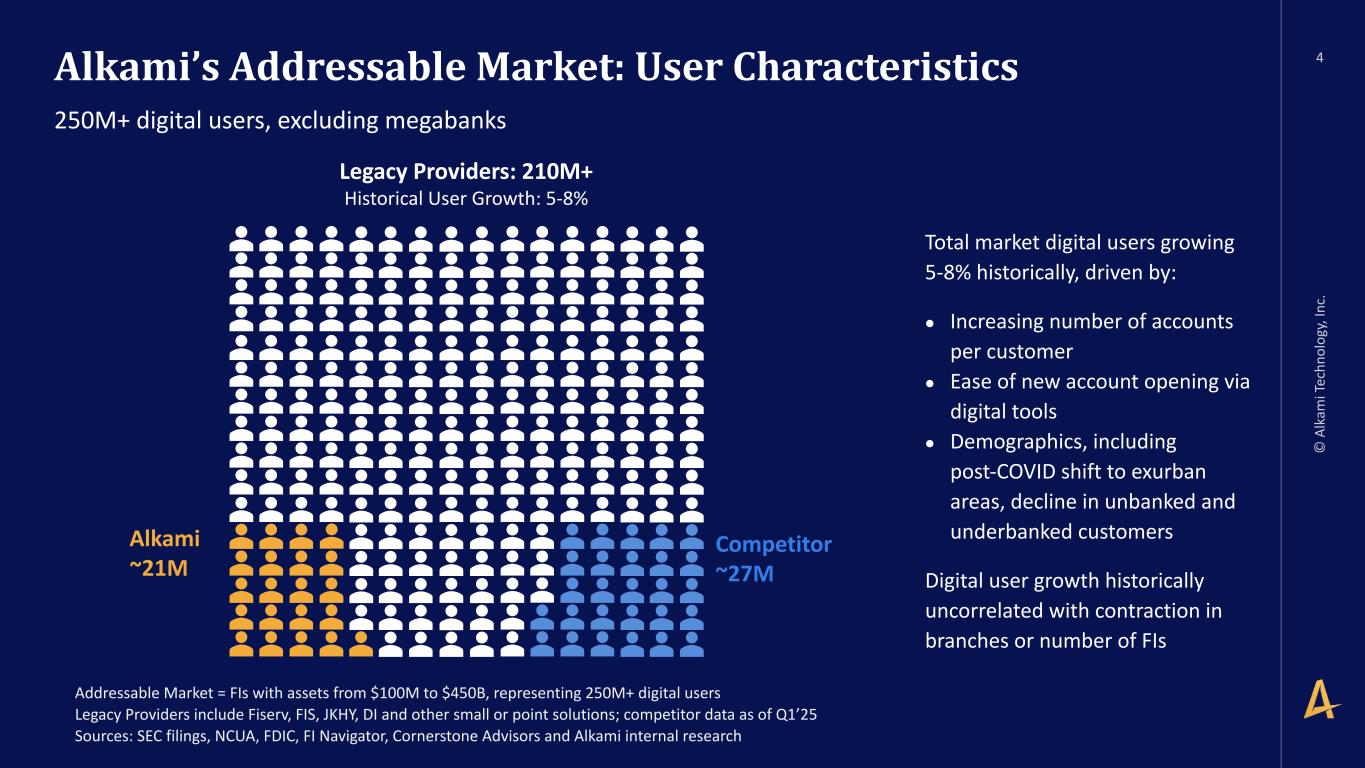
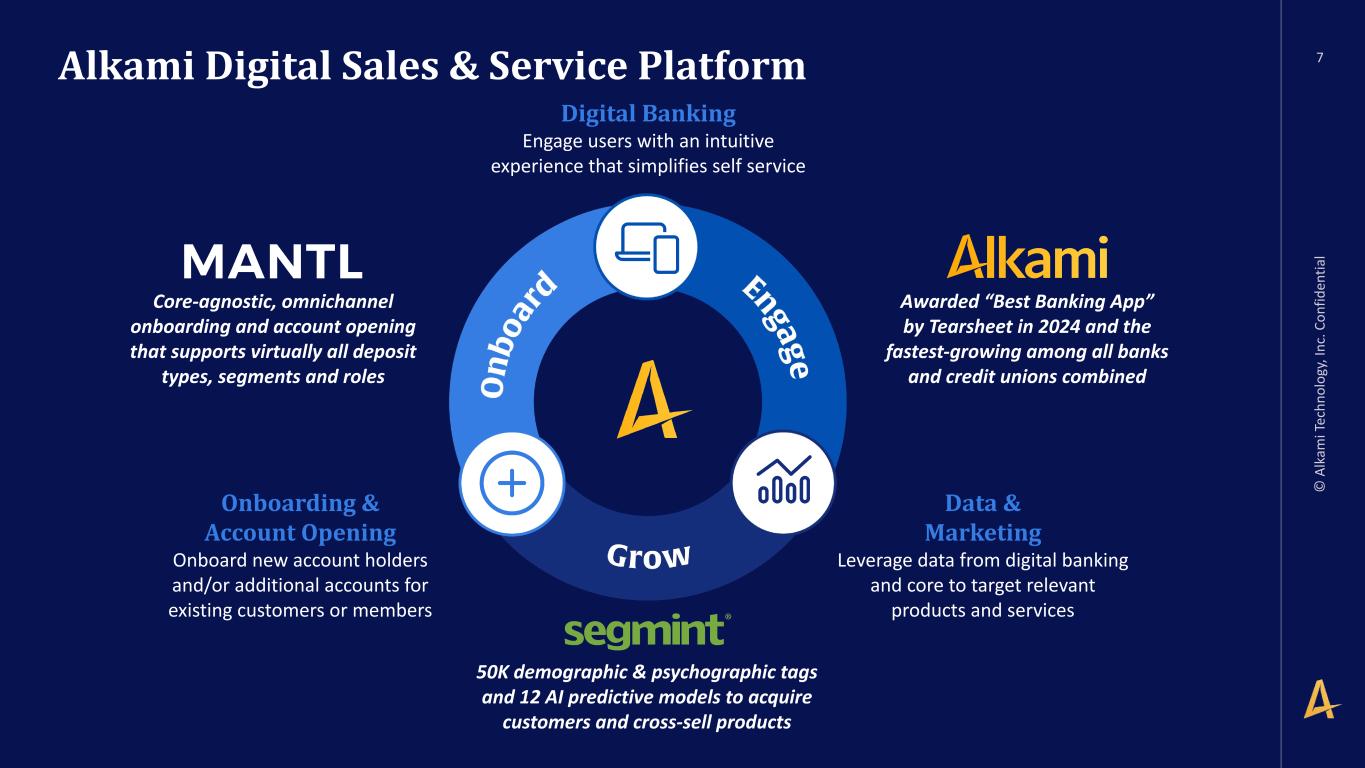
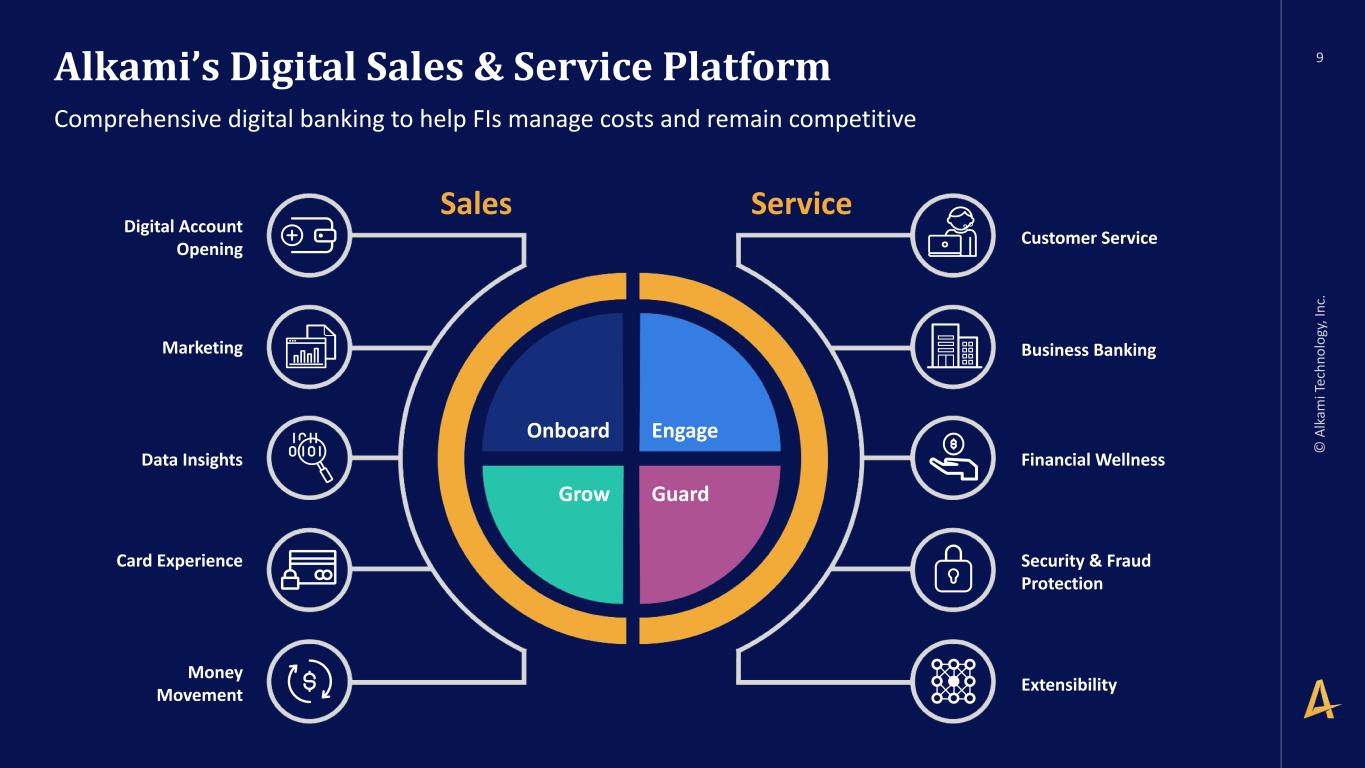
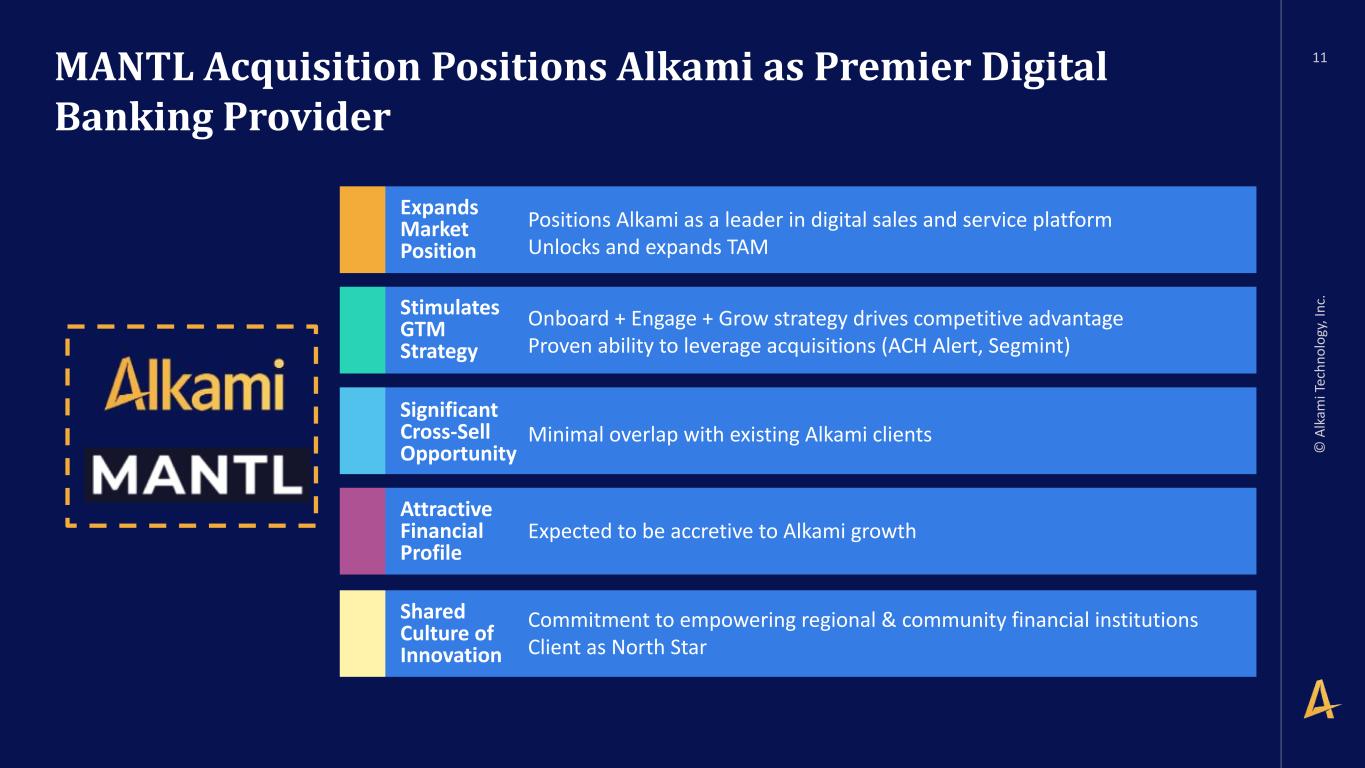
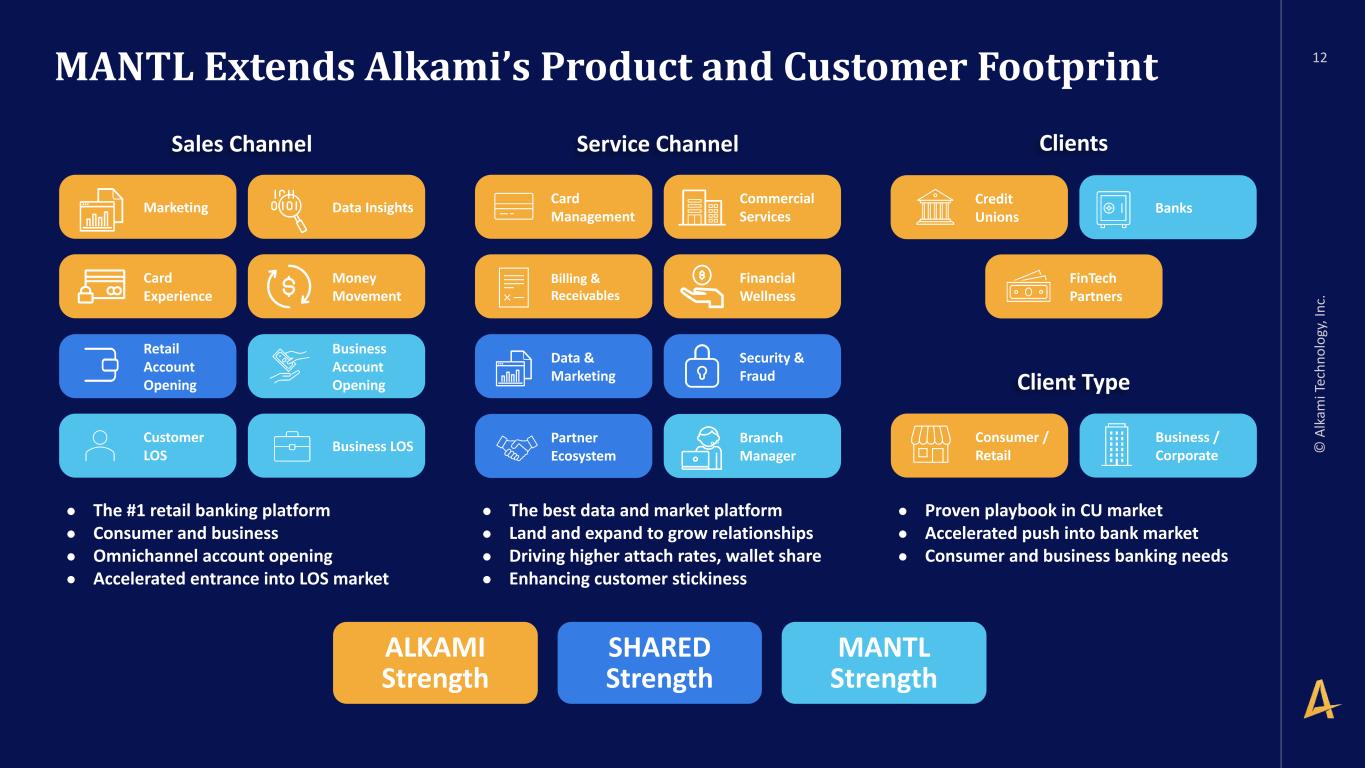
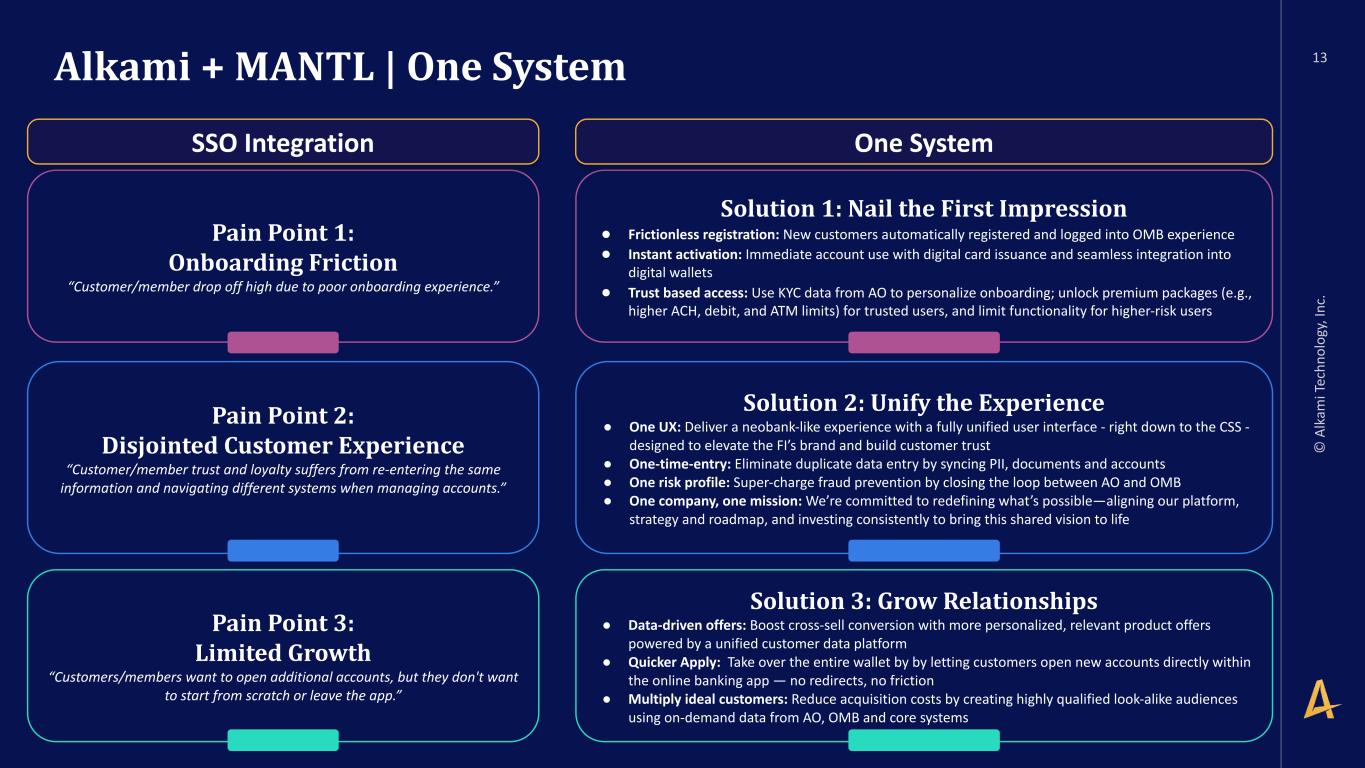
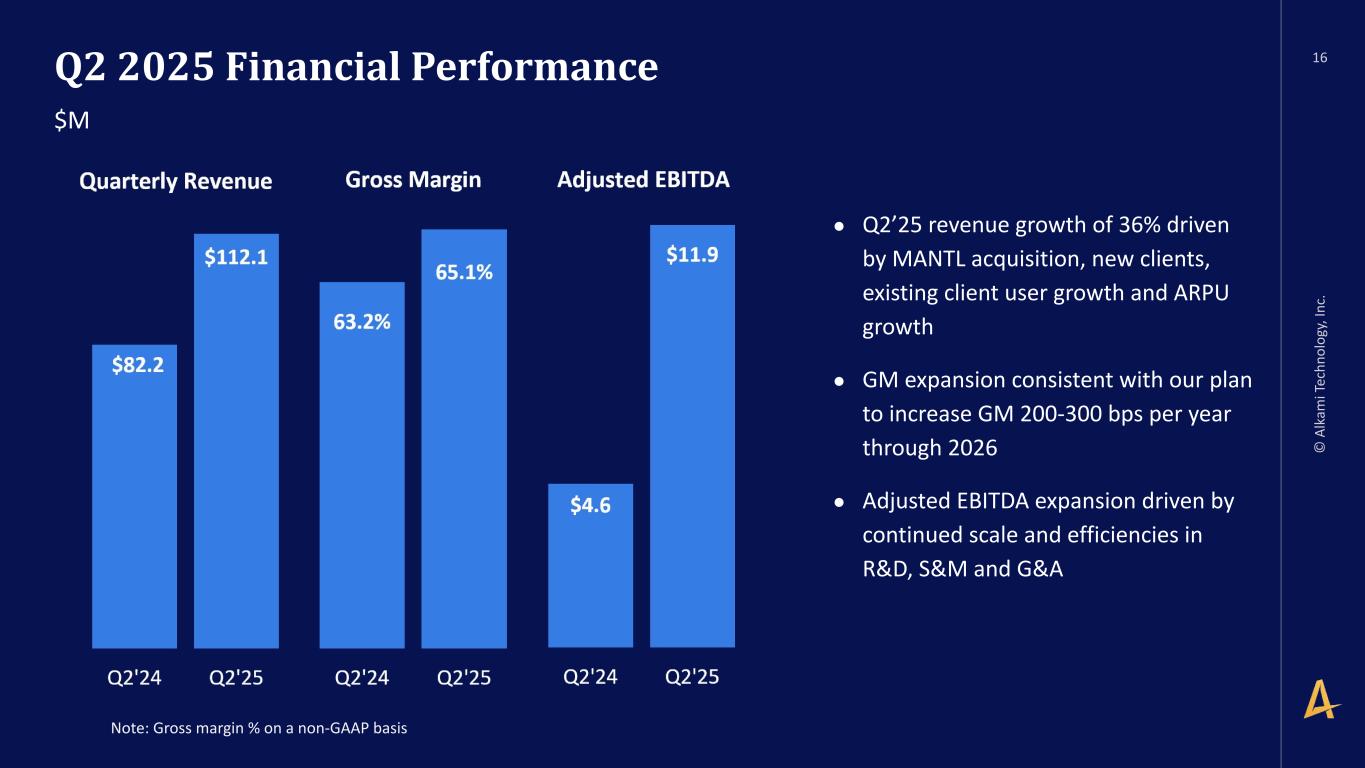
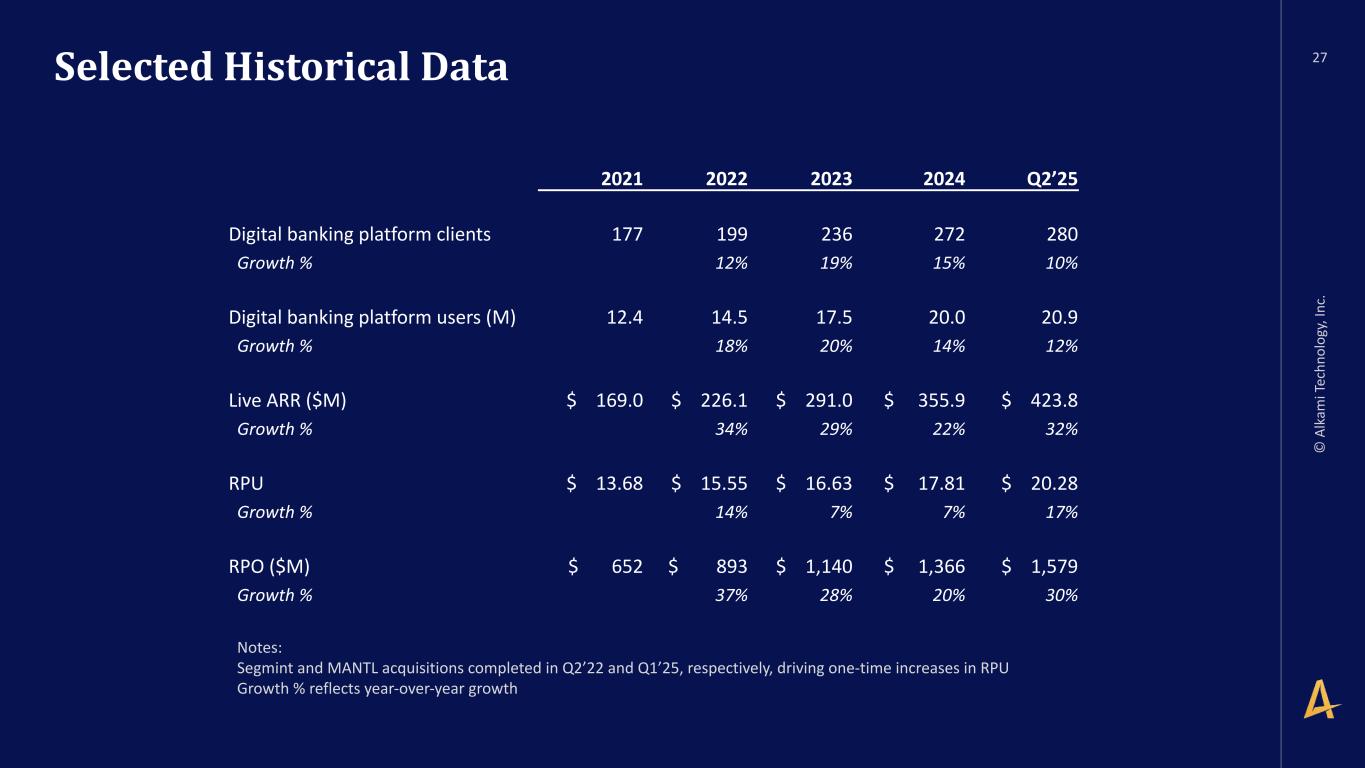
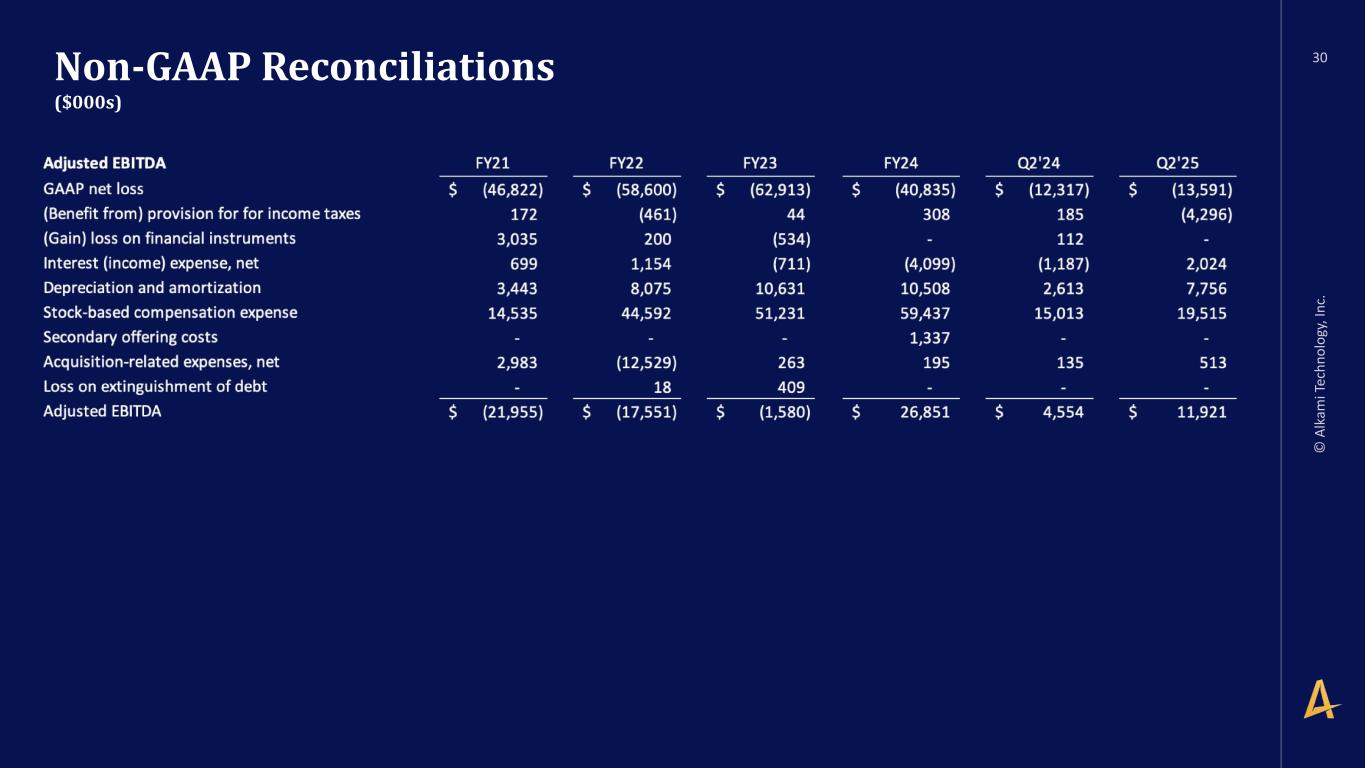
Good afternoon, and thank you all for joining us. Alkami continued to deliver strong financial results in the second quarter, driven by sustained top-line execution, while also exceeding our profit commitments. During the second quarter, Alkami grew revenues 36% and generated $11.9 million in adjusted EBITDA. We exited the quarter with 20.9 million registered users on the Alkami Platform, up 2.3 million from the prior quarter. We continue to enjoy a healthy pipeline as digital transformation remains a priority for regional and community financial institutions. We are still seeing the industry dynamics that have driven Alkami's growth to date. Digital banking is a mandatory innovation. The number of digital accounts continues to grow, and modern technology and user experience remain a winning combination. This industry demand and our own execution has kept us in the top quintile of vertical SaaS growth, even as we demonstrate the ability to create operating leverage in our business. In addition to our overall performance, we're pleased with the early commercial success of the MANTL acquisition. In the first half of 2025, MANTL added 39 new clients, a record for MANTL on a stand-alone basis. Among these 39, 14 are Alkami digital banking clients, demonstrating an early ability to introduce MANTL into the Alkami installed base. If we achieve cross-sell results consistent with other acquisitions, this can have material implications for our future growth. As a reference point, historically, 70%, and in the first half of 2025, over 90% of our new digital banking clients also bought our data and marketing solution, which is based upon our segment acquisition. As our clients realize the value of MANTL, we could see onboarding and account opening achieve a similar level of success. Along with our cross-sell opportunity, we now have 2 strategic platforms by which we can create a new logo relationship for Alkami. In the first half of 2025, Alkami sold 13 new logos with our digital banking platform. In the same period, MANTL sold 25 non-Alkami new logos with our onboarding and account opening platform, increasing our year-to-date new logo ACV by over 70%. What do I mean when I say that onboarding and account opening is a strategic platform on par with digital banking? Two weeks ago, I was talking with the CEO of a regional financial institution in the middle of Pennsylvania. She told me, as the rate environment fluctuated over the last couple of years, we've managed by issuing high-cost promotional CDs and buying wholesale loans. But this is too costly over the long term. We have to attract core deposits from younger account holders, and the only way we will do this is with an elegant onboarding and account opening platform that will let us compete with Bank of America. Our market increasingly sees a modern onboarding and account opening platform as mandatory innovation for attracting and growing low-cost core deposits. Progress on product integration is exceeding our expectations as well. Our intent is to deeply integrate account opening with online banking and data and marketing. This will enable our clients to deliver the type of experience that only a few of the largest financial institutions and fintechs can create today. Let me give you some examples. First, financial institutions want to target a potential new account holder through a marketing program that leads them to the financial institution's website. Once the account is opened, the new account holder is automatically registered and logged into digital banking. The account is funded and then enabled for immediate use for digital card issuance and integration into digital wallets, increasing the ability for the financial institution's card to be top of wallet. The financial institution can use KYC data from account opening to set dynamic premium packages like higher ACH, debit and ATM limits for trusted account holders and limit functionality for higher risk account holders. Second, the financial institution is on an integrated user experience, where personal and business data, documents, and account information flow across a single profile. This eliminates friction, which will increase conversion and cross-sell opportunities as well as close the traditional fraud gap between account opening and online banking. Third, financial institutions want to deepen account holder relationships with a unified platform and embed data and marketing, which surfaces the next best product or service at the exact right moment inside the banking app with no redirects. All this boosts cross-sell, increases wallet share, and cuts acquisition costs. The on-demand data from account opening, digital banking, and the core banking system allows the financial institution to create high propensity look-alike audiences for future campaigns, which further drives growth and lowers acquisition costs. These are just the first 3 experiences we are creating for our clients to bring to their account holders. The combination of the modern platform, award-winning digital banking, market-leading onboarding and account opening technology, and innovative data and marketing products will allow us to build capabilities for our clients that only a few of the largest financial institutions and fintechs can create. Our clients will have access to a digital sales and service platform that will allow them to compete with mega banks and own their markets. As we share our product roadmap with clients and prospects, the response is more enthusiastic than we anticipated when we evaluated the acquisition. With this in mind, we have decided to manage the separate Alkami and MANTL sales teams under 1 leader, Nathaniel Harley, who was the MANTL Co-Founder and CEO. This will allow Alkami to take advantage of the power of the integrated platform and enable MANTL to operate as a stand-alone brand to remain open when working with other technology providers. We're excited to have Nathaniel in this role as Alkami has great depth of credit union experience to which Nathaniel adds banking knowledge today; roughly 70% of MANTL clients are banks. In closing, the demand environment for our products remains strong, and I'm proud of our team for delivering another strong quarter for our investors. I'm energized by our continued innovation and I look forward to seeing how the products and technology we are introducing will power Alkami's growth for the rest of 2025 and beyond. I'll now hand the call to Bryan to take us through our financial results.
Speaker 3
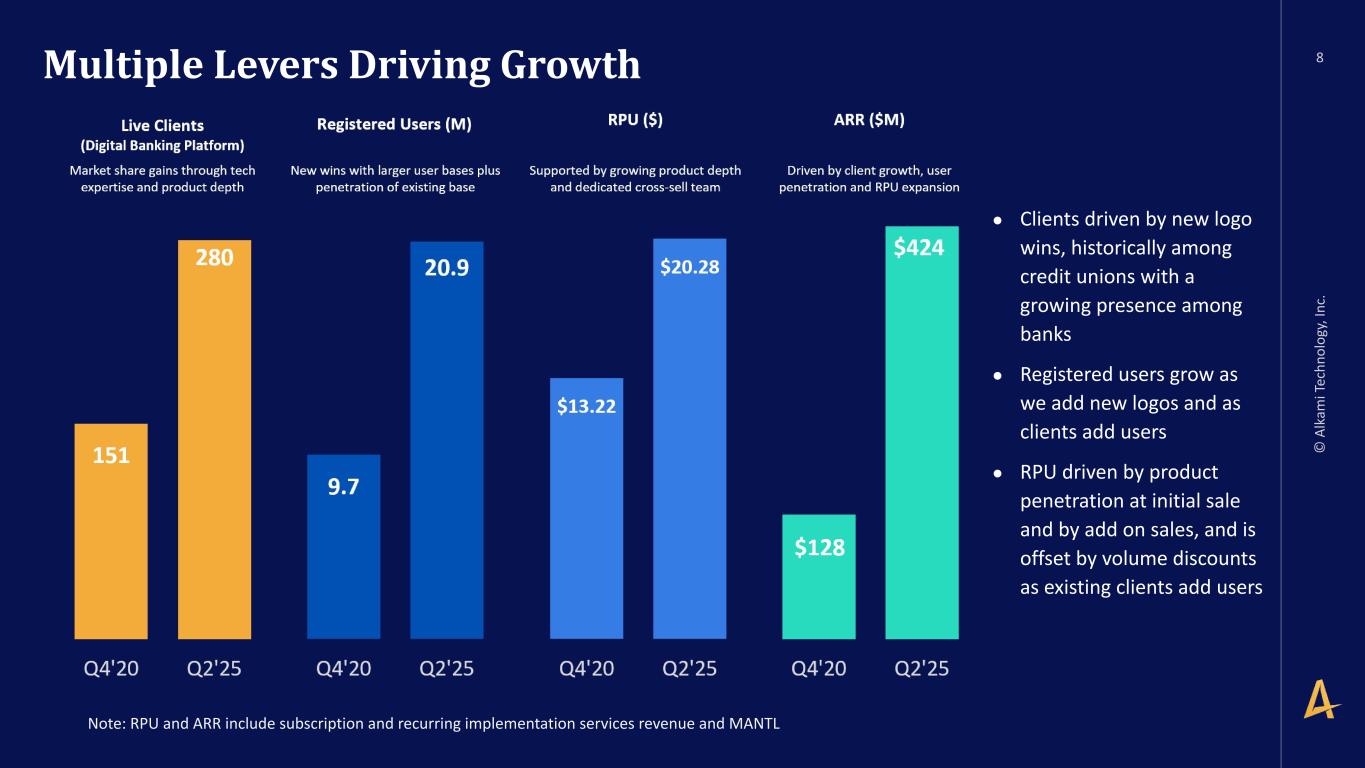
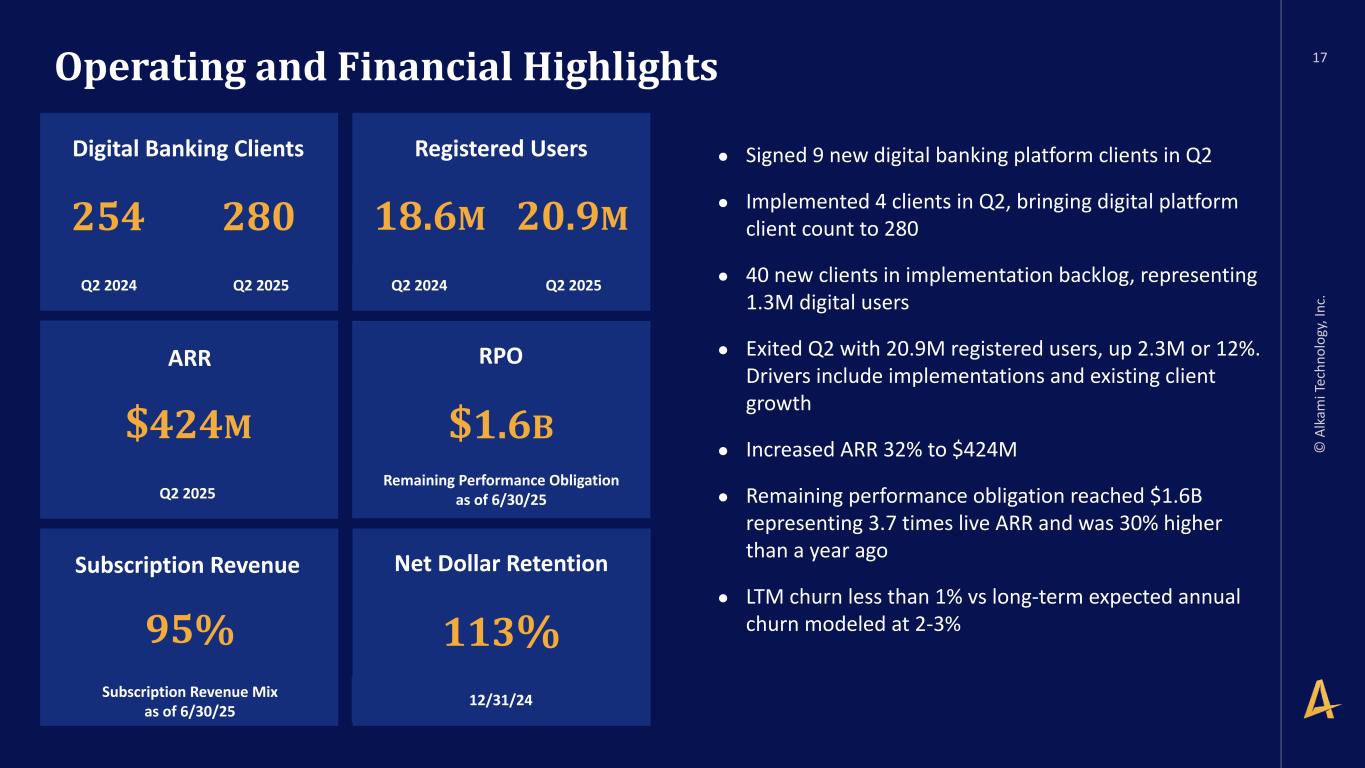
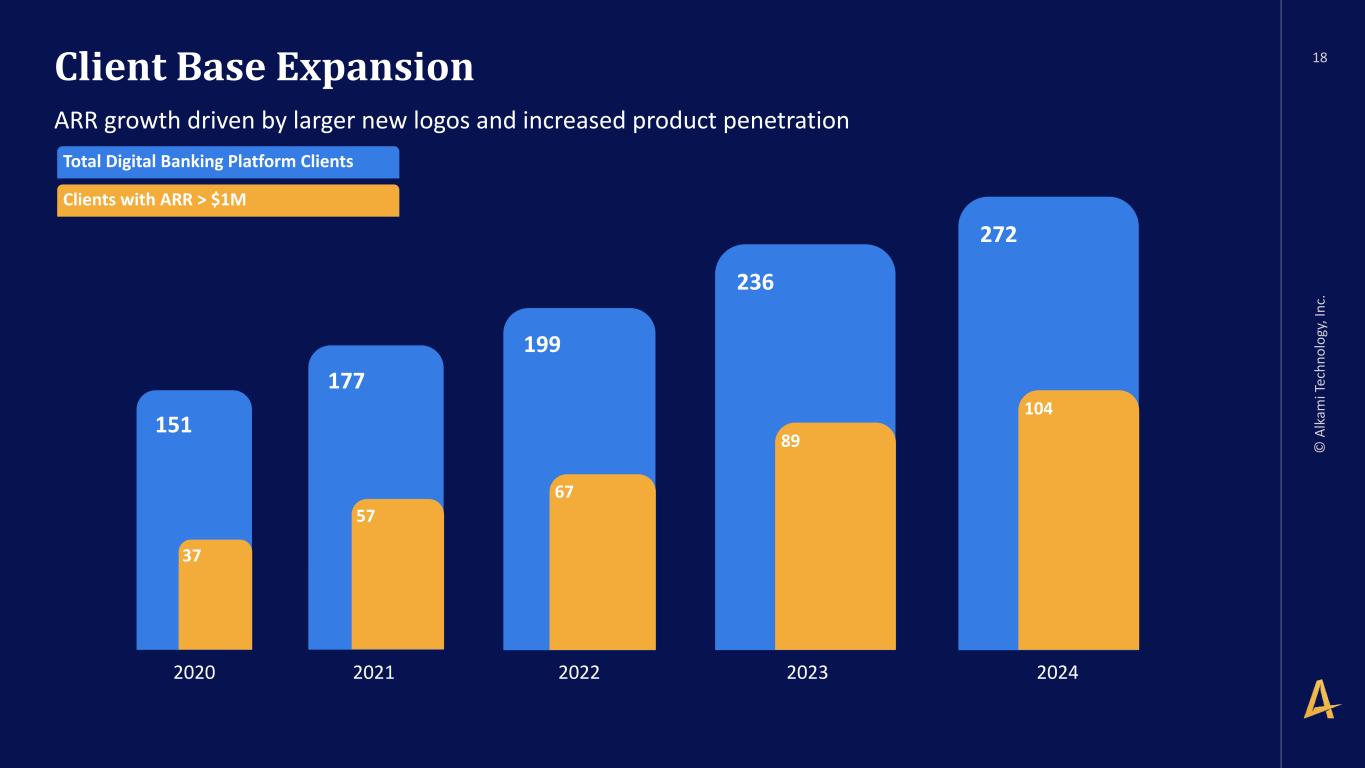
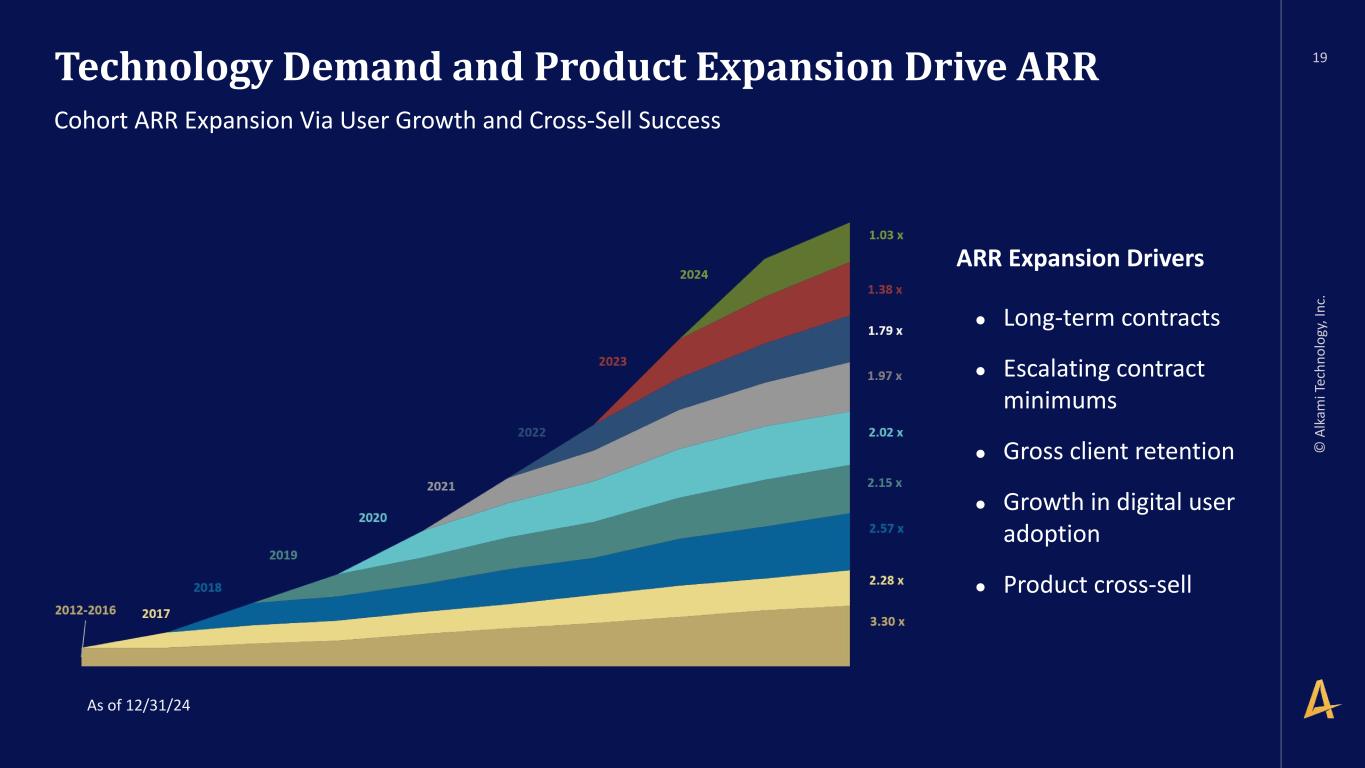
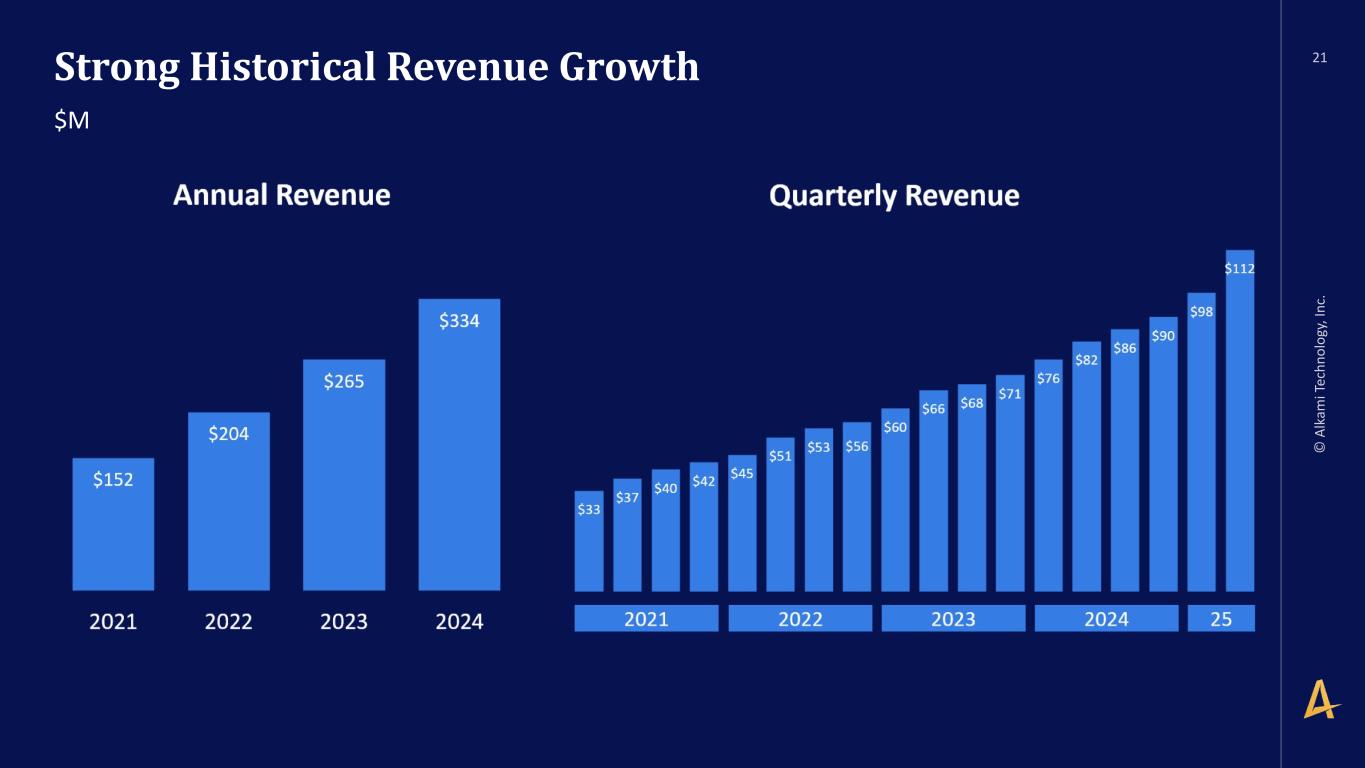
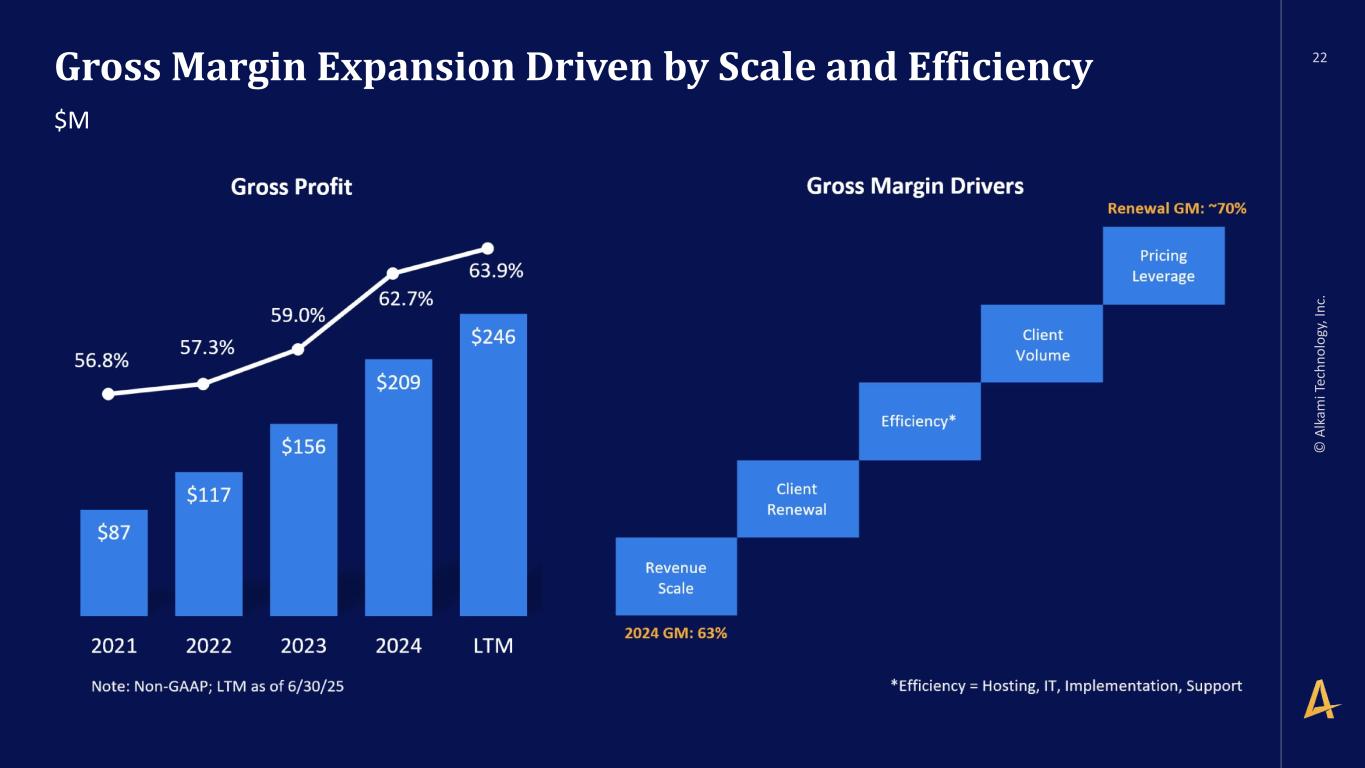
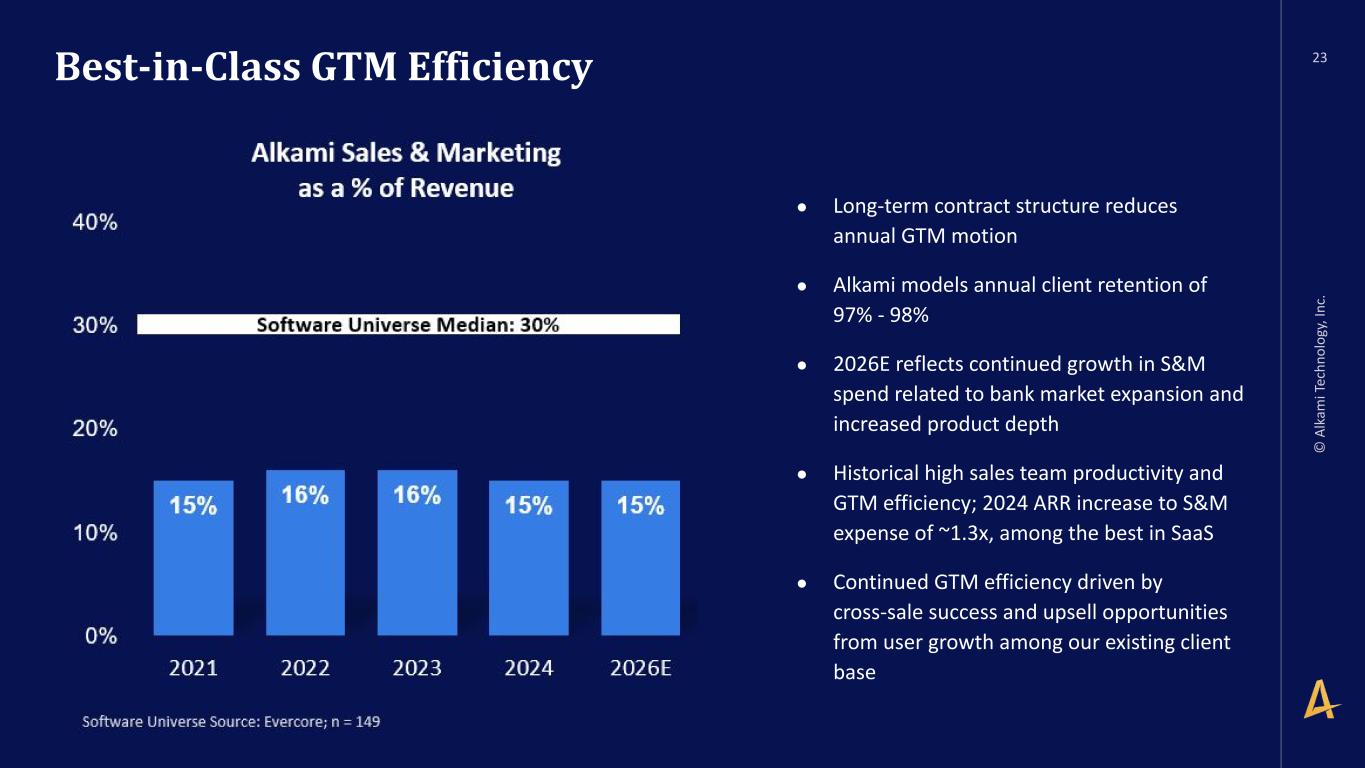
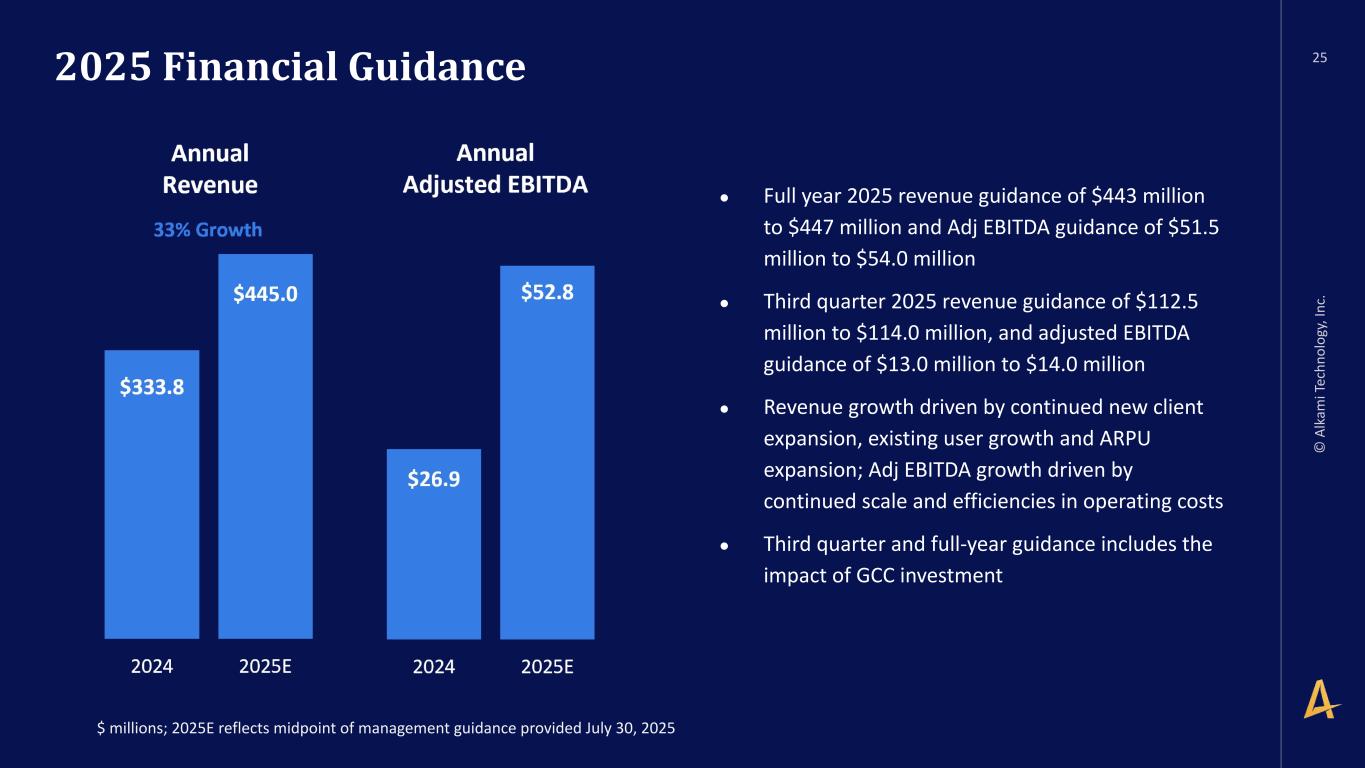
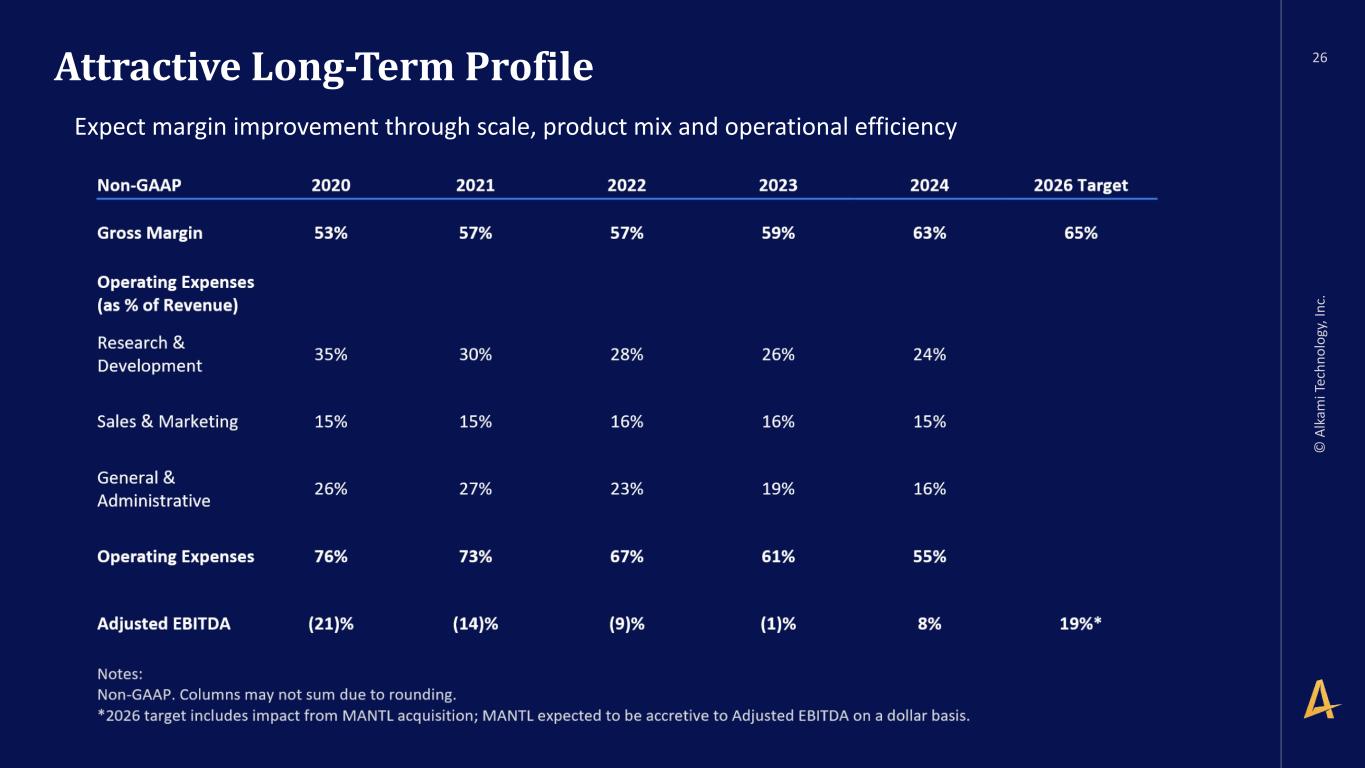
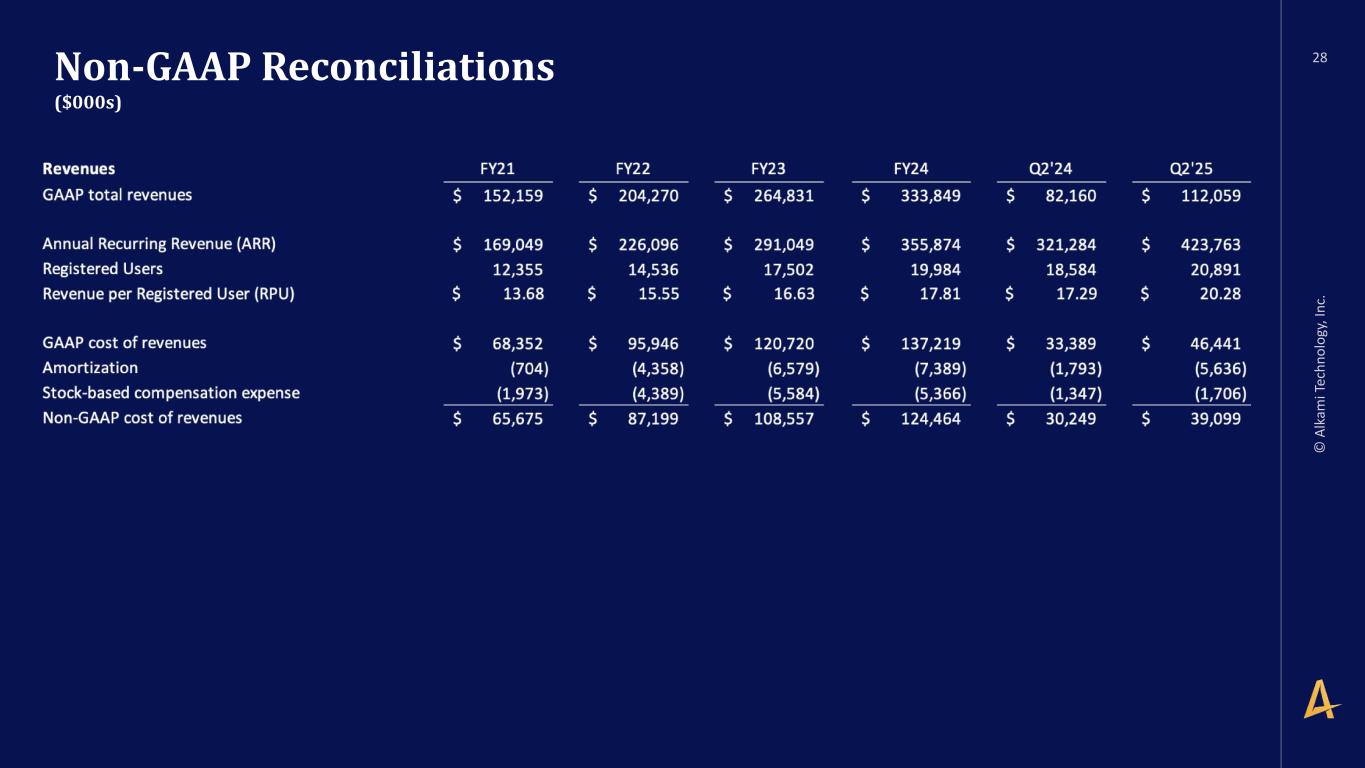
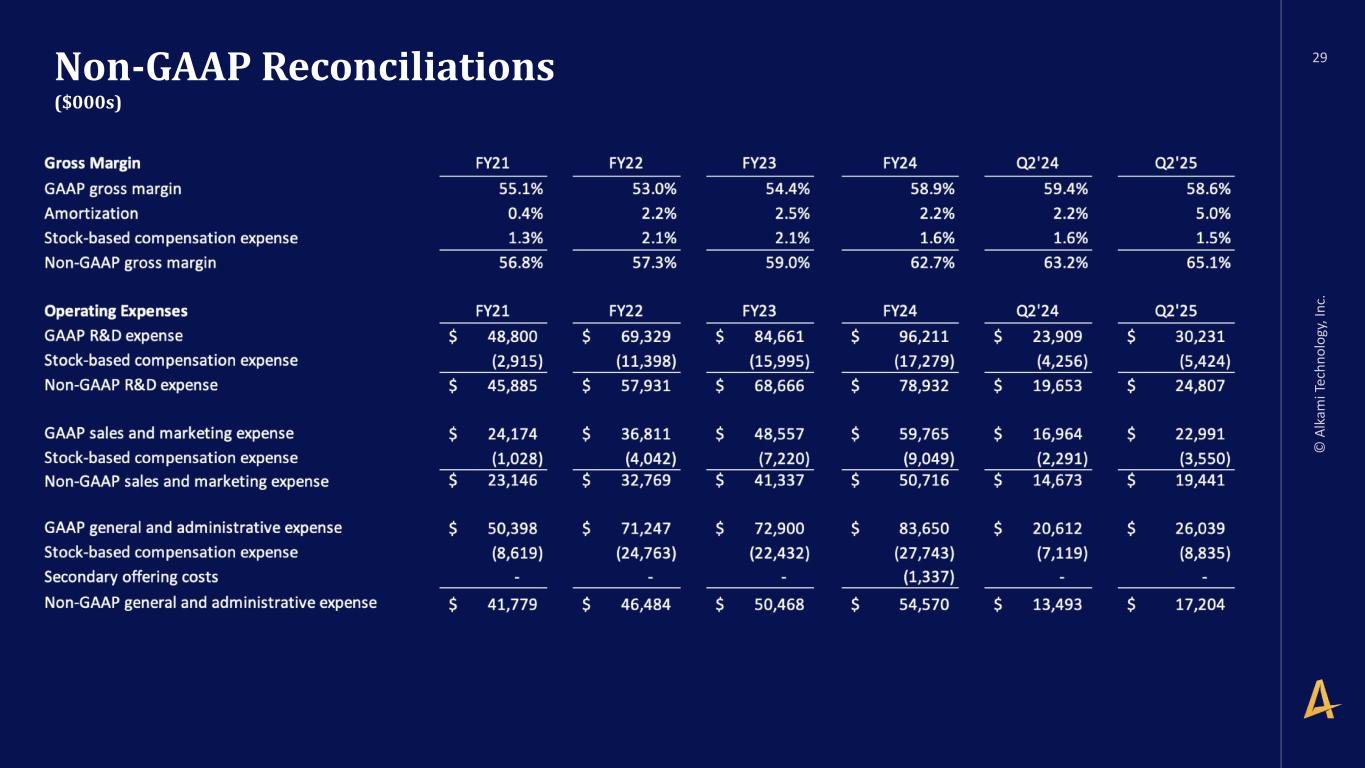
Thanks, Alex, and good afternoon, everyone. In the second quarter of 2025, we continue to drive strong revenue growth and outperformed our profitability objectives. In the second quarter, we achieved total revenue of $112.1 million, representing year-over-year growth of 36% and organic growth of 28%. We improved adjusted EBITDA to $11.9 million compared to $4.6 million in the year-ago quarter. Subscription revenue grew 35% in the second quarter and represented 95% of total revenue. We increased annual recurring revenue (ARR) by 32% and exited the quarter at $424 million. We currently have approximately $68 million of ARR backlog for implementation, the majority of which will occur over the next 12 months. Included in our backlog are 40 new digital banking clients representing 1.3 million digital users; we exited the quarter with 280 live clients and 20.9 million registered users on our digital banking platform, representing registered user growth of approximately 2.3 million or 12% compared to last year. Over the last 12 months, we implemented 31 financial institutions and 5 clients left our platform. As a reminder, due to the long-term nature of our contracts, we have 3 to 4 quarters of visibility into upcoming client attrition. Currently, we expect a churn total of 4 clients in 2025, representing less than 1% of ARR. We also have 2 clients merging with existing Alkami digital banking clients where we will retain the digital users. Over the long term, we model digital banking ARR churn at 2% to 3% per year, which we have historically outperformed. Our churn produced higher-than-expected termination fees in the second quarter. While this was in our 2025 full year expectations, the timing between quarters can be uncertain. As a reminder, the primary driver of our churn is related to M&A within our client base, and we tend to benefit from this activity. In 2025, we expect to net over 300,000 users from financial institution consolidations. We ended the quarter with an RPU of $20.28, up 17% compared to a year ago, driven by the acquisition of MANTL and add-on sales success. We continue to see broad-based demand across our product portfolio. This is reflected in our sales pipeline, new logo and client renewal success, our ability to cross-sell new products into our installed base, and now the rate at which we are seeing the market adopt the MANTL onboarding and account opening solution as well as our marketing and data analytics solution. For the second quarter, we signed 9 new digital banking platform clients and renewed 6 existing clients, representing 15 online banking contract signings. One renewal during the quarter was for a top 5 client with over 700,000 digital users. We expect a total of 25 renewals in 2025. MANTL added 23 new clients in the second quarter, including 3 attached to Alkami digital banking wins and 6 that are existing Alkami digital banking clients. Our add-on sales effort continues to increase as a percentage of total sales. For the first half of 2025, our add-on sales effort, excluding MANTL, represented over 60% of new sales for the quarter. This compares to 55% for the first half of 2024. Our remaining performance obligation was approximately $1.6 billion, representing 3.7 times our live ARR and up 30% compared to a year ago. Now turning to gross margin. For the second quarter of 2025, we delivered non-GAAP gross margin of 65.1%, representing nearly 200 basis points of expansion compared to the prior year. We achieved gross margin expansion through continued improvement in our hosting costs driven by platform investments as well as operating leverage across our post-sale operations. Moving on to operating expenses. For the second quarter of 2025, operating expense of $61.5 million, or 54.8% of revenue, represented year-over-year operating leverage of approximately 340 basis points. We primarily drove operating leverage across R&D and G&A, where we continue to realize operational scale. We are on track for adding engineering talent at our global capability center located close to New Delhi, India's national capital region. We now have approximately 70 Alkamists at this facility with an expectation of over 175 Alkamists as we exit 2025. As we discussed the last several quarters, during 2025, we expect to invest approximately $5 million in this facility. We are still planning to complete the transition from our outsourcing partner during 2026 and we do not anticipate any impact on our 2026 financial targets, although we do expect to see a positive impact on margins beyond 2026. Related to sales and marketing expense, we typically conduct our client conference in the second calendar quarter, resulting in approximately $3 million in seasonally higher expense during this quarter. However, in 2025, our client conference bridged 2 quarters, resulting in smaller, seasonally higher operating expenses in both quarters. In terms of go-to-market efficiency, we continue to rank among the best in SaaS. Including our MANTL acquisition, sales and marketing expense is expected to be between 15% and 16% of revenue for 2025. Our adjusted EBITDA in the second quarter was $11.9 million, better than the high end of our expectations and representing an adjusted EBITDA margin of 10.6%. The MANTL acquisition was 190 basis points dilutive to our adjusted EBITDA margin, in line with our expectations. We expect a positive adjusted EBITDA contribution from MANTL in 2026. MANTL will continue to be dilutive to adjusted EBITDA margin over the next few years, albeit at a declining level. Turning to our balance sheet, we ended the quarter with $87 million of cash and marketable securities. During the second quarter, we used a portion of our cash on balance sheet to reduce our revolver by $10 million, bringing our current balance to $50 million. Now turning to guidance. For the third quarter of 2025, we are providing guidance for revenue in the range of $112.5 million to $114 million, which represents total revenue growth of 31% to 33%. For adjusted EBITDA, we are providing third-quarter guidance in the range of $13 million to $14 million. For full year 2025, we are providing guidance for revenue in the range of $443 million to $447 million, representing total revenue growth of 33% to 34% and organic revenue growth of 25% to 26%. We have not changed our full-year revenue guidance from last quarter due to the component of the second quarter beat related to the previously mentioned timing of termination fee revenue. We are also providing full-year adjusted EBITDA guidance of $51.5 million to $54 million, representing a raise of $1.8 million above the midpoint of our previous full-year guide. In conclusion, we are pleased with our impressive revenue growth and margin expansion. We remain positive about the demand environment and our continuing ability to acquire, grow and retain our clients. This gives us confidence in our ability to achieve our long-term financial objectives and drive shareholder value. And now I'll hand the call to the operator to take your questions.
Operator
And your first question comes from Saket Kalia from Barclays.
Speaker 4
This is Ryan Powderly on for Saket tonight. Alex, maybe to start with you, now that you're starting to get some of these new logos attaching MANTL onto deals from the start. I'm just kind of curious what kind of starting ARPU for these new logos are you seeing compared to the blended average of around $20 of your reports here in Q2?
Speaker 3
Yes, I'll take that one, Ryan. The way to think about MANTL is, MANTL adds 30% to 40% of ARR to a new logo deal. So for the new logos that we've been landing over the last couple of years, those are online banking new logos, and they average around $800,000 of ARR. You can expect between 30% and 40% higher value when attaching MANTL.
But what I would add to that, this is Alex, is on a stand-alone basis. Recall that MANTL's client base is 70% in the bank market. There are some larger banks that MANTL sells to. And on a stand-alone basis and a full omnichannel solution for a larger bank, this can open up a multimillion-dollar relationship with us even on a stand-alone basis.
Speaker 4
Got it. That's super helpful. Bryan, maybe for my follow-up for you. I think we added about 400,000 just using round numbers, of new users this quarter. I'm just curious how that parses out between new customers versus existing. I think in the past we've talked about adding around 100,000 per month in users from the existing base? Just curious if that equation has changed at all.
Speaker 3
Yes. So in 2025, our implementation schedule for online banking new clients that we're implementing, it's more back-half heavy. So in the second quarter of the approximately 400,000 digital users that we added, 25% of those were from implementations, and the remaining 75% were added from existing clients because we did have a couple of clients that attrited during the quarter.
Operator
And your next question comes from Cris Kennedy from William Blair.
Speaker 5
Can you just give us an update on the bank channel and how MANTL can improve that opportunity or your position to capture that?
Thanks. I continue to be pleased with the progress that we're making in the bank market. If you look at where we are today from an online banking perspective, banks under contract represent 13% of our total clients under contract. In 2024, we implemented 11 banks, and right now, we plan to implement 16 banks on the online banking platform. But once again, what's exciting about putting Alkami and MANTL together is that given MANTL's presence in the bank market, that represents another way for us to create a new significant relationship in the bank market. So overall, I'm pleased with the progress that we're making in the bank market.
Speaker 5
Great. And then just a small one. Is there any way to quantify the term fees that were brought ahead, pulled forward a little bit?
Speaker 3
Yes. Term fees during the quarter represented about 70% of the beat. So we beat from a revenue basis, we beat the high end of our guidance at $1.6 million, and the term fees that shifted from the back half of 2025 into the quarter were about $1 million. It's also important to note that by the term fee accelerating into the second quarter, that also means the client left the platform in the second quarter, so the ARR associated with that, the subscription revenue associated with that client is no longer in the back half of the year.
And then the part I would add is we use the terminology termination fee, but termination fee is almost 100% related to M&A activity in the market. As you noted in Bryan's prepared remarks, we continue to be a net gainer in terms of M&A activity.
Operator
And your next question comes from Eleanor Smith from JPMorgan.
Speaker 6
This is Eleanor Smith from JPMorgan. Now that you've had a few months of cross-selling MANTL, could you share if there's a particular type of customer that has shown the most interest in the product?
Yes, this is Alex. I would just say kind of to my prepared remarks, this is a good intersection of a good product and a market need. If you think about up until the interest rate increase just a couple of years ago, interest rates were pretty low for a very long time, and so money was very sticky inside of financial institutions. Where the interest rates increased, money got hot and started moving and chasing higher interest rates. As I noted in the CEO's comments, we're hearing the same from almost every customer I met with: folks try to react in the moment by doing things like issuing promotional CDs and doing a lot of things that were expensive to attract deposits so they could make loans, which is obviously how they make money. As that's kind of become okay and business as usual, we're now having to be in a perpetual attraction of deposits in core deposits. So really, the buyer for us is almost any financial institution, and that's being driven by the fact that their business environment changed quite a bit since 2022.
Speaker 6
That's helpful. Also from us, are there any particular products or capabilities that are supporting your endeavors to win with the regional banking customers specifically?
Well, 2 things. One, obviously, with respect to onboarding and account opening, that is strong in the bank market. Our ACH Alert product and positive pay product are strong in the bank market. We continue to build out our treasury management capability, which is attractive to the regional bank market.
Operator
And your next question comes from Jeff Van Rhee from Craig-Hallum.
Speaker 7
Just a few. Starting maybe with MANTL, you talked about 39 new customers. I think you referenced 14 were Alkami digital banking customers. Kind of curious about the other customers there. Were most of those going into an existing digital banking platform and layering on top, or were they going in with a new digital system being implemented? Just you've got a little more visibility into those customers that are not on Alkami. Wondering what you're learning there.
Thanks for the question. Obviously, every customer already has a digital banking system. As we've talked about before, it's a 100% replacement market. One of the great things about putting Alkami and MANTL together is that MANTL has the ability to open a new account for Alkami even though there's an existing digital banking platform in place. That's primarily the new logos that we're continuing to win by MANTL stand-alone into a bank or a credit union that has an existing digital banking platform.
Speaker 7
Interesting. Great. And then on the sales front, Alex, I think you commented about you really like what you were seeing in the pipeline. Maybe just spend a minute and expand a bit more on what you're seeing there. Along those lines, I have 2 specific questions. You're putting MANTL and Alkami teams under 1 leader. Curious your thought process, what triggered that here? And also related to the sales and sales pipeline, I think last year you had 21 new logos in the second half. Just curious if you think you could be up over that year-over-year.
Well, I would be silly to forecast the number of new logos in the back half of the year. But our pipeline continues to be strong, and it continues to be balanced between banks and credit unions. So we're pleased with the pipeline. The decision on putting the Alkami sales team and the MANTL sales team under one leader is really the following: If you think about what we have learned and executed from a go-to-market perspective, we've got a stand-alone MANTL team that sells MANTL to customers that may have Alkami or may not have Alkami. And that go-to-market is very precise—go win new logos for MANTL. We have an account management team that takes care of the Alkami online banking customers, and that go-to-market is very clear. Those account managers should look for MANTL opportunities and then bring in the MANTL sales team. The place where we had the biggest opportunity to bring together messaging and go-to-market approach is when we've got a new customer pursuit that's online banking and there's an interest in MANTL as well. We wanted to make sure that we took advantage of what we think is a pretty powerful differentiation in terms of the product offering that comes from the data marketing platform, integrated with online banking, integrated with onboarding and account opening. In summary, our thinking process of bringing the teams together: we had a good motion on account management, a good motion on MANTL new logo, and a good motion on Alkami online banking new logo. We needed to create a really good motion when there was both a MANTL and an online banking opportunity because we think that creates a strategic advantage for us.
Operator
And your next question comes from Charles Nabhan from Stephens.
Speaker 8
I saw a release during the quarter indicating that MANTL is now working with Plaid. My question is following JPMorgan's announcement that they intend to charge for access to consumer data. Is that—do you expect that to have any potential implications on either MANTL or Alkami's business?
Well, first of all, account aggregation, account verification, transaction cleansing, and transaction data enrichment are all very desired capabilities by the end users of financial institutions. These are capabilities that we offer within the online banking platform and within the onboarding and account opening platform. We are in the same place as most of the rest of the industry, waiting and watching how the industry reacts to the potential fees that JPMorgan may implement. From my perspective, these are very important capabilities. We've obviously read and heard what JPMorgan intends to do, but we need to see what ultimately happens within the industry and then make adjustments to our strategy based upon that.
Speaker 8
Got it. And as a follow-up, I could appreciate that there's substantial opportunity for synergies with MANTL, and at some point, we'll just look at the business as one unit. However, is there any way to parse out the contribution to that $68 million backlog from MANTL this quarter? Getting questions on how we should think about that from an organic standpoint.
Speaker 3
Yes. I mean, Chuck, as you can imagine, it's hard to parse out any one product because of the manner in which we sell. It includes multiple products as it relates to new logos, along with stand-alone products for add-on sales and cross-sells. There's a component that's also related to our stand-alone segment, which includes marketing data analytics and MANTL for account opening and onboarding. It wouldn't be fair to look at any one product. What I can tell you is the backlog, if we were to parse out MANTL, is continuing to grow. Our ideas and forecast for the back half of the year would lead you to believe that our implementation backlog will continue to grow and even be at a higher point when we exit 2025. But to provide it for just a single product, it almost isn't a relevant data point.
Operator
And your next question comes from Mayank Tandon from Needham.
Speaker 9
Maybe for you, Alex, first. There's been a lot of talk about deregulation within the banking sector being a potential tailwind for tech spending. I'm just curious, have you seen any indications of that so far? What are you hearing from the bank customers in terms of their appetite for spending if there is deregulation? Any color on that would be helpful.
Yes. Thanks for the question. As we've noted over the last few years, the nature of online banking and now increasingly the nature of account opening and onboarding does not have a lot of elasticity depending upon what's happening with regulation, deregulation, a hot economy, or a slow economy. These are fundamental building blocks of the systems you need to run a bank. You have to have a core system, an onboarding system, a LOS system, a digital banking system, and payment systems. You have to manage fraud. For Alkami, it may be true that more discretionary spending in other areas of IT that could correlate with deregulation might lead to increased spending. However, these necessary systems see consistent spend irrespective of what is happening in the economy.
Speaker 9
Got it. Okay. And then maybe just turning to Bryan. Bryan, in terms of the levers to growth, as we think about the ARPU, which has been growing significantly over the last couple of quarters, and user growth has also been good but maybe moderated from what we've seen historically. How are you thinking about those levers going forward for the balance of 2025 and even longer-term?
Speaker 3
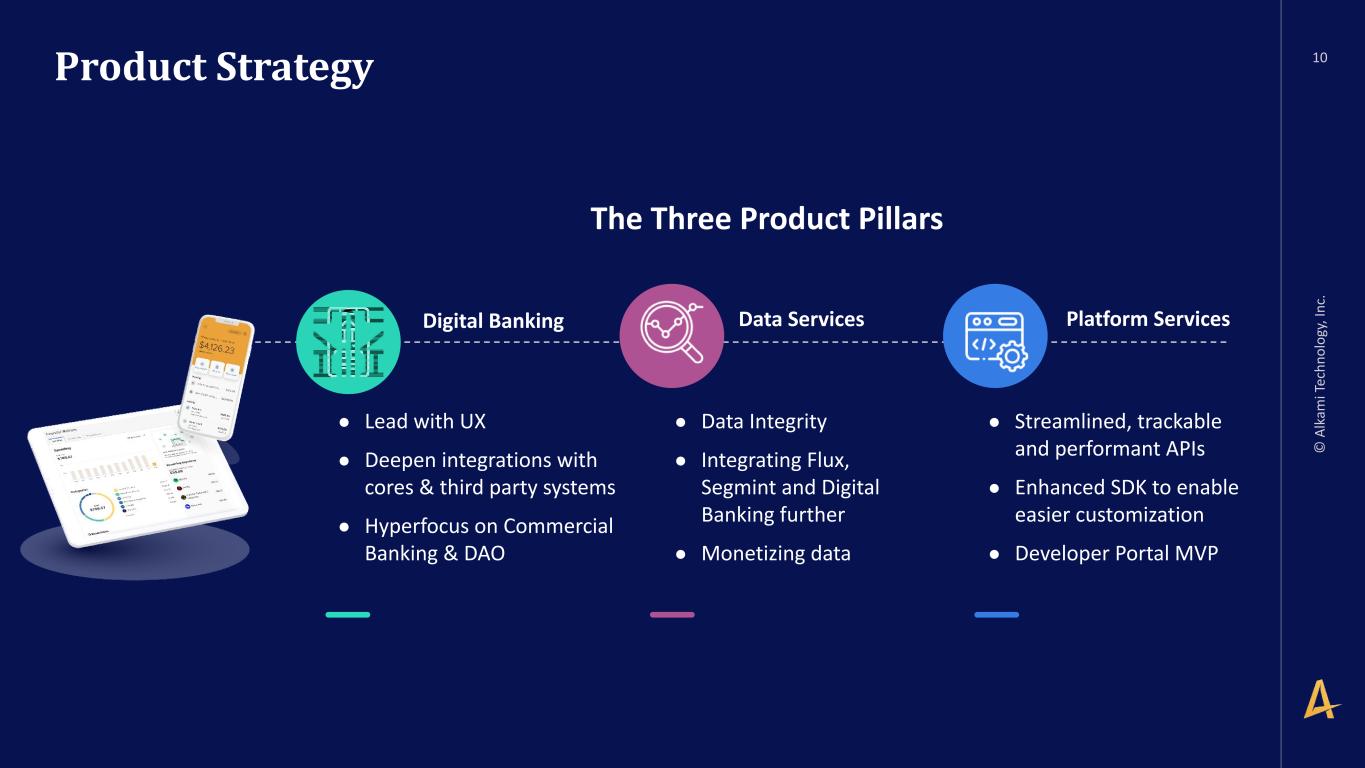
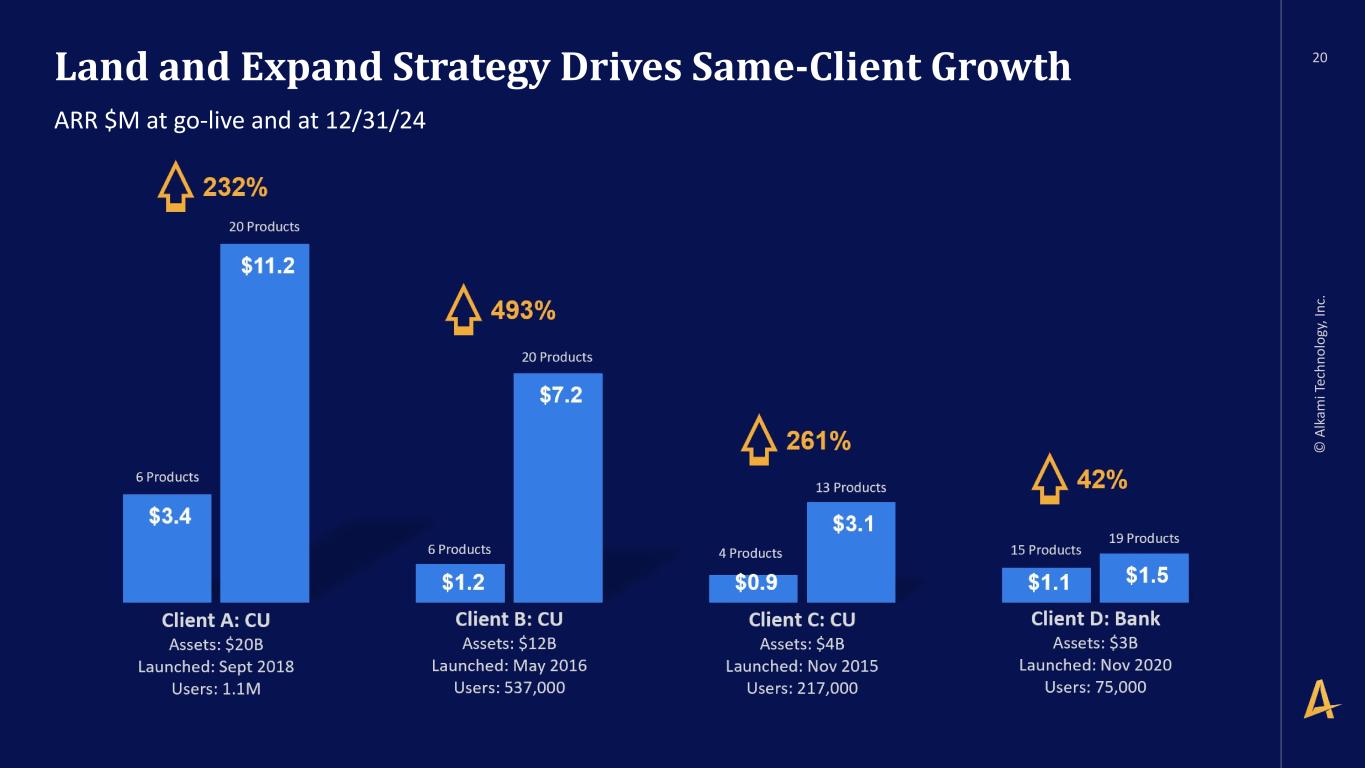
The contribution from each of those levers should continue to be consistent. Today, we see user growth at about 12% and ARPU expansion on an organic basis in that 6% to 7% range. ARPU will continue to outpace that as we have success with selling our digital account opening, online banking, and marketing data analytics products together. Out of our 320 contracted clients, 16 of those today have all three of those offerings. Approximately 1/3 of our clients under contract have marketing and data analytics. Our view is as we continue the integration strategy of these three platforms together, we can uplift the digital account opening piece to be comparably successful in the future as our marketing and data analytics, in terms of penetration.
Operator
And your next question comes from Pat Walravens from Citizens.
Speaker 10
Great. This part, it's not a question, just a comment. It's great to see Joe Payne joining the Board. Been a long time. My question, though, Alex, is around the GENIUS Act and stablecoins and how we think about the implications of that for community banks. I mean, I guess what the risks are and then the community bank lobby, I think, helped put some restrictions in this.
Thanks for that question, Pat. When I sit with customers, here's the conversation we have, which is, well, maybe there's some possibility that stablecoins might disrupt the entire community bank and credit union ecosystem. But we shouldn't plan around that because if that happens, you all aren't going to be here, and we aren't either. So what do we really think is going to happen? The way our customers view stablecoins is that it's a product they need to offer to their customers to retain deposits. If a customer of theirs wants to access a stablecoin, then they need to ensure that their deposits don't leave, so how can this be a product they offer? In general, we have about a 2-minute conversation about how stablecoins could blow up the world, and then it shifts to how they need to offer stablecoin products to retain deposits. But overall, I would say that, along with FedNow, are still very early in terms of clarity on what they should bet on. Most of our customers are still concerned about their ability to manage fraud in a real-time payment environment, so they are proceeding cautiously with the real-time payment piece, while being cognizant of stablecoins but not yet committing to one specific approach.
Operator
And your next question comes from Adam Hotchkiss from Goldman Sachs.
Speaker 11
I wanted to ask around M&A. I know historically you've talked about how mergers at the low end of the market could benefit Alkami by bringing more credit unions and banks into your buy box. Is there any updated view around how M&A impacts you guys, particularly as we see some larger financial institutions in the space pick up activity there?
Yes. I'll provide some overall comments, and Bryan may have additional perspectives based on numbers. I was talking to a large credit union CEO on the West Coast about a month ago. His view was that there are a couple of large mergers announced that have not been fully approved. When those mergers do receive approval, there may be an impetus for more M&A activity. But there’s a difference between bank M&A and credit union M&A. Bank M&A is traditionally done through a standard acquisition process, while credit union mergers are decisions made by boards to serve their members better through a merger of the two entities. In general, the sense among our customer base is that if those major mergers get approved, we might see more mergers that generate opportunities for us. Bryan, did you have some numbers in the prepared remarks?
Speaker 3
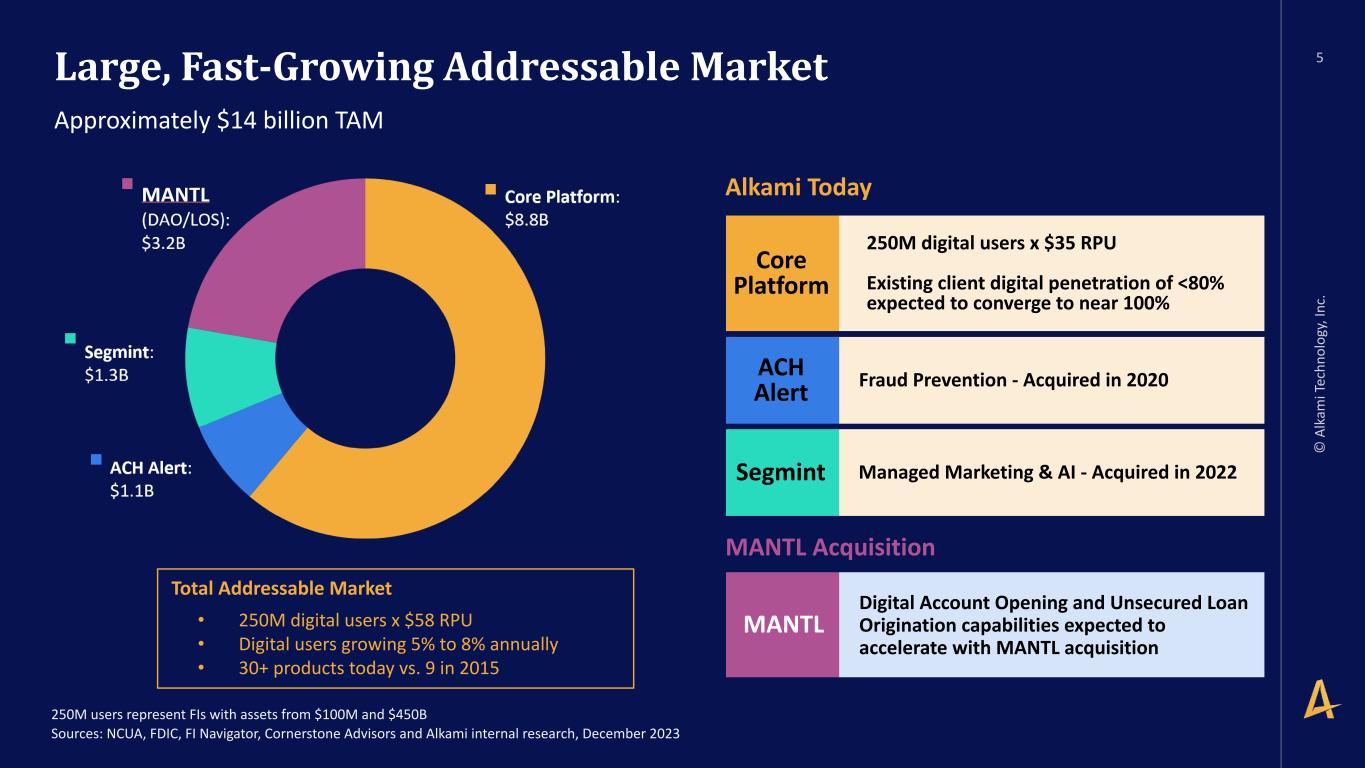
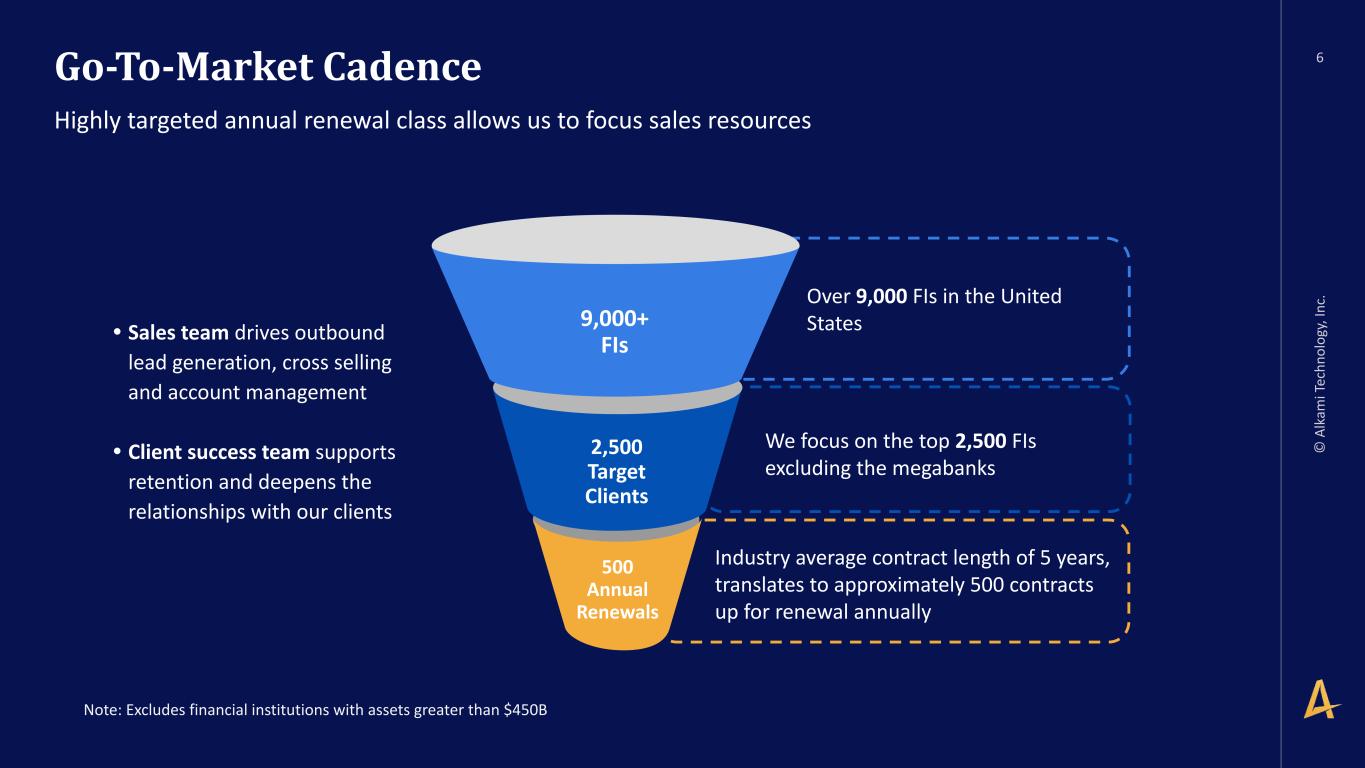
Yes. Just a couple of comments on consolidation activity. In most markets, consolidation can really lower TAM, leading to fewer buyers in your market. That's not the case for Alkami and other digital banking providers, as when there's a merger of financial institutions, they're merging to gain market share rather than consolidating existing clients. So our TAM remains unchanged, and our market opportunity remains intact. Over the last 4 years, we've gained almost 500,000 net digital users from M&A activity. Some of that was skewed toward 2025, with 1 consolidation resulting in approximately 200,000 additional users on our platform. We've been fortunate to benefit from M&A activity, focusing on the top 2,500 financial institutions outside of the mega banks, which tend to be the ones acquiring or merging with smaller financial institutions.
Speaker 11
Okay. That's really helpful color. I wanted to ask the MANTL backlog question a bit of a different way. Is there any way to parse out the impact to ARR revenue this quarter for MANTL? Or said another way, if that's more challenging, how has the contribution from MANTL trended relative to the $31 million you had expected for the year?
Speaker 3
Yes. MANTL contributed just over $10 million of revenue in the quarter, which is slightly ahead of what we were expecting for the quarter. For the full year, MANTL is still on track to achieve approximately $31.5 million in revenue included in our guidance. More importantly, due to the market adoption we're seeing, we anticipate hitting the $60 million in ARR under contract. This looks increasingly likely, and we expect to achieve this in 2025, indicating strong performance for MANTL this year.
Operator
Thank you. There are no further questions at this time. So ladies and gentlemen, this does conclude your conference call for today. We thank you very much for your participation, and you may now disconnect.