Operator
Hello, and welcome to the Alkami's Third Quarter 2025 Financial Results Conference Call. My name is Andrew, and I will be your operator for today's call. This call is being recorded on Thursday, October 30, 2025. I would now like to turn the call over to Steve Calk. Steve, you may begin.
Thank you, operator. And with me on today's call are Alex Shootman, Chief Executive Officer; and Bryan Hill, Chief Financial Officer. During today's call, we may make forward-looking statements about guidance and other matters regarding our future performance. These statements are based on management's current views and expectations and are subject to various risks and uncertainties. Our actual results may be materially different. For a summary of risk factors associated with our forward-looking statements, please refer to today's press release and the sections in our latest 10-K entitled Risk Factors and Forward-Looking Statements. Statements made during the call are being made as of today, and we undertake no obligation to update or revise these statements. Also, unless otherwise stated, financial measures discussed on this call will be on a non-GAAP basis. We believe these measures are useful to investors in the understanding of our financial results. A reconciliation of the comparable GAAP financial measures can be found in our earnings press release and in our filings with the SEC. I'd now like to turn the call over to Alex.
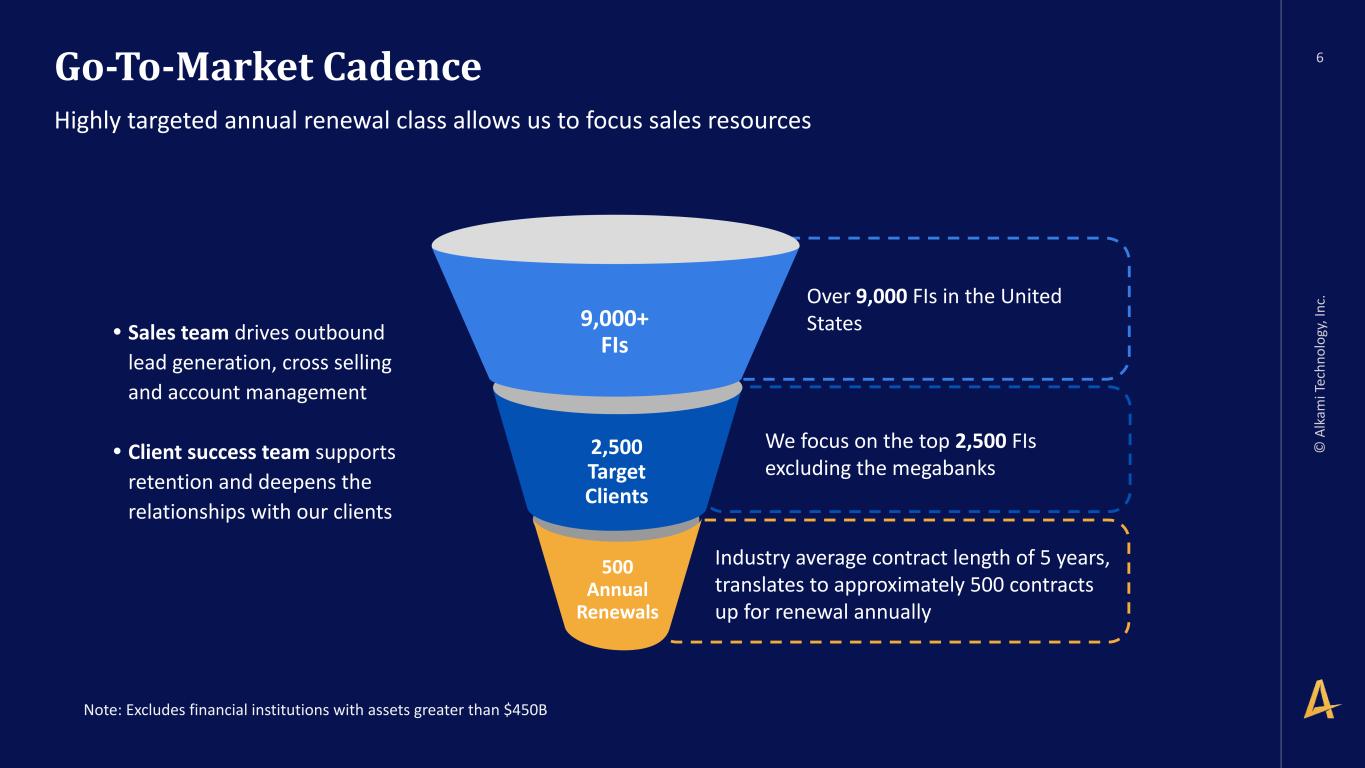
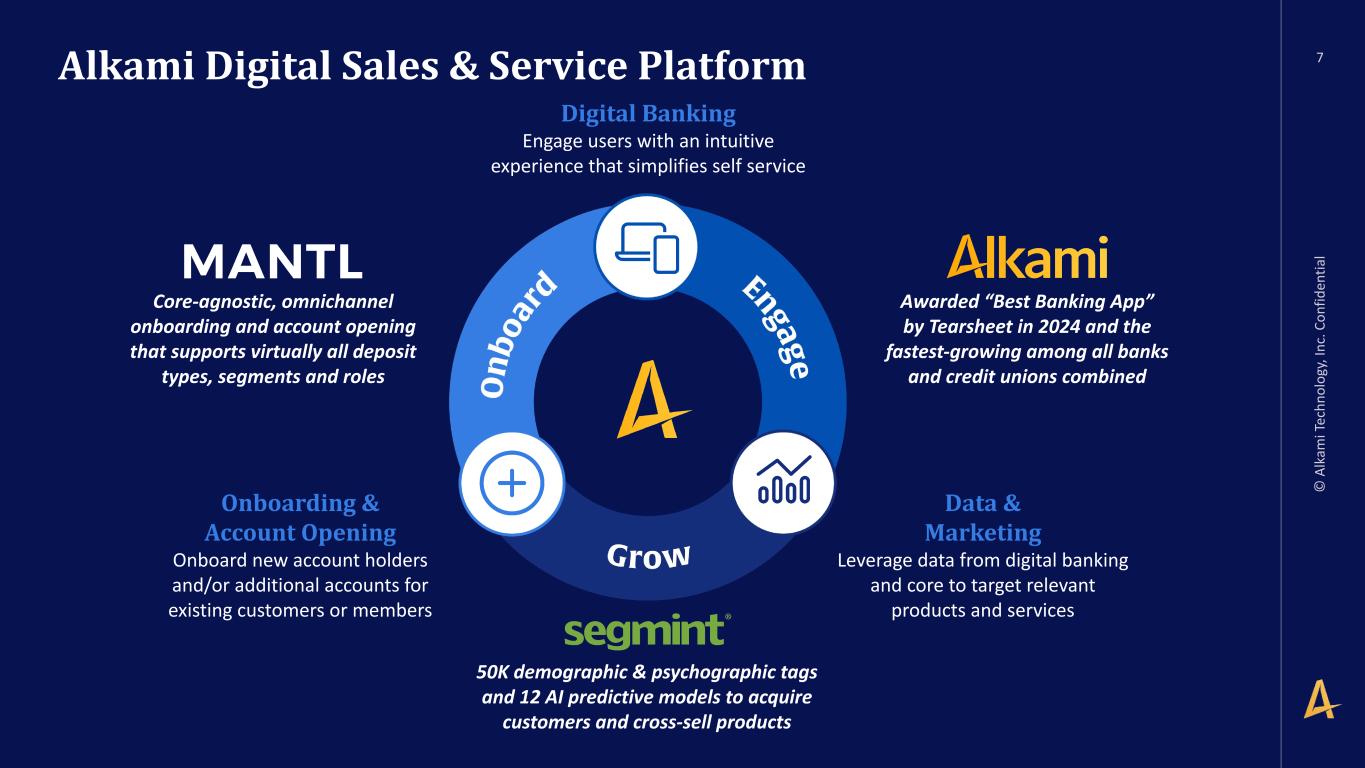
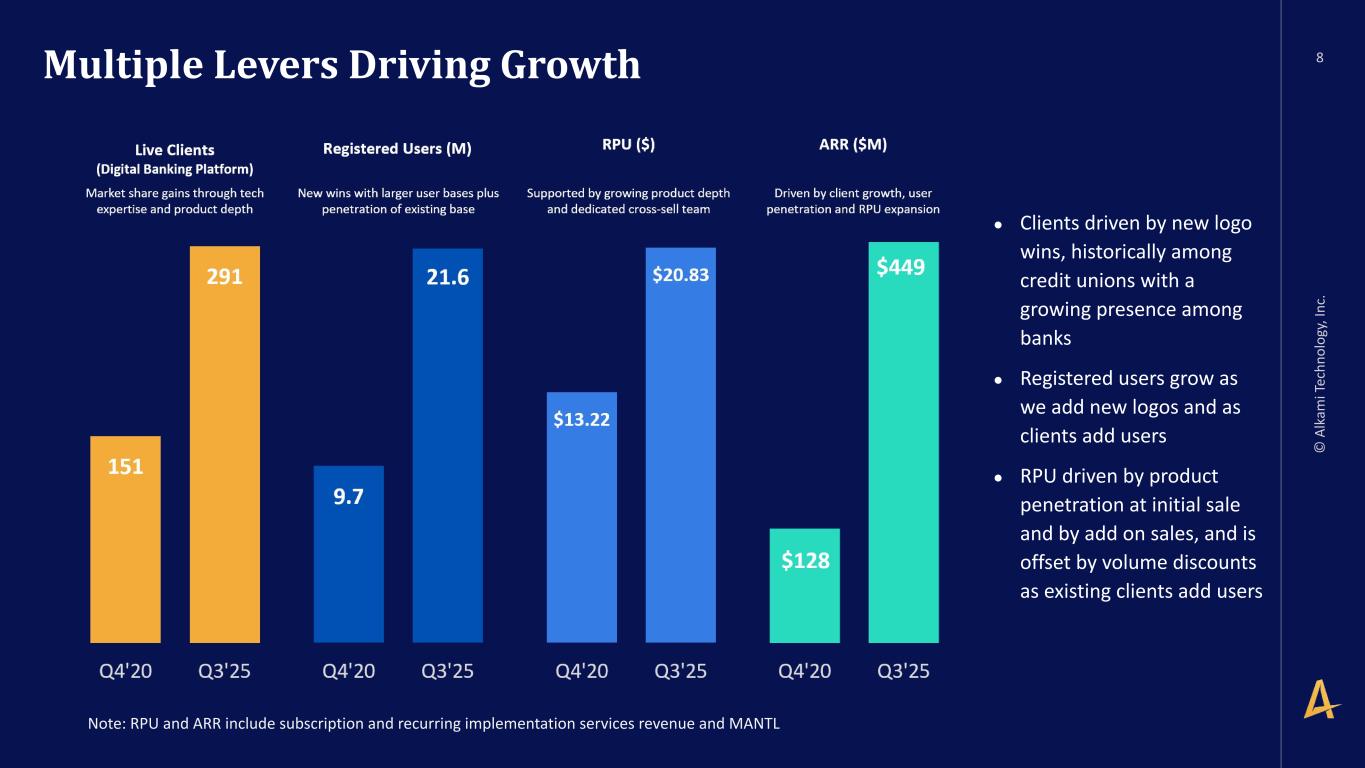
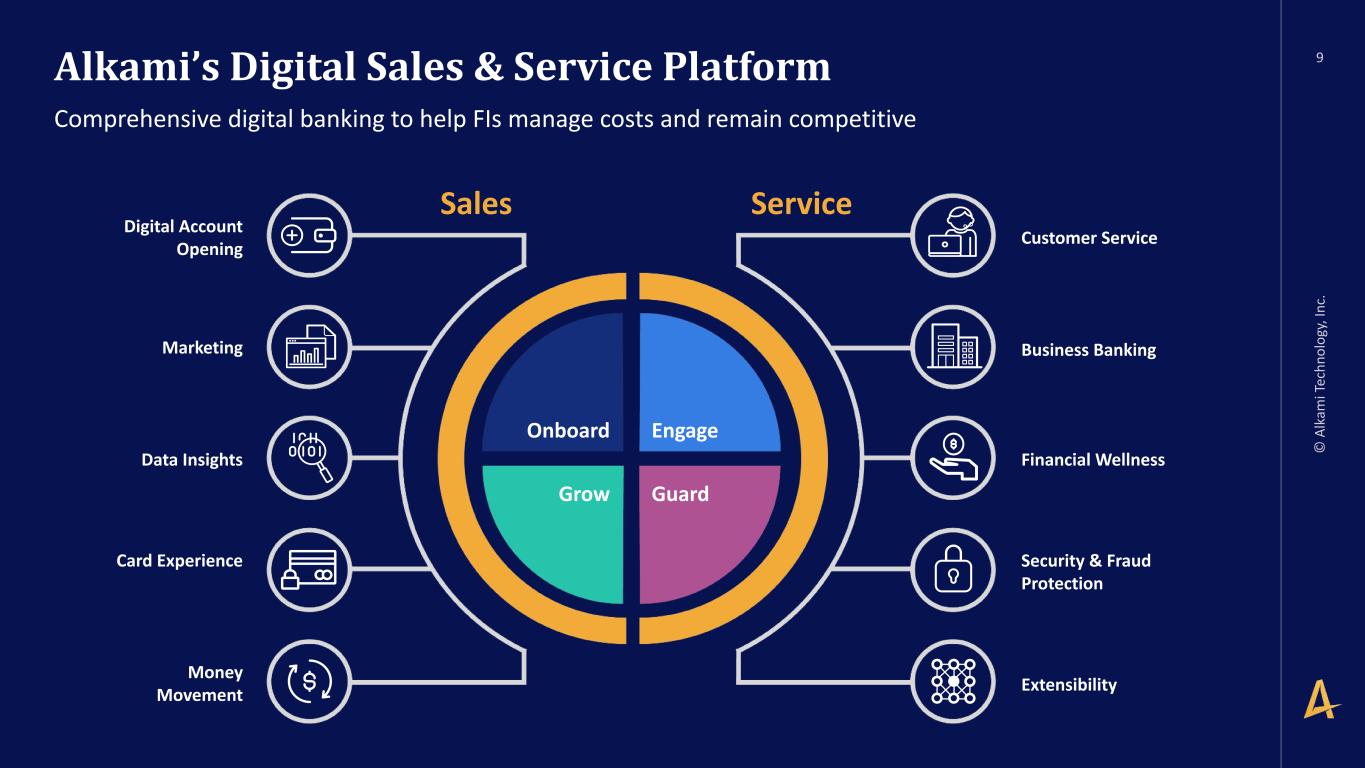
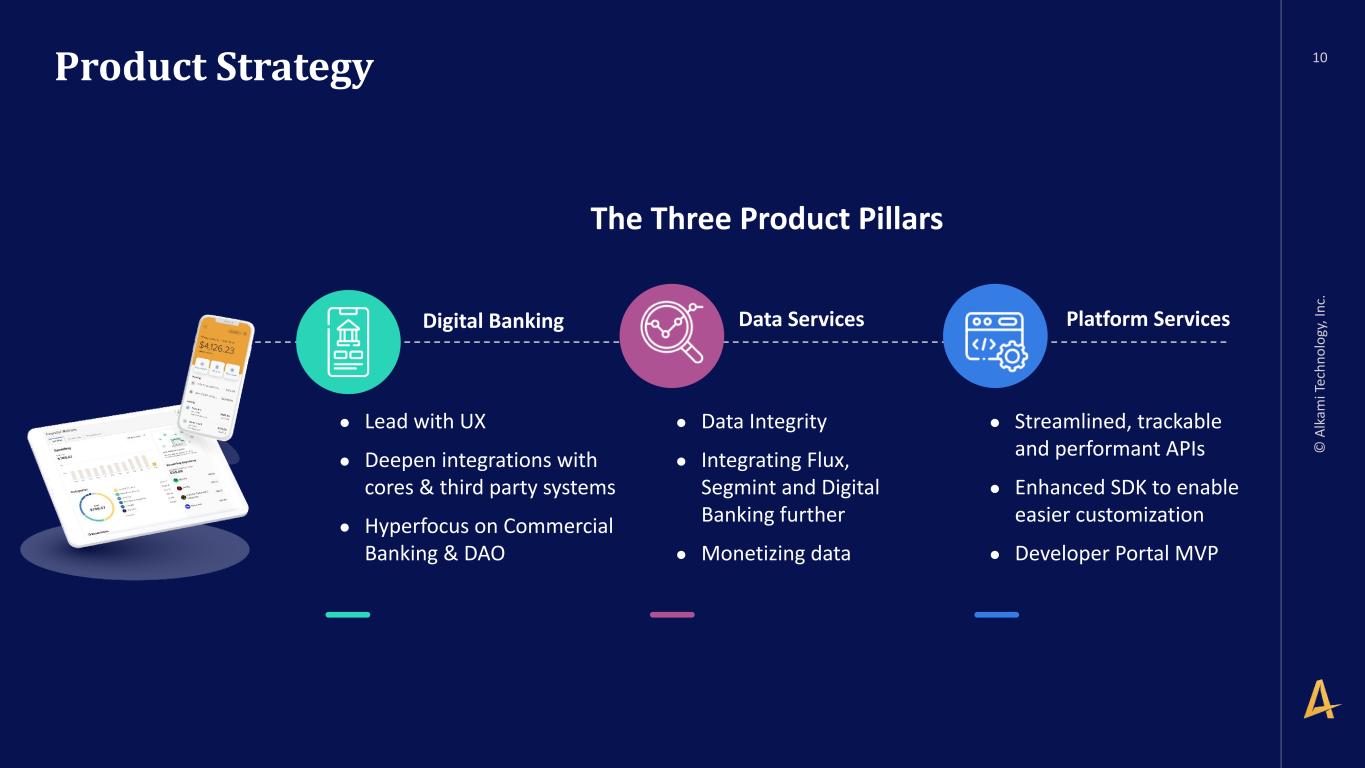
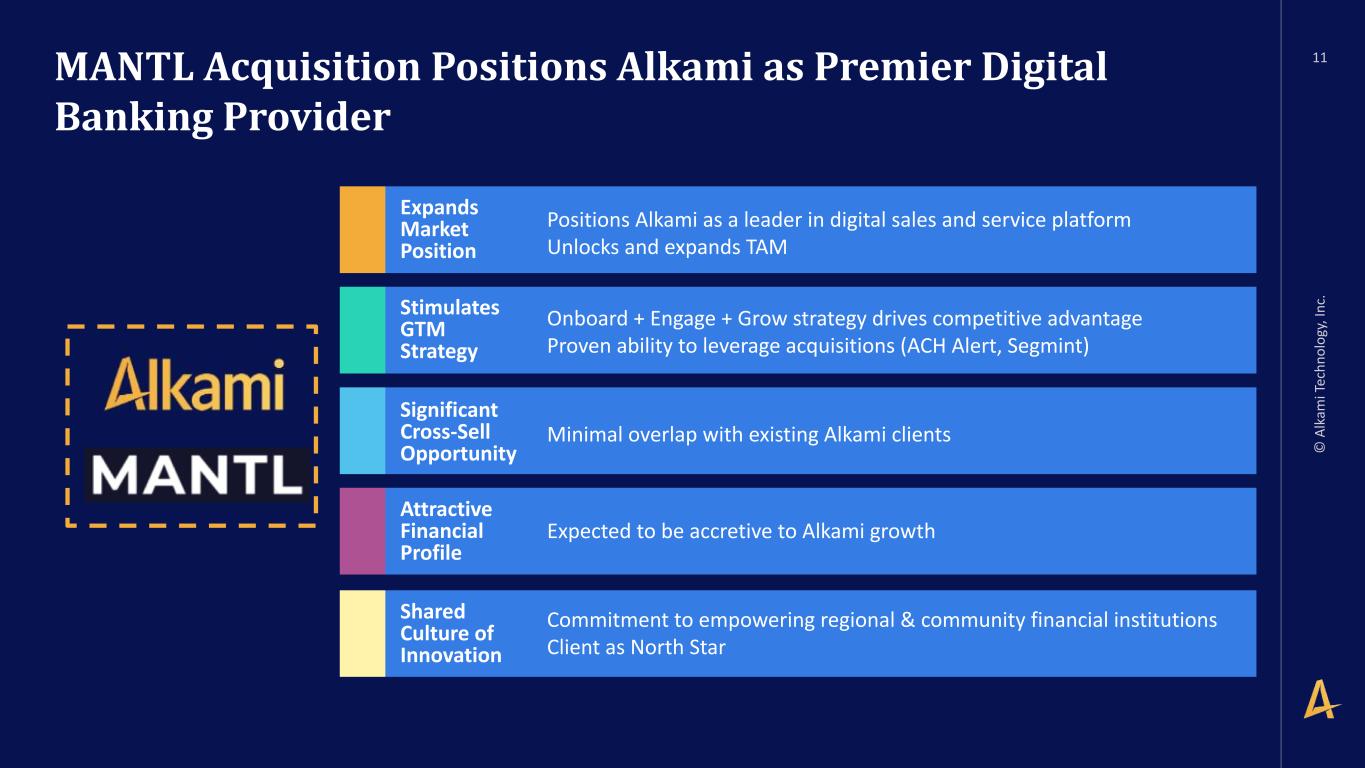
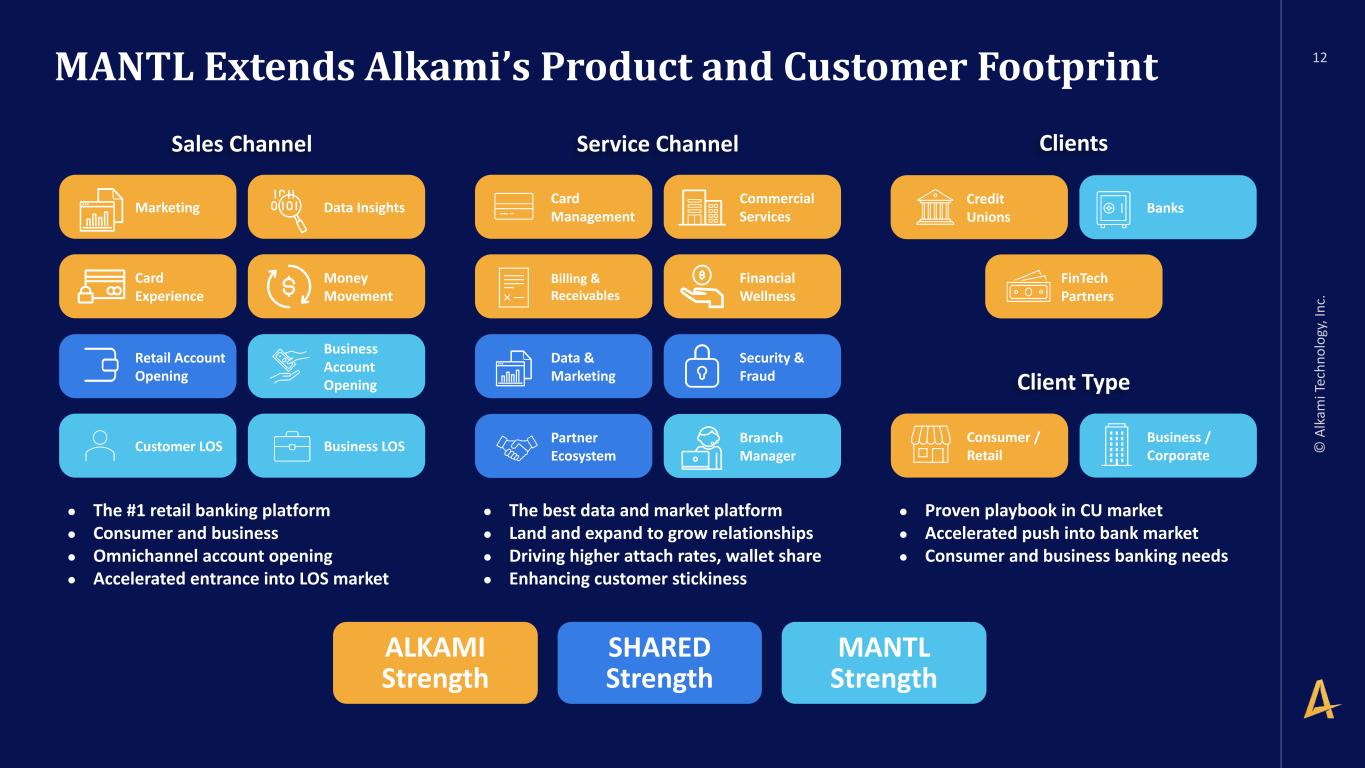
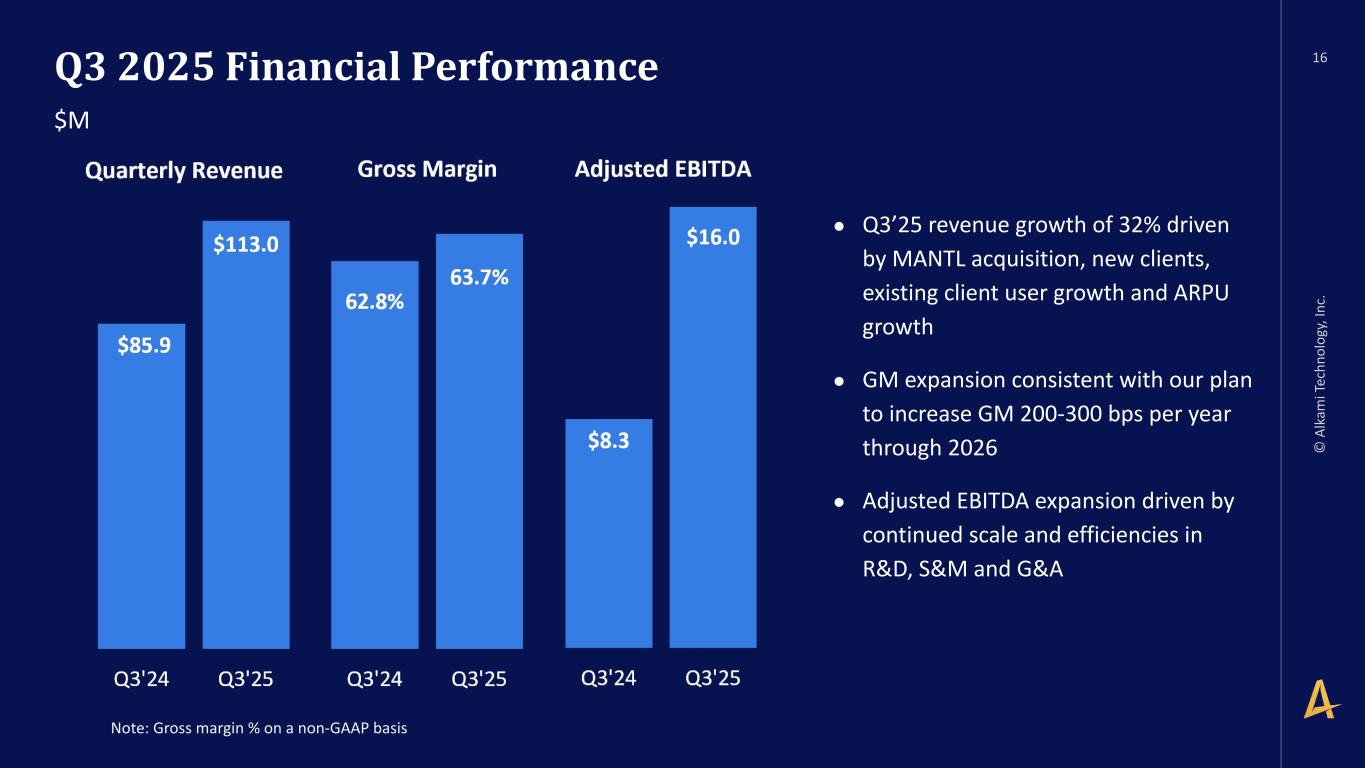
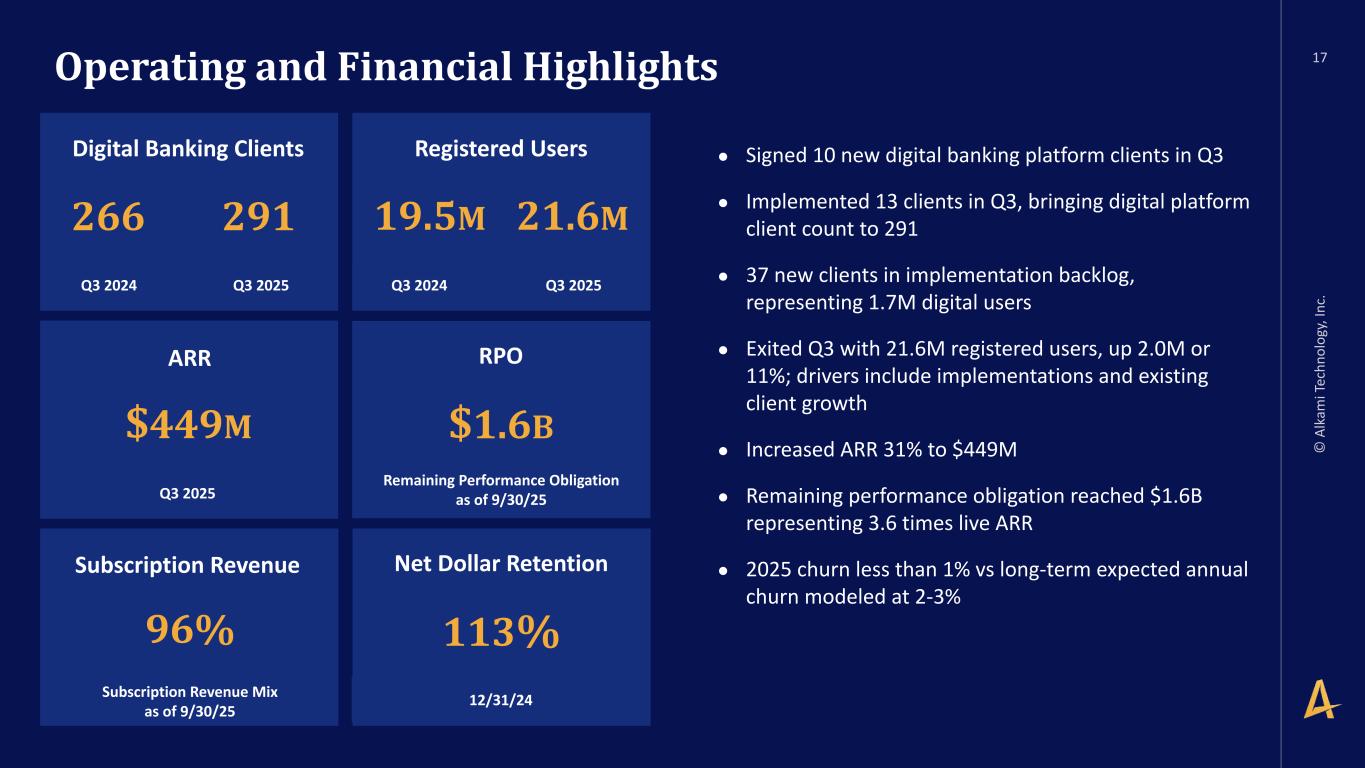
Good afternoon, and thank you all for joining us. I am pleased to report that Alkami continued to deliver strong revenue and profit results in the third quarter of 2025, which I plan to discuss. But first, I'd like to announce that Alkami has selected a new Chief Financial Officer to succeed Bryan Hill, who previously announced his intention to retire. Also, as discussed earlier this year, Alkami entered into an agreement with Bryan in which he will be available in a consulting role to the company for some time in the future. Alkami's new CFO is Cassandra Hudson. Cassandra brings to Alkami over 20 years of experience building, leading and advising companies through rapid growth, capital market transactions, international expansion and M&A activity. Most recently, she served as CFO of StackAdapt, a leading advertising and marketing technology company. Prior to that, she was CFO of EngageSmart, where she guided the company through a successful IPO and drove meaningful growth in both revenue and profitability. Earlier in her career, she spent 12 years at Carbonite in a series of finance leadership roles, ultimately serving as Chief Accounting Officer and Vice President of Finance. Cassandra comes on board next week, and I'm looking forward to the investment community spending time with her in the coming quarters. I'm grateful that Cassandra said yes to Alkami and excited to have her on our executive team. Turning to our business results. In the third quarter of 2025, Alkami grew revenue over 31%, increased adjusted EBITDA to $16 million, and exited the quarter with 21.6 million registered users on the Alkami platform, up 2.1 million from the prior year quarter. Q3 2025 was also a strong sales quarter, equal to our best Q3 ever. We added 10 new clients on our digital banking platform, 6 credit unions and 4 banks, and one of these clients is the largest new logo transaction in our history. Including this client, Alkami now serves 5 of the top 20 credit unions in the United States. On a year-to-date basis, our new logo performance is consistent with the last 4 years. Our sales pipeline for Q4 and 2026 is also in line with recent years. And looking further into the future, out of the top 2,500 FIs, excluding mega banks and super regionals, there are still over 900 credit unions and nearly 1,000 banks that are not on a modern platform like Alkami. For these reasons, we remain bullish about the growth opportunity ahead of us. Our MANTL business also delivered a strong new logo sales quarter with 29 new MANTL clients, 15 of which are new to Alkami. Our cross-sell efforts are beginning to materialize as year-to-date, MANTL has added 68 new logos, including 29 that are existing Alkami clients. As I mentioned in a previous call, we now have 2 strategic platforms in which we can initiate a relationship with a financial institution. Year-to-date, the company has signed 23 new logos with our digital banking platform. And in the same period, 39 new logo relationships have been created with the onboarding platform in FIs that do not have Alkami digital banking. Together, that is over 60 new platform client relationships with whom we can expand over time. From a qualitative perspective, we continue to see positive market reaction to the combination of Alkami and MANTL. In a midyear survey, 80% of bank and credit union leaders in our target market said the MANTL acquisition will have a positive impact on Alkami. Our prospects appreciate that if you want to attract deposits, acquire new account holders, increase engagement and improve operational efficiency, you need Alkami's digital sales and service platform, which is the combination of our digital banking, onboarding and account opening, and data and marketing technologies. We had 6 renewals in the third quarter, and we had an amazing quarter in terms of online banking implementations. In Q3 2025, we brought 13 new clients onto our digital banking platform, the most in a single quarter in our history. 6 of the 13 are banks, and year-to-date through October, we've implemented 14 banks, of which 8 are integrated to the core system that represents our largest market opportunity. MANTL also had a strong implementation quarter, bringing 15 clients onto our onboarding and account opening platform, which was as many as we implemented in the entire first half of 2025. If you combine institutions that are live on either our digital banking platform or our onboarding and account opening platform, we now serve 413 financial institutions, of which 124 are banks and 289 are credit unions. We also had an exciting quarter in terms of product progress. The design work of our digital sales and service platform, which once again is the integration of digital banking, onboarding and account opening, and data and marketing is complete. We've assigned a dedicated engineering team to the build effort and expect to show product to our clients at our spring customer conference. This effort can impact future growth as we now have 17 clients under contract for all 3 technologies, and delivering the planned product integration can generate a 30% uplift to our new logo ARR. We also released our new money movement hub, had our one-click SDK deployment in beta, and we showed our client community a prototype of an agentic code creator that builds tailored products for an FI. We released 2 new features for treasury management and last week added an additional 6 treasury management features to our beta client community. In onboarding and account opening, we are accelerating in-branch product adoption, have continued momentum on account maintenance, and our Pioneer loan platform client originated over $4 million in loans in their first 6 months of product usage. From a partner perspective, we created a new development team dedicated to our partner ecosystem, which will double the number of partners we can onboard each year. This will create future growth potential and improve customer satisfaction by giving our clients more capabilities for their account holders. In closing, I am proud of the more than 1,000 Alkamists who achieved another strong quarter of results for our clients and our investors. As we finish 2025, I'm excited about our continued innovation and execution, a resilient growing market and a business model with several growth levers. I'll now hand the call to Bryan to discuss our financial results.
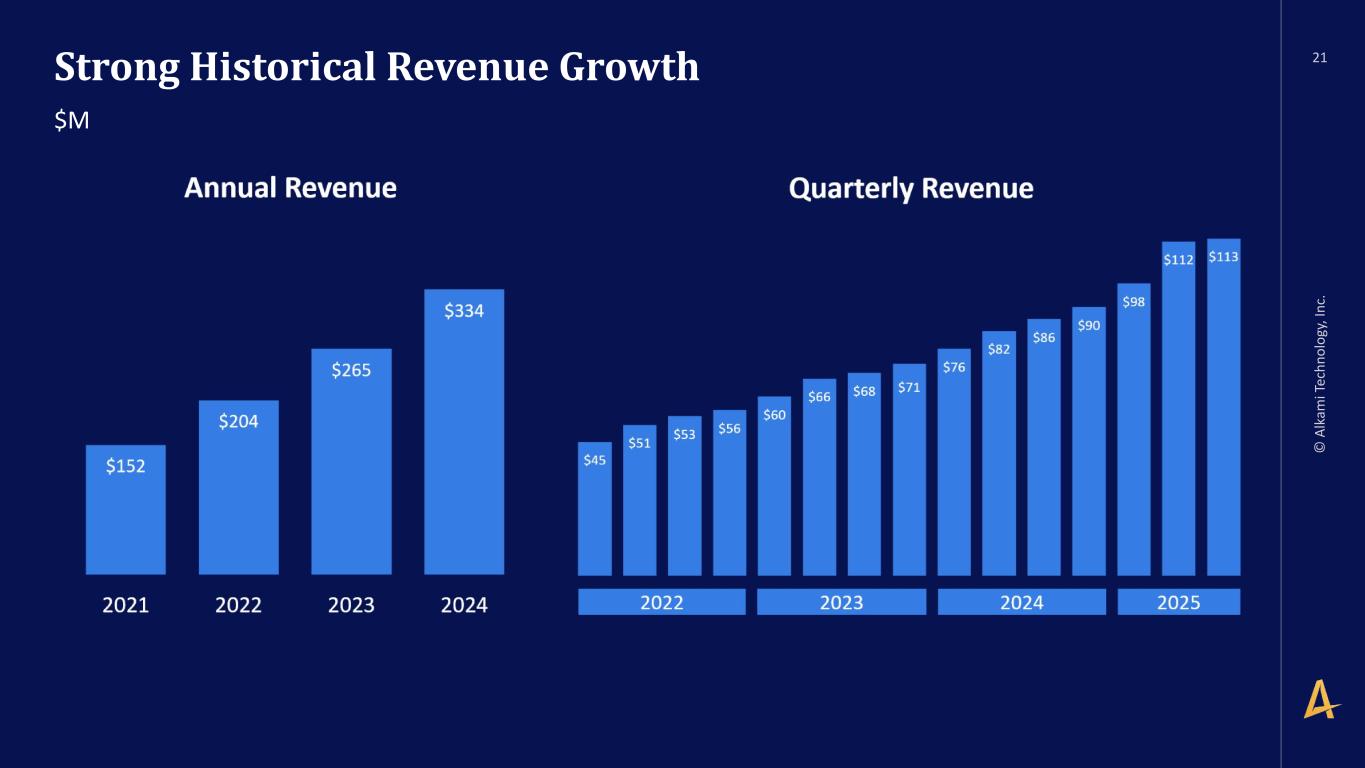
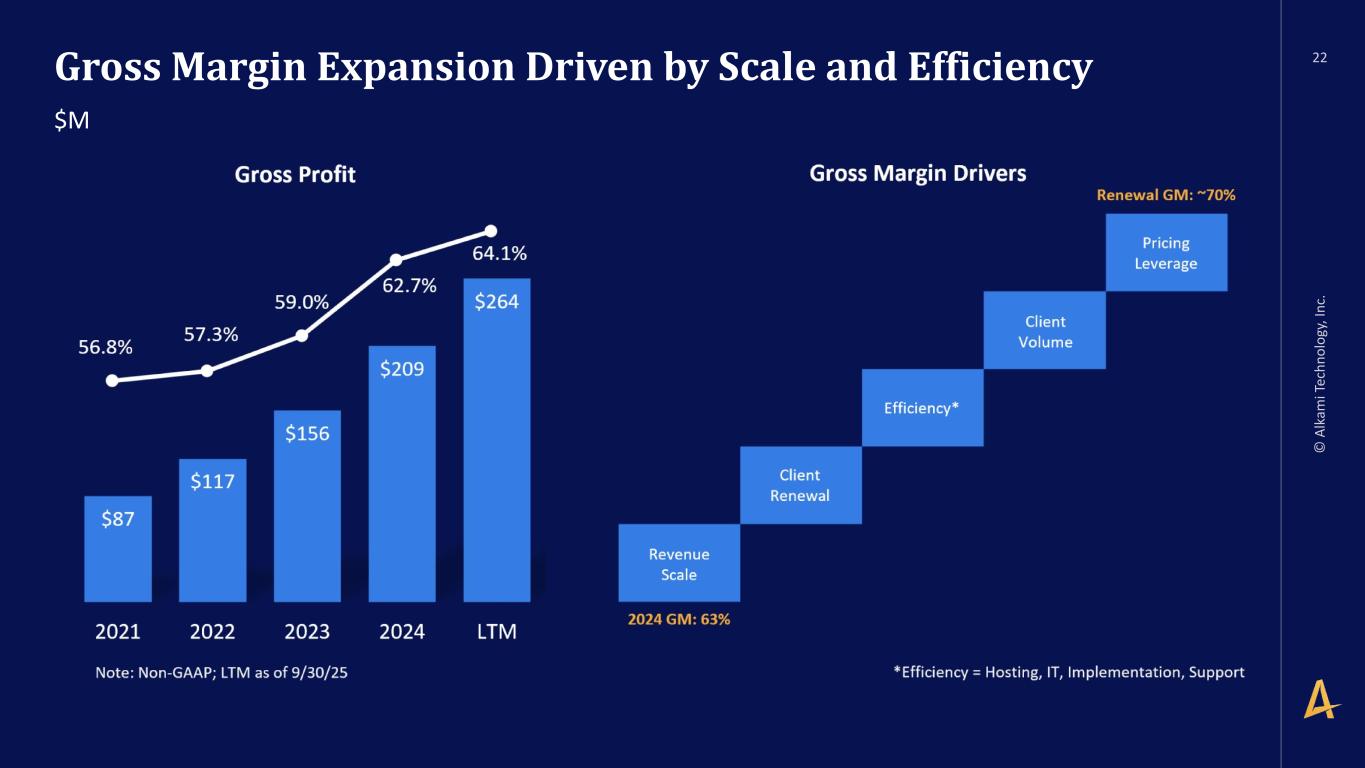
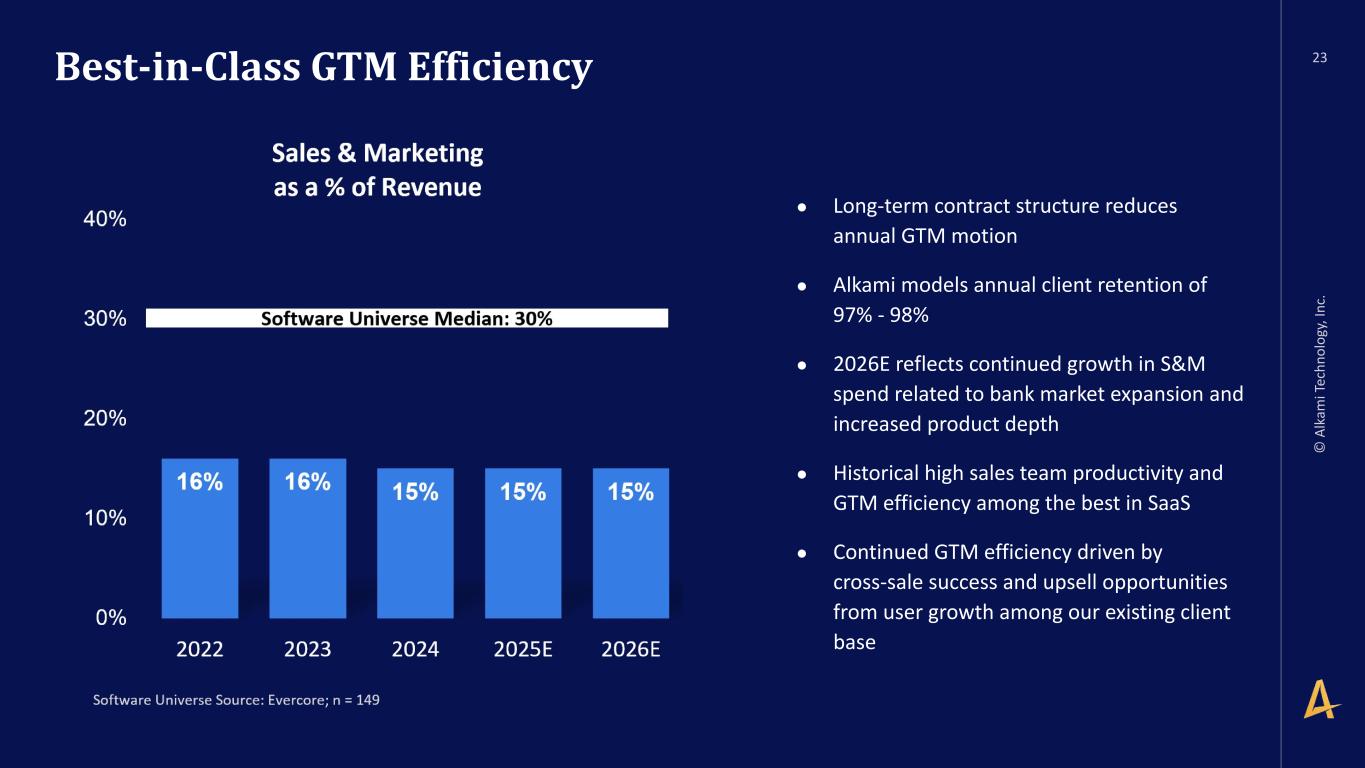
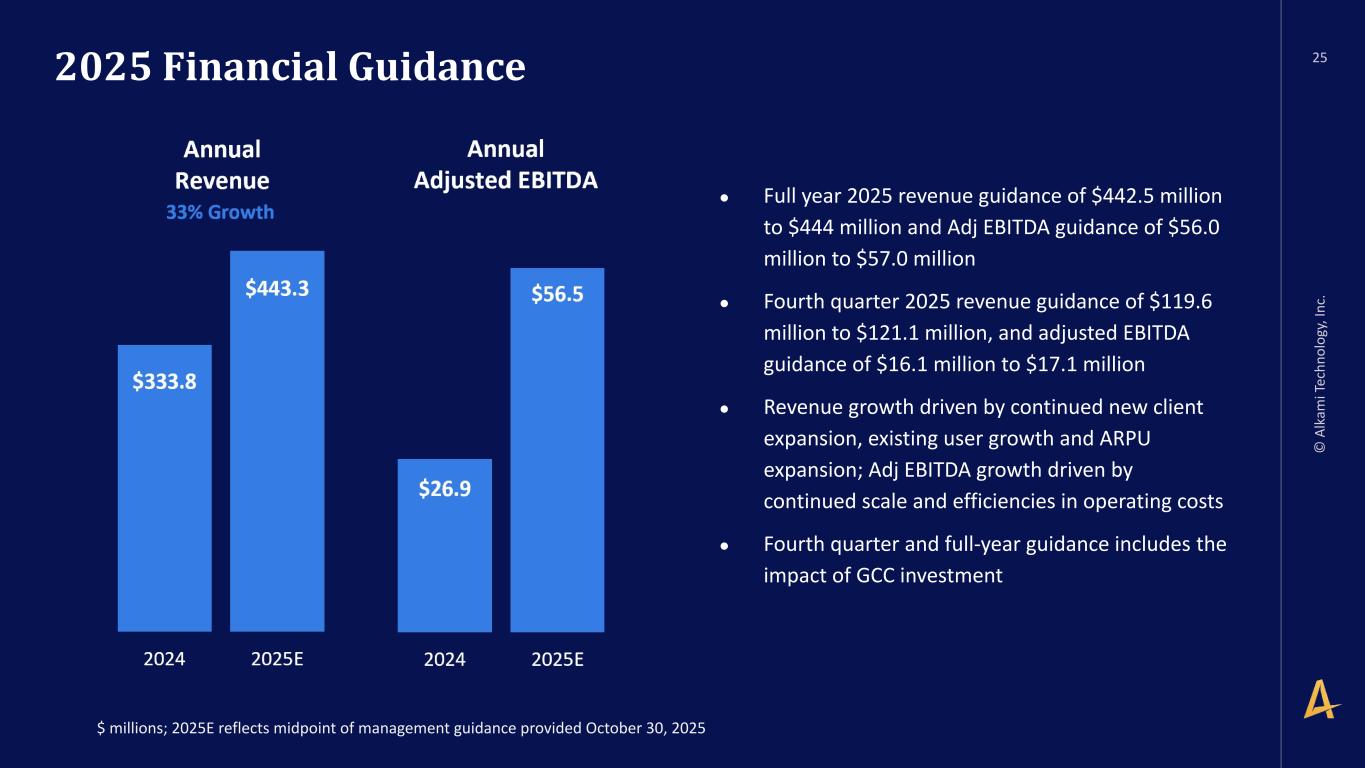
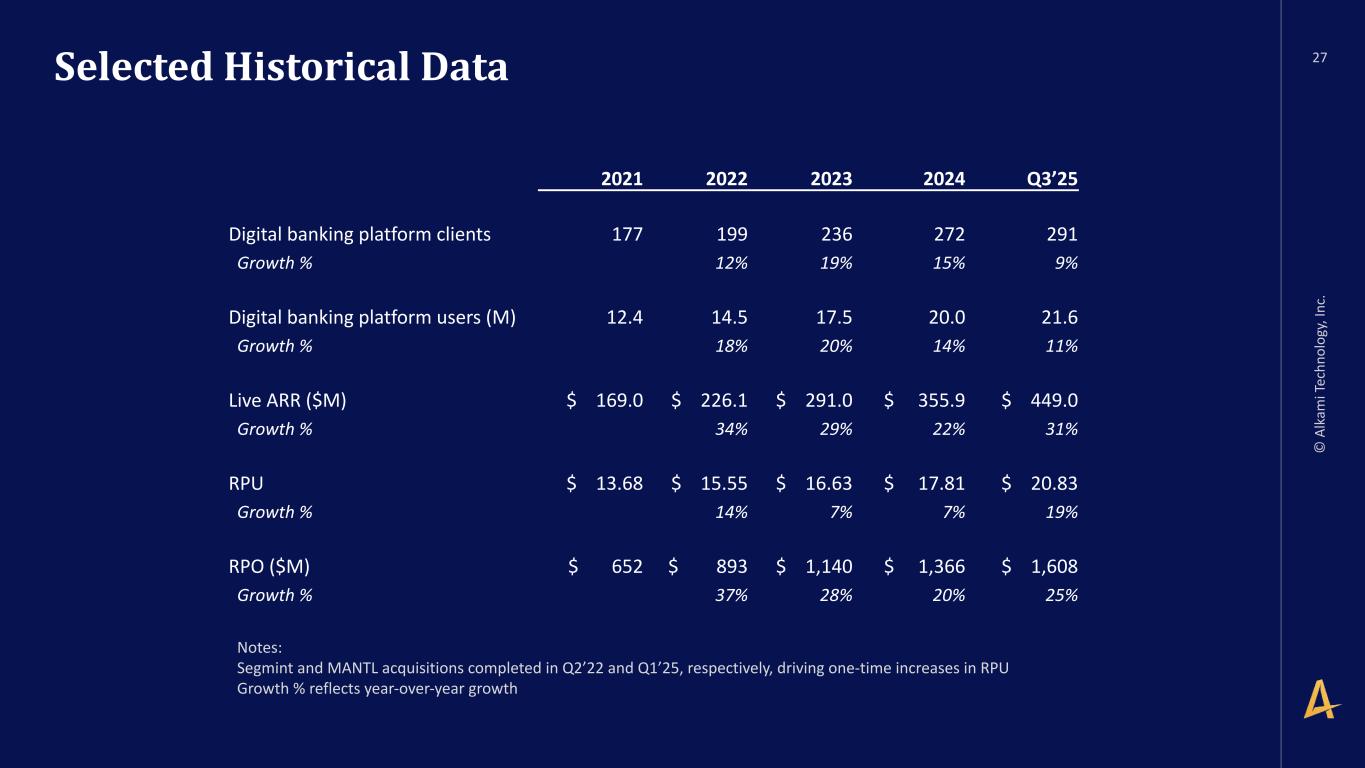
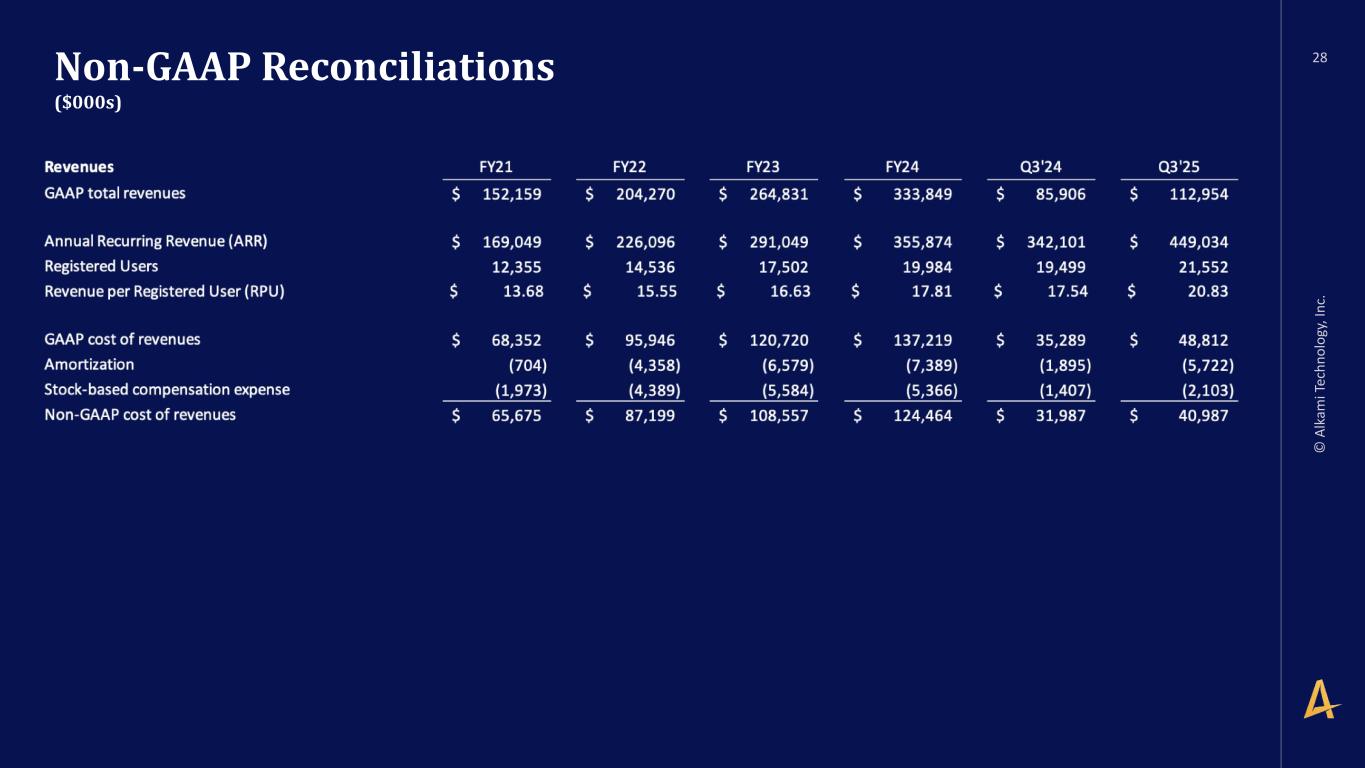
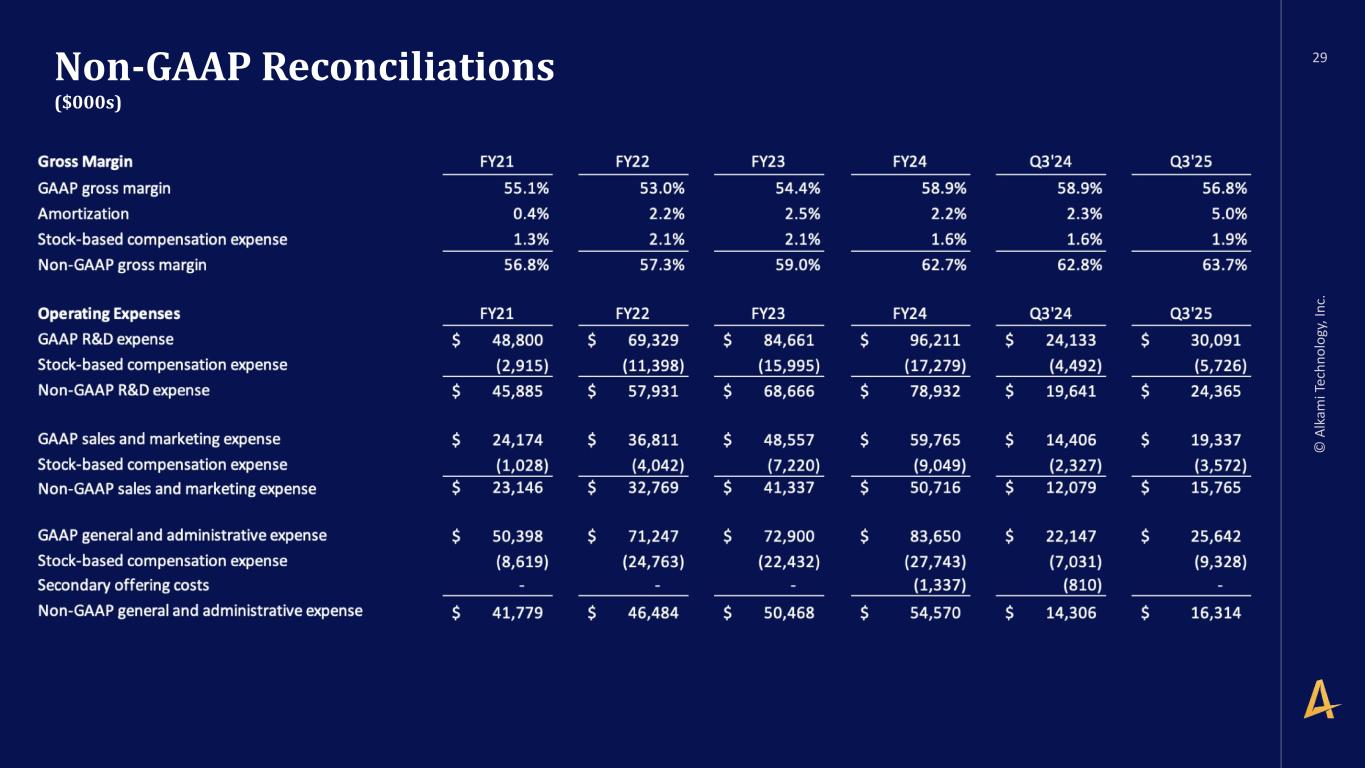
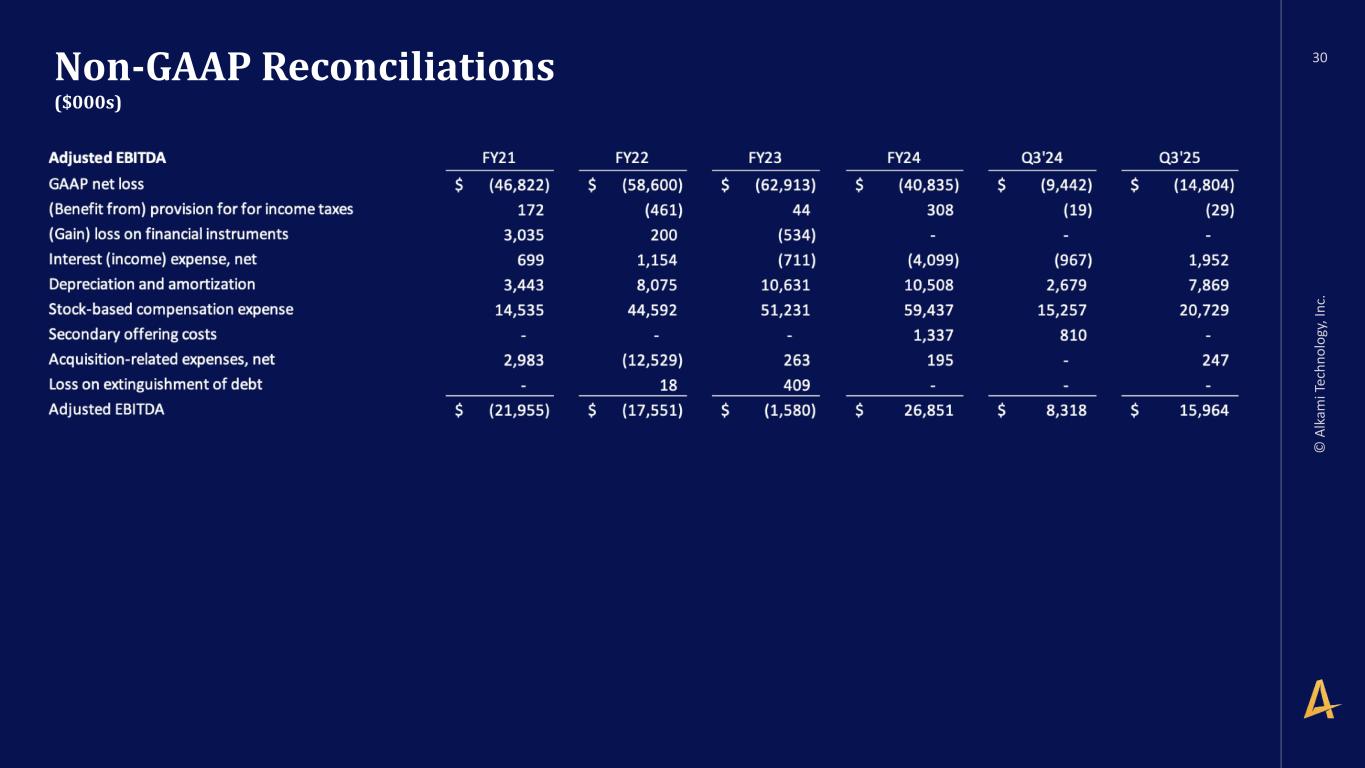
All right. Thanks, Alex, and let's do this one last time. Shall we? Good afternoon, everyone. In the third quarter of 2025, we achieved total revenue of $113 million, representing year-over-year growth of 31.5% and organic growth exceeding 20%. We continue to improve adjusted EBITDA to $16 million compared to $8.3 million in the year ago quarter, further underscoring the operating leverage of our financial model. Subscription revenue grew 31.5% in the third quarter and represented 96% of total revenue. We increased ARR over 31% and exited the quarter at $449 million. We currently have approximately $67 million of ARR in backlog for implementation, the majority of which will occur over the next 12 months. Included in our backlog are 37 new digital banking clients, representing 1.7 million digital users. We exited the quarter with 291 live clients and 21.6 million registered users on our digital banking platform, representing registered user growth of approximately 2.1 million or 11% compared to last year. Over the last 12 months, we implemented 32 financial institutions. Because of the long-term nature of our contracts, we have 3 to 4 quarters of visibility into upcoming client attrition. In the last 3 quarters of 2025, 3 clients left our platform, representing less than 1% of ARR, and 2 clients were merged with existing Alkami clients. Over the long term, we model digital banking ARR churn at 2% to 3% per year, which we have historically outperformed. We ended the quarter with an RPU of $20.83, up 19% compared to a year ago, driven by the acquisition of MANTL and add-on sales success. Excluding MANTL, RPU increased 7% over the prior year. We continue to see broad-based demand across our product portfolio. This is reflected in our sales pipeline, new client wins, client renewal success, our ability to cross-sell new products into our installed base, and now the rate at which we are seeing the market adopt MANTL and our data and marketing analytics solutions. In the third quarter, we signed 10 new digital banking platform clients and renewed 6 existing clients, representing 16 total digital banking contract signings. One new client win during the quarter was a top 20 credit union representing 450,000 digital users. We expect 25 to 30 renewals in 2025. MANTL added 29 new clients in the third quarter, including 15 that are Alkami digital banking clients. We now have 44 clients under contract that subscribe to both the Alkami digital banking platform and the MANTL onboarding and account opening solution. Our add-on sales continue to increase as a percentage of total sales. Our add-on sales effort, excluding MANTL direct sales, represented just under 50% of new sales for the year, 4 percentage points better than the same period in 2024. Our remaining performance obligation was approximately $1.6 billion, representing 3.6x our ARR and up 25% compared to a year ago. Now turning to gross margin. For the third quarter of 2025, we delivered a non-GAAP gross margin of 63.7%, representing nearly 100 basis points of expansion compared to the prior year. We achieved gross margin expansion through continued improvement in our hosting cost efficiency as well as operating leverage across our post-sale operations. For the first 9 months of 2025, gross margin was 64.4%. Moving to operating expenses. For the third quarter of 2025, operating expense of $56.4 million or 50% of revenue represented year-over-year operating leverage of approximately 360 basis points. We primarily drove operating leverage across R&D and G&A, where we continue to realize operational scale. We are on track for adding engineering talent at our global capability center located close to New Delhi in India's national capital region. We now have over 110 Alchemists at this facility with an expectation of approximately 150 as we exit 2025. Related to sales and marketing expense, we continue to achieve a high level of sales team productivity and go-to-market efficiency ranking among the very best in SaaS. Sales and marketing is expected to be approximately 15% of revenue for 2025. Our adjusted EBITDA in the third quarter was $16 million, $2 million better than the high end of our expectations and representing an adjusted EBITDA margin of 14.1%. Turning to our balance sheet. We ended the quarter with $91 million of cash and marketable securities. During the third quarter, we used a portion of our cash to reduce our revolver by $25 million, bringing our current balance to $25 million. For the first 9 months of 2025, operating cash flow was $26 million, which is net of a one-time acquisition items of $7 million. Excluding these one-time items, this is over 2.5x the operating cash flow of $13 million in the year ago period. Now turning to guidance. For the fourth quarter of 2025, we are providing guidance for revenue in the range of $119.6 million to $121.1 million. At the midpoint, this represents organic growth of 22%, 200 basis points higher than Q3's organic growth. For adjusted EBITDA, we are providing fourth quarter guidance in the range of $16.1 million to $17.1 million. For the full year of 2025, we are providing guidance for revenue in the range of $442.5 million to $444 million. We are also providing full year adjusted EBITDA guidance of $56 million to $57 million, representing a raise of just under $4 million above the midpoint of our previous full year guide. In conclusion, we are pleased with our continued revenue growth and margin expansion. We remain positive about the demand environment and our continuing ability to acquire, grow and retain our clients. This gives us confidence in our ability to achieve our long-term financial objectives and drive shareholder value. Now on a personal note, it has been a great honor to serve as Alkami's CFO for the past 6.5 years and to steward the company as we expanded revenue 500% and increased profitability over $95 million since 2019. We also engaged in multiple capital raises and acquisitions and built one of the best teams in digital banking. I want to thank our shareholders and our clients and especially our team for helping make this a reality, and I'm excited to see what Alkami can do in the coming years. And with that, I'll now hand the call to the operator to take your questions.
Operator
Your first question is from Andrew Schmidt from KeyBanc Capital Markets.
Speaker 4
Your final call here at Alkami, Bryan. Congratulations on the transition. It was great working with you from the IPO up until today. So congrats.
Yes. Great working with you, Andrew.
Speaker 4
I wanted to just maybe just go back to what you said, Bryan, on the organic growth for the fourth quarter. Obviously, we saw the revenue growth, the outlook come down just a little bit. But I think you mentioned that organic growth is actually accelerating. Maybe you can dig into that a little bit, maybe something that's inorganic or MANTL related that's affecting the outlook, but that would be a good place to start.
No, that's a great question. Look, first, I'm very proud that 19 quarters consecutive at Alkami as a public company, we've either met or exceeded both our revenue and adjusted EBITDA guidance. So that's a mark that many companies cannot say. But as we think about our transition of revenue growth from Q3 to Q4, we've said this many times, but the timing of implementations during the year makes a big difference on any one quarter's year-over-year growth. As an example, if you compare the first 9 months of new logo implementations in '25 to '24, we actually had approximately 100,000 more in the first 9 months of 2024. But then when you look ahead to Q4 in 2025, Q4 is really our greatest implementation quarter. We're going to have close to 350,000 more users that we implement in Q4 this year versus last year. So that transition provides us the step-up in organic revenue growth in Q4, both on the top line for revenue, but also for ARR.
And just to add to that, the schedule of when we're doing the implementations depends a lot on when the customer wants to do the implementations, right. And so that creates, as you said, Bryan, sometimes those dislocations between the quarterly compares.
Speaker 4
Got it. The implementation schedule is set, but the organic growth underneath is strong and gaining momentum. I have a quick question about the competitive landscape. There has been a notable shift from a major core provider announced this week. I'm aware that they focus more on core services, but do you anticipate any advantages from this in terms of attracting clients who might be reassessing their technology frameworks and seeking advanced digital banking solutions? I'm interested to know if this could benefit you. Additionally, if you have any further insights on the overall market conditions, that would be helpful.
I don't think for us, any particular company's results in a quarter make a difference in the buying behavior necessarily. What we do see in the bank market, and we've talked about this before, the credit union market has historically been a best-of-breed market. It's a buyer who is used to combining a digital banking platform that's different than their core provider. The community bank market has not been that kind of market. The community bank market was a market that very much bought digital banking from its core provider. And Andrew, that's the biggest thing that we're seeing change is the opening of momentum of people saying, I'm going to actually have a different digital banking application than my core provider. And that's why it's so important, what I shared in my opening remarks of, look, since the beginning of the year, we have brought 14 banks live and 8 of them are on a core that we consider to be our largest market opportunity. So in summary, no particular quarterly result changes the customers' buying behavior. The most important thing that we're seeing in the community bank market is the beginning of the willingness to buy best-of-breed instead of suite.
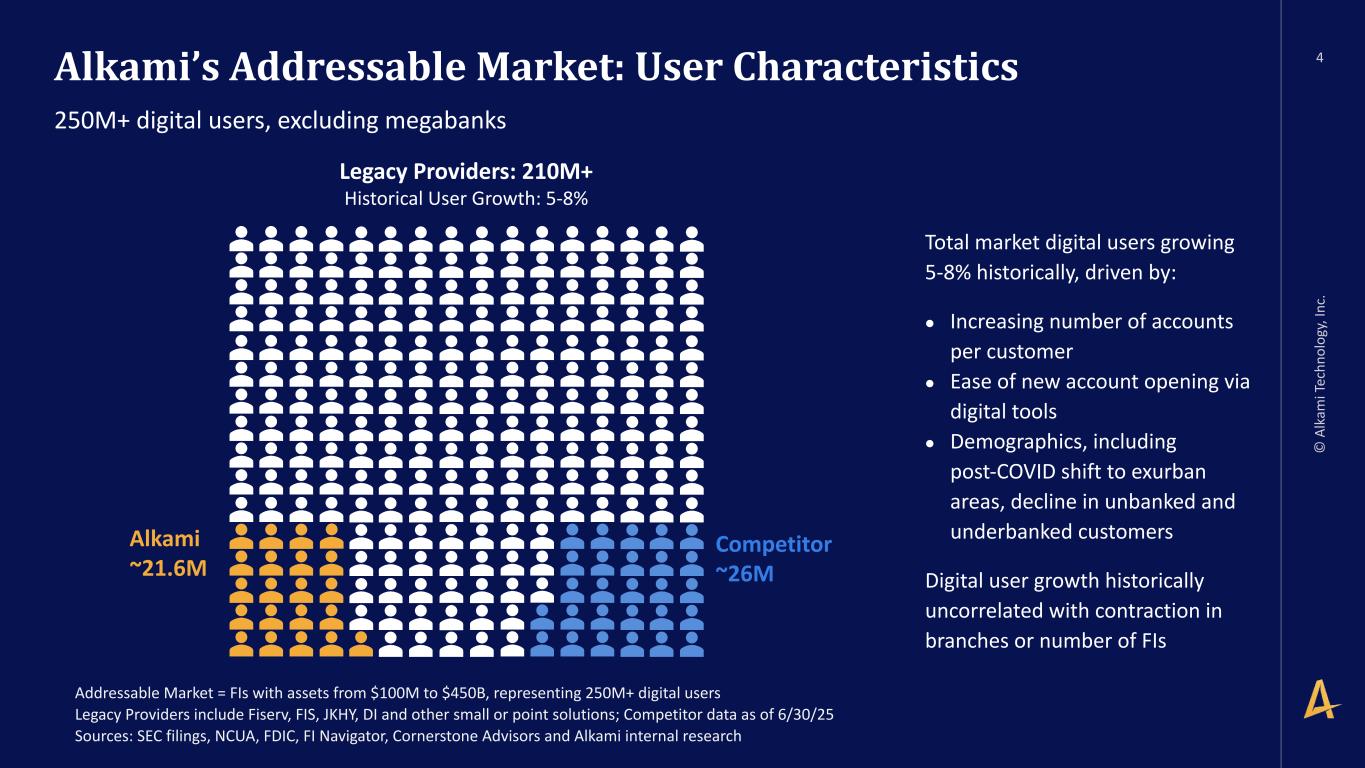
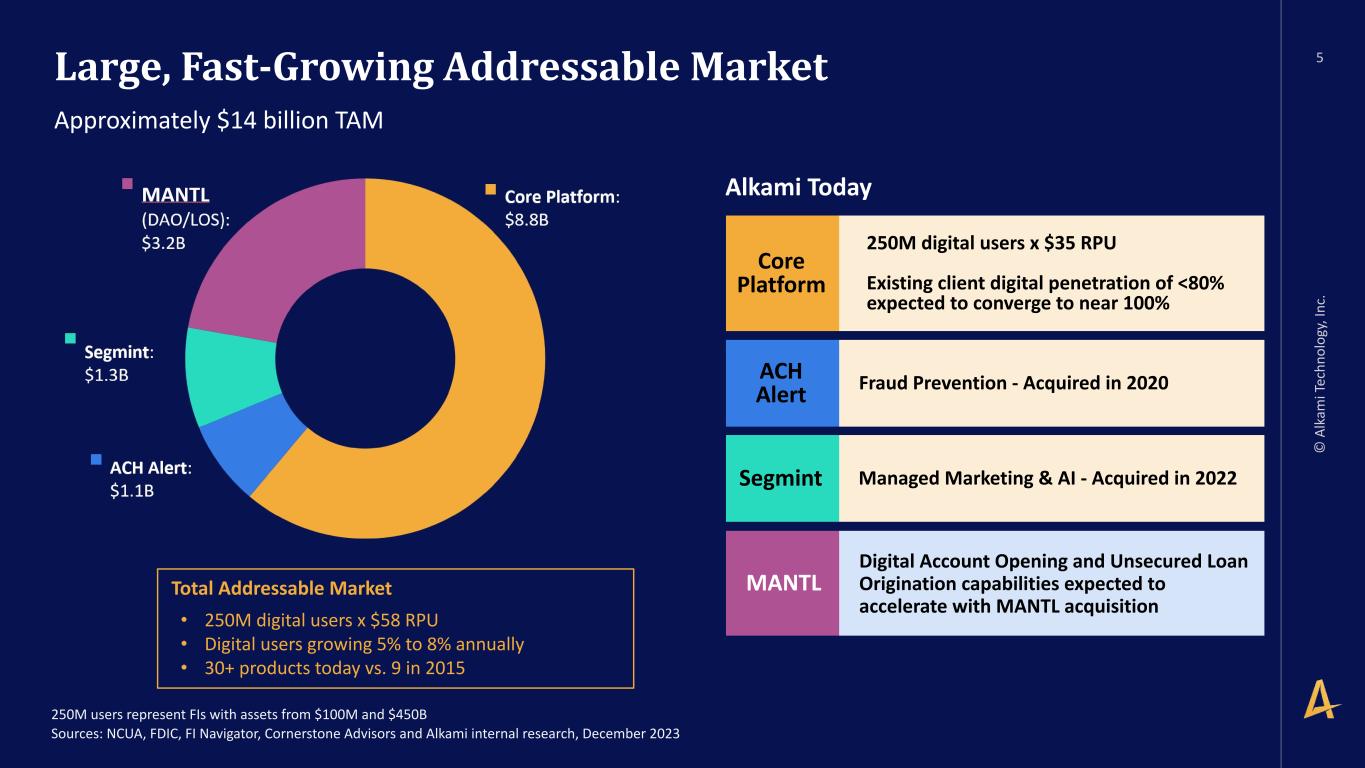
And Andrew, keep in mind, out of the 250 million digital users that comprise our addressable market, less than 30% of those are on a contemporary platform. And so the decision to switch to a contemporary platform such as an Alkami, what we've seen through many different disruptions in this market, whether it was SVB, high interest rates, you name the issue, the demand has remained consistent through that. So if a provider in the market is experiencing problems for different reasons, whatever the case may be, that doesn't really expect the fundamental drivers of what's causing the change. And then we introduced the MANTL acquisition. We combine that with our online banking platform, as well as our data and marketing analytics solution, and we think that's a game changer in the market. As we pointed out on the call, we now have 44 shared clients with MANTL under contract, and we only had 15 when we completed the acquisition. That's significant progress. We think that progress is going to continue as the market continues to understand the power of bringing these 3 primary platforms together. It's a differentiator for them. It's a moat and a differentiator for us.
Operator
Your next question is from Patrick Walravens from Citizens.
Speaker 5
This is Austin Cole speaking on behalf of Pat Walravens. I would like to congratulate you, Bryan, on your retirement. I wanted to ask about disruptions and if you’re hearing anything regarding AI and its potential to be used for developing digital applications. Is that something that is gaining traction in the market?
We recently held our Customer Advisory Board meeting for several hours, during which a significant portion of the discussion focused on how participants are utilizing generative AI and agents, along with their various use cases. Every financial institution is either actively using or experimenting with agent technology or generative technology. None of them are considering developing their own software using agent technology because the complexity of building that software and integrating it into different core systems is not a priority for them. It's important to note that even if six customers have the same core system, the age and design of those systems lead to completely different implementations. There is considerable interest in the use cases for generative AI and Agentic AI, but no one is discussing the idea of building their own systems.
Speaker 5
Okay. If I could just follow up quickly. When you consider your digital banking solutions and the potential use cases, what are some areas where customers might want to see elements of AI or automated workflows? Could this enhance the product offerings?
Yes. First of all, we are currently using AI in our technology. Our data and marketing platform leverages AI to create precise audience segments for clients, and AI is also integrated into our chat products. If you're referring to either agentic AI or generative AI, I mentioned in the prepared remarks that we have a software development kit that allows clients to build functionality that extends Alkami. Currently, clients need a developer to create that functionality. However, we have aggregated all the code submitted to Alkami, which amounts to nearly 3 million lines of code since the beginning of this year, contributed by customers. We are training a large language model with this code, along with the associated instructions, and we believe we will be able to develop a prompt-based code creation tool for financial institutions. This would be very appealing to clients. The team responsible for onboarding, account opening, loan platforms, and account management has developed an agent-based banker capability to help bankers quickly understand all the relevant information about clients across the bank’s systems. In response to your question, there are numerous use cases where we can offer exciting capabilities to clients, and we are eager to pursue these opportunities. We currently have two pilot projects in progress that I mentioned.
Operator
Your next question is from Saket Kalia from Barclays.
Speaker 6
Congrats on hiring Cassandra and Bryan tip my cap to you on your next phase.
Speaker 6
Absolutely, Alex. It seems that the selling activity during the quarter was quite strong, but some of the implementations may be more heavily weighted towards Q4 than we anticipated. Looking back over the past few years, the third quarter has generally been the strongest for attracting new users to the platform. So, is the shift from Q3 to Q4 due to just a few customers, or are you noticing some changes in seasonality within the business?
If I differentiate between signing and implementing, I'll first focus on implementing. There's a slight seasonality regarding the implementation process. When discussing the implementation timeline with clients, they generally prefer to start in late Q1 to early Q2 or between Labor Day and Thanksgiving. This preference is influenced by the seasonal aspects of their business. Looking back at the past four or five years, we see a bit more activity in Q2 and again between Labor Day and Thanksgiving, indicating some level of seasonality. Additionally, online banking does not see much activity during the Christmas holiday, as users need access to digital banking. However, from a bookings perspective, there doesn't seem to be significant seasonality. It mostly depends on when clients' contracts expire and when they need to finalize agreements for scheduling implementation. Therefore, I don’t observe much seasonality regarding signings, though client behavior does affect implementations.
Speaker 6
Got it. That's super clear. Bryan, for my follow-up, I want to discuss the same topic. I want to ensure I understand how the timing of implementations might impact the revenue guidance. It's a small point, but it seems like if these implementations are happening a quarter later than we anticipated, that would mean one less quarter of revenue for the full year. However, it appears that from an ARR perspective, we should still achieve the ARR we expected by the end of the year, in line with our original projections. So while we have one less quarter of revenue for the year, it shouldn't affect our ARR outlook. Is that the right way to think about it?
That is the right way to think about it, Saket. There can be fluctuations throughout the year regarding implementation dates being pushed back or moved forward, which can affect in-year revenue. However, the important takeaway is that we anticipate a growth in live ARR of 22% to 23% as we finish the year, aligning with our initial expectations. My earlier comment in response to Andrew was specifically about a year-over-year comparison. It's essential to distinguish that from what may happen in a single quarter, especially when we only have one quarter of visibility. In Q3, we experienced some delays in new client implementations, impacting in-quarter revenue. We had 13 new client implementations in online banking during Q3, which is our highest number. There were also some resource reallocations concerning those implementations, leading to a minor effect on add-on sale implementation. The positive news is that as we approach Q4, we have $67 million of ARR in the backlog, much of which consists of add-on sales and MANTL. A significant portion of this backlog linked to those business lines is expected to implement in the fourth quarter, which will help us achieve the anticipated increase in live ARR growth. There are many moving parts, but I wanted to highlight that there are various levers we can adjust, and ultimately, we will see where the live ARR stands and how it compares year over year.
Operator
Your next question is from Jacob Stephan from Lake Street Capital Markets.
Speaker 7
I'll echo the congratulations to Bryan as well. It's been a pleasure working with you. You mentioned that there are 900 middle market institutions that are not yet on a modern platform. If I remember correctly, you have stated that there are about 2,000 in total. I'm curious if you could guide us on the segments of the remaining 900. Have we already worked through most of the low-hanging fruit and those who are ready to switch immediately, or are we now entering longer sales cycles? It would be helpful to get your thoughts on this.
Yes. Let me confirm the details. What I mentioned is that among the top 2,500 financial institutions, excluding mega banks and super regionals, there are still over 900 credit unions and nearly 1,000 banks that are not using a modern platform like Alkami. As we've always stated, these clients are under multiyear contracts, which means that each year, some come up for renewal and have to make a decision. Some choose to switch providers while others decide to stay with their current one. The key point for us is to assess how many are currently using live online banking.
Yes. So we've got 291 live online banking customers. And we still have a lot of runway in this market from a digital transformation perspective. And that 2,500 is our target market. So that's the main point I'd like you to take away from it is within our target market, even given the size that Alkami is today at almost $0.5 billion of revenue, we still have quite a bit of market that we can sell into and continue to grow.
Speaker 7
Got it. Okay. That's helpful. And then maybe just touching on gross margin here. In Q2, it appeared we were performing well above the 2026 framework at 65%, but we did notice a sequential decline, and you all are clearly experiencing some nice operating leverage. Could you help us understand some of the gross margin pressures in Q3? Is this solely due to MANTL's increased cloud costs, or can you provide more details on that?
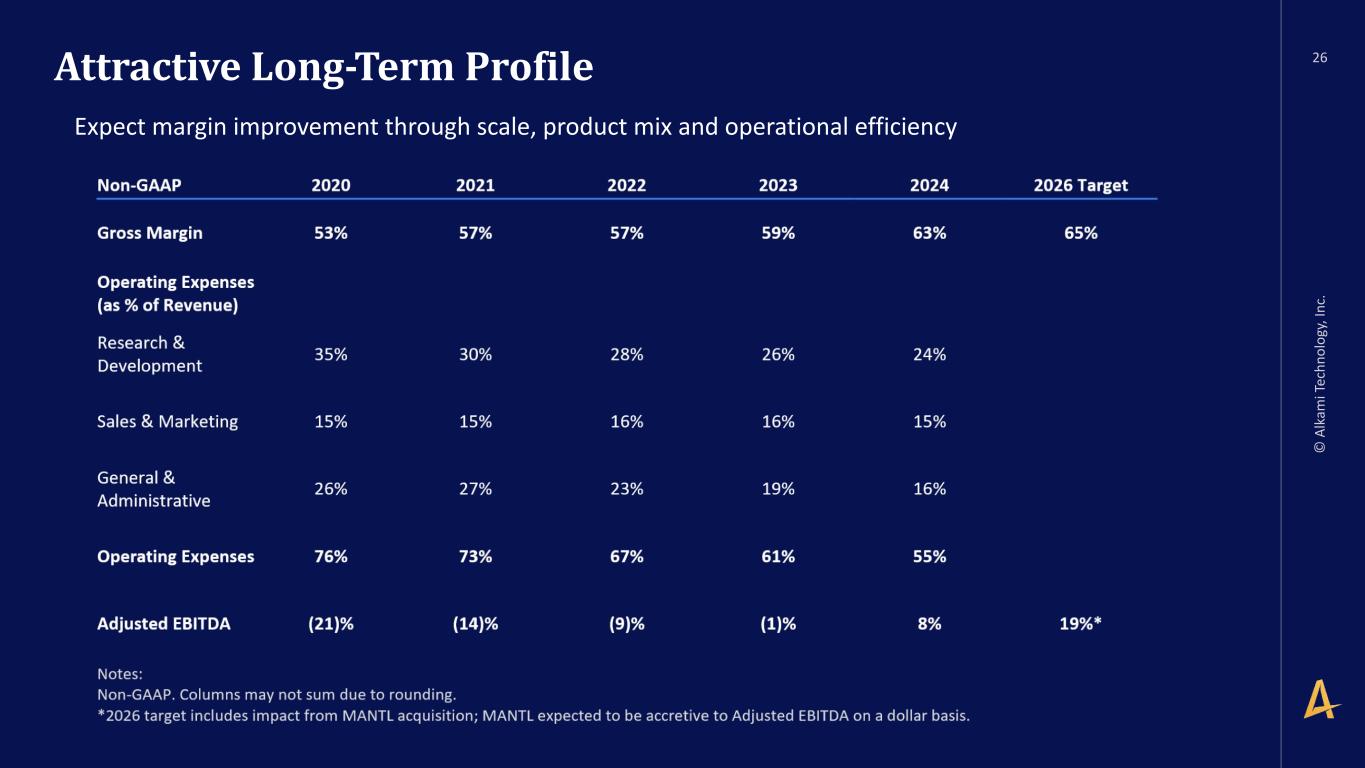
No, it's really related to some of the third-party IP that we sell through our platform. Some of the excess fees associated with those sets of products were lower than what we had originally anticipated in the quarter, and that had the effect of driving down gross margin. But that's the main impact sequentially. Year-over-year, we still expanded gross margin 100 basis points. And we'll exit the year just under 65% gross margin for the full year, and we feel really good about where we could actually perform from a gross margin perspective in 2026.
And remember, when Bryan and I came out and shared with you all a longer-term view of the business model, it would get to 65% gross margin by the end of 2026. So we feel like we're ahead of what we had planned to do.
Operator
Your next question is from Ella Smith from JPMorgan Chase.
Speaker 8
So first, I was hoping to ask about the record or near record number of implementations. I'm curious what is enabling you to implement more customers in a given quarter?
Thank you for your question. The services team has focused on improving their implementation methods, and they have developed new processes that enhance collaboration with the product and engineering teams on necessary changes. Our code base doesn't allow for custom development; instead, it involves configuration for client needs. The teams analyzed their most successful implementations and contrasted them with those that took longer. From this analysis, they began to replicate the successful behaviors of these top implementations. This effort included finding ways to assist customers in testing the code and managing key third-party relationships essential for the implementation process. As a result, we have seen increased speed in our cycles due to the collaborative efforts of the product, engineering, and services teams. I want to emphasize that this required significant work to understand what constitutes a successful implementation and to find ways to replicate that success. I am very proud of our company and the services team for successfully implementing 13 clients in a single quarter. Additionally, last week, we had three clients go live on the same day, which is an achievement we've only matched once before in our history. The team is truly performing at a high level.
And this is a scale game. So I mean, you can't perform at this level unless you've scaled your business to a point to where you're over 20 million digital users. So our ability to implement is definitely a differentiator for us in the market. And I'd like to echo Alex's compliments towards this team because if you drill down into the numbers, and Alex mentioned this in his prepared comments, but we also implemented 6 banks during the quarter. We now have 33 banks live. So 20% of the banks that we have live were implemented during the quarter that we had our highest new client implementation quarter. So that says a lot to the progress that this team has made. It also says a lot to the progress that we're making and now how we can go to market and sell to a bank with this level of track record and success in implementing a bank financial institution.
Speaker 8
That's very helpful. And if I can throw in a quick follow-up. Can you speak to the factors that led to your backlog ticking up in the quarter? And if you can provide any color on its composition, that would be really helpful.
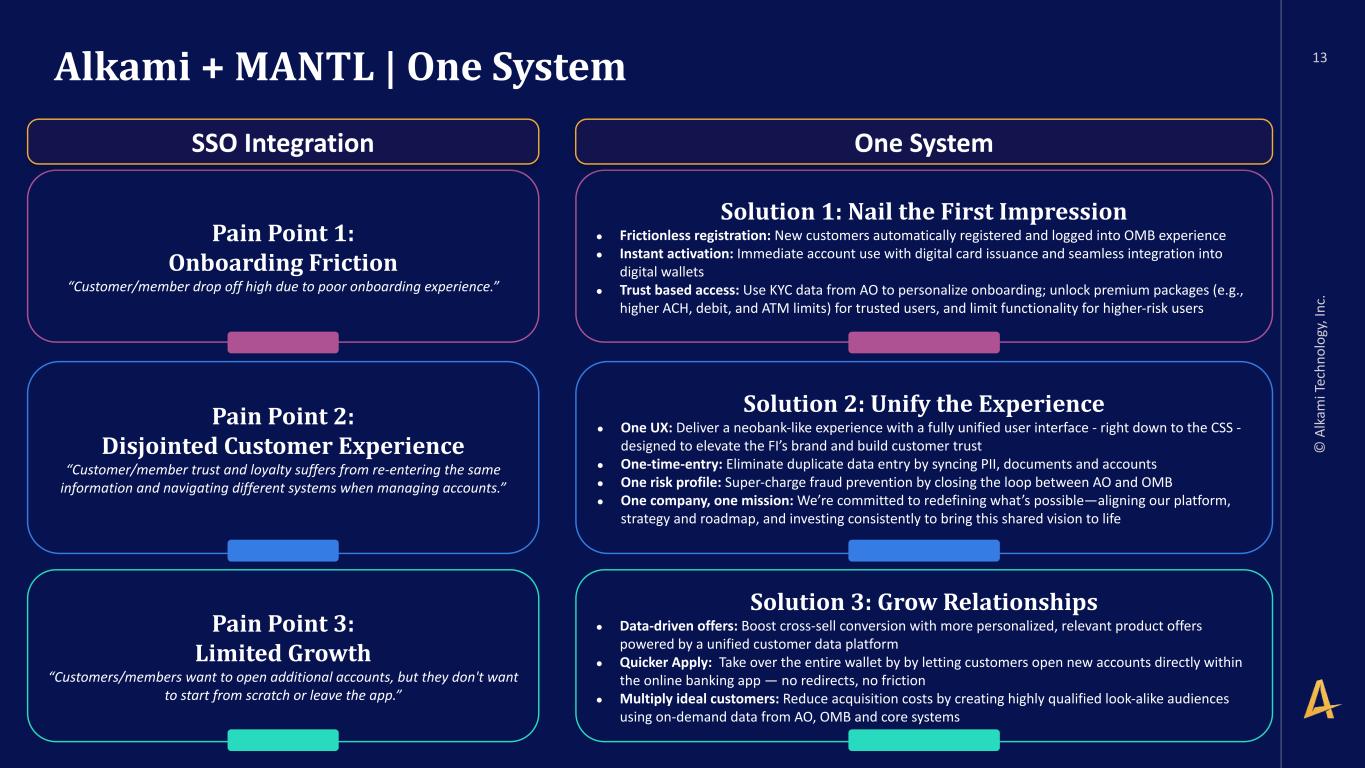
Well, we have 1.7 million digital users in our backlog now. If you look back a year ago, that number was about 1.2 million. So one of the largest factors is the fact of the number of digital users that we have in backlog. It's almost a year's worth of digital user growth, which provides significant visibility. And then also MANTL, MANTL is contributing in a big way to our implementation backlog. When we acquired MANTL, we suggested that MANTL would reach $60 million of ARR under contract. So that would include the backlog. we're almost at that level as we cross over Q3. So MANTL is doing a very good job in selling their products direct. As we mentioned in our prepared comments, we're doing a great job of cross-selling MANTL into either a new client win or into our installed base. We now have 44 shared clients under contract, which is 29 more than when we acquired MANTL. And then also the attachment rate of Segmint, so our data and marketing analytics product for the year, we're attaching at a rate of 75%. So if you step back from this and you go, well, what's the significance of the company being able to sell these 3 individual platforms into a client? Well, when you add Segmint and MANTL on a new client win or even a sell into our installed base, it increases the ARR 30%. So it's a pretty significant boost in ARR growth and ultimately subscription revenue growth.
Operator
Your next question is from Chris Kennedy from William Blair. Looks like that question was disconnected. The next question is from Adam Hotchkiss from Goldman Sachs.
Speaker 9
And Bryan, great working with you. Best wishes to you going forward. I wanted to talk about, Bryan, I know we've talked about the high visibility into revenue you have entering any given year. Could you maybe talk a little bit about the pieces outside of that, right? Maybe some of these surprise cross-sells that you get in any given year that would ultimately lead to the outperformance versus the visibility that you have in a given year? How are some of those cross-sells and upsells tracking relative to historical trends?
Our cross-sells actually, as we mentioned on the call, as a percent of our total sales, excluding MANTL to keep the comparison consistent, was just under 50% through the first 9 months of this year, which was a step up from last year. So our view is we're ahead of where we would like to be from a cross-sell perspective. Our ultimate goal was to be at 50% in 2026. So of our new client wins, 50% of those banks, 50% are credit unions, but of our total new sales, 50% derived from cross-sell activity. And MANTL is only going to accelerate that.
Speaker 9
Okay. That's really useful. And then one of the things that struck me intra-quarter was some of the MANTL announcements like the Taktile partnership and the bulk account opening product. Can you maybe just give us some color around what MANTL provides you from an innovation perspective now that you have them under your roof? Does it allow you to accelerate and pull forward some of these innovation projects that you've been thinking about? Any color around that would be useful.
Yes, what this provides us is the ability to deliver a crucial business capability that regional and community financial institutions desire. These institutions have strong relationships in their communities and aim to grow. However, the digital experience has become essential for their growth. Without the integration of technologies like Alkami and MANTL, the experience for new customers trying to sign up or purchase products is quite poor. It's often fragmented, requiring interaction with multiple systems, sometimes necessitating a call to customer service, or even physical paperwork. Therefore, their growth strategy relies on an integrated and seamless front-end experience. Our significant opportunity lies in developing this integration among our data and marketing platform, onboarding and account opening platform, and digital banking solutions. This will result in a smooth experience for both new customers and existing customers purchasing new products. This capability is something that all our clients are eager to have. Additionally, our team at Alkami and MANTL is highly innovative and already has several ideas for expanding our offerings, such as an account maintenance application and enhancements to our loan origination platform. This team demonstrates rapid product development and creativity, and we anticipate they will contribute new products that we can monetize. We are genuinely excited about the acquisition we made.
And Adam, it's important to consider what Alex just shared regarding our opportunities for innovation. There are various areas within the company where we can foster innovation. When you have a financial model like Alkami's that offers visibility and allows you to grow profitability at a high rate, it enables you to accelerate investments in those areas while still meeting your profitability commitments. This capability is a key differentiator in understanding the investment thesis in Alkami. It drives innovation within a public company while ensuring that it meets its profitability objectives. This is a balancing act, but our insight into revenue and profitability gives us that advantage.
Operator
The next question is from Chris Kennedy from William Blair.
Speaker 10
I'll just echo the comments to Bryan and Cassandra. Congratulations. It's good to see the 4 new bank wins in the quarter. Can you just talk about what you're seeing there? And was it related to combining the sales forces of Alkami and MANTL?
Yes. The main thing we’re observing is that this is a risk-averse marketplace. Companies are transitioning from a suite approach to a best-of-breed model, and they want assurance that a company has a proven record of successfully migrating them to a modern digital banking platform. Our ability to bring previous clients onto the platform is instilling confidence in the market. Additionally, we are ramping up our capabilities within our treasury management portfolio. This allows us to meet with potential clients and demonstrate our current treasury management capabilities, the advanced features we are developing, and the dedicated teams working on this. Clients are making decisions today with the understanding that they will come onto the system in 9 to 12 months. They are evaluating our existing treasury management capabilities and assessing the feasibility of our roadmap. They consider whether we know what features to develop and our success in delivering them into production. Clients are questioning if we will be able to integrate our digital banking system with their existing core system, and whether we will have the necessary commercial business banking and treasury management capabilities to support their operations. What we are noticing is that our extensive work over the last couple of years is beginning to gain traction, as people can see we are successfully launching customers and developing software. They desire a modern platform, and they are choosing Alkami.
Speaker 10
Understood. And it's great. And then as a follow-up, it's great to hear MANTL is nearing $60 million of ARR, about a quarter ahead of expectations. Can you just talk about the loan origination initiative for MANTL and kind of what you see as the opportunity with that?
Well, let me remind everybody what we've talked about in terms of the loan origination platform. As we said, there are a set of lighthouse clients that are collaborating with Alkami and MANTL to build a loan platform, and we're going to be bringing those lighthouse clients on the loan platform. We're going to be evaluating product market fit and our ability to do a great job for those clients. And sometime, towards the end of this year or the beginning of next year based upon our evaluation of our ability to go to market with that product, then we'll make a decision to go to market with that product. That is not a generally available product that our sales team can sell right now. So to frame your expectations, it's a market that would like us to be in it. It's a product that we're building, but we're going to make darn sure that it's got great product market fit, and we've got live customers that are satisfied before we put it in the bag of the sales team.
Operator
Your next question is from Jeff Van Rhee from Craig-Hallum.
Speaker 11
Alex and Bryan, this is Daniel Hibshman standing in for Jeff Van Rhee. Regarding MANTL, I found the numbers you shared particularly interesting. This quarter, MANTL signed 29 new clients, with 15 of them being new to Alkami. This means that about half of the MANTL signings this quarter came from Alkami clients. I assume that cross-selling plays a significant role in this. It seems unlikely that half of the MANTL client base consists of Alkami clients, so I gather that the MANTL client base is more representative of the market share split with Alkami. With half of the new signings coming from the Alkami base, does this mean MANTL's new signings have nearly doubled thanks to their connection with Alkami? I'd like your perspective on the pace and impact that Alkami’s involvement with MANTL is having.
I'm going to give you a qualified answer and let Bryan talk to the numbers. What you're seeing from our base is a demand for a great highly intuitive onboarding and account opening product. And so when they see MANTL and what that team has built, they want to buy the product. So it's had great reception in our market. I would never project doubling sales.
MANTL has joined Alkami, not the other way around. When we acquired MANTL, we compared it to our Segmint acquisition, which focused on data and marketing analytics. Our investment thesis was that the buyer of the MANTL solution within a financial institution is typically similar to the person purchasing online banking. This gives us a strong opportunity to cross-sell to our existing clients. With Segmint, we noticed a high attachment rate in new client wins when the C-suite was involved in decision-making. However, the challenge we faced with Segmint was that the buyer within the financial institution was different, meaning our existing relationships weren't as effective in influencing that buying decision. We don't face the same issue with MANTL, which is why we are seeing early success and significantly better results compared to the Segmint acquisition in the first couple of quarters.
Speaker 11
That's helpful. Regarding the ARR and backlog for implementation, I believe I heard it was $67 million, so I want to confirm if that's correct. Last quarter, it was noted as $68 million, so there's a slight decrease sequentially. Given the 10 new signings to the digital banking platform and the strong signings for the quarter that you mentioned, why wouldn't that number increase? What are the factors at play here?
We had a significant implementation quarter. We had the largest number of online banking new client implementations that we've had in the history of the company. And within that, there were 6 banks, and there was also a very large client that went live as well. So...
Also MANTL had as many implementations in Q3 as in the entire first half.
Yes, MANTL continues to enhance its implementation efficiency. This improvement significantly reduces the backlog and contributes to our confidence in the expected increase in organic growth for both revenue and ARR as we approach the end of the year.
Operator
There are no further questions at this time. Ladies and gentlemen, this concludes your conference call for today. We thank you for participating and ask that you please disconnect your lines.