Operator
Good morning. My name is John and I'll be your conference operator today. At this time, I would like to welcome everyone to Atkore's First Quarter Fiscal Year 2025 Earnings Conference Call. All lines have been placed in a listen-only mode. After the speakers’ remarks, there will be a question-and-answer session. As a reminder, this conference is being recorded. Thank you. I would now like to turn the conference over to your host, Matt Kline, Vice President of Treasury and Investor Relations. Thank you. You may begin.
Speaker 1
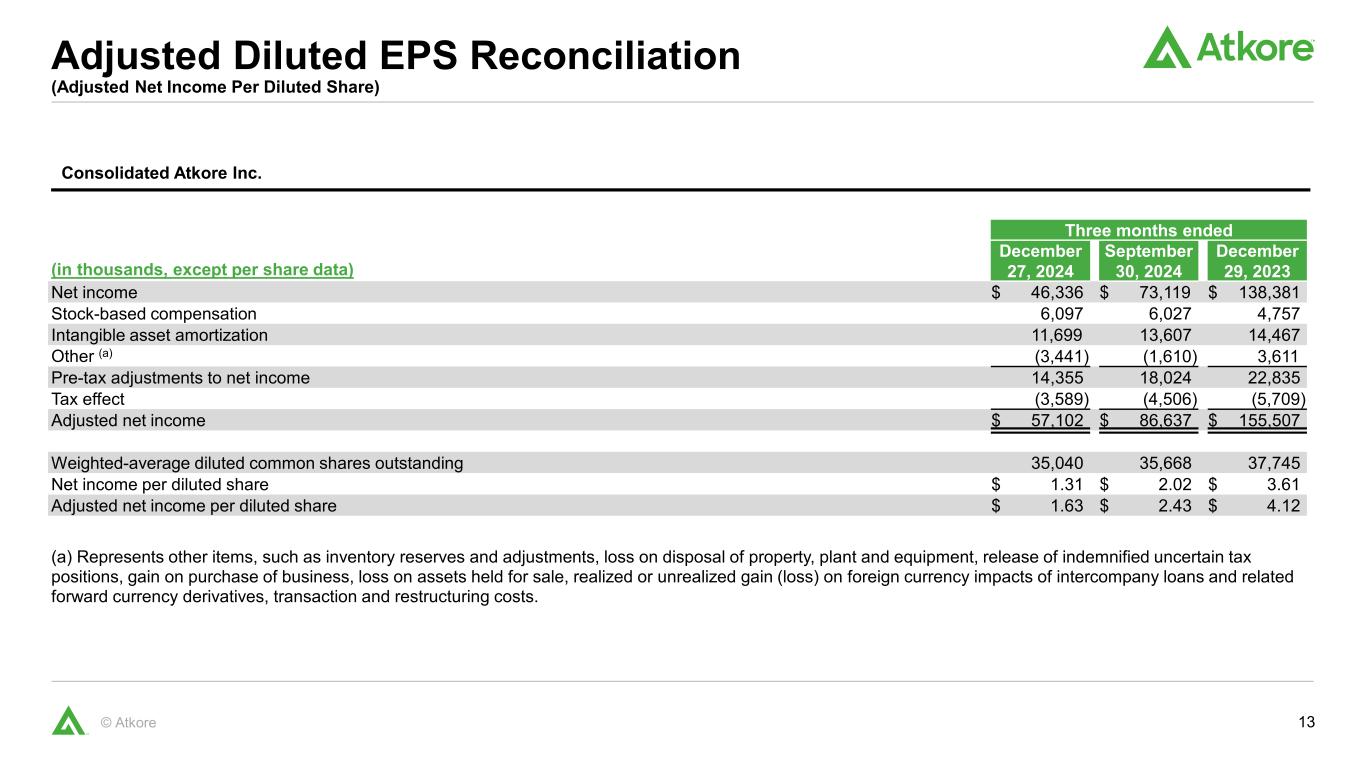
Thank you and good morning everyone. I'm joined today by Bill Waltz, President and CEO; John Deitzer, Chief Financial Officer; and John Pregenzer, Chief Operating Officer and President of Electrical. We will take questions at the conclusion of the call. I would like to remind everyone that during this call, we may make projections or forward-looking statements regarding future events or financial performance of the company. Such statements involve risks and uncertainties, such that actual results may differ materially. Please refer to our SEC filings and today's press release which identify important factors that could cause actual results to differ materially from those contained in our projections or forward-looking statements. In addition, any reference in our discussion today to EBITDA means adjusted EBITDA and any reference to EPS or adjusted EPS means adjusted diluted earnings per share. Adjusted EBITDA and adjusted diluted earnings per share are non-GAAP measures. Reconciliations of non-GAAP measures and a presentation of the most comparable GAAP measures are available in the appendix to today's presentation. With that, I'll turn it over to Bill.
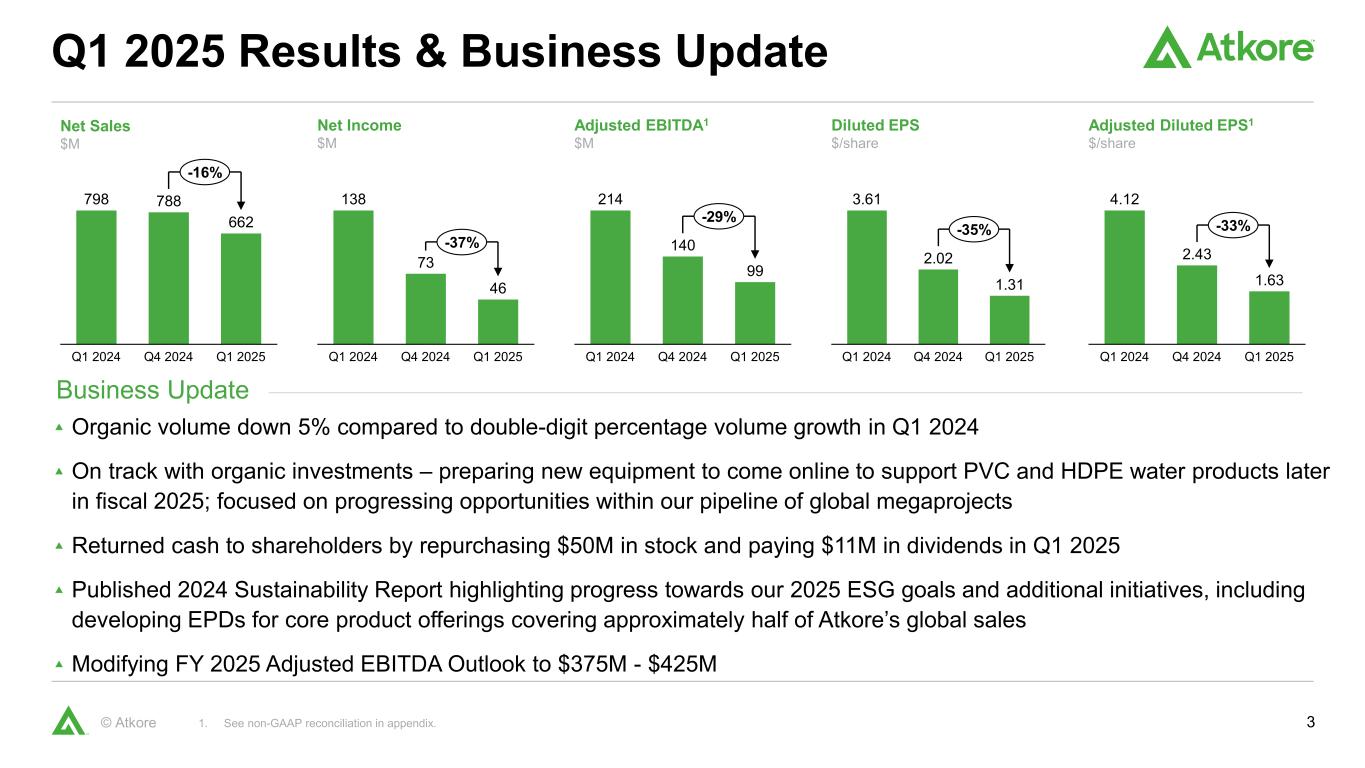
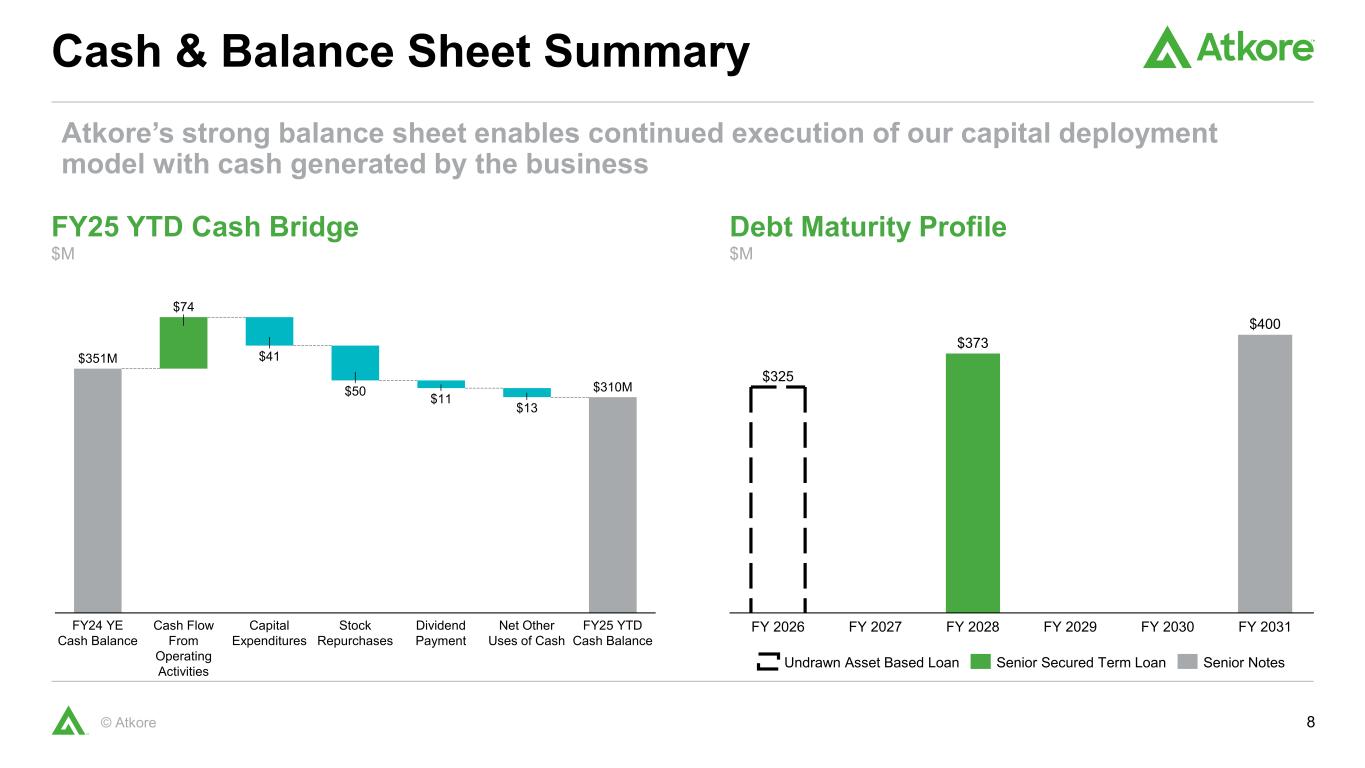
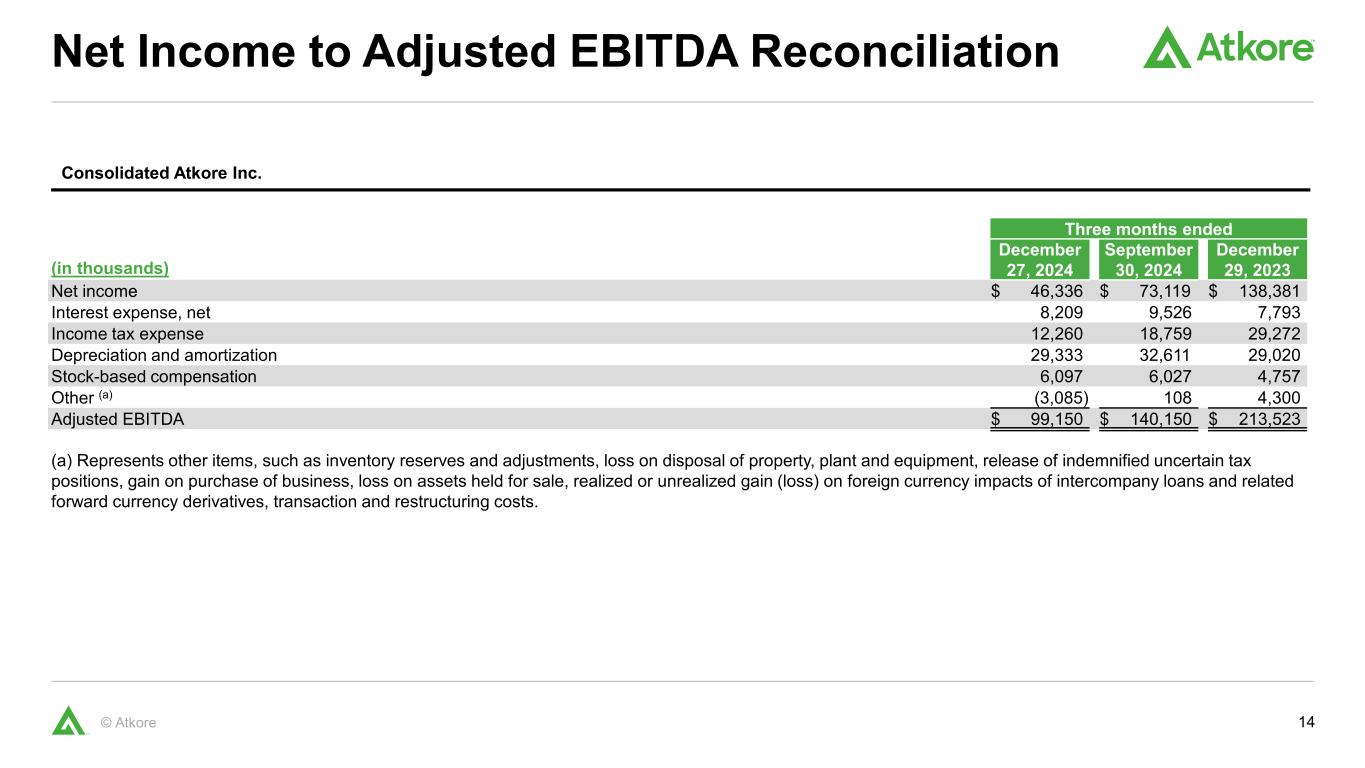
Thanks, Matt and good morning, everyone. Starting on Slide 3. Our Q1 performance was in line with our expectations. We achieved net sales of $662 million and adjusted EBITDA of $99 million, both of which were within our outlook range. Our $1.63 of adjusted EPS was near the top end of our outlook range. Organic volume declined 5% in the first quarter, but this is in comparison to our strong volume performance in the first quarter of fiscal 2024. Our teams have been focused on executing the growth initiatives that we discussed in November related to water and global construction services. We are on track with our organic initiatives and are planning for those to come online later in the year to support both our PVC and HDPE water products. We continue to pursue several opportunities for global mega projects as we look to grow our pipeline and eventual backlog. We remain committed to returning cash to our shareholders as evidenced by the $50 million in share repurchase in the first quarter, which complements our quarterly dividend payment. I'm also pleased to highlight the release of our fiscal year 2024 Sustainability Report which we published last month. This report details our ongoing initiatives, accomplishments, and progress toward our 2025 goals. In the first quarter of 2025, we released additional environmental product declarations for our core products. Atkore has EPDs for our core products covering approximately half of our global sales. When we met in November, we planned our year with an expectation that we will continue to face challenges impacting both our volume and price due to increased foreign and domestic competition. Most notably, these challenges impact our PVC conduit and steel conduit businesses. Having completed our first quarter, we now believe the challenges we outlined in November will have a larger impact on our 2025 performance than previously anticipated. We saw year-over-year volume increases in imported PVC conduit which is impacting the market environment. Additionally, we continue to see year-over-year increases in imports for steel conduit. The imports for both PVC conduit and steel conduit originated from countries where quantity limitations are either non-existent or poorly enforced. During the first quarter, we saw downstream constraints impacting our utility scale solar market which impacted our volume. However, we are pleased by the improved operational performance within the S&I team and our Hobart, Indiana facility. I am disappointed that we continue to operate in these conditions. The challenges we are navigating are not what we anticipated at the end of fiscal year 2022 when we signal normalization of our record profits. We now expect full year 2025 adjusted EBITDA to be approximately $400 million at the midpoint of our range. Our outlook reflects what we believe is most probable. We are pleased that an announcement was made related to tariffs on Mexico. Should these tariffs go into effect, they should have a positive impact on our business. At this time, our outlook does not contemplate any material benefit from tariffs on imported conduit. As a reminder, the recently announced tariffs impacting Mexico and Canada do not affect our PVC conduit business. We are currently forecasting the headwinds impacting PVC pricing may continue. In the meantime, we are advancing our key initiatives to expand our business in new market areas. Secondly, we are prudently looking at our enterprise-wide cost structure to mitigate the impact of these industry headwinds. Lastly, we are looking at alternative scenarios for certain assets to provide the best economic return. My conviction and our team remains strong and we will lean into our business system to execute our strategy. I'd like to take a moment to thank all of our employees for everything they do to support our key stakeholders. With that, I'll now turn the call over to John to talk through the results from the quarter and provide more details on our outlook.
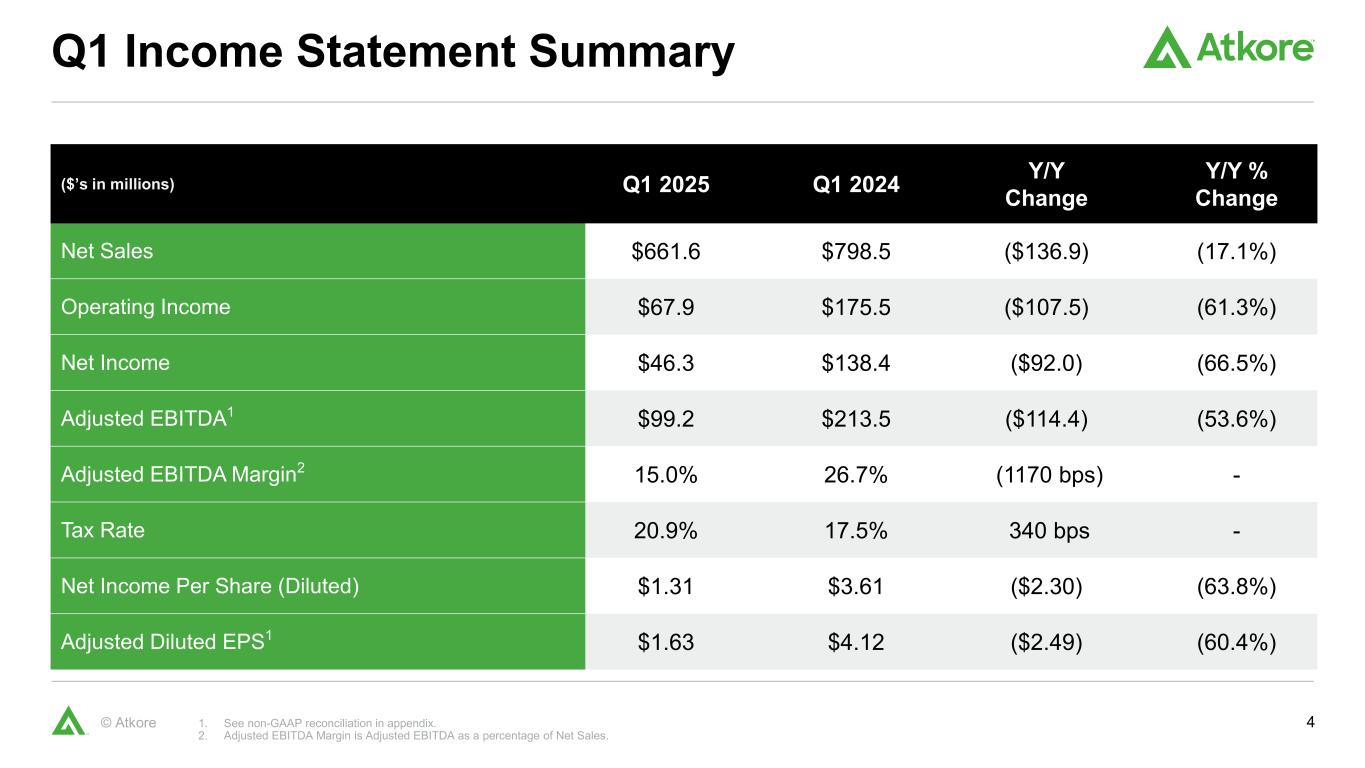
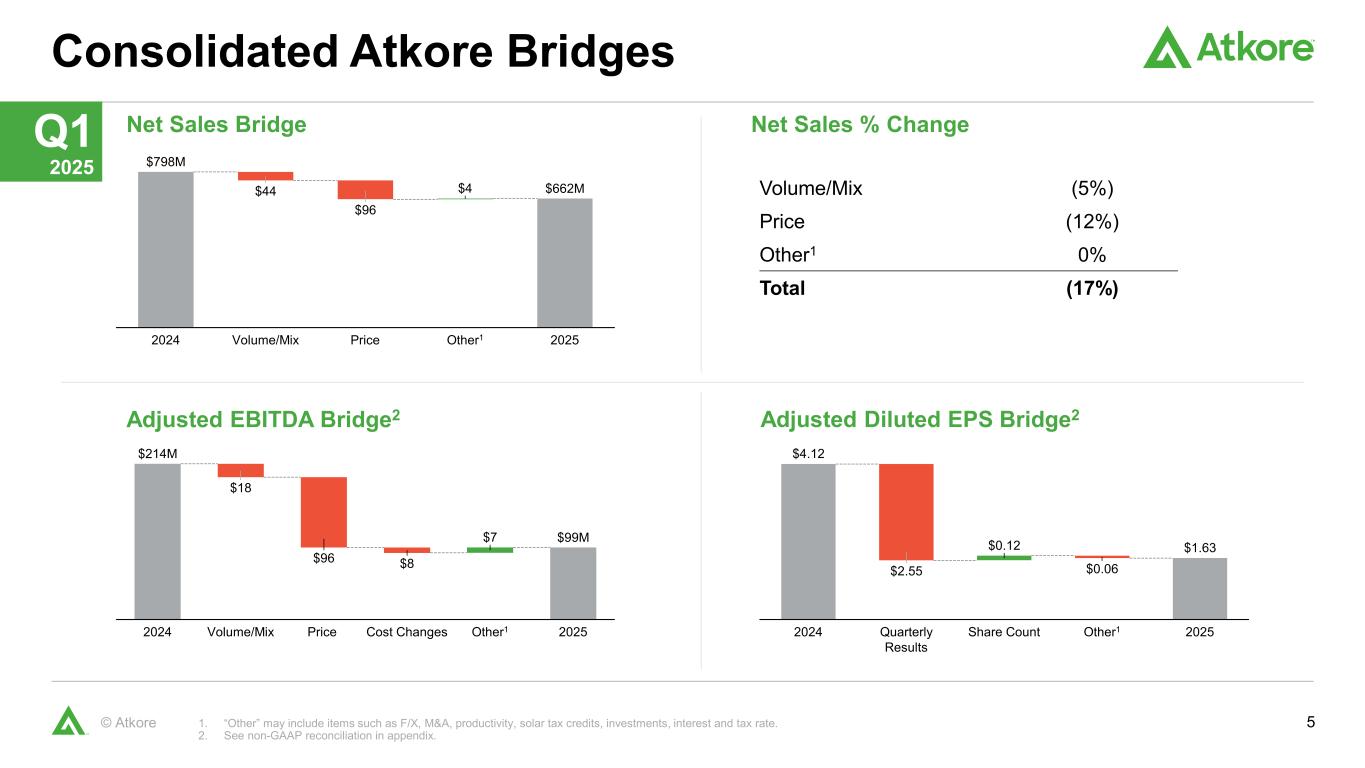
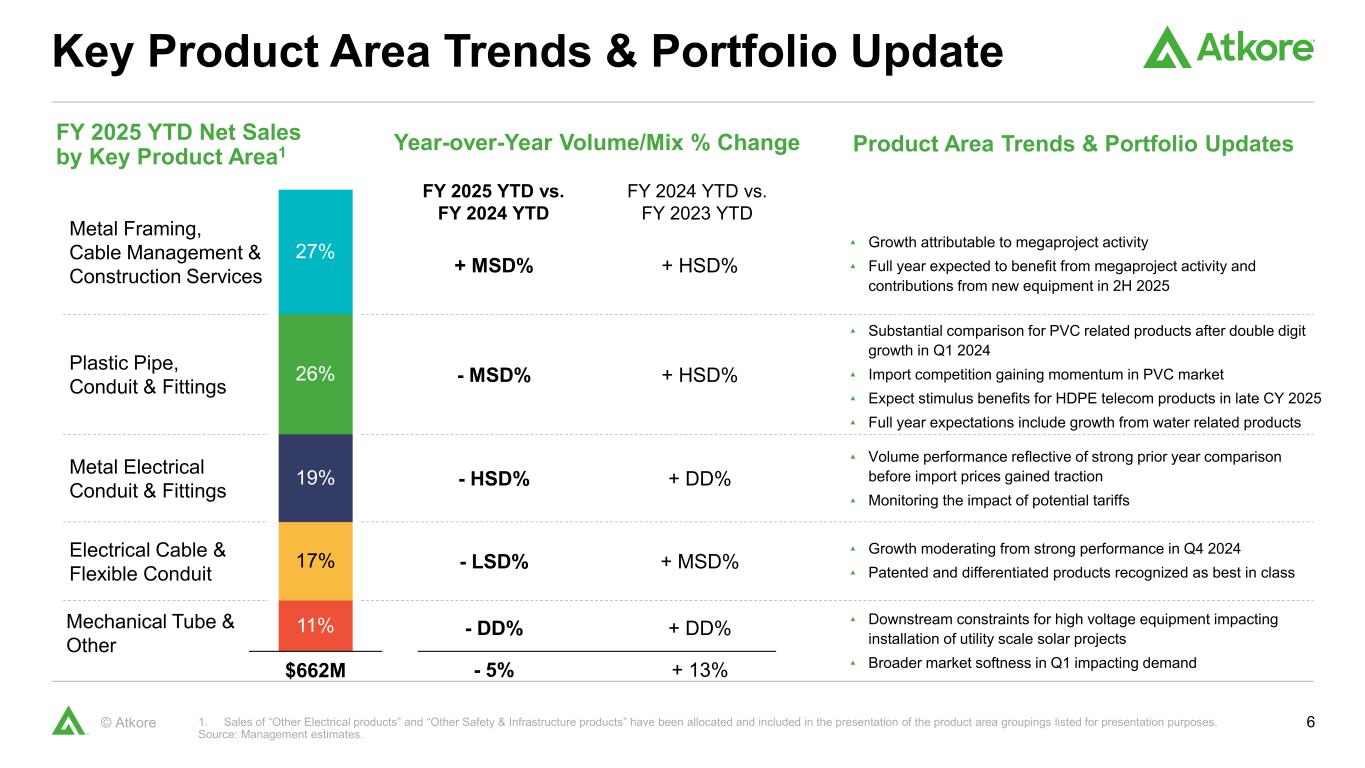
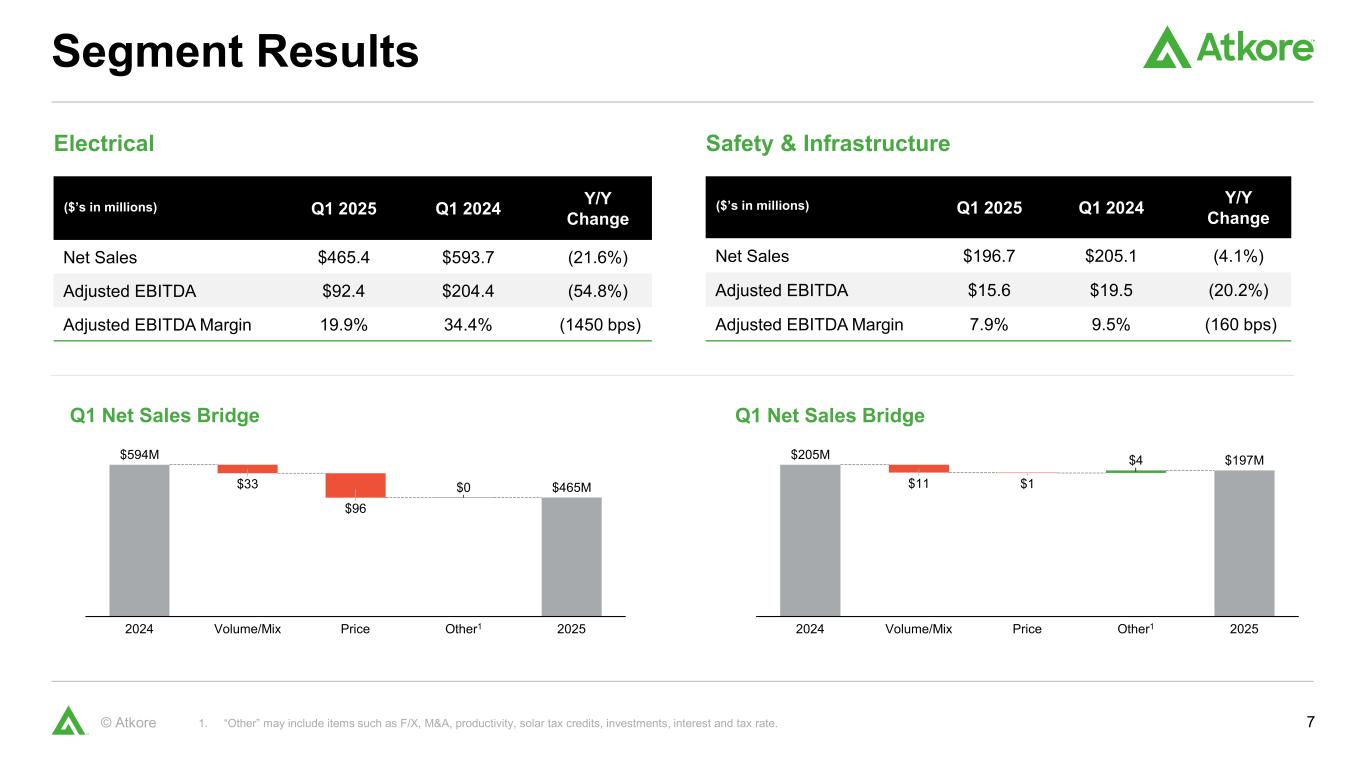
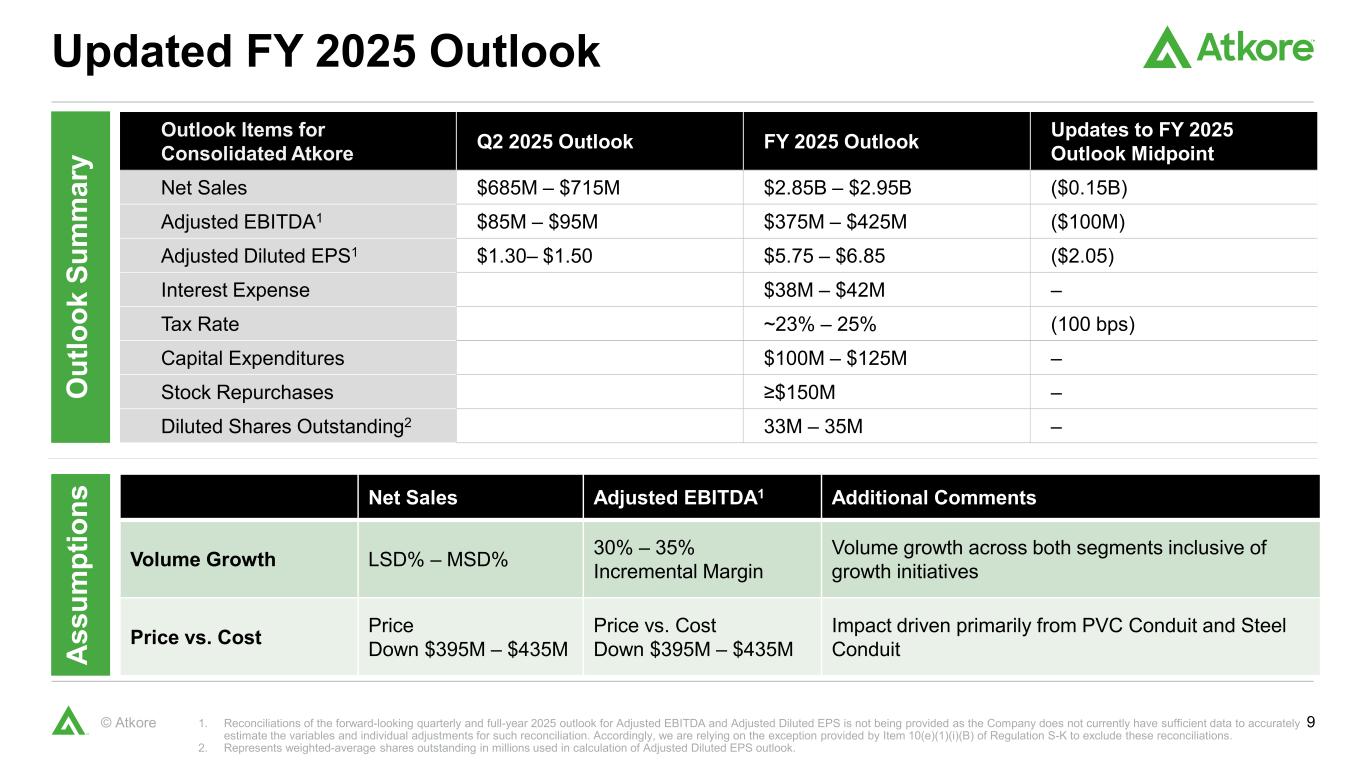
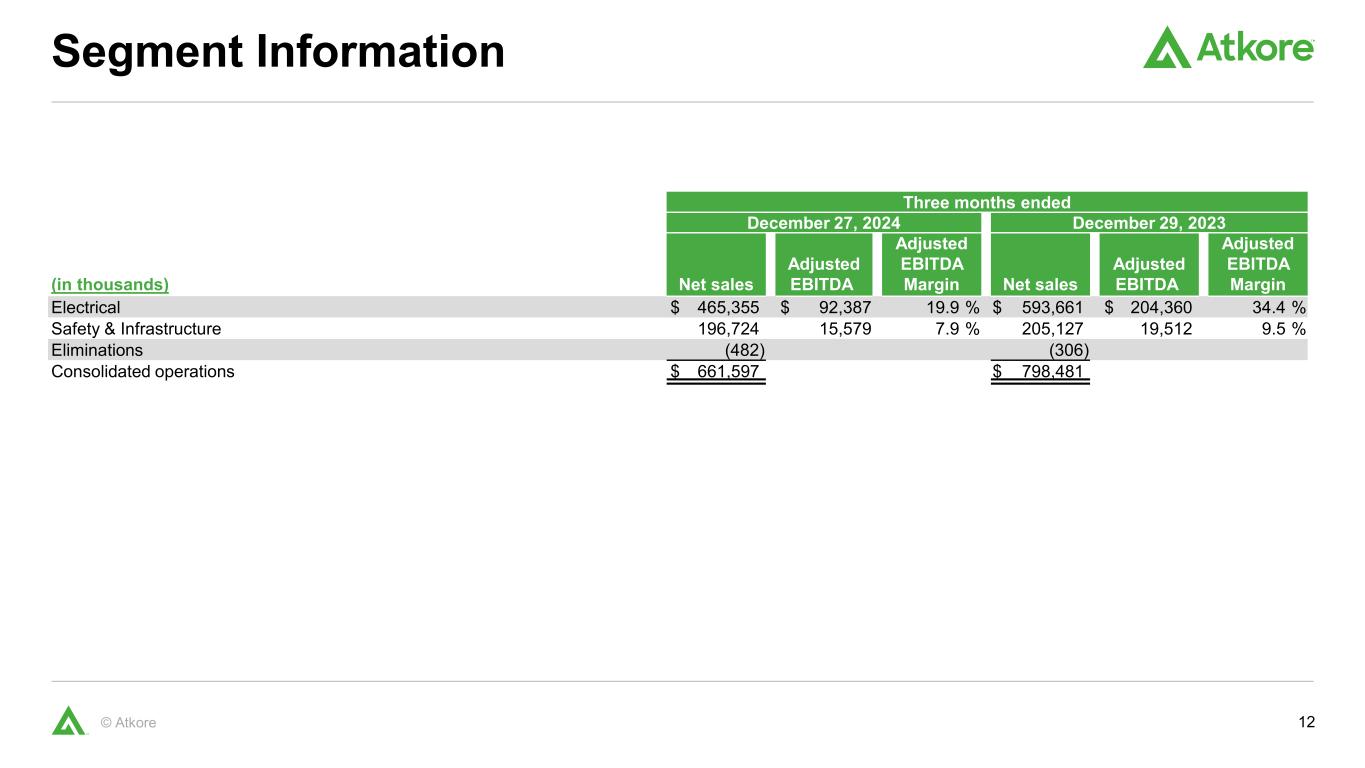
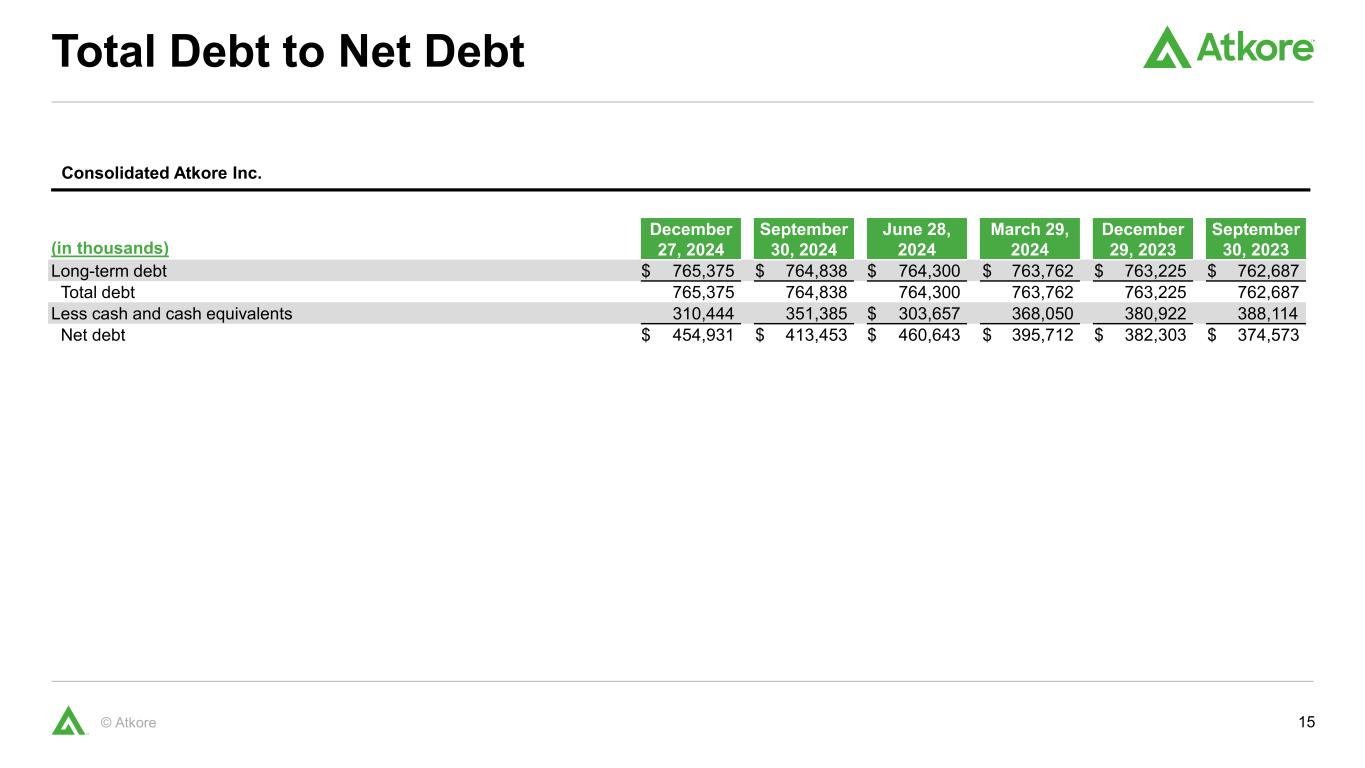
Thank you, Bill and good morning, everyone. Moving to our consolidated results on Slide 4. In the first quarter, we achieved net sales of $662 million and adjusted EBITDA of $99 million. Our tax rate in the first quarter was 21%, an increase from 17.5% in the prior year. As a reminder, the tax rate in the first quarter of last year had benefits from previously granted stock compensation. These outsized benefits contributed to our stronger-than-anticipated EPS performance in the first quarter of fiscal '24. Turning to Slide 5 and our consolidated bridges. Organic volumes were down 5% compared to double-digit growth in the first quarter of fiscal '24, when volume was up over 13%. Our average selling prices declined 12% during the quarter, most of which came from our PVC conduit and steel conduit products. Moving to Slide 6. Our volume decline during the first quarter was across most product categories. As we mentioned earlier, volume in the first quarter last year was atypical for what is traditionally our slowest quarter. However, our metal framing, cable management, and construction services businesses grew mid-single digits in the first quarter of fiscal '25 after being up high single digits in the prior year. This growth is driven by both an increase in our construction services support of global mega projects as well as the high density of metal framing products required for this type of construction. We anticipate additional growth from these businesses throughout our fiscal year in part due to the addition of new capacity for metal framing to support large construction projects such as data centers and chip fab manufacturing. Our plastic pipe and conduit product category declined mid-single digits during the quarter. This category grew high single digits in the prior year as the channel is adding back inventory after a period of destocking in 2023. Separately, as Bill mentioned earlier, we are also seeing an increase in imported products coming from multiple locations, including Central and South America. The combination of imports remains below 10% of the overall market but we are continuing to monitor this situation closely. In addition, we are examining the product quality characteristics of these imported materials versus the standards and specifications. Our volume decline for steel conduit was also impacted by year-over-year foreign competition. We believe that imports represent between approximately 20% to 25% of the overall market. As we look beyond Q1, we continue to expect growth across much of the portfolio, including contributions from our plastic pipe category driven by growth in our water-related products. Overall, we continue to expect volume growth between low to mid-single digits for the full year. Turning to Slide 7. Adjusted EBITDA margins compressed in our Electrical segment due to previously mentioned pricing and volume declines. The adjusted EBITDA margins also declined in our S&I segment primarily due to lower volume. The S&I segment margins, however, did improve sequentially from the fourth quarter of 2024 and we are pleased with the operational performance and improvements being made in our key facilities such as Hobart. Turning to Slide 8. We continue to execute our balanced capital deployment model with an emphasis on returning cash to shareholders along with capital investments to progress our growth initiatives. Our balance sheet remains in a strong position with no maturity repayments required until 2028. Next, on Slide 9. We expect low to mid-single-digit percentage volume growth for the full year. We expect our Q2 net sales in the range of $685 million and $715 million. Our adjusted EBITDA is expected to be in the range of $85 million to $95 million. Our adjusted EPS is expected to be in the range of $1.30 and $1.50. Historically, we are accustomed to anticipating some amount of seasonality. We generally build in an expectation that the back half of the year will be stronger than the first half. We believe this will be the case this year for two main reasons. First, our overall business is generally stronger in the spring and summer construction season versus the fall and winter. Second, as we continue to ramp up our initiatives, our volume should steadily increase throughout the year. Therefore, we expect adjusted EBITDA to improve sequentially from Q2 into the second half of the year. As Bill shared, we are also updating our full year 2025 outlook. We now expect full year adjusted EBITDA in the range of $375 million to $425 million and adjusted EPS in the range of $5.75 to $6.85. With that, I'll turn it back to Bill.
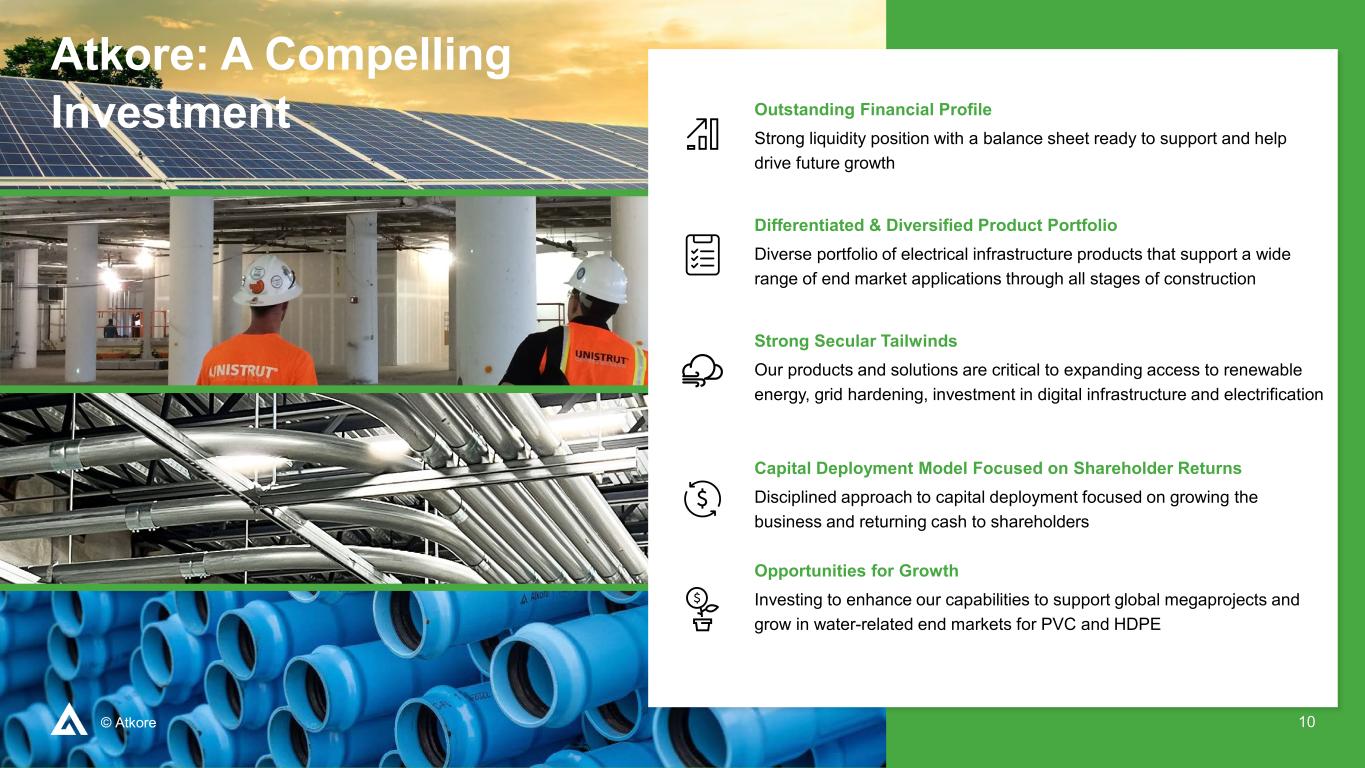
Thanks, John. Moving to Slide 10. As the entire management team focuses on executing our growth initiatives and creating greater value for our customers and shareholders, we remain confident that the electrical industry is a great place to be. Atkore's strong balance sheet, breadth of products, service capabilities, and goal of being the customer's first choice positions us well to benefit from the strong electrical trends projected across numerous end market categories. We remain committed to returning cash to shareholders through a combination of share repurchases and quarterly cash dividends and look forward to sharing more about our progress against our growth initiatives related to global construction services and water-related products later in the year. Through it all, we are guided by our strategy, our process, and our people, the three fundamentals of the Atkore business system. One recent demonstration of the Atkore business system at work is our announcement of our new Chief Operating Officer held by John Pregenzer. John's multidisciplinary career, combined with his experience, holding various roles at Atkore since joining in 2015 makes him a tremendous asset and I'm excited by the additional value he will help Atkore achieve for our customers and our shareholders. With that, we'll turn it over to the operator to open the line for questions.
Operator
Your first question comes from the line of Andy Kaplowitz with Citigroup.
Speaker 4
Bill, can you elaborate on the commentary that import competition is gaining momentum in PVC? Maybe what has changed with PVC imports versus past that you've seen a pretty big move from this Latin American competition? And then metal conduit volume looks like a reverse course and declined in Q1. Is that just for comps, project delays or new capacity starting to come in?
Yes. Let's discuss PVC in detail, Andy. Imports have increased, still in single digits, but they have grown over 20% year-over-year. This growth may be attributed to improved performance or customer acquisition, leading to higher shipments. While overall market volume remains in single digits, factors like pricing pressure and competition from slower markets have played a role. I want to highlight our guidance this year. We understand the frustration around not hitting or exceeding numbers, so we've projected a return to pre-COVID levels by the end of the year. Our goal is to add value and explore options to increase prices amidst current conditions. We've adopted a cautious stance, anticipating price declines. Our forecast suggests this year could see the steepest year-over-year declines in PVC. Regarding imports, I don't have visibility into other companies' cost structures, but reaching pre-COVID levels may not be profitable for them due to extra freight costs, even with lower volumes. Based on our analysis, resin costs in other countries are similar to ours, and labor costs are a small factor, making profitability challenging. Looking at steel, it's mostly just about year-over-year comparisons, and imports continue to pose a challenge, although they've only grown about 4%. It appears to be moderating, and we faced tough comparisons. We previously mentioned we didn’t anticipate much impact from tariffs and trade policy changes. We're approaching the end of the year with the expectation that things will stabilize; however, we have not altered our guidance and have accounted for all variables, meaning any changes from tariffs or quotas would be beneficial to our numbers.
Speaker 4
No, that's helpful. I just want to confirm regarding the volume. Volume was down 5%, which appears to be due to tough comparisons. You are not anticipating any cyclical improvements in construction markets, only seasonal improvements, correct? Also, could you provide some commentary on the health of the markets as you see them?
Yes. It's exactly, Andy. So no bounce back in industries, no bounce back in residential or anything else there. So it's literally, as I think in John's prepared remarks, I think we will finally get back to normal pre-COVID things that there is that 7%, 10%, just the summer months and so forth that we'll have that. Otherwise, even most of our initiatives, like I'm sure somebody will ask about BEADs and HDPE, we really have going into '26 and so forth.
Speaker 4
Okay. And just one more for me. Like, can you give more color into your comments regarding looking at your cost structure under getting value? I think you said value for strategic assets. Might we see bigger activities on these fronts this year and what could that look like?
I'll begin and then pass it over to John Deitzer because there are many topics to cover, but I'll take some of John's points from this morning. Apologies, John. To highlight what we've already accomplished, we had a facility in Tempe, Arizona. We are committed to efficiency, so we closed that operation. We will maintain business activity by relocating it to Phoenix and Massachusetts. That's one example. Looking ahead strategically, we identified areas where we can produce effectively. While I won't disclose specifics, we successfully sold a couple of production lines because we determined we could still meet customer demand without them. We are also implementing a headcount freeze for attrition. We're evaluating our product lines, like PVC conduit in water, and making decisions based on economic returns, balancing mechanical products and conduit products among other considerations. I believe we are on track for the highest year-over-year productivity in Atkore's history. So, Andy, there are numerous factors we are examining. We are also considering potential spin-offs of smaller businesses that were acquired and are not part of our strategic vision; these evaluations are either completed or underway.
I agree with everything Bill mentioned there. I would just add to his point that we did have some positive productivity and we are going through almost at every line item, asset by asset, what makes the most sense. So I think we are actively trying to understand what levers we have to pull.
Yes. And Andy, sense for you, I know you'll appreciate but again, it's a forecast. We have 2 weeks of backlog, all those other things. But I do think this is a point where I'm just frustrated with the unexpected. It's like, okay, guys, listen, I assume good things, they will raise forecast and let's work like hell to get these numbers moving forward.
Operator
Your next question comes from the line of Deane Dray with RBC.
Speaker 5
So just if I step back and look at the first quarter, price and volume both came in largely in line with our expectations. So the cut here is all prospective on how you think the dynamics change for the balance of the year. And maybe it would be helpful if you could, just in broad strokes, kind of break out for us on that guidance cut, how much is the PVC, how much is steel conduit? Just to size kind of the severity. And you hadn't, unless I missed it, talked about the new competitor in PVC. Maybe it hasn't really become all that volume online yet but if you'd address that?
Yes. I will start and then hand it over to my financial partner for more detail on the division between the two groups. Regarding my earlier comments to Andy, yes, there are indicators out there. Currently, it seems like imports are primarily driving this situation. This pattern has been consistent for the past decade; Atkore's main challenge remains supply and demand. December was weak, which we've addressed in prior discussions, and January was also underwhelming. I hesitate to mention external factors like storms in California and freezing temperatures in the south, but we need to consider how January pricing has been affected and what this means if this trend continues. I don't want to express optimism that this will not be an ongoing issue. We should realistically think about the implications. I'm not altering our view based on the first week of February or the potential impact of tariffs—this is just one week. We are navigating these challenges and focusing on what could realistically happen rather than what we hope will happen, and we need to reassess from there. John, if you...
Yes. I'll jump in here to kind of help you dimension it, Deane. So from a price versus cost standpoint, we roughly had an outlook of down $300 million previously. Now we're at the midpoint, roughly down $400 million. So it's a $100 million delta from a price versus cost standpoint versus where we were back in November. I'd say roughly $75 million or three-quarters of that is on the PVC side and probably 25% of that is on the steel conduit side. So overwhelmingly driven by the changes in expectations from a PVC conduit. I'd say that market is changing as we've talked about. And I'll probably kick it here over to John Pregenzer who can kind of give some context on what we're seeing from an import perspective, where it's coming from because I don't think it's just about the domestic competition as well. John?
Yes. Thanks, John. Deane, so when we look at the PVC market, there's been a number of new entrants from all different sources, whether it's imports from Latin America, from China. We've seen domestic producers diversify out of the waterwork business to get into the electrical space. And obviously, there's new entrants that are coming in out of nowhere. So it's my career, probably the most disruptive period we've ever seen in regards to a number of new entrants and that's just creating a lot of pressure on price and spread that we're experiencing. And there's been a significant acceleration here as we've been tracking this price normalization over the past couple of years, the last quarter to two quarters has really accelerated. So I think what we're trying to do is to capture that going out for the rest of the year.
And I know you might ask. Go ahead, Deane, sorry.
Speaker 5
No, I just think it's great to be able to understand what those are and to hear John's comments about how many other entrants are in the PVC side. We thought it was just Venezuela and the Dominican Republic, but it's much more than that. So that's very helpful. And Bill, I apologize for interrupting you.
Yes, the only point I want to emphasize is that we have considered various factors. As I mentioned earlier, we're aiming to return to pre-COVID levels. While I can't make any commitments, as someone who has been in this industry for over a decade, you're aware that the PVC margins for the 500 miles aren't sufficient to support it. We believe that before reaching that number, some aspects will need to be adjusted, but I would prefer to include the best possible estimates in our forecast.
Speaker 5
Yes. That's a great last point there. And just one question and I'll hand it off was, are you suggesting some of these imports and is it both PVC and steel might not be meeting specs?
Yes. I would say without getting too specific and looking over my attorney here because there's not a 30-second rewind. We've communicated in the past, there are several things occurring. One, there's products that don't have all the specs. So for example, you can use it in this application but you can't use it in that. So then a contractor has to decide, are they meeting and saying, put this and quite frankly, they're not looking to go, oh, it doesn't meet a temperature of 90 degrees Celsius. Two, we are working with the authorities on products coming in even, for example but I won't call what specific customers and so forth. But where they have to pass like an impact test of 7 out of 10, you have to drop away from certain things and not crack. And we've recently tested one significant importer and they're passing 1 out of 10. So from authorities to customers, to our government relations, this also are things that just for the safety of society need to be fixed.
Operator
Your next question comes from the line of David Tarantino with KeyBanc Capital Markets.
Speaker 7
Maybe just to put a finer point on PVC. Is the revision entirely from the imports? Or is there also additional capacity domestically? And then could you maybe give us an updated view on the degree of incremental capacity being added from the market as a whole?
Yes, David, I think it's a bit of both in relation to what John Pregenzer mentioned. We don't have insights into our competitors, so I'm unsure how much is attributed to new lines being introduced versus changes in market share. Some clients may be commenting on their municipal status as we enter what we generally refer to as the water market, which includes agriculture, plumbing, and municipalities. It’s challenging to determine if the focus is on capacity or expanding their market presence. Imports play a significant role; while it's still less than 10%, it increased over 20% year-over-year. Additionally, we are seeing expansions with some U.S. manufacturing companies.
Speaker 7
And just to confirm, this quarter's revision was mostly just the imports?
Well, I think it's pricing. It's the one problem with this, even I've talked in the past, whether it's steel, conduit or whatever else. It's I'll disregard and then I'll try to answer your question. I still think we're the market leader out there. We had the full breadth of products. We have regional service centers. We have a national footprint. Because of our spend, we have relationships with all these companies and we're kind of the first choice and last look. But people trying to enter the market, trying to grow will leverage price. It's hard to say to go, well, hold, who was the one that dropped their price or now that somebody dropped their price, even a well-known recognized competitor of ours, call it Tier 1 person has been around for a century or something, that PVC hasn't been long but you get it, to go, 'Hey, now they're matching and now they think that's the market price.' So David, it's just how hard to say here is the one causing it. I think it's more the imports but I just can't say or you can't point it down to one specific one. Does that make sense, hopefully?
Speaker 7
Yes, yes, that's helpful. And then on the volume growth, is there a way to break it out between kind of end market expectations and the internal initiatives? And maybe on that, could you give us an update on the progress around the growth initiatives, particularly between solar and water?
Thank you, David. I encourage you to refer to the framework we outlined on Page 6 as a good starting point. The metal framing, cable management, and construction services sectors performed well in the first quarter, achieving mid-single-digit growth after high single-digit growth last year. We are well-positioned in rapidly growing end markets such as data centers and large manufacturing projects. Additionally, we have enhanced our construction services and introduced new equipment for the metal framing product line, which we believe will significantly contribute to our growth. This category is expected to continue its expansion in the latter half of the year, making it a key growth driver for us. In terms of the plastic pipe conduit product category, we anticipate that our new water-related products will be a significant growth driver in the second half of the year, particularly as we navigate through some comparison challenges from the first quarter last year due to restocking. We are now equipped to capitalize on this opportunity. Furthermore, we expect the metal conduit and electrical cable market to see low single-digit growth, although we face competitive pressures, especially related to steel conduit dynamics. The mechanical tube segment was soft in the first quarter, but we expect improvements in the latter half of the year, even though the solar market presents challenges. Overall, we believe we can achieve low single-digit volume growth by the end of the year. While we have discussed various unfavorable factors, we remain optimistic about the performance of metal framing and construction services. This area is critical for us, not just this year, but also in the future as we look to combine multiple offerings, positioning us for prolonged growth.
Operator
Your next question comes from the line of Chris Dankert with Loop Capital.
Speaker 8
Forgive me if I'm misunderstanding but the expectation around profitability is now that we're kind of reset the pre-COVID levels on the PVC side. However, we've seen imports come in. We've seen more domestic production. So how do we get confident that that is actually the right level and not something lower than pre-COVID?
Okay. I will address that. While there’s no guarantee, I want to clarify that our pricing reflects certain conditions. It's evident that labor costs have surged during COVID, inflation has been in double digits for a few years, and transportation costs have increased, leading to margins that are lower than they were before COVID, at least from an industry perspective. Regarding my earlier response, I cannot speak to others' cost positions, but our quick analysis indicates that freight is becoming a significant factor. Previously, we typically avoided shipping items beyond distances of 500 to 800 miles because the freight costs were around 7% to 8% of revenue back then. Since our products are bulky and light, freight costs significantly affect the pricing. Therefore, we believe that imports from distant locations may not be economically viable anymore. While I cannot predict the future, I believe we will reach a point where the cost position will be critical. On the positive side, at Atkore, we are one of the largest buyers of resin, which has been critical for pricing. Our automated factories allow us to bundle products efficiently, which many competitors still handle manually. I feel optimistic about our efficiency, and this year, including PVC, should be our best for productivity, whether pre or post-IPO.
Speaker 8
That's extremely helpful. And then I guess just on Hobart, I mean, maybe can you tell us where production levels are kind of at versus target? And then to my understanding, is the IRA or those incentives are narrowed, changed, whatever, that doesn't particularly shift the profit pool for Hobart, right? Like most of those incentives are passed along to customers, correct?
Operations are performing well now. I spoke with the operations teams last week about looking at different plans, and there was a sense of confidence. I wish we had this level of performance a year ago, but the team is progressing well, similar to what we accomplished at Hobart, and we are set to replicate that success. Operations are achieving the speeds and productivity we expected. We are now focusing on expanding sales to customers, increasing volume, and building on our strengths in solar. Regarding the IRA and incentives, I believe the bipartisan acts for funding will remain effective across various states, regardless of political affiliation. Even if there were fewer incentives, potential tariffs could balance any shortfalls as discussed by our current President. In the short term, with solar, we've mentioned in our prepared remarks that some projects are connecting to the grid. Although I may be stepping out of my expertise here, potential deregulation could speed things up as we increase our solar capacity. I want to highlight that one of the largest solar tracker companies recently announced a record backlog too. While I'm not addressing this quarter's performance specifically, I still believe this market has great long-term potential. We began developing solar technologies even before the IRA tax credit was in place, so we are ready to grow this market with or without incentives.
Operator
Your next question comes from the line of Chris Moore with CJS Securities.
Speaker 9
Most have been answered. Maybe can you provide perhaps the puts and takes as to why fiscal '25 will be the bottom from a revenue and an adjusted EBITDA standpoint?
So here's the situation. We anticipate, as I mentioned before, and I’ll share some considerations for you to think about with the models, Chris and everyone else, regarding the PVC and similar products, we expect a decline. This decline won’t happen all at once in January or February. The first week of February looks promising. However, over time, we believe it’s best to lower expectations, as previously discussed, regarding pricing and the fact that costs are higher than they were five years ago in the industry. We consider this a natural adjustment, and we also expect our productivity and growth in global mega projects to bring some positive developments. It's crucial to keep in mind that going into next fiscal year, if pricing levels remain low by year-end, we might see a decline in 2026. This is important when considering comparisons between October 2026 and October 2025, as this year's price drop will make next year's comparisons more challenging. We aren't providing guidance for 2026 at this time; instead, we aim to perform well over the next three quarters at Atkore and implement our initiatives. I strongly believe that we will have sufficient productivity, and I look forward to discussing our achievements in global mega projects in future earnings calls. That summarizes our perspective on 2026 moving forward, Chris. Thank you. Let me take a moment to summarize my three takeaways from today's discussion. First, Atkore continues to evolve as we expand our products and services portfolio through our initiatives which we believe are natural extensions of what we've built over many years. Second, we continue to monitor the overall market dynamics and competitive landscape and believe several factors could have a positive impact for us as we move throughout the year. Finally, we remain committed to our capital deployment strategy to create shareholder value over the long term. With that, thank you for your support and interest in our company. We look forward to speaking with you during our next quarterly call. This concludes the call for today.
Operator
That concludes today's conference call. You may now disconnect.