Hello, everyone, and welcome to Atomera’s Fourth Quarter and Fiscal Year 2024 Update Call. I’d like to remind everyone that this call and webinar are being recorded, and a replay will be available on Atomera’s IR website for one year. I am Mike Bishop with the company’s Investor Relations. As in prior quarters, we are using Zoom and we will follow a similar presentation format with participants in a listen-only mode. We will open with prepared remarks from Scott Bibaud, Atomera’s President and CEO, and Frank Laurencio, Atomera’s CFO. Then, we will open the call to questions. If you are joining by telephone, you may follow a slide presentation to accompany our remarks on the Events & Presentations section of our Investor Relations page on our website. Before we begin, I’d like to remind everyone that during today’s call, we will make forward-looking statements. These forward-looking statements, whether in prepared remarks or during the Q&A session, are subject to inherent risks and uncertainties. These risks and uncertainties are detailed in the Risk Factors section of our filings with the Securities and Exchange Commission, specifically in the company’s annual report on Form 10-K filed with the SEC on February 15th, 2024. Except as otherwise required by federal securities laws, Atomera disclaims any obligation to update or make revisions to such forward-looking statements contained herein or elsewhere to reflect changes in expectations regarding those events, conditions, and circumstances. Also, please note that during this call, we will be discussing non-GAAP financial measures as defined by SEC Regulation G. Reconciliations of these non-GAAP financial measures to the most directly comparable GAAP measures are included in today’s press release, which is also posted to our website. Now, I would like to turn the call over to our President and CEO, Scott Bibaud. Go ahead, Scott.
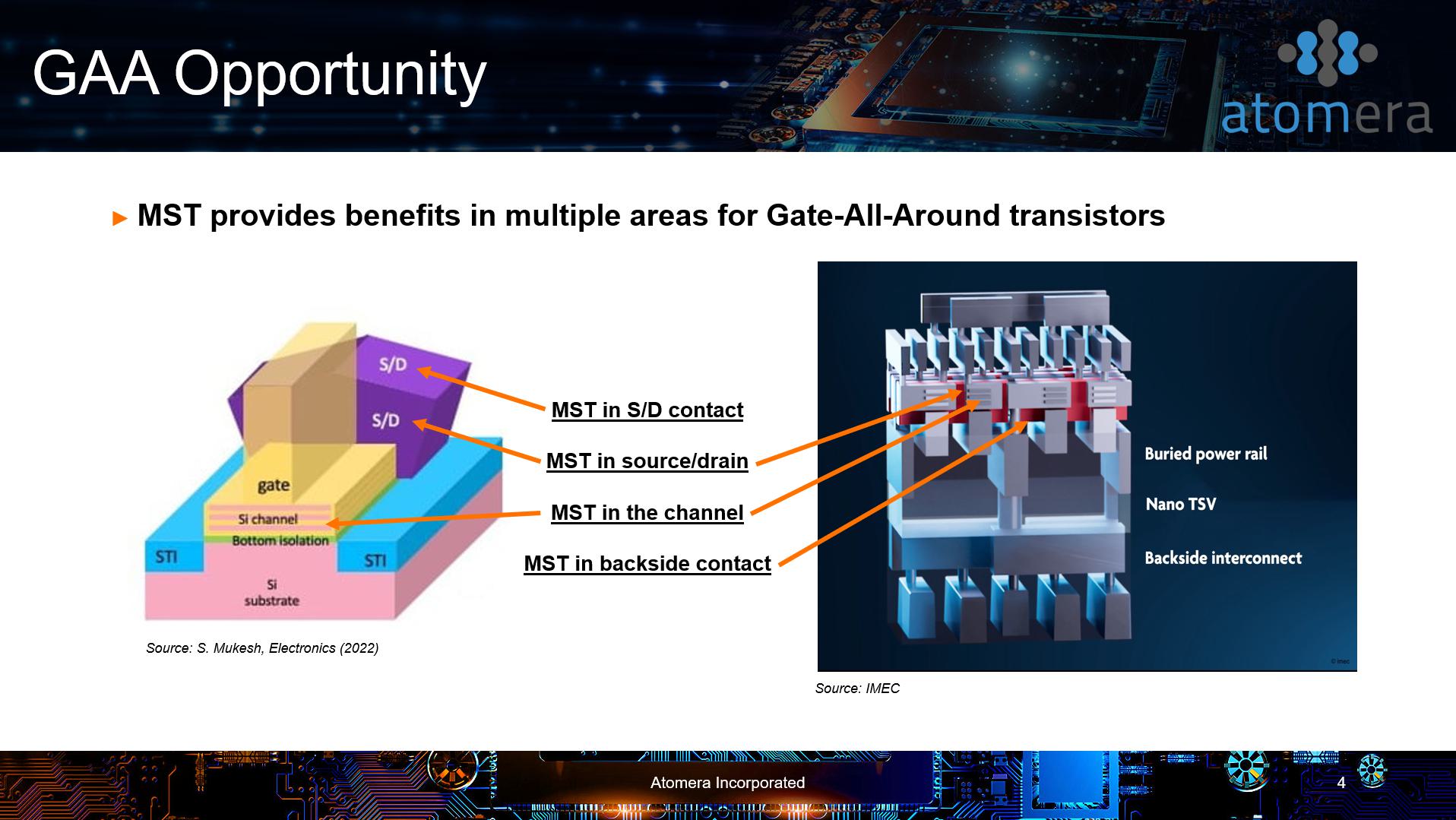
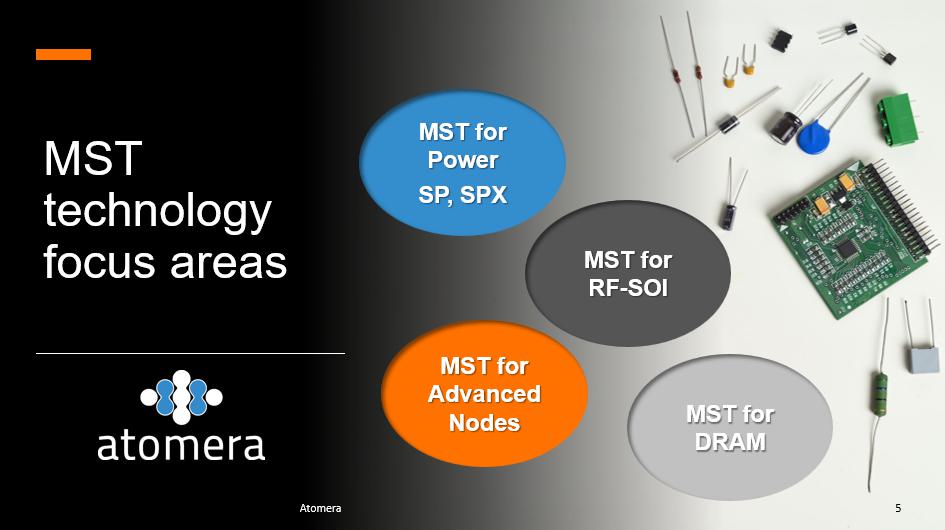
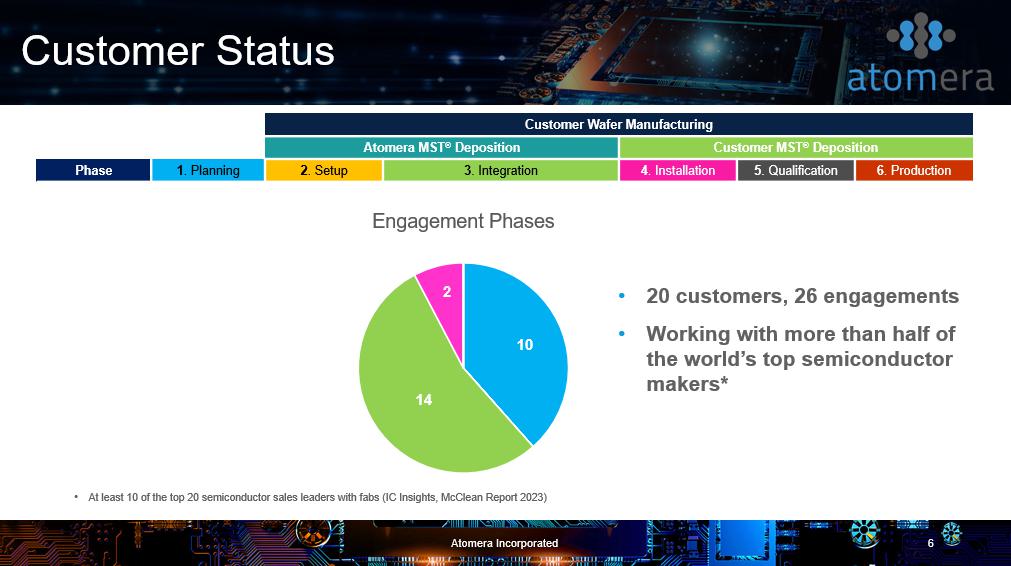
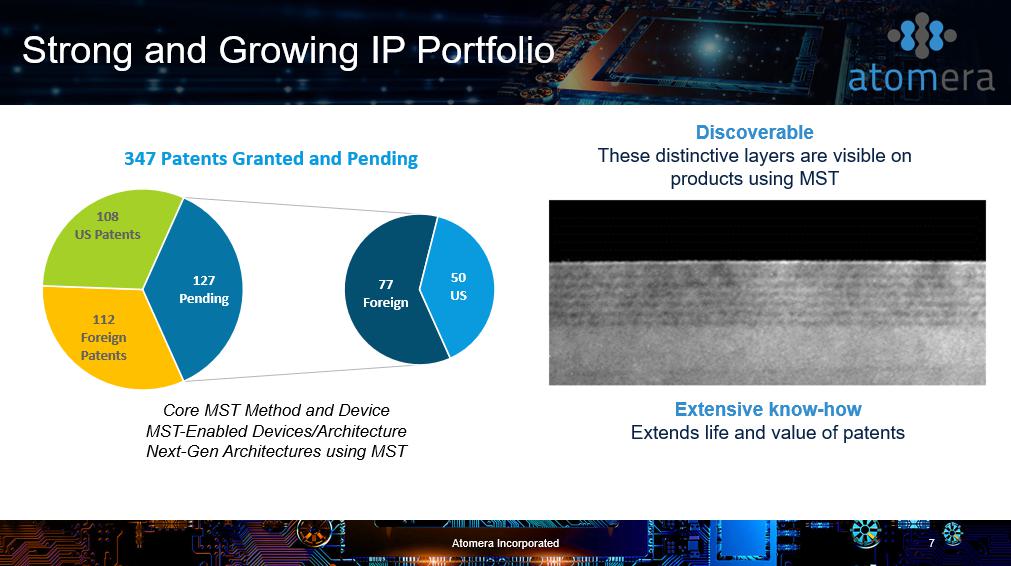
Thanks, Mike. This past year has been an incredibly productive one, with Atomera advancing across all customer categories, building our stature as a technology pioneer, entering new segments, and getting closer to first production. Building on the strength of Q3, our fourth quarter has been filled with progress on every front, with one setback, and I'll start off with the details there. Last quarter, we mentioned an active negotiation with a transformative customer. Discussions have been underway with them for some time, with periods of very intense negotiation followed by lengthy delays on their part. At the time of our last call, we felt very close to concluding a deal, but it has dragged on much longer than expected, and at this point, we have to say it has stalled. We are confident that MST can deliver to this customer one and a half to two generations of performance improvement in a critical area, and we are asking for only a small fraction of the economic value they would be receiving, but they still have yet to move forward. Although disappointing, it is not surprising, since resistance to innovative ideas is expected, and in this case, we're providing two: an externally developed material delivered with low upfront cost and an ongoing royalty, a format which is new to some customers. We continue to believe there is strong support for our technology at the engineering level in this company. Indeed, in this market segment, all of their competitors are struggling with the same issues, and we believe one or more of them will adopt MST for this application. Furthermore, we believe their ability to achieve the improvements they need through other means will be limited and will take much longer than would be possible by adopting MST. So, we are hopeful discussions will restart soon and we're doing everything we can to make that happen. The performance improvement potential we showed them is important to advance Moore's law across all semiconductors, particularly for artificial intelligence devices being designed today on the most advanced nodes using gate-all-around transistors. So, I'd like to dig a little deeper into the opportunity this market represents, valued at about $150 billion in 2023. As leading advanced logic IDMs and foundries like TSMC, Samsung, and Intel ramp up manufacturing capability for the gate-all-around architecture at 2 nanometers and below, it is becoming increasingly clear, more so than in previous generations, that materials engineering will play a crucial role in driving the performance improvements expected at these nodes. The high costs associated with lithographic scaling have led fab module engineers to place greater emphasis on incorporating new materials into their standard toolbox for transistor engineering. Epitaxy is a critical process in this context, directly impacting the channel definition and source-drain regions of gate-all-around transistors. Indeed, we believe that epitaxy is now more widely used than lithography in gate-all-around architectures. Since MST is an Epi-based technology, the barrier to incorporate MST into the process flow is much lower than it has been in the past. Given that gate-all-around requires at least twice as many Epi steps as the previous FinnFET architecture, we anticipate that our partnerships with IDMs, foundries, and OEMs will significantly increase the potential for MST to be integrated into multiple regions of the gate-all-around transistor. These diagrams show different areas where MST can help improve the performance of gate-all-around devices. In the channel area, MST can increase drive current and reliability by improving interface traps at the channel gate interface. MST can reduce contact resistance, improve transistor variability, reduce leakage in the source-drain area, and even improve backside contacts. These are all problems the industry faces, and MST provides a compelling, fast time-to-market material solution. The memory segment, valued at over $125 billion in 2024, has many characteristics in common with the advanced node segment, except because it's a commodity market, it is hyper-focused on low production costs. Similar to gate-all-around, memories are in a relentless drive to smaller node sizes. Today, Epi is being introduced into memory flows, enabling MST to become a small incremental cost adder while delivering substantial performance, die size, and margin improvement potential for our customers, even after paying us a royalty. As in gate-all-around, the opportunity is huge with very high volumes and long technology cycles. We have engagements with multiple customers in both these segments. Likewise, in RF-SOI, we provide a performance advantage that we do not believe is possible without MST. Not only can we assist with complex RF power switch devices, but we can also improve LNAs and analog components critical for 5G mobile phones. Today, we are working with the majority of device manufacturers who use RF-SOI substrates in their designs. We continue to make inroads in the power semiconductor market, which is a large, rapidly growing segment driven by the power demands of AI, large compute infrastructure, and vehicle electrification. Our products here are MST SP for 5-volt and SPX for 5 to 48-volt devices. With ST as our lead customer, we are attracting interest from many other players in this segment. We expect this market to be worth over $52 billion in 2024, so innovations to drive efficiency, power, and cost savings are clearly needed. Gallium nitride also is emerging as a major market opportunity for us, projected to represent a $12 billion market in five years and growing at more than 26% annually. The great news here is that many of the potential customers for GaN overlap with our existing customer base, and we have lots of interest from them and from others. Electrical results from our latest set of tests at Sandia are around the corner, and we're hopeful they will provide enough ammunition to begin engagements with several interested parties in GaN. Now, let me give a brief customer update. ST continues to progress very well in both design and manufacturability efforts. The next step, which is called process qualification, is complicated, and the schedule can vary depending on how many issues they need to resolve. Typically, the industry takes about nine months on this step, after which production will start. We are planning to announce when we enter process qualification, which will also result in us recognizing license revenue. So, you should be able to estimate production start timeframes from there. We are not free to update the ST schedule otherwise. Efforts continue on JDA1, where data acquisition to address specifications they have given us is underway, including in areas beyond this initial scope of the JDA. JDA2 is starting a multistage wafer run with us demonstrating their commitment to moving beyond the development phase and into a license agreement enabling volume production in the future. Results from the latest wafer run with our fabless licensee have been received, but additional wafers need to be processed to achieve a full cycle of learning as the data we could extract from the prior run was incomplete. However, the results we were able to analyze provided insights, which we believe will yield an even higher performance result in the next wafer lot, which we are working on right now. In the last three months, we've made headway with several other customers and, in particular, two new ones, who I would categorize as transformative. We have been trying to start work with one of them for years without success until now, and they've recently started their first demo wafer run with us, a major milestone. The other has solidified plans for a comprehensive set of wafer runs to validate their own internal TCAD simulations, which show very promising results using MST. We've been pursuing each of these opportunities for quite a while, and they have now moved to an implementation stage. I call these customers transformative because they are some of the industry's largest manufacturers. They have the ability to move quickly, and they are well known for cutting-edge products. Our business potential with each of them is huge. Finally, our ability to land-and-expand has really accelerated this past quarter with two of our existing customers planning demos in entirely different product areas than our original engagements. We believe this illustrates a few positives. First, it shows that customers who have worked with MST believe in the technology enough to recommend its use by other product lines. Second, it shows how deeply our customer relationships go once we start working together on a serious engagement. We've talked about the domino effect in the past, and this is a sign that it's starting to happen with existing customers, which we hope will lead to wider adoption over time. 2024 has been a very good year of market and technology development at Atomera. We solidified our value proposition in four major high-growth markets in semiconductors and positioned ourselves to enter into another market that offers a path to faster time-to-revenue, while still supporting the enormous potential of our traditional business model. Our R&D pipeline in new markets and applications continues to expand as reflected in our patent portfolio, which had an increase of over 30 granted and pending patents in 2024. Our new business development execution is clearly improving, as evidenced by our deeper penetration with both new and existing customers and partners. Right now, our team morale is high because we are getting direct feedback from customers that our technology provides important solutions necessary to deal with big issues in the semiconductor roadmap. Our engineers are doing the detailed, innovative, and thorough work that they know is necessary to overcome customers' bias for internally developed solutions and to integrate our technology into their designs. ST is a great example of how this can happen in a large successful company, and right now they are moving nicely towards production. Our potential in other target markets is even larger, and I feel we are close to announcing deals that will cement that position. The work we are doing in gate-all-around and memory is tied directly to the biggest driver of the semiconductor industry today: the rollout of AI infrastructure. Our gate-all-around work is not only aligned with a major industry push, but we also believe it can be executed with a faster time to revenue than our other segments. There is no doubt about the value proposition we are offering the industry, and we believe it will ultimately allow us to build Atomera into a successful materials solution provider to the entire industry. Now, Frank will review our financials.
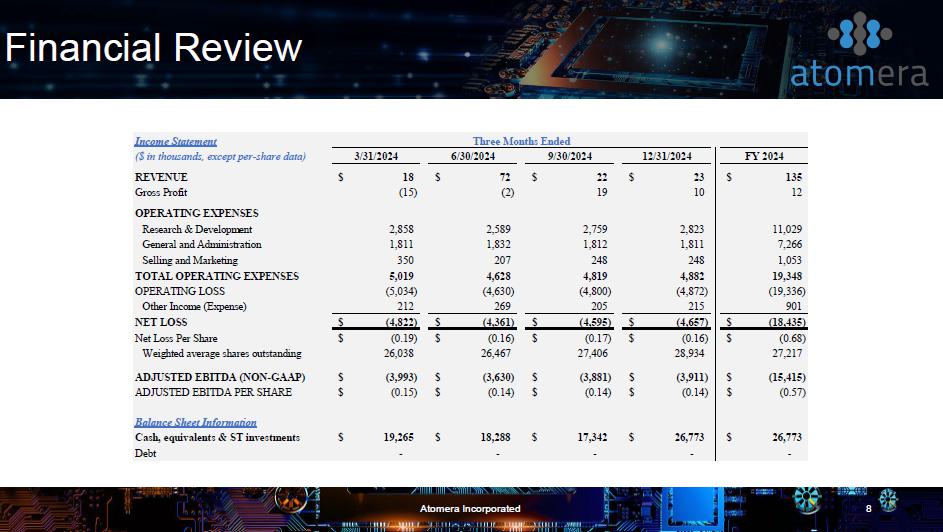
Thank you, Scott. At the close of the market today, we issued a press release announcing our fourth-quarter and full-year results for 2024. This slide shows our summary financials. Revenue in 2024 was $135,000 and consisted of MST CAD licensing and NRE fees. Our GAAP net loss for the year ended December 31, 2024, was $18.4 million or $0.68 per share compared to a net loss of $19.8 million or $0.80 per share in 2023. GAAP operating expenses were $19.3 million in 2024, which was a decline of $1.9 million from $21.2 million of operating expenses in 2023. The main driver of the decline in operating expenses was a $1.5 million decrease in R&D expenses, which was almost entirely due to a decline in outsourced engineering spending resulting from the closure of TSI Semiconductor's services business after TSI was acquired by Bosch. Sales and marketing expenses declined by $546,000 due to lower headcount costs, whereas G&A expenses increased by $191,000 due to higher payroll and legal costs offset in part by lower stock compensation expenses. Turning to our quarterly results, fourth-quarter 2024 GAAP net loss was $4.7 million or $0.16 per share compared to a net loss of $4.6 million or $0.17 per share in Q3 and a net loss of $4.6 million or $0.18 per share in Q4 2023. Revenue was $23,000 in Q4, $22,000 in Q3, and $550,000 in the fourth quarter of 2023. GAAP operating expenses were $4.9 million in Q4 2024 compared with $4.8 million in the previous quarter and $5.3 million in Q4 2023. Non-GAAP net loss in 2024 was $15.4 million compared to a loss of $16.6 million in 2023, reflecting a decline in non-GAAP operating expenses from $17.1 million in 2023 to $15.4 million in 2024. The decline in operating expenses reflected the same factors I discussed about GAAP results. Stock compensation expenses, which is the main difference between GAAP and non-GAAP operating expenses, were $3.9 million in 2024 and $4 million in 2023. In Q4 2024, non-GAAP operating expenses were $3.9 million, which was the same level as Q3 and compares to $3.8 million in Q4 2023. Our balance of cash, cash equivalents, and short-term investments on December 31, 2024, was $26.8 million compared to $19.5 million at the end of 2023 and $17.3 million at the end of Q3 2024. We used $13.2 million of cash in operating activities during 2024, $3 million of which was used in Q4. During 2024, we sold approximately 4.1 million shares under our ATM facility at an average price per share of $5.38, resulting in net proceeds of approximately $21.3 million. During Q4, we raised net proceeds of $12.8 million based on sales of approximately 2.2 million shares at an average price of $5.92. As of December 31, 2024, we had 30.1 million shares outstanding. After year-end, we raised an additional $2.4 million by selling approximately 163,000 shares at an average price of $15.19. So, I'm pleased that we were able to take advantage of favorable stock market conditions in recent months and strengthened our balance sheet with less dilution than earlier last year. In Q1, we're not expecting to recognize any revenue. The wafer run we are working on with our fabless licensee will result in engineering services or NRE revenue which may happen in either this quarter or Q2. The timing will depend on when the wafers ship. Consistent with our usual practice, we're not providing revenue guidance any further out. The next major revenue milestone under our agreement with ST will occur when they get into formal process qualification. Moving to expenses, during 2024 our non-GAAP operating expenses were $15.4 million, which was below the low end of guidance and was down from $17.1 million in 2023. As I mentioned, the main reasons for the decline in spending were that we did not replace TSI, and our average headcount through the year was lower. For 2025, we expect our non-GAAP operating expenses to be more consistent with 2023 levels, so we're planning for it to be in the range of $17 million to $18 million, with the exact amount depending mostly on our use of outsourced engineering services and additions of headcount. Given our limited revenue visibility, I assure you we will be conservative about any structural increases in spending. With that, I'll turn the call back over to Scott for a few summary remarks before we open the call up to questions.
Thanks, Frank. Atomera is extremely well-positioned to deliver important innovations to the hottest markets for semiconductors today. Our years of development mean that customers can rely on us to get them to market more quickly than internally developed solutions, providing an advantage to them that gives Atomera a solid business opportunity with a financial structure that's hard to beat. I appreciate your support as we work hard to turn this vision into reality. Mike, we can now take questions.
Thank you, Scott. Our first question comes from Richard Shannon of Craig Hallum. Go ahead, Richard.
Speaker 3
Great. Thanks, Scott, Frank, and Mike for letting me ask a few questions here. Scott, I guess I'll ask on your leading comments here about the transformative opportunity here. Maybe if you can describe the dynamics here. It sounds like it's mostly a pricing issue here as opposed to other things. It sounds like they got through all of their qualifications and answered all those questions, and it's a pricing issue. Can you confirm and maybe elaborate on the sticking points there?
Yes. Of course, I can't provide full details, but let me say this. First of all, as I mentioned in my remarks, we believe that we're providing enormous value to them for what we were offering to work for the price that we were offering. And as I've said many times in the past, we are being very flexible with our early customers on pricing. I think whenever you're negotiating a contract with a big customer, there's a lot of different things that come into play, a lot of decision makers, each of whom may have a different concern. In this case, I don't think it came down to exclusively price. As we said in our remarks, we're asking them to do something new, and there may have been issues in having that happen. The negotiation went through fits and starts, where we'd have a lot of discussion followed by very long delays, which would lead me to believe that there was lots of discussion inside the company among many different people trying to reach decisions. So ultimately, we are hopeful that we'll get this thing restarted. We feel we have feedback from them that our technology really does provide an excellent solution for them. So ultimately, we believe that if we're providing a really good value to customers and technology that we've done the work to prove will deliver, then we'll ultimately succeed.
Speaker 3
Just to clarify, so it doesn't sound like there's any technological issues. You provided all the data, they asked for all the runs, et cetera, and it was more down to the business decision-making that you don't have a lot of visibility into, is that fair?
Yes, I'd say that's probably fair.
Speaker 3
Okay, fair enough. Let's move on. It seems from your prepared remarks that progress with leading-edge technologies, both in logic and memory, is really picking up. Besides discussing specific transformative opportunities, you are also emphasizing aspects related to power and RFs, which we haven't typically focused on in the past. If I understood correctly, it sounds like you're mentioning multiple customers in both areas, which I don't believe you have mentioned before. Could you discuss the dynamics a bit more and elaborate on where the acceleration is happening? You've mentioned these customers adopting Epi at a faster pace, which presents more frequent opportunities for engagement. What is your overall perspective on the opportunities with leading-edge technologies in both logic and memory?
Yes, I mean, both logic and memory, the interesting thing is, now when we're working on RF and power, we're working with teams on kind of legacy nodes. They have smaller development teams, and sometimes it can be challenging to get their attention as they're being pulled in many different directions. But when we're working on advanced nodes or memory, most of the company is working on those technologies. So, when we start doing something that they find interesting, we're getting a lot of pull and a lot of interest. And they'll have many resources to throw at it as well. As I really do believe the move to gate-all-around is a game-changer because when you have a wafer run and you want to add MST and it was a new Epi step, then a customer has to think about the logistics of incorporating that Epi tool. But if that wafer is already in an Epi tool doing another step, you can see from the diagrams that they're doing a whole bunch of steps in Epi, and then they want to add on MST, it's a really, really quick and easy thing to do. So, that lowers the cost for them and just allows us to have more opportunities for easier entry. So, yes, I think it's a huge opportunity. And I would say that the industry has really been moving to gate-all-around just in the last couple of years. And as luck would have it, we hired our new Head of Business Development, who's an expert in this area and knows all the people that are doing that work in the big company. So, yes, I think we're getting good traction and providing solutions that I think will gain a lot of interest over time.
Speaker 3
Thanks for that. Maybe a few more questions. Let me just touch on GaN, it's a topic you brought up about a year ago. It sounds like there's a lot of interest there and I think you've characterized this as something that could be a faster time to revenue than your typical business model. Maybe you can kind of couch the progress in the last quarter. What's been going on there?
Yes. So, really, GaN is pretty new. It wasn't even a year ago that we got our first test results on GaN; it was in April of last year. We had been theorizing about what we'd be able to get out of GaN, but that was the first time that we ever saw data. So, we did some more runs, working with outside partners. And then in the fall, we announced this deal with Sandia, where they're going to take our wafers and start doing electrical characterization on those. So, we've been working on that over the course of the fall, and we haven't gotten the results on those electrical runs yet, but we do expect them imminently here. If they look very good, then we'll have a solid data set. The challenge is starting to work with customers; we're going out and showing them the physical data we have today, showing that we're making these wafers with lower stress than other wafers, and that should lead to higher quality. But ultimately, what people need is electrical results that show improvement. And so that's what we're striving for right now. If we get the good electrical results, then we'll have a full data set that we can take out to customers and start really engaging with them. And you mentioned the faster time to market; if our technology really works out well for GaN, people should be able to make higher quality GaN on silicon starting wafers for manufacturers. Although there is certainly a qualification process for a new wafer going into a fab, it is shorter than full integration and qualification and everything that we have to do with our traditional business. So, that's why we keep saying we think it might have faster time to market. There's still a few question marks there; we have to prove the technology electrically and get the customer signed up. But if we can do that, I think this might be a way to really supplement our other business.
Speaker 3
Okay, fair enough. Thanks for that. Let me touch on STMicro; I want to make sure I understood your comments there. So, once you hit this, I think it was process qualification, that's what you expect that to be a typical nine-month cycle, after which you would expect to go into production soon after, and we haven't gotten to that point. So, going back in history here, when you announced ST, I think in April or May of 2023, you're expecting 18 to 24 months process. And so if we haven't started this nine-month clock, we're going to extend a little bit beyond that. Maybe give us some flavor of the dynamics here as you understand it? And obviously, I imagine there's probably some restrictions on what you can talk about with this, but understanding why the process seems to be longer than what you had expected before. And do you expect that nine-month process qualification to start soon?
Yes, I can share what I can without discussing their timeline. When I announced the deal, we didn't have a schedule from them. I shared what I thought was standard for the industry, suggesting that if everything went perfectly, we might see results in the 18 to 24-month timeframe, possibly as soon as 18 months. There has been a delay for ST in actually installing MST onto their tool due to logistical issues unrelated to MST or ST; it involved a third party responsible for the installation. During that time, we made significant efforts and were optimistic they could catch up, but I must say that this setback ultimately slowed things down. I want to emphasize how well our teams and ST are collaborating and the prioritization given to this project. ST is taking the right steps, and our team is making this our top priority. We hope to begin qualifications soon, but I can't provide specifics on when that might occur.
Speaker 3
Okay. We'll look forward to that timeframe. I think that’s all the questions for me. I'll jump out of line. Thanks, Scott.
Thank you, Richard. Our next question comes from Cody Acree of Benchmark. Hey Cody, go ahead.
Speaker 4
Thanks. It’s good to be back. It's been a while since my last participation in this call. Reflecting on the prepared remarks this morning, I noticed that while circumstances have evolved and details have shifted, the fundamental operations of the company remain the same. Our interactions with customers continue in the same manner: we still face challenges from their side, and although we are seeing some signs of progress, there hasn't been a significant breakthrough yet. Can you share your thoughts on your confidence regarding the various opportunities you have? You touched on several areas, including GaN, advanced nodes, memory, SOI, and power. There’s a lot on your plate. Could you rank your confidence in these opportunities?
Sure. And I don't know if I agree with your assessment of no change, Cody. The difference is, first of all, we've moved very close to production with ST. We have gone from kind of talking in general with the advanced node and memory guys about what our technology can do to being very, very specific about exactly what we can do and where in their architecture and how we can help them, and that's what I've tried to illustrate in those diagrams. So, I would say today, our level of engagement with the advanced node and memory teams is at a whole different level than it was the last time you were here. Our work with power customers has been expanding wider. And then on RF-SOI, I would say we are still working with a similar group of people. We've added a couple there, but that one is getting closer, but I would say it's similar to where we were before. Then the other thing is that this whole opportunity with GaN is bringing in a kind of fifth market segment to us that we didn't have before, and so that's another new addition since you were here before. Did that answer the question? I'm sorry, am I...?
Speaker 4
No, it did, Scott. Thanks. One of the newer areas I heard about is your data center opportunity, which I don't think has been discussed before. Could you describe your opportunity in that area, your go-to-market strategy, and the types of customers you are working with?
Yes, we announced that in the last call we focused on our new MST-SPX. While this technology isn’t new for us, we are concentrating on 48 volts, which is becoming essential as data center racks transition to this standard. Hyperscalers are increasingly building their systems around 48 volts, leading to significant efforts to replace the older 12-volt racks. There is considerable competition in this market. While I won’t name all the competitors to avoid missing anyone, I can mention that Monolithic Power is quite strong in this area, among others. These are the companies we aim to engage with.
Speaker 4
And maybe, Frank, when you're looking at juggling your resources with that many opportunities going on, and it sounds like there's no lack of ways to spend money, how are you managing to address all the opportunities?
Yes, I believe one aspect to consider from Scott's response is our workflow, especially following our engagement with STMicro. We had team members on-site to assist with installation and later worked on the film's manufacturability. One potential issue could arise if we were to install MST at multiple locations at the same time while also processing wafers for our customers in Arizona or for our R&D efforts. While the headcount in R&D hasn't changed, we did introduce additional resources in Epitaxy to ensure that installations at customer sites are well-supported, preventing any disruptions. This work is quite labor-intensive as it often involves hands-on training for customers regarding the installation of recipes and the metrology needed to guarantee film uniformity. If we were to face any personnel limitations as our business expands, it would likely be among the Epi engineers, but we haven't encountered that situation. Additionally, we were able to strengthen that team last year. As for reducing our spending with TSI, that adjustment was somewhat mandatory, but we adapted effectively. We are leveraging our TCAD tools more extensively, which are proving to be quite beneficial. Scott mentioned an exciting opportunity made possible by our TCAD efforts. We are increasingly utilizing AI, which has become a useful term, but we are implementing these tools to enhance our productivity and simulation iterations. Our efficiency with TCAD and integration engineering has significantly improved through better tool usage, and we haven't suffered much from the loss of TSI. However, I want to emphasize that we will be cautious about any structural increases in spending, such as adding headcount or entering into new leases or acquiring additional equipment. Our current tools are sufficient, so our spending in that area will remain stable. Regarding hiring, we are aiming to do so only when we are close to generating the revenue needed to support it. We constantly evaluate whether we should de-emphasize certain areas due to potential resource constraints, but so far, I haven’t found that to be an issue.
Speaker 4
Great. Thanks for the update, guys. I appreciate it. Thank you.
Thanks, Cody. All right. Seeing some questions come in on the chat here and I'll just go ahead and fire them off at you. So, can you please provide an update on the progress with a major analog company that we referenced in prior quarters utilizing MST CAD?
Yes. I'll connect some dots on that. That is one of the two transformative customers I spoke about today where they've gone from achieving outstanding results to planning a comprehensive set of wafer runs to validate them on silicon. This is the first step to obtaining licenses and moving into production, so we are very excited about what we've accomplished. We believe this is a great example. Frank mentioned how productive we've become with our TCAD, but in this case, we licensed MST CAD to the customer. They conducted all the work themselves and achieved very impressive results that are leading them to engage in more R&D work with us.
Another one. Is STMicro going to be the first opportunity for product revenues for Atomera or might there be another opportunity that would percolate sooner?
It's difficult to determine for certain. Most likely, it would be STMicro, but we are collaborating with some customers on applications that could reach the market fairly quickly. Specifically, if we are assisting a customer with a yield enhancement technology, it indicates they are already in volume production. If our technology can help improve the yield of those products, they might be able to implement it swiftly. Could this occur before STMicro? I'm not really certain. I noticed a question regarding a statement I made last year about potentially generating revenue from gallium nitride in 2024. We did not achieve that, and I'll explain why. One lesson learned in technology is that the more data you analyze, the more you wish for additional data. When we announced our GaN project in the spring, I mentioned that there was a possibility of generating revenue in 2024, which would have involved selling some MST wafers for evaluation purposes. This wasn’t expected to produce high-volume revenue, but I was optimistic. However, when we approached the market with our physical data, they requested electrical data. Once we provided some electrical data, there were requests for more. This cycle of requests continues. Nonetheless, we believe we are nearing the stage where we can have enough data to encourage purchases of MST wafers for GaN development, beginning with sampling revenue and eventually scaling up to volume production. It's uncertain how quickly this will happen; it might be faster than STMicro, but that could be challenging. However, in an ideal scenario, it’s possible.
Thank you. And one sort of final set of questions before we turn the call to closing comments. What is the current stage of the collaboration with a DRAM customer or customers? And are there any potential benefits for HBM, high bandwidth memory?
First of all, we are continuing to be engaged with multiple memory customers, and I can't say a lot more than that about where we are with them. But yes, high bandwidth memory. I think when I talk about how MST has got great benefits for the artificial intelligence market, I'm talking about gate-all-around for the processing side, but I'm also talking about memories. There's nothing more important than getting memories that are higher throughput and consume less power for these AI infrastructures. In the hyperscaler space, I think I've seen that 40% of the power consumed in hyperscalers is associated with memory. So, to the extent that we could do work with high bandwidth memory devices to help get their power down to lower levels or to improve their performance to have higher bandwidth, again, would be transformative. We really hope that we can make some of that happen in partnership with a memory maker out there today.
All right. Great. And at this point, this concludes the Q&A session. Scott, if you want to conclude with any closing comments.
Sure. All right. Well, thanks. I want to say thanks to all of you for joining us to listen to our Q4 and 2024 update and for getting an update on the progress being made within Atomera. Please continue to look for our news, articles, and blog posts, which are available along with investor alerts on our website, atomera.com. Should you have additional questions, please contact Mike Bishop, who will be happy to follow up. Thanks again for your support, and we look forward to our next update call.
Thank you. This concludes the conference call.