Hello, everyone, and welcome to Atomera's Second Quarter 2025 Update Call. I'd like to remind everyone that this call and webinar are being recorded, and a replay will be available on Atomera's IR website for 1 year. I'm Mike Bishop with the company's Investor Relations. As in prior quarters, we are using Zoom, and we will follow a similar presentation format with participants in the listen-only mode. We will open with prepared remarks from Scott Bibaud, Atomera's President and CEO; and Franc Laurencio, Atomera's CFO. Then we will open the call to questions. If you are joining by telephone, you may follow a slide presentation to accompany our remarks on the Events and Presentations section of our Investor Relations page on our website. Before we begin, I would like to remind everyone that during today's call, we will make forward-looking statements. These forward statements, whether in prepared remarks or during the Q&A session, are subject to inherent risks and uncertainties. These risks and uncertainties are detailed in the Risk Factors section of our filings with the Securities and Exchange Commission, specifically in the company's annual report on Form 10-K filed with the SEC on March 4, 2025. Except as otherwise required by federal securities laws, Atomera disclaims any obligation to update or make revisions to such forward-looking statements contained herein or elsewhere to reflect changes in expectations with regards to those events, conditions and circumstances. Also, please note that during this call, we will be discussing non-GAAP financial measures as defined by SEC Regulation G. Reconciliations of these non-GAAP financial measures to the most directly comparable GAAP measures are included in today's press release, which is posted on our website. Now I would like to turn the call over to our President and CEO, Scott Bibaud. Go ahead, Scott.
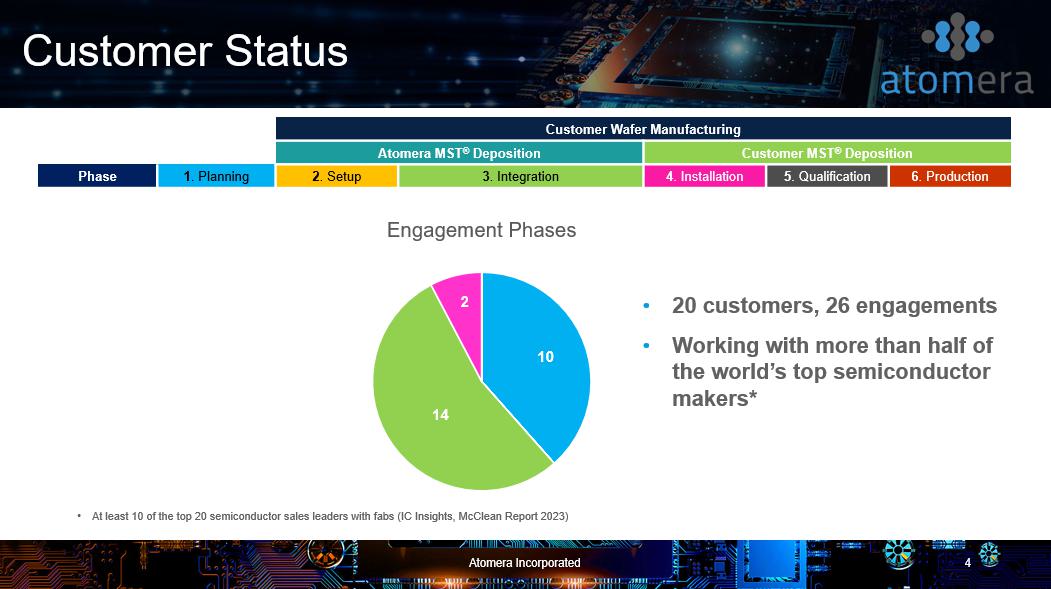
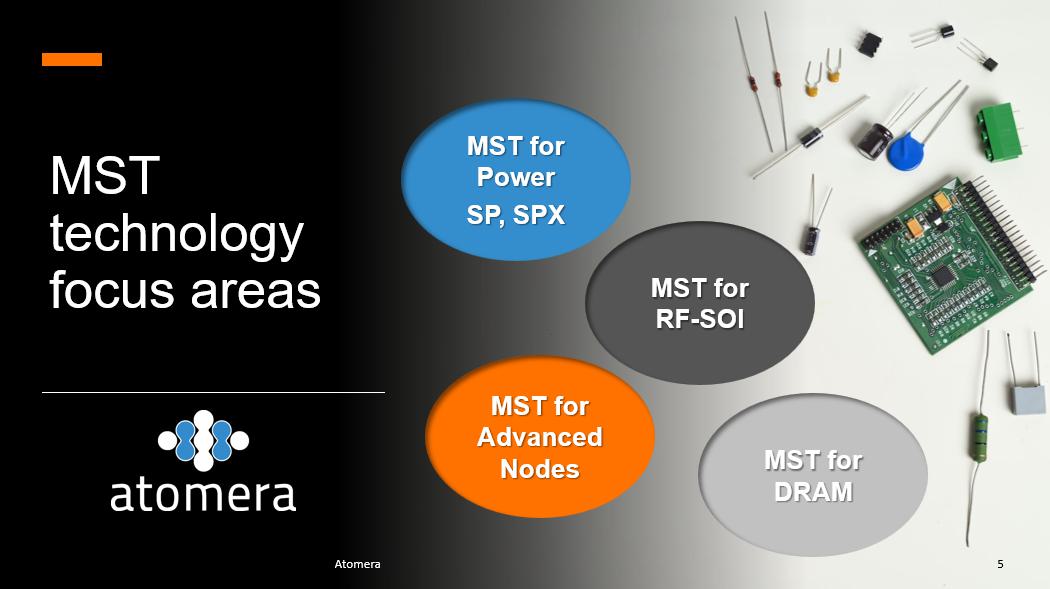
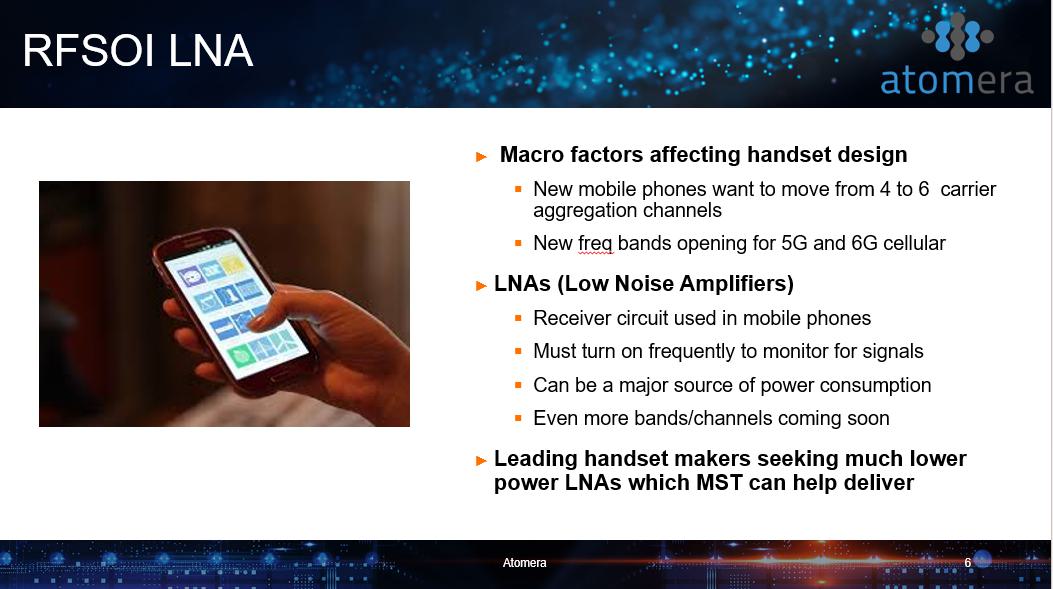
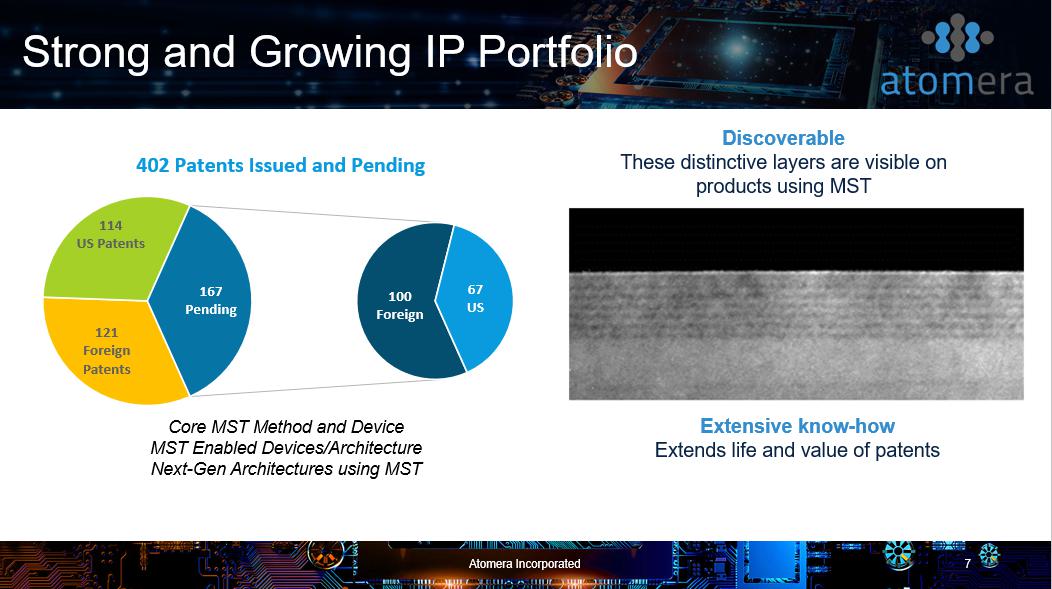
Thanks, Mike. Right now, there are a number of macro factors in the semiconductor industry that are in favor of our product initiatives. For this reason, wafer activity at Atomera and customers is currently running at a much higher level than we typically experience, which reflects the number of irons Atomera has in the fire. On today's call, I'd like to give you a flavor of our activity and how new applications of MST are driving our business. Let me start with a review of our work with licensees. A few months ago, STMicro announced a new initiative to reshape their manufacturing footprint to 300-millimeter silicon production. It was not entirely clear to us how this would affect the Smart Power segment. Originally, the first BCD 110 process with MST was to launch using 200-millimeter wafers and later, the process would be ported to 300-millimeter. We just heard recently as part of the reshaping initiative that ST has changed plans and decided to go directly to 300-millimeter, which will delay the rollout of BCD 110 with MST. We do not have a revised schedule, but it's now clear that we will not enter process qualification in 2025. While the delay is disappointing, ST's ambitions for advanced BCD are definitely very aggressive, targeting a significantly higher 300-millimeter wafer capacity at full build-out than we initially expected. We are very excited by the revenue potential represented by those numbers. The move to 300-millimeter wafers is logical since they are fundamentally less expensive than 200-millimeter, which hopefully should assist adoption. As mentioned on our last call, ST has continued to support the adoption of MST in multiple other applications with more BUs expressing new interest this past quarter as well. We've reached a new high watermark on customer wafer runs at both our facility and our customers' fabs. Many of our licensees are in the process of doing demo runs with us that we hope would lead to production decisions. And during the last quarter, we were able to deliver to them new insights into incremental improvements they can get with MST. Let me provide a few updates on some important customers. At JDA1, meetings with a new senior level management team in conjunction with support from our capital equipment partner makes us believe that the wafers we are working on for them will drive a decision to use MST in a new application. Both JDA2 and our fabless licensee are in the process of doing wafer runs with us. We believe these will be critical in reaching a production decision once they've been able to test the final devices. At our foundry licensee, we are currently in a TCAD exercise to define our next steps as well. Two calls ago, I spoke about a couple of new potentially transformative customers we had started working with. Each of these customers is now running wafers with MST, one in a large-scale demo plan encompassing 2 business units and the other engaged on multiple wafer runs to test out different MST applications. Several other customers are in various stages of investigating MST for their products as well. As I said at the beginning of the call, our team is very busy right now, and this is a real positive for our future business. A substantial part of our activity is targeting the advanced gate-all-around and DRAM areas where our source strain diffusion blocking capabilities are particularly interesting, but by no means the only solution we are offering. In these new nodes, everyone is focused on yields and MST is a tool that can help improve yields. In the power area, our ability to simulate different architectures and integration techniques using TCAD and our own internally developed AI tools has allowed us to propose solutions to customers, which we do not believe are possible to implement without MST and have led to potential breakthrough levels of performance. Our work with Sandia and other partners on gallium nitride is making great progress. This past quarter, we've come to understand even better how MST can benefit GaN devices, causing us to expand our focus from exclusively GaN for power to also include GaN for RF. To accelerate this work during the last quarter, we announced a strategic collaboration with Incize, a well-recognized and respected RF test house. They will help us characterize this technology in terms that the market will appreciate, making it easier for designers to translate our process changes to RF electrical spec improvements. We believe RF will be an important growth area for GaN in the future, and several potential customers have already stepped forward expressing an interest in our work. Finally, in RF-SOI, we have expanded our offerings to also include the key devices for low-noise amplifiers or LNAs. I'd like to take a few minutes to give some background on why this LNA offering is so important. Historically, we've worked with RF-SOI customers primarily on RF power switches. Last year, many of those customers started asking if we could help improve LNAs in their mobile phone front-end products. LNAs are the technology used by cellular phones to receive and amplify small signals. There are a number of reasons why LNAs need further improvement at this time. Carrier aggregation was introduced in LTE Advanced to increase peak data rates and network capacity by combining multiple spectrum chunks or component carriers into a single data channel. Manufacturers have been aggregating up to 4 carriers. But in the future, we expect to see 6 carriers, which means that more LNAs must be turned on to receive these signals, significantly increasing power consumption. New frequency bands associated with the evolution of 5G and 6G cellular are also driving the need for more active LNAs. The net result is that to bring features that customers are demanding for new phones to market, a solution to lower LNA power consumption must be found. That's where MST comes in. We took existing MST RF-SOI transistor silicon test data and then used TCAD to reoptimize implants for the LNA devices. We determined that MST can significantly improve the performance of LNAs by lowering the circuit bias current and hence, the power consumption. We believe based on market reaction, we have started promoting this capability just at the right time. Recently, we presented our findings at an RF technical conference and it has generated lots of inbound interest. Indeed, during the last few months, we've worked with several different RF-SOI manufacturers to start new wafer runs using our partner, Soitec special ultrathin RF-SOI wafers to prove out those LNA benefits. We'll be working hard to shore up this evidence with more data to entice customers to take it to market quickly. What is particularly exciting is that we can provide this LNA benefit in addition to the power switch benefit on RF front ends with a single deposition of MST on a wafer. So our customer can get 2 much-needed solutions for the cost of 1, which should make it even more attractive. We expect that this type of high visibility solution with end customer pull should go to market more quickly than a general performance improvement. I'm always impressed by the amazingly high levels of creativity and innovation demonstrated by Atomera employees across many diverse fields. And today, I've spoken about some of the solutions we found for industry problems. You can also measure this innovation by the number of patents we file and have approved. This past quarter, our tally of issued and pending patents exceeded 400, which is quite a milestone for a company of our size. We are definitely punching above our weight. In the last month, we also joined the National Semiconductor Technology Center, which has a goal of extending U.S. leadership in semiconductor technology. There, we expect to provide important contributions but also benefit from the NSTC's focus on reducing the time and cost to prototype new semiconductor technologies like the ones Atomera is bringing to market. We believe this organization will help create the ecosystem necessary to continue the advancement of Moore's Law. Finally, I'll just reiterate how many active engagements we have underway at Atomera and how we feel in the brink of several of them turning into commercial agreements. The team is working hard. Indeed, we are looking to hire several additional team members, but morale is high, and we're excited to see our innovations getting into production. When that happens, we continue to believe that Atomera will see increased adoption rates and shorter time to market as competitors race to catch up with those who are already using MST to gain market advantage. We are working hard to make that day come as soon as possible. Now Frank will review our financials.
Speaker 2
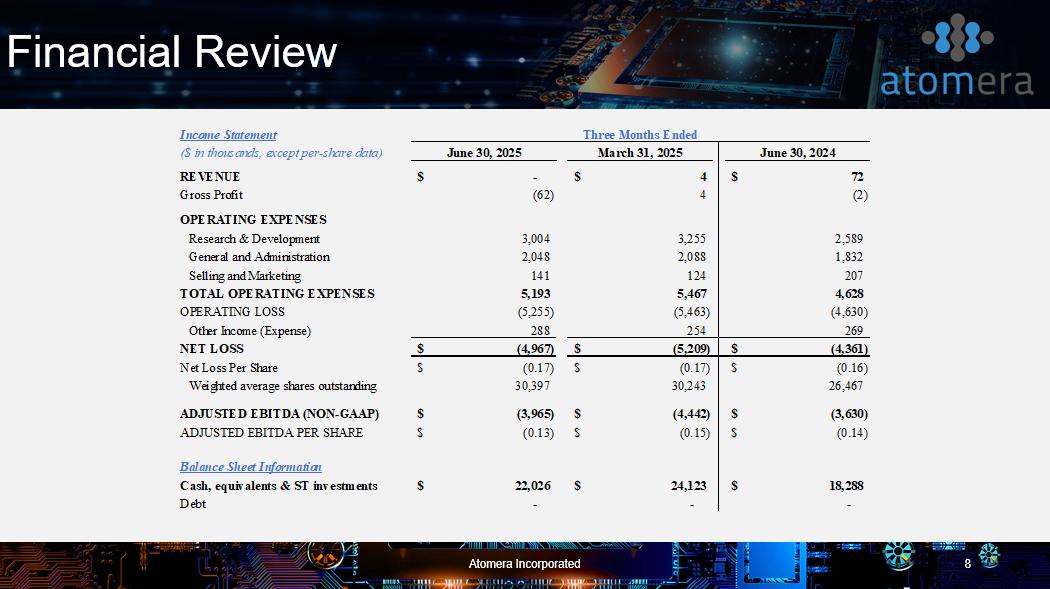
Thank you, Scott. At the close of the market today, we issued a press release announcing our results for the second quarter of 2025. Our summary financials are shown on this slide. Our GAAP net loss for the second quarter of 2025 was $5 million or $0.17 per share compared to a net loss of $4.4 million in Q2 of last year, which was $0.16 per share. GAAP operating expenses in the second quarter of this year were $5.2 million, which was an increase of $565,000 from $4.6 million in Q2 2024. The increase in OpEx was due to a $415,000 increase in R&D expenses, reflecting both higher outsourced device fabrication work and increased payroll costs and a $215,000 increase in G&A expense, primarily due to higher payroll costs. These were partly offset by a decline in sales and marketing expense due to lower headcount. Non-GAAP net loss in Q2 2025 was $4 million compared to a loss of $3.6 million in Q2 of last year due to a $275,000 increase in non-GAAP OpEx, reflecting the same factors I just discussed. Stock compensation expense, which is the main difference between GAAP and non-GAAP operating expenses was $1.3 million in Q2 2025 and $1 million in Q2 2024. Sequentially, Q2 2025 non-GAAP net loss of $4 million compares to a $4.4 million loss in Q1, primarily due to lower payroll expenses, reflecting lower headcount in sales and marketing as well as 401(k) timing issues. Our balance of cash and cash equivalents as of June 30, 2025, was $22 million compared to $24.1 million as of March 31. We used $3.5 million of cash in operating activities during Q2 compared to $4.8 million in the first quarter. The first quarter of every year has higher cash outlays for items that are expensed throughout the year. During Q2, we raised approximately $800,000 under our ATM facility, net of commissions and expenses of filing our shelf registration by selling approximately 185,000 shares at an average price of $5.21. Since the end of the quarter, we've raised an additional $2 million from sales of approximately 392,000 shares at an average price of $5.23, putting our current cash balance higher than at the end of Q2, which will allow us to be selective in accessing the market going forward. For Q3, we expect to recognize a small amount of NRE revenue from wafer shipments to our fabless licensee and to the customer running a large-scale demo that Scott mentioned in his remarks. Timing of that revenue will depend on when wafers are shipped out to those customers. Given ST's shift to rolling out BCD110 only on 300-millimeter wafers, we do not expect that milestone payments for process qualification will happen until next year. Moving to expenses. On our last call, I narrowed our expected range of non-GAAP OpEx for 2025 to a range of $17.25 million to $17.75 million. I'm maintaining that guidance, though we are tracking to the low end of the range. We've spread our outsourced fabrication work over multiple vendors to enable us to address the range of technology areas we're working on. And this spending should trend back to our prior spending levels with TSI Semiconductor. We're also making solid progress in adding new leadership in sales and marketing and bolstering our engineering staff to support our unprecedented level of customer activity. With that, we'll turn the call back over to Scott for a few summary remarks before we turn the call open for questions.
Thanks, Frank. Today, Atomera is offering the market several innovative solutions to problems that are difficult to solve without MST. I believe we are better positioned than ever to enable new capabilities for today's challenging electronic devices. With the number of engagements we have today with top semiconductor manufacturers, it's only a matter of time before that effort turns into the commercial success that will make Atomera a semiconductor technology licensing powerhouse. I appreciate your support as we work hard to turn this vision into a reality. Mike, we can now take questions.
Thank you, Scott. Our first question comes from Richard Shannon of Craig-Hallum.
Speaker 3
Great. Thanks, Mark, and thanks, Scott and Frank, for letting me ask a few questions here. I guess I'll ask the first one on STMicro. Certainly, a disappointment to see this delay, but obviously, a need for STMicro here. I guess my first question is, to what degree is the work that you've done with them on 200-millimeter will be useful and be leveraged to 300-millimeter? Or to what degree do we have to kind of restart things? Frank, in his comments said something about not expecting a milestone payment this year, but next year. So it doesn't sound like it's necessarily 2 years, initial 2 years, but maybe you can characterize that somehow, please.
Yes. It's important to understand that when we began collaborating with STMicro, they had a steep learning curve. They needed to master the deposition of MST using EPI and ensure it was functioning optimally and looking good. They also focused on manufacturability and figuring out how to deposit it at faster speeds for increased production throughput. This groundwork is beneficial for transitioning to 300-millimeter processes as well. Currently, STMicro has become proficient in depositing MST, analyzing results, and optimizing throughput, as well as manufacturability in general. Additionally, there is integration work required for MST that also began at the start of our contract. We have conducted several wafer iterations with them, allowing them to simulate MST, execute tests, and obtain electrical results, which they are now quite adept at. Therefore, I believe they have gained significant knowledge that will facilitate a relatively quick and smooth transition to 300-millimeter production. However, there are some challenges to this transition. They need to install MST on a 300-millimeter tool since their previous setup was on 200-millimeter tools. They must procure this equipment and fine-tune it before starting wafer production. There may also be additional adjustments to the VCD110 technology during the shift to 300-millimeter, along with necessary integration changes, although these should be significantly less than what was required in the initial phase. Overall, I remain optimistic about the potential for a swift transition.
Speaker 3
Okay. But just to be clear, Frank's comments were about expecting the milestone payment next year. That sounds like a fairly high level of confidence in that statement. Is that accurate?
I can share that we have demonstrated to ST some performance levels that are quite compelling for them to consider moving into production next year in the 300. I believe they will work as quickly as possible to achieve that. While I cannot comment on the timing of their process qualification due to restrictions, I do think that if they gain access to the 300-millimeter tool, we are prepared to assist with wafer deposition until they are ready. If they can expedite this process, I believe we have a strong chance of moving forward quickly.
Speaker 3
Okay. That's understandable. I have a question regarding STMicro. As we've anticipated over the years of covering you, reaching that first licensee who is committed and ready to proceed with production is clearly a challenging step. Many companies tend to be cautious and prefer to wait for others to take the leap first. How frequently have you had discussions over the past two years since announcing your partnership with STMicro? Given your progress, have you engaged with potential partners who might be willing to move forward once you finalize your arrangement with STMicro?
Yes. I think people don't say it quite as explicitly as that, Richard, but they say things that are similar to that all the time. And it's definitely true that since we started working with STMicro, people can see we're getting very close to the end. We've had others that have kind of joined in and said, yes, okay, we got to do this as well. So you're talking about kind of the domino effect that I've been talking about for a long time. Once we get with one guy, we'll get with others. And we've seen real evidence of that in the past, yes.
Speaker 3
Scott, could you please restate and elaborate a bit more on the interaction with one of the transformative customers? I didn't quite catch the part about the two large-scale demonstrations across different business units and applications. It would be great if you could clarify and provide more details about what’s happening.
Yes, in the February call, I mentioned that we had two new customers classified as transformative. If they reach production with us, it will be a significant milestone. One of these customers is conducting an extensive demo run, the largest we've undertaken, which includes more wafers and a variety of tests. This is excellent news. With a large quantity of wafers, they can execute numerous learning cycles. They can take a portion of these wafers for testing, and they may not even have to wait for all the wafers to finish processing before starting new tests. Having a substantial number of wafers available allows for ongoing experimentation and faster learning. This is part of their plan, and we are thrilled about it. They are also pursuing similar efforts across two different business units simultaneously, which is very exciting for us.
Speaker 3
Okay. When do you expect I don't know, some sort of conclusion about how successful these runs have been? Maybe we'll hear in the next call or just take a little bit longer. I know some of these...
I think it will take longer than the next call. We're currently conducting the runs and I believe we might see initial results by the end of the year if everything goes very well. These processes tend to be iterative, so it's possible we might need to conduct additional runs based on the first results. However, I'm optimistic that they will achieve something relatively quickly. We are not starting from scratch; we have been collaborating with these teams for some time at the TCAD level. They have simulations in place, and we believe we are guiding them effectively towards quick success. Regarding the other transformative customer you mentioned, they are also engaged in multiple wafer runs across different application areas, which is quite distinct from the first one. We have recommended several approaches involving MST, and they are testing a few of those, which is also exciting. We are providing them with considerable support.
Speaker 3
Okay. Sounds great. We look forward to more updates there. Scott, let me ask about the unnamed equipment vendor partner that you've been working with. Specifically, you mentioned that they have been helping you with JDA1. Could you discuss more broadly the engagements you have been working on with them? Also, what application areas are we discussing? Is this at the forefront of technology, such as wireless or RF, or can you provide any characterization of their focus with you?
Okay, there are several questions here that I'd be happy to address. First, regarding the application areas, we announced a strategic partnership for gate-all-around devices, which was the initial focus. However, as we become more involved with them, it's natural to expand into other areas. When we discuss working with a customer and seek their assistance, they can contribute in various ways. The strategic collaboration is centered around gate-all-around technology. I believe the first part of your question concerned how that is progressing, correct?
Speaker 3
Yes, yes. And maybe describe the breadth of the engagements in any way.
Yes. So shortly after our announcement, we started having management-level meetings with them to talk about exactly how do we want to try to focus on addressing this segment. We've done a lot of work in that area. So it isn't like we're starting from ground zero. As a matter of fact, we've done some work with them. They've also done a lot of work. And so we defined a number of different areas where we're going to work together to develop the test data that's necessary to really convince customers to use this and to take it to production. And we're doing a lot of work with them since then. As a matter of fact, we have weekly meetings and constant updates to what we're working on and how the progress there is going. Separately, we're also talking with their executive management about kind of customer relationship type of engagements, like who do we need to talk to at what customers, how can we jointly go in there and offer a better solution together than we could separately. And so those discussions are underway. We've had a few meetings with customers. I hope to have a lot more as we come out of the kind of summer slow season.
Speaker 3
Okay. Fair enough. Let me ask one question to Frank, and I'll jump out of line here. Frank, I think you mentioned for your OpEx guidance for the year, keeping the same, but kind of angling towards the low end here, yet you're talking about a number of hires here. Maybe, a, can you kind of describe some of the needs here from an OpEx point of view, especially on the, I guess, more on the engineering side, what do you need there? And then does this extrapolate into a noticeable or meaningful growth as we look into calendar '26?
Speaker 2
I think the reason I'm maintaining the guidance but also discussing new hires is related to the timing as we enter the second half of the year. When our VP of Marketing left unexpectedly, we had planned to increase headcount in sales and marketing. We are still moving forward with those plans while also finding a replacement for that role. So these two hires were in plan from the outset. We've spent less in the first part of the year, and we'll return to our original projections. In engineering, this aligns with the level of customer engagement we are experiencing. Some team members supporting our customers, particularly in advanced nodes and DRAM, are somewhat stretched thin. We are managing more work than we can handle, necessitating additional hires. However, this shouldn't be interpreted as a long-term growth trend; it's more about meeting current demand. On the sales and marketing side, we are primarily backfilling positions that were once filled if you consider where we were a year ago.
And some questions coming in on the Q&A chat here, Scott and Frank. The first one is, do you anticipate other existing customers moving on from current 200 work and instead focusing on 300 millimeter?
Yes, I wouldn’t say it’s necessarily an industry-wide trend. It’s not a negative trend for us. The issue with ST is mainly due to our initial work starting with 200, and we are transitioning to 300. However, for most of our customers today, we begin working with 300 right from the start. Our technology performs well in both formats. Also, I believe the likelihood of some of our other customers shifting from 200 to 300 is relatively low.
You mentioned to Richard about the transition of MST to 300 millimeters at ST. Is that a substantial challenge to implement? Can you provide more details about what you shared with Richard regarding this move?
Yes. As I always explain, there are two aspects to the transition. One aspect involves moving the EPI side, which I don't believe is a significant challenge from an engineering standpoint. The key issue is that a tool needs to be available for conversion to run MST. For some, not having such a tool could be a barrier. While I won't comment on ST's capabilities, they are a large company with substantial resources. If they acquire a 300-millimeter tool, they can quickly convert it to run MST, and their EPI engineers are already well-trained. On the other side, the integration isn't a considerable challenge either. They are familiar with MST, understand its functionality, and know how to incorporate it into their devices. The only uncertainty is whether they have other planned changes for the 300-millimeter that might require adjustments to MST. I'm not yet aware of those developments. Overall, I believe they understand what steps they need to take, and there are no significant obstacles.
Great. Can you provide an update on the collaboration with the equipment partner that was announced last quarter? Are you seeing synergies from the partnerships, particularly in gate-all-around?
Yes. We're already seeing some benefits from this partnership. The first thing we did after the announcement was to come together and identify which customers to target and what key applications they are looking for, as well as how MST can assist with those needs. We created a prioritized list of application areas to focus on, with some of the most important ones already in progress, while others raised by the partner needed more attention. The positive aspect is that we quickly established an engineering plan for testing and process development to evaluate these applications and provide data to the customers so we can secure their business. We've made significant progress on this and will continue to work in this direction, as it's part of the long-term strategy for our partnership. However, we need to enhance our business efforts, which are currently trailing behind the technical advancements. This is expected since we need data to effectively market to customers, and we are collaborating on this. I believe we'll soon elevate our engagement at the senior customer relationship level.
Great. And given the explosive demand for data centers, what's the market around or the market demand for MST-SPX? And what are Atomera's plans to capitalize on the trend?
Yes. Everything we are doing in power, including MST-SPX and gallium nitride, is definitely focused on the data center. Both of these technologies will significantly reduce power consumption and enhance the efficiency of our customers' power products, which we see as a substantial opportunity. I may have mentioned this before, but we are also engaged in some initial work on 48-volt power devices, which are becoming the standard rack power supply voltage for new AI data centers. We believe we can offer tangible advantages in the trench used for manufacturing these types of devices, and we're currently speaking with several customers about this as well.
Thank you for your question. We can provide an update on our contract discussions with memory customers regarding DRAM and high-bandwidth memory. Additionally, our recent patents indicate that we are indeed exploring a new memory architecture and interconnect design. This is part of a strategy to develop new intellectual property for memory device structures that go beyond our current MST offerings.
So first part of the question about the contract. So we won't comment on contract discussions until we actually have a contract close. So I'll probably pass on that part of the question. But the second part, yes, we're constantly looking at important market needs and then trying to figure out how to create IP to take advantage of those needs. So if we figure out a customer has some demand and MST can help support that. The first thing we do internally is we do some development efforts and try to come up with a solution and then we patent that solution, and then we bring it out to the market and start pitching it to customers. And so if you really go in and analyze our data, you can see some of the ways that we've looked at different markets. In this case, you're asking about the memory market. We have been offering solutions in the memory market for sense amps for several years. We also have some of the same technologies that are advantageous for gate-all-around. We will also be advantageous for some of the newest DRAM nodes that are coming out. We also have some technology around new architectures that are either enabled by MST or are just great ideas in general that we may have patented. And all of those are things that we'll be out marketing to the customers in the future. I don't know if you want to add anything to that, Frank, but...
Speaker 2
No, I think you've covered it well. There are several recent patents related to MST-enabled solutions for DRAM that we've been discussing with customers for some time. We also have new technologies that we've patented, which could lead to additional revenue streams in the future beyond just the MST film, although it's still early for that. It's crucial for us to have these patents completely filed and approved before we approach customers, as the core intellectual property in our business model is the MST film. When it comes to other types of architectural patents, we really need to ensure they are fully filed and issued before engaging with customers. The question about the patents is indeed important, but that pertains more to future activities.
Okay. Another question. Does becoming an official member of the NSTC increase the possibility of receiving CHIPS Act subsidies?
Speaker 2
I believe the answer is yes, but it's not solely about the CHIPS Act providing direct funding. One challenge we face in our business is that during our time with TSI Semiconductor, we had the ability to run many test chips, but they were based on older technology, specifically 180 nanometers. Now, as we work with more advanced transistor structures like gate-all-around and DRAM, one of our biggest difficulties is finding affordable ways to test MST on these newer structures. Historically, there have been very few labs available, and accessing them can be very costly. With the NSTC and especially in the current phase of the CHIPS Act, which focuses on R&D and prototyping new materials and devices, we're hopeful that we'll gain access to more testing and metrology necessary for MST on these structures. Furthermore, it places us in a better position to identify upcoming funding opportunities that we can pursue. Therefore, I believe it does enhance our chances of receiving CHIPS Act subsidies, although the access to prototyping and related services is arguably even more crucial.
All right. Well, thanks, Frank. Scott, at this point, we'll turn the call back to you for closing comments.
All right. Well, thanks, Mike, and thank you all for joining us to hear the progress being made at Atomera. Please continue to look for our news, articles and blog posts, which are available along with investor alerts on our website, atomera.com. Should you have additional questions, please contact Mike Bishop, who'll be happy to follow up. Thanks again for your support, and we look forward to our next update call.
Thank you. This concludes the Atomera conference call.