Operator
Good morning, and welcome to the Axelon Therapeutics First Quarter 2026 Earnings Conference Call. My name is Kevin, and I'll be your operator for today's call. At this time, all participants are in listen-only mode. Later, there will be a question-and-answer session, and instructions will be given at that time. Please note this call is being recorded. I will now turn the call over to Ashley Donk, Senior Director of Investor Relations. Ashley, please go ahead.
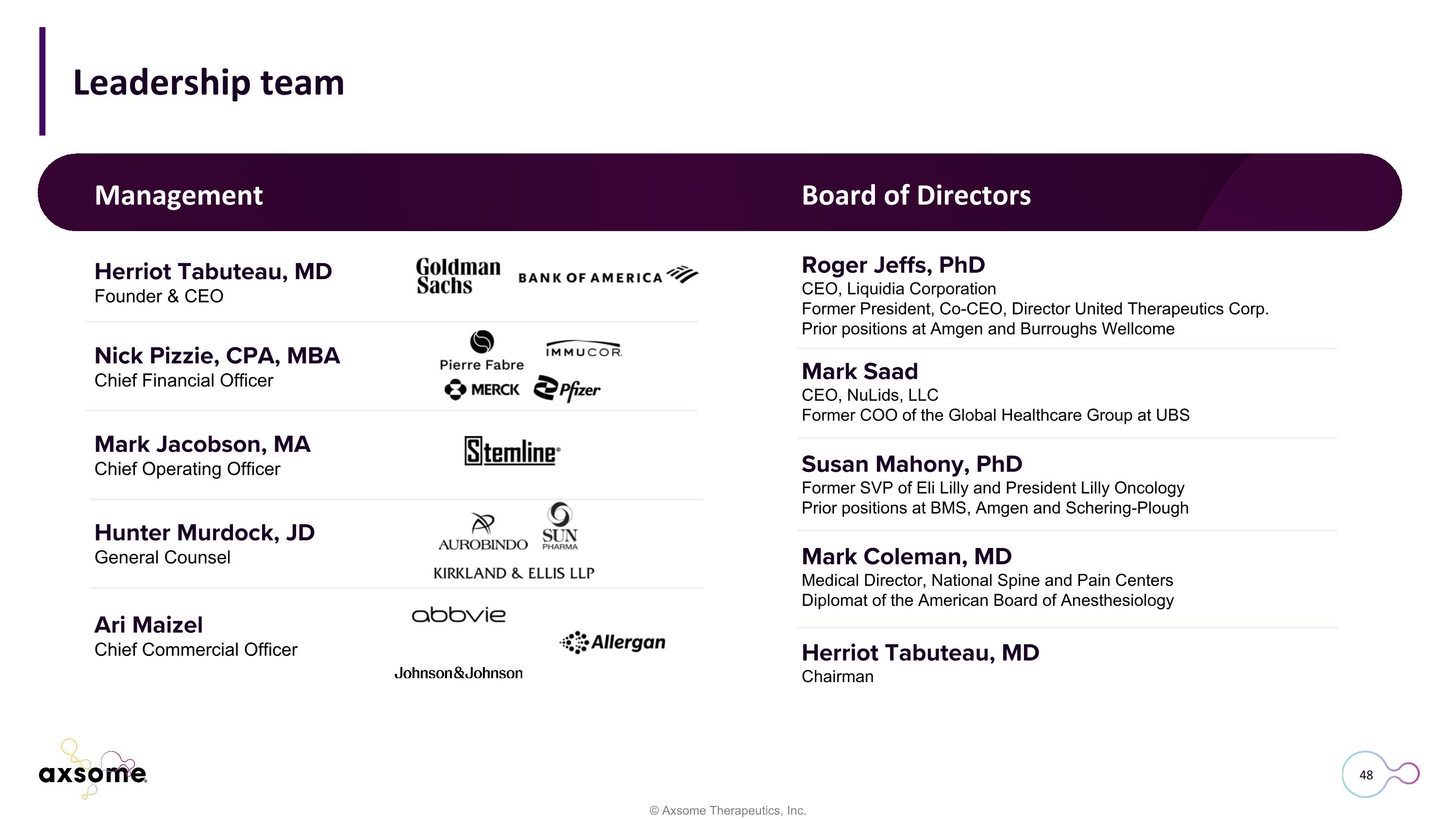
Thank you. Good morning, and thank you for joining AXM's first quarter 2026 earnings conference call. With us today are Dr. Ario Tabuto, our chief executive officer, Nick Pizzi, our chief financial officer, and Ari Maybel, our chief commercial officer, who will begin our call with prepared remarks. Mark Jacobson, our chief operating officer, and Hunter Murdoch, our general counsel, will also be available for Q&A. Please note that today's discussion includes forward looking statements regarding our financial performance commercial strategy and operational plans including research development and regulatory activities these statements are based on current expectations and assumptions and are subject to risks and uncertainties that may cause actual results to defer materially please refer to our sec filings including our quarterly and annual reports for description of these and other risks you are cautioned not to rely on these forward looking statements which are made only as of today and the company disclaims any obligation to update such statements and with that i'll hand it over to ariel thank you ashley and good morning
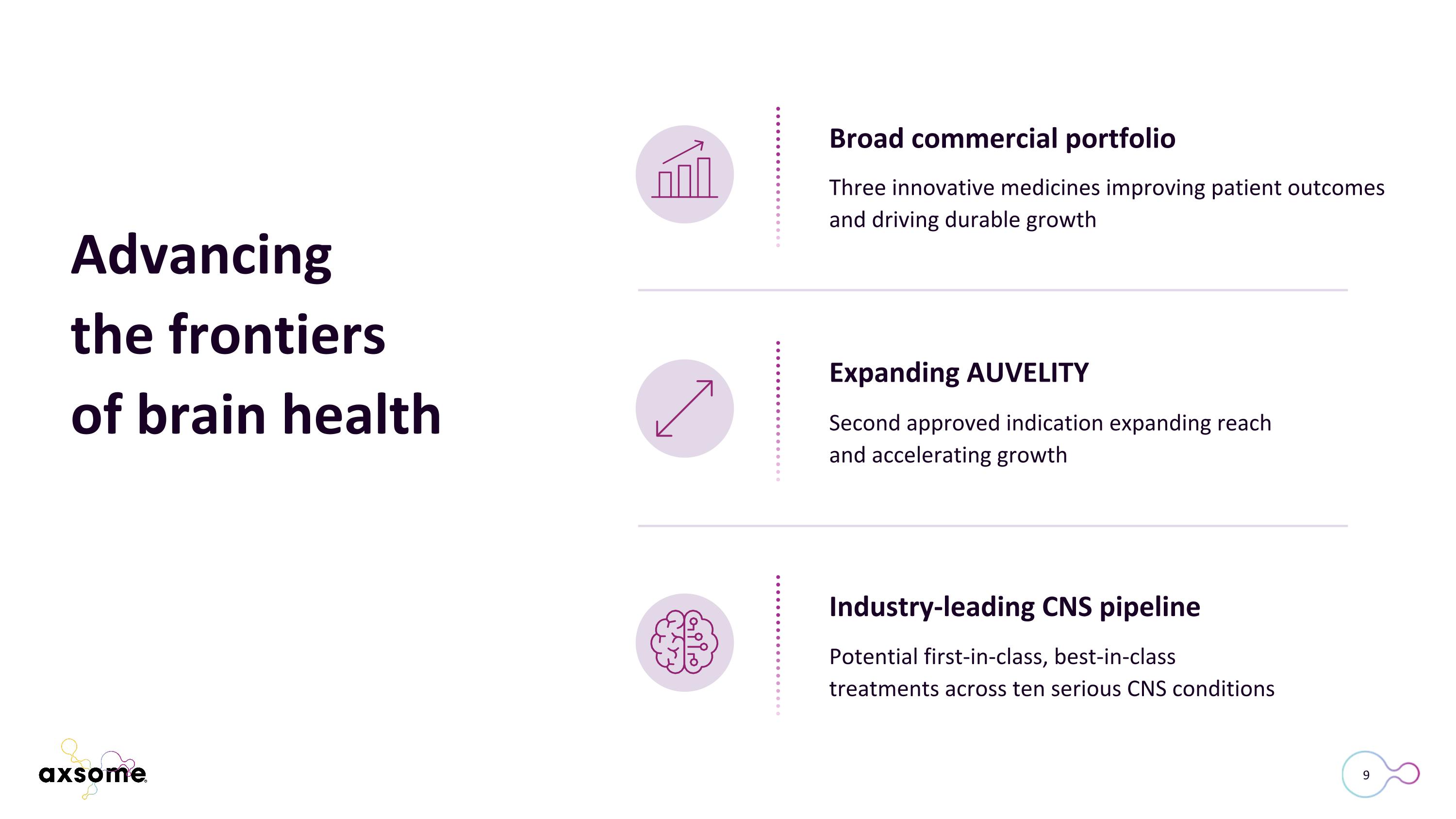
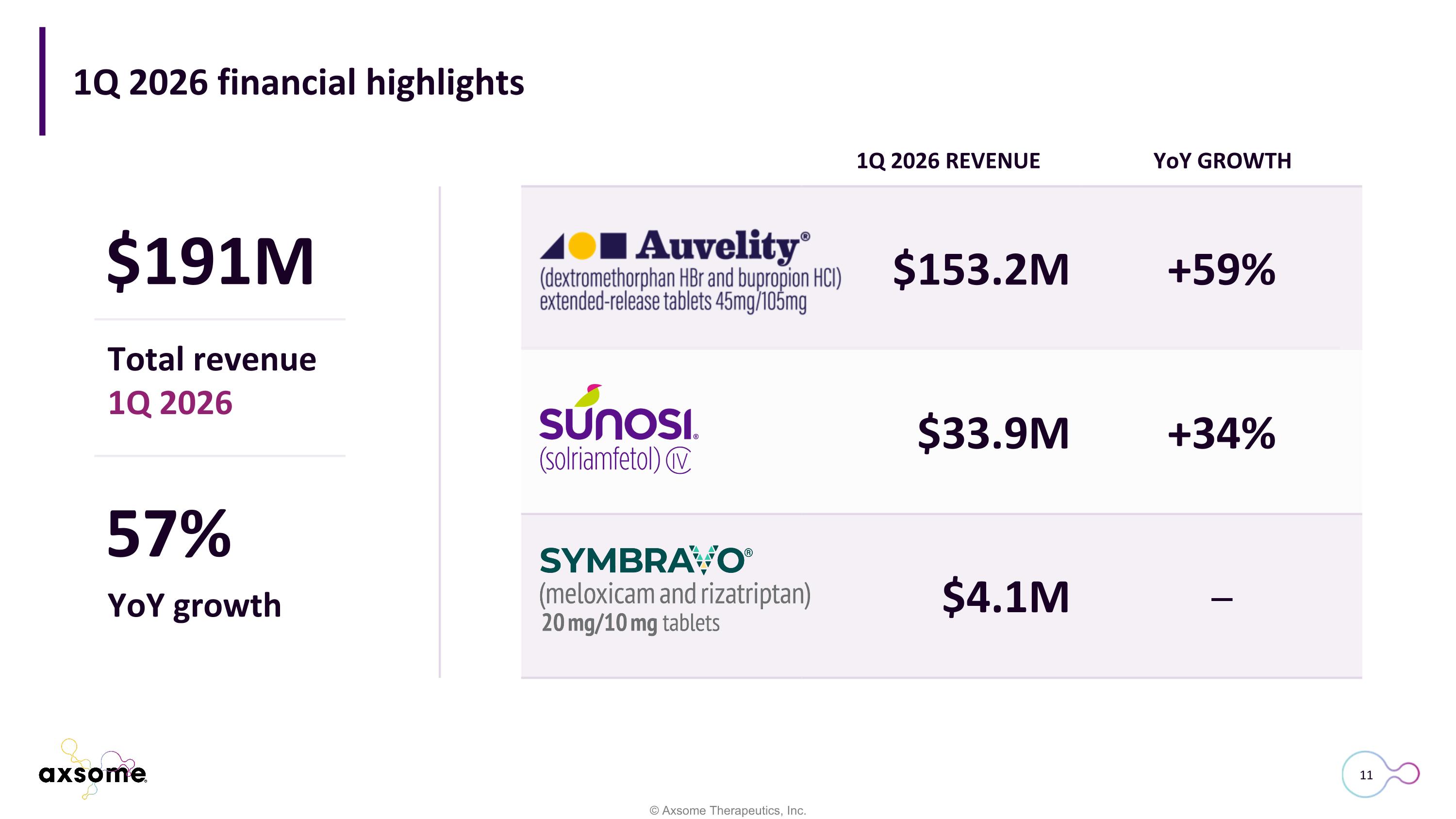
everyone in the first quarter of 2026 axiom delivered strong year-over-year growth and execution across the business this performance was driven by our commercial products and the advancement and expansion of our R&D pipeline, which is now composed of six innovative, potentially first-in-class or best-in-class product candidates. Starting with our commercial business, total revenue for our three marketed products was $191 billion, representing year-over-year growth of 57%, driven by Avelity and Sunozzi with contribution from Simbravo. Building on the strong clinical profile of our marketed products, in the quarter, we substantially expanded the sales force for Avelity, finalized plans for the expansion of the Bravo sales force, and increased covered lives and quality of coverage for all of our marketed products. These initiatives will support continued strong revenue growth of the base business this year and beyond. Last week, we received FDA approval of Avelity for the treatment of agitation associated with Alzheimer's disease, an indication which received FDA breakthrough therapy designation and priority review. This approval introduces a first-in-class treatment option for this highly prevalent, debilitating, and critically underserved neuropsychiatric condition. As such, it marks an important milestone for the millions of patients living with Alzheimer's disease, their families, and their caregivers. Avelity has now been approved in two indications that received FDA breakthrough therapy designation and were granted FDA priority review. The approval in Alzheimer's disease agitation combined with the health of the MTD business and the recent augmentation of the Avelity commercial infrastructure provide us with a clear line of sight to Avelity's market potential. Ari will provide an update to our peak sales estimate for the Avelity franchise based on these developments. The approval in Alzheimer's disease agitation is a testament to our research and development productivity. Since the start of this year, we have continued to advance and expand the rest of our industry leading pipeline with a focus on developing first-in-class and best-in-class products. On the regulatory front, following the FDA approval of Avelity last week, we are pleased to share that we have submitted our NDA for AXS-12 for the treatment of cataplexy and narcolepsy. Clinically, our ongoing trials continue to progress, and we will be starting multiple Phase III trials within the next few months. Finally, we recently expanded our pipeline further with the addition of AXS-20, a potentially first-in-class pre-Phase III PDE-10A inhibitor for schizophrenia and Tourette's syndrome. I will discuss each of these developments in detail later in the call. All in all, Axome is advancing the commercialization of three differentiated marketed medicines across four highly prevalent indications, as well as an innovative pipeline of potentially first-in-class and best-in-class medicines that includes six product candidates targeting 10 different highly burdensome conditions in psychiatry and neurology. Looking ahead, Axome is well positioned to realize robust growth driven by execution across our commercial portfolio, the long-term ability in Alzheimer's disease agitation, and the advancement of the rest of our neuroscience pipeline. With that, I'll hand the call over to Nick to review our financial results for the quarter.
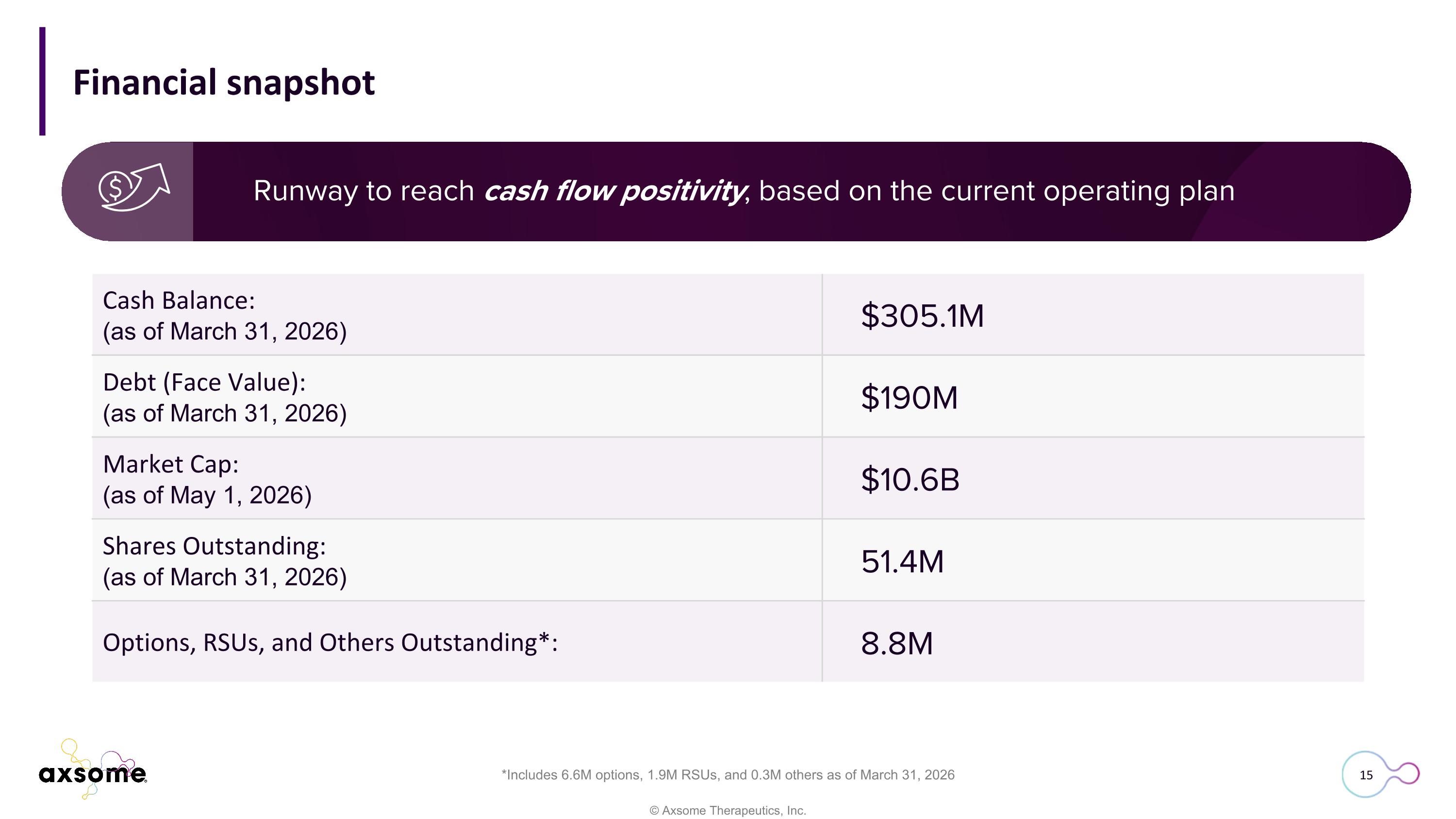
Thanks, Ariel, and good morning, everyone. Our financial performance in the first quarter was strong, with our three commercial products delivering continued double-digit revenue growth. Total revenue for the quarter was $191.2 million, a 57% increase compared to the first quarter of 2025. We expect revenue growth to continue in 2026. Aveli achieved net product revenue of $153.2 million in the quarter, up 59% compared to the first quarter of 2025. Senosi net product revenue for the quarter was $33.9 million, a 34% increase compared to the first quarter of 2025. Senosi revenue consisted of $32.6 million in net product sales and $1.3 million in royalty revenue associated with Senosi sales in out-licensed territories. Net sales for Simbravo were $4.1 million in the quarter. Aveli and Cenosi gross to net discounts for the first quarter of 2026 were both in the low to mid 50s range. We anticipate the gross to net discounts for both products to improve throughout the year consistent with prior year trends. Sinbravo gross to net discount for the quarter was in the high 70% range and we continue to expect it to remain elevated over the near term as access continues to evolve and awareness continues to build. Turning now to expenses, total cost of revenue were $14.7 million compared to $9.8 million for the first quarter of 2025. Our research and development expenses were $52.7 million in the quarter compared to $44.8 million for the first quarter of 2025. The increase in R&D spend primarily reflects a one-time acquisition-related expense booked in the quarter. Our selling general and administrative expenses were $185 million for the quarter compared to $120.8 million for the first quarter of 2025. The increase was primarily driven by the acceleration of prelaunch activities for Availity in Alzheimer's disease agitation and commercialization activities for Availity, which included the national direct to consumer advertising campaign and sales force expansion, along with commercial activities for and Bravo. Net loss for the quarter was $64.5 million or $1.26 per share compared to a net loss of $59.4 million or $1.22 per share for the first quarter of 2025. The $64.5 million net loss in the quarter includes $23.4 million in stock-based compensation expense. Our balance sheet remained strong. We ended the first quarter with $305 million in cash and cash equivalents compared to 323 million as of the end of last year our overall financial performance reflects continued top line revenue growth and improving operating leverage driven by disciplined commercial execution we anticipate that our current cash balance is sufficient to fund our operations into cash flow positivity based on our current operating plan and with that i'd like to turn the call over now to ari who will provide additional details on the key drivers behind medicines, and the broader commercial performance of the business.
Thank you, Nick. The first quarter of 2026 was a pivotal period for Axome's brands, reflected in ongoing demand for our medicines, meaningful improvements in payer coverage, and sales force expansion activities. Our promotional efforts across HCP and patient audiences, combined with a broadening commercial infrastructure, will support Axome's sales objectives throughout 2026. Starting with Alvelity, more than 223,000 prescriptions were written in the quarter, representing 35% year-over-year growth and remaining consistent with the prior quarter. By comparison, the antidepressant market grew 1% year-over-year and declined by 1% compared to Q4 2025. Alvelity performance in the quarter was highlighted by a continued shift toward earlier line use, with first-line, first-switch prescriptions increasing to 56 percent of overall demand. Primary care adoption also expanded in the quarter, now representing 35 percent of total ovality prescribers. These trends reflect meaningful improvements in market access over the last two years, broadened awareness of the brand driven by our national direct-to-consumer campaign, and our concentrated effort in expanding use among primary care providers, a key driver of earlier line utilization and an important foundation to support early trial in connection with the upcoming Alzheimer's disease agitation launch. Additionally, more than 5,500 new prescribers were activated in the quarter, bringing the total number of unique prescribers for AllVelity since launch to approximately 60,000. We continue to make important progress with formulary access for AllVelity. Commercial coverage is at 78%, and alongside Medicare and Medicaid coverage at 100%, total coverage is now at 86% of all lives across channels, establishing a strong foundation of access for Ovality in advance of the launch in Alzheimer's disease agitation. We expect both the quantity and quality of coverage to continue to expand and improve. Ovality's growth to date in the depression market continues to reflect its compelling clinical profile, highlighted by rapid and durable symptom improvement, and a distinctly favorable safety and tolerability profile. Last week's FDA approval of Ovelity as a treatment for agitation associated with dementia due to Alzheimer's disease is a significant advancement for patients and a major milestone for the brand. We are very pleased with the product label, which provides compelling clinical information regarding Alvelyde's impact on agitation for Alzheimer's patients. Alvelyde is a first-in-class treatment for this patient population, demonstrating rapid and durable symptom improvement with a favorable safety and tolerability profile. Alvelyde is the only approved treatment for Alzheimer's disease agitation with efficacy on symptom relapse demonstrated in long-term trials. In a short-term study, the most common adverse reactions were dizziness and dyspepsia, and only 1.3% of patients discontinue treatment due to an adverse reaction, the same rate as placebo. In market research, HCPs rate Olvelity's clinical profile in Alzheimer's disease agitation as highly compelling from both an efficacy and safety perspective, with clear potential for first-line use in appropriate patients. We are expanding the Olvelity sales team to approximately 630 representatives, enabling Axome to reach 68,000 HCP targets across primary care, psychiatry, neurology, and geriatric specialists who treat both MDD and Alzheimer's agitation patients across community and long-term care settings. Our expansion efforts are substantially complete, positioning us well for the commercial launch in June. We believe Availity has the potential to play a significant role in the treatment of Alzheimer's agitation and, together with the MDD indication, further broadens its use across serious neuropsychiatric conditions. Alvely's expanded sales force and strong foundation of coverage positioned the brand to drive growth across both indications throughout the second half of 2026. Taking into account the recent label expansion in Alzheimer's disease agitation, the clinical profile in this indication, the health and trajectory of the MDD business, and recent investments in our sales infrastructure, we are now able to update our peak sales outlook for the product. We now believe Albelity has the potential to generate at least $8 billion in annual revenue at peak, with approximately equal contribution from each indication. Over the extended life of the product, we see a clear path to achieving this growth potential, supported by the underlying fundamentals of the business as we continue to scale. Turning now to Symbravo, more than 17,000 total prescriptions were written in the quarter, representing 36% growth versus Q4 2025. More than 5,000 new patients started Symbravo treatment in the quarter. Neurology specialists accounted for approximately 60% of total ridership in the quarter, with primary care representing approximately 32%, an increase from 20% in the first quarter of launch. While headache specialists will remain a critical prescriber segment for Simbravo, the increase in primary care prescribing is an encouraging signal of Simbravo's potential and reinforces the early experience with Simbravo as a safe and tolerable acute migraine treatment that provides fast migraine pain improvement sustained through 24 and 48 hours. Based on Simbravo's growth within its launch year and increasing demand for education of the only branded multi-mechanistic acute migraine treatment in the market, we are increasing the Simbravo sales team by approximately 50 representatives. Our expanded Simbravo sales force of 150 representatives will support broader reach in the primary care market while deepening engagement with headache specialists and neurologists throughout the country. We are also pleased to announce a major commercial payer contract for Simbravo effective this month, securing coverage for approximately 17 million lives. The agreement reflects Simbravo's compelling clinical profile and its potential to address the needs of patients with inadequate response to triptans. Overall payer coverage for Simbravo is approximately 57 percent, representing 56 percent in the commercial channel and 57 percent in government channels. We expect coverage for Simbravo to expand and evolve throughout 2026. And finally, in Q1, approximately 54,000 Senozi prescriptions were written, representing 16% year-over-year growth and a 3% decline sequentially. By comparison, the weight-promoting agent market grew 1% year-over-year and declined by 5% versus Q4 2025. Nearly 500 new clinicians prescribed Senozi in the quarter, bringing the total cumulative prescriber base to more than 16,500 since launch. Payer coverage for Cenozi remains steady at approximately 83% of lives covered across channels. Overall, the first quarter of 2026 was marked by significant progress across Axome's commercial business, including strong demand for our products, key advancements in market access, launch preparations for Avelity and Alzheimer's disease agitation, and disciplined organizational growth designed to maximize the potential of our singular cns portfolio looking ahead axom is well positioned to deliver on our commercial objectives across our innovative portfolio through the balance of the year we look forward to sharing our continued progress with you over the coming months i will now turn the call back to ario to discuss our singular cns pipeline thank you ari i will now touch on recent developments
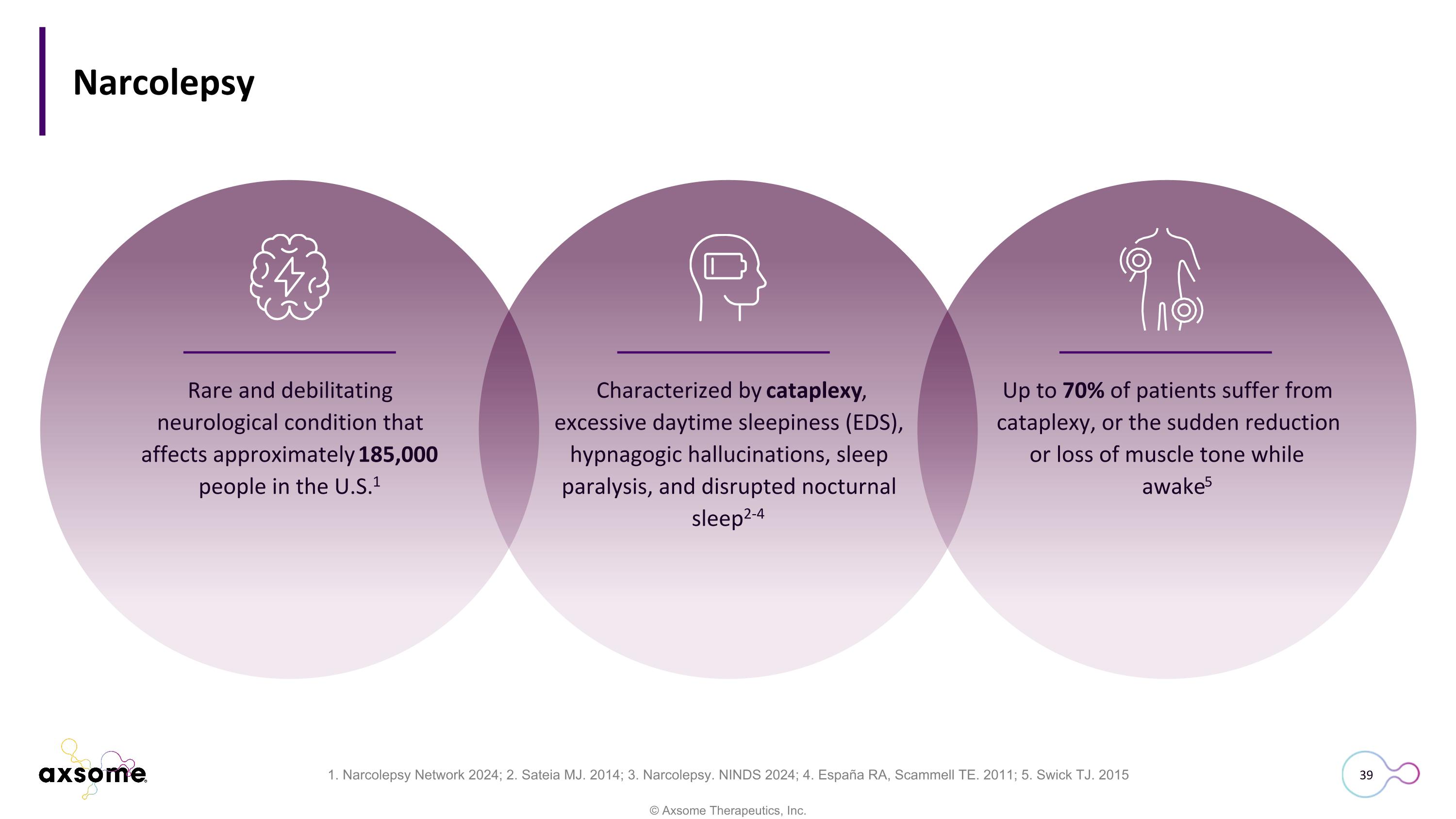
and upcoming milestones for the rest of our pipeline. Starting with AXS-12, as I mentioned, we recently submitted our NDA for AXS-12 for the treatment of cataplexy in patients with narcolepsy. Narcolepsy is a rare and debilitating neurological condition that affects approximately 185,000 people in the U.S. We are excited by the potential of AXS-12 to provide a new and differentiated treatment option to patients living with narcolepsy. We look forward to announcing the FDA's decision on the acceptance of the filing. Beyond AXS-12 and narcolepsy, we are also developing the full suite of clinical programs in our leading neuroscience pipeline. Starting with AXS-05, we are on track to initiate a pivotal phase 2-3 trial in smoking cessation this quarter. Moving on to Solvary Infetal, our phase 3 programs for this molecule continue to progress. These include ADHD, binge eating disorder, MDD with symptoms of excessive daytime sleepiness, and excessive sleepiness and shift work disorder. For ADHD, we are on track to initiate two pediatric phase three trials, one in children and one in adolescents this quarter. For MDD, we recently initiated the CLARITY study of phase three double-blind placebo-controlled randomized withdrawal trial. In the trial, patients who achieve a sustained response during the open-label period will be randomized to continue Solvary Amphital or switch to placebo. The primary endpoint of that trial is time to relapse of depressive symptoms. The binge eating disorder, our ENGAGE phase three double-blind randomized controlled trial is progressing, and we anticipate top-line results in the second half of this year. Finally, for shift work disorder, the Phase III trial continues to enroll with top-line results anticipated in 2027. Turning now to AXS-14, our novel, highly selective, and potent norepinephrine reuptake inhibitor for fibromyalgia. Enrollment is ongoing in the forward Phase III trial. We look forward to sharing updates on this program as the study progresses. For AXS-17, our novel oral selective gabapam for epilepsy, TEP transfer, and Phase II trial-enabling activities are well underway. Lastly, we recently acquired AXS-20, or the Lipidec, a potentially first-in-class oral potent selective PDE-10A inhibitor. We plan to develop AXS-20 for the treatment of schizophrenia and for Tourette's syndrome. We plan to initiate Phase 3 trial enabling activities for AXS20 in schizophrenia later this year. I will now turn the call back to Ashley for Q&A.
Ashley Aries Thank you, Ariel. Operator, please open the line for Q&A.
Operator
We'll now be conducting a question and answer session. If you'd like to be placed in the question queue, please press star 1 on your telephone keypad. A confirmation tone will indicate your line is in the question queue. You may press star 2 if you'd like to remove yourself from the queue. In the interest of time, we ask you to please ask one question and one follow-up, then return to the queue. Our first question today is coming from Ash Verma from UBS. Your line is now live.
Hey, guys. Congratulations again on all the progress. Thanks for taking our question. So I know it's the second day of Q&A, but maybe just on ADA, are you thinking about the LTC market in the long run? I mean, clearly right now, 40% of these patients reside in LTC, but the current prescriber mix is heavily PCP. But when you think about the long run, how much of a, for this, for you to completely extract value out of this market, how much of a focus does LTC need to become in the long run?
Hi, Ash. Thanks for the question. Our sales team of approximately 630 representatives will call on both community and long-term care facilities, and so for us it's important to be present and to educate prescribers and care partners within both facilities or both settings of care. Ultimately it's a concentrated market that allows for efficient promotional activities, and we expect that it will grow over time as the brand ramps um but we we believe that community and long-term care are both uh very important for this market and look forward to sharing some updates as we get get going with the launch got it can i ask a quick follow-up um so just on the ada indication i know you're using this uh unique 30 meg dexomethorphan dose in the titration pack which you haven't used before uh for this launch um is this uh supplied in the channels already or doesn't does this in any way
become like a bottleneck for the full launch at this point. Thanks.
Hi, Ash. As a reminder, we'll be launching next month, and Ari touched on the items that are being finalized right now for launch. Do you want to recap those again one more time, right?
Yeah, I mean, we're finalizing our sales and marketing resources and training our sales force on a new indication. The titration dose will be available at the time of commercial launch.
Operator
Thank you. Next question is coming from Mark Goodman from Lyric. Your line is now live.
Those are pretty big peak sales numbers. Can you help us just understand why did you feel like you had to raise them today. And secondly, just talk about what went into the forecasting there and $4 billion in each indication. Thank you.
Thanks, Mark. Well, the FDA approval of mobility and Alzheimer's disease education provides greater certainty regarding the long-term sales potential of the product. And as you know, Alzheimer's disease is a large and growing market, 7 million patients, of which 76% are impacted by agitation symptoms. Of course, there are only two approved agents on the market. So, when we review our proprietary market research on HCP perceptions, potential use of the product, taken together with the clarity around the final label, it really provides confidence that Obelity will be used as a frontline treatment in Alzheimer's agitation, and we've seen growing use as frontline treatment and MDD. The foundation market access that we built, along with growing adoption and primary care, which, of course, is a critical provider segment in the Alzheimer's space, I think these things taken together with our MDD penetration and growth trajectory and the increased sales force to support both indications give us confidence in the potential to achieve our updated peak sales estimate for all validity.
Operator
Thank you. The next question is coming from Andrew Sy from Jeffrey's. Your line is now live.
Hi, good morning. Thanks for taking our questions. I have a bigger picture question. You know, now with Ovelity approved in Alzheimer's agitation, how does that embolden you guys to pursue even more indications? I'd imagine you can directly go to Phase 3 with Ovelity for other indications. And this drug has a long tail, too, so maybe talk about when we might learn more about indication expansion expansion of opportunities, or is that it with availability? Thanks.
Hey, Andrew. Good morning. We did touch on the next indication that we've been working on for some of that smoking cessation. So stay tuned for updates there. And, you know, the next step with that program is initiating the Phase 2-3 BIVO trial. So we'll have updates there soon. And, you know, the product is very interesting given that it targets NMDA and Sigma-1 receptors. High potential applicability to other neuropsychiatric conditions, and, you know, that's something that the team is obviously exploring. But right now, the next formal step is smoking cessation trial initiation.
Great. And then as a follow-up with your new PDE-10 asset that's starting phase three enabling studies this year, can you talk about the efficacy safety profile, why it did not necessarily hit STAT-SIG in phase two, and why you think you can produce a different outcome in phase three? And correct me if I'm wrong, but I think schizophrenia studies could be relatively fast. So could it be possible we get data maybe 2028?
Thanks for the question on Belipidect. With regards to the efficacy, there was a phase two trial, which you mentioned, which was done in schizophrenia. This was a randomized, double-blind, scene-controlled trial. And when we looked at the data, there was clear separation. The magnitude of treatment effect for Belipidect was on the high end when you look at historical treatments for schizophrenia. Now, because of the size of the study, obviously it was not powered for statistical significance. But despite that, there was a very clear trend and there was statistical significance on various measures, including, for example, global measures. So clinicians were able to see highly statistically significant improvements in schizophrenia, and there were also other measures which were positive. For example, the rates of discontinuations due to lack of efficacy, wide gap with half of the patients who weren't placebo discontinued, the lack of efficacy versus in the low double digits for at the lipidant. So, clearly, there was a very strong signal there. And when you look at the safety profile, it is very distinct, obviously, from atypical antipsychotics. So, we're very excited about this potentially first-in-class treatment. And as it relates to timing of starting a phase 3 trial, this is a phase 3-ready asset. What we need to do is to to restart manufacturing of clinical supplies. So the phase three enabling activities are ongoing this year, and we would anticipate we are targeting, potentially starting a phase three trial around the end of the year.
Thank you again, big congratulations.
Operator
Thank you, next question is coming from Ami Fadiah from the Indian Company, your line is now live.
Speaker 1
Hi, good morning, thanks for taking my question. Um, firstly on, uh, some Bravo, can you, uh, give us some more details around where you're seeing utilization and how you see, uh, the drug evolve, uh, you know, with sort of this expanding, uh, payer coverage, how do you see the evolution of, uh, you know, growth to net and, and also utilization as the year progresses. And then with regards to ability, just to follow up to a previous comment, um, as you think about the IP runway you have, how are you thinking about sort of really expanding the number of indications where you explore this product, you know, ahead of the IP runway and the IRA? So, you know, could we expect to see you look at multiple other indications, or will it be sort of more sequential? Thank you.
Thanks, Ami. I'll start with this CIMBRAVO question. You know, we've been really pleased that CIMBRAVO has found its way into the treatment paradigm for many headache specialists, and what we're seeing is, you know, approximately 60 percent of use is in the first and second line setting. The feedback that we get from HCPs is that CIMBRAVO has been particularly effective for patients with inadequate or partial response to triptans, and we expect those patients to be the primary focus moving forward. Obviously, the The market access win that we're announcing today is an important step for long-term patient access. We think it will have a positive impact on GTN in the future, but the focus of the team is to continue to expand access for patients, which will help to drive reductions in GTN over time. But for the short term, we expect GTN to continue to be elevated as we build our access.
Great. And as it relates to the question on new indications or additional indications for Avelity, given the IP runway, you are correct. We're in a very favorable position, given that there is a very long exclusivity runway for Avelity and also the fact that the product is commercialized. We are not resource constrained as it relates to potentially developing for other indications. The other interesting thing about the product, which Mark touched upon, is its unique pharmacology, which is applicable to a number of potential CNS indications. So, we have very clear ideas, as you can imagine, internally, around what these additional indications are, and want to make sure that we move in a very measured way. And And if there is something that is worth doing, you know, we think it's worth doing quickly. And so, stay tuned as it relates to other potential indications, which could further increase the value of the product long term.
Operator
Thank you. Next question is coming from Jason Gerber from Bank of America. Your line is now live.
Hey, guys. Thanks for taking my question. Another follow-up question on the PDE 10. And my understanding was that I think Axome and acquiring this asset plan to push dose relative to what was studied by Takeda to get better receptor occupancy. So wondering if you can speak to that dynamic, how high you'd be looking to push dose and confidence that the supportive data give you a safe dose strength to interrogate. And then as my follow-up, are there any signs or indications that antipsychotic use in nursing homes is coming down at all in the wake of the March OIG report that was dubbed, I think, inappropriate use of antipsychotics in nursing homes. So, just kind of curious if you have any insights as you gear up for your own ADA launch. Thanks.
Yeah, thanks for the question. With regards to the PD-10A inhibitor, we have not discussed dosing as it relates to the product. uh however the dose of that was studied uh was uh was effective you know had the number of subjects per arm then what you would have what you would have seen in a normal phase three trial in schizophrenia um clearly it would have reached physical significance yeah and regarding your question on antipsychotic use um there hasn't been an immediate drop in antipsychotics and in an overall substantial way.
I think the news is still relatively new. But what I will say is that the awareness of that report and the sensitivity on using antipsychotics with this patient population is very high among providers and family members. So, we think that provides a good foundation for the ability launch in the Alzheimer's disease agitation space and expect there to be, you know, continued focus on antipsychotic use moving forward.
Operator
Question today is coming from Ram Silvaraju from H.C. Rainway, Rainway, your mind is now live.
Thanks so much for taking our questions. Firstly, on the commercial side, I was wondering if you could provide us with some additional details regarding the deployment of the field sales force, the degree to which sales reps currently promote more than one product or are dedicated to promoting a single product within your commercial product range, and how you expect this to evolve going forward. In other words, to what extent do you expect to deploy sales representatives dedicated to a specific product and a specific indication versus having them promote more than one product at a time, and to what extent this strategy will be reflected going forward in the deployment of the commercial sales force. And then with respect to clinical development directions, I was wondering if you could comment generally, perhaps, on your interest in muscarinic receptor modulation, particularly as this pertains to both the neuropsychiatric and cognitive dysfunction dementia fields, and if you could also give us a sense with respect to Balapodect, you know, where you expect the specific safety advantages of this product to lie within the neuropsychiatric indications that you expect to target? Thank you.
Yeah, I'll start with the deployment of Salesforce questions. So up to this point, we've largely had our sales teams focused on one specific brand. Part of that is related to the unique specialist audiences that are particularly important in the launch phase. And so for Avelity, that's psychiatry, for Simbravo, headache specialist and neurologist, and for Cenozi, sleep specialist. With the Alzheimer's education launch, because of the high degree of overlap in call points for NDD and ADA, that team will be supporting and promoting both indications. But in terms of long-term potential or vision for the team. As you know, our portfolio and our pipeline is unique in that there are many shared call points for certain therapeutic areas. And so, that's something we'll continue to evaluate and we'll share as we make some progress moving forward.
Great. As it relates to the pipeline questions, with regards to your question on muscarinic receptor modulation. That mechanism of action does not fall into our current pipeline, so we don't have much to add there. And as it relates to bolipidect and the potential safety advantages, just as a reminder, this is a PDE DNA inhibitor, and so it works by regulating cyclic AMP and cycle GMP levels downstream from D1 and D2 receptors so the the potential safety advantage and this has been shown in preclinical studies as well as in clinical studies is is one of the advantages is that what has not been seen or changes in glucose levels or relaxing levels so as you know with With atypical antipsychotics, one of the major side effects has to do with metabolic side effects. And so we have seen preclinically as well as clinically that this could be a major benefit with bilipidectin.
Operator
Thank you. Next question is coming from David Amselen from Piper Samu. Your line is now live.
Thanks. So just two for me. With the significant expansion of the commercial infrastructure, what's your appetite for the acquisition of a market-ready or commercial-stage asset? I know you focused on expanding the pipeline, but you have a lot of infrastructure now that you can leverage. So maybe talk to that. And then secondly, a question on riboxetine and how you're thinking about the underlying commercial opportunity in a landscape where you're going to have orexin-2 receptor agonists as options in this population.
Thanks. in terms of um being able to acquire a marketed uh product you know we we have done that in the past and we did that with uh snozi um which was our first acquisition having said that uh we have such a a rich portfolio of marketed assets new indications and uh and also a very late-stage pipeline that we, you know, we have enough to focus on to drive long-term and as well as near-term value. So short-term and near-term value inflections and, you know, long-term sustainable value creation. With regards to the orexin-2 agonist, so if you look at, If you look at narcolepsy, this is an orphan indication, but a large orphan, 185,000 patients. And what we see is that there is a lot of heterogeneity in this patient population. There is a lot of polypharmacy. Not every drug works. And also, there is a lot of side effect liability with the current treatments. And, you know, each treatment will have different side effect profiles. else. So what we like about our product, about AXS12, a couple of things. One, it works very quickly. So we have an onset of action, which is at one week. And currently, all the other products on the market take a lot longer, about a month to work. Secondly, the efficacy that we've is durable. So, we have data out to six months, and all of that efficacy comes with a very favorable side effect profile and a first-in-class mechanism of action for narcolepsy. Lastly, with regards to some of the other ancillary symptoms of narcolepsy, the data it does show that AXS-12 has the potential to also beneficially affect EDS as well as cognition. So we're very excited by the potential to provide a new treatment option to patients.
Operator
Thank you. Your next question today is coming from Yatin Suneja from Guggenheim Partners. Your line is now live.
Hey, guys. Thank you for taking my questions, and congrats on all the success and progress. Just a question on ADA. Actually, two questions. One is, you know, how should we think about sort of guidance? You know, at what point do you think you might be able to establish guidance, if that's even possible? Two, you know, if we, you know, we are all trying to model the ADA RAM curve. Obviously, when you launch availability in MDD, I think the awareness was not there. So, how much more, like, how should we think about the early launch in MDD and how do we sort of model it for ADA? Any guidance there will be really helpful.
Hey, Aden. This is Nick. As relates to guidance, first of all, we gave guidance, right? We have peak sales guidance out there of at least $8 billion for Avaldi, $300 to $500 million for Synose, and $500 million to $1 billion for SunBravo. So that's our peak sales guidance. And, you know, obviously a lot of fluidity now with the expansion, with the approval, with market access continuing to grow and evolve. So at this point, there's many variables out there from a short-term perspective. So we want to see how they evolve, and then we can take a look at potential guidance down the road.
And regarding the ADA ramp, obviously, it's very challenging to predict exactly how any new launch will ramp over time. As you mentioned, you know, the Ovelity MVD, in one hand, is an analog, even though a different marketplace, same product. And, you know, obviously, we're optimistic because there's greater awareness, better market access, larger sales theme. On the other hand, there's one analog in this market with Rex Salty, and although the clinical profiles are very different, it does give some sense of uptake in the settings of care which we'll be entering. So, I think we'll learn more as we get into the launch, and we'll be able to share those details of what we're observing. Thank you.
Operator
Thank you. Next question is coming from Sean Lomin from Morgan Stanley. Your line is now live.
Thank you. Good morning, everyone. Hope everyone's well. Well, back on AXS12, I'm just wondering what your sort of price and payer discussions, if any, have been like, and what's the kind of investment you think you need to make to ensure that this drug has a success, you know, given there is such hot debate on the Erexin-2 agonists and the large market potential there?
Yeah. Thanks, Sean, for the question. You know, obviously we've been engaged with payers on early education around the clinical trial programs and the data. We have not specifically engaged in pricing discussion, so I'll have to defer to a later time to share some of those details, but there is genuine interest in new narcolepsy products for the reasons Aria stated earlier, which is that there's significant inadequate response, treatment switching, and polypharmacy, and so payers are very mindful of ensuring that treatment options that are available have strong efficacy, safety, tolerability. In terms of the investment required, you know, we'll have more to share as we get closer to a potential approval. But as we've mentioned previously, you know, we have established a sleep team for Senozi that is in market today, and obviously there is near-perfect overlap in terms of ACP targets for Senozi and AXS-12 if approved.
Yeah, maybe just a little bit furthering on to Ari's comments from a financial perspective, you would consider, you would think of or for drug pricing from a top line as ari shared we already have the infrastructure set up with the sleep team and the and the marketing team from from uh from sleep so you know what we would anticipate that a lot of synergies with axs12 into the current infrastructure and uh and hype improve to continue to improve the operating leverage within the piano well thank you how excited are you about that product it doesn't seem to get a whole heap of airplay amongst investor discussion.
So how excited are you about it?
Very excited. We are very excited. The feedback we're getting from KOLs and early market research is really strong. And because these patients are very difficult to treat and are frankly dissatisfied with existing treatment options. We believe there will be significant room for ASS-12 to make a significant impact in this marketplace.
Wonderful. Thank you. That's all I have.
Operator
Thank you. Next question today is coming from David Hong from Deutsche Bank. Your line is now live.
Hi, there. Thanks for taking my question, and congrats on all the recent progress. So, first, I wanted to come back to the peak sales number that you put out there for Avelity. If I heard you correctly, I think you said 50-50 for the, you know, MDD versus ADA indications. And so the MDD number, you know, strikes me as a large one. And I'm just wondering if you look at other kind of other antidepressants or comparable products in the market to help you get to that number. And then maybe a follow-up there is, does that contemplate, you know, evolving competition in the field over the next few years, let's say, and, for example, do you see psychedelic therapies as competitors to ability? Thanks a lot.
Yeah, thanks, David. Yeah, I think, obviously, we take a look at market analogs, but they don't fully drive our decisions, which is largely based on our internal research and analysis and, you know, what we're seeing in terms of adoption rates, penetration, the improvements in our commercial infrastructure related to Salesforce and market access, and now the additional data in Alzheimer's disease agitation. In some ways, Ovality stands on its own in this marketplace because of its novelty in terms of mechanism of action, as well as the clinical profile that it delivers when compared to other treatment options. And so we're confident in the potential that we shared earlier today and, you know, look forward to sharing some additional updates as we grow the brand, particularly as we get into the Alzheimer's disease agitation launch, which is a really important milestone for the brand.
Operator
Your next question is coming from Miles Minter from William Larry Line is now live.
Hey, thanks, everyone. Congrats on the quarter. First one's just on the ENGAGE study of psoriaphytol and binge eating disorder. How are you thinking about what you'd like to see from an efficacy standpoint there? Should we be looking at the Vibans data set of about one and a half day reduction in binge eating days over that week period, so that it'd be about 18 to 20 days over your 12 weeks in ENGAGE? That's the first one. And then on AXS14, very curious as to the randomized withdrawal nature of the trial that you're conducting in fibromyalgia. That seems great from a probability of success standpoint. Just reading some recent guidance from the FDA, I think that they make a statement that it's not necessarily a robust comparative from the safety aspects of that drug. Was there any sort of conversations that you're already over the hurdle per se on the safety data requirements for AXS-14 with the previous data from Pfizer and that you don't have to do any additional studies beyond this one? Thanks very much.
Thanks for the questions. As it relates to the binge eating disorder study, it's hard to say what we're looking for. Obviously, we powered the study to detect a treatment difference. One of the limitations of making predictions is that currently there's only one product that's approved, so not very many studies have been done in binge eating disorders. So, that's exciting, and we look forward to the data readout to see what we see. Obviously, what we're looking for is a positive study, so we're looking for a statistically significant improvement with our drug versus placebo. As it relates to AXS14, we are very excited about the clinical trial, which we've launched. With regards to the safety data, just as a reminder, two randomized double lines of secret control trials have been conducted, and both of those were positive. These were very large studies. And also, there were two long-term safety trials with hundreds of patients treated out to at least a year. So, plenty of randomized as well as long-term safety data with AXS-14.
Operator
Thank you. Next question is coming from Matthew Hershelhorn from Oppenheimer, your line is now live.
Hey, guys. Congrats again on the ADA approval, and thanks for taking our question. We were wondering just about your overall BD strategy following the recent deals for AXS-17 and Belipidect, especially in terms of additional capacity and other areas you'd like to add to, do you consider psychedelics or neuroplastogens as a potential complement to your psychiatry portfolio, and if the recent policy and regulatory dynamics, as well as some strategic interests for those, inform your thinking there at all? I really appreciate it.
Thanks for the question. We don't, as you know, comment specifically on business development, but what we can share is that we think very carefully and we're very selective as to what we add. Now, we don't really need to add anything more. We have a pipeline right now, which is very deep and very broad and late stage. And so, you know, we did announce these two recent business development transactions, which provide us two new NCEs with novel first-in-class mechanisms of actions, and then that complements the rest of our pipeline. So, you know, we've demonstrated our ability to generate what we believe will be an inflection in the base business already. And then also we are ensuring that that inflection will be sustained with the current pipeline that we have.
Operator
The next question is coming from Ben Burnett from Wells Fargo. Your line is now live.
Hey, thanks very much. I want to ask just a question about the CLARITY-SORI-ANFETAL study. So, it's a randomized withdrawal study. Maybe give a little color as to why that design was chosen. And I guess if it's positive, would you expect to have to do a parallel study after that?
Thanks for the question. So, we do anticipate that we would need two positive trials. That's the standard for any approval for any indication at the FDA. And in terms of the reason for the randomized withdrawal design, one of the challenges with neuropsychiatric indications and depression in particular is the high placebo response. So, you know, how do you deal with that? So, in the prior studies, in the prior study which we conducted with sol-reampatol in this indication, what we saw in the active arm was clearly a very pronounced antidepressant effect. So, what we wanted to make sure is that we're able to tease out and really demonstrate that this is a drug effect and while minimizing the impact of the placebo response. So that's the rationale behind the selection of that city design.
Okay. Thank you very much. And can I also ask, just like long-term, how are you thinking about profitability? And does the increased conviction and ability and what that could do from a sales perspective, I guess, does profitability start to become a goal for the company, or is the focus kind of more on sort of revenue growth?
Right now our focus continues to be on revenue growth. So I think if you have to put things in priority order, revenue growth is number one. Then getting the cash flow positivity is two, and then profitability shortly thereafter.
Operator
Great. Thank you. Thank you. The next question is coming from Greg Subalavage from Missouri Honey, and why is that why?
Speaker 21
Good morning, guys. Congrats on all of the progress, and especially the AD agitation approval, and thanks for taking my questions. I've got questions on Ovelity, and I'm curious if you could provide some color around how we should think about this year's quarterly sequential growth given seasonality dynamics, given that, you know, while Ovelity is still growing year over year in MVD, as you get to bigger numbers, it starts slowing down, but then you've got the ADA launch. So I guess do you anticipate year-over-year growth in 2026 to be perhaps bigger than you saw in 2025? And then just a follow-up on Avelity, just given the ADA approval, can you tell us how you're thinking about IRA implications and how we should think about, as you add more Medicare patients, how we should think about including that in our models or not in terms of any impact there? Great.
Yeah, I'll start with the first question around quarterly sequencing. You know, we haven't guided specifically on sales ramp over the course of the year, but as you know, Q1 is a quarter in which market seasonality comes into effect, but we believe is transitory in nature, as evidenced by the early demand trends that we're seeing in Q2.
And then maybe just a little bit on the IRA, Greg, you know, at the earliest IRA negotiations will not impact a validity until 2031, obviously assuming a validity meets the requirements for negotiation of being a top spend Part D product. And it is important to note that the $8 billion that we share today contemplates any type of IRA impact. Okay, thank you.
Operator
Thank you. Next question is coming from Brian Skorny from Bayard, your mind is now live.
Hi, thanks for taking our question. This is Charlie on for Brian. So just kind of following up on an earlier question, curious how you're thinking about positioning Synose ahead of potential Rex and Agonist launch later this year, as well as with your expansion of the Salesforce there and wrapping up the expansion of the Ovelity Salesforce, how should we think about kind of the ramp of SG&A spend throughout 2026? Thank you.
Sure. Maybe I'll take the SG&A question first. So SG&A increased this quarter primarily for four reasons. First off, we typically do see a bit of phasing of higher spend in SG&A in Q1 versus the rest of the year just on the underlying business. Secondly, we accelerated the marketing spend in preparation of approval of ADA to ensure the infrastructure was established and ready to launch in June. So, we're moving along there very nicely. Thirdly, the field force expansion was actually faster than we anticipated. So, we're pleased with where we are in preparation for a June launch. And fourth, we actually continue to have DTC spend for Valdi in MDD. So, as we think about the rest of the year, we would anticipate SGNA will likely increase in Q2, but at a slower rate than what we've seen from q4 to q1 and likely level out shortly thereafter but it's it's importantly it's it's we should note that we expect to see continued operating leverage in the pnl as top line revenue growth is anticipated to outpace the growth that we expect to see in operating expenses yeah and regarding your question on on axs12 obviously say it's a great time for treatment developments in the narcolepsy space.
And we're very excited about the potential for AXS12 to enter this marketplace. You know, without sharing specifics around the orexins, I would just say that we're very pleased with the phase three clinical trial results. Ariel mentioned earlier, you know, significant reduction in weekly cataplexy attacks as early as week one, very safe and tolerable, and demonstrated benefits across a variety of secondary endpoints, including excessive daytime sleepiness and incognition. So, we think there's a real opportunity for ASS-12 to make a difference for patients, and we'll look forward to news regarding the submission.
Great. Thank you very much.
Operator
Thank you. The next question today is coming from Madison El-Sadi from Be Riley Securities. Your line is now last.
Hey, congrats on the progress, and thanks for taking your question. A couple related to Avelity. Our understanding is that long-term care, formulary additions are gated by these quarterly reviews that facilities have. And so just given everything we know in terms of payer coverage, Salesforce expansion, the general profile, the landscape, I'm curious if there could be a bolus of AD agitation patients. And then just as a follow-up, I guess over the next, say, call it 12 months, how many prescribers do you expect may prescribe availability for both depression and for AD agitation?
Yeah, thanks for the question, Madison. And regarding LTC bolus, I think it's difficult to predict exactly, but, you know, our team has been actively engaged with, you know, payers and LTC organizations to ensure patient access for audility. So, you know, we'll have more to share once we get into the commercial launch. And in terms of MDD and ADA prescribing, I think it's important to note, and we shared this on our call last friday that we'll be calling on roughly 68 000 hcps with our expanded sales team and approximately half of those targets are considered high volume treaters of both alzheimer's disease agitation and major depressive disorder so i think that gives you some sense of the potential for ability to be used across both indications within a single prescriber or clinician's practice. Understood.
Operator
The next question is coming from Rudy Lee from Wolf Research Room Line. It's now live.
Thanks for taking my question. Just a quick follow-up to your long-term guidance of AB in ovality cells. How should we think about the uptake maybe for the relatively near term, maybe in the next two, three years? Just additional color on your key assumptions and what kind of give you confidence with the trajectory to a billion peak sales? And secondly, just can you talk about your O2S development plan for Ovality? Since now we already secured two indications in the U.S. Thanks.
Yeah, and thanks for the question. You know, when you think about uptake in the next two to three years, obviously there will be a lot to learn over the next several months as we see our expanded sales force in the market for both indications. And obviously, the Alzheimer's education indication will be new, so this is a new launch. And so, it's hard to share specifics on what we expect the uptake to be, but we have seen strong growth in new patient starts and new rider activation within MDD, which we expect to continue, and there will be another increase relative to the Alzheimer's agitation market, which shares some common targets with NDD, but there are some distinct targets that we're adding to the call plan for this year. So, I think we'll have more to share as we get into the Alzheimer's agitation launch, but, you know, the update to the peak sales estimates was guided by our internal analysis and ultimately the the final label for education which gives us confidence that in both indications there will be increasing first line frontline use of the product and rudy as it relates to the us our primary focus is on executing you know a launch in ADA and successful commercialization in the U.S. while identifying the ideal partner ex-US.
So as we said in the past, our plans are to partner ex-US and our primary focus is to ensure that we find a partner that shares our vision for the drug in its future.
Got it. Congrats on the progress.
Operator
Thank you. We reached out of our question and answer session. I'd like to turn the floor back over for any further closing comments.
Thank you, operator. Axiom today represents a singular CNS platform. With our differentiated marketed products and a broad pipeline of potentially first-in-class and best-in-class treatments targeting unmet medical needs in psychiatry and neurology, we are well-positioned to deliver substantial long-term value for patients and shareholders. We look forward to providing updates on our progress throughout the balance of the year. Thank you, everyone, for joining us this morning. Have a great day.
Operator
Thank you. That does conclude today's telecomments and webcast. You may disconnect from my at this time and have a wonderful day. We thank you for your participation today.