Operator
Good morning, ladies and gentlemen, and welcome to the Bay First Financial Court Q2 2025 conference call and webcast. At this time, note that all participant lines are in the listen-only mode. Following the presentation, we will conduct a question and answer session. And if at any time during this call you require immediate assistance, please press star zero for the operator. Also note that this call is being recorded on Wednesday, July 30th, 2025. I would now like to turn the conference over to Tom Zernick, CEO. Please go ahead, sir.
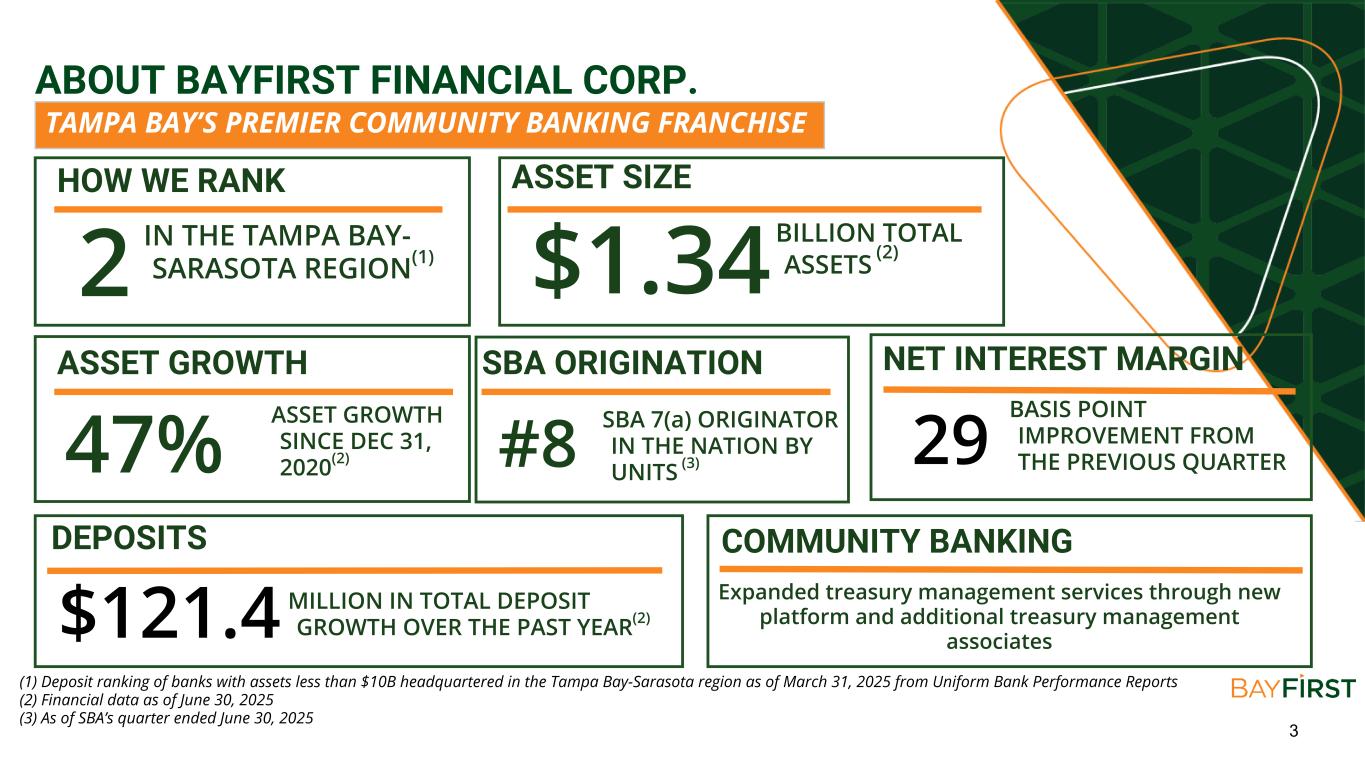
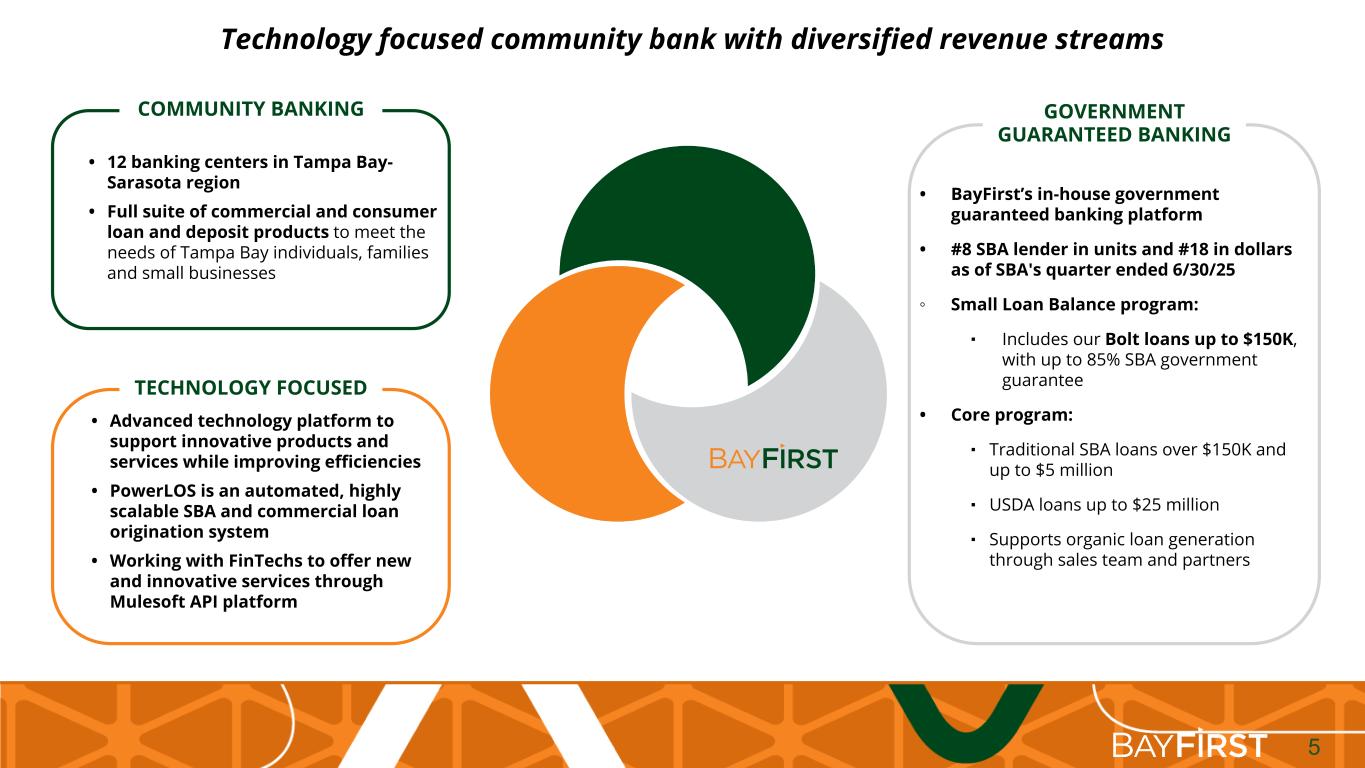
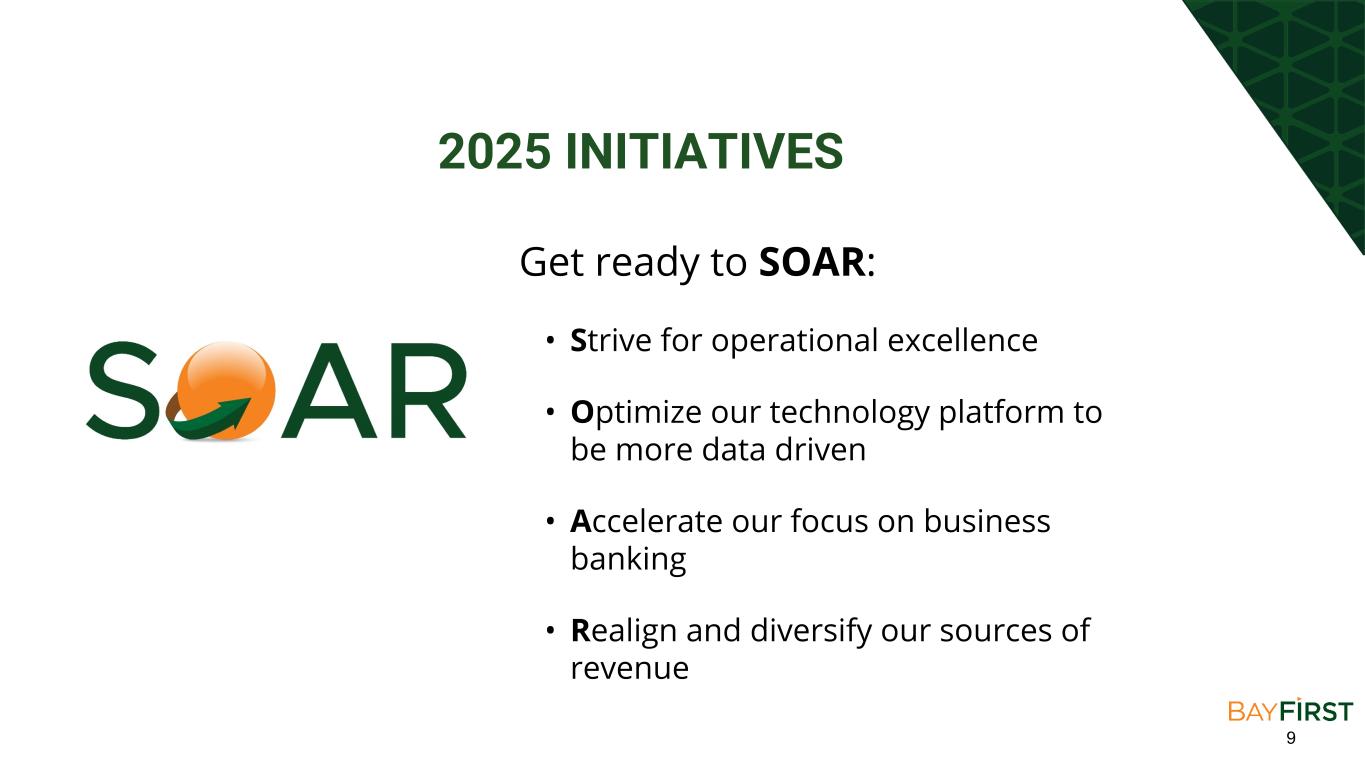
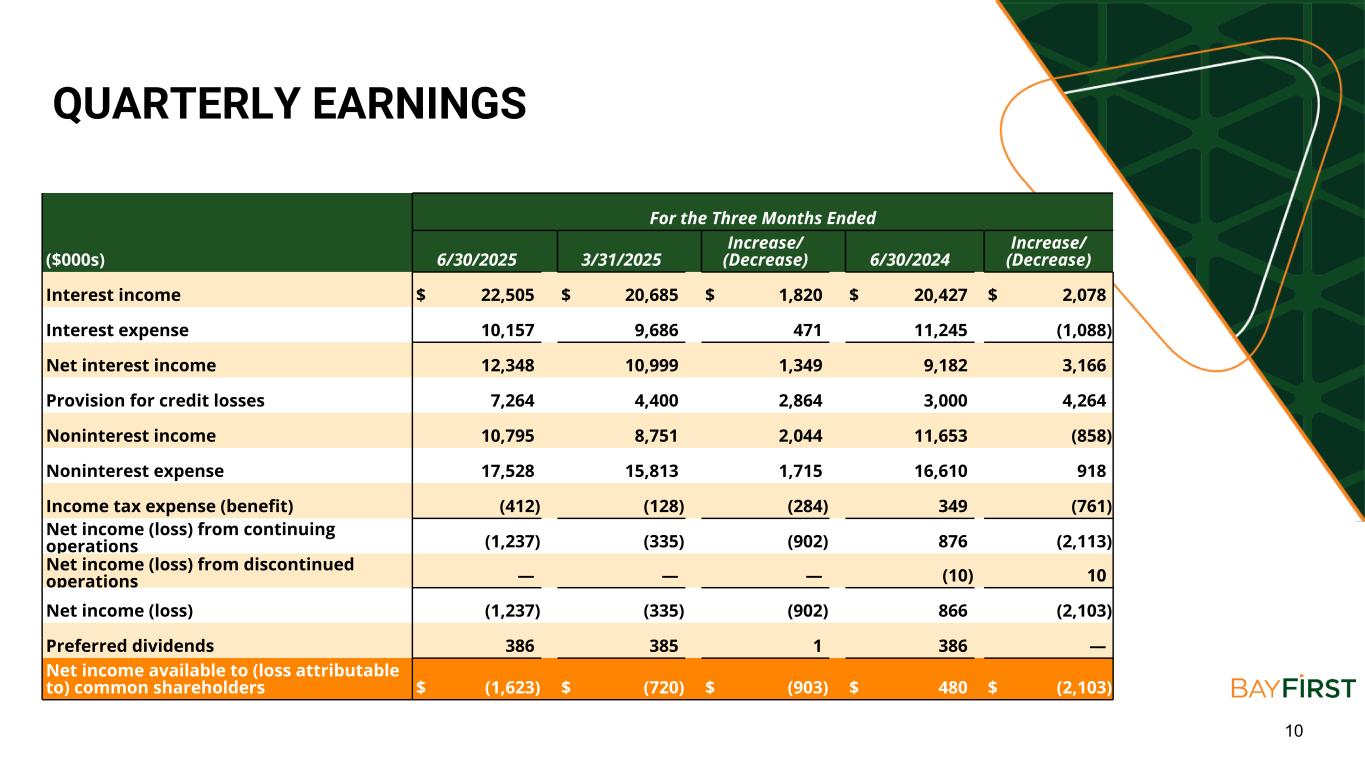
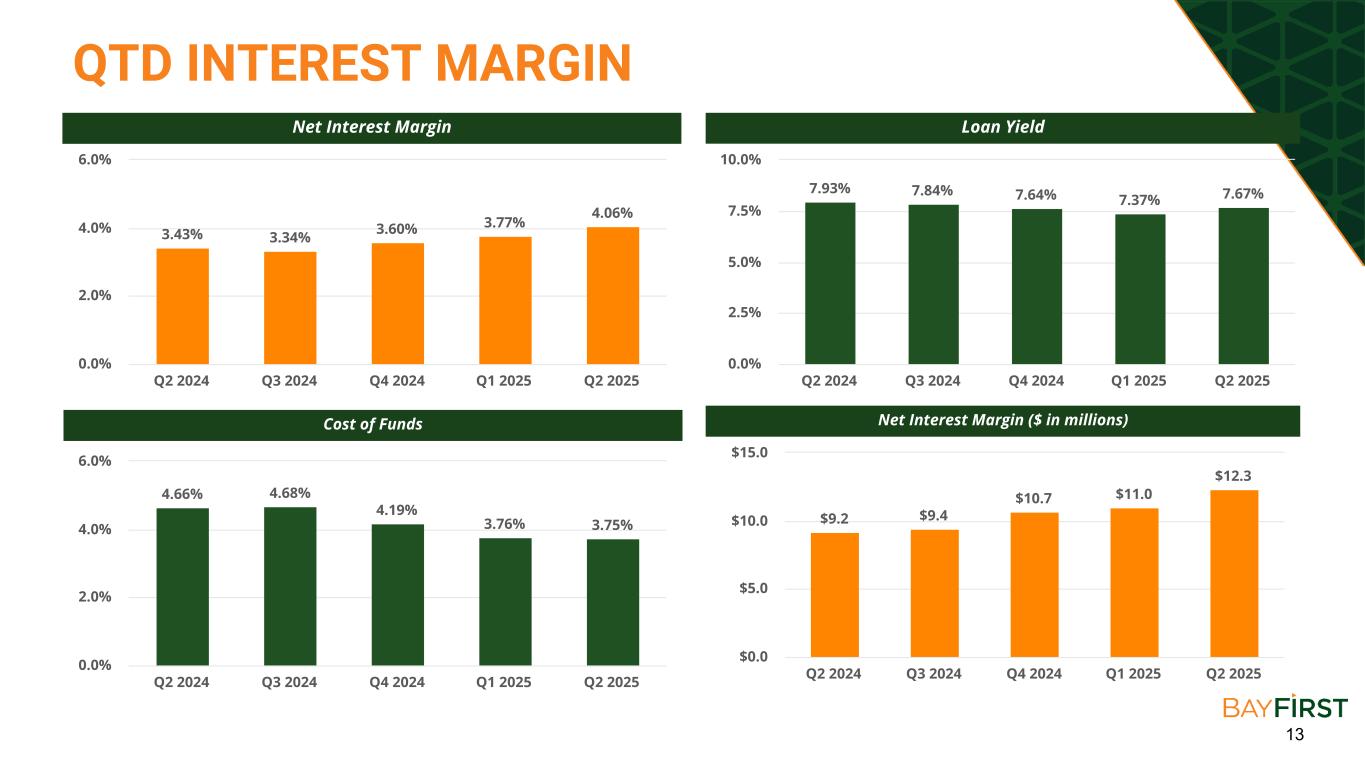
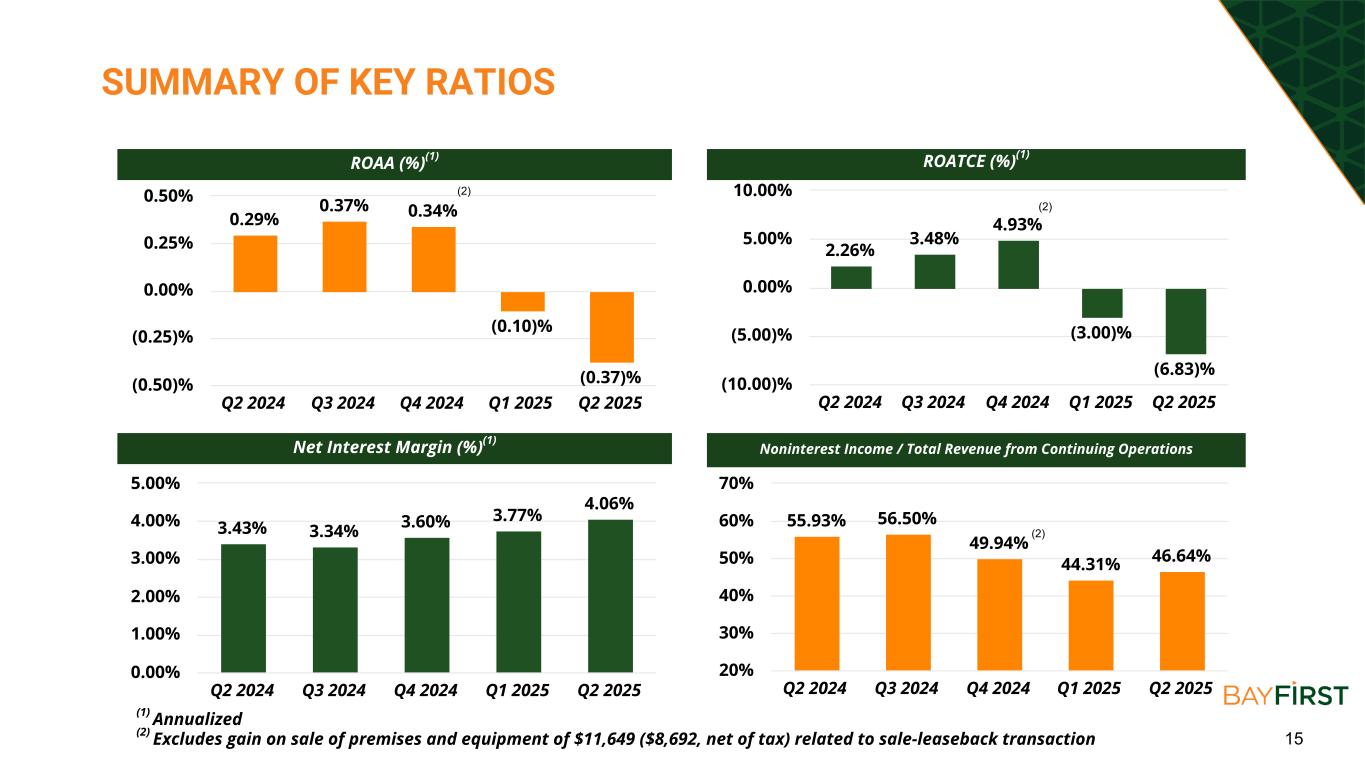
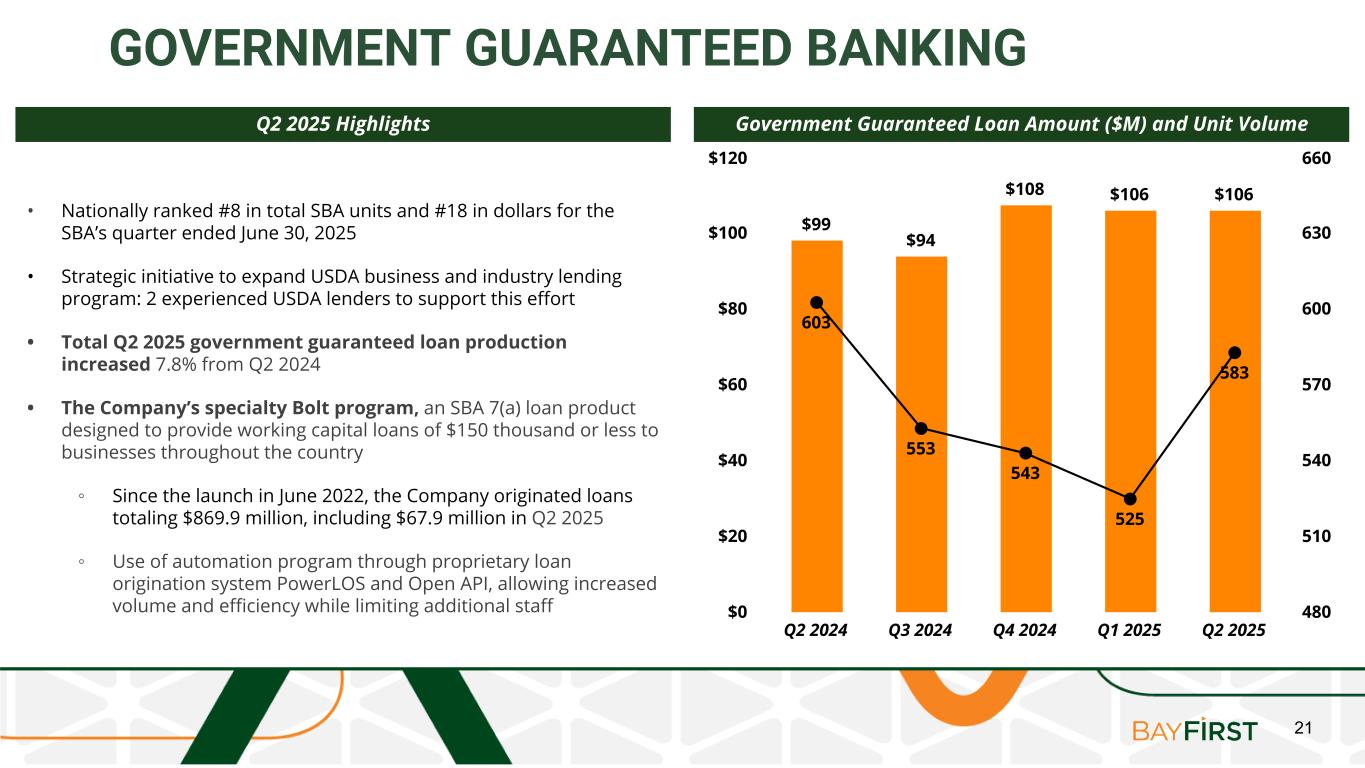
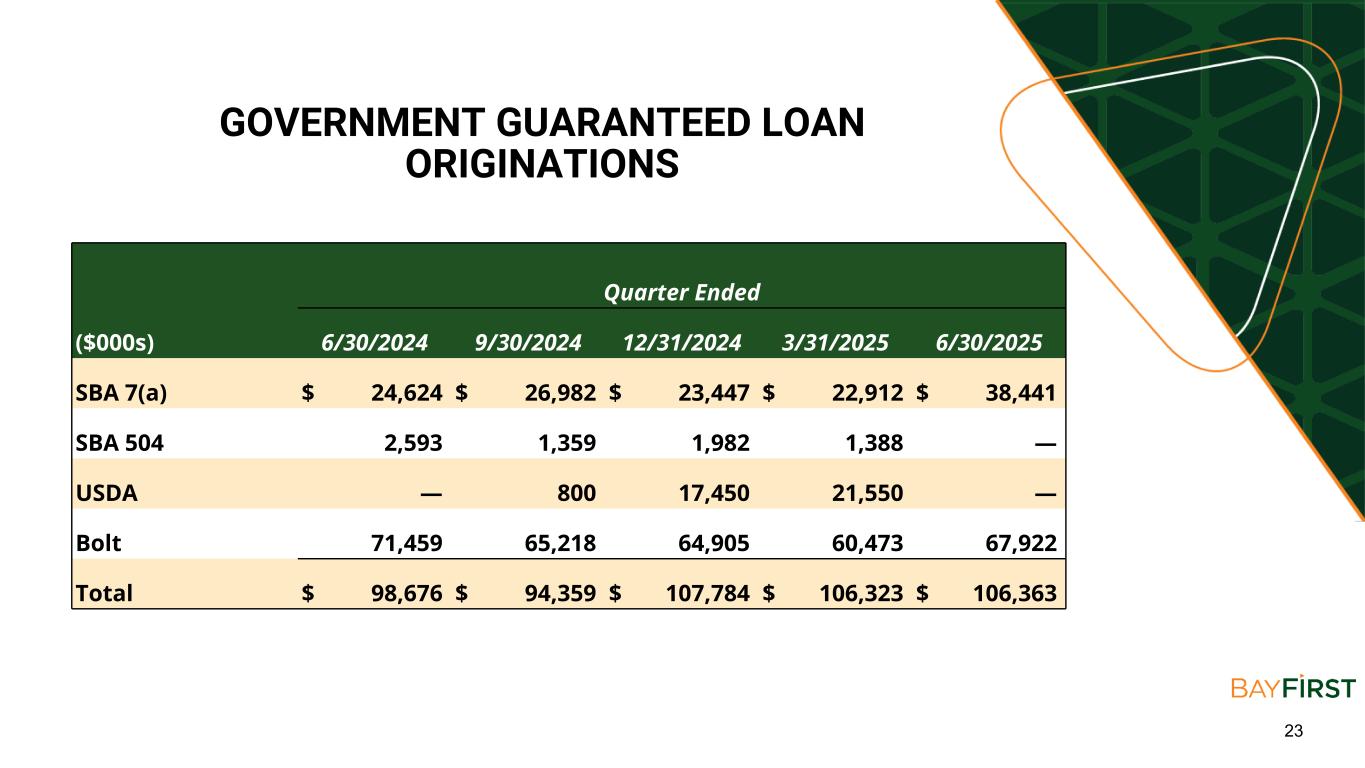
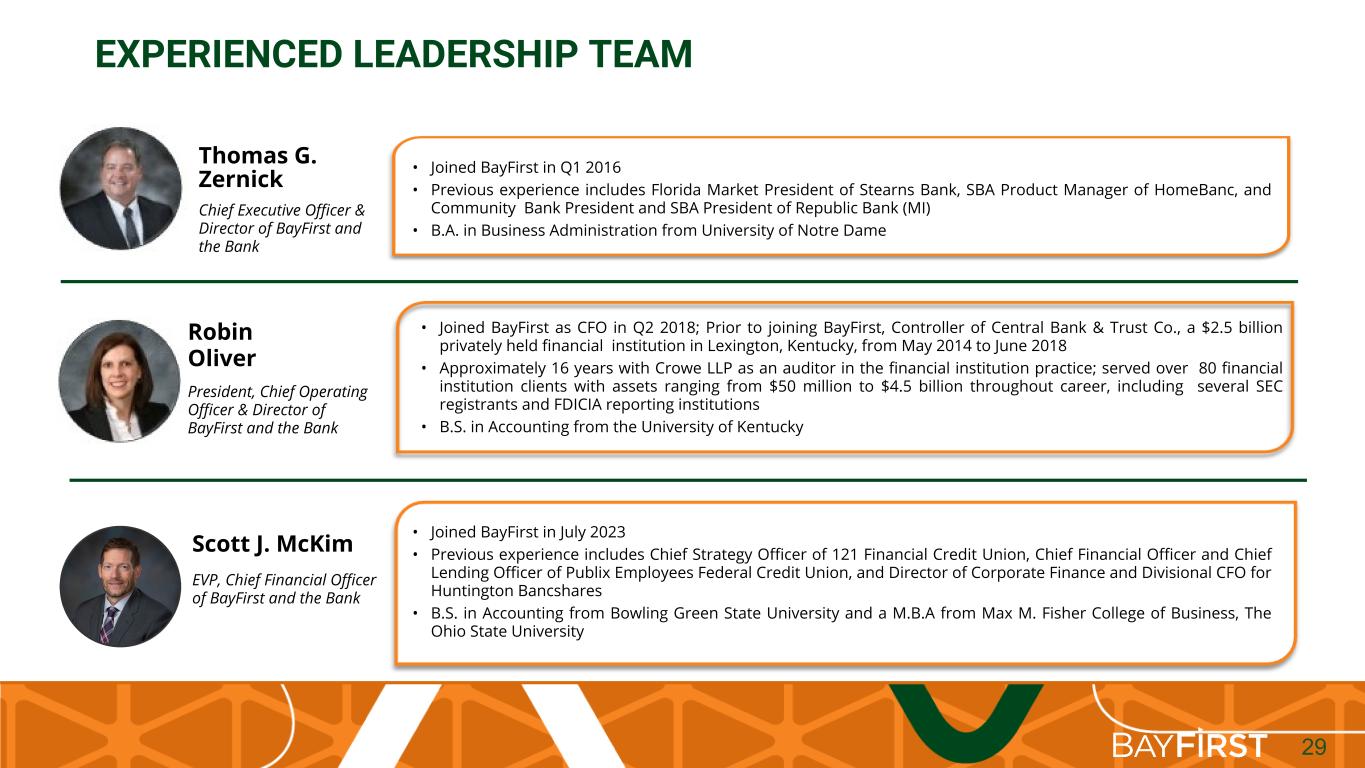
Thank you, Sylvie. Good morning, and thank you for participating on our call today. Once again, with me is Robin Oliver, our President and Chief Operating Officer, and Scott McKim, our CFO. Today's call will include forward-looking statements and non-GAAP financial measures. Please refer to our cautionary statement on forward-looking statements contained on page two of the investor presentation. We reported a net loss this quarter of $1.2 million, driven by notably higher provision expense and higher write-downs on our portfolio of loans measured at fair value. As we announced last quarter, management and the Board initiated a comprehensive strategic review aimed at de-risking unguaranteed SBA 7A balances on the balance sheet and positioning the company for long-term growth and enhanced shareholder value. Much progress is being made, and we expect to have additional information on our plans and the expected results in the coming weeks. In conjunction with our review, they first reported charge-offs and fair value write-downs on related SBA 7A loans with elevated levels of risk. The net loss this quarter of $1.2 million is driven by these additional charge-offs and fair value write-downs. This will provide for a stronger balance sheet to take advantage of community banking opportunities. Furthermore, to offset the impact of these charges, the Board has voted to suspend common and preferred stock dividend payments and Board of Director fees. Now I want to talk about some areas that are performing well in the first half of the year and activities that set the stage for continuing transitioning Bay First into a strong community bank. Our net interest margin improved again in the second quarter, an increase of 29 basis points to 4.06%. Viewing this improvement were increases in non-interest-bearing account balances, savings and money market account balances, and time deposits, partially offset by a decrease in interest-bearing transaction account balances. Our trendsetter deposit portfolio, a 50-or-better senior club, has over 2,100 accounts and represents more than $200 million of balances. Year-to-date, we added 60 more households through this program. Plus, our Cash Kids Club program has over 1,300 accounts and has grown by 11% this year. These programs are important sources of core deposits and demonstrate our commitment to building household relationships across Tampa Bay and Sarasota. I also want to point out that our ReferLive program, which allows our current customers to refer their friends and family to Bay First, has generated over $4 million of new deposits and $10.5 million of consumer loans over the past 12 months. The bank has continued to see consistent growth in community bank loans and core deposits. This growth will continue to position Bay First as the premier community bank of Tampa Bay. The company's government-guaranteed loan origination platform originated $106.4 million in new government-guaranteed loans during the second quarter of 2025, of which $67.9 million were Bolt loans, which is the company's SBA 7A loan program designed to expeditiously provide working capital of $150,000 or less. The origination volume was relatively stable from the prior quarter, up slightly from $106.3 million of loans produced in the first quarter, of which $60.4 million were Bolt loans. Now, I will pass the microphone to Scott McKim, our CFO, to provide an overview of our financial performance.
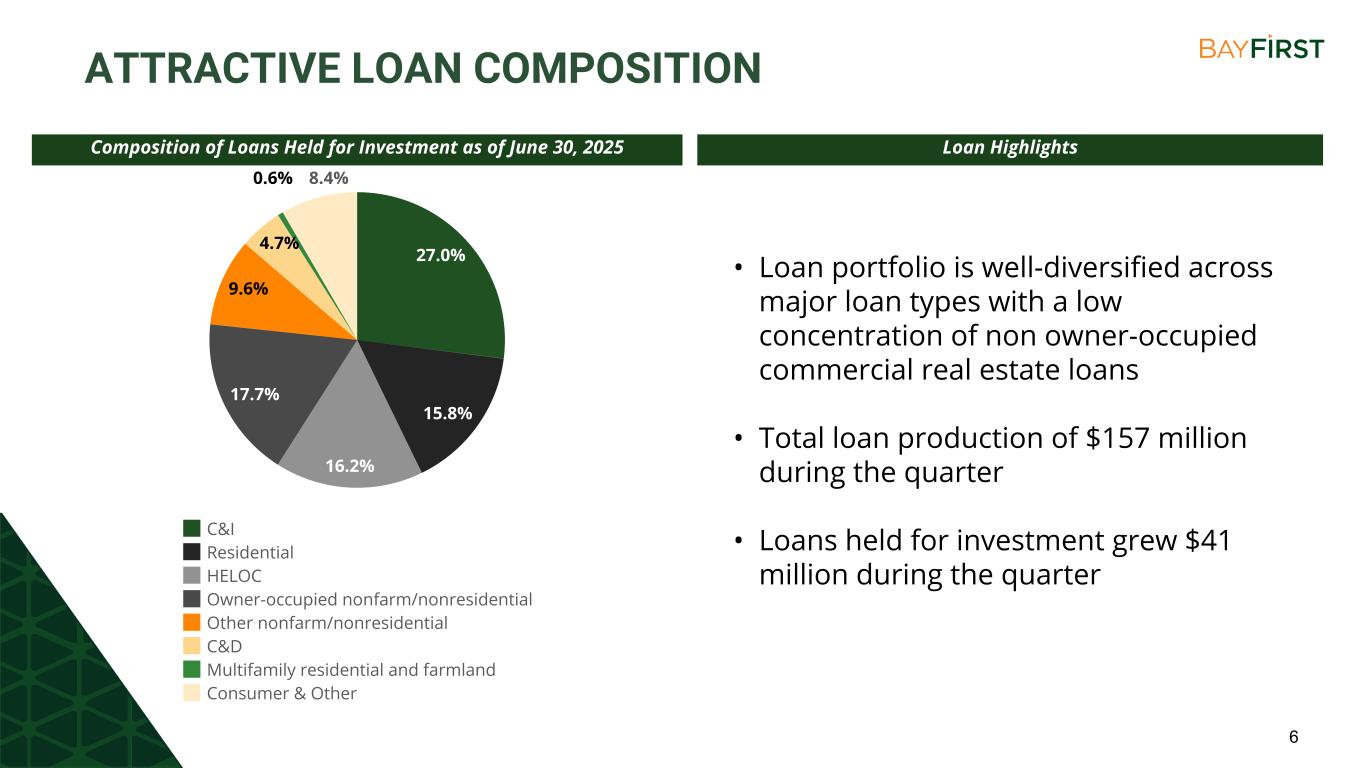
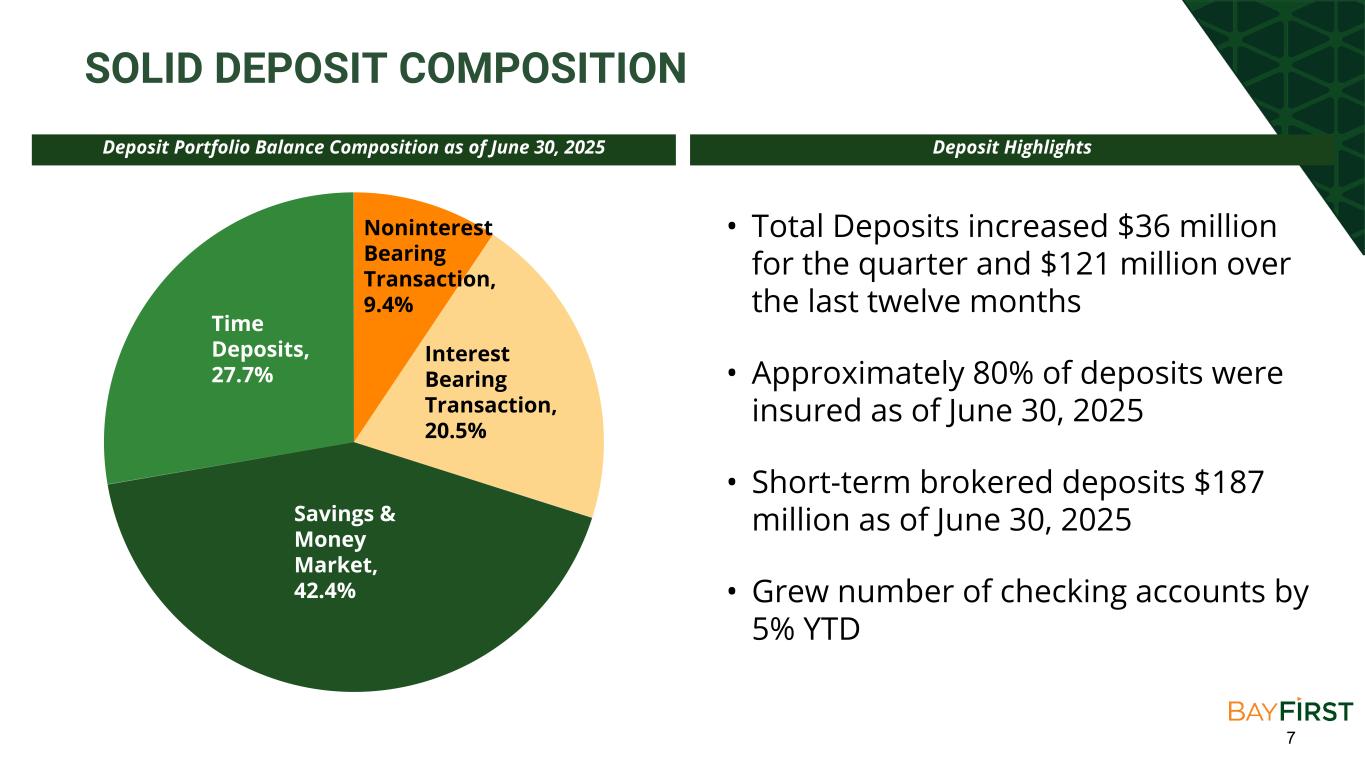
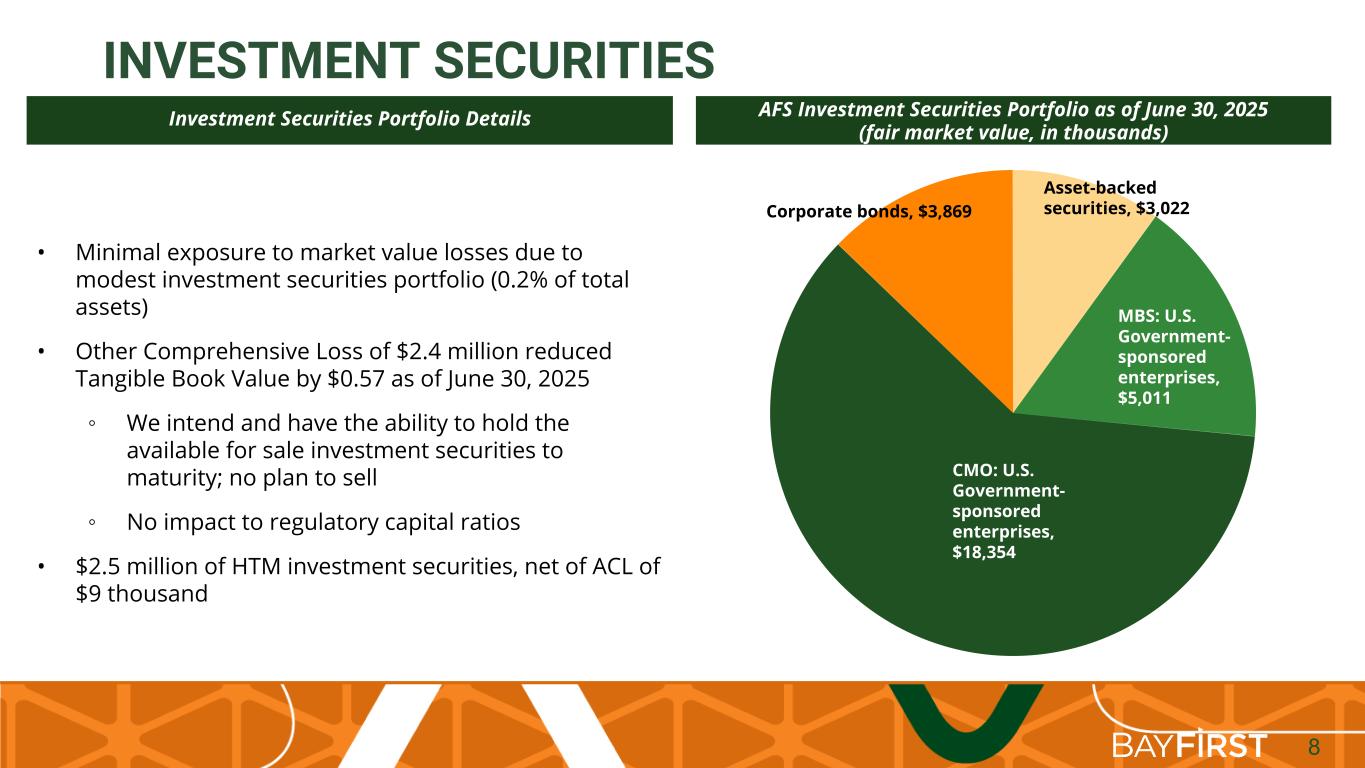
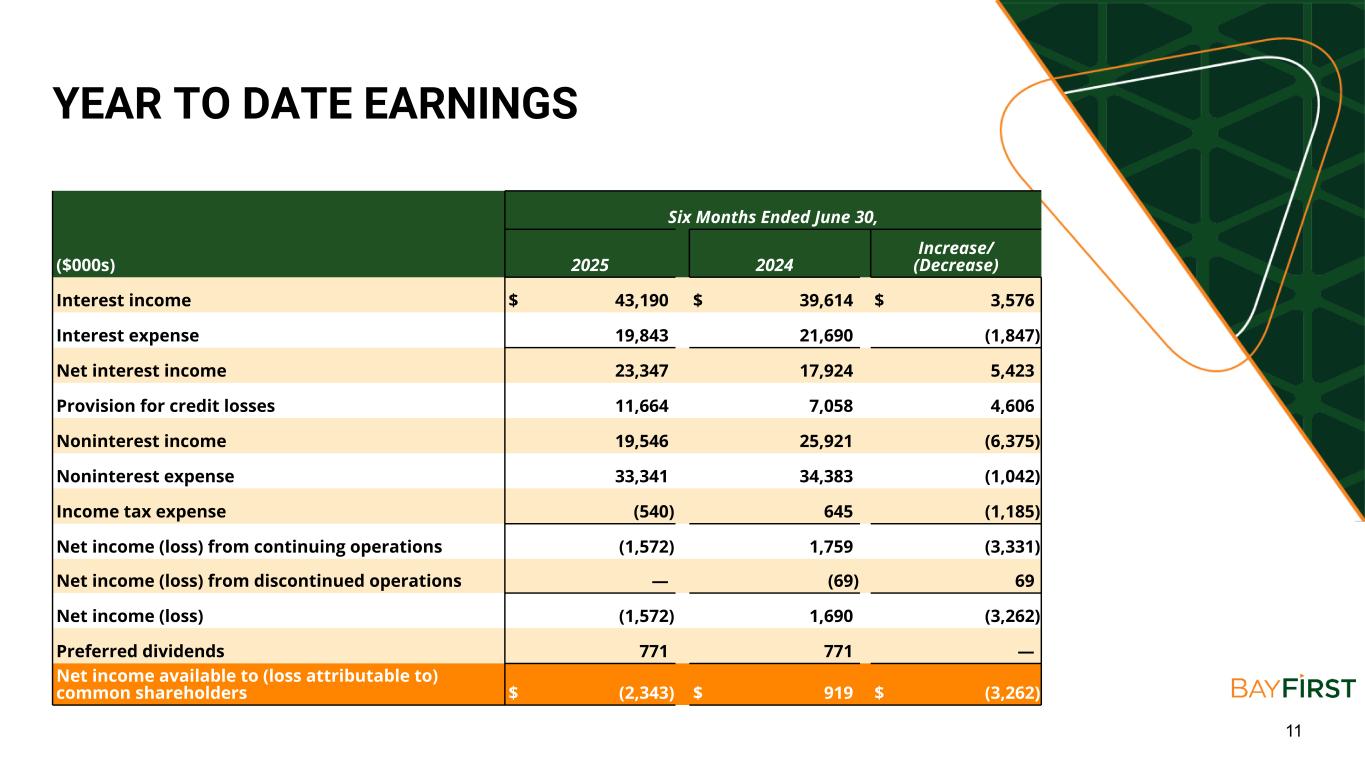
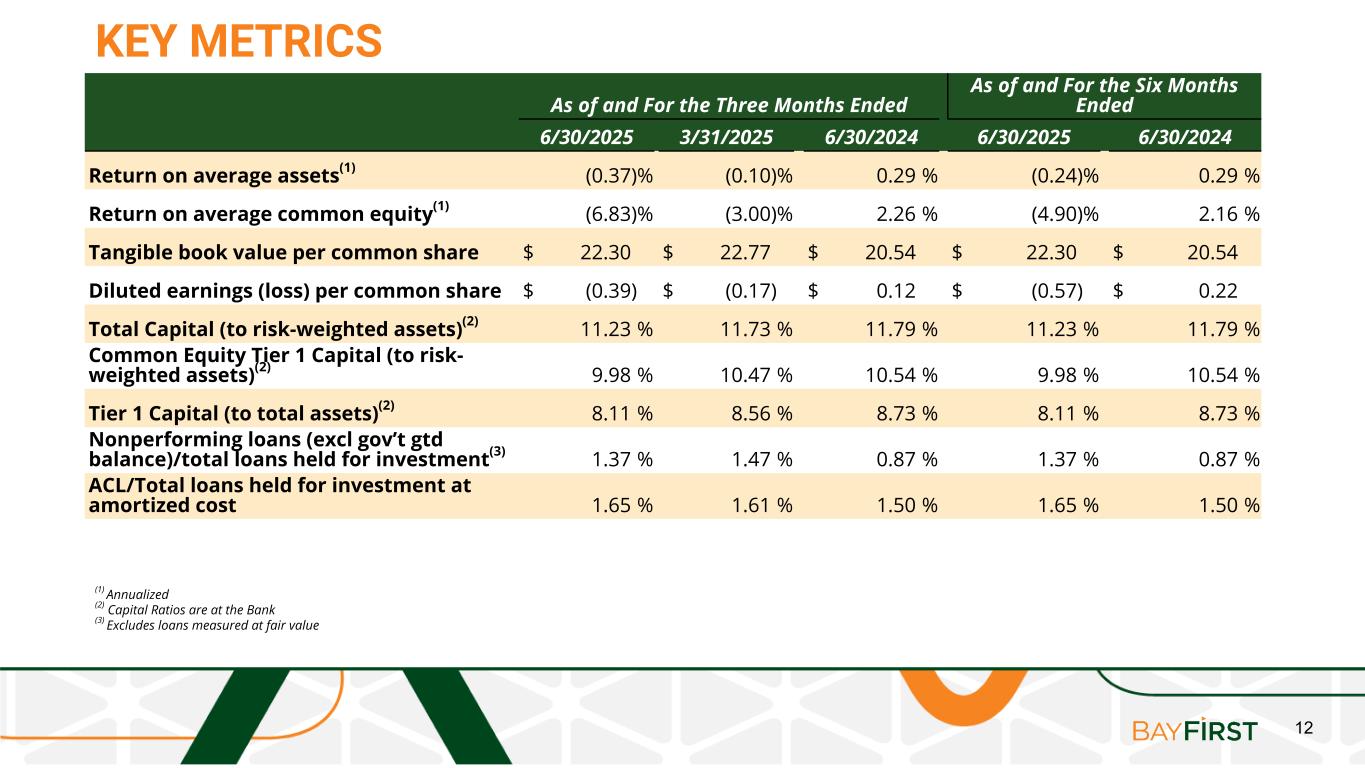
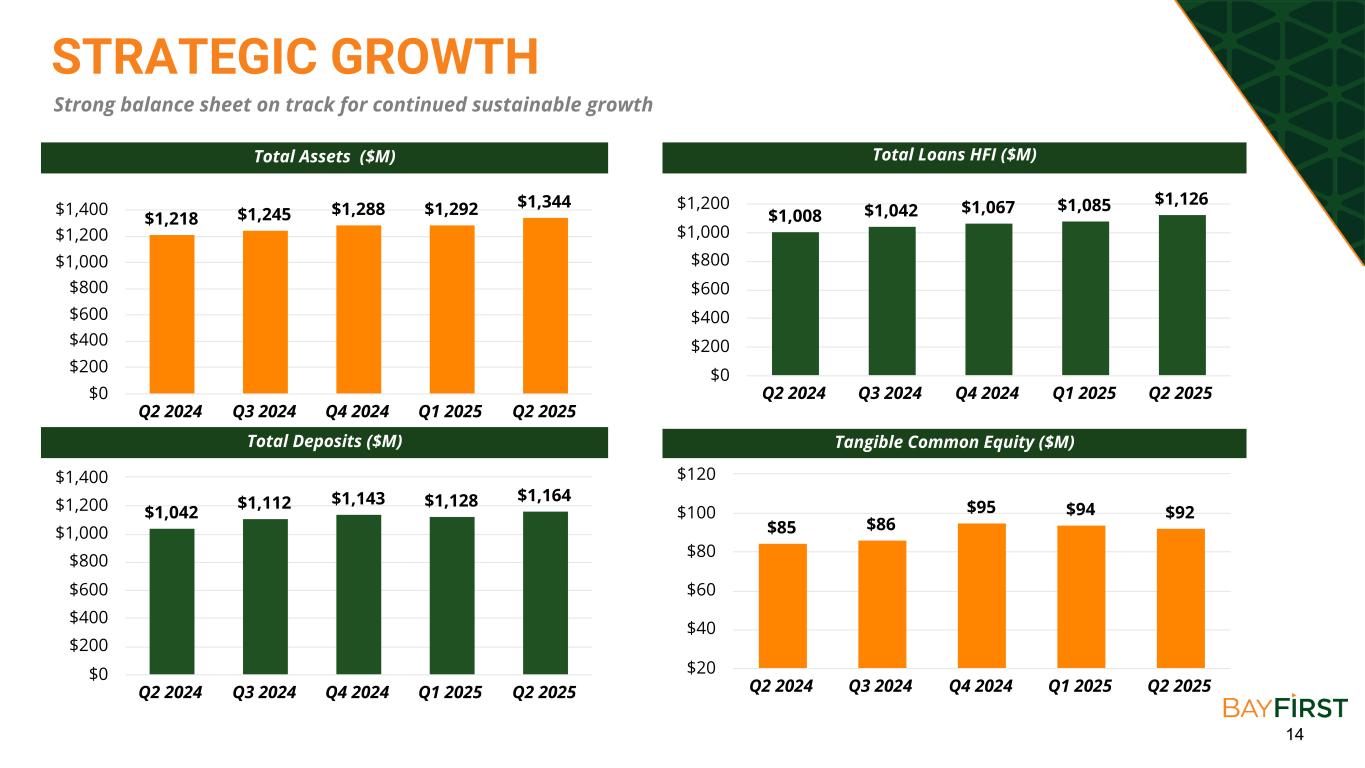
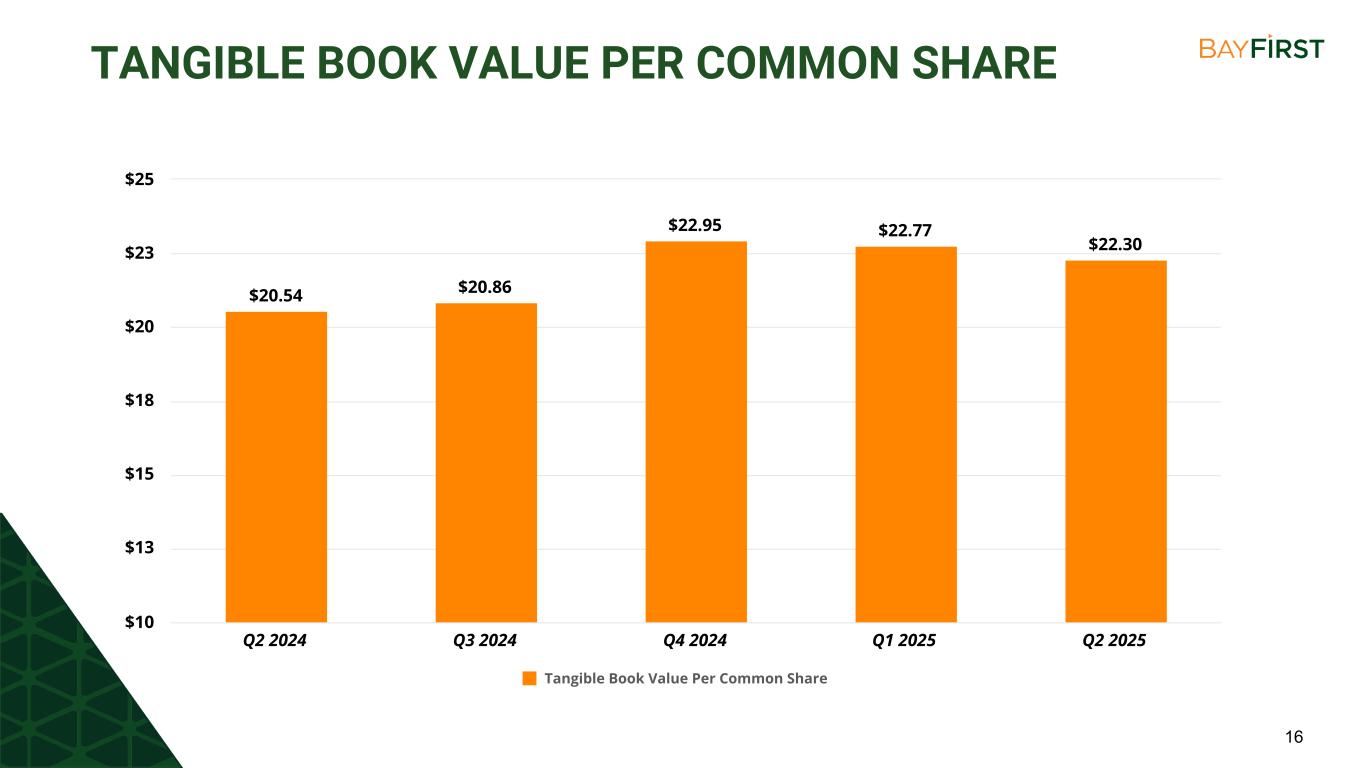
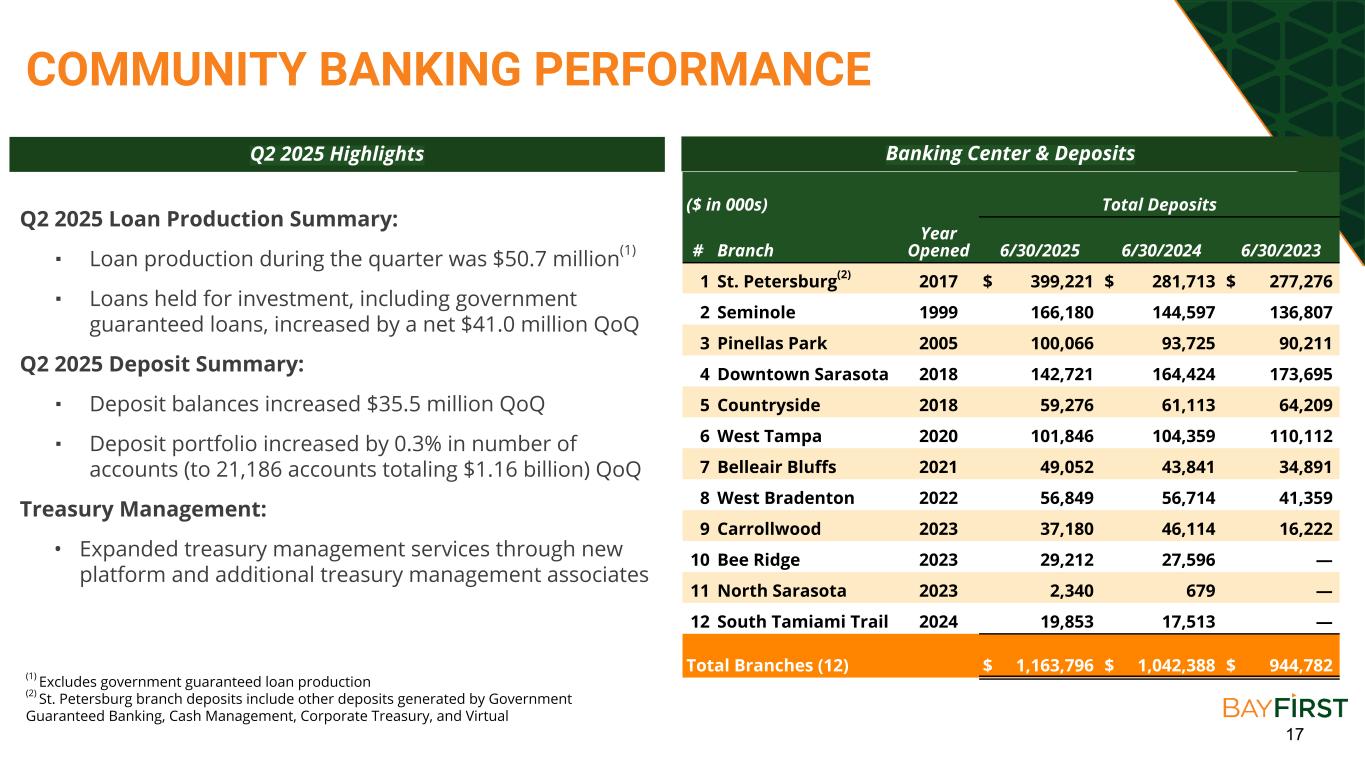
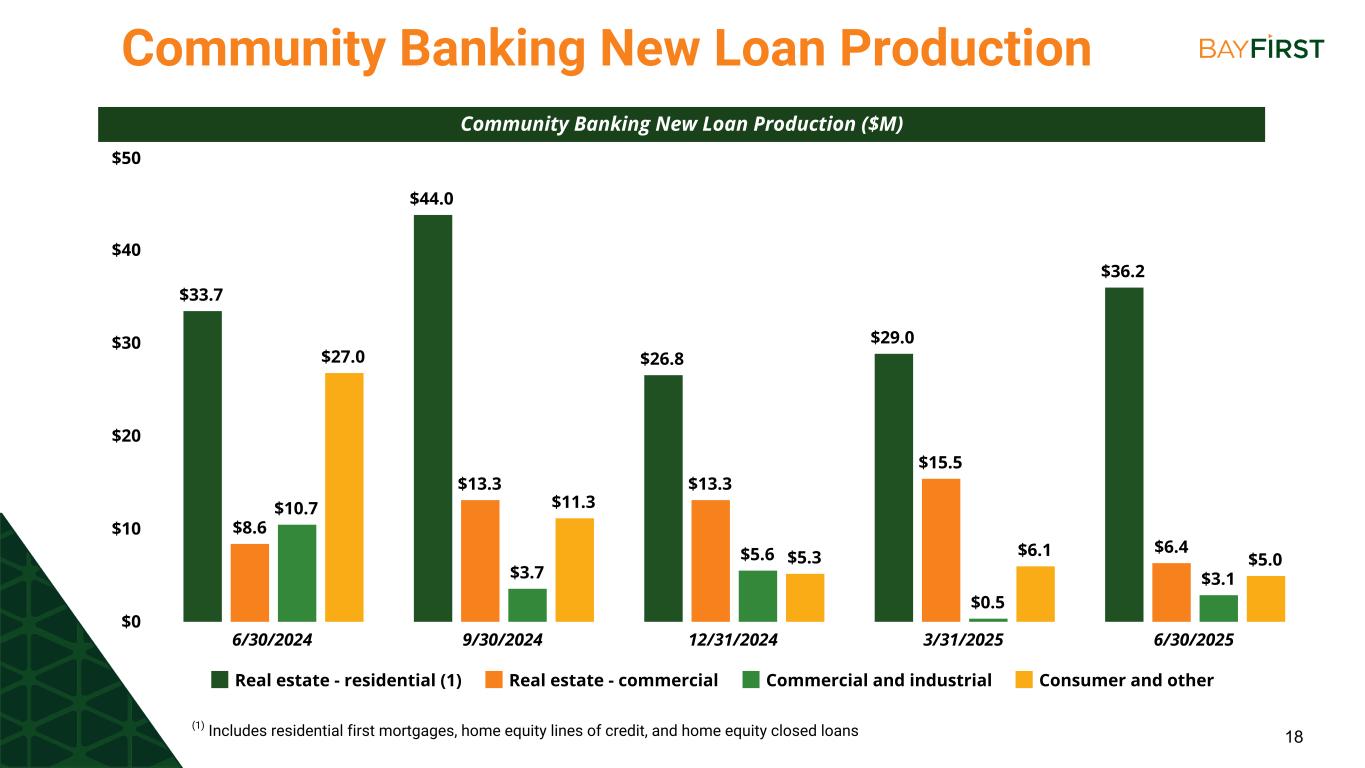
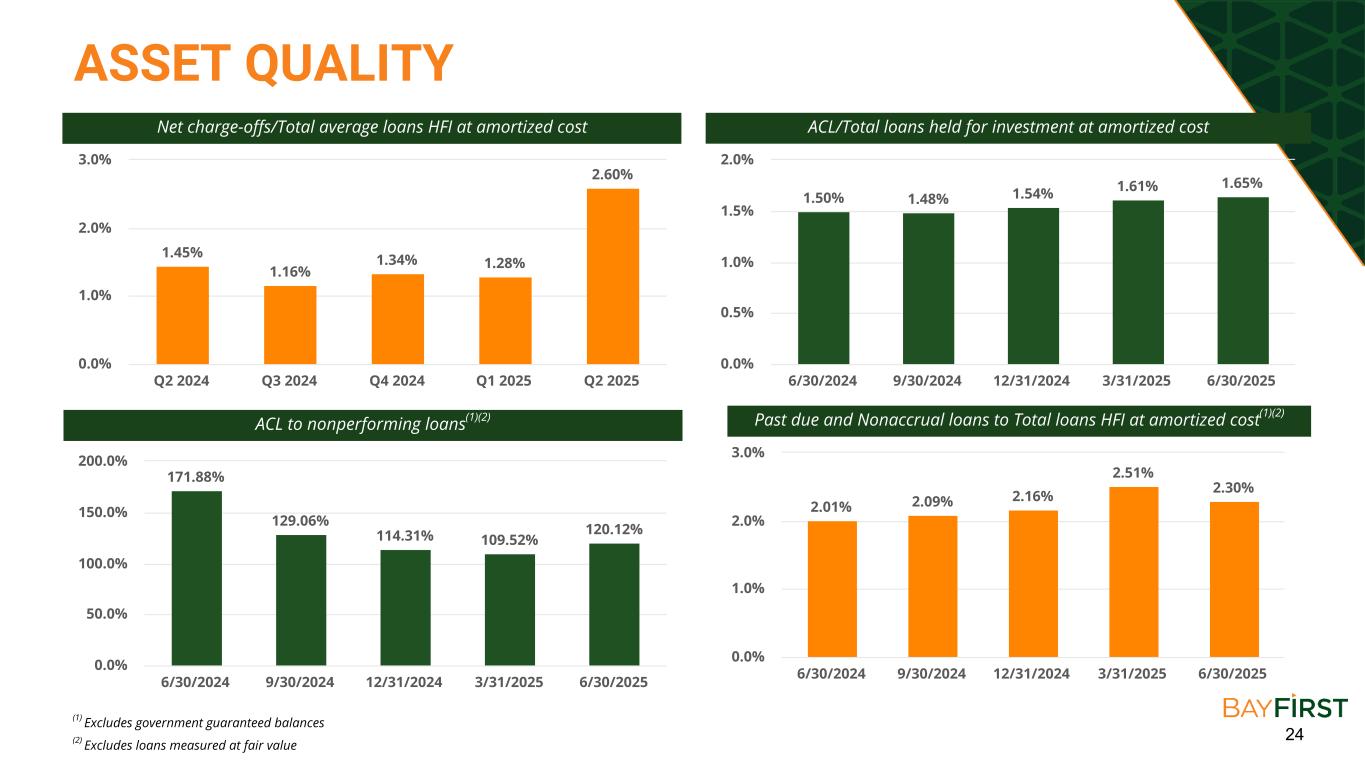
Thank you, Tom. Good morning, everyone. As Tom mentioned, we are reporting a net loss of $1.2 million from continuing operations in the second quarter. This compares to $335,000 net loss reported in the first quarter of this year. Loans held for investment increased by $41 million or 3.8% during the second quarter of 2025 to end at $1.13 billion and increased $117.5 million or 11.7% over the past year. During the quarter, the company originated $157 million of loans and sold $66.8 million of government guaranteed loan balances deposits increased 35.5 million or 3.1 percent during the second quarter of 2025 and increased 121.4 million dollars or 11.6 percent over the past year to 1.16 billion dollars the increase in deposits during the quarter was primarily due to increases in non-interest bearing account balances savings and money market account balances and time deposits partially offset by a decrease in interest-bearing transaction account balances. Shareholders' equity at the end of the quarter was $109.7 million, and it's $9.7 million higher than the end of the second quarter of 2024. Net accumulated other comprehensive loss decreased by $10,000 during the quarter, ending at $2.4 million. Our tangible book value decreased slightly this quarter to $22.30 per share, down from $22.77 per share at the end of the first quarter. As Tom mentioned, our net interest margin improved impressively by 29 basis points to 406% in the second quarter. Net interest income was $12.3 million in the second quarter, which was an increase of $1.3 million compared to the first quarter, and it was a $3.2 million increase from the year ago quarter. Our focus on checking accounts and savings accounts versus promotional rate, money market, and CDs have contributed to the margin improvement that we are reporting this year. Importantly, the bank's deposit cost has decreased from 3.78 percent in the fourth quarter of last year down to 3.33 percent in the second quarter now. This 45 basis point decrease is clearly much higher than the six basis point decrease on interest earning assets. I should point out that the fed rate change that occurred in december is fully into all of these numbers non-interest income was 11.4 million dollars in the second quarter of 2025 which is an increase from 8.8 million dollars in the first quarter of 2025 and a small decrease from 11.7 million dollars in the second quarter of 2024. gains on the sale of government guaranteed loans were also 1.2 million dollars lower in the second quarter compared to the first quarter due to slightly lower production of saleable government guaranteed loans and were available to be sold changes in the sba standard operating procedures introduced additional steps and requirements to process small dollar loans during the quarter which resulted in longer processing times especially in the last month of the quarter this meant there were fewer guaranteed loan balances available to be sold through June, and we elected to book these loans measured at fair value to match that revenue in the period where the loans were originated. The bank sold $66.8 million of government-guaranteed loan balances during the second quarter, compared to $72.5 million in the first quarter. Gains on loans booked and measured at fair value during the quarter were $3.4 million, an increase of $3 million for the first quarter, where we had only booked a single loan at fair value offsetting the gains is 1 million dollars in write downs on loans previously booked at fair values i will note that these fair value markdowns are not charged off according to gap rules however they are very similar nonetheless and this number is inclusive of what tom mentioned at the beginning of the call our non-interest expense increased by 1.7 million dollars in the second quarter most of this increase or 1.2 million dollars represents the non-deferrable loan origination expenses incurred related to loans booked at fair value during the second quarter. This is an increase of $1 million from the first quarter. An increase in commission costs of $200,000 and an increase of other expense of $100,000 represent increases as well in non-interest expense. Our commitment to manage controllable expenses is also evident with a $1.1 million decrease in year-to-date non-interest expense, including the impact of loan origination and non-deferrable origination expenses. In fact, total non-interest expense overall is $1.2 million lower in 2025 compared to the same period in the first half of 2024. Prevision for credit losses was $7.3 million in the second quarter compared to $4.4 million in the first quarter and $3 million from the second quarter of 2024. Net charge-offs, primarily unguaranteed SBA 7A balances, were $6.8 million in the quarter. That was an increase of $3.5 million compared to the first quarter, which was $3.3 million. These additional net charge-offs are the increase as well that Tom had mentioned. Annualized net charge-offs as a percentage of loans held for investment at amortized cost were 2.6% for the second quarter. That is up from 1.28% in the first quarter, as well as being up from 1.45% in the second quarter of 2024. Non-performing assets were 1.79% of total assets as of June 30, 2025. This is down compared to 2.08% as of March 31, 2025, and compared to 1.28% on June 30, 2024. Non-performing assets, excluding government-guaranteed loan balances, were 1.12% of total assets as of June 30, 2025. That was also a decrease from 1.22% as of March 31, 2025, and up slightly from 0.82% on June 30, 2024. The ratio of allowance for credit losses to total loans held for investment at amortized cost was 1.65% at June 30, 2025, which is up slightly from 1.61% as of March 31, 2025, and 1.5% on June 30, 2024. The ratio of ACL to total loans held for investment at amortized cost, excluding government-guaranteed loan balances, was 1.85% at June 30th, 2025, and that was consistent with a 1.84% at March 31st of this year and 1.73% of June of last year. At this time, I'll turn the call over to Robin for some additional comments.
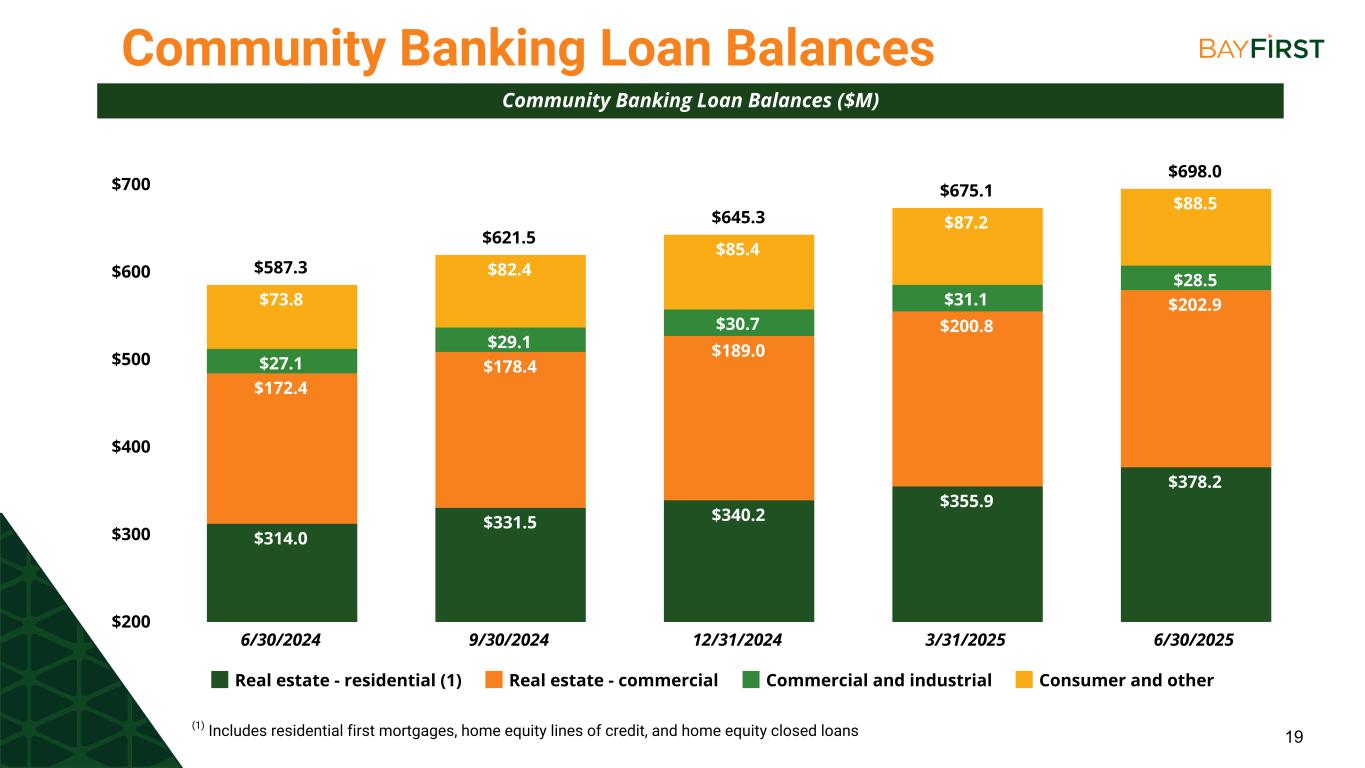
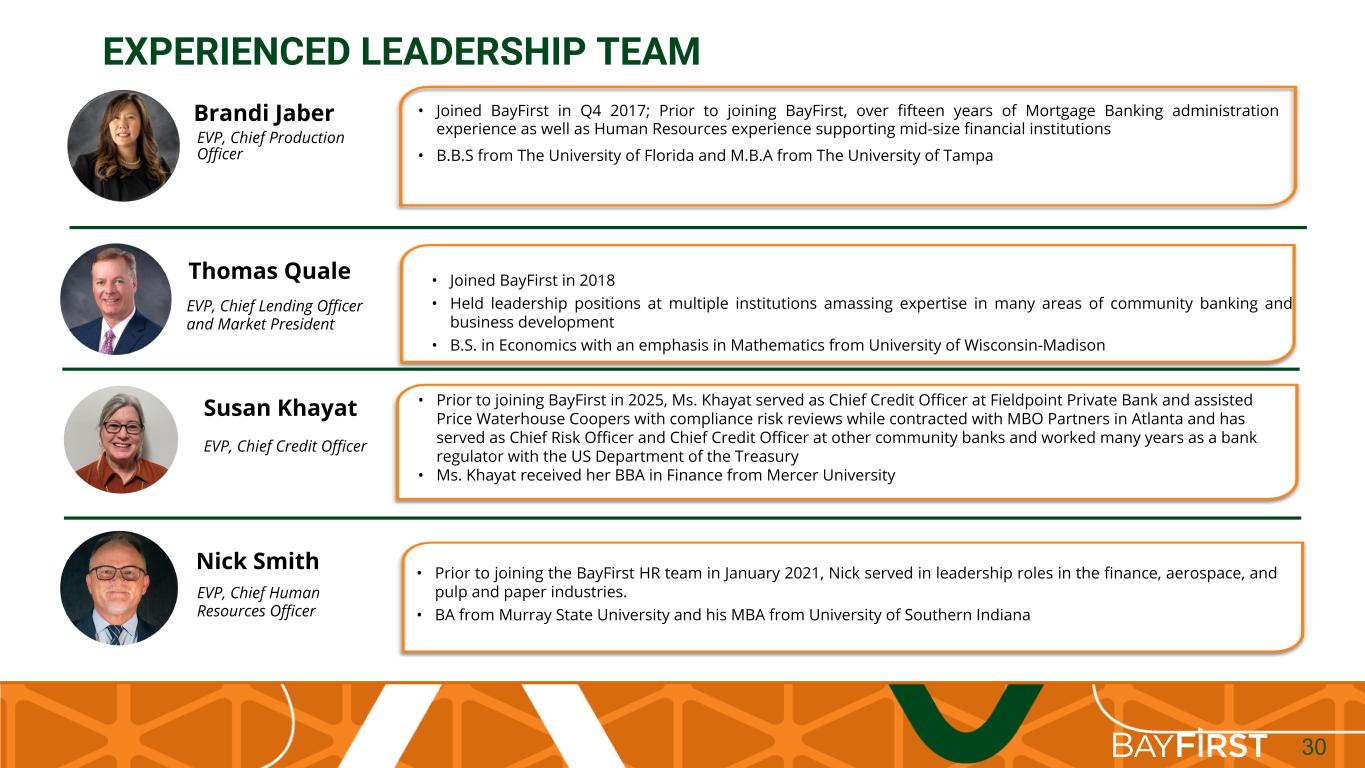
Thank you, Scott. As Tom and Scott have detailed, asset quality trends, primarily in our SBA 7A small loan program product, continue to decline in the current economic environment. Although we have strengthened credit underwriting parameters and reduced volume from the height of the Bolt Loan program, the losses in both Bolt Loans and our earlier vintages of small balance loans originated prior to 2022 continue to worsen given the recent historic rise in interest rates, high inflation, and now tariff uncertainty. Management has significantly increased collections and portfolio management staff over the past year to ensure we are proactively collecting payments or modifying loans is prudent for as many borrowers as possible our chief credit officer and director of credit administration both hired in the first quarter this year are working diligently supported by all of management to ensure strong oversight is provided to reduce losses wherever possible as part of our review of strategic alternatives evaluation of the small loan program product and related underwriting is underway with further announcements forthcoming. I also want to point out that although there have been some credit deterioration in our more traditional SBA 7A loan product that we call CORE, the historical credit quality of this portfolio has been significantly better than the small loan program with strengthened underwriting, more collateral, and deeper relationships with the bank. Outside of SBA lending, our conventional commercial loan portfolio continues to demonstrate strong asset quality metrics and provide solid yields as we have grown this portfolio at a steady pace over the past year with conventional commercial loan balances increasing by 31.9 million or 16 percent since June of last year. The conventional consumer and residential portfolios have also increased steadily over the past year, with demand for HELOCs continuing on in this economic environment. Since June of 2024, consumer and residential loan balances have increased by 78.9 million, or 20%. So even with the headwinds we described in credit quality that we are currently managing through, our future is anchored by an outstanding community bank in one of the most desirable markets in the country. As we've stated previously, we serve a broad community of small businesses, individuals, and families, and have become a notable presence in our Tampa Bay and Sarasota communities, with outstanding customer service and community partnerships demonstrating our commitment to innovative solutions with a personal touch.
At this time, I will turn it back to tom for his final thoughts our board of directors and leadership team are committed to driving resilience and innovation as we position the company for long-term success and enhanced shareholder value we are confident these efforts will better align the company at our bank with the demands of a dynamic banking landscape thank you all for joining us this morning.
We will now turn it back for questions.
Operator
Thank you. Ladies and gentlemen, if you do have any questions at this time, please press star followed by one on your touchstone phone. You will then hear a prompt that your hand has been raised. And should you wish to decline from the polling process, please press star followed by two. And if using a speakerphone, you will need to lift the handset first before pressing any keys. Please go ahead and press star one now if you do have any questions. Once again, ladies and gentlemen, if you do have any questions, please press star followed by one on your touchstone phone. And your first question will be from Ian Green at Pendragon Capital. Please go ahead, Ian.
Hi, good morning. How would a 25 basis point cut in Fed funds? It seems like the market is kind of trying to price that in. How would that flow through to your NIM? And I guess, do you benefit on the asset side? The second part to that question is, for your repricing of your assets, do you have old vintages? I know some of that's been problematic, going to higher rates.
But, you know, will in general you benefit as some of these older vintages roll off? um and this is scott i'll take that question um when i i want to be real clear that when we talk about the balance sheet and as we've said in the past it's we are asset sensitive and um that typically is kind of the overarching answer to your question but i think if we drill down just one level with it i also want to point out the fact that the older vintages of loans really are still prime base and so therefore they're going to reprice even with the newer vintages and accordingly it's uh our our liability side or really the deposit book also is variability priced almost to the same degree so we're pretty well matched if there is um i don't expect the fed to move today but if they were and there's a 25 basis point decrease i would say that we will probably have a few basis point temporary compression but really by the end of the next quarter that would work its way through so the margin itself should be relatively stable uh we wouldn't expect any other expansion from a rate decrease or really a rate increase otherwise okay gotcha and i guess if i could just follow up i mean how you i mean in general you're feeling about capital i mean do you see a scenario or probabilities of having to raise additional capital here um that's a good question and we do talk about it frequently and are engaged with the board of directors and and we we typically look at different options and the bank is well capitalized right now and uh we don't like obviously we don't like reporting losses and how it uh tends to dilute things and reduce overall capital uh but we do have some options we have not made any decisions on any imminent actions at this point in time. But as Tom mentioned, we continue to go through a lot of strategic development work here. And if we do move down that course, certainly we'll let everyone know in a press release in 8K.
All right, of course. Okay, thank you.
Operator
Next question will be from Julianne Casarino at Sycamore. Please go ahead, Julianne.
Hi, Julianne. Hey, Julianne.
Hi, so I apologize. I missed Ian's questions because I had to change my phone handset. So I hope I don't ask questions yet. But I just caught the word stable net interest margin or stable margin. So I wanted to ask also, the NIM was great. Is there anything one time in that? It sounds like no, right?
No. And, Jillian, if you kind of recall our prior announcements and kind of even the conversations that you've asked us directly, we've been working really hard to manage our deposit costs and make sure that as we grow deposits, we're doing it at rates that are consistent with what our peers are doing in the market. You know, the marketplace here is very dynamic. It's high growth. There's lots of opportunity, which in addition to the institutions that are based here, we have a lot of out-of-town institutions that come in. They offer promotional rate programs that we compete with and have competed with over the years. That's not to say that we don't do some of that, but we're trying to manage the book in a way that allows us to have lower overall deposit costs and lower all funding costs. Our team really has done a terrific job with that narrative, and certainly it's hard for most institutions to really grow deposits in a meaningful way but we've been very purposeful and we believe that where the margin is at now is a fairly stable level it certainly was our goal to to get to four percent this year and i'm pleased that in the second quarter we're able to do that uh ian's question was around if there was a faith said rate change they have a quarter point what would that mean to the margin and the short answer to that is that uh if it happens, we would expect to see a small compression, but as both sides of the balance sheet replays throughout the quarter, it would generally kind of, you know, recover back to the same level that it's at now.
Okay. So, four handles should be able to stick.
That is my belief. Like I said, we've worked really hard to get where we're at, and there's always more work to do. But again, it's a compliment to the team and for the efforts that they've done.
Yes, definitely. And likewise, the loan and deposit growth were good. Is that, there's nothing one time or seasonal or, you know, is that a good run rate or is there anything, you know, that's non-recurring nature?
No, I would say that's pretty stable. I think, you know, even if you go back and look in second quarter of last year, we did pretty darn well as far as growth in our conventional and our retail So loan deliveries, I suppose you could call that seasonal. Second quarter seems to be one of our best ones in terms of growth. Robin, anything you want to add to that?
Yeah, no, I think, you know, that's a pretty typical run rate for us at this point. So, you know, we really are seeing a lot of consumer demand still. And sometimes the product makes shifts on that as to what's in demand. And, for example, residential is really not in favor right now, but the HELOCs are. And, you know, things can turn around as the rate environment changes. But, you know, so far this is probably a pretty steady rate for us.
Right, right. You don't have a lot of HELOCs. Oh, you do, actually. I'm sorry.
Yeah. And the credit issues, I just want to – is it concentrated only in that one loan category, the SBA loans?
I would say, by and large, historically, the vast majority, 99 percent – well, maybe that's high, But over 90% of our credit losses have been, you know, SBA loans, period, whether they're larger loans or smaller loans. And by far, of those SBA losses, the vast majority is in our small loan program loans, which historically have been, you know, 70% to 80% of our volume, too, keep in mind. You know, strangely enough, the larger loans actually perform better. I think you have different types of borrowers, more sophistication in the financial statements and things of that nature with some of those larger borrowers, and we have more collateral on a lot of those as well. So those have performed better, but the, you know, the small loan program loans, no matter whether it's our bank or any others, are the riskiest loan program within, you know, the SBA, which is why we're, you know, pricing them at prime plus 475 is our bolt loan pricing. So that really is where a lot of the losses are concentrated. If you go back to pre-pandemic, we had a lot of those small loan program loans, and they probably got in priced at 6%, and now they're paying significantly higher than that, and some of their payments have doubled. But even the Bolt loans that are more recent, we're still seeing stress in that portfolio, which is why we are really closely looking at that program and how best, you know, to move forward. And I indicated some announcements will likely be coming soon on that. But that's really where the stress is. Not to say that there's not a consumer, you know, as the consumer volume grows, you know, you're always going to have some consumer charge-offs here and there. But it hasn't been overwhelming. And also, I just want to remind you, too, that on our HELOCs, yes, we have a decent amount of them. We also have an insured product for many of our HELOCs, which is an interesting program where anything over 80% loan-to-value, we won't do that unless it can fit in this insured product. and if it's with a separate insurance carrier and on a loan-by-loan basis, they will, you know, secure all of the balance of our HELOC. So we have had claims that we've had to make there and have had those paid, yeah.
And have had them paid. Just real quick, in the HELOC book, do you also own the first positions as well or not typically?
Not typically, although more than you might think of our HELOCs are first mortgages. Right. Believe it or not, I mean, there's probably, I don't know what the number is today. I looked at it at March 31, and around 20% of the HELOCs are second liens in general, or the HELOCs, yeah, were first liens, not second liens. The loan-to-value ratio was generally low, and the credit profile was better, you know, than we expected when we really did a deep-dive analysis. But there are some cases where we'll do a piggyback loan with a first and second at the same time. So we do have some of those, but it's not as typical.
Yeah, so even if they're in first position, they still, in the call report, have to go under revolver revolving one to four even if it's first position and that's because of the they're not fixed rate or something or yes that is correct all right and so um yeah just back to the bolt loans then so so it's it so you're not so but it seems like from the depth that you're growing the bolt loans despite the credit issues is that right um i think the bolt loan volume has has been choppy right i would say it's pretty steady um you know over this this past
uh or over year to date at least right i mean they're at the height of our bolt loan program i would say we were up to 38 almost 40 million a month in volume and then we instituted some additional credit underwriting parameters and and really uh you know pulled back on that volume and then it's kind of normal ebbs and flows from there with just seasonality and what's going on in the marketplace. You know, the hard part is we've instituted additional credit underwriting in April of this year, but you really don't see the results of that until a year and a half, two years out, right? So you can't, it's a relatively new product for us that started in June of 2022. So we're just now, you know, having some of those loans season. And I think some of the earlier vintages definitely showed more stress than likely what we're doing today. But, you know, we're definitely not trying to increase volume in bulk. And we're looking at the whole program in its entirety as we speak.
Okay, so it's not growing. So just a quick question to characterize the SBA credit issues. It's been largely the smaller-sized loans, No geographic concentration for credit issues. Is that accurate? It's been anywhere.
That is correct. It's really broad. There's been some NAICS codes that don't perform as well, and we look at those every quarter. And when we see additional stress in those NAICS codes, for example, transportation is one that we cut off over a year ago. You know, so when we see those industries that are more stressed and causing more losses, we'll take action to, you know, stop doing those particular NAICS codes. But in general, our losses kind of mirror, you know, if you looked at the SBA as a whole, where their losses fall from a NAICS code standpoint and no geographic concentration.
Okay. And the smaller size and then also low rate, meaning ones that were originated, I'm sorry, it's some more, ones that were originated like in 2020-21?
Well, it's both. It really, yes, the older ones, vintages that started at lower rates definitely have had stress and are struggling to keep up with the payments. But even the Bolt loans, many of them made in a higher rate environment are also showing I think it just speaks to the nature of, you know, what's going on with small businesses here in this economic environment. And I think the reality is we just have a higher concentration of small loan program loans compared to our peers that do SBA lending. And so that's why we're evaluating. We've been on a trajectory to try to do more larger loans and increase our loan size to improve credit quality.
Okay. All right. Great. Well, thank you. Thank you so much.
Operator
Thank you. Again, a reminder to please press star 1 should you have any questions. Next, we will hear from Ross Haberman at HLS Investments. Please go ahead, Ross.
Thanks for taking my call. I just have two quick follow-ups from Julianne's questions. How big are those BOLT loans in total on your balance sheet today, and could you segregate them between, as you describe them, the larger loan size and the smaller ones, which where you're having more of the credit issues, it sounds like.
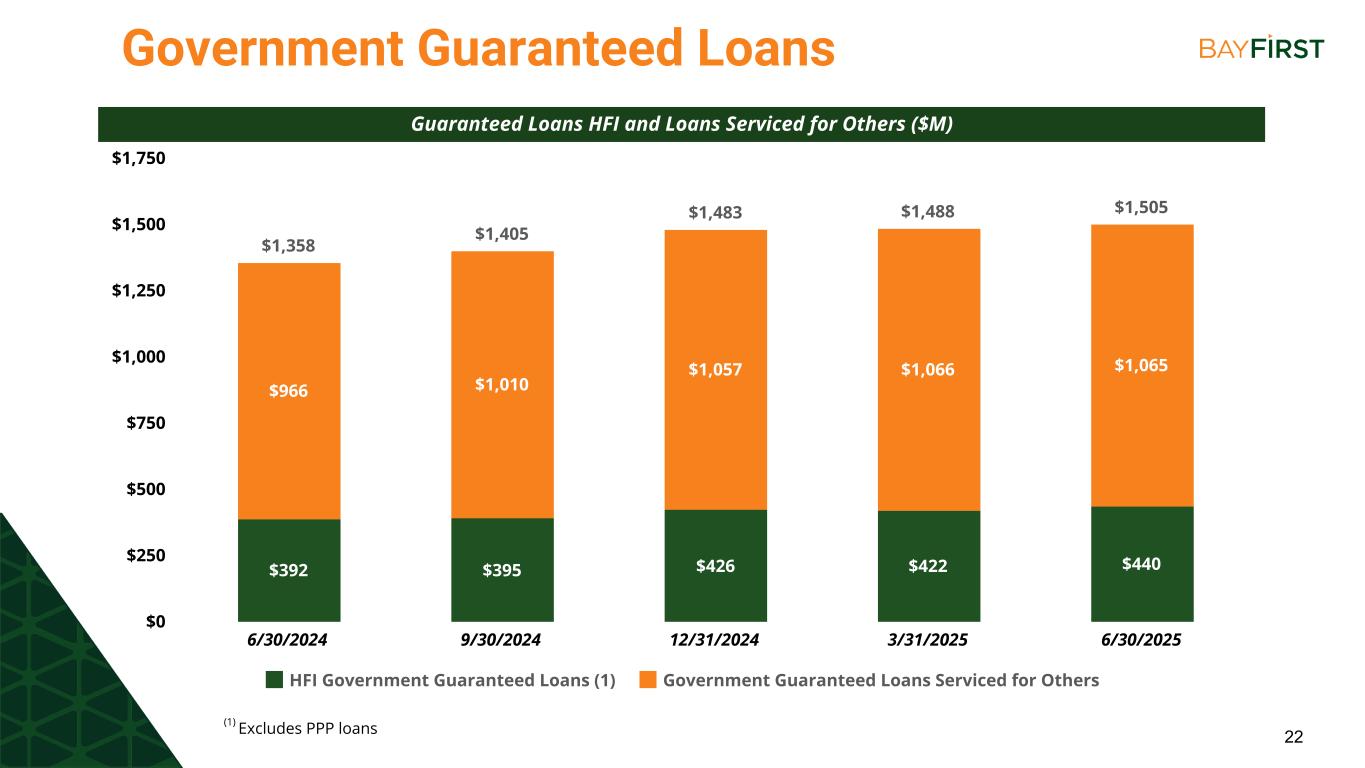
Yeah, Ross, these are going to be some round numbers for you. But the total SBA portfolio is around $350 million or was as of June 30th. and the bolt loan component of that was about 160 million and that includes both guaranteed and unguaranteed and the stress component that that robin sort of elaborated on on the small dollar loans that is unguaranteed was about 123 million at the end of june and um you know that that also includes our historical flash cap loans as well which which you know we would also put in that bucket as far as demonstrating some of these characteristics.
And is that where you took most of your reserves this quarter in that 123 of unguaranteed portion?
Yeah, that is the largest component of our ACL.
And just one last question. You said something in your verbiage. you said you're going to evaluate strategic alternatives. Did you hire an invested banker or something? And could you tell us a little more, if anything, about that?
We can't really speak to that, Ross, as you probably know. But obviously, we are looking at every possibility to make sure we have a successful path forward. And, you know, we haven't made any announcement yet because we're still evaluating. in a lot of ways, and so we want to make sure we give that thoughtful consideration and model out all kinds of different scenarios to make the best decision to get us back on track in our earnings and going up and to the right.
Can I just one follow-up? Can you say which invested bank you've hired to help you?
That's fine. That would imply we hired one, so, you know.
Ross, I think it's safe for us to say, you know, it's obviously we're seeking, you know, counsel and working very closely with the board of directors at the same time. So, you know, it's, that work continues. And as Tom mentioned, we'll have more to come here in the coming weeks.
Okay. I greatly appreciate your time. Thank you for the help and the best of luck. Thank you again. Thank you, Ross. Appreciate it.
Operator
Next is a follow-up from Ian Green at Pentragon Capital. Please go ahead, Ian.
Oh, hi. Thanks. Yes, I also appreciate your time. I just wanted to clarify, you're still making those small SBA loans, and are you still making, what's the pipeline for the SBA products and and sort of selling off the piece for gain of sale? Is that pipeline still active and working?
So on our SBA loans, we are moving towards a focus on the core loans, our larger, more traditional SBA 7A loans that folks think of, not the small loan program. And there is a steady market flow of good premiums on those loans. You know, obviously, through June 30th, we have continued to do small loan program loans, and those do enjoy a very healthy premium. You know, we have seen really outstanding premiums over the past year on those bolt loans when we sell into the secondary market. But, you know, we've got to continue to evaluate the credit losses and the profitability of the program to, you know, make sure we're looking at that product and the health of it as we move forward.
So on a linked, you know, quarter basis or so, it seemed like it went, you know, you lowered the amount of gain. The gain on sale was down fairly significantly from the first quarter to the second. do you anticipate that the gain on sales will continue to decline for a period or do you think there's some stability in that?
Yeah, Ross, I would ask you to also include the fair value gain in that number. And when you combine those two, it's not down a dramatic amount. The difference is that because of the added time periods for processing loan applications that we noted in the second quarter we weren't able to sell them so we went ahead and um booked the loans measured at fair value and that way we were able to recognize the uh the gains that will pick up when we sell them in the future um as far as going forward i think the premium percentages that we have earned will continue the overall total gain impact um will will be dependent upon what the loan volume is okay great all right um so and just another but both your preferred stock issues are private placements or do do anything i'm sorry repeat that uh the preferred stocks are
they both private placements or is there a market in your no no they do not trade there's not a market on any of the three of them. Great. OK, well, thank you again for your time.
Operator
Next is a follow up from Julian Casarino at Sycamore. Please go ahead, Julian.
Hi, real quick. The tangible book per share, 2230, does that include the preferred or no? Is that tangible common book per share or just tangible book per share?
So it includes that preferred amount. The, I don't know, the loan sale gains, are you selling, or just the loan sales, are you selling the loans with recourse? No. No recourse. And then have the margin, the loan sale gains on these SBA loans, has that margin been, what is the margin and has it been changing, you know, any trend in any direction?
Let me characterize it this way, Julianne. it's when the loans are offered in the market. Investors will buy it and they will purchase the loans at a premium. So I guess, you know, I'll use that term premium. I would say that that what we have seen with the premium that we are earning on it, they've been relatively stable. The SBA has reinstituted some guarantee fees across the board and, you know, those have depressed the overall gross premiums that we've earned by about by about 100 basis points but we still get on um on the small dollar loans as we saw them in the marketplace it's still somewhere in the neighborhood of you know 13 or so and then the core loans are a little bit less they tend to be about 10 percent has that been changing any any direction and changing at all no that's been that's been fairly stable okay okay all right thank you certainly thank you and at this time we have no other questions registered which will conclude your
Operator
conference call for today we thank you for attending and at this time ask that you please disconnect your lines enjoy the rest of your day