Operator
Ladies and gentlemen, thank you for standing by. My name is Colby, and I'll be your conference operator today. At this time, I'd like to welcome you to the Bloom Energy 3rd Quarter 2025 Earning Results. All lines have been placed on mute to prevent any background noise, and after the speaker's remarks, there will be a question and answer session. If you'd like to ask a question at that time, please press star, then the number 1 on your telephone keypad. If you would like to withdraw your question at any time, please press star 1 again. Thank you. I'd like to turn the call over to your host today, to Michael Tierney, Vice President, Investor Relations. Sir, you may begin.
Thank you and good afternoon, everybody. Thank you for joining us for Bloom Energy's third quarter 2025 earnings call. To supplement this conference call, we furnished our third quarter 2025 earnings press release with the SEC on Form 8K and have posted it along with supplemental financial information that we will reference throughout this call to our investor relations website. During this conference call, both in our prepared remarks and in answers to your questions, we may make forward-looking statements that represent our expectations regarding future events and our future financial performance. These include statements about the company's business results, products, new markets, strategy, financial position, liquidity, and full-year outlook for 2025 or 2026. These statements are predictions based upon our expectations, estimates, and assumptions. However, as these statements deal with future events, they are subject to numerous known and unknown risks and uncertainties, as discussed in detail in our documents filed with the SEC, including our most recently filed forms 10-K and 10-Q. We assume no obligation to revise any forward-looking statement made on today's call. During this call and in our third quarter 2025 earnings press release, we refer to GAAP and non-GAAP financial measures. The non-GAAP financial measures are not prepared in accordance with U.S. generally accepted accounting principles and are in addition to and not a substitute for or superior to measures of financial performance prepared in accordance with GAAP. A reconciliation between the GAAP and non-GAAP financial measures is included in our third quarter 2025 earnings press release available on our Investor Relations website. Joining me on the call today are K.R. Sridhar, Founder, Chairman, and Chief Executive Officer, and Maciek Korzynski, our Acting Principal Financial Officer. K.R. will begin with an overview of our progress, and then Maciek will review financial highlights for the quarter. After our prepared remarks, we will have time to take your questions. I will now turn the call over to K.R.
Good afternoon, and thank you for joining us today. I'm delighted that Bloom had its fourth consecutive quarter of record revenue. This seminal year for Bloom positions us for an even stronger 2026 and beyond, with higher growth and more profitability. Three major tailwinds benefiting Bloom today have created a once-in-a-generation opportunity for us to become the global standard for on-site power generation. First, the AI build-outs and their power demands are making on-site power generated by natural gas a necessity. Second, winning the AI race is a nation-state priority, driving government policy and removing barriers that had previously been headwinds for on-site power generation. Third, our product innovation is advancing at a pace more akin to semiconductor evolution than to that of traditional industrial products. Every year, for over a decade, our fuel cells have seen double-digit year-over-year cost reductions. While our costs are coming down, our performance is going up. Our fuel cells last longer, are more reliable, and are more efficient, and today produce 10 times more power in the same footprint than they did 10 years ago. These improvements have opened up large market opportunities. For example, we historically sold exclusively in high-cost electricity markets such as California and the Northeast. We are now competitive in large power-hungry markets of the Midwest, Mid-Atlantic, Mountain West, and Texas, and many European and Asian cities. Bloom is now positioned to become the standard in on-site power, which many of us believe will be a trillion-dollar market. Becoming the standard means we will be the benchmark by which all others are measured, the reference point for speed, reliability, and performance in on-site power. When customers, partners, regulators, and governments think about dependable dispatchable electricity, they should think about Bloom first. While we built Bloom with the conviction that this moment would arrive, we had no illusions of the difficulties we would face to gain acceptance as we embarked on this journey. To be even considered, we had to be better in every dimension. We persevered and delivered step by step. Now, after 24 years, we have robust supply chains, manufacturing processes, installation capabilities, and field performance data to show our customers we offer an unparalleled on-site power solution at speed and scale. We obsess about meeting our customers' needs and do not expect them to compromise. We do not offer them false choices, clean, reliable, or fast. Instead, we offer them an and solution. We ship on time and aim to ship faster than anyone else. We are more reliable and resilient and offer our customers superior price to performance value. Our mass-produced modular power systems allow us to power sites as small as your neighborhood retail store and as large as a giga AI factory that mass manufactures intelligence. Bloom Energy servers are safe, operate without consuming water, do not pollute the local air, and have curb appeal. all features that make them welcomed in the communities where they are installed. The precursor to becoming the standard is to first earn our place in the evaluation process alongside the well-entrenched and very capable competitors that have defined the market for decades. We are now executing on this phase, working to replicate in new markets the success we have achieved in sectors like semiconductor manufacturing and telecommunications, industries that demand the highest reliability. Today, we are the standard for on-site power in telecom and semiconductor manufacturing, as evidenced by the rapid adoption of our technology by the top-tier players and the strong sales pipeline in those segments. Our strategy is deliberate and simple. In each vertical, we establish our credibility with a lighthouse account and then build on that success with other Tier 1 customers. For example, in telecommunications, we first secured AT&T as a Lighthouse customer in 2011. After they became convinced of our operational excellence, they deployed us in multiple sites in many states. Soon, we added Verizon and T-Mobile as customers and have sold over 100 megawatts of on-site power to telecoms. Today, we are a go-to on-site power choice for U.S. telecom companies. Now, we are following the same playbook to become the standard on-site power solution for AI. We are embedded in seven distinct AI ecosystem channels. In each channel, we have secured a lighthouse customer and have robust pipelines. First, the hyperscalers. Back in August, we announced our first deal to power an AI factory with Oracle. We have fulfilled our delivery ahead of schedule. We promised to deliver in 90 days, and we delivered in 55 days. Second, electricity providers. Last year, we signed a gigawatt agreement with AEP, which purchased our fuel cell systems to power another big hyperscaler, AWS. Third, gas providers. We signed our first deal with a major gas provider who will convert its gas to electricity with bloom fuel cells and sell that on-site power to a third hyperscaler. The hyperscaler will announce details of this installation when it is ready. Fourth, our co-location providers. We work with many, including Equinix, which has deployed over 100 megawatts across data centers in multiple states. Fifth, neoclouds. Our systems are generating on-site power for top neocloud provider, CoreWeave, at a high-performance data center in Illinois. Sixth, data center developers. When an understanding has been reached on key terms, developers begin to file permits and permissions. You may have seen some of these public filings recently. Seventh, infrastructure owners. Large infrastructure funds are increasingly developing their own AI factories. Brookfield, the world's largest AI infrastructure investor, has invested $50 billion in AI opportunities and is tripling the size of its AI strategy over the next three years. It announced an AI infrastructure partnership with Bloom Energy and made an initial investment of $5 billion. dollars bloom will be the preferred on-site provider for brookfield's trillion dollar infrastructure portfolio of ai factories data center operators corporate facilities and factories brookfield will also finance bloom sourced ai opportunities we have already completed projects and Brookfield plans to announce a Bloom-powered European AI Inference Data Center project by the end of the year. To recap, we have strong traction across all channels of the AI ecosystem. Each channel is anchored by a lighthouse customer and accompanied by robust commercial activity. As we continue to penetrate new geographies and verticals, success builds upon itself and should make each new market entry easier than the first. The opportunity is vast, and we are still in the early innings. So, what are we doing to make sure we are ready to handle growth as well as further advance our leadership position? As we have previously announced, we are doubling our capacity to 2 gigawatts by December 2026, which will support about four times our 2025 revenue. That expansion is all systems go. Bloom's capacity will not be a bottleneck for our customers. We are also investing in operational talent and capabilities needed for the expansion of our production capacity beyond the 2 gigawatts. We are building a commercial team that can capture opportunities across diverse market segments and geographies. And we are continuing to invest in R&D to increase our lead in on-site power. We are doing all of this while maintaining our focus on operational excellence and financial discipline to achieve margin expansion over time. Based on what we see today, we expect 2025 to be better than our previously stated annual guidance on our financial metrics. In addition, we expect double-digit product cost reductions to continue and keep us on a path of margin accretion. We look forward to a strong 2026 as we march forward and build a future where Bloom powers the digital age and is the recognized standard for on-site power globally. I'll turn over to Maciek now, and I look forward to answering your questions.
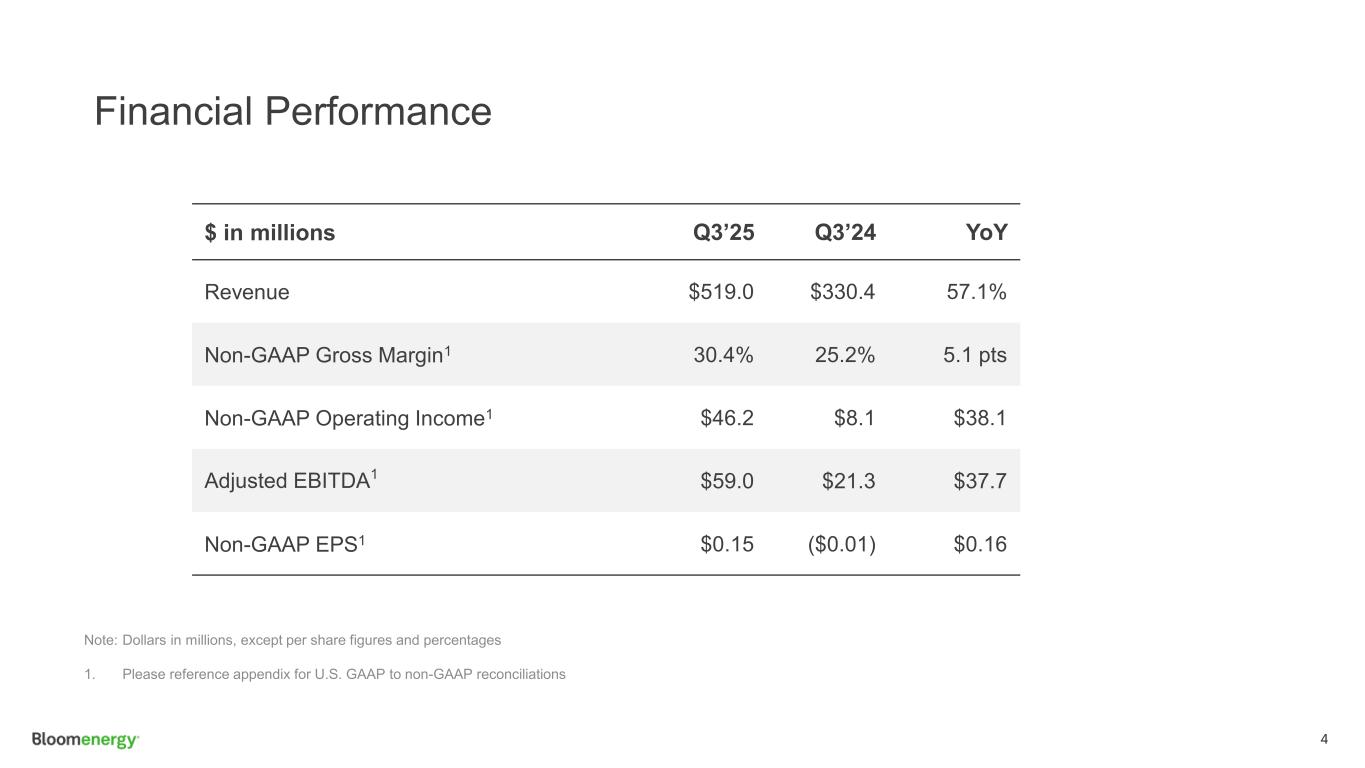
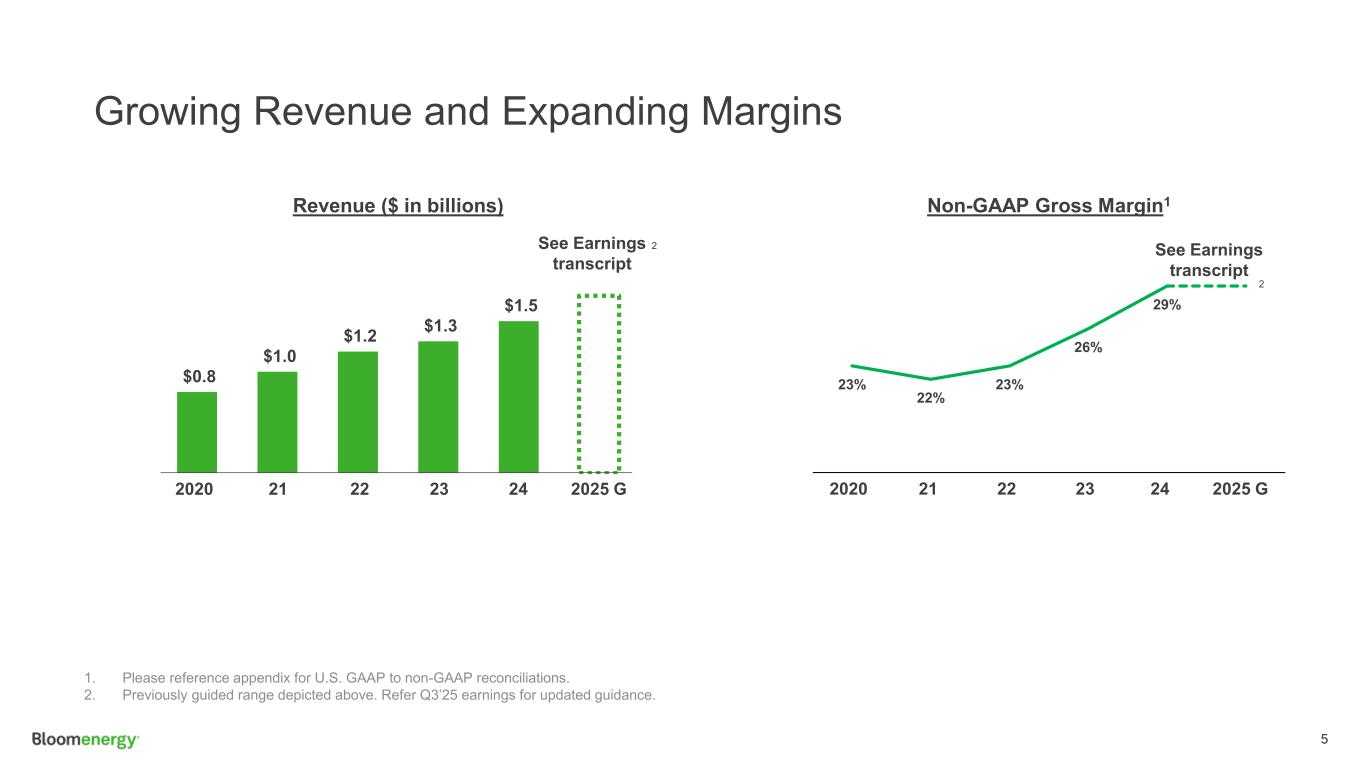
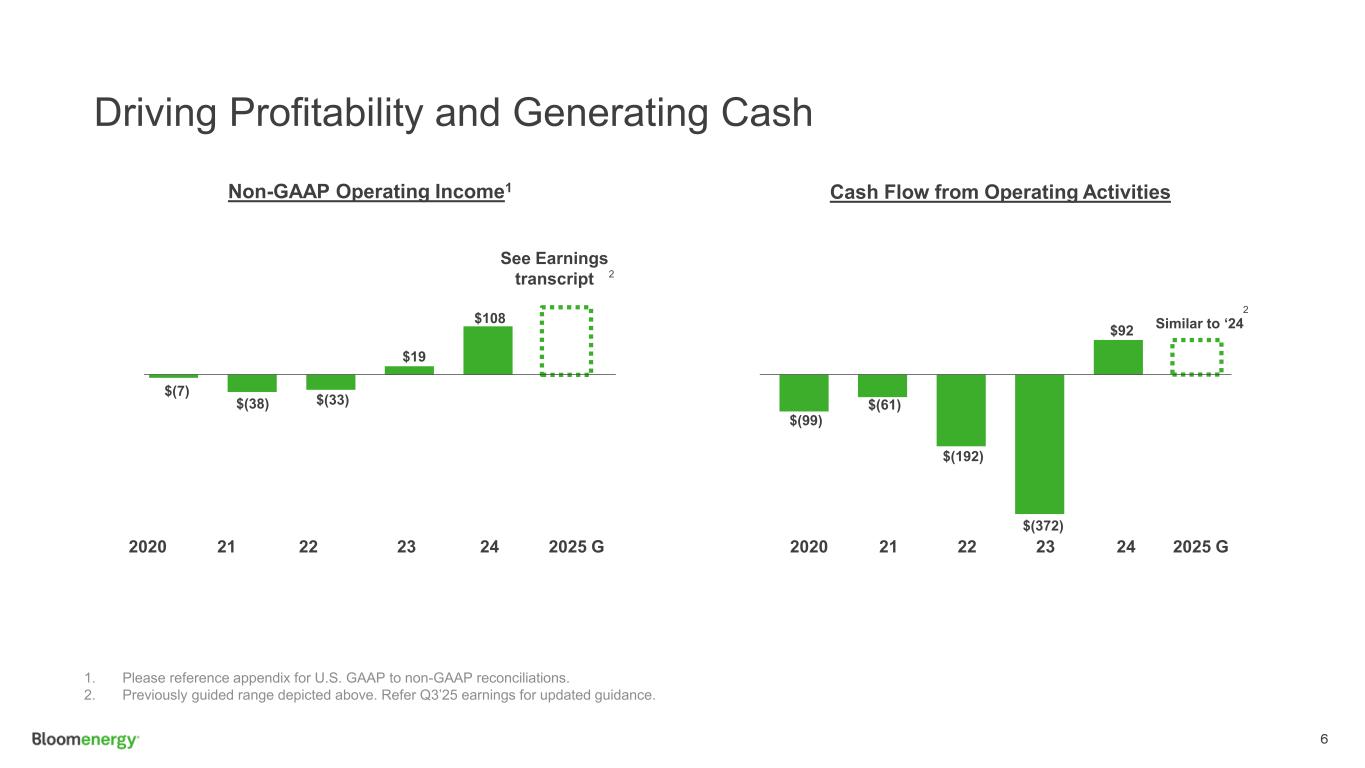
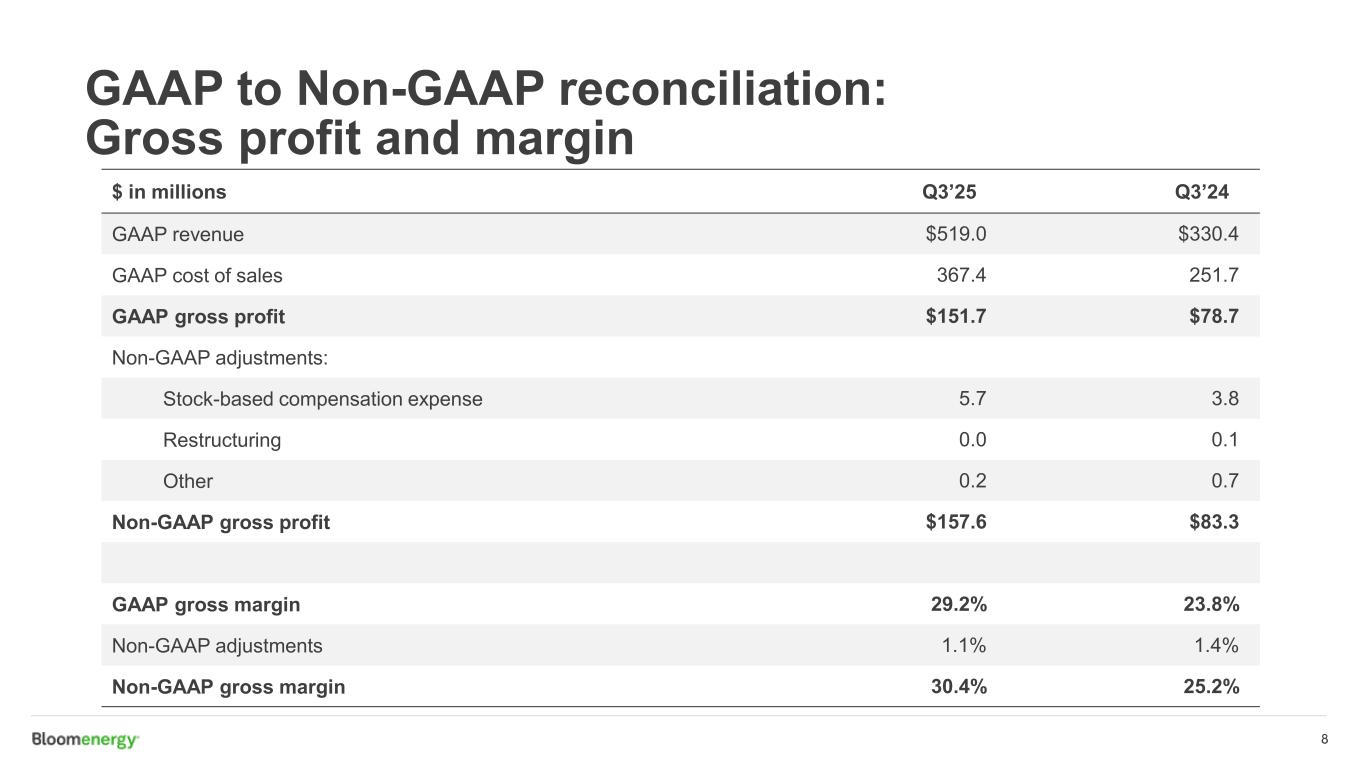
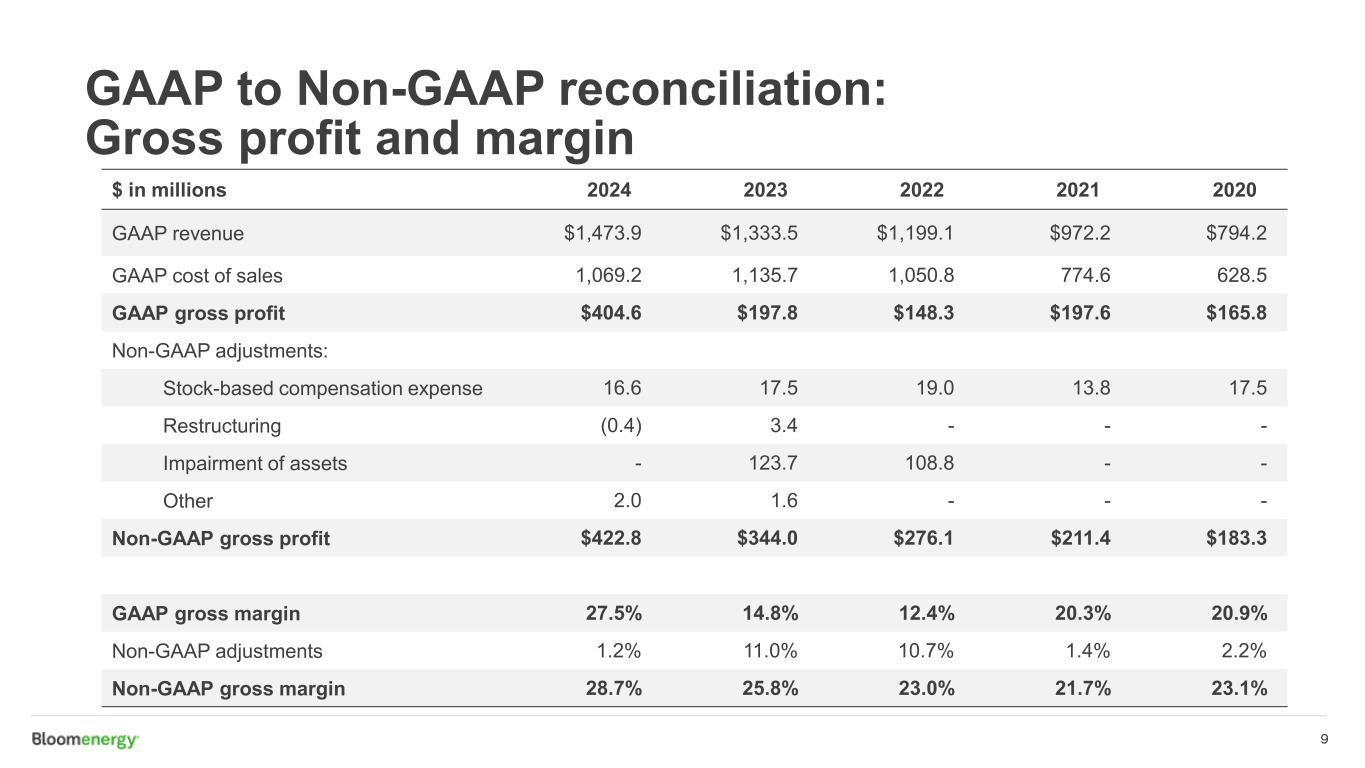
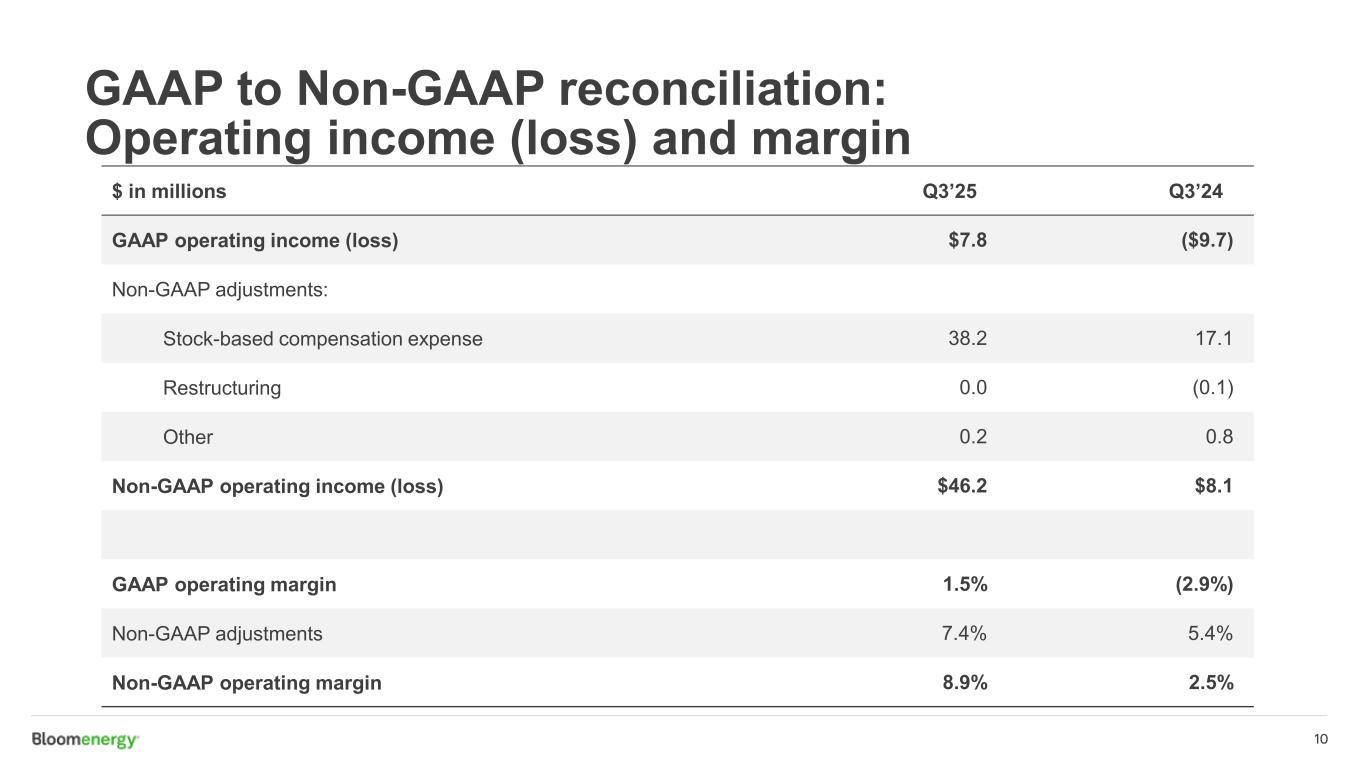
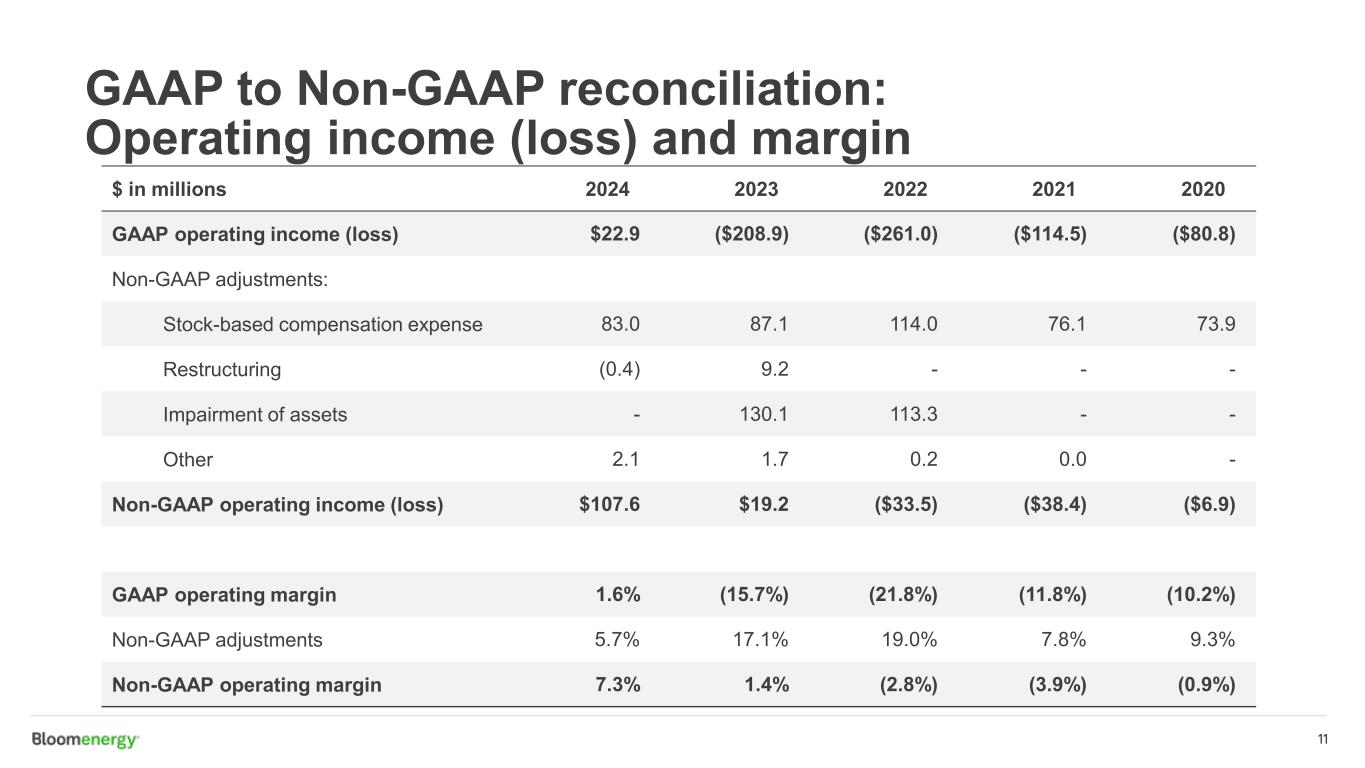
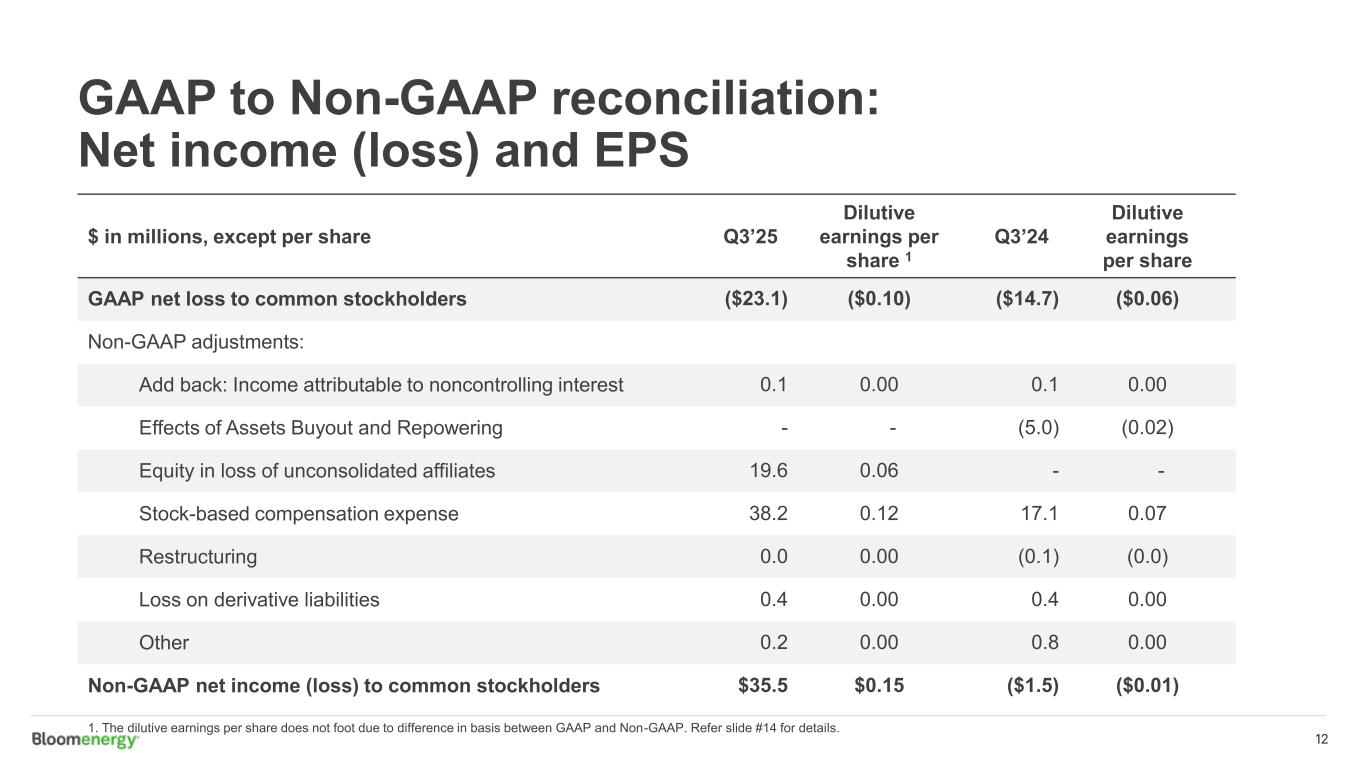
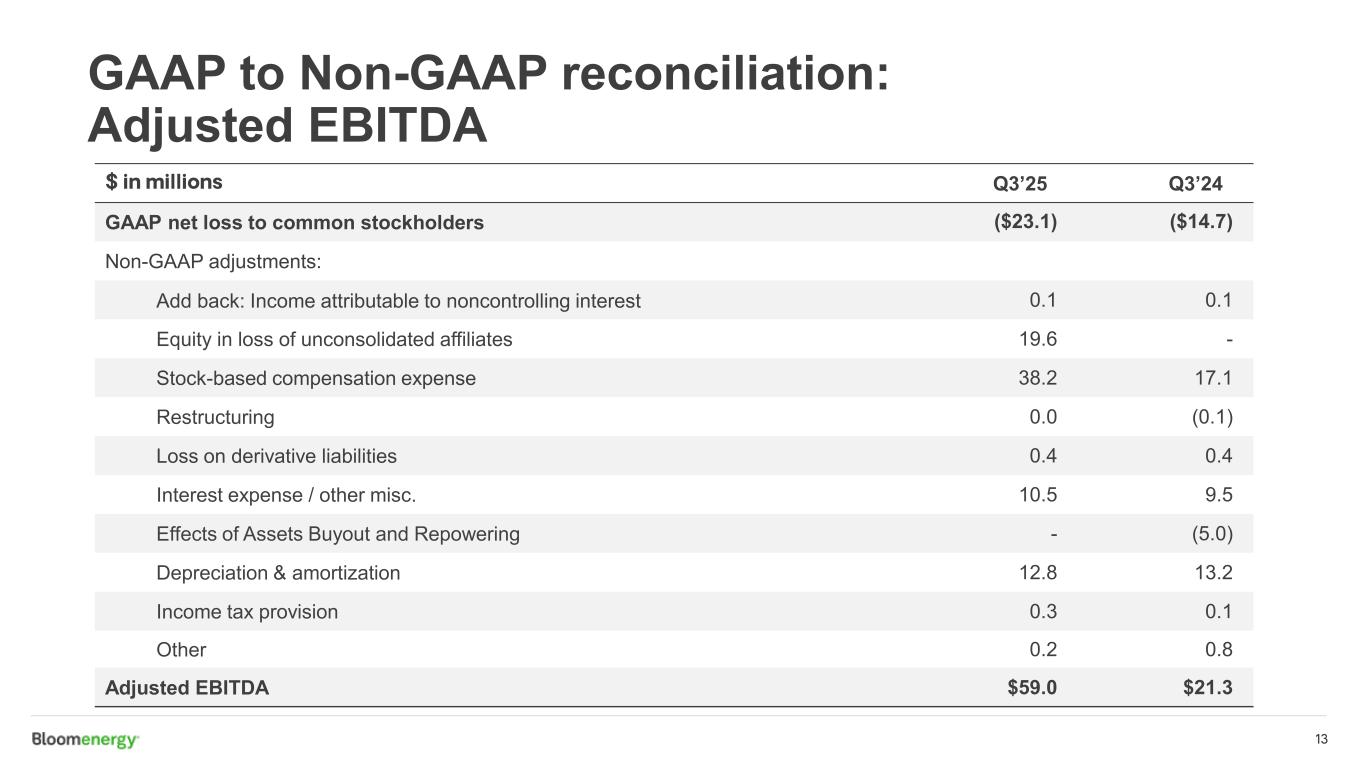
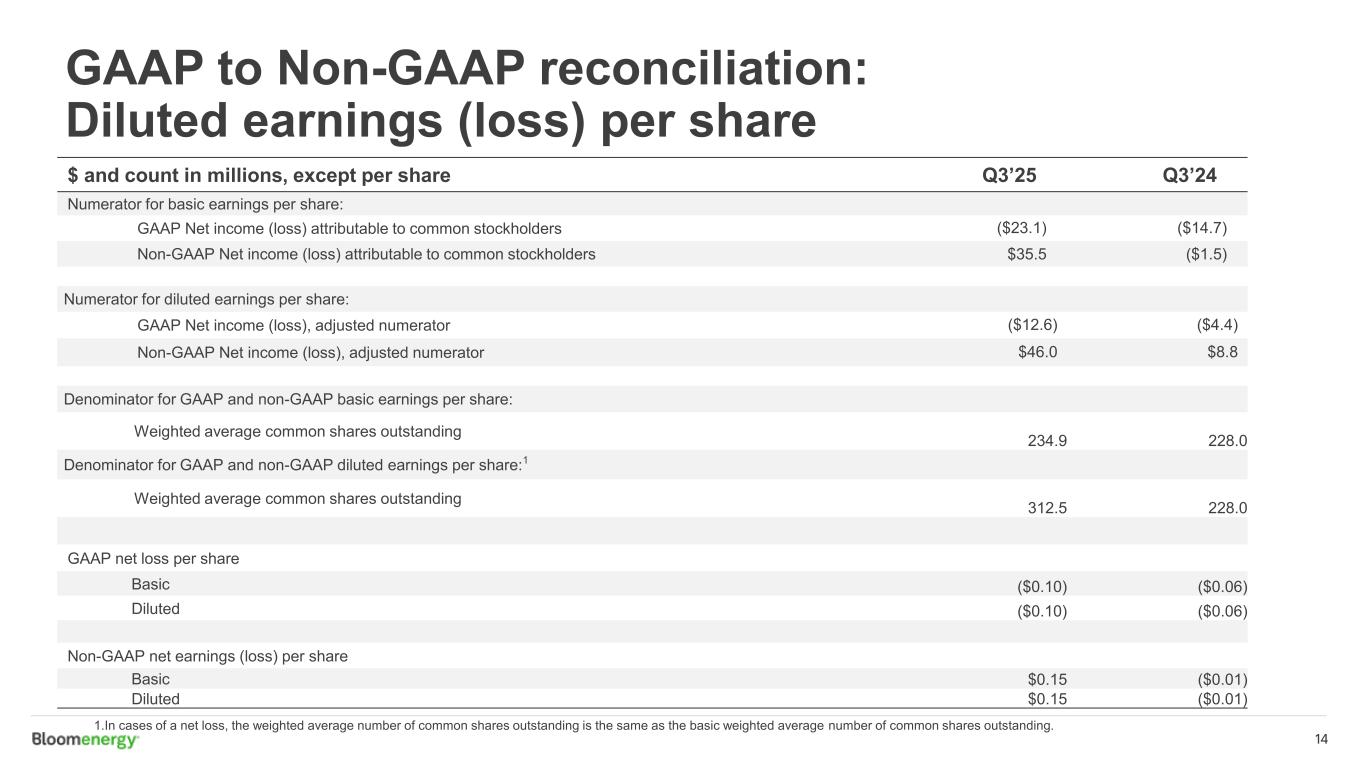
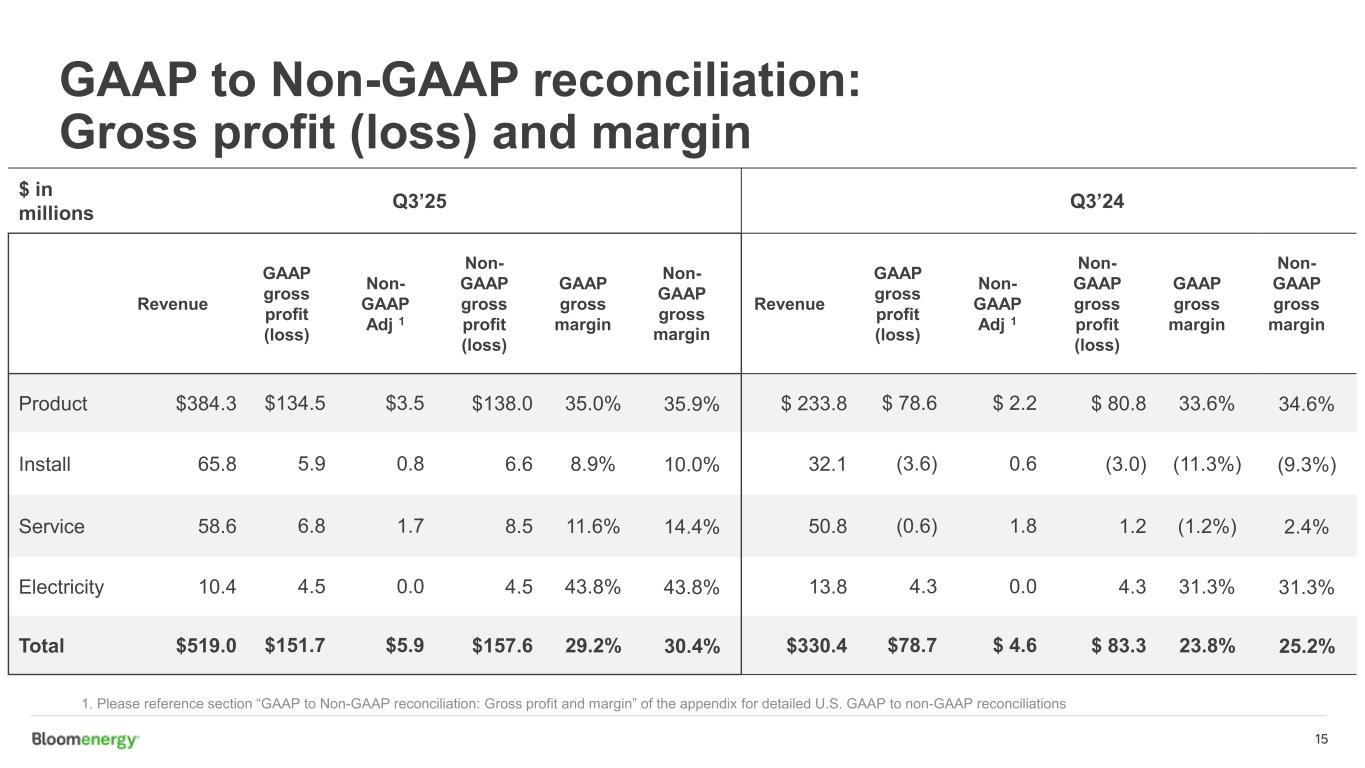
Thank you, KR, and good afternoon, everyone. As KR mentioned, Bloom is now positioned to become a standard in on-site power. Our announced customer base and financial results are a testament to this. On today's call, I will discuss our Q3 financial performance and make a few comments about fiscal 2025. The last four quarters have been a record operational and financial performance, and Q3 was no exception. While our commercial success has been most visible, the work, our engineering, and manufacturing is evident in our financial results. Highlights include record third quarter revenue, positive cash flows from operating activities, and our seventh consecutive quarter of profitability in our service business. As a reminder, I will focus my discussion on non-GAAP adjusted financial metrics. For a reconciliation of GAAP to non-GAAP, please see our press release and the supplemental deck on our website. Revenue for the quarter was $519 million, up 57% year over year. Time-to-power needs are creating demand for on-site power. This, together with the advantages of our fuel cell technology for AI factories, is driving our revenue growth. Gross margin was 50.4%, 510 basis points higher than the 25.2% gross margin in Q3 of 2024. Driven by continued focus on product costs and manufacturing efficiencies, Our operating income was $46.2 million versus $8.1 million in Q3. Adjusted EBITDA was $59 million versus $21 million in Q3 of 2024, while EPS was a positive $0.15 versus one penny loss. Again, our product margins were 35.9%, while our service margins were 14.4%. This is the second straight quarter of double-digit margins in the service business, and we expect this trend. As we have talked about on each call this year, we took advantage of our balance sheet and our visibility into customer demand to level load our factory. We expect cash flow from operating activities was an inflow of $20 million, primarily due to working capital improvements. We ended the quarter with $627 million in total cash on the balance sheet. Turning to the full year. As Kaira mentioned, based on what we see today, we expect Disco 2025 to be better than our previously stated annual guidance on our future. To conclude, Bloom is focused on not just on scale, but on showing sustainable profitability as we grow. We are uniquely positioned to benefit from this unprecedented market dynamic, and I could not be more excited about the opportunity in front of us. Operator, we are now happy to take questions.
Operator
Thank you. We will now begin the question and answer session. We ask that you limit yourself to one question and one follow-up. If you would like to ask a question, please press star 1 on your telephone keypad to raise your hand and enter the queue. If you would like to withdraw your question at any time, simply press star 1 again. Thank you. Your first question comes from the line of David Acaro from Morgan Stanley. Your line is open.
Oh, hi, great. Thanks so much for taking my questions. I was wondering if – a very helpful commentary, too. I was wondering if you could talk about the pace of commercial activity that you're seeing. You know, you've had success now with multiple agreements in a short period of time. How do you see this playing out, you know, as we look forward to the next agreements in the pipeline, just in the context of the market demand that you're seeing?
David, hi. You know, thanks for that call. look, I think we've been saying in the last three earnings calls that the commercial momentum is robust. And all that I can tell you, if I looked at it this week and last week, and if I walk over to the, you know, commercial section of our offices, is that momentum is clearly accelerating and it's palpable.
So, you know, forget questions of is it static or is it slowing down? it's accelerating. That's all we see. And we see that across the board. And by the way, it's accelerating not just in AI. Our traditional commercial industrial segments are doing the same. So it's across the board. And the larger the deals get, the more the actors that get involved, as I explained in the entire AI value chain, These are complex deals, and each one goes to a different phase, different momentum. Some close extremely fast because we need, some take a little bit longer. But make no mistake, the commercial momentum is absolutely accelerating.
Okay, excellent. Yeah, thank you for that. And I was wondering, you know, we've seen other technologies emerging in recent data center deals, you know, small-scale gas turbines, gas engines. I'm wondering if you could describe what you're seeing with the competitive environment, you know, how your product compares to some of the other solutions, and just is the competition heating up, or how do you see it playing out?
Look, I think the supply-demand mismatch is so large. that everybody who has a solution that's viable today has a market out there for them to address. So you're going to see, you know, data center developers, hyperscalers wanting any and every solution that they can find. But there are very clearly you're asking for distinction between us and other technologies. we were purpose-built for the data centers. The additional benefit and value we bring to them is enormous compared to a band-aided solution or something that was created for the mechanical age trying to solve this very sophisticated digital AI problem. So we stand to benefit every single time that we stand to benefit our end customer using our technology. And so you asked me to compare. Let me compare. Other technologies that generate on-site create air pollution, we don't. Other technologies that now using mechanical combustion moving parts cannot load, follow, and require lots of batteries to be able to maintain an on-site power because these are not connected to the grid, whereas our solid-state power does not require batteries, and we are able to provide that power. Today, we are able to provide our power faster than most of the others who have, you know, who have supply chain constraints. We can expand our capacities a lot faster than anybody else. We are future-proofing our customers for future technology advances, whether it is in the field of DC power, whether it is in the field of carbon capture and zero carbon or a green molecule. We offer all those optionalities that others don't have. You put all those together, and then if you take the same amount of gas that is available, we can produce a lot more power and allow the hyperscaler to put out a lot more tokens. At the end of the day, it is converting those watts to tokens, is where the game is. With the same amount of gas that's available, same amount of space that's available, we can produce a lot more tokens for the hyperscaler than any other technology can today, end-to-end. And so the value for the hyperscaler is not about the cost of power. It's about that cost of that entire value chain across the board. So price-performance ratio, we can compete with anybody. So that's the answer, David. Thank you.
Okay, great. That's helpful. Thank you so much.
Operator
Your next question comes from the line of Chris Dandrinos from RBC Capital Markets. Your line is open.
Yeah, thanks. and congratulations on the strong quarter. I wanted to follow up on the Brookfield partnership here, and I'm hoping you could just expand a little bit on the relationship and provide some more details around the potential development timeline, and then just how should we think about this partnership financially and how that benefits you?
Chris, thank you so much. Brookfield, look, they're an incredible partner to Bloom, right? I mean, they are at the heart of the AI value chain, And I think I mentioned this in the script. They've already invested over $50 billion in AI and want to triple that very quickly in the next two to three years. But put that in a broader context. They're one of the world's largest infrastructure owners with over a trillion dollars in assets that comprise of 140 data centers operating and using approximately one gigawatt of critical load capacity and wanting to accelerate and grow that enormously in AI. On top of that, they have a portfolio of factories. They have a portfolio of commercial offices and real estate that are all going to be beneficiaries of AI. And as they automate, as they bring robots in, those factories are going to need more power. So Brookfield is using their balance sheet and using their relationship with us as the power provider and making us the preferred choice that they would recommend to all their portfolio companies, including their data centers. On top of that, Brookfield believes that they themselves are going to be a large AI infrastructure developer. And there, they're going to use us. On top of that, if there are Bloom-sourced deals that require financing so we can offer a customer a PPA, they're willing to step in and be the financier for that. this is all not, and they made it very clear that this $5 billion investment is an inaugural investment. Now, what Brookfield, with Brookfield, we have already done some deals together. And they have said that they will announce a European AI Inference Data Center before the end of the year using Bloom as a power source, so stay tuned for that. So it's a very big relationship. I cannot understate how important it is to us.
Got it. Thank you. And I guess maybe just as a follow-up, you know, sticking with the European opportunity here, and can you maybe just expand on the global opportunity, and are you seeing the same kind of power limitations globally as you are in the U.S. and does that present a strong opportunity for more international growth?
Yeah, you know, Chris, that's a great question. Look, you know, I have been to these capitals, whether it is Frankfurt, whether it's Munich, whether it's Dublin, whether it's Taipei, okay? They all have a power shortage problem. And they all clearly recognize that their central power plants, along with transmission distribution, cannot keep up with AI speed.
That's across the board. This is true in Delhi.
This is true in Mumbai. Okay. So now what is happening in Europe, Asia, if you take as an example? I was just recently in Tokyo, and what I heard there is finally the sentiment of natural gas not just being a short-term bridge, but a long-term solution. And the agreements the U.S. is reaching with our friendly countries, our friendly allies, to say, we will supply you long-term LNG, is now making them take a very different look at natural gas. And once that policy unlock happens of saying natural gas projects can move forward, we think there will be a tremendous acceleration in those places, and we're extremely well positioned to be able to play. And the interest in Europe for our carbon capture solutions, where you can go to almost net zero using natural gas as a fuel, tremendous interest there. No other technology, the turbines and the engines, cannot do that. we can. So tremendous interest there.
Operator
Your next question, your next question comes from the line of N.A. Gupta from UBS. Your line is open.
Good afternoon. Generally, when you tell a customer I can deliver the order in 90 days, the customer is happy to get the order in 360 days. So incredible feed delivering it in 55 days. My first question, sir, here is last week, energy secretary sent a draft proposal to FERC that would limit the regulatory review period for data center connections to power grid to just 60 days, expediting a process that can currently extend up to years. Help us understand how this could help bloom energy.
Manav, thank you for those kind remarks, a shout out to our team for doing that. So, look, the first thing I want to say about that for people who are not familiar with that is, again, the Energy Secretary asked to start a hearing process and a rulemaking change to allow large loads like data centers and AI factories and other factories to get a rapid interconnection with the grid, which has been an issue. And first and foremost, we applaud the policymakers and regulators for doing that. I think it's the right thing for us as a country to do. The second thing I want to say is, if you read that announcement, it's very obvious. Even when you get that interconnection, they state very clearly, you're entering the age of B-Y-O-P, bring your own power, okay? You get curtailed, even if you have an interconnection, if you don't bring your own power. And large AI data centers are not going to operate in a place where the utility is going to curtail them and not curtail them depending on what their load and peaks are, right? So that becomes extremely important. So, obviously, time to power is the reason this is being done. We are able to provide our servers very quickly to a utility who wants to interconnect and offer the power to either a data center or a factory. And it's not unlike what AEP is trying to do. We think it's just going to accelerate other utilities wanting to do the same thing. So that's how we think it's going to help our business. And for people from the utility listening to that, right, it's very simple. You don't make your nuclear power plants. You don't make your gas turbines.
You don't make your fuel cells.
You can now buy our fuel cells very quickly and install it in front of the meter and offer it to your customer. But when you do that, here are the additional benefits you get. Ancillary support for the grid. Let me explain this. It's not an easy concept to understand. Engines and turbines can offer reactive power. It is something that you can provide as a byproduct in addition to supplying power to your load almost for free into the grid, and the grid benefits from that in stabilizing the local grid. Now, engines and turbines can, or any other kind of combustion device that has rotation or movement, can only do that in a very narrow range. Bloom has an amazing range in terms of that power factor, and that benefit will be enormous in places like PJM, where you have grid congestion and grid instability, or places like California where the amount of renewables you have completely destabilize the grid. We are a stabilizing factor. In addition, we can easily provide a lot more power into the grid in short notice to make up peaks and non-peaks if they want a net meter as a utility because we are constantly standing in hot standby. and when the data center is not using it, you can export that power. However, if you're going to use a bunch of turbines to be able to do it, you don't keep the turbines on hot standby. It's not economically possible. So you have to start it up and bring it up, which means you need five, six minutes, and that may be the time you need to peak. So we are a tremendous asset to benefit, first, the data centers being built fast, Second, for the utilities to be able to provide that and win with that. Third, for the utilities to use our ancillary services and benefit from that. And fourth, because we don't pollute the air, we are a benefit to the communities where they're installed. So this is a win-win-win. We love this proposition. Thank you.
Second question, and I apologize in advance. I am an electronics engineer, but it's been two decades since I graduated. it. So in case it's an invalid question, please just ignore it. Sir, I recently read somewhere that some chip makers are looking to move from 400 volt AC to 800 volt DC by 2027. I think it was NVIDIA. I'm just trying to understand if that does happen, would it make your fuel cell even more efficient? Would DC DC power be even more efficient than DC AC power because of transmission losses. If you could just talk about that. Thank you.
Don't undersell your technical knowledge. It is spot on. So I think given how you phrased it, let me, this is such an important question and we didn't address it. It is probably a miss on my part to have not addressed it in the script. So let me take a few minutes to explain this so everybody understands. It's so important. So here's the important part, and I want you to understand this. This moving from converting that 400-volt AC to 48-volt DC, which is how server racks, which are the size of a refrigerator roughly sitting in a data center. These are the machines that manufacture the intelligence. Okay. Today, the standard has been, ever since we had data centers, low voltage, like 48 volt DC. So, it gets converted. So, think of this. The power going – so, I'm thinking of an analog as you asked me this question. It may not be perfect, but I think it will answer the question. So think of power coming in into the rack as a hungry human being drinking water, okay? They can only drink through a straw, and that straw was sufficient. That is the 48-volt DC because this small wire through which a small amount of water comes into the straw, that water was sufficient to satiate the thirst. That was when CPU racks were 13 kilowatts. They put a lot of Band-Aids on it to make sure Blackwell chips that come somewhere near the 130 kilowatts can handle it with a straw. Guess what? The Reuben chips and going forward are going to be five times that to ten times that. There is no way you can pump that much of fluid for the body to keep up if that's the amount of water you need, that's the amount of power you need through that little straw. But in the rack, there is no more space than the straw. What does that mean? You have to increase the pressure of the water that you're shoving through that straw. That's the only way you're going to get more water through. And that pressure equivalent in the water is voltage in power. So it is the laws of physics dictate that you have to go to 800-volt DC architecture if you want AI chips that have more power density, which is the only way you can improve upon AI in the next generation. This is not an if. This is not a nice-to-have. This is a must-have. Now go to the other side. All our wonderful legacy power generation systems that helped us propel into the mechanical age was built for the mechanical age. They are like Niagara Falls dropping water, and you cannot make it to the voltage that you need. You need to make it very, very high voltage. Otherwise, you can't bring all that water in a pipe of reasonable size to where you want to bring it. Even an on-site 50 megawatt turbine cannot produce directly at 800 volts, or the amount of copper you need becomes too bulky, too big. It's not just physically viable. Guess what we did at Bloom? We saw this coming one day. We didn't know what day. In 2000, when we initially created the architecture, we built an architecture where we can feed these straws. appropriately right at that 800 volts and we decided every unit we have shipped for the last 15 years has that but after that we have one other box that takes that DC and makes it into AC and provides it because we were making color TV images the world was only consuming black and white so we are converting our color TV images to black and white but the other guys create black and white And now you have to colorize them all and provide low definition when we already have high definition color images. That's the analog. So we are super excited about this. As I see it, it's self-evident to me that this has to become the standard, and Bloom will set the standard for the digital age, digital power. Thank you.
Operator
Your next question comes from the line of Nick Amacucci from Evercore ISI. Your line is open.
I just wanted to touch upon the doubling of capacity by the end of 2026 and kind of the commentary that would support Forex, the fiscal 25 revenue. How should we think about kind of the utilization on that capacity as we kind of enter into, again, as we enter into 2027 and we have that, the two gigawatts kind of up and running? I mean, because if we're exploring opportunities to go beyond that two gigawatts, it seems like, you know, 4X full year 25 revenue, that seems like a big number that we could get there relatively quickly. So I just wanted to parse that out a little bit.
Yeah. So, you know, here's a simple way to think about it, right? We didn't get to where we are today to deliver what I just explained, this purpose-built factory, based on just meeting a market demand as we see it right now. We just prepared ourselves. What is the beauty of Bloom being able to expand its capacity and offer what we do? It's the return on investment, you know, like invested capital. So we are fiscally very disciplined. And we only make decisions based on that added cost and its absorption, will it have a great rate of return? So we have a very disciplined process on this. And on top of that, we have a very clear understanding right now given time-to-power shortages and the importance of this as a nation-state issue for AI. We are committing to strive and work as hard as we need to and stay ahead such that we will never be the constraint to our customer on growing their data center. That's what we are positioned for, and we will increase capacity. We will increase it in whatever steps necessary as we see fit, but as you saw, this two gigawatt capacity, all systems go based on that. Would we use it for peak capacity? When we use it, will we use it for steady capacity? All that you will hear from us as we talk about our backlog and other things next year. But we are now using our OPEX wisely to invest in capability and talent to think about how do we expand beyond 2 gigawatts. That's all I can say right now. Thanks for that question.
Got it. That makes sense. And so as we see kind of, you know, the here and now, obviously the power demand is here and, you know, and obviously you guys are ready, willing and able to address it. But as we kind of think out, and I bring this up because you had mentioned an inference data center in Europe, I guess just see, can you just kind of convey the additive value when we think of kind of the inference and, you know, when latency becomes an issue, when we get to inference and reasoning within the AI complex, how kind of Bloom partake in that?
Thanks for asking that question. It's very important, right? Here's the beauty. Our exact same architecture with pure Lego blocks, okay? Think of each of our, you know, Bloom power systems as a Lego block. With a fewer Lego block is an inference data center. Multiply that many times over, it can power a training data center. No difference. No other technology can do that. That's how we built it. That's the power of our modular fault-tolerant architecture, number one. Number two, inference data centers are going to be close to your bedroom window and your office window. You don't want that to be polluting. You don't want that to be noisy. We should be, for those inference data centers, the power producer of choice. Thank you.
Operator
Sure. Our next question comes from the line of Ben Kahlo from Baird. Your line is open.
Hey, K.R. Maybe could you just talk about, I think, the biggest project you guys have announced is 80 megawatts with SK. Could you just talk about how you view, because there's been permits out there, huge numbers on them, on doing bigger projects, how your customers have gotten comfortable with your technology over time. And maybe time to power how you think about, you know, the size of projects you can do and where we think you guys fit in, you know, if it's 100 megawatts or 900 megawatts.
Thank you. Ben, that's a very good question. And look, again, our architecture was purpose-built. Our factories do copy exact modules, and the boxes don't know whether they are sitting along with five other boxes or 5,000 other boxes. Nothing in our scaling has scaling risk, right? So, yes, we are talking to customers with a lot bigger stamps right now and working with them on ideas and projects and various stages of negotiations of much larger sizes. We can do that, and we can do your neighborhood retail store, and we are talking to customers about that, too. So that is the flexibility of our architecture. You're adding no additional risk. In fact, think about it because these are hot swappable Lego blocks. The more Lego blocks you have, the more reliable our system gets. So large block power becomes a lot more reliable than small block power. Thank you.
Maybe a follow-up. Just as we think about capacity, I think other people ask about this. But we see these big numbers out there. What's go, no-go decisions from going two gigawatts more, and how fast can you do that?
Look, we get accused of you're building capacity too fast. We get accused of, you know, we don't think you can build too fast. Let me be very clear. We are going to strive to make sure we are able to provide power for our customers before they are ready for it. We will not be the bottleneck. And we designed our factories, we designed our factories, we built it with that in mind. Thank you.
Operator
Thank you. Due to the time allotted for question and answers, we please ask you to shift to one question only, please. Your next question comes from the line of Mark Strauss from JPMorgan. Your line is open.
Thanks very much for taking our questions.
So, KR, things obviously are changing very rapidly here. It's been a bit there since you've provided kind of long-term margin targets. So, kind of to the earlier point about capacity expanding, but also as the utilization of that capacity increases, how we should think about kind of gross or operating margins under that scenario. Thank you. Thank you.
So, look, here's how I'd answer it. Wait till 90 days from now to hear our annual guidance for next year. But in the meantime, if you want to think about it, here's how you can think about it. For over a decade, every single year, we have a cost down in double digits, number one. Number two, when we transact on electricity as we grow our volume, the pricing pressure on electricity is going to be based on the macros and there's a shortage of electricity. So you go figure out what that pricing pressure would be. And we have tremendous operating discipline within the company that you've seen us exercise these last three, four quarters, and that's how we'll continue going forward. Our factories are not capital intensive. We have made that statement very clear. You know what those numbers are. Where is it that we will spend? Investment. We'll invest in our people. We'll continue to invest in our technology. We will invest in the talent necessary for scaling our operations. We'll invest in the skills needed in our commercial team to go capture opportunity. And we will continue to invest in technology to further enhance our leadership position on on-site power. So those are the things to take away. Thank you.
Operator
Your next question comes from the line of Michael Bloom from Wells Fargo. Your line is open.
Thanks. Good afternoon. You've given us some good information on how to think about the Brookfield partnership and the scope of that. But can you do something similar with Oracle? Can you give us a sense of the size of that opportunity set and how exactly Bloom will play a role in that partnership? Because they also obviously have pretty big ambitions as well.
Michael, I can't speak to any one customer. You should be asking them about that question. But I think what I can refer you to there would be their statement when we had the press release saying that what we did for them earlier was the first of many, right? So we think they are going to play an extremely big role in this space, and they are going to be growing in many, many geographies. And they are not only looking at how we have executed on the first year, but they're intimately familiar with what's in our technology roadmap and all the value we can bring to them so we just obsess on pleasing the customer then the customer will do the right thing so that's what we do thank you your next question comes from the line of amit tucker from bmo capital markets your line is open hi i've just got a quick uh kind of housekeeping
Speaker 4
in question um your 10 qs kind of refers to 288 million dollars of related power um so related party revenues uh during the quarter i was just wondering is that related to brookfield or is that related to sk thank you yeah this is macek um part of the the um the contracts with with brookfield we made equity investments into these vehicles.
And because of those equity investments, those JVs became a related party to Bloom. And that's what created the disclosure around the related party. And again, it's important to know that the equity investments are fairly small. The way the contract is being set up is that we put a limit of ceiling on those investments to be very significant. That said, there's criteria to go through, and if you meet the criteria of equity investment, you get into the related potty disclosure.
Operator
Your next question comes from the line of Colin Rush from Piper Sandler. Your line is open.
No, it's Colin Rush, but I am from Oppenheimer. So just in terms of the balance of 2025 and looking into 2016, can you talk a little bit about the next shift from direct product sales into some of these financing options with partners or related parties, and then also if you could get a quick update on the CFO search and that coming to conclusion.
Yeah, I'll take the CFO search. Look, it's a very important position for us. We take it very seriously. And so we have a process in place, and that search is going on. We have a sense of urgency, but no sense of rush. So we will let you know when we hire one.
Yeah, as far as the financing goes, you know, if you go back, and we talk about this in pretty good detail in our 10Ks, where, you know, there are three ways of going to market. There is a direct sale, which we refer to as COPEX, which is effectively a customer showing up and writes a big check, which effectively is that prepaying for electricity for. a number of years. There's a PPA financing structure in place and the managed services, which is a sale-leaseback transaction. We haven't done managed service transactions in quite some time. We don't expect to do those going forward. And I would say the majority of the transactions we get into are actually up to the PPA structures, although there are some top-ex deals every quarter from time to time where the customer is willing to to find it with the other sets.
Operator
Your next question comes on the line of Mahit Mandeloy from Mizzou. Your line is open.
Hey, thanks for taking the questions. Most of the high-levels answer, but maybe it's like housekeeping on the guidance for T4. We could just talk about like the reason to not disclose that. Is it just timing of these lumpy installations you have in December or January or something else over there?
Yeah, I think you just answered your question, Maheep. You know, we have said that at the beginning of the year. Why do we give a range? Because, you know, project-based installations, many of them being greenfield for changes and, you know, changes and variations. Lots of things could happen on the customer end. We have no difficulty supplying our boxes on time, ahead of time, as you saw. But, you know, the customer has to be ready to take the power, which is when we ship. So, you know, a project can fall a few days in front of or on the other side of December 31st, which is just a deadline. And it has no impact on that project or that revenue other than a pure timing issue. And yes, with 365 days in the year, we would give you one guidance. Now, 300 of those are gone, and we have 65 days left. So we are giving you a slightly better guidance, but we can't pinpoint it. That's exactly right.
Operator
Your next question comes from the line of Sharif Almagrabi from BTIG. Your line is open.
Thank you. For the Brookfield Partnership, you mentioned they're bringing a substantial balance into the equation but um any capital commitments for bloom under those joint ventures or or other costs related to that obviously besides the fremont capex that you're already investing yeah other than the equity investments that were uh that we agreed to make for the respective project very small equity investment there is none okay with that uh i just want to bring this to a close as we are getting to the top of the hour.
Thank you all. We are delighted with our results in Q3. Our commercial activity is robust and the momentum is accelerating across the board. This year has been a big transition year for Bloom. I want to thank Thank our team inside for stepping up and, you know, contributing to our success in such a great way. We appreciate the trust of our long-term shareholders, and we welcome our newest shareholders. And thanks to all of you for placing trust in us. and I think we have an exciting journey ahead of us together as we go forward to become the standard for on-site power. Thank you and have a great day.
Operator
This concludes today's conference call. You may now disconnect.