Speaker 0
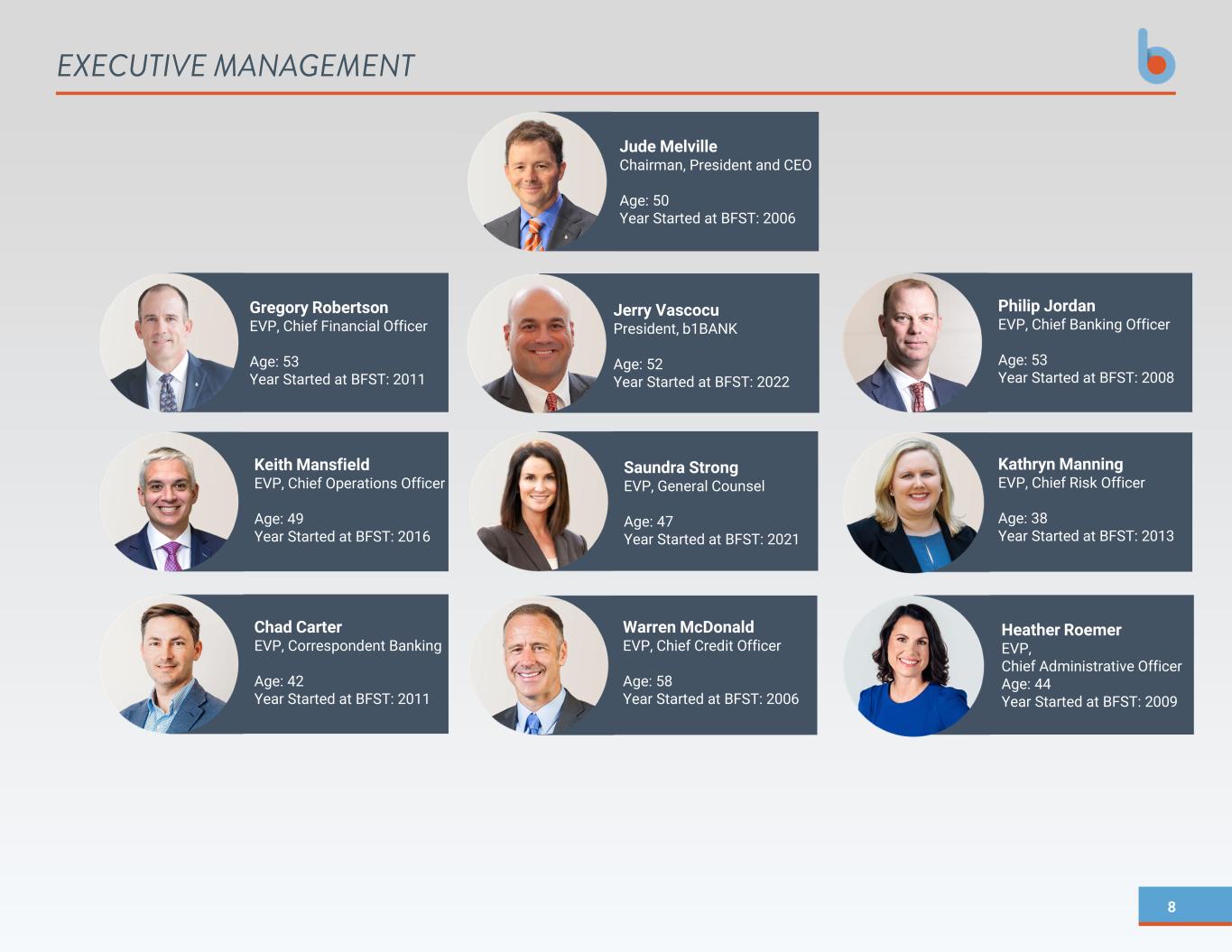
Thank you. Good morning, and thank you all for joining. Earlier today, we issued our second quarter 2025 earnings press release, a copy of which is available on our website along with the slide presentation that we will reference during today's call. Please refer to Slide 3 of our presentation, which includes our safe harbor statements regarding forward-looking statements and the use of non-GAAP financial measures. For those of you joining by phone, please note the slide presentation is available on our website at www.b1bank.com. Please also note our safe harbor statements are available on Page 7 of our earnings press release that was filed with the SEC today. All comments made during today's call are subject to the safe harbor statements in our slide presentation and earnings release. I'm joined this morning by Business First Bancshares Chairman and CEO, Jude Melville; Chief Financial Officer, Greg Robertson; Chief Banking Officer, Phil Jordan and President of b1BANK, Jerry Vascocu. After the presentation, we'll be happy to address any questions you may have. And with that, I'll turn it over to you, Jude.
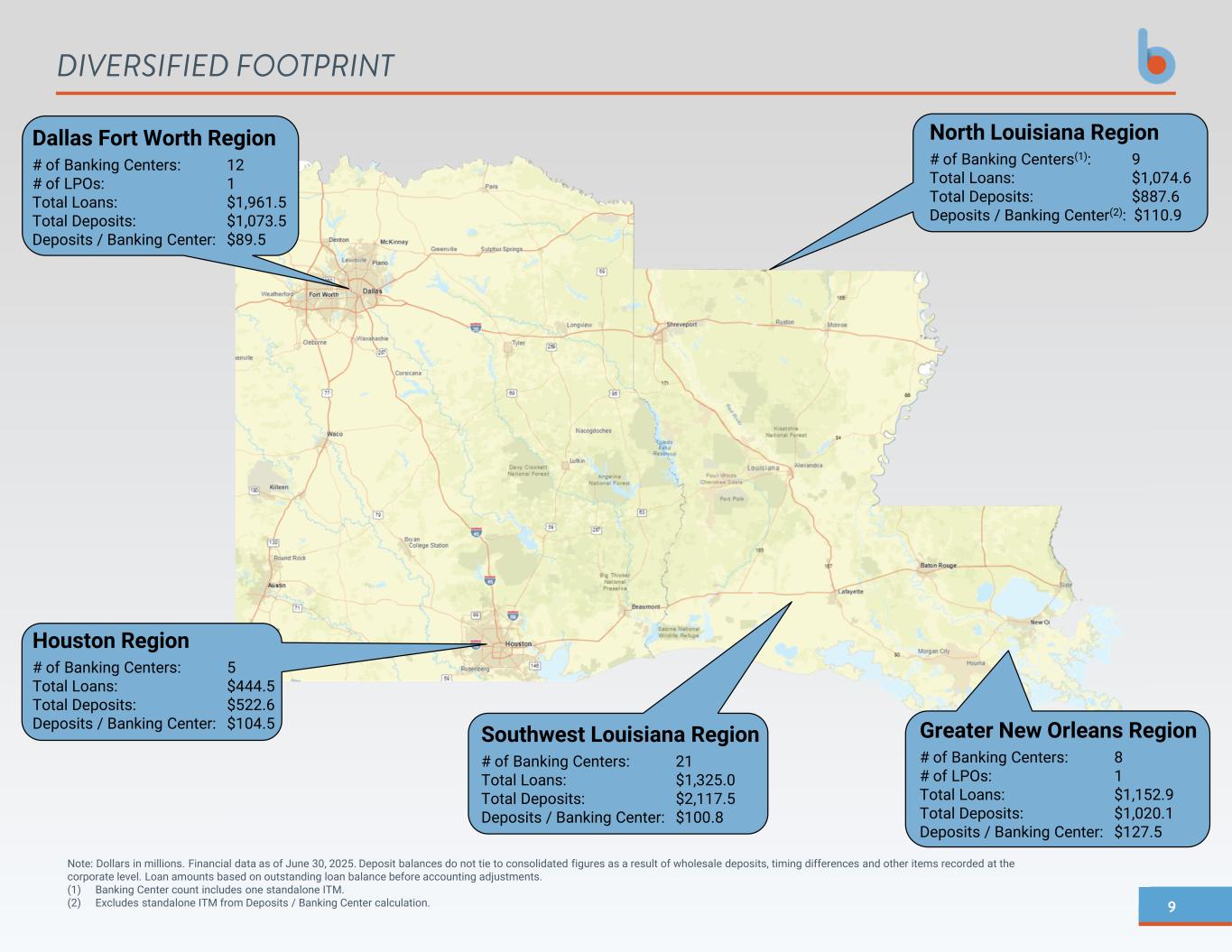
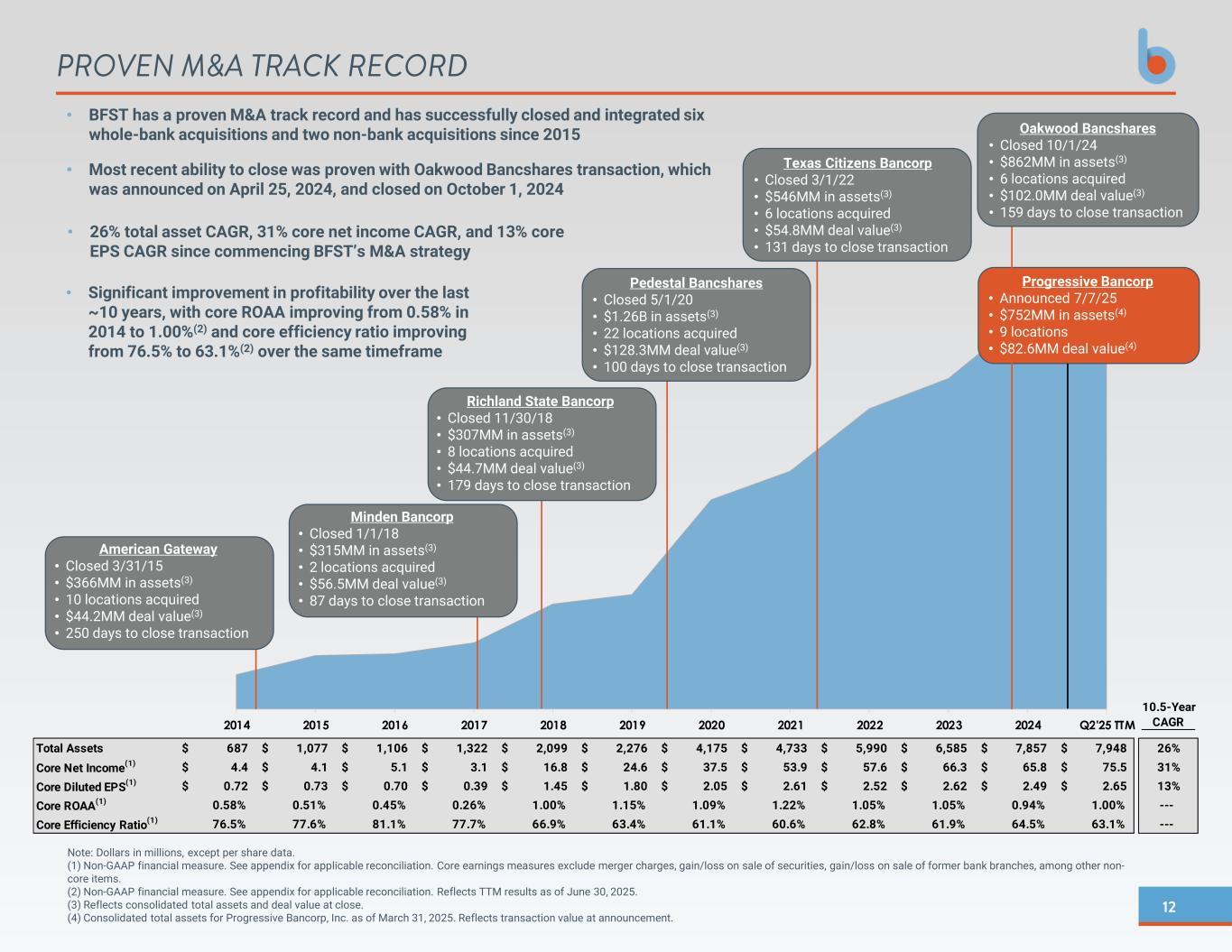
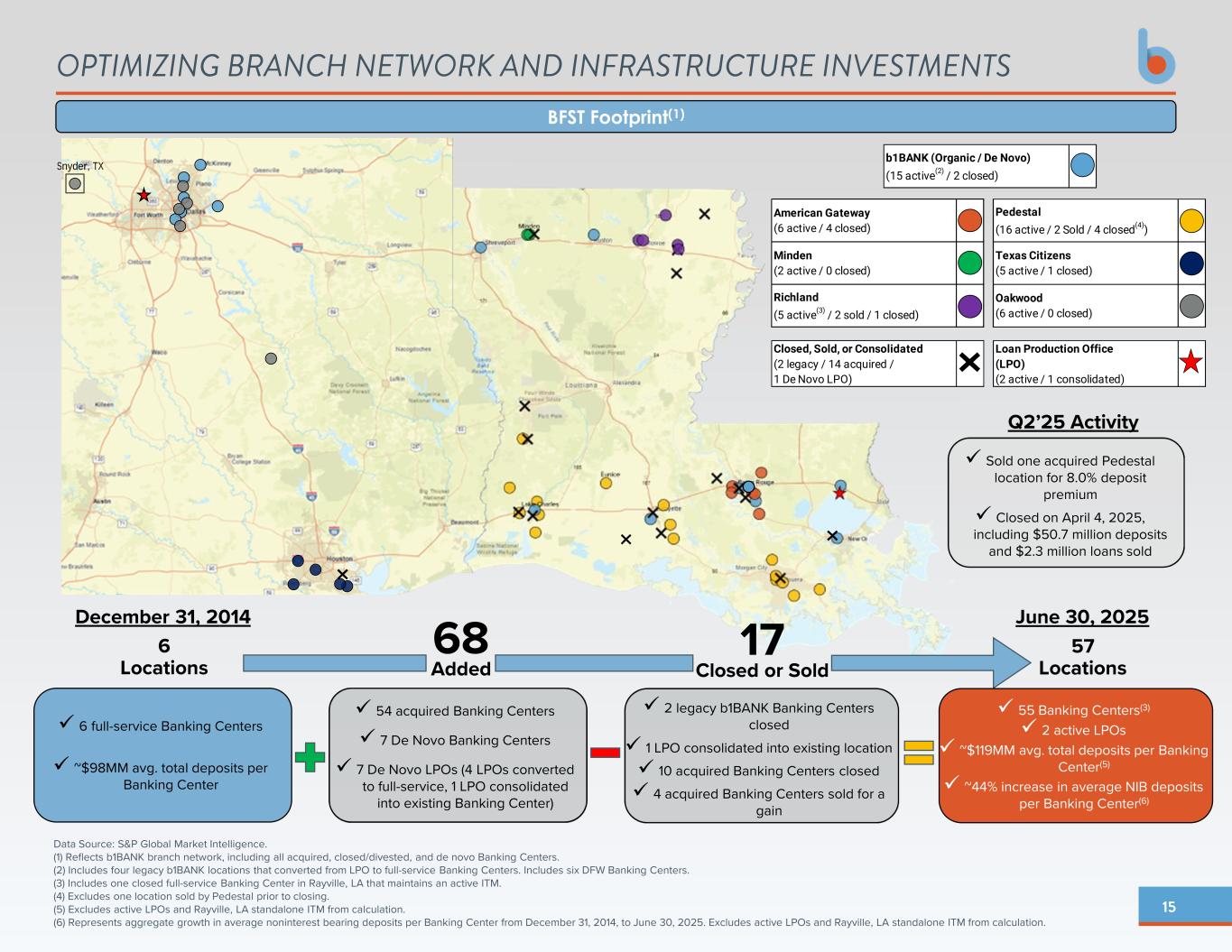
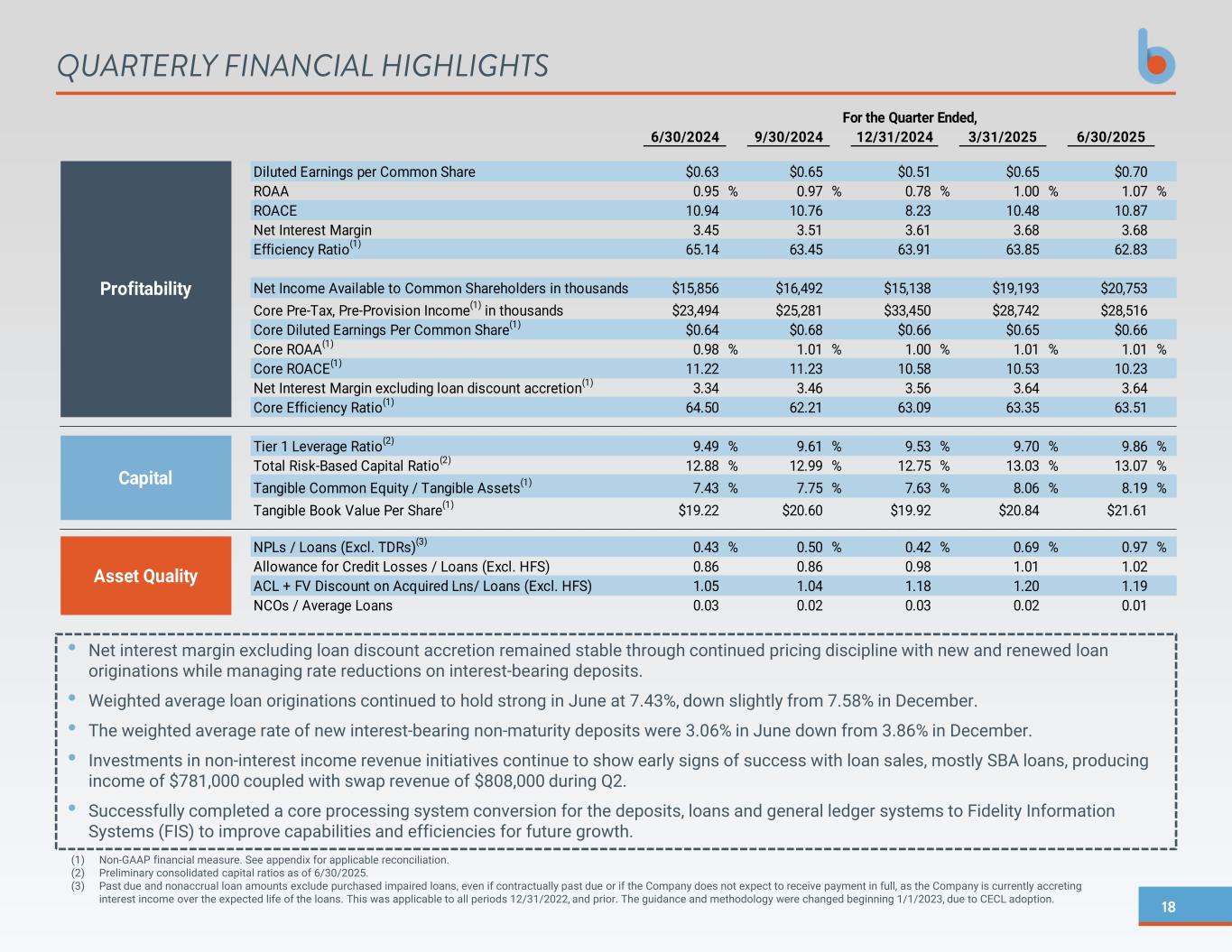
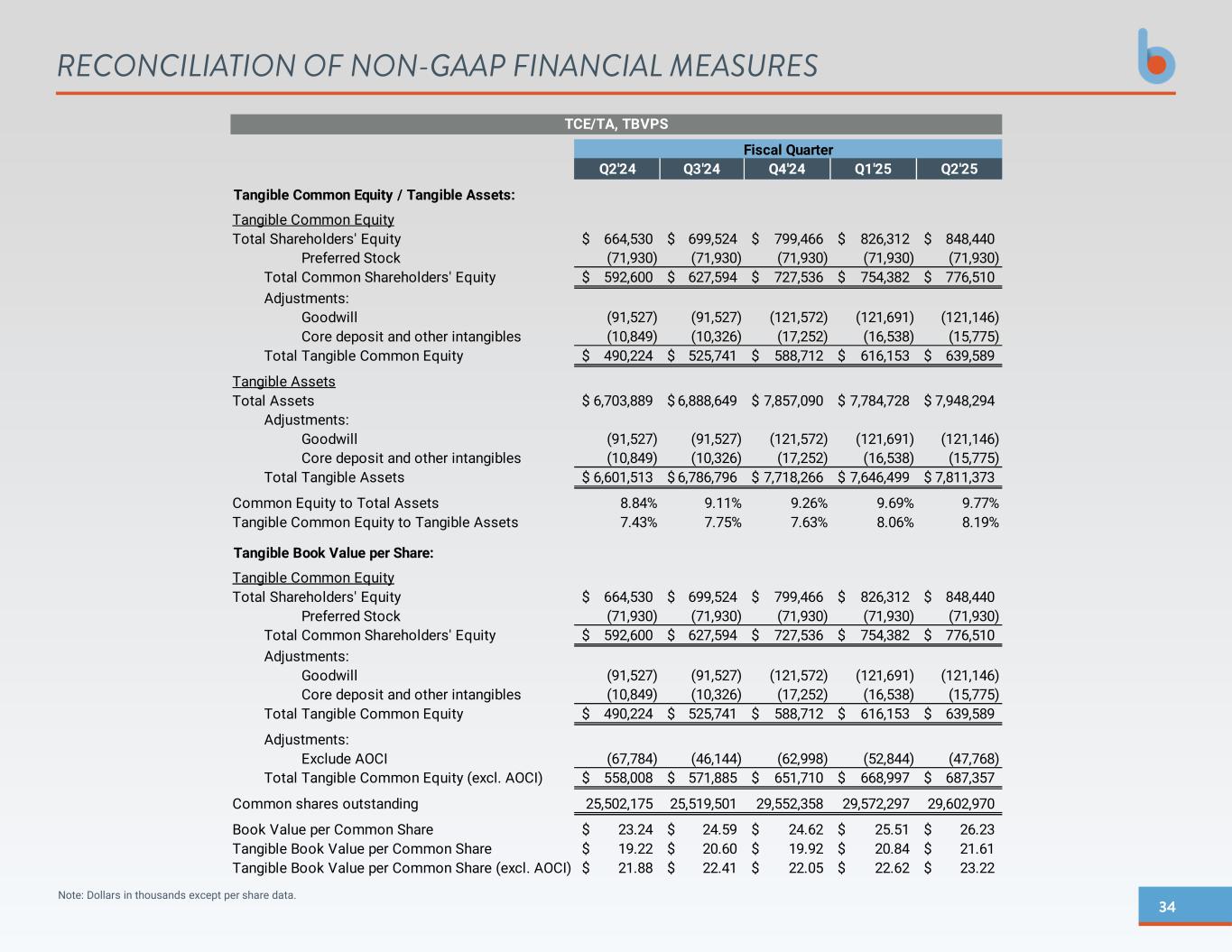
Okay. Thanks, Matt. Good morning, and thanks, as always, to everyone for prioritizing this call. I know you have plenty to do on a Monday morning, and we appreciate you participating with us. I'd like to start by explaining that we chose a later than normal release date out of an abundance of caution, given the core system conversion we conducted over the past few weeks, wanting to err on the side of giving our team ample time to close out the quarter; we were successful. And going forward, I expect we will revert to our normal release date in time. Four things I'd like to highlight before I turn it over to Greg to offer a more detailed analysis of our performance. First, the quarter was successful today. We again posted 1% ROAA earnings, but maintained our net interest margin. We increased our capital levels as well as increasing our tangible book value by almost 15% any loss. These have been our primary goals over the past few quarters, and we're pleased to accomplish them despite an extra busy quarter. We also originated loans at a healthy pace even while continuing to decrease our C&D concentration levels as well as improving the makeup of our funding base, growing noninterest-bearing accounts quarter-over-quarter. Second, the quarter was successful operationally. We embarked two years ago on a project to upgrade our core processing system to IPS, the FIS large bank platform, and after thousands of man hours in preparation and then an action-packed Memorial Day weekend, executed successfully, positioning ourselves for more efficient processing for the foreseeable future. We're excited about this partnership and believe it will lead to more efficient organic and inorganic operational effectiveness. We also continue to work on cultivating our branch footprint, teaming with a local community bank in the sale of one of our legacy branches. We're proud to again deliver on a win-win proposition for the local market and our local employees, leaving them in secure hands while we position our broader footprint for future operational savings approaching $750,000 a year. These operational decisions require significant work to execute by large numbers of our teammates, and I'm proud of the way they've done so. Third, we announced a partnership with Progressive Bank, a $750 million community bank in the North Louisiana area of our footprint. We’ve known the team at Progressive for many years and have felt for some time that they would make good partners. I'm very proud that they chose to join with us on this next stage of our journey. They have excellent asset quality, strong long-term client relationships, and a team that will fit in day one with the B1 culture. Between continued integration of the Oakwood Bank footprint, with conversion scheduled for late in the third quarter and incorporation of Progressive with the projected close of the first of the new year, we entered 2026 projecting meaningful upside earnings accretion added by our fruitful M&A activity. Fourth, though our asset quality metrics trended negatively during the quarter, that's partly a function of successful work navigating through the process on a handful of relationships that have been previously identified. We have not been identifying new relationships through which we have to work, experiencing a decline in our watch list over the past two quarters. We believe we are adequately reserved against the nonperforming relationships and all borrowers continue to work with us towards resolution. While we don't expect to suffer any losses over the remainder of the year as we bring the subject credits to their conclusion, the quarter, as with most of our recent quarters, exhibited exemplary net charge-offs at 0.01%. We are preparing to enter 2026 with a stronger balance sheet as positive go-forward P&L opportunities, a diversified geographic footprint, and as much operational capacity as I can remember during my time as CEO, and I'm excited to see our team continue to perform. With that, I'll turn it over to Greg. Thanks again.
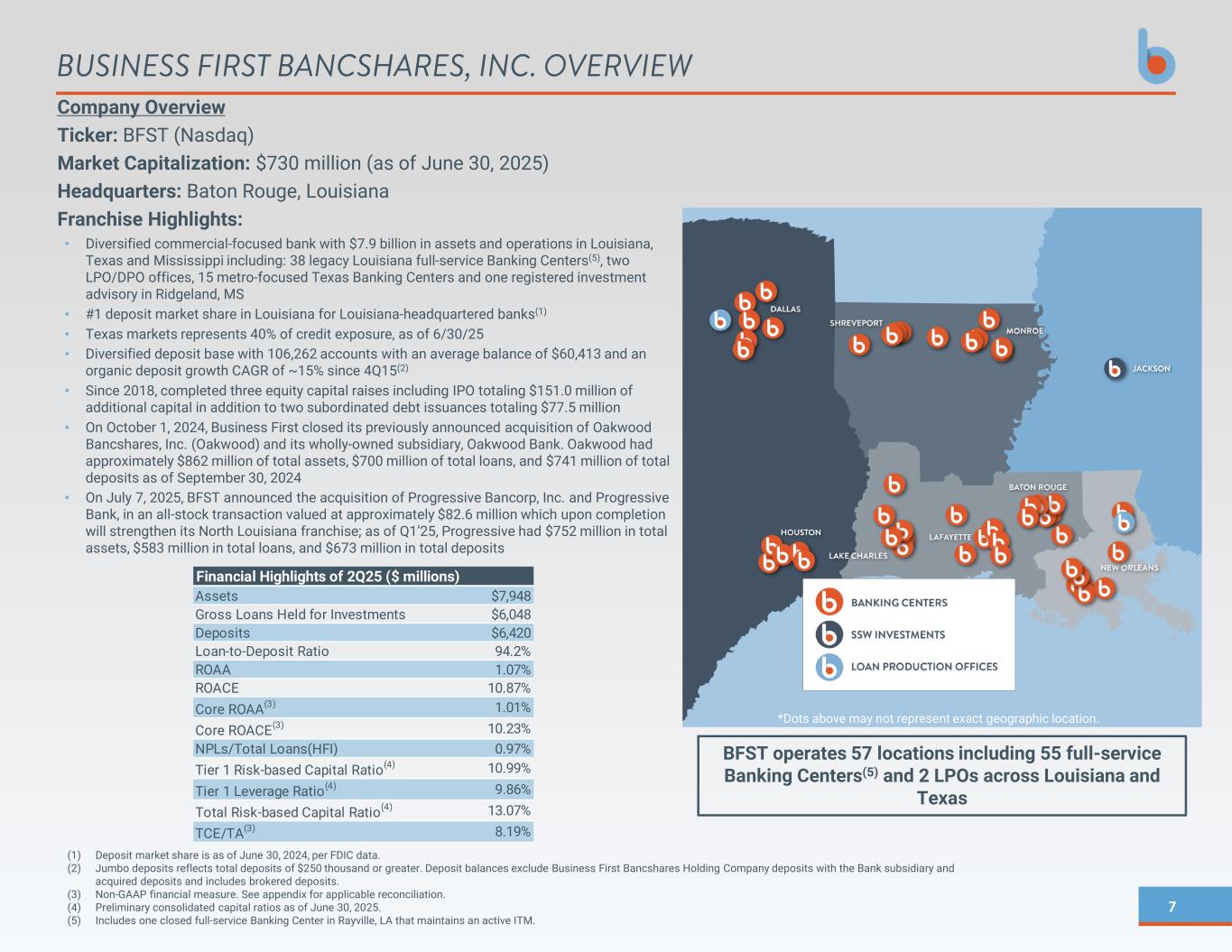
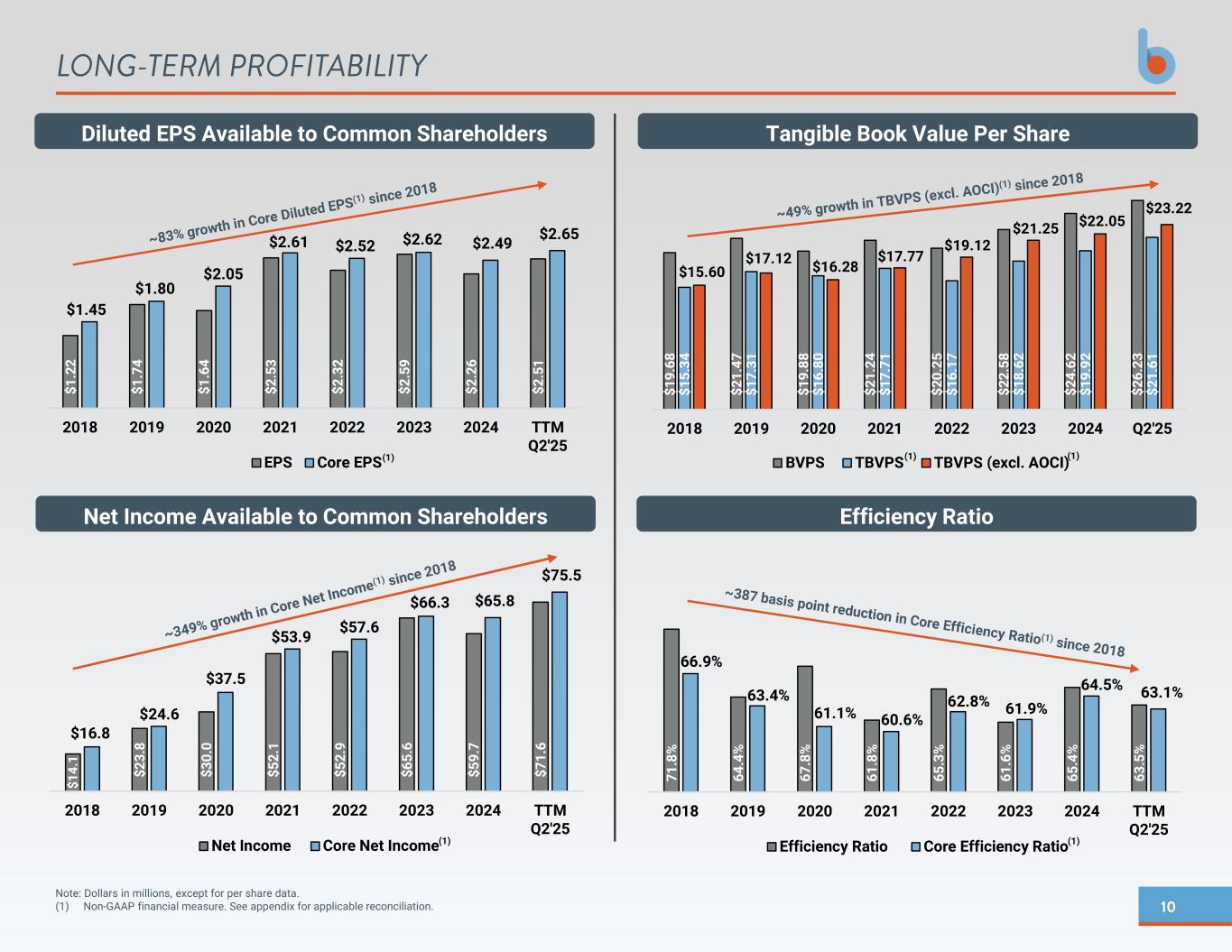
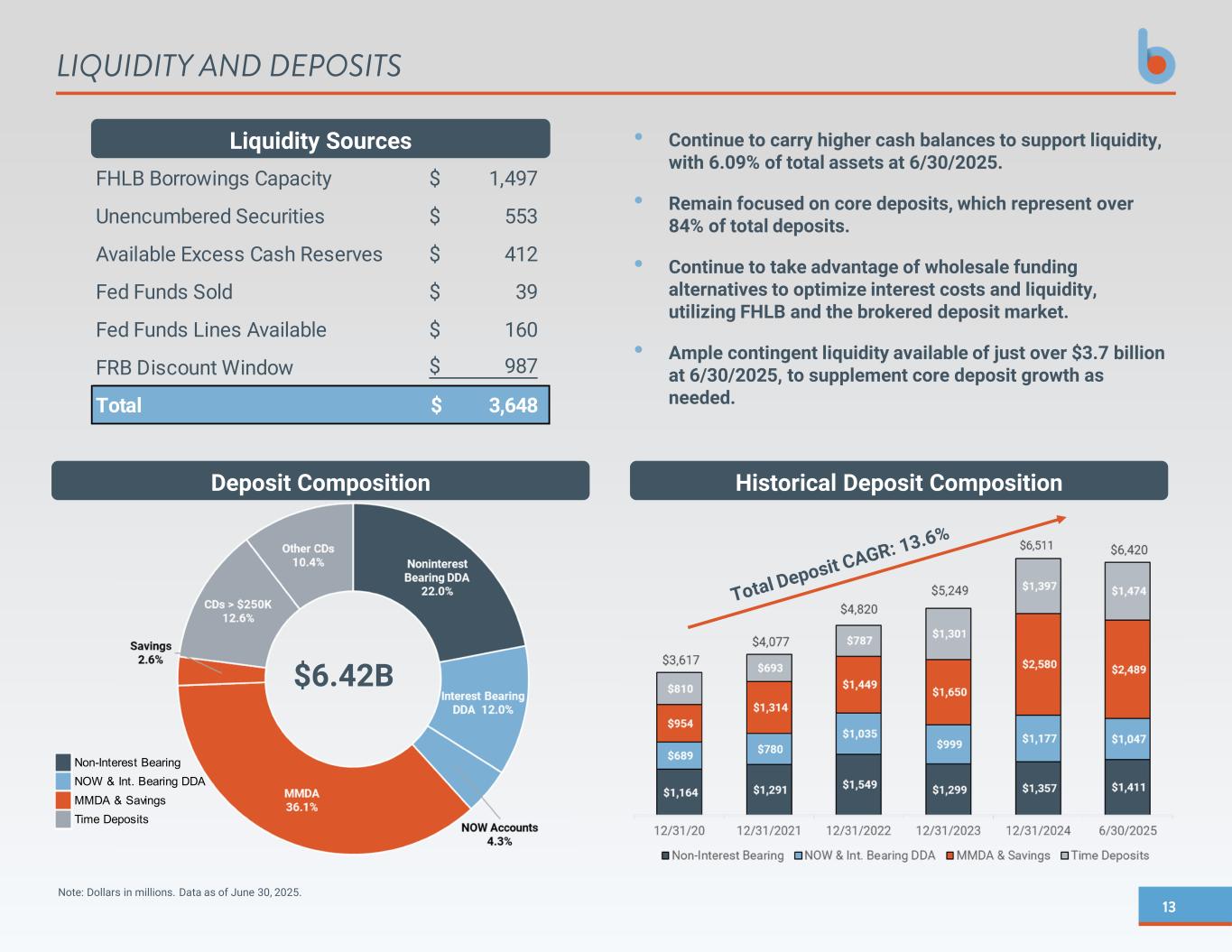
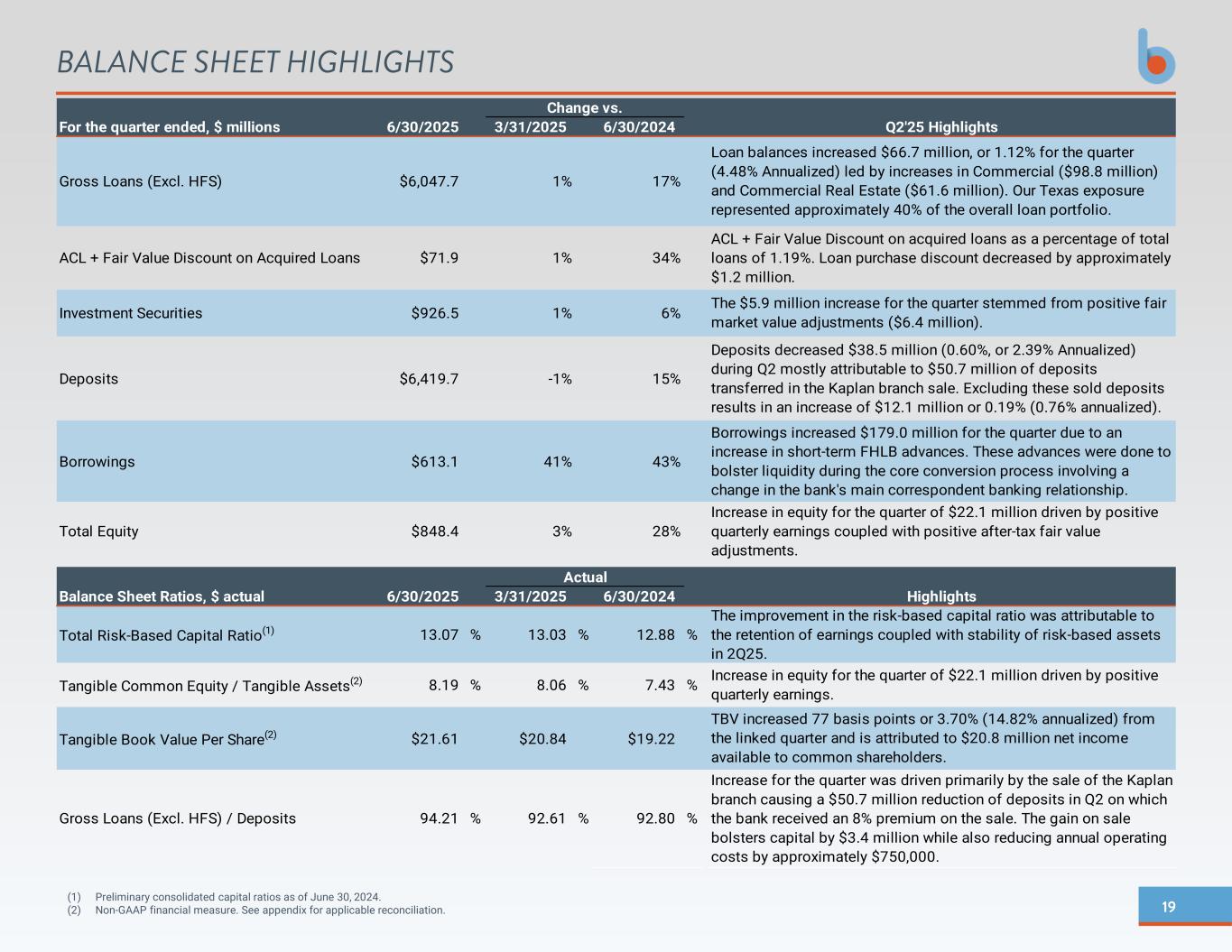
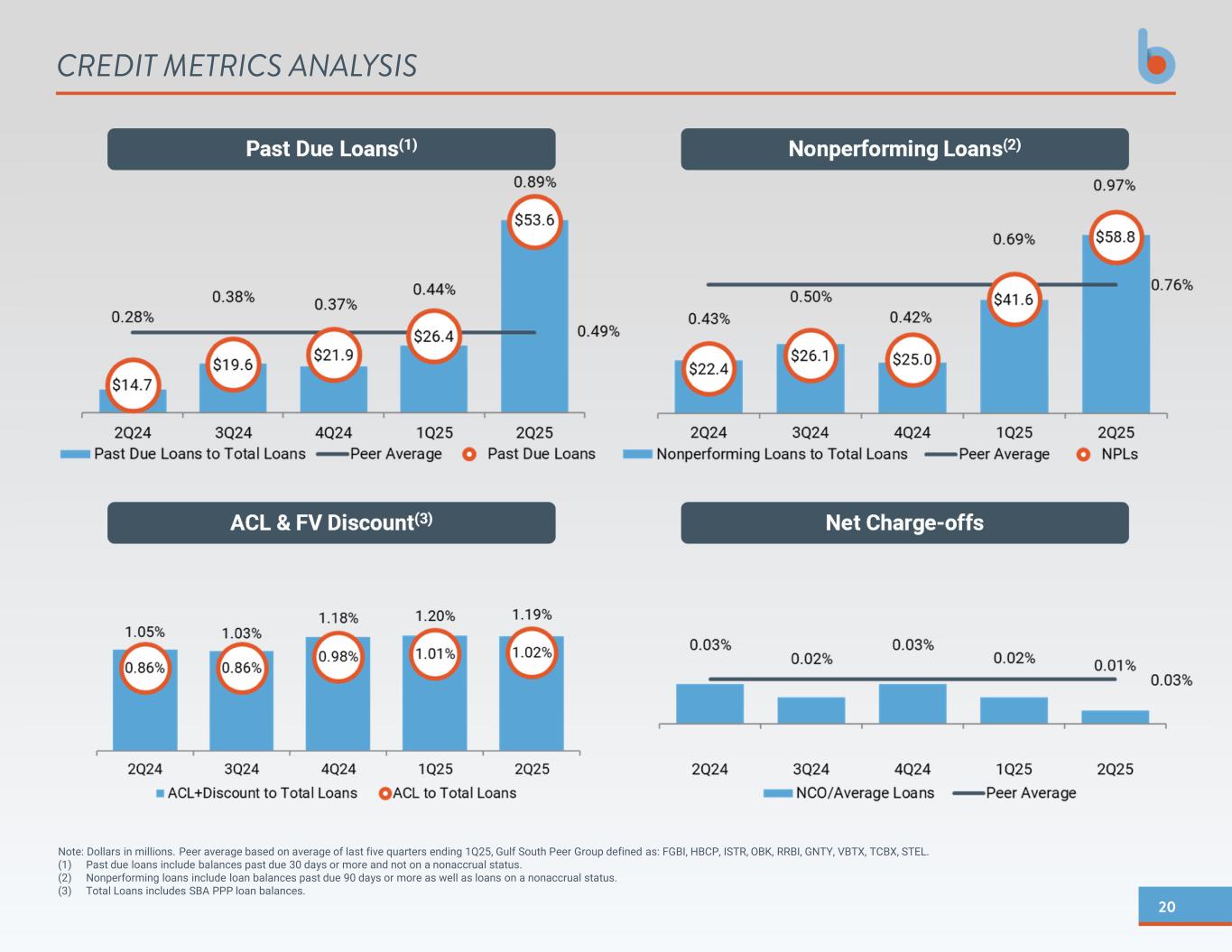
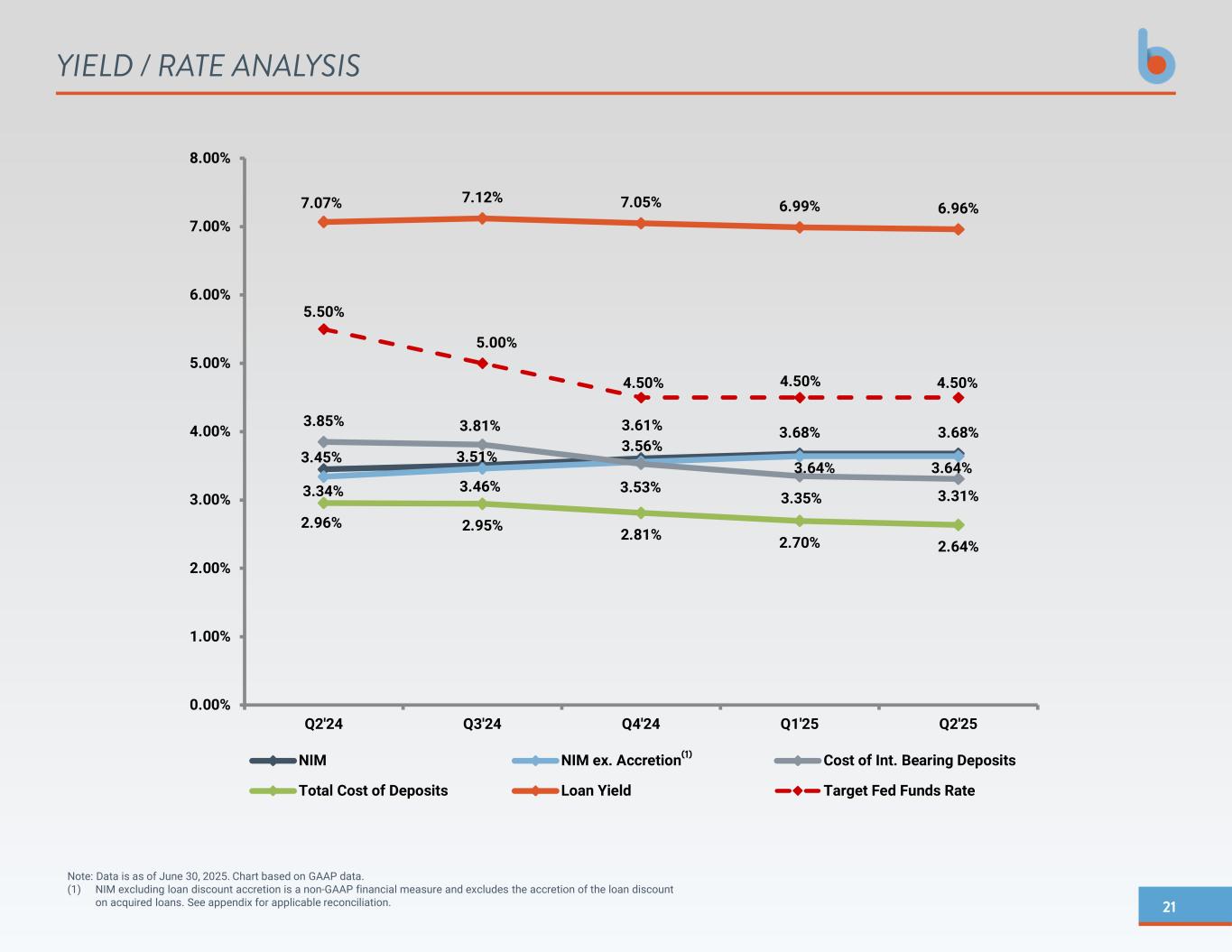
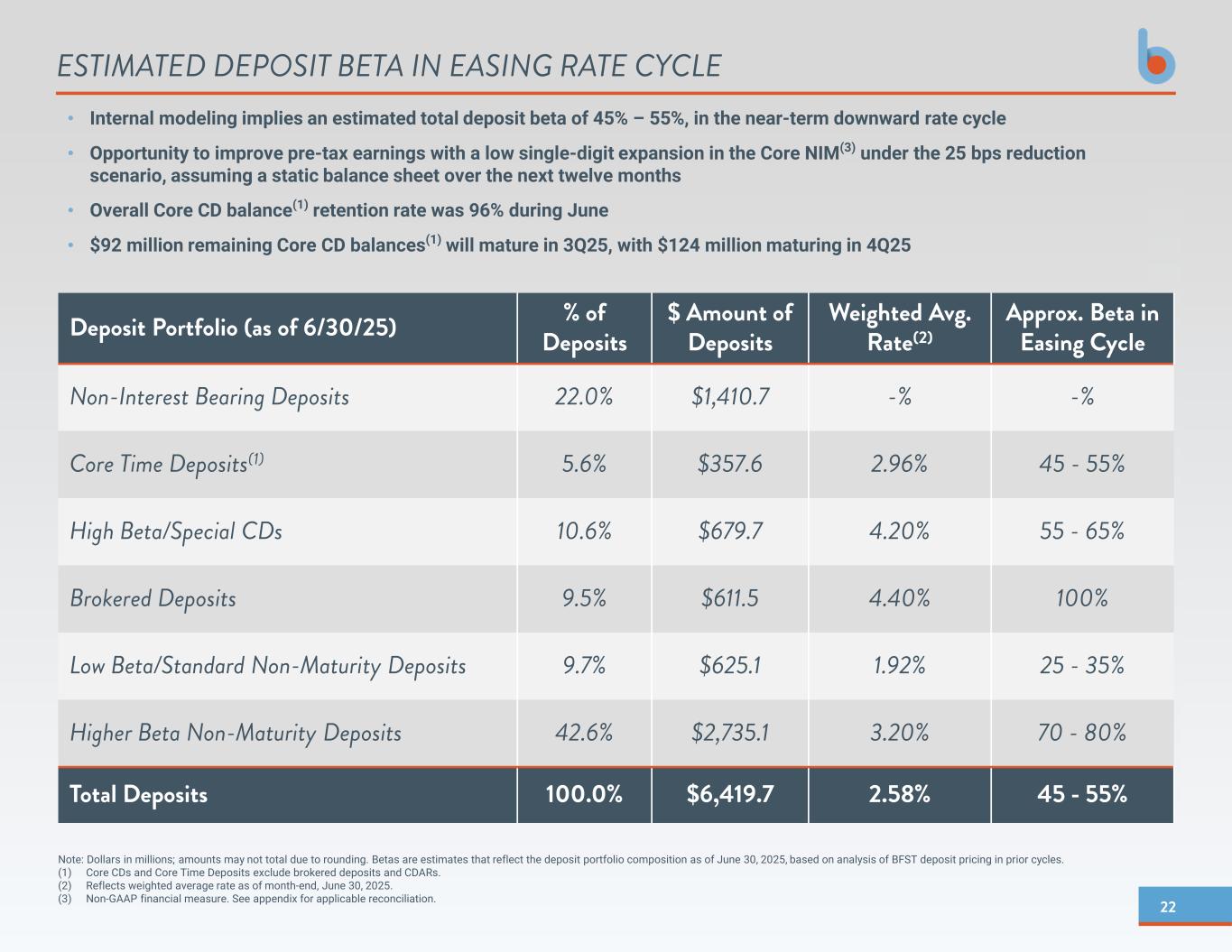
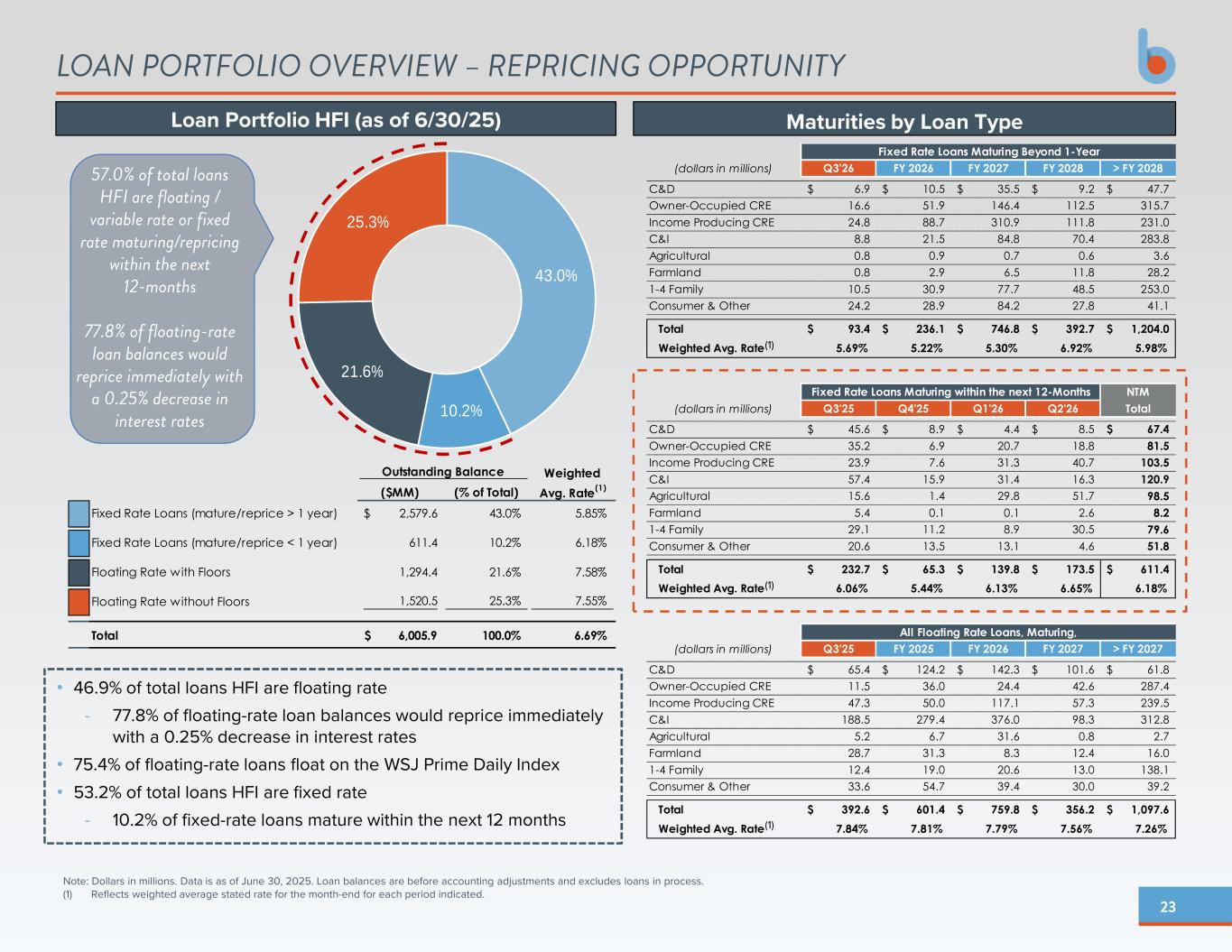
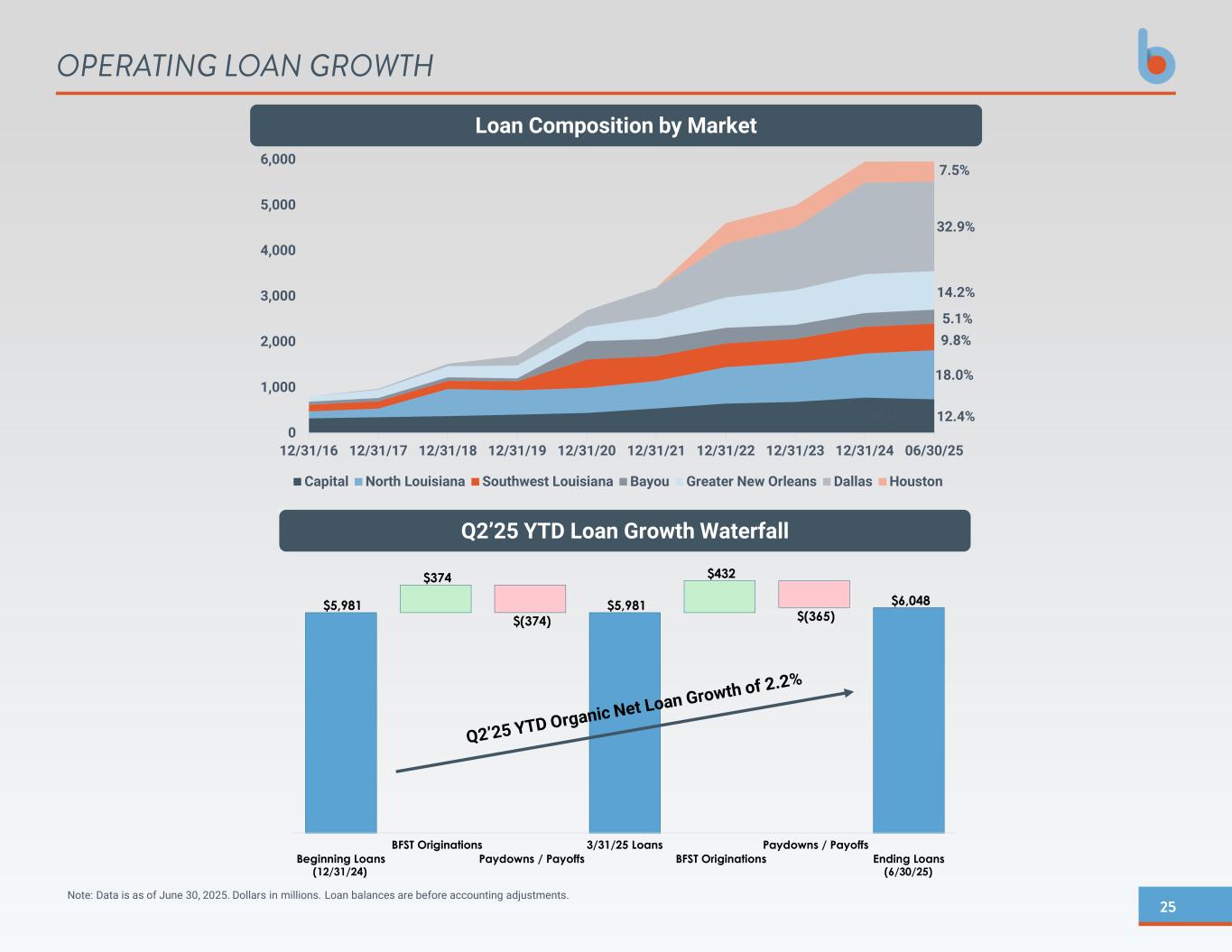
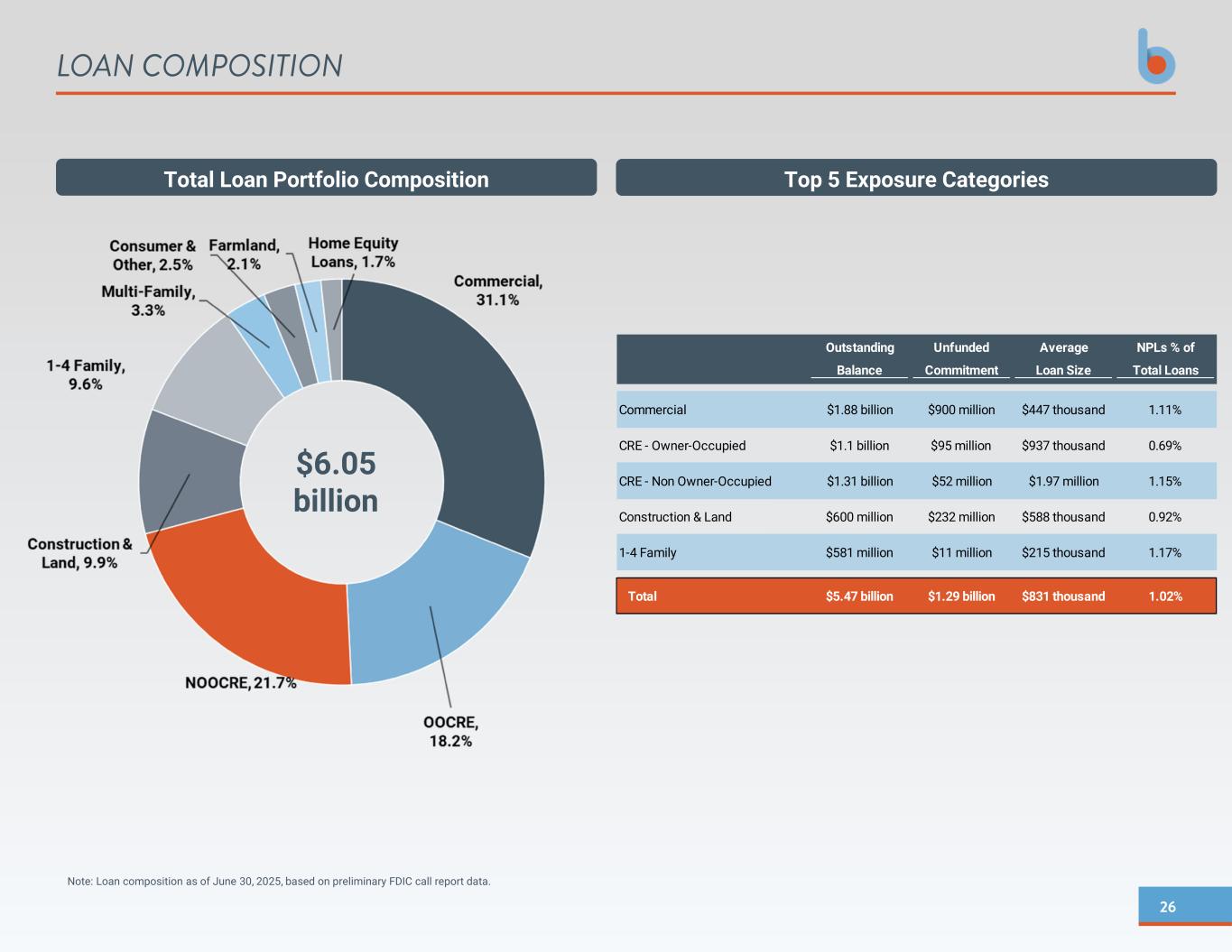
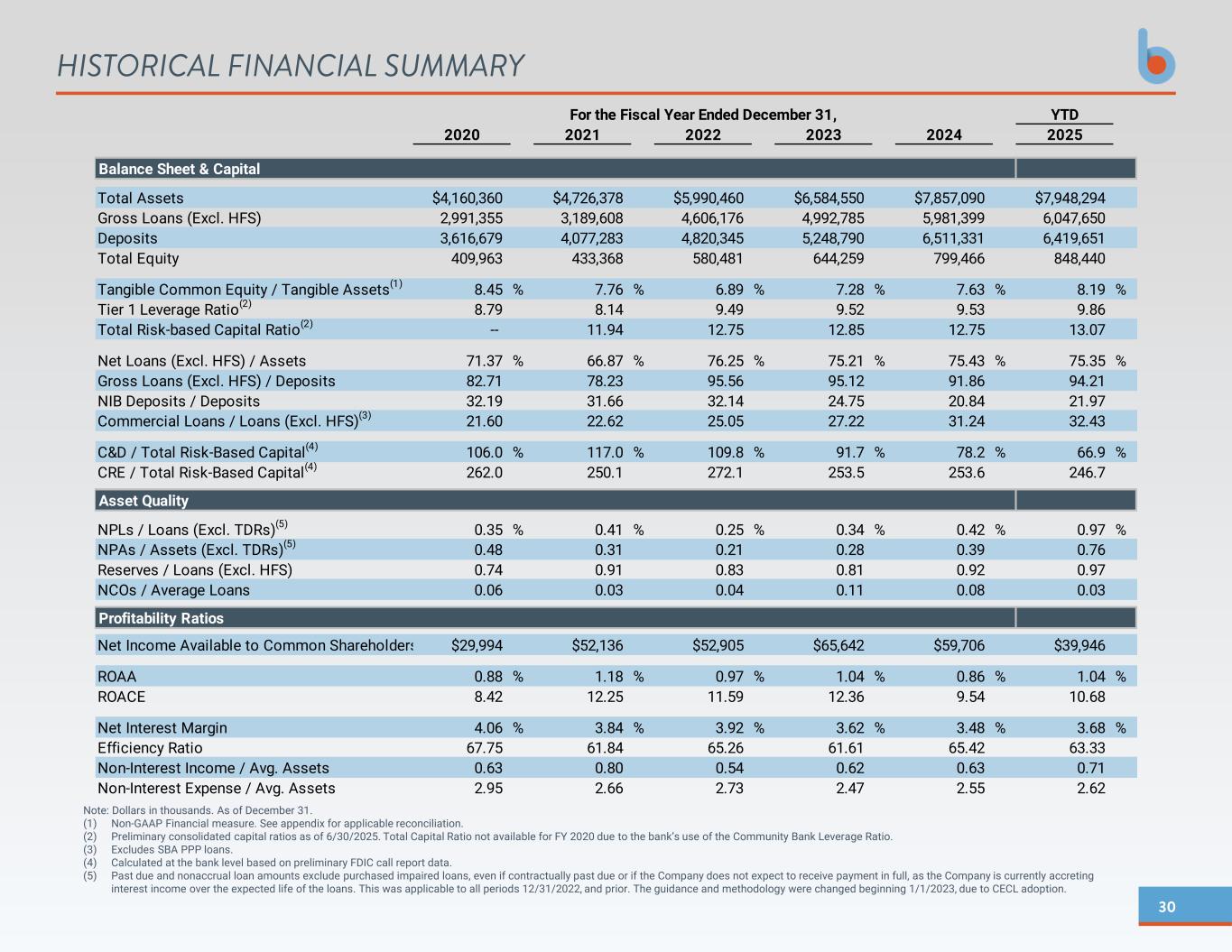
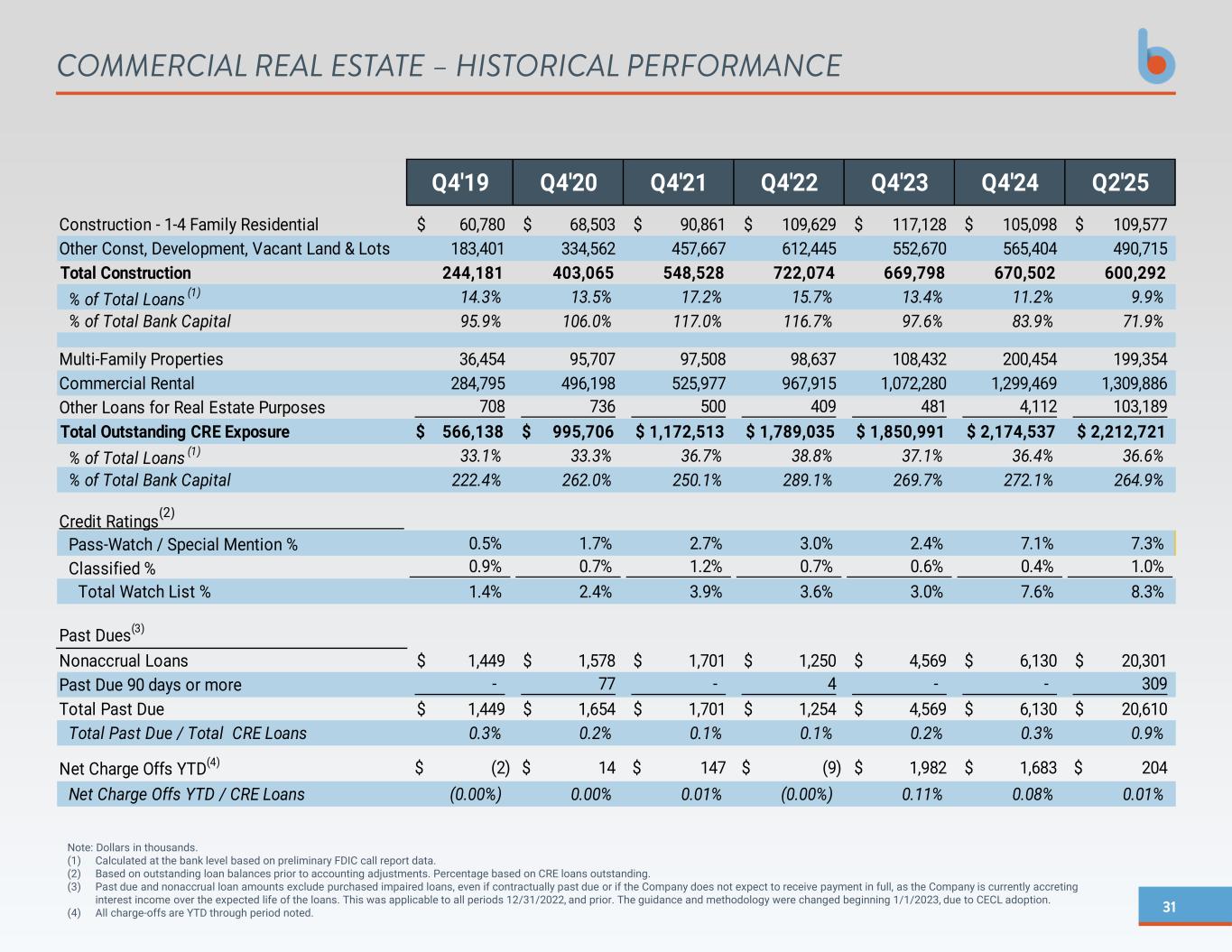
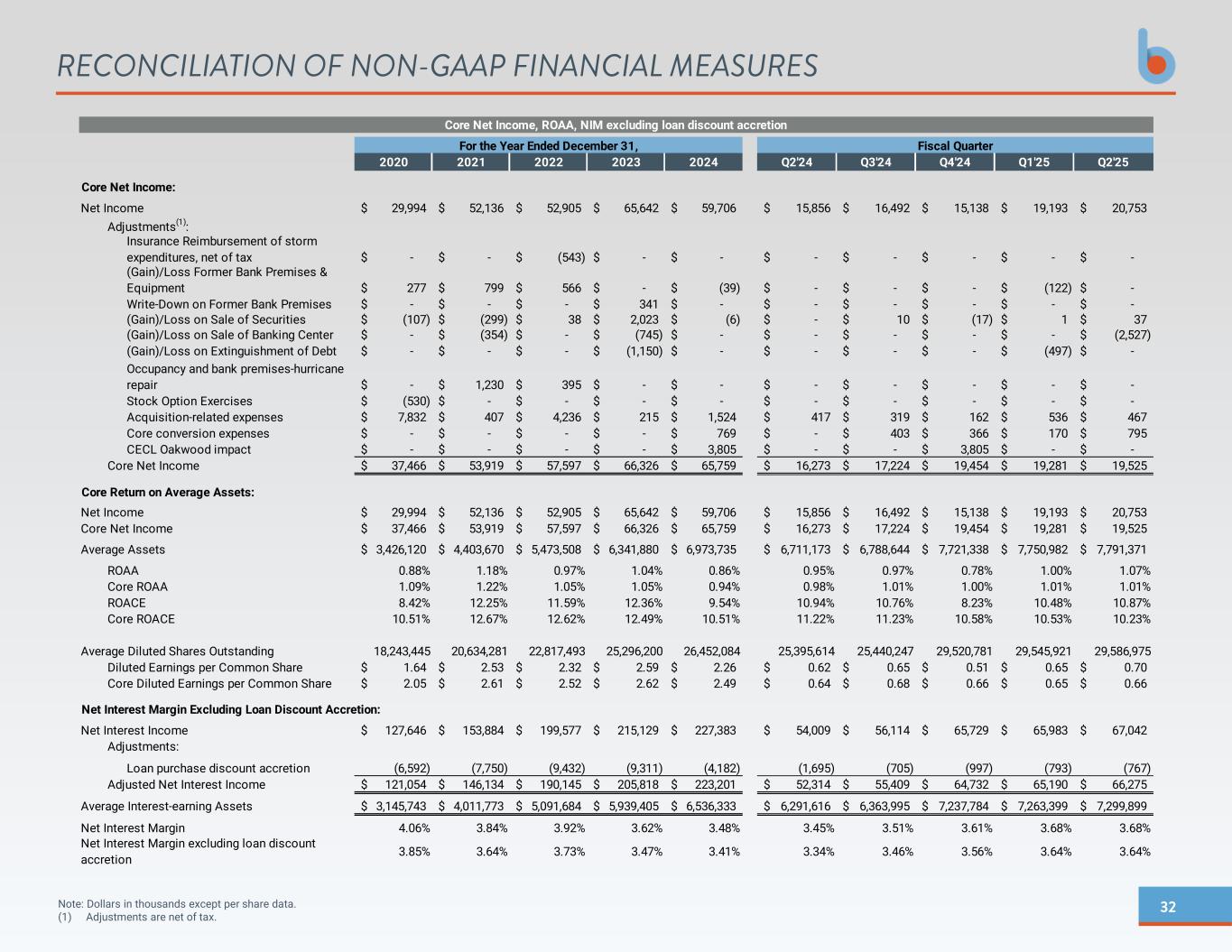
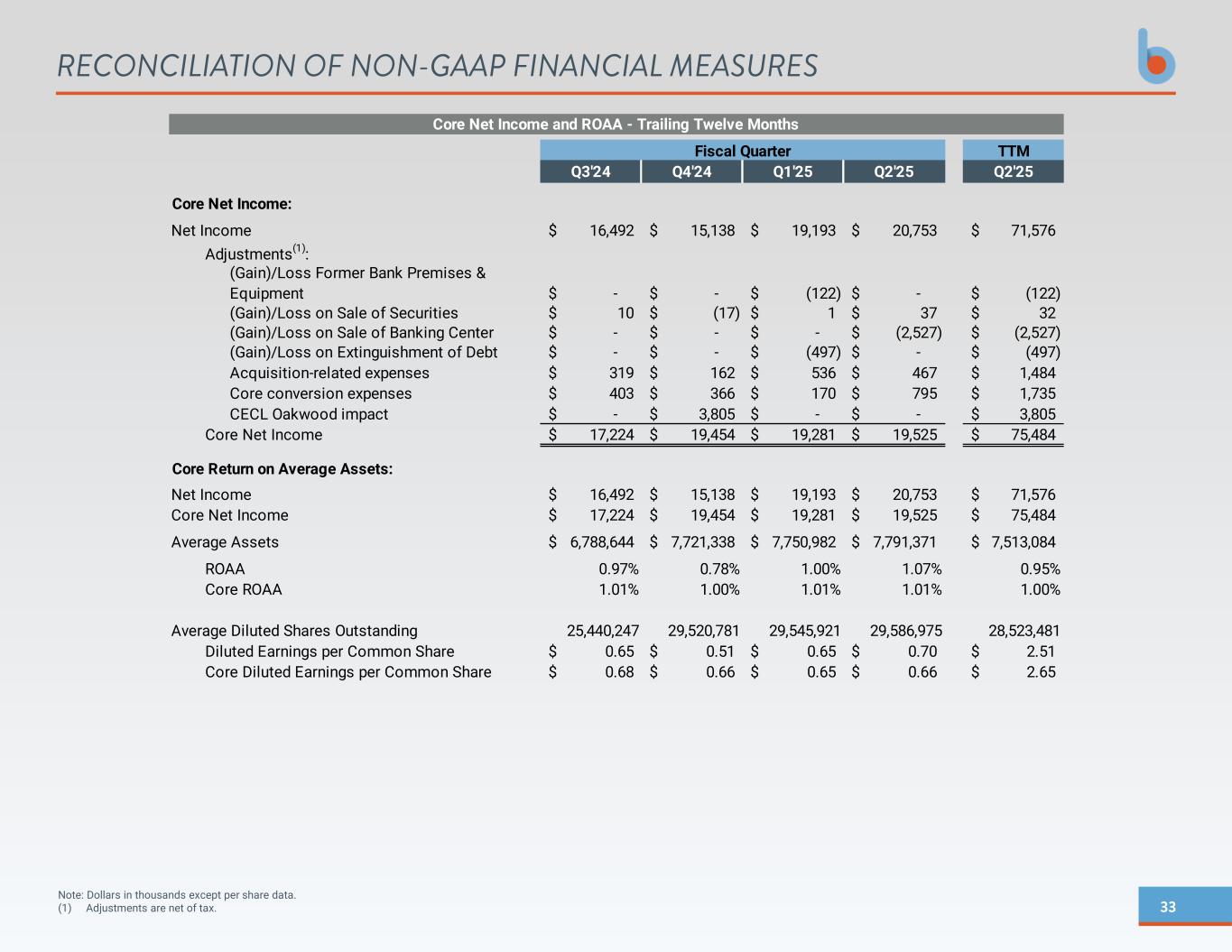
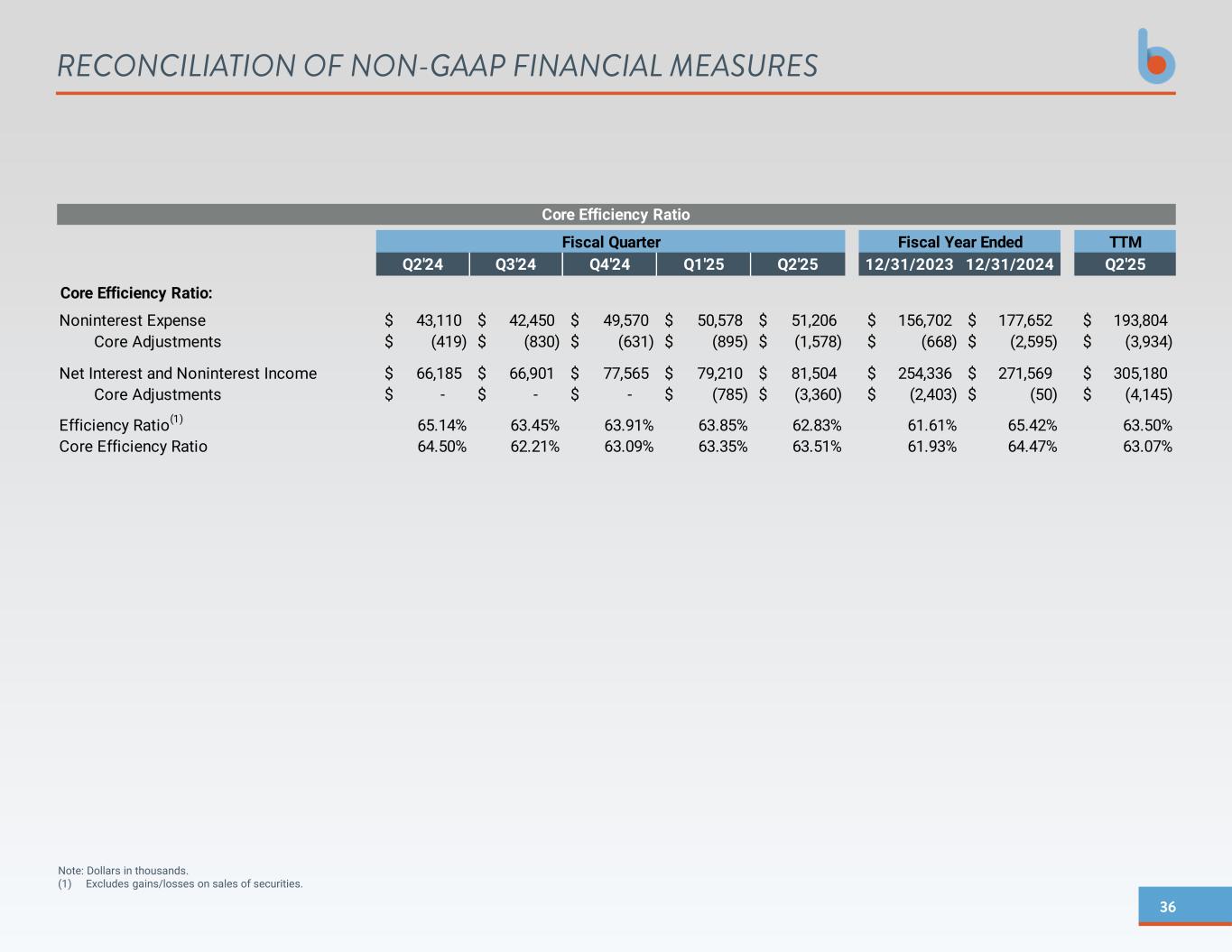
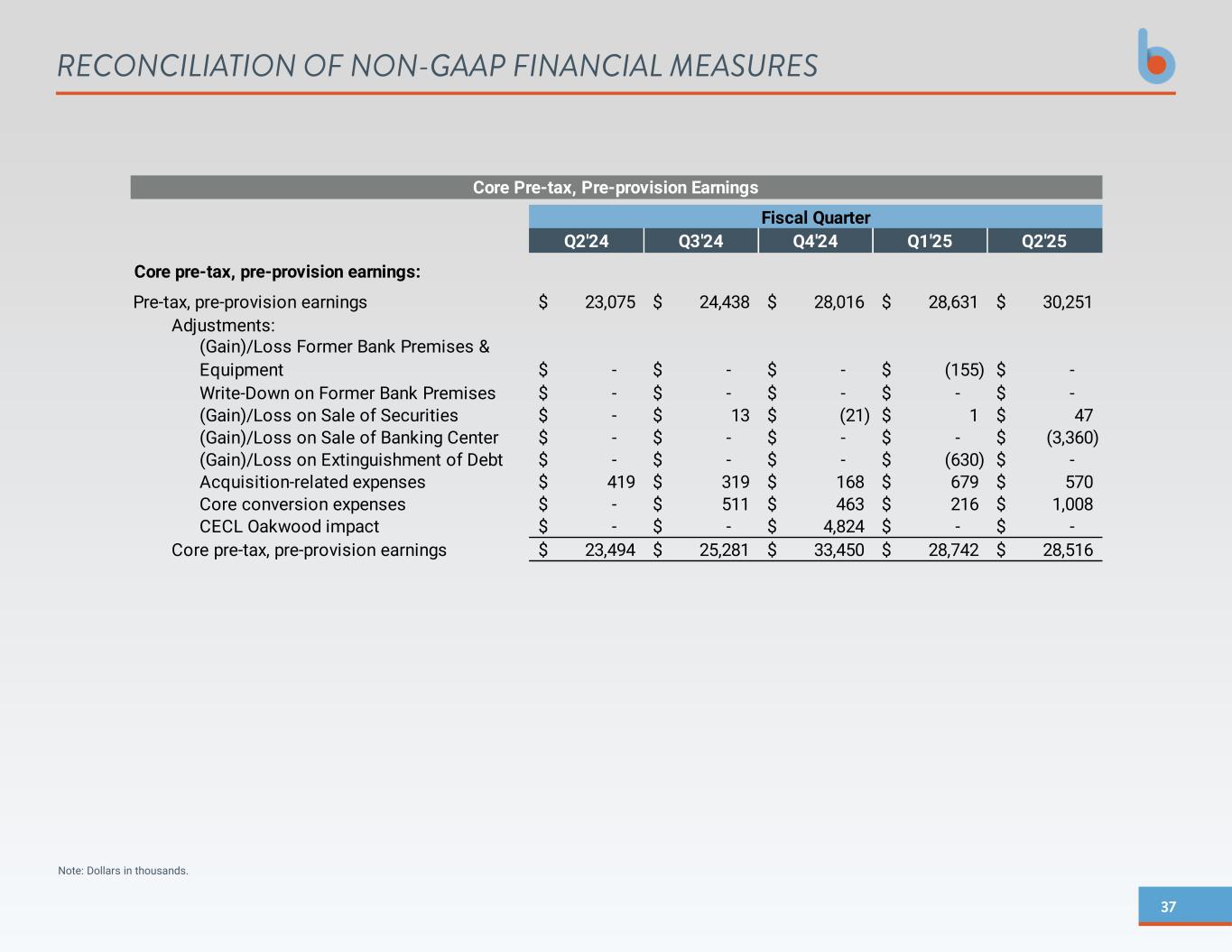
Thank you, Jude, and good morning, everyone. I will take a few moments to review our results and our updated outlook before we proceed to Q&A. In the second quarter, our GAAP net income and earnings per share available to common shareholders were $20.8 million and $0.70, which included a gain of $3.36 million from the sale of a branch we closed on April 4. The GAAP results also reflected an acquisition-related expense of $570,000 and a core conversion expense of $1 million. When excluding these noncore items, our non-GAAP core net income and earnings per share available to common shareholders were $19.5 million and $0.66 per share. From our perspective, the second quarter represented a solid performance with consistent profitability, generating a core return on average assets of 1%. We remained active during the quarter with a successful core conversion that took place over Memorial Day weekend. We sold one location in South Louisiana in early April and announced our acquisition of Progressive Bank, based in North Louisiana. The merger announcement was made earlier this month, but we were busy in the months leading up to it. Looking at our balance sheet, total loans held for investment grew 4.5% on an annualized linked-quarter basis, increasing by $66.7 million from Q1. Paydowns and payoffs slowed somewhat, amounting to $365 million, while new loan production during the quarter was $432 million. Loan growth was primarily driven by commercial and industrial loans and commercial real estate, which rose by $98.8 million and $61.6 million, respectively. This growth was somewhat offset by decreases in construction and residential loans, which fell by $33.4 million and $54.5 million, respectively. Based on unpaid principal balances, text-based loans remained relatively stable at about 40% of our total loan portfolio as of June 30. Total deposits decreased by $38.5 million, mainly due to a net decrease in interest-bearing deposits of $140.9 million on a linked-quarter basis. The net decline was largely a result of withdrawals from financial institution accounts and the earlier branch sale. The reduction in our interest-bearing deposits during the quarter was somewhat strategic, as the weighted average cost of these outflows averaged 4.45%, which we replaced with more efficient sources like brokerage CDs and deposits. Excluding the $50.7 million in deposits moved from the branch sale, our net deposit growth would have been $12.1 million for the linked quarter. It is noteworthy that we replaced over $100 million in high-cost deposit balances with the Oakwood acquisition as part of our strategy. Additionally, noninterest-bearing deposits increased by $102 million or 7.8% on a linked-quarter basis, boosted by a short-term inflow of around $60 million, which was withdrawn after the quarter ended. On the funding side, bank borrowings increased by $179 million or about 41% from the prior quarter. This increase primarily stemmed from a rise in short-term FHLB borrowings, which were utilized at quarter-end to facilitate the transition of our correspondent banking relationship in line with our core conversion. Regarding margins, our GAAP reported net interest margin for the second quarter held steady at 3.68%. The non-GAAP core net interest margin, excluding purchase accounting accretion, also remained unchanged at 3.64%. The growth in interest-earning assets during the second quarter was counteracted by excess funding during the core conversion and additional funding to replace deposits transferred in the branch sale. The lower cost deposits divested from our branch sale caused about a 2 basis point drag on the second-quarter margin, while excess liquidity carried during the quarter accounted for around a 3 basis point drag on the margin. Looking ahead, we expect to maintain somewhat elevated liquidity levels, at least for the near term. Assuming no rate cuts in the next two quarters, we expect deposit costs to remain stable, though our ability to attract and retain lower-cost noninterest-bearing deposit accounts will play a significant role. We are pleased with our management of deposit rates; interest-bearing deposit costs fell by 4 basis points from the previous quarter, with a 26 basis point reduction in the overall cost of money market deposits and a 17 basis point reduction in the cost of time deposits. Notably, in the first quarter, the weighted average cost of total deposits was 2.64%, down 6 basis points from the linked quarter, while the June figure was 2.62%. Further reductions in funding costs will depend on the Fed's interest rate decisions, and we are optimistic about this trend. I want to highlight some key takeaways from our investment presentation on Page 22. We continue to aim for a deposit beta of 45% to 55% concerning rate cuts. Moreover, our overall core CD balance retention rate was 96% in June, reflecting our team's dedication to maintaining core deposit relationships. Currently, we have around $2.8 billion in floating rate loans at a weighted average rate of approximately 7.56% and about $611 million in fixed-rate loans maturing in the next 12 months with a weighted average of 6.18%, which we expect to reprice in the mid-7% range. Additionally, we anticipate loan discount accretion to average between $750,000 and $800,000 per quarter moving forward. Turning to the income statement, our GAAP noninterest expense was $51.2 million, comprising $570,000 in acquisition-related expenses and $1 million in conversion-related expenses. Core noninterest expense for the quarter stood at $49.6 million, which was relatively consistent with the previous quarter. We expect a slight increase in the core expense base in Q3 due to the timing of various investments hitting in Q3 and Q4. However, we should begin to see the partial quarter impact of cost savings from the Oakwood acquisition after the conversion in the fourth quarter. In the second quarter, GAAP noninterest income was $14.4 million, while core noninterest income was $11.1 million. The GAAP results included the previously mentioned $3.36 million gain from the branch sale and a $47,000 loss on the sale of securities. Our noninterest income results for the second quarter were mostly in line with our expectations, though I should note that our SBIC pass-through income was negative $246,000, which was roughly $500,000 lower than anticipated. This component of fee income can be difficult to forecast, but we expect some normalization in the future. Over the long term, we anticipate an upward trend in our core noninterest income, although quarter-to-quarter fluctuations may occur. Lastly, regarding credit migration in the second quarter, nonperforming loans increased from 0.69% in Q1 to 0.97% in Q2, with the uptick caused by negative migration in three separate loan relationships, totaling outstanding principal balances of $23.7 million. Annualized net charge-offs decreased from 0.07% in Q1 to 0.05% in Q2. For the three credits mentioned, we have 34% reserved on one, 14% on another, and we are adequately reserved on the third. We expect to resolve these credits in the third and fourth quarters, with the one that has 34% possibly settled next year. That concludes my prepared remarks. I will now hand the call back to you, Jude, for anything you would like to add before we open up for Q&A.
Good. Thanks, Greg. I don't have anything to add. Yes, why don't we jump into questions.
Speaker 3
I wanted to drill down on the excess liquidity piece related to the core conversion. I guess the first way I read that was that maybe that would go away. But Greg, it sounds like in your prepared comments, you're going to hang on to that excess liquidity for a little bit longer?
Yes. Good question. What we were using liquidity for in the core conversion was we were transferring from a correspondent bank that we've used for a while to a direct-to-Fed relationship. So during that process, we were clearing in 2 different places. So we needed the additional liquidity. I think we'll continue to carry some of that liquidity as we go forward until we get past the core conversion with the Oakwood franchise because we're helping them manage their balance sheet in real-time, too. So having that additional liquidity, which we've kind of had all year long, it's partly been for the conversion, specifically in the second quarter, but also now we're looking at Oakwood's conversion until we get beyond that and just handling everything on one balance sheet, so to speak. We feel that's the right thing to do.
Speaker 3
Got it. That's helpful. And just so I understand the credit moves this quarter, this was simply a migration from substandard nonaccrual and you mostly reserved for this, what it sounds like, given some of your prepared comments?
Yes. The one credit was from the last quarter, and we classified it as nonaccrual then. We have a reserve of about 35% for that credit. It's a commercial and industrial relationship where we're still assessing the collateral. We're making progress toward a resolution, and they have been cooperative. The other two recent moves include one related to commercial real estate and the other to an owner-occupied property. We set aside a $1.6 million reserve for the commercial real estate case. We're working through the resolution for that one, and we're very close to a resolution for the owner-occupied property. These cases are progressing at different rates, but based on the information we have, we believe the reserves we've set are appropriate for the risks involved. We will continue to work toward resolution.
And I'll just emphasize that none of those are surprises. We're just kind of working its way through the system over the course of the year. With each step, you label it something different and it doesn't necessarily change the underlying risk parameters. So feel good about the progress on working our way through that. And as Greg said, we're benefiting from good client communication and we're working towards resolution together as opposed to the bank being any standoff. As a bank, that's what you hope for when you have an issue that you can work with your borrower to get to a good resolution, and we feel like those things are happening.
Speaker 3
One follow-up on that. I mean, all else equal, given you feel like you're close to getting resolution on these. I mean, could we see NPAs probably drop some in the back half of the year, all else equal?
I believe that the three credits represent 50% of the non-performing assets. As we work towards resolving these issues, I expect the numbers will begin to decrease. The most immediate resolution involves a smaller credit of about $4.5 million out of the total $23.7 million, and that resolution is on the horizon. As we address the other two credits, I anticipate significant reductions in those figures, returning us to levels we maintained over the past eight quarters. While I can't guarantee this will happen in the third quarter, I remain hopeful for positive progress throughout the year. These matters do take time, even with collaborative efforts.
Speaker 5
Just wanted to start on the expense outlook. It looks like you were basically flattish quarter-on-quarter on an operating basis. Obviously, you have the systems conversion with Oakwood here coming up cost savings realization. So just trying to get a sense for that $49.6 million this quarter. How should we think about the next quarter or two from a progression point of view? I know there's lots of moving pieces, and you guys have been pretty busy behind the scenes with the FIS conversion and soon to be the Oakwood conversion?
I think we managed good from an expense standpoint, managed to a good spot in the second quarter with a lot of activity going on. I think in the third quarter, some of our expected investments will probably see that shift up into the low $50 million range. I do want to remind you that in the fourth quarter, we're set to close or convert the Oakwood franchise on September 20, so the weekend of September 27. Therefore, the way we usually schedule those is we will only pick up a couple of months of the impact of any kind of cost savings in the fourth quarter. I would think for the remainder of Q3 specifically, it would be in the low $50 million range is what we expect for the run rate.
Speaker 5
It seems like the fourth quarter might be a bit higher. I appreciate that. Moving on to the margin, I understand the impact of excess liquidity and other factors. So, should we expect the core margin to have a slight upward trend from this point? I realize there are various factors at play; loan yields were down compared to the previous quarter, but deposit costs have decreased as well. I'm trying to establish a baseline for the margin and how asset sensitivity could change with the progress of the deal as we look towards next year.
Yes. I think the way we think about margin from here on out is really for the balance of the remainder of the year. We think we can improve margin, as I say, in the 4 to 6 basis points range from here on out for the rest of the year. Now I think it's probably going to trend to maybe be flatter in Q3 and up in Q4, but the timing of that is going to be a little bit tricky based on how we handle the excess liquidity and the deals on the fixed-rate maturities that are coming due and the timing of which some of those price up. So we think that we'll have margin improvement for the rest of the year. The timing of that may be a little tricky as we move forward.
Speaker 5
Okay. Great. One last question, if I may. The loan growth was approximately 4% to 4.5% annualized this quarter. I know you've previously mentioned expecting low single digits. Clearly, the industry is seeing improved pull-through rates and a bit more optimism. Can you discuss the factors influencing that prior outlook? It seems like growth should at least modestly improve considering the current environment, but I would appreciate your thoughts on how we should view growth in the short term.
Yes, we believe that mid-single-digit growth for the remainder of the year is achievable. As you noted, we're receiving more requests and our pipeline is expanding. From our perspective, the growth in tangible book value and capital accumulation we are seeing through our financial performance will be approached with discipline moving forward. Additionally, we have made significant progress in reducing some of our concentration risk. We aim to remain diversified, which generally involves focusing more on commercial and industrial growth, albeit this is somewhat more challenging and tends to be smaller for a bank like ours. I think the previously stated growth range of mid-single digits, between 4% and 6%, may lead us closer to the higher end of that spectrum rather than the lower. However, I don't view this as a fundamental shift in our growth trajectory. As Greg mentioned, growth is not solely our focus; we also consider our margins, tangible book value, capital appreciation, and concentration risk. We want to engage in growth that provides the best outcomes for our shareholders, which requires balance. I believe this range remains accurate, and we anticipate being at the higher end of it, which is encouraging.
Speaker 6
I want to go back to the discussion around the loan yields, and you made a lot of progress there over the last several quarters, but that momentum slowed this quarter. Just looking for more color on kind of what drove the softness in Q2? And then as you look forward, any more commentary about expectations as far as repricing some of these fixed-rate loans we've talked about over the last few quarters?
Yes. The average weighted rate is around 3.60%. The spot rate at the end of June was about 7.40%. We believe our pricing deals are in the mid- to low 7s. While we aim to maximize yield, competition is influencing this, and we may not be as competitive as we'd like. Currently, the pricing on the deals we are evaluating remains in the mid- to low 7s. We have opted out of a few deals due to pricing; we feel this is the right position for us at the moment.
And, Matt, one thing that I'd add is this is readily available from the press release. But the breakdown within the loan portfolio quarter-over-quarter, we had deferred loan fees and our business manager factoring light product that we offer; those fees in that segment were lower to the tune of about $1 million quarter-over-quarter. That just all rolls up in the aggregate loan interest income. And so that's a little flavor for where some of that drag might be coming from. But by product type, C&I and CRE, those individual loan item categories were still up quarter-over-quarter.
Speaker 6
Thanks, Greg and Matt. In your prepared remarks, you noted that FHLB borrowings increased in the second quarter and stayed elevated at the end of the quarter. Will those continue to remain high in the near term, like your comments about overall liquidity for the next quarter or two? Or have they already decreased?
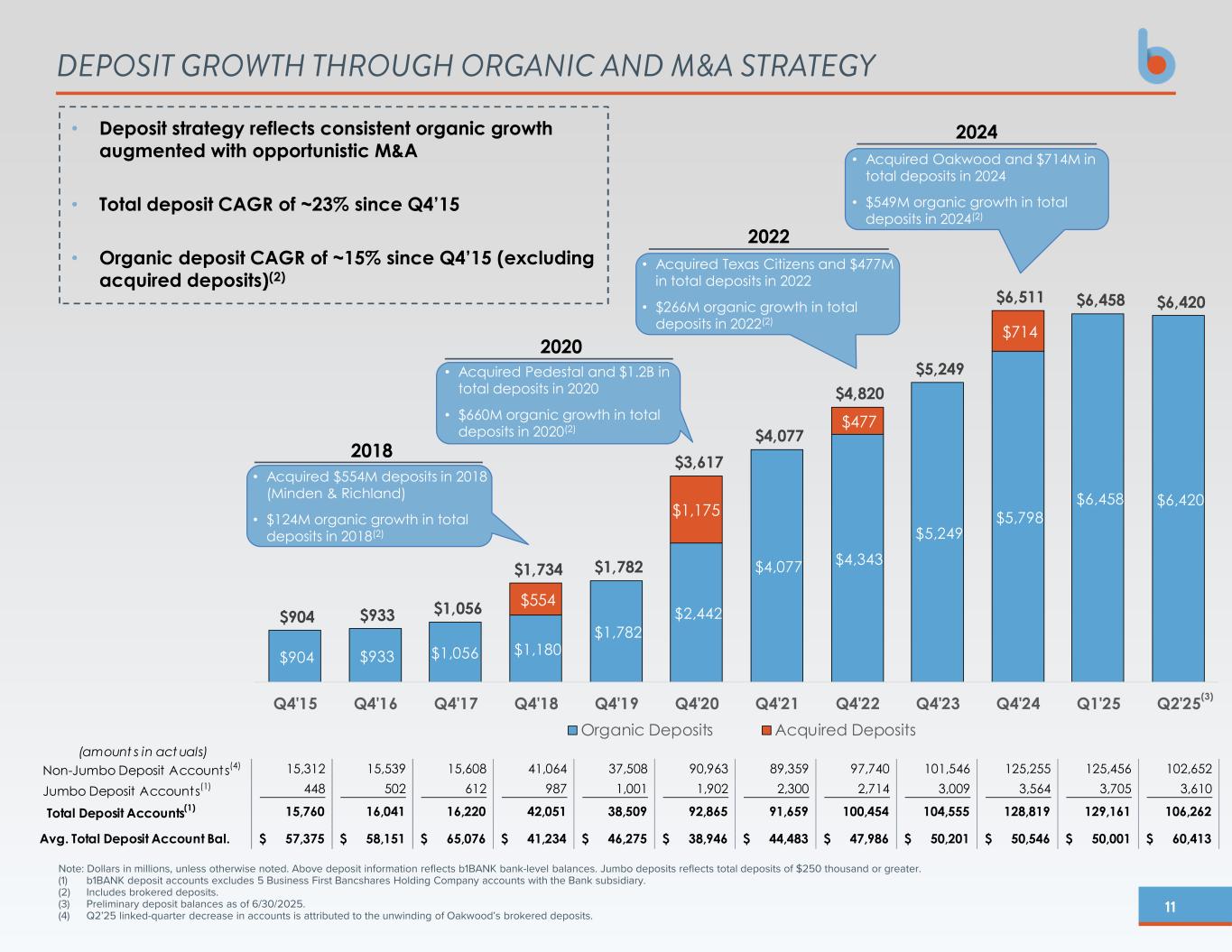
We utilized some of the liquidity build that I mentioned. The reality is that we will continue to assess the best funding options for both the short and long term. At that time, it made the most sense to use the FHLB availability, focusing primarily on short-term needs. To provide some context on funding, we've discussed this in our calls and meetings since announcing the Oakwood acquisition. We planned to manage their balance sheet systematically by addressing higher-priced funding and utilizing our balance sheet or other funding sources for repositioning. Since December 31 of this year, we have successfully managed down or repositioned approximately $140 million of deposits that had a weighted average interest rate of about 5% or slightly higher. We are leveraging different funding sources to systematically navigate this situation and I expect us to continue doing so in the second half of the year. In response to your question, Greg, the figures could fluctuate. From a quarter-over-quarter perspective, they might change or remain stable in appearance, but that does not mean we aren't adjusting them within the quarter to take advantage of pricing opportunities.
Speaker 6
Okay. That's great context, Greg. And then my last question, just going back to the core conversion you guys did recently at the bank. Just any early feedback on that newer platform? And just remind us how much of that switch is more of a near-term cost savings for the bank versus just longer-term savings, more efficiency around future growth?
Yes. I believe it’s still a bit early to assess people's reactions to the new system; it typically takes some time to adjust. We executed the transition successfully over the weekend, which required a lot of preparation. Now we're in the adjustment phase, and managing that change will take time. It's premature to provide a comprehensive evaluation of the experience so far. All the reasons for choosing to implement the new system remain valid, and I believe we will be very pleased with it in the end. One reason for the change was that we feel it positions us better for efficient growth in the future, and I still believe that's the case. I don't expect to see significant savings immediately, partly because we are making other technology investments. We've discussed preparing to be a $10 billion organization and ensuring we have the right systems for reporting and management. The overall costs will likely be comparable to our current capabilities, both in core functions and other technology, which should improve. However, those decisions will unfold over the coming years. I believe one advantage of the new system is that it will not only enhance organic growth efficiency but also enable us to pursue M&A opportunities more aggressively. This confidence is crucial as we look to integrate new partners into our operations. The new system should provide more assurance to our partners, as it is designed to be more effective than the previous one. There are many reasons to move forward even without immediate financial gains. We anticipate that over time, the financial benefits of the new system will become evident. It will take a few months for everyone to adapt, but that’s a normal part of the process. I look forward to 2026 bringing all the changes, and I think our employees and clients will appreciate the improvements by then.
Speaker 7
I wanted to drill down on Smith Shellnut and just get a sense from you of kind of where you think you are in the evolution of the business. I know it's made a lot of progress. It's got $6 billion of AUM. Just curious kind of where you think they are in terms of how much more that can go in the next 12 to 24 months.
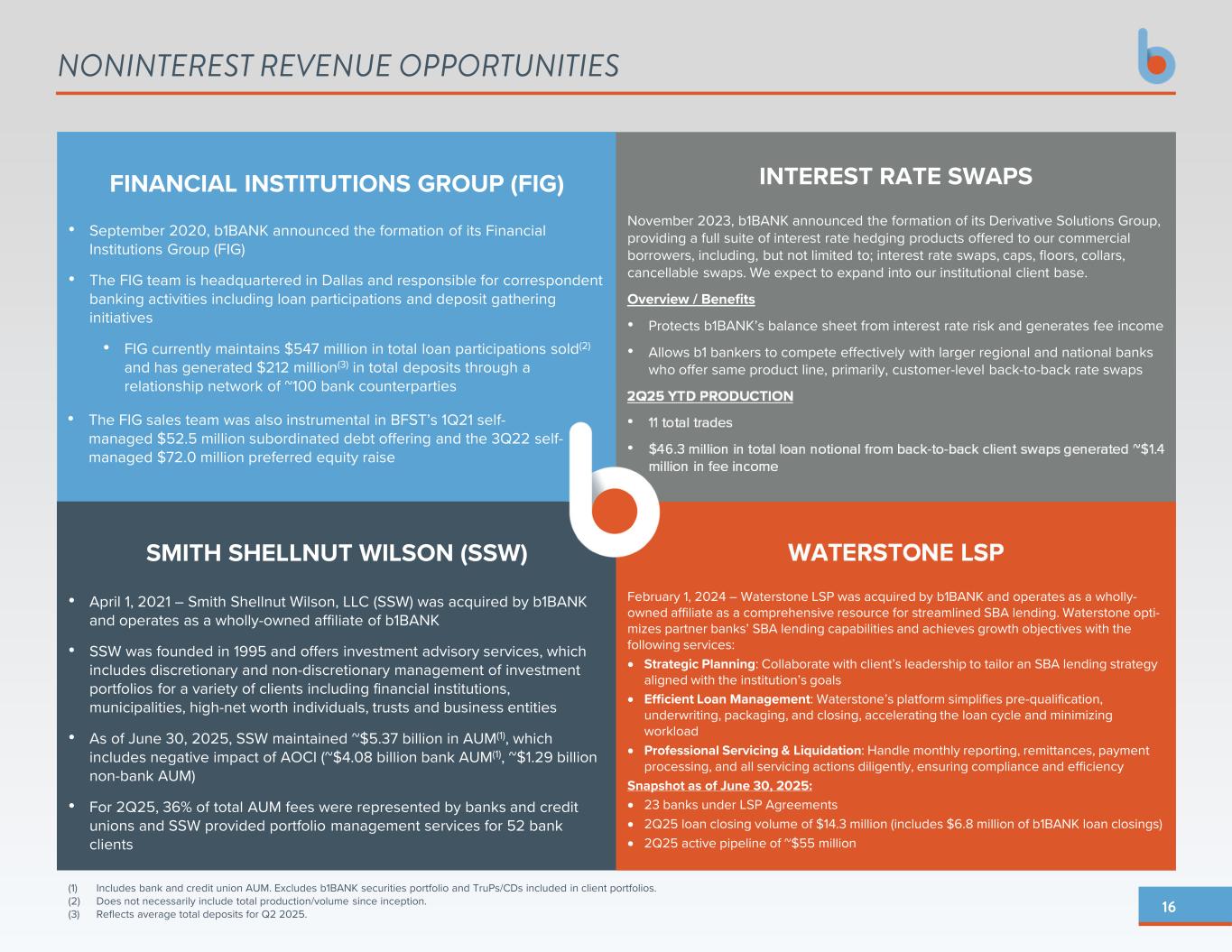
Yes. Good. Thanks, Chris. Appreciate that. That is a part of our business that didn't get quite as much attention, and partly because it hasn't been around as long. But it's a part that we're very excited about and not just Smith Shellnut Wilson taken in isolation, but very excited about the correspondent banking function in general, and that's one of a handful of products that we're offering to our client base, which includes probably 120 banks who are doing business with us in some form or fashion today. I think when we bought SSW and began that process, they had about 40 banks, maybe 45. So we've been able to grow that ships, and I don't see any reason that we won't be able to continue to grow that. I will say that I think growth can mean different things, and it doesn't just mean AUM, although we have been having overdougled the AUM; SSW has over doubled the AUM since joining up with us, and we expect that we'll be able to continue to grow that number. But we're also focused on things that aren't AUM-related, such as providing swaps for our client banks, which is beginning to generate some fee income. I'd like us to continue to grow that part of the business. We've made some significant personnel changes. For the first time this year, we have a senior executive whose full-time job is to coordinate the multiple parts of our correspondent banking network. I think we're feeling really good about the progress that he's making; part of it is we've had a number of products that have run independently, and they haven't really coordinated much in terms of their sales efforts. We're in the process of making sure that we have a unified sales effort. I'll have to say, I think, as Greg says every quarter, and as I say, when I talk about it, I think it's going to continue to be a little rocky in terms of the magnitude each quarter. But if you look at it over time, I think we expect to continue to grow that income in the next 12 to 24 months albeit surprised if we don't double its impact by the end of that time period. We think that there's a lot of potential there and a lot of momentum building internally that doesn't quite show up in the numbers, particularly a little bit masked at this time because of just thinking about our fee income in general because of that SBIC drag. The actual underlying growth in fee income relative to the correspondent banking function is moving in the right direction, and we feel excited about it.
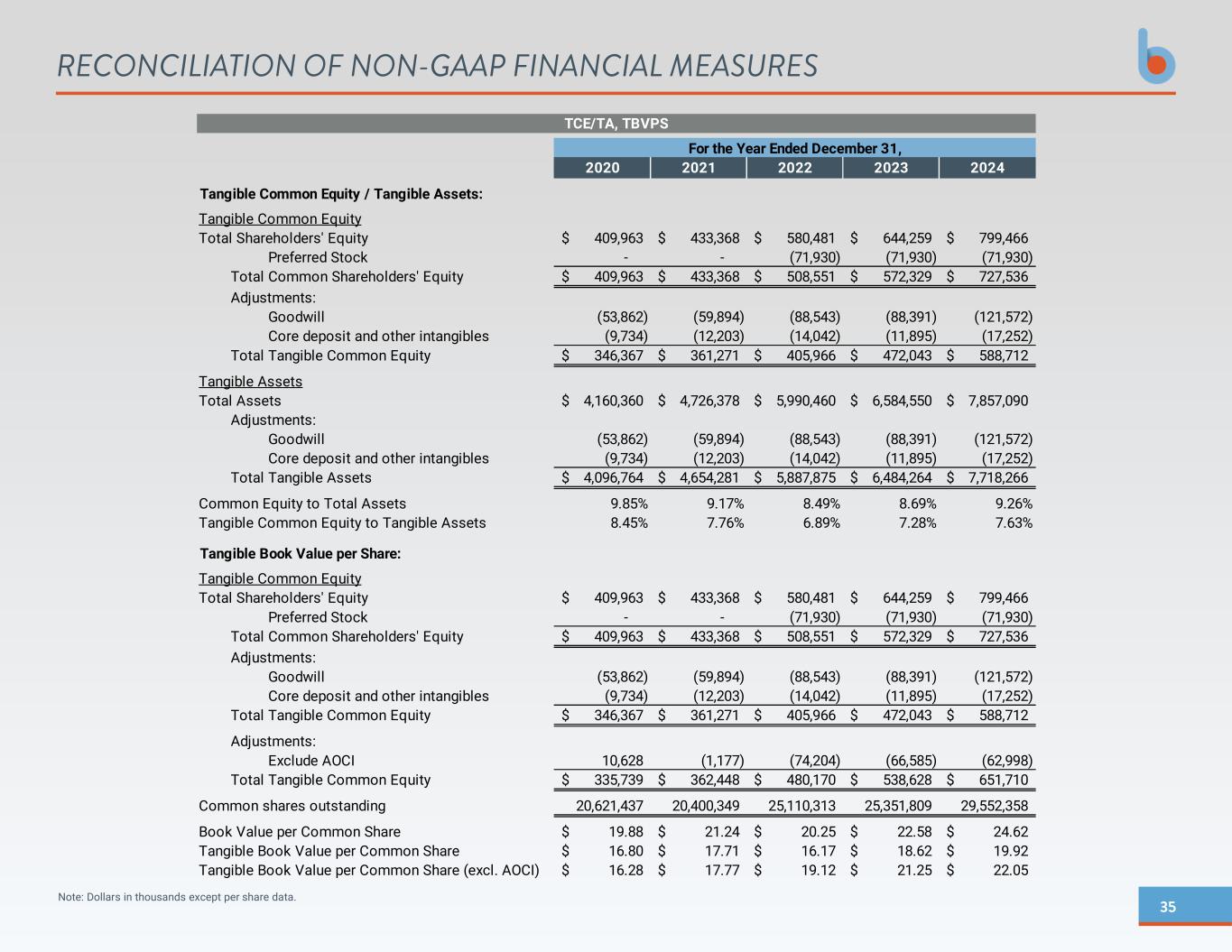
We think that by the end of this year, before we close the acquisition, TCE will be close to 8.50%, total risk-based will be close to 13.30%, $13.40% range. We think in those two ratios kind of the north star for us would be on a risk-based scenario somewhere in the 13.75% area. We think approaching 14% would probably give us enough capital to be opportunistic and ready to deploy the capital in the right way if the opportunity presents itself. I think on the TCE front, that's in the 9% range, low 9% range somewhere in that ballpark. This is probably what we talk about being our normal over time or what we aspire to be.
Yes, I would say, I certainly think that's the direction we want to move in over time, but we've also been operating at a level lower than that and still been able to take advantage of opportunities over the past couple of years in particular. We certainly think there's an optimal level, but we also think there's a practical level, and you kind of have to balance those two. We don't feel like we have to put things on hold not necessarily to get to 9% as long as we're doing the right things to increase incremental levels of income at the right pace, which, over time, ultimately generate a higher capital ratio and higher tangible book value ratio. So 9%, I like that number for kind of an aspirational goal, as Greg said; but I also don't think that we need to not take advantage of opportunities along the way as we've done a good job of over the past two years when those levels have been considerably lower. So really pleased with the movement of things, and that's partly some of these investments paying off.
Speaker 8
A lot of my questions have been asked and answered, but I just want to get a little more specific on the loan growth. Is that mid-single-digit guidance just for the second half of the year, or does it represent 4% to 6% for the entire year? Also, could you discuss the sentiment among the borrower base?
Yes. Well, I think I'll answer your first question. We think that for the whole year, it's probably going to be in the low 4%, 4.5% range just based on the production in the first quarter. We still started with a slow start of the year dragging us down, but we think going forward from here, like Jude mentioned, it could be in the 4% to 6% range, looking like maybe trending towards the higher part of that range. On a run rate.
On a run rate per quarter, annualized per quarter.
Speaker 8
That's really helpful. Is that your appetite? Or do you sense an improved sentiment? Can you talk about that for a moment as well?
I think it's a little bit of both. I mean, we are in a little different position than we were a year ago in terms of our capital levels and kind of what we were talking about earlier; we want to continue to increase those levels, but we also feel like there's room to take advantage of opportunities. We want to be sure that we're selective when we do it, but we want to be sure we take advantage of our opportunities. The downward transition that we made in our construction concentration levels over the past couple of years has really impacted our loan growth over time. But they also put us in a better spot now. We can do some more construction again, being selective and not getting back in a position where we feel like we have too much exposure, but we can kind of incrementally add, pick and choose where we add some exposure there, which we might not have felt as much flexibility to do so a year ago. So a little bit our own. I do think that just anecdotally, you definitely feeling like there's a little more activity out there in general. I think the year has been somewhat muted by just uncertainty around what's going to happen with tariffs, what's going to happen with the Big Beautiful Bill, and things of that nature. We're starting to get some clarity on that or people are just starting to say, 'hey, we got to keep moving on with our lives and taking care of business' much as they have done over the past 5, 6 years despite numerous uncertainties. At some point, particularly the small businesses that we deal with, they just have to keep on keeping on. So I think you're seeing a little bit of that, a little resolution of whatever the external circumstances are; we're going to continue to do our thing internally. I think you're feeling a little bit of positive momentum across our markets as we round up the year and move into 2026. I don't see anybody at the table having any different opinion or, is that...?
I have to agree with that.
I believe other banks are becoming more aggressive, which is contributing to increased competition in loan yields as they look to seize opportunities. We have aimed for consistency in our operations over the past few years, maintaining a balanced approach. Some banks that may have scaled back are now resuming activities, reflecting a shared positive sentiment in the industry, which is encouraging. We are ready to do business and are excited about the industry aligning with this mindset.
Speaker 8
I appreciate that commentary. I just wanted to switch to fees for a moment. I definitely heard the confidence in the Smith Shellnut Wilson team. The Smith factor this quarter was that pass-through loss. What are the lines you have like kind of more near-term composite that can kind of just build across the back half of the year, getting more looking at the fee income line specifically?
Yes. There are two key areas to focus on. One is our SBA loan services, which we provide through Waterstone in Houston. We've seen them add four bank clients over the past quarter, and our internal participation in SBA originations is also increasing. While it's not dramatically impactful yet, it's definitely moving in the right direction for future growth. Regardless of the political context, SBA programs are among those with the most bipartisan support, and we believe this opportunity will expand with time. We're also experiencing significant momentum in our derivatives business, where we offer interest rate swaps to help our clients and other banks tailor loan pricing. We're seeing more successes in this area, indicating that our bankers are becoming more comfortable and are better able to assist our clients. We have only just started to offer this to other banks, and our strategy is to first provide these services to our own clients to ensure we are comfortable before extending them to others. In each partnership, whether it's with SSW, Waterstone, or our derivatives business, we begin by working with those who can serve our clients and then extend those offerings to community banks. We expect to see more opportunities, especially around 2026 and 2027. The increasing pace of successes gives us confidence that these will be areas contributing positively to our earnings over the next few years. Greg, do you have anything else to add?
No, I think you mentioned Waterstone at the beginning. Since our acquisition on February 1 last year, we have increased the number of banks they work with. This is due to their involvement in prequalification, underwriting, packaging, post-closing servicing, and assisting with dialogue with the SBA for any problem loans. This has proven to be a valuable resource for these banks, and we are approaching a doubling of their business since our takeover. We are excited about this, especially with a strong pipeline for the second half of 2025. We feel very confident and enthusiastic about it.
I think over time, we'll look to add some of these product capabilities. You know there are correspondent banks who do a really good job for these banks, but there aren't many corresponding banks that offer some of these slightly more complicated, sophisticated products. We believe that's a role that we can serve. So we'll continue, particularly with some of the governmental lending stuff, looking for further opportunity in those areas.
Operator
Thank you. There are no further questions. I'll now turn the call back over to Jude for closing remarks.
Thank you all for joining us today. It appears we are experiencing a positive earnings season as a bank, and the community banking industry is also showing signs of optimism that we hope to build on. Banking is about consistent incremental improvement, refining our processes quarter-to-quarter, and being ready for opportunities. I believe we have excelled in this area, especially over the past few years, focusing on gradual improvements. When opportunities for partnerships, like those with Oakwood or Progressive, arise, we are well-prepared in terms of capital, knowledge, and technology. We will keep investing and concentrating on the small details that can lead to significant outcomes over time. Thank you for your support, and we look forward to speaking with you again in about three months. Take care.
Operator
The meeting has now concluded. Thank you all for joining. You may now disconnect.