Operator
Ladies and gentlemen, thank you for standing by. My name is Desiree and I will be your conference operator today. At this time, I would like to welcome everyone to the Business First Bank Shares Q4 2025 Earnings Call. All lines have been placed on mute to prevent any background noise. After the speakers' remarks, there will be a question and answer session. If you would like to ask a question during this time, simply press star followed by the number 1 on the telephone keypad. If you would like to withdraw your question again, press the star 1. I would now like to turn the conference over to Matt Seeley. You may begin.
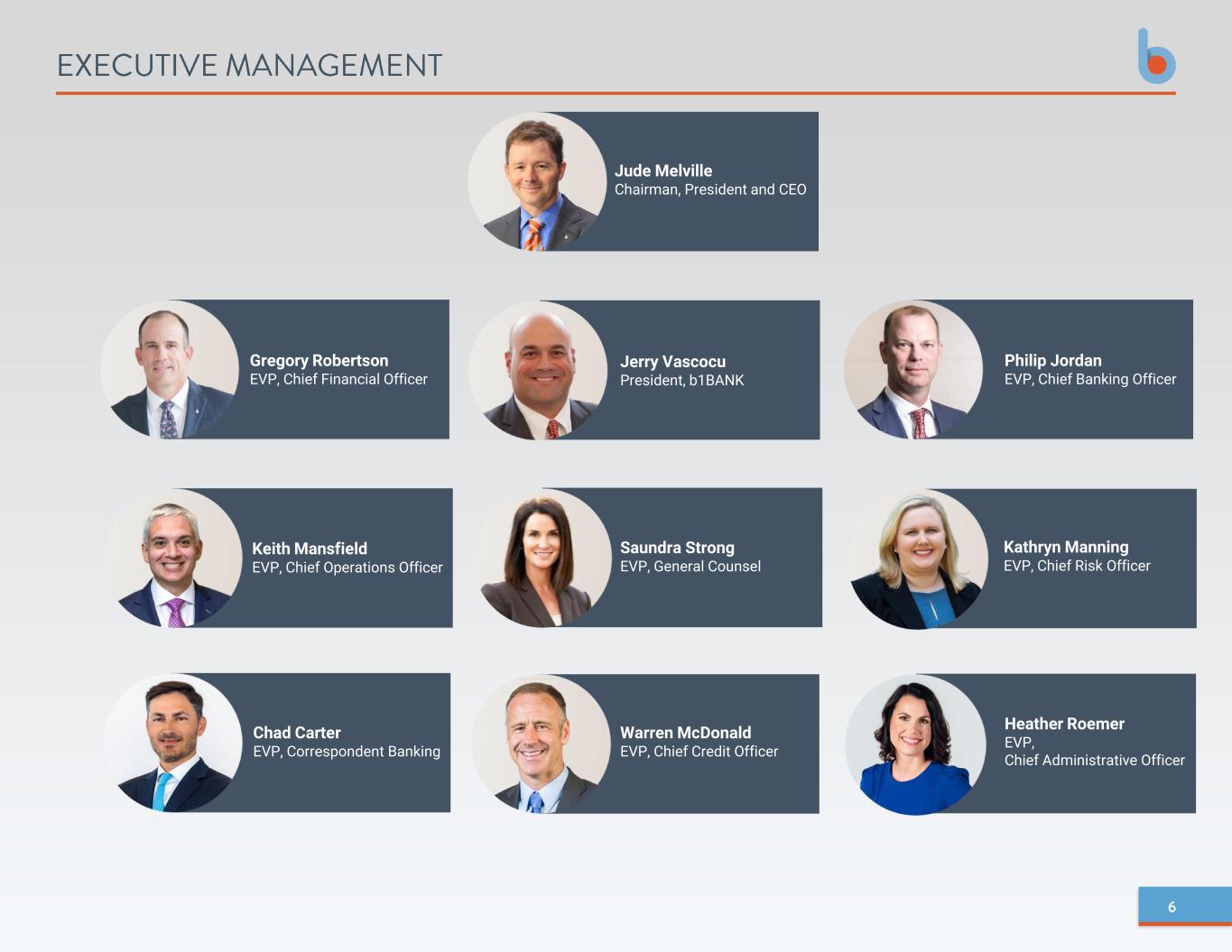
Good afternoon, and thank you all for joining. Earlier today, we issued our fourth quarter 2025 earnings press release, a copy of which is available on our website, along with the slide presentation that we will reference during today's call. Please refer to slide three of our presentation, which includes our safe harbor statements regarding forward-looking statements and the use of non-GAAP financial measures. For those of you joining by phone, please note the slide presentation is available on our website at www.b1bank.com. Please also note our safe harbor statements are available on page 6 of our earnings press release that was filed with the SEC today. All comments made during today's call are subject to the safe harbor statements in our slide presentation and earnings release. I'm joined this afternoon by Business First Bank Shares Chairman and CEO Jude Melville, Chief Financial Officer Greg Robertson, Chief Banking Officer Philip Jordan, and President of B-1 Bank, Jerry Vaskakue. After the presentation, we'll be happy to address any questions you may have. And with that, I'll turn the call over to you, Jude.
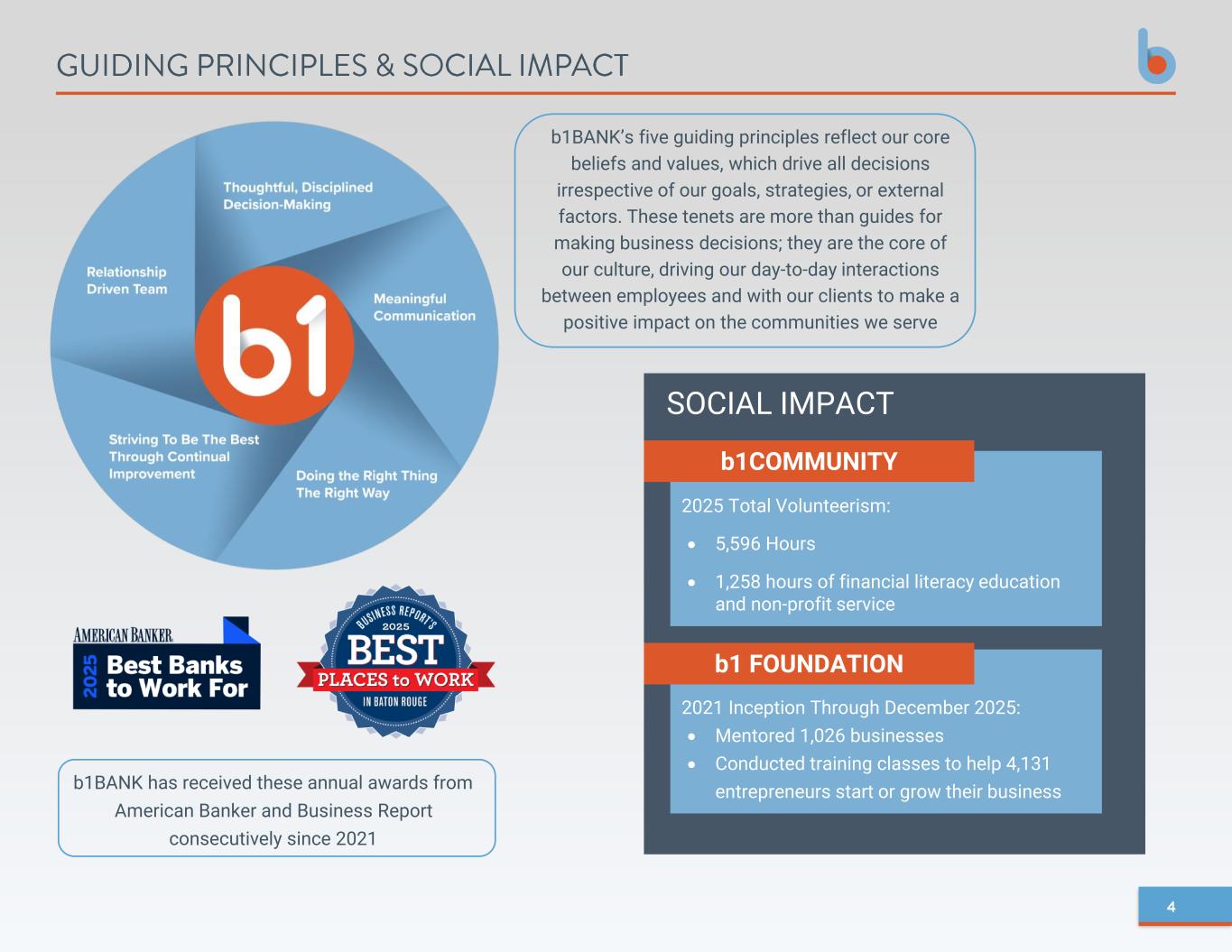
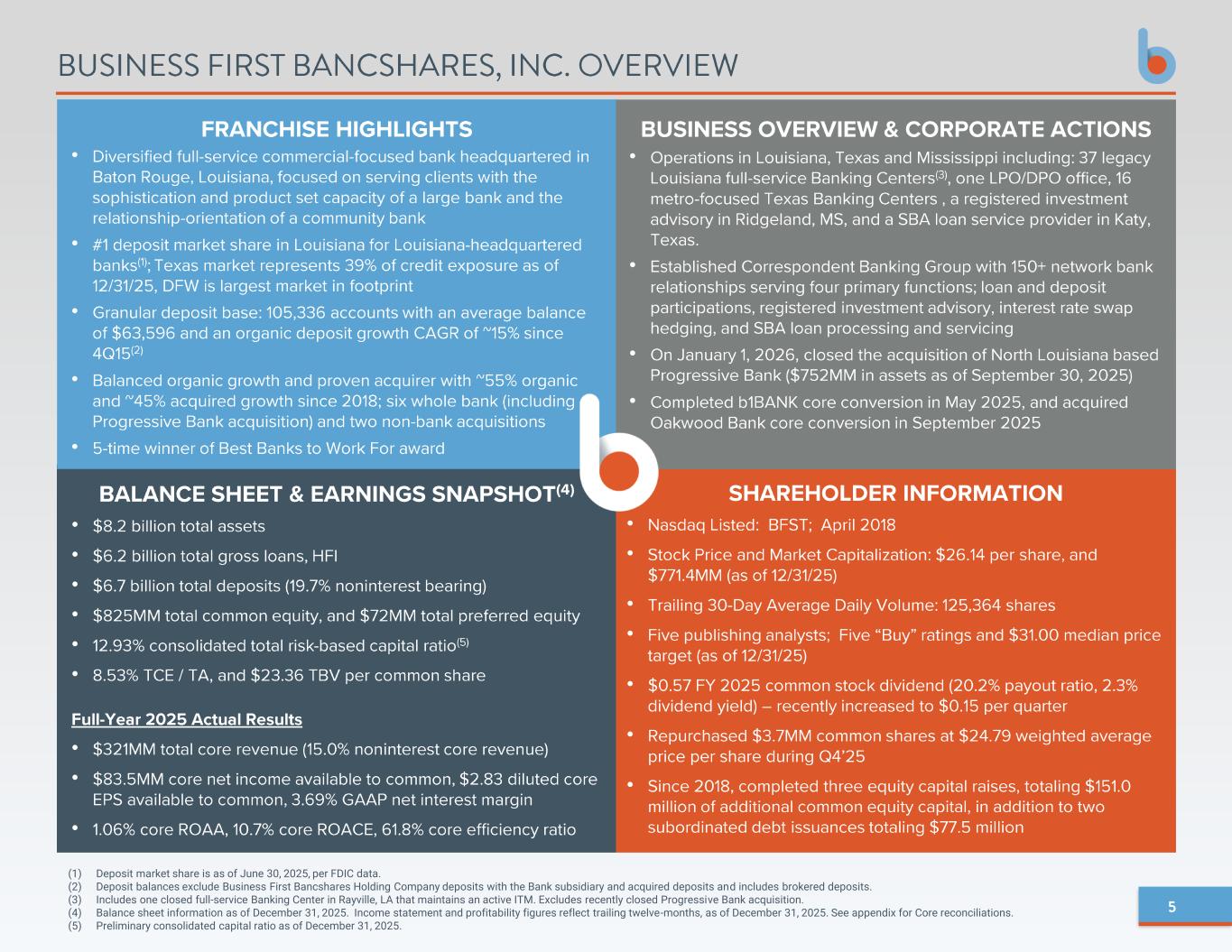
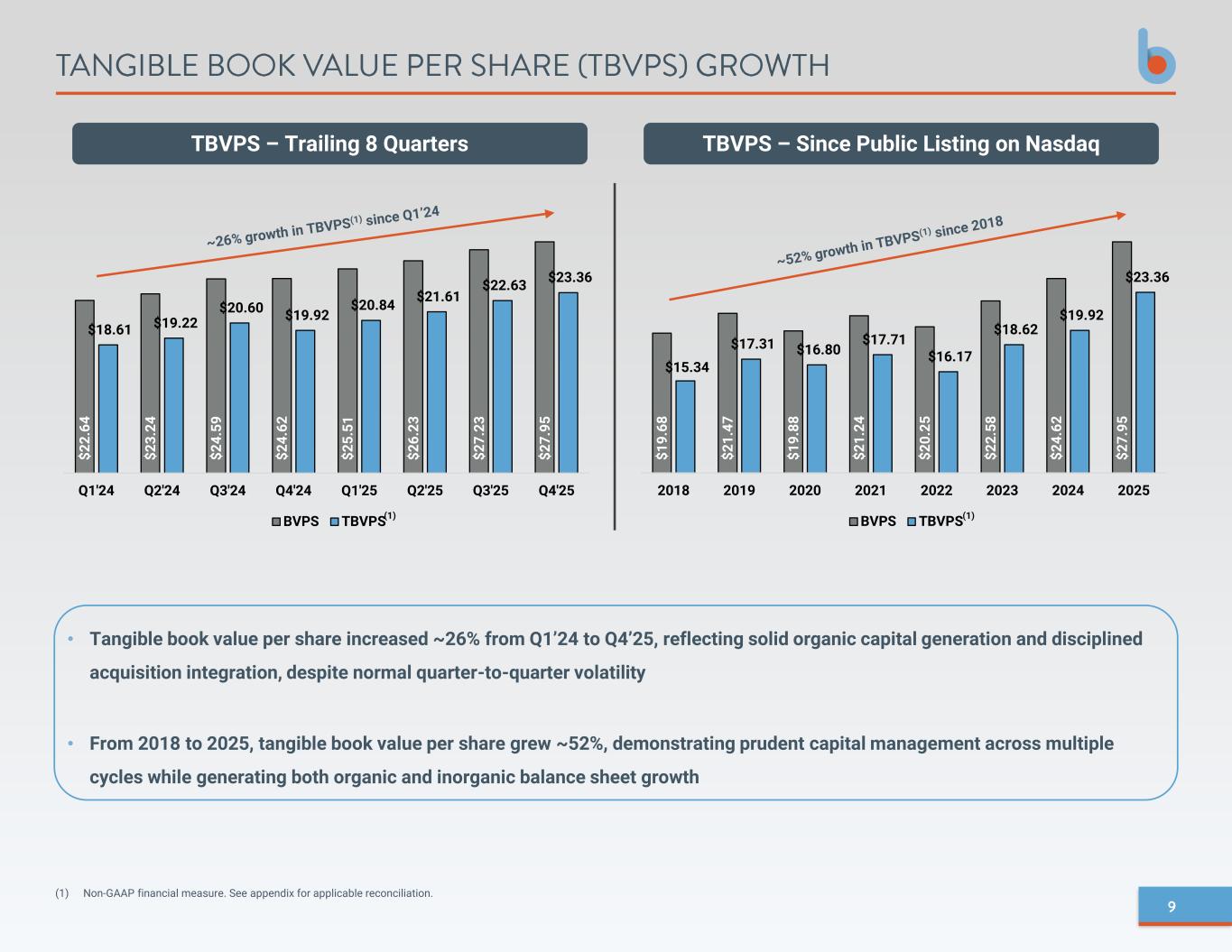
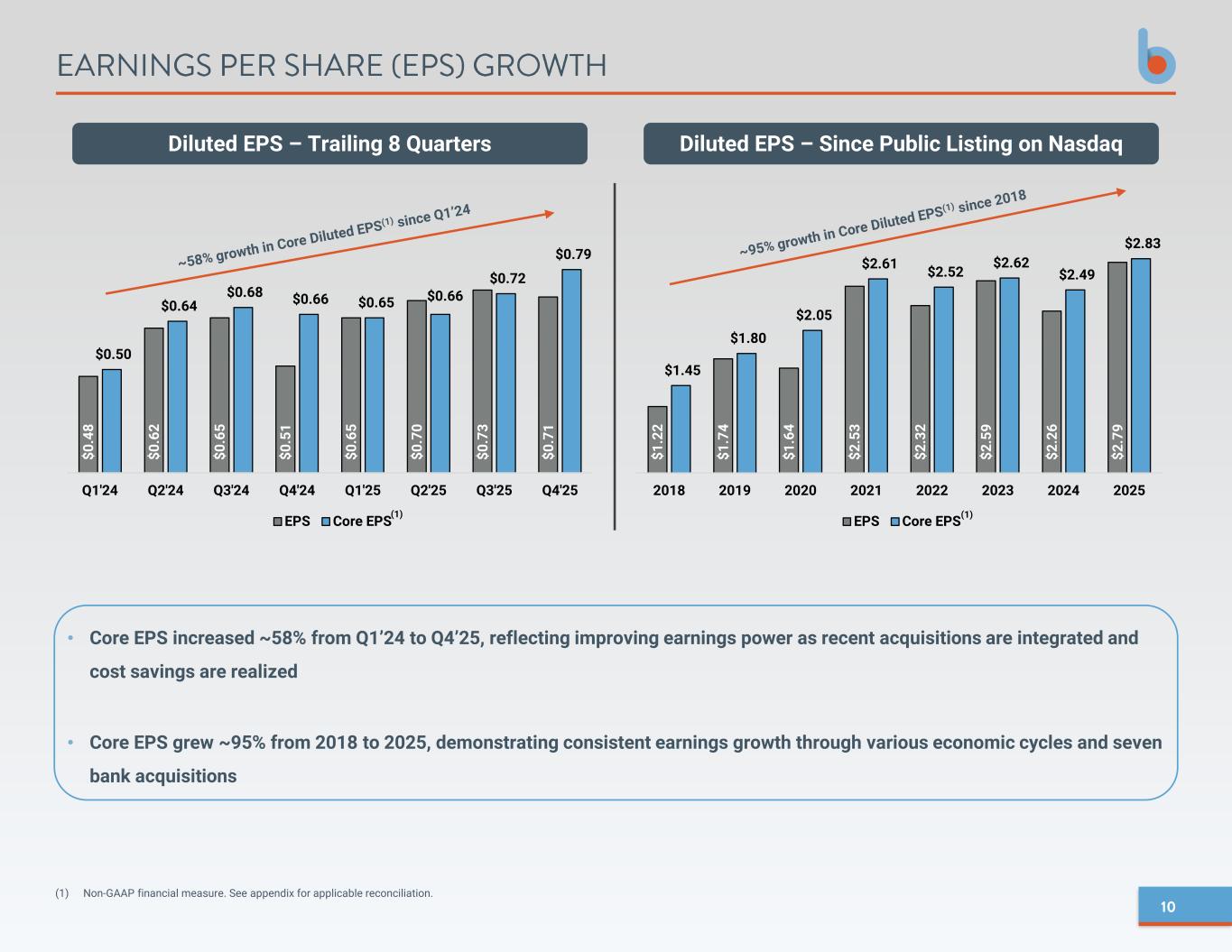
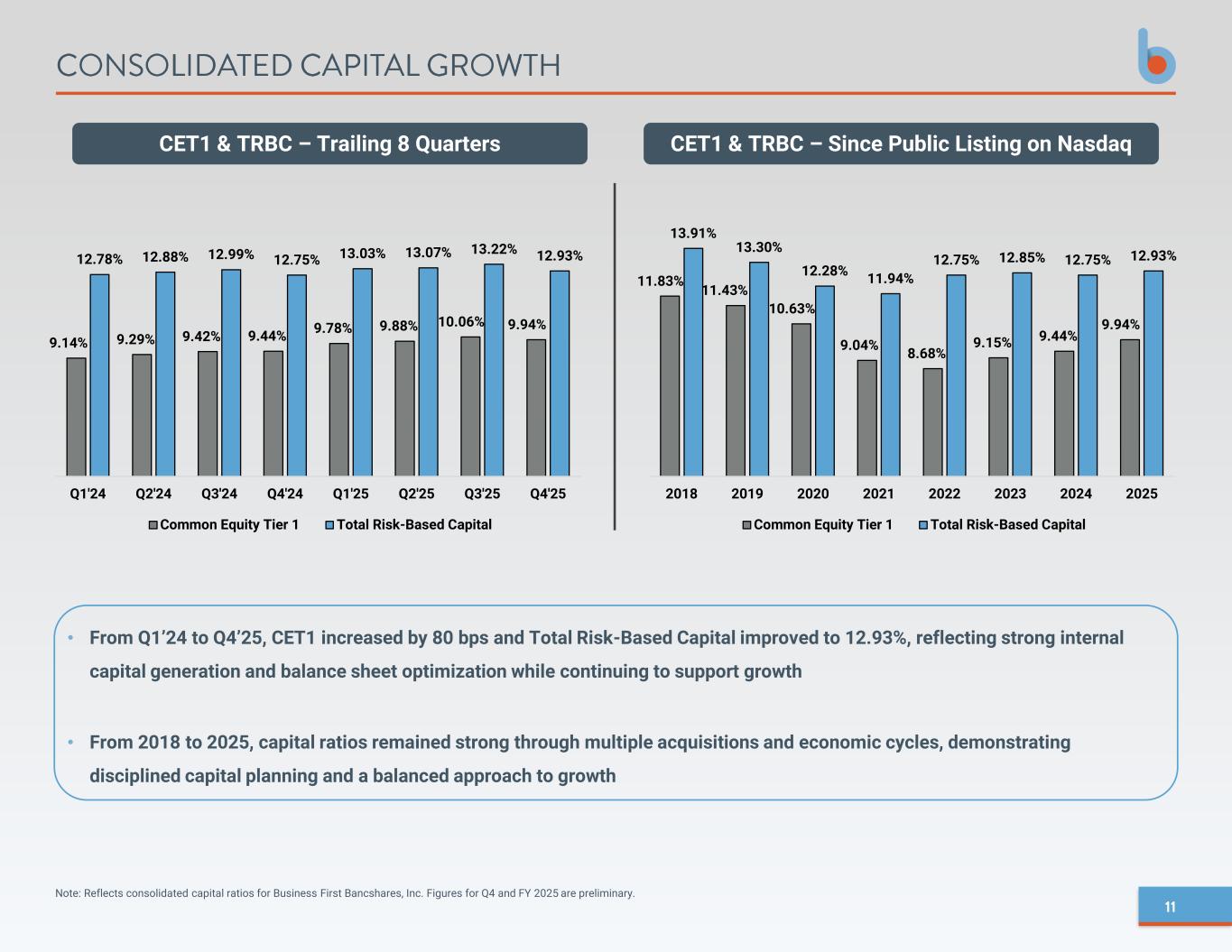
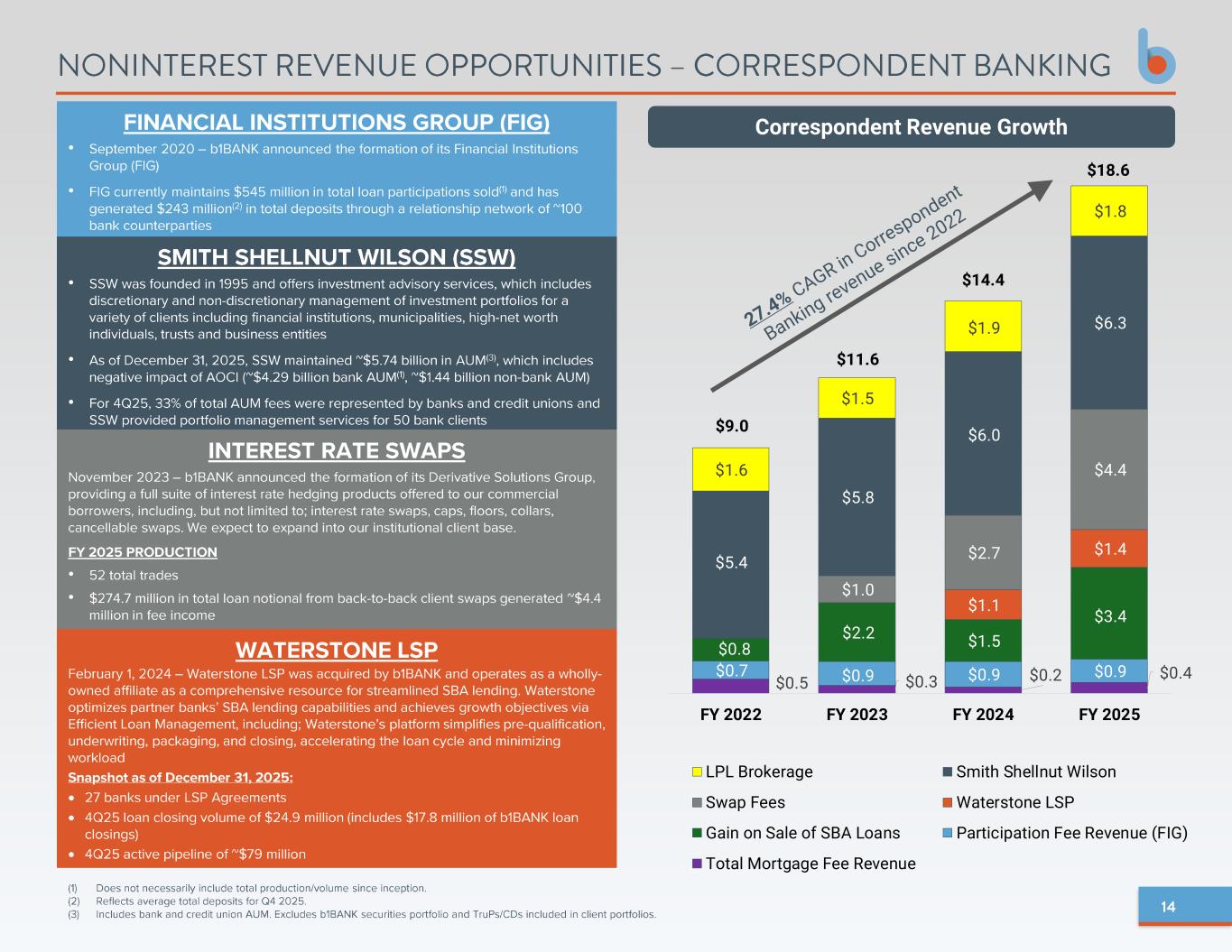
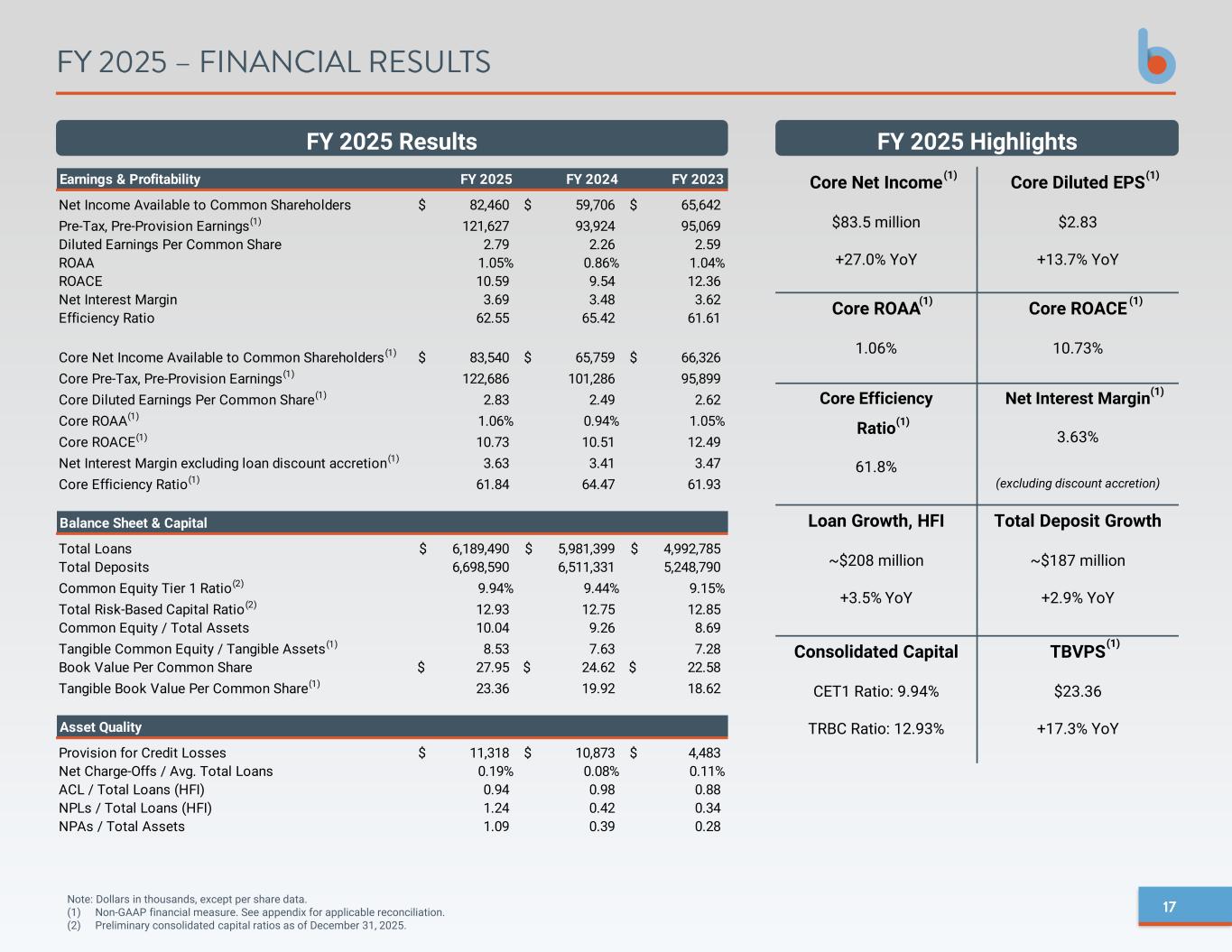
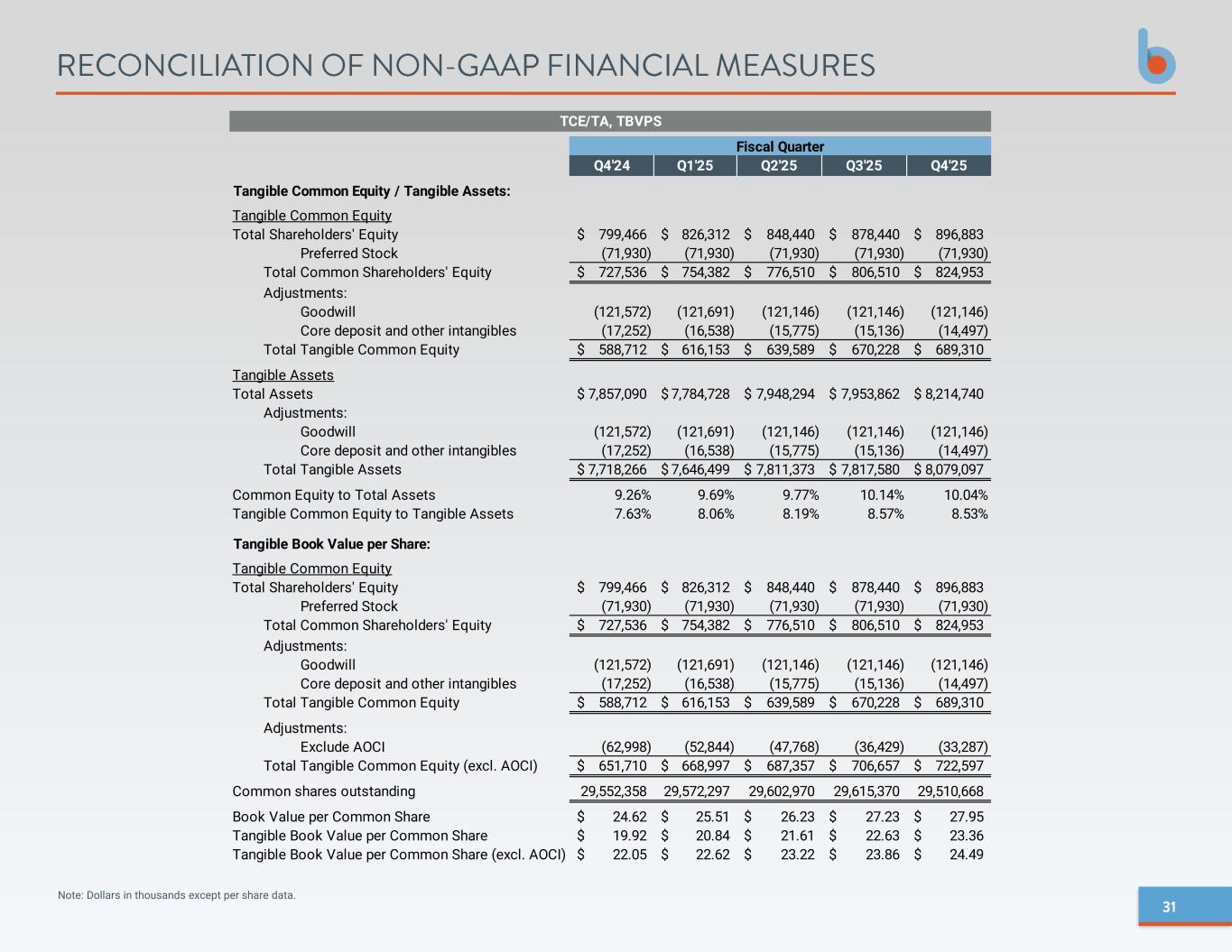
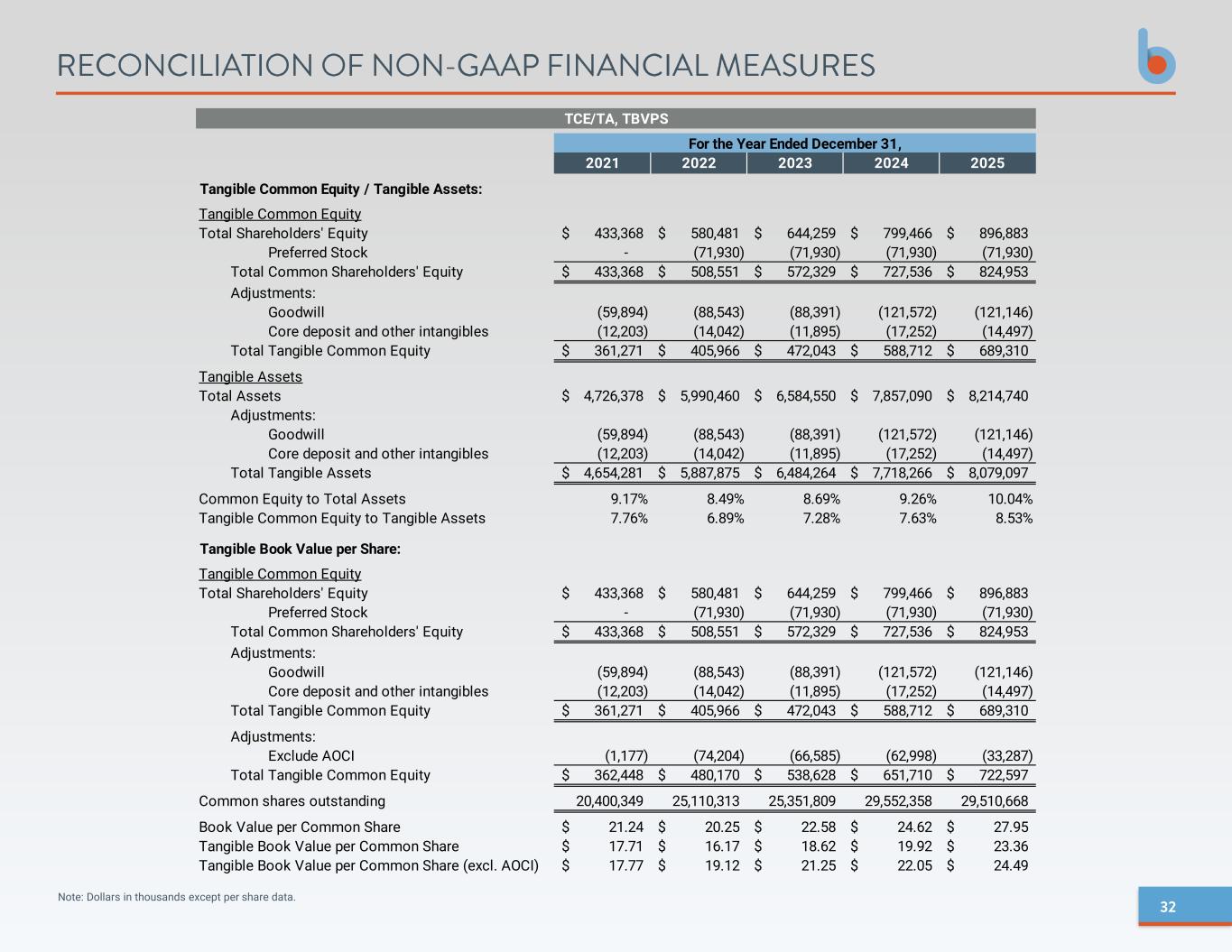
Okay, thanks, Matt. Good afternoon, everybody. We thank you all for being with us today. I'd like to begin our conversation with a brief high-level review of the work our team accomplished in 2025, which turned out to be, in my opinion, one of the most meaningful and positive years our franchise has experienced. I'll start with a few of the non-financial highlights. While they don't contribute much to the short-term modeling that this call invariably centers around, they are what enables future opportunity and therefore representative of the most important work that we do. Over the course of 25, we conducted two major core conversions and implemented a number of software platforms designed to prepare us for managing at this and future scale. We continue to develop multiple internal divisions focused on preventing and mitigating fraud, internal loan review, audit, and various ERM capabilities, contributing to both our ability to operate safely and maintenance of a positive regulatory relationship. We continued our practice of incrementally evolving our footprint, closing three banking centers and opening one. We made big strides developing our correspondent banking initiative into a significant part of the bank, contributing meaningful non-interest income, growing the client base to over 175 community banks. We announced and then at the turn of the year closed the acquisition of Progressive Bank in North Louisiana. We, and this may sound out of place on a call such as this, but we learned some lessons by working through credit issues for the first time in a number of years, things that will ultimately make us better providers and managers of credit in the future. For the fifth year in a row, we were one of the winners of the American Bankers' Best Banks to Work for award, voted on by employees and therefore one of my favorite awards to win. These non-financial accomplishments are important, and I'm proud of them, but they, of course, aren't a loan sufficient. 2025 was also a year of accomplishment from a balance sheet perspective. Over the past 12 months, we've bolstered our capital ratios with tangible common equity increasing by 90 basis points and consolidated CT1 capital increasing 50 basis points year over year. We grew tangible book value 17.3%. We have as balanced a balance sheet as we have ever had, but limited concentrations in any lending category and significant geographic diversification. We grew loans and deposits in tandem, particularly in the fourth quarter as we got through some of the bigger non-financial projects and returned with more focus to production. We began purchasing shares back for the first time in almost six years and positioned ourselves to have that tool as a viable option in the future. And we increased our common stock dividend for the seventh year in a row. Now, we recognize that all this non-financial and balance sheet activity needs to lead up to something else, something tangible. And over the course of 2025, we delivered strong P&L improvement beyond what we or the analysts forecasted. We grew ROAA beyond our stated 1% goal to a 1.06 core ROAA for the year and a 1.16 core ROAA in the fourth quarter. We delivered a 14% increase in EPS over the course of the year, and in the fourth quarter, a 20% year-over-year improvement. We grew our full-year core margin beyond our stated goals of 3.5 to 3.63, and we held non-interest expense growth relatively flat while growing revenue, generating positive operating leverage, posting a sub-60 efficiency ratio in the fourth quarter. In sum, we are turning the investments we've made over the past few years into momentum, which leads me to believe that even though 2025 was a pivotal year for B1, 2026 will be even more fruitful. With our major systems implementations behind us, we will focus more on optimizing the systems, which will lead to greater efficiencies. With a healthy footprint in place, we will focus less on expanding it and more on deepening it. By the way, over the past few weeks, we were pleased to begin to take advantage of some of the disruption in the Houston market by recruiting John Heine, formerly of Veritex, to be our new market leader. and he's already been able to add a couple impressive ranked bankers to the foundational team we have in place. Finally, we will focus less in 2026 on embarking upon new major projects and more on daily execution. We have a good team, we're in good markets, and we're focused on the right things. Sustainable ROAA, tangible book value accretion, EPS enhancement, non-interest revenue giving us greater revenue optionality, and non-interest expense discipline leading to continued efficiency ratio improvement it's an exciting time and we look forward to discussing it further over the course of the call I thank you all again for your attention and I'll turn it over to Greg thank you Jude and good
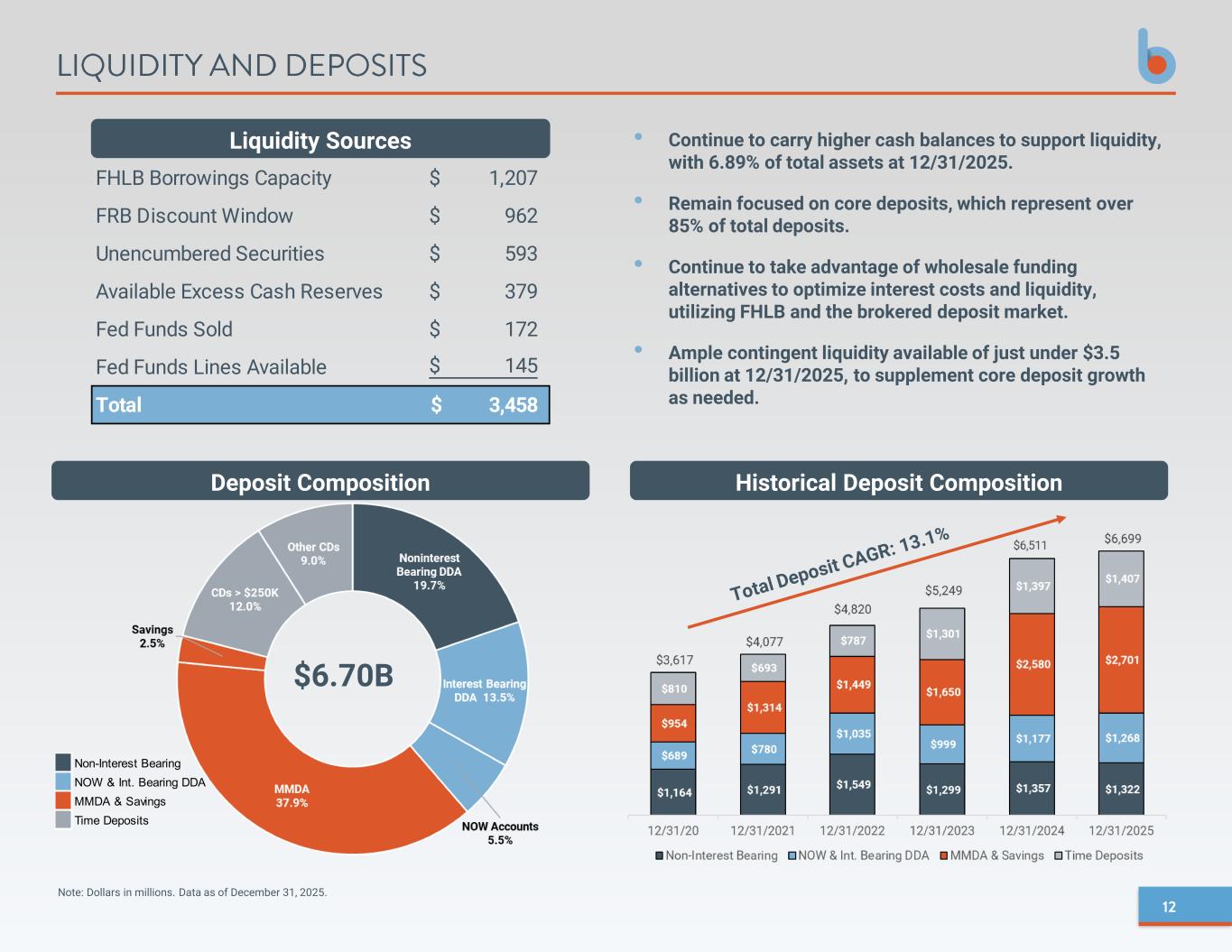
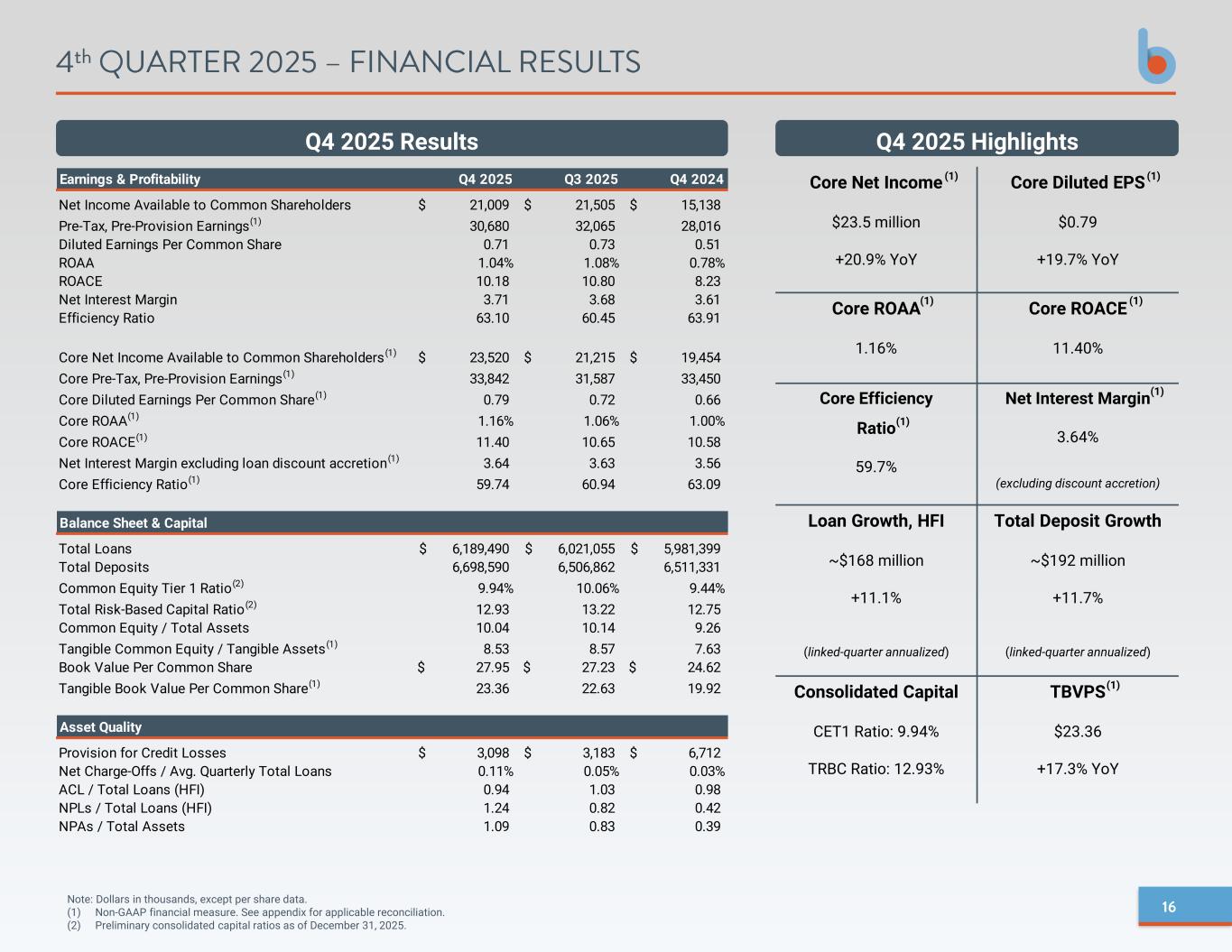
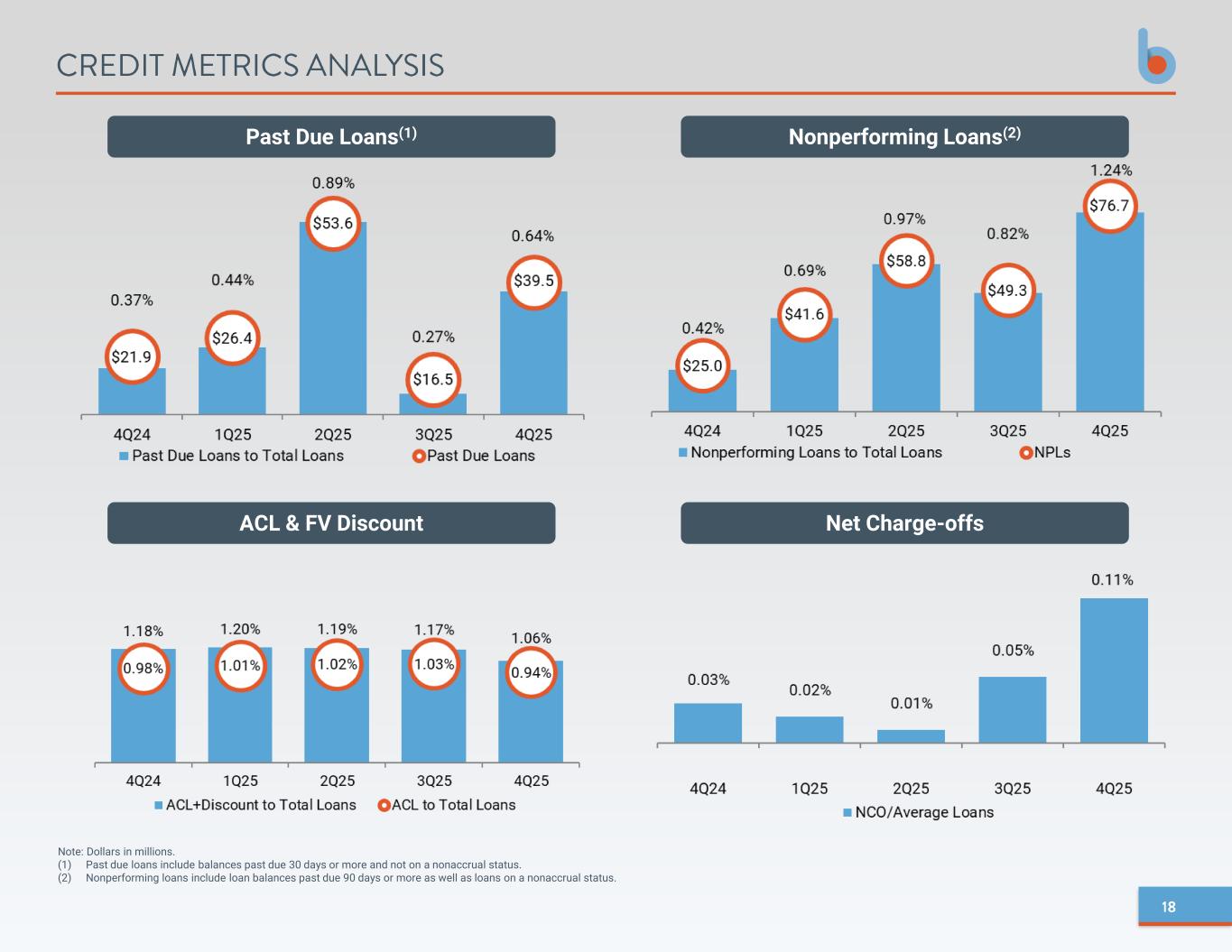
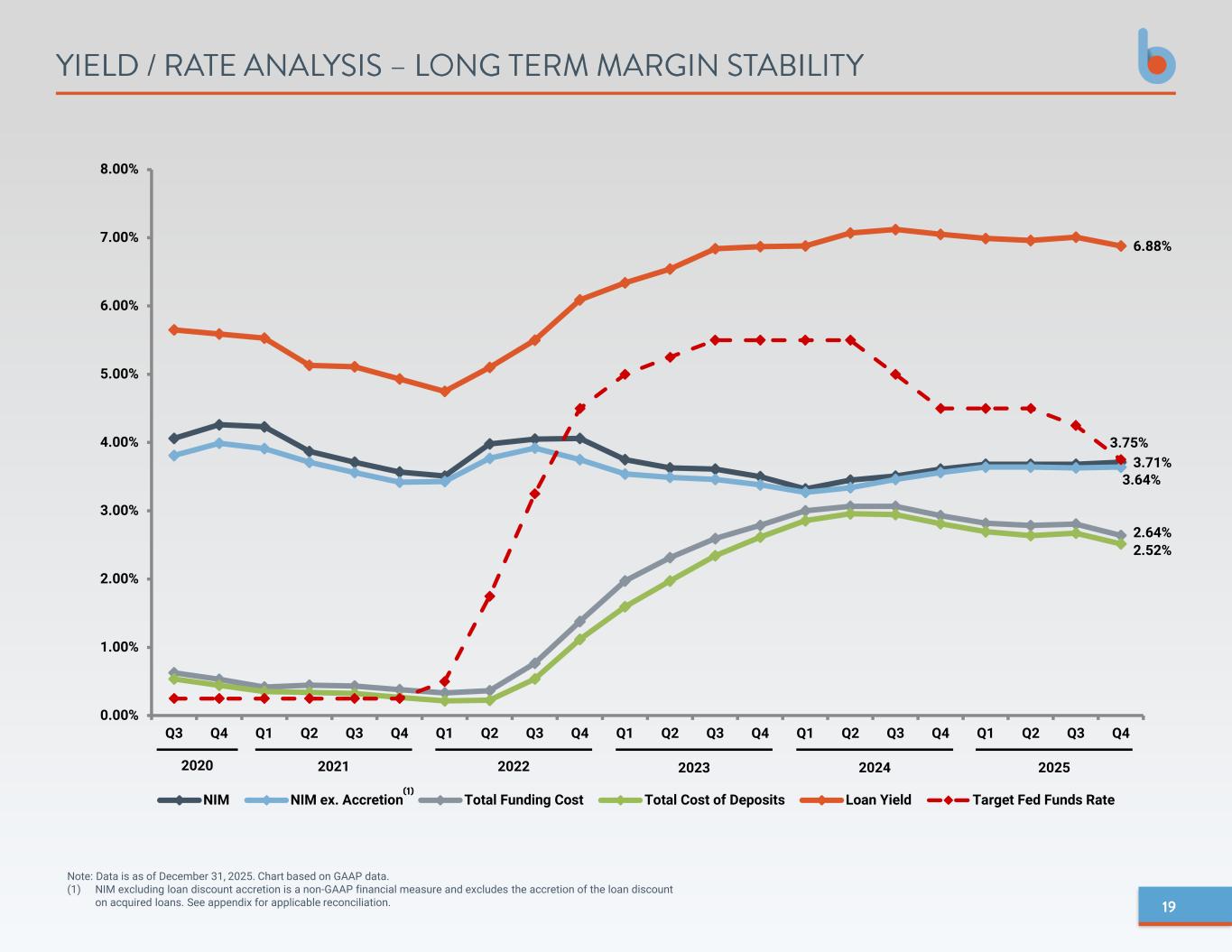
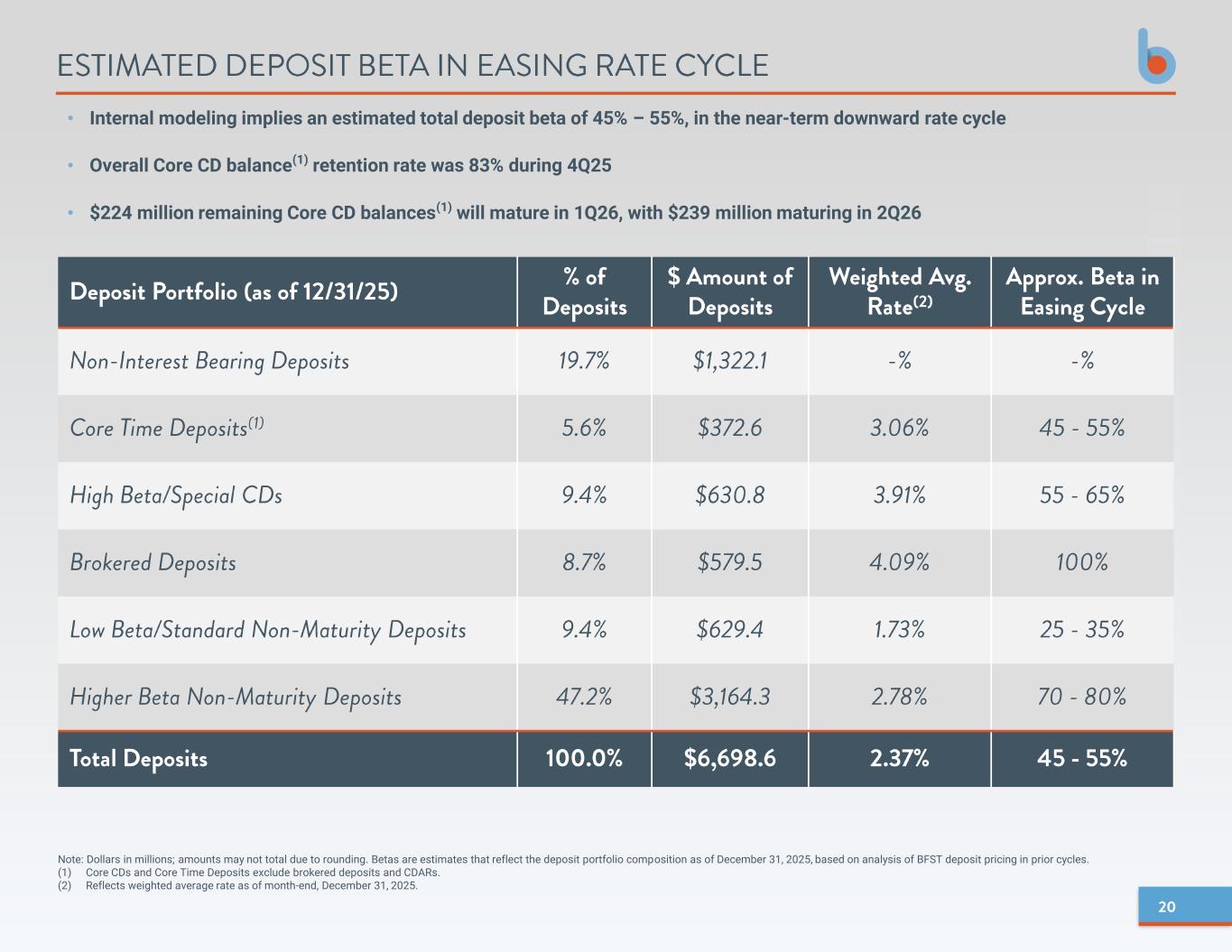
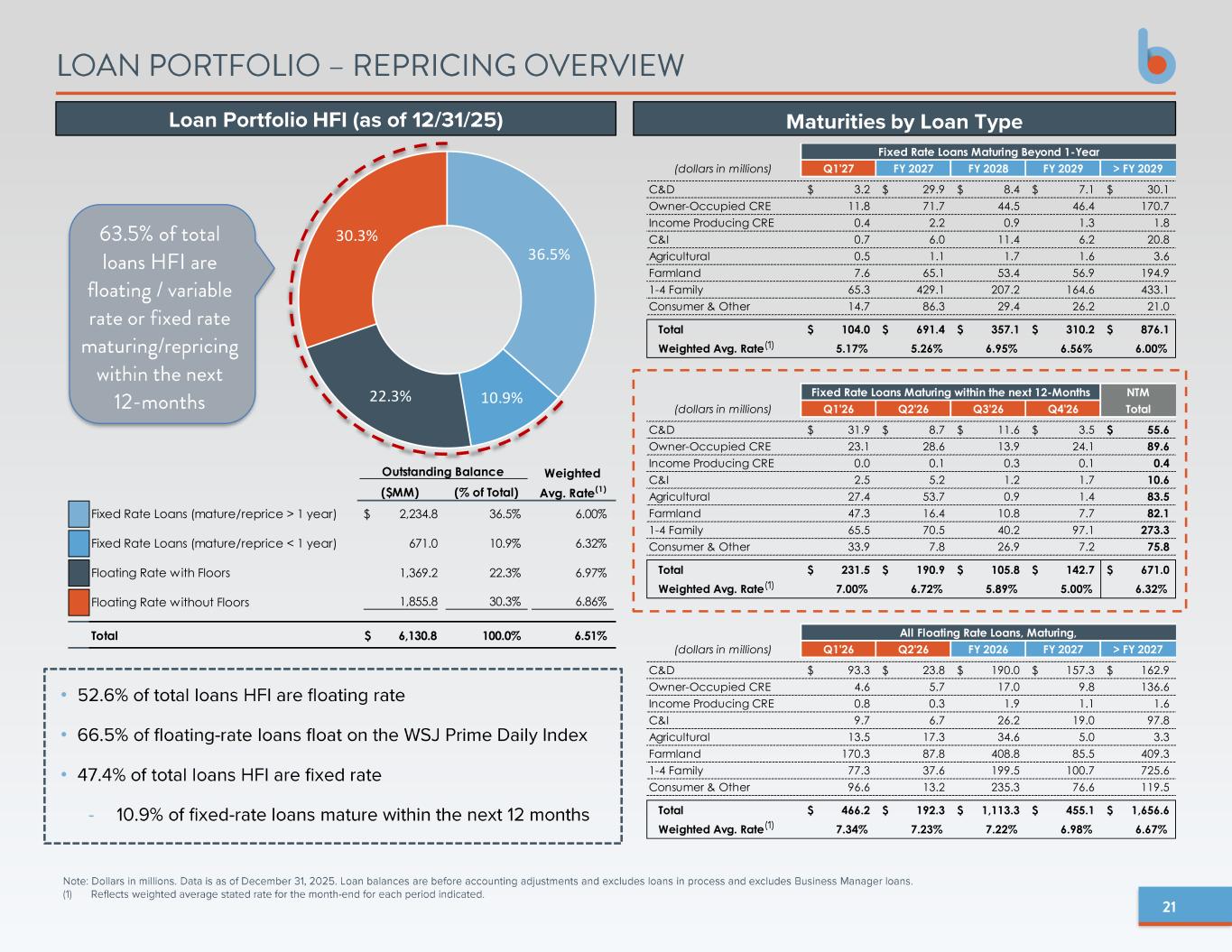
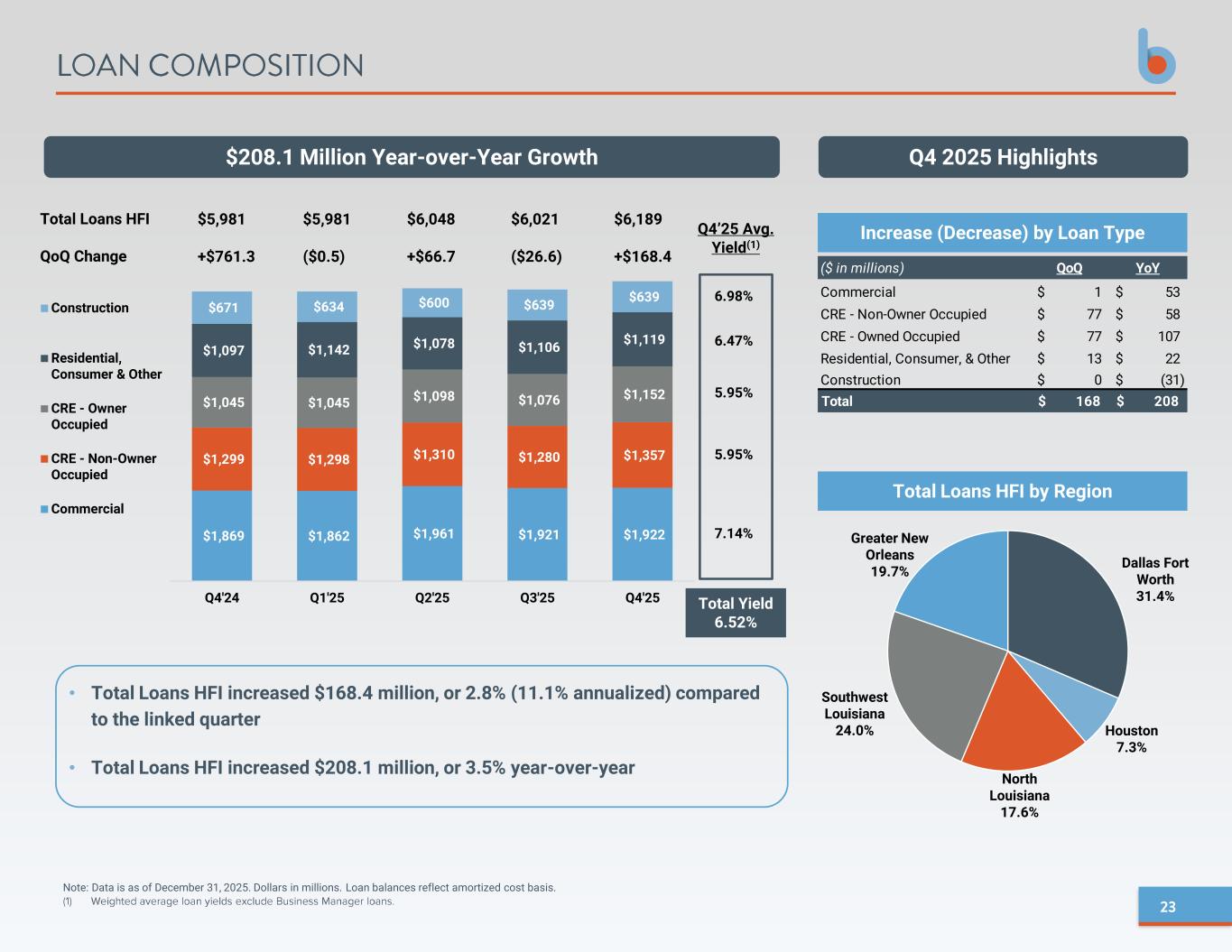
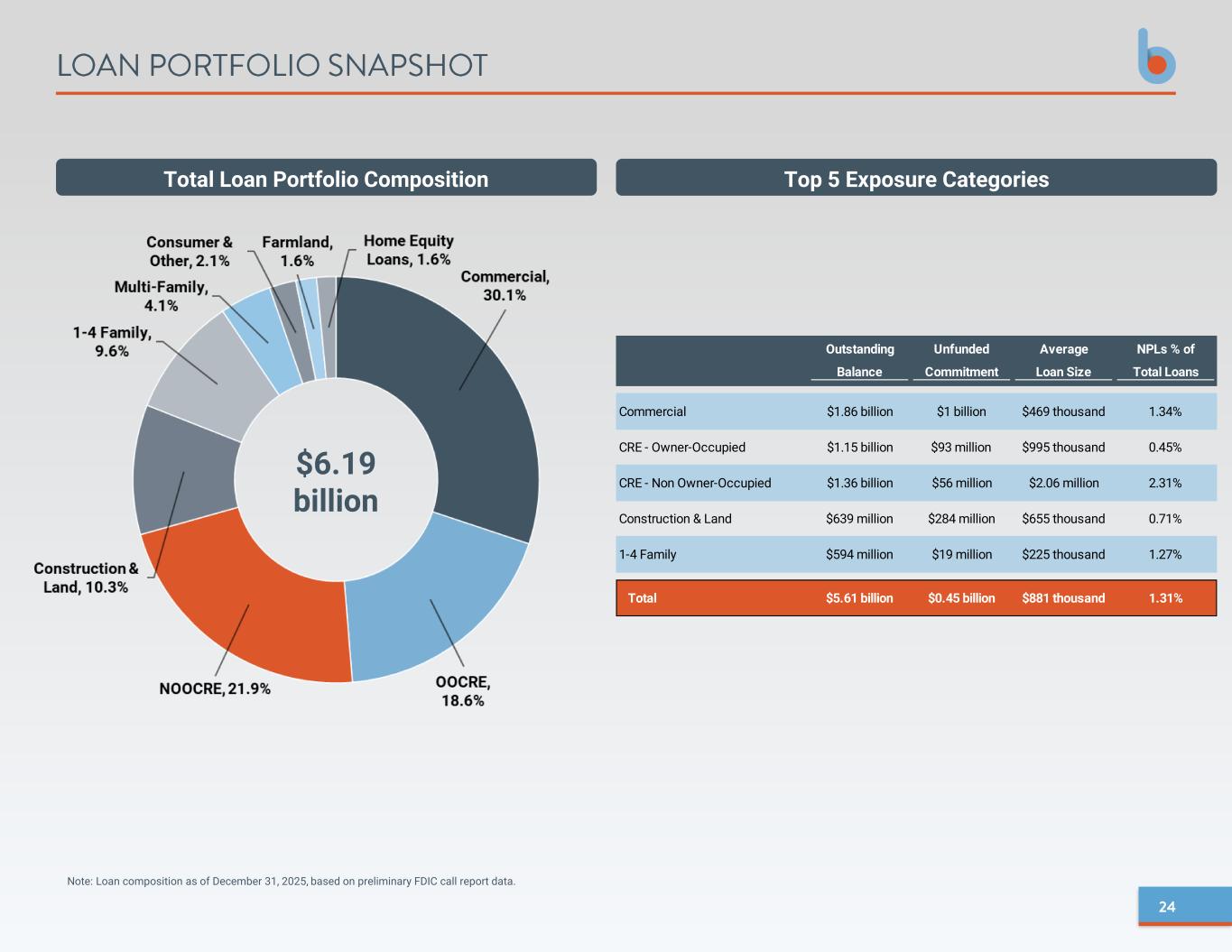
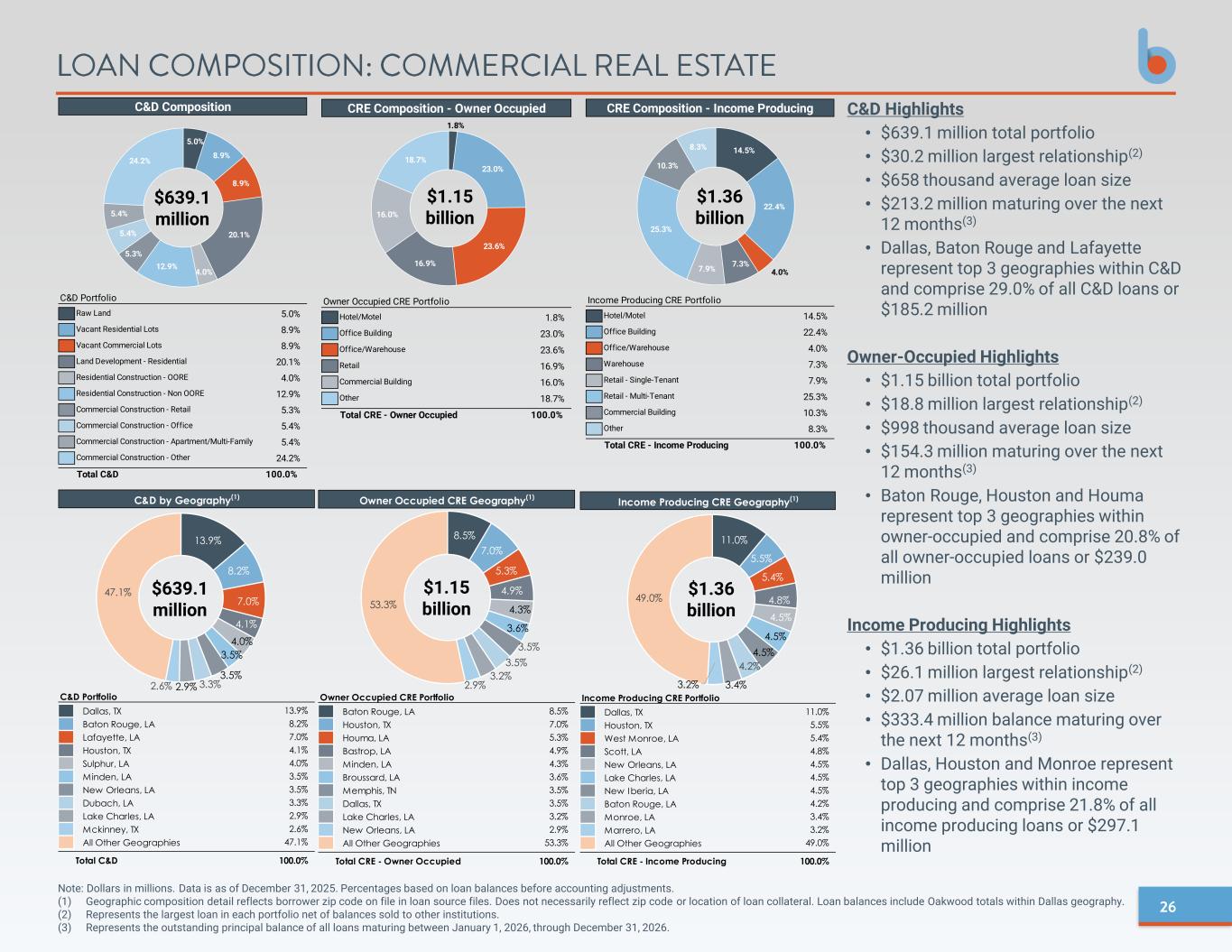
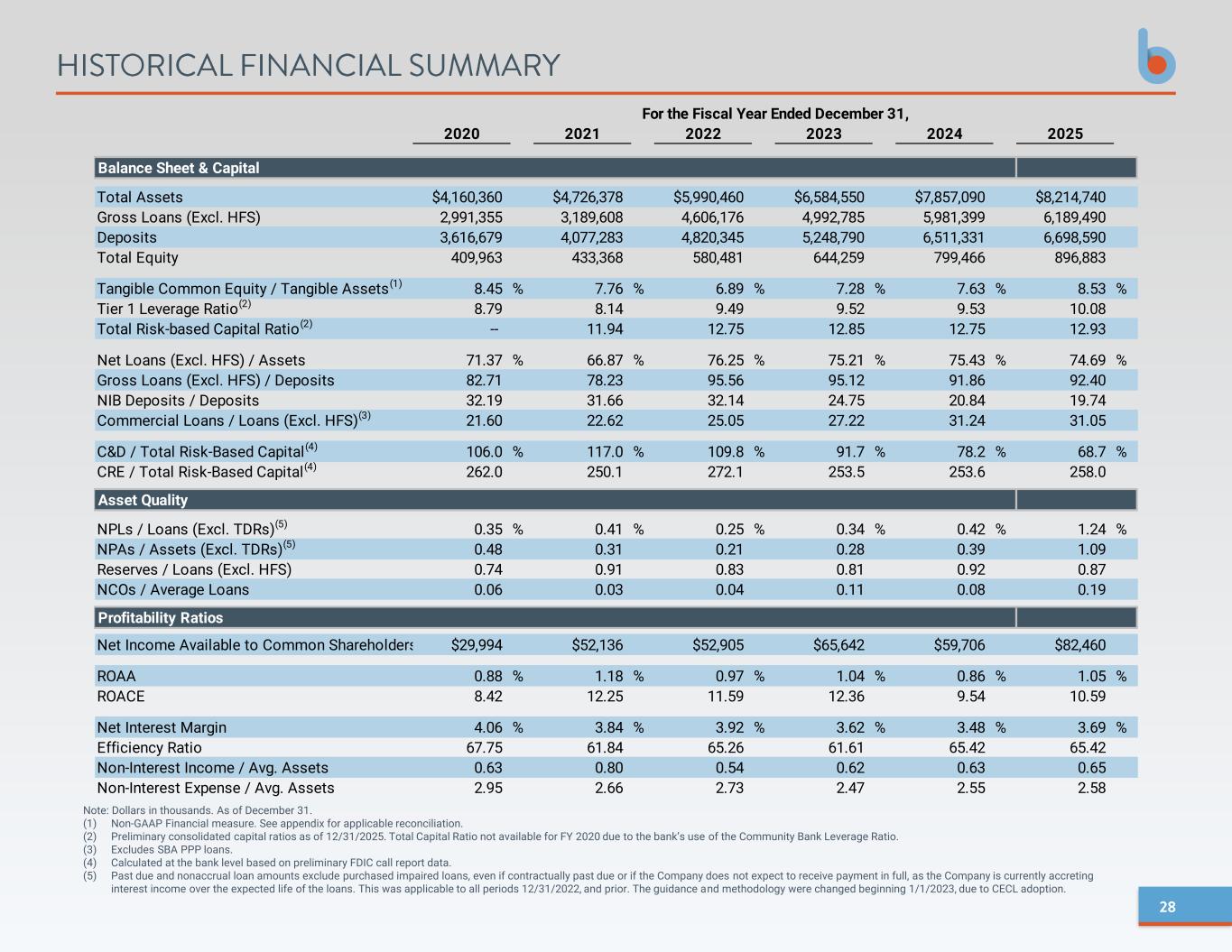
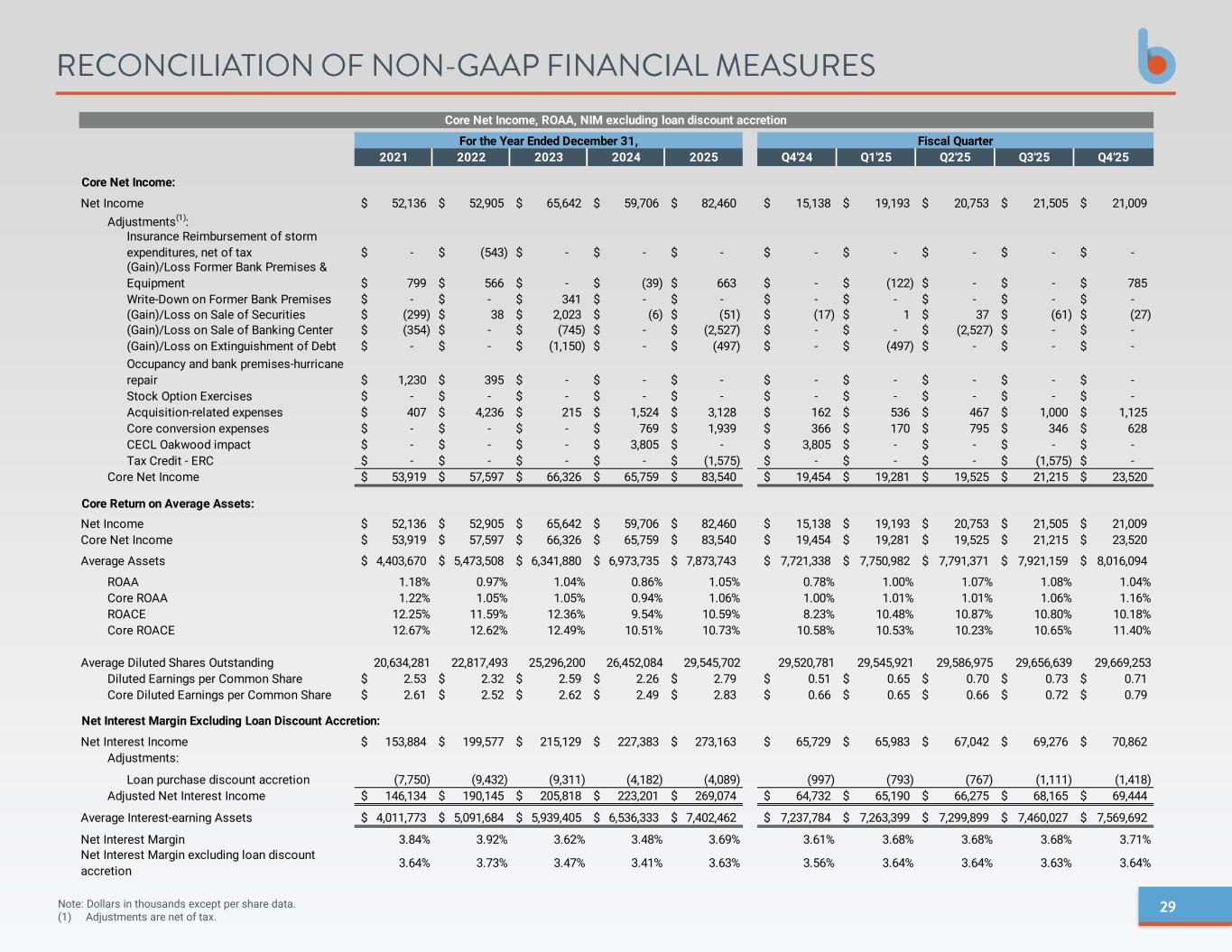
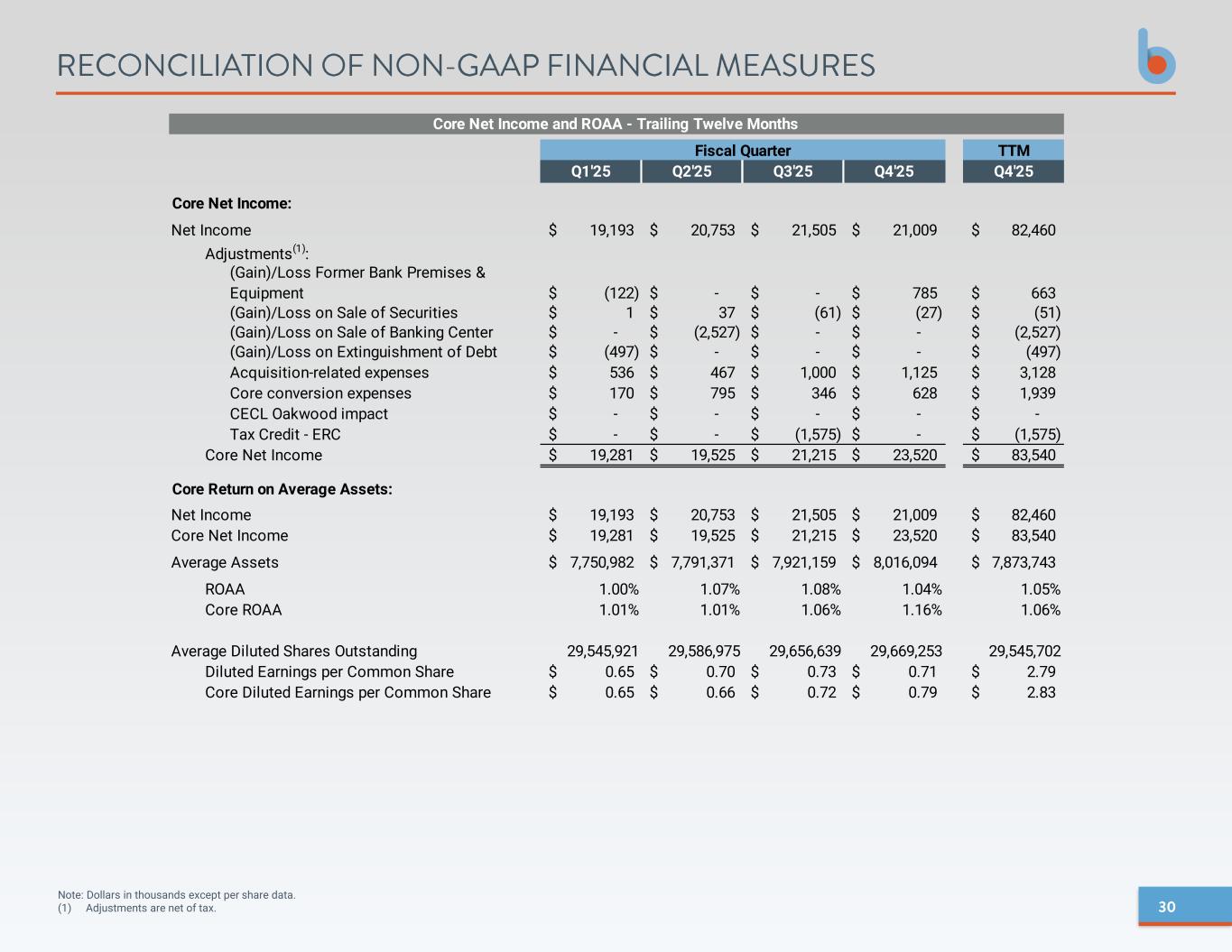
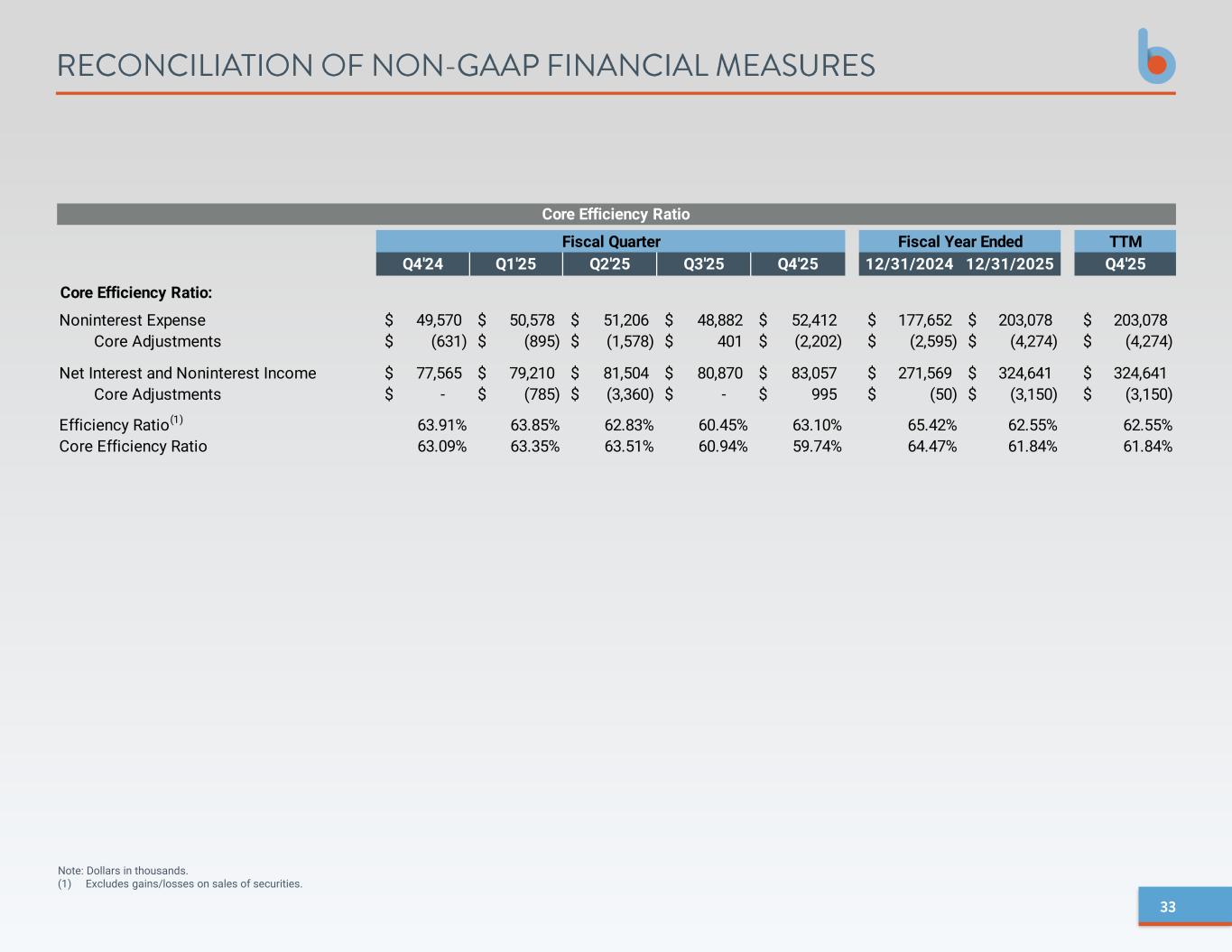
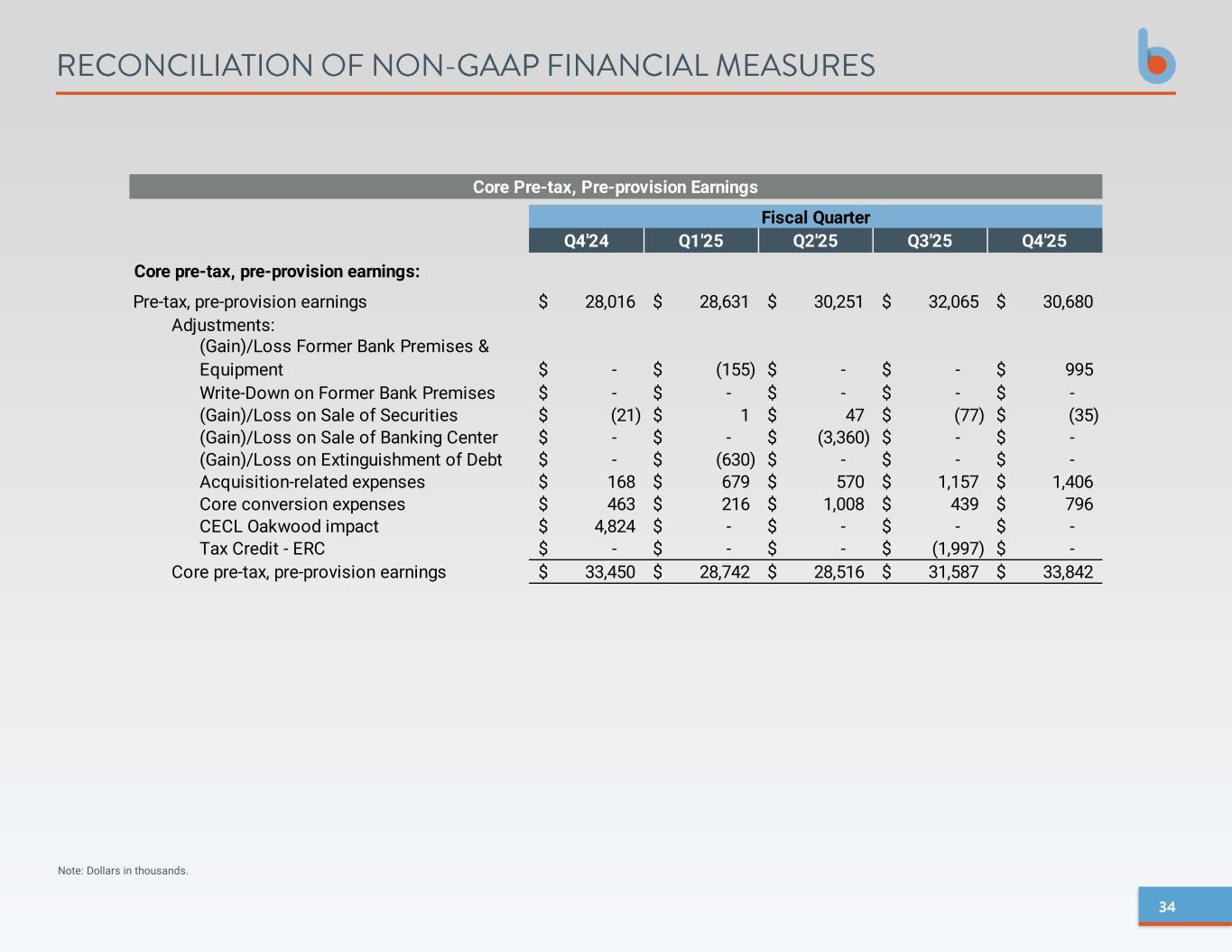
afternoon everyone as always I'll spend a few minutes reviewing our results and we'll discuss our updated outlook before we open up the Q&A fourth quarter gap net income and EPS available to common shareholders was 21 million and 71 cents per share and included $2.2 million in merger and core conversion-related expense, $995,000 loss on former bank premises, and $35,000 gain on sale of securities. Excluding these non-core items and non-GAAP core net income in EPS available to common shareholders was $23.5 million and 79 cents per share. From our perspective, fourth quarter results marked another quarter of strong financial performance generating, as Jude mentioned, a 1.16 core ROA with our core efficiency ratio falling to 59.7% for the quarter. A notable impact during the fourth quarter included continuing meaningful contribution from our correspondent banking group. Also, as Jude mentioned, we added several new slides to our earnings presentation. I'll start on slide 24, a new overview slide from our loan portfolio. Total loans held for investment increased 168.4 million or 11.1 percent annualized on a linked quarter basis. The higher than expected loan growth was driven by an overall improved demand and a slowing in paydown and payoffs. Specifically, new and renewed loan production of approximately 500 million during the fourth quarter compares to a slower scheduled and non-scheduled paydowns and payoffs of $332 million. Recall, in the previous quarter, we experienced a slight decrease in net loan production, which was a result of $395 million in paydowns and payoffs, only offset by $368 million new and renewed loan production during the third quarter. On a linked quarter basis, owner-occupied CRE loans increased $76 million, or 28% annualized, while non-owner-occupied Cree loans increased $77 million to 23.9% annualized. Based on unpaid principal balances, Texas-based loans declined slightly from 39% as of December 31, 2025. We expect that percentage of the Texas loans to further decline with the closing of the Progressive Bank to approximately 36% in the first quarter. Moving back to slide 16, total deposits increased $191.7 million, mostly due to net increase in interest-bearing deposits of $236.2 million on a linked quarter basis, somewhat offset by a net decrease in non-interest-bearing deposits of $44.5 million from the prior quarter. The increase in interest-bearing deposits was largely driven by approximately $105 million in public funds and $60.8 million in commercial money market accounts. We do expect somewhat of an outflow of the public funds markets during the first quarter consistently with prior year's Q1 seasonality. Moving to the margin, our gap reported for quarter net interest margin increased three basis points linked quarter to 3.71%, while the non-gap core net interest margin excluding purchase accounting accretion increased one basis point from 3.63% to 3.64% for the quarter ended in December. The margin performance during the quarter was driven by elevated loan discount accretion due to a single large acquired loan paying off sooner than we expected. Loan discount accretion during the quarter was elevated at $1.4 million, including the addition of progressive. We expect quarterly accretion in 2026 of approximately $1.8 million. On a linked quarter basis, cost of total deposits decreased 15 basis points. while total loan yields decreased 13 basis points. Core loan yields, excluding loan discount accretion for the fourth quarter, was 6.78%, down 15 basis points from the prior quarter. The total cost of deposits for the month into December was 2.44%, which compared to the weighted average of the fourth quarter of 2.51%. We're pleased with our ability to hold the line in new loan yields during the quarter with a weighted average new and renewed loan yield of 6.97% for the fourth quarter. However, with the interest rate cuts we experienced during the fourth quarter, we did start seeing some pressure from overall loan pricing. I'd like to take a moment to explain some of the movement in the margin during the fourth quarter. We recognized $1 million of interest income reversal for a non-accrual loan. This translated to about five basis points in the fourth quarter net interest margin. That is to say, had we not recognized this accrual reversal, our Q4 margin would have been five basis points higher. It is of note, until we find resolution on that credit that was primarily responsible for the income adjustment, we would expect this somewhat of a drag to remain. We are pleased with our ability to manage funding costs for the quarter with the weighted average rate of all new interest-rearing deposit accounts during December of 3.51 percent, down from September's weighted average rate of new interest-rearing deposit accounts of 3.66 percent. I'd like to make a note of a few takeaways, slide 22 in our investor deck, as we continue to see 45 to 55 percent of overall deposit bait is achievable regarding any future rate I would also like to point out overall core CD balance retention rate was about 83 percent during the fourth quarter. That statistic reflects our team's continued focus on maintaining and retaining core deposit relationships. Our baseline assumption is that we do not receive any further rate cuts in 2026. We have worked hard to manage our balance sheet to a relatively neutral position, and we believe we can achieve modest margin improvement in a slightly downrated environment. Lastly, on the topic of net interest margin, I'd like to mention a new slide we created and added to the quarterly slide presentation. Slide 20 is a combination of two prior slides and shows our gap in core net interest margin in the context of the volatility in the Fed funds rate since 2020. We're proud of our ability over the years to maintain the margin with a relatively tight range. This slide also shows our ability to hold the line on overall loan yields in a declining rate environment while managing funding costs downward. Moving on to the income statement, The GAAP non-interest expense was $52.4 million and included $1.4 million acquisition-related expense and $796,000 conversion-related expense. Core net interest expense for the fourth quarter of $50.2 million was up slightly from the prior quarter, but we do expect an increase in the Q1 core expense base, primarily due to the closing of progressive acquisitions and timing of various first-quarter annual expense resets. As a reminder, we should begin to recognize the impact of progressive cost days post-conversion, which should occur in the third quarter of this year. Fourth-quarter gap in core non-interest income was about $12.2 million and $13.2 million, respectively. GAP results did include a $35,000 gain on sales and securities and a $995,000 loss on former bank premises. Core non-interest income results for the fourth quarter were better than we expected, primarily due to swap fee revenue, which was about $1 million higher than expected. Also included in core non-interest income was $312,000 gain on Oreo. We expect near-term quarterly non-interest income to be in the mid to high $13 million range, which includes approximately a million dollar quarterly contribution from the Progressive Bank Acquisition closed on January 1st. Lastly, I'd like to provide some context to the credit migration during the fourth quarter. Total loans past due 30 days or more, excluding non-accruals, as a percentage of total loans held for investment increased from 27 basis points to 64. At December 31st, the ratio of non-performing loans compared to loans held for investment increased 42 basis points to 1.24% at December 31st, while the ratio of non-performing assets compared to total assets increased 26 basis points to 1.09% compared to the linked quarter. The increases in the non-performing loans and assets ratio over the linked quarter were largely attributed to the deterioration of a single $25.8 million commercial real estate relationship. With that, that will conclude my prepared remarks, and I'll hand it back over to Jude so he can wrap up the conversation.
Okay, thanks, Greg. I just want to take one moment to welcome our new progressive, former progressive bank shareholders and employees as well, if you're listening. excited about that partnership and I feel like everything that we've worked on thus far is ahead of schedule in terms of, you know, from our getting the approvals that we needed to get to close it to all the social integration work that we've already done and enjoyed over the past couple weeks being able to spend time with a number of employees and the former board members and just real excited about incorporating that into our already existing strong north Louisiana franchise is an important part of our footprint important part of the state and look forward to continuing to make a significant contribution to the economy and our role as a community bank in that area so with that be happy to turn it over to the answer question answer period to our best answer any
Operator
questions you might have thank you we will now begin the question and answer session. If you have dialed in and would like to ask a question, please press star 1 on your telephone keypad to raise your hand and join the queue. If you would like to redraw your question, simply press star 1 again. If you are called upon to ask your question and are listening via speakerphone in your device, please pick up your handset to ensure that your phone is not on mute when asking your question. We do request for today's session that you please limit to one question and two follow-up questions only. Thank you. And our first question comes from the line of Matt Olney with Stephens. Your line is open.
Hey, thanks. Good afternoon, guys. Appreciate you guys taking my question. Want to start on the loan growth front. Sounds like the paydowns that have been a challenge of the last few quarters weren't as much of a challenge this quarter. Any more color you can add to that as far as the fourth quarter growth and then the outlook for organic loan growth from here?
I think, Matt, this is Greg. You're right. I think we did have a great quarter. I think some of that was just a little bit of pent-up demand that we've been working on for a while, so the bankers did a good job of landing it. And then just a little bit of downshift in the payoffs that we've seen kind of created that really great quarter. As far as going forward, we still feel very comfortable with the mid-single-digit loan growth throughout the balance of 2026.
And, Greg, just to follow up on that comment, does the mid-single digits, does that imply a more balanced view of the paydowns that have kind of ebbed and flowed throughout 25, or any commentary on what that assumes with the paydowns?
Yeah, that's a more balanced view would be a good way of putting it. And if you think about kind of coming out of the – if you roll back the clock to the quarters where we were producing extremely high long growth, you know, double-digit to almost 20% annualized long growth quarters two or three years ago, I think we're unwinding out of that. And so having a more reasonable long growth expectation might be a little bit easier to achieve without the headwinds from the payoffs. That's helpful, Greg.
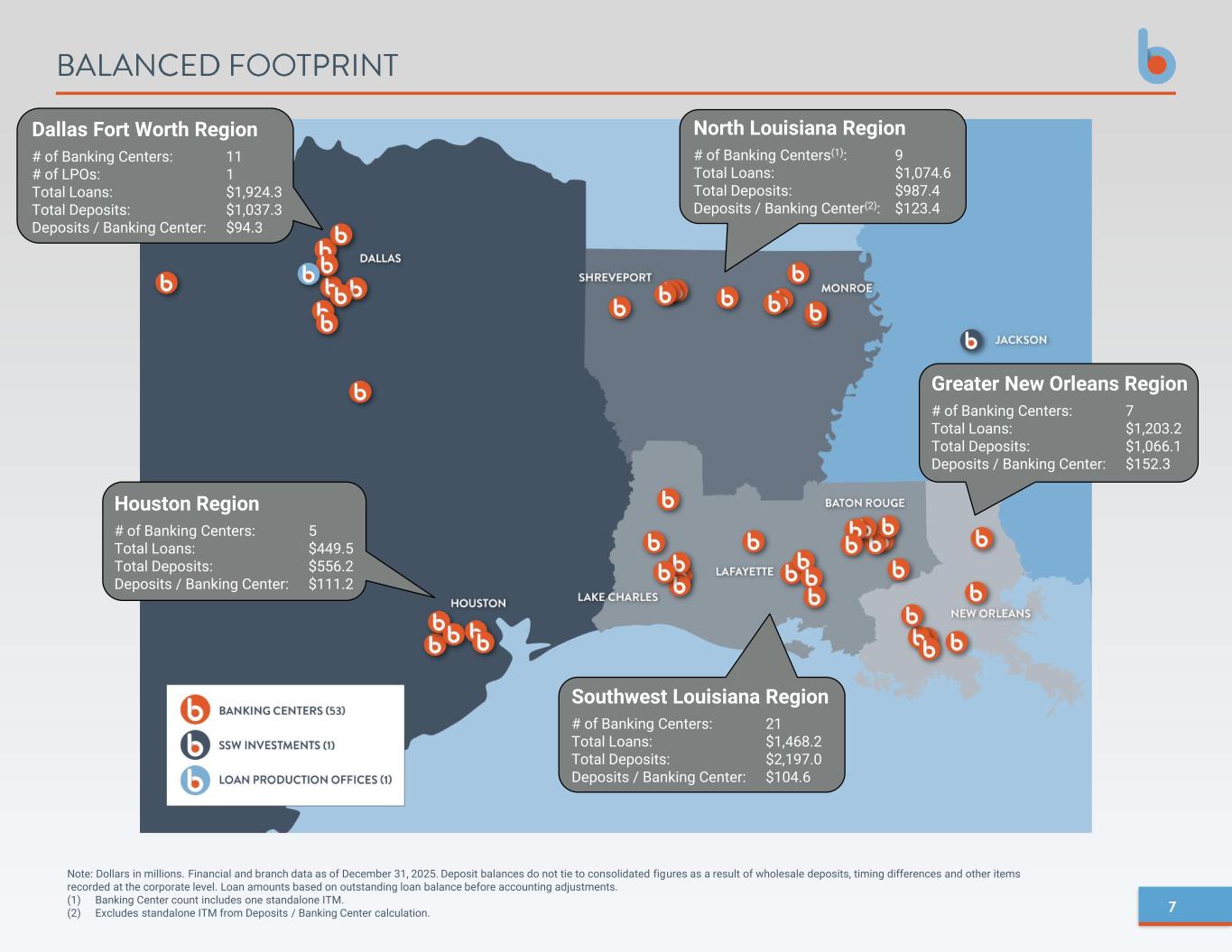
Hey, Matt, just a little more color on the loan growth in the fourth quarters. It was nice to see that it was kind of led by southwest Louisiana and north Louisiana. You know, we worked hard to build a footprint that's diversified, and you think about that first from a credit perspective, but you also want to think about diversification from a production standpoint, and it's interesting to track that over time and certainly want to give those areas their due for contributing so much to the strong quarter on the production side. And, you know, Texas is an important investment for us and will continue to be. And, you know, we're hovering around 40% of our exposure there, which is a good healthy number. But that doesn't mean that there aren't a lot of good things happening in Louisiana as well. And a lot of investments up and down the Mississippi River and Meta making the major investment up in North Louisiana. So it's nice to see some of that paying off in terms of increased demand, and we look forward to a balanced production throughout our footprint over the next couple of years.
Okay, great. Thank you for that, Jude. And then I guess shipping over to the credit side, any more details you can disclose behind that relationship that went to non-performing? What drove the downgrade? It looked like a pretty decent-sized loan. Where does that loan rank among your large relationships you have at the bank? And then, Jude, I think you mentioned in prepared remarks there were some lessons learned when it comes to credits. Didn't know if that was speaking to this specific credit or just more broadly. If you could just expand on that.
Matt, the credit that we identified was a commercial real estate medical facility in the Houston area. And we've been really dealing with it for the balance of the year. Got real close to resolution on it. We feel like we've marked it down to where the loss from here on out would be immaterial at this point. um but we we um we just have moved that that forward and i don't know that there's any um anything more to say about it than that we just been working with it for a while and thought we had a a real resolution in hand and it kind of kind of kept dragging on so we decided to do the
prude thing and move it over and where does that rank size wise size wise i would say that's one
of our larger, if not one of the largest single commercial real estate exposures.
Yeah, I think it's the largest single for which we hold the exposure on our books. As you know, we try to actively participate in exposures, particularly when they get to the 20-25 millionaire level, and certainly at this level, anything above this level. So, yeah, it's one of the larger ones. If you think about lessons learned or things to continue to work with, I do think the biggest lesson in banking is just concentration risk and exposure risk. You know, you can do everything right, and there's going to be something that happens to a certain number of credits. And if you look at banks that have failed or just been in serious trouble over the past 15 years, generally it comes down to a relatively small number of outsized credits. And so one of the reasons that our metrics have moved around a little bit more than we would like and been more volatile is because the loans that we've had something happen on have been slightly bigger. And so not necessarily representative of the entire portfolio. It just feels worse when it hits the different stages of the life cycle of a credit that you're working through. So, you know, I think a reinforcement of the idea that we want to, even as we continue to grow, we want to keep our individual loan exposures to manageable levels. And then we also want to make sure that on our concentrations from an industry perspective or a geography perspective, that we don't get too over-relying upon any one particular type of loan. So I think, and these are just generic, you know, we've had a long period here where we haven't had to really run many credit issues through any kind of process. And so just as we kind of remember how to do that, if you will, you know, there are going to be lessons learned about how aggressive you are when you see warning signs and how you do from a monitoring standpoint along the way. and not so much with this particular credit as much as just general things that I think whatever stumbles we've had credit-wise over the past 12, 15 months will benefit us as we continue to make credit decisions along the way and continue to refine our processes as we continue to get bigger.
Okay. Thank you, guys. Appreciate all the color. I'll step back.
Operator
Our next question comes from the line of Michael Rose with Brinkman Jeans. Your line is open.
Hey, good afternoon, guys. Thanks for taking my questions. Hey, Jude, you mentioned in the prepared remarks that the focus this year is going to be, you know, more so on daily execution versus, you know, any sort of major projects. I don't want to put any words in your mouth, but I might take that to mean or someone might take that to mean that maybe additional M&A opportunities may not be in the cards. Obviously, you've been fairly acquisitive here lately, but just wanted to get a better sense of, you know, kind of what that comment means. And maybe if you can remind us on some of the projects that you've recently completed and maybe just what that daily execution would mean. I know there's a lot in there, but hopefully you can provide some context.
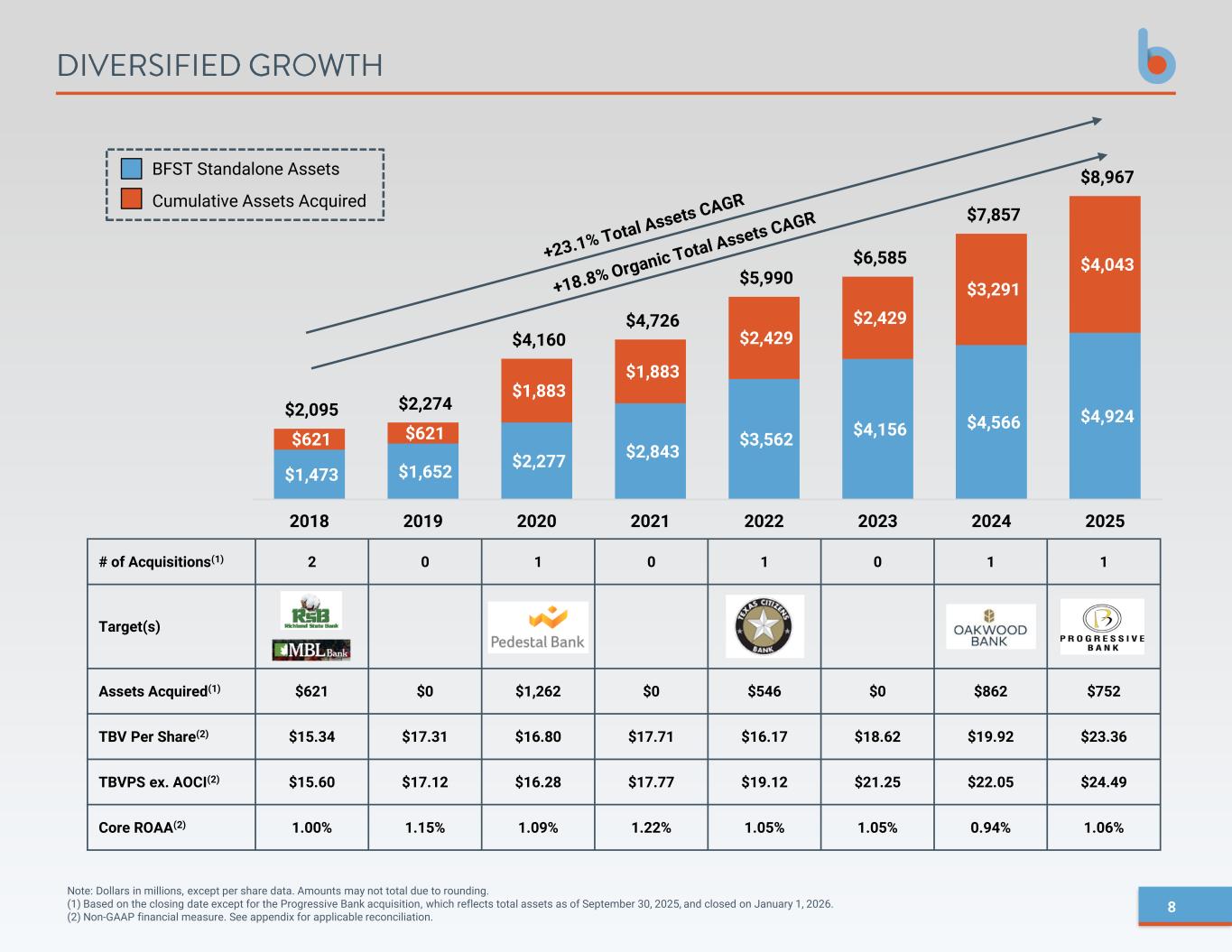
Yes, sir. I appreciate you asking that, actually. You know, we had a busy year, busy number of years, but in particular this year, in addition to consummating or integrating an acquisition in Dallas and then consummating an acquisition in North Louisiana, we also did a lot of process improvement internally and we've talked about on these calls a few times the number of projects that we, took on that are technology-related. So we, not only did we convert another bank, Oakwood, over the course of the year, we actually converted ourselves to a new platform, a new core platform, which is a two-year project and involved pretty much everybody in the bank. So it's a big deal. And we also had three or four others, you know, five or six in total implementations, which, you know, does take a certain amount of bandwidth It takes a certain amount of energy, and there are things that we felt like we needed to do to be able to manage and run more effectively at $9 billion in size over two states and a significant geography versus what we could manage and run. When we knew everybody, all the employees and most of the clients, the exec team had the relationships with, as you scale, you need better processes. So I knew you want better visibility into numbers and managing by those things, including pricing software, you know, as we're thinking about credit exposure, thinking in a more sophisticated way about what kind of profitability that incremental client has to the bank's overall profitability is something that we're better at than we were before because of some of these implementations. So what I meant in my comments was we don't really, although we'll always be incrementally upgrading and incrementally adding, we don't have any implementations that in the aggregate will be as substantial as we had last year, and we'll focus more this year on making sure that we're maximizing the output from the implementation process last year. So it's one thing to do it. It's another to then use it in an optimal manner. And so we want to focus on making sure that we're actually making better decisions because of the data that we have. We want to make sure that we're providing better client service because of the systems that we've invested in. And we want to make sure that our employees' efficiency and happiness around doing their job is enhanced. And that, we believe, involves taking a little bit of a breath and just making sure that we're maximizing the investments we've already made. On the M&A front, yeah, we're not prioritizing seeking another M&A alternative now. We've made a number of really what we believe to be really good investments and partners throughout the years. And we're beginning to see, we believe we have the opportunity now to demonstrate why those good partners not only give us greater opportunity over time and diversify our risk, but also have been good financial partners leading to increased profitability. And sometimes the only way you can really demonstrate that is to pause the M&A for a second and kind of let the good things percolate and catch up with you. So we saw significant improvement in ROA over the course of 2024, or excuse me, 2025. And I shared with you last time that we intend to be over a 1.2 ROA, last half of this year, 2026. And so that's become more of a focus for us than seeking to expand. We want to deepen the relationships that we have, which will, in turn, lead to greater profitability, which leads to greater tangible book value, which should lead to an enhanced share price. And that gives you more optionality for M&A down the road. And so we're kind of at that point where we believe we've made a number of investments over the years, and we want to be able to demonstrate what we know, which is that they were good investments that we've done well, and we want to be able to prove that out a little bit through increased financial performance before we take on other initiatives. So we're going to execute, we're going to work on the investments that we've made, and we're going to be good bankers day to day, and that will translate into increased profitability, it'll be sustainable, and that will give us more optionality to embark upon future projects down the road.
Appreciate the comprehensive answer. Maybe just following up on one of those aspects on the capital front. It was good to see the buyback announcement you guys execute on it. You know, how should we think about that going forward? You guys are trading at about 1.2 times tangible. The earnback on the buyback is, I would characterize, is fairly attractive. Capital is really going to start to appear once the deals are fully integrated. in the cost phase realized um should we think about you guys uh at least in the nearer term it's kind of a regular way buyer um just given where you are or um you know just just trying to
frame up the capital discussion thanks you know that's a great question and you know obviously something we're talking about at the board level um we'll continue to talk about we were able to buy back about 150 000 shares in the fourth quarter and what proved to be the attractive prices, the $24.70s kind of range. And those were more in the $110 to $115 ROA range, or tangible book value, multiple range. So I think we certainly, I would certainly agree with your characterization of $120 still being a reasonable and even cheap price. And over the course of the year, we have more optionality on what we do with capital than we did last year. Last year we had more than we had the year before because we've been building up those capital levels. So we will definitely continue to look for opportunities on a quarterly basis. I don't see us just setting it and letting it go and saying we're going to buy back this number of shares no matter what. We do want to be want to pick and choose when the right moments are. But certainly, I would think over the long run, anything below $120,000 would be an attractive price. Got it.
One thing, Michael, is that when you think about key one, we're going to take a little bit of a step back in tangible book on a per share basis with progressive closing. So it would be, you know, I guess an effective kind of slightly higher multiple right now than just $120,000. there's something we're thinking about when we evaluate buybacks.
Perfect. Got it. At the outset, they said keep it to two follow-up questions, so I'm going to use that one. Just as we kind of think about hiring from here in the opportunity set, just given some of the dislocation, you mentioned John Heine was hired as new Houston market president. Can you just frame up what you see as kind of the opportunity to hire? I think we've heard mixed messages from some banks. Some banks are being fairly aggressive. Some are saying, like, take a wait and see approach just wanted to see how you know we should think about the the opportunity set for you um guys or is it just more opportunistic making a kind of a full court
for us here thanks yeah i think the answer actually is probably similar to the answer i just gave you on stock buybacks right i think it's kind of a we're prepared to hire and would like to hire if they're the right people uh we don't feel any need to hit our in order to hit our profitability targets and our growth targets we don't necessarily have to hire to do that but we do know that there are good people out there and they're living in a more disruptive world than they were a year ago and we know we also are a different bank than we were a year two years and three years ago in terms of our capabilities which also means in terms of our attractiveness as an employer so why not continue to to have conversations i would expect that we will add another two or three in Houston over the next couple months. We've got some conversations and we'd like to bring those to fruition. And beyond that, it'll really be on a case-by-case basis. We don't have to hire every banker in the world to do what we want to do in terms of financial performance. We need to hire the right bankers and so we'll focus on evaluating that on a case-by-case basis as the opportunities arise, but I do think there will be opportunities and we will be thoughtful about. One reason we can afford to be a little less aggressive on M&A is that we believe that in our footprint, organic growth is going to be possible. Part of that is growing with our current staff, but part of that is incrementally adding some additional team members, teammates. For the near future, we believe that's a more likely and profitable use of our capital than M&A. Great. Appreciate all the call. I'll step back.
Operator
Next question comes from the line of Fetty Strickland with Havdi Group. Your line is open.
Hey, good afternoon, everybody. Just wanted to start on the DDAs. I understand the public flows have an impact here, but I do still think they're down a little bit year over year. Can you talk through maybe what the opportunity might be to kind of grow those on a year-over-year basis trying to outscore some of the seasonality in those public funds flows?
Yeah, I think it's a good question. I think what we still see is some migration from some of those non-interest-bearing accounts to interest-bearing. So not a huge piece of that business is actually account or losing accounts. I think it's more of a migration. That has slowed over the course of 2025. With the addition of a progressive bank partnership, they have a nice amount of their deposit base is non-interest-bearing. So we should get some lift from that in the first quarter. We still have plans to continue to focus on elevating deposit gathering through Treasury and non-interest-bearing sources. So it's something that we are looking at in 26 as a big part of our plan of operation. But there has been some movement.
Got it. That's really helpful. And just wanted to step back into the feed. Appreciate the guidance there. But, you know, obviously the star of the show was the swap fees, and you saw the brokerage commission fees, I think, up a little bit as well. What's kind of the level of opportunity in each of those areas and, I guess, contributions from, you know, SSW and the FIG group as well.
Yeah, we see opportunity in 2026 for that to continue to expand. I think it's going to be like we've kind of really messaged for the last few quarters that it will be a bumpy, upward-sloping trajectory, though, just like this last quarter was with the SWAT fees being outsized. I think what we're excited about is the continued integration and of our SBA group, Waterstone, out of the Houston area. There's some opportunity, we feel like, in that to continue to grow, not only with our bankers becoming more comfortable with SBA production, just the rate environment with SBA lending becoming economically more stable with a lower rate environment. So we're excited about that. I think also we think the SSW Group and the brokerage piece of our business, so to speak, we do continue to see it scaling. We've been investing over the last few years in more talent in that area, and I think we'll continue to invest. So we do look it upside for that. So I think non-interest income as a whole, we feel like that will be in the mid to upper $13 million per quarter with the addition of the progressive group. So we're comfortable understanding that it may be rocky going upward, but I think the trajectory is still we're excited about that upward slope.
And one more if I could squeeze it in just on the loan growth and the growth in general coming from southwest and southeast Louisiana. And Jude, I think you touched on that a little bit earlier on. But just curious, I mean, is it going to be a more balanced pace of growth? Do you feel like going forward that it's going to be, you know, sort of evenly balanced between southern Louisiana and the Texas markets? Or is it just going to kind of differ from quarter to quarter depending on what's in the pipeline? I'm just curious whether that's a deliberate part of the strategy or that's just kind of how it shook out this quarter.
Yeah, well, the deliberate part of the strategy was building the footprint that we knew that Not every market had to hit every moment in order to move forward and building a footprint that didn't rely upon one market to carry the load all the time. I do think just based on demographics and differentials between economies that there's more upward growth opportunity in Dallas and Houston. They're just faster-growing cities, and we have enough of a footprint in both that we'll be able to take advantage of that. But we've got good, core, consistent growth in most of the Louisiana markets. So in a quarter in which one of our larger markets slows down a little bit for whatever reason that is, Dallas was slower this quarter, then we'll have our more consistent markets across Louisiana there to give us some more predictability as we try to forecast out from a balance sheet perspective over time. So, yeah, I guess the answer to your question is, did we specifically say we need to grow southwest Louisiana and north Louisiana faster in the fourth quarter than the other markets? But we did specifically try to build a productive footprint in which we could have different parts of the footprint experiencing greater success at different times, which hopefully over time leads to a good, consistent, moderate growth pace for the bank as a whole.
Yeah, Fetty, I think if you think about 2025 as a whole, we had both North Louisiana and Southwest Louisiana grow over $100 million in loans and deposits each. And, you know, we're excited about, you know, southwest Louisiana now is over $2 billion in deposits, which is a large part of our deposit base and an important part of that. North Louisiana, with that kind of growth as well, $100 million in deposits, they are now over a billion or approaching a billion dollars in deposits. With the addition of our progressive partners, that will be approaching $2 billion. And so we're excited about those areas. As I said, in the southwest Louisiana-Dallas comparison is an intriguing one
because one of the pieces behind the construction of our footprint was that not only would different areas produce differently at different times, but that we could be a little more thoughtful about funding generation versus loan generation depending upon what type of market. As Greg mentioned, the southwest Louisiana has been able to be more aggressive on deposits over the past two or three years, probably because we knew we had growth in the Dallas loan environment. And so Dallas is actually our largest market as measured by loan volume. And in southwest Louisiana, I believe it might be our largest market based on deposit volume. And they've both been able to be slightly more aggressive because the other supports the other. So it's a symbiotic relationship. And I know a lot of banks over time have talked about the rural versus the urban mix of their footprint and trying to get the best of both worlds. And I think we have some real-world examples of where that's working, which is, again, I think bodes well for the future. Yeah, I'd like to have one thing that really pops up. This is Jerry,
by the way. Yeah, Jerry, I'm asking you here, Just an important part of this is I want to call out a lot of this growth is coming from adding new clients. It's not just legacy client base. It's tenured, strong bankers in our footprint. New bankers bringing in new clients is accounting for quite a bit of that growth, which is really nice to see in these markets that we've got such strength within. Yeah, and this is still a pleasure to say. Also, obviously, we're excited with the addition of John and the horsepower that he's going to bring in the Houston market. But in North Louisiana, where we're excited, the progressive addition and the opportunity, as Jude talked about, in the 26th, deepening our existing relationships, progressive being deepening those relationships with a bigger balance sheet.
Perfect. Thanks for all the additional color guys.
Operator
Next question comes from the line of Gary Tenner with DA Davidson. Your line is open.
Thanks. Good afternoon. So my questions have very largely been answered, but I wanted to just ask about the swap business again.
And as you think about that business, if and when we get to more of a steady-state rate environment,
how do you see that business kind of trending in that sort of environment?
Yeah, I think one of the things that the rate environment could provide some challenges, but I think as we continue to scale and understand our philosophy around pricing and fixed-rate loan pricing with long duration. We would like to, and I think our bankers are becoming accustomed to taking some of those rate bets off the table with longer-duration deals. So I think as we continue to integrate that process, and it's a very new process within our bank being only a little over a year old, but I think as we integrate that process with our bankers and our new bankers and they understand that we would like to manage that rate risk or longer maturity fixed-rate loans through the swap vehicle. I think that gives us, even in a rate environment that may be more challenging than what it has been, more opportunity.
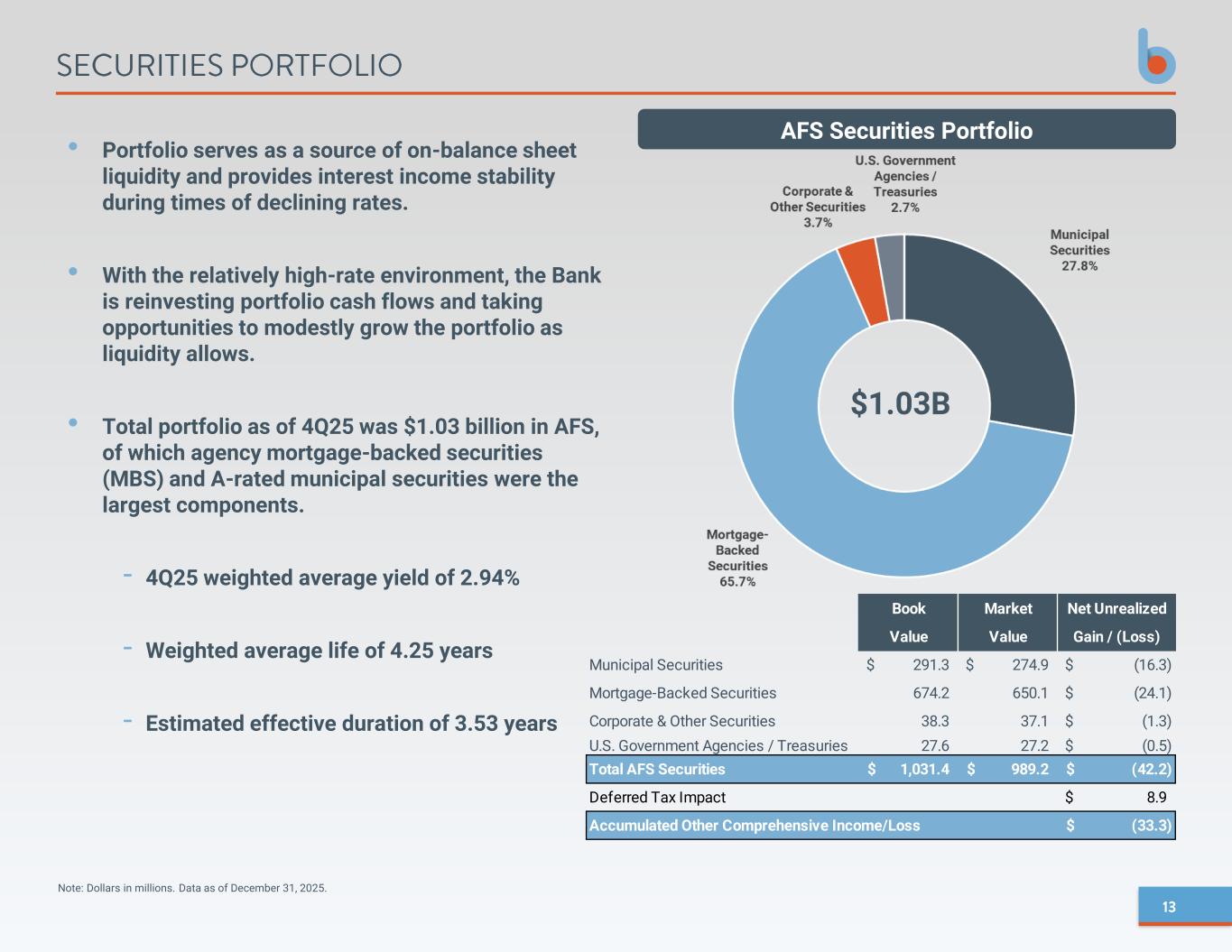
Yes, that's a good point. It's not just about the economic opportunity for the fee generation. It's also an opportunity to offer the client more options even while we put ourselves in a better place to manage our interest rate risk. You know, one reason we added that chart that Matt described earlier, I believe, or maybe it was Craig, that described earlier the chart showing the pretty consistent over time was we don't believe that we should be taking significant interest rate risk. And we've managed not only the bank's entire balance sheet, but our investment portfolio in particular, we manage it for cash flow as consistent, predictable cash flow as opposed to yield. And I think we've had good results not trying to guess on rates. And so this enables us to give the client what they might want in terms of longer-term predictability of rates, but still enables us to have more flexibility in the construction of our alcove posture. I would also say, although certainly the lower rate mean that maybe less swap activity, more SBA activity, the other dynamic for us is that we don't just do these things for ourselves, for our own clients, but we also do them for other banks. And so with the swap product, we are just now, I think just yesterday, in fact, We closed one for one of our first ones for the client of another bank, another institution in our community bank network. Over the end of last year, we actually closed a couple swaps for other banks, not for their clients, but for their own balance sheets. And so as we were able to discuss with and educate our banker partners on the opportunities to provide more optionality to their clients, I would think that we would continue to see success grow in the volume of swaps, even if it ends up faster rate of growth off our balance sheet as opposed to with our direct clients.
Great, thank you. And our last question.
I was going to say real quick on the correspondent banking, I think our biggest opportunity, we have a little over 175, 180 clients. But with most of them, we just do probably just one bank member for the vast majority. And so part of our biggest opportunity there that we've been working on is having more of a unified sales approach so that we can actually increase the share of wallet, if you will, and provide multiple opportunities. So most of the folks that we've done SBA with, we haven't done swaps with, and vice versa, or the other products that we offer. Our largest one, actually, and our original one was through our affiliate, SSW, who manages other banks' investment portfolios. We have $6 to $7 billion in assets under management, and being able to cross-sell the different products that we've been working on adding to our tool set, that I think is the biggest opportunity that we have regardless of the demographic or economic changes in the environment.
Operator
And our last question comes from the line of Christopher Marinek with Jannie Montgomery-Scott. Your line is open.
Hey, thanks for taking the questions this afternoon. I wanted to go back to the reserve. What should be the reserve ratio over time? Just looking at kind of annualized losses this quarter, last quarter, and just thinking at three-and-a-half, four-year average life, should the reserve be higher over time, even if we included the discount, as you have on the deck?
Yeah, I think that's a great question, Chris. I think what we talk about internally is continuing to move that reserve to 1% or higher. I think the charge also we had in this quarter took it down a few basis points, But I think internally, we're reserving at a rate of 120 on every new loan we make. So over time, we would like that to be above 1%. I think that's our intentions as well. And especially when you add the credit marks in there, I think we're currently all in about 106, like we show in the deck. And that'll continue to move up with the closing of the progressive transaction.
Got it. And should annualized losses be, you know, somewhere kind of in the mid-teens or 20? Or do you have a thought about that?
Yeah, we would think those would be somewhere in the lower teens to mid-teens next year. I think 10 to 12 basis points of annualized losses is what we're kind of thinking. We ended up the year at about 19 basis points. And so we've kind of, as we work through some of those NPLs, we've identified paths to move those off with minimal to no loss. So it's just a matter of time, and I'm unwinding some of those.
We took some losses on them last year and have some specific reserves as well.
There can be a bit of a drag in terms of the actual recoveries. So gross, to Greg's point, is maybe in the mid-teens net kind of lower to, you know, low double-digit annualized.
Chris, I think the days of us operating in the four to five basis points of charge-offs, that's going to be tough going forward. I think it's just for the industry as a whole.
And the last question just has to do with kind of efficiency goals over time. You know, if you look at expenses to assets, you've made a little bit of progress in the last year. Obviously, you've got integrating with Progressive, but just in the big picture, do you think we'll see more leverage going through the platform this next 12 to 18 months?
Yeah, I think our plan is to continue to improve operating leverage. I think, as Jude mentioned, we're moving toward being able to have a run rate of a fourth quarter, 120 run rate. I think if that's achieved, then I think that thing gets close to 60 on an annualized basis. And then you'll probably start seeing on a monthly basis into the 50s post-integration and progressive here and there as we continue to improve performance and earnings throughout the balance of the second half of the year. As we get into 27, we would expect that our goal is to have that into the 50s. And I think there's, once you kind of achieve those third quarter, fourth quarter, 26 ROA targets we've been talking about, then there's a pretty natural glide path into the 50s. And I think that we feel like it's very achievable and necessary.
Great. Thank you again, guys. Appreciate taking the time. Thanks, Chris.
Operator
That concludes the question and answer session. I would like to turn the call back over to Jude Melville for closing remarks.
Okay. Well, thanks again, everybody, for joining us. I realize you have choices to make on your time and your attention, and I appreciate you spending this hour with us. I'm very pleased with the quarter and how we ended the year, and it matched up well with our expectations of building momentum over the course of the year. and look forward to seeing that momentum continue in 2026. So thank you all again, and hope you have a great end of the week.
Operator
Ladies and gentlemen, that concludes today's call. Thank you all for joining in. You may now disconnect.