Operator
Ladies and gentlemen, thank you for standing by. My name is Lisa, and I will be your conference operator today. At this time, I would like to welcome everyone to BIORAD's second quarter 2026 results conference call and webcast. All lines have been placed on mute to prevent any background noise. After the speaker's remarks, there will be a question and answer session. I would now like to turn the conference over to Ruben Argueta, BIORAD's Head of Investor Relations. You may begin.
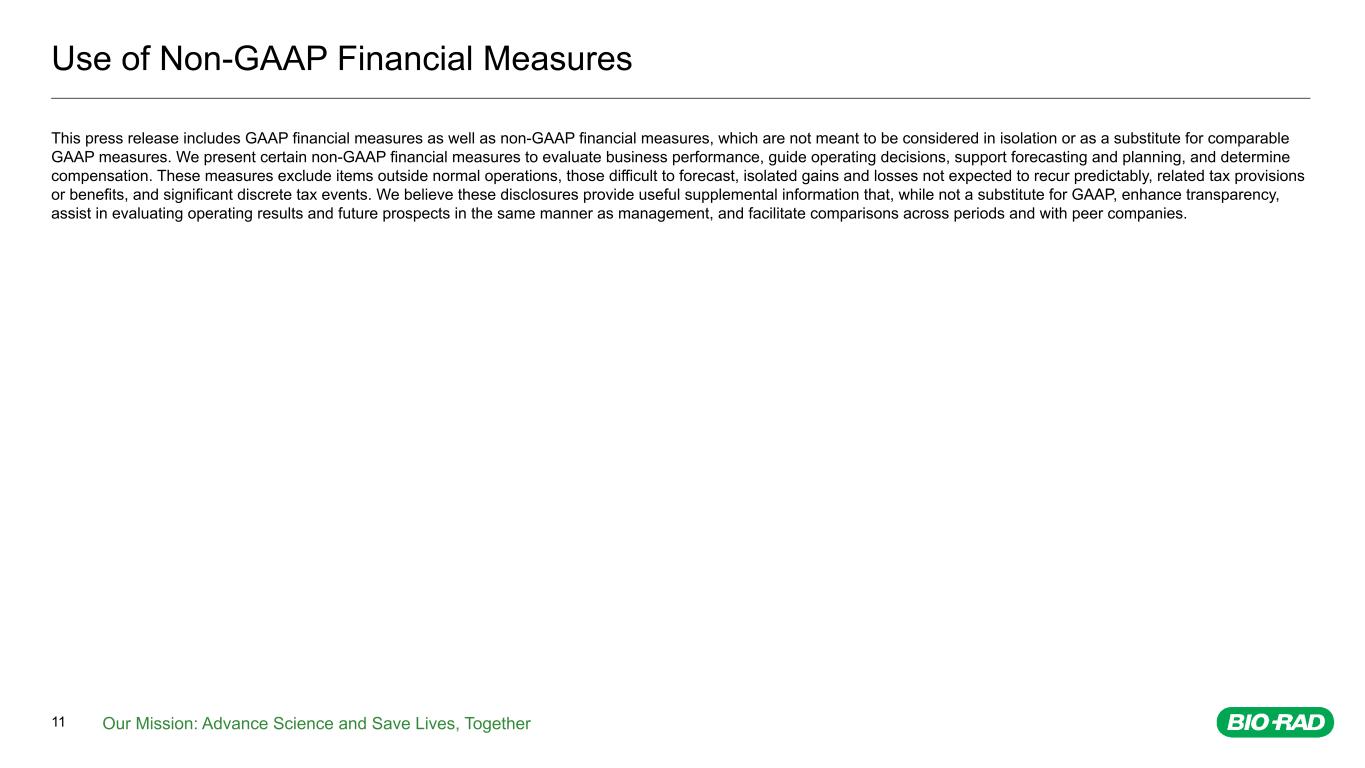
Thank you, operator. Good afternoon to everyone, and thank you for joining us. Today, we will review the financial results for the second quarter ended June 30, 2026 and provide an update on key business trends for BioRat. With me on the call today are Norman Chorks, our Chief Executive Officer, John DiVincenzo, President and Chief Operating Officer, and Ruth Lakeraju, Executive Vice President and Chief Financial Officer. Before we begin our review, I would like to remind everyone that we will be making forward-looking statements about management's goals, plans, and expectations, our future financial performance, and other matters. These statements are based on assumptions and expectations of future events that are subject to risks and uncertainties. Our actual results may differ materially from these plans, goals, and expectations. You should not place undue reliance on these forward-looking statements, and I encourage you to review our filings with the SEC, where we discuss in detail the risk factors in our business. The company does not intend to update any forward-looking statements made during the call today. Finally, our remarks today will include references to non-GAAP financials, including net income and diluted earnings per share, which are financial measures that are not defined under generally accepted accounting principles. In addition to excluding certain atypical and non-recurring items, our non-GAAP financial measures exclude changes in the equity value of our stake in Sartorius AG in order to provide investors with a better understanding of Biorad's underlying operational performance. Investors should review the reconciliation of these non-GAAP measures to the comparable GAAP results contained in our earnings release. We have also posted a supplemental earnings presentation in the investor relations section of our website for your reference. With that, I will now turn the call over to our Chief Operating Officer, John DiVincenzo.
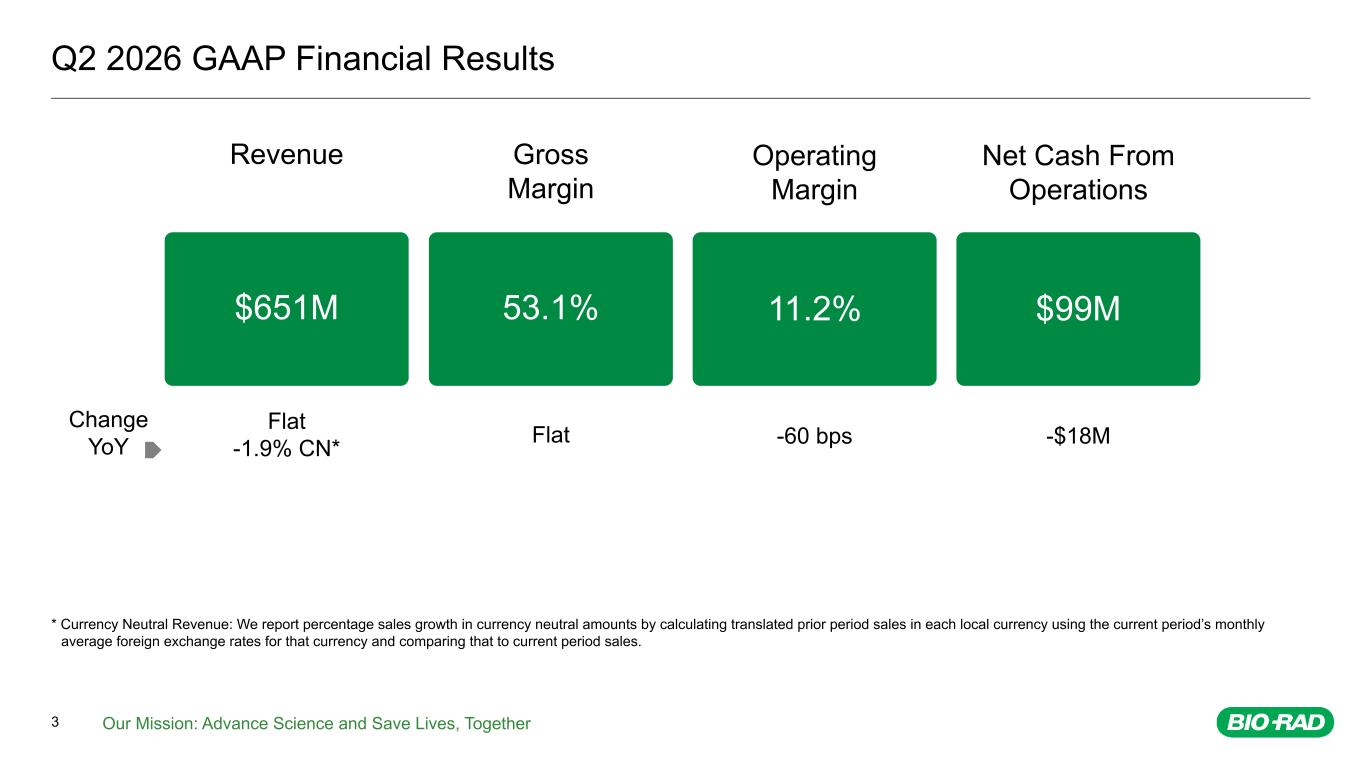
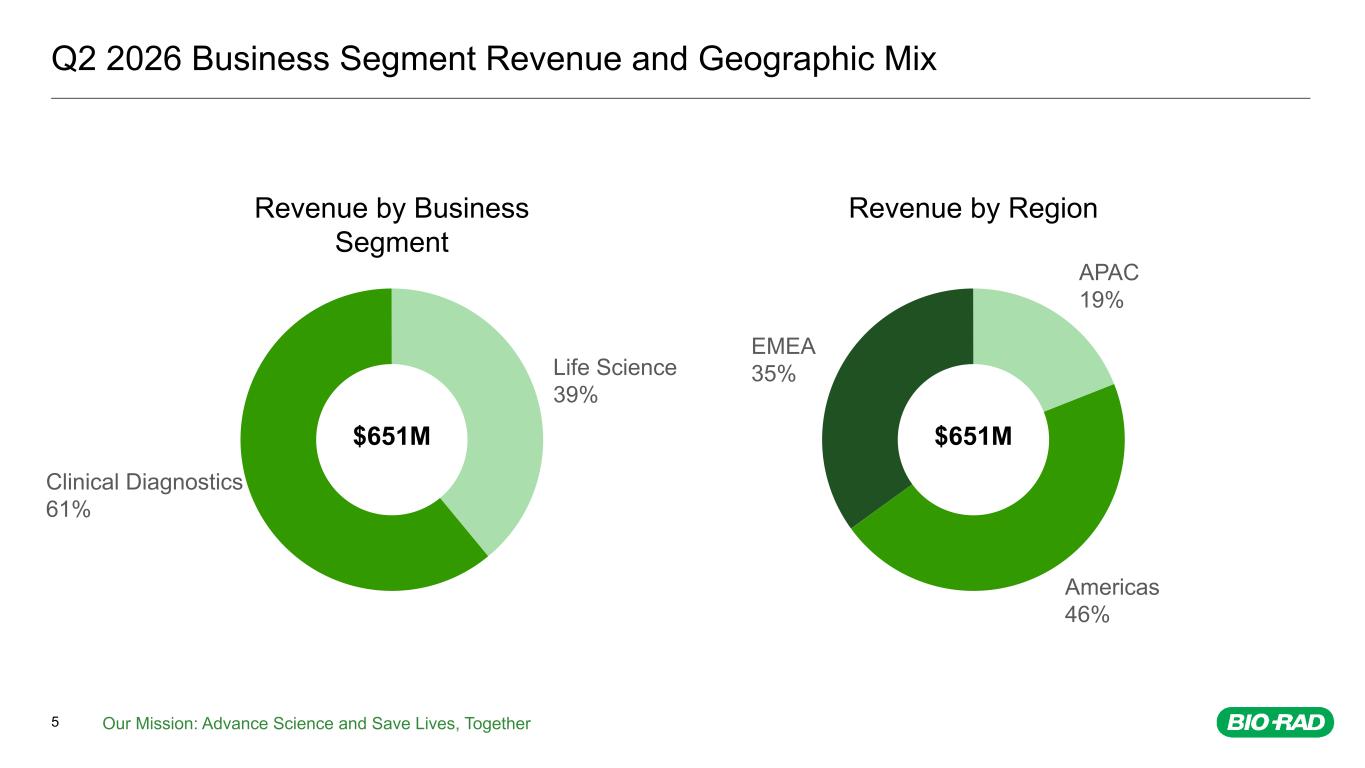
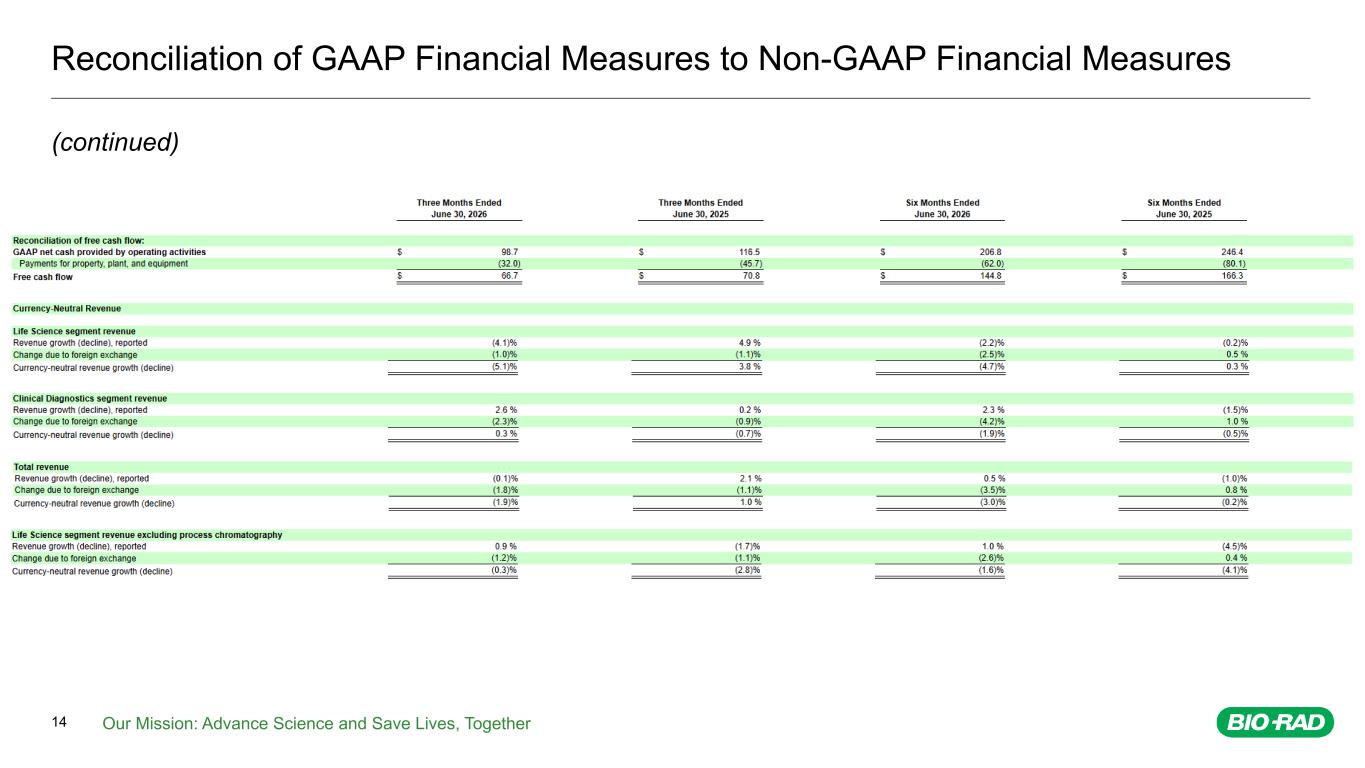
Thanks, Ruben. Good afternoon, everyone, and thank you for joining us. Total company revenue in the second quarter was approximately $651 million, essentially flat as reported, and down 1.9% on a currency-neutral basis compared with the prior year. Sequentially, revenue was up 10%, reflecting improved performance as our teams overcame challenging end-market dynamics in the first quarter. Clinical diagnostics returned to modest currency neutral growth led by quality controls in our blood typing portfolio. In life science, results continue to be affected by softness in the academic research market. Excluding process chromatography, life science revenue was approximately flat on a currency neutral basis, representing an improvement in the segment's underlying trend digital pcr was a particular area of strength growing six percent in the quarter in the academic and government market demand remains below historical levels particularly in america's nih funding outlays have begun to increase year over year but purchasing activity typically lags funding the recent indicators are encouraging but we need to see a more sustained pattern before concluding the market has entered a durable recovery In biopharma, we are seeing early signs of stabilization, consistent with broader industry commentary. Improvement is most evident among later stage and commercial scale biotech customers, where early stage biotech companies remain more cautious as funding conditions have not yet fully normalized. Taken together, these indicators suggest the market is beginning a gradual recovery. Process chromatography, which represents less than 5% of total annual revenues, was sequentially up in decline year-over-year as expected. As a reminder, our current niche position in the polishing step of bioprocessing contributes to revenue concentration from a select number of commercial therapeutics and vaccines. For the remainder of the year, we expect the second half to mirror the first half. Turning to our regional performance, Americas remained soft, primarily due to continued pressure in the academic market. However, we saw improvement as we ended the quarter, and our teams are now cautiously optimistic as we enter the second half of the year. Asia-Pacific, excluding China, grew 6% on a currency-neutral basis, with growth across most major product areas. China, which represents approximately 6% of bi-res total revenue, declined in the high teens, reflecting the timing of quality control orders and softer demand for life science instruments. For the remainder of the year, continued life science softness, coupled with order timing and clinical diagnostics, are expected to create an approximate $4 million headwind. That impact is already incorporated into our full-year guidance. We continue to adapt our business model to the changing market environment. Our in-China, for-China manufacturing capability is operational, and we are now participating in a broader range of tenders. Over time, these actions should improve our competitive profile in the China market. For a mere return to growth, with Middle East revenue increasing 7% year-over-year, Channel partners began replenishing approximately $3 million in inventory during the quarter, although underlying customer demand has not yet stabilized. The continuing conflict in the region has driven higher fuel and transportation costs globally. We want to recognize our teams for navigating these challenges while continuing to support our customers and channel partners. Volatility in the region is expected to continue during the second half, which is reflected in our guidance. Moving beyond the Middle East, our digital PCR franchise continues to be an important strategic differentiator for Biorad. Currency-neutral GDPCR revenue increased 6% year-over-year, with instrument revenue growing more than 20%. The QX700 continues to generate competitive wins and conversions from QPCR, supported by Biorad's broad assay menu, industry-leading installed base, and expanding body of scientific publications. Digital PCR consumables revenue was down slightly year-over-year, but increased sequentially. Consumables pull through has not yet reached the level we ultimately expect. However, the strength in instrument sales is an encouraging indicator of customer demand and establishes a larger foundation for future recurring consumables revenue. We have also reached the first anniversary of our acquisition of Spill Technologies. The expanded portfolio has accelerated revenue growth and is delivering margin performance ahead of our original expectations. The progress reinforces our approach to discipline-focused M&A. Acquiring differentiated commercial products that strengthen our portfolio, complement our existing capabilities, and create durable value. Turning to our operational priorities, since 2024, we have been working to make BioRat a faster, more agile, and efficient enterprise. Earlier this week, we announced the next phase of that work, including changes to our organizational structure, workforce, and physical footprint. These actions are designed to reallocate resources toward the capabilities most important to our future. Cost savings are one outcome, but this is not simply a cost reduction program. We are reshaping the organization, strengthening critical capabilities, simplifying how work gets done, and directing more of our resources toward innovation, customer needs, and sustainable growth. Artificial intelligence is an important enabler of our transformation. Employees are using AI to accelerate analysis and decision making, and we are seeing tangible results. For example, Agentec AI enabled our product development teams to complete 12 months of software development in just six weeks. In another instance, our teams developed new cloud-based functionality in approximately one month, avoiding thousands of hours of conventional engineering work. In closing, the second quarter demonstrated meaningful sequential progress. Clinical diagnostics returned to growth, underlying life science trends improved, and digital PCR delivered strong instrument performance. At the same time, we recognize that several end markets continue to evolve and that we must continue to improve how BioRed operates. The organizational actions announced this week are the next step in an ongoing process to build a faster, leaner, and more competitive company with resources and capabilities closely aligned to innovation, customer needs, and growth. With that, I will turn the call over to Roof.
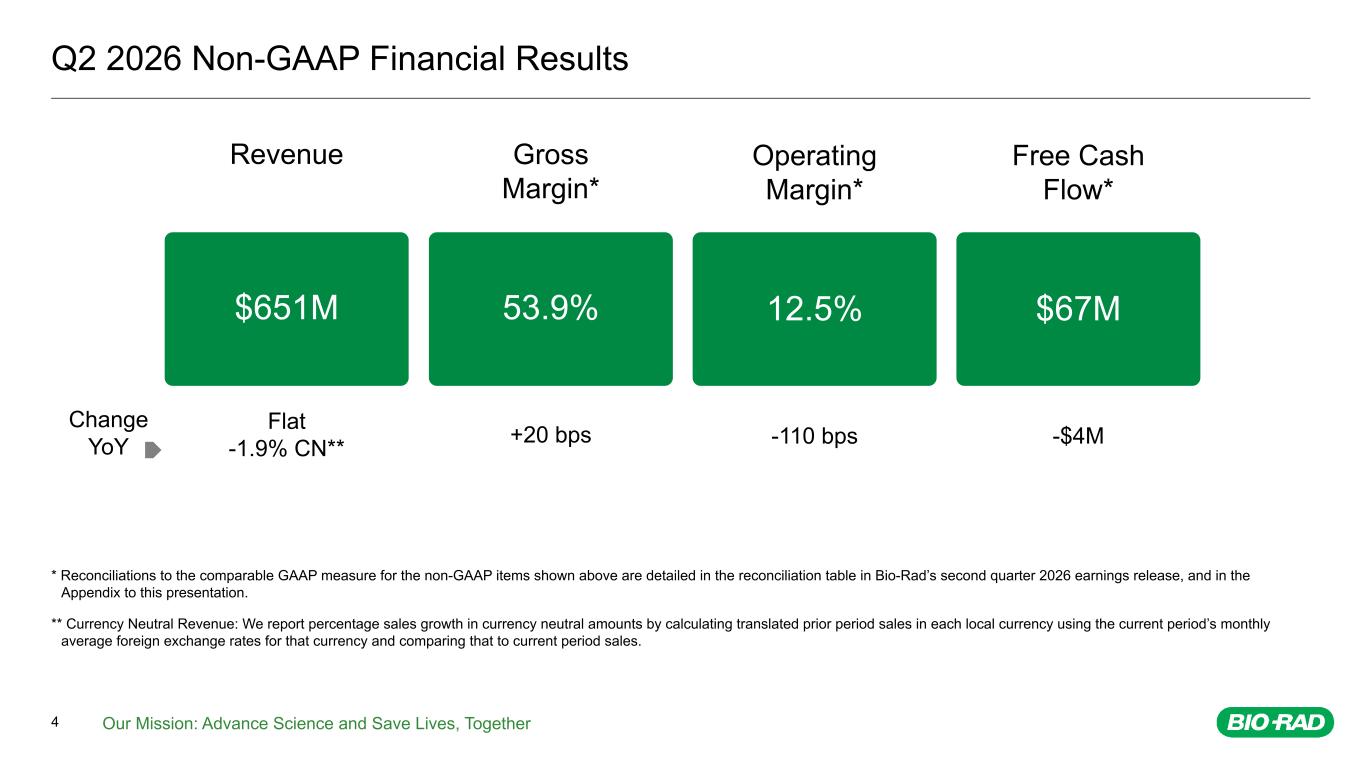
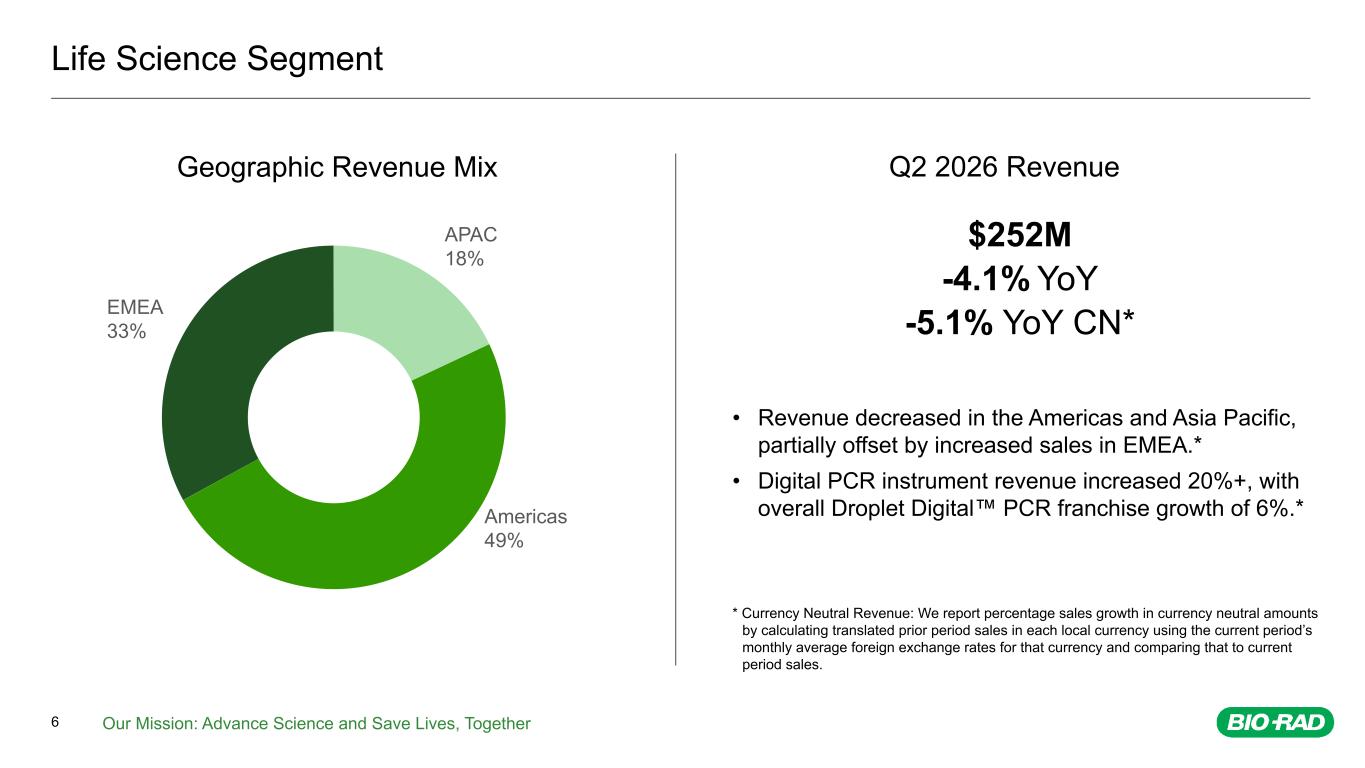
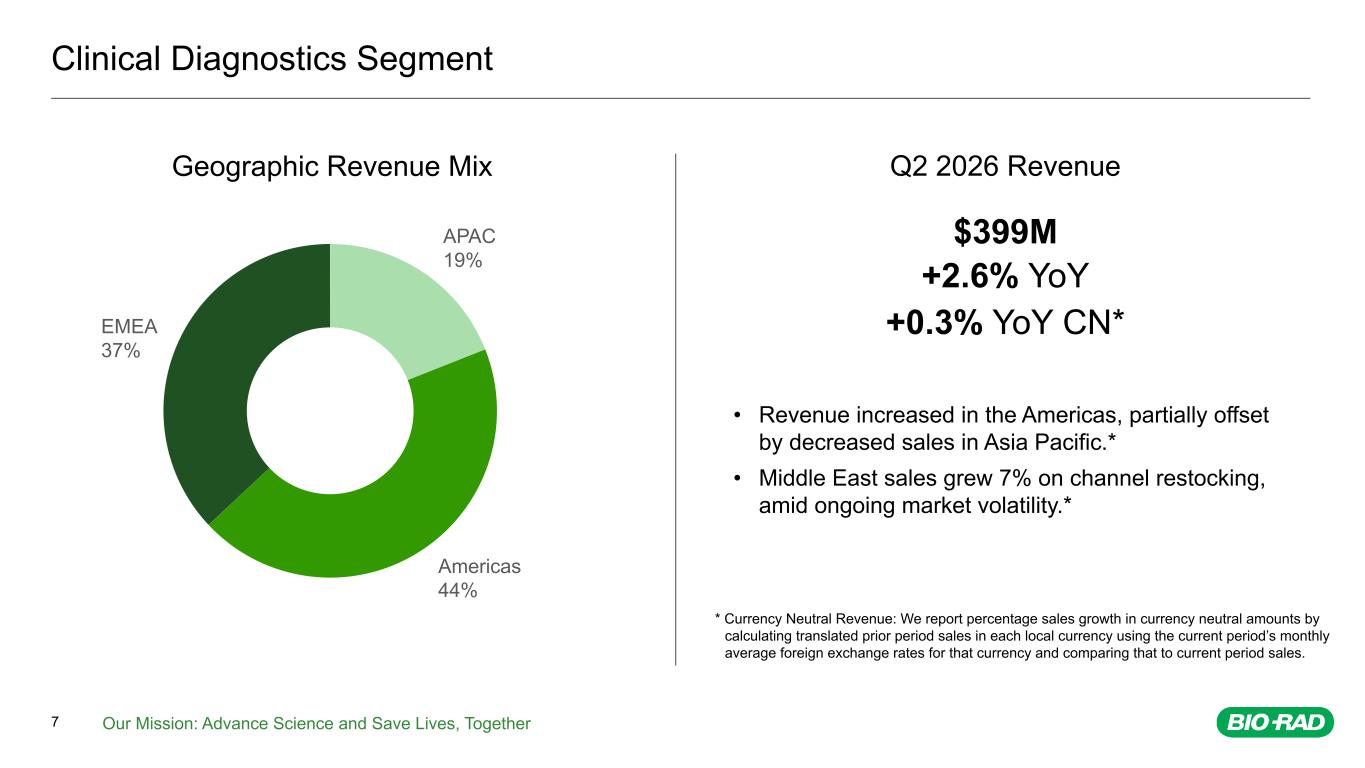
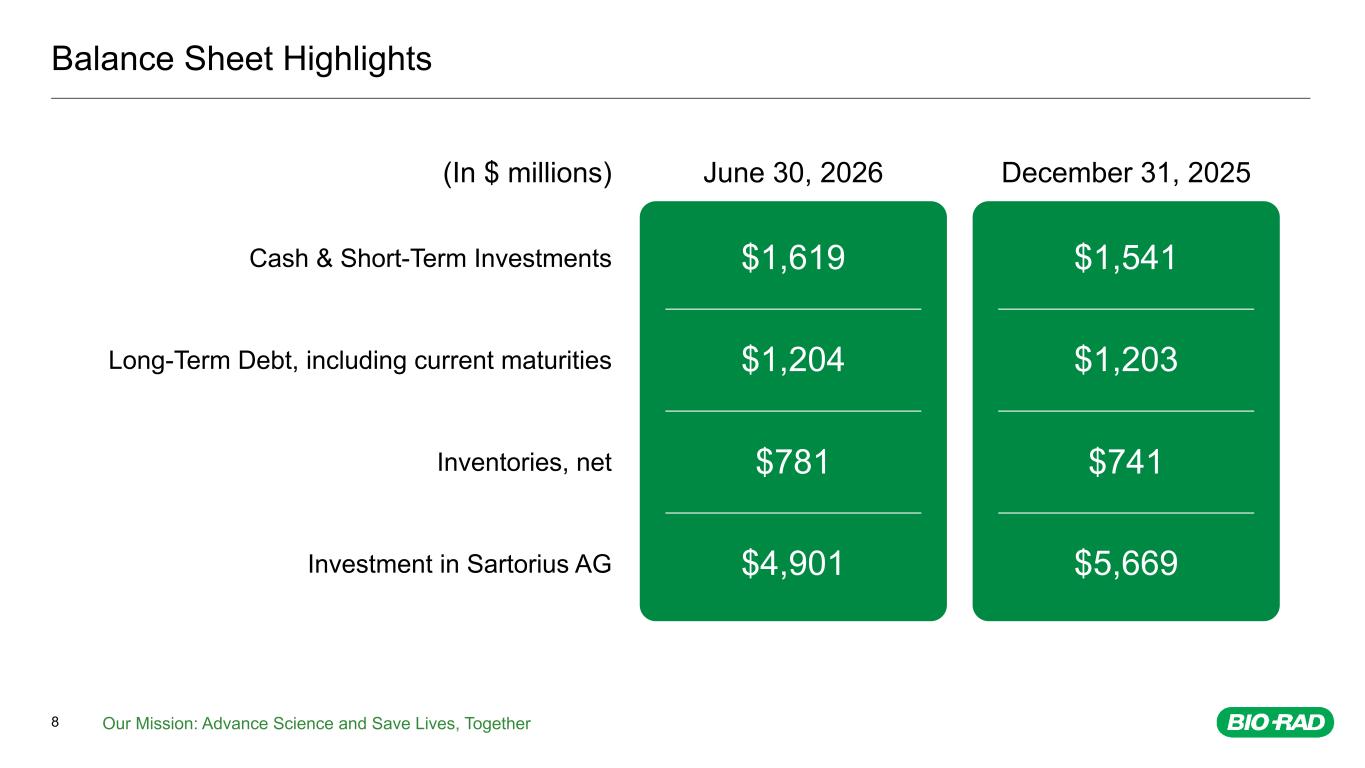
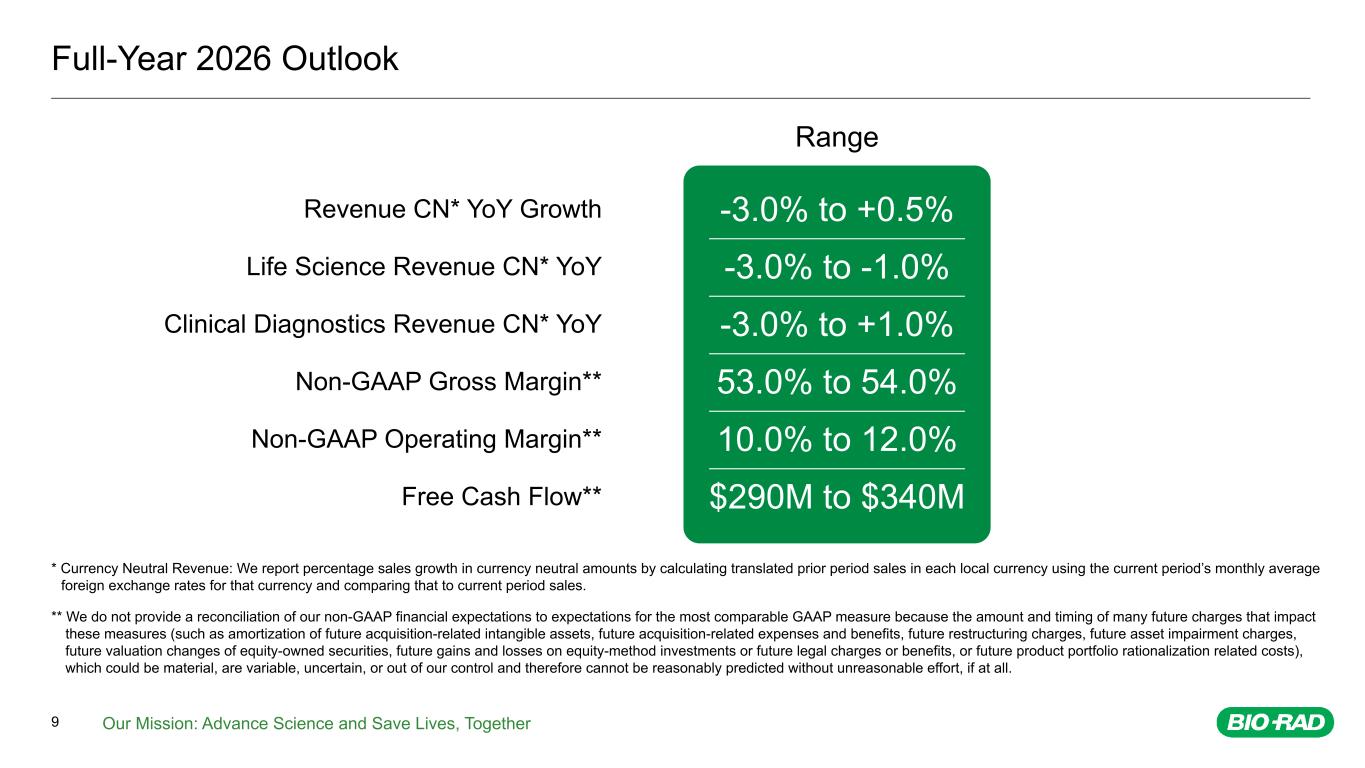
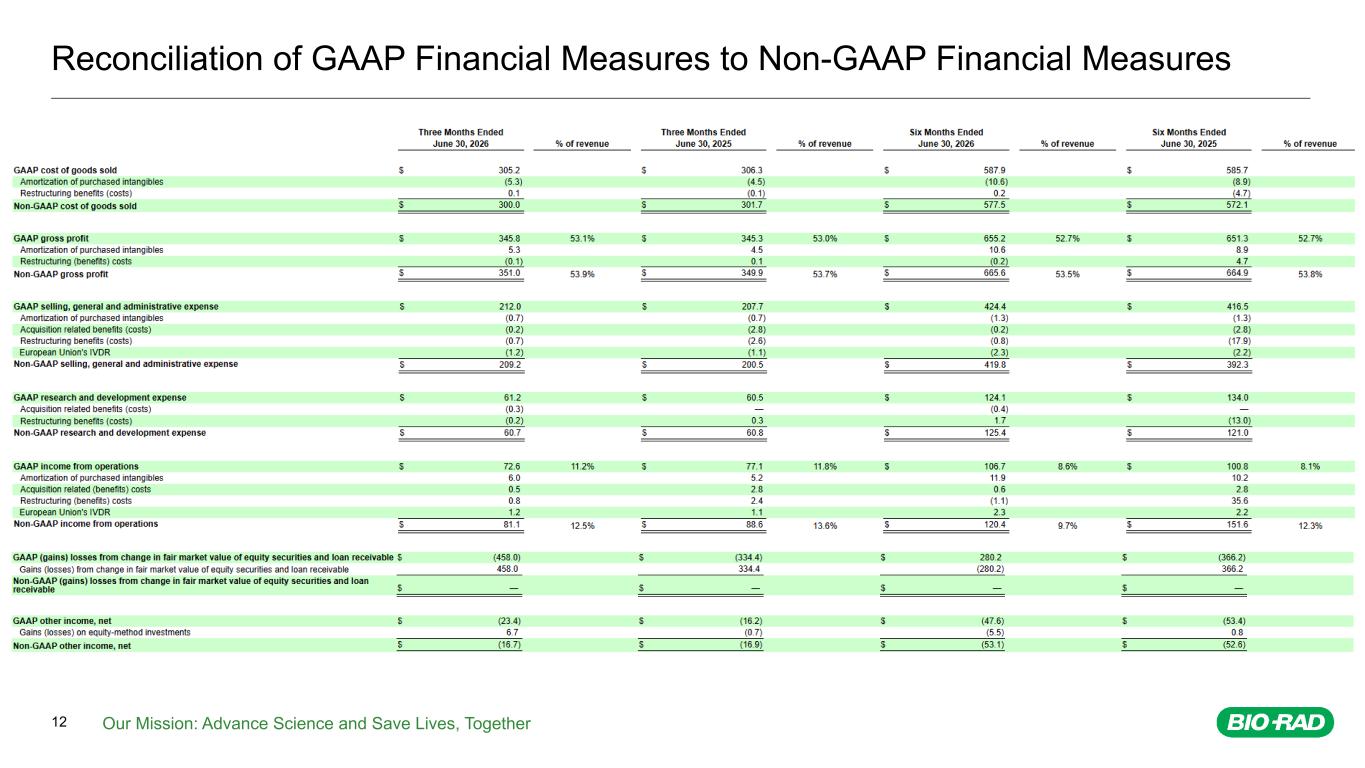
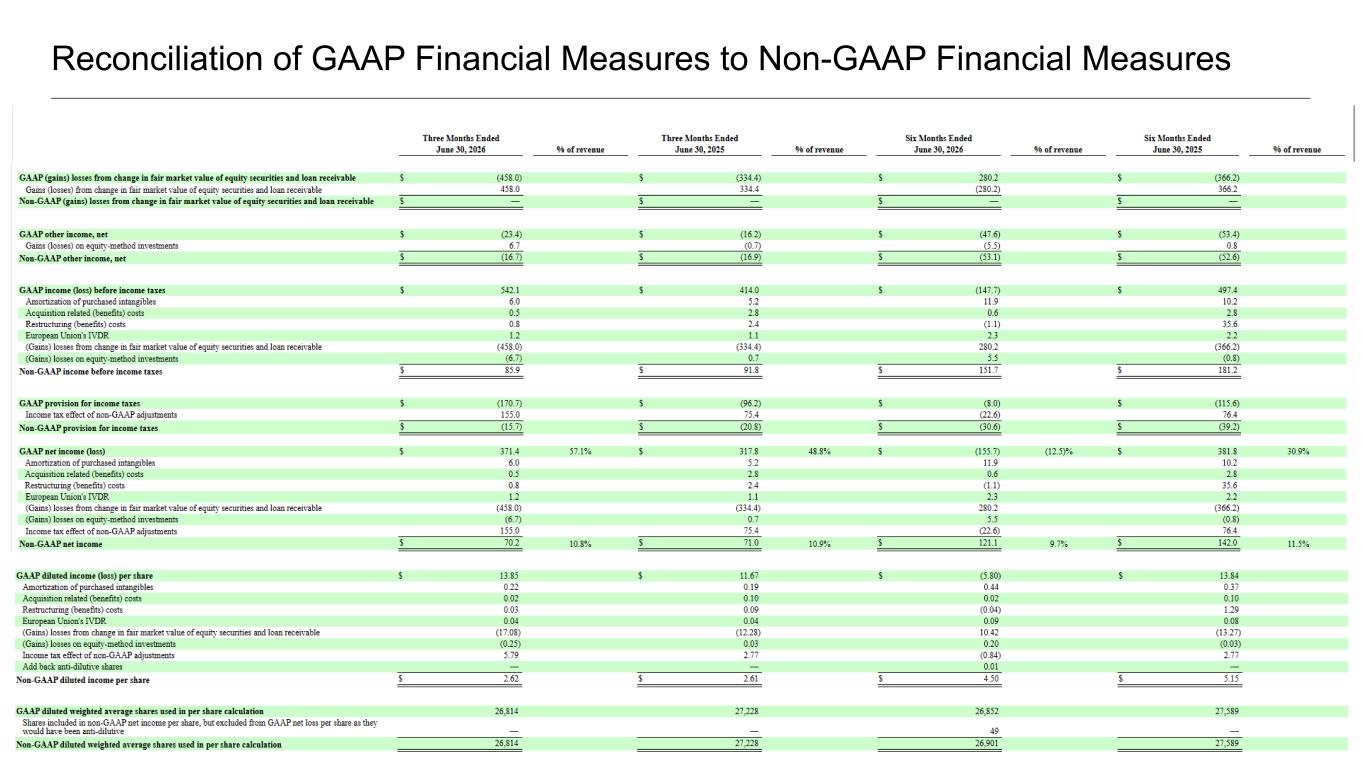
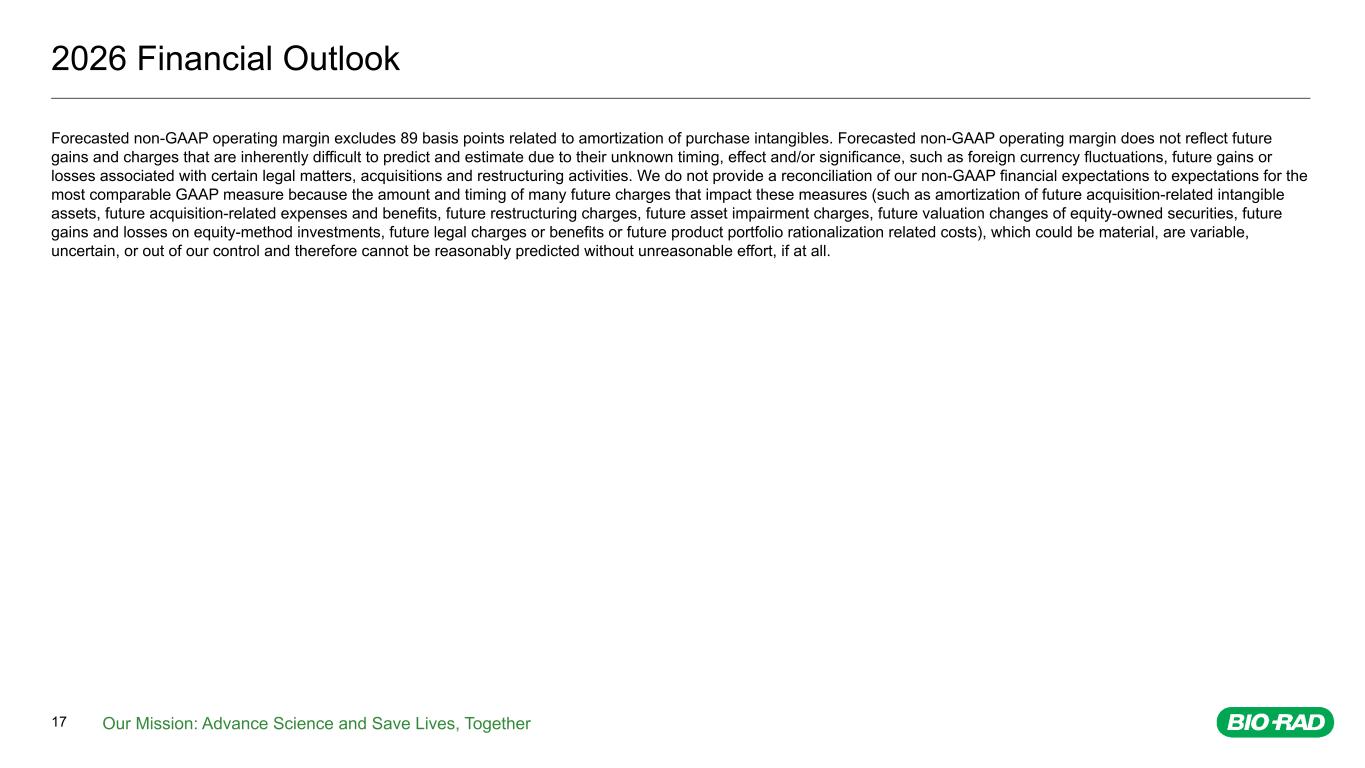
Thank you, John, and good afternoon. I'd like to start with a review of the second quarter of 2026 results, then move to guidance. Overall, net sales for the second quarter of 2026 were approximately $651 million on a reported basis versus $652 million in Q2 of 2025. On a currency neutral basis, this represents a 1.9% year-over-year decrease and was driven by lower sales in the life science segment. Life science sales in the second quarter of 2026 were $252 million, a decrease of 4.1% compared to Q2 of 2025 on a reported basis, and a 5.1% decrease on a currency neutral basis. This was primarily driven by ongoing challenges in the academic research market and a tough process chromatography year over year comparison. Currency neutral sales decreased in Americas and Asia Pacific, partially offset by increased sales in EMEA. Clinical diagnostics sales in the second quarter of 2026 were approximately 399 million compared to 389 million in Q2 of 2025, an increase of 2.6% on a reported basis and a 0.3% on a currency neutral basis. Regionally, growth in Americas was offset by revenue declines in the broader Asia-Pacific region. Ex-China, the Asia-Pacific region grew 6% and EMEA was roughly flat as the Middle East region rebounded 7% growth. Turning to gross margin, consolidated gross margin was 53.1% for the second quarter of 2026 compared to 53% in Q2 of 2025. But on a non-GAAP basis, second quarter gross margin was 53.9% versus 53.7% in the year-ago period. Non-GAAP gross margin improved sequentially from 53.1% in the first quarter due to favorable manufacturing absorption and partially offset by an unfavorable product mix and elevated logistics costs. SG&A expense for the second quarter of 2026 was $212 million for 32.6% of sales compared to $208 million for 31.9% in Q2 of 2025. Second quarter non-GAAP SG&A expense was $209 million versus $201 million in the year-ago The increase in SG&A expense is primarily due to higher employee-related costs. Research and development expense on a GAAP and non-GAAP basis in the second quarter of 2026 was $61 million, or 9.4% of sales, compared to $61 million, or 9.3% of sales in Q2 of 2025. Q2 operating income was approximately $73 million, compared to approximately $77 million in Q2 of 2025. On a non-GAAP basis, second quarter operating margin was 12.5%, compared to 13.6% in Q2 of 2025, and this represents a sequential improvement from 6.6% in the first quarter of 2026. Second quarter, 2026 non-GAAP net income, which excludes the impact of the change in equity value of the Sartorius shares, was $70 million, or $2.62 diluted earnings per share versus 71 million or $2.61 deluded earnings per share with you to 2025. For full details on the balance sheet, cash flow, tax, and sartorius valuation, please refer to our earnings presentation, press release, and 10Q file today, all available on our investor relations website. During the second quarter of 2026, we repurchased approximately 110,000 shares for our buyback program at a total cost of approximately 32 million at an average price of 281 dollars 57 cents moving on to our non-gap guidance for 2026. while we made progress in the second quarter on both revenue and margin we are taking a measured view of the back half of 2026 given a few items that we are watching closely first we are encouraged by early signs of improvement in the academic and government and markets we We want to see a more sustained pattern before treating it as a recovery. Second, we continue to actively manage the China dynamics discussed, which represent an estimated $4 million headwind for the remainder of the year. Third, our opportunity funnel remains healthy, though a tougher process chromatography comparison from the prior year will be a modest drag on third quarter growth. And fourth, in the Middle East, one of our previous higher growth markets, our local teams are actively working to keep product flowing to the region collectively these actions add some near-term variability to both revenue and margin based on these considerations we reaffirm the full-year non-gap guidance framework we continue to expect full-year currency neutral revenue growth be between minus three percent and plus point five percent we expect the life science segment currency-neutral growth to be between minus 3% and minus 1%, and the clinical diagnostic segments, currency-neutral revenue growth to be between minus 3% and plus 1%. Sequentially, we expect third-quarter revenue to be flat to Q2, which is our typical pattern. We model a sequential mid-single-digit revenue percentage ramp from Q3 to Q4, reflecting continued growth in life science from DDPCR, as well as improvement in clinical diagnostics from quality controls and blood typing products. We continue to expect full-year non-gap gross margin to be between 53 and 54 percent. The following dynamics influence our outlook. The America's academic and market continues its gradual recovery, China life science continues to be soft, and the Middle East continues to see intermittent volatility, which is globally impacting our freight logistics a product mix that skewed more towards instrument revenue which carries a lower margin profile than consumables we have factored all of these variables into our gross margin guidance in opex we expect a modest sequential step up in sgna in r d and q3 to support investments in product innovation now i'd like to provide further color on the actions that John mentioned. The restructure within the functional OPEX areas involves head count reductions, facility rationalization, and adding critical skills in support of growth and innovation. This announced restructuring is already underway and expected to be substantially completed by the end of 2027. On an annualized basis, we expect to achieve $30 to $35 million of net cost savings after reinvestment, with most of this realized by the end of 2027. Due to the timing of the actions, we expect minimal savings in 2026, and in 2027, we estimate approximately 40 to 50 BIPs of operating margin expansion. We continue to evaluate opportunities to optimize our operating model and expect to share more in the future. We expect full-year non-GAAP operating margin to be between 10 and 12 percent. We are reaffirming our 2026 full-year free cash flow estimate to be in the range of approximately 290 to 340 million. Finally we will continue to be opportunistic with our share repurchases and as of June 30th we have approximately 206 million available for additional buybacks under the current board authorized program. I'll now turn the call over to Norman.
Thank you Rue. So you know John and Rue have covered the quarters mechanics well so I wanted to spend some time on the key areas of focus for us. First, I wanted to talk about how our team is approaching the evolution of our business. We have organized around two distinct actions, improving execution and sharpening capital allocation. And I would emphasize the word organized. It's not been one action it's been a series of deliberate steps building on each other over the past two years and what you're now seeing are those pieces starting to come together in 2024 you know we began our review of the broader portfolio and strategy then in 25 we took action to rationalize parts of our portfolio pivoting towards higher return areas like digital PCR and we've completed a restructuring program which is reflected in our current cost structure. Our reprioritization has been paired with a deliberate push to improve product vitality which has been foundational. What we're focused on this year is a performance culture, which includes clearer accountability, tighter operating rigor, and better forecasting discipline. All of this is intended to accelerate revenue growth and improve profitability. On capital allocation, again, discipline has shaped how we're deploying capital. Our acquisition of droplet digital PCR companies still with technologies is a good example of the kind of transaction we want to keep doing focused growth and margin accretive business that strengthens our portfolio and also on capital allocation just to reinforce the point on sartorius kind of consistent with previous quarters our view has not changed we see it as a valuable asset that provides us with optionality and it is monetizable at the right time and price. So John and Rube spoke earlier about the restructuring program we announced this week. I do see this as a necessary part of our evolution as markets continue to move faster and demand more agility. The program is about shaping our workforce around the skills that we need to continue to be competitive in the longer term. And we do believe the capabilities we're building will underpin our path to robust growth and profitability. I do want to emphasize that this is not the end of our work. BioRED's evolution is of course ongoing and we'll keep acting deliberately and with urgency on the opportunities to see, you know, to strengthen the business and to create durable value for all stakeholders. So finally, before we take questions, let me just briefly address our engagement with Elliott Management. We have been in active, I would say constructive dialogue, helping them to understand the journey that we are on. We believe that we are broadly aligned on the objectives, including improving execution, sharpening capital allocation, and closing the gap between buyer ed's value and its share price. And we do look forward to continuing those conversations.
So maybe with that operator, I think we'll now open up the line for questions thank you sir at this time i would like to remind everyone in order to ask a question press star then the number one on your telephone keypad your first question comes from jack mehan operon research thank you good afternoon guys um had a few uh questions around the quarter and then wanted to ask about the engagement at the end um the first is the digital PCR instrument growth over 20% in the quarter. How much, was there anything one-time or stock, stocking might not be the right word, but like anything one-time-ish that helped the results or was it the comp dynamic or something else going on in terms of market growth that you would flag?
Hey, Jack, John DiVincenzo here. You know, it really is broad-based. We're very proud that right out of the gate when we closed the acquisition at the end of June last year, We were well prepared to make the transition from our legacy portfolio to include these new systems from STILLA. We worked very quickly to move and qualify our catalog of assays onto that platform. In fact, we accomplished it ahead of time. And it was very motivational for our commercial team to have this broader portfolio and to go out and take some share from QPCR, have some competitive wins, And we saw wins across the board in all the geographies we operate in. So, you know, a lot of our business is in the academic market, which is not the strongest, but we still grew significantly in both academic and biopharma segments.
Great. And then on the engagement with Elliot, appreciate the color on that. One question we get a lot, and I feel like where some of the uncertainty around the value of the Sartoria stake is, if this is truly monetizable, how you treat the tax effect, if any, related to that. I was wondering if there was anything you could comment that if there were a monetizable event related to that, like what structures you might have considered and what, you know, what structures you could put in place to minimize any tax leakage related to that?
Hey, Jack, it's Rubell. I'll try and give some thought to that. In terms of the possible tax efficiency of monetizing it, it's going to depend upon the particular situation as to what creates the monetizable events, if you will. So, that's one thing to keep in mind. The second thing to keep in mind, and so that's, again, a case-by-case. The second aspect is, from a P&L standpoint, we do accrue the tax effect of the sartorius shares today on our balance sheet. So, there's a deferred tax liability there. Obviously, that's a P&L effect. The cash flow is still leave the company to pay for those taxes, but at least the P&L is taken into account.
Okay. And then the last one, and I'll go back in the queue, is I was just – one thing that didn't come up was related to just succession planning as it pertains to CEO. Norman, I didn't know if there was anything more you could add in terms of what's in place in terms of formalized CEO succession plan and timeline related to that, and who's on the list in terms of internal versus external candidates.
Yeah, so this is obviously kind of a standing responsibility of the board at the end of the day, which is reviewed on an annual basis as part of its kind of regular kind of governance process. And, you know, I think, you know, when the time comes, I would expect the board will run a process evaluating both internal and external candidates with the idea of, you know, obviously mid-cap, public company experience, and, you know, the relevant qualifications to really to continue to drive the company. I think it'll be grounded in all of that.
Sounds good. Thank you, Norman.
Operator
Your next question comes from Tycho Peterson, Jeff Rees.
Okay, thanks. I think I'll start with the restructuring. You said restructuring at 40, 50 basis points next year. I just want to make sure that's incremental and additive on top of underlying margin expansion. There was some confusion about that based on my inbounds. And then can you just talk about, you know, the pacing of these actions as we think about building from the 10 to 12 percent from this year and any more kind of granularity you can provide on is this more SG&A focused R&D? Just give us a little bit of a sense of, you know, where you think you might get the leverage.
Yeah, I hate to go through. So, it is incremental from a margin expansion standpoint, so that's number one. The predominance of the actions which are phased over time, and that's why we won't see the full realized savings until the end of 2027, is primarily in the OPEX areas. There is some facility aspects to it that also contribute to it, which also take time through between now and throughout 2027.
And then how are you thinking about, I guess, input costs in the meantime? You've mentioned shipping materials costs. That was in kind of the context of the Middle East comments, I think. But just how are you thinking about input costs here?
Yeah, I think, you know, obviously we're in the middle of 26 still, right? And so we've still got a planning process to go through in 27. As we think about it, we understand the need to drive margin expansion over time, and especially towards, you know, kind of that mid-teens number that we've spoken about recently. So with that said, beyond these actions, things like the freight costs, logistics costs, our current headwinds, we are taking actions to try and mitigate some of that, which we'll continue to do. That could be, you know, opportunity for us to help support margin expansion. The other aspect is continued operational execution, both from an absorption standpoint, but also from a procurement leverage standpoint over time that we'd be able to drive. And then as we continue to evaluate other efficiencies that we can drive, John spoke about AI and how that's enabling things. We think that there's opportunities potentially there as well. So, you know, this is the incremental actions from the restructuring are intended to be additive, but we're still thinking through additional ways to drive margin expansion beyond this restructuring action.
And take those, John, maybe just to add to it a little bit. We're looking across the board in the P&L for cost reduction. So above the gross margin line, we're actively pursuing some product cost reductions. Also, the new products coming online between now and the N27 will be of a higher margin overall. So we're driving in kind of improved cost structure in the product portfolio as well as, you know, managing the mix and then wherever we can, as Rube said, looking for ways to leverage our existing OPEX and grow the top line.
Okay, that's helpful. And then maybe pivoting to end markets, you know, trying to, I'm curious, down mid-teens, obviously it's been, you know, a tough market that's known. Did something get worse here in the quarter and how are you thinking about it for the remainder of the year?
You know, not from a reimbursement standpoint, from a diagnostic standpoint. So it was just, I think, softness that we saw within the life science portfolio. We did start manufacturing product locally there, as we said, that helps us participate in some tenders that are mandating a certain percentage of the products are built in China. We'll expand that over time. But for us, it was more pressure in the academic market for life science instruments with softness and overall kind of status quo for diagnostics.
And, Tycho, maybe just one additional thing to add to John's. It's order timing of things like quality controls and some of our other products there on the diagnostic side. So there's a little bit of order timing there that we think comes through later in the year.
Okay. Last one, just the inventory restock. You said $3 million. I guess, is that drag completely over, or how do you think about incremental catch-up on any restocks in there?
Yeah, we don't necessarily see it catching up through the year. We actually see the Middle East being somewhat consistent with Q2 levels. Obviously, there was that immediate restock that we expected to see from a safety stock replenishment standpoint, and that played out as we thought. The rest of the year in the Middle East, and all of that is specific to the Middle East in terms of that restock, is relatively consistent quarter to quarter between Q2, Q3, and Q4.
Operator
Your next question comes from Dan Leonard, RBC Capital Market.
Thank you very much. I wanted to follow up on the organizational actions first, both on magnitude as well as timing. I think you said $30 to $35 million in savings with a $90 million one-time cost number associated with that. It's about a three-year payback. Is that a conservative estimate or do you think that's the right number?
Those are the numbers, Dan. So that's right from a cost standpoint and kind of what we project right now. And one thing I want to reinforce here, that's a net cost savings. One of the things that we've commented on within the script is we are adding back certain capabilities that we feel are necessary to drive further innovation and growth on a longer-term basis. So, yes, there's a restructuring action. However, there's incremental investments that we're making as part of this, which nets the savings down to that sort of $30 to $35 million on an annualized basis.
Got it. Understood. And then from a timing perspective, the 18 months to accomplish the restructuring, is that linear? What are the pushes and pulls on that timeline?
Yeah, I mean, there's various things, right? Some of this is facilities related and therefore it takes some incremental effort around the facility. That's the most significant driver in terms of it being over time, if you will. And so, as that, as we manage those, those, that facilities exit, those facilities exit, you know, that could kind of move a little bit ahead or a little bit further behind, but we anticipate getting it all done by the end of 27 at the latest.
Okay, thank you. And then my final clarification, as you mentioned, you're lapping now the acquisition of Scylla. Presumably that means the comps get tougher in digital PCR. How are you thinking about the durable growth rate then in that category as you lap against the instrument placements from prior years?
Yeah, I guess there's a couple different things. We actually still feel very confident on the long-term growth prospects of DDPCR. If you think about it, yes, the comps become a little bit tougher, especially considering the success of the recent quarters, but we think that there's more opportunity in the marketplace from an instrument placement standpoint. The other aspect of it, if you will, is, as we've indicated, the consumable pull-through takes six to 12 months, and it's kind of still a soft academic market. So, we would anticipate consumable pull-through to start adding or being additive to our overall DDPCR growth rate. With all that said, we still see near-term, mid-single-digit kind of growth rate from a DDPCR standpoint. And over time, we think success really looks like if we can take that to a high single-digit kind of range, if you will.
Yeah, Dan, one way I like to about it that acquisition accelerated some of our product development efforts um so first of all the products that we acquired and put on the marketplace uh were similar to things that we had a couple years out and so we pulled forward some things so the growth would be driven by the current portfolio we have and and some strength there in taking share by expanding the marketplace and competitive wins but also um products that we have in our pipeline to come in the next few years so we're very very confident that that product line will be a leader for us okay thank you very much your next question is from daniel gross light city daniel your line is over who on for hi this is
albert who on for daniel uh thanks for taking the question uh if i'm not mistaken uh i didn't catch this in the uh prepared remarks but uh have you guys quantified the process chrome um uh decline for the quarter and then can you just share some confidence about you know getting to let's say low single digit grower again in 27 and uh maybe mid to high single digit growth in the long term i guess uh can you speak to like the visibility the actions you're taking and their confidence to get their place. Thank you.
Yeah. Hey, Albert. So this is Ruth, maybe I'll start. In terms of visibility, we've got good visibility with our end customers and seeing what their forecasts look like. Our commercial teams work actively with them as do our business group teams. In terms of, you're right, the year-over-year comp is a little bit tough because as we, if you remember, in Q2 and Q3 of last year, process chromatography was very strong above kind of usual run rates that we've seen on a quarterly basis as customers moved orders around between the year and later in the year into earlier quarter like Q2 and then Q3 as well. So we're going to see that difficult comp again in Q3. With all that said, we do think that because of the strength of our customers and the clinical phases. And obviously, over time, those need to translate to commercial success. But between the success we have with the customers we have in commercial phase and those that we see advancing through the clinical phases, it gives us confidence in looking at a kind of low to mid single digit near term growth rate from a process chromatography standpoint, and then ultimately trying to drive towards high school digits, which is more similar to the markets. But with all that said, we are in this niche area of polishing phase, if you will, and so we don't support the broader buyer processing market. And I think, as we've always said, we will see lumpiness on a quarter-to-quarter basis as a result of where we play and our customer concentration.
Got it. Okay, thank you. and maybe moving to china obviously we've seen some ever-changing dynamics here especially on the diagnostic landscape so what can we kind of expect going forward here what should we be watching besides you know bio diabetes asset just because it seems like it's an ever-changing dynamic um things can come up so how is bio thinking about at the moment appreciate that albert this is john rutenzo um thanks for joining today obviously for several years now the china government has been trying to bring health care to more and more of its population at the same time control the costs uh and they've taken a number of actions there you know i think that uh majority of their actions
they've taken uh we've absorbed we had one or two areas that affected us most did not but moving forward we expect that they're going to continue to try to control the costs and bring the health care to more and more of their population. I think that's the reality of it. We think there's probably one more maybe change in reimbursement, but we're monitoring now some of the developments there with our China team.
Got it. Okay, thank you. And last one for me, just on the DDPCR growth, I think you previously mentioned early in the call that maybe it's still like a mid-single-digit grower this year in the near term, but eventually that can get into high single digits. Is that strictly through pull through or how are you guys thinking about, you know, getting from that single to high single after placing, you know, after having very strong instrument placements in the recent quarters? Thank you.
So, first of all, it is about instrument placements, but then it's about the, you know, the pull through on reagents, but, you know, just the expanding use of the technology in general and the value that it's bringing to science, I think that's probably going to continue to be a pretty good driver for us. And, you know, as people also pivot from qPCR to ddPCR with applications, kind of another avenue for us. So those are probably the principal ones. And you can also think about as you move ahead with the technology diagnostic application. So a number of directions to go in.
All right, thank you. Thanks, Albert.
Operator
Again, if you would like to ask a question, please press star, then the number one on your telephone keypad. We'll now take a follow up from Jack Meehan, Opera and research.
Thanks, guys. I wanted to ask about one of the topics to yours this earnings season, which is tariff dynamics. I was wondering if you were anticipating any meaningful refunds or payments back to customers.
Yeah. Hey, Jack. This is Ruth. So, from a tariff standpoint, we've obviously applied for refunds. Obviously, there's this appeals process that's ongoing from From a government standpoint, you know, I think as that gets settled out, we will then have some conclusion on it from a tariff standpoint and hope to be able to see some tariffs running through the P&L at that time.
Yeah, Jack, we did not charge a surcharge, so there's nothing going back to our customers at this point in time.
Got it. And then back on DDPCR, you know, one of your flagship diagnostic partners, Genoscopy Gut Medicare final coverage in the quarter. I was wondering if there was anything you could share about whether there could be any, you know, step up in contribution to sales from them this year, next year, how you're thinking about that as an opportunity for the DD-PCR business.
We're excited about the partnership and the application of technology. They have a strong partnership with LabCorp as well. We haven't modeled anything to our plans yet. We're kind of waiting for kind of final confirmation from them as we kind of end 2026 and then plan for 2027. But so far, you know, we've let the development happen between genoscopy and marketplace. But we're bullish overall. We just haven't put anything to our plans yet.
Okay. And then last phasing question, maybe for Roop. You know, in life sciences, you did call it down four and a half constant currency in the first half of the year. So to get to down one to three for the year, it calls for, you know, kind of a nice improvement in the second half. Can you talk about what is stepping up from a business perspective from a, from paving?
Yeah, I mean, it's broad-based actually in terms of what steps up as we go through the rest of the year, Jack.
We see digital PCR, DPCR specifically, and some of the applied markets associated with DPCR as growth contributors, but really it is broad-based as includes you know partnerships that we have that their business is going strongly in some of the applied markets as well as diagnostic applications for summer gene expression portfolio um and maybe in the fourth quarter a little easier comp with process chrome got it okay thank you guys thanks ryan at this time there are no further questions i'd like to hand the conference back to mr rubin arguetta for any additional or closing remarks thank you for joining us today looking
ahead we'll be attending two investor events in september the wells fargo healthcare conference and bernstein's healthcare forum we appreciate your interest in bi-rad and hope to connect with many of you there ladies and gentlemen that does conclude today's call thank you for joining and you may now disconnect your lines.