Operator
Good morning. My name is Rebecca, and I will be your conference operator today. At this time, I would like to welcome everyone to the Brookdale Senior Living Third Quarter 2025 Earnings Call. Today's conference call is being recorded. At this time, I would like to turn the conference over to Mike Grant, Brookdale's Vice President of Investor Relations. Please go ahead.
Thank you, operator. Good morning, everyone, and welcome to Brookdale Senior Living's Third Quarter 2025 Earnings Call. Participating on today's call are Nick Stengle, Brookdale's recently appointed Chief Executive Officer; Dawn Kussow, our Executive Vice President and Chief Financial Officer; and Chad White, our Executive Vice President, General Counsel and Secretary. On this call, we will discuss financial results for the third quarter of 2025 as well as updated financial guidance for the 2025 year. We'll also provide you with other general business updates. During today's call, our remarks, including our answers to your questions, will include forward-looking statements pursuant to the safe harbor provisions of the Private Securities Litigation Reform Act. These statements are made as of today's date, and we expressly disclaim any obligation to update these statements in the future. Actual results and performance may differ materially from forward-looking statements. Certain of the factors that could cause actual results to differ are detailed in the earnings release we issued after market yesterday as well as in our Securities and Exchange Commission filings, including the risk factors included in our annual report on Form 10-K and quarterly reports on Form 10-Q. I direct you to the release for the full safe harbor statement. Also, please note that during this call, management will discuss non-GAAP financial measures. For reconciliations of each non-GAAP measure to the most comparable GAAP measure, I direct you to the earnings release and to the company's quarterly supplemental financial information, which may be found at brookdaleinvestors.com and was furnished on an 8-K yesterday. With that, it is my pleasure to turn the call over to our CEO, Nick Stengle.
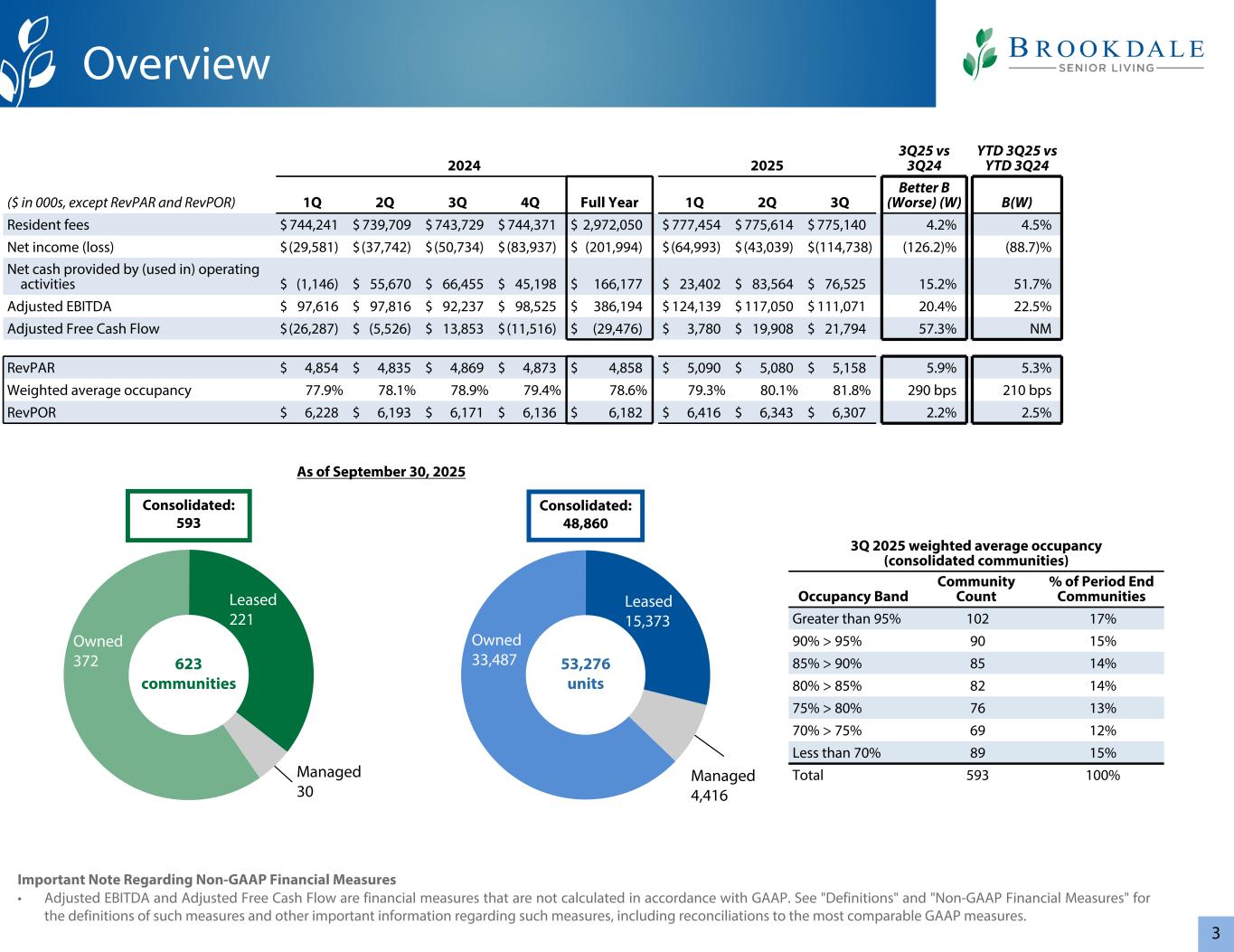
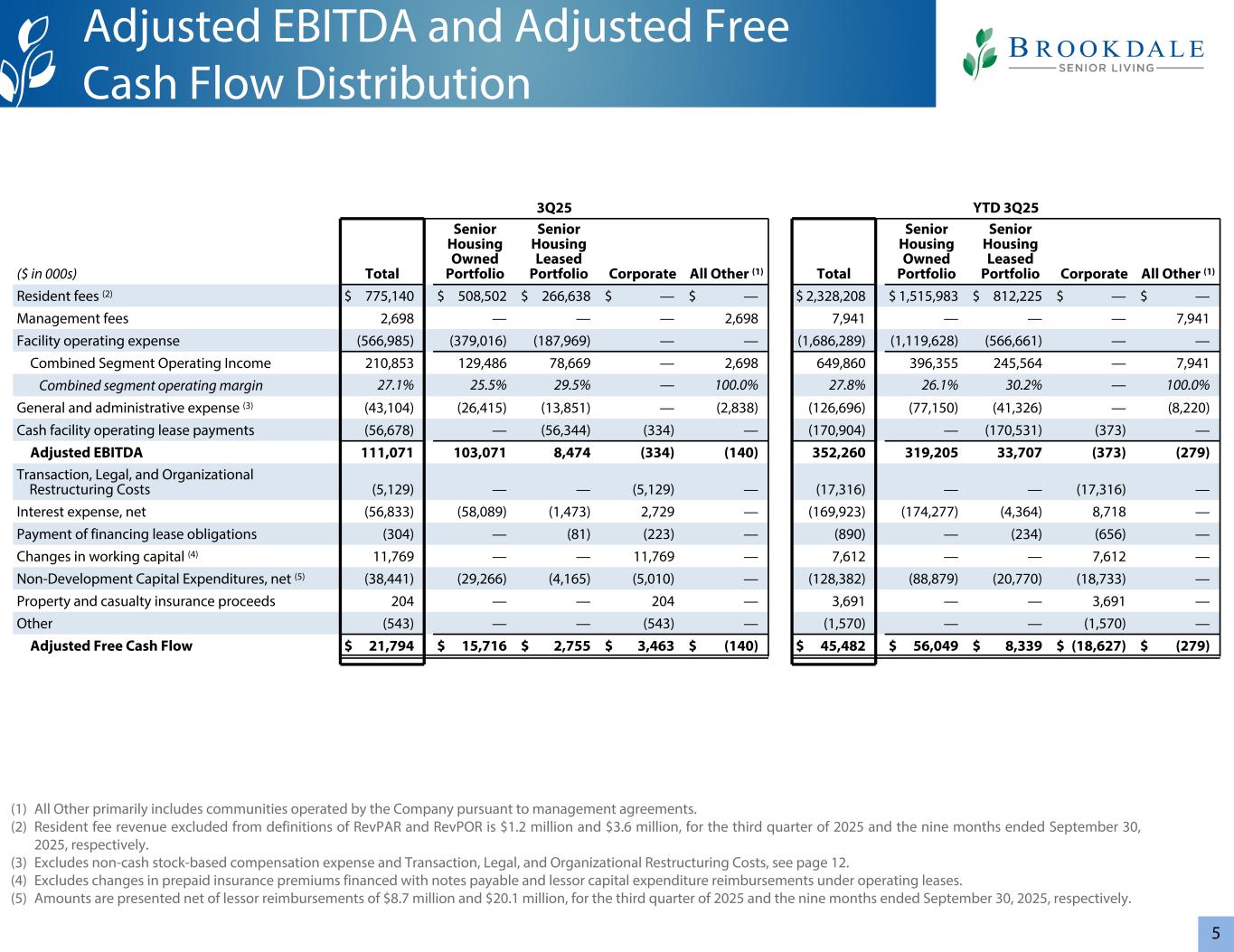
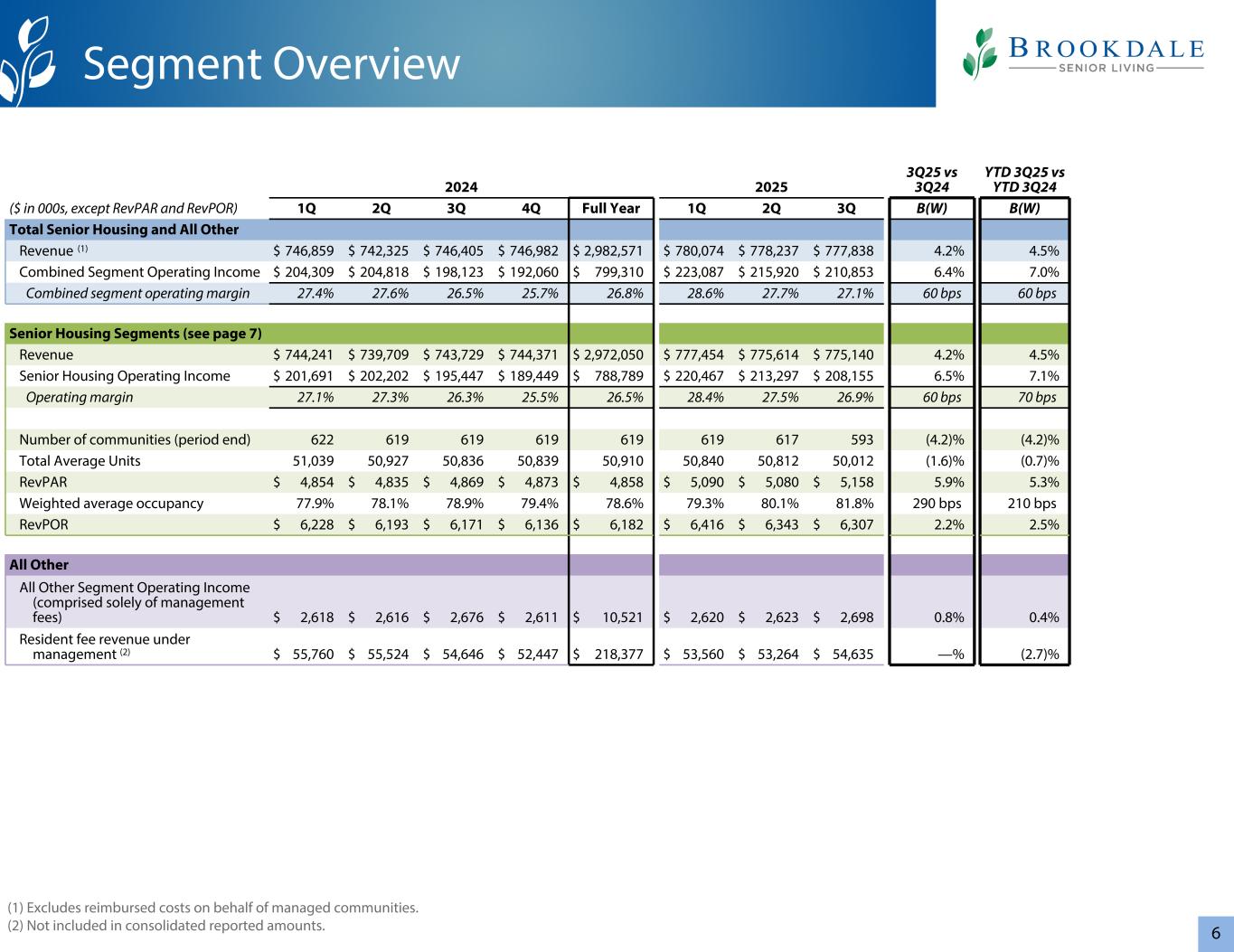
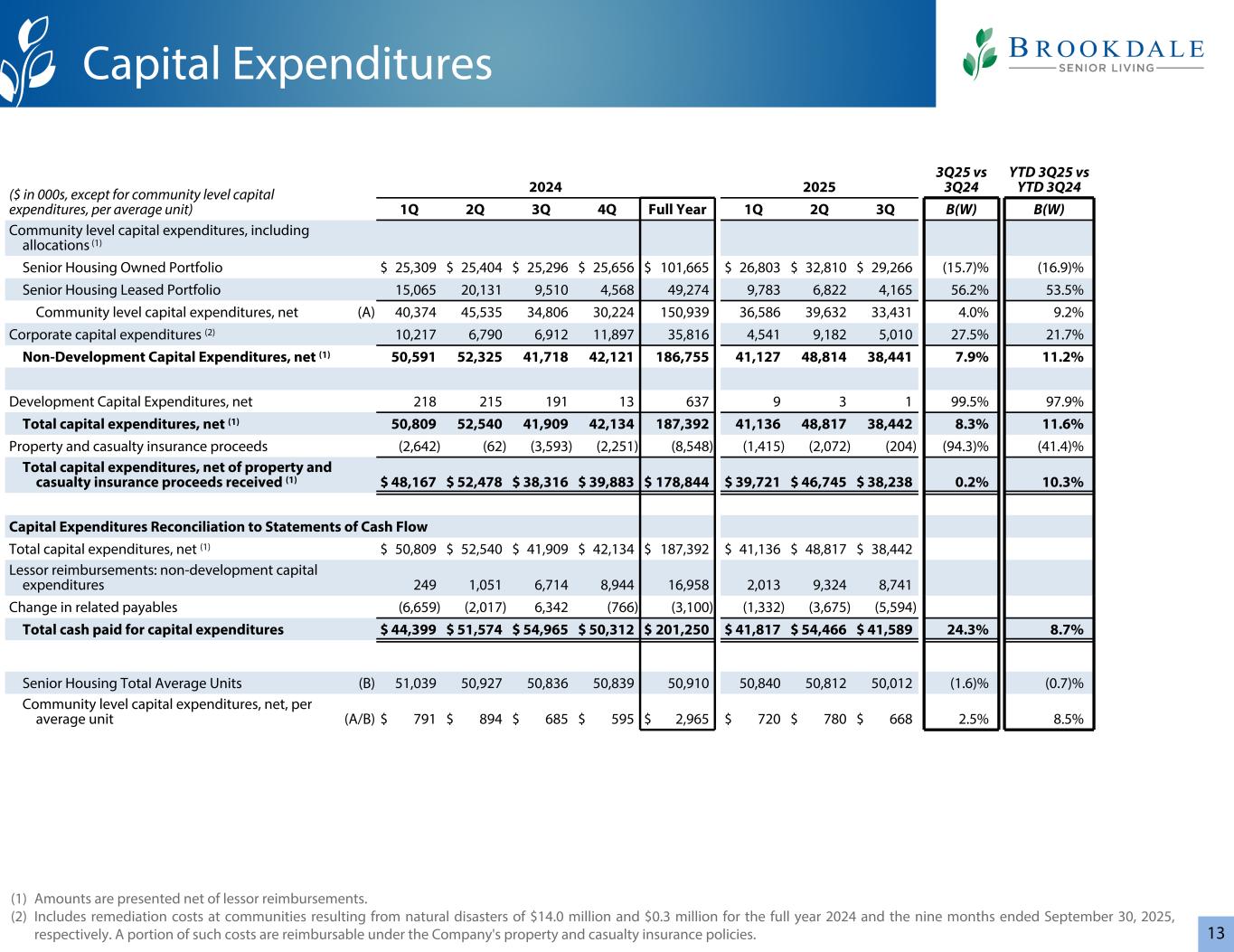
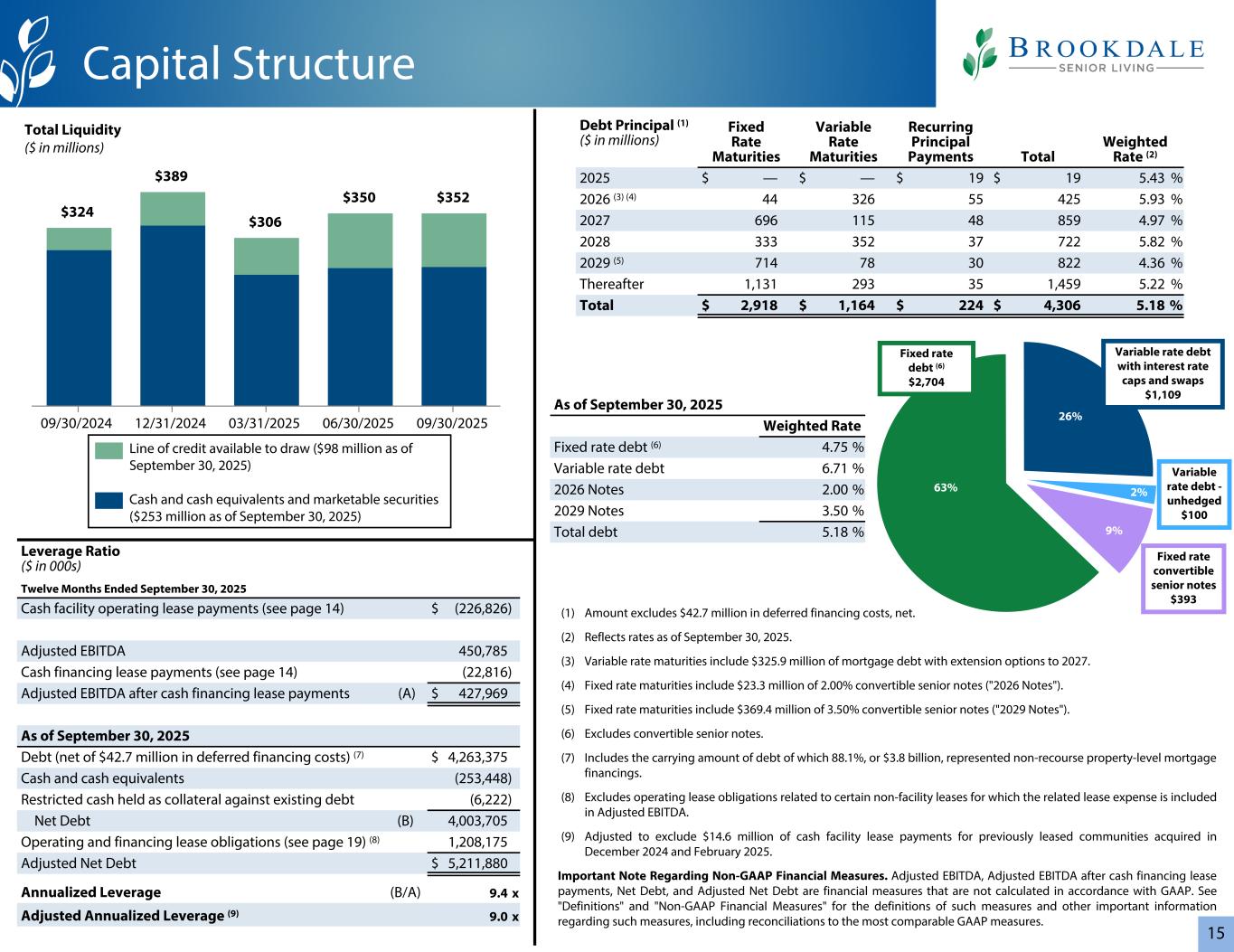
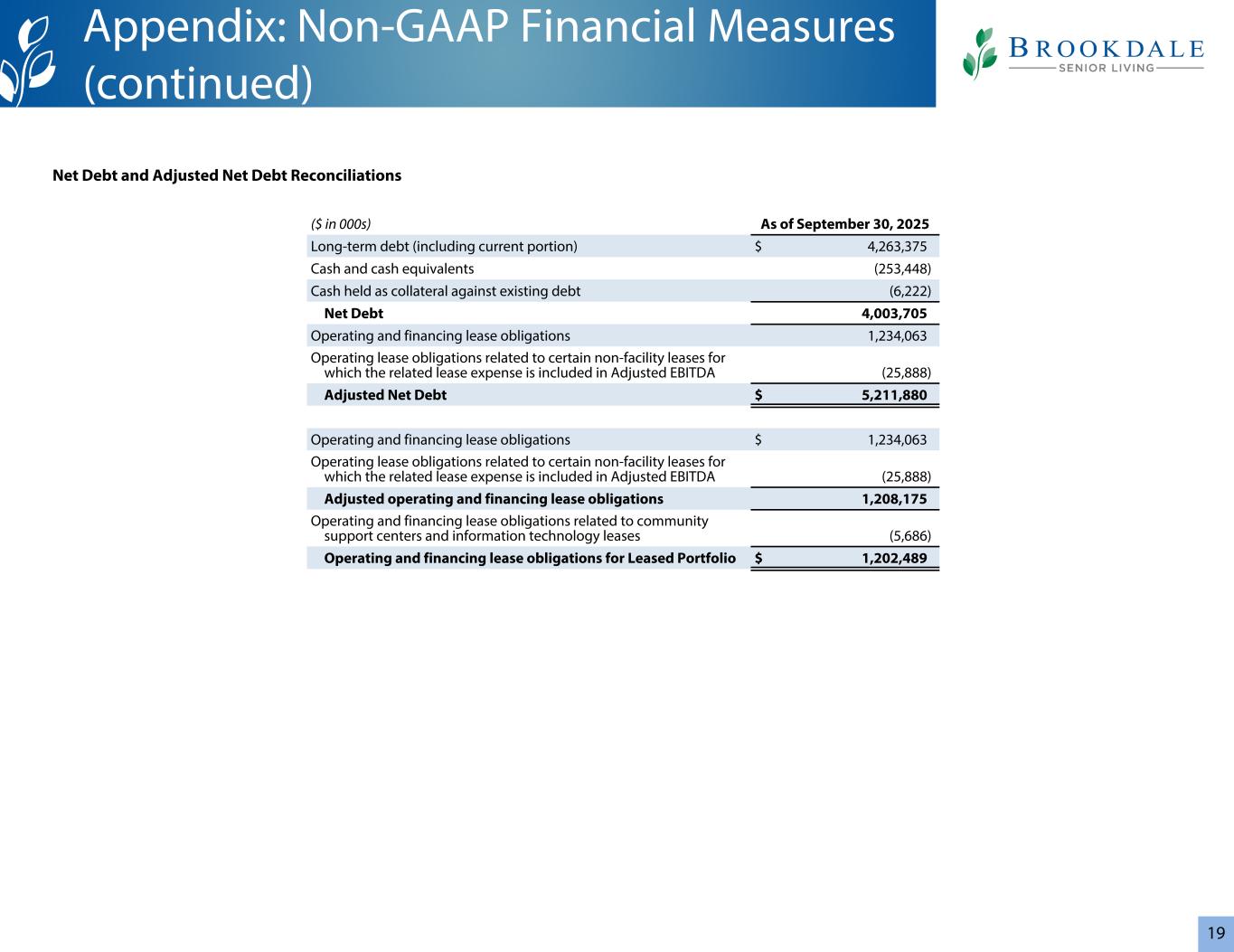
Thank you, Mike. Good morning. I appreciate everyone joining us for today's call, my first as Brookdale's CEO. This morning, I'll provide a high-level review of our third quarter results, followed by an update on the five strategic priorities originally outlined by the Brookdale leadership team during the Q1 earnings call earlier this year. Before that, I'd like to start by thanking the 35,000 Brookdale associates who provide the amazing care and service every single day at all hours, which is the hallmark of what it means to be a Brookdale associate. I would also like to thank the roughly 49,000 residents and their families who put their trust in Brookdale. And finally, I would like to thank our shareholders for their continued support and insight. I'd also like to take a moment to recognize the interim office of the CEO comprised of our Board Chair, Denise Warren; our CFO, Dawn Kussow; and our General Counsel, Chad White, who, since mid-April of this year, jointly assumed the CEO function. This team did a fantastic job of refining and executing Brookdale's strategy in addition to their primary roles during a period of transition. The team remained focused and made excellent progress on improving our culture, our operations, our portfolio optimization, and our financial results. I am excited for the opportunity to work alongside these strong leaders and continue the trajectory they have set Brookdale on. Since joining Brookdale early last month, I've spent my time getting to know our people and culture, getting to know our investors, connecting with our communities and residents, and digging into the business. I'll take a moment now to briefly introduce myself and answer some questions I've heard frequently since joining Brookdale, specifically why Brookdale and why now. Let me start with my background. During my career, I've held executive operational leadership roles across multiple industries, including senior living, health care, restaurants, private equity portfolio operations, and hospitality. Most recently, I served as President and Chief Operating Officer of Gentiva, the largest provider of hospice care in the United States, where I led 12,000 associates across approximately 550 locations in 38 states. In addition, I was the COO of Gentiva's predecessor company, Kindred at Home, where I led the largest home health and personal care operation in the United States. In the interim period, I served as the Chief Operating Officer for Sunrise Senior Living, of which many of you are familiar. I also worked at TPG Capital, Marriott, and HMS Host, all in senior leadership roles in operations. Earlier in my career, I served in the United States Air Force for 11 years in a number of positions, including as a Top Gun instructor pilot, flight commander, and Deputy Director of Operations. One common theme of all my prior roles is a focus on operations, building teams, leading people, and driving for high performance, which all ties nicely to my role here at Brookdale. Now to answer the question why Brookdale. I have worked both within and adjacent to the senior living industry for the last seven years, and Brookdale is universally recognized as a leading company in the space with a matchless reputation for providing compassionate service and care. Given its place in the industry and its exceptional potential, it is truly a privilege and an honor to join Brookdale at this moment in its history. Furthermore, as I got to learn more about the company through the interview process and my own review, it became evident that there were a handful of meaningful opportunities within Brookdale that closely matched my experience. I made the decision to join because I felt that I could help lead the company in unlocking the intrinsic value of Brookdale by unlocking these same opportunities. Now, I'd like to share a couple of examples. First, earlier in my career, I worked for the Boston Consulting Group, where I spent an entire year on a single strategic pricing project. I also spent half a year on a separate project with another client implementing the use of promotions to drive market share. This experience really taught me the power of pricing, the need for analytical rigor, and more importantly, the need for discipline in the implementation of pricing action. While Brookdale does have a targeted approach, I can already see that there's much more that can be accomplished in this space to optimize both occupancy and profitability. Another observation is how Brookdale has deployed its free cash flow. While this has been constrained in the past, today, Brookdale is generating positive cash flow, and there's an opportunity to use that cash flow to drive the business. While serving as COO at Sunrise Senior Living, I saw firsthand the power of how deliberate CapEx deployment can directly tie to occupancy growth, underpin growth in room rates, improve resident satisfaction, and expand NOI. At Brookdale, we will spend approximately $170 million to $175 million in CapEx this year and can already see that there are opportunities to spend it more deliberately towards NOI driving projects. The next question is why now. There are historically strong tailwinds in the senior living industry underpinned by both sides of the free market coin: strong demand and limited supply. The baby boomer silver tsunami is undeniable. The leading edge of the tsunami begins in 2026 as the first baby boomers turn 80 years old and begin to enter the sweet spot of the typical age that residents move into senior living. At the same time, the growth in supply in recent years has been severely stunted, with new construction starts at record lows and development and construction timelines continuing to expand. Given current construction costs, extended construction timelines, and elevated borrowing costs, we expect new supply to remain muted for years to come. This is particularly true in the price points and markets in which Brookdale mostly competes. Wrapping this all together, the senior housing industry is sprinting towards a period of real scarcity, and it's exciting to lead a company that is the third largest owner and the largest operator of such a scarce resource. Let's turn now to third quarter highlights, where Brookdale delivered another solid performance. Many of the positive trends seen in the first half of the year continued into the third quarter. Specifically, I would like to call out two highlights from the quarter: our improved occupancy growth as well as our strong adjusted EBITDA, and we'll ask Dawn to provide more details. Number one, our occupancy for the quarter achieved a weighted average of 81.8% and 82.3% on a same community basis, its highest level since the beginning of the pandemic in Q1 2020, and we closed the last day of the quarter with a consolidated occupancy of 83.8% and 84.0% on a same-store basis. As you will recall from our prior calls, for Brookdale, there's a meaningful inflection point for cash flow generation due to the fixed cost leverage in our operating model that begins around the 80% occupancy mark, so we are excited about our progress. It is noteworthy to highlight some specific efforts that contributed to this occupancy growth. We've previously discussed our SWAT-team approach to improve performance across our lower occupancy bands. This effort is picking up steam. In Q1, we reported 143 communities that had an occupancy below 70%. In Q2, we reported 129 communities below 70% occupancy. And this quarter, we have further reduced the count to 89 communities below that threshold, an improvement of 38% in just two quarters. Of these remaining 89 communities that are below 70% occupancy, 26 are slated for disposition through either lease terminations or asset sales, and 22 are working with our SWAT teams. That leaves 41 remaining communities, and of those, 16 need only 1 to 3 move-ins to exit the sub-70% occupancy band. At the top end of the range, communities with occupancy greater than 90% grew from 154 in Q1 to 169 in Q2 to 192 in the third quarter. This represents a 25% improvement, and now roughly 32% of our total community count is above 90% occupancy. Our SWAT teams are improving operational performance and deploying capital in a way that directly ties to occupancy and EBITDA growth. The teams are also taking a very targeted approach regarding rate to ensure our RevPOR outpaces our expense growth in these communities. The second item I want to highlight is that our adjusted EBITDA in Q3 increased 20% over the prior year and is up 23% year-to-date. Brookdale again generated positive adjusted free cash flow amounting to $21.8 million in the quarter, which is an increase of 57% as compared to the prior year. Based on the strong performance in Q3 and our outlook for the remainder of the year, we are raising our guidance for 2025. For full year 2025 adjusted EBITDA, our guidance moves from a range of $445 million to $455 million to a revised range of $455 million to $460 million, an increase of $7.5 million at the midpoint of the range. While I do plan to conduct a more comprehensive analysis of Brookdale's strategy in the coming months and to share my conclusions with our investors, we continue to make progress against the five-pronged strategy shared in our first quarter call, and all of these components will remain central to unlocking Brookdale's intrinsic value. As a reminder, those five elements are: number one, improve operating performance; number two, optimize our real estate portfolio; number three, reinvest capital into our communities; number four, reduce leverage; and number five, elevate quality for residents and associates. On the first item, improved operating performance, I already shared our improvement in occupancy across our portfolio as well as our EBITDA growth. Much of the progress through the end of the third quarter is a result of our SWAT-team approach, targeted pricing actions, and a focus on operational accountability. Additionally, at the beginning of the fourth quarter, we implemented a new regional operating structure, which we expect to further accelerate our operational results. The new structure is designed to focus the entire company from our headquarters down to each of our communities on delivering operational excellence. One concern we sometimes hear is that Brookdale is a national company that does not have the ability to be as nimble and focused as smaller regional companies. Our recent organizational design places all operations under a single leader, who, in turn, leads six regional vice presidents. Each of these six new regions has their own dedicated functional support leaders that span sales, clinical, HR, recruiting, FP&A, asset management, dining, and other functional roles. In effect, these six regional leaders act similarly to a general manager, having direct ownership of their specific business. We are, in practice, six operating companies of roughly 100 communities each that are tied together with the resources provided by a central support team in the form of our community support center. On our second strategic objective, optimizing our real estate portfolio, we continue to streamline our portfolio to focus on communities with the strongest long-term value creation potential. By the middle of 2026, we anticipate that we will have a portfolio of approximately 550 communities. As of September 30, Brookdale's consolidated portfolio was at 623 communities, 221 leased and 372 owned, a reduction of 14 leased and 10 owned communities since midyear. As announced previously, we plan to exit a total of 55 leased assets by year-end. 43 of those are now complete. We remain on pace to transition the remaining properties this quarter. From the original group of 14 dispositions we announced in the first quarter, all but 4 have already been completed, and those 4 are currently under contract and expected to close by year-end. For the second group of 20 assets that we announced in the second quarter call, about one-third are already under contract or LOI, and we continue to expect that the remaining closings will occur during 2026. As we previously stated, the exit of these groups of assets will result in improved occupancy, RevPAR, adjusted EBITDA, and adjusted free cash flow while generating cash proceeds that can be used for capital reinvestment and required debt repayments. Note, of the 32 assets remaining to be sold, 18 are in the under 70% occupancy band. During the third quarter, we invested $33.4 million into capital projects in our communities, in line with our third priority of capital reinvestment. We have several hundred capital-related projects underway, ranging from first impression aesthetic upgrades to larger renovations. Our SWAT teams continue to prove that targeted capital investment where it matters most for existing and prospective residents can have an outsized impact on occupancy and EBITDA growth. Our fourth strategic objective is to reduce leverage. Brookdale's adjusted annualized leverage at the end of the third quarter was 9.0x adjusted EBITDA on a trailing 12-month basis, a vast improvement over the 9.9x at the end of last year. We will continue to reduce leverage meaningfully as our adjusted EBITDA continues to grow. Notably, 88% of our total debt is nonrecourse debt secured by property-level mortgages. Nearly all of our debt is refinanced through 2026, and our team has made excellent progress towards working with our lenders on the 2027 tranches. As I come close to the end of my prepared remarks, I would like to highlight that we plan to hold an Investor Day early in 2026 to share far more specifics on how these priorities are progressing and provide visibility into the results we expect to deliver over the next several years. In the interim, I'd like to share a brief perspective on how we view our momentum today. As I shared, our SWAT team efforts are working, and our ability to deploy targeted CapEx in specific communities is generating outsized RevPAR and EBITDA growth. Each quarter, we are passing the 80% occupancy inflection point at more of our communities, whereby the marginal adjusted EBITDA flow-through naturally expands because of the tremendous operating leverage inherent in our business. At the same time, as more of our communities move into the higher occupancy bands, our pricing strategy will continue to migrate towards driving rate, particularly in our highly occupied communities. With our established and expanding positive performance, we expect to deploy more of the cash we generate towards first impressions and other capital improvements that are directly tied to future adjusted EBITDA expansion. Putting all of these factors together, we are projecting annual adjusted EBITDA growth in the mid-teen percentage range over the next several years on our ongoing portfolio. This will, in turn, naturally reduce our leverage ratio each year, and we expect to achieve a ratio of below 6 by the end of that period. We are confident in the intrinsic value of the company, and we intend to accelerate our operational and financial performance improvement as we optimize our footprint and thereby continue to create durable and sustainable shareholder value. To conclude, I'm very excited to be at Brookdale, particularly at this inflection point for the company and the industry. We have a lot of work ahead of us, but the opportunity is there, and we have already proven that we have the capability and momentum to capture that opportunity. There's a strong future ahead for Brookdale, for our team members, and for our shareholders. Now it is my pleasure to turn the call over to our CFO, Dawn Kussow, for more details on our financial performance and outlook.
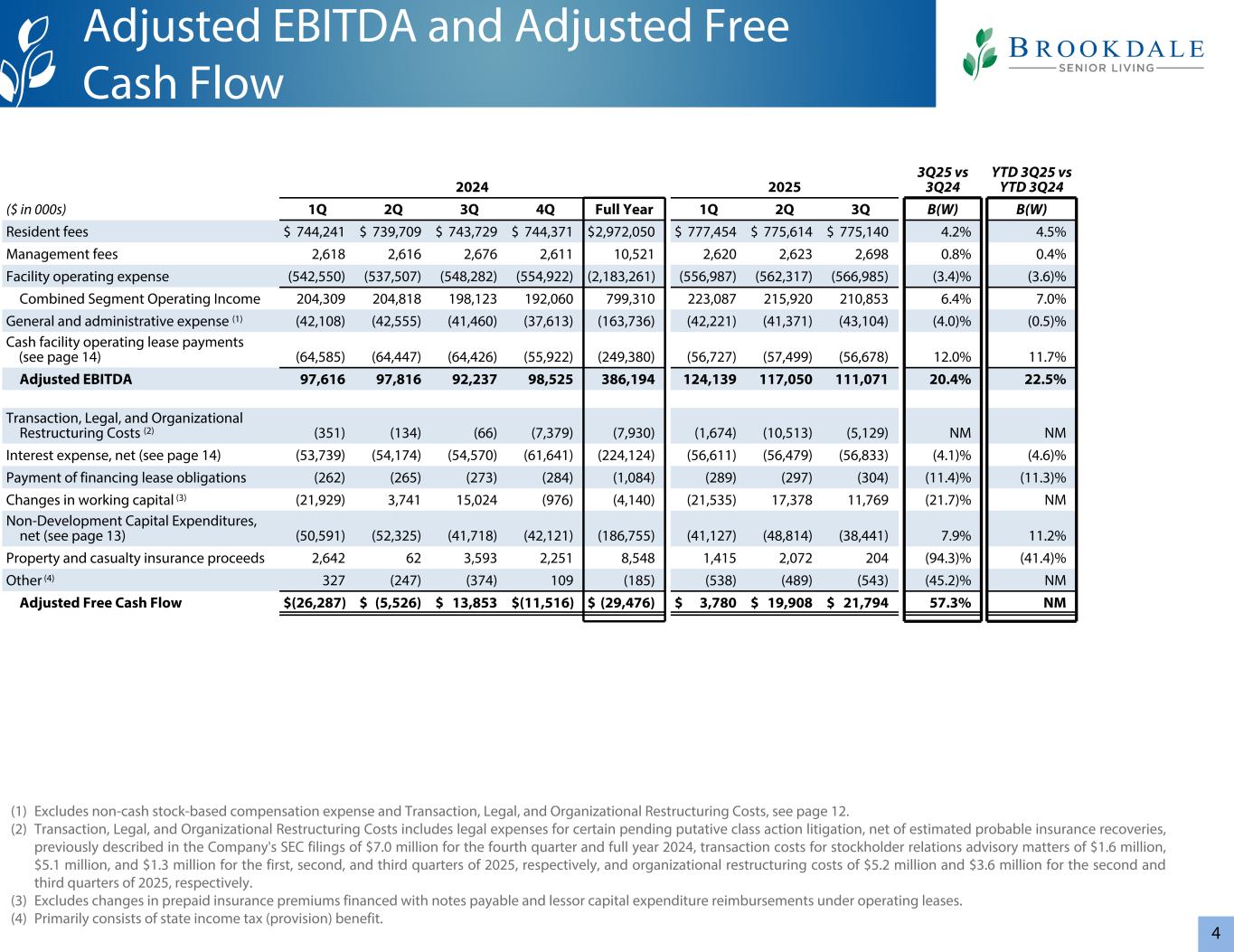
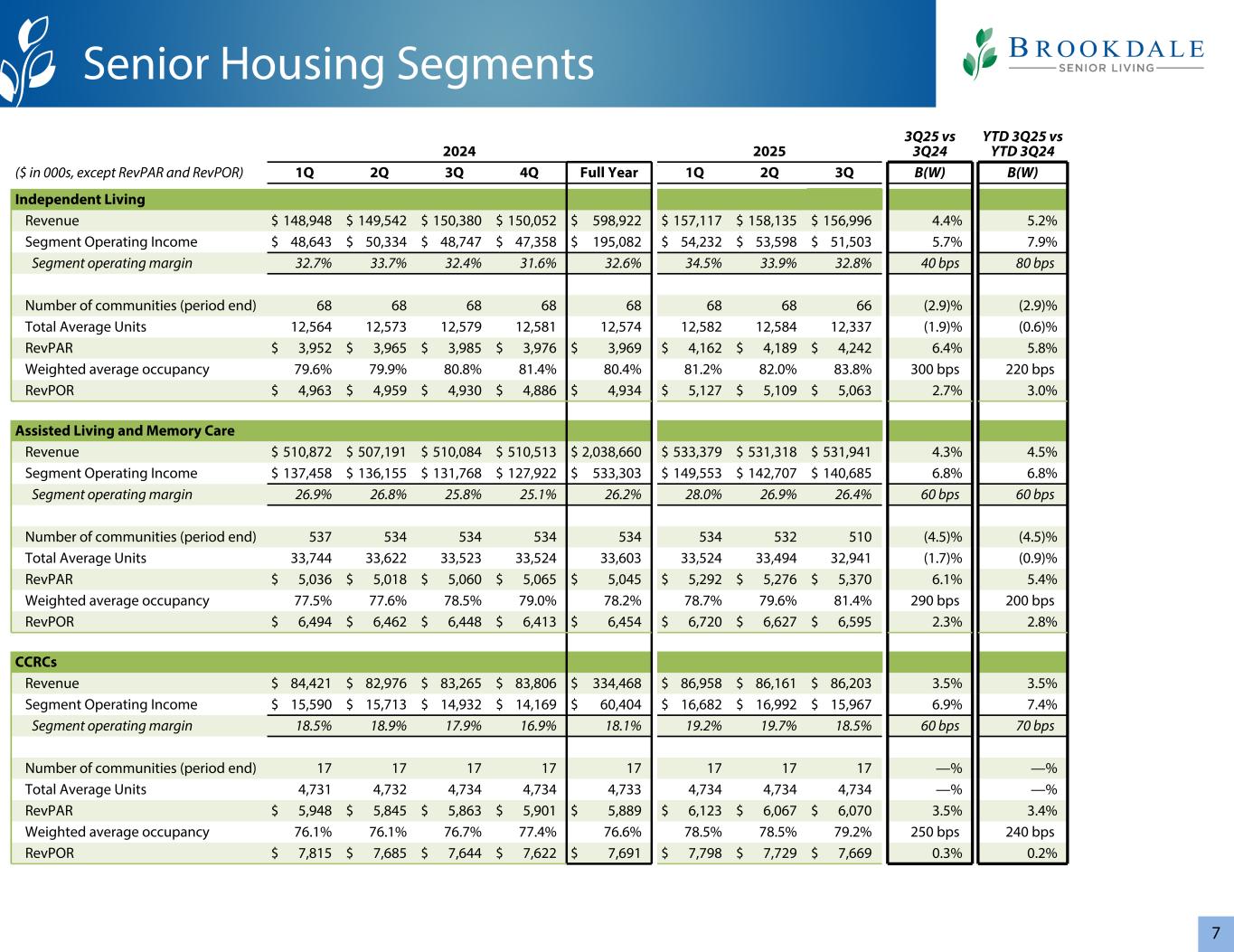
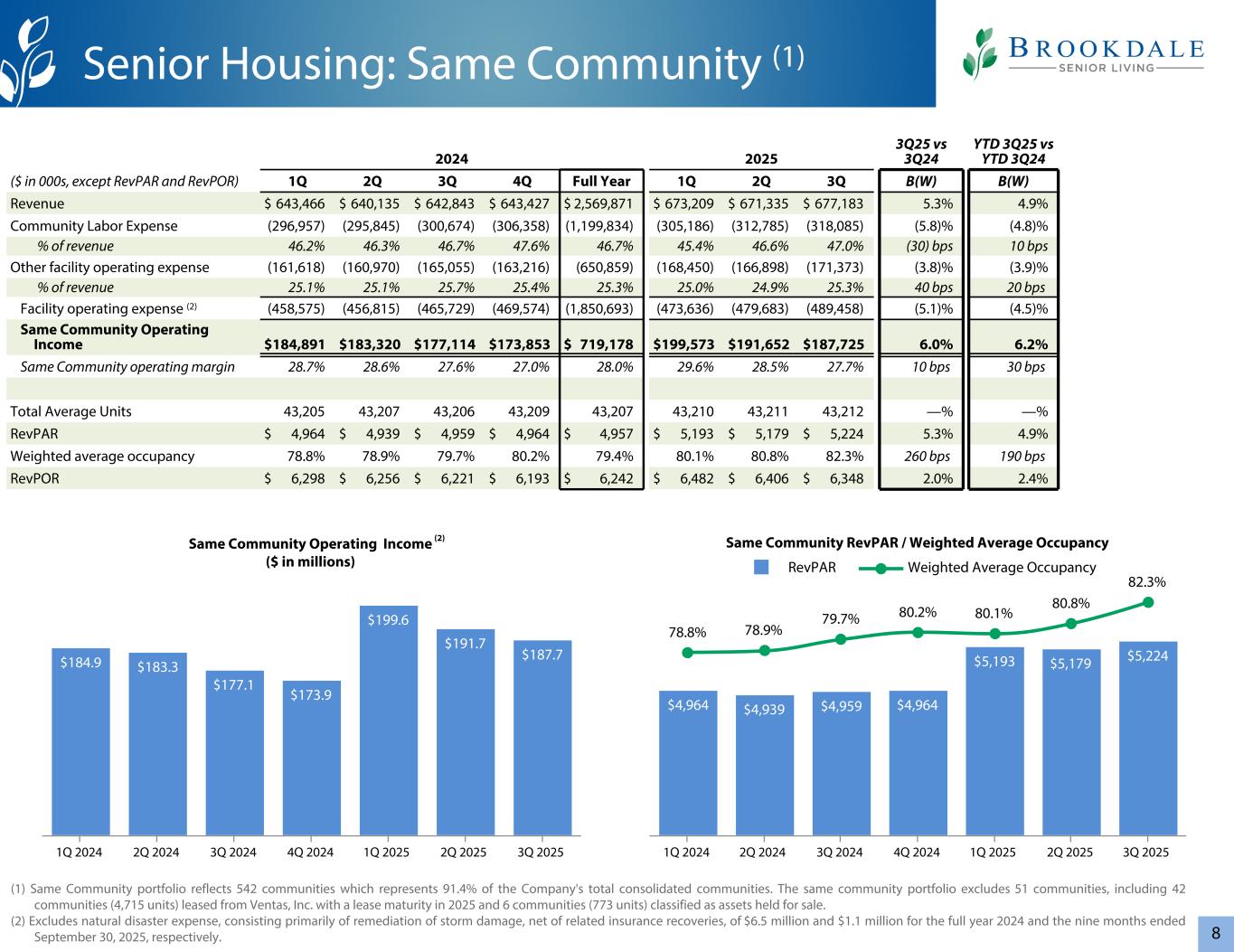
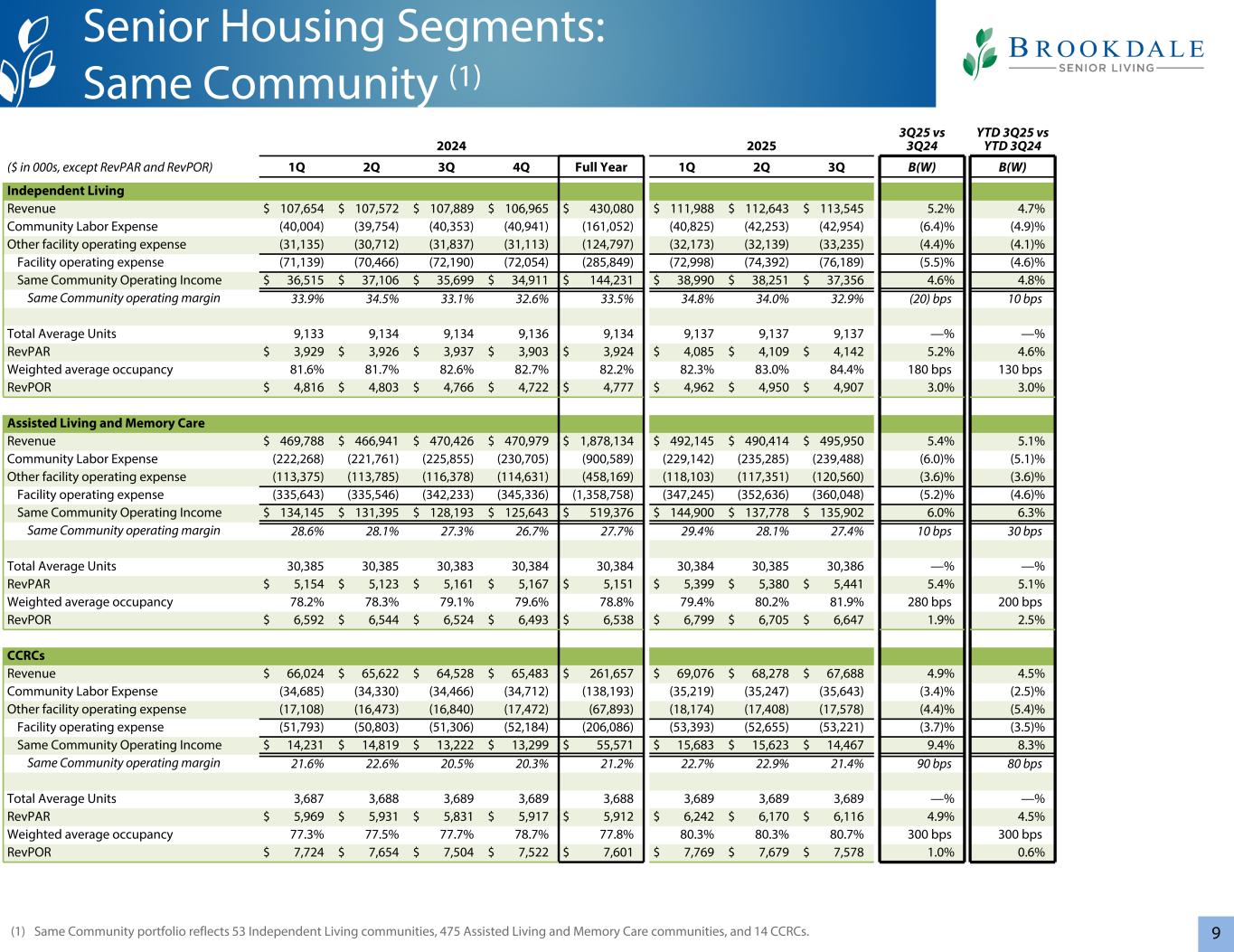
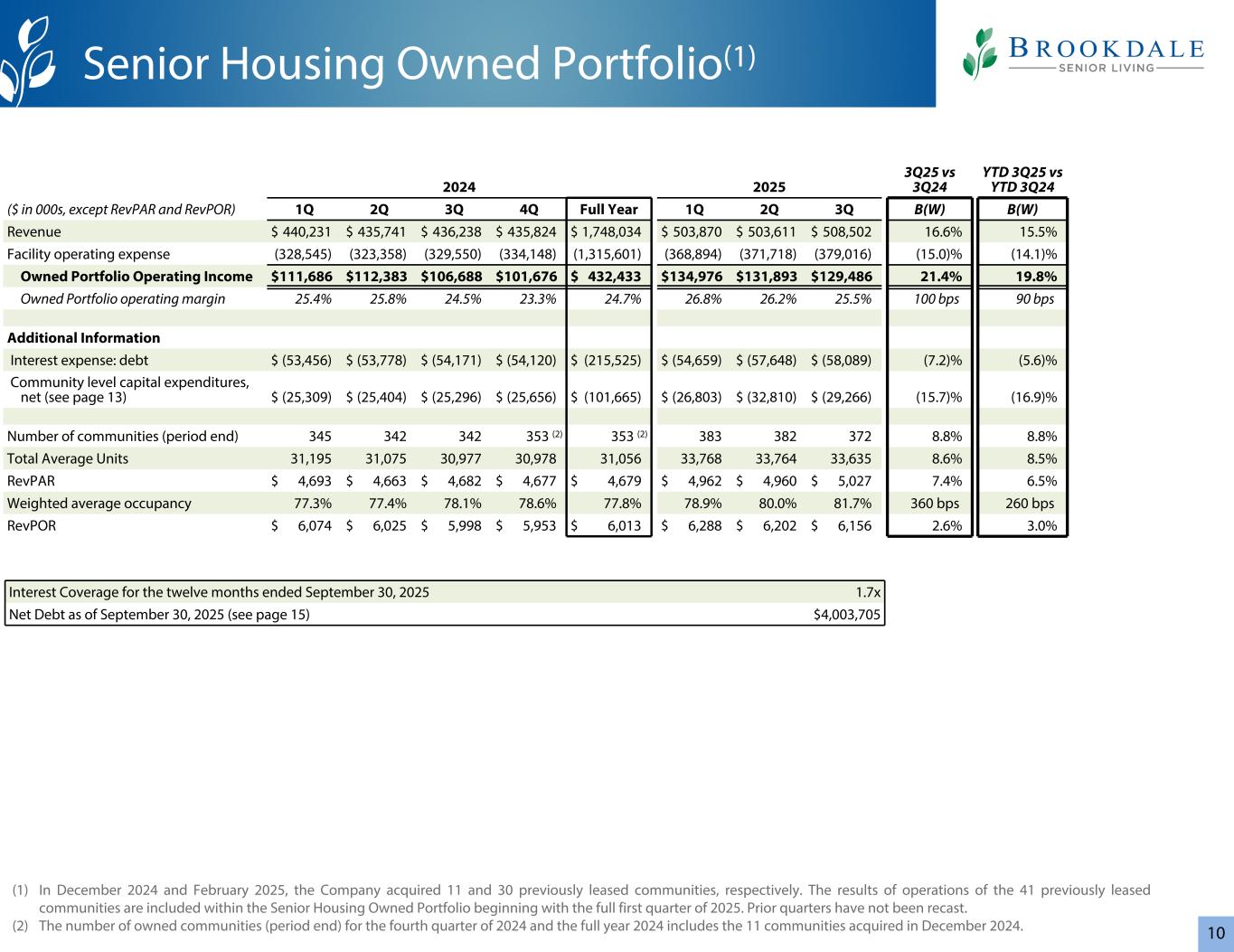
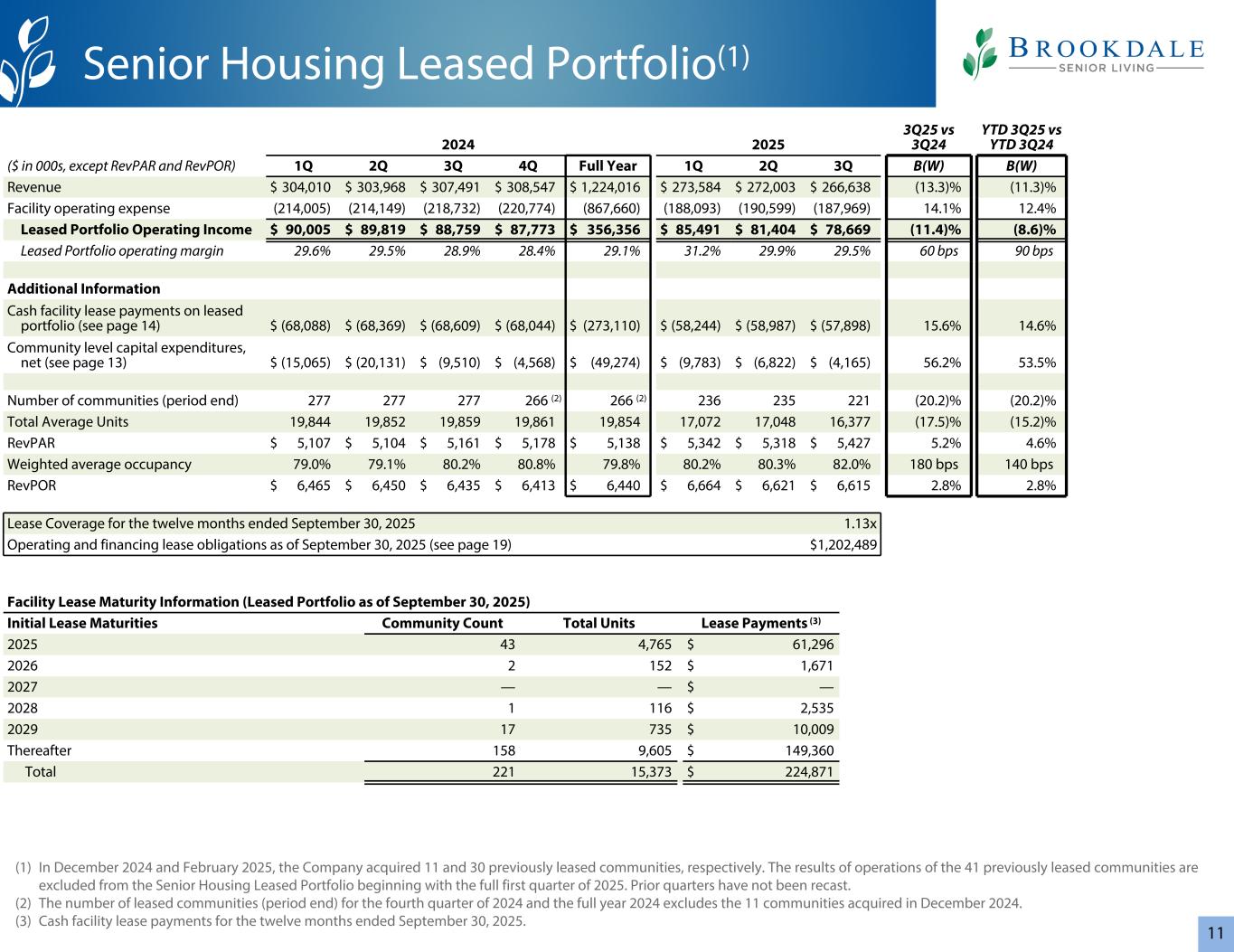
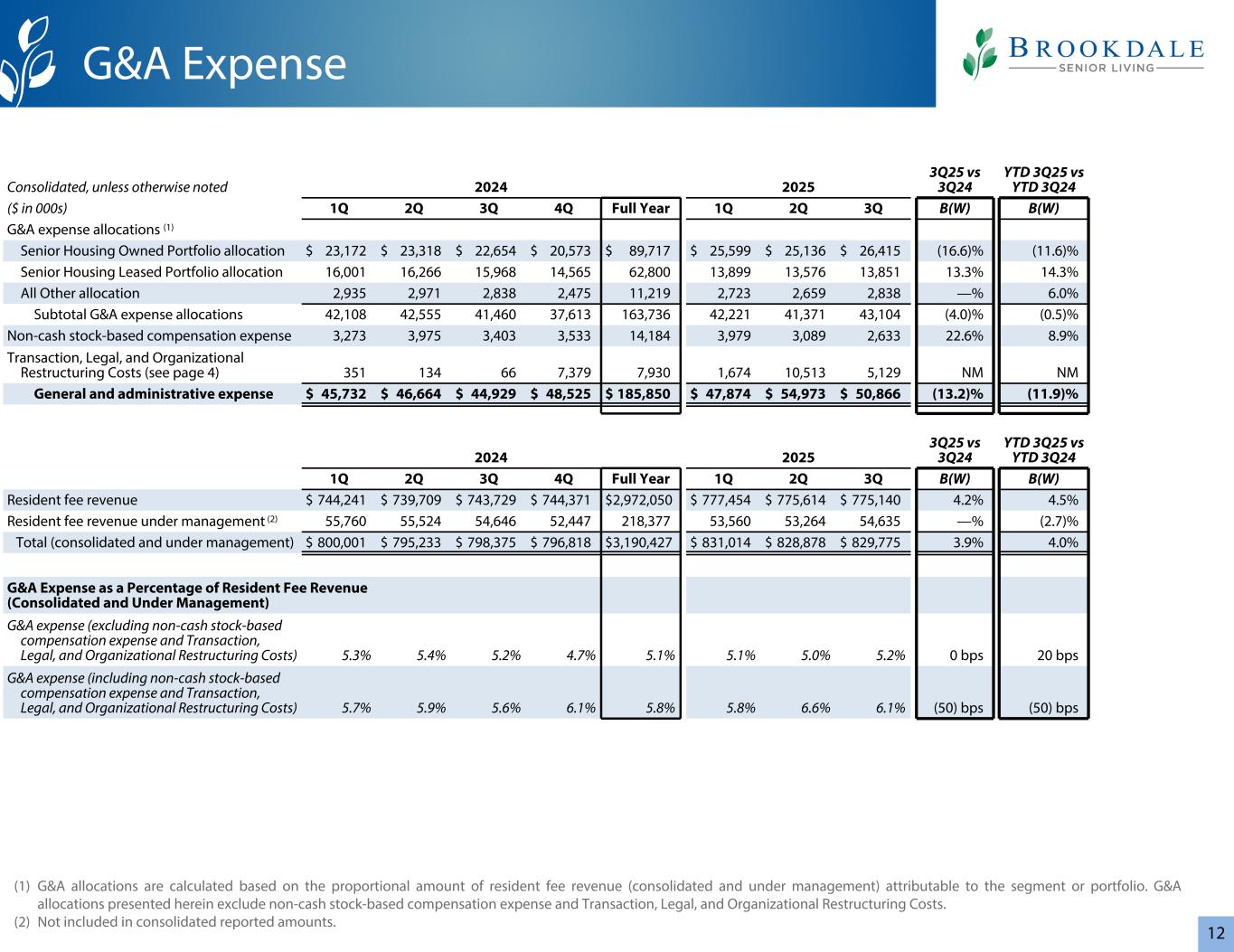
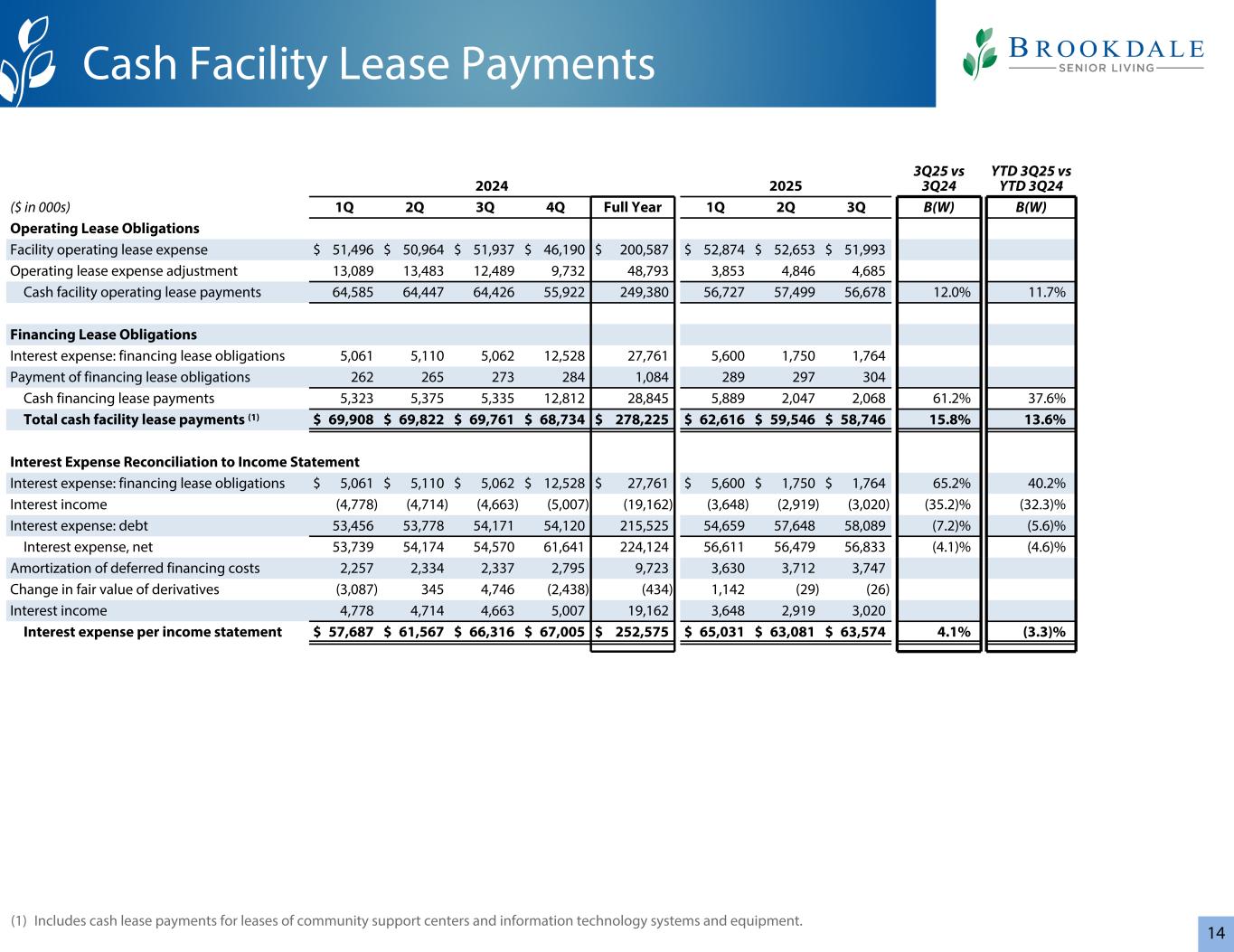
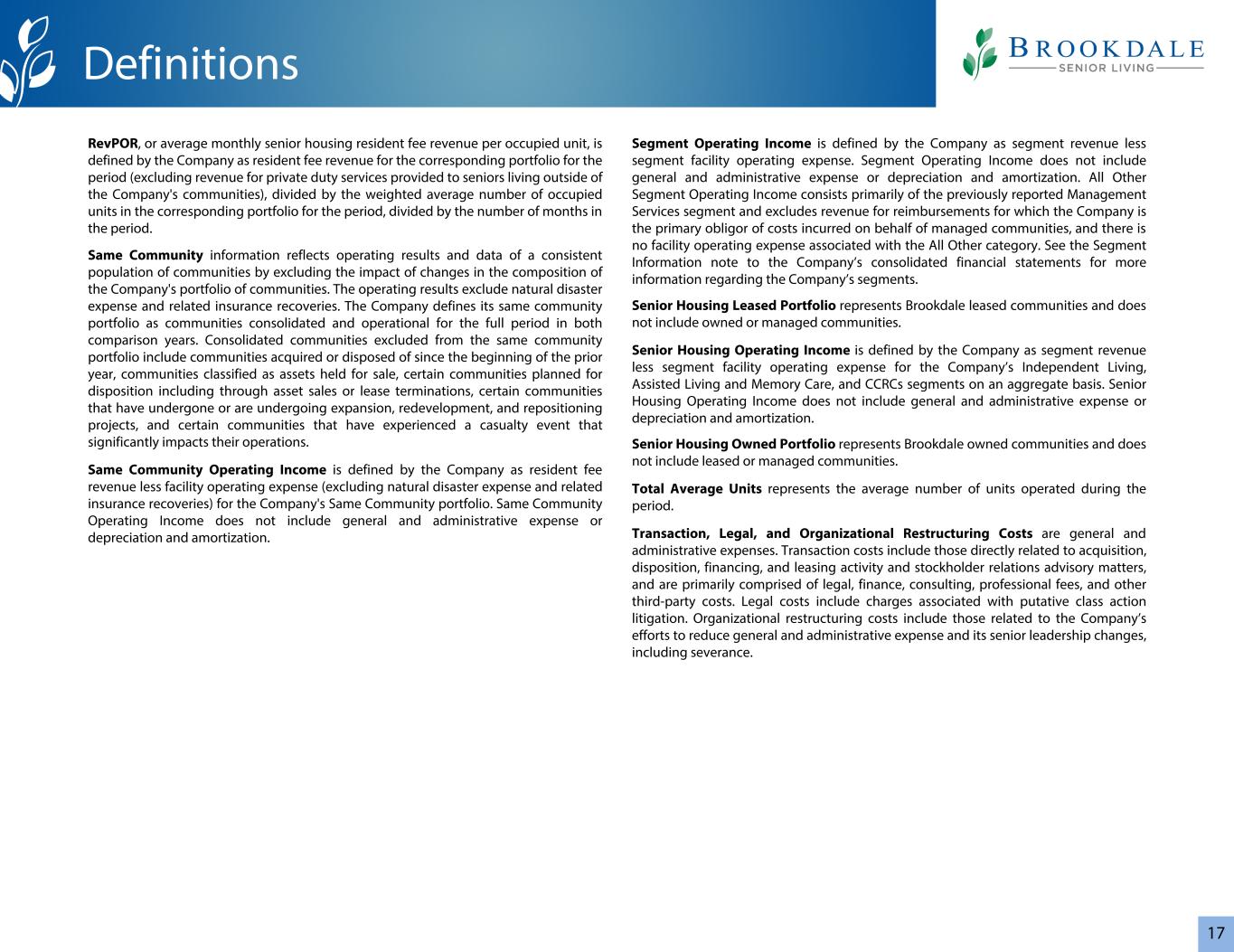
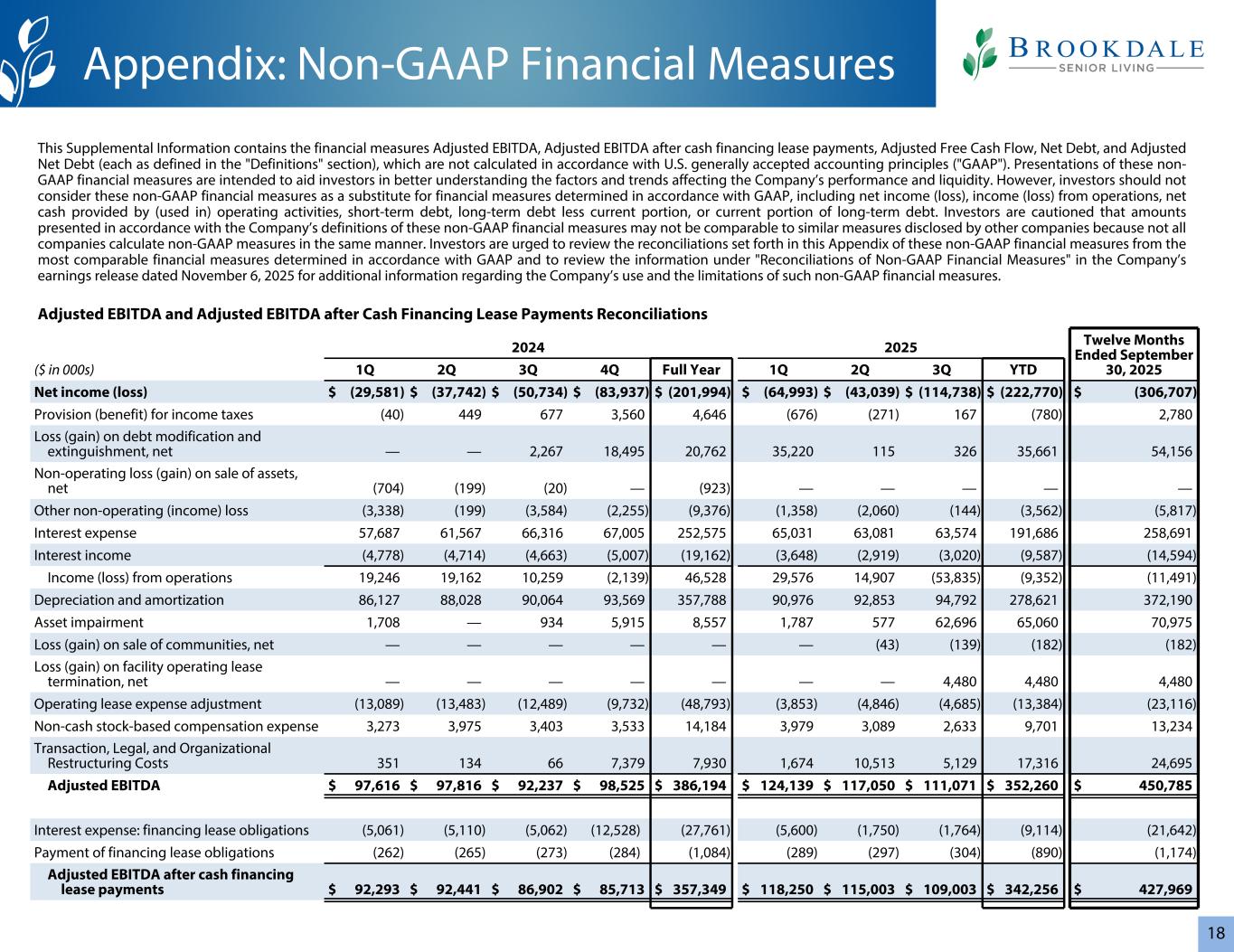
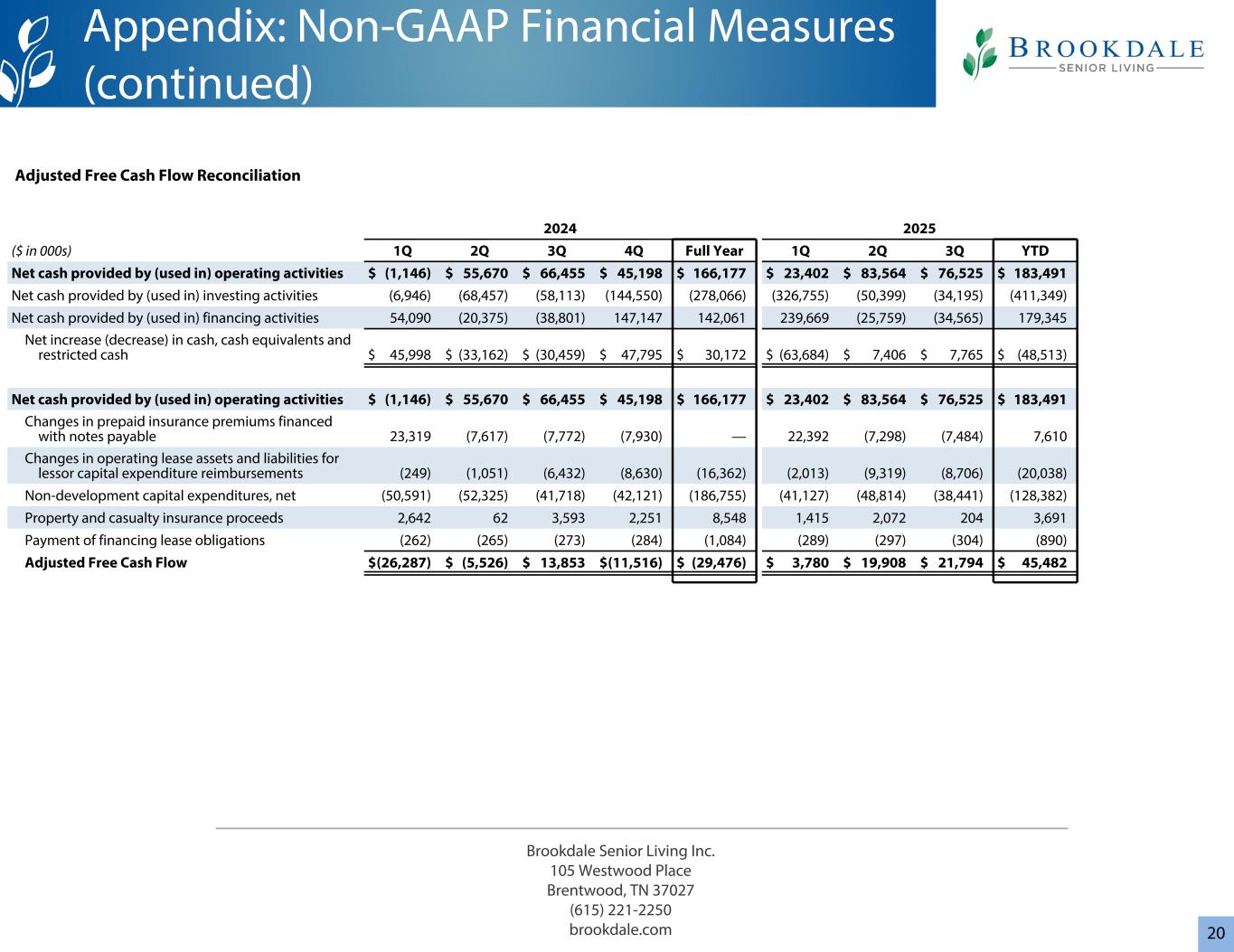
Thank you, Nick. The team is excited to have you onboard. As Nick described, we are very pleased with our third quarter financial results. In particular, occupancy and adjusted EBITDA exceeded our expectations, providing us the confidence to increase our fiscal 2025 guidance range. Specifically, we're increasing our guidance for full year 2025 adjusted EBITDA to a revised range of $455 million to $460 million from a prior range of $445 million to $455 million, and we expect to come in above the midpoint of our RevPAR range of 5.25% to 6% year-over-year growth. In the third quarter, we grew our occupancy 170 basis points sequentially on a consolidated level and by 150 basis points on a same-community level, capitalizing on the summer selling season. We also expanded our consolidated adjusted EBITDA by $18.8 million or 20% year-over-year. We have made significant progress on our lower-occupied communities, both through performance improvements and portfolio optimization efforts, and we expect to see the impact of margin flow-through as these changes progress. We're pleased with our continued progress and are optimistic about the remainder of the year. Before getting into results, I'd like to give you an update on our previously announced actions to rightsize our portfolio. As a reminder, we expected to transition 55 communities leased from Ventas by the end of 2025, as well as 42 communities owned by Brookdale that we have identified as non-core and that for a variety of reasons would be better fit for a different owner/operator. These communities would transition both during 2025 and 2026. During the third quarter, we transitioned 13 Ventas assets with approximately 1,400 units and exited 10 communities with 242 units. During the next month, we expect to transition the remaining 42 Ventas communities, of which 30 were already transitioned as of November, and to complete the sale of 6 communities. The remaining previously announced dispositions are expected to be completed in the next 9 to 15 months. To that end, when we talk about same community results, it approximates our ongoing portfolio results as the additional dispositions are expected not to have a meaningful impact on the ongoing net operating income. The same community population already excludes results from all Ventas communities that are to be transitioned out in 2025, as well as the 6 communities under a purchase agreement or letter of intent. Importantly, you will see in our updated third quarter investor deck on Slide 18 the disposition of the 25 previously announced communities, which have low occupancy and would have a negligible impact on our operating income. Now moving to third quarter results. Our third quarter consolidated weighted average occupancy was 81.8%, and on a same-community basis, our weighted average occupancy was 82.3%. This is a much improved absolute level of occupancy. Joining last quarter as our first quarter above 80% since the pre-pandemic months of 2020, 81.8% consolidated occupancy represents improvement of 290 basis points year-over-year and 170 basis points sequentially. On a same-store basis, weighted average occupancy for the third quarter was 82.3%, representing an increase of 260 basis points year-over-year and 150 basis points sequentially. The occupancy growth stems directly from Brookdale initiatives to drive occupancy, including our SWAT-teams approach, targeted pricing actions, and a focus on operational accountability. Looking at our top line results. Resident and management fees of $778 million increased 4.2% over the third quarter of last year. The components of this 4.2% year-over-year growth are a 5.9% increase in RevPAR, partially offset by a 1.6% decline in the number of total available units from our previously announced portfolio optimization, including the disposition of both owned and leased communities. The 5.9% increase in RevPAR from the third quarter of the prior year was driven by an ongoing acceleration in year-over-year weighted average occupancy. Comparable third quarter move-ins were 2% above the prior year, while move-out volume was also beneficial in the quarter. Resident rate increases more than offset the ongoing trend of lower resident acuity as revenue per occupied room or RevPOR increased 2.2% year-over-year. The third quarter exhibited sequentially improving occupancy as the strong occupancy trend has continued into the quarter. As you may recall, during the second quarter, we experienced some softness in our move-ins early in the quarter, and we responded by implementing strategic and selective incentives to drive move-in growth during the important summer selling season. These actions were successful as seen in our occupancy, and we moderated incentive usage in the third quarter. Third quarter same-community RevPAR increased 5.3% over the prior year, driven by 260 basis points of occupancy growth, coupled with a 2% increase in RevPOR. Our third quarter same-community weighted average occupancy continued to accelerate with 150 basis points of sequential growth. While the third quarter is typically the highest sequential growth period of the year, Brookdale's third quarter occupancy growth exceeded its normal seasonality for this period. Now turning to expenses. On a same-community basis, third quarter expense per occupied unit or ExPOR increased 1.8% over the third quarter of 2024. This 1.8% increase in ExPOR is lower than the 2% increase in our RevPOR, reflecting a positive spread between realized revenue and expenses per occupied unit. As lower occupied communities continue to move up in the occupancy bands, we expect to see the flow-through to continue to expand. Year-to-date, same-community RevPOR has improved 2.4%, while ExPOR has increased 2%, creating a positive spread of 40 basis points. Third quarter same-community operating income grew 6% from the prior year, and the operating income margin improved by 10 basis points. Year-to-date, same-community operating margin has improved by 30 basis points over last year. Note that there is seasonality associated with operating income margin, including an extra Labor Day and higher spending in utilities in the third quarter. So it's typical to see our operating margin decline from the second to third quarter of the year. Third quarter general and administrative expense, excluding noncash stock-based compensation expense and transaction, legal and organizational restructuring costs, was flat year-over-year as a percent of revenue. Brookdale remains focused on appropriate cost structure as we optimize our portfolio. As Nick mentioned, we made some organizational structure changes effective at the beginning of the fourth quarter. We expect the impact of these actions already taken to become more apparent in our fourth quarter G&A. Lastly, cash operating lease payments were $56.7 million, down $7.7 million from $64.4 million in the prior year quarter as a result of the acquisition of 36 formerly leased communities in late '24 and early 2025 and to a lesser degree, the initial Ventas dispositions. Adjusted EBITDA for the third quarter was $111.1 million, an increase of $18.8 million or 20.4% above the prior year quarter. Year-to-date, adjusted EBITDA is 22.5% higher year-over-year. We're pleased with our level of adjusted EBITDA performance relative to our internal expectations and analyst consensus estimates, as this is reflective of our improving operational performance and the benefit of rationalizing our G&A early in the year. We delivered $21.8 million of adjusted free cash flow, our third consecutive quarter of positive adjusted free cash flow. For the year, we've generated $45.5 million of adjusted free cash flow, $63.4 million ahead of where we stood at this point last year. We remind you that our fourth quarter is generally a period of cash outflow, and we expect to generate $30 million to $50 million of adjusted free cash flow for the full year 2025. Notably, both our owned and leased portfolios were adjusted free cash flow positive in the quarter. As of September 30, total liquidity was $351.6 million, up $1.6 million from the second quarter. As a result of our adjusted EBITDA improvement, we continue to maintain recent progress on our adjusted annualized leverage, which improved to 9x with Brookdale now exceeding 80% occupancy, roughly the fulcrum point at which our fixed costs are covered. We are beginning to enjoy more significant adjusted EBITDA growth. As a result, we expect our annualized leverage to continue to decline significantly in coming years via adjusted EBITDA growth with additional deleveraging and as a result of the disposition activity we've announced. Turning next to our 2025 financial expectations. As reflected in yesterday's press release, given our strong third quarter results, we've increased our annual guidance for adjusted EBITDA. We continue to expect 2025 RevPAR growth in the range of 5.25% to 6% over the prior year, and we expect to be above the midpoint of that range. Our raised 2025 adjusted EBITDA guidance range of $455 million to $460 million incorporates these favorable top line expectations. Our guidance continues to assume that all 55 of the Ventas nonrenewal communities will be transitioned by year-end. The transition is expected to have an impact with both revenue and expenses stepping down from the transition communities, with a partially offsetting reduction in cash operating lease expense. We expect cash operating lease expense to be approximately $46 million for the fourth quarter. As a reminder, we have realized G&A savings throughout the year, so we expect a timing difference on our G&A savings compared to our step-down in operating income offset by the cash lease expense reduction. We do expect G&A to step down modestly in the fourth quarter from the third quarter from the actions we've recently taken to realign our business. As you consider how the fourth quarter may vary from the third quarter performance, we remind you of some of the seasonal factors inherent in our business. For our ongoing portfolio, fourth quarter occupancy tends to remain relatively flat versus the third quarter as we're coming out of the seasonally high summer selling season into the holiday season, and RevPOR or realized pricing tends to step down sequentially. Labor costs are similar to those of the third quarter, as both have the same number of days and holidays. Fourth quarter working capital is seasonally a cash outflow generally driven by real estate tax payments, and we expect a working capital cash outflow from community transitions. The seasonal factors are all called out on the last page of our investor presentation. To date, 2025 has been a light year for hurricanes and other storms in our geographic footprint. We are toward the end of our storm season now, and we feel comfortable with our assumptions regarding annual storm activity. Finally, we would anticipate greater G&A savings related to the Ventas transitions in the fourth quarter than in the third quarter, though the full realization of those savings is likely to be felt in 2026. In contrast, the corresponding operating income step down from divesting Ventas communities will largely impact the fourth quarter, with a partially offsetting step down in lease expense. In summary, we're pleased with our third quarter operating and financial results, which again exceeded our internal expectations. We remain confident in our strategic and operational plans, which are beginning to yield solid adjusted EBITDA growth. Our team is enhanced through the addition of an operations-focused CEO, and we're excited to have Nick onboard. Brookdale is again operating with purpose, and we are confident in our ability to build sustainable long-term value for our shareholders. Operator, we will now open the call for questions.
Operator
Your first question comes from the line of Brian Tanquilut with Jefferies.
Speaker 4
Congrats on the quarter, and Nick, excited to work with you here. So maybe my first question, Nick, as I think about the fact that you've been here in the job for a month now, just curious, number one, what have you seen as areas of opportunity within the Brookdale portfolio? And number two, how are you thinking about strategically the whole philosophical debate between pricing focus versus occupancy versus cash generation, FFO, all these things?
Awesome. Thanks, Brian. So I have been here just over a month, literally 1 month and 1 day today, but I'll tell you a clear picture is already evolving in that short period. We will share a lot more details during the Investor Day that I mentioned during the prepared remarks. And I did also mention the five strategic priorities, which kind of define the overall framework of what I'll call the vision, the strategy. But the real vision, the real pivot here is that we're going to be changing the underpinnings of that framework. What I mean by that is we're going to take a far more offensive posture as a company. We're going to be driving the business as opposed to reacting to the business. Part of this is doubling down on this cultural mindset that we are first and foremost an operating company that is built upon a real estate foundation. Maybe I'll talk to that a little bit more in a second. I would like to share maybe a few examples of what I mean when I say we're going to be more offensive. The first item is around our organizational structure. I admit that's not what typically grabs the headlines or what shows up in the analyst reports, but it is what defines what a company is. It defines how companies think, how they operate, the culture, and all of that is changing. Unfortunately, some of that predates me during the transition period, but we're going to continue doing a lot of that. A lot of that starts really at the very top. It starts with me, as the CEO, both my experience and my approach and just doubling down on this idea that we are an operating company. A key part of that is that we have consolidated all our operations under a single leader. This leader wakes up every morning figuring out how we can convert the next prospective resident into a move-in, how we can retain all our residents through our care and service, how we can reduce associate turnover, and how we can expand NOI in each of our communities. The second focus is our headquarters. We call it the community support center. This focus is truly living up to that name. If you're not serving a resident, serve someone who does. The last part of it, and I didn't mention this during the prepared remarks, is we have pivoted to this regional support structure where we have six purpose-built teams led by a leader with dedicated functional leaders from a 1-to-1-to-1 relationship. So in effect, we've become six companies of about 100 communities to really be nimble, really be focused on the regional aspects of senior living. The second thing changing under this idea of a more offensive posture is around CapEx deployment. We are investing in our communities in projects that tie to occupancy and NOI growth. We're just setting up a flywheel. As occupancy goes up, we'll be able to drive better rates. We'll be able to expand the flow-through because of the operating leverage, and we'll be able to generate more NOI, which then turns into more cash flow that we can do more of that. The third part, and you sort of alluded to in your question, this idea of pricing. I briefly mentioned my experience in pricing is quite extensive in a previous life. I have learned long ago, even if you think you're perfect at pricing, you can always do better. Even though Brookdale does it well, it does it fine, there is a system across the platform. We can do it far, far better. That will be one of the focus points: this idea of a strategic pricing platform that is far more dynamic to what is going on in the business, both on the low end of occupancy and, just as importantly, on the high end of occupancy, being dynamic to the things happening within the four walls but also things in the marketplace that that community lies. I wouldn't mind mentioning a few things on why I feel good about pivoting towards this offensive posture. First, it's our positive cash flow. We are generating cash flow. As our occupancy and rates continue to grow, that cash flow will continue to expand. We have the freedom to invest that into our communities, right back into our business in the form of capital improvement programs. The other thing is the SWAT team. We have defined the playbook. We have a real deliberate thing we can do that's working in our communities in those less than 70%. It's a mix of operational focus. It's a mix of capital deployment. It's just creating a better laser focus, and we're going to use this to continue expanding the performance of our business. The last item I'll talk about is the silver tsunami thing, on why I feel good about it. We've been beating this drum now for the last 10, 15 years: the silver tsunami is coming. It is here. The front edge of the wave is next year as baby boomers turn 80. The average move-in for assisted living, for memory care is in that low 80s. Brookdale is exactly right in the middle of that. The other drum we've been beating as an industry is this idea of new starts being at record lows, and that is real. Even if new starts tonight went back to what was needed to cover the demand, it will take 4, 5, 6 years before resident #1 can move in. There is a long tailwind, a long runway here with the silver tsunami and the demand where it is. Putting that all together, we're talking about a game of scarcity. We are the third largest owner of senior housing real estate. It feels good to have that as our underpinnings as an operating company where we're holding and owning a very scarce and valuable resource that will become more so in the next few years.
Yes, that's a great question. Thank you, Brian. I think for our fourth quarter, we obviously are going to get a little bit of a benefit as the dispositions come off in our RevPOR. But we are very laser-focused on the budgets for 2026. As Nick said in all his comments, we are going through the budget process now, certainly very focused on driving rate at the high occupancy and driving rate across the organization and ensuring that we have that in-place rate increase that will give us our single biggest economic benefit next year, just making sure that that is going to be in excess of what we expect for our ExPOR for the year.
Operator
Your next question comes from the line of Ben Hendrix with RBC Capital Markets.
Speaker 5
To start with, congratulations and welcome to Nick. We're certainly looking forward to working with you. One thing that we noticed on the release was a new FFO disclosure. I just wanted to get some insight on your decision to start to closing that metric, how you're thinking about the normalized LTM figure in the context of the owned portfolio value and where you think that could go as the optimization ensues.
Yes, Ben, I appreciate you bringing this up. I was listening to Welltower's earnings call last week, and Shankh mentioned that Welltower is now functioning as an operating company within a real estate framework. I believe that's a fitting description of Welltower's transformation over the past few years, which made me reflect on how we position Brookdale. Clearly, we are the largest operator in the market, a fact that remains true even with our recent asset sales. However, we must continuously remind ourselves and others that we are also the third-largest owner of senior living real estate, following Welltower and Ventas. I would characterize us as an operating company built on a solid foundation of real estate. This real estate foundation is increasingly scarce and valuable. Therefore, we felt it beneficial to share a different perspective on our internal performance and our perceived value compared to other real estate companies. We believe that FFO offers valuable insight into our business.
Operator
Your next question comes from the line of Joanna Gajuk with Bank of America.
Speaker 6
So maybe first, I guess a couple of follow-ups. When you mentioned this organizational change that you are just making, I guess that started this quarter, did I get it right, it's going to impact G&A? And I wasn't quite sure whether you were trying to say negatively or positively. It sounds like quarter-over-quarter. And then I have a follow-up on next year.
Joanna, I'll take a first crack at the question, and then Dawn may add a few more specifics. Our G&A is reducing. I think on Slide 18 or 19, we talk about $162 million projected for the year, which is a reduction. As I was describing that organizational change, we removed a layer, consolidating it. So in effect, it's kind of a net 0 G&A cost when it comes to the organizational component that I described very explicitly. There's no increased cost. The commentary was not even really about saving dollars or spending dollars. It was more about a mindset of a company that's an operating company underpinned by real estate. We're going to structure ourselves that way. We're not adding additional heads or positions. To accomplish that, we're just refocusing folks into six regions with the functional expertise.
Yes, and Nick's exactly right. I think on Slide 18, we have what we expect for the $162 million for 2026. As you do the math on that, it will be a step down. As you think about 2025 run rate and then merit increases and the cost of inflation coming into 2026, that will be a step down. The other thing to point out is in the current quarter, you'll see we did take some restructuring charges or severance costs in our add-back, so that's just a direct result, just not an impact for the ongoing run rate.
Speaker 6
Okay. So that was my question here. So the $162 million reflects the change. It sounds like that's a net 0 impact. And then the $162 million also reflects any merit increases that you would do.
Speaker 6
Perfect. Regarding the guidance, you did raise your EBITDA, and you expect to be at or above the midpoint of the RevPOR. However, there was no change to the free cash flow guidance. Why is that? Is something offsetting the positive effect of the higher EBITDA?
Yes, Joanna. As you recall, the fourth quarter is generally a working capital cash outflow. We have a couple of things, mainly ongoing as our real estate tax payments come through in the fourth quarter. We do expect this quarter or the fourth quarter to have a negative working capital impact just simply from the transition of the dispositions. We also expect G&A to step down modestly in the fourth quarter from the third quarter from the actions we've taken to realign our business.
Operator
Your next question comes from the line of Andrew Mok with Barclays.
Speaker 7
Appreciate all the comments around mid-teen EBITDA growth over the next few years. Nick, you noted that you're going to be digging into the business in the coming months and presumably share that at the Investor Day. What gives you conviction to make that statement now and before the Investor Day?
Yes. Obviously, we'll go into far more detail of how we view this at that Investor Day, and I don't want to continue just repeating things, but the first thing is undeniable market dynamics. We are running headlong into scarcity, and it starts next year. There is a reality there. Especially for our company since we're so heavy in assisted living and memory care. I think we're about 70% mix. That is not a discretionary spend. You cannot delay or defer it. The alternatives are not good. So prospective residents that need that care and service have to go somewhere, and we are going to be ready to serve them. Our competitors filling up means we have openings right across the street, which provides even more tailwind for us to fill those spots. The second reality is that new starts are down, and the cost of capital and construction is high, driving rates that are a premium to ours. So even if a new competitor opens right next to an existing Brookdale, in many cases, we're not chasing the same customers. The last point I'll make is our SWAT teams are working. We have a model, a plan, a team, and an approach to continue expanding performance. A lot more to come, Andrew, but appreciate the question.
Speaker 7
Great. And if I could, a follow-up on the occupancy gains. It's been very strong these last couple of quarters. Do you have a sense for how much of your occupancy gain is coming from seniors that are new to senior housing versus market share gains from competitors?
Yes, I would say I don't know that we track it exactly that way. But I'm excited that we're at 170 basis points of sequential occupancy for the quarter. I expect to see a slight lift in occupancy in the fourth quarter with the dispositions, and we're still observing strength in October occupancy.
Yes. One thing I would add to that is we've really also seen continued improvement in our controllable move-outs. Resident satisfaction is crucial for us. We're driving strong growth year-over-year in our NPS scores. Not only are we attracting new residents, but we are also delighting and satisfying our existing residents.
Well said, Chad. Let me add one more thing. Our sequential occupancy growth on the same-store communities grew 150 basis points from Q2 to Q3. NIC data shows they grew 50 basis points, so I believe there's a market share component to that, but it'd be hard to tease out exactly.
Operator
Your last and final question comes from the line of Josh Raskin with Nephron Research.
Speaker 9
I'll add my congrats as well to Nick. I guess the first question I have would be how do you maintain best practices and the organizational benefit that you get from scale as you move to these six regional units where everyone is running their own business?
Great question, Josh. Org design is very important to me. It's because we have a single operational leader that reports to me and the six regional leaders that in turn report to this leader. This idea that we have to be regional to be nimble to focus on specific regions while underpinned with the strength that Brookdale has to offer and the resources and guidance. It's all about empowerment. We at the CSC set the goal and help pave the road. We give the CapEx, resources, finance, HR, and recruiting support. We put up the guardrails, our policies. We let these six regional leaders run down the road. As long as they're going towards our goal and we're aligned, it works beautifully. In my experience, the most successful companies have a similar structure. You can't centralize everything so far up in the ivory tower that you lose connection with what's happening in the communities. Our residents make decisions 650 times across 650 communities, so this gets us closer to the decision.
Speaker 9
That's perfect. And then I've got a sort of EBITDA margin growth question. You're laying out this longer-term mid-teen EBITDA growth rate. I'm just curious, starting at, let's call it, 15% margin corporate-wide this year, where does that longer-term target go? What do you think is the opportunity there?
Yes. Mid-teen growth is a multiyear run rate, and it starts now. At the Investor Day, we'll model it out in detail and do sensitivities around it. I think Dawn wants to say something as well.
I just want to clarify that it's on the ongoing portfolio because we have a level of disposition noise. We did add Slide 18 to the investor presentation, which provides clarity on the ongoing portfolio, breaking it out between owned and leased.
Operator
Ladies and gentlemen, I would now turn the call back over to Nick Stengle for closing remarks.
Well, excellent. Appreciate it, Rebecca. I'll close by thanking all our associates providing amazing care every day. It only works because of them. I want to thank the 49,000 residents, the families that continue to trust us, and the prospective residents that will trust us, and our investors. I really appreciate the support, the insight, and the interest in Brookdale. With that, Rebecca, I think we can close the call. I wish everyone a pleasant weekend.
Operator
Ladies and gentlemen, that concludes today's call. Thank you all for joining. You may now disconnect.