Operator
Greetings and welcome to Broadwind's first quarter 2026 results conference call. At this time, all participants are on a listen-only mode. A question-and-answer session will follow the formal presentation. If anyone should require operator assistance during the conference, please press star zero on your telephone keypad. As a reminder, this conference is being recorded. I would now like to turn the conference over to your host, Mr. Tom Ciccone. Thank you. You may begin.
Good morning, and welcome to the Broadwinden First Quarter 2026 Results Conference Call. Leading the call today is our CEO, Eric Blashford, and I'm Tom Ciccone, the company's Vice President and Chief Financial Officer. We issued a press release before the market opened today detailing our first quarter results. I would like to remind you that management's commentary and responses to questions on today's conference call may include forward-looking statements which, by their nature, are uncertain and outside of the company's control. Although these forward-looking statements are based on management's current expectations and beliefs, actual results may differ materially. For a discussion of some of the factors that could cause actual results to differ, please refer to the risk factors section of our latest annual and quarterly filings with the SEC. Additionally, please note that you can find reconciliations of the historical non-GAAP financial measures discussed during our call in the press release issued today. At the conclusion of our prepared remarks, we will open the line for questions. With that, I'll turn the call over to Eric.
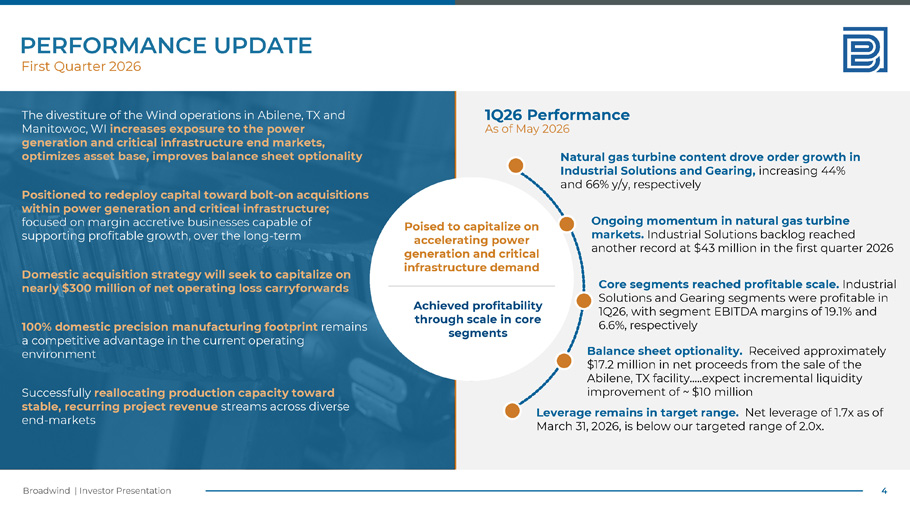
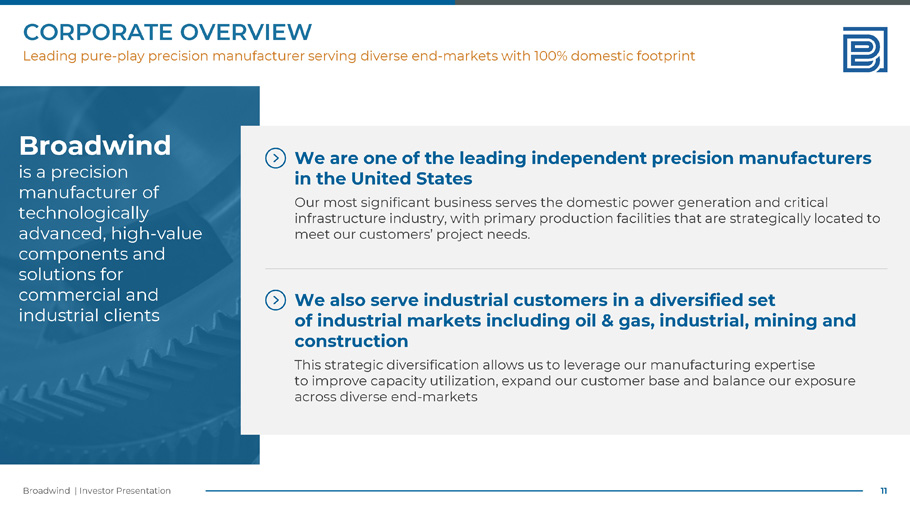
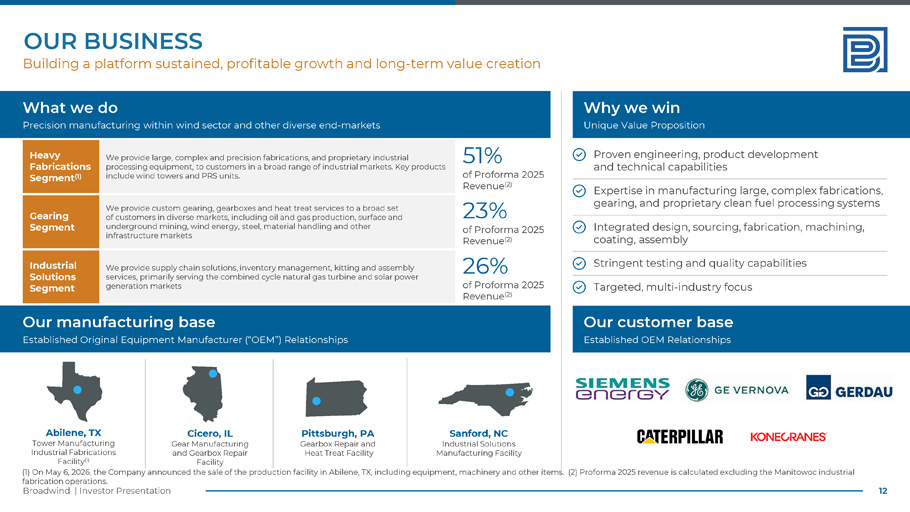
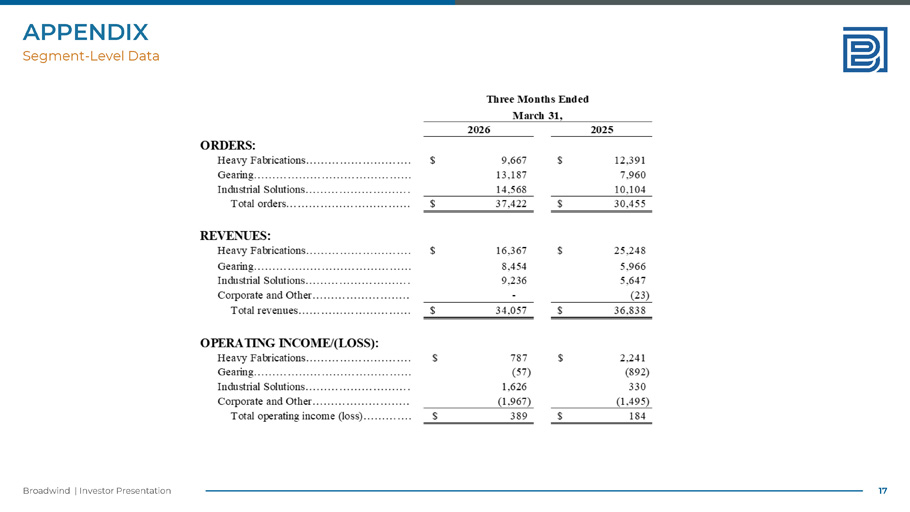
Thank you, Tom, and welcome to our call today. During the first quarter, we advanced our business transformation strategy while delivering strong revenue growth, margin realization, and order momentum in our core gearing and industrial solution segments. Higher demand in the power generation and critical infrastructure and markets drove revenue growth of more than 40% in gearing and more than 60% in industrial solutions year-over-year. We anticipate our strategic exit from wind tower production will be complete in the third quarter of 2026, so gearing and industrial solutions will represent our core businesses moving forward. Excluding the divested product lines within the heavy fabrication segment, Broadwind generated approximately $64 million of revenue on a trailing 12-month basis through the end of the first quarter. Our remaining businesses are higher growth, more predictable, more profitable, and not policy-dependent, with meaningfully improved earnings quality. Over time, we will use our core gearing industrial solution segments as a platform to grow a business of increasing scale and profitability. Within the gearing segment, Q1 orders increased more than 65% to $13.2 million, supporting a backlog of $30.5 million. Demand growth within the gearing segment has been largely driven by strong customer activity and power generation, driven by the AI data center boom, as well as industrial and mining markets. Quoting activity remains robust, with green shoots now forming in defense. Our industrial solution segment had yet another strong quarter, as orders increased 44% year-over-year to $14.6 million, driving backlog to a record $43.3 million. Natural gas turbine demand remains very strong, also driven by the AI data center boom, as well as global electrification, representing key growth drivers for this segment, and we are happy to meet that demand. Operationally, we continue to invest in equipment and technology to increase our process capabilities, reduce costs, and improve our profitability. In gearing, this quarter we commissioned new, very high-precision grinding and mechanical balancing equipment to improve quality and reduce lead times in the production of high-speed reduction gearing, such as the gearing used on natural gas turbines. These technology improvements make us one of the most vertically integrated manufacturers of these types of critical components in the U.S. In the industrial solutions segment, we continue to make investments to improve our capacity and capabilities in order to meet the strong customer demand that we're experiencing from our key gas turbine equipment customers. We are on track to expand our local footprint in our North Carolina facility in Q2. This expansion will increase production space in North Carolina by 30%, which is necessary to service our strong backlog to position us to handle the future growth projected in this market. Within our heavy fabrication segment, Q1 revenue decreased by 35%, reflecting the sale of the Manitowoc Industrial Fabrications business last year, lower PRS demand, and the residual impact of the OEM-directed-buy material supply issue we experienced late last year. Revenue on our gearing segment increased 42% year-over-year to $8.5 million, given the steady ramp-up in power generation-related demand. Within industrial solutions, revenue grew 64% year-over-year to $9.2 million, primarily due to stronger shipments of natural gas turbine components. In summary, the team and business continue to perform well as we sharpen our focus within adjacent higher-margin precision manufacturing verticals. Our progress on industry-specific certifications, such as AS9100 for aerospace and defense, and the Cybersecurity Maturity Model Certification, or CMMC 2.0 for the defense market and others, combined with targeted investments in capacity and capability, is yielding the results we expected and more. Our decision to strategically pivot from the unpredictable, uncertain, and policy-dependent wind tower business and repurpose that capital toward higher growth, more predictable, more profitable markets positions us well for the future. With that, I'll turn the call over to Tom for a discussion of our first quarter financial performance.
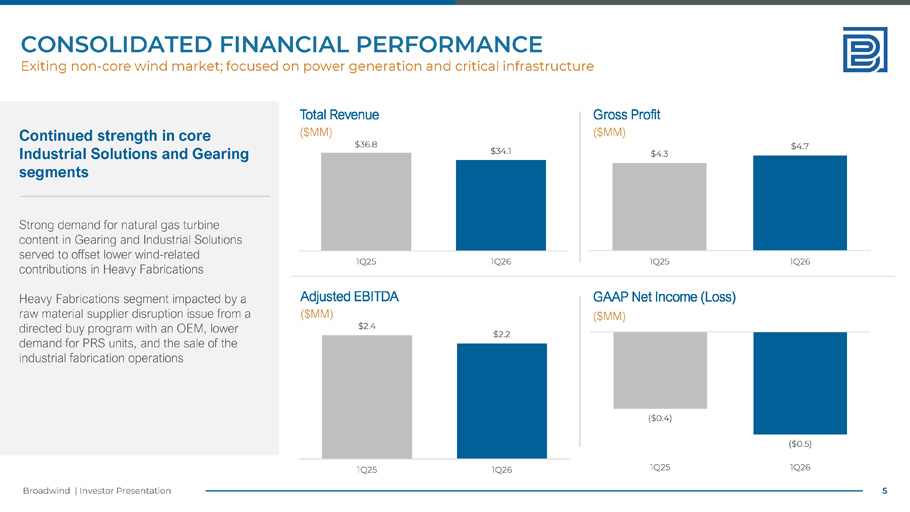
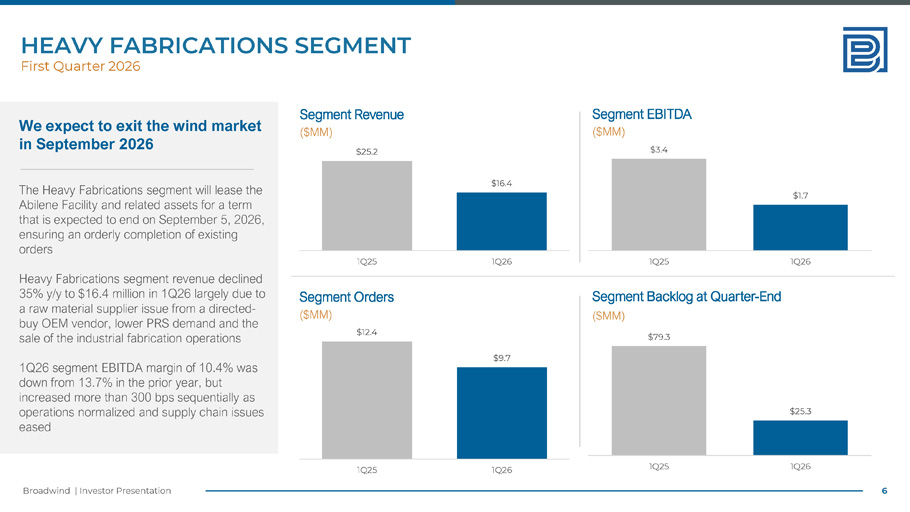
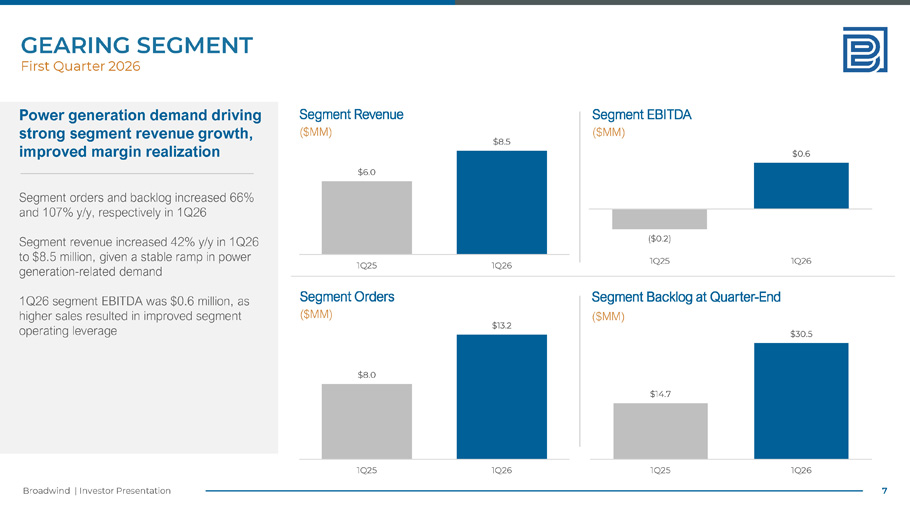
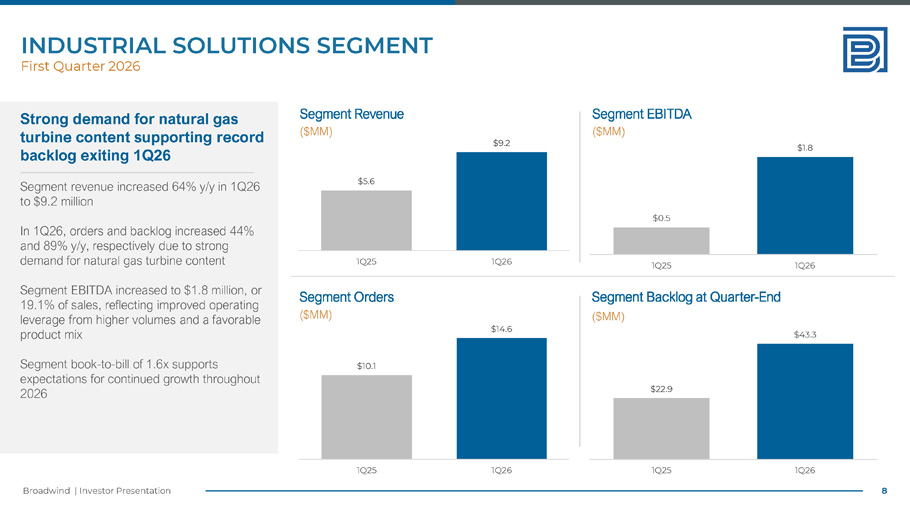
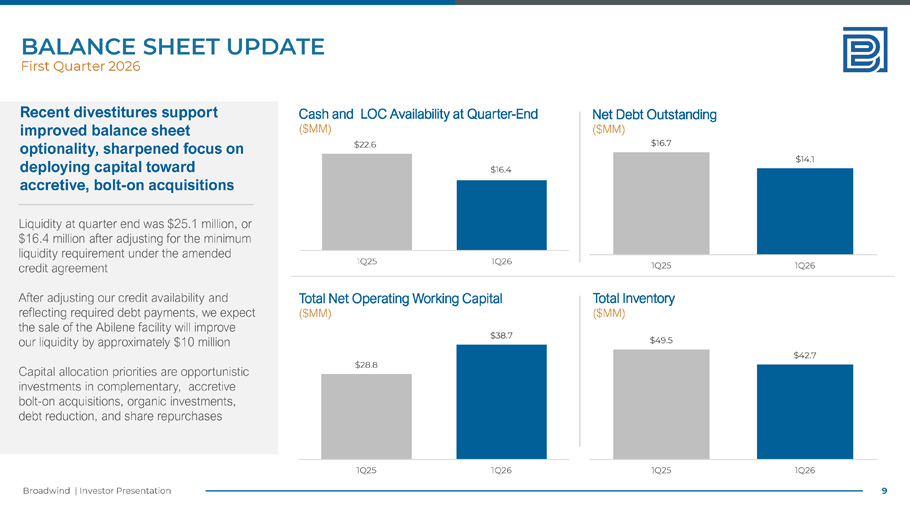
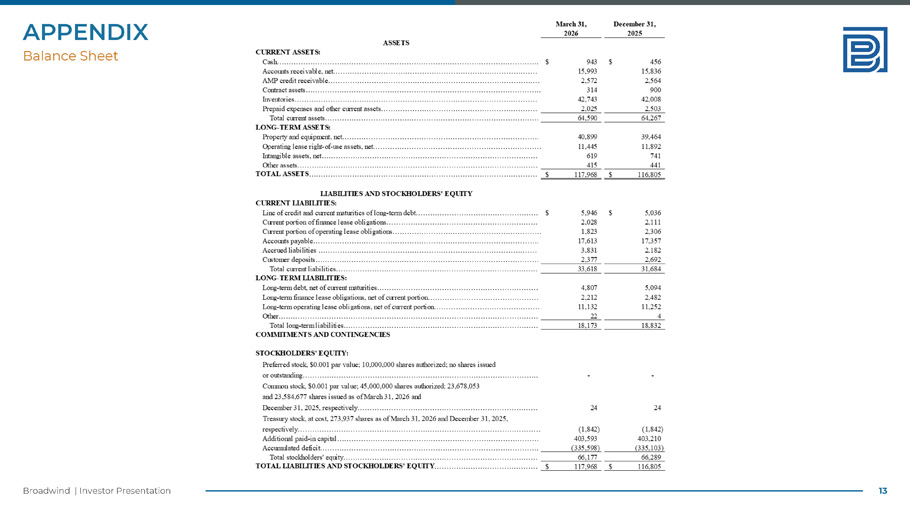
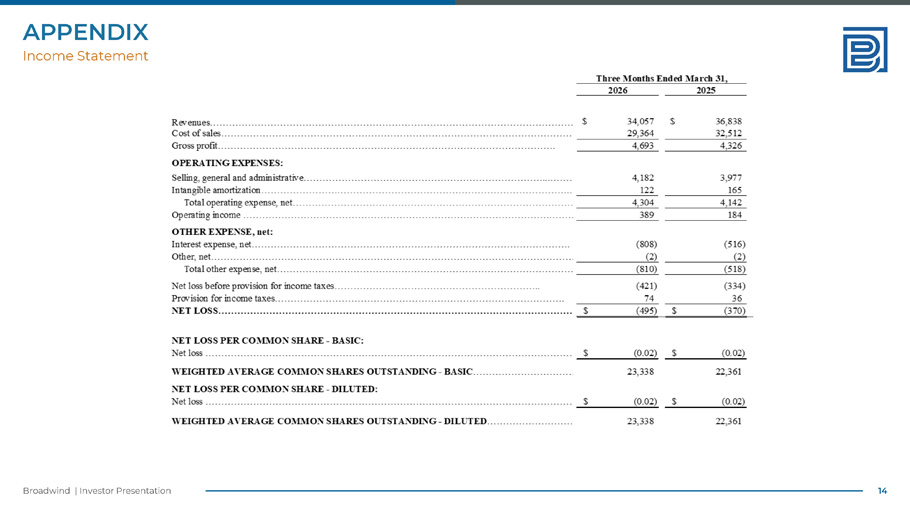
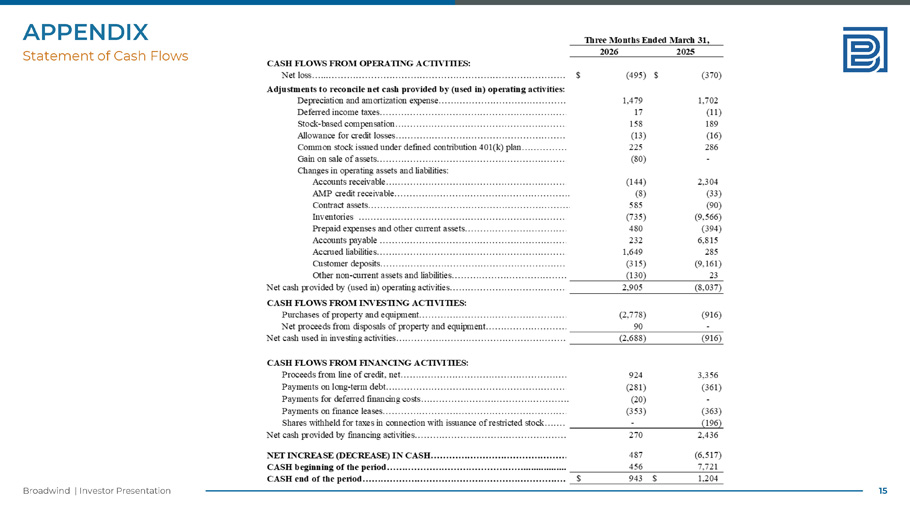
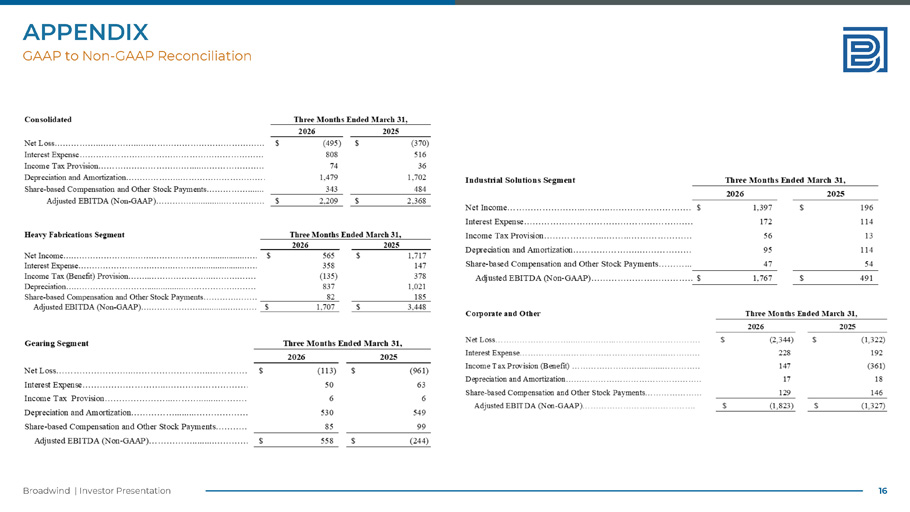
Thank you, Eric. Turning to slide five for an overview of our first quarter performance. First quarter consolidated revenues were $34.1 million, representing an 8% decrease versus the prior year period. As expected, we experienced a decrease in our heavy fabrication segment. However, outside of the heavy fabrication segment, first quarter revenues within our gearing and industrial solution segments increased more than 40% and 60% respectively, reflective of the strong order activity levels we've been recognizing. Adjusted EBITDA declined slightly to $2.2 million versus the prior year of $2.4 million. However, adjusted EBITDA increased approximately 16% sequentially, driven by improved capacity utilization and a more profitable mix. First quarter orders remained strong at over $37 million. Orders increased within our gearing and industrial solution segments, driven by strength in the power generation and natural gas turbine verticals. while orders decrease within our heavy fabrication segment, reflective of our exit of the Manitowoc facility late in 2025. Turning to slide six for a discussion of our heavy fabrication segment. As expected with the wind down of the Manitowoc operations, we continue to see decreases in revenue, orders, and backlogs. We anticipate this to continue going forward, especially in light of our recently announced sale of our Abilene facility, pursuant to which we strategically exited the wind market. First quarter orders of $9.7 million primarily consist of wind tower production that will continue through Q3 of 2026 out of the Abilene facility as well as some baseline PRS activity. As a reminder, we will retain the PRS business and we are evaluating segment reporting following the divestiture. We'll provide additional detail as the process is finalized. First quarter revenues of $16.4 million and adjusted EBITDA of $1.7 million are both down versus the comparative prior year period due to the wind down of our Manitowoc operations, the resolved raw material supply issue, and lower PRS demand. Turning to slide 7. Q1 gearing orders remain strong at $13.2 million, an increase of 66% versus the prior year and 36% sequentially. We ended Q1 with over $30 million in backlogs, a level we have not reached since 2023. As we noted in prior quarters, we continue to see strong orders from power generation and oil and gas customers, and that momentum continued into Q2 as we booked more than $6 million in orders in April alone. Segment revenue was $8.5 million, an increase both sequentially and versus the prior year, reflective of the stronger recent order intake levels. We recognized adjusted EBITDA of $0.6 million compared to an adjusted EBITDA loss of $0.2 million in the prior year period. As our volumes continue to recover, we are improving our capacity utilization, driving improved operating leverage. Turning to slide 8, Industrial Solutions booked almost $15 million of new orders during the first quarter, 44% increase over the prior year. During the first quarter, the segment set a new record for both orders and backlog, and is on track to do so again in Q2, as it has already recorded over $10 million in orders during April alone. The $43 million backlog total is more than $5 million above the previous high-water mark set in Q4. Q1 represents the sixth straight quarter setting a record backlog level. Q1 segment revenue was $9.2 million, up over 60% versus the prior year, reflective of the elevated order levels received recently. As we noted last quarter, we expect this business will operate at these elevated revenue levels over the medium term. First quarter adjusted EBITDA was $1.8 million, or 19% of revenue. This represents a significant increase over the $0.5 million in adjusted EBITDA and 8.7% EBITDA margin in the prior year, as the segment benefited from improved capacity utilization and a more favorable mix of products sold. Turning to slide 9, we ended the first quarter with total cash and availability on our credit facility of more than $25 million, or $16.4 million after adjusting for the minimum excess availability requirement in place effective Q1. Pro forma for the sale of the Aveline facility, our liquidity improves approximately $10 million, reflective of credit availability adjustments and required debt payments. during q1 operating working capital increased slightly as a decrease within our heavy fabrication segment was more than offset by increases within our gearing and industrial solution segments in line with their increasing activity levels finally with respect to our financial guidance as noted last week with the sale of the abilene facility we have elected to withdraw our full-year 2026 financial guidance. That concludes my remarks. I will turn the call back over to Eric to continue our discussion.
Thanks, Tom. Now allow me to provide some thoughts as we move into Q2 and beyond. We continue to make a decisive shift toward increasingly stable, growing power generation in critical infrastructure markets. The strategic moves we've made with our tower facilities position us to focus on higher growth, and higher margin opportunities that leverage our precision manufacturing expertise and to do so with a strengthened balance sheet we will complete our remaining wind tower orders through q3 and indirect our full attention to the to our growth strategy our remaining facilities in chicago pittsburgh and sanford north carolina near raleigh have more than 450 000 square feet of manufacturing space ready to serve our customers. Quarter upon quarter of strong water growth within the gearing and industrial solution segments from power generation, specifically within distributed power, as well as growing opportunities in both small frame and utility-scale natural gas turbines, support our strategy to expand in this market. Code activity continues to increase in both gearing and industrial solutions, generated by our ability to solve complex precision manufacturing and sourcing challenges faced by our customers in this growing market. So, we have prudently added resources to meet this demand in both divisions. In our gearing segment, we continue to execute our strategy to move beyond traditional gearing toward new opportunities in other precision machine products for power generation, aerospace, We see the continuing strength in incoming orders from the power generation sector as the beginning of a super cycle for which we are prepared. The expansion of our very high precision and vertically integrated capabilities to serve the high-speed gear segment I mentioned earlier increases our value add to key customers. We're pleased with the increasing level of customer activity we're seeing in various new infrastructure-related opportunities such as material processing and defense. We expect further inroads in defense as we complete our CMMC 2.0 certification later this year, which is a requirement when producing certain defense-related products. Lastly, there is also improving order activity in traditional gearing markets supporting oil and gas, specifically the fracking aftermarket as certain customers begin putting older rigs back in service. In industrial solutions, our commercial performance continues to set new records in both orders and backlog. The strong demand that we began experiencing in 2025 continues to accelerate in 2026. As the global demand for natural gas power generation equipment grows, and as our customers bring additional production capacity online, we believe this is an extended period of growth. Some of our key customers have sold out their production capacity for the remainder of the decade, which gives us confidence that this period of strong demand is still in its early stages. In summary, I am pleased with the order growth and the strategic actions we've taken over the last year, and I'm excited to execute our plan. Our divisions are well positioned to support the nation's growing need for power generation and infrastructure improvement, which we see as long-term opportunities for us. Our quality, quick response, and ability to solve complex manufacturing challenges for our customers continue to help us win new opportunities. We've refocused our business, are investing wisely, and are taking decisive strategic actions towards higher value, growing, and markets. We're encouraged that our order intake continues to grow, positioning us for improved utilization of our reduced manufacturing footprint in 2026, as we strengthen our foundation for steady, profitable growth, serving the power generation, critical infrastructure, and other key markets with high-quality precision components and proprietary products to capitalize on improved demand in the years ahead. With that said, I'll turn the call over to the moderator for the Q&A session.
Operator
Thank you. At this time, we'll be conducting a question and answer session. If you'd like to ask a question, please press star 1 on your telephone keypad. A confirmation tone will indicate your line is in the question queue. You may press star 2 if you'd like to remove your question from the queue. One moment, please, while we poll for questions. My first question comes from Justin Clare with Roth Capital Partners. Your line is now live.
Hey, good morning. Thanks for taking our questions here. Good morning, Justin. Morning. I wanted to start out with Heavy Fab and just wanted to see how you'd frame the conversion of the remaining backlog for Heavy Fab, the $25 million. How do you expect that to convert between Q2 and Q3? And then just wanted to see how you're thinking about the inventory levels for the overall business as you convert the remaining orders for Heavy Fab here, and then what the effect could be on your overall liquidity, because I'm imagining you may have a lower inventory level as you convert the remaining orders here.
Yeah, thanks, Justin. So, of the $25 million of backlog, the overwhelming majority of this is towers-related that we'll be completing out of the Aveline facility here, And that should be very, very ratable over the next two quarters. So, you know, it's probably five months. Think of it, you know, one-fifth over the next five months, if you will. So I think that you can call that fairly ratable, you know, post-close three, I mean, post-Q1 here. The other thing I would mention is overall, you know, when we're looking at not just inventory balances, But our operating working capital, we have maybe about $10 million of operating working capital associated with our wind business at the end of the quarter. So we expect that that will obviously decrease, but we are expecting that to be partially offset by increases within our gearing and our biz segments as those businesses continue to ramp up here for the balance of the year. So there may be some benefit, but I think it'll be muted. Yeah.
Got it. Okay. And then with the sale of Aveline, just wondering how we should think about the overall operating expenses for the business here and how you anticipate that changing as you exit that, that wind tower business. And then any other actions we should be looking for in terms of things that you may be looking to do to optimize the business as you shift to, you know, a focus on power generation and critical infrastructure?
Well, yeah, we do have obviously the operating expenses associated with that facility will go away as we exit the facility. I don't think that their cost structure is, you know, significantly different than what we have within the other business units. So we shouldn't see any consolidated impact there. In terms of other costs that we're looking at, we're looking at all of our costs and trying to optimize that in light of this transaction going forward.
Got it. Okay. And then maybe just one more, you know, you indicated natural gas content drove order growth for industrial solutions and gearing. I'm wondering if you could talk about the opportunity for Broadwind to expand, you know, content per turbine or wallet share within the NatGas end market. And then also, I guess, what you're seeing in terms of order size or project scope and how that's trending.
Yeah, thanks, Justin. This is Eric. Well, I will tell you that we are engaged with a couple different producers of gas turbines, primarily the ones that are in the utility scale. We're engaged right now with four of the top ten. Right now, of course, we do have some concentration on a couple of those. As far as content, the content for industrial solutions is broad, as we discussed before. we tend to support those installations on what's called not a hot gas path, but surrounding the hot gas path. So we continue to invest in capabilities to grow, share within that product set. So I think we are growing within our primary customer, and another three on top of that, we're also growing content from industrial solutions kind of beyond what we traditionally do by taking more manufacturing on ourselves. With regard to gearing, we do reduction gearing, and we're looking at some other components within the natural gas turbine, but it will be limited primarily to that reduction gearing that we discussed before because that's primarily what these turbines need from us as far as precision machine gearing.
Okay, got it. Thank you. Appreciate it.
Operator
Our next question comes from Eric Stein with Craig Hallam. Your line is now live.
Hi, Eric. Good morning. So obviously you're focusing here. You've been investing in gearing and industrial solutions for some time. Curious, could you update us on, you've got really strong backlog in both segments, update us on how you would expect that backlog to flow in both businesses, whether that has changed or, you know, improved your ability to execute on that and then just what that implies over the next, say, 12 to 18 months?
Sure, sure. Thanks, Eric. I think what we're seeing is we think that Q1 is probably the low watermark for our revenues for both of those segments. We do expect these revenues to ramp up. You know, I don't think we can take our order run rate and extrapolate that to mean what we're going to book in terms of revenue because we are probably booking further into the future than we have in the past. But I think just suffice to say, I think we can expect a steady, ratable growth for the balance of this year.
And we are, I should add, that we are booking into 27, and actually a little bit into 28. Now, that's depending on when the customers want the product, not depending on our capability to deliver it to when the customers want it. They are looking further out. A couple of our customers are booked literally to the end of the decade, And so we have some advanced notice of some of their products. They want to secure a capacity now instead of waiting.
I don't want to put words in your mouth, but you could, it sounds like you could execute on this backlog in both segments, you know, perhaps over the next 12 or so months. But in some cases, as you said, it has to do when the customers want that production and that that would potentially be the limiting factor.
Correct. Now, which also means there's more capacity we have to fill in the interim.
Yep. Okay. Got it. I mean, is it something where you're able to disclose kind of what your, you know, the percentage? And it sounds like it would be more skewed to industrial solutions when you're talking about booking further out. but are you able to kind of give a high-level view of, say, what in that backlog, what is kind of earmarked for 26 versus 27 and 28?
We could probably provide that on the next call. We could provide some color there. At this point, I would say it's primarily 27. Anything that's not in this year would be 27. We're just starting to touch 20, 28, but we can add some color to that maybe on the next call for sure.
And you are correct. You are correct. The customer that is pushing some or requesting some 2028 due dates, delivery dates, would be out of the industrial solution segment, not so much out of gearing.
Yep. Okay. Got it. And then could you just talk a little bit about gearing? You mentioned some positive trends in oil and gas. And certainly, you know, you are hearing just, I mean, it's a distant memory, but early in the year, gas prices, or I'm sorry, oil prices, pretty depressed. And you're hearing people start to talk about that that's really weighed on their oil and gas business, and that it really has not picked up, you know, even with oil price appreciation given geopolitical factors. So maybe talk about that. I mean, is that something that you're kind of concerned about or on the lookout for? Or is there a reason that gearing would be a little bit insulated from what some others are seeing?
Well, gearing has been, or oil and gas gearing, as you know, has been at a low for, shoot, six or seven quarters now. And it's because a couple things. One is the customers are being more frugal with their capital. their rigs are a lot more productive, so they don't need to add rigs to add output. However, what's going on now is we have customers that are putting some of their old rigs back to work and replacing some components within their existing rigs. So what we're seeing is what I would call quick-turn domestic supply for our customers as they put some of their old equipment back to work.
Got it. So, I mean, maybe is this a possibility that that actually, I mean, you are seeing some improvement there. As you said, low levels, but you're seeing some improvement there because customers are, in fact, a little bit cautious, but they're trying to get more out of their existing equipment rather than new capital.
Right. That's correct. So the rig count in the U.S. remains down. The customers aren't really putting new rigs back to work. There's been a couple over the last couple of weeks that have been redeployed, but where we are seeing the demand is what I would call aftermarket, meaning the customers that have rigs working need to keep those rigs functioning, and they're replacing some of their gear and wear parts with new components, not new rigs, upgrading existing rigs.
Okay. All right. That's helpful. Last one for me, just pretty clear signaling that you aim to use a stronger balance sheet to add to your business. So I'm curious, maybe it's too early or maybe you just can't talk about some specific thoughts, but just curious when you look at your platform, what are some areas where you potentially could fill in?
Well, of course, we have been pretty open about wanting to grow inorganically. We're going to use both those platforms gearing in industrial solutions as platforms to grow. We like precision machining with exposure to defense and aerospace. We already have some exposure to power generation. If we can find something in power generation, that would make sense. We'd certainly like to bolt that on. We also like grid hardening. I think in terms of transmission distribution, a lot of the grid in the U.S. is quite old in need of upgrade, and we think there's a position for us to take to support that upgrade.
Operator
Our next question comes from Amit Dayal with H.C. Wainwright. Your line is now live.
Thank you. Good morning, everyone. Thanks for taking my questions. So it looks like, you know, you have a pretty clear strategy in front of you with the new segments you're focused on. In that context, you know, what should we expect EBITDA margins to sort of, you know, come through maybe over the next 12 to 18 months as you sort of clean up the, you know, the businesses you're exiting and focus on these new segments? Sure.
Yeah, I'll take that one. Thanks, Mitt. So I would say within our gearing segment, we should expect margins to continue to improve. For them, it's really about volume and operating leverage. They have a big fixed cost structure, and the more revenue that we can produce out of that plant, the more profitable the overall plant is. So we should see that continue to improve radically. In terms of our biz, we should see our mix normalized. The last two quarters, I think we've got a very strong mix of products sold, and we expect that to increase – we expect that to normalize, I should say, over the balance of the year. Although, you know, revenue going up, but in terms of margins, I think you'll see that normalized a little bit over the balance of the year.
Understood. And then, you know, we've spoken about this, guys, you know, one-on-one in prior calls, but, you know, with the fabrication now sort of out of the way, is there a potential rebranding coming for the company overall?
Yeah, the question really is, we don't know yet. There's certain of our divisions are already operating with different names, Bradford Gear, which we would not rebrand. But the overall company, we're thinking about it. So I would stay tuned on that. The word broadwind has wind in it, but there's a whole lot more that broadwind means to many people than just a wind company. So stay tuned. We've thought about it. We're considering it, but no decision at this point.
Understood. And then just last one, on the defense side, who are the customers on the defense side, Eric? Some of them, well, there's a... Oh, what kind of customers? Just to get a sense of...
Yeah, what I would say is some of them don't want us to disclose their name, but let's say there are parts for weapon systems, there's parts for the naval systems, and there's parts for helicopters.
Okay, thank you. And that's all I have, guys. I'll take my other questions off, Glenn.
Operator
We have reached the end of the question and answer session. I'd now like to turn the call back over to Eric Blasford for closing comments.
Yeah, thanks, everyone, for listening today. We're on the move. We're excited to execute our strategy, so stay tuned on that. We look forward to speaking with you again after Q2 to discuss your results. Have a great day, everyone.
Operator
This concludes today's conference. You may disconnect your lines at this time, and we thank you for your participation.