Operator
Thank you for standing by. My name is Jordan, and I'll be your conference operator today. At this time, I'd like to welcome everyone to the Clarivit Second Quarter 2025 Earnings Conference Call. All lines have been placed on mute to prevent any background noise. After the speaker's remarks, there'll be a question and answer session. If you'd like to ask a question during this time, simply press star, followed by the number one on your telephone keypad. If you'd like to withdraw your question, press star one again. Thank you. I would now like to turn the call over to Mark Donahue, Vice President of Investor Relations. Please go ahead.
Thank you from Jordan and good morning everyone. Thank you for joining us for the Clarivate Second Quarter 2025 earnings conference call. As a reminder, this call is being recorded and webcast and is copyrighted property of Clarivate. Any rebroadcast of this information in whole or in part without prior written consent of Clarivate is prohibited and the company earnings call presentation is available on the Investor Relations section of the company's website. During our call, we may make certain forward-looking statements within the meaning of the applicable securities laws. Such forward-looking statements involve known and unknown risks, uncertainties, and other factors that may cause the actual results, performance, or achievements of the business, or developments in Clare-based industry to differ materially from the anticipated results, performance, achievements, or developments expressed or implied by such forward-looking statements information about the factors that cause actual results of different material from anticipated results or performance can be found in Clarabate's filings with the SEC and on the company's website our discussion will include non-GAAP measures or adjusted numbers Clarabate leads non-GAAP results are useful in order to enhance understanding of our ongoing operating performance but their supplement to should not be considered in isolation from or to substitute for GAP financial measures. Reconciliation of these measures to GAP measures are valuable in our earnings release and supplemental presentation on our website. With me today are Monty Shintaz, Chief Executive Officer, and Jonathan Collins, our Chief Financial Officer. After prayer remarks, we'll open the call to your questions.
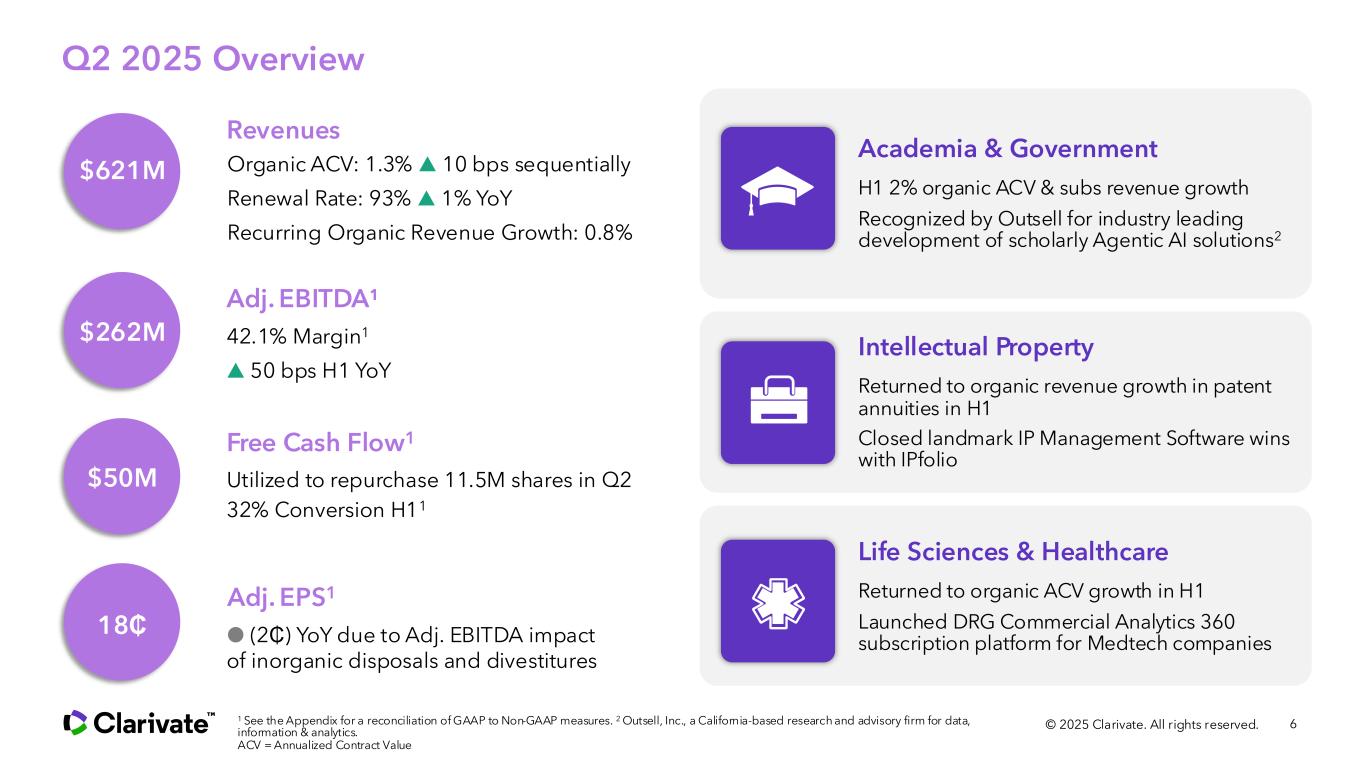
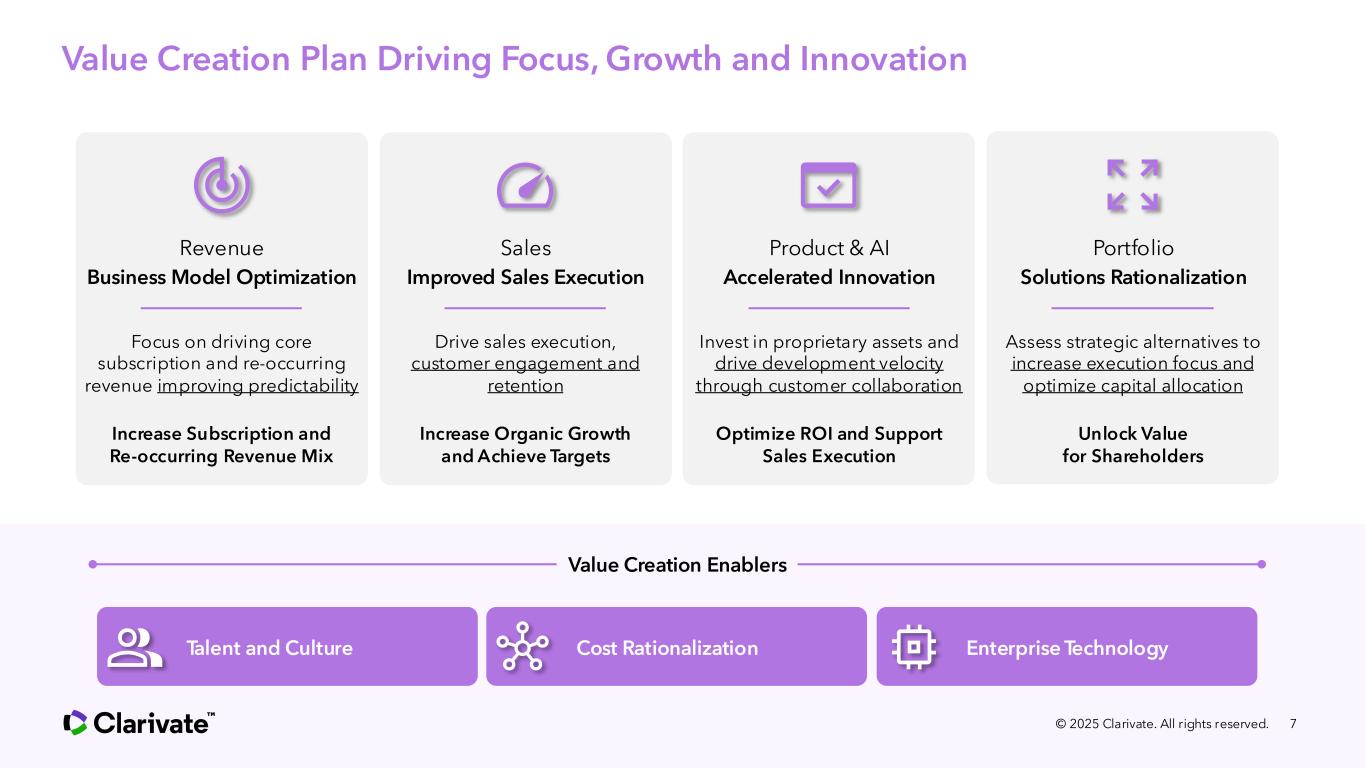
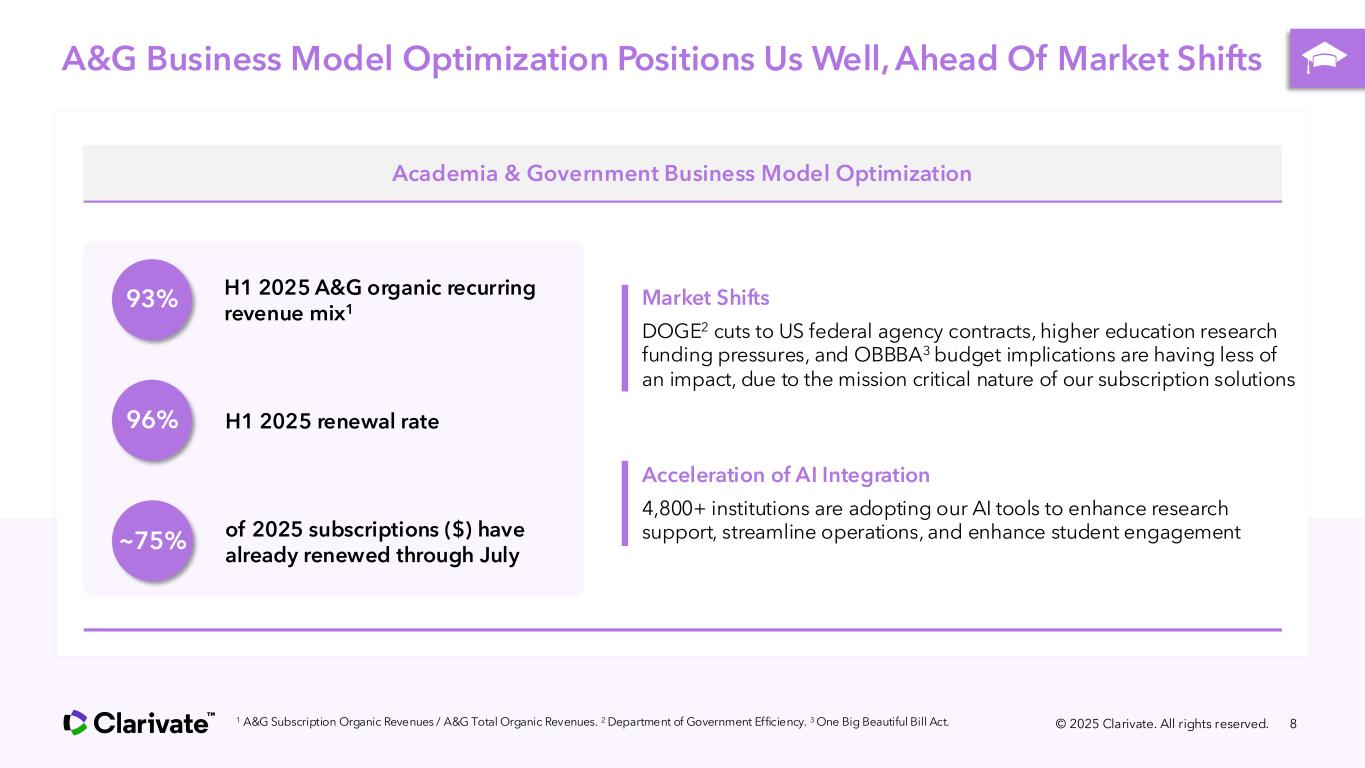
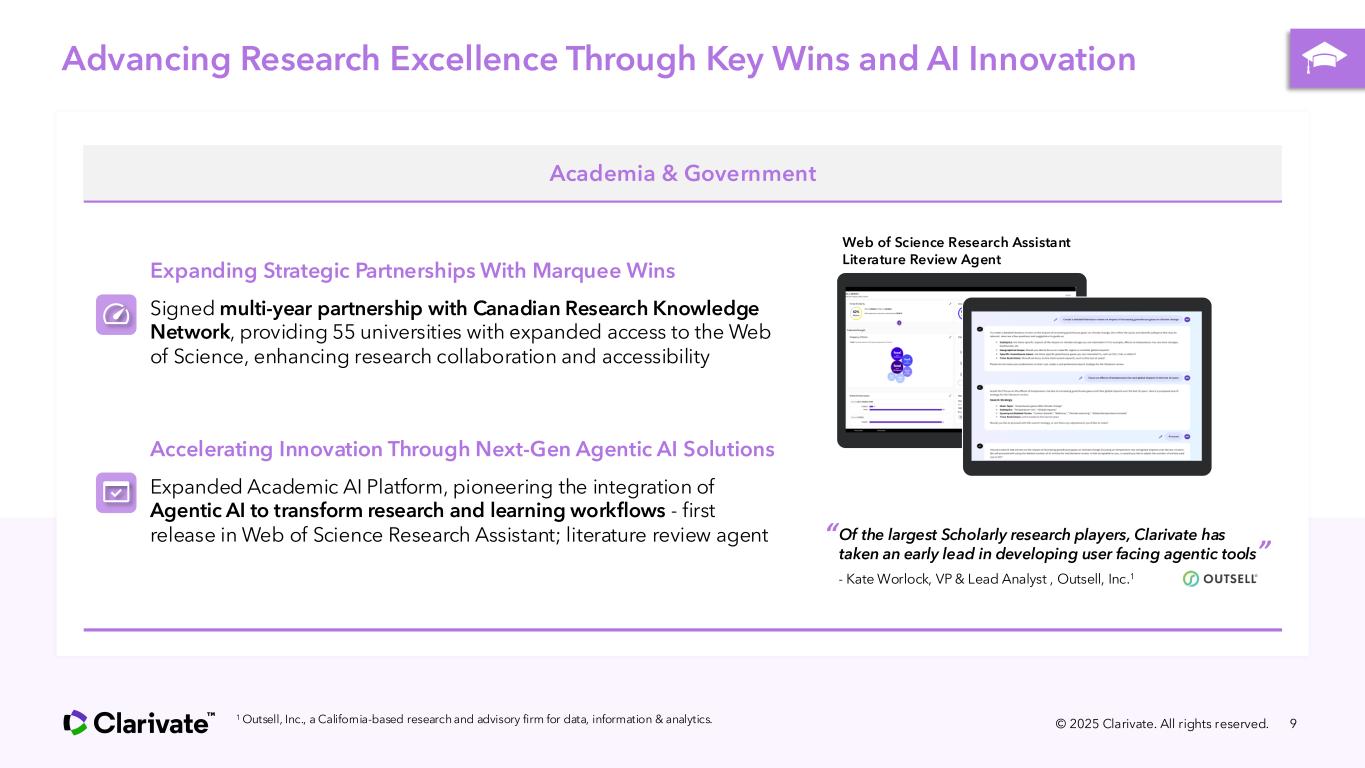
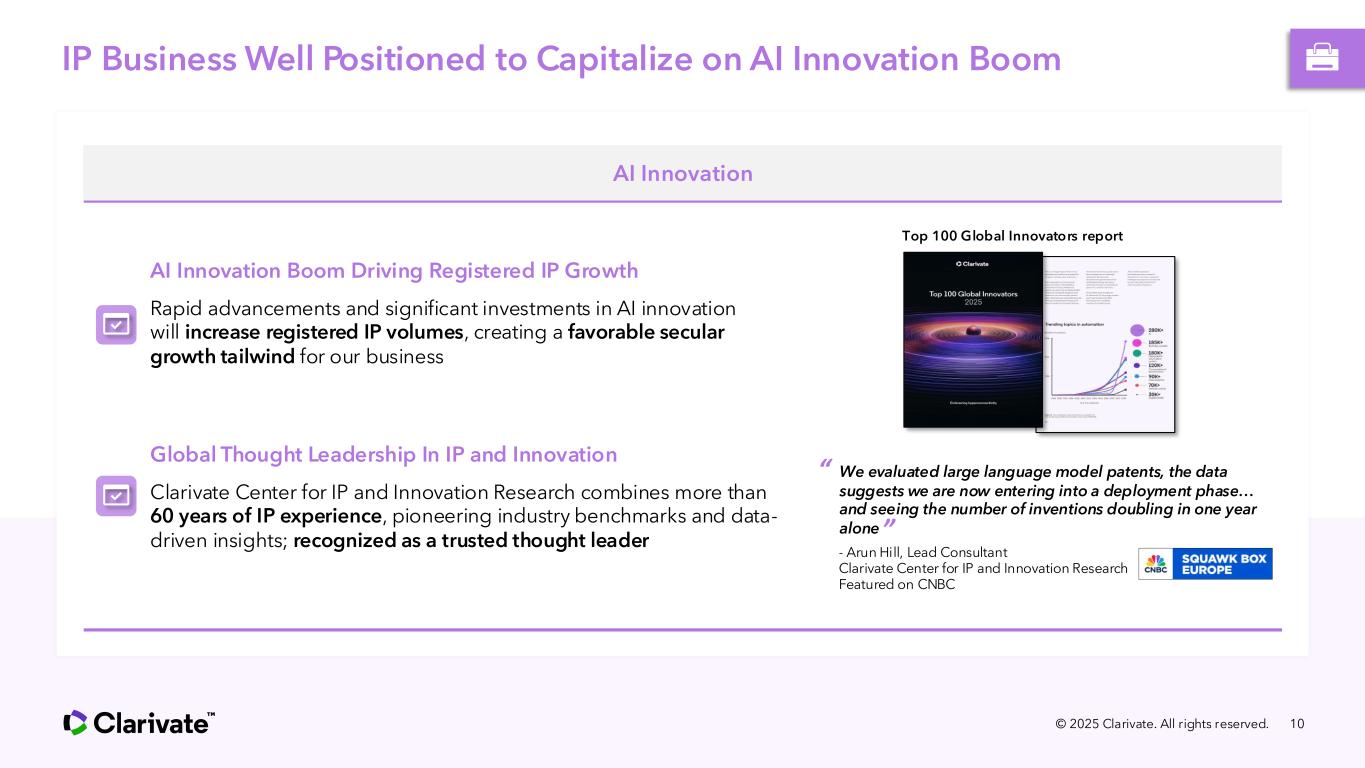
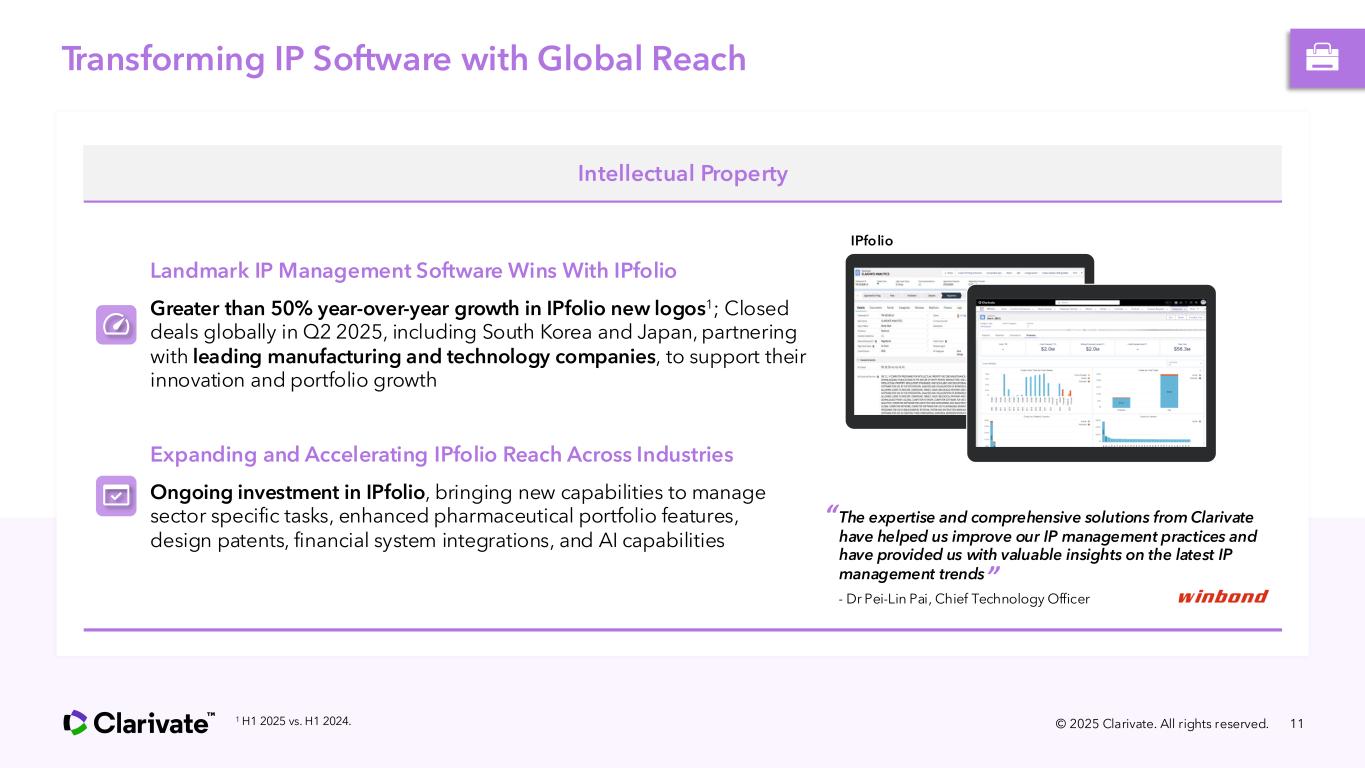
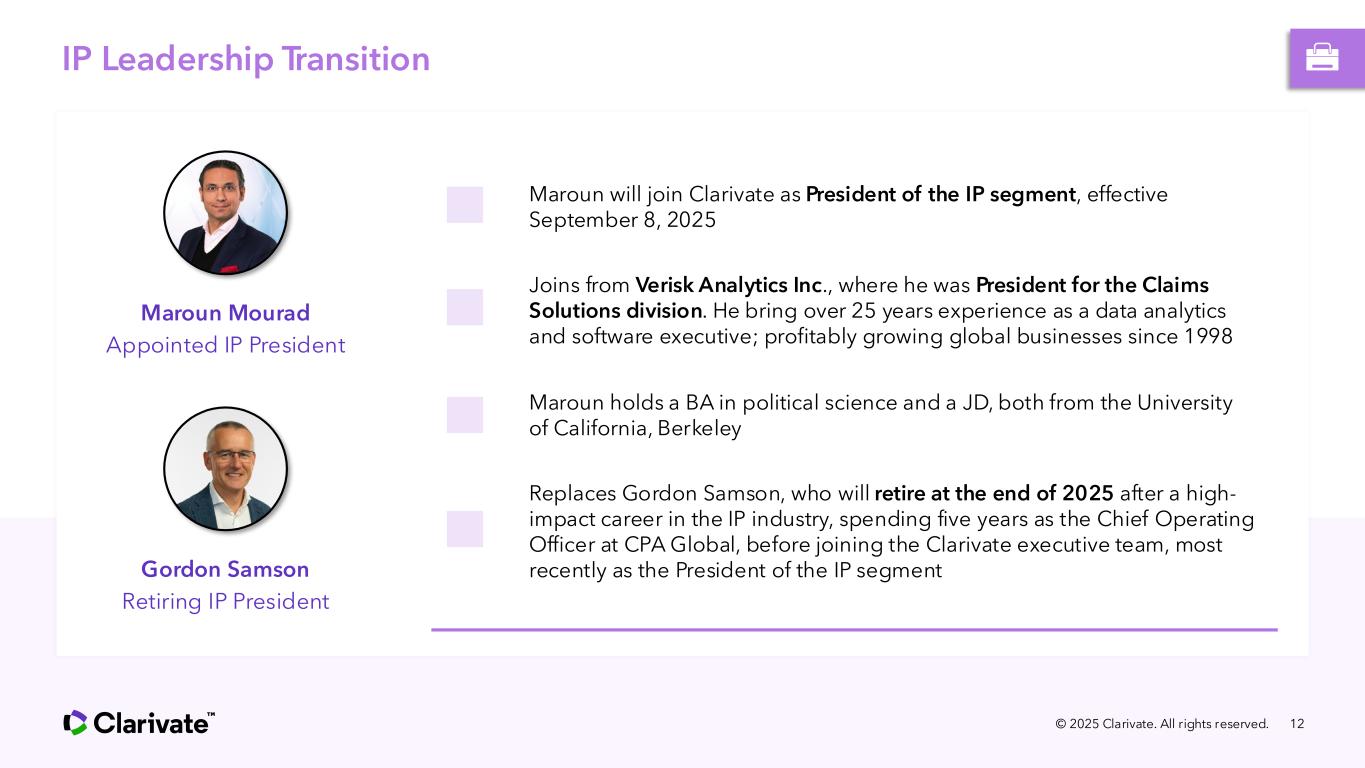
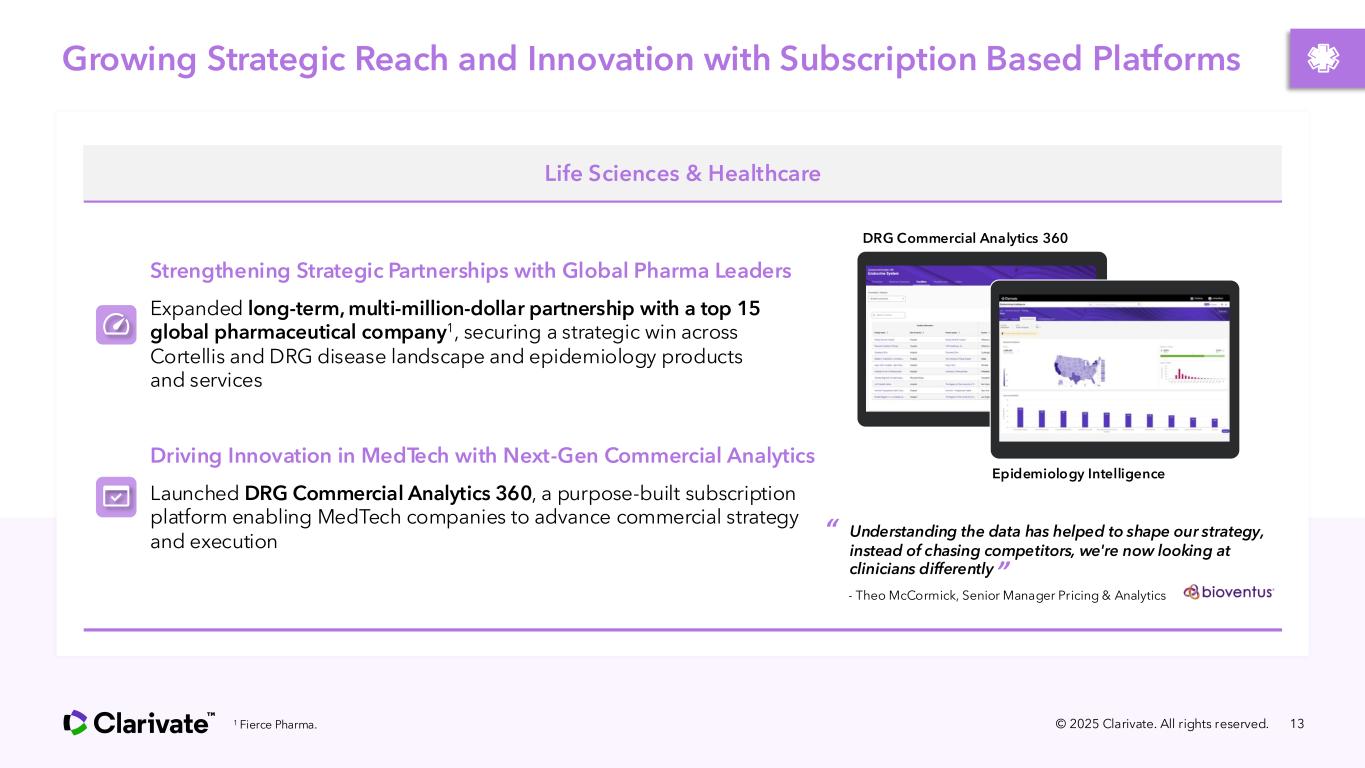
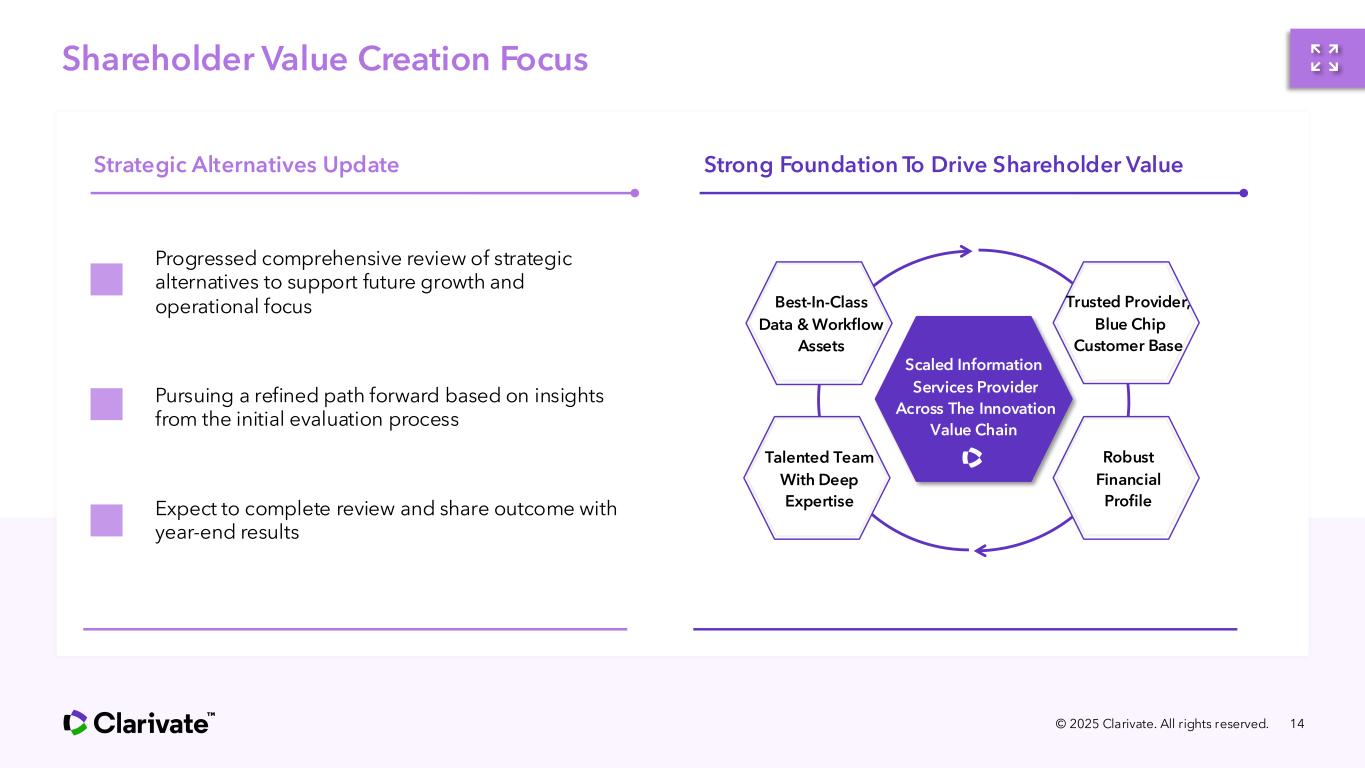
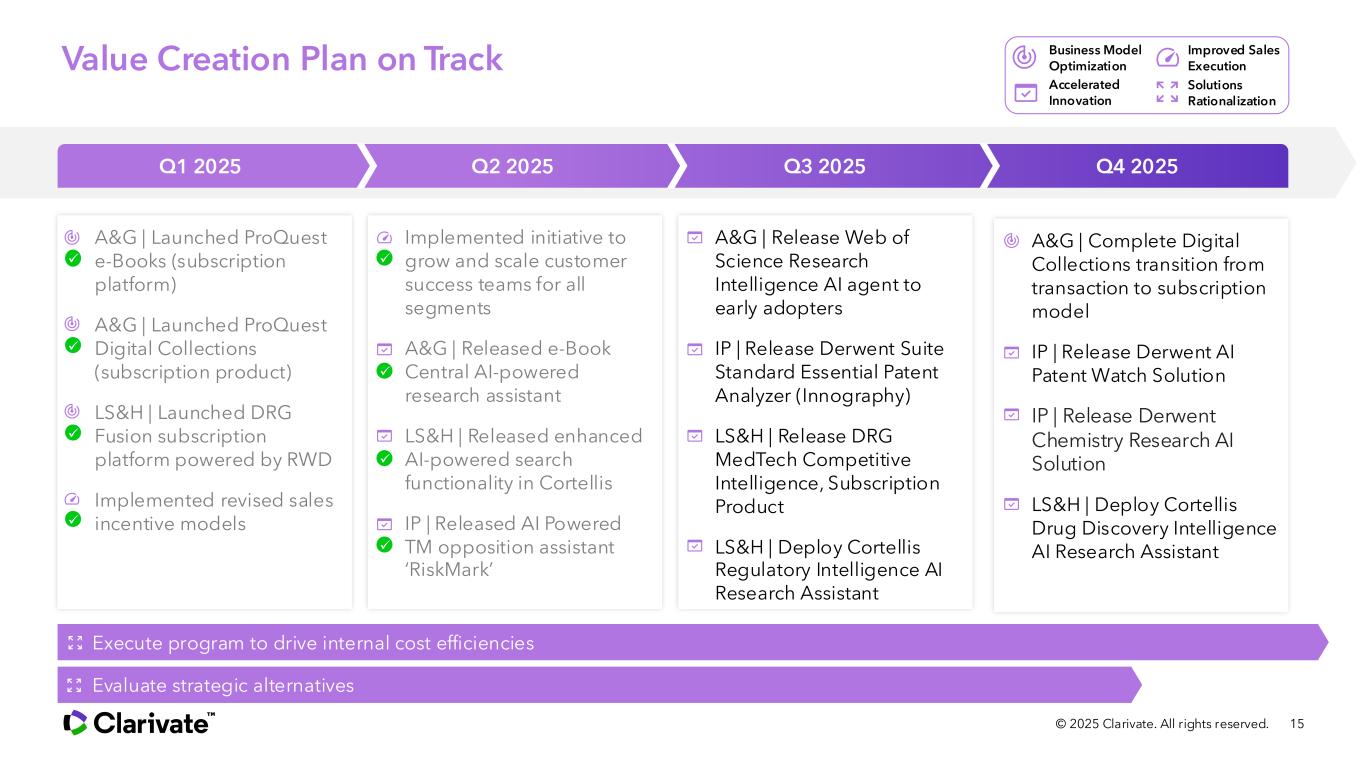
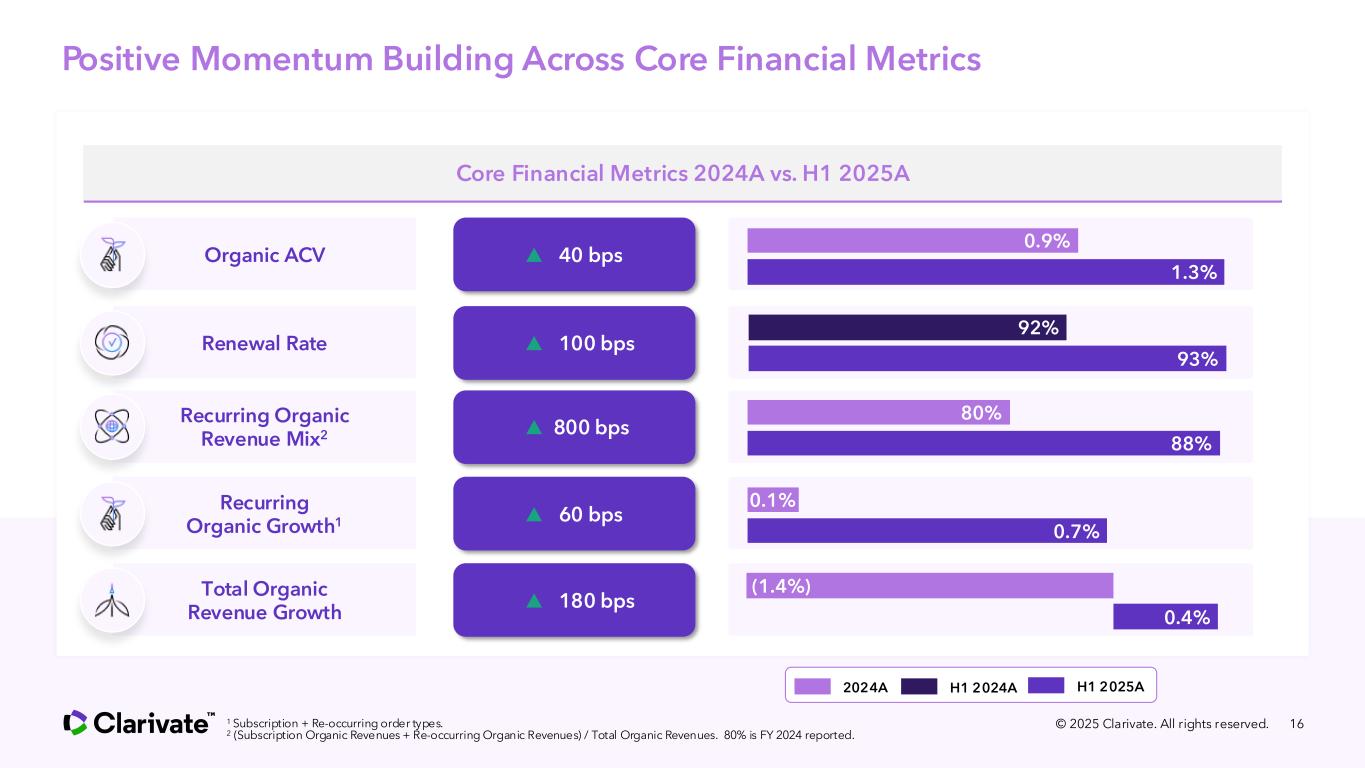
And with that, it's a pleasure to turn the call. Good morning, everyone, and thank you for joining us. We reported solid second quarter financials performance and deliver growth in our key metrics. We also made progress on the value creation plan, including AI-led product innovation, improving sales execution, and enhancing operational efficiency. On slide six, in the second quarter, we demonstrated our strategic positioning within the market. Organic ACV grew 1.3% compared to the prior year period and improved 40 basis points from the end of last year. This was driven by an important improvement in the subscription book due to higher renewal rate and new business wins. Total organic revenue in the second quarter grew 50 basis points and recurring organic revenue grew almost 1%. Adjusted EBITDA margin for the first half of the year increased 50 basis points to 41%, driven by internal cost efficiencies. Free cash flow continued to be strong as we generated $50 million in the second quarter and $161 million for the first six months of this year. I'd like to highlight that all of our segments shown improvement for the first half of the year. Our A&G business delivered 2% organic ACV and subscription revenue growth. IP returned to organic growth in patent annuities and is well positioned to benefit from AI tailwind and life science and health return to organic ACV growth. With a solid first half, We are reaffirming our full year to 2025 outlook. Jonathan will cover the financial results in more detail shortly. On slide seven, our value creation plan was launched in the fall of 2024, and it is on track with measurable progress across all key initiatives and KPIs. We have launched all major business optimization programs to increase cost subscription and reoccurring revenue, which is enhancing sales predictability. We have completed most of the major operating model changes within our sales organization to improve new business generation, customer engagement, and retention. Since the launch of the VCP plan last October, we have delivered 10 cutting-edge product and AI-powered capabilities while focusing on developing AI-enabled work-class subscription-based solutions in partnership with customers. And we are undertaking strategic review to assess alternatives across the business. If you turn to slide eight, I'll provide an update on the VCP, starting with the AMD segment. Our proactive business model optimization, coupled with decades of experience in delivering data and analytic solutions to our clients, has strategically positioned us to anticipate and adapt to current market dynamics. We are on track to discontinue transactional sales of digital collections and books over the next year. This shift away from transactional sale is increasing, recurring revenue growth by transitioning some of the business to the new ProQuest e-books product and other content solution subscription. We are pleased with early adoption with over 70 wins to date and hundreds of customers currently evaluating this new model. Following this change in strategy, ANG subscription revenue now constitutes 93%, 93% of the total segment revenue excluding disposal, up from 79% in the prior year period. In the first half of 2025, we have achieved a 96% renewal rate in ANG, This is impressive results considering the macro backdrops characterized by reduction in the U.S. federal agency contracts, increased constraints on higher education research funding, and potential additional university budget cuts. It is also noteworthy that, as at the end of July, 75% of global AMG subscription for the full year has successfully renewed. This is in line with last year's renewal pace. We continue to successfully invest in innovation across the A&G product portfolio with a focus on AI. We are very pleased by our success so far in product launches and customer adoption. More than 4,800 institutions have already adopted our AI tools to strengthen research support, increase operational efficiency and enhance student engagement. On slide nine, our partnership within A&G continues to grow, including recent multi-year agreement with the Canadian Research Knowledge Network that will provide 55 universities greater access to web of science, fostering enhanced research collaboration and impact. We are also accelerating progress with next-generation Identic AI solution. AI agents can independently play and execute multi-step processes by interacting with users, data sources, and tools. The expansion of our Identic AI platform marks a significant milestone as we implement responsible Identic AI to accelerate research and learning workflow. Our initial launch of the literature review agent in the web of science exemplify this pioneering approach. The agent converse with the researchers to understand the research goals, then customize a specific literature review scope and define the proper output. This personal interactive experience keeps the researcher in the Center, which closely mimics working with human assistance. Finally, we are very pleased that Outsell, a leading research advisory firm in B2B technology, data and information services, recognized Clarivate AI leadership among major scholarly research organization, underscoring our position at the forefront of developing user-facing ai agency tools moving to intellectual property segment on slide 10. after a challenging few years our patent renewal business returned to growth this year with organic reoccurring in revenue rising by about one and a half percent in the first six months of 2025. The market-wide surge in AI innovation across industry is driving sustained growth in registered IT. We believe this trend will create favorable condition for our patent renewal business. As an example, in the past year alone, but its filing for AI invention have grown fivefold compared to pre-CHET GPT levels. In addition, AI has the potential to double innovation output and build more defensible IP portfolio for industry power by IP and scientific research. The takeaway is that this strong market tailwind driven by the proliferation of AI innovation and technology adoption are fueling our work with customers, empower them to achieve higher levels of efficiency and IP creation. Our IP segment is well positioned to capture this growth as we continue to lead at the intersection of technology innovation and ip according to slide 11 during the second quarter ip folio our industry-leading cloud-based ip management platform designed for corporate intellectual property teams grew new customer new clients and partnership over 50 percent year over year across global markets, including South Korea and Japan. We are now broadening and accelerating IP folio adoption across multiple industries, including the pharmaceutical and large law firms. Our expertise and comprehensive solutions have enabled clients such as Winband to enhance the IP management practices and gain meaningful insights into emerging trends in the IP management. IP management transition. So this morning, we have announced that Maroon Murad will join Clarivate as president of the IP segment, effective September 8, 2025. He joins us from Verisk Analytics, where he is the president for the Claims Solution Division. We are confident that his leadership abilities and expertise will further drive the IP business commitment to fostering innovation and growth. I would like to express my gratitude and appreciation to Gordon Sampson for his dedication to the industry any significant contribution to clarivate success turning into life science and as an healthcare segment in life science we are encouraged that the VCP effort have resulted in return to organic ACV growth during the first half of this year we have been expanding our strategic reach fostering innovation to subscription-based platform designed to support lab science and health customers our commitment to develop robust partnership is demonstrated by the recent extension of a long-term multi-million dollar agreement with a top 15 global pharmaceutical company this achievement validates the importance of our Cotelis and DRG product and services to customers. Additionally, we continue to drive advancements in MedTech by introducing next-generation commercial analytics, the launch of DRG Commercial Analytics 360, a dedicated subscription platform empowers MedTech organizations to enhance their commercial strategy and execution capabilities. As commercial budget improves, we believe we will be in the best position to capitalize on an improving environment. On slide 14, value creation plan, I'm pleased that the DCP plan is on track. The first half of this year was marked by accelerated product innovation and significant number of new product launches and enhancements the AI capabilities. We anticipate that the momentum of the product release will continue throughout all three segments in the second half of the year by integrating AI functionalities into our offering, including Web of Science Research, Derwent, and Kotelis. We aim to further improve outcome and value for our users. On slide 15, now that you've heard our VCP is driving results across each of our segments, the fourth pillar of our VCP is evaluating strategic alternatives. Earlier this year, we initiated a formal process to enhance execution focus, optimize capital allocation, support future growth, and increase operational effectiveness. We are making progress and have narrowed the scope of the review. We anticipate communication, communicating the result when we will report our year-end financial performance in February 2026. And lastly, slide 16. In closing, we are pleased to see improved revenue performance for the first six months of 2025, driven by organic HCV growth in A&G and life sciences segment, and the return of growth in the patent renewal business. The mix of organic recurring revenue to total revenue for the first half of the year is now 88%, an improvement of 800 basis points compared to last year. Our annual renewal rate across our subscription base improved to 93% during the first half of the year compared to 92% for the same period last year. We are moving in the right direction and seeing early indication that our plan is driving improved performance. It is encouraging to witness the initial sign of success, which affirms the effectiveness of our strategies and the education of our teams.
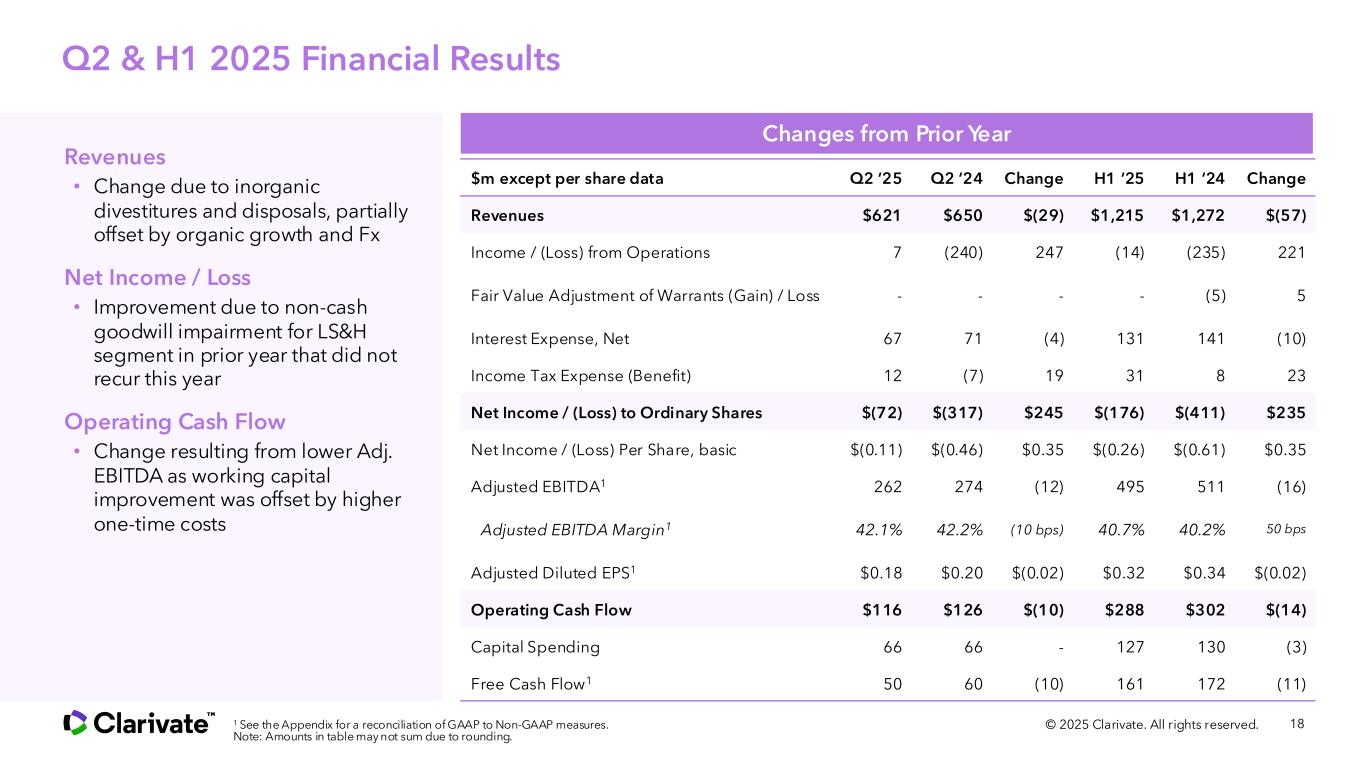
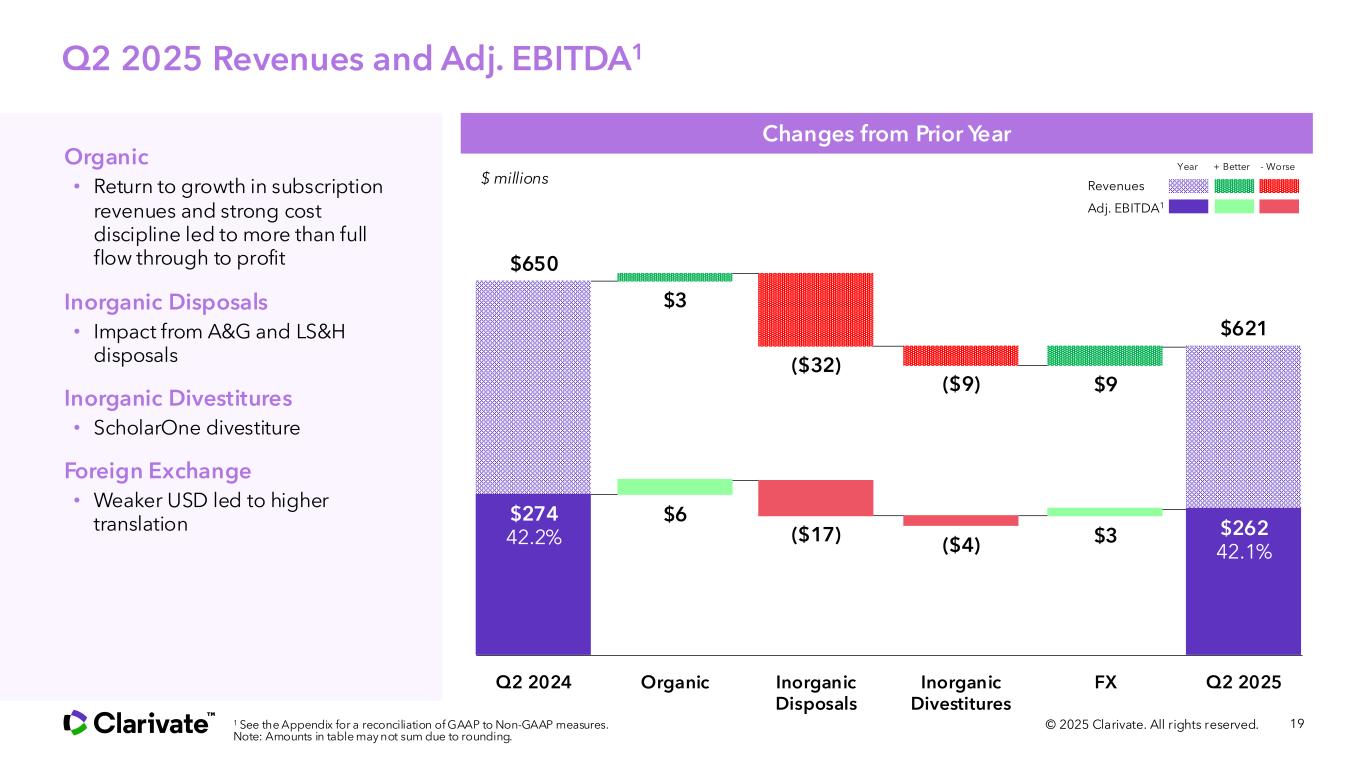
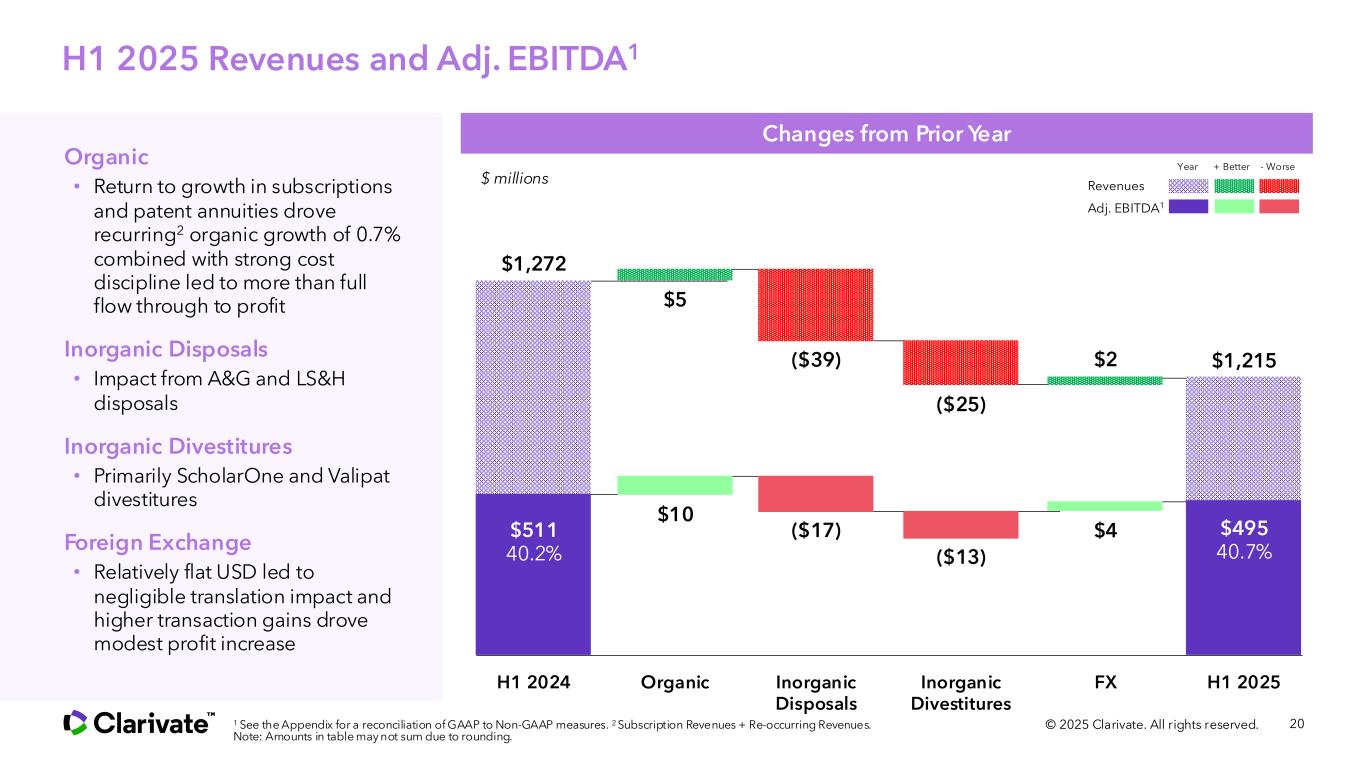
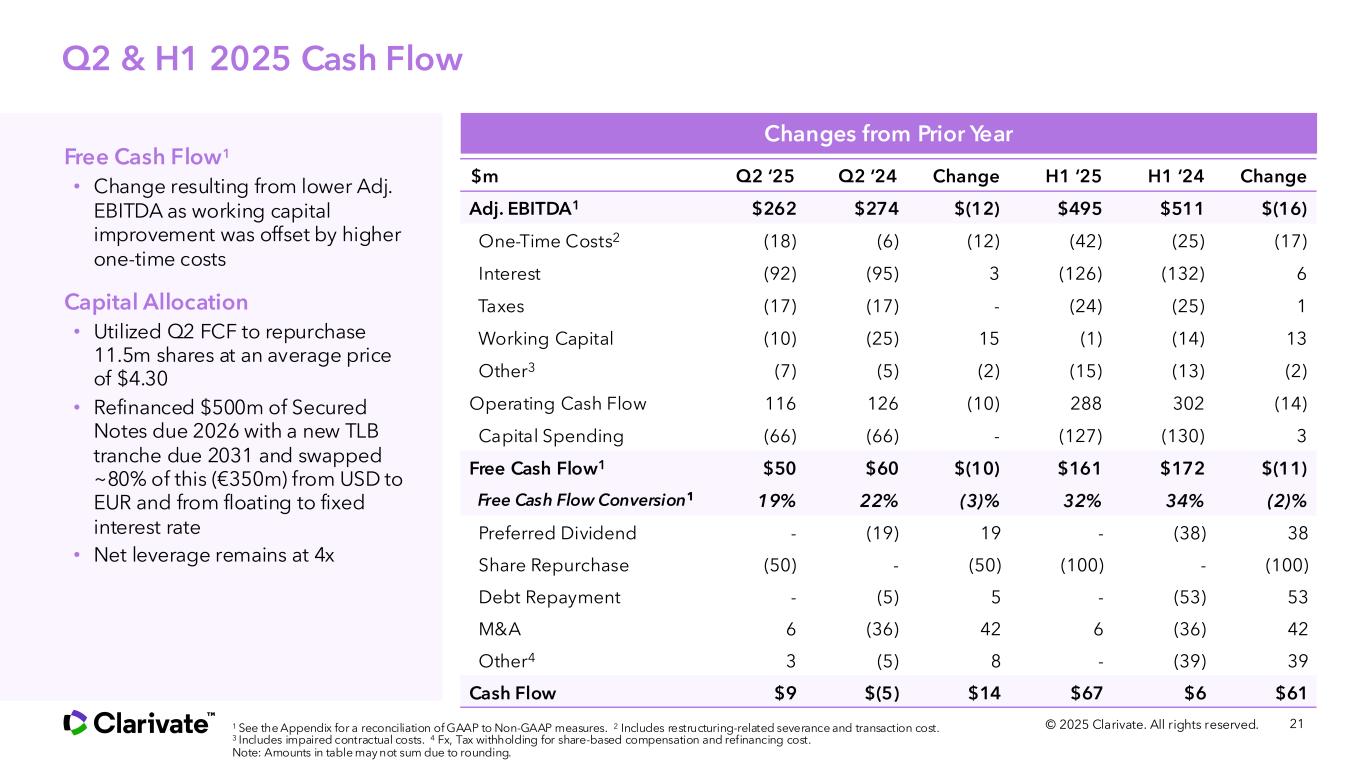
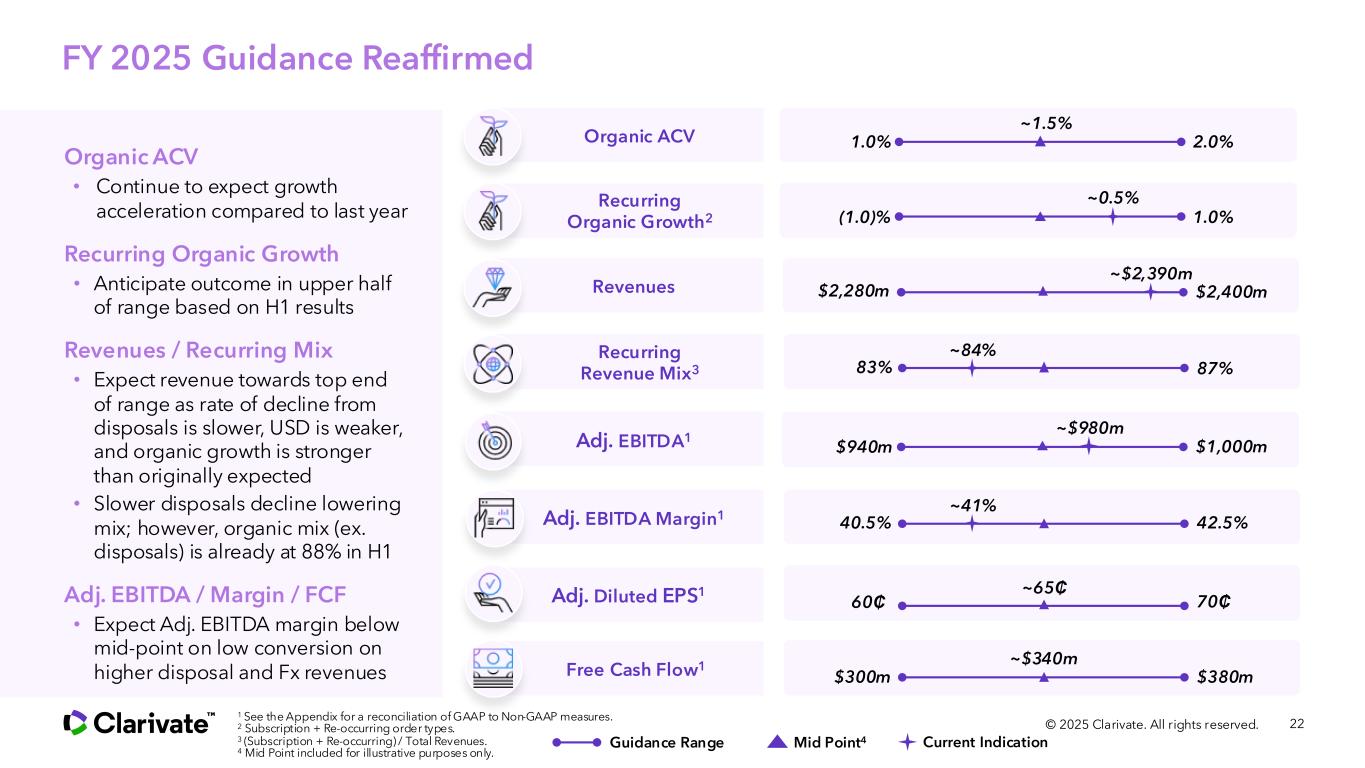
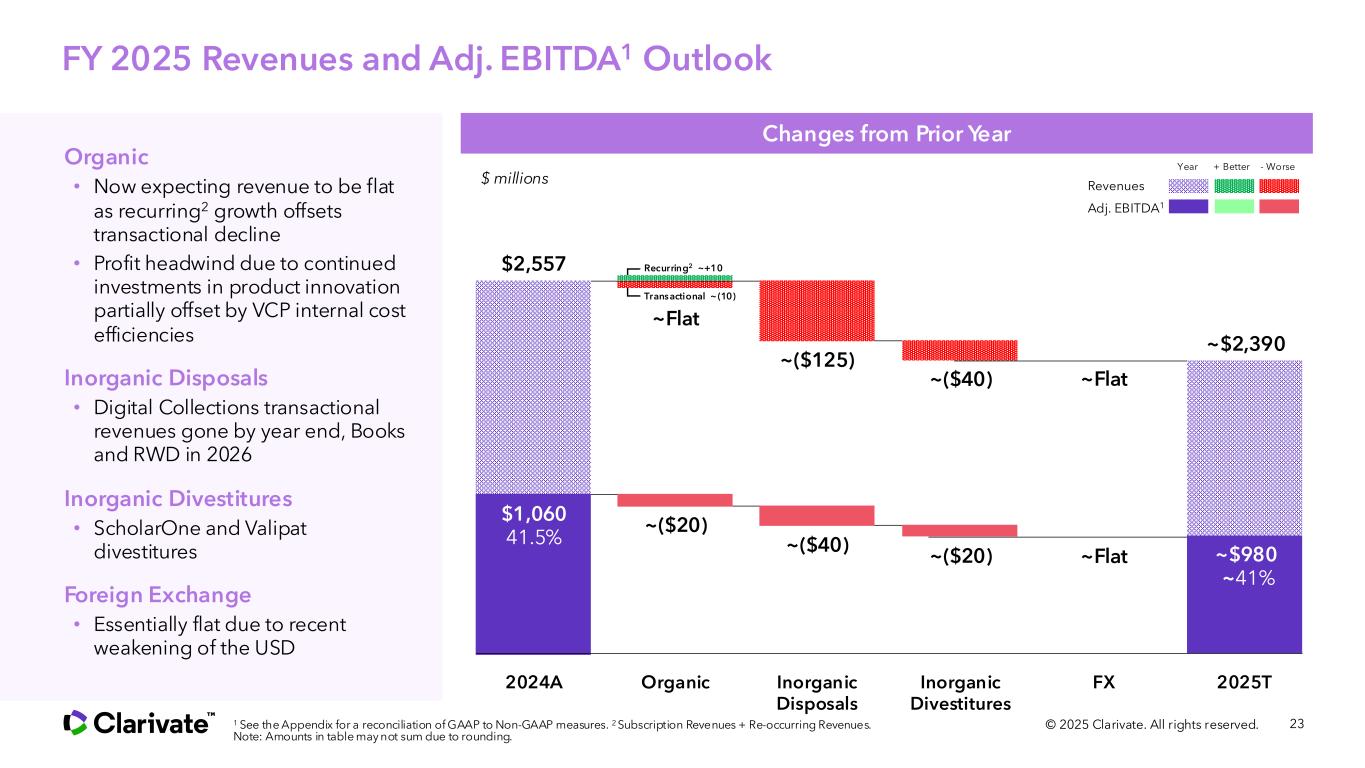
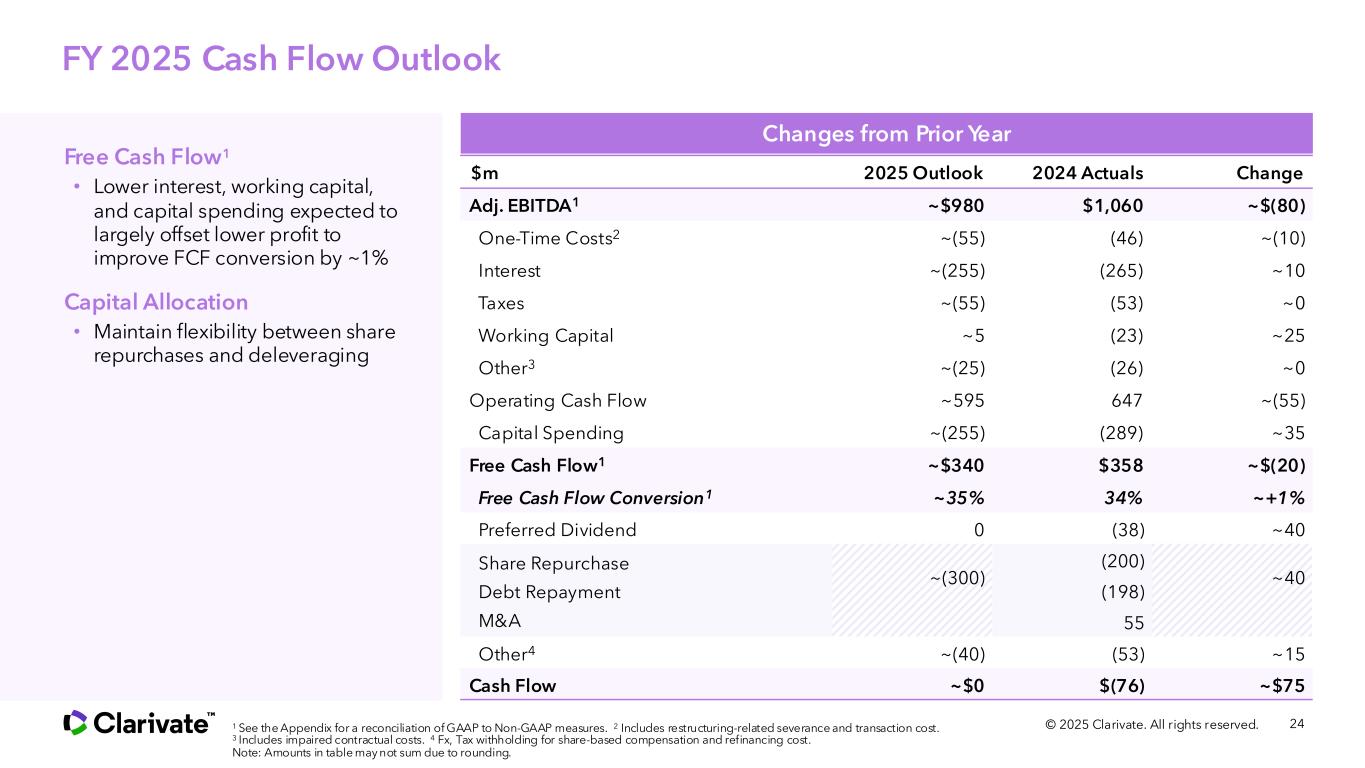
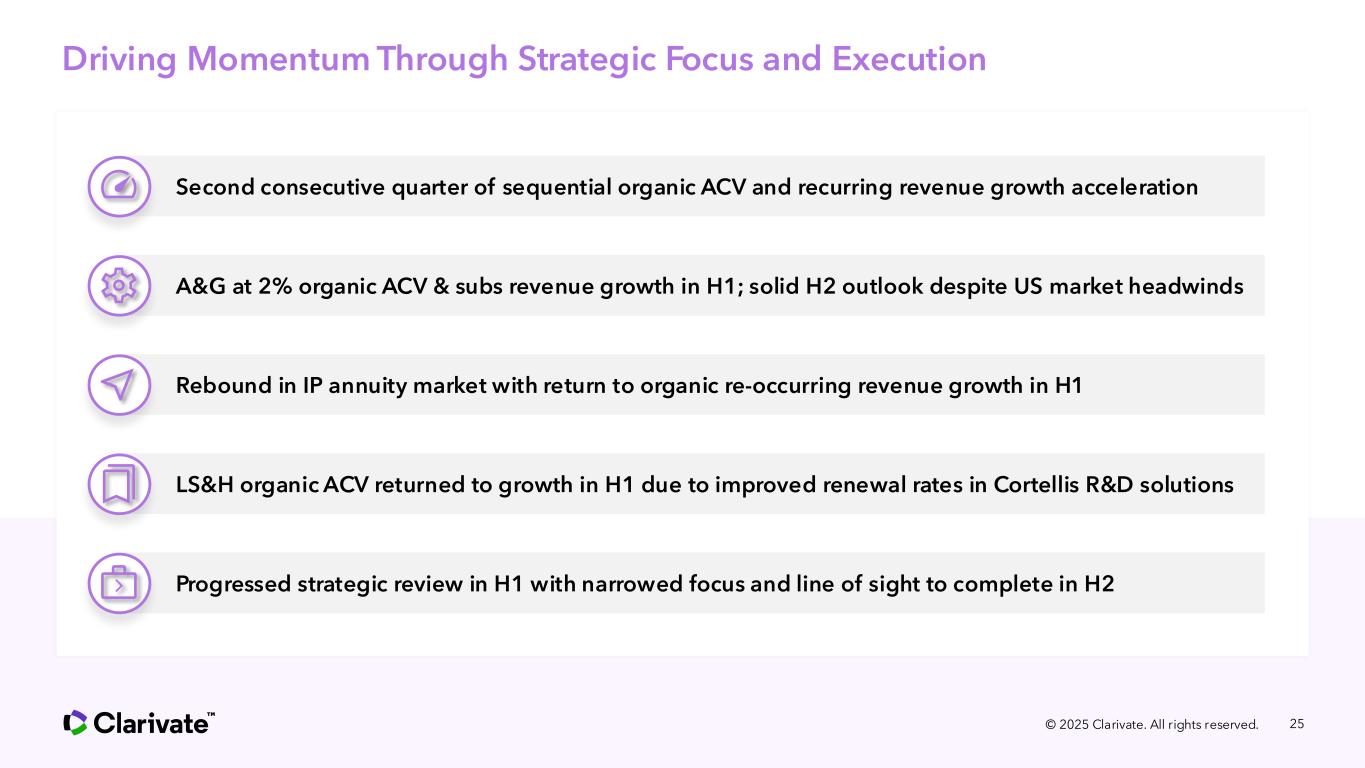
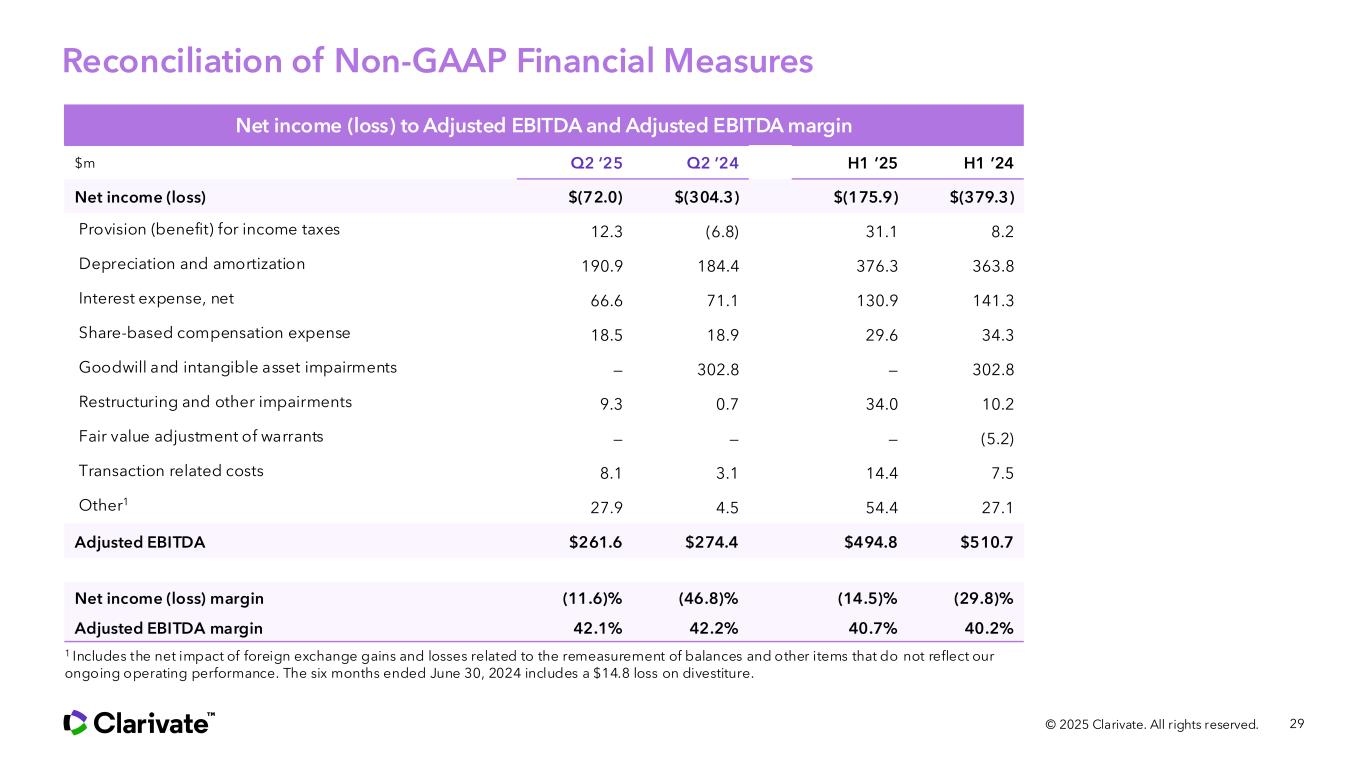
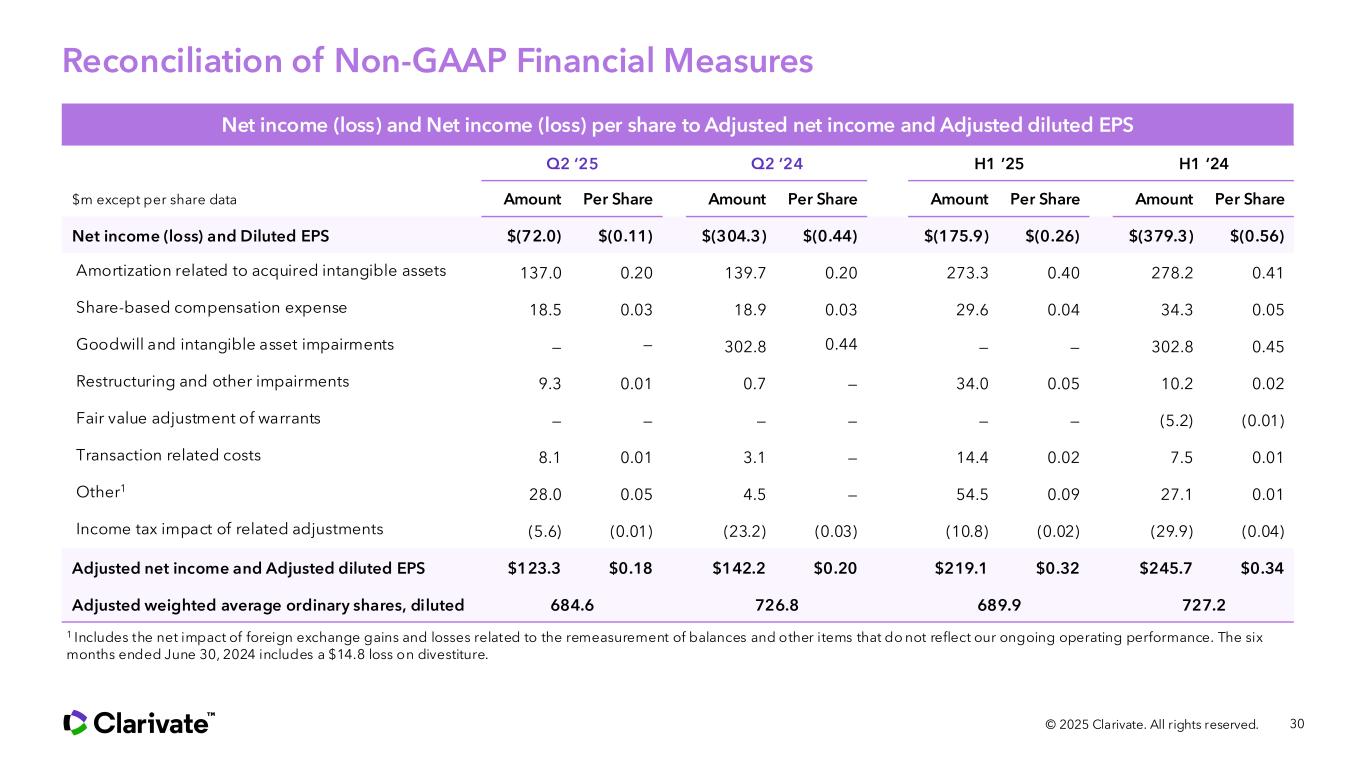
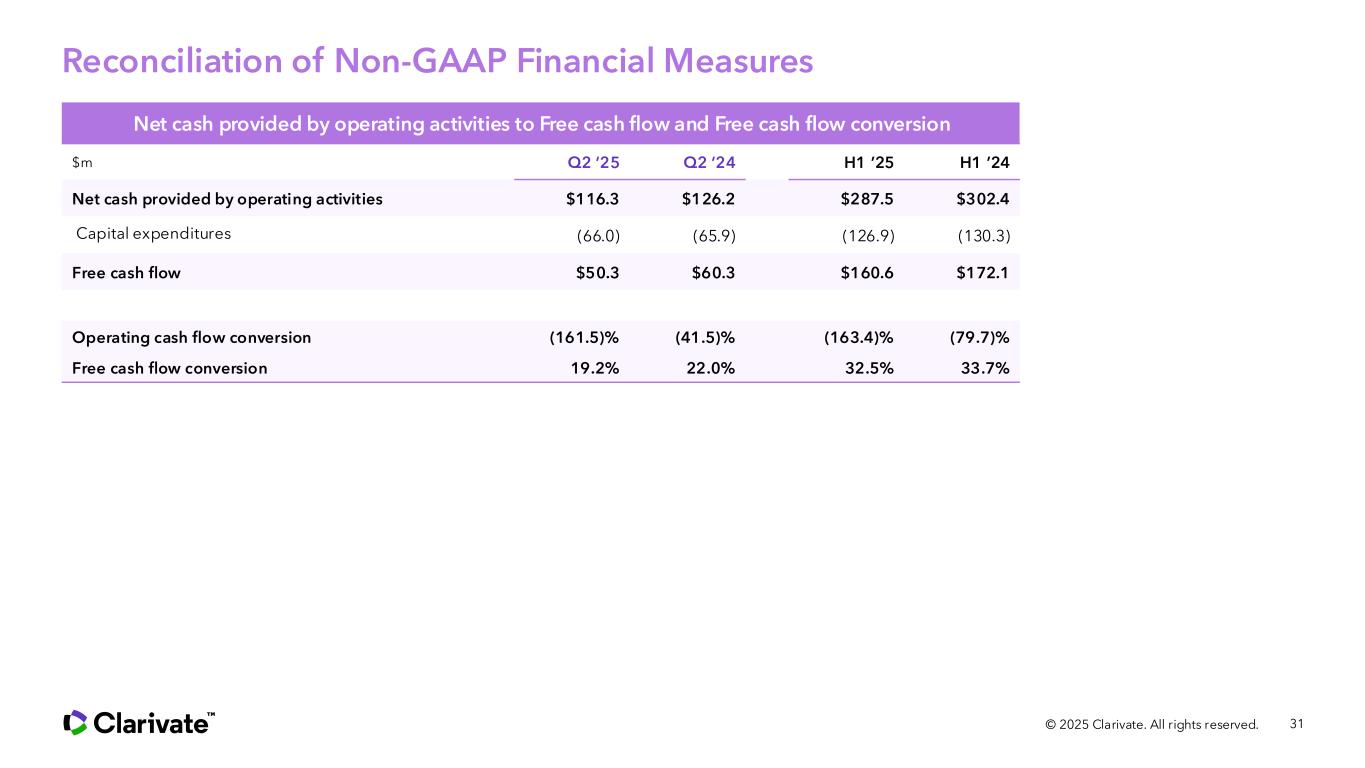
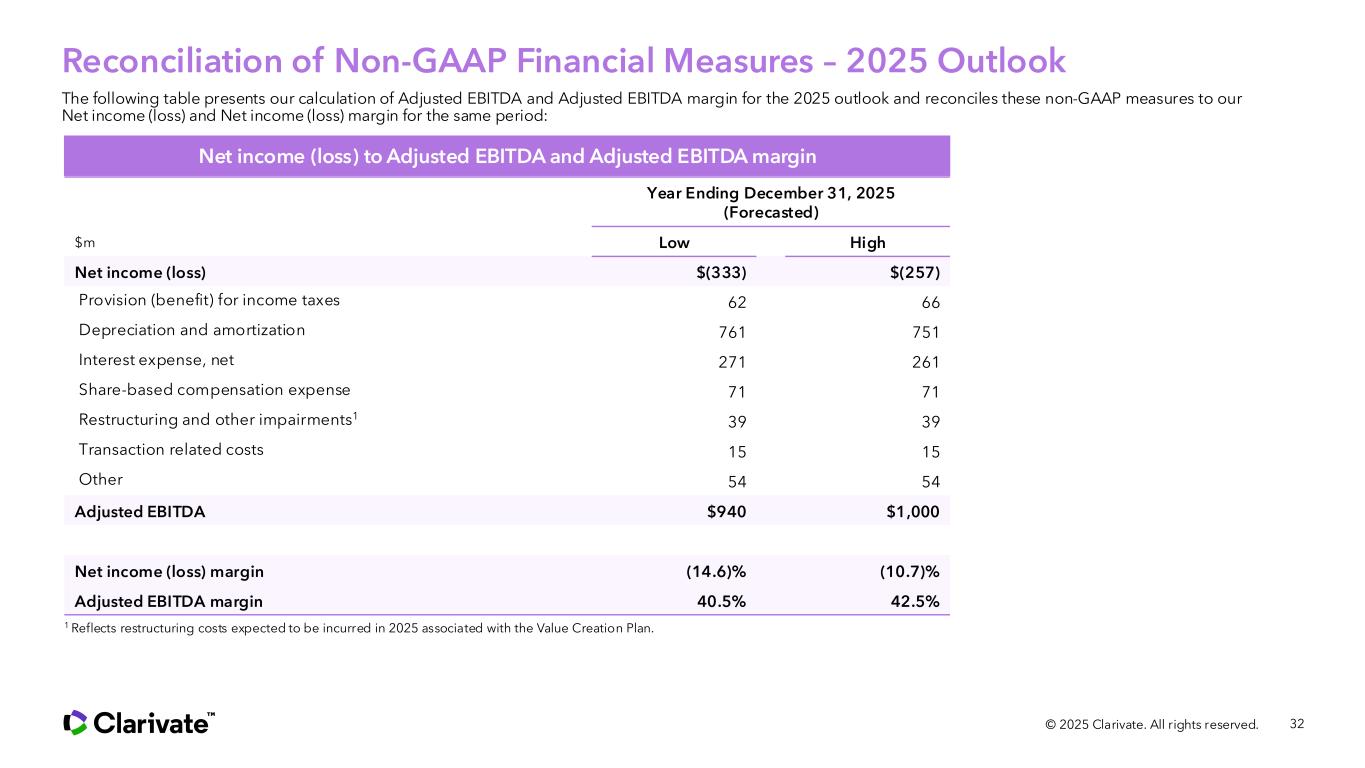
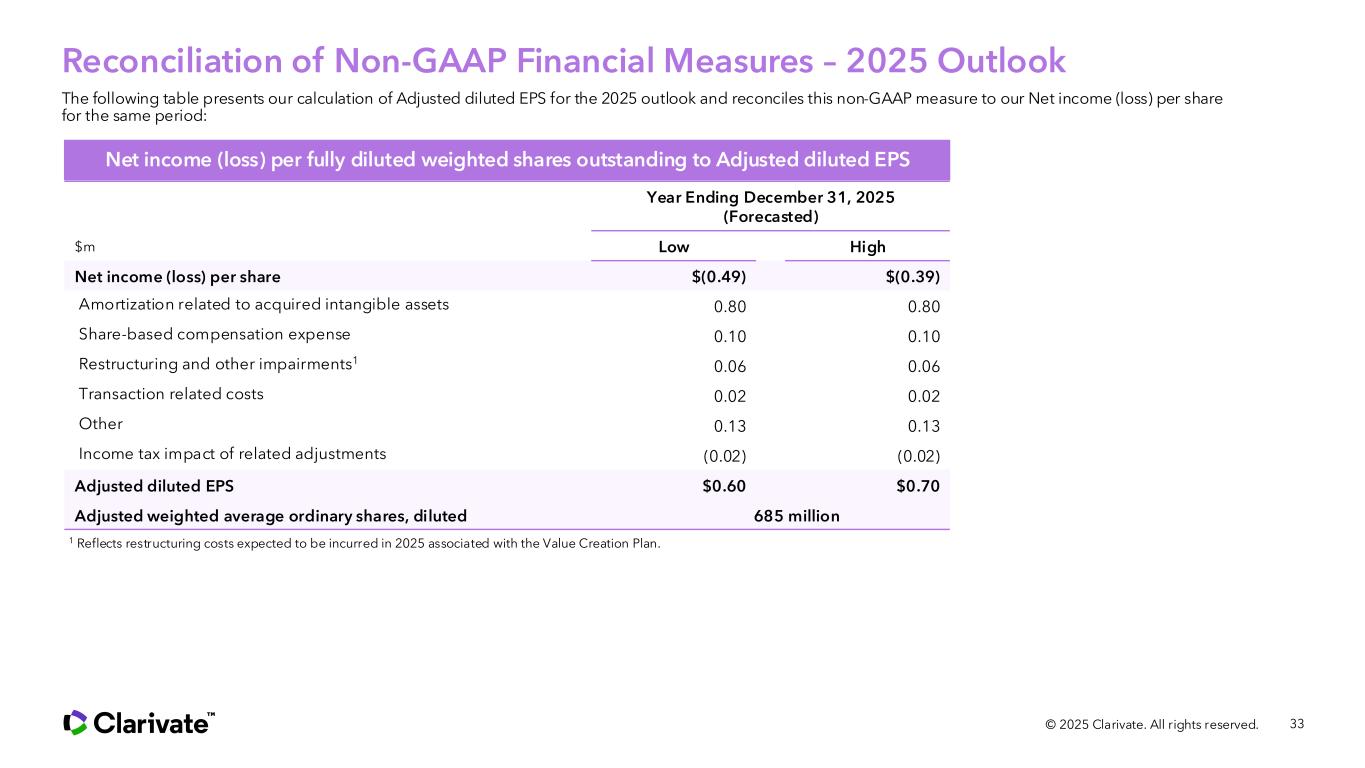
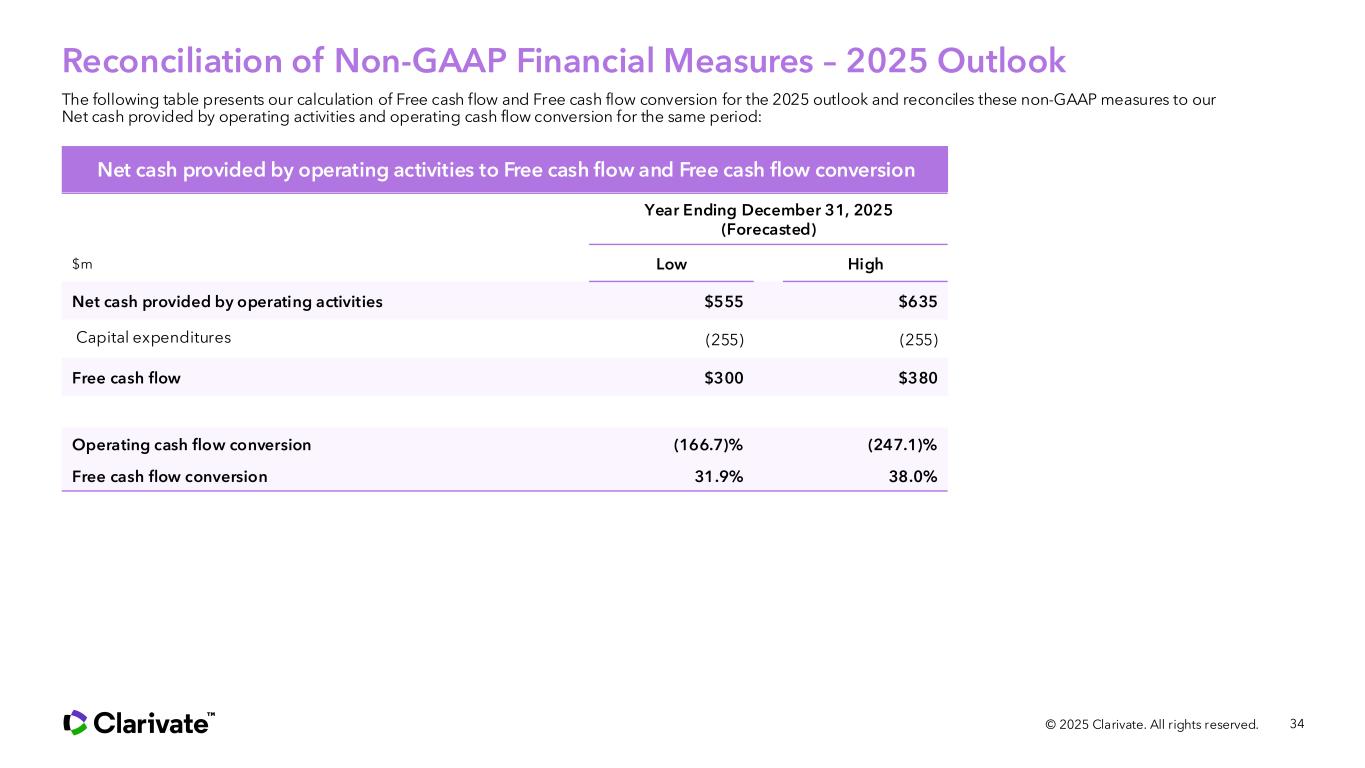
We remain focused on executing our plan to ensure sustained growth and value creation for all stakeholders. and with that I would like to turn over to Jonathan thank you thank you Maddy slide 18 is an overview of our second quarter and first half financial results compared with the same periods from the prior year Q2 revenue was 621 million bringing the first half the 1.2 billion the second quarter change from last year was entirely inorganic as a result of the scholar one divestiture and the a and g and ls and h business disposals partially offset by organic growth and foreign exchange the second quarter net loss was 72 million the improvement over q2 of the prior year is driven by the non-cash impairment charge recorded last year that did not recur this year adjusted diluted eps which excludes items like the impairment was 18 cents the change over last year is entirely attributed to the divestiture and disposals. Operating cash flow was $116 million in the quarter. The change compared to last year is entirely driven by adjusted EBITDA, as an improvement in working capital was offset by higher payments of one-time costs associated with implementing the value creation plan. Please turn with me now to page 19 for a closer look at the drivers of the second quarter top and bottom line changes from the prior year. I'm pleased to share this morning that the business grew organically for the second quarter in a row and margins remained at approximately 42 percent. This was driven by four primary factors. First, our recurring organic growth increased 20 basis points sequentially in the second quarter to nearly 1 percent as our subscription business returned to growth following the inflection in our ACV in the first half of this year. Careful operating expense management amplified the $3 million of total organic growth, which includes the transactional revenue type, resulting in a $6 million increase in adjusted EBITDA. Second, during Q2, we continue to experience the inorganic impact of the businesses we are disposing as a part of the value creation plan. The top and bottom line changes of $32 million and $17 million respectively impacted both the A and G and LS and H segments. Third, as we've seen in the last couple of quarters, we continue to experience the inorganic impact of the Scholar One divestiture, lowering revenue by $9 million and adjusted EBITDA by $4 million. And fourth, the U.S. dollar weakened against a basket of foreign currencies, which caused a foreign exchange translation tailwind on the top and bottom lines. Please turn everything out of page 20 to review how these same drivers impacted the top and bottom line changes for the first half of this year. As Mahdi noted just a few moments ago, organic growth for h1 has improved by 180 basis points over where we ended last year this modest growth compared to last year's decline yielded 5 million of total organic growth and 10 million of incremental adjusted EBITDA in the first half the combined impact of the disposals and divestitures lowered revenue by 64 million and adjusted EBITDA by 30 million over the same period last year both the top and bottom lines benefited from foreign exchange in the first half as the U.S. dollar weakened towards the end of the first quarter. The net impact of these changes led to a 50 basis point profit margin expansion for the year-to-date results compared to the same period last year. Please turn it to me now to page 21 for a look at how the Q2 and H1 adjusted EBITDA converted to free cash flow and how we allocated the capital in a shareholder-friendly manner. Free cash flow is $50 million in the second quarter, bringing the first half to $161 million. The change in the quarter and the half are driven entirely by the adjusted EBITDA impact outlined on the last two pages as lower working capital requirements were offset by higher one-time cost. We incurred $18 million of one-time cost in Q2 and $42 million in H1, both of which were largely restructuring-related outflows associated with the implementation of the value creation plan. Cash interest was $92 million and was slightly lower than Q2 of last year as we continue to recognized the benefit associated with the 200 million of debt we repaid. Working capital requirements improved by 15 million in the second quarter and a comparable amount for the first half and we expect this trend to continue in the second half of the year as implied in our full year guidance. Cash taxes, capital spending, and other operating outflows were essentially flat compared to the same periods last year. We used the 50 million of free cash flow we generated in the second quarter to repurchase another 11.5 million shares of common stock, bringing the first half buybacks to $100 million, which is about 60% of the capital we had available to allocate. The remaining 40% increased our cash balance, lowering our net debt. We also took the opportunity during the second quarter to extend a portion of our debt maturity by five years through refinancing a half a billion of our 2026 bonds with a new tranche on our existing term loan B facility, which matures in 2031. Shortly after we completed the refinancing, we swapped about 80% of the new tranche from dollars to euros and from a floating to a fixed interest rate. The net impact of the refinancing and swaps is an annual cash interest increase of about $7 million, a favorable outcome in this higher rate environment. Please turn with me now to page 22 for a reminder of our full year financial guidance ranges for this year, which remain entirely unchanged from initial guidance we provided in February and affirmed in April. Beginning at the top of the page we continue to expect our organic annual contract value to accelerate by approximately 60 basis points to one and a half percent at the midpoint of the range as we begin to recognize the benefits of our investments in product innovation. We've made good progress on this in the first half where we've delivered more than half of the acceleration about 40 basis points. Based on our performance in the first half, recurring organic growth will likely be in the upper half of our range. The improved organic performance combined with a weaker U.S. dollar and slower than anticipated attrition in the business disposals will likely yield revenue near the top end of the range. As a result of the strategic disposals, we expect our recurring revenue mix will improve by about 400 basis points from 80 to about 84 percent this year. It's worth reiterating what Mahdi indicated earlier in the call. Our organic recurring revenue mix, which excludes the disposals, is already at 88% in the first half of the year. Moving down the page, we expect adjusted EBITDA slightly above the midpoint of the range and our profit margin at approximately 41% due to higher revenues from the disposals and FX, which have lower profit conversions. We continue to anticipate diluted adjusted EPS between 60 and 70 cents as the inorganic driven change in adjusted EBITDA, which I'll detail on the next page, will be partially offset by lower interest expense, as well as the benefit of a lower share count resulting from last year's and the first half's stock repurchases. And finally, at the bottom of the page, we anticipate free cash flow at about $340 million at the midpoint of the range, as the adjusted EBITDA change will largely be offset by lower interest, working capital, and capital spending. Please turn up to page 23 for more details on the full year top and bottom line changes we're expecting compared to last year. The expected changes in revenue and to a large extent adjusted EBITDA this year compared to last year are largely driven by the disposals targeted at optimizing our business model and the divestitures of non-core products and services. We now expect organic growth will be essentially flat as the growth in the recurring revenue types, both subscription and reoccurring, will offset the originally anticipated decline in our remaining transactional business. This represents about $10 million improvement over our initial indication at the midpoint of the guidance range. We continue to expect a profit headwind in this area of about $20 million as cost efficiencies will not fully offset inflation and higher incentive compensation expense. The strategic disposals are now expected to lower revenue this year by approximately 125 million, and we're implementing 85 million of operating cost actions, which yield a profit impact of about 40 million. We expect most of the remaining 75 million revenue reduction will take place next year and will have a small profit impact. The top line change for the disposals represents a 15 million improvement over our initial indication. The divestitures of both Valley Patent Scholar-owned last year will lower revenue by about $40 million and profit by $40 million. And finally, we now anticipate foreign exchange translation will have a negligible impact as the U.S. dollar has remained weak against other foreign currencies. This represents a $25 million improvement from our initial indication for full-year revenue. Please turn with me now to page 24 to step through the components that will lead to more than a third of the adjusted EBITDA converting to free cash flow. Our outlook for e-cash flow remains unchanged at the midpoint of our range. One-time costs are expected to be slightly elevated over last year as we invest to execute the VCP. We expect cash interest to improve by about $10 million over last year as a result of the debt we prepaid. Cash taxes are expected to remain in line with 2024. We anticipate the change in working capital this year will be negligible, which represents an improvement over last year of about $25 million. And while we remain committed to investing in product innovation, the strategic disposals and cost efficiencies will improve capital spending by about $35 million. The net impact of these changes is free cash flow of $340 million at the midpoint of the range and will result in an improvement on the conversion of adjusted EBITDA of about a percentage point. From a capital allocation perspective, we continue to have the flexibility between share repurchases and deleveraging as we move through the second half of the year. In closing, we believe our first half results indicate strong momentum as the value creation plan is taking hold, as evidenced by a few key elements. First, Q2 represents the second quarter of sequential organic ACV and recurring revenue growth acceleration. Optimizing our business model by disposing of non-core transactional businesses is creating a laser focus on our core recurring products and services, and we now have tangible evidence of the upward trajectory. Second, each of our segments made meaningful progress in the first half of the year and have a solid outlook for the second half. In A&G, both organic ACV and subscription revenue growth are stable at about 2%, and we have good line of sight to a stable second half despite funding pressure in the U.S. In IP, we've seen a clear rebound in the annuity market, our reoccurring revenue stream, as it returned to growth in the first half after declines in the prior year. In LS&H, our Subscription Revenue Leading Indicator, ACV, returned to organic growth as the investments in Cortellis are paying off in the R&D market with higher retention and strong subsets. And third, we made significant progress on the strategic review in the first half by narrowing the focus to a core option and expect to complete this work in the second half and provide the conclusion with our year-end results. I'd like to finish by thanking all of you for listening in this morning. I'm now going to call to turn the call back over to Jordan to take your questions. And as a reminder, please limit yourself to a question and then return to the queue for any additional.
Operator
Jordan, please go ahead. As a reminder, at this time, I would like to remind everyone, in order to ask a question, press star, then the number one on your telephone keypad. We'll pause for just a moment to compile a Q&A roster. Your first question comes from the line of Manav Patnik from Barclays. Your line is live.
I had a question on the IP business. I know you talked about the rebound in the IP and the annuity market. I think you also talked about being excited about the AI opportunities there. So just a few parts of that, just the timing of that rebound, you know, how you can capitalize on that AI opportunity. And I think I read somewhere that, you know, a lot of the, at least, Gen AI, new patents, all that kind of activity seems to be more weighted towards China. So, just wondering your exposure and capabilities there as well.
Yeah, sure, Manal. Thanks for the question. So, in principle, as new filings and new patents are awarded. On average, it takes a couple or a few years to work its way into the renewals. It varies by jurisdictions, but on average, it's a couple to a few years. So this is a trend that we've started to see over the last year or two and think that it's something that could help put some wind into our sales as we move into next year and the following year. So certainly there's a clear trend that more patents are being filed related to AI. Overall, this is a good thing for our business. That's what we wanted to highlight and note. To your point, the quantity of patents that have been filed related to AI are a bit disproportionate. Our IP Center for Innovation Research noted that in some of its recent reportings. And we've seen more of it in Asia and particularly in China, but we've certainly seen an uptick in most of the major regions. So we think we'll start to see that benefit around the globe over the course of the next few years.
Thanks, Manav. Next question, please, Jordan.
Operator
Your next question comes from the line of Tony Kaplan from Morgan Stanley. Your line is live.
Thank you so much. I think earlier this week we saw a headline that the Department of Commerce is considering changes to the fee structure and filing patents in the U.S. and I know there's a lot of moving parts and you know it's not totally settled yet but just wanted to understand you know maybe the potential impacts to your business from sort of the potential change in in fee structure and how that plays out thanks so first of all we've seen this as well it's very early days and obviously there's no definite decision and no definite view on our side but let's just remind ourselves that
we've been in the IP ecosystem for more than two or three decades so we are an integral part of the ecosystem including collaborating with patent offices worldwide collaboration with law firm and with corporate. In a way, we are sitting in the intersection and supporting those institutions. So any change that will be, we are very well positioned to support this change and somehow even take advantage of this change. Yes, this market may be changing. It may be not changing, but we've been there for the last 20, 30 years and even more. And we are very well positioned close to our customers, so we'll track it. We'll continue to, as it continues to evolve, and we will be collaborating with our customers and partners on this transition.
Thank you. Thank you, Tony.
Operator
Next question, Jordan. Our next question comes from the line of Owen Lau from Oppenheimer. Your line is live.
Hi. Good morning. Thank you for taking my question. So for university funding cuts, which is still a hot topic um i saw that 75 of your 2025 subscriptions have already been renewed in july which is good but could you please give us more color on your conversation with your clients about the current situation so far and our look for renewal in the second half and going into 2026. thanks so i'll start and then you know may continue so we are looking good on AMG, despite of all the concern that we collectively have.
So 93% of the AMG revenue is now recarrying. We have 96% renewal rates. As you mentioned, 75% of the books is already in-house. We don't have anything out of the ordinaries with our customers, but let's just remind ourselves of a few things. One, you know, our AMG products are central and mission critical to this organization. I can only imagine a decent university today without web of science and some of the surrounding problem. Any university will need to have an ALMA type solution. So we are in pretty good shape on the web of science and the ERP ALMA things. With regards to the content, as I mentioned in my discussion, we were forward looking, taking away the discretionary one-time expenditure and it serves us very very well these days and we see the uptake of customers who were initially complaining about taking away the the you know the one-time purchases we're now buying more and more of our subscription businesses the PQ e-books, the PQ digital collections, which actually serve them very, very well in this, you know, in this current economic climate. So we are pretty confident that going ahead, we will continue to see a good and decent renewal rates and uptake of the different A&G offering. Thank you.
Thank you, Gordon. Jordan, next question, please.
Operator
Your next question comes from the line of Ashish Sabhadra. Your line is live. Hi.
Hey, good morning, guys. This is Will Chi for Ashish Sabhadra. Congrats on the quarter. I appreciate you guys taking that question. Last quarter, you guys initiated a new sales incentive plan with a refocus on subscription and recurring revenue. It's been great to kind of see that progress with the renewals tick up. I'm curious if you could provide any updates, you know, how that sales momentum has been continuing and any outlook from here? Thank you.
I think we've taken away a lot of hassle from the sales organization. We are very, very focused this day. Subscription, reoccurring, renewal, price, bringing back new business. So I've just attended a sales meeting last week in London and people are very excited they are very focused they just do subscription reoccurring as opposed to do subscription one time one-time ebooks it's just complicated the focus we're taking away we took away a lot of complexity out of the organization focusing the sales organization we have a great sales organization we've done some changes we just spoken about a very upbeat about about uh going forward for the rest of the year and for next year as well so yeah thank you just as a
Operator
reminder if you'd like to ask a question press star one on your telephone keypad your next question comes from the line of george tong from goldman sachs your line is live hi thanks good morning your sciences and healthcare business saw organic revenue growth positively inflect can you give a little bit more color around end market dynamics that you're seeing and how conversations with pharma and biotech companies have evolved?
Yeah, thanks for the question, George. And to be clear, what we saw in the second quarter is the subscription business within life sciences and healthcare return to positive organic ACV growth, which is a really good leading indicator for where we would expect subscription revenue for that business to be in the second half of the year. To your point, just a little color on the market. You know, we primarily serve R&D and then the commercialization efforts of our life sciences customers. On the R&D side, that market continues to be stable. Spending on our types of solutions has been solid. We attribute the improvement largely to the investments that we have made primarily in the Cortellis suite of products. So over the course of the last six to 12 months, we've made some really nice strides. Madi touched on a couple of those new capabilities that have gone into the products. We've embedded AI, made investments in the workflow capabilities of those solutions, and we've seen nice usage and nice retention improvements on those products, and we attribute that to the improvement that we've seen in this area. The commercialization part of that market continues to be relatively soft, and that's reflected in the results of our commercialization business. But certainly, stable in R&D, that's where we're really starting to see the traction based on the investments that we've made. So thanks for the question, George.
Operator
Your final question comes from the line of Shlomo Rosenbaum from Stiefel. Your line is live.
Hi, this is Adam from Shlomo. Why are disposals taking longer than expected? Is this a customer service focus shift towards trying to sell some of the assets or something else?
It's pretty straightforward. I mean, there's one out of the three disposals. One is taking longer because we simply had some interaction with our customers, and they asked us to extend because it took them longer than we expected to get settled with alternative offerings. So we just extended it by six months. And it reflects on the selling that specifically on the one-time e-books, they ask for more time to get organized, and that's the reason. Nothing behind this.
Well, thank you very much. That concludes our call for today. If you have any follow-up questions, you can reach out to Investor Relations. Thank you very much.
Operator
Ladies and gentlemen, that concludes today's call. Thank you all for joining. You may now disconnect.