Operator
Thank you for standing by. At this time, I would like to welcome everyone to today's Clearwater Paper first quarter 2026 earnings conference call. All lines have been placed on mute to prevent any background noise. After the speaker's remarks, there will be a question and answer session. If you would like to ask a question, please press star one to raise your hand. To withdraw your question, press star one again. I'd now like to turn the call over to Sherry Ellison, Investor Relations. Sherry?
Thank you, Ben. Good afternoon, and thank you for joining Clearwater Papers' first quarter 2026 earnings conference call. Joining me on the call today are Arson Kitsch, President and Chief Executive Officer, and Sherry Baker, Senior Vice President and Chief Financial Officer. Financial results for the first quarter of 2026 were released shortly after today's market close, along with the filing of our 10-Q. You will find a presentation of supplemental information, including a slide providing the company's current outlook, posted on the Investor Relations page of our website at clearwaterpaper.com. Additionally, we will be providing certain non-GAAP financial information in this afternoon's discussion. A reconciliation of the non-GAAP information to comparable gap information is included in the press release and in the supplemental information provided on our website. Please note slide two of our supplemental information covering forward-looking statements. Rather than reading this slide, we incorporate it by reference into our prepared remarks. With that, let me turn the call over to Arson.
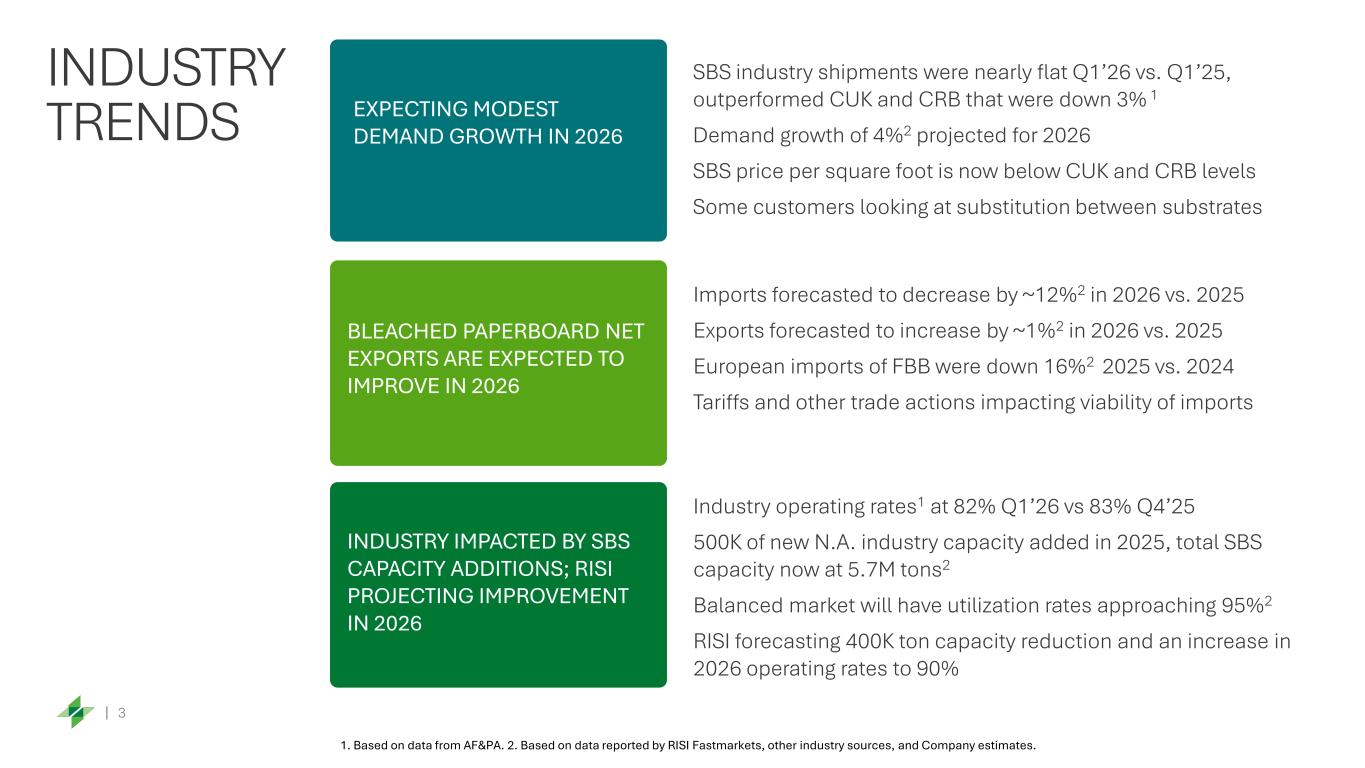
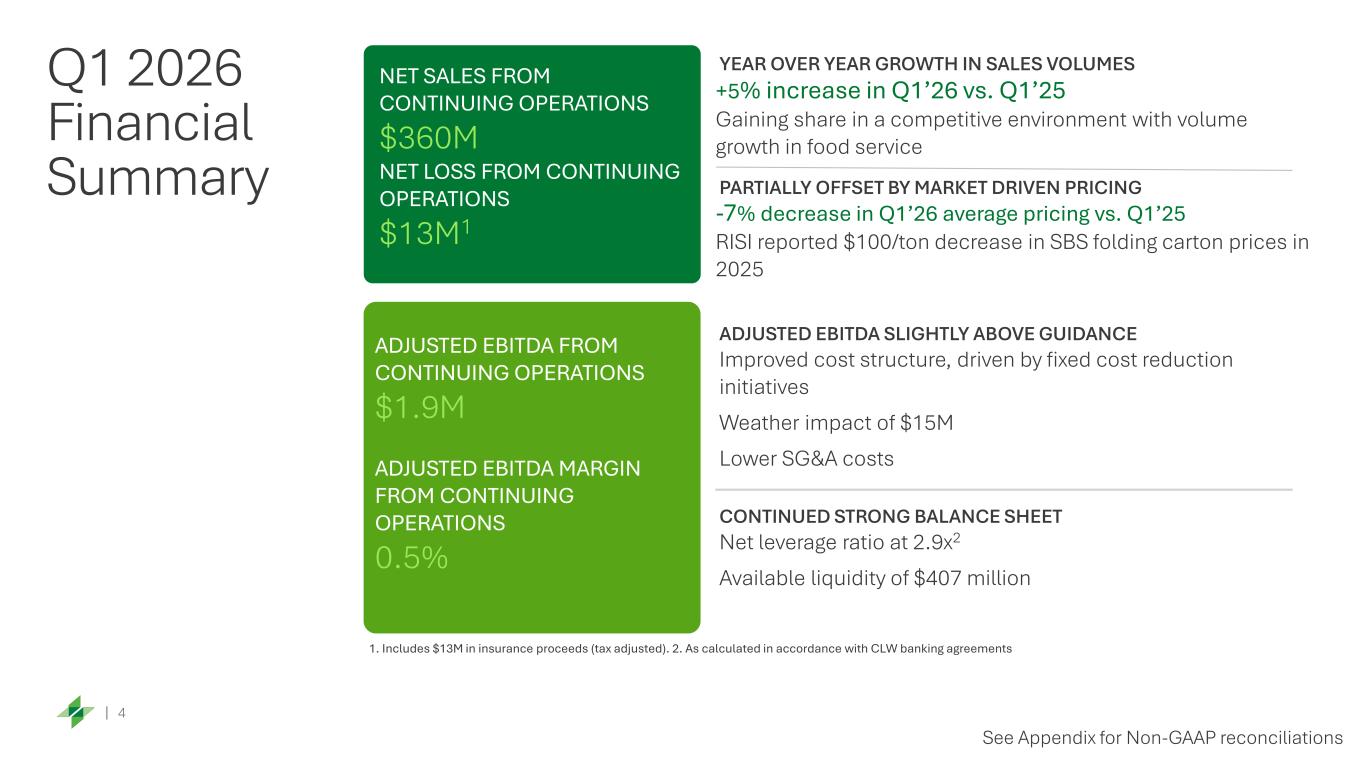
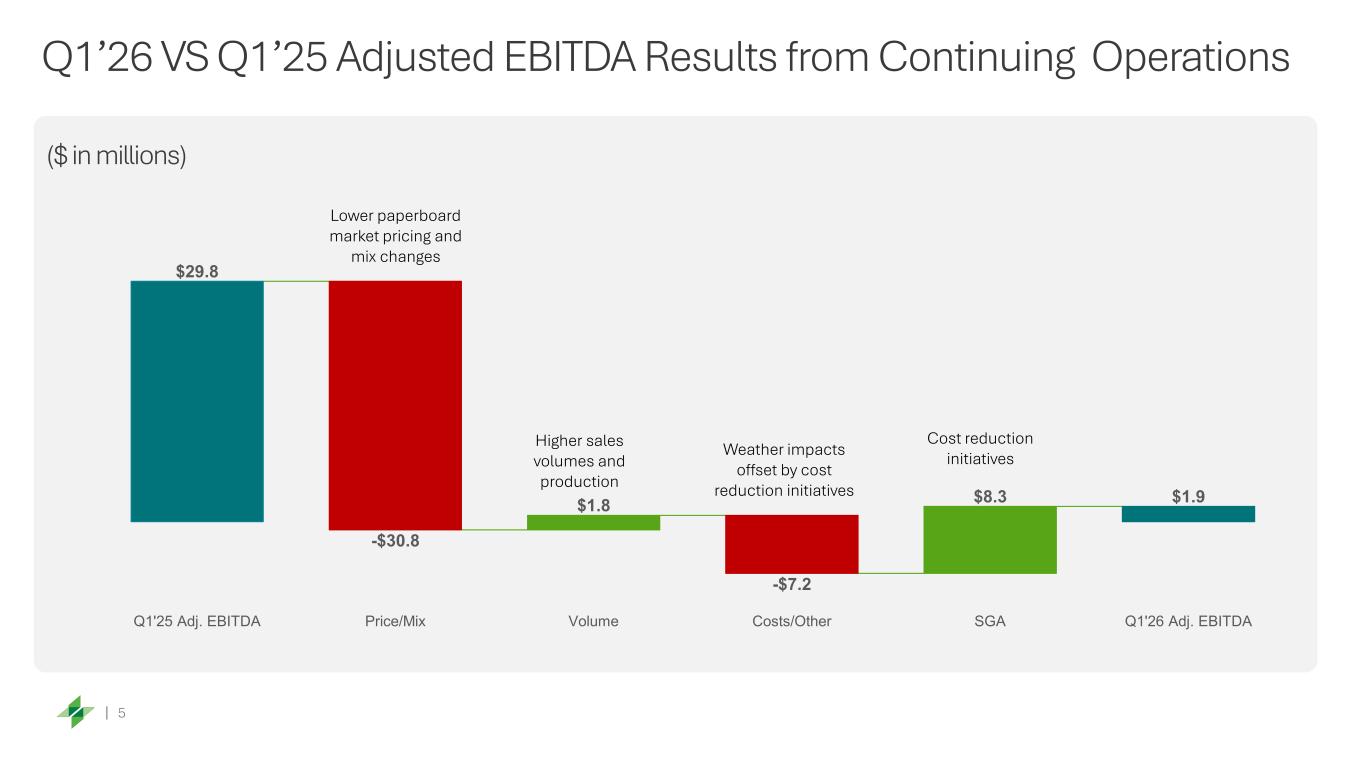
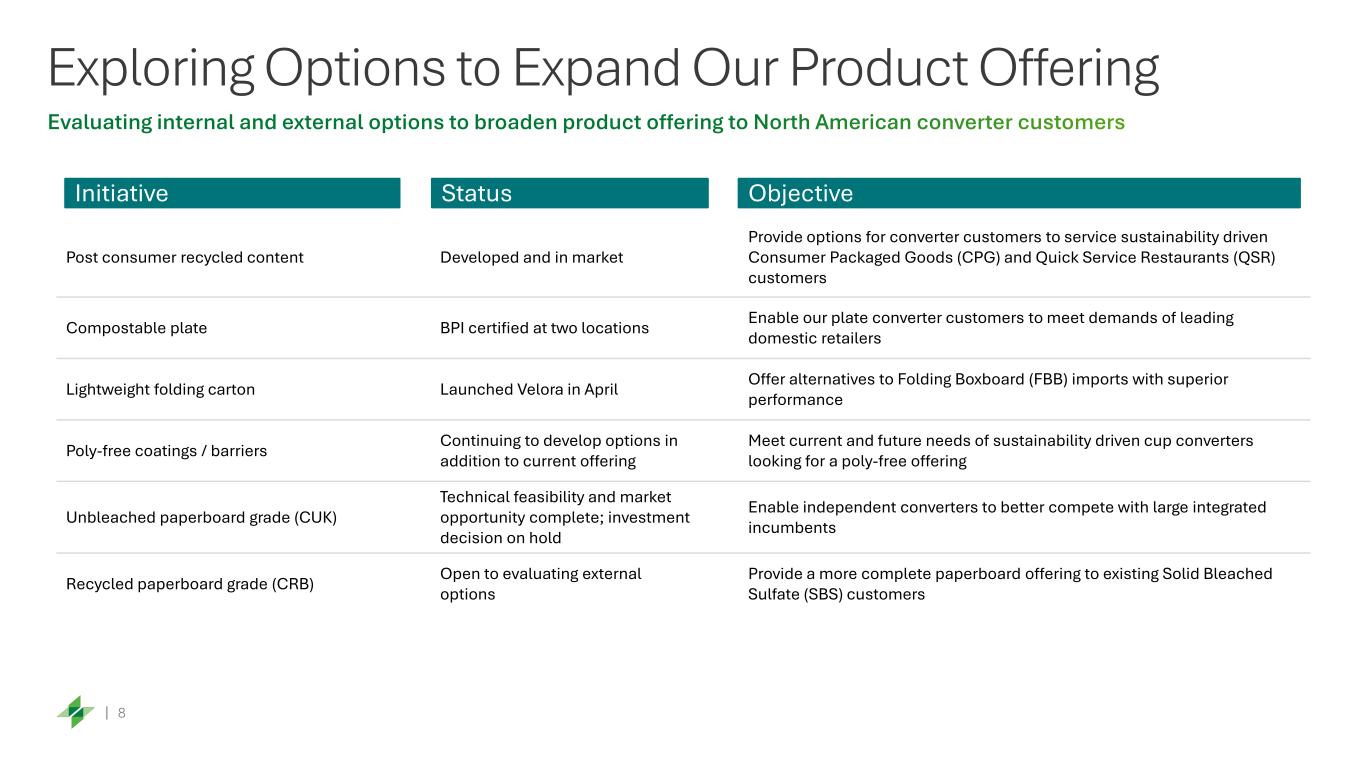
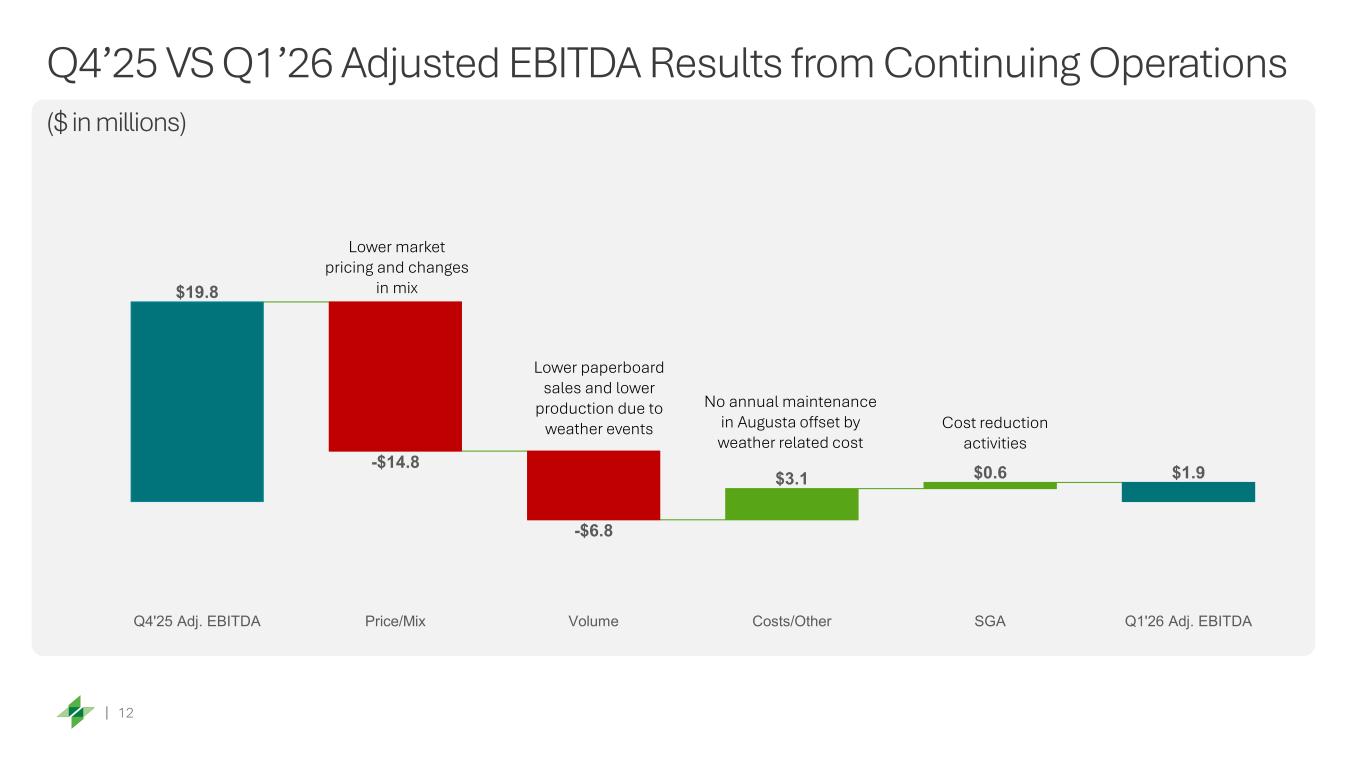
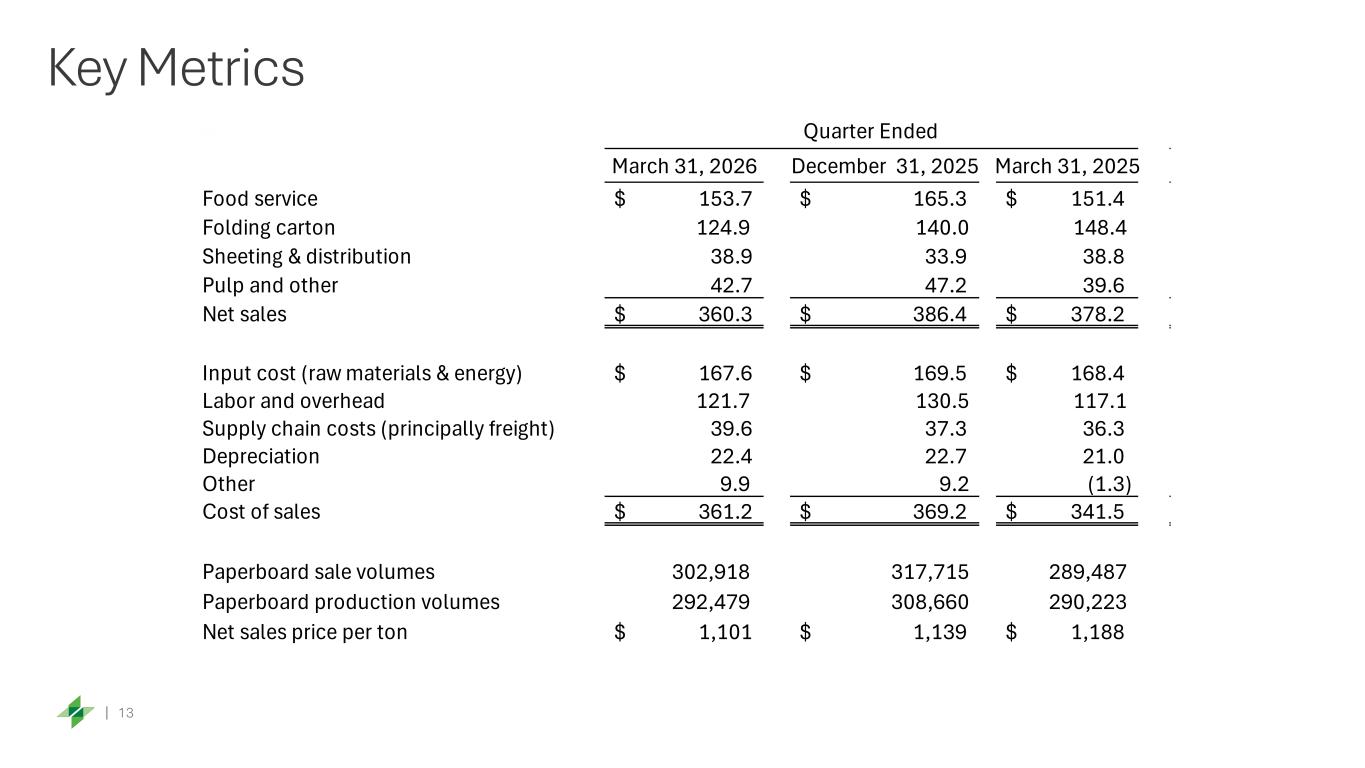
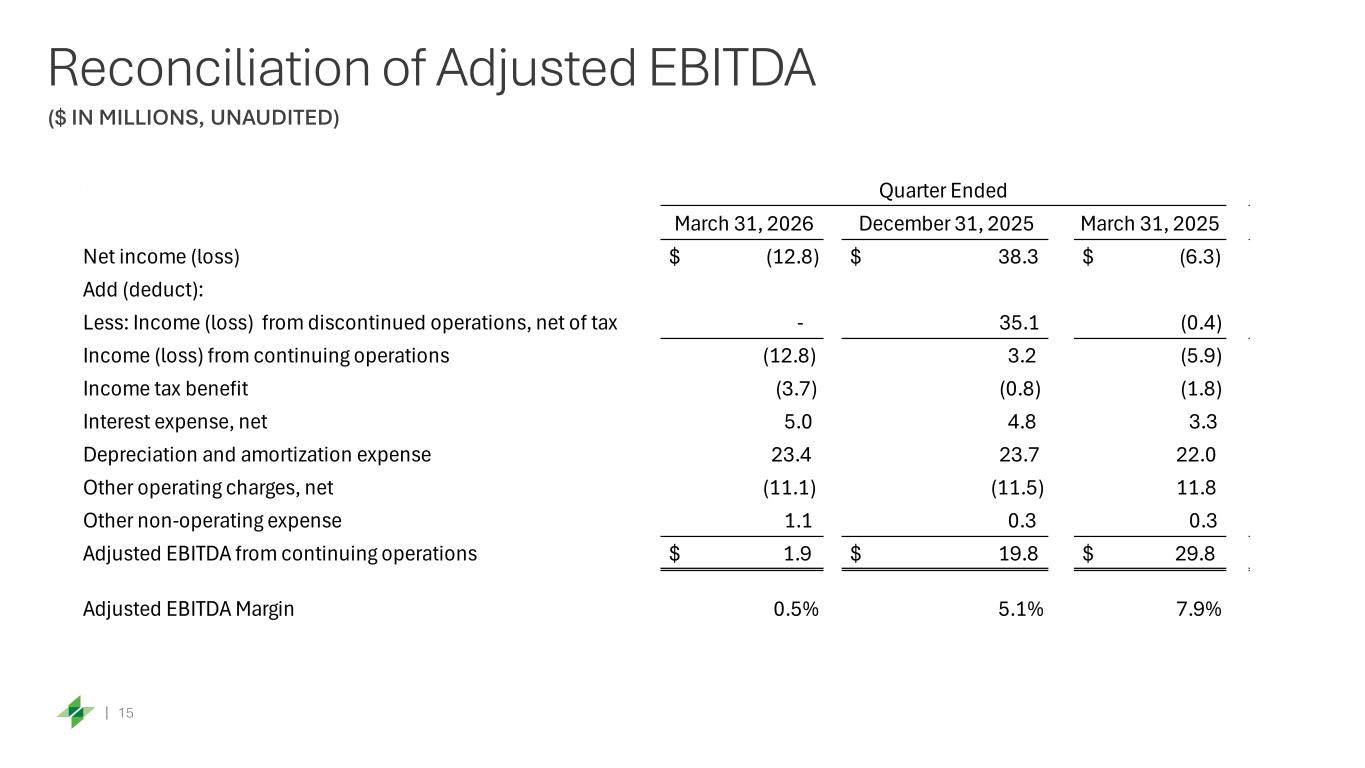
Good afternoon and thank you for joining us today. I'll begin my comments with a brief overview of the first quarter. I will also provide some perspectives on industry conditions and outline the actions that were taken to navigate the current business environment. I'll then turn the call over to Sherry to walk through the financial results in more detail and discuss our outlook. Let's start with the highlights from our first quarter as well as a few updates from April. Our shipment volumes were up 5%, which was more than offset by lower market pricing, resulting in net sales being down 5% compared to the prior year. We increased share in a highly competitive market environment with continued growth in food service. Adjusted EBITDA for the quarter was $2 million, slightly above our guidance of breakeven. This included approximately $15 million in weather-related impacts at our mills earlier in the quarter. Our team effectively navigated difficult operating conditions with a weather event in the southeast. We minimized costs, protected our assets, and were able to service customers with minimal disruptions. This quarter we launched Valora, a new lightweight folding cart and paperboard brand that is engineered to compete with imported FPV. We restructured our Cypress Bend Arkansas facility, resulting in a reduction of approximately 20% of rolls at the mill. We're planning to run the mill at reduced operating run rates until industry conditions improve. This action will drive an expected cost reduction of approximately $8 to $12 million on an annualized basis. Our Lewiston-Idaho union ratified the new four-year labor agreement. This agreement combines competitive wages and benefits for our employees with significant additional flexibility and how we can operate the mill. Finally, we received $17.5 million in additional representation and warranty insurance proceeds during the first quarter for a total of over $40 million. We continue to pursue claims against $50 million of the remaining policy limit. Let me now provide some perspectives on industry conditions and the impact on our business. SPS shipments were nearly flat in the first quarter of 2026 versus the first quarter of 2025, outpacing CRB and C.U.K., which declined by around 3%. SPS shipments are forecasted to grow by 4% in 2026. We believe that at least part of this strength can be attributed to lower imports and substitution effects, as SPS is now the low-cost paperboard substrate on a per-square-foot basis. SBS is highly versatile with diversified end-use applications ranging from high-end folding cartons used in pharmaceuticals and cosmetics to food service items for at-home or QSR consumption. From a supply perspective, we started the year with industry capacity substantially exceeding demand by more than 10%. With recent changes in industry capacity, including our restructuring of the Cypress Bend Mill, we now believe that the excess industry supply has been reduced by approximately 50%. RECI is forecasting additional net capacity reductions by the end of this year, resulting in industry operating rates of around 90%. As we've stated previously, margins should start improving to historical cross-cycle averages with industry rates exceeding 90%. Bleached imports were down by 12% in 2025 versus 2024, driven by higher tariffs and a weaker dollar. European producers are facing additional cost pressures this year with higher energy, chemical, and transportation costs driven by the conflict in the Middle East. RECI is forecasting total bleached imports to decrease by an additional 12 percent in 2026 versus 2025. In terms of our business, we're experiencing solid demand with stability in folding carton and strength in food service, particularly in cup and plate. Backlogs across our paint machines are strong, and we are sold out on extruded products such as cup and poly-coated folding carton. With our mill restructuring, we have customer demand to run full across our three mill network for the remainder of the year. While we're seeing some positive signs of both demand and supply, current industry operating rates are driving margins that don't produce the necessary cash flow or returns to reinvest in our capital-intensive assets in the long run. In fact, we believe that today's margin levels are resulting in negative operating cash flow after the capex that's required to maintain these assets. This is simply not a sustainable position for us to be in. Against this backdrop, we remain focused on controlling what we can control while anticipating a recovery in industry conditions. First, we're continuing to drive costs out of our business and focusing on operating our assets efficiently. Second, we're protecting share with our strategic customers by delivering the right combination of quality, service, and cost. And third, we're looking for ways to recover the increased costs that we've experienced, including the most recent impacts from the Middle East conflict. Let me provide a bit more context on our actions at Cypress Bend. We reduced rolls at the mill by about 20% and improve the mill's cost structure by an expected 8 to 12 million per year. We're prepared to run and reduce production rates until SDS industry conditions improve or we invest in other capabilities such as CUK. Cypress Bend remains a well-invested and cost competitive mill that provides us with the optionality to grow in the long run. It also provides our customers with North America's largest independent paperboard mill network with capabilities to produce a full range of SPS products. In total, we are now focused on producing and profitably selling approximately 1.2 million tons of SPS across all three of our mills versus our stated capacity of around 1.4 million tons. In addition to the industry oversupply that we're facing, we're also experiencing significant cost pressures on certain chemical, wood, and diesel costs because of the conflict in the Middle East. Altogether, we're projecting 3 to 5 million of quarterly headwinds from these cost increases until the conflict is resolved and global supply chains have returned to normal. With these additional cost headwinds, and due to our sold-out position in our cup business, we have revised our previously announced price increase on cup and other extruder products to $60 per ton effective in May. This increase impacts the approximately 70,000 tons of our extruded business, not tied to the RISI price index. The rest of our cup and extruded business, which is approximately 150,000 tons, will move within a couple of quarters of any change to the RISI price index. We see momentum in our cup business while we continue to face a highly competitive environment in our not extruded grades, such as folding and plate. We announced a $50 per ton increase on these grades in March, but we found implementation to be challenging given our industry's current oversupply position. We believe that our margins on these grades aren't sustainable in the long run and will continue to look for ways to recover the cost pressure that we faced over the last couple of years. Before I turn the call over to Sherry, I'd like to briefly update you on our strategic initiatives to further build and diversify our product portfolio. We have successfully launched a new lightweight paperboard product line called Valora. We believe that Valora will compete effectively with FBB and support a wide range of general use packaging applications. While we believe that this type of product has a place in the market, it is not a replacement for a high-quality SVS offering. We continue to evaluate our CUK investment decision as we navigate current industry conditions. The engineering work is complete, with an estimated investment of approximately $60 million and an execution timeline of roughly 12 to 18 months. As a reminder, this project would take place at our Cypress Bend Arkansas mill, and we would target 100,000 to 150,000 tons of C-U-K volume with this conversion while maintaining our ability to produce S-B-S. In addition to our focus on lightweight SBS and C.U.K., we are evaluating opportunities to add CRV to our product portfolio. We believe that offering the full range of paperboard substrates positions us to better meet the needs of our independent converter customers and expand our share of their overall paperboard spend. With that, I'll turn the call over to Sherry to discuss our first quarter financial results in more detail and provide an outlook for the second quarter.
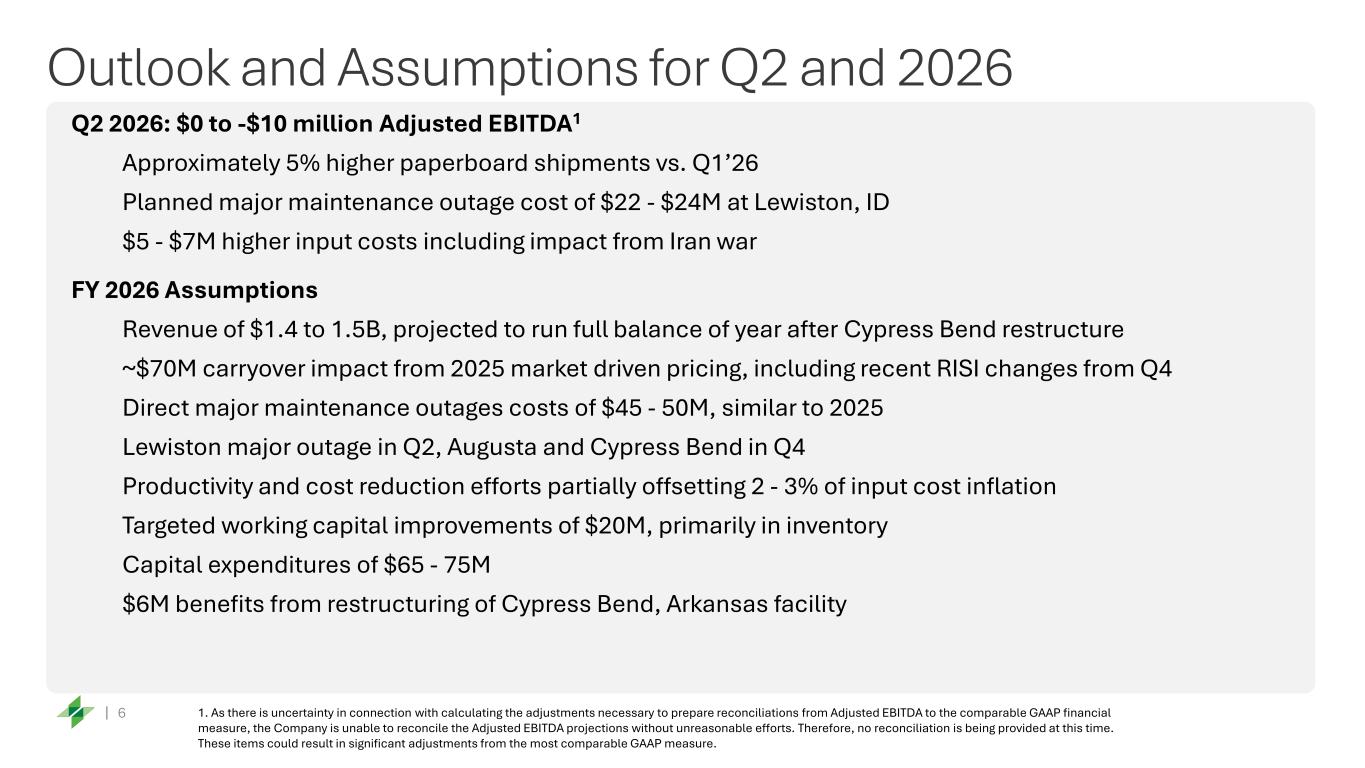
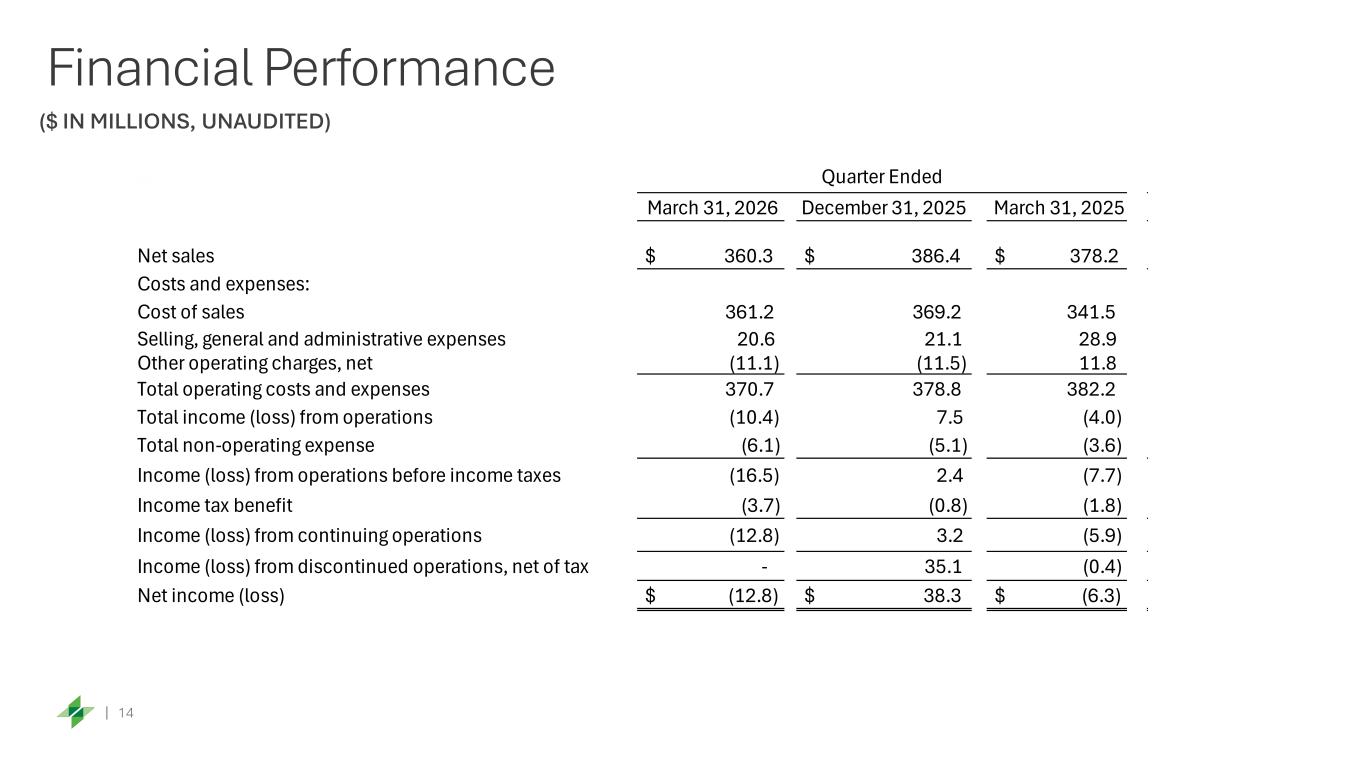
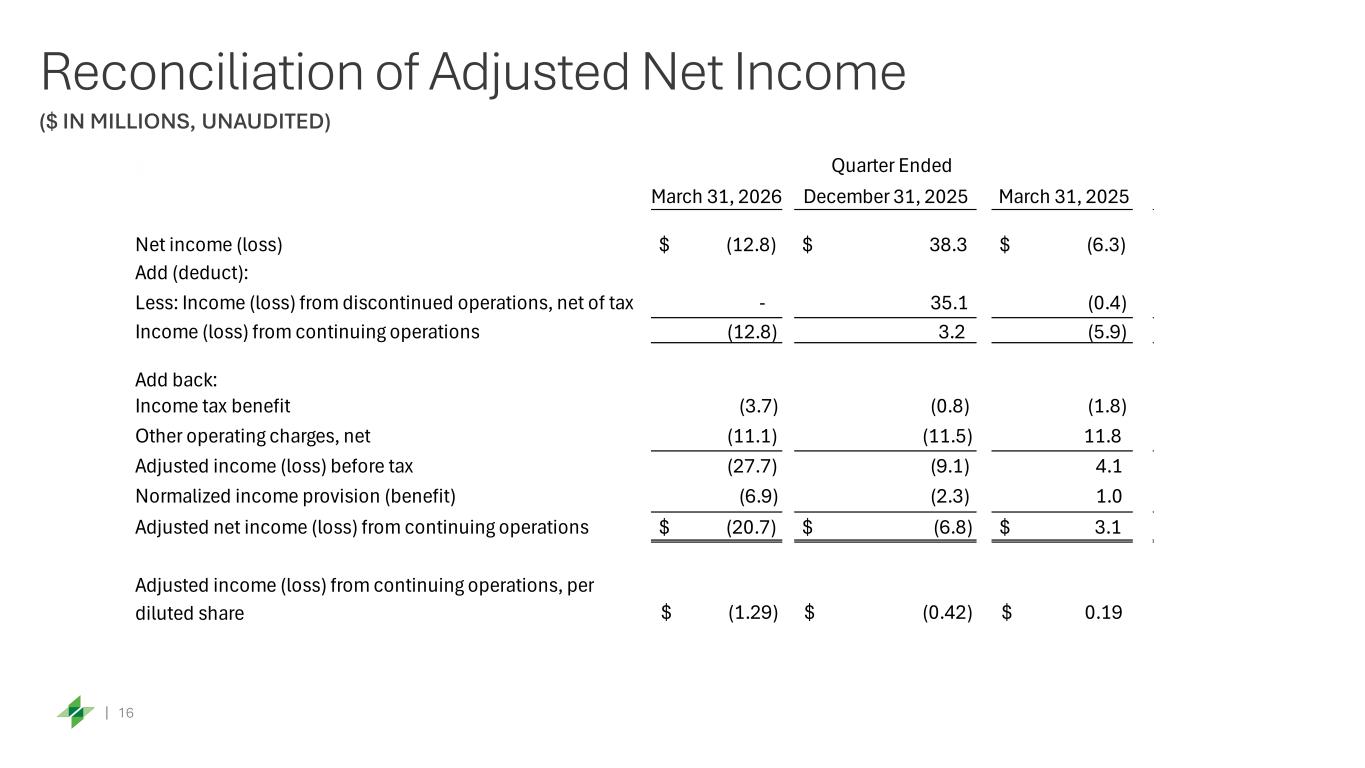
Thank you, Arson. Turning to our first quarter financial performance. For the quarter, we reported a net loss from continuing operations of $13 million, or $1.29 per diluted share. Our results include $17.5 million of insurance proceeds. Net sales were $360 million, down approximately 5% compared to the first quarter of 2025. Higher shipment volumes were more than offset by lower SBS market pricing. Adjusted EBITDA was $2 million, slightly above our guidance, which contemplated break-even performance. As Arson mentioned earlier, the weather event at our Augusta and Cypress Sun Mills impacted EBITDA by approximately $15 million in the quarter. SG&A as a percentage of sales remained below our target range of 6% to 7%, reflecting continued cost discipline. We believe that this is best in class in our industry. The conflict in the Middle East is putting pressure on chemical, wood, and transportation costs. As Arson mentioned, we believe that these additional costs will be in the $3 to $5 million range per quarter. Oil-derived chemicals have experienced increased price volatility, and transportation costs have been impacted by higher fuel prices. We are working to mitigate these impacts through targeted pricing actions and operational productivity, but these dynamics remain a near-term headwind to margins. We will continue to monitor developments closely and provide financial updates as appropriate. Let me also provide an update on the insurance recovery related to the Augusta acquisition. As a reminder, we obtained representation and warranty insurance with a $105 million limit through multiple insurers. We identified certain matters that were not consistent with representations made to us at the time of the transaction and notified the insurers of these breaches. In the fourth quarter, we received an initial settlement payment of $23 million, including approximately $6 million related to direct operating costs occurred in 2025. In the first quarter, we received a second settlement payment of more than $17 million, of which approximately $6 million relates to direct operating costs incurred in Q1 of fiscal 2026. As of March 31st, approximately $50 million of the policy limit remains. We are actively pursuing the recovery of the remaining claim amount with our insurers and will provide updates in future quarters. Turning now to our outlook. For the second quarter, we expect adjusted EBITDA in the range of break-even to negative $10 million. This is being driven by our planned major maintenance outage at our Lewiston facility, which will have a direct cost of $22 to $24 million. In addition, we expect $5 to $7 million of higher input costs, including the impact from the Middle East conflict. Partly offsetting those headwinds will be benefits of our cost reduction initiatives and seasonal uptick in shipment volumes. Our full-year assumptions remain as follows. Revenue of $1.4 to $1.5 billion. Flat to modest shipment growth. Approximately $70 million carryover impact from 2025 market-driven price decreases, excluding the effect of recent pricing actions or future receipt price index movements. Productivity gains, including carryover from 2025, offsetting 2% to 3% of input cost inflation. Major maintenance outage costs of $45 to $50 million consistent with 2025. Please note that the Cypress Bend outage has been moved from Q2 to Q4 of this year. Approximately $6 million of benefit related to the Cypress Bend restructuring, capital expenditures of $65 to $75 million, targeted working capital improvement of $20 million to $30 million, and SG&A maintained toward the lower end of our target range of 6% to 7% of sales. Importantly, we believe that we have a path to break-even or better free cash flow for the year. This includes impacts from the cost actions that we are taking, insurance recoveries, a tax refund that we are expecting, and reductions in net working capital. As Arson mentioned earlier, we are focused on controlling the controllables, even as we work through a challenging industry environment. Let me wrap up with a few comments on our balance sheet. We have ample liquidity available to us and are managing to keep our overall debt levels relatively flat. Our 2020 notes go current in the second half of 2027, while our ABL goes current later this year. It is our intent to extend or refinance both instruments before they go current. We are in active discussions with our banking partners and will provide an update in the coming quarters. With that, I'll turn the call back to Arson for closing remarks.
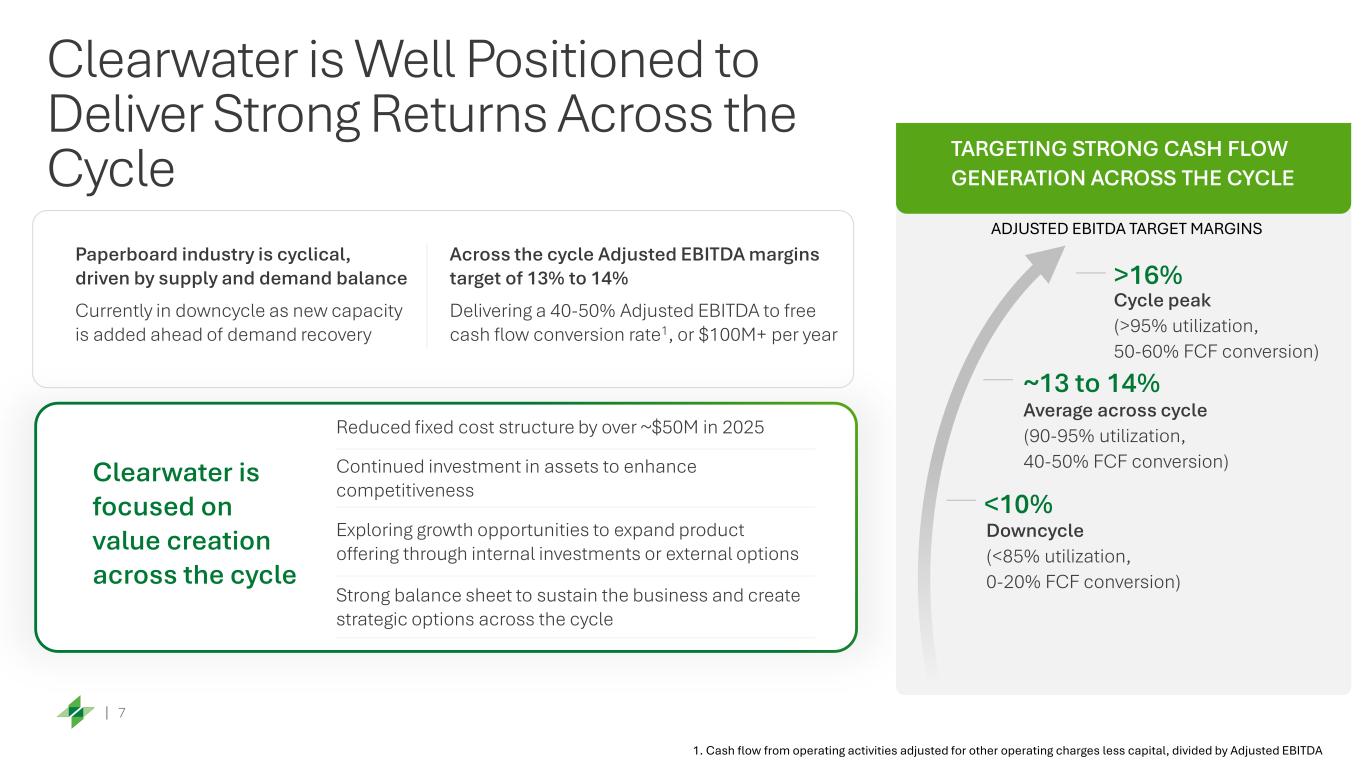
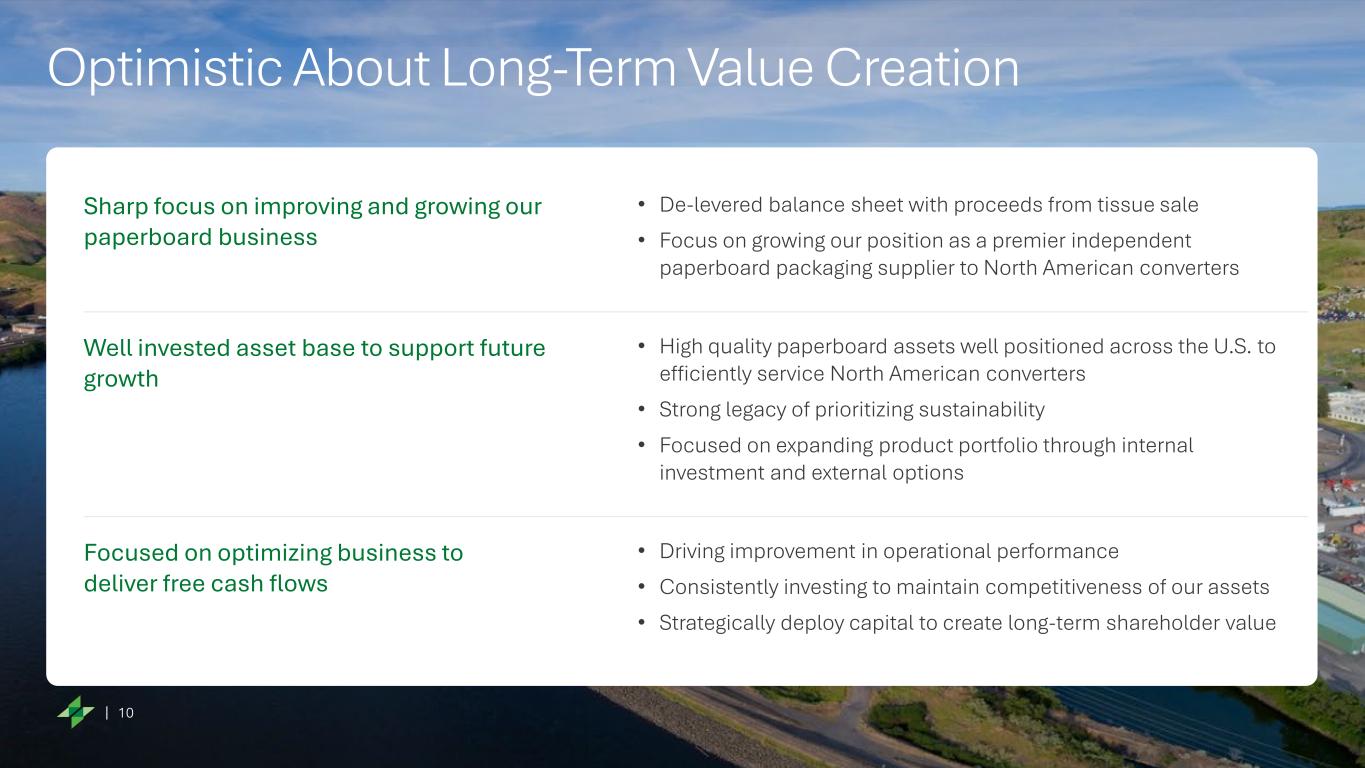
Thank you, Sherry. I'm proud that our team has continued to maintain its focus on running safely and effectively while reducing costs across the business. We are a lean and agile company, which is an advantage regardless of what part of the industry cycle that we're in. We have taken important steps to improve our performance, including restructuring the Cypress Bend Mill, implementing pricing actions, and advancing our product portfolio diversification. In closing, I'd like to summarize our key priorities for Balancer this year. First, we will continue to focus on operating efficiently and reducing costs. Second, we will protect share with our strategic customers. Third, we're taking actions to be cash flow neutral this year. And finally, we're planning to refinance or extend maturities on our existing debt. I remain confident that this cycle will turn. Over time, we believe we will return to cross-cycle EBITDA margins of 13% to 14% and generate more than $100 million of annual free cash flow. Most importantly, we will continue to make decisions that drive long-term shareholder value while supporting our customers, employees, and the communities in which we operate. Thank you for joining us today. We'll now open the call up for questions.
Operator
We will now begin the question and answer session. Your line will remain open for follow-up questions. If you would like to ask a question, please press star 1 to raise your hand. To withdraw your question, press star 1 again. We ask that you pick up your handset when asking a question to allow for optimum sound quality. If you are muted locally, please remember to unmute your device. Please stand by while we compile the Q&A roster. Your first question comes from the line of Sean Stewart with TD Cowan. Sean, your line is open. Please go ahead.
Thank you. Hi, everyone. um question i want to start with uh i want to start with the cypress bend uh restructuring uh so you're you're cutting roll production 20 but the indication was you don't expect any overall impact on shipment volumes which i suppose implies you'll be you'll be adding volume at the other the other mills i guess the question is you know should we consider this the extent of Queerwater's supply response to a difficult market environment. And if that's the case, I guess your assessment of the overall industry cost curve, you reference what Reece is forecasting for capacity cuts through the remainder of the year. Your impression of how steep that cost curve is and how quickly this supply response could arrive.
Thanks, Sean. There's a couple of questions in there, so let me try to tackle them all. So at Cypress Bend, we've reduced our roles at the mill by 20 percent, so headcount and other and open roles in addition to other costs. So that should drive $8 to $12 million of annual savings at the mill. We intend to run the mill at reduced operating rates until industry conditions improve. We're, given that strategy, we have about 1.2 million tons of volume that we're comfortable with. And at this point, we have about 1.2 million tons of annual production that we're comfortable with after taking this action. So we're now going to be focused on ensuring that we produce that 1.2 million tons and we sell it profitably to our customer base. So, given that change, we believe that we're fully utilized for balance of the year. In terms of broader industry changes, if you look at the first half, the actions that have taken place have reduced production or capacity by 280,000, 300,000 tons. And if you recall, we stated that this industry is oversupplied by 500,000 to 600,000 tons. So we think that's about 50% of that oversupplied. The industry is forecasted to grow by 4%, which should add a couple hundred thousand tons of demand. And imports are forecasted to come down by 12%, which is probably going to be another 50,000 tons or so. So if you pull all those things together, RECI is forecasting a 90 plus percent utilization or industry operating rate by balance of the year, which should put us on a path back to a recovery.
Okay. Okay. I think I get that piece of it then. The second question is for Sherry. On the free cash flow bridge commentary, I think I understand the insurance piece of it, but you mentioned the tax refund coming. Can you give us perspective on how much that will be and specific quarterly timing there?
Yeah, so the overall for the full year would be um 27 to 28 million of which we received four in the first quarter so you've got roughly 23 remaining for the balance of the year.
And one last question Sherry the um the debt rating uh downgrade for Moody's does that have any real bearing on your your your interest um your your borrowing costs effectively right now or is it more subject to future um credit facility negotiations that type of thing it would be the latter it would be more more applicable to any future refinancings okay that's all i have for now thanks guys thanks john thank you your next question comes from the line of matthew mckeller with rbc matthew your line is open please go ahead good afternoon thanks for taking my questions uh first
For me, I think you mentioned $3 million to $5 million per quarter of input cost pressure until the conflict is resolved. Is that essentially a comparison of where costs are today versus where they were in February? And does that embed any potential recovery against higher costs that I think you mentioned, whether that be through price or other mechanisms? And if you could speak to what those might be, that would also be helpful.
No, good question. So first, yes, it is a sequential comparison. So it's versus where we were at, call it a month or two ago before the conflict started. There's really three buckets of costs. Number one is chemicals. Number two is transportation, diesel. And the third one may be a little surprising, but wood. You know, we think approximately 20% of wood costs actually have to deal with transportation to get the wood out of the forest. So we are seeing some cost pressure on wood as well related to higher diesel costs. So, yes, three to five million sequential. In terms of recovery, you know, listen, we're focused on cost reductions. So the Cypress Bend restructure should deliver about $2 million a quarter of cost reduction sequentially. As I mentioned on the call, we're also in the process of implementing a $60 price increase on our extruded products, and our extruded products are polycoated, so they use more chemicals than non-extruded products for the polycoating, so we're facing some unique cost pressures on those grades, and we're also sold out on those grades. So I think between the cost reduction in Cypress Bend and the price increase, we are attempting to recover at least some of that cost increase.
Great. That's helpful. Then just a quick one on Valora. Could you just help us maybe understand how that fits into the product portfolio? Are you seeing that uptake from customers who had been on FBB so far? And where would your expectations be in terms of what share of your folding carton and food service volumes that product would eventually represent?
Good question as well. So I view Valora like I viewed Reimagine. It's another tool in our toolkit to work with our folding carton customers. They're obviously participating in bids and specs with their customers, so we want to put another tool in our toolkit. It is a grade that includes mechanical pulp. It is a lightweight grade. It is not a replacement for SBS, but it's meant to compete with FBB. So if our customer is looking at a lightweight FBB product, we have a solution for them. It is not incremental growth. It will take up some of our existing SPS capacity, and we haven't sized it yet in terms of number of tons. We don't expect it to be a large number in the near term. We'll monitor it and see what the uptake is, and then we'll figure out how much capacity to allocate to it in the long run.
Great. Thanks for the help. I'll turn it back.
Your next question comes from the line of Mike Roxland with Truist Securities. mike your line is open please go ahead thanks uh arson sherry and team for taking my questions um hey mike first first question what is the customer response been to the 60 per ton price increase on the extruded products thus far yeah i think we're still working through it um with with our customers i'm not not prepared to comment on on feedback yet i think the the important points that are raised during the call is, you know, we're facing unique cost pressure on those grades because they're poly-coated. And the second piece, we are sold out. So, our backlogs on those products are well beyond what we normally see with our customers. So, we think between those two variables, I think we have a very strong case to implement this price increase.
Got it. Were the backlogs just as strong a couple months ago? I mean, because I heard you correctly. I apologize if I didn't. I mean, I know you went out with another price increase, I think targeting March, which you now pushed out. Maybe it's one and the same. If not, my apologies. But were backlogged the same couple months ago if we're talking about the same price increase? And if not, like, why do you think the conditions warrant? I mean, I understand the wars, you have increasing costs, but why would customers be willing to do that if they're also stretched themselves upset?
Yeah, so I think our original price increase back in March was $50 on folding and $60 on cup. This is a revision. We're at $60 across all extruded products, which includes some poly-coated folding carton as well as poly-coated cup. And yes, our backlogs on those grades have grown, and we're actually pressured on how to satisfy customer demand at this point. So they've grown since then, and costs have also grown.
So it's a bit of a revision from what we talked about back in uh back in march okay got it um in terms of cuk sounds like you know you mentioned the engineering work is now complete um it requires invested 60 million the timeline of 12 to 18 months i mean can you give a sense as to whether you're willing to like what would get you over the hump to pull the trigger to move forward with producing cuk at cypress bend and secondly what what optionality you have also with CRB and where would you be looking to do that as well?
Good questions, Mike. So on C-U-K, you know, I think frankly just has to do with the balance sheet and cash flows at this point, right? It's a $60 million investment when we're working very hard at this point in the cycle to remain cash flow neutral. So it's a matter of allocating the capital and the cash, which at this point we'd have to borrow. So that's the C-U-K decision. We think it's a good project. We think we have a place in that part of the market. It's just figuring out the right time to make the call. On CRB, as you know, Mike, SBS mills would have a difficult time converting to CRB given the differences in the back end of the mill. So it's a matter of, you know, it's either looking at M&A in the long run or looking at some additional partnerships or supply agreements or something along those lines to get some CRB into our portfolio. So that's the CRB one, the CRB one around M&A, I think that's a longer term thinking because, you know, frankly, right now we're focused on ensuring that we have a strong balance sheet to get this through this part of the industry cycle.
And I appreciate that, Arson.
Well, just a quick follow-up. So even with the C-U-K, it's quite to say the $60 million is probably unlikely, even though you don't want to stretch your balance, I would assume that you would not want to stretch your balance sheet any further given the fact that there is still risk in SPS and a lot of uncertainty with respect to how this access capacity is going to be absorbed. In other words, the conversion to CK is probably unlikely in the near term as well because you don't want to stretch yourselves further.
I think we're going to keep reviewing it. We think it's a good project. I think $60 million right now is a bit of a stretch. So we're going to look really hard to see how we can get C.U.K. into our portfolio. At this point, we have an engineer project. You know, frankly, we're pushing the team to figure out what other paths we have to create C.U.K., to make C.U.K. in our facilities, maybe spending less than $60 million.
Got it. And one final question, and I'll turn it over. Just, you know, I know you're pretty constructive, but maybe the condition is getting better by the end of the year. you're signing Recy, if marketing conditions remain challenging, and let's say the biggest player refuses to do anything further with respect to cutting capacity, what else can be done, or what else can you do from a portfolio perspective?
Listen, Mike, I'm not going to try to speculate what we would or wouldn't do. I think right now we focused on a few actions. So we talked about price. We talked about cost reductions. We did the Cypress Bend restructure. I think in the long run, we'll continue to assess our cost structure and our assets to make sure that we're in a good spot. But I think we're optimistic that we're seeing enough green shoots for a recovery in our corner of the market and our industry here as we progress through the year.
Got it. Understood. Good luck in 2Q in the rest of the year.
Operator
Thank you. there are no further questions at this time this concludes today's call thank you for attending you may now disconnect