Operator
Good morning, and welcome to Columbus McKinnon's fourth quarter and full year fiscal 2026 earnings conference call. My name is Joanna, and I will be a conference operator today. As a reminder, this call is being recorded. I will now extend the conference over to Christy Moser, Vice President of Investor Relations and Treasurer. Please go ahead.
Thank you, and welcome everyone to our call. On today's call, we will be covering our full year and fourth quarter fiscal 2020 financial and operational results. As a reminder, our results reflect the completion of the Keeter-Crosby acquisition closed on February 3, 2026, and the divestiture of Columbus McKinnon's legacy U.S. power chain hoist and chain operations on March 4, 2026. On the call with me today are David Wilson, our president and chief executive officer, and Greg Rustowitz, our Chief Financial Officer. In a moment, David and Greg will walk you through our financial and operating performance for the quarter. The earnings release and presentations to supplement today's call are available for download on our Investor Relations website at investors.cmco.com. Before we begin our remarks, please let me remind you that we will have our safe harbor statement on slide two. During the course of this call, management may make forward-looking statements in regards to our current plans, beliefs, and expectations. These statements are not guarantees of future performance and are subject to a number of risks and uncertainties and other factors that can cause actual results and events to differ materially from the results and events contemplated by these forward-looking statements. I'd also like to remind you that management will refer to certain non-GAAP financial measures. You can find reconciliations to the most directly comparable GAAP financial measures on the company's investor relations website and in its filings with the Securities and Exchange Please see our earnings release and our filings with the Securities and Exchange Commission for more information. Today's prepared remarks will be followed by a question and answer session. We will respectfully ask that you limit yourself to one question and one follow-up question. With that, I will turn the call over to David.
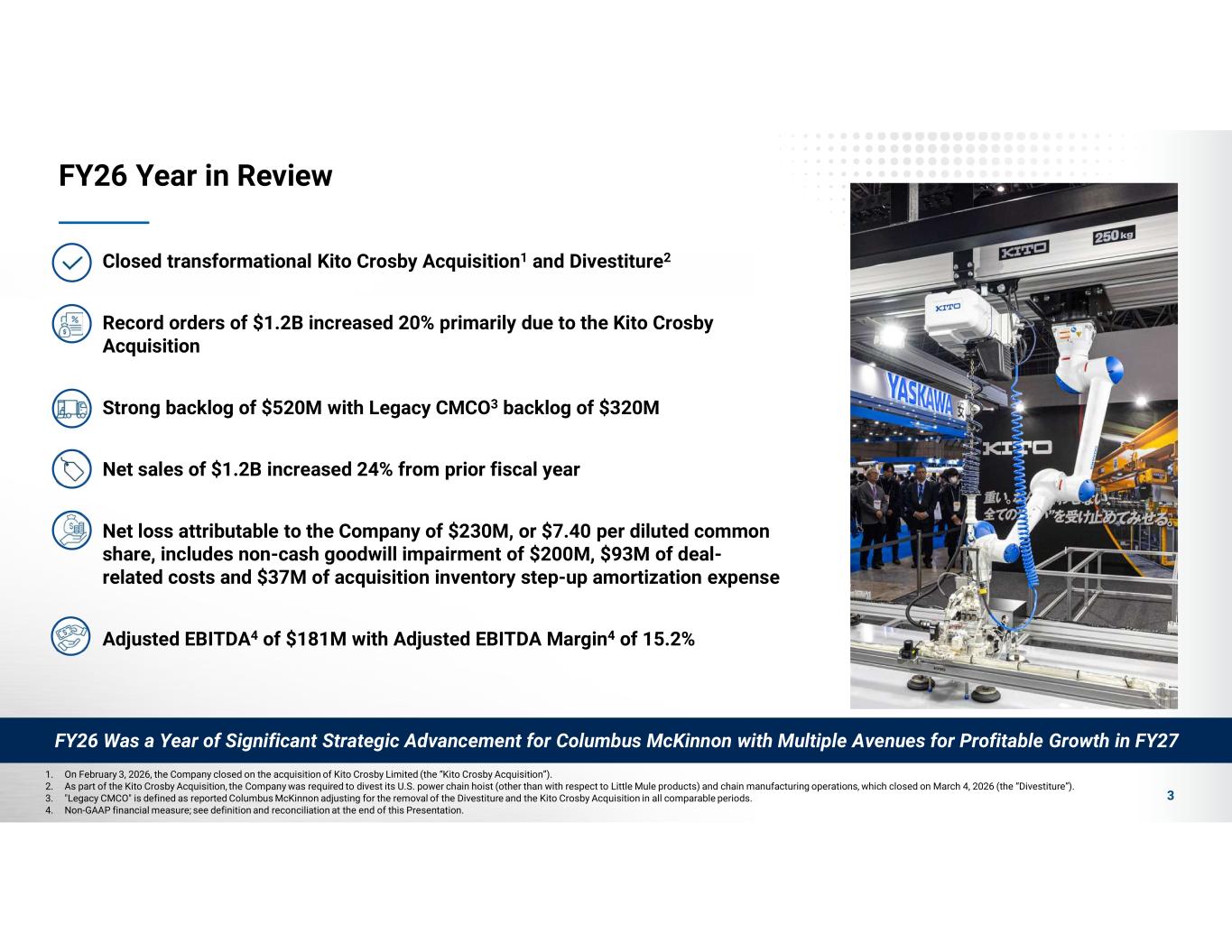
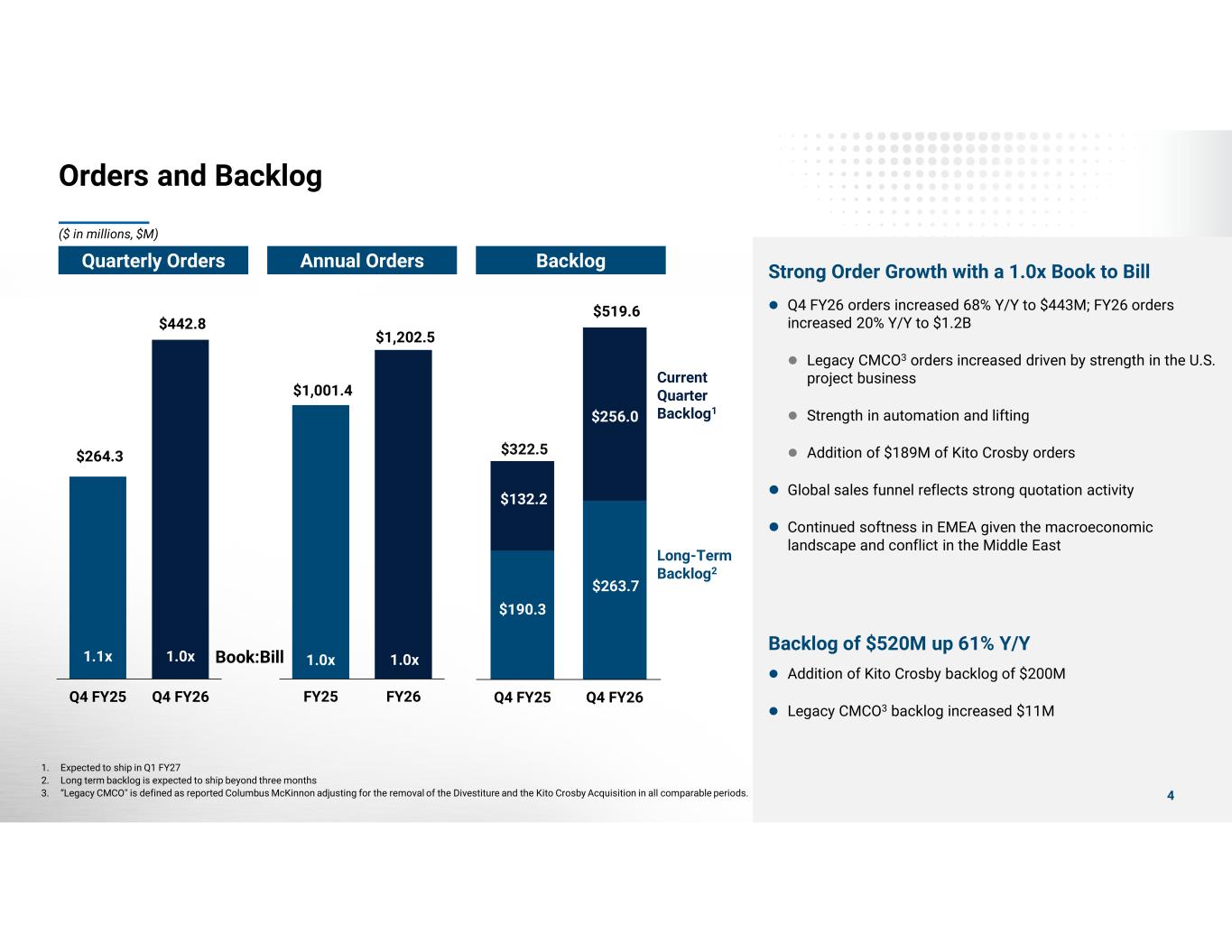
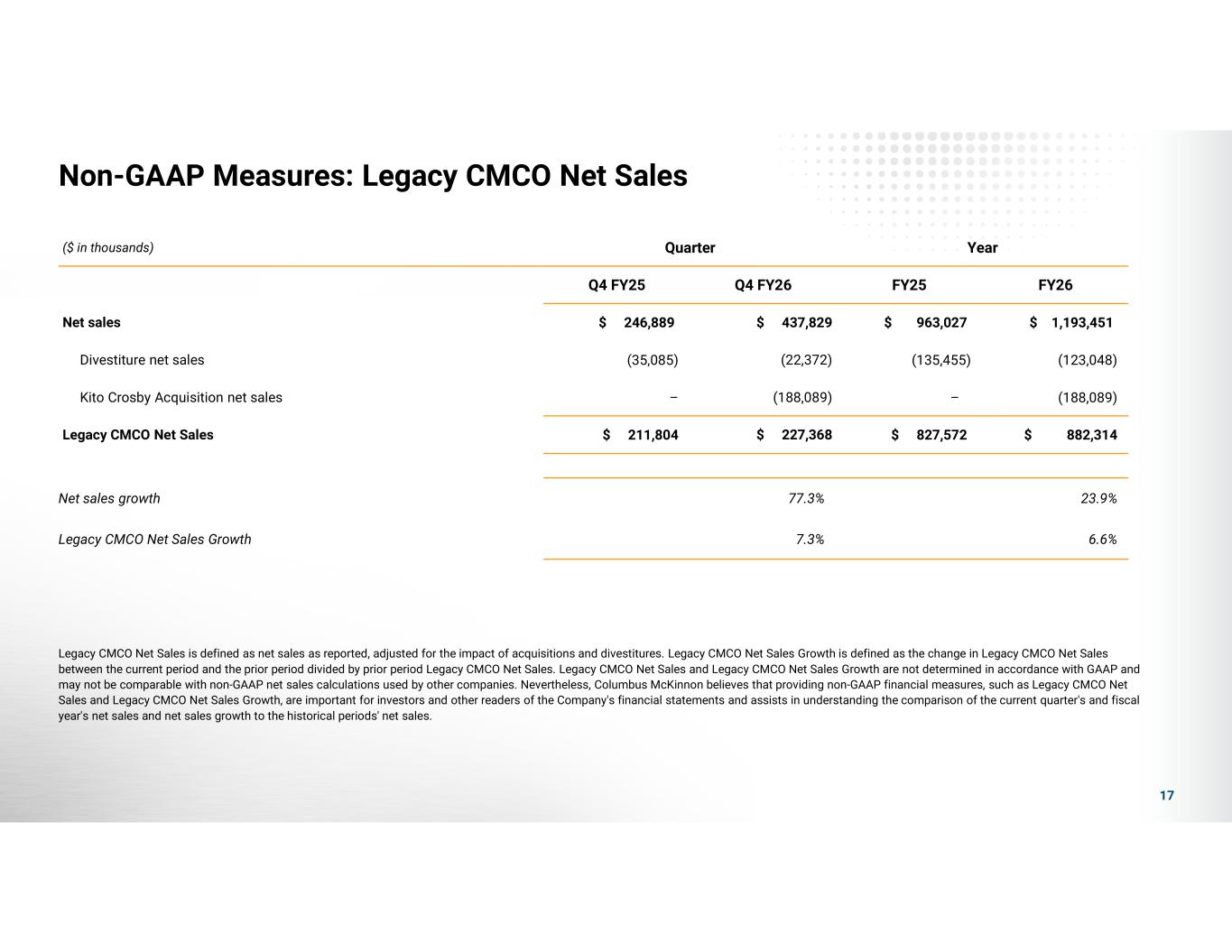
Thank you, Christine. Good morning, everyone. Fiscal 26 was a defining year for Columbus McKinnon. One marked by meaningful strategic, operational, commercial, and customer experience priorities of combined company with Guido Crosby, we're even more optimistic about the future we are building together. Before I begin, I want to thank our more than seven disciplined execution throughout this transformational period while advancing two highly strategic transactions through closure in the early stages of integration, including synergical long-term value for customers and shareholders. Over the year, we also expanded our two-way dialogue with investors, incorporated insights from those discussions. This increased engagement has made us a stronger organization, more aligned with our shareholder interests. This year reflects the completion of both the acquisition and the divestiture in the fourth quarter, and momentum that is building across the enterprise. Sixth, we delivered 20% order growth, 24% net sales growth, and 16% adjusted EBITDA growth year over year. The hard work of our team. These results were supported by continued progress in operational excellence, commercial effectiveness, and customer experience initiatives that are improving our competitiveness and strengthening our foundation. Although Keto Crosby contributed only two months of results in the fiscal year, our combination has already begun to meaningfully enhance performance. Removing the divestiture in both periods, our legacy CMCO business grew net sales. The newly combined company grew six strong results across both short-cycle and project-based business, with particular strength and short-cycle demand, encouraging market conditions, reflecting both the recovery in demand and improved operational performance in linear motion following the successful transition of production to Monterey as part of our... ...also delivered solid growth, supported by the acquisition, favorable foreign exchange, and tariff-related pricing, and worsening geopolitical... This was partially offset by... ...20% order growth, largely driven by the acquisition. Removing the divestiture, legacy CMCO orders grew across both short cycle and project-related activity, led by strength and automation, implemented by modest growth and legacy CMCO orders, affected by macro pressures and EMEA related to the divestiture, while the divestiture created some short-term headwinds to drive future growth. Encouragingly, in the first two months of Fiscal 27, ordering in robust quotation activity, Fiscal 27 was earning approximately $320 million in legacy CMCO backlog and an additional $200 million from Keto. From a profitability standpoint, the year included several related items that Greg will detail shortly. Adjusted EBITDA increased 16% year-over-year, driven by the acquisition. Adjusted EBITDA margin declined primarily due to tariff-related impacts in the first economic and geopolitical. Importantly, we see a clear path to margin improvement over the course of the coming year, supported by pricing actions, operational execution, and synergy On day one, we implemented a unified organizational structures of both companies and building a cohesive operational model that accelerates value creation. Crosby and Columbus McKinnon is already enhancing our scale, expanding our global reach, strengthening our ability to deliver differentiated solutions. Highly confident in achieving our targeted $70 million in annualized net cost synergies in year consolidation and contract harmonization. This progress gives us confidence in our ability to deliver and potentially exceed our synergy commitments. As we look through fiscal 27, we expect to grow sales, strong U.S. demands we will use to pay down debt and remain mindful of factors that are outside of our performance, priorities, and realizing synergy. The longer-term value creation potential of Columbus McKinnon is also clear. Global megatrends, including onshoring, were entering a period of significant opportunity tied to our business combination with Keto-Crosby. The landscape ahead is rich in value creation potential that is within our control. Our combination enhances scale, expands global reach, positions us to accept an important moment in time for Columbus McKinnon focused on driving profitable growth. I'll turn the call over to Greg to take us through our fourth quarter and full year financial.
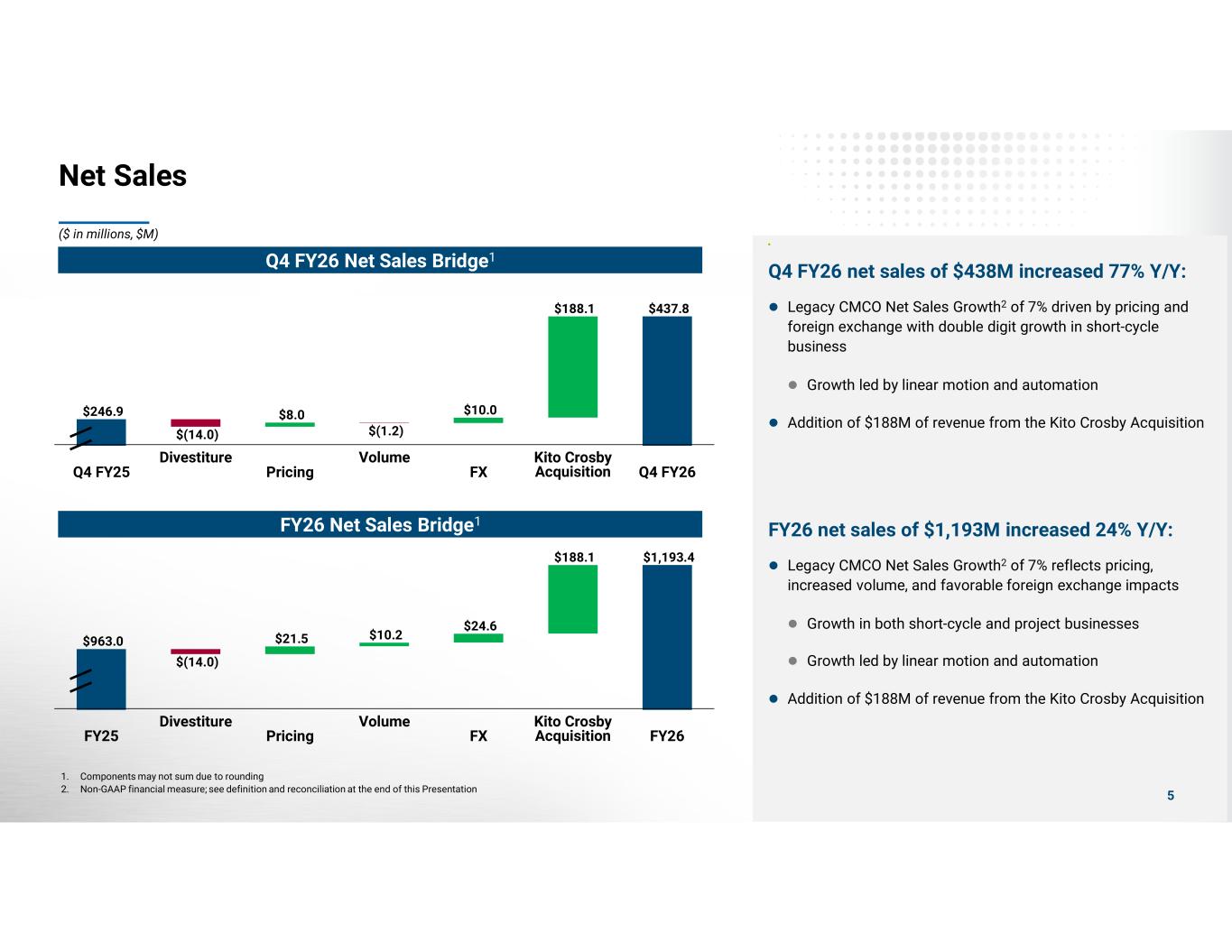
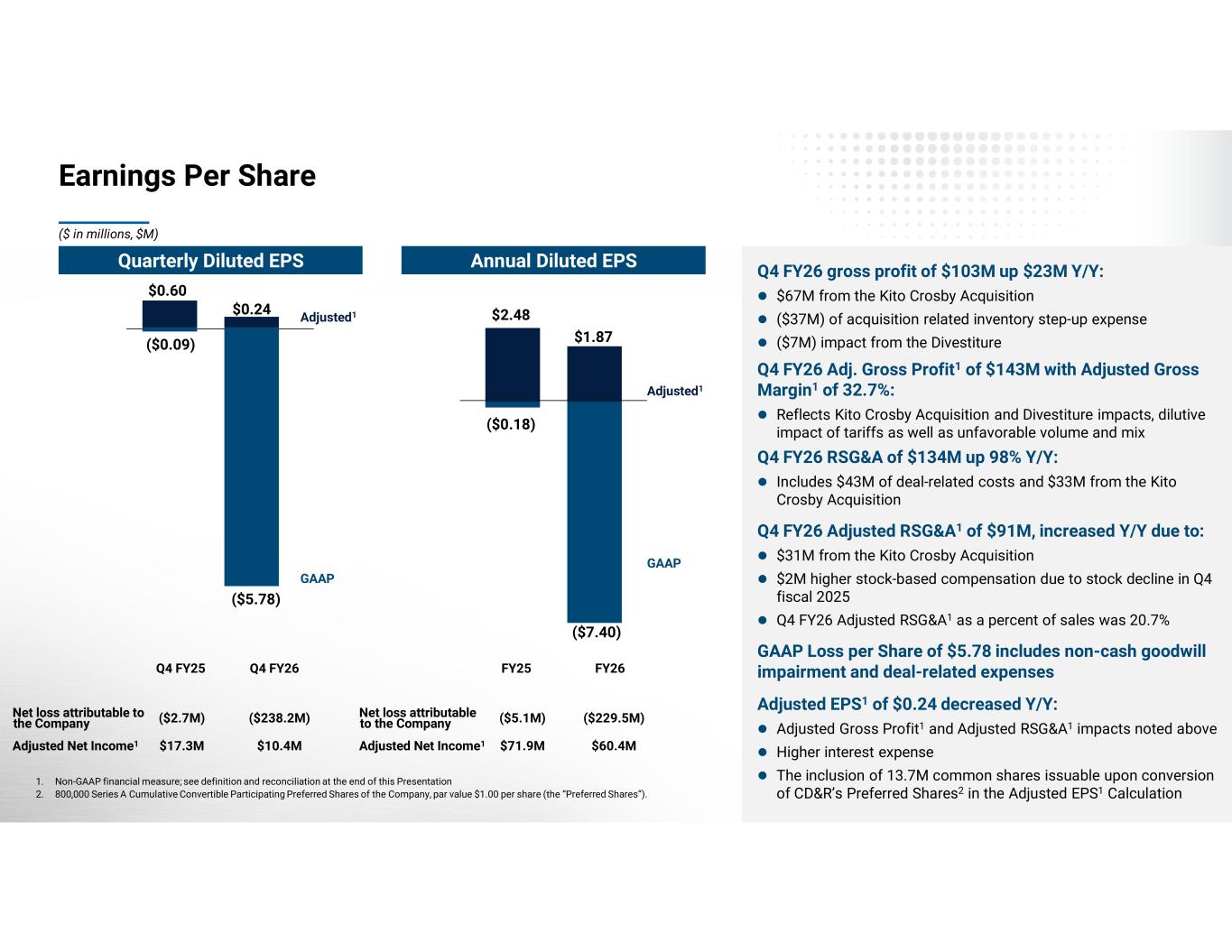
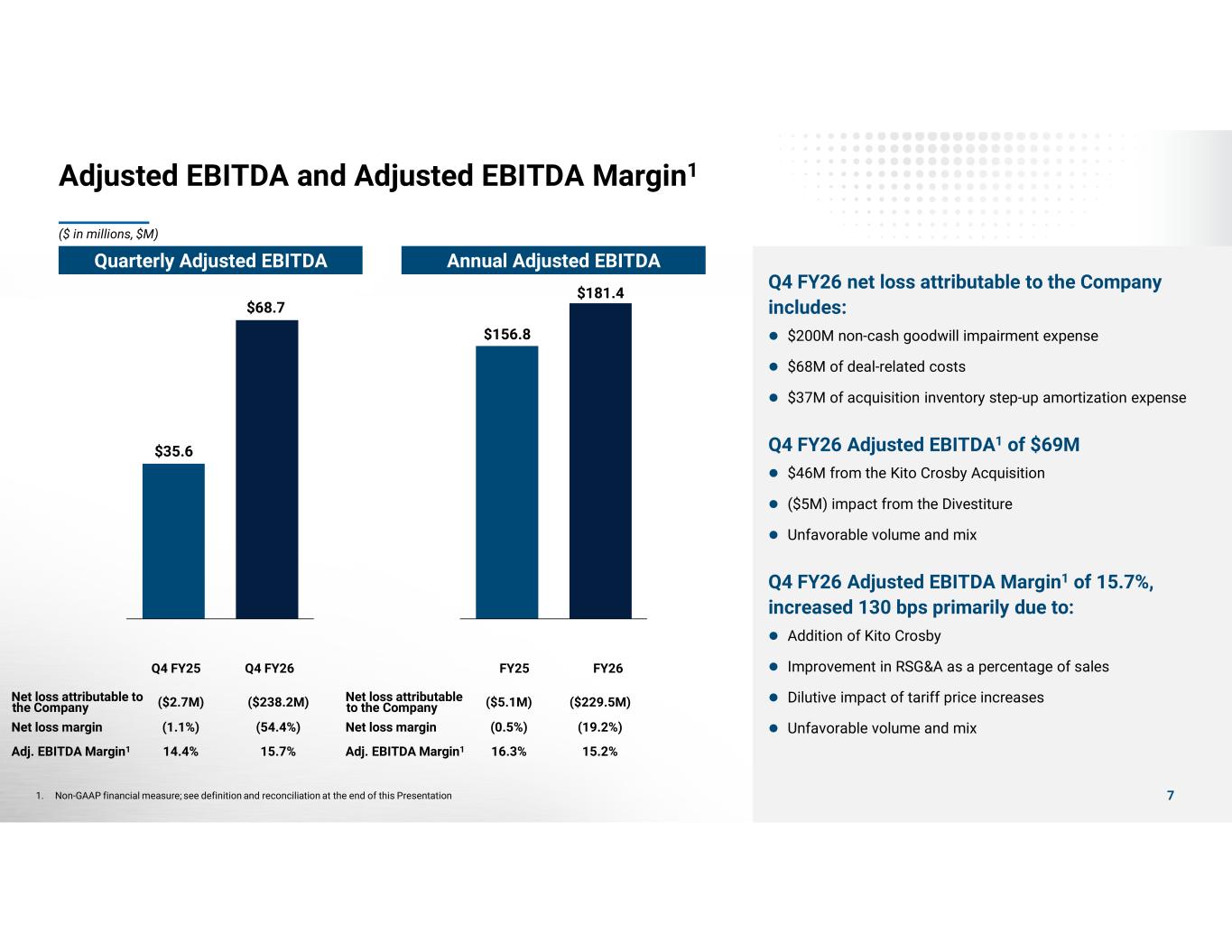
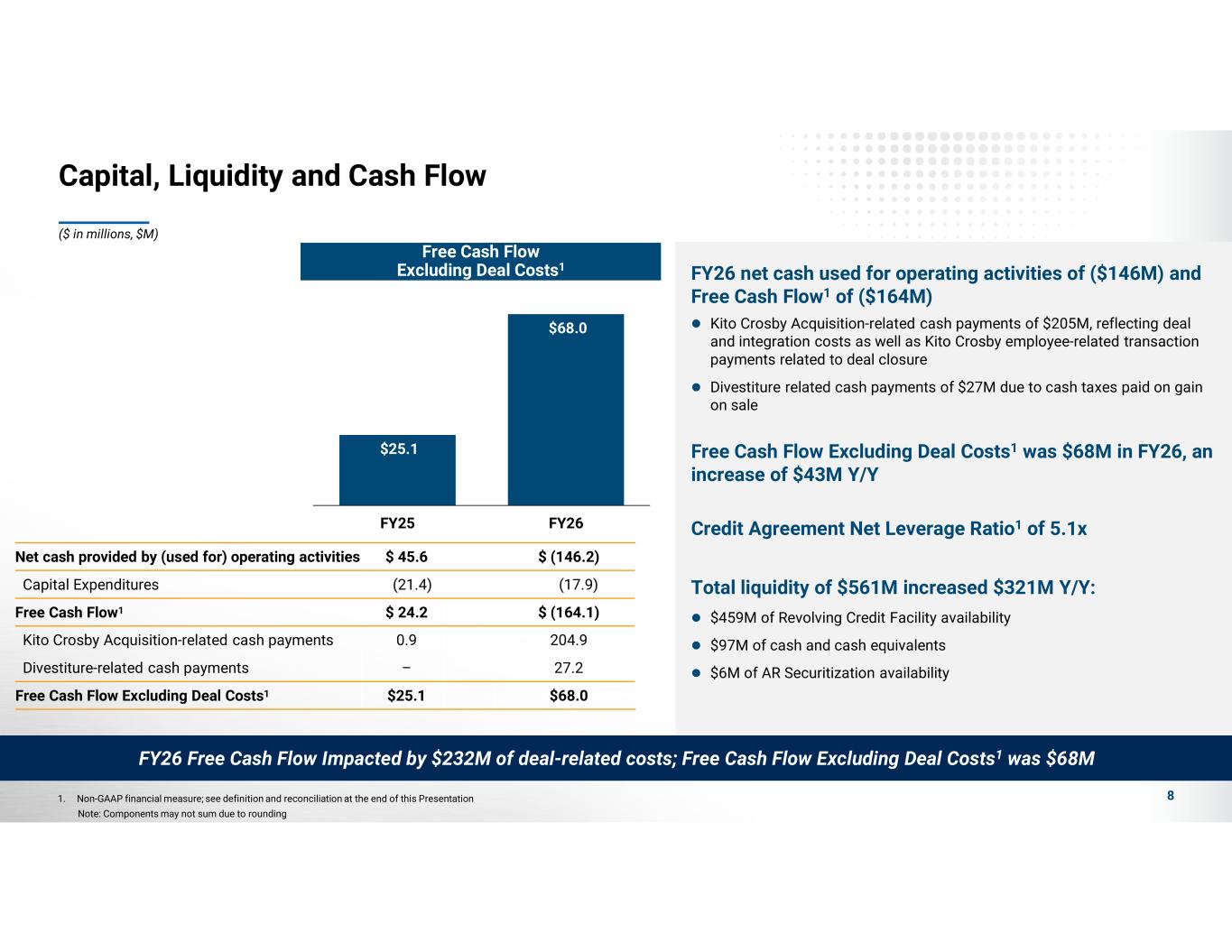
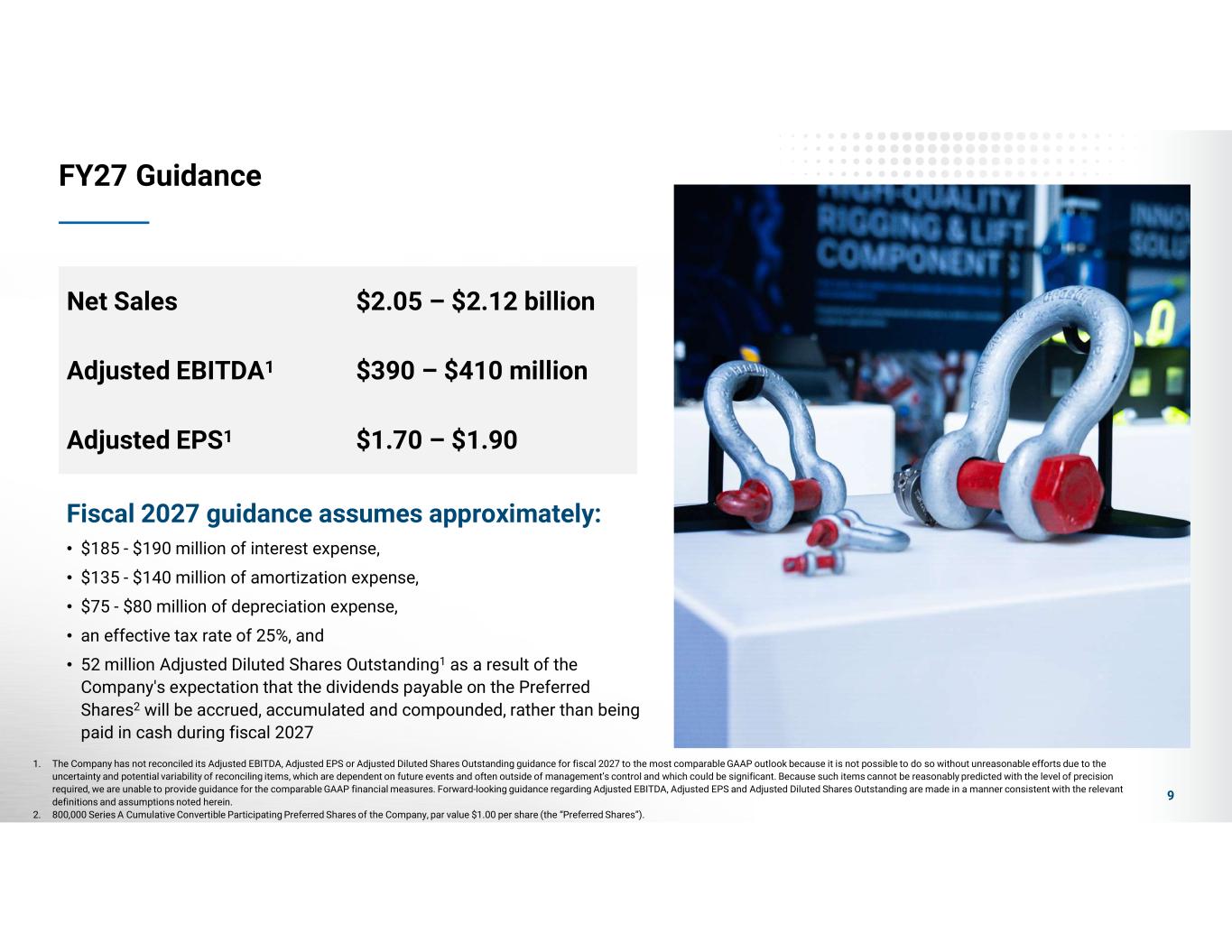
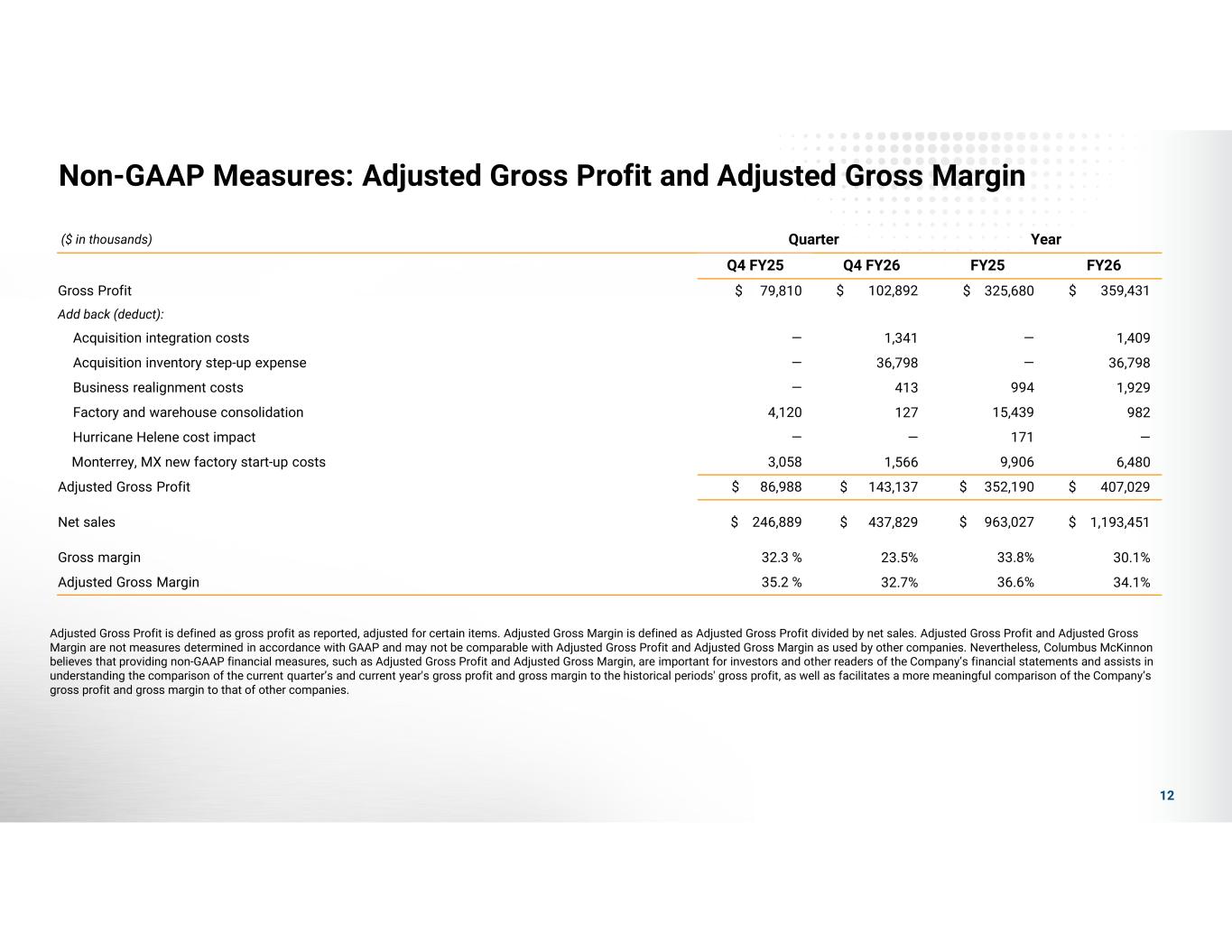
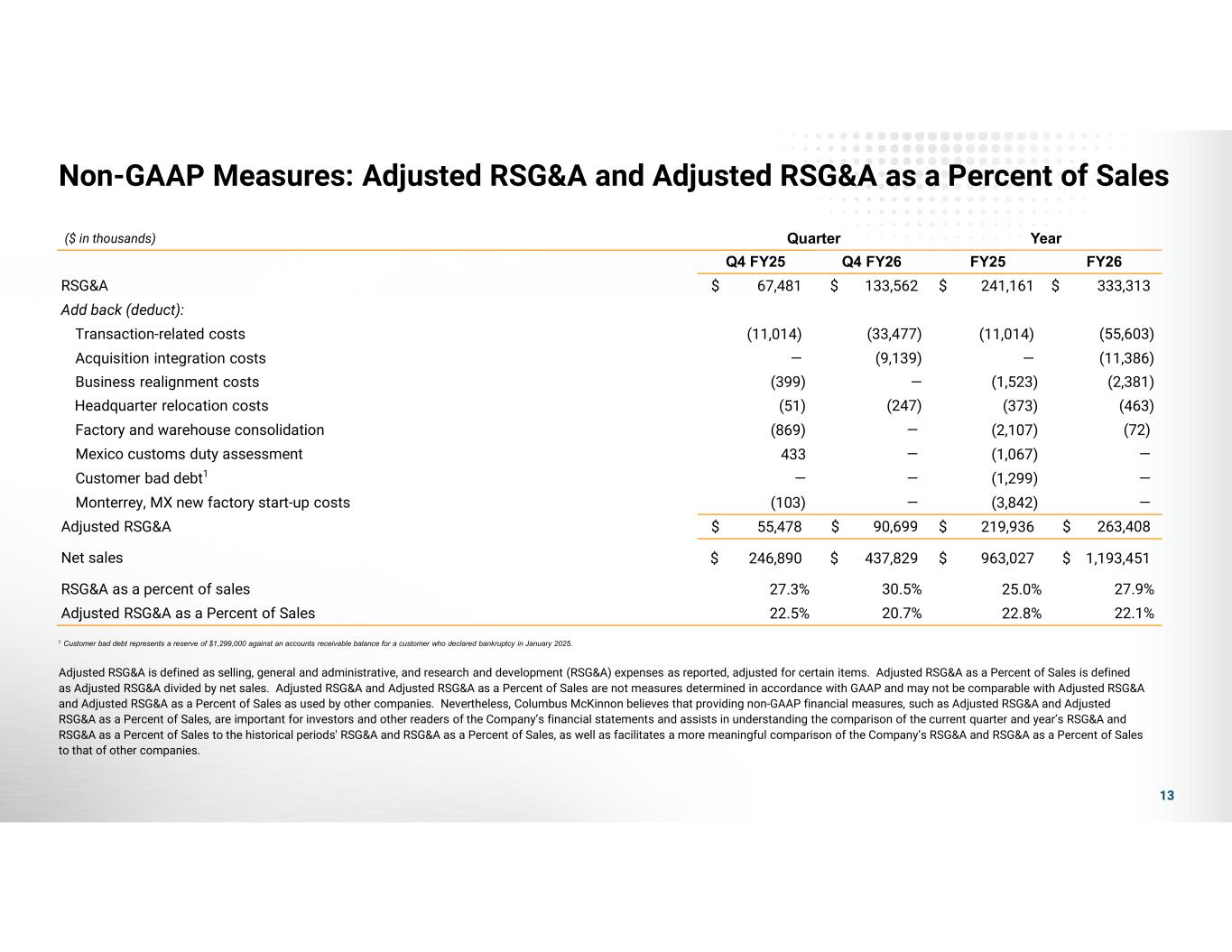
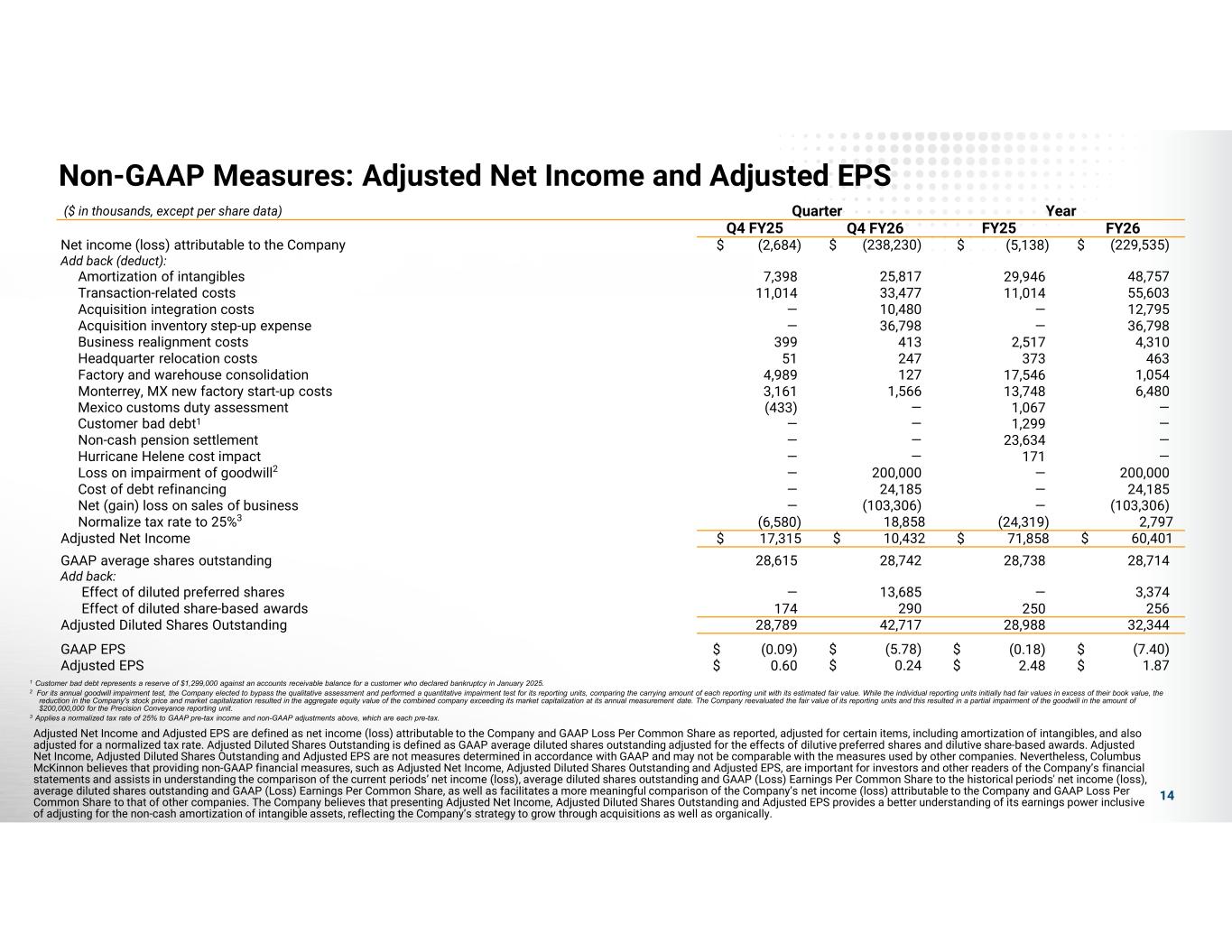
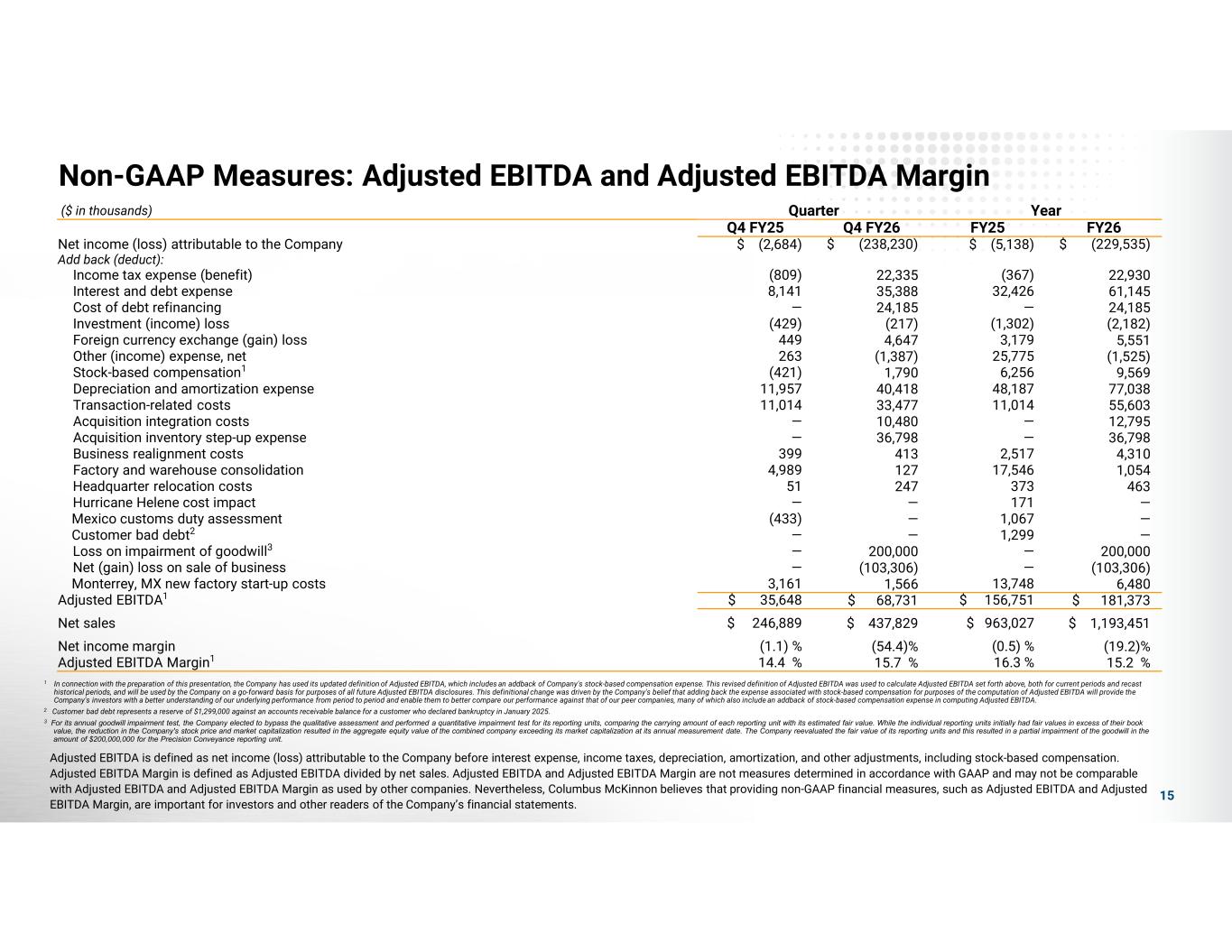
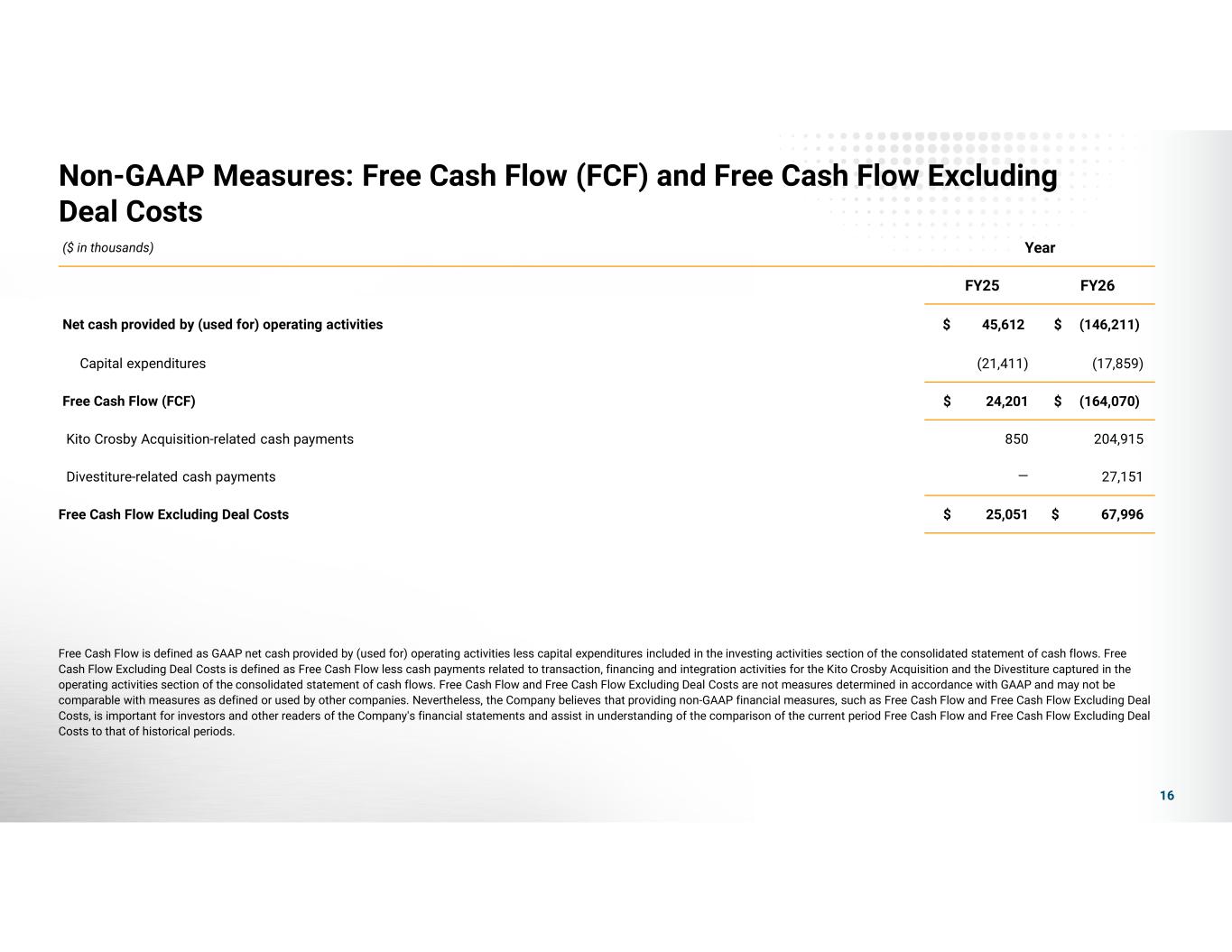
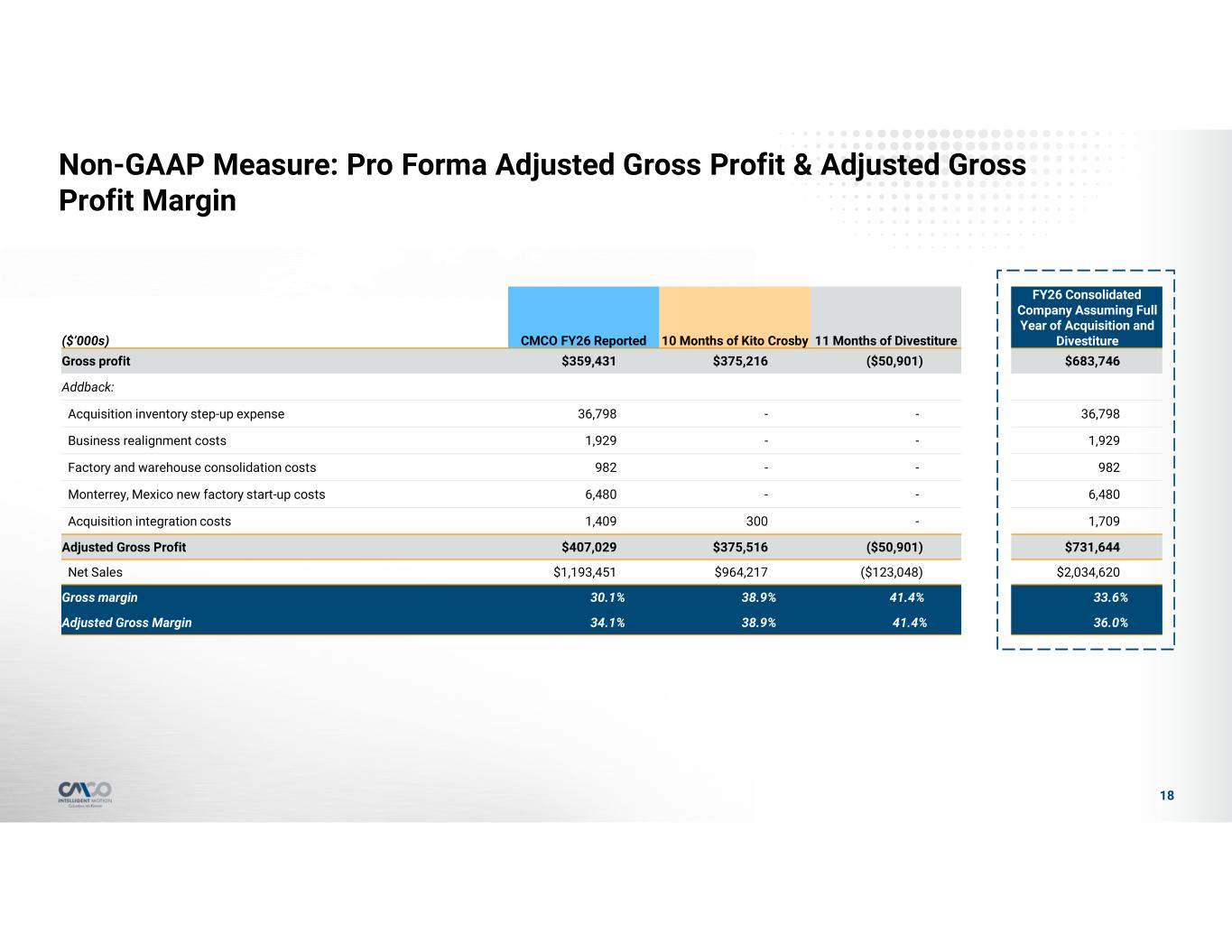
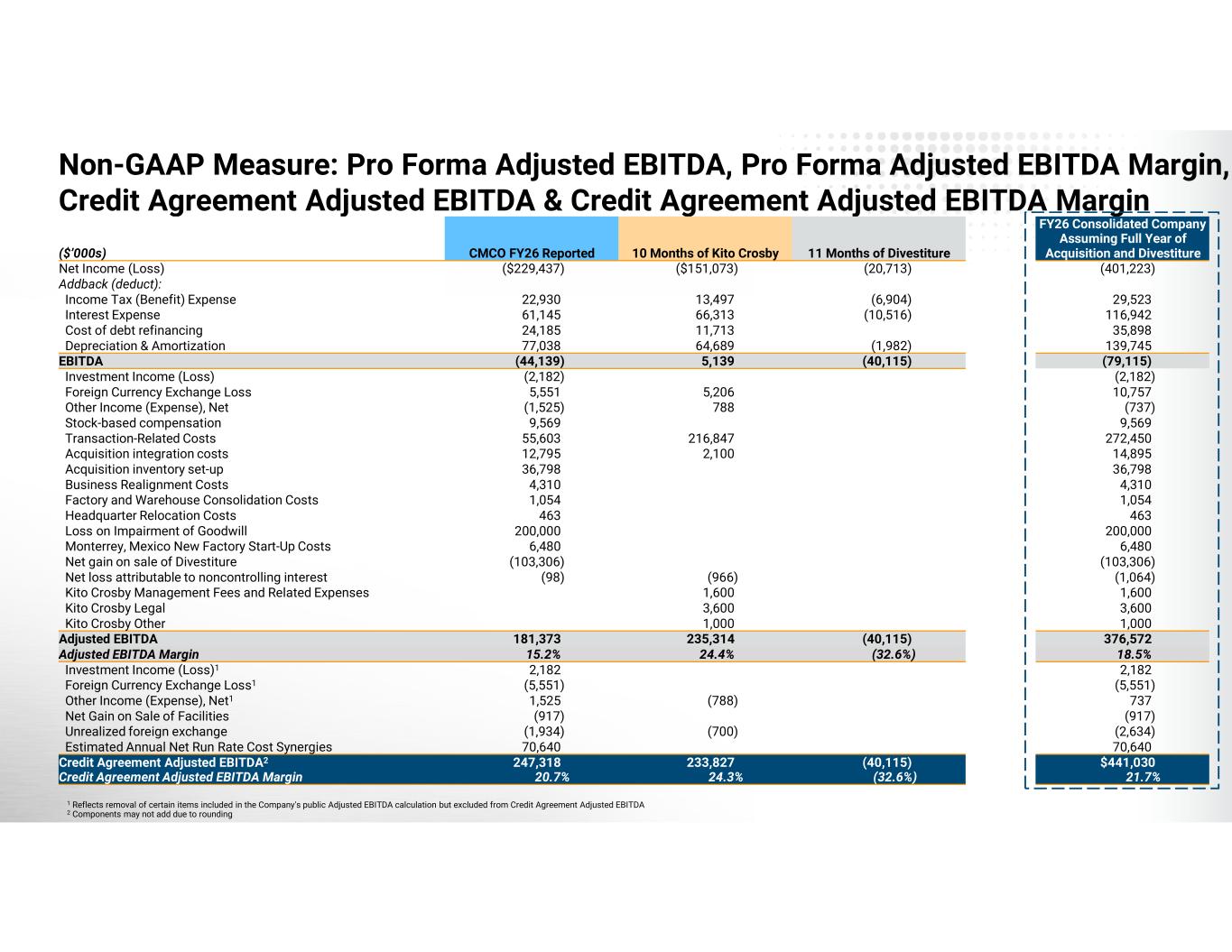
Thank you, David. Good morning, everyone. We're pleased to share our first set of results after closing the Quito-Crosby acquisition on February 3rd and the divestiture of the legacy Columbus-McKinnon U.S. power chain hoist and chain operations. As such, our results for the fourth quarter reflect two months of Quito-Crosby and exclude financial results for the divestiture for the month of March. In fiscal 2026, Columbus-McKinnon delivered record net sales of $1.2 billion, up 24% year-over-year, in positive pricing and volume, favorable foreign exchange movements, in the addition of $188 million of revenue from the Keto-Crosby equity. This was partially offset by a $14 million impact from the divestiture. For the year, sales grew in both short cycle and project sales, with growth led by our linear motion and automation product. Civic to the fourth quarter, $138 million increased 77% from the prior year, benefiting from pricing, favorable foreign exchange movements, partially offset by the impact of the divestiture. Encouragingly, short-cycle sales and legacy Columbus-McKinnon grew from a profitability perspective. Fourth-quarter GAAP gross profit of $103 million increased 29%, driven by the addition of $67 million from the Quito-Crosby acquisition. This was partially offset by the impact of a $37 million non-cash acquisition-related inventory step-up advertised by the gross profit from the prior year reflects a $7 million impact from the divestiture. On an adjusted basis in the fourth quarter, gross profit was $143 million and adjusted gross margin was 32.7%. Adjusted gross margin reflects the impact of the Keto-Crosby acquisition, the impact of the divestiture, which was dilutive to margins, the impact of unfavorable volume and mix. RSG&A expense of $134 million increased 98% of incremental deal-related costs, $31 million from the Keto-Crosby acquisition, and $2 million of higher stock compensation expense. Recall that in the fourth quarter of fiscal 2025, stock compensation expense was declined that occurred during that period. On an adjusted basis, RSG&A expense was $91 million, an increase of 63% driven by the Keto-Crosby acquisition. Adjusted RSG&A as a percentage of sales improved 180 basis points to 20, in addition to the items I just covered, we had some additional items that affected gaff net income and earnings per share. In the fourth quarter, we recorded a $200 million non-cash goodwill impairment charge due to the sustained $24 million in debt extinguishment costs and $27 million of higher interest expense due to the acquisition. partially offset by a $103 million gain on the sale of the divested business. All of this together resulted in a net loss attributable to the company of $238 million on a gap basis. Gap loss per common share was $5.78 in the quarter and $7.40, including the non-cash goodwill impairment, non-cash inventory step-up amortization expense, acquisition-related expenses, and higher interest expenses. Adjusted EPS was $0.24 in the quarter and $1.87 for the year, reflecting the impacts from the acquisition and divestiture, as well as higher interest expense-related impacts and a higher share count due to the inclusion of common shares issuable upon the conversion of the preferred shares owned by CD&R. Adjusted EBITDA was $69 million, an increase of 93% in the fourth quarter. adjusted EBITDA margin of 15.7%, expanded 130 basis points, driven by the accretive Keto-Crosby acquisition, and increased leverage on fixed costs to realize the benefits of scale through our newly combined company. Here to date, net cash used for operating activities was $146 million, which included $205 million of Keto-Crosby acquisition-related cash payments and $27 million in divestiture-related tax and transaction cash payments. Free cash flow, excluding acquisitions and divestiture-related cash costs, was $68 million of $43 million year-over-year, which reflects a strong cash flow generation capability. Our credit agreement net leverage ratio was 5.1 times, and as we have previously stated, our capital allocation priority is debt-reviewed. As a larger business post-acquisition, we increased our total liquidity by $321 million to $561 million. Liquidity is comprised of $97 million of cash and cash equivalents and $459 million of capacity from our revolving credit facility. Let me wrap up my prepared remarks, which reflects the full-year impact of both the acquisition and the divestiture. We are excited by the opportunities ahead as we integrate Keto-Crosby and target a $14 million for fiscal 2027 as shared previously. Our guidance for fiscal 27 is as follows. of $2.05 billion to $2.12 billion, adjusted EBITDA of $390 million to $410 million, including $14 million of in-year cost synergy for Crosby acquisition. DPS of $1.70 to $1.90 per share. This guidance assumes $185 to $190 million of interest expense, $135 to $140 million of amortization expense, $75 to $80 million of depreciation expense, an effective tax rate of 25%, and $52 million of adjusted diluted shares outstanding third share dividend in fiscal year 27. In combination with Keto-Crosby and in line with historical seasonality, our business is anticipated to be back half-weighted as we realize synergies and accelerate growth initiatives. I'm encouraged by the work our combined teams have already done and believe in our ability to deliver shareholder value as a scaled provider of intelligent motion solutions. Our strategy will unlock multiple avenues of growth, improve our margin profile, and generate significant free cash flow, which will allow us to delever the balance sheet rapidly. With that, operator, we are ready for questions.
Operator
Thank you. Ladies and gentlemen, we will now begin the question in our fifth session. Should you have a question, please press the star followed by the one on your touchtone phone. You will hear a prompt that your hand has been raised. If you wish to decline from the polling process, please press our follow-up driver too. And if you are using a speak phone, please flip the handset before pressing any keys. The first question comes from James Kirby with J.P. Morgan. Please go ahead.
Hey, good morning, guys. Thanks for the time. First question, just on the sales guidance, you know, I'm kind of trying to back into it on an apples-to-apples basis. I'm getting somewhere around mid-single-digit growth. I'm just wondering, what are the drivers behind there? Is there a macro? assumption driving that, and just to be clear, there's no revenue synergies on that front.
You're correct. There are no revenue synergies assumed in that number. We do have the acquisition full of basis. Our guidance range is between 1% and 4%. We do have some assumptions around price to offset some inflationary pressures that are coming in and strong demand in the U.S. and short cycle demand notably has been quite strong in the U.S. and some of the downstream effects of a prolonged.
Thanks and you mentioned the Middle East. I know it's a small part of the business but I'm just trying to gauge the secondary impacts on the business if this does continue whether it be from higher oil or input cost.
From an input With cost perspective, we're confident in our ability to pass on increased costs that might be tied to inflationary pressures. You know, what we're anticipating is what we see decision-making, and although we see healthy pipelines for activity, notably in Europe, awarding projects roughly $4 million of exposure, you know, $20, $24 million kind of run rate in full.
Operator
This question comes from Steve Zarazani with Tidoti. Please go ahead.
Morning, David. Morning, Greg. I wanted to follow up the conversation around guidance. Can you give a sense of how you think this will convert to free cash flow, any change to your leverage targets?
I believe that we're going to be able to generate substantial free cash flow. We're going to be putting the bulk of it to debt repayment. Now, we don't give specifically guidance to free cash flow, Steve, But we give you enough of the data with, you know, where we expect CapEx, where we expect and some of the other changes. And I know in the past we've been public about the fact that we do expect to be able to improve working capital levels, and that's part of the equation. So in total, we believe we can get to the four times or inside of four times net leverage within your question.
It's helpful. It's helpful. Thanks, Greg. Right. And, David, you were talking about early signs are, and you don't want to say so yet, but that you could even exceed synergy realization targets. Can you talk a little bit about the actions you've completed so far and what you can do in the first 12 months?
Been focused on really realignment of the organization, able to harmonize contracts and negotiate better positions in multiple areas. Like we've gotten off to a good start, We're really confident in the progress that we're making and the plans that we have. As we're reiterating our earlier remain on that track and see an accelerated realization of something.
You talked about, and typically we've seen this through your history, is that you are able to pass through the higher costs, but sometimes there can be a lag with the current inflationary pressures you're already seeing. Are you adding surcharges, or are you more thinking about lagging price increases where we might see some impact in the first half of the fiscal year?
Acted on both fronts and would anticipate that those ultimately are.
Any difference first half to second half to what you're thinking if the environment remains challenged?
I would expect margin taking as well as the real, you know, there's some notification periods that need to be covered.
Operator
Thank you. Our next question comes from Matt Somerville with DA Davidson. Please go ahead.
Greg, in your prepared remarks, you commented on a handful of things that drove adjusted growth margin down to the 32.7. I was hoping you could maybe parse through the impact of the acquisition, divestiture, mixed volume, tariff, you know, all that sort of stuff, if you're able to give a little bit of granularity.
I mean, clearly the acquisition was accretive to our adjusted gross margins, you know, roughly a couple hundred basis points. But we had a negative impact from the divestiture, which was roughly 50 basis points of the reduction. And then when you look at it excluding, though, the acquisitions of divestiture, essentially, you know, the headwinds were split between some delayed shipments and EMEA related to some backlog that we have for a large customer that is basically reassessing their construction schedule, the macroeconomic conditions there. That was a pretty sizable impact. We covered the cost of tariffs. We did have a dilutive impact to tariffs from a margin perspective, which is, you know, roughly 50 basis points. We also had an unfavorable mix impact in the Americas, roughly 75 basis points. And, you know, it's kind of a good news, bad news story. We've improved our operations substantially, and we were able to deliver on pass-through backlog that was at lower prices because of just the fact that tariffs and material inflation had increased substantially over the time frame. These are much longer delivery items, and so that was a higher proportion of our total revenue relative to parks, which has very high margins for us. And then lastly, it's one that's a little more tricky to explain, but we did feel that we had some distractions with the sales force in the U.S. related to the divestiture in terms of there was a lot going on in the quarter. And it, you know, it had an impact, I think, on how our team was able to deliver. And, you know, looking forward, you know, we're confident we've got the right sales teams. You know, we're happy with the operational footprint that we've got, and we expect to improve gross margins going forward. So that's a lot there, Matt, but hopefully that answers a lot of your questions. So, you know, the short answer is it's a bit of an anomaly. We would expect gross margins to normalize going forward.
So to that end, and as you think about RSG&A, how ultimately should we be thinking about adjusted EPS and adjusted EBITDA cadence implied at the, you know, $1.80 and $400 million bid points, respectively?
From an EBITDA perspective, the range we gave lines up with the EPS numbers that we've given you. So, you know, there are some items below that would have to be taken into account depreciation, for example, which you'd have to take out. But remember, we add back amortization into our adjusted EPS calculation, so that's a non-factor. We are going to have higher interest expense. We've given you guidance on what that's expected to be. The share count is changing substantially. It's going to be roughly 52 million shares on a diluted basis when we include the converted number of shares from the pipe. So that's how I would think about it from that perspective in terms of, you know, gross margin and as a percent of sales or just a gross margin, RSGNA has a percent of sales we don't give guidance anymore on those items it's really all about the EBITDA margin and I think at the levels we've given with the sales levels it's roughly in the 19% a little over 19% of EBITDA and as we drive synergies that number is going to get much larger thank you our last question will be from John Tanweteng with CJS securities please go ahead hi good
morning thank you for taking my question my first one is if you could just what's the volume versus price expectation in the revenue guidance this year? Is it mostly price and kind of flattish volumes, or is it some other mix in there? And then as a second piece of that, you know, what is the underlying expectation of increasing COGS this year due to inflation?
Good question, John. It's really, we said, organic growth. And largely, you know, I would think about it, you know, pricing is probably a little more than half of it given the inflationary environment that we're in. And while we are expecting to drive volume, and once again, as David mentioned, we don't have any revenue synergies baked into our guidance, so that's upside, you know, there is the concerns about Europe. And if the European situation improves, then I think we will, you know, certainly be higher in that range or even be extending the range of revenue. But right now, with what we see in the world we're living in, we think we've got an appropriate range. And what was the second part of your question?
What's your expectation for an increase in COGS this year from inflation?
Inflationary pressure across the full landscape, there are a lot of increases that we have been seeing in the data, and while we negotiate long-term contracts wherever possible to make sure that we can stabilize our cost inputs, we are seeing some pressure there, and I'm anticipating that we're going to see inflation at a rate that about in terms of price increases in the guidance that we provided and would be adjusting our pricing.
On the upside, John, though, with the company essentially doubling in size or more than doubling in size, we are putting from a spend perspective together both companies' spend, and we're trying to leverage our vendors with their higher spend to get the best possible pricing and terms we can get.
And we're finding that we're being effective there in certain spots, and so we're doing a lot of work to offset, negotiate, as we talked about, longer-term, more stable contracts were possible. So, you know, it's a very active area of focus right now, but an expectation that it's going to be probably will adjust accordingly.
Got it. That's helpful. And as we head into Q1, I mean, you mentioned some headwinds to the margin from Q4, whether that's, you know, mixed, maybe some of these inflation things. Are we going to see a full run rate of those, a full quarter of those headwinds, or do you think some of those reversed out like mix? It's just how should we think of the margin progression in Q1?
Yeah, I would anticipate transient through Q1, but I would argue that some of them, given the extended conflict in the Middle East and some of the downstream order demand as well as the mix of past due items, we continue to improve our operational performance. Some of that has a tail on it that will continue for a short time, and that's why, as I said earlier, I expect that margins will expand.
Speaker 2
Thank you very much.
Operator
This is the Q&A section of the earnings call. I will now turn the call back over to Mr. Wilson for closing remarks.
Last year, we took an important step in becoming a more scaled global provider of intelligent motion solutions. Until 27, we are accelerating debt reduction in our integration and long-term shareholder value creation objectives. Thank you again for your time and with any questions.
Operator
That concludes today's conference call. You may now disconnect.