Operator
During today's discussion, we may make forward-looking statements that may vary materially from our actual results. Please refer to our SEC filings and earnings presentation for information concerning risks, uncertainties, and other factors that could cause these results to differ. In addition, our discussion today may include certain non-GAAP financial measures. Reconciliations to the most directly comparable GAAP financial measures are provided in the earnings presentation on our Investor Relations website.
Hey everyone, thanks for joining us live on X today. I'm Alicia Haas, CFO of Coinbase, and I'm here with our co-founder and CEO, Brian Armstrong. We are also joined today by a group of independent and institutional research analysts. We're excited to connect directly with you, our customers, our community, our shareholders, to talk about our quarter and answer your questions. So we're going to take our first question from an independent analyst named Eric Pan. Eric, over to you.
Hey there, Eric Pan, Ericnomics here. Great to see you guys again since the systems update in New York. My question is around clarity. As clarity is at the one-yard line and now out for the Senate floor vote, prediction markets and Galaxy Research have odds of it passing around roughly 30%, and August recesses right around the corner. Now, I really want to be optimistic about this, it but also imagining a scenario of a world where it doesn't really get passed so my question is what's going to happen with one coinbase um are you guys just going to be more careful uh while kind of being in this limbo between cf2c and sec and then two us the everyday consumers if it doesn't get passed yeah i'll take that one so first off um i am pretty optimistic that it'll get to a full Senate floor vote.
There's a lot of last minute negotiations happening, which to me is a sign that everyone is invested in getting something over the line. I mean, there's just thousands and thousands of hours that have been spent by the Senate staff and the senators themselves on getting a really good work product. And like every good negotiation, there's a lot of last minute details to get right. But having a deadline or a forcing function with this August recess for the Senate is actually a good thing. It tends to get people to the table at the last minute. So there's been lots of phone calls happening this week. Now, of course, there's more steps that would need to happen for it to become law after the Senate floor vote. And you can never say 100% with these things. So anyway, I'm optimistic it can get done. By the way, a big shout out to the Stand With Crypto advocates who sent, I think, over a million emails and phone calls to their representatives to help get that through. But your question was about what happens if it doesn't pass. And I think in that world, it's actually kind of just business as usual for Coinbase. For a few reasons. One is that, I mean, we already do many of the things that would be required by the Clarity Act as just sort of a good best practice. But more importantly, maybe, you know, Chair Atkins and Selig at the SEC and the CFTC, respectively, they have publicly said that they're poised to pass clear rules, whether Clarity passes or not. I think they've been kind of in a holding pattern. You know, I don't speak for them, but I think they're a bit of a holding pattern waiting to see what happens with Clarity. And if it doesn't, go through for some reason, then they would come out with their own rules that would allow businesses like Coinbase to continue to operate and have more clarity. So we still think on margin it's better if the Clarity Act passes. It creates durability through multiple administrations. People can make longer-term investments. But it's really the American consumers, as you mentioned, who would lose if Clarity doesn't pass. I think Coinbase would be fine. Thank you.
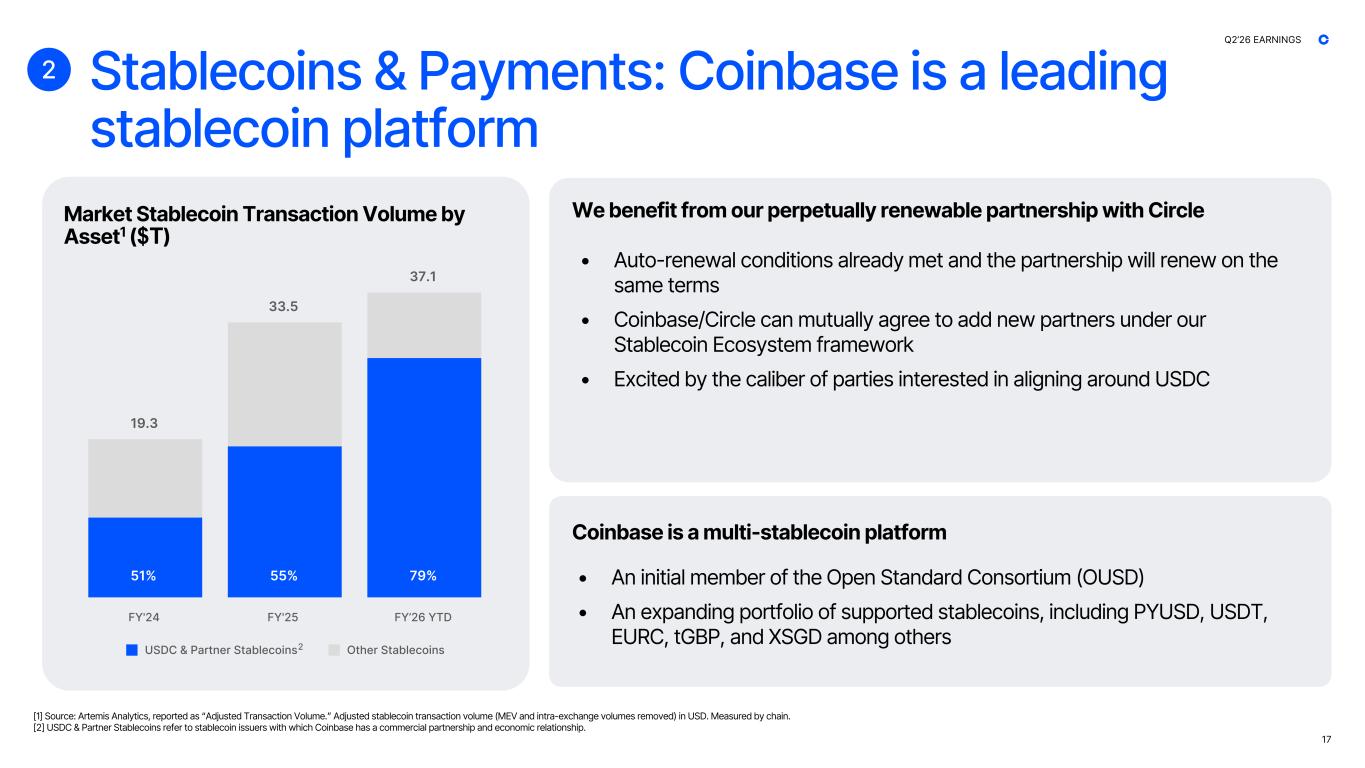
We are moving to our next question and this is going to come from institutional research analyst owen lao at clear street thank you alicia and also brian could you please talk about the reason coinbase joining open usd some people think oh usd it's a major threat to usdc obviously oh usd it's not even launched yet so there are no hard figures we can compare with but why does coinbase participate pay in a competing stablecoin platform, competing stablecoin. And in relation to that, does it increase your leverage to negotiate the contract with Circle? I actually saw that it is auto-renewed on the same terms, but I keep getting this question. Do you need to self-partnerships for negotiation? Thanks.
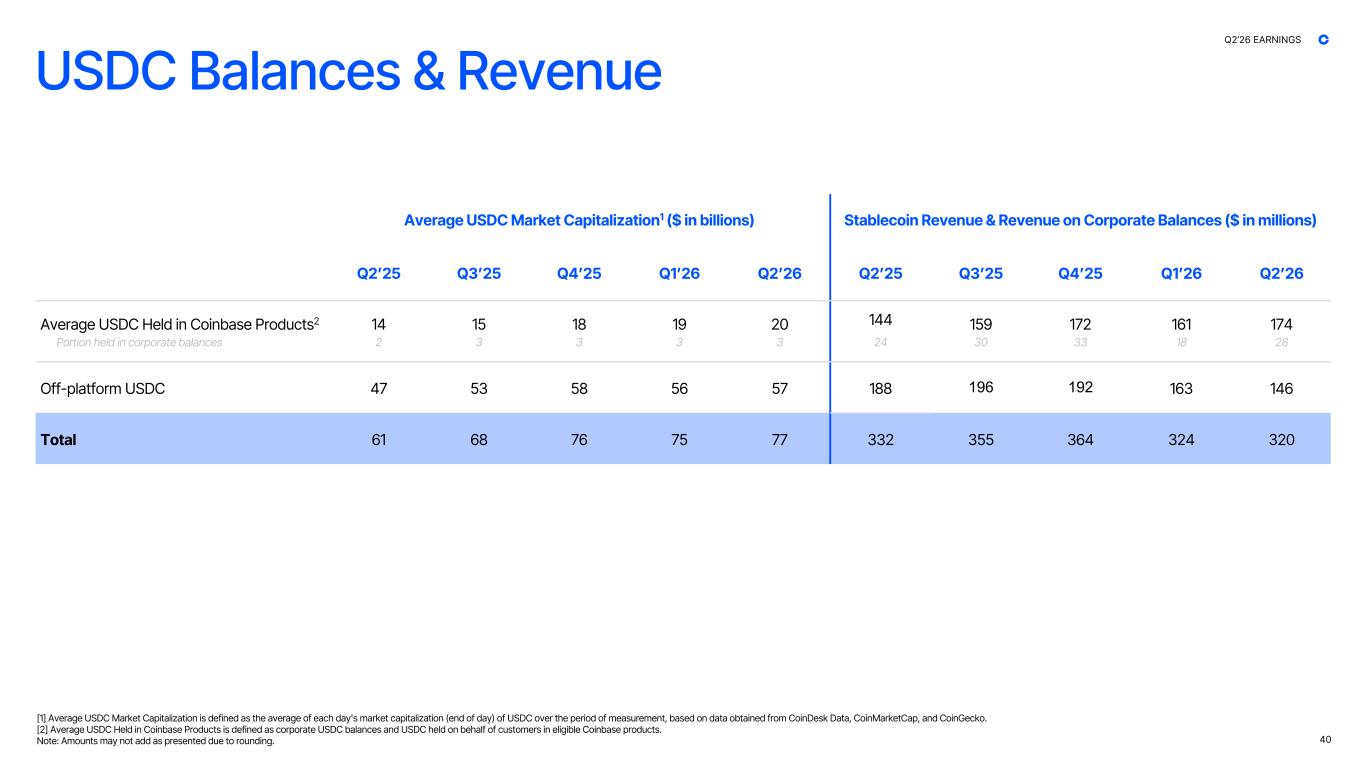
Can I address the partnership with Circle first, Brian, and then we can talk talk about our platform, if that's okay with you. So we have already met the conditions for the Circle contract to renew. So it will renew on the same terms. I want to take away any ambiguity about that for the market, Owen. So we will continue to work on growing USDC, partnering with Circle and driving that ecosystem. Now why OUSD? Brian, over to you.
Yeah, I mean, the short reason is that we're a multi-stablecoin platform. We want to provide the stable coins that all of our customers want to use. And where possible, we want to strike good economic arrangements with that. Now, we have a great partnership with Circle and USDC. We have arguably the strongest economics from that point of view. But we want to make sure that we strike economic deals with every major stable coin out there and support everything. So we actually already support other stable coins, things like PayPal, PYUSD, USDT, Tether. Right. So anyway, we're excited about this open USDC consortium and we'll keep investing in that. I think this just creates additional business opportunities and revenue opportunities for us to be a multi-stable coin platform. Not to mention, I guess, you know, FX trading, things like that. Thank you.
All right. Next question. Brian Jung.
Hey, Brian. Hey, Lisa. It's good to see you guys again. i am really curious about your relationship right now um that you have with retail you know you had your appearance on market bubble you announced kobe was taking over the base app i feel like these are some early signals that coinbase here wants to really reconnect with the create uh crypto native users can you just tell me more about your thoughts on this and what made you really take this kind of pivot recently yeah so we have lots of different groups that like to use Coinbase and build on top of the base chain is even probably a broader group.
And so, you know, we try to make an effort to connect with all of them. It's really a pretty diverse group of people that use Coinbase, right? There's the largest like GSIB banks in the world are building on our infrastructure. We also are having AI agents spin up wallets on top of our architecture. We have fintechs and payment service providers. We have a huge segment of retail. We have simple traders. We have advanced traders. And of course, there is this crypto native community that you mentioned. So that's a very important constituency that we go connect with. They're more internet native. Sometimes I have to make sure I'm 43 now, so I have to get in the weeds on some of the lingo and the norms and whatnot. But we have great people on our team to go speak to all of these different constituencies with more depth than I have. And you mentioned Kobe. He's one of the folks that just joined recently. I think he comes from that community, which is really good. And I'll continue to go on podcasts that speak to all these different groups, including the crypto native community.
I appreciate that. Thanks. Yeah.
Thank you. All right. Next question from Ken Worthington.
Hi, Brian and Alicia. Nice seeing you both. Thank you for letting me participate here.
There were a number of departures from your senior leadership team this quarter why did you have these high profile changes in a short period of time what is the strategy with regard to hr state legal and institutional yeah um you broke up there for a little bit but i think i got the gist of it and um you mentioned strategy there's nothing that's changing about the strategy but i guess what i'd say is one of the things i'm most proud of about coinbase is we have a really deep bench of talent and we have a really good succession planning process and so we've had lots of folks that are long tenured it's normal for people to turn over at different points but what i'm really
bullish about is we just have amazing talent that's been at the company a while that is ready to go step up into these these roles and um i think it's really a strength of ours so yeah i'm exciting i'm excited to see what that turns out to be yeah i just want to underpin my excitement around the bench of talent that we have and all of the folks that you have been introduced to Dominique that will lead our people function Molly leading our new legal function or Liz each of them has been groomed by the outgoing leaders and I think that we are just excited for next generation of talent but these were all individual decisions so there's nothing from a strategy standpoint to read into these changes all right next question Austin Hankwitz hey y'all how's it going Austin Hankwitz
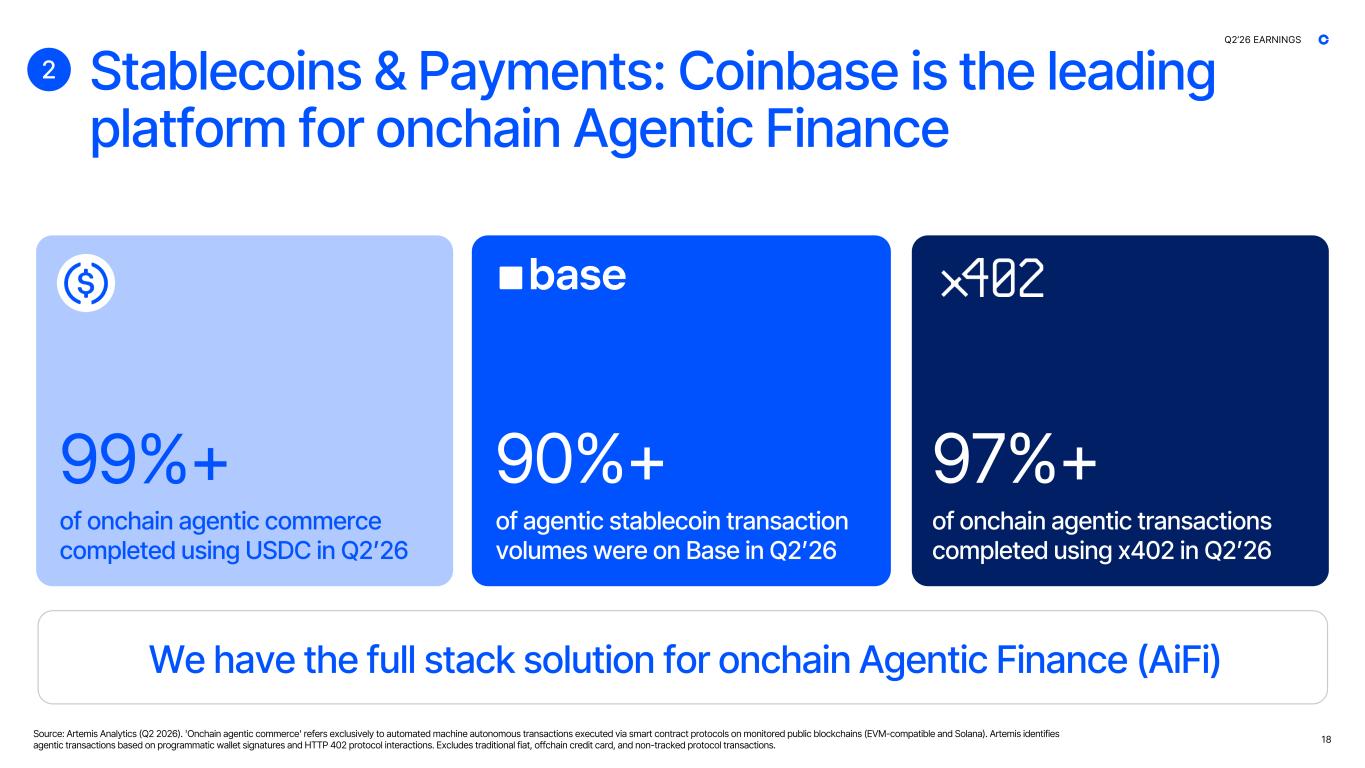
here co-host of the rich habits podcast and head analyst at grid capital thanks again so much for letting me tag along brian you all said last quarter that customers don't choose coinbase because you're the cheapest they choose you because you're the most trusted you also said over 90 of agentic stablecoin transaction volume settles on base but an ai agent has no brand loyalty it simply optimizes for cost and latency so as agents become a larger share of volume does that trust mode transfer to them? Or does agentic commerce structurally now push Coinbase toward competing on price in a way that maybe the consumer business never had to? Would love to get your take.
Yeah, well, I'm glad you're thinking about how we're going to serve AI agents as customers, along with humans, which, you know, I've been thinking a lot about as well. I think the short answer to your question is that, actually, I think AI agents are probably going to care about a similar set of things that humans would. Certainly price is one of those factors and you know base actually delivers like sub cent uh and sub one second settlement so it's like very competitive from that point of view but i also think ai agents are going to choose infrastructure that is reliable and safe and liquid and compliant and has good uptime just like they might choose aws or some kind of cloud vendor for different types of infrastructure you could imagine so long long way of saying i think trust will continue to be important in that world. And we're going to be rolling out the red carpet for AI agents and make sure that we're serving them appropriately. Love it.
All right. Our next question, Alex Markgraf from KeyBank Capital Markets.
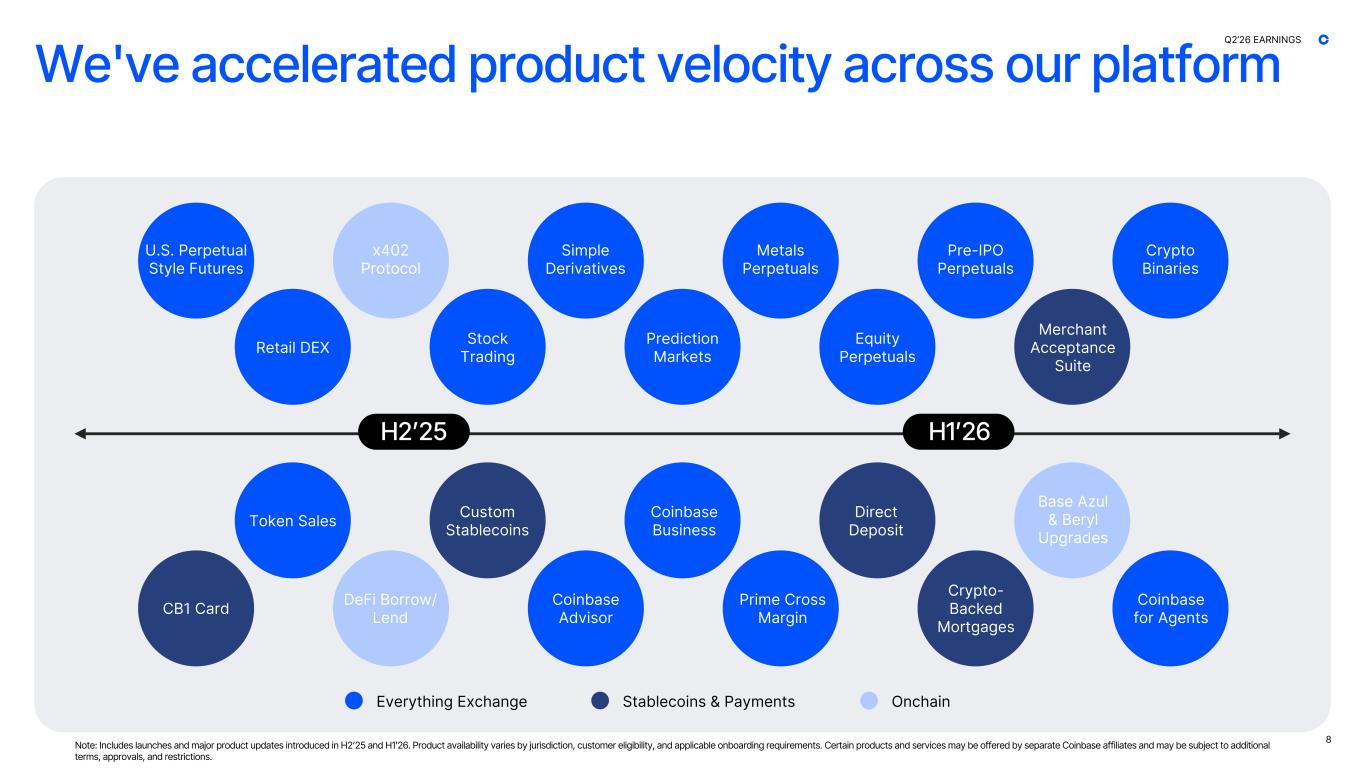
Hey, Brian. Hey, Alicia. Thanks for doing this and including me. Coinbase has launched many new products since December 25. I think the product velocity has certainly stepped up. I'm curious to understand how the team is thinking about driving cross-product adoption and specifically bringing new users in through various entry points that are newer products to the platform. So it would be helpful just to understand the strategy there. And then if there's any detail on sort of marketing dollar allocation as you think about that approach would be helpful. Thanks.
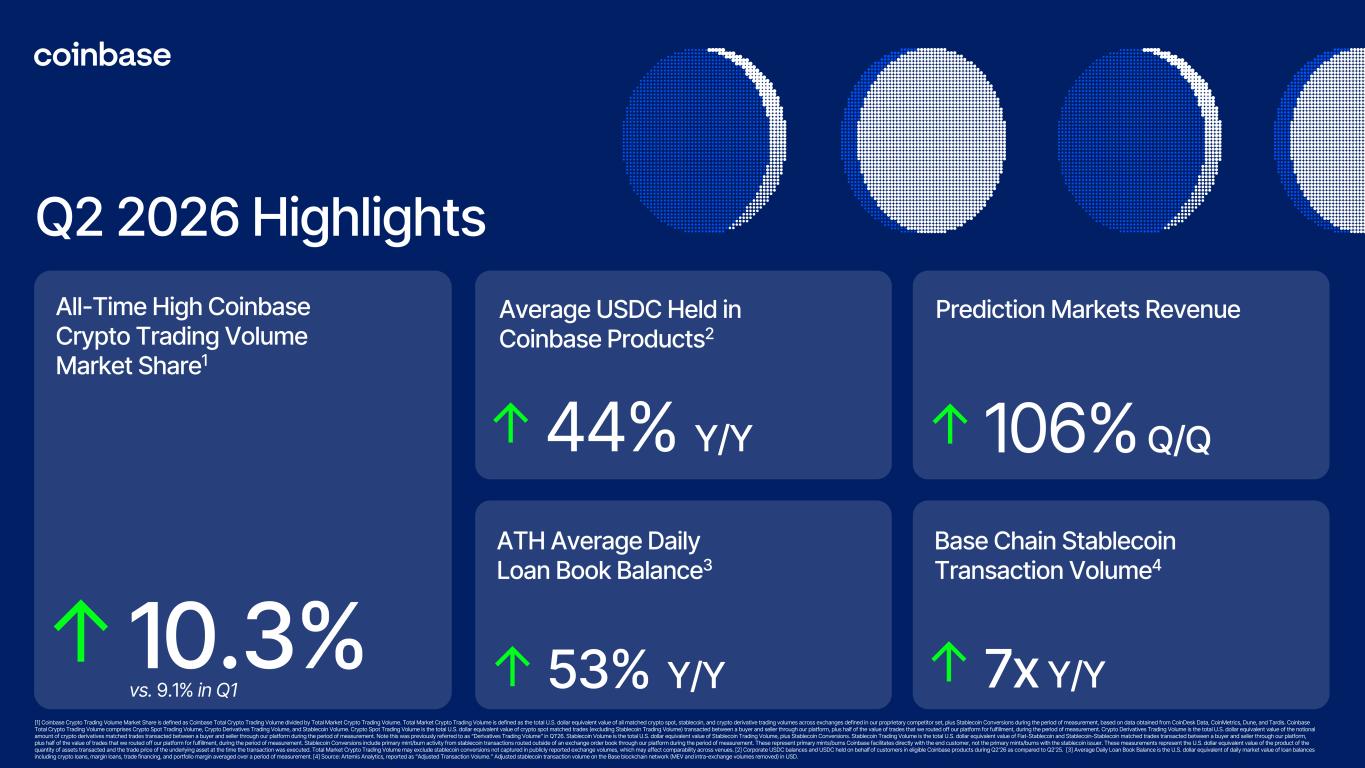
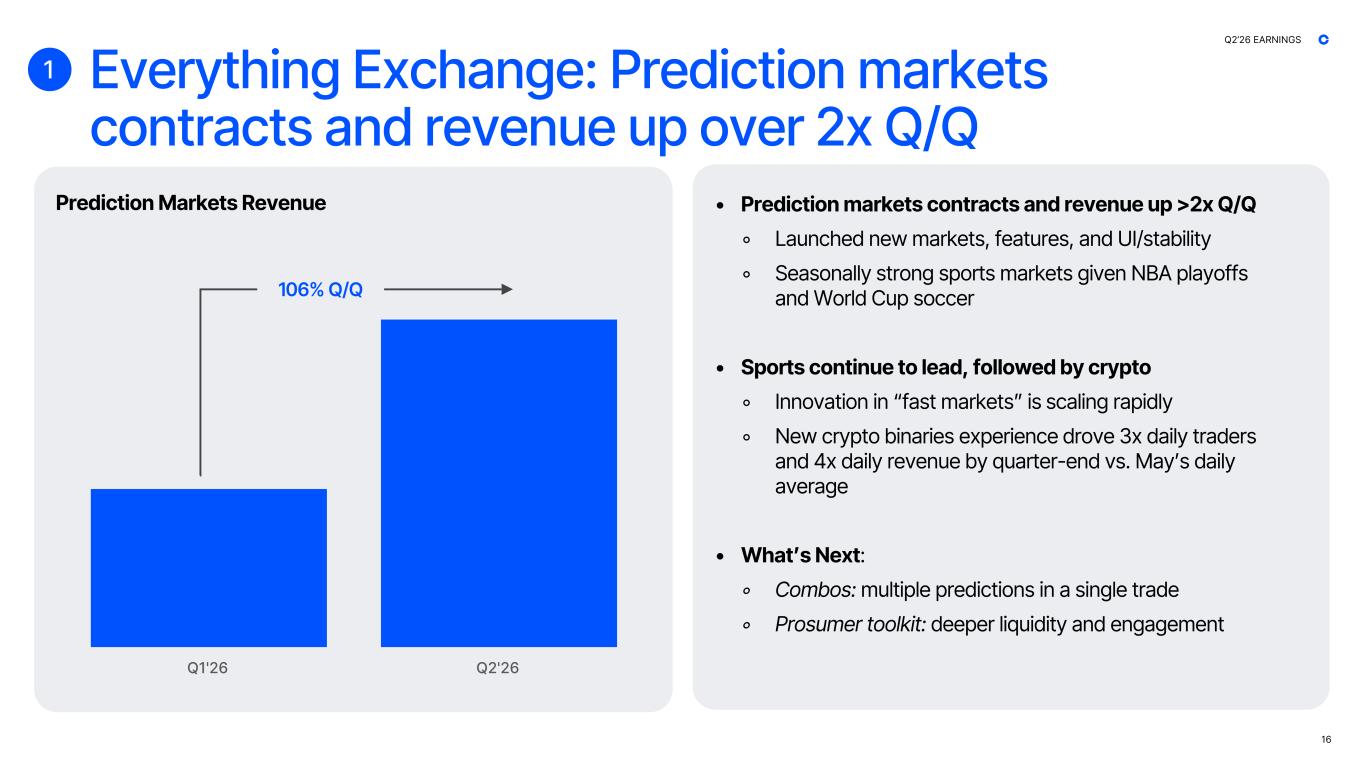
All right. Why don't I start on this one? So our whole strategy starts with providing safe storage of customer assets and driving our assets on platform we find when customers store with us they transact with us so then when we get to our growth marketing strategy it really looks to what product is meeting the market need and where do we see activity coming from in our retail customer base currently we are seeing a lot of success with growth marketing efforts around prediction markets and also crypto trading some of the new products that we've offered in derivatives as well. We are typically seeing a one-year payback on growth marketing efforts, but recently we've outperformed this benchmark. We have also early signals that customers who are engaging with these new products, for example, prediction markets, are also driving incremental spot trading volume. So we're not seeing cannibalization. These early days are actually indicating that we're seeing incremental trading coming as we then cross-sell and have more customers adopt more products on our platform.
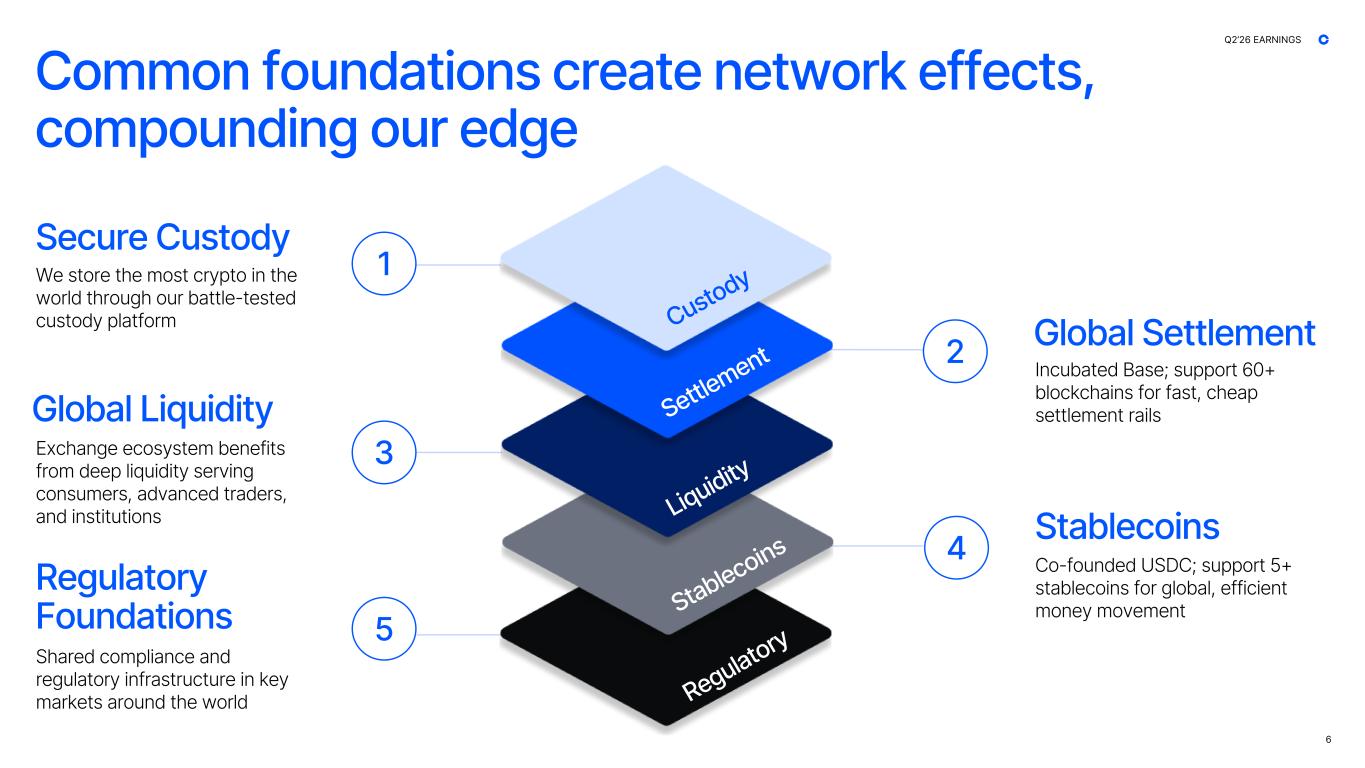
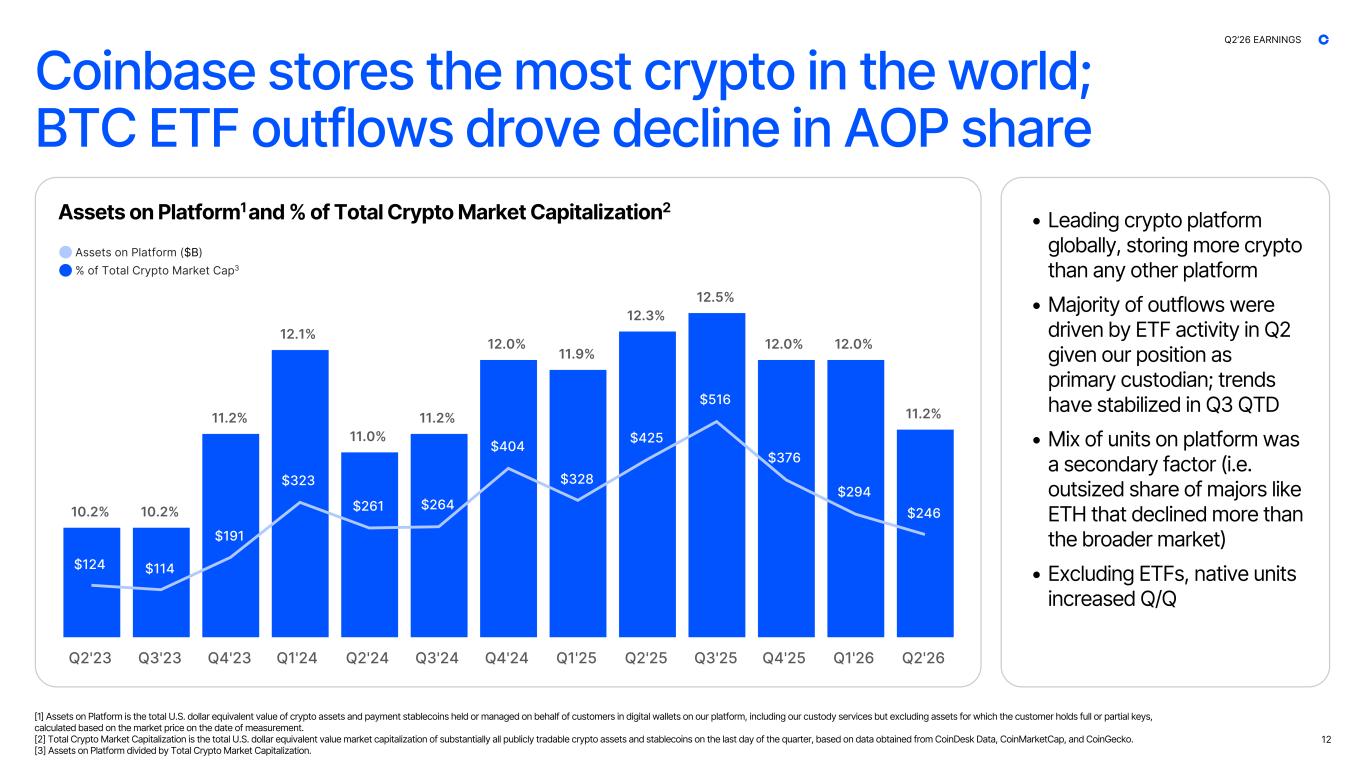
Yeah, just to underscore that, I mean, the asset accumulation is a core part of the strategy there. When we see customers trust us, we have the most trusted branding crypto, we store more crypto than any other company out there. If they're willing to store their assets with us, then whenever they come back for the one product that they are using today, we have a chance to put something in front of them. And over time, they can adopt additional products. and it tends to be good for user retention the more products they use and the more assets they store with us. So we have various incentives set up to encourage more of that. For instance, you can get a higher rate on the Coinbase One card the more assets you're storing with us. So we look at tiers like that to get people incentivized to store more assets with us over time.
All right, now we're gonna go back to the top. So Eric Pan, question number two.
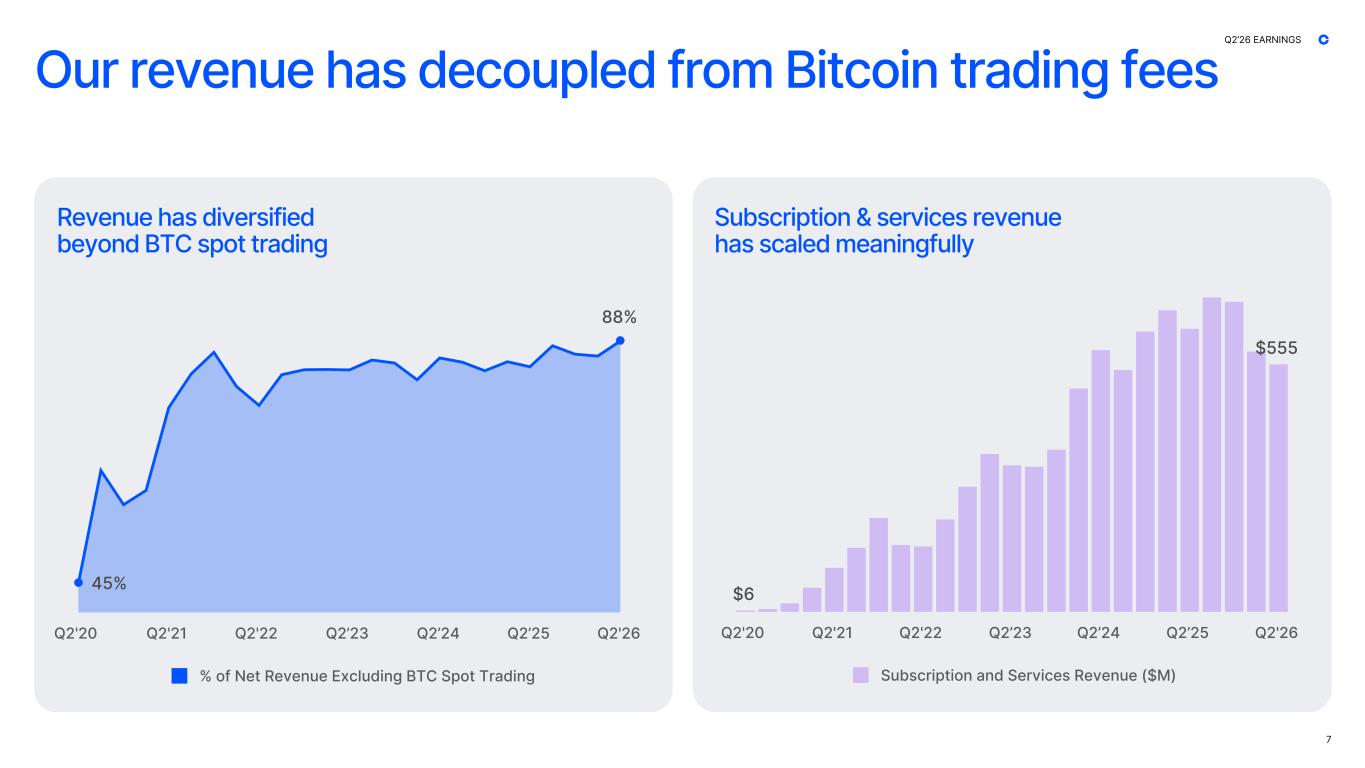
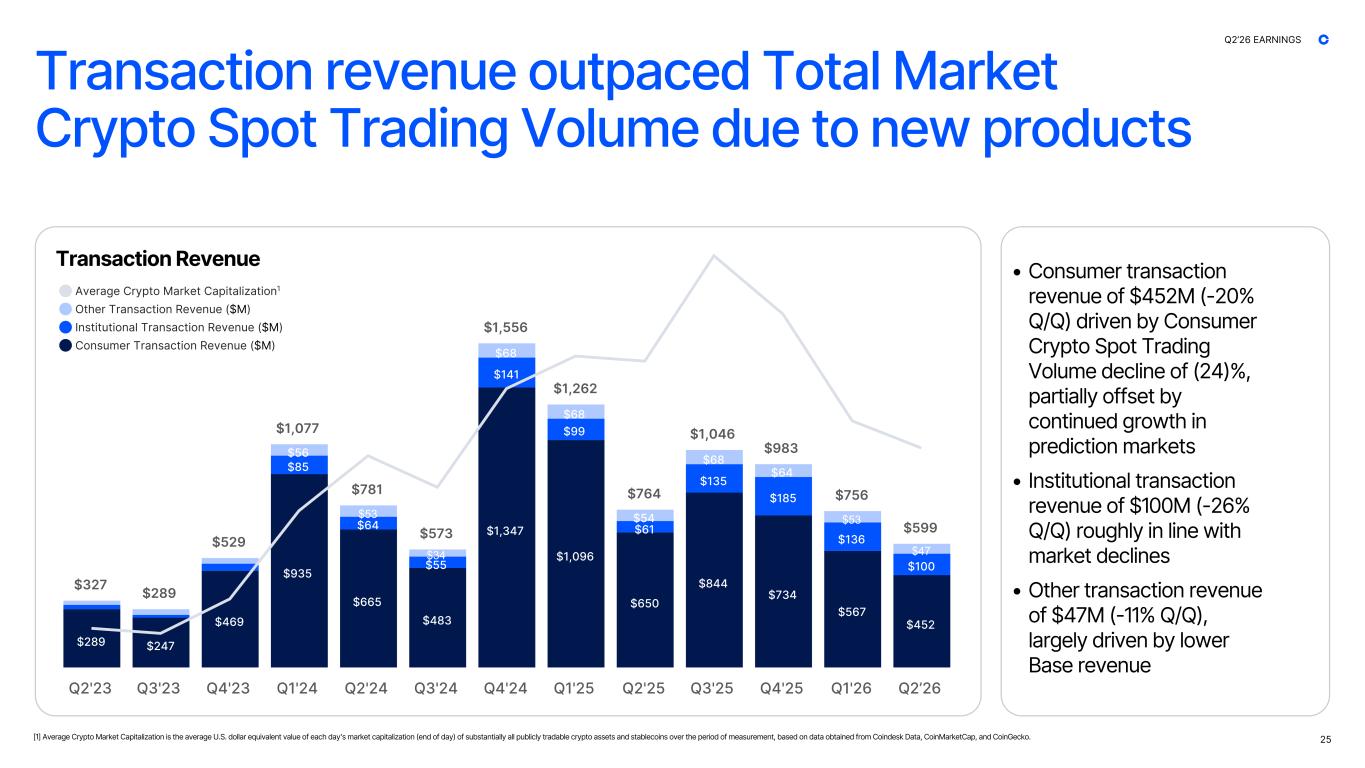
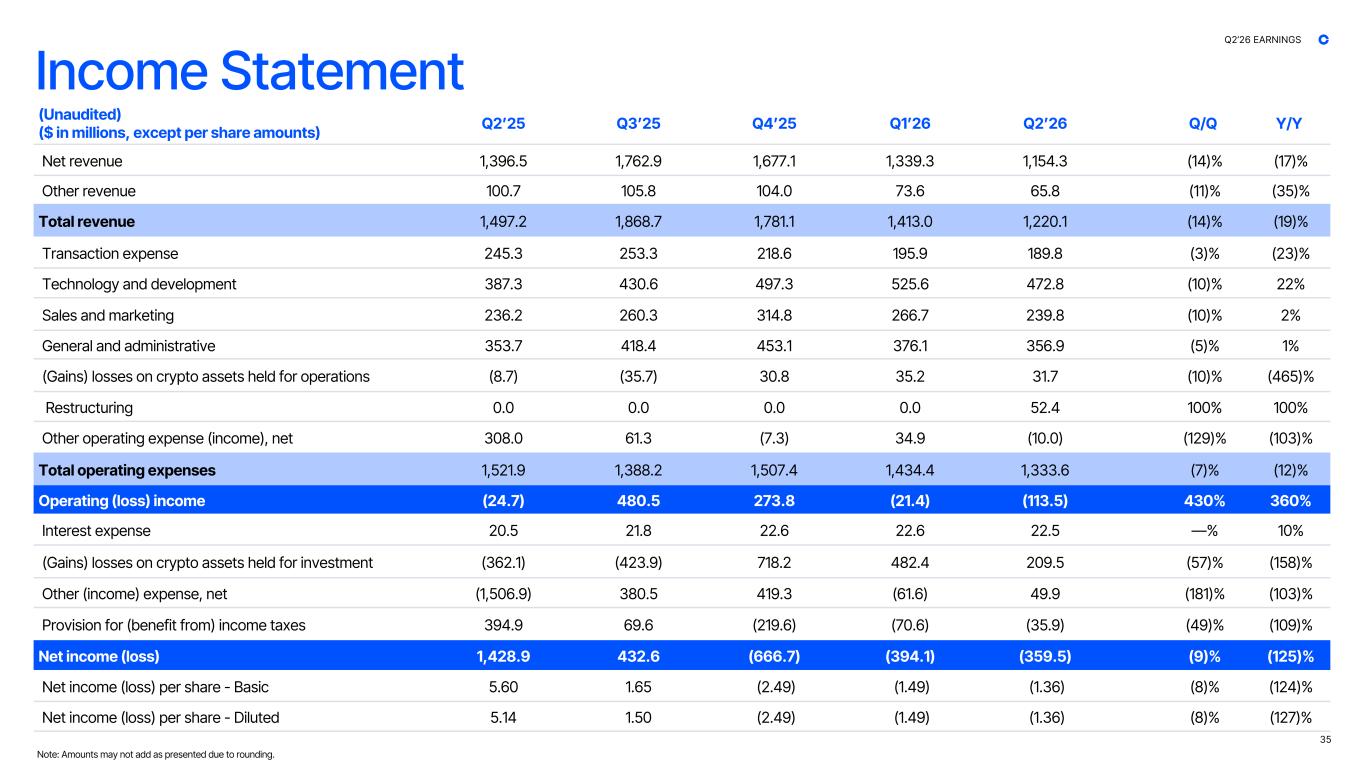
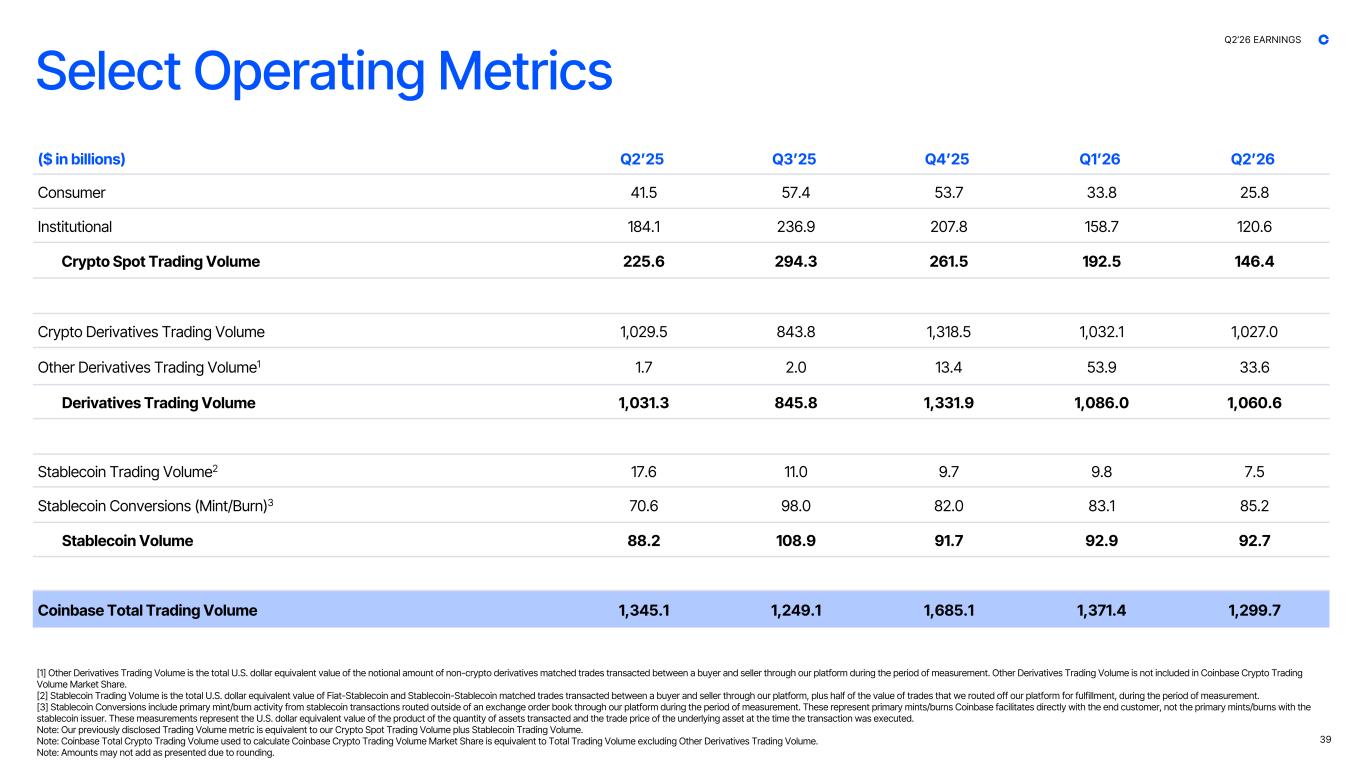
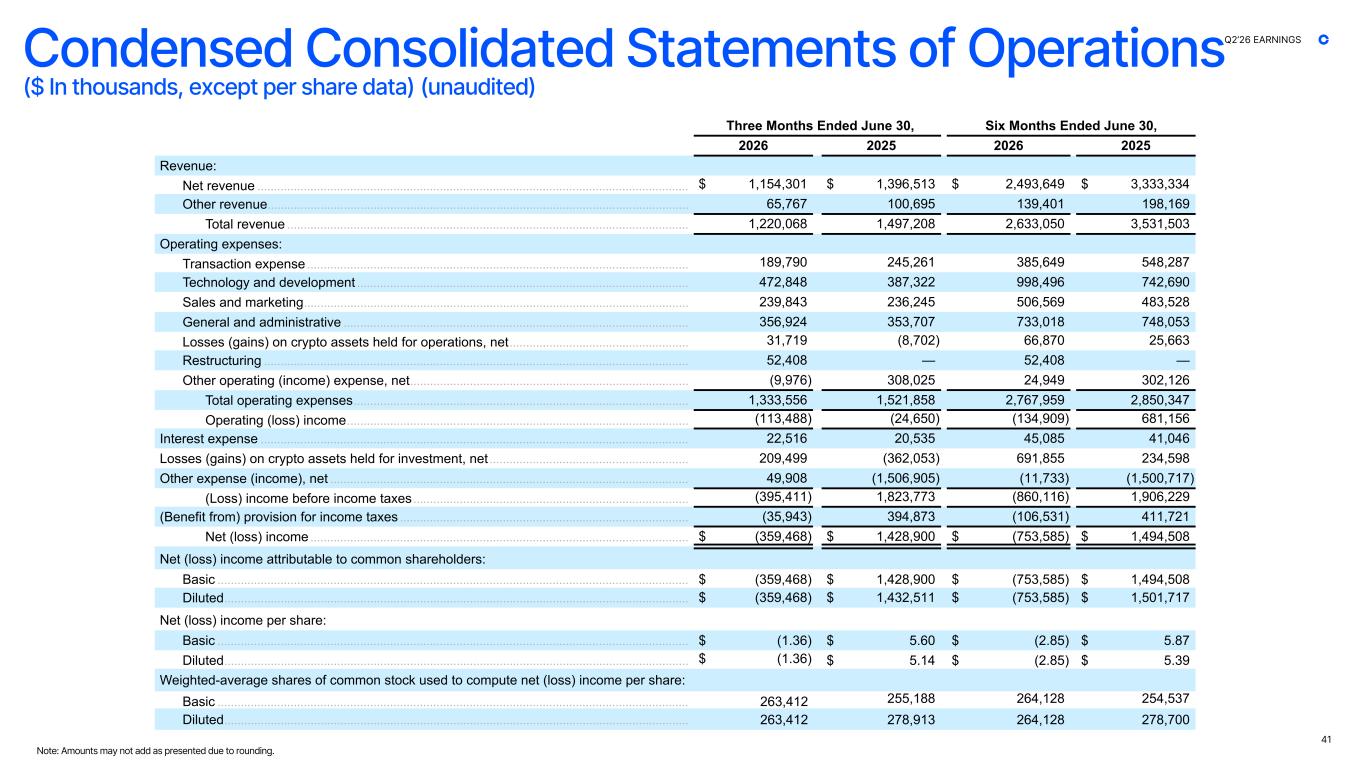
Sure, thank you. So Coinbase continues to diversify and decouple your revenue streams as Bitcoin related transactions used to comprise more than half the entire company's revenue. And now it's a staggering 12% of the business. So what other revenue verticals are you guys really focusing on? I know you guys are making a big push on the agentic commerce side. So we'd love to hear more about that along with other verticals.
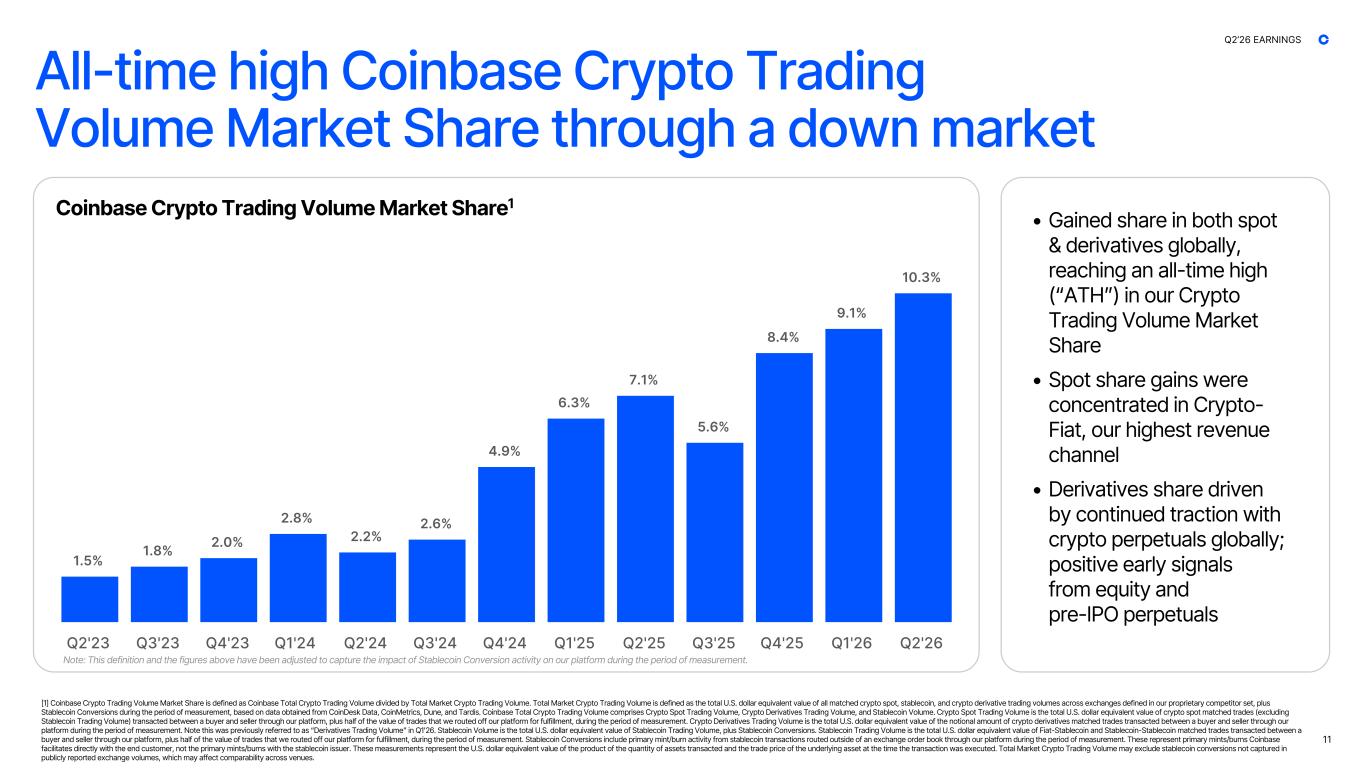
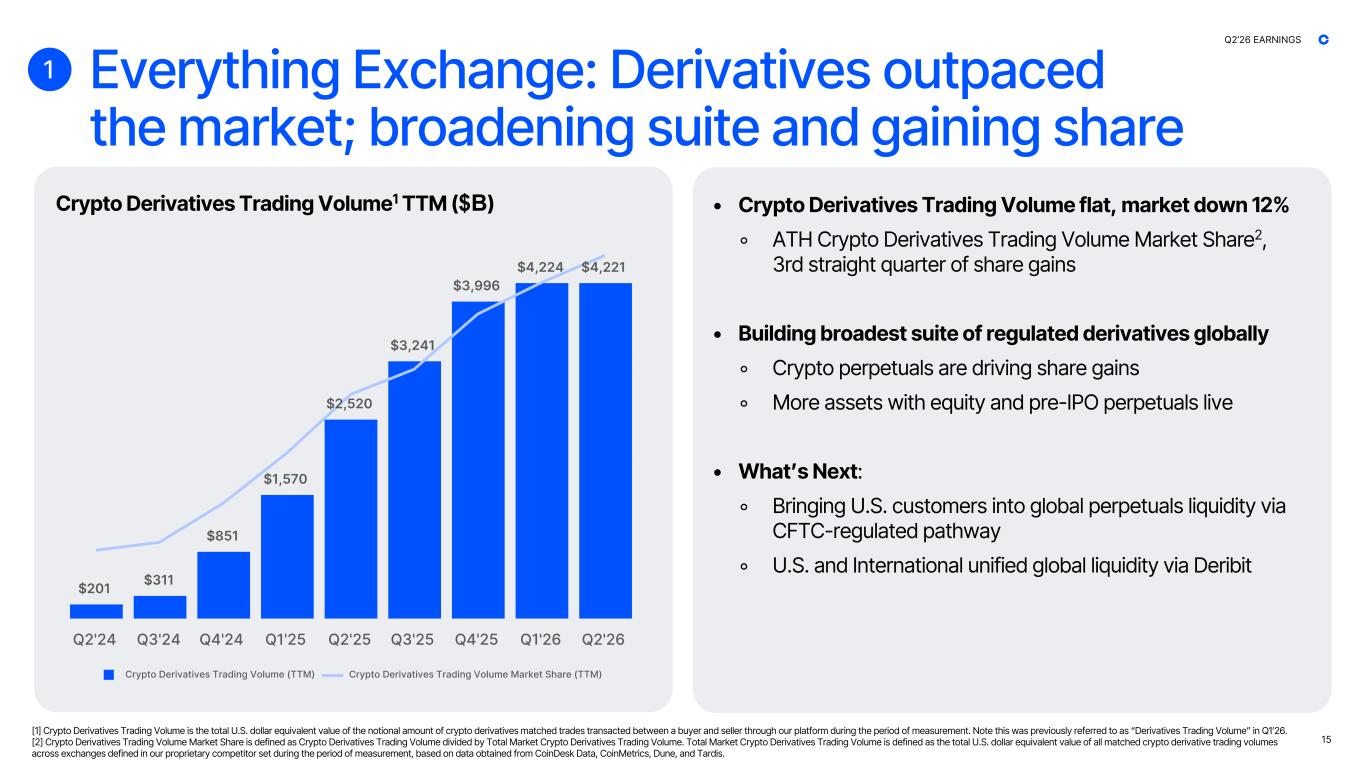
Yeah, well, thanks for noticing that. I mean, we're diversifying revenue both on the trading fee side and on subscription and services with non-trading fees. So on the trading fee side, I mean, we're seeing good adoption of things like prediction markets, perpetual futures. You're seeing our overall trading volume share grow. We added stock trading. There's various things that we've talked about on the horizon, like stock options trading. So I think that the diversity of revenue on trading fees specifically will continue to happen. And I think Bitcoin will come back in a big way too, by the way. It keeps going through these cycles. So at any given time in trading, there's always something that's up and something that's down. And so you have to have really, that's part of the everything exchange strategy. You've got to have all the shelves stocked. So you have the inventory when people, when that thing trends that week. And then on the non-trading fee side with subscription and services, we've seen good growth of that over the past years as well. And it just allows our business to be a bit more predictable. So yeah, Alicia, anything you want to add on that?
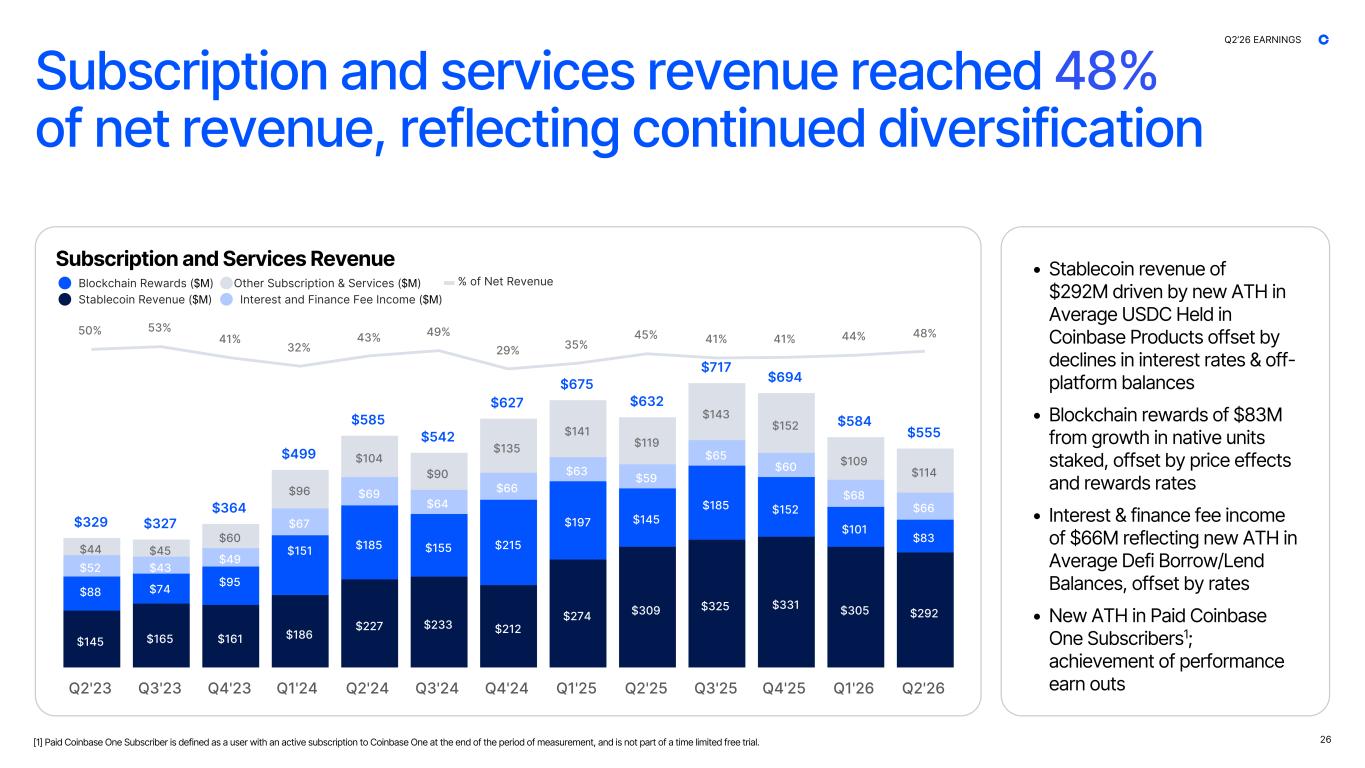
One thing I wanted to share that maybe people looked past is that we saw an all-time high in paid Coinbase One subscribers this quarter. And what that's really indicating to us, and this is during a down market, obviously, we saw crypto trading volumes down, but growth in Coinbase One memberships. And so it really speaks to then the value of the subscription product. And these tend to be our most deeply engaged customers that try out the most products and services we offer. So that's another important growth vector that we think we can really drive membership and engagement through our platform through that subscription product.
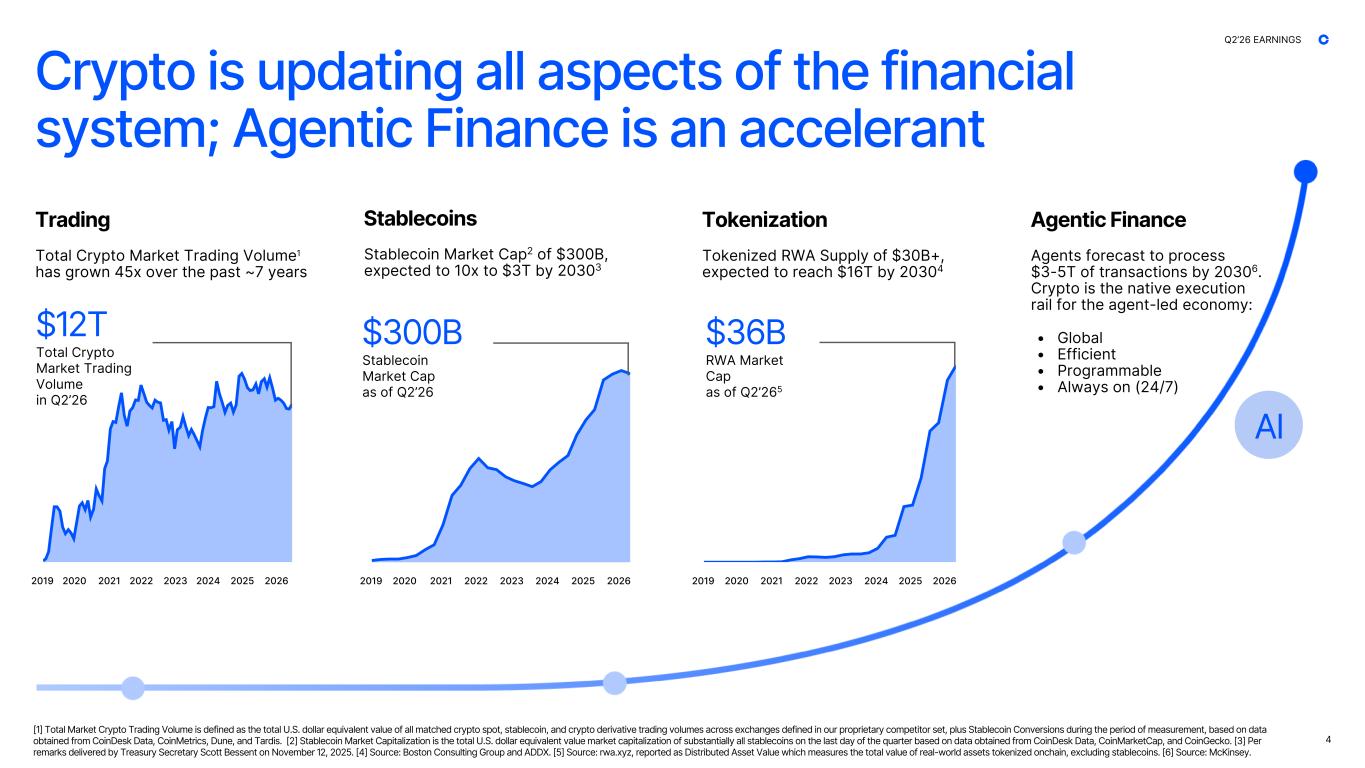
Thank you. Yeah, you asked, I think you asked about Agentic Finance as well, or AIFI. I think it's still very early days on that. I'd say Coinbase has an early lead, you know, from an Agentic Finance point of view. We are seeing the majority of the transactions happening with USDC and base and X402 and Coinbase developer platform has been a really great resource for people on that, but it's still quite early. So I don't think we have any specific numbers or forecasts to share on that at the moment.
Sounds good. And I just really want to make a comment that I really love the fact that you guys are building the rails amongst all of this. So when the $450 trillion global asset market moves on chain, when the rails get rebuilt, Coinbase is well positioned to be able to capitalize on all of that because you guys own the plumbing. So I really love that. Thank you. Yeah. Yeah. Thank you. Building for the future here.
All right. Owen. Owen Lau from ClearStreet. Back to you.
Thank you, Alicia. Last month, Coinbase started to offer pre-IPO perpetual futures for non-US traders to gain access to private companies. The first one was SpaceX. Could you please talk about the next step and the pipeline you're building? When should we expect to see more private companies? And do you have timeline for when this product can be offered to US customers? Thanks a lot.
Yeah, so the early traction is definitely encouraging on the pre-IPO perps, and there's a lot of customer demand for it. In terms of US access, that is on the roadmap, and we'll keep pushing on that. But yeah, I think it's important to get people access to these kinds of things that they historically couldn't get access to. It's a good part of democratizing the financial system. So we'll keep pushing on that from a US approval point of view. Thanks a lot.
All right. Brian Jung, back over to you.
Yeah, thanks, guys. So, Brian, I'm particularly interested in the evolving competitive landscape right now in crypto, especially with Robinhood. They announced that they were expanding deeper into crypto. They recently launched their own L2. How do you view them as a competitor? And particularly, how do you view them in relation to the whole base ecosystem?
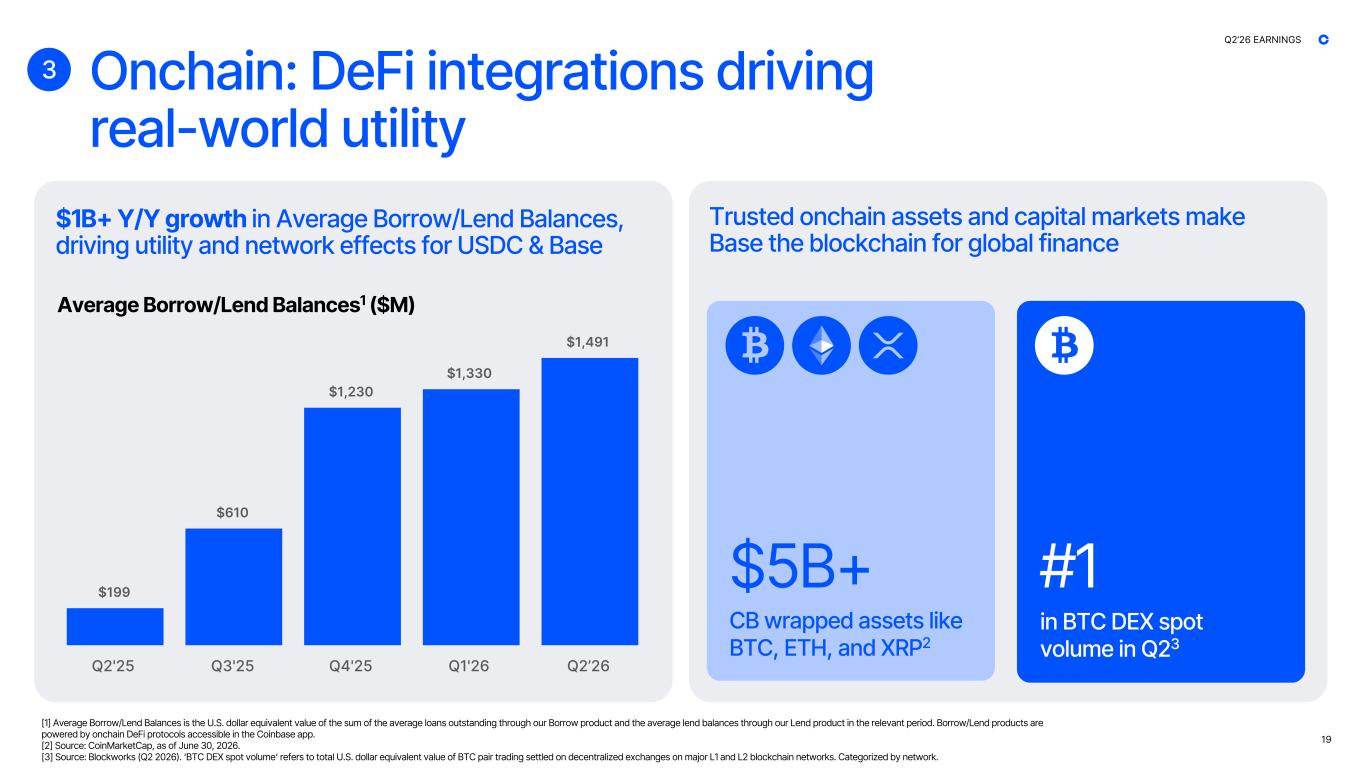
Yeah, so we are seeing lots of different companies come out and launch their own chain now, which, you know, in a way is normal. like whenever you have a growing market, you see initially fragmentation. And then over time, you typically see consolidation. We've seen that this has been true for automobiles and trains and all kinds of things historically. But even in the crypto space, I think we saw this with stablecoins where just it seemed like there was a period of time where every company was coming out with their own stablecoin. And there was a belief that we all have to have our own. And then it's turned out that despite all of those new stablecoins being announced, the market share of, say, USDC and Tether has not really shrunk by almost any amount over the last year or so. So maybe a very de minimis amount. So I think what people found out in stablecoins is that there's an actual network effect to stablecoins. And customers, if you're sending and receiving between platforms, which is a big part of the utility of it, then you want to keep it all in a stablecoin that you know, You don't have to be paying sort of an FX or conversion fee every time you use a stablecoin. So my guess is we're going to see something similar happen with blockchains. And, you know, Stripe has launched one and Robinhood has launched one. Some of them are a little bit more special purpose, I guess, in what they're targeting. And then, you know, the largest blockchains out there, Ethereum and Solana, are still kind of more general purpose. So it's an interesting question about when the consolidation phase will start to happen. And, of course, BASE has been doing really well as the largest L2 on Ethereum. You know, it's the most liquid market, for instance, like with crypto spot trading, like Bitcoin and Ethereum. You know, I think it's number one now in terms of stablecoin transfer volume. I think it did about like $32 trillion in the last 12 months of stablecoin transfer volume. It's also the leader in agentic finance, right? We've seen, like I mentioned earlier, the payments that are happening with X402 and those kind of things. They're happening predominantly on base. So, you know, I'm very excited about base. I think it's an incredible innovation. I think, you know, there's a path to decentralize it over time, which we've said publicly in the past, where we want lots of companies to be able to build on it as neutral infrastructure. And we've been making good progress of that through the different stages of decentralization. So we've got really like a two-year head start, I would say. We're going to continue to invest in base. We're going to make sure everyone can build on top of it. And then, you know, we probably will see more companies launch their own. And then the question is, when will that consolidation phase happen? And how might there be sort of an M&A type process in the world of blockchains? Like, we've seen small examples of that in the past, but who knows, we might have to become a bit of a specialist in that area. I love it. Thank you.
All right. Ken Worthington from JP Morgan.
Hi. The relationship with hyperliquid seems to demonstrate that if a third party has enough USDC, it can leverage the position into commanding the majority of the USDC economics. How do you continue to invest in the USDC network, bring in new participants, and still protect the longer-term economics as the network strengthens?
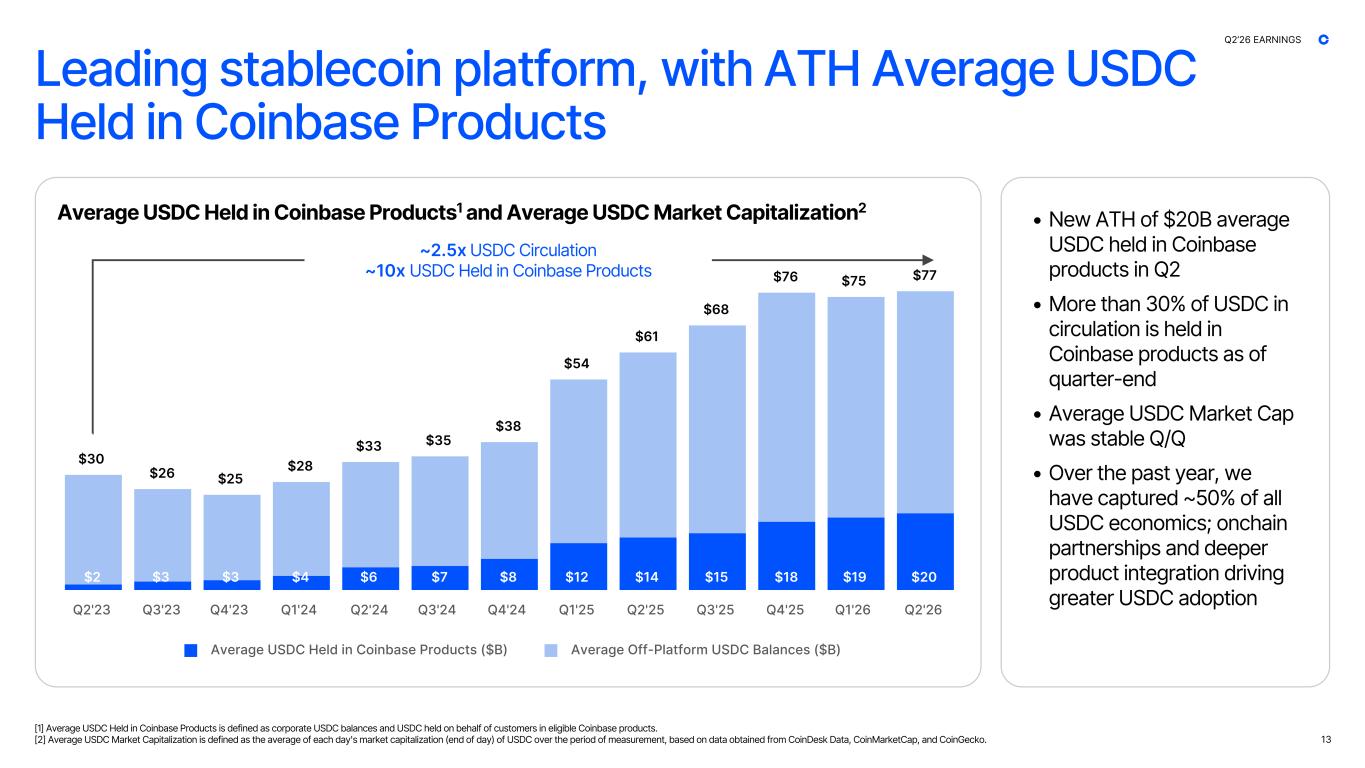
Maybe I'll start with this one, Ken. So anybody is welcome to come to Coinbase and become a customer and hold USDC on our platform and participate in rewards. We want to welcome institutional customers to do this. And if you're a Coinbase One member as a retail holder, you're also welcome to come and earn rewards on your USDC by participating in our products and services. So we didn't view Hyperliquid any differently in that way. They are obviously a very important market player in the overall Perpetual Futures ecosystem. And we believe that this partnership will drive broader network effect, broader USDC adoption by deeply embedding it in an important player that has a lot of its own market maker activity. With stable coins, with underlying protocols, even base, liquidity network effect are critically important. And so bringing USDC deeply into this ecosystem just further drives USDC growth and adoption throughout the ecosystem. So that was our strategy. This is what we think is the right long-term strategy for stable coins. And we're happy to share economics to drive this network effect.
Yeah, just to underscore that. Yeah, we're going to keep investing in USDC to keep growing it. And, you know, it's actually it's already number one, if you look at stablecoin transaction volume, which is great, it's, it's already number one, the number one regulated stablecoin in the world. The only one that it hasn't achieved the number one on is if you look at regulated and under regulated, and then you say, what's the market cap or the assets under management that then, you know, you could say it's number two compared to tether so i do think it's important for us to continue sharing economics to grow usdc and get it to be number one across all those categories not just two out of three and um you know that it's there's disproportionate gains to being the number one in the market so we're going to keep doing that to try to help it out absolutely all right austin hankwitz over to you hey alicia um so you already alluded to this earlier but i kind of want to linger on it uh for a little bit which is coinbase one past a million subscribers now you just said you know new all-time highs you've
also said that members trade more and generate higher revenue per user but that said members do get these zero fee trading and you've noted that you can still capture a spread that books you know that retail transaction revenue but as more volume shifts under this coinbase one umbrella is revenue per dollar traded higher or lower for a coinbase one member than a non-member so you know, should investors read this Coinbase one as accretive or as take rate compression? Thank you.
Great question. I'm going to give an unsatisfying answer because when I look at the data on average Coinbase one subscribers trade more and have higher unit economics, but there's always examples on the edges. And so I think that what you'll see obviously is the revenue will not just all accrue to the trading revenue area because those Coinbase One users, they're also staking. They're also using their Coinbase One credit card. So we're earning revenue in multiple ways to the Coinbase One membership. But what we see is it's an accretive relationship because it's just driving activity up and down the product stack. So I think overall, this will be more net economic positive to us. We also see better retention rates and better engagement rates, but you will see the revenue shift through the P&L if we see broad adoption and a shift from just a la cart users to Coinbase One subscribers.
That makes a ton of sense to me. Thank you so much for walking me through that.
All right. Next, we have Alex Markraff.
Alex, we're not able to hear you. If you want to try something with your mic.
All right, we'll give him a minute. And if we lost him, then I think then we will have ended the call for this quarter. Give him two more seconds. All right. Great. Well, that wraps up our Q2 2026 earnings call on X. Thank you all for joining us, and we look forward to seeing you next quarter.