Operator
Greetings, and welcome to the Americold Realty Trust Second Quarter 2025 Earnings Conference Call. As a reminder, this conference is being recorded. It is now my pleasure to introduce your host, Rich Leland, Vice President of Investor Relations and Treasurer. Thank you, sir. You may begin.
Speaker 1
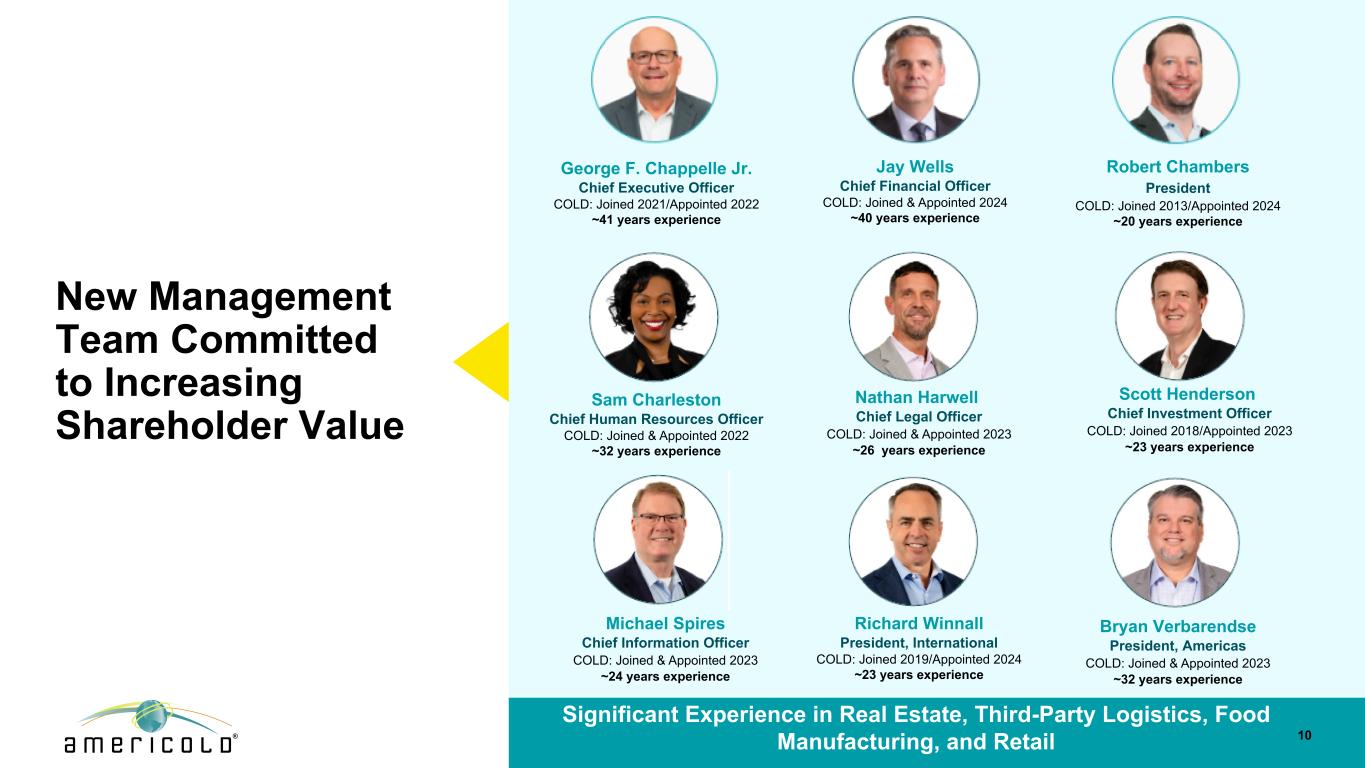
Good morning. Thank you for joining us today for Americold Realty Trust's Second Quarter 2025 Earnings Conference Call. In addition to the press release distributed this morning, we have filed a supplemental financial package with additional details on our financial results which is available in the Investor Relations section on our website at www.americold.com. This morning's conference call is hosted by Americold's Chief Executive Officer, George Chappelle; President, Rob Chambers; and Chief Financial Officer, Jay Wells. Management will make some prepared comments, after which we'll open up the call to your questions. Before we begin, let me remind you that management's remarks today may contain forward-looking statements. Forward-looking statements are subject to a number of risks and uncertainties that may cause actual results to differ materially from those anticipated. These forward-looking statements are based on current expectations, assumptions and beliefs as well as information available to us at this time and speak only as of the date they are made. And management undertakes no obligation to update publicly any of these statements in light of new information or future events. During this call, we will also discuss certain non-GAAP financial measures, including NOI, net debt to pro forma core EBITDA, and AFFO. The full definitions of these non-GAAP financial measures and reconciliations to the comparable GAAP financial measures are contained in the supplemental information package available on the company's website. Please note that all warehouse financial results are in constant currency, unless otherwise noted. Now I will turn the call over to George.
Speaker 2
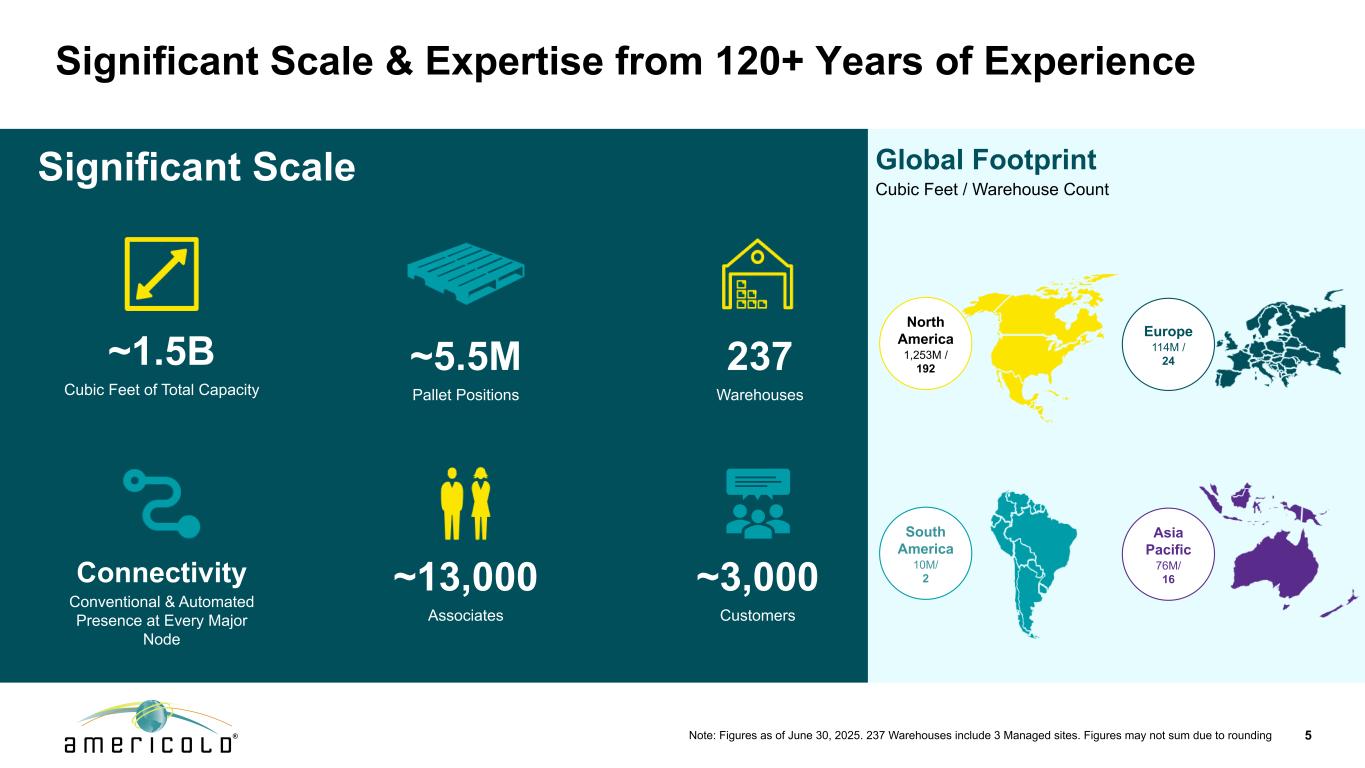
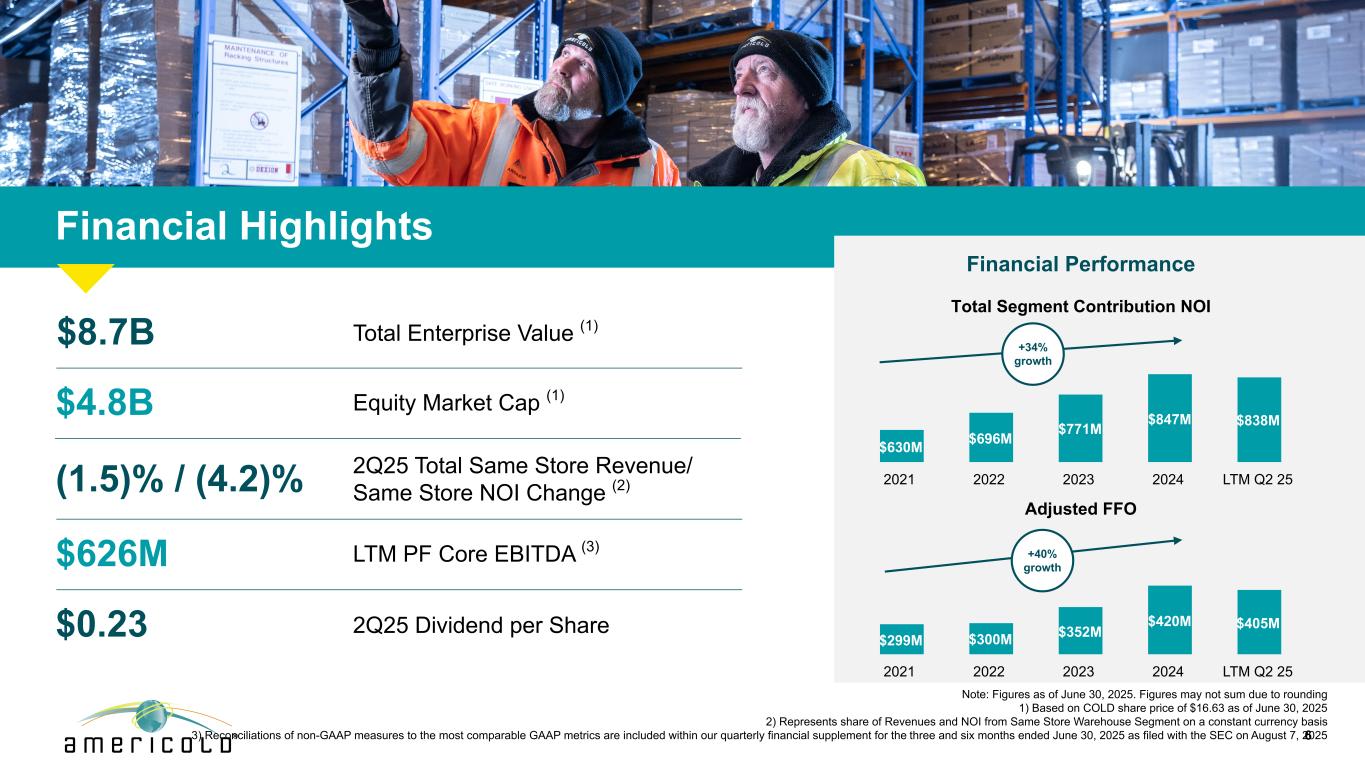
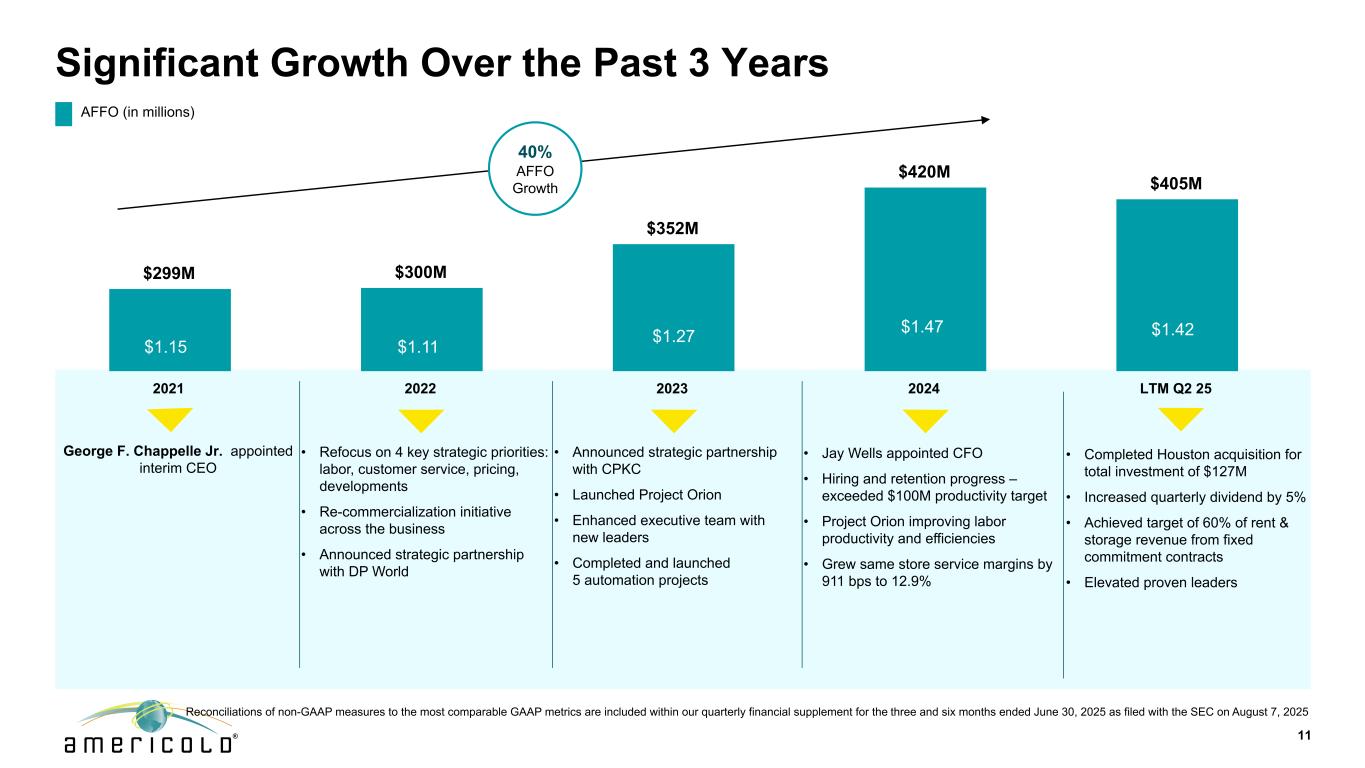
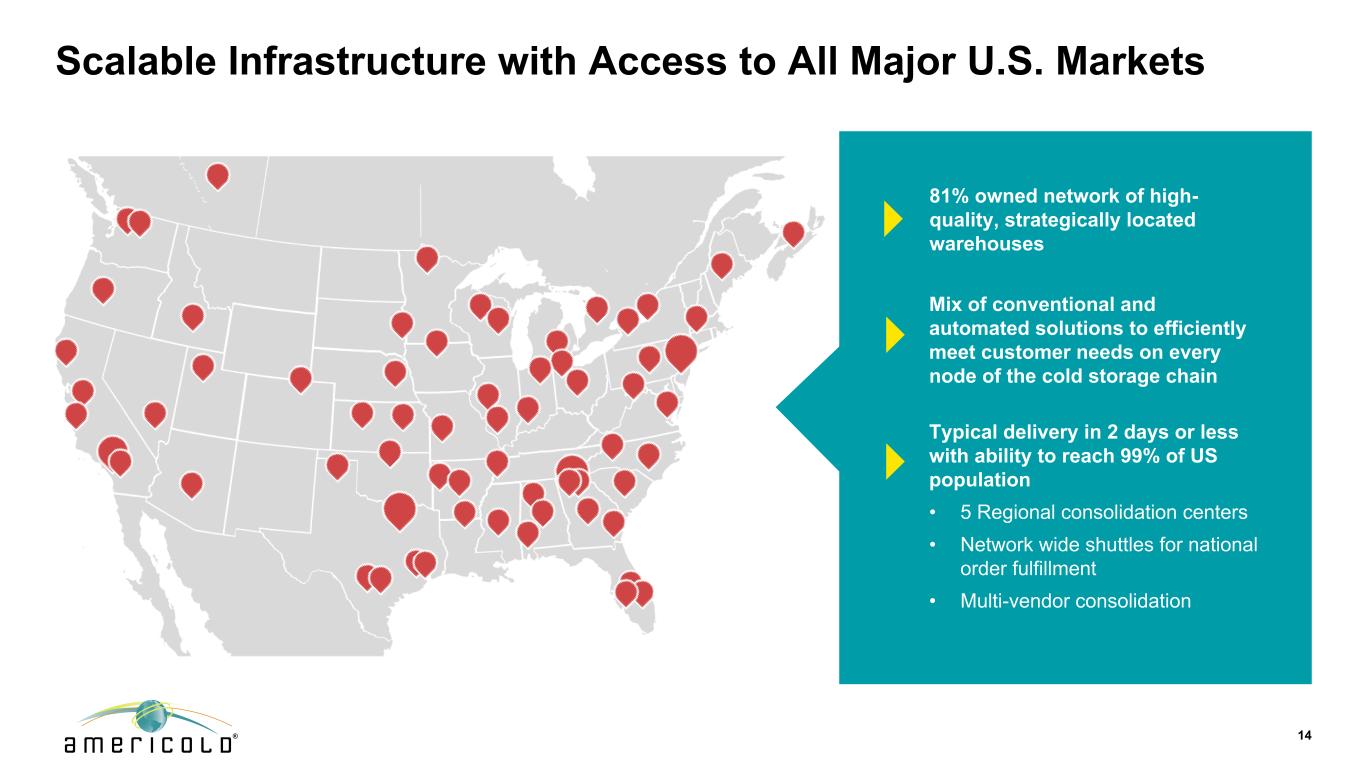
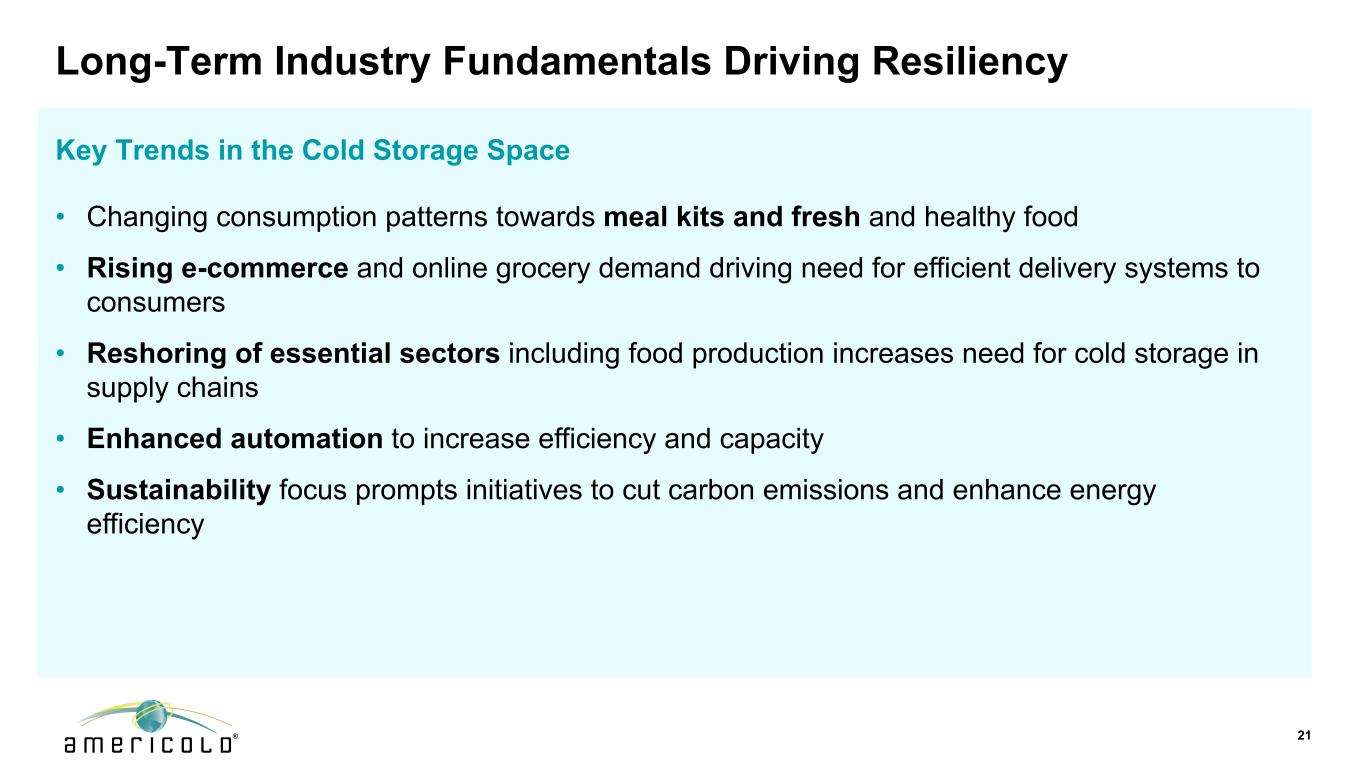
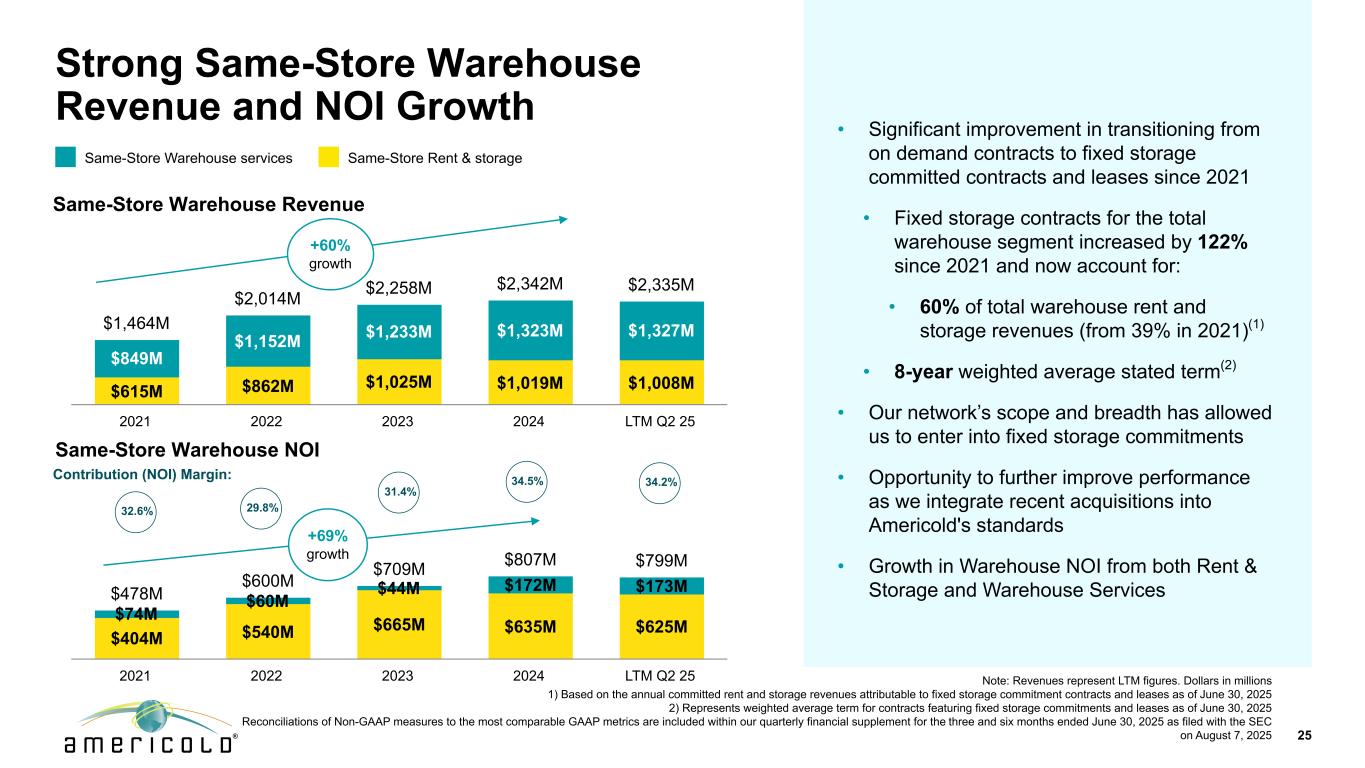
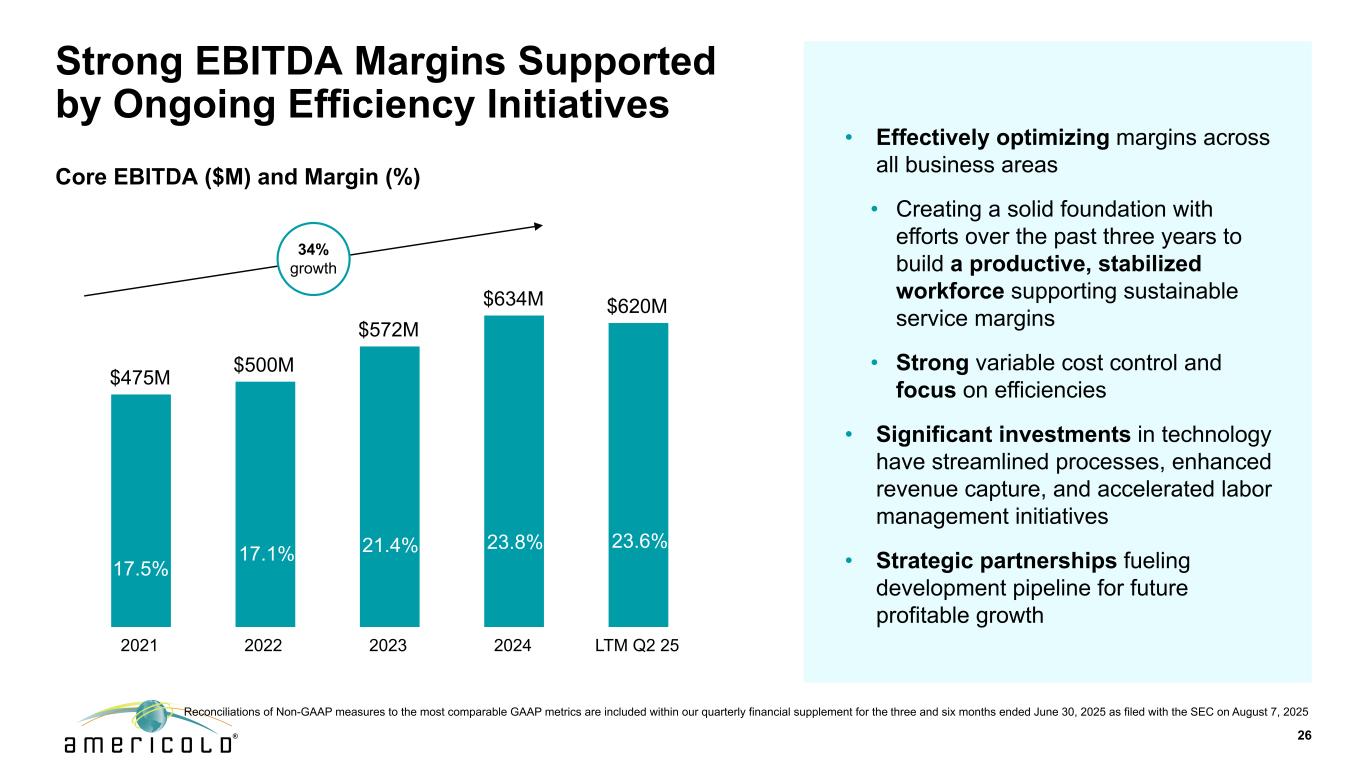
Thank you, Rich, and thank you all for joining our second quarter 2025 earnings conference call. This morning, I will provide an update on our four key priorities, our financial results for the quarter, and current market conditions. Rob will then discuss our customer service initiatives and development activity. Finally, Jay will review our capital position and liquidity and discuss our outlook for the balance of the year. Turning to our four key priorities and financial results for the quarter. We said Q2 would look a lot like Q1, and that's exactly how it unfolded. Starting with customer service. During the quarter, Americold was recognized as a top 3PL and cold storage provider by Food Logistics Magazine. This award recognizes cold storage companies that are revolutionizing the global cold storage food supply chain and reliably delivering innovative and high-quality solutions throughout the world. We are honored to be recognized, and I want to thank our incredible team for their continued dedication to providing our customers with best-in-class service. As anticipated, same-store economic occupancy declined slightly in the second quarter versus the first quarter of the year. Q2 is typically the lowest seasonal quarter of the year for us, although it is difficult to define typical in the current environment. While we are pleased with the new business wins from our sales pipeline, occupancy gains have been slow to materialize given the ongoing demand headwinds. We recently had two new retail wins in Europe that are good examples of our strategy to expand our retail and QSR business across the globe and build on our leadership position. The profile of the retail and QSR businesses puts it near the top of our portfolio in terms of cash flow generation. Additionally, our rent and storage revenue from fixed commitments came in at 60% for the quarter, reflecting the quality of our mission-critical assets and the value we deliver to the customers who occupy them. Turning to labor. The investments we have made over the past few years in training, engagement, and retention initiatives continue to pay dividends. During the quarter, our perm-to-temp hours ratio was 75-25, giving us the ability to flex labor with demand while benefiting from the enhanced productivity that comes from having a dedicated and well-trained permanent workforce. You can see this reflected in the continued growth in our same-store warehouse services margins, which improved by 90 basis points year-over-year to 13.3% for the quarter. This continues to be a bright spot for the company, and we remain confident in our ability to deliver service margins in excess of 12% for the full year. Turning to pricing. In the second quarter, our same-store rent and storage revenue per economic occupied pallet increased approximately 1% versus the prior year. And same-store services revenue per throughput pallet increased by 4%. While we expect to see continued pricing pressure across our U.S. business, the team has done an excellent job of strategically defending our market share and maintaining our pricing architecture while ensuring that we receive fair value for the critical and diverse services we provide. We believe service and operational excellence will become an even more important differentiator for Americold in the future as customers seek to turn inventory faster in an effort to realize working capital efficiencies. As I mentioned last quarter, Americold is a trusted and experienced operator that delivers value to customers far beyond price per pallet position. Therefore, we are more capable of balancing price and volume versus most competitors where price is their only lever. On the development front, we have several key projects that were completed in the second quarter, including Kansas City, our flagship development with CPKC, creating an efficient new way to move temperature-controlled products across North America; our Allentown expansion, which was driven by strong customer demand in the region; and our flagship development in Dubai in partnership with DP World. Rob will discuss these further in just a moment, but these facilities are great examples of our ability to leverage our scale, expertise, and unique strategic partnerships to drive innovative new market solutions. Turning to our financial results for the quarter, Q2 AFFO per share was $0.36. Our performance in the first half of the year has largely been on track, and the team continues to execute well. However, the combined impacts of interest rates, tariffs, inflation, government benefit reductions, and excess capacity continue to pressure occupancy rates across the industry. Based on our conversations with customers, we expect these headwinds will likely continue into the second half of the year as they remain hesitant to build inventory in an uncertain demand environment. With inventory levels low across the supply chain, we are also seeing customers taking the opportunity to leverage available capacity in their own infrastructure rather than utilizing third-party storage providers. As a result of these continued headwinds, we are taking a more conservative view of the market for the second half of the year, removing the traditional seasonal inventory build that we had been forecasting and now expect occupancy levels to remain pressured for the balance of the year. Despite these top-line challenges, the team continues to execute well on our strategic priorities, and we remain focused on controlling what we can control, including lowering costs, improving efficiencies, and capturing new business. We are also actively pursuing alternative growth opportunities, such as expanding our retail and QSR business, as I mentioned earlier, and focusing on investments in underserved geographies around the world in need of infrastructure. Additionally, because of the operating component of our business, we have more levers than a traditional REIT, and this quarter is a great example of our ability to manage the variable pieces of our business in a balanced approach to deliver AFFO results in line with expectations. This ability to manage the business tightly will be increasingly important in the second half of this year as we further adjust our cost structure to reflect the current demand levels. Jay will discuss these changes in more detail in a moment. But first, I will turn the call over to Rob so he can discuss our development projects and customer initiatives in greater detail.
Speaker 3
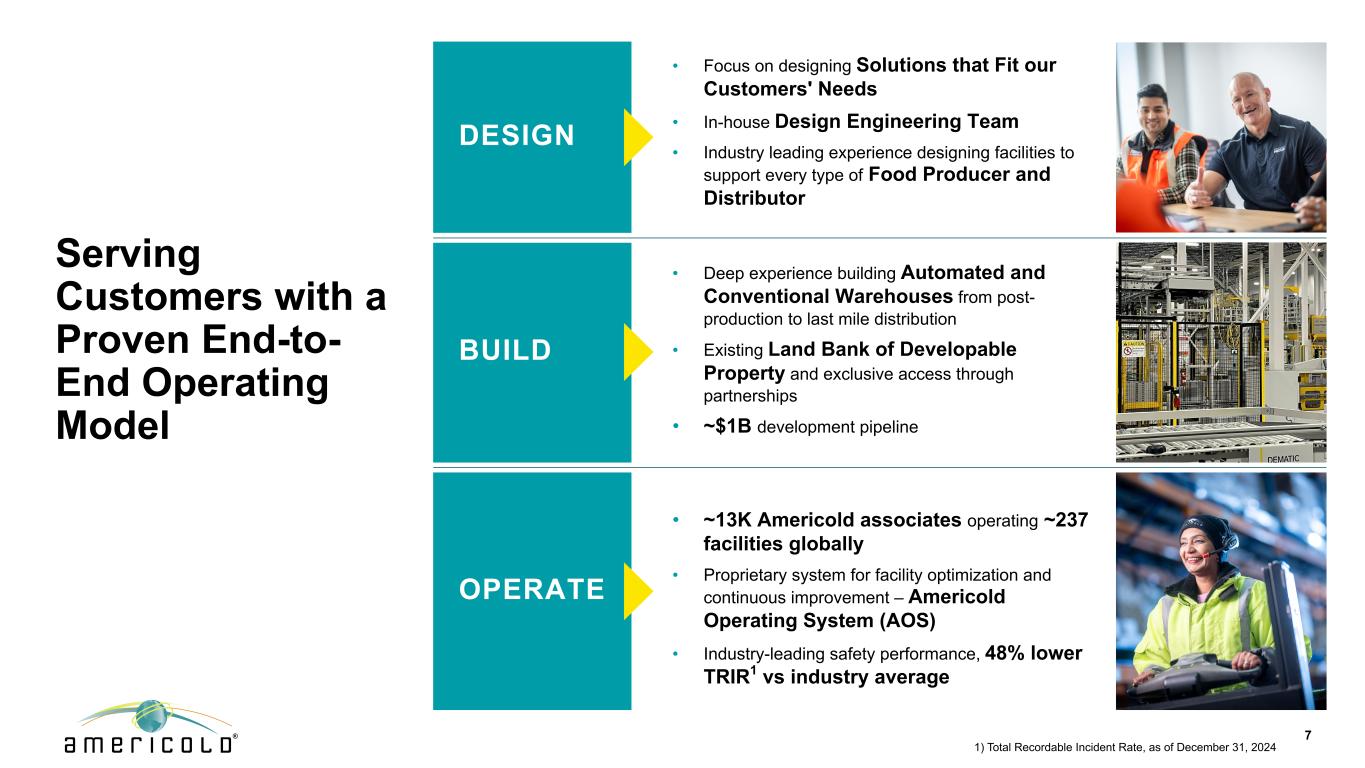
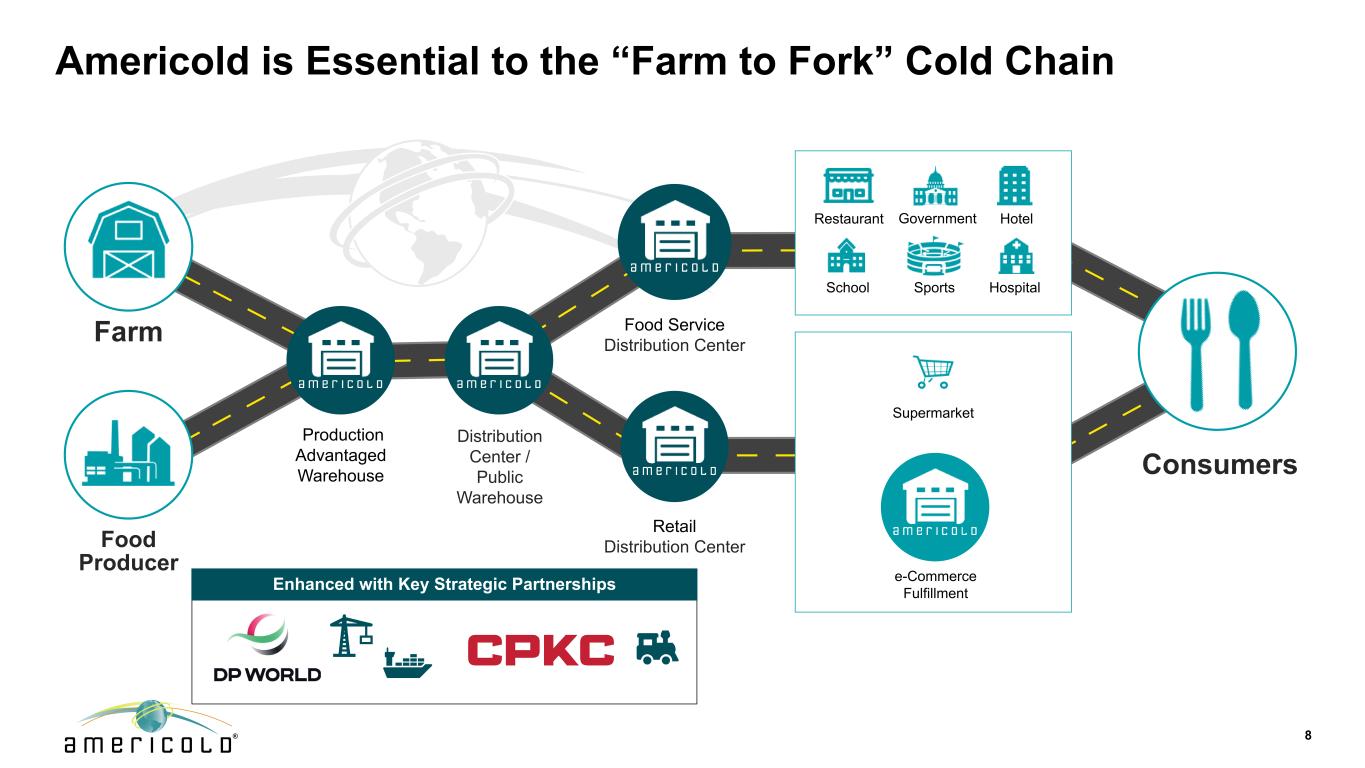
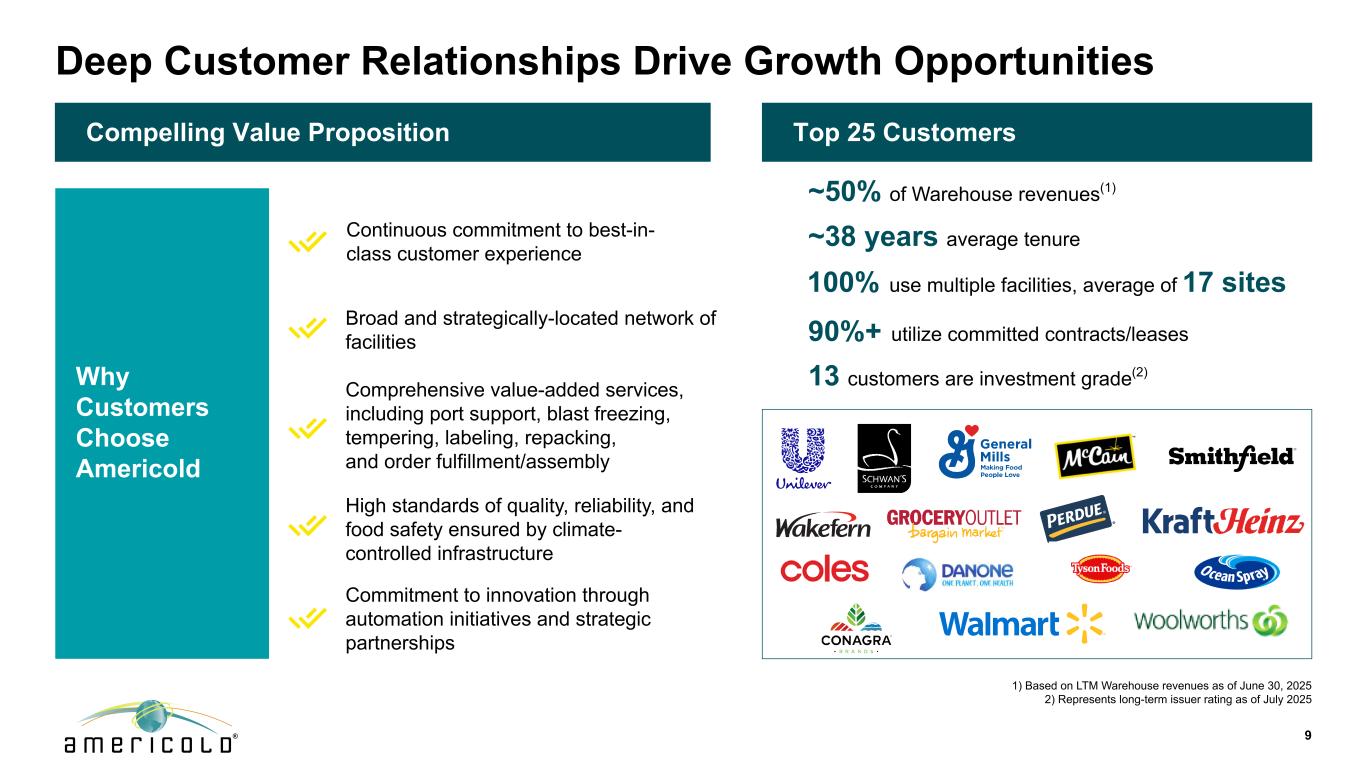
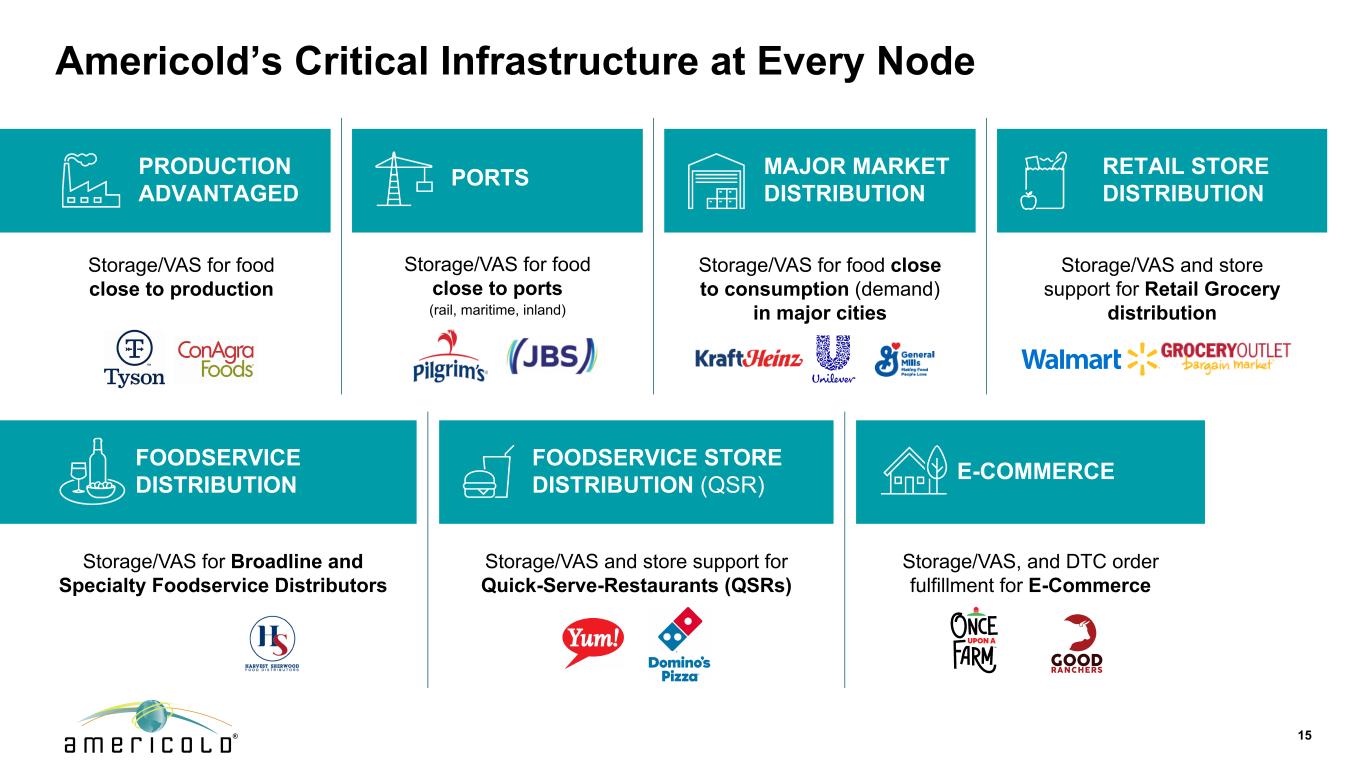
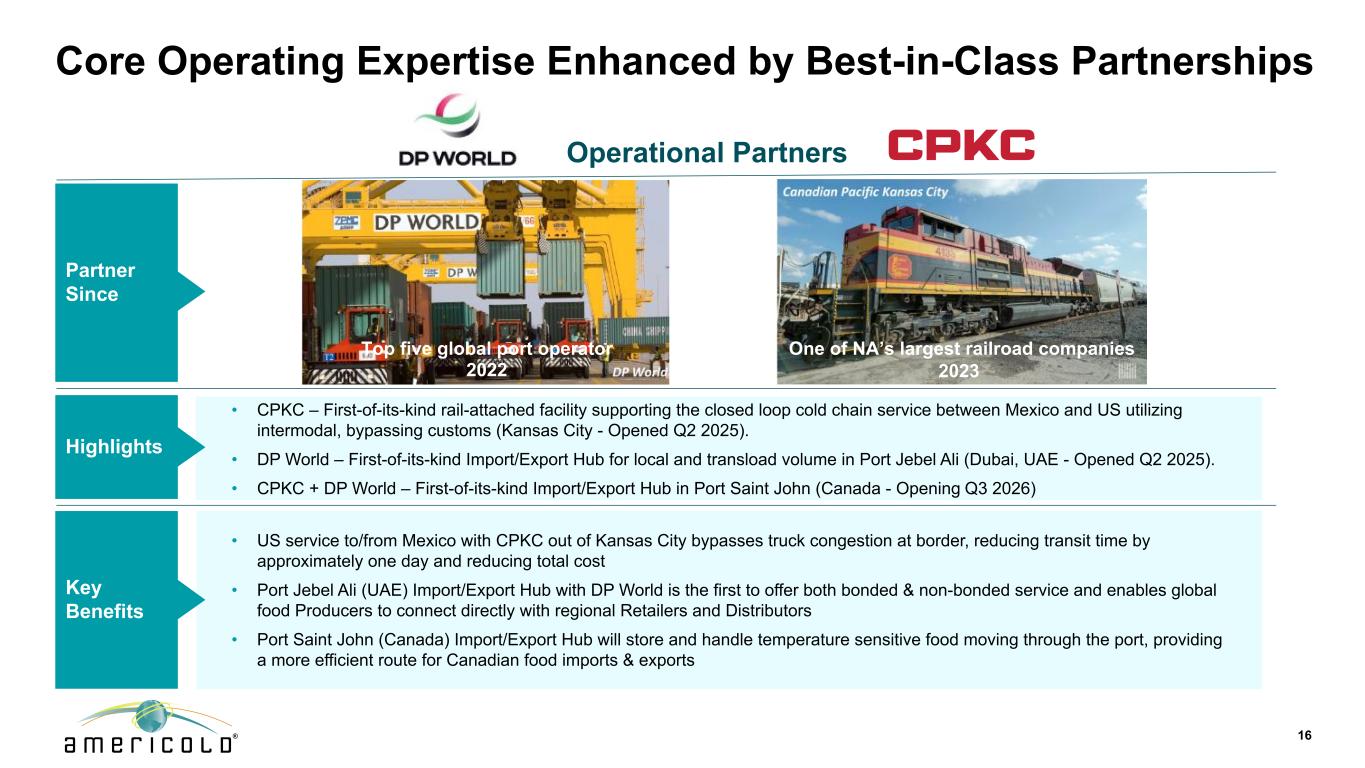
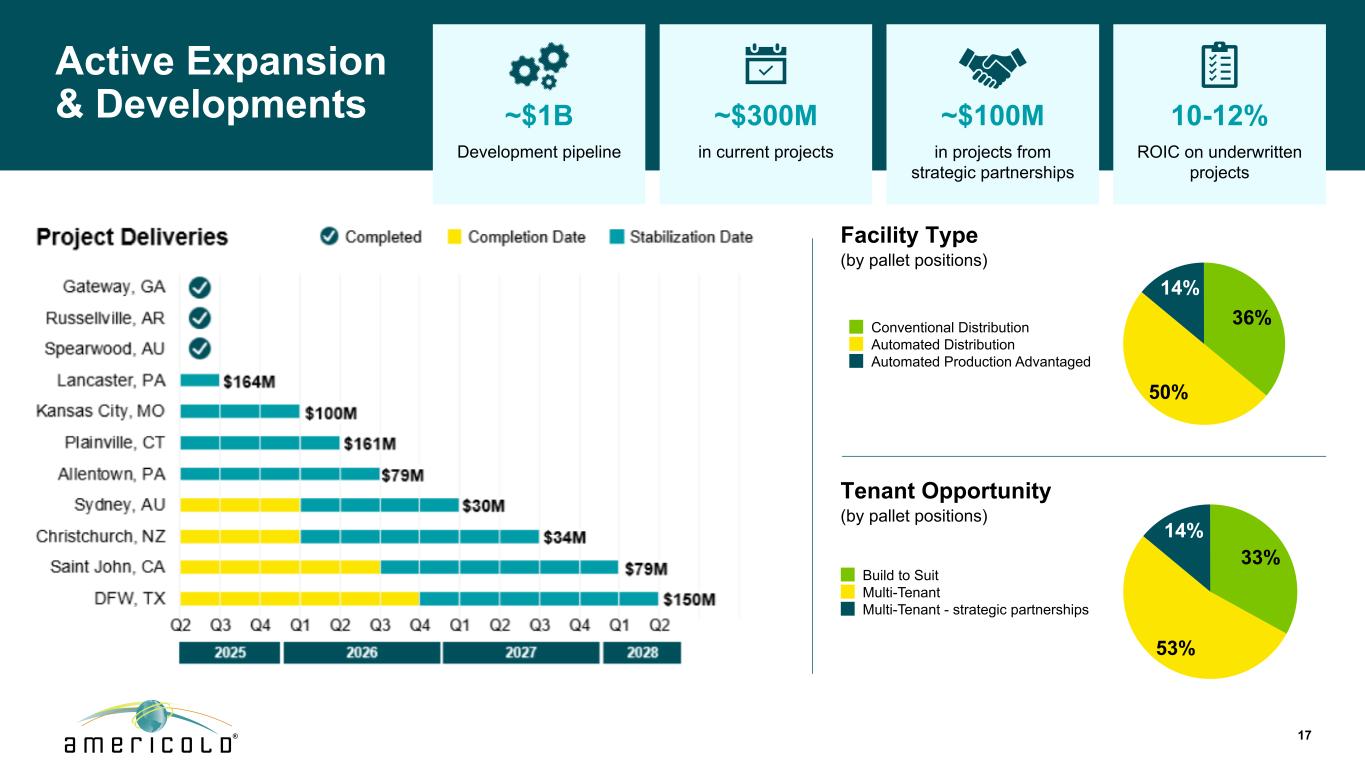
Thank you, George, and good morning, everyone. Our commercial teams continue to execute well, and during the second quarter, same-store rent and storage revenue per economic occupied pallet increased year-over-year by about 1%. And warehouse services revenue per throughput pallet increased by 4%. Although we continue to see some irrational pricing moves by competitors, we have the tools and visibility to thread the needle, balancing price and occupancy effectively while strategically defending our market share as appropriate. Our rent and storage revenue from fixed commitments came in at 60% for the quarter, maintaining the record that we set in the first quarter of the year. As a reminder, we believe 60% is the appropriate long-term level for this metric given the composition of our customer base. Our top 100 customers represent approximately 70% of our total warehouse revenue, and the vast majority of these customers prefer having committed space. Balancing this with the more transactional nature of some of our smaller accounts led us to set the 60% area as our goal. While there could be some slight variability around this level, we believe the benefits to both us and the customers are clear. Meeting end market demand is a top priority for our customers, and having guaranteed space gives them the opportunity to reduce their per pallet cost as they turn more inventory, allowing them to realize cost savings. This type of arrangement is more aligned with that of a traditional real estate lease, allowing them to leverage the space as they see fit. For Americold, we get the benefit of having the vast majority of our contracts commercialize with multiyear agreements and do not reset volume guarantees or rates on an annual basis. As a reminder, fixed commitments were approximately 40% of our revenue when we started this journey and our progress over the past four years in transitioning our customer base to fixed commitments is a clear indication of the win-win benefits of this structure and of our team leading the industry in commercial excellence. Within our Global Warehouse segment, we had no material changes to the composition of our top 25 customers who account for approximately 50% of our Global Warehouse revenue, and our churn rate remains below 4%. While the market remains competitive, we continue to win new business and have successfully converted over 80% of the previously announced $200 million probability-weighted sales pipeline. The occupancy ramp for these new customers is taking longer than expected in the current environment, and the revenue benefits are somewhat muted by declines in the base business, but our overall sales pipeline remains healthy, and our wins continue to surpass where we were last year. As George mentioned, we recently had two significant wins in the Europe region that highlight our growing leadership position in the operationally intensive and services-heavy retail segment of the market. The first win is with one of the largest supermarket chains in Portugal to utilize our 34,000-pallet position facility in Lisbon. We will now be providing them with frozen storage space and case-picking services under a multiyear fixed commitment agreement. Like most of our retail business, we expect the inventory to turn roughly 25 times per year, making this an attractive cash flow business. The second win is with one of the largest supermarket operators in the Netherlands to utilize our 38,000-pallet position facility in Barneveld. They have ambitious growth plans over the next five years and will be utilizing our storage and case-picking services under a multiyear agreement with similar inventory turn expectations. Both the Lisbon and Barneveld facilities will be operating at well over 90% occupancy as these customers ramp in the coming quarters. The international team has done an excellent job of leveraging both the Americold operating system and our retail expertise in the U.S. and Asia Pacific to expand our market share in Europe with these two new customer wins. Now I'd like to give you an overview of our development activities as we have three attractive projects that went live during the second quarter. First is our Allentown, Pennsylvania expansion, which was completed in Q2. This facility came in below budget at $79 million compared to an initial estimate of $85 million and adds 37,000 pallet positions and nearly 15 million cubic feet to our network. Allentown is an ideal location to receive imports from the Philadelphia and New Jersey ports and is the largest transportation hub in the Northeast. After the expansion, this campus will have over 100,000 pallet positions to service this key distribution market. This is an example of our low-risk customer-driven approach to expansion projects as our original facility in Allentown was approaching 100% occupancy, and the project was initiated due to demand from existing customers. I'm happy to report that we have moved the stabilization date for the building up by two quarters due to the high demand we experienced for this space immediately upon opening. The management team in Allentown is one of the best in the business, and I'm excited to watch them service our customers with this increased capacity. Second is our greenfield facility developed in collaboration with CPKC in Kansas City, Missouri, which also launched at the end of Q2. This facility was originally anticipated to be $127 million and was also completed under budget at $100 million. As a reminder, this facility is North America's only single-line rail service for moving refrigerated shipments between the U.S., Canada, and Mexico. Customers of our new facility will be able to clear customs in Kansas City, bypassing the significant congestion and wait times that often occur at the border, resulting in faster delivery times, lower costs, and a much more environmentally friendly alternative to traditional over-the-road solutions. Much like a retail facility, this location will specialize in high-turn cross-dock operations, a complex and demanding component of the cold storage food supply chain that Americold is uniquely suited to handle. We are already seeing high demand for this space from our customers, which gives us confidence in our ability to deliver stabilization at the end of Q1 2026, which is 3 to 6 months faster than a typical development project. Finally, our $35 million state-of-the-art flagship build with DP World in the Port of Jebel Ali in Dubai also launched during the second quarter. This facility has 40,000 pallet positions and connects to DP World's best-in-class port logistics solutions. This development was completed through our joint venture and is another great example of Americold's ability to partner with multiple market leaders to identify new opportunities through our combined expertise. Additionally, we have several other expansion and development projects in process, all of which are on time and on budget. Domestically, we have our $150 million, 50,000 pallet position automated expansion in Dallas, Fort Worth, Texas. And internationally, we have our $30 million, 13,000 pallet position expansion in Sydney, Australia; our $34 million, 16,000 pallet position expansion in Christchurch, New Zealand; and finally, our $79 million, 22,000 pallet position development in Port Saint John, Canada in partnership with DP World and CPKC. In May, I was honored to deliver the keynote speech at the Port Saint John Port Days event, where we also hosted a groundbreaking ceremony for our new facility. DP World and CPKC have made substantial infrastructure investments in Port Saint John, which is Canada's largest Atlantic port by volume. The market is poised for significant growth, and our new world-class facility will support temperature-controlled food flows from Canada and the rest of the world. Our building is located on the grounds of the port facility, connecting us to the DP World infrastructure and CPKC rail line to create a unique end-to-end logistics solution. For customers, this means a more efficient way to move temperature-sensitive food through the port with reduced transit times and lower costs by shifting freight from trucks to rail. Longer term, we see this location as an important link in the supply chain ecosystem we are creating with CPKC to provide customers with an innovative and unique cold chain solution connecting Canada, the United States, and Mexico. The reception of the port could not have been more welcoming and enthusiastic, and we are excited to further deepen our relationship with this location and our strategic partners. Our Lancaster facility is ramping up aligned with our expectations, proving the effectiveness of our automated retail technology. In order to prioritize the stabilization of the Lancaster site, we have modified the stabilization date of the Plainville facility to Q2 2026. This also ensures we are fully stabilized for the ramp-up of the retail season next year. Overall, our development pipeline remains healthy at approximately $1 billion in high-quality, low-risk opportunities aligned with our strategy to focus on our customer-dedicated new builds, customer-driven expansions, and unique cold chain solutions that are supported by our strategic partnerships. Outside of the expansion underway in Dallas, which is driven by strong demand from our existing customers, most of our projects we currently have underway are focused on our international business. We continue to pursue attractive opportunities to support our customers in several of these underserved foreign markets, particularly in Asia Pacific, where occupancy rates are high, and there has generally been less speculative development activity. We also remain focused on opportunities at the plant-adjacent and retail nodes of the cold chain, where we can leverage our deep customer relationships and operational expertise in a segment of the market that is out of reach for many other cold storage providers. With that, I’ll turn the call over to Jay.
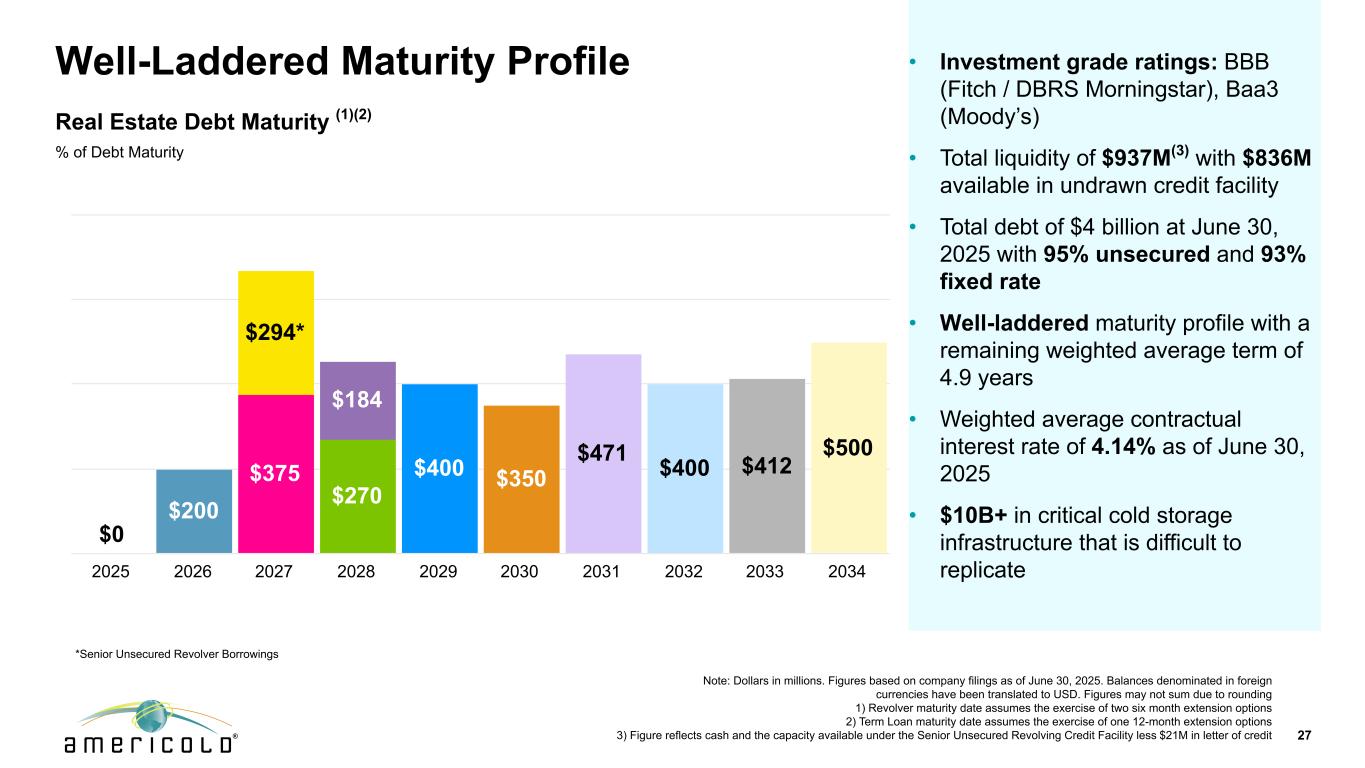
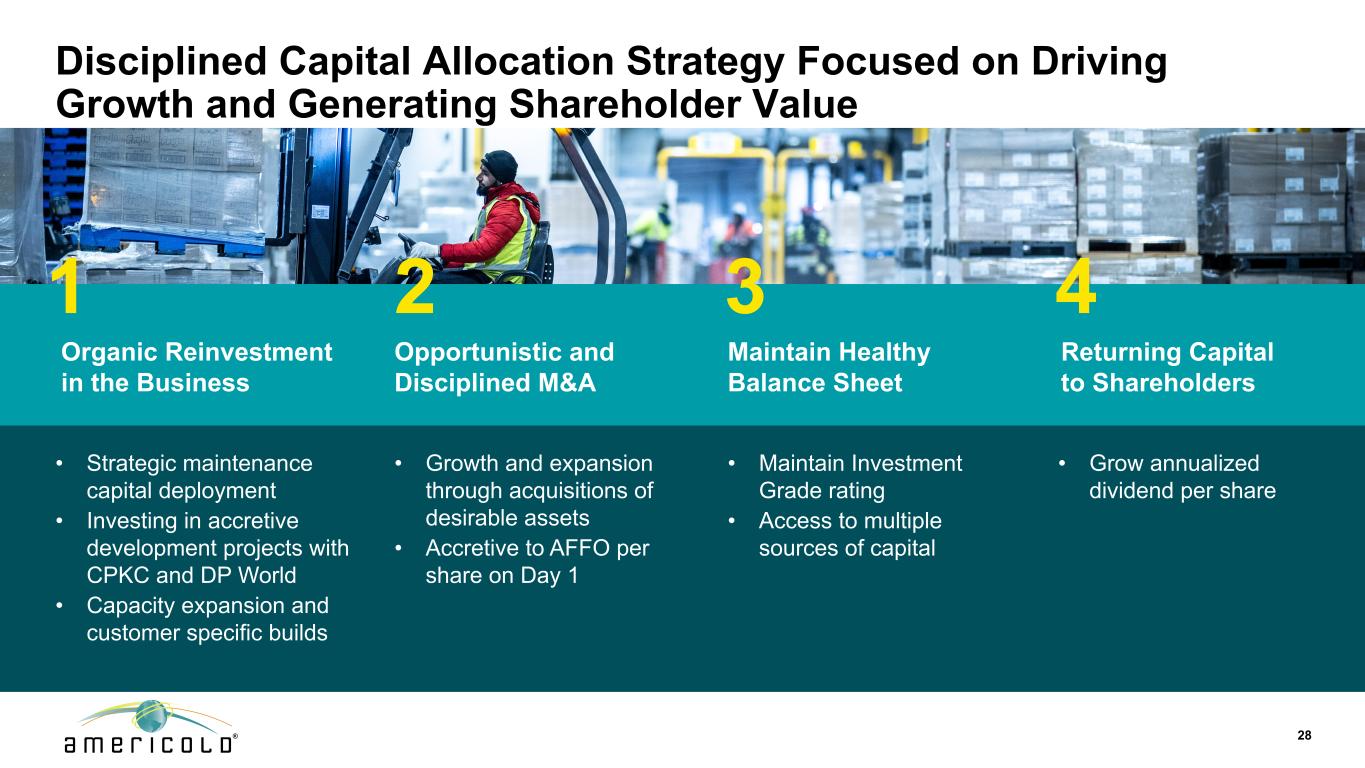
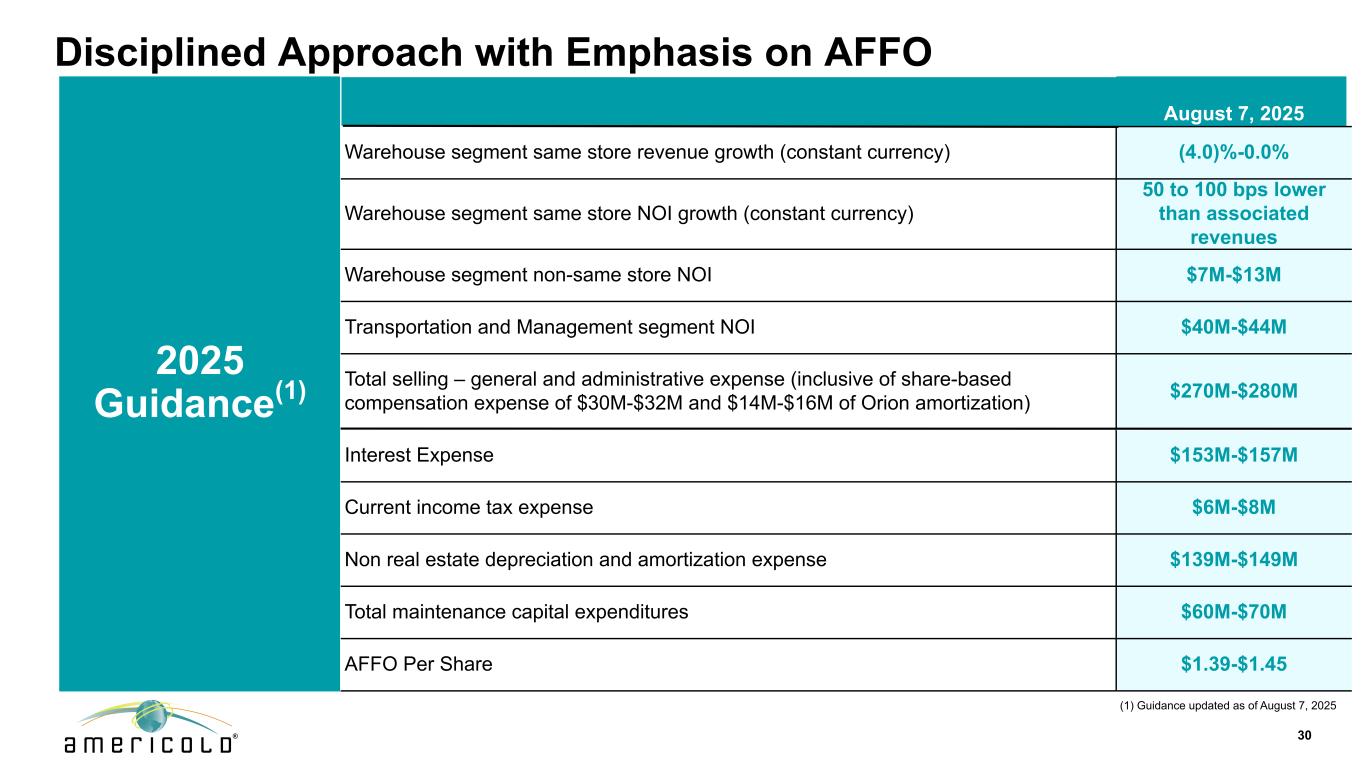
Thank you, Rob, and good morning. As George and Rob have mentioned, the teams continue to execute well despite what has otherwise been a choppy overall market environment. During the second quarter, we continued to make progress on our key operational priorities and win new business while managing the business tightly. As a result of these efforts, AFFO per share for the quarter came in at $0.36, and our first half performance has been largely in line with expectations. However, we did not see the typical seasonal uptick in occupancy and throughput materialize in either June or July. As a result, we are further muting our outlook for the second half of the year. We now expect same-store economic occupancy levels for the year to decrease by approximately 250 to 450 basis points and same-store throughput to decrease by 1% to 4%. Sequentially, we anticipate that throughput will lift slightly from Q2 to Q3, which will build occupancy levels modestly in Q4. As a result of these continued market headwinds, we are reducing our AFFO guidance to $1.39 to $1.45 per share. We continue to manage the business with an emphasis on AFFO, and because of the operating components of our business, we have more levers to pull than a traditional REIT. Specifically, we are taking additional actions to reduce core SG&A and right size our cost structure in line with the current demand environment while still ensuring we continue to provide the superb customer experience that we're known for in the industry. Additionally, we are lowering our range for maintenance capital expenditures in line with the slowdown in throughput, as many of the preventive maintenance activities are based on utilization. Despite the current economic volatility, which has impacted cold storage occupancy levels, we remain firmly focused on driving shareholder value. Based on a variety of different metrics, Americold is currently trading far below its asset value, whether you look at capitalization rates, replacement costs, or on a cost per pallet basis; we have over $10 billion of critical cold storage infrastructure deployed around the world. When combined with a robust Americold operating system and our dedicated and experienced team of associates serving customers in an industry that is complex and operationally challenging, we believe that we are uniquely prepared to maximize growth when industry volumes improve. Turning to our balance sheet, our $400 million public bond offering closed early in the second quarter, and the proceeds of that offering were used to repay a portion of our outstanding revolver borrowings. Anticipated, we also executed the first of two 12-month extension options available under our $375 million term loan facility. Total net debt outstanding at the end of the quarter was $3.9 billion, with total liquidity of approximately $937 million, consisting of cash on hand and revolver availability. Net debt to pro forma core EBITDA was approximately 6.3 times. We currently have a number of development projects underway, and as they come online and stabilize, we expect the NOI generated from these facilities will allow us to deleverage throughout 2026 as we remain committed to managing the business to an investment-grade profile. We also continue to rationalize our portfolio and sell off underperforming or non-strategic assets. During the second quarter, we successfully completed three planned exits of idled facilities for total cash proceeds of $20 million. As a reminder, most of the facilities we are exiting this year are leased, and the majority of the customers' inventory can be relocated to nearby owned facilities, resulting in an accretive transaction for the company. We plan to exit six more facilities, including our Pleasantdale, Georgia location, which was announced in early July. Additionally, as mentioned during our last call, we exited our minority ownership interest in the SuperFrio joint venture in Brazil, resulting in approximately $28 million of cash proceeds. We have a disciplined internal approach to capital allocation and use the same discipline to ensure that we are receiving an attractive return on our investments. We believe the actions we have taken to rationalize the portfolio so far this year will allow us to strategically redeploy capital into higher-return projects and ultimately drive future growth and shareholder value. Now I would like to turn the call back to George for some closing remarks.
Speaker 2
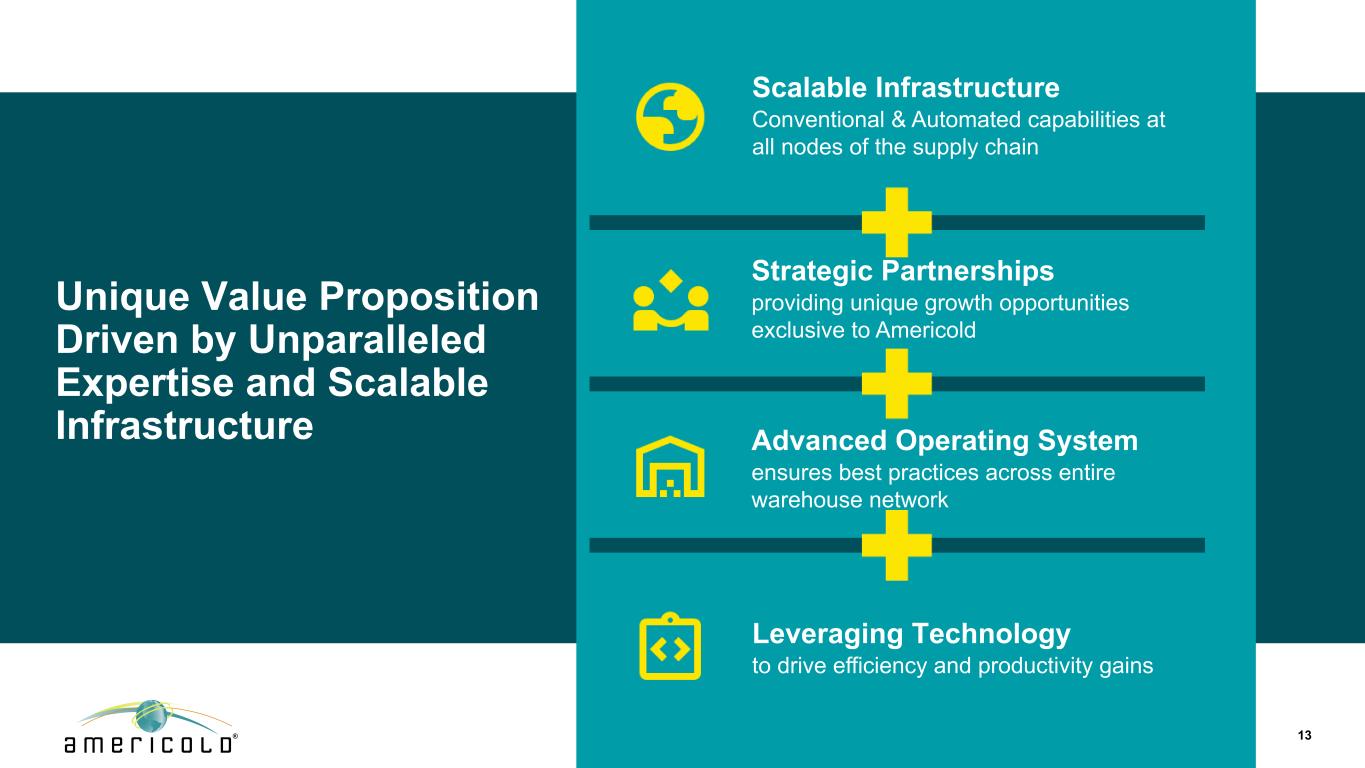
Thank you, Jay. While the external environment remains challenging from both a demand and supply perspective, we have the operating experience to manage our variable costs while still meeting customer expectations. We believe our previous investments in technology, our labor force, and industry-leading commercialization position us to weather this unique environment where multiple headwinds are simultaneously converging. Americold's value proposition remains unparalleled and uncompromised, which has proven itself through our unique customer solutions, dynamic offerings, disciplined capital deployment, and versatility through multiple operating environments. I want to thank our 13,000 associates who work tirelessly all over the world each day to make our vision a reality. Your dedication, engagement, and enthusiasm are what make Americold the cold storage provider of choice around the world. With that, I'll turn the call back to the operator for questions.
Operator
Our first question comes from Samir Khanal with Bank of America.
Speaker 5
I guess, George, you talked about the ability to hold pricing, but give us an idea of how competitive this environment is right now. You've kind of used the word challenging a few times here. You talked about pricing pressure. But just any color would be helpful.
Speaker 2
I would say the storage market remains very, very competitive when it comes to pricing, and we're even still seeing some moves that are irrational, to be honest. So we consider it to be under a significant amount of pressure. We expect it to remain under pressure for the balance of the year and, quite frankly, until occupancy growth returns. Customers see the value in our strong operational execution and customer service, and that's reflected in our low churn, still under 4%, as we mentioned on the call. The value-add services we provide are a big differentiator when it comes to pricing. It makes the business very sticky, it makes it easier to get fair value for our services, and it makes it much more difficult to move the business. So that's a strong asset in our portfolio in terms of defending price, but it will remain under pressure for the second half of the year, and we are seeing it intensify in some cases as we move through the second half and occupancy remains challenged.
Speaker 3
I think, Samir, the only thing I would add is that at Americold, we have developed the tools, and we have the visibility to understand on a by-service basis, customer by customer, what are our margins, our profitability, and we're using those tools. We're using that visibility that we've created to make sure that we do the right thing to balance price and occupancy so that we're doing the best thing for the business moving forward.
Speaker 2
And I think in our guidance revision, you see we have taken the storage pricing down. We haven't taken the handling pricing down, and that's very reflective of the value-added services we provide. The stickiness that they put in the business and the fact that customers realize for many of the value-added services we provide, they get incremental value that others can't provide. So that's a strong point. And maybe the last point on pricing is we're talking about a very U.S.-centric environment. Other geographies where we have 90-plus percent occupancy, less speculative development, investment opportunities, we're fortunate we have a global business. It provides us opportunities around the world when one area of the world may be going through some economic pressures; others aren't. And we're fortunate to have business in those geographies that we can continue to invest in.
Speaker 5
I have a second question about fixed commitments, specifically the 60%. It seems that number has remained fairly consistent with last quarter. Can you explain how these contracts operate? Do customers have the option to restructure these contracts given the current challenges?
Speaker 2
Yes, I'll ask Rob to explain the details of the contracts. They are very structured, and I believe we lead the industry in commercial excellence, particularly in selling fixed committed space. We didn't just sell it, but the structure is important. We set a target of 60% a couple of years ago, which we believe is a reasonable level for the business. However, I want to remind everyone that we mentioned last quarter that it won't stay fixed at 60% every quarter. There might be fluctuations, especially regarding your first question. Now, I'll hand it over to Rob to discuss the structure and the outlook.
Speaker 3
Yes, we're very pleased that we maintained the percentage at 60%. These contracts generally are structured as multiyear arrangements. They are fixed monthly fees that include a commitment on pallet positions that generally is pegged at the peak amount of space that a customer is going to need for the year. That's the key value for our customers is that it holds the space available for them during the seasonal peaks when they need the space the most. They are generally multiyear agreements, anywhere between, call them 3 to 7-year agreements if you're going into existing infrastructure. They're much longer-term agreements if you're going into a dedicated infrastructure that we built on behalf of a customer, and they don't include annual volume resets. The opportunity to reset the agreement is when those contracts expire. And we've had a lot of success, as you've seen over the last couple of years, even in a challenging environment of maintaining those fixed commitment levels and increasing them over the last couple of years. Now that we're at that 60% range, I went through in my prepared remarks why we feel like that's the right goal. And as George said, there could be some variability quarter-to-quarter. But we continue to lead with that because it is a win-win from a selling standpoint for both us and for our customers.
Operator
Our next question comes from Steve Sakwa with Evercore ISI.
Speaker 6
I guess we're not really surprised, George, by your commentary around cautiousness around the business and the outlook. But I guess when I look at kind of the first half results and revenue down 1.4% on a constant currency basis, to get to the low end of the revenue of minus 4%, you obviously have to have a pretty large drop in the back half of the year. And my thought was that you had, I guess, easier comps coming in. And even if you didn't get the full seasonal build, it just would be hard to see things falling off that much on the revenue side. So can you maybe just help us walk through what's really pressuring the revenue growth in the back half of the year?
Speaker 2
Yes. I think there are several factors limiting revenue growth in the latter half of the year. First, we discussed pricing pressure and irrational movements in the market, which has led us to adjust our pricing expectations downward. Secondly, we are encountering a unique situation regarding demand. There are probably five or six challenges affecting demand, including interest rates, tariffs, inflation, potential cuts to SNAP benefits, GLP-1 drugs, and excess capacity. Any two of these challenges might be manageable, but the combination of all five or six makes it extremely difficult not only to achieve growth but also to predict metrics like occupancy and pricing. Therefore, while we are guiding to the middle of our range, we do not expect to reach the lower end. Both price and demand are facing pressures, and we are trying to remain as conservative as possible. We anticipated a seasonal increase in the second half of the year, which unfortunately did not occur. This also plays a role in how we have formulated our guidance. That encapsulates our outlook.
And Steve, I mean if you look at just sequentially, first half of the year to second half of the year, revenue is growing sequentially, but what we have done and the reason why it's down versus the prior year, we have removed any seasonality except for certain harvests that are guaranteed from our forecast. But sequentially, first half to second half revenue is increasing.
Speaker 2
Yes. I'll just make a few comments and turn it over to Rob. We don't see an issue with return hurdles. I mean when we deploy capital, we have to have a return that's reasonable for the risk we take. And we think the 10% to 12% is that range. Is it conceivable we would do one under 10%? It would require special circumstances that we would communicate. But in the main, we are still going to develop to the 10% to 12% hurdle rate. And why don't you...
Speaker 3
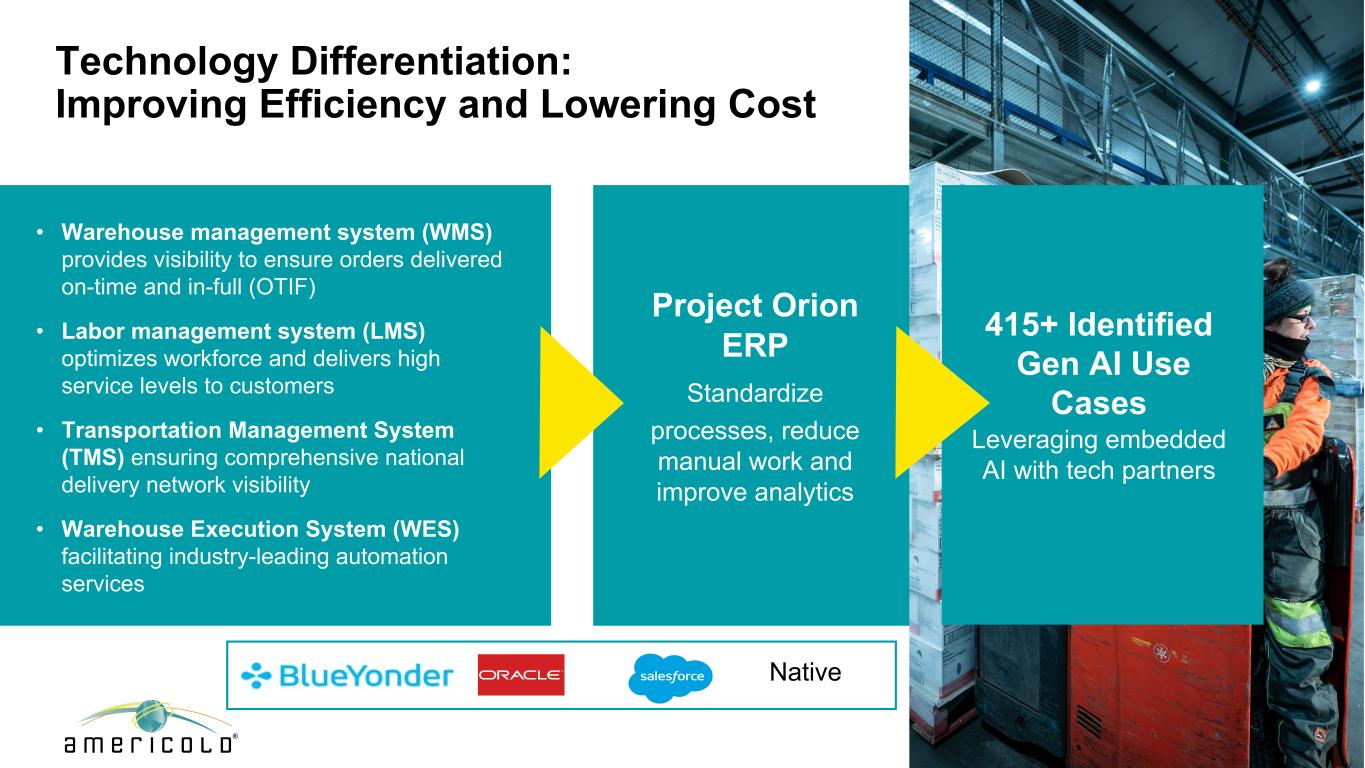
Yes, as I mentioned, we're very focused on new developments centered around three core priorities that we believe carry the least risk. When we refer to customer-dedicated projects, we mean expansions in major markets where we have already identified demand that surpasses our current capacity, as well as strategic partnerships aimed at building an ecosystem that delivers significant value to our customers. Future projects will primarily revolve around these low-risk opportunities that we anticipate will yield the traditional 10% to 12% return on invested capital margins that we've communicated for some time. We're pleased with the progress of our existing developments; having launched three this quarter, all on time and below budget, is a testament to the strong team we've built and our development capabilities. We successfully completed these projects under budget due to various factors, including improved procurement processes we've implemented over the past two years through operational enhancements and Project Orion. We also secured incentives from local governments in the municipalities where we were constructing, which was very beneficial. Accelerating the stabilization date for a facility like Allentown is a significant achievement for us. Overall, we are very satisfied with the development progress, and we believe this will continue to be a growth driver moving forward.
Speaker 2
And Steve, I want to reiterate what I mentioned earlier. As a global company, we currently have markets in our portfolio where we maintain a significant amount of assets at over 90% occupancy, and these markets do not have much speculative development that we can pursue today. There are still opportunities for us to build with customers and work with our partners in markets where we recognize demand and face limited supply. This makes investing attractive. There are plenty of opportunities available, and I believe our pipeline is still strong; however, many of these opportunities may not be located in the U.S.
Operator
Our next question comes from Greg McGinniss with Scotiabank.
Speaker 7
I just wanted to touch back on the lack of seasonal uplift. Are you able to provide some greater context around your occupancy expectations in both Q3 and Q4 and help us understand how far below prior expectations occupancy sits today?
Speaker 2
I believe we mentioned that we do not anticipate any seasonality in the second half of the year. Honestly, if I noted during the call, Q2 resembled Q1 quite closely, and I expect the second half will mirror the first half as well. Q3 could be slightly exaggerated, considering it's our peak quarter for power costs, which may turn out to be higher than our estimates. That said, we believe the fourth quarter is a couple of pennies too low. Overall, we see both halves of the year being very similar across almost all metrics. Jay, would you like to add to that?
And really the change in our forecast for occupancy, we had talked on the last call that we were expecting a 200-bps sequential build in occupancy on seasonality. And based on how we saw July unfold, where we saw no seasonal lift, we basically eliminated that 200-bps sequential improvement in occupancy from our forecast.
Speaker 7
Okay. You mentioned various factors affecting demand, such as interest rates, tariffs, and inflation. Is there anything that could boost your customers' confidence to increase inventory levels apart from these factors? Or is improvement solely dependent on macroeconomic conditions, meaning we need to see progress in that area before the business can recover?
Speaker 2
I mentioned several individual challenges that are negatively impacting demand, and while we might address one or two, dealing with all of them together is quite difficult. Some of the factors I mentioned are temporary, like interest rates, tariffs, and inflation, which should improve with time, although we can't predict when that will happen. We've attempted to forecast improvements in these macroeconomic factors but haven't had much success. As Jay pointed out, we've removed seasonality for the rest of the year, but these factors will eventually get better. When they do, we believe consumer demand will also rise, leading to increased occupancy. Other factors may take longer to resolve but are manageable. For example, excess inventory will gradually clear out. Therefore, we need improvements in several of the macroeconomic indicators before we see a recovery in consumer health and demand. However, we are not idle; we are actively exploring alternative growth opportunities. Both Rob and I highlighted our unique position in retail and QSR, where we have strong potential to sell our services and are making significant progress. This segment is among the highest cash flow areas in our business, and we are eager to expand it. Additionally, this issue is primarily focused in the U.S., while we also see many attractive investment opportunities globally, which we will prioritize in our capital deployment, aside from the partnerships we support. Overall, our portfolio is diverse enough to present appealing opportunities even during challenging times.
Speaker 8
George, I think you said in your prepared comments that certain customers are integrating or taking control of their cold chain needs as opposed to utilizing third-party warehouses. Can you elaborate on that comment a little bit? Did that impact the 4% churn rate that you saw? And is there any way to sort of quantify that impact on demand? And what segment are you seeing that most prevalent in? Just curious if you could talk about that a little bit as well.
Speaker 2
Yes, I'd say it's another factor. I would categorize it as relatively minor, but many of our large customers have significant cold storage facilities within their own companies. It's standard practice for them to ensure their assets are full before they ship products to a third-party logistics provider. This isn't new. What’s somewhat different now is that they are optimizing their cold storage space for products they may not typically store there. They are being more proactive because their financial situation is somewhat constrained at the moment. This behavior is slightly more assertive. I mentioned this in relation to what we're observing in the U.S. market. I'm not suggesting that it's a major contributor to the challenges we face regarding demand. I anticipate a quick turnaround once demand returns because the areas most manufacturers are currently using for storage aren't usually designated for that purpose. Once demand picks up, I'm confident these practices will revert. Consider this more of a reflection of the current market environment rather than a direct impact on our business.
Speaker 8
Okay. Got it. So it sounds like as their inventory levels normalize, they'll increase capacity in their warehouses first and then look back towards third-party warehouses and operators.
Speaker 2
Which is normal course, yes. So again, think about it as giving you more context for the environment more than a significant impact on our financials.
Yes. No. I mean, George got it right. The bulk are just leases that we're exiting, and we're able to move the inventory to an owned facility nearby. The three sales that I talked about were all very small sites; you can tell, roughly $20 million of proceeds for the three sites. One was related to actually our transportation business over in Europe, and the other were just two small properties that we actually idled a while ago, and we found non-cold storage buyers.
Operator
Our next question comes from Craig Mailman with Citi.
Speaker 9
Jay, can you just tell us what was that $5.7 million in other income?
The $5.7 million in other income, I don't normally get questions on other income on this call. But what you saw there was it was the benefit of some of the sales transactions. It was some hedging transactions that we benefited from, I would say, was the bulk of the two items in other income.
Speaker 9
Right. And that flowed through to AFFO?
Yes, because the hedging transactions are offset higher up. So it's on different lines of the P&L that nets down when you get to AFFO.
Speaker 6
Okay. For the second question, George, I don't want to overemphasize the macroeconomic factors and demand, but I realize it might be a bit premature to consider 2026. However, looking at the current environment as we try to determine the growth outlook for next year, aside from the ongoing projects and potential acquisitions you have, are there any short-term catalysts that might encourage tenants to shift their mindset, leading to a reacceleration in inventory restocking? Or should we anticipate that next year's baseline occupancy will fluctuate around current levels due to stagnant demand, while also accounting for the potential benefits of capital deployment in our forecasts?
Speaker 2
Well, I think that's the big question we're all asking ourselves, Craig, what does it take to spur demand. I mentioned we now have multiple headwinds to demand. It's not a single factor by any means. And it's very difficult to handicap the effect of one demand driver on a percentage basis versus another versus another. So what we know is the cumulative effect is hard to come by. So what would have to happen is some of those drivers would have to improve. Again, we can overcome one or two of them. We can grow through one or two of them. We can't grow through four or five of them. So something would have to change. What I can tell you, customers are trying very hard to create demand. They're spending money behind promotions. They're spending money behind incentive plans and rebates. It's not a lack of trying on behalf of customers. They're just having very difficult times in finding the right price points to drive volume where they're comfortable and retailers are comfortable. So the gaps are still very wide. So I would say, one, not for a lack of trying on our customers' behalf. But two, with all the pressures on demand, we need to see some of them improve before we can reliably say that occupancy will improve with it.
Speaker 3
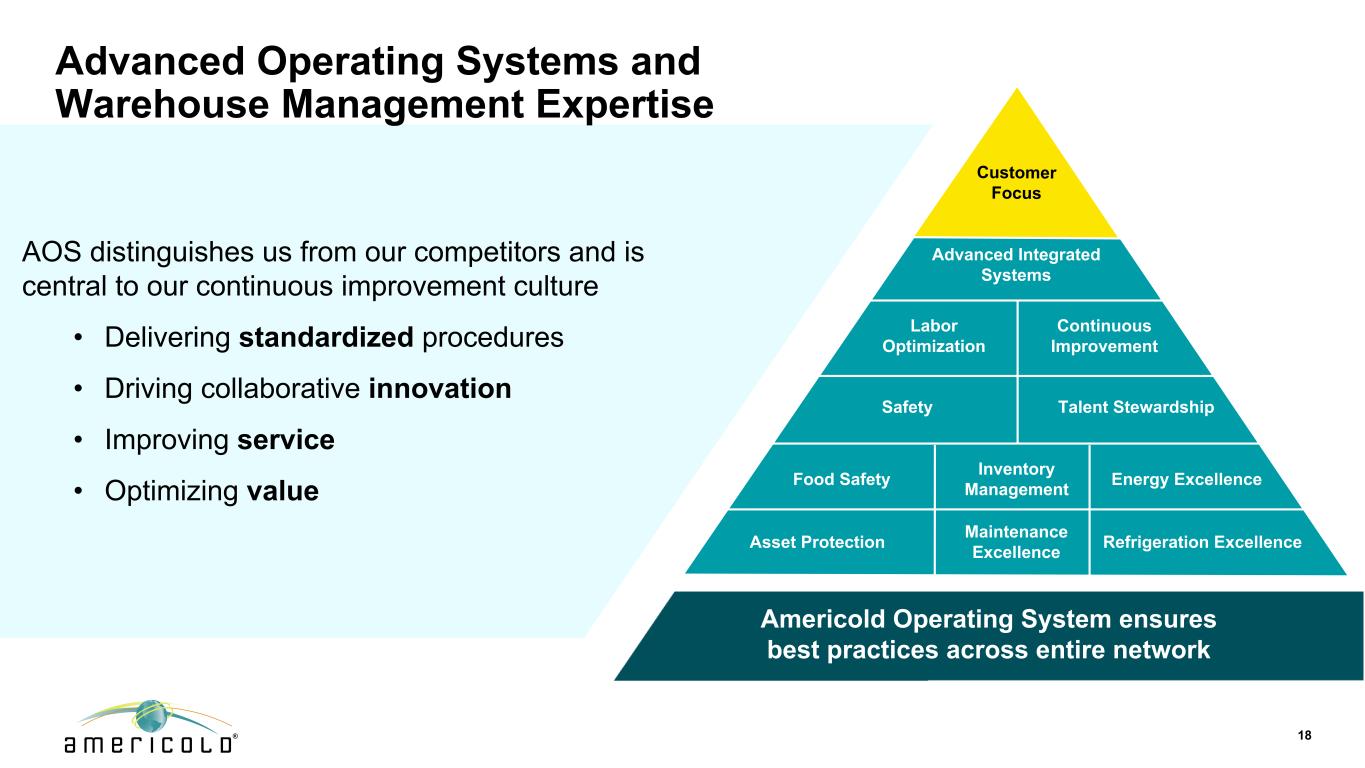
And this is where, I think, for us as a business to have a big operating component, this is where we have the opportunity to use all the levers and tools in our tool belt to focus on earnings per share growth even in an environment where occupancy is challenged. This is where we continue to drive productivity. We're focused on adding incremental value-added services into the business. We're focused on improving business mix by generating new business wins in the retail and QSR business that are higher cash flowing. So our customers aren't standing still, and we certainly aren't standing still. We're pulling every lever that we have to continue to drive this business forward, even in a challenged environment.
Speaker 2
And I think the last part of the question was capital allocation. I wasn't sure of the context of it, Craig. But what I will say is, we have opportunities to deploy capital, and we will in areas of the world where they're not faced with the challenges we've been talking about. Our Asia Pacific business, for instance, is doing exceedingly well; it's 90-plus percent occupied. It is very retail and QSR-based. So investments down there make a lot of sense. And just making the point that with a global company, we still have very attractive areas to invest in. We have two very strong partners in CPKC and DP World, who are also growing. So a lot of those are non-demand-driven opportunities to invest in, and we intend to take full advantage of those as well.
And Craig, a follow-up on other income. As I said, part was from gain on sale, part was from other income. $2.4 million was from the SuperFrio disposition that was adjusted out of AFFO, and the other was just different types of hedging unwinds that just offset line items higher up. So that’s more specific numbers for you.
Operator
We have reached the end of our Q&A session, which now concludes today's teleconference. You may disconnect your lines at this time. Thank you for participating.