Operator
Good morning, and thank you for joining us today for Concentra Group Holdings Parent, Inc. Earnings Conference Call to discuss the first quarter 2025 results. Speaking today are the company's Chief Executive Officer, Keith Newton; and the company's President and Chief Financial Officer, Matt DiCanio. Management will provide an overview and then open the call for questions. Before we get started, we would like to remind you that this conference call may contain forward-looking statements regarding future events or the future financial performance of the company, including, without limitation, statements regarding operating results, growth opportunities and other statements that refer to Concentra's plans, expectations, strategies, intentions and beliefs. These forward-looking statements are based on the information available to management of Concentra today, and the company assumes no obligation to update these statements as circumstances change. At this time, I will turn the conference over to Mr. Keith Newton. Sir, the floor is yours.
Speaker 1
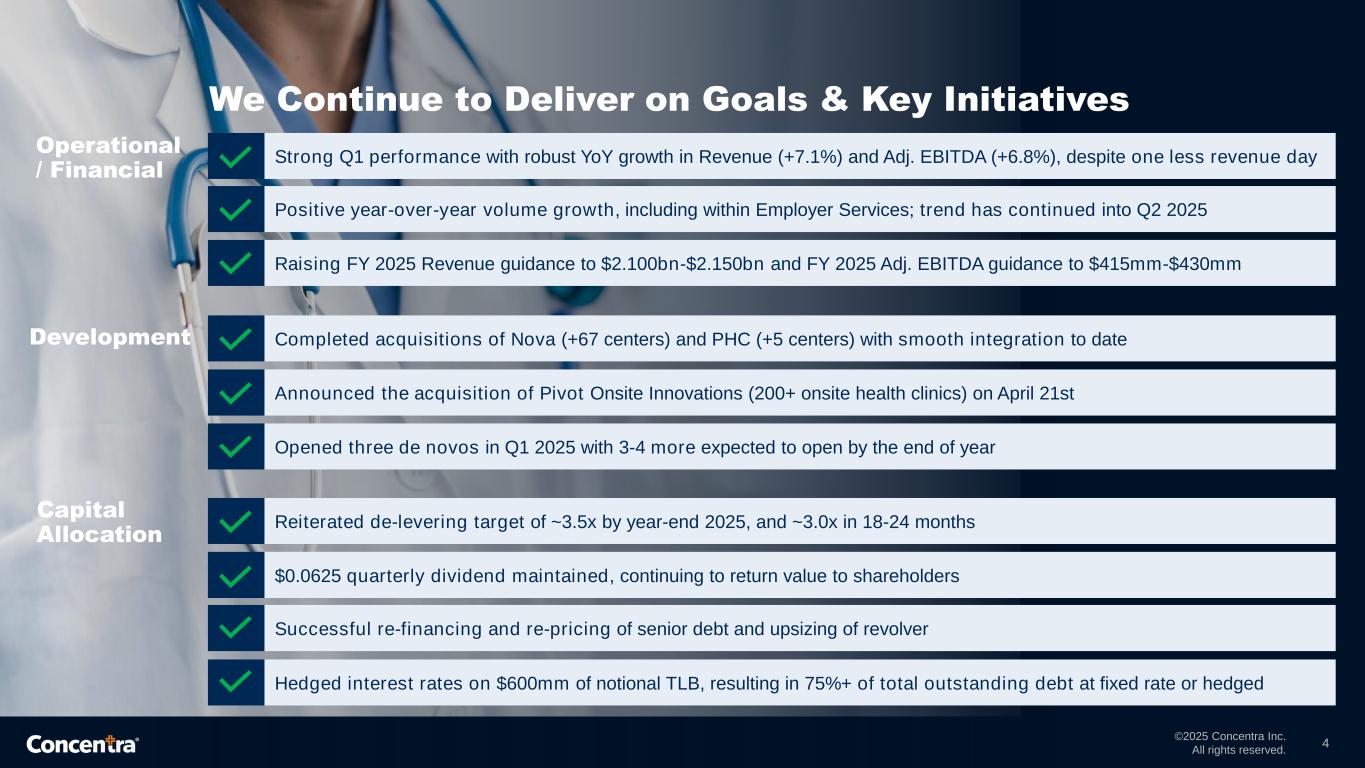
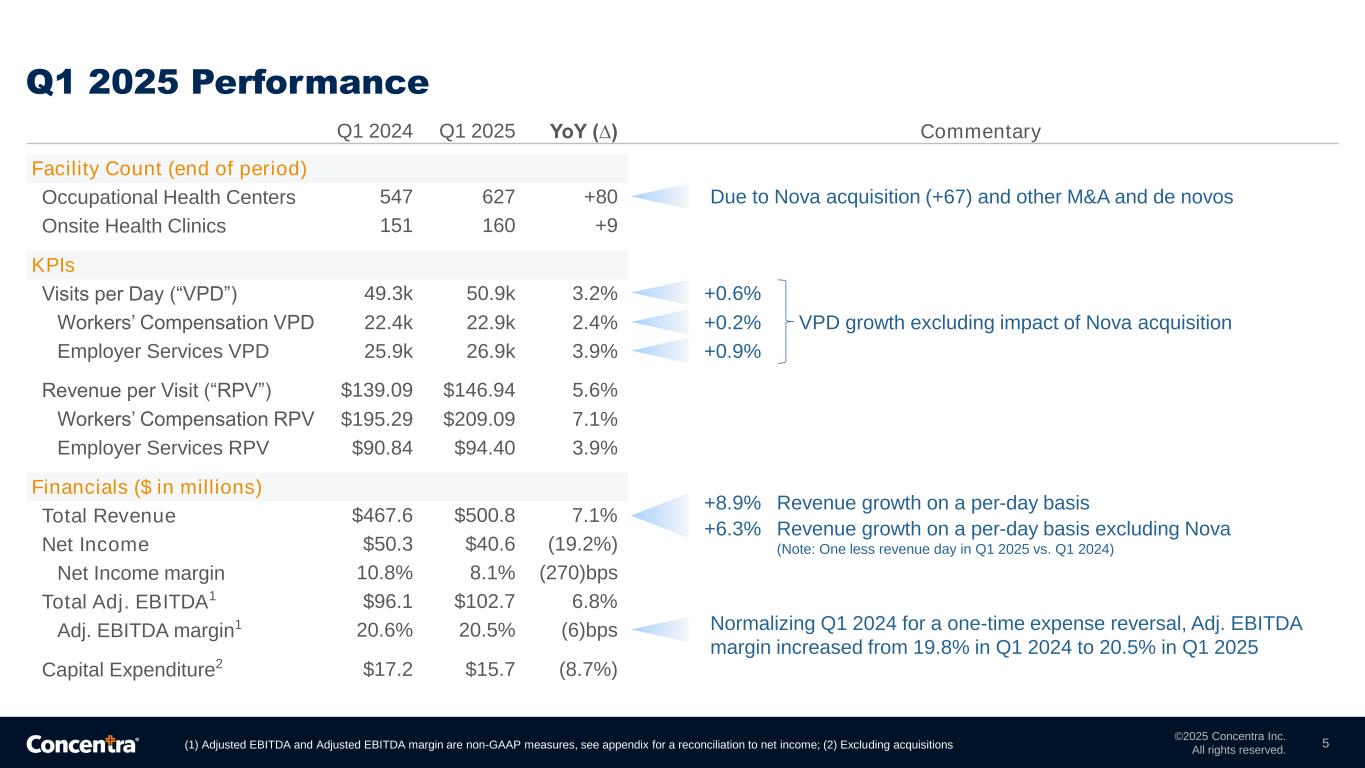
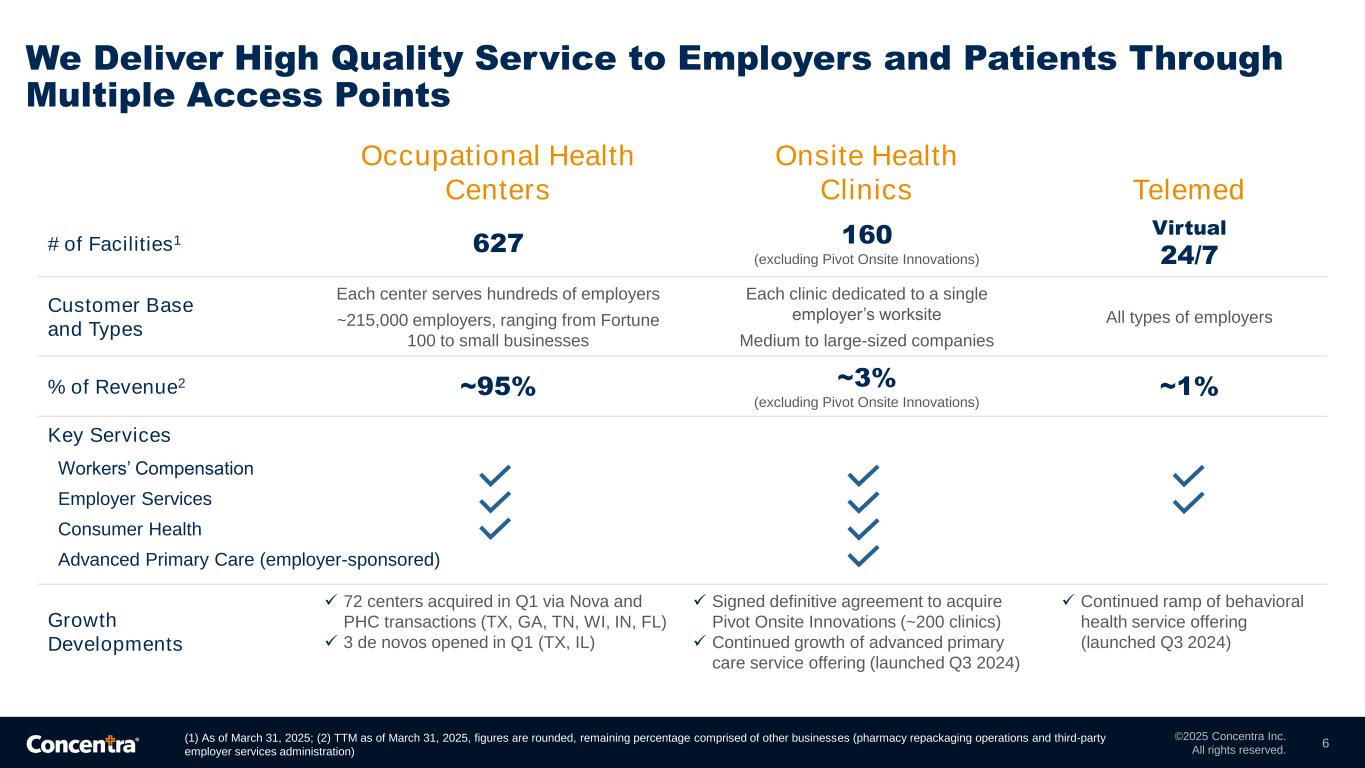
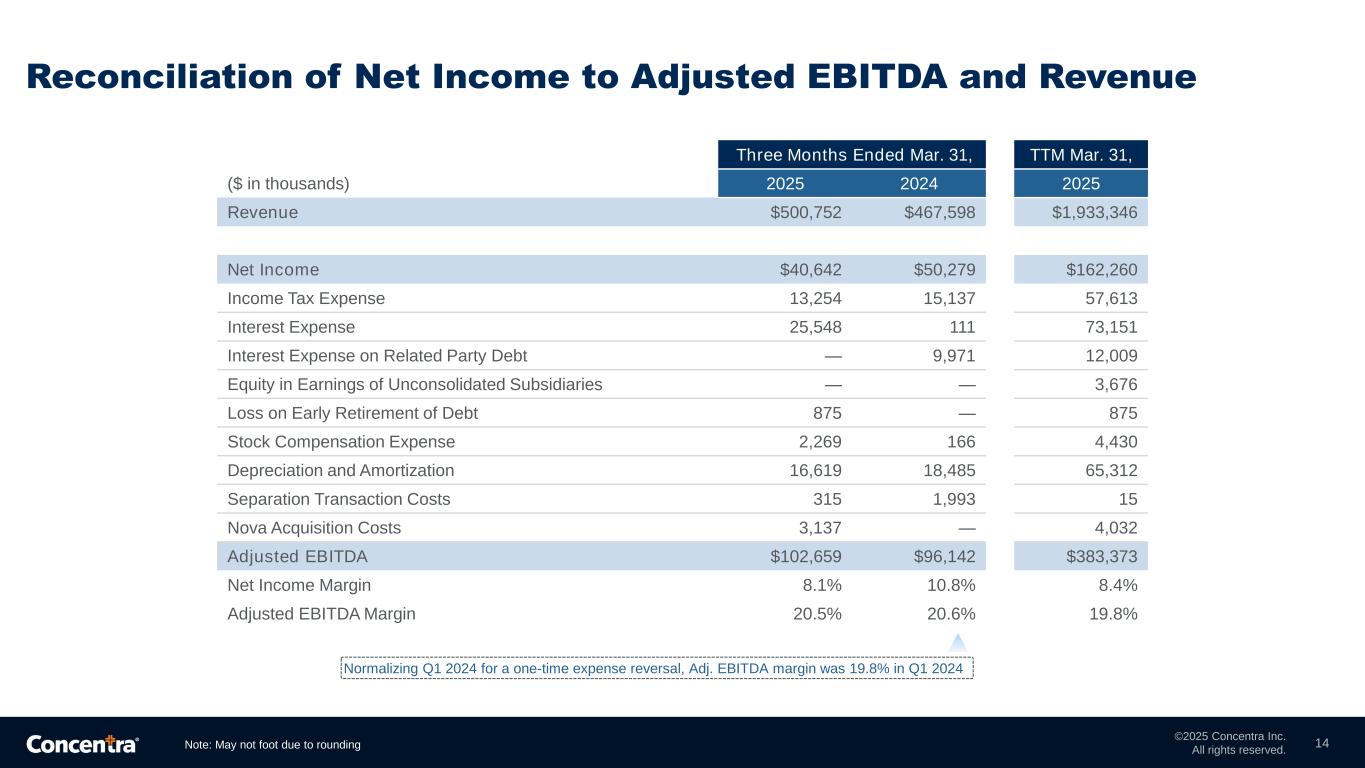
Thanks, operator. Good morning, everyone. Welcome to Concentra's First Quarter 2025 Earnings Call. We had a very successful first quarter to start the year. Today, we'll talk about three key trends we saw in our business: first, solid visit growth, including a positive reversal in our employer service visits; secondly, strong rate growth; and finally, significant corporate development activity. We've always referred to these as our key growth drivers, and this quarter, all were nicely trending together. One thing to note, given that the Nova Medical Centers acquisition closed on March 1, 2025, and thus, we are only reflecting one month of its results in the first quarter. We will talk about some of our results this quarter with and without Nova, so investors and analysts can understand both. First, from a visit perspective, patient visits in Q1 2025 were up across all service lines year-over-year with total visits per day increasing 3.2% to 50,900. Excluding the impact from the acquisition of Nova in early March, total visits per day increased 0.6% to 49,600. We continue to see year-over-year growth in workers' compensation volume with total visits per day increasing 2.4% over the first quarter of 2024. Excluding Nova, daily workers' compensation visits increased 0.2%. Importantly, on the employer services side, we are pleased to report that we saw year-over-year daily visit growth for the quarter. Employer services volume increased 3.9% per day relative to the first quarter of 2024. Even when excluding Nova, employer services volume increased 0.9% per day. This marks a pretty significant turnaround in our employer services visits following many consecutive quarters of year-over-year mid-single-digit declines coming out of the post-COVID normalization. From a rate standpoint, we had another strong quarter with a 5.6% increase in revenue per visit in Q1 2025 compared to the same quarter prior year. The growth was driven by increases in both workers' compensation and employer services revenue per visit. Lastly, I will let Matt talk more about our corporate development efforts, but it has been a highly successful few months with the closing of our Nova acquisition on March 1, the addition of five new centers in Florida from our Physicians Health Center acquisition on March 8, the opening of three de novo sites in Q1 and the signing of the Pivot Onsite acquisition that we announced on April 21. In total, these efforts will add 75 new occupational health centers and approximately 200 on-site health clinics. This is our most active stretch of M&A in quite some time. With the three growth drivers all moving in the same direction and despite one less revenue day in the quarter versus prior year, we achieved strong financial results for Q1. Revenue was $500.8 million for the three months ended March 31, 2025, compared to $467.6 million for the three months ended March 31, 2024, representing 7.1% growth year-over-year. This represents a revenue growth rate of 8.9% year-over-year on a revenue per day basis. Adjusted EBITDA was $102.7 million in the first quarter of 2025 versus $96.1 million in the first quarter of 2024 or a 6.8% increase. Adjusted EBITDA margin decreased slightly from 20.6% in Q1 2024 to 20.5% in Q1 2025. Matt will provide more detail shortly. But once you normalize Q1 2024 for a favorable out-of-period expense reversal, we would have experienced positive year-over-year growth in adjusted EBITDA margin. Net income was $40.6 million and adjusted earnings per share were $0.32 for the first quarter of 2025. Net income was lower than same quarter prior year, primarily due to an increase in interest expense resulting from the IPO recapitalization. We had some transaction expenses related to the Nova acquisition and related financing events that were accounted for as adjustments to earnings per share. Overall, the Nova acquisition contributed to our strong performance in the month of March, but our core business also performed very well. Just to reiterate, positive workers' compensation visit growth, positive employer services visit growth, strong rate growth for all visit types and successful M&A, a nice recipe for success with our business. Later in the call, we will discuss our revised financial outlook for 2025, which we are raising from our initial outlook provided in January of 2025. We'll also comment on the expected impact of potential tariffs on our business and why we think we are well positioned as a company in the event of macroeconomic turbulence. Now I'll turn it over to Matt to provide some more detail on our financial results and additional commentary on our corporate development efforts.
Speaker 2
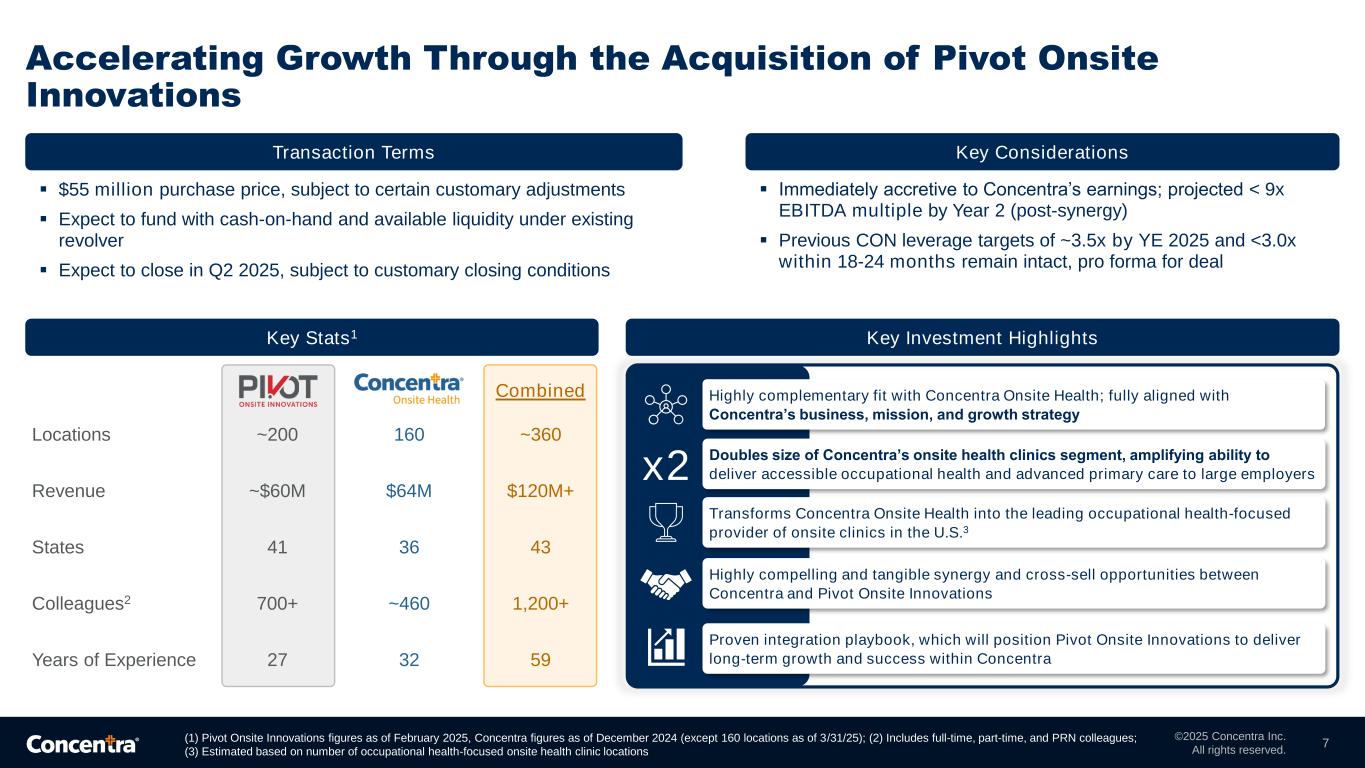
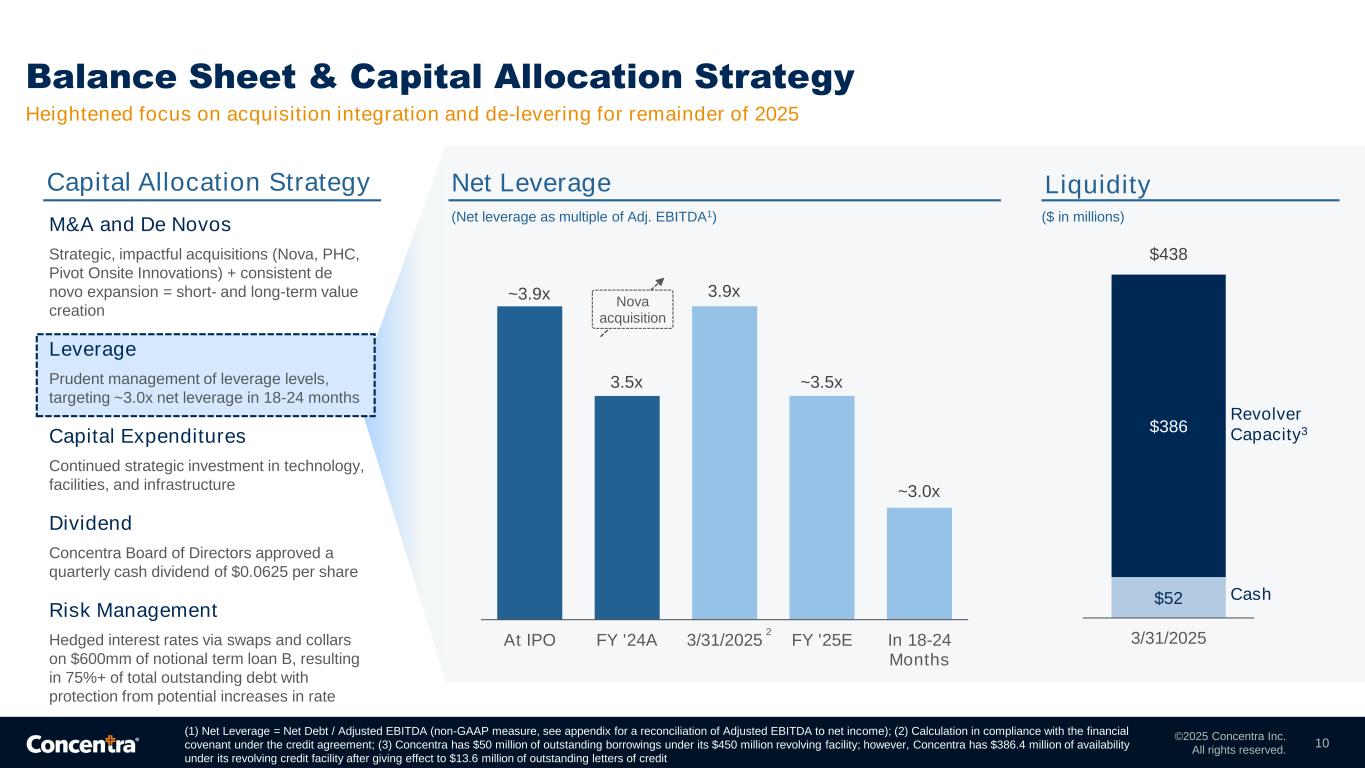
Thanks, Keith, and good morning, everyone. I'll start by adding some additional commentary on the financials, and then we'll talk more about the exciting growth efforts. In our occupational health center operating segment, the following numbers are inclusive of the Nova acquisition. Total revenue of $472.9 million in Q1 2025 was 7.2% higher than the same quarter prior year. With one less revenue day as compared to the prior year, this constitutes an 8.9% year-over-year increase on a revenue per day basis. Total visits per day increased 3.2% over the same quarter prior year, and revenue per visit increased 5.6% from $139 in Q1 2024 to $147 in Q1 2025. Workers' compensation revenue of $302.1 million in Q1 2025 was 8% higher than prior year. This constitutes a 9.7% increase on a revenue per day basis. Work comp visits per day increased 2.4% from prior year and work comp revenue per visit increased 7.1% versus prior year. Excluding the Florida work comp rate increase, our work comp revenue per visit would have increased by approximately 5%. Within employer services, revenue of $160.1 million in Q1 2025, increased 6.2% from prior year. This constitutes a 7.9% increase on a revenue per day basis. Employer services visits per day increased 3.9% from prior year, a welcome reversal of negative year-over-year trends in recent quarters. Employer services revenue per visit increased 3.9% versus prior year. Given the partial quarter contribution of Nova to the financial results, I'm also going to provide a few metrics, excluding the impact of the Nova acquisition. Excluding the impact of Nova, total revenue within the occupational health center operating segment, which excludes the onsite health clinics and other businesses, was $461.7 million, a 4.7% increase over the prior year. This constitutes a 6.3% year-over-year increase on a revenue per day basis. Total visits per day increased 0.6% over the same quarter prior year, and revenue per visit increased 5.8% from $139 in Q1 2024 to $147 in Q1 2025. Work comp visits per day were 0.2% higher than prior year and work comp revenue per visit was 7% higher than prior year. Employer services visits per day were 0.9% higher than prior year. Employer services revenue per visit was 4% higher than prior year. Moving on from our occupational health centers. Our onsite health clinic segment reported revenue of $16.6 million in Q1 2025, a 4.4% increase from the same quarter prior year, and our other business segment generated revenue of $11.3 million, a 5.7% increase against same quarter prior year. Now to expenses. Our cost of services expense, excluding depreciation and amortization, a major component of which is personnel costs, includes all direct and indirect support costs related to providing services to our customers. Cost of services was $357.1 million or 71.3% of revenue in Q1 2025, down from 72.1% of revenue for the same quarter prior year. The percentage of revenue was overall lower, predominantly due to the nice increase we saw in revenue, including the rate gains as well as operational efficiencies resulting from the replacement of contract clinicians with employee clinicians and general improvements in staffing efficiencies across both clinical and operations. General and administrative expense includes corporate overhead such as finance, legal, HR, marketing, corporate offices and other administrative areas. Our G&A expense were $46.7 million or 9.3% of revenue in Q1 2025 compared to 7.9% of revenue in the same quarter prior year. Excluding items that are added back for the purposes of calculating adjusted EBITDA, including equity compensation expense and certain transaction expenses, G&A expense was $41.2 million for the quarter or 8.2% of revenue compared to 7.4% of revenue in the same quarter prior year. Prior year G&A expense was reduced by a favorable out-of-period legal expense reversal that was recorded during Q1 2024. This had a positive EBITDA impact. The year-over-year increase in G&A as a percentage of revenue is primarily driven by that reversal and the addition of new support FTEs as previously planned as we separate from Select Medical and build out the team required to operate as a stand-alone public company. The overall result was adjusted EBITDA margin in Q1 2025 of 20.5%, a slight decrease from 20.6% during the same quarter prior year. Removing the impact of the favorable one-time legal expense reversal would have resulted in Q1 2024 adjusted EBITDA margin of 19.8%, demonstrating strong year-over-year margin growth on a run-rate basis. In Q1 2025, we generated $11.7 million in operating cash flow. I would note that Q1 is consistently one of our slowest cash quarters due to lower collections following seasonally lower fourth quarter volume as well as other quarter-specific material cash outflows such as company-wide bonus payments related to prior year incentive plans and semiannual interest payments on our unsecured bonds. Relative to Q1 2024, the drop in cash flow from operations was largely attributable to an increase in interest payments following the IPO-driven recapitalization last summer. Investing activities used $294.7 million of cash in the first quarter, predominantly driven by our previously announced acquisition activity. Also included in this number was $15.7 million of CapEx that covered our normal course capital program, opening de novos and upgrading and maintaining existing facilities. Financing activities resulted in net cash inflows of $151.9 million for the first quarter. As a reminder, in conjunction with funding the Nova acquisition in early March, we drew $50 million on our revolving credit facility, and we upsized our Term Loan B from approximately $848 million to $950 million. Additionally, we repriced our Term Loan B at SOFR plus 200, down from SOFR plus 225 with a 25 basis point step down at net leverage of less than 3.25x. At the same time, we upsized our revolver capacity from $400 million to $450 million, and we repriced at SOFR plus 200 down from SOFR plus 250 with a 25 basis point step down at net leverage of less than 3.5x. We ended the quarter with a total debt balance of $1.6 billion and a cash balance of $52 million. At the end of March, our net leverage ratio per our credit agreement was 3.9x, up from 3.5x at year-end 2024 and approximately the same as our leverage ratio at the time of our IPO last July. The increase in leverage during the quarter was driven by our Nova acquisition and is in line with what we previously communicated at the time of the acquisition signing. In early March, we executed interest rate hedges on $600 million of notional value related to our floating rate Term Loan B. This, along with our fixed rate bonds, now gives us protection from rising interest rates on over 75% of our currently outstanding debt while retaining solid exposure to potential rate decreases. Switching gears, we are pleased to announce a continuation of our dividend this quarter with Concentra's Board of Directors declaring a cash dividend of $0.0625 per share on May 6, 2025. The dividend will be payable on or about May 29, 2025, to stockholders of record as of the close of business on May 20, 2025. Now before I turn it back to Keith, I want to add some more color on our corporate development updates. First, we are very excited about the last few months and what our collective teams have accomplished. We closed on a core and strategic acquisition of Nova. Our team is working hard on the integration efforts, and we're really pleased with the progress to date. We are ahead of schedule on synergy capture, and we are trending above forecast with respect to patient visit volume in those centers. Our new Concentra colleagues that came over from the Nova acquisition have hit the ground running and have done an excellent job adhering to best-in-class clinical and operational standards and maintaining customer relationships through the transition. We will be converting all Nova centers over to Concentra's systems, processes and signage over the coming months, which we anticipate will further enhance top line and cost efficiency. Our Physicians Health Center acquisition in Florida and our three de novos opened in the quarter are a continuation of our core center growth strategy and all eight centers are off to a great start. Lastly, with respect to Pivot Onsite Innovations, this is an acquisition we're really excited about and demonstrates our commitment to investing in and scaling our onsite health clinics business. This effectively doubles the revenue of that segment and brings an additional 700-plus colleagues into the Concentra family. We see a lot of opportunity for both organic and inorganic growth within the onsite health space with an estimated serviceable addressable market of more than $17 billion across both occupational health and advanced primary care service offering. We announced the signing of this transaction on April 21, 2025, and posted a brief investor deck on our website. The purchase price is $55 million, and the expected acquired revenue will be approximately $60 million. The deal is immediately accretive from a value standpoint, and we expect to capture cost synergies over the first 12 months post-acquisition, resulting in a pro forma purchase multiple below 9x. We expect to close in Q2 2025, subject to certain closing conditions. Our teams will be highly focused on integrating, growing employer relationships and continuing to scale the onsite health segment. We look forward to updating you on the continued growth of our onsite business in future quarters. Given the recent pace of deal activity, I would like to take a moment to underscore our long-term commitment to delevering. As of quarter end, our leverage ratio is approximately 3.9x, and we do not expect that to change materially because of the Pivot acquisition following the close of that deal later this quarter. We anticipate limited M&A activity over the remainder of this year with our focus now on integration efforts.
Speaker 1
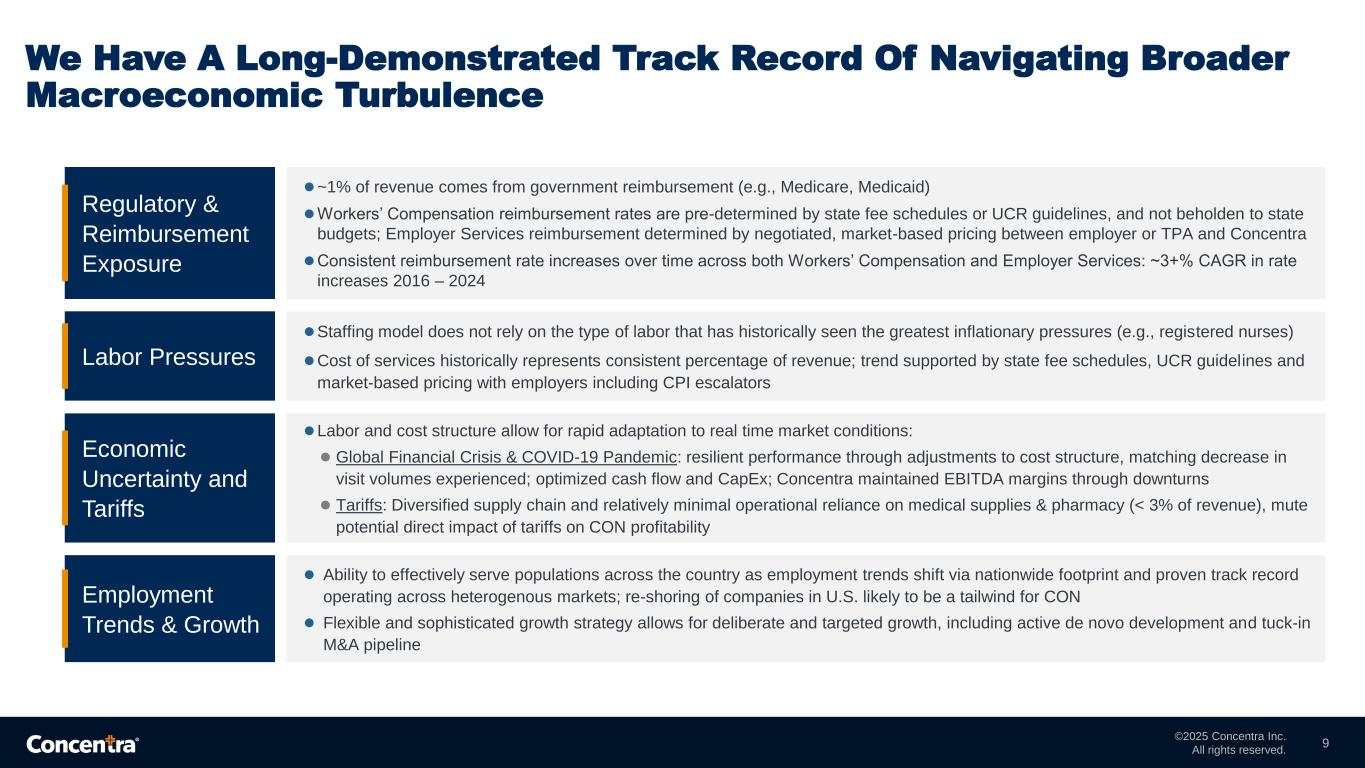
Thanks, Matt. As you can see, we made great progress in the first quarter. I'd like to take a few minutes to address the current macroeconomic landscape and outlook for Concentra from a qualitative perspective, and then Matt will review our updated 2025 financial outlook. Like everyone else, we are actively monitoring global fiscal, monetary, regulatory and trade policy and are evaluating potential impacts to our business. There is obviously a fair amount of broader economic uncertainty right now, but I will note that we have not observed an impact to the visit volumes in our centers as of the date of this earnings call, which I think is an encouraging macro data point, especially given the breadth and diversity of our domestic customer base and our footprint. Like everyone else, I wish we had a crystal ball with respect to the impact of the implementation and outcomes of these policies. But in the absence of that, we feel that we are positioned well here at Concentra to address any economic slowdown should it occur and had proven that in the past. What we can share anecdotally at least is how the administration's current policies could directly impact us over time. To the extent economic policy does result in an expansion of manufacturing through the reshoring of American industrial jobs over the long term as the current administration hopes, that would serve as a tailwind for Concentra because we serve America's workforce. To that end, there has been a flurry of recent announcements from domestic and international companies indicating plans to invest in incremental manufacturing capacity in the U.S., which would likely drive an increase in total employment and thus, both visit growth at our centers as well as potential new employer onsite opportunities. If new policy leads to higher inflation, our rates would likely increase due to many of those states' workers' compensation fee schedules having built-in inflationary adjustments. Employer services rates have also generally grown in line with inflation in recent years. So higher inflation would likely result in higher revenue per visit, which is what we have experienced in the past. From a supply chain standpoint, we expect minimal bottom line impact from tariffs since medical supplies and pharmacies as a line item expense category constitute less than 3% of total revenue for us, which, based on our research, is one of the lowest percentages among comparable health care services companies. That said, we are certainly taking proactive steps to mitigate any potential exposure to trade-induced cost creep within our business. Lastly, in the event economic activity does slow over the near term, which to be clear, we are not currently predicting nor seem to be experiencing in our visits, we are well positioned to weather the storm. Although we are a new stand-alone public company, we have a long history of nimbly managing our cost structure through down cycles in the economy. During the global financial crisis in 2008 and 2009 and during COVID in 2020, we experienced a substantial drop in visits, but we limited the negative adjusted EBITDA impact. We have a highly experienced and capable operational team actively monitoring day-to-day volume and managing our cost trends throughout the country, and we are well positioned to react quickly in the event overall economic growth were to slow. Longer term, these policies could serve as tailwinds for our business if they result in material growth in U.S. jobs. With that, Matt can share our thoughts on our updated financial guidance.
Speaker 2
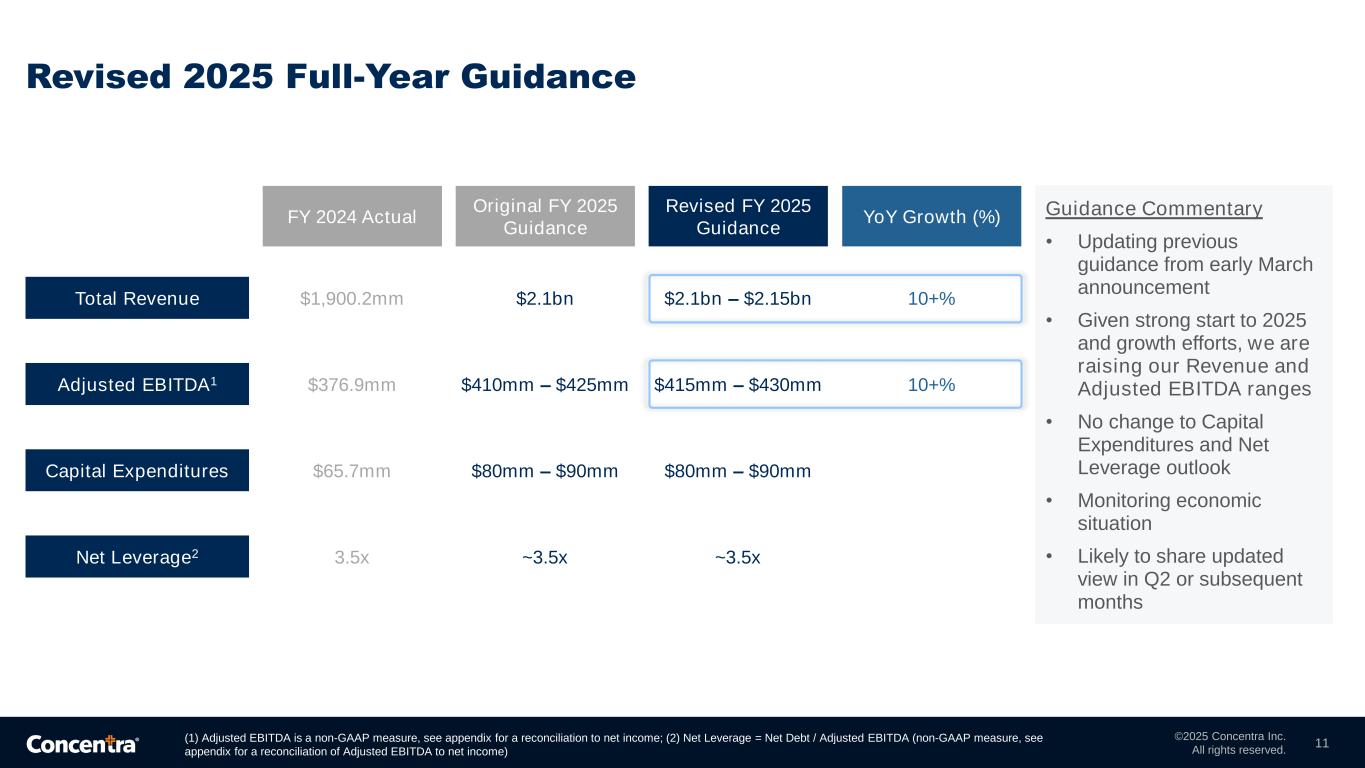
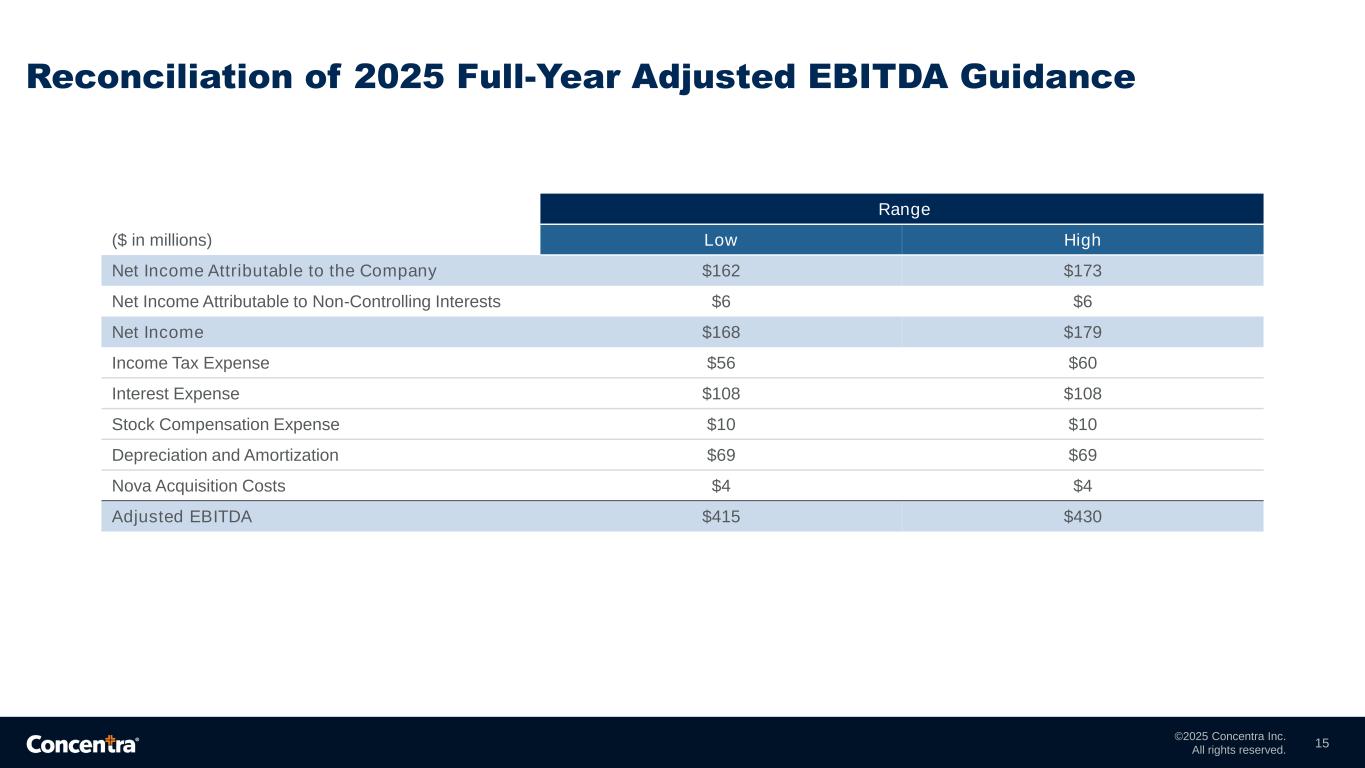
Great. Thanks. I think Keith summarized the uncertainty nicely in the way these policies could impact Concentra. While we are obviously tracking the broader macroeconomic landscape, we aren't seeing an impact to our business currently. In fact, April volume across work comp and employer services was up year-over-year and into early May, even after excluding the impact of Nova. Given the strong financial start to the year and additional development activity that previously wasn't factored into our guidance, including the acquisitions of Physicians Health Center and Pivot Onsite, we felt it was appropriate at this time to raise our view of some of the previously provided 2025 financial metrics. For 2025, Concentra now expects to deliver revenue in the range of $2.1 billion to $2.15 billion and adjusted EBITDA in the range of $415 million to $430 million. We are tracking well to the capital expenditures and net leverage ratio outlook guidance that we previously communicated, so there's no change there. We intend to closely monitor potential macro impacts to our business over the next few months as well as progress on integration of our recent acquisitions, and we may have additional updates with respect to full year 2025 guidance during our Q2 earnings call.
Speaker 1
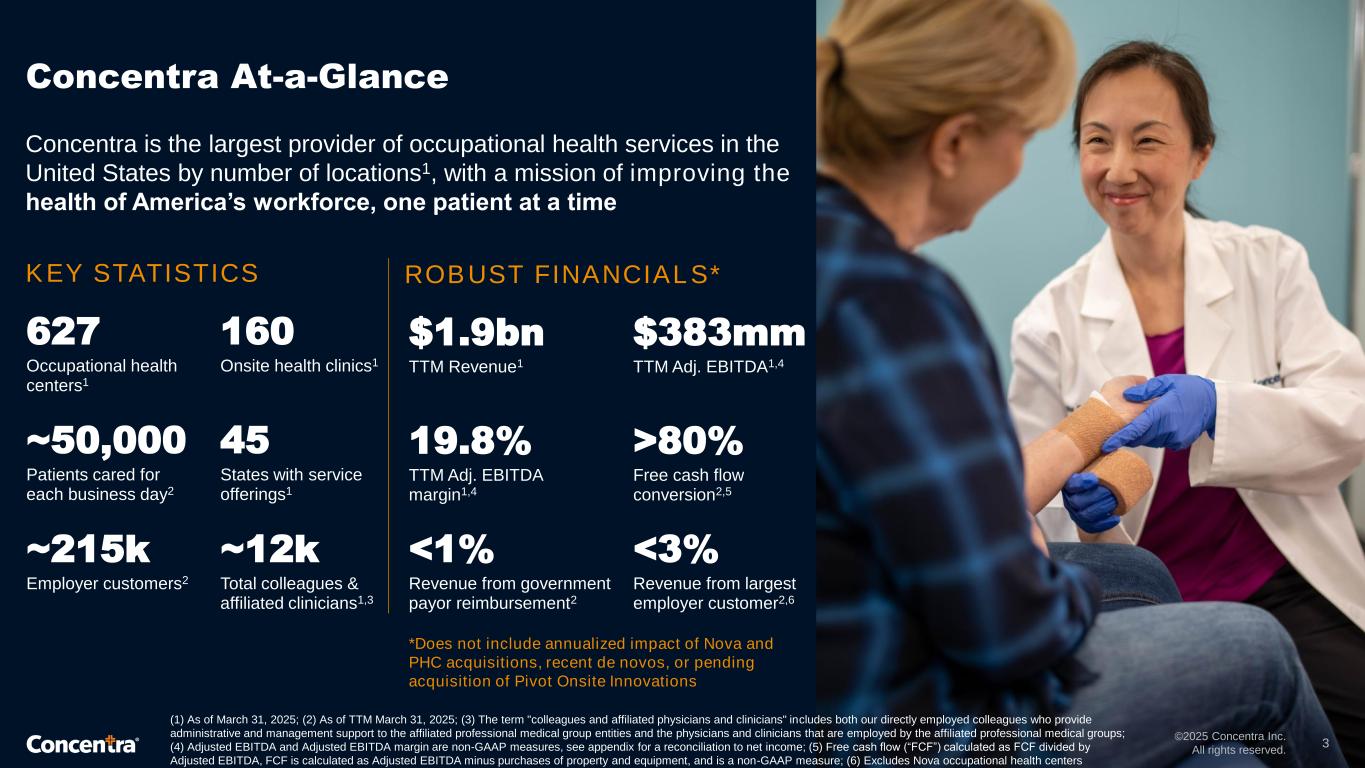
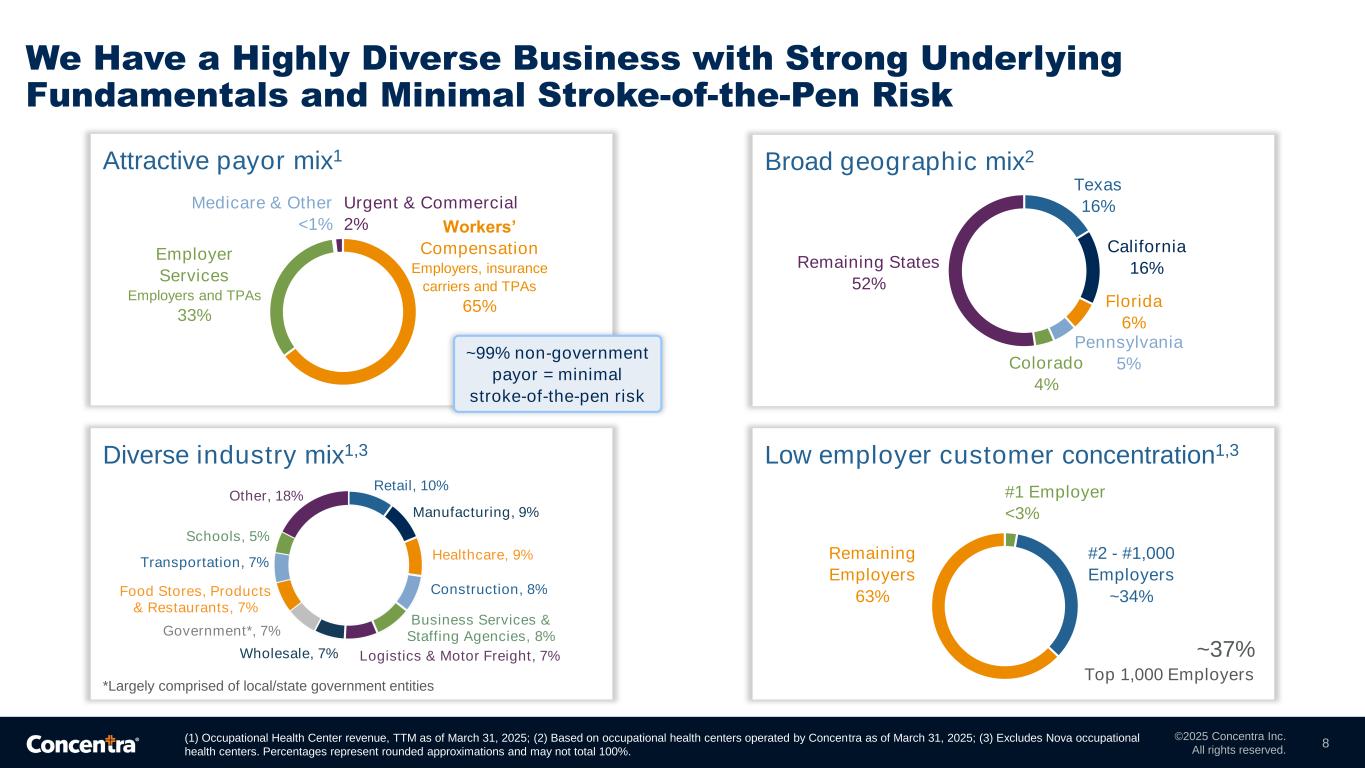
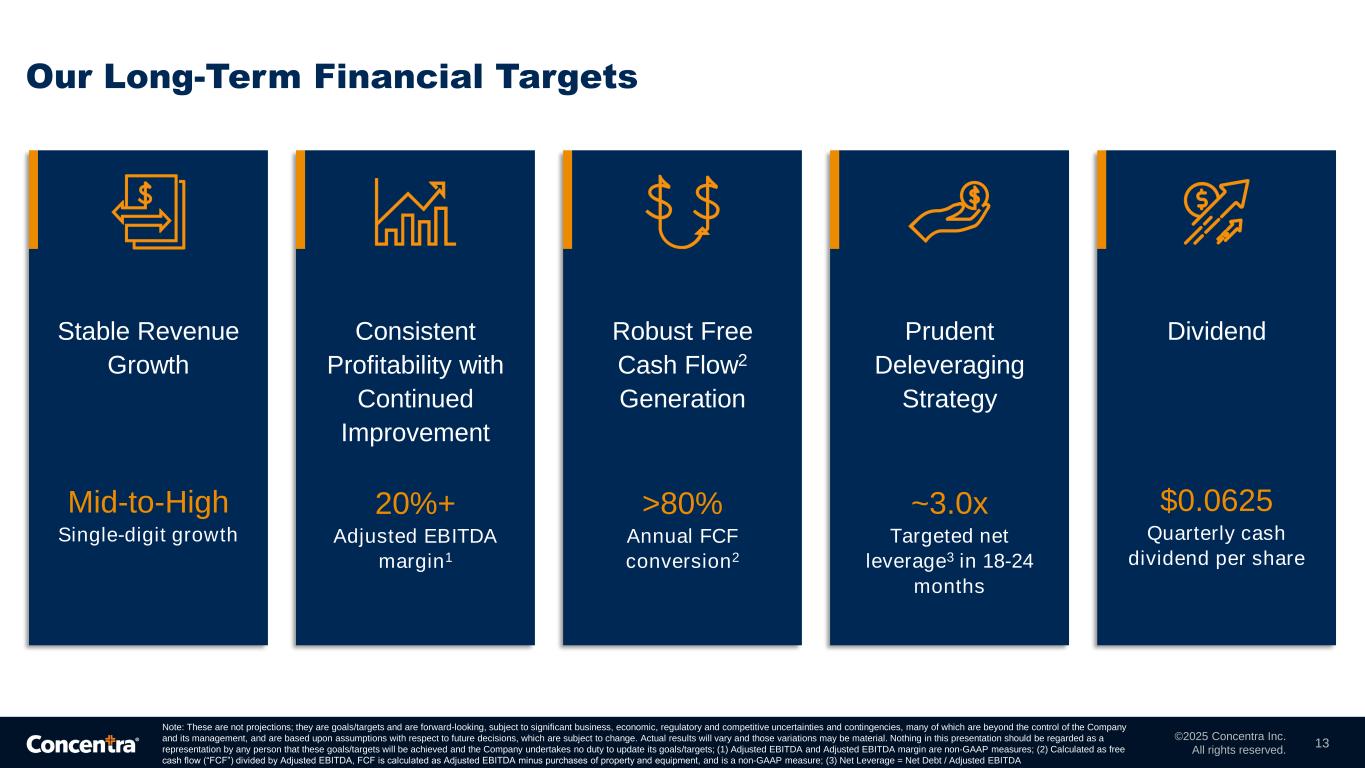
Thanks, Matt. Obviously, a lot of good news here for the quarter. As a management team, we're excited about the progress we have made as a stand-alone company post IPO and are proud of the outstanding effort and execution from all of our colleagues across clinical, operational support and development functions. Our people and culture have served as the cornerstone of our company for over 45 years, and we are focused on maintaining our values and adhering to our mission of improving the health of America's workforce one patient at a time as we continue our growth. We think we have a strong value proposition to offer health care investors given our industry-leading market position as a provider of choice for over 215,000 employer customers due to our long history of clinical excellence, patient care and our overall value proposition to help employers lower health care costs. Also our strong geographic industry, customer and service offering diversification representative of 45 states, the attractive reimbursement model that mitigates stroke of the pen risk due to less than 1% of our revenue having government payer exposure, our flexible operating structure that allows us to quickly scale staffing and costs up and down from real-time volume trends, our history of successful execution on M&A and the white space that exists for those trends to continue and our motivated and highly experienced management team that has a long track record of producing mid- to high single-digit top line growth, consistent 20% adjusted EBITDA margins, significant free cash flow and low to mid-teens return on invested capital. We are excited to continue to share our story with the market and provide updates on our performance and growth initiatives over the coming quarters. That concludes our prepared remarks, and we thank everybody for the time today.
Operator
Our first question is from Benjamin Rossi with JPMorgan.
Speaker 3
So on employer services volumes, with the strong performance during Q1 coming in ahead of expectations, it seems as though we've potentially hit an inflection point on visit volume erosion in that segment. Can you just discuss your turnaround here organically? And what are some of the factors that aided this turnaround? And then looking ahead, how are you factoring volume trends here for the remainder of the year?
Speaker 1
Yes, I'll begin with that. Matt, feel free to add in. As we have discussed previously, we experienced significant highs and lows during the COVID years, which included ramping up and subsequent churn, followed by a downturn that led to year-over-year negative comparisons. I believe we have reached the lowest point, and we've mentioned before that we were beginning to see some improvements. Coming into this year, there was a sense of increased optimism from employers. Additionally, our ongoing sales and marketing efforts across various channels to capture market share have significantly contributed to this positive trend. Historically, we have witnessed fluctuations in connection with economic conditions, and we are starting to see the benefits of our hard work over the past year, combined with the shifting dynamics following COVID and the associated hiring and churn. We remain cautiously optimistic, aware of the turbulence in the market and uncertain economic projections. However, we are encouraged by the trends we are observing.
Speaker 3
Great. Appreciate the color there. And just as a follow-up, so taking a step back, sounds like a series of acquisitions makes you one of the most scaled platforms in occupational health across both your workers' comp and employer services segments. Just with these transactions, could you take a step back and describe to us where you see Concentra going from here with these added capabilities and ultimately, how this scaled platform helps you deliver upon your long-term growth goals?
Speaker 1
Yes, I will address that. We are committed to enhancing our brick-and-mortar operations and see ongoing opportunities in that area. Our size has enabled us to establish stronger partnerships within the managed care ecosystem and the workers' compensation industry, which are generating additional volume for us. I am particularly excited about our three core areas at Concentra: the bricks and mortar operations, our employer onsite services, and our other business lines, mainly telemedicine. We are enthusiastic about the potential of our onsite segment, which we are significantly expanding in terms of revenue through the acquisition of Pivot. While we are still on the smaller side among onsite companies, we rank within the top 10 and anticipate substantial growth ahead. We are actively exploring additional opportunities to expand this business further. Currently, we are scaling it up, and we believe Pivot will significantly contribute to our efforts, as it aligns closely with our occupational medicine service model. We have also rolled out our advanced primary care product and are beginning to secure wins related to RFPs in that domain, which represents a major market for us. We intend to vigorously pursue growth in this area, and with a solid foundation established through the Pivot acquisition and our existing operations, we are confident in the future growth this segment will drive for us.
Speaker 2
Yes. Ben, the only thing I would add there, too, I always talk about providing great access to our employer customers, and we do that through our locations, so employers can send their employees to us at our health clinics. But we can also go to them through our onsite business, and we do that episodically. We do that from a mobile standpoint and then full time as well. And then the third one is our virtual telemedicine service offering. So what we're trying to do is just continue to build out all three of those areas and provide a very comprehensive solution set for our employer customers.
Operator
Our next question is coming from Jamie Perse with Goldman Sachs.
Speaker 4
Just starting on workers' comp. I think visits were up 2.4% per day. It sounds like that was 0.2% organic and 220 basis points from Nova. How would you contextualize the organic performance there? It was slower than trends, and I think slower than the roughly 2% long-term framing you've provided for that business. So what did you see in the quarter? Do you expect improvement from here?
Speaker 2
Sure. I can take that. Jamie, so yes, work comp from a core standpoint was a little lighter than prior quarter, but still positive overall. We continue to see total employment growth. There's obviously some changes within that category, practice patterns and things like that. So overall, we expect to see positive work comp visit growth from a core perspective on a go-forward basis.
Speaker 4
Okay. And then on gross margins, I think you cited 150 basis points improvement from last year, excluding the reversal you had last year. How much of that was from the acquisition of Nova versus more underlying performance? And then is that a sustainable level adjusting for seasonality that we should think about as a starting point for the year given the kind of potential improvement in volumes, the pricing you're getting, et cetera? Just how should we think about gross margin progression this year?
Speaker 2
Sure. There are many factors affecting the margin profile. We had strong rate performance and positive visit growth, along with the acquisitions and some additional hires while separating from Select. There was also a one-time favorable item from the previous year. All of these factors contribute to our current outlook. This marks the fifth consecutive year of achieving margins above 20 percent, and we believe that level is sustainable. With ongoing M&A activity, we anticipate further upside as well.
Speaker 1
Yes. And I would add that Nova was only one month of the results, so it had very little impact this quarter, but we feel pretty good with the synergies that we're executing on right now that it's going to contribute as we go forward, but the rate has really been a nice driver this year.
Operator
Our next question is coming from Ben Hendrix with RBC Capital Markets.
Speaker 5
First question here for Keith. Just following up on your trade policy discussion. Just in that high inflation scenario, you noted that rate increases would likely flow through. Just wanted to get any commentary on your views on the uniformity of that across your states. I know these states have different rate mechanisms. Are there any particular key areas or key markets where you could be at risk of rate updates lagging inflation more than others?
Speaker 1
Yes. Typically, there's some sort of inflationary factor they use, and it could be CPI, it could be MEI. But what historically we've seen is the implementation of the adjustments to their fee schedule typically within the first quarter of the year. And they'll look back kind of what's happened in the last three to six months. So it's been fairly reflective at the time that they go in as to what recently has happened relative to inflation. And so that's what we've seen historically. So it's worked pretty well from that standpoint.
Speaker 5
Great. I wanted to ask Matt about the performance of service costs and the lower service costs as a percentage of revenue. You mentioned some labor efficiencies achieved. Could you provide more details on that, including whether there's potential for further improvement and your long-term outlook on labor costs as a percentage of revenue? Also, is there any change to that forecast?
Speaker 2
Sure. Yes, I'll add a couple of comments there. Obviously, the revenue increase and the rate gains helped cost of services as a percentage of revenue go down. But we also noted that we had some staffing efficiency gains at the center level across all disciplines and across the country. So our teams are doing a great job. The visit volumes are more stable than they have been in prior years. We have some technology initiatives that have helped with efficiencies. And we're really happy with some of the key metrics we look at, whether it's patient satisfaction or turnaround times and things like that. So we'll continue to invest in technologies and other ways to make our colleagues at the centers more efficient in the future.
Operator
Our next question is coming from Joanna Gajuk with Bank of America.
Speaker 6
So I guess a couple of follow-ups. Just to clarify on your guidance update, where you said you raised the revenue and your EBITDA guidance was raised by $5 million. And you said to reflect the Q1 and also the deal activity. So just to make sure, do you include the Pivot acquisition that in this updated guidance?
Speaker 2
Yes. So I'll add a little commentary just to make sure that's very clear. Our previous guidance included Nova and all of our de novos for this year. Subsequent to that, we closed on the small PHC deal in Florida. And then we announced the Pivot acquisition. So both PHC and Pivot are included in our revised guidance. Pivot is not closed yet, but we expect it to close here shortly.
Speaker 6
Okay. You expect to close shortly. That's why you're including it. Okay. And another follow-up. So your workers' comp revenue per visit, even if you exclude the Florida base would still be pretty good up at 5%. So is that a good number to kind of assume longer term?
Speaker 2
Over a long period of time, the stat that we've always referenced is 3% is the long-term average on work comp rate increases. You can look over a 5-, 10-, 15-, 20-year period, and it's pretty much in line with that. Obviously, inflation has been higher in recent years. And I think that's what's reflected in our numbers this year. And to Keith's comments earlier, if there is any sustained inflation, we expect it to be slightly higher than 3% in the near term.
Speaker 6
And if I may, another follow-up on workers' comp. So your comment was that, I guess, excluding Nova, the rents per days decelerated and we're only up like 0.2% versus 1% in Q4. So I wasn't quite sure whether you're trying to call out anything there? Or are you just kind of sort of in the range of things that you would have expected?
Speaker 2
No, we're not trying to call out anything there other than we just felt it was really important to exclude the Nova visits so people can look at our core company performance this quarter, especially with the one month of Nova visits. But work comp was in line with expectations, maybe slightly softer than what we thought, but it always bounces around a little bit, and it's still positive. And I think the big news for us really, as we spoke about, was the turning point with employer services visits. So we're very happy about that.
Operator
Our next question is coming from Stephen Baxter with Wells Fargo.
Speaker 7
Just wanted to follow up a little bit on some of the moving parts on guidance. Perhaps you could start by reminding us, I guess, when exactly you're expecting the Pivot deal to close and what the annual revenue contribution is there? I kind of thought that getting a couple of quarters of that deal would maybe explain the entirety of your guidance raise, maybe even more than that potentially. Just trying to sort out the organic pieces versus how you're thinking about Pivot and how much revenue is in the guidance for Pivot. And I guess also the smaller five center deal that you closed as well.
Speaker 2
Sure, thanks for the question, Steve. We expect to close the Pivot deal towards the end of Q2, which will have an impact on our financials for approximately half a year. There will be some transition time and ramp-up with both the PHC deal and Pivot. PHC closed in mid-March and we anticipate Pivot closing at the end of Q2.
Speaker 7
Okay. And I believe Pivot was potentially a $60 million annual revenue business and maybe the disclosures you gave, do we have that right? Or is there a different number for some reason that we should be thinking about for two quarters of that for the balance of the year?
Speaker 2
No, that's correct. $60 million revenue on an annualized basis. And just to add a couple of comments. I think as you're getting into how we thought about guidance, obviously, there's a lot of moving pieces. We've got the M&A coming on board. We've got some uncertainty that Keith and I both talked about. And we felt like at the end of Q1 with the strong Q1 performance and then a couple of additional deals, we felt like it was appropriate to increase the guidance by $50 million on the top end of the revenue range and then $5 million on both ends of the EBITDA range. And really just being very thoughtful about where we are in the year and the uncertainty that Keith talked about. Other than that, I think it likely could have been a higher or larger increase.
Speaker 1
Yes, I was going to add, in my comments, I mentioned we wish we all had a crystal ball. We feel really good about how we ended the first quarter and how we're going into the second quarter. But again, there's a lot of uncertainty and turbulence out there. So as an organization, and what we say at this point in time, we want to remain cautious, especially in the early stages of being a public company as to far as what we think we'll end, and we'll update as we go forward each quarter as to what we're seeing in the business.
Speaker 7
Okay. Makes sense. Better Q1, but just maintaining a prudent stance on the rest of the business organically and folding in deals. I think we can appreciate that then. And then I just wanted to follow up on some of the macro discussion. I think we do understand the workers' compensation side of the business and how there's often tie-ins to inflation benchmarking. Can you talk a little bit about how employer services rates have held up when you've had previous economic cycles with more pressure, maybe more uncertainty, maybe more akin to the environment that we're in now?
Speaker 1
Yes. Historically, our employer services rates have closely tracked the inflationary environment. Each year around October and November, we review the past year and assess current conditions to determine the appropriate rate to communicate for January 1. Typically, as long as we base our pricing on inflation trends and current circumstances, it has been well received with minimal pushback. This has been our consistent approach over the years. Additionally, I believe this year's increase of 3.9% aligns with our targets and what we communicated to employers in the fourth quarter.
Operator
Our next question is coming from Justin Bowers with Deutsche Bank.
Speaker 8
Just sticking with the rate topic. Can you remind us sort of the seasonality of when you get the updates or when those kick in for the fee schedules on the workers' comp side? So, for example, is it 75% on January 1, 25% on October 1? Just trying to get a sense of phasing here.
Speaker 1
I would say 80% to 90%, we're going to see within the first quarter. A good majority are effective January 1. Some states lag a little bit as far as updating their schedules, but it typically happens in the first quarter. You'll get the other 20% or so in the middle of the year. July, there's some updates. And then again, in October, there's a couple of states. I believe Arizona typically is an October update. But the majority of what we're going to see each year happens within the first quarter.
Speaker 8
Okay. Regarding workers' comp, I have two questions. First, was there any weather-related impact during the first quarter? I'm aware that we've seen that in other areas of our services. Second, you mentioned gaining market share in employer services. I'm interested in knowing your thoughts on consolidation or share gain opportunities with Fortune 500 accounts and how you view that over the next two to three years.
Speaker 1
Yes. I'll comment on both, if I understood the second part. But as far as weather, yes, we get impacted by weather, just like everybody else. It's a walk-in urgent care practices. And if there's ice and snow, it can significantly impact us as far as when it initially hits. It also potentially helps us with slips and falls along with that weather. But we have it every year, and it's hard to really ascertain if there's really a more negative impact this year than last year. So that's why we didn't really comment from that perspective relative to weather this year impacting us. As far as employers, we've built some of the larger ones. We get further and further integrated with them within workers' comp ecosystems and their other partners, their TPAs, their managed care entities that may support some of the programs they have in place to where there is a true direction of care that occurs relative to trying to get patients to us versus somebody else because of the ease of business that we provide for them and their payers. A big part of what our value prop is about is velocity of information regarding patients, return to work, communication. And if they can use a provider that is technology advanced, that can provide them information in a faster manner than others, that can help return their workers to full functionality quicker than others, it's going to save tremendous cost as we've shown in the past, validation studies have shown 25% to 30% cost of savings with us versus a non-Concentra facility. And so we feel good, especially with the size that we have, the footprint, the ability for an employer to come to us and have good penetration into their employee base across the country as far as using us, and it just streamlines things to them. So it's a great value prop that we have.
Operator
Our next question is coming from Ed Kressler with TPG Angelo Gordon.
Speaker 9
Thanks for the outlook on the macro, it's helpful. You did discuss the flexibility of your cost structure in the event of a macro downturn. Can you give a little bit of more color on how variable your COGS is? And just looking at the Q, is it right to think that kind of low 70s percent of your COGS is labor? And just curious how much of that is variable?
Speaker 2
Yes, I can take that, Ed. Thanks for the question. Most of our cost structure is labor. And there's obviously a core staffing group for each individual center. But the teams in the field that manage the centers and work in the centers every day are really good at staffing up and down to volume. We have large PRN pools across all functional areas. And the teams are used to the seasonality within the work week, within the month and month by month throughout the year. So we saw that as we navigate prior cycles, the teams can do a really nice job of managing the personnel to the appropriate visit volumes.
Speaker 9
Got it. Okay. Great. Lastly, can you discuss the experience during a macro downturn? For instance, during the great financial crisis, did you notice that employers reduced their provision of these services, or once they start offering them, do they tend to maintain them?
Speaker 1
I'll address that. Back in 2009, we weren't heavily involved in the onsite area. Some may view it as an unnecessary cost or perhaps an investment that isn’t essential, but overall, we haven't noticed a significant shift in this regard, whether during the COVID period or the global financial crisis. From what I observe and hear from competitors, there doesn't seem to be much indication of that concern. I believe companies like Polaris consider it an investment in their workforce at their locations. As long as they can demonstrate a return on that investment, employers are likely to maintain those services. Even during economic downturns, when there might be some workforce reductions, most onsite locations still have several hundred employees, so a small cut in staff typically doesn't lead to shutting down the entire site. Therefore, we’re quite hopeful that they will endure any potential challenges effectively.
Speaker 2
Yes. And the only thing I would add there, too, is we're thinking long term about the business and everything going on with the current administration and reshoring of America jobs. We think that's going to be a really nice tailwind as companies continue to announce their investment back here in the U.S. with large labor forces. And there's going to be an increased need for onsites long term in our view.
Speaker 9
Got you. Regarding the onsite side, should we consider it as generally cost plus as you've described in the past? Should we also view it as dependent on volume? For example, if an employer decreases staff at an onsite location, would that impact us? Or should we think of it as primarily cost plus for the service rather than being volume dependent?
Speaker 2
I would think of it as cost plus.
Operator
As we have no further questions on the lines at this time, I'd like to hand it back to Mr. Newton for any closing remarks.
Speaker 1
We appreciate everybody's participation today, and thank you very much.
Operator
Thank you, ladies and gentlemen. This does conclude today's call. You may disconnect your lines at this time, and we thank you for your participation.