Operator
Good morning, and thank you for joining us today for Concentra Group Holdings Parent, Inc. Earnings Conference Call to discuss the Second Quarter 2025 Results. Speaking today are the company's Chief Executive Officer, Keith Newton; and the company's President and Chief Financial Officer, Matt DiCanio. Management will give you an overview and then open the call for questions. Before we get started, we would like to remind you that this conference call may contain forward-looking statements regarding future events or the future financial performance of the company, including, without limitation, statements regarding operating results, growth opportunities, and other statements that refer to Concentra's plans, expectations, strategies, intentions and beliefs. These forward-looking statements are based on the information available to management of Concentra today, and the company assumes no obligation to update these statements as circumstances change. At this time, I will turn the conference call over to Mr. Keith Newton. Sir, you may begin.
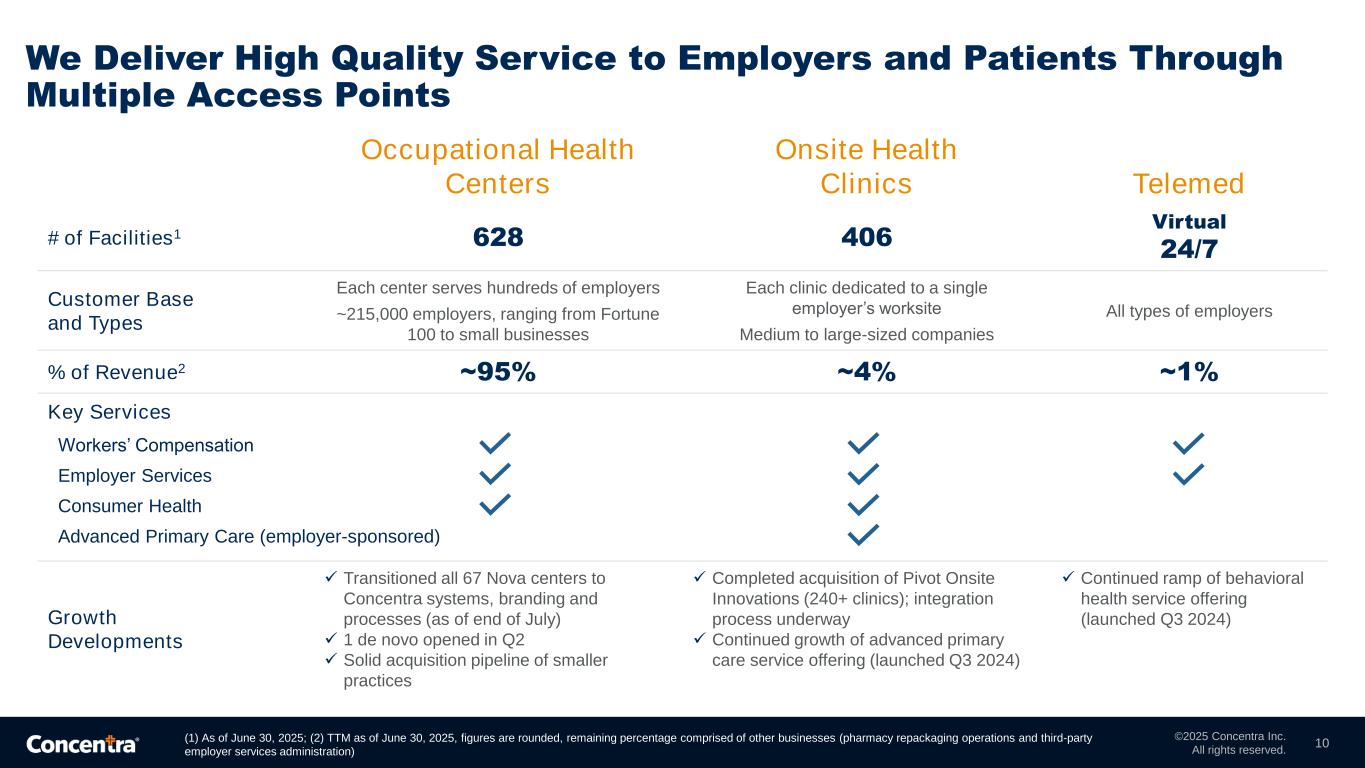
Thanks, operator. Good morning, everyone. Welcome to Concentra's Second Quarter 2025 Earnings Call. We are pleased to report on a strong second quarter, sustaining the momentum we had in the first quarter of 2025. In Q2, we saw accelerated growth in visits across both workers' comp and employer services, even after excluding the impact of the visits in the centers acquired in the Nova transaction. We had another quarter of mid-single-digit year-over-year rate increases. With this strong growth on both volume and rate, we had a high single-digit revenue growth, excluding Nova. In addition, we successfully completed the integration and rebranding of our acquired Nova occupational health centers. We opened an additional occupational health center de novos site in Chattanooga, Tennessee, bringing us to 4 de novos opened so far this year with 2 to 3 additional anticipated by the end of the year. We closed on the Pivot Onsite Health Clinic acquisition on June 1, which doubles the size of our on-site health clinic segment and brings Concentra to over 1,000 combined occupational health center and onsite health clinic locations across the country. The integration of Pivot is well underway and on track. Additionally, we expanded our Board of Directors and added 2 new directors, Brigid Bonner and Vipin Gopal effective July 1. Brigid and Vipin bring a wealth of experience across the customer experience, digital transformation, data analytics, and AI spectrums, and we're thrilled to gain access to their unique skill sets and knowledge base with their decades of experience at companies like Eli Lilly, Walgreens, UnitedHealth and IBM, we expect them to contribute meaningfully to our future success. I'll touch on some of the key financial highlights from the quarter, and then we will get into more details. As with the last quarter, we will continue to report certain metrics, both including and excluding the impact of our larger M&A so that people have a good sense on how the core business is trending. I would note here at the outset that we had the same number of revenue days in Q2 2025 as Q2 2024, so there is no need to adjust the prior year comparisons for days. Total company revenue was $550.8 million compared to $477.9 million in the prior year, representing a 15.2% growth year-over-year. Excluding contributions from Nova, revenue was $519.4 million, resulting in an 8.7% increase over the prior year. Total patient visits increased 9.5% in the quarter to approximately 55,000 patient visits per day. Our workers' compensation visits per day increased 9.3% and employer services visit volume increased 10.3% relative to the prior year. Excluding the impact from the acquisition of Nova, total visits per day increased 2.4%. Workers' compensation visits increased 3.2%, a notable acceleration over Q1 growth and employer services visits increased 2%, also better than Q1 results. A solid quarter across the board from a volume standpoint as work comp volumes rebounded from a softer Q1 and employer service visits continued the reversal in positive growth territory we have seen since the beginning of the year as we move to more normalized levels. We had another strong rate quarter with an approximately 4.4% increase in revenue per visit this quarter versus the same quarter prior year. This growth was driven by a 5.4% increase in workers' compensation and a 3.1% increase in employer services revenue per visit. Adjusted EBITDA was $115 million in the quarter versus $101.6 million in the same quarter prior year or a 13.2% increase. Adjusted EBITDA margin decreased from 21.3% in Q2 2024 to 20.9% in Q2 2025, primarily due to some favorable items impacting cost of services in the prior year, also some one-time Nova transition costs this quarter, along with incremental Nova G&A expense that wasn't synergized throughout the full quarter and other G&A cost increases in the current year that Matt will touch on shortly. Overall, we are pleased with the company's performance and our continued growth. Adjusted net income attributable to the company was $47.7 million and adjusted earnings per share was $0.37 for the second quarter of 2025. As with the last few quarters, net income was lower than the same quarter prior year, primarily due to an increase in interest expense resulting from the IPO recapitalization. Adjusted EBITDA and adjusted net income reflect the add-back of transaction expenses related to our acquisition activity as well as one-time costs related to our separation from Select Medical. Now before I turn it over to Matt for additional information, I'd like to briefly comment on the significant progress we have made during the second quarter as it relates to our Q1 Nova Occupational Health Center acquisition and the related integration efforts. The June 1 Pivot Onsite Health Clinics acquisition and our continued Select Medical separation efforts. We are incredibly proud of our team's efforts to manage these major initiatives and continue to achieve our goals on the timelines we established. Matt will share more details, but everything is on track, and we are pleased about where we will be when all three are completed. Now I'll hand it over to Matt to provide additional details on our financial results, capital allocation strategies, and growth efforts.
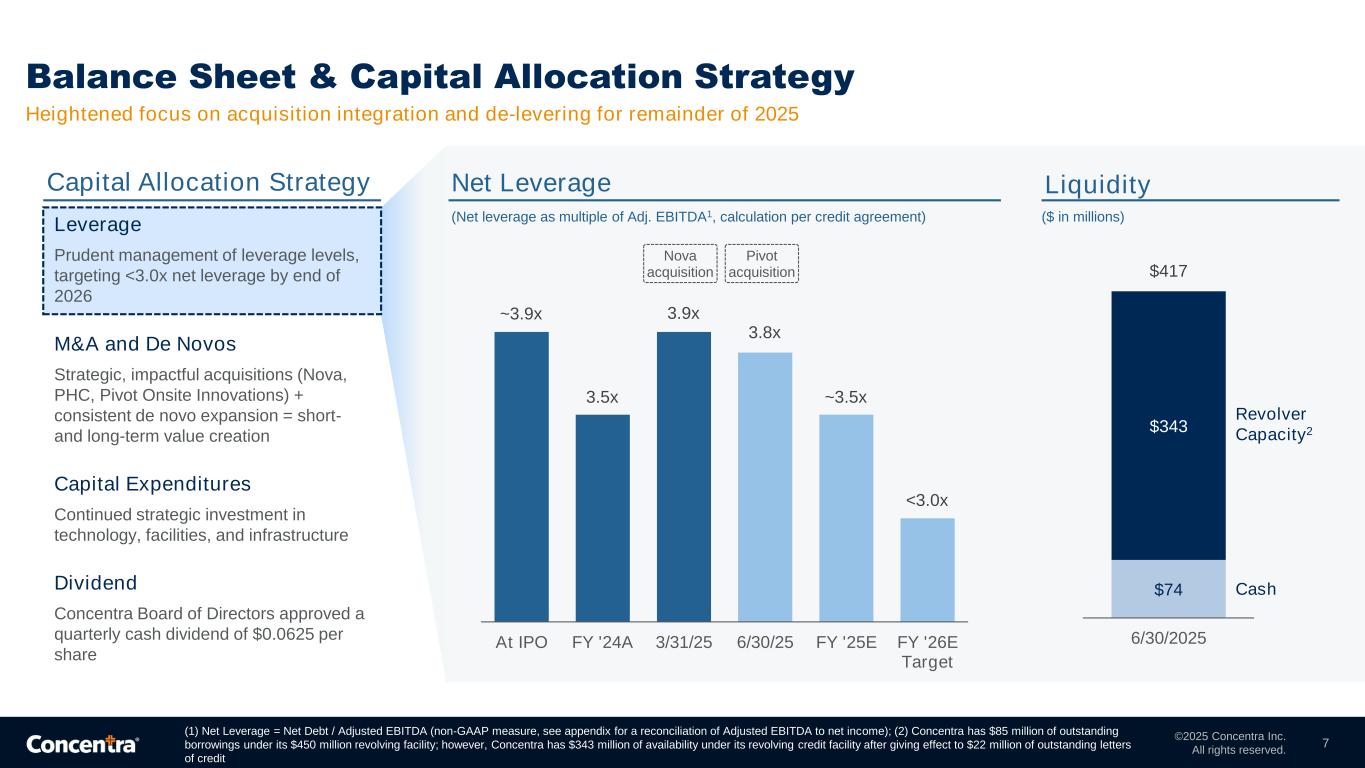
Thanks, Keith, and good morning, everyone. I'll start by going through some more details on our results in our three operating segments. In our Occupational Health Center operating segment, total revenue of $516.1 million in Q2 2025 was 14.4% higher than the same quarter prior year. Workers' compensation revenue of $332.2 million in Q2 2025 was 15.2% higher than prior year. As Keith mentioned, work comp visits per day increased 9.3% from prior year and work comp revenue per visit increased 5.4% versus prior year. Work comp revenue per visit was $209, similar to our work comp rate last quarter. Within employer services, revenue of $174.3 million increased 13.7% from prior year. Employer services visits per day increased 10.3% from prior year and employer services revenue per visit increased 3.1% versus prior year. To help isolate from our Q1 acquisition of Nova, here are the same stats excluding the impact of Nova. Total revenue within the Occupational Health Center operating segment was $484.8 million, a 7.4% increase over the prior year. Total visits per day increased 2.4% over the same quarter prior year. Revenue per visit increased 4.9% from $140 in Q2 2024 to $147 in Q2 2025. Workers' compensation revenue of $314 million in Q2 2025 was 8.9% higher than prior year. Workers' compensation visits per day were 3.2% higher than prior year and work comp revenue per visit was 5.5% higher than prior year. Within Employer Services, revenue of $161.8 million increased 5.5% from prior year. Employer services visits per day were 2% higher than prior year and employer services revenue per visit was 3.4% higher than prior year. The most notable takeaway from the quarter was our solid volume growth, both compared to Q1 and also compared to Q2 of last year. Excluding Nova, year-over-year visit growth for work comp accelerated from 0.2% in Q1 to 3.2% in Q2, and employer services went from 0.9% in Q1 to 2% in Q2. We had spoken before about the softer work comp volume number in Q1, and we did, in fact, see a much stronger number in Q2. We are also pleased to see the continued positive growth trend and slight acceleration for employer services. Work comp and employer services visits can bounce around a little bit, but growth tends to be in the low single digits over time. We'll add more commentary later in our remarks, but we think our Q2 visit trends are a pretty good indicator of the broader economy. We are not seeing any slowdown based on the data we look at every day that covers employers of all sizes, industries, and geographies. Moving on from our occupational health centers. Our onsite health clinics segment reported revenue of $22.6 million in Q2 2025, a 45.2% increase from the same quarter prior year. Excluding the one-month impact from the Pivot Onsite acquisition that closed on June 1, onsite segment revenue grew 9.9% year-over-year. So overall, a nice quarter as it relates to our core on-site performance and obviously, a major milestone adding the Pivot Onsite to our portfolio. A quick reminder for everyone. We do not report visit metrics for our on-site business given the nature of the revenue model. And finally, other businesses generated revenue of $12.1 million, an 8.5% increase against the same quarter prior year. Now switching to expenses. Cost of services was $389.3 million or 70.7% of revenue in Q2 2025, down from 71% of revenue for the same quarter prior year. We realized a nice decrease here, primarily driven by better staffing efficiencies in conjunction with the strong revenue growth. And this improvement would have been even better if not for approximately $750,000 of one-time costs related to the Nova and Pivot transitions that are not adjusted out of adjusted EBITDA as well as several favorable adjustments in the prior year. Overall, our labor costs continue to be stable, trending approximately 3% higher than prior year, which is a consistent theme for us over the years. Our teams are doing a great job managing staffing to the visit volumes, and we have made good progress filling open positions. We want to emphasize this point as labor dynamics have not historically been an issue for this business model. Our total general and administrative expenses were $52.9 million or 9.6% of revenue in Q2 2025 compared to 7.7% of revenue in the same quarter prior year. This comparison is not apples-to-apples, though, as we have expenses in Q2 of this year that we did not have in the prior year before we were a public company and separated from Select Medical, and we also have some acquisition-related expenses here related to Nova and Pivot. Excluding items that are added back for the purposes of calculating adjusted EBITDA, including equity compensation expense, one-time Select separation costs, and M&A transaction costs, G&A expense was $46.6 million for the quarter or 8.5% of revenue compared to 7.8% of revenue in the same quarter prior year. The increase was largely driven by incremental Nova G&A expense that wasn't synergized through the full quarter and planned increases in personnel costs related to becoming a public company and our ongoing separation from Select Medical. The overall adjusted EBITDA margin in Q2 2025 was 20.9% compared to 21.3% during the same quarter prior year. To reiterate, the primary drivers of the slightly lower margin are some favorable one-time cost of services items from the prior year, certain one-time Nova and Pivot integration expenses totaling approximately $750,000 that are not adjusted out of adjusted EBITDA, incremental G&A expense from Nova that was not fully synergized through the entirety of the quarter and the planned increase in personnel-related public company and Select separation costs. In Q2 2025, we generated $88.4 million in operating cash flow. It was a nice cash flow quarter for us, driven primarily by our financial performance, but also due to the timing of payroll and other payables at quarter end. Investing activities used $79.5 million of cash in the second quarter, predominantly driven by the Pivot acquisition closing on June 1. Also included in this number is $25.2 million of CapEx with approximately $18 million of that from our normal course capital program for upgrading and maintaining existing facilities, de novos, and technology investments and approximately $7 million of one-time CapEx associated with our Nova Center integration and rebranding efforts. Financing activities resulted in net cash inflows of $12.9 million for the second quarter, primarily due to our revolver draw of $35 million as part of the Pivot acquisition, partially offset by 2 quarterly dividend payments that both fell into Q2. We ended the quarter with a total debt balance of $1.67 billion and a cash balance of $74 million. Our net leverage ratio per our credit agreement at the end of June was 3.8x. We found that some investors are not including the annualized impact from our recent acquisitions in their leverage calculations, especially if doing a quick screen on Bloomberg or other sources. So we felt it was important to call this out. For the remainder of this year, we will be focused on continuing our deleveraging path while we look to fully integrate Nova and Pivot and continue to make progress with our separation from Select Medical. The second half of the year is our strongest cash flow period, especially Q4 with collections coming in from the highest volume months. Now switching to our growth efforts. With respect to the integration of Nova, we are progressing well and now have all centers converted to Concentra systems, processes and signage as of the end of July. We expect this to drive both increased top-line growth and operational efficiencies going forward. As we've mentioned, we incurred material conversion costs, which occurred in May, June, and into July that impacted our cost of services and were not added back to adjusted EBITDA. We expect to see these costs decline significantly going forward. Our teams are now focused on growing visits and adding additional services. We expect this will take some time like other acquisitions in the past, but we are confident in the team's ability to do so. As it relates to our cost synergies, through the end of Q2, we estimate that we have captured just over 70% of our planned operational and back-office synergies, which is right on track with our original underwriting. The remaining 30% will be systematically executed through the remainder of 2025 and into Q1 2026. Overall, this acquisition is tracking well, but more work to do before we are fully integrated and closer to run-rate performance. On the de novo front, we opened one location in Chattanooga, Tennessee in Q2 2025 and have 2 or 3 more locations planned for the second half of this year, depending on some construction variables. With respect to 2026 activity, to date, we have executed or are close to executing 5 new leases and have a number of other active targets that are candidates for opening in 2026. In general, we continue to identify a lot of white space across the country with high workplace injury density and little to no existing Concentra footprint. So we have a good opportunity to continue to accelerate our de novo activity. We also have a pipeline of small bolt-on M&A deals that we intend to pursue in parallel with our de novo strategy. I'd like to reiterate that both de novos and bolt-on M&A are down the fairway for us given our average run rate build and acquisition multiples of less than 3x EBITDA over the past decade. We will continue to execute on this corporate development strategy in concert with reaching our leverage targets on our projected timeline. We do not expect any larger acquisitions for the remainder of this year. Lastly, on the growth front, we are excited about the closing of the Pivot Onsite acquisition on June 1. Integration efforts are underway, but mostly focused on combining the 2 G&A teams. No changes at the on-site location level like we had with the Nova integration efforts. As previously stated, this is a deal that enhances our ability to compete in the broader on-site space, where we now view ourselves as a top 5 player in terms of scale. We've onboarded a number of new leaders that are going to be integral towards growing the business going forward, and we have a robust sales pipeline of both occupational health and advanced primary care opportunities that should set us up nicely for continued organic growth into next year. Longer term, we expect additional on-site acquisition opportunities to continue to arise, including advanced primary care focused platforms as we look to meaningfully grow our onsite segment. Finally, last note on capital allocation. We are pleased to announce a continuation of our dividend this quarter with Concentra's Board of Directors declaring a cash dividend of $0.0625 per share on August 6, 2025. The dividend will be payable on or about August 28, 2025, to stockholders of record as of the close of business on August 21, 2025. So now back to Keith to comment on a few important topics, most of which are popular topics we are asked by investors and research analysts.
Thanks, Matt. Overall, many positives to the quarter and a solid first half for 2025. We're pleased about the opportunities ahead in the second half of the year and 2026. As Matt mentioned, I want to take a few minutes and cover a couple of topics and questions that come up periodically. I'll start first on our visit trends, their correlation to economic indicators and what we're seeing as it relates to the job market. As we've discussed before, we track total employment and hiring and quit rates, but many variables are included in driving our visit volumes. Our work comp visit growth rates quarter by quarter will move around a bit for a variety of reasons. But over time, we expect to see low single-digit growth rates. It was good to see a stronger quarter in Q2. Our Employer Services visit growth rates have now been positive for 2 quarters in a row. We believe this is a solid indicator of the health of the labor market and broader economy. We are not seeing any indication of slowdown from what we have been recently been experiencing as we monitor our visit trends on a daily basis. There are some shifts in industry mix, but no extended trend, either positive or negative in any industry we serve. If anything, we're seeing more stability now than we have in more recent quarters. We've shown in the past that we can navigate well through any ups and downs in the broader economy. A recent example is how we grew EBITDA through many quarters of negative employer service visit declines. We want to emphasize this point as employment and hiring trends are important to us, but we have many other variables such as reimbursement increases and staffing controls that limit our exposure to economic swings. Secondly, we're getting some questions about how the recent legislation or the big beautiful bill impacts us as a company. As we've mentioned in the past, our industry is very unique in the workers' compensation fee schedules are governed by each individual state and employer service pricing is set by us with market pricing adjustments each year. For workers' comp, each state has its own fee schedule and the calculation of that fee schedule varies from one state to the next. Each state sets the fee schedule for their particular state, but are not the entities making the payments to providers, so it does not impact or relate to their specific state budgets. Because of this, most of the time, we are not impacted by federal legislation. With the recent legislation, there is one item of note that will impact us in a favorable way in 2026. It's primarily tied to the 2.5% Doc Fix provision. There are four states: California, Ohio, North Carolina, and Tennessee that utilize the conversion factor component of the Medicare physician fee schedule as one component of their calculation each year in adjusting their workers' comp fee schedules. These 4 states will see that 2.5% conversion factor increase as part of their fee schedule updates. We will benefit most from California as is one of our largest states and also because California has an MEI inflationary adjustment as another component of its fee schedule calculation that will be incremental to the Doc Fix increase. It's still early, but we're expecting another strong rate year in 2026. We'll continue to track other state changes and we'll likely have more information later this year on how 2026 is shaping up. Overall, we want to emphasize how unique our reimbursement environment is and how federal changes are unlikely to impact us unlike other healthcare service companies. Lastly, this legislation has some tax and depreciation regulation changes that while not impacting our overall effective tax rate, will help us in a material way from a cash flow standpoint by over $15 million in 2025 and about 1/3 of that in 2026. Last topic I wanted to comment on is our separation from Select Medical and how that is progressing. We're about 8 months into the 2-year project, and all teams are doing a great job to set us up for complete separation by November 2026. I credit both Concentra and Select colleagues in their collaborative approach. Concentra has hired almost 50% of the staff we project we will need, and we have started reducing the amount we pay Select for the services they have historically provided. Much more work to do, but our teams estimate that we are at approximately the midpoint in this separation process from a people, contract and project standpoint. With that, I will hand it back to Matt to wrap up the call with our financial outlook update.
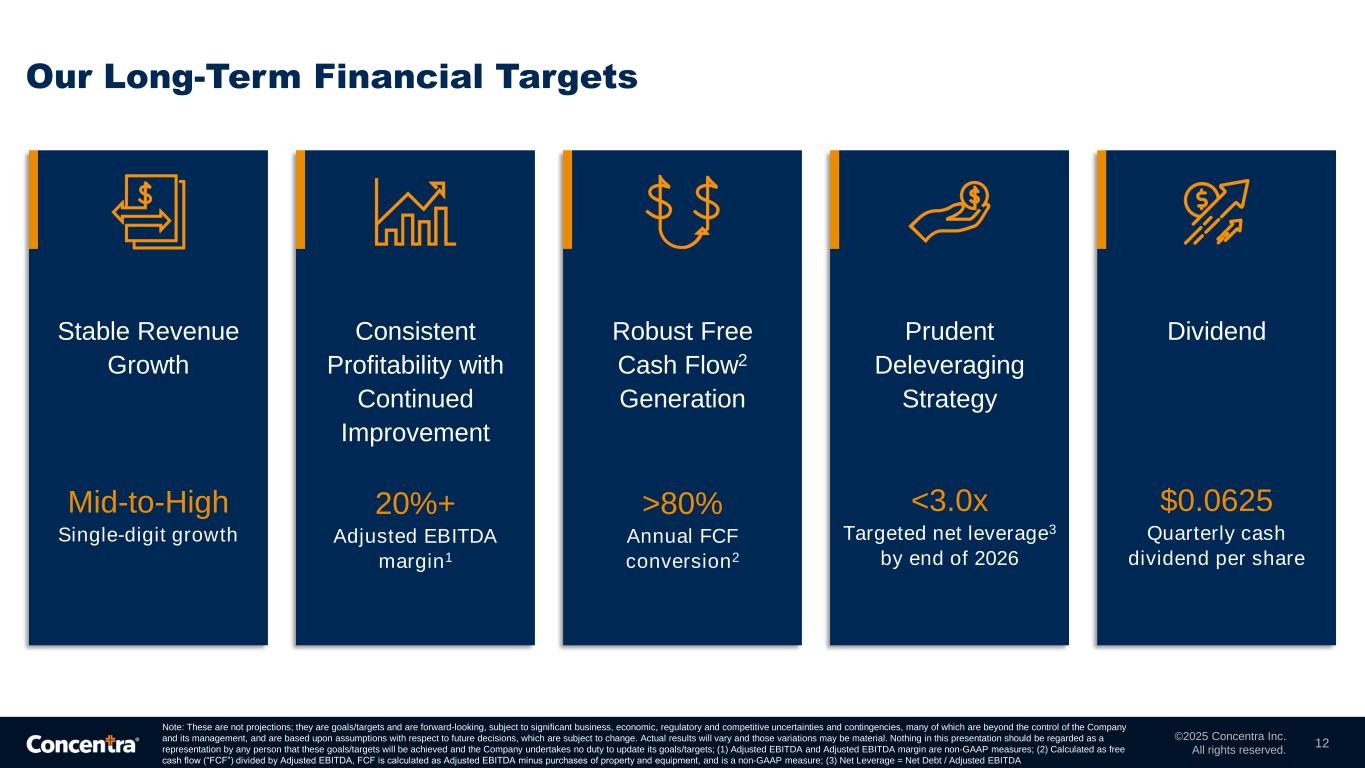
Thanks, Keith. Okay. To round out the call today with the previous comments as a general backdrop, we are raising our 2025 revenue guidance to $2.13 billion to $2.16 billion from $2.1 billion to $2.15 billion and the lower end of our adjusted EBITDA range to $420 million from $415 million. The result is a new 2025 adjusted EBITDA range of $420 million to $430 million. And we remain on target for $80 million to $90 million of CapEx, which includes significant one-time Nova spend and a 3.5x leverage ratio by year-end. Furthermore, we are on track for our leverage ratio to be below 3x by the end of 2026. To wrap it up, I'd like to reiterate the takeaways we'd like investors to leave with. Solid organic visit growth this quarter, another strong rate quarter with a good early outlook on rate for next year, raised guidance, no major reimbursement risk, stable labor trends, positive momentum with strategic M&A integration efforts, tremendous white space available to us across all our service lines, a clear path to continued delevering with very strong cash flow and continued solid EBITDA margins. With our unique reimbursement model and direct-to-employer relationships, we view ourselves as a B2B business services provider and a differentiated investment opportunity versus other healthcare services companies today. That concludes our prepared remarks. We thank everyone for the time today. We'd like to turn it back to the operator to open the call for questions.
Operator
Our first question is coming from Benjamin Rossi with JPMorgan.
Speaker 3
For the 2025 guidance update, could you just walk me through what's being contemplated in your changes to revenue and adjusted EBITDA from M&A contribution or aggregate improvements to either your core volumes or pricing across segments? And then just on cadence, I know last year, you had some weather-related drag in 3Q. Are there any other year-over-year dynamics to consider for incremental M&A spend within this guide for the back half of the year?
Sure. Ben, thanks for the question. I'll take the first part and then we can get to the second part after that. As far as the guidance, we thought it was appropriate to raise guidance. We obviously had a strong quarter on both revenue and EBITDA. We had previously given guidance a few months back that included the M&A. So all of that's factored in. And really, the way we're thinking about guidance is pretty similar performance to what we've seen year-to-date. And obviously, we'll have the incremental Nova and Pivot performance that we didn't have before those deals closed earlier this year. So pretty much run rate consistent performance through the remainder of this year. The second part of your question was around some weather. There was some weather last year, and it was primarily July that we had called out previously. So that will be a factor in Q3, but there's no other material events that we want to point out for the remainder of the year.
Speaker 3
Got it. Okay. As a follow-up on the total count of onsite health clinics, can you clarify the 406 reported centers in light of the POI acquisition? I remember that during the initial overview of the acquisition in April, you mentioned that the combined entity would have around 360 centers and about $120 million in combined revenue. Is that revenue figure still relevant for 2025 under the combined setup?
Yes. No change to the revenue, a slight update to the count of onsites. There are 240 total onsites. And the update there, I think we had previously said 200 plus, but there's a slight difference in how we account for them versus how Pivot had accounted for them. So post-acquisition, we updated that to about 240 onsites that were acquired.
Operator
Our next question is coming from Justin Bowers with Deutsche Bank.
Speaker 4
So one question for each of the main segments. Nice to see the workers' comp accelerate into 2Q. So now that you've had a chance to sort of do the look back, anything to explain sort of the softer trend in 1Q? And then with respect to the guide, does the guide accommodate sort of like flattish to 3% same-store workers' comp visits? Or just help us think about the guide on workers' comp. And then I'll follow up with employer services.
Yes, Justin, this is Keith. I believe the quarters can fluctuate for various reasons. I don't see much significance in the softness of the first quarter. There are many global dynamics at play that may have an influence on us. Employers appear to be in a stable, cautious state at times. The comparisons with last year, regarding what was taking place then versus now, also come into play. We have been focused on our work and I think we are starting to see the results of our efforts. I'm not sure if you have any comments.
Yes. And I'll just add to that. I think the second part of your question was the remainder of the year. Just to add on to what Keith said, Q1 of 2024 was the toughest comp. For this year, Q2 of '24 as a comparison was kind of middle of the road, so versus this quarter. And what we're projecting in our guidance is really closer to an average of our Q1 and Q2 numbers for the remainder of the year.
Speaker 4
That's helpful. Regarding employer services, Keith mentioned this in the prepared remarks. There is some uncertainty in the economy, but it seems like trends are quite stable. Do you believe the performance in this area is influenced more by the market, your own initiatives, or some combination of both?
I would characterize it as a combination of both. We are implementing various strategies in areas like account management and sales activities to deepen our penetration and reevaluate our sales organizational structure. This includes efforts from both the account management side and new business initiatives. Employers seem to be in a wait-and-see mode, as reflected in the current numbers and indicators. We are optimistic that as the year progresses and we gain better clarity on future developments, such as tariffs and other ongoing issues, employers might become more active in hiring, which will benefit us. Currently, we are not seeing significant advantages other than having a stable workforce and the actions we are taking.
Operator
Our next question is coming from Jamie Perse with Goldman Sachs.
Speaker 5
So you've spoken a lot about the volume acceleration that you saw in the second quarter. As we think about the back half of the year, is the right way to think about volume growth for both of the businesses more like what you saw in the second quarter or more like what you saw on a year-to-date basis? Just trying to put a finer point on volume expectations as you move through the back half of the year. And then just to push on this macro topic for a second. Pretty clear you are not seeing anything yet. You said that several times. Are you factoring anything into the guidance or any cushion broadly into the guidance if there were more of a slowdown in hiring trends?
Yes, Jamie, it's Matt. To clarify about the second half of the year, we are focusing on the year-to-date performance. We had a slightly softer first quarter but a stronger second quarter. Therefore, it makes more sense to consider the averages or year-to-date figures as we progress through this year. We do not anticipate significant changes to our visit volumes, whether up or down, for the remainder of the year. Coming off a strong second quarter and based on my comments regarding the second half of the year, closer to the year-to-date averages should provide some insight for the rest of the year.
Speaker 5
Yes, that's helpful. And then just on the P&L, can you spend a minute talking through some of the one-time items that were still included in the adjusted EBITDA? You mentioned some in cost of service. Just trying to better understand the margin progression for gross and operating margin in the second quarter, excluding some of these one-time items and if that margin progression should continue for the balance of the year?
Certainly. There are several factors to consider. First, the cost of services improved compared to the previous year as a percentage of revenue, mainly due to staffing efficiencies. We could have seen an even better result if not for some favorable reversals from the prior year that occurred in 2024, as well as costs associated with the Nova start-up transition. During the 2- to 3-month period of our system integration efforts, some costs were adjusted out, but others, which were typical front-loaded start-up expenses, were not. These costs impacted the overall cost of services. However, now that we've completed the transition at the end of July, we expect those expenses to be eliminated starting in August, which would have further improved the cost of services compared to last year. From a General and Administrative (G&A) perspective, there were two main points. The synergies from the Nova and Pivot transactions had not yet been fully realized. We closed the Nova deal on March 1 and the Pivot deal on June 1, resulting in a lag before we could achieve these synergies effectively. We have acquired that G&A but haven’t fully optimized it in the first quarter after the transactions, though we anticipate seeing improvements in the upcoming months and quarters. Additionally, we incurred some planned public company and separation costs included in G&A that weren’t present in the previous year when we were not a public entity. Considering both of these elements, our EBITDA margin was 40 basis points lower than last year. We believe that, factoring in these aspects, we would have been flat or possibly even improved from the previous year, despite now being a public company and separating from Select Medical. I hope this clarifies things.
Operator
Our next question is coming from Ben Hendrix with RBC Capital Markets.
Speaker 6
I wanted to follow up on a comment Keith made about the employment and jobs macro data. I appreciate that your platform has been very stable despite some changing numbers we've observed. However, you mentioned seeing some mix dynamics in your underlying business, potentially with certain industries or customers. Could you elaborate on that and let us know where you are seeing a shift? Do you anticipate that this could create headwinds or affect dynamics in the future?
Thank you, Ben. In our prepared remarks, we mentioned that we have not observed significant shifts in industry diversification. No single industry accounts for more than 9% or 10% of our business, and several fall in the 8% range, including manufacturing, healthcare, services, and distribution. We have not noticed much change in this stability. Regarding employment, as everyone knows, hiring has been relatively slow, and there seems to be a cautious approach as employers await clearer indications of future developments. However, employers have maintained a stable workforce, and we have not experienced the layoffs that typically signal a recessionary environment. This stability is why our volumes have remained steady, and the diversification among employers has continued to be stable, with no significant changes in the mix of what is coming to our centers.
Yes. And Ben, I would just add to a lot of discussion around the short-term, but we're also really excited about the long term. Every day, you hear additional proposed investment back in the United States with all the reshoring efforts that are going across the country. So every time we see an update like that, it's exciting for our business, both our center business and our onsite and telemedicine segments.
Speaker 6
Great. To conclude our discussion on costs, I'm curious about how you view the projected run rate for G&A and cost of service margins moving forward, especially considering the full synergies of Nova, the G&A rationalization at Pivot, and the complete transition from Select. Would this be more reflective of an exit rate for 2026?
Yes, sure. So obviously, a lot of things going on, as I described before. But what I think we would point to right now is exiting '25, if you just look at the midpoint of our EBITDA and revenue guidance, that implied margin is pretty similar to what we had last year. And we're taking on 2 major acquisitions and separating from our parent company. So I think that speaks for itself. And then we'll give more thoughts on '26 in subsequent quarters.
Operator
Our next question is coming from Joanna Gajuk with Bank of America.
Speaker 7
So maybe first, the onsite segment, it's relatively small, but excluding Pivot, the revenue grew like 10%. So is that the organic growth we should be looking at for the segment? Or there's some de novos in there that's driving that fast growth?
On the onsites, excluding Pivot, we anticipate that with the deployment of the advanced primary care product as an additional service, our core growth rate for onsites will accelerate compared to historical trends focused solely on occupational health. Early indications show we are starting to win business that we previously didn’t pursue due to the nature of the service. This makes us optimistic about the growth potential of our onsite operations outside of any merger and acquisition activities. There is a lot of activity in that sector currently. However, in terms of delivering core services, the addition of advanced primary care is helping us secure business that we historically missed. Thus, I expect a better growth rate than what we've observed over the past few years from our core operations.
Speaker 7
Okay. And a follow-up. So if I got it right, when you were talking about the second half, right, so like employer services volumes grew on average, I guess, 1.5% in first half and workers' comp also. So sort of like you're guiding us to assume similar growth in the second half. But is it sort of like a fair assumption for, I guess, long-term organic growth for these businesses when it comes to volumes?
Yes. I would reiterate what we've said in the past about our growth algorithm and how we think about volumes in the low single-digit range, rate in the plus or minus 3% approximately over a long period of time. And then our smaller core M&A and de novo efforts of 1% to 2% per year. So that's really how we're thinking about it. Q1, as just to mention again, a little soft. Q2, obviously better. We're looking at in between those 2 numbers.
Speaker 8
Yes. I think once we start seeing quit rates start to increase, job openings start to increase, hiring starting to increase, then certainly we'll start to tweak up from an employment services growth rate.
Operator
Our next question is coming from Stephen Baxter with Wells Fargo.
Speaker 9
Just wanted to ask about the guidance revision. It is kind of a small difference, but you're increasing the revenue by more than you're increasing the EBITDA on a percentage basis. I just wanted to know if there's anything to kind of note there. Obviously, you called out sort of a lot of discrete cost items in the second quarter, but I wasn't sure if those cost items were just to aid us in the comparisons or whether they were actually coming in maybe a little bit above what you might have expected? And then I have a quick follow-up, too.
No. We saw some of the costs from the transition efforts in maybe the tail end of May, but mostly in June, and we expect those same similar numbers in July because we were converting the same number of centers in July and then potentially into early August, but then we expect those costs to go away. So just being mindful of what we've seen over the last 2, 3 months as we went through a pretty massive effort to put our systems and signage in and change our workflows at all of those 67 centers. We're really proud of the work the teams have done and excited that, that's behind us and looking forward to the remainder of the year.
Yes. And I'll just add, there's a lot of dynamics in play from the cost perspective right now relative to the synergies being executed on from Nova perspective, the synergies being executed on from a Pivot perspective, the timing of separation cost and adding people and TSAs going down. So a lot of moving parts to that. So we just wanted to be conservative with our approach to how we gave guidance from an EBITDA standpoint at this point in time. And if we get better visibility and clarity as we go through Q3, we'll continue to sharpen the pencil on that.
Speaker 9
Got it. Okay. And then I appreciate the color. I guess I didn't realize that you have some linkages in some of your states to the doc fix. If the doc fix gets done as part of closer to like year-end spending packages related to 2015, do you expect that you would see a true-up in this year's results? Or I guess, how would you expect that to play out if something did ultimately get done for this year?
I wouldn't expect anything right away. Most states tend to operate on their own schedule when these changes occur. So if something happens, we may not see immediate results. I would anticipate seeing developments in 2026. As we progress through the year, we'll provide more updates. Generally, states will implement their fee schedules at their discretion, and if there are changes for any reason, I would say most will occur around January 2026, with others happening later in the year. Each state will follow its own timeline for these changes.
Speaker 9
Got it. Okay. And then I guess one thing we've kind of observed at least with regards to the onsite opportunity is we've had a couple of years now of this really high cost trends within the employer group business that all the managed care companies have discussed. I guess how much do you feel like that's starting to influence the conversations that you have? And do you think that's really been a material driver of maybe increased interest in the model versus what you might have seen going back a couple of years when things are a little bit more stable?
Yes, I certainly see that most companies are expected to face significant employee benefits costs as we approach 2026. We are engaging in more conversations with employers because we now have a product that is competitive with onsite companies focused on the commercial and group health aspects. Historically, our emphasis has been on occupational health, which meant we weren't interacting with employers on these topics, as we were primarily dealing with safety and risk rather than HR and benefits. Now, we have a place at the table concerning both benefits and safety and risk. As I mentioned earlier, we are successfully securing deals by offering advanced primary care services to employers and their employees at the worksite, a service we weren't providing before.
Operator
Our next question is coming from Ann Hynes with Mizuho.
Speaker 10
In your prepared remarks, you made a comment that labor dynamics is not an issue for this business model. Can you remind us why that is? And then secondly, I know you have a leverage target goal of 3x by the end of 2026. How do you balance that with the M&A potential and opportunity?
Labor dynamics in our model typically consist of doctors, physical therapists, and support staff like medical assistants. We don't employ registered nurses or licensed vocational nurses, which are areas where health systems have faced labor pressures. Historically, we have had a larger pool of medical assistants to draw from, so we haven't experienced the same pressures as health systems over the past few years. Our model focuses on visits per day per full-time equivalent within each center and similar metrics, allowing us to adjust our staffing levels based on changes in volume. This is essentially how we've managed our business over the years.
I can take the second question. Ann, on the leverage question, you said. So we've stated that we're targeting 3.5x by year-end and sub-3x by the end of next year. And really, we feel good about where we are because we're still working through the Nova and Pivot integrations. We're still working through call it, the second half of our select separation efforts. Our teams are very focused on executing on those successfully, and we're going to naturally delever, especially in Q4 with the strongest cash flow quarter we have. Then looking at '26, we'll have a lot of those 3 main work streams behind us for the most part. We'll continue to look at M&A. Our leverage targets and strategy are not impacted by our core de novos and smaller M&A. We'll continue doing that as we delever. And I think at some point next year, we'll continue to look at more sizable M&A efforts. But for right now, we are very focused on executing on what's in front of us.
Operator
Ladies and gentlemen, we appear to have reached the end of our question-and-answer session. So I would like to hand the call back over to Mr. Newton for any closing remarks.
No, I just want to thank everybody for joining us today, and appreciate it. Thank you very much.
Operator
Thank you, ladies and gentlemen. This does conclude today's call, and you may disconnect your lines at this time. We hope you have a wonderful day, and we thank you for your participation.