Hello everyone and welcome to Cerence's Second Quarter 2025 Conference Call. I'm Kate Hickman, VP of Corporate Communications and Investor Relations. I've been with the company for nearly eight years leading Communications and I'm excited to now be leading Investor Relations as well. I look forward to getting to know all of you. Before we begin, I would like to remind you that this call may involve certain forward-looking statements. Any statements that are not statements of historical fact, including statements related to our expectations, anticipation, intentions, estimates, assumptions, beliefs, outlook, strategies, goals, objectives, targets, and plans are forward-looking statements. Cerence makes no representations to update those statements after today. These statements are subject to risks and uncertainties, which may cause actual results to differ materially from such statements and expectations, as described in our SEC filings, including the Form 8-K, with the press release preceding today's call, our most recent Form 10-Q and our Form 10-K filed on November 25th, 2024. In addition, the company may refer to certain non-GAAP measures, key performance indicators, and pro forma financial information during this call. Please refer to today's press release for further details of the definitions, limitations, and uses of those measures and reconciliations of non-GAAP measures to the closest GAAP equivalent. The press release is available in the IR section of our website. Joining me on today's call are Brian Krzanich, CEO; and Tony Rodriquez, CFO. Please note that slides with further context are available in the Investors section of our website. Before handing the call over to Brian, I would like to mention that we will be presenting at the TD Cowen Technology, Media, & Telecom Conference on May 29th and Evercore ISI Global Automotive OEM Dealer & Supplier Conference on June 10th. Webcast details will be provided soon. Now, on to the call.
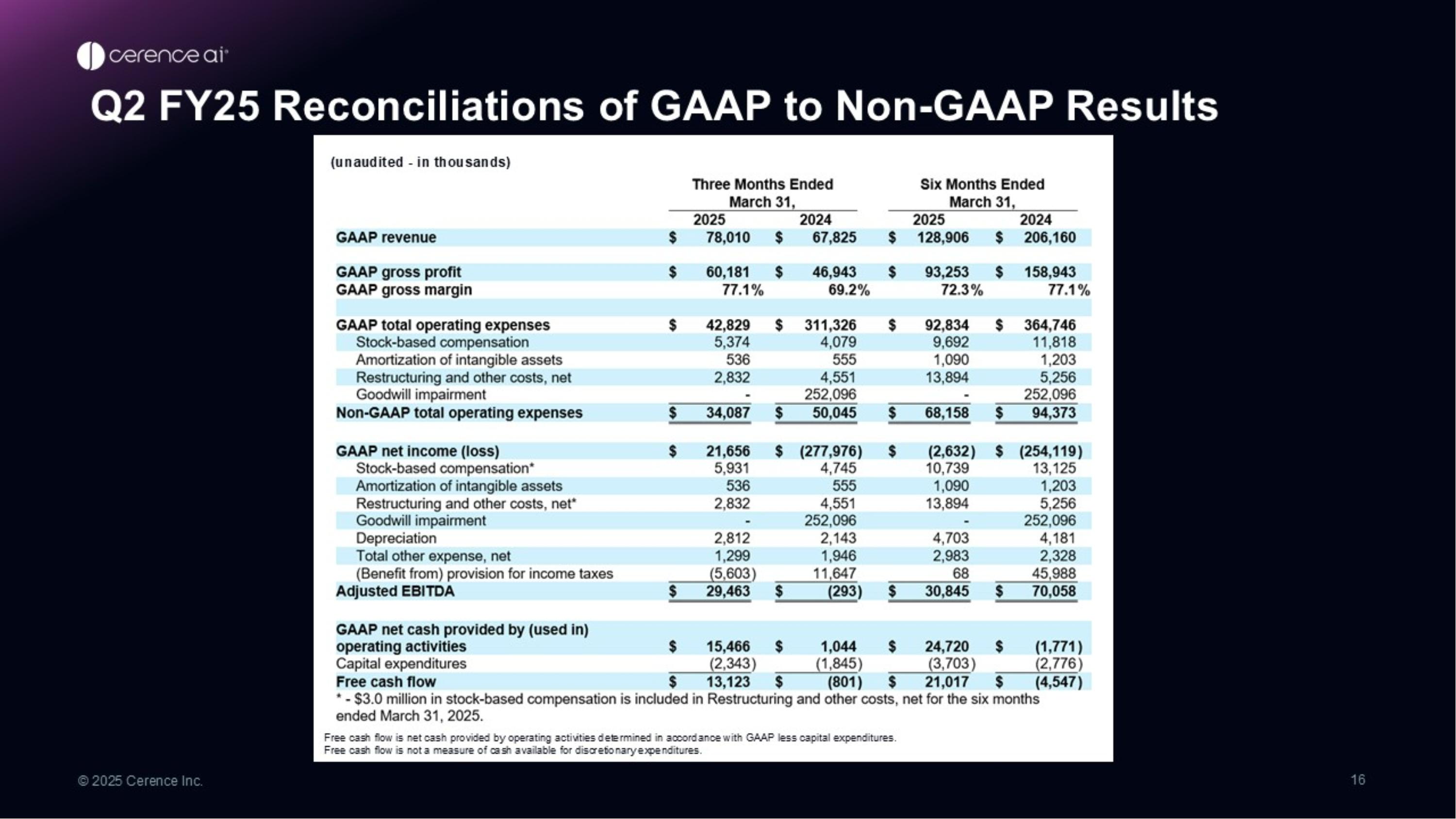
Thank you, Kate. Good afternoon, everyone, and welcome to the Q2 2025 Cerence earnings call. I'm really excited to speak with you today. Now, while Tony will walk you through the details, we're very pleased with the strong results the team delivered this quarter, exceeding the high end of our guidance with a revenue of $78 million and adjusted EBITDA of $29.5 million. Importantly, we generated strong free cash flow of $13.1 million, marking our fourth consecutive quarter of positive free cash flow. As a result, we are raising our full year guidance for adjusted EBITDA and free cash flow, and Tony will provide further details on this. I'm proud of our team and what it has accomplished despite ongoing macro challenges and uncertainty facing the automotive industry. We're focused on the future and believe that we remain well-positioned to support our customers. Cerence continues to be differentiated by our unique combination of technology innovation, our diverse and expansive customer base, and our deep automotive expertise. Our experienced management team and deep bench of talent are keenly focused on delivering to our customers and executing against our road map. As we anticipated and stated in our last earnings call, we did not see a meaningful impact from tariffs on this quarter's results. For Q3, we believe the impact will remain limited. However, we are seeing some pressure from our customers on pricing and some changes in their program timelines as they work to understand the true impact that tariffs will have on their businesses. We're working cooperatively with our customers to find ways to optimize our partnership to best support them during this time, while also maintaining favorable conditions for Cerence. Based on what we can see today and on currently available information for fiscal year 2025, we continue to assume minimal impact from tariffs. However, it's important to note that the situation remains fluid and may evolve over the remainder of the year. We continue to recognize the importance of differentiation and diversification. And as I've mentioned, we've had some great wins outside of automotive. We're building on that foundation to ramp up on our non-automotive efforts. For example, we're working to expand our partnerships with our network of distributors. You may have seen our announcement with Code Factory earlier this week. Together, we're introducing VoiceTopping, a new solution that will bring Cerence's conversational AI to self-service kiosks in a variety of settings. And we believe that this solution will be particularly relevant for things like placing orders and getting information in restaurants and hospitality, retail and self-checkout, healthcare, transportation, banking, and entertainment settings, enabling users to interact with kiosks using only their voice. We're continuing to identify new verticals where we think we have a solid value proposition and can win. And we believe we will see the impact of this work on our revenue and profitability in fiscal year 2026 and beyond. Another area in which we are strategically investing is IP protection. We intend to aggressively protect the time and effort Cerence has put into developing our innovative technology. And as you may know, we have ongoing lawsuits against Samsung for patent infringement. This week, we filed an action against Microsoft and Nuance for copyright infringement and breach of contract. As many of you know, these types of actions can take a long time to resolve and have risks, including loss of these actions. But as a company deeply rooted in innovation, we feel it's critical at this time that we take the steps to vigorously defend our IP. Of course, we also continue to make progress on three key deliverables planned for 2025 that I laid out in last quarter's call. First, we continue our work on Cerence XUI, our hybrid Agentic AI assistant platform. We reached several important milestones for XUI within the quarter, including the product's market launch, which coincided with an appearance at NVIDIA GTC in partnership with our customers, JLR and Renault. And we continue to evolve and enhance XUI with further edge and multimodal capabilities. Our teams worked hard this quarter to showcase XUI in both English and Mandarin at the recent Auto Shanghai 2025. This included new multimodal features within our CaLLM Edge embedded small language model developed in partnership with NVIDIA and MediaTek. This means we feed the SLM with car sensor data and camera-based video streams to create an experience that integrates context from both inside and outside the car, something no one else has done before. For example, XUI can explain or translate road signs, identify roadside buildings, and even offer details about something interesting on a billboard, which has the potential to open up new revenue streams for OEMs. In the coming months, we plan to continue to expand XUI's features and capabilities as well as increase language availability to serve automakers globally. We continue to see strong customer interest for XUI. We've signed several deals with top automakers, including JLR and have several more that we believe will close within the coming quarter. Additionally, we have a robust pipeline of ongoing customer interest with a steady stream of proof-of-concept programs. It's important to note that we can push out the cloud aspects of X UI over the air to existing programs that are already shipping. As OEMs navigate the complexity and ambiguity of the current market, we're well-positioned to help them continue to deliver new features and capabilities within their existing user experiences without having to invest in a full build-out or rebuild of their infotainment platforms. And we continue to build the pipeline for the hybrid cloud embedded aspects of XUI for automakers' future programs. The second key deliverable for 2025 is to continue growing our business with new and existing customers. Even major customer programs started production this quarter, including the Mercedes-Benz Virtual Assistant within the fourth generation of MBUX first introduced in a new Electric CLA. Cerence's AI solutions serve as the core input and output mechanisms across 25 languages, enabling seamless interaction across the platform's agentic architecture, including Mercedes new Avatar. Additionally, emotion detection and embedded neural text to speech from Cerence AI enabled MBUX to deliver more natural and empathetic interactions. The previously announced two-wheeler program with Kawasaki also started production alongside several China-for-the-rest-of-the-world programs with Great Wall Motor and Lincoln Company, among others. In addition, our Gen AI solutions went live with three customers, Hyundai, Kia, and PSA. The third key deliverable for 2025 is to continue our transformation and cost management. As you can see from our strong cash performance this quarter, we're seeing the real benefits from this work and it's being delivered to our bottom line for our shareholders. In conclusion, we are encouraged by our second quarter results, especially with regards to free cash flow and the solid path we have established ahead of us. And with that, I'll turn the call over to Tony.
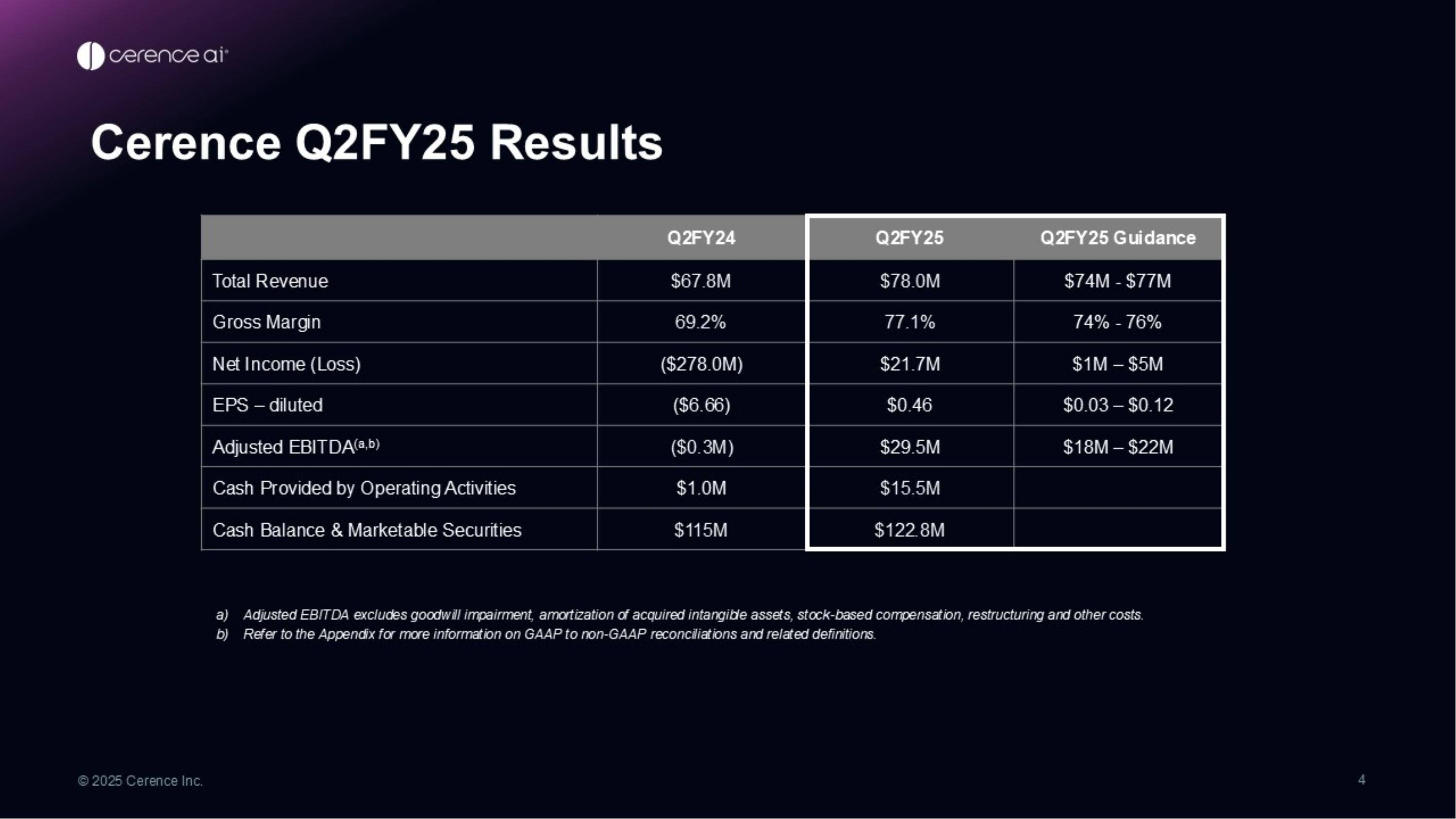
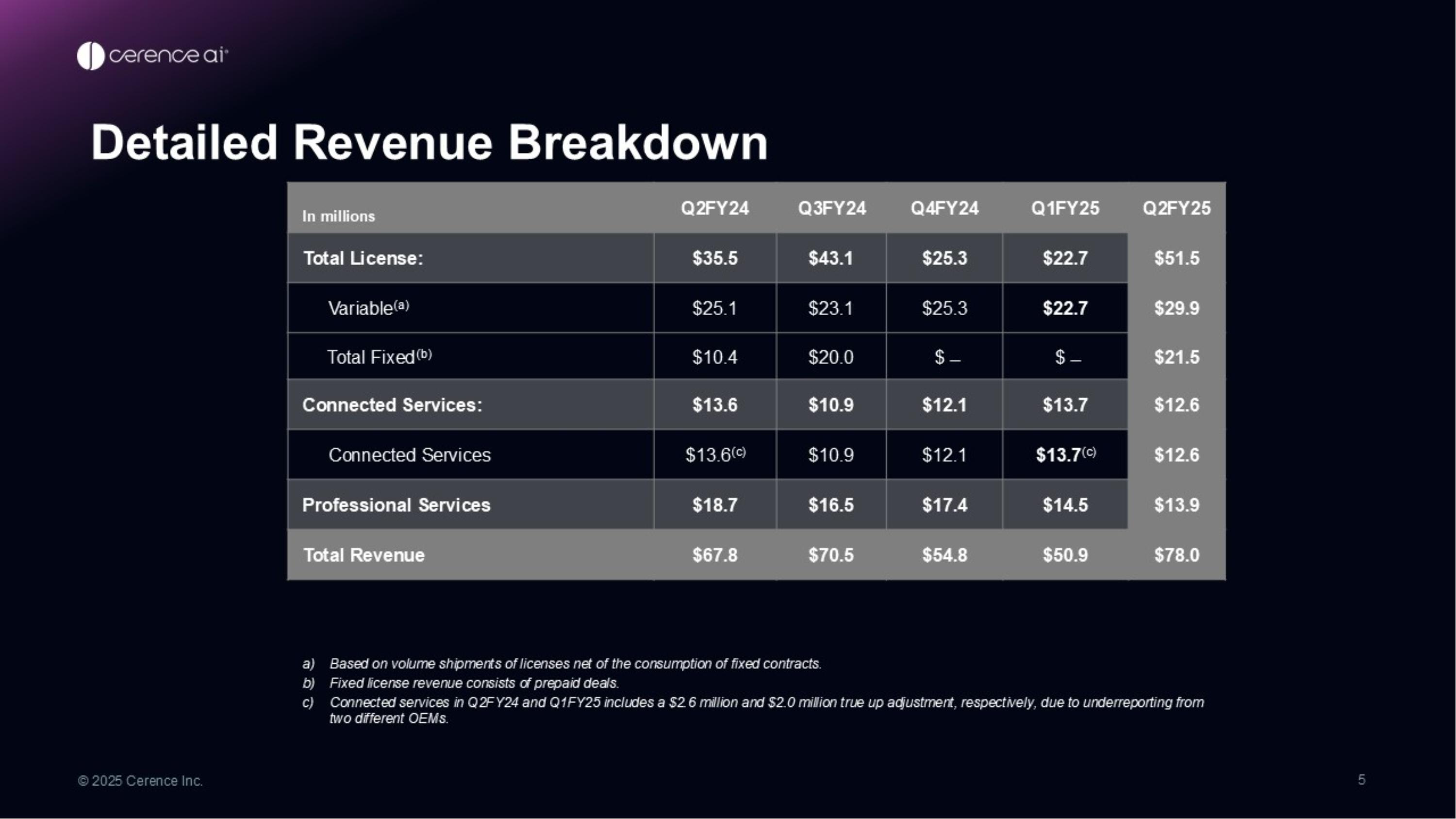
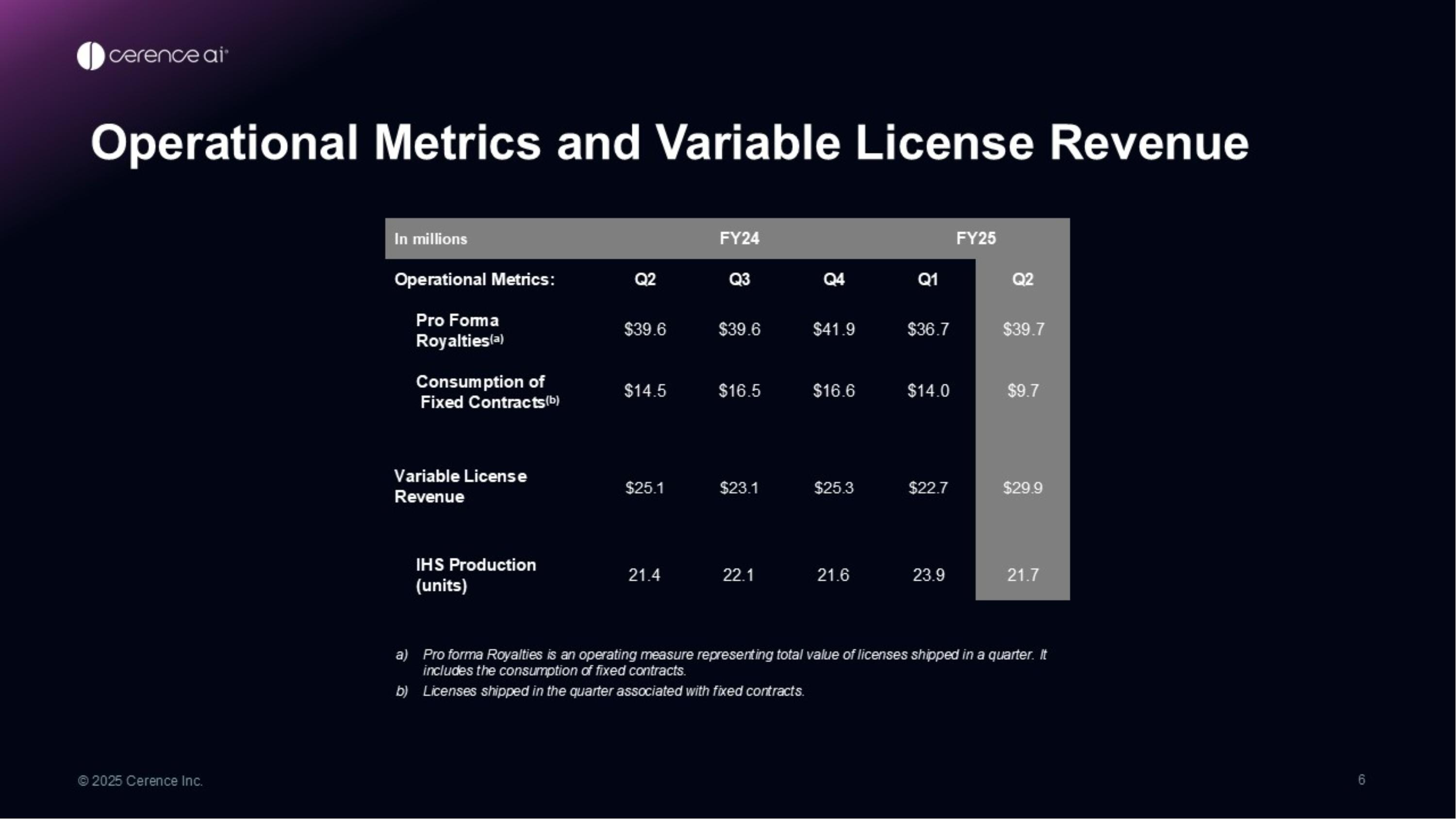
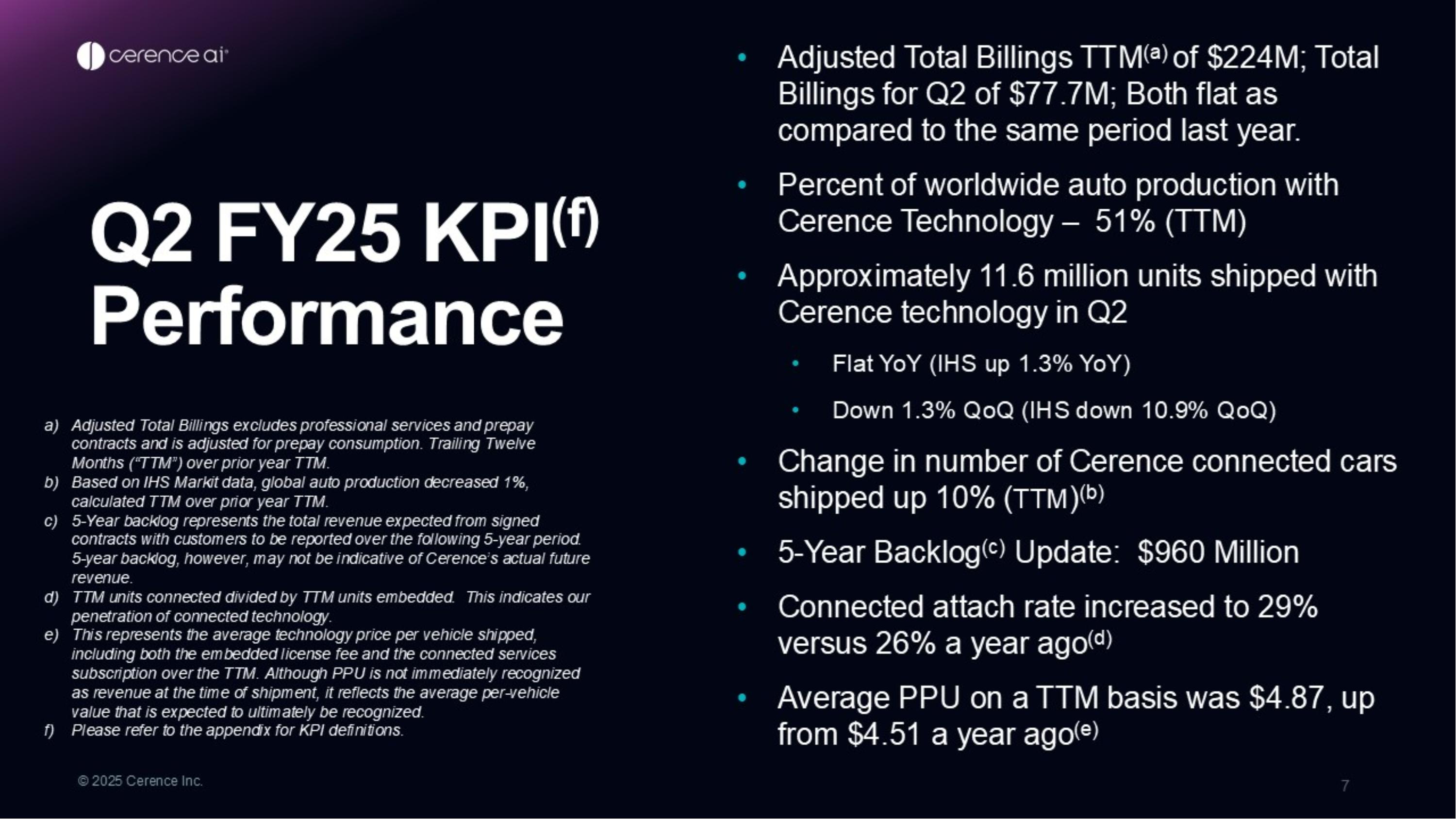
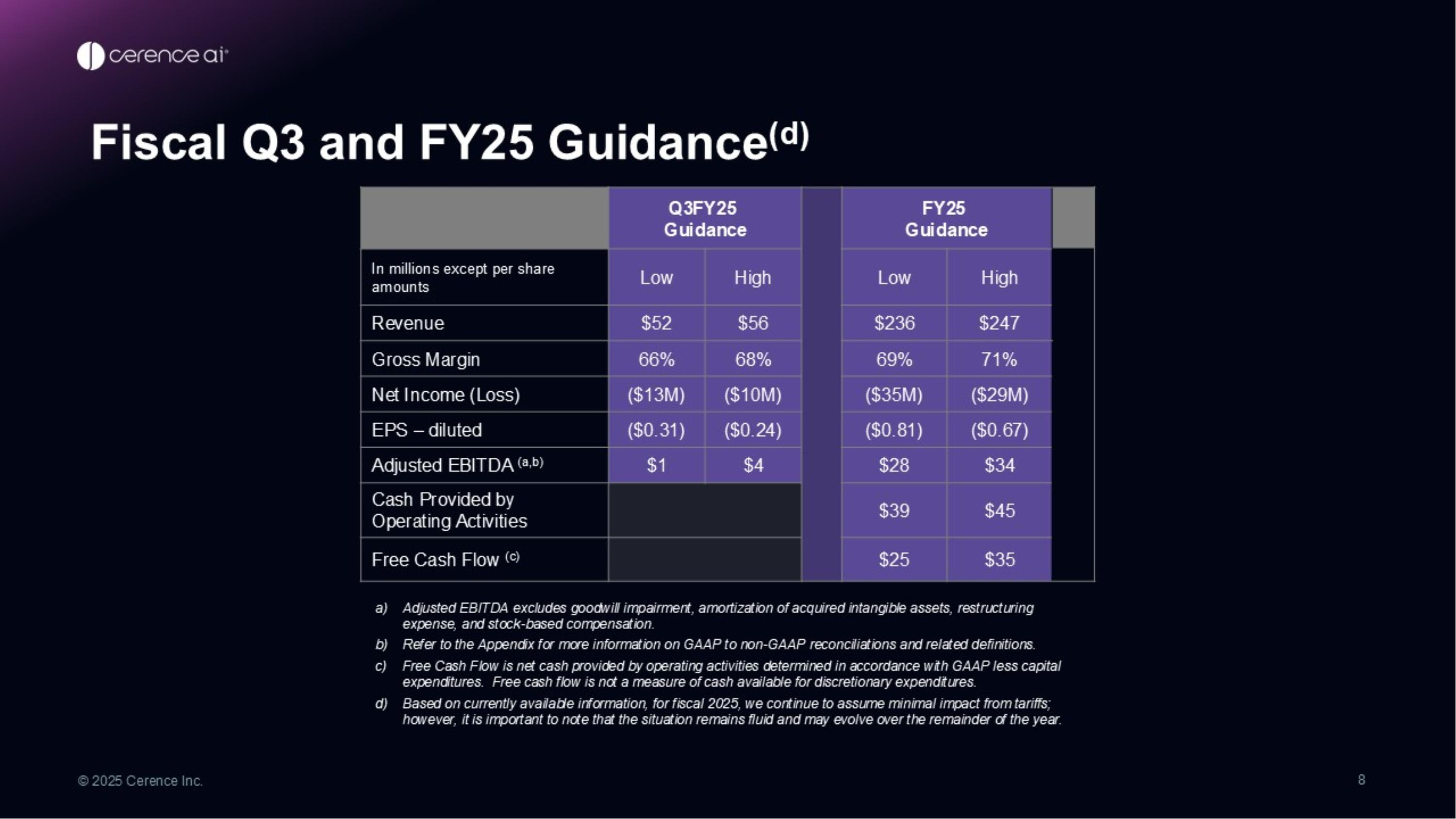
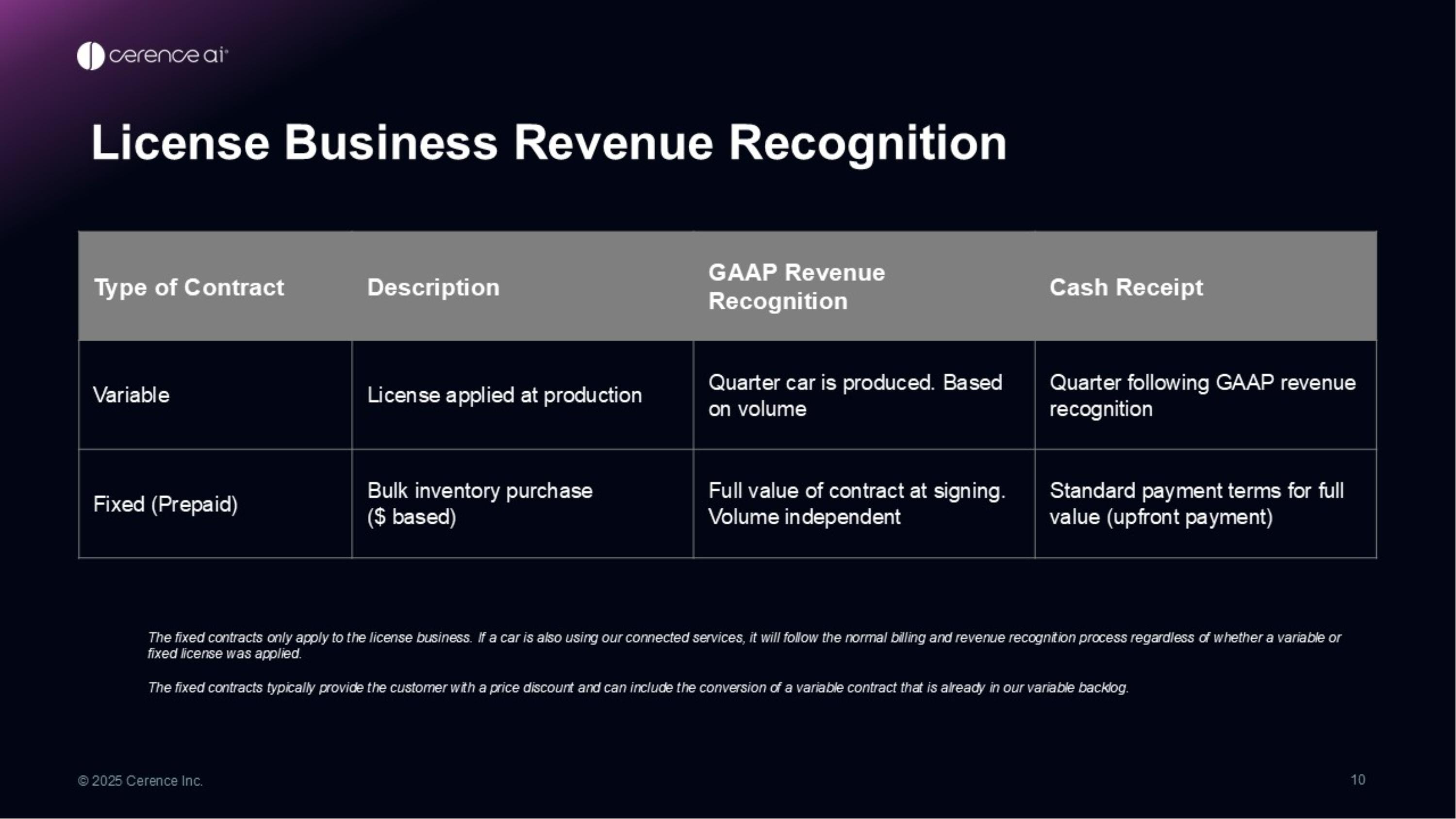
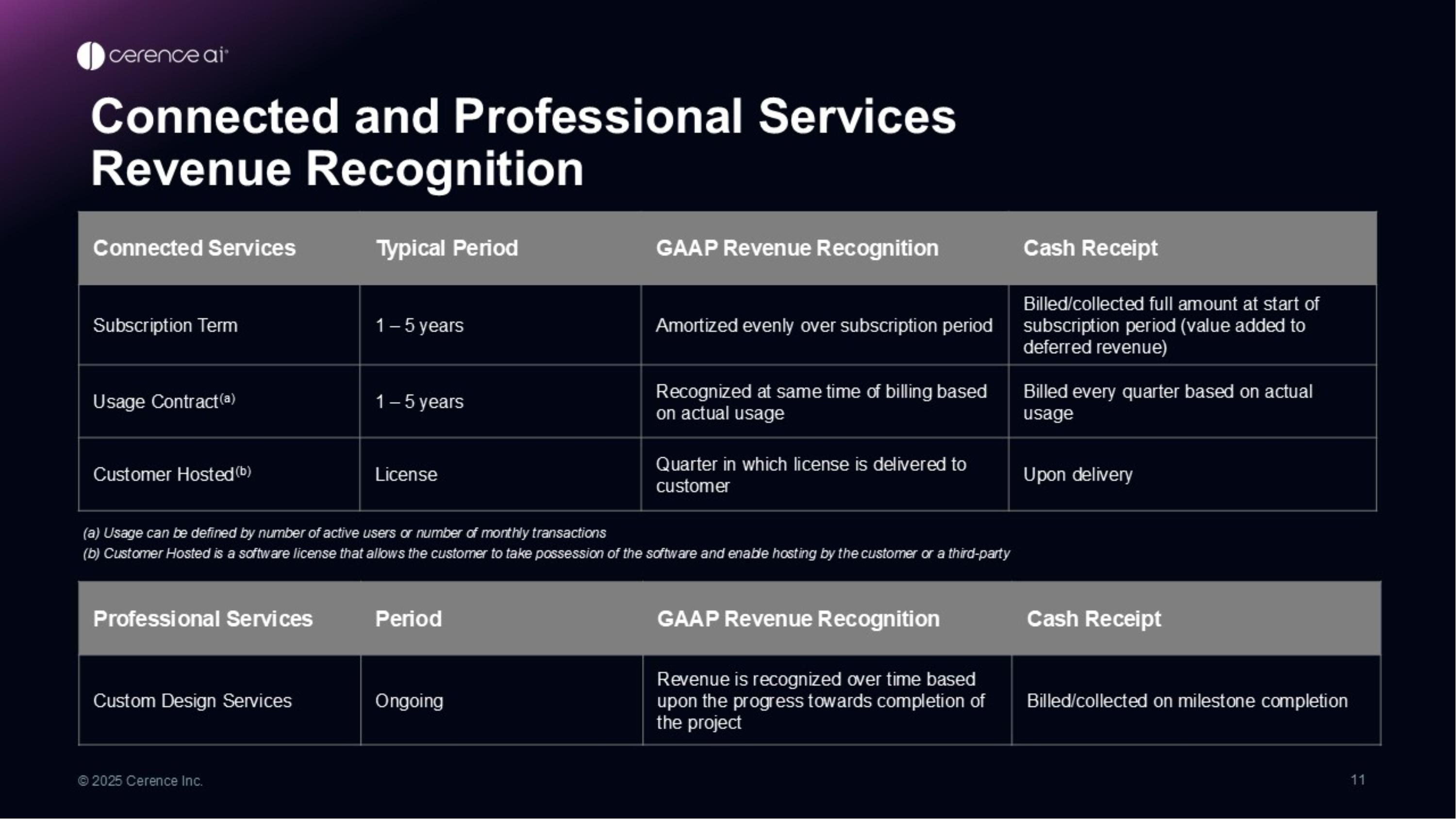
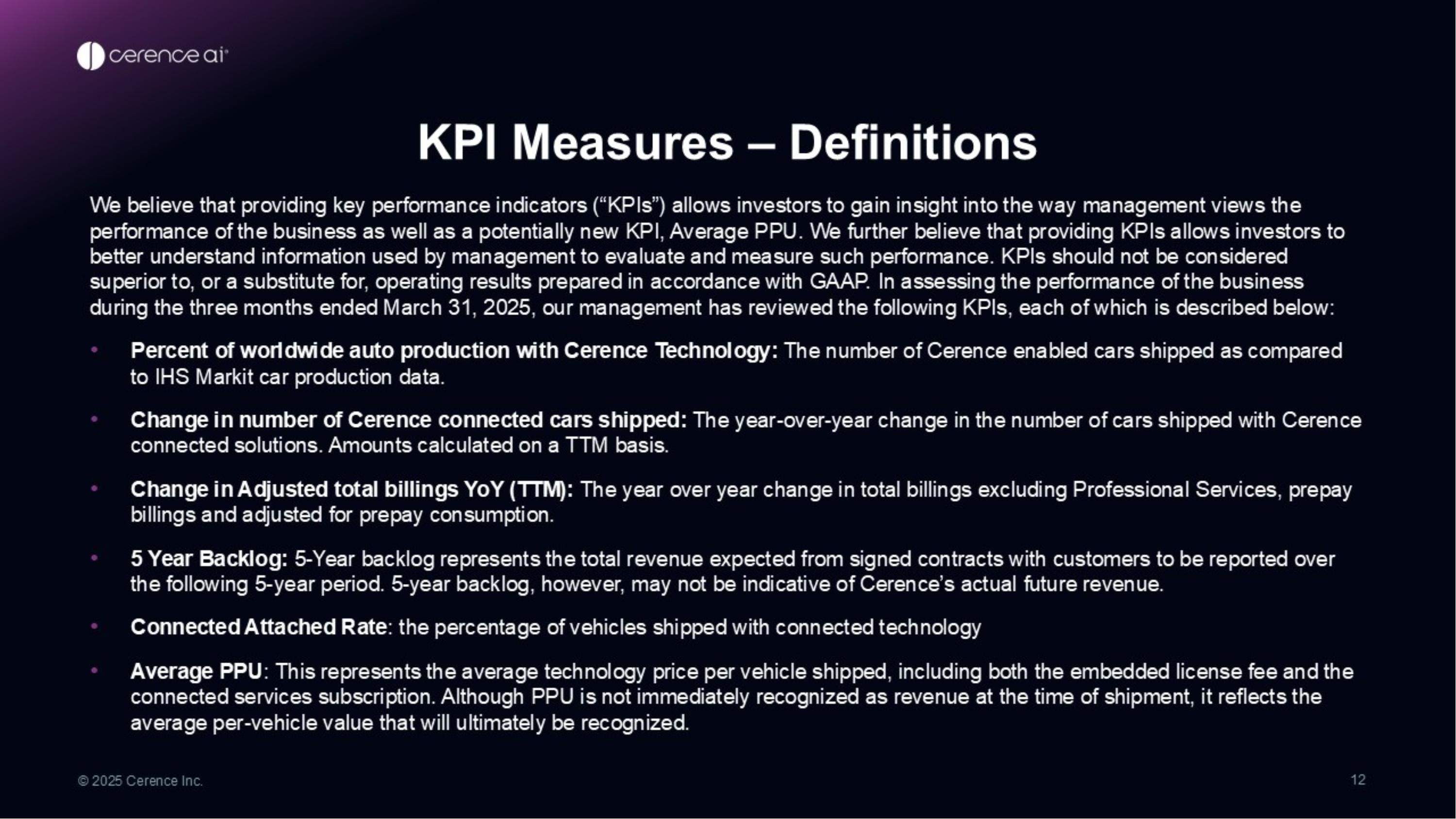
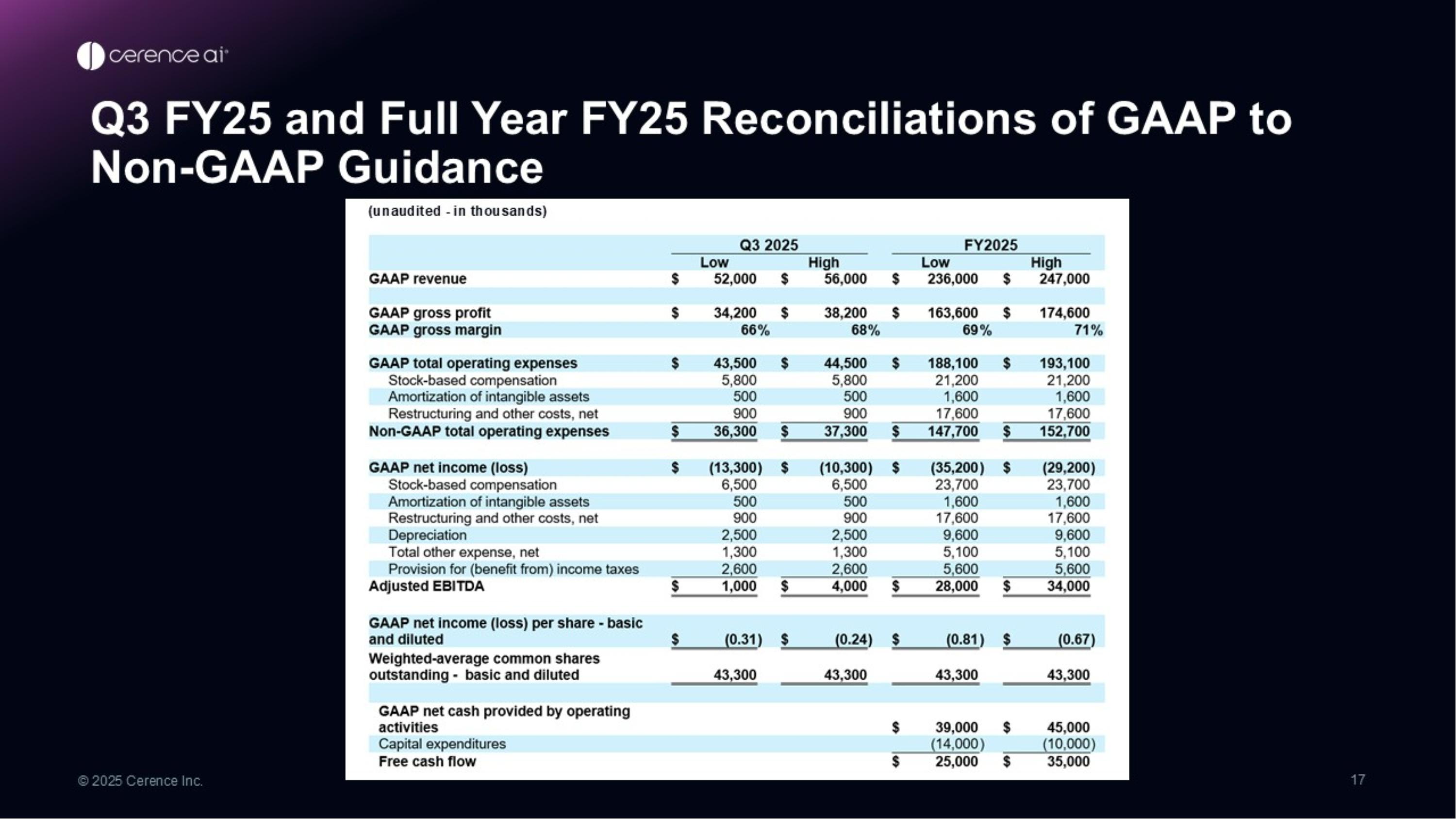
Thank you, Brian. Today, I'll be reviewing our Q2 results for fiscal 2025 and providing some guidance for our third quarter and full fiscal year. Let's get into the Q2 operating statement. At the top, we achieved Q2 revenue of $78 million, which exceeded the high end of our guidance range of $74 million to $77 million. As projected, the revenue this quarter included $21.5 million of fixed license revenue contracts. With Q2 behind us, we expect no material fixed license revenue to be signed during the remainder of the fiscal year. As compared to the prior year, Q2 revenue increased $10.2 million, primarily related to the year-over-year increase in fixed license revenue of $11.1 million. This was offset by a decrease in professional services revenue. Additionally, as compared to our expectations, revenue was negatively impacted this quarter by the euro to dollar exchange rate. This fluctuation was neutral to profitability as it had a corresponding positive impact on our operating expenses for the quarter, and the euro has rebounded to our forecasted rate for April. Our gross margin for the quarter, of 77%, also exceeded the high end of our guidance range of 74% to 76%, as our technology revenue constituted a larger percentage of the revenue mix than forecasted. Moving down the operating statement. Our non-GAAP operating expenses were $34.1 million for Q2 compared to $50 million for the same quarter last year. This decrease of $15.9 million or 32% represents savings from the restructuring efforts conducted at the end of last year. As compared to our forecast, we also continued to delay some planned R&D hiring until Q3 and had lower translated operating costs in our European subsidiaries due to the euro to dollar exchange rate for the quarter. Additionally, the company received notice of acceptance of another international tax credit that allowed us to record a $2.2 million operating cost benefit catch-up. The tax credit benefit recognized this quarter was similar to the credit reported last quarter, but for a different jurisdiction. These credits reflect our continuing effort to maximize the R&D benefits in our offshore locations. While we do not expect similar catch-up amounts going forward, ongoing R&D costs will reflect in-period credits we have applied for. Our adjusted EBITDA of $29.5 million exceeded the high end of our guidance range of $18 million to $22 million and was $29.8 million better than the approximate $300,000 EBITDA loss for Q2 of the last fiscal year. The improvement in non-GAAP operating expenses over prior year and expectations was driven by continued focus on managing operating costs and improving profitability. Our net income for Q2 was $21.7 million compared to a net loss of $278 million for the same quarter last year. In Q2 of last year, the company recorded a goodwill impairment charge of $252 million. This was a non-cash charge that only affected the GAAP results. Excluding the impairment charge, our net income still improved from last year by approximately $48 million this quarter. We ended the quarter with $122.8 million of cash and marketable securities, up $12.3 million compared to where we ended last quarter derived from our positive free cash flow during the quarter of $13.1 million. As we look at our revenue breakdown and operating metrics, variable license revenue of $29.9 million was up $4.8 million or 19% from the same quarter last year and slightly ahead of expectations. As mentioned, fixed license revenue during the quarter was $21.5 million compared to $10.4 million for Q2 last fiscal year. Q2 Connected Services revenue was $12.6 million, down $1 million or 7% from $13.6 million for the same quarter last year. However, in Q2 of last year, the company recorded a $2.6 million revenue true-up. We believe this improvement in Connected Services revenue reflects a positive sign of increased demand for connected vehicles. As planned, our professional services revenue was down year-over-year by approximately $4.8 million, but down a bit more than expected. As our solutions become more standardized, they become more easily integrated and require less of our professional services to integrate. Additionally, some OEMs are bringing more of this integration in-house. As we review our key performance indicators this quarter, total adjusted billings, which are defined as our total billings adjusted to exclude professional services, prepaid billings, and prepaid consumption was $224 million and flat for the trailing 12-month period this year compared to the previous year. Total billings, including professional services for Q2 of $77.7 million were also comparable to Q2 of last fiscal year. As a reminder, when we look at total licenses shipped, pro forma royalties is an operating measure we use representing the total value of variable licenses shipped in a quarter, including the shipments from fixed licenses where revenue was previously recognized upon contract signing. We refer to the shipments where revenue was recognized in the prior period as fixed license consumption. Our pro forma royalties were $39.7 million, which were comparable to Q2 of last fiscal year. Consumption of our previous fixed license contracts totaled $9.7 million this quarter, lower than the same quarter last year by about 33% and in line with expectations. As discussed in previous calls, we anticipated a lower level of consumption given the lower level of fixed contracts than historical periods. Our penetration of global auto production for the trailing 12 months ending this quarter was 51%. Approximately 11.6 million cars with Cerence technology were shipped in Q2, flat year-over-year and down 1.3% quarter-over-quarter. Q2 worldwide IHS production increased 1.3% year-over-year and was down 10.9% quarter-over-quarter. Excluding China, worldwide car production was down 3% versus the same quarter last year and down 1% quarter-over-quarter. This is important to note as it shows that a big part of the worldwide production decline quarter-over-quarter relates to the Chinese market and not to the regions where we are more predominant. To date, we have not really sold to the Chinese OEMs for the China domestic market. The number of cars produced that use our connected services increased by 10% on a trailing 12-month basis compared to the same metric a year ago. We believe this reflects increased demand for connected vehicles. So, last quarter, we discussed the possibility of introducing a price per unit or PPU operating metric, providing insight into pricing. For our business, PPU represents the average technology price per vehicle shipped, including both embedded license fees and connected services subscriptions. Although PPU is not immediately recognized as revenue at the time of shipment, it reflects the average per vehicle value that will ultimately be recognized. PPU is influenced by contract pricing, the take rate of technology features, and the adoption rate of connected services. For Q2, the trailing 12-month average PPU was $4.87, up from $4.51 for the same period last year. This increase was primarily driven by higher attachment rate of connected services. 29% of vehicles were connected this quarter compared to 26% a year ago. We believe this growth in Connected Services reflects consumer demand for interactive technologies that allow users to control vehicle function and communicate externally through a unified interface. While we expect continued adoption of connected solutions, past performance does not guarantee future growth rate results. Our five-year backlog metric, which is currently approximately $960 million, is consistent with where it was two quarters ago. Now, turning to our guidance. For Q3, we expect revenue to be in the range of $52 million to $56 million, with no material fixed license revenue expected to be signed during the quarter. Additionally, our Q3 revenue guidance absorbs approximately $1 million of headwinds in our professional services we saw in Q2. With no fixed license revenue forecasted in Q3, we expect gross margins to return to between 66% and 68%. We anticipate a net loss in the range of $10 million to $13 million and adjusted EBITDA in the range of $1 million to $4 million. We are reiterating our revenue guidance for the full fiscal year to be in the range of $236 million to $247 million. This absorbs headwinds of approximately $4 million to $6 million related to professional services projects for the second half of the year, offset by higher-than-expected technology revenue. While we expect revenue to be consistent with our previous guidance, we expect profitability and free cash flow to be better than originally projected. Subject to the macro risk we have discussed, we currently expect full-year adjusted EBITDA to be in the range of $28 million to $34 million and expect free cash flow to be in the range of $25 million to $35 million. When looking at our liquidity, we plan to use our cash on hand to repay the remaining $60.1 million of our 2025 convertible notes due in June. Following this, we expect to maintain a cash balance above $70 million for the rest of the fiscal year. While this supports our day-to-day operations, a higher balance closer to, say, $100 million would give us more flexibility to invest in growth and strategic priorities. We will continue to use cash from operations to get to our optimal position and evaluate other capital structure options as needed. Overall, we are very pleased with the solid results in Q2 and our continued financial performance. I will now turn it back to Brian to close our remarks.
Thanks, Tony. In closing, we're happy with our Q2 results and are feeling confident in our outlook for the full year while also recognizing that there are macro risks and uncertainties. We remain focused on execution and customer delivery, business process improvement and cost reduction and advancing Cerence XUI, while also accelerating the diversification of our business. Based on the current available information, we continue to believe in our ability to deliver on our Q3 and fiscal year 2025 guidance. We look forward to continuing to share our progress with you. I'll now open it up for questions.
Operator
Thank you. Our first question comes from Jeff Van Rhee with Craig-Hallum Capital Group. Your line is open.
Speaker 4
Hey, this is Daniel Hibshman on for Jeff Van Rhee. Thanks for taking my questions guys. Just on the metrics, maybe if we can walk through a little bit of the puts and takes. Billings deceleration towards 0%, but connected cars, sort of real nice uptick, acceleration from 5% to 10%. Maybe just puts and takes on the metrics, what are driving those and sort of which of those you see as sort of pointing to the future trajectory?
Thank you for the question. Overall, our volumes are largely in line with our expectations, possibly slightly higher than we anticipated for the quarter. The connected rate indicates that an increasing number of cars are being connected within our total volume, which is encouraging. It’s important to note that while more connected cars are being shipped, this does not immediately impact revenue. We recognize billings in the quarter they ship, but the actual revenue is accounted for over a set period. Therefore, it's positive to see the rising connected rates and the associated billings, as we anticipate revenues to materialize as we amortize these over the subscription period.
Speaker 4
And then it looks like new connected revenue, if you back out some of the one-times that you were speaking to, Tony, it looks like new connected is up about $1 million sequentially, which is one of the larger jumps that's taken. And generally, that's from SOPs going live that take time to ramp. Is that fair to say then that whatever is ramping there, it would be fair to expect to continue to ramp into Q3, Q4 and drive some similar sequentials? Or is there anything onetime there? Just kind of walk me through the progression of new connected and the underlying business aspect.
Yes, sure. No problem. Yes, you're right. We're up about 8%, which is good to see. And again, remembering that that revenue that's recognized this quarter is from previous billings that are now amortizing into revenue. So, as we think about our revenue going forward, we do believe, of course, that given the past billings that we would expect increased connected revenue as we go forward.
Just to give you a flavor, it takes a quarter or two, right? Because we get paid on the connected when the car sells and the dealer and the consumer basically connect the car. And that's when that contract starts. So, how long is the shipment out and lot time, things like that. And then before we actually see the revenue can be a little bit of time too. So, I always look at it as like it's a quarter or so, maybe slightly more, depending on the vehicle and the geography before we see that revenue.
Speaker 4
Yes. Brian, regarding AI and its impact, I assume it will be more evident in connected services than in variable services. Considering the recent uptick in connected services and looking ahead for the rest of the year, what factors are currently driving this growth? Is it primarily about the number of units, the AI capabilities, or other functionalities that are influencing the per unit pricing? What are the main contributors to connected services, and can you provide any insights, either qualitative or quantitative, on the impact of AI so far?
Sure. It’s important to note that large language models, or AI, are integrated into nearly all of our activities. For instance, even in non-connected vehicles, our Cerence Assistant large language model is embedded within. This means that for basic vehicle controls, such as adjusting floor heat, changing colors, activating adaptive cruise control, or modifying the temperature, you don’t need specific phrases anymore. You can simply express your needs, like saying your feet are cold or asking to crack the window, and the system interprets that through the large language model to perform the function. This technology is already implemented in vehicles without requiring connectivity. For tasks that involve seeking information, such as finding the nearest restaurant or checking sports scores, that capability exists in connected cars. All of these functionalities are powered by AI, which fuels consumer interest and increases per user usage. As more people seek to access things like sports scores, weather updates, or navigation while connected, we anticipate growth in connected vehicle usage. Overall, AI is enhancing voice command usage in both connected and non-connected vehicles.
Speaker 4
Yes, that does clarify things. When considering the opportunity with calm and embedded technology, it might not be the first connection people make, but it does make sense as it relates to the edge component. It's worth mentioning. Regarding my last question, many will be curious about macro effects. If there are any impacts, would they show in the total units shipped in the industry or in pricing from your customers? Where might we observe these effects?
You'll notice a bit of impact from both areas if they come to fruition. I mentioned earlier that we are beginning to receive some inquiries from OEMs about potential price reductions due to pressure on their cost structures. Instead of simply offering a percentage decrease, we're approaching these discussions by suggesting ways we can help them save even more money. This includes offloading some of their software needs and consolidating their requirements to provide them with a better deal. We anticipate that this approach will also yield some increased revenue for us while ultimately benefiting them in the long run. We're aiming for a win-win situation regarding pricing. On the volume side, our results will largely depend on the overall market conditions. If volumes decline significantly, we would be adversely affected by that. Keep in mind that we operate on a global scale; a significant portion of our vehicles is sold outside the U.S. Therefore, even if there are tariffs or repercussions within the U.S. market, they may not directly impact our sales as our international sales could mitigate those effects.
Speaker 4
And that’s it from me. Congrats on the quarter and thanks Brian, thanks Tony.
Operator
Our next question comes from Nicholas Doyle with Needham. Your line is open.
Speaker 5
Thank you for taking my questions. To start, you maintained the fiscal 2025 guidance. You mentioned that there is some improvement in professional services and an increase in higher tech revenue. Can you provide more details on what this entails and the reasons for the increase? I understand you mentioned various metrics regarding Connected Services, but it seems that might not be the source of this increase due to some delays. Any insights on this would be appreciated. Thank you.
Yes, as we discussed in the last two quarters, we're experiencing some challenges in professional services. However, we have not changed our guidance for the full year and believe we will meet that target range. If we fall short, it appears to be due to the technology segment. We're performing slightly better than our initial plans in connected services, but the primary factor is the license volume. We noticed a slight increase in license volume in Q2 compared to our expectations, possibly due to production adjustments in preparation for tariffs. Therefore, the main impact is from the license business.
And don't forget, one of the key factors that we're doing very differently than a year ago and was especially evident this quarter is we're really limiting the amount of prepays or as it's called in the discussion, fixed contracts. And by limiting those, we're also getting less of a discount in those spaces because we're being able to be more competitive in that space. And we're not giving as many discounts, right? So, we did $20 million-ish, I think it was like $21.3 million this quarter, and that will be it for this year. Prior years, the numbers were quite a bit higher, and those came with even bigger discounts. So, by just reducing that, it increases our effective price. But it's really because we're not doing as much of this pull-in of contracts with big discounts.
Speaker 5
And it makes sense. I think we could see that a little bit in the gross margins coming through. You had a press release last month with MediaTek for your Edge solution. What was the missing piece that MediaTek is bringing to you with that Edge solution? Thank you.
Well, it's really a three-way relationship. It's NVIDIA, MediaTek, and Cerence. And what we're working together, so MediaTek and NVIDIA are working together on cores that are directly related to automotive that have the right pricing and go-to-market within the automotive space. So, they're building those SoCs. And we're helping them and they're helping us by integrating our software and making sure we optimize together for performance, right? There's a lot of things we can do around latency, around overall performance, power, and amount of memory required, all of those kinds of things that if we work with the SoC providers, we can optimize that, and that then makes it lower cost for the OEM and the Tier 1 integrator, also makes it simpler, right? Part of why we don't need as much professional services. So, that relationship is really a three-way relationship. NVIDIA and MediaTek working on the SoC and then us working with the combined group there to really deliver the software stack.
Speaker 5
Thanks. And then if I could just ask one more. On the lawsuit, I guess, what are you really trying to achieve going into Microsoft, who are also a partner to you guys? So, I'm just wondering if it's trying to set a bit of a precedent here as other start-ups are moving into these voice assistant spaces. And I understand that it's specific to text to speech. Thank you.
We are focused on protecting our intellectual property. As a shareholder, your investment supports the development of our technology, including text-to-speech and wake-up word capabilities, which are essential to Cerence. We are committed to advancing and safeguarding these aspects of our business. Our primary goal is to protect our intellectual property and your investment. We are selectively managing our resources to clearly define our position in this space.
Speaker 5
Understood. Thank you.
Operator
Our next question comes from Mark Delaney with Goldman Sachs. Your line is open.
Speaker 6
Yes, good afternoon. Thank you for taking my questions. Price per unit increased on a TTM-to-TTM basis, and you talked about some of the potential positive drivers such as AI in the vehicle, but then you also spoke on some pricing headwinds that have emerged in your prepared remarks. I'm hoping you can help us better understand how these various puts and takes will lead to PPU and where you think PPU may go over the next 12 to 24 months overall.
Hey Mark, Kate here. So, we just lost the connection to Tony and Brian briefly. They're dialing in, in one second. So, we'll just have you repeat the question when they get back on.
Operator
Ladies and gentlemen, please stand by, your call will resume momentarily.
Can you guys hear us now?
Operator
Yes, we can hear you now. Can you hear me? Yes, we can hear you.
So, they can hear me. I can't hear you.
Operator
Can you hear us now, Tony? Are you back online?
Operator
Ladies and gentlemen please stand by.
Kate, can you hear us now?
Operator
And can you hear us now Tony, looks like you're back online?
Operator
Mark, could you go ahead.
We had technical difficulties on this side.
Can you hear us now Kate?
Operator
And ladies and gentlemen, please stand by, your call will resume momentarily.
Can you hear us now Kate?
Operator
Ladies and gentlemen, please stand by, your call will resume momentarily.
Thanks, Tony. In closing, we're happy with our Q2 results and are feeling confident in our outlook for the full year while also recognizing that there are macro risks and uncertainties. We remain focused on execution and customer delivery, business process improvement and cost reduction and advancing Cerence XUI, while also accelerating the diversification of our business. Based on the current available information, we continue to believe in our ability to deliver on our Q3 and fiscal year 2025 guidance. We look forward to continuing to share our progress with you. I'll now open it up for questions.