Operator
Hello and welcome to the Customers Bancorp, Inc. 2024 Fourth Quarter and Year-End Earnings Report. All lines have been muted to reduce background noise. Following the speaker's remarks, there will be a question-and-answer session. I will now hand the conference over to David Patti of Customers Bank. Please go ahead.
Speaker 1
Thank you, Sarah, and good morning, everyone. Thank you for joining us for the Customers Bancorp earnings webcast for Q4 and the full-year 2024. The presentation deck you will see during today's webcast has been posted on the Investors webpage of the bank's website at www.customersbank.com. You can scroll to Q4 and full-year ‘24 results and click download presentation. You can also download a PDF of the full press release at the spot. Our investor presentation includes important details that we will walk through in this morning's webcast. I encourage you to download and use the document. Before we begin, we would like to remind you that some of the statements we make today may be considered forward-looking. These forward-looking statements are subject to a number of risks and uncertainties that may cause actual performance results to differ materially from what is currently anticipated. Please note that these forward-looking statements speak only as of the date of this presentation, and we undertake no obligation to update these forward-looking statements in light of new information or future events, except to the extent required by applicable securities laws. Please refer to our SEC filings, including our Form 10-K and 10-Q, for a more detailed description of the risk factors that may affect our results. Copies may be obtained from the SEC or by visiting the investor relations section of our website. At this time, it's my pleasure to introduce Customers Bancorp Chair, Jay Sidhu. Jay?
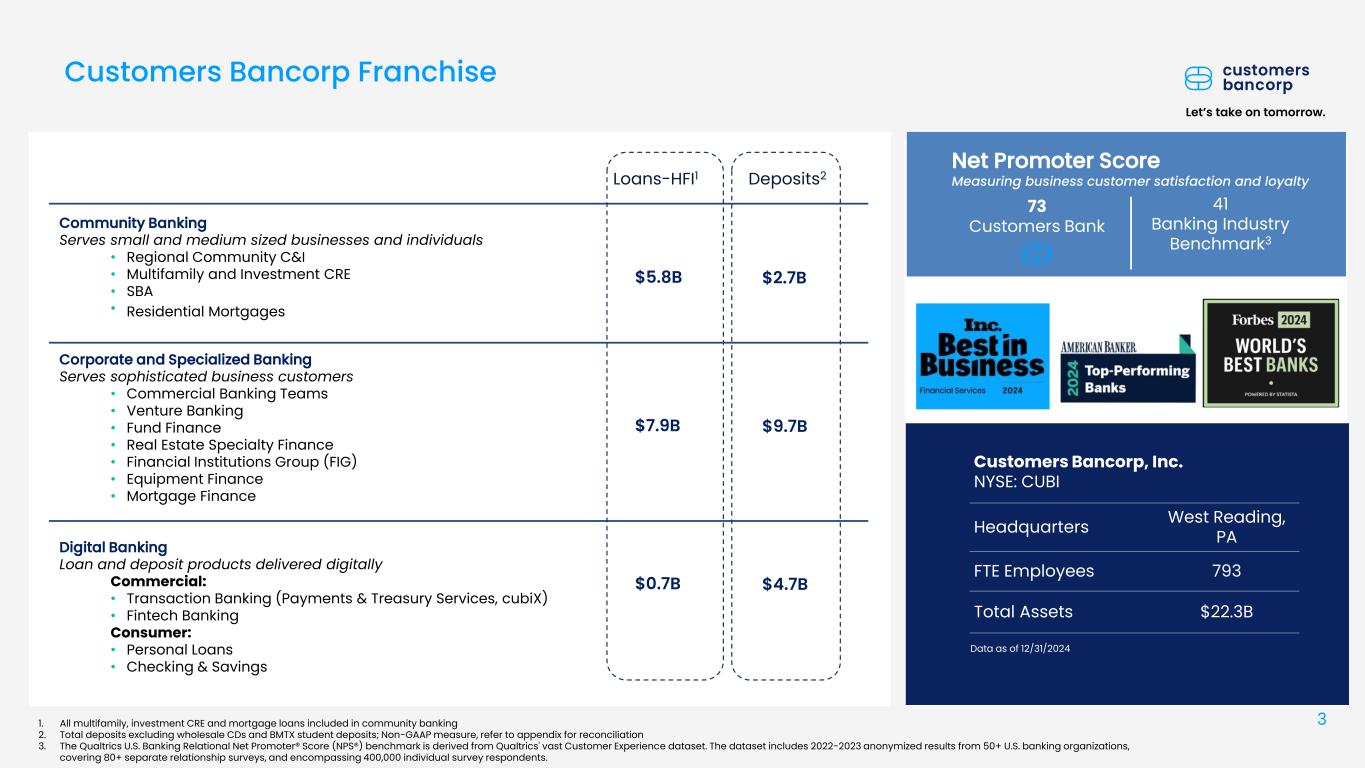
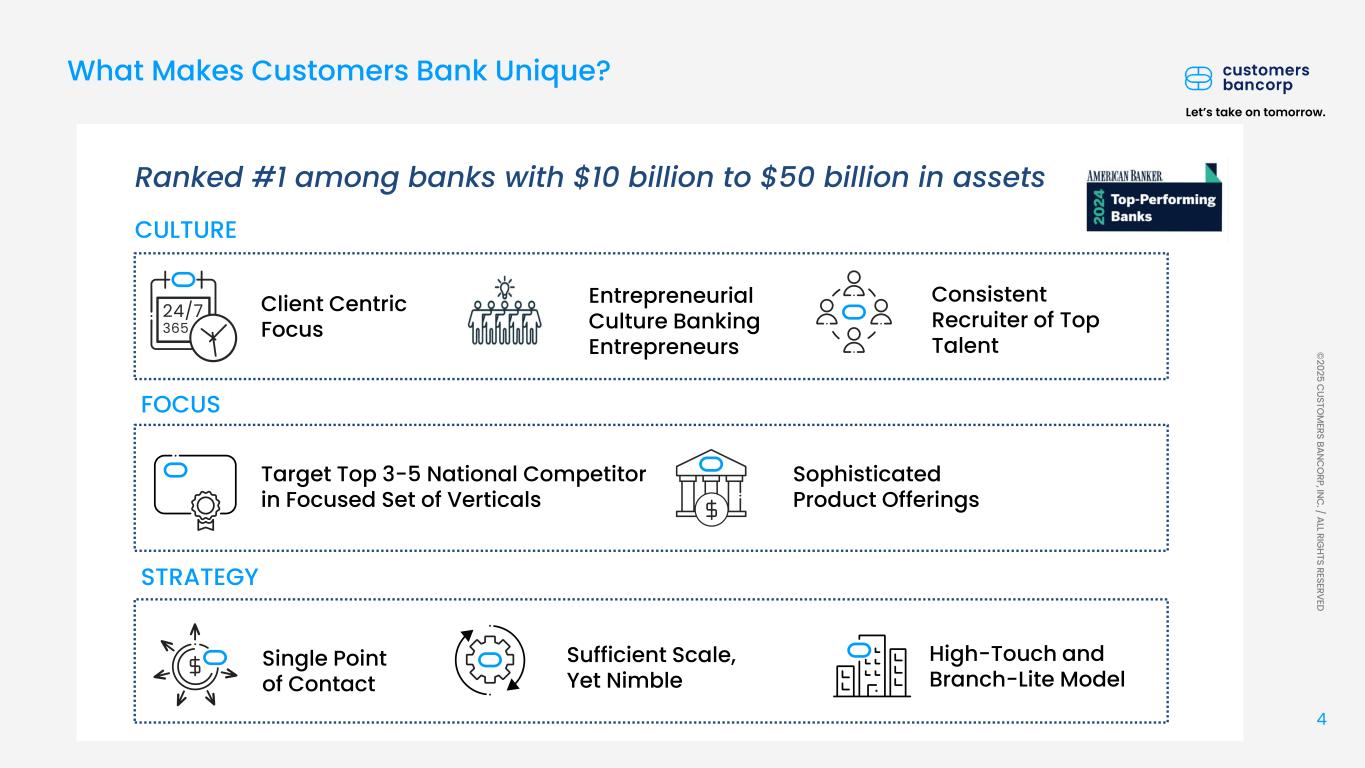
Thank you, David, and good morning, ladies and gentlemen. Welcome to our 2024 fourth quarter earnings call. I hope you all had a wonderful holiday season and are off to a great start in 2025. Joining me this morning on this call are President and CEO of Customers Bank, Sam Sidhu, and Customers Bank Corp CFO, Phil Watkins. I am pleased to share with you that in 2025, we'll be celebrating the 15-year anniversary of starting Customers Bank. From the humble beginnings of our family and friends making a $17 million equity capital infusion to take full controlling interest in, at that time, a $200 million asset new Century Bank, which had only $70 million in core deposits but also had 30% non-performing assets. From those kinds of beginnings, today, Customers Bank has been built into a thriving $22 billion asset bank, a high-performing bank. Please join me in congratulating and thanking our team members and our board of directors, who have worked very hard to make all this happen. For those of us who made the $17 million investment in Customers Bank 15 years ago, we also can celebrate because we have made about seven times our money over this 15-year period, even though we are still trading today at low book value. We believe that the best days of Customers Bank actually lie ahead. That's just one of the reasons why the entire management board or what many people call the executive and senior management team, this year has elected to take their entire 2024 bonus in stock rather than in cash. We are a future-focused bank. Through the hard work of our exceptional team, we built a franchise that is extremely ready for the future with diversified deposit and lending platforms that, in our opinion, are truly unique. We are very well positioned to continue our evolution from a small community bank to a well-diversified regional business bank with a national presence in several niche businesses and a business model that truly reflects the single point of contact for our customers. Our strong results this past quarter and over the past several quarters and years underscore this transformation and the progress we've made. Reflecting on 2024, it was truly a pivotal year for us and a year of strategic investments in our foundation for the future. We believe this will stand out as one of the most transformative periods in our company's history. And like I stated earlier, we are very excited about the future of our company. Moving now to slide three, most of you are familiar with the Customers Bank franchise. For those who are newer to our story, let me briefly highlight what makes our model unique. We are not a traditional bank. We are very well positioned, diversified, tech-forward institution, operating across community banking, corporate banking, and digital banking franchises. We believe we are building a bank of the future. Our goal is to provide clients with the breadth of products and services that you'd expect from a larger bank while delivering the personalized high-touch service of a private bank.
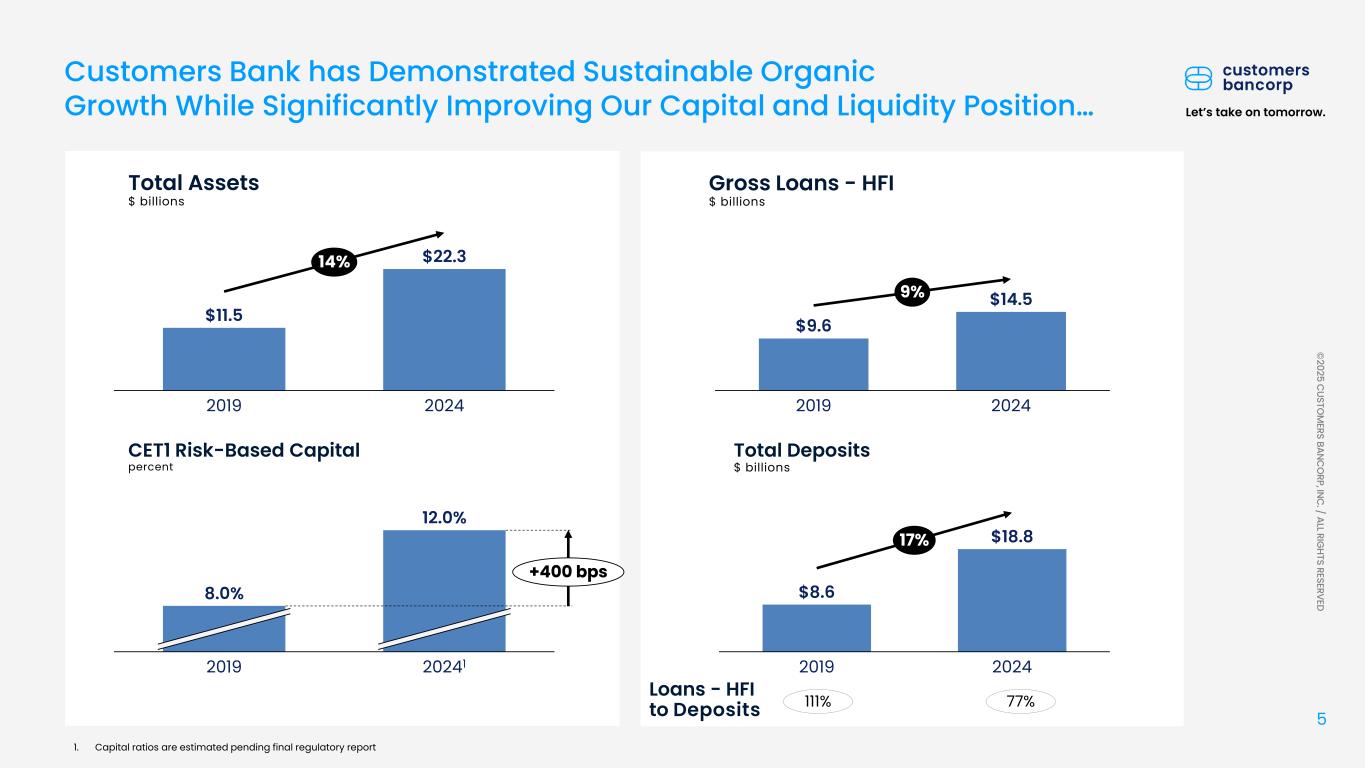
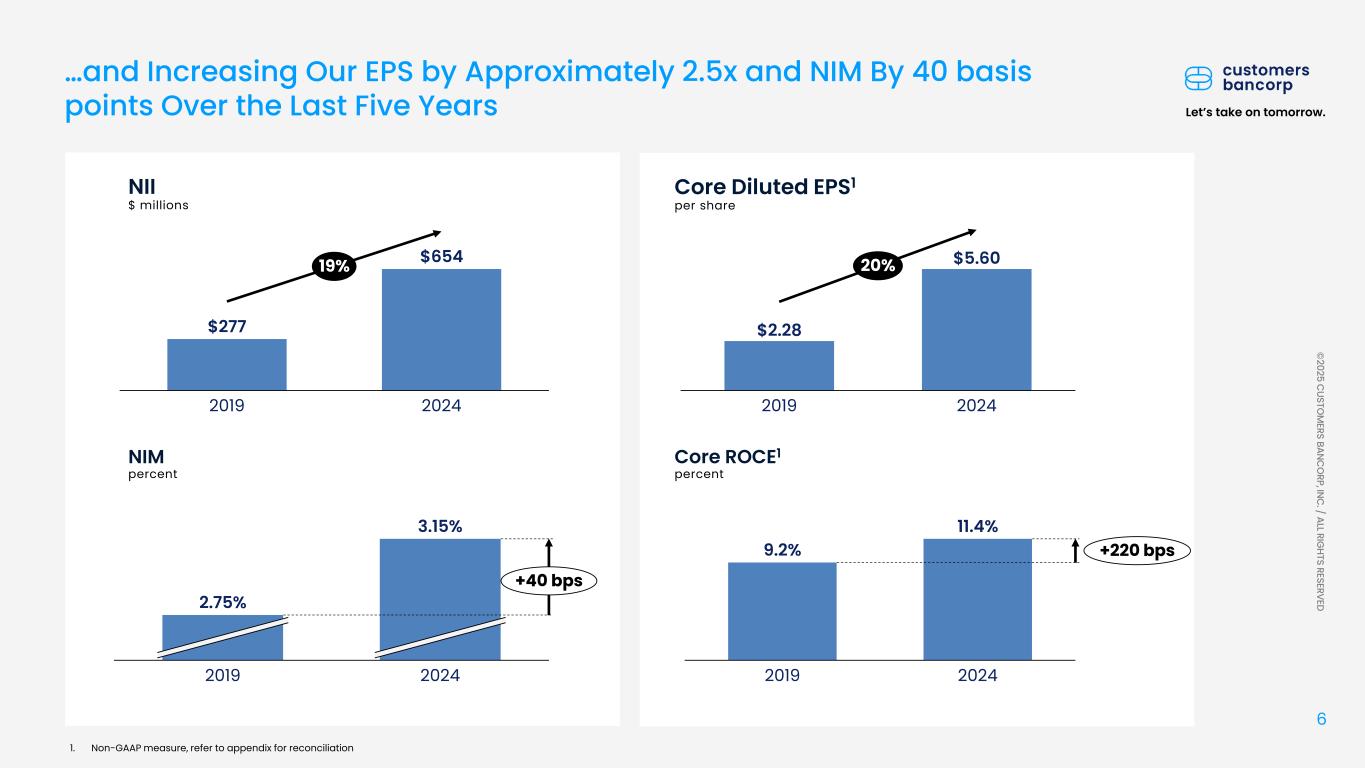
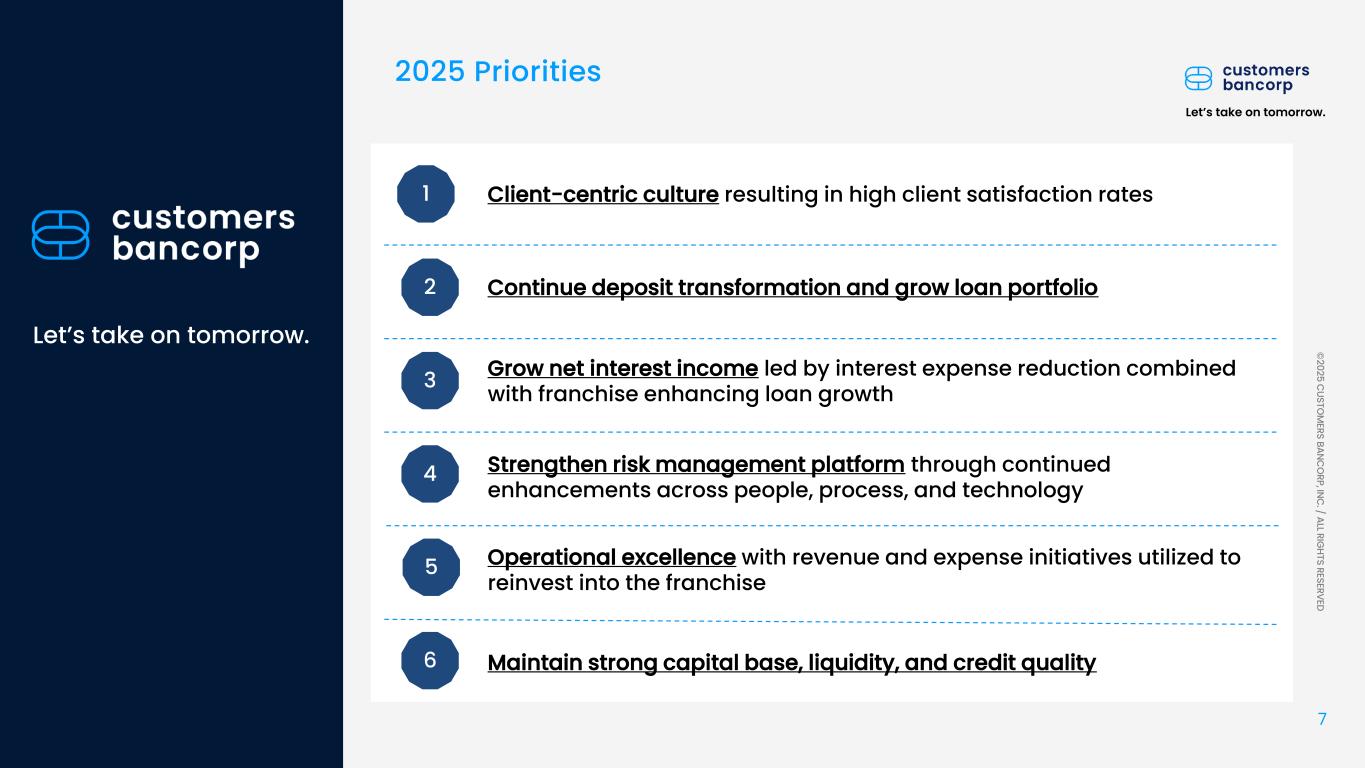
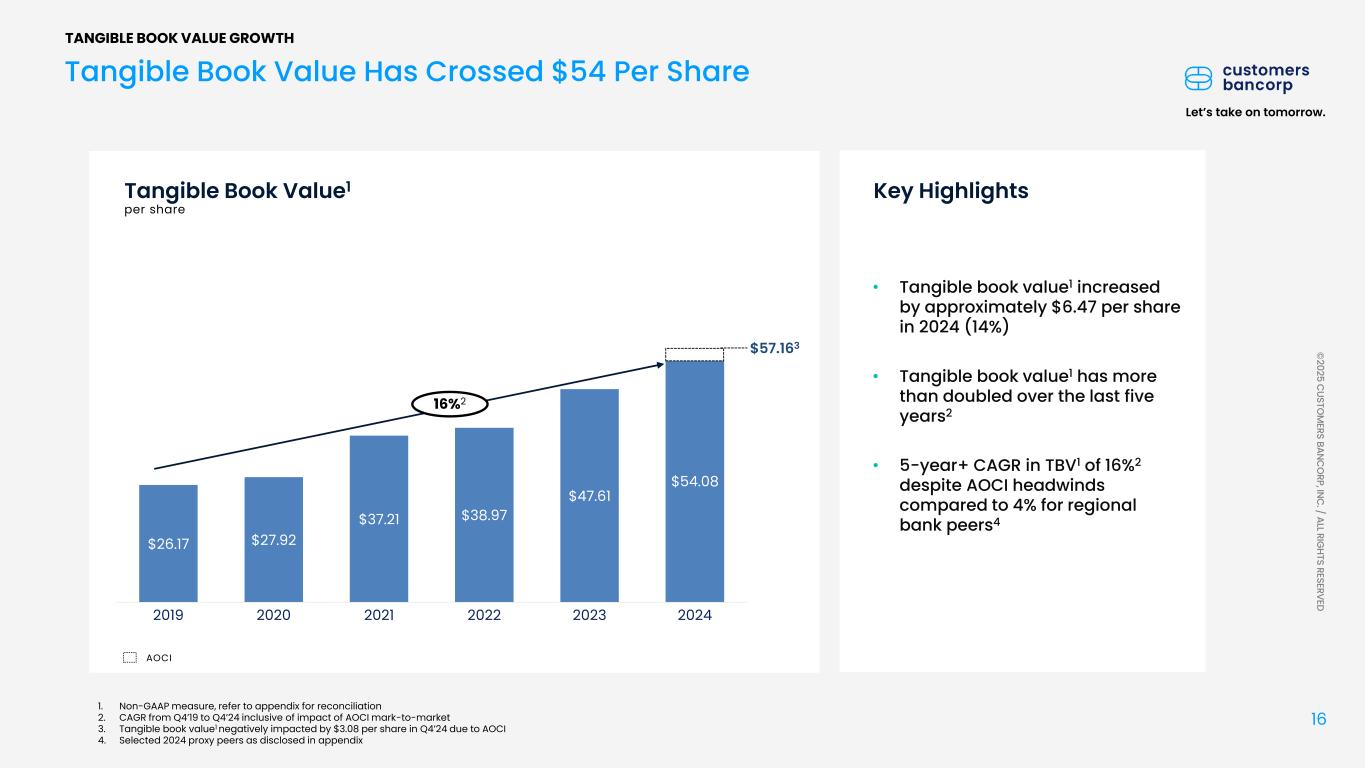
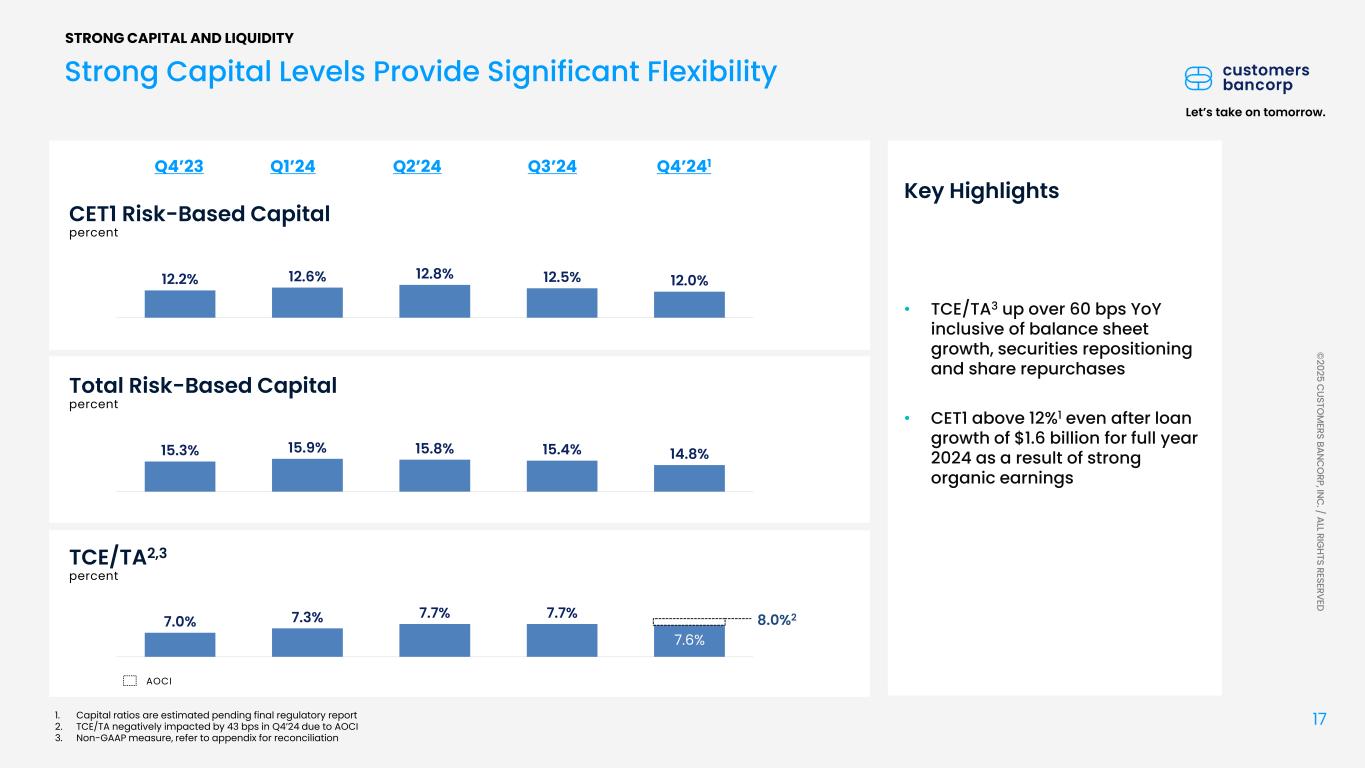
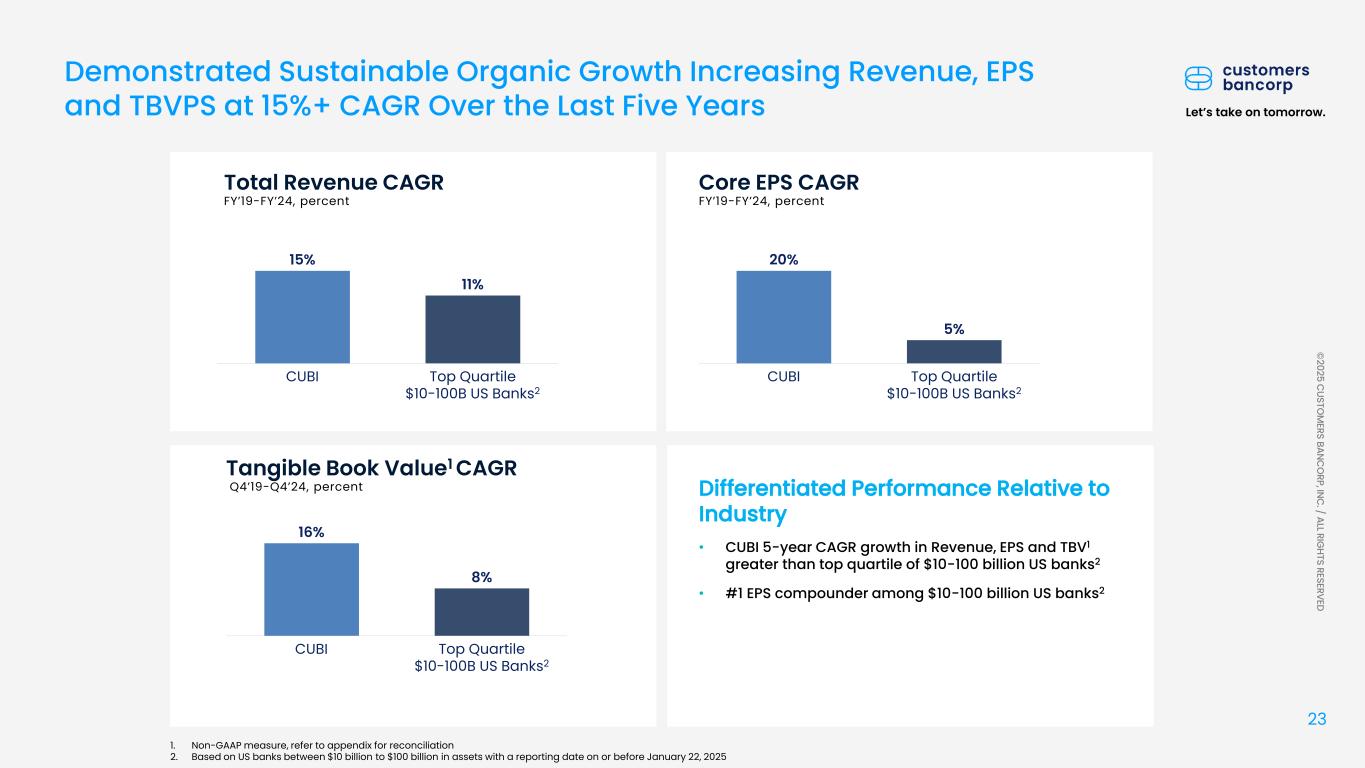
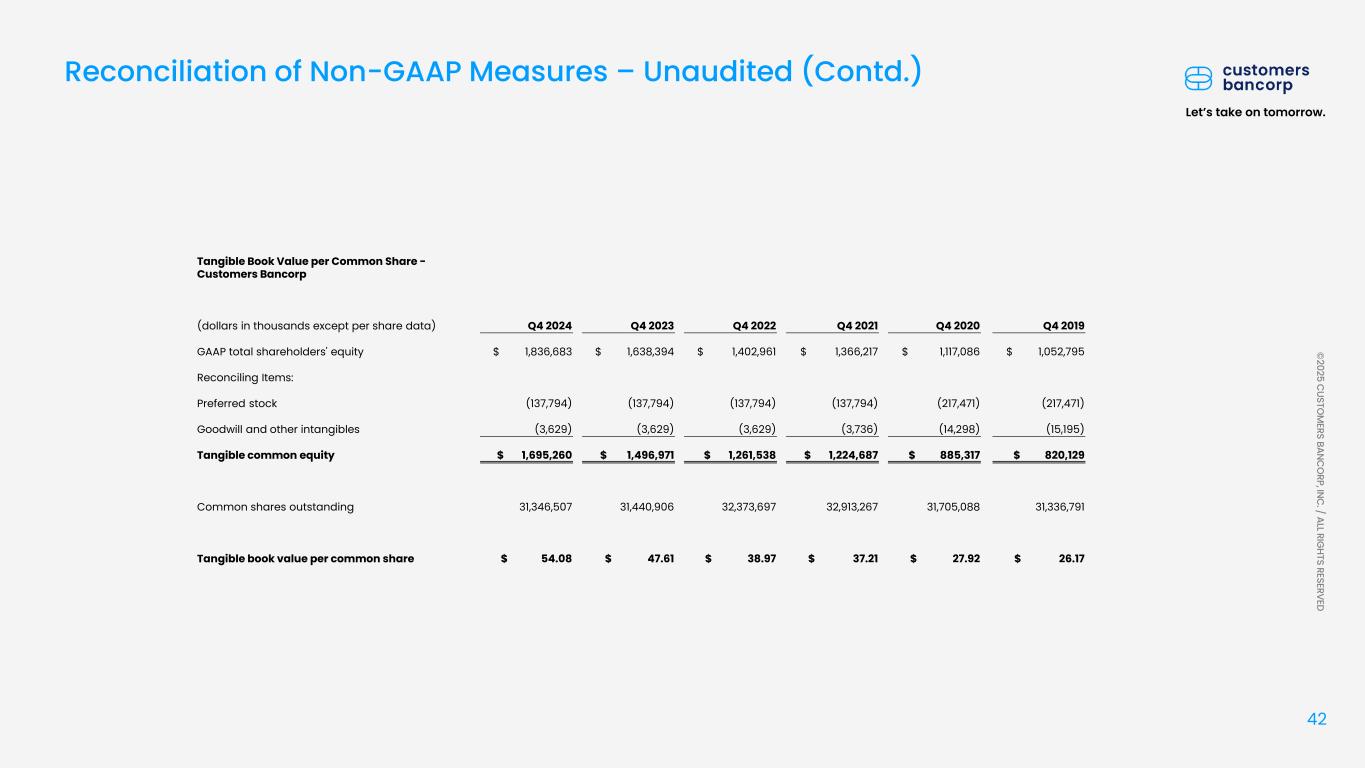
Thanks, Jay, and good morning, everyone, to the couple hundred live participants who have already joined the call. I really appreciate your interest. I'm thrilled to have an opportunity to walk you through our excellent quarter in more detail, but first I wanted to take a minute to reflect on what this incredible organization and my colleagues have accomplished since I had the privilege of joining the management team exactly five years ago this week. As you can see on slide five, over this time period, we have delivered exceptional franchise-enhancing deposit-led growth. The bank has essentially doubled in size over the last five years, ending 2024 with over $22 billion in assets led by an impressive $10 billion of net deposit growth, which is 17% annually. Incredibly, we accomplished all of this while growing our capital ratio significantly, with CET1 up 400 basis points, providing us tremendous flexibility today. Slide six shows how the execution of our unique strategy has resulted in a significant increase in our earnings power and profitability. Net interest income is up 19% annually, and our core EPS is up over 2.5 times over the last five years. This is even with the significant investments we've made in 2024. Our margin has also increased by 40 basis points over that time. As we've said many times before, sustainable growth in revenue, EPS, and tangible book value are the key metrics for long-term performance in bank stocks. Customers have delivered an impressive annual growth of 15% revenue, 20% EPS, and 16% in book value, which is higher than the top quartile of banks between $10 billion and $100 billion in assets. This has resulted in being the top-performing publicly traded U.S. bank stock two of the last four years. We're proud of what the team has achieved, but even more excited about the prospects and momentum going forward in 2025. With that, I'll move to slide seven and touch on our areas of focus. The top priorities for our company and senior management in many ways look very similar to last year, which highlights the consistency of our strategy. Our clients are at the forefront of everything we do. Every decision we make is guided by the understanding that our clients are the foundation of our success. When our clients succeed, we succeed, and we also believe what gets measured gets done as evidenced by our best-in-class NPS. We're committed to building on this momentum and will continue to look for ways to enhance the client experience and deliver moments that truly make our clients say wow.
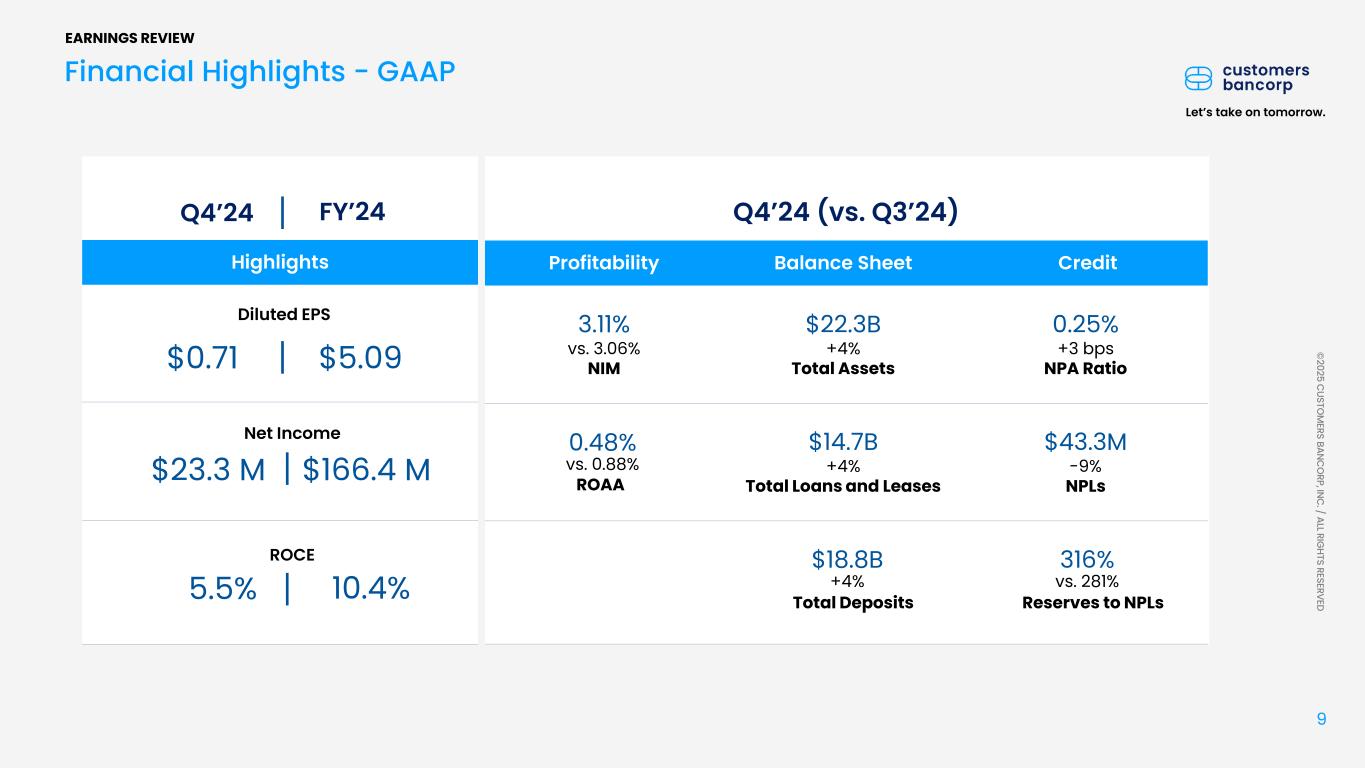
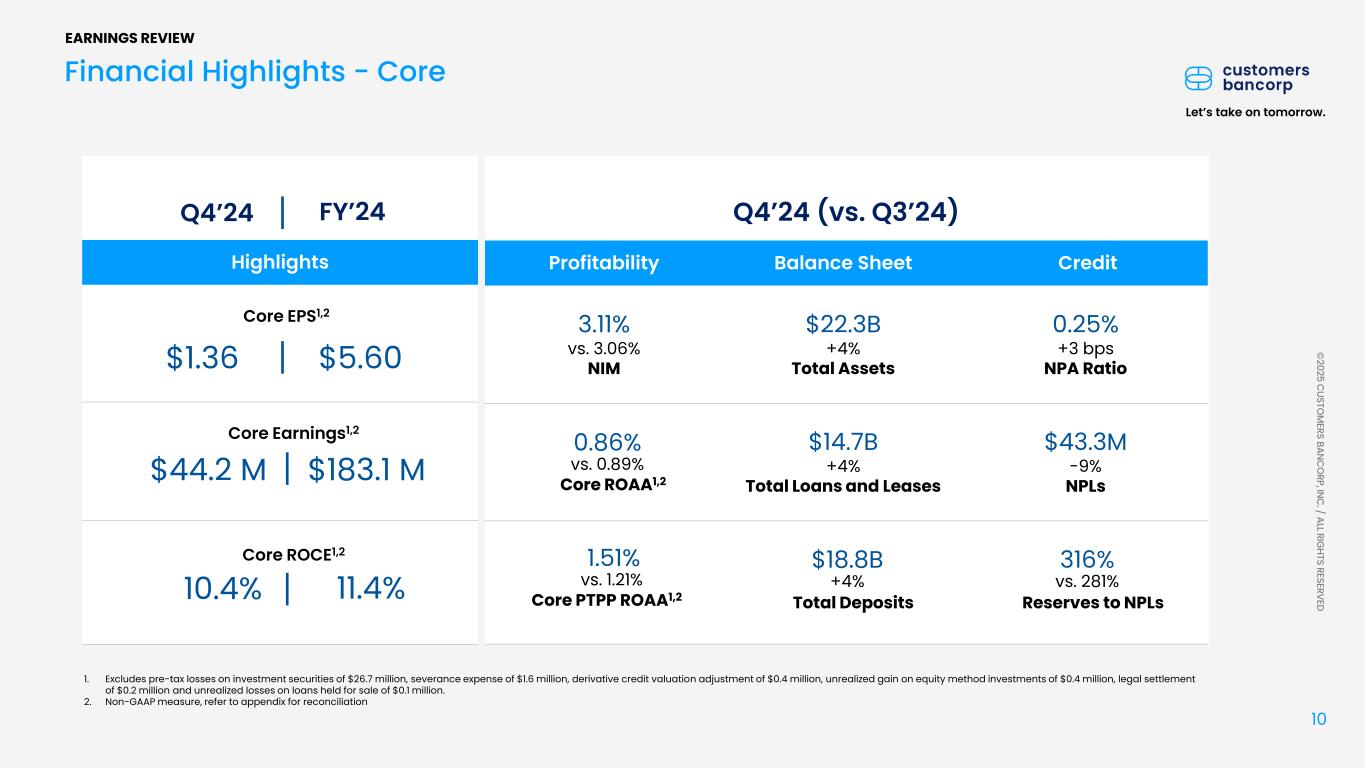
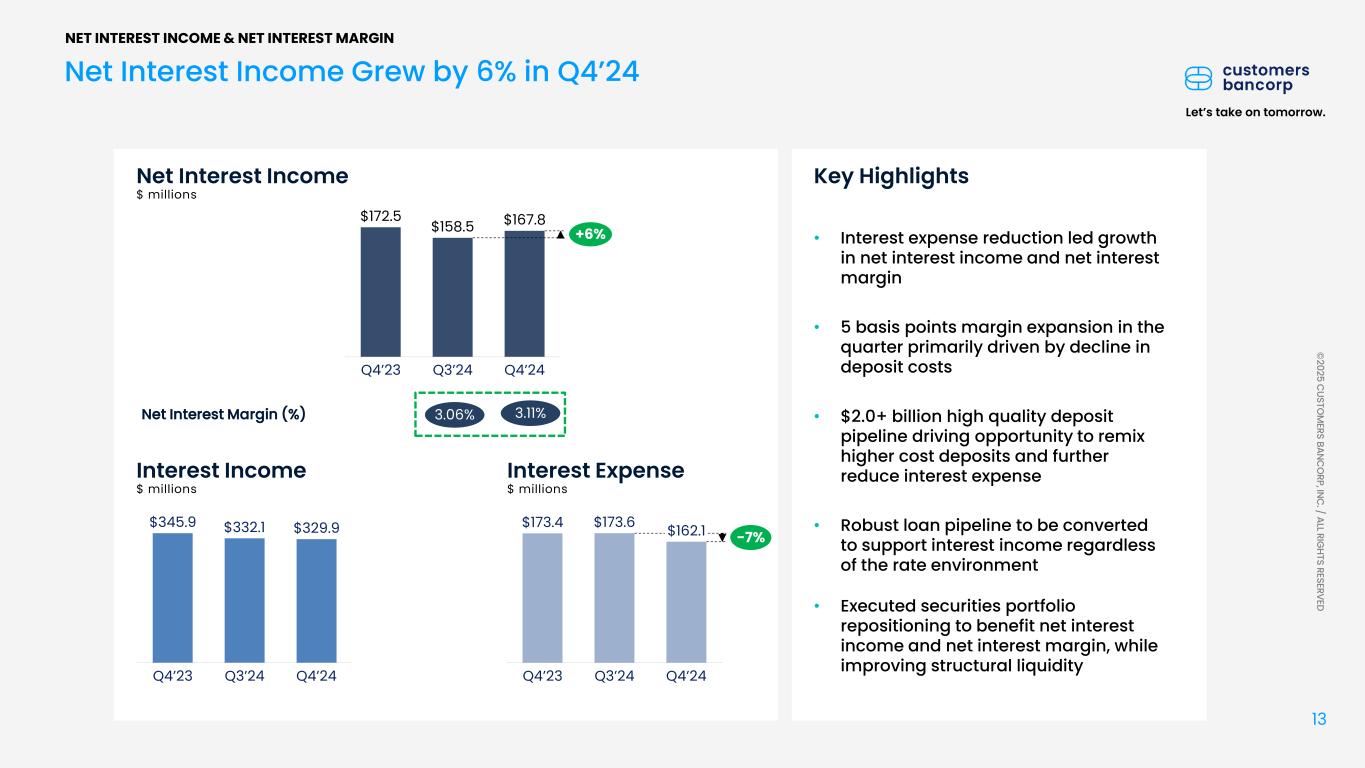
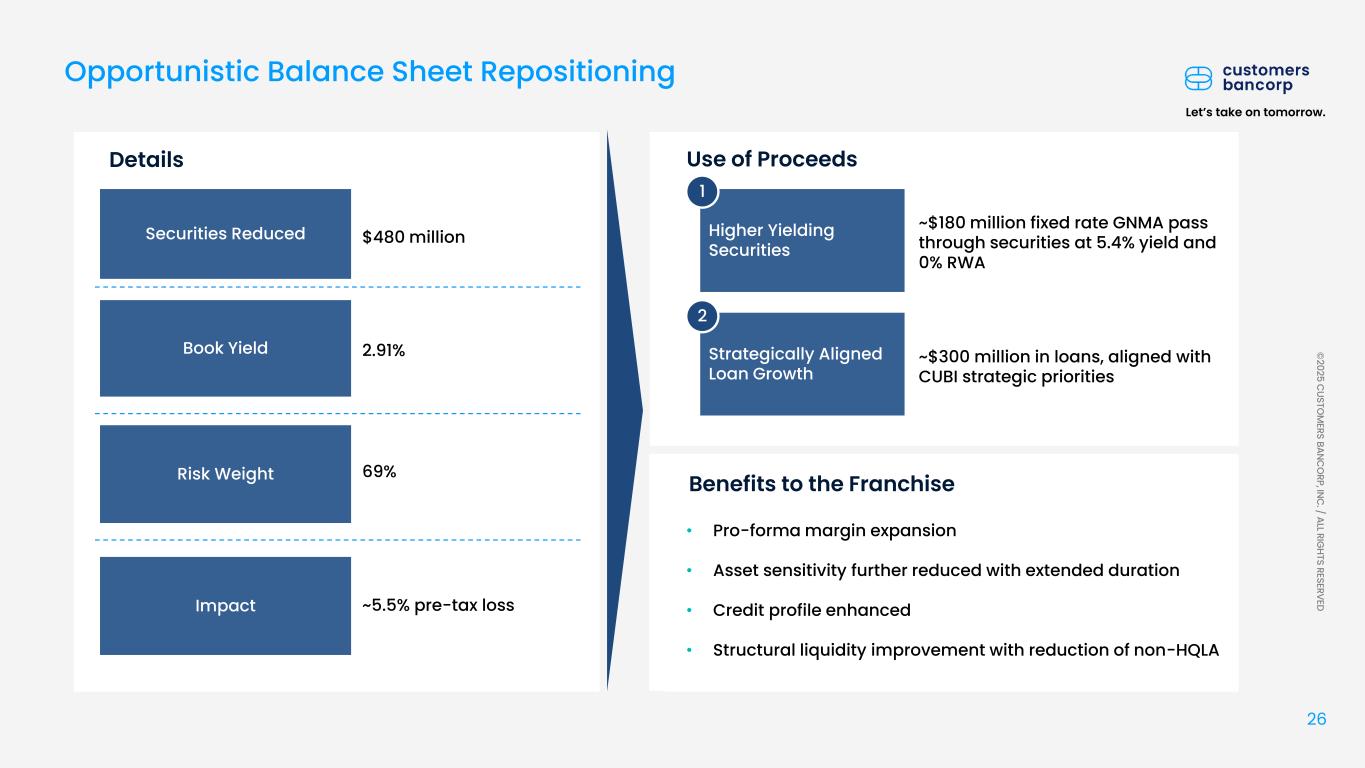
Thanks, Sam, and good morning everyone. On slide 13, we've provided the components of our net interest income, which was $168 million in the quarter, and our net interest margin, which increased to 3.11%. The 5 basis points of expansion in the quarter was driven by the liability side of the balance sheet as we lowered deposit costs and had higher levels of average non-interest-bearing deposits. You can really see this in the breakdown of the components of our 6% growth in NII. While interest income was down modestly, we were able to drive down our interest expense by about 7%. This led to the increase in NII for the quarter and also helped expand our margin. As Sam mentioned, further interest expense reduction is our strongest lever for continued margin and NII growth in 2025. In the quarter, we exited about $480 million in low yielding securities, and we reinvested about a third of the proceeds in securities with 250 basis points higher yield and the balance into loans. As most of you know, over the last few quarters, we've taken steps to gradually reduce our asset sensitivity. Even so, we feel that our modest asset-sensitive profile gives us good optionality, and that's proving out today. Generally, a higher-for-longer rate environment with an upward-sloping yield curve should be a tailwind for Customers Bank. And importantly, the organic actions on both sides of the balance sheet would be expected to more than offset any impact from potentially falling rates. As a result, we feel we are well positioned regardless of the near-term rate trajectory.
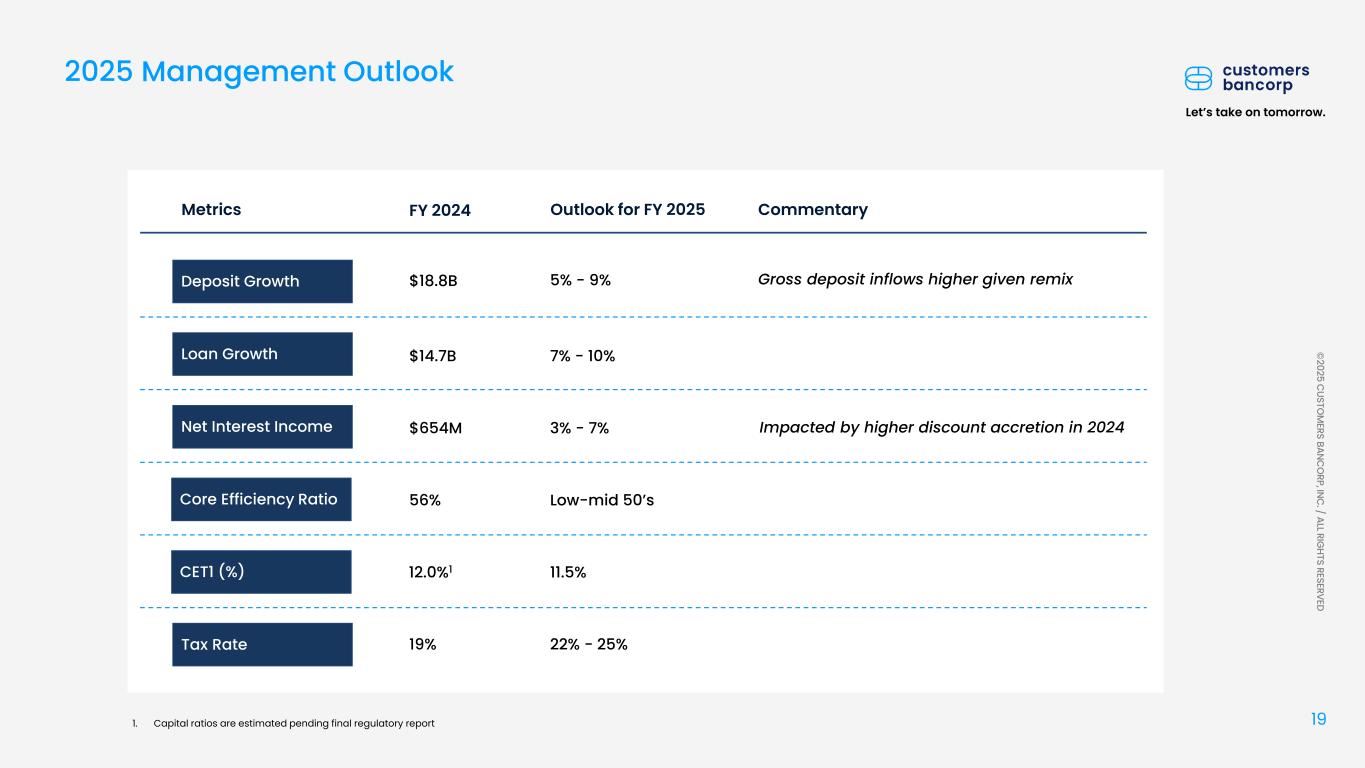
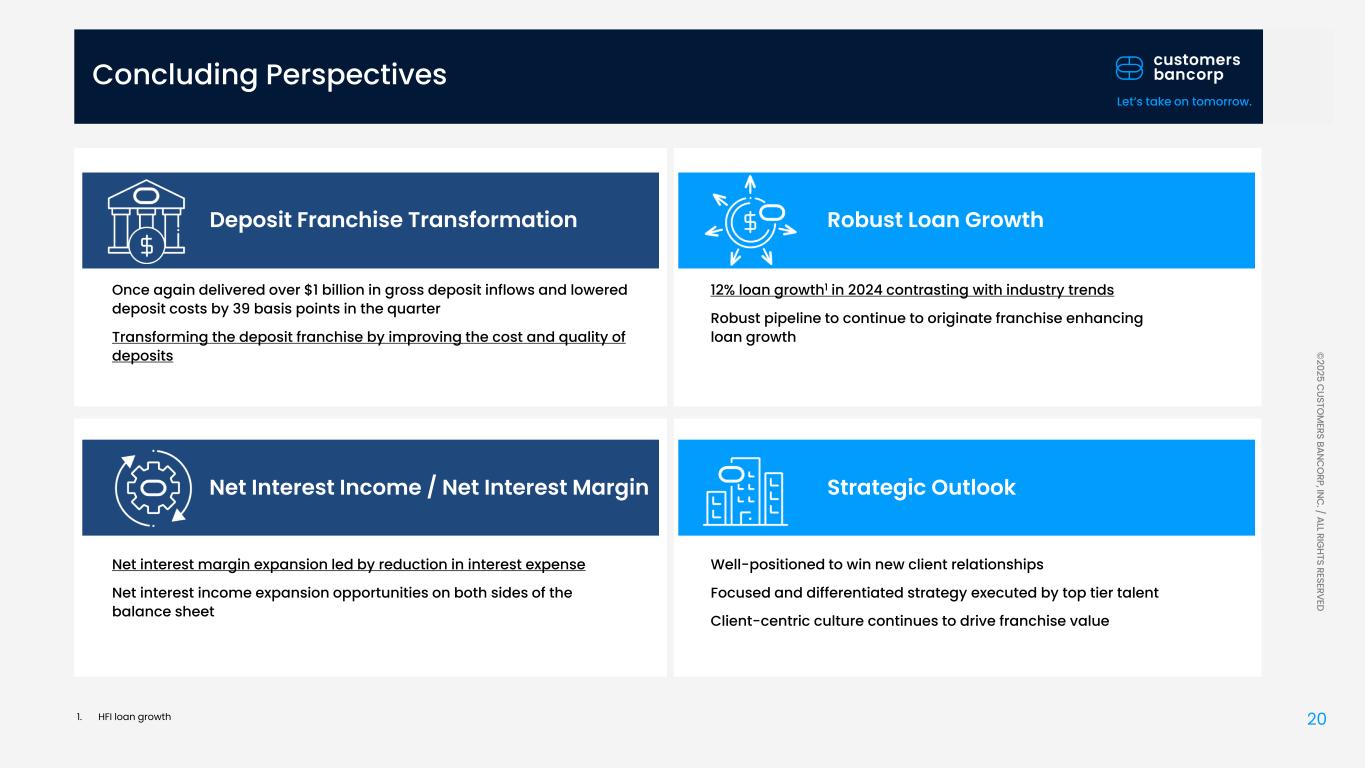
Thanks for that, Phil. From an external perspective, macroeconomic factors and confidence continue to point to a very positive outlook in 2025. As Phil mentioned, the upward sloping yield curve should lead to a much better environment for the banks as a whole. The new administration's sentiment is also pointing to a more favorable regulatory backdrop for the industry. As we look forward to the year, we expect a resumption of disciplined growth in the balance sheet. On deposits, I point out that while we're targeting modest net growth, we expect gross originations, as in the past to be higher as we continue to remix out less strategic deposits, especially in the first half of the year. On the loan side, we're seeing very good opportunities to originate franchise-enhancing loans across our various verticals. But we're being very selective, and from those opportunities, we'd look for the loan portfolio to increase by about 7% to 10% or even more over the course of the year. Importantly, we will be very disciplined around deposit-led loan growth.
Operator
Thank you. The floor is now open for questions. Your first question comes from the line of Steve Moss with Raymond James. Your line is open.
Speaker 5
Maybe just starting on the loan growth guide here, good morning Sam. On the loan growth guide here, maybe just talk a little bit about kind of your expectations for loan growth over the next quarter too. It sounds like the pipeline remains strong and I heard you there indicate that the loan growth guide could be conservative for 2025?
Yes, hey Steve, good morning. So the pipelines are definitely strong. We continue to build with the pipelines at least sort of in the $400 million to $500 million range. I will say, as you normally know, Q1 is usually a bit slower time. Obviously, we had a very strong fourth quarter with closings to get done by year-end, and so usually that rebuilds a bit. There's also the question of some of the unexpected payoffs, which is actually something we've been seeing a fair amount in some of our portfolios sort of earlier in the year. So I think we definitely feel good about it. As Sam mentioned, there could be potential upside there. We'll certainly continue to support clients as we see that franchise-enhancing loan growth. But we do want to remain disciplined and we're certainly not chasing any loan-only relationships. It's very much holistically focused.
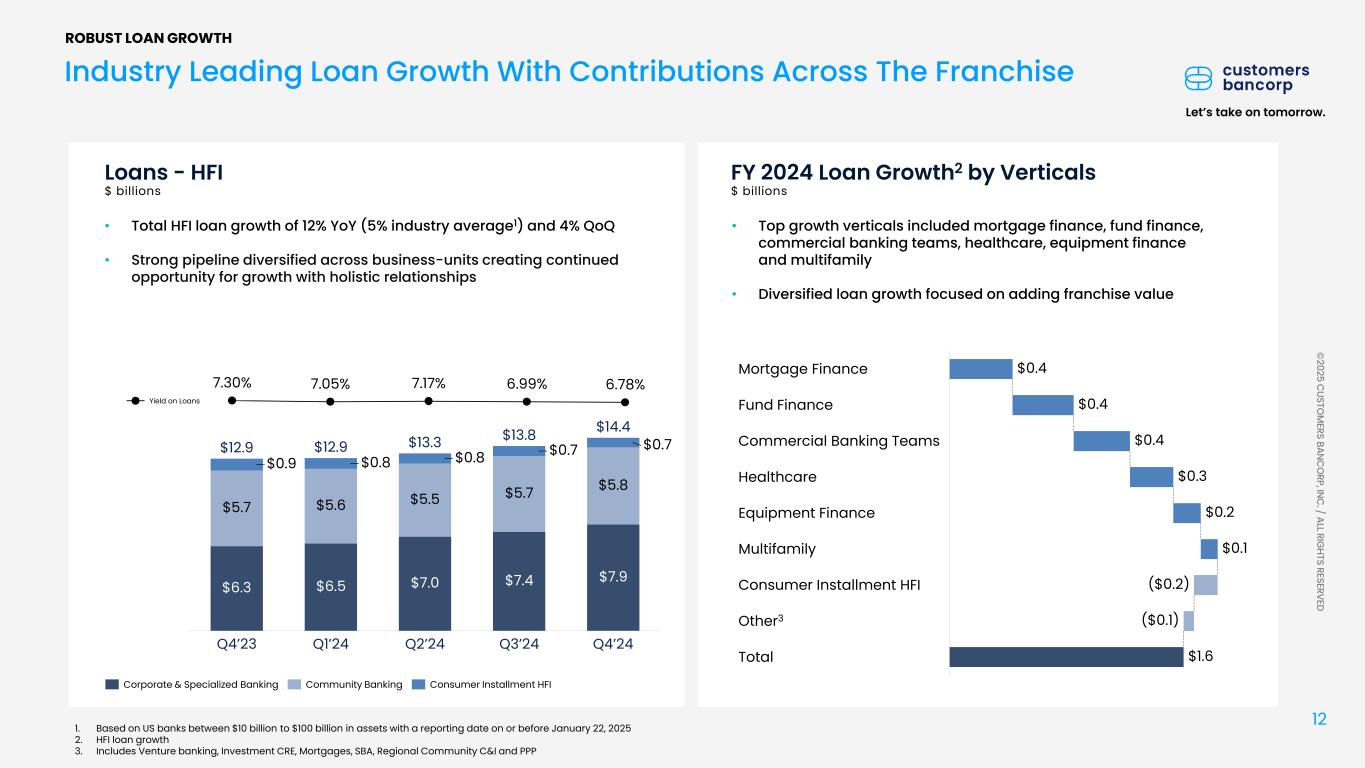
Yes, and Phil, if I could just add to that, I think that the point about payoffs is very important. We had a number of payoffs in 2024 to put it in perspective, we had about a $1 billion of payoffs and paydowns in the fourth quarter, which really shows that the net growth that we experienced, despite that was quite substantial, and it actually gives us good confidence going forward. We do anticipate that a lot of the payoffs have sunsetted mostly in 2024. Having said that, I think that as there's a stronger commercial environment, you could see some refinancing activity sort of across the portfolio, especially in some of our fund finance-type private capital businesses. But I think we also added that slide on our loan growth slide, loan slide, to really illustrate the diversification. I think that's what's really important is we have a number of levers to pull as the year progresses.
Speaker 5
Okay, great. I appreciate all that color. And then just in terms of the deposit growth here this quarter, you know, a lot on the non-interest bearing side. You know, I'm assuming a lot of that is from the instant payments. I'm just kind of curious, you know, how you're thinking about that business these days. You've had the 15% cap in the past. Obviously, it was a good quarter for productivity in that business. But maybe the dynamics there you're seeing and how you're thinking about it here, along with the fees that started this quarter?
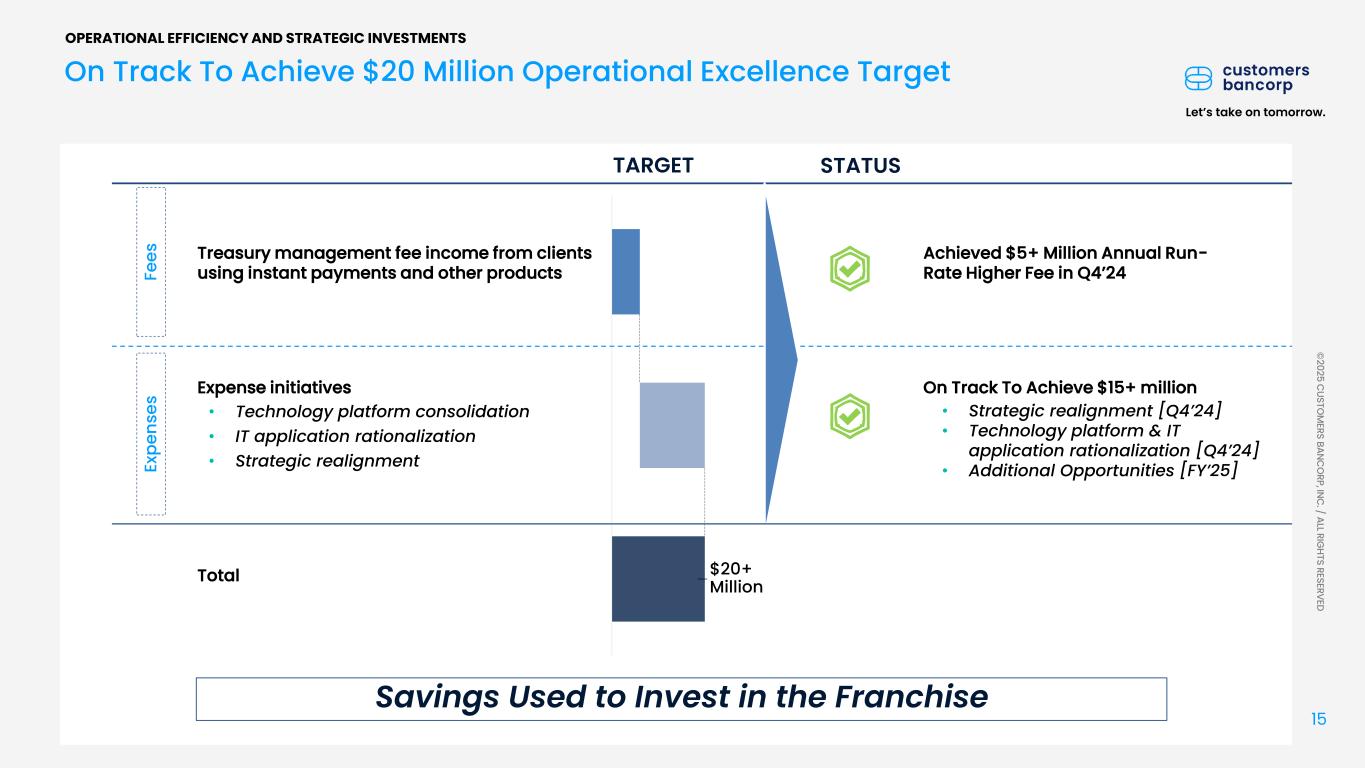
Sure, absolutely. So firstly, I'll start with saying, Steve, your intuition is correct. Most of that non-interest bearing deposit growth came from our cubiX platform customers. And after the election, our clients experienced a tremendous amount of increased market activity, which as you can imagine leads to higher balances, which we supported in order to serve our clients when they needed us most. We'll wait and see where things fully settle in, but it's worth noting at the end of the year we had about $3.6 billion in spot balances there. And, you know, on the point of our limits and targets, yes, it's above 15%, but importantly, we are holding all of these balances in cash to mitigate any perception of liquidity risk. And our management team is going to continue to evaluate limits and targets and take a holistic risk-based approach as we assess these levels going forward. So I think that's the important way that we're approaching this. At the end of the day, we want to make sure that we're there to serve our customers. You also heard me talk about the migration to our own in-house platform, which is not necessary, it's not even in beta, it's 100% switchover that we've made. And it's also helped us level up in fees. We had almost $2 million in fees in the fourth quarter related to our cubiX platform and the customers. Now, obviously, there's increased market activity there. You also heard Phil talk about $5 million plus is sort of where we're guiding to as sort of a minimum, but we'll wait and see how things settle in. September was sort of, sorry, October was slow. November was slow for the first week and things have been pretty active. And the first two weeks of January, as an example, were also slow. So increased client activity leads to higher balances. Higher balances lead to interest income, and it also leads to higher fee income.
Speaker 5
Great. Appreciate that. And one last one for you and I'll step back. On the NII guide, I apologize if I missed it, but just wondering what you guys are assuming for rate cuts there?
Yes, Steve, our base case had two rate cuts, which we were including one early in the year in March. Obviously, that trajectory moves around a lot, but we look at a pretty wide range anywhere from zero to five rate cuts.
Speaker 6
I wanted to follow up on the interest income. It's a fairly wide range of 3% to 7%. Could you explain some of the factors that would lead you to the upper end of the range compared to the lower end and discuss the trajectory of the margin?
Sure. I'll begin and then Phil can jump in if I overlook anything. As you can imagine, the primary factors affecting our outlook are interest rates and the pace of loan growth. We're looking at the upper end of our expectations, which is based on the current rate curve that includes two cuts. When we adjust for the accretion I mentioned earlier, that places us at around 10% or at the high end of the industry. We do have opportunities to improve further. However, as we sit here in January, many variables could change throughout the year, particularly the rate curve, which has fluctuated significantly from week to week. I hope that provides some context regarding our outlook. I’d also like to highlight the strength of our franchise. If you look at our slide, our net interest income has increased by 19% annually over the past five years, and we aim to maintain a strong growth trajectory moving forward, although likely not at that pace.
Speaker 6
I wanted to follow up on your comment, Sam. You had impressive growth from the third to the fourth quarter. If I annualize the fourth quarter net interest income and consider the midpoint of the range you provided for 2025, it indicates low single-digit growth. I'm curious why it seems that some of that momentum might slow down, if I'm interpreting that correctly.
Yes, hey, Peter. So again, a couple of things. One, as Sam mentioned, we are still modestly asset sensitive. So with two rate cuts in there, that would have some downward impact. And the other lever is also, as Sam mentioned earlier, just where some of the average non-interest bearing balances settle in.
Yes, and to kind of put that in perspective, Peter, you can see that on our NII slide, we broke out interest income and interest expense. So you can see that our interest income only slightly declined in the quarter, despite the fact that you had the full impact of September through December, you know, rate cuts. So I think that really just speaks to, as Phil mentioned, the mixed shift that we had across the franchise and those things need to sort of take time to stabilize in.
Speaker 6
Got it. And just one last question. Could you provide a bit of insight on the increase in the oil property, that $12.5 million and that $6.6 million reserve bill? Was that related to this credit?
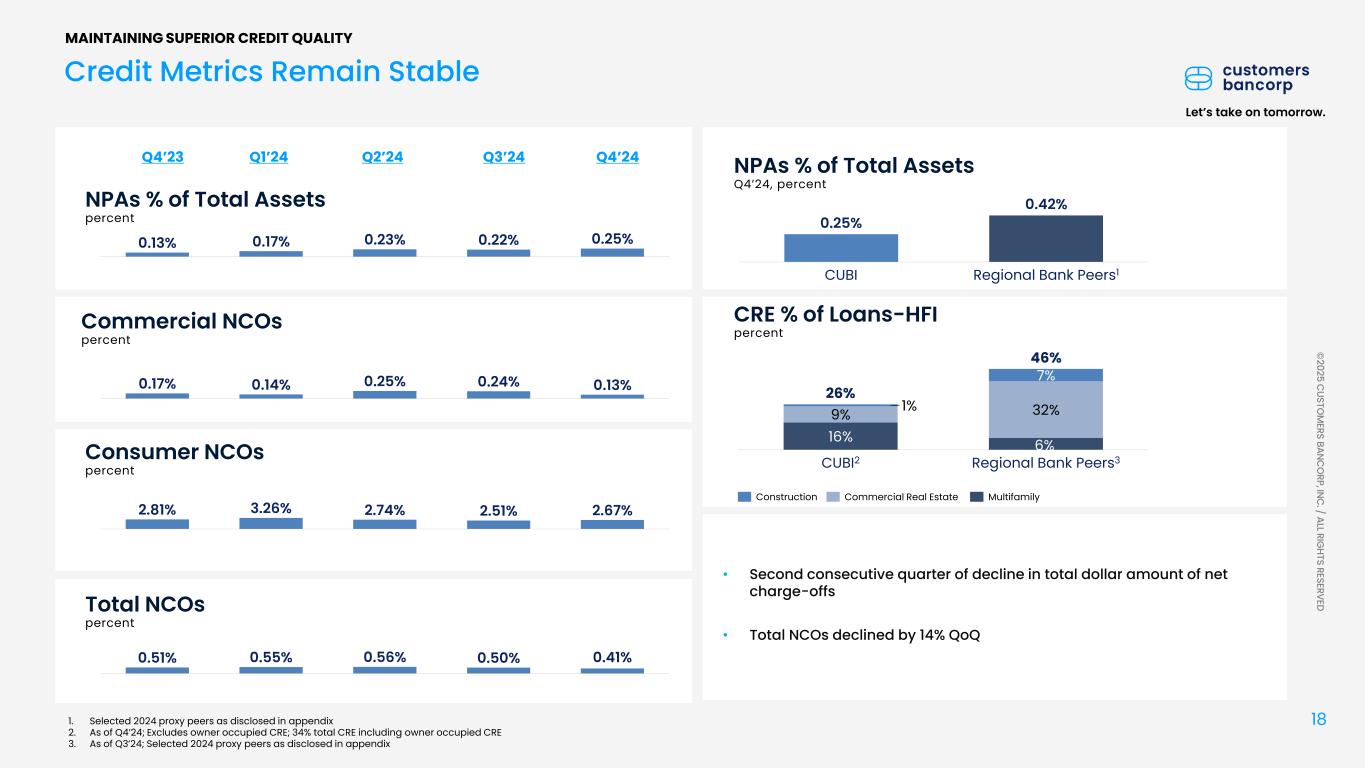
Yes, hey Peter, so I think you're referencing there was about an $8 million increase in NPAs. It's actually not OREO; it was a security that we put on NPA in the quarter, which we're in the final stages of restructuring with the issuer and feel we're well-reserved, but put that on in the quarter. So that's actually where that's coming from. On the loan ACL side, that's really related to the increase in the loan book. So if you see our coverage ratios there were relatively stable. But obviously, the increased loan volume is going to require increased provisioning.
Speaker 7
Good morning. I appreciate the question. Your core deposit growth has been impressive and remains strong; the pipeline is still robust, and the deposit betas are likely leading in the industry. As you look forward, it seems like most of the easy gains have been achieved with the ongoing decrease in brokered deposits. I'm curious about what is factored into your guidance regarding the expectations for further lowering deposit costs as your new teams continue to grow these core deposit accounts.
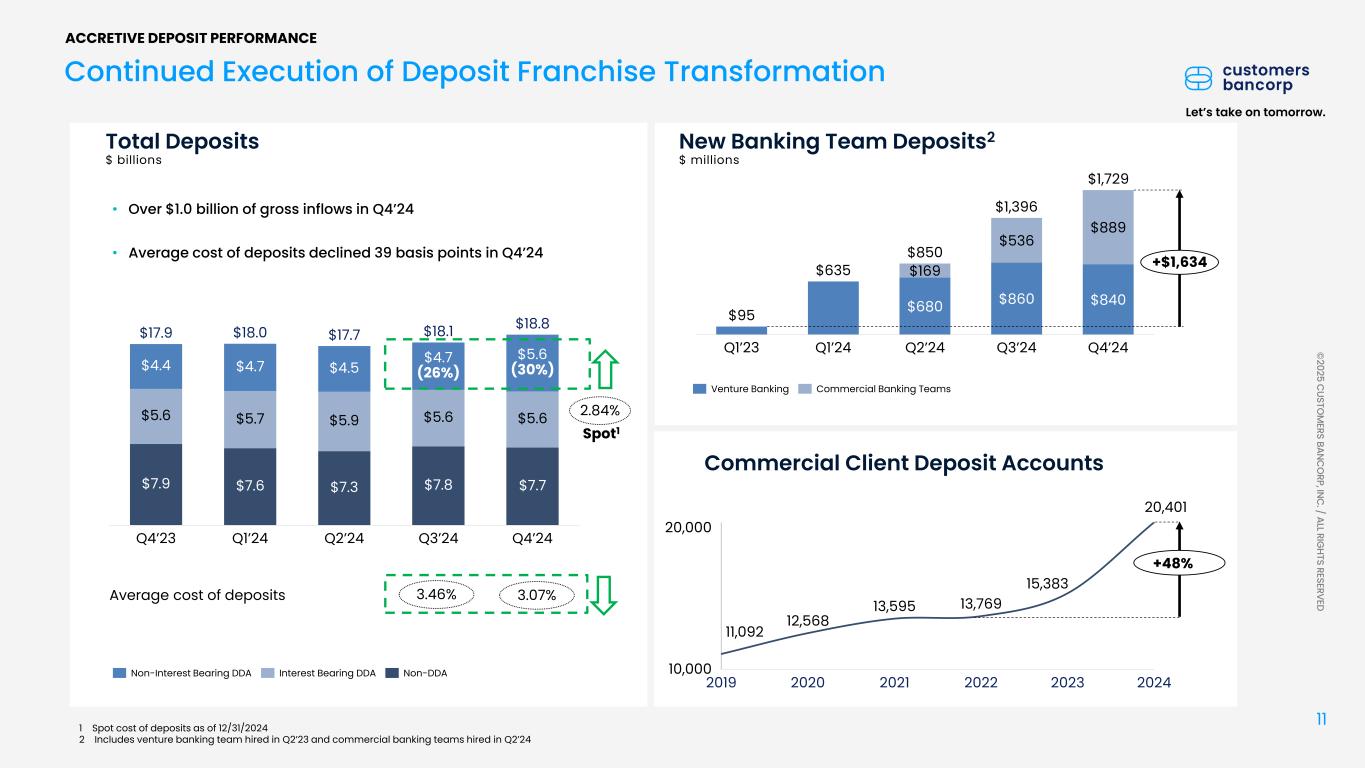
Sure. Good morning, Kelly. So I think that, first of all, you touched on a couple things. One thing I just sort of highlight is broker deposits; we continue to reduce. I'd also just sort of talk about the timing of deposit remix. I think last quarter we talked about, about north of $500 million that we were planning to remix in the fourth quarter. That was, I believe, 4.7% or 4.8% cost to funds. Similarly, we've scheduled about $500 million in the first quarter, which is currently at about 4.5%, to put that in perspective and put the scale of the continued remix. If you look at our spot cost of deposits, I think that's a pretty good indicator of giving you a sense of how the first quarter will trend down from a cost of deposit perspective. And then I'll point you back to, while their pipeline is $2 billion, we talked about our goals for the year for the new teams. And we think the new teams should really be able to drive $1.5 billion to $2 billion or so in 2025, which is at that sort of call it about $500 million or so on average a quarter. It'll be lumpy. It won't be necessarily perfectly consistent and linear. Having said that, that's sort of where we expect. Those deposits are coming in 150 to 200 basis points below our cost of funds. I think that sort of helps give you some perspective on how we're sort of seeing the overall remix and some of the levers and puts and pulls.
Speaker 7
That's super helpful. Thank you, Sam. And I'd like to ask a follow-up on the digital asset space. I appreciate the commentary that most of the non-interest-bearing deposits or a good portion of that was related to, you know, letting those caps increase a bit? I'm wondering how you're viewing this, you know, competitive opportunity ahead and if you could just frame it here. Obviously, the new administration is much more friendly to this business. But also I’m wondering how you're thinking about potential competitors getting back in and your ability to maintain your lead in this space?
Sure. Absolutely, Kelly. And let me just address one thing on the non-interest-bearing deposits. While we had a big driver from our cubiX client customers, we still had nine-figure deposits, which would have been a highlight of the quarter across the overall bank and non-interest-bearing deposit growth, even with, as you know, sort of Q4 type taxes and payments that kind of go out towards the end of the year. But to get to your question, I think post-November's election, it's really reinforced that digital assets are here to stay. And banks are going to handle this over time just like any other banking services that are being provided. And at Customers Bank, we have the benefit of being a first mover, and only mover, that has a network and it's very difficult to replicate. So we're sitting in the primary seat with operating and transaction accounts with the largest and most institutional customers in the space. So obviously, there are early green shoots of clarity on regulation for our customer base, which I think is going to provide overall clarity for how banks can operate, which will really benefit the overall industry. And I think we feel fortunate that we've been able to support our customers, build very long, deep relationships, and also really have a superior technology service that we've been able to support and provide to our customers base and also prove to them that on our own platform now we have the technology prowess to continue to support them in the future.
Speaker 7
Thank you very much. I will step back.
Speaker 8
Hey, good morning.
Speaker 8
You may be first just starting with the NIM. Can you provide the discount accretion over the last few quarters and what the expectation is for discount accretion in 2025?
Yes, hey, Matt. Good morning. As we kind of said on the last call, it really settled into a spot where it's been pretty immaterial. So it was low-single-digit basis point impacts are really not much. And again, we've realized essentially the vast majority of the discount accretion here now through 2024. So as Sam mentioned, it's not really much of a driver for ‘25 as we think about that comparison point.
Speaker 8
Okay. Okay. And then I was hoping you could also touch on the provisioning outlook and the reserve. You know the reserve as a percentage of loans has been kind of steadily declining. Where do you think that's settled out and what does that imply for the 2025 provision?
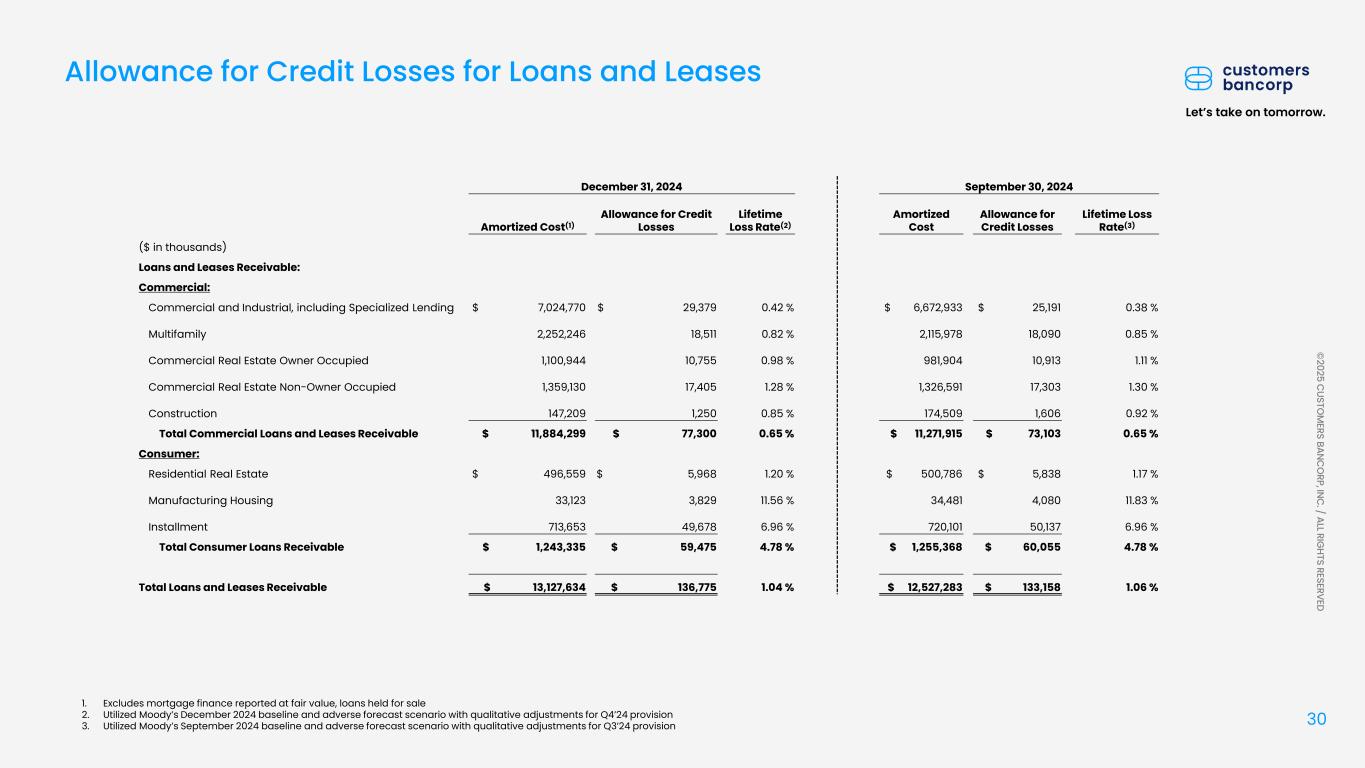
Yes, sure. So, you know, it's a great question. And as you pointed out, it has been declining, but that's really as a result of a mix shift. If you look at our sort of corporate and commercial and consumer reserve levels, they've been stable, or even on the commercial side, some slight increases. So that was really mostly mix-driven. I think as we kind of have the outlook looking forward, we still feel like those levels as we sit today probably feel like the right respective, around the right respective levels. But as I mentioned earlier with increased loan growth, you could see some increased provision. So while we don't have a formal guide on it, I think the directional range we've given in the past is kind of $18 million to $22 million. You could see that probably be a bit higher just given the continued loan growth.
Speaker 8
Okay, thank you. And then just going back to the cubiX and the crypto effort, I guess 15% used to be the old limit on crypto deposits? I think Sam, you said you are at $3.6 billion spot deposits today or period ends at kind of 18% to 19%. I guess what's the new cap? Is there one? And then the growth that you had this quarter, was it from existing customers? Just going back to the regulatory order, I thought there were some stipulations around engaging with new third-parties, and I didn't know if there was any sort of limitations on new customers.
Yes, sure. So I'll start with the last question first. We don't have any restrictions on new customers. I think you're referencing something about third parties or payment providers. But at the end of the day, we supported existing customers. And really, it was increased market activity with existing customers. And I think I touched on this before, is we're holding all of this in cash. That's our risk mitigation. 15% was actually something that we set a couple of years ago for this vertical prior to becoming the primary banking institution we've held to it. And as customer activity increased, we supported our customers. And in terms of a new level, it's to be determined. It's got to go through sort of our typical process. And we have to be thoughtful thinking about what our customers need. We also want to see where things settle in. It's only been 60 days or so, so I think we'd like to see where things settle in. If you look back to last year, it's tough to remember that in January you had the ETFs that were approved. In the fourth quarter, you had the election. The first quarter there's additional activity. So we'd like to see and get some more history of client activity and then we'll be able to make much more of an informed call then.
Speaker 8
Understood. And I appreciate the clarity on the third-parties. It was tough to interpret what they meant there. My last question is really just around overall broker deposit levels. Could you update us on where balances stand today, what it's down from about a year ago? And I guess where I'm going with this is the way I kind of track it is through the call reports. And the call report levels have been relatively flat the last handful of quarters, and I was hoping you could kind of square the progress versus what we're seeing in the call reports. I think there's some other things that kind of get globbed in there? Thank you.
Yes, sure, Matt. So I'll start, and Phil, you know, I don't have the numbers exactly in front of me, but I think we've gone down by $200 million over the last couple quarters. And I think you heard me talk about my script about another $500 million or so in the fourth quarter, which you'll see sort of filed in the near-term. I'd also say that the $500 million or so of deposit remix that we've scheduled has a good overlap with our broker deposits. So higher costs, less strategic deposits are going to be the focus areas of our deposit remix. So as we bring in those deposits, you could imagine that broker deposits or deposits that have been classified as broker, I think is also an important distinction. As you think about sort of the overall FDIC rules and how that has evolved, are going to be part of our target universe.
Speaker 9
Hey, congratulations, guys, on a great year. And my question is on how you guys come in with your punch list on working down the issues with the Federal Reserve Bank of Philly. What can you share with us on that?
Sure. Good morning, Hal. Thank you so much. As I mentioned last quarter, I think the easiest way to sort of summarize this is we're working on enhancements, as you described in sort of the punch list across people, process, and technology. You know, on the people side, we had hired at that time and since hired even more senior seasoned executives, and they're helping to level up the overall risk management infrastructure and helping us build the bank of the future. From a process perspective, we talked about some of the third-party services and getting top-tier firms to help us with design implementation that also have sort of a good mastery of the external environment. And from a technology perspective, we stated our goal was to transition to in-house, and I'm proud to say that this was a long time coming and something we started in 2023. But as of the end of the year, we fully transitioned all of our real-time payments clients to cubiX.
Speaker 9
And I have one follow-up to that. The elevated professional services costs, what's kind of like the pace that came from maybe fading that expense ramp or maybe maintaining it this year? Can you give us your thoughts on how we should think about that?
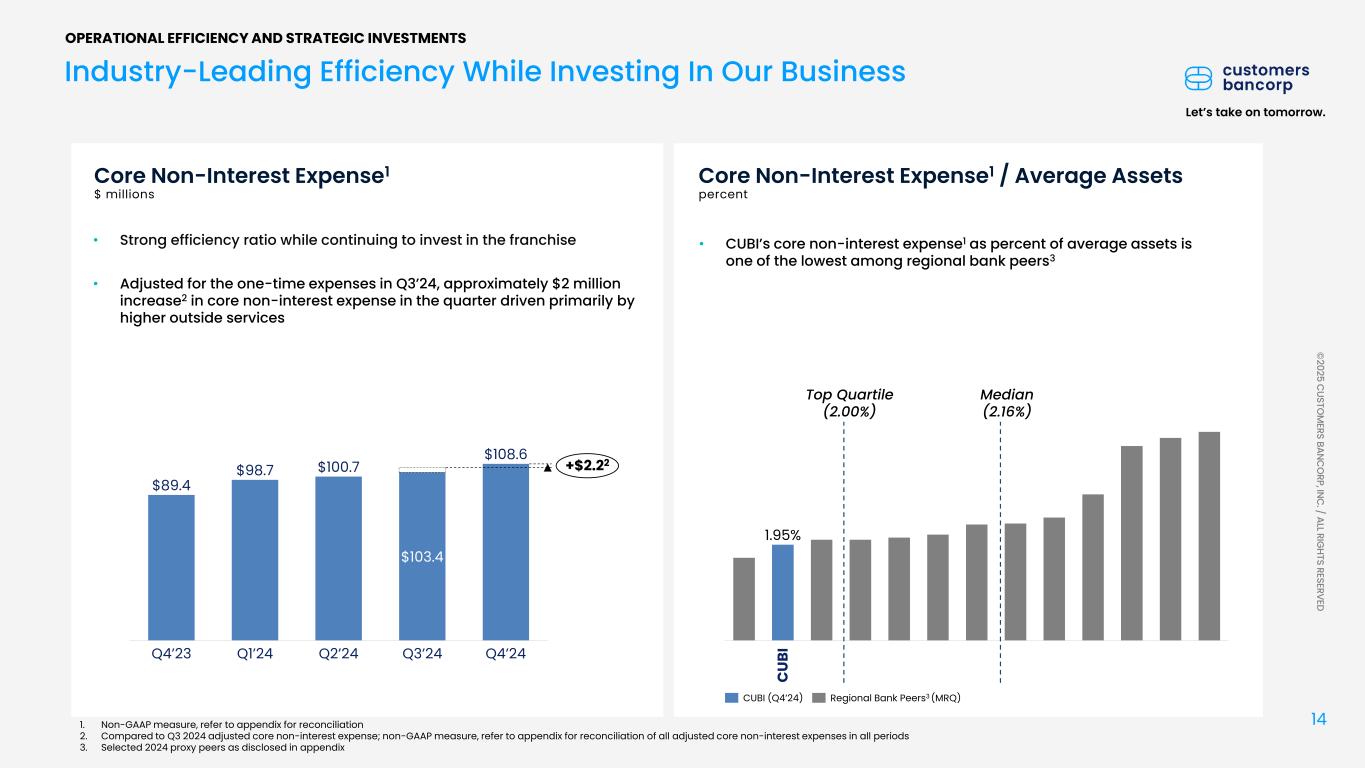
Sure. As I mentioned, it's somewhat of a bell curve. We peaked at $5.5 million to between $5.5 million and $6 million in the quarter related to these efforts. December and January are the peak months. It will decrease a bit from there, and by the middle of the year, we expect to return to more typical levels. We are past the halfway point, which is a good way to consider it. However, we will monitor our progress month to month. We have a well-executed plan that we hope to complete in the first half of the year.
Speaker 7
Thanks so much for letting me jump back on. I just wanted to get some clarity from Phil on the securities restrictions you took, the timing of that during the quarter, the sales as well as the timing of the reinvestment of loans? Did the reinvestment happen early 2025 or was that undertaken last quarter?
Sure. Hey, Kelly. So yes, the sales did occur kind of late in the quarter through the halfway point, so later in the quarter. And then the reinvestment was also gradual. You can imagine the securities happened a little bit earlier, but again, still pretty late in the quarter. And then the loans were just kind of organically as they came on. And you can probably imagine the majority of that loan growth always seems to come right around December 31 at the end of the year. So it tended to be a bit more towards the tail. But generally, we sort of think about it as probably having about 5 basis points of incremental NIM pickup in 2025.
Thank you everyone for your continued interest in and in support of Customers Bank Corp and the incredible franchise that we're building. We look forward to speaking with you next quarter. Thank you. Have a great day and a great weekend.
Operator
This concludes today's conference call. Thank you for joining. You may now disconnect.