Operator
Good morning, and welcome to Dana Incorporated's Second Quarter 2025 Financial Webcast and Conference Call. My name is Regina, and I will be your conference facilitator. Please be advised that our meeting today, including the speakers' remarks and Q&A session, will be recorded for replay purposes. At this time, I would like to begin the presentation by turning the call over to Dana's Senior Director of Investor Relations and Corporate Communications, Craig Barber. Please go ahead, Mr. Barber.
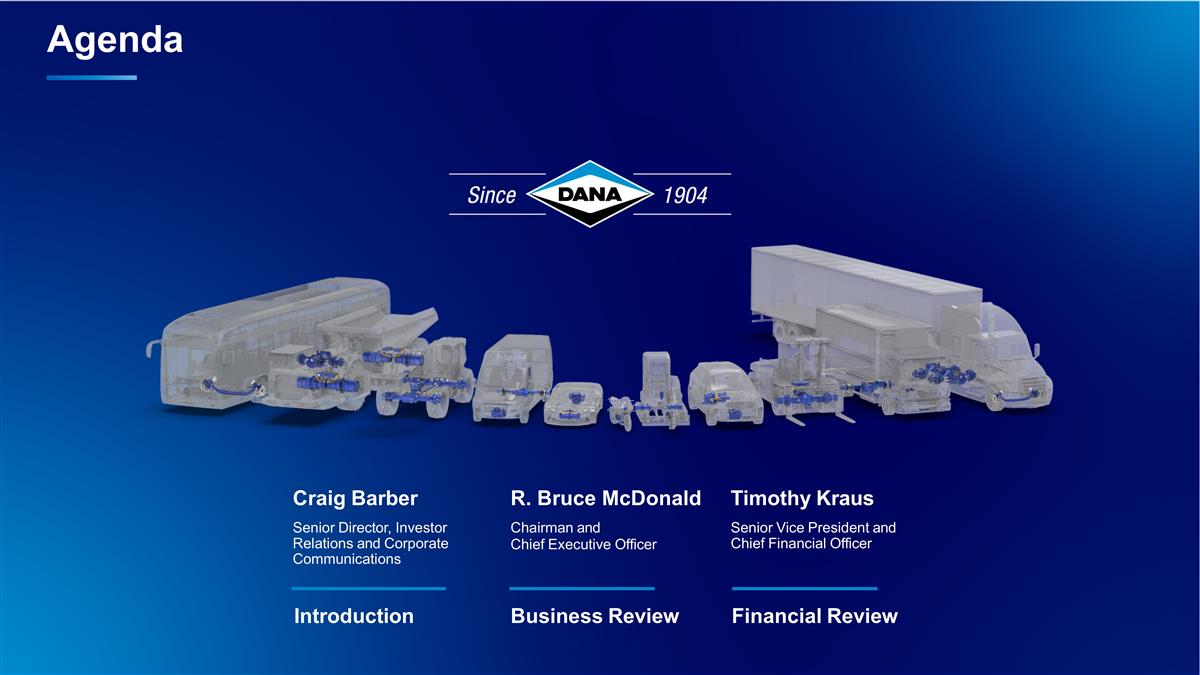
Thank you. Good morning. Welcome to Dana Incorporated's earnings call for the second quarter of 2025. Today's presentation includes forward-looking statements about our expectation for Dana's future performance. Actual results could differ from what we discuss today. For more details about the factors that could affect our future results, please refer to our safe harbor statement found in our public filings and our reports with the SEC. I also encourage you to visit our investor website, where you'll find this morning's press release and presentation. As stated, today's call is being recorded and the supporting materials are the property of Dana Incorporated. They may not be recorded, copied, or rebroadcast without our written consent. With me this morning is Bruce McDonald, Dana Chairman and Chief Executive Officer; and Timothy Kraus, Senior Vice President and Chief Financial Officer. I will now turn the call over to Bruce.
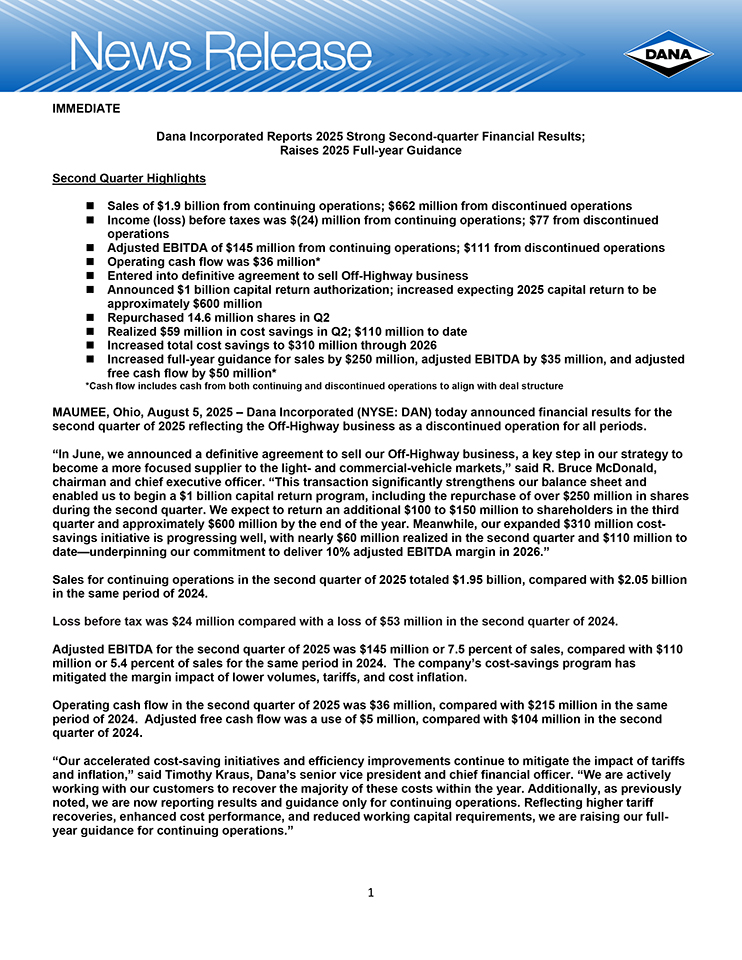
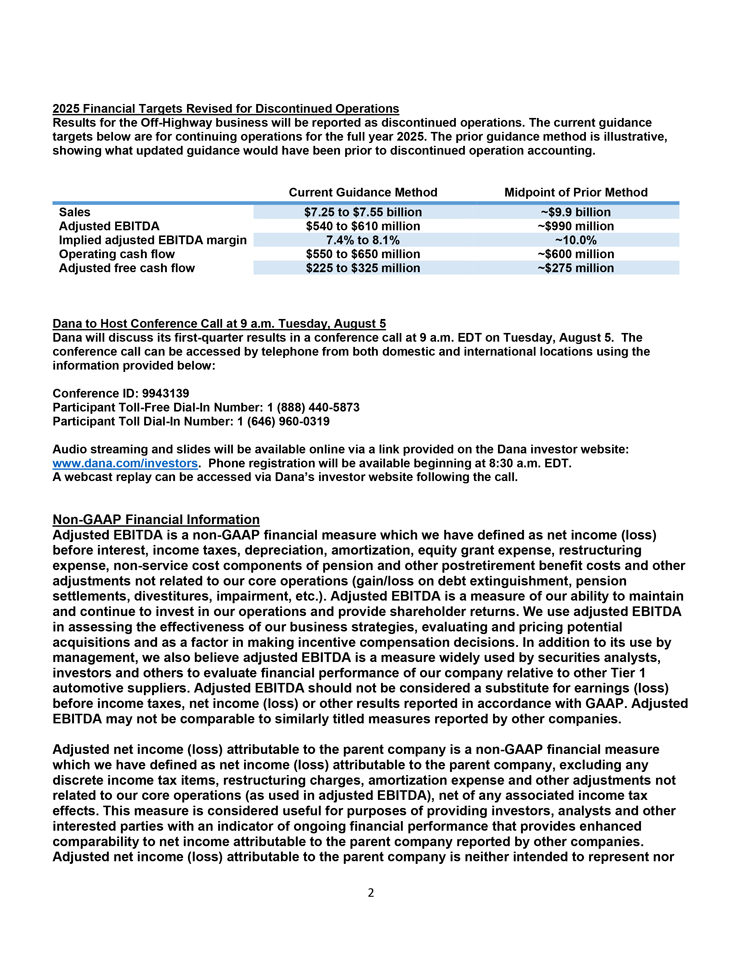
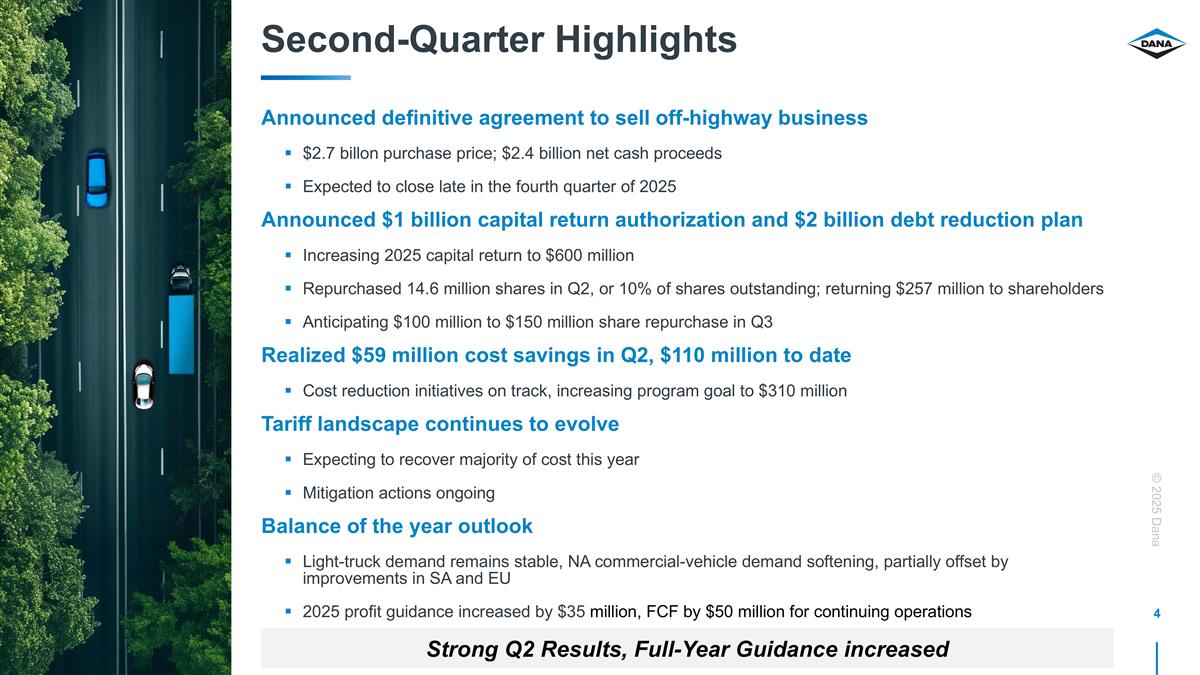
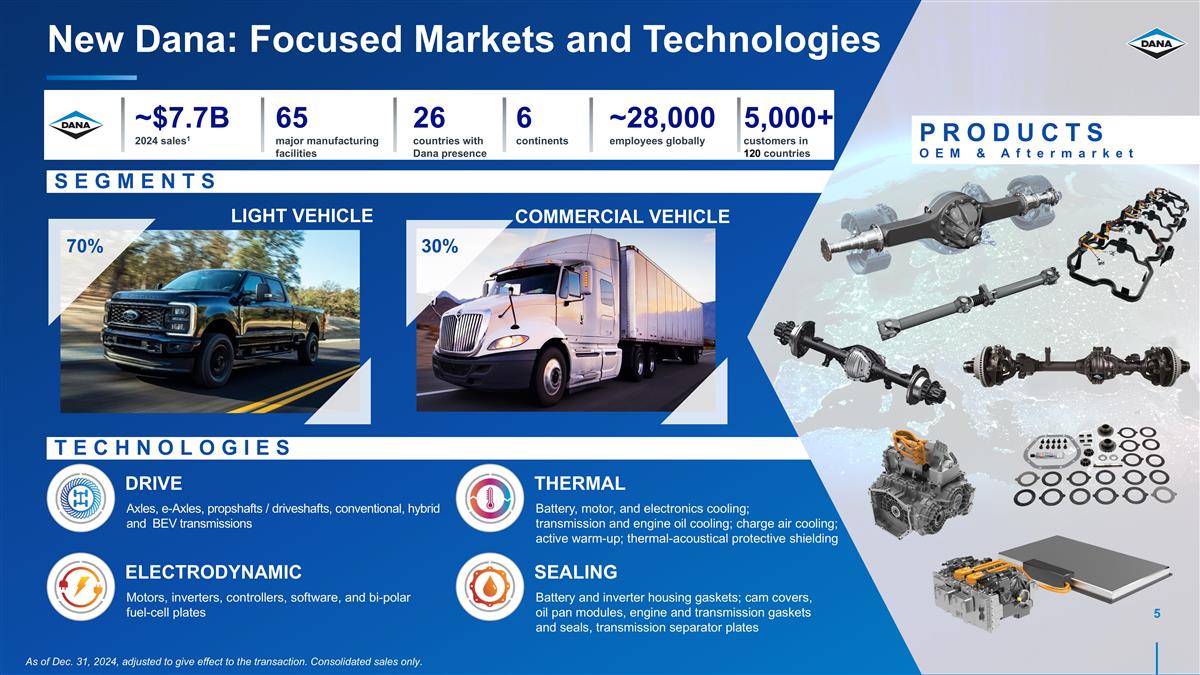
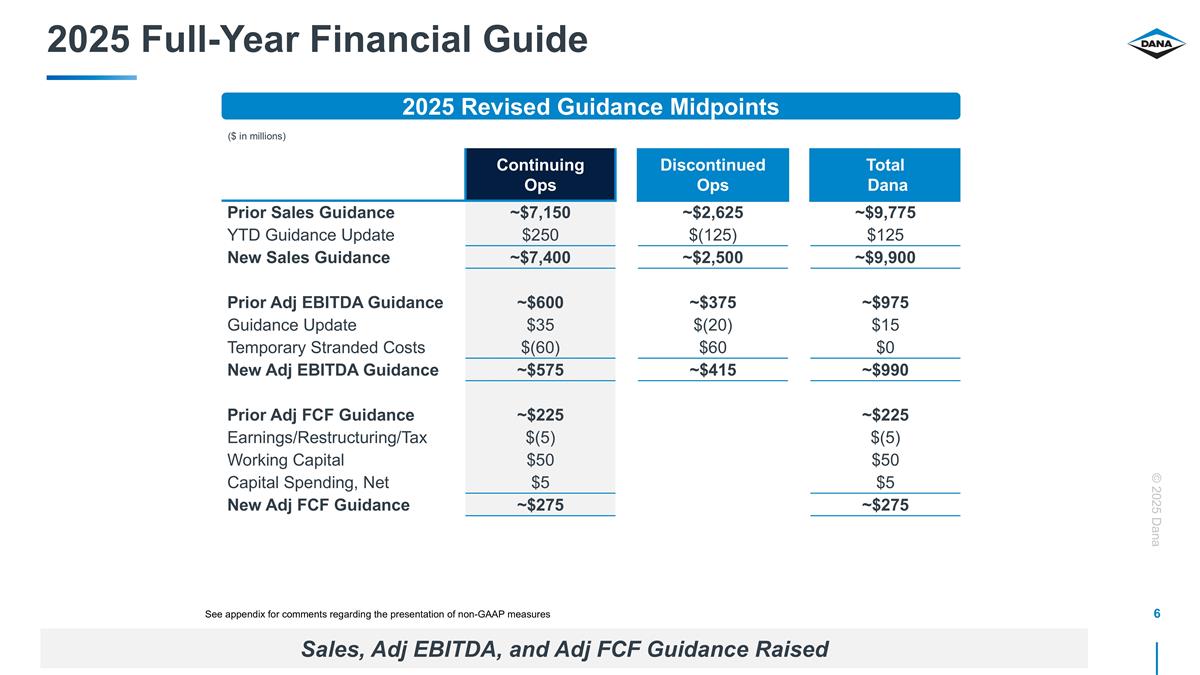
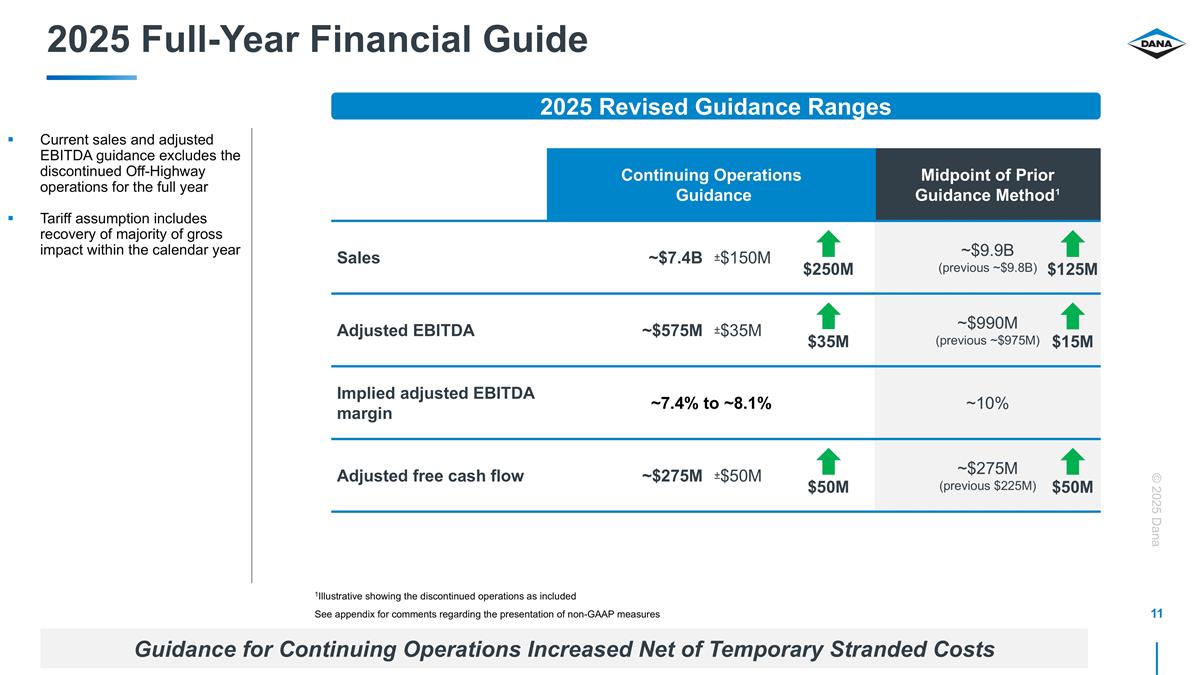
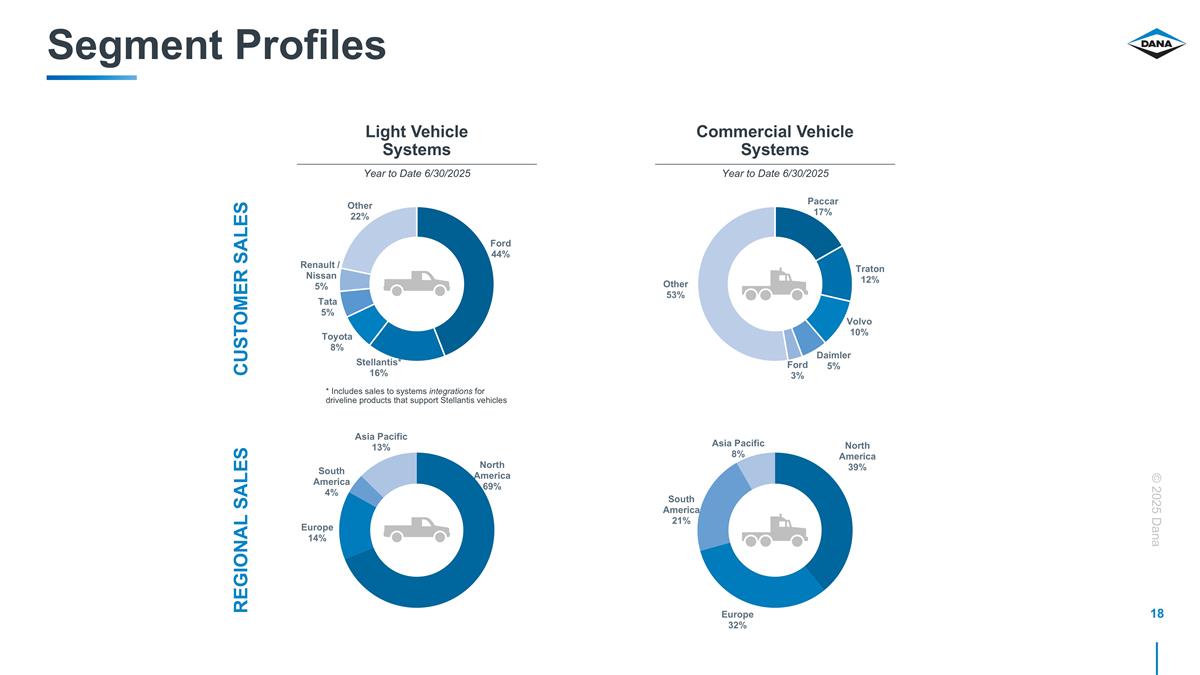
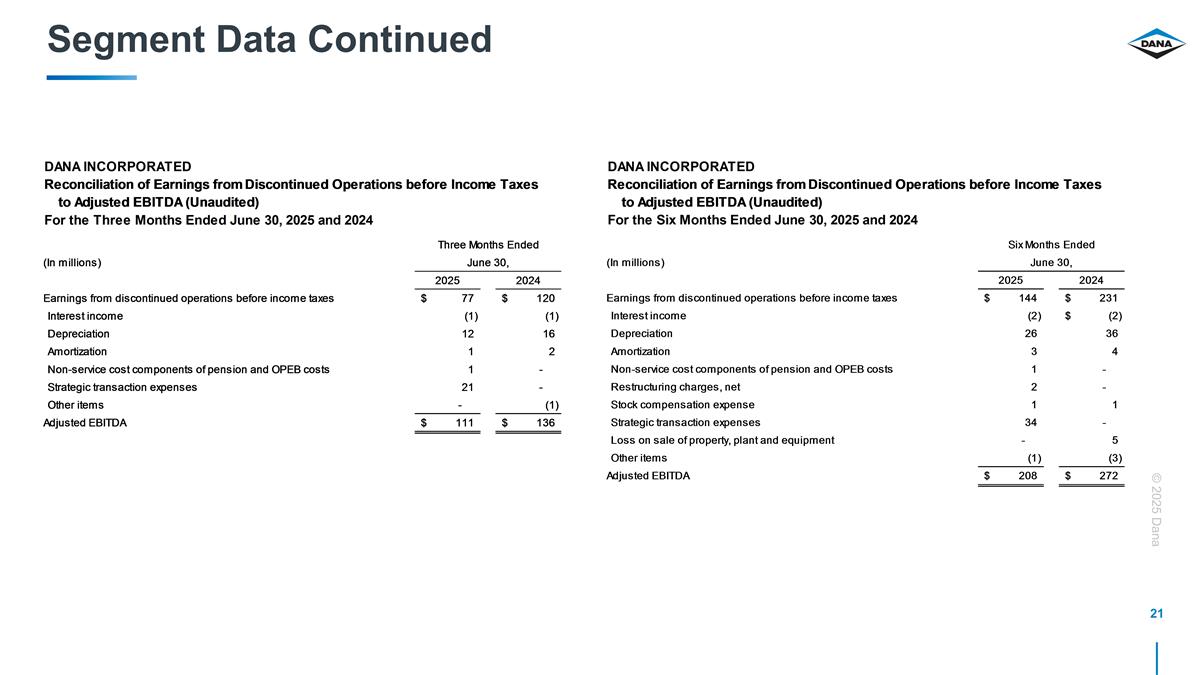
Thank you, Craig, and thank you all for joining Craig, Tim, and myself for our second quarter earnings call. There is a lot of noise in our numbers as we've got to reclassify Off-Highway as a discontinued operation. And so in our earnings deck and in our comments, we'll sort of talk intermittently between new Dana, i.e., Dana from continuing operations, and the full Dana, which obviously is the basis of our previous guidance and things like that. I guess I'd sort of characterize the second quarter as another quarter of the Dana team delivering on our commitments with a solid Q2 beat, double-digit margins, and accelerating free cash flow. In terms of some of the highlights here on Slide 4. As everyone knows, we did announce in the quarter our agreement to sell the Off-Highway business to Allison for just over $2.7 billion, with net cash proceeds expected to be about $2.4 billion. That closing is expected to occur here late in the fourth quarter. I think substantially all of the regulatory filings have been submitted, and the teams are working hard, both ours and Allison's on affecting a smooth transition of the business over to Allison. In terms of our use of proceeds, we previously announced that we were going to take the proceeds from the sale of the Off-Highway business and return about $1 billion to our shareholders as well as reduce our overall debt by a couple of billion dollars. I'm pleased to announce this morning that as a result of strong free cash flow and our higher guidance here for the year, we're raising the amount of capital return to our shareholders to $600 million from what was $550 million previously. As things stand now, we anticipate using all of that to reduce our shares outstanding, and we're forecasting that we'll end the year with a share count of around 110 million, which would be about a 25% year-over-year reduction. In the quarter, we did buy back just over 10% of our shares, returning $257 million to our shareholders. And as we look here into the third quarter, we anticipate buying back another $100 million to $150 million worth of shares. In terms of our cost reduction initiatives, this is where we sort of committed to a goal of $300 million run rate by 2026. We're upping that to $310 million as a result of some of the projects coming in better than Tim and I had expected. In the quarter, we delivered nearly $60 million of cost reduction and $110 million to date. And so I think we can tie a ribbon around cost reduction. I think we're highly confident in the $300 million target, and we don't really have a long way to go to get to that run rate here by the fourth quarter. In terms of tariffs and the tariff landscape, there is a lot moving around lately here, but I'd say the takeaway on tariffs is we're in great shape in terms of tariff mitigation and tariff recoveries. Right now, we have some headwind in the second quarter, about 80 basis points. That's worse than we expect is going to be the impact for the full year because we have some timing-related catch-ups that we didn't get customer agreements in place by the end of the quarter. Overall, we expect over an 80% recovery for the year. More importantly, the work that the teams are doing with our customers to mitigate the impact of the tariffs is critical for our industry because we don't want to just pass these costs along - we need to eliminate them so that we don't impact end vehicle demand. In terms of our balance of the year outlook, I think when we were on our call at the end of the first quarter, there was considerable uncertainty around the impact of tariffs in terms of volumes. What we've seen is very strong volume holding up in the Light Vehicle side of our business, we have seen some softening in North American Commercial Vehicles, which has been partially offset by a bit of better volume coming out of South America and Europe. In terms of our profit guidance, and here, I'm referring only to new Dana, we're up in our profit guidance for the year by $35 million. If you look at the whole company, it's up $15 million because Off-Highway is down $20 million. On a free cash flow basis, we're up in our target by $50 million to about $275 million at the midpoint of our guidance. So overall, a really strong quarter. I couldn't be more pleased with the results of the team. In terms of what new Dana looks like going forward, I mean, here's kind of an overall snapshot reflecting 2024 numbers. But we'll be much more of a Light Vehicle company and much more of a North American-centric company. We do have a nice split between commercial and light vehicles; within commercial, we have a very strong aftermarket business. And we don't talk a lot about it, but our thermal and sealing side of our business that we integrated into Light Vehicle continues to be a source of profit improvement going forward. In terms of the full year guidance, I just want to spend a few minutes on this page because this is the first time we're showing our numbers with and without the discontinued operations. So our guidance, as we've talked at the end of the first quarter, indicated our sales were trending towards the higher end of our previous range. We're seeing right now on a total Dana basis, our sales would have been about $9.9 billion. You can see on the discontinued operations side, sales down $125 million. There, we have seen softness in terms of tariffs, particularly European product that's imported into the United States that's bearing a tariff; we've seen those volumes drop off. However, on the continuing operations side, we see sales being up $250 million. In terms of the guidance for the two parts of the business, if you think about the original guide at $9.75 billion, you can kind of see the split: $600 million for continuing operations, and $375 million for Off-Highway. Our revised guidance that I touched on in my previous slide is up $35 million for new Dana, down $20 million for Off-Highway for a net positive $15 million. The stranded costs are just a pocket switch between discontinued operations. Those are costs that we currently allocate to Off-Highway that remain with new Dana. Just a point to note that number is higher than the sort of $35 million to $40 million that we've previously guided to. The reason is within that $60 million are variable costs allocated to Off-Highway that will go away upon the sale; those are $20 million to $25 million, and that's how you get back down to the range that we've talked about before. Regarding cash flow, I've seen a few notes where there's maybe a little bit of confusion about what's the cash flow split between discontinued operations and continuing operations. Under GAAP, we're required to report total cash flow inclusive of both pieces, and so that's what we're guiding here today. We will see when we publish our Q is cash flow split by operating, investing, and earnings split between the two, and that will get us to the year-to-date actuals. With that, Tim, I will now turn it over to you to go through the financials in more detail.
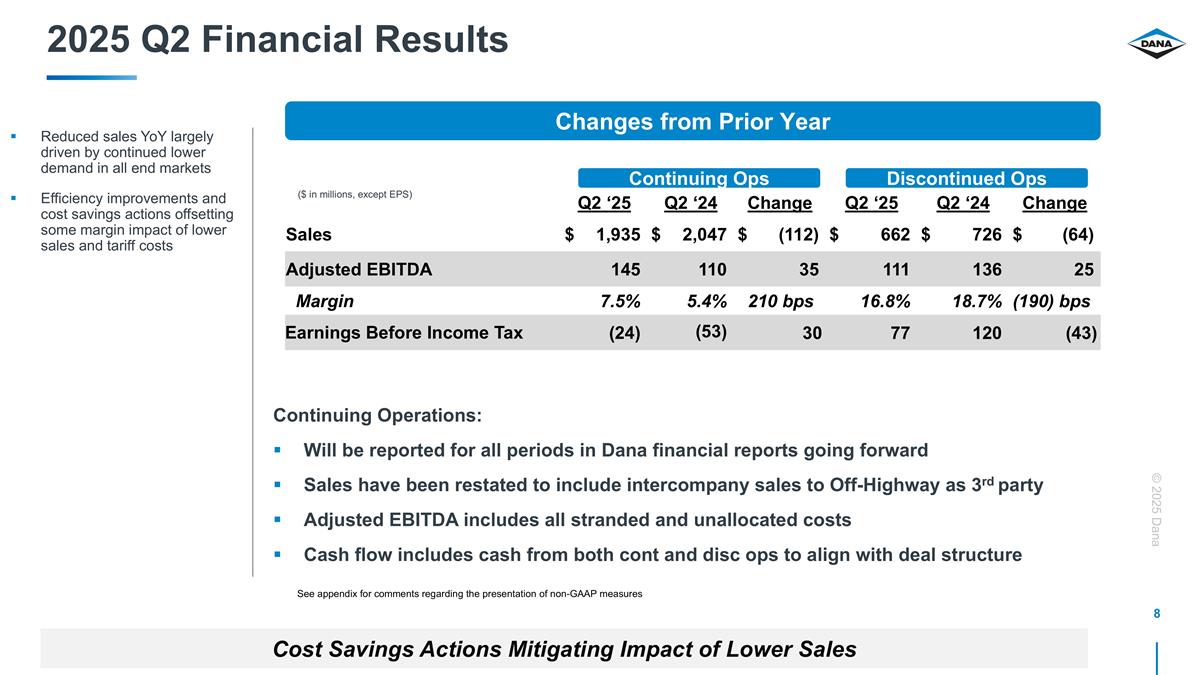
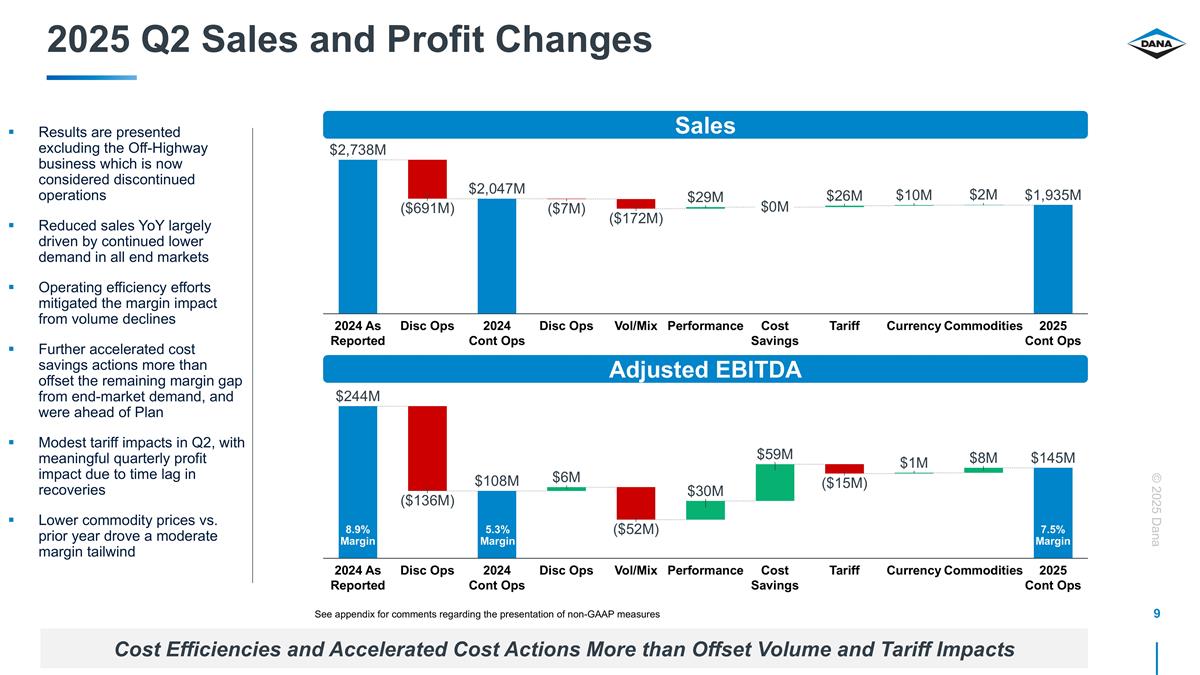
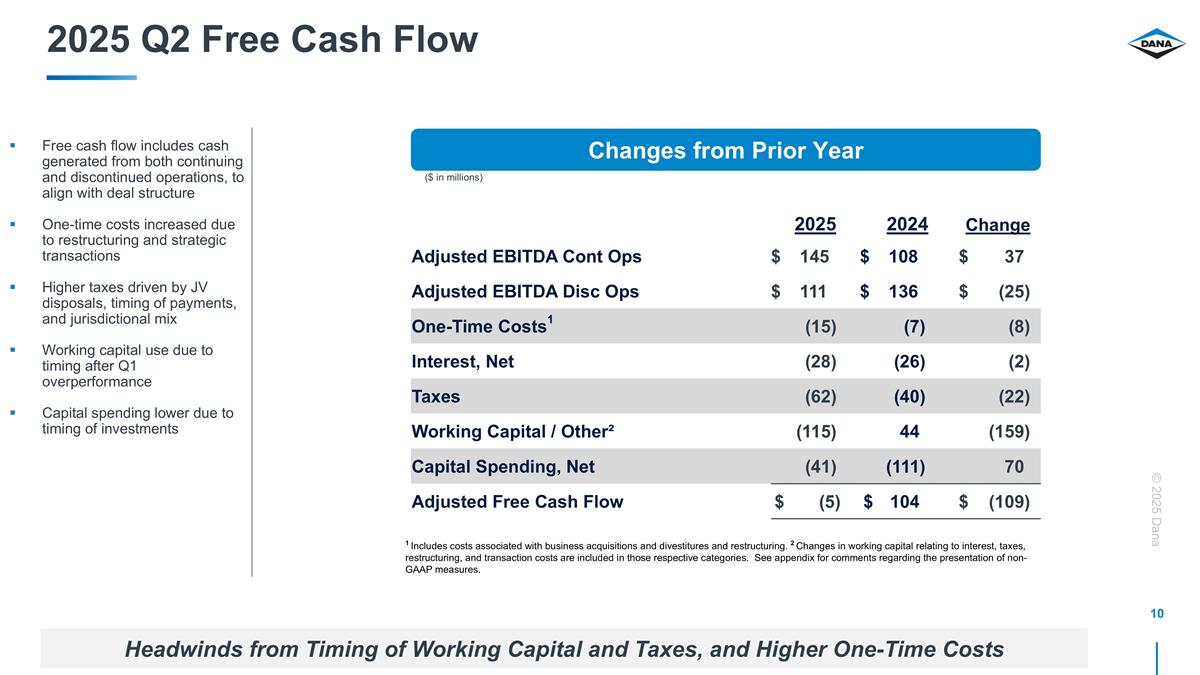
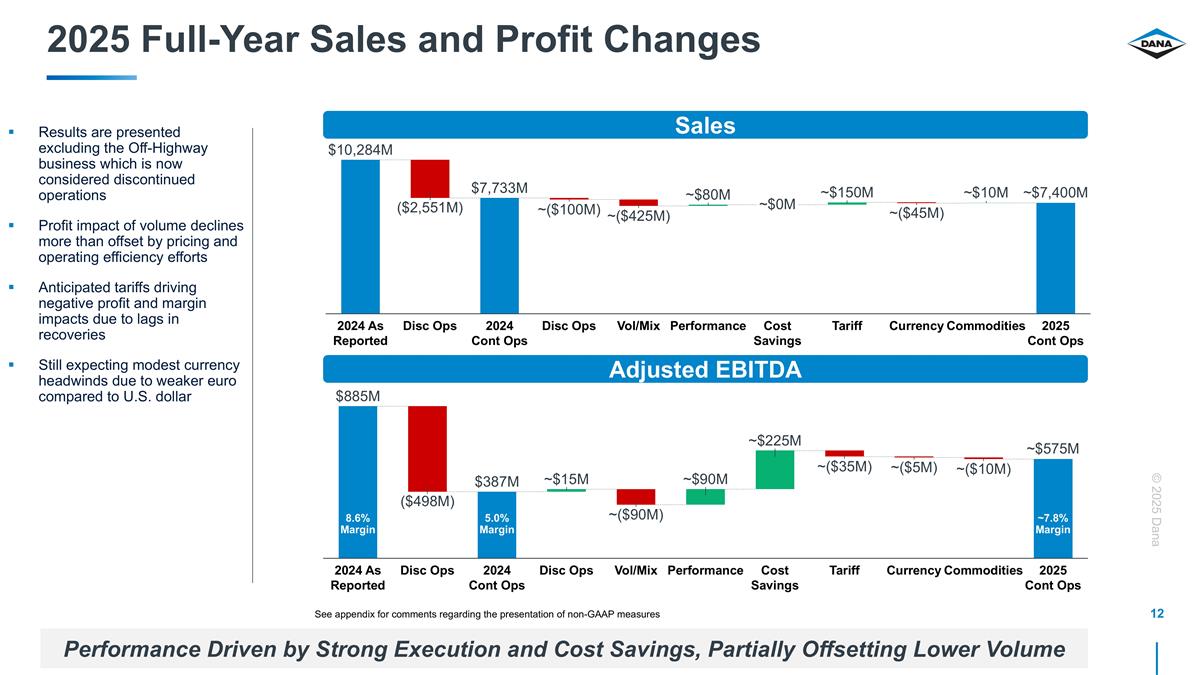
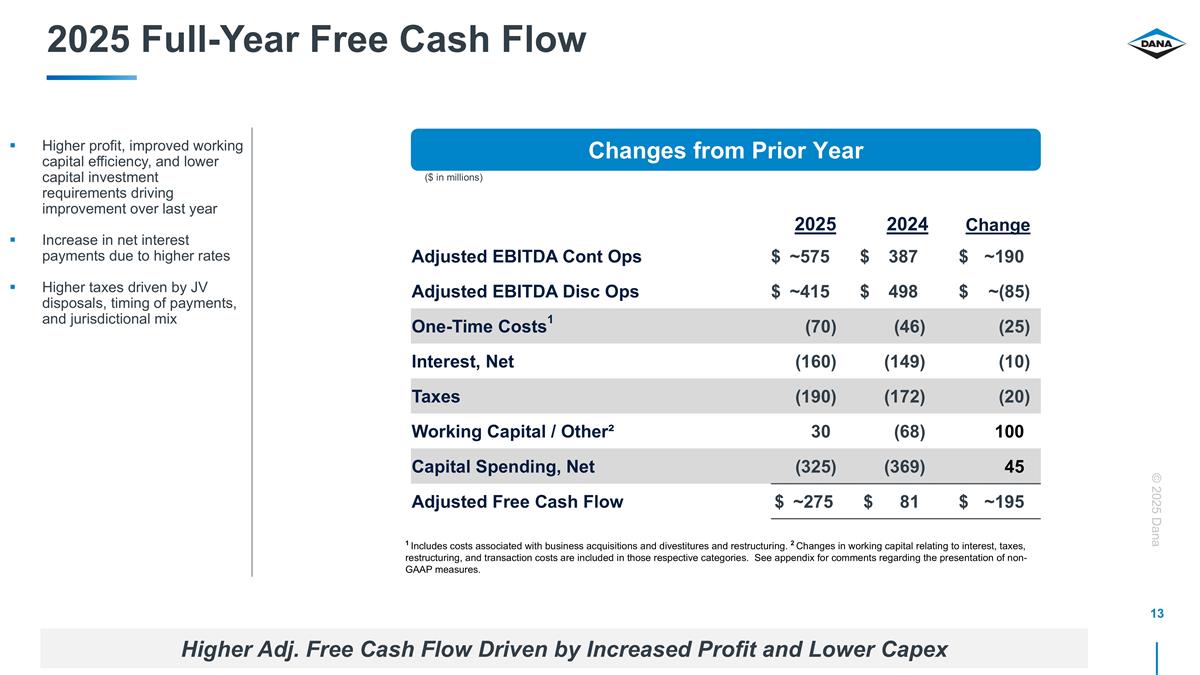
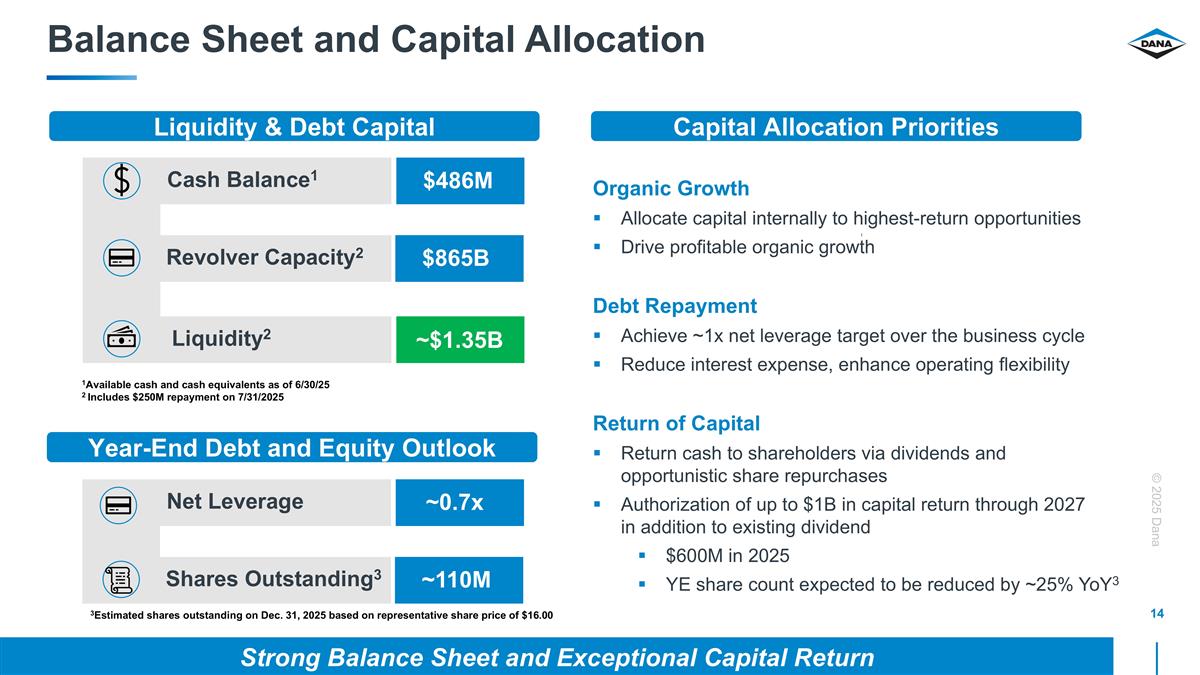
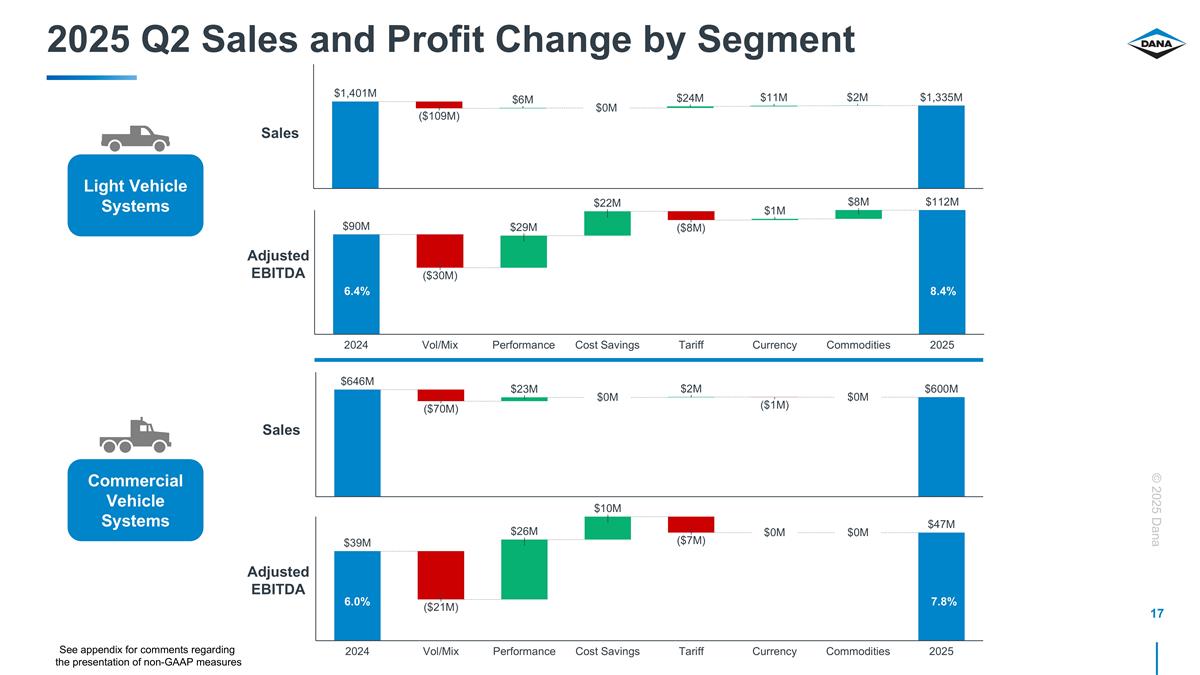
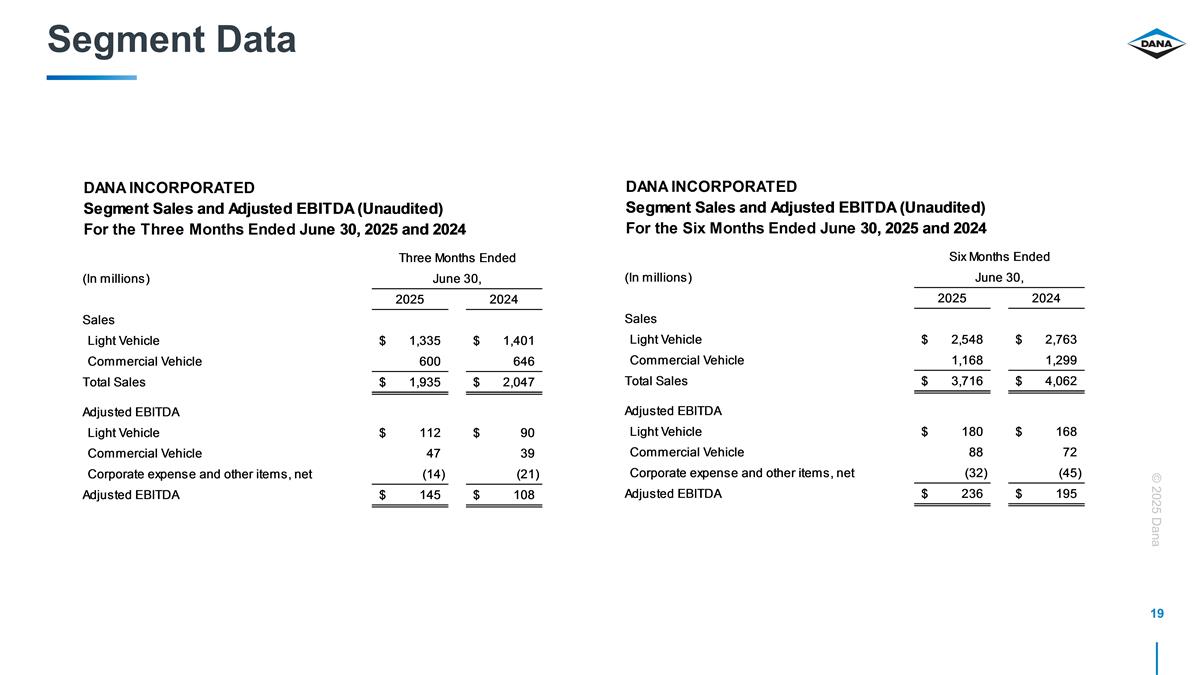
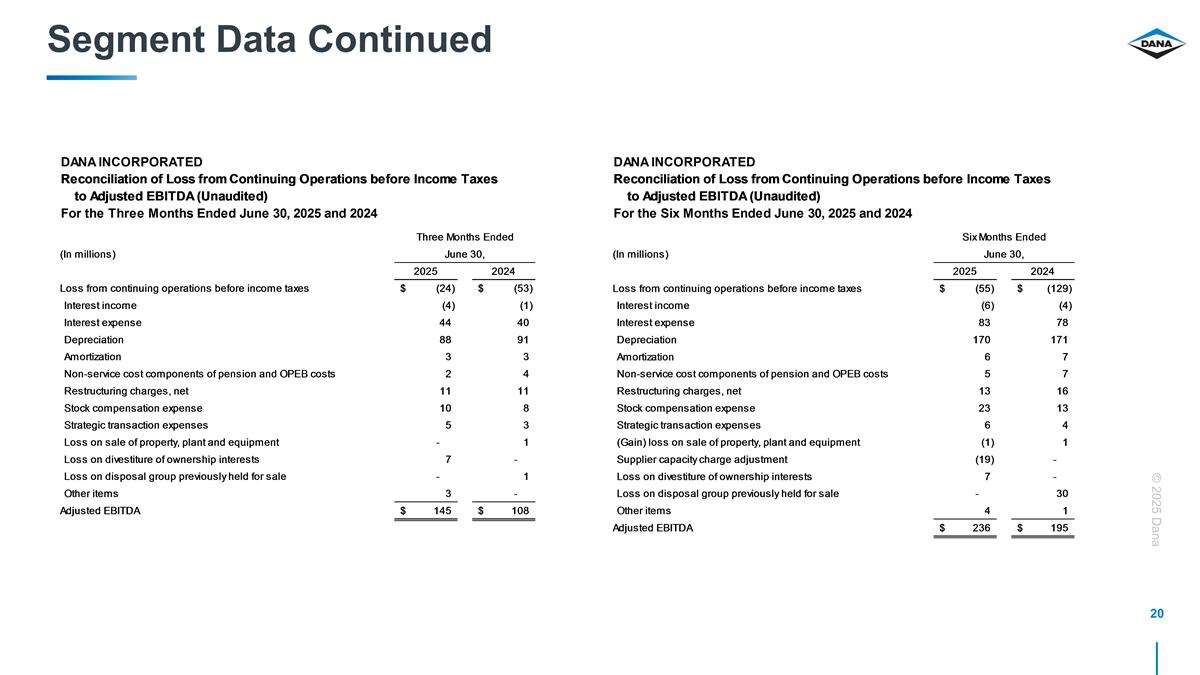
Thanks, Bruce. Let's begin with how we will be presenting our results in the prior periods. With the signing of the agreement to sell our Off-Highway business, that business will now be considered as discontinued operations. We will be reporting continuing operations in our financial statements. Continuing operations contain our Light Vehicle and Commercial Vehicle Systems reporting segments. The majority difference between these new reporting segments and the prior reporting segments is they now incorporate certain retained operations that were not included in the Off-Highway sale, as well as stranded corporate costs and prior intercompany sales to Off-Highway that are now treated as third-party sales according to the accounting rules. The net effect of the higher sales and increased stranded costs is to temporarily lower the profit margin of continuing operations until the sale closes and transition service payments begin. Third-party sales agreements and stranded cost reductions should begin early next year. Finally, cash flow is the one metric that will include Off-Highway as we had previously. Since the sale transaction excludes cash, all cash flow will remain with Dana until closing. For continuing operations, sales were $1.94 billion, $112 million lower than last year, driven by lower end-market demand. Adjusted EBITDA was $145 million for a profit margin of 7.5%, 210 basis points higher than last year as the benefits of our cost-saving and productivity improvements more than offset the lower sales and impacts from tariffs. Earnings before tax attributable to continuing operations was a loss of $24 million, a $30 million improvement from last year. Please turn with me now to Slide 9 for the drivers of sales and profit change. In line with the new accounting and reporting method, we've revised our walk presentation to include the impact of discontinued operations for the current and prior periods. The $691 million in sales and $136 million in profit removed from last year represents the Off-Highway sales perimeter and accounting treatment for discontinued operations. Moving to the right, for this year's second quarter, the change in discontinued operations lowered sales by $7 million, and overall volume and mix lowered sales by $172 million, driven by lower demand in both Light Vehicle and Commercial Vehicle end markets. Performance drove sales higher by $29 million due to pricing actions in the commercial vehicle and our aftermarket business, while tariff recoveries totaled $26 million for the quarter. Changes in adjusted EBITDA from continuing operations was $6 million for the quarter. The flow-through of sales from volume mix lowered adjusted EBITDA by $52 million. This was a decremental margin of about 30%. But recall that breaking out performance now, which includes efficiency gains in manufacturing separately. Performance increased profit by $30 million due to pricing and efficiency improvements in Commercial and Light Vehicle businesses. Cost savings added $59 million in profit through the various actions we have taken. This brings us to $110 million to date, and we are firmly on track to deliver our target of $225 million in savings for the current year. The tariff impact in the quarter was just $15 million. Since our tariff recovery mechanisms have a lag and the landscape continues to evolve, we expect to see a continuing headwind due to timing, but we expect to recover the majority of the impacts this year. Next, I will turn to Slide 10 for the details of our second quarter free cash flow. As I discussed on Slide 8, the accounting for cash flow includes both continuing and discontinued operations, as shown on Slide 10. Adjusted free cash flow for the second quarter of 2025 was a use of $5 million, which was $109 million lower than the second quarter of last year. Higher adjusted EBITDA in continuing operations was partially offset by lower earnings in the Off-Highway segment and higher one-time costs related to our cost savings and other improvement actions. Taxes were $22 million this year, mainly related to the sale of our joint venture interest, as well as jurisdictional mix of income. Working capital was a use of $115 million during the second quarter as requirements normalized after an unusually strong first quarter this year. Finally, capital spending, net of proceeds of sales of fixed assets and contributions from our customers, was $70 million, better than last year. Please turn with me now to Slide 11 for a summary of our updated guidance for 2025. As Bruce outlined earlier, our 2025 full-year guidance ranges have been updated for the impact of discontinued operations. On Page 11, we are summarizing the continued operations guidance as well as showing an illustrative view of the prior guidance method for comparison. We are expecting sales from continuing operations to be approximately $7.4 billion at the midpoint of the range. This is about $250 million higher than our previous expectation, as you can see in the column on the right. Higher sales are primarily due to expected tariff recoveries as well as tailwinds from currency rates. Adjusted EBITDA from continuing operations is expected to be about $575 million at the midpoint of the range. This is approximately $35 million higher than previously anticipated, driven by cost savings and performance improvements after adjusting for accounting impacts of the discontinued operations. Full year adjusted free cash flow is anticipated at $275 million at the midpoint of the range for the year. This is approximately $50 million higher than previously expected, driven by higher profit and working capital efficiencies. Please turn with me now to Slide 12 for the drivers of sales and profit change for our full-year guidance. As with the quarterly walk we showed earlier, our full-year guidance walk adjusts 2024 for discontinued operations and walks forward our guidance for continuing operations. Beginning on the left, discontinued operations reduced 2024 sales by approximately $2.5 billion, so we begin with 2024 at $7.7 billion in sales for continuing operations. Adjusted EBITDA from discontinued operations was $498 million, reducing 2024 adjusted EBITDA to $387 million, resulting in about a 5% margin on sales. Discontinued operations this year is expected to further reduce sales by $100 million due to lower sales between discontinued and continuing operations, but adds approximately $15 million to adjusted EBITDA due to lower unallocated costs. Volume and mix are expected to lower sales by $425 million, driven by lower demand across both Light Vehicle and Commercial Vehicle markets. Adjusted EBITDA from volume mix is expected to be lower by about $90 million, a decremental margin of about 20%. Performance is anticipated to increase sales by approximately $80 million, with $90 million in EBITDA impacts, mostly through pricing and efficiency improvements. Cost savings will add $225 million in profit, as I mentioned earlier. The tariff impact for the full year is expected to add about $150 million to sales and lower profit by about $35 million. The majority of this profit headwind will be recovered next year. Foreign currency translation is still expected to decrease sales by $45 million, driven by a mix of currencies with no margin impact. Finally, commodity cost recovery should be about $10 million higher in sales and an equal amount headwind to profit. The net result will be about a 280 basis points margin improvement in continuing operations when compared to last year, as performance and cost-saving actions overcome the headwinds we are experiencing in the business. Next, I will turn to Slide 13 for the details of free cash flow guidance. We anticipate full year 2025 adjusted free cash flow to now be about $275 million at the midpoint of the guidance range, $50 million higher than our previous guidance. We expect about $105 million of higher free cash flow from increased adjusted EBITDA when compared to 2024. One-time costs will be about $70 million, $25 million higher than last year as we invest in our cost-saving program and other restructuring actions. Working capital will be about $30 million source of cash, about $100 million better than last year as we continue to lower the requirements in the back half of the year for working capital. Capital spending net is expected to be about $325 million this year, which will be $45 million better than last year. Lastly, please turn with me to Slide 14 for a look at our balance sheet and capital allocation priorities. On the left side of the page, you will see that we have ample liquidity of about $1.35 billion at the end of the second quarter. During the second quarter, we returned over $250 million to shareholders through share repurchases in addition to our regular dividend. As we look to the end of the year, we expect to close the Off-Highway sale in the fourth quarter and expect our net debt leverage to be about 0.7x expected EBITDA. We expect to continue to execute on our $1 billion capital return authorization and repurchased a total of $600 million of our stock this year, which could result in having about 110 million shares outstanding at the end of the year at the current share price. As we look forward, our capital allocation priorities are: first, to drive organic growth as we will continue to be selective with where we spend capital to drive profitable growth within the Light Vehicle and Commercial Vehicle segments. We will aggressively lower debt as we look to achieve our 1x net leverage target over the business cycle. And as we have demonstrated this quarter, we will return cash to shareholders while increasing the overall value of the company.
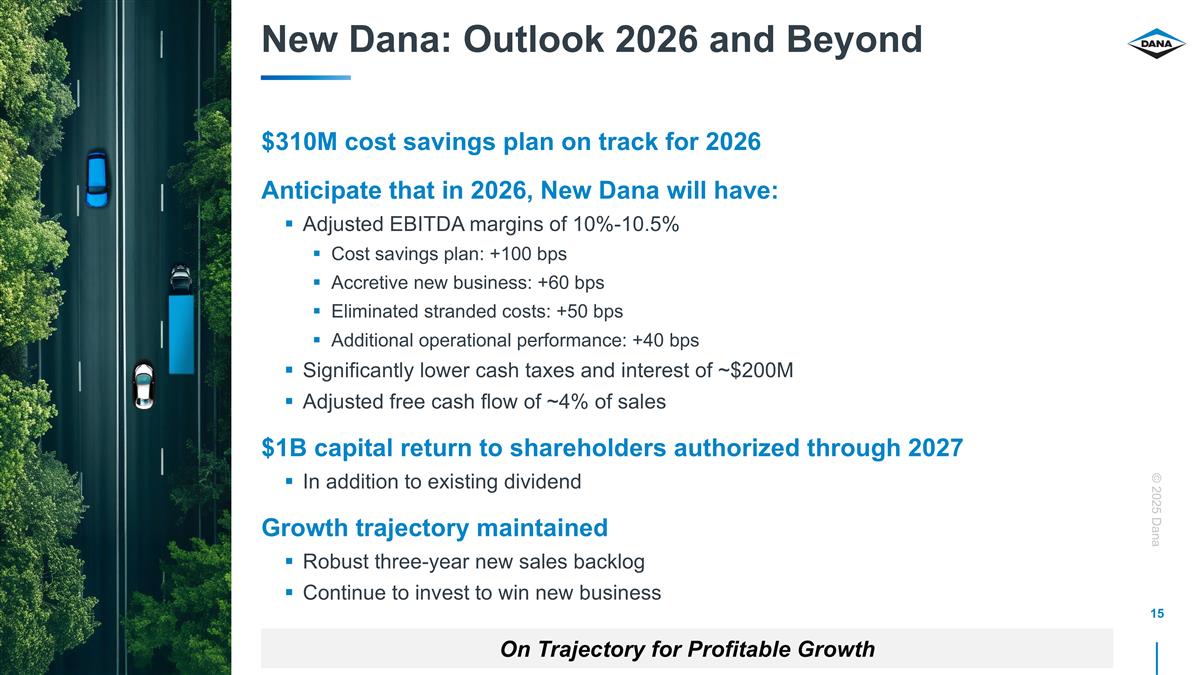
Thank you, Tim. In terms of 2026, again, a fair bit of comments I've seen from the Street around how do we get to 10% for next year. So I just wanted to focus on the way that we're looking at it. Start off with our cost reduction savings plan. We expect that to be a $310 million run rate for 2026. So that's a good news story for us and gives us a strong tailwind as we start the next fiscal year. Just starting off in terms of walk, if you use Tim's guidance at the midpoint, we're at about 7.8% for new Dana as we're going to report our numbers here in 2025. The first item is the annualization of the cost savings. This just basically is reflecting the fact that in Q1 and Q2 particularly, we weren't tracking to a $310 million annual cost savings rate. That number you can kind of think about is in the bag and just annualizing that would take our 7.8% up to 8.8%. If I just look at the flow-through of our backlog, we expect that to add about 60 basis points in terms of stranded costs. To get to this extra 50 basis points, we have to eliminate the variable costs that go away on day one, which is a fixed component. I would tell you that I'd be highly disappointed if that's where we end up; I would expect a combination of TSAs and a continued focus on those stranded costs that we should be able to do much better than that. Lastly, operational performance, we'll factor in 40 basis points to get there. What I would point out on that is that's about half of the operational performance benefit that we've delivered in 2025. I don't see the 2026 target of 10% to 10.5% as being a stretch; this is a commitment from our team. I have as much confidence in delivering it as I did when we committed to the $300 million cost savings. When you take that margin and apply it to our sales for next year, you factor in lower cash taxes and interests that we've talked about, we see free cash flow being in the 4% of sales range, which, if you do the math, is higher than this year. In terms of our share authorization, the capital return of $1 billion will continue as cash flow improves as we focus on the sale of non-core assets, expanding the timing of that to deliver more quickly to our shareholders in addition to our existing dividend. Lastly, we probably haven't done ourselves a disservice in terms of our top-line story. I think Dana has an underappreciated growth story here. We have a solid backlog that we'll be reporting next year, and we continue to be very productive in our discussions with both our Light Vehicle and Commercial Vehicle customers on gaining share and winning new business. With that, I'll open it up to Q&A.
Operator
Our first question will come from Joseph Spak with UBS.
Speaker 4
This is Rob Saltzman on for Joe today. Just on the 2026 outlook. You mentioned you'd expect 60 basis points of margin from that accretive new business backlog. Can you just provide some color on what's driving those new business wins and kind of where the wins are coming from in core Dana? That's my first question.
Yes. So if you just look back, right, we had incremental backlog when we reported in February. So in large part, that's coming in; it's a mix of both on the Commercial Vehicle side as well as on the Light Vehicle side. We have some significant programs, including a program with JLR that's launching next year, and volume uplift in a number of big Ford programs, including the Super Duty. We also have a number of smaller programs across a number of customers worldwide that will be driving that backlog with additional content for those vehicles.
Speaker 4
And just my last follow-up here. On the cost reduction side, you increased the goal to $310 million, $10 million higher versus prior. But you've kind of continued to increase that target over the course of this year. How much room would you say you have to run here on finding incremental cost savings to pull out of the business from the current levels?
Yes, I think most of our cost-saving programs for the $310 million are really above the plan. Most of what we have left will be around operating improvements largely in the plant. Those will naturally flow through what we're calling performance, and we do that today. We'll continue to look at the cost structure as we move into 2026, and I'm sure there'll be some opportunities, especially as we push forward and find ways to increase efficiencies, but in terms of the big driver on cost reductions, I think the largest and lowest hanging fruit has been done. Our real focus next year on those types of things will be around eliminating stranded costs. A lot of those are semi-variable or fixed. We believe we can get at least half, if not more than that $40 million out by the end of next year, so we think we're in good shape to deliver the 10% to 10.5% margins for next year.
Yes. Maybe just to add on a little bit. If you look at the cost reduction where we got the $300 million. If I think about new Dana, our total costs are just under $7 billion. The $300 million, we went hunting in about $1 billion of that. If you think about it, those were quick wins, things that we could do quickly without significant investment. I would tell you that in that remaining bucket in terms of what we can do longer term and where we can make some investments, there's still enormous opportunity. I would also tell you on the $6 billion where we didn't go hunting, there's an enormous opportunity for us. Over the next 3 to 4 years, it is a significant opportunity for us to expand our margins.
Operator
Our next question comes from the line of Tom Narayan with RBC.
Speaker 5
Not a lot to nitpick here, as you guys pointed out, but I guess if I had to ask, the Off-Highway guidance, obviously coming down that's on tariffs. Is there any risk for anything we should know about in terms of how that guidance cut could potentially impact deal closing timing? And then I have a follow-up.
No, it won't impact deal close timing. There are no covenants other than the typical running the business in the ordinary course. The one thing I will say, although the top line guidance is coming down, there is no degradation around margins; the Off-Highway team has done an incredible job of flexing their cost structure to support and maintain their quality of earnings.
Yes. I would just maybe add to that. If you think about where we were at the end of the first quarter prior to signing this deal, we all had concerns around volumes from tariffs. We knew we had issues, particularly in Off-Highway with a small percentage of their business, which is a product that they manufacture in Europe that they import into the U.S. That's facing a significant price increase and we're going to see in the volume decline. So nothing that we're seeing in terms of business performance is any different than the time we closed.
Speaker 5
And then for my follow-up, the cost outs in Q2 look like they were about $32 million across LV and CV, I think $22 million for LV and $10 million for CV out of the $59 million total. What was the remainder of the cost out? Was that just kind of overhead?
It's in corporate. It would be in corporate, yes. I mean it gets reallocated. So what you're seeing is the cost outs on the corporate side that then get reallocated back into the businesses.
Speaker 5
Correct. Okay. And then I thought CV would have seen more due to the EV side with the cost outs.
A lot of that fits from an engineering side in corporate. So that's probably where we're seeing the disconnect.
Operator
Our next question comes from the line of Edison Yu with Deutsche Bank.
Speaker 6
This is Winne Dong on for Edison. I was wondering if you can comment a bit on what you're seeing in the end market now for Light Vehicles, especially from some of your top customers? And then also on the Commercial Vehicles? And what kind of marketing conditions are you embedding into the second half?
Sure. I mean from a Light Vehicle perspective, things are pretty stable. For us, you have to look specifically into the light truck market in North America, as that's where the majority of our revenues are generated, particularly on four large programs. You have to be careful not to read across the entire SAAR for the Light Vehicle business in North America to Dana, just given the concentration we have on a number of large programs. On Commercial Vehicle, we are seeing softness in North America, largely around some of the tariff uncertainty. We've seen that impact sales both in the first half of the year, and we expect that softness to continue into the second. Offsetting that is some moderate strength in South America, particularly in Brazil, and then in Europe. Those are smaller businesses for us, but certainly, are helpful in terms of mitigating some of the weakness we're seeing in the North American CV market.
Yes. And I think softness might be too kind of word. If you look at the Class 8 market, we've talked to a few of our customers. Right now, ordering and book-to-bill is dropping fast. Orders are running half of last year. It's just not looking good. That's a combination of the impact of tariffs and the uncertainty associated with the business climate here; people are just deferring purchases when they can. We've factored in a pretty pessimistic view on North America in terms of our 2026 guidance. We're not factoring in any cyclical upturn in the Commercial Vehicle market in terms of getting to our numbers.
Speaker 6
Okay. Great. That's very helpful to know. And then just on the quarter itself, if I look at the bridge on Slide 9, the decremental is on the volume mix bucket seems to be about 30% or so. In your prepared remarks, you talked about splitting the performance bucket out. But it seems to me that on a full-year bridge, the implied decremental is about 20%. I guess I'm curious about the difference here and what you expect for the full year and how we should think about that on a go-forward basis and performance is sort of a strip-out bucket?
Yes. We had a fairly unfavorable mix in the in the second quarter, particularly, we lost some relatively high-margin sales from a commercial vehicle perspective. A lot of that around issues being able to export out of China was impacting the business. So just being able to get magnets and those sorts of things in rare earth materials. Those are higher margin business than the rest. And on the Light Vehicle side, we had a strange mix of sales differences that drove a decrement there; that was pretty different from what we would normally see. When you look into the back half of the year, we're seeing a much better or more favorable mix. We're not seeing quite as much of the downturn from a CV perspective in the EV part of the market, and our sales mix around Light Vehicle is more normalized. So it's unfortunately just a mix issue within the quarter for us given just the sales side.
As we get into Q3 and Q4, the volume mix bar changes color on us. We've been fighting year-over-year negative on the volume mix side of things as we get into Q3 and Q4. this turns from a headwind to a tailwind. Some of the comments around first half and second half comparisons, a lot of that is addressed by the fact that we don't have the volume headwinds in the second half of the year that we had in the first half.
Operator
Our next question comes from the line of Dan Levy with Barclays.
Speaker 7
I wanted to first just unpack the free cash flow. Maybe you could help us understand, as we look to try to bridge the free cash flow you've provided, which includes Off-Highway this year; you're saying next year is 4% of sales to RemainCo. Maybe you can just help us understand the rough bridge there. I understand part of it is going to be improved EBITDA, part of it is going to be lower interest expense; but maybe help us understand what the adjusted number this year would be for just RemainCo as opposed to including Off-Highway and what that bridges to next year. And then maybe some color on what these adjustments are that are cash items, but are being excluded from the adjusted free cash flow for Dana?
Yes. Being able to give you a '25 pro forma number is difficult given that all the debt sits outside the Off-Highway perimeter and you have sort of tax impacts. We've called out about $200 million between those two lines as you bridge from this year to next, that's going to come out of the transaction. We will get help from an EBITDA perspective. The onetime cost of $70 million should come down significantly, just given that there's a bunch of costs related to the restructuring program and the cost out program have this way. We'll continue to see more efficiency coming through working capital. That should be an additional tailwind for us on getting to the 4% free cash flow.
Speaker 7
And then the second question is on the outlook into next year. I recognize the end markets are going to move around. But one of the things we've been hearing from the OEMs is with EV and emission standards easing considerably, there's an opportunity for them to have a much richer mix. Is this the type of thing that is not currently considered in the schedules and the outlook but, once we see the standards easing and the mix starts to improve, that is something that could help you? There are certain variants of Ford trucks that could be richer mix for you. How much could the mix get better on easing emission standards, even outside of just less EVs?
Yes. I don't want to get ahead of our customers regarding what their build mix might be. But anything from a market perspective that drives higher heavy truck and pickup purchases is good for Dana. Think about our main programs, right? Super Duty, Ranger, Bronco, and Wrangler, those are popular vehicle brands, and if the customer builds more of them instead of building an EV or a passenger car or crossover, that's better for Dana.
As are lower gas prices in those vehicles. In our accretive new business line, we do have volume uplift on Super Duty in there. Ford has announced that they're going to start to manufacture additional volume next year in another plant, and that's flowing through in the back half of next year.
Operator
Our final question will come from the line of James Picariello with BNP Paribas.
Speaker 8
Buybacks will account for the full $600 million in this year's targeted shareholder returns. For the remaining $400 million commitment, should we consider any special dividend? Or has the company fully committed to share repurchases? And just to clarify, does last week's bridge loan just essentially help the company fund buybacks until the Off-Highway proceeds are received?
Yes. On your second question, yes. We drew down the revolver to make the purchases in the second quarter. We just wanted to put some liquidity back in to bridge us through the cash flow we're going to generate through the end of the year and then the closing of the transaction. If you look at it, the bridge falls away at the earlier of basically a year or the closing of the transaction. That's exactly why we put it in, just to ensure sufficient liquidity and flexibility to do everything we need to do between now and closing.
Yes. I'd say our Board continues to believe our shares are extremely undervalued right now. Our confidence level in the margins we're talking about for next year is extremely high. If you calculate our expected margins for next year, and look at the share count we expect to have at the end of the year, we see it being significantly undervalued and we will be looking to buy back more shares as we generate more cash flow.
Speaker 8
Got it. That's helpful. And my follow-up, are the $60 million in stranded costs mainly reflected in the higher corporate expense now? And does the $310 million in cost savings through next year include the recovery of stranded costs?
Yes. We're showing the stranded costs separated into corporate. We typically have very less than $10 million in corporate costs; you'll see those be significantly higher. In terms of your $310 million, that is without assuming recovery. We believe we'll be able to get at least half if not more of that $40 million out before the end of next year.
Yes. We expect to eliminate the stranded costs in their entirety. Are they all going to be out for next year? No, but they will all be out in 2027. That's an absolute certainty.
Operator
Our next question comes from the line of Ryan Brinkman with JPMorgan.
Speaker 9
Could you discuss a bit further what is giving rise to the expected improvement in working capital for the full year versus the prior view? I assume this is behind the planned to return $600 million of cash to shareholders before the close. Including, sometimes there's an investment needed in working capital to support higher sales, which you are forecasting? I know you generate a lot of your full year cash in the fourth quarter. So is it kind of timing-related stuff? How do you see sales and production kind of trending toward the end of the year? Or just curious on what's giving rise to that improvement? And how should we think about that maybe spilling over into 2026?
Yes. You have it right. If you look at the CV and Off-Highway perspectives, both those businesses have much longer supply lines than in the light vehicle business. Both have shown softness through the first half of the year. It takes time to start getting that worked out as we go through the back half of the year. Bruce and I are focusing the team on taking that out. For next year, yes, that's part of how we're getting to our 4% free cash flow, additional improvement in working capital efficiency within the business that we're going to retain.
Speaker 9
Okay, great. And then you've helped a lot already on the whole temporary stranded cost part of the guidance on Slide 6. The overhead is easy to understand, but I'm still confused about the variable cost component. Usually, when I think of variable costs, it would ordinarily sit above the segment to be allocated. Can you help explain the nature of those costs a little bit further? What gives rise to them and then your confidence that it goes away?
Yes. A couple of easy examples: the cost to audit the company, right? We're auditing a $10 billion business today. Next year, we'll be auditing a business that's $7 billion to $8 billion, right? While that cost is fixed, it doesn't change; it's effectively variable in the sense that the cost to audit a smaller company will be lower. Another would be our global insurance program. We'll need less insurance when we shrink the business, and those costs will naturally go away as we shrink. That’s the kind of things to think about.
If we say they're variable, what we mean is upon the sale, they will go away; there is no risk.
Operator
Our next question comes from the line of Emmanuel Rosner with Wolfe Research.
Speaker 10
Wanted to ask you about the growth trajectory message with a robust 3-year new sales backlog. If you can help us a little bit with some of the assumptions in the accretive new business contribution to margin next year. The last time you published backlog, it was about $300 million for next year. Is that still ballpark what you're considering in your margin walk? More generally, how much did new business contribute this past year, and what are the drivers for acceleration over the next few years?
Yes. We haven't published updated guidance, but the $300 million that was in our last guide is still reasonable. There will be a lot of puts and takes given some of the changes, but that’s still a pretty reasonable number to have out there. In terms of our new business growth, we continue to have a number of different programs, both on the Light Vehicle and on the Commercial Vehicle side coming online. Some of those are at lower volumes, impacting the flow-through, and we are getting ready to launch the next version of the Wrangler, which has added content. So there are various drivers for us from a backlog perspective this year.
Speaker 10
And your broader comments around the 3-year new sales backlog. Is it fair to say that the previous disclosure is still directionally correct?
Yes, directionally, those numbers are still reasonable. I think the mix of that is going to change a bit. There was a higher percentage of EV in the previous backlog; I think that's reflective of what we're seeing from the end markets with our customers.
Operator
Okay. One quick clarification on tariffs. The net headwind at the end of the year, is that a timing, and you would recover that next year, or is that a piece that you believe in the end, you'll absorb?
No, we believe there's timing. We're not going to get 100% back, but we'll get the majority of that over time.
Operator
Our final question will come from the line of Colin Langan with Wells Fargo.
Speaker 11
I just wanted to follow up on the implied second half guidance; it implies that sales are down about 1%, but you have like $100 million implied second half adjusted EBIT improvement. How should we think about those main buckets? It looks like you had $100 million of cost saves in the first half. On a year-over-year basis, it looks like a little better. What are the main drivers to get that $100 million?
Yes. Contribution margin on sales will improve. We're going to see better mix coming in with accelerating cost savings. So we expect $225 million for the year; I think you said we're at about $100 million, so we're about $25 million better in the back half of the year. We also expect tariffs to be better in the back half than they were in the first half. Continued performance in the business is driving margin expansion as we come through the end of the year.
Yes. We have a couple of footprint inefficiencies in the first half of the year, $20 million to $30 million that kind of go away in the second half as the plants normalize. A lot of that was ramping up, so we were kind of at that exit rate at the end of the second quarter. However, in Q1 and into Q2, there was a big headwind that goes away in the back half of the year.
Yes, largely around a couple of plants that have closed and are in the process of ramping up elsewhere, and those ramp-ups hindered our ability to deliver even better performance from the first half of the year.
Operator
We need to close it down, Colin. You can follow up with Tim and Craig to get a bit more comfort there in terms of the sales outlook. I want to wrap up this call. Thanks, everyone, for participating today. I know there's a lot of noise in these numbers. For me, the key takeaway is it's a solid Q2 beat against every number that’s out there. We're raising our guidance. New Dana is doing better than overall Dana. We're adjusting our free cash flow guidance up and pumping it into a share buyback. We're confident in our value. In terms of cost reduction, we're increasing our target to $310 million, and I'm confident we'll reach that target. As for 2026, a 10% to 10.5% margin is a commitment from our team. I believe we can achieve that next year. Lastly, our shares are undervalued, and we are committed to generating cash for more rapid share buybacks. Thank you all, and thanks to our employees for delivering a terrific quarter. This concludes today's call. Thank you for joining. You may now disconnect.