
Deep Isolation Nuclear, Inc 8-K, filed May 14, 2026
Deep Isolation Nuclear, Inc. (DBHL)
8-K
2026-05-14
For: 2026-05-14
View Original
Added on
July 14, 2026
About this 8-K
Deep Isolation Nuclear, Inc filed this 8-K on May 14, 2026.
Items reported
- Item 2.02: Financial results
- Item 7.01: Regulation FD disclosure
- Item 9.01: Financial statements and exhibits
UNITED STATES
SECURITIES AND EXCHANGE COMMISSION
Washington, D.C. 20549
FORM 8-K
CURRENT REPORT
Pursuant to Section 13 or 15(d) of the Securities Exchange Act of 1934
Date of Report (Date of earliest event reported): May 14, 2026

(Exact Name of Registrant as Specified in Charter)
| (State or Other Jurisdiction of Incorporation) | (Commission File Number) | (IRS Employer Identification No.) | ||||||||||||
| (Address of Principal Executive Offices) | (Zip Code) | |||||||
(509 )-943-5222
(Registrant’s telephone number, including area code)
Not Applicable
(Former Name or Former Address, if Changed Since Last Report)
Check the appropriate box below if the Form 8-K filing is intended to simultaneously satisfy the filing obligation of the registrant under any of the following provisions (see General Instruction A.2. below):
| Written communications pursuant to Rule 425 under the Securities Act (17 CFR 230.425) | |||||
| Soliciting material pursuant to Rule 14a-12 under the Exchange Act (17 CFR 240.14a-12) | |||||
| Pre-commencement communications pursuant to Rule 14d-2(b) under the Exchange Act (17 CFR 240.14d-2(b)) | |||||
| Pre-commencement communications pursuant to Rule 13e-4(c) under the Exchange Act (17 CFR 240.13e-4(c)) | |||||
Securities registered pursuant to Section 12(b) of the Act: None.
Indicate by check mark whether the registrant is an emerging growth company as defined in Rule 405 of the Securities Act of 1933 (§230.405 of this chapter) or Rule 12b-2 of the Securities Exchange Act of 1934 (§240.12b-2 of this chapter).
Emerging growth company ☒
If an emerging growth company, indicate by check mark if the registrant has elected not to use the extended transition period for complying with any new or revised financial accounting standards provided pursuant to Section 13(a) of the Exchange Act. ☐
Item 2.02 Results of Operations and Financial Condition.
On May 14, 2026, Deep Isolation Nuclear, Inc., a Delaware corporation (the “Company”), issued a press release (the “Press Release”) announcing its financial results for the first quarter ended March 31, 2026.
As previously announced and set forth in the Press Release, the Company will host a conference call to discuss its operational and financial results for the first quarter ended March 31, 2026, followed by a live Q&A session, on May 14, 2026 at 8:30 a.m. ET. A webcast of the conference call will be accessible on the Company’s investor relations website at https://www.deepisolation.com/investors. The live conference call may also be accessed by telephone by dialing (877) 704-4453 or (201) 389-0920. For those unable to listen to the live conference call, a replay will be available after the call through the archived webcast on the Company’s investor relations website or by dialing (844) 512-2921 or (412) 317-6671. The access code for the replay is 13760350. The replay will be available for 30 days following the live call.
A copy of the Press Release referenced above is being furnished as Exhibit 99.1 to this Current Report on Form 8-K.
The information in this Current Report on Form 8-K, including Exhibit 99.1, shall not be deemed “filed” for purposes of Section 18 of the Securities Exchange Act of 1934, as amended (the “1934 Act”), nor shall it be deemed “incorporated by reference” into any filing under the Securities Act of 1933, as amended, or the 1934 Act, except as may be expressly set forth by specific reference in such filing.
Item 7.01 Regulation FD Disclosure.
On May 14, 2026, the Company updated its corporate presentation, a copy of which is furnished herewith as Exhibit 99.2 to this Current Report on Form 8-K and is incorporated into this Item 7.01 by reference.
The information in this Current Report on Form 8-K, including Exhibit 99.2, shall not be deemed “filed” for purposes of Section 18 of the 1934 Act, nor shall it be deemed “incorporated by reference” into any filing under the 1933 Act or the 1934 Act, except as may be expressly set forth by specific reference in such filing.
Item 9.01 Financial Statements and Exhibits.
| Exhibit Number | Description | |||||||
| 99.1 | ||||||||
| 99.2 | ||||||||
| 104 | Cover Page Interactive Data File (embedded within the Inline XBRL document) | |||||||
1
SIGNATURES
Pursuant to the requirements of the Securities Exchange Act of 1934, as amended, the registrant has duly caused this report to be signed on its behalf by the undersigned hereunto duly authorized.
| DEEP ISOLATION NUCLEAR, INC. | ||||||||
Date: | By: | /s/ Rodney Baltzer | ||||||
| Rodney Baltzer President and Chief Executive Officer | ||||||||
2
Exhibit 99.1

FOR IMMEDIATE RELEASE
Deep Isolation Nuclear, Inc. Reports Operational and Financial Results for the First Quarter of 2026
Operational Highlights for the First Quarter of 2026
•Launched a non-radioactive, full-scale, at-depth demonstration of the Company's deep borehole waste disposal technology at Halliburton’s Drilling Technology Facility near Cameron, TX
•Successfully completed work under the U.S. Department of Energy Advanced Research Projects Agency-Energy's ("ARPA-E") Optimizing Nuclear Waste and Advanced Reactor Disposal Systems ("ONWARDS"), a project led by Oklo, Inc.
•Selected to participate in ARPA-E's SCALEUP Ready program, providing up to $20 million to accelerate market adoption of Deep Isolation's deep borehole waste disposal technology and the first time a company in the nuclear industry has been selected to participate
•Appointed nuclear industry veteran Ralph L. Hunter to the board of directors on January 23, 2026
•Appointed Paula Whitten-Doolin as General Counsel on February 3, 2026
•Appointed Joseph Nelson as Chief Financial Officer on February 17, 2026
•Appointed nuclear operations leader Matthew Sunseri to its advisory board on March 2, 2026
•The SEC declared Deep Isolation Nuclear, Inc.'s registration statement on Form S-1 effective on May 7, 2026, allowing the common stock of the Company to be freely tradable
Financial Highlights for the First Quarter of 2026
•Reported consolidated revenue of $1.4 million
•Reported research and development expense of approximately $3.5 million related to the start of the non-radioactive, full-scale, at-depth demonstration of our deep borehole waste disposal technology
•Had available cash of $22.2 million as of March 31, 2026
•Reported a net loss of $5.4 million primarily attributable to research and development expenses
•Total common shares outstanding as of May 12, 2026 of 57,647,613
BERKELEY, CA, May 14, 2026 – Deep Isolation Nuclear, Inc. (“Deep Isolation” or the “Company”), a leading innovator in nuclear waste disposal technology, today announced its operational and financial results for the three-months ended March 31, 2026.
“We are thrilled to be reporting Deep Isolation’s first earnings as a public company," said Rod Baltzer, CEO of Deep Isolation. “Our operational momentum in the first quarter was encouraging - breaking ground on our full-scale demonstration project in Cameron, Texas marks a pivotal milestone as we move from the R&D phase toward deployment, showcasing our innovative approach to safe nuclear waste disposal.
"Additionally, our selection for ARPA-E’s SCALEUP Ready program positions us to accelerate commercialization with support from the Department of Energy. These achievements demonstrate our team’s execution capabilities and reinforce Deep Isolation’s leadership in delivering practical solutions for one of the nuclear industry’s most critical challenges. We believe we are entering the market at the exact right time, as the entire nuclear industry is scaling up,gaining momentum and in need of a scalable waste disposal solution.”
Operational Progress
Deep Isolation advanced several strategic initiatives during the quarter, including the launch of its full-scale technology demonstration program in Cameron, Texas, in collaboration with Halliburton and the Deep Borehole Demonstration Center. The program, which includes collaboration with Westinghouse, NAC International, Occlusion Nuclear Solutions, and Amentum, is designed to demonstrate a fully integrated deep borehole disposal solution for advanced reactor and
nuclear recycling waste. The non-radioactive demonstration project is expected to provide operational data and support stakeholder and regulatory confidence as the Company advances commercialization of its technology.
The Company also announced the successful completion of its work under the ARPA-E ONWARDS program, confirming through modeling and analysis that waste streams from advanced reactor fuel recycling are compatible with Deep Isolation’s deep borehole disposal system and can achieve long-term safety performance significantly exceeding target standards. In addition, Deep Isolation was selected for ARPA-E’s SCALEUP Ready program to support commercial deployment of its Universal Canister System, with the Company advancing through the contracting phase for potential funding of up to $20 million to support its Cameron, Texas demonstration project. Deep Isolation is the first company in the nuclear industry to have ever been selected to participate in ARPA-E's SCALEUP Ready program.
Commercial Progress and Other Company Events
During the quarter, Deep Isolation strengthened its leadership and governance capabilities through several key appointments. The Company appointed Ralph L. Hunter to its Board of Directors, bringing more than 35 years of nuclear industry experience, including senior leadership roles across advanced nuclear development, operations, and policy. Deep Isolation also appointed Paula Whitten-Doolin as General Counsel and Joseph Nelson as Chief Financial Officer to support the Company’s commercialization efforts, public company readiness, and strategic growth initiatives. In addition, the Company appointed nuclear operations leader Matthew Sunseri to its Advisory Board, adding significant expertise in nuclear safety, regulatory strategy, and operational governance as Deep Isolation advances its demonstration and commercialization programs.
On May 8, 2026, the U.S. Securities and Exchange Commission (SEC) declared Deep Isolation's registration statement on Form S-1 effective, allowing the Company's common stock to be freely tradable. The Company is actively working with OTC Markets Group, Inc. to enable its shares of common stock to be traded on the OTCQB exchange.
Financial Summary
| (Amounts in thousands) | For the Three Months Ended | |||||||||||||
| March 31, 2026 | March 31, 2025 | |||||||||||||
| Revenue | $ | 1,447 | $ | 1,520 | ||||||||||
| Research and development expense | 3,489 | - | ||||||||||||
| Selling, general and administrative expenses | 2,840 | 993 | ||||||||||||
| Net Loss | (5,416) | (166) | ||||||||||||
EBITDA1 | (5,563) | (135) | ||||||||||||
Adjusted EBITDA1 | (1,536) | (135) | ||||||||||||
| Cash | 22,226 | 2,150 | ||||||||||||
Revenue decreased by approximately $73 thousand, or 5%, for the three months ended March 31, 2026, compared to the three months ended March 31, 2025. The decrease in revenue was primarily attributable to lower revenues at Deep Isolation following the completion of certain projects during 2025, offset by higher revenues at the Company's subsidiary, Freestone Environmental Services, due to an increase in the number of active contracts.
Research and development expense increased by approximately $3.5 million for the three months ended March 31, 2026, compared to the three months ended March 31, 2025. The increase in research and development expense was attributed to the ordering of long-lead items and front-end engineering work related to the Company's non-radioactive, full-scale, at-depth demonstration of its deep borehole technologies.
Selling, General and Administrative expenses increased by approximately $1.8 million, or 186%, for the three months ended March 31, 2026, compared to the three months ended March 31, 2025. The increase in selling, general and
administrative expenses was primarily attributable to higher accounting, audit, legal and travel expenses along with addition of 4 new employees, including the Chief Financial Officer and General Counsel.
Net loss increased by approximately $5.3 million for the three months ended March 31, 2026, compared to the three months ended March 31, 2025, primarily due to the increases in research and development and selling, general and administrative expenses described above.
EBITDA1 was ($5.6) million for the three months ended March 31, 2026, compared to ($135) thousand for the three months ended March 31, 2025. The decrease in EBITDA was primarily attributed to higher research and development expenses and selling, general, and administrative expenses as described above.
Adjusted EBITDA1 was ($1.5) million for the three months ended March 31, 2026, compared to ($135) thousand for the three months ended March 31, 2025. The decrease in Adjusted EBITDA was primarily attributed to higher selling, general, and administrative expenses as described above.
1 EBITDA and Adjusted EBITDA are non-GAAP financial measures and should not be used in isolation or as a substitute for Deep Isolation’s financial results presented in accordance with Generally Accepted Accounting Principles ("GAAP"). For the definitions and reconciliations of these measures to the most directly comparable financial measures calculated and presented in accordance with GAAP, please refer to Exhibit II at the end of this press release
Conference Call
Deep Isolation will host a conference call to discuss their operational and financial results for the first quarter of 2026 on Thursday May 14, 2026 at 8:30AM ET. The presentation of the Company's operational and financial results will be followed by a live Q&A session.
A webcast of the conference call will be accessible on Deep Isolation’s investor relations website at https://www.deepisolation.com/investors/. The earnings release and presentation will also be posted to the investor relations website prior to the conference call.
The live conference call may also be accessed by telephone by dialing (877) 704-4453 or (201) 389-0920. For those unable to listen to the live conference call, a replay will be available after the call through the archived webcast on Deep Isolation’s investor relations website or by dialing (844) 512-2921or (412) 317-6671. The access code for the replay is 13760350. The replay will be available for 30 days following the live call.
About Deep Isolation
Deep Isolation is the first company to undertake development of technologies for nuclear waste disposal in deep boreholes. When commercialized Deep Isolation’s solution will offer a uniquely tailored solution to help countries identify, plan for and complete the necessary steps to dispose of their nuclear waste inventories. With 99 patents issued to date, Deep Isolation’s technology is being designed to leverage proven drilling practices to allow safe isolation of waste deep underground in horizontal, vertical, or slanted borehole repositories. Deep Isolation’s Universal Canister System was developed through a three-year project funded by the U.S. Department of Energy’s Advanced Research Projects Agency—Energy and is engineered to support integrated management of spent fuel and high-level radioactive waste from legacy and advanced reactors across storage, transportation and eventual disposal.
For more information, visit: deepisolation.com
Media Contact:
Sophie McCallum
media@deepisolation.com
Investor Contact:
Caldwell Bailey
InvestorRelations@deepisolation.com
Forward-Looking Statements
Statements contained in this news release that are not historical facts are “forward-looking information” or “forward-looking statements” (collectively, “forward-looking statements”) within the meaning of Section 27A of the Securities Act and Section 21E of the Securities Exchange Act of 1934, as amended. Forward-looking statements include, but are not limited to, statements regarding our plans, objectives and expectations for our business, the future growth of our business and the nuclear energy and nuclear waste disposal industries as a whole, and future benefits expected to arise from our strategic partnerships. In certain cases, forward-looking statements can be identified by the use of words and phrases or variations of words and phrases or statements such as “may,” “should,” “expect,” “intend,” “plan,” “anticipate,” “believe,” “estimate,” “predict,” “will,” “could,” “project,” “target,” “potential,” “continue” and similar expressions. Forward-looking statements are based on management’s belief and assumptions, including current expectations and projections about future events and trends, and on information currently available to management.
Forward-looking statements in this or any other news release are subject to a number of risks, uncertainties, and assumptions that could cause actual results to be materially different from those expressed or implied by such forward-looking statements. Such risks, uncertainties, and assumptions are subject to a number of factors, including, among others: the failure of a market to develop for our deep borehole disposal solutions as quickly as we expect or at all; a failure of demand for our solution to develop sufficiently; regulatory and legal developments, including issues relating to obtaining regulatory approvals or permissions on the timelines we expect or at all; our lack of profitability; delays or failure in our initiative to complete a full-scale, at-depth demonstration of our Universal Canister System and our deep borehole solution; our failure to enter into contracts with customers or, once we do enter into contracts, to continue such contractual relationships or to receive new contract awards; our dependency on governmental contracts and awards and our ability to finalize negotiations on same; our failure to manage our growth effectively or to execute our business plan; our failure to sustain and expand relationships with governmental entities and strategic partners; a failure in the assumptions or analyses we have used in supporting forecasts or plans; our inability to commercialize our products at scale; the development or deployment of other technologies or solutions supplanting or competing with our technologies; challenges to our intellectual property; failures to protect, maintain, enforce, and enhance our intellectual property, and claims by others of intellectual property infringement; political and public perceptions of nuclear energy, including perceptions as to accidents or other high-profile events involving nuclear power facilities or radioactive materials; our liquidity and ability to raise capital; any inability to control operating and project costs and project delays or other project-related problems; security (including cybersecurity) breaches or disruptions; geopolitical, macroeconomic, domestic events or crises, including supply chain disruptions and other risks and uncertainties outside of our control; weather and effects of climate change; and litigation or legal proceedings that may be brought against us.
The foregoing is not an exhaustive list of all the factors that may cause any forward-looking statements to prove inaccurate or our actual results to differ materially from our expectations and forecasts. Moreover, we operate in a highly regulated environment. New risks emerge from time to time. It is not possible for our management to predict all risks, nor can we assess the impact of all factors on our business or the extent to which any factor, or combination of factors, may cause actual results to differ materially from those contained in any forward-looking statements we may make. In light of these risks, uncertainties, and assumptions, the future events and trends discussed in this release may not occur and actual results could differ materially and adversely from those anticipated or implied in the forward-looking statements, and we cannot guarantee future results, performance, or achievements. Accordingly, readers should not place undue reliance on forward-looking statements. We undertake no obligation to update any forward-looking statements for any reason after the date of this release or to conform these statements to actual results or revised expectations, except as required by law.
Additional information concerning the factors above and other factors will be found in the Company’s public filings with the Securities and Exchange Commission (the “SEC”), including the sections titled “Forward-Looking Statements” and “Risk Factors” in the Company’s Annual Report on Form 10-K for the fiscal year ended December 31, 2025 filed with the SEC on March 30, 2026, our Form S-1, originally filed August 18, 2025 and subsequently amended, our Proxy Statement for our 2026 Annual Meeting as filed on April 29, 2026, and in filings with the SEC that will be made in the future, including the Company's Quarterly Report on Form 10-Q. The information in this press release should be read in conjunction with the financial statements and footnotes contained in Deep Isolation’s Quarterly Report on Form 10-Q for the quarter ended March 31, 2026 which will be available on the Company's website. The Company’s SEC filings are also available free of charge at www.sec.gov or upon written request to Deep Isolation at InvestorRelations@deepisolation.com or CorpSec@deepisolation.com.
Exhibit I - Unaudited Interim Financial Information
Deep Isolation Nuclear, Inc. and Subsidiaries
Condensed Consolidated Balance Sheets
(in thousands, except share and per share data)
| March 31, 2026 (Unaudited) | December 31, 2025 | ||||||||||
| Assets | |||||||||||
| Current assets: | |||||||||||
| Cash | $ | 22,226 | $ | 27,434 | |||||||
Accounts receivable, net of allowance for credit losses of $120 thousand and $118 thousand, respectively | 593 | 439 | |||||||||
| Contract assets | 614 | 275 | |||||||||
| Other current assets | 622 | 672 | |||||||||
| Total current assets | 24,055 | 28,820 | |||||||||
| Property, plant and equipment, net | 142 | 128 | |||||||||
| Intangible assets, net | 53 | 73 | |||||||||
| Finance lease right-of-use assets | 10 | 11 | |||||||||
| Operating lease right-of-use assets | 240 | 269 | |||||||||
| Goodwill | 182 | 182 | |||||||||
| Other non-current assets | $ | 86 | $ | 140 | |||||||
| Total assets | $ | 24,768 | $ | 29,623 | |||||||
| Liabilities and Stockholders’ Equity | |||||||||||
| Current liabilities: | |||||||||||
| Accounts payable | $ | 1,239 | $ | 1,113 | |||||||
| Accrued payroll | 329 | 774 | |||||||||
| Contract liabilities | 75 | 150 | |||||||||
| Finance lease liabilities, current | 3 | 3 | |||||||||
| Operating lease liabilities, current | 129 | 125 | |||||||||
| Other current liabilities | 513 | 101 | |||||||||
| Total current liabilities | 2,288 | 2,266 | |||||||||
| Finance lease liabilities, net of current portion | 8 | 9 | |||||||||
| Operating lease liabilities, net of current portion | 118 | 152 | |||||||||
| Total liabilities | 2,414 | 2,427 | |||||||||
| Commitments and Contingencies (Note 16) | |||||||||||
| Stockholders’ Equity | |||||||||||
| Common stock, par value $0.0001 per share, 300,000,000 shares authorized, 57,647,613 and 57,542,113 shares issued and outstanding as of March 31, 2026 and December 31, 2025, respectively | 6 | 6 | |||||||||
| Additional paid-in capital | 59,982 | 59,456 | |||||||||
| Accumulated deficit | (37,919) | (32,503) | |||||||||
| Accumulated other comprehensive income | 285 | 237 | |||||||||
| Total stockholders’ equity | 22,354 | 27,196 | |||||||||
| Total liabilities and stockholders’ equity | $ | 24,768 | $ | 29,623 | |||||||
Deep Isolation Nuclear, Inc. and Subsidiaries
Condensed Consolidated Statements of Operations and Comprehensive Loss
(Unaudited) (in thousands, except share and per share data)
| Three Months Ended March 31, | |||||||||||
| 2026 | 2025 | ||||||||||
| Revenue | $ | 1,447 | $ | 1,520 | |||||||
| Cost of services (exclusive of depreciation shown separately below) | (681) | (662) | |||||||||
| Gross profit | 766 | 858 | |||||||||
| Operating expenses: | |||||||||||
| Depreciation and amortization expense | 25 | 29 | |||||||||
| Research and development expense | 3,489 | - | |||||||||
| Selling, general and administrative expenses | 2,840 | 993 | |||||||||
| Total operating expenses | 6,354 | 1,022 | |||||||||
| Loss from operations | (5,588) | (164) | |||||||||
| Other income (expense) | 172 | (1) | |||||||||
| Net loss before income taxes | (5,416) | (165) | |||||||||
| Provision for income taxes | - | 1 | |||||||||
| Net loss | $ | (5,416) | $ | (166) | |||||||
| Other comprehensive loss: | |||||||||||
| Foreign currency translation adjustments | 48 | (49) | |||||||||
| Total other comprehensive income (loss) | 48 | (49) | |||||||||
| Other comprehensive loss | $ | (5,368) | $ | (215) | |||||||
| Net loss per common share – basic and diluted | $ | (0.09) | $ | - | |||||||
| Weighted average common shares outstanding - basic and diluted | 57,628,502 | 40,736,035 | |||||||||
Deep Isolation Nuclear, Inc. and Subsidiaries
Condensed Consolidated Statements of Changes in Stockholders’ Equity
(Unaudited) (in thousands, except share and per share data)
| Common Stock | Preferred Stock Series A | Preferred Stock Series A Prime | Additional Paid in Capital | Accumulated Deficit | Accumulated Other Comprehensive Income | Total Stockholders’ Equity | |||||||||||||||||||||||||||||||||||||||||||||||||||||
| Shares | Amount | Shares | Amount | Shares | Amount | ||||||||||||||||||||||||||||||||||||||||||||||||||||||
| Balance, January 1, 2025 | 773,941 | $ | - | 655,351 | $ | - | 115,057 | $ | - | $ | 29,962 | $ | (27,167) | $ | 122 | $ | 2,917 | ||||||||||||||||||||||||||||||||||||||||||
| Retroactive application of Merger | 39,127,838 | 4 | (655,351) | - | (115,057) | - | (4) | - | - | - | |||||||||||||||||||||||||||||||||||||||||||||||||
| Adjusted Balance beginning of quarter | 39,901,779 | $ | 4 | - | $ | - | - | $ | - | $ | 29,958 | $ | (27,167) | $ | 122 | $ | 2,917 | ||||||||||||||||||||||||||||||||||||||||||
| Exercise of stock options | 1,330,620 | - | - | - | - | - | 70 | - | - | 70 | |||||||||||||||||||||||||||||||||||||||||||||||||
| Stock based compensation | - | - | - | - | - | - | 25 | - | - | 25 | |||||||||||||||||||||||||||||||||||||||||||||||||
| Foreign currency translation adjustments | - | - | - | - | - | - | - | - | (49) | (49) | |||||||||||||||||||||||||||||||||||||||||||||||||
| Net loss | - | - | - | - | - | - | - | (166) | - | (166) | |||||||||||||||||||||||||||||||||||||||||||||||||
| Balance, March 31, 2025 | 41,232,399 | $ | 4 | - | $ | - | - | - | $ | 30,053 | $ | (27,333) | $ | 73 | $ | 2,796 | |||||||||||||||||||||||||||||||||||||||||||
| Balance, January 1, 2026 | 57,542,113 | $ | 6 | - | $ | - | - | $ | - | $ | 59,456 | $ | (32,503) | $ | 237 | $ | 27,196 | ||||||||||||||||||||||||||||||||||||||||||
| Exercise of stock options and distribution of restricted stock units | 105,500 | - | - | - | - | - | 4 | - | - | 4 | |||||||||||||||||||||||||||||||||||||||||||||||||
| Stock based compensation | - | - | - | - | - | - | 522 | - | - | 522 | |||||||||||||||||||||||||||||||||||||||||||||||||
| Foreign currency translation adjustments | - | - | - | - | - | - | - | - | 48 | 48 | |||||||||||||||||||||||||||||||||||||||||||||||||
| Net loss | - | - | - | - | - | - | - | (5,416) | - | (5,416) | |||||||||||||||||||||||||||||||||||||||||||||||||
| Balance, March 31, 2026 | 57,647,613 | $ | 6 | - | $ | - | - | $ | - | $ | 59,982 | $ | (37,919) | $ | 285 | $ | 22,354 | ||||||||||||||||||||||||||||||||||||||||||
Deep Isolation Nuclear, Inc. and Subsidiaries
Condensed Consolidated Statements of Cash Flows
(Unaudited) (in thousands, except share and per share data)
| Three Months Ended March 31, | |||||||||||
| 2026 | 2025 | ||||||||||
| Cash Flows from Operating Activities: | |||||||||||
| Net loss | $ | (5,416) | $ | (166) | |||||||
| Adjustments to reconcile net loss to net cash used in operating activities: | |||||||||||
| Depreciation and amortization expense | 25 | 29 | |||||||||
| Interest expense | 1 | - | |||||||||
| Stock based compensation | 522 | 25 | |||||||||
| Changes in operating assets and liabilities: | |||||||||||
| Accounts receivable | (156) | 174 | |||||||||
| Allowance for credit losses | 2 | 8 | |||||||||
| Contract assets | (339) | 10 | |||||||||
| Other current assets | 50 | 17 | |||||||||
| Other non current assets | 54 | - | |||||||||
| Account payable | 126 | 55 | |||||||||
| Contract liabilities | (75) | - | |||||||||
| Accrued expenses | (445) | (110) | |||||||||
| Other current liabilities | 407 | (31) | |||||||||
| Operating lease right-of-use assets and lease liabilities | 2 | 1 | |||||||||
| Net cash (used in) provided by operating activities | (5,242) | 12 | |||||||||
| Cash Flows from Investing Activities: | |||||||||||
| Purchases of property, plant and equipment | (17) | (31) | |||||||||
| Net cash used in investing activities | (17) | (31) | |||||||||
| Cash Flows from Financing Activities: | |||||||||||
| Payment of finance lease liability | (1) | (1) | |||||||||
| Proceeds from exercise of stock options | 4 | 70 | |||||||||
| Net cash provided by financing activities | 3 | 69 | |||||||||
| Net change in cash and cash equivalents | (5,256) | 50 | |||||||||
| Effect of exchange rate on cash and cash equivalents | 48 | (50) | |||||||||
| Cash and cash equivalents: | |||||||||||
| Beginning of period | 27,434 | 2,149 | |||||||||
| End of period | $ | 22,226 | $ | 2,149 | |||||||
| Supplemental schedule of non-cash investing and financing activities: | |||||||||||
Exhibit II Non-GAAP Financial Measures: EBITDA and Adjusted EBITDA
EBITDA is defined as earnings before depreciation, amortization, finance income and expense, and taxes. Adjusted EBITDA is defined as EBITDA before non-recurring items such as registration statement expenses and research and development expenses. EBITDA and Adjusted EBITDA are non-GAAP financial measures that are used as supplemental financial measures by management and external users of financial statements, such as investors, to assess our financial and operating performance. We believe that these non-GAAP financial measures assist our management and investors by increasing the comparability of our performance from period to period. We believe that including EBITDA and Adjusted EBITDA assists our management and investors in (i) understanding and analyzing the results of our operating and business performance, (ii) selecting between investing in us and other investment alternatives and (iii) monitoring our ongoing financial and operational strength in assessing whether to purchase and/or to continue to hold our common shares. This is achieved by excluding the potentially disparate effects between periods of, in the case of EBITDA and Adjusted EBITDA, financial income and expenses,, taxes, depreciation and amortization; in the case of Adjusted EBITDA, registration statement expenses and research and development expenses.
EBITDA and Adjusted EBITDA have limitations as analytical tools and should not be considered as alternatives to, or as substitutes for, or superior to, profit or loss, profit or loss from operations, earnings or loss per share or any other measure of operating performance presented in accordance with GAAP. Some of these limitations include the fact that they do not reflect (i) our cash expenditures or future requirements for capital expenditures or contractual commitments and (ii) changes in, or cash requirements for, our working capital needs. Although depreciation and amortization are non-cash charges, the assets being depreciated and amortized will have to be replaced in the future, and EBITDA and Adjusted EBITDA do not reflect any cash requirements for such replacements. EBITDA and Adjusted EBITDA are not adjusted for all non-cash income or expense items that are reflected in our statements of cash flows and other companies in our industry may calculate these measures differently than we do, limiting their usefulness as a comparative measure.
In evaluating Adjusted EBITDA, you should be aware that in the future we may incur expenses that are the same as, or similar to, some of the adjustments in this presentation. Our presentation of Adjusted EBITDA should not be construed as an inference that our future results will be unaffected by the excluded items. Therefore, the non-GAAP financial measures as presented below may not be comparable to similarly titled measures of other companies in the nuclear or other industries.
The following table presents a reconciliation of net loss to EBITDA and Adjusted EBITDA for each of the periods presented (in thousands):
| For the Three Months Ended | ||||||||||||||
| March 31, 2026 | March 31, 2025 | |||||||||||||
| Net loss | $ | (5,416) | $ | (166) | ||||||||||
| Depreciation and amortization expense | 25 | 29 | ||||||||||||
| Other income (expense) | (172) | 1 | ||||||||||||
| Provision for income taxes | - | 1 | ||||||||||||
| EBITDA | (5,563) | (135) | ||||||||||||
| Registration statement expenses (1) | 538 | - | ||||||||||||
| Research and development expenses (2) | 3,489 | - | ||||||||||||
| Adjusted EBITDA | $ | (1,536) | $ | (135) | ||||||||||
(1) Represents specific costs that are incremental and discrete to the periods presented and are not indicative of our core ongoing operations. For the three months ended March 31, 2026, these amounts were comprised of non-routine legal costs associated with the Company's registration statement that do not qualify for equity issuance costs and outside the ordinary course of business.
(2) For the three months ended March 31, 2026, these amounts were comprised of research and development costs incurred to design, develop, test, and validate the Company’s technologies and services for the deep borehole disposal of nuclear waste. The Company believes excluding these investments provides investors with additional insight into the operating performance of its core business activities and enhances comparability across reporting periods by removing costs that may vary significantly based on the timing and scope of development initiatives.
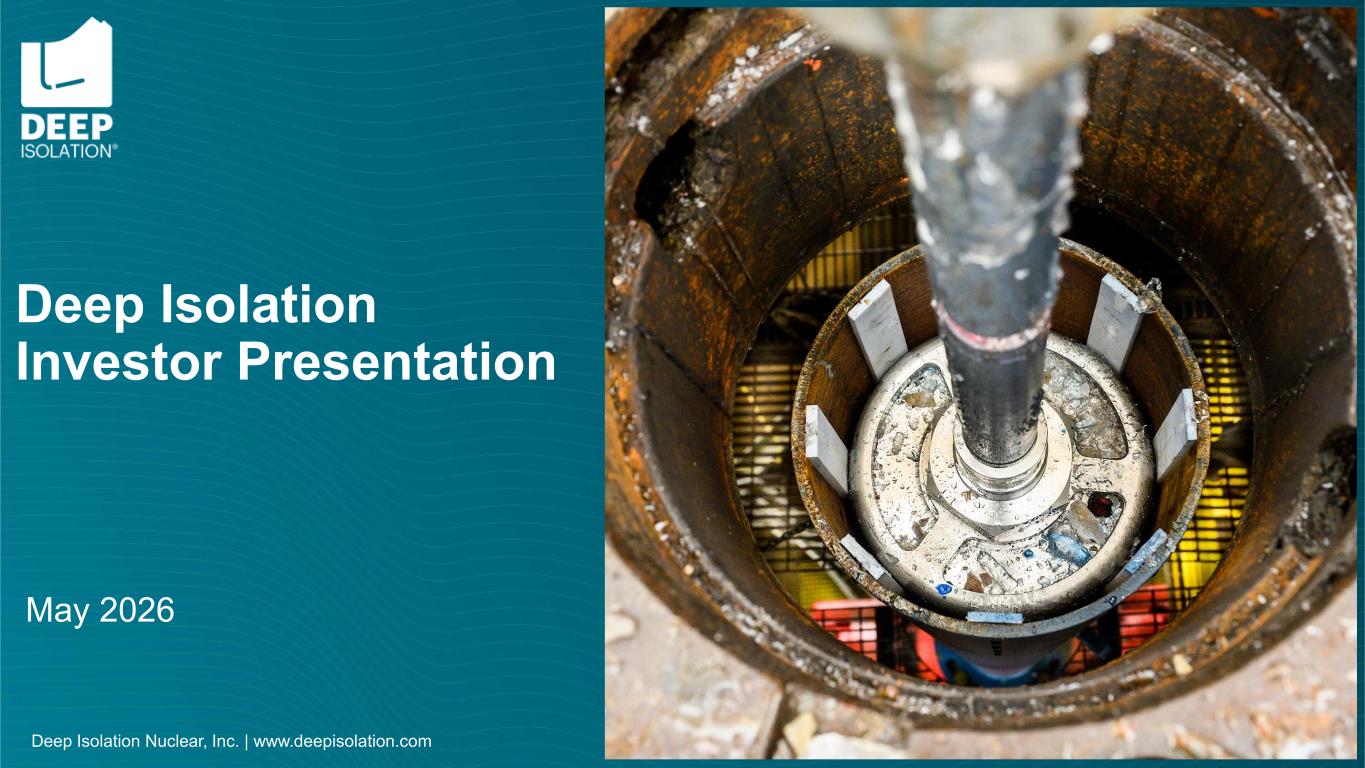
© 2026 Deep Isolation Nuclear, Inc. Deep Isolation Nuclear, Inc. | www.deepisolation.com Deep Isolation Investor Presentation May 2026
© 2026 Deep Isolation Nuclear, Inc. This presentation includes forward-looking statements within the meaning of Section 27A of the Securities Act and Section 21E of the Exchange Act. Forward-looking statements relate to, among others, our plans, objectives and expectations for our business, operations and financial performance and condition, and can be identified by terminology such as “may,” “should,” “expect,” “intend,” “plan,” “anticipate,” “believe,” “estimate,” “predict,” “will,” “could,” “project,” “target,” “potential,” “continue” and similar expressions that do not relate solely to historical matters or actual results. Forward-looking statements are based on management’s belief and assumptions and on information currently available to management. Although we believe that the expectations reflected in forward-looking statements are reasonable, such statements involve known and unknown risks, uncertainties and other factors that may cause our actual results, performance or achievements to be materially different from any future results, performance or achievements expressed or implied by forward-looking statements. The forward-looking statements are subject to risks which include, but are not limited to, the risk factors included under the caption “Risk Factors” in the Company’s Current Report on Form 10-K, filed with the Securities and Exchange Commission on March 30, 2026. Moreover, we operate in a highly regulated environment. New risks emerge from time to time. It is not possible for our management to predict all risks, nor can we assess the impact of all factors on our business or the extent to which any factor, or combination of factors, may cause our actual results to differ materially from those anticipated or implied in any forward-looking statements we may make. In light of these risks, uncertainties, and assumptions, the future events and trends discussed in this presentation may not occur and our actual results could differ materially and adversely from those anticipated or implied in the forward-looking statements. You should not rely upon forward-looking statements as predictions of future events. The events and circumstances reflected in the forward-looking statements may not be achieved or occur. Although we believe that the expectations reflected in the forward- looking statements are reasonable, we cannot guarantee future results, performance, or achievements. We undertake no obligation to update any of these forward-looking statements for any reason after the date of this presentation or to conform these statements to actual results or revised expectations, except as required by law. CERTAIN DISCLOSURES & DISCLAIMERS 2
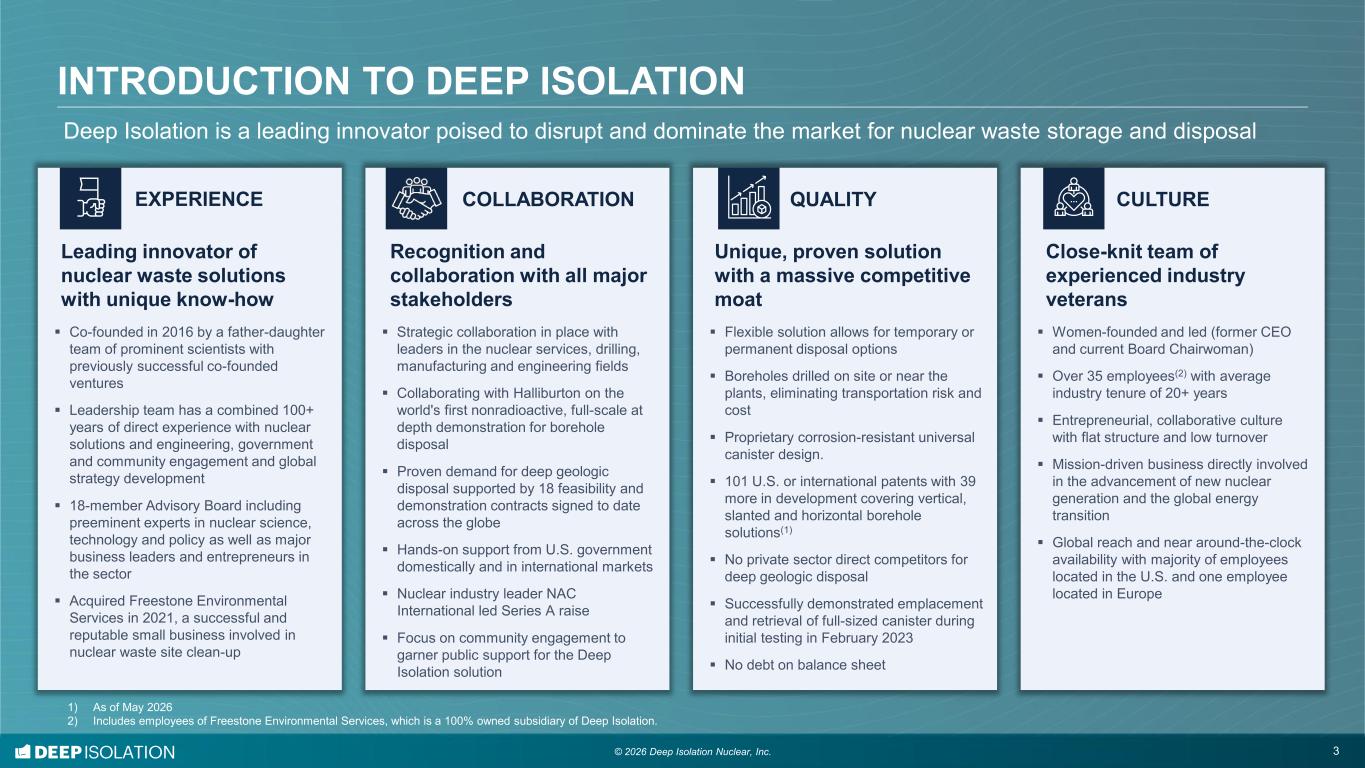
© 2026 Deep Isolation Nuclear, Inc. 3 INTRODUCTION TO DEEP ISOLATION Deep Isolation is a leading innovator poised to disrupt and dominate the market for nuclear waste storage and disposal Recognition and collaboration with all major stakeholders Close-knit team of experienced industry veterans Unique, proven solution with a massive competitive moat Leading innovator of nuclear waste solutions with unique know-how EXPERIENCE COLLABORATION QUALITY CULTURE ▪ Strategic collaboration in place with leaders in the nuclear services, drilling, manufacturing and engineering fields ▪ Collaborating with Halliburton on the world's first nonradioactive, full-scale at depth demonstration for borehole disposal ▪ Proven demand for deep geologic disposal supported by 18 feasibility and demonstration contracts signed to date across the globe ▪ Hands-on support from U.S. government domestically and in international markets ▪ Nuclear industry leader NAC International led Series A raise ▪ Focus on community engagement to garner public support for the Deep Isolation solution ▪ Women-founded and led (former CEO and current Board Chairwoman) ▪ Over 35 employees(2) with average industry tenure of 20+ years ▪ Entrepreneurial, collaborative culture with flat structure and low turnover ▪ Mission-driven business directly involved in the advancement of new nuclear generation and the global energy transition ▪ Global reach and near around-the-clock availability with majority of employees located in the U.S. and one employee located in Europe ▪ Flexible solution allows for temporary or permanent disposal options ▪ Boreholes drilled on site or near the plants, eliminating transportation risk and cost ▪ Proprietary corrosion-resistant universal canister design. ▪ 101 U.S. or international patents with 39 more in development covering vertical, slanted and horizontal borehole solutions(1) ▪ No private sector direct competitors for deep geologic disposal ▪ Successfully demonstrated emplacement and retrieval of full-sized canister during initial testing in February 2023 ▪ No debt on balance sheet ▪ Co-founded in 2016 by a father-daughter team of prominent scientists with previously successful co-founded ventures ▪ Leadership team has a combined 100+ years of direct experience with nuclear solutions and engineering, government and community engagement and global strategy development ▪ 18-member Advisory Board including preeminent experts in nuclear science, technology and policy as well as major business leaders and entrepreneurs in the sector ▪ Acquired Freestone Environmental Services in 2021, a successful and reputable small business involved in nuclear waste site clean-up 1) As of May 2026 2) Includes employees of Freestone Environmental Services, which is a 100% owned subsidiary of Deep Isolation.
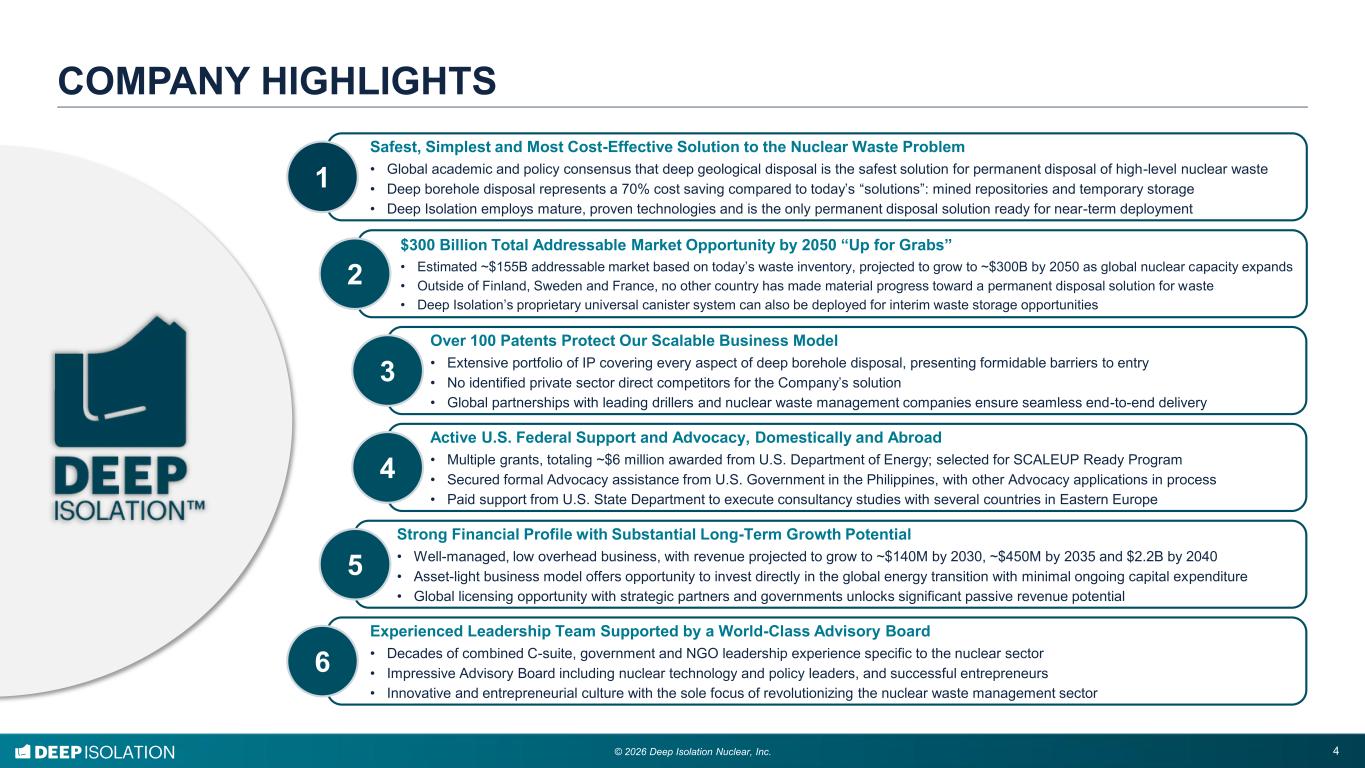
© 2026 Deep Isolation Nuclear, Inc. 4 COMPANY HIGHLIGHTS Safest, Simplest and Most Cost-Effective Solution to the Nuclear Waste Problem • Global academic and policy consensus that deep geological disposal is the safest solution for permanent disposal of high-level nuclear waste • Deep borehole disposal represents a 70% cost saving compared to today’s “solutions”: mined repositories and temporary storage • Deep Isolation employs mature, proven technologies and is the only permanent disposal solution ready for near-term deployment 1 Over 100 Patents Protect Our Scalable Business Model • Extensive portfolio of IP covering every aspect of deep borehole disposal, presenting formidable barriers to entry • No identified private sector direct competitors for the Company’s solution • Global partnerships with leading drillers and nuclear waste management companies ensure seamless end-to-end delivery 3 $300 Billion Total Addressable Market Opportunity by 2050 “Up for Grabs” • Estimated ~$155B addressable market based on today’s waste inventory, projected to grow to ~$300B by 2050 as global nuclear capacity expands • Outside of Finland, Sweden and France, no other country has made material progress toward a permanent disposal solution for waste • Deep Isolation’s proprietary universal canister system can also be deployed for interim waste storage opportunities 2 Experienced Leadership Team Supported by a World-Class Advisory Board • Decades of combined C-suite, government and NGO leadership experience specific to the nuclear sector • Impressive Advisory Board including nuclear technology and policy leaders, and successful entrepreneurs • Innovative and entrepreneurial culture with the sole focus of revolutionizing the nuclear waste management sector Strong Financial Profile with Substantial Long-Term Growth Potential • Well-managed, low overhead business, with revenue projected to grow to ~$140M by 2030, ~$450M by 2035 and $2.2B by 2040 • Asset-light business model offers opportunity to invest directly in the global energy transition with minimal ongoing capital expenditure • Global licensing opportunity with strategic partners and governments unlocks significant passive revenue potential 6 Active U.S. Federal Support and Advocacy, Domestically and Abroad • Multiple grants, totaling ~$6 million awarded from U.S. Department of Energy; selected for SCALEUP Ready Program • Secured formal Advocacy assistance from U.S. Government in the Philippines, with other Advocacy applications in process • Paid support from U.S. State Department to execute consultancy studies with several countries in Eastern Europe 4 5
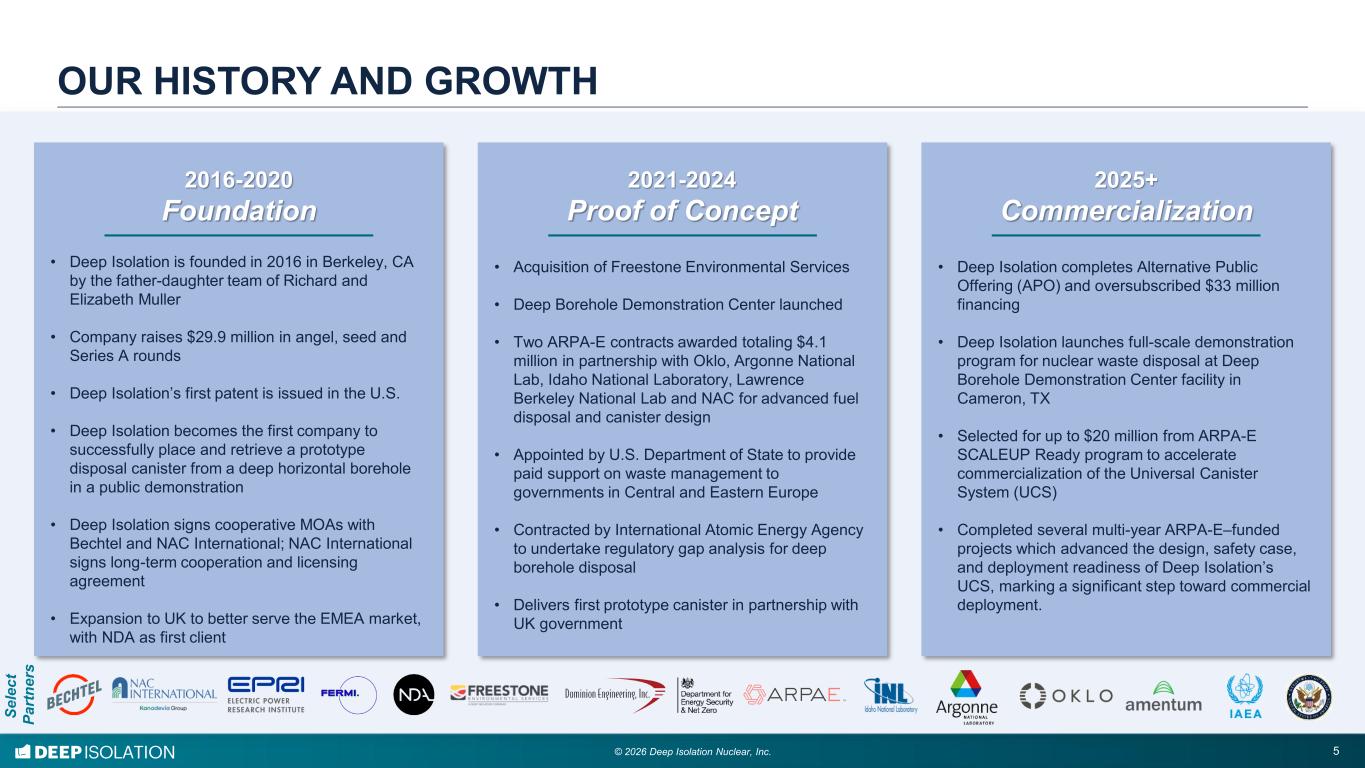
© 2026 Deep Isolation Nuclear, Inc. 5 OUR HISTORY AND GROWTH 2016-2020 Foundation 2021-2024 Proof of Concept 2025+ Commercialization • Deep Isolation is founded in 2016 in Berkeley, CA by the father-daughter team of Richard and Elizabeth Muller • Company raises $29.9 million in angel, seed and Series A rounds • Deep Isolation’s first patent is issued in the U.S. • Deep Isolation becomes the first company to successfully place and retrieve a prototype disposal canister from a deep horizontal borehole in a public demonstration • Deep Isolation signs cooperative MOAs with Bechtel and NAC International; NAC International signs long-term cooperation and licensing agreement • Expansion to UK to better serve the EMEA market, with NDA as first client • Acquisition of Freestone Environmental Services • Deep Borehole Demonstration Center launched • Two ARPA-E contracts awarded totaling $4.1 million in partnership with Oklo, Argonne National Lab, Idaho National Laboratory, Lawrence Berkeley National Lab and NAC for advanced fuel disposal and canister design • Appointed by U.S. Department of State to provide paid support on waste management to governments in Central and Eastern Europe • Contracted by International Atomic Energy Agency to undertake regulatory gap analysis for deep borehole disposal • Delivers first prototype canister in partnership with UK government • Deep Isolation completes Alternative Public Offering (APO) and oversubscribed $33 million financing • Deep Isolation launches full-scale demonstration program for nuclear waste disposal at Deep Borehole Demonstration Center facility in Cameron, TX • Selected for up to $20 million from ARPA-E SCALEUP Ready program to accelerate commercialization of the Universal Canister System (UCS) • Completed several multi-year ARPA-E–funded projects which advanced the design, safety case, and deployment readiness of Deep Isolation’s UCS, marking a significant step toward commercial deployment. S e le c t P a rt n e rs

© 2026 Deep Isolation Nuclear, Inc. KEY EVENTS SO FAR IN 2026 6 First Quarter Key Appointments ▪ January 23 – Named nuclear industry veteran Ralph L. Hunter to Deep Isolation’s Board ▪ February 3 – Named experienced energy industry and corporate attorney Paula Whitten-Doolin to the position of General Counsel ▪ February 17 – Appointed energy sector financial leader Joseph Nelson to the position of Chief Financial Officer ▪ March 2 – Appointed nuclear operations expert Matthew Sunseri to the Company’s Advisory Board First Quarter and Subsequent Business Updates ▪ January 13 – Completion of Project SAVANT with the U.S. Department of Energy validates Deep Isolation’s Universal Canister System as suitable for storing nuclear waste material ▪ February 2 – Announcement of the launch of Deep Isolation’s full-scale demonstration program for nuclear waste disposal in Cameron, Texas ▪ March 9 – Completion of the ONWARDS project with the Advanced Research Projects Agency – Energy (ARPA-E), further validating Deep Isolation’s borehole technology for safe disposal of recycled nuclear fuel waste ▪ April 7 – Deep Isolation selected for grant of up to $20 million for participation in ARPA-E SCALEUP Ready program, which aims to accelerate market adoption of first-of-a-kind technologies through financial support

© 2026 Deep Isolation Nuclear, Inc. ARPA-E SCALEUP READY PROGRAM AWARD 7 The ARPA-E SCALEUP Ready Program provides funding and support to validate first-of-a-kind technologies ▪ On April 7, 2026, the U.S. Department of Energy Advanced Research Projects Agency-Energy (ARPA-E) announced it had selected Deep Isolation to negotiate a grant under the SCALEUP Ready program ▪ The SCALEUP Ready program bridges the gap between pilot- scale demonstration and full commercial deployment for technologies that ARPA-E believes have potential “to radically transform America’s energy reality” ▪ The SCALEUP Ready program provides up to $20 million to applicants and Deep Isolation has requested the maximum amount ▪ The award will provide non-dilutive funding for Deep Isolation’s non-radioactive, full-scale, at-depth field testing of the UCS in Cameron, Texas while also enabling regulatory validation of the technology ▪ Department of Energy Press Release Announcing Deep Isolation’s Selection +

© 2026 Deep Isolation Nuclear, Inc. OUR LEADERSHIP TEAM 8 Highly experienced team with unmatched, complementary expertise Steve Airhart President of Freestone Environmental Services Rod Baltzer Chief Executive Officer Chris Parker Chief Commercialization Officer Sophie McCallum Chief of Staff Jesse Sloane EVP of Engineering Joseph Nelson Chief Financial Officer Paula Whitten- Doolin General Counsel ▪ Joined Deep Isolation in 2018 ▪ 25 years of experience in the nuclear waste industry, including radioactive waste licensing and disposal, stakeholder engagement and management ▪ Previously served as CFO, President and CEO for Waste Control Specialists over 14 years ▪ B.S. in Agricultural Economics & Accounting from Oklahoma State University ▪ Joined Deep Isolation in 2020 ▪ 34 years of experience in stakeholder engagement, governance and partnership development Formerly a senior civil servant reporting directly to the British Prime Minister on the digital transformation of UK’s economy and public services ▪ M.B.A with distinction from Imperial College London and B.A. in French and International Studies from University of Warwick ▪ Joined Deep Isolation in 2018 ▪ 14 years of experience in growing and scaling early stage companies, fostering collaboration and implementing systems ▪ Previously served as Director of Operations at ClinCapture and in equity derivatives roles at BNP Paribas ▪ M.B.A in Entrepreneurial Studies and International Studies from ESCP Business School ▪ Joined Deep Isolation in 2022 ▪ 16 years experience in SNF and waste management, fabrication and transportation, risk engineering and management of large-scale nuclear, capital, and construction projects ▪ Former U.S. Naval Officer and lead engineer of Spent Fuel Disposal Projects of the Naval Nuclear Propulsion Program ▪ M.S. Nuclear Engineering from Penn State University; B.S. Mechanical Engineering and Mechanics from Drexel University ▪ President of Freestone since 2019 ▪ 39 years of experience as a geologist specializing in environmental investigations, compliance, spill response and cleanup actions ▪ Has performed complex investigations for the U.S. DOD and U.S. DOE’s Hanford Site ▪ Experienced Program Manager for large federal IDIQ contracts ▪ B.A. in Geology from University of Montana ▪ Joined Deep Isolation in 2026 ▪ Over 20 years experience in financial leadership, fundraising, M&A and driving corporate growth in the energy sector ▪ Previously served as CFO of Delta Corp. Holdings Limited, and public companies GasLog Ltd. and GasLog Partners LP ▪ M.B.A., with finance specialization from NYU Stern School of Business ▪ Joined Deep Isolation in 2026 ▪ Over 15 years experience in corporate and legal affairs in the energy industry ▪ Previously served in senior legal roles, including as General Counsel, with Houston First Corp., Ideanomics, Neste, SLB and MI SWACO ▪ B.S. from California Institute of Technology; J.D. from Northwestern University School of Law

© 2026 Deep Isolation Nuclear, Inc. ▪ Co-Founded Deep Isolation in 2016 ▪ Currently serves as Board Chair Elizabeth Muller Chair and Co-Founder ▪ Joined Deep Isolation in 2018 ▪ Currently serves Chief Executive Officer Rod Baltzer Executive Director and Chief Executive Officer ▪ Joined Deep Isolation Board of Directors in 2025 ▪ Committee Memberships: • Nominating & Governance (Chair) • Audit • Compensation Renee Hornbaker Independent Director Stream Energy ▪ Joined Deep Isolation Board of Directors in 2019 ▪ Committee Memberships: • Compensation (Chair) • Audit • Nominating & Governance Leslie Tepper Lead Independent Director The Artemis Fund OUR BOARD OF DIRECTORS 9 Highly accomplished board with decades of experience leading companies ▪ Joined Deep Isolation Board of Directors in 2019 ▪ Committee Memberships: • Audit (Chair) • Nominating & Governance Jonathan Angell Independent Director Angell Investments ▪ Joined Deep Isolation Board of Directors in 2025 ▪ Committee Memberships: • Audit • Compensation Christa Steele Independent Director Mechanics Bank ▪ Joined Deep Isolation Board of Directors in 2026 ▪ Committee Memberships: • Compensation • Nominating & Governance Ralph L. Hunter Independent Director RC Nuclear Consultants

© 2026 Deep Isolation Nuclear, Inc. Meghan Caiazzo Chief Commercial Officer at Prepared Hero and Co-founded Victory Wine Group Steven Chu Nobel Prize winner in Physics; Former U.S. Secretary of Energy and Director of LBNL; creator of the Blue Ribbon Commission on America’s Nuclear Future and ARPA-E Clay Collier Expert in communication architecture and software development as well as a mentor at SkyDeck Berkeley Terry Considine Real estate entrepreneur and investor serving as CEO for four REITs; current director of the Lynde and Harry Bradley Foundation in WI and Intrepid Potash in CO Bill Edwards Managing Partner at CS Transformation and previously was the Chief Strategy Officer at Deep Isolation Richard Esposito Current R&D Program Manager at Southern Company; President of the Alabama Geological Society Tom Isaacs National and international leader in the fields of nuclear energy, nuclear waste management, nuclear security, controversial facility siting, stakeholder engagement, and earning public trust and confidence. Jeffrey Merrifield Partner at Pillsbury Winthrop Shaw Pittman and former U.S. NRC commissioner Daniel Metlay Former member of the Senior Professional Staff of the U.S. Nuclear Waste Technical Review Board and served in the Carter White House on radioactive-waste management OUR UNPARALLED ADVISORY BOARD 10 Exemplary Advisory Board includes top minds in geology, nuclear and environmental science alongside business leaders, innovators and entrepreneurs Monica Mwanje Provides strategic consultancy services for organizations seeking growth in nuclear and other regulated sectors Per Peterson Former CNO of Kairos; Nuclear Engineering Professor at UC Berkeley focusing on high-temperature reactors, high-level nuclear waste processing and nuclear material management John Raymont Nuclear sector entrepreneur, founder and former President of Kurion Inc.; recognized for innovation on waste management products Jen Schneider Current Professor at Boise State University conducting research focusing on energy industry rhetoric and technical discourse; stakeholder engagement specialist James Smalhout Former Federal Reserve economist, World Bank consultant, derivatives trader and author of over 100 financial publications Matthew Sunseri Seasoned nuclear energy executive bringing deep expertise in nuclear safety, regulatory engagement, organizational performance, and enterprise risk management Barbara Laflin Treat President & CEO of InstrastructureWorld and former Principal Vice President at Bechtel Corporation Rob Utter Consultant at New Ventures Energy Consulting and has over 30 years of experience in drilling operations at Schlumberger Heather Westra Independent consultant with over 30 years of experience in Indian Country focusing nuclear regulation
© 2026 Deep Isolation Nuclear, Inc. I l ti l , I . The State of Nuclear Waste Disposal 11

© 2026 Deep Isolation Nuclear, Inc. THERE IS WIDESPREAD RECOGNITION THAT NEW NUCLEAR POWER IS A CRITICAL PART OF THE SOLUTION 12 An increasing number of countries around the world recognize the critical role of nuclear energy for ensuring energy security and achieving net zero goals CLEAN Zero carbon emissions from nuclear-generated power RELIABLE Continuous operations provides baseload, 24/7 power SUSTAINABLE Reactors built to last up to 100 years, decades longer then any other generation source EFFICIENT Smallest footprint-to-energy output ratio for both fuel and land SECURE Reduces reliance on fuel imports from politically unstable regions, increasing energy independence RESILIENT Weather related events have caused <0.1% average loss of capacity factor at nuclear plants Sources: IAEA, U.S. DOE, IEA, International Monetary Fund. 1) Estimate from IEA’s “Nuclear Power and Secure Energy Transitions” report. 2) Based on midpoint of IAEA’s low and high cases. The U.S. DOE alone has a goal to add 200 GW of nuclear in the U.S. by 2050. 3x 25 countries (representing 41% of world GDP) pledged to 3x global nuclear capacity by 2050 at COP28 >$2Tn Annual global nuclear investment through 2050 needed to achieve global net zero by 2050(1) 300+ GW Forecasted global increase in nuclear capacity through 2050(2)

© 2026 Deep Isolation Nuclear, Inc. A REALISTIC SOLUTION FOR PERMANENT WASTE DISPOSAL IS FUNDAMENTAL TO THE ROLLOUT OF NEW NUCLEAR 13 The world has not yet permanently disposed any of the spent fuel it has created over the last seventy years ““To move the next generation of nuclear reactors forward, the industry needs to be able to tell investors and the government that we have a solution to the waste.” – Rod McCullum Senior Director, Used Fuel and Decommissioning at Nuclear Energy Institute Estimated Size of Existing Spent Fuel Inventories in Metric Tonnes of Heavy Metal (MTHM) ““…This issue has to be resolved. The communities that raised their hand to put nuclear facilities in their geographic boundaries did not raise their hand to store permanently, the spent nuclear fuel, and we are seeking to get a solution to that sooner rather than later.” – Jennifer Granholm Former U.S. Secretary of Energy Sources: IAEA, Deep Isolation Financial Model. 1) Estimates the potential disposal value to Deep Isolation, assuming a weighted average cost of disposal of $348k/MTHM based on $424k/MTHM and $170k/MTHM for unprocessed and reprocessed waste, respectively, per the Deep Isolation Financial Model. Assumes 30% of global waste is reprocessed, while remaining 70% is unprocessed. Less than 3,000 (up to $1.0B(1) disposal value) 3,000 - 10,000 ($1.0-3.5B(1) disposal value) 10,000 - 30,000 ($3.5-10.4B(1) disposal value) Greater than 30,000 (greater than $10.4B(1) disposal value)

© 2026 Deep Isolation Nuclear, Inc. 14 How does it work? ▪ Involves the mining of miles of underground tunnels to create a centralized repository in which all spent nuclear fuel (SNF) produced by a certain country will ultimately be packed into canisters and emplaced ▪ Facility maintained by a large staff of engineers and other personnel onsite and underground What does it cost? ▪ Construction can cost billions to tens of billions alone plus significant operating and monitoring costs, with a large staff on hand for decades ▪ In many cases where not all SNF is produced near the disposal site, countries will also incur significant transportation costs How long does it take to deploy? ▪ Projects take decades to plan and deliver before becoming operational ▪ Political opposition can cause decades of delays – in the U.S., Yucca Mountain was selected as the site for all U.S. SNF disposal in 1987, but has made no material progress to date What progress has been made to date? ▪ There are no currently operating mined repository facilities for the disposal of SNF – Finland aims to open the world’s first SNF disposal facility in 2026 – Sweden and France are next in line, and neither country has begun construction ▪ Only a handful of countries have made significant progress in even selecting a site Why is this option so unpopular? ▪ Community Opposition – most citizens are deeply opposed to living near a nuclear waste site ▪ Cost – most expensive solution for SNF disposal plus many more years of interim storage costs ▪ Safety – requires transportation of radioactive waste over long distances; requires constant human intervention underground THE CURRENT NUCLEAR DISPOSAL APPROACH IS NOT WORKING Mined Repository: the expensive and unpopular option Above-Ground Interim Storage: the “kick-the-can” option The world’s current nuclear waste management model is nearly unanimously unpopular, resulting in the continuous cycle of delays in permanent disposal and indefinitely recurring storage costs How does it work? ▪ Involves packaging SNF into canisters that are then placed and stored in above-ground concrete dry casks located onsite at the power plant where the SNF was produced ▪ Onsite monitoring and maintenance required What does it cost? ▪ Globally, the annual spend for temporary storage of SNF is ~$10B – the U.S. alone spends ~$2.2B annually ▪ As this is not a permanent solution, these costs do not include the inevitable transportation and disposal costs to come in the future How long does it take to deploy? ▪ Because the world has decades of experience, interim storage can be deployed immediately ▪ The actual placement of SNF into the dry casks depends on the inventory, and can take months to years to complete What progress has been made to date? ▪ Temporary above-ground storage is the only waste management solution for SNF currently being practiced worldwide ▪ No SNF globally has ever been moved from temporary storage to a permanent disposal site Why is this option so unpopular? ▪ Cost – billions of dollars are passed through to taxpayers each year for a solution that includes the inevitable bill for permanent disposal at some point in the future ▪ Timing – SNF is being stored above-ground decades longer than anticipated and, in most countries, with no permanent solution on the horizon ▪ Safety – risks include natural disasters, cask degradation, accidents, terrorist attacks, etc.

© 2026 Deep Isolation Nuclear, Inc. I l ti l , I . The Deep Isolation Approach 15

© 2026 Deep Isolation Nuclear, Inc. THE DEEP ISOLATION SOLUTION 16 ▪ Deep Isolation’s solution places corrosion-resistant canisters containing waste in deep boreholes, greater than 1 kilometer below the surface – far deeper than is feasible with a mined repository ▪ Boreholes terminate in stable geological formations that have been out of contact with the biosphere for millions of years ▪ Key features of the solution include: ✓ Inexpensive Proven Drilling: Remarkable advances in directional drilling technology have made such deep boreholes reliable and relatively inexpensive; leverages existing technology ✓ Permanent Isolation: Our corrosion resistant canisters serve as an engineered barrier – and the billion metric tons of rock above them create the final impermeable barrier ✓ Time to Implement: The technology and know-how exist and are ready to be deployed quickly ✓ Remote Handling: Deep borehole emplacement does not require human involvement underground ✓ Minimal Transportation: Disposal can take place at or near sites where nuclear waste is produced and currently stored, minimizing the cost and risk associated with waste transportation Our Solution Deep Isolation’s mission is to provide the world’s safest and most cost-effective solution for the permanent disposal of nuclear waste, becoming the dominant solution across the world

© 2026 Deep Isolation Nuclear, Inc. 17 HOW DOES HORIZONTAL BOREHOLE DISPOSAL WORK? Deep Isolation’s repeatable process leverages proven technology and has been successfully tested and demonstrated The disposal process consists of six stages: 1. Vertical Access: Drill a vertical hole to a suitable depth and then gradually curve the direction until the drillhole is approximately horizontal. The horizontal section is the disposal region. 2. Casing Installation: Line the drillhole with a carbon-steel pipe known as casing. Because the curved section is so gradual, the steel casing bends easily around it. 3. Canister Preparation: Place the nuclear waste in corrosion- resistant canisters. 4. Canister Emplacement: Lower canisters into the hole and push them into the disposal region. This process is completed using standard oil and gas industry practices. 5. Release: Release canisters, withdraw the conveyance mechanism, and repeat. 6. Seal / Plug: Seal the vertical hole with rock and bentonite clay after removing the casing, or use temporary plugs for interim storage.

© 2026 Deep Isolation Nuclear, Inc. UNIVERSAL CANISTER SYSTEM (UCS) ▪ The UCS is a Deep Isolation patented family of canisters that: i. Are engineered in a range of sizes (to accommodate a wide variety of advanced reactor waste forms) and thicknesses (to provide structural stability in a range of different disposal depths) ii. Share common, standardized features, including closure designs and lifting attachments designed for interoperability with emplacement technologies used on a daily basis in the oil and gas industry ▪ Designed to accommodate all major current and advanced nuclear waste streams ▪ Only triple-purpose canister system in the world – integrates with (i) transport systems, (ii) interim dry cask storage and (iii) disposal (in deep boreholes or mined repositories) ▪ Enables waste to be packaged once, avoiding costs and risks associated with future repackaging – even when a disposal path is uncertain ▪ Significant government support and investment from the U.S. and UK, with $7.1 million of government grant contracts to date ▪ Preliminary safety evaluations were performed for design-limiting conditions to develop a canister design sufficient to satisfy established and anticipated regulatory requirements UCS Assembly Key Plate Cap Plate Jam Plate Lift Adapter UCS Configuration Diagram UCS prototype design, measuring about 16 feet in length and weighing over 4,000 lbs (Nuclear AMRC, United Kingdom, circa 2024) 18

© 2026 Deep Isolation Nuclear, Inc. NUCLEAR WASTE MANAGEMENT COST ANALYSIS 19 Disposal Cost Comparison ($000s per MTHM)(1,2) Deep Isolation’s borehole solution is far more economical than mined repositories or the current status quo – temporary storage before ultimate disposal Sources: Amentum (published white paper); Deep Isolation Financial Model. 1) Does not incorporate costs of spent fuel transportation. 2) Values represented in real 2024 U.S. dollars. 3) Considers global average mined repository and does not include costs of spent fuel transportation. 4) Weighted average cost of disposal based on $424k/MTHM and $170k/MTHM for unprocessed and reprocessed waste, respectively, per the Deep Isolation Financial Model. Assumes 30% of global waste is reprocessed, while remaining 70% is unprocessed. 5) This assumes that U.S. spent nuclear fuel is disposed of at the Deep Isolation’s average unit cost for direct disposal ($424k/MTHM), with none reprocessed first as shown in the lower blended rate at Footnote (4). PERMANENT DISPOSAL SOLUTIONS “KICK-THE-CAN” OPTION ▪ By Deep Isolation’s estimates based on DOE data, the ongoing annual cost of storage is ~$23k / MTHM / year – This means that Deep Isolation’s deep borehole disposal solution is equivalent to ~20 years(5) of temporary storage costs in the U.S. ▪ Inevitably, the waste stored in these dry casks must ultimately be disposed of permanently in either mined repositories or deep boreholes ▪ When considering the combined costs of (i) permanent disposal canisters, (ii) waste repackaging, (iii) any necessary transportation and (iv) ultimate disposal, the status quo temporary storage option quickly becomes the most expensive and burdensome option $1,160 $348 Mined Repository Borehole 70% Cost Savings versus Mined Repositories (3) (4)
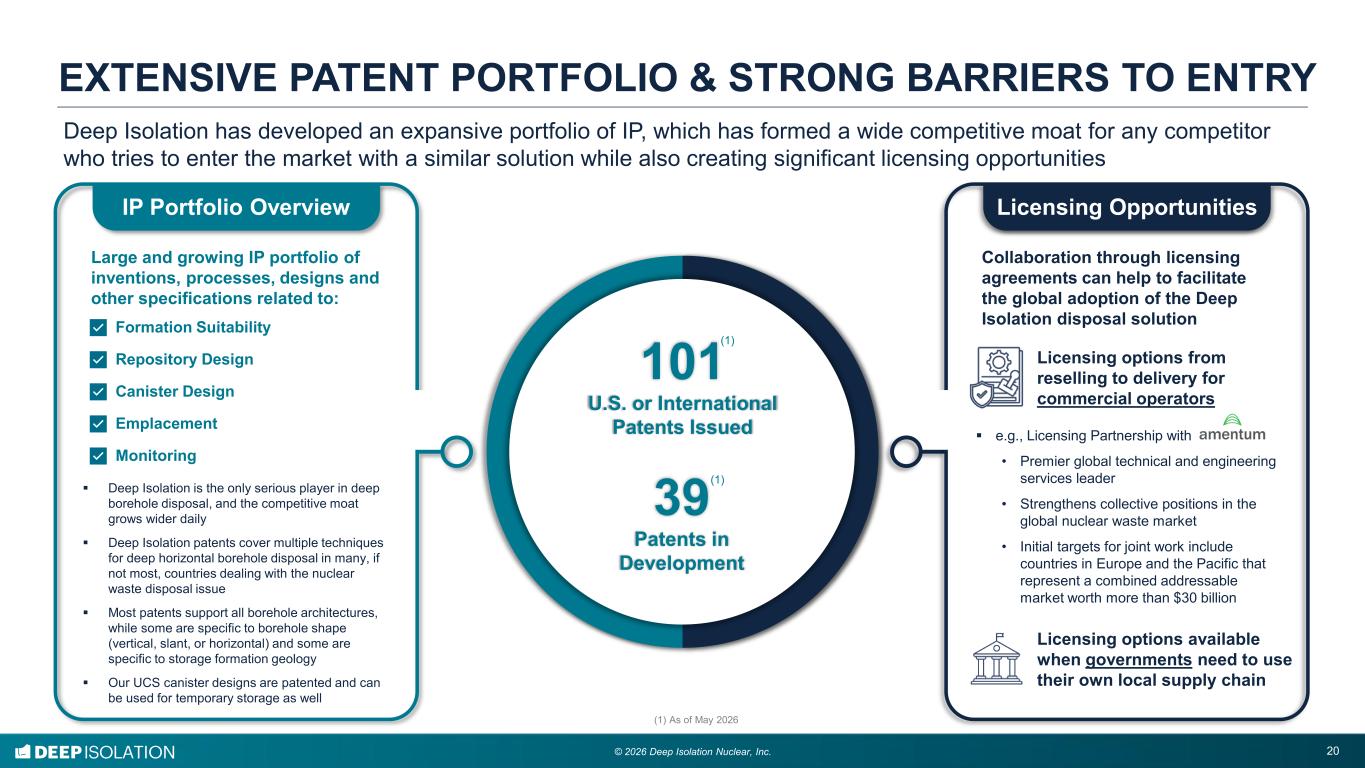
© 2026 Deep Isolation Nuclear, Inc. 20 EXTENSIVE PATENT PORTFOLIO & STRONG BARRIERS TO ENTRY Deep Isolation has developed an expansive portfolio of IP, which has formed a wide competitive moat for any competitor who tries to enter the market with a similar solution while also creating significant licensing opportunities IP Portfolio Overview Licensing Opportunities Licensing options from reselling to delivery for commercial operators Licensing options available when governments need to use their own local supply chain 101 U.S. or International Patents Issued 39 Patents in Development Formation Suitability Repository Design Canister Design Emplacement Monitoring Large and growing IP portfolio of inventions, processes, designs and other specifications related to: ▪ Deep Isolation is the only serious player in deep borehole disposal, and the competitive moat grows wider daily ▪ Deep Isolation patents cover multiple techniques for deep horizontal borehole disposal in many, if not most, countries dealing with the nuclear waste disposal issue ▪ Most patents support all borehole architectures, while some are specific to borehole shape (vertical, slant, or horizontal) and some are specific to storage formation geology ▪ Our UCS canister designs are patented and can be used for temporary storage as well Collaboration through licensing agreements can help to facilitate the global adoption of the Deep Isolation disposal solution ▪ e.g., Licensing Partnership with • Premier global technical and engineering services leader • Strengthens collective positions in the global nuclear waste market • Initial targets for joint work include countries in Europe and the Pacific that represent a combined addressable market worth more than $30 billion (1) (1) (1) As of May 2026

© 2026 Deep Isolation Nuclear, Inc. 21 WIDESPREAD SUPPORT FROM THE GLOBAL NUCLEAR COMMUNITY Nuclear stakeholders across the globe have expressed formal support of Deep Isolation and our waste management solutions “Fermi Energia’s reference solution for spent fuel disposal… is provided by Deep Isolation. The solution includes packaging our SMR spent fuel in the Universal Canister System and then emplacing it in a deep borehole repository.” ““Deep borehole disposal is an important alternative option for us to consider in Slovenia…[the study is] helpful in highlighting the potential benefits, the increasing maturity of, and required next steps for deep borehole disposal” “ “By joining forces with Deep Isolation, we’re not just addressing a critical need for effective nuclear waste management; we’re spearheading an era of innovation and responsibility in the nuclear industry.” “ “[Deep Isolation’s study for ERDO] confirms ERDO’s own published assessment that deep borehole disposal could be a viable and cost-effective option for disposal… offering significant potential savings compared to conventional mined repositories.” “ “The integration of UCS with our eVinci microreactor technology provides a comprehensive solution for managing spent nuclear fuel through its entire lifecycle. This partnership showcases the impact of innovation, where we are merging our next-generation nuclear technology with a reliable, economical and adaptable method for handling nuclear waste.” “Kairos Power is excited to see the progress made by the Deep Isolation team in advancing the Universal Canister System and looks forward to continued collaboration. Together, Deep Isolation and Kairos Power are setting a precedent for innovation, safety, and sustainability in the safe and effective management of spent fuel from high temperature reactors.” “ Actively Engaged NGOs

© 2026 Deep Isolation Nuclear, Inc. I l ti l , I . The Nuclear Waste Disposal Market 22
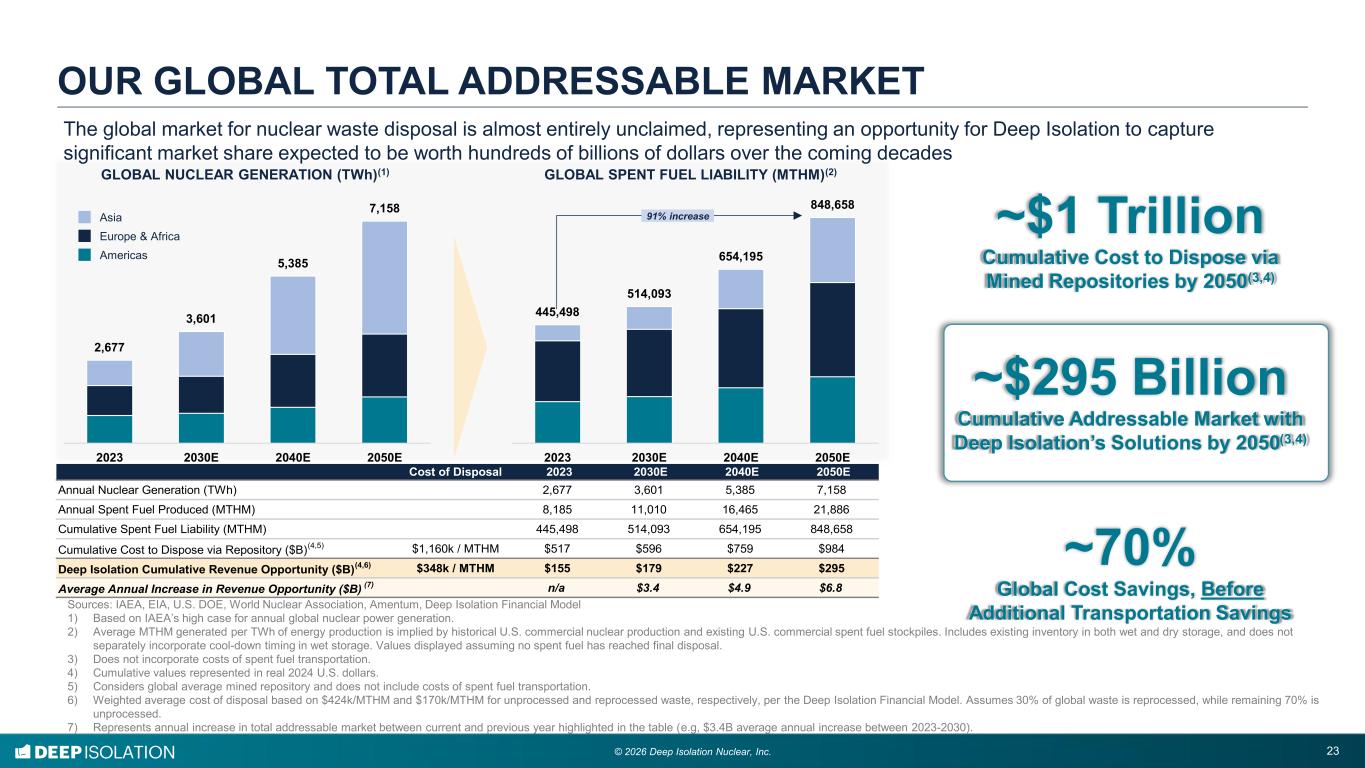
© 2026 Deep Isolation Nuclear, Inc. 23 OUR GLOBAL TOTAL ADDRESSABLE MARKET The global market for nuclear waste disposal is almost entirely unclaimed, representing an opportunity for Deep Isolation to capture significant market share expected to be worth hundreds of billions of dollars over the coming decades Sources: IAEA, EIA, U.S. DOE, World Nuclear Association, Amentum, Deep Isolation Financial Model 1) Based on IAEA’s high case for annual global nuclear power generation. 2) Average MTHM generated per TWh of energy production is implied by historical U.S. commercial nuclear production and existing U.S. commercial spent fuel stockpiles. Includes existing inventory in both wet and dry storage, and does not separately incorporate cool-down timing in wet storage. Values displayed assuming no spent fuel has reached final disposal. 3) Does not incorporate costs of spent fuel transportation. 4) Cumulative values represented in real 2024 U.S. dollars. 5) Considers global average mined repository and does not include costs of spent fuel transportation. 6) Weighted average cost of disposal based on $424k/MTHM and $170k/MTHM for unprocessed and reprocessed waste, respectively, per the Deep Isolation Financial Model. Assumes 30% of global waste is reprocessed, while remaining 70% is unprocessed. 7) Represents annual increase in total addressable market between current and previous year highlighted in the table (e.g, $3.4B average annual increase between 2023-2030). 2,677 3,601 5,385 7,158 2023 2030E 2040E 2050E 445,498 514,093 654,195 848,658 2023 2030E 2040E 2050E 91% increase GLOBAL NUCLEAR GENERATION (TWh)(1) GLOBAL SPENT FUEL LIABILITY (MTHM)(2) ~$1 Trillion Cumulative Cost to Dispose via Mined Repositories by 2050(3,4) ~$295 Billion Cumulative Addressable Market with Deep Isolation’s Solutions by 2050(3,4) Asia Europe & Africa Americas Cost of Disposal 2023 2030E 2040E 2050E Annual Nuclear Generation (TWh) 2,677 3,601 5,385 7,158 Annual Spent Fuel Produced (MTHM) 8,185 11,010 16,465 21,886 Cumulative Spent Fuel Liability (MTHM) 445,498 514,093 654,195 848,658 Cumulative Cost to Dispose via Repository ($B) (4,5) $1,160k / MTHM $517 $596 $759 $984 Deep Isolation Cumulative Revenue Opportunity ($B) (4,6) $348k / MTHM $155 $179 $227 $295 Average Annual Increase in Revenue Opportunity ($B) (7) n/a $3.4 $4.9 $6.8 ~70% Global Cost Savings, Before Additional Transportation Savings

© 2026 Deep Isolation Nuclear, Inc. 24 ▪ The world’s only company developing an end-to-end solution for deep borehole disposal ▪ Hybrid solution alongside mined repositories, under discussion with governments (e.g., ERDO, UK, others) COMPETITIVE LANDSCAPE We do not have any true competitors for our DBD solution – in fact, many of our “competitors” are actually strategic partners MINED REPOSITORY INTERIM STORAGE DEEP BOREHOLE DISPOSAL COMMENTARY ▪ German-based dry cask manufacturer for interim nuclear waste storage ▪ Complementary capabilities with Deep Isolation – does not manufacture disposal canisters ▪ Provides interim storage and transportation solutions ▪ Provides interim storage and transportation services ▪ Deep Isolation shareholder and supply chain partner; agreement to manufacture DI canisters ▪ Provides interim storage and transportation services ▪ DI has discussed disposal solution in conjunction with Orano’s reprocessing capabilities ▪ Managed national waste programs in both the U.S. (WIPP) and UK; last contractor for Yucca Mountain ▪ Key supply chain and licensing partner for Deep Isolation ▪ Early-stage company looking to commercialize multinational mined repository solutions; in discussions about use of Deep Isolation’s solution ▪ Currently manages and operates WIPP disposal repository ▪ Cooperation partner with DI since 2019; mentor-protégé agreement signed with DI for WIPP in 2023 ▪ Finnish company managing mined repository program in Finland ▪ Swedish company developing a mined repository in Sweden ▪ Sells consulting services for mined programs to other countries 1) Deep Isolation is in discussions to provide deep borehole disposal solutions alongside mined repositories. The company does not currently have commitments from potential customers to pursue hybrid solutions. (1) Both commissioned to provide Disposal Solutions for Yucca Mountain. Designs submitted to NRC but not implemented.

© 2026 Deep Isolation Nuclear, Inc. I l ti l , I . The Deep Isolation Business Model 25

© 2026 Deep Isolation Nuclear, Inc. ▪ Strategic options appraisal, comparing: ✓ Costs and benefits of Deep Isolation’s solution with other options (e.g., long-term interim storage, mined disposal) ✓ How Deep Isolation’s solution will vary depending on whether the client prefers direct disposal of spent nuclear fuel or first to re-process and then dispose the residual high-level waste ▪ Preliminary feasibility assessment focused on suitability of geology and inventory for Deep Isolation’s solution ▪ Comprehensive feasibility assessment providing all information needed to proceed to Step 3: ✓ Generic Design for a Deep Isolation repository tailored to client’s geology, inventory and regulatory requirements ✓ An IAEA-compliant economic and strategic business case, and Generic Safety Case ✓ Commercial model for implementation, including options for financing support from U.S. EXIM Bank ✓ Roadmap for all work needed to commission and implement Deep Isolation’s solution ▪ Implementation contract that deploys an IAEA- compliant, phased and gated program for repository delivery: ✓ Siting ✓ Licensing ✓ Construction ✓ Cold and hot commissioning ✓ Operations ✓ Closure ✓ Post-closure monitoring Potential Contract Value ~$1 billion+(1) Potential Contract Value ~$1-2 million(1) Implementation Time 5-15 years Implementation Time ~12 months Operational Planning Implementation (Disposal or Storage)Strategic Appraisal Implementation Time 4-6 months Total Contract Value ~$100-200k 1 2 3 26 DEEP ISOLATION PRODUCT LINES We do not expect our customers to commit to implementation of the Deep Isolation solution in one single decision. Instead, we offer a ladder of engagement that builds confidence from the client while also generating early income for Deep Isolation ✓ Community & Stakeholder Engagement GOVERNMENT R&D GRANTS Smaller grants to support further testing for our technology Larger grants to deliver full-scale demonstration of borehole disposal 4 BUSINESS-AS-USUAL CONSULTING 5 Current revenue streams Future revenue streams 1) Based on Management's assumptions and projections. For further detail, see the Company's Form 10-K filed with the SEC on March 30, 2026.

© 2026 Deep Isolation Nuclear, Inc. 27 ▪ Freestone Environmental Services, Inc. (“Freestone”) is a multi-discipline environmental and water resources consulting firm serving federal, state, municipal and private clients ▪ Team with decades of professional consulting experience in solving technical and regulatory challenges ▪ Variety of technical backgrounds to support a range of environmental services to environmental cleanup sites and the U.S. Government ▪ Freestone also performs R&D work that has led to the development of its automatic hexavalent chromium sensor ▪ Headquartered in Richland, Washington Freestone Overview Acquired in 2021, Freestone offers key synergies with our core disposal solution and provides cash flow to the business REGULATORY SUPPORT Assist private and government clientele in solving regulatory related issues associated with the evolving local, state, and federal environmental requirements INVESTIGATION & REMEDIATION Perform environmental investigations to characterize conditions of a site, and determine if hazardous substances are present to the degree that remediation or cleanup may be necessary ENVIRONMENTAL DATA REVIEW & MANAGEMENT Provide data verification and quality reviews for federal environmental cleanup actions, using spatial analysis and statistical evaluation to determine environmental impacts and assess progress TECHNOLOGY DEVELOPMENT Developed a cable-deployed hexavalent chromium sensor for wells or water bodies. The sensors serve as an alternative to manual sampling and analysis, offering continuous data collection and reduced cost per measurement FREESTONE’S SERVICES Synergies for Deep Isolation Expands bench strength and provides additional human capital, including: Strategically and culturally aligned Existing subcontractor with U.S. DOE’s prime contractors Access to Freestone’s catalog of back office resources Access to professional geologists GIS expertise Support for drilling plans Site characterization support Dedicated procurement team Hazardous waste permit expertise Validation of lab results

© 2026 Deep Isolation Nuclear, Inc. 28 DEEP ISOLATION IS ENGAGED IN ALL MARKETS WITH COMMERCIALIZATION POTENTIAL GLOBALLY (1) Deep Isolation manages prospective clients through four phases of engagement, each with specific actions and stage-gates 3. PRODUCT ADOPTION0. PRE-SALES 1. FAM ILIARIZAT ION Phase 0: Pre-sales Phase 1: Familiarization Phase 2: Confidence Building Phase 3: Product Adoption Market Sizing and Prioritization Introduction of Solution to Key Stakeholders Joint Advocacy Strategic Appraisal 2. CONFIDENCE BUILDING Market Analysis Qualification Potential but unqualified market Developing Stakeholder Understanding Qualified opportunities where we are engaging directly with potential clients Qualified opportunities where potential clients are actively collaborating with us to build the case for Deep Isolation’s solutions Client has contracted with Deep Isolation for our products and we are leveraging this to build trust and engagement Technical Workshop Proposal in Development Proposal Submitted Contracting Country has or plans to have nuclear waste that needs disposal Key stakeholders, funding and the policy context are mapped, and we have named contacts for key decision-makers and influencers Active collaboration from at least one senior and empowered stakeholder to build stakeholder support for the Deep Isolation solution Client has contracted with Deep Isolation for one or more products Operational Planning Implementation (Storage, Disposal) Prospect Qualification Opportunity Funnel Sales Pipeline Active Clients 1) Countries with commercialization potential excludes six countries with current or planned nuclear that are not being considered at this time for geopolitical reasons (China, Iran, Israel, Kazakhstan, Pakistan and Russia), as well as France and Sweden, who have both been disqualified as potential clients due to their commitment to geological mined repository solutions. REGIONAL SUMMARY 2 3 1 2 12 7 1 1 7 Americas APAC EMEA
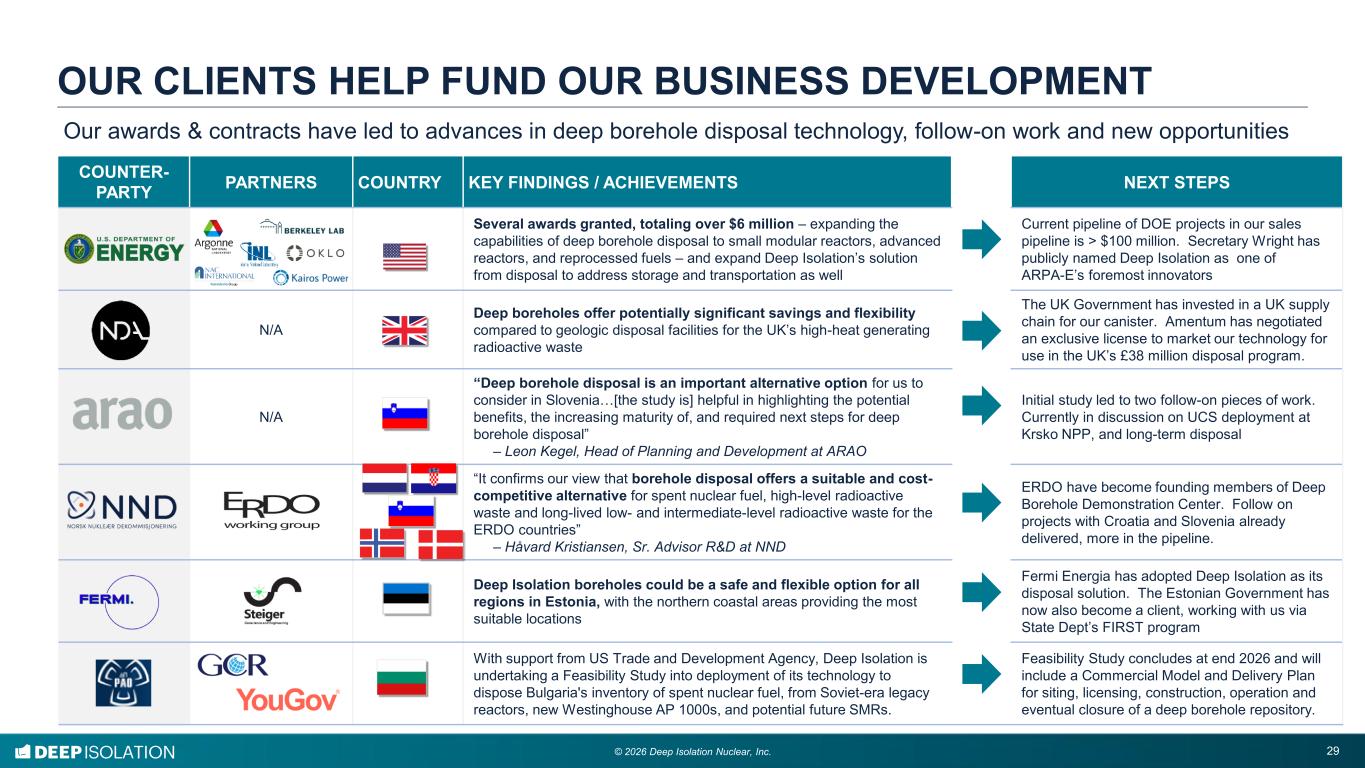
© 2026 Deep Isolation Nuclear, Inc. 29 OUR CLIENTS HELP FUND OUR BUSINESS DEVELOPMENT Our awards & contracts have led to advances in deep borehole disposal technology, follow-on work and new opportunities COUNTER- PARTY PARTNERS COUNTRY KEY FINDINGS / ACHIEVEMENTS NEXT STEPS Several awards granted, totaling over $6 million – expanding the capabilities of deep borehole disposal to small modular reactors, advanced reactors, and reprocessed fuels – and expand Deep Isolation’s solution from disposal to address storage and transportation as well Current pipeline of DOE projects in our sales pipeline is > $100 million. Secretary Wright has publicly named Deep Isolation as one of ARPA-E’s foremost innovators N/A Deep boreholes offer potentially significant savings and flexibility compared to geologic disposal facilities for the UK’s high-heat generating radioactive waste The UK Government has invested in a UK supply chain for our canister. Amentum has negotiated an exclusive license to market our technology for use in the UK’s £38 million disposal program. N/A “Deep borehole disposal is an important alternative option for us to consider in Slovenia…[the study is] helpful in highlighting the potential benefits, the increasing maturity of, and required next steps for deep borehole disposal” – Leon Kegel, Head of Planning and Development at ARAO Initial study led to two follow-on pieces of work. Currently in discussion on UCS deployment at Krsko NPP, and long-term disposal “It confirms our view that borehole disposal offers a suitable and cost- competitive alternative for spent nuclear fuel, high-level radioactive waste and long-lived low- and intermediate-level radioactive waste for the ERDO countries” – Håvard Kristiansen, Sr. Advisor R&D at NND ERDO have become founding members of Deep Borehole Demonstration Center. Follow on projects with Croatia and Slovenia already delivered, more in the pipeline. Deep Isolation boreholes could be a safe and flexible option for all regions in Estonia, with the northern coastal areas providing the most suitable locations Fermi Energia has adopted Deep Isolation as its disposal solution. The Estonian Government has now also become a client, working with us via State Dept’s FIRST program With support from US Trade and Development Agency, Deep Isolation is undertaking a Feasibility Study into deployment of its technology to dispose Bulgaria's inventory of spent nuclear fuel, from Soviet-era legacy reactors, new Westinghouse AP 1000s, and potential future SMRs. Feasibility Study concludes at end 2026 and will include a Commercial Model and Delivery Plan for siting, licensing, construction, operation and eventual closure of a deep borehole repository.

© 2026 Deep Isolation Nuclear, Inc. 30 DEEP BOREHOLE DEMONSTRATION CENTER ▪ In 2021-2022, Deep Isolation (in partnership with The University of Sheffield) conducted an in-depth survey of international stakeholder views from the regulatory, policy and waste management communities – Sponsored by UK Department for Business, Energy & Industrial Strategy and published at multiple international waste management conferences ▪ Study found that 4 out of 5 participants would welcome greater international collaboration on deep borehole disposal – Key themes in progressing the DBD solution included (i) demonstration and (ii) guidance ▪ The Deep Borehole Demonstration Center was founded in direct response to that demand, with the aim of advancing the maturity of the safety case for DBD and the technical readiness levels of the disposal concept Inception and Overview An independent, nonprofit, science-driven organization funded on a multinational, public-private-partnership basis ▪ February 2023: Initial emplacement and retrieval demonstration of a full weight and size disposal canister in Cameron, TX is successful ▪ May 2023: Deep Borehole Demonstration Center signs MOU with Norsk Kjernekraft to collaborate on a demonstration of DBD in Norway ▪ November 2023: Deep Borehole Demonstration Center signs MOU with TNO to collaborate on a demonstration of DBD in the Netherlands ▪ August 2024: Deep Isolation’s first fully prototypic disposal canister arrives at the Center for testing in prototypical pressure and temperature conditions, at start of test program supported by grants from UK and U.S. governments ▪ September 2024: Deep Borehole Demonstration Center hires Andy Griffith, a 40-year veteran of the nuclear energy sector with experience in the U.S. Navy, DOE and Battelle, as its new Executive Director ▪ January 2026: Groundbreaking held at Deep Borehole Demonstration Center facility in Cameron, TX for multi-year, full-scale, at-depth deep borehole demonstration program Key Events The Deep Borehole Demonstration Center has been actively testing Deep Isolation’s technology in Texas since January 2023 Initial full-scale PWR canister test on 23 February 2023 Class 1 UCS prototype, at Deep Isolation’s fabricator (RV Industries in Philadelphia), prior to shipping to DBDC for testing Corrosion testing at pressures and fluid chemistry of disposal depths, at Halliburton facility in Carrollton, TX Study tour to DBDC by Czech Government, Dec 2024
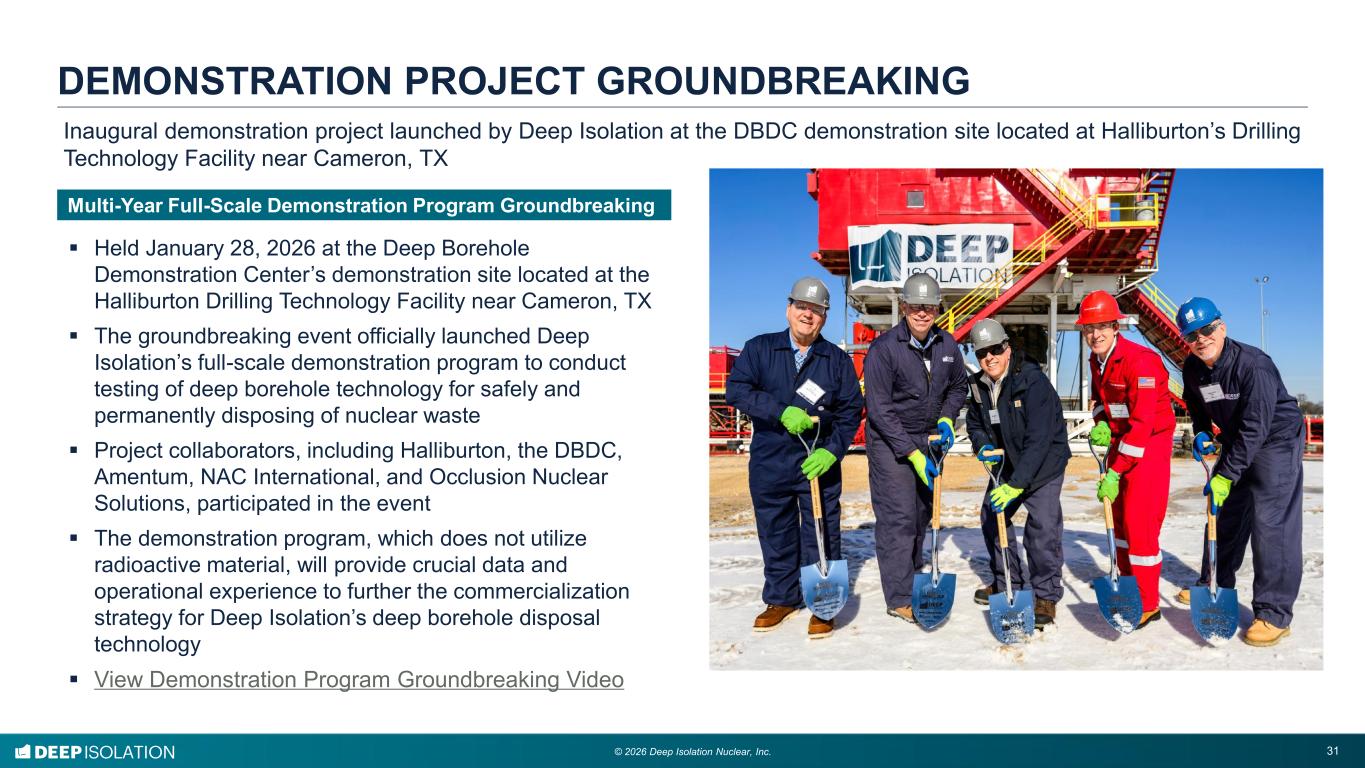
© 2026 Deep Isolation Nuclear, Inc. 31 DEMONSTRATION PROJECT GROUNDBREAKING ▪ Held January 28, 2026 at the Deep Borehole Demonstration Center’s demonstration site located at the Halliburton Drilling Technology Facility near Cameron, TX ▪ The groundbreaking event officially launched Deep Isolation’s full-scale demonstration program to conduct testing of deep borehole technology for safely and permanently disposing of nuclear waste ▪ Project collaborators, including Halliburton, the DBDC, Amentum, NAC International, and Occlusion Nuclear Solutions, participated in the event ▪ The demonstration program, which does not utilize radioactive material, will provide crucial data and operational experience to further the commercialization strategy for Deep Isolation’s deep borehole disposal technology ▪ View Demonstration Program Groundbreaking Video Multi-Year Full-Scale Demonstration Program Groundbreaking Inaugural demonstration project launched by Deep Isolation at the DBDC demonstration site located at Halliburton’s Drilling Technology Facility near Cameron, TX

© 2026 Deep Isolation Nuclear, Inc. PARTNER DESCRIPTION ▪ Deep Isolation has signed a Memorandum of Agreement with technical and engineering services provider Amentum to cooperate on the commercialization of Deep Isolation's radioactive waste disposal technology around the world. ▪ Deep Isolation has a Mentor-Protégé Agreement with SIMCO, a Bechtel subsidiary, which allows SIMCO to mentor Deep Isolation while providing scopes of work at the Waste Isolation Pilot Plant – the world’s only operational deep geological repository. ▪ Deep Isolation and Dominion Engineering, Inc. cooperate in the sales, development, and deployment of Deep Isolation’s patented SNF and HLW disposal technology. ▪ Deep Isolation signed a long-term cooperation and licensing agreement with NAC International to design, manufacture and supply the canisters that will be used to safely store and/or dispose of nuclear waste in deep horizontal boreholes. ▪ Deep Isolation and Navarro have entered into a strategic partnership to jointly demonstrate the feasibility of Deep Isolation’s solutions for disposal of high-level nuclear waste in the U.S. and abroad. ▪ Deep Isolation is collaborating with Halliburton on the deployment of its deep borehole nuclear waste disposal solution, with Halliburton providing drilling, well construction, and subsurface project management expertise – including construction of a full-scale, at-depth repository for non-radioactive demonstration at the Halliburton Drilling Technology Facility near Cameron, Texas ▪ Nuclear AMRC completed the manufacturing of the first full-size prototype canister in conjunction with Deep Isolation and NAC. ▪ Deep Isolation’s subsurface partner, Occlusion Nuclear Solutions brings advanced drilling, wellbore integrity, and real-time monitoring expertise to support safe and precise emplacement and retrieval of waste canisters. Integrating oil and gas engineering best practices with nuclear-grade safety and digital tracking, OCNS enhances the operational strength of Deep Isolation’s deep borehole disposal solution. 32 COLLABORATIONS / GLOBAL SUPPLY CHAIN Deep Isolation’s strong collaborator network enhances capabilities and reach

© 2026 Deep Isolation Nuclear, Inc. 33 PROACTIVE SUPPORT FROM THE U.S. GOVERNMENT Deep Isolation has garnered significant support from the U.S. Government from multiple federal agencies through direct contracts and formal Advocacy for Deep Isolation’s solutions internationally Team USA ▪ The Advocacy Center of the U.S. International Trade Administration (“ITA”) has identified Deep Isolation as a unique part of the U.S. offer in nuclear export markets, suitable for formal Advocacy by the Federal Government to overseas governments ▪ Initial Advocacy status has already been granted in the Philippines. ITA is now encouraging Deep Isolation to submit further advocacy applications in Europe, the Middle East and Asia. ▪ U.S. Department of State’s FIRST program has appointed Deep Isolation as its Spent Fuel and Waste Management Consultancy provider in Central and Eastern Europe ▪ Deep Isolation is supporting FIRST as an expert advisor on spent fuel and waste management for new-to-nuclear countries looking to deploy SMRs Study tour to DBDC by Czech Government, December 2024, funded by State Dept FIRST program Financial support from USTDA and ExIm ▪ In December 2024, the U.S. Trade and Development Agency announced grant support of $1.2 million for Deep Isolation Feasibility Study in Bulgaria: A delivery plan with supporting commercial model for siting, design, licensing, construction & operation of a deep borehole repository for: existing waste at Kozloduy NPP, new waste from two AP-1000s and future SMR waste In positive dialogue with U.S. Export-Import Bank to provide 22-year financing to support capital expenditure by Bulgarian government (and other governments) on Deep Isolation technology Enoh Ebong (Director of USTDA) and Sergey Tzochev (Head of the Board of Directors for State Enterprise Radioactive Waste) signing Deep Isolation Grant Agreement on December 13, 2024 Co-investment in R&D ▪ Department of Energy is investing over $6 million in Deep Isolation technology through ARPA-E and Small Business Innovation Research contracts - supporting collaboration with Argonne National Lab, Berkeley National Lab, Idaho National Lab, and companies including Kairos Power and Oklo Secretary of Energy Wright with Deep Isolation Team at ARPA-E Summit, March 2025

© 2026 Deep Isolation Nuclear, Inc. 34 COMPANY HIGHLIGHTS Safest, Simplest and Most Cost-Effective Solution to the Nuclear Waste Problem • Global academic and policy consensus that deep geological disposal is the safest solution for permanent disposal of high-level nuclear waste • Deep borehole disposal represents a 70% cost saving compared to today’s “solutions”: mined repositories and temporary storage • Deep Isolation employs mature, proven technologies and is the only permanent disposal solution ready for near-term deployment 1 Patent-Protected and Scalable Business Model • Extensive portfolio of IP covering every aspect of deep borehole disposal, presenting formidable barriers to entry • No identified private sector direct competitors for the Company’s solution • Global partnerships with leading drillers and nuclear waste management companies ensure seamless end-to-end delivery 3 $300 Billion Total Addressable Market Opportunity by 2050 “Up for Grabs” • Estimated ~$155B addressable market based on today’s waste inventory, projected to grow to ~$300B by 2050 as global nuclear capacity expands • Outside of Finland, Sweden and France, no other country has made material progress toward a permanent disposal solution for waste • Deep Isolation’s proprietary universal canister system can also be deployed for interim waste storage opportunities 2 Experienced Leadership Team Supported by a World-Class Advisory Board • Decades of combined C-suite, government and NGO leadership experience specific to the nuclear sector • Impressive Advisory Board including nuclear technology and policy leaders, and successful entrepreneurs • Innovative and entrepreneurial culture with the sole focus of revolutionizing the nuclear waste management sector Strong Financial Profile with Substantial Long-Term Growth Potential • Well-managed, low overhead business, with revenue projected to grow to ~$140M by 2030, ~$450M by 2035 and $2.2B by 2040 • Asset-light business model offers opportunity to invest directly in the global energy transition with minimal ongoing capital expenditure • Global licensing opportunity with strategic partners and governments unlocks significant passive revenue potential 6 Active U.S. Federal Support and Advocacy, Domestically and Abroad • Multiple grants, totaling ~$6 million awarded from U.S. Department of Energy; selected for SCALEUP Ready Program • Secured formal Advocacy assistance from U.S. Government in the Philippines, with other Advocacy applications in process • Paid support from U.S. State Department to execute consultancy studies with several countries in Eastern Europe 4 5
© 2026 Deep Isolation Nuclear, Inc. I l ti l , I . Thank You InvestorRelations@deepisolation.com 35

© 2026 Deep Isolation Nuclear, Inc. KEY 1Q 2026 FINANCIAL METRICS 36 $ in 000s, except per share info. 1Q 2026 1Q 2025 Revenue $1,447 $1,520 Research and development expenses $3,489 - Selling, general, and administrative expenses $2,840 $993 Adjusted EBITDA1 ($1,536) ($135) Net profit (loss) ($5,416) ($165) Weighted average diluted shares outstanding 57,628,502 40,736,035 Net cash used in operations $5,243 $12 $ in 000s 1Q 2026 FY 2025 Cash & cash equivalents $22,226 $27,434 ▪R&D expenses for Q1 related to front-end engineering work and the ordering of long-lead items for the non- radioactive, full-scale, at depth demonstration of our deep borehole technologies in Cameron, TX ▪SG&A expenses include approximately $538k of non-recurring legal and accounting costs for the preparation and filing of Deep Isolation’s registration statement with the SEC 1) Adjusted EBITDA is a non-GAAP financial metric. For a reconciliation of Adjusted EBITDA to net profit or loss please refer to the reconciliations provided on slide 37
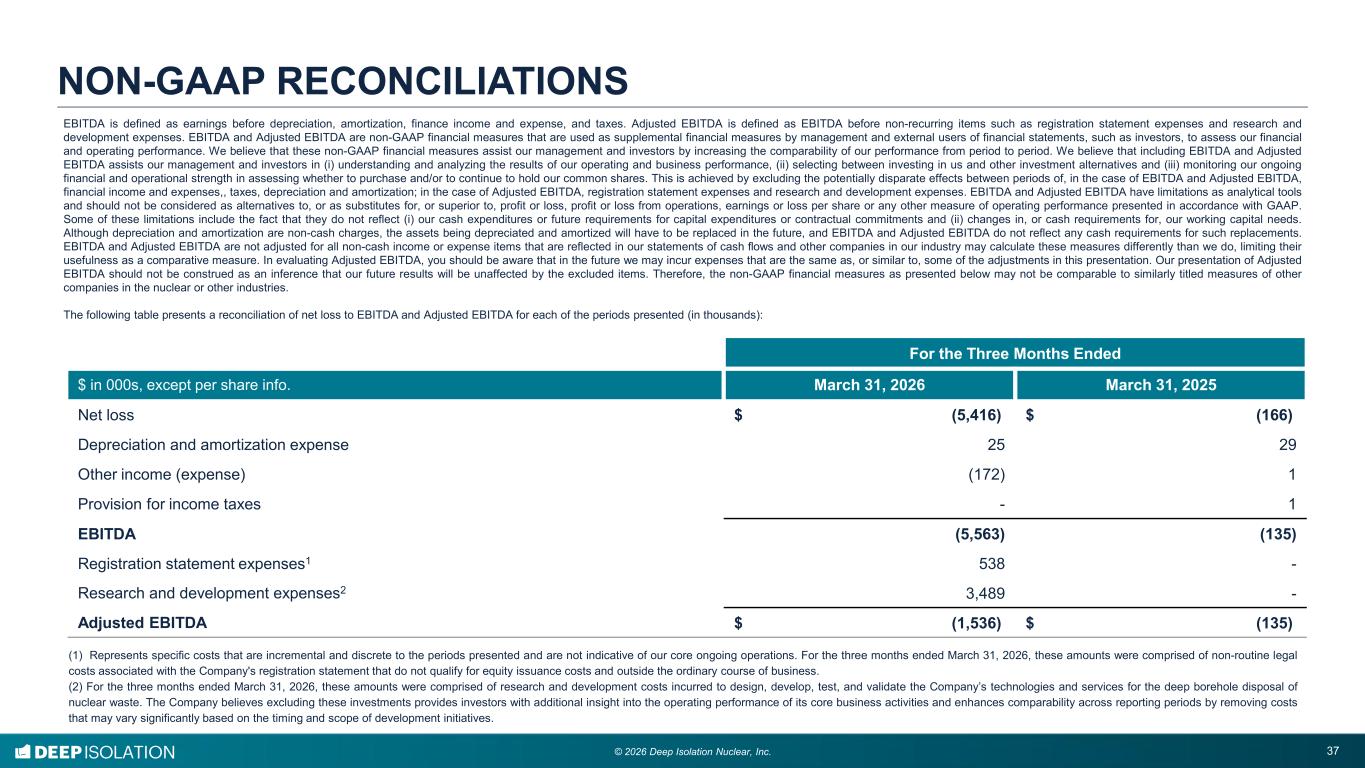
© 2026 Deep Isolation Nuclear, Inc. 37 NON-GAAP RECONCILIATIONS EBITDA is defined as earnings before depreciation, amortization, finance income and expense, and taxes. Adjusted EBITDA is defined as EBITDA before non-recurring items such as registration statement expenses and research and development expenses. EBITDA and Adjusted EBITDA are non-GAAP financial measures that are used as supplemental financial measures by management and external users of financial statements, such as investors, to assess our financial and operating performance. We believe that these non-GAAP financial measures assist our management and investors by increasing the comparability of our performance from period to period. We believe that including EBITDA and Adjusted EBITDA assists our management and investors in (i) understanding and analyzing the results of our operating and business performance, (ii) selecting between investing in us and other investment alternatives and (iii) monitoring our ongoing financial and operational strength in assessing whether to purchase and/or to continue to hold our common shares. This is achieved by excluding the potentially disparate effects between periods of, in the case of EBITDA and Adjusted EBITDA, financial income and expenses,, taxes, depreciation and amortization; in the case of Adjusted EBITDA, registration statement expenses and research and development expenses. EBITDA and Adjusted EBITDA have limitations as analytical tools and should not be considered as alternatives to, or as substitutes for, or superior to, profit or loss, profit or loss from operations, earnings or loss per share or any other measure of operating performance presented in accordance with GAAP. Some of these limitations include the fact that they do not reflect (i) our cash expenditures or future requirements for capital expenditures or contractual commitments and (ii) changes in, or cash requirements for, our working capital needs. Although depreciation and amortization are non-cash charges, the assets being depreciated and amortized will have to be replaced in the future, and EBITDA and Adjusted EBITDA do not reflect any cash requirements for such replacements. EBITDA and Adjusted EBITDA are not adjusted for all non-cash income or expense items that are reflected in our statements of cash flows and other companies in our industry may calculate these measures differently than we do, limiting their usefulness as a comparative measure. In evaluating Adjusted EBITDA, you should be aware that in the future we may incur expenses that are the same as, or similar to, some of the adjustments in this presentation. Our presentation of Adjusted EBITDA should not be construed as an inference that our future results will be unaffected by the excluded items. Therefore, the non-GAAP financial measures as presented below may not be comparable to similarly titled measures of other companies in the nuclear or other industries. The following table presents a reconciliation of net loss to EBITDA and Adjusted EBITDA for each of the periods presented (in thousands): For the Three Months Ended $ in 000s, except per share info. March 31, 2026 March 31, 2025 Net loss $ (5,416) $ (166) Depreciation and amortization expense 25 29 Other income (expense) (172) 1 Provision for income taxes - 1 EBITDA (5,563) (135) Registration statement expenses1 538 - Research and development expenses2 3,489 - Adjusted EBITDA $ (1,536) $ (135) (1) Represents specific costs that are incremental and discrete to the periods presented and are not indicative of our core ongoing operations. For the three months ended March 31, 2026, these amounts were comprised of non-routine legal costs associated with the Company's registration statement that do not qualify for equity issuance costs and outside the ordinary course of business. (2) For the three months ended March 31, 2026, these amounts were comprised of research and development costs incurred to design, develop, test, and validate the Company’s technologies and services for the deep borehole disposal of nuclear waste. The Company believes excluding these investments provides investors with additional insight into the operating performance of its core business activities and enhances comparability across reporting periods by removing costs that may vary significantly based on the timing and scope of development initiatives.