Operator
Good day, and welcome to East West Bancorp's second quarter, 2026 earnings call. All participants will be in a listen-only mode. Should you need assistance, please signal a conference specialist by pressing the star key followed by zero. After today's presentation, there will be an opportunity to ask questions. To ask a question, you may press star, then one on a touch-tone phone. To withdraw your question, please press star and then two. Please note this event is being recorded. I would now like to turn the conference over to Adrienne Atkinson, Director of Investor Relations. Please go ahead.
Thank you, Operator. Good afternoon, and thank you, everyone, for joining us to review EastWest Bank Corp's second quarter 2026 financial results. With me are Dominic Ng, Chairman and Chief Executive Officer, Chris Del Moral-Niles, Chief Financial Officer, and Irene Oh, Chief Risk Officer. This call is being recorded and will be available for replay on our Investor Relations website. The slide deck referenced during this call is available on our Investor Relations site. Management may make projections or other forward-looking statements, which may differ materially from the actual results due to a number of risks and uncertainties. Management may discuss non-GAAP financial measures. For a more detailed description of the risk factors and the reconciliation of gap-to-non-gap financial measures, please refer to our filings with the Securities and Exchange Commission, including the Form 8-K filed today. I will now turn the call over to Dominic.
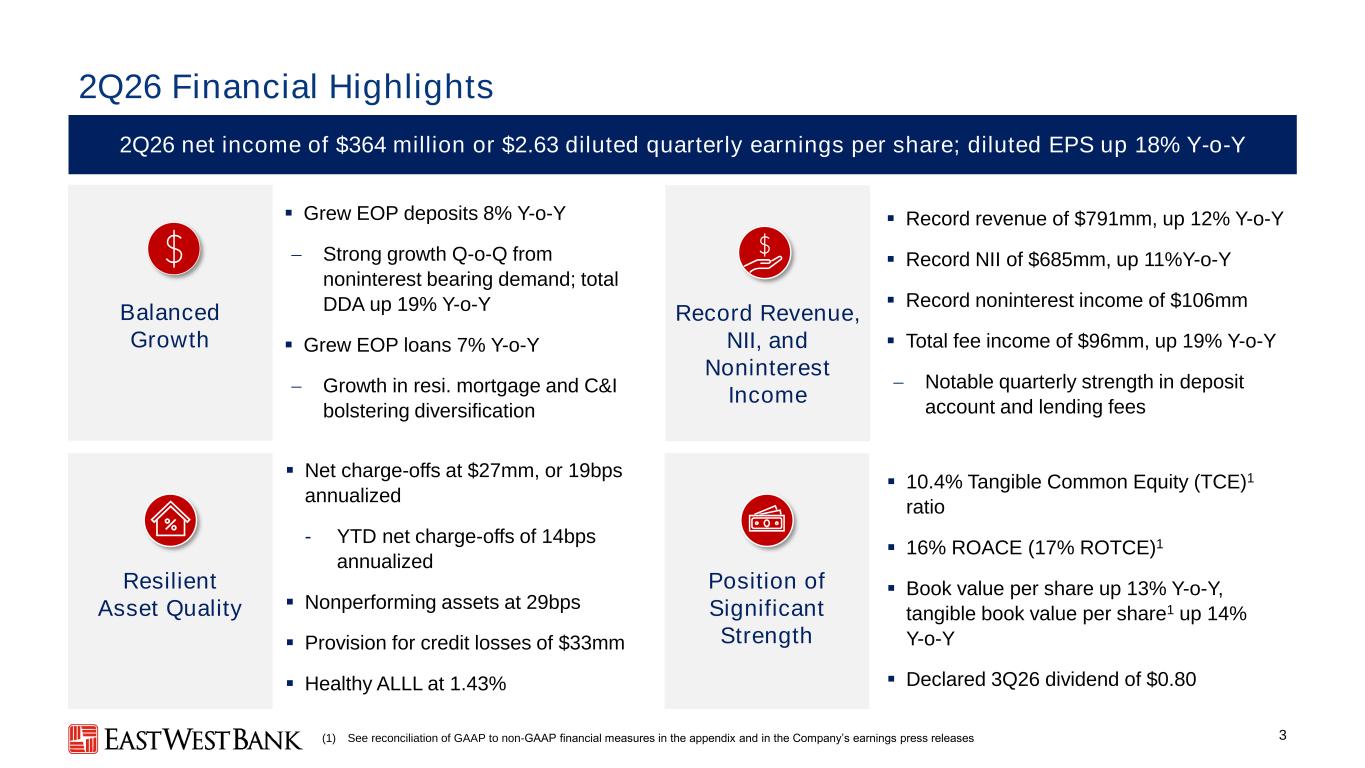
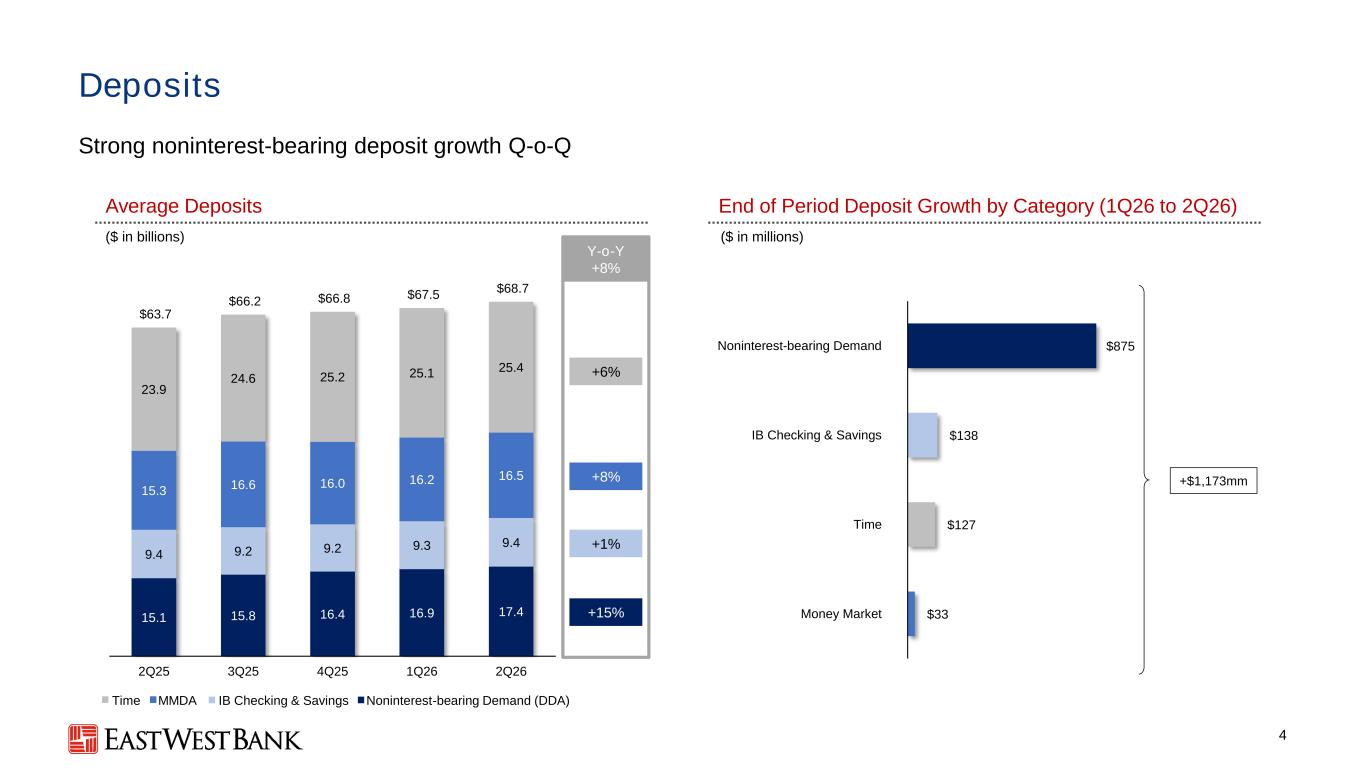
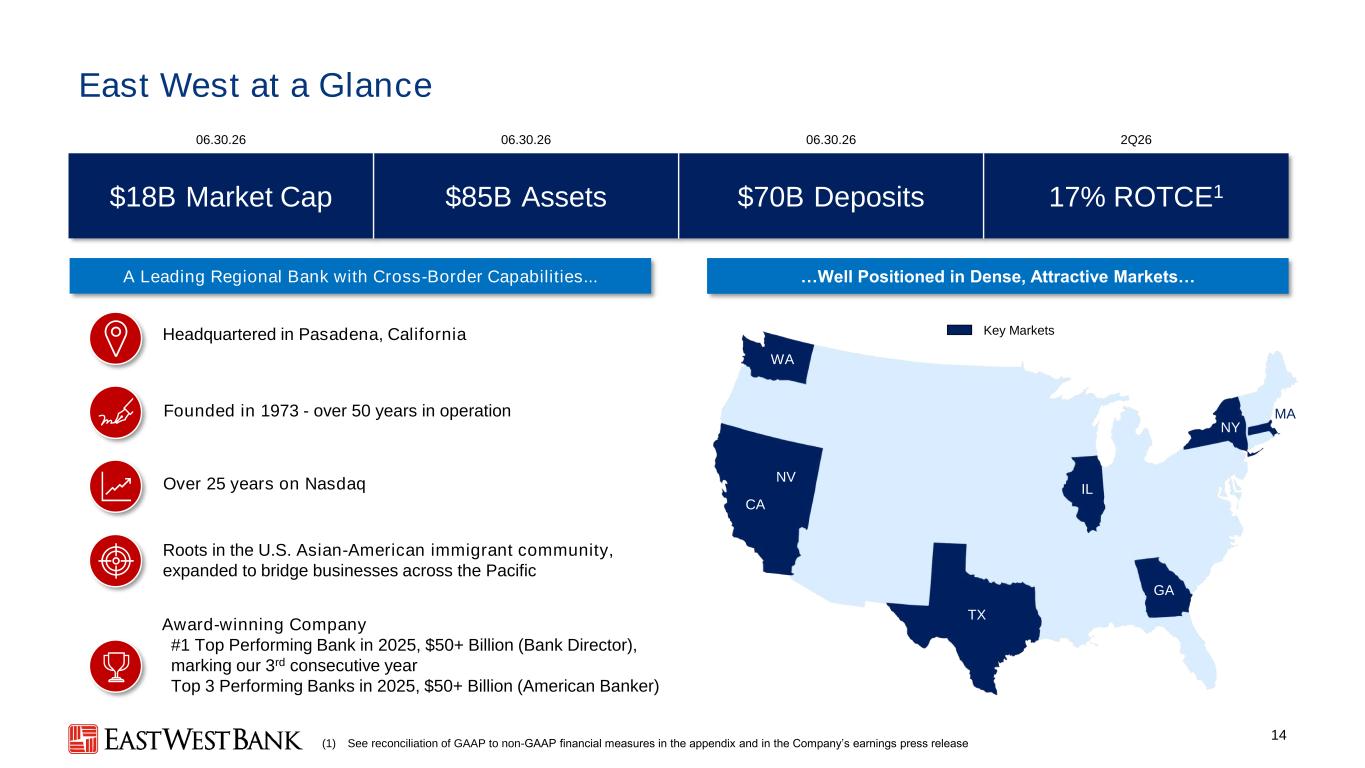
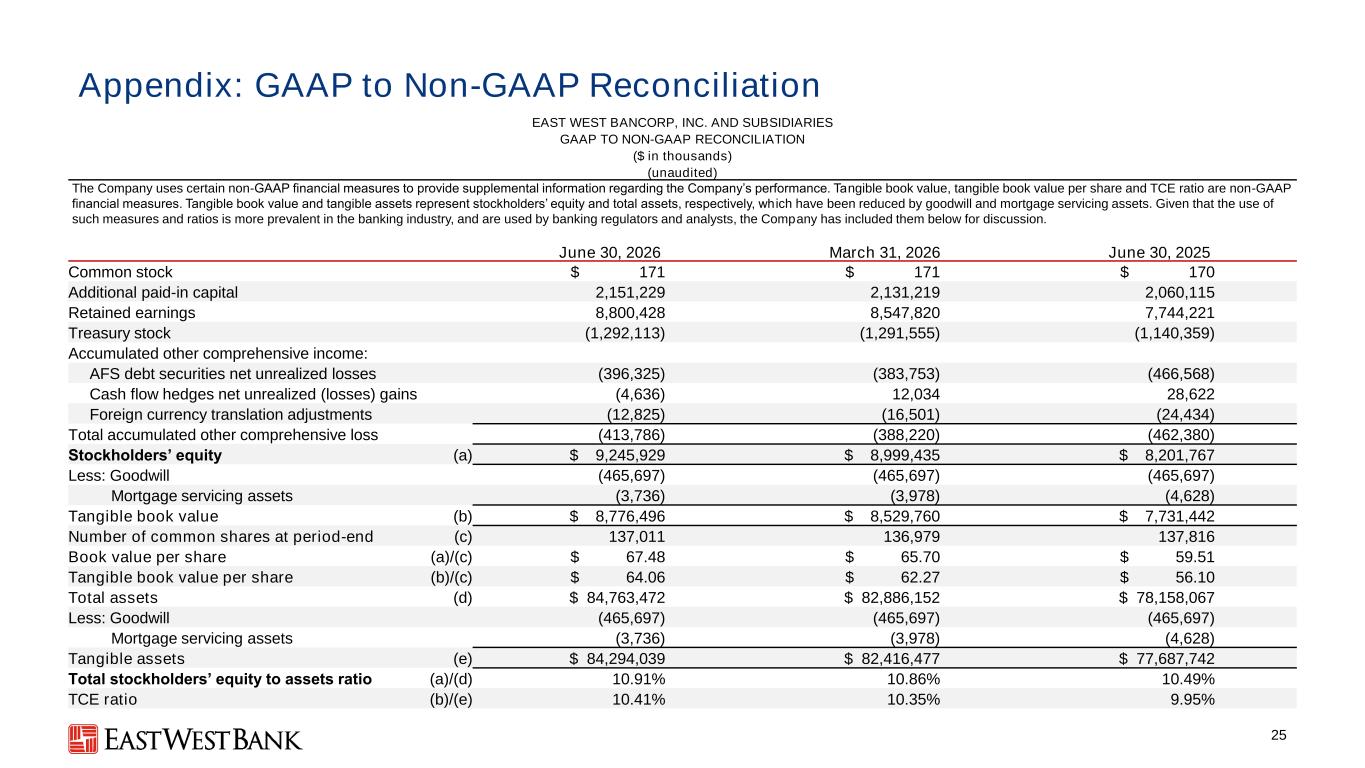
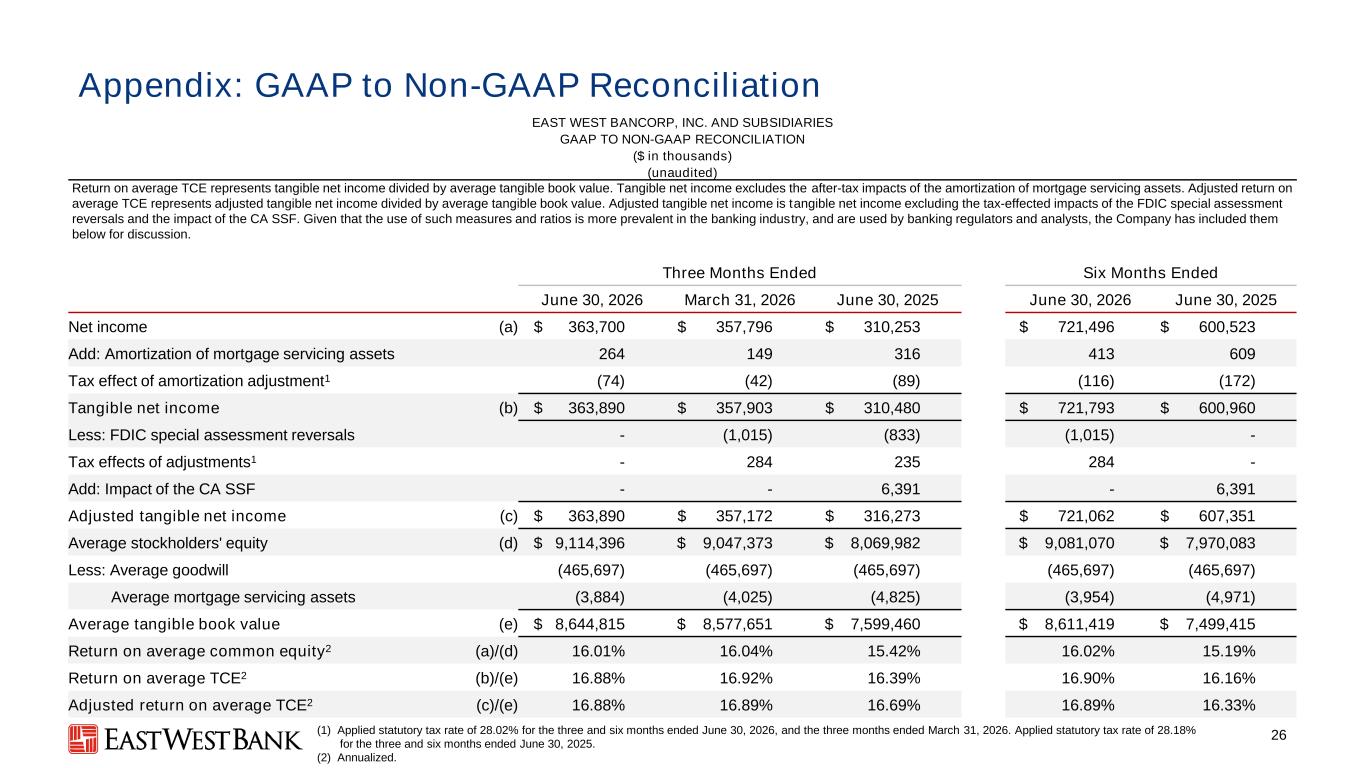
Good afternoon, and thank you for joining us for our second quarter earnings call. I'm pleased to report that EastWest earned record total revenue, net interest income, and non-interest income in the second quarter. These results were driven by new record levels of loans and deposits. Inner period deposits grew by 8% year-over-year, with strength across all deposit product categories. Notably, demand deposits accounted for more than two-thirds of this quarter's total increase. A continued focus on providing solutions to our customers helped drive a 19% increase in non-interest-bearing deposits year-over-year. End-of-period loans were up 7% year-over-year, with growth in residential mortgage and C&I further increasing the diversification of our portfolio. Non-interest income also grew to a new record in the second quarter and is up over 20% year-over-year. This performance has been driven by consistent execution across all our fee-based businesses. In particular, we see continued growth opportunities in wealth management and have been proactive in building out this business. Our credit quality remains strong. Non-performing assets, criticized loans, and net charge-off levels all remained broadly stable and continue to reflect our disciplined approach to risk management. Our capital position remains a key advantage for EastWest, with a tangible common equity ratio over 10%, on which we generate a 17% return. We believe our financial strength and customer-focused strategy position us to deliver sustainable growth and long-term shareholder value. I will now turn the call over to Chris to provide more details on our second quarter financial performance. Chris?
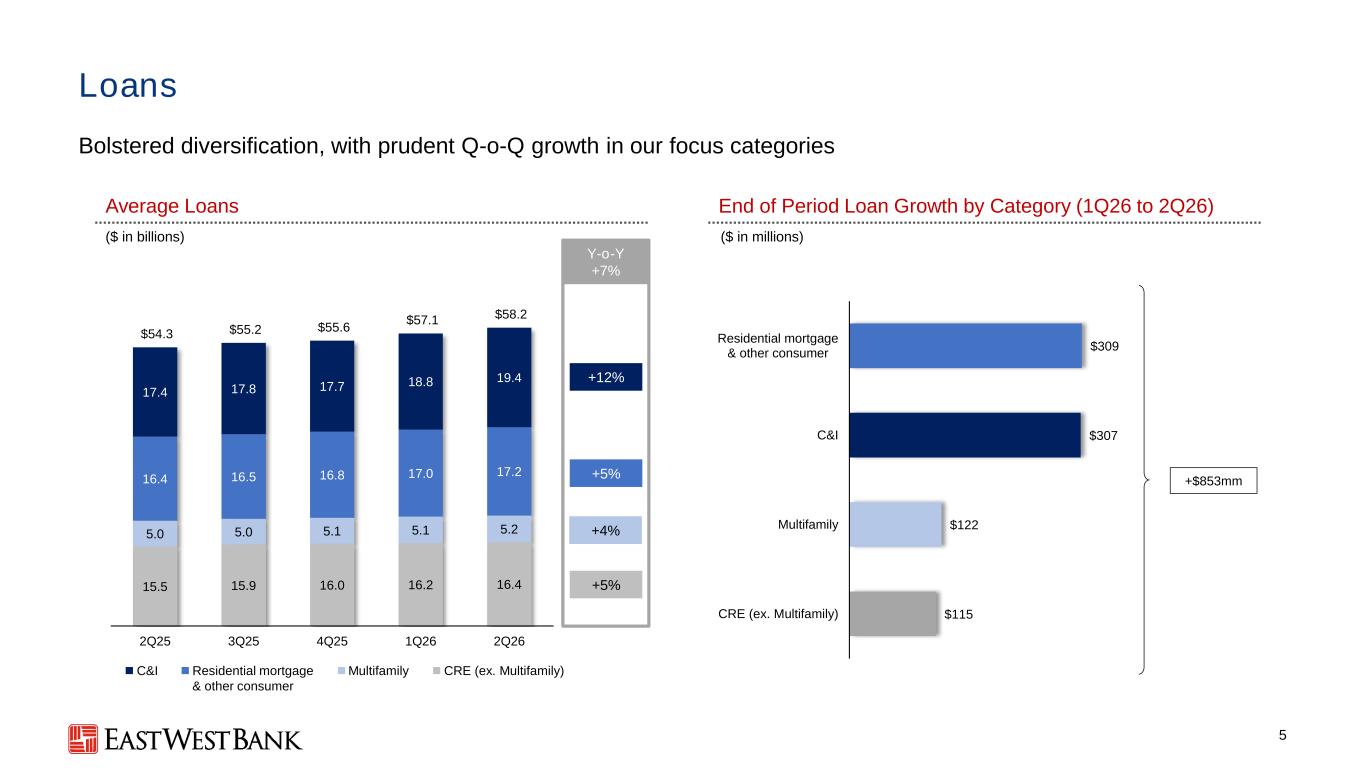
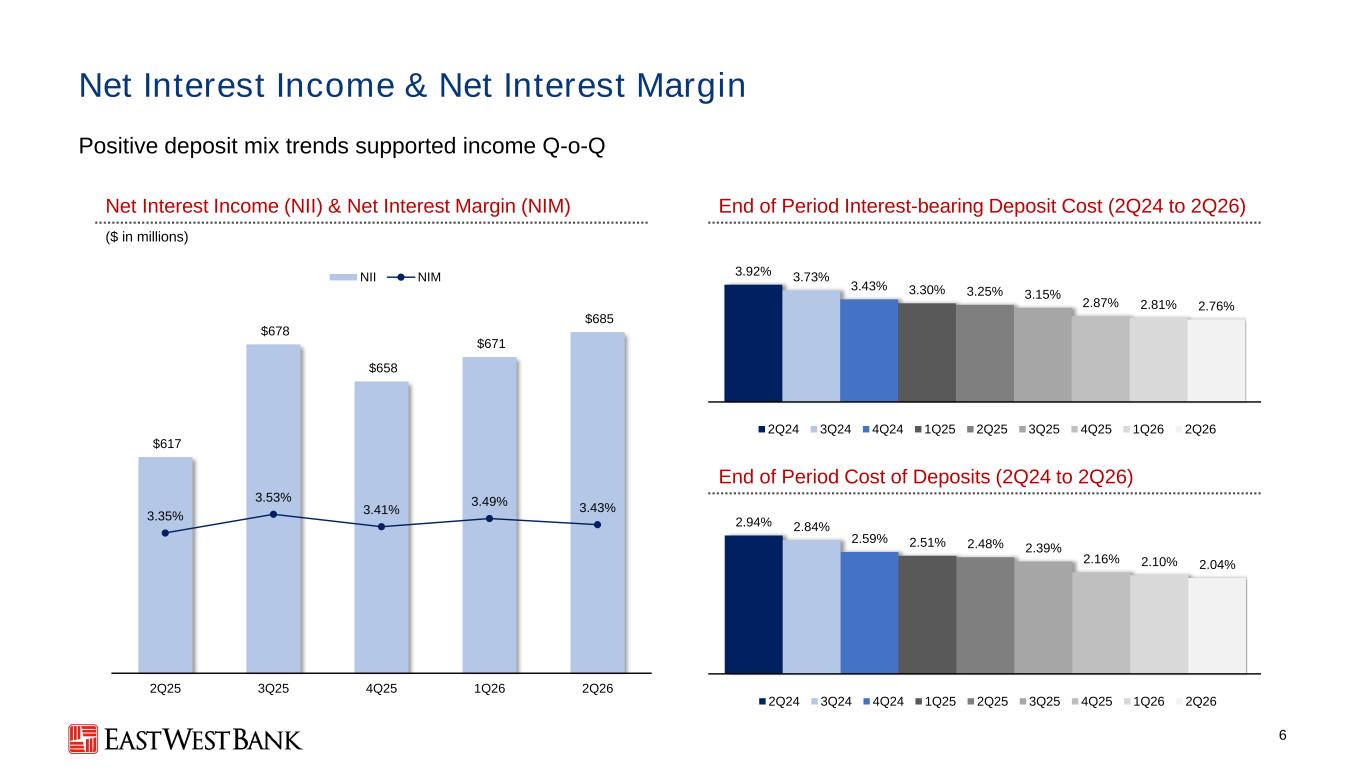
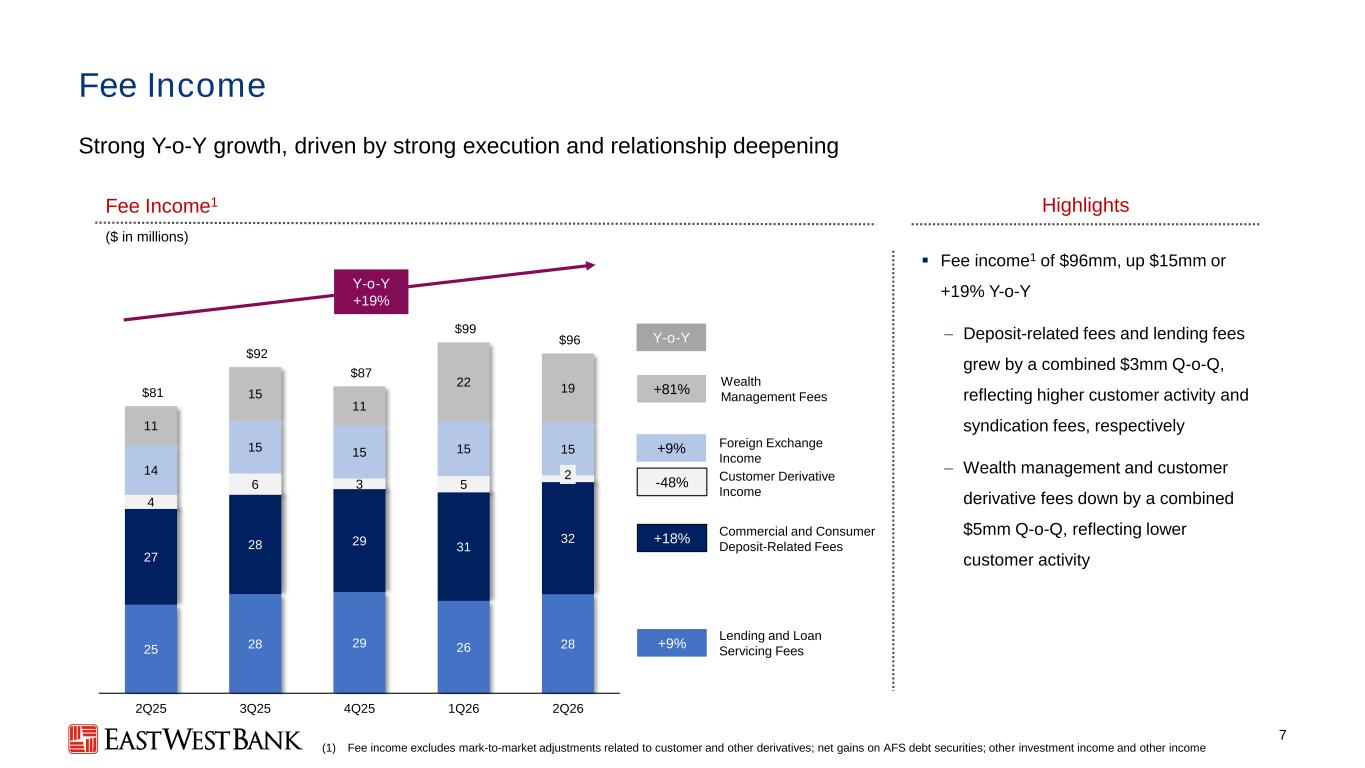
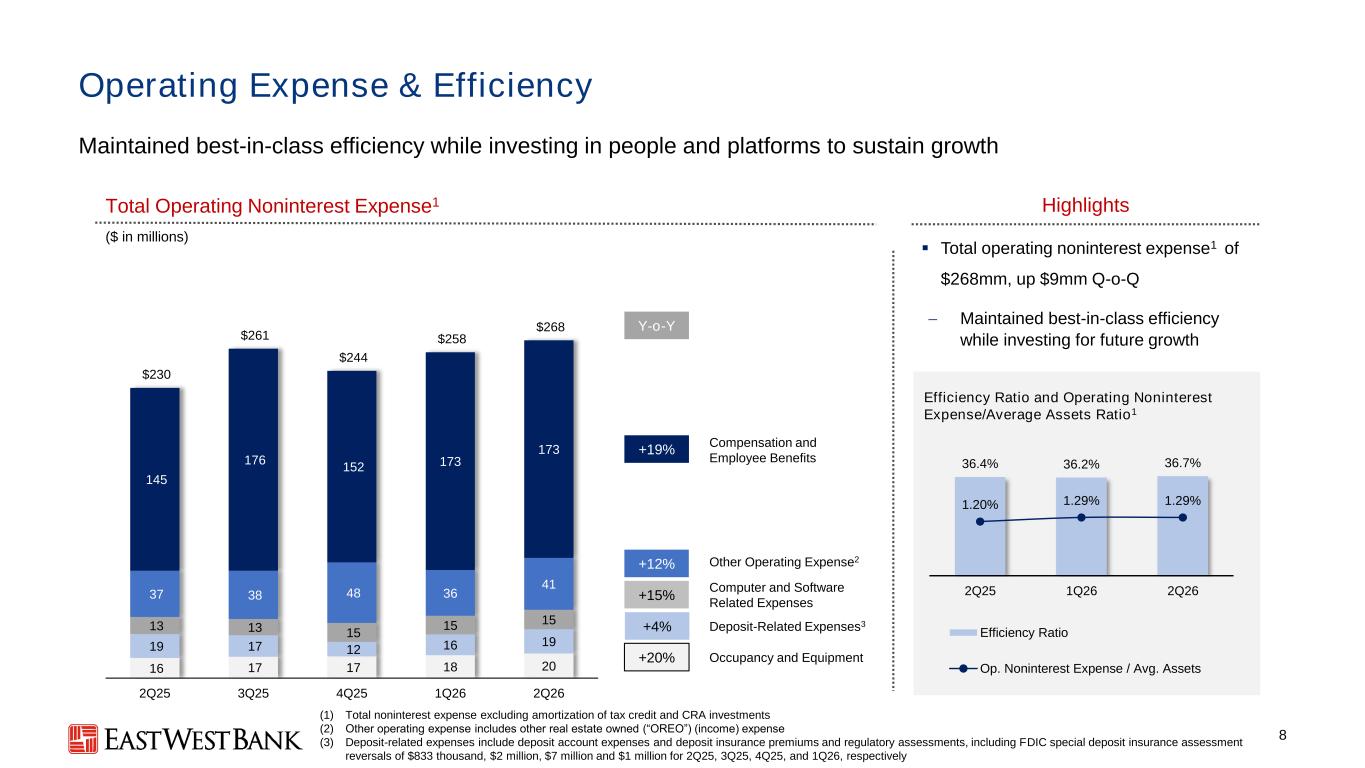
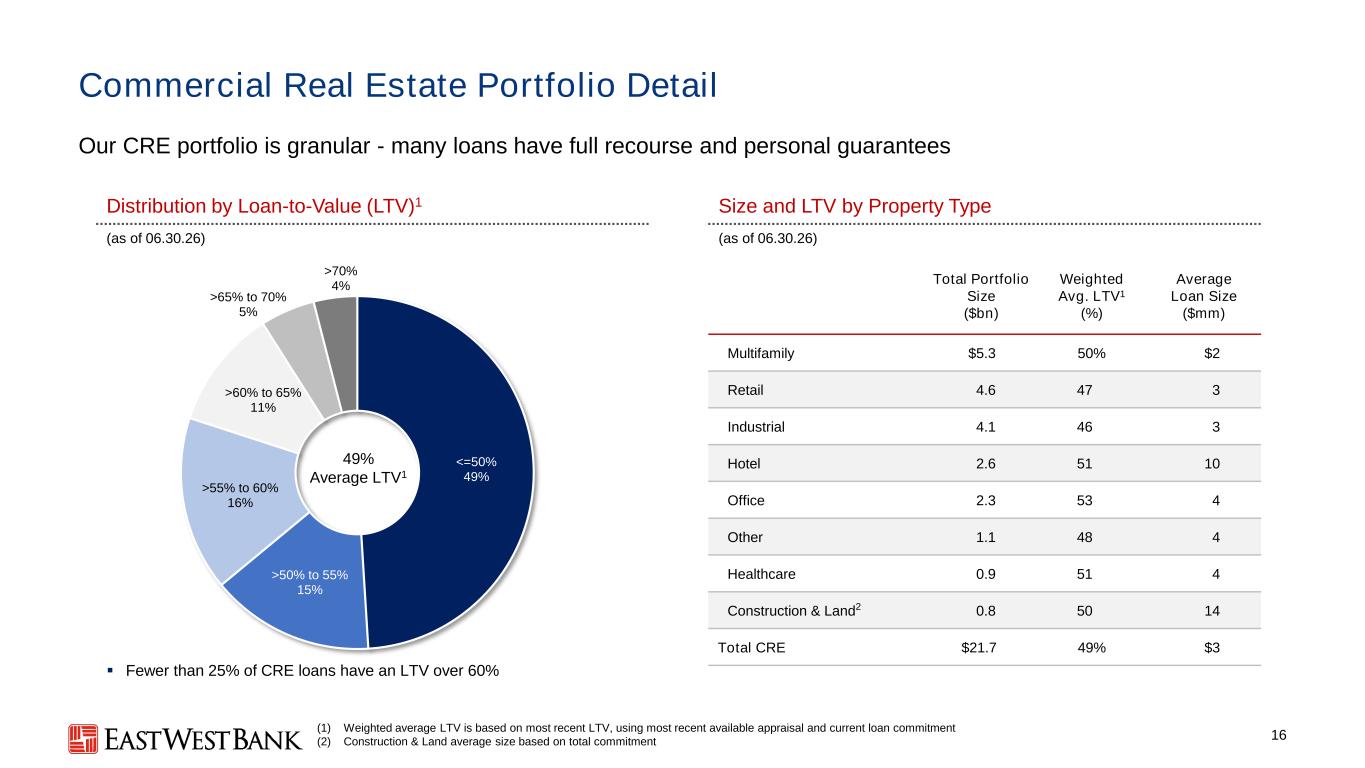
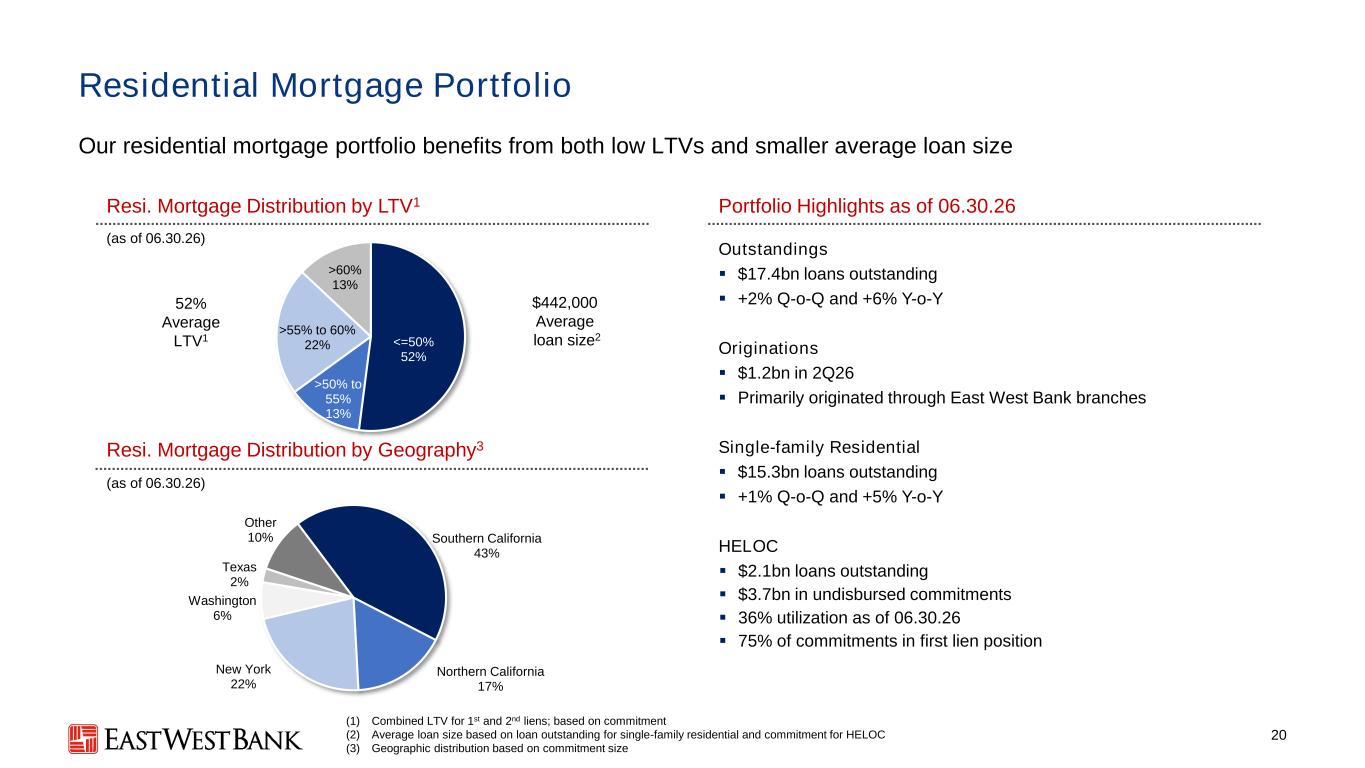
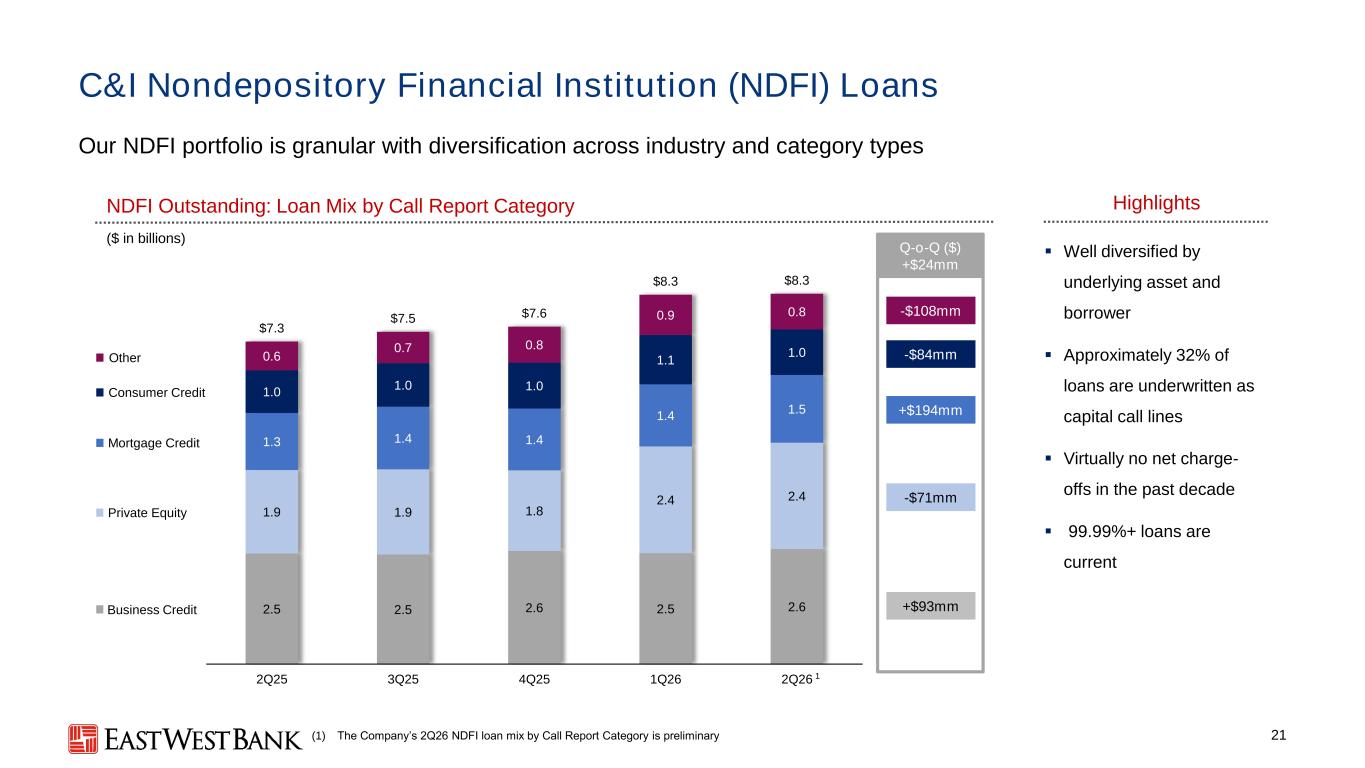
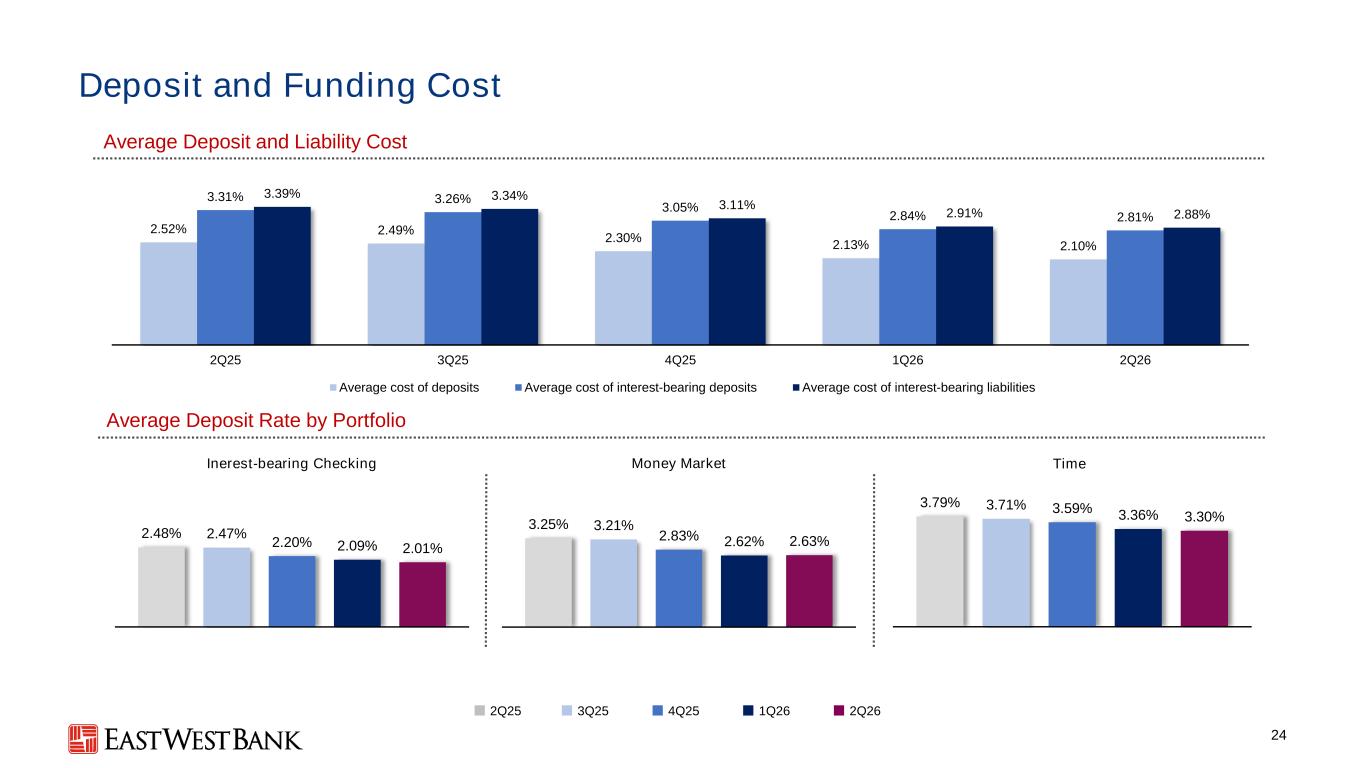
Thanks, Dominic. Let's start with the deposit slide on page four. Our end-of-period deposits grew by $1.2 billion across our more than 700,000 customer accounts. Demand deposits were up $875 million during the quarter, which accounted for the lion's share of the growth. Average DDA was up 15% year-over-year, reflecting the continued success of our small business checking campaigns and positive flows from tariff refunds across hundreds of our accounts. Our DDA mix grew to 26% of total deposits due to core relationship growth. We continue to shift away from CDs, wholesale, and public funds deposits, and further emphasize core DDA. This ongoing shift helped us to support the margin and control our deposit costs during the quarter. Turning to loans on slide five, as Dominic mentioned, we continue to diversify our loan portfolio by emphasizing growth in residential mortgage and CNI. Residential mortgage was this quarter's standout, with over $300 million of net growth. We remain committed to our conservative underwriting approach as we continue to maintain a 52% average portfolio LTV in our residential book. C&I lending balances were also up over $300 million in the second quarter, with notable growth in lending to financial services, equipment, finance, and lessors, and manufacturers and wholesalers. Our NDFI balance has increased by just $24 million, reflecting expected paydowns in our private equity loan book and consumer credit portfolios, which we had anticipated and relayed last quarter. Overall, C&I loans are up 11% year-over-year, representing over $2 billion of net growth in that period. Given the 7% level of growth we've seen over the first half of the year, and the pipelines that we see looking into Q3, we are updating our guidance for the full year loan growth to now be in the range of 6% to 8% by year end. Switching to NII on margin trends on slide 6, quarterly dollar net interest income grew to a record $685 million, reflecting our balance sheet growth and improving mix shift. Our net interest margin came in at 3.43%, reflecting one less day in the quarter in line with our guidance, and up, notably, eight basis points year over year. Our positive deposit remixing trends continued during the quarter and allowed us to further to reduce our deposit costs, driving a six-basis point reduction in our period and deposit costs. Looking back over the past year, we have decreased interest-bearing deposit costs by 49 basis points against a backdrop of 75 basis points of cuts in the Fed's final target. Given our robust NII growth year-to-date, we now expect full-year NII growth to be in the range of up 7% to 9%, an improvement from prior guidance range of 6% to 8%. Moving on to fees on slide 7, quarterly fee income grew 19% year-over-year to $96 million. While total fee income was down $3 million from Q1, this largely reflects the record wealth management results we reported in the first quarter and a slight downtick in some derivative activity. Nonetheless, loan and deposit-related fees were up 14% year-over-year, reflecting our ability to grow fees as we grow the balance sheet. We remain focused on driving a healthy level of fee income and further diversifying our revenue streams. We are on track to deliver double-digit year-over-year growth in fee income for 2026. Turning to expenses on slide 8, total operating non-strict expenses were $268 million for the second quarter. Comp and benefits costs were flat quarter by quarter. However, we expect the level of comp and benefits to actually moderate over the back half of the year. Other expense categories experienced an uptick as we continue to invest in people and platforms to sustain growth. Nonetheless, East-West delivered another quarter of industry-leading efficiency. The Q2 efficiency ratio was 36.7%, consistent with her prior periods, and our operating non-interest expense to average asset ratio remained flat at 1.29%. Based on our year-to-date trends, we are narrowing our full-year expense growth guidance range to 8% to 9% versus last year. I will now hand the call over to Irene for comments on credit and capital.
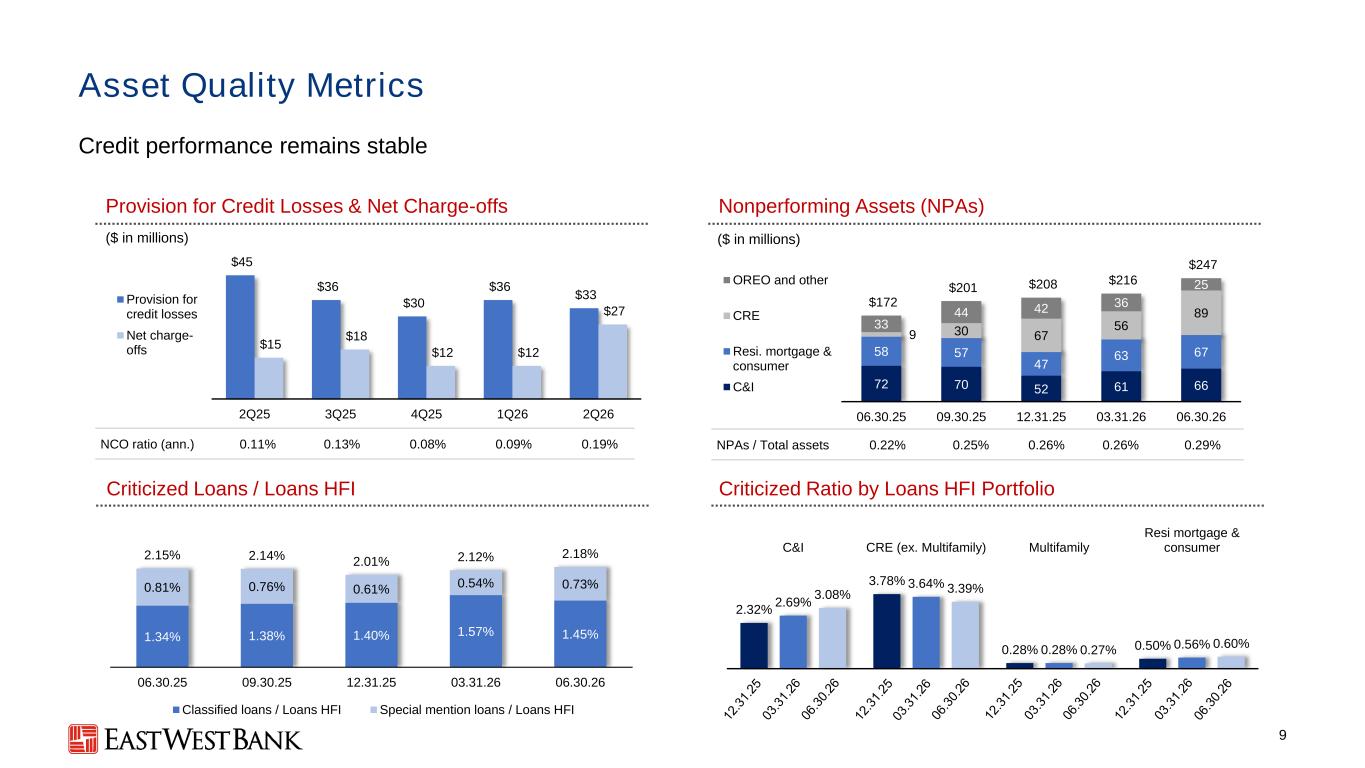
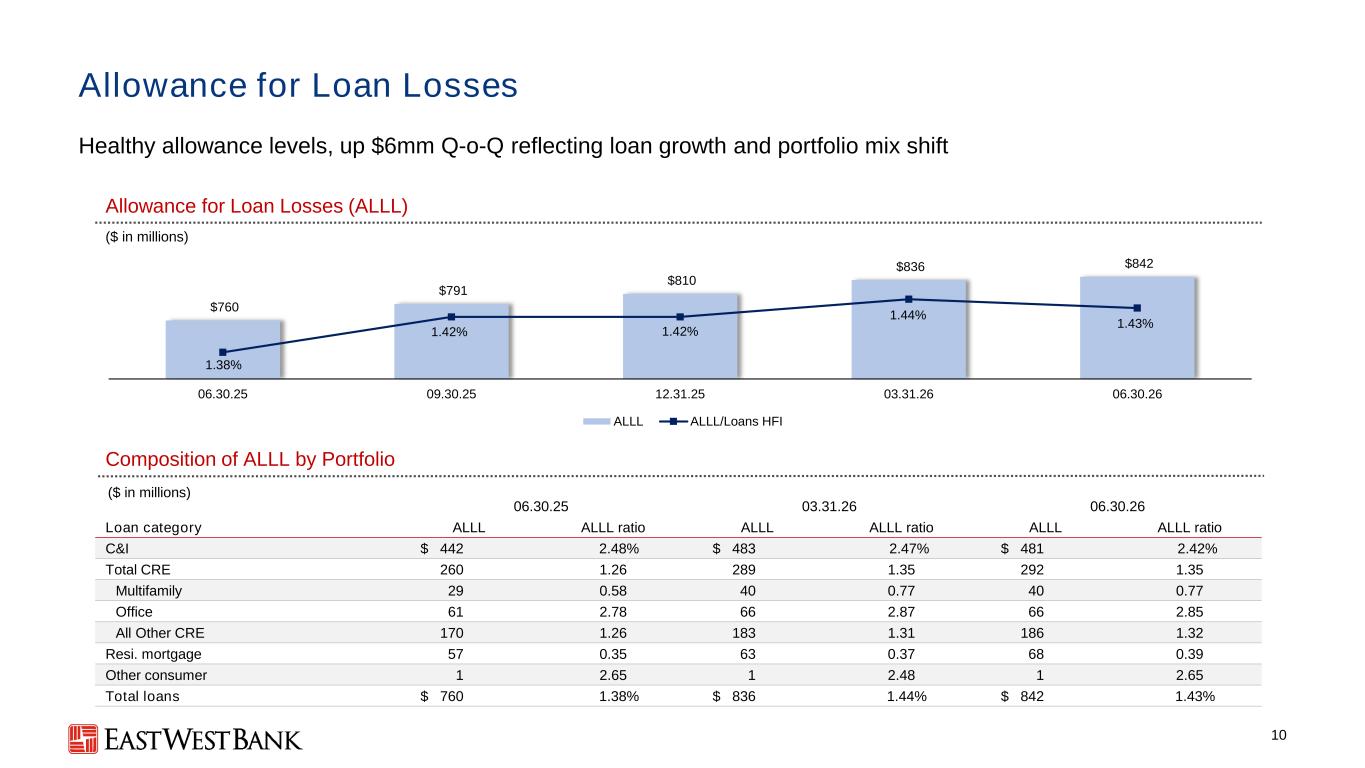
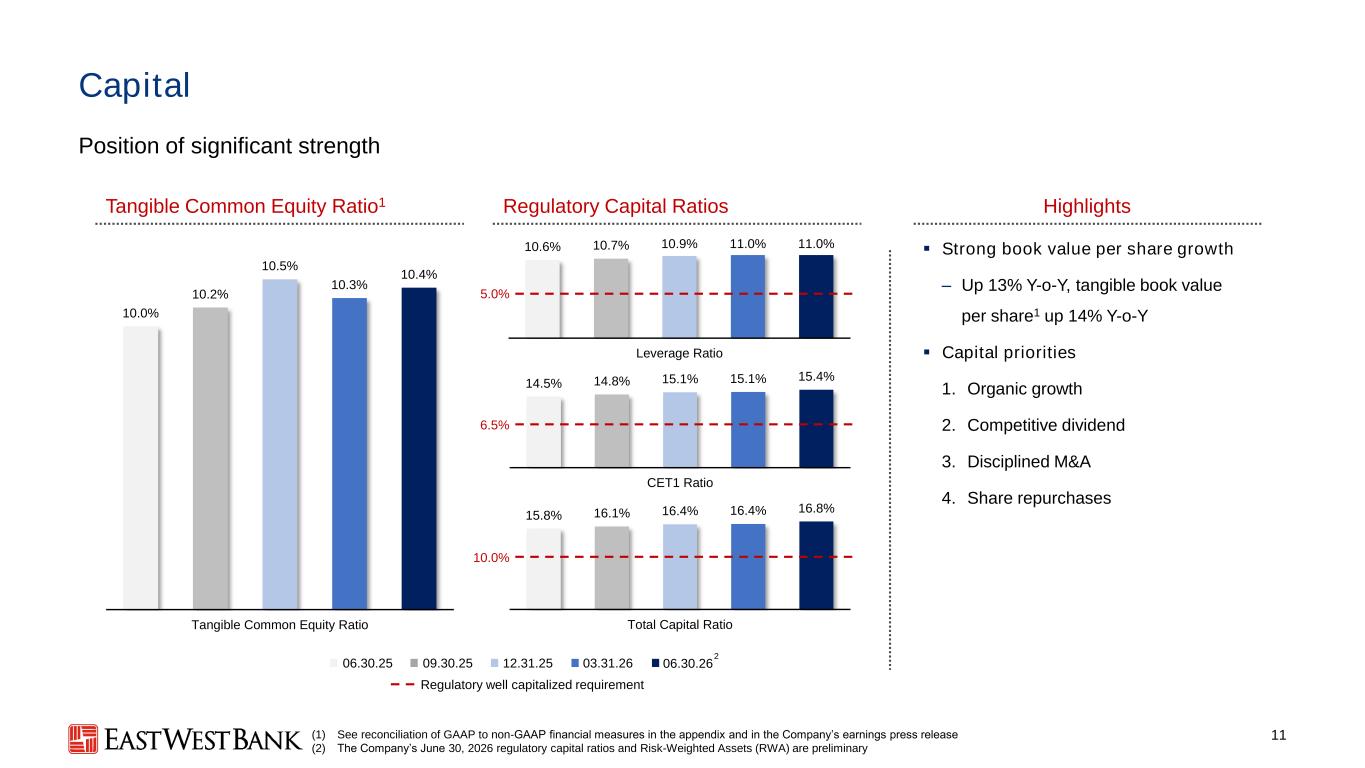
Good afternoon to all on the call. As you can see on slide nine, our asset quality metrics held broadly stable. Quarter over quarter, non-performing assets saw a slight uptick of three basis points to 29 basis points as of June 30, 2026. We recorded net charge-offs of 19 basis points in the second quarter, or $27 million, compared to nine basis points in the first quarter, or $12 million. We are reaffirming our guidance range of 15 to 25 basis points for the full year. We recorded a provision for credit losses of $33 million in the second quarter, compared with $36 million for the first quarter. Overall, we continue to remain vigilant and proactive in managing our credit risks. Turning to slide 10, the allowance for credit losses increased $6 million to $842 million, or 1.43% of total loans as of June 30, reflecting quarter-over-quarter loan growth and portfolio mid-shift. We believe we are adequately reserved for the content of our loan portfolio, given the current economic outlook. Turning to slide 11, all of East-West's regulatory capital ratios remain well in excess of regulatory requirements for well-capitalized institutions and well above regional and national bank averages. East-West's common equity Tier 1 capital ratio stands at a robust 15.4 percent, while the tangible common equity ratio now sits at 10.4 percent. These capital levels continue to place us amongst the best capitalized banks in the industry. We currently have $117 million of repurchase authorization. There are remains available for future buybacks. EastWest also distributed approximately $111 million to shareholders via quarterly dividends. EastWest's third quarter 2026 dividend will be payable on August 17, 2026, to stockholders of record on August 3rd, 2026. I will now turn the call back to Chris to share our outlook.
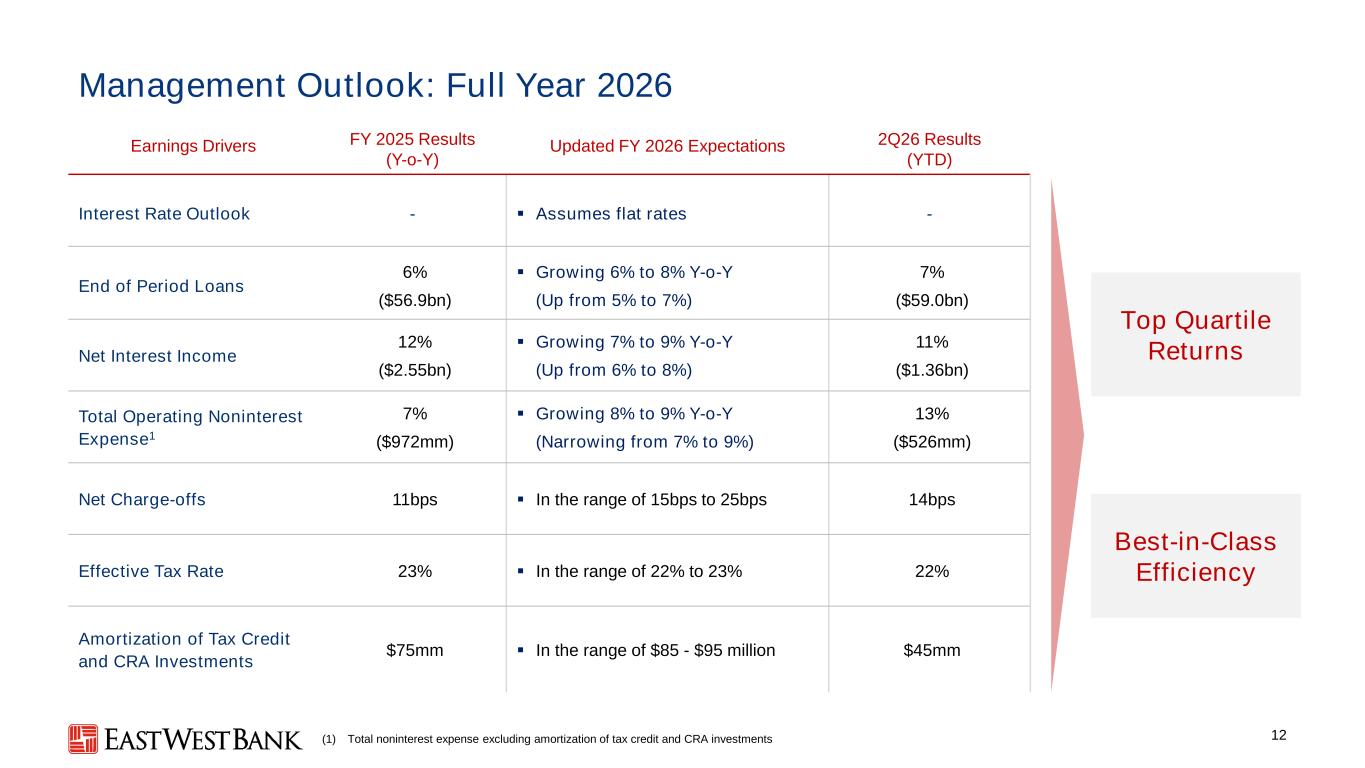
Thank you, Irene. To recap, we have updated four elements for guidance today, each of which is reflected on slide 12. Number one, we're assuming flat Fed funds through the end of the year. Number two, we're increasing our 2026 full-year guidance for end-of-period loan growth. Number three, we are increasing our full year 2026 net interest income guidance. And number four, we're narrowing the range of our full year expense guidance. With that, I'll now open the call for questions. Operator?
Operator
Thank you. We will now begin the question and answer session. To ask a question, you may press star, then one on your touchtone phone. If you are using a speakerphone, please pick up your handset before pressing the keys. If at any time your question has been addressed and you would like to withdraw your question, please press star and then two. In the interest of time, please limit yourself to one question and one follow-up. We'll now pause momentarily to assemble the roster. The first question will come from Jared Shaw with Barclays. Please go ahead.
Hey, good afternoon. Thanks. I guess maybe just starting with margin, you know, there's great trends in cost of funds. It looks like you saw a little bit of spread compression maybe on the loan side. How should we think about some of those components going forward in the supply rate environment? Is there, you know, still an expectation that loan yields grind lower from here?
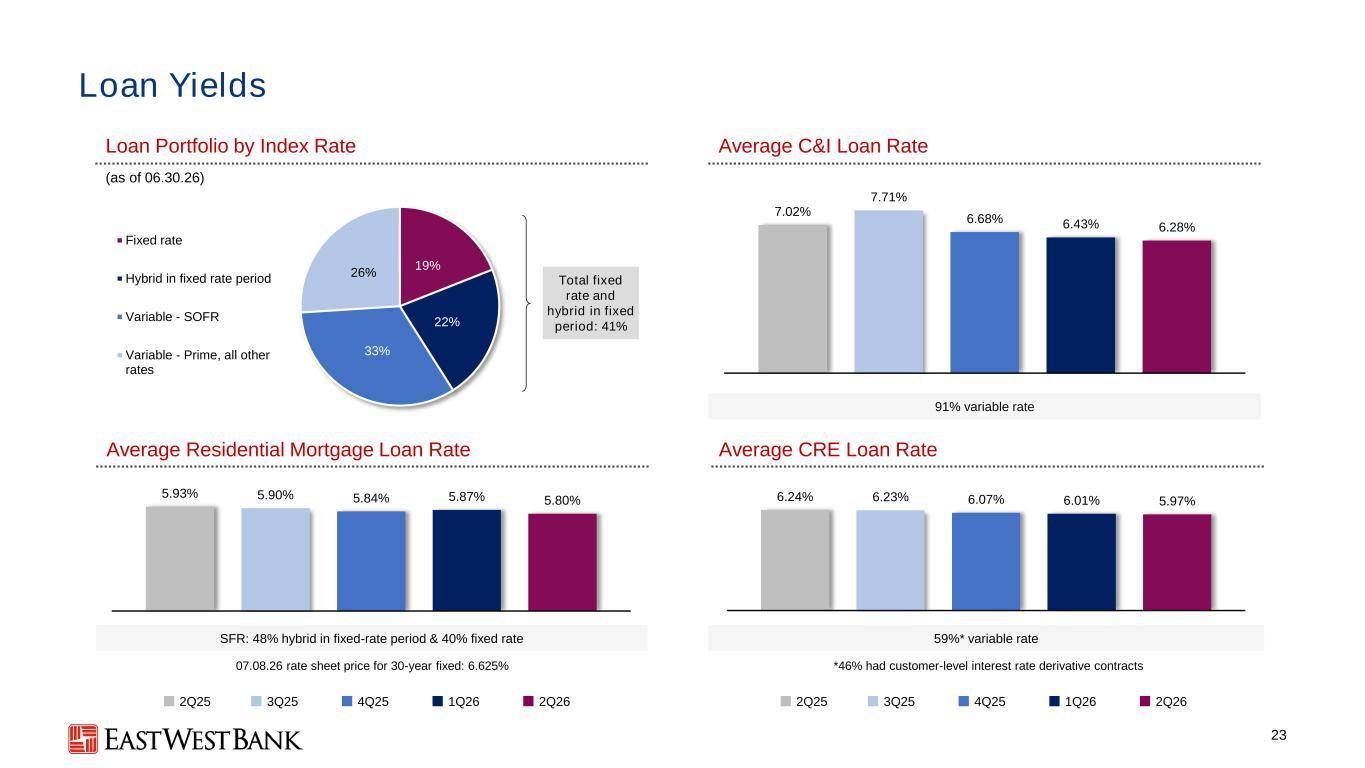
Well, Gary, we're focused on, first of all, hitting our net interest income targets, and those continue to come along quite nicely. Absolutely, we consider margin dynamics. Overall, we expect our margin to hold relatively stable as we look to a relatively stable said month environment. That having been said, yes, we're seeing some marginal compression or grinding, as you put it, on loan. Part of that was mix-driven, and part of that was some one-time accretion benefits that we saw in the first quarter, which partly offset by some negative items that we saw in the second quarter. That having been said, our general outlook is we're going to hold the margin relatively stable and continue to grind out stronger NII through balance sheet growth over the balance of the year. Obviously, there will be some deposit competition factors that we're very mindful of and very thoughtful about as we think about how we're going to roll over and reprice particularly our CDs in Q3. But so far, our customers have hung with us, even as we've been pricing below what might be considered top of market by a decent amount and a reflection of the customer relationships that we have and our ability to manage those at the branch level. Okay.
All right. Thanks. I guess on the deposit side, you called out the DBA growth part of that coming from tariff benefits. What's the expectation of those balances staying through or our customer is going to be deploying that windfall? And could you remind us of what the CD roll-off is in the third quarter?
Sure. Let me take those in backwards order. The CD roll-off in the third quarter will be $13 billion, and we're proactively pricing that today at 360 and 375 on – 360 on a six-month and 375 on a 12-month, although we'll be looking at those levels as we, you know, migrate through the quarter. In all likelihood, we'll be a little bit more competitive later in the quarter. With respect to tariff deposits, yes, we did see inflows. We estimate roughly somewhere between 200 and 250 of the period end balance likely reflected net excess tariff-related inflows, but what we saw throughout the quarter is money came in and money went out. And so we would tell you that of the 250, 200, 250 that was there at quarter end, most of it has already gone back to wherever it needed to go. On the other hand, there are ongoing tariff deposits coming in still under those refund programs, and they'll likely continue into August.
Operator
Thank you. The next question will come from Casey Hare with Autonomous Research. Please go ahead.
Afternoon, Casey. You might be on mute. Casey, going once. All right, next one, operator.
Operator
The next question will come from Dave Rochester with Cantor. Please go ahead. Hey, good afternoon, guys.
Just maybe one quick on expenses on the guide. It looks like you would need to see a decrease from that 2-2 level in the back half of the year. And, Chris, you spoke to moderating comp expense going forward earlier.
Is that primarily where you're going to see the decrease to be able to hit that guide?
And then what is it that made that comp line elevated this quarter?
I think you've probably heard two or three of our peer banks talk about deferred comp expenses this quarter. And so we do have a deferred comp plan, and that's part of it, obviously. We also had some changes to the way we think about vacation pay around here that influenced that number this quarter. But those two things will moderate out, therefore, the comp line, certainly in Q3, and likely dampen what would otherwise be growth in Q4. And so that gives us comfort that overall expense levels will remain relatively stable as they move through the back half of the year.
Great. And then just back on the GDA growth, again, that was outstanding. I know some of this is coming from the tariff benefit. fit. Have you guys changed any of your banker incentives or anything else that could support that going forward as you focus the shift towards more DDA?
I think it's been more a change of messaging and direction and focus. And that combination has resulted in, I think, a behavioral shift where people have seen the light on the need to essentially go door to door and make sure that that we are evangelizing the East-West value proposition as efficiently and effectively as possible. And that continues to work really well in our core markets.
We have a – I mean, on the retail banking side, we have a focus on getting our retail bankers to go after small business checking accounts. And that campaign has been going pretty well. In fact, it done pretty well last year. It continued to do well this year, getting them to focus on commercial banking clients. They're a small business, small business, one small business at a time. Now, that's not to say they are not taking care of retail consumer clients, as that's always their core business. They have continued to bring in retail consumer core customers. But meanwhile, they're also out there in the market, on the street, and then talking to, you know, small business one at a time. And so far, they've generated some pretty decent momentum. I think that clearly contributes to our growth of non-interest-sparing deposits.
Operator
Sounds good. Thanks, guys. The next question will come from David Smith with Truist Securities. Please go ahead.
Good afternoon. Hey, good afternoon. C&I growth was pretty strong. Can you talk about the range of industries driving this? Are there a few standouts, or is it a pretty diverse set of sectors at work? And then if you could compare that breadth to what you were also seeing a quarter ago, please.
Sure. So I think in the first quarter, by contrast, we saw a very significant uptick with equity capital call line activity in particular. We called out at the end of the first quarter that we expected to see that volume pay down, And, in fact, that's exactly what we saw in April and into early May. In the second quarter, we saw a pickup in financial services, equipment finance, lessor financing, and as well as manufacturers and wholesale distribution borrowings. All of those sectors contributed to this quarter's growth range, while we continue to obviously have strong growth as well in residential mortgage. And so those two portfolios together accounted for the larger part of the total growth, and we're certainly delighted to see both the breadth and diversification of the C&I book and the continued conservative quality of the residential mortgage book drive our loan growth.
Thanks. And then just for the loan growth this year, assume that should continue to be predominantly C&I and residential mortgage into the second half?
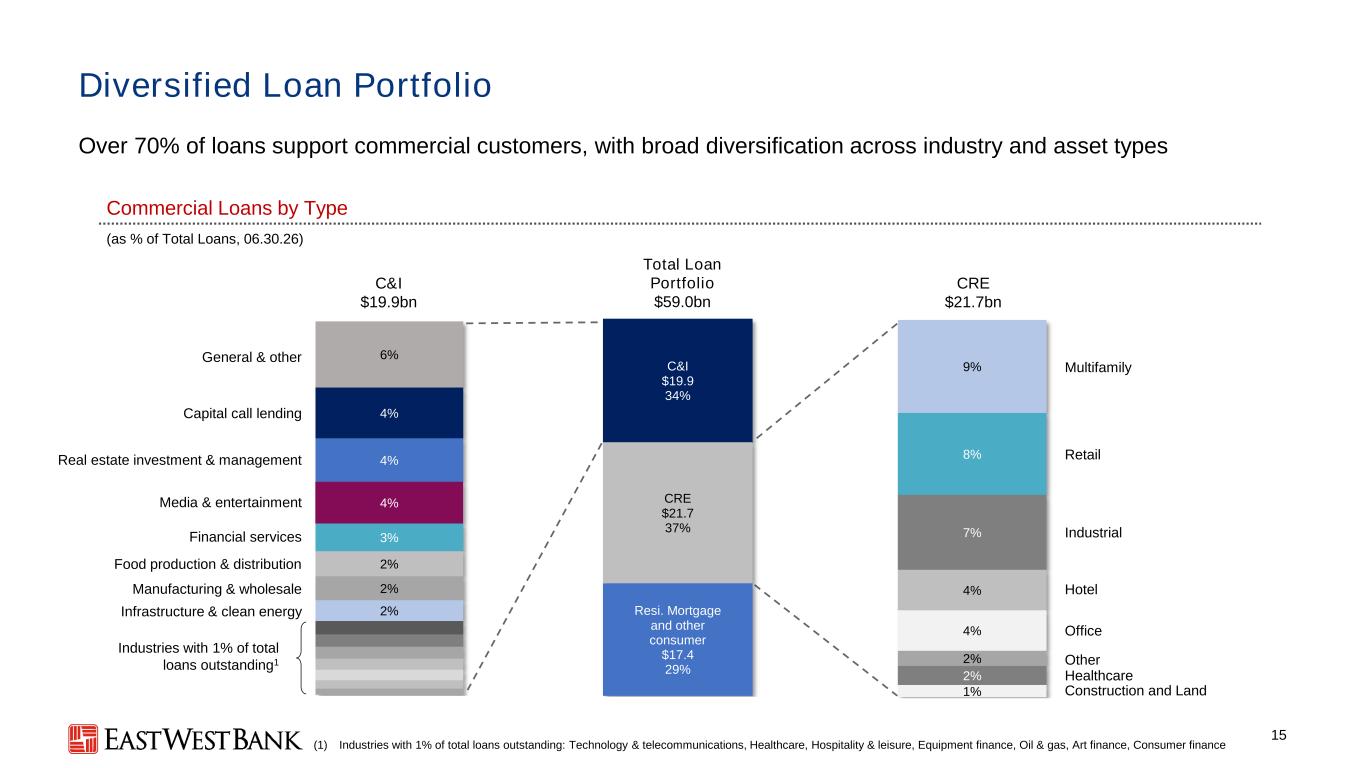
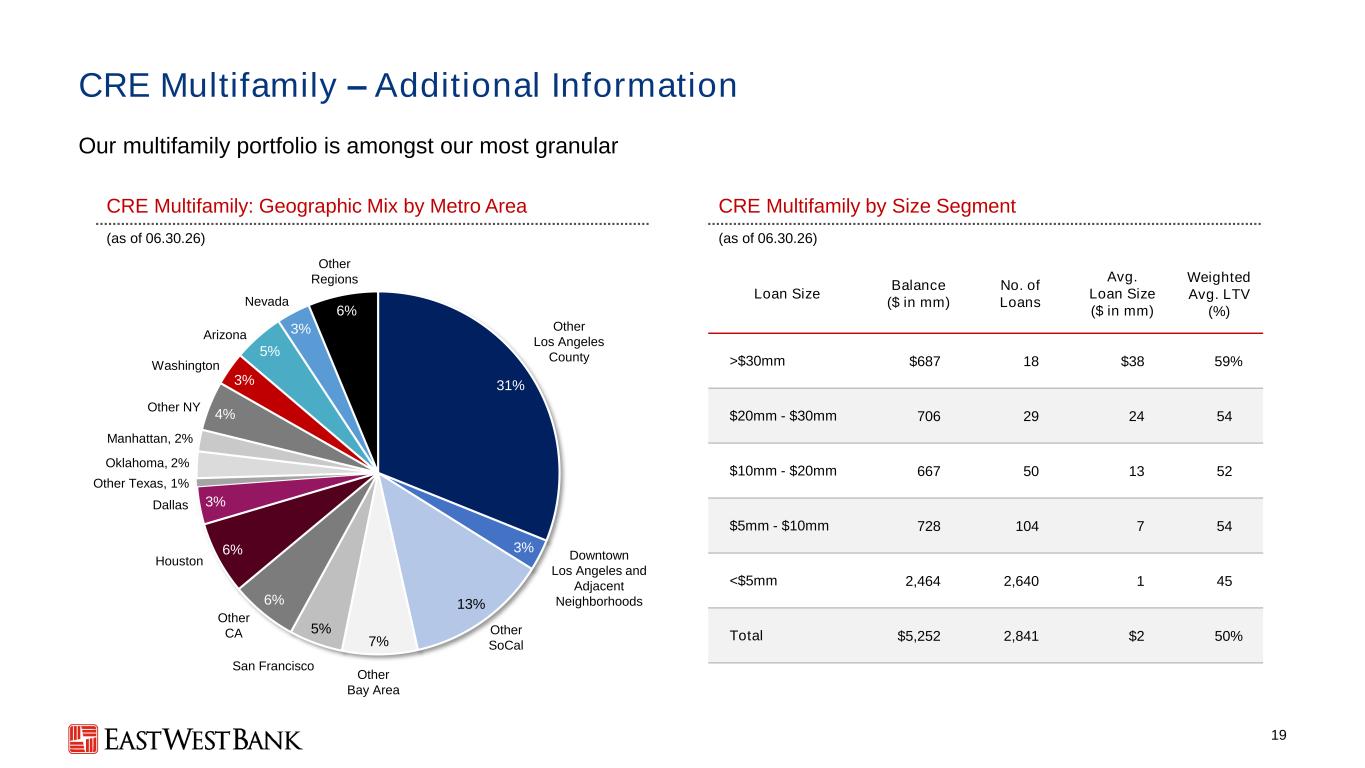
We continue to be focused on attaining a third, a third, a third diversification at some point in the future. And so as we look at our balance sheet mix today, we still find ourselves a little underweight in resume mortgage. So we're happy to see that be the standout this quarter and expect that we'll have a good quarter in Q3 as well. We obviously are continuously focused on growing our C&I business, and that's, you know, there. We're at 34% CNI to total loans right now. We intend to defend that level and hopefully improve on it a bit. And together, those two will chip away at the allocation to CRE, which at 37 is so little heavier than our long-term vision. But we're very comfortable with our clients in that space. We're very comfortable with our portfolio. We're very comfortable with the credits. And so there's no intent for us to shrink those portfolios. It's just that we're growing all of our portfolios in a balanced manner. All right.
Operator
The next question will come from Manan Gasalia with Morgan Stanley. Please go ahead.
Good afternoon. Hey, good afternoon. Maybe on the NID deposits again, so if I understood your comments correctly, just given the tariff-related deposits coming in and going out, is it fair to say that the average deposit number in 2Q is the right number to grow off of as opposed to the end-of-year number?
That's part of the reason I mentioned the 15% average quarter over quarter in my comments. Yes, good catch.
Okay, perfect. And then as we think about the jumping off deposit rates, right, you mentioned that, you know, you might take another look at the six to 12-month promo deposits that you're offering. But as we look at some of these deposit rates on slide 6, the 2.76 on interest-bearing deposit cost spot, and then the 204 on total deposit cost, I guess is that 2.76% the right number to jump off of for 3Q and 4Q?
Yeah, I mean, that is the end-of-period deposit cost, so that's the right launch point. And I think what we're trying to figure out is where do we think that number lines up relative to the competitive landscape as we move forward to the balance of the year. And as we sit here today, you know, I think we recognize there are a number of smaller banks and some larger banks that are offering deposit rates, you know, well above where we are. That having been said, we continue to see progress and expect to see more progress on our DDA over the balance of the year. And so we're not sure we need to stretch for the highest yield. And I think we need to focus on making sure we're servicing our customers on a holistic basis across all of their deposit and lending needs. And that relationship we think is worth a few basis points.
Operator
The next question will come from David Ciaverini with Jeffries. Please go ahead. Can I see you, David?
Thanks for taking the questions. On net interest income, how you raise the guide to seven to nine from six to eight, is the main driver of that the DBA deposit growth? Can you talk through that?
Well, I think it's both because we're also raising the loan growth. And so the asset growth profile of the bank, I think, is coming in a little stronger. in part because overall deposits have come in. And added to that is the fact that some of those deposits have come in in non-interest-bearing. And so the combination of the fact that deposit growth and loan growth continue to come in perhaps better than we would have expected earlier in the year is a positive, coupled with the fact that we are getting some of those deposits, the majority of those deposits in a lower-cost framework, allows us to lift the guide.
Thanks for that. And then on rate sensitivity, you mentioned about stable NIM with a stable Fed funds. How should we think about if we do get a rate hike, the impact on East-West?
We are modestly asset sensitive, and we've said in the past that we think a 25 basis point rate hike or rate cut probably costs us about $2 million a month with about a 45 day lag.
Operator
The next question will come from Timur, Braziller, with UBS. Please go ahead.
Hi, good afternoon. Looking at the CD repricing, I'm assuming you're now starting to get into some of the back end of 25 production that I think was in the 3.4s and now coming in kind of 3.6, 3.7. Is that the right way to think about it? The CD costs are going up here, and I'm just wondering to what extent is the expectation internally that some of the growth in DDA will be a gating factor and maybe containing some of those CD costs going higher?
I think we've been relatively both successful and pleased by our ability to retain the CD book here through the second quarter. And the majority of our CD book has, in fact, been around the six-month maturity. And so most of the lower-level $340 special-type dollars already repriced into $360 or $368, which is where we ran our Lunar New Year CD campaign earlier this year. And so the baseline for those repricings will be what happens in August and September. And that's what we're looking at, is given that those were at 368, what's the right level price to retain those as we sit here in July looking out to what's going to come rolling in in August and September? And we haven't quite decided how we'll land on that, but I think we're looking at a variety of maturity structures, in part to spread out that over a longer horizon, and in part because to the extent that forwards are telling us rates might move forward, it could help pay for it over the longest term. But we're pricing for retention, not necessarily for CD-balanced expansion.
Got it. Helpful, thank you. And then as a follow-up, would love to hear how you are thinking about that $100 billion threshold, both in terms of LFI-related expense and maybe what that means for capital optionality here.
Sure. Well, we continue to have a significant level of capital options. We continue to be focused on driving ourselves to be the best operational bank we can be, making the investments in things like cyber, resiliency, backup that we think support having a high-quality, high-performing bank. The emphasis regulatory-wise seems to have shifted to one of safety and soundness. And from a safety and soundness perspective, while East-West Bank perhaps can't claim to be too big to fail, we aim and strive to be too strong to fail. And we've consistently made sure we have the capital and the liquidity profile to support that. And that's been the emphasis and focus. Dominic, would you care to add to that?
Operator
The next question will come from Ibrahim Poonawalla with Bank of America. Please go ahead.
Operator
Good afternoon, Ibi.
Hey, Chris. Maybe just on capital, maybe revisit that. One, given the trajectory you're on, do you see capital levels building? I'm assuming you're okay with it. And in your priorities, you list buybacks below M&A. Is it just that you like buybacks even less than you like M&A, or should we lead anything into that?
I think that's a pretty standard lineup for us here. And given that we haven't done M&A in now going on 12 years, it's clearly not the first burner. But obviously focusing on organic growth is the primary. From a total capital perspective, we feel very comfortable, in fact, proud of maintaining a 10-plus percent tangible common equity level. from a capital distribution and return profile. We think our current dividend is very competitive, but we'll obviously look to revisit that from time to time. And I think the market is one where there will be opportunities for disciplined M&A, but in the absence of that, we obviously have been very opportunistic, even this year, in share repurchases, and will remain very opportunistic going forward.
Okay. Yeah, I'll just add a little bit more. So, you know, all of us here are professional hire guns at East West Bank, and we don't like or dislike M&A or buyback or anything. We love our shareholders. So what we do is that we always weight each opportunity against the other, and we do it on a regular basis. you know our sort of instant reflex is that whenever there is a let's say an M&A opportunity we assess evaluate and then we wait against is it better to do this versus just go ahead and then you know buy back right so those are the things that we're constantly evaluating and we're very neutral and there's nothing particular that we either like or dislike. We're just going to do whatever we think is the best option that enhances long-term shareholder values. What we also keep in mind is that long-term shareholder values may not come if we don't do well short-term. So that's what you're seeing, these record earnings after record earnings and record whatever. It's because the strong performance quarter after quarter is the best validation that we have the ability to sustain long-term growth and long-term shareholders return. So in that standpoint, we actually don't take these buyback or not buyback lightly. We're just looking at the entire East West Bank situation and we're also looking at the global landscape in terms of what's happening in this world and we make our decision about what is the appropriate time to execute whatever is best for our shareholders that's what we do but very clear and I guess maybe just on the free side so good growth over the last several quarters.
We have seen fees kind of bounce around at this $90 million range over the last three or four quarters. Just talk to us in terms of the trajectory of that, like the growth that we've seen year over year, is that repeatable on fees? And maybe if you can spend some time on the wealth management side, you've talked about this in the past, like where are we investing and what should we expect in terms of the growth for that sort of revenue stream and the opportunity there? Thank you.
Sure. So thank you, B, for the question. I would note wealth management fees, if you're looking at page nine of the press release tables, are up 71% year over year over the first six months. Clearly, that's been a market opportunity for us. We have leaned into that opportunity with new hiring. We have leaned into that opportunity with investments in the platform and the people and the talent to drive that business further forward. and we continue to think that is an area where there will be additional opportunities for growth as we look through the back half of this year and into next year. We're certainly investing in the people and the platform to do so. Commercial and consumer deposit-related fees have also been growing nicely. They're also up more than 15% year over year, six months. And, again, we see that as an area where we have been able to push new solutions to our clients, not push solutions. We've been able to offer new solutions to our clients that have resulted in an additional uptake, which has been quite positive. FX, loan-related fees also up quite nicely. Taken together, all fees up 15% year-over-year. It gives us comfort that our double-digit growth aspiration is very much attainable for the full year 2026.
Got it. And sounds like, Chris, If all else equal, macro remains more or less the same, the runway to deliver sort of double-digit growth, the kind of growth that you're seeing in wealth, there's still meaningful runway on both fronts, overall fees as well as the growth on the wealth side.
We absolutely – I'm not calling for a sustained 70% year-over-year growth, but I am calling for continued – I'm hoping that the investments we're making and the people and the platforms will continue to pay dividends to us and our shareholders in the quarters ahead.
Operator
The next question will come from Chris McGrady with KBW. Please go ahead.
Good afternoon, Chris. The NII growth is perhaps better than even this. Does your expense guide move or is that kind of baked?
I guess I would look at it slightly. I think we're guiding for NII that we think is in line with the current expectations for the flat curve and the growth that we see ahead. I think we're giving you a guide for expenses that recognizes the current trajectory, but to the extent that, for example, in particular fee income lines grew, the marginally efficiency ratio in those lines is slightly higher. And so, as both of you and I have said in the past, we see the efficiency ratio as an output, but it's one that we tie to additional revenue growth. So to the extent that we are coming in hotter on expenses. As I sit here today, I would think that would only be driven if we came in better on revenue growth.
I think we're assuming today, given a flat rate environment, a relatively stable mix to our growth trajectory, but that obviously means growing dollar balances as we continue to grow deposits through the end of the year.
Operator
The next question will come from Matthew Clark with Piper Sandler. Please go ahead.
Good afternoon. I wanted to ask about the uptick in C&I criticized. It looks like your C&I reserve was down a little bit, so probably not something you're too concerned about. But anything within that bucket to call out or anything lumpy, and then also just the uptick in theory, non-performers?
Good question. On the C&I criticized, we did look at, you know, we obviously go through a process where we're getting annual financial statements quarterly in some situations and there were some where there were cash flow reductions which is why we downgraded those special mention with that said in those same reviews there are many loans that we upgraded from substandard and that's why as you noted overall the allowance for CNI the drivers of those ultimately the coverage of the amount that we needed was a little bit lower quarter over quarter. And I think your second question was on Cree in general. Overall, when we look at the Cree non-performing, when we look at Cree non-performing, you know, there were about four loans that moved in to non-performing. I would say we've always taken a very kind of conservative view as far as reserving and charge-offs, and some of those were resolved in the quarter or subsequent to the quarter. We don't believe there's a lot of lost content as of 6.30 and a go-forth basis from those that flew into non-performing.
Okay, great. And then the other one for me, just on M&A, your comment in the deck about disciplined M&A. Can you just remind us of the type of, you know, bank or organization you'd ideally want? You know, we talked about wealth, you know, in recent months. I assume you'd want it to have a wealth component in an Asian-American market to some degree. But any updated thoughts on the criteria there?
I think banks generally are sold more so than bought. And so I think, as Dominic pointed out earlier, when things become known to us, we dive in and we take a good look at evaluating if they make sense. We clearly have been investing on the wealth side of our business. We made significant investments back in an outside asset manager in 2023. We've continued to make investments in people and talent and platforms here more recently. And if we could find the right opportunity to invest additional capital behind a wealth platform or a wealth-oriented banking organization, that might be attractive to us. We just haven't found the right one yet. But from an Asian community banking standpoint, I think we're, you know, it's a relatively small uterus, and we know all the players, and all the players know us. And so I think we're, you know, continue to monitor that market, but there's nothing further to comment on. Dominic?
Operator
The next question will come from Janet Lee with TD Carolyn. Please go ahead.
Good afternoon. Just making sure that I'm understanding the NIM dynamics, so outside of the increase in, well, outside of any expected move in the Fed, should low yields decline from the second quarter level through the rest of 2026 from spread compression or next shift perspective?
We're not seeing spread compression the way we saw it last year. And so as I sit here today, it wouldn't be spread compression driven. We are seeing some mixed shift elements. And so to the extent that, for example, there's less NDFI, which in some cases can be yieldier, and more core CNI, we would see a potential shift downward. But again, it depends on exactly where those loans originate from. As we sit here today, we would anticipate the margin remains relatively stable, given what we see in the pipeline at this point in time.
Got it. And that assumes that the interest-bearing deposit cost increases from the 281 level.
I think that assumes our base level that if there's no Fed funds hike, that our need to be competitive on deposit pricing might step up a tad, but would be offset, we hope in part, by additional DBA growth as well.
Right. Got it. And just a quick last one. You have no problem growing loans and fund it with deposits. Should we expect the size of your security portfolios to continue grinding higher, are consistent with the case we've seen in the first half of 2026?
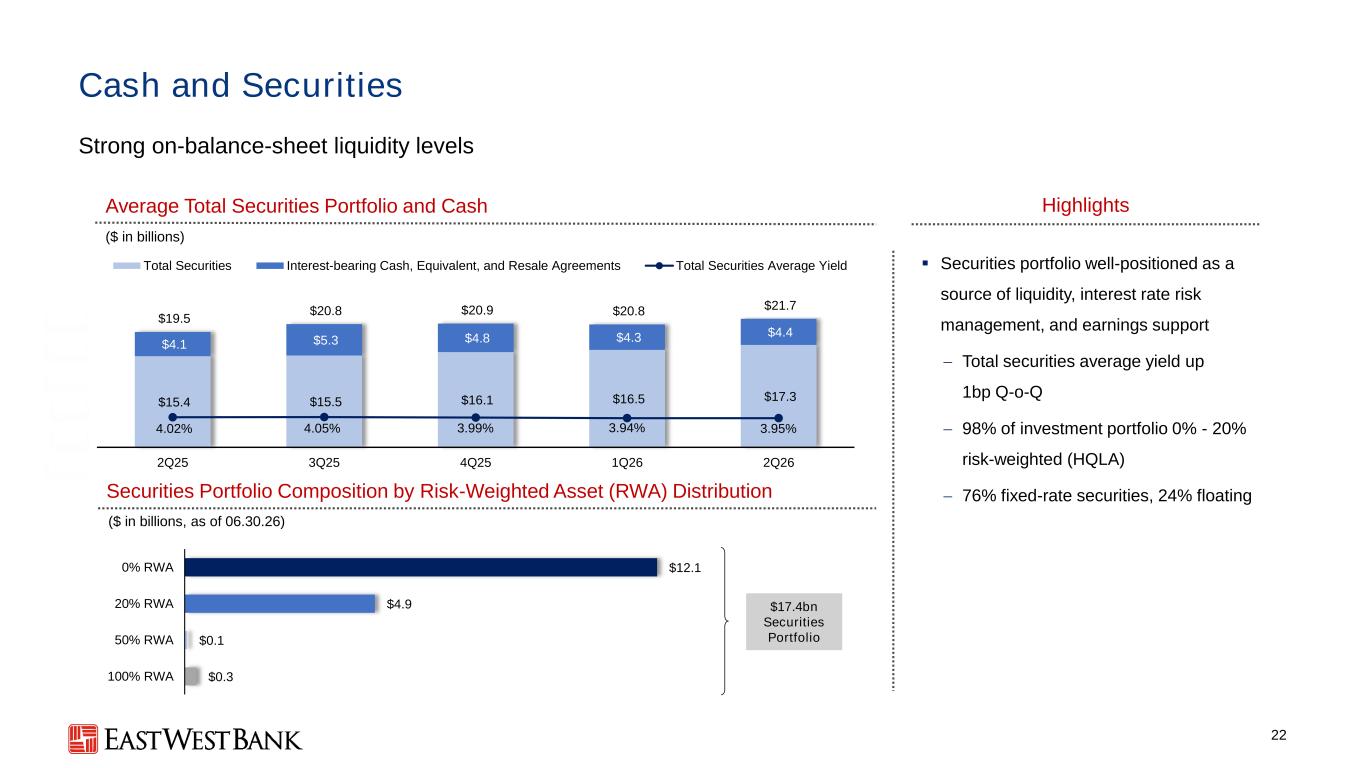
I think we look at our securities portfolio as a reservoir to fund growth. And so at this point in time, you know, it can be added to the extent deposits exceed loan growth, or it can be detracted from the fund loan growth to the extent they don't materialize. But given that we've been able to grow deposits even faster than loans, it has been a net contributor to your state.
Operator
The next question will come from Bernard von Gizicchi with Deutsche Bank. Please go ahead.
Good afternoon, Bernard. Hey, good afternoon. Just with your loan growth, you know, it's broad-based during the quarter, and there's some nice growth in Syria, especially in multifamily and construction. Wondering if those trends during the quarter are expected to, you know, continue, and you'll still see, like, good growth in those particular areas in the second half of the year?
We appreciate the growth that we have seen across all the portfolios. We'll continue to be there for our clients, particularly, you know, the longstanding, well-tenured, well-experienced developers that are active in today's market. And, yeah, to the extent there are, you know, things we can do for them, we're very supportive.
Okay, just as a follow-up, I know the capital deployment priorities were discussed, but just wondering if we could look at the potential Basel III impact versus peers. Unless it's changed, I think previously, you know, you mentioned, you know, expecting 160 to 180 basis points uptick in capital versus peers who are probably expecting somewhere about 100 basis points increase. So your relative advantage in capital would, you know, continue to increase. Would you be more or less inclined or have no impact on lowering your capital levels to a similar move down versus, like, some of the larger banks just on the Basel III impact?
I think we're focused and very happy to manage the bank around a tangible common equity goal and driving a top quartile returns on tangible capital. And so as we think about those Basel and Platt, they really don't influence our focus on either TCE or the ROTCE. That having been said, it gives us comfort that our strategy of holding residential, low-risk residential mortgage is a great strategy and one that effectively, you know, others have taken notice of by reducing what they see as a risk profile, which, you know, we had noticed a long time ago. Great. Thanks for taking my questions.
Operator
This concludes our question and answer session. I would like to turn the conference back over to Dominic Ng for any closing remarks.
Thank you. Well, to conclude, as always, our results are a reflection of the dedication and discipline of our team. and I want to thank them for their continued contributions we remain focused on creating long-term value and we're looking forward to speaking with you again next quarter thank you the conference is now concluded thank you for attending today's presentation you may now disconnect