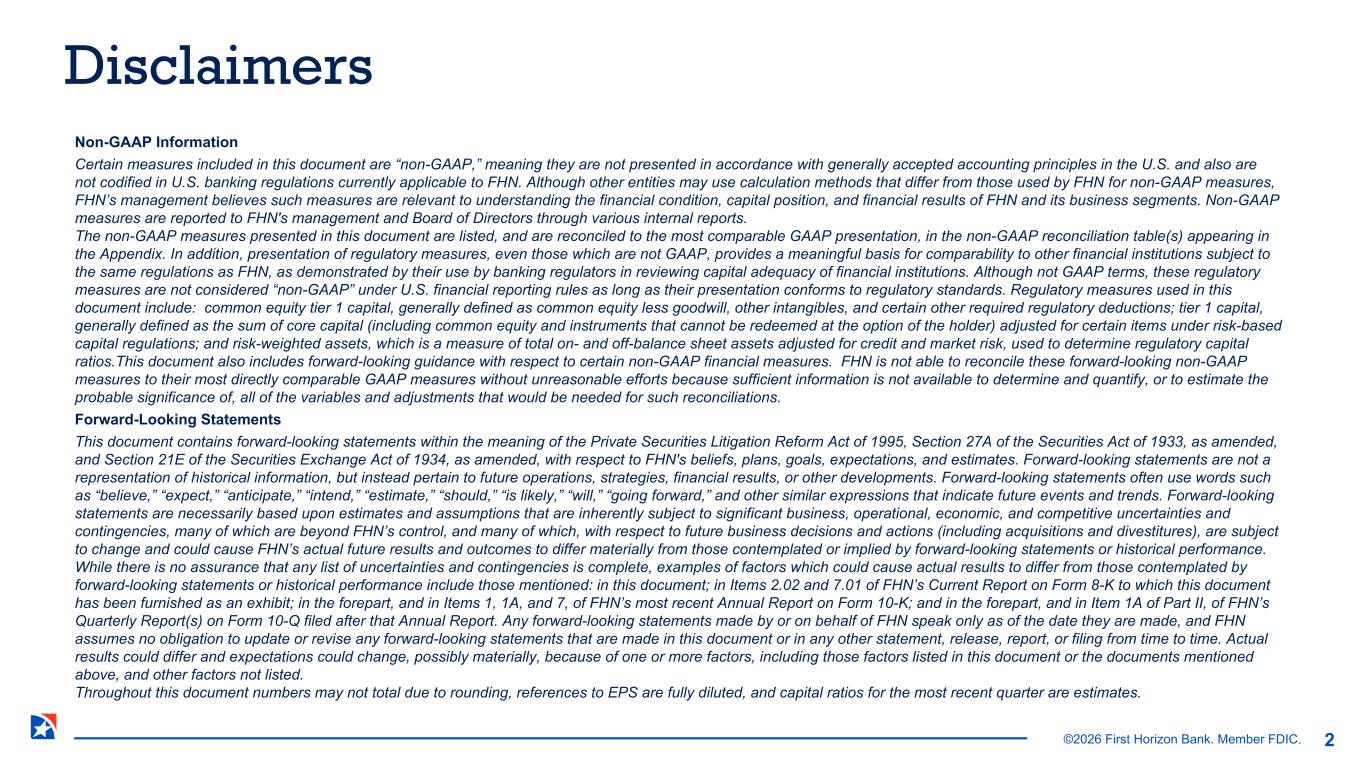
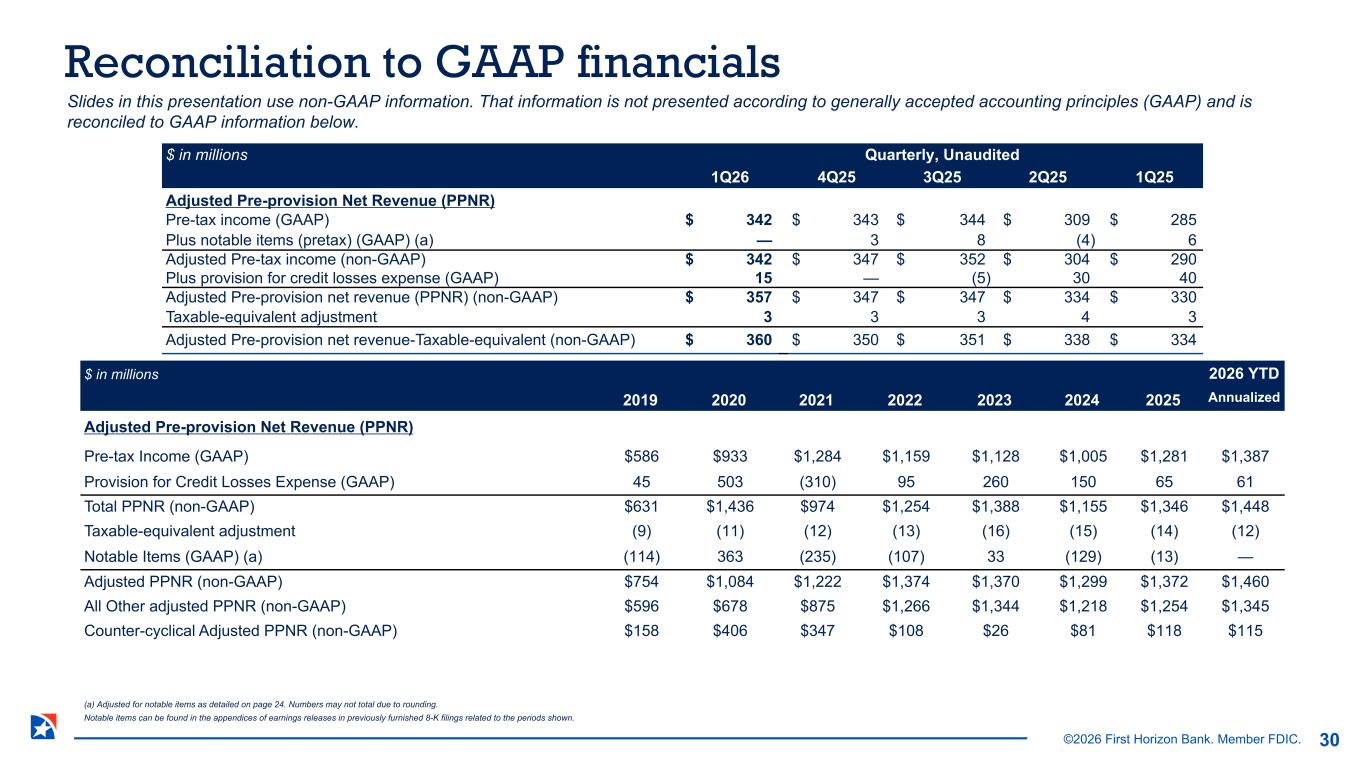
Order 2026 Results Conference Call. Thank you for joining us. Today, our Chairman, President, and CEO, Brian Jordan, and Chief Financial Officer, Osam Chauke, will provide prepared remarks, after which we'll be happy to take your questions. We'll also be pleased to have our Chief Credit Officer, Thomas Hahn, here to admit with questions as well. Our remarks today will reference our earnings presentation, which is available on our website at ir.firsthorizon.com. As always, I need to remind you that we will make forward-looking statements that are subject to risks and uncertainties. Therefore, we ask you to review the factors that make all the results that differ from our expectations on page 2 of our presentation and in our SEC filing. Additionally, please be aware that our comments will refer to adjusted results which exclude the impact of notable items and to other non-GAAP measures. Therefore, it's important for you to review the GAAP information in our earnings release pages 2 and 3 of our presentation and the non-GAAP reconciliations at the end of our presentation.
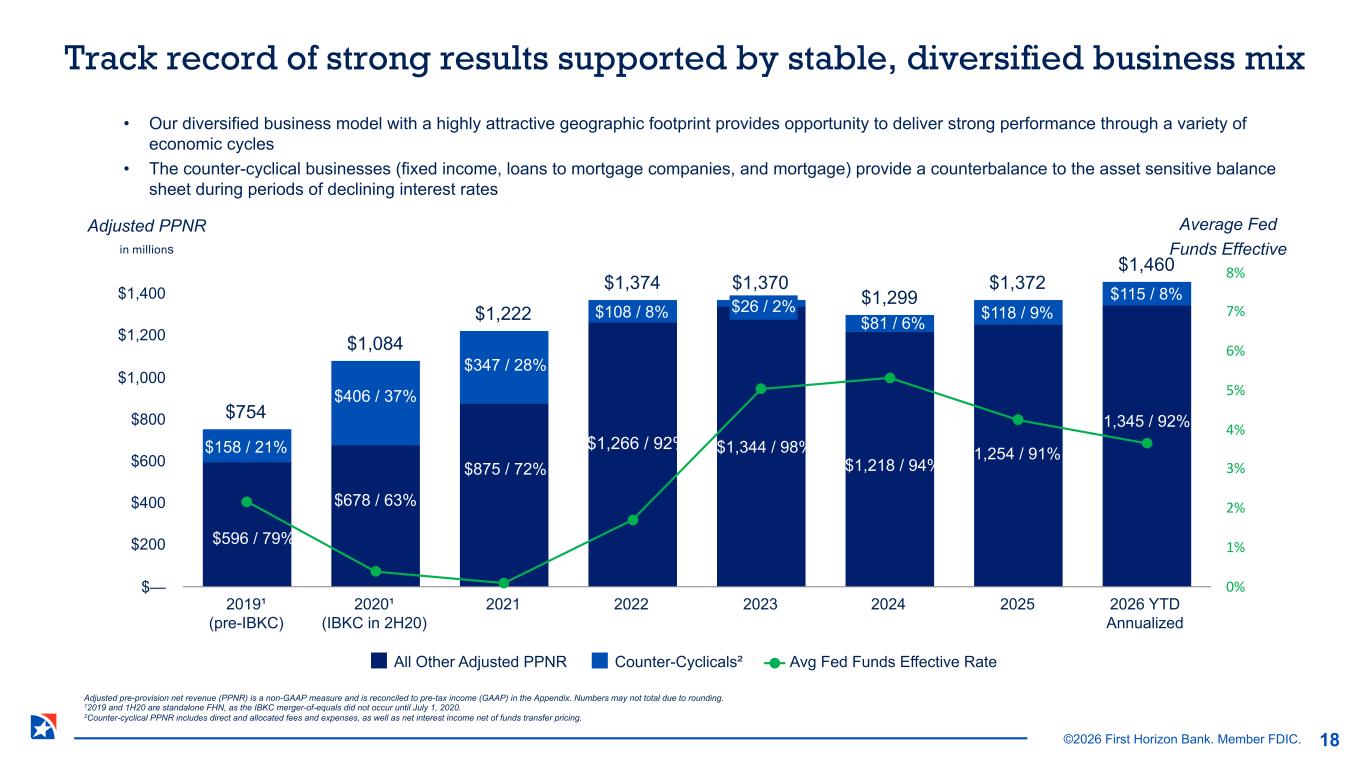
And last but not least, our comments reflect our current views and you should understand that we are not obligated to update them and with that i'll hand it over to brian thank you tyler good morning everyone we started 2026 with strong momentum in the first quarter we delivered our third straight quarter of 15 or greater adjusted rotc in line with our expectations high client growth and relationship focused client activity across our market differentiated business model we continue to successfully execute by providing tailored solutions to meet client needs and turning insights into profitable outcomes. We're focused on building true client relationships, staying disciplined on price and structure, and supporting our clients with the full capabilities of our franchise. Our diversified business model with counter-cyclical businesses positions us well as the operating environment evolves. I'll now turn the call over to Hope to walk through our first quarter results. I'll provide some closing comments at the end of the call.
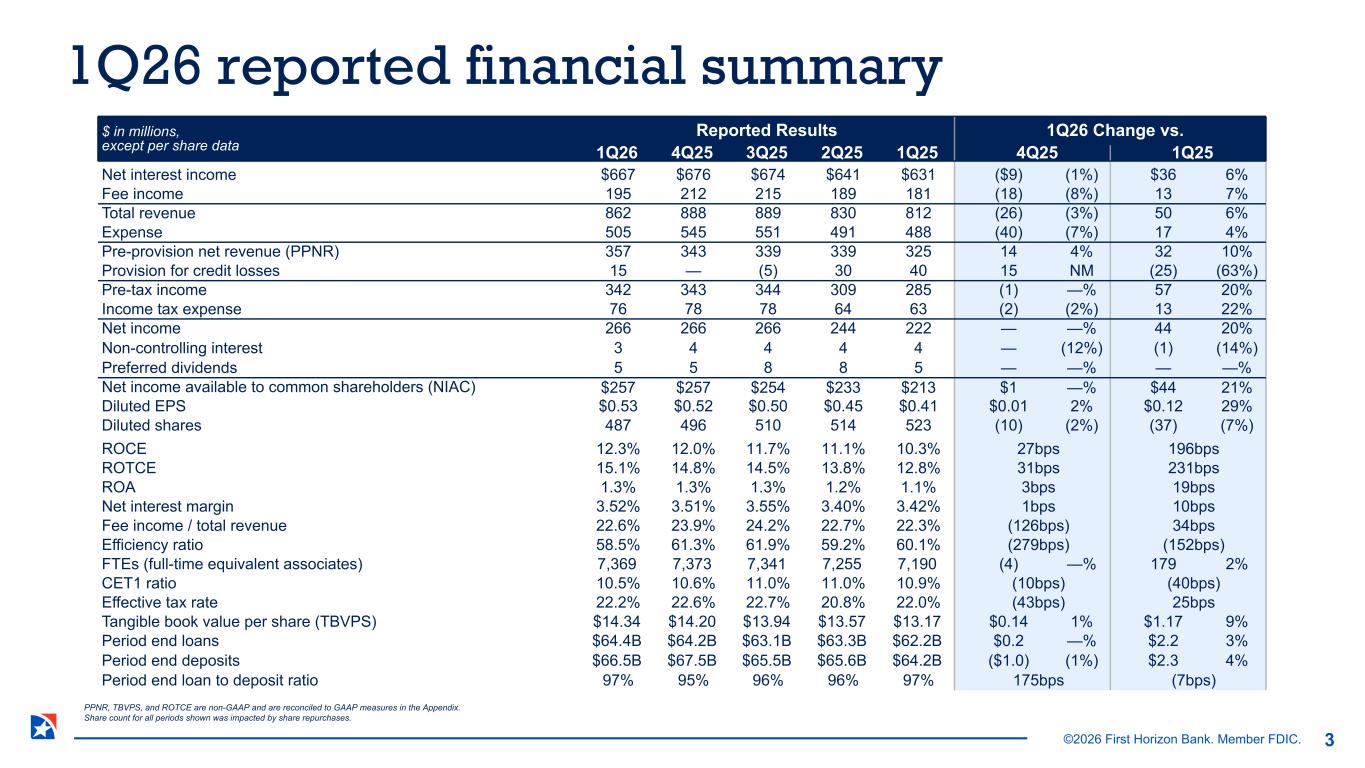
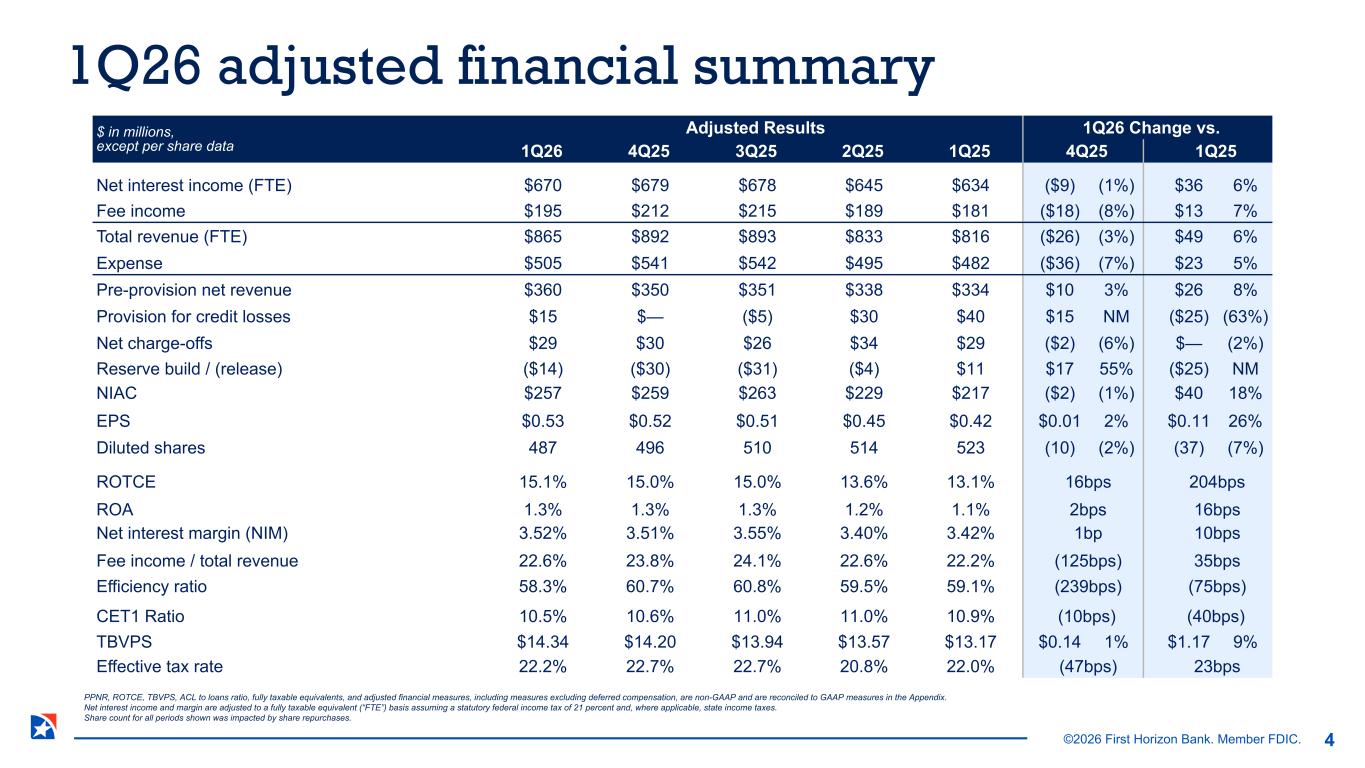
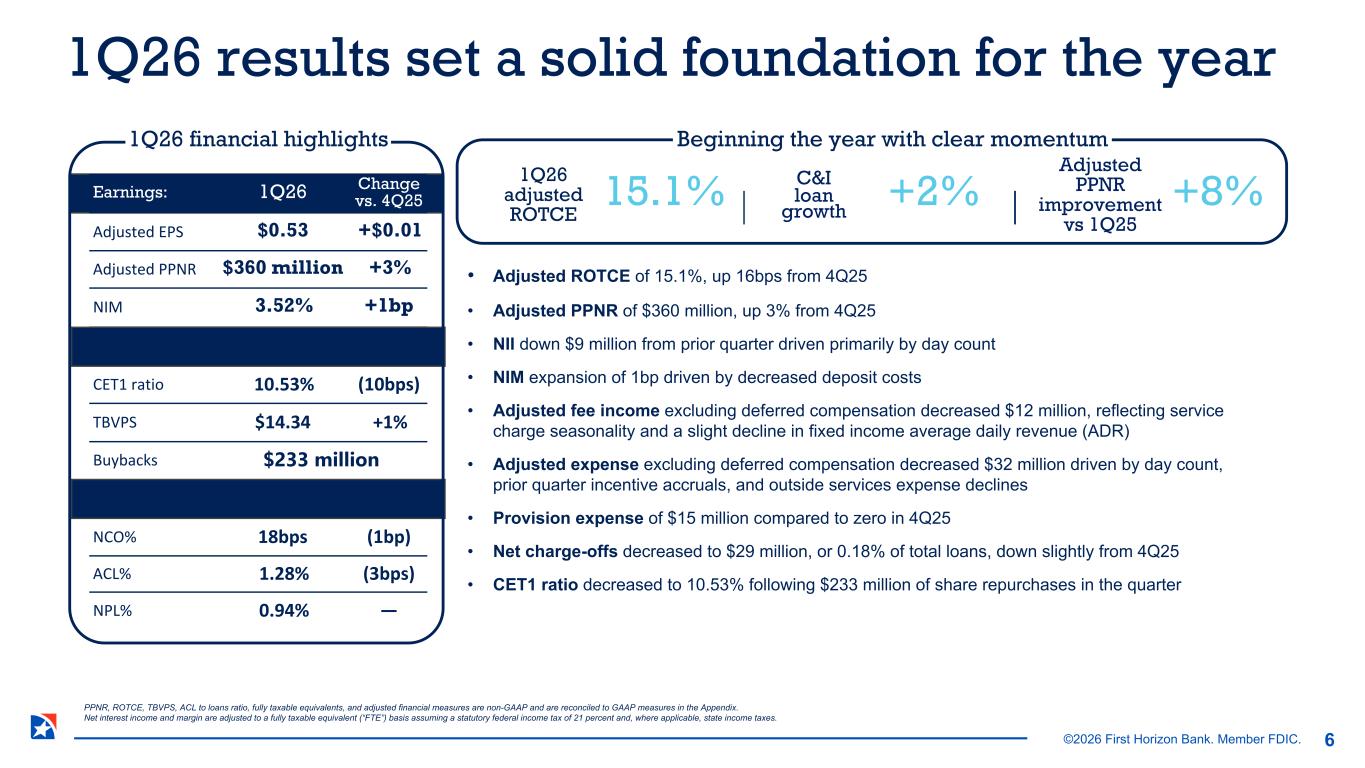
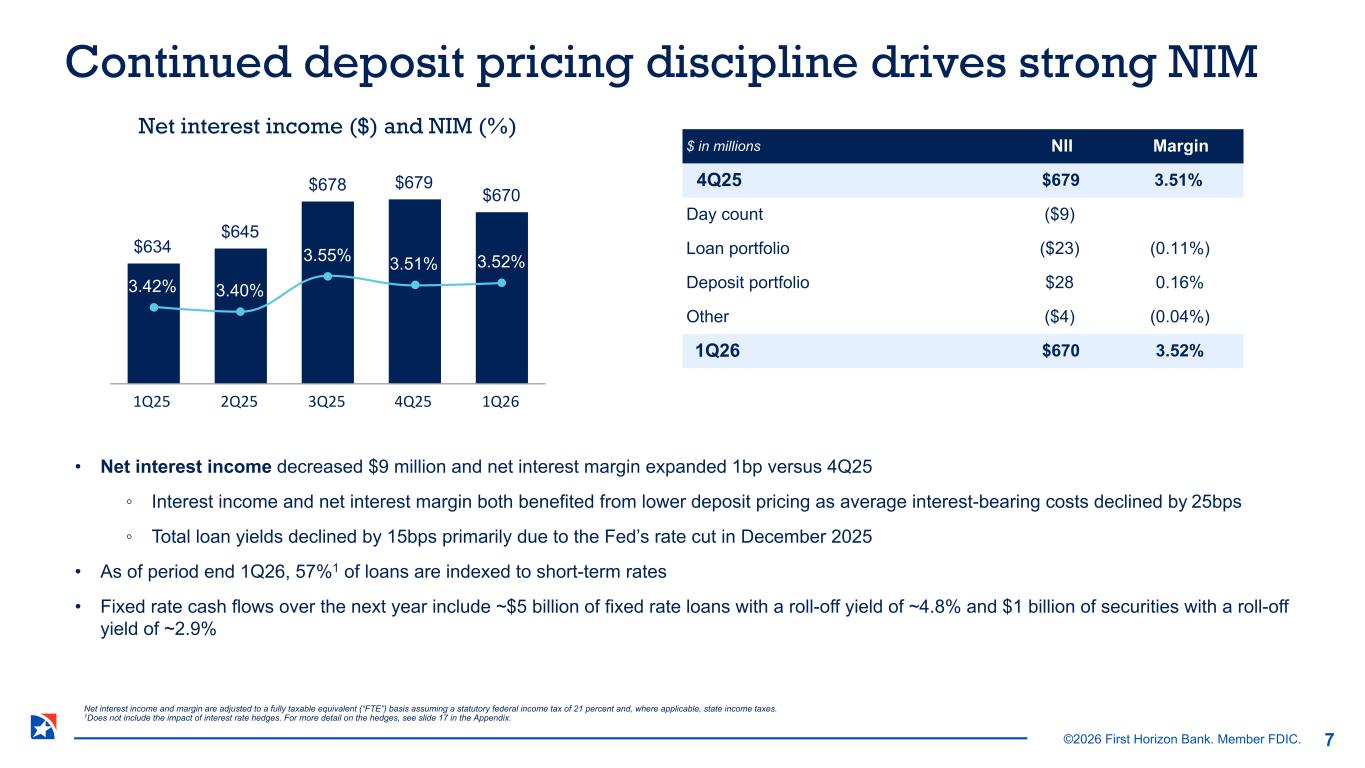
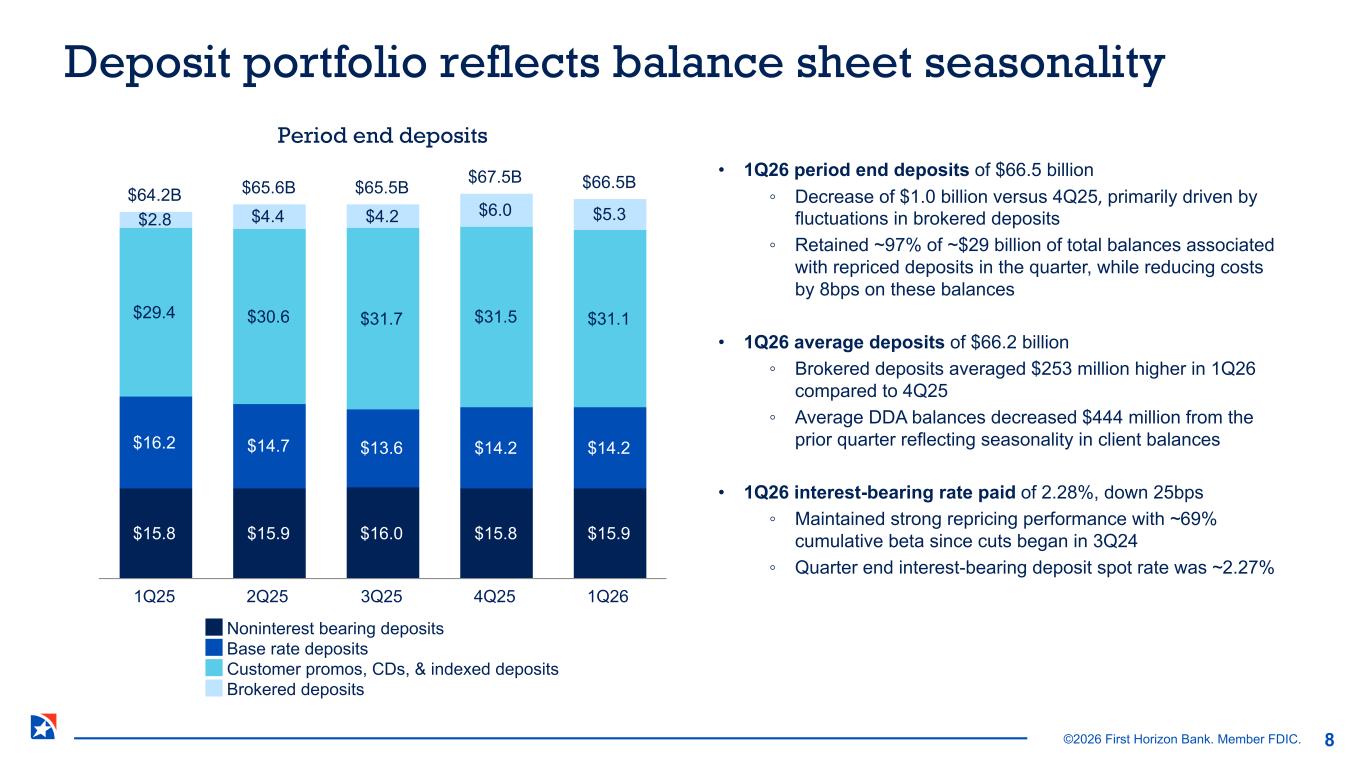
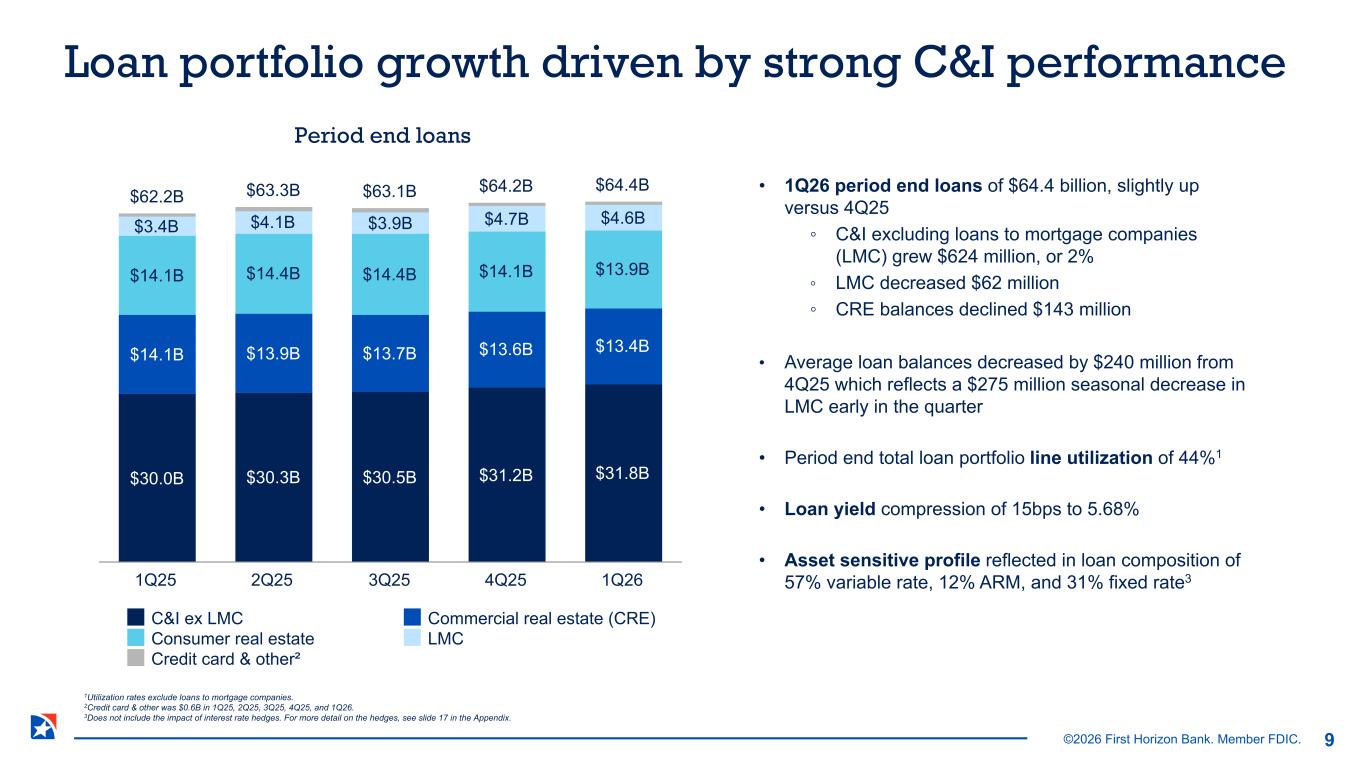
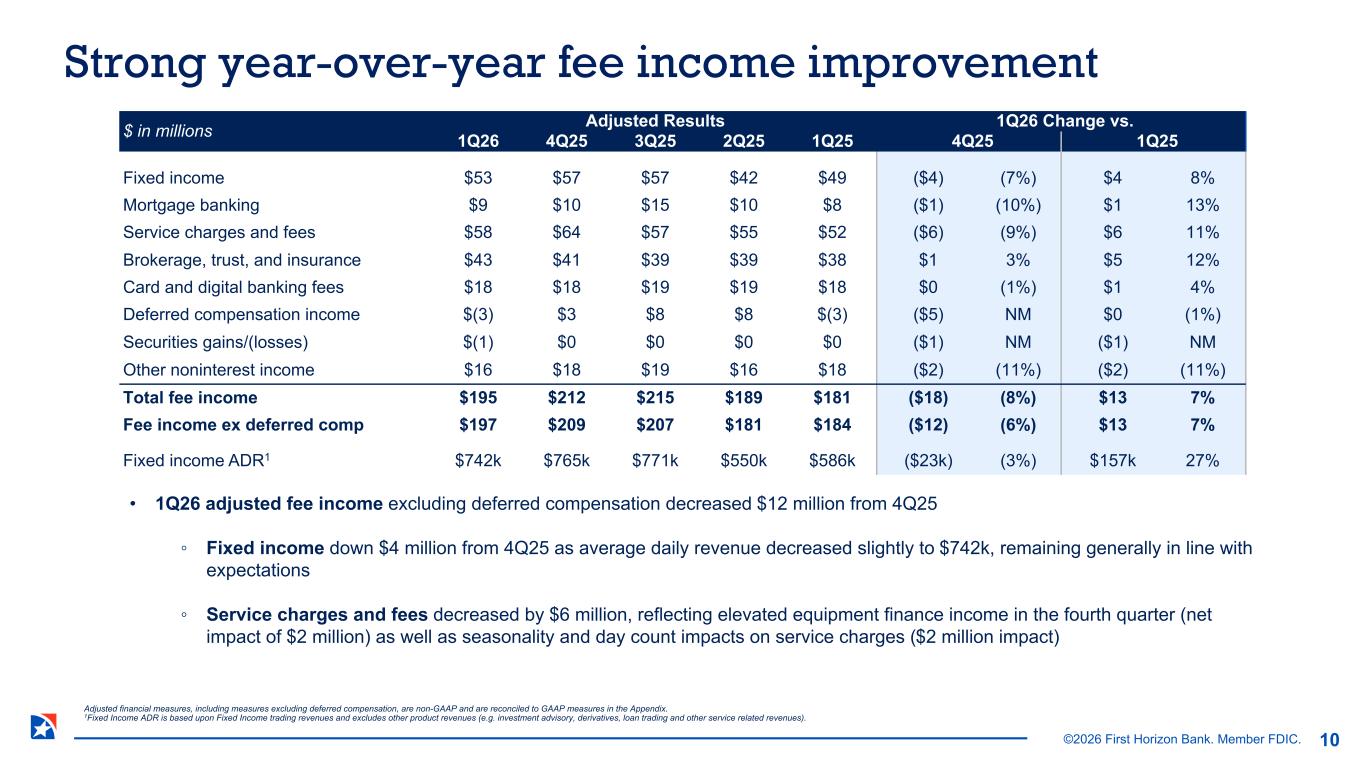
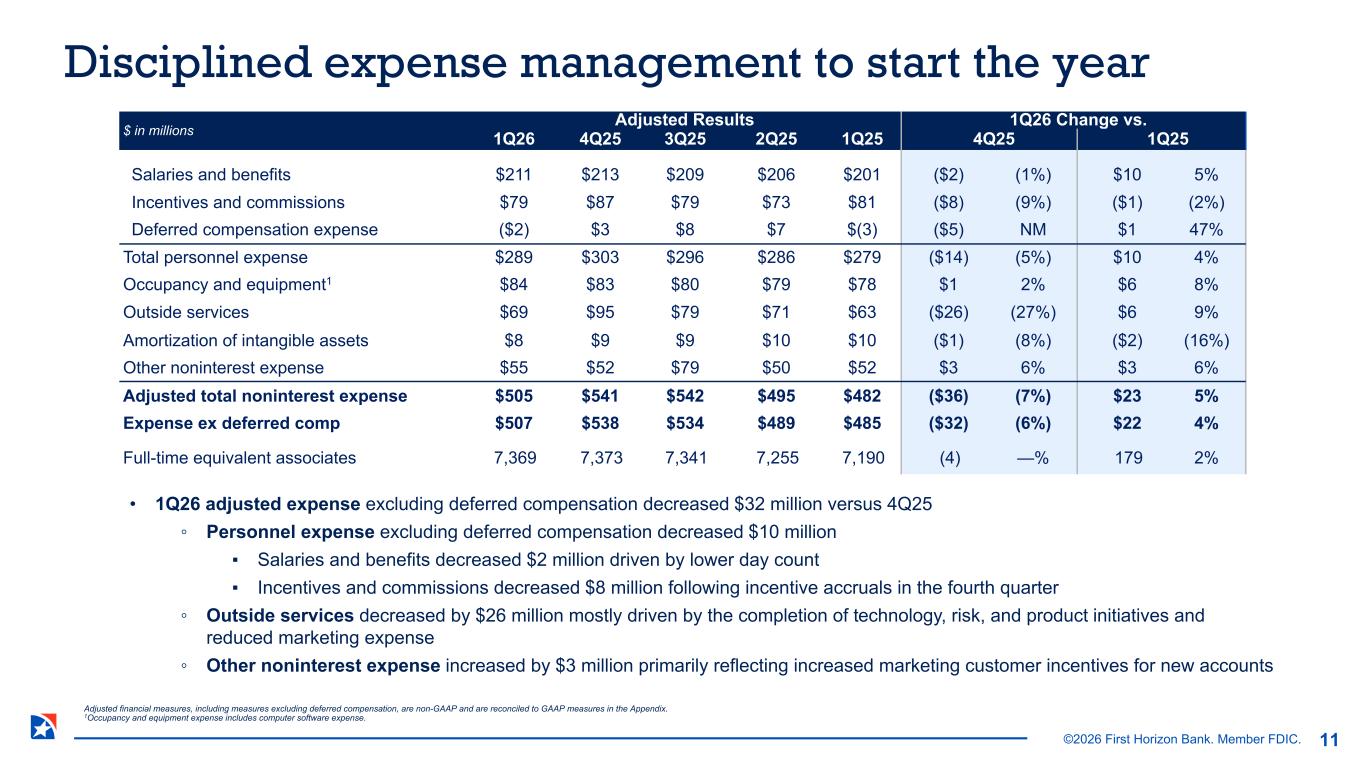
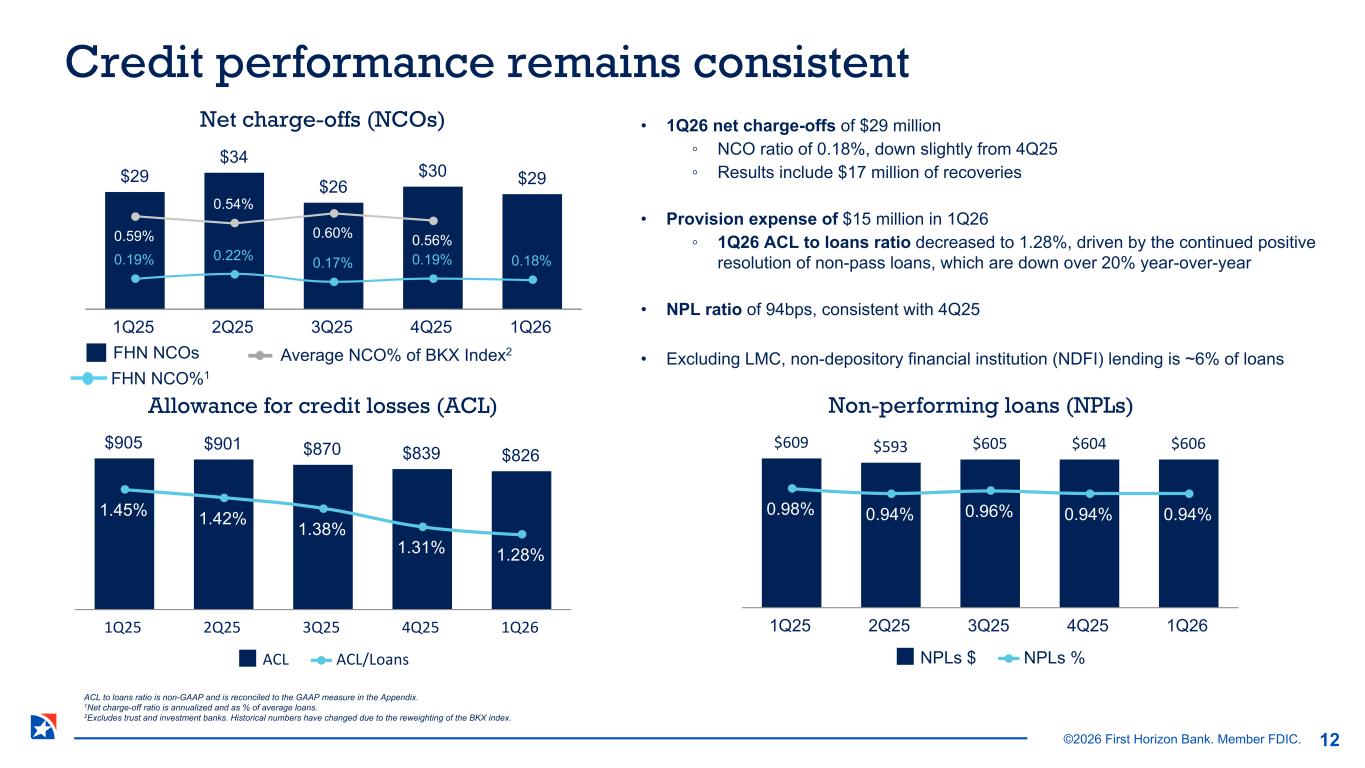
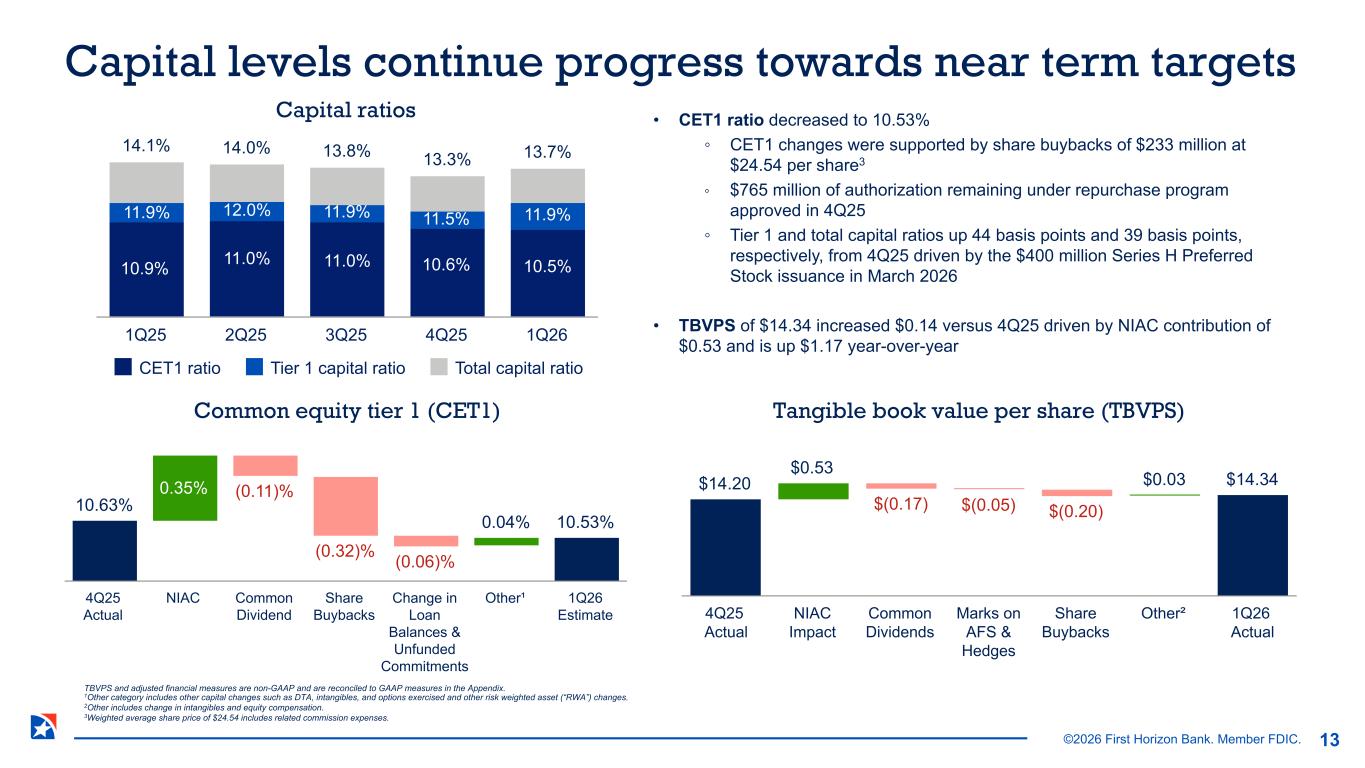
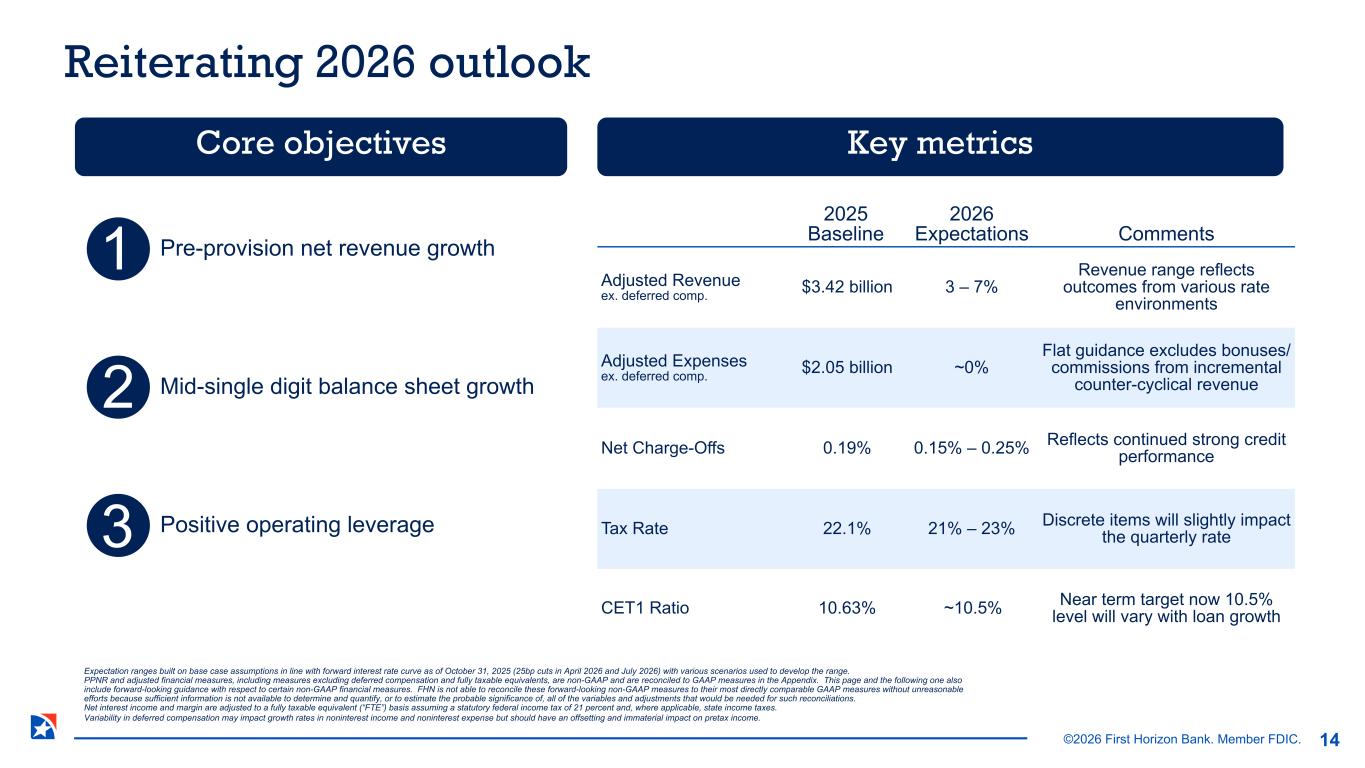
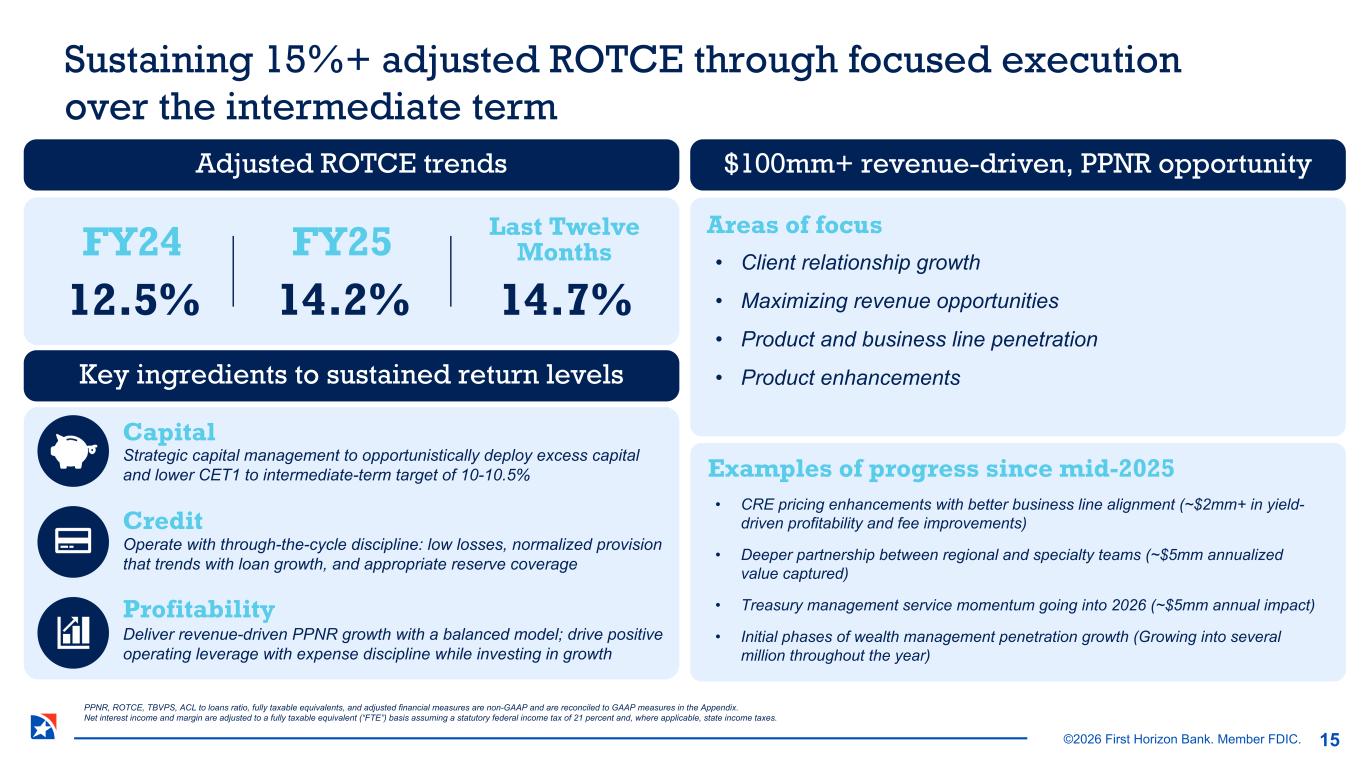
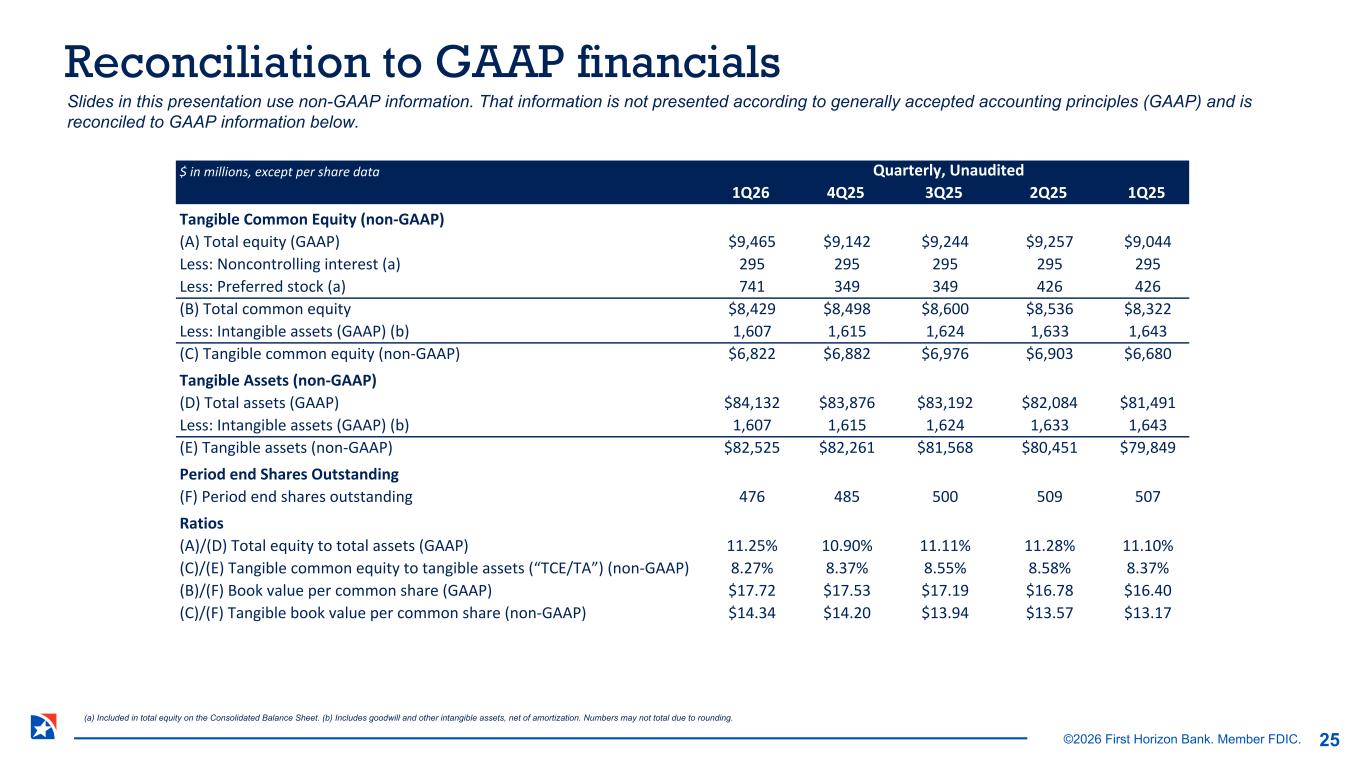
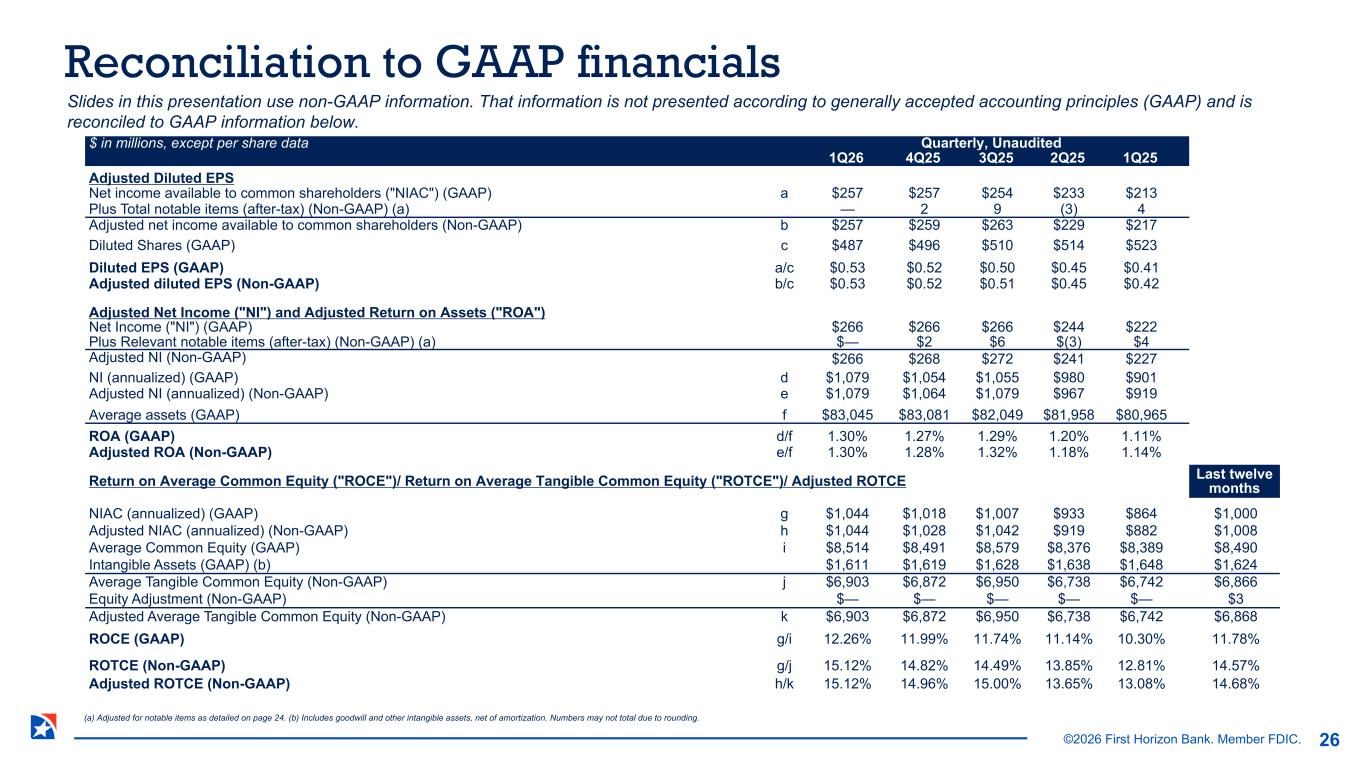
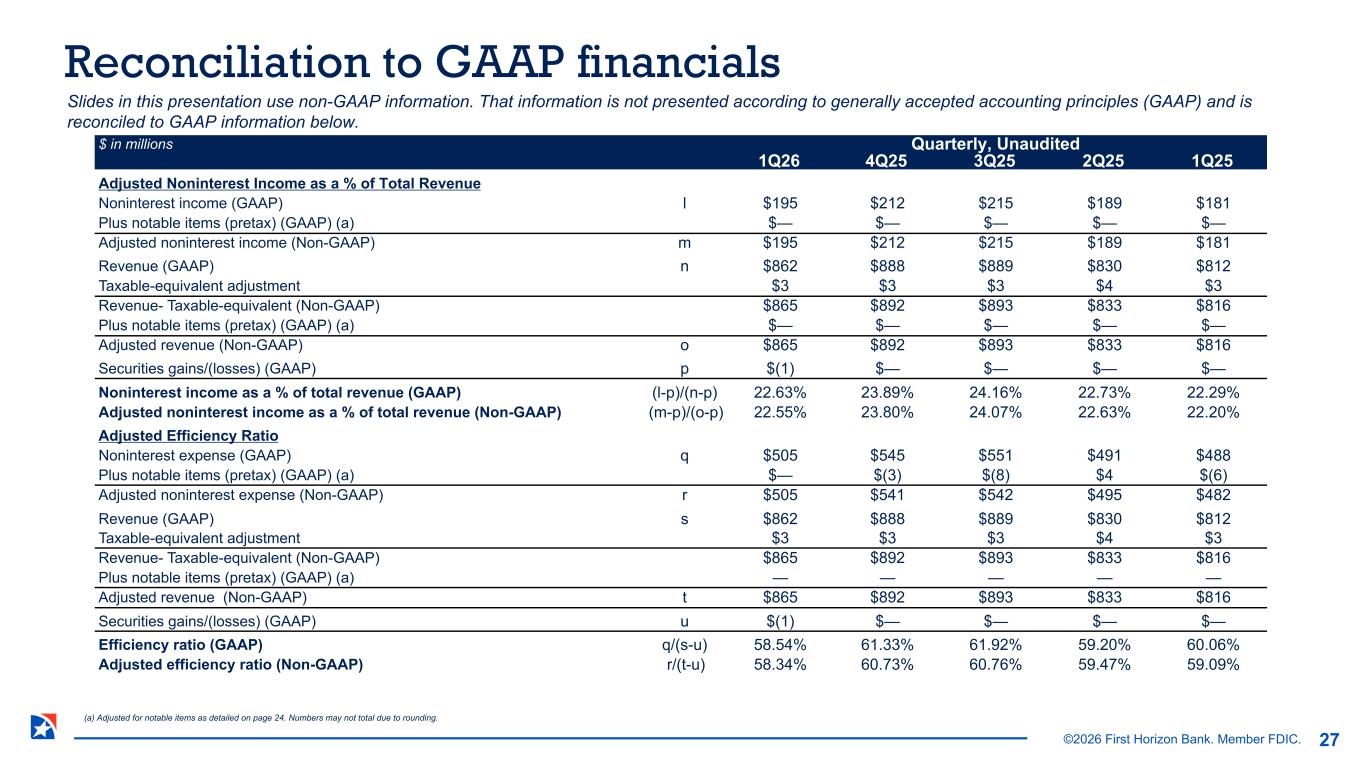
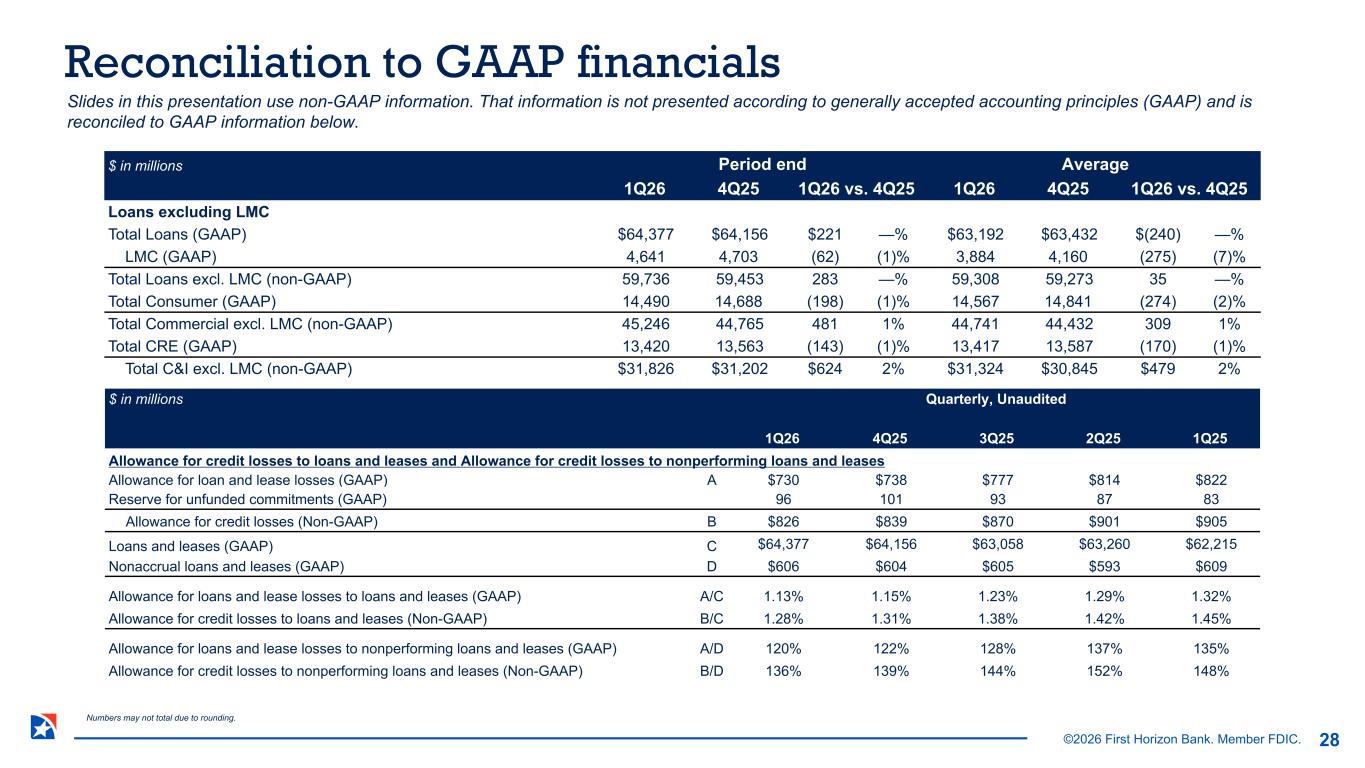
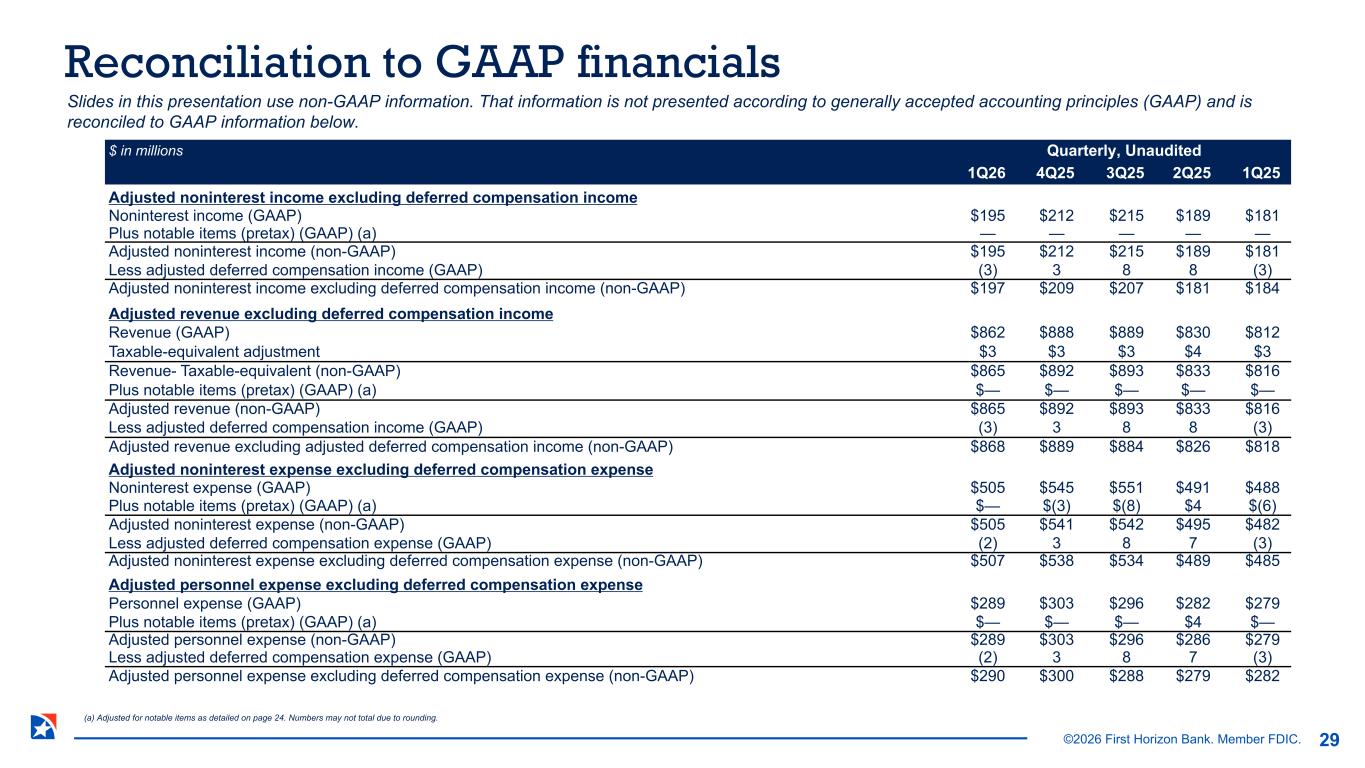
Thank you, Brian. Good morning, everyone, and thank you for joining us today. Over the last year, we have talked a lot about our efforts to improve the profitability of the balance sheet and how we laid out our strategy for the entire organization. That work is evidence in our results this quarter, which includes a return on average assets of 1.30%, up 19 basis points from first quarter last year. Amidst rate decreases over the last year, we have grown net interest income 6% year over year, which outpaced our Loan Before Leo growth of 3% in that same time, demonstrating our continued focus on profitable growth. We started 2026 with great momentum, including earnings per share of 53 cents, which is an increase of 11 cents over the first quarter of 2025. Excluding loans to mortgage companies, our C&I portfolio grew $624 million in the quarter compared to having approximately flat growth in the first quarter of 2025. Our performance also includes 8% improvement in adjusted pre-provision net revenue compared to the first quarter of 2025. Our adjusted ROPSE of 15.1% increased over 200 basis points year over year. Starting on slide 7, we walked through our net interest income and margin performance in the first quarter, which saw NII consistent with the fourth quarter absent day count impacts. Our margin expanded by one basis point on continued strong performance in managing deposit costs following the Fed's last rate cut in December 2025. While our variable loan portfolio experience yield declines in the quarter, our deposit pricing discipline offset this impact. On slide 8, we covered details around our deposit performance in the quarter. Period end balances decreased by $1 billion compared to prior quarter, driven primarily by reductions in brokered deposits. The average rate paid on interest-bearing deposits decreased to 2.28%, coming down from the fourth quarter average of 2.53%. We maintain a cumulative deposit data of 69% since rates started to fall in September 2024. Our interest-bearing spot rate ended the quarter at 2.27%. On slide 9, we cover our quarterly loan loans. Period-end loans increased slightly by $221 million from the prior quarter. This quarter's results, which included an impressive start to the year for our core C&I business, which saw a $624 million in loan balance growth. This builds on momentum we saw in the second half of 2025 and supported by continued strong pipelines in 2026. Loans-to-mortgage companies experienced typical seasonality in the first quarter and ended down $62 million versus year-end. This business continues to have momentum as a source of strength. Commercial real estate continues to be a headwind for loan balance growth as stabilized loans move to permanent markets and non-passed loan resolutions reduce balances. Encouragingly, our CRE pipelines are strong and present notable opportunities to stabilize CRE balances in the future. I will also note that our consumer loan portfolio declined $198 million in the quarter, which is in line with normal fluctuations. Our goal for consumer lending is to focus on relationship expansion and profitability. While competition in the market is strong, commercial loan spreads remain generally in the mid-100s to upper 200 face points. Turning to slide 10, we detail our fee income performance for the quarter, which decreased $12 million from the prior quarter, excluding deferred compensation, and is up $13 million year-over-year. The largest decreases for fee income comes from our service charges and fee lines, which was driven by the impact of day count and normal seasonality in other service charges like treasury management fees, interchange income, and NSF fees, and by quarter-over-quarter fluctuations in our equipment finance business. We saw a slight quarter-over-quarter decline in fixed income revenues due to the decrease in ADR to $742,000, though this is still a 27% increase year-over-year. We saw slightly lower ADRs at quarter-end as market volatility increased. On slide 11, we cover our adjusted expenses that, excluding deferred compensation, decreased $32 million from prior quarter. Personnel expenses, excluding deferred comp, decreased by $10 million from last quarter, driven by an $8 million decline in incentives and commissions, which followed higher incentive accruals last quarter. Slide services decreased by $26 million, which includes reduced expenses related to technology initiatives from last quarter and decreased marketing expenses in the quarter. Turning to credit on slide 12, net charge-off decreased by $1 million to $29 million. Our net charge-off ratio of 18 basis points remains in line with our expectations. We recorded a provision for credit losses of $15 million in the quarter, and our ACL to loans ratio declined slightly to 1.28%. This was driven by mixed change in the portfolio. On slide 13, we ended the quarter with a CET1 of 10.53%, driven by buyback activity and loan growth in the quarter. During the quarter, we bought back approximately 230 million of common shares. We have approximately $765 million in our current board authorization remaining. During the quarter, we successfully issued $400 million of Series H preferred stock, which drove the 44 basis point increase to our Tier 1 capital ratio of 11.95%. Our tangible book value per share is $14.34, which is up 9% year over year, which includes buybacks of $766 million during that period and an increase to our dividends. I'll wrap up on slide 15. I am proud of the momentum we have to start 2026. We continue to maintain our full-year outlook and updated our near-term CET1 target to 10.5% during the first quarter. For the third consecutive quarter, we achieved 15% plus adjusted ROTC, reflecting our focused execution on our business priorities. We continue focusing on deepening our client relationships, fully delivering our products and services across our excellent footprint, and enhancing our capabilities to create value for clients and shareholders. All of this moves us towards achieving the $100 million-plus PPNR we noted last year as our opportunity in the next couple of years. We made initial progress on this objective last year and continue doing so in 2026. Our revenue expectations reflect continued capture of this profitability throughout the Expense discipline and underwriting consistency continue to be central to our company, and And disciplined capital deployment continues moving us towards our intermediate-term CET1 targets. And with that, I'll turn it back over to Brian.
Thank you, Hope. On the whole, we feel very good about how we started the year. We're seeing strong client activity in our commercial pipelines as well as business owners planning for growth. Relationship banking remains our priority. focusing on primary relationships, deepening treasury and wealth management, and making sure our solutions match client needs. In the first quarter, we saw strong production, essentially evenly balanced between our regional banking and specialty verticals. CNI loan commitments reflected both deepening of existing relationships and new client acquisitions. positions. And our CRE pipelines are as strong as they've been in years. We manage our business with three priorities, safety and soundness, profitability, and growth, which is evident in our results again this quarter. We're not playing solitaire. Competition is active, but our associates are protecting our base and winning with exceptional service and value, along with healthy C&I demand and the strength of our markets to drive revenue growth as the year progresses. Our diversified model gives us a balance as the macro and geopolitical backdrop evolves. If the rate path is choppy or sentiment shifts, our counter-cyclical businesses are positioned to contribute. If confidence builds, our core banking engine benefits from client growth. Credit remains in line with our expectations, and we continue to approach opportunities selectively on price and... Our footprint is a real advantage. The Southeast and Texas remain growth corridors. We deliver big bank capabilities with the personalized touch of a community bank across... That combination allows us to serve clients locally by bringing the resources of the entire bank when they need them. We remain focused on expense discipline while strategically investing in talent, technology, and tools that make our associates more effective for their clients. We'll stay thoughtful on capital management, economic environment changes, and creates new headwinds and uncertainties. I remain optimistic about our job is to stack one good quarter on top of the next by effectively serving our clients and communities. Thank you to our associates for their hard work and to our clients and shareholders for their continued confidence in First Horizon.
Operator
Thank you, Brian. To ask a question, please press star followed by 1 on your telephone keypad now. If you change your mind, please press star followed by 2 to remove yourself from the question queue. When preparing to ask your question, please ensure your device is unmuted locally. The first question today is from John Astrom of RBC Capital Markets. The line is now open. Please go ahead.
I've done some of this, but you seem a little more optimistic on the lending environment and wondering if you could touch a little bit more on the pipelines in C&I and whether or not you've seen any impact on pipelines from the macro uncertainty.
Yes, happy to, John. The pipelines in C&I continue to be very, very good. And while the short-term effects of the disturbance really has not had a significant downward impact on what is a continuation of what we saw building in 25 and build, and so that has been positive. In addition, I mentioned, and I think Hope did as well, that CRE pipelines have continued to build. And as you know, that's a business for us that loans originate and fund up over a three-, four-, five-year period and then pay off all at once. And we haven't seen pipelines this strong since the 22-, 21-22 timeframe when rates were essentially zero. So those pipelines are building. So we're very optimistic about the outlook for lending growth over the course of this year. You will see in our results, and it's somewhat evident in the way that we have transformed our balance sheet over the last 18 months. We have continued to focus on profitable growth. We've repositioned the business to align around our consolidated strategy. And with that, we're seeing an improvement in the profitability of the lending that we're doing. We're focused very much on relationship lending, things that are not relationship-oriented. We're being very disciplined about. And so we look at the year and are very optimistic. I said in my closing comments that the market is still very competitive, and without a doubt, the markets are still very competitive. Very good loan transactions have a lot of competition for those, and our bankers not only getting our fair share, but maybe a little bit.
And then maybe one more on lending. I think, Hope, usually you handle this one. But on the loans-to-mortgage companies, despite the fact it's been maybe a choppy environment, you're still up like 35% year over year. Do you expect a typical seasonal bounce in warehouse balances? And since it's a bigger category for you, maybe you can size it for us and give us an idea of what we could see in Q2.
Thanks, John. I will say we do expect to see a seasonal increase in Q2. We're already starting to see some of that fund up at the end of March and beginning to April. Now, whether it's typical, I can't say what typical is anymore. Last two years, John, have been some of the lowest mortgage origination years in the last 20 years, and I think the way rates have been going the first part of the year, we're probably going to see a low mortgage origination and a low refinance rate, but do expect that it will trend consistently with Q1 to Q2 and Q3 of the last two years. We have picked up market share, and that has shown and continued to show in our strong loans-to-mortgage company balances, even, you know, at the end of Q4 and Q1. You know, I've said before, I think one of the biggest upsides to our guidance is if we saw a refi wave, I think it gets less likely the further that 30-year rate goes up. But that is the back half of the year that I think that's still a possibility for us, although that's not built into our outlook today.
Yep. Thank you very much. Appreciate it. Thank you.
Operator
Thank you. The next question comes from Michael Rose of Raymond James. Your line is now open. Please go ahead.
Hey, good morning, guys. Thanks for taking my questions. Maybe I'll just take the other side of the balance sheet from John. Just on deposit competition, you know, I noticed that the interest-sparing spot rate was 227 versus the full quarter average of 228. Can you just talk to us about deposit competition? It seems like anecdotally over the past month it's definitely increased. So I just wanted to get your kind of light of the land and then what we can expect, you know, in terms of what you've modeled for rate scenarios for the year and, you know, what is kind of a more optimal environment for deposit pricing at this point.
I think this year is shaping up to look a lot like last year in the seasonality of deposit rates. As we expected more rate cuts, people brought in, our competitors brought in their terms and their rate guarantee. We're starting to see that shift to longer guarantees and higher rates for longer in competition. And so we, as you saw, our spot rate is still below our average and we're generally there. I do think that deposit costs will slightly trend up in Q2 and Q3 if we dealt with the rate cut. Additionally, I mentioned in my expense comments that marketing was down in Q1. We tend to do a lot more new-to-bank acquisitions in Q2. It's a time that consumers start thinking about moving their checking accounts, savings accounts, and tax refunds. And so I do think with that new-to-bank promotion out there, we'll see a little bit of uptake, and then we'll walk it back just like we have the last two years. And that's in our guidance.
Perfect. Really appreciate that. And then obviously there's a lot of focus just separately on, you know, private credit and things like that. I appreciate some of the color that was in the deck. Looks like generally credit appears to be good. So maybe for Tom, anything you're seeing on the credit front? And then I noticed that you guys didn't put any commentary on criticizing Classified this quarter, just any sort of updates there. Thanks, guys.
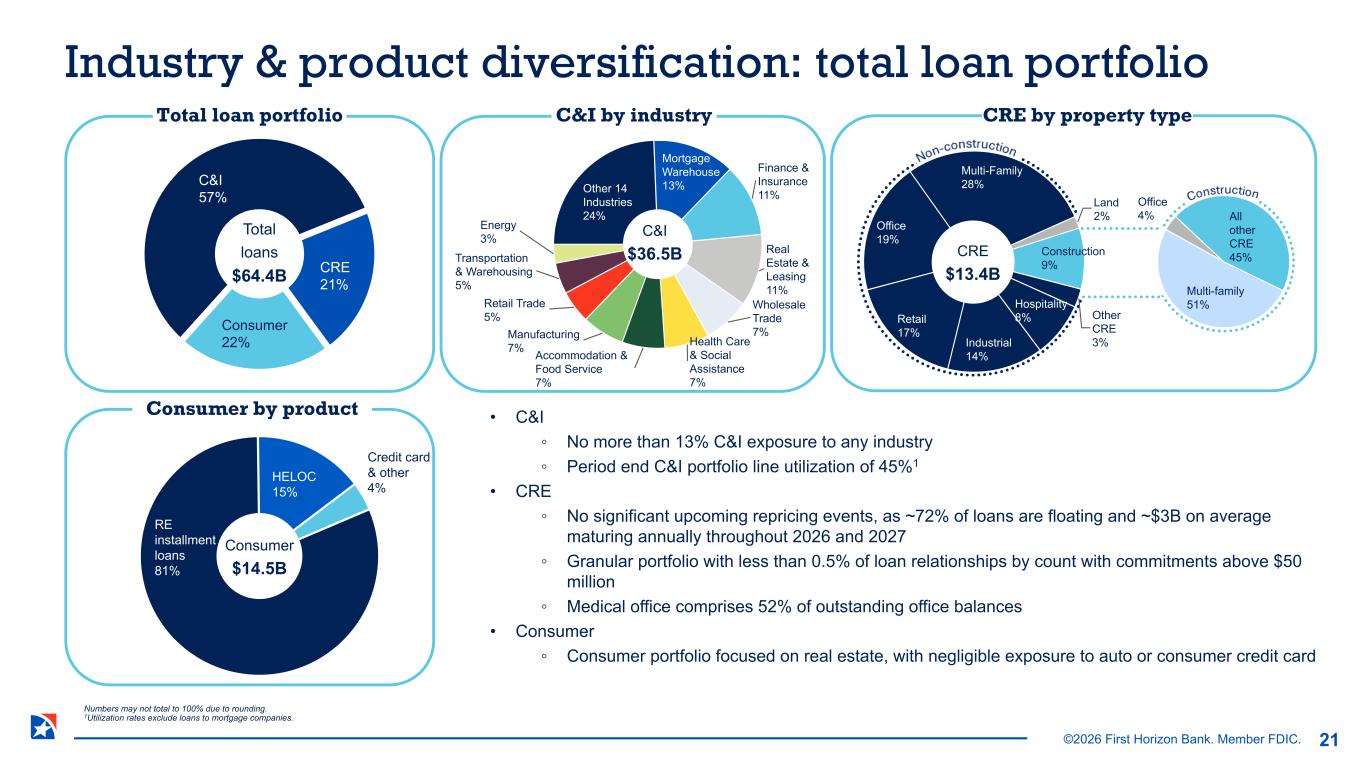
Hey, Michael. Good morning. Happy to address those. In overall, I remain pleased with our very consistent credit performance, headlined by the 18 basis points net charge-off, which is slightly below the median of the range. You know, that said, there's always things that we want to watch carefully. I would say for me in particular, I'm still carefully watching anything that is most closely tied to consumer discretionary spending, especially with recent increases in energy prices, that certainly hits discretionary spending. So sectors like trucking, auto, restaurants, you know, those are things that I want to watch more closely. But to your comment on private credit, you know, that is something that we're certainly monitoring as well. But I would point out we have a very minimal exposure to that segment. In terms of direct exposure to private credit, it's less than 1% of our loan book, and substantially all of that is backed by either. The end collateral is either tangible assets like real estate, inventory, or equipment, accounts receivable, and there's very, very little enterprise value lending exposure.
Very helpful. Thanks for taking my questions. I'll step back.
Operator
Thank you. The next question comes from Jared Shaw of Barclays. Your line is now open. Please go ahead.
Hey, good morning. Good morning. You know, I think if we could look at the $100 million of that sort of incremental BPNR, what are any of the assumptions behind that for cost savings and or potentially slower hiring driven by AI implementation? And if there's nothing in there, is AI a positive or a negative to that $100 million?
There is nothing in there about expenses. That is all deepening relationships and about revenue. You know, in my prepared remarks with year over year with 3% balance growth in a decreasing rate environment. So you can see the profitability of the existing relationships at renewal or new to bank getting, you know, additionally creating more value for us. So there are no expenses. As far as AI, you know, we do have a flat expense outlook, excluding counter-cyclical commissions. We've said that, and that is coming from the technology investments we've made over the years, and we continue to make so that we can scale revenue without having to scale the back office. So less about cost saves right now in our outlook and more about able to scale with bankers, invest in new hires, grow our market share without having to add all of that support.
Great. Thank you. And then on the capital side, you know, I guess what would cause you to lower that 10.5% target? And, you know, you did some work on the capital stack this quarter. You know, I guess what could cause you to feel comfortable with lower?
I think, right, I think given the near term, it's probably not a bad idea. The economy is still, I think, at that point, we have a lower CET1 ratio than the 10.5%. And over time.
Operator
Thank you. The next question comes from Casey Hare of Autonomous. Your line is now open. Please go ahead.
Good morning, guys. I wanted to revisit the NII outlook. I hope you mentioned that deposit costs were going to feel some pressure going forward. I was wondering if you could shed some light on loan yields and bond yields given the fixed rate asset repricing benefits And just overall, what does that do for NIM?
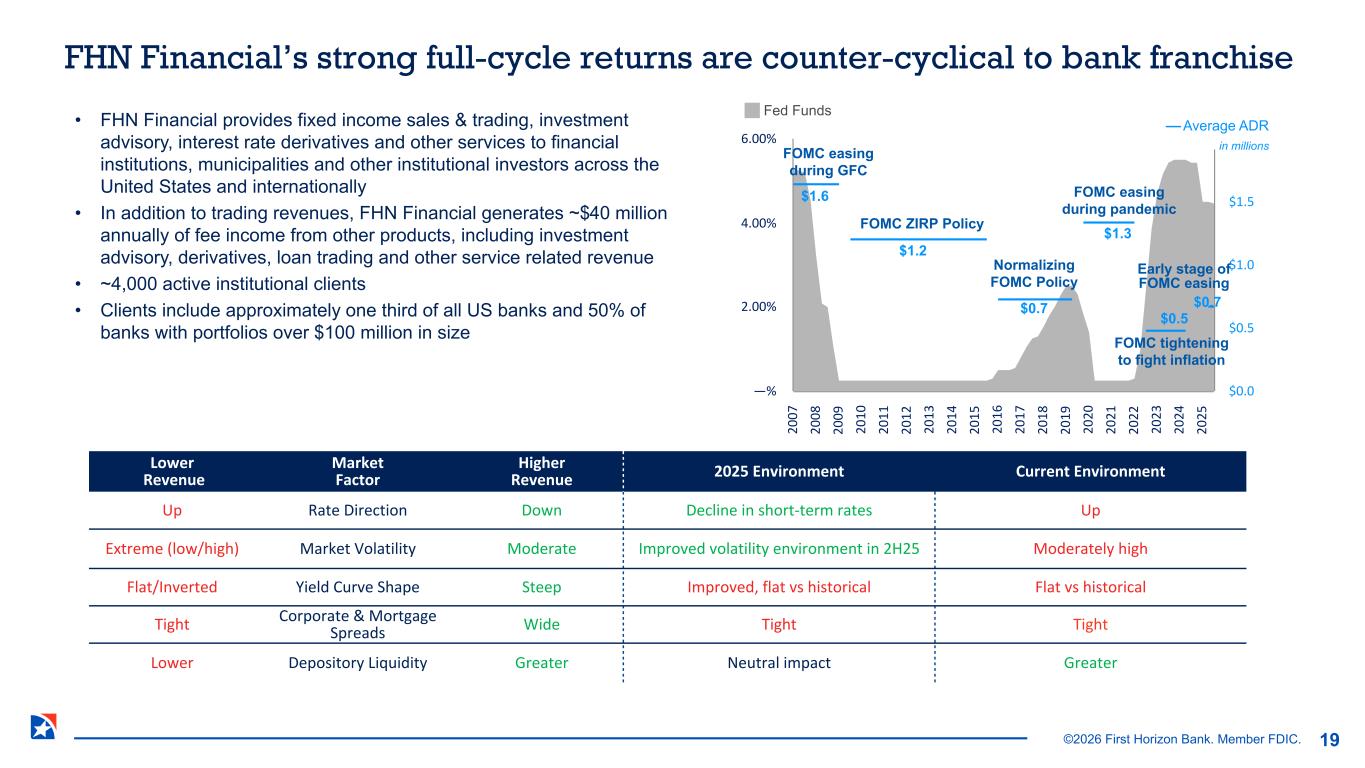
Question, Casey. When I said it was a slight pickup, I don't expect that to put a ton of pressure on NIM or NII. It's really the mix that you bring new to bank in. And so I see that in the low to mid single digits, and that's manageable for us in our current outlook. As far as bond prices and the outlook there, it's really hard to predict what's going to happen. And as Brian mentioned earlier in his comments, we saw a lot of volatility that impacted FHN Financial at the end of March, and April has started off slow. We have a slide in the back of our deck about where, you know, the market is for FHN Financial today, and we have it in red and green and all but one factors in red for them as of today. That does not mean it couldn't change, you know, going into the back half of the year. But we do see, you know, some risk there, but we don't see any risk to our outlook of our guidance on all revenue. So, if NII were to come down with rate cuts or we saw some stability, we'd see FHS financial pickup, maybe some additional refi. And so, we feel that we are really balanced in the back half of the year to hit that revenue guide.
Gotcha. I'm trying to take you. I'm sorry, this is Brian. I'm trying to pull off. You asked about fixed asset repricing. I think we have something like a billion dollars or so in 2026.
Yeah, no, I see that on the slide deck, on slide 7. I was just wondering if the asset yields could offset some of the modest deposit pressure that you guys are feeling to keep the news stable.
Well, I think clearly the fixed asset repricing will have some impact. But Hope's alluded to it a couple of different. We're working very profitable to improve the property. And so there is some, for example, our market investor, Cree, we've improved the yield significantly in that business on a year-over-year basis. So we think we have lots of the positive trends that are occurring in the market in the near term and as much or more stability.
Just one more on the credit side of things. So the ACL ratio has come down nicely. You've got some mid-shift and some credit resolution. I know it's difficult with the CECL modeling, but all else equal, what is a good landing spot for the ACL ratio versus that 128 level?
Yeah, it's hard to say because obviously things have evolved on a quarter-to-quarter basis, and depending on what happens with loan growth, depending on what happens with great migration, and classified resolutions, all of that can change the result quarter to quarter. But we feel like we're very adequately reserved at this current time. At our current ACL, that's approximately seven times our average net charge-up over the last two years. And so I believe where we're currently at is a very well-reserved position relative to our very steady net charge-up performance.
Our three basis points in the CISO model is not material. I mean, we've got up, if you look at the last six quarters, we've gone down three, one quarter, up two. I mean, that's really essentially flat in a coverage with a portfolio that moves as much as ours does.
Operator
Thank you. The next question comes from Bernard Fonguziki of Deutsche Bank. Your line is now open. Please go ahead.
Good morning. On the $100 million plus PPR opportunity, you know, you highlighted some progress made since mid-2025. on slide 15 of the deck. Can you just walk us through these examples on the CRE pricing, you know, the deeper relationships between regional and specialty, the treasury management and wealth management initiatives?
That is in no way a holistic list of all the things, but as we keep getting asked, what are some proof points that you can show us, what can you point to, we put a couple on slide 15. But CRE pricing is one that Brian has talked a lot about as we've been speaking with investors at conferences, which is the benefit of having a specialty model and a market-centric model. We have a strong pro-cree business that is long-tenured bankers and are continuing focusing on exactly what's happening in the Cree industry across the country by sector, by subsector. And about a year and a half ago, we brought that specialty to every deal with a in-market banker who is doing a Cree deal, and we've been able to see additional fee income come out of that partnership where they were able to get origination fees or unused line fees, as well as increased margins as the appetite for Cree in our industry really shrunk over the last three years, so those spreads increased. It's really the benefit of a market-centric model with a specialty partnership. You're bringing the best of both to the client, and we've gotten, in addition to the financial benefits, we continue to hear from our clients how much they appreciate that, having somebody who can talk to exactly what's happening in the industry alongside a bank for the news. And we have that in a lot of places. Franchise finance, ABL, equipment finance, just that partnership is really paying additional dividends for us and is a big part of our 100 million PPNR opportunity that we're already realizing.
This is something that we have It's built into our expectations for 2026, and it's really hard to highlight how much work goes into this. We have hundreds, thousands of bankers that are working on aspects of this every day, and it really comes from the ability that our teams have created for the organization to see with a lot of granularity, relationships, and understanding the nature of relationships, interconnectedness of deposit or fee-based services and lending relationships. And those tools have helped us navigate opportunities for bringing new products and capabilities we've underpriced on the credit or whatever it happens to be. And it's something that is a work in progress. And in 25 or 26, it will continue. But it's part of the discipline that we believe that the organization is oriented around deep, broad, long-term relationships and creating win-win solutions to essentially create partnerships that are, as I said, win-win for both sides.
Thanks for that, Culler. Just a follow-up on loan growth. Obviously, you reiterated the expectations for the mid-single-digit growth. But just wondering, are contributors changing? You know, maybe, you know, stronger C&I than originally expected, maybe a bit less CRE. You know, you noted the headwinds, but pipelines remain strong. Just thoughts on if CRE will still be a positive contributor for loan growth this year?
Yeah, I'm happy to tackle that one. I'll start on the C&I side where you saw very strong continued momentum in Q1. I think what I'm most pleased about in those results is how evenly spread that is. between both our regional bank regions as well as our specialty lines of businesses. We saw momentum on both sides. On the CRE side, we've talked about the headwinds in terms of project starts over the last several years going into the perm market. We started to really see that pace decelerate, and we believe with a very, very strong pipeline, especially now compared to a year ago. We should start to see some very good next later this year as well. So overall, there's very good momentum.
Operator
Thank you. The next question comes from Chris McGrady of KBW. Your line is now open. Please go ahead.
Hey, how's it going? This is Andrew Leishner on for Chris McGrady. I know you touched on it a little bit earlier on – hey, how's it going? I know you touched on it a little bit on Casey's question earlier, But just on the 3% to 7% revenue guide, can you maybe walk us through the scenarios or assumptions that would get us to the higher end or lower end of that range?
As I said, I think we're pretty balanced. The question's not how do we get to the higher or lower end of the range. It's does it come from fee income and counter-cyclicals, or does it come from NII and higher loan growth? What I have mentioned is to get to the high end or exceed, not to say it's our only, but it's really – we have no pickup in mortgage or free-size built into this outlook. As I said earlier, I don't expect it in the near term as 30-year rates keep moving up and there's uncertainty of the consumer, but that's the one item not built in here. But, you know, we're starting the year with 3% loan growth year-over-year and, you know, 6.5% revenue growth year-over-year. So we have a strong start to that momentum. Tom?
I think the other driver is likely to be an acceleration of economic growth. And excuse me, to the extent that we look at the economy today, we feel like we're in a pretty good place, but it's probably in that two and a half to three percent area loan growth of how interest rates play out in connection with some of it in terms of economic growth.
And on the expense outlook, analyzing this quarter gets you a little lower than flat expenses. So outside of the lower marketing in the quarter, is this a good run rate from here, or were there some other items that were lower than usual? I know you completed that technology project reference in the release, but any color here would be great.
I see some movement throughout the quarters as it relates to marketing spend. You know, we always have an issue with the way we do our income statement where marketing expense hits first and then the cash offers hits an other, and so you'll see some volatility there. But, you know, the other one is technology projects. They can vary quarter to quarter at the end of the year. We had a lot of projects complete, and they went from the expense part of their project to capitalization, which is more stable. But I do think, you know, to your point, it's a good glide path, and on average, we do expect to be flat year over year with some variability quarter to quarter.
One of the things that I'm excited about on the expense side is we've had very good success in hiring new revenue producers. And if you look at just, we're having very, and I think the point I'm really trying to make is not only are we bringing good people into the organization, we're controlling costs while still continuing to invest in growth and driving the business forward. So I think that combination is very positive for the loan.
Great. Thank you so much for the color.
Operator
Thank you. And the next question comes from Ben Gerlinger of Citi. Your line is now open. Please go ahead.
I know you talked through CT1 and the appetite. We could potentially go lower, but as of now, it's 10.5. And then kind of with the outlook for loan pipelines, it sounds pretty robust with that respect. When we look at the seasonality component, your balance sheet balloons a little bit with mortgage. I get that mortgage is a little bit soft, but how should we think about buybacks over the next couple of quarters, given you're fairly close to the 10.5? Is it more opportunistic?
Because the capital needs to go to growth, but how do we just think about the next couple of quarters here? yeah we will the extent that mortgage warehouse lending pushes our mortgage warehouse lending business has exceptionally low credit we see it as more of an operational our team does the extent that that pushes that that does not call against that backdrop we will continue to
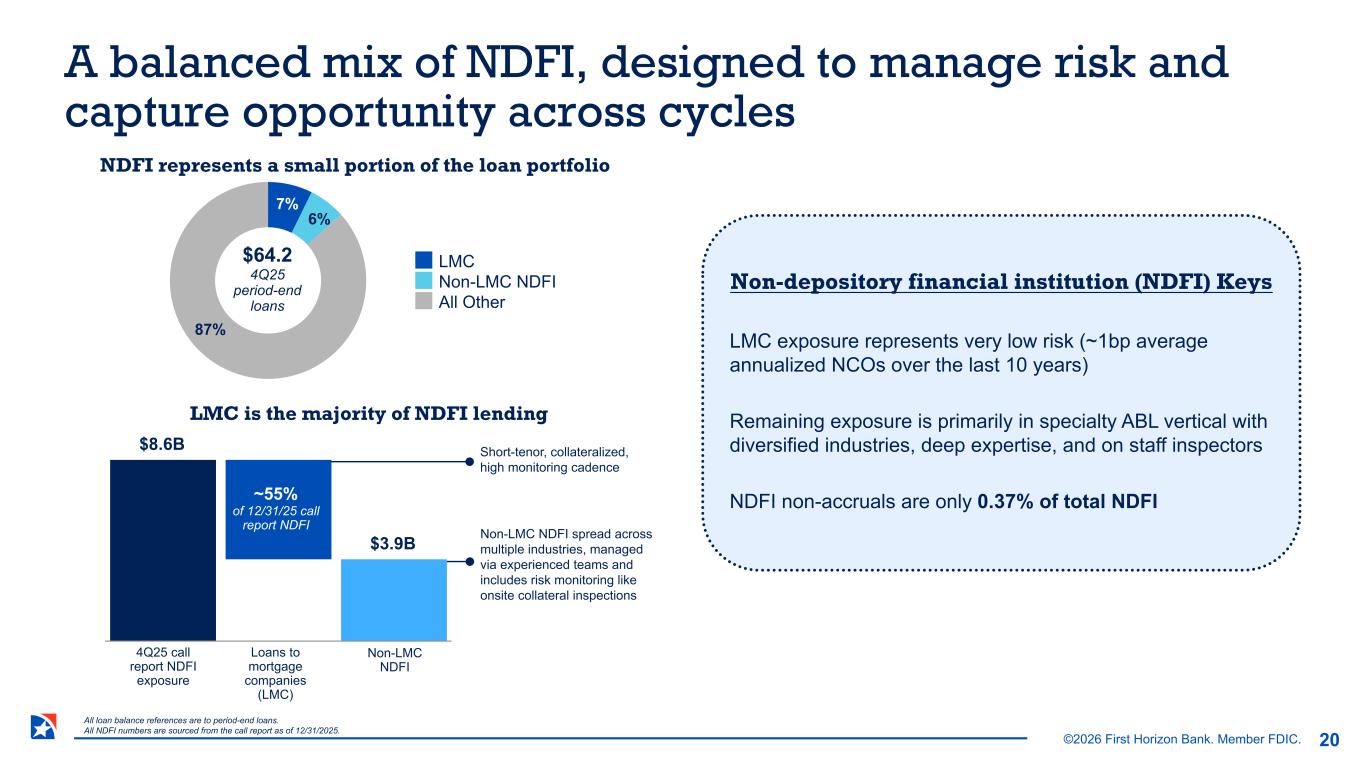
be opportunistic to generate to take the excess capital that we generate and use that and yeah And just to add on to Brian's comments, it's noted in our presentation, over the last 10 years, our mortgage warehouse business has averaged about one basis point's annual net charge cost.
Yeah, no, that's great. I wasn't worried about the credit cards more, so just the usage of capital over the next. But that was a great answer. Appreciate the time, guys.
Operator
Thank you. The next question comes from Tim of Ravilla of UBS. Your line is now open. Please go ahead.
Hi, good morning. Looking at the expense guide relative to revenue, the revenue guide is still pretty wide in range versus a pretty tight expectation on expenses. I'm just wondering how agnostic the expense base is towards the different ranges of the revenue guide and kind of what's embedded as the baseline now for the flat year on your expense.
The revenue guide, with the exception of the higher end of the range and more of it comes year-over-year from the counter-cyclical businesses, you can assume a 60% commitment. What's built in is flat counter-cyclical revenue year-over-year to that flat guidance. But I don't see, you know, Brian talked about new hires. New hires were built into our expense guide. Branches were built into our new expense guide, a consolidation into a new hub in Charlotte in our expense guide. All of the investments are already in there, and we believe it's flat. You talk about the range of the guide. Every CFO will tell you it's easier to troll expenses than biz revenue. And so the range for the guide is really the uncertainty of the economy that we're looking at right now. Brian mentioned earlier, could we see the economy start to rebound with consumer confidence and more spending in the loan group? That is what's driving our large range, not our internal understanding of where we think our businesses are going. It's just really hard right now, Timmer, as you know, to figure out what type of economy we're going to be lending into and, you know, what's going to happen in the wealth business over the next three weeks.
Great, thanks. And then as a follow-up, there's some increased conjecture maybe this week surrounding M&A, all the volatility that's going on in the market right now. Could you just give us a reminder on both sides of M&A, kind of your updated center?
Nothing's changed the benefits that we've done.
Operator
Thank you. The next question comes from Anthony Elian of JPMorgan. Your line is now open. Please go ahead.
To put a finer point on NIM, last quarter you went into a range in the mid three fours, but you've clearly outperformed that for a couple quarters now. Just getting the earlier comments on loan yields, deposit costs ticking up slightly, how are you thinking about NIM here? Thank you.
Yeah, the mid four comment was about stabilization when we saw, you know, know, a flat interest rate environment, more consistent spreads. Near term, we do expect to be in the high three-fours, you know, within a few basis points of where we're at right now.
Thank you. And then on capital, given the recent proposals, have you quantified any of the estimated impact or benefits you'd see from the recent proposals? Thank you.
Thanks, Anthony. We have calculated, and every consultant out there has sent us a deck and wants to meet with us on how to optimize it, it's really clear that it is positive for everybody. It will definitely be a pickup for us, especially in some of the proposals for mortgage, some of the proposals for our fixed income business inventory, but we have not put a fine pen to say that this is exactly what it is. There's still a lot of uncertainties out there in the model, as well as how do we react to some of those? How do you change, you know, term of a loan, for example, gives you different capital treatment, but net positive for sure.
Operator
Thank you. The next question comes from Christopher Maranek of Green Capital Research. Your line is now open. Please go ahead.
Thanks. Good morning. Tom, just wanted to ask about the reserve as it pertains to both Mortgage Warehouse and any other NDFIs. Should we see that grow over time, or how do you think about that?
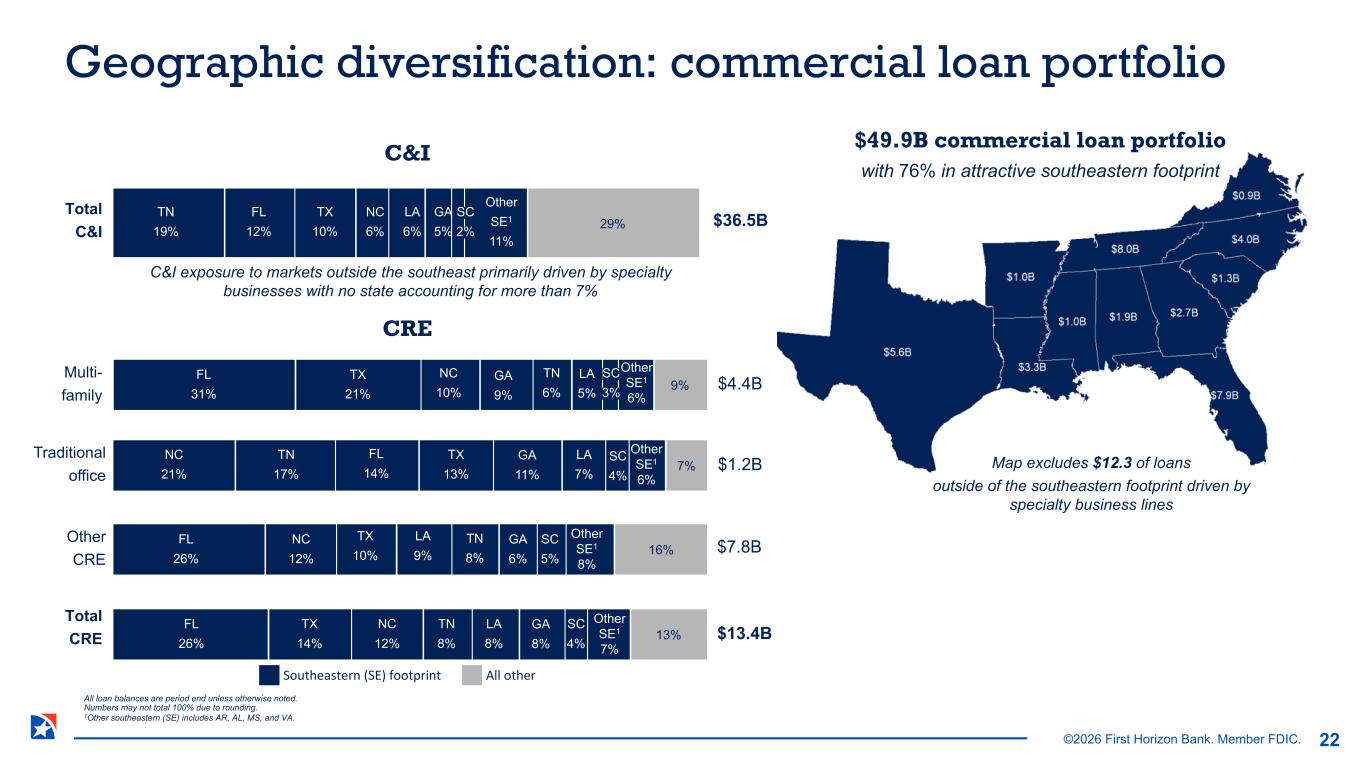
Yeah. Yeah, and Mortgage Warehouse and NDFI is all part of our atrical and ACL reserves of the C&I business. I don't have it broken in front of me in terms of my specific lines of business, but overall, as you saw, we did add a little bit to our C&I reserves this quarter. That's more a reflection of some overall economic uncertainty around the conflict in the Middle East as well as what is that, how that is impacting discretionary consumer spend. mentioned earlier, I believe my basis as well, to NDFI, I think what I would point out is it may be helpful to break down the components a bit. From the Cole report, you'll see we have a total of $8.6 billion of total NDFI. However, from there, about 55% is the mortgage warehouse business that we've talked about with very low charge-offs and very short tenure with an average dwellings under 20 days. And so the remaining $3.9 billion of non-morgasers of that is categories that are NDSI in the call report that are really more akin to traditional C&I structuring and risk. And so, therefore, what's left, the remaining two-thirds, is really only the performance in that business. You know, there's certainly some pockets with some elevated C&Cs we have to watch, as you would expect. But the overall performance of that remaining book is actually not too dissimilar from our overall C&I book in terms of the NPLs are actually slightly lower relative to our overall book, and their charge-off is slightly higher, but it's all very close to being in line. And so from my position, I don't think there's any specific reason to have outsized results tied to our NDFI book.
On your comment about mortgage warehouse and NDFI, I want to point out, for us, the way we do mortgage warehouse, we don't really consider an NDFI, although the call report does. We hold the underlying collateral. We take each note at closing. Tom talked early in his remarks that we had one basis point of charge-off in the last 10-plus years. That comes down to the operational risk. Should the company that we're lending to have an issue and can no longer be in business, We have the notes. We've worked through that, and we then pledge them and sell them or put them on our balance sheet. And so for us, NDFI is an operational risk. For the fraud piece of it, we've seen collateral, double pledge. We don't have that situation. We actually maintain the notes until they're sold. And that's something that is different than how some others do mortgage warehouse in the industry.
And just to make sure we're clear, the one basis point is the average annual.
Thanks, Hope, and thank you, Tom, for that addition. detail, that's very helpful. Tom, just to clarify, you mentioned that there are some charge-offs in the other 90-5, that smaller component. Are these kind of normal charge-offs, or have these changed at all in recent quarters?
I would say it's relatively normal. I mentioned it's slightly higher than our overall net charge-off rate, but it's not anything alarming.
Operator
I'll also point out, The question comes from David Chiaverini of Jefferies. The line is now open. Please go ahead.
Hi, good morning. Max Astaris on for David Chiaverini. Just a quick question around capital markets. Given recent yield curve volatility, I wanted your thoughts specifically around fixed income. And how sensitive is the fixed income trading desk to the current shifting expectations around Fed easing?
Yeah, this is Brian. And the uncertainty in our ADR for the call, we look at the business as a very strong optimistic. Our outlook is optimistic for the foreseeable future, recognizing that there are going to be potential events that can push rates up or bring. But we think we're well positioned and in a good place to benefit from that policy.
Operator
The next question comes from John Pancari of Evercore. Your line is now open. Please go ahead.
Hi, this is Gerard Sweeney. I'm for John. So, you highlighted that this is the third straight quarter of 15% plus ROTC, considering 15% target. How should we think about ROTC's trajectory going forward? Do you see a path closer to high teams or is maintaining the current level more your priority? And if you were to get more to a high teams level, maybe what are the three, you know, or a few steps that would get you there?
It is a destination. And to the extent the improved process, we think we have the ability. I'm not going to try to put a – and I feel good about it.
That makes a lot of sense. And maybe going back to the prior question on the fixed income business, is there an ADR range, you would say, embedded in your revenue guidance? I know there's a counter-cyclical side of it, but just how to size up, you know, from a modeling standpoint, you know, the rest of the year.
There are multiple ranges embedded in our guidance because, as I've said before, we trade NII for fee income or mortgage warehouse balances in a decreasing rate environment. And so we do not have a single outlook to head-earn guidance, regardless of whether rates increase, stay flat, or decrease. You'll just see the revenue come from different places.
Operator
Thank you. We have no further questions at this time, so I'd like to hand back to Brian for closing remarks.
Good morning. Please reach out if you have any further questions. We appreciate your interest. I hope everyone has a wonderful day.
Operator
This concludes today's call. Thank you all for joining. You may now disconnect your line.