Operator
Greetings. Welcome to FinWise Bancorp's First Quarter 2025 Earnings Conference Call. At this time, all participants are in a listen-only mode. A question-and-answer session will follow the formal presentation. As a reminder, this conference is being recorded. Thank you. You may begin the presentation.
Good afternoon, and thank you for joining us today for FinWise Bancorp's first quarter 2025 earnings conference call. Earlier today, we filed our earnings release and investor deck and posted them to our investor website at investors.finwisebancorp.com. Today's conference call is being recorded and webcast on the company's website, investors.finwisebancorp.com. On today's call, management's prepared remarks and answers to your questions may contain forward-looking statements that are subject to risks and uncertainties that could cause actual results to differ from those discussed today. Forward-looking statements represent management's current estimates, expectations and beliefs and FinWise Bancorp assumes no obligation to update any forward-looking statements in the future. We encourage listeners to review the more detailed discussions related to these forward-looking statements contained in the company's earnings press release and filings with the Securities and Exchange Commission. Hosting the call today are Kent Landvatter, Chairman and CEO; Jim Noone, Bank CEO; and Bob Wahlman, CFO. Kent, please go ahead.
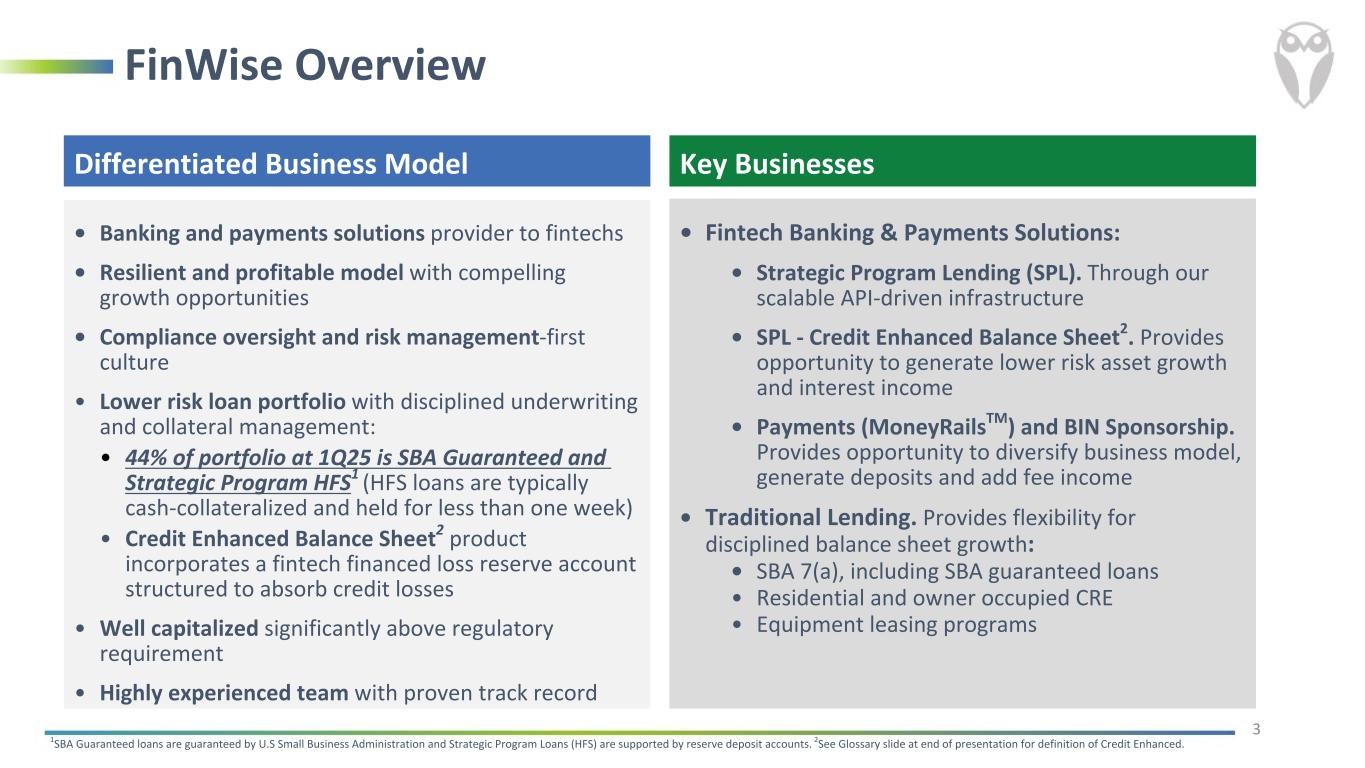
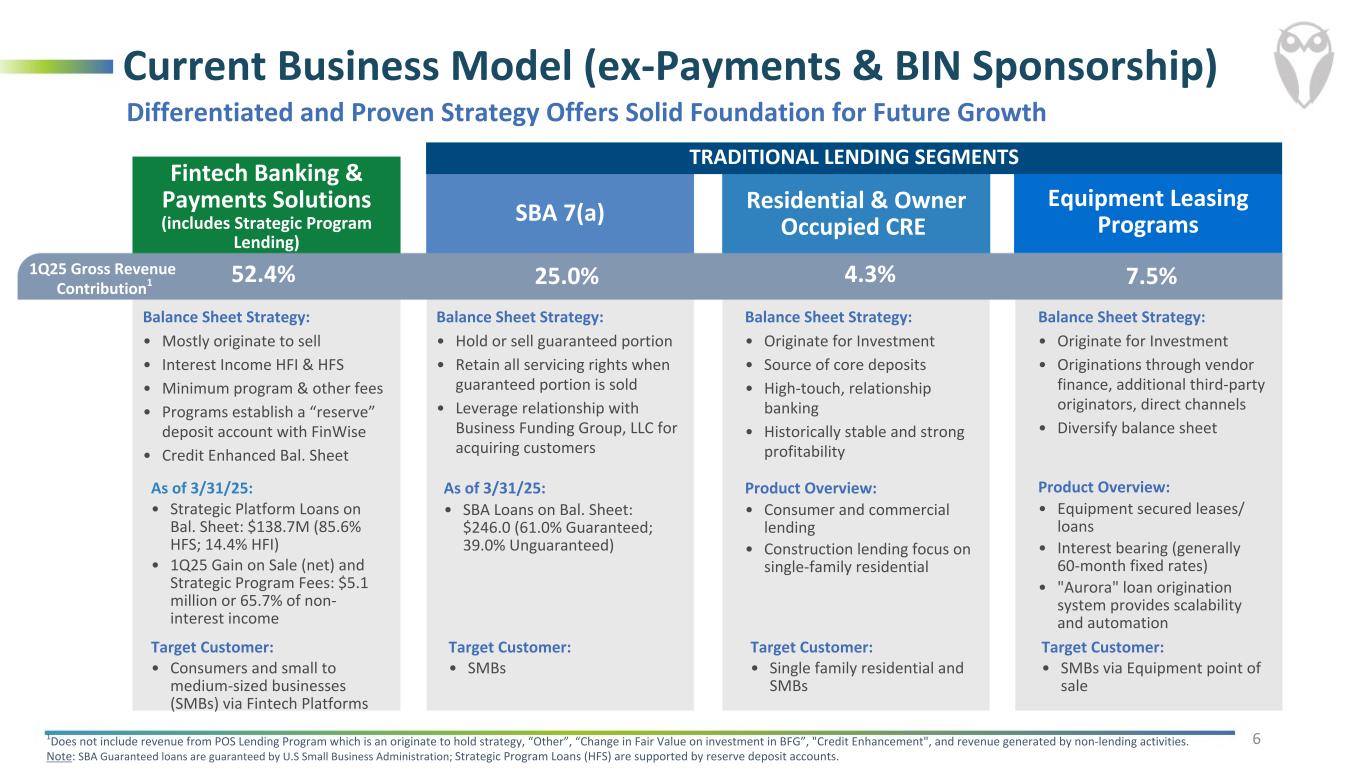
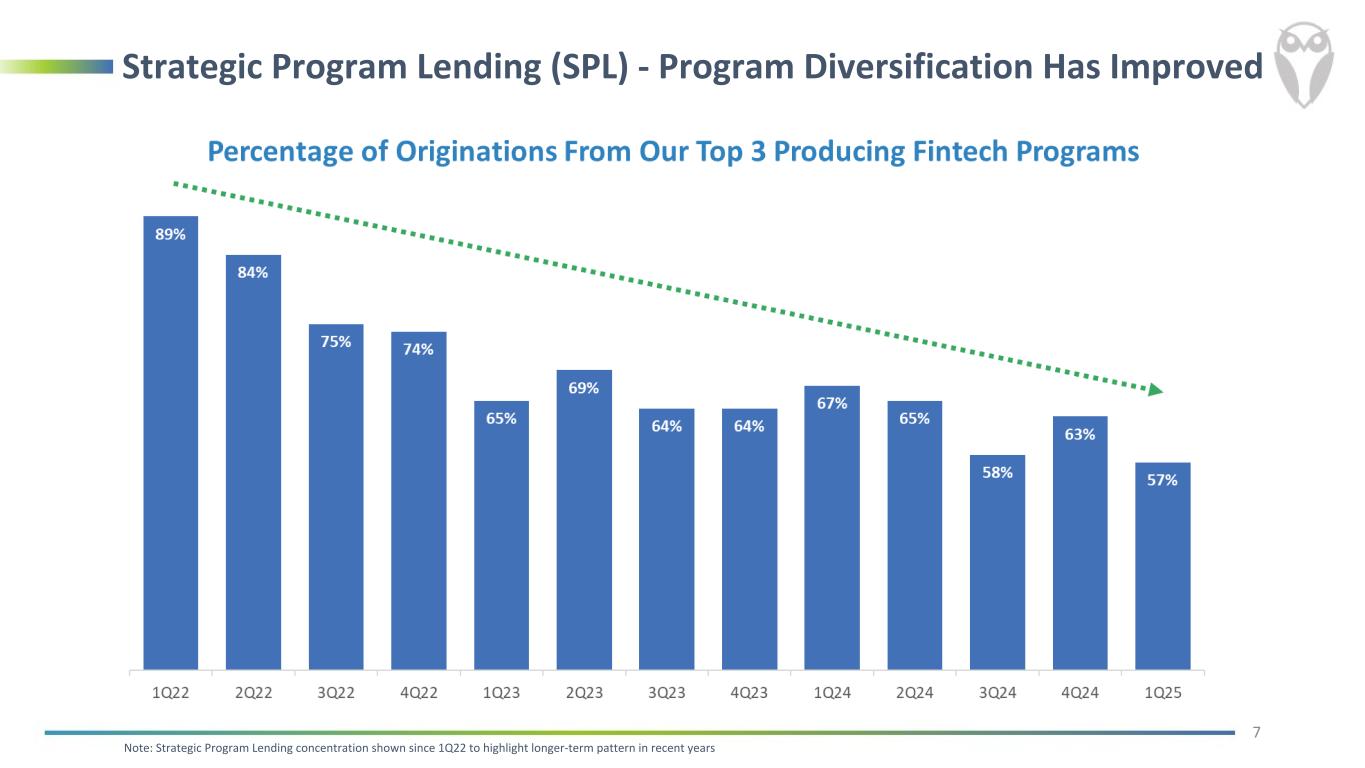
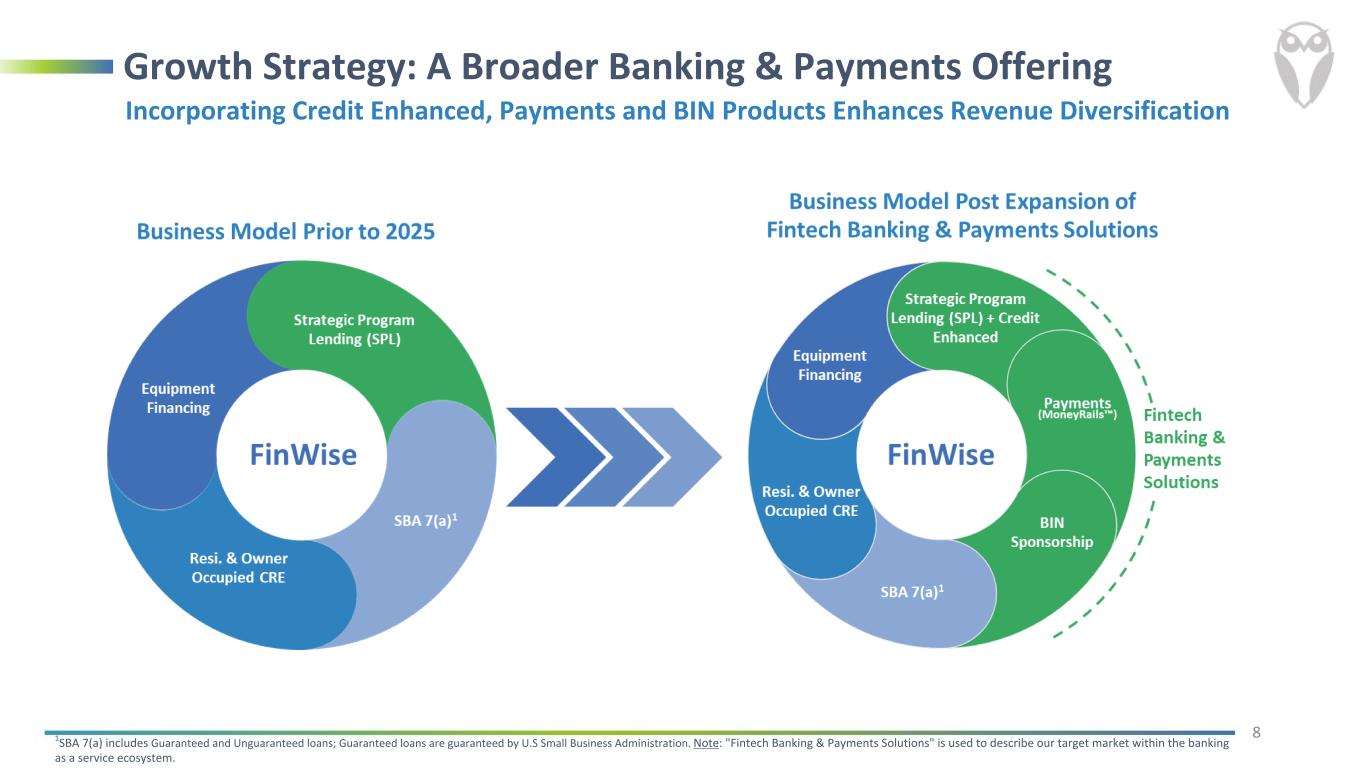
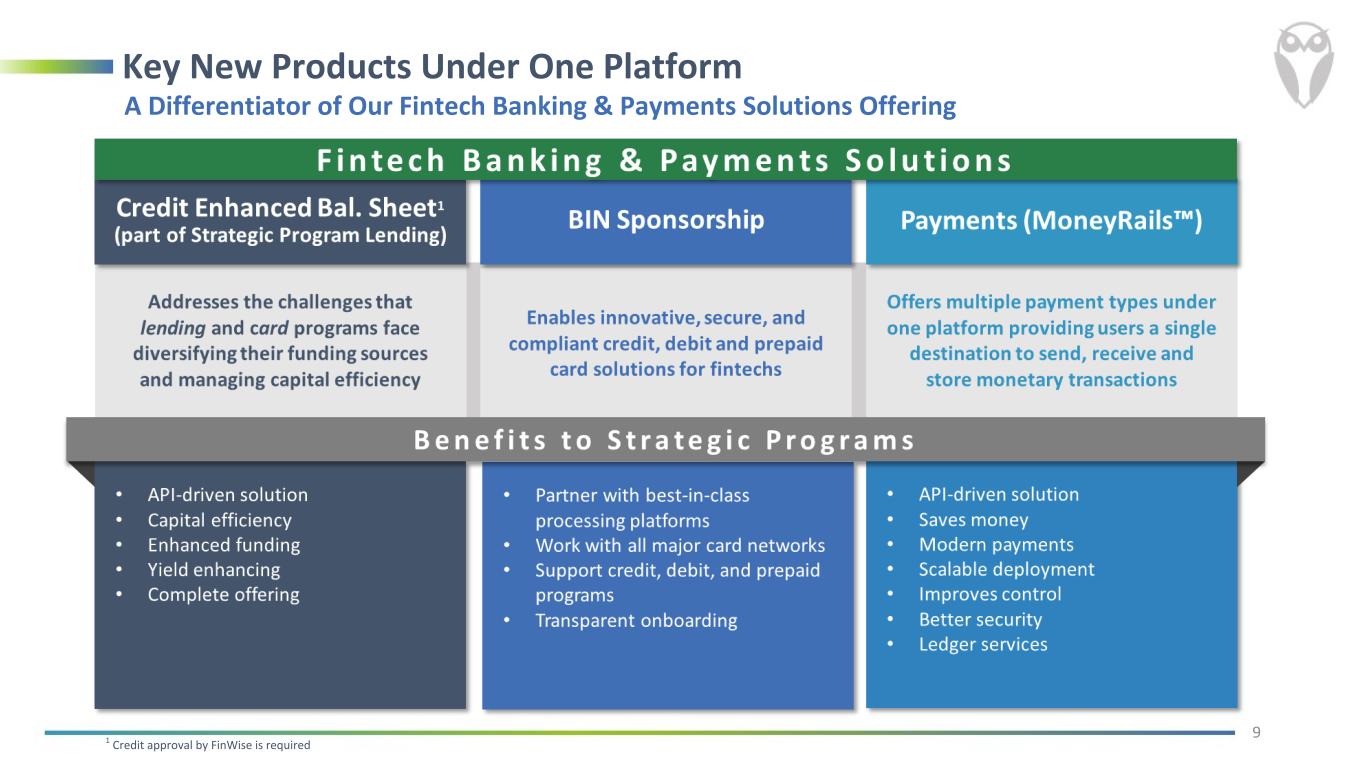
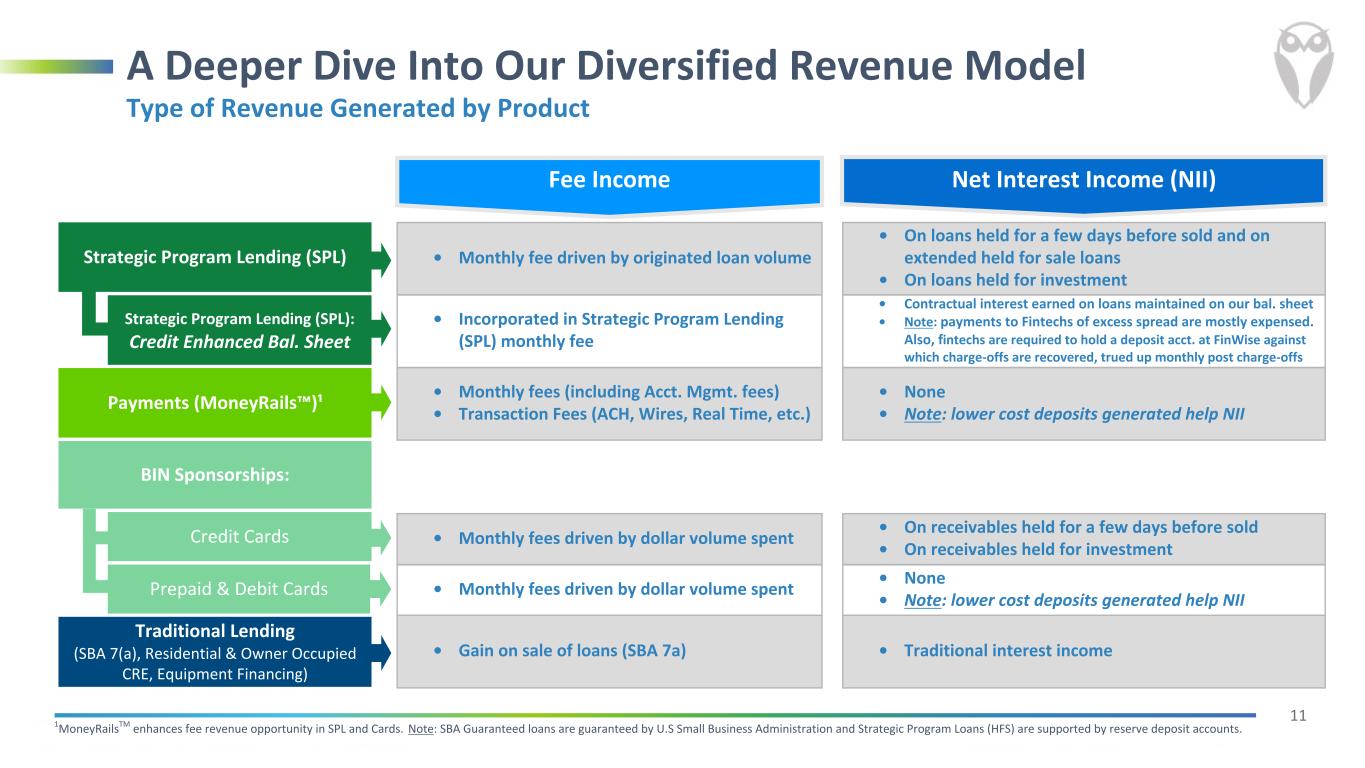
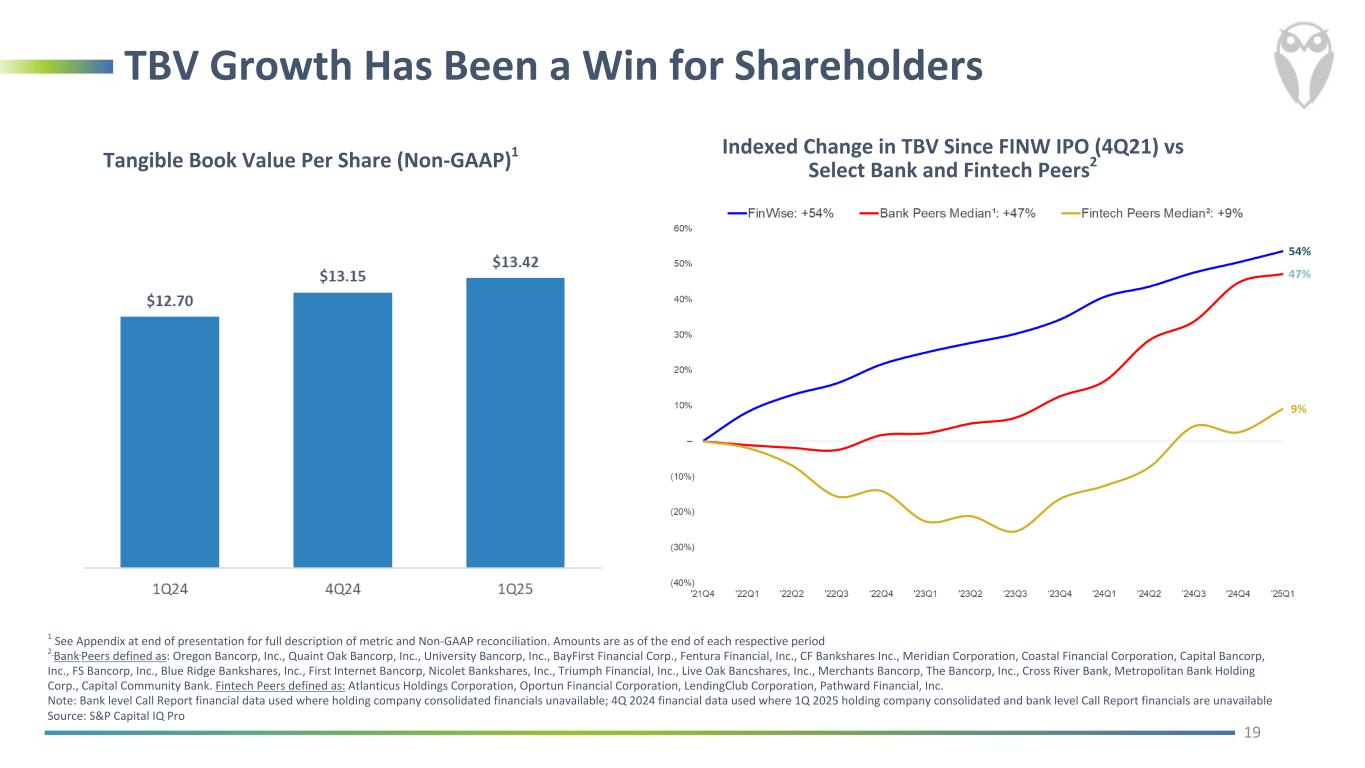
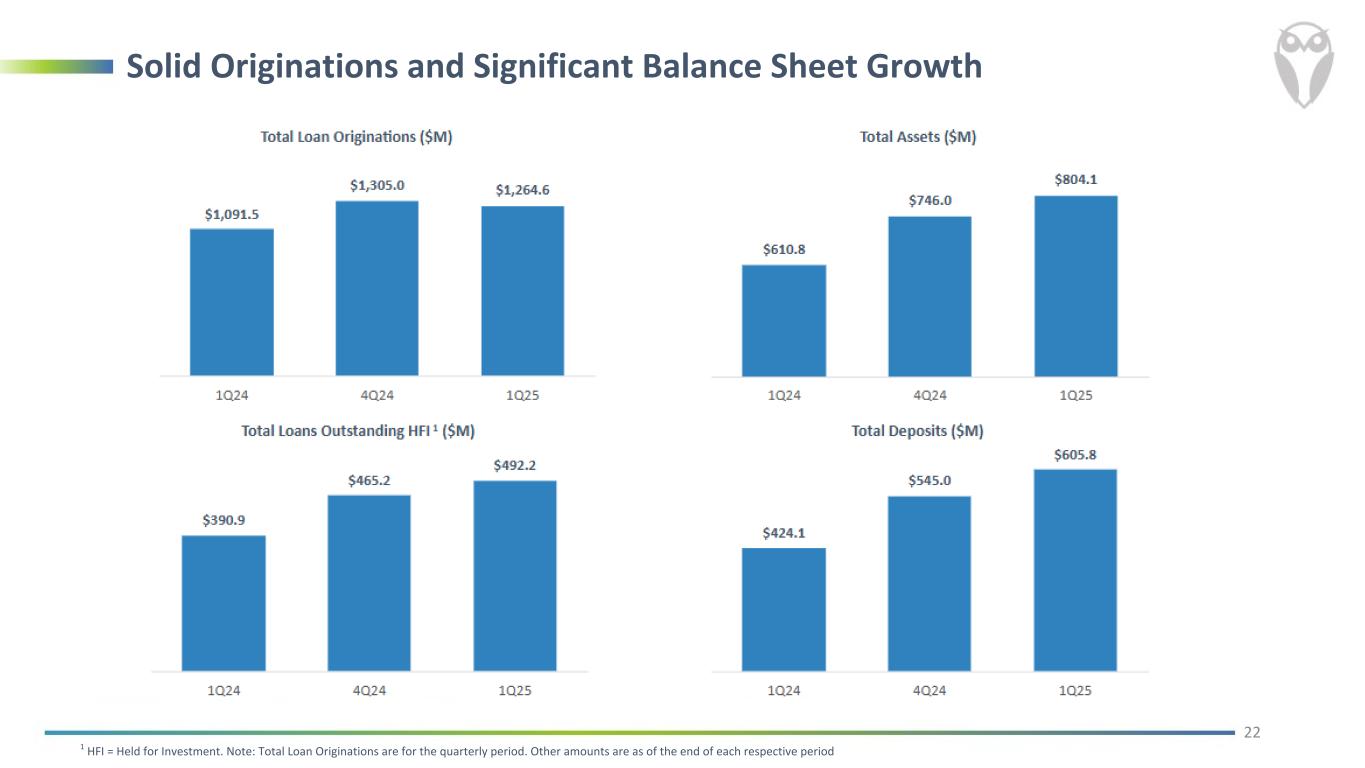
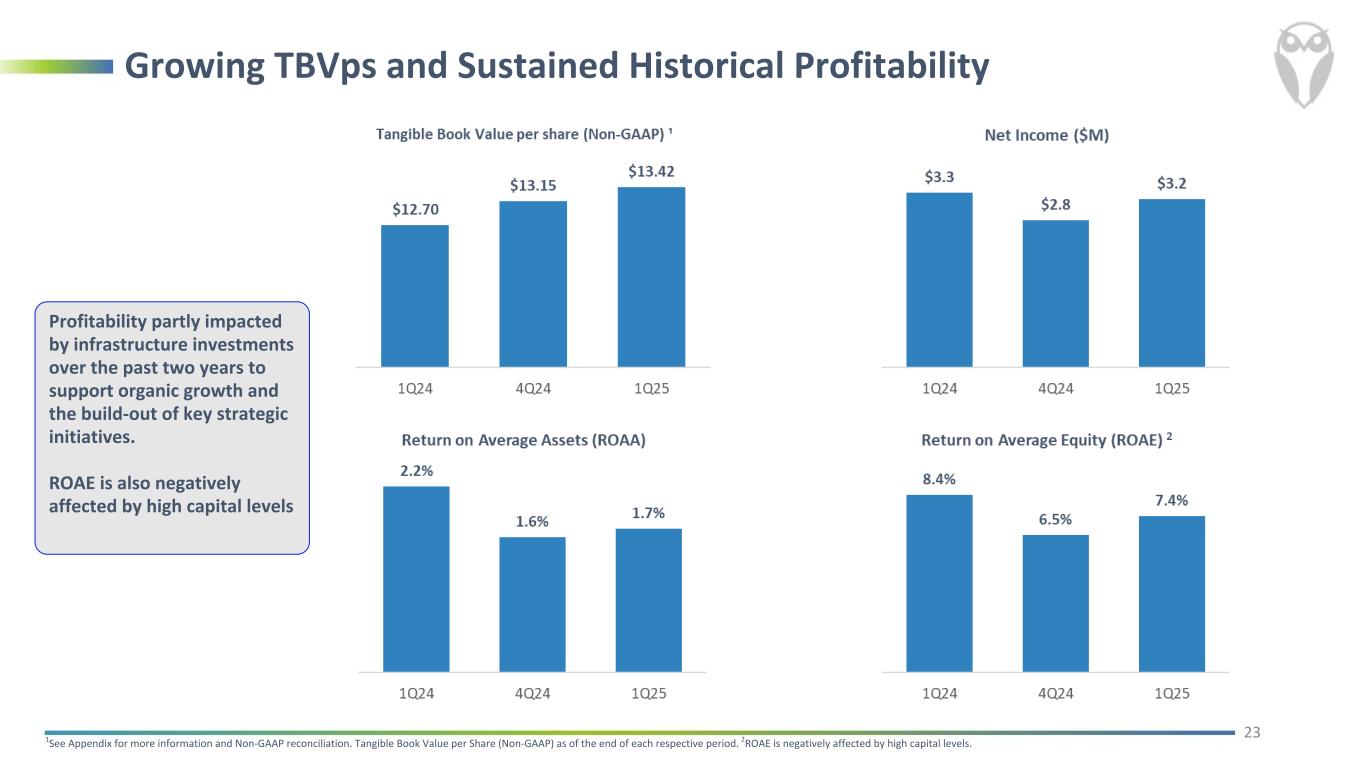
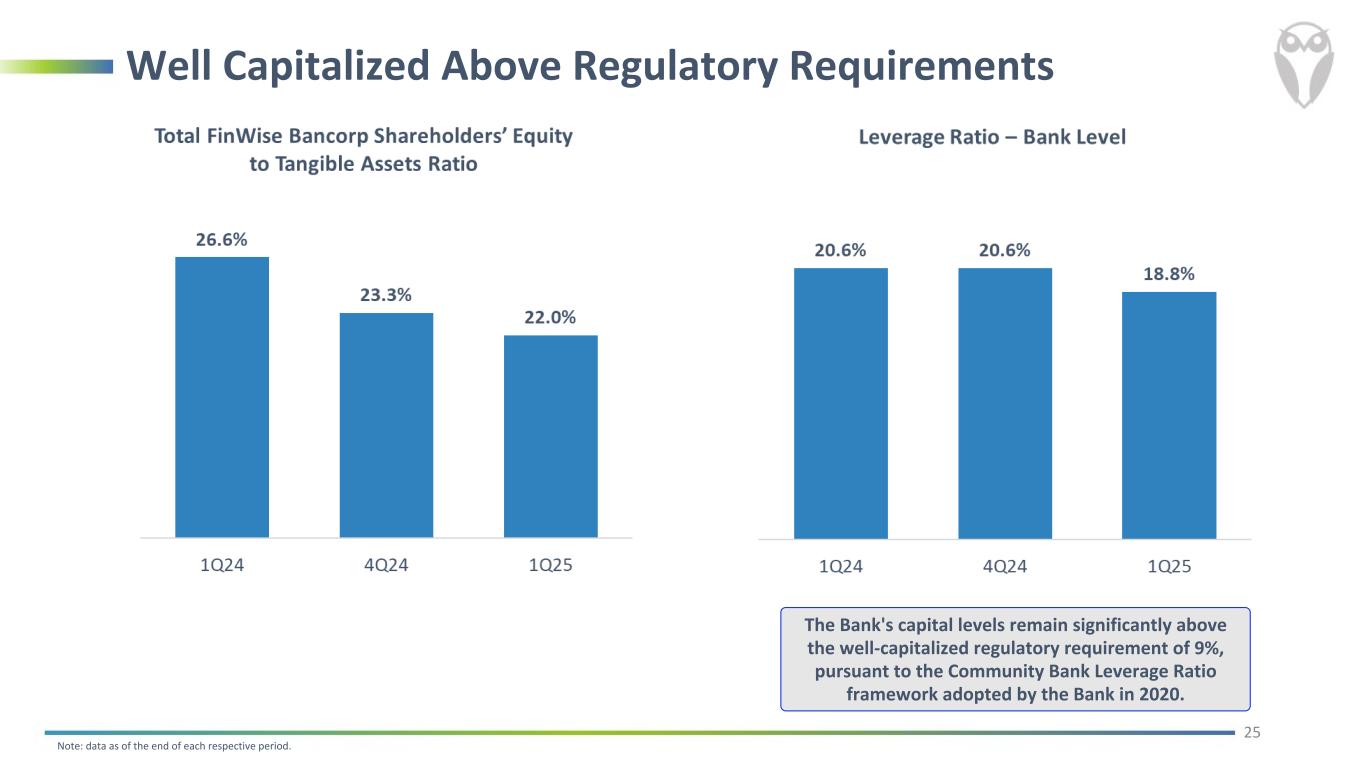
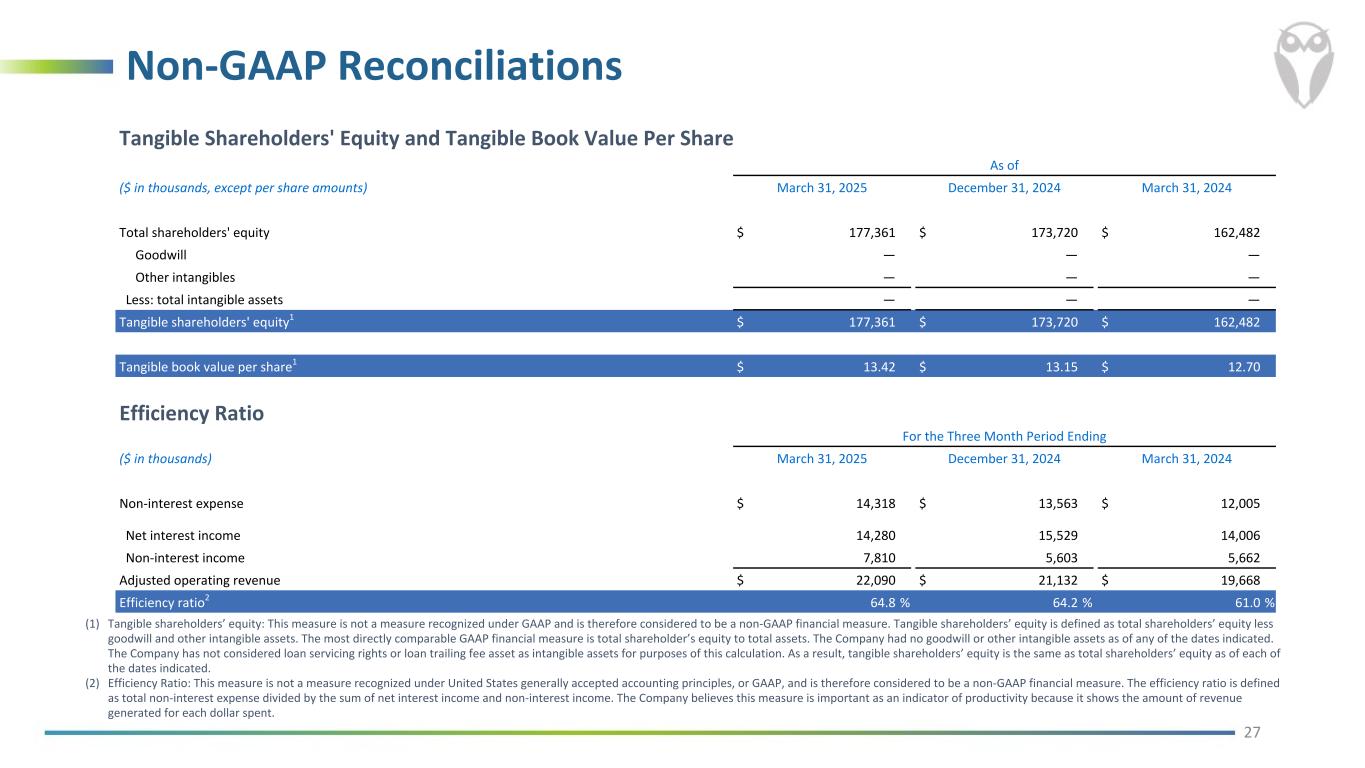
Good afternoon, everyone. The FinWise model remained resilient in its first quarter even amidst a more uncertain macro environment. Loans originated totaled approximately $1.3 billion and we also posted solid asset growth and encouraging credit quality performance as both NPL balances and net charge-offs declined versus the prior quarter. Furthermore, we continue to migrate our loan portfolio to a lower risk profile while still growing profitably and increasing tangible book value. Specifically, our tangible book value per common share ended the quarter at $13.42 versus $13.15 in the prior quarter. We also remain well capitalized, significantly above regulatory guidelines with a tangible shareholders equity to assets ratio of 22% down from 23.3% at year-end 2024. As we have discussed in the past, we expect our capital ratios to decline due to the planned growth in assets. We also remain focused on executing our business strategy including announcing a new strategic program agreement with fintech Bakkt subsequent to the end of Q1. As part of our relationship with Bakkt, FinWise will provide business installment loans to small and medium-sized businesses and we will also provide access to our lower risk credit enhanced balance sheet program. While we will continue to closely monitor the economic environment, we remain very excited about the long-term outlook for our business, particularly as our existing and potential strategic partners are enthusiastic about the benefits that our broader banking and payments platform provides them. For 2025, we continue to look for gradual progression in growth as we move through the year, driven by originations from existing programs as well as incremental growth from programs that were signed late last year and more recently. We also continue to expect our credit enhanced balance sheet program, including a similar extended held-for-sale product to be a meaningful contributor to our earnings in 2025, with most of the growth coming in the second half of the year as we had discussed on our prior earnings call. With that, let me turn the call over to Jim Noone, our Bank CEO.
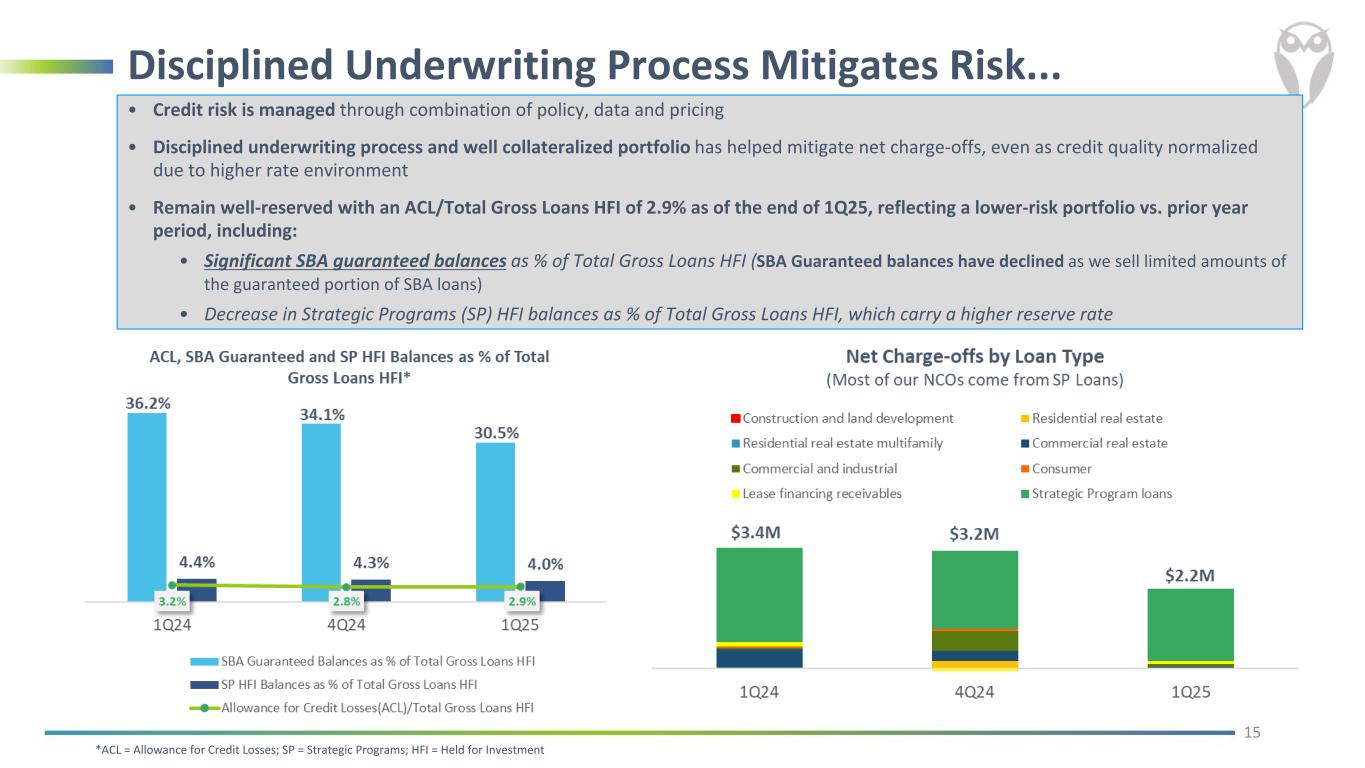
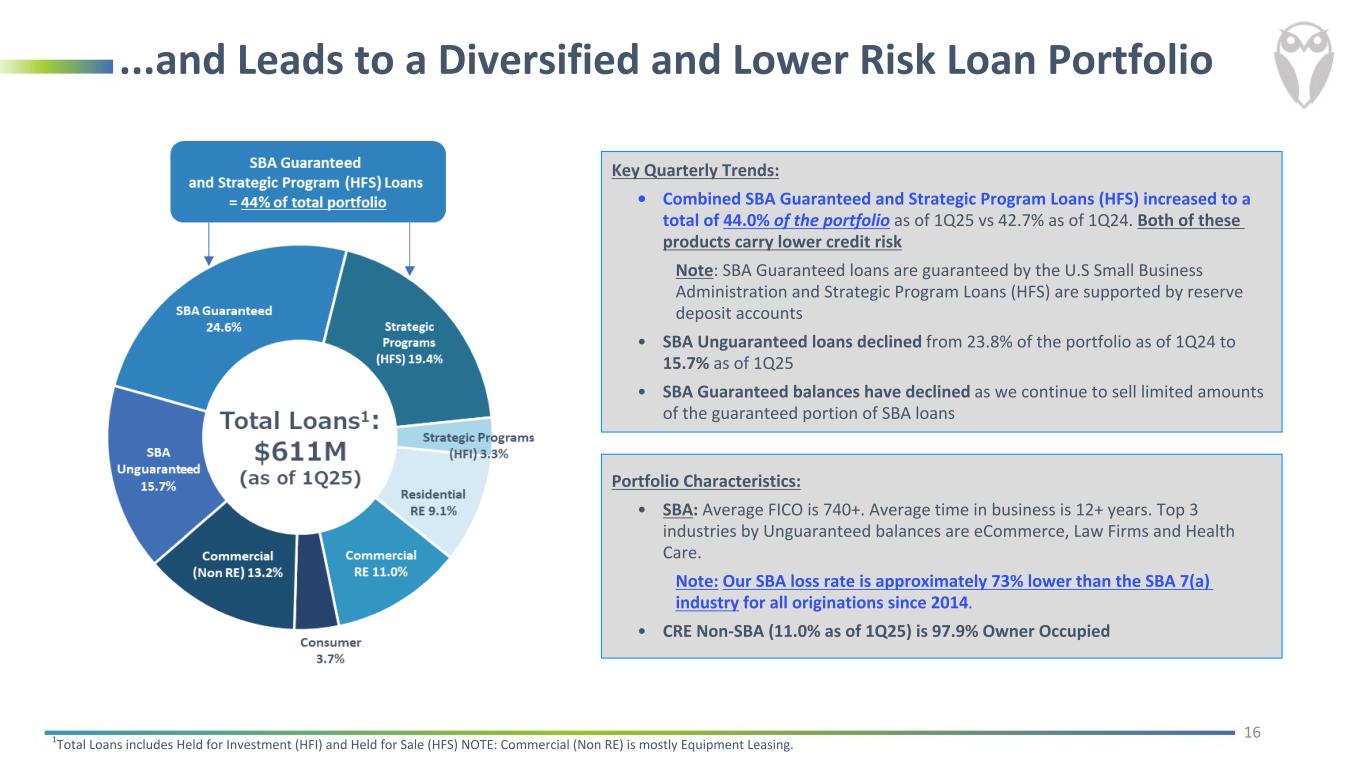
Thank you, Kent. As mentioned, our businesses are healthy. We originated approximately $1.3 billion in loans during the first quarter and we were pleased that several of the strategic programs we announced in 2024 began to contribute. That said, in the second half of the quarter, we saw some seasonal softening in demand from our higher yielding partners and this seasonality is in line with our expectations from prior years. Our largest student lending program had a strong seasonal quarter on originations, but we expect this contribution to decelerate in line with school calendars during the second quarter. Although, the lending market could change through the first four weeks of April 2025, loan originations are tracking at a quarterly rate of $1.2 billion. We remain comfortable in the outlook for originations for the year, particularly as the four new programs from 2024 begin to mature more meaningfully with us. Our SBA 7(a) loan originations ticked down a little quarter-over-quarter. This was driven primarily by average loan size coming in slightly lower in the quarter as we have continued to see stable demand with our SBA lending. We also had solid growth in our equipment leasing and owner-occupied commercial real estate lines, both of which have been meaningful contributors to portfolio growth. During the quarter, we continued to sell some of the guaranteed portions of our SBA loans. As we have previously discussed, we plan to continue to sell SBA loans as long as market conditions remain favorable. Our SBA guaranteed balances and our strategic program loans held-for-sale, both of which carry lower credit risk in aggregate, made up 44% of our total portfolio at the end of Q1. Moving to credit quality, the provision for credit losses was $3.3 million in Q1, compared to $3.9 million in the prior quarter. The decrease was driven by lower charge-offs. Quarterly MCOs were $2.2 million this quarter versus $3.2 million in the prior quarter. Regarding NPAs, while we continue to expect roughly $12 million in potential NPA migration during Q2 as a result of higher rates. During Q1, we were successful in reducing our NPA balances to $29.9 million versus a $36.5 million balance in the prior quarter. The decline in NPAs was driven by consistent collection efforts by our portfolio team. Of the $29.9 million in total NPAs, $15.1 million is guaranteed by the federal government and $14.7 million is unguaranteed. I will now turn the call over to our CFO, Bob Wahlman, to provide more detail on our financial results.
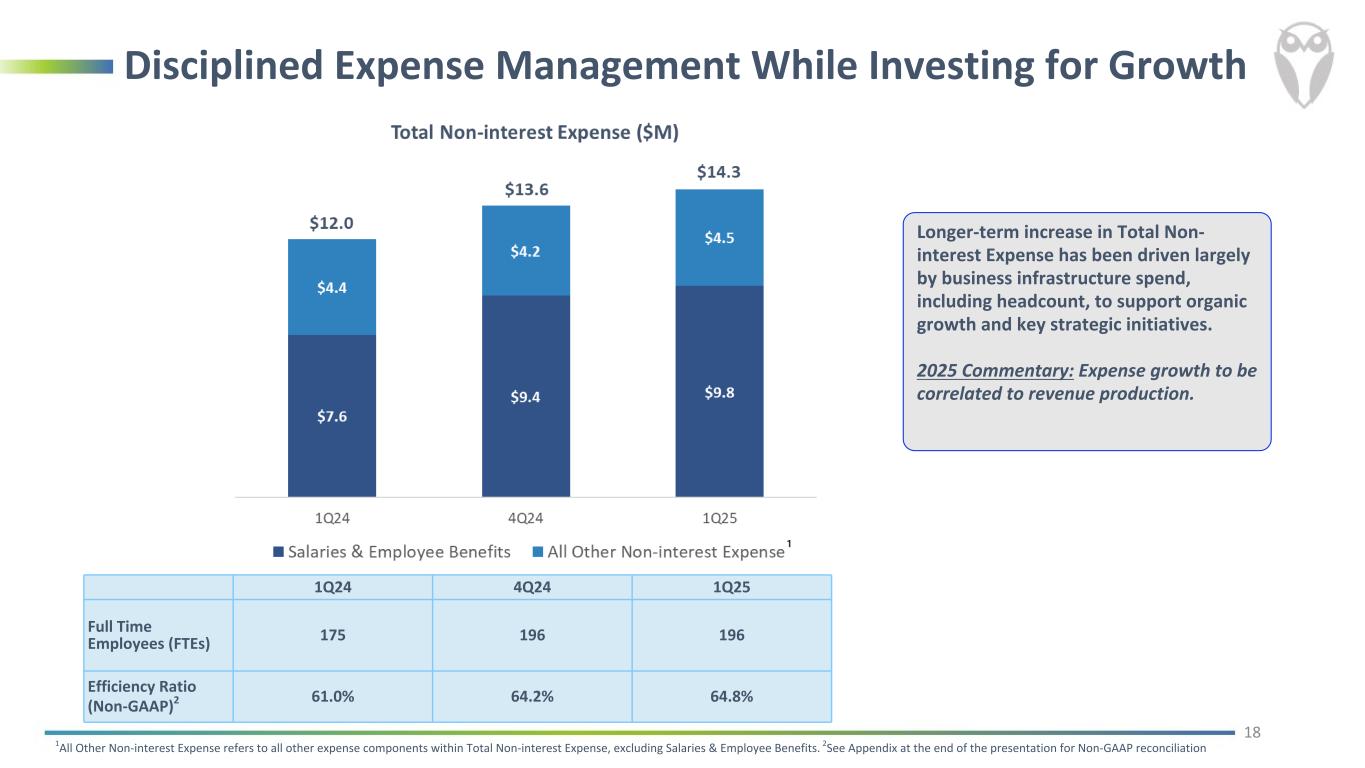
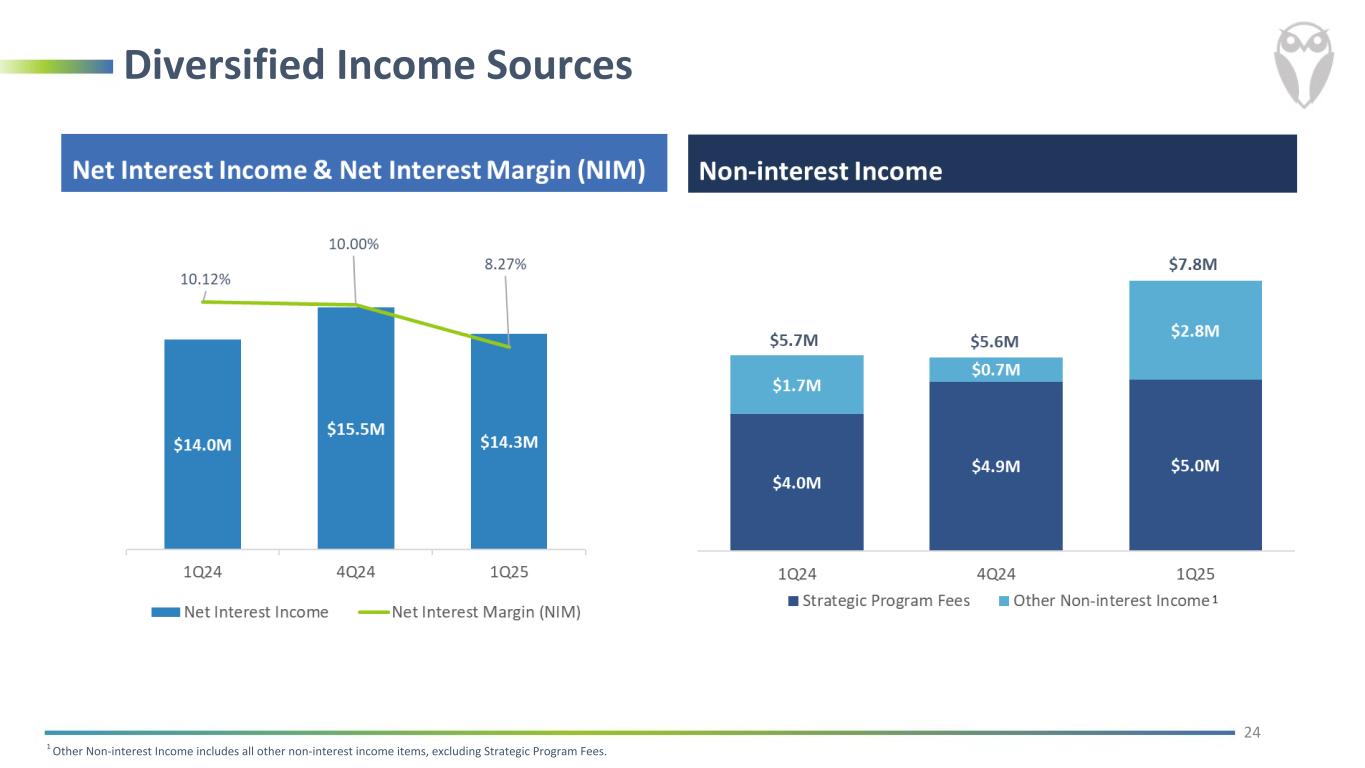
Thanks, Jim, and good afternoon, everyone. For the first quarter, we generated net income of $3.2 million or $0.23 per diluted common share. Key items that drove our results were softer net interest income, including a sequential NIM decline driven mainly by a change in the mix of originations during the quarter and adjustment of our variable rate SBA loans for the two Q4 rate reductions partly offset by solid fee income. Average loan balances including both held-for-sale and held-for-investment loans totaled $565 million for the quarter compared to $522 million in the prior quarter. This increase included growth from our SBA 7(a) commercial leases and consumer programs. Average interest-bearing deposits were $430 million, compared to $355 million in the prior quarter. The sequential quarter increase was driven primarily by an increase in interest-bearing demand deposits and broker time certificates of deposits to meet our funding needs. Net interest income was $14.3 million versus the prior quarter's $15.5 million, primarily due to the previously referenced change in the mix of loan originations, re-pricing the prime-based variable rate loans and lower rates on additions to the held-for-investment loan portfolio, partially offset by an increase in interest-earning assets. Our net interest margin declined to 8.27% from 10% in the prior quarter driven primarily by a seasonal decline in origination volume from our three highest yielding held-for-sale programs, an addition of $40 million of lower risk and lower yielding loans to our held-for-investment portfolio, and a decrease in yield in our SBA and other variable rate loans as the 50 basis point Q4 market interest rate reductions took effect. This overall decline in our net interest margin, while significant, is directionally consistent with our expectations and commentary on prior earnings calls that we would see the NIM decline as we continue to migrate our loan portfolio to a lower risk profile. We continue to expect the net interest margin to decline over time due to our risk reduction strategy, though the downward progression could be slower in future periods if we have stronger origination from higher yielding held-for-sale loans or quicker if we fund large amounts of lower risk but lower yielding assets such as the Crescent enhanced loan portfolio. Fee income was $7.8 million in the quarter compared to $5.6 million in the prior quarter. The sequential quarter increase was primarily driven by a modest pickup in strategic program fees, a favorable change in the fair value investment in BFG, and an increase in miscellaneous income. The increase in other miscellaneous income was due to increased revenue growth from our operating lease portfolio, increased distributions received from BFG, and the $900,000 reduction of prior quarter miscellaneous income due to the write-off of the called CEs unamortized premiums that we described in January. Non-interest expense in the first quarter was $14.3 million, compared to $13.6 million in the prior quarter. The increase was primarily due to an increase in salaries and employee benefits and an increase in professional services expense resulting from reduction in accruals for legal services during the three months ending December 31, 2024. Our efficiency ratio was relatively flat quarter-over-quarter at 64.8% versus 64.2% in the prior quarter. We remain committed to generating positive operating leverage as we move through 2025 and begin to realize revenue associated with the new programs that have been developed. Future increases in incremental headcount will primarily be related to increased production and we do expect to see future decreases in the efficiency ratio. Our effective tax rate was 28.1% for the first quarter compared to 24.3% in the prior quarter. The change from the prior quarter was due primarily to permanent differences related to executive compensation. We expect an effective tax rate of roughly 27.5% for 2025. Lastly, we remain comfortable with the outlook provided on last quarter's conference call for the credit enhanced balances to increase by $50 million to $100 million by year-end 2025. Positively, we have been working proactively with many of our programs over the last six months and conversations continue to go well. We went live with two credit enhancement balance sheet programs by the end of 2024 and additional discussions continue. During the first quarter, we were also pleased to see material growth in an extended held-for-sale program. In this case, our strategic partner needed balance sheet access but for a period of less than the full term of the underlying loans, which varies from our credit enhancement program where FinWise typically holds the loans to maturity or payoff. That said, this enhanced held-for-sale structure also generates incremental bank earnings for FinWise through a yield split model with low credit risk and the bank is happy to initiate the program. This is another example of how FinWise delivers innovative lending products that support our strategic partners' growth and further enhances our revenue opportunities. With that, we would like to open the call for Q&A. For your information, Kent had to step away as he has a travel conflict. But Jim and I are here to answer your questions.
Operator
Thank you. Our first question is from Brett Rabatin with Hovde Group. Please proceed.
Speaker 5
Hey, good afternoon, everyone. Wanted to start on the expense run rate. It seems like despite possible easing of regulatory levels that the fintech space, people continue to spend money and just wanted to get a sense of if the build rate may have changed at all in terms of thinking about what you have to do with expense levels for either technology or people or back office from here.
Good afternoon. Thank you for your question. Currently, our efficiency ratio stands at about 65%, specifically 64.8%, which is relatively unchanged from the previous period. From our viewpoint, the development related to BIN sponsorship and the payments business is mostly finished. We anticipate some additional expenses moving forward. Our expenses during this period were largely due to compensation tied to FICA income taxes. We previously didn’t have to pay FICA income tax for employees whose compensation surpassed $168,600, but this cycle has reset for the current quarter. Additionally, we experienced some normal fluctuations and adjustments of accruals in Q4 that have carried over this year. Overall, as we've indicated in the past, we expect our expenses to remain relatively consistent and to rise as our revenues grow.
Speaker 5
Okay. That's great color. And then just wanted to get a little better sense of the path on the margin from here and maybe a different way to tackle it, might just be thinking about top-line NII growth and just thinking about the margin continuing to atrophy with the risk reduction. Can you still have or can NII growth be high-single-digit this year given what's transpiring with the margin?
Yes, we experienced a significant decline in net interest income, which has impacted our net interest margin. To address your question directly, we anticipate growth in net interest income as we progress into the second quarter and throughout the year. This growth will stem from two primary sources. Firstly, we observed a seasonal decline among our top three highest-earning partners in the held-for-sale portfolio, resulting in a drop in total originations for the first quarter by approximately $47 million to $50 million. This has a considerable impact due to the higher yields associated with those portfolios, which we usually see return seasonally. Therefore, we expect net interest income to rise as origination returns to its normal levels. Secondly, we expect an increase in net interest income from the growth of our loan portfolio. This growth will primarily come from traditional banking products, specifically owner-occupied commercial real estate and our lease portfolio, in which we saw an increase this quarter. Additionally, as we move through the year, we will also see growth in the credit-enhanced portfolio. However, it's important to note that the yields on all three of these products are below the average yield, which will dilute our net interest margin. While your question wasn't specifically about net interest margin, it was about net interest income, and we do expect to see NII grow. However, due to the increase in loan volume, we may see a decrease in net interest margin, which will depend on how much of that volume we realize in the next quarter or subsequent quarters, leading to a balance between the two in terms of overall net interest margin rate.
Speaker 5
Okay. That's helpful. And if I could sneak in one last one just around the buyback. You guys didn't buy back any stock this quarter. We were closer to tangible book at certain parts of the quarter. Is there levels that you would start to think about needing to buy back more or is this the growth that you're anticipating in the next few years just too much of an opportunity relative to maybe doing some accretive buyback?
Yes, I think that's a great question. And what we have tended to do in terms of our buyback is exercise that, that buyback option if we were to see the share price drop below what our current book value is, and it hasn't done that for some time and maybe it would even go to a discount. So we haven't been active for that reason. Plus we also try to balance it against the need to maintain liquidity in our stock and enough shares out there. So we don't want to bring in too many shares, not leave enough out there for active trading.
Operator
Our next question is from Joe Yanchunis with Raymond James. Please proceed.
Speaker 6
So kind of starting off here, sorry if I missed this, but what were the credit enhanced loan balances exiting the quarter? And then can you reach that $50 million to $100 million year-end target with your current partners and kind of tack it onto that? How long will it take for Bakkt to be able to generate or begin to generate credit enhanced loans?
I can address the first two questions. This is Jim, and I'll let Bob cover the final figure. Regarding how quickly we can reach the guidance of $50 million to $100 million with our existing partners, we absolutely can do that. In terms of how quickly Bakkt will scale, it usually takes one to two quarters after we launch our programs and make public announcements before we see significant volumes. As for Bakkt's contribution to the $50 million to $100 million guidance, I would consider that a back-end figure. Bakkt is likely to ramp up more in Q4, but we also have other partners that should help us reach that target by the end of the year. Bob, would you like to discuss the balance?
So at the end of the year, the balance was slight of the credit enhanced portfolio was slightly under $2 million as we were developing the application and making sure everything was working right. It takes a while to bring on the new partners. And so we're working with the older partners that were in the tech mode and the balance is probably around is about $2 million at this point in time.
Speaker 6
Got it. Okay. So $2 million exiting March quarter. And then kind of additionally from me, in your prepared remarks, you discussed the credit enhanced kind of balance sheet held-for-sale product. Wait, I'm sorry. No, I'm sorry. Yes, the held-for-sale product, kind of given your focus to de-risk the balance sheet, why would you sell these loans and what's that demand for that type of product?
Sorry, say that again, Joe. As far as why do we sell the loans?
Speaker 6
Yes, the credit enhanced loans, if the focus is on de-risking the balance sheet when you want to load up on those a little bit more.
I believe you are referring to the extended held-for-sale in the prepared remarks. This extended held-for-sale is designed for partners, similar to when we first created the credit enhanced balance sheet product. We approach existing partners with solid profiles for this offering, which may be based on loan performance or their capital strength, among other factors. One of these partners showed significant interest in the product, but they are regular users of the securitization markets. Therefore, we customized this extended held-for-sale product for them, as they did not plan to retain those loan accounts or balances through payoff charge-off on the underlying loan. However, they required this balance sheet capacity for a temporary period during a consolidation phase for credit card balances and their refinancing. They needed more than our usual two to four-day held-for-sale period but did not require full life loan balance sheet capacity. Thus, the extended held-for-sale model was beneficial for both them and us, given the yield split. It proved to be a valuable product to implement.
I would add just as a note that it still carries a very low credit risk because the purchase price is all contractual principal and interest.
Speaker 6
Got it. Appreciate that. And then just one more for me. Given the current market uncertainty, how do you characterize the healthier strategic partners at this time? Is there any concern that you have about a particular one about naming names?
No concerns right now, Joe. I'd say origination levels continue to be healthy and we're comfortable with the guidance, which is a gradual pickup from newer partners throughout 2025. As far as macro-related stuff, there's a fair amount of stuff going on, but a lot of this we've been through at some point in the past, whether it's economic interruption with COVID, whether it's the significant and quick succession of rate increases and the effects that that has. I would say one impact that I don't think any of us have control over is just a meaningful slowdown in consumer spending and the impact that that could have kind of across the board in lending, whether it's demand within our fintech originations, whether it's delinquencies in SBA or other portfolios, we're not seeing any of that right now. But if you're talking about macro risks that are out there, that's certainly something we keep an eye on.
Operator
Our next question is from Andrew Terrell with Stephens, Inc. Please proceed.
Speaker 7
To start with margin, specifically regarding the held-for-sale yields, I appreciate your mention of the $0.5 million impact. It seems to be linked to a seasonal decline in originations from a few partners. Do you anticipate this returning in the second quarter? Is there any reason it wouldn't? Additionally, I believe you mentioned a $300,000 impact, which seems to be due to lower rates in certain areas but higher volumes. Can you elaborate on what caused the remaining changes in the HFS yields?
Certainly. Regarding the expectations for the held-for-sale assets related to those three higher yielding partners as we progress through the second quarter, I anticipate that about two-thirds to three-quarters will return during this period, with the remainder increasing in the third and fourth quarters. As for the activities that contributed to the decrease in net interest margin, a significant portion came from the healthcare investment portfolio, particularly the variable rate small business lending and SBA loans. The Federal Reserve reduced rates by 50 basis points in the fourth quarter, which led to adjustments at the start of each quarter, impacting our results throughout the entire quarter. Additionally, we implemented a strategy to diversify our loan portfolio with lower risk, lower yielding loans, which affected yields, especially in the owner-occupied commercial real estate and lease portfolios, as well as in the held-for-investment portfolio. Furthermore, the newly introduced extended held-for-sale program also entered at lower rates, contributing to the dilution.
Speaker 7
Got it. Okay. But the SBA and the diversification of the lower risk would all be in HFI, I guess specifically there was a note on the HFS yields in the release, $0.5 million for what sounds like the seasonal drop and then $0.3 million from just a decrease in yields outside of that. So I guess, I was just trying to figure out what the $0.3 million there was referencing.
Well, actually it comes from the $500,000. And then in the retained portfolio, the drop related to those three higher yielding partners was about an additional $250,000. And then the residual was, as I said, the dilution.
Speaker 7
Okay, understood. Moving on to the commercial real estate portfolio, it's quite interesting to note the current pace of CRE growth. It seems that loan growth for the credit-enhanced segment could escalate from virtually zero this quarter to between $50 million and $100 million over the next three quarters, which indicates a substantial increase in balance sheet growth. I'm interested to know specifically what areas of commercial real estate you are expanding in. Additionally, considering the general lack of growth in commercial real estate loans currently, what factors are contributing to your CRE growth and which specific assets or industries are you focusing on?
Yes. Hey Andrew, this is Jim. I'd say, just to be clear, these are always, this is owner occupied commercial real estate. So it's not going to be the same asset or loan product type that when banks reference commercial real estate loans, this is different. These are always going to be at minimum 51% owner occupied by the small business. Generally, they're very similar profiles to what we have in SBA. In some cases actually, originally this was almost a defensive product, right? As we saw SBA borrowers refinancing out, we wanted to get a product out there that met their needs. It's going to be for a better LTV, they're going to get a better rate. And so that was the original impetus for the product, why we've been successful with it. I think I would point to our relationship with business funding group, their ability to continue to deliver qualified applicants both in SBA and in owner-occupied commercial real estate. We did have a pretty big pickup this quarter. I would tell you that generally, will we have that type of pickup in every quarter throughout 2025? No, it'll probably be a little bit more sporadic. But we feel really good about the product. It's a good quality product for us with low credit risk, good LTVs, similar business profiles to what we do in SBA where we stay out of certain industries. So we're very happy about it.
Speaker 7
Yes, understood. What's the net yield you're putting that commercial owner occupied CRE on the books at relative to say the net yield on credit enhanced lending?
The gross yield for credit enhanced products is likely around 300 to 350 basis points higher than that for owner occupied commercial real estate. However, since both products are still relatively new, I'm unable to specify the stabilized difference between them at this time. We are optimistic about the yields we have projected for 2025, although the exact figures are still to be determined; it is expected that the yield will be higher than that of owner occupied commercial real estate.
Speaker 7
Yes, okay, understood. Yes, and I'm sure it even differs partner to partner. If I could also just sneak another one in around, just I heard Kent's not here anymore. But you mentioned in the prepared remarks comments about leveraging capital further. You guys have obviously brought TCE down a bit. Your leverage ratio has come in a bit. Remind us capital goal posts and then specifically whether you're comfortable if a majority of the growth later this year is coming from credit enhanced, where you're not taking risk if you're willing to leverage capital further given the risk-free nature of that growth.
So what we've consistently talked about over the last three or four quarters and we're still staying with is that we have a floor that we'd be comfortable with which would be around 14%. And we would like to maintain our capital with some cushion in excess of the 14%. So that gives us on our balance sheet with our existing capital, that gives us the balance sheet to grow our portfolio and maintain that leverage ratio at that level of in excess of $1 billion. So still a lot of room to grow yet.
Operator
Our next question is from Andrew Liesch with Piper Sandler. Please proceed.
Speaker 8
Hey everyone, thanks for taking the questions. Just sticking with the commercial real estate there. Do you have the yield on what those loans were added at the owner occupied CRE.
Sorry, Andrew, you're saying what's the gross yield on the owner occupied commercial real estate portfolio?
Speaker 8
Yes, just curious what that came on at.
Yes, I would tell you in general, it's going to be a prime minus product. So it's probably prime minus 100.
Speaker 8
Got it. And so then these were sourced from BFG. Is that what I heard?
Speaker 8
Okay, got it. But it also looks like these were funded with brokered CDs. So the spread on that. Am I looking at the balance sheet wrong? Just looks like the spread on that is pretty narrow. Is it worth it to grow this owner occupied CRE?
Yes, I agree that the margins in this area are tighter compared to most of our other products. The credit risk is also significantly different. We acknowledge that the margin is tighter than our other offerings, and this is something we monitor closely to ensure we are booking solid loans. While this will represent a meaningful growth trajectory, it won’t be the primary focus of the bank’s asset growth. It serves as a good opportunity to attract quality customers who may be refinancing or coming to us through strong referrals. We can achieve reasonable margins, but these are not the highest margins the bank has.
Speaker 8
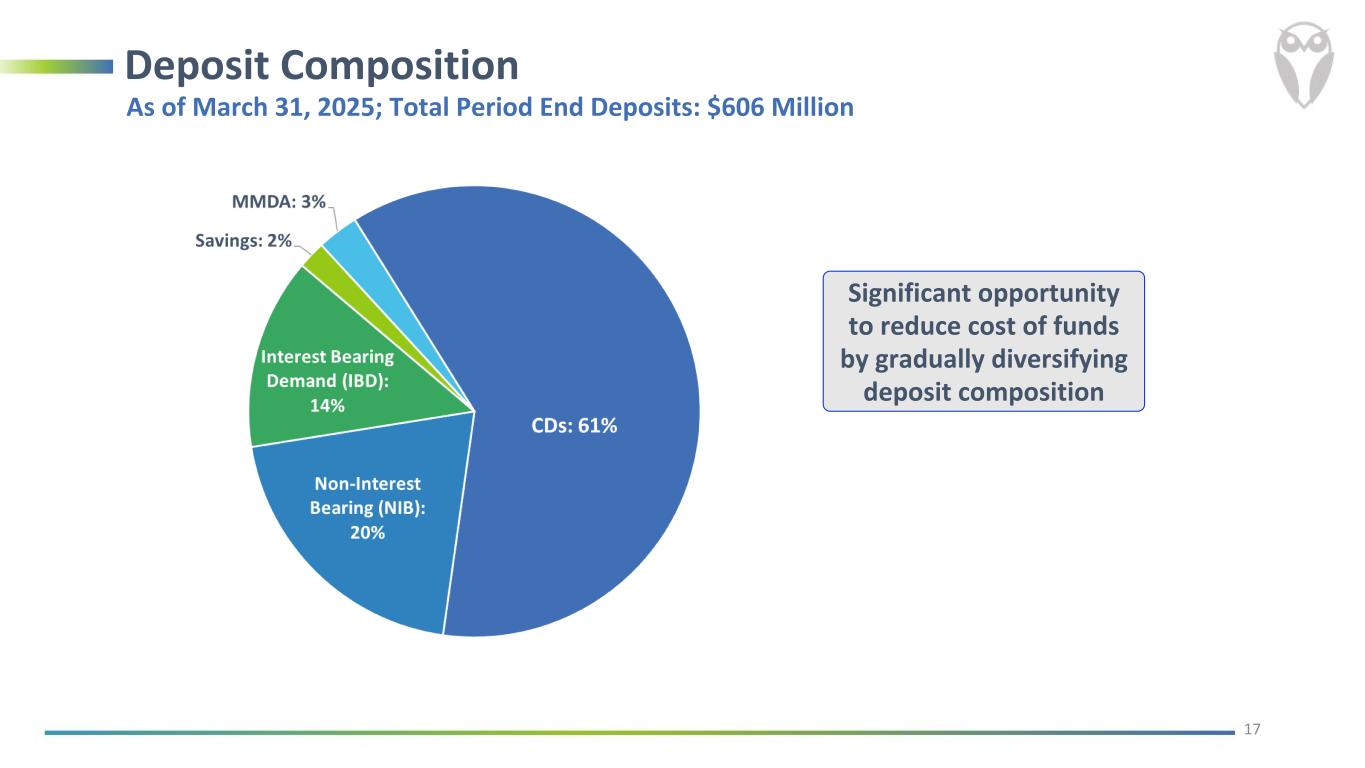
Got it. Okay. Just think about the funding side then not only for this product but for other products going forward. When the BIN sponsorship really gets going, is there opportunities there to bring on deposits? How do you look at funding over the course of maybe the next year rather than looking at the brokered funds, brokered sources?
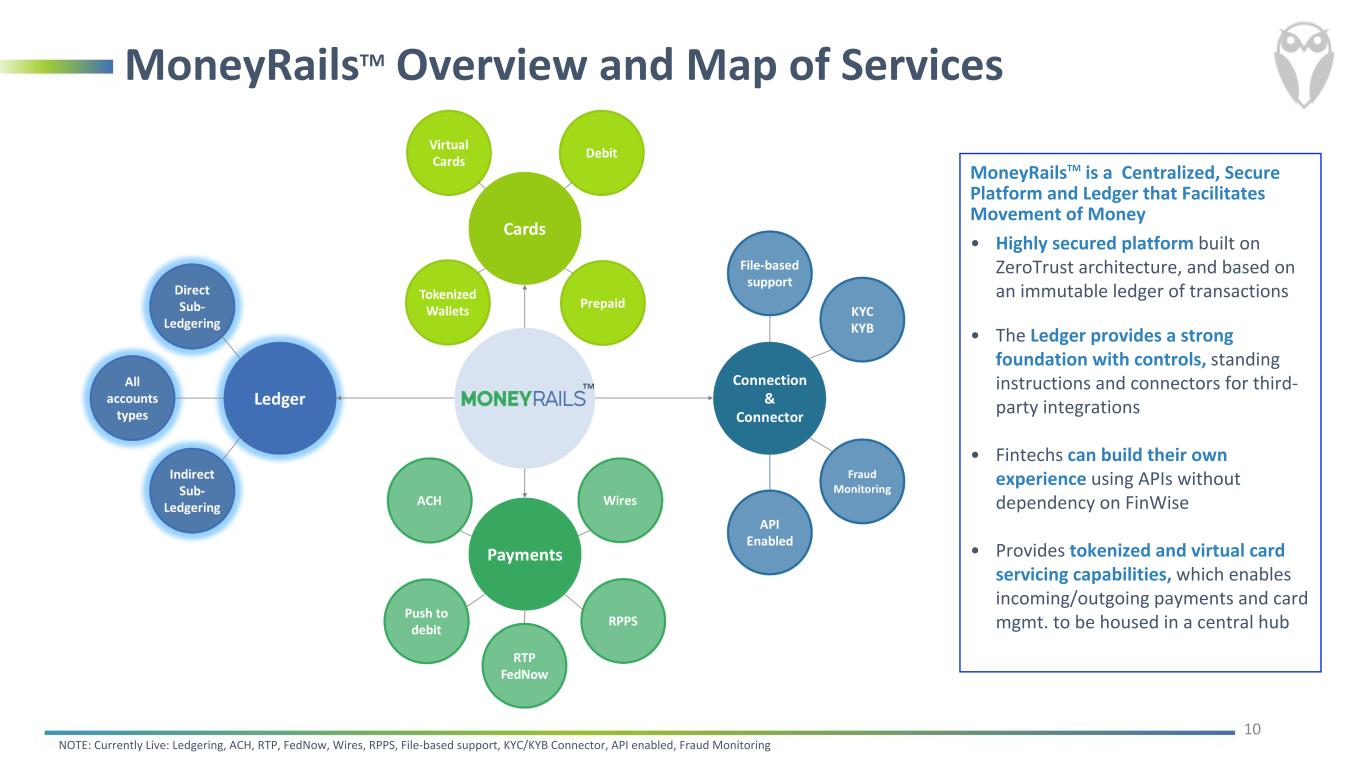
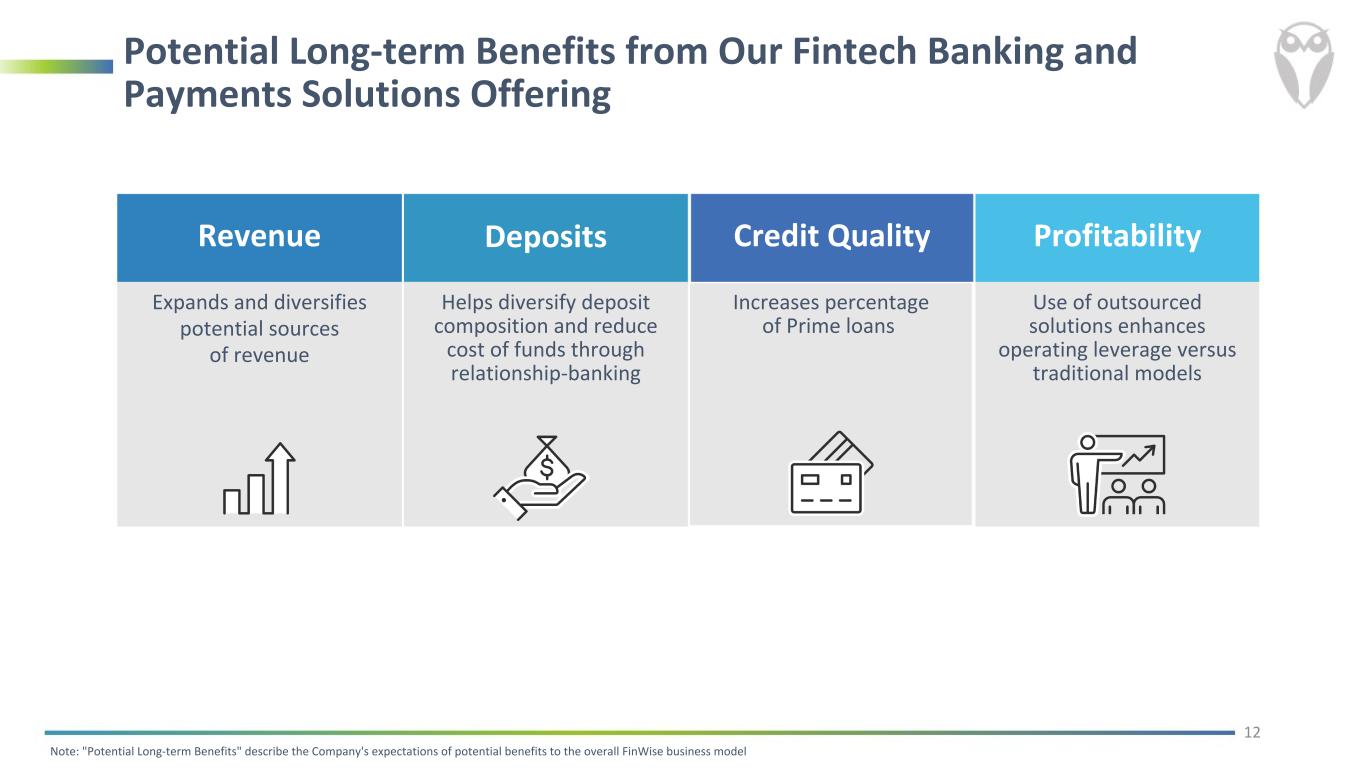
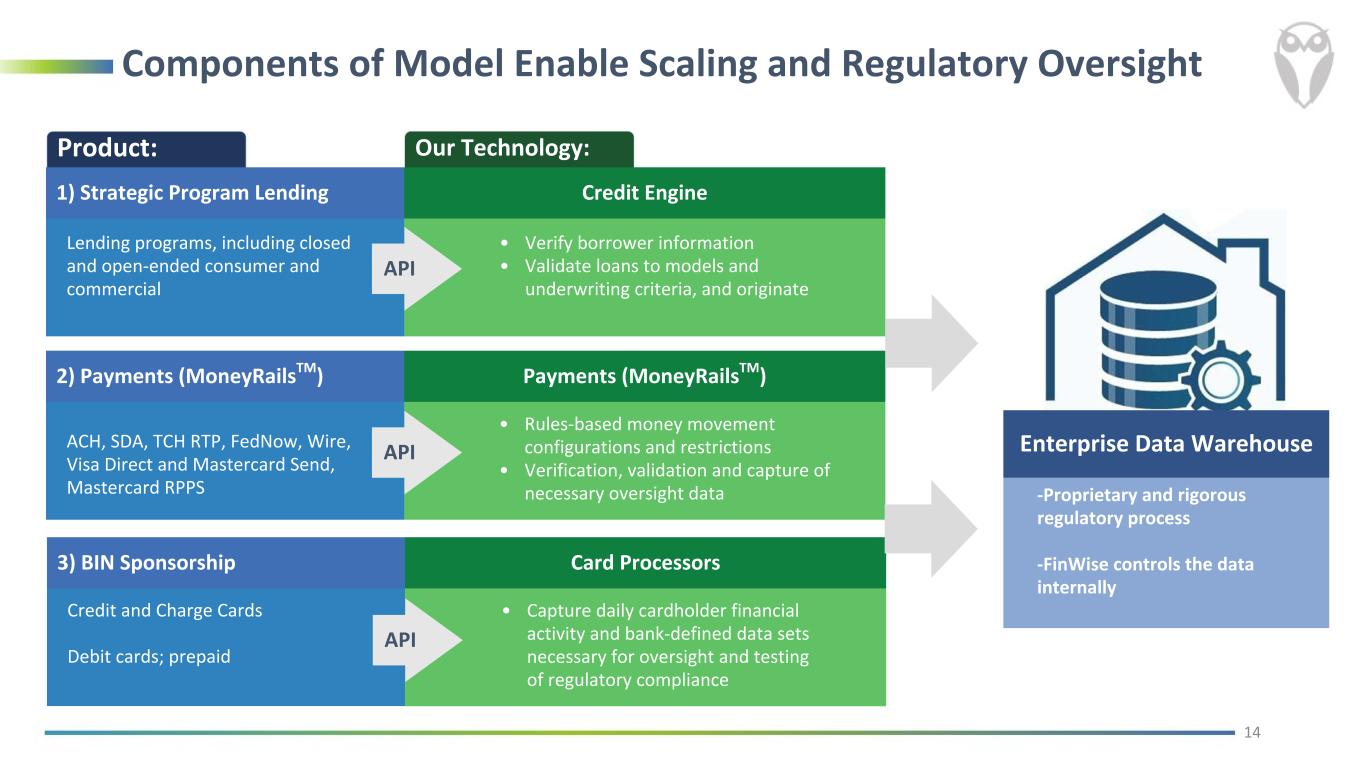
So that is the plan. We expect to see significant deposit growth as it relates to both BIN sponsorship and we also look for deposit growth from the payments business. In addition to that, we are close to launching our online account opening, which also gives us another source of non-brokered funding, more core funding.
Speaker 8
Great. That's good to hear. Looking forward to seeing that product and I will step back. Thanks for taking the questions.
Operator
There are no further questions at this time. This will conclude today's conference. You may disconnect your lines at this time and thank you for your participation.