Operator
Welcome to the Five Star Bancorp Fourth Quarter and Year-End Earnings Webcast. Please note, this is a closed conference call, and you are encouraged to listen via the webcast. After today's presentation, there will be an opportunity for those provided with a dial-in number to ask questions. To ask a question, you may press star, then 1 on your telephone keypad. To withdraw your question, please press star, then 2. Before we get started, we would like to remind you that today's meeting will include some forward-looking statements within the meaning of applicable securities laws. These forward-looking statements relate to, among other things, current plans, expectations, events, and industry trends that may affect the company's future operating results and financial position. Such statements involve risks and uncertainties, and future activities and results may differ materially from these expectations. For a more complete discussion of the risks and uncertainties that may cause actual results to differ materially from the company's forward-looking statements, please see the company's annual report on Form 10-K for the year-ended December 31, 2024, and quarterly reports on Form 10-Q for the three months-ended March 31, 2025, June 30, 2025, and September 30, 2025, and in particular, the information set forth in Item 1A, Risk Factors, in those reports. Please refer to Slide 2 of the presentation, which includes disclaimers regarding forward-looking statements, industry data, unaudited financial data, and non-GAAP financial information included in this presentation. Reconciliations of non-GAAP financial measures to their most directly comparable GAAP measures are included in the appendix to the presentation. The presentation will be referenced during this call but not followed exactly and is available for a closer viewing on the company's website under the Investor Relations tab. Please note this event is being recorded. I would now like to turn the presentation over to James Beckwith, Five Star Bancorp President and CEO. Please go ahead.
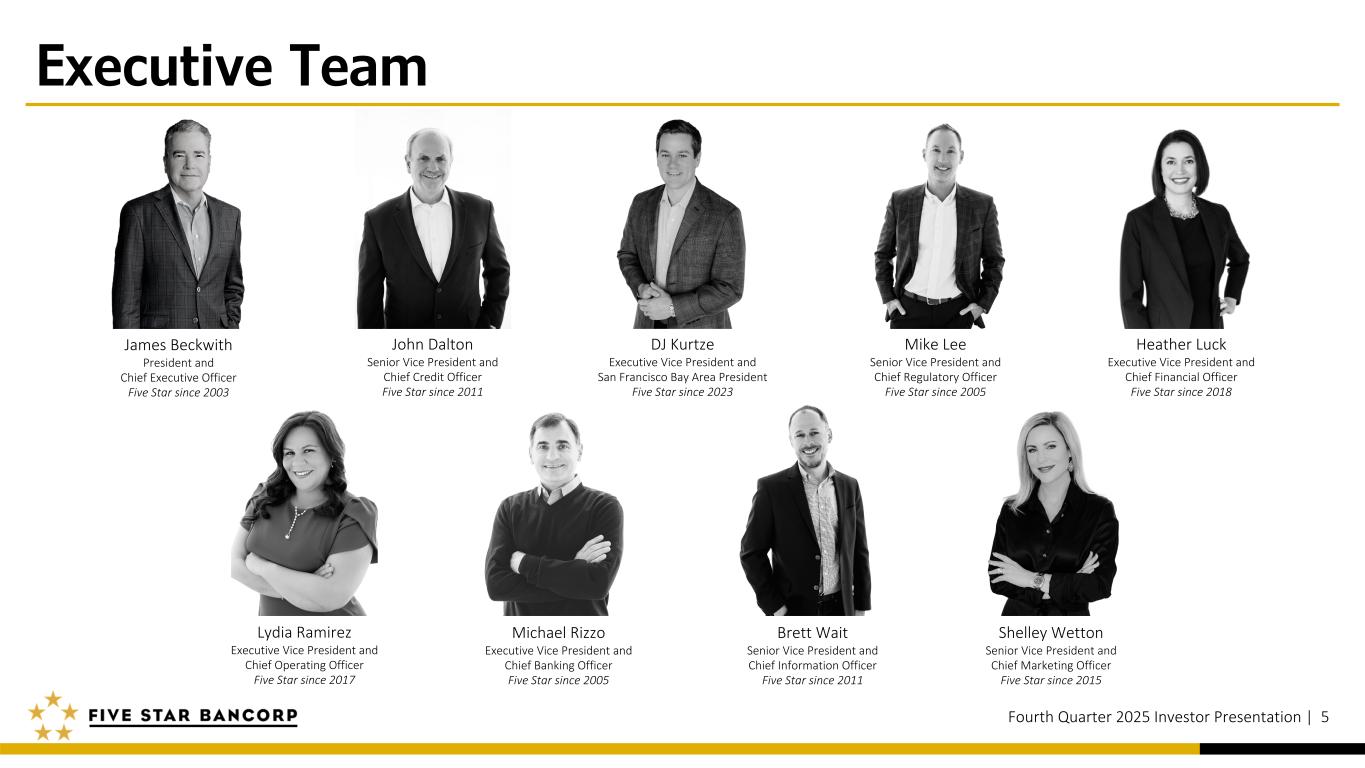
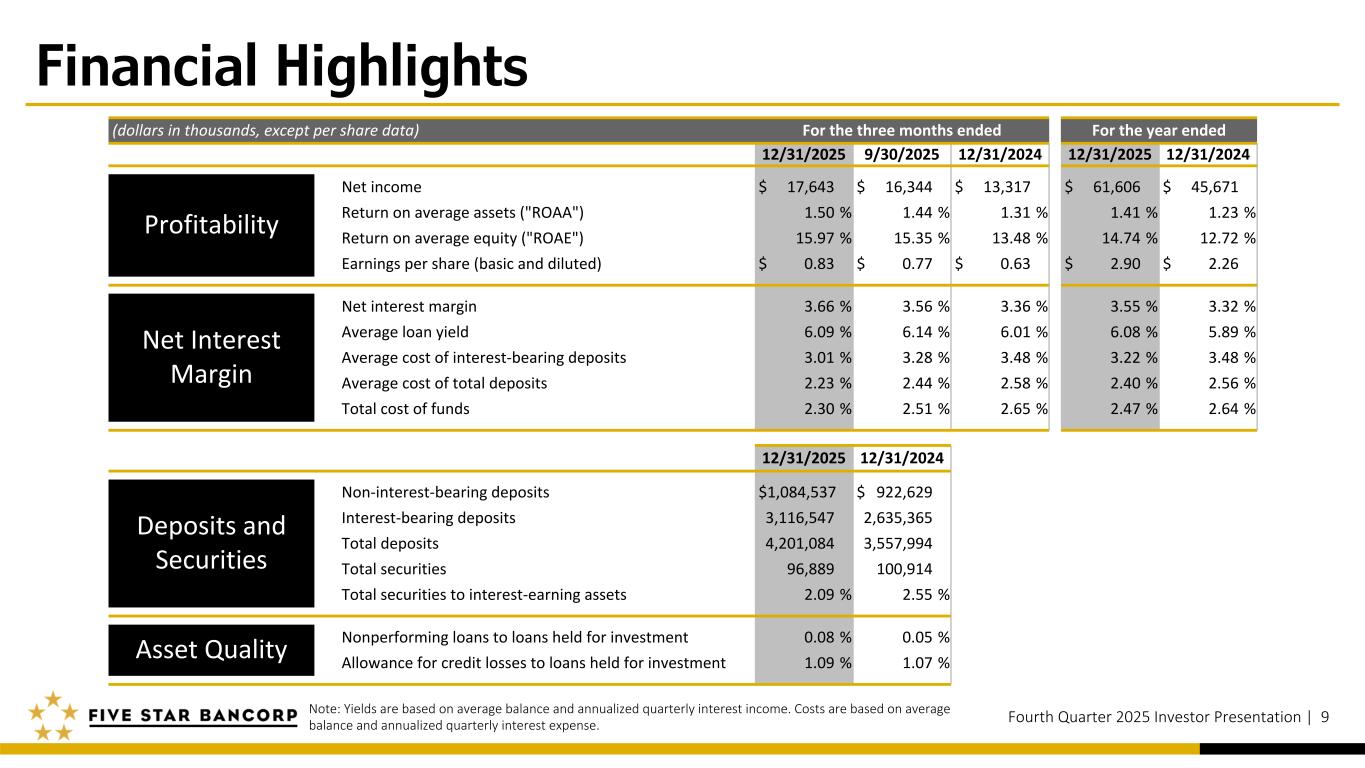
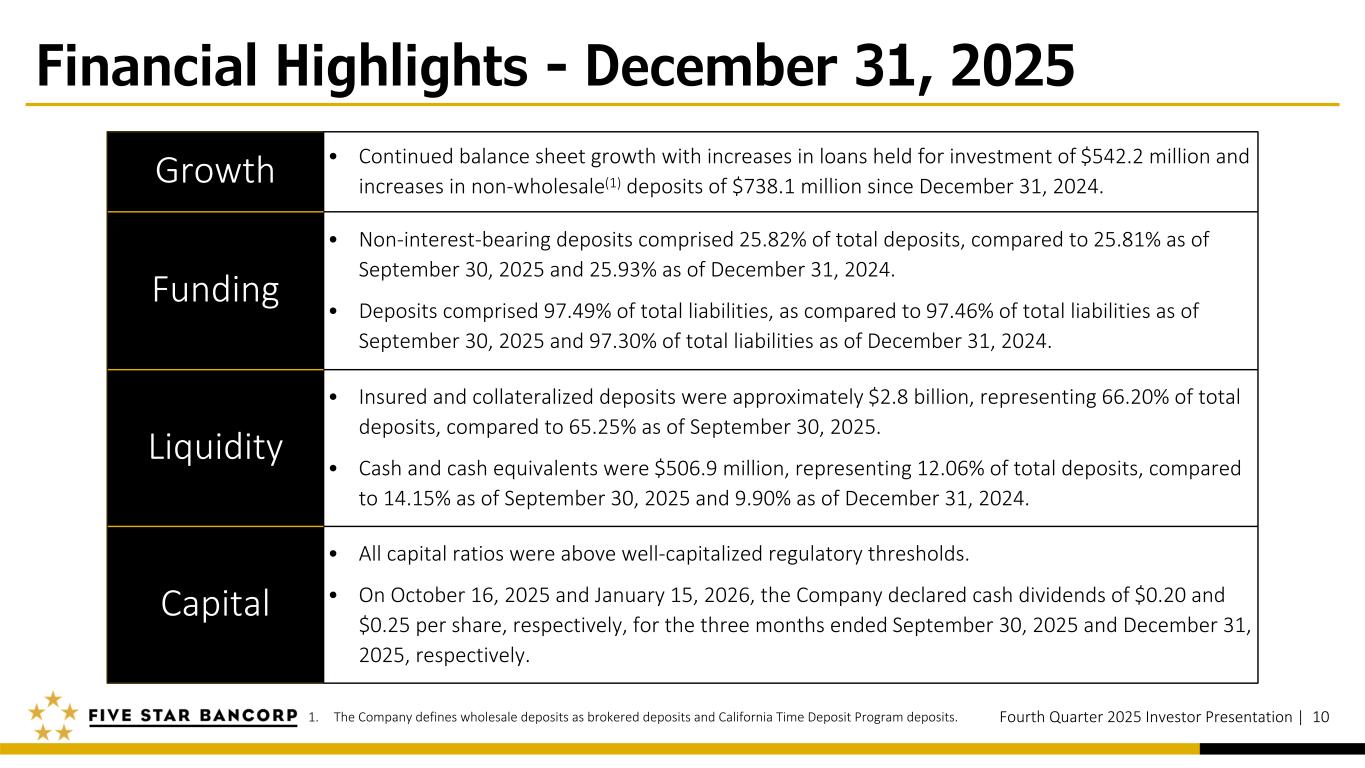
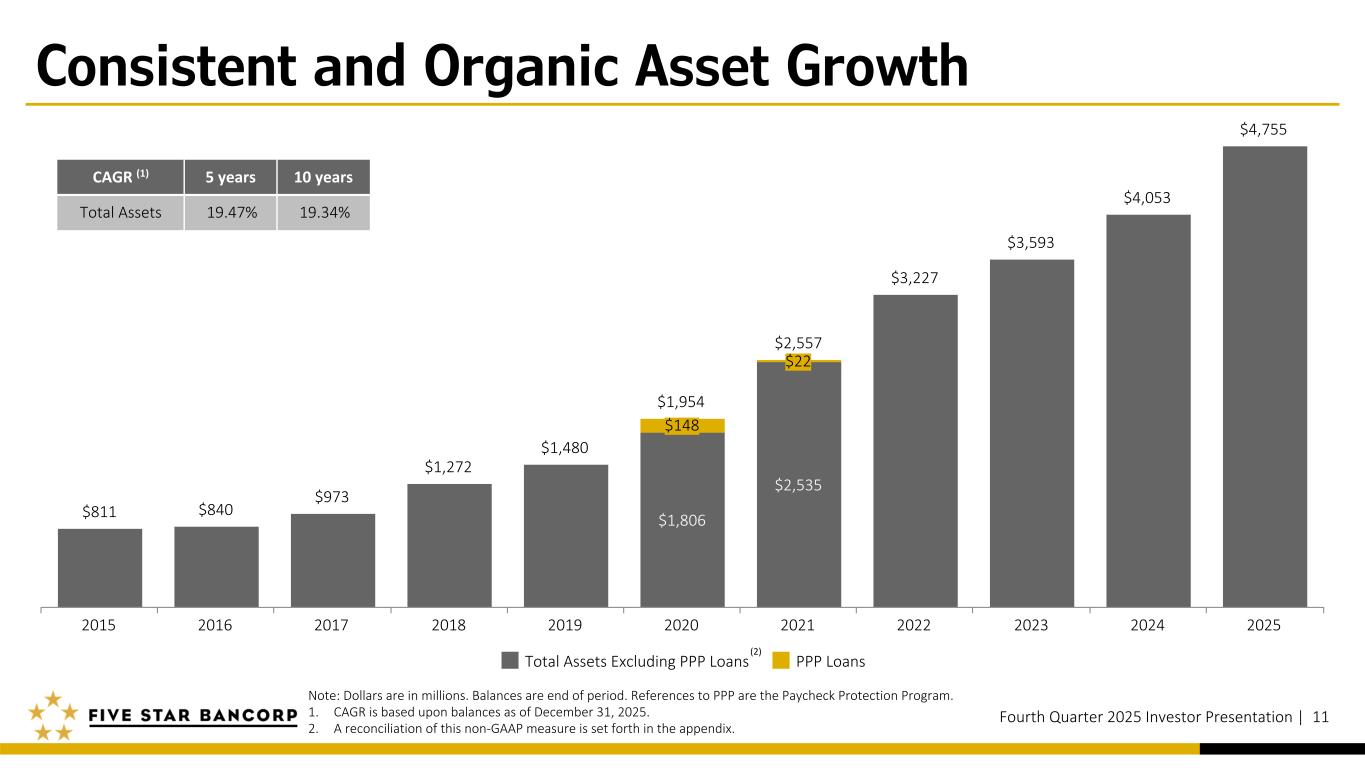
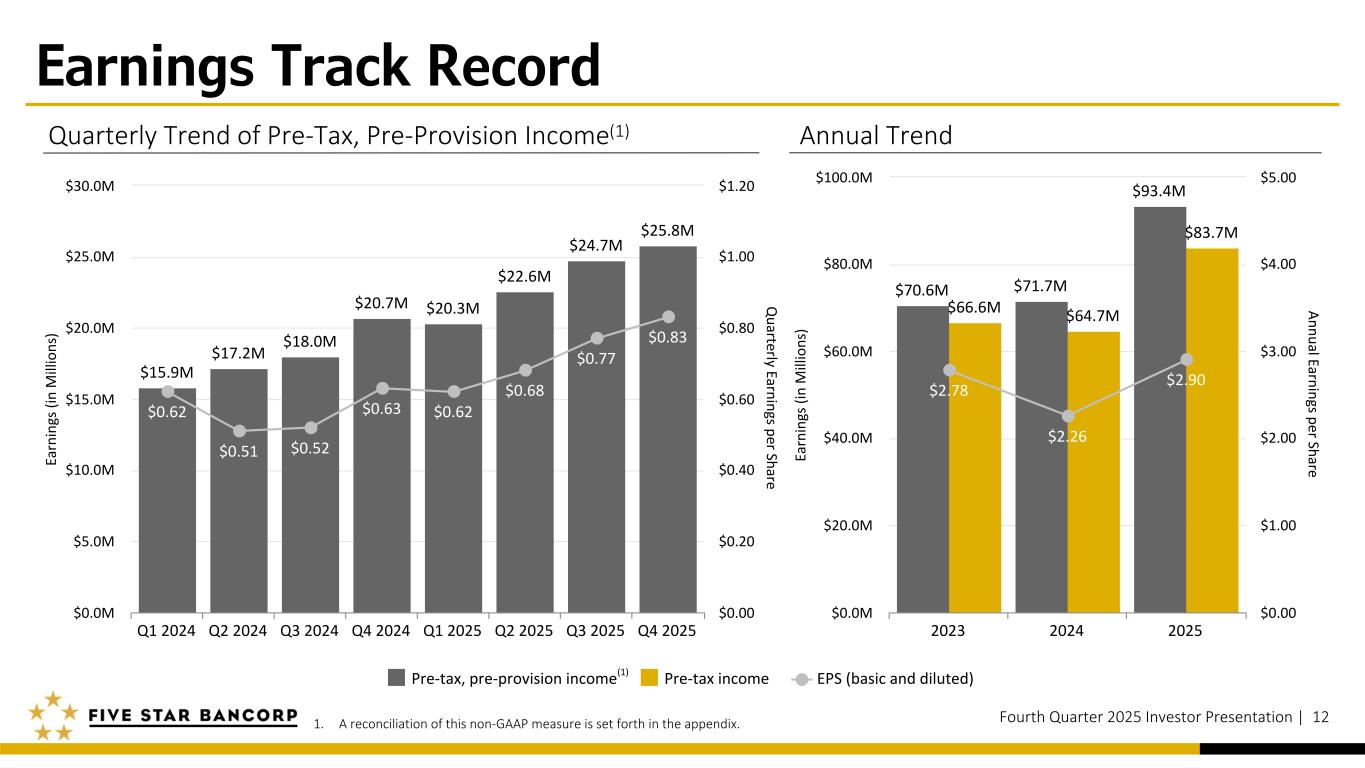
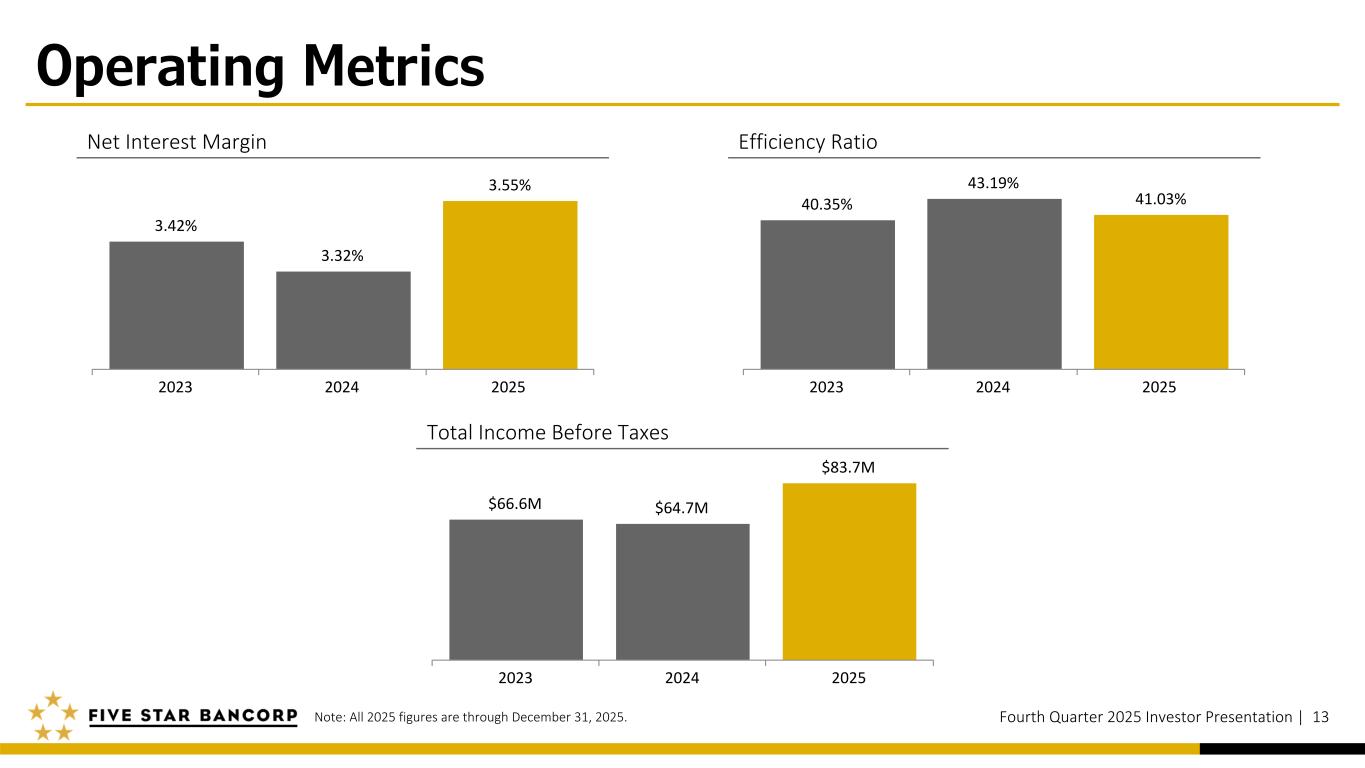
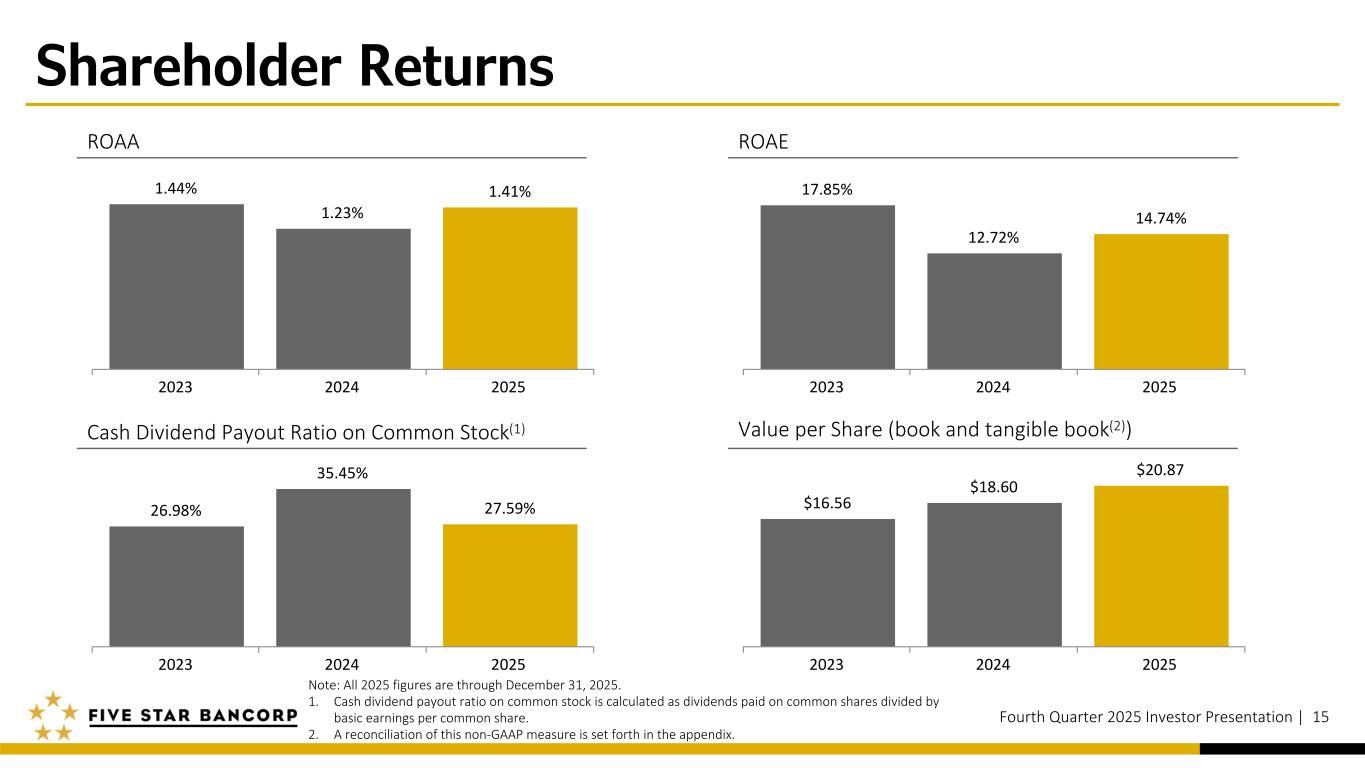
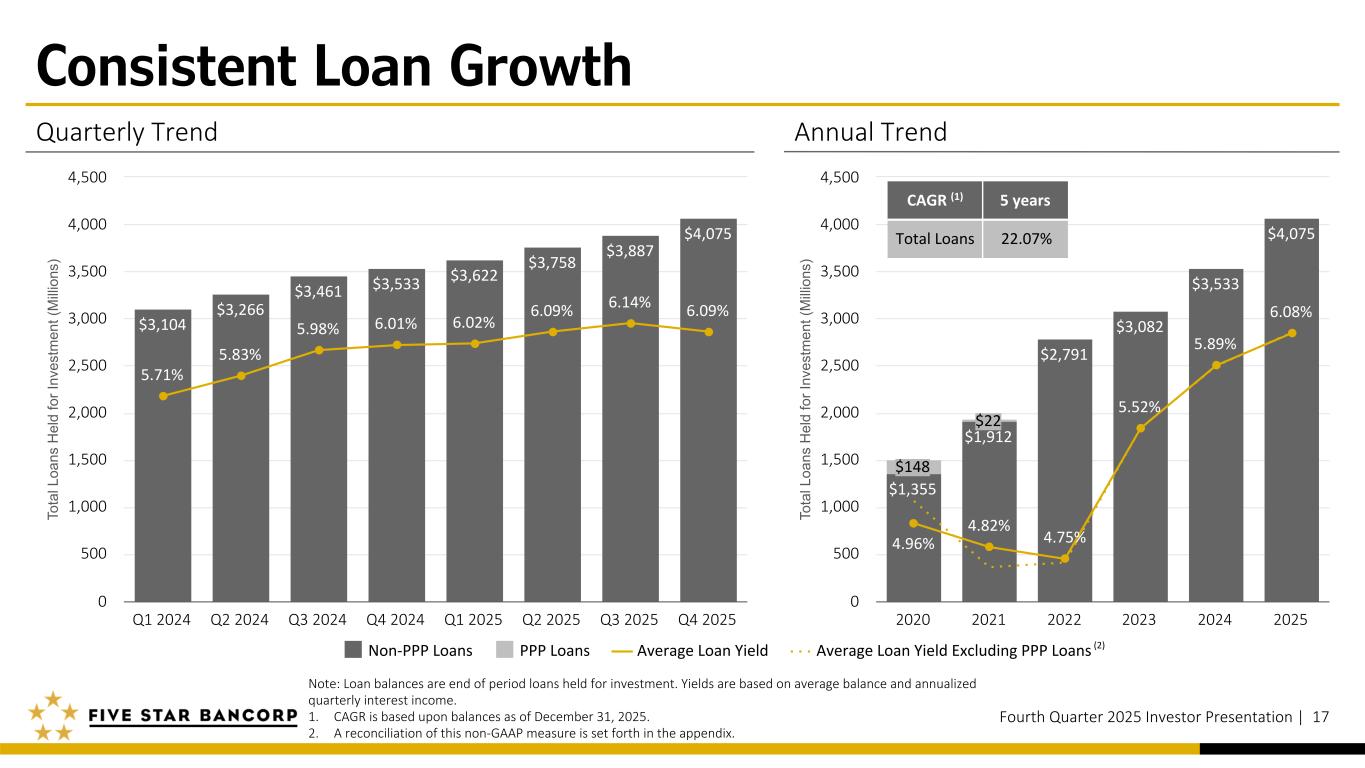
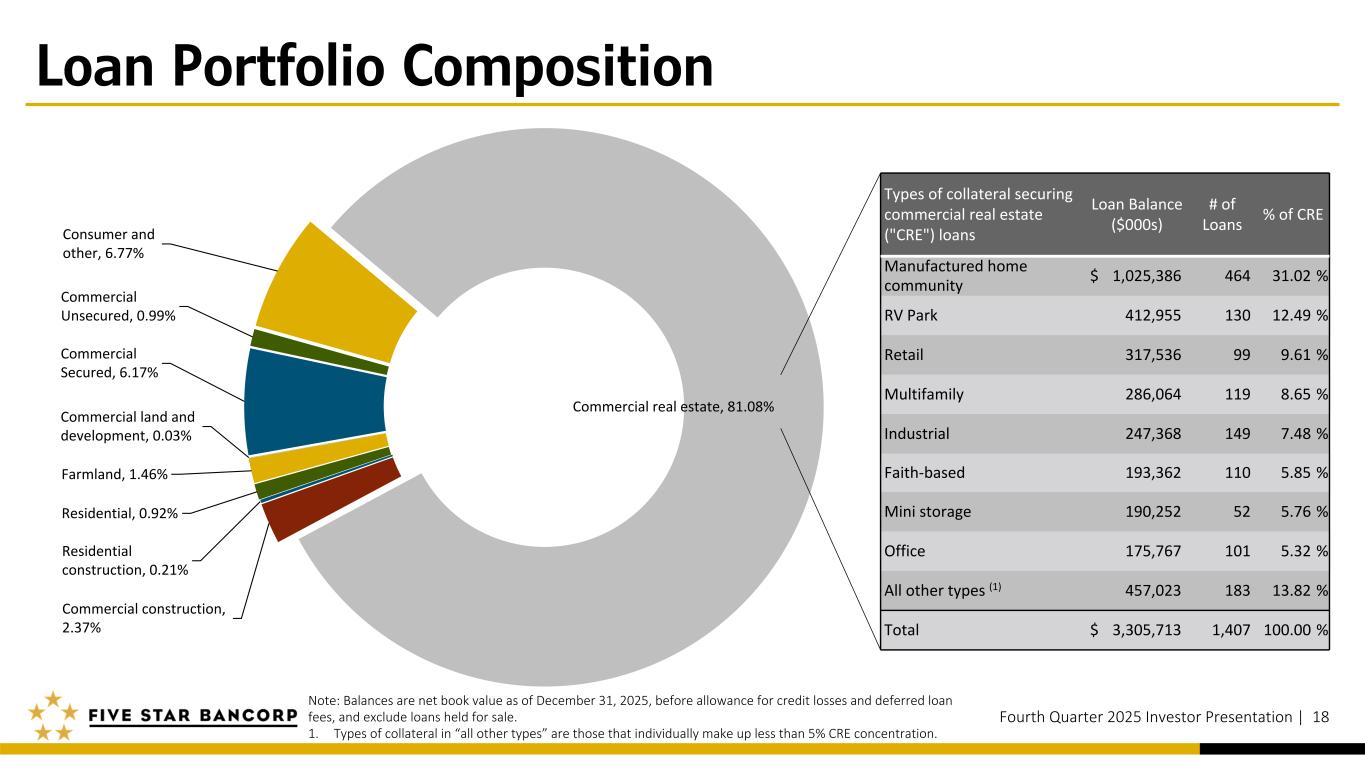
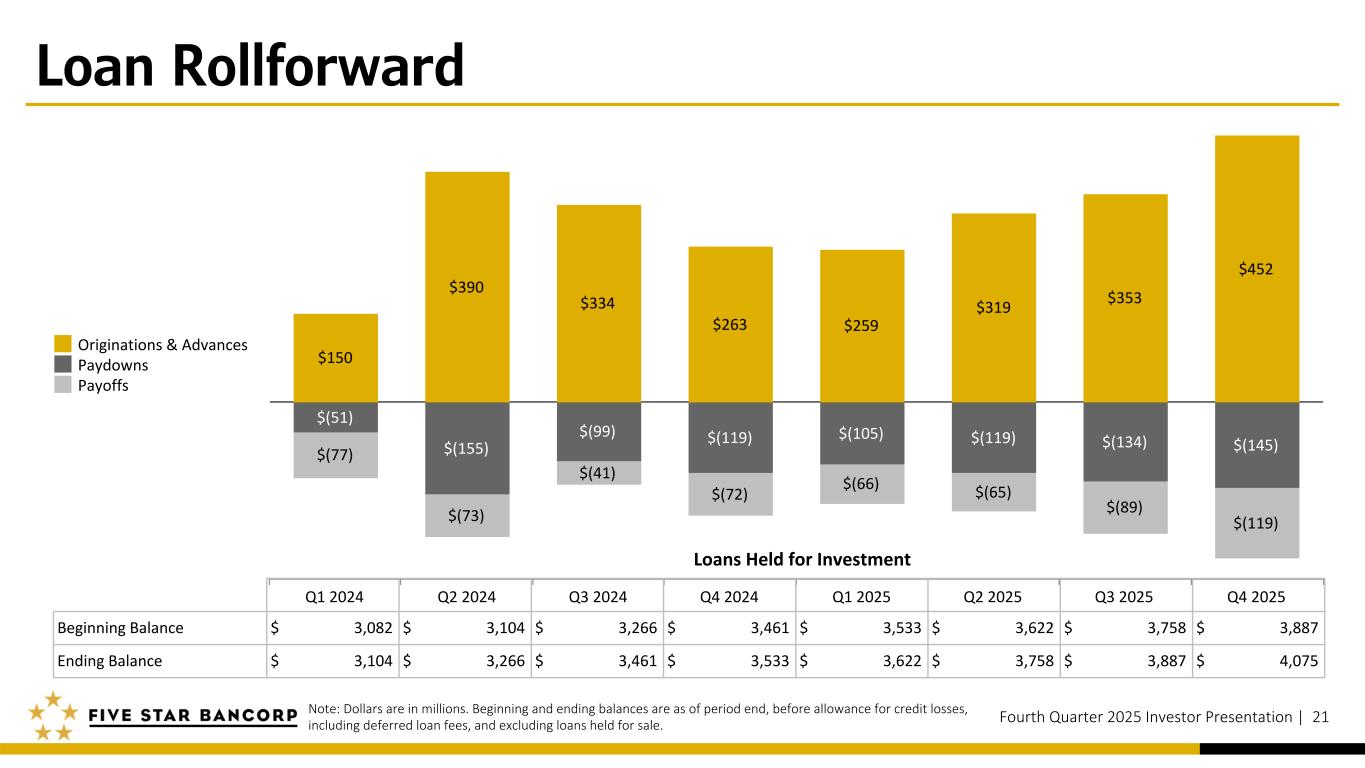
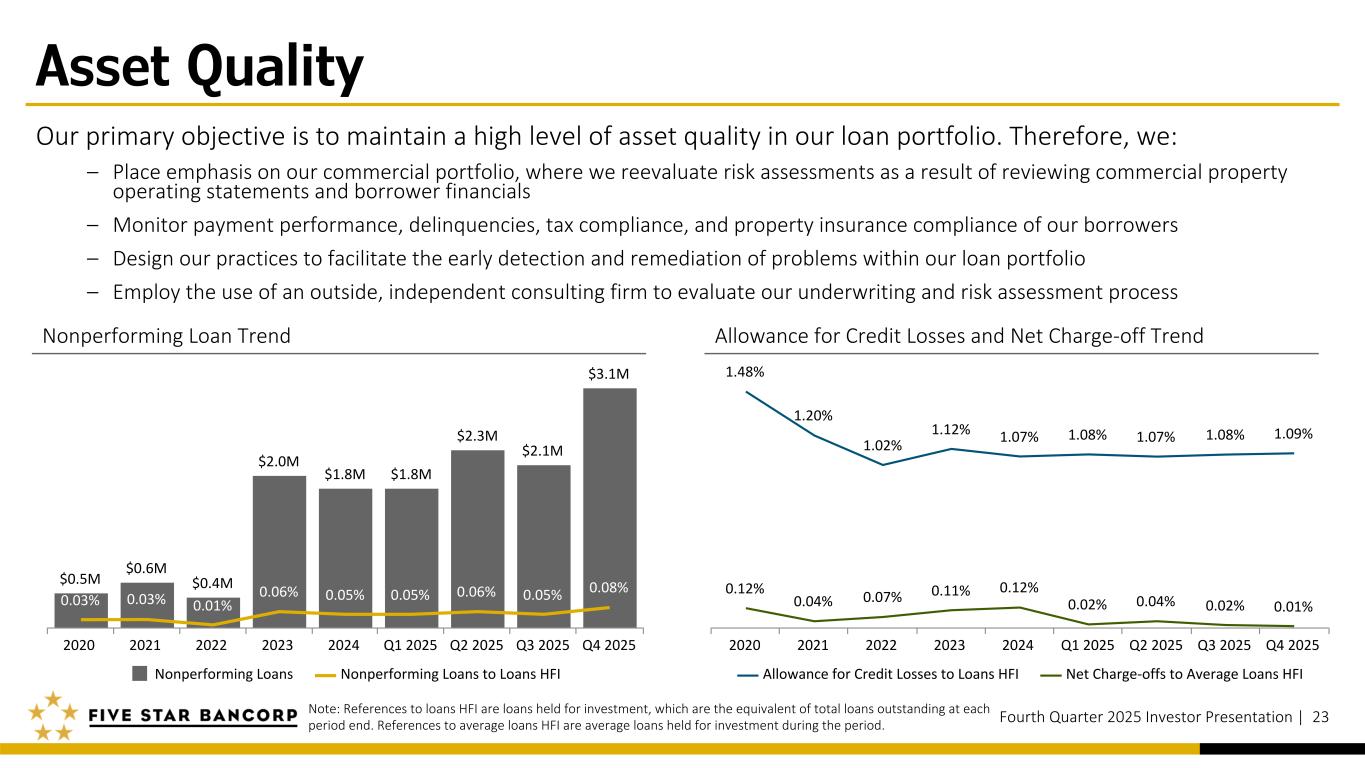
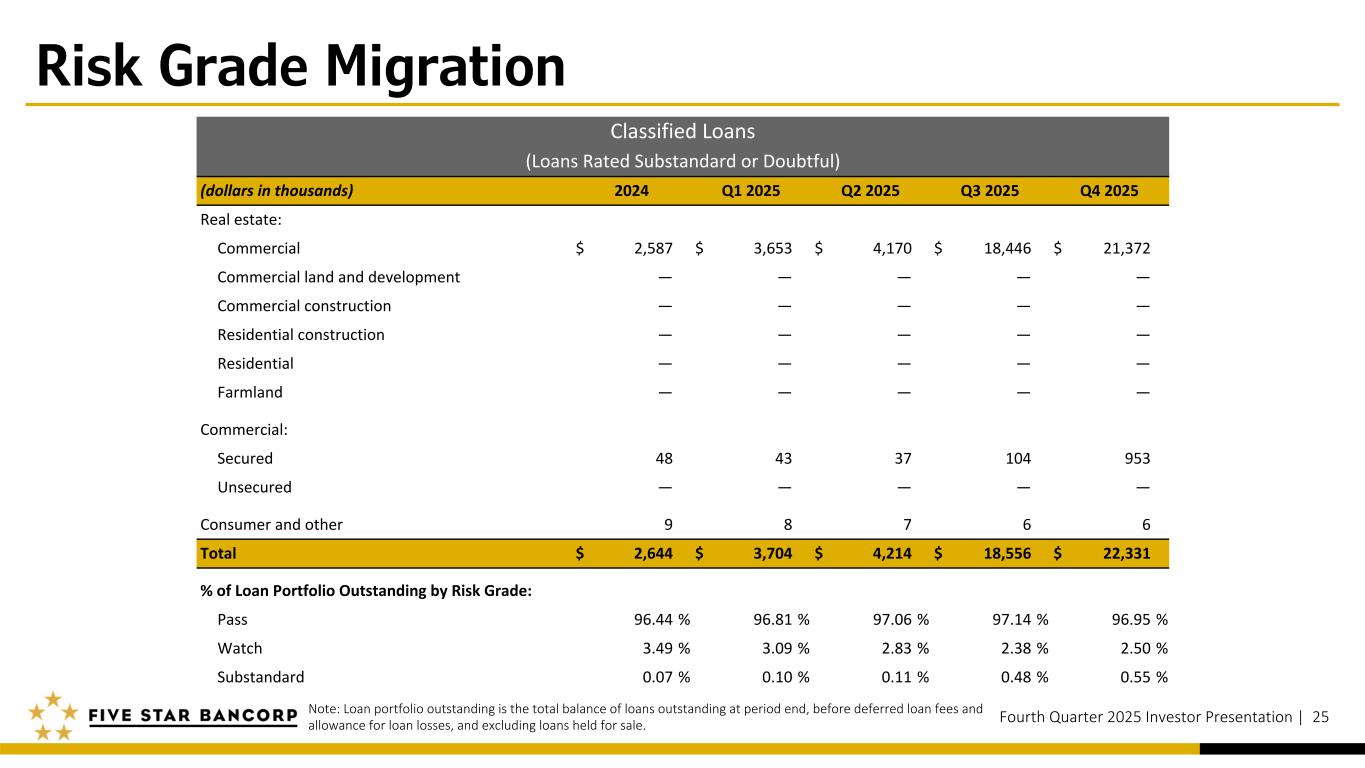
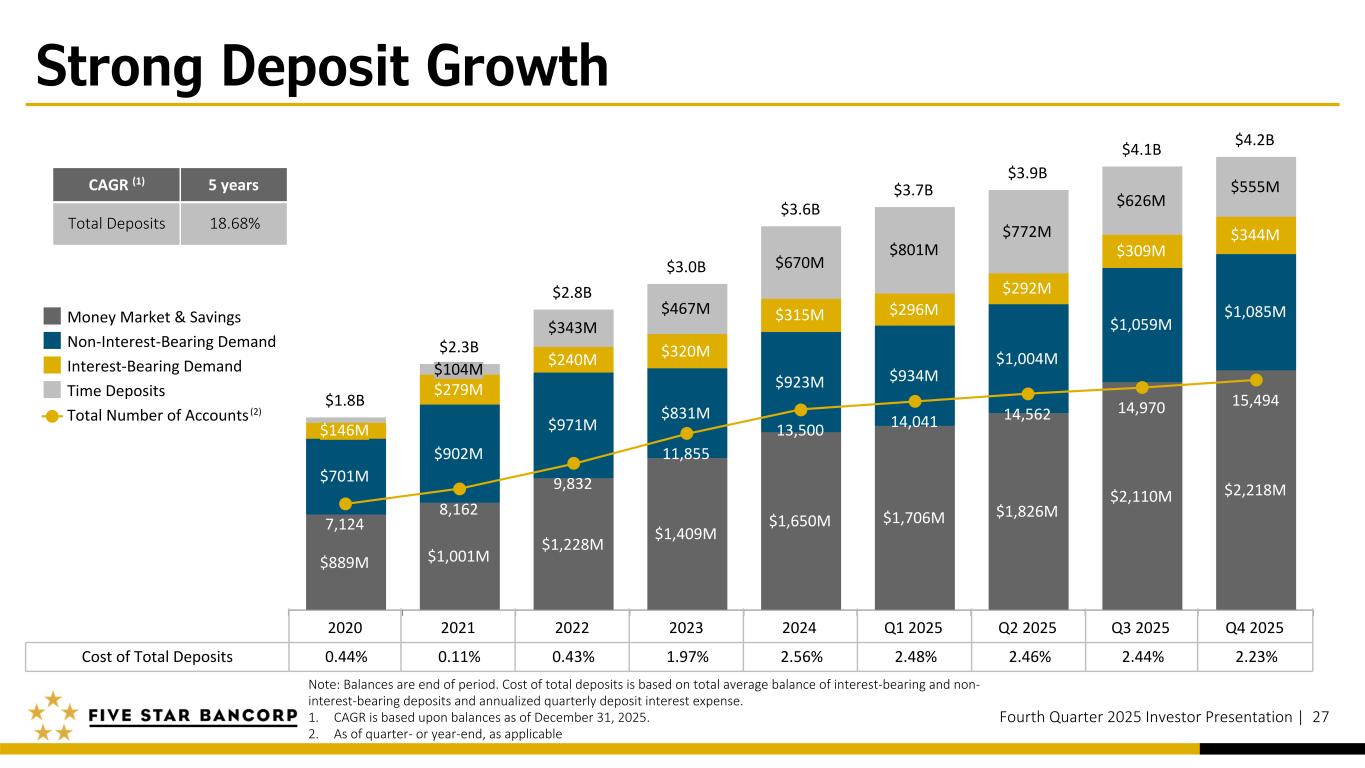
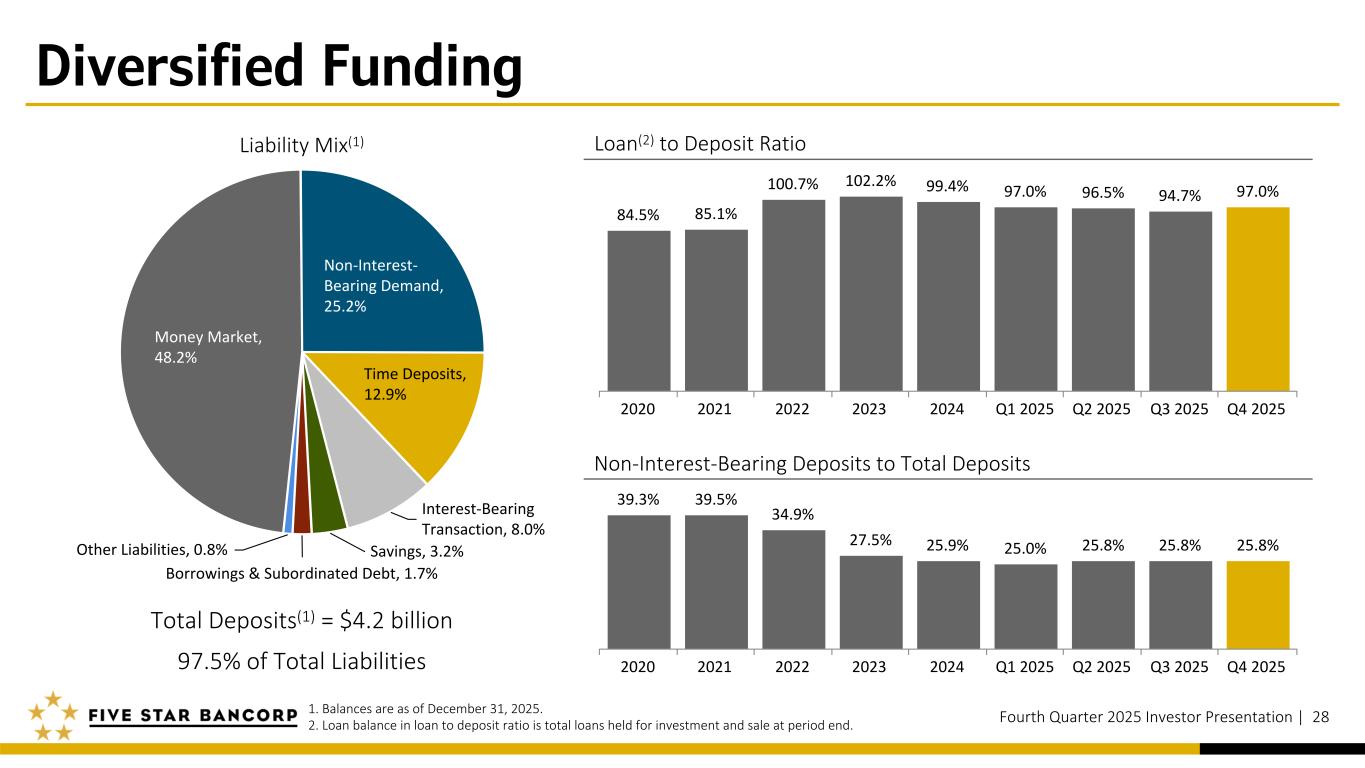
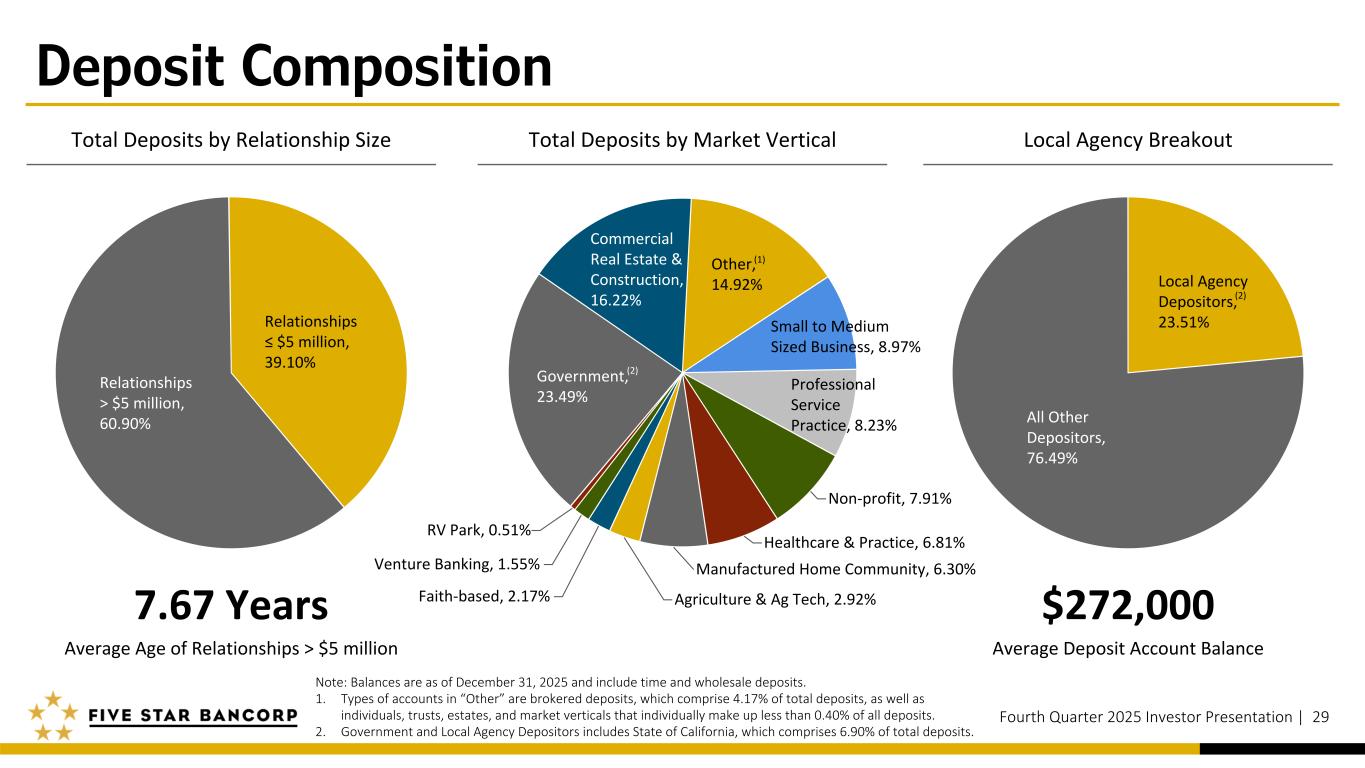
Thank you for joining us to review Five Star Bancorp's financial results for the fourth quarter and year-ended December 31, 2025. These results were released yesterday and are available on our website, fivestarbank.com, under the Investor Relations section. Joining me today is Heather Luck, Executive Vice President and Chief Financial Officer. 2025 was another outstanding year of achievement, underpinned by exceptional growth across all of the markets we serve and consistent, strong financial performance. During 2025, we expanded our footprint in the San Francisco Bay Area through the opening of our Walnut Creek office. We expanded our agribusiness vertical, and we also added 10 more seasoned business development professionals to facilitate ongoing organic growth. In 2025, Five Star Bank achieved year-over-year growth in total loans held for investments of 15 percent, total deposit growth of 18%, net income growth of 35%, and an increase in earnings per share of 28% to $2.90 a share. Financial highlights for the fourth quarter include $17.6 million in net income, earnings per share of 83 cents, return on average assets of 1.50 percent, and return of average equity of 15.97 percent. Our net interest margin expanded 10 basis points to 3.66 percent, and our total cost of deposits declined by 21 basis points to 2.23 percent. Our efficiency ratio was 40.62%. Financial highlights for the year included a $61.6 million net income, earnings per share of $2.90, return on average assets of 1.41%, and return on average equity of 14.74%. Our net interest margin expanded by 23 basis points to 3.55%, and our cost of total deposits declined 16 basis points to 2.40%. Our efficiency ratio was 41.03% for the year. In the fourth quarter, we saw continued balance sheet growth. Loans held for investment grew by $187.7 million, or 19% on an annualized basis, and total deposits increased by $97.6 million, or 10% on an annualized basis. Over the course of the year, we experienced outstanding balance sheet growth. Loans held for investment grew by $542.2 million, or 15%, and total deposits increased by $643.1 million, or 18%. We successfully reduced our balance of wholesale deposits by $95 million, or 17%, in 2025, and we grew our balance of non-wholesale deposits by $738.1 million, or 25%. Our asset quality continues to remain strong, with non-performing loans representing only eight basis points of total loans held for investment. We continue to be well capitalized, with all capital ratios well above regulatory thresholds for the quarter and year. Our strong financial performance and dedication to delivering shareholder value drove an increase to our cash dividend of $0.05 per share for a total dividend of $0.25 per share for the quarter. This is the first increase in the dividend since April 2023. The dividend is payable to the company shareholders of record as of February 2nd, 2026, and is expected to be paid on February 9th, 2026. Total assets increased during the fourth quarter and full year by $113.1 million and $701.6 million, respectively. This growth was largely driven by loan growth within the commercial real estate portfolio. which increased by $161.4 million in the fourth quarter and $448.5 million in the year. Our loan pipeline remains strong. Our prudent underwriting standards, comprehensive loan monitoring, and focus on relationship-driven lending have contributed to maintaining the strong quality of our loans. As a result, we have a very low volume of non-performing loans, despite an increase of $1.0 million during the fourth quarter related to two separate faith-based real estate loans entering non-performing status. We recorded a provision of $2.8 million for credit losses during the fourth quarter, primarily related to loan growth, for the total provision of credit losses of $9.7 million for the year-ended December 31, 2025. Growth in our total liabilities during the fourth quarter and full year was a result of growth in interest-bearing and non-interest-bearing deposits related to both new accounts and inflows from the existing customer base. Non-wholesale deposits increased $139.1 million during the quarter and $738.1 million during the year. Wholesale deposits decreased by $41.4 million during the quarter and $95 million during the year. Total non-interest-bearing deposits accounted for 26% of total deposits. Approximately 61% of our deposit relationships total more than $5 million. These deposits have a long tenure with the bank, with an average of eight years. we believe our deposit portfolio to be a stable funding base for future growth on that note i will now hand it over to heather to discuss the results of operations heather thank you james
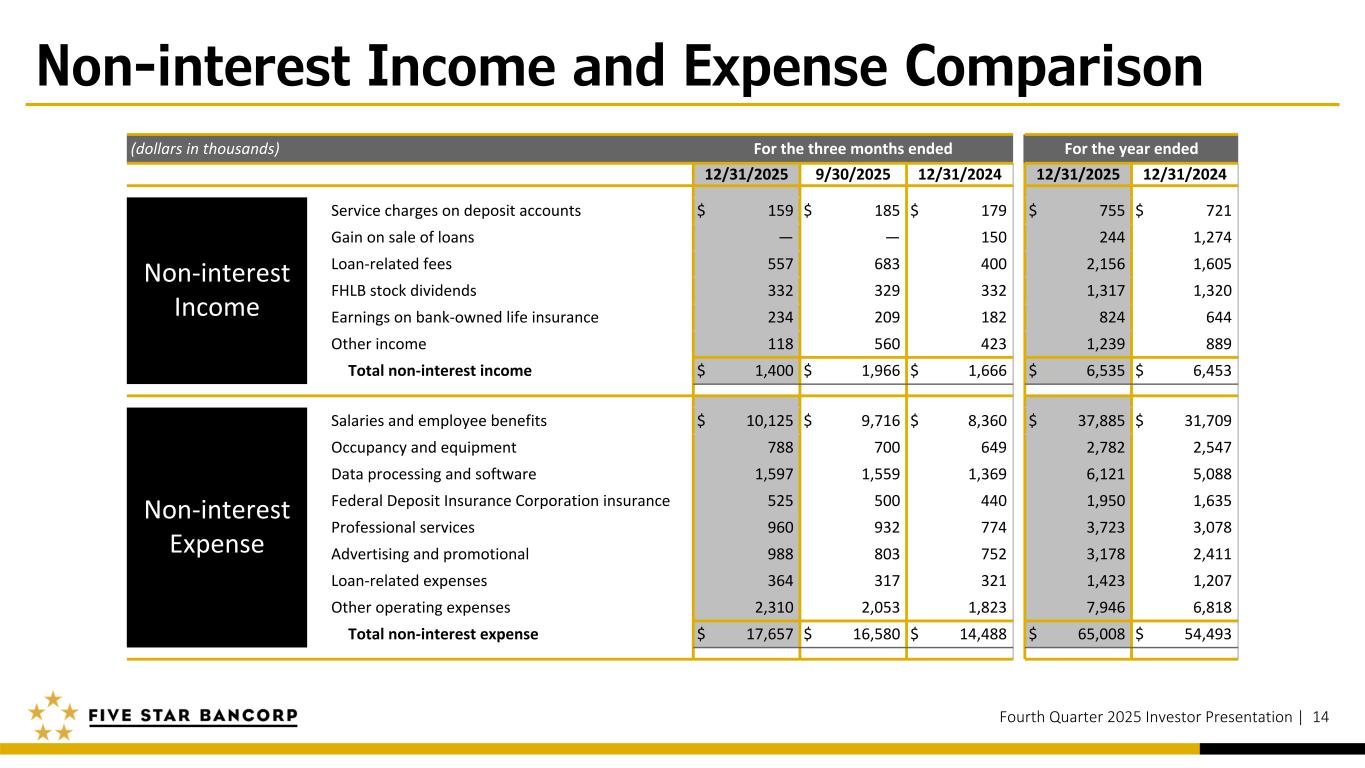
and hello everyone net interest income increased 2.7 million or seven percent from the previous quarter primarily due to a 1.8 million dollar increase in loan interest income driven by new loan production and a $1.1 million decrease in interest expense. The decline in interest expense is primarily related to a 21 basis point decline in the average cost of deposits quarter over quarter, driven primarily by two rate cuts occurring in the three months ended December 31st, 2025. The average balance of deposits increased by 4% during the three months ended December 31st, 2025, but the substantial decrease in the costs associated with deposits led to a net reduction in total interest expense. Net interest income increased by $32.2 million, or 27% from 2024, primarily due to a $35.9 million increase in loan interest income driven by new loan production at higher rates, contributing to overall improvement in the average yield on loans. This is partially offset by a $10 million increase in deposit interest expense related to a 19% increase in the average balance of deposits during the year. The average cost of deposits was $240 for the year ended December 31st, 2025, a decrease of 16 basis points compared to the prior year, which helped to moderate the increase in interest expense related to deposit growth. Non-interest income decreased to $1.4 million in the fourth quarter from $2 million in the previous quarter, primarily due to an overall decline in earnings related to equity investments and venture-backed funds during the three months ended December 31, 2025, compared to the prior quarter. Non-interest income increased by $100,000 in 2025, primarily due to an increase from fees from swap referrals and income from credit card activity, an improvement in earnings related to equity investments and venture-backed funds, and an increase on earnings on bank-owned life insurance related to the purchase of additional policies. These gains were almost entirely offset by lower gain on sale of loans, which declined due to the strategic reduction in origination of loans held for sale during the year. For the three months ended December 31, 2025, there was a $1.1 million increase in non-interest expense and for the full year ending that date, the increase amounted to $10.5 million. The primary driver for higher non-interest expense was related to an increase in headcount, leading to elevated salaries and benefits. Provision for income taxes for the quarter ended December 31, 2025 decreased by $500,000 or 9% as compared to the prior quarter due to a $900,000 benefit recorded during the fourth quarter related to the purchase of transferable tax credits. This was partially offset by an increase in pre-tax income recognized during the quarter and an adjustment related to the true-up of amortization expense related to low-income housing tax credits during the three months ended December 31, 2025. The provision for income taxes increased by $3.1 million, or 16%, for the year ended December 31, 2025, as compared to the prior year, due to a 29% increase in pre-tax income recognized during the year. This was partially offset by a $900,000 benefit recorded during the quarter related to the purchase of tax credit. And now I will hand it back to James for closing remarks.
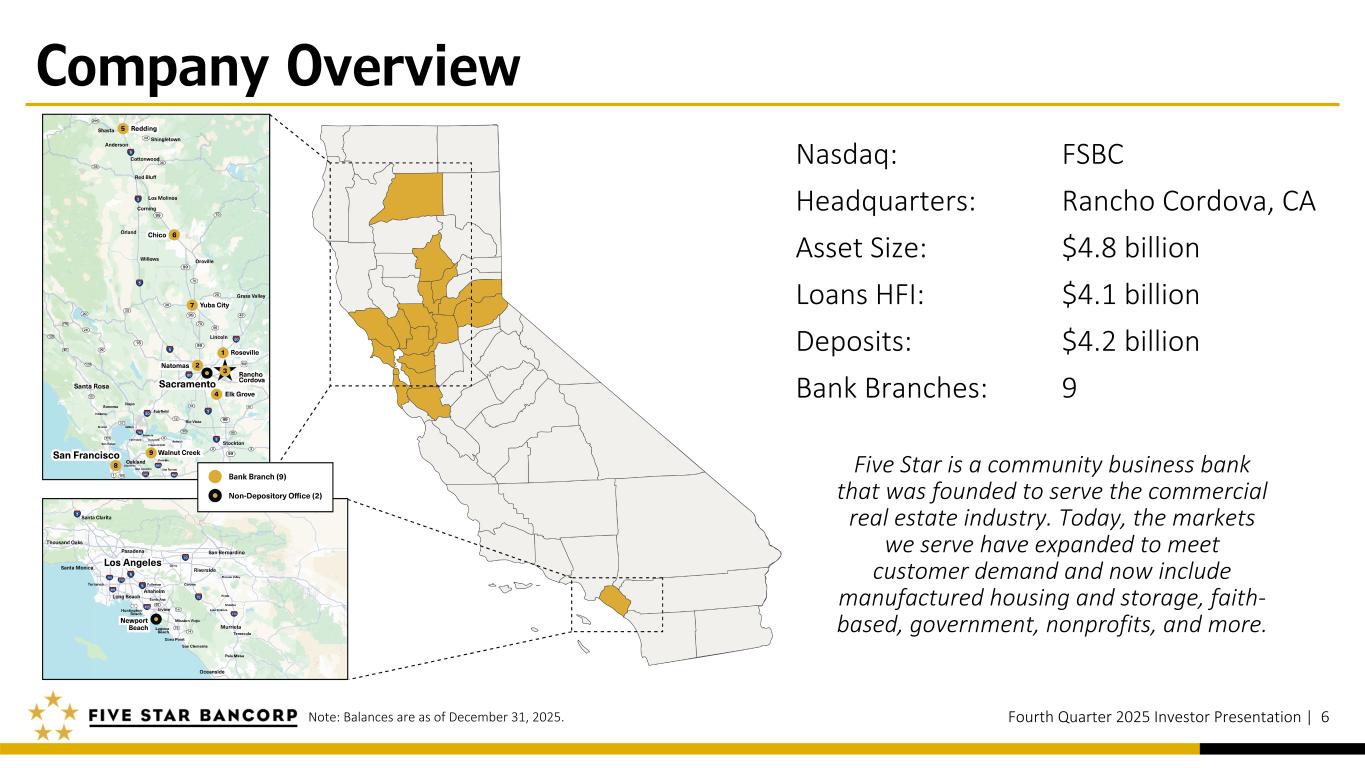
Thank you, Heather. 2025 was an outstanding year of achievement for Five Star Bank. As we not only celebrated our 25th year in business, but also reflected on a quarter century of growth, innovation, and commitment to our core values. Since our founding, Five Star Bank has steadily evolved from a small group of entrepreneurs into a $4.8 billion financial institution with nine branches and over 230 employees. This remarkable expansion is a testament to our enduring dedication to authentic, relationship-based service, a philosophy that places the needs of our customers, the well-being of our employees and communities, and the interest of shareholders at the heart of everything we do. Throughout these 25 years, Five Star Bank has consistently prioritized building deep, meaningful relations with our clients, understanding that true success comes from trust, transparency, and mutual benefit. Our employees play a crucial role in this journey, embodying our values through personalized service, expert financial guidance, and active participation in the community initiatives. We take immense pride of our achievements, which include not only financial growth, but also positive impacts on the local economies, support for small business, and contributions to the social and environmental causes. Looking ahead to 2026 and beyond, our vision remains steadfast. We are committed to further developing all of our business verticals while expanding our reach into new markets. It is increasingly in an increasingly digital world we recognize the importance of blending cost-cutting technology with the human touch that defines Five Star Bank's high-tech and high-touch approach to business. As we move forward, Five Star Bank will remain focused on innovation and service excellence. We are excited about the opportunities ahead and are confident of our proven strategy will drive continued growth, strength, and client relations and creating lasting value for our shareholders. We appreciate your time today. This concludes today's presentation. Now, we will be happy to take any questions you might have.
Operator
Thank you. We will now begin the question and answer session. To ask a question, those dialed in may press star, then one on your telephone keypad. If you are using a speakerphone, please pick up your handset before pressing the keys. To withdraw your question, please press star, then two. Questions will be taken in the order received. And the first question today will come from David Feaster with Raymond James. Please go ahead.
Hey, good morning, everybody. Hey, David. I am great. I wanted to start on the origination side. You saw a real nice acceleration in originations this quarter. I was hoping you could give us maybe a sense of some of the drivers behind it. I know it's hard to peg, but, you know, how much of that growth is from new hires versus increasing demand? And then just any thoughts on how pipelines are shaping up heading into the new year and where you're seeing opportunity for growth?
Sure. You know, we saw all of our verticals perform extremely well in the fourth quarter. Our food and ag group did extremely well in terms of onboarding some clients, whose lending cycle, if you will, kind of gears up during the fourth quarter, especially in some of our clients who are paying growers. So that was a significant component. So it's seasonal in nature. But also some of the deals that we did down in the Bay Area, I think we had a fair amount of volume that came out of that. But across all of our geographies and our verticals was a very big quarter for loan production. Now, as we enter into 2026, the pipeline looks good. It's been higher. It's been lower. But it looks good as we roll into 2026, David.
That's great. And maybe just switching to the other side of the balance sheet, your deposit growth has been phenomenal. You've done a great job driving core deposit growth and reducing the wholesale funding. It's significantly improved your deposit costs. I just wanted to – I was hoping you could touch on, first, the competitive landscape for deposits from your perspective today. And then just how you think about core deposit growth going forward and your ability to continue to fund your outsized loan growth with core deposits.
Sure. Well, you know, the markets that we're in right now are very competitive. For the best clients that are going to see the tier one clients, if you will, or prospects, it's a very competitive space. And it doesn't really matter what geography you're in. It's just competitive. And so, you know, we don't expect that to change. But our secret sauce, David, is the fact that we've got 42 business development folks, that that's their job, is to bring in core deposit and core relationships into the bank. We feel that's our competitive advantage. We brought some folks in down in Orange County that are deposit gatherers. They're starting to see a fair amount of traction down there. We've got folks that are in the Bay Area that are primarily deposit, have a deposit orientation. They're doing well. But we also saw great growth in North State in our Redding office and also our Yuba City office. So we're excited about what that might mean for 2026. We seem to be doing fine so far. So we expect that we'll be able to continue to execute. We don't think we're going to be able to do what we did in 2026, what we did in 2025, David. That's just asking a lot. And a lot of things are away. So, you know, we're projecting on both sides of the balance sheet, you know, 10% growth as we roll into 2026. If we can achieve that, which is really quite substantial, we're happy with that. A couple of drivers of that is that on the loan side, you know, we expect a fair amount of payoffs. We saw a fair amount of payoffs in the fourth quarter, and we expect the same or similar that we're going to see in 2026. So we're going to have to run that much harder. And then on the deposit side, you know, we're trying to get rid of all of our wholesale, excuse me, our brokered deposits. And that's $175 million as we end of the year. And so in order to grow total deposits by 10%, I think, what is it, Sarah, we're going to have to grow by 13 or so percent. So we're going to have to hustle in order to achieve those types of goals for us as we enter into 2026.
And one of the things that supported your growth has really been your hiring efforts. I mean, you talked about adding 10 BDOs this year. You know, you've had a lot of success. I've got to imagine what you guys are doing is resonating in the market. I mean, you guys are putting up pretty – it's fun growing like you guys are, and I know you're getting recognized. I'm just curious, you know, there's still a lot of disruption across your footprint in Northern California. How do you think about your ability to continue to recruit bankers and BDOs, and are there any markets or segments that you're notably focused on or expanding into?
Sure. Sure. You know, I think we did a nice job with the East Bay in our Walnut Creek opening. It's a nice office. We expect that to grow. But when you consider about what we're doing down in the Bay Area, you know, we're not yet on the peninsula or South Bay. So that certainly would be an area of perspective that's of interest to us. highly competitive in terms of getting qualified bankers to come work for you. And frankly, a lot of those salaries have been bid up. And it's not a bad time to be a seasoned business development person in the Bay Area. Let me tell you that much.
That's great. Thanks, everybody.
Operator
The next question will come from Andrew Terrell with Stevens. Please go ahead.
Hey, good morning, James. Hey, good morning, Heather.
Maybe if I could just start on expenses, Heather, I'm hoping you could help us out with just kind of thoughts on the expense run right into the first quarter. And if I look back at 2025, you guys grew, I think it was around high teens on overall expenses. You obviously had a pretty tremendous amount of revenue growth as well throughout the year. But just as we look out into 2026, any thoughts on kind of where the expense growth has? Should it moderate from here or, you know, stay elevated as you guys keep hiring and continue making investments?
Yeah, sure. So from a dollars perspective for Q1, you could probably add about $300,000 to that expense amount. We do have plans that have brought on a few new people into our group. So that will help support that. But if you look at the full year for 2026, I think our target for a range on expenses as a percent of total assets or average assets should be like $148 to $155 in that range. And we believe that that will help accommodate growth as well as regular maintenance on there, too. So I think that range for 2026 should be $148 to $155.
I think, Heather, when we end the quarter at or in the year at, we're right at $150.
Yeah, the quarter was at $150.
So, you know, that's something that we think about constantly, Andrew, in just terms of a percentage to total assets. And it's not a bad guide as we continue to grow.
Yeah. Yeah, you guys have stayed pretty consistent in that band we've talked about for a while. Okay. Okay. James, I wanted to get a sense from you just on competitive dynamics on, you know, rate competition on loans specifically. I know you guys do have somewhat of a repricing story, you know, as we move forward. Just wanted to get a sense on where, you know, originations are coming on at from a yield standpoint. You know, we've heard from several of your peers just the competition they're seeing on the loan side is impacting spreads. I'm just curious what you're seeing.
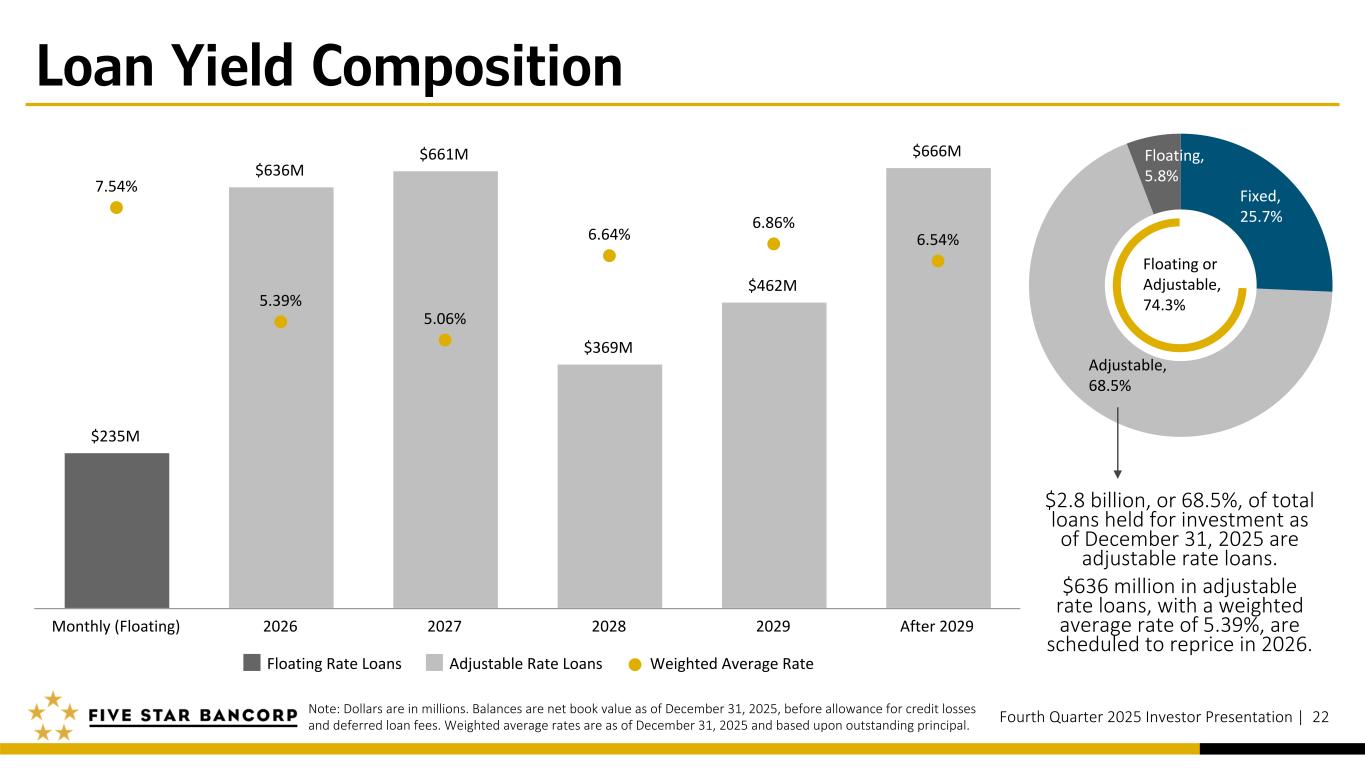
Yeah, I think we're seeing the same thing. But, you know, we have an ability to generate new credit within our MHC and RB efforts that usually will allow us to get our normal spreads, which could be anywhere between 275 to 350 over the five-year. So we have a competitive advantage from that perspective because it's just not a lot of players in that market. But if we're going toe-to-toe with folks, you know, on an owner-occupied real estate and line of credit for an operating entity, it can be very competitive. And you could see spreads as low as 200 over, 205 over, and, you know, at prime or prime minus a quarter even for their operating line. So it's constant. You know, there's a lot of folks that are interested, certainly in the Bay Area, that have come in. And so it's a highly competitive environment, not just in the Bay Area, but up and down the valley, the capital region. So we recognize this. There is pressure. We do have a lot of refinancings coming up in 26, and those fundamentally are from everything that we did in 21, since we have, for the most part, our MHC and RV, and probably outside of that, too, anything with a CRE patina to it. You know, it's a five-year reset, usually a 25- or 30-year ammo due in 10 with one reset after the 60th month. So big years of origination, you're going to have some resets happen. We don't expect all those loans to stay with us. A lot of those operators are going to take their loans to agency because they can get a better deal, lose the personal guarantees, take cash out. So we just, you know, it's going to have an impact to us. So a lot of those credits were forehandles in terms of interest rates. So we're going to see a lot of that happen in 2026. Hopefully, we can keep up to half of them, okay? But they're going to reset, and we'll just see how that goes. We're actively, I'm going to say, because we have other credits with it, we're actively in those discussions about what they're going to do when their loans reset.
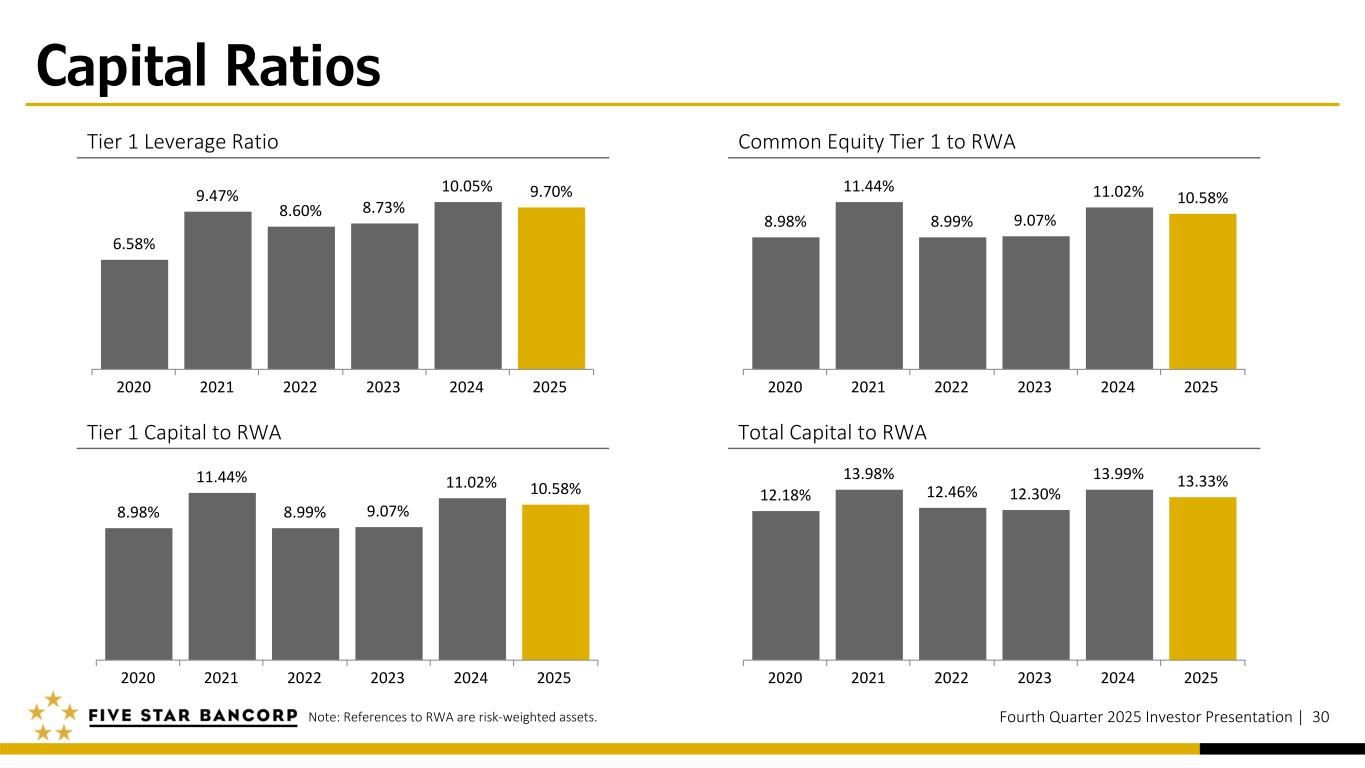
Yep, got it. Okay, I appreciate all the color there. And if I could just ask one more. you know you leveraged capital a little bit this quarter with the strong growth i think your ct1 down around 10.5 percent now maybe 10.6 but i just wanted to get your sense on comfortability with capital as it stands today and kind of the outlook i'm sure you know organic earnings can can fund a kind of 10 growth rate but just wanted to get your thoughts on the current position and the kind of capital expectations, thanks.
Sure, we had outside growth in 2025, so you saw a decline in our capital ratios. But as we go forward, we believe that we'll be able to maintain our capital positions with a 10% growth. We do anything like 15% growth, I think that's another matter. But I think we like where we are. You know, we need to be highly profitable so we can fund our growth, and I think we'll be able to do that in terms of what we see in front of us in 2026 from a profitability perspective. So we'll just see how that goes, Andrew. If we have outside growth, you know, that's another conversation.
Yeah. If we stick to that 10% growth rate throughout our entire forecast period, we usually budget on a five-year forecast. We are able to sustain ourselves and fund ourselves through that, even with the elevated dividend that we just announced recently. But if we did grow like 15% to 20%, that clearly will accelerate capital needs and we won't be able to self-generate. So we would likely have to have a capital event sometime in 27 or 28, depending on how fast that growth happens.
Thanks for checking the questions.
Operator
The next question will come from Gary Tenner with DA Davidson. Please go ahead.
Thanks. Thank you, Eric. I just wanted to dig a little bit into kind of the efficiency ratio. I know you talked about the expense-to-asset ratio earlier in the call, but as I'm thinking about the margin expansion kind of outlook, thinking that NII should run somewhat ahead of your loan growth outlook and balance sheet outlook. It seems like, you know, it'll be kind of in line with the expense side of things. So I'm just wondering, you know, with your efficiency ratio at 40% and a little bit from a year ago, is there much more room to push that lower, or is it really just, you know, making a dollar on every 40 cents?
Well, I think it's probably more the latter. And, you know, we have, you know, because we're constantly investing in our business. We're constantly employing our front end, adding more business debt people, and they're expensive. And we're constantly throwing coal into the boiler and trying to maintain our growth rates. You know, as we get bigger and bigger, doing 10% is harder to do because the numbers are just bigger. But so we think that, you know, constantly having some form of area of investment in the business in the form of new front-end people, which has a rippling effect across our cost structure because you hire some more biz dev folks. You've got to have some backup from a depository perspective. And then, of course, you've got to have a few more lenders that will be able to underwrite their business. So that's how we think about it. It really starts with the folks that are on the front end. And we're not backing off. If we see a team that we think we can get, Gary, we're going to do it. And I think that's evidenced in what we've been able to do over the last three, four years. So we're reinvesting. We're constantly reinvesting in our business. You know, I think our profitability would be a lot higher if we didn't do that. But, you know, this is really a long-term play for our shareholders. And so we're a long-term organic growth shop, and we want to maintain that focus.
Appreciate that, James. And then just as it relates to kind of the near-term outlook, the ability to generate that kind of 10% threshold of loan growth, or really both sides of the balance sheet is that do you have the the headcount to accommodate that or to accomplish that today or is there any assumption that there's ads early in the year that help generate some of that growth or is it basically kind of is it based on the current team
i guess is the question uh kind of based on the current team wouldn't you say heather yeah i i
think so you know we really have if you think about it we've in the bay area specifically you You know, we've been hiring in tranches, and so it started in 2023, but we continue to add headcount as we go. So we have new hires. We hired 12 BDOs in 2025, and it does take some time to really understand our system, our platforms, our processes to really get their feet under themselves to run hard. And so, you know, they'll come online, but really I think 10% growth is achievable with the current team that we have in place.
Operator
Again, if you have a question, please press star, then one. Please stand by as we poll for questions. Seeing no further questions, this will conclude our question and answer session. I would like to turn the conference back over to management for any closing remarks.
Thank you. We are proud to have achieved another quarter and year of significant organic growth. Built on a strong foundation of client service, expanded relationships and products, and the loyalty of our exceptional clients, we will always remember that we exist because of our clients' trust us and we believe in them. We will continue to answer the call of businesses and organizations who desire a time-honored banking partner through the geographies and verticals we serve. Five Star Bank is here to stay. It is our privilege to be a driving force of economic development, a trusted resource for our clients, and a committed advocate for our communities. We look forward to speaking with you again in April, discuss the earnings for the first quarter of 2026. Have a great day, and thank you for listening.
Operator
The conference has now concluded. Thank you for attending today's presentation. You may now disconnect.