Operator
Thank you for standing by, and welcome to the First Watch Restaurant Group Inc. First Quarter Earnings Conference Call occurring today, May 6, 2025 at 8 AM Eastern Time. Please note that all participants are currently in a listen-only mode. Following the presentation, the conference call will be open for analyst questions and instructions on how to ask the questions will be given at that. This call will be archived and available for replay at investors.firstwatch.com under the News and Events section. I would now like to turn the conference over to Steven Marotta, Vice President of Investor Relations of First Watch to begin.
Speaker 1
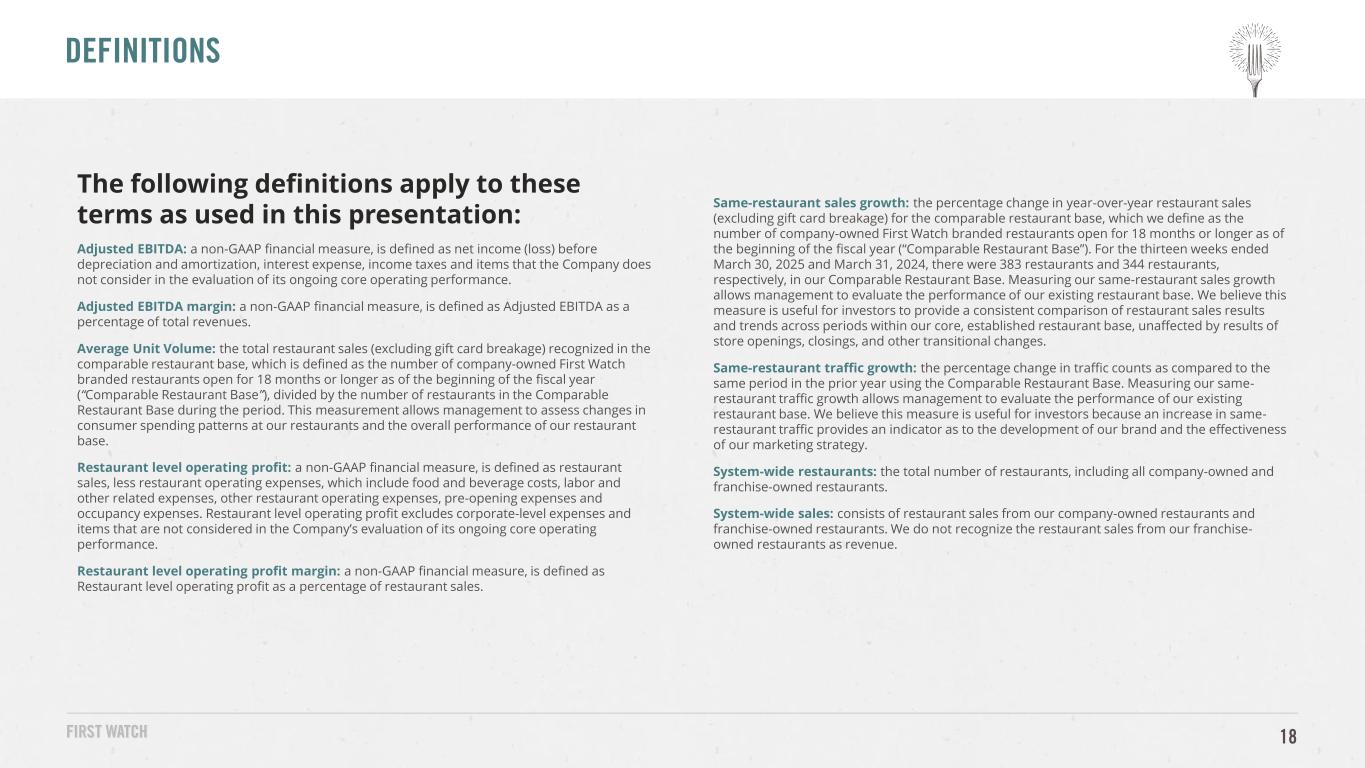
Hello, everyone. I'm joined by First Watch's Chief Executive Officer and President, Chris Tomasso and Chief Financial Officer, Mel Hope. This morning, First Watch issued its earnings release for the first quarter of fiscal 2025 on GlobeNewswire and filed its quarterly report on 10-Q with the SEC. These documents can be found at investors.firstwatch.com. This conference call will include forward-looking statements that are subject to various risks and uncertainties that could cause the company's actual results to differ materially from these statements. Such statements include, without limitation, statements concerning the conditions of the company's industry and its operations, performance and financial condition, outlook, growth plans and strategies and future expenses. Any such statements should be considered in conjunction with cautionary statements in the company's earnings release and the risk factor disclosure in the company's filings with the SEC, including our annual report on Form 10-K and quarterly reports 10-Q. First Watch assumes no obligation to update these forward looking statements whether as a result of new information, future developments or otherwise, except as may be required by law. Lastly, management's remarks today will include references to various non-GAAP measures, including restaurant level operating profit, restaurant level operating profit margin, adjusted EBITDA and adjusted EBITDA margin. Investors should review the reconciliation of these non-GAAP measures to the comparable GAAP results contained in the company's earnings release filed this morning. Any reference to percentage growth when discussing the first quarter performance is a comparison to the first quarter of 2024, unless otherwise indicated. And with that, I will turn the call over to Chris.
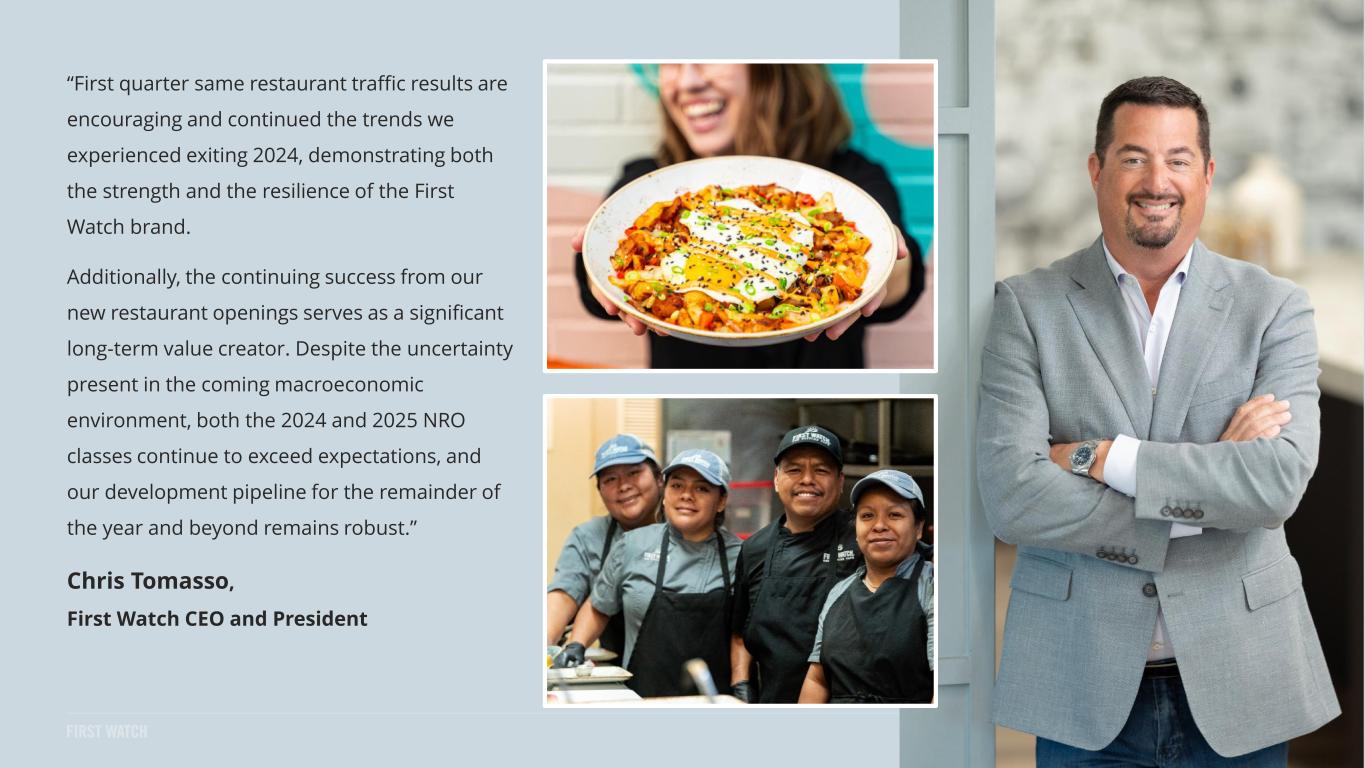
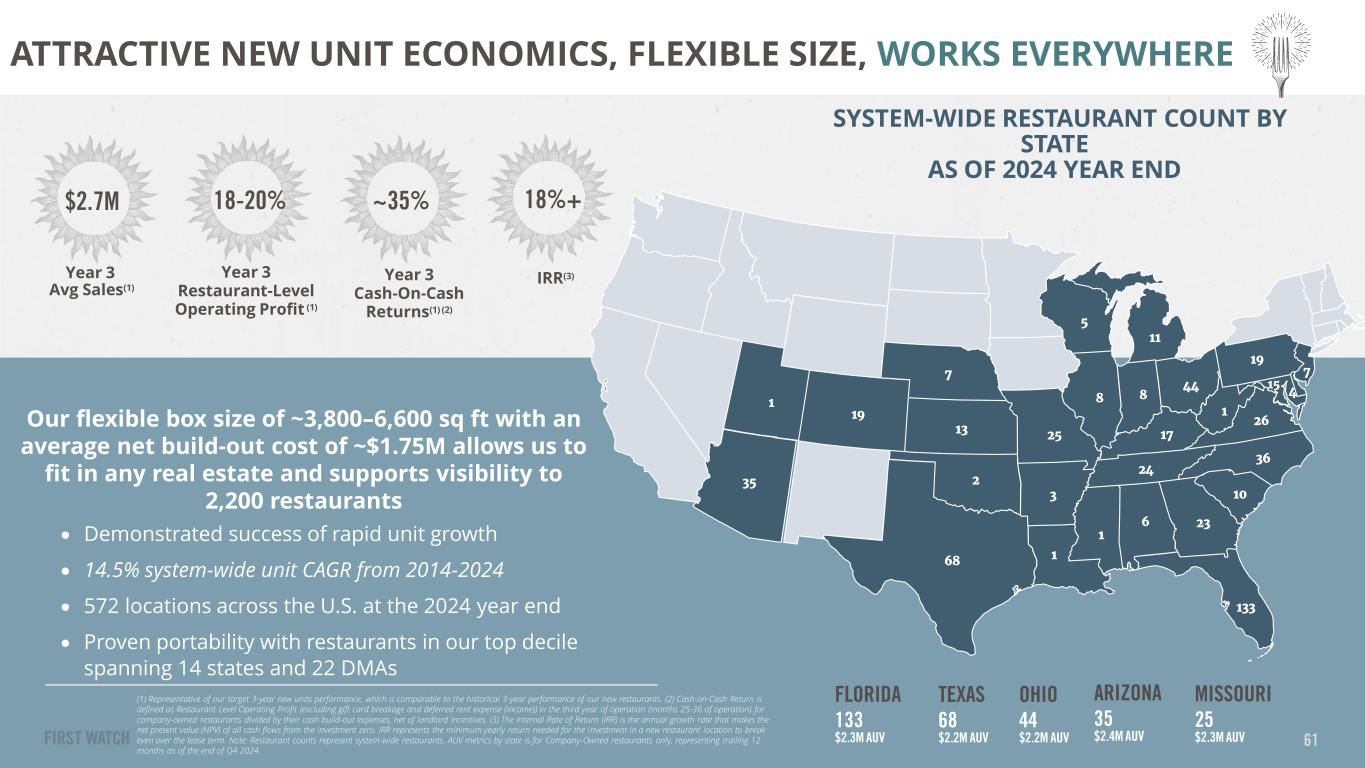
Good morning, everyone. Thank you for joining us today to discuss our first quarter results, and a very special thank you to our entire team across the country, over 16,000 strong. At First Watch, regardless of the season or the economic cycle, we are about growth, bringing our unique breakfast, brunch, and lunch offering to more customers more often and in more markets. Our first quarter of 2025 delivered better than 16% total revenue growth, positive same-restaurant growth, 13 new system-wide restaurant openings and the launch of new marketing campaigns across multiple markets. We also realized a lift in our traffic as the improvement in that trend we shared with you in March continued with our first quarter results. As always, our teams continue their high standard of consistent execution on our service objectives. As recent headlines attest, the broader macro environment appears even more volatile than when we spoke in March with rapidly shifting expectations for both consumer demand and input costs. Last year, in describing our organization's primary focus, we often used the phrase 'controlling the controllables' with regard to our customer and employee experiences as well as our management of the business day-in and day-out. This approach served us well through 2024 and will continue to be a guiding principle. Now on to Q1 in more detail. 2025 got off to an encouraging start with a return to positive traffic in January, followed by a widely reported weather-driven decline in February and then a return to positive traffic in March. Then in April, we posted the best monthly same-restaurant traffic result in over two years, giving us optimism that we're on track to achieve positive traffic for the year. Our better than 16% total revenue growth in the first quarter, driven by a powerful combination of positive same-restaurant sales and continued success of new restaurants illustrates the strength of First Watch's growth strategy. The commitment of our culture to improving operational efficiency has led to the adoption of new technologies and streamlined processes, ensuring we deliver exceptional customer experiences while remaining competitive and agile in an ever-changing macro backdrop. Ticket times, for instance, are an important KPI for us, and they improved once again in the first quarter compared to the year-ago period. Our investments in the development of our people and their well-being continue to pay dividends, fostering a highly motivated and skilled team as evidenced in part by our continued reduction of turnover rates. Indeed, the first quarter of 2025 represented the eighth consecutive quarter of improved field level employee turnover. Our people are a key brand differentiator. And because we recognize the importance of maintaining a positive and productive work environment, we will continue to introduce and prioritize programs that support their personal and professional growth, like our GM Council, for instance, where a select few of our general managers are chosen to act as sounding boards and problem solvers for their counterparts across the system. Our enhanced strategic marketing efforts began rolling out across multiple markets in March, and we are pleased with the results thus far. We have tactically targeted various consumer touch points, including social media, digital advertising, and connected TV to positively influence both reach and engagement. This multifaceted approach is allowing us to connect with a broader, but more targeted audience, driving brand awareness and fostering deeper connections with our existing customers. These campaigns are already exhibiting promising results in targeted geographies. As we continue to refine and expand our marketing strategies as the year progresses, we will be able to increase our reach, retention, and frequency to support sustained same-restaurant traffic growth. Turning to new restaurant development. We opened 13 company-owned and franchised restaurants during the quarter across 10 states, ending with 584 First Watch locations. In January, we opened our first New England location in Hanover, Massachusetts. In only its first few months, this restaurant is performing well above our expectations and is often on a wait even on weekdays. Hanover's success is yet another proof point that supports the fact that the First Watch brand is highly portable and that our total addressable market of at least 2,200 locations in the continental United States is not only realistic, but highly attainable. And just two weeks ago, we announced that we will open a flagship location in a high-profile site on Boylston Street right at the finish line of the Boston Marathon and in Boston's Back Bay. The entire New England market represents a significant opportunity for our continued expansion. Towards that end, we recently signed a lease in Nashville, New Hampshire, representing our very first in that state. Speaking of new markets, in addition to our previously announced entry into Las Vegas later this year, we recently signed our first lease agreement in Memphis, Tennessee, where we expect to open our first restaurant in Q3 of this year. Our strategic expansion into Memphis is also set to advance our footprint across the region, complementing our presence in Nashville, a market we entered more than a decade ago and now have 14 restaurants. And just yesterday, we put our 31st state on the map with our first restaurant in Idaho, specifically in Meridian, a suburb of Boise, yet another market with a lot of white space that also helps us fill in the Northwest and builds upon our expansion into Nevada and Utah. One last word on development. As a group, the 2024 and 2025 classes are currently tracking 10% or above both the comp cohort and our first year sales expectations. This relative outperformance underpins our confidence in delivering double-digit percentage unit growth targets and in our capital allocation strategy targeting cash-on-cash returns of around 35% and an IRR of greater than 18%. Additionally, we are pleased to share the completion of our previously announced franchise acquisition of 16 restaurants in North and South Carolina on April 28th as well as the acquisition of three franchise restaurants in Missouri on April 14th. These strategic acquisitions bolster our presence in these key states and the accompanying development rights provide several high-quality trade areas for continued new company restaurant growth. Every year, our strategic planning focuses on innovative methods to create more demand, improve throughput, enhance customer satisfaction and at the same time, support our entire team. I'd like to highlight a few key initiatives that aim to further strengthen our leadership position and contribute to our continued growth. Last quarter, we mentioned working more closely with our third-party delivery partners to better accommodate the demand dynamics in that channel given the macro pressures facing the consumer. Working in partnership with the largest of our two third-party delivery providers, we developed and implemented a strategy that reversed our negative traffic trends in this channel. The channel's traffic lift has outperformed our expectations. And as a result, we are driving more margin dollars, albeit by design at a lower PPA and at a somewhat lower margin. To enhance customer satisfaction and deliver increased value, we doubled the amount of meat in one of our top-selling classic dishes, the trifecta, and chose not to take price in order to maintain the original margin. The timing of an outsized increase in bacon costs, combined with the significant demand shift by customers into this menu item has placed additional pressure on our margins. We believe taking selective steps like this will ultimately lead to increased customer frequency at the short-term cost of a tighter margin for this high mixing item. Our general managers are at the forefront of our customer service. To demonstrate our commitment to hospitality, inspire their creativity, and positively impact their communities, we have empowered and encouraged them to make days brighter for certain customers through surprise and delightful acts of kindness. These come to life in the form of a complimentary juice, shareable, or entrée. While there is an impact to our per person average check, with these actions, we are making an investment in long-term customer retention. Small acts such as these create an emotional connection for our customers and build loyalty in ways points-based loyalty programs simply can't. We believe that the way to effectively manage through uncertain times is to focus on the customer, deliver exceptional value and meet the customer where they are. By optimizing our third-party delivery program, amplifying our investments in the Guest initiatives, and empowering our leaders to make days brighter for our customers, we are doing just that and building a stronger foundation for future growth at the same time. Inevitably, every year presents a new set of challenges. While our overall first quarter traffic was a bit lower than our own expectations, specifically as it relates to the in-restaurant channel, we're pleased to see same-restaurant traffic growth displaying sequential improvement. April was better than the first quarter, which was better than the fourth quarter, which was better than the third quarter. Near-term, our margin profile is being pressured by higher inflationary headwinds in our market basket since our last earnings call, the impacts of new tariff implementation, and the incremental costs of the previously listed initiatives. We believe that the multiple challenges affecting our current margin profile are transitory and that our daypart dominance, market share, unit growth, competitive positioning, and customer service experience are unmatched across the industry. We have a lot to look forward to in 2025. With our increased marketing activity this year, we're actively building customer awareness in core, emerging, and entirely new markets. Our new restaurant openings continue to exceed expectations. Our growth plan is solid with both our real estate and people pipelines in place to support our continued expansion. Our top-performing restaurants span 14 states and 22 DMAs, showcasing the adaptability and appeal of our brand across diverse regions and illustrating First Watch's widespread popularity. We have nearly 600 system-wide restaurants serving breakfast, brunch, and lunch in 31 states. We believe that with the higher sales potentials represented in our new openings when compared to the existing portfolio, our future restaurant classes will perform even better. And now I'd like to turn it over to Mel.
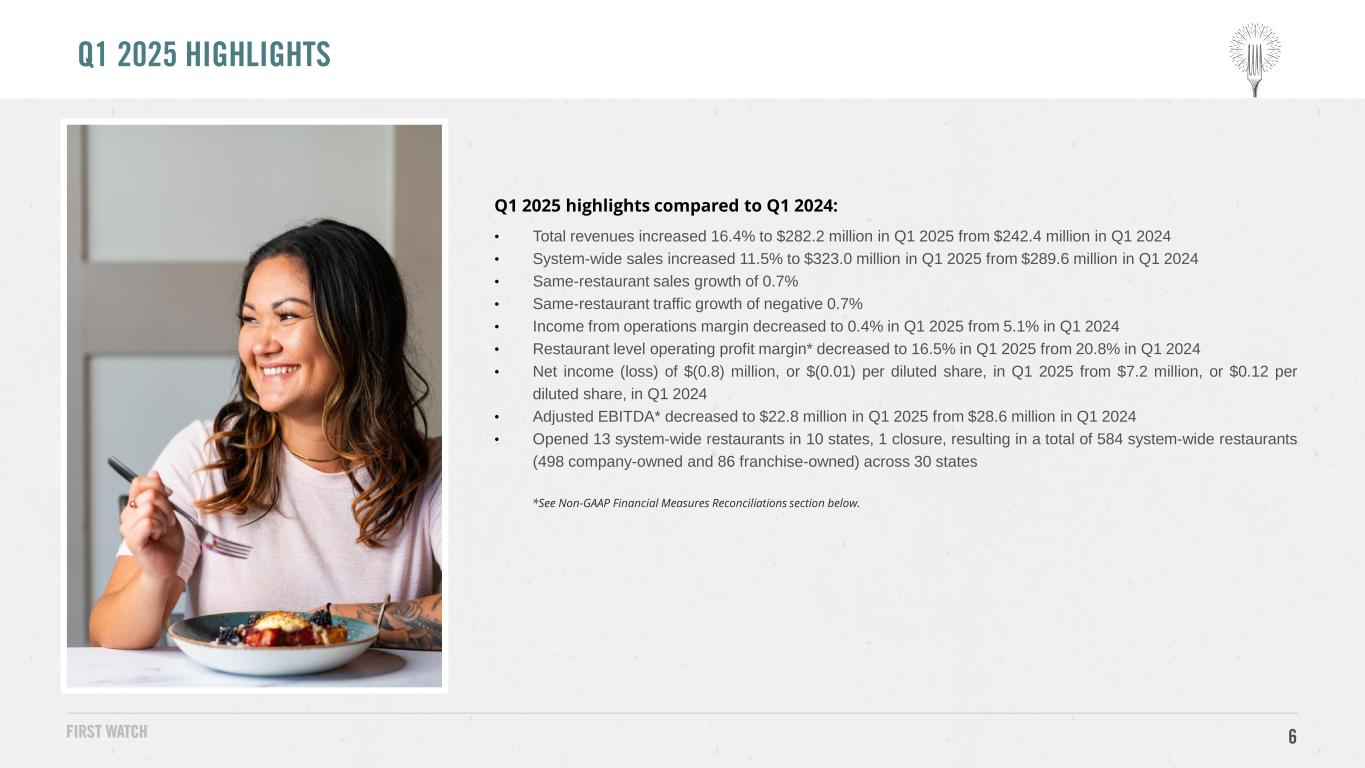
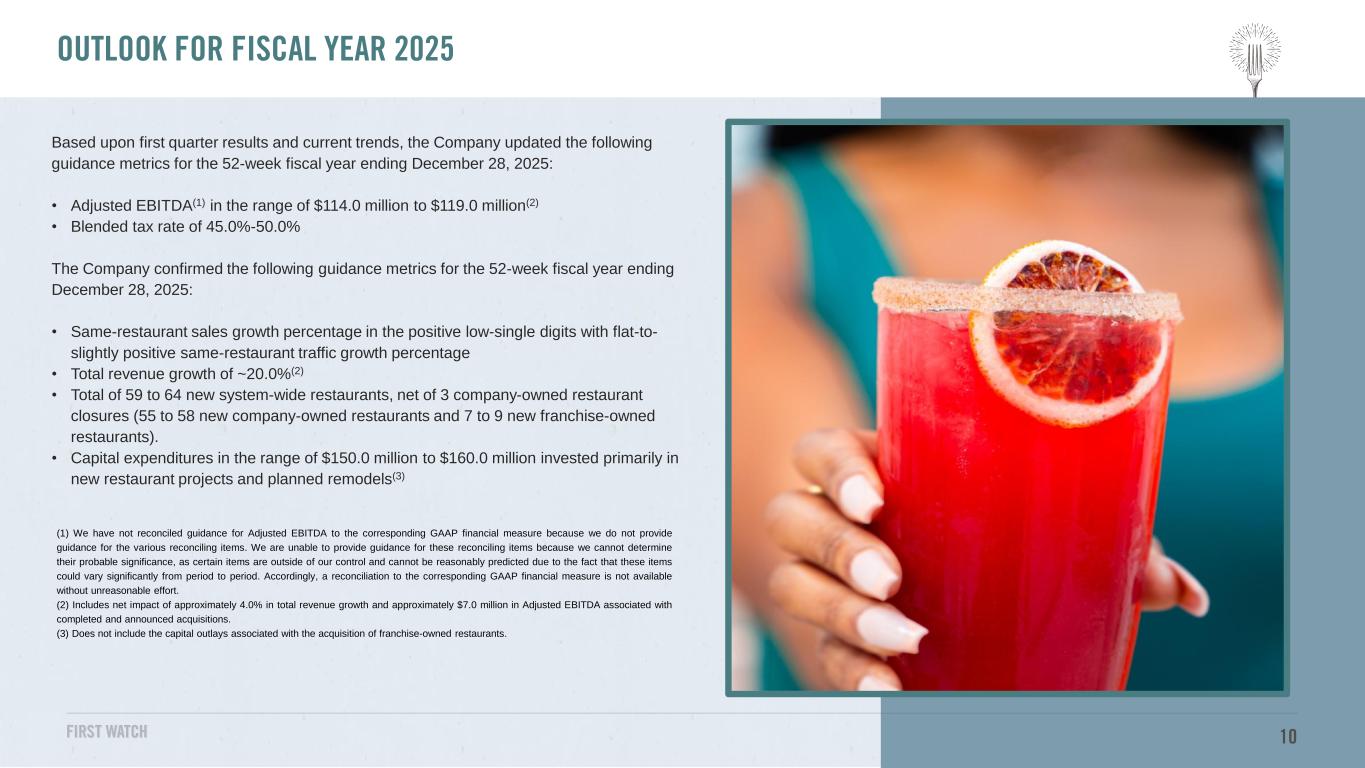
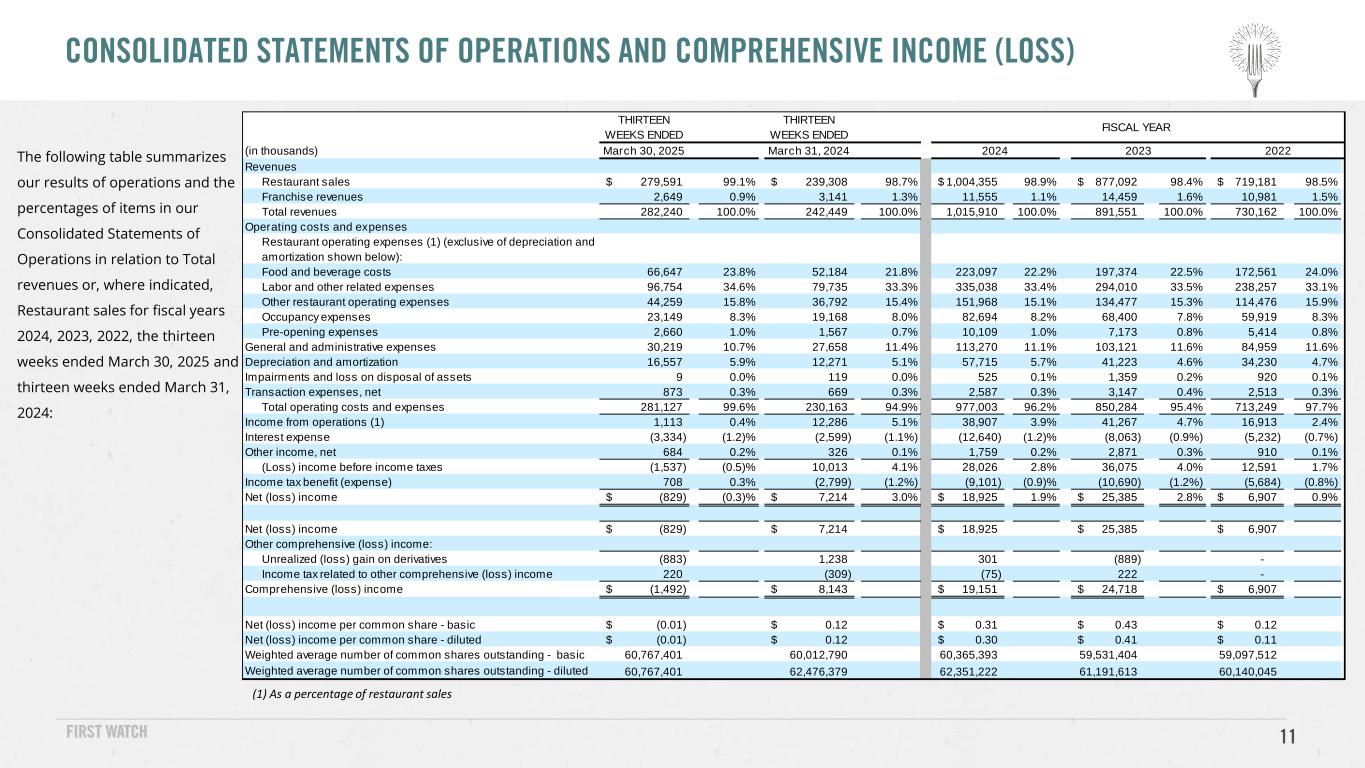
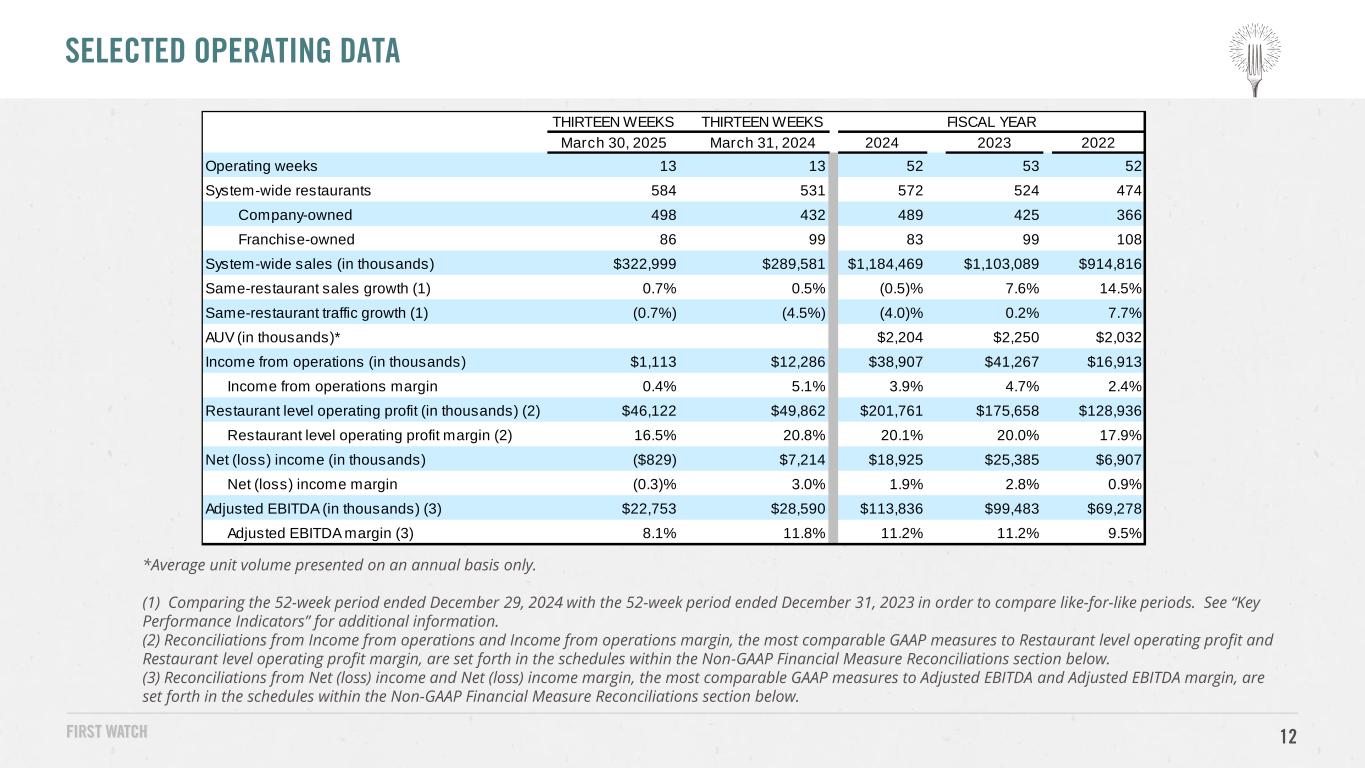
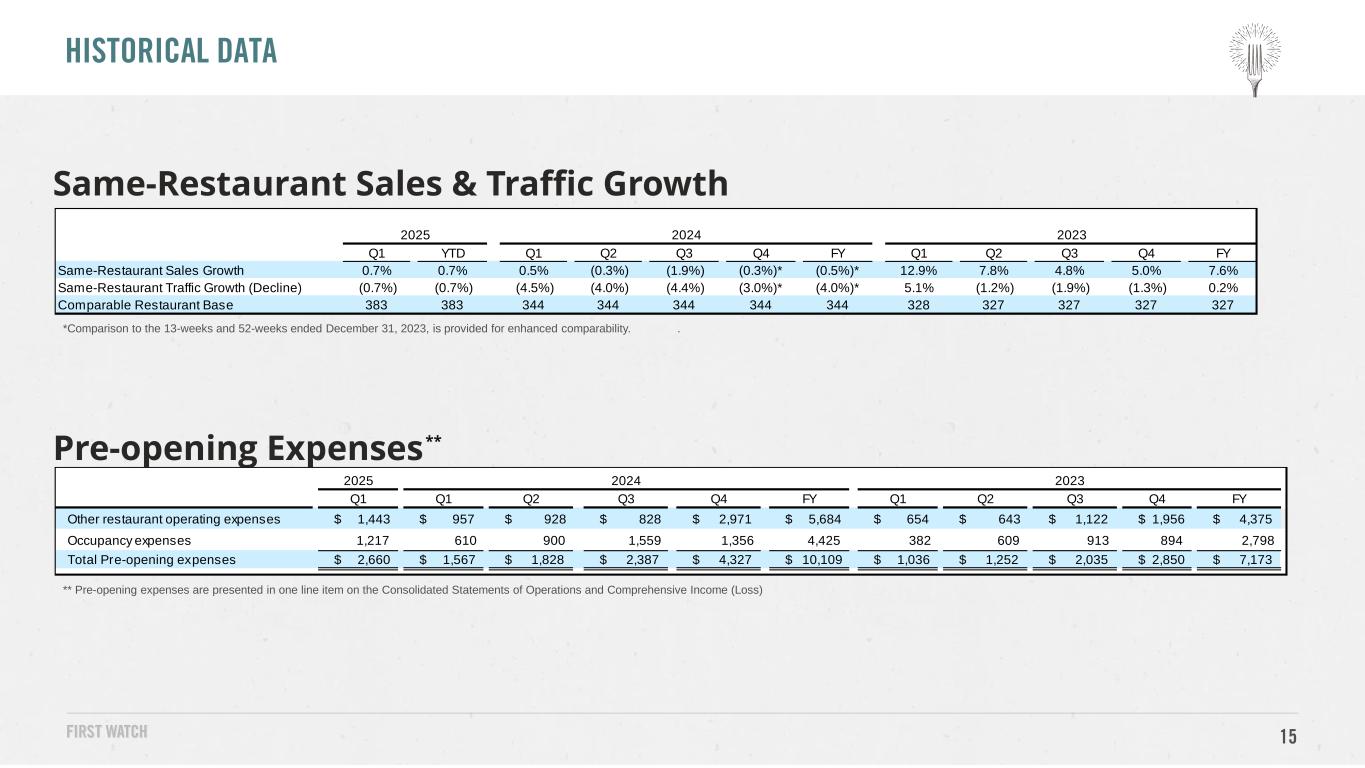
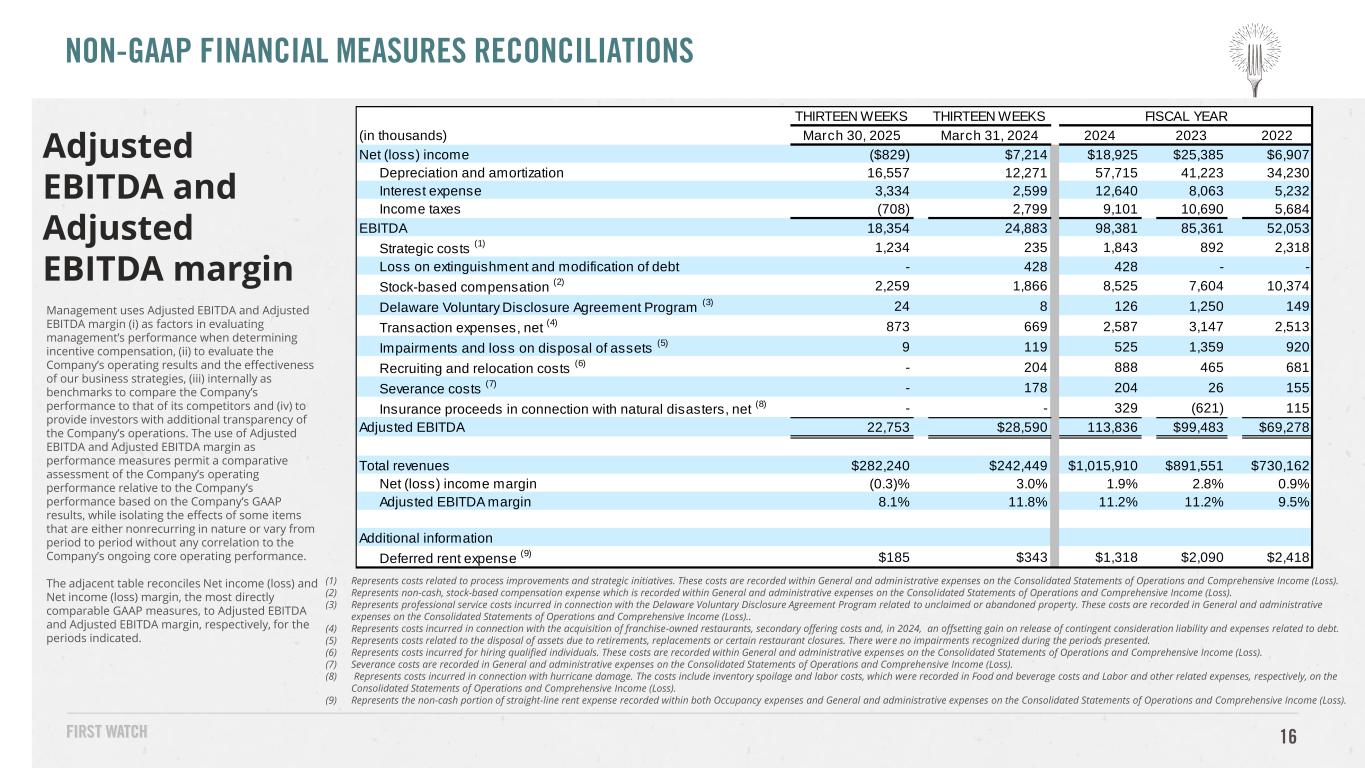
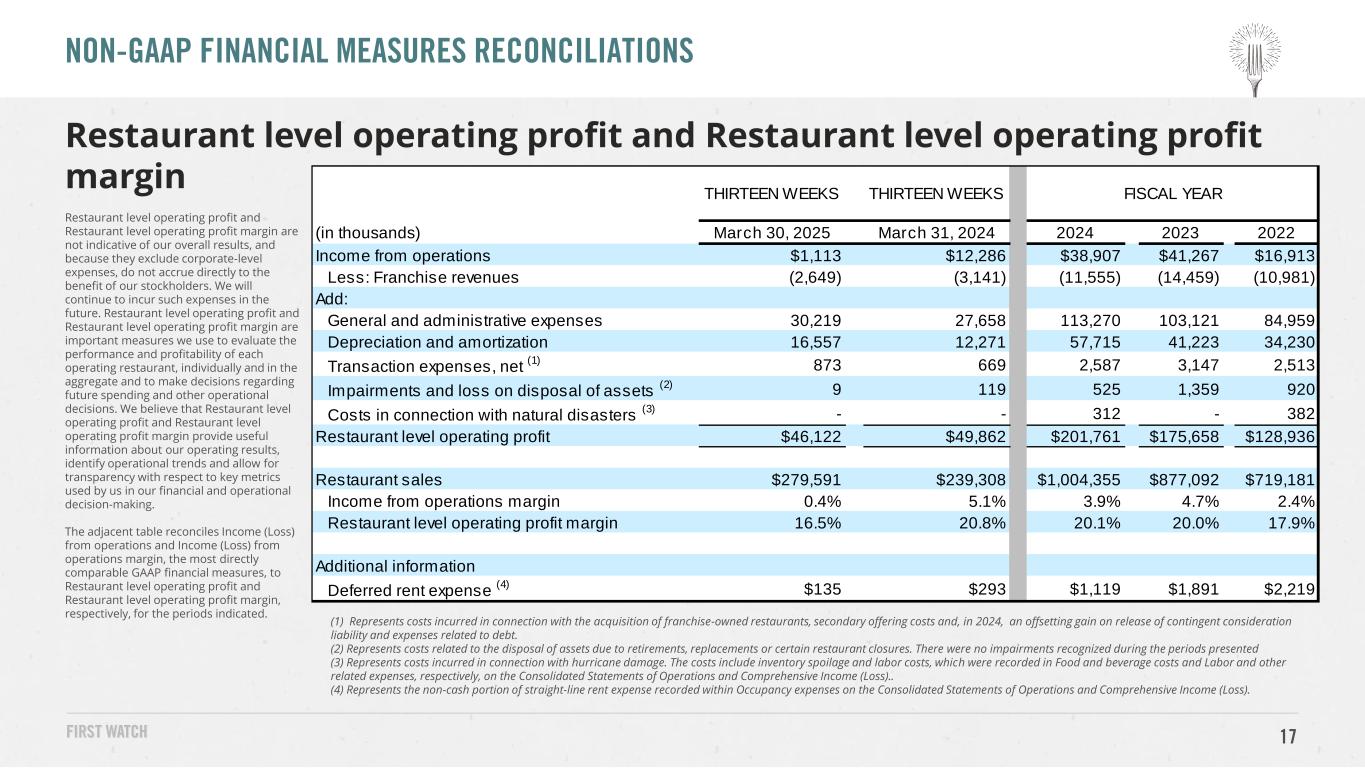
Thank you, Chris, and good morning. Total first quarter revenues were $282.2 million, an increase of 16.4%. Our top line increase results from positive same-restaurant sales growth of 0.7% and the contribution of 115 non-comp restaurants, including 46 company-owned new restaurant openings and 22 locations we've acquired since the fourth quarter of 2023. Same-restaurant traffic was negative 0.7%. We're generally pleased that both January and March posted positive same-restaurant traffic, though the headwinds experienced industry-wide applied pressure on February results. For the quarter, our in-restaurant traffic was below our expectations. However, changes we made to our third-party delivery program yielded immediate results with this channel experiencing percentage traffic growth in the mid-teens and offsetting much of the traffic decline of our in-restaurant dining and direct off-prem sales channels. We also experienced positive sales mix during the quarter. Before moving on to specific income statement inputs, I want to draw your attention to two independent factors that impacted multiple income statement line items. First, growth in the per person average check was lower than carried pricing in the first quarter due to both the surcharge adjustments we made to our third-party delivery program as well as various in-restaurant marketing initiatives, not check management. Second, and as we've shared before, our new restaurants operate at less efficient margins with the first 120 days having the steepest climb to maturity. During the quarter, the contribution from our new restaurants was more pronounced than usual, considering that we've opened 33 new company-owned restaurants in the last two quarters. Food and beverage expense rose to 23.8% of sales compared to 21.8% in the first quarter last year. Costs as a percentage of sales benefited from carried pricing of around 2.5%, though this was more than offset by commodity inflation of 7.7%. Eggs, bacon, coffee, and avocados, which comprise four of our top five food cost inputs, are all trading at remarkably high prices and so are increasing our commodity costs. Additionally, food and beverage costs as a percentage of sales were impacted by our decision to increase certain portion sizes, as Chris mentioned earlier. Labor and other related expenses were 34.6% of sales in the first quarter, a 130 basis point increase from 33.3% reported in the first quarter of 2024. Higher health benefit costs were the primary reason for the year-over-year percentage increase due to higher enrollment and higher claims. Restaurant level labor inflation was 4.1% in the first quarter and labor efficiency was in line compared with last year. Restaurant level operating profit margin was 16.5% in the first quarter compared to 20.8% in the first quarter last year. Income from operations margin was 0.4%. We leveraged G&A expenses. As a percentage of total revenue, these expenses declined to 10.7%, a 70 basis point improvement compared to the same quarter last year. The $2.5 million increase versus last year was driven by investments in marketing and in headcount. Adjusted EBITDA was $22.8 million, $5.8 million below last year with adjusted EBITDA margin slipping to 8.1% from 11.8%. Adjusted EBITDA results were lower than our prior expectations due to three factors; first, while March traffic improved from February, both months were weaker than we expected. Second, as Chris mentioned, we empowered our managers to surprise and delight certain customers and the costs associated with this program were higher than anticipated. And lastly, adjusted EBITDA was affected by the increased cost of our healthcare benefit programs. We reported a net loss of $829,000. There were 13 new system-wide restaurants opened during the first quarter, of which 10 are company-owned and three are franchise-owned, and we ended the period with 584 restaurants in the system. The net effect of acquisitions, which includes only the impact of purchases made within the last 12 months, increased first quarter revenue by about $10.5 million and adjusted EBITDA by about $1.9 million. For further details on the quarter, please review our supplemental materials deck on our Investor Relations website beneath the webcast link. Before moving on to guidance, I want to offer some further context on our commodity costs. Four of our top five market basket items, including eggs, bacon, coffee, and avocado are experiencing high rates of inflation in 2025. While slightly higher since our last earnings call, our consolidated commodity inflation expectations remain in the high single-digits for 2025, and we expect the inflated cost to peak in the second quarter. In our experience, outsized inflation tends to be transitory. And as such, we do not intend to fully offset the inflation with increased menu pricing. Now I'd like to provide an outlook for 2025. As I do, please note that our updates incorporate our estimates of the impacts of announced tariffs, which account for roughly 30 basis points of additional costs as a percentage of total revenue. We're maintaining our estimate of percentage same-restaurant sales growth at positive low-single digits with flat to slightly positive same-restaurant traffic. Our estimate includes the consideration of a 1.3% price action implemented in January and implies carried pricing of around 2.6% in the second quarter and 2% for the full year. As a reminder, our menu pricing disciplines target the offset of what we perceive to be permanent cost inflation, not transitory spikes. We expect total revenue growth of around 20% with a net 400 basis point impact from completed acquisitions. We expect a total of 59 to 64 net new system-wide restaurants, including 55 to 58 company-owned restaurants and 7 to 9 franchise-owned restaurants with 3 planned company-owned restaurant closures. Our company-owned new restaurant development pipeline is weighted in the second half of 2025, Q4 in particular. We expect full-year percentage commodity inflation in the high single digits, driven largely by increases in the four commodities I discussed earlier, as well as the tariffs. Restaurant-level labor cost inflation is expected to be in the range of 3% to 4%. We're lowering our adjusted EBITDA guidance to a range of $114 million to $119 million, which includes the estimated net contribution of about $7 million from acquired restaurants. Our updated estimate of full-year adjusted EBITDA considers the first quarter's underperformance, our lower-than-expected in-restaurant traffic, costs associated with 'invest in the guest' measures and incremental inflation expectations, among other items. We expect a blended tax rate of 45% to 50%. We expect capital expenditures of $150 million to $160 million, not including the capital allocated to franchise acquisitions. And finally, a couple of reminders about the current quarter to help with your financial models. As Chris mentioned, April's consolidated same-restaurant traffic was positive and though the consumer backdrop remains highly uncertain, our expectation of positive same-restaurant traffic in the back half of 2025 remains unchanged. Also, we currently expect the second quarter will represent the peak of our commodity inflation for the year with some relief in the second half of the year. With a strong pipeline of new restaurant openings and plans to continue driving traffic, we're looking forward to serving our current customers more frequently, as well as introducing new customers to First Watch.
Operator
Thank you. We will now begin the question-and-answer session. Our first question comes from Andrew Charles with TD Cowen. Please go ahead with your question.
Speaker 4
Good morning, Mel. Thank you, guys. Can you expand on the comment that sales turned positive in March and then traffic turned positive in April? I'm wondering, just given the Easter shift, can you speak to two-year underlying sales improving from March to April?
I think what we're seeing is that this year’s shift created some advantages. Even when we exclude the holiday effect, our traffic has remained positive in both periods.
Andrew, it's Chris. I'll say that we had sequential positive dine-in traffic improvement for all four quarters last year. And in Q1, taking out February, that trend would have continued.
Speaker 4
Okay. And then, Chris, wondering if you could talk more about the trade-off between driving traffic through third-party actions and other initiatives, but doing so at a lower margin. What gives you confidence that this is the right approach for the business?
That it's working. The results that we're seeing are encouraging for us. So our focus right now in this environment, obviously, we've got cost pressures. We'll talk about that some more, I'm sure. But our focus is on driving traffic in our channels and specifically in our dining rooms and in the third-party channel. So as you know, we had certain headwinds that we spoke about very often in 2024, and our team got to work on addressing those, and we're pleased with the results we're seeing. So if you look at what we reported today, a lot of confidence here around our ability to move the needle and get the consumer engaged with us, whether it's the marketing efforts, the moves we make in partnerships with our third-party providers. But the costs that we're dealing with, we are confident that they're not permanent. So we're really focused on the top line. And that's really what's driving the guidance and why we kept a lot of the elements from a top line perspective of the guidance in place because we are seeing some positive inflection there.
Speaker 4
That's helpful. Thank you.
Operator
Our next question comes from Jim Salera with Stephens Inc. Please proceed with your question.
Speaker 5
Hey, guys. Good morning. Thanks for taking our question. I wanted to drill down a little bit on some of the learnings from the increased media spend and particularly engagement that you've seen following some of the new media efforts in March and if that has any sort of learnings that you can apply more broadly across the network and help support traffic as we have kind of this consumer malaise that we're confronting.
Yeah. Again, we're iterating as we go along, but we're pleased with the results we've seen. I think it comes to life in the form of the improved traffic trends that we're seeing. And so we're chipping away at it. And we're only in, call it, the second month of that effort. We launched it really February, March. So we're starting to see the benefits of that now, which gave us the confidence to hold some of the guidance as it relates to that because we are happy with what we're seeing. So the team is just doing a really good job of, a, harvesting the data, leveraging it for the messaging, the timing, all of those things. And it really is a highly iterative process where we're making a lot of positive adjustments as we go along.
We're learning from the markets, identifying which characteristics respond more quickly than others. This is helping us to refine our approach more effectively.
Speaker 5
Okay, great. Can I ask about commodities? I believe you mentioned that Q2 will be the peak for commodity costs. Could you share any thoughts on whether you have better visibility for commodity prices in the latter half of the year? Are there specific sourcing strategies you’re implementing to help manage those costs? I’d appreciate any insights you can provide on this.
One thing I would highlight is that we have crop-related commodities, which means that their availability depends on the timing of the harvest. In seasons where crops have been negatively impacted, we don't see that as a long-term issue. Regarding eggs, this has been a major part of our inflation discussion for several quarters. As the flocks are still being rebuilt, we are particular about the eggs we use, specifically cage-free, pasteurized extra-large shell eggs. For hens to produce extra-large eggs, they need to reach a certain maturity, and those flocks are currently being replenished. Therefore, I believe that at some point, we will see an adequate supply of our specialty birds, which should provide some relief.
Operator
Our next question comes from Brian Vaccaro with Raymond James. Please proceed with your question.
Speaker 6
Hi. Just a quick follow-up on the marketing spend and just thinking about the potential benefit through the year. Could you elaborate on sort of what percentage of the system had support in the first quarter? Or any color on how that could increase in the second quarter or second half or anything around spend levels? I'm just trying to gauge what we've seen versus what we could see the rest of the year.
Thanks, Brian. It's Chris. I mean, basically, almost the entire system is receiving some kind of support. Obviously, there's heavy ups in certain markets that we're not disclosing. But there are efforts, whether it's digital, social, or some of the more targeted things that are impacting the entire system and then an elevated level in certain markets where more of the spend is being allocated.
And Brian, every market, every restaurant has always received some level of marketing support. So this is more of an emphasis in certain markets.
Speaker 6
Okay. And then I guess maybe a high-level question. I guess I'm curious to get your thoughts just on the breakfast category in the US. And it seems like quick service weakened quite a bit in the first quarter and then legacy family dining continues to have its challenges. Are there macro factors that might be weighing there that you are less exposed to? Or maybe you do see some evidence of the broader headwinds sort of beneath the surface, whether that be softness during the weekdays or any pullbacks you're seeing in the lower range of your income cohorts? Just curious to get your lay of the land on the category.
Yes. We do believe that our higher income profile customer provides some protection for us against that. I think there's been a lot of discussion around the lower income consumer pulling back. And you know that the type of customer that we appeal to and that makes up the majority of our demographic profile of our customer. So we think there's some protection there.
Operator
Our next question comes from Jeffrey Bernstein with Barclays. Please proceed with your question.
Speaker 7
Great. Thank you very much. My question is on the 2025 guide. So you tempered the EBITDA by roughly $10 million or 8%, but all of the components effectively reiterated. Mel, I know you talked a lot about a variety of headwinds that don't seem to be top-line related, at least in your view. I'm just wondering, it's all about costs over sales here. I'm just wondering if you could prioritize or bucket for us. Again, you mentioned a number of them, but the primary drivers in order of magnitude, I guess, for that significant EBITDA reduction. And then I had one follow-up.
I think almost certainly, the cost-related issues are the piece that motivated us to bring down our guidance for the full year, more sustained inflation and then obviously, the consideration of tariffs, which we hadn't included in our guidance before.
And Jeff, this is Chris. I've been here for almost 20 years, and in my experience, it's unprecedented for four of our top five commodities to be under pressure at the same time. The diversity of our market basket has historically been beneficial to us, making this a truly unique time.
Speaker 7
Got you. And my follow-up is just on the comp trend. I'm wondering whether you've seen any change in consumer behavior, whether it's frequency or weekday versus weekend. It does seem like you're encouraged by the sequential traffic uptick, but I know there are some that are concerned. It looks like you're saying you expect to sustain that positive traffic in the second half despite the consumer volatility. So I'm just wondering if you can prioritize the primary driver to give you that level of confidence. Thank you.
Sure. Yes. I mean we are encouraged by the trends that we're seeing. And again, it goes back a little ways here as we're chipping away at it. But as far as like the high-level trends, we're not seeing any big shifts or anything. We're not seeing any check management, as Mel mentioned, which is great. So at least all the signs that we're seeing in our business, we see a healthy customer for us. And I'm choosing the word customer because they're the ones that come to us rather than consumer. Obviously, there's some challenges in the environment. But in our four walls and our restaurants and the customers that we're serving, we're encouraged by the trends we're seeing right now.
Speaker 7
Great. Thank you.
Operator
Our next question comes from Sara Senatore of Bank of America. Please proceed with your question.
Speaker 8
Thank you. I have two questions. I'll start with the first one. Just on the closures this year, I think it's been a while since you've closed restaurants or certainly this number. Can you just talk about the ones that you're closing and especially in light of how good the new unit economics seem to be, anything worth noting there?
Yes. We operate a system of 500 restaurants, and each year, some leases come to an end. If the trade area has changed, we might decide not to renew the lease or to move the restaurant. However, there is nothing unusual about the three closures we expect this year. Regarding new units, they continue to exceed our sales expectations and are on track to reach full maturity over time.
Speaker 8
Right, right. So these aren't relocations. These are just like you said, a system of 500, you're going to invariably have maybe a couple more closures than you would have a couple of years ago.
Yes, across 40 years, we've got restaurants that have leases that are maybe 25, 30 years old. And so occasionally, things move or trade areas go through a regeneration or something like that.
Sara, I'll be more specific. There are restaurants that we opened about 20 years ago in trade areas that were the best options at the time, but new trade areas have since developed. By closing one restaurant, we can often open two in nearby locations, as having one in a central location may prevent the establishment of the others. We continuously review our assets, and as leases expire, we aim to proactively optimize our markets. Our goal is to achieve the best market penetration and density to ensure our success.
Speaker 8
Thank you for your insights. Regarding the surprise and delight initiative, you mentioned that margin pressure was higher than expected. It seems some customers are choosing higher-cost items, partly due to the portion investment. Is there anything specific we can do within the surprise and delight strategy to manage this situation, or any guidance you can provide to managers for more efficient execution?
Yes, we introduced this initiative at our annual conference, and it embodies our commitment to making days brighter. Our managers have enthusiastically embraced it, as we recognize first responders, teachers, our neighbors, and Little League teams, focusing on the area within 2.5 miles of our restaurants, where most of our customers live. This is an ongoing effort for the rest of the year. Naturally, we will have discussions on how to manage it effectively, but we believe it's an excellent program that fosters loyalty. Our teams are excelling in this initiative, and we will ensure appropriate management as the year progresses.
Operator
Our next question comes from Jon Tower with Citi. Please proceed with your question.
Speaker 9
Great. Thanks. I know it's early in the process in terms of some of the marketing stuff and even some of the surprise and delight ramping. But I'm curious maybe if you've seen any improvement in some of the consumer scores regarding your value proposition for the guest as you've been ramping some of these things through the system?
No, I think you're right. It's early. I mean we've probably been at this for about 13 weeks. So there's a longer period ahead and more data to analyze.
Speaker 9
Okay. And then maybe just on the labor front, I know it was higher this quarter. You called out health benefit costs kind of ticking higher. But is there anything else that we should consider going forward aside from the underlying labor inflation to consider? Is there any investment here that...?
The other part of the uptick is one that we always have, which is that we carry extra managers, because we're opening so many restaurants at such a rapid pace that we carry extra managers so that when we do open a restaurant, we can put a veteran manager into the restaurant. And so we tend to carry some higher costs there. And as we're opening more restaurants each year and opening more rapidly, the fact of the matter is that we're carrying more managers.
Speaker 9
Got it. And just one last quick question. Regarding the tariff pressure, could you clarify where that originated from? Is it related to coffee and perhaps avocados? I'm curious to know more.
A lot of it has to do with supplies that we get from Asia. And there's some on food products, but really a great deal of it has to do with our packaging supplies and paper goods, napkins, that sort of thing.
Operator
Our next question comes from Todd Brooks with The Benchmark Company. Please proceed with your question.
Speaker 10
Thank you for my question. First, Mel, you provided some insights on the pricing waterfall for the remainder of the year. Considering the mix influences you mentioned between GM, Surprise and Delight, and DoorDash, along with the new pricing algorithm for that business, what do you anticipate as the mix offsets for those pricing impacts as we look ahead?
Todd, when you say mix offsets, help me understand what you're trying to drill to?
Speaker 10
I'm trying to get from the menu pricing that you talked about to what the actual average check growth would be in the forward outlook?
We generally don't guide to mix. Generally speaking, we consider it sort of a flattish in our own projections. So if that's helpful.
Speaker 10
I wasn't sure if there had been any changes regarding what you mentioned about Surprise and Delight and the significant growth you experienced in third-party delivery along with the new structure. Thank you. This is more of a management philosophy question. In the current environment, while many companies seem to be struggling with their guidance strategy, your top line appears relatively stable compared to others. When you consider the updated EBITDA guidance, are you thinking about making adjustments to incorporate everything along with some additional buffer? Or is this essentially the best representation of your current position in what is a fluctuating cost environment?
In terms of management, we are pleased with the investments we've made. What drives our long-term growth is increasing our market share and enhancing in-restaurant dining, which is our most profitable and proudest representation of our brand. The initiatives we undertake to build loyalty and increase visit frequency, while also personally acknowledging our guests and celebrating their presence in our restaurants, are management decisions that we believe will yield long-term benefits.
Regarding costs, what we have included is derived from the best information we currently have. At the beginning of the year, we projected a higher inflation estimate compared to others, based on our observations. We find ourselves in a unique situation as four of our top five commodities are experiencing significant inflation pressure. If you're wondering about any cushion in that, I can assure you that we operate based on our current experiences. As Mel mentioned, we anticipate Q2 to be a key period, largely influenced by the repopulation of hens' eggs and challenges related to weather impacting commodities like coffee. Ultimately, our approach is grounded in the best information available at that moment.
Operator
Our next question comes from Andy Barish with Jefferies. Please proceed with your question.
Speaker 11
Hey. Good morning, guys. Wondering if you could comment kind of on the Florida market relative to the system, I know there's been a lot of dynamics down there in that large market for you. Anything you'd like to call out?
Florida has performed exceptionally well, surpassing the performance of the rest of the country. We have discussed this in detail, especially during the times when it was underperforming, to explain our perspective. I believe we managed to articulate this well in 2024, indicating it was a re-adjustment following the post-COVID excitement, leading to a steady state in Florida. Currently, Florida continues to thrive, and we are actively opening new restaurants here. We remain very optimistic about Florida, and our outlook hasn’t changed.
Speaker 11
Yeah. Good to hear. And then, Mel, just one other cost item. It looked like you called out an increase I think it was $2.5 million in R&M and utilities. Was that kind of a variance on the bad side to what you guys expected? Or was that sort of in line with what you had been thinking in that area?
Repair & Maintenance has been a little bit, I would say, a little bit of a growth area for us in terms of increased costs, but it's not too surprising for us.
Operator
Our next question comes from Brian Mullan with Piper Sandler. Please proceed with your question.
Speaker 12
Hey. Thank you. Just a question on menu innovation, last call, you discussed testing an expanded line of beverages. Can you just elaborate a bit on those efforts? What are you seeing in test? And maybe what the next steps would be with that idea if you wanted to move it across the system?
Speaker 13
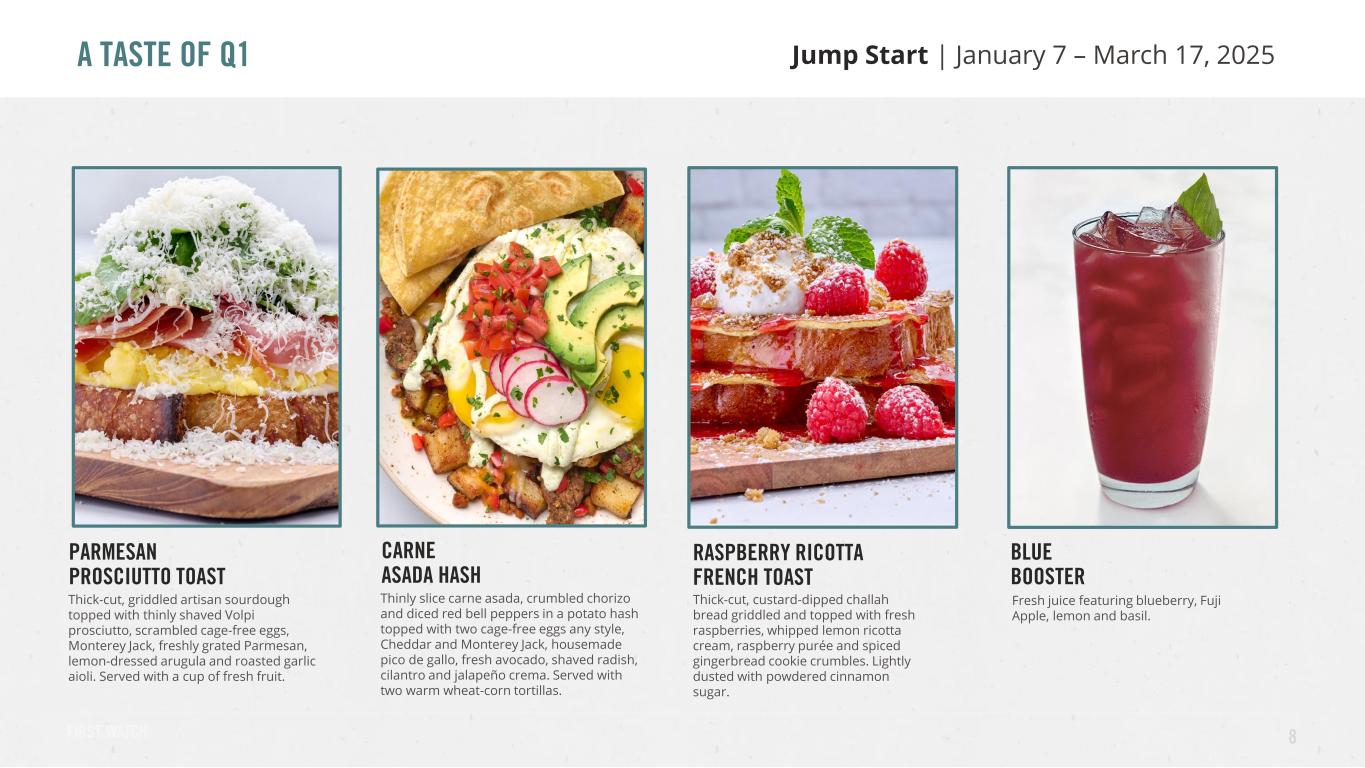
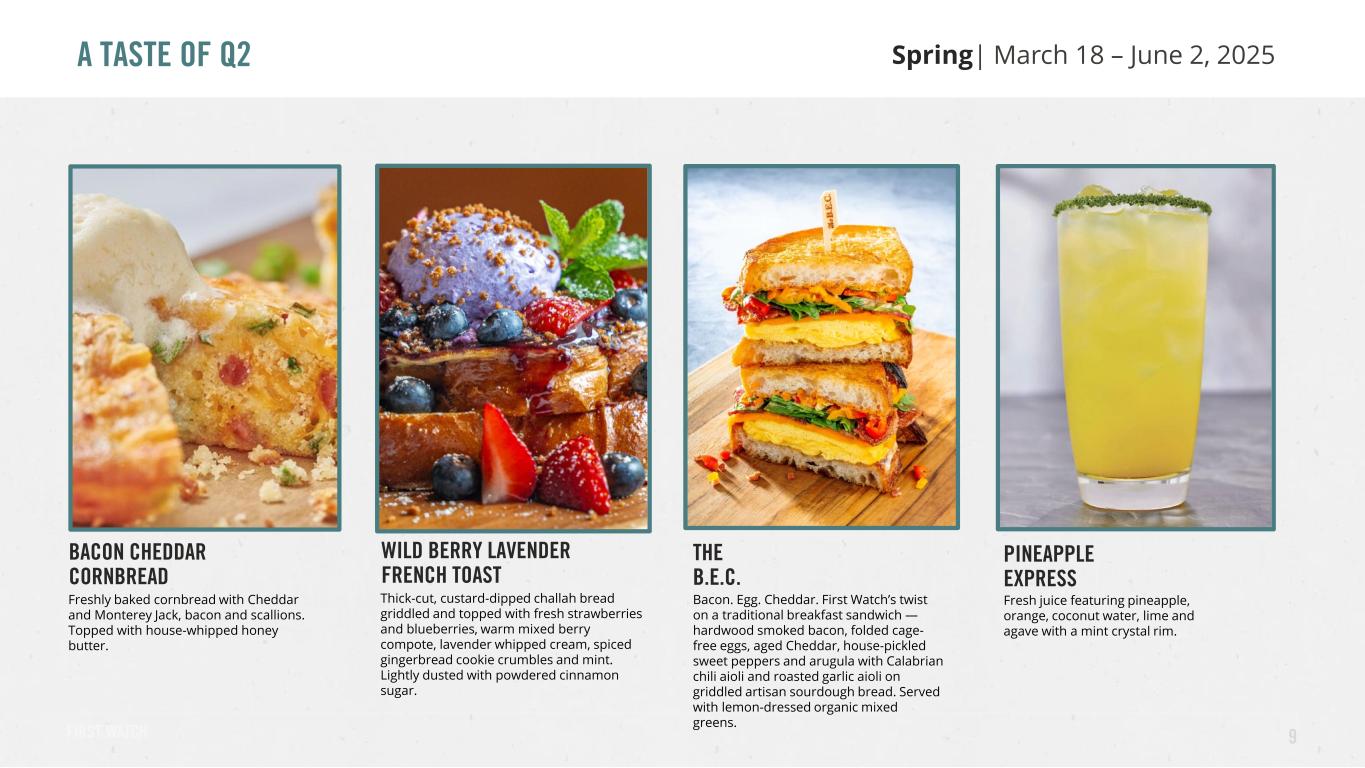
Yeah. Hey. Thanks for the question. This is Matt Eisenacher, our Chief Brand Officer. We've continued to iterate on different formats for our menus. We are still in the final stages of moving into test for those expanded beverages. We obviously want to see those in market for quite a bit of time. But obviously, our goal is to continue to drive incremental beverage attachment.
Operator
Our next question comes from Mel Hope with The Benchmark Company. Please proceed with your question.
There are 67 franchise locations, and eight of those have purchase rights.
Operator
Our next question comes from Gregory Francfort with Guggenheim Securities. Please proceed with your question.
Speaker 14
Hey, thanks. I had two questions. The first one, I guess, is for Mel. Just how are you thinking about long-term margins, restaurant margins within the context of maybe your 20% in 2024. I think your guidance would suggest it's going to be down to some degree this year. What is your target for long-term margins and kind of where you want to be in that range? Thanks.
Yes. I think we've always said that we try to, over the long-term, target between 18% and 20% on the restaurant level operating profit margins, and that hasn't changed.
Speaker 14
Okay. And then just maybe digging in a little bit more on aggregator performance and the third-party sales being as strong as they were in the quarter. Are you seeing anything different from the consumer in terms of how they're responding or the offers that they want to see or just kind of how the aggregators might be dealing with placing First Watch versus other brands? Just any thoughts there?
Not necessarily for us. I think the biggest benefit we received was really through the partnership with DoorDash and realizing that we could help each other. We operate during a time that isn't as competitive as lunch and dinner. However, from a consumer perspective, we haven't seen much change in the nature of the orders. Also, we don't focus on discounting in that channel, so that's not a strategy we pursue.
Operator
Our next question comes from Brian Vaccaro with Raymond James. Please proceed with your question.
Speaker 6
Yes. I just had a quick follow-up kind of high level on just thinking about relative pricing within the category. It seems like some of the family diners have gotten even more aggressive on value in recent months and quarters. But at the same time, they've maintained elevated menu pricing for maybe a higher for longer strategy, many of them are my franchisees, et cetera. So their core menu prices, they don't appear to be much different than yours and in some cases, are even higher based on some of our checks. I'm curious if that fits with what your pricing studies and internal analytics would show and just sort of how much that pricing differential may have narrowed over the last few years?
Yes, it aligns with our research, Brian. It's a significant part of our strategy, which is why we are working hard to keep our menu prices down, even if it affects our margins currently. We believe our relative value has greatly improved when considering the quality of our ingredients compared to family diners. As I've mentioned before, in highly franchised systems, the parent company has limited control over menu pricing. Being over 90 percent company-owned allows us to make long-term strategic decisions that we believe will be beneficial. Our focus is on increasing traffic, which is more important to us than raising prices. We aim to be an everyday dining choice and want pricing not to hinder our ability to attract customers. We're confident that by acquiring franchisees and making strategic moves to set ourselves apart in this challenging environment, we're strengthening the system. Our new restaurants are performing strongly, and this macro environment is viewed as an opportunity to bolster our position and extend our lead.
Speaker 6
All right. I’ll take the rest offline. Thanks so much.
Great. Thanks, everyone, for joining us this morning. We appreciate it. It really is an exciting time for First Watch, and we're looking forward to continuing to make days brighter for our customers and our employees in our nearly 600 First Watch restaurants across 31 states now. And a special thank you again to our entire team across the system for making days brighter for everyone. Thanks, everyone.
Operator
This concludes today's teleconference. You may disconnect your lines at this time. Thank you for your participation.