Operator
Thank you for standing by, and welcome to the First Watch Restaurant Group, Inc. Second Quarter Earnings Conference Call, occurring today, August 5, 2025, at 8:00 a.m. Eastern Time. This call will be archived and available for replay at investors.firstwatch.com under the News and Events section. I would now like to turn the conference over to Steven Marotta, Vice President of Investor Relations at First Watch to begin.
Speaker 1
Hello, everyone. I am joined by First Watch's Chief Executive Officer and President, Chris Tomasso; and Chief Financial Officer, Mel Hope. This morning, First Watch issued its earnings release for the second quarter of fiscal 2025 on Globe Newswire and filed its quarterly report on Form 10-Q with the SEC. These documents can be found at investors.firstwatch.com. This call will include forward-looking statements that are subject to various risks and uncertainties that could cause the company's actual results to differ materially from these statements. Such statements include, without limitation, statements concerning the conditions of the company's industry and its operations, performance and financial condition, outlook, growth plans and strategies and future expenses. Any such statements should be considered in conjunction with cautionary statements in the company's earnings release and the risk factor disclosure in the company's filings with the SEC, including our annual report on Form 10-K and quarterly reports on Form 10-Q. First Watch assumes no obligation to update these forward-looking statements, whether as a result of new information, future developments or otherwise, except as may be required by law. Lastly, management's remarks today will include references to various non-GAAP measures, including restaurant-level operating profit, restaurant level operating profit margin, adjusted EBITDA and adjusted EBITDA margin. Investors should review the reconciliation of these non-GAAP measures to the comparable GAAP results contained in the company's earnings release filed this morning. Any reference to percentage growth when discussing the second quarter performance is a comparison to the second quarter of 2024, unless otherwise indicated. And with that, I'll turn the call over to Chris.
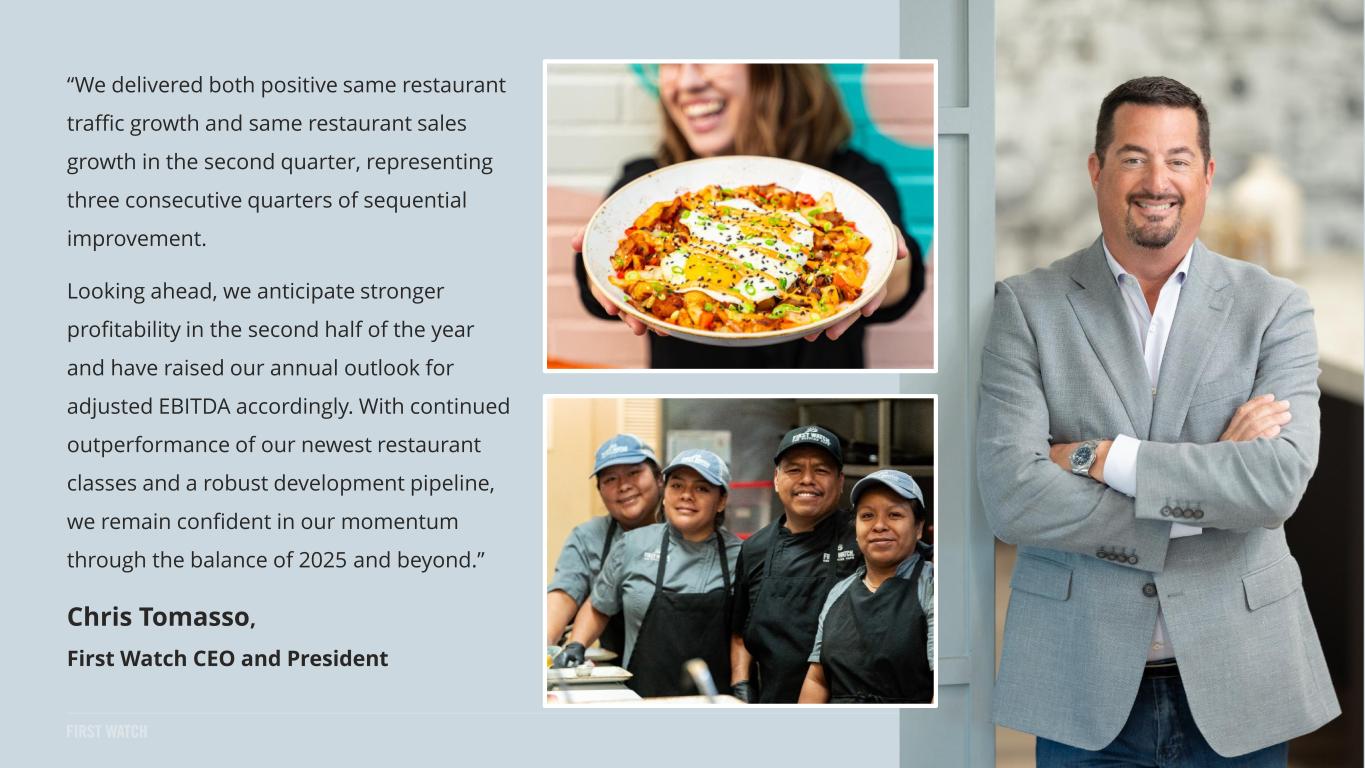
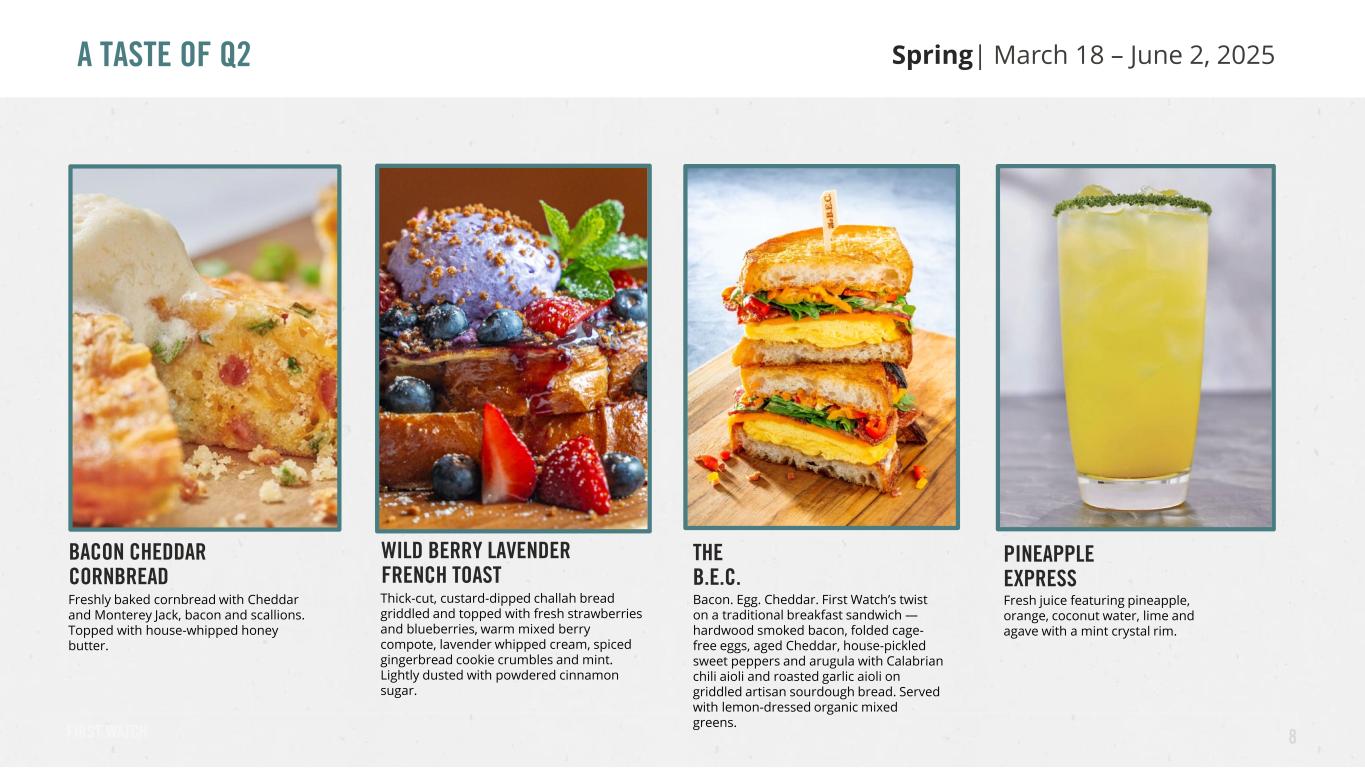
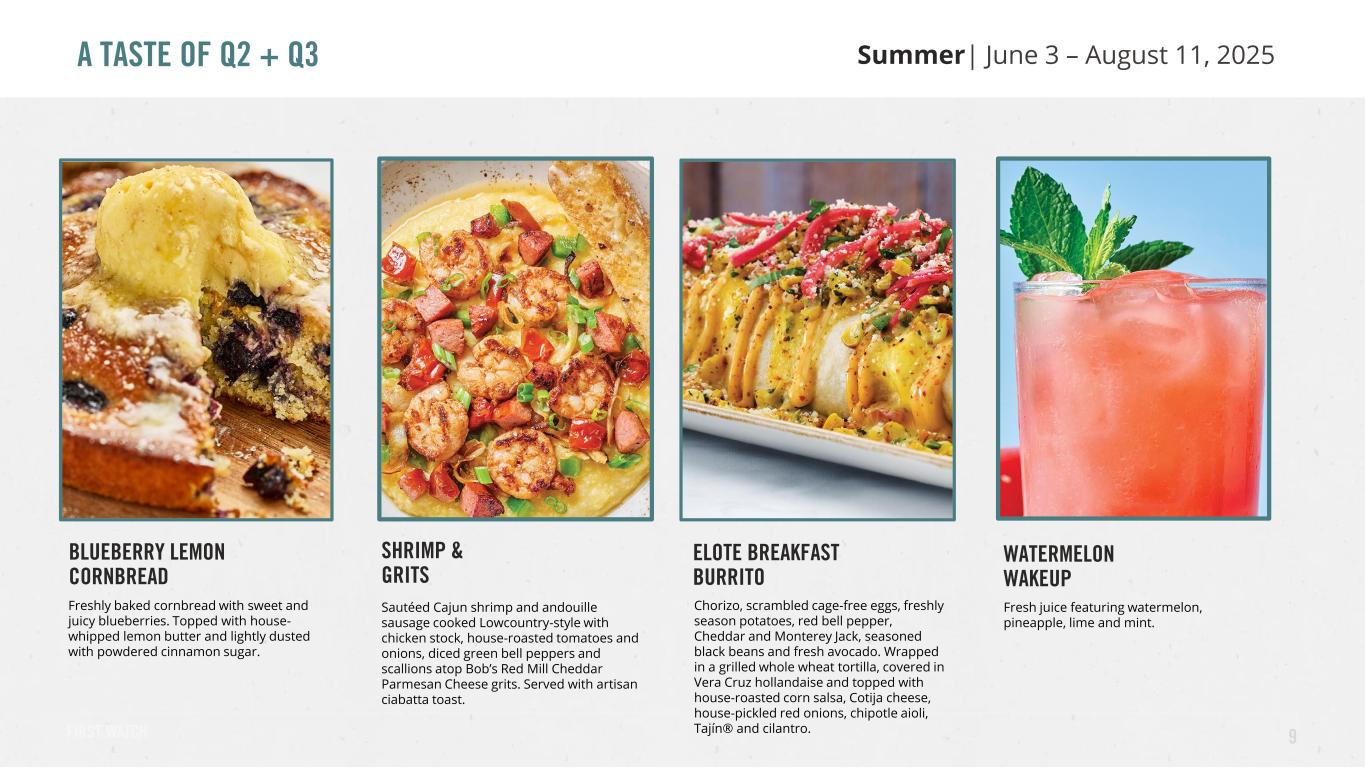
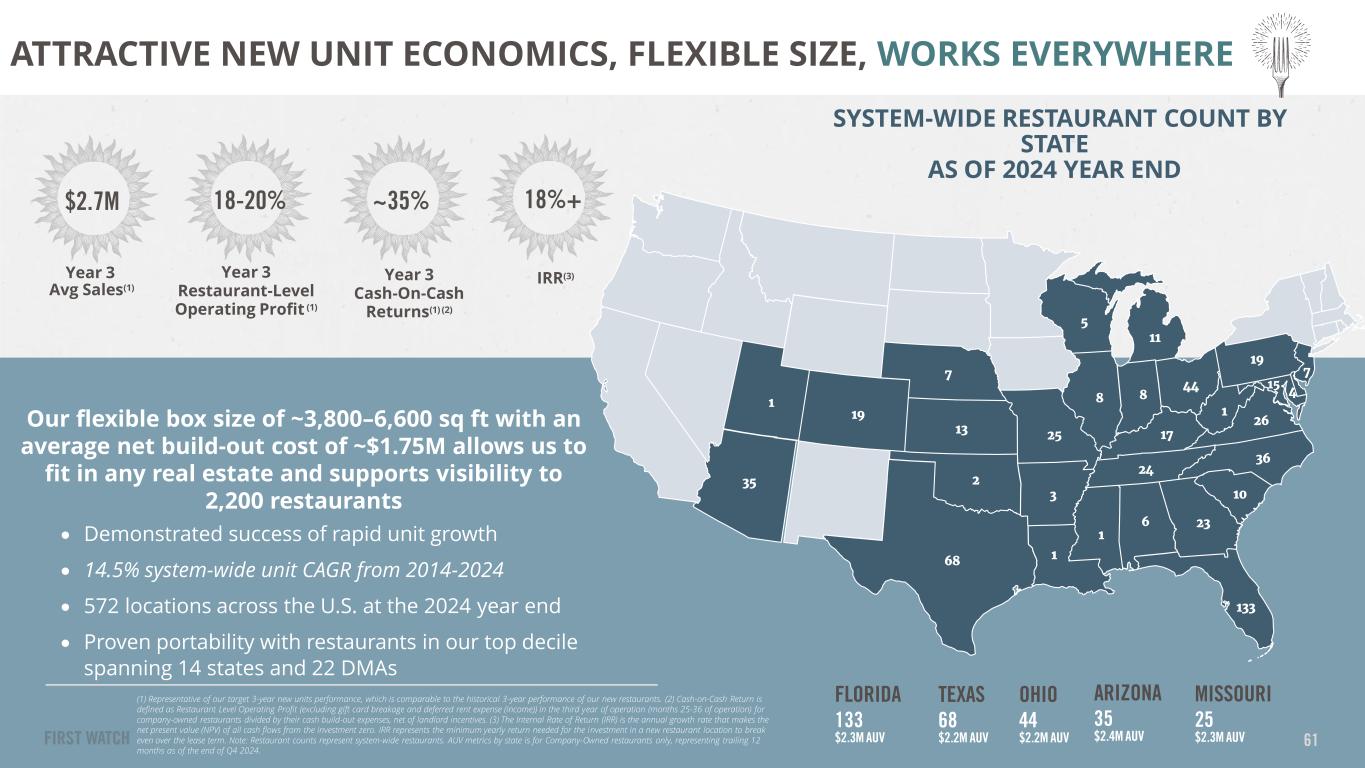
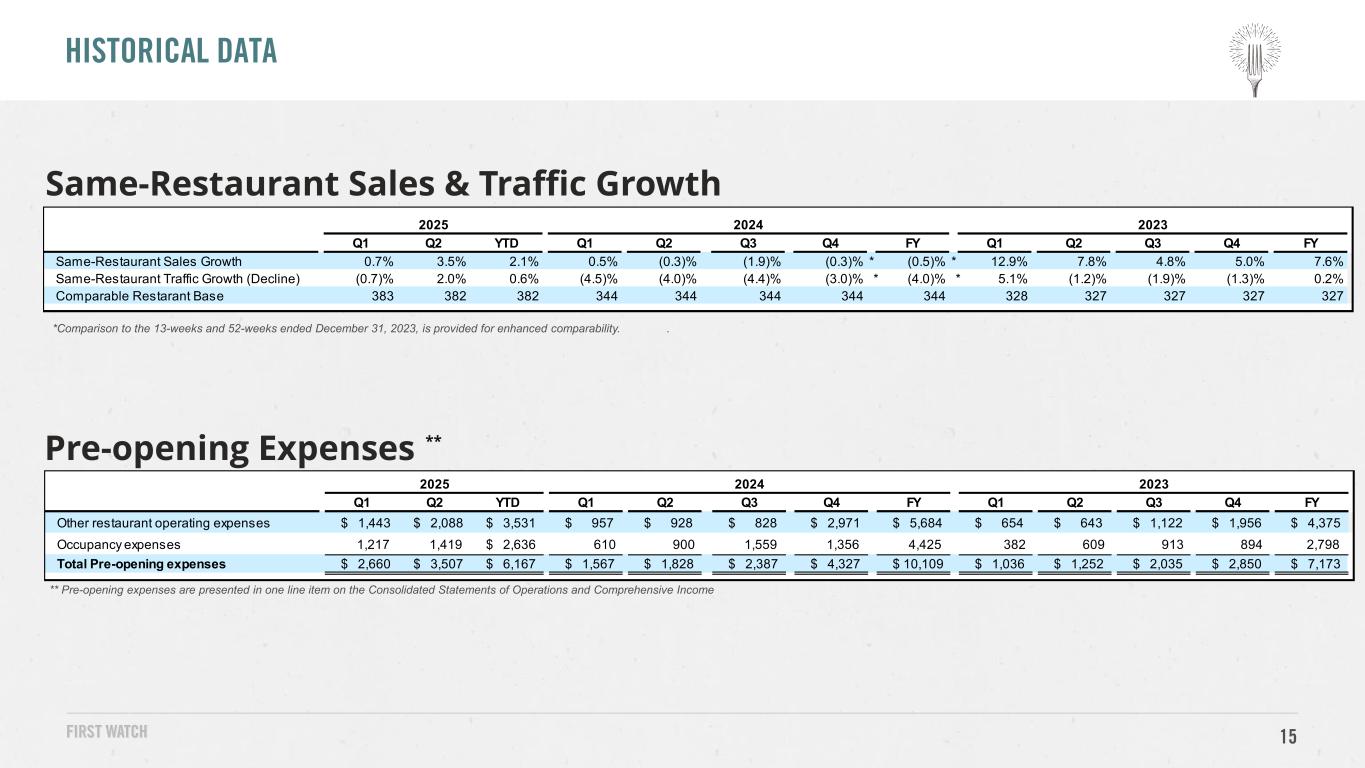
Good morning, everyone. We appreciate you joining us to discuss our second quarter performance. We're pleased to report a strong quarter and encouraging underlying trends as First Watch's broad brand appeal and unit growth engine were on full display. Equally important, the decisions we've made around pricing, including, for instance, our resistance to passing along temporary commodity cost inflation are proving to be well received by our customers. Total revenue increased by more than 19%, led by growth from high-performing new restaurant openings and the strategic acquisitions we completed over the past year. This was underpinned by positive same-restaurant sales growth of 3.5%, driven predominantly by 2% positive same-restaurant traffic growth. We enjoyed sequential improvement in both in-restaurant and consolidated traffic trends, generated growth in every daypart and saw and are continuing to see tangible traction from our marketing efforts. We opened 17 new system-wide restaurants across 8 states, and these new restaurants are on track to meet or exceed the strong cash-on-cash returns and ROI that we target. We also successfully completed the acquisition and integration of 19 franchise restaurants in North Carolina, South Carolina and Missouri. Our results illustrate that our growth strategy is working. And before we dive in, I want to thank our teams across the entire enterprise who execute at a very high level every day to deliver these results. As we noted during our first quarter conference call, the second quarter got off to a strong start with April delivering the best monthly same-restaurant traffic growth in more than 2 years. May was similar to April and June exhibited even further improvement. Delivering sustained traffic momentum across multiple quarters builds our confidence in achieving positive traffic for the balance of 2025 and for the full year as we guided to previously. Mother's Day and Father's Day, our 2 busiest days of the year, occurred in the second quarter, and our teams operated splendidly on both holidays. These 2 occasions perfectly illustrate our capacity to achieve even higher unit volumes. Mother's Day was the single busiest day in our 42-plus year history with record same-restaurant traffic and sales. Just 1 month later, we locked same-restaurant traffic growth in the mid-single digits on Father's Day. As a reminder, our AUVs have grown from $1.6 million in 2019 to $2.3 million today, and our new restaurants are projected to reach $2.7 million in their third year of operation, with recent classes on track to exceed even that target. First Watch remains America's fastest-growing full-service restaurant brand, averaging more than 1 new restaurant opening per week. And given the strength of our new openings and the related returns, we're not slowing down. I'm proud of our development team's sharp focus on strategy and their successful results. The NRO pipeline is as strong as ever with more than 130 new sites approved and in various stages of completion. In fact, our double-digit percentage growth plans for 2026 are already firmly in place, and we are nearly halfway to our target for 2027. In short, we are right where we need to be as it relates to hitting our near and midterm unit growth targets. In effect, each year, we are opening the equivalent of an entire regional chain. To better illustrate, our new restaurants opened in the last 2 years outnumber the entire system size of the next largest daytime dining concept. First Watch is growing aggressively and doing it with a well-formed playbook in place. For 2025, we are targeting 62 to 67 new locations. The broad geographic diversity of our new restaurant openings can be seen in the first half of this year, where we opened new restaurants in 18 markets across 15 states. Our NROs are positioned in highly visible A locations, providing us with a competitive advantage during our daypart. As a group, they continue to outperform our underwriting targets, which include year 3 average unit volumes of $2.7 million, cash-on-cash returns of around 35% and returns on investment of better than 18%. Increasingly, we are taking advantage of more second-generation sites with high visibility, plentiful parking and the square footage that showcases our larger concept. In the 18-month period between the beginning of Q1 2024 and the midpoint of 2025, nearly 40% of our 80 new restaurants were second-generation restaurant spaces with about 60% of those in freestanding buildings. Because each one of our restaurants is unique and not artificially constrained by a cookie-cutter approach to design, we can modify just about any location into a highly efficient First Watch. We have successfully converted well-known national full-service burger chains, seafood chains, bar and grills, Italian concepts, bakery cafes and even national family dining concepts. These locations boast some of our highest AUVs and 40% of our yet-to-be-built active pipeline sites are previous generation restaurant spaces and all of exceptional site quality. With our top decile restaurants spread across 14 states and 22 DMAs and consistent AUVs across all regions, we remain confident in our ability to reach our stated total addressable market of 2,200 locations within the Continental United States. And with over 600 First Watch restaurants in operation today, we have many years of strong in-restaurant growth ahead of us. Shifting now to brand and marketing. The investments we are making this year are yielding positive results, contributing to our same-restaurant traffic growth and increased brand awareness. For example, in core geographies like the Southeast and the Southwest, we're not only outperforming the system, but also gaining market share. Even in Florida, the state we've called home for nearly 40 years, we still have opportunities to increase brand awareness, and we remain bullish on the untapped potential across all regions. I'm particularly enthusiastic about how nicely the composition of our customer base continues to evolve, broadening our demographics beyond what leaned toward the boomer generation just 10 years ago. Today, our customers are skewing more towards the Gen Z and millennial generations with the majority falling below 50 years old, which is a direct result of our marketing, culinary and operational efforts to ensure our ongoing relevance and long-term viability. We are highly attentive to all facets of the customer experience. To that end, in the second half of this year, we'll be relaunching all of our customer-facing digital properties, including a custom-built waitlist experience, streamlined digital ordering and nutritional filtering tools, further enhancing the First Watch customer experience. More to come on all of that in the future. One of the best examples of our commitment to our customers' in-restaurant experience is by removing needless friction from the waitlist process. For those of you who have visited First Watch, you know that our host area can become quite congested during peak hours. While pay at the table improved the payment process and successfully alleviated a portion of this congestion, our new waitlist experience uses automation to improve the experience even further. Geolocation technology allows customers the option to be automatically checked in and notified as they approach the restaurant, saving them the need to physically check in at the host stand. Culinary innovation has always been a competitive advantage at First Watch and is key to our customer experience. With our seasonal menu changing every 10 weeks, we're continuously testing new and innovative offerings, while evolving and optimizing the core menu to enhance menu navigation, test new items and introduce new platforms. Our culinary and menu evolution continues to get better each year as we learn more and more about what resonates with our customers. In the first half of this year, we had several test items exceed expectations and one actually broke a sales mix record, giving us a high degree of confidence in our upcoming seasonal offerings when they go to nationwide rollout. At First Watch, our focus is on our people and our culture of kindness. Some of you may have seen the August cover story that FSR Magazine just released featuring First Watch. Dany Klein and the entire editorial staff did a really nice job capturing the essence of our philosophical approach in these areas and how we bring them to life. The timing of this profile is apropos as we are in the midst of conducting our annual wide tour, which stands for 'We Hear You' and comprises nearly 2 dozen 90-minute virtual town halls with me, our Chief Operations Officer, Dan Jones; and our Chief People Officer, Laura Sorensen, directly engaging with hourly employees. The feedback gathered during these sessions has proven crucial across enterprise touch points, including marketing, generating menu ideas, enhancing processes, developing retention strategies and identifying countless ways to improve both the employee and customer experiences. It's an important interaction that we look forward to every year. We are and will remain an employer of choice, providing a unique combination of quality of life and growth opportunities that are unmatched in our industry. A few examples include the introduction of a certified general management program and expanding the First Watch Academy of Restaurant Management Program or FARM as we affectionately refer to it, to include a Director of Operations session for the first time. The certified general management program is a new role that focuses on improving manager training and retention and enables us to build a people pipeline made up of veteran managers who support our aggressive unit growth plans. Since its implementation early last year, we have raised the bar on the rate of internal promotion, as well as our execution in the restaurants. This program has been so successful that the vast majority of our multi-unit Director of Operations promotions were existing certified general managers. Initiatives like the certified general manager program, among others, are improving our turnover at all levels. Our strong employee retention among hourly staff and at the manager level improved again in the second quarter with turnover for both remaining several hundred basis points below full-service industry averages. In today's dynamic environment, we are seeing growing demand for full-service dining as consumers increasingly gravitate towards more hospitable casual dining experiences. They're seeking consistency, exceptional service and innovative menu offerings made with high-quality ingredients that elevate their visit beyond what the fast casual category can offer. This is an area where we shine. The appeal of a full-service casual dining visit to First Watch rests in our ability to offer a memorable experience at an enticing value throughout the entire customer journey. We feel really great about how we are positioned. Our unwavering focus on the customer experience and people development has positioned First Watch as a leader in full-service dining. With our robust people and real estate pipelines, planned operational improvements, menu innovation and a steadfast commitment to fostering a culture of engagement, we continue to elevate both the employee and customer experience. Our progress is reflected not only in the positive shifts in customer demographics but also in our industry-leading employee retention and track record of successfully executing our growth strategies. As we move forward, these foundational strengths will remain central to sustaining our momentum and delivering long-term value creation for our investors. And now I'd like to turn it over to Mel.
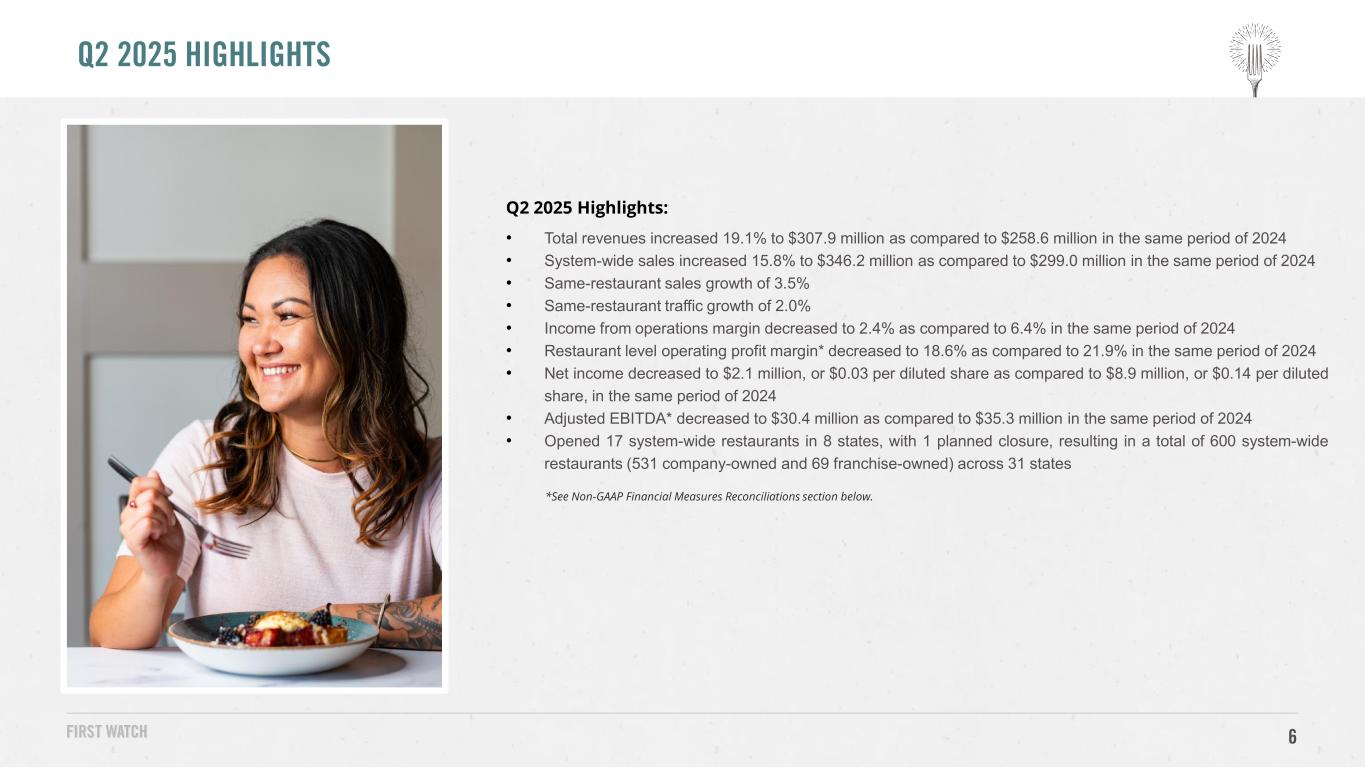
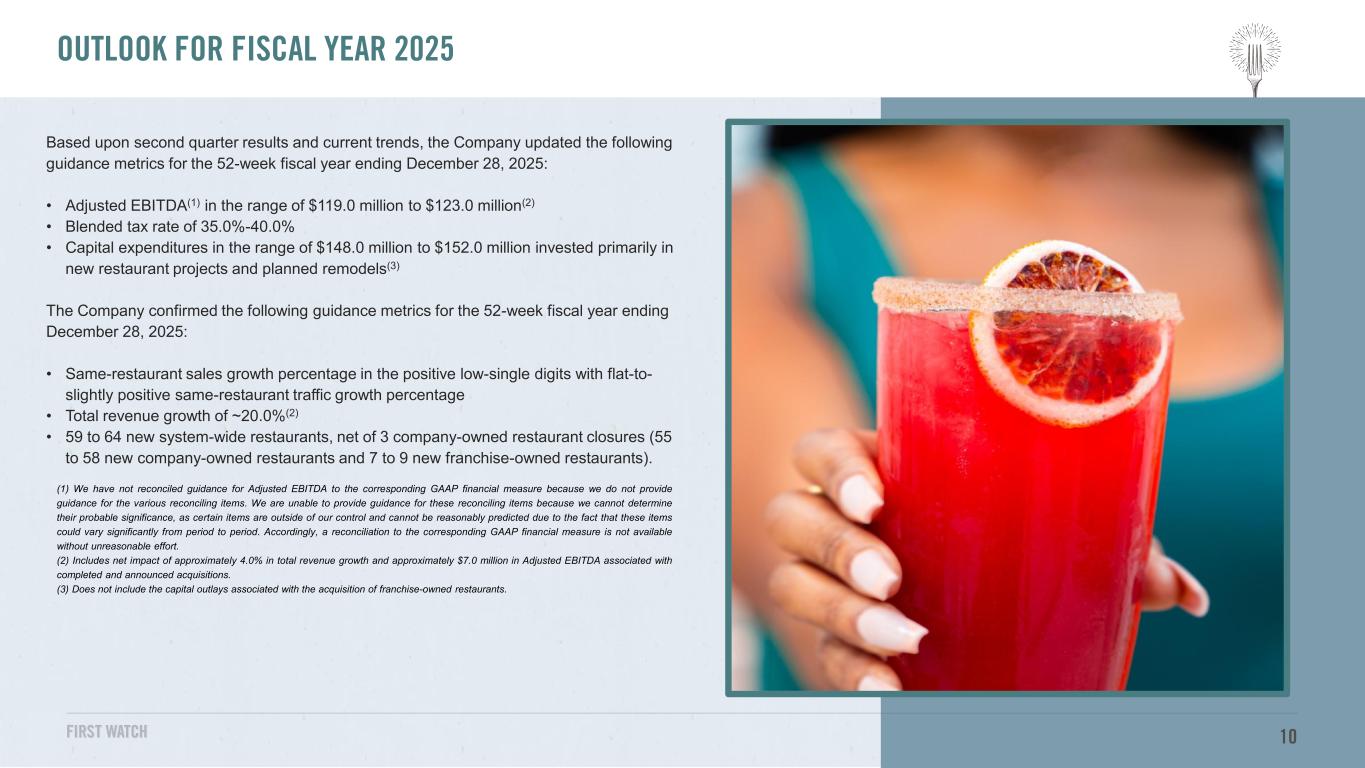
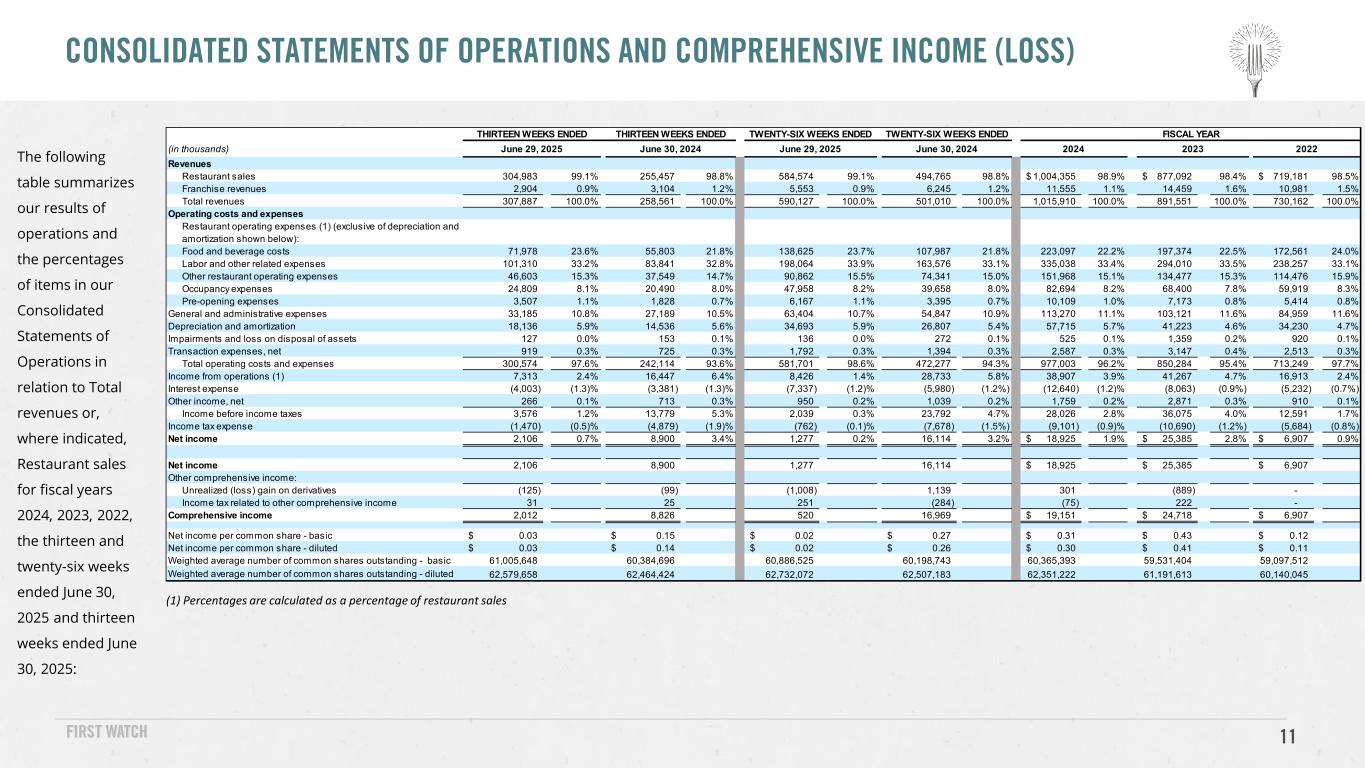
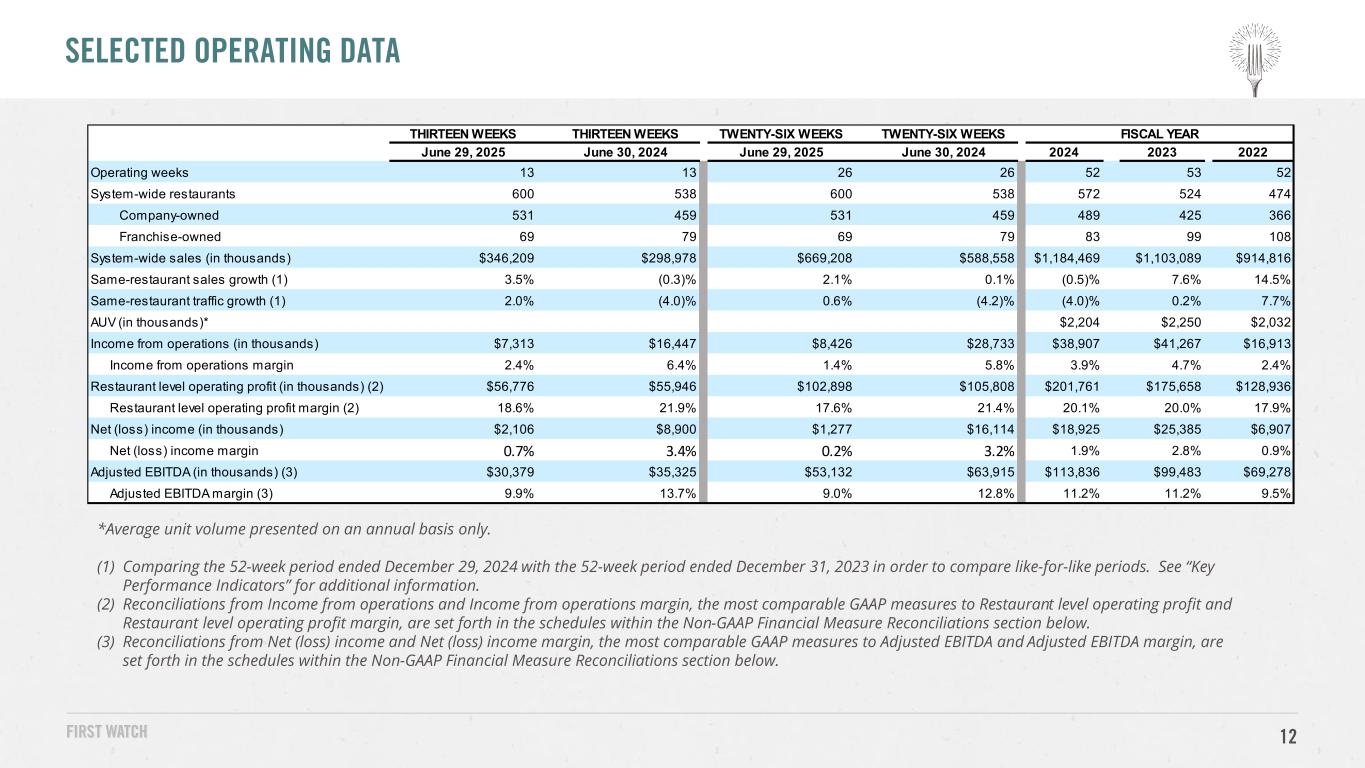
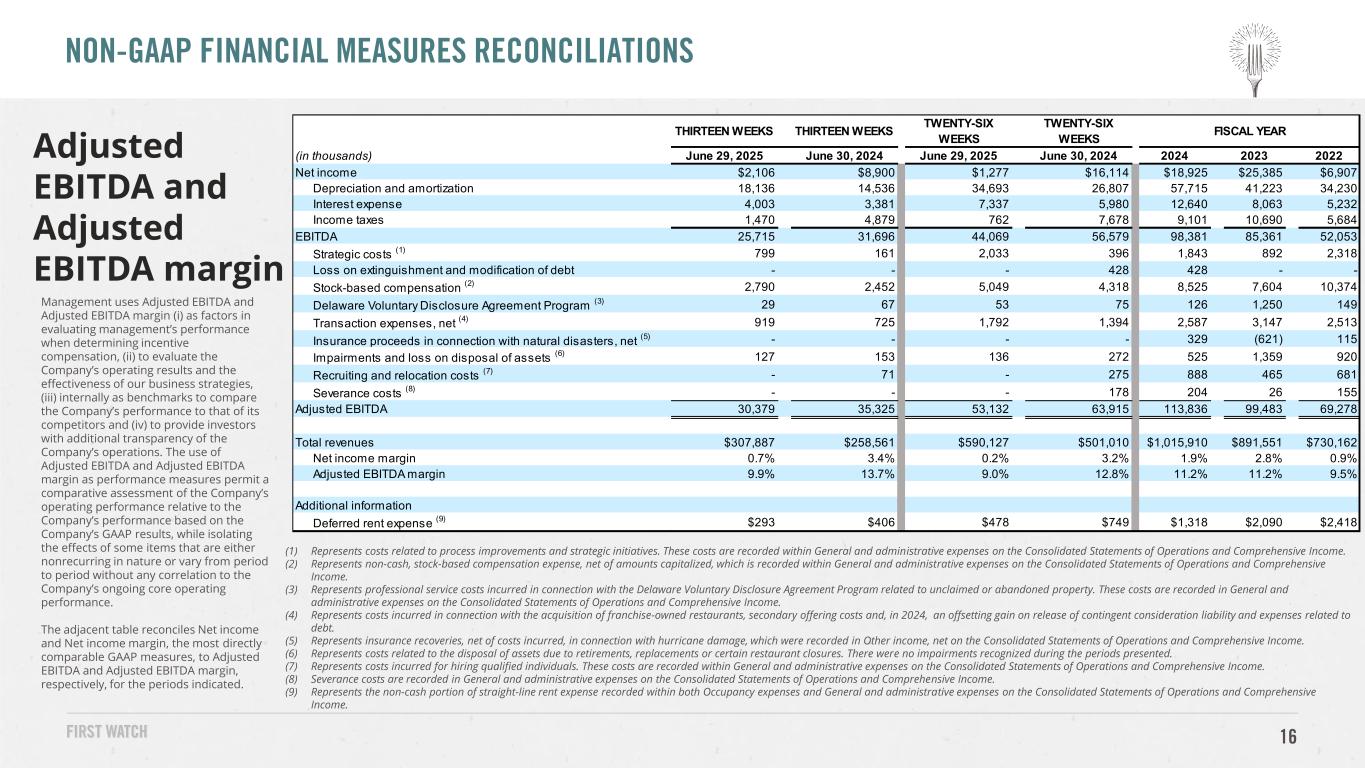
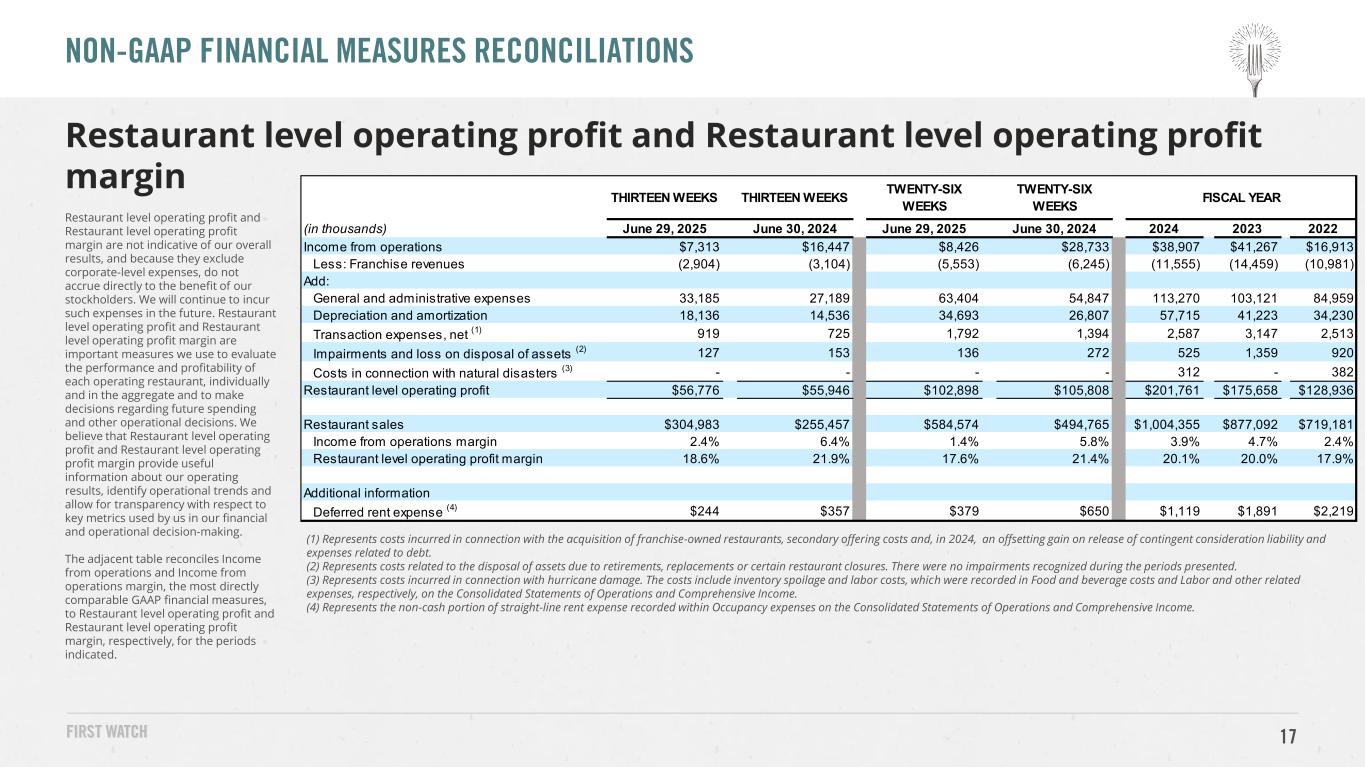
Thank you, Chris, and good morning. Total second quarter revenues were $307.9 million, an increase of 19.1%. Our top line results were driven by the contribution of 149 non-comp restaurants, including 61 company-owned new restaurant openings and the 40 franchise locations we acquired since the first quarter of 2024 and traffic-driven positive same-restaurant sales growth of 3.5%. Same-restaurant traffic was positive 2%. In our fiscal June, we posted the best monthly same-restaurant traffic growth in over 2 years, which reaffirms our confidence in projecting positive same-restaurant traffic growth for the remainder of this year. Our in-restaurant traffic for the quarter, while slightly negative was also the best in 6 quarters. Traffic growth in the third-party delivery channel increased materially during the second quarter, a continuation of the first quarter trend and a direct result of the changes we made to that program earlier this year. As part of our efforts at the start of this year to improve the performance in the third-party channel, we set 2 primary goals: one, to recapture lost traffic in the channel. We have successfully met this goal; and two, to generate incremental profit dollars. We successfully achieved this goal as well. Additionally, we believe that third-party delivery occasions are incremental, not a replacement for in-restaurant dining visits. We believe this is at least partially validated by the fact that both in-restaurant and third-party delivery traffic have been improving simultaneously. We again experienced modest positive sales mix overall during the quarter. Food and beverage expense was 23.6% of sales, up from 21.8% in the second quarter last year. Costs as a percent of sales benefited from carried pricing of around 2.5%, though this was more than offset by commodity inflation in the quarter of 8.1%. Eggs, bacon, coffee and avocados, which comprise 4 of our top 5 cost inputs were all materially more expensive than in the same period last year, similar to the first quarter. I'll return to the topic of the egg costs in just a moment when I share the good news about our forecasted costs for the balance of the year. Labor and other related expenses were 33.2% of sales in the second quarter, a 40 basis point increase from 32.8% reported in the second quarter of 2024. Restaurant level labor inflation was 3.9%, a combination of labor inflation and higher health benefit costs were the largest factors for the increase in the percent of sales. Our labor efficiency was in line with last year. Restaurant level operating profit margin was 18.6% in the second quarter compared to 21.9% in the second quarter last year. General and administrative expenses increased to $33.2 million from $27.2 million in the second quarter of 2024. At 10.8% of total revenue, these expenses were 30 basis points higher than in the same quarter last year. The increase was driven by investments in marketing and headcount. The income from operations margin was 2.4%. Adjusted EBITDA was $30.4 million, $4.9 million below last year, with adjusted EBITDA margin declining to 9.9% from 13.7%. We reported net income of $2.1 million. There were 17 new system-wide restaurants opened during the second quarter, of which 15 are company-owned and 2 are franchise-owned, and we ended the period with 600 restaurants in the system. The effect of our franchise acquisitions, which includes only the impact of purchases made within the last 12 months, increased second quarter revenue by about $7 million and adjusted EBITDA by about $1 million. For further details on the second quarter, please review our supplemental materials deck on our Investor Relations website beneath the webcast link. Now I'd like to provide our updated outlook for 2025. We are maintaining our estimate of positive low single-digit percentage same-restaurant sales growth with flat to slightly positive same-restaurant traffic growth. Our estimate includes 2.8% of price implemented in July and carried pricing of around 4% in the second half of the year, which blends to around 3% of price for the full year. As a point of reference, we piloted a handful of call-to-action consumer outreach programs around this time last year, which positively impacted same-restaurant traffic in the third and fourth quarters of 2024. Consequently, this year's fiscal September presents our most challenging monthly comparison. Additionally, the cadence of our 2025 marketing investment reflects the fact that the third quarter is typically our seasonally slowest period. We expect total revenue growth of around 20% with a net 400 basis point impact from completed acquisitions. We expect 62 to 67 new system-wide restaurants, including 55 to 58 new company-owned restaurants and 7 to 9 new franchise-owned restaurants with 3 planned company-owned restaurant closures. Our company-owned new restaurant development pipeline remains weighted to the second half of 2025, the fourth quarter in particular. There is good news in our cost expectations for the balance of the year as it pertains to eggs. As you are aware, the effects of recurring incidents of avian flu in recent quarters have elevated the cost of eggs. Earlier this year, the increased cost of eggs was a major input to our forecast of overall commodity cost inflation. As of July, with egg supply improving, our cost has improved as well. As such, we are lowering our fiscal year 2025 commodity cost inflation guidance to a range of 5% to 7%, down from high single digits previously. Restaurant level labor cost inflation is still expected to be in the range of 3% to 4%. We are increasing our adjusted EBITDA guidance range to $119 million to $123 million, up from $114 million to $119 million, which includes the expected net contribution of about $7 million from acquired restaurants. Our updated estimate of full year adjusted EBITDA is primarily driven by the reduction in our egg costs, combined with the shifting impact from tariffs. For modeling purposes, we expect G&A in the third and fourth quarter to be roughly equivalent to the second quarter results in absolute dollars. We expect a blended tax rate of 35% to 40%. We are lowering our expected range for capital expenditures to $148 million to $152 million from $150 million to $160 million, not including the capital allocated to franchise acquisitions. The adjustment is largely due to fewer-than-expected ground lease new restaurant openings in both 2025 and 2026 and the latter's impact on current year CapEx. We have a lot to look forward to in the back half of 2025. With a healthy lineup of new restaurant openings, moderating commodity costs and a deep bench of seasoned staff, we are well positioned to extend our lead in the daytime dining segment.
Operator
And we'll go first to Jim Salera with Stephens Inc.
Speaker 4
I wanted to ask about something you had mentioned in your prepared remarks regarding the majority age of customers kind of falling below 50 years old. And to drill down on that, do you think that, that's a function of broadening the store footprint across more and more markets outside of the core Florida market? Or is there also a component there that Gen Z and younger generations tend to order more off the third-party platforms and now that you're seeing an uptick there that that's changing the composition. Any commentary there would be great.
Yes. Sure. I think it's all the above. I think we're entering new markets where a lot of the customers are having their first experience at First Watch. And you've seen the evolution of our prototype. You've seen the kind of the advancement in our culinary that's continued. So, there's that piece of it. And then I think our team has just done a really nice job of reaching out to that next generation of First Watch customer in our core markets, which I think has been a driver also of trial and expanding our customer base. So, we're really focused on filling the pipeline with the next generation of First Watch customers. We're thinking about the next 40 years just like we did the first 40. So, I think it's really part and parcel to everything that we're doing.
Speaker 4
And are you able to speak to any differences in frequency or ticket size? I'm trying to get a better sense of how those younger consumers engage with the brand relative to what's kind of been your traditional older consumer?
Not very different, I mean we're not seeing any kind of massive shifts in mix items and things like that. One other proof point to your first question actually is, I mean, if you just think about social media alone, the presence that we have on social media and how active we are just lends itself to attracting that next generation. So even with the introduction of alcohol, for example, I think that helps attract that generation as well. So really, it's our brand voice. It's how we're positioning ourselves and how we continue to just evolve. What we don't want to do is ever have to be in a period where we're having to reinvent ourselves. So, we're constantly evolving as we go along and really focused on long-term consumer trends and staying ahead of them.
Operator
And our next question comes from Jeff Bernstein with Barclays.
Speaker 5
This is Pratik on for Jeff. Chris, it's encouraging to see a more positive EBITDA outlook, especially after the more cautious positioning last quarter. Just wanted to parse out what you feel gives you the confidence to raise the outlook, especially just given the ongoing volatility. We've seen a lot of noise in the data this year. And obviously, consumers are obviously a little bit jittery. Just anything you're seeing in your consumer base that gives you that confidence? And then I have a follow-up.
Sure. First and foremost, the relief in egg costs is a significant factor contributing to our EBITDA. This was likely the largest element driving our cost inflation, which we initially projected to be in the high single digits at the start of the year. The cost relief in the second half of the year plays a major role. Additionally, we are very encouraged by the consumer trends we've observed. There was no decline in our same-restaurant traffic trends in July, which boosts our confidence that our strategies are effective. This is why we adjusted our guidance accordingly.
Speaker 5
Understood. And Mel, just a question on the pricing strategy. It looks like you took 280 basis points in July. With consumers obviously focused on value, we've heard no shortage of this from some of the companies that have reported this cycle. Just how are you thinking about that going forward and the flow-through to margins in the second half?
Actually, our pricing strategy hasn't changed over decades. We generally review pricing about twice a year, typically making some adjustments in the first quarter and then reassessing based on inflation and making minor corrections midyear. The pricing philosophy and our approach have remained consistent this year and in previous years, and we expect it to stay within the usual long-term range of 3% to 3.5%.
Speaker 5
Got it. And any implication on the margin there from the pricing action? Or...
When we set our prices, we aim to address what we perceive as permanent inflation, rather than just temporary inflation. The 200 basis points you mentioned will be beneficial for us, reflecting our adjustments for what we believe to be more permanent or sticky inflation.
Operator
And our next question comes from Todd Brooks with The Benchmark Company.
Speaker 6
Congratulations on returning to positive traffic this quarter. I wanted to connect that return to some of the marketing strategies. Chris, you noted that many of these were tested late in Q3 and refined into Q4 last year. I'm not sure if Matt can address it or if you'd like to, but I am curious about where you're seeing traction and if you could provide some quantification of how these efforts are contributing to the growth in traffic observed in the recent quarter.
Speaker 7
Yes. This is Matt Eisenacher. I'll take that, Chief Brand Officer. As Chris said in the script, we did focus a lot of our efforts in certain geographies, really corresponding to some of our largest markets. And we've seen tangible traction in those geographies. And just like anyone would, we compare that to the rest of the system and certain control markets. And so when you ask where the confidence comes in, we've just been really pleased with the results we've seen in those markets versus the rest of the system.
It’s essential to discuss our target audience. We are focusing on our customers to encourage increased frequency, specifically targeting users in categories where we see potential for additional visits. We have experienced success in this approach, so understanding who we are engaging with, where we are focusing, and how we are executing is key to our progress.
Speaker 6
Perfect. And then just a second, not related question, but I was surprised when you were talking about in the pipeline of openings and out of the last 80 openings that 40% of those have been second-generation locations just because I know that typically, you're getting those A+ sites when you're going in and opening new units now. Can you walk through when you're looking at the build cost, what's the difference in build cost for a second-generation reclaim versus a typical First Watch build?
Our building average across all of our restaurants after TI dollars is generally around $1.7 million. With second-generation spaces, developers or landlords are often eager to have a new national brand like us occupy the space and start operations quickly and efficiently. As a result, the net costs haven't changed much. For larger footprints, we might pay for additional square footage and potentially receive a slight reduction in the average rate per square foot. Ultimately, the costs end up being quite similar to those for first-generation spaces, particularly those at prime locations with excellent access and egress, which we consistently seek for our first-generation openings.
Operator
Moving on to Jon Tower with Citi.
Speaker 8
Maybe kind of hitting on both of those questions again, different tacks. The media spending and specifically the traffic that you're seeing coming to your stores in response to the media spend that you're getting, are you seeing an increase in customer frequency from existing customers? Are you drawing new customers to the brand? And I'm curious to the brand that is and across both the in-store and the 3PD channel? Or I'm just kind of curious if you could parse that out for us.
I believe that, considering the frequency in full-service restaurants, we may need a longer period to assess how much repeat business we are generating or if we are seeing an increase in visits.
Operator
And our next question comes from Brian Mullan with Piper Sandler.
Speaker 9
You've been asked about marketing and the impact of traffic already. I wanted to ask on some of the actions you've taken inside the restaurants. Last quarter, you talked about improving the value to the consumer for the trifecta. That's a high selling item. You reintroduced the surprise and delight acts of kindness from the GMs. My question is, do you think the consumer is noticing and appreciating this? And are there any other similar moves you could look to make just to continue to make sure the guests appreciate your total value proposition?
Yes, I think consumers are noticing this more than ever. We're really focusing on it, and I mentioned the article in FSR magazine that came out recently, which highlighted this as well. We believe consumers are currently seeking hospitality, high-quality ingredients, consistency, and value. While these have always been important themes for consumers, there was a time when they might have overlooked some of these aspects in favor of price. However, we’re seeing a positive response from consumers now. When we discuss the impact of our marketing and various initiatives, we view it holistically. We aim to do right by the consumer through all our interactions, whether it’s being cautious with pricing when consumers feel financially squeezed, enhancing hospitality, or increasing portion sizes. It's uncommon for restaurant companies to take such steps right now, and we see this as an opportunity to distinguish ourselves. We truly believe consumers are recognizing our efforts.
Speaker 9
Okay. And then just wanted to ask about the mix. I think it was down about 100 basis points in the quarter. Could you just remind us the contributing factors? And then talk about how to exploit mix for the back half of the year and what we might expect?
We actually experienced a slightly positive mix. The effect on the PPA is due to our efforts related to in-restaurant initiatives. It's primarily tied to the reduction of third-party surcharges. We did not observe a negative mix effect; in fact, it was slightly positive.
Operator
Our next question comes from Brian Vaccaro with Raymond James.
Speaker 10
I wanted to just ask about your raised EBITDA guidance for the year. I think at the midpoint, it implies about $68 million and a return to significant year-on-year growth. Could you provide any guardrails on your expectations for third quarter and fourth quarter, given all the moving pieces? And if not, maybe just walk through some of the key moving dynamics supporting that improvement in EBITDA. Obviously, you talked about the pricing and easing of food inflation. But anything else we should keep in mind as we model out the second half?
I would estimate that the adjusted EBITDA for the second half of the year will be fairly consistent between the third and fourth quarters. Unfortunately, we don't have any additional guidance to offer.
Speaker 10
Okay. Even that is helpful. And Mel, you touched on tariffs at one point. Could you just elaborate on your latest thinking on the tariff impact this year? And any color there would be great.
Well, it's certainly gone from being a headline for us in the first quarter to being less impactful. It's been a choppy topic for us. I think we have about 10 basis points maybe built in for the balance of the year, but it's kind of thinking it might be 10 basis points in terms of just cost items, but it's getting immaterial for this year.
Operator
Moving on to Andrew Charles with TD Cowen.
Speaker 11
This is Zach Ogden on for Andrew. I just wanted to follow up on the surprise and delight and the increased portioning. How much of a drag are these still having on margins relative to the margin headwinds you saw in 1Q? And is there anything else from the 1Q headwinds you called out last time as you would say, has notably improved since 1Q?
Those are not challenges; they are part of how we operate in the restaurants. We see it as something that guests respond to positively, and it is included in our expectations for the year. In the first quarter, we noted that our teams were enthusiastic about certain promotions in the restaurants. We have improved the tools they use for monitoring, and our training has also aided them in this area. Overall, we are pleased with the results, and it is integrated into the company's framework.
That said, we did see improvement from Q2 in Q2 from Q1 through increased communication with the restaurants about the execution of it.
Speaker 11
Got it. Okay. And then just based on our math, it looks like the third-party delivery volumes per store were up almost, I guess, over 20% in 2Q. So, could you speak to what's working so well for that part of the business and why it was so much larger of an increase in 2Q relative to the increase you saw in 1Q?
Yes, we've discussed it. We have optimized our relationship with our providers and refined our business model, which has reduced the surcharge. Our performance in delivering the third-party experience has also improved how we appear in the queue when customers are looking for places to order. Key factors like accuracy, speed, and quality have played a significant role. All these elements together have contributed to the increase in our third-party channel.
Operator
And Andy Barish with Jefferies has our next question.
Speaker 12
Just wanted to double-click on that for a second. So, was that kind of KDS related and reduced ticket times where you can kind of get under that magical sort of 30-minute mark is sort of that barrier for a lot of the delivery stuff?
I mean, look, I'll say that KDS helps us execute on any kind of occasion that we have just for more efficiency in the kitchen. But it's the whole cocktail of reducing the surcharge, also communication with our teams about how to manage that channel during peak hours and things like that. So yes, it's all part of it, but keeping the channel open at all times and being able to execute it at a high level. So, the good news is, we had a couple of challenges to address, like Mel mentioned in his prepared remarks, we did address them, and we're really happy with how that channel performs for us now and how we performed executing that channel.
Speaker 12
And just refresh my memory, I think it was last quarter or last year in the 3Q that you guys made some of those changes. So, is that kind of year-over-year mix headwinds approaching the lapping when you put that into place?
Yes. In the third quarter last year, what you might be referencing is that we tested some marketing strategies that we have now implemented on a larger scale this year, but we did not start adjusting third-party delivery until the first quarter of this year.
Operator
Yes. We'll go next to Chris O'Cull with Stifel.
Speaker 13
This is Patrick on for Chris. I just had a quick follow-up on the marketing. Chris, I know you said you were targeting both existing First Watch users and new guests that you know are daytime users, but not necessarily guests of First Watch yet. So I was curious, how does that lean in dollar terms in terms of the investment one to the other, where the majority of the funds are going? And then are there any particular channels like programmatic TV or paid advertising on social media that are particularly effective? And just how you're thinking about the trajectory of that spend relative to what you did in the first half over the second half of the year?
Speaker 7
Yes. This is Matt Eisenacher. I'll take that one. Yes, as Chris said, we have seen it as a good first step to really focus on those category users largely because it's just more effective and efficient spend. As you know, going after and finding brand-new customers takes time and consistent investment. And so we saw it as a prudent investment to start and really identify those category users. And yes, it has been much more of an efficient spend for us. All of those channels that you mentioned are ones that we've employed in the first half of the year. Again, all of it is digital related. And I think the benefit is that we're able to target individuals uniquely. So we know from a one-to-one basis who we're targeting versus going after big broad audiences.
Speaker 13
Got it. That's helpful. And then, Mel, I know you mentioned at least in the first quarter that new unit drag played a little bit of a role in the margin results. And you guys opened quite a few units again this quarter. And so I was just curious kind of how that's trending. I know top line is looking pretty good. And so if you had any comments you could make on just sort of how that margin ramp-up is looking and how to think about any sort of drag you've built in from that dynamic in the restaurant margin over the remainder of the year.
Yes, that's a good question. Our mature restaurants consistently operate at margins that are a few hundred basis points higher than new restaurants still in the maturity phase. We typically don't categorize them by group because we know that new restaurants can be highly productive. Due to their sales levels, they tend to perform better in terms of margin compared to the established restaurants. Therefore, this pattern will persist. Generally, you can expect a consistent spread from quarter to quarter regarding the impact on the overall consolidated margin.
Operator
We'll go next to Sara Senatore with Bank of America.
Speaker 14
This is Isaiah on for Sarah. Just a quick question when we look at COGS versus expectations. Just curious how you guys were able to do better than expected, just given that inflation was at its peak in 2Q? And then a quick follow-up after that.
So, improvements in our margins have been noted, although we are still a couple of hundred basis points lower than this time last year. I would say that inflation has impacted our cost of goods sold margin. We are content with the current status, and we are being more mindful of these impacts. Generally, we have a diverse enough range of products that when inflation rises in one or two commodities, we can see some positive effects in others, as was the case this quarter. In the last quarter as well, our most frequently used commodities experienced significant price increases. However, the better-than-expected performance is more about our ability to manage the situation rather than any actual decline in overall costs.
Speaker 14
Got it. Very helpful. And then just unrelated, but when thinking about the drivers of top line just going into the second half of the year, do you see things as more segment-specific as relating to breakfast or more company specific? And if it's the former, does any improvement in breakfast kind of signal anything about how the consumer is reacting to things or maybe if weekday breakfast is improving to the levels of weekend? Just any color that you have over there.
Yes. Again, we saw improvement in all of our dayparts, which was very encouraging. I can't speak to the rest of the segment, but I know that we're really pleased with our underlying trends and our performance and how that's continued. So I'll go back to my point about the consumer seeking hospitality and quality and all the attributes I listed before. And again, I think we show up perfectly right in the center of all of that. And so I think that's the benefit we're seeing, plus the proactive nature of things we're doing from an operations execution standpoint, from a unit growth standpoint, helping raise our brand awareness and then from a culinary standpoint as well.
Operator
Our next question comes from Greg Francfort with Guggenheim.
Speaker 14
Can you please expand on regional performance? Did you see any pockets of weakness in the quarter? Looking into the third quarter, do you anticipate any impact from the recent devastating floods in Texas? Any insights on this would be greatly appreciated. Additionally, regarding the second generation, you mentioned that capital expenditures are fairly consistent. Can you provide any further information on return on investment and cash on cash, as I’d like to better understand the structure?
Regionally, there was no weakness in performance. Our trade areas generally perform quite similarly across different locations as it relates to our site selection practices. As long as we adhere to these practices, the restaurants maintain consistent performance regardless of the region. We did not experience significant impact from the floods in Texas. What was your second question?
On second-gen space, we don't relax the underwriting criteria for our new restaurants regardless of their size or what kind of space it is. We're always underwriting for them to get to about $2.7 million in sales by year #3, mature margins in the 18% to 20% range, which generally comes to an ROI of about 18% to 20% as well and a cash-on-cash return at 35% or thereabouts.
And I'll just remind you that our top decile restaurants are in 14 states and 22 DMAs that kind of puts a finer point on Mel's comment, and we see similar performance with our new restaurant openings, too, even when we're going into new markets. So we love that flexibility of being able to open across geographies and have the same expectations around performance.
Operator
This now concludes our question-and-answer session. I would now like to turn the floor back over to Chris Tomasso for closing comments.
Great. Thanks, everybody, for joining us on the call this morning. We really appreciate it. Appreciate all the questions. As always, we're grateful for the dedication shown by our entire team, and we're really looking forward to building on this strong foundation throughout the rest of 2025 and beyond. Have a great day, everybody.
Operator
Ladies and gentlemen, thank you for your participation. This does conclude today's teleconference. You may disconnect your lines, and have a wonderful day.