Operator
Greetings, and welcome to the Gaming and Leisure Properties, Inc. Third Quarter 2025 Earnings Conference Call and Webcast. As a reminder, this conference is being recorded. I would now like to turn the conference over to your host today, Joe Jaffoni, Investor Relations. Please proceed.
Thank you, Latanya, and good morning, everyone, and thank you for joining Gaming and Leisure Properties Third Quarter 2025 Earnings Call and Webcast. The press release distributed yesterday afternoon is available on the Investor Relations section on our website at www.glpropinc.com. In addition to the third quarter press release, GLPI also posted a supplemental earnings presentation which highlights the events of the quarter, recent developments and future considerations that can also be accessed at www.glpropinc.com. On today's call, management's prepared remarks and answers to your questions may contain forward-looking statements as defined in the Private Securities Litigation Reform Act of 1995. Forward-looking statements address matters that are subject to risks and uncertainties that may cause actual results to differ materially from those discussed today. Forward-looking statements may include those related to revenue, operating income and financial guidance as well as non-GAAP financial measures such as FFO and AFFO. As a reminder, forward-looking statements represent management's current estimates, and the company assumes no obligation to update any forward-looking statements in the future. We encourage listeners to review the more detailed discussions related to the risk factors and forward-looking statements contained in the company's filings with the SEC, including its 10-Q and in the earnings release as well as the definitions and reconciliations of non-GAAP financial measures contained in the company's earnings release. On this morning's call, we are joined by Peter Carlino, Chairman and Chief Executive Officer at Gaming and Leisure Properties. Also joining today's call are Brandon Moore, President and Chief Operating Officer; Desiree Burke, Chief Financial Officer and Treasurer; Steve Ladany, Senior Vice President and Chief Development Officer; and Carlo Santarelli, Senior Vice President, Corporate Strategy and Investor Relations. With that, it's my pleasure to turn the call over to Peter Carlino. Peter, please go ahead.
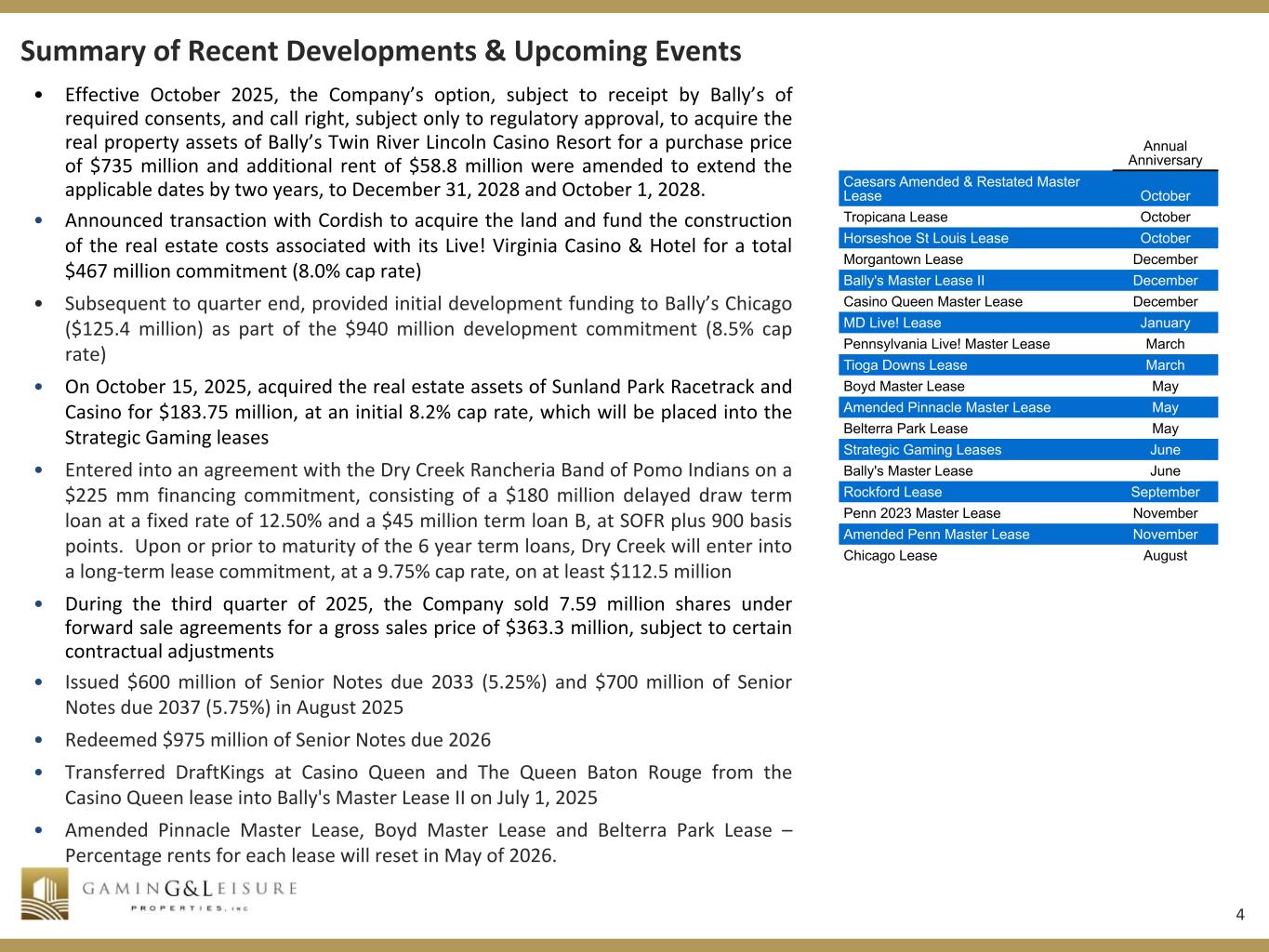
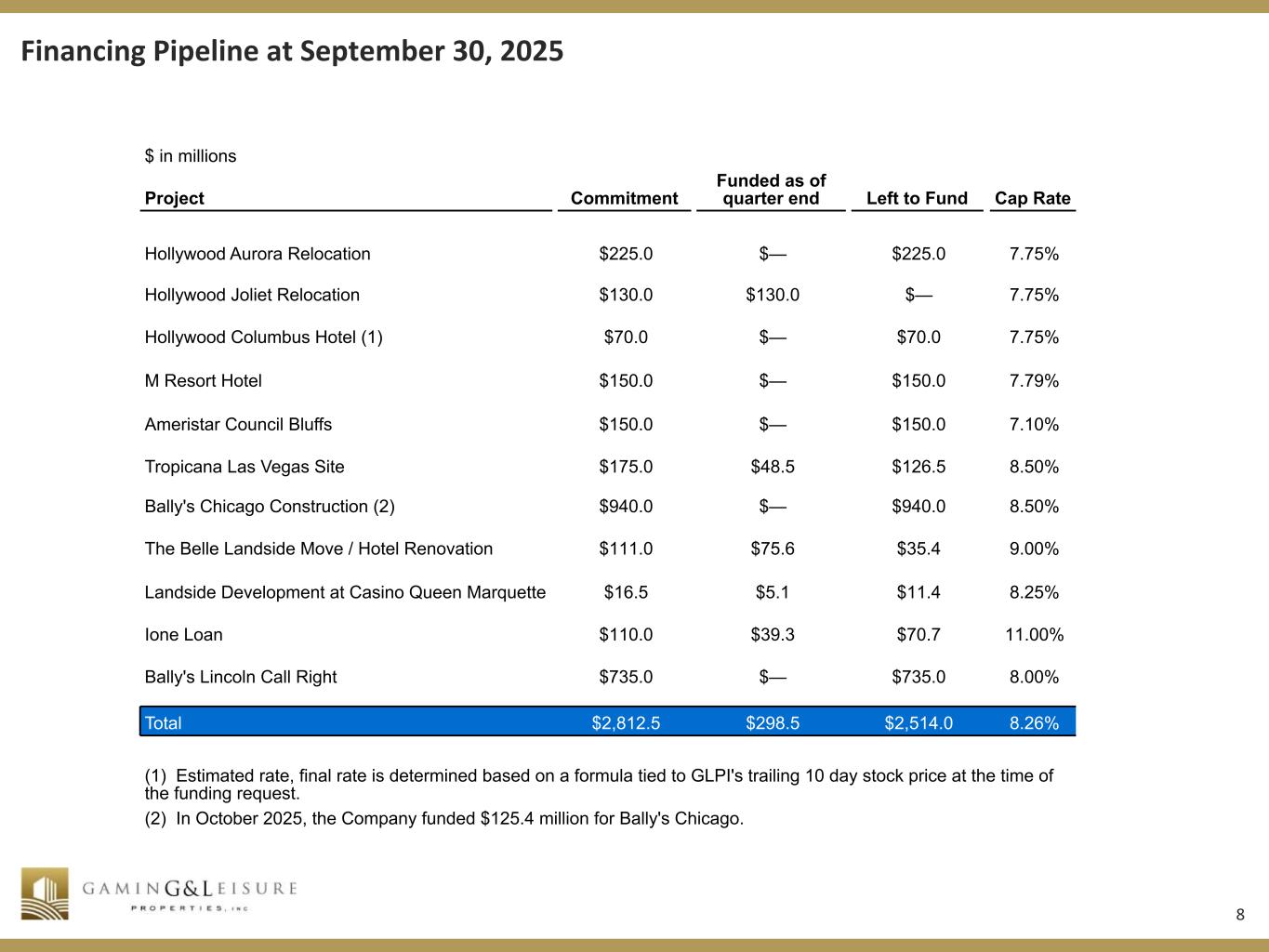
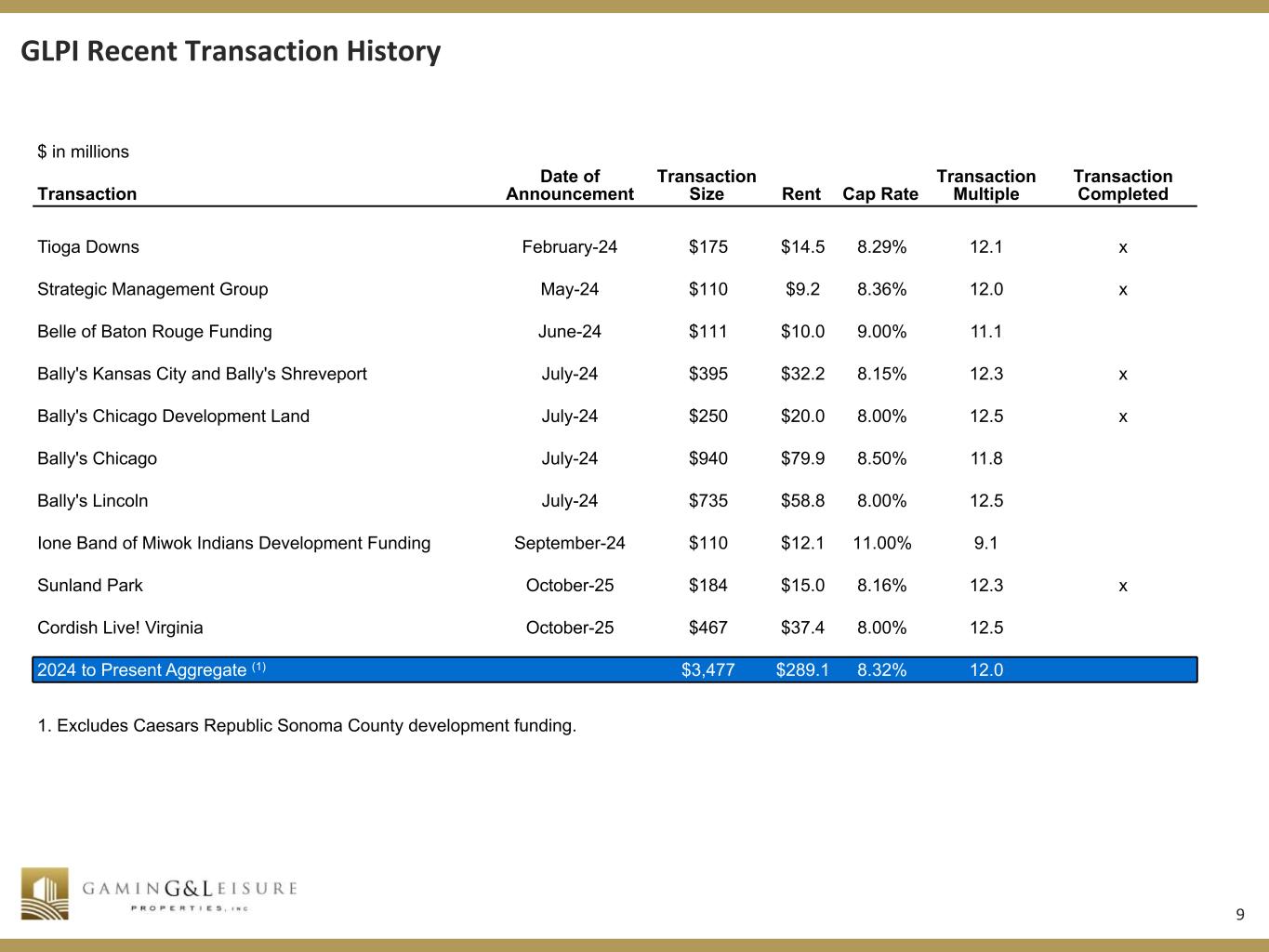
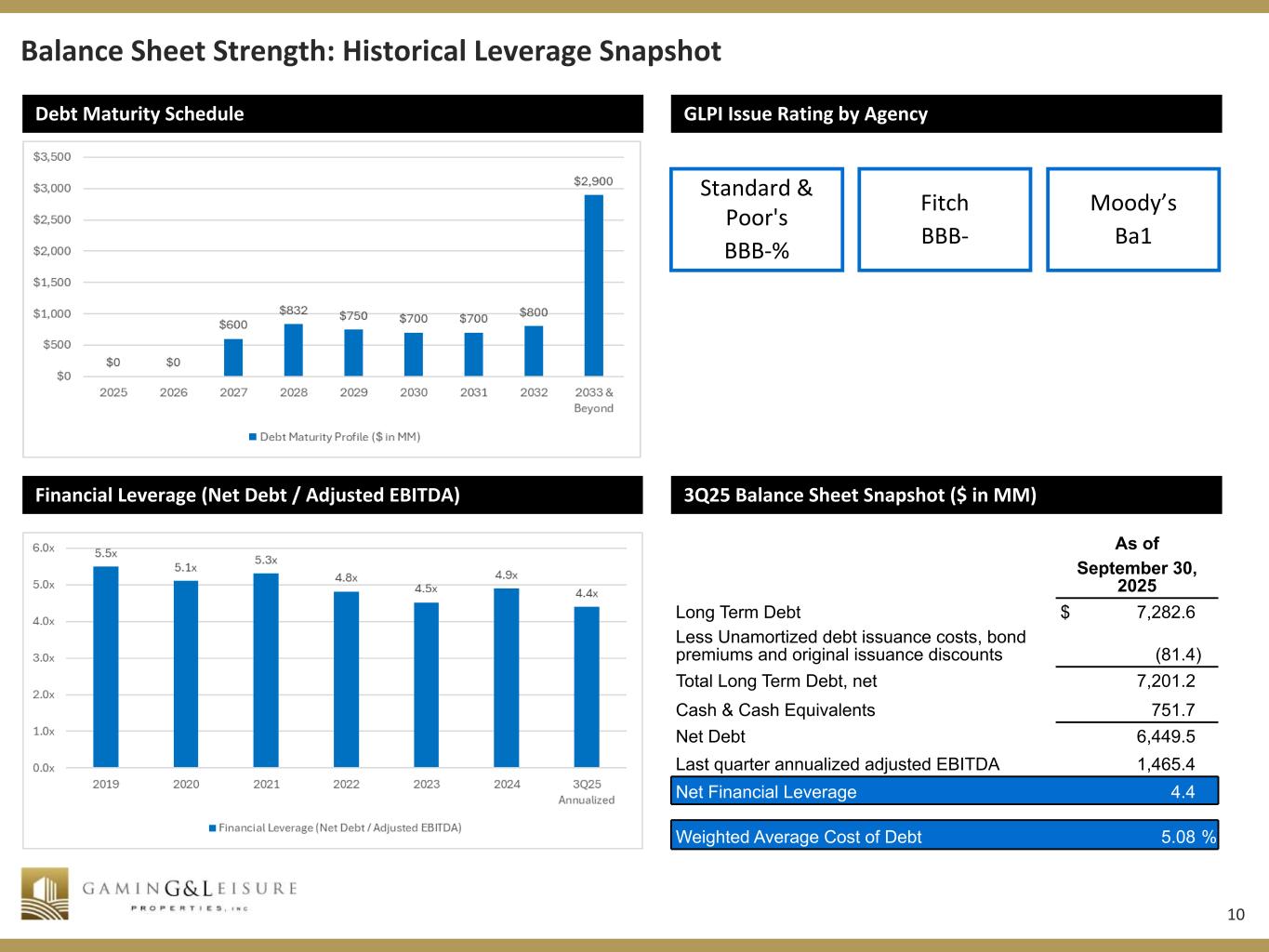
Well, thank you, Joe, and good morning, everyone. We are particularly pleased to announce a really terrific quarter in which I think a lot of really good things have come together. As always, these have been thoroughly detailed in our earnings release. Nonetheless, there are three items that I think are worthy of spending just a little bit of time this morning that represent important elements of the GLPI story today. The first topic I'd like to highlight is our pipeline and our recent transactions. Very simply, in the last 60 days, we have announced three transactions. And while the market has given us a little credit for these deals, each of these is accretive and allowed us to deploy $875 million of capital at a blended cap rate of 9.3%. When completed, these transactions will add over 5% to our current annualized cash rent while also expanding partnerships with two existing tenants and furthering our initiatives in the area of tribal gaming. The second item is funding, which is something we get lots of questions about. We currently have over $3 billion of announced transaction activity in our pipeline. As you saw in our third quarter results announcement, we executed on $363 million of forward equity in this period at an average price of $48. Despite the size of our current funding commitments, given our current leverage profile, it is worth pointing out that we can fund the entirety of our future commitments solely with debt financing and still remain at approximately 5.1x leverage, the low end of our 5 to 5.5 range. So given the current valuation of our equity, this path appears to be most appealing as it's unlikely we'll be tapping the equity market in this current pathetic range. Number three, the third item is Bally's. We get lots of questions about that. And I'd like to talk a little bit about our relationship with them. We have two very strong well-covered leases with Bally's: the development in Chicago, a ground lease on a soon-to-be-developed prime parcel of Las Vegas real estate and which you would know is the new home of the Las Vegas A's. Since we last spoke, a lot has transpired with Bally's, all of which has been very positive from our perspective. Bally's successfully completed its international iGaming transaction with Intralot, positioning the company very well from a liquidity perspective. Additionally, since we last spoke, Bally's has become one of three remaining bidders for three potential licenses, very lucrative licenses in New York, which, whether we participate or not, is a very good thing for them. And lastly, of core importance to us, significant progress has been made in Chicago in the development of that project. We extended our first tranche of capital for the development earlier this month. So we step back and look at the Bally's relationship. We like the assets that we have. Coverage on our existing leases is very good. And the Chicago development has a very strong ROI framework. We see tremendous potential and opportunity in land in Las Vegas, and we see New York as a potentially material value-enhancing opportunity for us or for Bally's with or without us. So these have been very positive developments. I would like to point out that the progress in Chicago is significant, and the pace of construction has picked up dramatically. To that end, we publish photographs that give any interested among you an idea of just how things are looking. We've gone vertical, and we're going to keep those photographs and the storyline updated, so you know at any moment where we are in Chicago. In Las Vegas, Bally's has published a site plan that encompasses what may be possible at the site. We are very pleased with what they have discovered or what they have laid out. We may or may not participate as opportunities arise. It's unlikely that we will finance the entire project, but there are elements of that, profit-making elements, that I think we could participate in. So I'd stay tuned in Las Vegas as well. It's in a very good place at the moment. So with that, I'm going to turn it over to Desiree to give you things that really matter.
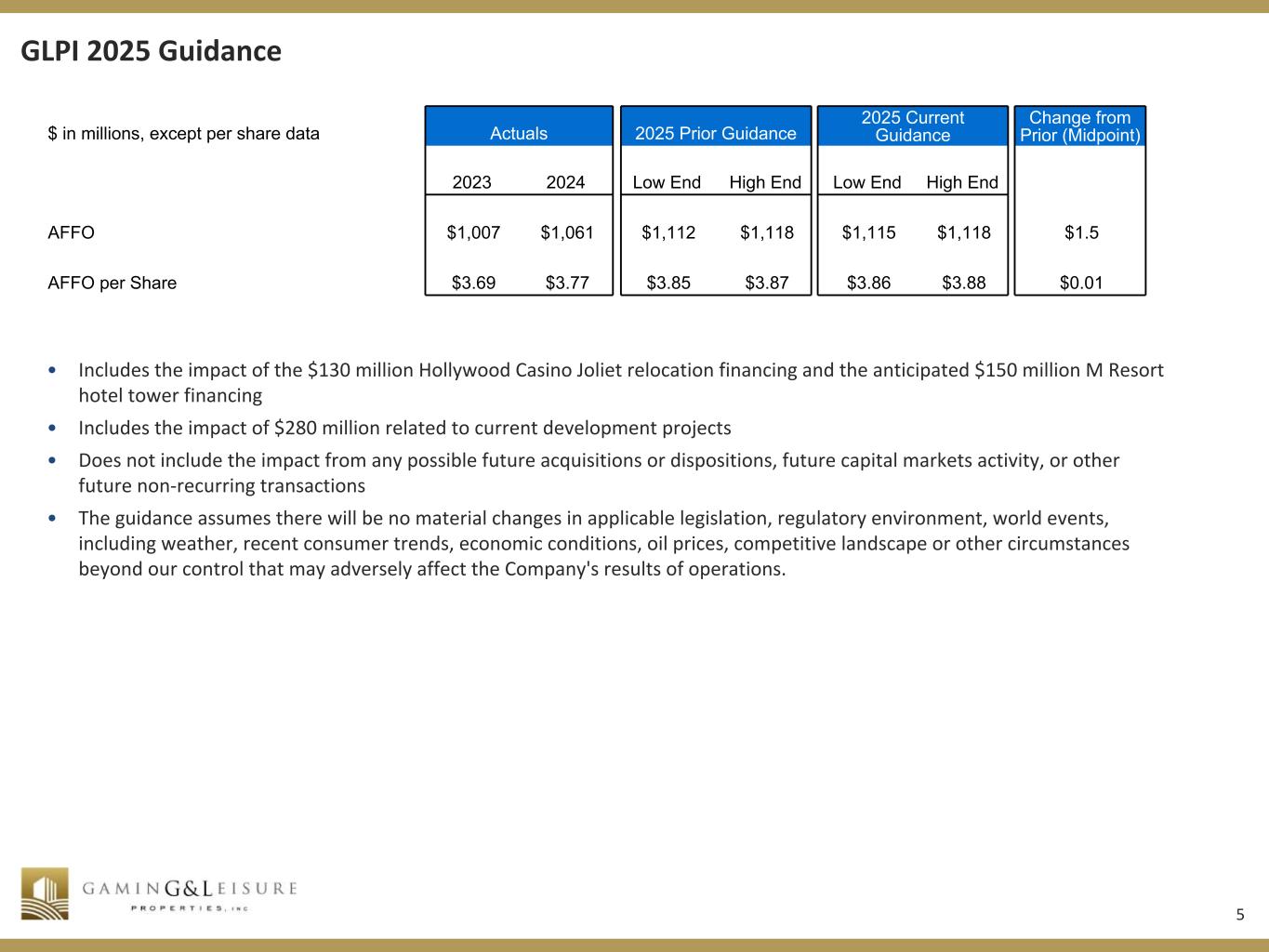
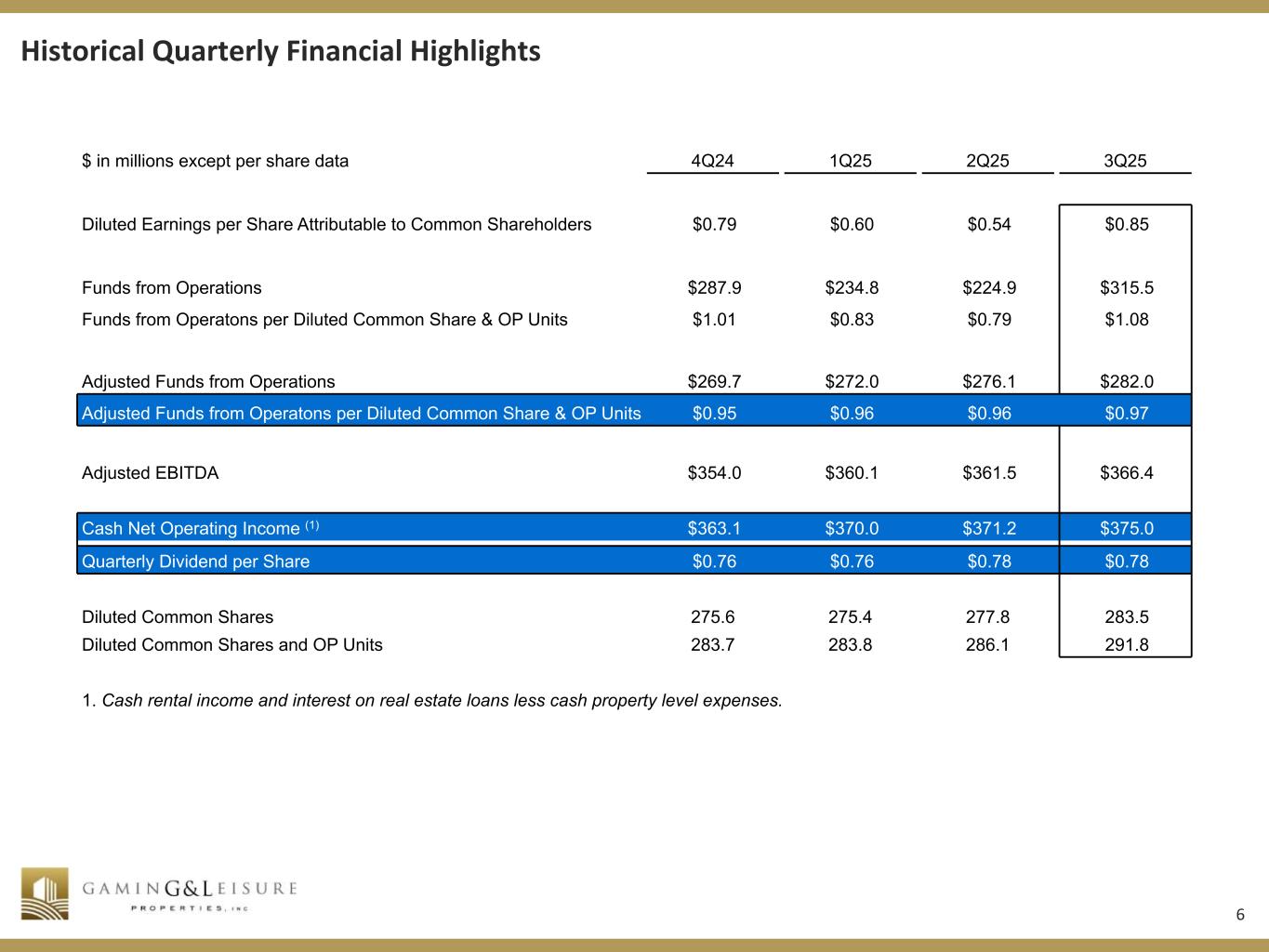
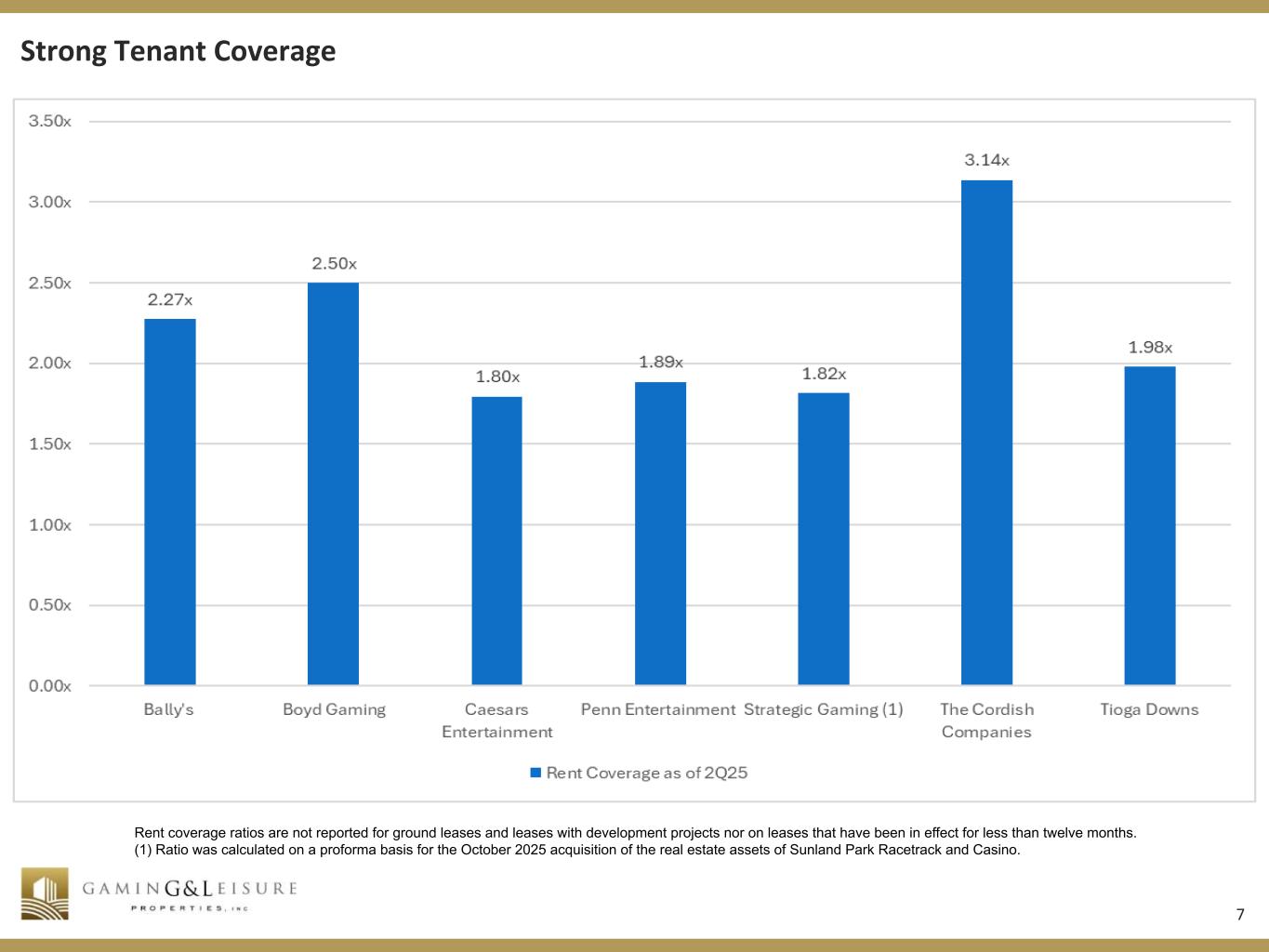
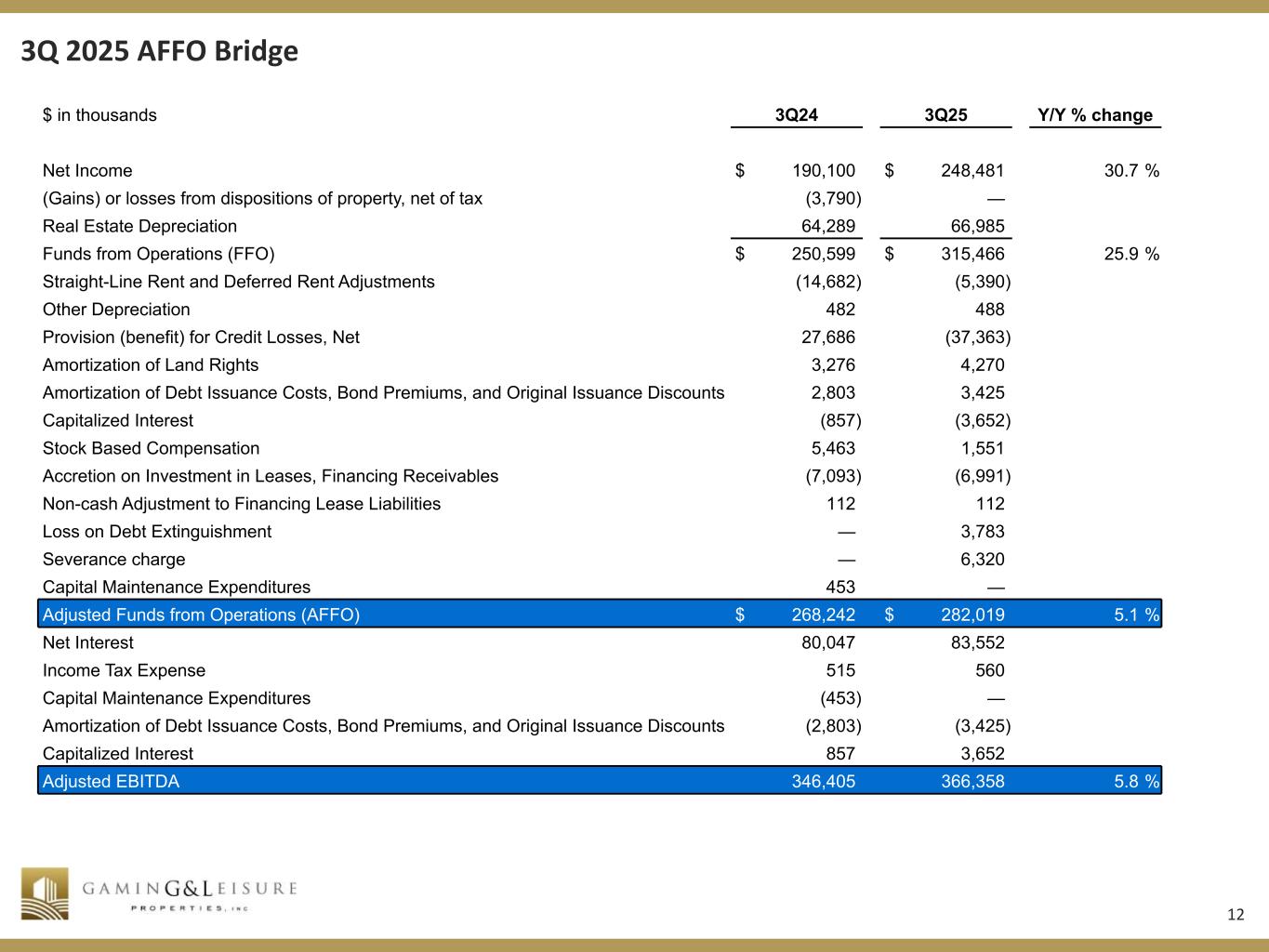
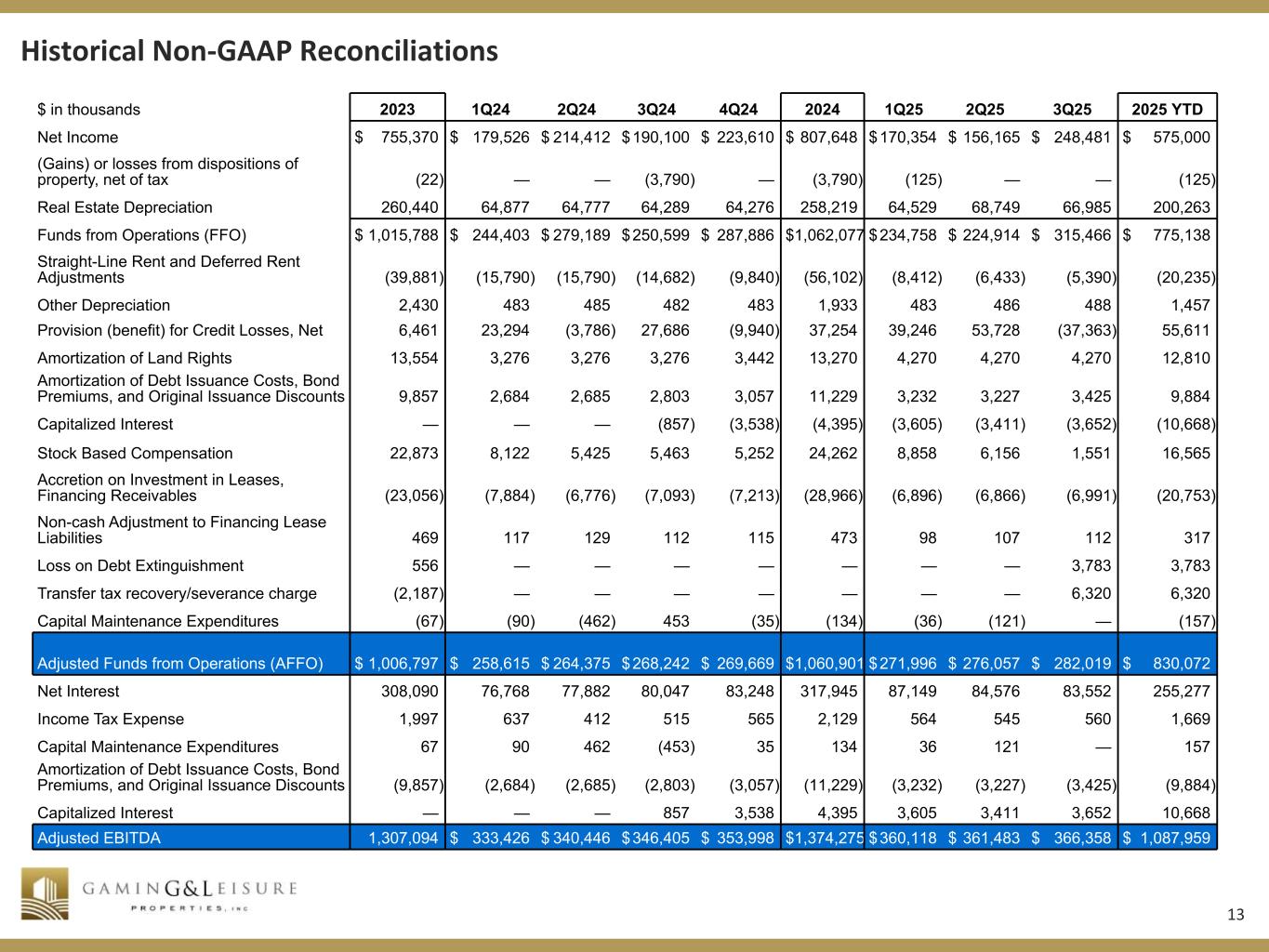
Thanks, Peter. Good morning. For the third quarter of 2025, our total income from real estate exceeded the third quarter of 2024 by over $12 million. The growth was primarily driven by increases in our cash rent of $20 million. Those are related to our acquisition of Bally's Kansas City and Shreveport, which increased cash rent by $8 million. The Chicago land lease increased cash income by $3.9 million. Bally's Tropicana funding increased it by $600,000, and the Belle development increased cash rent by $1.6 million. The Ione loan increased cash income by $900,000. The Joliet funding increased our cash income by $1.7 million, and the recognition of our escalators and percentage rent adjustments increased cash income by about $4.2 million. The combination of our noncash revenue gross-ups, investment and lease adjustments and straight-line rent adjustments partially offset those increases, driving a collective year-over-year decrease of $8.4 million. Our operating expenses decreased $53.5 million, mainly resulting from noncash adjustments in the provision for credit losses due to a less pessimistic forward-looking economic forecast as compared to the prior quarter, as well as the fact that 2024 the provision included a charge for the establishment of the Tropicana reserve. Just a reminder that we capitalized interest and deferred rent during the development period for financial reporting purposes. However, we add that back and deduct the capital interest in deriving our AFFO. Included in today's release is an increase in GLPI's full year 2025 AFFO guidance ranging from $3.86 to $3.88 per diluted share and OP units. Please note that this guidance does not include the impact of future transactions. However, it does include our anticipated funding of $150 million for the M Resort tower expected to occur next month and approximately $280 million of funding for development projects expected to occur during the fourth quarter, of which $125 million was funded for Chicago in October. From a balance sheet perspective, and this is probably the most important part of my comments, during the quarter, we sold 7.6 million shares under a forward sale agreement to raise $363.3 million or $47.87 per share. Additionally, we issued $1.3 billion in new bonds and redeemed our sole 2026 maturity of $975 million, thereby raising in excess of $680 million of capital for our development and acquisition pipeline. Our leverage ratio is at 4.4x, well below our target and historical levels. Given our current balance sheet position, the several year runway to fund our development projects and our annual free cash flow over that time frame, we have optionality to fund our future accretive commitments. As a reminder, our significant development projects pay us cash rent upon funding. In October, we extended the company's option and call rate to acquire the real property assets of Bally's Twin River Lincoln by 2 years from 2028 to 2026. Our rent coverage ratios on our master leases are ranging from 1.69 to 2.78 as of the end of the prior quarter end. With that, I will turn it back to Peter.
Well, thanks, Desiree. And with that, operator, can we open the call to questions.
Operator
The first question comes from Haendel St. Juste with Mizuho.
Speaker 4
Desiree, I wanted to follow up on your comments about the balance sheet. It appears that you have adequate coverage regarding your sources and uses for the time being. However, how comfortable are you with your current liquidity profile? Additionally, how much are you willing to allow leverage to increase in the near term?
Right. So look, if I funded everything I have out there in the pipeline with debt, which obviously, that's not exactly what we intend to do. But however, if our equity remains where it is, we may just do that. We only get to 5.1x levered, right, once everything is annualized in. So I'd be very comfortable at that range. I mean, you can see in our supplemental, historically, we've been over that, right, up to 5.5x is our maximum range of leverage. So I am very comfortable with our current liquidity position and the funding of the transactions that we've announced to date.
Speaker 4
Got it. Appreciate that. And then I guess, just more broadly, curious on the regional gaming trends during the quarter, foot traffic, revenue in light of the slowing macro? And I guess some broader commentary on how do you expect regional gaming to perform in this environment?
Any of us could answer that question. Generally, regional gaming has performed very well, and our coverage remains quite secure, with no threats to the industry. Given time, things may change, but currently, the regional business is extremely strong. Carlo, would you like to contribute anything to that?
Sure. It's Carlo. I think when you look across our tenants who've reported to date and some who haven't, but when you look across those who have reported to date, you had a good regional report from obviously MGM, a good regional report from Caesars. I think when you look at the state-level data, it all appears very solid and very steady. I know there were some concerns around promotional activity in those markets, but certainly not showing up in EBITDAR and has not showed up in coverage for those who've reported thus far.
Speaker 4
And foot traffic?
Yes. I think foot traffic remains fairly steady as well in regionals. I think there's a broader malaise around the space that's created by numerous other things. But I think in regional markets, there hasn't been a dramatic change in demand as far as we can see.
Operator
The next question comes from Rich Hightower with Barclays.
Speaker 6
So my first question just has to do with some of the puts and takes in expected fourth quarter development funding. I think there were some questions last night as to kind of what changed versus what the expectation was 90 days ago or even more recently. So just help us understand what changed, including obviously the impact of Chicago within that mix.
Right. So really, the biggest take, I would say, is that we've reduced our Chicago development funding by about $25 million and pushed that into 2026. So it's really just a timing adjustment. So my $338 million is now $280 million. Obviously, we funded about $35 million for the quarter. And so that has declined $25 million, that's it. But it's really just timing of coming out of '25 into '26.
Look, I think it's safe to add that some delay in the actual first payment or advance had to do with just papering the transaction. I'm looking at Brandon sitting across the table, who spent a lot of time working on the details to make sure it was all right and perfect given the scale of what's happening and so forth. But now that they're underway, the advances have begun, I think you can expect a regular flow of capital investment going forward.
Speaker 6
Okay. Great. And then obviously, we all noticed the extension of the purchase option at Lincoln. So just tell us your latest thoughts, if you don't mind on that asset and maybe some of the pressures that asset might be facing over the next couple of years and how it factors into the timing and even the purchase price itself, if you don't mind.
I'll address part of it, and then we can discuss the rest later. It's well known that obtaining approval from the lenders for that property has been difficult. However, we are not going to pressure our partner into making decisions that aren’t in their best interest. We are completely willing to be patient and assist in this process. It’s simply about alleviating pressure from the situation and allowing it to progress at a comfortable pace.
Yes, Rich, I mean, I think on the second half, the Lincoln asset has had some stress because of road closures, bridge closures and the competing First Light project, which is being expanded somewhat we understand. I think that this is mutually beneficial to the two companies. For us, we'll push Lincoln out. We'll get a better look at that market and what's going on. We've got plenty of growth in place for '26 and '27 and pushing this out doesn't hurt us at all. We have our hands full for the next year, 18 months. And so as Peter said, for the reasons it was beneficial for Bally's, it certainly isn't detrimental to GLPI. And so I think this was a win-win accommodation to push it out to '28.
Yes, it's kind of an ace in the hole that we've got it, and we'll get it when its time is right. We feel good about that.
Operator
The next question comes from Jay Kornreich with Cantor Fitzgerald.
Speaker 8
I guess just first off, there's been a number of announced deals lately from you in the past two months, as you mentioned. And I'm curious if there's been anything that's really been driving that for you? Or is it kind of just more coincidence that many transactions you've been working on just all got done around the same two-month time?
Why don't you take that, Brandon?
Okay. Yes, I'm happy to address that. I think that's easy. I think it's the latter. A lot of hard work came together at about the same time. And so all those deals, while very different, were things we have been working on for a very long time and just came together in the quarter. So as you know, from our business, it can be a little lumpy from time to time, and this was a quarter where we just had a lot of things come in at the same time.
Speaker 8
Okay. And then if I could just follow up on the funding for the Chicago Bally's development. Are you able to comment on how much funding you expect in 2026 and what portion may spill into 2027?
I'm not ready to comment on that right now. I can tell you that the funding will extend into 2027, as we have mentioned before. When we release the fourth quarter results and provide the 2026 guidance in February of next year, we will share as much information as possible regarding the timing of the funding for that project.
Yes. Each day brings us a clearer understanding of the project's status. We are closely monitoring the construction process, with our team actively overseeing progress. It's progressing well, but it is a large project. As we continue, we will gain a better idea of the timeline for completion. I know the team is focused on opening the casino as soon as they can.
Operator
The next question comes from Barry Jonas with Truist.
Speaker 9
You've now announced two tribal deals. How would you characterize the pipeline for tribal deals from here? Curious how the education process has been resonating.
Do you want to take that, Steve?
Speaker 10
Sure. From a tribal perspective, the education process is ongoing. We are receiving more inbound inquiries and continuing our outreach discussions, although the frequency of these discussions is beginning to shift. This change is partly due to others in the marketplace noticing transactions happening and capital becoming accessible for their clients, leading them to reach out to us more often. We will keep pursuing transactions in this area. One of our focuses is to demonstrate that our structure and capital can serve purposes beyond just greenfield projects in the tribal landscape. We are actively seeking opportunities with mature assets where clients might be looking to diversify into new business lines or refinance existing debt, rather than only funding new projects. While we will continue to explore greenfield projects, we are also trying to identify other ways to utilize capital that can help advance the education process in the marketplace.
Speaker 9
Great. And then just as a follow-up, we just talked a little bit about the regional markets, but curious to get your wider views on the Strip today, given the recent softness we've been seeing. You commented on Bally's project there, but would you be open to meaningfully increasing your Vegas exposure if the right opportunity came along?
Well, yes, I mean, simple answer is yes. You said it right, the right opportunity, whatever that might be. We're not looking for anything there. We have a wonderful project in hand that offers us an opportunity to participate at some level should we choose. But look, we're always in the market for the next thing.
And Barry, this is Carlo. Look, I mean, you've covered the space for a long time. You've seen Las Vegas Strip go through many cycles, and this feels like just another one of those cycles. So when you're thinking long term like we are, I don't think a couple of choppy quarters in a row coming off of a very strong period like we saw coming out of COVID really changes the thinking much around investment into that market.
Operator
The next question comes from John Kilichowski with Wells Fargo.
Speaker 11
My first question is just on the New York City casinos. How is your appetite to participate in those casinos change given the developments that we've seen in the quarter? There's been some news flow recently. And I don't know if there's been any more progressive conversations being had? Or are we in the same place that we were a quarter ago?
Well, I think we're in a little bit different place than we were a quarter ago given that there are now three left standing and three licenses to provide. No telling whether New York will actually issue the three licenses or whether they'll be issued to the folks that are still standing or some other change in process might occur that we saw back when resorts eventually came out in Queens. But I think that the appetite for New York is strong in the sense that these are really strong projects that promise a lot of EBITDA coming out of that market. And if we can participate in a prudent way in those projects, we'll certainly seek to do that. As most of you probably know, we do have a right of first refusal associated with the Bally's project. So we'll see how that plays out. I think it's a little early in the game for us to tell you if and at what level we might commit capital to that market. But it obviously remains a very attractive expansion market to not only GLPI, I'm sure everybody that's looking at investing in gaming.
And I probably should underline that there's no shortage of money chasing that opportunity. And I can't speak for Bally's, but I can well surmise that they're getting calls from all over the place, people wanting a piece of that opportunity. So it's a big deal. Good for them. We could take a part if the right opportunity appears, but we're certainly not going to be the sole source of what they're going to require there.
Speaker 11
Okay. Very helpful. And then my second one is back on the tribal deal. Could you just talk more about the return hurdles that you're looking for, for a tribal deal where there's less protections maybe involved versus the construction that you're working on or the fee simple acquisitions that you've been targeting?
Yes. I think from an underwriting standpoint, each of them are going to be a little bit unique because each one will present a different credit profile, just as in commercial gaming, we face that. And I think at the end of the day, the difference between the risk on the tribal and the commercial may not be as wide as some folks believe. I think when you dig into it, you can see that there are some challenges to tribal gaming, but they may not be as steep as you think, and there are some very well-capitalized tribes. So clearly, we're looking at a wider spread to the cost of capital than what we do with commercial gaming, whether it's 50 basis points or 100 basis points or 150 basis points. It's going to depend on the credit quality of the tribe and the opportunity. And I think we're also looking for increased coverage on those assets because of the nature of that investment, we want to make sure that the coverage is even stronger than what we have in our commercial deals. And as I think most of you know, we've always focused on coverage. We've done that since day one here. We've known that creating a healthy tenant landlord relationship for the term of the lease is very important. And so while we look at 2:1 coverage generally on commercial assets, if not better, you can assume with tribal we're looking to be much higher. So that's kind of where we are in the underwriting process on tribal as we sit here today. And I think each deal will be a little bit different.
Operator
The next question comes from Greg McGinniss with Scotiabank.
Speaker 12
So I guess just quickly speaking on coverage. Is the expected rent coverage at Live! Virginia in that 2:1 range? And how did you go about underwriting that project to determine the expectations?
So as we always do, we go through a rigorous process to due diligence on what we think the market can do and what the demographics of the market are, the drive times around the property. And we do expect in the line of 2:1 rent coverage on that property as it opens.
Yes. Let me add. We're talking about the Cordish organization. These guys are highly capable, highly successful. The kind of folks you'd want to sign up for every deal imaginable given the opportunity. So it doesn't get any better opportunity to partner with any entity on the planet than the Cordish organization. So we're delighted to be part of that project. No worries whatsoever.
Yes. I think in that market, we also did a lot of work on the legislative side, on the regulatory side to understand what the potential for expansion is going to be in that market. And we're pretty comfortable that, that Richmond market is pretty well protected at the moment. As Peter said, the Cordishes have a demonstrated ability to deliver projects on time and on budget. And so that's a project that's easy for us to get behind in that market with that kind of partner. And I would just add at 2:1, I think it's more of a downside base case scenario. If you ask the Cordish folks, I think they tell you that they think coverage is going to be much higher at that facility. But we don't underwrite on the hope certificate. We underwrite on the conservative side. And so at 2:1, we think we're going to be very well protected in that market.
Speaker 12
Yes, I guess, given where their other leases are, that makes sense.
Speaker 12
And then just a follow-up on, I guess, a point of clarification on the Lincoln deal. If Bally's were to receive approval from the term loan lenders, the few remaining that they need it from, do you expect they'd elect to do that deal earlier? Or do they prefer not to have to pay off the $500 million of debt that would require?
I think that asks us to crawl into the minds of Bally's, which we obviously can't do, but I will acknowledge that you're correct in the way that the option works. If they solve the lender consent issue, Lincoln can come in well before 2028. There's been no change in the terms of how the option works only the date. So if Bally's can solve that and they think it's prudent to bring that capital in, they'll likely come to us and ask for that. I can tell you that we've done a lot of work in the market. We have our own views on how the market is going to perform and what's happening in that market. And if we're called upon to exercise Lincoln earlier than 2028, we'll be prepared to make that decision and have that discussion.
Operator
The next question comes from Ronald Kamdem with Morgan Stanley.
Speaker 13
I have two quick questions. Regarding the Chicago project, I appreciate the increased transparency. Can you provide an update on the upcoming activities, specifically the vertical construction for the hotel and casino, and the delivery of cranes number two and three?
Speaker 10
Yes. There are currently three cranes operating on the projects, and steel is being erected. The hotel has had four or five levels of concrete poured, so it's nearing the height of the first-floor guestroom. There is definitely ongoing construction at the property. If you check the camera or are in Chicago, feel free to stop by. There are many people and a lot of activity happening there every day.
Speaker 13
Great. Helpful. And then my second one was just on just the cost of financing, if you can remind us where you think you can issue ten-year? And how is that impacting or is that even impacting your sort of underwriting return hurdles for new deals in the pipeline? Just how is that shifting?
Yes. Sure. So obviously, as you know, the 10-year treasury is moving quite a bit lately. So the last I looked, it was around 4.1%, which means we would be issuing somewhere around 5.6% to 5.6% range. I think it bumped up over the last few minutes, hours; it keeps changing on me, but that's about where we would fund. And it is pretty consistent. We've been somewhere around the treasury of right around 4%, and our spreads to that haven't changed significantly. So our funding and our spreads that we're expecting to our cost of capital are really only changing on the equity side more so, not necessarily the debt side.
Speaker 10
We're very hopeful that the market will realize that 160 or 165 basis point spread between the equity dividend yield and the 10-year issuance costs will be recognized by investors and...
Operator
The next question comes from Chad Beynon with Macquarie.
Speaker 14
Congratulations on the recent developments. In the gaming calls for this quarter and the last, there has been significant emphasis on the overall advantages stemming from the One Big Beautiful Bill, particularly in terms of construction and capital expenditures, including accelerated depreciation. So, I wanted to inquire about how crucial this is in your discussions with current or potential partners, particularly regarding the urgency and benefits of investing in the next year or two. Could this result in more funding or lease agreements in the near future?
So yes, it doesn't really come up in our conversations. Obviously, there is a tax benefit to our tenants to do that under the One Big Beautiful Bill. But it's a tax benefit. It's not a free cash flow issue for them. So it's not part of our discussions regarding their desire to do it quickly.
Yes. I don't think it's what's driving capital investment decisions at the gaming operators primarily. It may be something that if it's on the margin or on the edge, they might tip it over. But I think they're making those decisions based on the return of capital, not on tax depreciation. But as Desiree said, I don't think we've seen any of that.
Speaker 10
Most of our transactions, as you're aware, we're funding the hard cost and we're owning hard cost. So the tenants are not in a position where they own that physical property to be able to take the accelerated depreciation. So I think what you're hearing is the tenants in our discussions have been more focused on cost of capital and the rate at which they can access capital from us versus a lender and therefore, making the decision based on the cost of capital afforded to them, not necessarily on a tax deduction they can get.
Speaker 14
Great. Appreciate that. And then on the strategic deal that was done, maybe just a broader one in terms of assets, country that maybe generate less than $50 million or less than $40 million of EBITDA and finding homes for these operators. Do you think there's going to be additional M&A or kind of changing of properties that could help some of these smaller regional gaming operators that you either work with or could work with in the near term?
Speaker 10
So this is Steve. Two points. First, I noticed a note overnight regarding the $40 million EBITDA ROFR with Strategic, which is an aggregate number, and they've surpassed that with this deal. If that was part of your inquiry, I wanted to provide clarification. Second, concerning smaller assets and operators, I believe we will see an increase in opportunities for them. This will come from sellers being more inclined to part with what used to be referred to as non-core divestitures, which may regain popularity. Larger regional companies might look to sell some smaller operations. However, accessing capital will be a challenge for smaller potential buyers. With the right partners and relationships, smaller operators we are comfortable with could see growth opportunities. Nonetheless, right now, capital access is limited for some parties, hindering their ability to capitalize on non-core divestitures.
Operator
The next question comes from Daniel Guglielmo with Capital One.
Speaker 15
At REITworld last fall, there was a lot of discussion around the new administration and potential for gaming M&A. It didn't materialize in the first half, but it has picked up some in the second half. From your seat, what conditions do you think have led to that pick up? And do you expect them to carry through to next year?
Speaker 10
I think most of the transactions you're seeing have been worked on for a number of months. They are not things that just happened in the second half of this year. So I don't think there's a perfect read-through for you on that front. The other thing I would tell you is most of the transactions that have been announced either by us or others in the space are more bespoke and they're one-off transactions. I think what you will see maybe now going forward is maybe more broadly marketed competitive bidding type processes, which historically aren't the ones that we typically are passionately winning. But I do think you'll start to see maybe some more broadly marketed type transactions that will feed off of the REITworld assumptions, I guess.
Speaker 15
Great. I appreciate that. And then the second one, you mentioned that lease coverages have held up well. But for leases where coverage ratios are coming down, when you dig into those properties and talk with the operator, can you just give us a sense of if it's revenues lagging, labor coming in hot, both? Anything you have there would be helpful.
Our rent coverage has slightly decreased, by about one to two basis points. There haven't been any significant changes. Earlier this year, we noticed a reduction in the Pinnacle lease with PENN, which was primarily influenced by competition rather than regional market conditions.
Our coverages are strong. It's a long way to the bottom, so we have no concerns at all, to be completely honest.
Operator
The next question comes from John DeCree with CBRE.
Speaker 16
I think we talked quite a bit about some deal terms, coverage, et cetera, underwriting, but maybe some of the less exciting ones like initial lease term and master lease or single assets. So the Cordish transaction in Virginia, can you talk a little bit about the negotiation or thoughts on keeping that as a single asset lease versus combining it with the other leases? And then the initial term, 39 years is what you've done with Cordish in the past, but it's quite a bit higher than some of the other leases we've seen in gaming. So curious to hear your thoughts there if that's a significant negotiating point or not.
Yes, thanks, John. In response to your latter point, I believe that a longer lease term benefits both parties. It indicates that Cordish is committed to these agreements for the long haul, viewing it as a long-term investment rather than a brief transaction. Both parties are seeking stability in the lease, so I think having a longer lease term is advantageous for us. Regarding your initial question about negotiations with the Cordishes, I apologize, John, could you please repeat that question?
Speaker 16
The decision or negotiation point to keep it as a single asset lease versus combining it with Maryland and Pennsylvania.
Yes. That's primarily structural. The Cordishes have a different partnership in Virginia with the Bruce Smith Enterprise. There isn't a perfect overlap of the partners in those deals, so Cordish cannot combine them and have one risk influencing the other due to the different ownership structures. Therefore, it's not feasible for those transactions.
And that applied even in Maryland versus Pennsylvania and previously as well.
Speaker 10
It's a different partnership group.
Operator
The next question comes from Chris Darling with Green Street.
Speaker 17
I'd love to get your thoughts on regional casino values and how they might have evolved over the course of the last year. As I think back through the past several commercial sale-leaseback deals you've done, they've all kind of been in roughly that 8.25% cap rate range. And I wonder if that really reflects just competitive market dynamics or it's more a reflection of GLPI being one of maybe the only bidders in some of these cases?
Speaker 10
I think it's going to be deal specific. But I think in many cases, I think that the pricing pressure that you would get, whether you were the only bidder or a competitive bid is only probably slightly different from our perspective. We're going to be a disciplined buyer either way. The market is not unintelligent. Everyone is banked by someone who knows where all the comps have been and where everything else is traded. So whether someone brings us a deal and says, "Hey, you're our favorite guy, we'd love you to buy this, before we go shop it." They're still not going to then give us a 200 basis point spread because we're nice. So the market is going to dictate where pricing goes. We all recognize where that should be, and we're always going to look to get a spread to our cost of capital. So that's just kind of how things will evolve.
I believe we've mentioned before that we don't favor auctions. In my opinion, the winner often ends up losing. Therefore, we never aim to be the highest bidder. There are various options we consider that make us appealing, but achieving the absolute lowest or highest price is not our objective.
Speaker 17
All right. Fair enough. And then maybe just a quick point of clarification on something mentioned earlier. You discussed a view around your share price, your equity cost of capital today. Does that impact your willingness to pursue incremental new deals from this point going forward? Or does it really just influence how you would finance any future deals?
I think it really just influences how we would finance future deals or what the spread we would be looking for to our cost of capital.
Operator
The next question comes from David Katz with Jefferies.
Speaker 18
I’ve covered a lot already, but I wanted to revisit New York. The concession there is a 15-year license, rather than 30, correct? I would appreciate your thoughts on how that affects your participation parameters. Peter, you mentioned earlier that there are various sources of capital available to them, right? They have a partner in that bid, who I assume is also a funding partner. How does that change your opportunity set?
I'll comment on the first part, David, on the licensing. I haven't dug into that in tremendous detail, but I will point out that licenses in many jurisdictions renew every three years, every five years, every ten years. So the fact that you have a 15-year initial license period, I guess I'm not reading too much into that. In other words, if you put $4 billion, $8 billion into the ground, the thought that you'd lose a license in 15 years and they'd relocate that or do something with that license seems outlandish even in a smaller market where you might invest $400 million. And it's inconsistent with how any other state regulator has approached a renewal of a gaming license. So we're going to take a closer look at that given that that's been highlighted as a rationale for why MGM might not want to do Yonkers or didn't want to do Yonkers. But on its face, I think that we're less concerned with that than we are of getting the spend right, getting the facility right, understanding what the market is and the EBITDA that's coming out of it, what the competition is going to be. I think all those things may be more important than that 15-year term. That being said, we are going to dig into that and take a closer look to make sure it's not something more than what we think it is.
Operator
The next question comes from Smedes Rose with Citi.
Speaker 19
I noticed that Bally's added a corporate guarantee for the Chicago casino. I was wondering if there was a specific reason for that or if it was something you were advocating for. I believe it's a positive move for you, but I'm curious about what led to that decision.
Contractually triggered, Smedes. That was a negotiated term that when Chicago came into the restricted group, which is what they did following the Intralot, Gamesys merger, we were to get a corporate guarantee on that. So that was already prenegotiated.
Speaker 19
I wanted to revisit your earlier comments about funding and the use of all debt. I assume you prefer to include an equity mix as well. I'm curious about your approach to issuing equity. Some companies have internal estimates of their net asset value and prefer not to issue below that level, while others may issue below NAV if it's still beneficial. How do you assess equity issuance?
Yes. So we do look at it very opportunistically, right? So we do look at the cap rate of where we're trading and what that spread would yield to whatever we are attempting to finance. I wouldn't say that we put a floor on it per se, but certainly, I can tell you at these levels, we have zero interest in funding with equity.
Smedes, I'll add to that. You saw, obviously, we executed on the forward closer to $48. Since that, subsequent to that, we've announced a couple of transactions that are AFFO accretive. So you could kind of think about that floor as potentially moving higher in the absence of an immediate need for equity, which we don't have, as Desiree outlined earlier.
Operator
The next question comes from David Hargreaves with Barclays.
Speaker 20
I apologize if this is a basic question, but you have provided a range of rent coverage. I'm curious if that is based on reported EBITDAR or some adjusted EBITDAR. Are you only using cash rent? Have you made any adjustments to these figures? What is the comparison metric?
Right. Our tenants are contractually required to report to us based on their actual EBITDAR as specified in each lease and the total rent being paid. There is a small adjustment for the Pinnacle lease due to an asset that is not considered in their coverage ratio, but it's a minor adjustment. For all other leases, the EBITDAR is calculated by taking the total EBITDAR of all properties and dividing it by the total rent being paid.
Speaker 20
But is this just the property-level EBITDAR? Or are you looking at it on a consolidated basis?
Yes. It's the properties that are in that lease. So if it's a master lease, it's all of the properties that are in that lease. It is not at a corporate level.
Speaker 20
So for example, with Bally's, it wouldn't have been factoring in any contribution from Gamesys or anything like that?
Operator
The next question comes from Robin Farley with UBS.
Speaker 21
I wanted to follow up on the New York project. You mentioned you're evaluating how to approach a 15-year term. I've heard that some operators withdrew from bidding due to concerns about New York potentially legalizing iGaming. Considering these factors, how would you assess the rent coverage ratio needed in New York compared to a standard 2x?
We're looking around the table to see who wants to take that one.
Speaker 10
I don't see us undertaking any upfront projects in New York that would aim for anything near a 2x rent coverage ratio. There are many factors to consider, such as construction schedules, budgets, and the potential years required to build in New York. If someone were to request an upfront investment that was highly accretive, it would require significantly more coverage than 2x. We would not entertain any proposal at that level. Looking ahead to four years from now, we should have a clearer understanding of whether iGaming has developed and what the profitability of those businesses might be. Based on our experiences in Las Vegas regarding the need for major renovations of large casino resort properties, I expect that New York would present a similar scenario. Therefore, we intend to maintain a healthy cushion in our rent coverage assessments.
Yes. I also think a lot of the projects that you've seen fall by the wayside in New York failed the Community Action Committee hurdle. So I think that ended up being a much bigger hurdle than maybe even New York could realize it would be. And therefore, a lot of those folks, I think, would still be interested despite iGaming and unknown tax rates and things like that, had they passed that hurdle. And that was the last and final for many of these applicants.
Operator
Thank you. At this time, I would like to turn the call back to Mr. Peter Carlino for closing comments.
Well, thank you all who have dialed in this morning. I think and hope you get the idea that we're quite happy with the way things have been going here at GLPI. And we were anxious to tell our story, and we'll see how it plays out. But stay tuned. I think there's good things ahead. With that, operator, and all, thank you very much. Have a great day.
Operator
Thank you. This does conclude today's teleconference. You may disconnect your lines at this time. Thank you for your participation, and have a great day.