Operator
Greetings. Welcome to Gaming and Leisure Properties, Inc. first quarter, 2026, Earnings Conference Call and Webcast. At this time, all participants will be in listening only mode. The question and answer session will follow the formal presentation. If anyone should require operator assistance during the conference, please press star zero from your telephone keypad. Please note that this conference is being recorded. At this time, I'll now turn the conference over to Joe Giaffone with Investor Relations. Thank you, Joe.
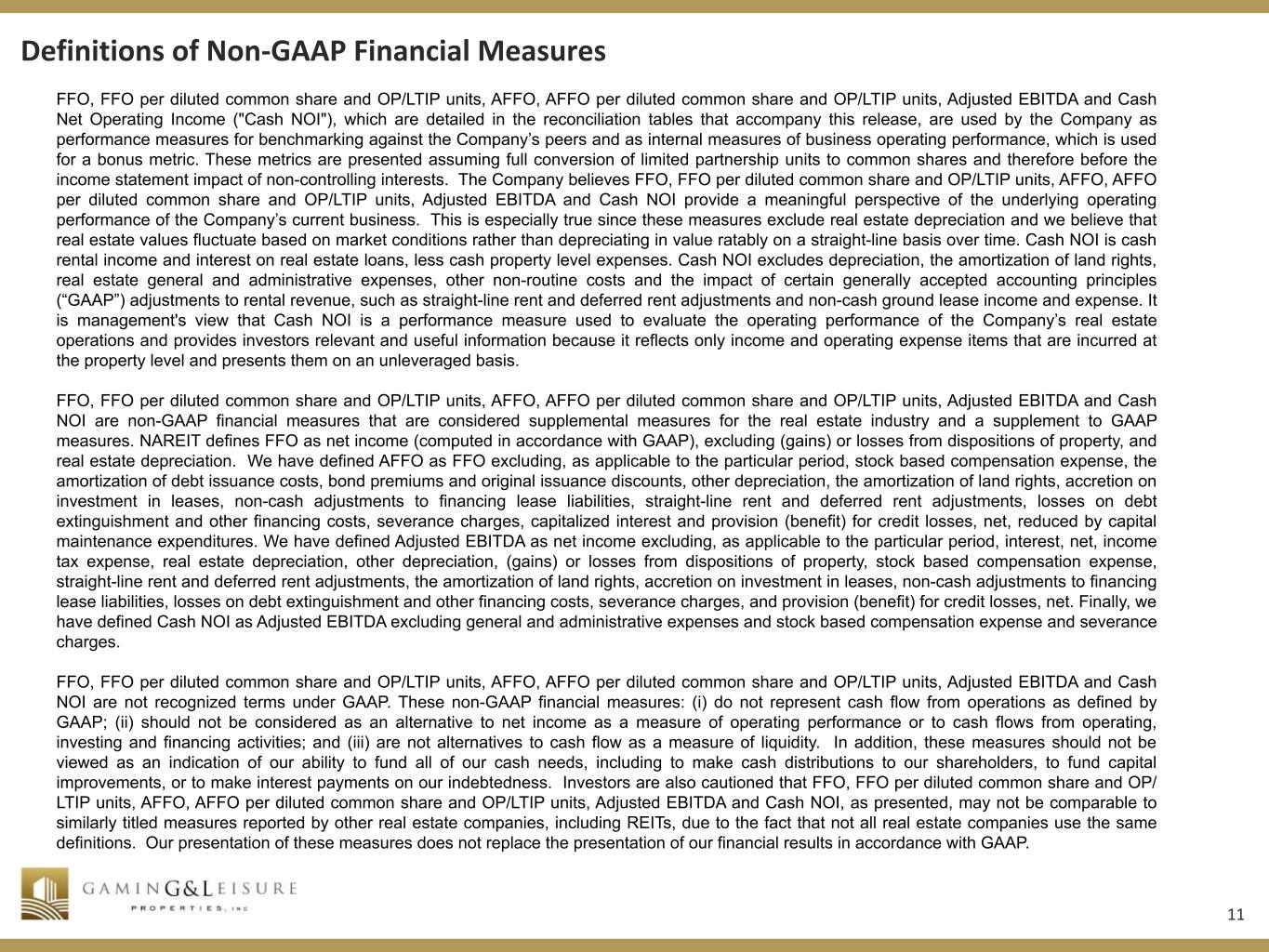
You may begin. and thank you rob and good morning everyone and thank you for joining gaming and leisure properties first quarter 2026 earnings call and webcast the press release distributed yesterday afternoon is available in the investor relations section on our website at www.glpropinc.com in addition to the press release glpi also posted its supplemental earnings presentation which highlights the events of the quarter recent developments future considerations can be accessed at glpropinc.com On today's call, management's prepared remarks and answers to your questions may contain forward-looking statements as defined in the Private Securities Litigation Reform Act of 1995. Forward-looking statements address matters that are subject to risks and uncertainties that may cause actual results to differ materially from those discussed today. Forward-looking statements may include those related to revenue, operating income, and financial guidance, as well as non-GAAP financial measures such as FFO and AFFO. As a reminder, forward-looking statements represent management's current estimates, and the company assumes no obligation to update any forward-looking statements in the future. We encourage listeners to review the more detailed discussions related to risk factors and forward-looking statements contained in the company's filings with the SEC, including Form 10-Q and in the earnings release, as well as definitions and reconciliations of non-GAAP financial measures contained in the company's earnings release. On this morning's call, we are joined by Peter Carlino, Chairman and Chief Executive Officer at Gaming and Leisure Properties. Also on today's call are Brandon Moore, President and Chief Operating Officer, Desiree Burke, Chief Financial Officer and Treasurer, Steve Ladney, Senior Vice President and Chief Development Officer, and Carlos Santorelli, Senior Vice President, Corporate Strategy and Investor Relations. Thank you for your patience with that. It's now my pleasure to turn the call over to Peter Carlino. Peter, please go ahead.
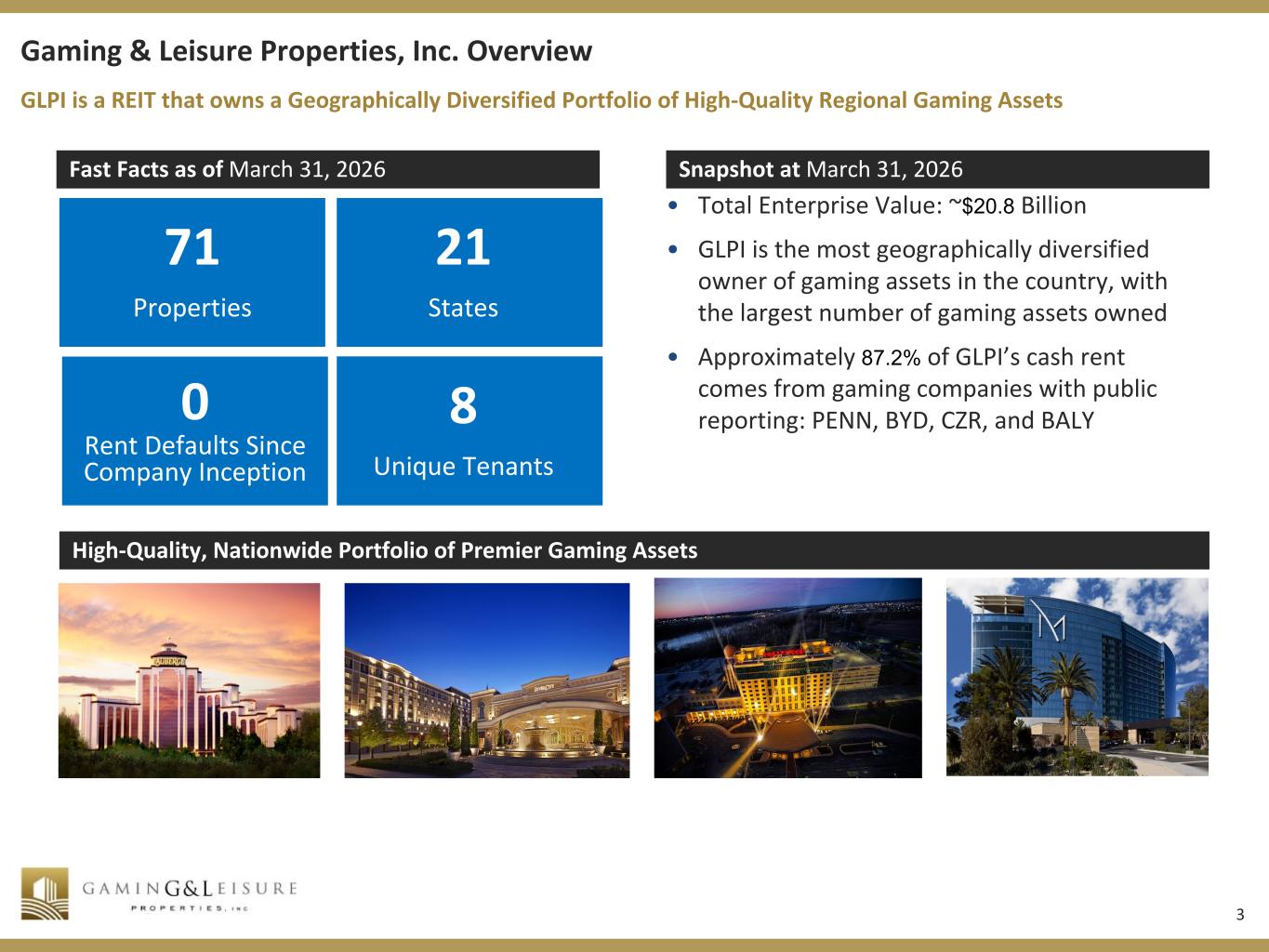
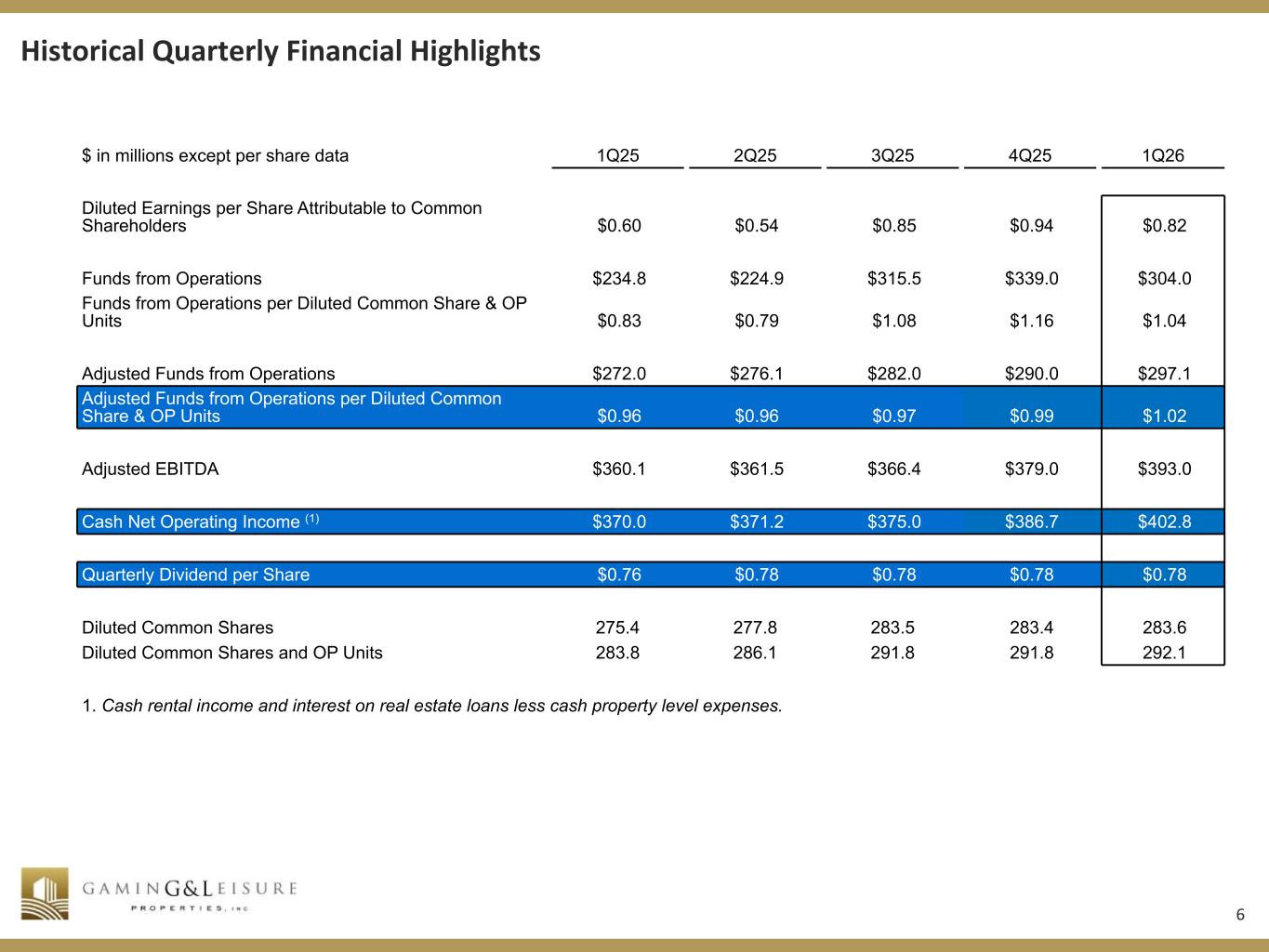
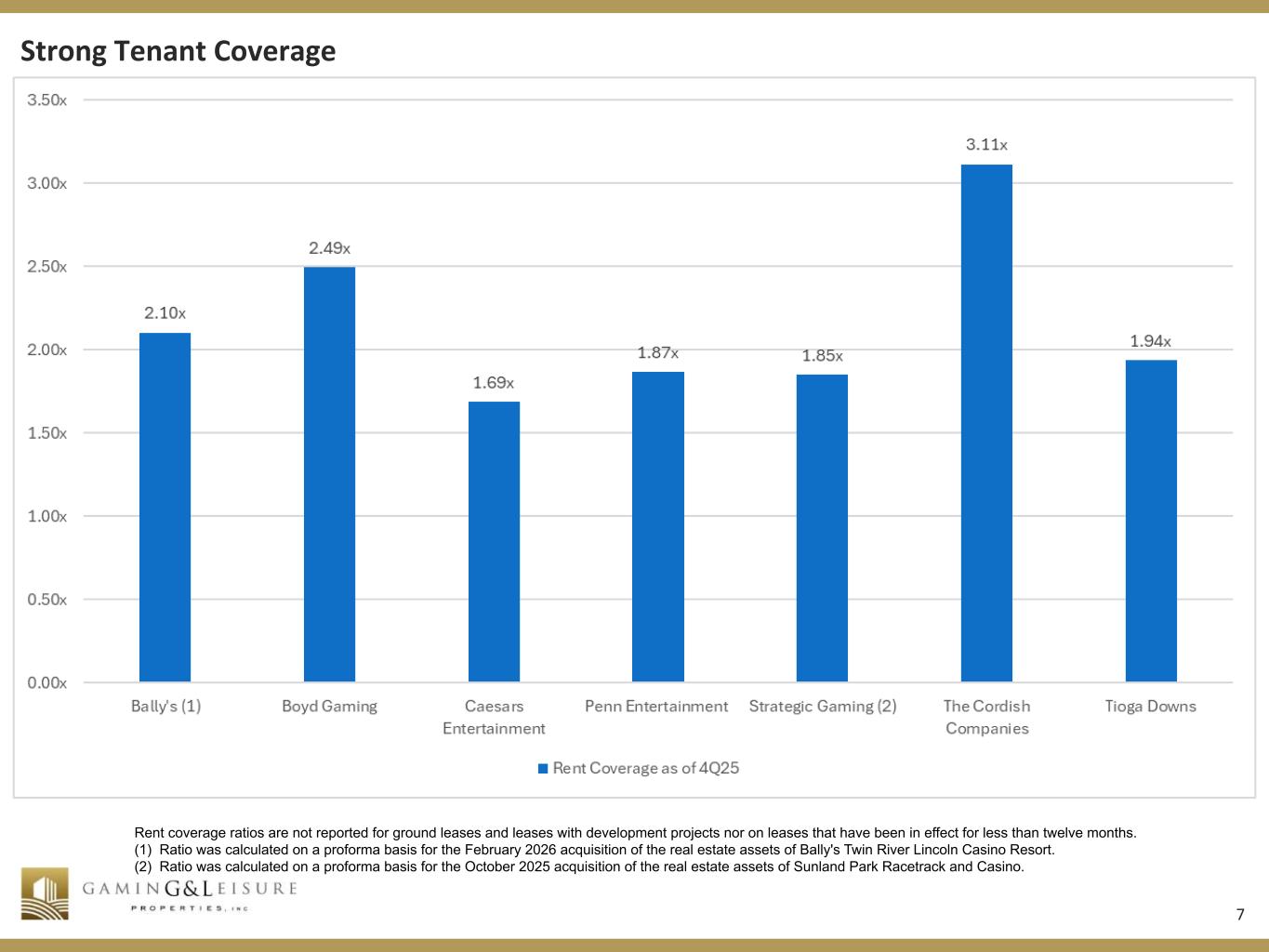
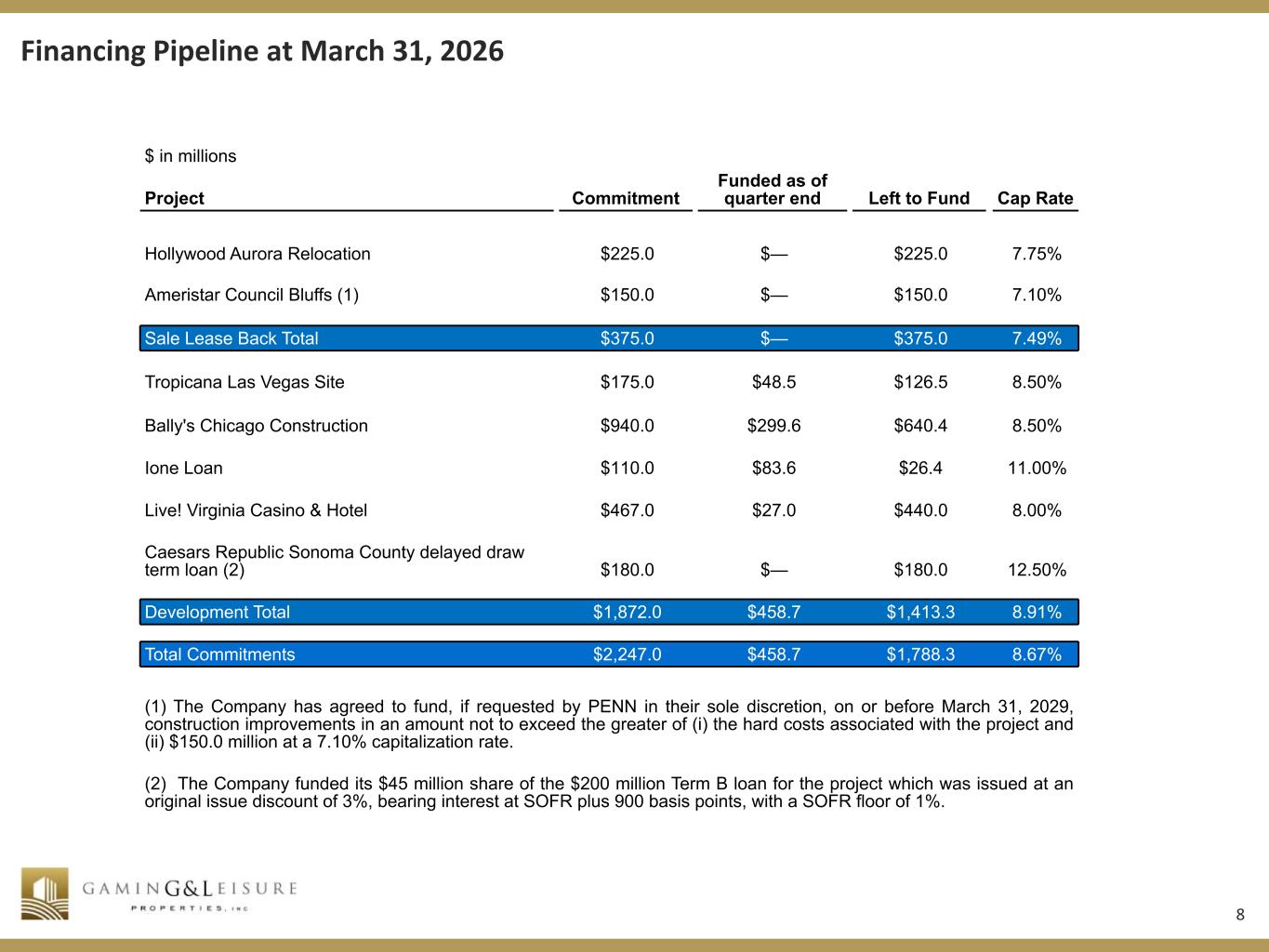
Well, thank you, Joe. Happy to be here this morning and always a lot more fun to make these calls when things are looking good. And we've had a terrific quarter. Our AFFO and AFFO per share both growing in mid to high single digits through this first quarter. And as we did, as we entered 2026, we sit in a very enviable position with a clear and well-documented line of sight toward a very healthy multi-year AFO growth, both in our acquisition and development pipelines. With the acquisition of Bally's Lincoln in February, as well as progress on several of our development projects, our future capital commitments stand at roughly $1.8 billion, nearly all of which we expect to deploy by year-end 2027. And despite what was a relatively challenging year in the regional gaming markets, 2026, as you've been seeing the earnings reports, are off to a very, very solid start. And our rent coverage remains strong with a vast majority of our leases covered at 1.8 times or higher. We feel pretty good about opportunity that exists in the market today. We remain pretty active and feel pretty well about our balance sheet. their ability to transaction in an accretive manner. As I've offered many times over the years, I would remind you that there is no transaction that we have to do. We are never pressured just to do something new. I used to say over at Penn National that our customers may be in the gambling business, but we are not. So our focus remains on thoughtful transaction, underwriting, careful capital deployment, looking always at the health of our balance sheet and continuing to position the company for multi-year AFFO and dividend growth. So with that, I'll turn this over to Des.
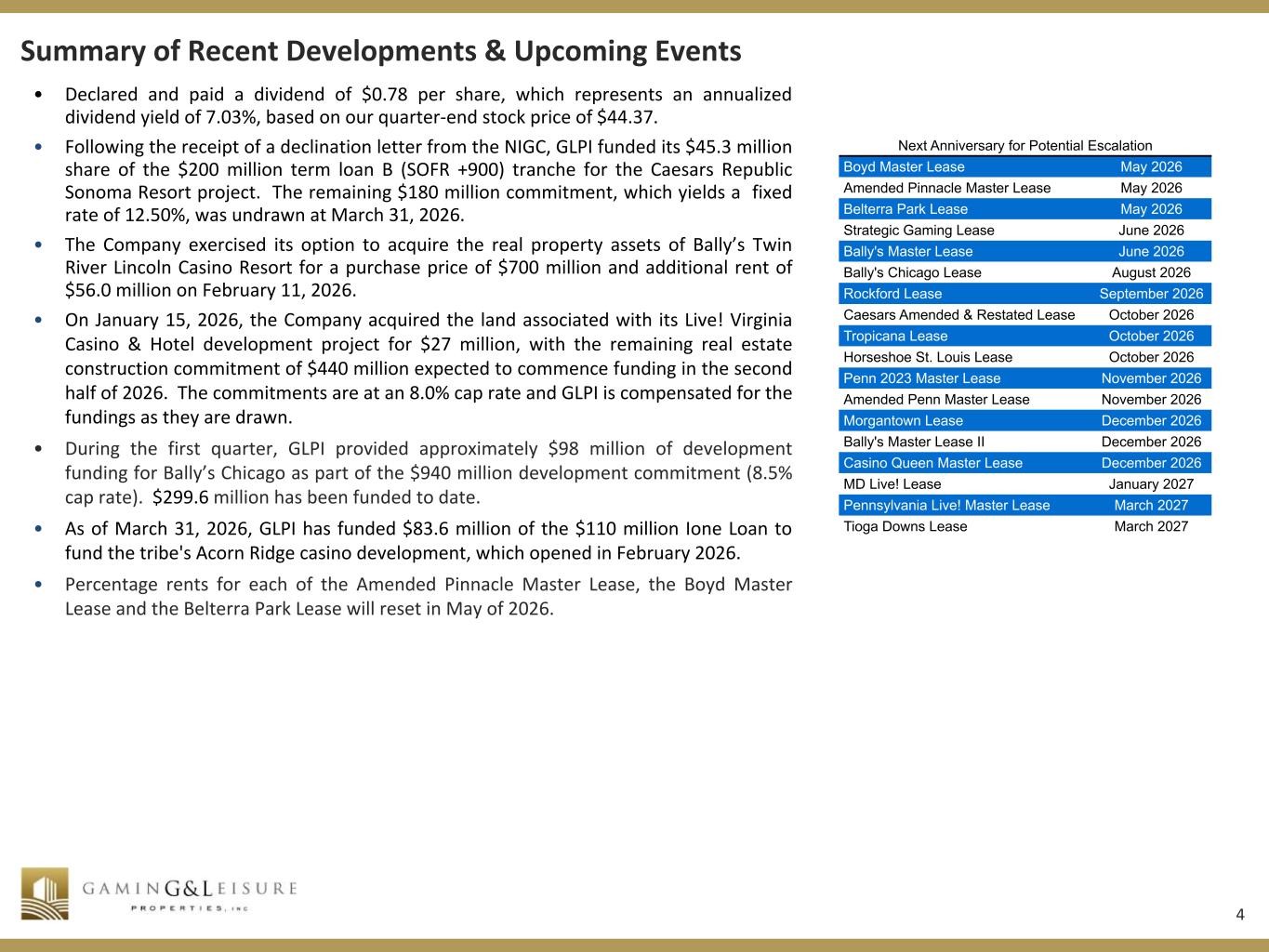
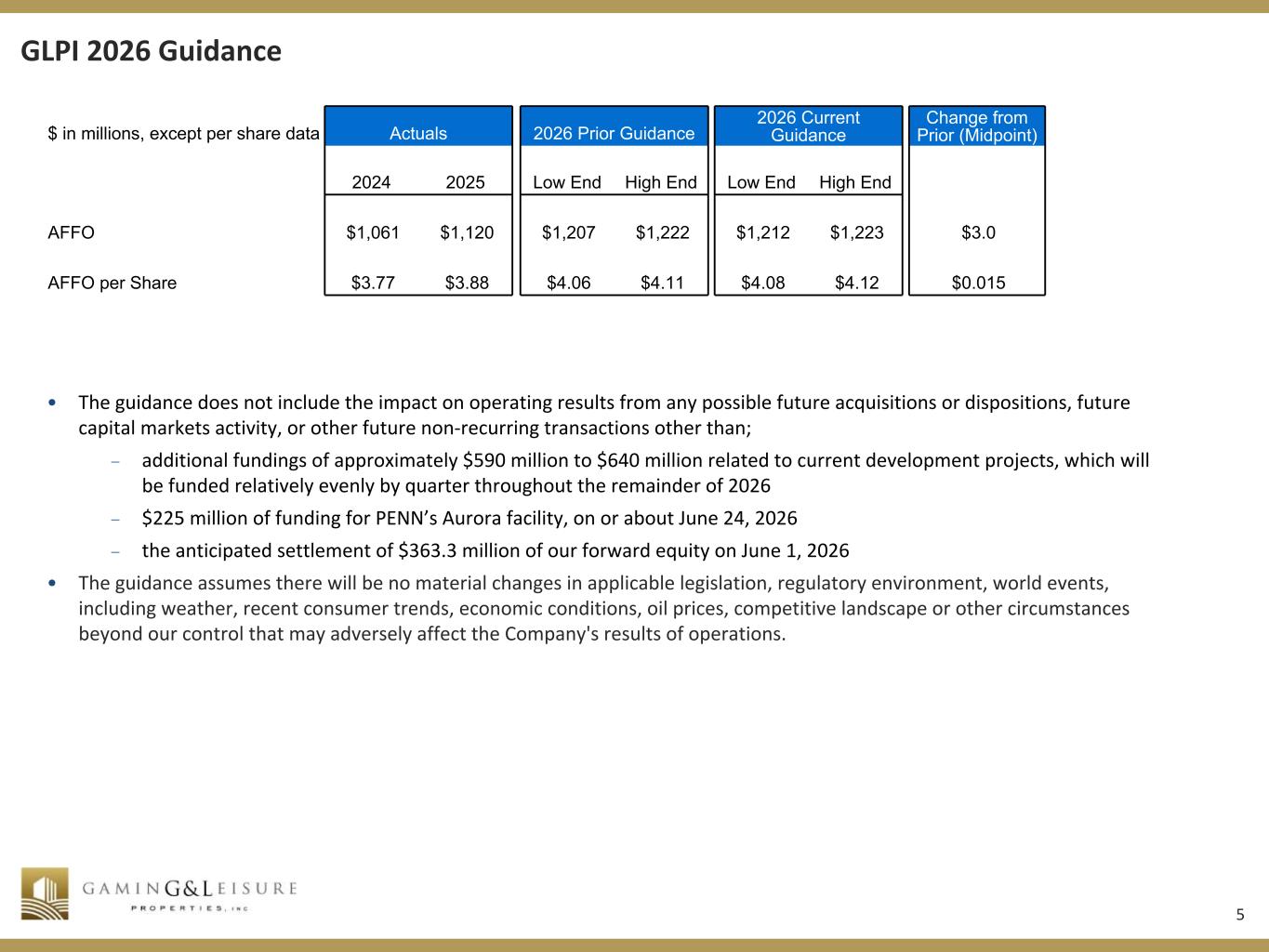
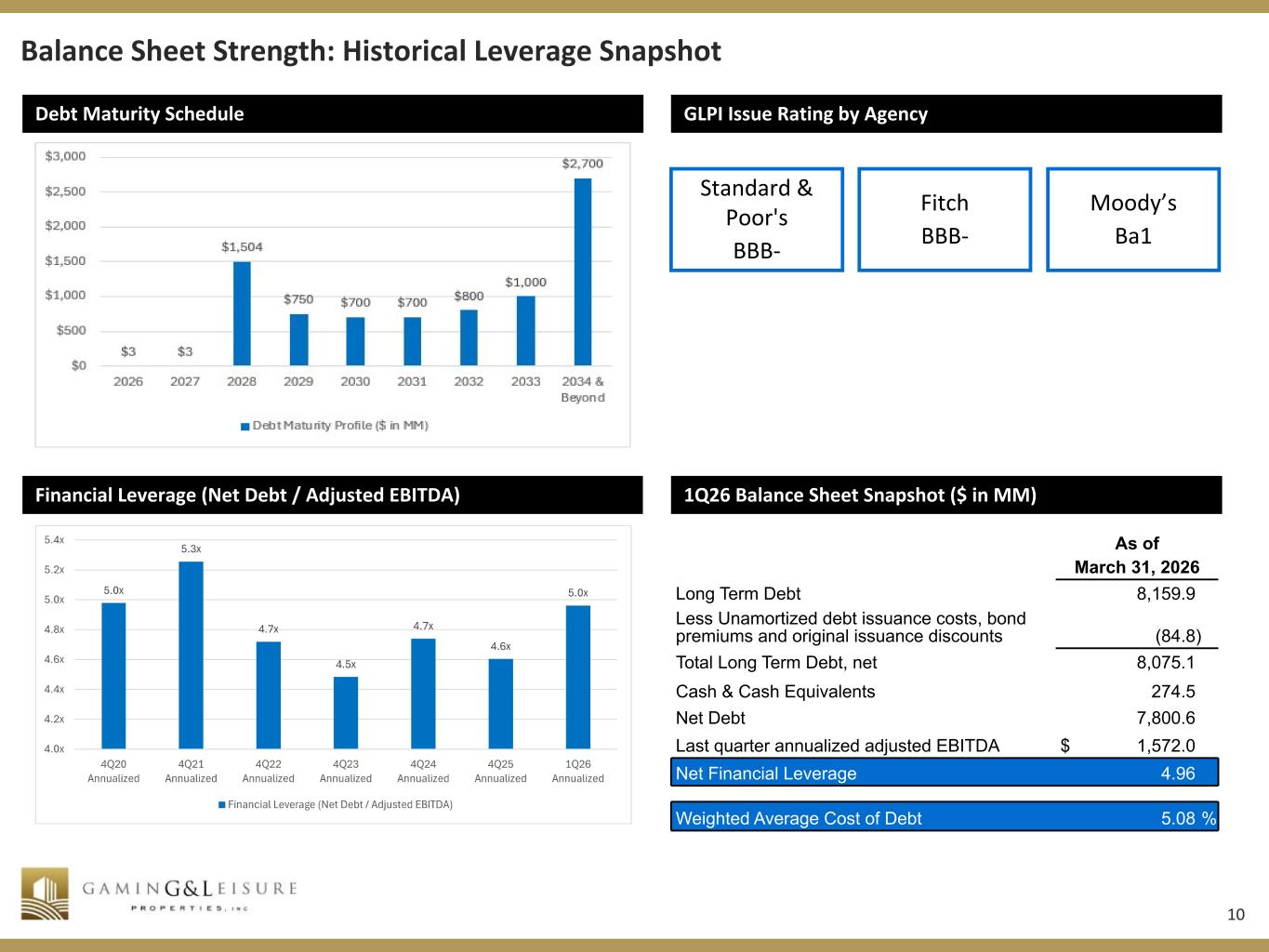
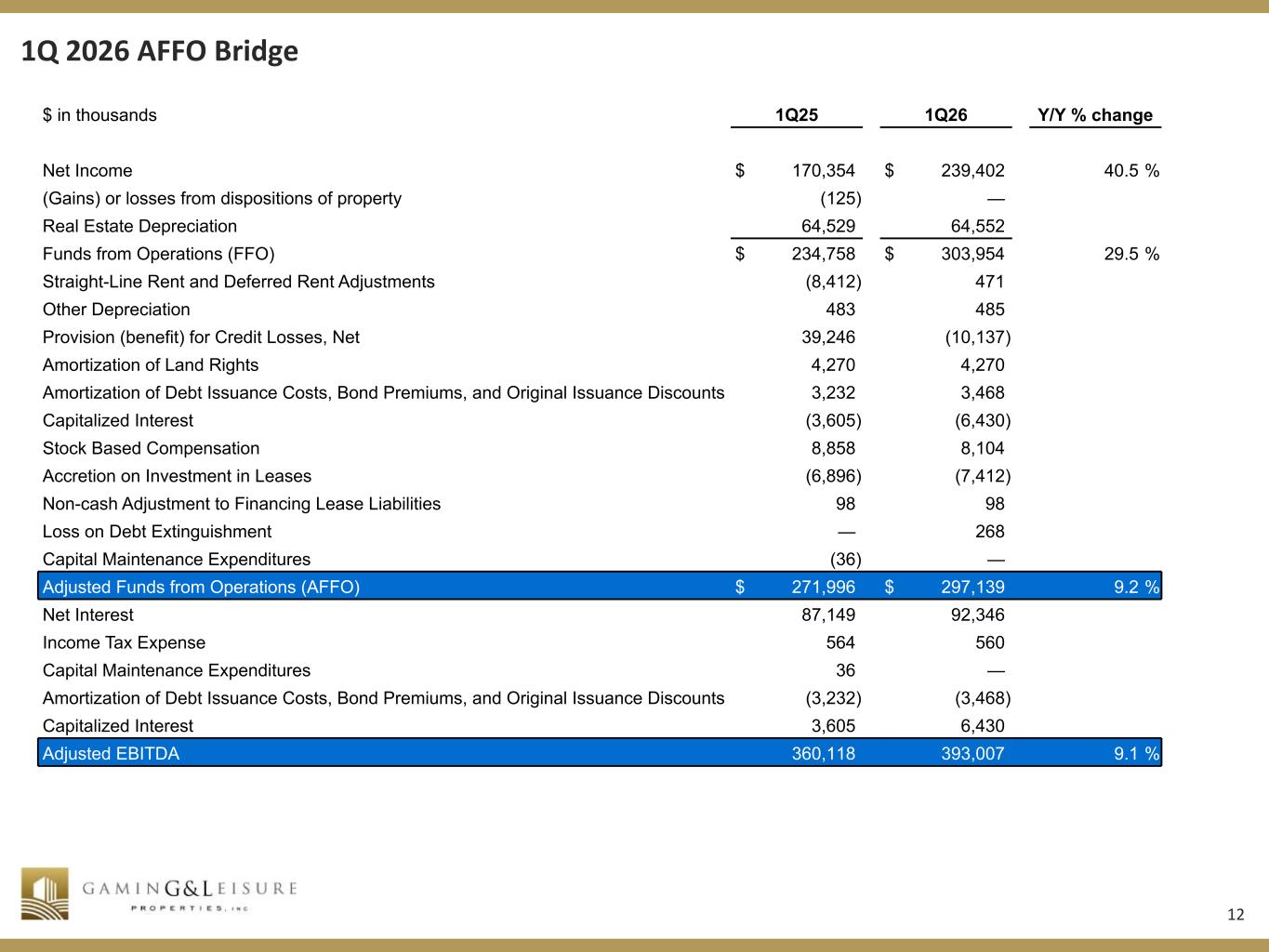
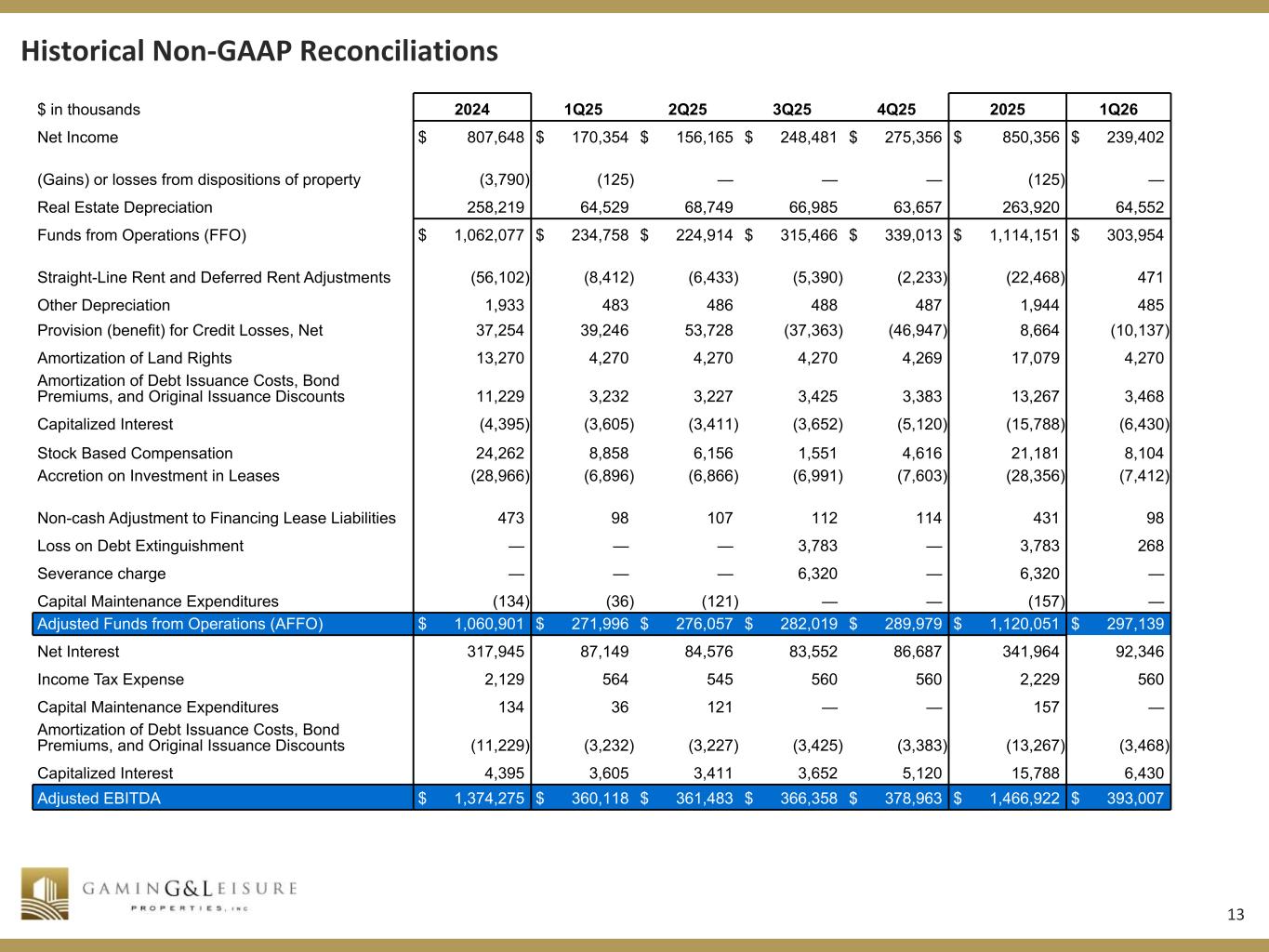
Thanks, Peter. For the first quarter of 26, our total income from real estate exceeded the first quarter of 25 by over $24 million. This growth was driven by approximately $33 million in cash rent increases resulting from acquisitions escalation. For Bally's, the acquisition of Bally's Lincoln real estate increased cash rent by $7.5 million. The Chicago lease increased cash income by $5.5 million. And the Bally's Baton Rouge development increased cash rent by $2.6 million. For Penn, the Joel Hinton M funding increased cash income by $5.4 million, the Sunland Park Act increased cash income by $3.8 million, the Dry Creek, IOWN, and Cordish, Virginia loans increased cash income by $3.5 million, and then the recognition of escalators and percentage rent adjustments on our leases added approximately $4.6 million. In addition, the combination of our non-cash revenue growth-ups, investment and lease adjustments, and straight-line rent adjustments partially offset these increases, resulting in a collective year-over-year decrease of $8 million for the non-cash items. Our operating expenses decreased by $49.8 million, mainly due to the non-cash adjustments in the provision for credit losses. Included in today's release is our full year 2026 AFFO guidance of between $1.212 billion and $1.223 billion, or $4.08 to $4.12 per diluted share in OP units. The guidance does not include the impact of future transactions, however, we did include additional development funding of approximately $590 to $640 million, which will be funded relatively even by quarter throughout the remainder of 26, bringing our total development spend between 750 to 800 million dollars for 2026 full year. The acquisition of PEMS Aurora facility for 225 million is also included in our guidance and we expect that late in the second quarter and the anticipated settlement of 363 million of our forward equity is also still expected on June first. From a balance sheet perspective, our leverage ratio is at five times at the low end of our target level. We are still under the impression that given our balance sheet position, our several-year runway to fund our development projects, and our annual free cash flow over that timeframe, we have optionality to fund our accretive commitments. As a reminder, our significant development projects do pay us cash rent upon funding, and with that I'll turn it back to Peter.
And with that, Alessia, operator, would you open the call to questions?
Operator
Thank you. We'll now be conducting a question and answer session. If you'd like to ask a question at this time, you may press star 1 from your telephone keypad and a confirmation tone to indicate your line is in the question queue. You may press star 2 if you'd like to withdraw your question from the queue. For participants using speaker equipment, it may be necessary to pick up your handset before pressing the star keys. One moment, please, for our first question. Thank you. And our first question is from the line of Anthony Pallone with J.P. Morgan. Please proceed with your questions.
Thanks. Maybe can you start with talking a bit more about what your investment pipeline does look like? How does it feel in terms of what you're seeing out there, yields, all those various dynamics?
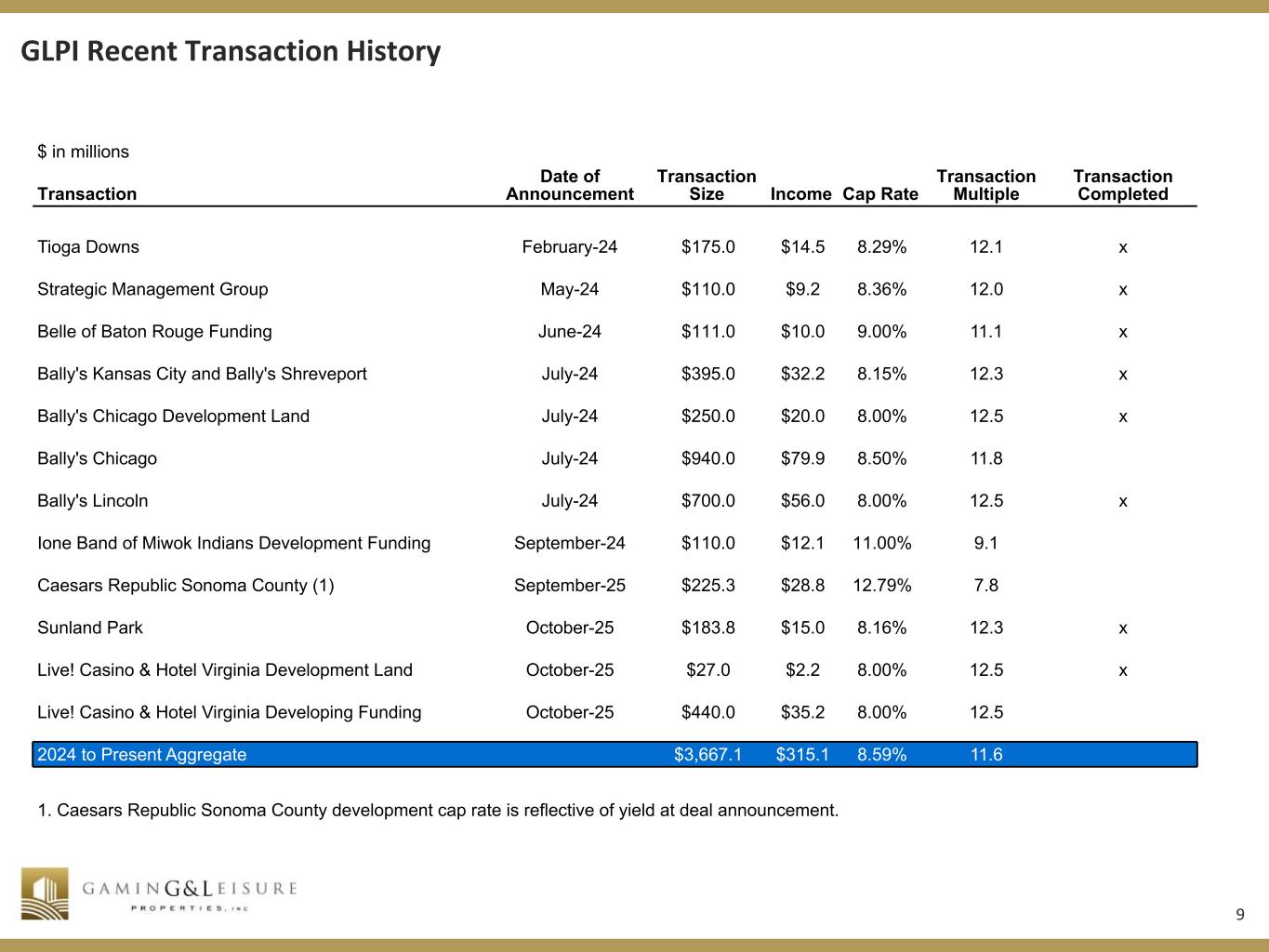
Well, the pipeline that is outlined, that has been disclosed, obviously, I think you're not talking about that. So assuming you're talking about what we're seeing behind the scenes that we've not yet announced, I'd say we're having a very active dialogue on a number of fronts. The marketplace continues to be very productive. I'd say it ranges from anything, the large-scale divestiture portfolios coming out of, whether it be strategic decisions or M&A type of processes, all the way through the tribal discussions we continue to have. So there are a number of fronts. There's very active dialogue. But I think as far as where we're at in the process, we're obviously not in position to be able to announce anything at this time. I will say from a cap rate perspective, since you brought that up, I think the market is normalizing. and normalizing in an area that's accretive to us. I don't think the 7.5% cap rates that have been previously printed in the not-so-distant past are indicative of what you will see going forward. I think the market has normalized some. I think credit markets continue to be somewhat turbulent for the gaming operators, And therefore, I think the realization of where cap rates probably play out for our benefit is more indicative of the 8% area that you saw Lincoln done and some of the other transactions we've announced more recently. Thanks.
And then just my second one, as we look to 26, is there a sense or can you give a sense as to which of the leases may not see bumps in 2026 because coverage falls below maybe the 1-8? I don't know if maybe if things are still rolling down before they turn the corner. Just trying to get a sense as to where we shouldn't assume a bump this year.
The only lease that we currently do not expect escalation on would be the Pinnacle lease. We do have percentage rent adjustments that are coming in on the Pinnacle lease, as well as a few other leases, and that should be a small decrease for 2026. I think we talked about that last quarter, it's below $4 million for a full year, but we would only see about half of that this year. And that is baked into our guidance, and that is just an estimate at this point.
Operator
Our next question is from the line of Ronald Camden with Morgan Stanley. Please receive your questions.
Jenny
Analyst — Morgan Stanley
Hey, good morning. This is Jenny on for Ron. Thanks for taking my question. The first on development funding, you raised your 2026 guidance to $750 to $800 million. Can you walk us through, like, what drives that increase and what projects may be moving faster than expected? Thank you.
So from a project perspective, we did raise the guidance, you're right, by $150 million on the high end for the full year. That's mainly due to our Chicago project where we have greater visibility and a clearer spend cadence as the project has progressed and the podium has topped off. It does not mean that we're changing timing of when we think these properties may open. It's just the timing of our spend is coming in quicker than what we had originally anticipated.
Perfect. I think the second one is...
Jenny, the only thing I'll add there is that in Chicago, they will be topping out both the podium and the tower next week. So pretty pleased with the progress there and still on track for the first half of 27 opening.
We're always happy about that. Putting money out that gets current interest is a happy experience. So that's a very positive event for us.
Jenny
Analyst — Morgan Stanley
That's exciting. I think the second question, maybe on Life, Virginia, I think you bought the land in the first quarter. Maybe talk a little bit more on when to expect the remaining funding to be started in the second half of 26, and just more details on that, the timing of funding and the first construction drone will be great.
I mean, that is included in our guidance, And that is included in the, you know, 590 to 640 for the remainder of the year. We haven't provided specific guidance on month by month by project. So I'm not exactly certain what else I can add to answer that question.
And, Jenny, just as a reminder, the structure that we have for the Cordish deal is a little bit different than we had for the Chicago transaction and our other development projects where the Cordish equity dollars are all being spent first. So I think we'll get better visibility into this as the Cordish money goes in and the development gets underway.
Jenny
Analyst — Morgan Stanley
Okay, sounds good.
Thanks for taking my question.
Operator
The next question is from the line of Steve Pizella with Deutsche Bank. Please receive your questions.
Hey, good morning, everyone, and thank you for taking our questions. First, obviously there's a lot in the pipeline that you covered, but can you share your insights into some of the performance of the recent development openings?
Steve, you know, look, obviously, it's been pretty productive here over the last, you know, six to even 12 months. You go all the way back to Hollywood Joliet, you know, as you heard from Penn yesterday. I think they're very pleased with the early returns there, clearly been incredibly additive relative to the prior facility. You know, live Petersburg, the Cordish development in Virginia opened on January 22nd. That has been incredibly strong, doing, you know, a little bit over $15 million a month in each of the two months that that's been open. So I think from an indication standpoint, clearly, you know, shaping up to be a very good market for that permanent development. The other project that, you know, we opened from a development standpoint in December of 25 was Bally's Baton Rouge. I think the story there is very much the same. when you look at kind of the progress relative to the old boat, I think the key there is what we're seeing is market expand fairly nicely and Baton Rouge is driven by that new supply and some of that, you know, incremental investment. So I think, you know, those things in general, those data points give us a lot of comfort for some of the things that we're doing on a go-forward basis here.
Okay, very helpful. Thank you. And then, oh, go ahead.
Oh, yeah, and as Peter just mentioned, you know, obviously, if you listened to Penn's call yesterday, I know you did, you know, the hotel expansion at M has been very well received. Obviously, they're outperforming in that market and appear to be taking some share due to that expansion in capital investment.
Yeah, I'll also add we opened in February our first tribal investment with Ione, which had a very strong opening, and that appears to have grown that market. So I think we're very positively inclined with the first set of development projects that have come online and the general performance out of those facilities.
Okay, great. Very helpful. And then just a bigger picture question, if I may. How do you value your protections and the long-term relevance of the site versus the potential free cash flow of an asset or the free cash flow conversion?
Sorry, Steve. I think you might have cut out for a little bit there. Could you just repeat that?
Just asking how do you value the location of the real estate compared to, like, your protections and the long-term relevance of a site versus the potential free cash flow of an asset or the free cash flow conversion?
We really do value it on a free cash flow basis. You know, we look at, you know, the competition in that location, drive times, whatnot, how we think that location will perform over the long run and what kind of risks there are in the future. and then we derive what we think the fair coverage would be on a property and it's all cash flow generated rather than value of land and building. I don't know if that exactly answers your question but.
I think the location helps you get better visibility into the cash flow right so as Desiree said we're valuing off a cash flow the location can because of these things are licensed and fairly sticky, the location isn't like a CVS where you can move across the street. So we do focus on the location, but as Desiree said, really focused on valuing the cash flow.
Operator
Our next question is from the line of John Kulchowski with Wells Fargo. Who's to see with your questions?
Hi. Good morning out there. Thank you very much. And I'd like to start, Peter, it's good to have you back. Hope your back is feeling better. My first question is on the Caesars Master Lease 2. You know, it had a pretty sizable move down in coverage this quarter. I was wondering if you can give us any color on what's going on with those assets and maybe if you're seeing any green shoots there that might show a bottoming in coverage, you know, for the rest of the year.
Yeah, John, this is Carlo. I think you might have conflated two things. The Caesars Master Lease or Bally's Master Lease 2. I think if you're asking about Bally's, you know, we pointed out at the time of the Twin River Lincoln acquisition that the pro forma coverage for that lease was going to be a very robust 2.2 times after the addition of Lincoln. With respect to Caesars, yes, the master lease with Caesars coverage went to 1.59 in the quarter. It's still a very fine, solid coverage in our view. We've long had a very strong relationship with Caesars management. There were certainly some items in the fourth quarter that I think did negatively impact results, some hold in Atlantic City, also, you know, West Tower room renovations at a property there as well for them. So, you know, I think we feel pretty good that we have our hands around that situation.
And as I said, you know, at almost 1.6 times, it's a pretty solid coverage. thanks carlo and i i was complaining to you so i appreciate you breaking those out for me um and then my second one is just on the city of chicago is talking about moving ahead with video gambling and bally's has mentioned an impact to the business i'm curious on your thoughts on how that may impact bally chicago around rent or coverage well we did underwrite the vlt um possibility in chicago so you know it does definitely impact rent coverage but it was underwritten in us determining the 940 million that we were willing to provide
to Bally's for that project. I can't give you exact numbers as to how it will impact, but certainly the VLT legislation should have an impact if it does go through. They are hearing different things about sweepstakes, Brandon. I don't know if you wanted to add anything on that.
Yeah, all the sweepstakes stuff is definitely impacts. I mean, I think the point in sweepstakes is there's a pretty robust sweepstakes market going on in Cook County today. So the question of whether or not VGTs are going to have a significant impact on bricks and mortar gaming is somewhat open. We know we'll have some impact. And as Desiree said, we underwrote this as if VGTs were in Cook County. And we also, for that matter, underwrote as if Hawthorne had a full gaming facility. So our underwriting in Chicago is fairly conservative. And while we would prefer VGTs not to be in Cook County, we don't view that as being overly adverse to our underwriting with that project, if it should come.
Operator
Our next question is from the line of Greg McGinnis with Scotiabank. Pleased to see you with your questions.
Hey, good morning. Just given some of the challenges that we've seen across gaming this year. Firstly, how do you see operators responding? You know, what are your thoughts on rent coverage in 2026? And secondly, does it change the nature of the conversations that you're having with, you know, casino owners in terms of types of deals that they're looking for?
Greg, thanks for the question. I mean, I think we could start with, you know, we've been incredibly encouraged with what we've seen in the first four months across the regional gaming footprint this year. I think you saw yesterday very solid earnings from Penn, very solid earnings from Boyd in their Midwest and South region. Churchill earlier in the week, also solid. So I think what we're seeing from a regional perspective has been encouraging after, I think, a malaise over 2025 as the industry more or less digested very strong both margin and top-line comparisons, and, you know, we certainly saw that period more or less curb rent coverages a little bit. So I think, you know, our rent coverages are still in incredibly solid place, and we do believe what we've seen early in this year is incredibly encouraging in terms of the progress regional gaming is making. I'm sorry, I think there was a second part to your question.
And yeah, curious on how, you know, if that's had any influence on the types of conversations that you're having with casino owners, developers, folks looking to make investments, that kind I think the average...
Yeah, look, I think the one thing that's at least been more appearing to us is that the operators, developers, et cetera, who would be paying the rent have been significantly more focused on ensuring that they have a level of cushion and a higher rent coverage starting out of the gate. So I think whereby the market in the past may have been a little more nonchalant with respect to their starting point on a rent coverage basis, I think due to some of the struggles that have taken place in things like Maverick. You've seen that portfolios and pieces of portfolios that have been leased that had extra cushion on the rent coverage side have retained value for the owners, whereas the assets that have significantly lower coverage have struggled to redeem the same type of credit recovery. So I think folks are focused on starting with higher rank coverage out of the box.
Operator
Our next question is from the line of Brad Heffer with RBC Capital Markets. Pleasure to see you with your questions.
Yeah. Hey, good morning, everyone. There's been a lot of investor concern about the rise of prediction markets and the impact on gaming. How do you guys view that? And is that something that you think about when you're underwriting new projects?
I think prediction markets in underwriting, we lump in with iGaming, I would say we view it similarly. I think, obviously, iGaming has got a more specific path and traction through the state regulation than the predictive markets, which at a federal level, on a state level, are completely unregulated and at a federal level, I will say lightly regulated at best. I think that there are a lot of challenges to the prediction markets right now. And while I won't tell you we're not concerned about the prediction markets, I don't think we're overly concerned about the prediction markets at the moment. given the challenges. And the fact that, look, there was iGaming legislation, I think, in nine different states, maybe a couple more, but nine that we were sort of actively monitoring this session. And it really doesn't look like any of them are going to pass, including Illinois and New York. You know, they're still alive, but they don't look promising. Colorado may be the one that's a little bit more open. But the point being, I don't think the proliferation of iGaming is going to accelerate this session, which I think is good for us overall. And I think the predictive markets, we'll have to wait and see. We're keeping a close eye on it, but I wouldn't say we're overly concerned at the moment.
Okay. Got it. Thank you for that. And then on Rockford, obviously that loan's coming up for the initial maturity date soon. Do you expect that to be extended? And then what do you think happens ultimately at expiration there? Do you think it just gets paid off or maybe converted into ownership of the improvements?
Rockford, we've obviously begun discussions with those, but we haven't made a final determination as to what we're going to do with that loan at this point.
Thank you. Our next question is from the line of Smeeds Rose with Citi.
Operator
Please receive your questions.
Hi, thanks. I wanted to ask you, there's been a lot of, obviously, discussion in the media about seizures potentially going private, and then that's led to various discussions around changes that might happen at the corporate level with that company. And I'm just wondering, just in terms of your leases, could you just maybe talk about how, I guess, sort of durable they are in terms of, you know, do they attach going forward or are they easy to, well, not easy, but could they sort of be gotten out of, if you will, if someone wanted to do that?
Yeah, good morning, Smead. You know, I think it depends on the structure of the transaction. So, overall, generally speaking, our leases do have a concept in them of a discretionary or qualified transferee. If you've looked at the leases that we have publicly available, but most of our leases all have the same concept, in which case it's possible that a transaction could be structured where GLPI would not have a consent right to it. That being said, there are a number of different things that have to be true for that to be the case, and I don't think we have enough visibility into the potential structure of that transaction to ultimately determine whether or not a consent will be required from GLPI. Clearly, if it is, we'll do what's in the best interest of our shareholders in evaluating that. But at the moment, we don't have enough information. I think our conversations with Caesars on this topic have been relatively few, but we have a close relationship with that management team. And if that transaction does go through and that management team survives, I think overall we view that as a neutral transaction to us. could be positive if there are things that fall out of it, but I don't think we're overly concerned about it. But the impact on our lease is, I would say, is TBD at the moment.
Okay, okay, fair enough. I just wanted to ask you bigger picture, too. Just in general, you mentioned you started out the call talking about, you know, you're in active dialogue across a number of different opportunities. Do you feel like, you know, owners who you're speaking with have other sources of capital that are readily available to them, or do you think that's become more scarce like over the last several quarters in terms of either direct competitors to you or maybe just more traditional regional bank lending and things like that?
Look, I think there's the haves and the have-nots, right? To be totally honest and candid, there are certain parties that I think would probably struggle to find inexpensive capital that would be easily accessible based on their circumstances, whether it be their leverage or their operational profile, or maybe even just the fact that they're very small or only have one or two assets. It's harder to get larger banks to finance those types of endeavors. Some of the transactions, though, to be totally candid, the larger operators, even the private ones that are larger, family-owned, et cetera, they have plenty of access to capital. It really comes down to broader decision-making and whether it's a strategic fit to do a sale lease back versus to do a traditional bank loan or bond or what have you. So, the dialogue depends on the counterparty, and some of the counterparties definitely have access to capital and others do not.
Operator
Our next questions are from the line of Barry Jonas with Truist Securities. Pleased to see you with your questions.
Good morning. Peter, great to have you back. I hope that back is better.
Well, it's a process, Barry, but we're back. I don't recommend back surgery to anybody, by the way.
We'll follow that. I want to start with Bally's. you know, they appear to be looking to do a bit more M&A, including a large deal internationally. So maybe more as it relates to corporate guarantee, does that influence how you think about future deals and underwriting with them?
I don't think, I think our answer is unchanged in the sense that we have always underwritten deals at the property level. And if that at least had a great transaction for a property level asset that we thought was accretive to us and our shareholders. I don't think we'd let Valley's work in international work dissuade us from that. That being said, clearly that's another capital allocation decision that they've made with the various projects they have in place. And I guess our focus is more on what, if any, impact does that have on the projects that we have with Valleys and their ability to execute on those. And at the moment, we're not concerned with Valley's ability to fund and complete Chicago, ago, for example. But I think it's more impactful in that way than it is on the overall risk as we look at sort of more property-level performance.
Understood. And then just for a follow-up, you know, I appreciate the general comments on the pipeline. But any updated thoughts in terms of international or non-gaming opportunities and where that ranks in terms of the opportunity set?
Well, I'll take international and somebody else will take non-gaming. So on the international front, we have had conversations around international properties as recently as this last quarter. But, you know, as we've said many quarters in the past on these calls, there's always a tax implication aspect of it. There's a repatriation implication aspect of it. And there's just the legal and customs aspect that we have to get comfortable with, depending on the jurisdiction that we're looking at the domiciled business in. So we continue to look there. I would love to tell you that we could get comfortable and get something done in international capacity, non-Canada, just because that seems to be where others have gone. and so I'd like to do some new cutting-edge thing somewhere else, but I'm not willing to tell you that I think that's coming anytime soon. So we're going to keep working. We'll keep trying to do our diligence and try to look for opportunities that would equate to an accretive transaction for us here in the United States when we bring all the money back and pay all the taxes.
By the way, that answer is a perfect response to the non-game as well. So we look at a lot of stuff. As I like to say, we kiss a lot of frogs, but we're still looking for a princess in that category.
Great. Thanks, guys. Great. Thanks, guys.
Operator
Our next questions are from the line of Todd Thomas with E-Bank Capital Markets. Please receive your question.
Yeah. Hi. Thanks. Good morning. Brandon, can you just talk a little bit more about the, you know, normalizing cap rates that you discussed? What's driving that specifically? And from your comments, it sounded like it was about 50 basis points. I mean, is that sort of the right range to kind of quantify the change that you're seeing in cap rate expansion?
Well, I'll let Steve, I believe, answered that the first time. I will say I think what's led to the normalizing of cap rates, what Steve is referencing is obviously we have a lot of data points behind the scenes of things that are coming to fruition. And this happens all the time where things bubble up to the surface where people are interested in understanding the valuation of what they have. And I think Steve's pointed, and he can make it again, but it's just that those cap rates we're seeing are beginning to tighten in a range, and we think we have a pretty good feel of where the right cap rate is for transactions. And I say that at least the cap rate that we'd be willing to execute on transactions. But Steve, I don't know.
Yeah, yeah, I'm sorry. I wasn't trying to peg a 50 basis point number out there. I don't think it's as precise as that, to be honest with you. Each transaction is a negotiation. You're sitting across from a counterparty and you're trying to figure out what makes sense for you and what makes sense for them and what's their need and what's your desire, and it all has to kind of go into the blender. My point was, I think if you were to say, what do I think the average market-clearing regional gaming asset sale-leaseback on a regular way down the middle of the fairway transaction is going to go for right now? I think it's going to have an 8 in front of it. It's not going to have a 7 in front of it. I'm not trying to be more specific than that as far as 50 basis points or 62.5. But I think the reality is that's just kind of where the market's trended at the moment. It doesn't mean that it can't pivot on a dime and six months from now we're telling you the market's moved again. But we would obviously anticipate and hope that our cap rate where we trade, our implied cap rate, would would grind tighter as well as the market then grinding tighter at that point. So where we're at today, I think from a cost of capital, spread it where we're at. I think, you know, we're comfortable that the market is probably yielding any eights.
OK, that's helpful clarification. And then, Desiree, I had a question about the guidance adjustment. You know, the nominal AFFL was increased about $30 million at the midpoint, I think, mostly at the low end. But, you know, it looked like it was a little more than it would seem to be due to the higher capital deployment on its own. And you talked about Chicago, but, you know, I was just curious if there was, you know, if there were some other changes around either earlier cadence of funding that had an impact or something else altogether. You know, can you just talk about some of the changes there around the guidance specifically?
Sure. So, really, it is mainly due to the funding changes because that's going to increase, obviously, their income. That's going to have an offsetting impact in our interest income. On the high end, we did see some increase in SOFR rates, obviously, this quarter, so that some of the benefit gets eaten up by the SOFR rate assumptions in the high end of our guidance that we had already had a little bit of additional interest expense put into the low end of our guidance, so that's why you're not seeing an even change. I will also tell you there's some rounding involved because the stronger the round is coming into the guidance, you know, it takes a lot less AFFO to increase that per share amount.
Okay. That's helpful. Did anything change there in terms of GNA and the stock-based comp component? Did anything change there with regard to the mix as far as the reconciliation there? Okay. Okay.
All right. Thank you. All right. Thank you.
Operator
Our next question is from the line of Handel St. Just with Miseo Securities. Pleased to see you through questions.
Hey, guys. Thanks for taking my question. Desiree, can you talk a bit more about the positioning of the balance sheet in the current macro, lots of, obviously, volatility. You've got $1.8 billion of capital deployment you've outlined over the next 18 months. Leverage today is at the low end of your target range, but looks like it would be at the high end on a pro forma basis. So are you willing to let leverage stick up? How are you thinking about balance sheet management over the next 18 months and perhaps the need for new equity. Thank you.
Sure. So, you know, we sit here today with $275 million cash that has not been deployed into that run rate of five times, right? So as that, you know, becomes income earning, the leverage ratio will not increase for that portion or for the $363 million of forward equity that we have outstanding. We also have free cash flow and to the tune of $230 million or so per year. So we have a majority of that still coming for this year. And then, you know, the rest, as we said, we can do either debt or equity depending on what we expect to do. But I still expect us to be at the end of this when all of our transactions are completed, the remaining $1.8 billion is funded, we get full credit for the ASFO that those transactions derive. We'll still be at the low end of our five to five and a half times guidance, or leverage, sorry.
Got it, got it. I appreciate that. And then more broadly, the growth for this year is mid-single-digit. I think next year is kind of the same. Is this something you think is sustainable beyond the next 18 months? I'm curious how you're thinking about the sustainability of the long-term cash flow growth from the portfolio here. and if the next two years are more of an aberration or something you feel you can sustain over the longer term. Thanks.
So, you know, look, I can clearly see through 27 and see the growth there just as you can. 28 and beyond depends on which transactions that we come up with over the next year or two. We certainly will have growth related to escalation on our transactions. But, you know, outside of that, until we do an accretive transaction, I can't really predict 2028 and beyond.
Fair enough. Appreciate the time.
Operator
The next questions are from the line of Rich Hightower with Barclays. Please proceed with your questions.
Hey, good morning, guys. Thanks for taking the questions here. So I want to go back to Smeeds' question on the potential teasers deal and how it might affect GLPI. You know, there's obviously a parent guarantee in place on your master lease, And I appreciate the idea that it's really four-wall coverage that's the primary focus in any scenario. But, you know, what's your legal understanding of the ability of the parent guarantee to travel with the lease under a variety of potential deal structures? And how should we think about that from the outside?
I think you should think of it as the parent guarantee being one of the requirements that has to be in place for us to be forced to take a new tenant. In other words, in order to meet the definition of a qualified or discretionary transferee, certain things have to be true with respect to the transferee, but also with the transaction, including the pro forma leverage and the existence of a replacement parent guarantee. So, again, I don't think we know enough about the anticipated structure of that transaction in order to determine whether or not, for example, the parent guarantee is at an entity level that would meet our lease requirements and be acceptable to us. We just don't know yet. But you should assume that that does, in fact, travel with the next tenant.
Okay, that's really helpful. I guess more broadly, and maybe it relates to the cap rate comment as well, but are you seeing, and I'll use the Bally's New York project as an example here, But are you seeing other sort of, you know, previously competitive capital providers? And I'm really thinking of sort of the private credit universe that appears to be having its own, you know, issues in various ways. Are you seeing those potential competitors pull back from the market? Does that imply anything about GLPI's ability to step in as a capital provider to a project like that or any other development going on? and does that affect market pricing for the capital as well? Thanks.
Sure. I'll give it a shot. To date, we haven't seen the private credit type of folks pulling away. Now, I can't speak to their ability to show up at the finish line, but I can just tell you at the early onset, they seem to be just as much engaged and participating as anybody else. So I don't think there's a huge seismic shift in the competitive landscape. There are not new folks seemingly pouring in. So it's the same handful of people are looking at transactions. I think it all kind of goes back to relationships at the end of the day and underwriting. And so they're kind of both critically important and they work together you can you can obviously have successful underwriting and maybe not the greatest relationship but that just means you did a transaction and conversely you have a great relationship and poor underwriting and then you have a friend that is is not doing so great and neither you so I think we we continue to try to operate in a position where we hope to be everyone's first call if there's something they're looking to do or something they're trying to be creative around and then we look to try to make sure we overlay our our underwriting success with that and and so so far it's worked out well for us i think continue it will continue to have us at least have a seat at every table whether we whether
it plays out uh the way we want it to or not is is yet to be seen well and i think in new york you kind of picked out the one unique animal in the bunch which is that that is a unique market that It has a lot of interest to people that want to have a piece of that. So I think Bally's is in an enviable position in New York where they're having a lot of different capital sources to discuss and talk to. Whether or not we have an opportunity there for a piece of that will be relationship-driven more than economically driven, I suspect. But I don't think we're doing it at a cap rate that's any lower than what Steve has indicated because, quite frankly, that wouldn't be accreted to us and not a smart use of our capital. So we'll see how New York plays out. I think that's somewhat unique. There may be several layers of opportunity there, to say the least.
And we expect at least to be at the table, as Steve and Brandon have well outlined. Four billion opportunities in New York.
Some of it should follow.
Got it. I also appreciate the hat trick in terms of management's responses from all three of you.
Operator
Next questions are from the line of Chris Darling with Green Street. Please receive your questions.
Hey, thanks. Good morning. So with Acorn Ridge now open, I'm wondering if you've had any discussion around the conversion of the loan into a formal lease structure. And then separately, whether it's Acorn Ridge or any other tribal investment, can you talk about your level of visibility into the underlying financial performance of those properties and sort of the regular cadence of any updates you might get?
It has a term, right? So the Acorn Ridge loan has a five-year term with, I think it's two six-month extensions. So we're not in discussions about converting it to ultimately to a lease at this point. As far as performance goes, we do get quarterly certifications, which will include coverage ratios at least as far as how it's going to cover the rent. In this case, it's interest. So we're really just going to be looking at the AFFO vis-a-vis what interest payments we have as far as the stability of the operations of the project. But we will get information on a quarterly basis.
And I think that with respect to Acorn Bridge, we have dialogue with the chairwoman there. And, you know, she's very level-headed with respect to this and said, like, look, let's get six months of operations under our belt. And then as a tribe, we'll start to kind of reevaluate what we want to do as far as future capital spend or financing markets, et cetera. So we're cheering them on and anxiously awaiting future dialogue.
Okay, that's helpful. And then maybe taking a step back more broadly, as you think about underwriting new investments in the tribal space, are there any jurisdictions that are more or less attractive to you? I'm curious how you think about that.
I think different jurisdictions lead to different opportunities. And by that, I mean in a jurisdiction like California, you have a very large number of tribes. And the opportunity for expansion, what you're seeing in California is, despite the fact that there are a lot of tribal casinos, the tribal casinos opening appear to be growing the markets that they're in. So there's a lot of opportunity in California just given the sheer size. And California doesn't have, with their compacts, a very stringent taxing regime. So even when the tribes enter into compacts, they're not paying a lot of tax. In other states, you know, they're paying more tax and have different compacts. And so I think just sheer numbers, California, New York has some tribes, the Midwest has several tribes, Oklahoma. I'd say it's more relationship-driven at this point. and we're looking at tribal needs and trying to figure out which transactions best suit our underwriting. I will say there are a lot of opportunities. We're getting a lot of inbounds. We're getting a lot of questions around what we can offer, and so we'll have a lot. We have a lot to digest. We'll continue to get a lot to digest, I think, this year and try to figure out how much capital we want to allocate to this form of financing and where. But I don't think it's necessarily driven by state lines, per se. It's just more the number of tribes in different areas is obviously a lot different in California than, for example, Alabama, which has one tribe.
All right. Understood. Thank you for the time.
Operator
The next questions are from the line of Daniel Gutselmo with Capital One Securities. Hi, everyone.
Operator
Thank you for taking my question. Just one from me. do you all have a minimum dollar size for redevelopment projects that you'd be willing to fund? It feels like operator CapEx budgets are down for 26 versus 25, but improving properties has been working, so we're curious if smaller, less invasive projects at more properties are coming.
Daniel, just to clarify, do you mean this is a capital improvement project at an asset we already own?
I don't think there's any number. We would fund down to whatever the tenant needs, assuming that it's a project that they think will be accretive to them and will generate pro forma business for them that surpasses the cost of our capital. So I think we would look to be supportive of the tenant in any of these opportunities.
Operator
The next question is from the line of Chad Venian with McClary. Please just use your question.
Hi, good morning. Thanks for taking my question. You guys have clearly differentiated yourself with more of a drive-to regional focus versus destination. And we've talked about it a couple times on the call, how strong the regional market has been year to date. Some operators actually improving margins, which we haven't seen for a few years. So, does this vindication or validation in your thesis maybe dissuade you into leaning in, kind of back into Las Vegas, you know, beyond the TROP site and really just kind of doubling down in your current thesis and drive-to in regionals?
You know, I don't think we ever were leaning into Las Vegas. I mean, and it has been well said. And we look at these projects one at a time, almost location not critical. But we have no special focus on Las Vegas at all. Look, I've been an enthusiast for the regional market for 20 years and trying to make the case that it's the better place to be, safest place to put capital by far. I think we've demonstrated that, and a lot of events and recent events in Las Vegas highlight that where we put our capital makes a lot more sense. Chad, I think it's – I'll go ahead, Desiree.
No, you can. Chad, I think it's – I think, as always, it's the strength of the cash flows. It's not the building. It's not necessarily the geography. It's the strength and safety of the cash flows. And I think if you look over time, acknowledging, you know, we don't share an upside any more than just the escalators we receive for a well-covered lease, you know, the regional business has provided a lot of stability. And, you know, if you look back over the last few years, you've come off of very solid peaks. And, you know, as you mentioned, first quarter has been a very nice indicator that things are strengthening here again.
And I would add, you know, we've been saying this for a long time, but even back at Penn and our Penn days in 2008, the financial crisis, our properties held up the regional much better than what happened in Las Vegas. You saw that coming out of COVID as the regional properties held up much better than those in Vegas. You know, that trend is continuing. So I agree with you the thesis. I think everybody should see it on their own at this point in time.
Great, thanks. And maybe just to hit on one market to keep it fun here, Peter, I know, you know, 20 years or so ago, you were looking at Atlantic City. We just returned from the East Coast Gaming Congress, and it sounds like a lot of the operators down there are, you know, pretty scared in terms of what could happen with New York. Is that a market that you think, you know, could recover with capital? And would you be interested in helping out some of those operators, either, you know, on the developmental side or pivoting their strategies?
Probably pretty risky looking at what's on the horizon. New York is going to have a big impact. And I've long said that sooner or later, New Jersey is going to have to break down and put something up in North Jersey. unless they want to lose all that business to the New York properties. That's just my view about it. So it's not a happy time to be in Atlantic City today. So, look, there are always going to be some winners there, without a doubt, but it's not a market that's looking for more investment.
Thank you all. Appreciate it.
Operator
Next question is from the line of David Katz with Jeffries. Please receive your question.
Yes, hi. Good morning. I've covered a lot of details already, but look, when we look at the market for regional properties today, you know, if we can be sort of upfront about it, there's, you know, yourselves and one other, you know, who's closest like you, and then obviously other capital sources that may be available, right?
You can say the name. I can.
You know, I can. I can. You know, I just usually don't as a policy. And, you know, same with yours. Look, you know, the nature of the question is, are you seeing a, you know, change in that competitive landscape, specifically for regional properties? We're in a moment where, you know, our collective expectation is that there's, you know, things coming to market. What does the competitiveness look like for you today versus where it was six to 12 months ago?
That's an interesting question.
To be honest, I think there's less competitors right now. And I think there's just been a couple gyrations in the market. There have been a couple people that have dipped their toes in and either decided it wasn't for them or got burned. And so, you know, we've seen the, you know, some funds, I guess we won't name names either, but we've seen some funds that have bought some properties which later then divested of those pieces or currently going through the Maverick bankruptcy and trying to figure that piece out. So I think that as, you know, the market evolves, there's always going to be someone that's going to take a look. We love this business, right? There's a reason why we're in this business and we think we're undervalued. So if it only makes sense that others will probably see that light and will decide they want to get involved as well. I think the complexity has been in the regional markets is there's a lot of diversity. You have to understand who the operators are. You have to understand the assets. And it's multiple assets with different competitive landscapes and market dynamics that go into a portfolio. And that's where it gets complex for someone sitting in an office in, you know, you name the big city to decide that, like, I can just roll this thing up at a certain percent and this is going to make me a wizard. I think it becomes more difficult than that. And I think the reality is because of that, there will constantly be people that will come in and then out of the space. So right now, I think there's, you know, three to four or five people that are probably looking at any larger portfolio that comes to market. And at the end of the day, it's probably the same three-ish people that will put in some kind of indication. Thank you. Nothing worse than back pain, Peter. Feel better.
Operator
Our next questions are from the line of Robin Farley with UBS. Please see what's your question.
Great. Speaking of not leaning into Las Vegas, I wonder if you could just update us on, you know, potential timing or what your latest thoughts are on opportunity for you at that site.
I'd love to tell you our answers changed. As we sit here today, I think that the stadium is progressing quite nicely. And if you've looked at the cameras sitting on top of MGM Grand, you'll see that the stadium concourse level is up, and they're probably going to be putting on the first roof cuss here in the next six to eight weeks. The integrated resort was always behind and not in the sense of being behind in a bad way, but it was going to follow the construction of the concourse. And so I think we're getting to the point where alleys will have some decisions to make about how much they want to do and how they're going to do it. We have $125 million commitment remaining. Whether or not we expand that commitment is to be determined. As we see the leasing of the site and the RED space start to fill out, and we get a better picture of the revenue that will be generated on that site, we in Bally's will be discussing what level of investment above and beyond the 125, if any, will be appropriate from GLPI. But unfortunately, I don't think we have much different answer right now. But I do think in the next six months that will change. I think the integrated resort will come into clarity in the next six months or so.
Okay, great. Thank you. And Peter, good to have you back. Thanks.
Operator
Our final question is from the line of John DeCree with CBRE. Please proceed with your questions.
Hey, everyone. I think we covered mostly everything, so I apologize if this is a touch redundant. I think you'd already answered investment sizing questions as it relates to development. But with the Caesars buyout talk, we've got questions about portfolio transactions. So from your perspective, an investment sizing question, large portfolio of assets, do you think there's a market there for real estate today? I think much of what we've seen so far is single asset. And from GLPI, is there an investment size that would be too small or too large, rather? Would you kind of consider anything that might come to market, even if it's chunky?
I think it might depend on whether or not it's going into another master lease with another tenant or how it's being done. I mean, are there assets that are too small for us to look at? There may be. If they're accretive and they're generating good capital and we can put them into a lease with an existing tenant, I don't think there's anything we necessarily would not look at. If you're talking about the Caesars portfolio specifically, it's not clear to us which of any assets may fall out of that portfolio as a result of the impending or proposed transaction. We just have to take a look at it when the time comes.
Brent, maybe more broadly, you know, if there was a multi-billion dollar transaction unrelated to Caesars, if there was a seller of a package of assets, is that something that would be in your wheelhouse or, you know, is there a dollar amount where you say that, you know, we don't want to deploy that much capital or the market might not be there for that?
Oh, I think as long as it's accretive, we do it. I mean, look, we did the Pinnacle transaction a few years out of the gate, which was roughly $4 billion. I don't think that there's any number that's necessarily too high of all the portfolio assets we see right now. We just have to underwrite it. And if it's accretive, based on our cost of capital at the time, I think we would look at it and do it. So, no, I don't think there's anything too big or too small at the moment that we wouldn't look at.
Yeah, I've always felt that there's never a shortage of opportunity for funding for a good deal. So I think Brandon answered it pretty well. As to small, we jokingly say we'll hit some singles and even every now and then take a bunt if the spread is worth it. So nothing we won't look at.
Operator
Thank you. At this time, I'll turn the floor back to Peter Carlino for closing comments.
Well, with that, I think the morning has been productive from our point of view, and we thank you for tuning in today. See you next quarter. Thanks very much.
Operator
This will conclude today's conference. May disconnect your lines at this time. Thank you for your participation. Have a wonderful day.