Operator
Good morning, and welcome to the Galaxy Digital 4th Quarter 2025 Earnings Call.
Operator
Today's call is being recorded. After today's presentation, there will be an opportunity to ask questions. To ask a question, you may press star than 1 on your telephone keypad, and to withdraw your question, please press star than 2. At this time, I would like to turn the conference over to Jonathan Godalski, Head of Investor Relations. Please go ahead, sir.
Good morning and welcome to Galaxy's fourth quarter and full year 2025 earnings call. Before we begin, please note that our remarks, including answers to your questions, may include forward-looking statements. Actual results could differ materially from those described in these statements as a result of various factors, including those identified in the disclaimers in our earnings release or other filings, which have been filed with the U.S. Securities and Exchange Commission and on CDAR+. Forward-looking statements speak only as of today and will not be updated. Additionally, we may discuss references to non-GAAP metrics, the reconciliations of which can also be found in our earnings release. Finally, none of the information on this call constitutes a recommendation, solicitation, or offer by Galaxy or its affiliates to buy or sell any securities. With that, I'll turn it over to Mike Novogratz, founder and CEO of Galaxy. Good morning, everybody.
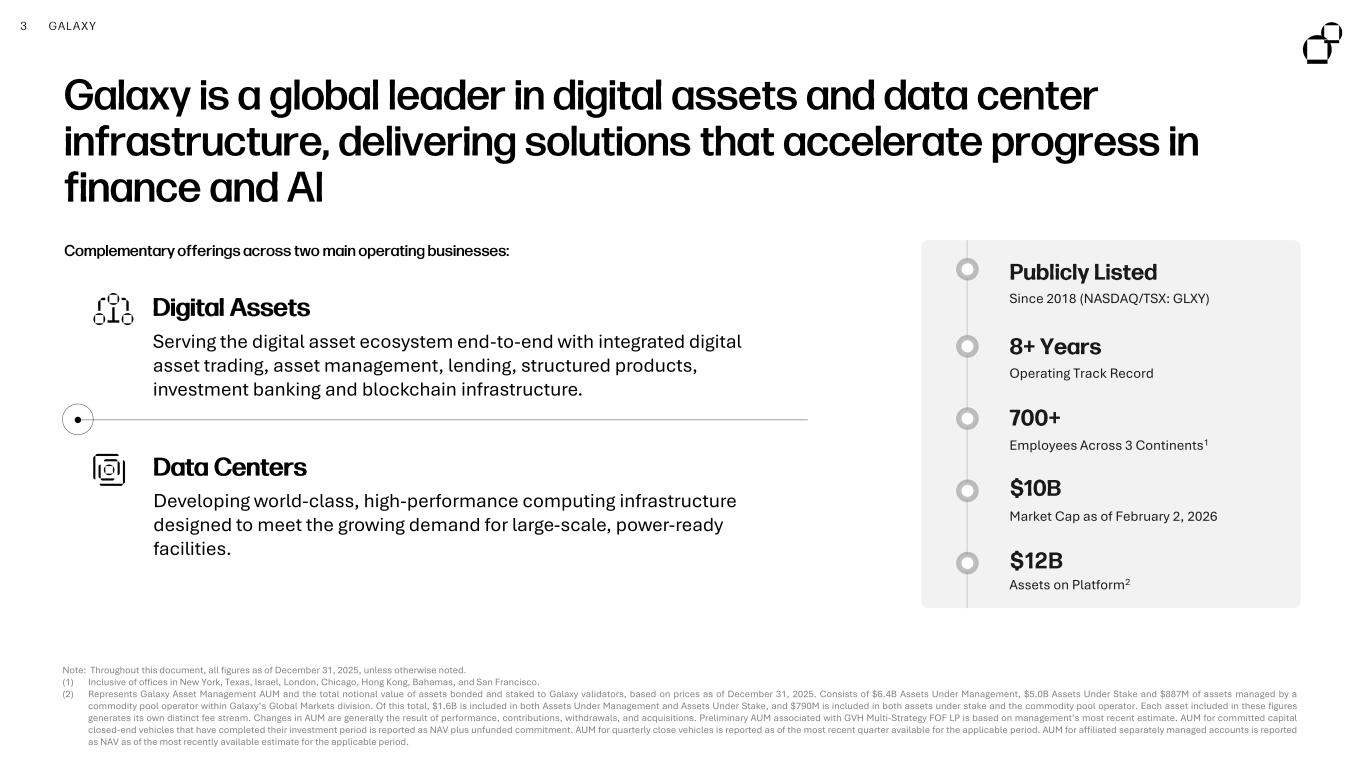
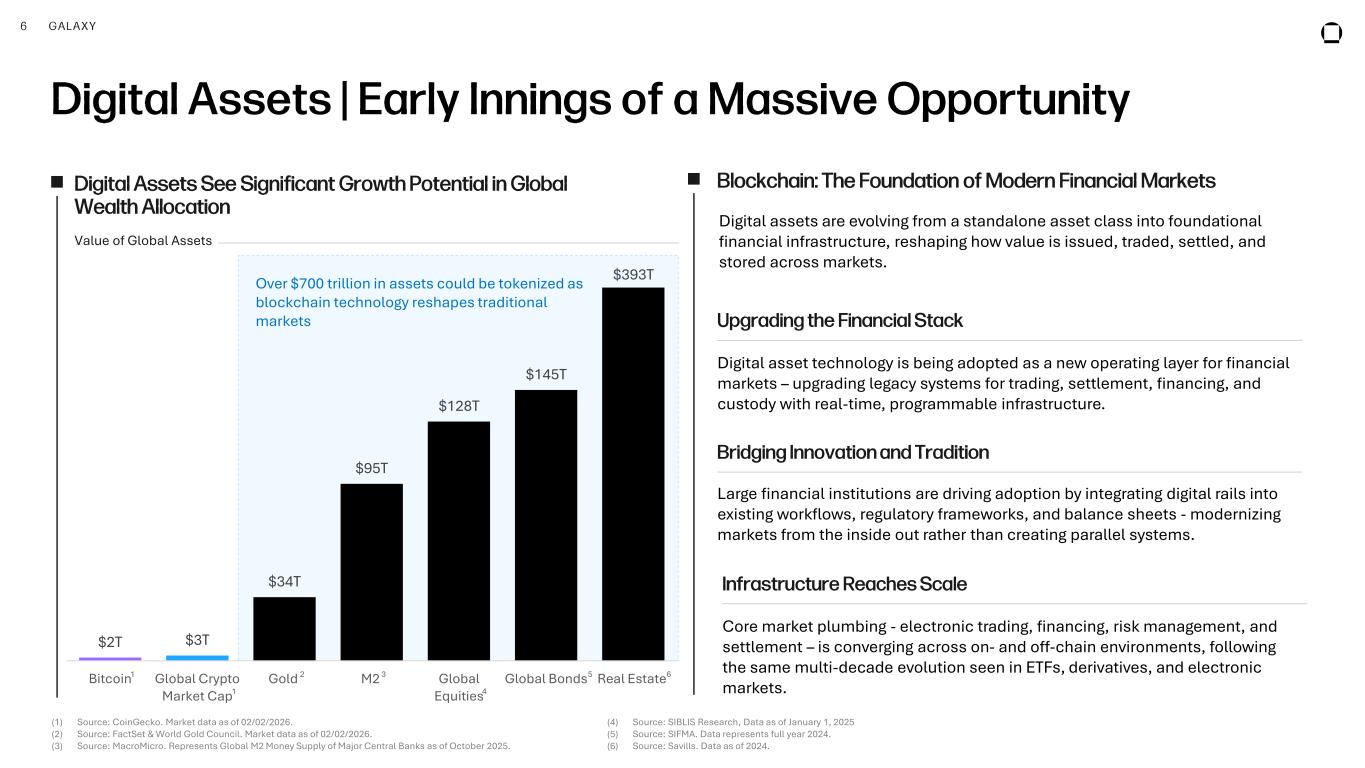
We're New York City. We've got ice in the Hudson. Still chilly out here. Listen, I think about this quarter in our year a lot, and I thought in a perfect Dickinsonian way that this is a tale of three cities, not two cities. And so I'm going to start with the shiny one. Listen, our data center business, I couldn't be more excited for it. We're now over 1.6 gigawatts of approved capacity. If you haven't followed our stock as closely as I think you have, we got 830 megawatts of additional power approved recently. I want to give a shout out to the state of Texas. They've proven to be great to do business with. I literally have got an extra set of cowboy boots every month. And so we're excited. Listen, there is not a lot of 830 megawatt new sites of power being granted in the United States. We are engaging with potential tenants and, you know, hopefully in the next period of time have news on who's going to occupy that site. At the same time, we've got over 1,000 employees or 1,000 workers, I should say they're not employees, building out the site for CoreWeave. We hope to have or we will have our first data halls delivered by the end of Q1. And so the data center business will start cash flowing, you know, quite quickly. On top of that, you know, we're engaged in conversations with other sites, both in Texas and in other states. And so the data center business is growing. It is a macro environment still where the demand for power is strong. You see that in everywhere you're reading and looking. It's usually the same five or six major players. But underneath that, there are a whole lot of other players that are building out data centers themselves. And so could it be more bullish on the data center business? The crypto business or the digital assets business, that itself is a tale of two cities, both internally at Galaxy and broadly macro. So macro-wise, you have the crypto coins, Bitcoin, Ethereum, Solana, you name them, have been in a bear market. When we cracked 100 in Bitcoin, there was a lot of price action above that ever since then. I thought it's been in a 75 to 100 range. We're at the lower end of that range right now. if you had told me a year ago with gold at the highs and NASDAQ at the highs and a very friendly administration that we would be lower, I'd have said no way. And so when that happens, you've got to think through what's gone on. And I think there's a lot that's gone on. I think people got excited over 100,000 and felt like the race was won. All the hard work over 15 years to get there felt like some relief that the community had done something so amazing, and that somehow allowed people to take profit. And then that profit taking became a bit of a virus. And so we are distributing a lot of those huddled coins into new buyers. And I learned early on as a trader, prices are set at the margin. Obviously, there have been more sellers than buyers. And the question just as one to stop. Do we find sellers exhaustion at one point? And what are the catalysts to turn it around? I do think we're at the lower end of the range. And what I would say is we've been here before. Anyone who's been in crypto for more than five years realized that part of the ethos of this whole industry is pain. And that often when things feel worse, it's time to be very focused and potentially accumulating or at least getting prepared to. Because when the tide turns, it turns quick. Potential catalysts are if we finally pass this crypto legislation here in the US. We just got a new Fed governor. We can talk about that later. He is not as dovish as people had hoped, right? You were hoping that you were going to get someone who would do the president's bidding. And I think the market reaction, both in precious metals and crypto, was telling and was a nod of recognition to Kevin Warsh as a man of integrity. That said, the budget deficit is still 6.5%. Our debt is $40 trillion. And the broad story that brought people into Bitcoin as a store of value, as a digital gold is intact. And so, we certainly haven't given up on our bullishness around the long-term prospects of crypto. So, our balance sheet took a hit in the fourth quarter. In some ways, it was unfortunately the mirror of the third quarter where we had a great balance sheet and gave a lot of that back. Our underlying business, however, again, back to my tale of two cities within crypto, has had a great year. We did over $500 million in operating revenue. And so I can strip out the balance sheet. Galaxy's digital assets business is a big business. It's got a great brand. We've got great relationships with a lot of institutional customers. We had record trading volumes. Our loan book has grown immensely. $12 billion of assets on our platform. And so I feel really good about our overall business. And I would say neutral to getting ready to hopefully feel bullish about the overall crypto market. The last thing I'd say is there's a very big and exciting bull market in what I call blockchain plumbing or digital asset plumbing. Even before the passage of this market structure bill, every trade by institution that we're in touch with is figuring out in a much, much quicker pace how they're going to participate in this transition to a digital world where wallets replace accounts. And so you read about the kind of the stable coin debates that are going on in D.C., hopefully in the next, you know, period of time, we're going to have some big announcements about, you know, different endeavors we're taking with trade by companies. But Galaxy sees ourselves as a partner for lots of these people. We're going to partner with some. We sit in our office, we're like, are they a collaborator or a competitor or a client, right? They're a little of all of them. And so that's a bull market for us. And it feels that way. And so we could go into a period where the old business doesn't do as well, but you're building into the new business. And what is that new business? That new business is going to be more on-chain stuff, but it's going to be traditional assets that use crypto rails. You already see it. There's a protocol called XYZ, which trades on the hyperliquid platform, and full disclosure, we are long hyperliquid, that is doing $4 billion of revenue already. It did 4% of the CME volume in silver. And so as we see assets that are traditionally not trading on blockchain rails shift to the blockchain, we think that's ripe opportunity for Galaxy and for the whole space. So with that, I will say, I'm hoping that Chris or Tony has a literary metaphor for their piece, and I'm going to pass the ball.
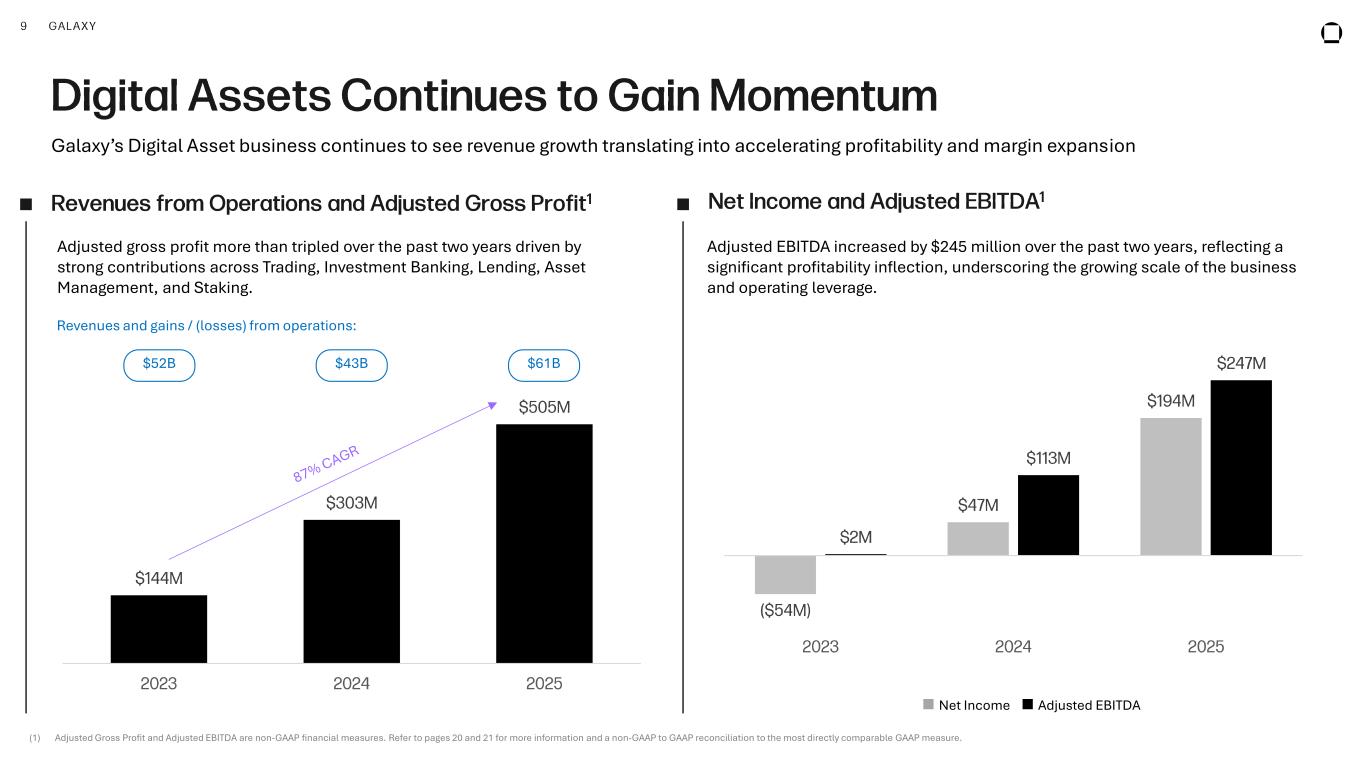
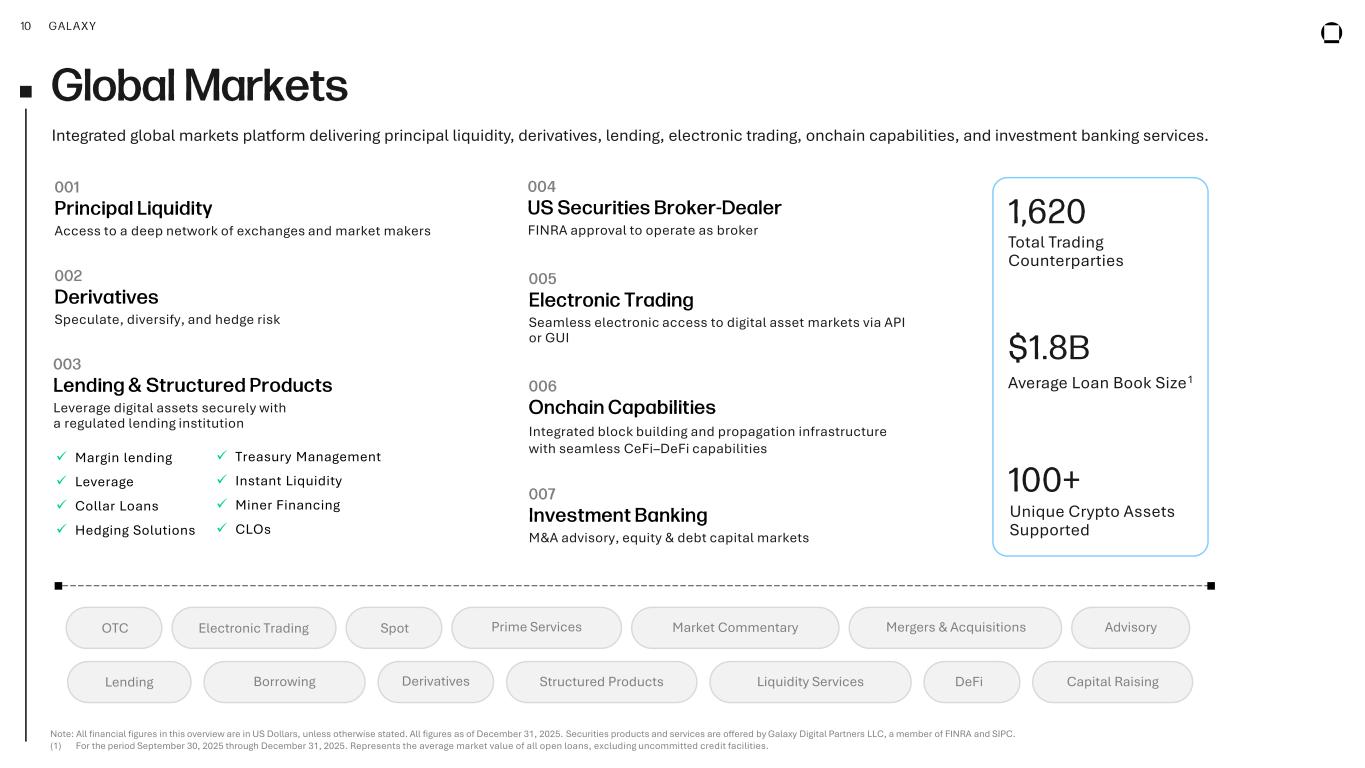
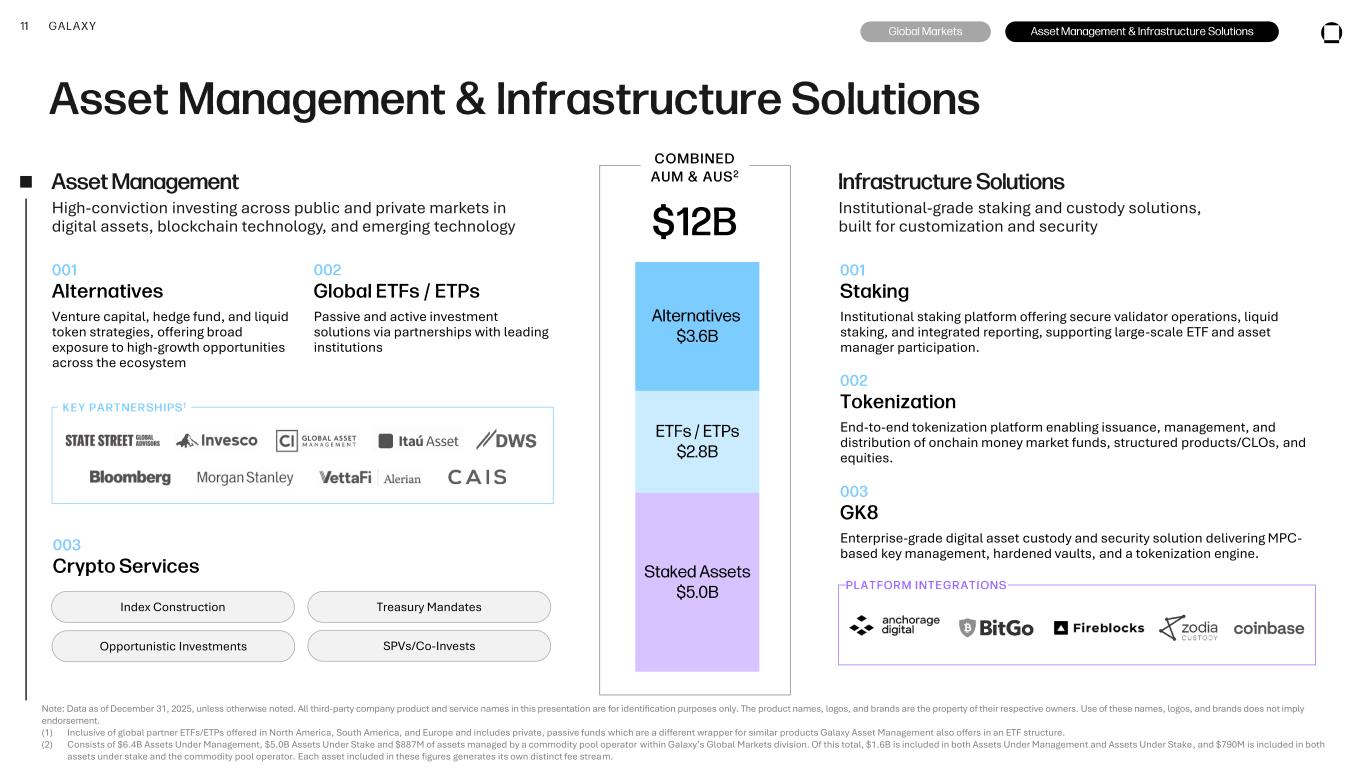
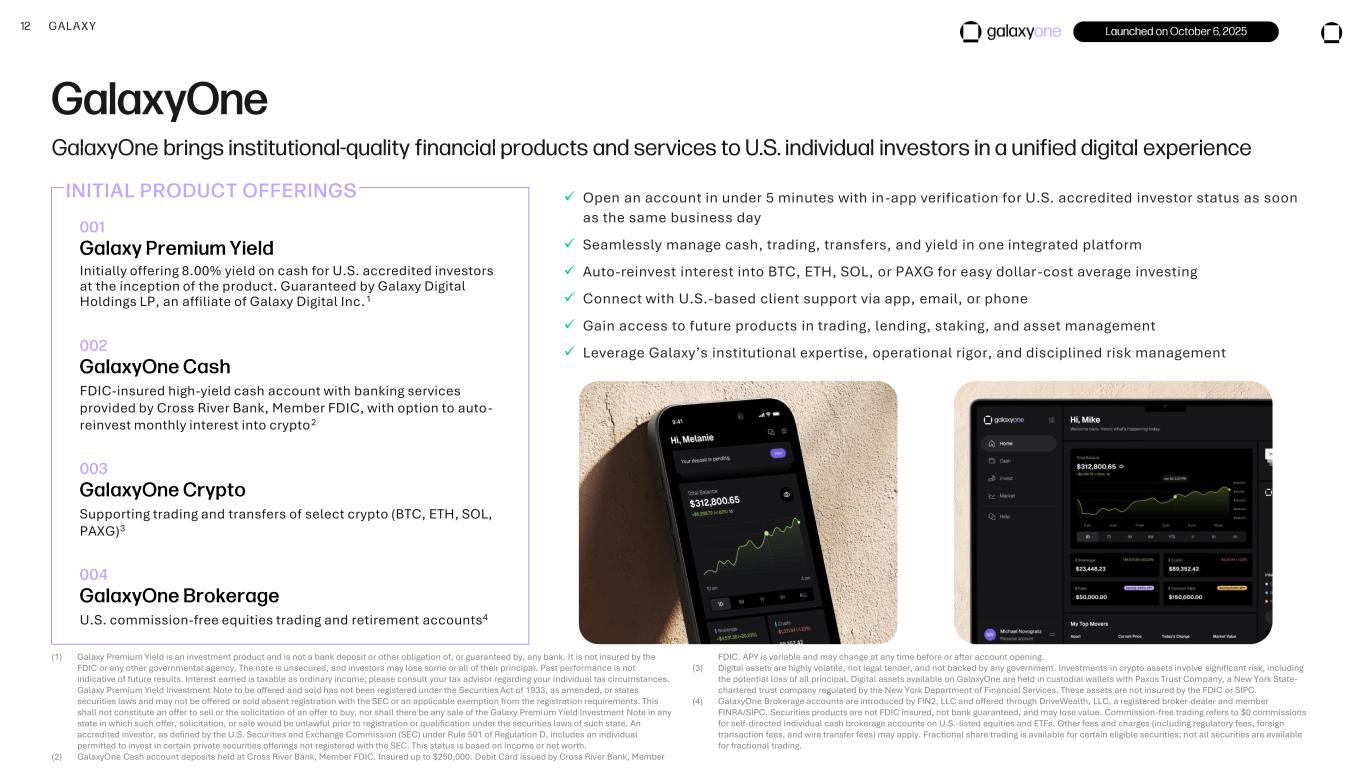
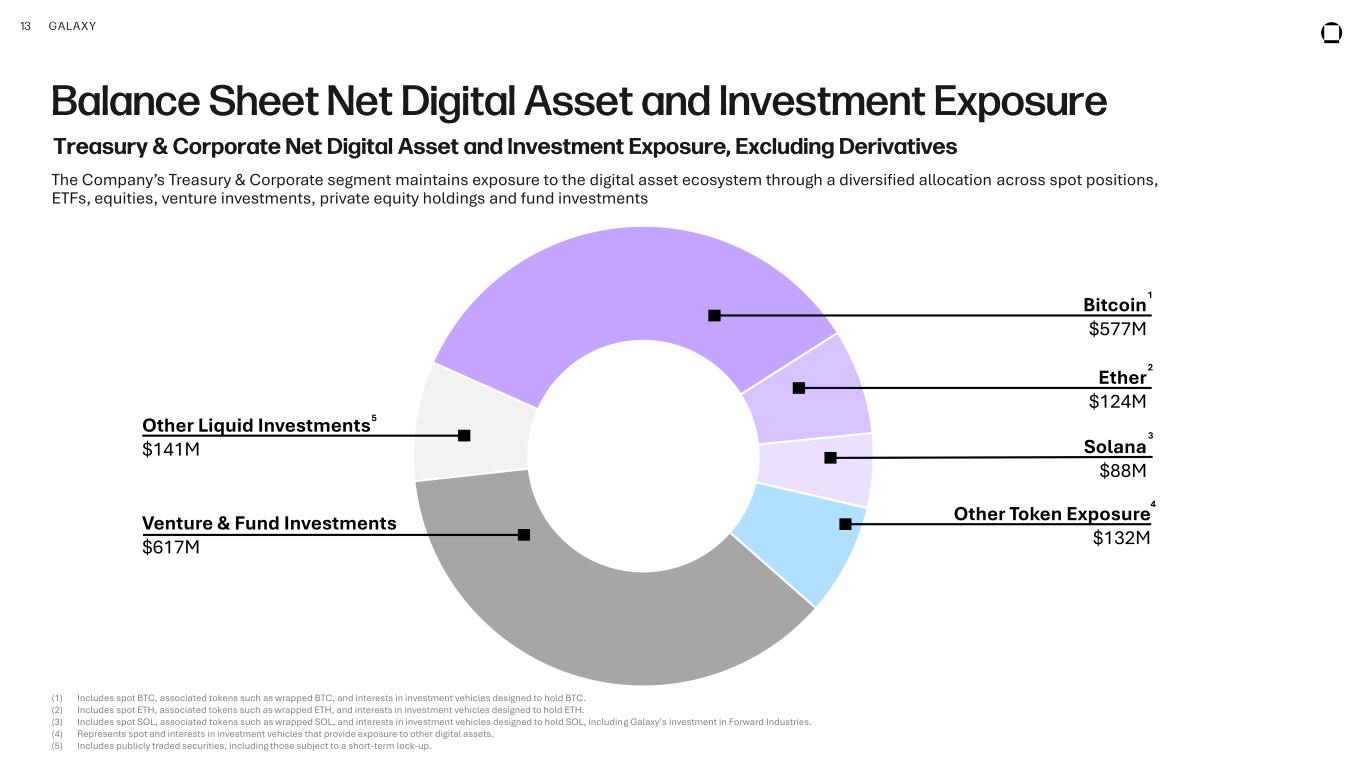
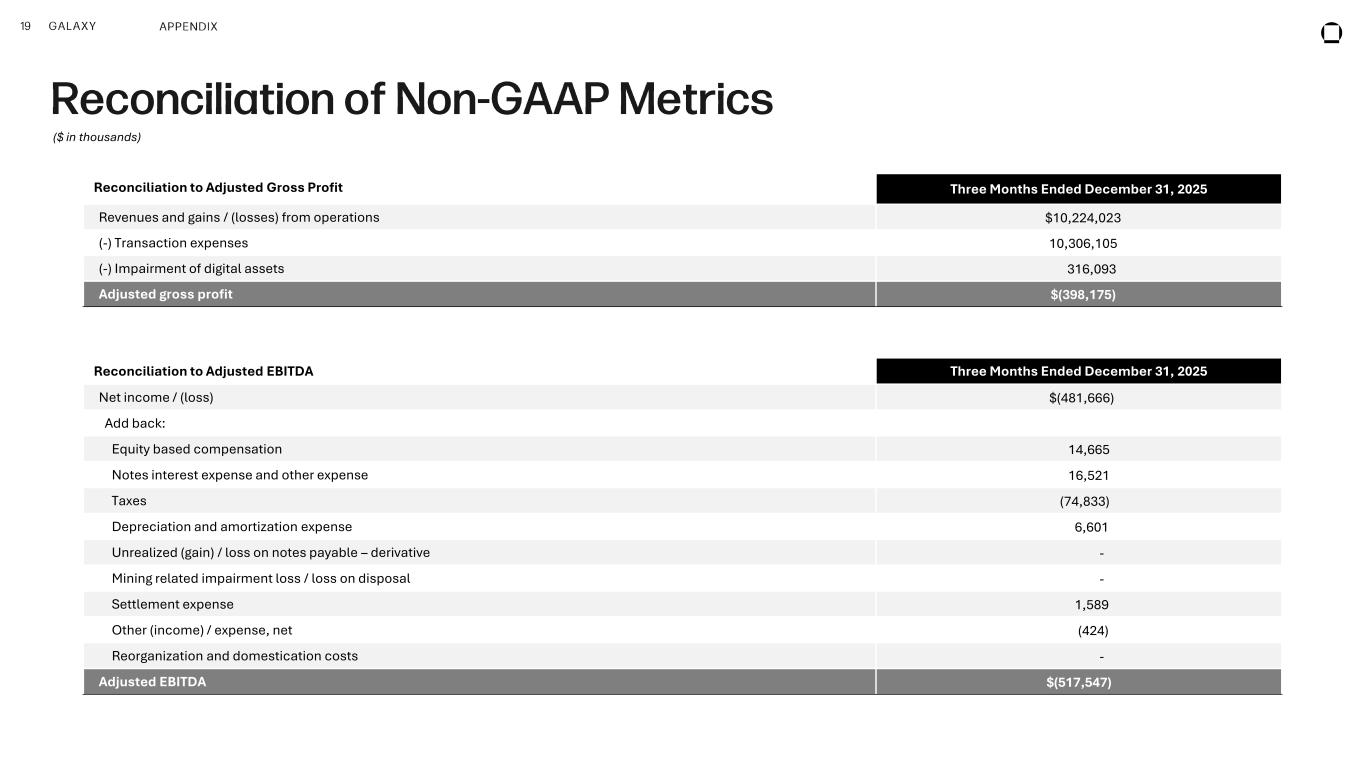
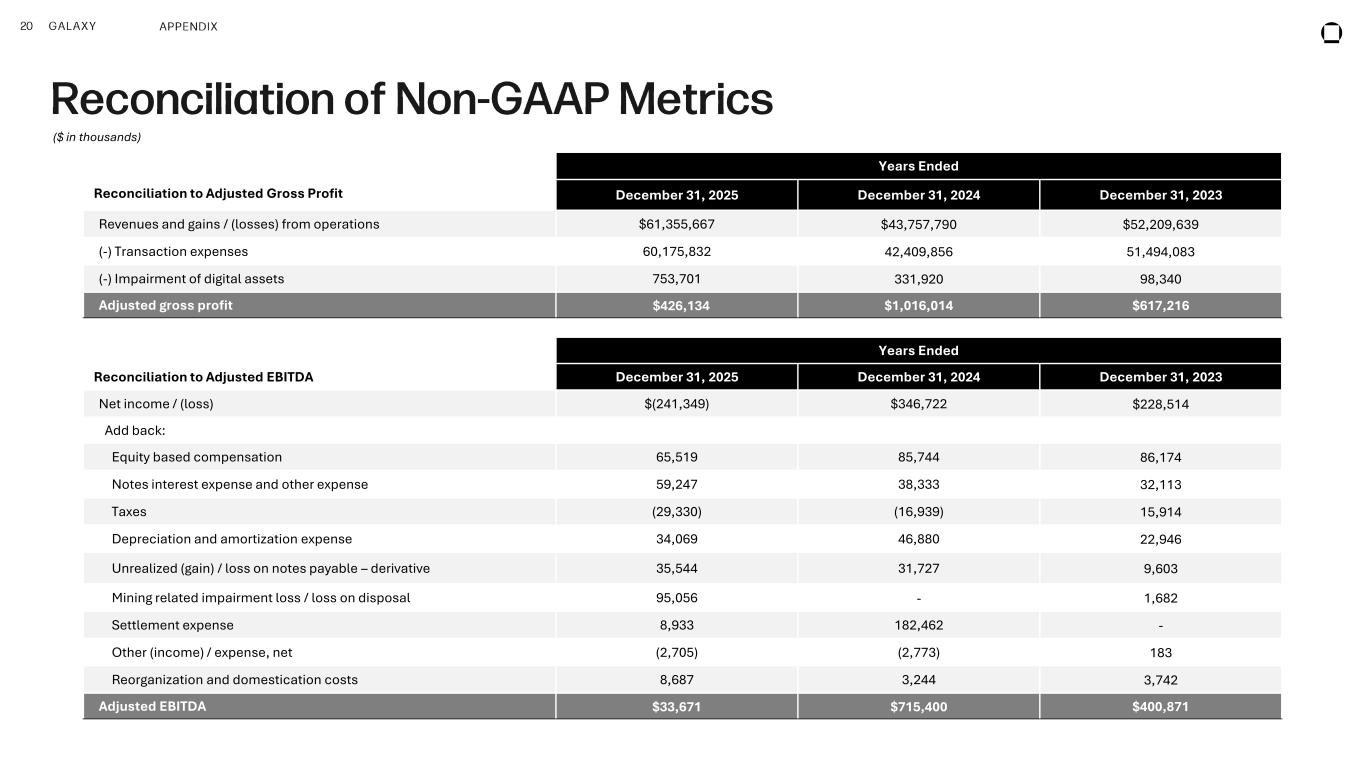
Thanks, Mike, and thanks, everyone, for joining us on the call today. It's my pleasure to present the results for Q4 and full year 2025 before turning it over to Chris to provide a little more context on the data centers. First, starting with our full year 2025, we reported a gap net loss of $241 million, or 61 cents per share. These results were impacted by approximately $160 million in one-time items that occurred earlier in the year, including write-downs and other expenses related to our legacy Bitcoin mining infrastructure, costs tied to our US listing and corporate reorganization, and a negative mark-to-market adjustment on the embedded derivative associated with our exchangeable notes, which no longer impacts results following our Q2 2025 reorganization. Despite these non-recurring charges, our business delivered $34 million of adjusted EBITDA in 2025. This performance came against the backdrop of a 10% decline in the total crypto market cap, driven by a 24% drop in Q4. This profitable performance also underscores the growing scale of our business and the increasing contribution of recurring fee and transaction-oriented revenue within our earnings In our digital assets operating segment, we generated record-adjusted gross profit of $505 million in the year, up from $303 million in 2024, representing a 67% year-over-year growth, an acceleration that reflects both operating leverage and the strength of our diversified business model. Growth was broad-based, with strong contributions across trading, investment banking, lending, asset management, and staking. In Treasury and Corporate, we reported an adjusted gross loss of $86 million in 2025, primarily reflecting the unrealized losses in our digital asset and investment portfolio during the year as a result of lower digital asset prices. In data centers, as we've discussed previously, we expect financial results in this segment to remain de minimis until we begin recognizing revenue under phase one of our core weave lease agreement, which we expect to start later in Q1. Turning to the balance sheet, we ended the year with $11.3 billion in total assets and over $3 billion in equity capital, with roughly 60% allocated to our operating businesses. That mix will fluctuate quarter over quarter with movements in our Treasury portfolio, but as stated previously, over time, we expect the percentage allocated to our operating businesses to increase as we scale across both digital assets and data centers. Within Treasury and corporate, we held approximately $1.7 billion of net digital assets and investments at year-end, down 22% quarter over quarter. That decline primarily reflects market depreciation, as Mike discussed, which resulted in unrealized losses across our investment portfolio. We also closed the year with $2.6 billion of cash and stablecoins on balance sheet, up approximately $700 million from Q3. That increase reflects two strategic capital raises in Q4, a $1.3 billion exchangeable note issuance and a $325 million equity investment in Galaxy by one of the world's largest asset managers, which together resulted in approximately $1.6 billion of net proceeds to the company. Cash raised in Q4 went to two primary uses, continued investments in data center infrastructure to ensure we stay on track for upcoming data haul deliveries and paying down short-term borrowings. Going forward, uses will be focused on continued data center build as well as general corporate purposes, including ensuring sufficient liquidity for the potential repayment of the $445 million of exchangeable notes that mature in December 2026. 2026. Maintaining discipline, risk, and balance sheet management focused on strong capital and liquidity remains a critical priority as we execute our multi-pronged growth strategy across digital assets and data centers. Now, shifting to our digital assets business. As Mike mentioned, Q4 reflected lower digital asset prices, softer sentiment, and reduced activity industry-wide. Coming off a record Q3, that shift was more pronounced, but we maintained strong client engagement throughout the quarter. In our global markets business, we delivered adjusted gross profit of $30 million in Q4, bringing our full-year global markets adjusted gross profit to $423 million, up 88% year-over-year. Our average loan book held steady at $1.8 billion, despite broader market pressures, which is a strong indication of the business resilience and sustained client demand. Digital asset trading volumes declined approximately 40% quarter-over-quarter, largely reflecting softer client activity on the back of a record Q3 and lower industry-wide volumes. That said, we're starting to see capital formation migrate onto blockchain rails, and we're deeply engaged with some of the world's largest banks, asset managers, and hedge funds across everything from credit and on-chain markets to electronic trading and ETF create redeem workflows. For a quick update on Galaxy One, we're continuing to make progress here as well. While it's still early days, we're encouraged by the momentum we've seen over the first four months since our launch. We've seen strong adoption of our high-yield products, which offer market-leading yield and serve as a compelling entry point into Galaxy One. We've also been listening closely to our user feedback on what they want from their accounts. That's already led to the launch of daily buys, more accessible account minimums, and in-app staking and custody, which are coming soon. Now turning to asset management and infrastructure solutions, we delivered adjusted gross profit of $21 million in Q4 and $82 million in 2025, up roughly 5% year-over-year. Galaxy ended Q4 with $12 billion in assets on platform, down approximately 15% quarter-over-quarter, reflecting the impact of digital asset price depreciation. While overall flows were more muted in Q4, we continued to expand our product suite to meet the needs of our clients. We partnered with Invesco to launch the Invesco Galaxy Solana ETP. We collaborated with State Street Global Advisors to tokenize a private liquidity fund, which is a step forward toward broader adoption of tokenized investment vehicles. And post-quarter end, we announced the initial closing of our debut tokenized CLO, a major step towards building a tokenized credit platform. And on the infrastructure solution side, in Q4, we completed our fifth integration with a leading custodian and closed the acquisition of Alluvial Finance. This acquisition marks a key milestone, bringing us into liquid staking, which we see is essential for institutional adoption, given its capital efficiency and alignment with broader DeFi and yield strategies. In all, Galaxy's digital asset business made significant strides in 2025, with momentum building both strategically and operationally. In global markets, we delivered record trading volumes, including executing one of the largest notional Bitcoin transactions in digital asset history and a record average loan book size. Asset management rolled out several new ETF and alternative investment products and delivered $2 billion of net inflows during the year, representing a 30% organic growth. And in infrastructure solutions, we grew our assets under stake by $750 million and scaled our platform, deepening access for clients and solidifying Galaxy's position in institutional workflows. As we head into 2026, we're building with a clear focus, aligning the momentum in digital assets with the long-term needs of our clients. Across our platform, we're seeing deeper engagement, not just access seeking, but demand for infrastructure, product, and partnership. As Mike said, the line between traditional and digital finance is disappearing, and we're designing for where institutional demand is going, not where it's been. We're meeting that moment with a unified strategy, scaling structured products like our tokenized CLO, launching targeted investment strategies such as our newly formed FinTech fund, and delivering on-chain solutions built for institutional scale. We've also realigned our leadership and operating teams behind this strategy, enhancing coordination across product, infrastructure, and go-to-market as we serve increasingly sophisticated institutional clients who are looking for integrated solutions across our platform. This is where Galaxy stands apart, investing ahead of the curve with technology, foundation, and operational strength to be a full-stack partner through this transition. Despite the recent pullback in crypto prices, we enter the year with conviction and the platform to lead. With that, let me turn it over to Chris to discuss the data center business.
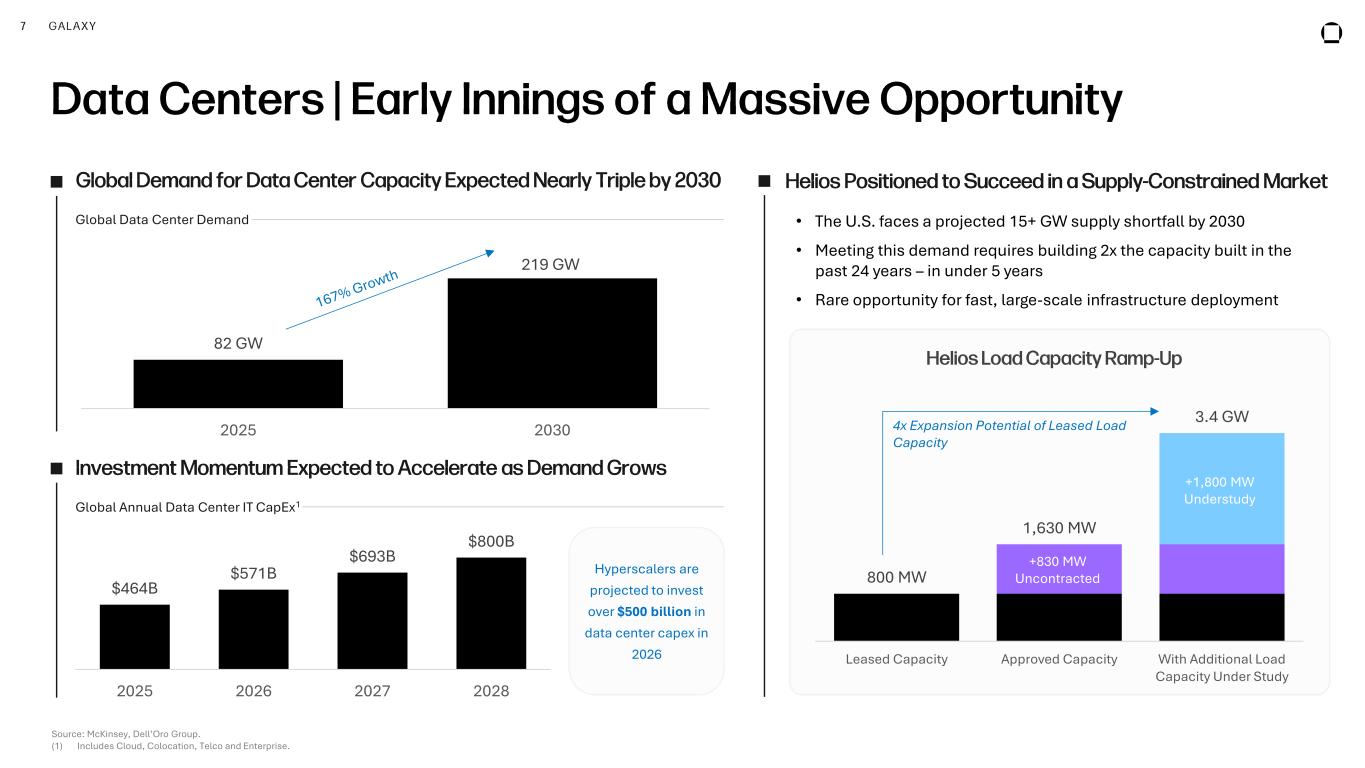
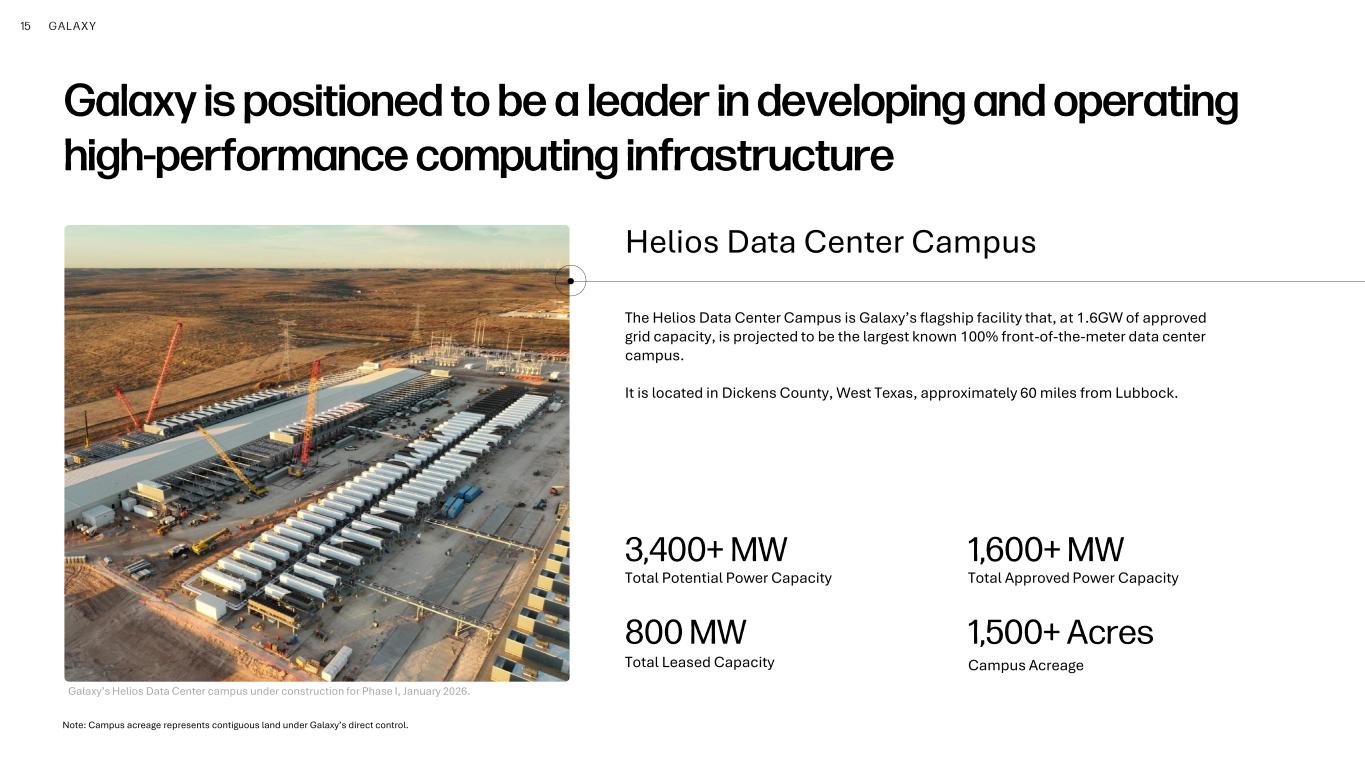
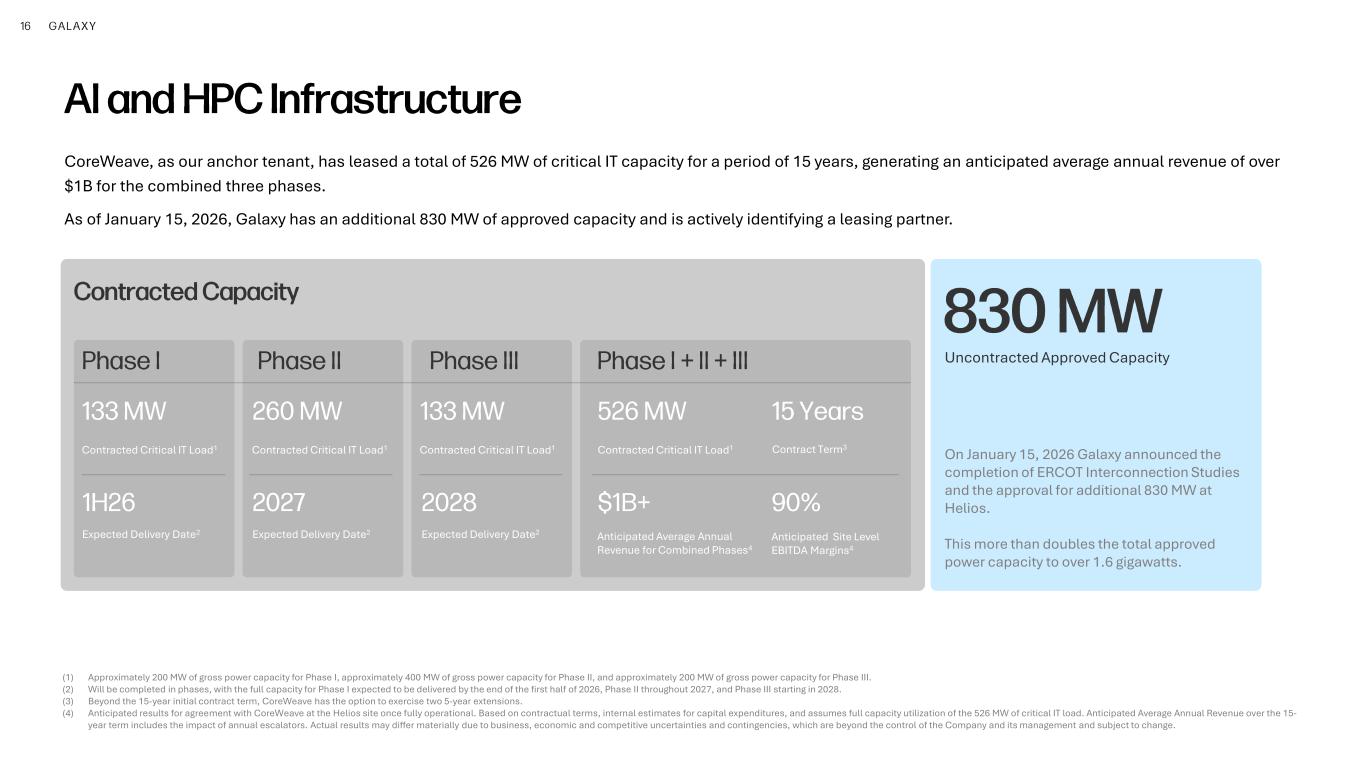
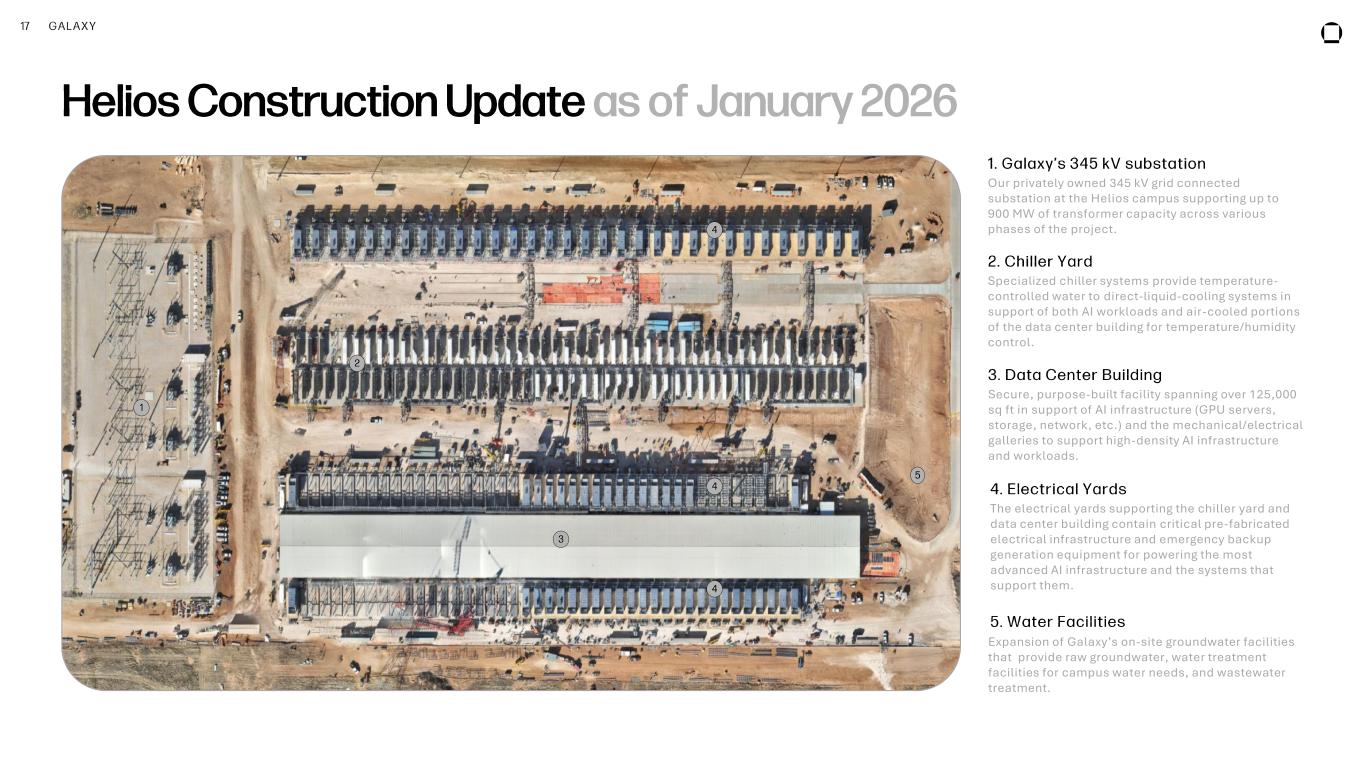
Thanks, Tony and Mike. I would normally go with we are John Galt, but I think today we're going to go with go West, young man, and grow with the country. I could not be more pleased to share that subsequent to quarter end, we completed a large load interconnect study and received approval from ERCOT for an additional 830 megawatts of power capacity at the Helios campus. This approval more than doubles Helios' footprint of approved power capacity and represents a significant milestone in the long-term expansion of our flagship campus. With 800 megawatts now contracted under our lease agreement with CoreWeave, this recent approval of incremental capacity expands our leasing optionality, providing additional power that can be allocated to existing or new tenants during a period of intense demand for large-scale AI data center capacity. The timeline to energize the next 830 megawatts of capacity will depend on several factors, including the completion of certain approved transmission infrastructure, including a private substation. Based on current procurement and construction schedules, we expect to begin energizing this additional capacity in late 2028 through early 2029. With more than 1.6 gigawatts of approved power capacity, Helios is among the largest AI data center campuses currently under development and is projected to be the largest known 100% front-of-the-meter data center campus. We continue to pursue ambitious expansion plans. Beyond the capacity already proved, we have two applications totaling approximately 1.8 gigawatts of incremental requests, progressing through various stages of the load study process. We are actively engaged with ERCOT and closely following guidance on the timelines and requirements under the new batch process, and we're encouraged by the continued evolution and increased clarity of those procedures. Turning to construction. We're prepared to deliver the first data hall to Corweave later in Q1 as part of our Phase 1 project and remain on track to deliver the remaining data halls, representing the full 133 megawatts of critical IT for Phase 1, within the first half of the year. In order to make this possible, the team has been incredibly busy. In the fourth quarter, the building was completely dried in, meaning the structure was fully enclosed and protected from the elements, allowing us to proceed efficiently with interior work, regardless of weather conditions. All generators and e-houses to support the first data hall are fully set in place, and importantly, every major component required to energize that first data hall is on-site and installed. With materials in position, we transition into commissioning. As a reminder, commissioning is a multi-level process that validates the electrical and mechanical infrastructure is installed, configured, and operating correctly. We began commissioning activities in the fourth quarter and have continued moving through the process. Recently, severe winter weather swept across much of the country, including Texas, as winter storm fern and heavy snow and ice moved through the region. During that period, construction was temporarily paused as several inches of snow and ice accumulated across the campus. Even so, the team responded quickly and decisively, protecting critical mechanical equipment and preparing the site for rapid restart. Within five days of the storm, more than 1,000 subcontractors were back on site and construction resumed. We remain on track to turn over the first data hall in the first quarter with the remaining data halls coming online by the end of the second quarter. Looking ahead, we've kicked off earth, concrete, and steel work associated with our phase two development of the Helios campus. We've issued purchase orders to secure critical long lead equipment to support the additional building development that will house the 260 megawatts of incremental critical IT capacity for phase two. Overall, execution remains strong, constructions tracking well, and Helios continues to transition from a large-scale construction project into an operational AI data center campus, positioning us to be recognized as one of the few companies that has proven its ability to execute in a hyperscale AI data center development. Turning briefly to phase two financing, we're continuing to evaluate various debt financing structures and are having productive conversations with a select number of potential partners. Our focus is on maintaining a disciplined capital structure that supports long-term scalability at Helios. Scaling Helios is just the first step in our vision of building Galaxy's data center business into a multi-gigawatt, multi-tenant, multi-campus platform. Beyond Helios, we continue to evaluate a robust pipeline of expansion opportunities across a range of possible developments. We've evaluated more than 100 campuses across the U.S., including many in Texas, giving our deep familiarity with ERCOT an existing development footprint. At the same time, we are actively exploring additional markets where power availability, permitting timelines, and grid dynamics may offer more attractive paths to accelerate time to power. We're seeing tremendous opportunities to scale the business and will be focused on that growth in a measured and disciplined manner. We're entering 2026 now from a position of strength. We've laid the foundation physically, operationally, and organizationally to transition Helios from construction into an operating campus. The work over the past year has been about preparation and precision. The work ahead is about execution and scale. In starting off 2026 by doubling the approved capacity, power capacity at Helios Campus and preparing to power on our first data center development, we expect this year will be a pivotal one as we continue to relentlessly execute on our plans. We are confident in the team, the strategy, and the progress we've made, and we're excited about what 2026 will bring for Helios and for Galaxy. Now back to the operator for questions. Thank you all.
Operator
Thank you. We will now begin the question and answer session. To ask a question, you may press star than 1 on your touchtone phone. If you are using a speakerphone, please pick up your handset before pressing the keys. If at any time your question has been addressed and you would like to withdraw your question, please press star than 2. Please note, once your question has been addressed, we will be moving on to the next caller. If you have more than one question, please rejoin the question queue as needed. At this time, we will pause momentarily to assemble our roster. And today's first question comes from Patrick Moley with Piper Sandler. Please go ahead.
Yes, good morning. Thanks for making the question. Mike, maybe to start things off, would love to get your thoughts on everything that's been going on in Washington around the crypto market structure bill.
What are you hearing about the chances that bill passes? Is this a bill that you think is necessary to kind of advance that, you know, transformation of the digital asset plumbing this year? And then as you look at the bill as it sits today, what aspects are you most excited for as it relates to Galaxy's business?
Thanks. Yeah, great question. First, I would say we have spent a lot of time on this. We've got a great team in D.C. I have been down myself a bunch and have literally spent more time with senators, both on the left and the right in the last eight weeks that I have in my life combined. I guess the top line is I think a deal gets done. If you had to put a percentage on it, I would say it's 75%, 80% right now. And that's for a bunch of reasons. Both parties feel the necessity to get it done, right? The Republicans kind of took all this crypto money and ran that they were going to be the party of crypto and get stuff done. And so they have a tremendous amount of pressure on their side. And quite frankly, Democrats realized last election cycle that being anti-crypto was a really dumb political strategy. And the whole party didn't have enough knowledge about crypto. It was really being driven by a small faction led by Elizabeth Warren, Gary Gensler. You've heard that story. But broadly, the moderates in the party now say, hey, this should be a bipartisan issue, and we want it off the table politically. And so the politics lines up. I would say we're on the putting green between the Republican version and the Democratic version. There have been a couple of really controversial pieces to it. I think there's agreement now on most of those, the last one being interest on stablecoins. And there was a meeting in DC yesterday. Both sides laid out their cases again. The White House is putting pressure and saying, guys, you're going to come up with a solution yourselves. And I do think the crypto industry, when you think about it, the revolutionary transformative technology would be an interest-bearing stablecoin. That's not going to happen. Some version of that and no interest is going to be the compromise. And so I do think we'll get to a compromise in the next two to six weeks, and you'll get a bill passed. It's important for a lot of reasons. I said earlier, all the trade-by companies are already working on their transition, right, to where, I mean, listen, Paul Atkins says, I want every market, you know, on-chain. And you're seeing a bunch of on-chain activity, both in sandboxes and actually on public chains. That's going to wildly accelerate post the clarity that comes with the clarity bill. And so, you know, DeFi is a space to watch, right? How DeFi impacts the traditional exchanges. I already talked about both hyperliquid and XYZ and the explosive growth those things have. A, there's a regulatory arm in that, right? They have less overhead if they have a different regulatory environment. Very similar, quite frankly, to what we're seeing with prediction markets and traditional gambling and sports betting. And so I do think that's like the flag, the checkered flag going down. I think there's a lot of trade by companies that probably feel short. And so you'll see a pickup in M&A post that bill passing.
Operator
Thank you. And our next Next question today comes from Brett Knobloch, a cancer for Fitzgerald.
Operator
Please go ahead.
Hi, guys. This is Gareth on for Brett. I was just wondering if you could go into kind of the future potential build out at Helios. So I know you guys recently talked about the incremental 830 megawatts with ERCOT. We were wondering if throughout that study you could provide kind of how it went and if there were any glaring constraints. And also, I know you talked about kind of two applications totaling 1.8 gigawatts in process. Maybe if you could kind of touch on if you think that process to go similarly with this incremental 830 you just received.
I will, yeah, I'll take the first crack at that. So, you know, we have had between the prior interconnect requests put in from the Helios campus that we purchased from Argo back in 2022 plus some incremental interconnect requests that we've accumulated through land acquisitions adjacent to Helios. We've had north of 3.5 gigawatts in total are 800 approved plus the remaining amounts with ERCOT at various stages of either internal study on our side or study with ERCOT and WET to get done. The 830 that we received firm approval for for ERCOT was part of actually a larger request that ultimately ERCOT, in looking at where we were in the queue and the current grid capacity at the time, concluded through various stages of study that the grid could accept an additional 830 megawatts today, which is what we got firm approval for. We, as I said in my comments, we currently have various different studies and requests into ERCOT for an incremental 1.8 gigawatts on top of now our 1.6 that is already approved, over 1.6 that's already approved. That 1.8 gigawatts of incremental load is now very clearly, which is different than our 830 that we just received, is now very clearly going to be part of a new set of frameworks that ERCOT has worked out and is still sort of working through, which is this batch processing where they're going to look at various batches of requests, given how large the queue has grown in ERCOT for requests, And sort of look at groups of requests together and in each group look at what the grid can absorb today, where those requests are coming, what infrastructure upgrades need to be made, and then sort of pro rata part out new approvals in a step-by-step process. And so the timing on the next incremental load approvals for us or anyone else in the queue is still a little unknown and we think is going to take a lot of time for ERCOT to really sort out the process on. And so from our seat, getting the 830 in one large chunk fully approved from us before the new batch process is in place was sort of worth its weight for us. And so we're very excited about that. I think on a go-forward basis, us and everyone else in the queue are going to have a number of new processes to go through. And so we're very focused on now working through and understanding what is important to ERCOT and where those stand in the queue.
Let me just add, given those dynamics, first a shout-out to our whole mining team, data center team, both here in New York and in Texas, because in lots of ways we got in under the line. And that was because we were prepared way ahead and we were very diligent the whole process. And so couldn't be more thrilled. You know, it makes that power more valuable. There are not a lot of 830 megawatt chunks of power available in Texas or the United States. You know, there's a lot of people building for the future behind the meter. And so I think, you know, we'll see how the negotiations go with our next group of tenants. but it leaves me pretty bullish.
Operator
Thank you. And our next question today comes from James Yarrow at Goldman Sachs.
Operator
Please go ahead.
Good morning, and thanks for taking the question. Mike, I really appreciate your comments on the crypto backdrop. I just wanted to expand on one element of what you touched on in your prepared remarks. You've been through a lot of cycles here. Are we heading into another crypto winter or not? How long until the cycle could begin to recover? And And then, you know, you're a trader. You look for these signals. So what should we be paying attention to to mark this cycle either continuing to deteriorate or potentially inflecting?
Yeah, that's a great question. I mean, listen, it feels pretty chilly right now given that we were at 100 and what was the high 130 and we're currently, I haven't seen the market in the last two minutes, you know, 78, 80 or something. You know, when you look on the charts, it feels to me we're kind of a 70 to 100 range until we take out 100. There is, like, the idea that Bitcoin is now a macro asset, I think, is solidified, right? There are too many people that have owned it, that have bought into it, that believe in it, that have institutions built around it. And so this is not going away. You are having a supply-demand imbalance. And when I think about potential catalyst, you think about this market structure bill and really turning on Wall Street. And I said this before, Wall Street is a selling machine. That's what Wall Street's built to do. If it's mortgages or equities or government bonds, the structure is set up to sell. And as you start putting crypto through the traditional Wall Street selling machine, you're just going to see demand pick up from pockets that we haven't seen yet. And again, that is what has kept crypto. The two-way price action you've seen, because it has been a one-directional move, has been more broader distribution coming in against big, chunky positions, big whales getting out of their long-held positions. And so, again, my instinct is we're closer to the bottom of the range than the beginning of a bear market. I think we've had a bear market. Could things go lower? Of course they could. But what I learned about, you know, painfully in three cycles now is, you know, you don't necessarily have to pick the bottom, but you've got a sense when it turns. And like pornography, you know it when you see it, right? there will be a catalytic event. And so that's Judge Lord at hand for you guys who think I made that quote up. And so, yeah, like I said, I think we're closer to the bottom.
I'm not sure we've reached it yet, but we'll tell you what we think we have.
Operator
Thank you. And our next question today comes from Devin Ryan with Citizen Bank. Please go ahead.
Question just on kind of market structure clarity. You talked about that, Mike. I mean, as we try to map this out and we're getting questions from investors, trying to understand kind of where Galaxy fits blur between crypto and kind of TradFi over time. And obviously, the large banks are going to need to participate in this world of tokenizing markets. And that will probably bring them closer to trading the tokens themselves. On the flip side, you know, it's a very technical space. So it's not going to be easy for many of them to just enter. And so curious kind of how you think about Galaxy's position in that, the moats, and then kind of what role you want to see Galaxy play as we move to a market where more assets are tokenized and probably have more of the large banks involved in the same space as Yeah, it's a great question.
We think about it a ton. I think that a couple areas where we think we need to win and have a right to be significant players. One is credit, right? We've got a great credit business, and you're going to see an on-chain credit world explode, right? There already is an on-chain credit world, and we're participating. But I think in the next three years, it could be one of the big growth areas for both the market and for Galaxy. You know, one of the complaints in D.C. was, well, if we, you know, allow interest-bearing stable coins and you get deposits light, what does it do for credit creation? And I'm like, guys, credit creation is already starting on chain, and it's going to explode on chain. And so I could see a future, not in the next few years, but in the next 10 years, where on your cell phone, you've got your bank account, i.e. a stablecoin that pays some kind of interest, and you've got your lending account, right, where you're picking from a menu of potential places to lend money. And that's already in existence in what I'll call like a beta stage in the market, but that's going to be a big part of it. And the second piece is really infrastructure, right? All of these financial market players, banks, Fincos, neobanks, need staking. They need wallet infrastructure. And our info team is growing. We're adding to it. And we're engaged in conversation around how do we help? And like I said, hopefully we get some announcements publicly in the next period of time. But that has to be a big business for us. And we're really focused on it because they're coming. Listen, at one point, you know, J.P. Morgan will trade Bitcoin derivatives and Bitcoin, and that's going to make our Bitcoin derivative and Bitcoin business, you know, it's going to be competition for it and it's going to be a bit more difficult. And so we're hoping the pie expands, but that we're skating into the edges where those guys aren't. We use our domain expertise to help those players into the market.
Operator
Thank you. And our next question today comes from James Fossett with Morgan Stanley. Please go ahead.
Thank you so much. Thanks for all the comments this morning. I wanted to follow up on kind of what's happening beyond just the allocation and approvals of I really appreciate the color there, and certainly you guys have done good work. I'm wondering if you can give more color on how we should be thinking about the engagements with potential tenants and kind of how they're looking at it. I get the sense that they want to do bigger pieces if they can, particularly the hyperscalers, but just love to hear any more details you can provide around that and how you're thinking about potential partners, et cetera, and timing.
Thanks for joining, James, as well. I think you're right that, A, for us, the major tenant category we are focused on, I'll call them hyperscalers, but I think that that term is actually broadening out a little further as it relates to traditional hyperscalers, now neoclouds who are getting larger and larger, maybe the direct model builders themselves, et cetera. Like that's the universe of tenant and perhaps even some equipment manufacturers. That's the universe of tenant that is out there who we are talking to and looking at, who are looking for large chunks of power capacity that they can put to work in the billions and billions and billions of dollars and gigawatts of size. because this truly is the new modern space race for control of who's going to have the most frontier model and the smartest brain offering to power sort of the future of automated everything. And so the ambitions have not shrunk at all. In fact, they've grown on the tenant client side, and we've seen reiterated and elevated capex expectations um from a lot of companies already sort of supporting that um that data for us um uh we've we've talked over and over again about our decision making on the first 800 megawatts to partner with core weave who themselves i think have emerged um sort of uh without debate as a one-of-one partner for and most of the large model builders and hyperscalers themselves as an expert in arranging and automating and running ever more complex large GPU clusters for those end-to-end clients. For the next 830 megawatts, I think all potential tenants are on the table. We do recognize with extreme clarity that availability of capital and credit on economically attractive terms is paramount to being able to develop a multibillion-dollar data center campus on time, on budget, et cetera. And the credit markets have had a little bit of a tough go in 2025, absorbing the sheer amount of this first wave of capital that's come into the markets, and you've seen a real divergence first in non-IG credit with CoreWeave, although there's been some let up recently, and I think their continued partnership with NVIDIA and the large investment NVIDIA made helps a lot on that front. But you've also seen it creep into IG concerns initially in 2025 with Oracle. And yet, I think just last night overnight, after the close, Oracle successfully punched out close to $30 billion of new bonds and preferred equity at pretty attractive rates. And so for us, already having such a large exposure to CoreWeave means a natural focus on higher credit quality tenants on the go forward. And I think that's not a comment at all about CoreWeave and their position. I think they would be happy with us working directly with IG tenant counterparties, which also offers them an opportunity to be an orchestration agent and a GPU cluster management partner as well, which we value a lot going forward. So that's how we're thinking about the landscape.
Operator
Thank you. And our next question tonight comes from Martin Toner with ATV Capital Markets. Please go ahead.
Hi, guys. Thank you very much for taking my questions. So, you know, and the last deal we saw, I believe it was from Cypher, was on the best terms we'd seen yet. And we haven't yet got into a stage where each successive HPC deal is on improved terms. The terms have really varied depending on partners and customers. But if data centers in space make sense, then data centers in Texas must make a lot of sense. And so should CoreWeave, sorry, should Galaxy be driving a harder bargain on new HPC deals?
I'll answer this one because, you know, a markets guy, first and foremost, listen, the market's going to dictate. We want strong partners that we have a long-term partnership with, people that feel comfortable working with us and that we feel comfortable working with, and we're going to balance that versus the best price. We watch the market like hawks. And certainly, you know, it's not all apples to apples. And so Chris has this very elaborate spreadsheet with his team where he tries to make it apples to apples. And, you know, we listen on Corweave. We took a risk the first the first train. I think it's a great risk that we got paid extra because we took credit risk with Corweave. Right. They were at a time of their development. And we were that we thought it was the right bet to make. And I think we're going to be proven out to be a winner on that bet. And so we'll look at, you know, rate plus counterparty and get the best price. You know, there are enough players around the table that there's attention. You know, if there was one, it's a very different story. And you don't need 10.
And the other thing I'll add is I think you did rightly point out a dynamic, which probably has surprised us a little to the upside, which we're happy about, which is initial instinct way back when was the dollar per kilowatt rental per month rental price would start out high and then over time sort of go down and normalize to a market clearing level as bigger and bigger potential clients come in. But as you pointed out, there isn't actually a very good downward trend. And in fact, given that there's a real choke point in available future capacity for electricity at scale, we've actually seen base rental prices go up in a lot of cases and with Cypher as well. And so that's a dynamic that I think actually plays very favorably to what we were initially underwritten way back when we started this journey.
Operator
Thank you. And our next question today comes from Ed Engel at Compass Point. Please go ahead.
Hi, thanks for taking my question. Just another follow-up on Helios. I guess if you were to secure a new tenant there, could construction be done concurrently with Cori's existing build-outs, or do you think you kind of need to complete phases one, two, and three before really starting any new developments? Thanks.
Yeah. So there's a couple of different dimensions to the answer to that question. So one, the new 830 plus megawatts that were approved require infrastructure build, not just on the galaxy side, but also on the grid side as well. And so the availability of that power, regardless of, you know, if we could snap our fingers and move mountains ourselves, still won't come online until late 2028 on the earliest. And so we will be doing everything we can along the way to parallelize the site work and the concrete and the ground clearing and development for all the adjacent land that we've acquired over the last few years that allows us to actually execute on this. But the practical reality is we will be fully developed and delivered on the CoreWeave Helios 1 side, largely in advance of the practical ability to come online for the next 830 megawatts. So we will parallelize, but it will come at, like, I'll call it sort of the back end of the CoreWeave Phase 1 project. Anyway.
So, yes, we can have multiple tablets.
Operator
Thank you. And our next question today comes from Greg Lewis of BTIG.
Operator
Please go ahead.
Yeah, hey, thank you. Good morning. Thanks for taking my questions. I did want you to kind of talk about, if you could, the step up in the loan book. I guess kind of curious, maybe if you could provide any color around maybe what was driving that, how that might have looked in a recovery in the market. Is it largely with incremental customers? Are we adding any new customers? Any kind of color you're comfortable sharing around the loan book would be helpful.
Yeah, Greg, it's Tony. Thanks. I'll take that one. I mean, as we mentioned, the loan book grew pretty healthily throughout the course of 2025. We ended the year at, you know, $1.8 billion, a little over $1.8 billion in average total for Q4. That was up slightly from Q3, and I guess the way to contextualize that is in a market where the underlying asset class was down 24%, 25% on average, it tells you that the loan originations and loan quantums were up to offset that value because these are obviously backed by crypto. So there wasn't a ton of change underneath the surface. I would say the net interest margins, as we mentioned, I think last quarter, did compress a little bit earlier in the year. They have roughly held steady over the last kind of period of time. We have continued to grow our client base. The loan originations were up. And overall, we see it as a healthy business. You know, we've talked about the collateralization on the book being somewhere, you know, 130% or north of that. That has all been fairly consistent. So, you know, it can be a fluctuating business as a function of, you know, the underlying market cap for crypto. But I would say our demand in that space has remained pretty healthy, which, you know, lends to the point Mike made around our confidence in on-chain credit, you know, continuing to become a more stable and more, you know, visible path forward for the industry.
The other thing I'll add to what Tony said, being a lender at my core by background is, you know, growing the loan book as a KPI is is a real double dead sword for for most companies like giving money away to grow your loan book is actually a pretty easy thing to do. Growing your loan book while maintaining the right over-cloudization and risk-weighting so that you don't lose the money you give away is the most important thing. That's at the core of our DNA from when we started this business. We are very focused on growing the loan book. without taking any incremental net risk along the way because it's just – it's not worth it at the end of the day. So that's – that has never – we've never wavered from that, and that hasn't changed.
If you guys – if this was on video, you would look at both Tony and Chris's outfits, and you'd realize that this is a pretty conservative firm.
Operator
Thank you. You have no comment on Mike's outfit. Thank you. And the next question today goes from Joseph Vathi with Canaccord. Please go ahead.
Hey, guys. Good morning. Congrats on the new Helios announcement. Maybe we go back to price action here and Bitcoin and some of the other coins real quick. I know, Mike, you know that you had the big OG profit taking. We've heard things about maybe a little over leverage in the system. Is Bitcoin a risk asset? Is it a store of value? Is it trying to be both? Just, you know, it was a little surprising to see, and I think it was surprising to everyone to see, you know, that price action. You know, maybe just some more color on, you know, where maybe you were seeing selling. Was it broad-based across all these groups? Or, you know, was it over-leverage? You know, are OGs really kind of, you know, maybe profit-taking a little more than we thought? Just whatever you might want to add, thanks.
I think the OG profit taking more than we thought is a real thing. And I think the psychology is, if you've ever been like a speculator, once you start selling, it becomes like an idea, a reaction function. Then you sell a little more, you sell a little more. And it is so hard to hodl, to literally hold a position and ride it for a long, long trend. And there were a tremendous amount of kind of religious believers in this concept of hodling, of holding, you know, and not letting go of your Bitcoin. And somehow that virus or that fever broke and you started seeing some selling. Quantum has been the big excuse for people. Now, you know, you're seeing some reaction function from the industry. I think the industry has been slow to kind of like fund the quantum institutes to say, hey, this is the real story, right? The story in layman's terms, which has always been told to me by the, quote, smart guys who in and around the Bitcoin core developers is, as we get closer to quantum, we're going to get closer to quantum resistant, and you will have the Bitcoin code changed in time. So the risk, of course, to the Bitcoin ecosystem is the developers all get obstinate, and they fight amongst each other, and they nihilistically blow themselves up. I just don't see that happening. And so I think in the long run, quantum will not be a huge issue for crypto. It'll be a big issue for the world, but crypto, Bitcoin especially, will be able to handle it. But that's been the excuse. And I think that selling happens. And listen, we had one customer alone who sold $9 billion worth. And to put that in context, that was one quarter or one third of all of IBIT's inflows last year, the biggest player in this market. And so these big, chunky positions take a while to work their way through. Someone wrote an article, it's like distributing an IPO. The price usually goes down, then the distribution ends and it goes back up. And I think that's the part of the cycle we're in right now. And I said earlier, I don't know when the seller's exhaustion happens. There is not a lot of leverage in the system anymore. And so Bitcoin specifically and crypto in general always need a new story, a new catalyst, something that happens. And it's always hard to predict what it's going to be and it shows up. And then all of a sudden, like a wildfire, everyone kind of gets excited again. and I'm blowing smoke on the embers, hoping the wild flyer, you know, picks up. You know, it's not here yet, obviously, by the price action.
Operator
Thank you. And our final question today comes from Chris Brindler at Rosenblatt Securities. Please go ahead.
Hey, thanks. Good morning, and thanks for squeezing me in. I'm actually going to ask two quick ones, if that's okay. The first one is on the new 830 megawatts of power, Or does the timeline of late 28, early 29, you know, sort of slow the pace of current negotiations? Like, is this something that could take place, you know, over the course of a year? Or do you expect it to be shorter than that, just given the voracious demand out there for power?
And the second question I wanted to ask was, on Galaxy One, the 8% yield that that product is offering, is that in any way at risk for the Clarity Act and the compromise on stable quarter rewards? um i'll take the first one at least on the 830 megawatts if if the negotiations lieutenant goes a year uh i'll be somewhere between fired and or uh and or tied up in a closet by mike i think um the the uh we we do have a lot of time and i and we want to be prudent and thoughtful about who our our next partner or partners uh will be and the economics associate associate with that with that. That being said, it is clear that all the market participants have the capital available today and are in a race to secure future capacity. And the timelines that we were originally looking at when we started with Helios and people looking at, you know, very focused on 26 and 27 power have very quickly moved to 28, 29, 30 power in terms of all the major players looking to lock that up for themselves. And so we're going to balance that very strong, voracious demand that we see with a little bit of prudence and making sure we make the right decision. But I think we're in no ways looking to watch the market for the next year or a couple of years to see how it develops in terms of parting, in particular, because the reality is 28, 29 power, given the lead times for the large electrical infrastructure that need to get built, those lead times today sort of push you up into early 28 at a minimum anyway. And so you got to pick your partner quick. You got to make your decisions on what you're going to do. And you got to start locking up supply chain so that you can actually deliver that far out. And so that's how we're thinking about prosecuting that opportunity. On the Galaxy 1 side, I'll pitch it to Tony and I'll kick in if I can be helpful.
Yeah, Chris. So the short answer is you're talking about the premium yield, 8% that we're offering on the Galaxy One platform right now? Short answer is no, that is not at risk from the Clarity Act, at least as our understanding, the way anything in the Clarity Act is proposed. It's an offering that is available to accredited investors only. We have certain customer limits and a total portfolio limit on how much we're offering there. But it is really in the interest of growing our overall client base as that business gets off the ground. That rate is obviously subject to change with a period of notice, and that'll be driven by sort of broad supply and demand. But we also think about it more generally as diversifying our funding sources for the markets business more broadly, obviously within a box of disciplined in asset liability management, but it's a rate that we control, and it's not subject to the Clarity Act at all. Hopefully, it answers your question.
Operator
And that concludes the question and answer session. I'd like to turn the conference back over to Mike Novogratz, founder and CEO, for any closing remarks.
Guys, thanks a lot. We appreciate all the insightful questions and your support. I just want you all to know that we're working our tails off here. And, you know, our eye is certainly on the prize. And so hopefully come back next quarter with better numbers and a better story. Have a great day.
Operator
Thank you, sir. This concludes today's conference call. We thank you all for attending today's presentation. You may now disconnect your lines and have a wonderful day.