Operator
Ladies and gentlemen, thank you for standing by and welcome to the first quarter 2025 HII earnings conference call. At this time, all participants are in a listen-only mode. After the speaker's presentation, there will be a question and answer session. To ask a question during the session, please press star, put it by one on your telephone keypad. If you change your mind, please press star, put it by two. Please be advised that today's conference is being recorded. If you need further assistance, then please press star, put it by zero. I would now like to hand the call over to Christy Thomas, Vice President of Investor Relations. Mrs. Thomas, you may begin.
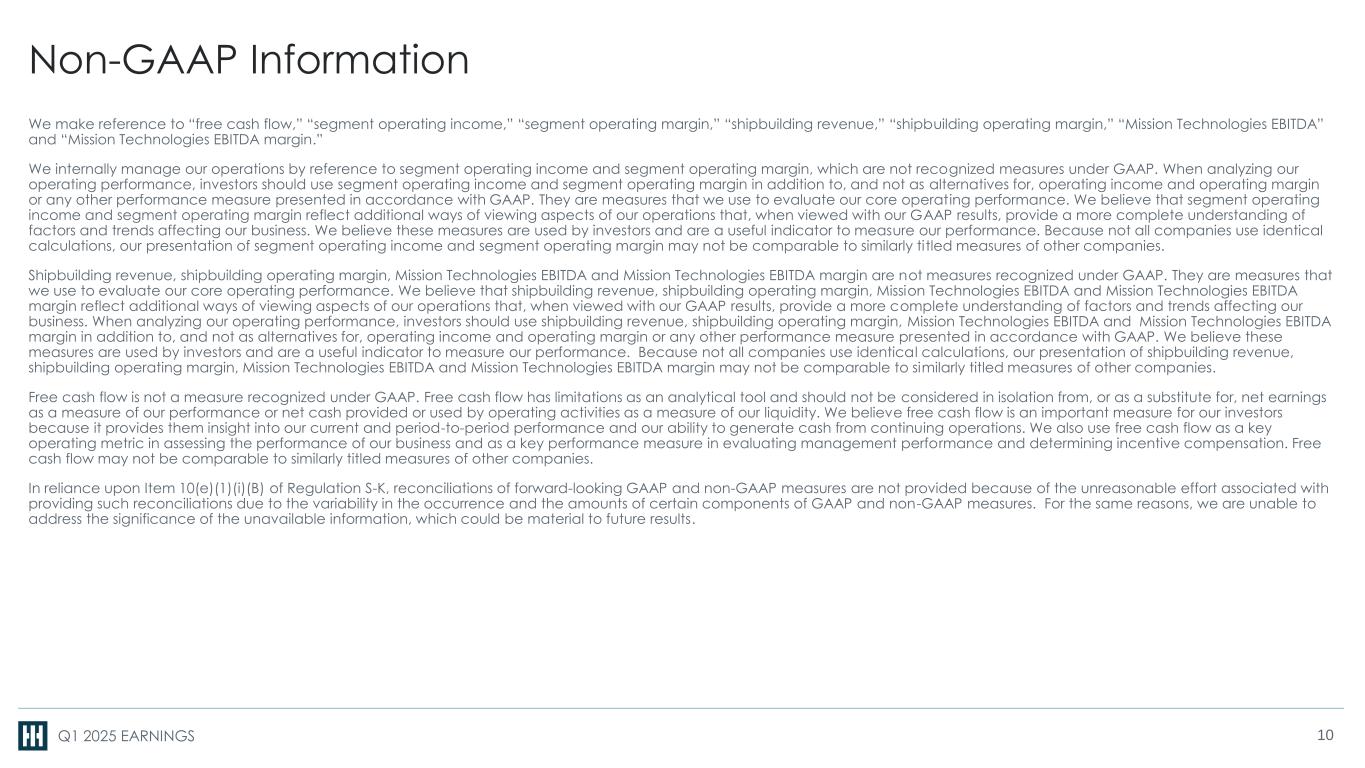
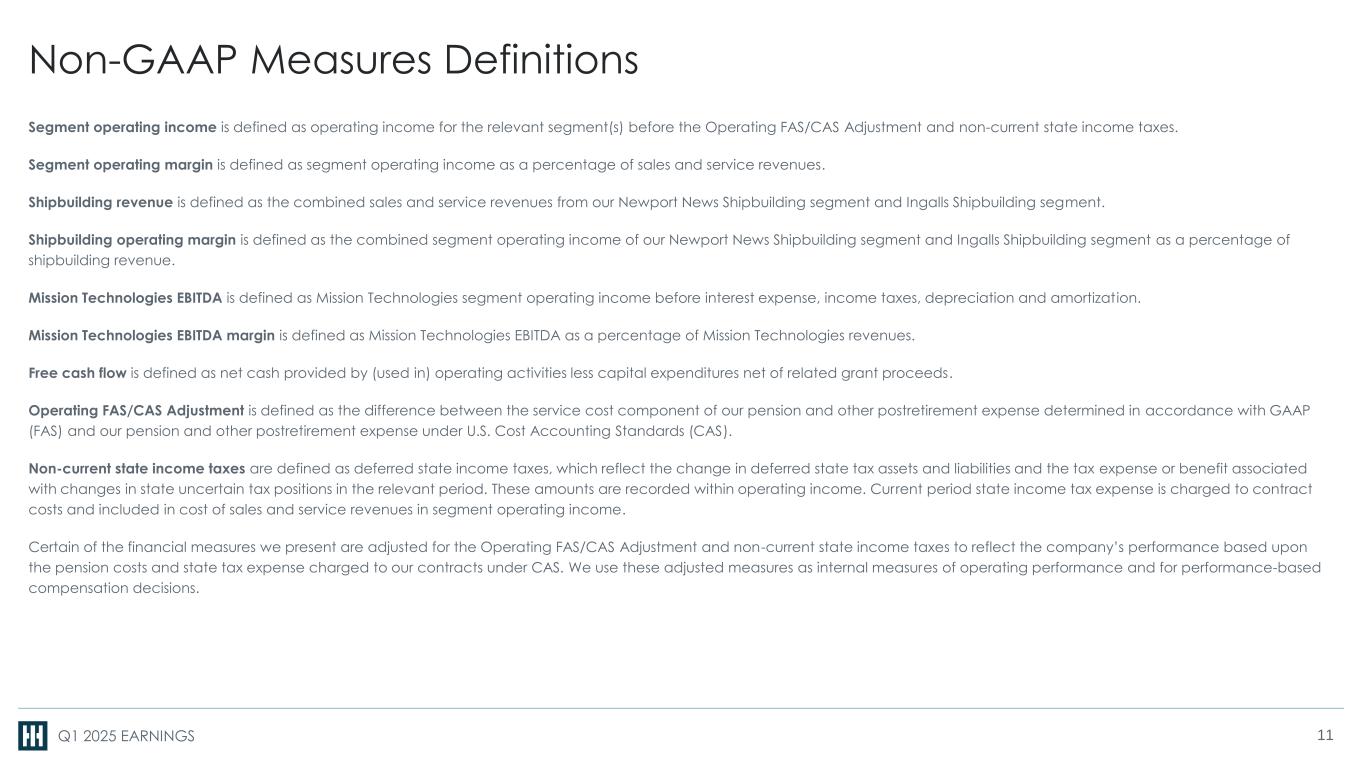
Thank you, Operator, and good morning, everyone. Welcome to the HII First Quarter 2025 Conference Call. Matters discussed on today's call that constitute forward-looking statements, including our estimates regarding the company's outlook, involve risks and uncertainties, and reflect the company's judgment based on information available at the time of this call. These risks and uncertainties may cause our actual results to differ materially. Additional information regarding these factors is contained in today's press release and the company's SEC filing. We will also refer to certain non-GAAP financial measures. For additional disclosures about these non-GAAP measures, including reconciliations to comparable GAAP measures, please see the slides that accompany this webcast, which are available on the Investor Relations page of our website at IR.HII.com. On the call today are Chris Kastner, President and Chief Executive Officer, and Tom Steele, Executive Vice President and Chief Financial Officer. I will now turn the call over to Chris.
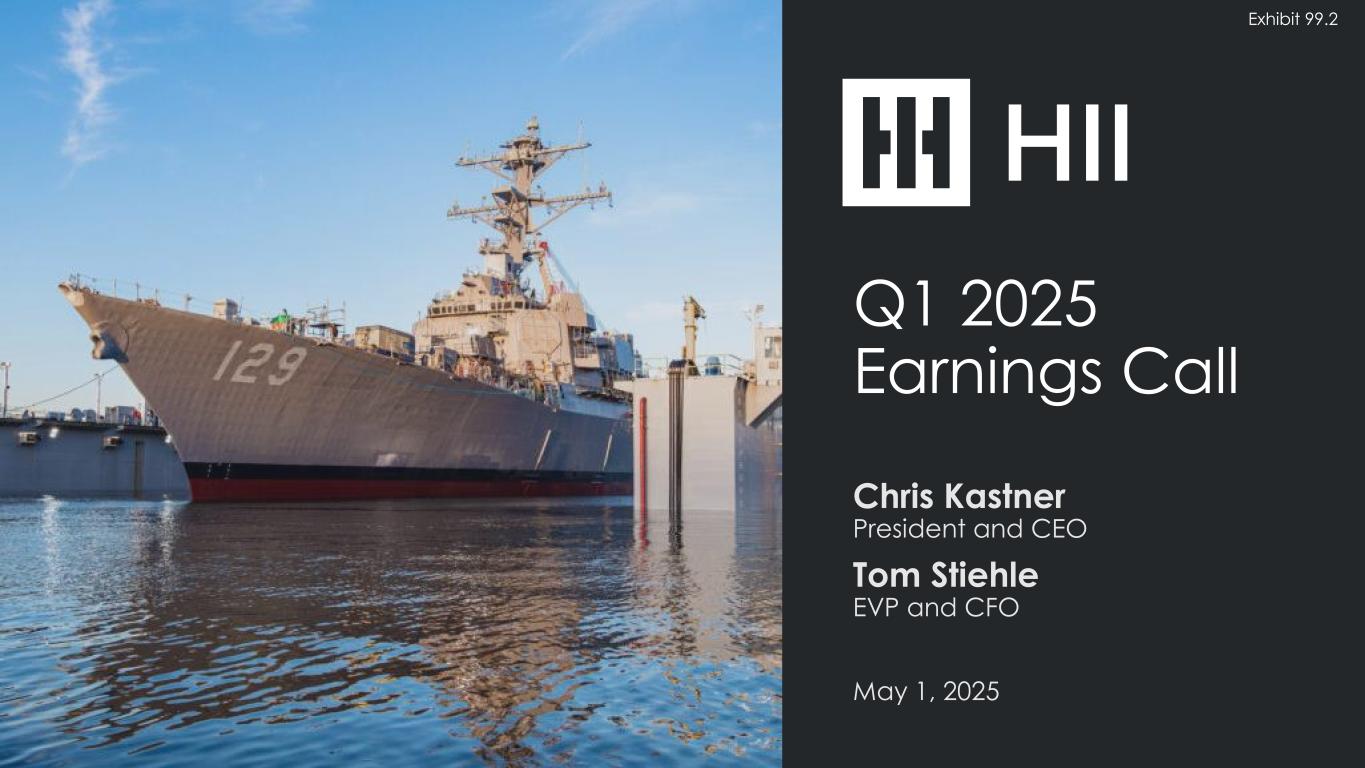
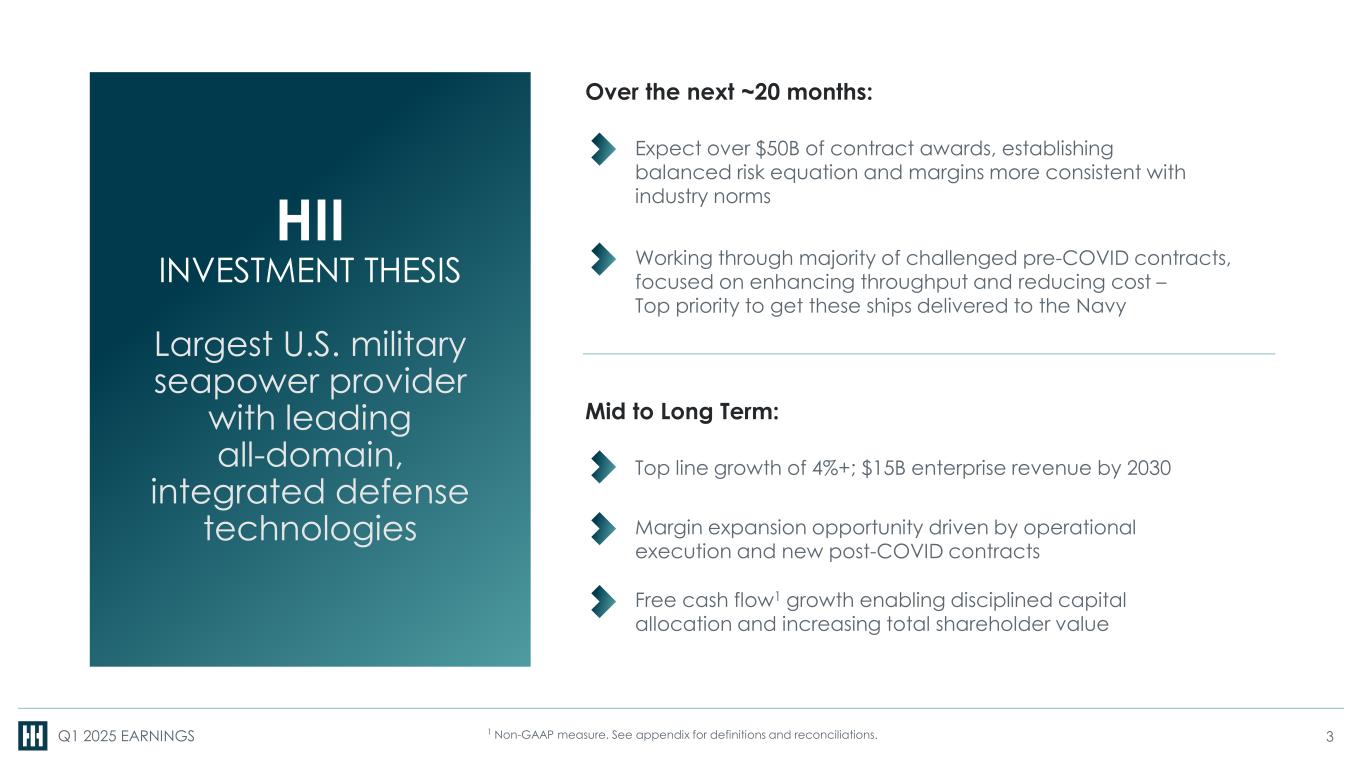
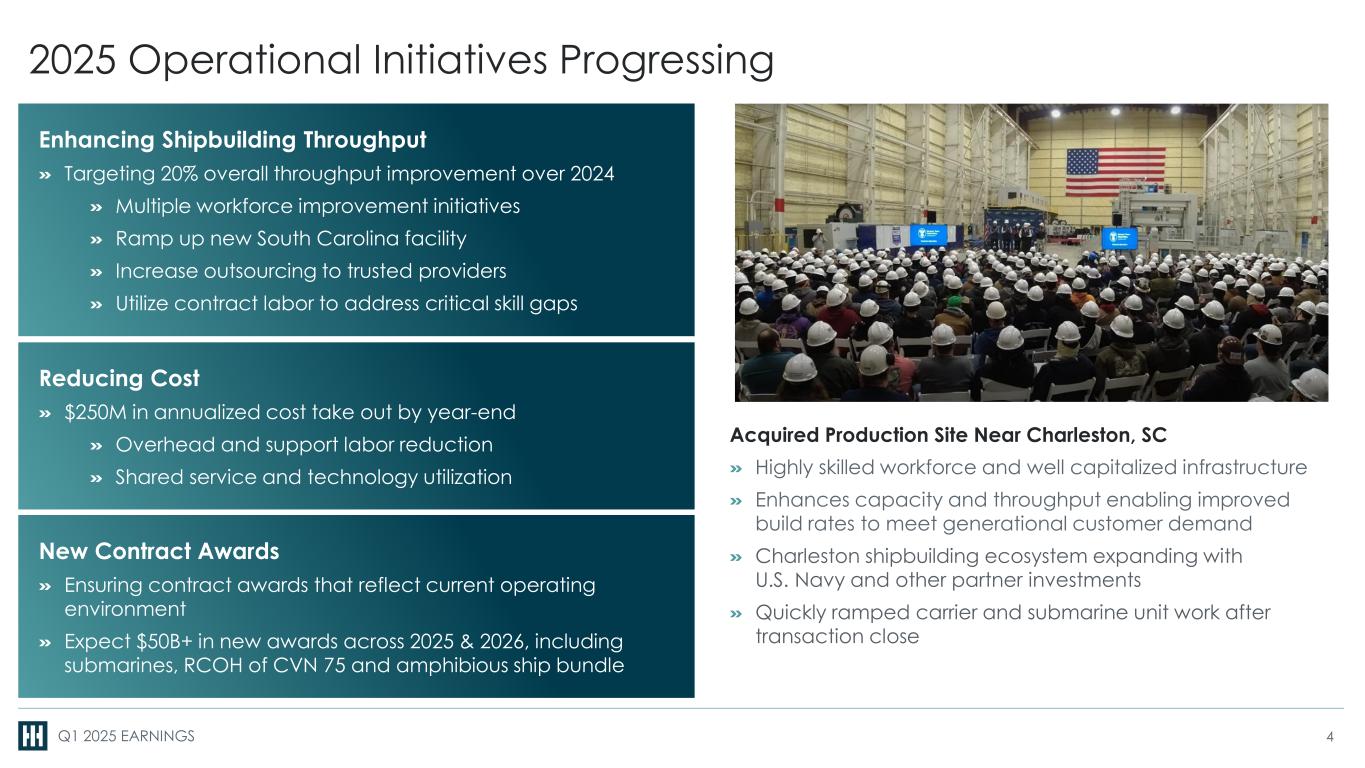
Thanks, Christy. Good morning, everyone, and thank you for joining the call. I'll start by providing an update on our 2025 operational initiatives, which include enhancing shipbuilding throughput, reducing costs, and securing new contract awards. In the first quarter, we made progress against our goal of improving shipbuilding throughput by 20% year-over-year. Ingalls is largely on plan, and their production milestones remain unchanged. Newport News is modestly behind plan. Half of this variance is driven by the atypical weather we experienced in January and February. The most significant variance in Newport News resides with CVN 80. This is directly related to the late major equipment that is to be installed in the hull of the ship. These delays directly impact the construction approach and have limited the progress we can make on the ship. Once this equipment is received from our suppliers, which is scheduled throughout the summer, we anticipate an acceleration of progress. Additionally, for both shipyards, our outsourcing efforts continue, continue, and we expect this to ramp throughout the year to support our throughput goals. Our South Carolina production facility is online and has already completed the first carrier unit for Newport News. The team remains focused on meeting our delivery schedules and is working with the Navy to identify additional initiatives that will accelerate schedule performance. Turning to our cost reduction efforts, plans are in place and we intend to reach our goal of $250 million in annualized cost reduction by year's end. We have an agreement on the Block 5 FY24 two-boat contract and will now turn our focus to the Block 6 and Columbia Bill 2 contracts. Also, I want to highlight how our strategic focus in 2025 aligns nicely with the administration's defense priorities. On April 9th, the Trump administration released two executive orders, modernizing defense acquisitions and spurring innovation in the defense industrial base and restoring america's maritime dominance we are working with our customers on strengthening the industrial base and accelerating the transition of new capabilities to the warfighter we are leaning into the use of other transaction authorities and are working with the rapid capabilities office as a means to leverage new technologies for example in april we delivered the first two lionfish, small uncrewed undersea vehicles, to the U.S. Navy under a program that could scale to 200 vehicles. The program was developed in partnership with the U.S. Navy and Defense Innovation Unit to accelerate adoption of dual-use commercial technologies into U.S. Department of Defense programs. This quarter, we also announced that our Mission Technologies Division was selected to develop an open architecture high-energy laser counter drone system for the U.S. Army's Rapid Capabilities and Critical Technologies Office. HII will develop and test a high-energy laser prototype to acquire, track, and destroy small to medium-sized unmanned aircraft systems. On the shipbuilding side of the business, we established an MOU with HD, Hyundai, Heavy Industries. The MOU provides a framework for us to jointly explore opportunities to collaborate on accelerating ship production in support of defense and commercial shipbuilding projects. Like our existing strategic relationship with UK-based Babcock International, we believe international partnerships are crucial to strengthening the allied industrial base. Given our core business, these strategic relationships position us to support initiatives that may result from the maritime executive order. Turning to the results, first quarter revenue is $2.7 billion and earnings per share was $3.79. We ended the first quarter with backlog of $48 billion, of which approximately $28 billion is currently funded. Now, let me share a few first quarter highlights. During the quarter at Ingalls Shipbuilding, we launched DDG-129, Jeremiah Denton, christened LPD-30, Harrisburg, and started fabrication of LPD-32, Philadelphia. At Newport Newport News, CVN 79 Kennedy, continued catapult testing and achieved 95% of compartments turned over to the Navy. And on the Virginia CLASS program, we completed a major test event on the first boat of Block 5 SSN 802 Oklahoma. Also, at our recently acquired Newport News Charleston operations, we retained 99% of the transitioning workforce, and these new shipbuilding team members are working on submarine and carrier units to help increase throughput at Newport News. We also celebrated the graduation of 115 apprentices during the apprentice school graduations at both shipyards. These graduates started the apprentice program during COVID and we look forward to higher numbers of graduates in upcoming years following the expanded enrollment we've recently experienced. Turning to mission technologies, in addition to delivering the initial line fit small UUVs I mentioned earlier, we surpassed 700 Remus uncrewed underwater vehicles sold and delivered to 30 countries. Key winds admission technologies in the quarter, in addition to the high-energy laser weapon system, included a contract to expand shipboard and shore-based training support for the U.S. Navy and coalition forces, a pilot training contract to support the nation's combat-ready force, an award from the U.S. Air Force to protect systems and software and a task order to support global air and space operations. Turning to activities in Washington for a moment, while a full-year continuing resolution for defense is unprecedented, we are pleased with the support provided for our shipbuilding programs, which supports our target of achieving more than $50 billion in new awards across 2025 and 2026. The full-year Continuing Appropriations and Extensions Act 2025 included funding for three Arleigh Burke-class surface combatants, one Virginia-class submarine, one San Antonio-class amphibious ship, and the RCOH for CBN 75. All note that we do not expect a material impact related to tariffs. We purchased the vast majority of our material domestically. We have long-term purchase agreements in place for material that may be impacted by tariffs. In summary, I'm encouraged by the results to date and the progress our team has made against the operational initiatives we've laid out but i also know there's significant work to be done as we continue to execute for our customers and create value for our shareholders our outlook is unchanged and over the next few years as we execute on the pre-covid contracts and transition into the post-covid contracts we will continue to reduce risk and align our portfolio baselines with the current environment I fully expect top-line growth with a forecast of $15 billion of revenue by 2030, as well as margin of free cash flow normalization in the years ahead. And now I'll turn the call over to Tom for some remarks on our financial performance. Tom?
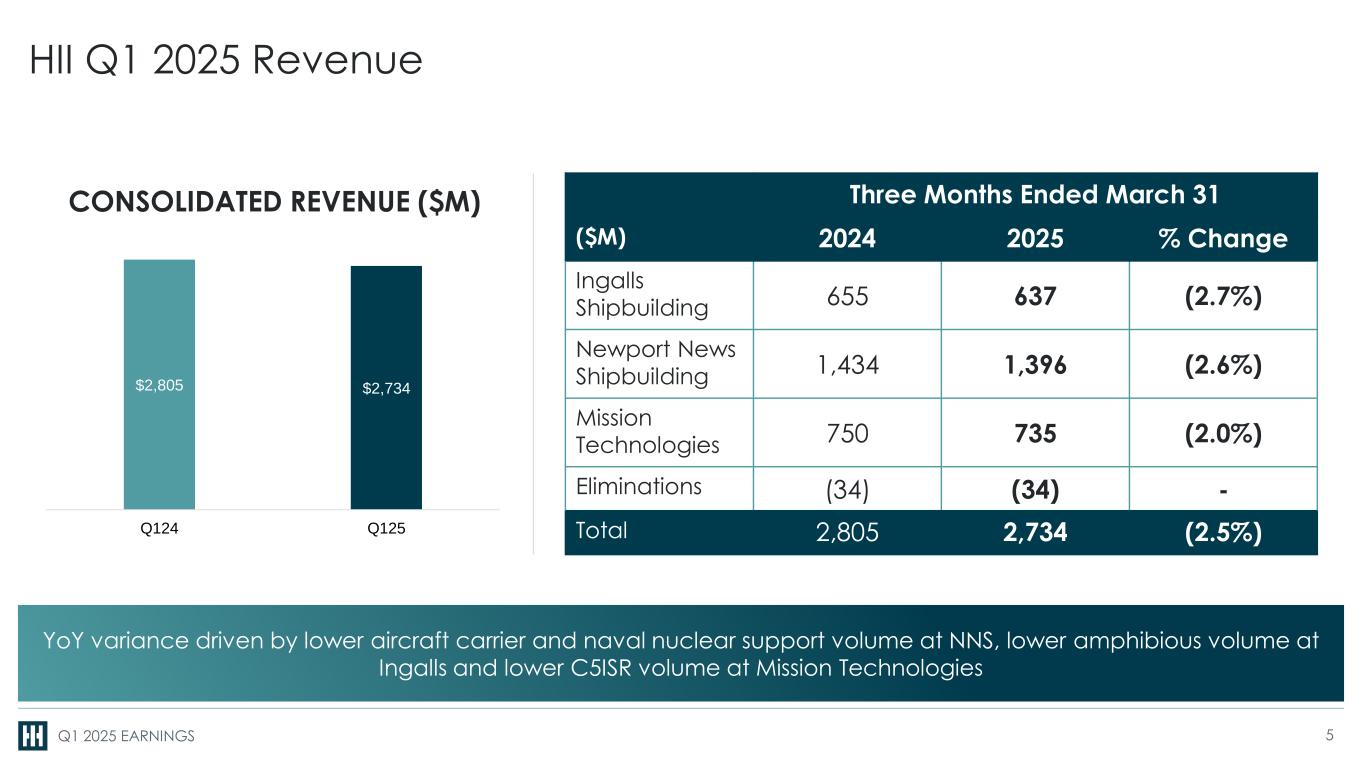
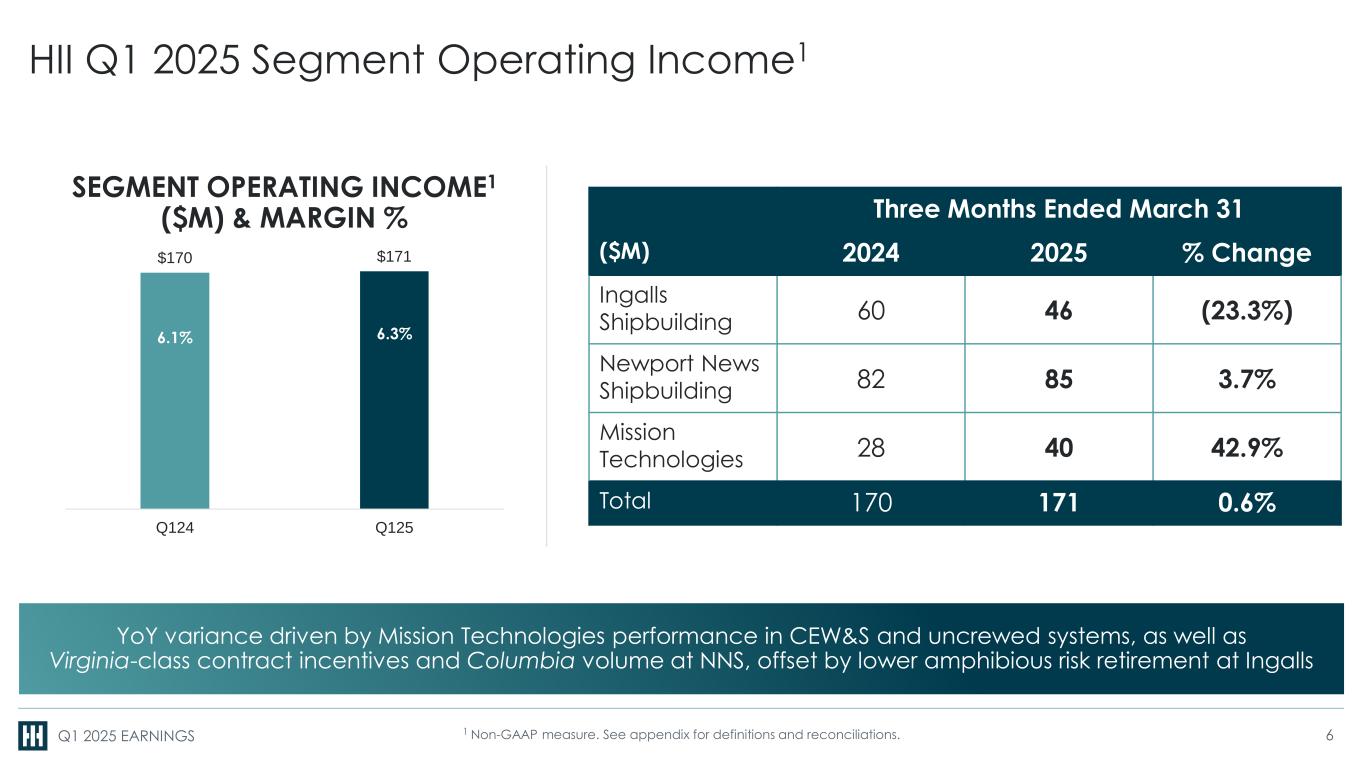
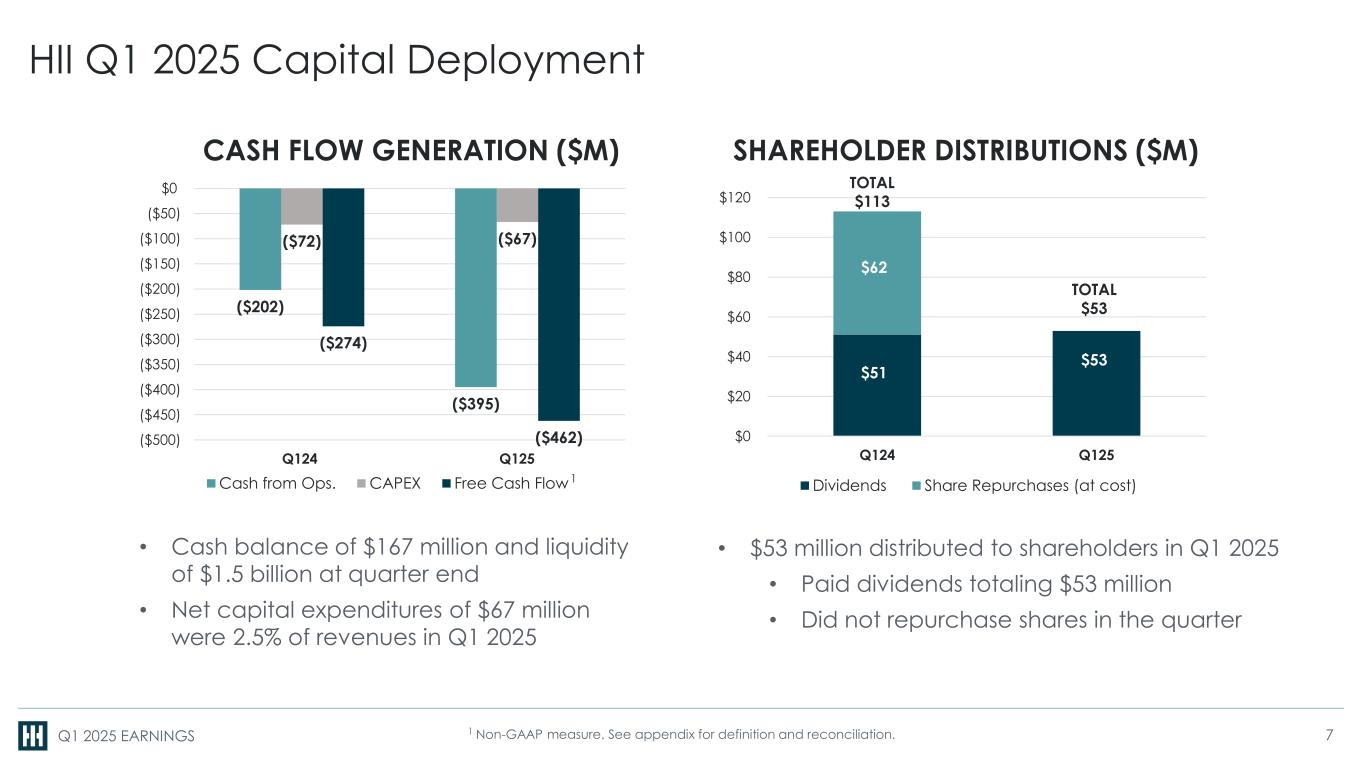
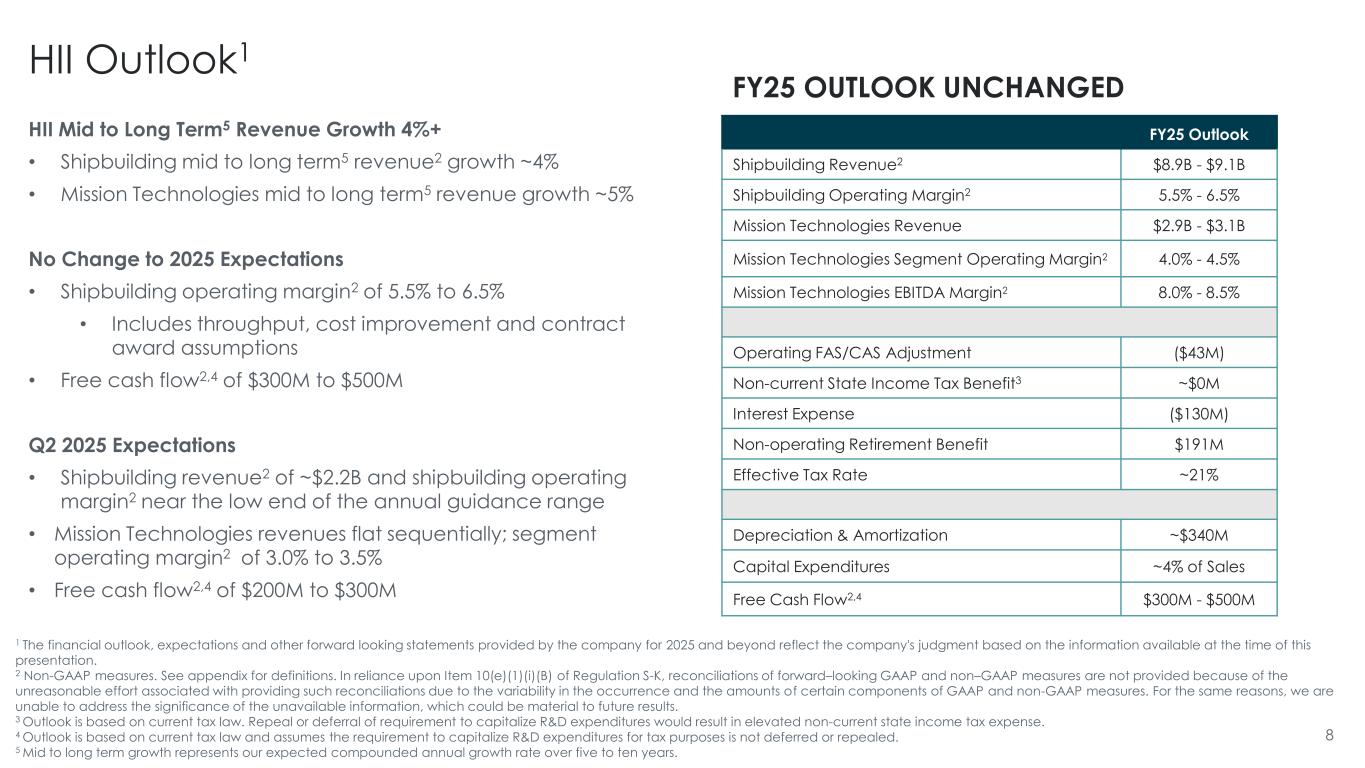
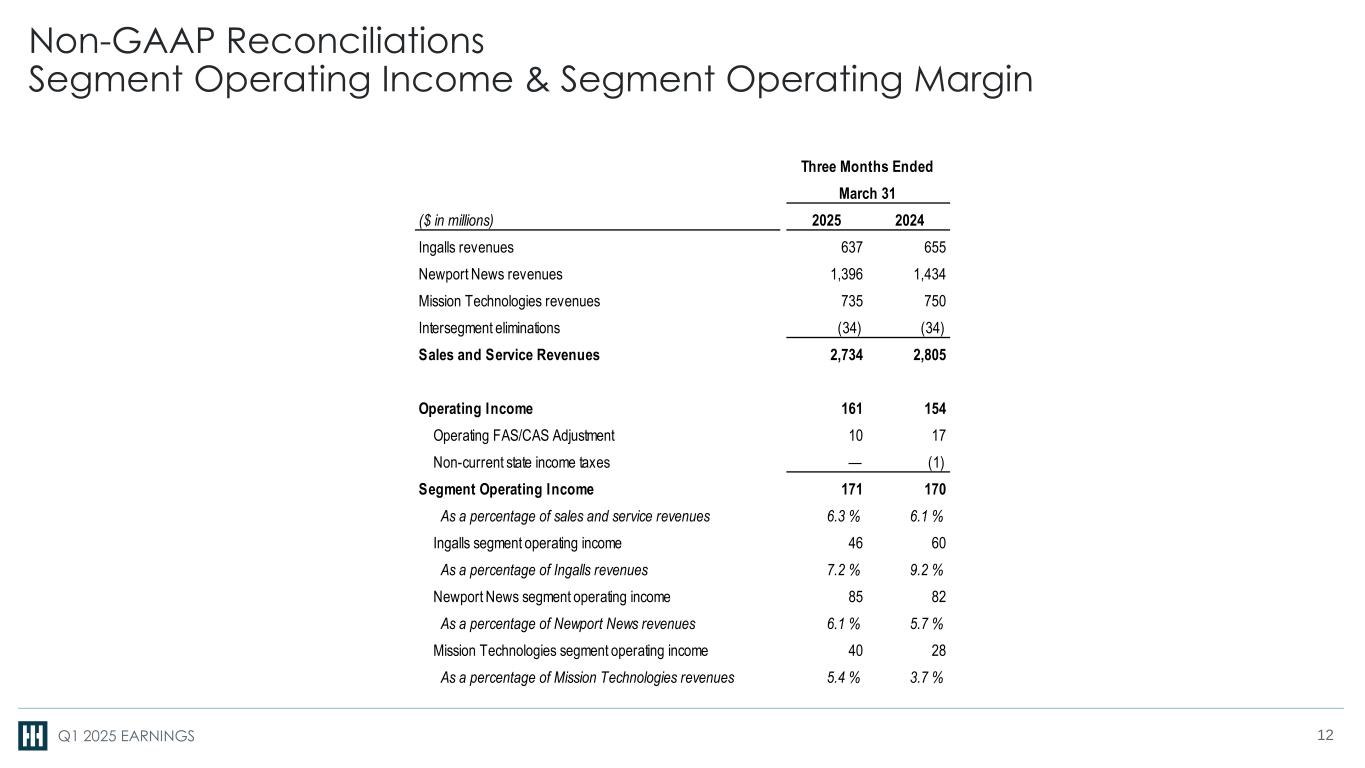
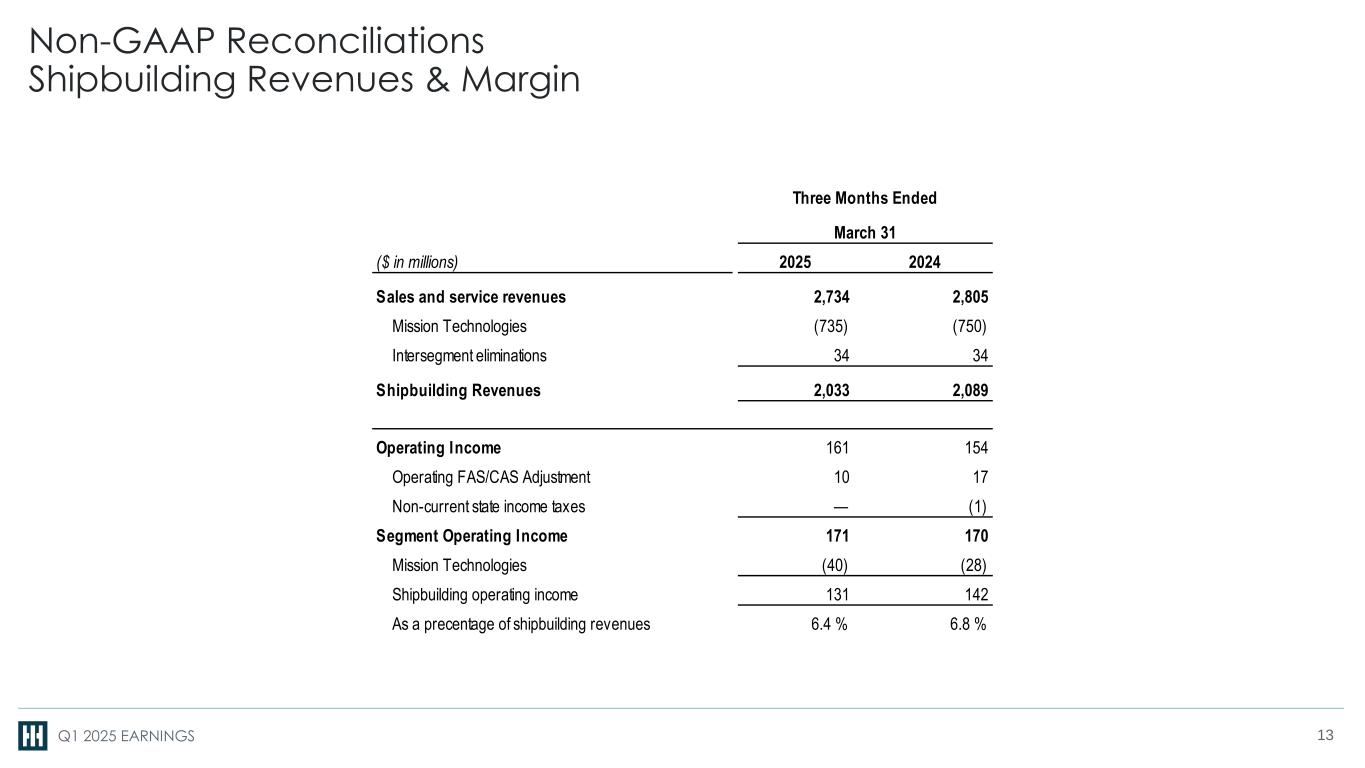
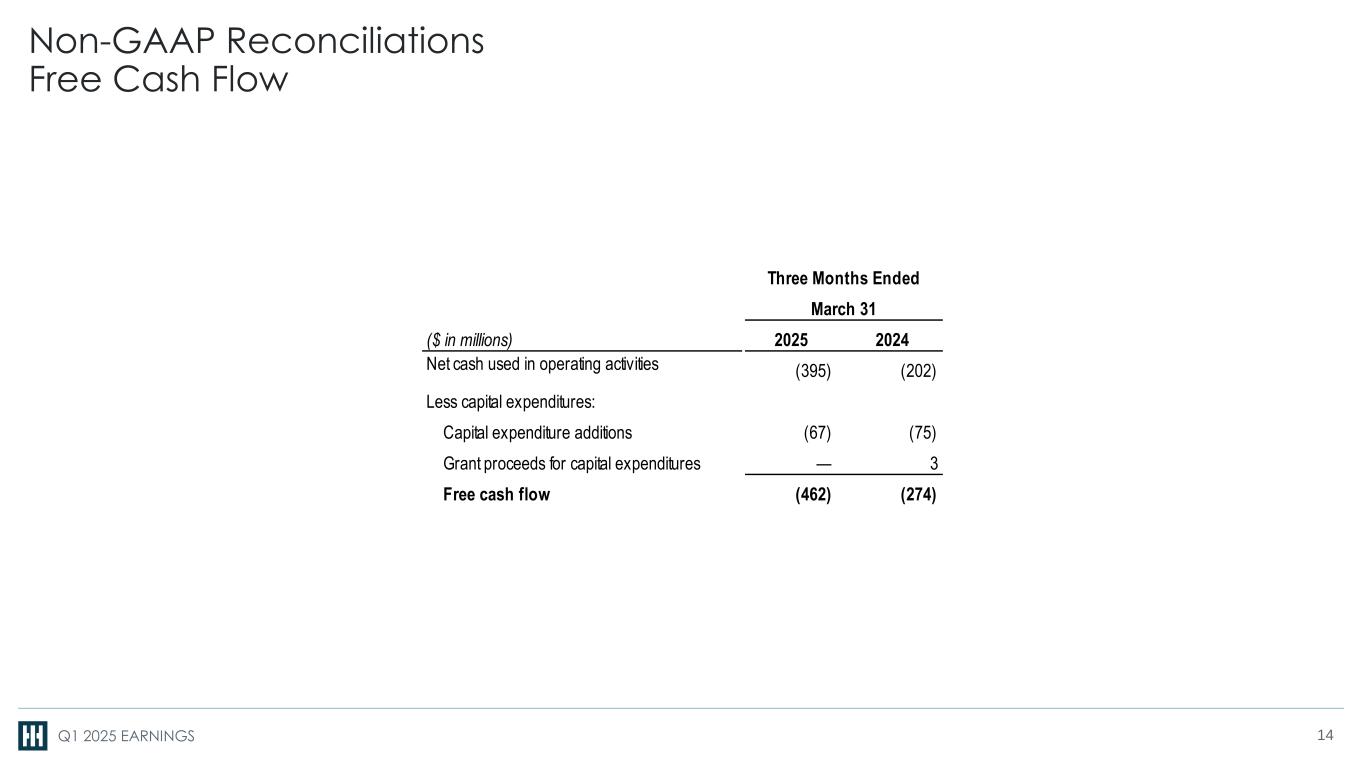
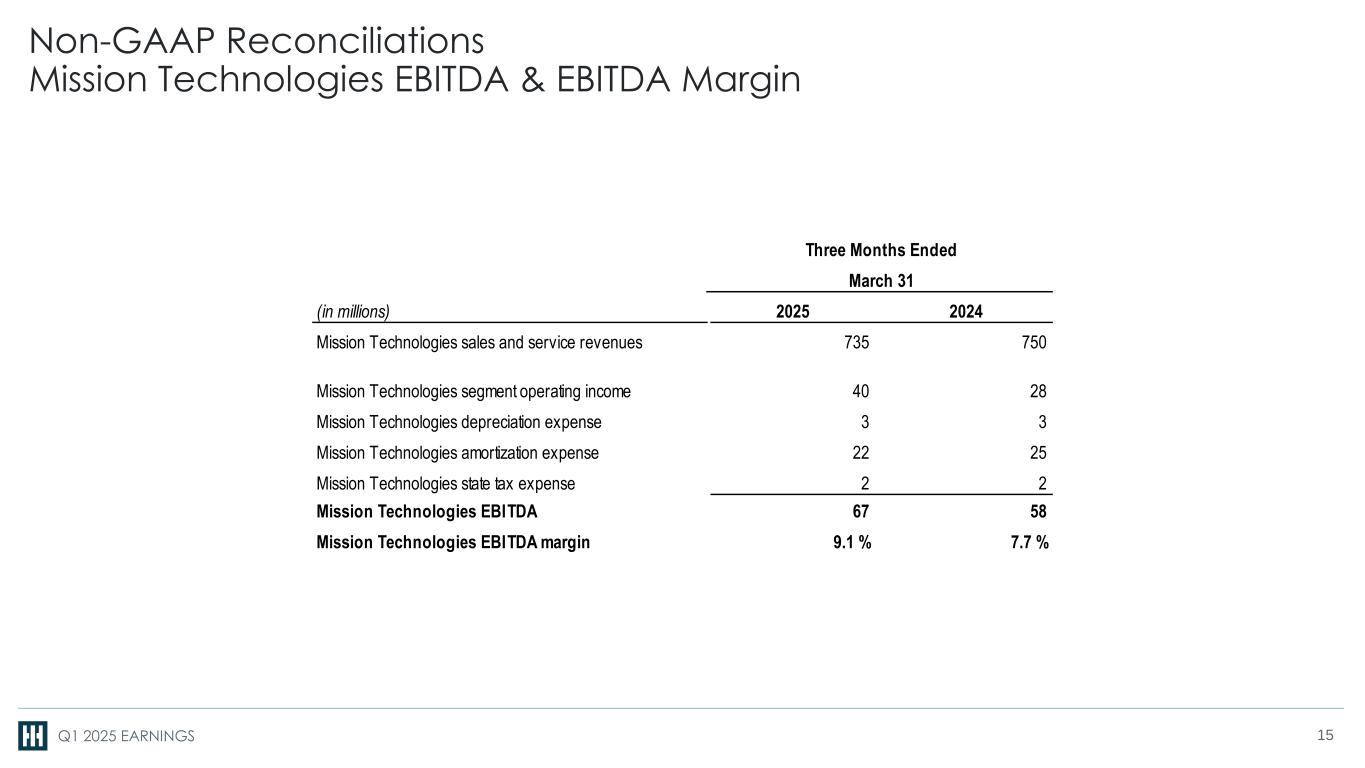
Thanks, Chris, and good morning. Let me start by briefly discussing our first quarter results, and then I will address our reaffirmed outlook for the year. For more detail, please refer to the earnings release issued this morning and post it to our website. Beginning with our consolidated results on slide 5 of the presentation, our first quarter of revenues of approximately $2.7 billion decreased 2.5% compared to the same period last year. This decreased revenue was attributable to declines at Newport News Shipbuilding, Ingalls Shipbuilding, and Mission Technologies. Ingalls revenues of $637 million decreased by 2.7% compared to the first quarter of 2024, driven primarily by lower volume on amphibious assault ships. Newport News revenues of $1.4 billion decreased by 2.6% compared to the first quarter of 2024, driven primarily by lower volumes in aircraft carriers and naval nuclear support services, partially offset by higher volumes in the Columbia-class submarine program. Mission Technology revenues of $735 million decreased by 2% compared to the first quarter of 2024, driven primarily by lower volume in C5ISR. Results for the quarter exceeded our guidance. The year-over-year decline was expected and related to non-recurring sales in the first quarter of 2024. Moving on to slide 6, segment operating income of $171 million in the first quarter of 2025 increased less than 1% compared to the first quarter of 2024, driven by improved performance at mission technologies in cyber, electronic warfare in space, and uncrewed systems, which was largely offset by lower amphibious assault ship risk retirements at Ingalls. At Newport News, segment operating income improved by $3 million, or 3.7%, compared to the first quarter of 2024. Results in the quarter included unfavorable performance-related adjustments for CBN 80 Enterprise, as well as Block 4 and Block 5 of the Virginia CLASS program, which were offset by contract incentives. Consolidated operating income for the quarter of $161 million increased by $7 million, or 4.5% from the first quarter of 2024, an operating margin of 5.9% in the quarter compared to 5.5% in the same period last year. The improvement was driven by a more favorable operating fast-cast adjustment, as well as the favorable segments results I've noted. Net earnings in the quarter were $149 million, compared to $153 million in the first quarter of 2024. Diluted earnings per share in the quarter were $3.79, compared to $3.87 in the same period last year. Our contractual commitments increased by approximately $2.1 billion in the period, bringing backlog to $48 billion at the end of the quarter. Turning to slide 7, cash used and operations was $395 million in the quarter. Net capital expenditures were $67 million, or 2.5% of revenues. Free cash flow in the quarter was negative $462 million. This was within our free cash flow guidance range for the quarter, though at the low end of the range, due to timing of incentives and normal fluctuations in program receipts and disbursements. During the quarter, we did not repurchase any shares. We did pay a cash dividend of $1.35 per share, or $53 million in aggregate. Turning to liquidity and the balance sheet, we ended the quarter with a cash balance of $167 million and liquidity of approximately $1.5 billion. Today, we are repaying a $500 million note and plan to utilize a revolving credit facility and commercial paper program to support interim liquidity as free cash flow generation ramps through the year. This is in line with our prior expectations and was contemplated in the interest expense guidance that we had previously provided and are reiterating today. Our capital allocation priorities aren't changed. We value our investment-grade credit rating. We will continue to strategically invest in our shipyards. thoughtfully grow our dividend, and return excess cash through share repurchases. Moving on to our outlook on slide A, we are reiterating all elements of the 2025 guidance, and there is no change to our medium to long-term thinking in terms of growth and profitability expectations. Our guidance is predicated on achieving the operational initiatives we have laid out for 2025. As Chris noted, we are progressing on each of these items, and we expect to achieve a meaningful improvement in throughput over the cost of the year. For shipbuilding, we expect second quarter sales of approximately $2.2 billion and margins near the low end of our annual guidance range. For Mission Technologies, we expect second quarter sales that are relatively flat sequentially and margins of 3 to 3.5%. We expect second quarter free cash flow to be between $200 and $300 million. To close, I will echo Chris's positive sentiment regarding the company's mid- to long-term outlook. We've seen credible demand for critical products and services that we provide and are heartened by the administration's clear focus on growing our domestic shipbuilding capability and supporting a strong maritime industrial base. With that, I'll turn the call back over to Christy to manage the Q&A.
Thanks, Tom. As a reminder to everyone on the call, please limit yourself to one initial question and one follow-up so we can get as many people through the queue as possible. Operator, I will turn it over to you to manage the Q&A.
Operator
Thank you very much, Christy. If you would like to ask a question, please press star followed by one on your telephone keypad now. Please ensure your device is unmuted locally. If you change your mind or your question has already been answered, please press star followed by two. Our first question comes from Doug Harned with Bernstein. Doug, your line is now open. Please go ahead.
Good morning, Doug. We've seen now with the CR with additional money for shipbuilding infrastructure and then this big authorization proposal that came up on the weekend. And now, you know, when you look at all of this, there should be more money there. But the thing that I've sort of struggled with here is how to take that money and convert it into a plan that can address what you, say on the Virginia class, you, electric boat, and the whole infrastructure needs to happen to really get throughput up. Can you comment on where the responsibilities lie, what the Navy is actually doing, so that we can have confidence that not just the money is there, but the real actions are there to change the way things have been going over the last few years?
Sure, Doug. Let me give that a shot. That's a big question. And it's not only the budget, the FY24-2 vote, the executive orders related to commercial shipbuilding and then reconciliation. There's just a lot of tailwinds right now related to shipbuilding that we need to participate in. Now, the first step in seeing what the investments are in that regard is this FY24 two-boat contract. You know, that was a product of really a couple years of effort by the Navy and the shipbuilders to evaluate the investments that were required to get at accelerating throughput. You see that in the award of that contract. It was very thoughtfully put together. It's wage support and workforce development support. It's very targeted investments to increase the submarine build rate. So that's all very positive. And then when you look at the SIV and the MIB funding that have been applied to the supplier base, that's also very positive. And you see a buildup of the infrastructure in shipbuilding that will support the growth that we think is ahead of us. really, I would think, an industry to identify. Now, it's not easy. It takes time. These are heavy manufacturing facilities and equipment. This is building a workforce in a challenging environment, but I think it's only positive for HII.
I guess the challenge here is that there's been a lot of discussion about this over the last few years, and just are there some specific things, like if you start to look at what you need to get to that rate of two Virginia class per year, you know, what's the trajectory for this? Are there specific things that will enable you and your partner to get there?
Absolutely. And really, the first step of that is this FY24 two-boat contract, targeted investments in workforce equipment, facilities, training that will accelerate the throughput. We have a lot of confidence that when these investments take hold, it's going to start to ramp throughput for the submarine program. And this shouldn't end here. We're going to negotiate Block 6 of the Columbia Build 2 contracts, we've identified additional investments that could potentially be applied to further accelerate. So it's going to, as I said before, it's going to take a while. You just don't build a building overnight. You don't build a workforce overnight. But I absolutely think that these are the right investments to get at the build rate.
Okay. Very good. Thank you.
Operator
Our next question comes from David Strauss with Barclays. David, your line is now open. Please go ahead.
Hi, good morning. Morning. Chris, following up on the CR money, the 24-2 contract that was announced yesterday, it looks like it's a cost, some form of cost contract. How is that? I thought we were operating under a fixed price on Virginia class. So how is that potentially different? What does that contract contemplate differently, I guess, than prior contracts?
Yeah, it's a bit of a hybrid, but I'll kick it over to Tommy who can answer that.
Yeah, so it's a cost-type contract. It covers both parties, the Navy and ourselves' concerns as far as what wants to be put on contract. It's a good mix and blend between affordability and profitability, and it covers the business environment that we find ourselves operating in. So it's a CTIF, and it has with the Navy, and it was approved, And as you saw, it was awarded last night. So we're excited about that to get going on that contract.
And any more detail on, you know, obviously the chip building margins in total came through better than what you had died to. You know, Newport News got a fair amount better. Ingalls kind of continued to step back. Can you just a little bit more detail on exactly what's going on and why you're forecasting, you know, kind of a margin step down again in Q2?
And if you also want to talk about what EACs were in the quarter. thanks yeah sure so hey um we got it five five for the quarter so we're happy with where we landed we landed uh about about uh 90 bips above that uh angles came in at seven two um and um it was a pacing quarter for them uh i guess i can start with the esc adjustments we had 80 up and 80 down for a net of zero so there's no there's no break at that it's a company as a net um ingles facing quarter I would say right now we're watching how amphibs are kind of working ourselves through the heart of those programs down there from a Newport news perspective this is a good quarter I think it was a mix of some pressures that we've seen on CV and 80 that Chris talked about in his remarks as we're waiting for parts to pop in there it's just having a little bit of a draw on the EAC and schedule on that front and then the VCS program as we're working people in parts to make sure we have enough people talented people the wages the wage element of this this recent award will help that and on the part side just making sure we can feed that production line as that production line ramps up and wants to get to the one plus two that we've talked about earlier here so but as i said overall it was a net neutral for eac
cum adjustments across the corporation yeah david this is the timing of incentives kind of across the portfolio i've talked we just have more incentives on our contracts now and the timing is variable at some point well right now so there's a couple of dollars of margin accretive on that
front the guide for q2 that you asked about i think we're just being being being conservative right now as chris said there's a lot a lot of work to do although we're on pace and where we want to be on cost reductions and throughput um and uh the contract awards we've got the first increment of uh of this one here in the spring and then we have vcs block six and clumbia bill two at the back half of the year but i think it's just conservatism and prudence on our side that went back to the lower end of the range.
All right, thanks very much.
Operator
Our next question comes from Scott Micas with Spellius Research. Scott, your line is now open. Please go ahead.
Morning, Chris and Tom. I wanted to follow up on David's question about the two-boat Virginia contract. It was surprising to see that it was cost plus, but obviously there's funding in there for workforce development electric boat has an ongoing labor negotiation i think newport news is three collective bargaining agreements expiring in 27. so until those negotiations are wrapped up should we expect a greater share of shipbuilding orders over the remainder of this year and next year to be more cost plus incentive fee type structures?
Yeah, I wouldn't necessarily assume that. We need to really get the wage support that's provided in the two vote. I'm not going to get into dates or because we do have to discuss that with our labor unions. When we get the workforce, the support, the wage support to our retention will improve. I'll be able to make our commitment. So I wouldn't necessarily think that that would dictate the contract types. We're going to evaluate the appropriate contract types based on the situation at hand when we negotiate the contracts. So we're just going to have to kind of move ahead from here on Block 6 and Columbia Build 2 that essentially was put in place forms an interesting basis to roll into those discussions.
And then the Golden Dome is also a big priority for the administration, and that's going to require a lot of equipment, especially radars and potentially the Aegis Ashore system. Lead times on radars are also very long. So has there been communication between shipbuilding and the administration about how to produce enough radars for both the Golden Dome and what the Navy needs for shipbuilding priorities?
Yeah, so we have not been involved in those discussions to date. I'm unaware of potential suppliers. Our DDG-51 program, Aegis program is going well. We saw 129 go on the water, 128 will out this year. So we're making progress on our milestones there, but relative to those shifts with those new radars. All right.
Thanks for taking the questions.
Operator
Thank you very much. Our next question is from Pete Skibitsky with Alembic Global. Pete, your line is now open. Please go ahead.
Hey, good morning, guys. I guess Chris or Tom, I'm not sure. but um kind of a complicated situation but you guys have you know nearly 50 billion in total backlog right now and you're talking about an incremental 50 billion new awards in the relative new you know near term how can we not think that there's upward pressure on that four percent shipbuilding you know revenue growth guide in in this type of backdrop is it now is it still just early or labor situation that confounding and I assume the four percent doesn't include you know the 150 billion in defense ads it's you know potentially coming down the pike as well so just want to hear your thoughts on that yeah so let's say the the 50 billion in new awards
includes um block six uh on the Columbia second build uh the ANFID bundle uh down in in Ingle so So I wouldn't necessarily correlate it to a $50 billion. Now, tailwinds related to the 4% absolutely could happen. I'm not going to go there from a guidance standpoint at all right now, but the tailwinds between reconciliation, the executive order, these contracts being put under contract, the investments that are being made in the industrial base and the shipyards, there's absolutely a medium-term upside related to that top-line growth number. So we just need to take advantage of it, and that's what we're going to work to do over the next couple of years.
Okay, I appreciate it. Just one last one for me on Ingle's margin. It used to be kind of reliably in the double digits, and it's kind of regressed over the past five quarters or so. What time frame is reasonable for us to think about the current environment changing to one where positive EAC adjustments are more, you know, maybe more likely than not.
Yeah, I think you nailed it that, Pete. The culprit is the positive EAC adjustments. It's not so much that we're realizing kind of negative adjustments, but we're staying on our run rate and we're neutral there. You know, all three of those programs are in a production environment. The engineering works to keep the retention. And as we go forward with that, to make sure that we feed the factory to run its production environment there. So I'm comfortable with the leadership down there and that we understand those ships out of the gears there and having the production flow run as fast as possible. You know, we are down probably a couple of years and hours of experience down there. That just works itself through maybe not as cost-efficient to realize those upsides and maybe a little bit more rework from time to time or an EAC. I'd love to see a time frame yet. Proceed forward.
Okay. Appreciate it, guys.
Operator
Our next question comes from Myles Walton with Wolves Research. Myles, your line is now open. Please go ahead.
Maybe Chris, could you start by talking a little bit about the workforce and how it trended in the first quarter? I think you probably picked up about 500 employees with W International and the press release is still talking about 44,000 employees. So was there much of a movement in net hiring and how is attrition doing?
Yeah, so interesting. Good question, Myles. We hired 1,000 people in the first quarter, 1,000 craftsmen and women. They related to the change in the strategy in both shipyards to hire more experienced personnel and improve the mix. New hires, we think that strategy makes sense. We're going to continue to execute on that. The good news is attrition is down in both shipyards. Not materially down, not back to pre-COVID levels, but it is definitely moving in the right direction so yeah I hired a thousand which is a bit south of where we wanted to be but regarding the 35% increase in outsourcing can you comment on where you are with respect to that and sort of how the performance quality is looking from what you're outsourcing actually the way we've executed on our outsourcing program has been very positive you know we have some tough lessons learned uh back at ingles and outsourcing we've used those lessons learned and applied them so the quality is pretty good we we do pilots uh in these uh manufacturing yards before they actually execute they've done that uh we are on schedule in both yards in and the quality looks we're going to continue it we need to uh the industrial base is expanding we need to take advantage of it but we need to make sure that it's if it's not you have to read the last one On the SAAS program, is there a direct benefit to the carrier programs, or is it more of
an indirect benefit with the submarines being the direct?
Yeah, it supports the entire nuclear industrial base and nuclear infrastructure.
Operator
Our next question comes from Seth Seisman with J.P. Morgan. Seth, your line is now open. Please go ahead.
Thanks very much. good morning um good morning when when we think about kind of the the direct impact of the contract that was announced last night um you know is there kind of a sizable um cash advance associated with it and is that part of the cash guidance for q2 and you know does it enable signing the contract um you know give you opportunity to to change um you know some of the assumptions across the different work at Newport News beyond just the two subs that were contracted?
Let me start with that. So guidance assumed execution of the Block 5-2 boat contract. It has all year. And we assume incentives and capital incentives in Q2. It's all in the mix, a week of pre-cash flow for Q2 as well as the end of the year. I'd love, Tom, if you want to add anything.
It was incorporated into the guide that we gave you for Q2. We mentioned at the very beginning of the year expectation to have both that award and then in the back half of the year, VCS Block 6 and Columbia Bill 2, not incrementally, but it was in the mix, and it was in line with what we expected here. So I'm comfortable with both the guide that we've given you now for Q2 at $200 to $300, supports the three to five hundred for the entire year with no change and and on the on the on the assumed on the booking rate part of that well it's all included in our in our in our guide and in our accounting some okay we'd always assume and then just a little bit bigger picture you know you have this
announcement with I think with Hyundai during the quarter and you know one of one of the topics that some people in Washington are discussing in terms of ways to accelerate shipbuilding is through partnership with other countries. This seems like a pretty early effort based on what was in the press release, but how do you think about where that could go and where international partners might actually be able to fit in?
Yeah, thank you for that question. Yeah, it is early on in a strategic relationship that's very broad in nature and it's going to apply to commercial shipbuilding and potentially taking advantage of the economic situation arising out of the executive order on commercial shipbuilding to see if there's an economic model that makes sense for expanding the commercial shipbuilding base in the united States. And then best practices in defense and military shipbuilding. We've been in their shipyard, they've been in our shipyard. They're a great shipbuilder, we're a great shipbuilder, and we can learn from each other. So it's very broad in its nature right now. I think it's, when you think about having allies participate in shipbuilding, that only makes sense. An expansion of the capacity only makes sense and bringing the best people to the table to to execute against this is only the right thing to do so we don't know where it's exactly going to take us at this point uh it's in the initial talks um but we need it's part of taking advantage of what we see as a very interesting thanks yeah our next question comes from jason grisky with city group jason your line is now open.
Operator
Please go ahead.
Great. Thanks. Good morning, everybody. Hey, Chris, we've talked about this kind of in bits and pieces throughout the call today, and I think in prior calls, but I'd like to just ask, you know, a step back bigger picture question about the timing of the transition from pre-COVID to post-COVID chips, and maybe give you an opportunity to kind of update us on any changes to the timing and maybe the major risks and opportunities in that timeline. I think you announced today some modest delays on the carrier side. So I just want to make sure we're kind of baselined, re-baselined here on the expectations on timing of that transition.
I think we said that 50% was going to, we're going to hit the 50% mark or beyond 50% mark in 27, 27, that's correct. You're correct to pick up on the issues with CB&80 related to the equipment that's late in the bottom of the ship. We expect to get that over the summer and then when that gets in, we'll start to make more progress. But there's no change in the balance of our milestones. We're in a pretty good place there, so I still expect that transition to be on schedule.
Okay, great. And then Christy's restricting us to one follow-up question, so this might be like a couple, three parts here. I'm just kind of curious on all the reform and the executive orders that have been coming our way. get your thoughts on a couple of different things. First on shipbuilding assistance and investment that might go into the shipbuilding industrial base, what strings might be attached to it? Do you need to invest ahead of getting funds, and does that change the potential cash flow profile ahead for you. And then you mentioned OTAs in your preparer's remarks. And I think it's kind of tied up in the potential for acquisition reform, acquisition reform of FAR and DFARS specifically. So I'm kind of curious, is that something that is going to impact, those kinds of mechanisms will impact emission systems business more than shipbuilding per se? and what do you think is the long-term impact on the mission systems business from risk and opportunities and margins? Thanks.
Thanks, Jason. So first things first, the reform, executive orders, and cash flow profile. Look, I think it's too early for that right now. There's a lot of work going into making recommendations on how those are rolled out. If you read the executive order, a significant amount of activity that we need to participate in quite actually because we think we can add a lot of – provide a lot of input to them so we can kind of get at the right answer. But so, yeah, a lot of work by the team, the government team and the shipbuilding office over the next 30, 60, 90 days to further define what those mean, what the economics mean, what the investments mean. And we'll know more, but I don't see definitely a cash flow drain by us related to that at this point, but more to come. On the OTAs, those are only positive. Things happen faster in an OTA environment. We're pretty good at them. Our small uncrewed vehicle was an OTA that was converted to a program of record and very positively. So we only see upside related to that we're comfortable with it we're going to lean into it uh so so there's potential upside within mission technologies related to that activities and the the rapid capability office sort of activities with our high energy laser that we're providing for the army is also positive so i think you have to lean into this stuff you know historically our mission technologies division has been very good at applying commercial technologies to some of the biggest problems that the DOD has. We're going to continue to do that. We have a team that can do that within mission technologies. So, as I said before, we're going to lean into it, and I see potential upside related to it.
Operator
Our next question comes from Noah Upanak with Goldman Sachs. Noah, your line is now open. Please go ahead.
Hey, good morning, everyone. The press, and I think you discussed that maritime executive order that included the SAWS language. And then, you know, we now have the executive order. It doesn't include the process to sort out where to go from here.
Your senses for why that changed in the process and how unlikely it is that we that you eventually see saws yeah so that's probably not important to how it did not end up in the final executive order I'm sure that those are that's why their drafts they go through review with the different elements of the government and ultimately it wasn't included do I think saws will happen in the future look saws did a lot of really interesting things. It was very innovative. It accelerated investment into the shipyards to get at the submarine production rate. But right now, our baseline is the Block 5 contract, the Block 6 and Columbia Build 2. And we're working with our support to get those under contract. Now, it identified in detail the investments we thought we needed to get this done. You see those investments show up in the Block 5 contract, and as we move through Block 6 and Columbia Build 2, they should show up there as well. So SAWS called another name, but the investments are required. The team knows it. They put those investments together as a team, so we need to make sure that we continue to make those investments to get to the build rate. SAWS is something that is a name at this point, that could or could not happen in the future, but the investments have to happen in order to get to...
Chris, how much have you been able to raise wages in recent periods to get the attrition improvement that you referenced? And how much more do you have to raise wages to make much more significant strides on that front?
So I think the attrition improvement has really been a result of the targeted hiring of more experienced labor. We have addressed wages very tactically, both at Ingalls and Newport News, but we do have labor arrangements, so we have labor adjustments. But I think the attrition improvement is more directly related to our hiring strategies to focus on more experienced people.
And then lastly, Tom, can you just give us the very specific why both the shipbuilding and the MT margin are down a decent amount sequentially in the second quarter?
Yeah, so as you said earlier, just the guide that we're giving is on the conservative side. We saw from MT, you know, crude, and CEW do well for the quarters as they booked up and they closed out some projects. We don't want to get ahead of ourselves. And then from a shipbuilding side, I think we're just being conservative. We have some risks to burn down through the year, and the initiatives that we've talked about, more progress and the cost reductions, I want to see them kind of play out. We do have plans in place for that to occur. But with risk and variability, we're just staying and getting close. It was a good first quarter out of the gate and we'll adjust kind of going forward as we see successive quarters do well.
Operator
Our next question comes from Ron Epstein with Bank of America. Ron, your line is now open. please go ahead.
Hey, good morning, guys. Maybe going back to a couple of questions we've heard before, maybe Doug's earlier. What has to happen in the shipyards to really update the manufacturing process? When you look at how the Koreans do it and their commercial operations, it seems like there's more automation. They build ships differently.
Realistically, how much of that can be deployed in in our military shipyards to improve throughput you know the whole nine yards yeah I like the distinction you're making between the commercial manufacturing process and the defense process they are different when you when you're getting at a rate on fairly simple dance it's just a different process so what's it going to take fortunately we've been doing this work for a while now and what's it going to take to increase the submarine throughput and it shows it's going to show up on that these are targeted investments to create capacity and increase the efficiency on how the ships and how the manufacturing we've been working very hard at it we know where the constraints are once they get implemented I'm very confident that things are going to improve I mean is it more automation I mean are there things like that that you can do to take out variability or it's more about it's more about streamlining um there is some automation that could take place to begin at the front end of the process we have ai pilots going on in in both shipyards where we can be more efficient in analysis of scheduling per se or quality but but this is more about efficiency of the manufacturing process and eliminating road roadblocks or ensuring that your critical path is squared away It's not real automation when you get to the back half of the process. This is all about throughput and efficiency and throughput.
Got it, got it. And then maybe just one more. What are you seeing in terms of demand for your, you know, unmanned product for the autonomous stuff?
Yeah, so really good in the uncrewed space, not only in our, as I said in my remarks, we have really a couple hundred in backlog. we could have significant ramp this year executing on that small uncrewed underwater vehicle space. So demands only improving in the uncrewed space, underwater uncrewed space, not only for that product, but derivatives of that product, both domestically and internationally. So some very positive developments in the uncrewed space.
Got it. All right. Thank you.
Operator
Thank you very much. I am not showing any further questions at this time. I would now like to hand the call back over to Mr. Kestner for any closing remarks.
Thanks again for your interest and participation today. I look forward to providing updates as we progress throughout the year.