Operator
ladies and gentlemen thank you for standing by and welcome to the first quarter 2026 HII earnings conference call at this time all participants are in a listen only mode after the speaker's presentation there will be a question and answer session if you would like to ask a question please press star one to raise your hand to withdraw your question please press star one again please be advised that today's conference is being recorded If you need further assistance, please press star zero on your telephone keypad. I would now like to hand the call over to Christy Thomas, Vice President of Investor Relations. Mrs. Thomas, you may begin.
Thank you, Operator, and good morning, everyone. Welcome to the HII First Quarter 2026 Conference Call. Matters discussed on today's call that constitute forward-looking statements, including our estimates regarding the company's outlook, involved risks, and uncertainties, and reflect the company's judgment based on information available at the time of this call. These risks and uncertainties may cause our actual results to differ materially. Additional information regarding these factors is contained in today's press release and the company's SEC filings. We will also refer to certain non-GAAP financial measures. For additional disclosures about these non-GAAP measures, including reconciliations to comparable GAAP measures, please see the slides that accompany this webcast, which are available on the Investor Relations page of our website at ir.hii.com. On the call today are Chris Kastner, President and Chief Executive Officer, Kerry Wilkinson, Executive Vice President and President of Newport News Shipbuilding, and Tom Steeley, Executive Vice President and Chief Financial Officer. Now I'll turn the call over to Chris.
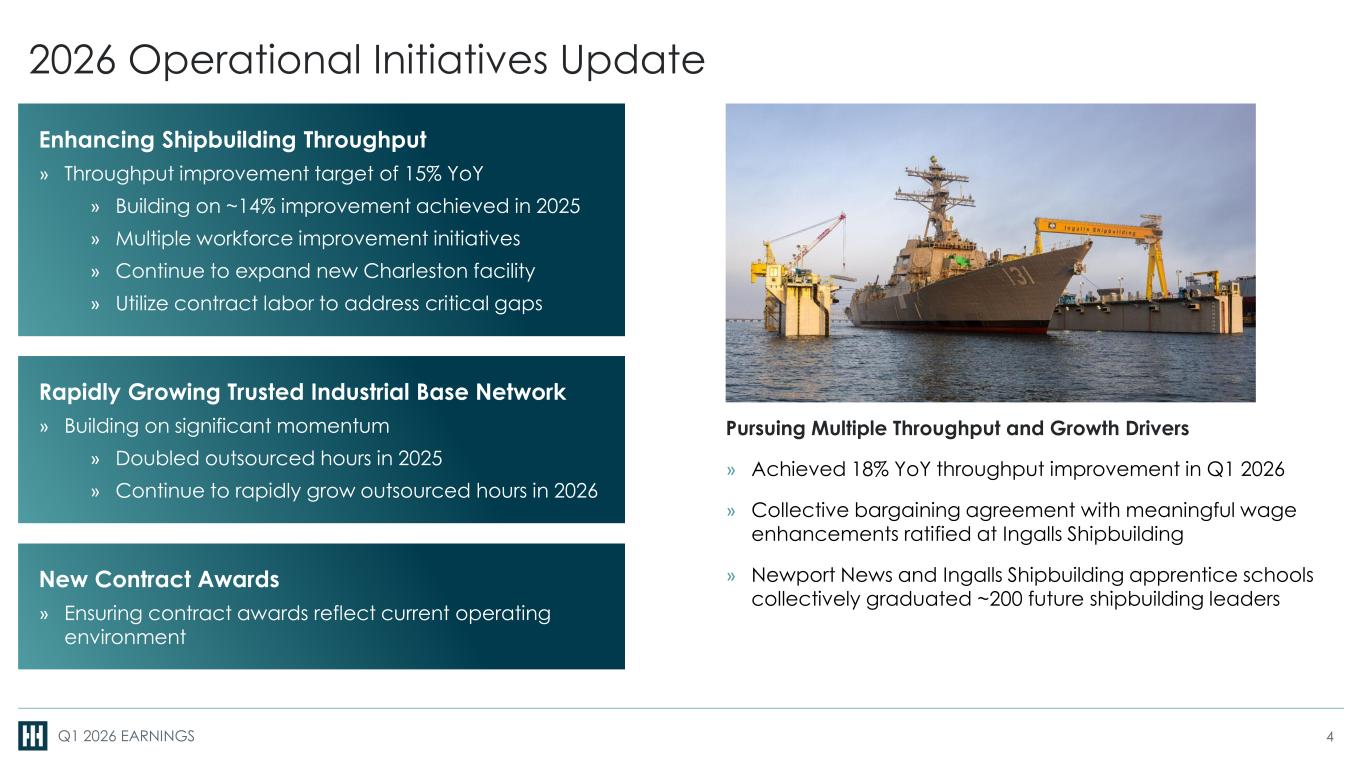
Thanks, Christy. Good morning, everyone. Before I begin today, I'd like to thank the men and women in the U.S. military and our shipbuilders for supporting our nation and our allies every day. Our ships, submarines, and defense technology solutions are foundational to United States military operations around the globe, providing superior capabilities in a high-threat geopolitical environment. At HII, we are focused on delivering for mission success, and we are committed to providing quality platforms for the warfighter. Today, I'll start by discussing our results, the Ingalls and Mission Technologies Division highlights, and provide an update on our operational initiatives. I've asked Carrie Wilkinson to join me to discuss Newport News updates, and then Tom will provide more details on our financial performance and outlook. Now, turning to our results, we reported first quarter sales of $3.1 billion and diluted earnings per share of $3.79. Another strong quarter of shipbuilding sales growth at 18% year-over-year was driven by our shipbuilding division's focus on increasing throughput in our shipyards and supported by broader efforts underway to revitalize and rebuild the U.S. maritime industrial base. Customer demand for our products and services remained strong. First quarter contract awards were $4 billion. At Ingalls, in the first quarter, we achieved stern release on LPD-31 Pittsburgh, laid the keel for LPD-32 Philadelphia, loaded JP-5 fuel on LHA-8 Bougainville, and continued to make test progress on LPD-30 Harrisburg, which we expect to deliver later this year. We also completed builder's trials for DDG-1000 USS Zumwalt and achieved crew move aboard. On the destroyer program after delivering DDG-128 Ted Stevens at the end of last year, we loaded fuel on DDG-129 Jeremiah Denton, launched DDG-131 George M. Neal, and achieved stern release on DDG-133 Sam Nunn. We also loaded main machinery on DDG-135 Thad Cochran and received the first two of 32 units in yard from our distributed shipbuilding partners on DDG-137 John F. Lehman. Moving to mission technologies, we had another quarter of strong sales of $748 million. We have a robust opportunity pipeline, and we were awarded a position on the $25 billion ceiling Advanced Technology Support Program Microelectronics multi-award contract and the $151 billion ceiling Missile Defense Agency's SHIELD multi-award contract. We also secured a new $500 million contract to expand our cyber defense and data mesh solutions for the department of war in support of the navy's hedge strategy and the government's approaches to procuring new technology programs emphasizing corporate investment and product development and demonstration prior to formal contract award we are increasing our investments in our autonomous solutions portfolio of products we have multiple autonomous vessels in production we are actively extending the capabilities of odyssey or autonomy software in strategic partnership with leading AI companies. We see significant award opportunities in this group as evidenced by material increases in the FY26 funding and FY27 budget documents and international growth pipeline. Our expertise in unmanned technology and autonomy coupled with strong technology partnerships and comprehensive understanding of manned unmanned interfaces provides a strategic advantage that we can capitalize on to substantially grow this business. Moving on to an update on our operational initiatives. As for the first operational initiative, Enhancing Shipbuilding Throughput, we are on plan through Q1 and continue to expect to achieve our goal of approximately 15% throughput improvement for the full year in 2026. We hired over 1,600 shipbuilders in the first quarter. We also graduated nearly 200 apprentices from our apprentice schools this year, and our apprentice schools are now at full enrollment. I'm confident that as our workforce continues to stabilize, our workforce will become more proficient. Also, we continue to make progress on our second operational initiative to rapidly grow our trusted industrial-based network. Leveraging our distributed shipbuilding strategy, we are on track to grow our outsourcing hours year-over-year by 30 percent, and we will continue to identify capacity expansion opportunities to meet customer program demand requirements. The third operational initiative of securing new contract awards is on track, and we are making good progress on the VCS Block 6 and the next Columbia contract, with awards expected in the second quarter. Shifting to activities in Washington, Congress finalized defense appropriations for fiscal year 2026 in February. In addition to the support for our programs in last year's reconciliation bill, we saw continued bipartisan support for our programs reflected in the 2026 Consolidated Appropriations Act, including funding for CVNs 80 and 81, along with advanced procurement for CVN 82, 2, continued funding for CBN 74R COH, funding for the Virginia-class and Columbia-class submarine programs, advanced procurement for the DDG-51 program, and funding for long-lead materials for the new frigate program. In early April, the President submitted a top-level fiscal year 2027 budget request to Congress. The proposed budget reflects continued investment in our shipbuilding programs, funding two amphibious ships, LPD-34 and LHA-10, one DDG-51 surface combatant, two Block 6 Virginia-class submarines, one Columbia-class submarine, and the first FFX frigate. The budget request continues funding Ford-class nuclear aircraft carriers and aircraft carrier refueling programs and provides initial advance procurement funding for the lead ship of the Trump-class battleship program, the USS Defiant. Beyond shipbuilding, the fiscal year 2027 request reflects increased investments in capability enablers, including autonomous systems that align well with our advanced technology capabilities of our mission technologies division. Now to wrap up my remarks, in summary, we had a solid first quarter and remained focused on meeting our commitments to our customers and creating value for all our stakeholders. And now I'll turn the call over to Carrie for her remarks on Newport News.
Thank you, Chris, and good morning, everyone. We've been busy at Newport News since the start of the year, beginning with our visit from the Secretary of War for the launch of his Arsenal of Freedom tour. Over the course of the day, the Secretary spoke directly to sailors and shipbuilders about the importance of what they do and how what we build directly supports the mission. Appropriately, within just a few weeks of that engagement, we marked 140 years of service to our nation. In program milestones, we exited a very active and successful fourth quarter in 2025 and hit the ground running by successfully completing Builder's Sea Trials of CVN-79 John F. Kennedy. We remain focused on preparing for CVN-79 acceptance trials later this year. CVN-80 Enterprise is now coming together at pace and is over 50% erected in DryDoc 12, and CVN-81 units continue to move through steel fabrication and outfitting in support of the keel laying later this year. In our submarine programs, we completed sea trials and re-delivery of SSN-796 USS New Jersey after her post-shakedown availability. We remain laser-focused on getting the last of our Block 4 boats, SSN 800 Arkansas, to sea and delivering later this year. As Chris mentioned, we've made good progress on the framework for both Virginia Class Block 6 and Columbia Build 2 and anticipate contract awards in the second quarter, demonstrating our continued commitment to increase submarine delivery cadence. We also continue to invest in our future. Following our January 2025 acquisition of a fully operational facility with an established and talented team of shipbuilders in Charleston, South Carolina, we added nearly half a million earned hours of progress to our programs in our first year operating as Newport News Shipbuilding Charleston Operations. In 2026, our plan is to double Charleston throughput, including structural fabrication and more fully outfitted units that are ready for integration when they arrive in Newport News. We will also continue our capital investments to grow the site substantially over the next several years and we will continue to transform our shipyard in 2026 we are again making hundreds of millions of dollars of capital investment at newport news including significant investment in our manufacturing centers of excellence to support the submarine throughput our nation needs finishing a multi-purpose carrier refueling and overhaul work center and making peer updates to support carrier inactivation our investments in people will continue as well. Our shipbuilders continue to gain in proficiency, confidence, and tenacity. In March, we congratulated 128 apprentice graduates as they walked across the stage and stepped into their leadership roles in our trades. We continue to partner with local high schools and community colleges, as well as Hampton Roads manufacturing pipeline programs to expand our workforce, and we have already reached our strategic goal of onboarding more than 50% of our new shipbuilders through these more sustainable methods. We also continue to graduate our foreman from the leadership programs that our operations leaders have reimagined. This program reboot focuses on the critical skills identified through our process excellence organization and gives our frontline leaders the hard and soft skills they need to do the important work we are asking them to do. With our 2025 and 2026 successes in hiring, reducing attrition, and our continued efforts to enable and strengthen our supply chain partners, I am confident we will continue to see improvement in Newport News outcomes. Now, I'll hand the call over to Tom for some remarks on our financial results.
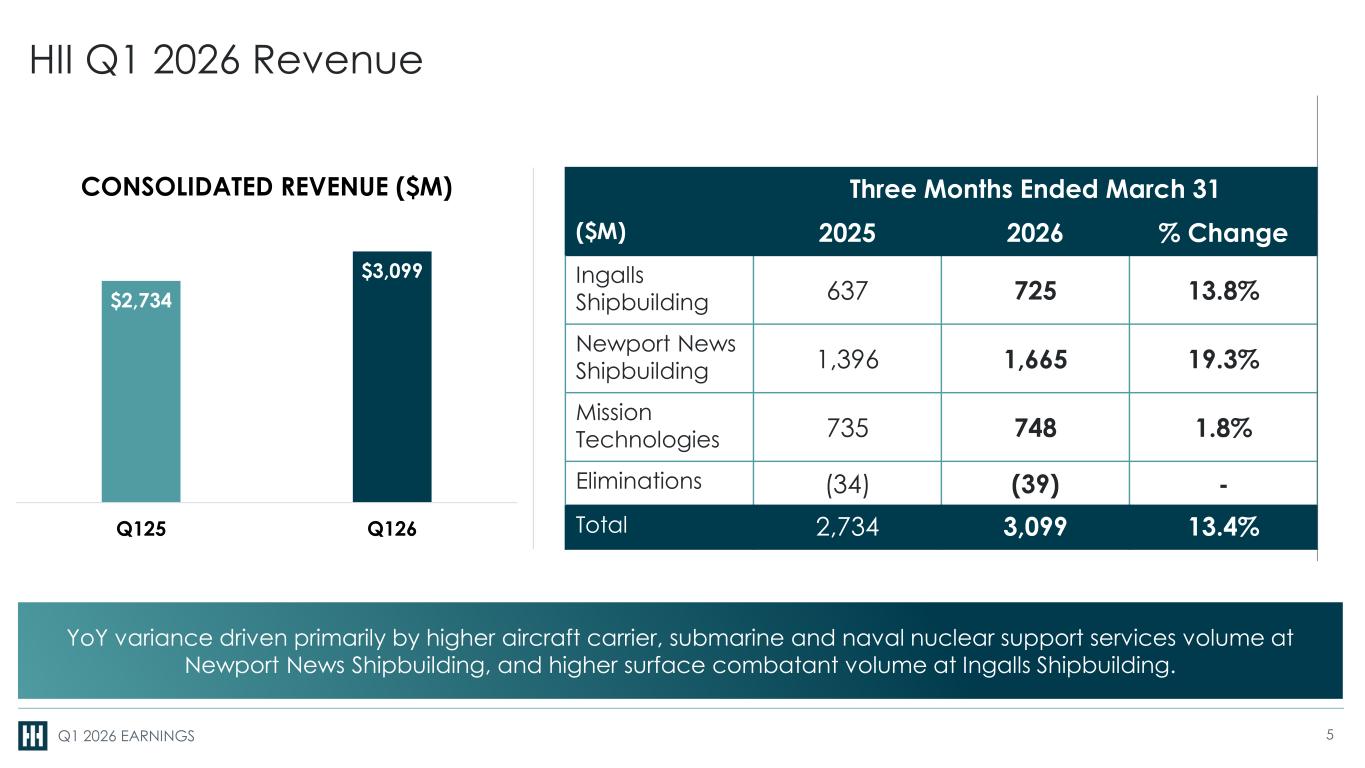
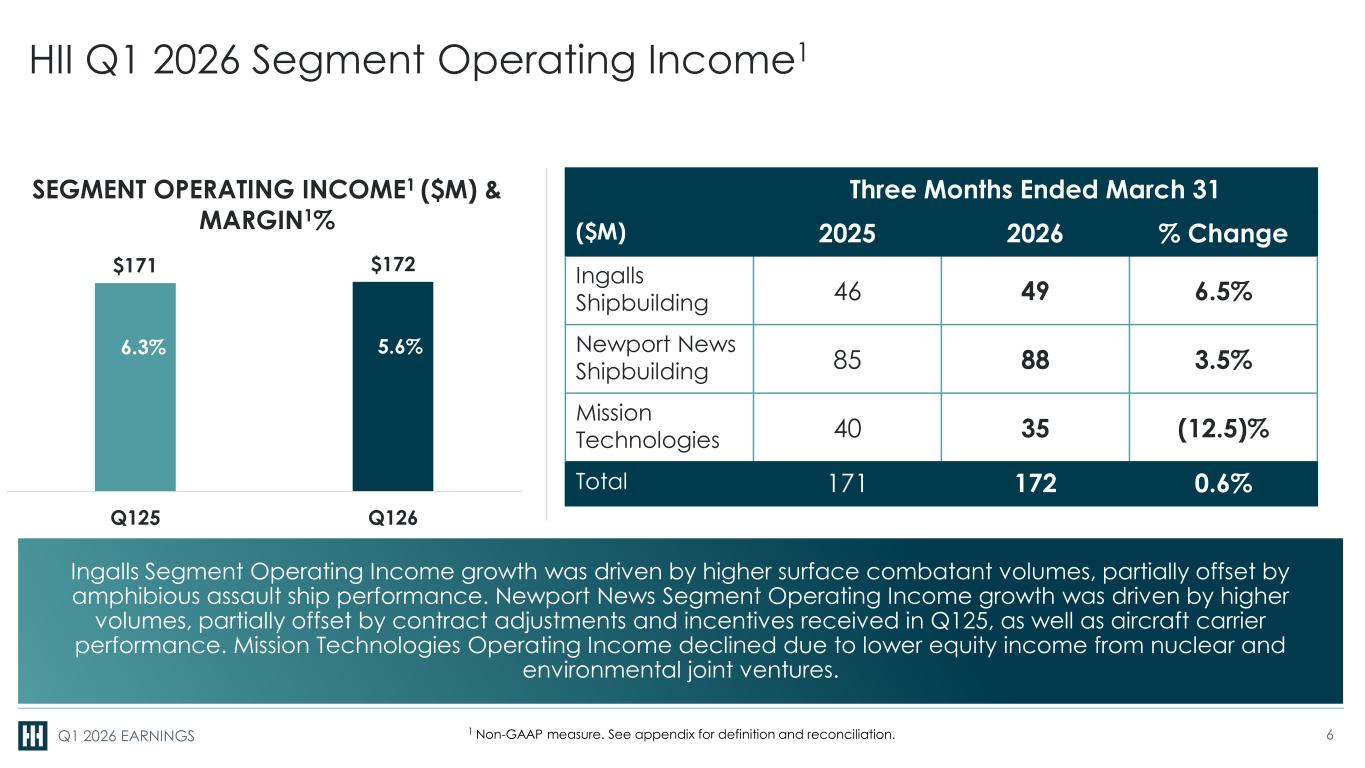
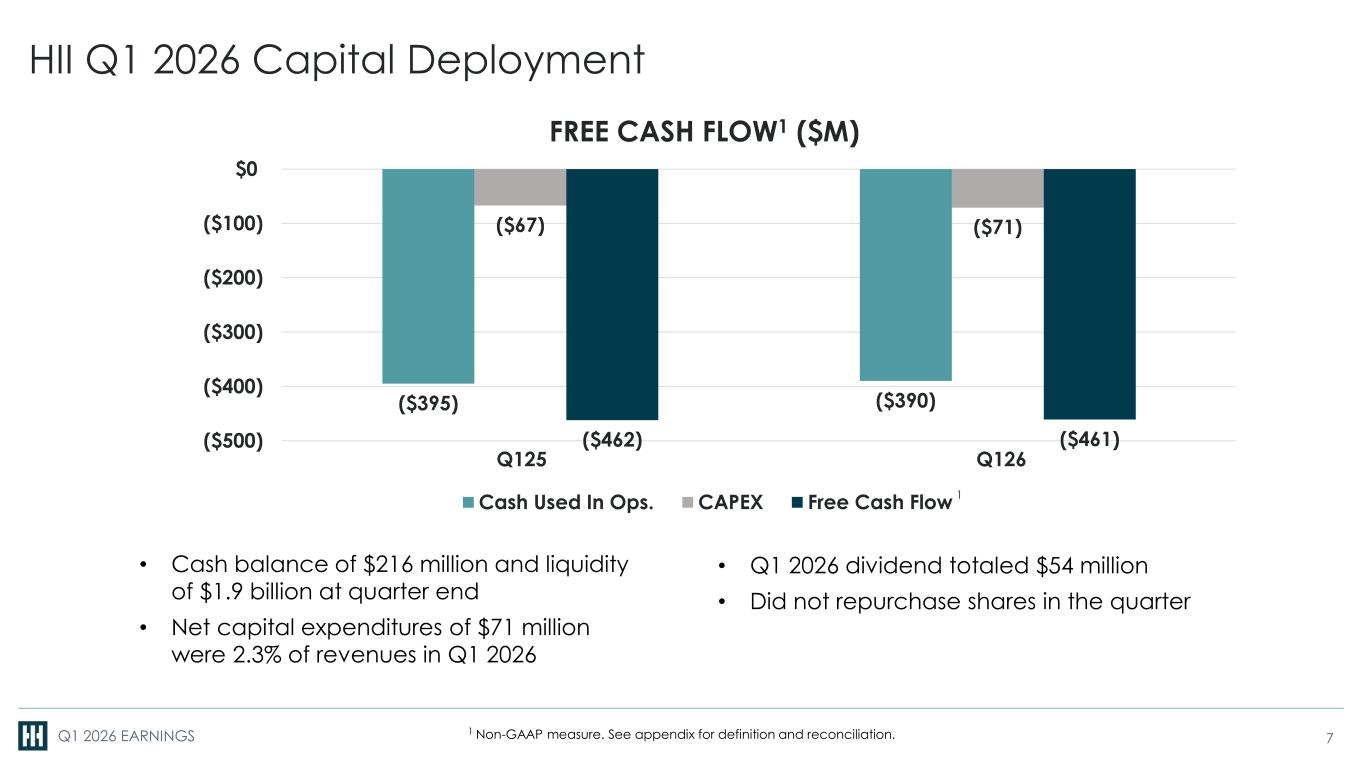
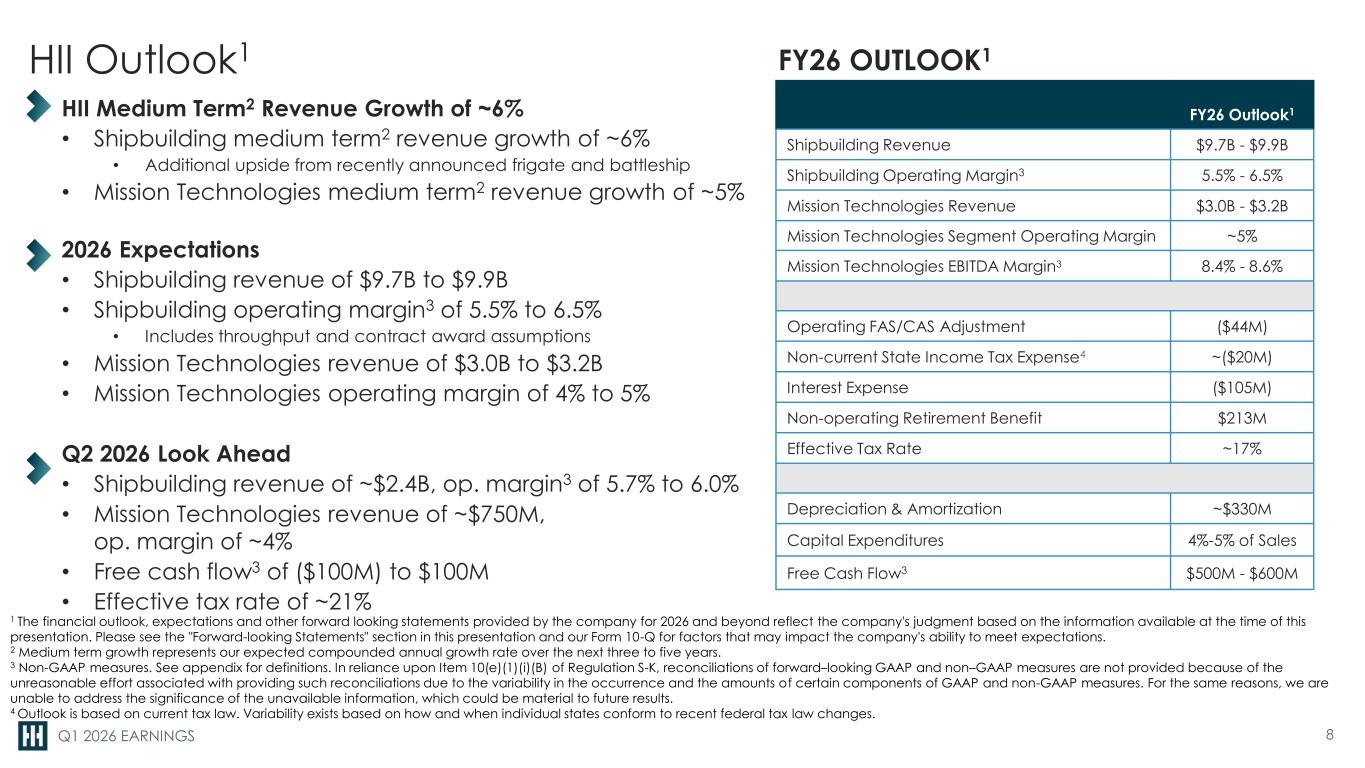
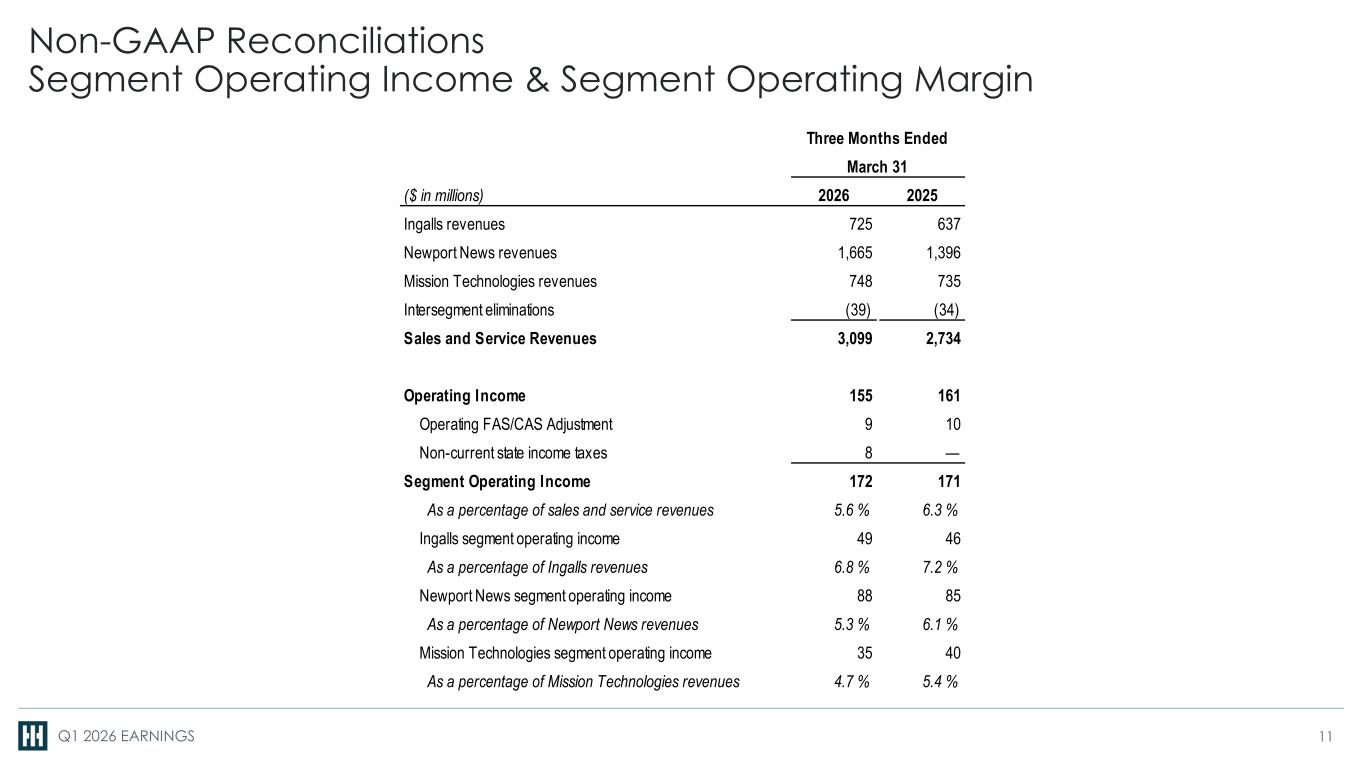
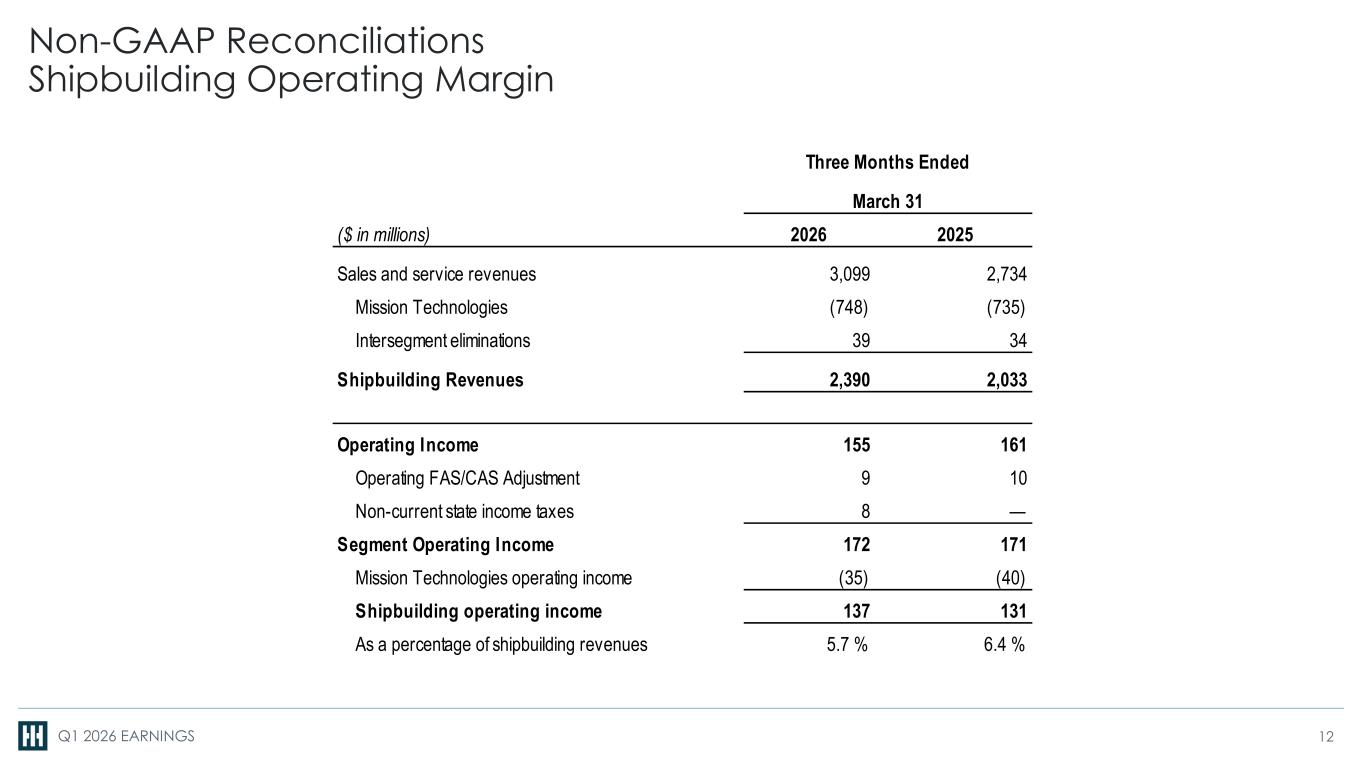
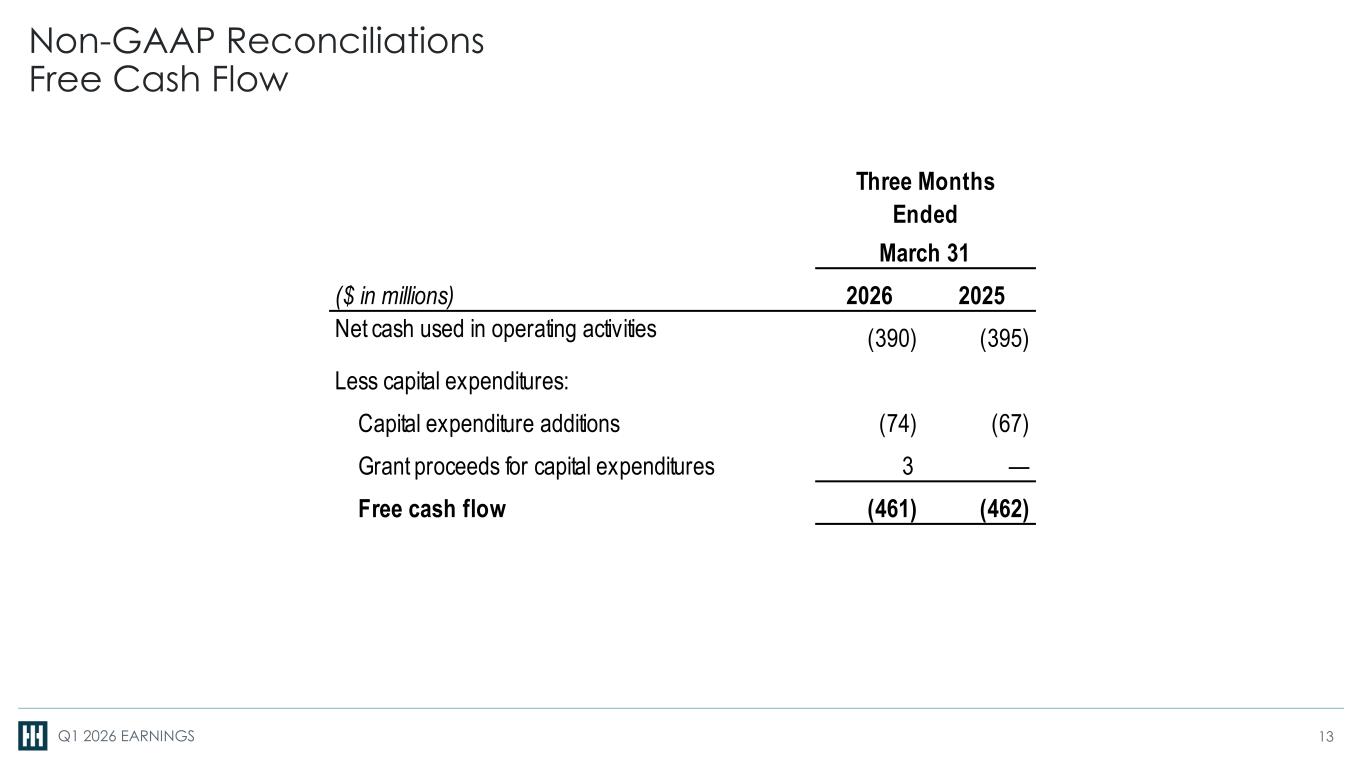
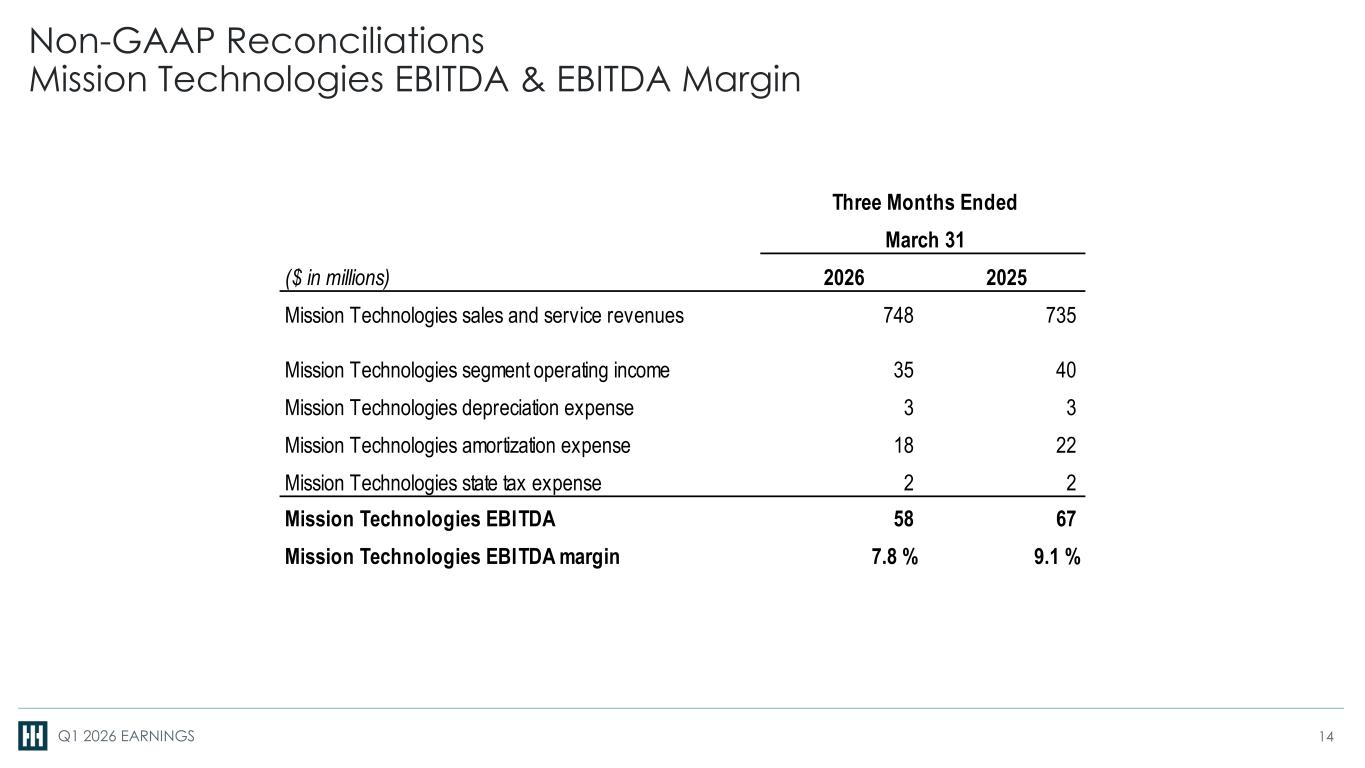
Thanks, Carrie, and good morning. Let me start by briefly discussing our first quarter results, and then I'll provide some color on our expectations for the remainder of the year. For more detail, please refer to the earnings release issued this morning and posted to our website. Beginning with our consolidated results on slide 5 of the presentation, our first quarter revenues of approximately $3.1 billion increased 13.4% compared to the same period last year. The higher revenue was attributable to year-over-year growth at all three divisions, with particularly strong growth at both shipyards. Shipbuilding revenue was up 17.6% compared to the first quarter of 2025. Ingalls revenues were $725 million and increased 13.8% compared to the first quarter of 2025, driven primarily by higher volume and surface combatants. Newport News revenues of $1.7 billion increased by 19.3% compared to the first quarter of 2025, driven by higher volumes across aircraft carriers, submarines, and naval nuclear support services. Together, shipbuilding revenue was $2.4 billion, modestly ahead of the $2.3 billion guidance we had provided for the quarter. Mission Technologies revenues of $748 million increased by 1.8% compared to the first quarter of 2025, driven by higher volume in all domain operations due to the C5 ISR growth, unmanned systems due to the growth in the Lionfish autonomous UUV program and global security, partially offset by lower volumes in warfare systems. Moving on to slide six, segment operating income of $172 million and segment operating margin of 5.6 percent in the first quarter of 2026 compared to 171 million and 6.3 percent in the first quarter of 2025. At Ingalls, segment operating income was 49 million and operating margin was 6.8 percent compared to 46 million and 7.2 percent in the first quarter of last year. The increase in segment operating income was driven by the higher volumes in surface combatants that I noted earlier, partially offset by the lower performance and amphibious assault The first quarter net cumulative adjustment at Ingalls was a negative 3 million, and none of the adjustments were individually significant. At Newport News, segment operating income was 88 million, and operating margin was 5.3%, compared to 85 million and 6.1% in the first quarter of 2025. The increase in segment operating income was primarily driven by the higher volumes described earlier, partially offset by contract adjustments and incentives in the first quarter of 2025 from the Virginia-class submarine program, as well as lower performance in aircraft carrier construction. Recall that Newport News' results in the first quarter of 2025 had the benefit of meaningful contract incentives related to the award of a contract modification for the construction of two additional Block V Virginia-class submarines. For the first quarter of 2026, Newport News Shipbuilding's net cumulative adjustment was negative $9 million. None of the adjustments in the quarter were individually significant. Mission Technology's segment operating income was $35 million and operating margin was 4.7%, compared to $40 million and 5.4% in the first quarter of 2025. The decrease in segment operating income was primarily due to the timing of equity income from nuclear and environmental joint ventures, partially offset by higher performance in warfare systems. For the first quarter of 2026, Mission Technologies' net cumulative adjustment was a positive $13 million. None of the adjustments in the quarter were individually significant. Consolidated operating income for the quarter was $155 million, and operating margin was 5%, compared to $161 million and 5.9% in the same period last year. The decrease in operating income was driven by higher non-current state income taxes, partially offset by the slightly more favorable segment operating income that I've just reviewed. Net earnings in the quarter were $149 million and diluted earnings per share were $3.79, with both consistent with the results from the same period last year. The effective tax rate in the first quarter was 20.7%. We provided the tax guidance for 2026 at approximately 17% and still believe that is correct. The credit responsible for that lower tax rate is expected to be processed later this I will provide our view on the appropriate tax rate for the second quarter in a moment. Turning to slide 7, cash used and operations was $390 million in the quarter. Net capital expenditures were $71 million, or 2.3% of revenues. Free cash flow in the quarter was negative $461 million. Free cash flow results in the quarter were better than the guidance we had provided, largely due to stronger collections in the quarter, as well as some disbursements moving out of the period. During the quarter, we did not repurchase any shares. We did pay a cash dividend of $1.38 per share, or $54 million in aggregate. Turning to liquidity and the balance sheet, we ended the quarter with a cash balance of $216 million and liquidity of approximately $1.9 billion. Moving on to our outlook on slide 8, we are reaffirming all of the guidance elements that provided on our last quarter's call for both 2026 and our medium-term outlook. I'll note that we continue to see the new battleship and frigate programs as meaningful upside opportunities to our medium-term outlook, that we will need additional details before we can include those in our guidance outlook. As I noted on our last call, our guidance for 2026 is predicated on achieving the shipbuilding throughput improvements that we have outlined, as well as reaching agreement on the next Virginia and Columbia-class submarine contracts in the near term. Moving on to the second quarter look-ahead outlined on slide 8, we expect shipbuilding revenue of approximately $2.4 billion and shipbuilding operating margins between 5.7 and 6 percent. For mission technologies, we expect revenue of approximately $750 million and operating margin of approximately 4 percent, inclusive of the strategic investments that we expect to make in our unmanned capability and production capacity. We expect free cash flow in the second quarter to be between negative 100 million and positive 100 million. There are a number of factors, including the timing of the upcoming submarine contract award, regular working capital movement, and CapEx timing that create variability in Q2. Regarding the effective tax rate, we believe it's prudent to use a tax rate of 21 percent for the second quarter, though we still believe 17 percent is appropriate for 2026 with an expected research and development tax credit coming later this year. To close, it was a good quarter as we continue to make steady progress and execute against our 2026 operational initiatives. With that, I'll turn the call back over to Christy to manage the Q&A.
Thanks, Tom. As a reminder to everyone on the call, please limit yourself to one initial question and one follow-up so we can get as many people through the queue as possible. Operator, I will turn it over to you to manage the Q&A.
Operator
Thank you. We will now begin the question and answer session. If you would like to ask a question, please press star one to raise your hand. To withdraw your question, please press star one again. We ask that you pick up your handset when asking a question to allow for optimum sound quality.
If you are muted locally, please remember to unmute your device please stand by while we compile the q a roster your first question comes from the line of scott micas with melius research your line is open please go ahead morning chris and tom you called out the battle ship and frigate as being uh potential drivers of upside to the medium term shipbuilding revenue growth outlook but we saw in the 2027 budget request there's a lot of funding in there for auxiliary and support ships just wondering how you're thinking about that opportunity set when it comes to ingles and could that put upward pressure on the medium-term growth outlook yeah the auxiliary ships when you take into consideration
their current workload at ingles as well as the battleship and the frigate we'd have to evaluate those kind of on a case-by-case basis but there's plenty of work at ingles when you look at their baseline business battleship frigate frigate which we know we're going to build battleship we're just at the beginning of with the design effort with the Navy. But I don't necessarily anticipate competing for those at this point, but we're going to evaluate it based on how they unfold and how the acquisition strategies unfold.
Okay, got it. And then a quick one for Tom. If I look at the 2Q outlook and the 1Q results, it implies that you need to generate about a billion dollars of free cash flow in the second half of this year.
Just curious if you could talk about the level of visibility to achieving that and what are some of the moving parts that could cause that to come in a little bit below or maybe even a little bit higher than that yeah i appreciate the question scott yeah so uh you know we're in the normal cycle here where we use cash at the beginning of the year uh we beat guidance for q1 as we uh we're out in front by about 100 million dollars as i mentioned about in my remarks it was uh some disbursements kind of moved out to the right as well as we did better in collections than we anticipated. The Q2 guidance is about neutral, plus or minus 100, and that will kind of leave us at the midpoint about 460 million negative, which means we've got to pick about a billion dollars in the back half of the year. That's in line with our playbook and consistent with what we guided at the beginning of the year. That will come about through making progress through the back half of the year. We have some major milestones loans and deliveries as well. We have some tax credits and collections and R&D that will come about, which will provide a tailwind to our performance as well in free cash flow. As far as opportunity sets, I mean, obviously there's opportunities and risks around that, but we're reaffirming the guide for the end of the year at $500 to $600 million, and we'll keep you informed as we move forward here. We usually don't want to get ahead of house when we guide relatively stable to conservative and there are opportunity sets you know both for improvement or if there's a drag on performance here but we still still feel good about the range that we have as we start to tackle the back half of the year okay got it thank you your next question comes from the line of scott deutschla with deutsche bank your line is open please go ahead hi good morning tom does the 2q guide include any margin benefit at newport news from the expected contract awards that carrie mentioned yeah so in chris's remarks you know we're uh expecting and working closely to finalize and and execute that contract mod for those subs um you know there's uh opportunity sets around those for uh performance and incentives both in margin and cash collections and that's just going to depend on the timing as far as when that if if and when it hits in q2 and then how we push that through the system both in modification margin and cash i would tell you that we have that kind of weighted we factor these things and uh it's anticipated as i said at the beginning of the year to happen in the first half of the year um it is a factor in the q2 guide that we give here but um it's a it's a it's in there at a fact and weight right now so i'm comfortable with where we are making meaningful good progress with our customer on this front and i anticipate um you know that will work itself through the system in Q2 in the back half of the year.
Yeah, and this, Chris, I might add that operationally it's important to get that under contract so we can continue to make progress on the submarines. So that is just as large a factor as the margining cash guide for the quarter is we need to stay on schedule, need to stay in sequence on the submarine program.
Okay, thank you. And then, Chris, can you explain what is driving the additional delays for LHA 8, 9, and 10 that the Navy justification books show? And then do you still feel confident there will be a nice margin step up on the post-COVID ships, LHA 9 and 10, despite these additional delays?
Yeah, I'm very confident in the post-COVID ship ability to improve margin. What you found on LHA 8 was just some issues in the test program as we're working through it. We have some new systems on that ship having some challenges. We have seen over the last couple of weeks a bit of a ramp in the test rate, so that's positive. I wouldn't get overly concerned about the J-Books schedule date issues. That's kind of contextual in how the Navy communicates to Congress. We evaluate our EACs every quarter, and we take into consideration a schedule risk that we may have. So I'm real confident in the ANFIDS subsequent to LHA-8, and I have great expectations for their performance. All right. Thank you.
Operator
Your next question comes from the line of David Strauss with Wells Fargo. Your line is open. Please go ahead.
Good morning. Just a good morning. Follow on to that, to Scott's question. You know, the Ingalls margin performance, I think this is the lowest we've seen in quite some time there. So, Chris, if you could just dig in there in terms of exactly what's driven the margin that's much lower and kind of the outlook from here for Ingles' margin?
Sure. It was really what I would consider a pacing quarter for Ingles, making good progress on the DDGs. As I said, we did have some risk we had to put into the LHA 8 EAC for the progress in approaching their delivery and risk related to their delivery, so we had to take an adjustment there. But I think Ingles is making pretty good progress. It's what I consider, as I said, a pacing quarter. DDGs are showing some improvement. Milestones are in place and holding. LPD-30 making really good progress. So DDG-129 making progress you'll get to see this year. So, yeah, I've got a lot of confidence in the Ingles team. It's pretty stable there. We just had to take a minor adjustment there on LHA.
Okay. And in terms of the shipbuilding revenue gains through the year, based on the guide you gave for Q2, It doesn't look like, you know, you're forecasting much in the way of kind of sequential second half versus first half shipbuilding revenue growth. You know, typically we see a fair amount of growth in the second half in terms of just absolute revenue. If you could just talk about kind of the profile for the year. Thanks.
Yes, you know, it's Tom here. I'll take that one. And I'm comfortable with what we're seeing in shipbuilding. It's a third quarter in a row with double-digit returns. For 2025 over 24, it was a 9.7% growth in shipbuilding. And as I say, from Q3, Q4, and now Q1, again, we see both yards overachieving our guide of 6% kind of going forward here. So I think it's fairly linear. At Newport News, their growth was about two-thirds in labor and a third in material. And Ingalls, it was the other way around, about a third in labor and two-thirds in material. So we see, you know, what we're strategically trying to do here is, you know, get more throughput and capacity, increase the revenue volume here, insourcing, outsourcing, hiring, additional overtime, additional progress here. So I think it'll be linear as we work through the year. And as we increased the guys from 4% to 6% last year, we said we'd take a look at it. I want to see a little bit more run rate for a couple more quarters here. But, you know, the backlog has increased to $54 billion. dollars so the work is there the demand what we see already in the fy 27 the draft docs look looks like there's even more of an anticipate you know a consistent steady incremental ramp as we go forward here from quarter to quarter in shed building okay thanks tom your next question comes from the line of john godin with city your line is open please go ahead hi guys this is Jeremy, Jason, I'm for John Godden.
I kind of wanted to ask about last quarter you... I'm sorry, I didn't get that. You may have cut off, Jeremy. I was just going to... Oh, so sorry. I thought I heard my voice cut out. But last quarter you guys provided a nice layout for some major milestones for 2026 and 2027. So I was kind of wondering if you could provide an update on that chart and if you have sort of any indication of when those could hit beyond 2Q.
Sure, sure. So of the 26 milestones, obviously we delivered 128, went to sea trials on 1,000. We did launch DDG-131, and we're on track for delivery of LPD-30. That'll be the back half of the year. Newport News, acceptance of 79 will still happen, is on schedule. Lake Heel of 81 should happen this year we already did re-deliver ssn 796 and delivery of ssn 800 is towards the back half of the year as well so uh timing of these especially the significant ones are are towards the back half of the year and 27 is all on schedule thank you so much sure your next question comes from the line of seth siefman with jp morgan your line is open please go ahead Hey, thanks very much and good morning.
Good morning. I just wanted to ask on the carrier, when you talked about some of the performance on the carrier and the quarter, and it comes on top of the year-ago quarter where I think that there were some challenges on performance there as well, so what do you think it will take to kind of gain confidence in the estimates on the carrier and have the profitability outlook there kind of stabilize.
Yeah, thanks, Seth. I'll start here and then I'll kick it over to Carrie, but we did have a minor adjustment in the quarter just to deal with some scheduled challenges that we have getting it back into sequence, but I want to kick it over to Carrie to talk about some of the things they're working on on the aircraft carrier.
Yeah, Seth, good morning. So it's good to hear your voice. So as Chris mentioned, you know, we had been on previous calls talking about some of that missing equipment down low on the ship and having that equipment delivered now and being on pace to erect out the ship is really going to help us from a performance perspective those delays are costly as you're familiar and so i'll give you an example so the team has been really focused on structural completion with those components in place and so over the quarter we did three super lists over the course of just 10 days that's the kind of pace that i i was referring to in my initial remarks uh we set another last night so what that does for us is it really enables the completion of distributed systems and so the team is getting after that in a more meaningful way and getting the ship integrated. So coming through those delays, as Chris mentioned, being out of sequence and working ourselves back into a more reasonable sequence is a really important part of that strategy. And the team is really working hard to execute on that strategy.
Excellent, thanks very much, that's helpful. And then maybe to turn to the uncrewed side of the business, you talked about some incremental investments there. um what's the timeline when you think about when you might see the the types of awards to um you know get get production going in in that area of the business in a way that would would kind of uh stand out to us on the outside yeah so i don't think it's really immediate if you look at the budget uh in 26 and 27 you see significant increases in the in the unmanned autonomous system budgets.
We think we're well positioned to deal with that. Obviously, we have large capital ships. We've made significant investments in Unmanned already. We have our Unmanned Undersea business. It's very mature. We have our new Romulus family of systems. And then we have Odyssey with really premier technology providers teamed with our Odyssey software. All that mingled together with our manships means we're kind of uniquely qualified to take advantage of that business. And then you lay over the top of that our Minotaur, where we're the prime developer of Minotaur for the U.S. Navy, which is really the common operating environment and visibility for Navy platforms. We think we're uniquely qualified to take advantage of it. Now, do I think it's immediate? No, I think there are immediate opportunities that we're competing for both domestically and internationally. I think it will start to ramp. I'm not sure it'll be material this year, but it will over the next couple of years. You'll see material growth in the unmanned business for HII.
Great. Thank you. Thanks very much.
Operator
Sure. Your next question comes from the line of Gautam Kahan with TD Cohen. Your line is open. Please go ahead.
Yeah, thanks. Good morning. I was wondering, Good morning. I was wondering if you could just describe whether the fit-up delivery schedules aligned with what you were expecting as of a quarter ago. So, were there any surprises? You got the question on LHA. Just in general, were there any delivery timelines that were inconsistent with your internal thinking expressed in the 27th. Thanks.
Not necessarily. I have high confidence in 30 being delivered this year. I think that's into next year. So I think it'll happen this year. But as I said previously, I think it's contextual. I think it's just a different communication tool. And we're evaluating these things every quarter. So just off the top of my head 30 is the only one or lpd 30 is the only one that i uh that i think we we should do a little bit better than uh but beyond that i'd have to do some do some research uh on that issue okay and i know you guys pushed through some wage increases at the ingles shipyard i was wondering if you've seen any notable improvements and attrition uh since then any any changes really You know, Gautam, that's an interesting question. We did adjust Newport News wages last year, and it took a while. It took a while for the additional applications to go through the system where we were able to accelerate hiring and we're seeing some meaningful improvements in attrition and really the right level of attrition, the right people from an attrition standpoint at Newport News. I think you're going to see the same issue at Ingalls. We did adjust wages, had a very positive labor agreement put in place there. We do see some increase in applications, but it's going to take a while to run through the system. We do have better attrition or improved retention, actually, within both shipyards, but I don't think you're going to see meaningful improvement in Ingalls for a bit.
It takes a couple quarters for that to work through the system. thank you your next question comes from the line of ron edstein with bank of america your line is open please go ahead yeah good morning guys thanks um all right you guys talked about um increasing outsourcing um i think i think if i remember right you talked about maybe increasing it 25 30 in 2026 how's that going um you know how's the south carolina facility grant progressing um and can you discuss at all the uh the moa with uh fundate how's that evolving and
is that going to impact capacity sure i'll i'll start and then i'll i'll kick it over to carrie to talk about um charleston but yeah we uh we do anticipate 30 increase in outsourcing in 2026 over increases that we had in 2025 we continue to expand our distributed shipbuilding network. Charleston's doing well. As I said, I kicked that over to Kerry. But from a Hyundai standpoint, we're still engaging in discussions with them and evaluating potential. We don't see them in the network right now for this year. That could provide upside if we're able to jointly invest in some operating manufacturing footprint. So that would be upside. But we still think there's some very positive, we could get some very positive results from the Honda relationship, not only in manufacturing, but also in efficiencies in how we build ships. So I want to kick it over to Carrie to talk about Charleston for a second.
Hey, Ron, good morning. So yeah, Charleston is tracking the plan. So last year we spent a lot of time coming up on plane with respect to structural fabrication, and the team there did a fantastic job meeting the commitments that they made at the beginning of the year. To go from closing in January on a facility to producing almost half a million man hours over the course of one year was pretty phenomenal. So I'm really proud of what the team did there. This year, tracking to the commitment to increase throughput there and moving into outfitting more meaningfully. So starting with structure, moving into outfitting really allows us to start ramping that up in an even more meaningful way. I mentioned in my remarks, we'll do some additional capital investments to continue that growth trajectory, but really pleased with what that team is doing and that's obviously a core we are also working with other distributed shipbuilding partners that have been in our network and those muscles are strengthening as well getting back to the ebb and flow of what naturally happens in our industry and we're certainly in a place where we're able to stretch and grow there and that is tracking pretty well from my estimation great and then maybe just one quick one any update on the Romulus USBs and the Odyssey economy stack any production contacts visible that you could discuss or for 2026?
Well, I hate to talk about ongoing competitions but the obvious one right in front of us is the MUSV program and then some armor concepts over in the UK that could be interesting. We're talking about manned and manned teaming. We're uniquely qualified to do that but we'll compete for really, we have a breadth of product set that we can compete for a number of opportunities into space. But the one right in front of us is the MUSV program.
Operator
Your next question comes from the line of Noah Popenak with Goldman Sachs. Your line is open. Please go ahead.
Hey, good morning, everyone. Last quarter when you provided the initial 2026 outlook, look, I think we were all a little surprised at a low growth rate in shipbuilding revenue, given what happened in the second half of last year and the funding environment and everything going on with shipbuilding. You just logged another high growth rate and outperformed one queue. So I guess in reiterating the full year, it actually now you would need shipbuilding revenue down year-over-year for the rest of the year to do the midpoint of the guide. Is that possible? I mean, that would imply end of last year, beginning of this year, was just a kind of one-time bump in shipbuilding growth. It seems like what's happening in the industry is much more long-term and structural than that.
Hey, no, it's Tom here. I'll take that one. And no, I think the math is a little bit off on that. As I mentioned earlier, we've seen some good growth three quarters in a row obviously there's a comparison that we did from the previous year there both were what we've seen in insourcing outsourcing high revenues i talked earlier about the material and the labor that's growing i think the guide is on the conservative side we don't want to get ahead of ourselves and where we think we can land here um but um we won't see a contraction in revenue on the back half here i think there's a a strong opportunity set for us to exceed that and we're holding the guide right now as we want to see us kind of burn through the existing uh work that we have on contract, monetize the backlog that we have, and see the new awards that come on board. But I think operationally, going forward, my remarks earlier that I expect incremental quarterly growth in shipbuilding still holds.
Tom, if we were able to see your internal estimate for the mix of pre-COVID versus post-COVID ships each of the remaining years through the end of the decade if we were looking at that right now and then right next to it we had the version you had of that from a year ago do those look significantly different has there been a lot of movement um is the pre-pandemic contractual roll-off sliding out taking longer or would they look pretty similar they look they look on top of each other right now we're on plan and on the guide that we've given, we kind of laid out a couple of years ago
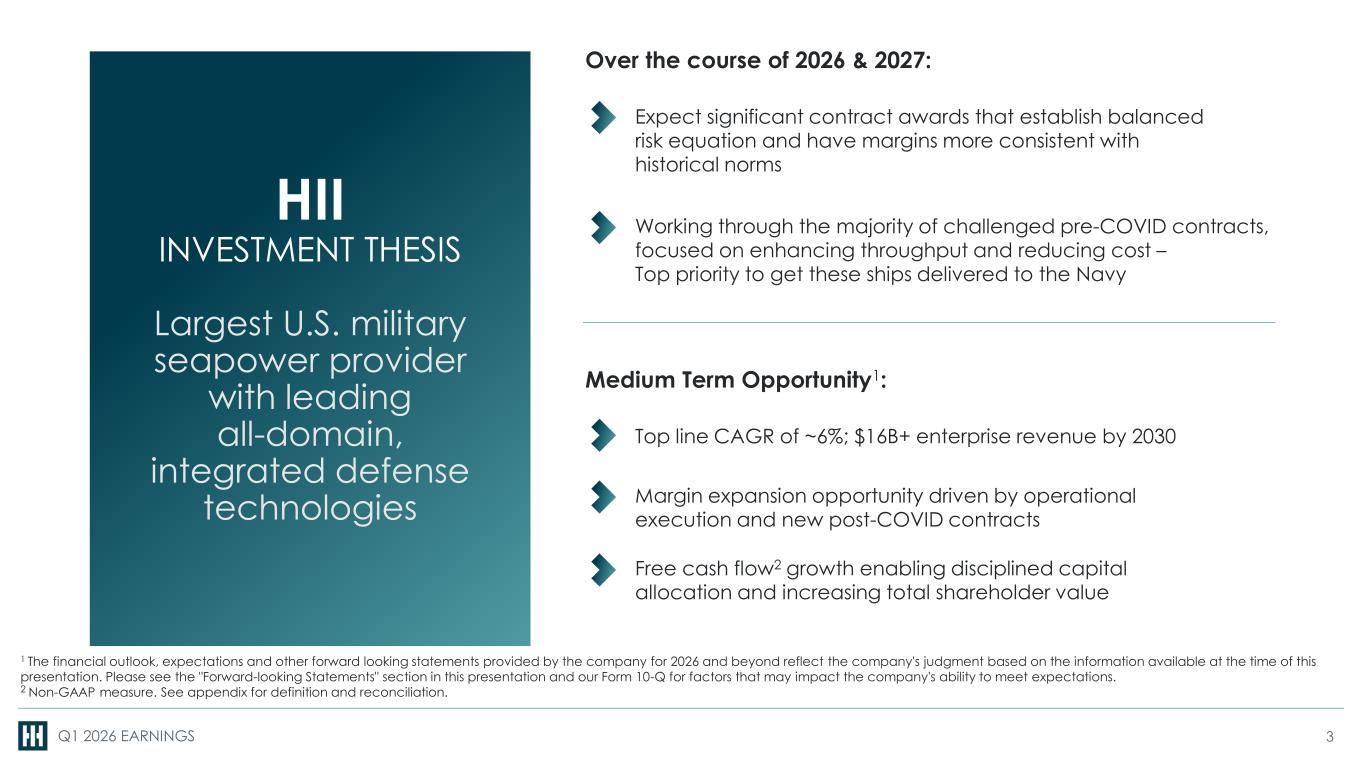
that it would be in 2027 where we would swing over from pre-COVID to post-COVID and we're right on track on that. We'll finish off 2027 with more post-COVID work than pre-COVID work. And even the perspective on our backlog, it's about 50-50 right now what we put on contract before the subs that are coming on contract. So again, that will continue to grow as the subs are awarded, CVN RCOH for 75, advanced procurement for CVN 82. The new awards will continue, you know, from a backlog perspective, we'll see more of that too. But we're on pace as we watch, as we retire out the pre-COVID work. 2027 is a significant year where we'll see more revenue on post than pre. And there's been really no material change since we've provided that.
Yeah. And is it possible to provide any more color on the sticking points in the in getting to the finish line on the next batch of nuclear subcontracts? It's been several months now versus the original timing forecast. And obviously, we know we know where the demand is. You're performing the long lead. That just remains a little surprising to see if you can help us better understand what points in the contract are holding it up.
Yeah, no, I just think it's a large contract that needs significant review and approval, and it's complicated, and we're just going through the approval process. I don't want to comment on any specific negotiation points. It's just a significant, very important contract that we all need to get right. Okay.
Operator
Your next question comes from the line of Miles Walton with Wolf Research. Your line is open. Please go ahead.
Thanks. Morning. Morning. I was wondering if you could comment on the reports about the Navy revisiting the carrier design and what, if any, impact that might have on ongoing work and or disruption.
Yeah, so this is Chris. I'll start and then I'll kick it over to Kerry. But I'm not worried about the reviews of the aircraft carrier. Those happen from time to time. It's usually at the end of those, it's found that it's an amazingly capable platform and it's required and we can see all the great work it's doing over in its engagement in Iran right now. So I'm not worried about it. I think a long lead for 82 will happen this year and we'll continue on on the aircraft carrier program. But let me kick it over to Carrie.
Yeah, Miles, the only thing I would add to that is that, you know, It's pretty routine for us to evaluate new capabilities as systems progress in order to incorporate those capabilities on all of the classes of ships in both yards that we build. So pretty confident where we are, and we're going to support whatever the Navy needs. So as we do evaluations on any given system, we're able to incorporate those over time pretty routinely. So I'm pretty comfortable with where we find ourselves.
Okay. And then maybe one for Tom – sorry, maybe one for Chris. Actually, back to you. The workforce size, and I ask this kind of frequently, but I'm going to ask it a different Should we expect the workforce size to start to grow in line with the sales growth or at least trend in line with the sales growth of the whole company on a go-forward basis? You've had roughly the same size for the last 20% increase in sales, but I imagine that probably is going to have to start increasing. Or is the outsourcing initiative enough to carry the load?
Not entirely. I think you will see increase in labor. Obviously, you need to adjust for taking into consideration you have contractors that come in to do work as well that won't be on your roll. So, outsourcing is going to play a significant part of it, but you should see labor start to trend as well. Sure, Maas.
Operator
I'm not showing any further questions at this time. I would now like to hand the call back over to Mr. Kastner for any closing remarks.
Thank you for joining the call today. I look forward to updating you throughout the year as we continue to make progress on our operational initiatives and deliver on our commitments. Thank you.
Operator
That does conclude today's conference call. You may now disconnect.