Operator
Thank you for standing by. My name is Kate, and I will be your conference operator today. At this time, I would like to welcome everyone to the Herc Holdings' second quarter 2025 earnings call and webcast. All lines have been placed on mute to prevent any background noise. After the speaker's remarks, there will be a question and answer session. If you would like to ask a question during this time, simply press star followed with the number one on your telephone keypad. If you would like to withdraw your question, press star one again. Thank you. I would now like to turn the call over to Leslie Hanseker, VP of Investor Relations. Lisa, go ahead.
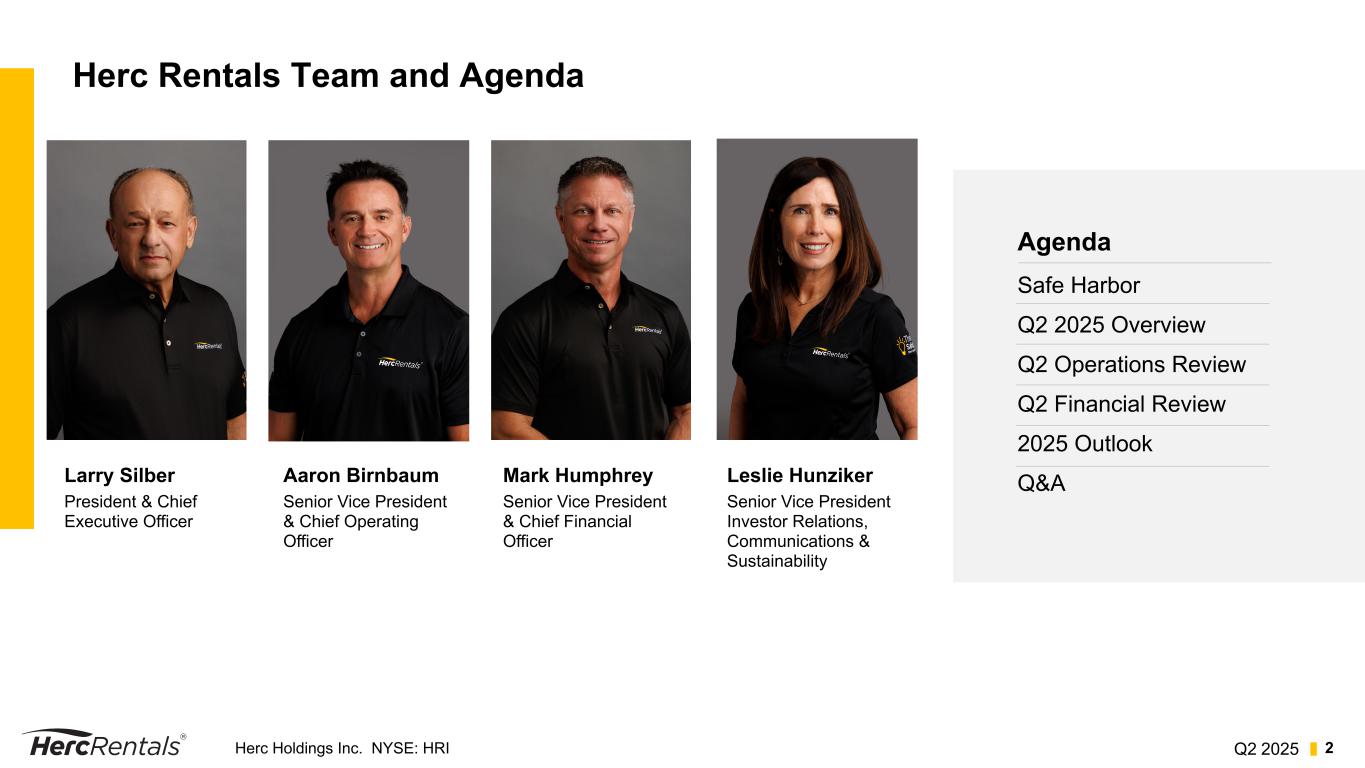
Thank you, Operator, and good morning, everyone. Today, we're reviewing our second quarter 2025 results with comments on operations and our financials, including our view of the industry and our strategic outlook. The prepared remarks will be followed by an open Q&A. Let me remind you that today's call will include forward-looking statements. These statements are based on the environment as we see it today and are subject to risks and uncertainties that could cause actual results to differ materially from our expectations and projections. These risks and uncertainties include, but are not limited to, the factors identified in the press release, our Form 10-Q, and our most recent annual report on Form 10-K, as well as other filings with the SEC. Today, we are reporting financial results on a GAAP basis, which include H&E results for June in each of the three- and six-month periods for 2025. In addition, we'll be discussing non-GAAP information that we believe is useful in evaluating the company's operating performance. Reconciliations for these non-GAAP measures to the closest GAAP equivalent can be found in the conference call materials. This morning, I'm joined by Larry Silver, President and Chief Executive Officer, Aaron Birnbaum, Senior Vice President and Chief Operating Officer, and Mark Humphrey, Senior Vice President and Chief Financial Officer. I'll now turn the call over to Larry.
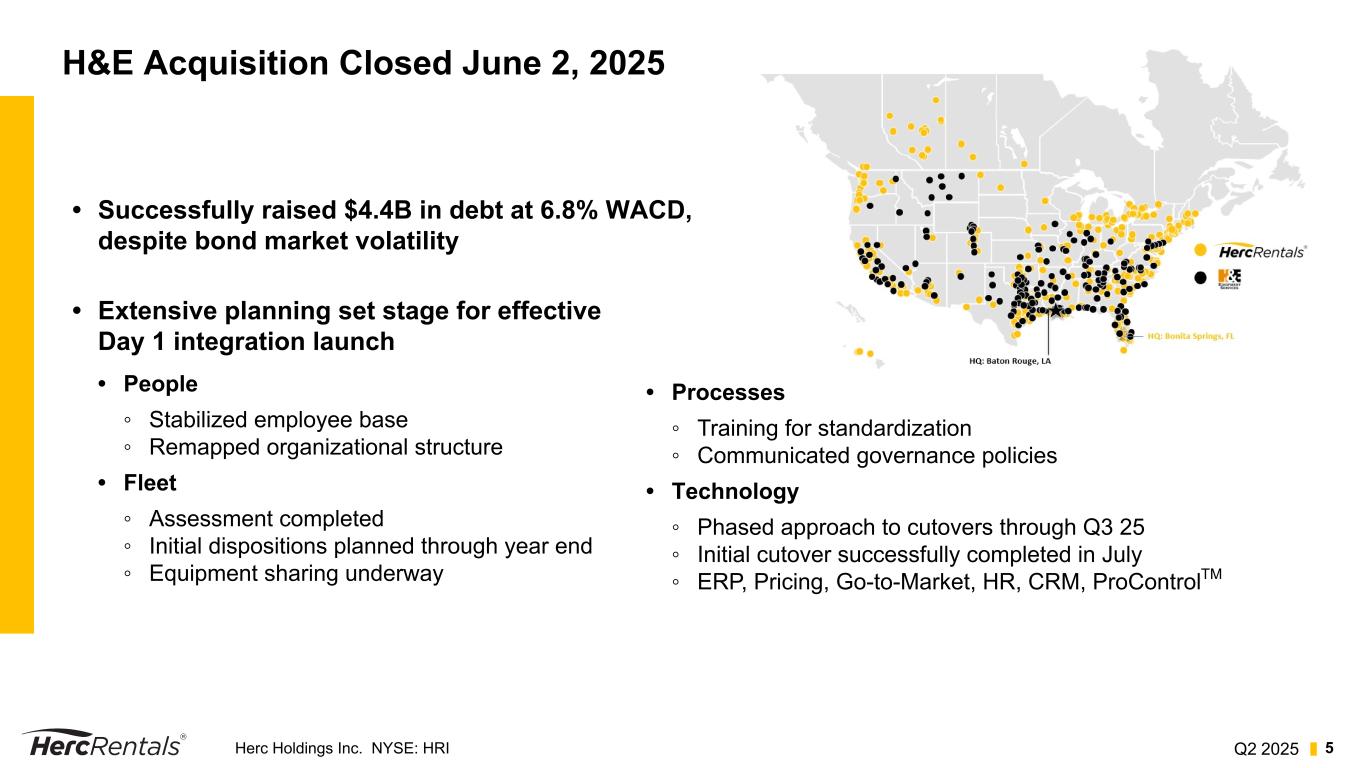
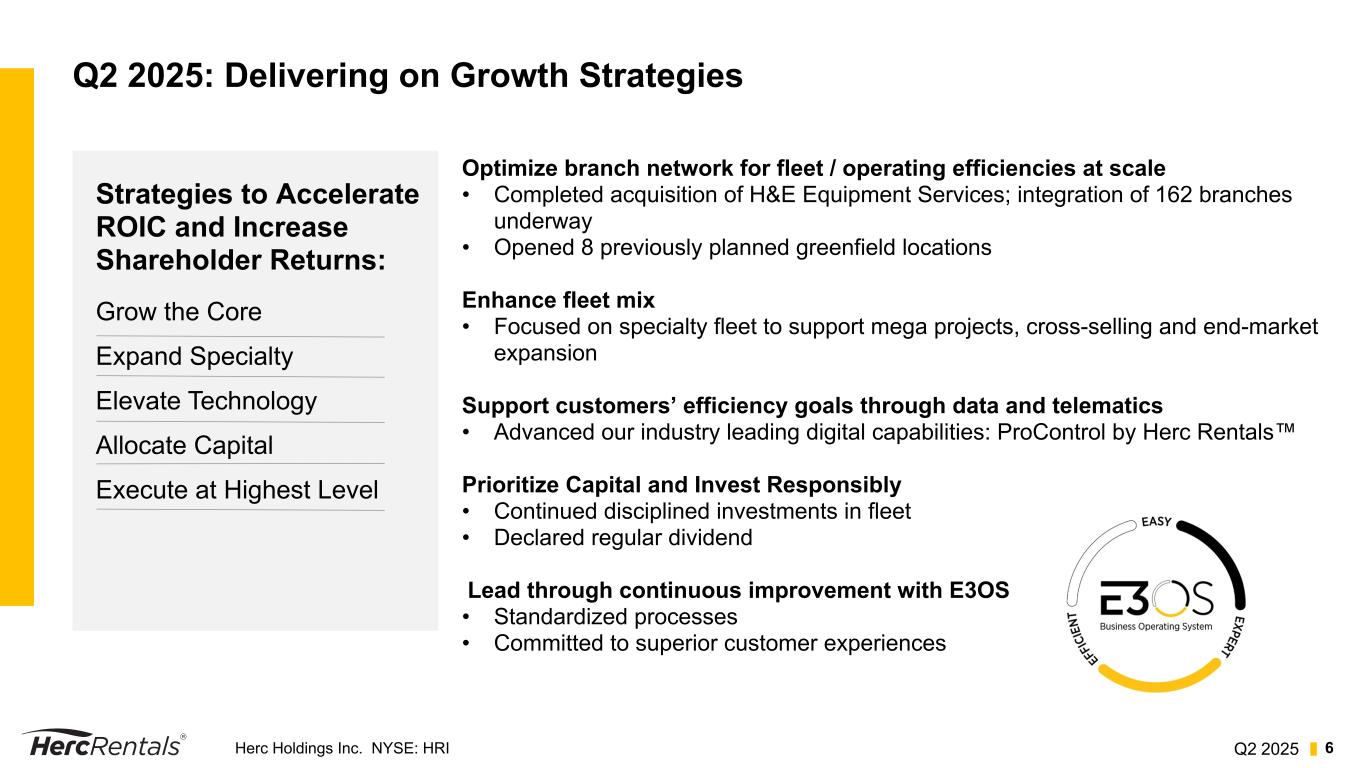
Thank you, Leslie, and good morning, everyone. It's been a busy time since our last earnings call. During the second quarter, we successfully completed the acquisition of H&E Equipment Services. Since then, integration activities have been underway to validate financial, operational, and cultural assumptions, identify key talent, mitigate risks, and ensure a smooth transition for all stakeholders. One of our early priorities was to set up an integration management office and clearly define roles and responsibilities within the integration process. this successfully ensured minimal disruption to the rest of our employees daily responsibilities and allowed her sales and operations staff to remain focused and productive through the transaction process in a dynamic environment like the one we operate in today where underlying local and national demand trends are bifurcated this was critical the local markets continue to see pressure as more commercial projects come to completion while new projects in that sector remain on pause due to prolonged higher interest rates the good news is that our local sales professionals are experienced determined hunters using the full suite of hertz product offering reputation for service excellence and industry-leading technology platforms to create opportunities and win new accounts on the other side of the coin national account demand remains strong and we continue to capture our targeted 10 to 15 percent share of the mega project activity there we're supporting customer success with differentiated specialty solutions a large and varied general rental offering and a full service fleet management including maintenance, logistics, safety training, and utilization insights. In the quarter, excluding Sinalese, HERC legacy branches continued to outpace overall market expansion driven by growth in both national and local account revenue. I want to thank all of Team HERC colleagues for bringing their best efforts every day, for the collaboration and support you've shown your colleagues, old and new, and for keeping your eye on the ball and embracing the changes that bring opportunity and growth as you can imagine hurt's biggest growth opportunity today and over the next three years stems from the scale and synergies we gain through the h e acquisition let's move to slide five for some perspective on how the integration has progressed since we closed the transaction our teams have been working tirelessly to successfully bring the two companies together. As reported in the first quarter, H&E's financial performance was impacted in part by disruptions to their employee base during the bidding process, and we saw those distractions continue through the close of the deal in early June. Since then, meeting the team and immediately putting in place comprehensive communications that address their most critical questions has gone a long way in stabilizing our acquired workforce in the field herc rvps and district managers have visited all of the acquired branches multiple times getting to know the new organization i've personally visited over 40 h e and herc locations throughout the west south midwest and northeast over the last couple of months and aaron's covered even more of our network additionally we've remapped the operating regions and optimize the Salesforce territories to address our now larger footprint in doing so we added two RVP positions which were filled by H&E field leaders we're also adding key management positions to our sales organization to drive revenue synergies and develop our mid-market capabilities where we know H&E excelled our new field structure has been cascaded to employees throughout the organization at the same time we're managing staffing priorities our fleet team completed its assessment of h&e's assets by market category class brands utilization rates and equipment aids based on the outcome updated plans for incremental dispositions as well as the addition of specialty fleet for synergies is considered in our next fleet capex guidance which mark will take you through in a minute. Most exciting is that the fleet sharing and sales referrals are already taking place. Let me give you just a couple of examples. One of our new sales reps recently was contacted by a customer of his who currently is running a mega project. The customer asked his rep if he could provide the fleet needed for this large job now that H&E was part of HERC. This wasn't a project that H&E could have previously supported with its more limited product offering and hurt didn't have a relationship with this contractor it's a clear example of the whole being greater than the sum of its parts and our national account project pipeline just got a bit bigger in another example we hosted joint branch manager sales leader town halls in Dallas and Houston about a week after we closed in each meeting we asked the room if anyone had a story of renting equipment that they wouldn't have been able to write just a few days earlier almost every hand went up one person said they were able to fill a request for a special aerial attachment another said they were working on a generator deal where h e previously didn't carry the size of generator the customer needed it seemed that everyone had a story and there were lots of excitement in the room that's really what this is about and it's one of the reasons we're confident in our revenue synergy target behind the scenes we're checking all the boxes training for standardizing processes for things like logistics maintenance and safety is also underway and governance policies including things like the customer and supplier contract approvals have been communicated and controls are in place across the joint organization our next major initiative is the technology integration we've got systems cut over planned and geographic phases throughout the third quarter and expect to be done by the end of September we've invested significant time and attention and adding capacity to the hurt system data testing capabilities data migration and of course security and putting together training processes mentoring structures on-site extra support and a dedicated hyper care team we feel good about the plan our initial cut over took place two weeks ago and it went very well our second phase is next week and we feel very confident that it will be equally successful at that time nearly 45 percent of the acquired locations will be fully integrated onto hertz industry-leading technology platform the takeaway here is that our new organization is working well and we're off to a great start as a combined company and we're well positioned to capture the synergy of the acquisition while continuing to deliver on our long-term growth strategies which are outlined on slide six As we said, integrating this acquisition will be our primary focus, and therefore, we are pausing other M&A initiatives for the time being and completing the remaining in-flight greenfields. In the first half of the year, we added 11 new facilities, of which eight were opened in the second quarter. Capitalizing on the secular shift from ownership to rental, particularly in the specialty market, and yielding greater value from megaprojects through specialty solutions is a key focus for us. Further, cross-selling specialty gear is an important component of the revenue synergies with H&E. In line with this strategy, we've continued to over-index our gross capex plans towards specialty as a percent of our fleet composition long term. we're also planning to repurpose general rental branches into pro solutions facilities beginning this year to support specialty equipment capacity with 160 plus acquired locations while we work through the integration of h e we'll continue to follow our playbook leveraging branch network scale our broad fleet mix technology leadership and capital and operating discipline to position us to manage across the cycle and generate sustainable growth over the long term. Now I'll turn the call over to Aaron who will talk a little bit more about operating trends and then Mark will take you through the second quarter business performance drivers and transaction adjustments. Aaron?
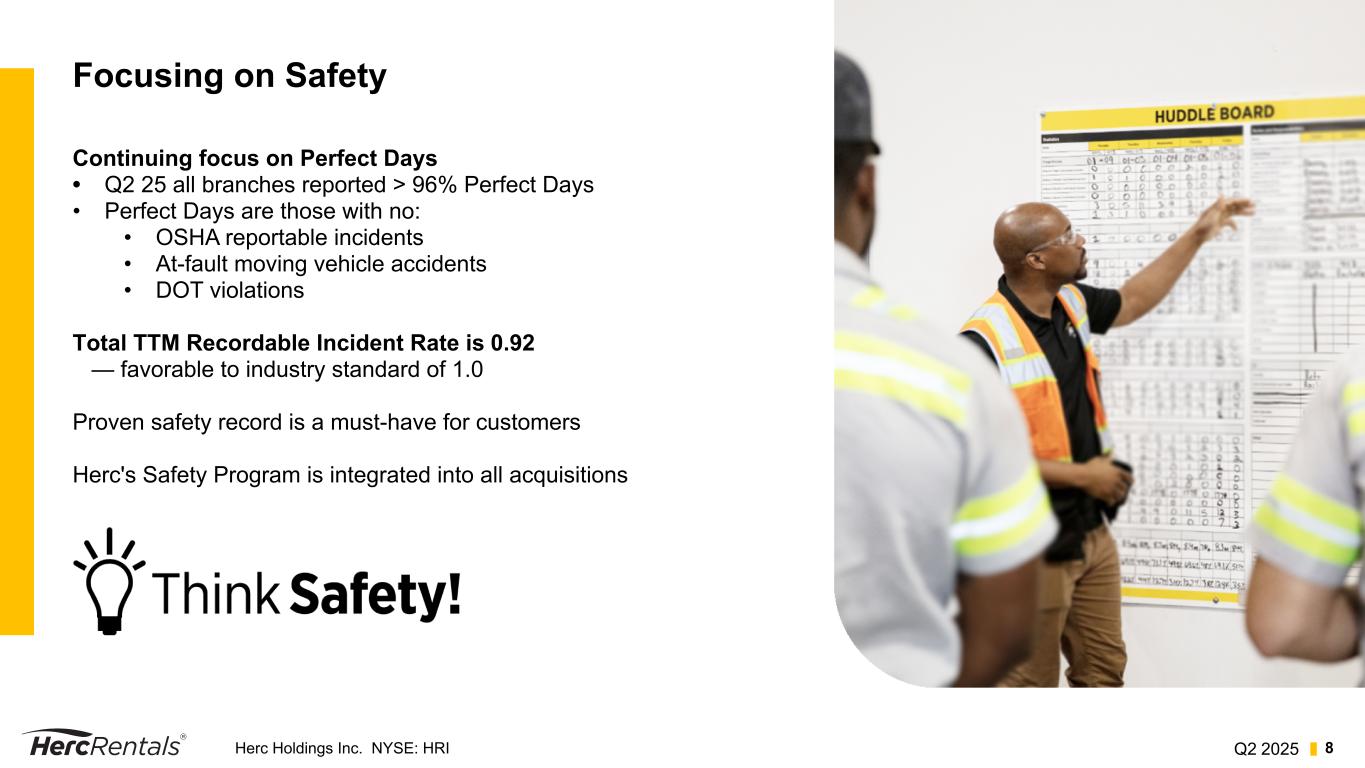
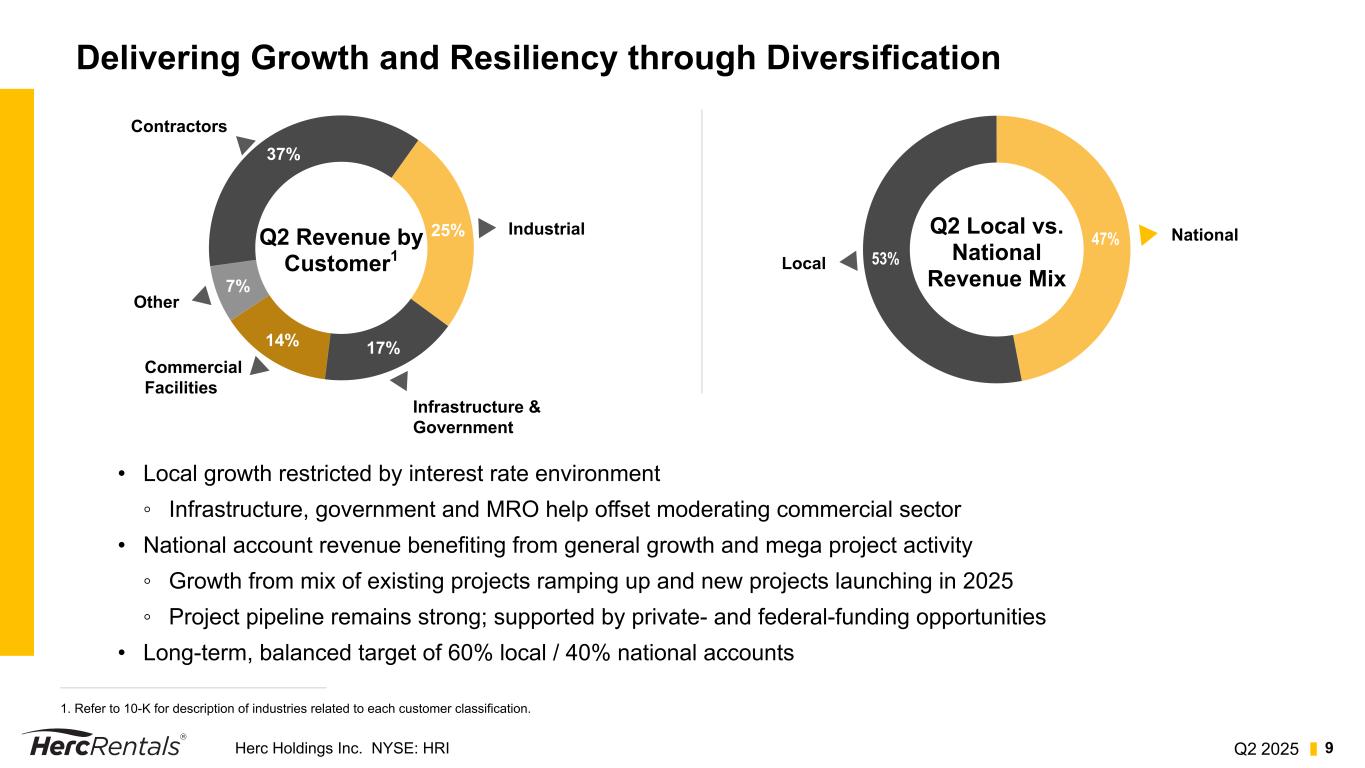
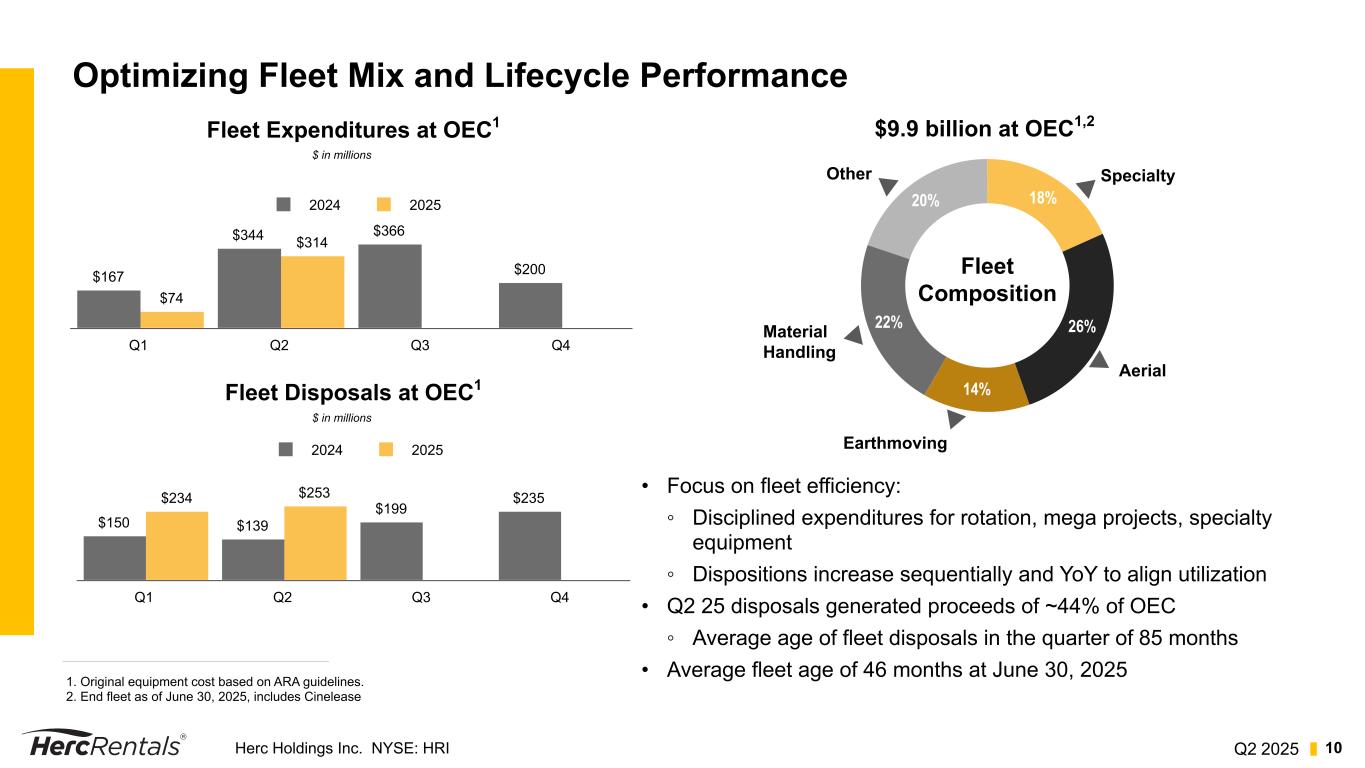
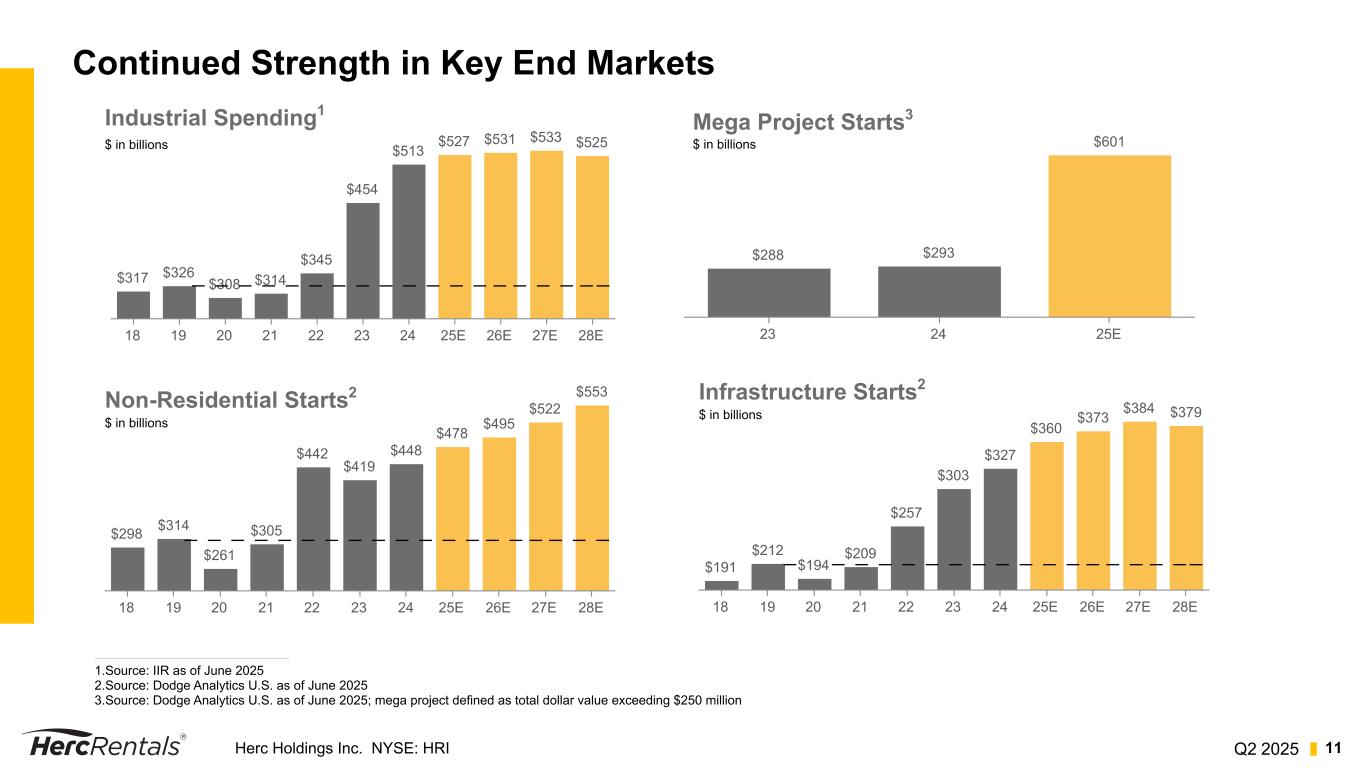
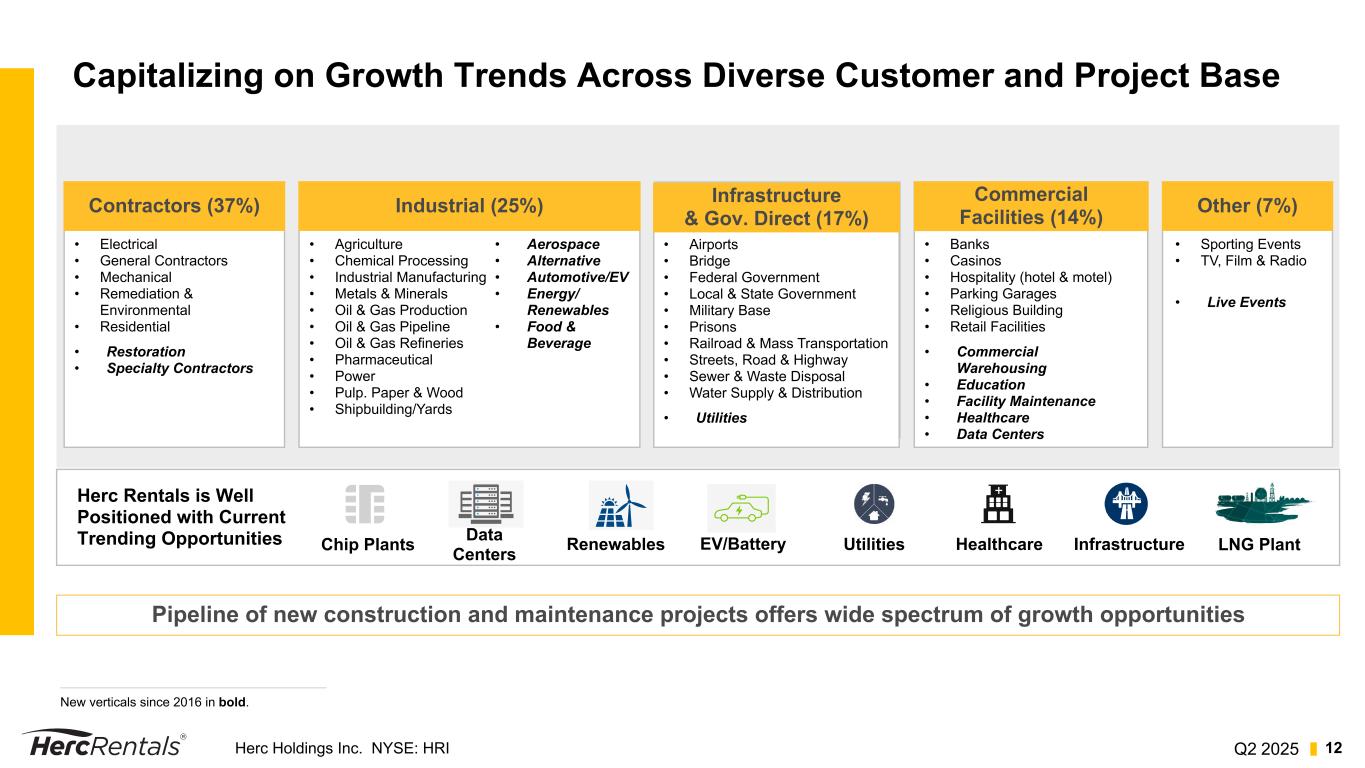
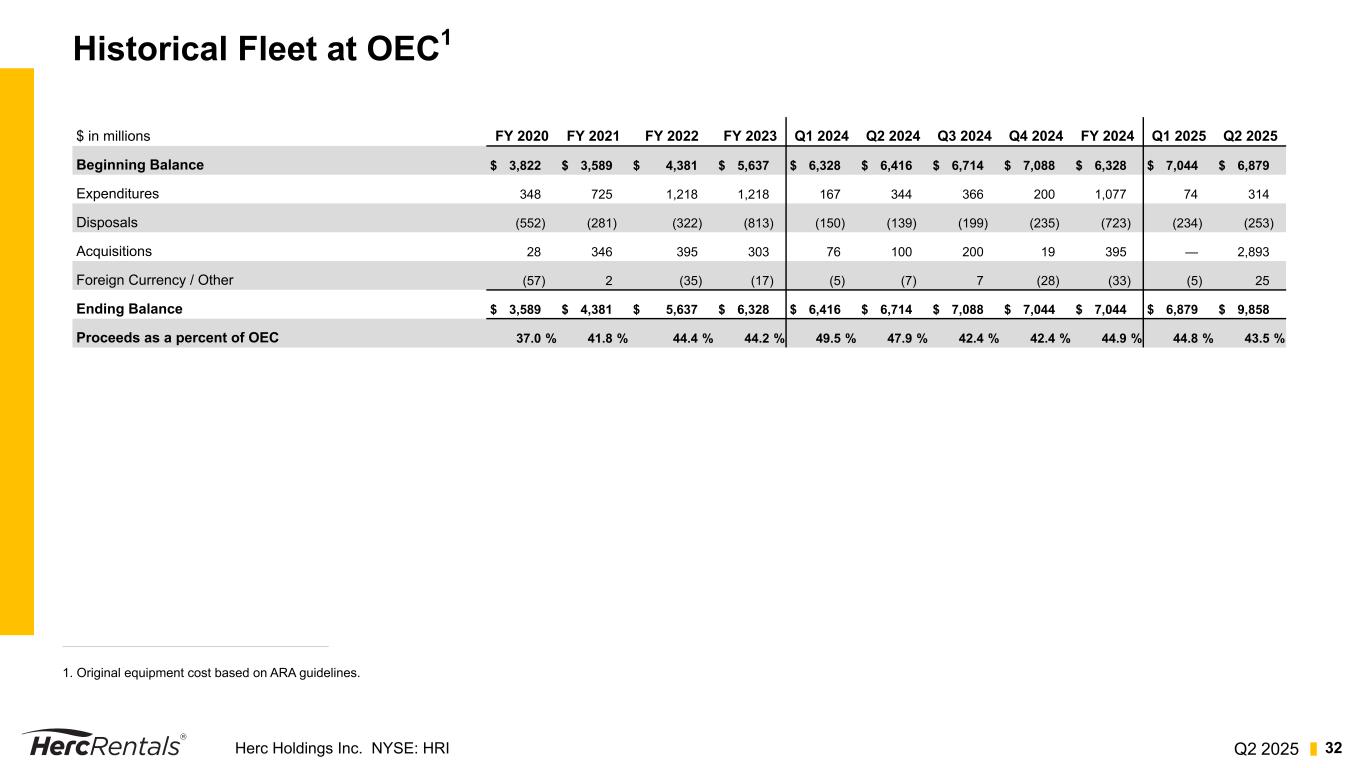
Thanks Larry and good morning everyone. I also want to thank our team for remaining agile in a very dynamic environment by leveraging our diverse and market capabilities, comprehensive fleet offerings, broad geographic coverage, and the deep customer relationships we've cultivated, all of which support a resilient business As an added bonus, our teams are energized by the unique opportunity that H&E presents, and that energy and excitement already is beginning to translate into an expanded project pipeline. Our combined team is committed to converting opportunities into revenue while prioritizing customer success and a safety first focus. Safety is at the core of everything we do and you can see on slide eight our major internal safety program focuses on perfect days and we strive for 100 perfect days throughout the organization. In the second quarter on a branch-by-branch measurement all of our operations achieved at least 96 percent of days as perfect. Equally notable, our total recordable incident rate remains better than the industry benchmark of 1.0, reflecting our high standards and commitment to the safety of our people and our customers. Turning to slide 9, as Larry said, we are operating in a disproportionate demand environment, where the local market remains affected by interest rate-sensitive commercial construction while mega-project activity continues to be robust. In the second quarter, with one month of H&E results included, local accounts represented 53% of rental revenue compared with 56% a year ago. On a pro forma basis, as if we owned H&E on April 1st, our second quarter rental revenue mix would have been 55% local and 45% national. In the local markets, we are expanding in select regions where infrastructure, education, government recreation and facility maintenance and repair projects are active. On the national account side, government and private funding for new large and mega projects is still quite robust. The push for reshoring manufacturing along with increases in LNG export capacity and the expansion of artificial intelligence are driving new construction demand. We are continuing to win more of our targeted share of these project opportunities with several new mega projects on deck this year and the 2024 projects still ramping up. We always get questions about cancellations and delays so I'll address that now. We haven't experienced any cancellations on our mega projects and when it comes to project delays as we've said before delays are fairly typical on national accounts as large complex projects deal with design revisions labor issues and lengthy permitting and regulatory reviews case in point in june we finally put initial equipment on rent for a substantial mega project that was awarded back in january this project was delayed due to a rigorous permitting process in instances like this our fleet team and operations and sales leaders rely on experience and collaboration to strategically adjust plans to address these timing issues it's the nature of the business as a combined company will continue to target a 60 local and 40 national revenue split knowing that this diversification provides for growth and resiliency moving to slide 10 if you jumped ahead in the deck then you know that we're increasing our gross capex forecast to account for incrementally more specially fleet this year to capture the cross-selling synergies in our plan despite this our net fleet capex forecast is unchanged at roughly 30% lower year-over-year at the midpoint of our guide. The offset to the expenditures is incremental disposals as we make adjustments for mix and utilization. In the second quarter, we spent roughly 9% less on new fleet than in the prior year quarter, with a mix of fleet expenditures more heavily weighted towards specialty gear, even pre-acquisition. Also in the latest quarter, we disposed of 82% more fleet on an OEC basis versus a year earlier in preparation for onboarding the H&E fleet. Realized proceeds were 44% of OEC on those equipment dispositions. For our residual values were down year-over-year, sequentially, we've seen the used equipment market stabilize since the back half of 2024. On the right side of the slide, you can see our fleet composition at OEC. Total fleet was $9.9 billion as of June 30, 2025, with specialty fleet representing about 18% of the total. Excluding the SINELES assets, our base fleet is approximately $9.6 billion, and higher margins of specialty fleet would make up about 16% of that. With the acquisition synergies, we expect Specialty Fleet to return to about 20% of OEC as we continue to prioritize this high-margin equipment category. Having a diversified offering that includes Specialty Fleet is an advantage for us in addressing the comprehensive needs of both local and national account customers. And delivering value-added expert solutions to meet these customers' critical or emergency requirements provides another degree of operating resilience of our business. Sticking with the topic of resiliency, let's turn to slide 11 where you can see that despite the uncertain sentiment in the general market around interest rates and tariffs, industrial spinning and non-residential construction starts still show plenty of opportunity for growth built on a foundation of mega project development and infrastructure investments. Taking a look at the updated industrial spending forecast at the top left industrial info resources is projecting 2025 to be another strong year of capital and maintenance spending at 527 billion dollars dodge's forecast for non-residential construction starts in 2025 is estimated to increase seven percent to 478 billion dollars additionally there's another 360 billion dollars in infrastructure projects forecasted for 2025. That's a 10 percent increase over 2024. The dotted line on these charts reflects growth over pre-pandemic peak levels. You can see that this year and the next three years are currently projected to be among the strongest periods of activity that this industry has seen. The mega project chart in the upper right quadrant gives you a snapshot of the growth in projected starts over the last two years and for 2025 for us construction projects with a total dollar value exceeding 250 million dollars we estimate we're only in the early to middle innings of this multi-year opportunity we don't take the chart out beyond this year because visibility is less clear for actual start dates of those projects still in the planning phases but there is an additional two trillion dollars in the mega project pipeline that isn't accounted for here of course there's some overlap in projects among these four data sets but no matter how you look at it for companies with the safety record product breadth technologies and capabilities to service customers at the national account level the opportunities for growth remain significant turning to slide 12 i'll continue to state the obvious Diversification is an important strategy for fostering sustainable growth and navigating economic cycles. As HIRT has diversified into new in-markets, geographies, and products and services over the last nine years, we have reduced our reliance on a single industry or customer. We've become more resilient to downturns and more adaptable to emerging opportunities like the megaproject developments, technology advancements that support customer productivity, and the secular shift from ownership to rental, especially in the specialty category classes. We believe we are well positioned to manage dynamic markets, and the acquisition of H&E first repulsters our capacity and therefore our opportunities. With that, I'll pass the call on to Mark.
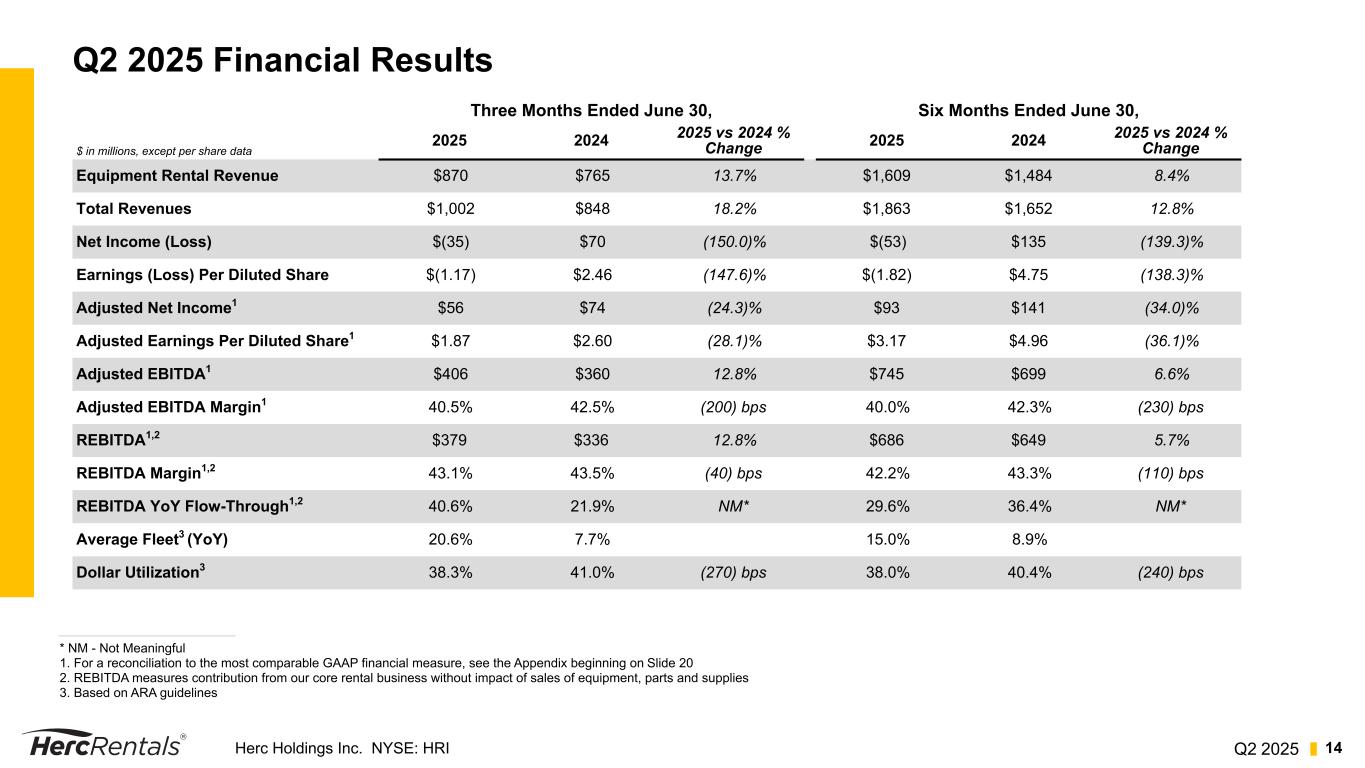
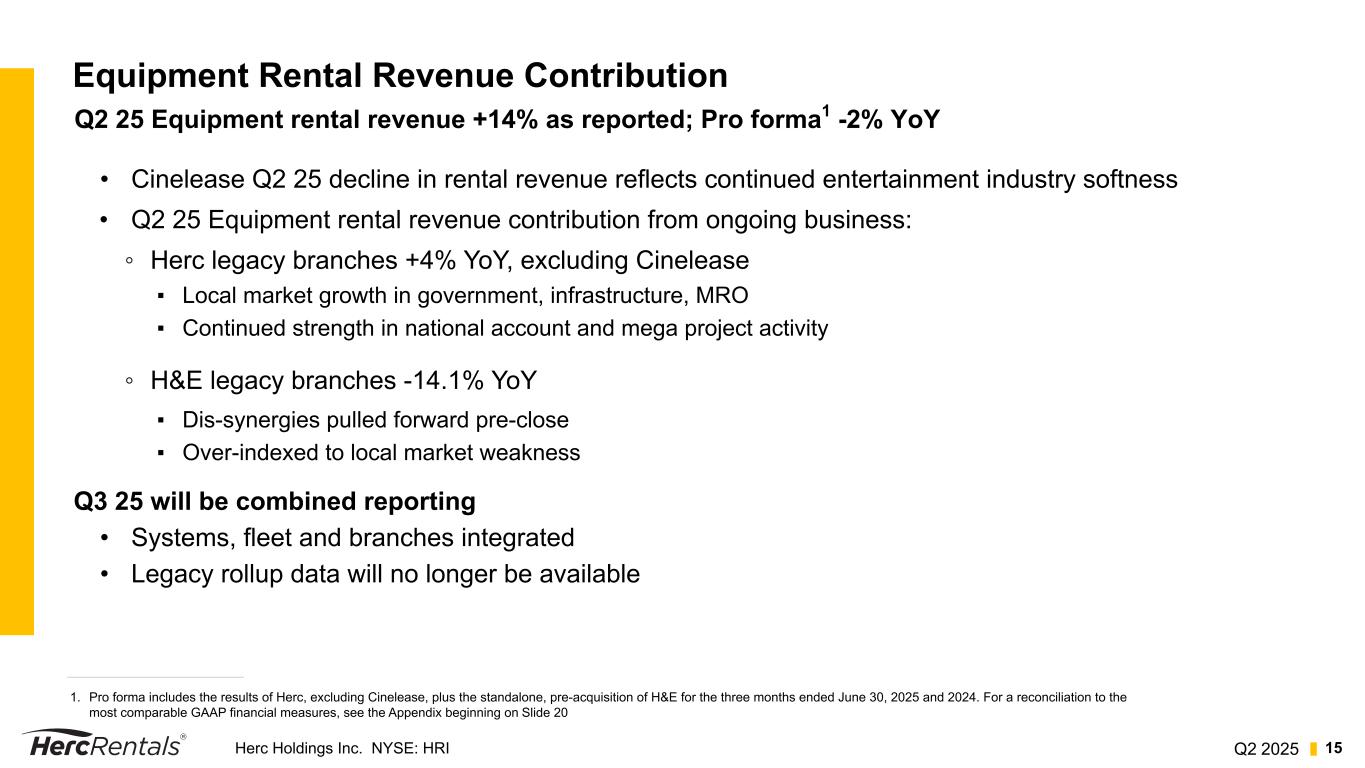
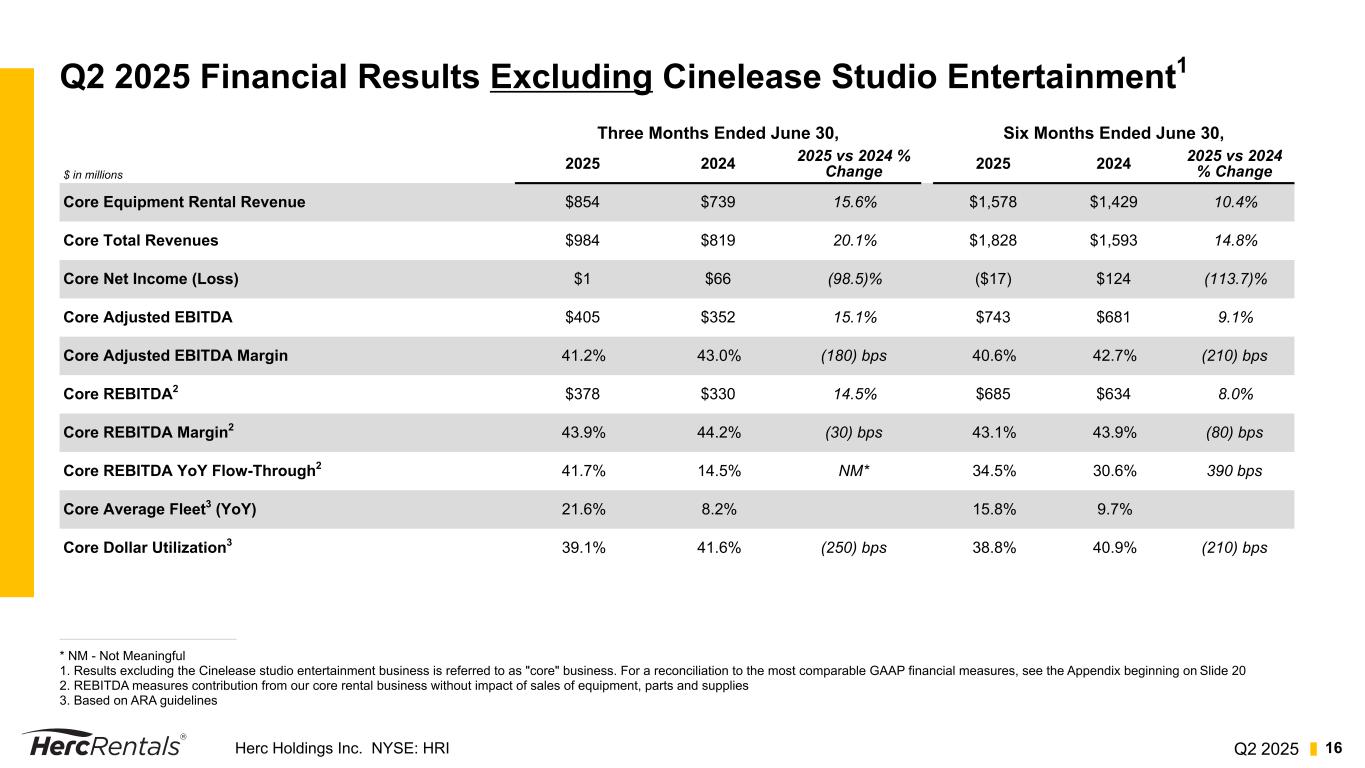
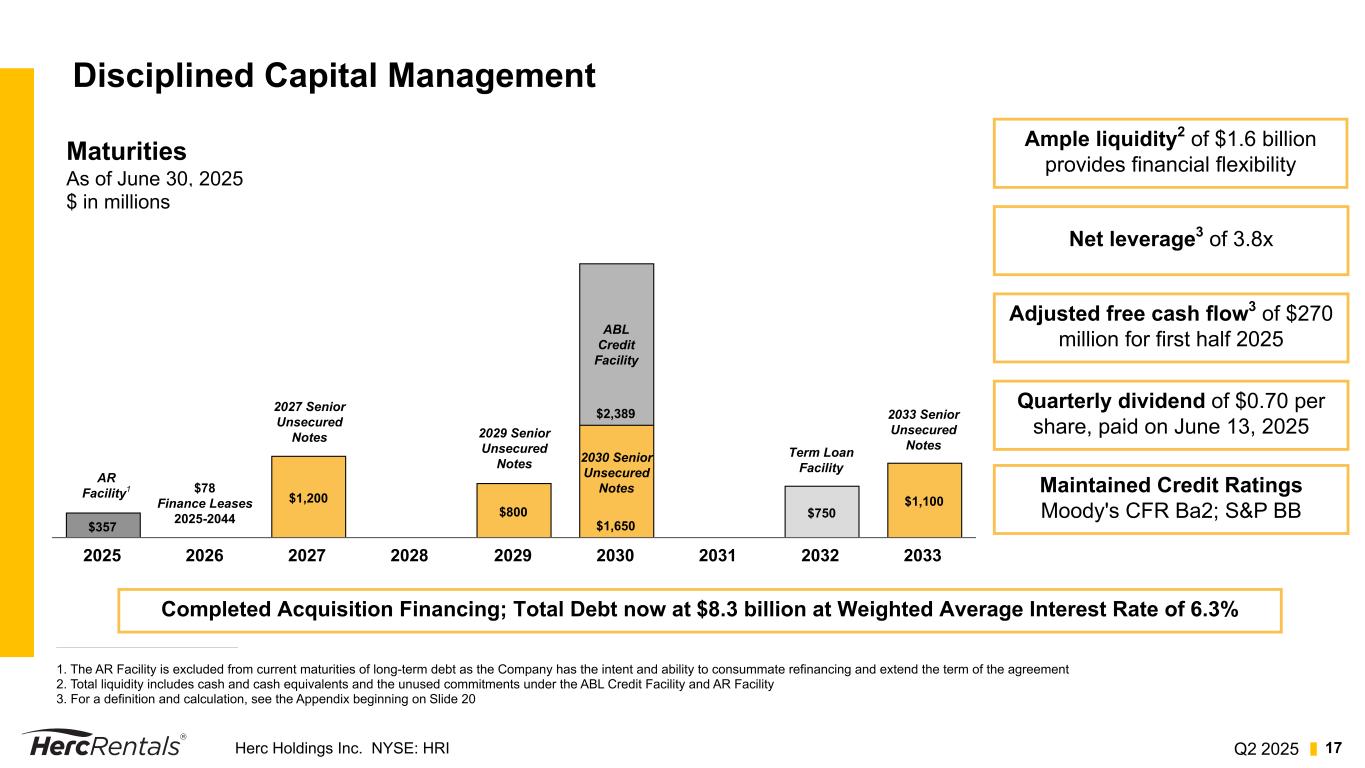
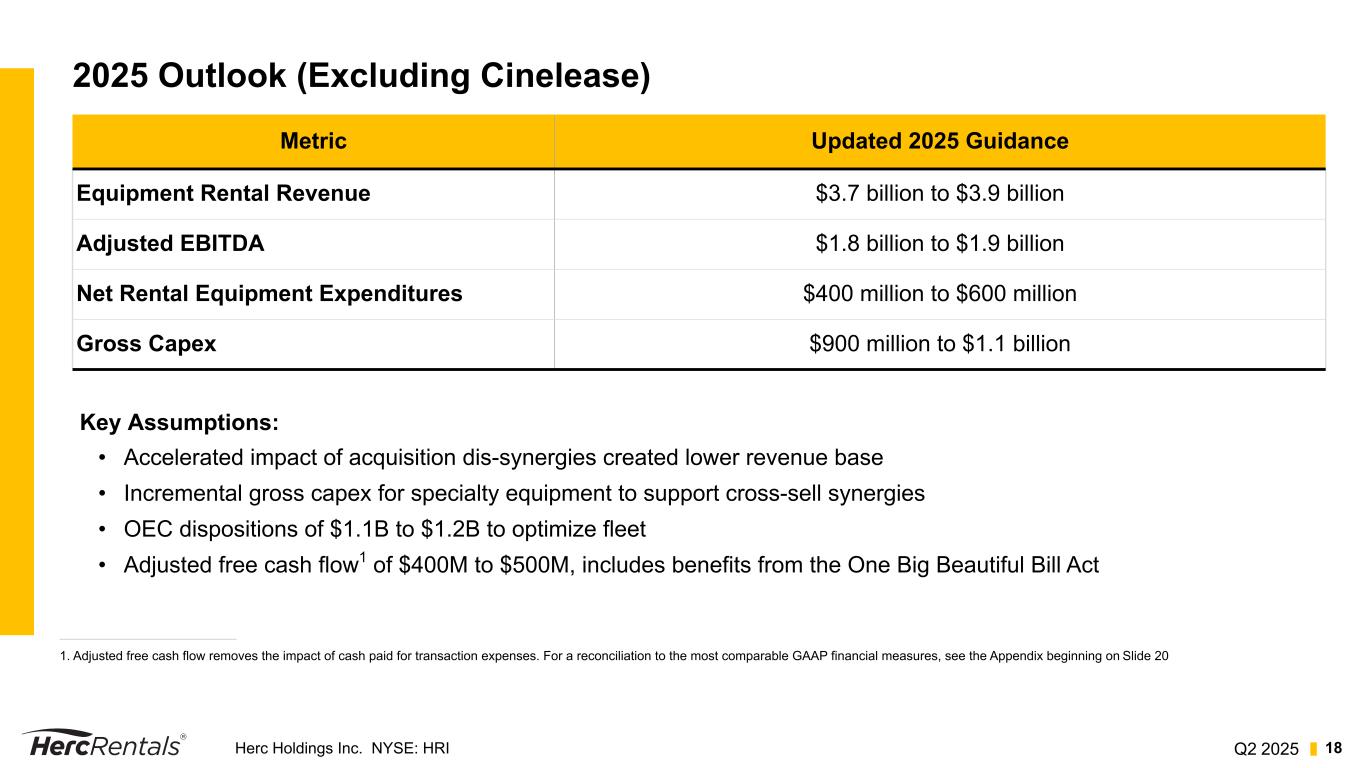
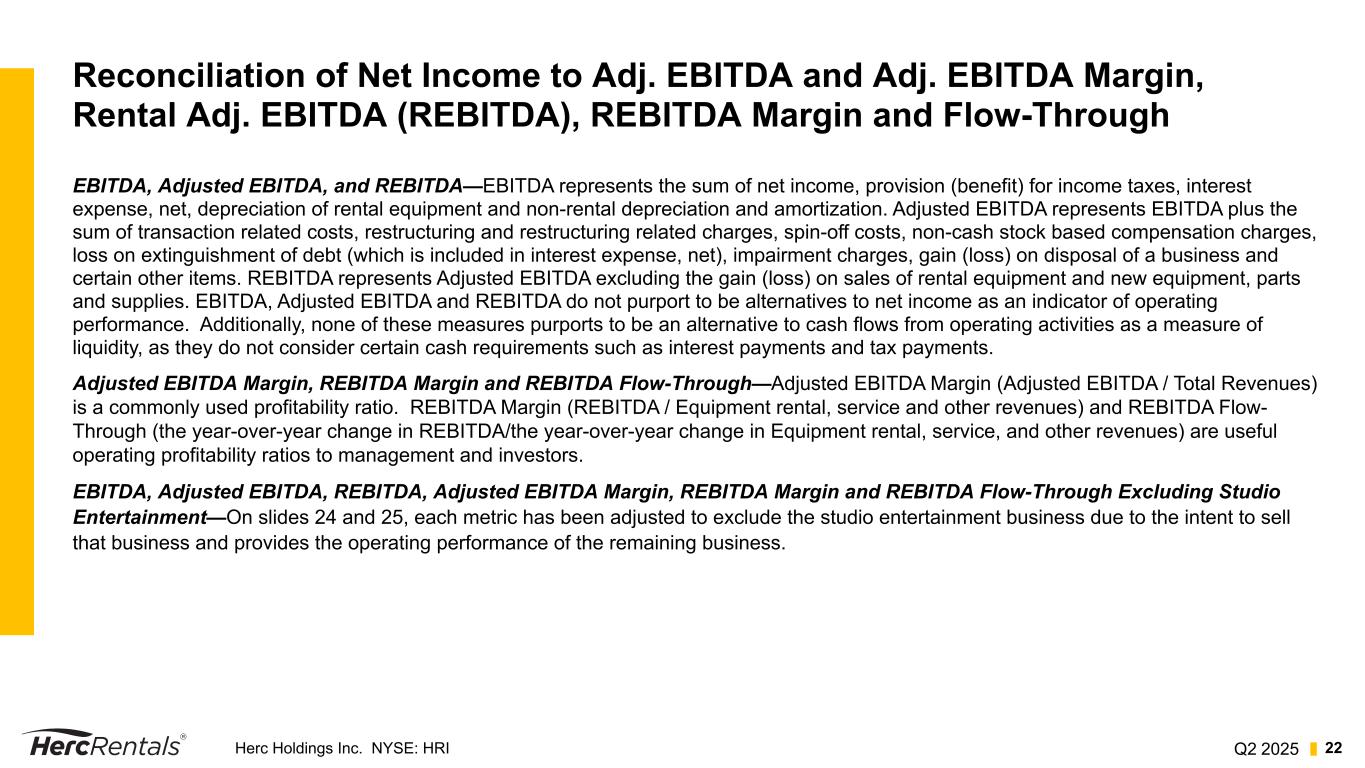
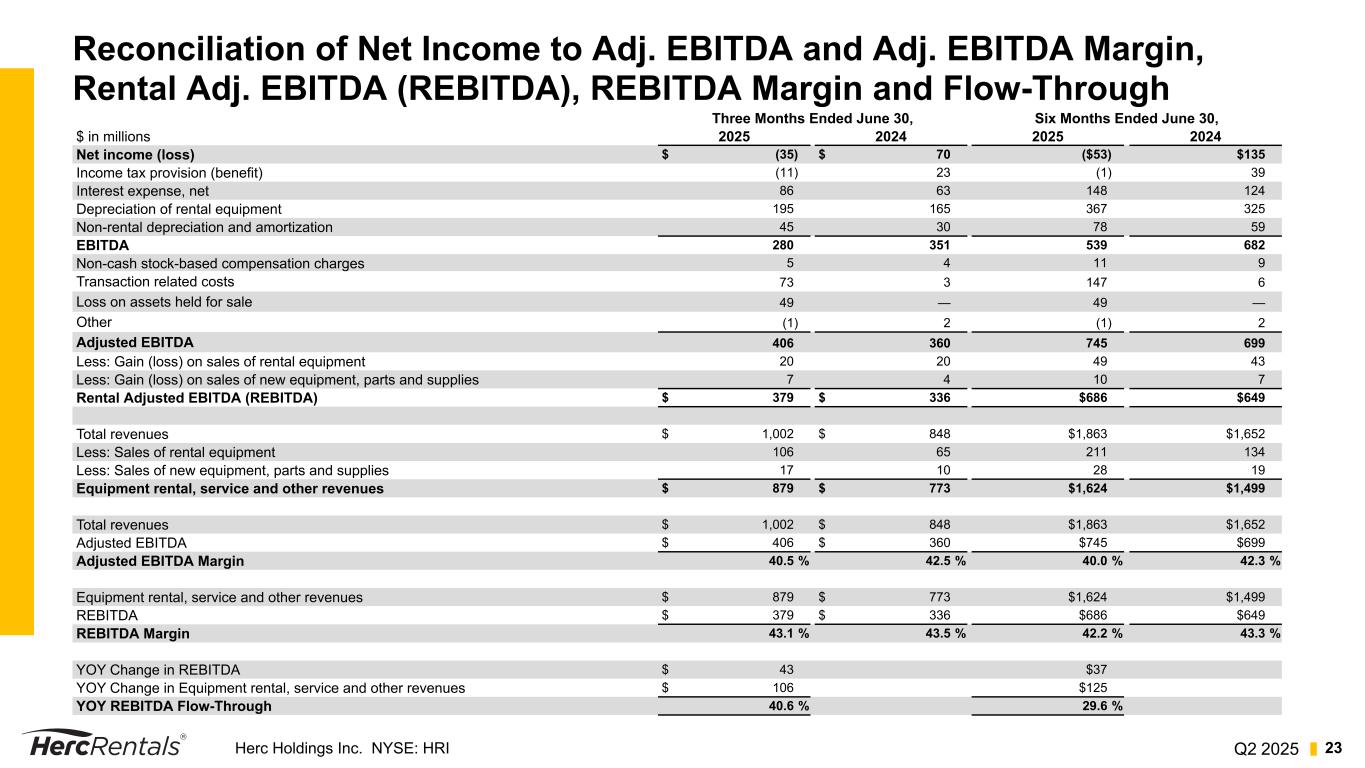
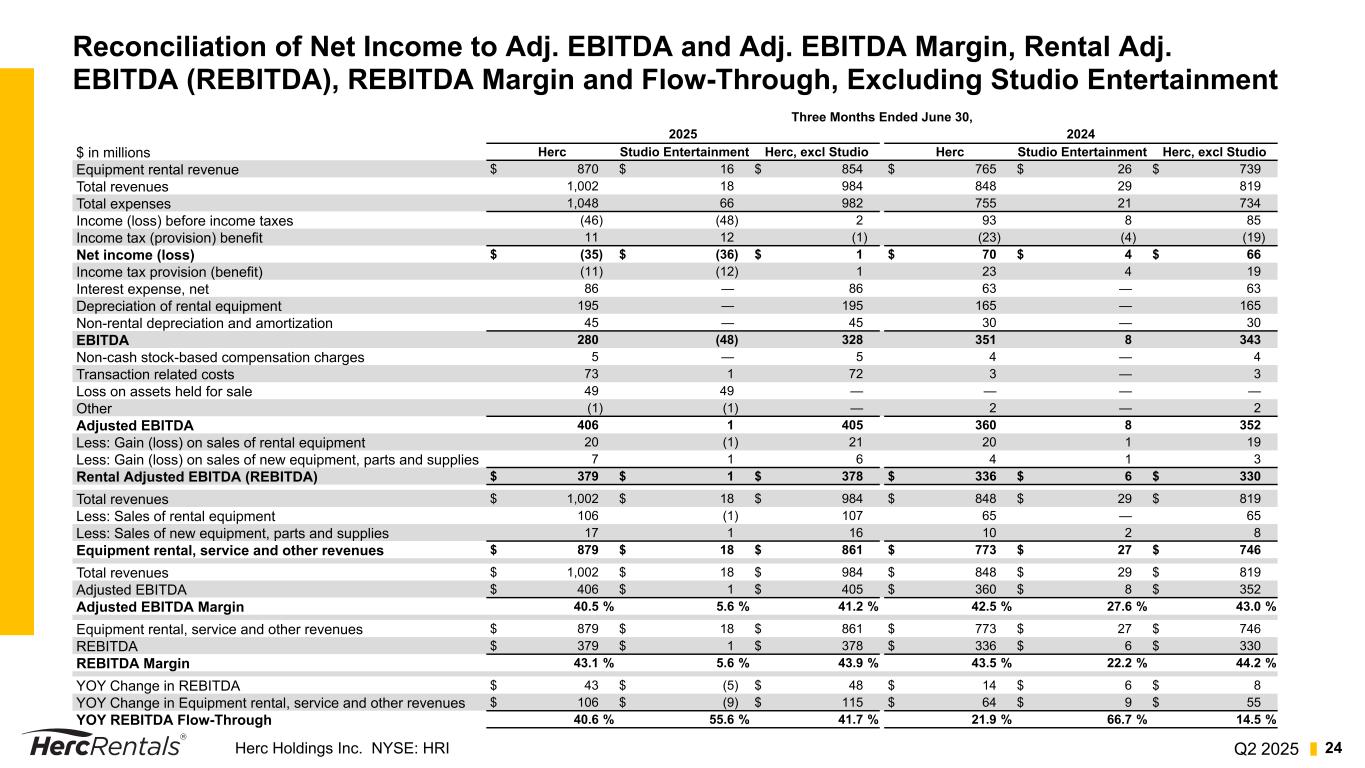
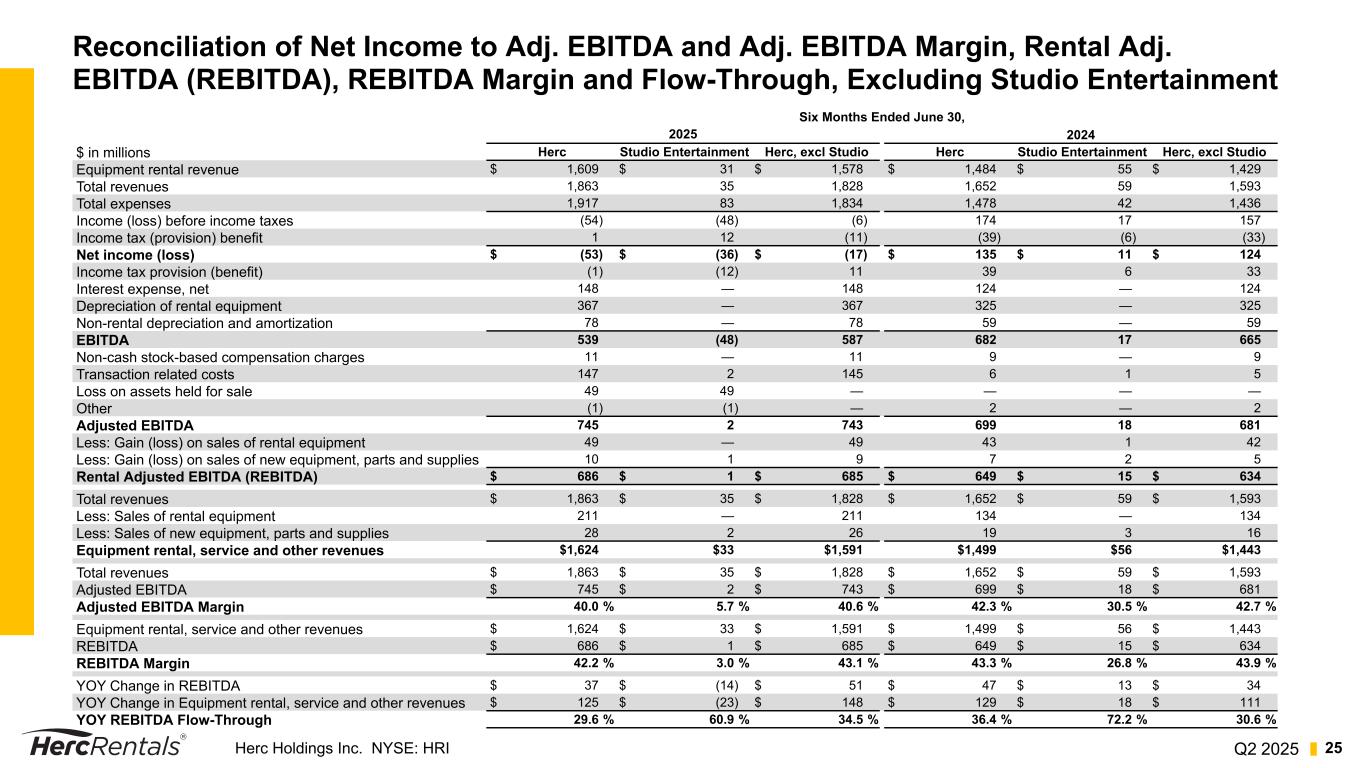
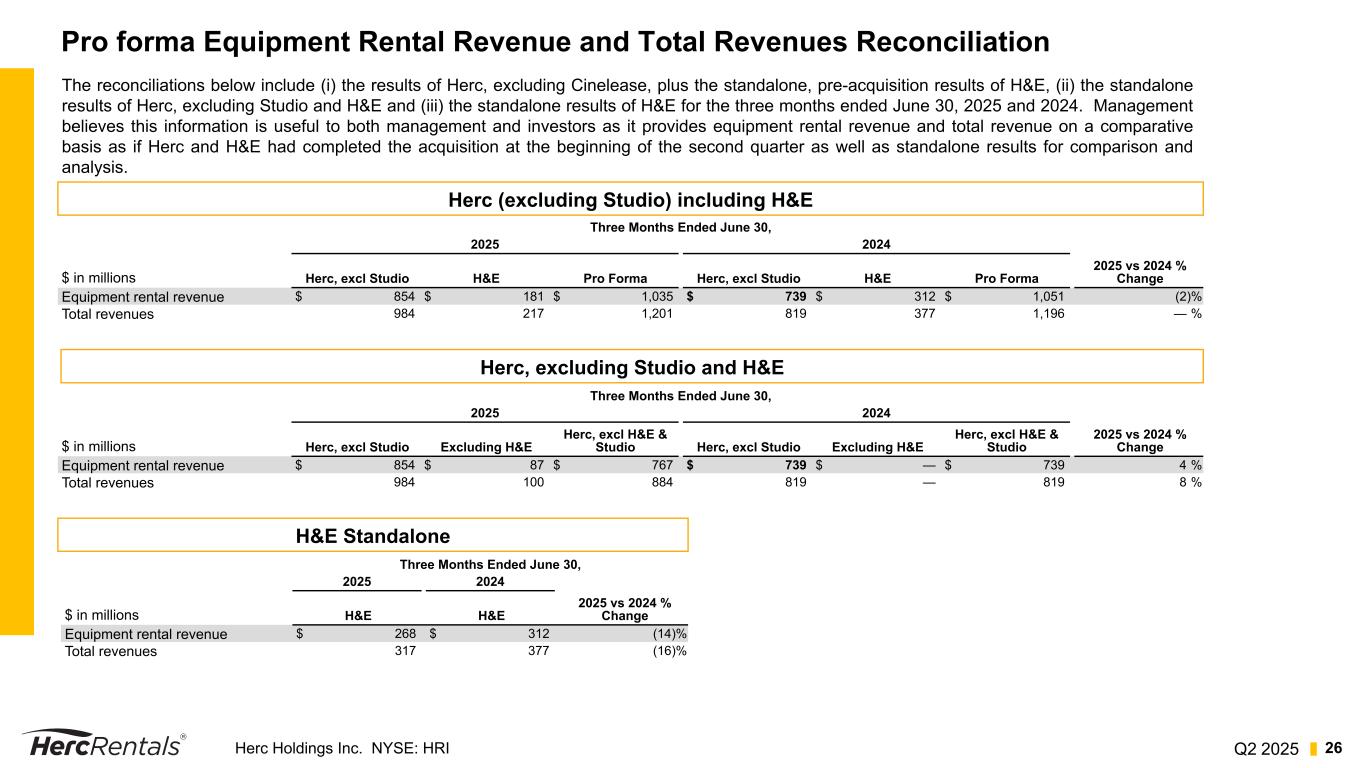
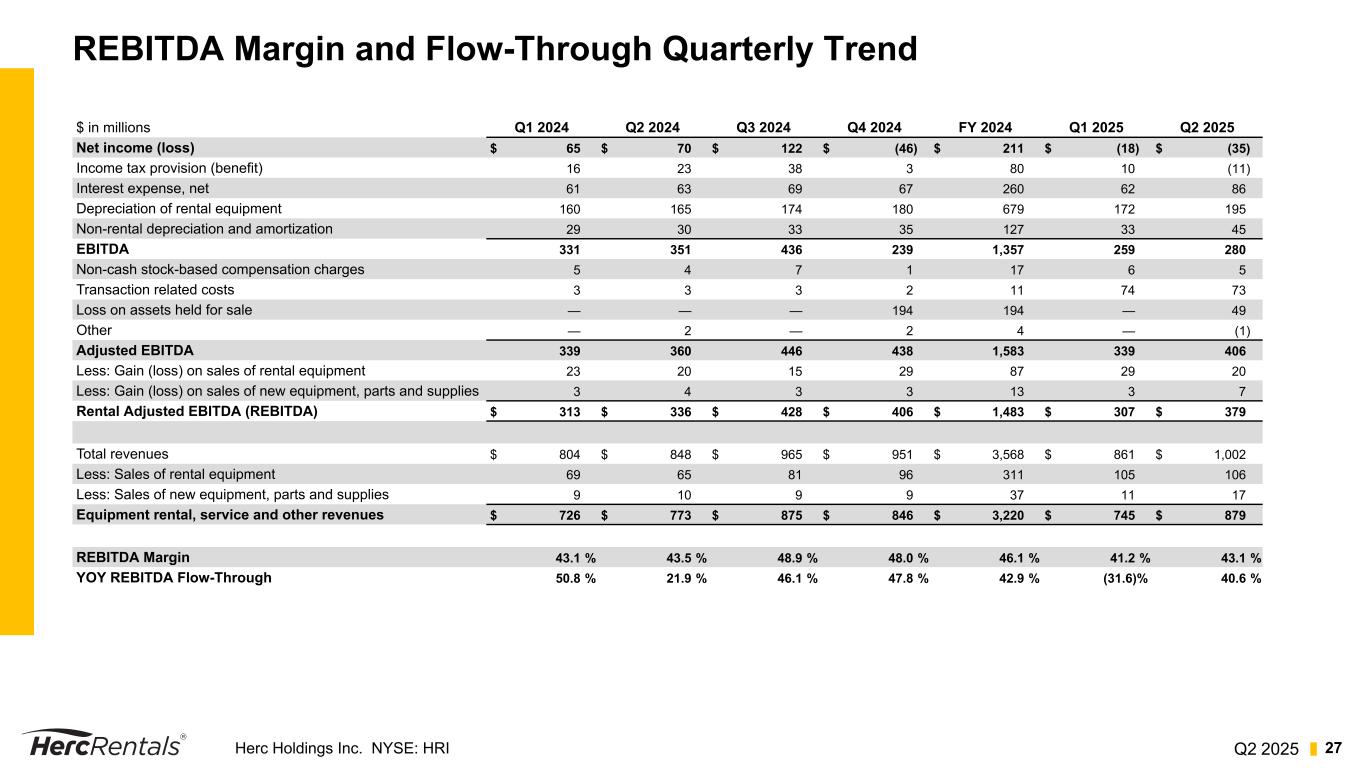
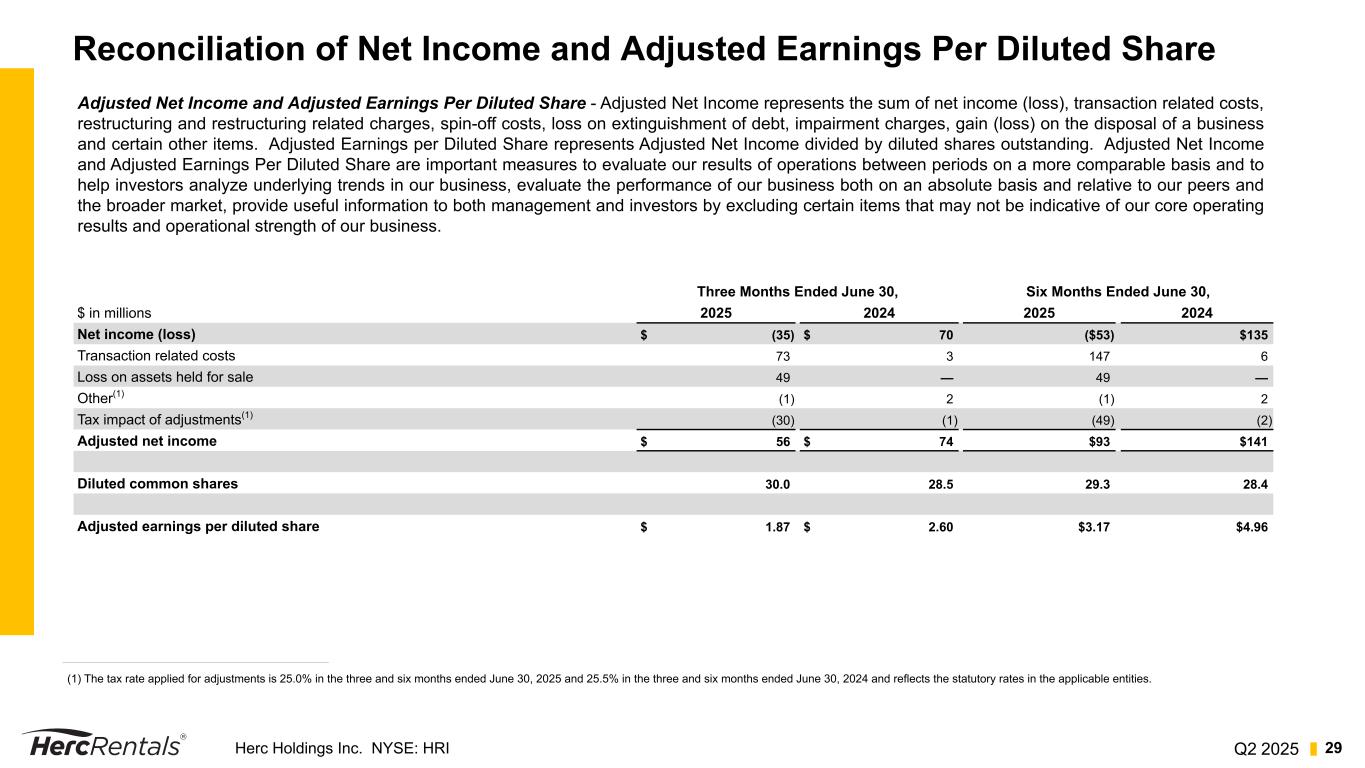
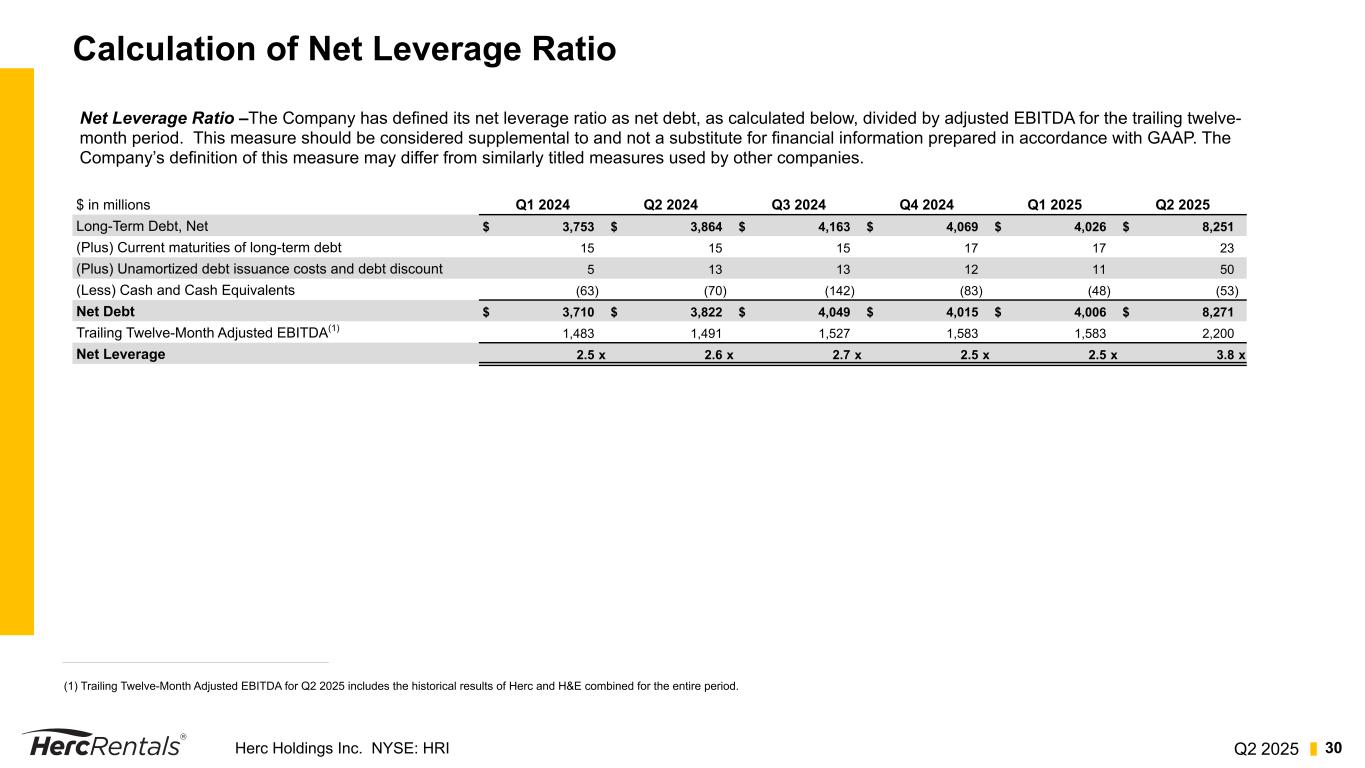
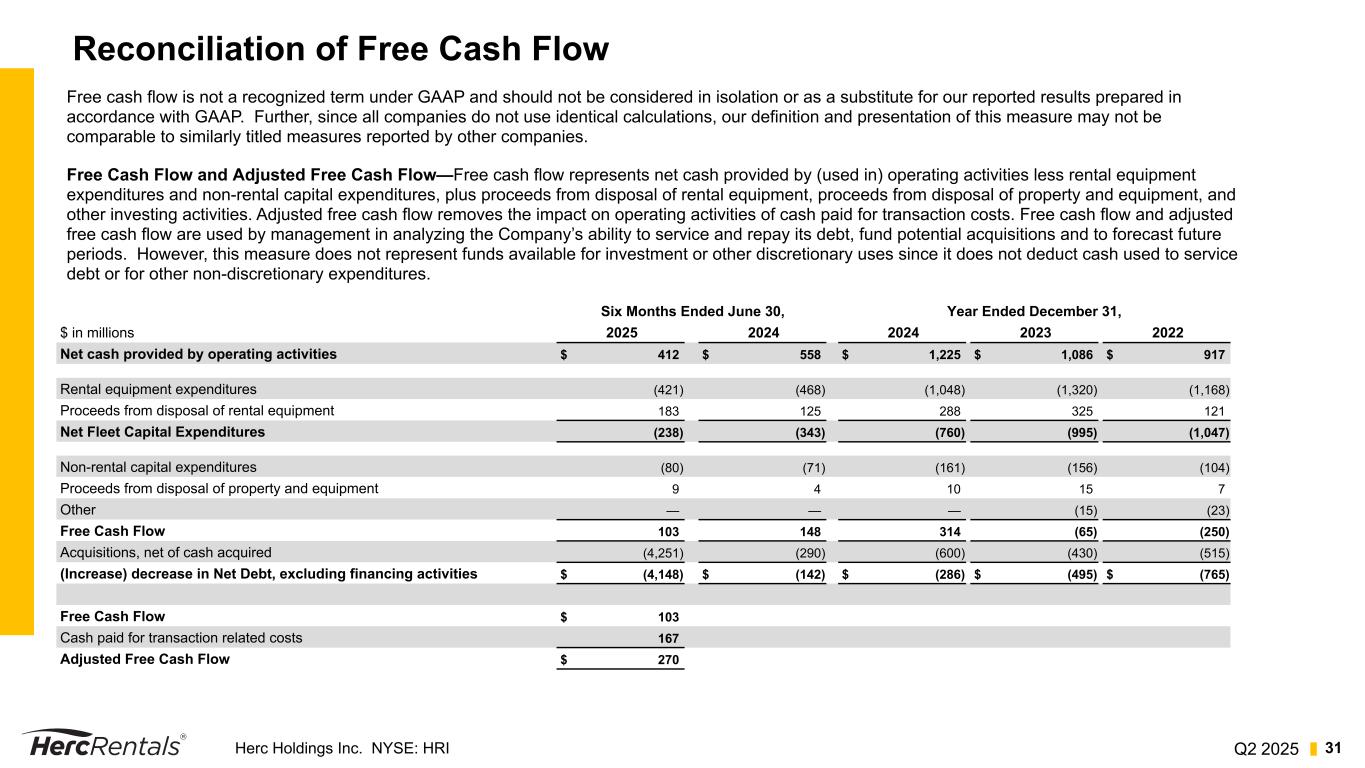
Thanks, Aaron, and good morning, everyone. I'm starting on slide 14 with a summary of our key metrics for the second quarter. I'll start with our GAAP results, which include both H&E's June results and the SenaLease results. SenaLease, as has been discussed, is classified as assets held for sale. I'll just make a couple of quick points here before turning the focus to the core results. In the second quarter, rental revenue increased 13.7 percent and adjusted EBITDA was up 12.8 percent to $406 million. We recorded a net loss in the second quarter, which included $73 million of transaction costs, primarily related to H&E, and a $49 million loss on assets held for sale. However, on an adjusted basis, net income was $56 million. Let's move to slide 15, where we can walk through the revenue breakdown by contributing business. In the second quarter, GAAP equipment rental revenue was up about 14%, but on a pro forma a basis, which includes H&E for the full second quarter, rental revenue would have been down 2% year over year, primarily as a result of continued weakness in the film and TV vertical and a double-digit decline in the H&E business. Stenely's rental revenue was down nearly 40% from a year ago as the studio entertainment industry recovery that started a contraction in the first half of 2024 continues to be pushed out as entertainment companies delay reshoring production. Excluding SenaLease, rental revenue from HERC legacy branches increased 4% in the quarter, reflecting strong megaproject activity, moderated growth in the local market, as well as positive results in both general rental and specialty product lines year over year. Shifting to H&E, as you saw in their last several earnings reports, the business has struggled to capitalize on opportunities outside of their local market. Legacy H&E branches exited the quarter, with rental revenue declining at roughly 15 percent. A portion of the decline is attributable to the workforce disruption, including turnover caused by two announced transactions. The balance reflects the volume and pricing pressure that results from being limited by a narrow product offering in a moderating local market. As Larry and Erin mentioned, we feel that the actions we've taken to stabilize and engage the workforce have been effective. Now, right-sizing the fleet and providing the acquired branches with a broader portfolio of equipment and more sophisticated tools with which to manage the business should get things back on track as we move into 2026 and hopefully a better interest rate environment. This is the last time we'll provide a revenue breakdown by business. The fleet is fungible and is already being commingled, and customer account sharing and redesigned sales territories are in play. We are now one company. Moving on to slide 16, here we outline our core financial results, which exclude SenaLease from both periods in order to give you a better sense of how the base business performed in the quarter. A full reconciliation of quarterly performance metrics can be found beginning on slide 24 in the appendix of our presentation. For the second quarter, equipment rental revenue was up 15.6% year-over-year. Adjusted EBITDA increased approximately 15.1% compared with last year's second quarter, benefiting from higher equipment rental revenue as well as used equipment sales. Adjusted EBITDA margin primarily was impacted by higher revenue from sales of used equipment, which generate a lower margin than rental revenue. Rebidah, which excludes used equipment sales, was up 14.5% during the second quarter. Rebidah margin dipped 30 basis points compared with the prior year due to the one-month impact of the lower margin acquired business. Margin improvement will come from cost synergies and a shift over time to a higher margin product mix as we deliver on the revenue synergies from the acquisition. ROIC for the core business is targeted to exceed our cost of capital within three years of closing the acquisition, supported by capital efficiencies, economies of scale, and a higher margin revenue mix. Shifting to capital management on slide 17, you can see that we generated $270 million of free cash flow net of transaction costs in the first half on higher operating cash flow and disciplined net capital expenditures. In June, we finalized the debt funding for the acquisition, raising $4.4 billion at a weighted average cost of 6.8%. This was done through a combination of unsecured notes, a term loan vehicle, and incremental drawdown on our upsized ABL. Our current leverage ratio is 3.8 times as we anticipated. We believe we can bring that back into the top of our target range of two to three times within calendar year 2027 as revenue and cost synergies drive higher EBITDA flow through and less capital will be required to achieve the revenue synergies due to scale benefits on the utilization of existing fleet. The combined entity will be capitalized to maintain financial strength and flexibility. If you flip to slide 18, you'll see that we are introducing combined 2025 guidance. As noted, our guidance excludes the performance of CENELIS. We are now expecting to generate equipment rental revenue of $3.7 to $3.9 billion in 2025, which includes six months of forecasted H&E results. You'll recall that we projected a 10% disk synergy target over two years in our initial modeling of the acquisition. We believe that all of that came to fruition pre-close as a result of the disruptions to the H&E business. The revenue outlook at a high level reflects the previously guided performance expectations for legacy HERC, the anticipated run rate revenue trajectory of legacy H&E, a reduction in greenfield openings and M&A branches year-over-year for both companies, and the phasing in of initial revenue synergies. Notwithstanding the DISC synergies, which created a new lower base of acquired revenue at closing, our gross revenue synergy target remains the same at approximately $350 million over three years. When it comes to cost synergies, savings from redundant positions, contracts, and public company expenses are already being realized. We expect to achieve 50% of our $125 million EBITDA run rate target by year-end 2025. We're confident in our ability to achieve both the full revenue and cost synergies and should be able to update you on the cadence of how those synergies come in when we give our guidance for 2026. For 2025, we estimate adjusted EBITDA will be between $1.8 and $1.9 billion, which implies an adjusted EBITDA margin of 42 to 43 percent. For net capex, as Aaron mentioned, we're tracking to our original guide of $400 to $600 million, despite increasing gross capex for synergy fleet. As we've stated, we believe we'll be able to generate the revenue synergies with roughly half the typical amount of fleet needed as we optimize utilization of the combined general rental fleets and only add incremental gross capex for specialty type fleet to support the acquired customer base. In the second half of the year, we are targeting equipment disposals of seven to eight hundred million at OEC as part of the H&E fleet integration to better align our fleet level to the new base of acquired revenue. We forecast adjusted free cash flow for the year to be four to 500 million net of transaction costs, reflecting an approximate $130 million cash tax benefit from the new legislation around retroactive bonus depreciation and interest deduction limitations, partially offset by higher interest expense. As with any major acquisition, we've got some work to do as we integrate H&E operations. as we gain more insight and intelligence into the acquired business, it's reinforced our view of the significant opportunities ahead and our belief that the combination with H&E will create long-term benefits for customers, employees, and shareholders. With that operator, we'll take our first question.
Operator
At this time, I would like to remind everyone in order to ask a question, press star then the number one on your telephone keypad. We encourage everyone to limit yourselves to one question and one follow-up. We will pause for just a moment to compile the Q&A roster. Your first question comes from the line of Rob Werthimer with Milius Research. Your line is open.
Hi, good morning, everybody, and congrats on getting the deal done and off to the new era. This first one's going to be a little bit tricky to answer because it touches on 26th and I don't want to go explicit, but I wonder if you could give general comments on how you feel set up for fleet in light of the dollar ute, in light of having acquired a bunch, and what that means for future CapEx. Did you consider tightening it further for this year? There's always different categories I know you need. So maybe just talk about your use of capital over the next couple years. Thank you.
Yeah, I think broadly speaking, Rob, obviously, you know, this is very early innings here, right? We have sort of an adjustment to make on the new revenue base, which will be sort of right-sizing that H&E fleet into the broader organization. Hopefully, the majority of that activity will occur in the back half of 2025. I think when you then think about that going forward, right, there's a rev synergy component to this, you know, as I stated and prepared, you know, there's a $350 million go-get over a three-year period. So, there will take some invested capital, capital light, as we've modeled it. But, you know, the majority of the increase here in the back half of the year on the growth side is related to Rev's energy fleet. That'll layer in over the back six months, probably rattably throughout. I think it's too early for me to sort of give you guide into 2026. I think we need to see the uptake of both the plan to right size, how the revenue synergy fleet is laying in, and be able to then provide you more clarity as we provide you 2026 guidance in 4Q with 4Q results.
That's totally fair. Thank you. And then if I can, I wonder if you could just describe, I mean, obviously this is a big transaction but you expected revenue synergies there was a little bit of a rush for that in the beginning i mean how confident are you that you've gotten past that how does that normally play out people come after some key employees or some key you know accounts and maybe that's what you figured but maybe just any expansion there and i'll stop thank you yeah robbie this is aaron i'll take the back half of that question for sure so as we communicated in the in the prepared remarks.
And as you're aware, there was a lot of, I guess, anxiety and change going on during the due diligence HSR period. So there was some loss of employees from H&E. Some of them were sales reps. But once we closed the transaction, we were able to get in front of the employees, that really settled everybody down. And we haven't had the same issues since June 2nd. So it's really It's a different business, as we said. You know, it's one company now, and we're seeing synergies occur, and we've really stabilized the force, and I think we're all working together right now.
I think, Rob, maybe coming at it a little bit differently, and to Aaron's point, we've absolutely stabilized the revenue base. that doesn't completely take into account the tough comp that that H&E business would have had on the back half of the year. It was an acquisition for them that was sizable in 2024, obviously didn't recur in 2025. So while the rev base is stabilized, it's not going to necessarily come through from a growth perspective in that same manner. There'll be additional pressures to the rev growth, if you will, in the back half of the year assumed in that H&E business. Does that make sense?
Operator
Your next question comes from the line of Tammy Zakaria with JPMorgan. Your line is open.
Hi, this is Alec on for Tammy. Thanks for taking my questions. So my first one is, are you able to comment on the timing of the, I think it was 1.1 to 1.2 billion OEC sales for the full year in 3Q versus 4Q, and sort of what's the expected recovery rate on that OEC and any incremental color on the used market since the prior quarter would be great.
I'll take the front half of that, and I'll let Aaron sort of comment on the used market as we see it today. But I think just from a dispositions perspective, we're probably looking, if you take that guide into its midpoint you're sort of talking about 750 million dollars of dispositions back half of the year my our sort of best view of that is probably ratable um q3 and q4 um as we think about it today and then i'll let aaron comment on the on the market yeah our view on the used markets is that they're they're healthy they're they're steady they've really stabilized since late last year.
Whether you're talking retail, wholesale, or the auction channel, they're stable, kind of looking back to like a 2019 level. So it's a healthy market. We think the used equipment markets are a good place for us to rebalance as we get through the balance of this back half of the year with the H&E sleeve. So we're encouraged about this stabilization there.
Obviously, I appreciate it.
And just for clarification, I think the slide mentioned you know accelerated impact of acquisition decision the synergies uh create a lower revenue base but sort of how should we think about you know how much of synergies versus this energies are embedded in the four-year uh revenue and the uh the ebit guide as well yeah good question i think if you think about sort of the entry rate of h e into us um prepared remarks had about a minus 15 and then my comments um back to rob is you're probably looking at something a little bit greater than minus 15 in the back half just due to the tough comp. So that's how I would think about it.
Operator
Your next question comes from the line of Kyle Mengers with CD Group. Your line is open.
Thank you. I had a question on the free cash flow guidance. Just maybe unpacking that a little bit. I mean, I think the back of that envelope math I think you said $130 million from the big, beautiful bill, bonus depreciation, and then seems like around $300 million maybe benefit from sales of OEC. So I guess that doesn't leave much implied for the core business from a free cash flow standpoint for the year. And then I guess, how should we be thinking about maybe the baseline for free cash flow into next year for the business?
Yeah, good questions, one and all. I think, you know, I've said that, you know, in my mind, the way I would think about the free cash flow capabilities of this business in a normalized environment, you know, sort of thinking mid-single-digit growth is somewhere between 10% to 15% free cash flow generation off of the revenue base. I think what makes the look through here a little bit more difficult, Kyle, is that we're missing five months of free cash flow generation from H&E. And so, you know, when you think about that, I think my sort of guide here of 10 to 15 percent of REVs on a free cash flow basis begins to make some sense. You know, that aligns to whether you wanted to look at it on a gap basis for the year, if you wanted to look at it on a pro forma basis and, you know, evaluate H&E in there. You kind of come to this, you know, five to six hundred million on a pro forma basis for the year, which aligns with where I would have anticipated the business to be.
That's helpful. And then it sounds like still some price, in your comments, some pricing pressure for H&E in the quarter. So, I mean, it would be helpful to hear just pricing for H&E versus legacy Herc. Is H&E pricing still negative and then Herc still positive? And then just how to think about price at a high level for the remainder of the year and into next year?
Yeah, I mean, I think, you know, the pricing headwinds that H&E are taking on is sort of already embedded inside of that overall rev guide that I gave you for them. I think on the Herc side of the equation, we don't break apart pricing components. I would tell you that pricing was a contributor to revenue growth in the quarter and leave it at that.
Operator
Your next question comes from the line of Ken Newman with KeyBank Capital Markets. Your line is open.
Hey, good morning, guys. Morning. Mark and Aaron, I think you guys talked about workforce stabilization at the beginning of the call. Can you just remind us how much of the $125 million of cost synergies is headcount related?
And maybe just help us clarify, does that assume that the headcount reductions have already kind of taken place here into the back half or is there still work to do there as well yeah great question ken i don't think we ever necessarily publicly disclosed how much of it was workforce related but i would tell you it's a it's a pretty good chunk um you know there's other components in their contracts and um you know locations and yada yada yada but yes i would tell you, we absolutely have identified the people. And that sort of gives me the confidence to lay out that number as we sort of get to the end of the year of being able to clip off sort of at a run rate basis, you know, 50% of that 125. And we have sort of laid them out in buckets. There's a 3, 6, a 9, and a 12 sort of disposition of employees as we sort of work our way through the transition of the business. And so, yes, all of that is sort of timelined and bright-lined and we have those marching orders.
And then for the follow-up, you know, obviously with the synergies on the workforce disruptions last quarter, I'm just curious how you think about share gains or share loss in the quarter and your opportunity to kind of recapture that back as we progress the rest of the year yeah you know the H&E business can as as you're aware was really tied to the local markets more heavily than the hurt business so some of those share issues will get manifested over the course of kind of the marketplace kind of improving maybe sometime when the cycle shifts again but as far as the um you know specifically about like the revenue that was assigned to some of the sales people that left earlier in the year we know all those customers we have all the data um we're putting in place uh plans and activities to reach back out to those customers right now and you know over the rest of the year some of those customers we didn't have a relationship with some of them we did so you know there's going to be a lot of activity going on with our sales force and now we've got a very large sales force so with our cms and our our our activities um to get them all engaged there our teams are all aligned now and um ready
to go so we're we plan on clawing that back your next question comes from the line of neil tyler with rothroud and co redburn your line is open yeah thanks good morning guys um a couple of questions a couple of questions still please firstly on the um the revenue synergy from cross-sell of specialty um you'd mentioned previously that that might um take a little longer to accrue as you as the um as the training measures and sort of education of the sales force um would take a little bit of time are you anticipating because obviously you're talking about bringing the fleet on board this year it sounds like that's you know you're reasonably optimistic you can get through those processes quite quickly and start to accrue those revenue synergies in the early part of 26 is that the right way to think about that um and then secondly just wanted a bit of clarification on the legacy herc component of the guide and and if you could just sort of walk me back through the um the the different pieces you said that there's been no change in the underlying market i believe in in terms of or markets that herc serves but you've you've removed the anticipation of branch openings. Is that the difference there? Thank you. I'll take the first one, Neil.
So when you think about specialty, customers really, you put them in two different buckets. Some customers know what they need for a product, especially, and some of them need help to technically set up the project to solve a problem. We already are getting early synergy wins with the H&E team has started immediately and you know we're tracking that those are probably the ones that fit in the first bucket customers that knew what they wanted but H&E didn't have the product so we've already started the campaign of softly developing the H&E sales team to understand all the specialty product breadth that we have but we have to do it in a in a kind of a measured approach first thing right now is to get through all of our kind of get them on our systems. But we're getting early, early wins there. When you look at getting into 2026, the beginning of the year, they'll all be trained up on it. And the neat thing about specialty is that if you're a general rental sales professional, and you got a customer that needs a technical solution, you don't have to have the technical expertise, you can lean on the sales force that we have and the technical experts we have in the specialty field to help solve that issue with the customer. And that's really how the machine works.
And then, Neil, on the legacy Herc side of this, and I think I said it in the prepared remarks, but effectively, you know, what we did at a high level was flowed the Herc 1H first half graph run rate into the new guide at the starting point, and then layered onto that sort of our anticipated growth provided by H&E, and then layered on top of that some REV synergies, which Aaron just kind of covered off with you. Great. Thank you.
Operator
Your next question comes from the line of Steven Ramsey with Sonson Research Group. Your line is open.
Hi. Good morning. I wanted to dissect fleet movement impact to the second quarter and the second half maybe from a couple of different ways. Number one, just shifting fleet from lower utilization branches to markets with higher demand.
Secondly, fleet disposition with H&E and how that impacts fleet movement maybe within megaprojects. and just overall was fleet movement an incremental headwind to rebut a margin in the second quarter or is it embedded in the second half yeah susan a couple uh things about fleet movement i've mentioned is that uh the western united states is has more moderated local market than other parts of the of the of the us so we've moved fleet kind of that direction when the h e business came in in June, we found that we were able to say yes a lot more frequently and quicker to big projects, mega projects, a lot of examples in that arena. And then the last piece is that when you think about logistics, right, so one of the things we noticed right away is that with our greater scale and larger footprint of fleet and locations, we're able to use third-party freight to move fleet less frequently than we had previously. And there has been a tremendous amount of kind of inflation in third-party freight over the last year or so. So that's really helped us kind of be more efficient, Stephen. And did I answer your questions there?
The only last part of it would be if there's extra expense headwind embedded in the second quarter result for Rebita or in the second half?
No, I think, Stephen, Aaron kind of summed that up. But I think, you know, as we sort of get used to our new normal increased scale, I think you'll even see less of that. I would tell you that, you know, repositioning of fleet sort of is what we do. And I think as on the go forward, the scale benefits of this to our markets sort of allows us to hopefully do less of that over time. Fleet is closer to where we need it to be just because of increased scale.
Excellent. Okay. And then my follow-up would be dissecting core KERC rental revenue trends. The 4% growth seems solidly in line with where large peers were. Just on an order of magnitude, were locals a negative and megas a positive when you look at that? And then thinking about rate and volume, just order of magnitude, how that contributed to the 4 percent?
Yeah, I would tell you that sort of across the board, gen rent, specialty, and then if you wanted to roll that up and look a level higher, your national accounts were all sort of contributors to rev growth inside of Q2. As I stated earlier, you know, we're not pulling apart pricing, but it was a contributor to rev growth in the second quarter as well.
Operator
Your next question comes from the line of Sheriff El-Sapai with Bank of America. Your line is still in.
Hi, good morning. I just wanted to touch on guidance again. I know we've discussed it quite a bit, but just looking at the EBITDA raise of about $237 million, you know, in the back half of last year, H&E did about $350 million. and EBITDA in Q1 for them was down 19%. So this seems to imply EBITDA weakening about down 30% year-over-year in the back half. So given that you've stabilized the revenue base, why is it that you seem to be implying that EBITDA declines increase?
Well, I mean, I think what you would, if you ultimately pulled that apart, um effectively there's a at least through the first six months of the year and what we've trended out is effectively a hundred percent um flow through of that revenue dollar um to the negative so from a percentage perspective yes it's going to look like a 30 percent but it's effectively dollar for dollar almost dollar for dollar for the revenue that's coming out of the top. So again, I think that there is a component of this of transition, right? We've got to right size that fleet, right size the business for the new revenue base, and that's all part and parcel to the back half transition that we're going through.
Understood. And just turning to a different segment of the business, looking at the breakdown, it seems like expenses at have tripled year over year. What's the driver behind that pickup and cost there? And is that something that you expect to recur going forward?
You know, I think that, you know, obviously we've stated Sinalis is a, is struggled, you know, it started to get some footing at the beginning of 2024, and then it took a pause again. And that's sort of what we're up against until productions reshore into the U.S. I think the biggest sort of cost difference year over year, Sharif, is just an impairment that we took to fair value the asset. The operational piece of that really is relatively unchanged year over year, but we did take an impairment charge in the second quarter.
Operator
Your next question comes from the line of Thank you.
Just to follow up on that last set of questions, so if I understand this correctly, H&E revenue to be down about 15% in the back half and pressure on EBITDA about 30. You know, how would you sort of frame what's cyclical here relative to some of the issues with, you know, employee turnover and like that that you talked about earlier And to that second point, how do you think about what's kind of structural here in nature and what do you need to do to address this? I understand that you said things have stabilized, but is it that now you need to go and try to replace these people, maybe go on a bit of a hiring spree or recruiting, or is it that you just need to accelerate some of your cost synergies to sort of reflect that, you know, the business is just operating on a lower base?
Yeah, there's a lot there. Let me see if I can unpack that. I think, you know, as we work our way through, you know, the integration, both systemically, as well as right-sizing the fleet, you know, we'll run that business and make those decisions. I don't necessarily foresee us. We've got a process that we need to run from an integration perspective. And so there won't be necessarily pull forward of cost synergies. We've got to run that plan out. And I think that that's sort of, you know, aligned into probably the early part of Q1 in terms of the runout of cost synergies. And so I think we'll, you know, I think we'll be able to provide additional clarity as we walk into 2026. We just have this transitionary period that we're going to have to adjust the business to both from a fleet perspective, a people perspective, and all of the above.
Understood. And I'm curious, I guess, for my follow-up, how you think about leverage and the path towards de-levering. Maybe you can comment on that. If I understood your comments on free cash flow, on a more normalized basis, we should be looking somewhere north of $600 million, maybe closer to $700. You know, you've got over $8 billion in debt. So, you know, what's the path here going forward? And given your leverage goals, how long do you think you're going to be maybe on a sideline from an incremental M&A perspective?
All very good questions, Meg. I'll take the last piece of that first. You know, I think that we have stated that we will be inside of our target of two to three times sometime inside a calendar 2027. And that really hasn't changed. Obviously, the base of the business here needs adjusting, and we'll do that. But that doesn't change sort of the outlook of getting inside of that target range of two to three times inside of, you know, calendar 2027.
Yeah, and as far as M&A goes, Nick, as I've said in my prepared remarks, and we'll continue, We're going to pause any additional M&A activity for the near term until we complete this integration and start on the path of achieving our synergy targets, both on a cost and a revenue side. And then as we get this leverage moving in the right direction, we'll see what's available out there. And at that time, we'll determine whether or not there are any appropriate targets for future M&A.
Operator
Your next question comes from the line of Stephen Fischer with UBS. Your line is open.
Thanks for taking the question and good morning. I'm just wondering if you see any differences in the profile of large projects over the next, say, 12 to 18 months relative to what you've seen over the last couple of years in terms of either end markets or geography you know is there going to be more public sector infrastructure big projects versus what's been private sector over the past couple years just curious about that large project mix yeah steven um this is aaron so i'll take that one on uh over the next 12 to 18 months what you see is a robust pipeline um there sure is a lot more data center type activity there's more infrastructure work that was planned and coming
online there's definitely a lot more industrial manufacturing projects that are coming into that large project profile you know whether you're talking about you know reshoring or pharma or industrial chemicals there's a lot of projects that you're seeing another thing you see a lot of as well. Coming online is things in the line of water treatment, water services. I guess that would fall into the infrastructure, but a really robust pipeline. And then, of course, it seems like every city wants a new stadium. Those news releases are pretty frequent. So it's really encouraging. I would say it's accelerated more than anything else.
That's really helpful. And And then just as a follow-up, I think you gave the 6.8% as the rate on the new debt. Did you give a total interest expense guide for the year?
I didn't, but I think if you think about sort of weighted average cost of debt running somewhere between 6.3 and 6.4 on your debt projection, you're going to land right in line with where you need to be.
Operator
I will now turn the call back over to Leslie Hansiker for closing remarks.
Okay, thank you for joining us on the call today. We look forward to updating you on our progress in the quarters to come. Of course, if you have any questions, please don't hesitate to reach out. Have a great day.
Operator
Ladies and gentlemen, that concludes today's call. You can now disconnect. Thank you and have a great day.