Operator
Hello, everyone, and welcome to the Independent Bank Corporation Reports 2025 Third Quarter Results. My name is Ezra, and I will be your coordinator today. I will now hand you over to Brad Kessel, President and CEO, to begin. Please go ahead.
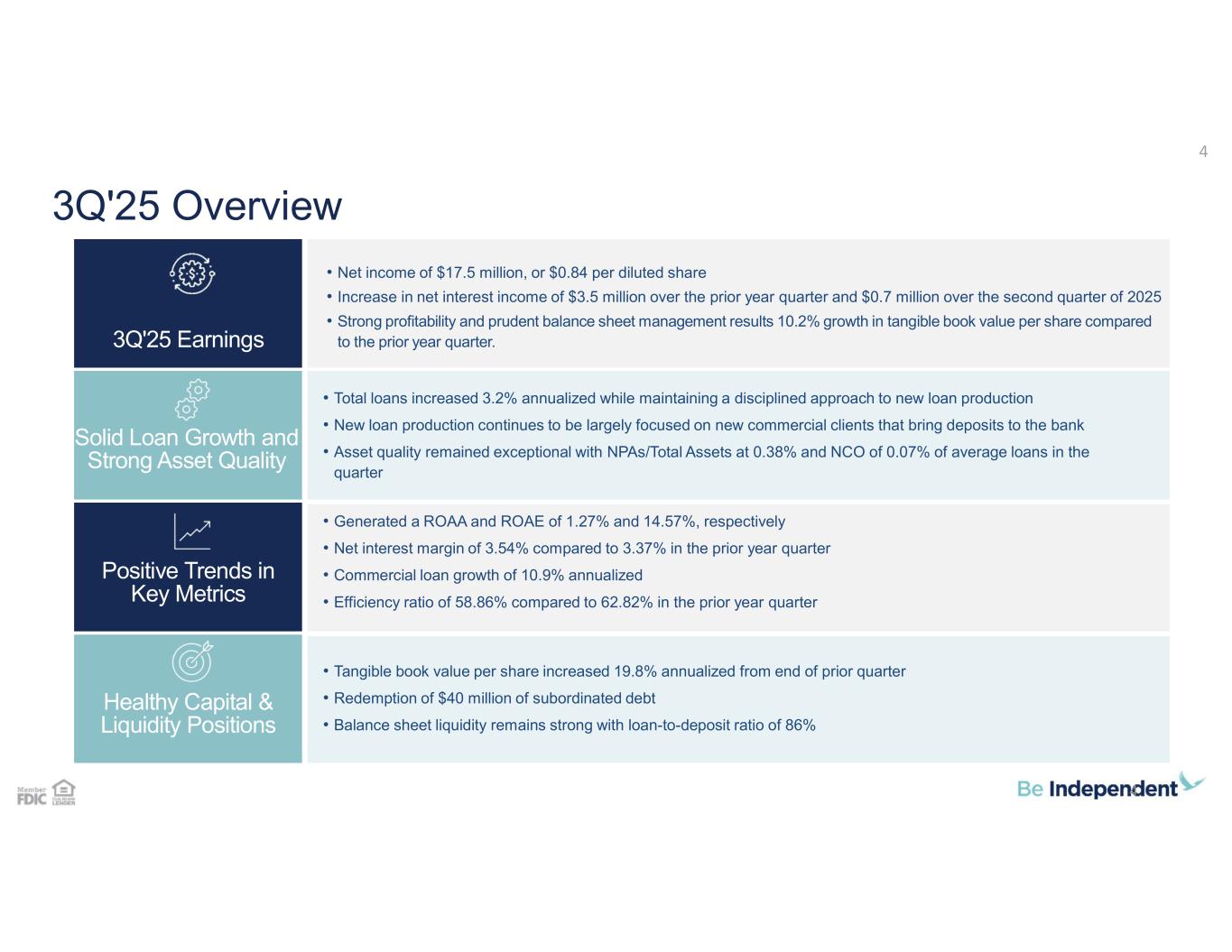
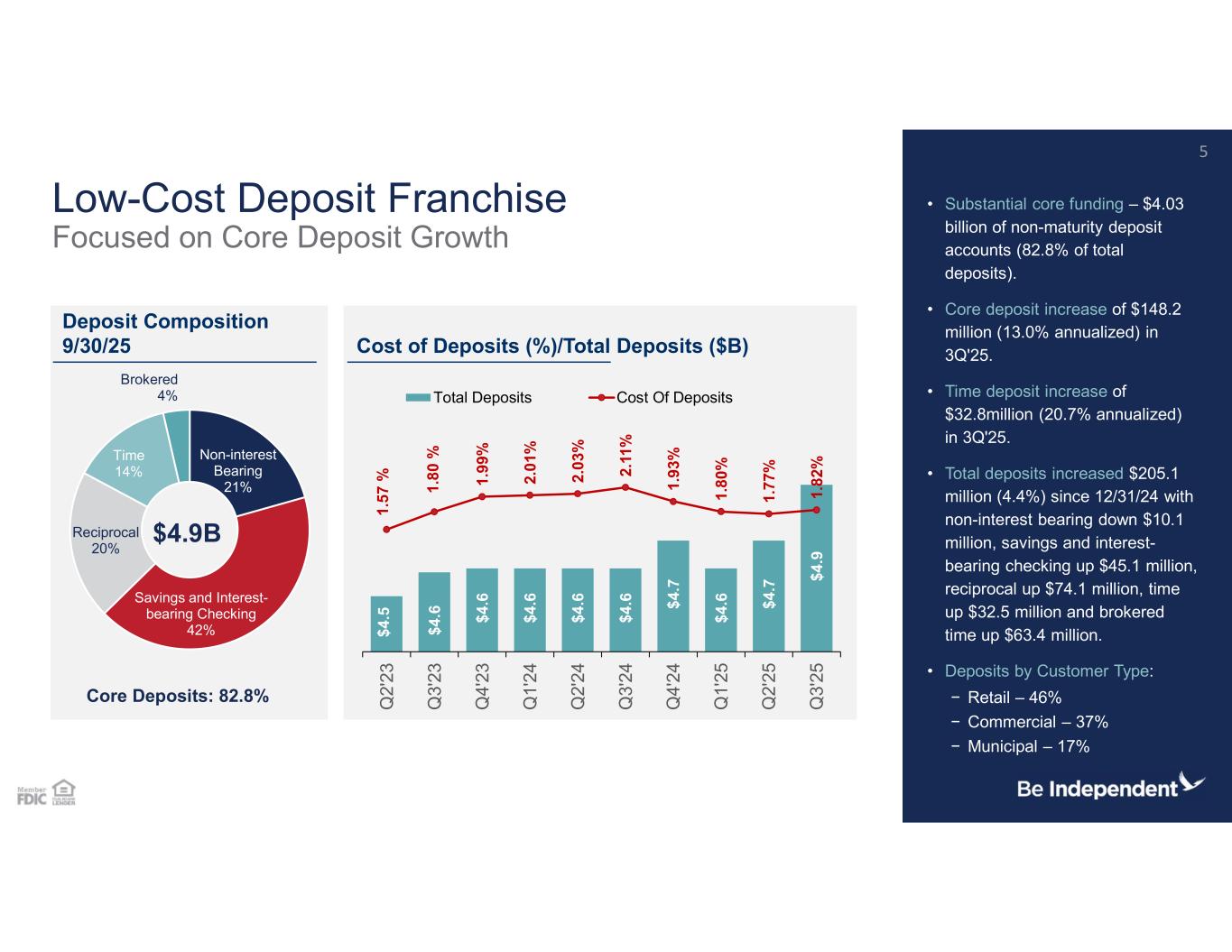
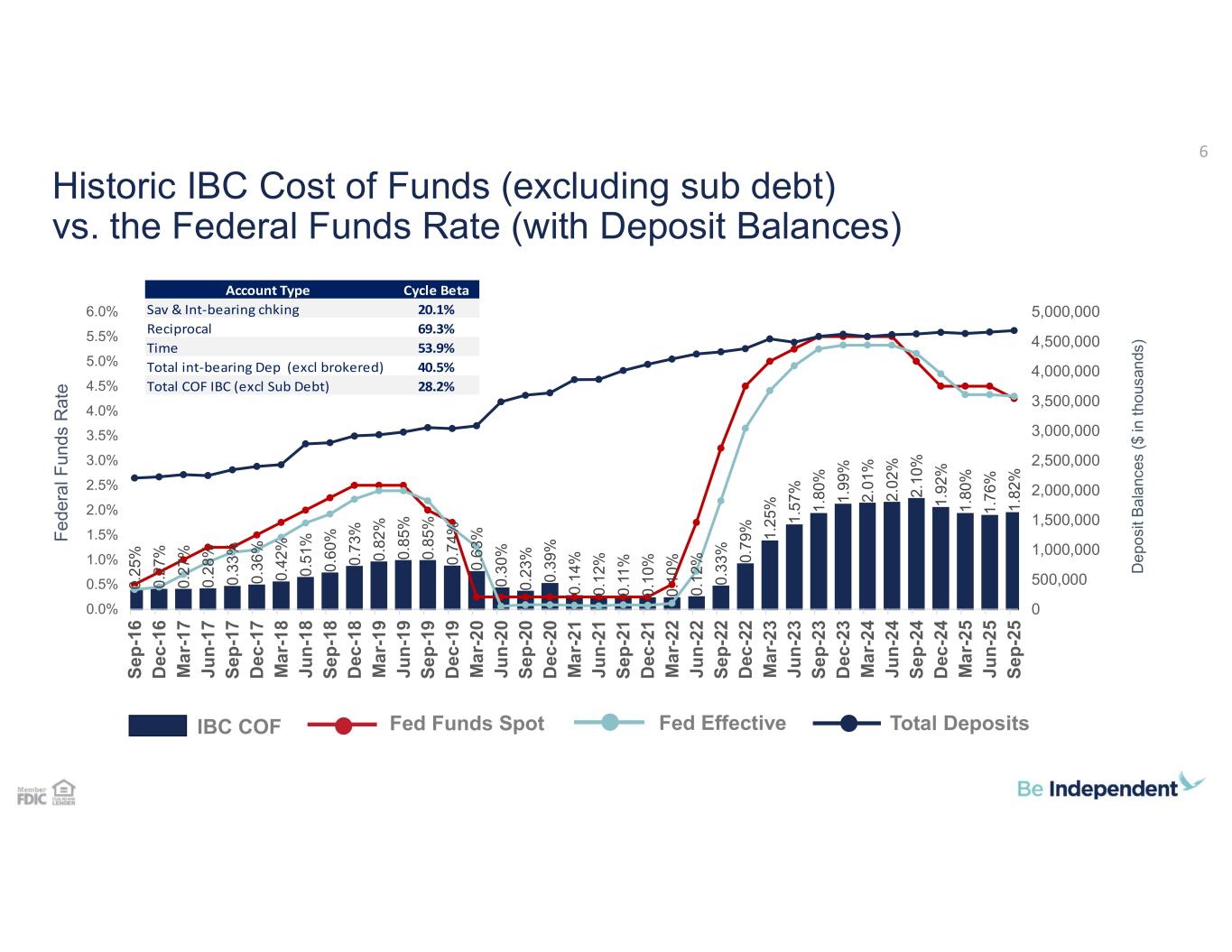
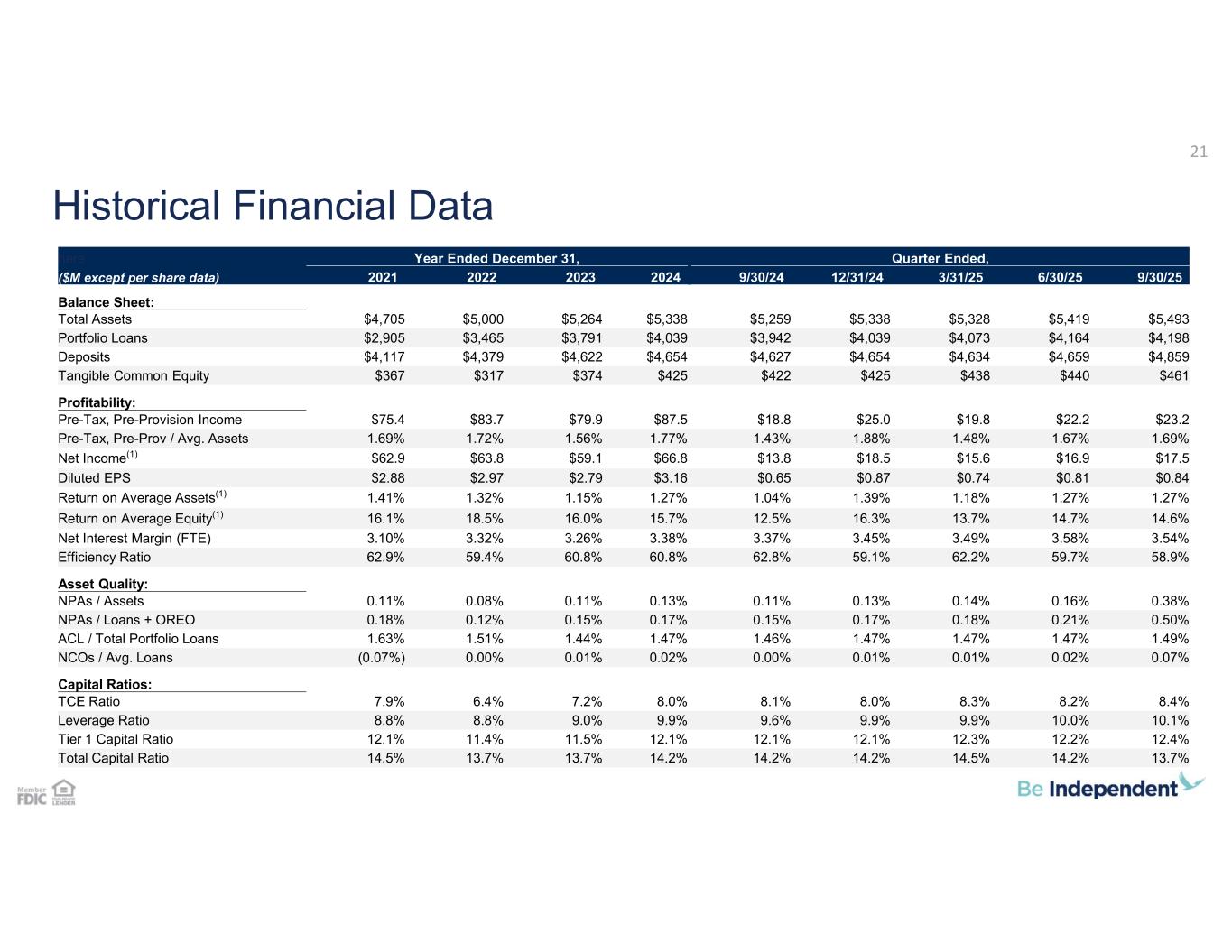
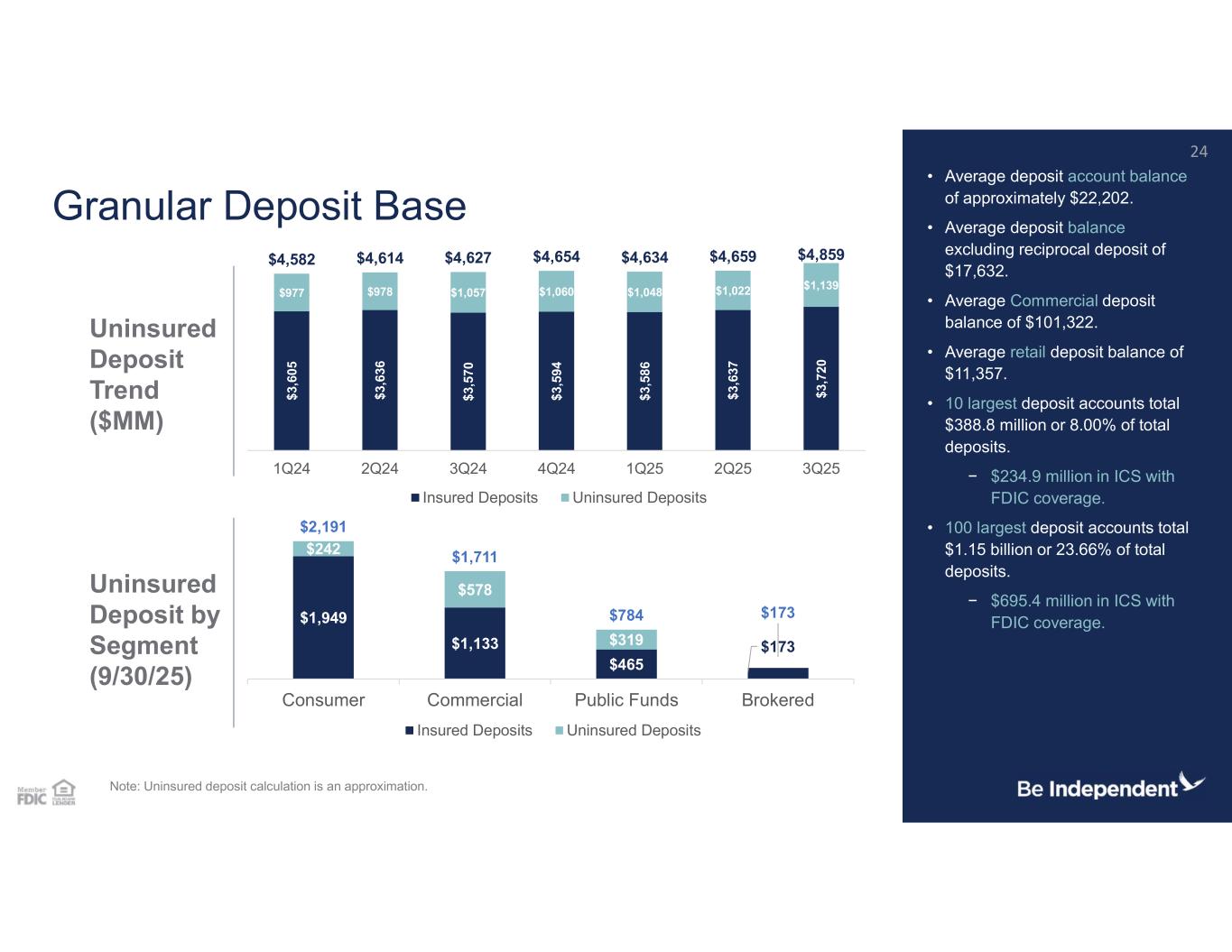
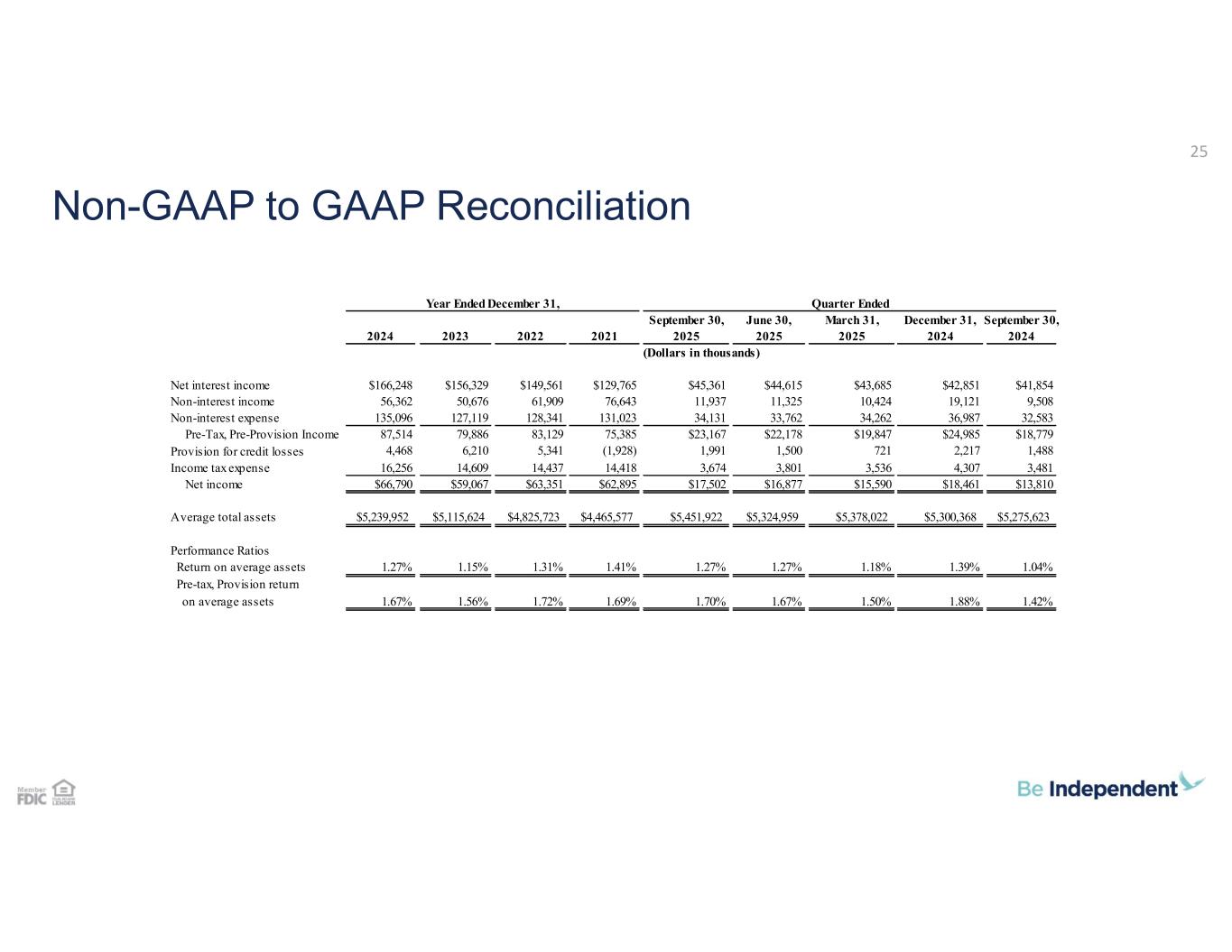
Good morning, and welcome to today's call. Thank you for joining us for Independent Bank Corporation's conference call and webcast to discuss the company's third quarter 2025 results. I am Brad Kessel, President and Chief Executive Officer. Joining me this morning is Gavin Mohr, EVP and Chief Financial Officer; and Joel Rahn, Executive Vice President and Head of our Commercial Banking. Before we begin today's call, I would like to direct you to the important information on Page 2 of our presentation, specifically, the cautionary note regarding forward-looking statements. If anyone does not already have a copy of the press release issued by us today it can be accessed at our website, independentbank.com. The agenda for today's call will include prepared remarks, followed by a question-and-answer session and then closing remarks. I am pleased to report on our third quarter results as we advance our mission of inspiring financial independence today with tomorrow in mind. Our vision is a future where people approach their finances with confidence, clarity and the determination to succeed. Our core values of courage, drive integrity, people focused and teamwork are the blueprint our employees live by. We strive to be Michigan's most people-focused bank. Today, Independent Bank Corporation reported third quarter 2025 net income of $17.5 million or $0.84 per diluted share versus net income of $13.8 million or $0.65 per diluted share in the prior year period. I am proud of our team's performance and pleased to report continued momentum for most of our key metrics. Loan balances grew at an annualized rate of 3.2% and total deposits less brokered time deposits increased by 13% annualized. We achieved growth in our net interest income, both sequentially and year-over-year. In fact, this is the ninth consecutive quarter we have increased our net interest income. Our net interest margin displayed a small decline on a linked quarter basis primarily due to the acceleration of unamortized issuance costs on subordinated debt we redeemed in the third quarter. I would characterize the NIM as stable when adjusting for this event. Expense management remains a strength as reflected in our third quarter efficiency ratio of 58.86%, which demonstrates the effectiveness of our recent investments. These solid fundamentals supported a 10.2% year-over-year increase in tangible common equity per share and strong returns, including a return on average assets of 1.27% and a return on average equity of 14.57% for the quarter. Despite market uncertainty, our credit quality remains strong with large credits at low levels. Nonperforming assets increased from 0.16% of total assets to 0.38% on a quarter-over-quarter basis, primarily as a result of one commercial relationship where the borrower is experiencing financial difficulties. Our annualized net charge-offs continue at historically low levels, 4 basis points through the first three quarters of 2025. The allowance for credit also stands at 1.49% of total loans. I am optimistic that we will finish 2025 strong and I am excited about our prospects to grow our customer base and earnings in 2026. Moving to Page 5 of our presentation. Total deposits as of September 30, 2025, were now $4.9 billion. Overall, core deposits increased $148.2 million during the third quarter of 2025. On a linked quarter basis, business deposits increased by $67.5 million. Municipal deposits increased by $82.5 million. These were offset by a small decrease in retail deposits. The deposit base today is comprised of 46% retail, 37% commercial and 17% municipal. All three portfolios are up on a year-over-year basis. On Page 6, we have included in our presentation a historical view of our cost of funds as compared to the Fed fund spot rate and the Fed effective rate. For the quarter, our total cost of funds increased by just 6 basis points to 1.82%. At this time, I would like to turn the presentation over to Joel Rahn to share a few comments on the success we are having in growing our loan portfolios and provide an update on our credit metrics.
Speaker 2
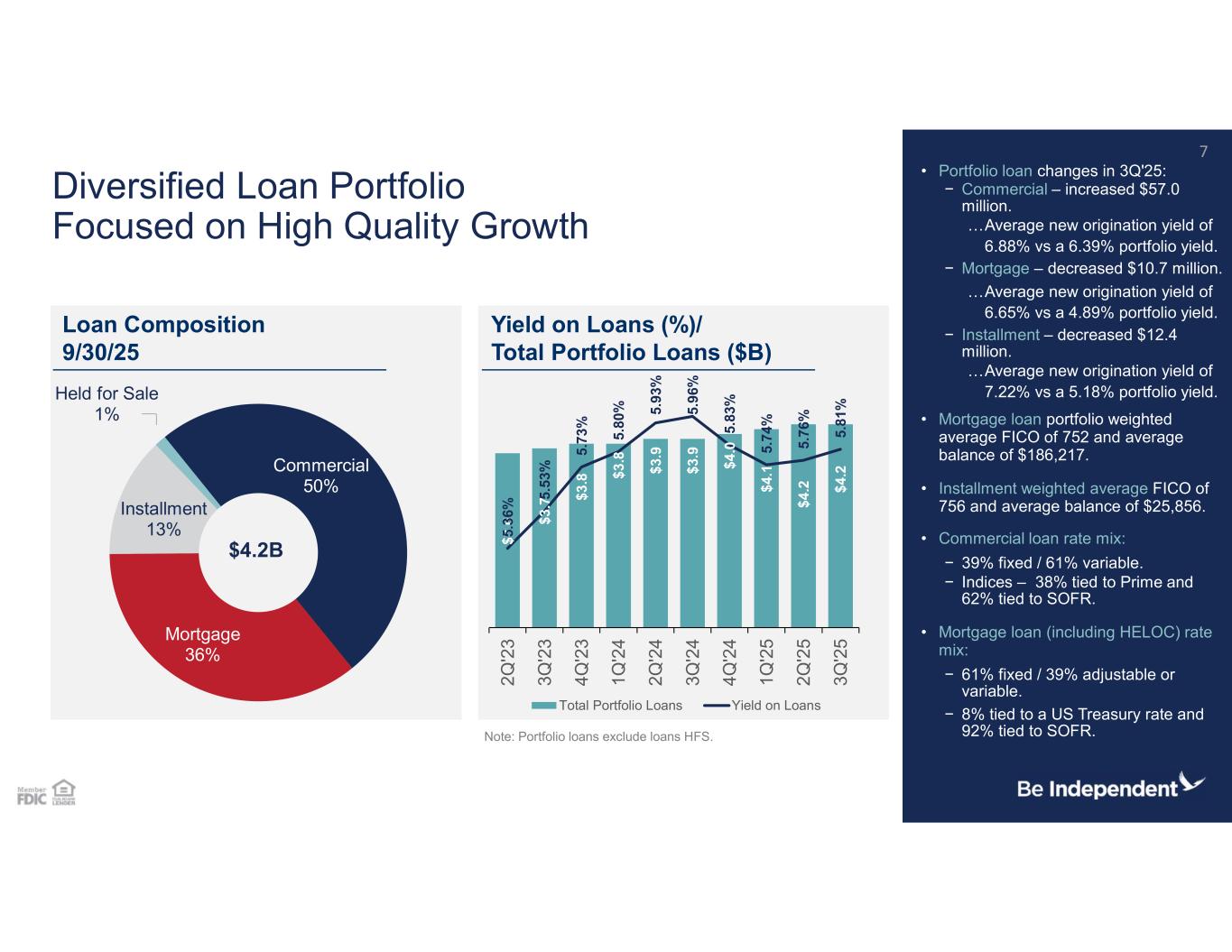
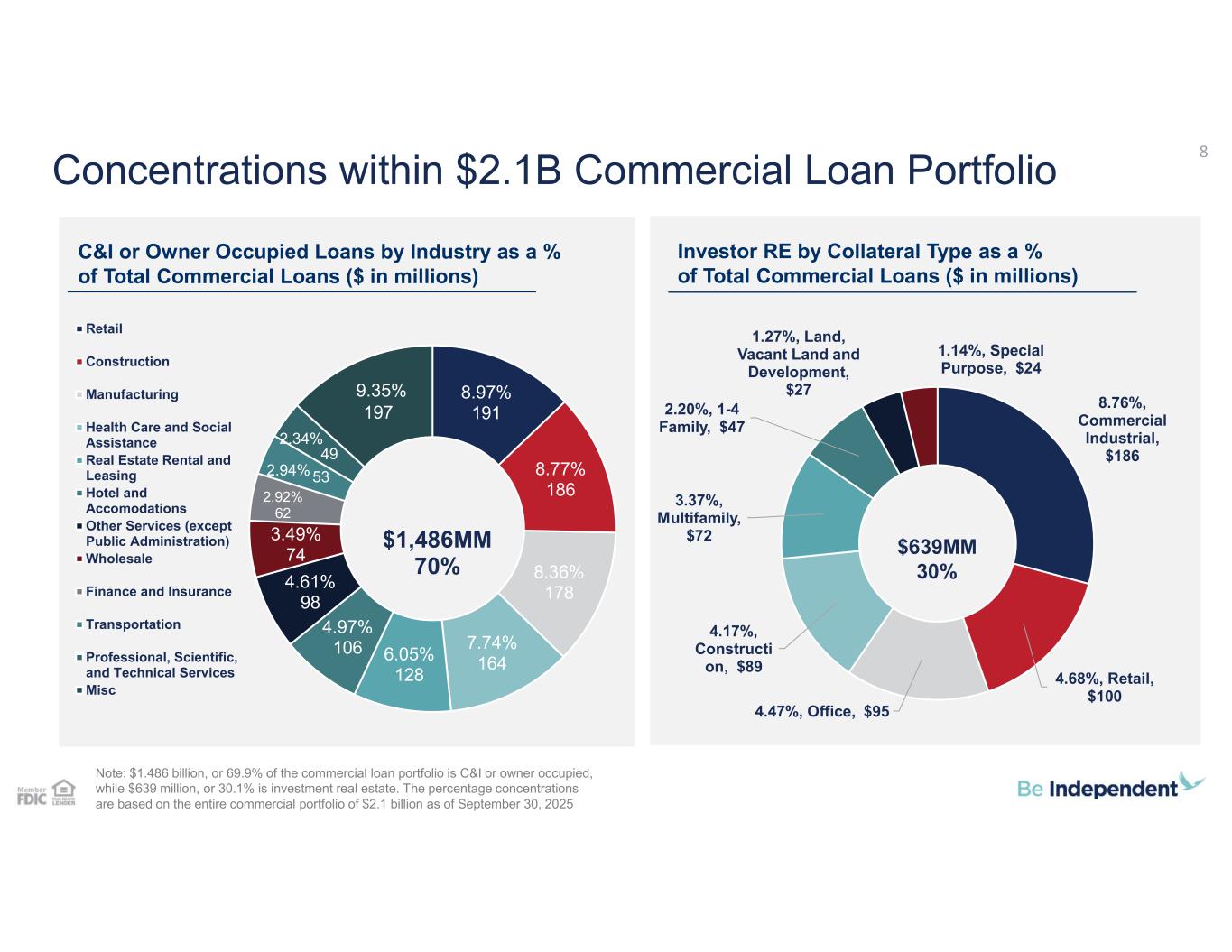
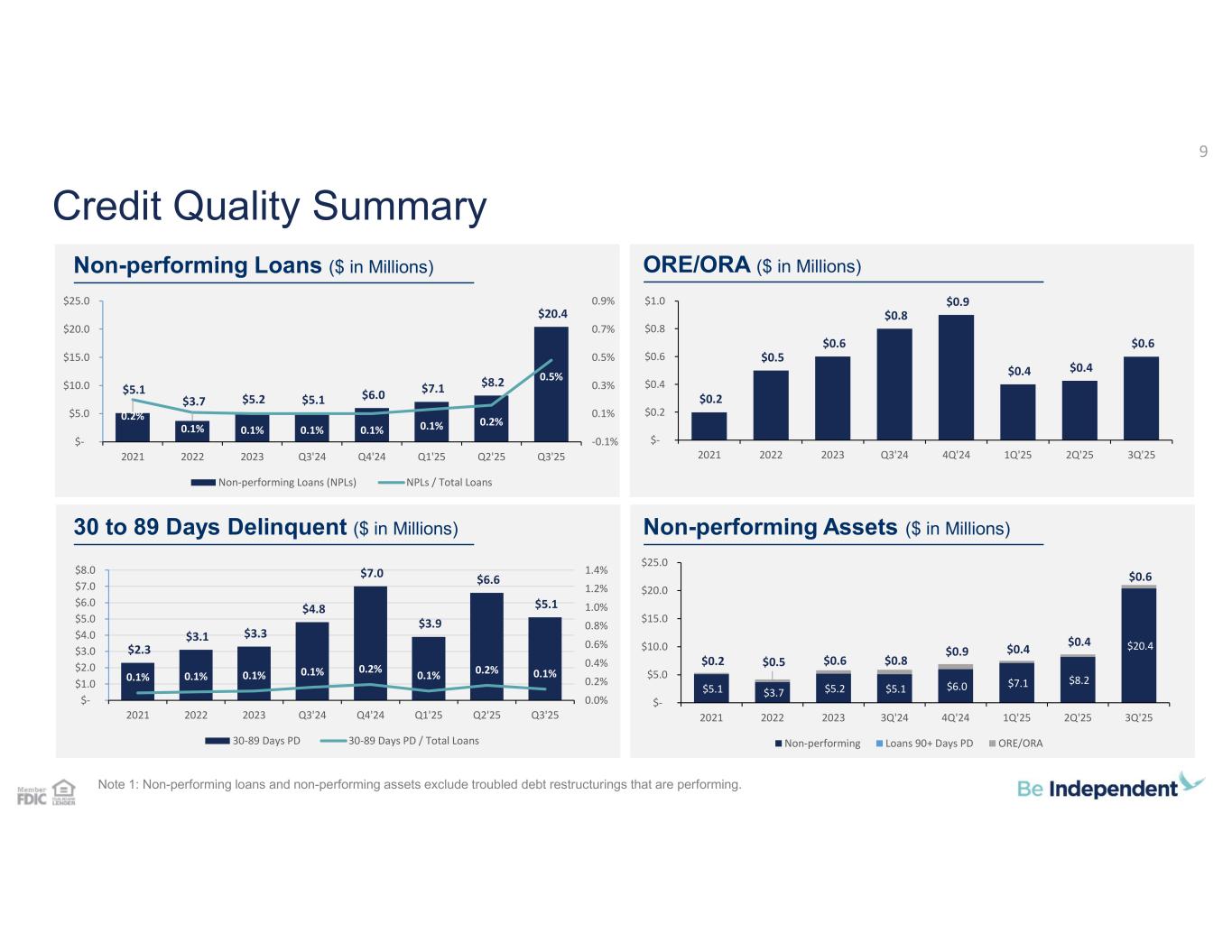
Well, thanks, Brad, and good morning, everyone. On Page 7, we share an update of the loan activity for the quarter. We had another solid quarter of commercial loan growth with that portfolio increasing $57 million. Total loans grew $33.9 million as both the mortgage and consumer loan portfolios contracted in the quarter. This is attributable to seasonality as well as disciplined underwriting. Year-to-date, we've grown the commercial loan portfolio by $188 million, representing 12.9% annualized growth. Our ongoing strategic investment in commercial banking talent continues to supplement our growth. We added three experienced commercial bankers in the third quarter, bringing our team to 50 bankers across our statewide footprint. As noted in previous quarters, our new loan production in each segment continues to come on at yields above the respective portfolio yield. Within the commercial loan activity, the mix of C&I lending versus Investment Real Estate for the quarter was 58% and 42%, respectively. Looking ahead, our commercial pipeline remains robust, so we expect strong loan origination in the fourth quarter. Page 8 provides detail on our commercial loan portfolio. There's not been any significant shift in our portfolio concentrations with the portfolio remaining very well diversified. C&I lending continues to be our primary focus. And as noted on the graph, that category comprises 70% of our overall commercial portfolio at September 30. Our largest segment of the C&I category is retail, which includes a variety of truck equipment and marine dealerships and is performing well. Another significant C&I category is manufacturing, which contains $142 million or 6.7% of the portfolio of automotive industry exposure that we continue to monitor closely for any tariff-related impact. Key credit quality metrics and trends are outlined on Page 9. Overall, credit quality continues to be very good, as Brad alluded to a moment ago. Total nonperforming loans were $20.4 million or 48 basis points of total loans at quarter end, up from 20 basis points at June 30. This is primarily due to one investment real estate commercial relationship that is in workout. Past due loans totaled $5.1 million or 12 basis points, down slightly from 16 basis points at June 30. It's not reflected on this slide, but worth noting that our net charge-offs are $1.2 million year-to-date or 4 basis points on an annualized basis. At this time, I'd like to turn the presentation over to Gavin for his comments, including the outlook for the remainder of the year.
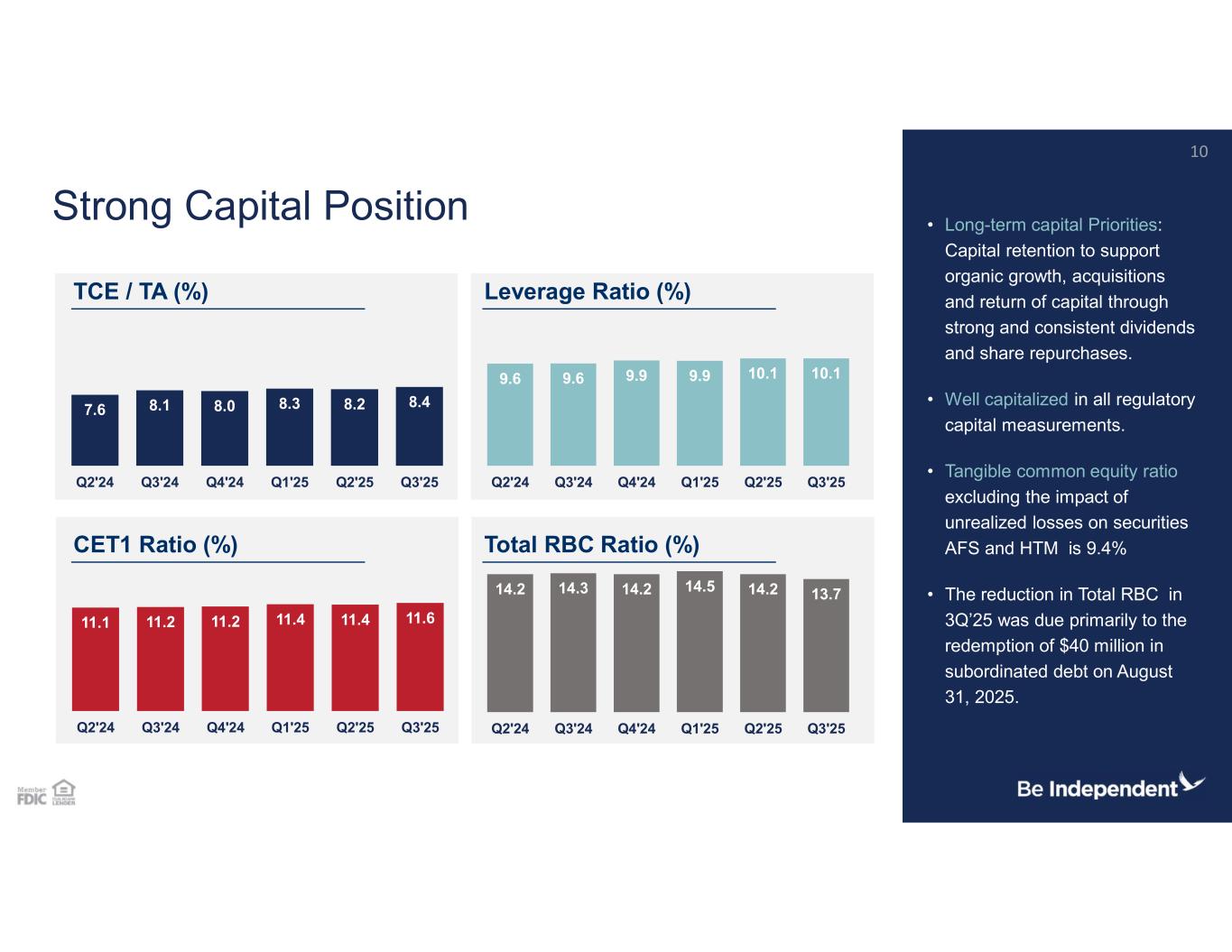
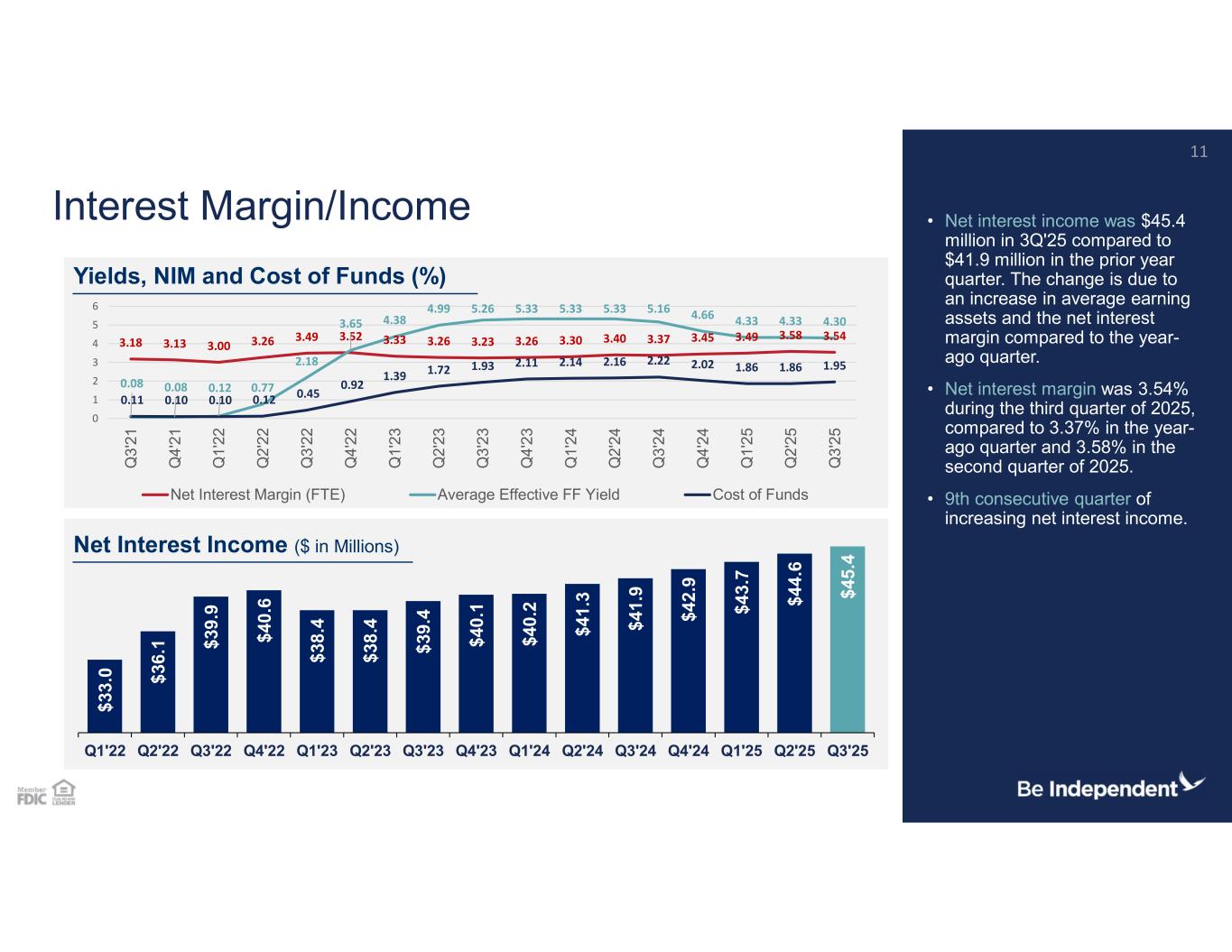
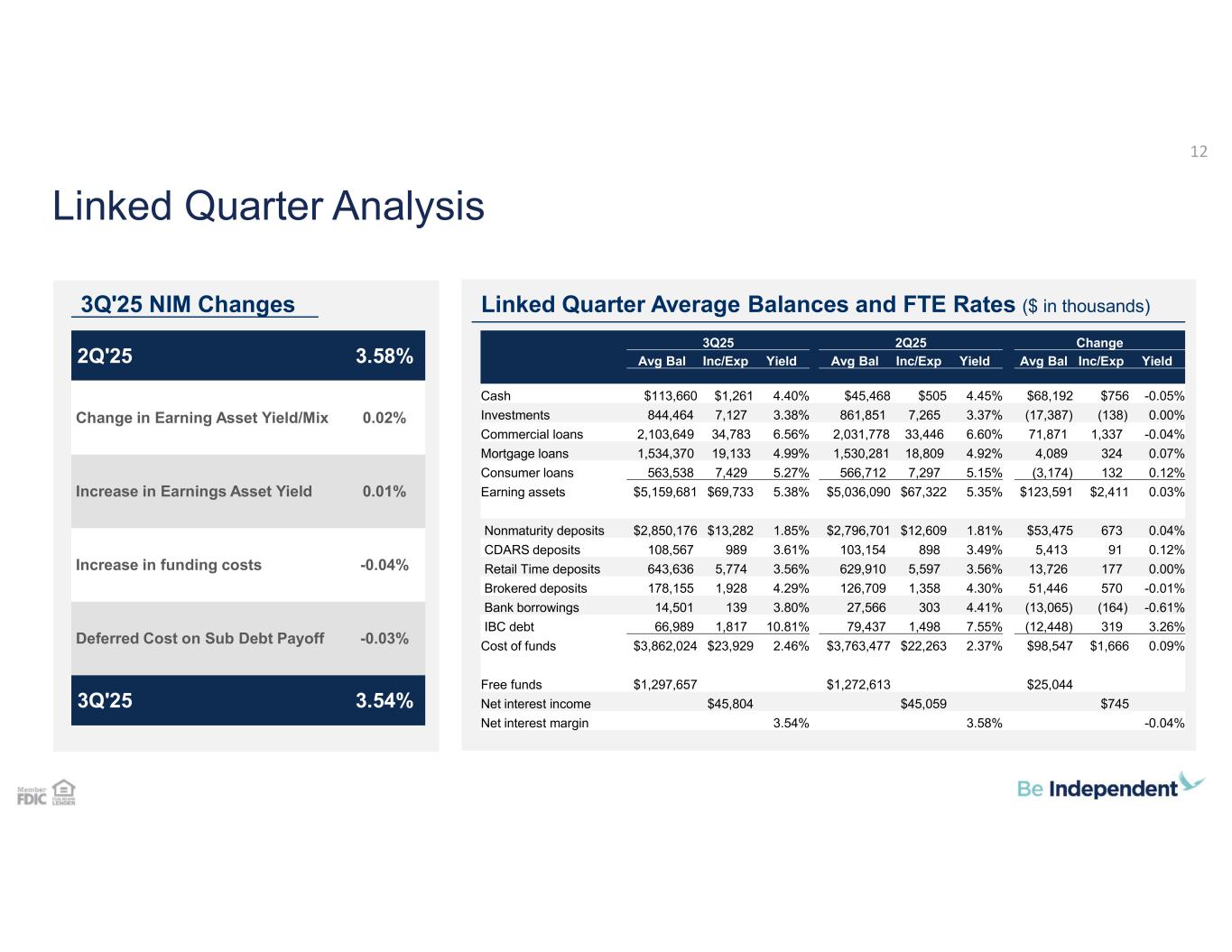
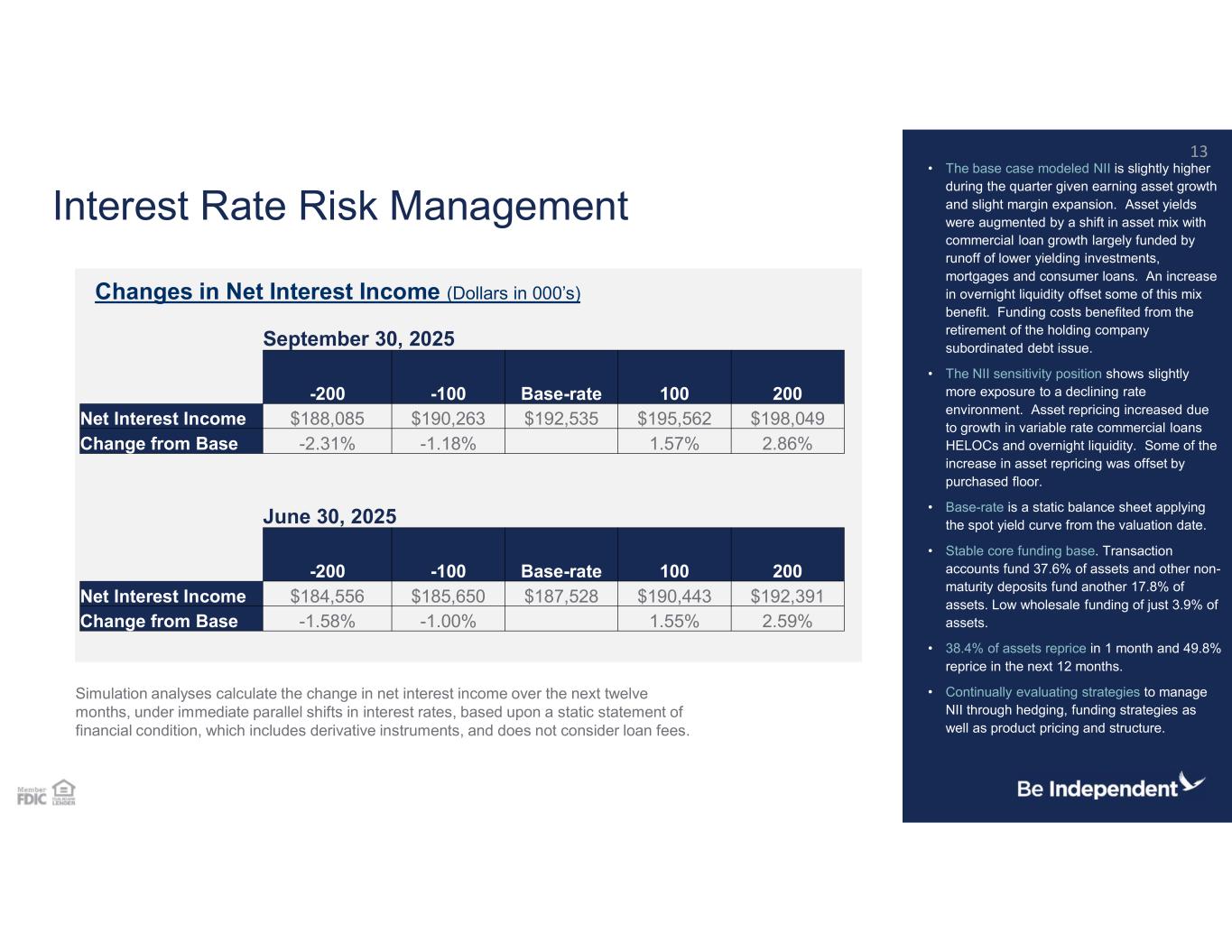
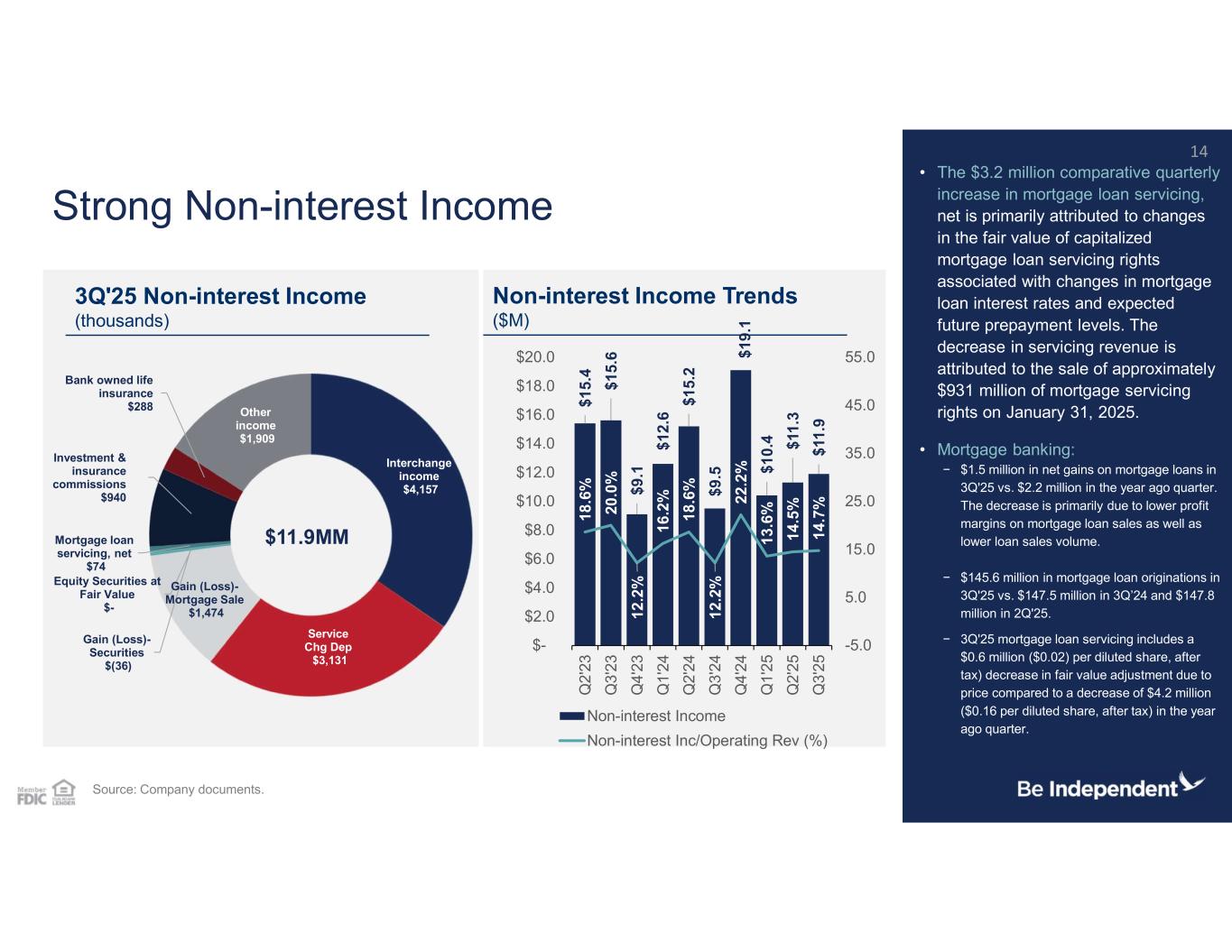
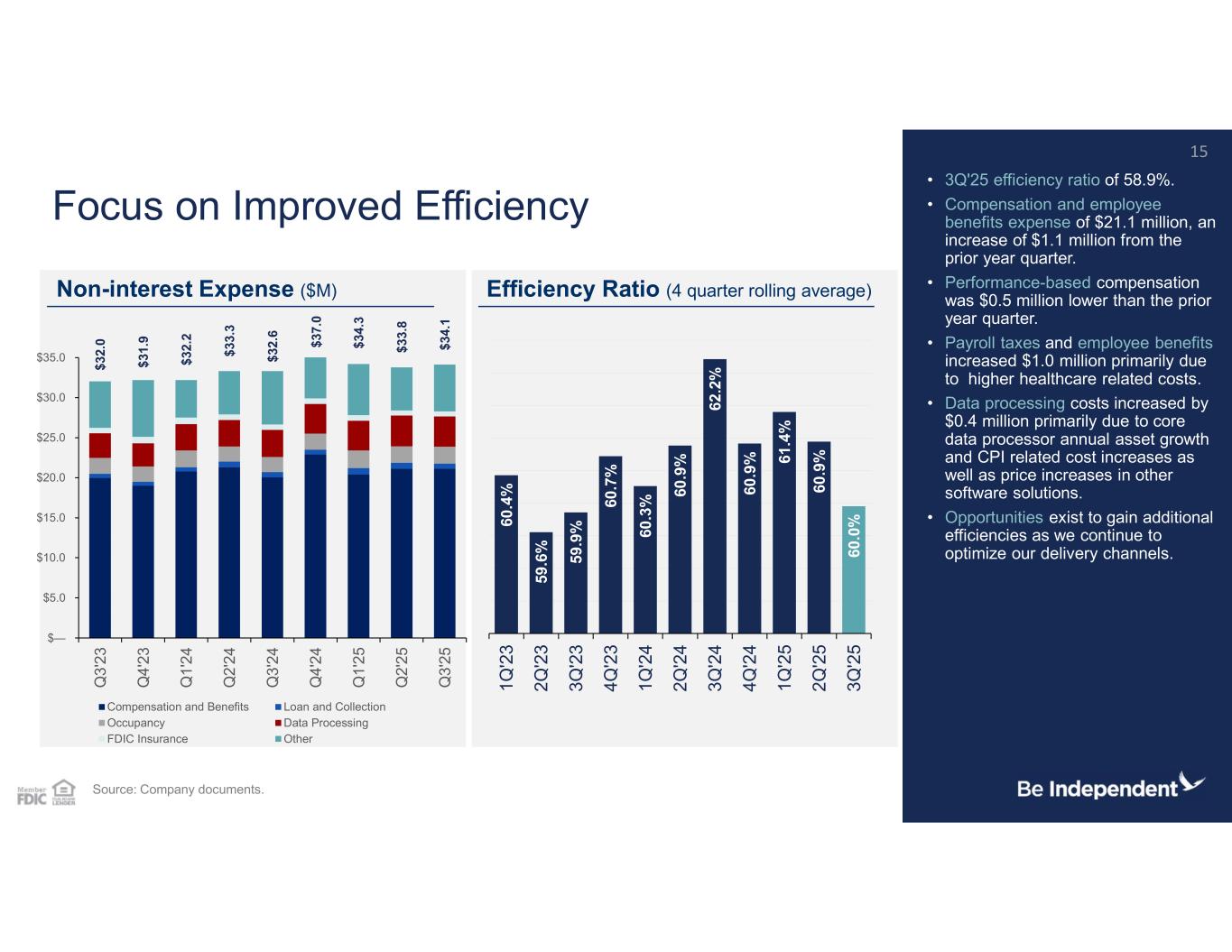
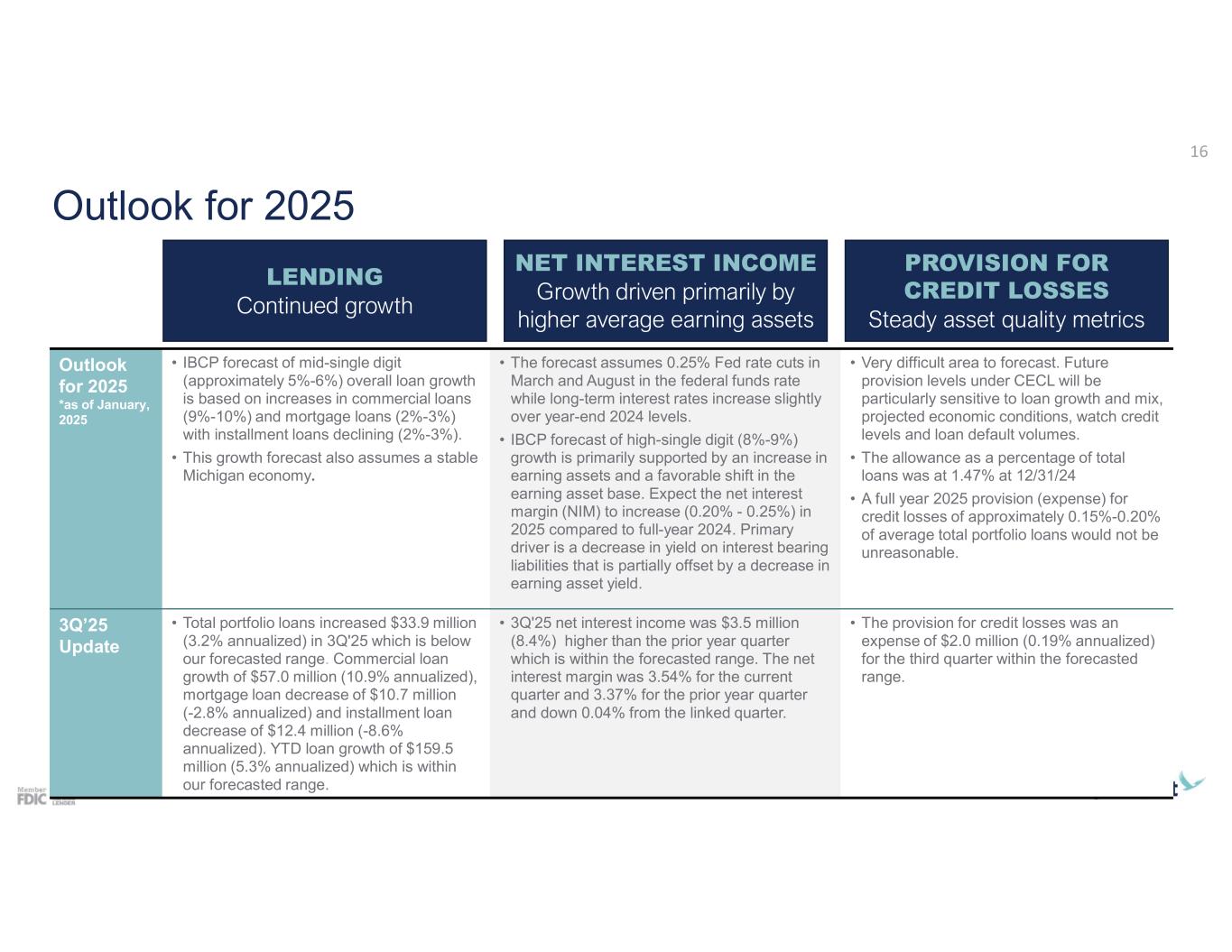
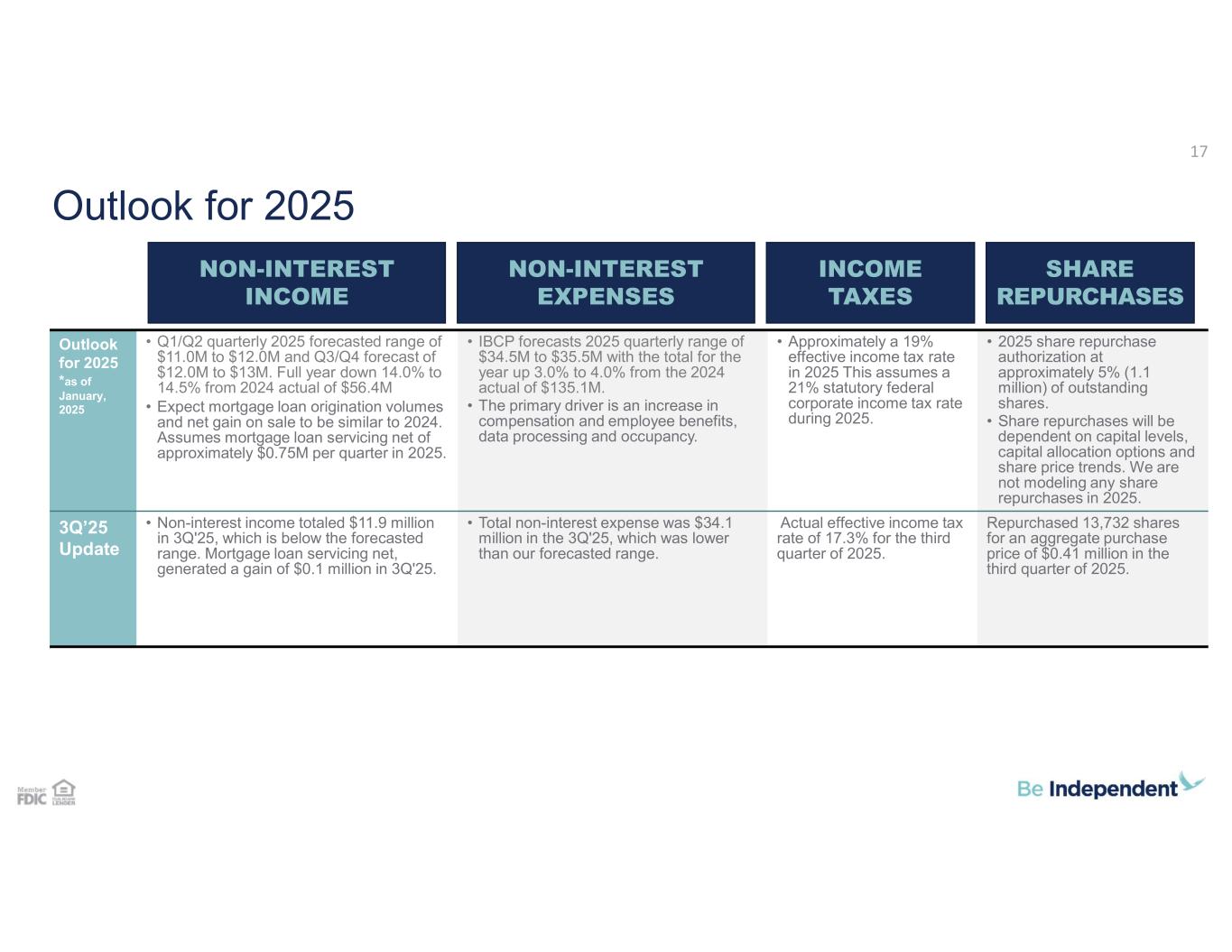
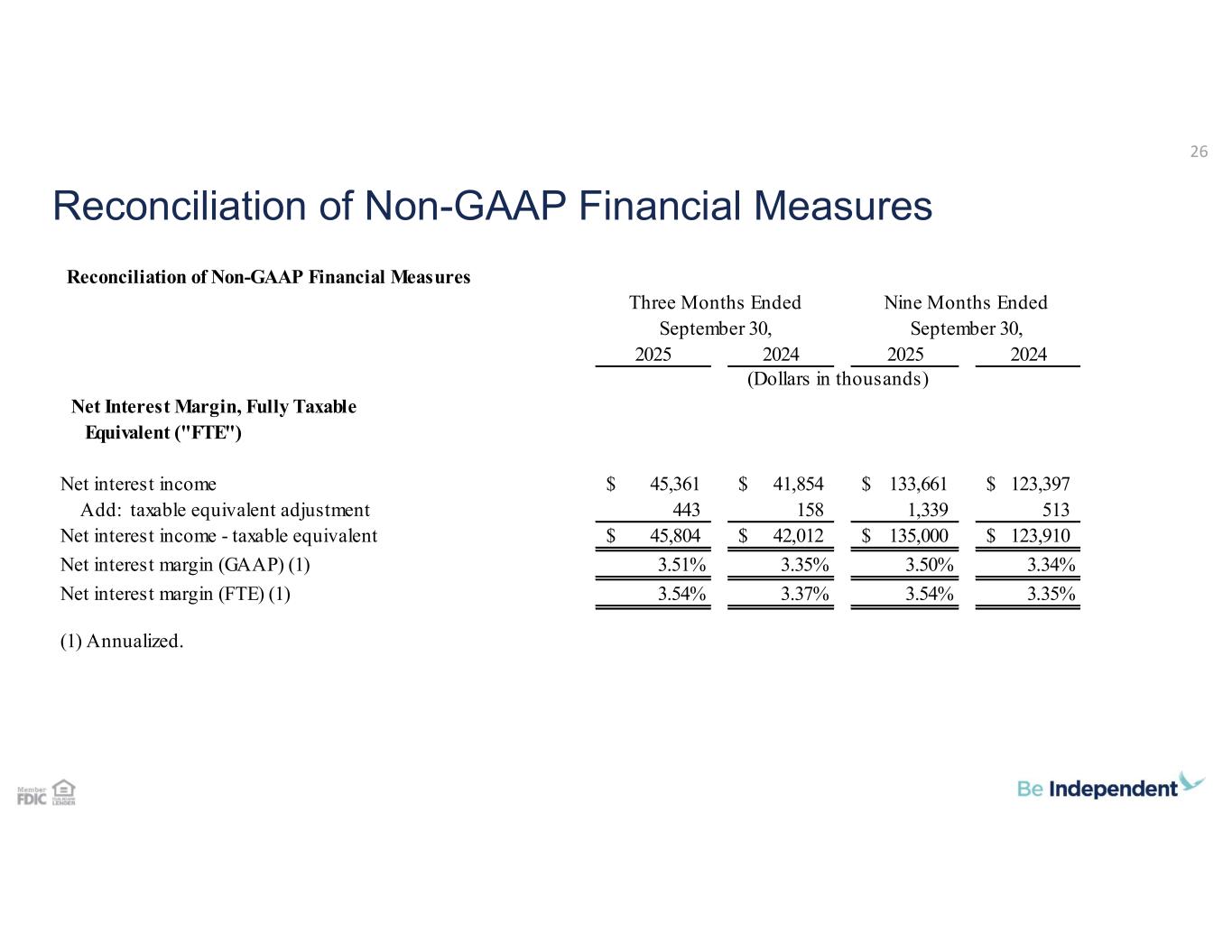
Thanks, Joel, and good morning, everyone. I'm starting on Page 10 of our presentation. Page 10 highlights our strong regulatory capital position. The reduction in our total risk-based capital ratio for the quarter was mainly due to the repayment of $40 million of subordinated debt during the quarter. Moving on to Page 11, net interest income rose by $3.5 million compared to the same period last year. Our tax equivalent net interest margin stood at 3.54% in the third quarter of 2025, up from 3.37% in the third quarter of 2024, but down 4 basis points from the second quarter of 2025. The decrease in net interest margin from last quarter is mainly attributed to the acceleration of unamortized issuance costs on the subordinated debt we redeemed in the third quarter. Average interest-earning assets were $5.16 billion in the third quarter of 2025, compared to $4.99 billion a year ago and $5.04 billion in the previous quarter. Page 12 provides a more detailed breakdown of the linked quarter decrease in net interest income and the net interest margin. On a linked quarter basis, our net interest margin for the third quarter of 2025 was positively influenced by two factors: a 2 basis points change in the earning asset mix and a 1 basis point increase in earning asset yield. These were countered by a 4 basis points increase in funding costs and the acceleration of unamortized issuance costs on the redeemed subordinated debt, which accounted for 3 basis points. Page 13 outlines the institution's interest rate risk position and presents a comparative simulation analysis for the third quarter of 2025 against the second quarter of 2025, which assesses the change in net interest income over the next 12 months under five rate scenarios, assuming a static balance sheet. The base rate scenario uses the spot yield curve from the valuation date. The shocks in the areas consider immediate permanent and parallel rate changes. The base case predicted net interest income slightly higher during the quarter due to earning asset growth and slight margin expansion. Asset yields were improved by a shift in asset mix with strong growth in commercial loans, partially funded by a decline in lower-yielding investments, mortgages, and consumer loans, while an increase in overnight liquidity dampened some of this mix benefit. Funding costs improved with the retirement of the holding company subordinated debt issuance. The net interest income sensitivity position shows a bit more vulnerability to declining rate environments. Asset repricing increased due to robust growth in variable rate commercial loans, home equity lines of credit, and overnight liquidity. Some of the asset repricing increase was balanced by purchase floors; currently, 38.4% of assets are scheduled to reprice in one month, and 49.8% in the next 12 months. Moving to Page 14, noninterest income reached $11.9 million in the third quarter of 2025, compared to $9.5 million last year and $11.3 million in the second quarter of 2025. Net gains on mortgage loans in the third quarter totaled $1.5 million, down from $2.2 million in the third quarter of 2024. This decline is attributed to lower profit margins and a decrease in loan sales volume. On a positive note, noninterest income benefited from a $0.1 million gain in mortgage loan servicing net. This included a $0.6 million after-tax loss due to price changes, a $0.9 million decrease from paydowns, and a $0.1 million loss on the sale of originated servicing rights, offset by $1.6 million in servicing revenue for the third quarter of 2025. The drop in servicing revenue compared to the previous year's quarter is due to the sale of approximately $931 million in mortgage servicing rights on January 31, 2025. As noted on Page 15, our noninterest expense totaled $34.1 million in the third quarter of 2025, compared to $32.6 million last year and $33.8 million in the second quarter of 2025. Compensation expense rose by $1.1 million, mainly due to increased salary and medical costs partially offset by lower incentive compensation expenses and higher deferred loan origination costs resulting from increased commercial and mortgage production. Data processing costs increased by $0.4 million from the previous year, primarily due to annual asset growth and CPI-related cost increases in our core data processing and other software solutions. Page 16 provides an update on our 2025 outlook, showing how our actual performance in the third quarter compared to our original forecast from January. We had estimated loan growth in the mid-single digits. Loans increased by $33.9 million in the third quarter, representing a 3.2% annualized growth, which is below our target range. Commercial loans increased in the third quarter of 2025, while mortgage and installment loans saw a decline. Year-to-date loan growth stands at $159.5 million or 5.3% annualized, falling within our anticipated range. Net interest income for the third quarter of 2025 rose by 8.4% compared to 2024, which aligns with our projected growth range of 8% to 9%. The net interest margin was 3.54% for the current quarter, compared to 3.37% for the previous year's quarter and down 4 basis points from the linked quarter. The provision for credit losses for the third quarter of 2025 was an expense of $2 million, consistent with our forecasted range. Moving on to Page 17, noninterest income was $11.9 million in the third quarter of 2025, which fell short of our forecasted range of $12 million to $13 million. For the third quarter of 2025, mortgage loan originations totaled $145.6 million, with sales and gains at $101.6 million and $1.5 million, respectively. The mortgage loan servicing net generated a gain of $0.1 million, which is below our target. Noninterest expense was $34.1 million in the third quarter, less than our projected range of $34.5 million to $35.5 million. Our effective income tax rate was 17.3% for the third quarter of 2025. Lastly, we repurchased 13,732 shares of common stock for a total cost of $0.4 million in the third quarter. That concludes my prepared remarks. I will now turn the call back over to Brad.
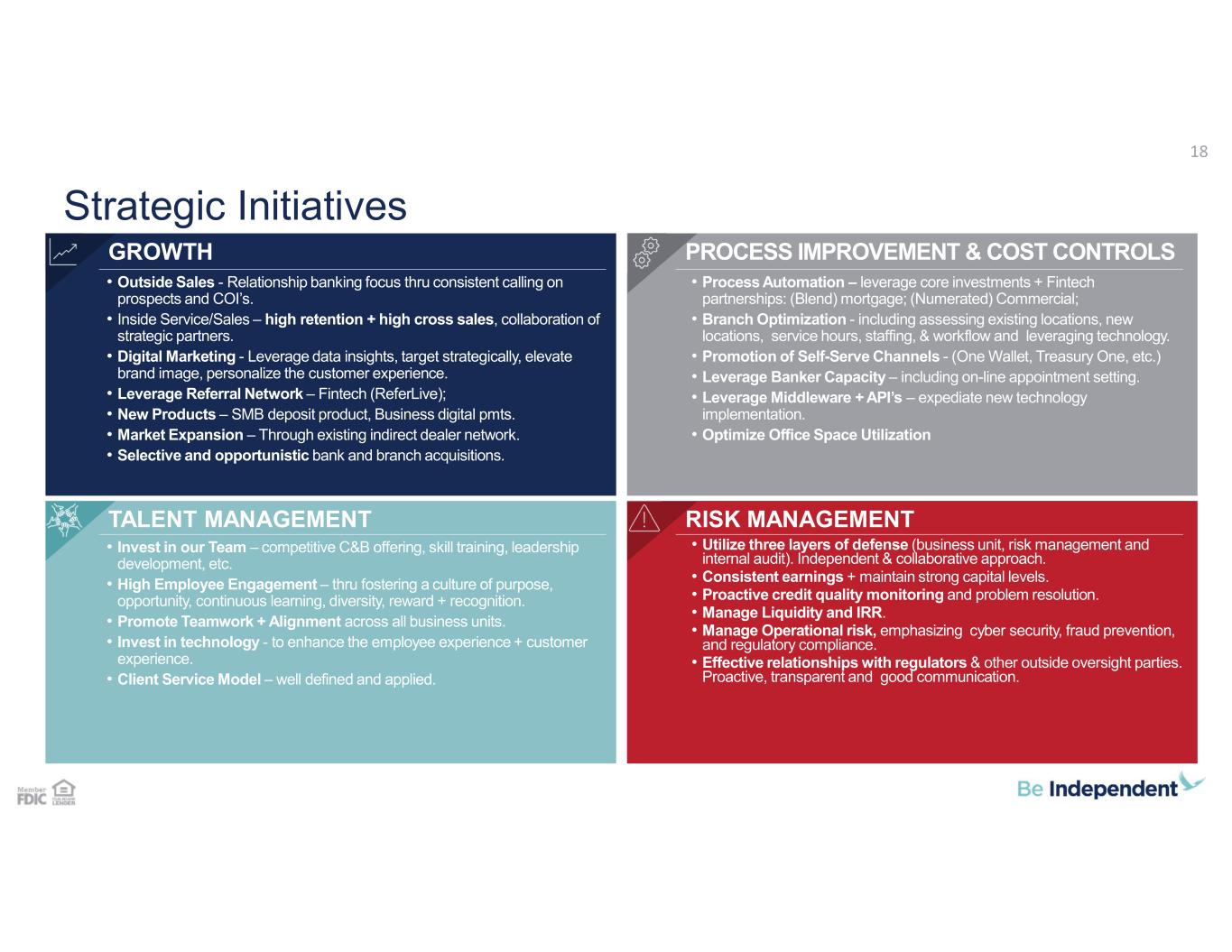
Thanks, Gavin. We've built a strong community bank franchise, which positions us well to effectively manage through a variety of economic environments, and continue delivering strong and consistent results for our shareholders. As we move through the last quarter of 2025 and head into 2026, our focus will be continuing to invest in our team investing in and leveraging our technology while striving to be Michigan's most people-focused bank. At this point, we would like to now open up the call for questions.
Operator
Our first question comes from Brendan Nosal with Hovde.
Speaker 4
Just starting out here on this quarter's commercial banking hires, I think you said that there were three new hires this quarter. Can you just offer some color on what the area of expertise is within commercial specifically, what markets they were added? And what sort of institutions did they come from?
Speaker 2
Yes, Brendan, this is Joel. I'll take that one. All three of them are very experienced at a minimum level of experience was years, and two of them are over 20 years in Commercial Banking, all in Southeast Michigan. And which is one of the areas that we look at strategically, no surprise, is continuing our growth. It's the largest MSA that our bank operates in. Two came from very large regional and one came from a small regional.
Speaker 4
Okay. Fantastic. Maybe just to piggyback off that. Can you just talk about the continued opportunity set from market dislocation just given another large deal in the state of Michigan, whether it's on the client side or opportunities for additional banker adds?
Speaker 2
Sure. That recipe has worked really well for us, Brendan, being an attractive culture for bankers that find themselves part of a larger organization, primarily that want to get back to more of a community banking organization. That has worked well for us. We continue to look for those opportunities. And it looks like the market is going to provide more of those as the industry continues to consolidate. So we think there is ongoing opportunity for us to garner talent. And strategically commercial banking relationships as well.
Speaker 4
Okay. Perfect. I'm going to sneak one more in here. Just looking at funding costs for the quarter, a couple of basis points of an uptick, which I've certainly seen from a handful of others, if not many others this quarter. Maybe just talk about how competitive the environment for core funding is in your markets and how you think you and the market at large in your state will respond to additional Fed cuts?
Our growth for the quarter was driven by municipal and commercial sectors. I'll let Joel provide an overview of how his treasury management team is looking at that, and then I can add any additional thoughts if needed.
Speaker 2
It's not surprising that the environment is quite competitive. We remain focused on being competitive to build relationships, even though we can't control the overall market. Our team is dedicated to fostering comprehensive relationships to enhance both sides of our balance sheet. The commercial team and our country management group are very concentrated on making progress in the market. It is competitive, and we do not anticipate changes in that landscape.
I would add, Brendan, that the 6 basis point increase was due to a change in mix. Additionally, it was influenced by where deposits were landing in the tiers. We experienced significant deposit growth, much of which came from municipal funds related to tax collection for the quarter, and those deposits are being categorized in the higher rate tiers within our product offerings.
Operator
Our next question comes from Nathan Race with Piper Sandler.
Speaker 5
Yes. So maybe a question for Gavin to start just starting on the margin. If we strip out the impact from the sub debt, the margin was roughly stable and I think last quarter, you mentioned one or two cuts in the back half wouldn't have a significant impact on the margin. So I guess do you still feel the margin can remain roughly stable even with an additional cut in December and just how you're thinking about the margin in 2026?
Yes, I do. So a couple of comments on the quarter. We disclosed the 3 basis points relative to the cost associated with the sub debt issuance. And the other piece, we were a little heavier in liquidity than we maybe would target. So if I said we had excess liquidity of $50 million. That had another 3 basis points of impact on the margin for the quarter. So going in here to the year-end with the forecasted cuts, I do anticipate the margin to be fairly stable or around where we're at today. For 2026, just on a longer-term horizon, we still have benefits of the remixing coming from just lower yielding assets and then the repricing effect of lower-yielding assets. So there's still tailwind there that we're really optimistic about.
Speaker 5
And could you remind us how much you have in terms of securities or lower-yielding fixed-rate loans repricing over maybe the next 12 months?
The security portfolio stands at approximately $138 million with a yield of 3%. In terms of fixed-rate loans, there will be around $438 million repricing in the coming year, with an exit rate of 5.59%. We expect this to result in a pickup of about 120 basis points.
Speaker 5
Got it. That's super helpful. Maybe just switching to credit. I was wondering if you could expand on the one investment real estate commercial relationship you called out that migrated to nonaccrual during the quarter, maybe just what industry, how large is the exposure? And if there was a specific reserve allocated during the quarter? And just any color there?
Nathan, this is Brad. I'll respond to that. First, I want to highlight that our portfolio has remained exceptionally strong for many quarters, which makes this situation stand out. We will likely keep the details limited, but we believe we have sufficient reserves for the credit and are collaborating with the borrower to navigate the issues at hand. We are optimistic about resolving this. So, that will be the extent of our comments.
Operator
Our next question comes from Peter Winter with D.A. Davidson.
Speaker 6
I wanted to just follow up on credit. It really has garnered quite a bit of attention this quarter that we had a few profile loans that went bad, but the question is, are you starting to see any signs of credit weakness in commercial borrowers as you approve loans during loan committee? I mean if I think about economic growth, it's slowing job growth has been weakening, just credit in general, please.
Yes, Peter, that's a great question. I'm going to let Joel address that first and share what he is seeing.
Speaker 2
Yes, Peter, I appreciate the question. As Brad mentioned, we need to be clear that there is one primary borrower that has come up this quarter. When I look at the rest of our customer base, performance at the individual business level remains solid. We aren't observing any systemic industry-specific issues. Apart from the one highlighted credit, our overall watch list percentage is still very low compared to historical standards. We aren't seeing widespread concerns. I would describe the Michigan economy as stable. We monitor the automotive industry closely, particularly early this year, and it has performed well. Our team recently received updates from automotive industry analysts at a meeting last week. There is some disruption within the supply chain regarding electric vehicles versus internal combustion engines, which might affect those heavily invested in EVs. However, we haven't seen that issue in our customer base, which is quite diversified. Overall, I still consider the Michigan economy to be stable.
Yes. And I think it's really good to all. I would just put in context, so the loan book today is $4.2 billion. What Joel was referencing was that 50% of that is commercial. And then the other, the balance, 36% is mortgage, and then we have 13% installment. An exercise that we do several times per year is rescore the credit scores and the entire portfolio of retail, so mortgage and installment. In the rescores, we're not seeing really a significant decline in our borrowers' payment performance. So we feel good about that. We like the diversity. We continue to be very bullish about Michigan and our outlook as we go forward.
Speaker 6
Great. That's great color. If I could follow up. You guys have done a really nice job managing expenses. I mean it's well on track to come in below guidance that you outlined in January. Can you maybe talk about expense management because expenses have been coming in below the low end of the quarterly range each quarter, and then secondly, I realize it's early, but maybe Gavin, any color you could provide in terms of expense growth next year?
I’ll address the second question first. We are currently in the process of finalizing next year's budget, and we are on the second draft. Therefore, I am cautious about providing any details at this stage. However, I will mention that a significant part of our compensation expenses is linked to incentive pay. Currently, compared to last year, the expected payout is lower than it was at this time last year, which will affect our expenses in 2025. Additionally, we are focused on managing our technology spending as efficiently as possible. We are continuing to invest in technology, which allows us to find efficiencies, often through not replacing positions as employees leave. We are dedicating considerable attention to this area and aim to maintain control over our spending.
Speaker 6
Got it. And just one last quick question. Gavin, could you share the spot rate on interest-bearing deposits?
I do. So as of September 30, the spot rates on total interest-bearing were $217 in total. Does that help?
Operator
Thank you very much. That concludes the Q&A session. I will now hand back over to Brad for any closing remarks.
Thanks, Ezra. In closing, I would like to thank our Board of Directors and our senior management for their support and leadership. Also, I want to thank all our associates and continue to be so proud of the job being done by each member of our team. Each team member, in his or her own way, continues to do their part toward our common goal of guiding our customers to be independent. Finally, I would like to thank each of you for your interest in Independent Bank Corporation and for joining us on today's call. Have a great day.
Operator
Thank you very much, Brad, and thank you to Gavin and Joel for being speakers on today's line. Thank you, everyone, for joining. You may now disconnect your lines.