Operator
Good afternoon, everyone, and welcome to IdaCorp's second quarter 2026 earnings call. Today's call is being recorded and our webcast is live. A replay will be available later today and for the next 12 months on the IdaCorp website. If you need assistance at any time during the presentation, please press star zero on your phone. I will now turn the call over to Amy Shaw, Vice President of Finance, Compliance, and Risk.
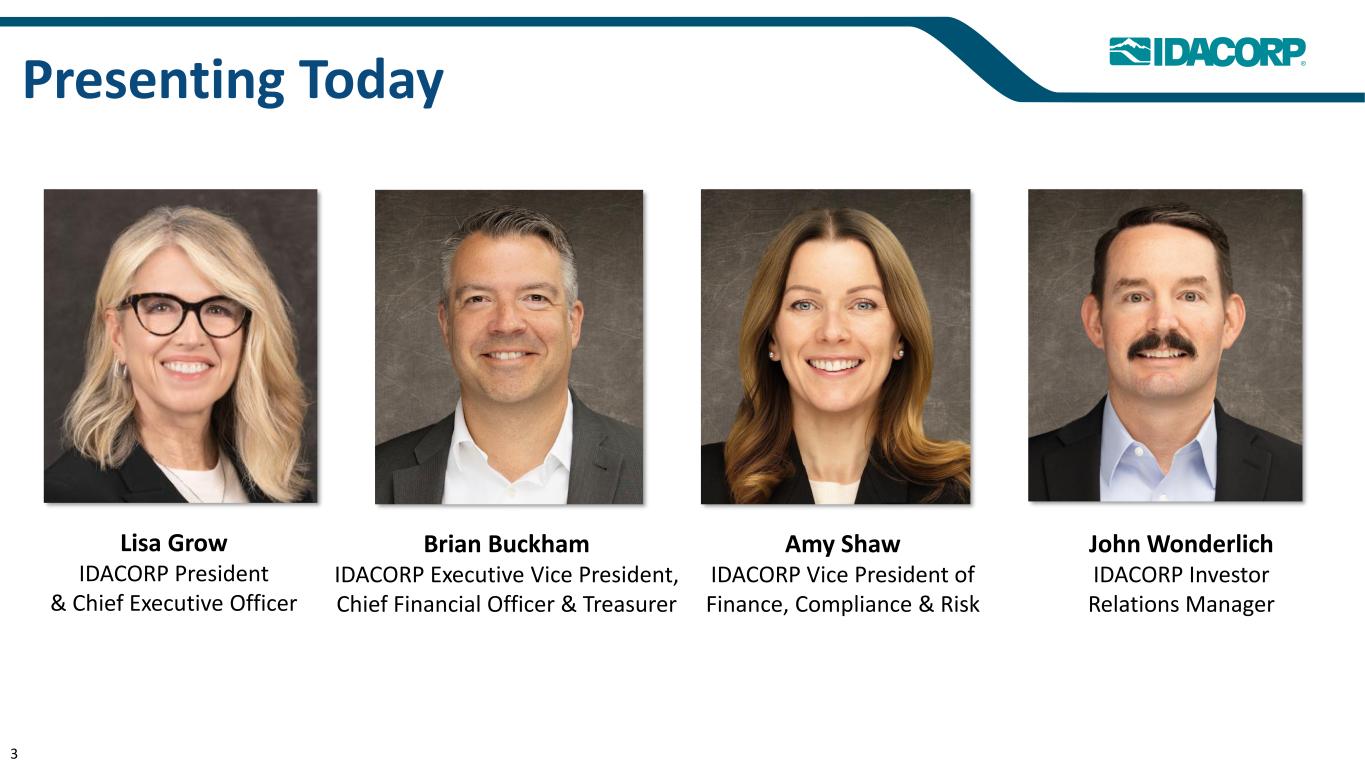
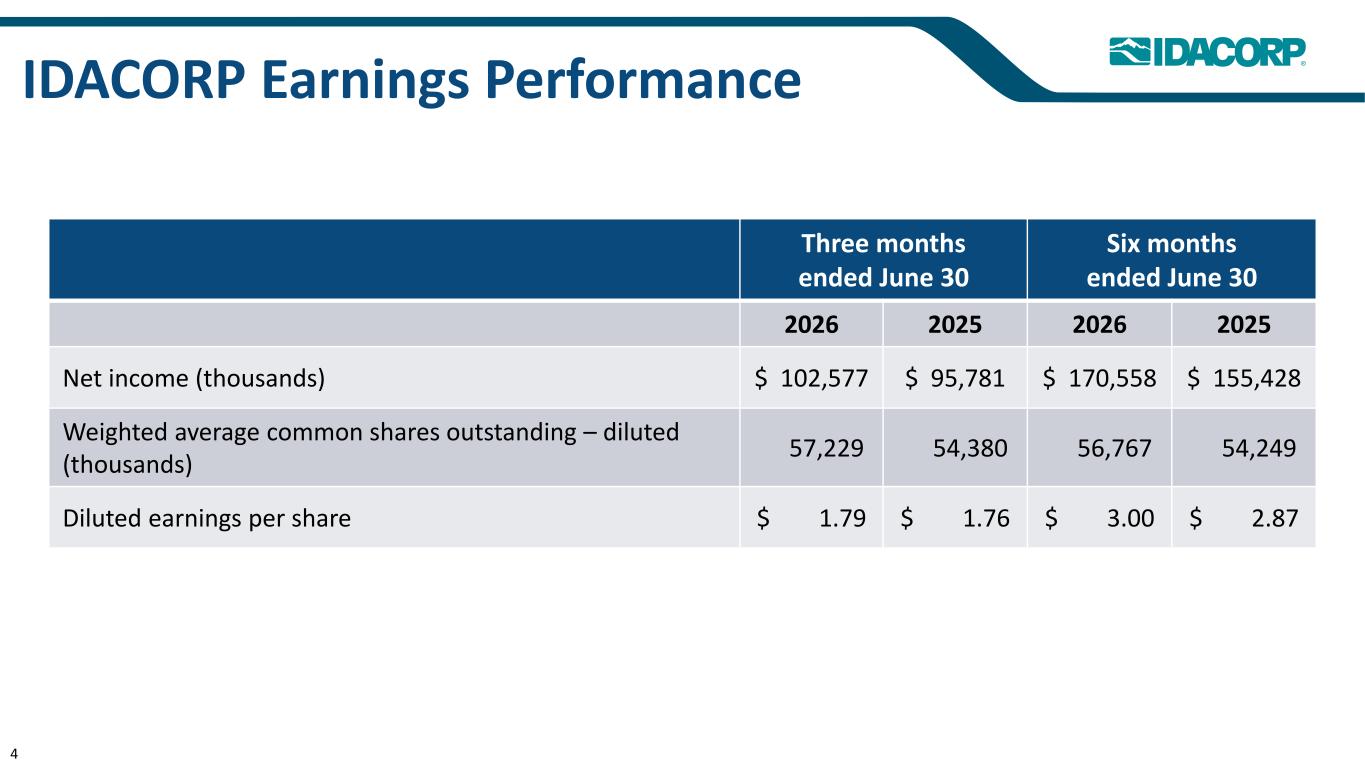
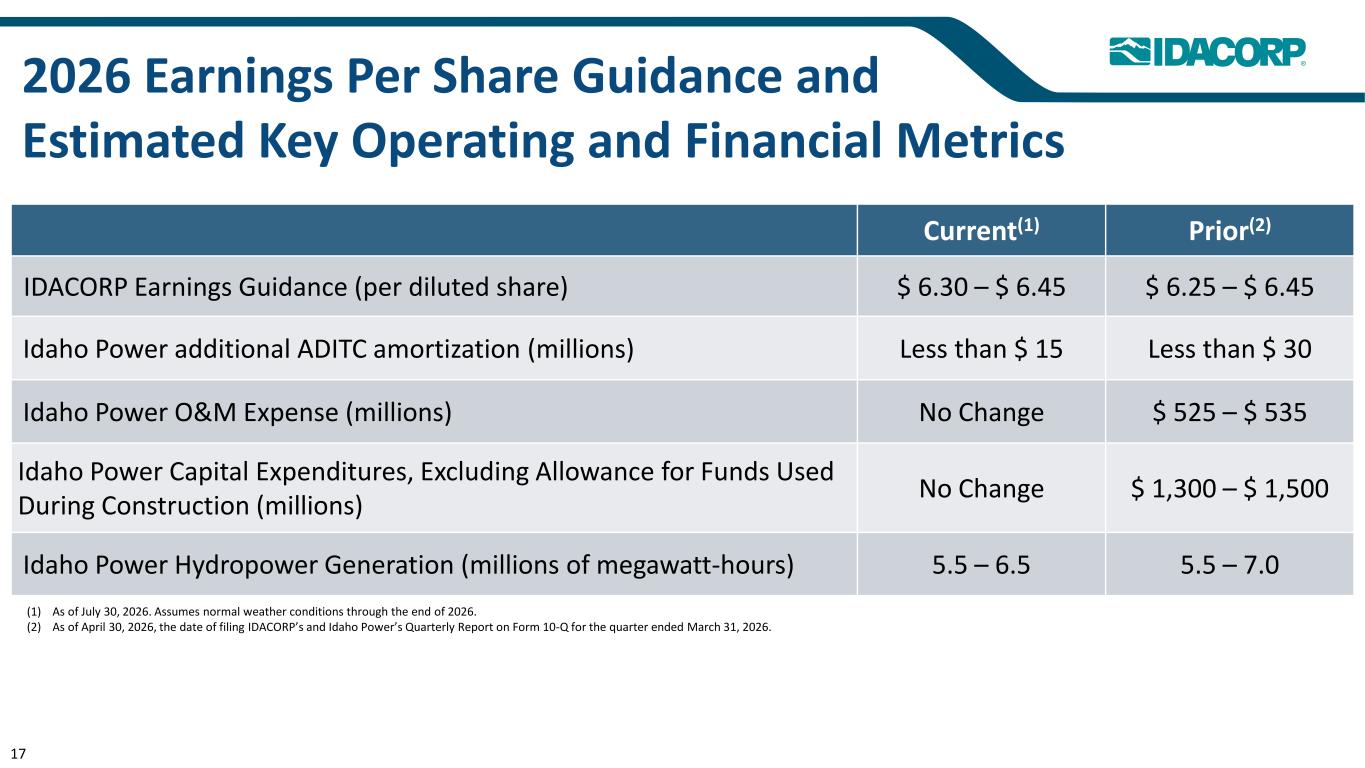
Thank you. Good afternoon, everyone. We appreciate you joining our call. The slides we'll reference during today's call are available on IDACorp's website. As noted on slide two, our discussion today includes forward-looking statements including things like earnings guidance, spending forecasts, financing plans, regulatory plans, and actions, and estimates and assumptions that reflect our current views on what the future holds. These are all subject to risks and uncertainties. Those risks and uncertainties may cause actual results to differ materially from statements made today and we caution against placing undue reliance on any forward-looking statements. We've included our cautionary note on forward-looking statements and various risk factors in more detail for your review in our filings with the Securities and Exchange Commission. As shown on slide three, also presented today we have Lisa growth president and ceo brian buckham ebp cfo and treasurer and john wonderlick investor relations manager slide four has a summary of our second quarter financial results idacorp's diluted earnings per share were a dollar 79 compared with the dollar 76 for last year's second quarter i want to highlight we didn't record any additional tax credit amortization under the idaho regulatory mechanism during the second quarter of this year compared with recording 17.2 million in the second quarter of last year for the first half of 2026 diluted earnings per share were three dollars versus 287 in 2025 and those results only include additional tax credit amortization of 6.3 million in the first half of 26 versus 36.5 million in the first half of last year which showcases the strong performance so far for 2026. our key operating metrics uh we're raising the lower end of our full year IDACORP diluted earnings per share guidance range by five cents to the new range of 630 to 645. This increase is driven by our strong operational results in the second quarter. It includes our expectation that Idaho Power will use less than $15 million of additional tax credit amortization for the full year, which is a reduction from the less than $30 million in our prior guidance. These estimates also assume historically normal weather conditions for the rest of the year. Now I'll turn the call over to Lisa.
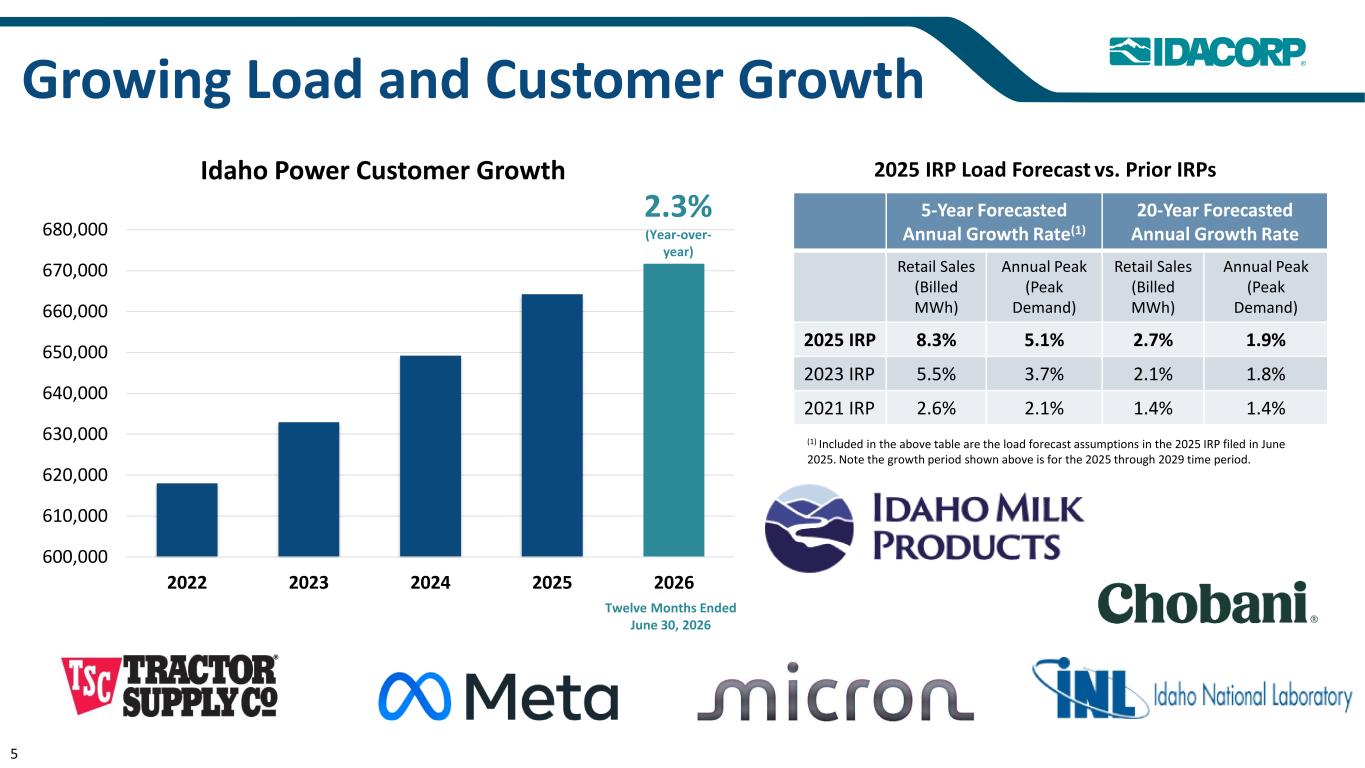
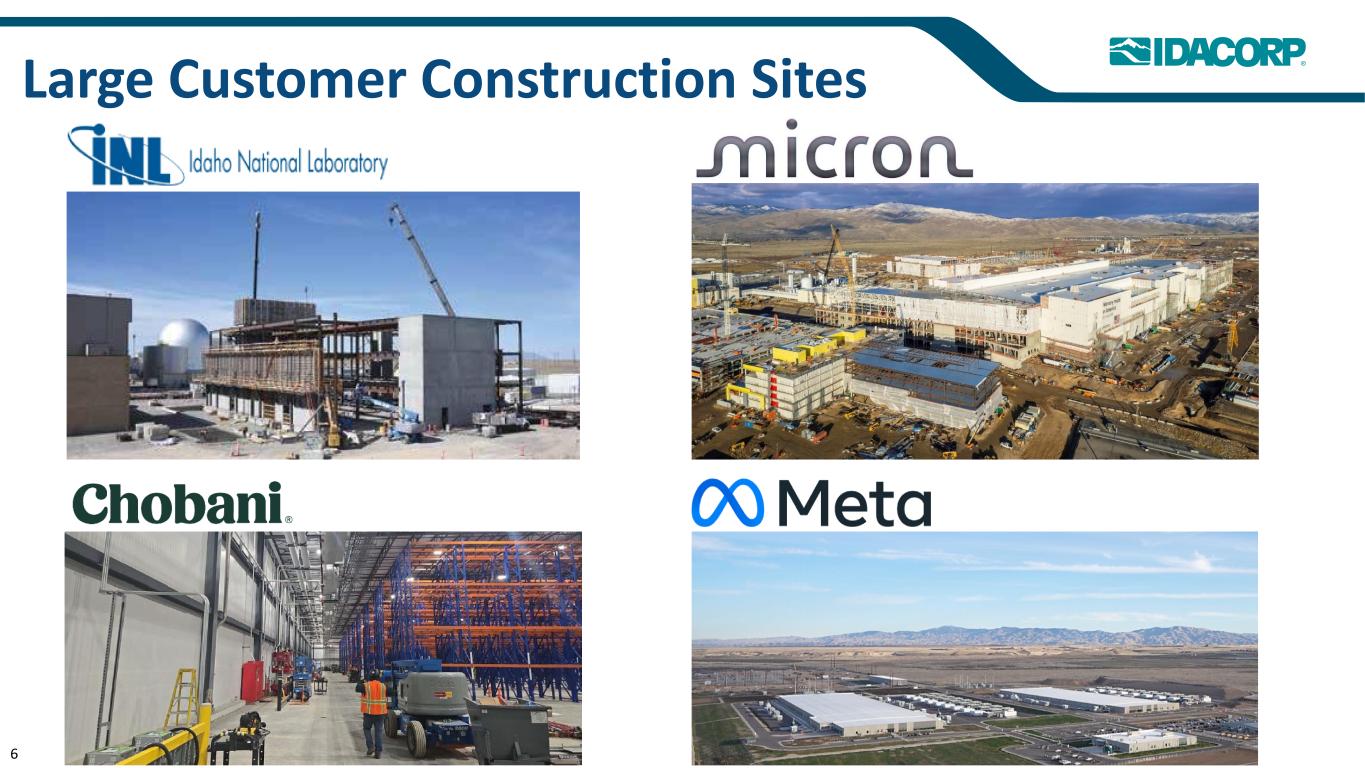
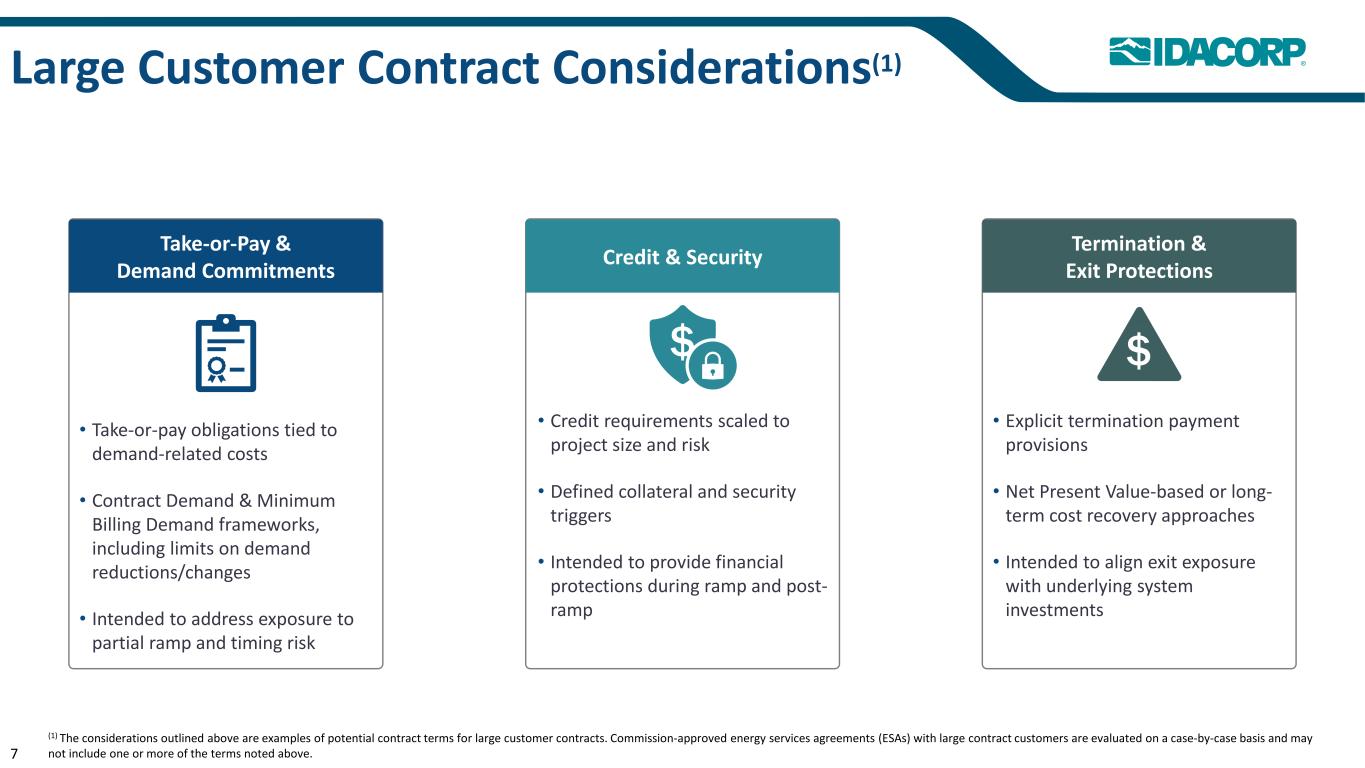
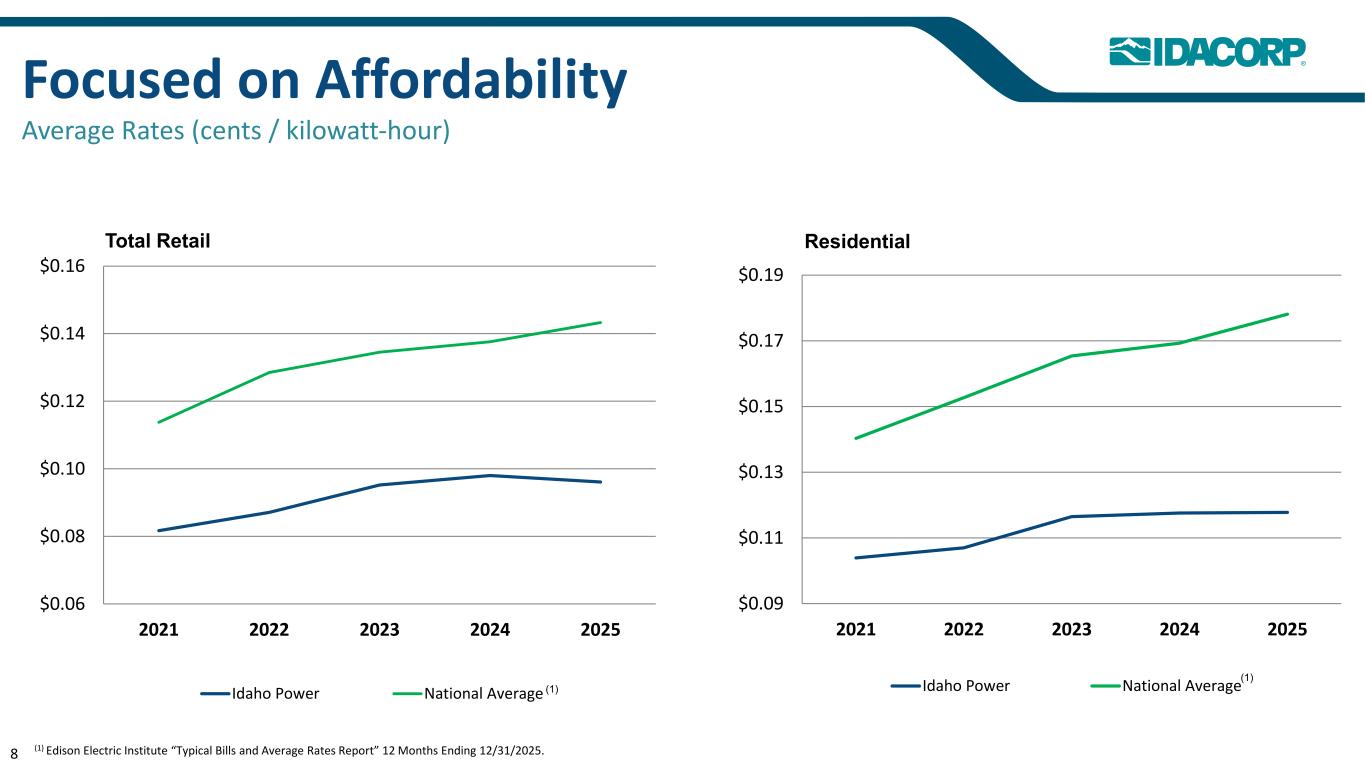
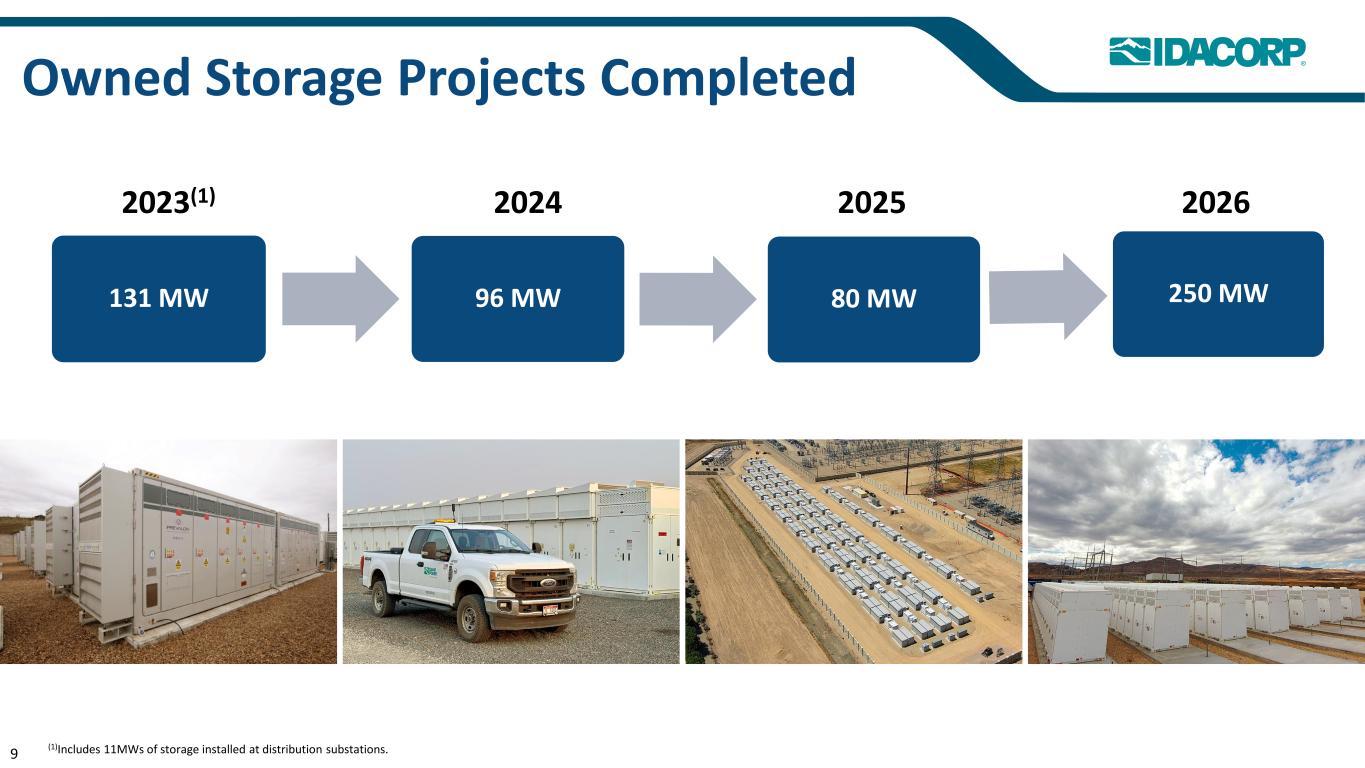
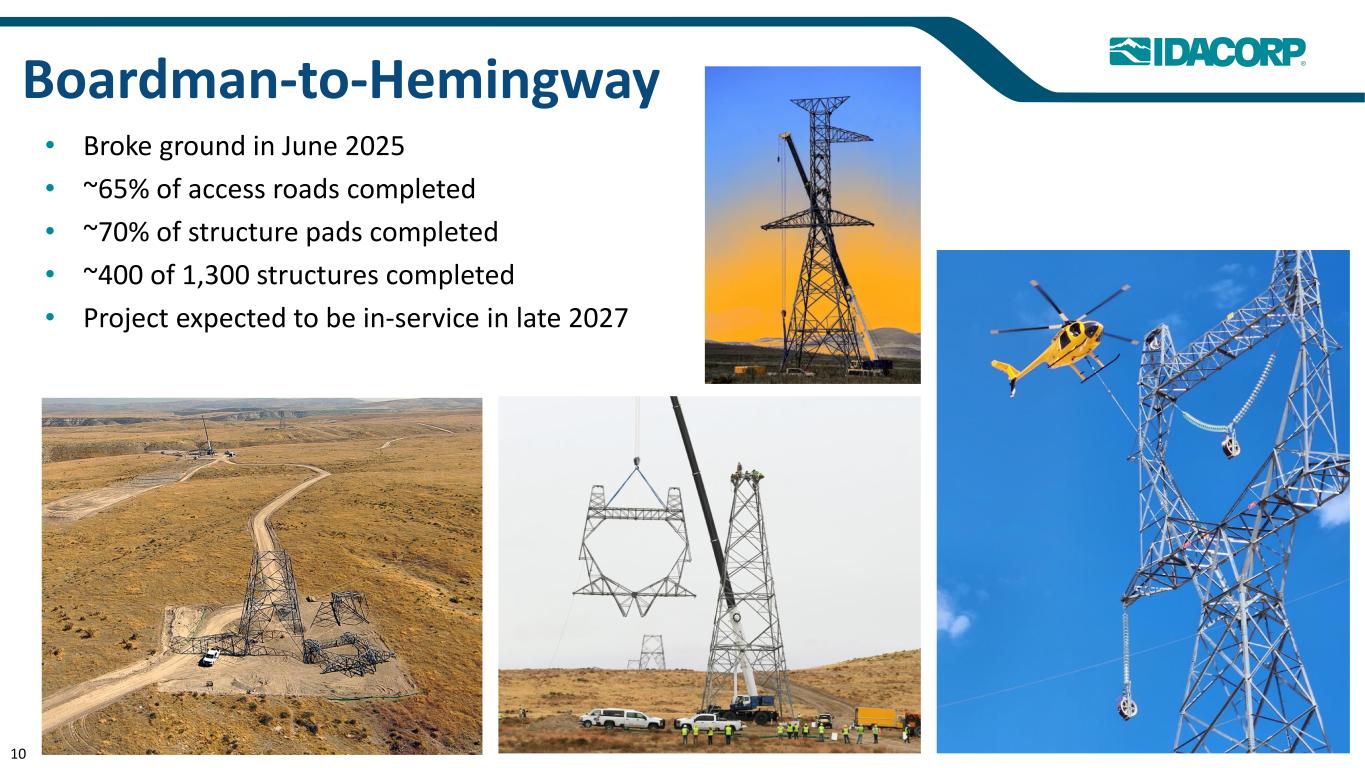
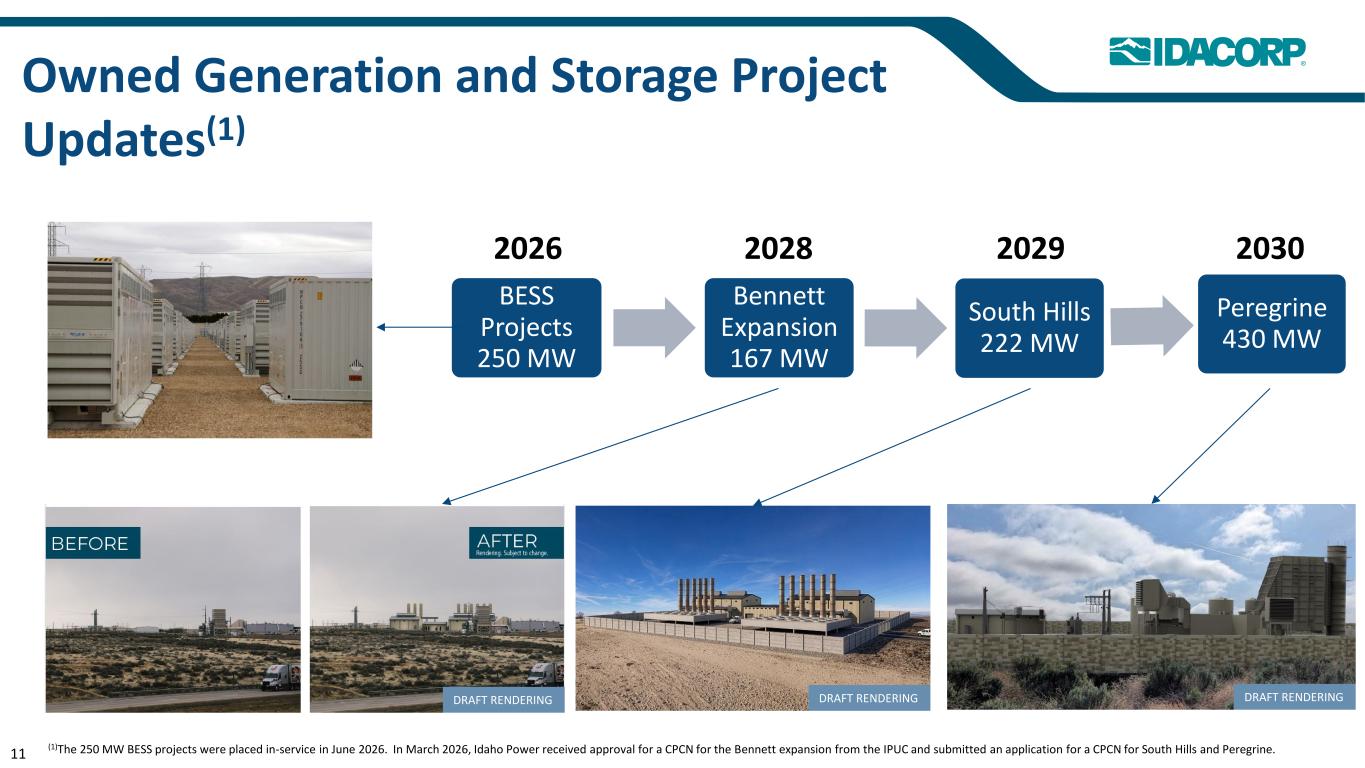
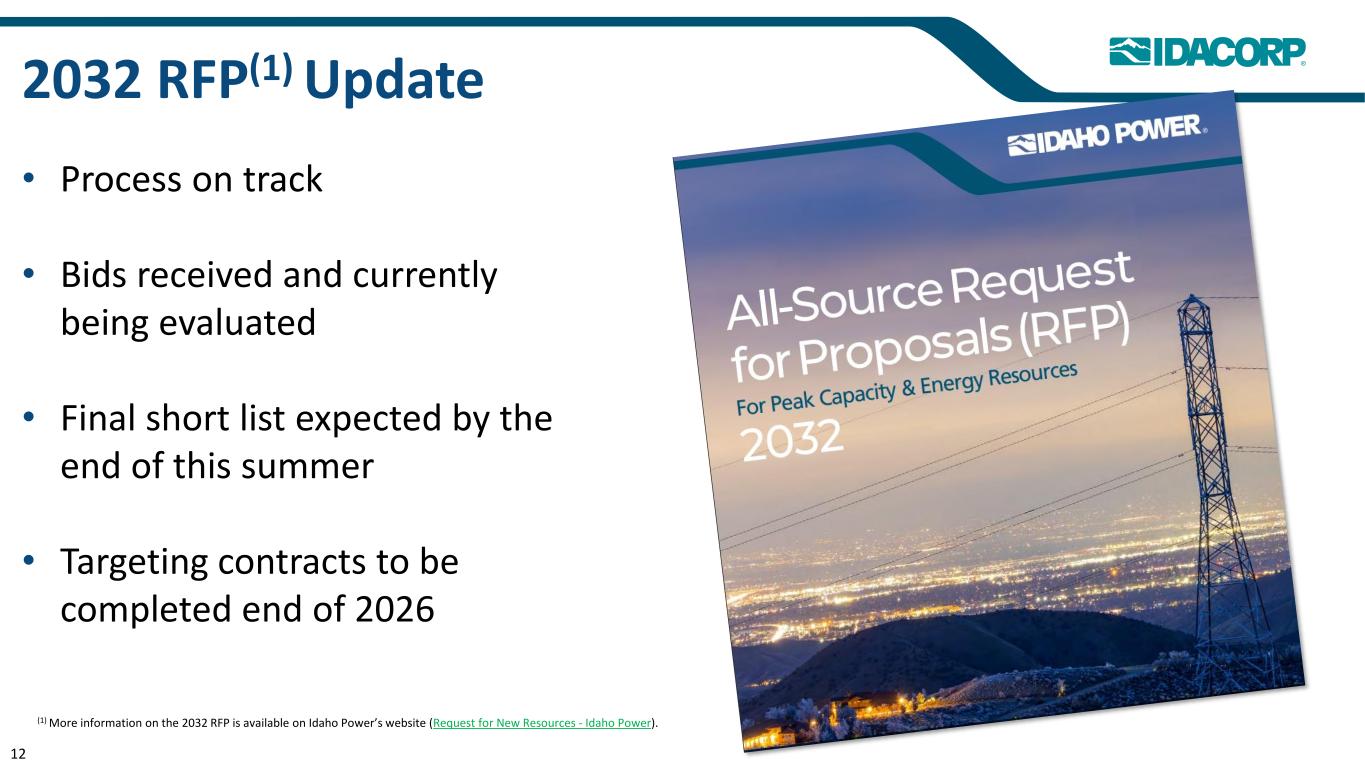
Thank you, Amy, and thanks to everyone for joining us today. I'll start my remarks with a look at customer growth. As you can see on slide five, we've seen a customer count increase of 2.3% since last year's second quarter, with growth across all customer segments. The customer and load growth that we've seen within our service area remains strong, and we're working hard to meet the increased energy demand. As one data point, industrial revenues, which include large contracts, were up a staggering 17% compared with the second quarter of last year. Thanks to years of thoughtful planning and project execution, we started seeing increased revenues from large contract customers in June, with more to come in the second half of 2026. I've been providing updates on Micron's expansion and Meta's new data center during our earnings calls for years, and it's great to see this hard work come to fruition as these projects ramp up. You can see photos of these massive projects on slide 6, along with pictures of some of our other large contract customers like Chobani and INL. Looking at slides 7 and 8, we're strong advocates that growth has to be sustainable and responsible so that service to our existing customers remains reliable and affordable. We expect that new agreements with large customers will include appropriate take-or-pay provisions, termination payments, and certain upfront payments, along with strong credit requirements, just as we've done in the most recent energy service agreements. These elements help ensure that growth pays for growth without shifting cost to other customers, and they help de-risk large loads for both our customers and our owners. One of the main draws to item power service area is affordability and keeping prices as low as possible remains a priority. Our retail prices are well below the national average with our average residential price about 30 percent below national average. I'll also point out that the revenue growth from the large contract customers is a key driver that's helping us stay out of a 2026 general rate case. We'll continue to take this thoughtful approach with our large customer pipeline which remains strong at multiple gigawatts as businesses across multiple industries look to operate in our region. Moving to slide nine, we're full speed ahead, executing on projects to serve our customers and enhance our grid. We recently brought 250 megawatts of new company-owned battery storage online as scheduled, marking our fourth straight year adding batteries to our system. Since 2023, we've added over 550 megawatts of company-owned batteries. We also completed the conversion of Balmy Unit 2 from coal to natural gas last month in time to help us meet peak summer loads. Additionally, a 125 megawatt third-party-owned solar generation project was recently commissioned as part of our Clean Energy Your Way program. These resources support our efforts to add capacity, flexibility, and reliable affordable energy to serve our growing reaches. Turning to slide 10, I'll provide an update on our three major transmission projects. We expect all three to come online in the next several years, bringing with them critical system flexibility, as well as access to diverse markets and transmission wheeling revenues. Starting with Boardman to Hemingway, work is progressing nicely. As of today, about 70% of the 1,300 structure pads have been completed. Over 400 towers are built, and we've started stringing wire. It's a huge undertaking, and we're pleased with the progress. We continue to expect B2H to be in service by late 2027. On the Swift North transmission project, we received our CPCN from the Idaho Commission in December, and project construction recently started in Nevada. With such good progress on the project, we expect the line to be completed in 2028. We're also continuing our work with Pacific Corps on the Gateway West transmission project. As we mentioned last quarter, we filed a joint request for CPCN with the IPUC, and we anticipate a portion of the segment described in that filing will come online as soon as 2028. As seen on slide 11, progress continues toward the construction of three company-owned natural gas-fueled projects that I've mentioned on previous calls. Construction is underway on the 1st, a 167-megawatt resource next to our existing Bennett Mountain Power Plant. We secured a CPCN, an air permit, and an EPC contract has a scheduled in-service date of 2028. We've also filed CPCNs for the 222-megawatt South Hills project, which is scheduled for operation in 2029, and the 430-megawatt Peregrine project, which is slated for 2030. We continue to work toward procuring the necessary materials and construction services to build these gas plants. These dispatchable projects will help us meet our near-term capacity deficit. Turning to slide 12, we're in the process of evaluating bids from our 2032 RFP. All bids have been submitted, including several of our own. At this stage of the process, several of our self-bid projects remain competitive, and the review team is beginning to narrow the field of contenders. We expect to have a final shortlist in the third quarter and begin contract negotiations soon thereafter. I'll close my remarks with an update on the proposed sale of our Oregon distribution system. Over the last few months, we've filed applications with the Oregon Commission, the Idaho Commission, and FERC requesting approval of our sale agreement with OTEC. These filings are being processed, and we expect the sale to close in the spring of 2022, pending successful regulatory outcomes. So we've been very busy, as you can see. And with that, I'll turn the time over to Brian.
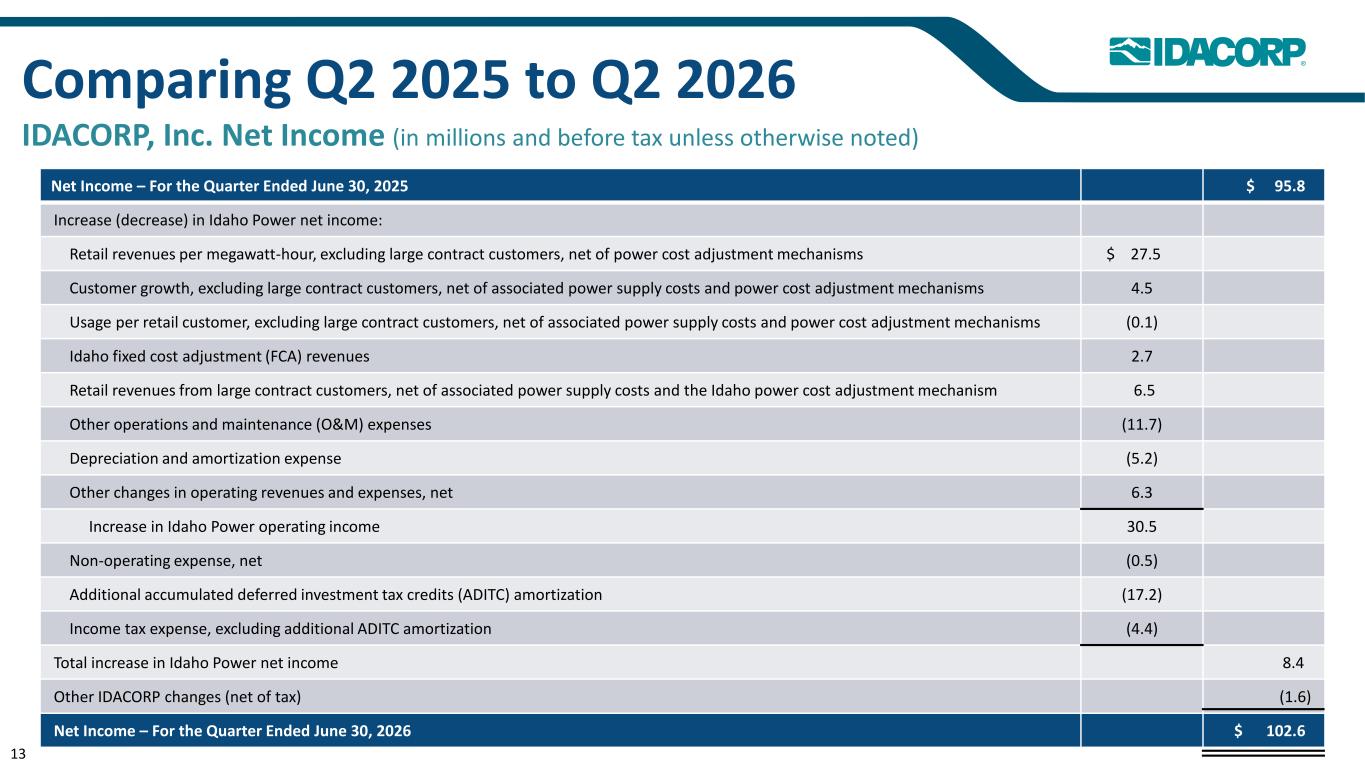
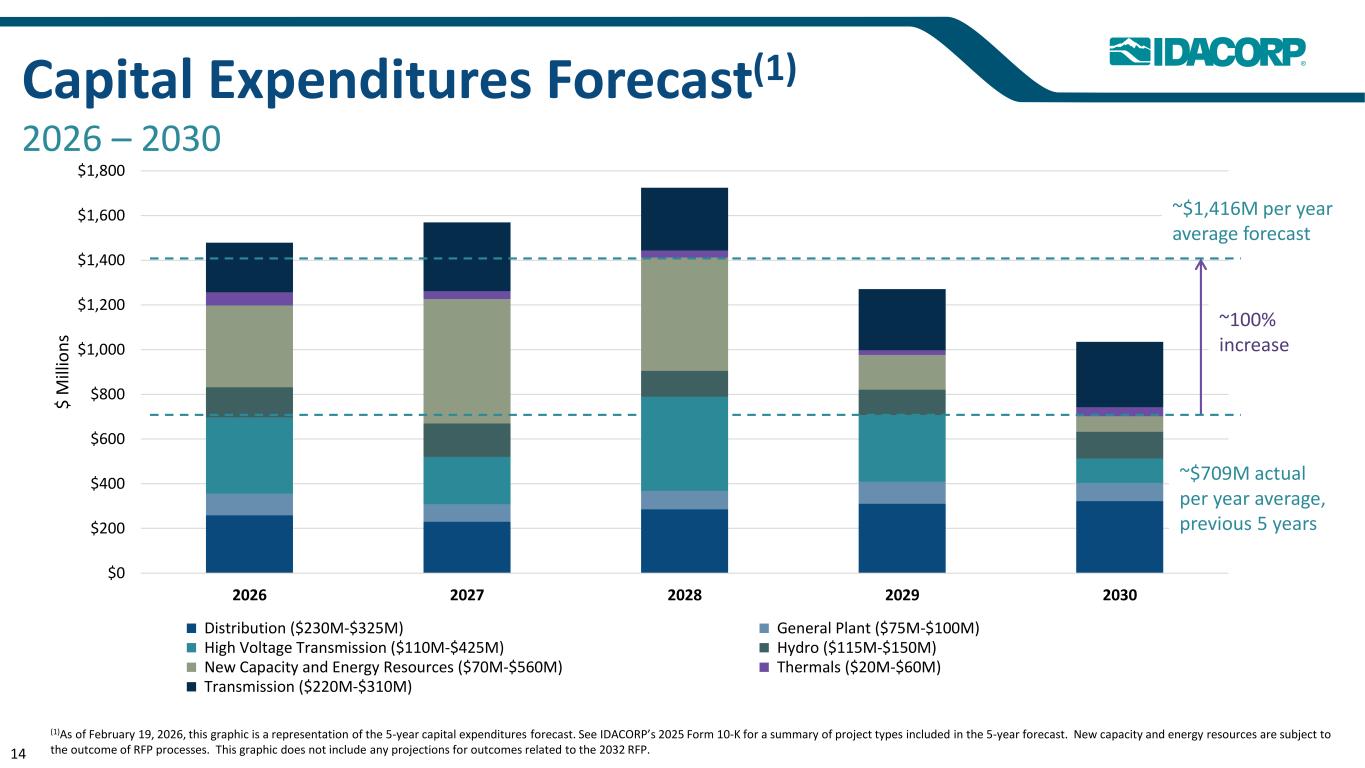
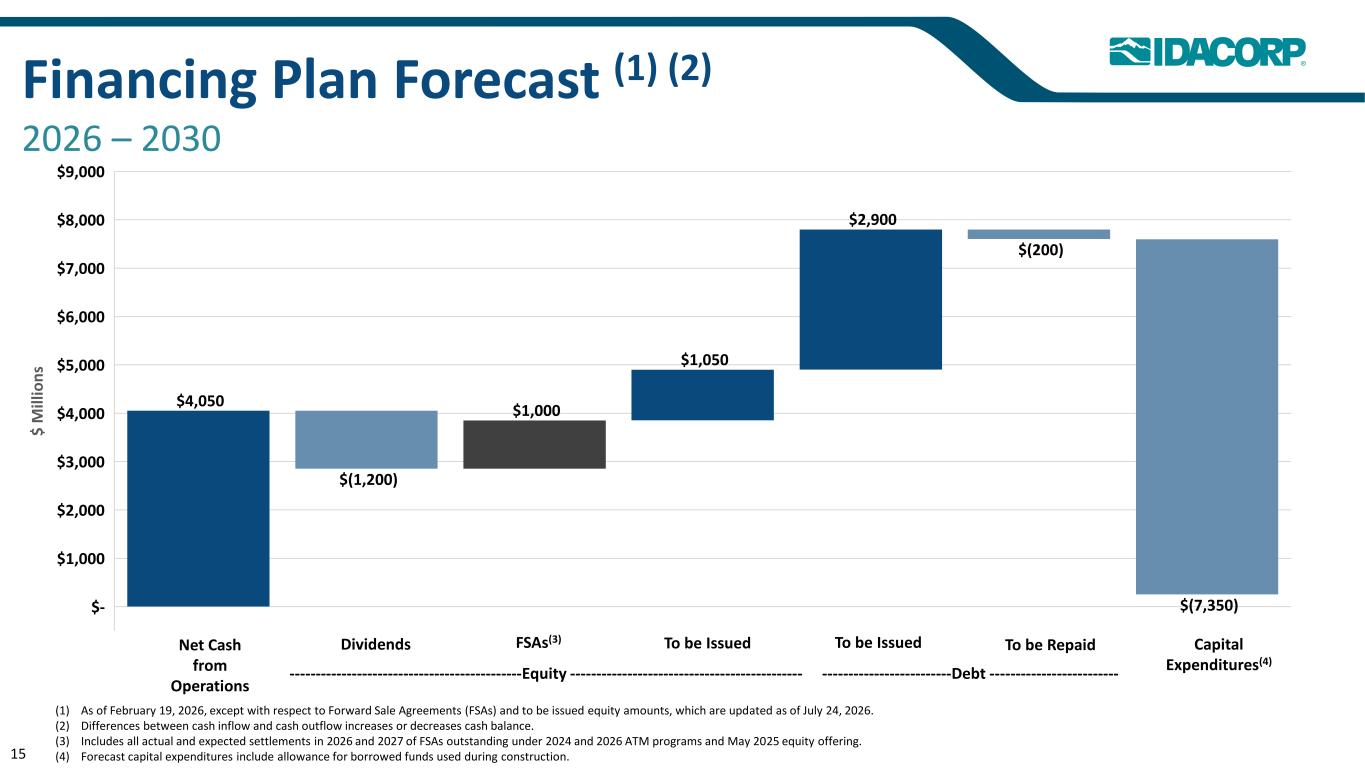
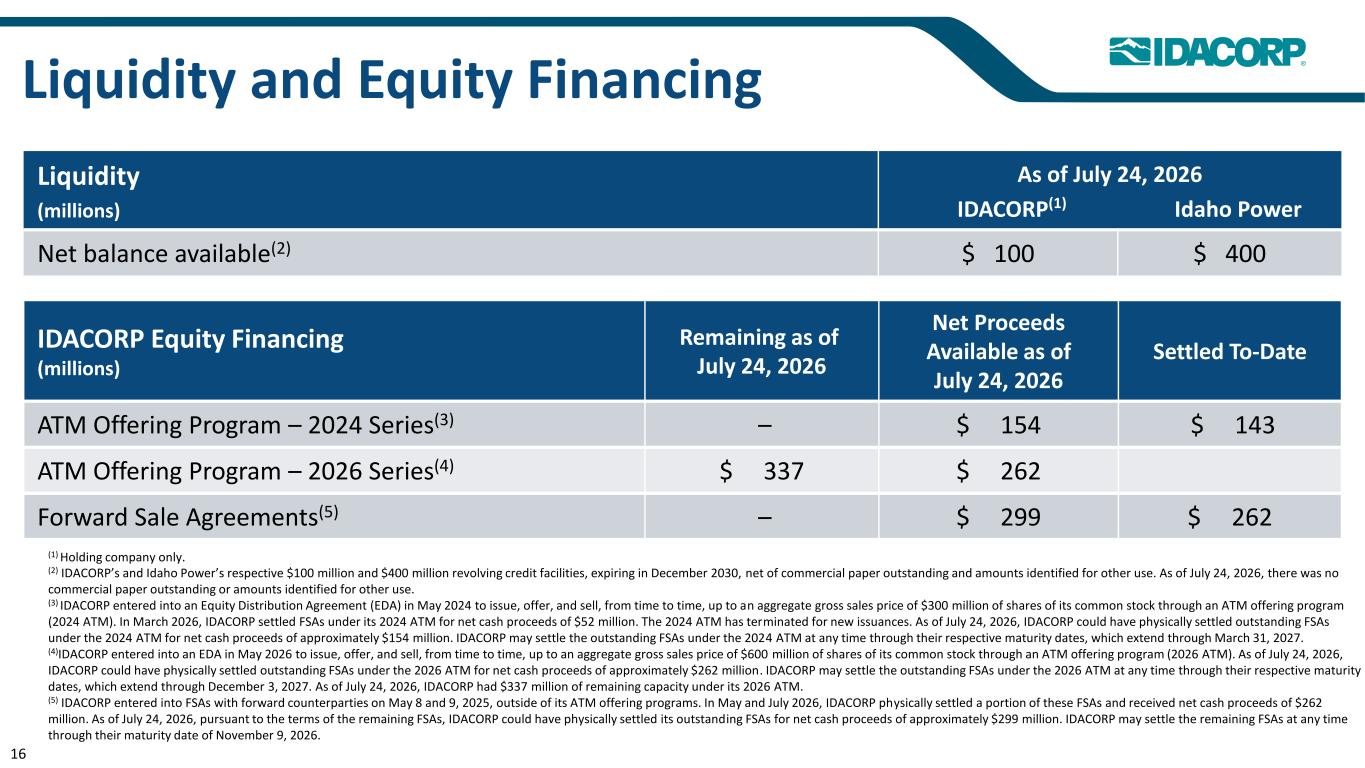
Hey, thanks Lisa. Hi everybody. Thanks for joining us today. It's exciting to see all the projects going on right now. Recent project execution has been particularly important because it helps serve an 8% quarter over quarter increase in industrial loads and they'll do that going forward. That load increase helped drive the 17% increase in industrial revenues that Lisa mentioned. Financial success is linked with operational success and I think financial side is just as exciting with strong results for the quarter and the year to date. Benefits from the January 1st rate change and customer growth were certainly evident during the quarter. I'll also mention that irrigation sales, which is impressive given that Q2 of last year also had favorable weather conditions for irrigation sales. This year's relatively heavy April rain didn't dampen quarterly irrigation sales because we later experienced the dry May and June. Aside from the amount, the timing of precipitation can also notably impact irrigation sales volumes. Before I get into the details, I want to point out that we added a new line to our quarterly reconciliation table. It shows the financial impact from large contract customers, which I think will be helpful going forward as we see the growing impact of these customer contracts. So when I quote changes from rates or customer growth generally, these exclude large contract customers because those will land on their own new line. All right, so getting more into the details let's go to the recon on slide 13 and from that you can see that the biggest movement was from higher retail revenues from the January rate increase and from customer growth combined those were a 32 million dollar benefit for the quarter and year-to-date it was over 52 million dollars per customer usage was essentially flat for the quarter at residential usage declined due to milder temperatures but higher irrigation usage mostly offset that decline the fixed cost adjustment mechanism also benefited retail revenues, which on our new line increased operating income by $6.5 million for the quarter. As expected, we're now seeing with greater prominence the revenue and load ramp, and we expect to see more of that benefit in the second half. As we expected, O&M expense was almost $12 million higher in the second quarter. Primary drivers were the amortization of previously deferred costs associated with the Jim Bridger plan and our Welfare Mediation Plan. A large portion of those items we recover in customer rates, so they're also reflected in revenues. Depreciation and amortization expense increased around $5 million for the quarter. No surprise there, given our ongoing infrastructure investment. Other changes in operating revenues and expenses increased operating income by a net $6.3 million. Similar to the impact in the first quarter, this benefit resulted primarily from a decrease in net power supply expense. And that was due to updates to the PCA mechanism base in last year's rate case. Non-operating expense increased only marginally with higher AFUDC mostly offsetting higher interest expense. Fairly significant, important from my perspective, Idaho Power didn't record any additional tax credits under the Idaho Earnings Support Mechanism in the second quarter. That was about $17 million less than what we recorded in the same quarter last year from a year-to-date perspective the roughly 6 million we've recorded for 2026 is compared to over 36 million we'd recorded at this same time last year that lower credit usage even with higher expected book equity this year is really indicative of our financial strength and performance our next slide slide 14 reiterates what we discussed about capex on the fourth quarter call so it's just for reference what you see in that forecast is admittedly already a large amount of capital but as a reminder it doesn't include any assumed resources from the 2032 rsp and relatedly it also doesn't include resources to serve projects like the micron fab 2 facility and it doesn't include updates from our annual long-term capital budgeting work so i'll just reiterate there could be some upside to what's shown we expect that more intel for you as we work through the rsp the low forecast update currently in progress moving to slide 15 in the In the second quarter, we executed around $260 million of additional forward sale agreements through our current ATM program. We're showing on there around $2 billion of equity content that we need to fund our business for the next five years under the current plan. We've either issued or we've sold on forward about $1 billion already, so we've solved for roughly half of our current plan's equity needs. We have the equity we need into 2027, and we think the remaining amount in the current plan is within ATM ranges. I'll reiterate that any additional CapEx would require some additional debt and equity. We still plan to blend debt and equity on a roughly equal basis for incremental CapEx with the goal of keeping our balance sheet strong. Slide 16 has helped to summarize the forward sale agreements that we have available and the forwards that we've settled to date. As you can see, we have a balance of about $715 million of forwards available for settlement. I don't have a slide on it, but I think operating cash flow warrants a mention given the deviations from this time last year. It looks low this year on a comparative basis, but it's important to note that much of the deviation is due to timing, including balances of items like accounts receivables. One last note from me, the Idaho Commission recently issued an order in our request for a prudence determination related to our health gain and relicensing effort. The commission in that case determines that our project expenditures from the start of 2016 through year-end 2025 were prudently incurred, rendering them eligible for insurance. We're pleased with the outcome of that case, in part because, as many of you know, we pride ourselves on being prudent spenders. I'm going to wrap up there. I'm going to hand it over to everyone's favorite IR celebrity, John Wunderlich.
Speaker 7
Thanks, Brian. turning to slide 17 you can see our 2026 full year earnings guidance and key operating metrics we've had some solid improvement in our earnings and aditc guidance as usual we assume normal weather for the remainder of 2026 for our guidance with strong operating performance in the first half of the year we now expect idacorp's diluted earnings per share this year to be in the range of $6.30 to $6.45. We lifted the bottom end of the range. We also see solid improvement in our ADITC expectation, so we're cutting our guidance in half. We now expect that Idaho Power will use less than $15 million of additional investment tax credit amortization in 2026, which is much less than the $40 million we amortized for the full year 2025, especially when considering the significant increase in year-end book equity, as Brian noted. We continue to expect full-year O&M expense to be in the range of $525 to $535 million. And we still anticipate spending between $1.3 and $1.5 billion on CapEx in 2026, though at this point it's fair to say we're trending to the high end of that range. Finally, given our current forecast of hydropower operating conditions, we expect hydropower generation to be within the range of 5.5 to 6.5 million megawatt hours for the year. We trimmed a half million megawatt hours off the top end of our guidance as dry conditions returned in May and June. With that, we're happy to address questions you might have.
Operator
We're now ready to begin the question and answer session for attendees who have joined on the Q&A line. If you would like to ask a question, please do so by pressing star one on your phone. Please ensure your mute function is turned off before you ask your question. We'll take as many questions as time permits on a first come basis. Once again, that is star one on your phone to ask a question now. Your first question comes from the line of Char Perreza with Wells Fargo Securities. Please go ahead.
Hi there. Hi, team. This is Whitney Mutalema on for Char.
Hey there. On resources, you've got 250 megaliths of batteries now in service. you have a number of applications in front of the commission is that paste roughly a project every few months sustainable or does it get harder to keep up as the two grows and a follow-up would be with all the battery storage going in for micron meta and the rest of the pipeline is gas plus batteries, the full long-term answer, or are you also looking at things like SMRs further out?
Yeah, so great question. So I'll start and I'll have Adam give some more detail. Certainly when we're looking at what we are going to need to serve our load, we go through exercise of the IRP, the integrated resource plan. So we're really looking for the least cost, least risk answer. So we have a total of 550 megawatts of batteries, but no, that's not the answer to everything. That fits kind of a, you know, it's great energy that will sort of fill in when the solar energy starts to diminish as the sun sets. So it's a great resource for the summer, but it's not a great source for the winter and certainly just because of shorter days and And, you know, so we don't get a chance to refill the battery before we need them again, and they last for four hours. So some of the operating characteristics just make it so that it's a great energy resource, but it doesn't – we don't really consider it a real capacity resource more than those first four hours. So we – it is, you know, an absolute sprint to keep up with this growing load and getting the resources online and in time. And so, you know, we've mentioned our pipeline before that continues to be evaluated as we go on beyond what we've shown here. So I think Adam, you want to.
Yeah, thanks for the question, Whitney. Happy to walk you through kind of year by year how we're looking. In 2027, it's largely batteries and solar. From that point, it does go turn a little more on the gas side. 2028, 2029, we had in 2030, which is also gas, 430 megawatts. And then the Eidl Power's origination team for 2031 and 2032, we bid in eight projects. Six of them were gas projects. Two of them were storage projects in terms of gas. In terms of SMRs, we've spent a fair amount of time learning about these new technologies. I'm on the customer advisory committee for one of the key technologies and companies. We spent a fair amount of time with INL, and we've met, I would say, with most of the key developers in that space is that we liked SMRs. At this time, we don't love the, you know, again, we like SMRs, but we're probably not going to be the first, and we're probably not going to be the last to look at them, and we'll continue. And the timing also, when they would be available. and of course in addition to the in her comments also it's always good okay that sounds good thank
you and then just if i could squeeze in a tiny question on wildfire mitigation obviously not trying to get ahead of the mountain home investigation since it's early but you've just gotten the 2026 wildfire mitigation plan approved right before this happened Does an incident like this change anything about how you're implementing it, or is it too soon to say? How are you seeing the plan you put into practice?
Yeah, so you're right. We do have a mitigation plan, and we do have it is now the standard care act here in Idaho applies to that that mitigation plan. So certainly, you know, the wildfire was impactful to that community, and we worked really hard to make sure that we are there for that community to help them get back on their feet and repair, replace what was lost. But it was a relatively small fire. And when it's all said and done, it will not be a material impact to our company, but we are taking it very seriously. So I wouldn't say that we are changing anything about our plan. We certainly continue to implement it. That is the key focus, that it's one thing to write a plan. It's quite another to make sure that we are following it. And in this case, it actually was followed. I mean, we feel really good about the implementation of that plan. So, I think that's probably about all I would have to say about that.
Operator
Your next question comes from the line of Michael Lonegan with Barclays. Please go ahead.
Hi, Dan. Hi, thanks. hi thanks for taking my question um so on micron sap 2 just wondering if you could share the status of negotiations and when you expect to find an esa and then you know anything you could share regarding the size of that investment that could be added to your plan and could this be a q3 update you know when you update your load forecast well those are often confidential so we have to you know rely on our customer as to whether or not they want to make that public.
I will say that the negotiations are very active. Adam do you have any details?
Yeah we're progressing well just in terms of the site. A ton of work is going on. It's amazing to see what a 50 billion dollar site looks like and they have started. We are in ESA discussions but as Lisa mentioned you know Those are confidential, so we can't really speak to those in terms of the CapEx side.
Yeah, just to add on to what Adam said, most of our CapEx that you see in the slides was premised on the 2015 IRB load growth rate, the 8.3% that we mentioned. So it excludes customers like promising loads, as we call them, that we're working. Incremental loads all generate additional capacity and energy needs with some of our related spending for the infrastructure, power infrastructure. Urgently, I'd say, in our five-year window, not all of it on the outside of that window. So while the 2025 are, we're tasked with serving load as it materializes, so the in-process transmission lines and the outcomes of that will end up getting reflected fresh and also a load.
Thank you. And then, you know, regarding your next rate case, I know you've indicated that June 2027 was a possibility. How are you thinking about that now? And should we expect this to be a modest request given all the large load coming in? And I know you often get asked about a depreciation and interest tracker. Could that be in there as well?
At this point, we're not really looking at a depreciation or interest tracker. And it is because the revenues of these large loads are helping to cover those costs. And so we continue to look at a possible June 2027 filing. But we obviously do the analysis. So we sort of wait and see if that is what is needed. But if things go as we are sort of forecasting, that's, I would say, a high probability. But we wait to see what the data actually indicates.
Yeah, and Michael, this is Brian. I think from the financial side, what we look at is that, you know, you've got large load revenues on one side that certainly are helpful. The other side of the equation, though, is plant. It goes into service, right? So in 2026 and in 2027, we expect quite a bit of our QIP to convert to plant and service. If you look at the balance sheet now, it's over $1.8 billion of QIP. When that converts to plant and service, obviously depreciates. So we get into a situation where we do the evaluation of, you know, keeping in mind things like cash flow, affordability for customers, we file a rate case. So we'll have to do that math pretty soon as we look relatively probable at this point. But, again, we're in somewhat of a what I'd call an NDS position compared to prior years where we have to do the math on that every year. The other thing I mentioned just on the tracker component, you know, if you file relatively frequent general rate cases because you have so much plant converting, the tracker doesn't have as much value. You also have to be careful to track a tracker wouldn't be shifting costs to customers that aren't driving the expense. And so the tracker would have, to the extent it applies to residential customers, it would be for the projects that are benefiting the residential customers, not the large load growth customers. So we're very cognizant of that when we think about the types of.
Thank you. And then, you know, obviously you're using less of the ADITCs. So, you know, presumably your earned ROEs are higher than you were expected.
You know, with all the large loads coming in, you know, how do you see the earned ROEs trending over the forecast period? is the chance you earn above your allowed or any you know obviously you don't give long-term eps growth guidance but anything you could share on earned roe's sure i mean that's a it's a projection that we do all the time in our forecasting there there's a possibility that occurs but i think the thing to look at is the amount of depreciation and interest expense that we have to overcome in any given year given a historic or hybrid test year that we have in idaho so while it's possible those revenues could be large enough to over earn in some years. I'd say in the near term, that's less likely just given the construction cycle that we're in. That said, you've seen us reduce our ADITC expectations for the year already this year, and they're significantly lower than last year. So things like weather conditions or outperformance on large load expectations compared to what we have in our forecast certainly drive us more towards over earning. Certainly the base level for the ADITC mechanism and then potentially even up from there.
Thank you for taking my question.
Operator
Your next question comes from the line of Chris Ellinghouse with Seabirdt William Shank. Please go ahead.
How are you? Brian, thanks for that new line that's helpful. In terms of the large customer load ramp, can we just think about that similarly to retail in its seasonality, you know, based on your temperatures?
I wouldn't look at it that way, Chris, because, you know, while residential and some of the small commercial can be pretty sensitive to weather conditions, the industrial loads themselves are not. They tend to be driven more by what sort of equipment is installed and turned on at any given point. You can see Micron's load ramps in their special contract. You can see that there are step-ups. They're certainly not linear, but there are take-or-pay obligations in that that don't reflect seasonality necessarily. And then if you look at things like data centers, their ramp-ups can be premised on what server racks are installed and when they're turned on. So I wouldn't look at it that way. One thing I would note is if you think about that line that we added, that really only have one month of Micron revenues in there for Fab 1. And then you do see some of the meta ramp-up reflected in there. But a lot of that is early stages, and we'd expect to see it over the second half of this year.
Right. Yeah, I was really – not the timing of incremental on for these customers, but in terms of their cooling requirements, can seasonality to the usage portion once something's online?
We haven't really forecasted that way. We look at more of a steady state from equipment operation, not from a cooling system, though it is possible in some of the hotter summer months there could be incremental loads from cooling systems. Okay.
In raising the guidance, is that purely a look through the second quarter, or does that include any of the... july seems like it was materially warmer than last year and still dry so does that include any look into what you know about july so far not much i mean we we have anecdotal evidence that july was a little was a little warm for us but in general we cut it off at the end of the quarter and then just predict normal weather conditions for the remainder of the year so it does turn out to be hotter than we expected okay um is there any rationale for you guys to use any parent leverage
as you get into really heavy spend you know we talk about that from time to time um you know one thing we have to watch for on that is you know credit rating implications of that that you know the credit rating agencies have complemented us as have many of our investors on the fact that we We don't have a holding company debt and we go to market at Idaho power for debt. We tend to be very well received. So our regular way financing approach has been otherwise and just interest in the marketplace. So our preferences for that relatively simple balance sheet. When you start adding holding company debt, you do add some complications, some regulatory items that we have to address and otherwise. So we've really focused a lot. Regular way financing, of course, in terms of hybrid now, we've taken off the table, but it's not our go-to when we think about the structure the other thing i mentioned is there are other ways we've done some of those great that helps um one last thing regarding the the
smr discussion was you know pricing has been rising for the much across regions and there there's some i'd say price insensitivity it seems um while smrs might be pricey today You know, as time goes by, you know, and a lot of things will happen in the next decade, but does pricing necessarily matter in the grand scheme of things if electricity markets are very constrained and some of these tech firms really are just constrained by electricity? You know, do you think the $150 a megawatt hour ultimately might make sense for that customer class?
I think that's entirely possible, Chris. I mean, I couldn't have forecasted, you know, what's happening to us right now five years ago or ten years ago. But I think the bigger constraint right now is just the commercial availability. because I don't even know if the $150 is a price that you could actually go buy one for. So I think there's a little bit of TBD on when they're going to be available and what price. But your question being, will there be a time where some customers will pay any price? Maybe. I don't know. I do find, though, that when we are negotiating with them, turns out price does matter still. So I think we'll have to wait to see on what happens in the future.
Sure. Thanks a bunch. Appreciate it. Thank you. Thanks, Chris.
Operator
Your next question comes from the line of Julian Damoulian-Smith with Jeffries. Please go ahead.
Brian, it's on for Julian. Hey, just on the 2031-32 RFP, is it still 200 megawatts for 31 and then greater than 200 megawatts for 32? Or could it possibly incorporate some of the incremental load that Micron FAB 2 might need as you move through the year and potentially sign an ESA?
Yeah, Brian, this is Adam. That 200 megawatts was, first of all, it's perfect capacity, so as opposed to kind of renewable capacity. But it really was a minimum from our standpoint. We used 25 to change what our outlook is. So we anticipate probably having to go a little bit higher than that in terms of how high. And we'll have to see how the forecasts come in, which I think we'll be providing to you all a November timeframe.
Okay. Okay. So, and that scenario excludes any micron FEP2 capacity. In theory, you issue another RFP for, I guess, incremental capacity when, you know, when the time comes?
No, it's a good question, Brian. At that point, we have a short list, so we're going to be able to work through that short list, and we may issue an RFP.
Oh, I see. And that's where the six gas projects, the six gas projects of self-built in the current RFP might accomplish that.
Correct. Yeah, we had eight overall projects that we've been in, six of them were cast, but have been in projects, too. So we were pretty looking, and I think we will hear available in the next month or so, and we'll be able to talk about whether the idle power projects have made that shortlist or not. But at this time, we feel really good about the projects we bid in. They're competitive from our standpoint.
Operator
Your next question comes from the line of Alex Konya with BTIG. Please go ahead.
Hi there. Good afternoon. I apologize. I probably should look for this in the queue. But just what's the current aided balance on the balance sheet as of June 30th?
It's about $156 million as of June 30th. and then we'll add some incremental and also some Idaho state.
So then, you know, I'm just kind of trying to triangulate this with the, maybe with the rate case strategy as well. So, I mean, is it kind of reasonable to think, I'm just kind of spitballing a little bit here, that to the extent that you've got Quip that's entering kind of rate-based, as it were, depreciation goes up. But, again, kind of non-cash, it feels like maybe the aid mechanism could help offset some of that, But then, you know, maybe if you're thinking about kind of more of the cash expenses, such as interest, that those, you know, maybe things that, you know, again, would be kind of for the call for a rate case. And I'm just trying to think about this from the rate case perspective is just how important is that aided balance that, you know, and how much flexibility could that add in terms of your timing call on the rate case?
Yeah, Alex, it's a great point. I mean, that's one of the factors that we consider in deciding whether or not to file a rate case is the ADITC mechanism and how many credits we feel we may need to use. The evaluation we'll do under this one is for 2028, right? And so we'll be looking at what are large load revenues in 2028. Would we need to use the ADITC mechanism to cover what we might otherwise get from a rate case to cover depreciation and interest expense and the return on some of those assets? I mean, a lot of those assets are in service serving customers, but we're not recovering anything on those. So in that case, we may decide to file the rate case, depending on how that math turns out. The other thing is in the last rate case we did, we imposed a cap in the settlement of $55 million per year on ADITCs. And so we look at where we might be relative to that threshold level in determining whether or not to file a rate case.
Great. Okay, I appreciate that. And then maybe just one follow-up question just on trying to think of the updates on the RFP and kind of better sense of what the generation resources might end up panning out to be, which I think for the previous question we might know within the next month or so. And then, you know, is that going to come out maybe before we even get kind of the full details, I guess, just in terms of what the demand outlook ends up being under the updated IRP, which, if I'm getting this right, may end up getting released a little bit later. just trying to think about kind of the the cadence of timing here for those for those those outlooks yeah alex this is adam it would the rfp results would come out here we'll say in the next month or so and then the new forecast related to the new irp i think would be released to you all right around november is that right brian that's about right that's the time that we have to have our new forecast established you eventually have to lock it down for purposes of
the 2027 IRP so we'd have to have that under our normal the thing that I'll mention though is you know things change over time so while we'll have results from the 2032 RFP if there's incremental load that shows up even beyond the forecast we include in our IRP some of those resources depending that are on the short list depending on the timing we may pull more of those resources than we originally thought in terms of you know implementing resources from the list or if their online dates are further out, then you start doing what Adam mentioned, which could be a 20, 32 or later. So again, the IRP is a point in time, but we have to serve load as it materializes, and that requires a lot of pre-planning. So we're certainly doing some pre-planning around those loads already.
Yeah, it's just a great point. And I think, you know, we talk a lot about our pipeline as though it seems like it's this static number, but it is a tremendous amount of activity of resources and loads that sort of go into construction like Micron that's no longer in the pipeline, but there's, you know, another tranche of new requests that fill that space that was in the pipeline. So there is – it's really, really active. So it's changing all the time, and we have to do the analyses to the extent those customers want to go forward with those construction agreements or analyses. So it's a tremendous amount of work, exciting times for sure.
That's very helpful. Thanks so much. Thank you.
Operator
And a final opportunity, press star one to signal for a question. And we'll pause for just a moment. That concludes the question and answer session for today. Ms. Groh, I will turn the conference back to you.
Thank you to everyone for joining us today and for your continued interest in IDACOR. It's always great to hear from you. So I hope you all have a great evening and we will see you all soon. Thank you.
Operator
Ladies and gentlemen, this concludes today's call. Thank you all for joining. You may now disconnect.