Operator
Good day and thank you for standing by. Welcome to the Q1 2026 Cadence Earnings Conference Call. At this time, all participants are in a listen-only mode. After the speaker's presentation, there will be a question and answer session. To ask a question during the session, you'll need to press star 11 on your telephone. You'll then hear an automated message advising your hand is raised. To withdraw your question, please press star 11 again. Please be advised that today's conference is being recorded. I would now like to hand the conference over to your first speaker today, Michael McKinney, Executive Vice President and Chief Financial Officer. Please go ahead.
Thank you, Therese. Good morning, everyone, and welcome to Caden's first quarter 2026 earnings call. With me on the call today is Jeff Paul, our President and Chief Executive Officer. Before we begin, let me read our Safe Harbor Statement. Various remarks that we may make today about Caden's future plans and expectations, financial and operating results, and prospects are forward-looking statements for purposes of the Safe Harbor provisions under the Private Securities Litigation Reform Act of 1995. These forward-looking statements are subject to known and unknown risks and uncertainties that may cause our actual results to differ materially from these forward-looking statements as a result of various important factors, including those outlined at the beginning of our slide presentation and those discussed under the heading risk factors in our annual report on Form 10-K for the fiscal year ended January 3rd, 2026, and subsequent filings with the Securities and Exchange Commission. In addition, any forward-looking statements we make during this webcast represent our views and estimates only as of today. While we may elect to update forward-looking statements at some point in the future, we specifically disclaim any obligation to do so, even if our views or estimates change. During this webcast, we will refer to some non-GAAP financial measures. These non-GAAP measures are not prepared in accordance with generally accepted accounting principles. A reconciliation of the non-GAAP financial measures to most directly comparable GAAP measures is contained in our first quarter earnings press release and the slides presented on the webcast and discussed in the conference call, which are available in the investor section of our website at cadent.com. Finally, I wanted to note that when we refer to GAAP earnings per share, or EPS, and adjusted EPS on this call, we are referring to each of these measures is calculated on a diluted basis. With that, I'll turn the call over to Jeff Powell, who will give you an update on Cadence business and future prospects. Following Jeff's remarks, I'll give an overview of our financial results for the quarter, and we will then have our Q&A session.
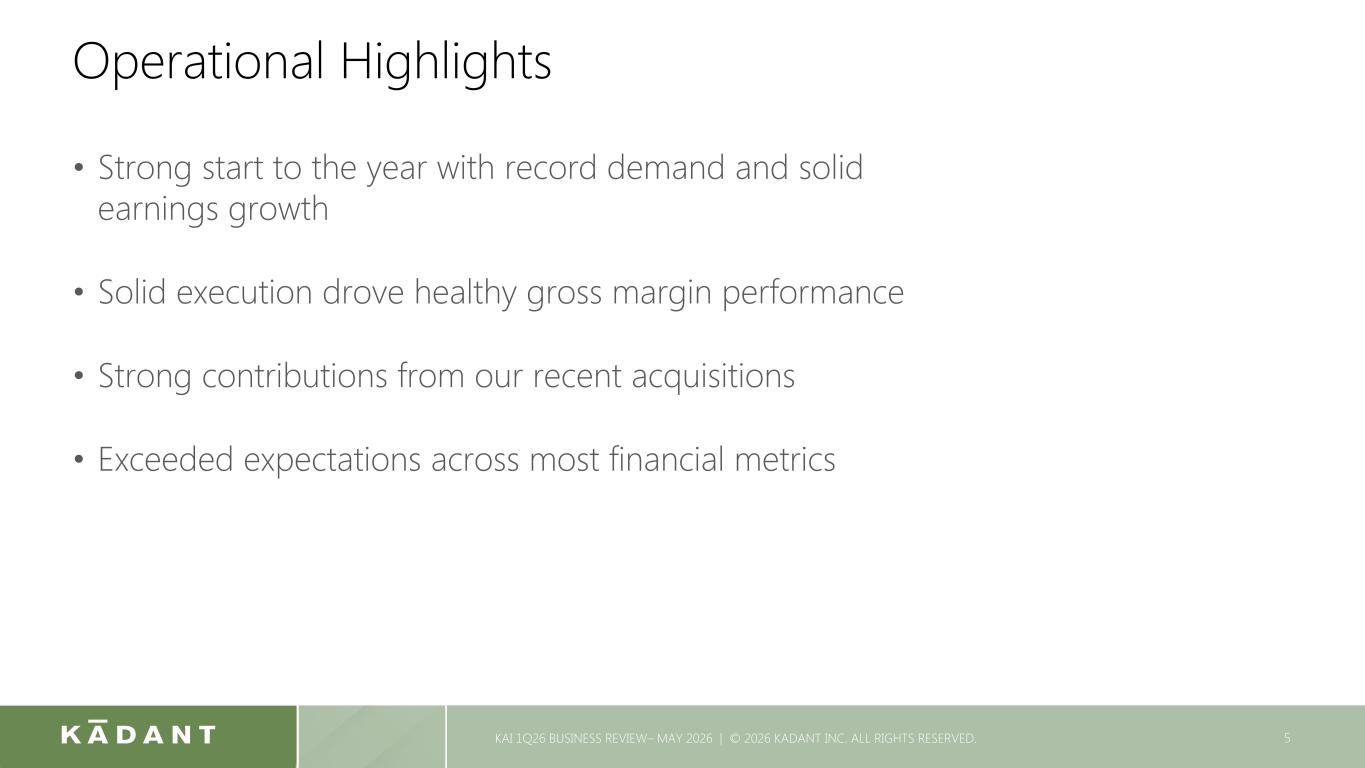
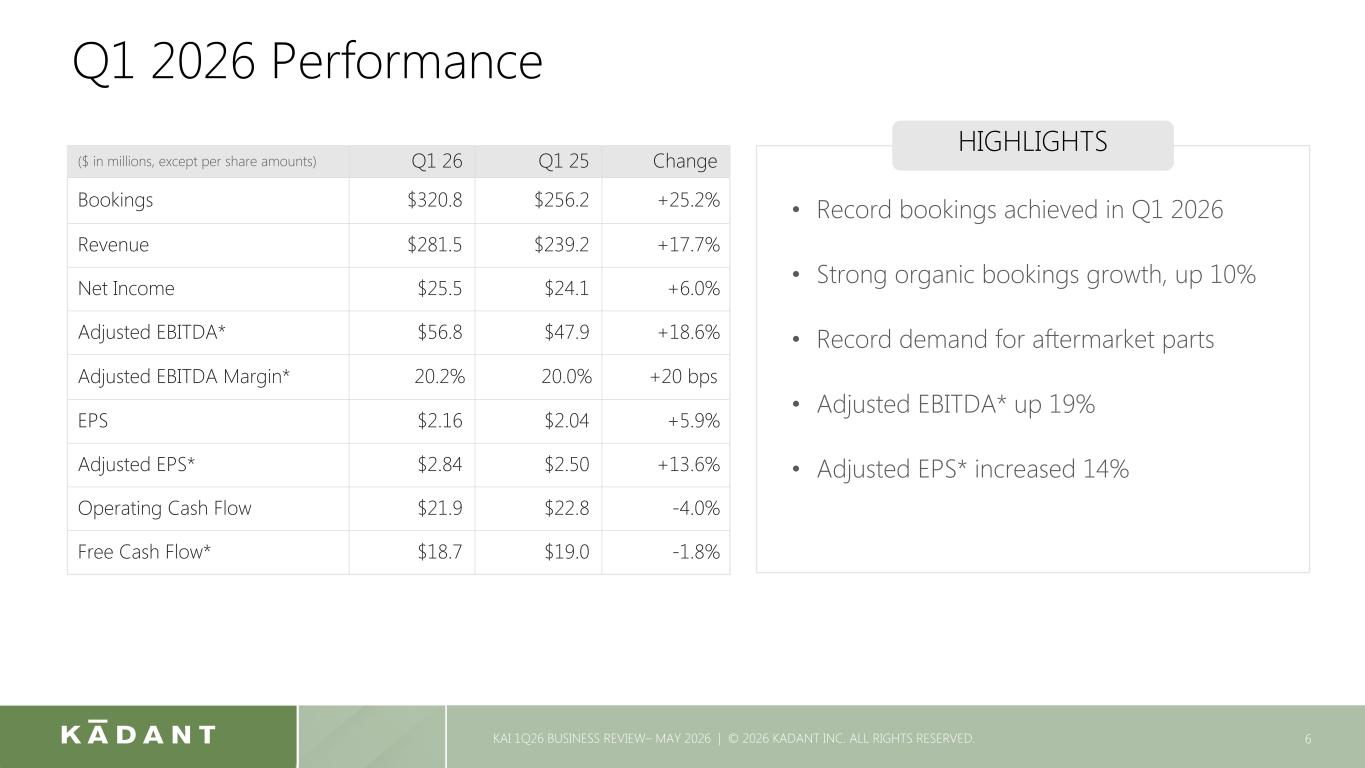
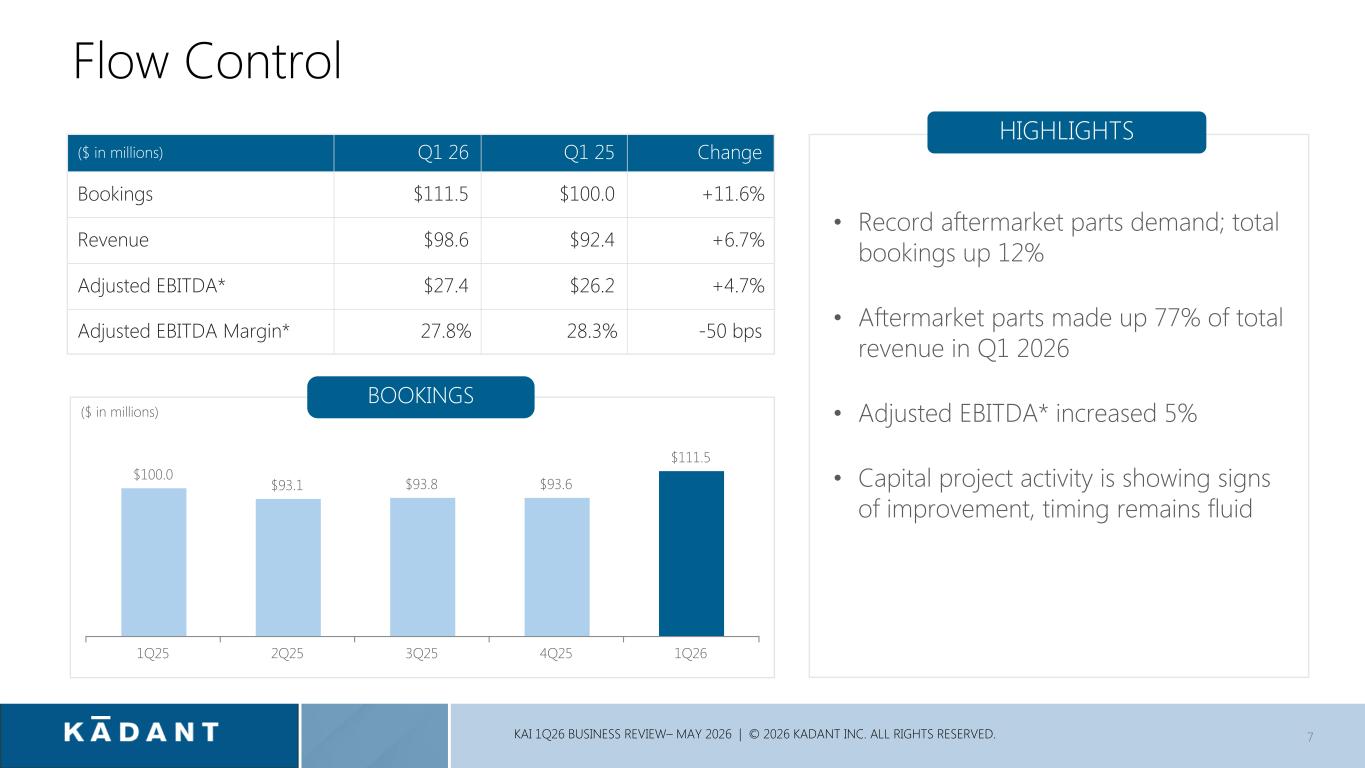
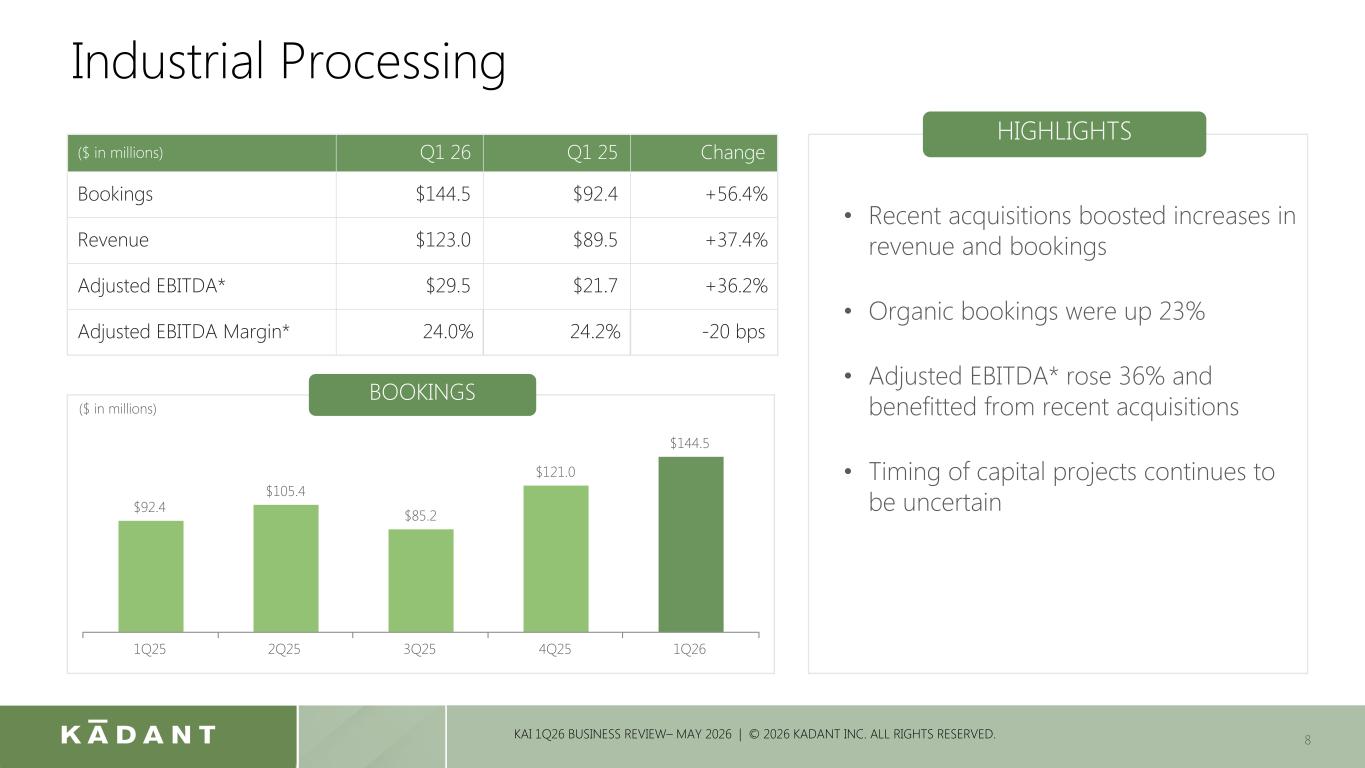
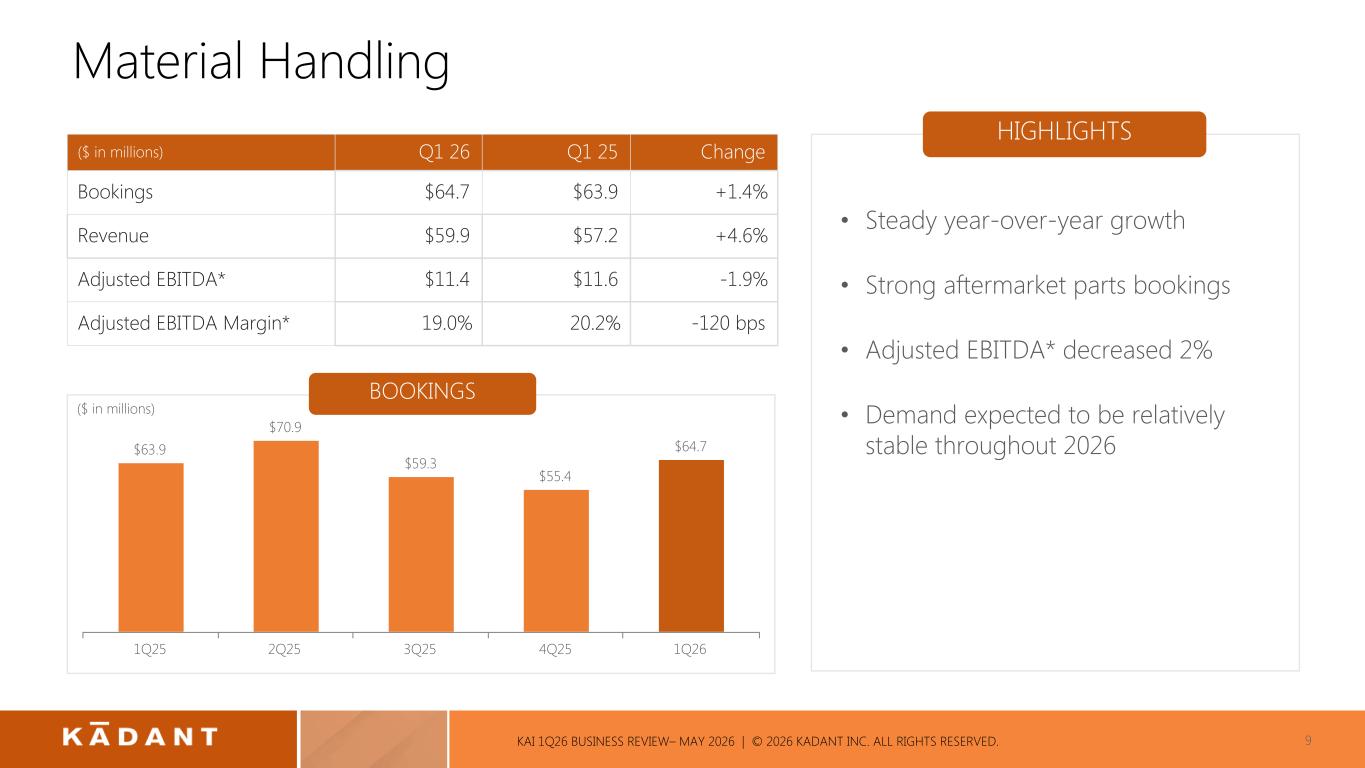
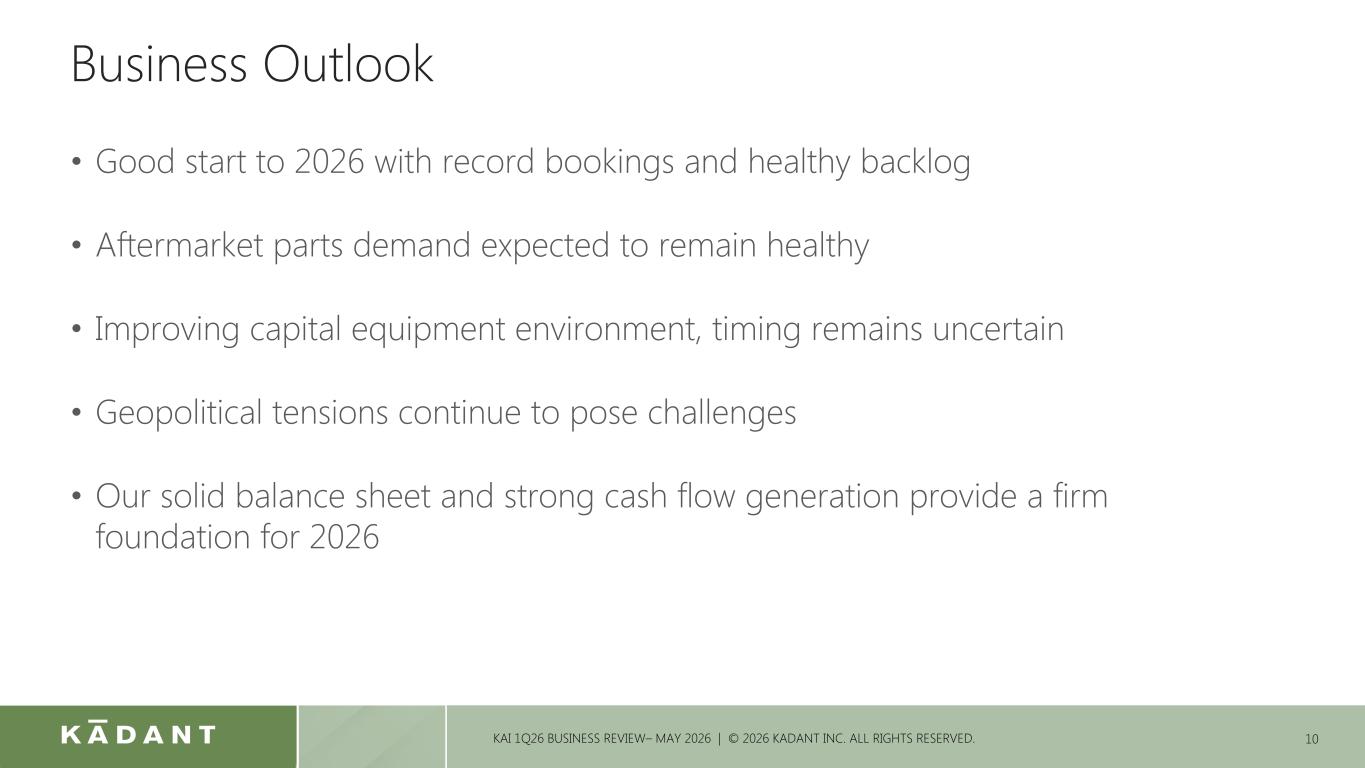
Jeff? Thanks, Mike. Hello, everyone. Thank you for joining us this morning to review our first quarter results and discuss our business outlook for 2026. The first quarter was a strong start to the year, highlighted by robust demand and solid earnings growth. We delivered strong profitability while continuing to see healthy demand in our aftermarket business and improving capital business. Despite the high level of uncertainty fueled by global trade challenges and ongoing conflict in the Middle East, our first quarter exceeded expectations across most financial metrics. Record bookings and record aftermarket parts revenue, along with solid execution in our operations drove healthy gross margin performance across our businesses. This, combined with lower than expected operating costs, led to exceeding our earnings expectations in the first quarter. We continue to refine our 80-20 performance system, which also contributed to our results, despite economic headwinds and tough competition in our core markets. Turning now to our first quarter financial performance in slide six, I'd like to highlight a few metrics that I believe are central to our growth story. Double-digit organic growth combined with our recent acquisitions delivered exceptional bookings growth of 25% in the first quarter compared to the same period last year. New order activity was strongest in North America and Asia with all regions seeing healthy demand growth compared to last year. Revenue was up 18% with aftermarket parts revenue a record $209 million representing 74% of our total revenue. The first quarter of the year is often a strong quarter in terms of parts bookings and revenue as our customers prepare for annual maintenance shutdowns. This strong demand is supported by our large installed base. Adjusted EBITDA increased 19% to $57 million, representing 20.2% of revenue. Finally, our adjusted EPS at $2.84 benefited from better-than-expected gross margin performance, lower than expected operating expenses, and excellent execution discipline. Overall, the quarter reflected a balanced picture of increasing commercial momentum in bookings, solid profitability and cash flow, and a revenue mix that strongly favored aftermarket parts. Next, I'd like to discuss the performance of each of our three operating segments, beginning with our flow control segment. The flow control segment ran strong demand in the first quarter, led by our North American businesses. Bookings increased 12% to a record $112 million, led by robust capital order activity and record aftermarket parts demand. Q1 revenue increased 7% to $99 million, with aftermarket parts revenue making up 77% of total Q1 revenue. This revenue performance is expected to remain stable as the year progresses and benefit from increased capital shipments in the second half of the year. Adjusted EBITDA increased 5% compared to the same period last year, and our adjusted EBITDA margin was 27.8%. While EBITDA margin was down modestly compared to last year, we expect to gain some operating leverage as the year progresses. Next, I'll discuss our industrial processing segment on slide eight. Strong demand for aftermarket parts and improved capital project order activity combined with contributions from recent acquisitions led to record bookings of $145 million in the first quarter. Importantly, organic bookings were up 23%, reflecting improving underlying demand for our products and technologies as we started the year. Revenue increased 37% to a record $123 million due to contributions from our recent acquisitions, which included Clyde Industries and Babini. Integration of these companies into our industrial processing segment is progressing well, and we are pleased with results delivered by both of these companies during the short time they have been part of the cadence. Adjusted EBITDA margin remained healthy at 24% of revenue. Overall, our first quarter performance in this segment was solid, with second half of the year looking to be stronger than the first. In our material handling segment, we achieved steady year-over-year growth in both revenue and bookings, consistent with our expectations. Revenue increased 5% to $60 million, while new order activity was up modestly to $65 million. While business activity remains stable, we are seeing an environment defined by capital equipment timing volatility. An unfavorable product mix led to downward pressure on gross margin, which contributed in part to a lower EBITDA margin. As we move into the second quarter, our backlog is strong and we're encouraged by the fundamentals of our end markets, which include aggregate mining, waste management, and recycling. We've entered 2026 with good start to the year in terms of record bookings and solid revenue performance, further supporting our confidence in the periods ahead. We are seeing an improving capital equipment market, although the time in these projects is more uncertain than normal due to the ongoing geopolitical conflicts. We will continue to focus on strengthening our operations using our 80-20 business performance system and other internal initiatives, including increasing investments in automation to provide increased value for our customers. Finally, last week, we closed on the a previously-announced acquisition of Volstolpina Boller Profil, now called Cadent Profil, a manufacturer of customized rolled profiles and industrial knives. In the short term, due to a portion of the sales of Cadent Profil being intercompany, this acquisition will have a dilutive effect on our adjusted EPS until the products currently held in inventory by other Cadent businesses are sold to a third-party customer. Mike will discuss this in more details in his remarks. Looking forward, we expect the newest addition to Cadent to be accretive to our earnings growth, and we are looking forward to integrating this business into the Cadent family. With that, I'd like to turn the call over to Mike.
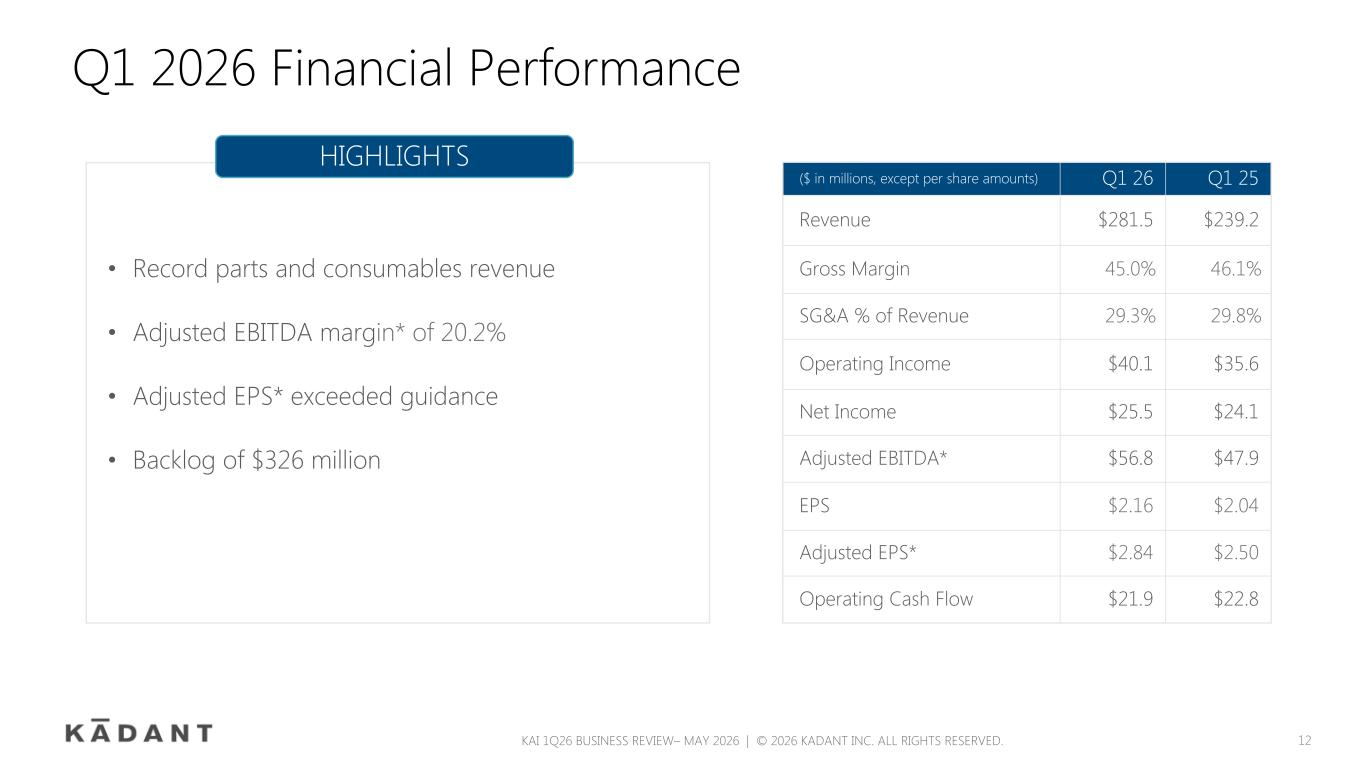
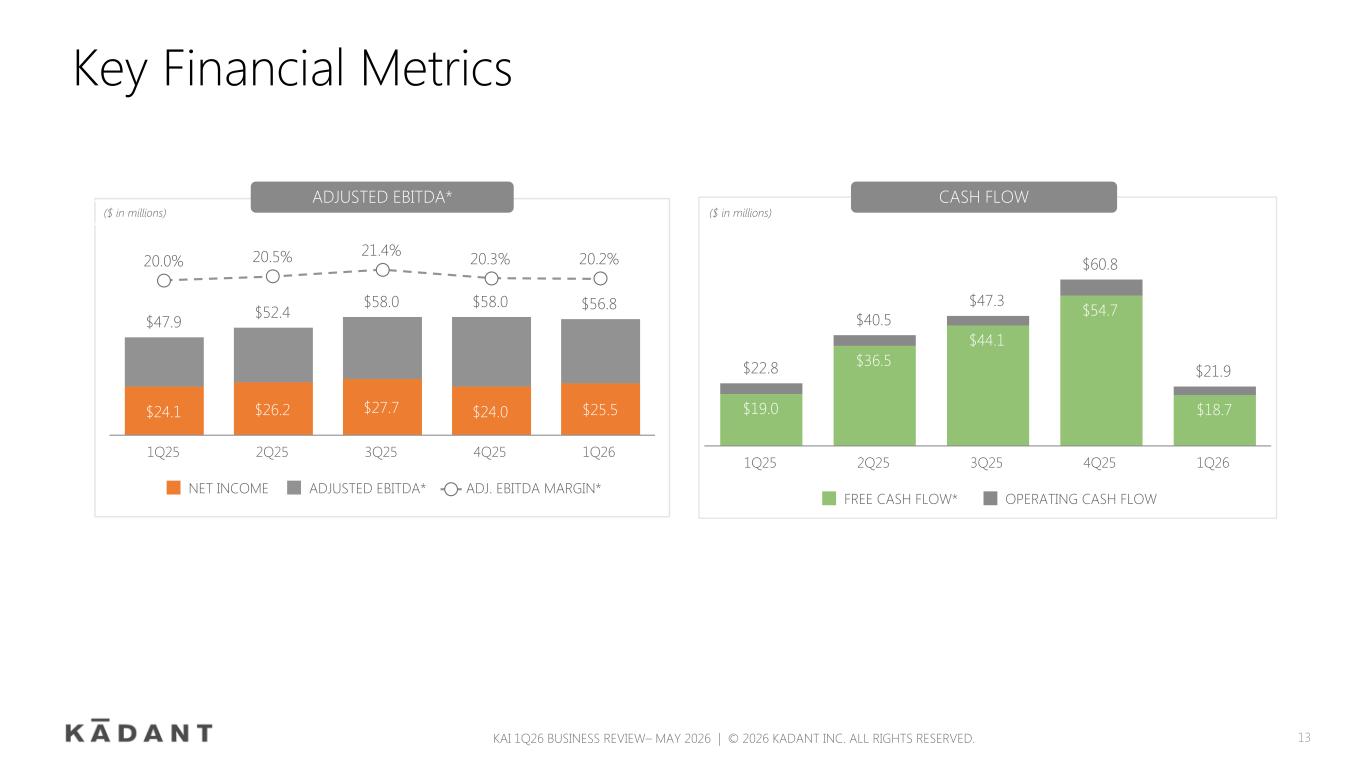
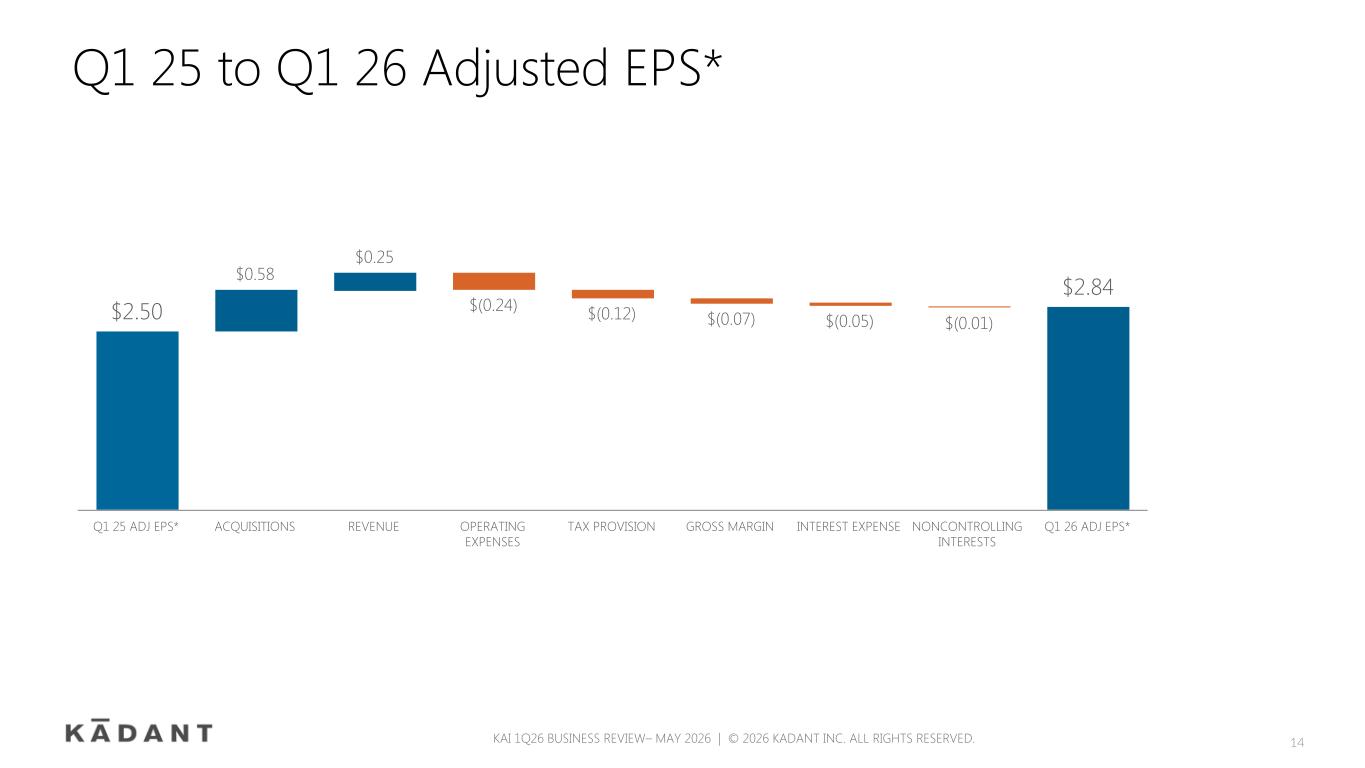
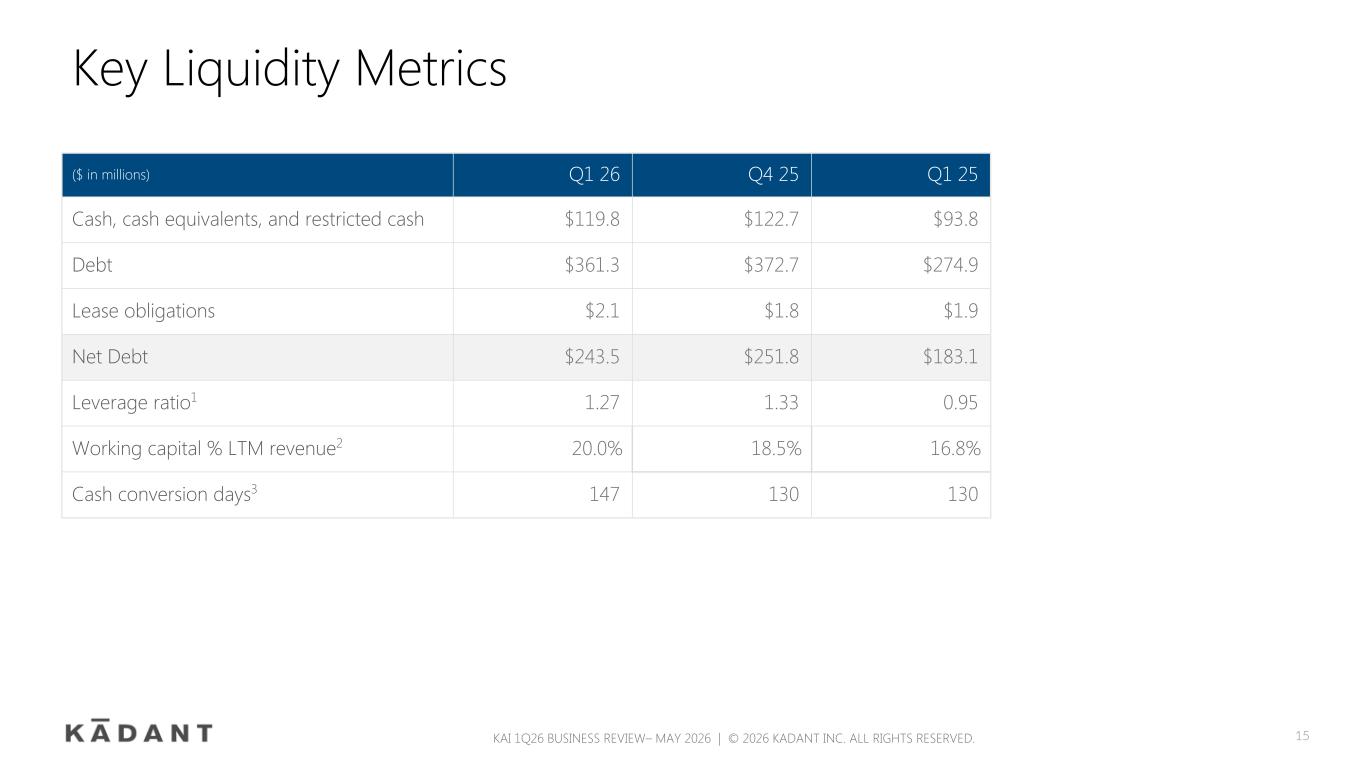
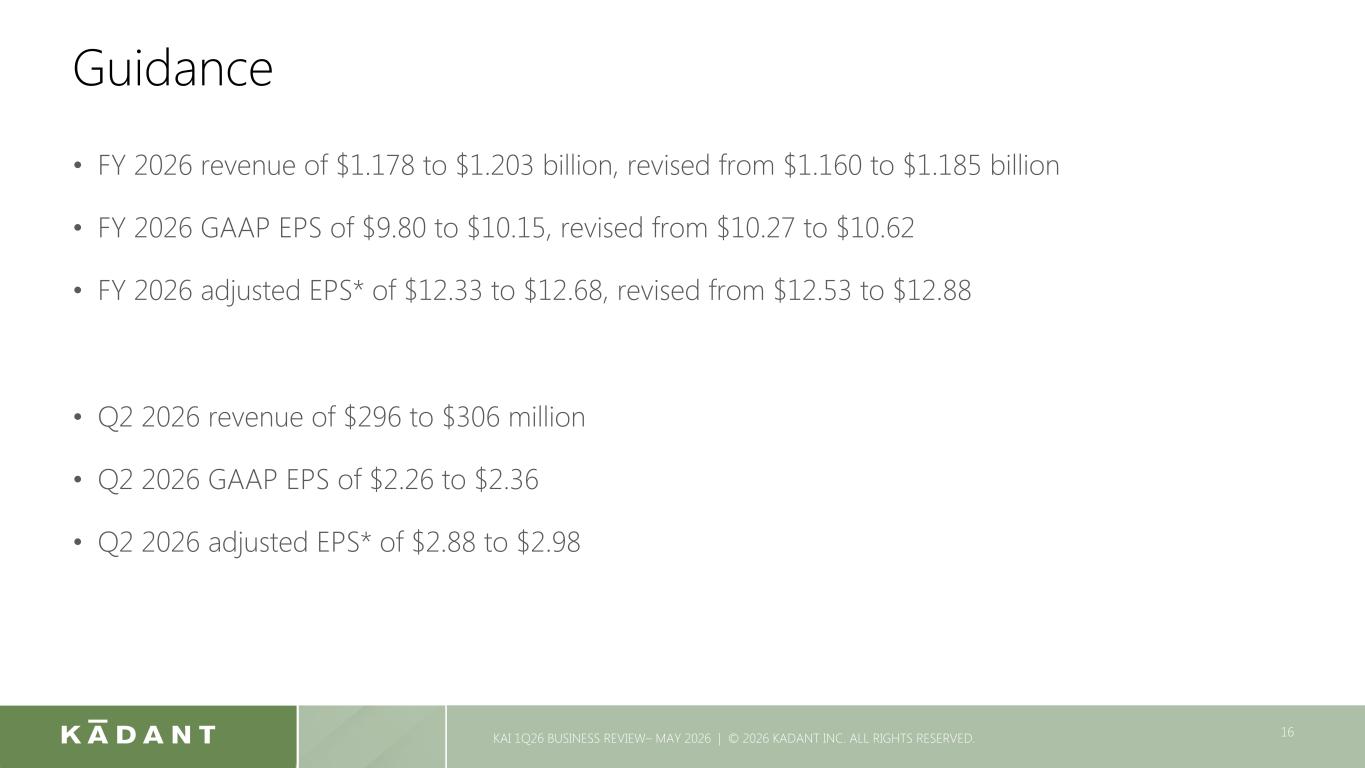
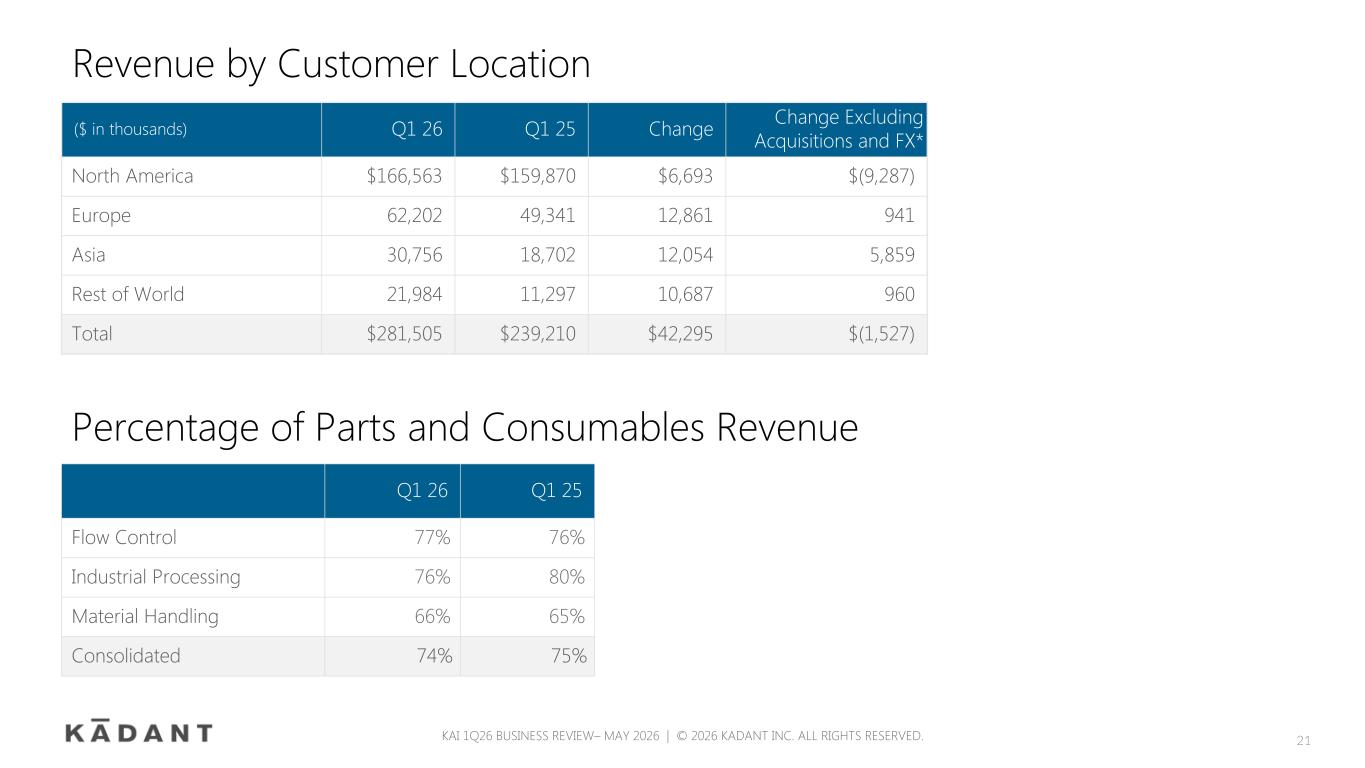
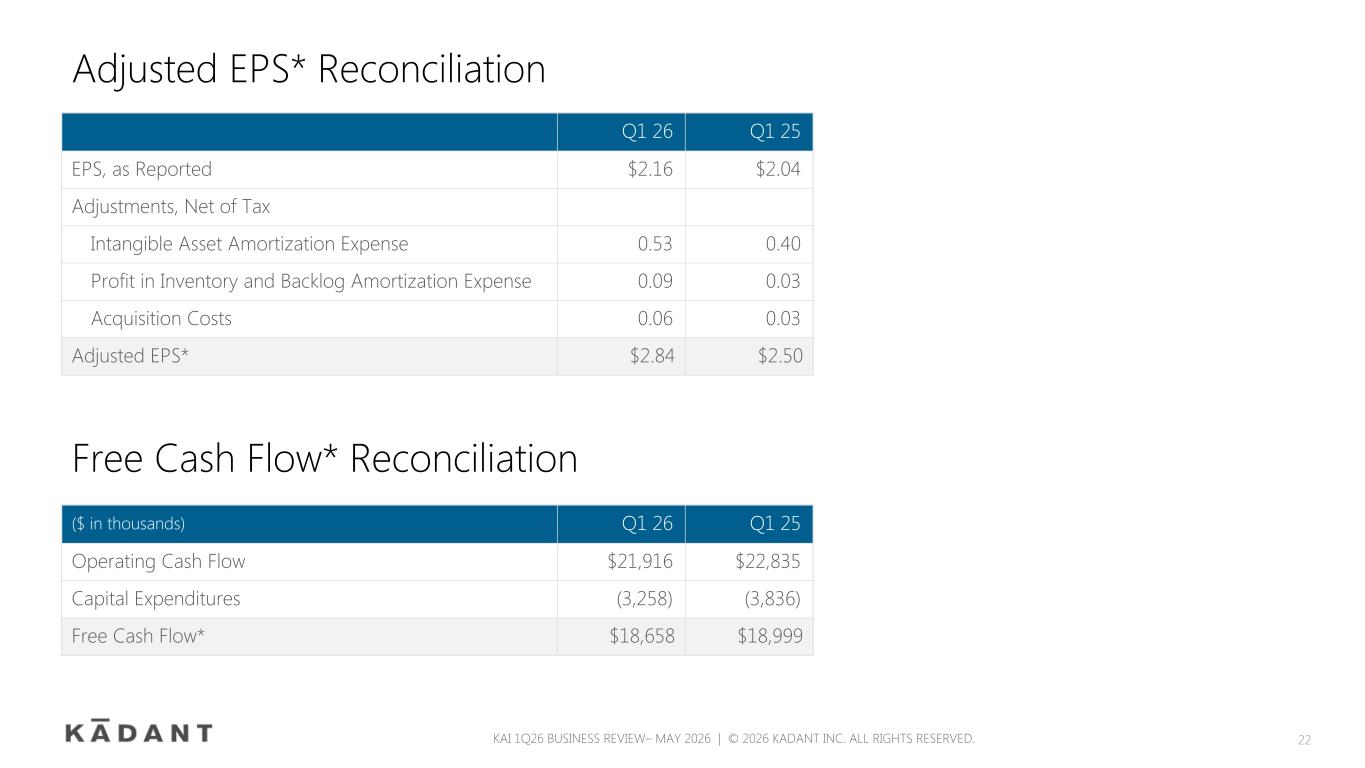
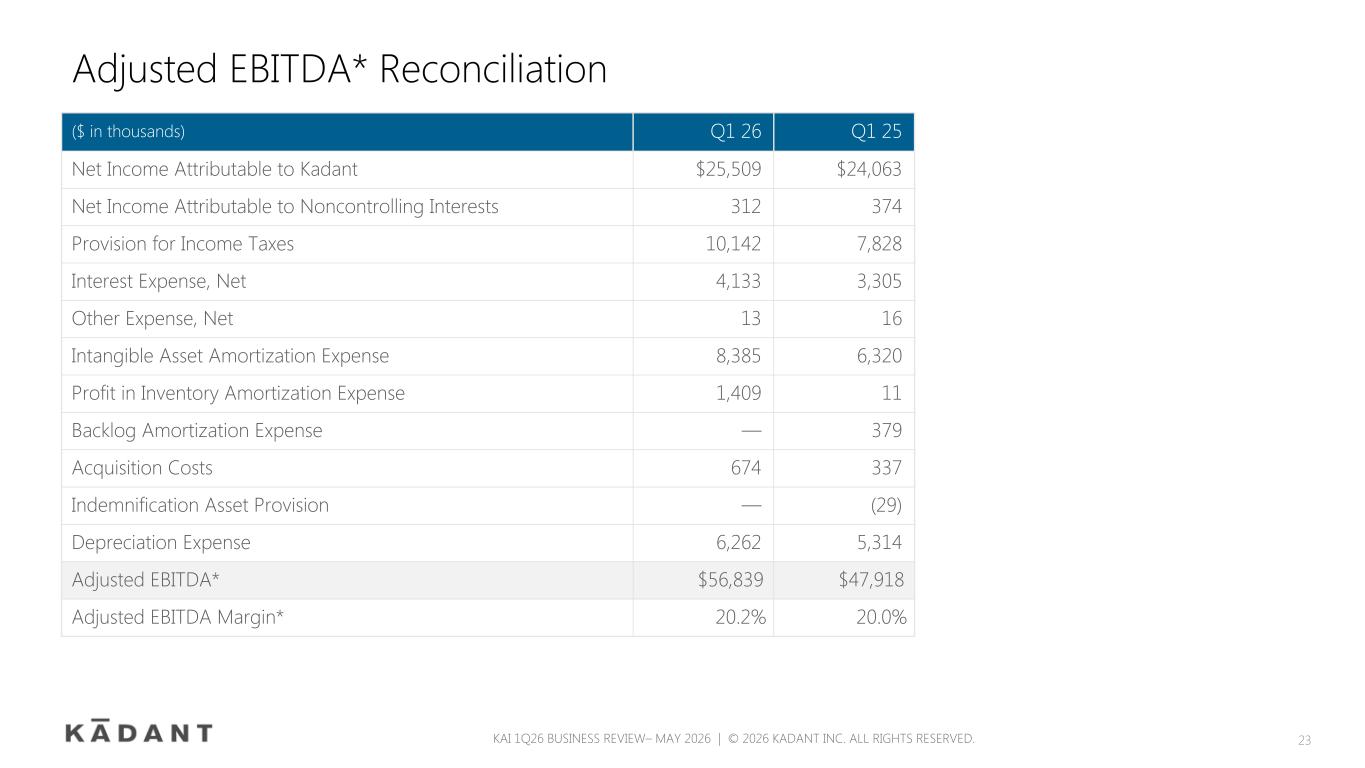
Thank you, Jeff. I'll start with some key financial metrics from our first quarter. Revenue increased 18% to $281.5 million in the first quarter of 2016, driven by record parts and consumables revenue, representing 74% of total revenue. Gross margin was 45% in the first quarter of 26, down 110 basis points, compared to 46.1% in the first quarter of 25. About half of this decrease relates to the negative effect of acquired profit and inventory amortization, which lowered gross margin in the first quarter of 26 by 50 basis points. The remaining decrease was due to the lower gross margin profile associated with the product mix in the quarter. SG&A expenses as a percentage of revenue decreased to 29.3% in the first quarter of 26 compared to 29.8% in the prior year period. SG&A expenses increased 11.3 million, or 16%, to 82.5 million in the first quarter of 26, compared to 71.2 million in the first quarter of 25. This included an increase of 7.9 million from our acquisitions and a 2.8 million unfavorable foreign currency translation effect. Our effective tax rate in the first quarter was 28.2% compared to 24.3% in the prior year period. The comparatively higher tax rate was due to discrete tax benefits related to the release of tax reserves and vesting of equity awards in the first quarter of 2025, which lowered the effective tax rate by 320 basis points. Our GAAP EPS increased 6% to $2.16 in the first quarter, and our adjusted EPS increased 14% to $2.84, which exceeded the high end of our guidance range by $0.43. As a reminder, we announced on our last earnings call that our adjusted EPS now excludes non-cash intangible amortization expense. The $0.43 guidance beat was due to higher gross margins and lower operating expenses than anticipated. Adjusted EBITDA increased 19% to $56.8 million compared to $47.9 million in the first quarter of 2025, principally due to strong contributions from our 2025 acquisitions. As a percentage of revenue, adjusted EBITDA was 20.2% compared to 20% in the first quarter of 25. Operating cash flow was $21.9 million, and free cash flow was $18.7 million in the first quarter of 26. Both were down slightly compared to the first quarter of 25. Our first quarter tends to be the weakest cash flow quarter, as was the case in 25. Other non-operating uses of cash in the first quarter of 2016 included $9.8 million of repayments on our debt, $3.3 million for capital expenditures, $4 million for dividends on our common stock, and $4.9 million for tax withholding payments related to the vesting of stock awards. Let me turn next to our EPS results for the quarter. Our adjusted EPS increased $0.34 from $2.50 in the first quarter of 25 to $2.84 in the first quarter of 26. This included increases of $0.58 from our acquisitions and $0.25 due to higher revenue. These increases were offset by decreases of $0.24 due to higher operating expenses, $0.12 due to a higher tax rate, $0.07 due to a lower gross margin percentage, $0.05 due to higher interest expense, and $0.01 due to higher non-controlling interest expense. Let me provide some further details on these fluctuations. The $0.58 increase from our acquisitions represents the operating results of our 2025 acquisitions, excluding associated borrowing costs and acquisition-related costs, as well as recurring intangible amortization expense of $0.13. The majority of the $0.24 impact from higher operating expenses is due to an unfavorable foreign currency translation effect. Collectively, included in all the categories I just mentioned was a favorable foreign currency translation effect of $0.08 in the first quarter of 2016 compared to the first quarter of last year. Looking at our liquidity metrics on slide 15, our cash conversion days increased to $147 at the end of the first quarter of 2016 compared to $130 at the end of 2025, principally due to a higher number of days in inventory as our operations work to fulfill orders and backlog. Working capital as a percentage of revenue increased to 20% in the first quarter of 26 compared to 16.8% in the first quarter of 25 due to the lack of a full year of revenue from our 2025 acquisitions. If you exclude the impact of our 2025 acquisitions from this calculation, it would be 17.4%, which is slightly above the first quarter of 25. Our net debt, that is debtless cash, decreased $8 million sequentially to $244 million at the end of the first quarter of 26. Our leverage ratio, calculated in accordance with our credit agreement, decreased to 1.27 at the end of the first quarter of 26 compared to 1.33 at the end of 25. At the end of April, we borrowed 155 million euros to fund our acquisition and as a result, we anticipate that our leverage ratio will increase to just below 2 next quarter. After deducting our acquisition borrowing, we have approximately 210 million of borrowing capacity available under our revolving credit facility and an additional 200 million of uncommitted borrowing capacity. As we anticipated, we had an increase in capital bookings in the first quarter. Our book-to-bill ratio increased to 1.14, a three-year high due to record aftermarket parts and a strong uptick in capital bookings. Our ending backlog was up 13% sequentially to $326 million. That being said, we remain cautious with our outlook for capital project activity in 26. While some pending capital projects have moved forward, given some easing of earlier tariff-related uncertainty, the timing for other capital projects may be impacted by the current macroeconomic and geopolitical tensions. This environment has made it extremely difficult for our operations to forecast the timing of capital orders, requiring significant judgment on order timing and future material costs. As Jeff mentioned in his remarks, we completed our acquisition of Will Subpoena Bowler Profile, which we now call Cadent Profile, on April 30th. We have now incorporated the operating results for this business into our updated 2026 guidance. I want to outline how the financial results of this acquisition will be reflected in Cadence financial statements. This company has been a long-time supplier to several Cadence businesses, and as a result, a significant portion of its revenue, which was 45% for the last fiscal year, will be intercompany revenue and therefore not included in Cadence reported revenue. The associated profit generated on this intercompany activity will be reflected in Cadence results, but the timing will depend on when the underlying product is sold to a third-party customer. In addition, our cadence businesses currently have on-hand inventory that will need to be consumed. For now, we have taken a conservative approach and have not included any profit for the intercompany sales as we estimate it may take the remainder of the year to work through the current on-hand inventory. Therefore, the only change to our guidance is the inclusion of Cadent Profile's external revenue and its operating results, as well as the associated borrowing costs. We estimate Cadent Profile, including the associated borrowing costs, will be dilutive to our adjusted EPS results by 20 cents in 2026. Of course, if current on-hand inventory turns faster than expected, there could be some upside potential for 2026. We are raising our revenue guidance for 26 to $1,178,000,000 to $1,203,000,000. Revised from our previous guidance of $1,160,000,000 to $1,185,000,000. We now expect adjusted EPS of $12.33 to $12.68 in 26, which excludes $2.20 of intangible amortization expense and $0.33 of acquisition-related costs. This is revised from our previous guidance of $12.53 to $12.88, which excluded $2.13 of intangible amortization expense and $0.13 cents of acquisition-related costs. Looking at our quarterly revenue and EPS performance in 26, we expect that the first quarter will be the weakest quarter of the year. Again, I want to stress the only guidance change is related to adding the forecasted results for Cadent Profil and the associated borrowing costs. Our revenue guidance for the second quarter of 26 is $296 to $306 million, and our adjusted EPS guidance for the second quarter is $2.88 to $2.98, which excludes $0.55 of intangible amortization expense and $0.07 of acquisition-related costs. Our revised 26 guidance includes the following assumptions. Gross margins of 44.5 to 45 percent. SG&A is a percent of revenue of 27.6 to 28.1 percent, net interest expense of $20 to $21 million, a tax rate of 27.5 to 28 percent, depreciation expense of $27 to $27.5 million, and intangible amortization expense, which we now add back to our adjusted EPS calculation, of $34.5 million. That concludes my review of the financials, and I will now turn the call back over to the operator for our Q&A session. Therese?
Operator
Thank you. At this time, we will conduct the question and answer session. As a reminder, to ask a question, you will need to press star 11 on your telephone and wait for your name to be announced. To withdraw your questions, please press star 11 again. Please stand by while we compile the Q&A roster. Our first question comes from Gary Prestopino with Barrington. Your line is open.
Good morning, Jeff and Mike. Hey, looking back on what you said at the end of Q4, you said there were, you know, several capital projects that you thought would come to the market, but you weren't really including them in any guidance or anything like that, just because of the uncertainty. I mean, I know you said it's still an uncertain environment, but has anything happened there in terms of the amount of projects that you still think will be coming to the market?
Great question, Gary. So, you know, we had several handful, I'd say seven to eight projects that we were monitoring of varying size that did not come in, that we thought may come in in 25 that didn't come in, but they're still alive and well here in 26. And in the first quarter, one of those projects came in. And I'm happy to tell you here that in the second quarter, an additional two of those projects have come in. So as Jeff and I have said in our little notes here, we see the capital activity warming up a little bit here now, which is nice to see.
Okay. That's very good news. And then just for purposes with the acquisition, I'm going to call it BBP because I can't pronounce this domain here. It looks like as of the last numbers you gave, 51.5 million euros, 15.6 million euros of adjusted EBITDA works out to about 60 million of annualized revenues, 18 million of EBITDA. Is that holding in terms of the profitability of the business? Do we see any growth from the time that, you know, you gave us that trailing 12-month September number for 25?
So, the profitability is holding, but when we did the forecast, we really looked at where they were so far in 26 and what they thought would happen for the remainder of 26. And so, it has stepped down a little bit. So that $60 million run rate that you quoted, I now have a $55 million. And I would say, you know, of that incremental decrease, we're a component of that. We are a component of it because what we're trying to do is, quite frankly, get through our on-hand inventory so that we can get to current inventory being purchased that is now intercompany and, you know, and we can recognize the profit on it. So we were a component of the reduction. Some is also external sales, but we stepped down our purchases because of our current inventory levels.
Okay, that's fine. And then this thing has 100% of aftermarket parts revenue, so it's basically recurring, right?
Operator
Okay, thank you. You're welcome. Thank you very much. Our next question is from Ross Berenbleck from William Blair. Your line is open.
Hey, good afternoon, gentlemen. Morning, Ross. Somewhat of a cautious tone this quarter from your European peers. It would be great to just kind of get a sense of what you're seeing by geography and also anything around just factory utilization rates globally as well.
Yeah, I would say, of course, North America, as it has been really for the last few years, is continuing to be in the strongest market. Asia was strong, I would say, in the first quarter. And as you pointed out, Europe, of course, is the most sensitive to what's going on in the Middle East and energy prices, in addition to all the other challenges they frankly have right now. So I think that we expect that will probably be the case probably for most of the year. that North America will be the strongest. And, you know, last year I would say Europe, you know, Asia was quite weak to begin with, and Europe was in the middle. But I think Asia and Europe have flipped a little bit now. And it really will depend on how quickly this conflict is resolved and what the ultimate terms are when it is resolved. If energy prices return back to normal, then I think Europe was positioned to try to start to make some investments. But, of course, this has really impacted them because they're so dependent on an external supply change for their energy production.
Okay. Have you seen, you know, factory utilizations start to tail off in Europe at the start of the year?
You know, I don't know that we've seen data. You know, this conflict's been going on now for several weeks. I'm not sure that we've seen hard data yet as to what that's doing, but it's definitely slow. You know, our European partners, you know, some of our European divisions are talking about, customers talking about, you know, delaying things again until they get a better picture on, you know, where energy prices are going to go. You know, a lot of our products, of course, the, you know, the payback calculation is very much driven by energy cost. So some spikes in energy sometimes can help our products. But, of course, when you have significant spikes, it really crushes overall demand, and we get impacted by that like everybody else. So I think we're going to keep a close eye on what happens to energy prices in this conflict in the Middle East. But Europe is definitely the most sensitive to it.
Okay. Well, if we take out the large project in the first quarter, it looks like capital bookings were still up 20% year over year, and they've been accelerating here. and your parts have been outperforming utilization rates for the last couple of years now. Just trying to get a sense of where you think kind of the run rate demand is and if we're starting to see the deferred maintenance start to flow, at least in the States.
Yeah, I mean, we've been saying for some time that our history would tell us that it's hard for our customers to go more than two or three years under-investing before it really starts to impact their operations. And so I think we're, you know, we've been tracking, you know, the age of our installed base, and some of it's quite old. And, you know, as you pointed out, the parts are really outperforming because of that. So, you know, we have expected that there will start to be an investment cycle. You know, a little bit of the issue we have, it seems like at the beginning of every year there's some black swan event that just creates uncertainty in the market. You know, last year it was, you know, the big tariff war. This year now it's a Middle East conflict. You know, it's just – and it just creates uncertainty and it slows things down. But they can only delay investing for so long before it starts to really impact their competitiveness. So, you know, we're encouraged by the orders we've gotten. I would say when Mike mentioned a lot of those large capital projects, most of them were outside of Europe. They weren't in Europe. I mean, there are a few that are in Europe, and we've gotten some actually from in Europe, you know, even this quarter. But a lot of the big ones are in North America or, I would say, North Africa, places like that, really outside of – certainly outside of Western Europe because they've been quite cautious for some time.
Yeah. Well, I mean, just also given all the M&A you guys have done in the last two years, can you help us maybe frame what this deferred maintenance spend should look like in the bookings? I mean, is it kind of a $100 million quarterly run rate?
Well, you know, Ross, if you look at the midpoint of our guidance on revenue, and if we had essentially the same split on parts capital, so $71, $29, we'd need about $340 million of capital revenue. You know, a capital revenue, so if you did that right out of the gate, you'd say $85 million a quarter. Capital revenue in the first quarter, of course, was softer, but we had good capital bookings, so the first quarter capital revenue was just $72 million. So that would say, okay, now that $85 million revenue needs to be about $90 million. And when we're looking forward, you know, the divisions are saying that they foresee capital bookings that will be, you know, above the $90 million mark. So, and I would add, I would kind of stitch in here, you know, the reason for our continued caution, and hopefully the geopolitical stuff will be settled here shortly and won't create any further disruptions, but, okay, we did have some of these capital projects that we were tracking we thought would come in at 25. Now some have come in. Projects that we had slated for 26, a couple projects already have been moved to 27. And specifically, those movements were related to the war. So that's why we're being a little cautious here on the guidance front. So I'm hopeful that we'll continue on the track we're on and we'll get to the end of the second quarter and we'll have enough confidence to raise guidance.
Yeah, I mean, it looks like we're turning the right direction after some headaches. Just on the capital backlog on the equipment side, I have, like, 193. Is that ballpark? I know that, you know, subjects have changed with FX.
Yeah. Hang in there. Actually, sorry, Ross. One second.
I do have that right here.
Yeah, so backlog was 321, and you're spot on. it's 193 capital. So, nice work there.
Good quarter, guys. I'll pass it along. Thank you.
Operator
Thank you. As a reminder to ask a question, you need to press star 11 on your telephone and wait for your name to be announced. Our next question is from Addie Maiden from DA Davidson. Your line is open.
Hey, thanks for taking my questions, guys. And just a couple of quick ones from me. So, looking at your FY26 sales outlook, does it still contemplate roughly like 1% to 3% organic sales growth? And can you remind us how that splits out between capital equipment and P&C?
Yeah, hang in there, Eddie. I'll flip to that. So, on the sales side, yeah, you're right in the ballpark there. At our midpoint, I have us at 2%. So, you know, right in the middle of the 1% to 3%. And then what was the second part of the question, Eddie, on the split? I have that as being, yeah, I have it being, you know, 71 parts and consumables, 29 capital.
And looking at like P&C, obviously like slightly lower year over year, was there any like one or two big factors that were like contributed to this? And is there anything that would let you be concerned around this, maybe the lower contribution?
Well, Addy, I'm not sure. I tried to read through the pre-call report this morning, which I thought was relatively on track except for one item. But I can tell you on the parts and consumables front, either – now, are you looking revenue or bookings there?
Mainly revenue, but yeah, if you talk about bookings too.
Because they're up. It's up all in and it's up organically for both revenue and bookings. So I'm not sure, you know, there might have been just a little misstep. I think the only place you might get to organic being negative or excuse me, either being negative is on organic or you wouldn't, of course, come anywhere near that on the all in. And it's, you know, there are huge upticks. But when I go to the organic, you know, we're in good shape on that also.
Got it. I think our report mainly talks about like the 74% versus 75% last year.
Yeah. Yeah, I have, you know, I would grant you organic on the parts and consumables front for revenue is, you know, is only up modestly, you know, on that revenue front. And on the bookings front, it's up 4%.
Okay. Got it. Yeah, thank you for the call. I appreciate it.
Operator
Thank you. If you have any questions, please press star 11 on your telephone and wait for your name to be announced. One moment. And I'm showing no further questions at this time, so I would now like to turn it back to Jeff Powell for closing remarks.
Thank you, Therese. So before wrapping up the call today, I just wanted to leave you with a couple of takeaways. A record-setting newer activity and strong demand for aftermarket parts provides a solid start to 2026. While there are a lot of discussions around new capital projects, the time in these projects is more uncertain than normal due to the issues that we've noted today. Our employees around the globe continue to focus on meeting our customers' needs and finding new ways to deliver long-term value to our stockholders. I want to thank you for joining the call today and we look forward to updating you at the end of next quarter. Thank you.
Operator
Thank you for your participation in today's conference. This does conclude the program. You may disconnect.