Operator
Good afternoon. My name is Aaron, and I'll be your conference operator today. At this time, I would like to welcome everyone to the Knights with Transportation First Quarter 2025 earnings call. All lines have been placed on mute to prevent any background noise. If at any time during this call you require immediate assistance, please press star zero for the operator. Speakers from today's call will be Adam Miller, Chief Executive Officer, Andrew Heff, Chief Financial Officer, Brad Stewart, Treasurer and Senior VP of Investor Relations. Mr. Stewart, the meeting is now yours.
Good afternoon, everyone, and thank you for joining our first quarter 2025 earnings call. Today, we plan to discuss topics related to the results of the quarter, current market conditions and our earnings guidance we have slides to accompany this call which are posted on our investor website our call is scheduled to last one hour following our commentary we will answer questions related to these topics in order to get to as many participants as possible we limit the questions to one per participant if you have a second question please feel free to get back in the queue we will answer as many questions as time allows if we are not able to get to your question due to time restrictions you may call 602-606-6349 to begin i will first refer you to the disclosures on slide two of the presentation and note the following this conference call and presentation may contain forward-looking statements made by the company that involve risks assumptions and uncertainties that are difficult to predict investors are directed to the information contained in Item 1A, Risk Factors, or Part 1 of the company's annual report on Form 10-K, filed with the United States Securities and Exchange Commission, for a discussion of the risks that may affect the company's future operating results. Actual results may differ. Before we get into the slides, I will hand the call over to Adam for some opening remarks.
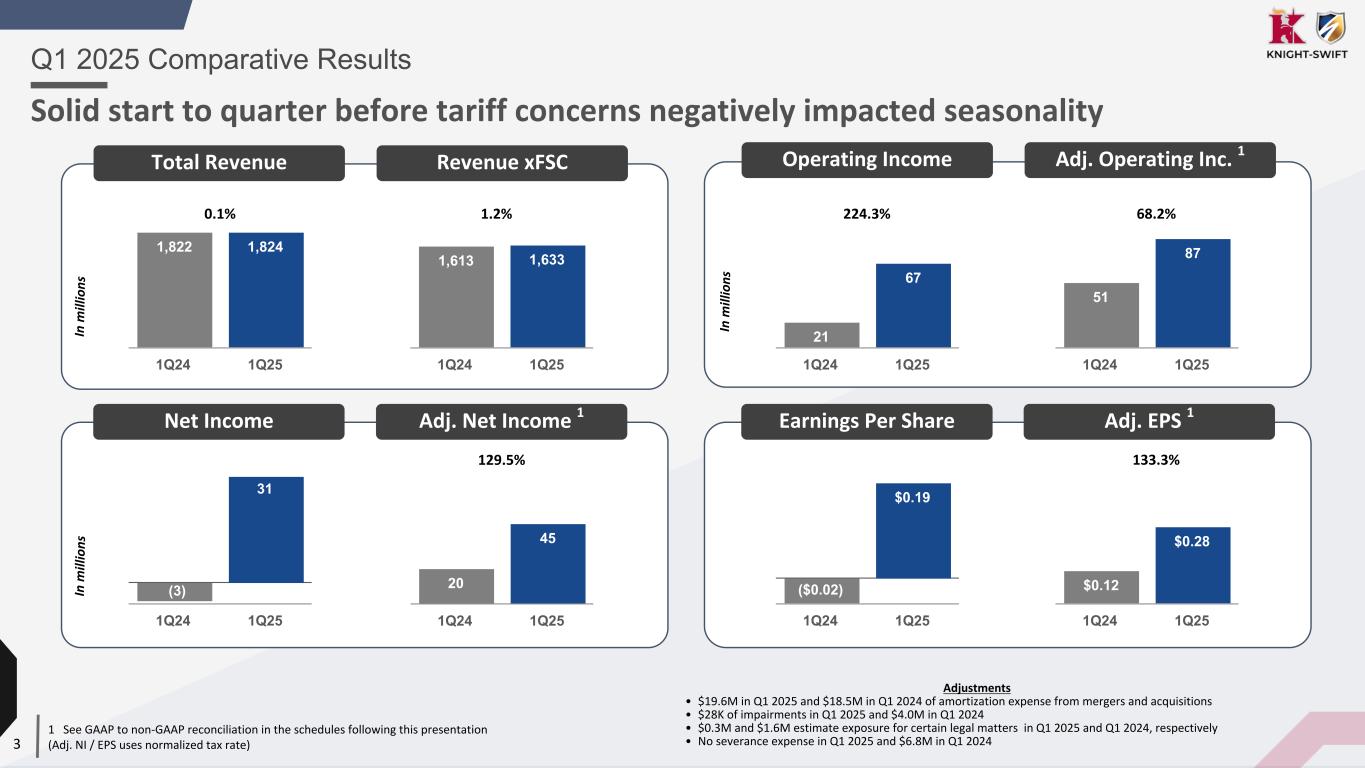
Thanks, Brad, and good afternoon, everyone. You know, with all the uncertainty in the market, I thought it would make sense to maybe open up the call with some high-level remarks regarding the first quarter as well as the current market, and then I'll turn it over to Brad and Andrew to cover the remaining slides. Here to kick it off, early in the first quarter, several indicators, both internal and external, were pointing to positive momentum in the truckload market. Our early bid season results were positive and volumes remained healthy following the fourth quarter. In February, severe weather in areas of the country not well positioned to handle snow and ice contributed to a slowdown in volumes. We were expecting a nice seasonal volume rebound in March. However, talks of tariffs and the fluid trade policy spurred more cautious tone among shippers that brought a pause to the momentum in the market. The increased uncertainty among shippers and growing concern among consumers resulted in lower volumes and an absence of the typical seasonal build in March. This has also impacted current rate negotiations in the truckload bid season. We are still achieving increases in the low- to mid-single-digit percentage range. However, we are not seeing the increases build like we had originally anticipated the bid environment would play out. Further, the progress we are making on contractual rates may not be as visible in our second quarter overall realized revenue per mile if the market experiences a low in volumes and the spot market remains weak. We are staying close with our customers as the situation unfolds, and they are generally expressing a few different approaches at this point. Some are pressing forward with little change, needing product as they see strength in their underlying sales. Some have already cut back or are in the process of cutting back on purchases, mostly centered around China, while still others are in wait-and-see mode, where they're drawing down inventory to support sales in the near term. At this point, our customers are expressing more concern around cost impacts of tariffs and less concern regarding demand from their customers. These strategies can create negative disruptions in volume in the near term. However, if consumer spending remains steady, goods will have to move at some point, and that may create opportunities for carriers that are proven to be nimble with scale, like many of our Knight Swift truckload brands. We recognize our customers' plans can change as clarity develops, so we are focused on controlling what we can control. For example, we are tightening our equipment fleet by selling underutilized tractors and trailers that will lead to lower depreciation and greater utilization of our remaining assets. We are also investing in new technology and raising the intensity around our safety and claims and reducing overhead costs. We need to have the most efficient cost structure possible in order to be prepared for what could be a volatile environment in the near term. With all that being said, during the first half of April, market conditions have largely been stable with where we exited the first quarter, but there is a wide range of possible paths forward from here. There could be a lull in volumes as shippers work to adjust supply chains, or there could be a pull forward in anticipation of a return of reciprocal tariffs. changes in trade policy could create the need for shippers to react quickly in managing inventory levels which could benefit the fast flexible nature of truckload service on the other hand concerns of recession risks could cause shippers to trim inventories and to aggressively prioritize the lowest short-term cost over all other factors in light of the unusual uncertainty we feel we we must adjust our approach to providing near-term earnings guidance. Starting with this report, we are updating our guidance for the second quarter and will hold off on introducing guidance for the third quarter until enough clarity develops to support a return to two quarters of forward guidance. Business conditions for the second quarter are also uncertain enough that we are providing a wider range than our normal practice and with risk appearing skewed to the downside in the near term, we are taking a somewhat more conservative approach as well. Even in an uncertain environment, we continue to improve on costs and collaboration across our truckload segment and grow our volumes and network in our LTL segment, opening seven more locations during the quarter and building to 30% growth in daily shipments year over year in March. The LTL industry is not immune to the wait-and-see attitude dampening freight demand, but we are not expecting the same potential for volatility in LTL demand in the second quarter as we do for truckload. Also, our significant LTL network expansion over the past year positions us for differentiated growth. We are confident that our experienced team, leadership alignment across our businesses strong balance sheet and our unique scale diversified offerings and value proposition will serve us well as we navigate the unfolding landscape and with that i will turn it over to brad for our overview on slide three thanks the charts on slide three compare our consolidated first quarter revenue and earnings results on a year-over-year basis revenue excluding fuel surcharge increased by 1.2% and our adjusted operating income improved by 68.2% or $35.1 million year-over-year.
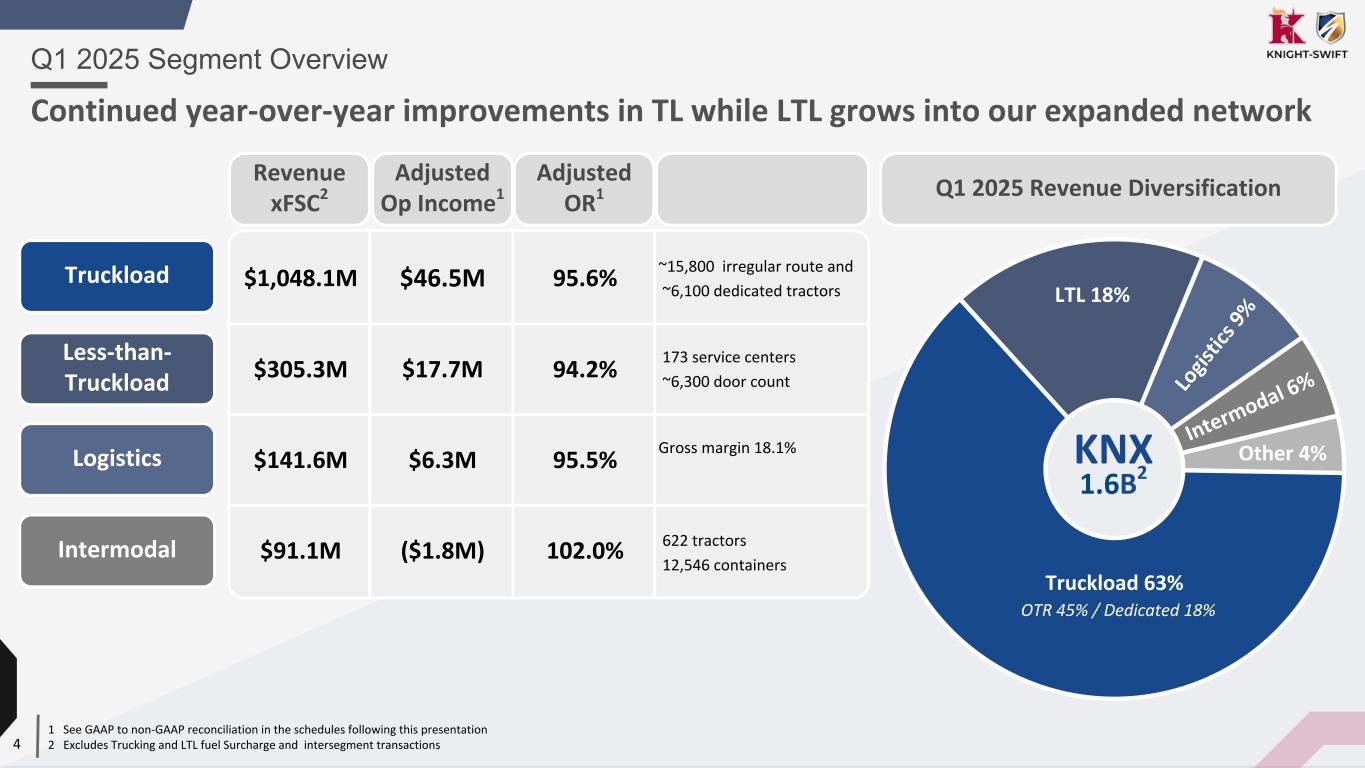
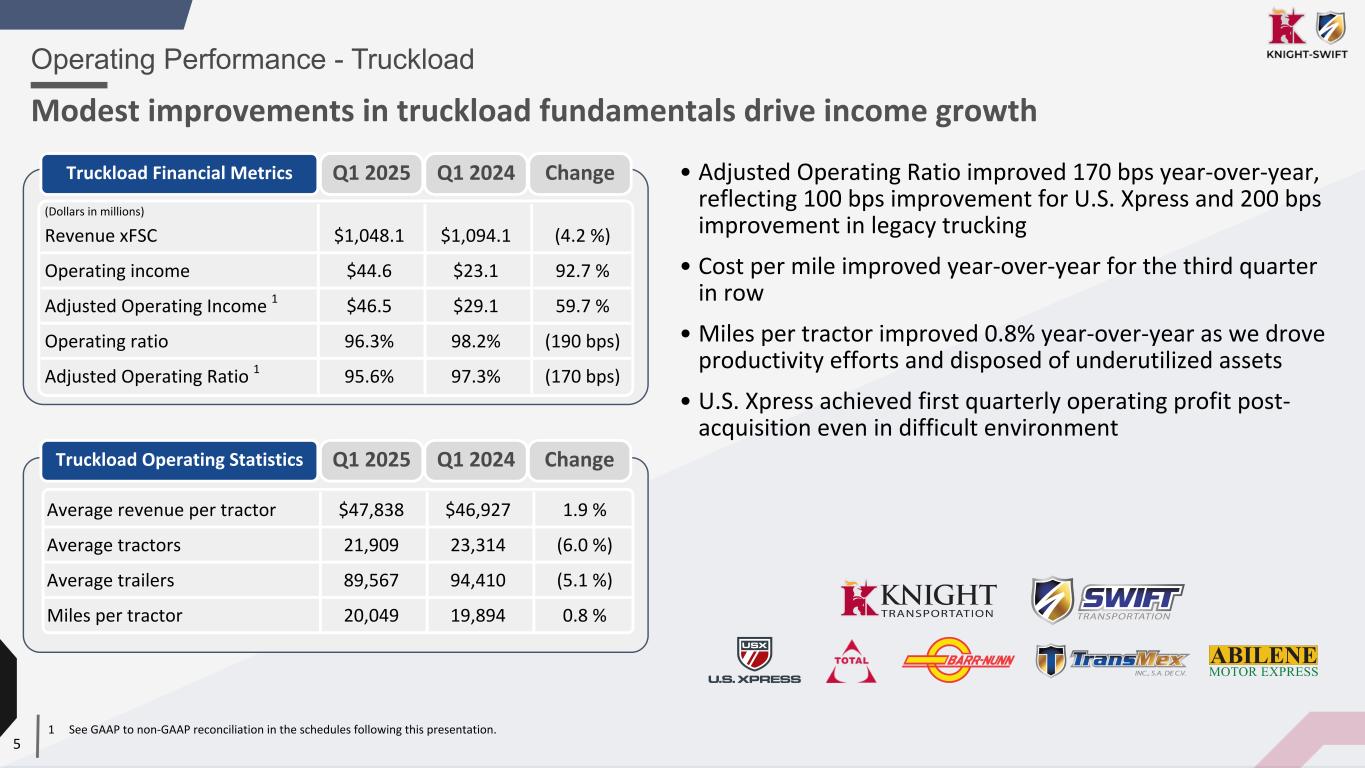
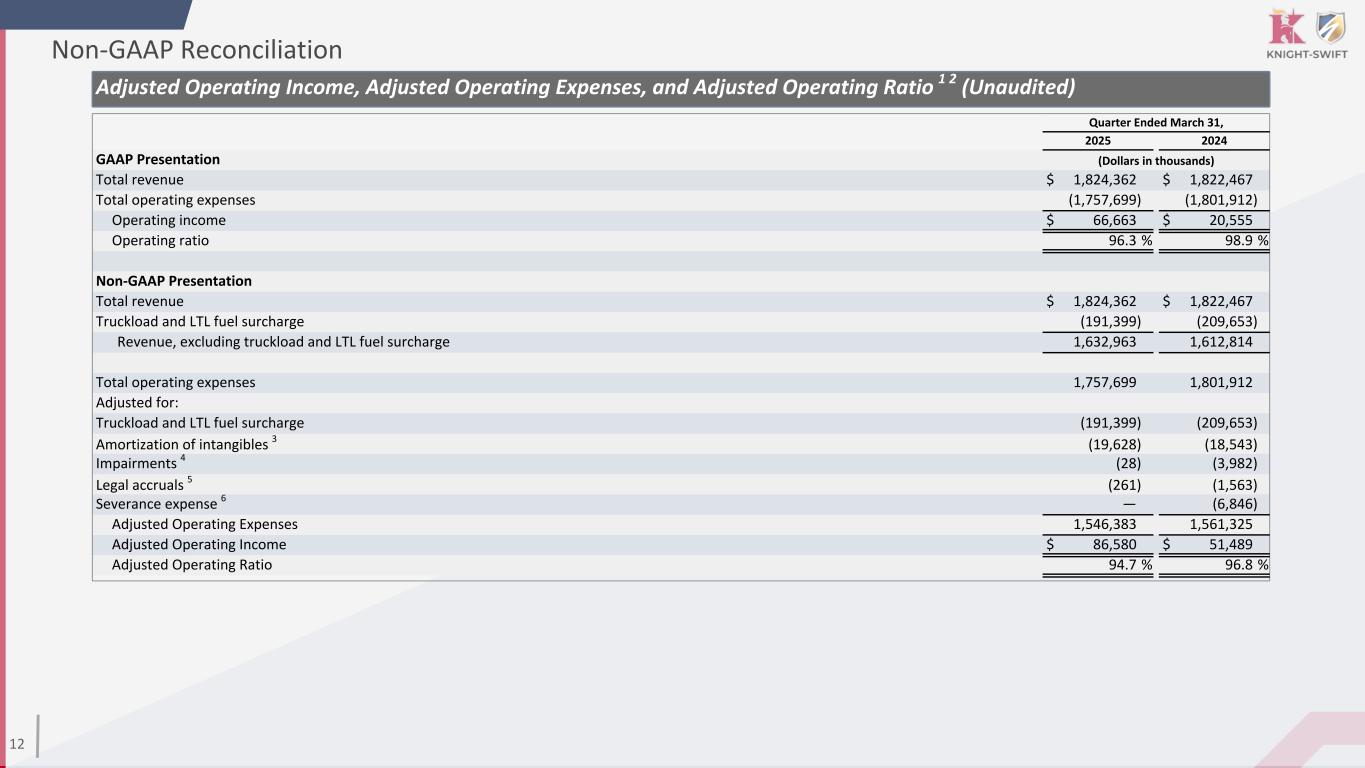
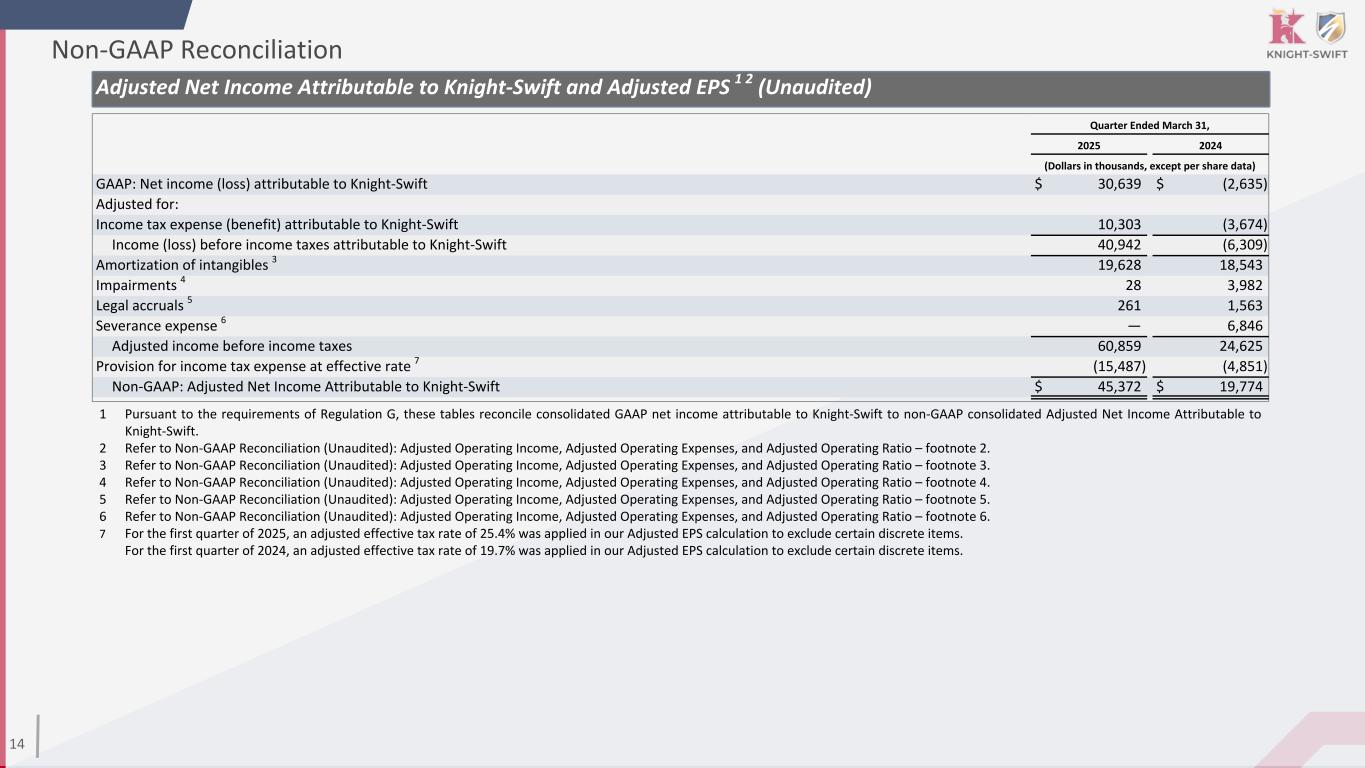
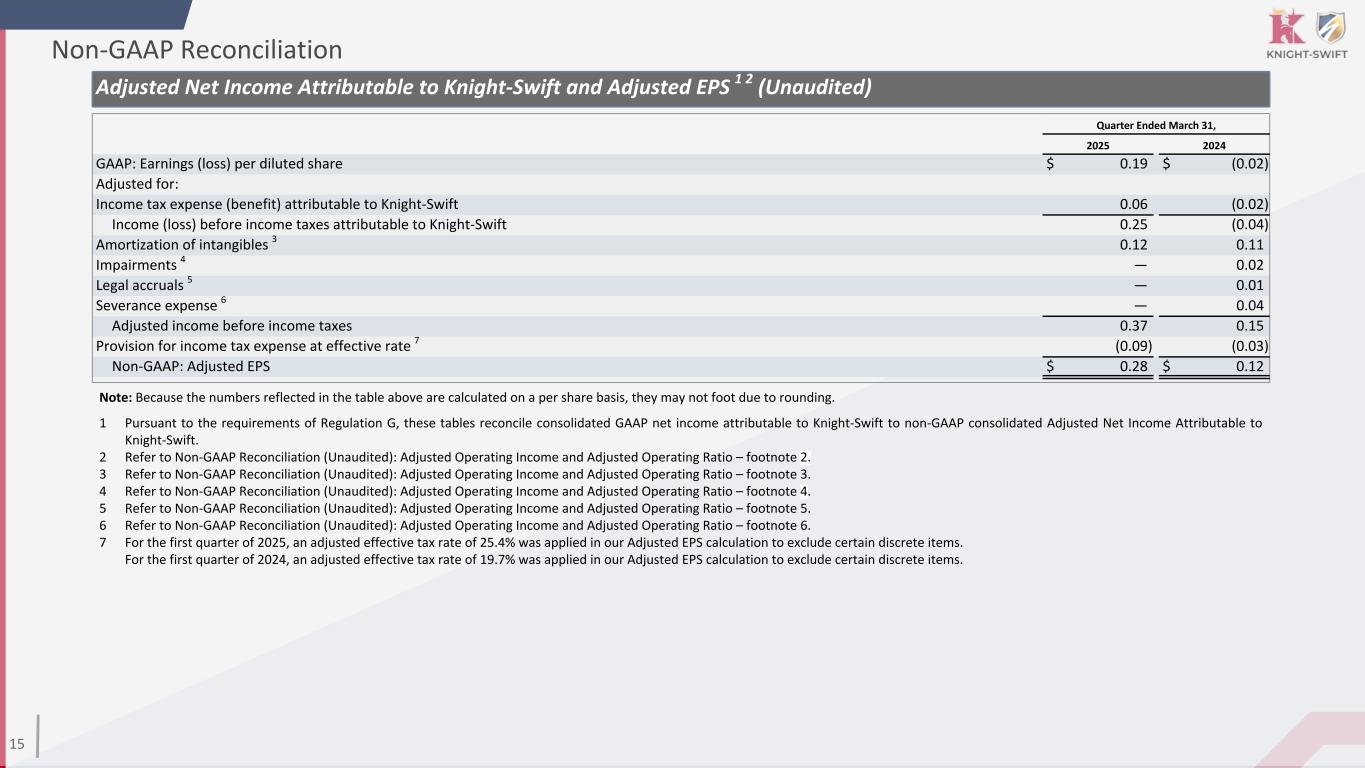
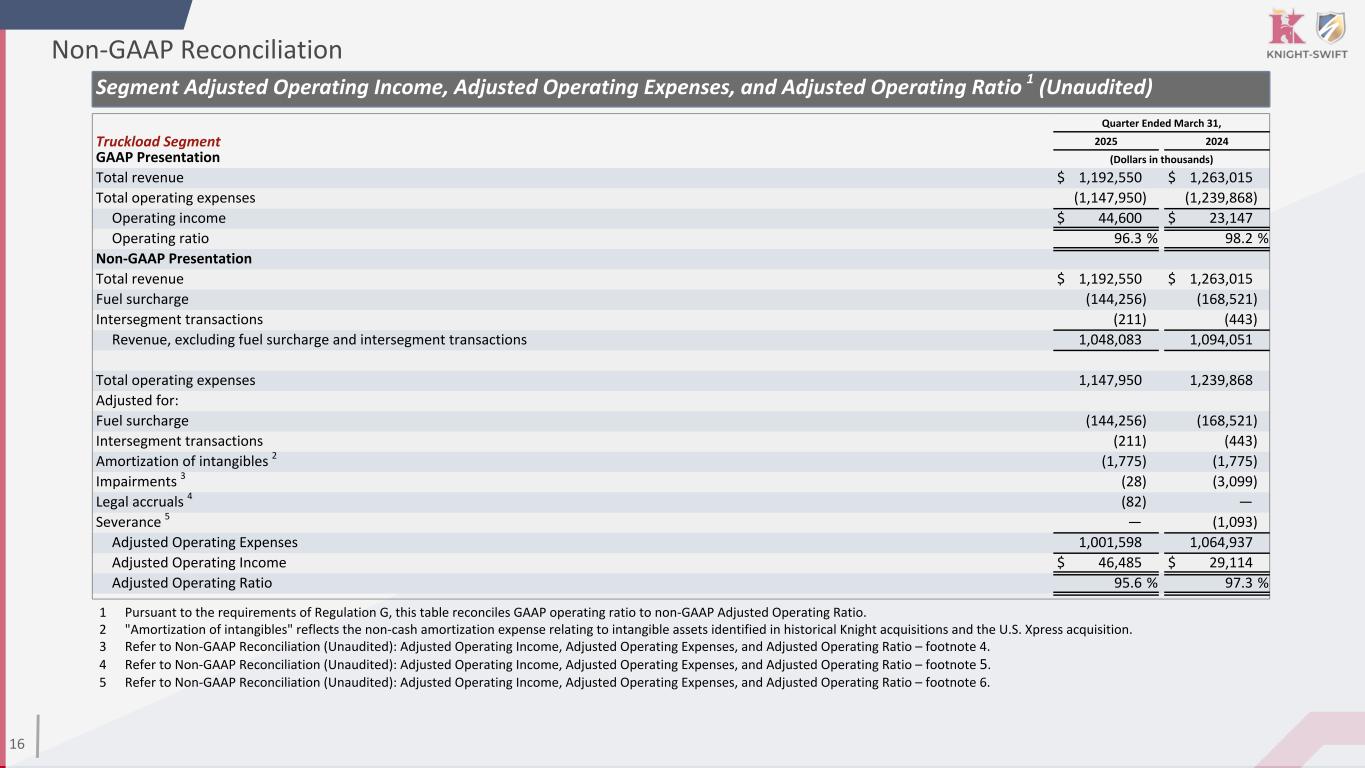
Gap earnings per diluted share for the first quarter of 2025 were $0.19 and our adjusted EPS was $0.28. Our consolidated adjusted operating ratio was 94.7%, which was 210 basis points better prior year. Slide 4 illustrates the revenue and adjusted operating income for each of our segments for the quarter overall our truckload logistics and intermodal segments all improved adjusted operating income and adjusted operating ratio year over year while our ongoing growth in our lto business is driving a growing portion of our consolidated revenue net reaching its highest share since our entry into this segment in 2021 the first quarter continued to show the benefits of our diversified business model as the seasonal pickup in our warehousing business helped to partially offset the early weather challenges and lack of seasonality late in the quarter in our truckload business. Now we will discuss our truckload segment on slide five. On a year-over-year basis, our truckload revenue excluding fuel surcharge for the first quarter decreased 4.2%, driven by a 5.4% decline in loaded miles, partially offset by a 1.5% increase in revenue per loaded mile excluding field surcharge. This was the first year-over-year increase in revenue-perluted mile in 10 quarters, which was achieved despite the spot market softening through the back half of the quarter. The improvement in realized rate, combined with a slight improvement in miles per tractor, drove a 1.9% year-over-year improvement in revenue excluding field surcharge per tractor. The improvement in utilization marks seven consecutive quarters of year-over-year gains in this metric as we have pushed to improve productivity and sell underutilized assets. As noted earlier, in March, we decided to tighten up our tractor fleet a little further alongside ongoing trailer ratio reductions in order to reduce operating costs over the next few quarters, but without going so far as to sacrifice our ability to respond to opportunities in the marketplace. Our cost per mile for the first quarter improved year-over-year for the third quarter in a row despite the decline in miles. Modest improvements in asset utilization, cost per mile, and revenue per mile led to a 170 basis point year-over-year improvement in adjusted operating ratio and a 59.7% increase in adjusted operating income, even while revenue declined. We are pleased with the progress in the U.S. Express truckload business, which even in a difficult environment reached a quarterly operating profit for the first time since our July 2023 acquisition. We are committed to disciplined pricing, intense cost control, and quality service as we position our business for the current volatility and for potential opportunities that may arise. Now we'll turn it over to Andrew for a discussion of our LTL business on slide six.
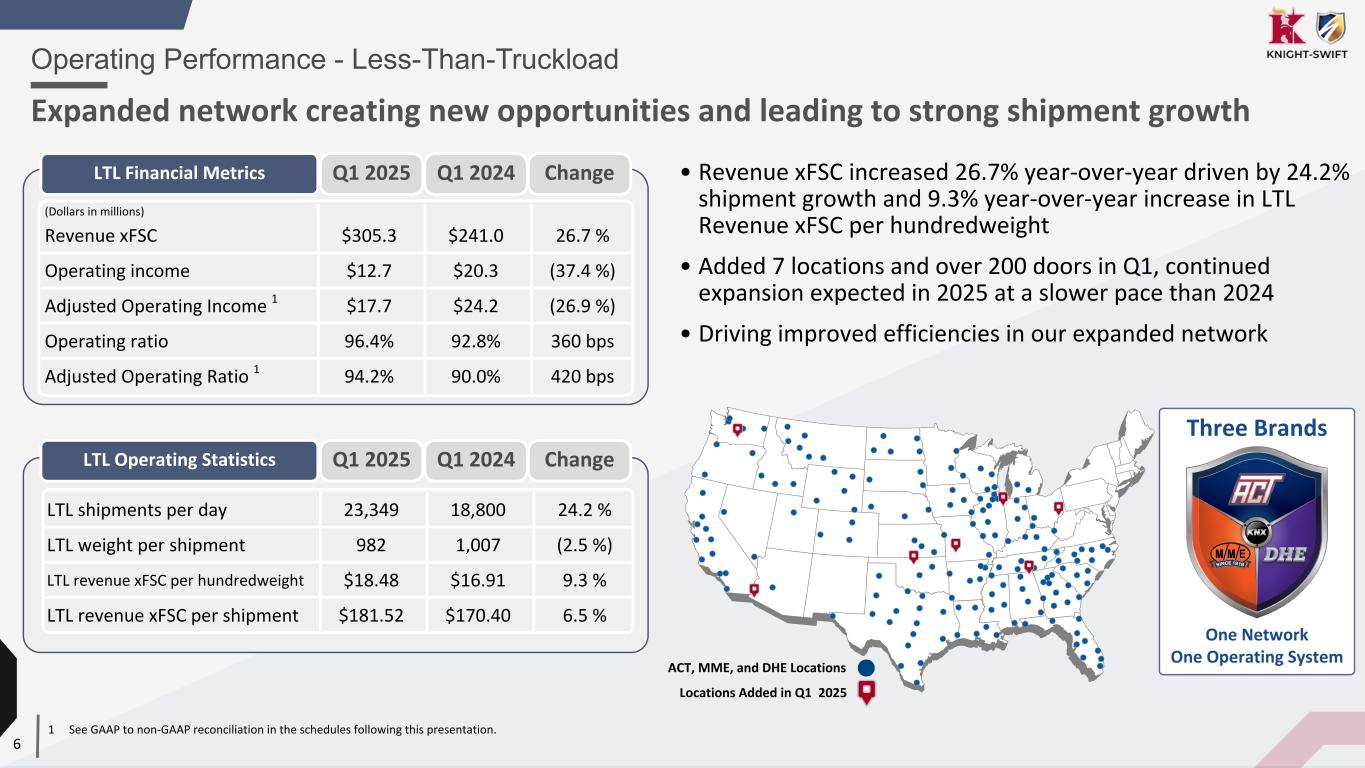
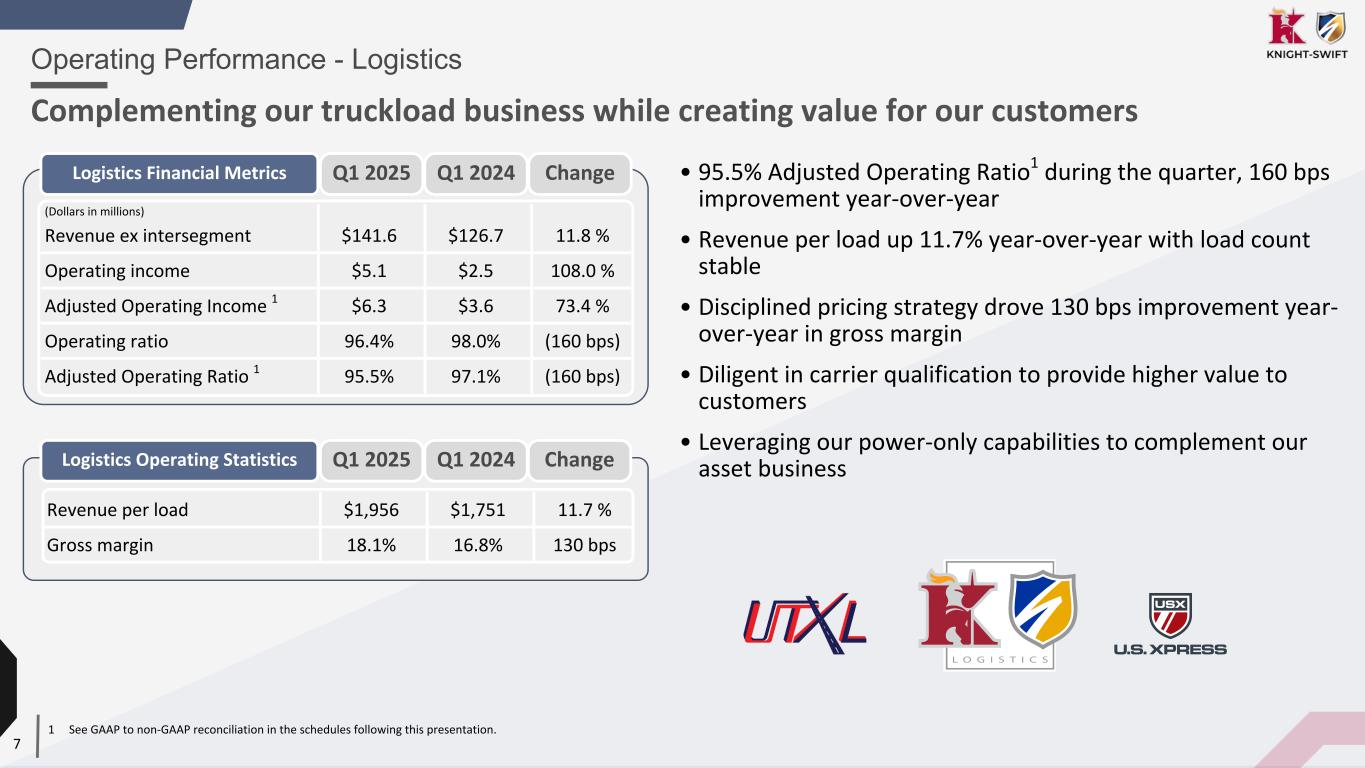
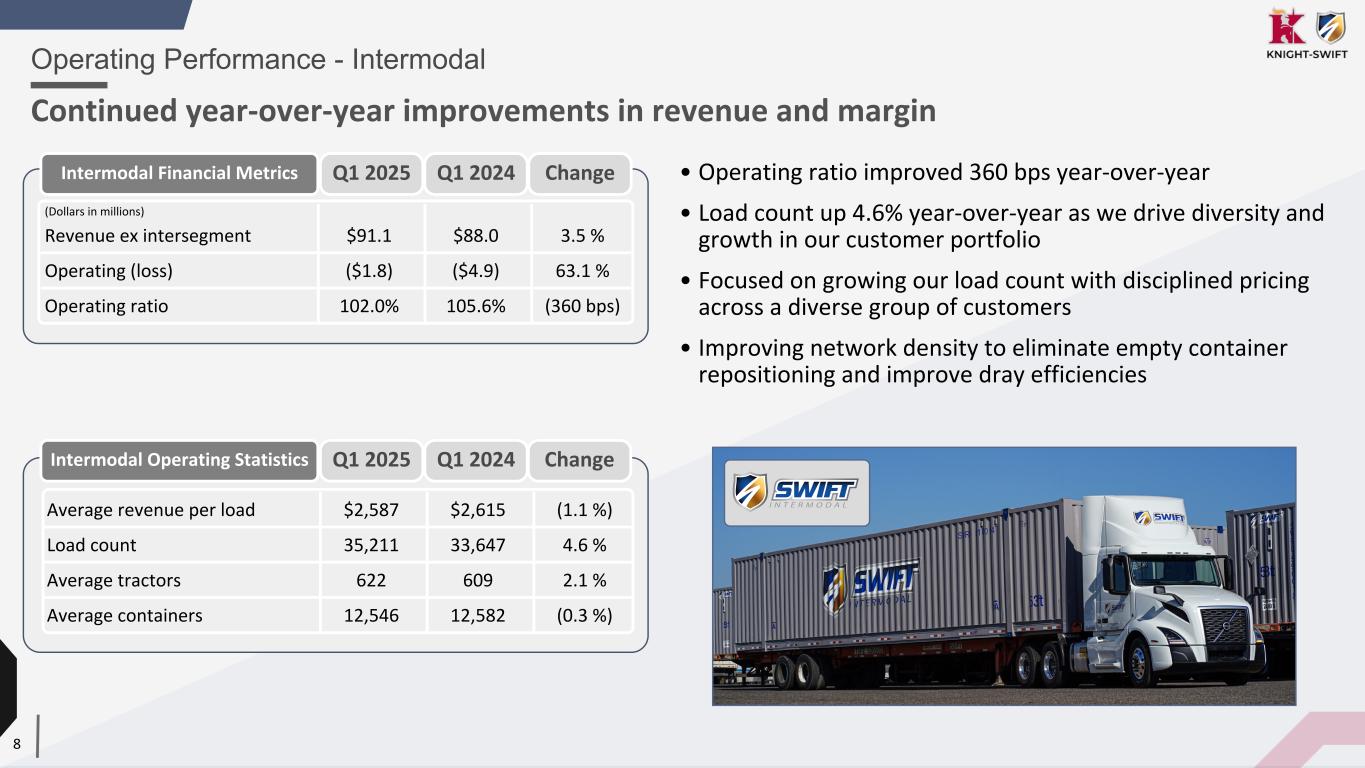
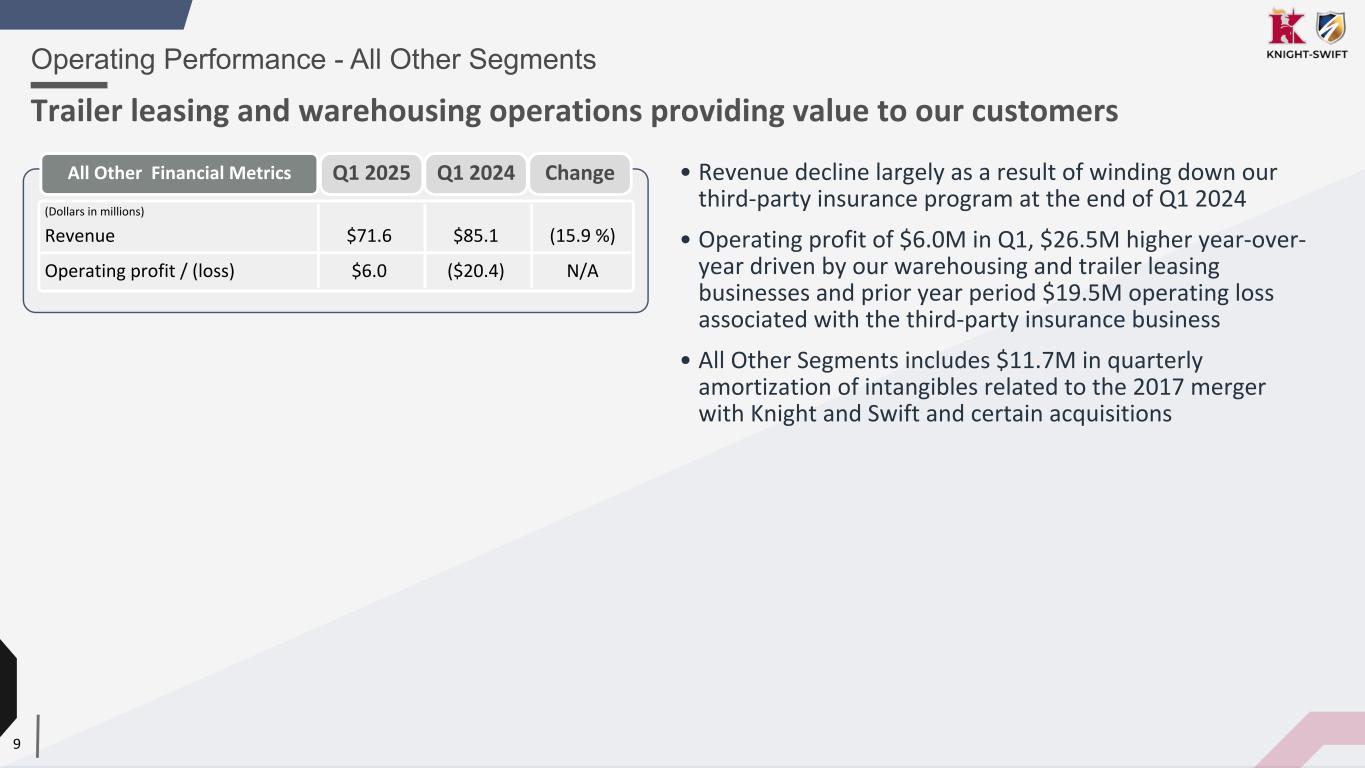
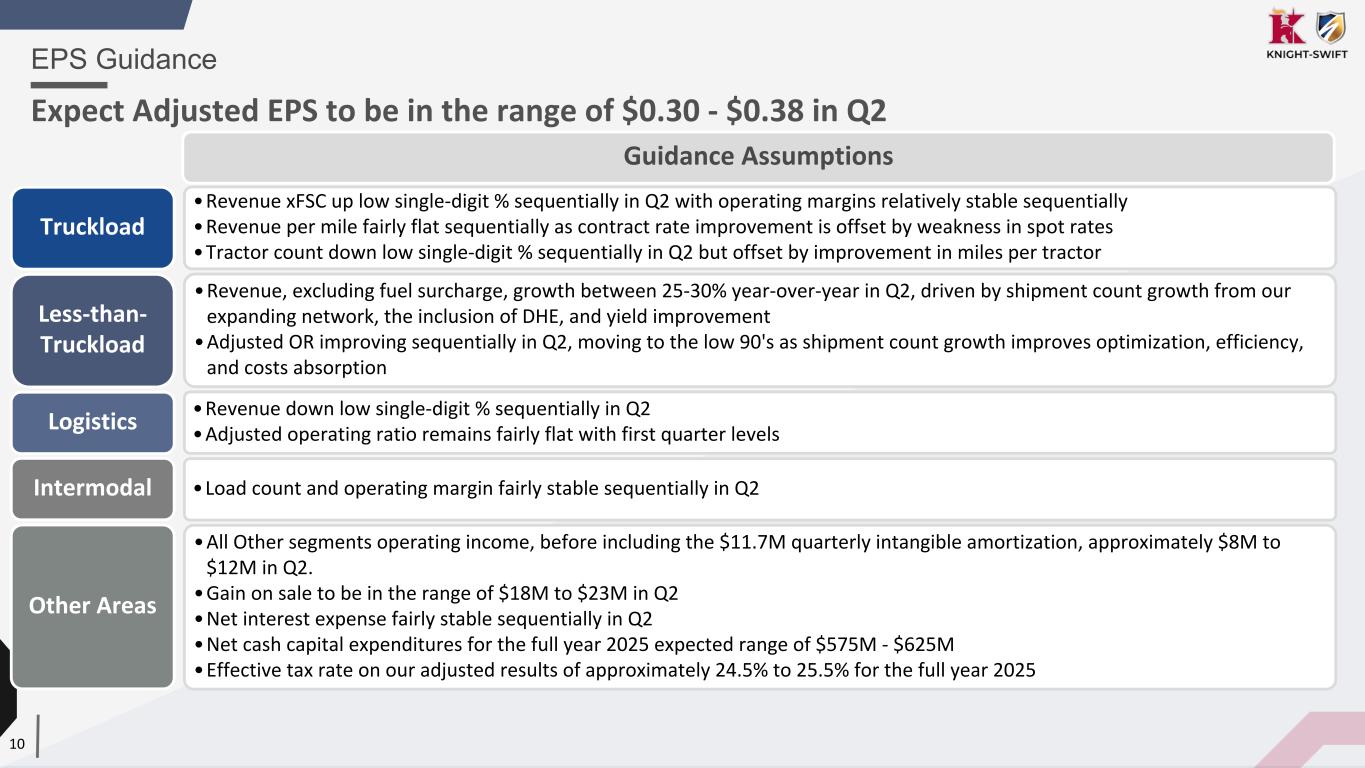
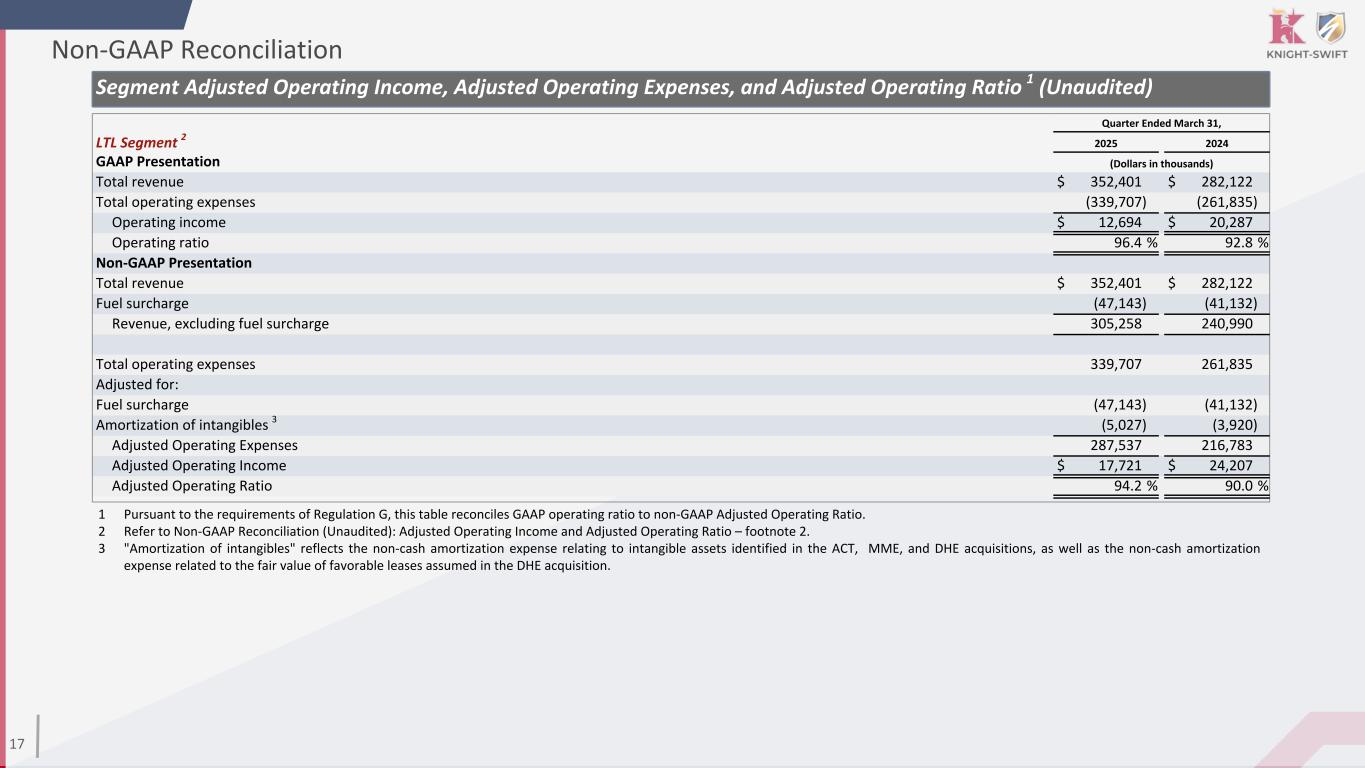
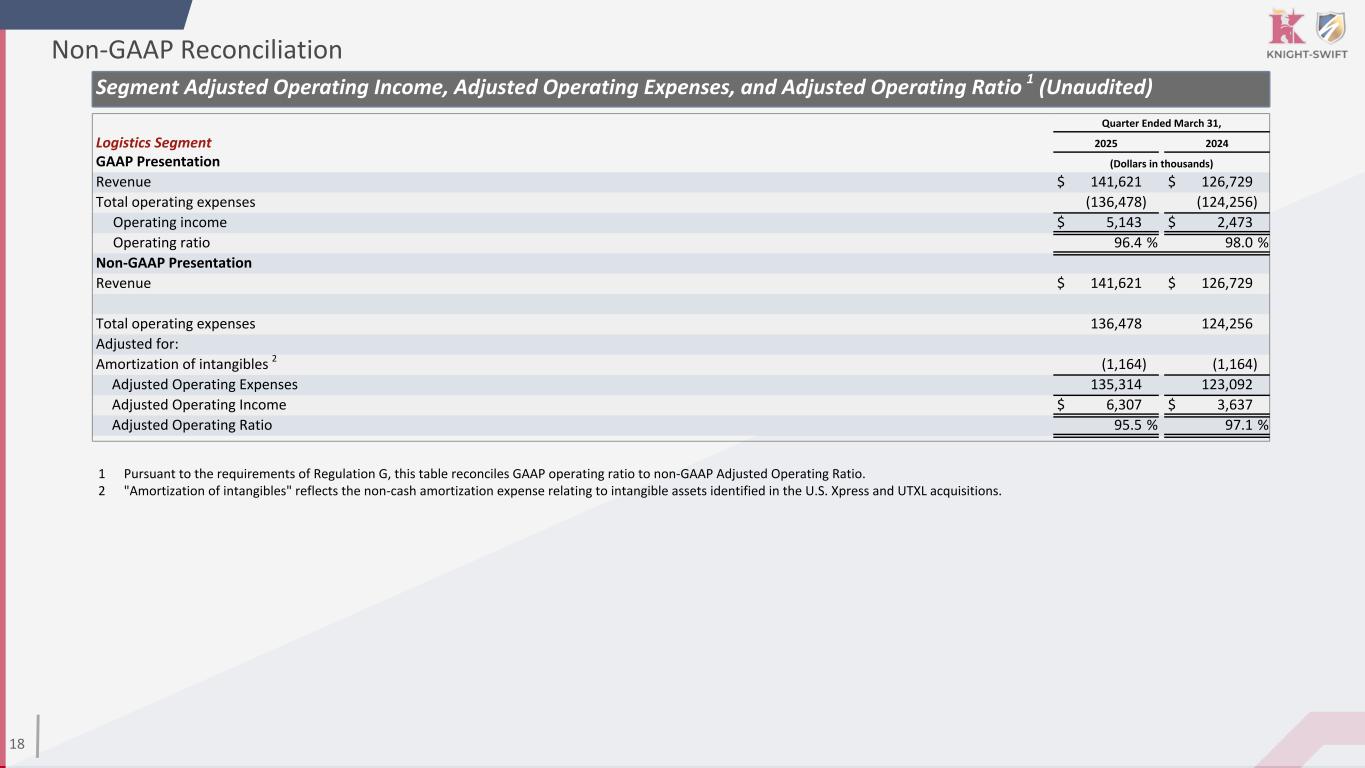
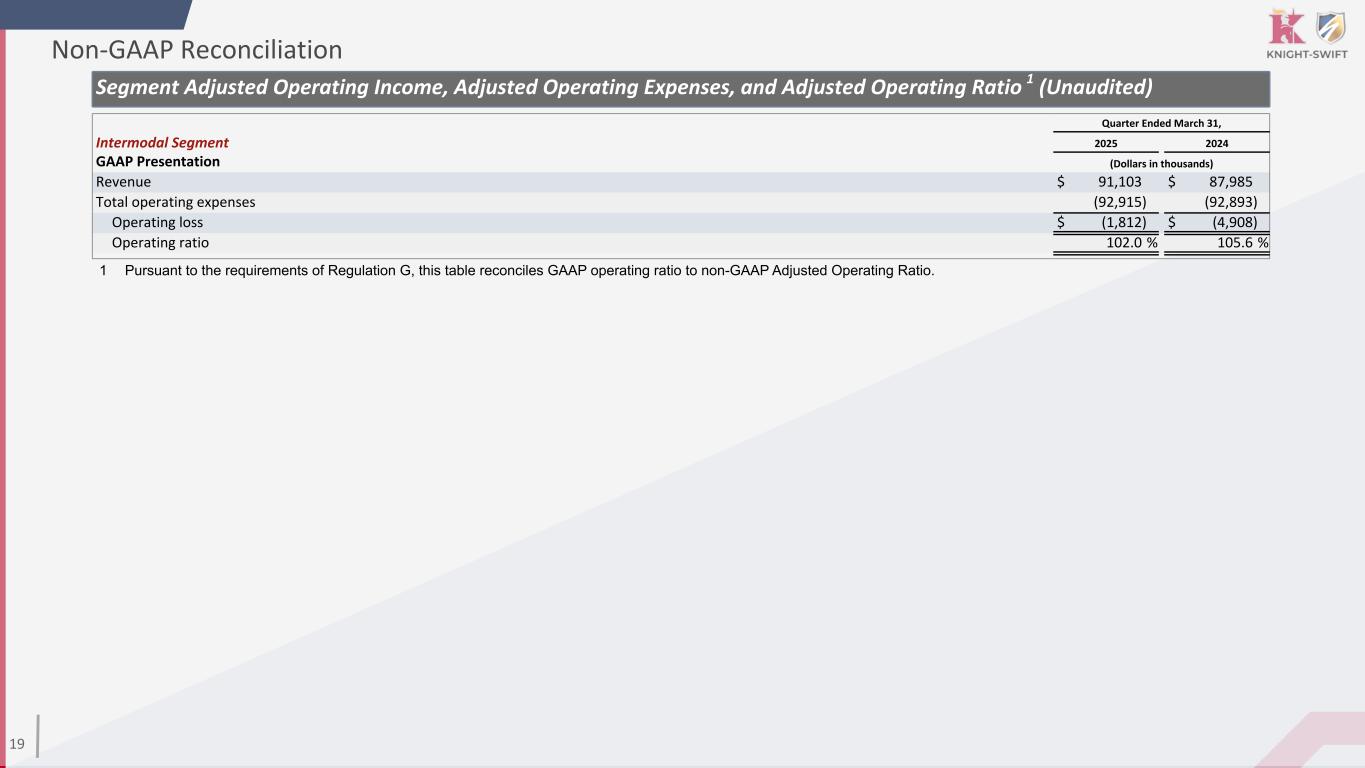
Thanks Brad. Good afternoon everyone. Our LTL business group revenue excluding fuel surcharge 26.7 percent year-over-year as shipments per day increased 24.2 percent which includes our acquisition of DHE. Revenue per 100 weight excluding fuel surcharge increased 9.3 percent year-over-year while weight per shipment declined 2.5 percent year-over-year. The adjusted operating ratio was 94.2 percent and adjusted operating income declined to 26.8 percent year-over-year due to weather challenges, which pressured volumes and costs early in the quarter, startup costs and early stage operations at our recently opened facilities, as well as cost headwinds from inefficiencies in the DHE region, given our strategic commitment to maintaining service while rapidly growing shipment counts following the recent system integration. operation. Operating margins and year-over-year volume growth improved each month of the quarter, reaching 30% growth in daily average shipments and an adjusted operating ratio of 90.6% in March. Growth in shipment count was higher than our projections, which coupled with our recent system integration was a headwind to operational efficiency and costs as we leaned into outside maintenance purchase transportation and temporary labor to augment our own resources in the short term until we insource these services the rampant volume through the quarter and progress and bid awards are encouraging signs as we move forward and work to maintain high levels of service while optimizing operational efficiency we are still experiencing steady rate increases in our business and as our expanded network allows us to offer services on more lanes to and existing customers we opened seven new facilities and acquired or assumed the leases on four more for our pipeline during the quarter our pace of facility additions in 2025 should slow compared to 24 but we will continue to look for both organic and inorganic opportunities to expand our footprint within the LTL market. We are focused on growing revenue and margins in 2025, and we're excited about the runway ahead of us. Slide seven covers our logistics segment. Logistics revenue increased 11.8% year-over-year as revenue per load increased 11.7% with load count flat the adjusted operating ratio of 95.5 percent improved 160 basis points year over year our investments in a common platform across our logistics brands have allowed us to be more efficient in procuring capacity and winning freight opportunities direct from our customers our power only offering continues to build momentum and differentiate us from non-asset brokerages and we remain focused on being nimble in order to remain profitable regardless of market conditions while complementing our truckload brands and bringing value to our customers as an asset-based logistics provider now on to slide eight our intermodal business posted a year-over-year increase in revenue for the third quarter in a row revenue increased 3.5 percent driven by a 4.6 percent increase in load count partially offset by a 1.1 percent decrease in revenue per load every year improvement in volume and progress in operating costs and network balance overcame the decrease in revenue per load to improve the operating ratio by 360 basis points year over year as tariff discussions began during the quarter we saw the intermodal market begin to often which has led to a more competitive bid season we remain disciplined on pricing and focused on improving our network efficiency reducing empty moves and enforcing a greater percentage of our tray moves and investing in private chassis in certain markets in order to position its business profitability on slide 10 we have outlined our on slide 9 illustrates our all other segments. This category includes support services provided to our customers, independent contractors, and third-party carriers, such as equipment sales and rentals, equipment leasing, housing activities, insurance, and maintenance. For the quarter, revenue declined 15.9% year-over-year, largely as a result of winding down our third-party insurance business in the first quarter of last year the six million dollar operating income within our other all other segments is primarily driven by our warehousing and trailer leasing businesses which saw some incremental activity beyond typical seasonality operating income was also improved year-over-year because the prior year period included a 19.5 million dollar operating loss for the third party insurance business now on slide 10 we have outlined our guidance and the key assumptions which are also stated in the earnings release actual results may differ from our expectations as adam noted earlier because of the significant uncertainty created by the current fluid trade policy situation and its implications for inflation consumer demand and demand from our customers we are only updating our guidance for the second quarter and we will not introduce guidance for the third quarter at this time we plan to provide guidance for the third quarter when we report results for the second quarter and will evaluate at that time whether enough clarity has developed to allow us to return to providing two forward quarters of earnings guidance Based on our assumptions, we project our adjusted DPS for the second quarter of 2025 will be in the range of $0.30 to $0.38, which is an update from our original range of $0.46 to The key assumptions underpinning this guidance are listed on this slide, though I won't cover them in detail. In general, though, the guidance for the second quarter reflects the following outlook. At the top of the range, we assume volumes remain fairly steady and we experience limited seasonality. The bottom of the range assumes a reduction in imports occurs in May and June and causes some deterioration in demand and an absence of seasonality. The stated assumptions generally reflect the middle of the range and are only applicable to the second quarter. We project truckload operating income to improve sequentially, largely driven by modest improvement in revenue with a comparable margin profile to the first quarter. This assumes modest improvement in miles and utilization, while ongoing spot market softness serves to offset contractual rate progress made through bid activity. For LTL, we project seasonal improvement in volumes and ongoing progress, growing our customer base and market share will support sequential improvement in revenue and operating margins. We also project relatively comparable contributions from our logistics and intermodal segments with their respective first quarter levels on a sequester. This concludes our prepared remarks and before I turn it over for questions I want to remind everyone to keep to UNCAT questions for participants. Thank you. Aaron, we will now open the line for questions.
Operator
Thank you. Ladies and gentlemen, we will now begin the question and answer session. Your first question comes from the line of Jonathan Chappell, Evercore ISI. Go ahead, please.
Adam, thanks for laying out the different scenarios that could transpire from here. If we had the gains of $15.5 million from 1Q and it looks like it's called $20 for 2Q for the second quarter of equipment sales, is that a point where you think that you've right-sized the fleet for the kind of downside scenario? I guess what I'm getting at here is I know Brad said you're being very cognizant of not selling maybe to the bone in my terms. But how are you managing the kind of the very different paths and then the different cost levers that you can pull as you think about moving forward the next three months?
Yeah, I think when we look at our cost structure, I mean, we're going to look at every opportunity to be as tight as possible. And when you look at your tractors and trailers, we have, you know, maybe a targeted trailer to tractor ratio that we would have unique to each business. And I think today it would tell us that we still have opportunity to pull out trailers to kind of match up to the number of seated trucks we have versus the number of trailers we're operating. And then when we look at our tractor count, there's always some degree of tractors that you just have unseated where you don't have drivers operating the tractors. And that's been a number that's been a bit elevated from our target. And so we've made the choice to tighten that up and pull a few hundred tractors out of the network to just clean up any excess capital that we have that we're not utilizing today. And that should drive better productivity when you look at miles per tractor in the total. It doesn't change our ability to respond to opportunities, to be flexible, to have capacity available. If we see a surge in drivers in a market that returns, we have flexibility to slow down what we pull out as we have new tractors that come in or could order more tractors if we really needed to. I mean, we have flexibility with that, you know, with the tractor count. And so in the meantime, with all the uncertainty, we felt like let's just be a little bit tighter here. Let's still get to a reasonable percentage where we're not limiting ourselves, a reasonable percentage of unceded trucks where we're not limiting ourselves to be able to hire drivers in markets where it makes sense. But let's not carry any excess costs in the meantime. Got it. Thanks, Adam.
Operator
The next question comes from the line of Brian Ozenbach, JPMorgan Chase. You may now ask your question.
All right. Thanks very much. I have a question on LTL and filling in the density. When do you think you'll get a little bit more visibility to filling in some of those areas that you're trying to fill and maybe get rid of some of those additional costs that you're carrying right now to meet the service where you're not quite able to do so right now? And then if you can add a few thoughts on M&A and if there's anything that kind of fits the bill right now or if we just should expect this to be a little bit more gradual of a process to fill in the rest of the coverage gap? Thank you.
Yes. No, thanks for the question, Brian. You know, the volume has been building nicely, and it's been relatively consistent. You know, like we've said before, as we've opened up these territories, we've been aggressive at doing so because it gives us the ability to participate in the bids that are now ongoing in the LTL industry. And so we're seeing the volumes build really on a weekly basis now that we've got out of some of the disruption from weather, and we feel very encouraged about building that density and helping us with the cost absorption and really kind of taking advantage of the operating leverage that we really have in this business. And so we're able to take market share with maintaining price discipline. We're still seeing contractual renewals in the mid-single-digit range, and we're seeing volume growth at the same time. And so it'll just take time to do that in each market, and there's still a few locations to add this year. We added seven in the first quarter. We probably have maybe nine or ten net adds. I think it's closer to nine. the back half year already planned and hey we could have um you know more if there's some opportunities that come our way and we feel good about the volumes building and and so you know i think first quarter just got off to a slower start than we had hoped and you had some cost headwinds that we've been dealing with but uh feel much better about where we ended in march and felt that trend continue uh into april and so we're we're we're feeling really good about ltl and and are looking to see that volume continue to build. And to be able to do that, you have to give great service. And so we've done that at maybe the expense of marching in the near term because we believe that gives us an opportunity to build volume. And the reaction from our customers has been very positive. They like having another option in some of the markets that we now serve. And we feel good about building that out. if you you know you asked about M&A I think I've said on previous calls you know we're always open to organic and inorganic opportunities to grow the business I think it's more likely if M&A were to play a role in building out particularly in the northeast that's probably a 2026 event if anything I don't expect that to happen in 2025 this is this is a year where we kind of grow into the 37 locations that we grew organically last year the you know continue to integrate the dhe business that we acquired last year so this is a year of of growing into what we have improving our top line as well as improving our margin profile in the business we remain committed to get into a to a national uh being a national carrier in this space but we're going to do that very deliberately with some discipline. And we think we have a lot of runway to grow top line and bottom line in 2025 without an acquisition.
Brian, I'll just maybe add a little more color to what Adam said. We're continuing to be in a phase of investment. I think we're mostly, a lot of that's now absorbed into Q1. So if you look at the cost that we brought into the business in Q1 compared to Q4, we brought a lot of fixed costs still into the business as we stood up those facilities. So costs on equipment, depreciation, rents, those are now largely in our baseline now, and we'll see some of that continuing. But we mentioned we've participated in some additional leases that we've assumed from the yellow bid in Q1. Those costs are included in our financials, but those are locations that are open yet. So there's still a lot of opportunity. I guess what's encouraging is our volume, both revenue and shipment count, is absorbing that cost and helping us drive productivity, leveraging that business. And as we practice, you know, the things we're focused on are, first of all, driving improvement in our variable wage efficiency. And we're seeing that But as we look at where we were at in Q4 versus Q1, we're seeing that in our line haul, in our P&D, in our dock efficiency. And certainly, as we've moved our DHE business onto this same system as the rest of our business last quarter, there's been some time for them to develop that efficiency. We feel like we're starting to see those results. Second, we're managing our maintenance. As we move into new locations, we have to use a lot of outside maintenance, and so that will get better as we build density and can insource a lot of that maintenance. And the third is managing these fixed costs that the leverage of the business will provide. So I think those are kind of some of the dynamics that you're seeing in the financials here, and as we look at Q2, you can see we're guiding to a low 90s OR. I think it's our progress in each of these areas that are going to help get us there as long as well as the density that that looks good you know as even here in April we feel good about the track we're on that gave us confidence to increase the revenue guidance here in the second quarter from what we provided previously based on the encouraging signs we're seeing in the market.
Okay thanks very much very helpful.
Operator
The next question comes from On the line of Ken Hoekster, Bank of America, you may now ask your question.
Ken Hoekster, Bank of America, Hey, great, good afternoon. If I can just jump back to the truckload sector, I guess, you know, you mentioned US Express kind of getting to profitability, maybe talk about some of the things you've done on the cost side. And I guess, Adam, if we look at utilization, I think you were kind of addressing this before, but you know, it used to be what, about 22,000, 24,000 miles per tractor. Is that part of what you were talking about before, getting rid of more assets to increase that utilization? Or are there things you can still do in this uncertain market to increase asset utilization? Is it getting rid of assets faster? What do you think has to be done to improve that profitability?
Yeah, I think when you look at – I'll just touch on the productivity side, and maybe I'll turn it over to Andrew. He could talk about some of the things on the cost side with USX. Yeah, I think, you know, part of the dynamic is just not carrying tractors that aren't producing revenue and aren't producing miles, right? Because we didn't have the drivers that are seated in there. And so we might as well not carry that cost. We can now turn that into capital and sell it in what's been a relatively good used equipment market for tractors, at least, maybe not trailers. And I think that's driven more from just scarcity of trucks in the market because of how many weren't built four or five years ago because of the supply chain challenges. And so we wanted to take advantage of that and just tighten up our depreciation costs. And that will lead to now having a similar number of miles over a reduced tractor count, which will drive, obviously, your miles per tractor up. So I think that's one of the things – that's just one of the levers, Ken, that we think we can pull that doesn't impact top line. It doesn't impact the ability to respond to customer needs. And again, if we see the market turn around quickly and there are greater needs and we can hire the drivers, then we can slow down on what we pull out and we can order more trucks if we need to. We can be pretty nimble and we can get new trucks pretty quickly or we can hold on to some of our trucks without trading them when we have replacement trucks coming in. if we need to be. So we felt like that was a lever that we can pull that doesn't necessarily impact our business in a negative way. It just gives us the ability to be more efficient with existing tractors.
Does that make sense? It does. It does. I guess I was trying to lead into the asset utilization. Sorry, I stopped midway through my question, but asset utilization into bid season, right? What does that, I guess I don't want to ask two questions, but I don't know if you could just throw one quick thought on to how bid season is progressing, just given where spot rates are.
All right. We'll let you slide that one in, Ken. Yeah. So I think I mentioned this on our prepared remarks. The bid season started off, I think, just like we had thought. And I think many customers kind of understood that contract rates didn't have any room to go down and that you're just trying to manage what that increase is going to look like. We thought it would start low to mid single digits and build some momentum as it progressed and it started off that way but I think as we got into March when we were in kind of in the heart of the bid season the slowdown because of just the uncertainty around tariffs maybe took away some of the momentum there for that just to really build and so the you know the renewals that we have are still you know increases and they range in that low to mid single digit range depending on the customer and the lane, there are some puts and takes. We've seen growth with customers who've seen the value that we bring. We have other customers who maybe are focused more on getting the lowest cost possible for the time being, and we've seen some volume that we've lost. But I think overall, we're faring pretty well, and I think it's going to put us in a position where we can improve productivity on our seated trucks and see our contract rates take a step in the right direction. Now, like I mentioned, having a weaker spot market potentially here in the second quarter could weigh on our overall rate, but I believe that's temporary. And I think if we see the market come back, whether that be because of just continued consumer demand or we finally figure out our tariff policy and we have our customers with more conviction to move forward with their plans, you know, we could see the spot market then improve and we'll be in a good position to be able to react to that and bring value to our customers. So it's, you know, there's a lot of moving pieces to it now, but I think ultimately Ken, we do feel the bid season playing out to where it's going to help improve productivity at rates that are higher on a year-over-year basis.
And maybe I'll let Andrew hit the US express question here yeah yes and a little bit about what what cost levers we have and here's what i would say look we when we establish our our path to parity of us express to our truckload businesses um we thought about it in these three buckets and we still have the same conviction we always did on these points so first of all we knew there was a lot of initial costs that we take out of the business we've communicated that on that on that point we've taken out more than 180 million dollars in cost on an annualized basis we continue we're going to continue to find opportunities there but those those are costs around procurement and other areas where there's efficiency to be gained so we've kind of done those in this difficult market the second thing we're focusing on is operational cost efficiency so think of hiring costs safety costs fuel we're well into that. We had to establish the decentralized network of terminals that enables that model we know works at Knight and Swift into the U.S. Express business. We are starting to see that. So just as an example, safety takes a while to really build the safety culture that you need. We're starting to see that. So just as an example, our csa crash rating is 20 better for that business than it was when we acquired them and we feel like there's a lot more to go right we're nowhere near kind of the potential of that business but that starts to to drive cost efficiency through the business and then the third area adam focused on which is which is on the market side we are we are seeing so far in bids like he talked about, you know, wins, well, you know, rates that would exceed what we're seeing in the truckload business because of how much more opportunity they are to have there. So we have the same conviction. We're something like five points apart now on OR between our legacy businesses and U.S. Express. We expect both of them to continue to progress from this point forward, but we're encouraged because we're seeing the kind of systemic operational efficiencies that that we knew that business could generate come to fruition. Thank you so much. Appreciate the time.
Operator
The next question comes from the line of Tom Wadowitz from UBS. You may now ask your question.
Yeah. Good afternoon. Adam, I think it makes a lot of sense the way you laid out the guidance. Appreciate the perspective on it. I wanted to see if you could maybe comment a little bit further on how you think a step down in container imports into the West Coast in particular would potentially flow into your business. I mean, I think the numbers that seem to be out there, you could see, you know, 25, 30 percent decline in West Coast container imports. So at the low end of your range and kind of how it affects June, is that what you're assuming? And I guess, you know, it's tough to have intuition with how that affects the truckload market, right? Because you've already seen weakness in truckload without a decline in imports in March. So I guess if you saw that, then I don't know, how do we think about what that does to truckload? Thank you.
Yeah, I appreciate that, Tom. And yeah, I think there's still some uncertainty about how that's going to impact the truckload industry. You know, I think what we're looking at is we're already assuming that may is going to be weaker as a result of the the west coast uh imports dropping off like like everyone's expecting to you know we're we're pretty we have a lot of diversity when you look at our different brands you know you look at you know us express they're largely an east coast um you know uh player we've got bar none abilene they they're largely in the in the east coast in of their presence. You know, Knight and Swift, they would be nationwide, and they'd be pretty balanced between the East and West Coast, but would have some exposure to the West Coast. So I think we could see an impact to those brands. And right now, we're working on plans to try to limit capacity in the markets we feel could be affected. And we may need to be a bit more nimble on the spot market to position ourselves to where we're not as exposed to the drop in freight, but that's easier said than done. I think there's an impact to the intermodal market. I think a lot of that freight could land on the rail, and I think there's international boxes that I think you're not going to move, but then there's going to be, I think, an impact to our intermodal business, which is why I think our updated guidance have come down on where we think the load count will be for that business as intermodal has become, you know, pretty competitive on the price front. And we've been, I think, made some progress in the bid, but in some cases has had to turn away from some business because the pricing just didn't make sense, you know, based on what our competitors were willing to run it on. So I think there's going to be impact in really the Knight and Swift truckload brands mostly and then in our intermodal business. But again, we can kind of see that coming and we're trying to react the best we can do it and not let it catch us by surprise. And I think really the question when you look at the guidance, Tom, is you see a reaction in June where there's a rebound. If we're able to get some clarity on trade policy and our customers that are kind of living off inventory we now have to replenish? And do you see some seasonality in June that helps offset maybe some of the weakness, the kind of the unseasonable weakness you would see in May? So I think that's really the question, how do things play out in June? We're already expecting May to be abnormal in terms of the volume you'd expect to see. And then, hey, how strong is beverage and produce, which usually helps carry a second quarter. So still a lot to, again, that's why we've had a wider range because there's a lot of ways that this could play out. But we're watching it really closely and trying to position ourselves to navigate it as well as we can.
Okay, great. Makes sense. Thank you.
Operator
The next question comes from the line of Scott Grew from Wolf Research. You may now ask your question.
Hey, thanks afternoon. I just want to clarify, does the High end of the guide, assume the normal May-June seasonal improvement we typically see or not. I just wasn't clear when you laid it out. And then just bigger picture, Adam, you guys are right-sizing the tractor fleet. Makes sense. At some point, do you consider shrinking the power-only offering, the broader brokerage short offering, maybe to potentially try to help catalyze a tighter market?
Okay, well, let me hit both those questions there, Scott. So on the guidance, I think what we've said is that the top end is really June with limited seasonality. So again, we normally don't say this, but I think when we were looking at a guidance, we were trying to have a degree of conservatism, just given the risk that's out there, the potential for risk. So it really, we would assume just limited seasonality, not your normal strength that you would see in June. Does that make sense?
And then your question on power only, I mean, we look at power only as a way to really complement our truckload business. So there, even when you have some softer markets, there's always going to be markets where we don't have trucks available where our customers have demand. And in some cases, those are customers that have drop and hook requirements when it comes to their freight. And so if we don't have power only, we really can't participate in those freight opportunities. There's also times when our logistics business is better suited for a certain business because it's maybe not as, you know, it's not as consistent. It doesn't create balance in your network. And you can still do that on the logistics front. We're managing trailers tightly and we have to just manage that better even when we have power only. And so we're really focused on that. But I look at power only as a way to help support truckload, keep revenue in-house, support service, support our dedicated operation when they need a surge. So we're not having to pull those trucks from line haul if they're needed elsewhere. And so I think it gives us a lot of flexibility in our network. And we would look at that as an advantage that we would have and it brings value to our customers and allows us to get better returns with the assets that we have.
Okay. Thank you for the perspective. Thanks, guys.
Operator
The next question comes from the line of Daniel Imbro from Stephens. You may now ask your question.
Yeah. Hey, good evening, guys. thanks for taking the questions um and i'm wondering to follow up on the cost per mile discussion within truckload but maybe within the core business not us express you know the cost per mile declined again here in one q i guess how do you feel about your ability to keep that flat to down for the full year just given the softer demand backdrop could make utilization maybe harder to achieve and i know your 2q guidance i think assumed relatively stable volumes here into april but is there an opportunity to accelerate the cost takeout if volumes do deteriorate through year just trying to get a sense of how variable that could be yeah hey daniel i'll maybe make a few comments there so yeah so that's uh like you mentioned this is the third quarter we've reduced
cost per mile and this has been without the tell way to miles right so when you really look at where we're where we're seeing that progress um that gives us the conviction it's sustainable it's let me just kind of break it down for you so probably two-thirds of the improvement we're making from a cost per mile perspective comes because of operational improvements we've made in our business. Now that comes to how we manage fuel and maintenance and safety. So let me just talk about safety. Safety has been, we're seeing the same pressure everyone is in the industry about nuclear verdicts and the costs of claims, but overall our leading metrics around safety are very encouraging and that's, in the case of the first quarters, our insurance costs are not inflationary to us we're managing those costs in a way that it's it's it's probably you know better than an industry on average on maintenance and fuel we're doing that as well and what what we're seeing though is we're making a lot of progress on fixed costs and so i'll maybe focus on some of the improvements we're making there now it's hard to show that on a cost per mile basis because of the miles your denominator changing but the cost that we've reset down in our overhead costs and gna and equipment are significant and so we're focusing on our facility footprint and how we manage our costs with our facilities we in some cases are consolidating drop yards or facilities we've implemented process efficiencies in our back office labor that's allowed us to use attrition to to manage down our non-driver headcount. We've effectively negotiated with vendors on costs that have allowed us in areas like benefits to see what we believe are some savings coming up in our business. Our discretionary costs, we're managing those much more effectively than I think we have in the past. And then we're reducing costs or finding better ways more efficient ways to manage i.t costs professional services consulting things like that that that we think um we are a better tighter organization and so so when we um we'll continue to do this we're we're not done um we've seen results from this but what this is going to do it it's really going to work to our benefit going forward um as we've introduced even more operating leverage into our business by reducing not just equipment but our gna and overhead costs in the business so it will continue to pivot as we watch how this market unfolds and we have a different playbook depending on kind of where the economy goes and and we're thinking of scenarios and how we adjust costs to continue to drive cost per mile down even in an environment where miles aren't helping us.
I think there's also opportunity, and I don't know if you've touched on this, Andrew, on the safety and claims standpoint. I mean, we've seen our safety performance continue to improve. Now, clearly, the environment with nuclear verdicts is a challenge, so you could have, you know, great performance, and one or two claims can really impact the results, but I think we've done a great job kind of navigating that the last, you know, a few quarters. And we, you know, we had some, you know, some, some challenging claims to deal with, you know, over the last couple of years. And we feel like we've got a lot of these more challenging claims behind us. And now we just have to execute better on not having incidents. And when you do have those, being able to manage them and get to a favorable outcome as quick as possible. So I do think taking claims is an area that we have some opportunities to improve just on execution and how we manage the claims.
Great. Thanks so much, guys.
Operator
The next question comes from the line of Chris Weatherby from Wells Fargo. You might now ask your question.
Hey, thanks. Good afternoon. Adam, I was curious to get your perspective on capacity in the truckload market. I guess as you think about the next quarter, like several months with potential weakness in May, and maybe there's a rebound in June, maybe there's not, Is that enough to sort of bring down capacity to the point where we are in a more balanced or more favorable truckload environment? I'm kind of just curious how you're seeing capacity react real time to these potential risks coming up from a demand perspective.
I think certainly when you see activities that drive the spot market down, I mean, that's a catalyst for capacity to exit the market. Now, is it going to be, you know, depending on the duration, is it enough for us to be, you know, back in balance? I think part of the balance is going to be if demand improves, then I think we would feel like we'd be in pretty good shape given what momentum we saw early in the first quarter and where we were in the fourth quarter. But I think we've got to see how both supply and demand play out here in the near term. You know, there's, you know, we look at, you know, different components of capacity and different ways to measure that on a regular basis. One of the data points we look at is there's a large, you know, load board company that, you know, provides detail of how many trucks are being posted on their load boards. And that's, I think, in March, it's down 28% on a year-over-year basis in March. And so, yeah, it tells us supply or capacity continues to exit, but I think it's still kind of hard to know what needs to happen for us to be back in balance. But certainly the slowdown we're expecting to see in May is not going to help the small trucker.
And, hey, Chris, this is Brad. I would just add a little color to that. You know, prior to this recent shift in the marketplace, you know, in the first quarter with all the tariff uncertainty and everything, Prior to that, especially in the fourth quarter and the beginning of this year, the market was already behaving largely like a fairly balanced marketplace. And so it's not that we were still well out of balance and now we've got further to go. The market had largely gotten into a healthier balanced place before we had this little adjustment here recently. So certainly if there's a leg down in demand, maybe we need more capacity rationalization to find a new level of balance. But it's not like we were far off the mark just prior to this latest uncertainty here.
Got it. Very helpful. Thank you.
Operator
The next question comes from the line of Ravi Shankar from Morgan Stanley. You may now ask your question.
Operator
Hey, thanks. So just to confirm the overall message here, so you said that the risk goes to the downside, which is what made you change your approach to guidance, but you're also getting low-to-mid single-digit price increases. are you hearing from your customers that they are like pulling back or you know going into their shell a little bit or is this just a reaction to some of the short-term uh data we're seeing out there kind of obviously the the message on transports called so far is that we haven't seen too much change in actual behaviors so i'm trying to see if you guys are seeing or hearing something different yeah so i mean we we've had dialogue with i don't know 40 or 50 of our you
know larger customers and and you know they've been you know for the most part uh fairly open with what their strategy has been but hey it can it can change daily um depending on you know what what they're seeing in the market but you know i think probably about there's three three buckets Robbie, they fall into. And maybe a third are around, hey, we're just not making any changes because of tariffs. And it's just, we're just going to continue on our path forward. And those are maybe some of our customers that don't have maybe as much exposure to China. Then there's those that are more in a wait and see bucket. And I think those are the customers that are maybe drawing down inventory more and living off that. So that would impact the volume that we would be seeing or could be seeing in May. And then there are some that have told us that, yeah, they have canceled orders or they've stopped ordering, particularly from China, and will figure out how to adjust their supply chain to avoid the cost. So I think our conservativeness is really based on the feedback we're hearing from customers, as well as just some early trends we've seen with how they've maybe shifted or maybe have forecasted what their volumes are going to be in the coming weeks. So it's not so much what we're seeing today, it's what we're expecting to see based on customer sentiment, as well as forecasts that we're seeing in our business.
I would just clarify, as we talk to our customers on their view of consumer sentiment, you know, very few seem to be changing behavior, to your point, Ravi, because of their view of a weakened consumer at this point.
Or strong. So it seems to be a reaction to tariff costs as opposed to kind of a changing view on consumer sentiment right now.
Operator
The next question comes from the line of Bascom Majors from Susquehanna. You may now ask your question.
Thanks for taking my questions. When will your bid discussions with your largest three or four retail industry customers be completed? When will those bid pricing updates be implemented? And ultimately, is the decision to withdraw the two-quarter forward guidance strategy, is that more about pricing and margin risk and forecasting that from those bids that are being discussed? Or is it really more about what the macro and demand picture looks like two, three months from now?
Okay, Baskin. So I'll hit that. You know, bids are kind of ongoing. okay and so we we've i think we've we implemented some in the first quarter i think there's the majority of them will hit sometime in the second quarter and then you'll have um some of our larger customers that do some you know early third quarter so it's you know it it's something that it's just you're always doing on a regular basis but your largest impact is typically going to be in the second quarter and we expect the our contract rates to improve to that you know low to single digit as we begin to implement these awards. There's also the mini bid process that a lot of our customers go through on. Sometimes it's every two weeks, sometimes it's weekly, where they have a set of lanes that they need help with for whatever reason, and we're able to bid on those lanes. And sometimes you can get some sizable awards through the mini bids. So it's an ongoing process, and that's why your network is always, it's never in a static position. It's always adjusting and moving uh based on new awards that you're able to pick up through these processes i think we look at the the the guidance it's more about the volume that you're going to receive from these awards because awards are paper commitments right there's no legal requirement for them to tender us those number of of loads that we've that we've won through the bid process So the concern is if they see a major change in their supply chain, do we not see the volume that we are expecting to see and what potential disruption could that have on your network? And so I think that's the biggest challenge to forecast third quarter, not knowing if we're going to see some major disruption in whether it be volume or just the balance in our network. And so that's why we've decided to take the approach that we have.
Adam, to that point, where is big compliance trending now versus what would be normal for this type of year? And has that loosened or deteriorated since that more normal seasonal environment you saw in January or February?
Again, we don't necessarily disclose that number, but it hasn't changed dramatically from where we've been. Again, we're more concerned about where that's going based on what we're seeing from the forecast from our customers and then external data. So, again, April's been relatively stable, but, you know, we're just, you know, where our conservative comes into is, you know, this may not play out like a normal may where you see strength, particularly in the back half as beverage and produce picks up. Is that just going to be offset with some of the supply chain pauses from our customers?
Operator
The next question comes from the line of Brandon Ogulanski from Barclays. You may now ask your question.
Hey, good afternoon, everyone, and thanks for taking my question. You know, Adam, I feel like you guys have been positioning the business here for a while for, you know, the inevitable upturn. It feels like maybe tariffs just push that out even more. I guess with this prolonged, you know, downturn and kind of trough earnings environment, Is there anything strategically you've been thinking about, like, through the portfolio approach on the TL side? You know, are there further cost efficiencies that you could look at there, maybe with all the brands or even thinking things about, like, intermodal and lack of, you know, like, long-term profitability in that business? Appreciate the feedback.
Yeah. I mean, look, Andrew laid out all the different costs that we're focused on and we continue to be focused on. Again, we're all about controlling what we can control. When I look at our different brands, through this process, we've made adjustments on size of certain brands, what we focus on with those brands, what makes them unique to each other. And, hey, you have to make adjustments in the market, and we have been doing so. We also don't want to make some decisions around businesses in kind of the trough of troughs, right? this has been the most challenging cycle that we've seen maybe ever. And so we want to see how these, you know, some of these businesses navigate through that. And I know you mentioned intermodal and, and hey, we have a very good team in intermodal. We like the partnerships we have with the rails. We've made year over year progress in many of the metrics over the last several quarters and expect to continue to make progress in that business. And believe it's a, it's, it's a service our customers value it's a lower cost service that they that they would value at times and we want to be there to provide it but yeah it has to generate returns and we want to see that business and how it performs when we get to a more uh balanced environment rather than making decisions in in a trough environment i don't i don't think that would be advisable and that's something that we would we would be considering at this point um now hey if you get into a a better environment and you have businesses that still can't perform in a better environment then yeah you look at that a bit differently but but you know at this point we're we like what brands we have we're making the the adjustments on the cost side as andrew laid out and i think we'll be able to navigate um you know the the market that that will be faced with and come out with these businesses returning to more normalized you know earnings when we get to a a more balanced market And so we still have tremendous confidence in that.
Okay. Well, I think that concludes our call. We appreciate all the questions. And again, I know we have some folks in the queue. And if we haven't been able to get to your question, you can go ahead and reach out to us. It's 602-606-6349. All right.
Operator
Thank you, everyone. and ladies and gentlemen this concludes today's conference call and thank you so much for your participation you have a great day