Operator
Good afternoon. My name is Ina, and I'll be your conference operator today. At this time, I would like to welcome everyone to the Knight Swift Transportation 3rd Quarter 2025 Earnings Call. All lines have been placed on mute to prevent any background noise. If at any time during this call you require immediate assistance, please press star zero for the operator. Speakers from today's call will be Adam Miller, Chief Executive Officer, Andrew Hess, Chief Financial Officer, and Mr. Brad Stewart, Treasurer and Senior VP of Investor Relations. Mr. Stewart, the meeting is now yours.
Thank you, Ina. Good afternoon, everyone, and thank you for joining our third quarter 2025 earnings call. Today, we plan to discuss topics related to the results of the quarter, current market conditions, and our earnings guidance. We have slides to accompany this call, which are posted on our investor website. Our call is scheduled to last one hour. Following our commentary, we will answer questions related to these topics. In order to get to as many participants as possible, we limit the questions to one per participant. If you have a second question, please feel free to get back in the queue. We will answer as many questions as time allows. If we are not able to get to your question due to time restriction, you may call 602-606-6349. To begin, I will first refer you to disclosures on slide 2 of the presentation and note the following. This conference call and presentation may contain forward-looking statements made on a company that involve risks, assumptions, and uncertainties that are difficult to predict. Investors are directed to the information contained in Item 1A, Risk Factors, or Part 1, of the company's annual report on Form 10-K filed with the United States SEC for a discussion of the risks that may affect the company's future operating results. Actual results may differ. Before we get into the slides, I will hand the call over to Adam for some opening remarks.
Thanks, Brad, and good afternoon, everyone. The third quarter saw freight markets still grappling with uncertainty, with many shippers hesitant to take much risk and freight demand trends that continue to deviate from normal seasonal patterns. However, the third quarter brought more proactive customer discussions around peak season projects than we have seen since 2021. Some of these involved customers who did not express any such needs last year. Some peak projects are already underway, while our base level of normal demand through the first two weeks of October have remained stable and have not yet begun a seasonal build. Last year, some peak projects developed almost overnight during the fourth quarter, and we still do not have visibility to forecast if that will happen again this year. With still some uncertainty around how volumes will build during the quarter, we are taking a more cautious approach to our expectations for the fourth quarter. Despite some of the uncertainties in the present environment, we see a number of factors that make the opportunities of the next cycle more compelling for our businesses. First, on the demand front, despite all the noise from tariffs and the shift in freight ordering patterns, demand has remained relatively stable throughout our different truckload brands. We believe the value we deliver through our scale, flexibility, and service has allowed us to maintain most of our volume in a challenging market. Early in the new bid season, we are seeing less churn of incumbent lanes and growth in awarded volume with low single-digit rate improvement. This contrasts against last bid season, where a similar pricing approach produced more churn in incumbent lanes and lower volume awards as some shippers were still pursuing discount offerings, especially through brokers. In recent weeks, more customers have been upfront about reducing the numbers of carriers they want to work with and are focused on increasing volumes with quality asset-based carriers. And as far as capacity, we expect ongoing attrition on a number of fronts that include the recent and developing regulatory focus on enforcement of standards related to English language proficiency and the qualifications and controls around the issuance, renewal, and revocation of non-domiciled CDLs, which we believe may have an outsized impact on the lowest price capacity in the one-way over-the-road market. Second, ongoing carrier downsizing and failures, especially among medium-sized carriers who invest in safety and compliance but do not have the scale to overcome cost inflation in the unsustainably soft price environment our industry has faced over the last three years. Third, we see large carriers continuing to pull back from over-the-road service in favor of dedicated opportunities given difficult business conditions in the one-way market. And fourth, we see private fleet growth plateauing and likely reversing course as capital assets increasingly come up for replacement and at higher prices. And while the spread between Between the cost of internalizing the service versus outsourcing it to the market is historically high. We believe the majority of the capacity attrition from these factors will be concentrated in the one-way market, which is where we do roughly 70% of our truckload business. There are signs that the recent regulatory focus is starting to have an impact on capacity availability, but it may take some time before that tightness is consistently felt across the market, absent an increase in demand. If enforcement efforts are sustained and effective, there could be a meaningful shift in the supply-demand dynamic in 2026. Such developments would bring a more favorable setup for carriers and one particularly beneficial to our truckload business, given our unique ability to deliver responsiveness at scale and with industry-leading trailer pool resources that provide valuable flexibility to our customers. Also, the improvements we have made on our cost structure during the down cycle provide great opportunities for margin growth in a stronger market. Beyond our truckload segment, our logistics business is well positioned through its complementary relationship with our asset business to augment revenue capture and to leverage our tech-enabled power-only services to enhance the return on our trailer assets. Further, our intermodal business targets, additional progress on cost, network management, and equipment utilization, and looks forward to leveraging the new chapter in our rail partnerships and in the improving market. Now shifting gears to our LTL business, we're excited to share that we are adopting the AAA Cooper brand across our entire LTL business. The consolidated branding recognizes that we are already one business operating seamlessly on one system through one network, delivering a cohesive solution to our customers. We are continuing to grow our LTL network, customer base, and volumes, and we are committed to doing this while providing strong service levels. As we build our network, we are capturing growth opportunities with new LTL customers, as well as from some of our long-standing truckload customers. This growth has come during the time when the industry volumes remain under pressure. Although we have felt some cost pressure during our network expansion, we remain focused on improving margins and have multiple initiatives underway to accelerate improvements in cost efficiencies and operational execution as we adapt to the growing network and customer base in a fluid market. So with that, I will turn it over to Andrew for our overview on slide three.
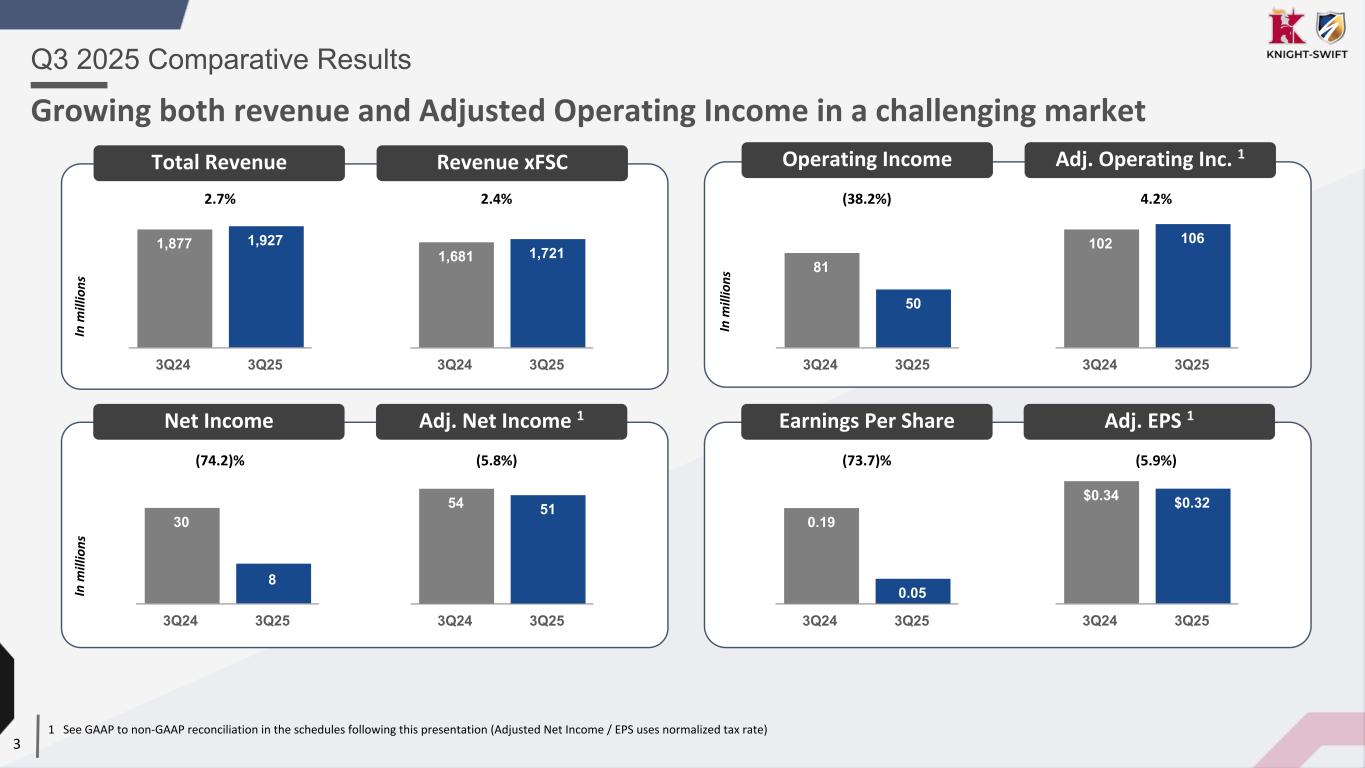
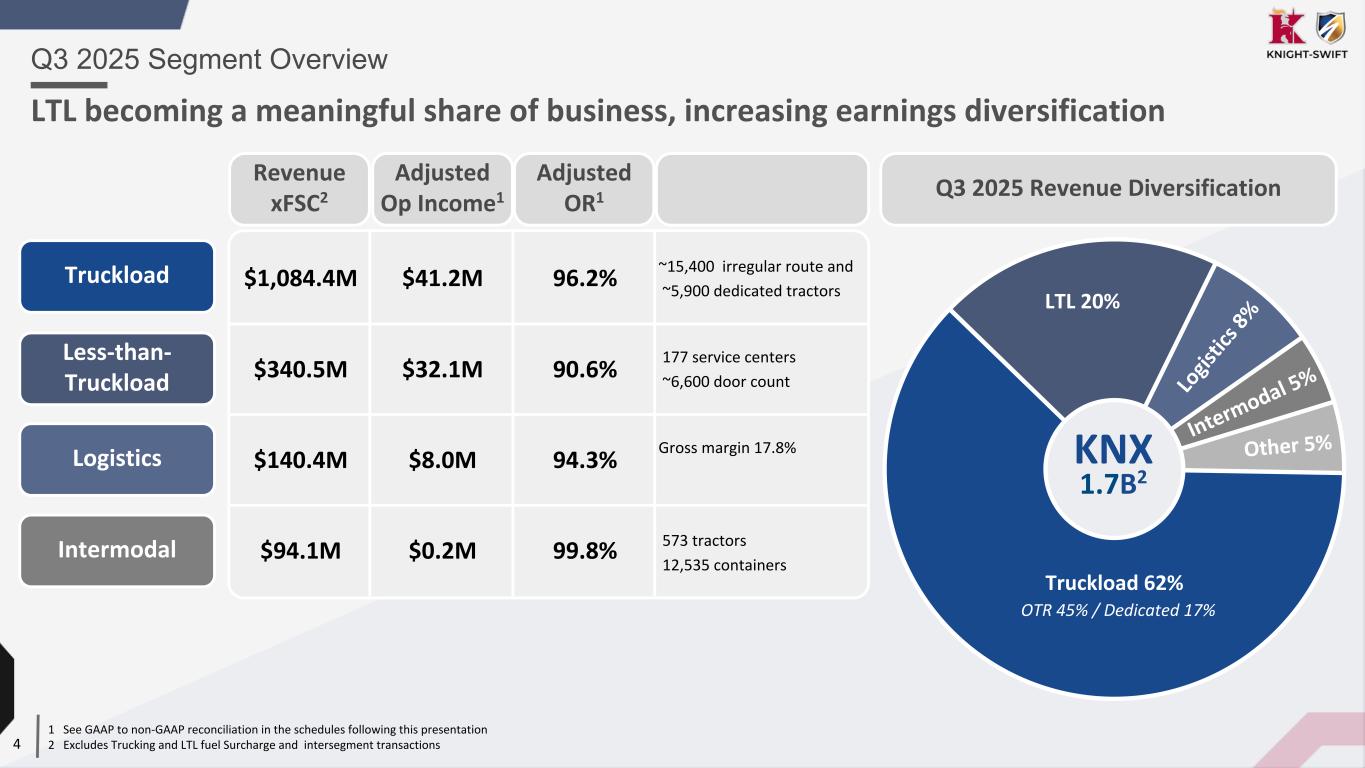
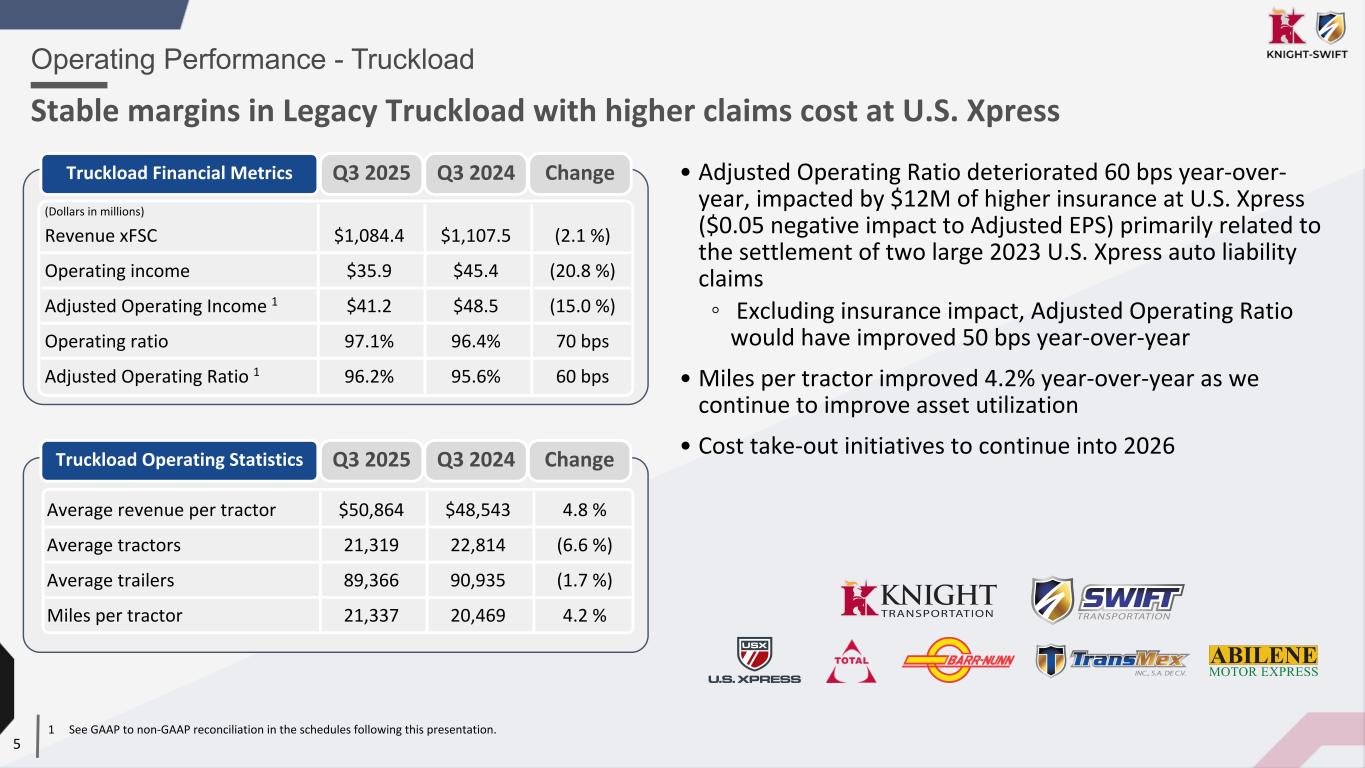
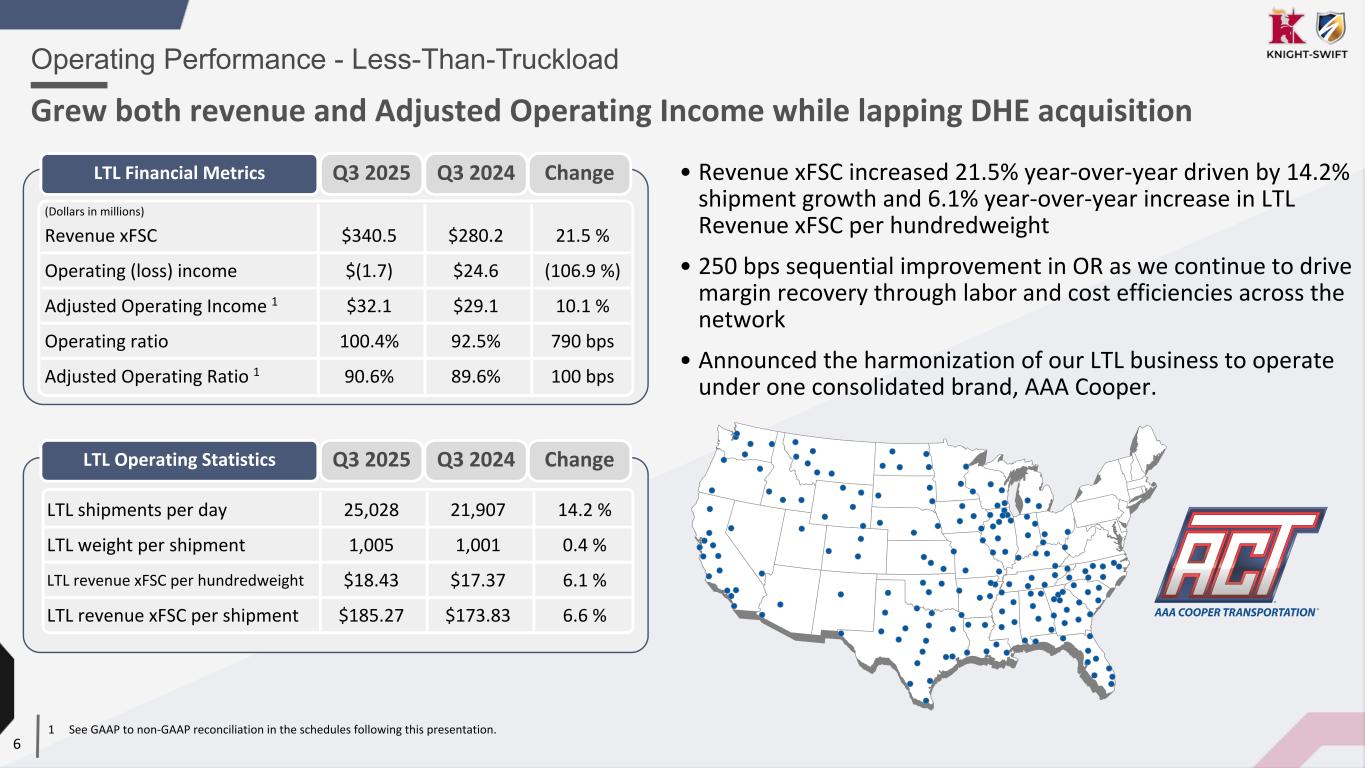
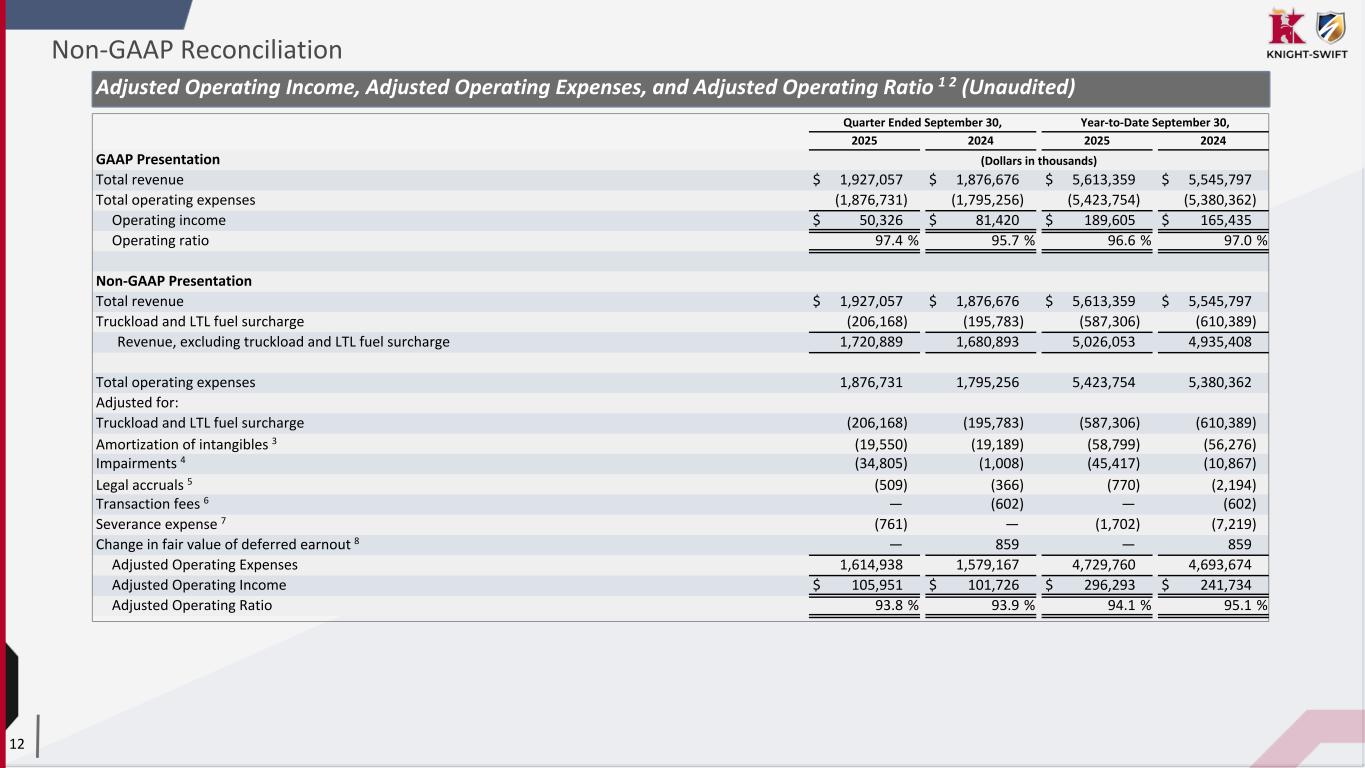
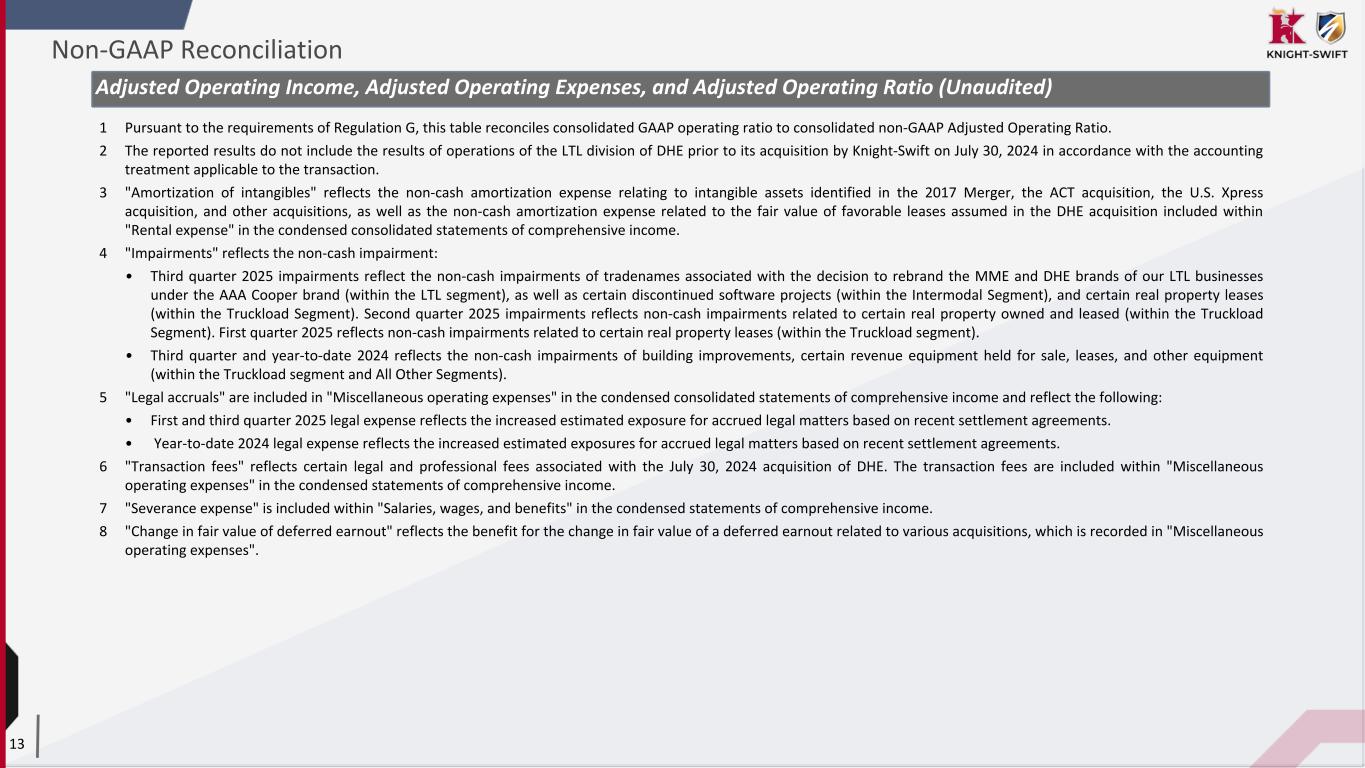
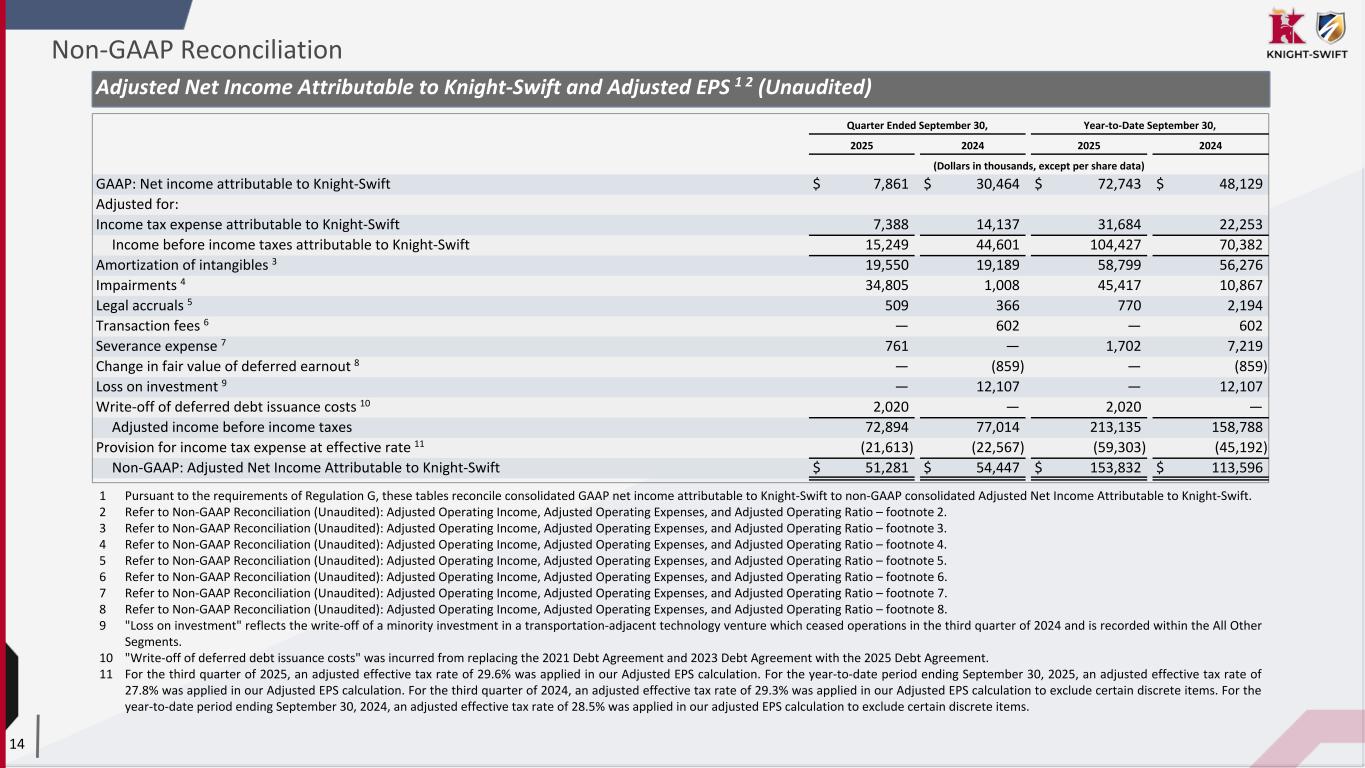
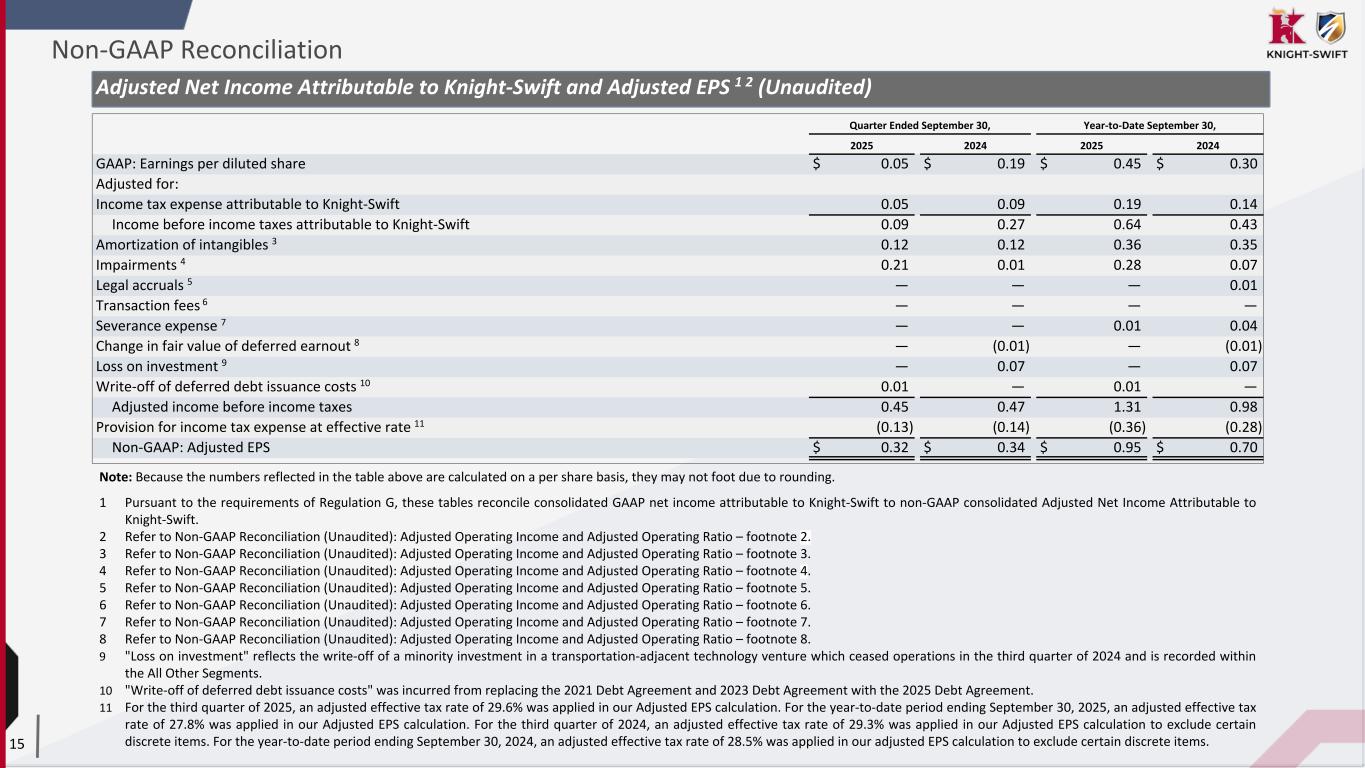
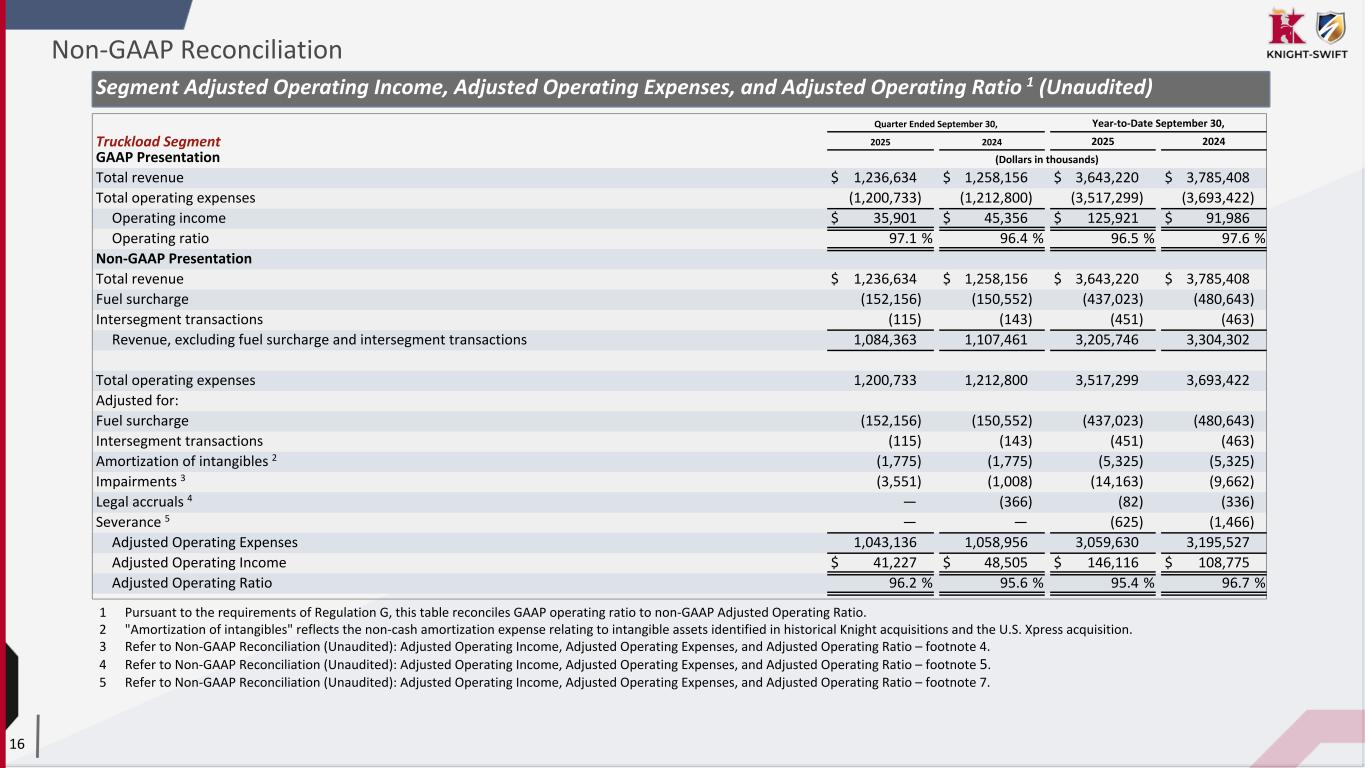
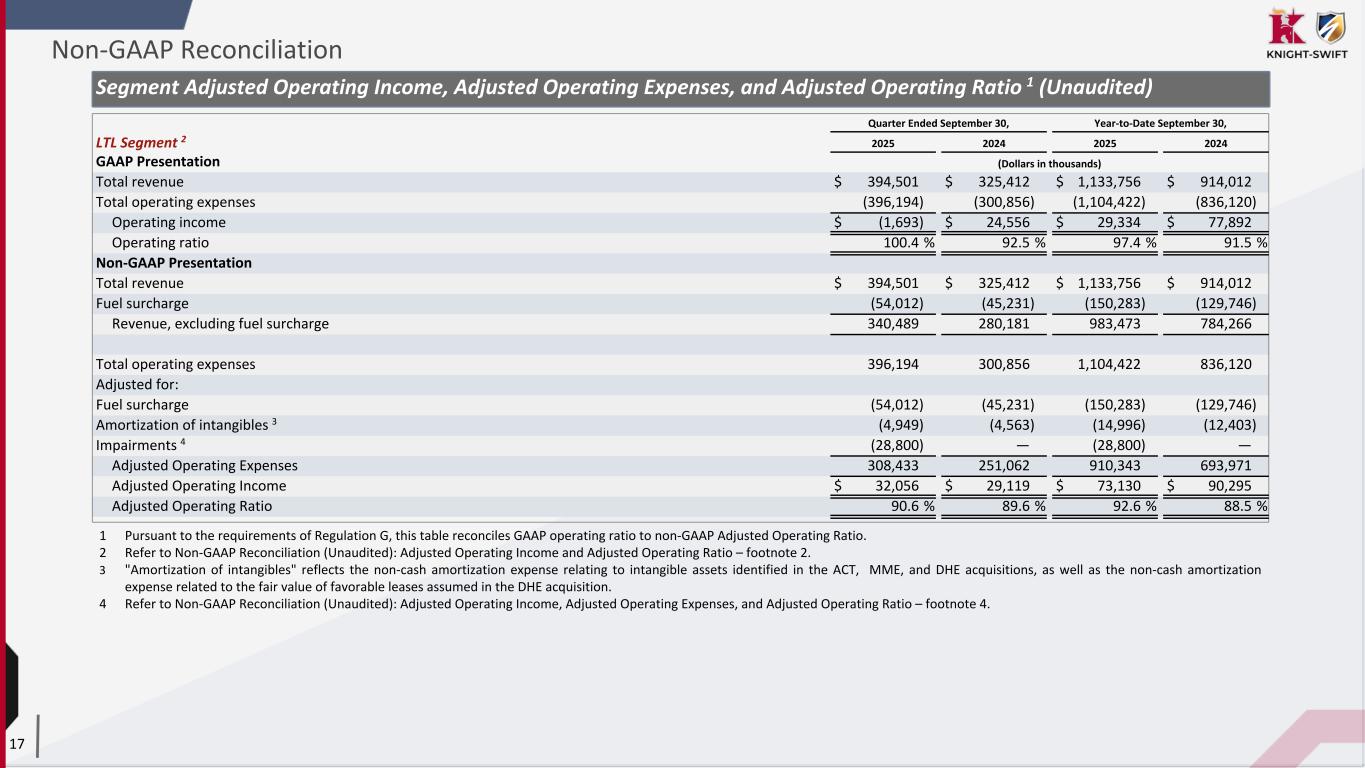
Thanks, Adam. The charts on slide three compare our consolidated third quarter revenue and earnings results on a year-over-year basis. Before getting into the comparisons, it's important to note that our gap results from the current quarter include $58 million of significant, unusual items. Included in our GAAP results are 28.8 million of trade name impairments as a result of our decision to combine our LTO brands under one trade name, $6 million of real property lease and software impairments, a loss contingency of 11.2 million related to the 2024 exit from the third-party carrier insurance business, and $12 million of a higher insurance and claims cost at U.S. Express, primarily driven by settlement of two large 2023 U.S. Express auto liability claims, one of which occurred prior to our July 2023 acquisition and the other shortly thereafter. The impairments have been adjusted out of our non-GAAP results as shown in the reconciliation schedules following this presentation. however the loss contingency and the claim settlement accruals have not been adjusted out and negatively impacted our adjusted operating income by 23.2 million and our adjusted eps by 10 revenue excluding fuel surcharge increased by 2.4 percent an operating income declined by 31.1 million or 38.2 percent year-over-year largely due to the 58 million of unusual items noted above adjusted operating income improved by 14.2 percent year-over-year as earnings growth in our LTL warehousing and leasing businesses more than offset the loss contingency and U.S. Express claims costs in the current quarter gap earnings per diluted share for the third quarter of 2025 were $0.05, compared to $0.19 for the third quarter of 2024. Adjusted EPS was $0.32 for the third quarter of 2025, compared to $0.34 for the third quarter of 2024, a 5.9% year-over-year decrease, primarily as a result of the $0.10 negative impact of the loss contingency and claims accrual noted above. A consolidated adjusted operating ratio was 93.8%, which was flat year-over-year and sequentially. The effective tax rate of 47 percent on our gap results was 15 percentage points higher year-over-year. The effective tax rate of 29.6 percent on our non-gap results was 30 basis points higher year-over-year and higher than the 27 to 28 percent range we had previously projected due to deferred tax impacts of combining our LTL legal entities. Slide four illustrates the revenue and adjusted operating income for each of our segments for the quarter. Overall, our LTL business has become a larger share of our consolidated revenue through our ongoing network expansion over the past two years. For the third quarter, the LTL segment held steady sequentially at 20% of our consolidated revenue, its highest share since our entry into this segment in 2021. Our strategy of building diversification in our enterprise is complemented by our strategy to enhance revenue synergies across brands and lines of service. To this end, we are applying intentional leadership to drive powerful collaboration. We continue to develop and deploy technology to foster seamless connectivity, enabling us to leverage excess capacity in one brand against excess demand in another which effectively increases our ability to surge and to capture greater share of market opportunities while solving for network imbalances to be certain we have leaned on uh we have leaned on each other before but these advances make these practices systemic more responsive and scalable now we will discuss each of our segment starting with truck our truckload segment on slide five our truckload segment navigated atypical demand patterns in the third quarter to generate miles that were flat with the second quarter as we had expected while freight flows and spot rates did show some progress in normalizing after an unusual second quarter the partial recovery in these dynamics pressured our revenue per mile, an operating margin relative to our expectations for the third quarter. Additionally, while we made further meaningful progress reducing fixed costs in our business, the quarter saw headwinds on variable costs such as insurance and claims, health insurance, and fuel. On a year-over-year basis, revenue declined 2.1 percent, driven by a 2.3 percent decrease in our loaded miles. Revenue per loaded mile, excluding fuel surcharge and Intersect Transactions was up slightly year-over-year and sequentially improved 1.1 percent over the second quarter. Adjusted Operating Income declined $7.3 million or 15 percent year-over-year, largely as a result of the $12 million of higher insurance and claims costs at U.S. Express, which was a five cents negative impact to adjusted EPS. These accidents occur prior to our integration of U.S. Express's hiring, safety, and claims management practices, which have since begun to produce meaningful improvements in safety metrics. The third quarter combined adjusted operating ratio with 60 basis points higher year-over-year as U.S. Express claims noted above negatively impacted this metric by 110 basis points and offset ongoing progress on our cost structure excluding us express and the legacy the legacy truckload brands operated at a 93.7 percent adjusted operating ratio while these claim developments disrupted us express's trend of improving results we expect this business to return to profitability in the fourth quarter and be back on track to make further progress closing the margin gap with our legacy truckload brands. Miles per tractor improved 4.2 percent year over year as a result of our efforts to drive productivity as well as our reduction of underutilized assets over the past several quarters. Sequentially tractor count was flat within the second quarter within the second third quarter. This was flat from the second to third quarter. We continue to make tangible progress in improving our cost structure to position our business to generate meaningful returns as market conditions recover. We remain committed to disciplined pricing, intense cost control, and quality service. All right moving to slide six our LTL business group revenue excluding fuel surcharge 21.5 percent year-over-year with shipments per day up 14.2 percent as we lapped the acquisition of DHE on July 30th. Revenue per hundred weight excluding fuel surcharge increased 6.1 percent while revenue per shipment excluding fuel surcharge increased 6.6 percent. Weight per shipment increased 0.4 percent for the first year-over-year increase in this metric since our 2021 entry into this business. Our gap results for this segment include a 28.8 million dollar trade name impairment as a result of our decision to combine our LTL brands under the AAA Cooper trade name. Adjusted operating income increased 10.1 percent marking the first year-over-year improvement in five quarters as volumes remain sequentially stable while operational and cost initiatives begin to gain traction. The adjusted operating ratio was 90.6 percent for the third quarter which was an improvement of 250 basis points from the second quarter counter to typical seasonal degradation some of the areas where we'll be making early progress on costs are in reducing purchase transportation as we deploy our own staff and equipment optimizing pickup and delivery through our new technology implementation and in refining our staffing levels and scheduling across locations as we gain more visibility into our evolving freight mix. During the third quarter, we opened one new service center and replaced two more with larger sites, bringing our growth and door count to 8.5% year-to-date and 10.2% year-over-year. Two weeks into the fourth quarter, LTO demand appears softer than the normal fourth quarter seasonal slowdown. This may be short-lived, but we are stepping up the yield and cost initiatives we began launching last quarter to respond to market developments we intend to take action where prudent to mitigate margin pressure in the short term but without sacrificing our ability to respond to growth opportunities through ongoing bids as discussions around bids currently in process are encouraging we believe we have opportunity to deliver improving margins through growth cost control and maturing operations and have confidence in our plans to achieve this All our solid service levels, growing customer base, ground to make up on pricing, provide a compelling runway for the value to be generated by this business. Now I will turn it over to Brad for a discussion of our logistics segment on slide seven.
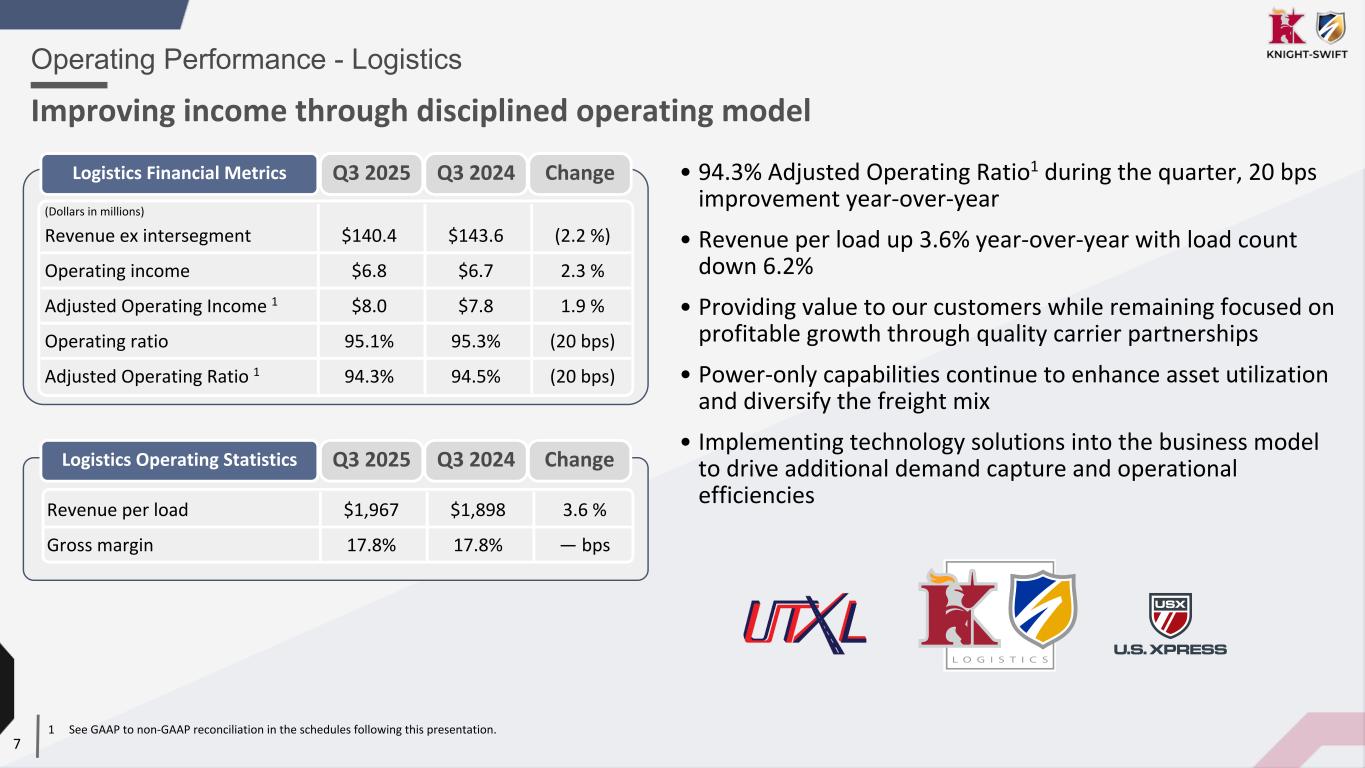
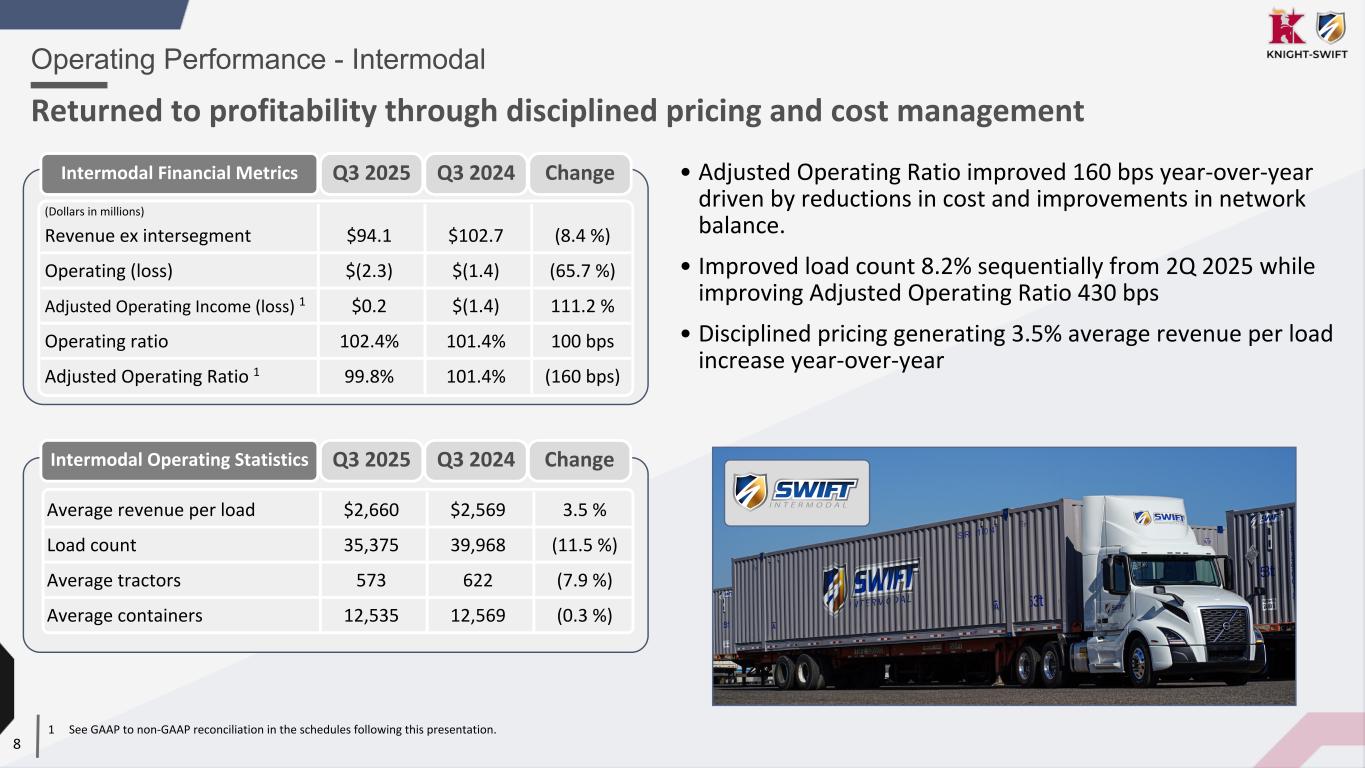
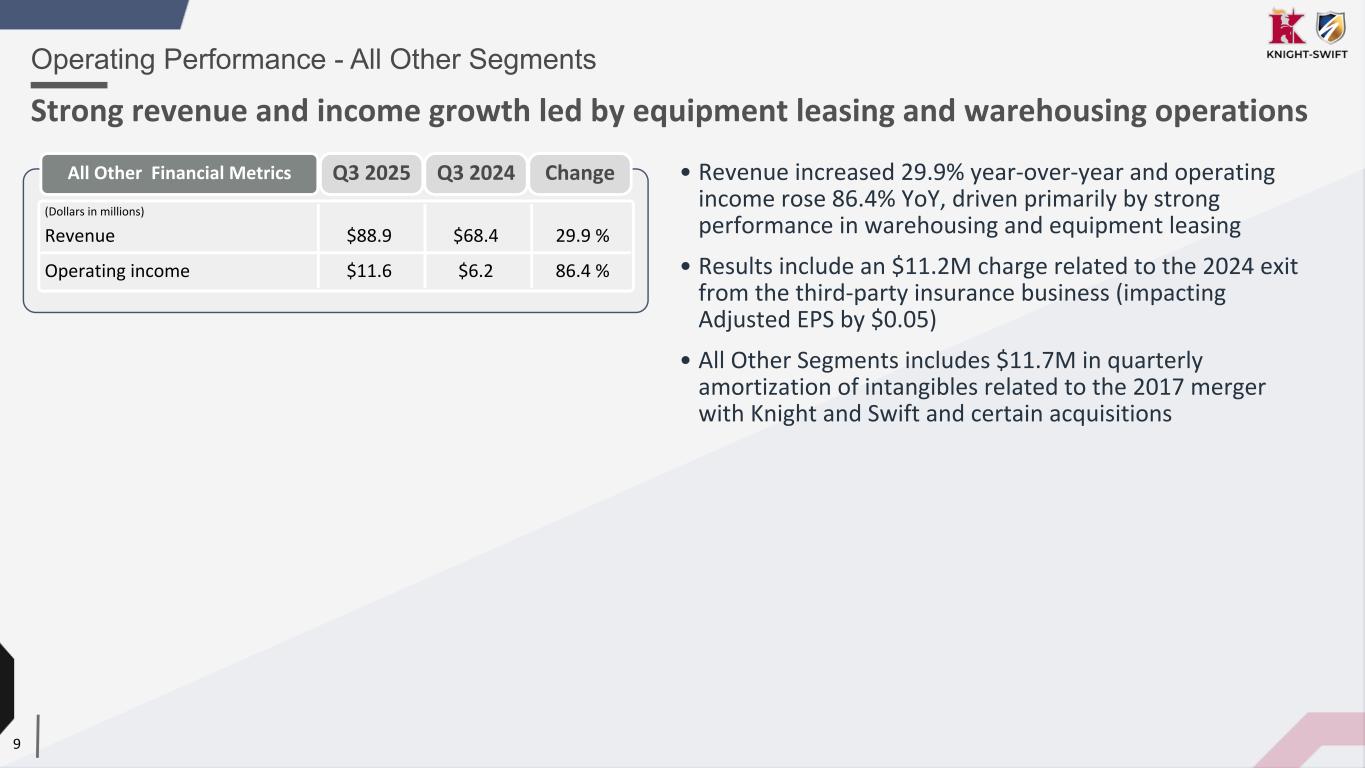
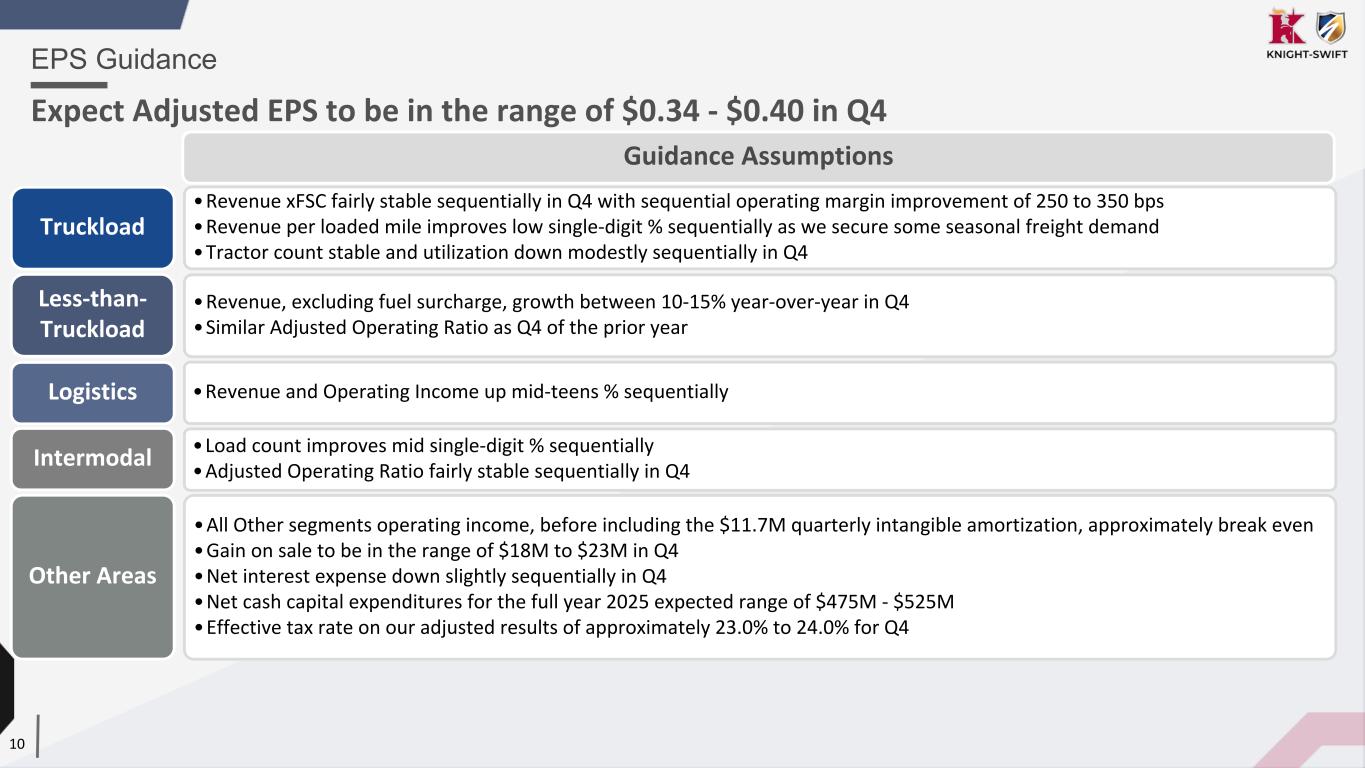
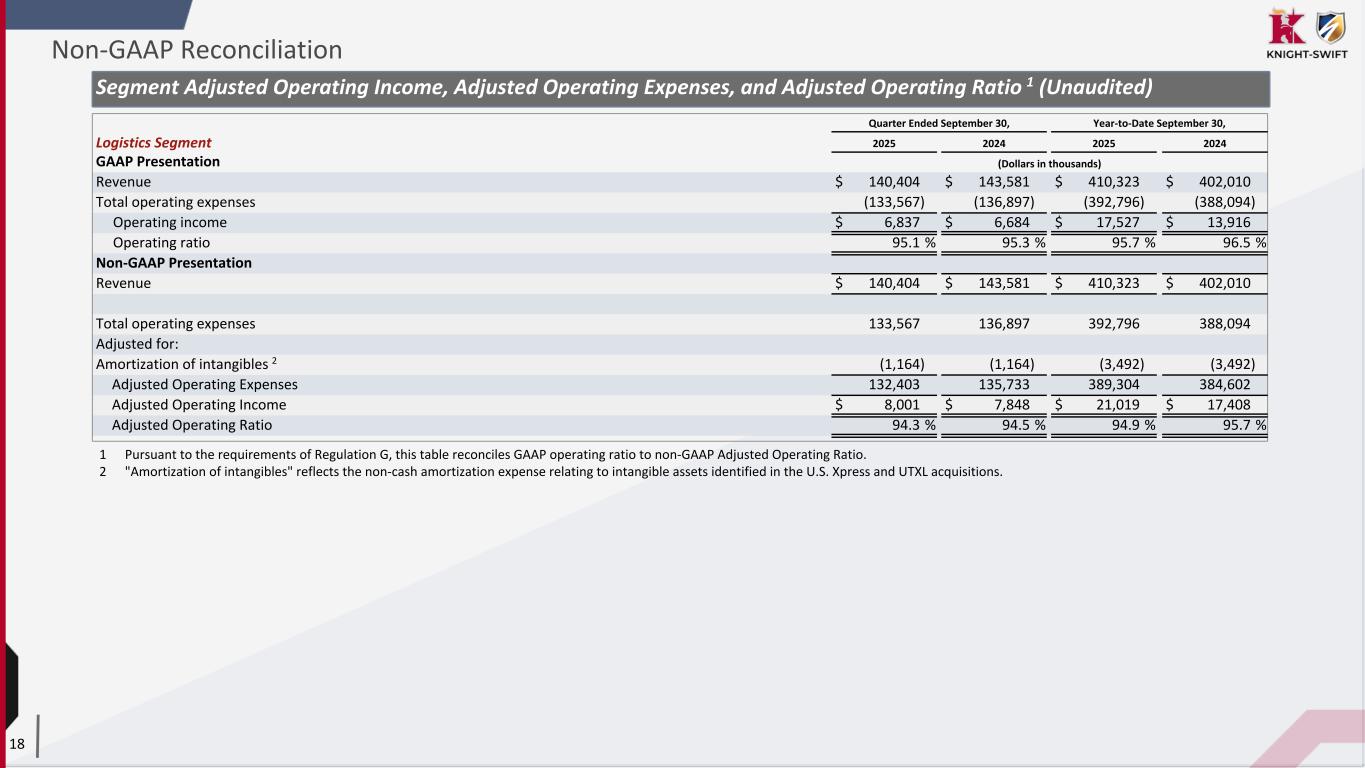
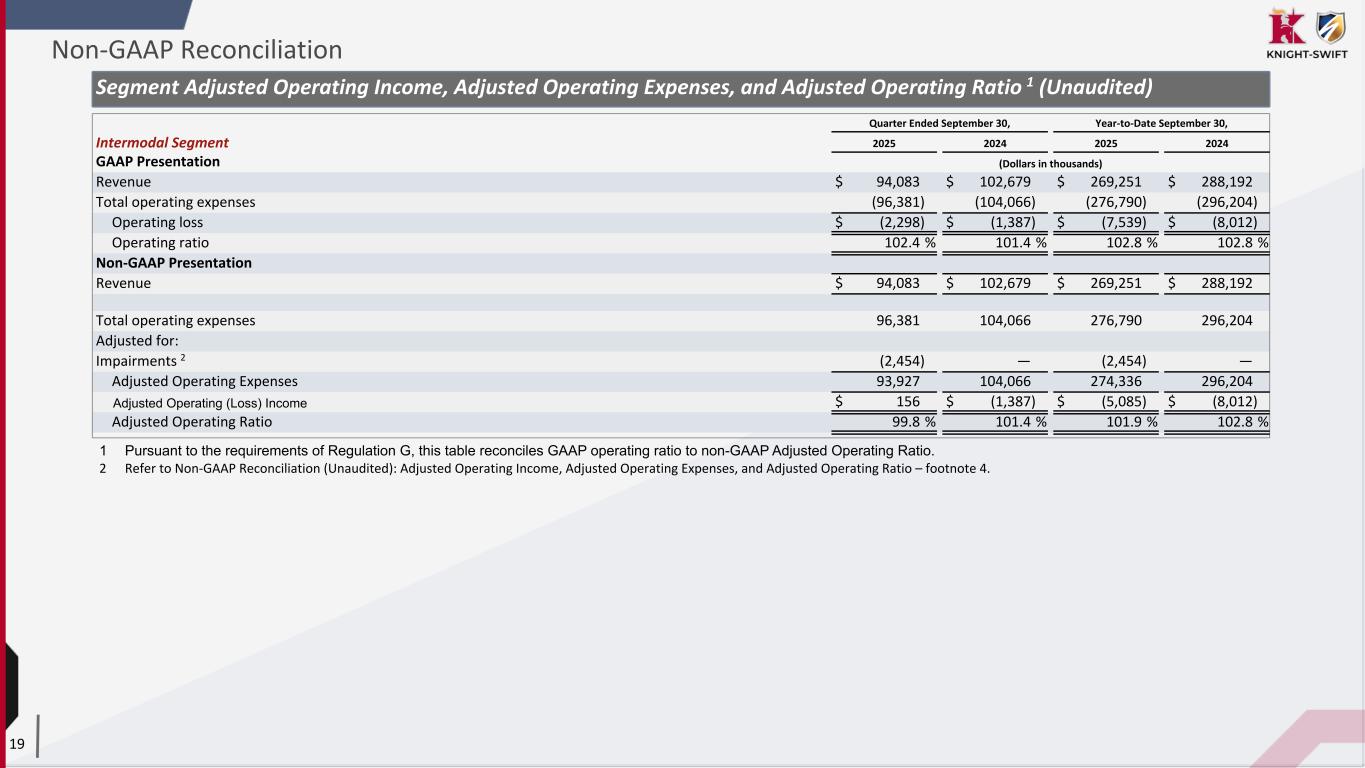
Logistics volumes were down year over year, but generally built throughout the third quarter after the lull scene during the second quarter. This segment experienced brief market tightening around the 4th of July and at the end of the quarter. Revenue for the third quarter declined 2.2% year-over-year, driven by a 6.2% decline in load count, partially offset by a 3.6% increase in revenue per load. Despite the decline in revenue and load count, our disciplined approach to pricing and cost management helped us drive slight improvement in the adjusted operating ratio to 94.3% and to grow adjusted operating income 1.9% year-over-year. We anticipate opportunities for further profitability gains ahead as we are early on in deployment of technology tools to drive better capture of opportunities and more efficient execution which we expect will contribute to earnings beginning in 2026. In recent weeks we are seeing what we believe are the early impacts that the renewed emphasis on regulatory enforcement is beginning to have on third-party carrier capacity availability. The impact is not yet consistently felt but there has been a noticeable reduction in capacity availability and pressure on gross margin in certain lanes and types of service if such trends were to continue this could cause further pressure on gross margin in the near term as capacity erodes and it could cause pressure on brokerage volumes if shippers increasingly rely on asset-based relationships however given the relationship between our logistics segment and our asset-based truckload segment we believe these dynamics would ultimately benefit both our asset and logistics businesses now on the slide eight for discussion of our intermodal business the intermodal segment improved its adjusted operating ratio 160 basis points year over year to a 99.8 percent driven by a three and a half percent increase in revenue per load and improvements in efficiency and network balance revenue declined 8.4 percent year over year on an 11 and a half percent decrease in load count partially offset by the increase in revenue per load. On a sequential basis, after seeing load count decline in the second quarter on import softness and volume churn through bid outcomes, our intermodal segment produced an 8.2% sequential recovery in volumes during the third quarter to reach the highest quarterly load total year to date. This was largely driven by more favorable bid awards taking effect, even while achieving a 3.4% sequential increase in revenue per load. The adjusted operating ratio improved 430 basis points on an 11.9 percent increase in revenue compared to the second quarter. We remain focused on delivering excellent service and driving appropriate returns through cost control, network balance, equipment utilization, and through growing our load count with discipline pricing. Slide nine illustrates our all other segments. This category includes support services provided to our customers, independent contractors, and third-party carriers such as equipment sales and rentals equipment leasing warehousing activities insurance and maintenance for the quarter revenue increased 29.9 percent and operating income increased 86.4 percent year over year primarily driven by growth in our warehousing and leasing businesses additionally the current quarter gap and adjusted results include a loss contingency of 11.2 million dollars or a five cent negative impact to our adjusted eps representing estimated additional premiums related to our 2024 transfer to another insurance carrier of the outstanding auto liability claims from the third-party carrier insurance business we closed in March of 2024. The transfer of these claims was completed in two separate tranches, each of which carried the potential for up to $14 million of additional premium being owed, as well as potential recovery of some premiums we paid, depending on claim development over the succeeding four-year period. The change in the current quarter exhausts the additional premium exposure on the first trunch. Now on slide 10, we have outlined our guidance and the key assumptions, which are also stated in the earnings release. Actual results may differ from our expectations. Based on our assumptions, we project our adjusted EPS for the fourth quarter of 2025 will be in the range of $0.34 to $0.40. In general, this guidance for the fourth quarter assumes that current conditions persist and that we experience some seasonality. The key assumptions underpinning this guidance are listed on the slide. We project that truckload operating income will improve sequentially, largely driven by operating margin improvement on fairly flat revenue. This assumes modest sequential improvement in revenue per mile, while utilization sees a slight seasonal decline from third quarter. For LTL, we anticipate continued year-over-year revenue growth and adjusted operating margins that are similar year-over-year in the fourth quarter. We project a sequential climb in revenue and earnings from our logistics segment as compared to the third quarter and for Intermodal's contribution to remain fairly stable as compared to the third quarter. For our all other segments, we expect the seasonal slowdown in earnings for this category in the fourth quarter will result in roughly break-even operating income before including the $11.7 million of quarterly intangible amortization. And finally, we project our full-year net cash capex will be between $475 to $525 million, and that our effective tax rate on adjusted results will be between 23 to 24 percent for the fourth quarter. This concludes our prepared remarks, and before I turn it over for questions, I want to remind everyone to please keep it to one question per participant. Thank you. Ina, we will now open the line for questions.
Operator
Ina Nguyen- Thank you. Ladies and gentlemen, we will now begin the question-and-answer session. Your first question comes from the line of Scott Groove from Wolf Research, please go Hey, thanks, afternoon.
So I have just a numbers question and then just a bigger picture. So am I just understanding this right? Like the clean, non-reportable is like 35 million in Q3, and you're saying break-even in Q4. That's a big drop. I just want to understand if I got that right. And then just bigger picture, like all like the regulatory stuff that you're talking about, like what's your view of, you know, how much capacity this takes out, how much of this we're seeing already in the market, you know, how long does it all take to play out? And then maybe just with that, Adam, you made a comment about private fleet growth reversing, which I think would also be a big deal. Just what's telling you that that's happening?
Thank you, guys. so scott i think that's three questions maybe we'll try to wrap that together as one i don't want to set a precedent here um yeah on the the all other um that is correct you're reading that correctly and i think we we signaled that uh you know i think maybe maybe earlier this year that's similar that's been the normal seasonal pattern it's really driven by our warehousing business where we have a lot of work that we do that's somewhat front-loaded in the year, and there's a lot that just doesn't happen in the fourth quarter. And that's how that would have played out last year as well. We were trying to get that a bit more smoothed out, but that didn't happen this year. So that would be the case, and I think that's how we've modeled that even in previous years. In terms of the regulatory question, I think there's a lot of unknowns there. You know, we've seen several numbers out there. I think the FMCSA has projected that there was over 200,000 non-domicile CDLs that were issued. I think a good number of them were probably not issued correctly. I think the enforcement may vary by state. I know that we're seeing certain states revoke CDLs now, and we're seeing letters come in across our industry. We have a very small number of drivers that have non-domicile CDLs, I'd say maybe a few dozen, and we've seen some activity there as well, even for those that were issued, we believe correctly. And so, I don't know, it's going to be interesting to watch, and we'll watch it very closely. I think you've seen a lot more enforcement on the English language proficiency, seeing the violations ramp up quite a bit over the last couple months when that's been really pushed. And now that you have some states that are having federal funding withheld, I think that's going to push some states that have been a little bit resistant to push some of these regulatory changes that may feel like they've got to act based on the new laws that have been issued. So, you know, when I look at certain markets, you know, we could certainly see pockets where, you know, carriers are not willing to take longer lengths of haul because of the risk of going through more checkpoints. Certain carriers that only want to stay within certain states where they feel like the enforcement will not be as strict. And so that's created some challenges on sourcing capacity in our logistics business, and I think we've seen that from certain customers as well. We've had some customers come to us with projects, but with some requesting that non-domiciled CDL drivers are not utilized for the project because of just what concerns could come from that if there were an incident. So it does feel like this is building, and it's the non-domiciled issue on top of the English language proficiency that I think early on I didn't feel was going to move the needle as much on capacity. but it certainly feels like the momentum's there, and we're beginning to start to see some tightness in certain markets, and I believe that's only going to continue. Did I hit that, Scott?
Yeah, that was great. I asked about the private fleet stuff too, but if you want to maybe take that later.
Yeah, I think that's just been anecdotal dialogue that we've had with many of our customers who, You know, some of them have ramped up fairly large private fleets and others that, you know, built up, you know, a private fleet not nearly as large as others during the pandemic. And they're just seeing that they're probably not optimizing the capacity that they have and that there's probably more value to outsource it than to do that internally. And so as these trucks hit the four- or five-year age and they have to determine if they want to refresh the trucks, we're finding that many of them are just shrinking that capacity and outsourcing it where it makes more economic sense for them.
I think the data on the private fleet cost per mile, how it's been pressure over the last few years if you compare that to the four-higher cost per mile, it's quite different than it has been historically. And so it's making the economic case for private fleets more challenging, especially as you're having to refresh the fleet. I think that the economics are changing a little bit. So we'll see how that plays out. Still kind of to be determined, but we think that we might see a shift there.
Operator
Thank you. And your next question comes from the line of Richard Harnin from Deutsche Bank. Please go ahead.
Hey, gentlemen. Thanks for the time. So I wanted to focus on LTL, ask maybe a near-term question and then a longer-term one. Andrew, I think you said, you know, softer demand was noted for Q4, but also that your bid discussions are encouraging. And then, you know, you guided to slattish margins in Q4, but that would be significantly worse than normal seasonality after you had very strong results in Q3. I think you're going to be the only carrier we cover that reports sequential margin improvement in Q3. So maybe help us square the messaging there on what's happening in Q4 and your guidance. And then just longer term, Adam, in the past, you've talked about potentially unlocking over time the unique synergy opportunities from being the only carrier that has both a strong CL franchise and growing LTL operation. Maybe elaborate on that as you've gotten some traction with LTL. How do you feel about that synergy potential, what it could look like, what ending we're in, et cetera?
Sure. All right. We'll touch on that, Risha. You know, I think on the near term with LTL, you know, I think what we wanted to comment is just that we've seen a little bit of softness going in to the first couple weeks of the quarter. You know, it's hard to read into just a couple weeks, but we felt it was noteworthy to share that and know that we're reacting to that and we're making the adjustments where we can. A lot of that will be on the labor front, but we built a network to handle a certain amount of volume, and we've been building into that volume over the last few quarters. And to take a step back does put a little bit of pressure on the cost front, and so we're going to manage what we can over the near term. But when we look at what the bid season and how that's building, we feel encouraged by what opportunities lie in front of us that may start to go into effect in late first quarter and into the second quarter. So we want to be cognizant of being prepared to handle those volumes. And we talked about, you know, where we expect the OR to be from third to fourth. And if you look at how we trended last year, that would be pretty consistent with the degradation sequentially. Given the mix of customers that we work with, we, you know, tend to have a real slowdown in the back half of the quarter, particularly in December. And so that would be something that we just have to navigate. But again, we're taking a lot of steps towards just managing the cost where it makes sense and aligning that management with where our shipment volumes are. But again, as we build out this network, we still feel very encouraged that we'll see growth in our existing network that we have without opening many properties here in the near term. And then, you know, we think about what the capabilities are with LTL and truckload and the size that we have. You know, we're finding real opportunities to leverage empty lanes between both brands where something might be a great fit for LTL partially on a lane. And so we can move a load halfway with truckload, transition to our LTL fleet to pick up some savings from not running empty. We're also seeing that our LTL business can leverage our truckload fleet for any purchase transportation instead of going to the outside. We can handle a lot of that inside when they have surge needs. And there's just more and more that we're finding as we've scaled LTL and we're building systems that allow us to find those opportunities, not just between truckload and LTL, but between all of our truckload brands. And we've been doing a lot of this kind of manually with communication and just relationships, But we have systems rolling out that will identify these opportunities quickly and allow us to seamlessly share those across our businesses. So I think we're in the early innings of finding opportunities to work together on truckload and LTL, and I think we're just going to grow from here.
I would just add a couple points there. so I think the Q3 to Q4 seasonality may look a little stronger for us than you're used to kind of with our peers in LPL and that's just I gotta mention the nature of our business so it's obviously a extremely volume sensitive business so that puts pressure on on the margins but but to kind of unpack a little bit um you know what what enabled us to improve our LTL margins by the 250 basis points from Q2 to Q3 with, you know, similar volume. It's what we've been telling you we've been doing all along. We're starting to see results in that. And so I'll point out, you know, three areas that I think are probably important for you to understand. First, in labor. So we've insourced a lot of our our purchase trans we reduced that as the percentage of labor by 2.3 percent our purchase trans percent our head count is down about two and a half percent so we've been able to kind of right size our head count as we understand that the flow of our of our um freight and and so the rate of work we're doing and increased discipline on scheduling and hours and building the dock efficiencies are starting to translate into real improvement. Our variable labor per shipment improved quarter over quarter by $2 per shipment. So I would say those improvements are going to continue fundamentally outside of the volume that's going to obviously lever in the business. The other costs that we've talked about in prior discussions here is some of the inefficiencies that are we had just from the system and business integrations so that's travel costs contract labor equipment rental all of those were reduced in the quarter and we expect that will continue we feel like there's opportunity there we're seeing good results as we implement technology in our pnd and rolling that out we feel like we're just starting to see the benefit of that and we feel like there's a lot of opportunity there to see more benefit and then there was you know we've had some redundant facilities as we've upside certain locations so for periods of time we've been replacing existing facilities and upgrading our facilities with larger facilities where we've had a yard or door pressure so we've been carrying some duplicate costs in some areas now we were able to exit some of those prior locations so those are kind of some of the structural costs that will come out as we get stability in our network. So all of those are going to continue. What you're seeing from Q3 to Q4 is simply a matter of the volume impact on the margins in a high fixed cost business.
Okay, understood. Just a quick one. So the softness that you cite, that's mainly on the volume side in LTL. It's not, from a pricing perspective, what you're seeing in the environment still pretty rational and consistent with what it's been?
That's absolutely right. The pricing has been disciplined. We've not seen any pattern of change there. What we're seeing is some softness. Now, it's early in the quarter. We'll see how it persists through the quarter, but these first few quarters have definitely signaled some softness.
Operator
Thank you. And your next question comes from the line of Ari Rosa from City Group. Please go ahead.
Hi, good afternoon. So, I want to ask about some of the cost-cutting opportunities. You had mentioned, I think, last quarter that there was kind of increased focus on scaling that cost and looking for ways you can be a little more efficient. I'm just wondering kind of where you are on that, you know, in terms of progressing on that for each of the segments. Thanks.
Okay, yeah, let me, I kind of focused on that last question on LPL, so maybe I'll spend a little time addressing our approach to our cost in our truckload segment so um hey let me break it down for you a little bit because the approach is different by area i just want to hit a few areas so let me talk about fixed costs they represent maybe a third of our costs in truckload um and obviously very lever really well in the business we we really feel good about the progress we've made here we reduced our fixed cost spend cost per mile percentage of revenue both year over year and quarter by by multiple percents and and so we The progress there in our cost on the fixed cost is meaningful and we think permanent. So about half of that is equipment-based, and that is obviously a big driver of our cost. And so our strategy around equipment is a multi-pronged. Our kind of analytical approach to equipment lifecycle, how we procure our asset utilization improvement that you're seeing in our miles per truck numbers and our ability to reduce unseated trucks and then maintain optimal trailer tractor ratios. We got a lot more miles we can put on our trucks, and we think that's going to, with volume, really give us some leverage opportunity. But, you know, our goal is to reduce our equipment cost per mile year-over-year each quarter. And so we're seeing good results there. The second area in our fixed costs are G&A and overhead. We're deploying, you know, significant initiatives, lean initiatives, technology-based initiatives. That's AI, but that's other areas as well. With the goal to offset inflation, reduce our spend in G&A and overhead costs year-over-year every quarter. And so we saw good progress sequentially in this area. And we've really taken a different approach on our facility costs, our footprint, and put a lot of processes in place to understand fundamentally the cost there. And I would say, you know, we have the expectation that we're going to reduce our cost per square foot lower year over year in this area. And so that's where we're focused. Now, on the variable cost, that's the other two-thirds. you got to think about that as um you know driver pay maintenance insurance a few those are your big ones right so in this area we've really we put in place lean management continuous improvement initiatives with the goal to to offset inflation or reduce our variable cost per mile and so in each of these areas we have a different strategy deployed to do that and so in maintenance we're we're managing how we do things internally versus externally and really understanding the cost drivers of the truck and fuel. We really feel good about the underlying metrics and fuel in our miles per gallon results that we're seeing. But we're going to see that number kind of fluctuate up and down a little bit quarter to quarter. And we saw a bit of that in this quarter, but underlying it, we think our operating performance is good there. We're using some new technologies in our trucks that are helping but fundamentally when it comes to fuel management it comes down to the discipline of how you plan and coach and create a culture of accountability there uh insurance i'll mention i think is a big area to focus because that's been you know hyperinflationary and really pressured and and what you're seeing in that at least will depend on some degree of normalcy in terms of what we would expect in claims expense uh over time what we're seeing is the way claims costs are settling and developing. You're going to see kind of more volatility than normal, I believe, in this area. So, and you saw some of that translate into our results this quarter, but we, again, we think what we're doing there is really going to start to pay effect. You know, our DOT crash performance is, we're on track for that to be our best ever over the last three years, and LPL this year is going to be the best ever for our DOT to crash performance. So as we really focus on these metrics, invest in technology to support this, we think we can turn insurance costs to a competitive advantage. So it's a complicated question because each area requires a different approach, but we have our organization really focused on this to create a groundwork of sustainable, constant improvement, and with the goal of seeing cost become an area where we can expand our margins over time.
I would add just to one segment.
Yeah, just one segment. We didn't touch on intermodal. I mean, that's an area where we've made, I think, a good amount of progress, and some of the areas we've focused on is, you know, investing in chassis in certain markets, and that's given us some real operating leverage. And as we've improved the volume in that business, we've seen more of that volume translate to improved margins. And so we look to continue down that path. And then we're finding ourselves being able to balance our network a lot more effectively as well. And so that's another area that we're focused on on the intermodal front.
Just as a follow-up, if you don't mind, I'm trying to get a little bit more clarity on how far along you are in terms of implementing these initiatives and to what extent it's kind of showing up results showing up in results and then how much it can drive kind of improvement in margins independent of uh rate improvement that might that might still be on the table no i i don't think look i think it's i think our efforts in this have been earnest for the last year It still feels like early stages, particularly around the technology-enabled efficiencies that we expect to really translate in our G&A and overhead costs.
So that's probably – I take a little more time than I probably can allocate here to really unpack that. But we feel like that is – there's going to be a lot of opportunity there to really impact our business. We've been hard at work at it, and we think the results are largely ahead of us. We think 2026 is we're going to really start to see that impact our business.
Okay, thanks for the time. I'm sorry.
Operator
Thank you. And your next question comes from the line of Ken Hoekster from Bank of America. Please go ahead.
Hey, Greg, good afternoon. Adam, just a real quick one on the – a lot of confusion. I'm getting some messaging. The technical reason, any technical reason why adjusted EPS, you went with $0.32 versus the $0.42, which it seems like that's your actual number if you exclude the two charges. And then my question would be just revisiting your fourth quarter comments. You can talk about seasonal demand. You're seeing it or you're not seeing it. You noted a lot of requests but then said it's not building into actual seasonal demand. So a little mixed message. I just want to understand your message there.
Yeah, no, I appreciate that, Ken, and give me an opportunity to clarify there. So, for one, on the $0.10 related to the third-party insurance and the U.S. Express settlement, historically, we have not adjusted those out. And so we're just following the historic pattern that we've used for reporting, but we wanted to make it clear to the reader that we believe these are kind of, you know, abnormal type charges, but we didn't want to change our approach to how we actually do the accounting. So we adjusted out the impairments, but not the claims expense, if that makes sense. Yeah. And then in terms of fourth quarter, so let me – I know I was kind of saying two things at once, but, you know, what I would say is we went into this fourth quarter with some peak projects already awarded to us, and some of those are already beginning to – we're already beginning to execute. There's some that have maybe a later date than we would have seen historically, but still a project that is under the works that we've been awarded and are anticipating generating outsized margins. Now, what I was trying to convey is kind of more of just the broad-based demand in terms of I look at every day how we're booked out. We haven't seen that demand grow like we would typically see from third to fourth when you have a strong peak season. So there's kind of limited seasonality with certain customers at projects that we already have. Now, last year, we had a project or two that developed kind of out of the blue, kind of mid-fourth quarter that really had an impact on our results, and that was largely in our SWIFT business. And we're having dialogue around that, but nothing's been awarded, you know, nothing – there's nothing that we can count on that's going to occur. So that still may happen, but today I can't sit here and say, yes, that's fine, we expect to see. So I guess what I'm trying to say is there is some peak seasonality. It's somewhat limited right now. That could change. But based on what we see, what we know, we're expecting, you know, what we've already had in the pipeline to occur and really just limited seasonality beyond that.
Would that be in your range? Is that in the 3440 or is that something that pushes beyond that?
The 3440 is what we know today.
And then just to follow up on an answer you gave before, Doresha, just a real quick one. The OR balance, I was surprised at your answer there just because I thought you had startup costs a year ago. Is that – I know you're talking seasonality or Andrew was talking about it, but wasn't there startup costs in that number as well?
We had some startup costs with DHE, but we also had accelerated low count or shipment count from third to fourth. And so today where we stand, we've seen a little bit of softness in the first two weeks, and so we're just taking a conservative approach on if that continues, this is what we would expect margins to do with us taking steps to try to limit the impact on it. That could change if we see those lines begin to pick up. You know, we don't know how much could be related to government shutdown, how much that flows through in terms of LTL shipments, but it was just kind of unusual to see a little bit of a slowdown. And, you know, our channel checks would indicate that I think other LTL carriers are seeing something similar. Crystal clear. Thanks for the time. Appreciate it.
Operator
Thank you. And your next question comes from the line of Jonathan Chappell from Evercore ISI. Please go ahead.
Thank you. Good afternoon, guys. Hopefully the enforcement of non-domiciled CDL and English proficiency is a little bit better than asking one question or one question only. Here's my one question, Adam. A little interesting that Knight Swift was so supportive of the UMP-NSC potential merger. I understand the benefits to your intermodal franchise given that you're on both rails as your primary carrier. But can you walk through what it means to your TL business, especially the long haul? 70% of your business is one-way spot market or one-way market. And it seems like that's the area where a lot of the revenue synergies are coming from from this transaction. So maybe the puts and takes on why you're so supportive of that were on a surface that looks like it could be more competitive to your core business.
Yeah, so here's what I would say without getting too detailed here. If it offers a cost-effective solution to our customers, we think that we would be supportive of that, considering that we have an intermodal offering that we could be there to support our customers with our rail partners. Now, when I think about that long length of haul freight that you're referring to, quite honestly, we don't haul a lot of that freight today. We do a lot of the regional, kind of the tougher freight that we know how to price and generate a healthy revenue per truck per day. The long length of haul is typically the cheapest freight out there because it's very attractive to the really small micro carriers that really care about just running miles on those trucks. And typically those are some of the less safe carriers out there. And so I feel like offering a good solution, a better solution for our customer for that type of length of haul would not be detrimental to our business. It would be additive because we could provide that with intermodal because, hey, that's just not freight that we really compete for in our truckload business. Got it. Thanks, Adam.
Operator
Thank you. And your next question comes from the line of Frabi Shankar from Morgan Stanley. Please go ahead.
Hey, thanks, guys. I'm going to stick with the three run-on question strategy here. Just three fallouts from me. One is just to confirm, you guys sound excited about what's happening on the capacity side, but you said it may take some time. So just want to confirm that you don't have anything capacity-wise in terms of tightness reflected in your guidance versus of normal seasonality. Second, can you give us an update on where bid season has been going for 26 in your early conversations? And third, when will you know if those special projects for peak season materialize? You said mid-fourth quarter, so will you know in like two to three weeks' time? Thank you.
Yeah, we're going to have to change the rules for this. I think Scott started this off not on the right foot here. Yes, it's just possible. Yes, I know. So I'll try to wrap that in as one question, right, in terms of just how are we seeing the market right now? Yeah, I think, again, on the capacity front, we're seeing certain areas where there's some tightness, and it's really, we get some visibility of that through our brokerage business, and when they're trying to secure certain capacity in some markets, it is starting to percolate, but it's not widespread yet. But I do think over time it's going to build. And, you know, I think there's probably a year or two timeline when a lot of these kind of non-domicile CDLs will expire. I think it won't be linear. I believe we'll see that happen maybe, you know, on the earlier part of that timeline. So I do feel like we start to see that into 26. But really that's not something that we're baking into the fourth quarter. So the fourth quarter, it's, hey, we have the projects that we've already had built into our system. Some have already started. Some will begin, you know, could be late October, early November is really the timeline. And some of them have a definite time but get pushed out if the customer still has a need, and we're starting to see that with some of the projects we have already started. So it's still a bit of a moving target, but anything that's been awarded to us, We expect this to start on target and on the date that we were awarded it. I think the real question is, is there going to be something that builds in a meaningful way that we're just not aware of today, similar to what happened last year? And so, again, we're not baking that into our guidance. If that were to occur, that would give us some upside. Your long one run on question there, Ravi. Thank you. We'll take it offline. Thank you.
Operator
Thank you. And your next question comes from the line of Tom Widerwitz from UBS. Please go ahead.
Yeah, good afternoon. So I wanted to, I guess, get your thoughts on how much price maybe you need and to improve truckload margin in 2026. You know, clearly there's a lot of hard work going on on the cost side to control costs and reduce your cost per mile, which is great. I don't know if you anticipate any driver inflation or if that's just going to be another kind of muted year, but how do you think about, you know, inflation that you'll have to offset and what kind of pricing do you think you need in 2026 to see some meaningful improvement in truckload margin? Yeah.
So, Tom, I think the way we're looking at it is, I think, early in the bid season, where we don't see the tightness that could come in 26, we're going after securing healthy wins on the volume front, but probably getting the low single-digit pricing in the early part of the bid, which I think we shared in our prepared remarks. I think that that pricing will grow if the capacity tightens like we think it will. But we wanted to start the bid season with a healthy amount of volume because when we can run our trucks on more volume and improve the utilization on the equipment, that certainly helps with that fixed cost absorption. And so that helps drive our cost per mile down and manage any inflation that we may feel. So on the driver front, it's really going to be dependent on what we see in the market. If drivers get really tight, obviously, as an industry, we're due to do something for drivers, but it's going to be market-driven, and we haven't determined if that's something that we're going to do yet. So I think, you know, the margin improvement that we expect to see in 2026 will be a combination of volume and price. earlier in 26 will be probably more volume, and I think back half will be driven more by price.
But if you get that low single-digit pricing, is that enough to get margin improvement, or you need to see something stronger through the bid season than that to really get the margin improvement?
If that leads to additional volumes and productivity, then yes, that can improve margins. But if the market does tighten like we expect it will, we'll have opportunities in the spot market where we'll shift capacity over there where we'll be able to see rates move much faster than what we've done on the contractual business.
Operator
Thank you. And your next question comes from the line of Fred Sey from Stephens. Please go ahead.
Hey, guys. Thanks for taking my question. I wanted to touch on exactly what you just talked about was on the contract side. As we look at this tightening, I'm sure shippers are seeing a lot of the same things that you are. When you start your negotiations for next year, do you get any leverage when you talk about the tightening that you're seeing and the capacity coming out? Or are they still pretty hesitant to give you any credit for that right now as we sit?
You know, that's going to be really case by case with our customers. There's some that try to look ahead and try to see what carriers they want in their portfolio if they do come across a tighter market and may be willing to do more on the contractual side to lock in that capacity. And then there's others that are going to take the approach of getting the best price possible in the near term and deal with any fallout in their network down the road. And, you know, our customers have different means of doing that. Some have mini bids that they put out on a weekly basis where they have challenges covering certain lanes, and they allow carriers to bid on that. And in many cases, in a tightening market, that becomes a premium rate that they pay to cover any holes. And then there's others that put things out on just spot boards that are transactional that we participate in. And then there's others that may come to us and try to secure more capacity at, I guess, more favorable rates for us to ensure that they don't have fallout. But, again, it's going to be customer by customer, and, hey, we're fine with any approach that they want to utilize. And, you know, we work with them to provide them good service, to have flexible capacity at scale. And, hey, we understand the market similar to how they would, but some take different approaches. And so we always try to remain nimble in the market so we don't lock in too much capacity. And so when there are changes, we can be one of the first carriers out there to capture what the market will bear. And that usually leads to us improving margins faster than the broader industry.
Got it. Appreciate the color.
Okay, so I think that hit our time for the call. We appreciate everyone who has joined. And again, we've got the phone number out there. If you weren't able to get to your question, 602-606-6349. And again, we appreciate everyone who joined the call.
Operator
And this concludes today's conference call. Thank you for participation. You may now disconnect.