Operator
good afternoon my name is constantine and i'll be your conference operator today at this time i would like to welcome everyone to the night swift transportation fourth quarter 2025 earnings call all lines have been placed to mute to prevent any background noise if at any time during this call you require immediate assistance please press tour zero for the operator speakers from today's call will be adam miller chief executive officer Andrew Haas, Chief Financial Officer, and Brad Stewart, Treasurer and Senior VP of Investor Mr. Stewart, the meeting is now yours.
Thank you, Constantine. Good afternoon, everyone, and thank you for joining our fourth quarter 2025 earnings call. Today we plan to discuss topics related to the results of the quarter, current market conditions, and our earnings guidance. We have slides to accompany this call, which are posted on our investor website. Our call is scheduled to last one hour. Following our commentary, we will answer questions related to these topics. In order to get to as many participants as possible, we limit the questions to one participant. If you have a second question, please feel free to get back in the queue, and we will answer as many questions as time allows. If we are not able to get to your question due to time restrictions, you may call 602-606-6349. To begin, I will first refer you to the disclosures on slide two of the presentation and note the following. This conference call and presentation may contain forward-looking statements made by the company that involve risks, assumptions, and uncertainties that are difficult to predict. Investors are directed to the information contained in item 1A, Risk Factors, or part one of the company's annual report on Form 10K, followed by the United States SEC for a discussion of the risks that may affect the company's future operating results. Actual results may differ. Now, please turn to slide three, and I will hand the call over to Adam for some opening remarks.
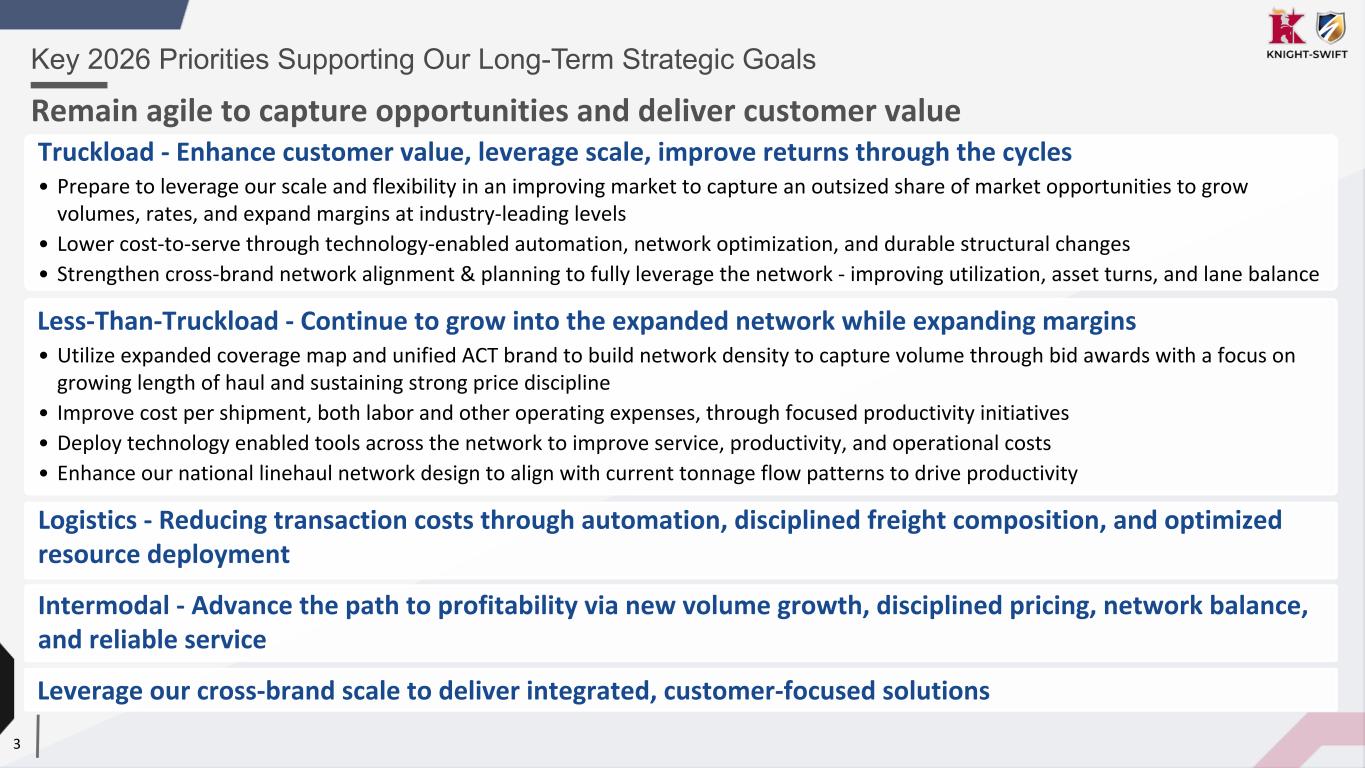
All right, thank you, Brad, and good afternoon, everyone. During the fourth quarter, the truckload market saw demand that was generally stable but lacking the typical broad-based seasonal lift in demand until late in the quarter. Seasonal project activity occurred in October but wound down quickly in early November. As a result, truckload volumes were lower than we expected. While we did see some improvement in overall demand and a tightening spot market in December, it was a reduction in available capacity that seemed to be the primary driver of the tightening market. The pressure on capacity also may be affecting the secondary equipment market as we experienced slowing equipment sales trends and falling average prices during the quarter. Developments such as these are often a precursor to a more healthy market. Thus far in January, network balance is running better than typical seasonality as capacity continues to be under pressure. We are pleased that our people were able to deliver meaningful sequential operating margin improvement in our truckload segment, even while demand was short of our expectation for much of the quarter. For the full year, our progress on structurally cutting costs out of the business helped us overcome a $125 million decline in truckload revenue, excluding fuel surcharge, but grew adjusted operating income, $28 million in this segment. At the same time, the truckload business overcame inflation pressures to hold its 2025 cost per mile flat with 2024 despite miles declining 3.6%. Our LTL team was able to produce year-over-year shipment growth for the fourth quarter in a lower demand environment, even after lapping the DHE acquisition in the prior quarter as our expanding network continues to help us create new opportunities. This team also responded quickly to the changing environment, stepping up the intensity of our cost initiatives to deliver operating margin within 60 basis points of the prior year levels, even while shipment count growth fell well below that of the growth in facilities and door count year over year. As we move into a new year and with anticipation building for a turn in market conditions, we felt it would be helpful to review our company's profile and to highlight some of the things we are focused on to better position ourselves for earnings growth moving forward. I won't touch on every part of our business here, but I wanted to share a few thoughts. First, we operate the largest fleet in the truckload industry and roughly 70% of our fleet is deployed in one way or over the road service it is true the one-way market has been the most difficult place to be over the past three plus years as this market has felt the brunt of the influx of capacity since the pandemic but one-way service is what typically improves first and most in a tightening market our unique ability to deliver responsiveness at scale and with industry-leading trailer pull flexibility are competitive differentiators that attract opportunities, especially in the tightening market. Second, the significant progress we have made cutting costs out of our truckload business has driven year-over-year earnings growth despite lower revenue. Further, while the deleveraging effect of lower miles has masked some of our progress in reducing cost per mile, we believe most of the fixed cost reductions are permanent and position us for better incremental margins as volume and pricing recover. The incremental margin opportunity is further enhanced by the room to improve utilization on the existing fleet. While we have made meaningful progress on cost to date, there are still a number of opportunities to further improve and to scale our business efficiently. We have been investing in internal development and external products to facilitate tech-enabled efficiency gains as well as better revenue capture, including through AI and other methods. We expect the benefits to begin to be realized in 2026 as we more fully roll out these technologies and as an improving marketplace provides us opportunity to scale more efficiently. Finally, our entry into the LTL industry and subsequent expansion over the past few years is just the beginning of what we believe will be a multi-year journey with an attractive runway for reinvesting free cash flow towards improving revenues, margin, and earning stability. As we have grown our facility count faster than our shipping count over the past two years, this has weighed down margins. But we expect a more deliberate pace of network expansion in the near term will allow us to restore margins as we continue to grow into these investments. We believe the existing infrastructure has capacity to support annualized revenue of $2 billion. As we continue growing into these investments, the operating leverage will be further enhanced by building density and optimizing our cost structure to help us reach our goals of steady margin improvement. Then, when we look externally, there are a number of factors that increasingly indicate the trucker market could begin to grow stronger in 2026. Capacity reduction is clearly underway. Regulatory enforcement of qualifications and safety standards was arguably the most welcome development in 2025 for our industry. The influx of capacity from 2021 to 2024, much of which was played by a different set of rules and operating with different cost structures, has distorted pricing behaviors and cyclical patterns. The ongoing efforts of the FMCSA and DOT to prevent and revoke invalidly issued CDLs, shut down noncompliant CDL schools, and address hour-of-service abuses should, in our view, have an outsized impact on the lowest price capacity in the one-way truckload market. Aside from the regulatory cleanup, capacity continues to erode, especially in the one-way truckload market, where struggling carriers are running out of liquidity, and large players continue to shift towards dedicated services. Second, market data trends have improved of late. Despite muted demand, rejection rates climbed in recent months and are hanging in above year-ago levels in early January. Similarly, market spot rates and the spot-first contract spread improved exiting 2025 to the best level seen since early 2022. These market trends align with those seen within our own businesses. And finally, the inventory pull forward appears largely worked off as a result of solid holiday sales, and there is a potential for stimulative support for demand from the tax bill and Fed rate cuts. It appears the market has progressed to a point where even small increases in demand can cause disruption, and our industry-leading over-the-road capacity is uniquely positioned to create value for our customers and capture opportunities for our business. The market and regulatory developments in the back half of 2025 give us increased confidence in the path to return our truckload segment back to mid-cycle margins. We are not here to call the turn by any means, but we are closely monitoring market trends, bid developments, and signals from our multiple nationwide truckload networks and are prepared to execute our playbook for deploying capacity towards the most valuable opportunities as the landscape shifts. We remain committed to thoughtfully deploying capacity, capital, intentionally leveraging our strengths, and creatively unlocking synergy opportunities across our business. And with that, I will turn the call over to Andrew and Brad to review the results of the quarter and our guidance.
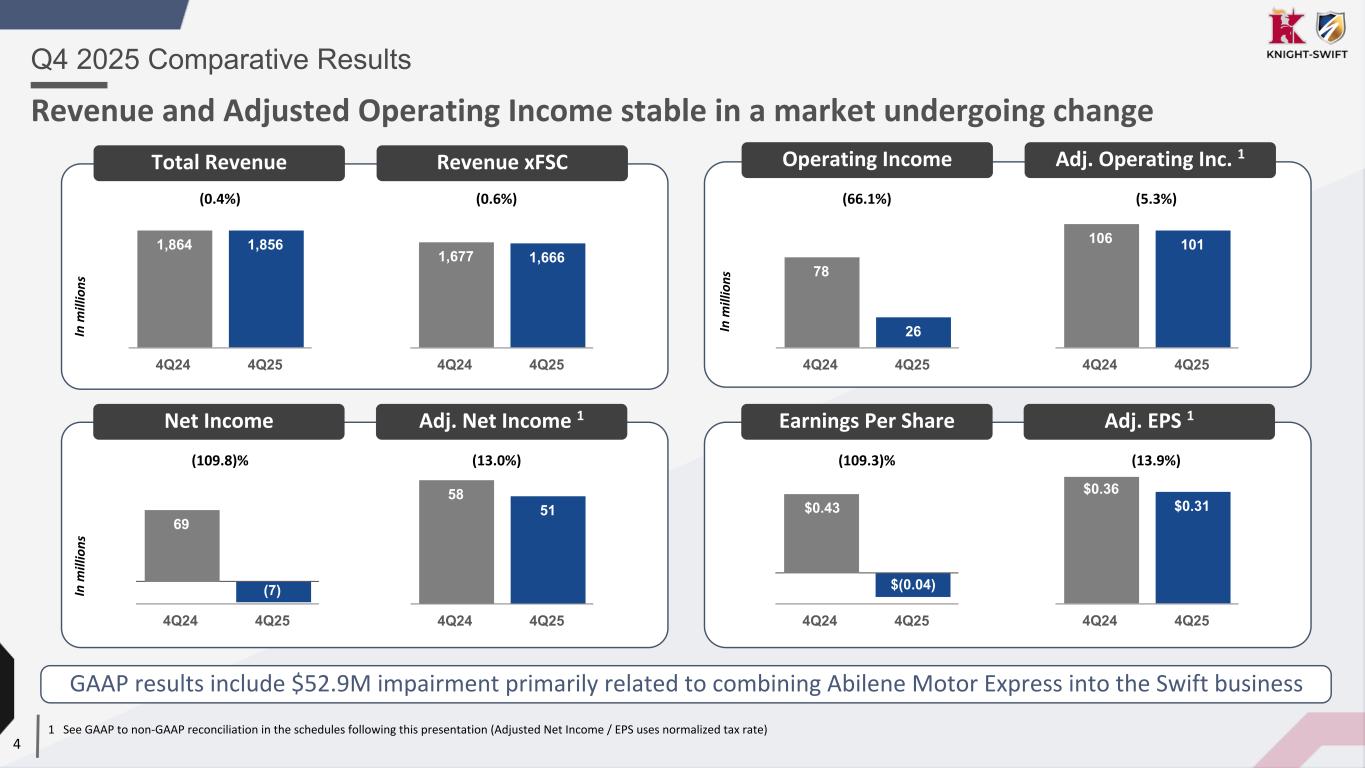
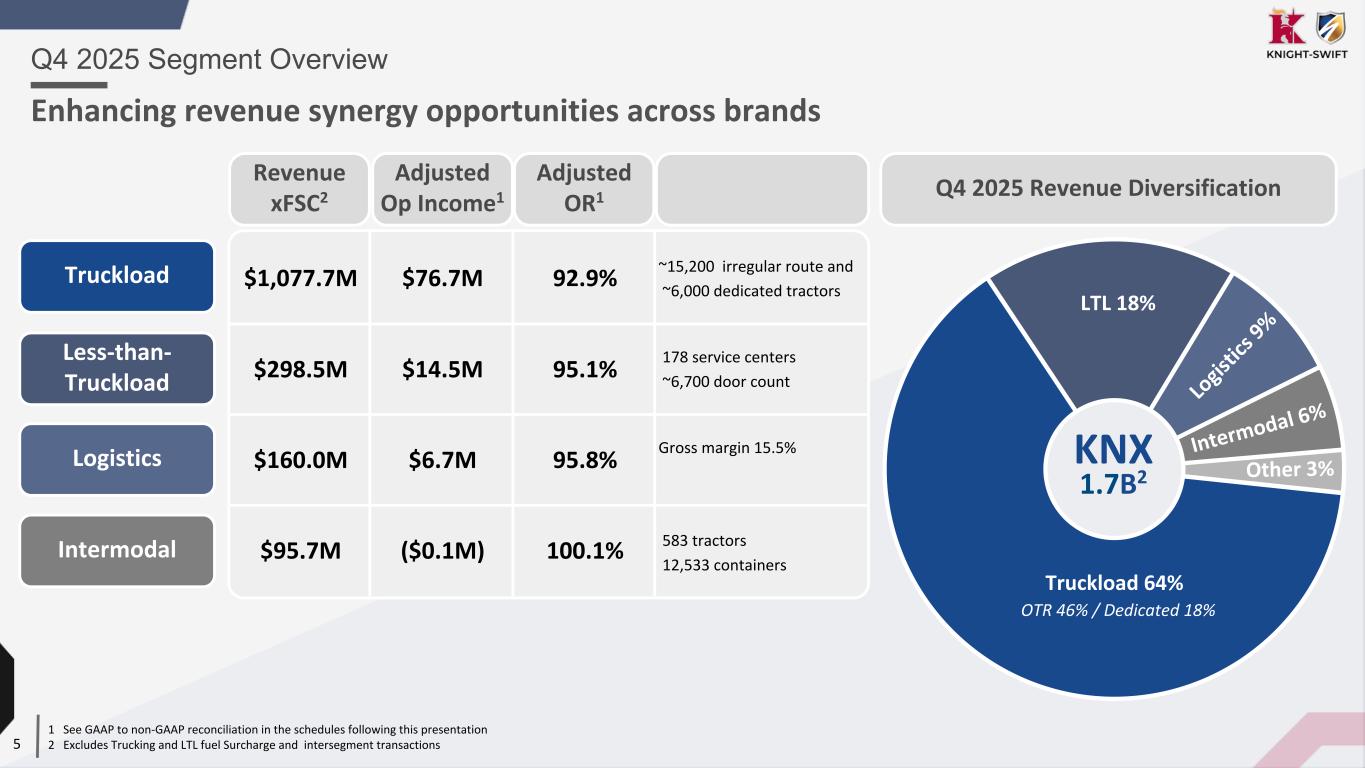
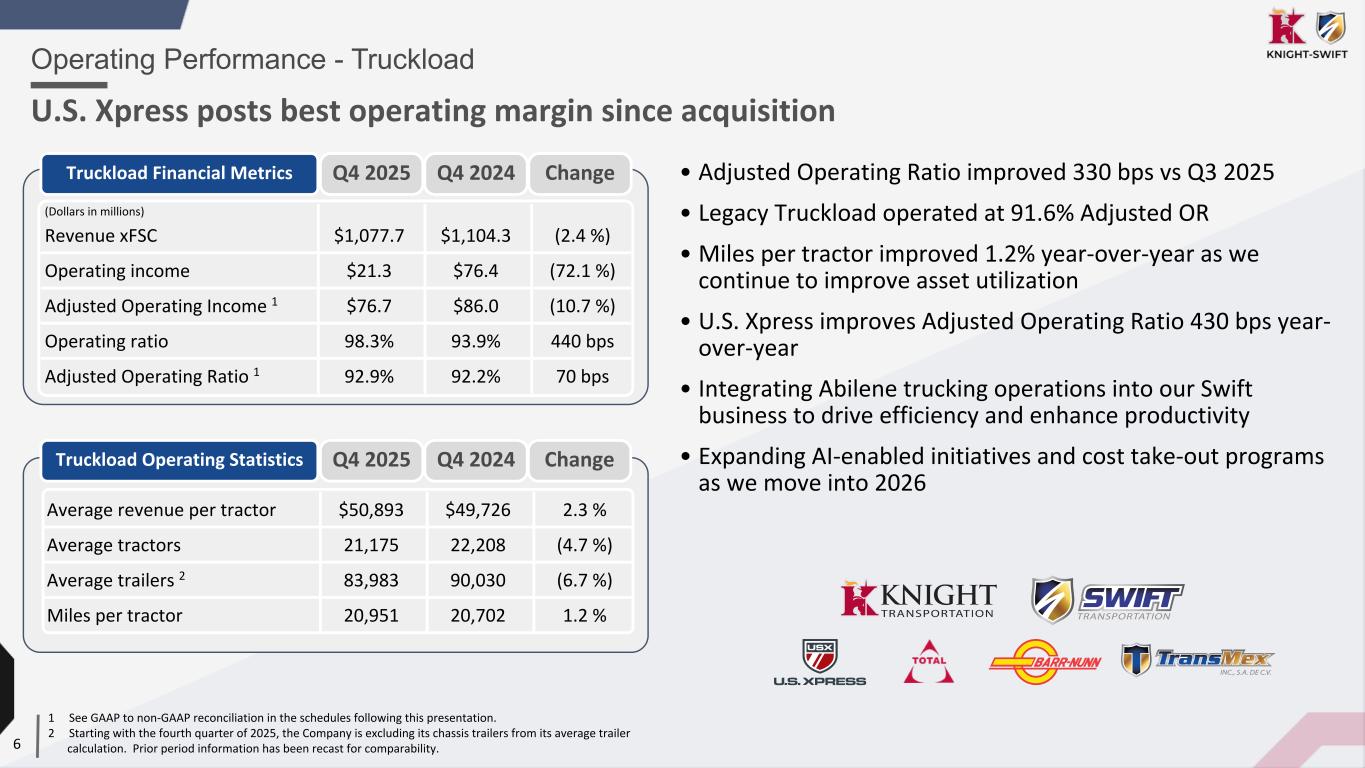
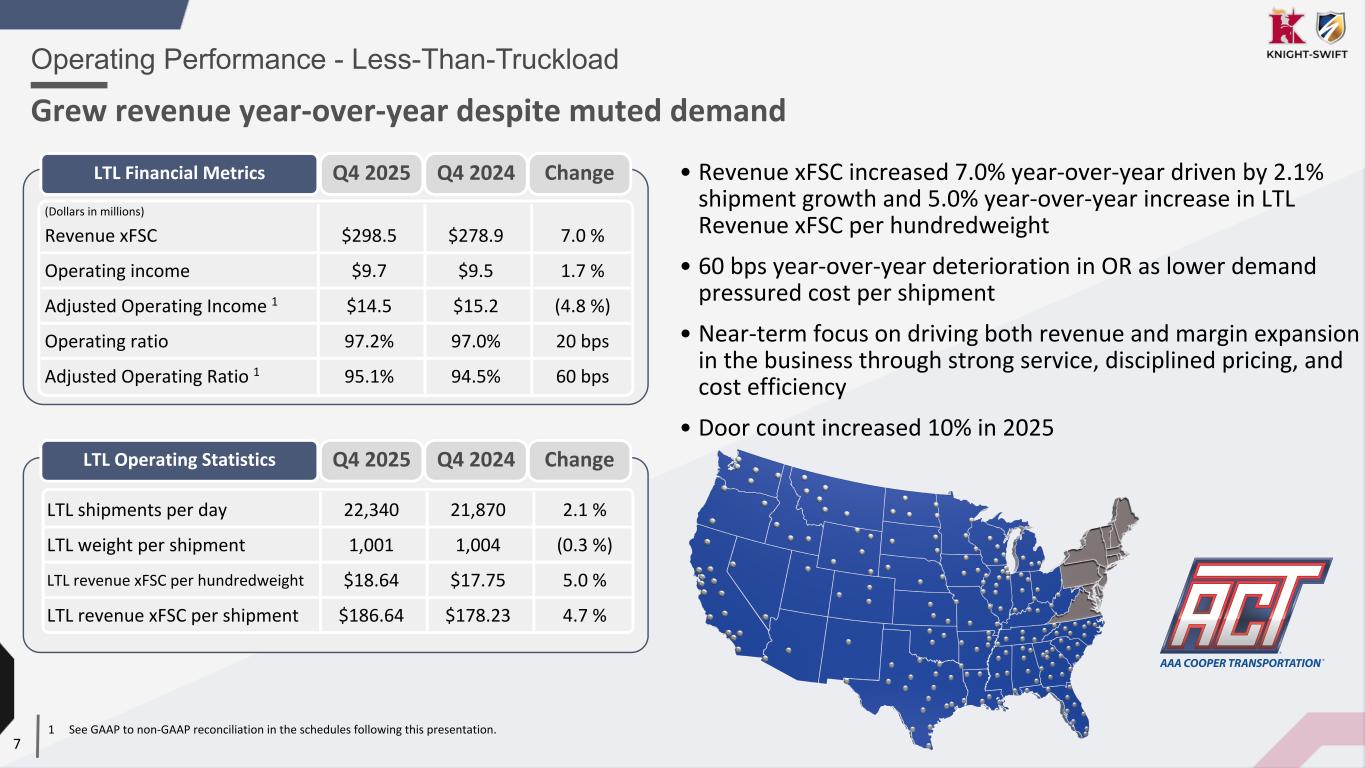
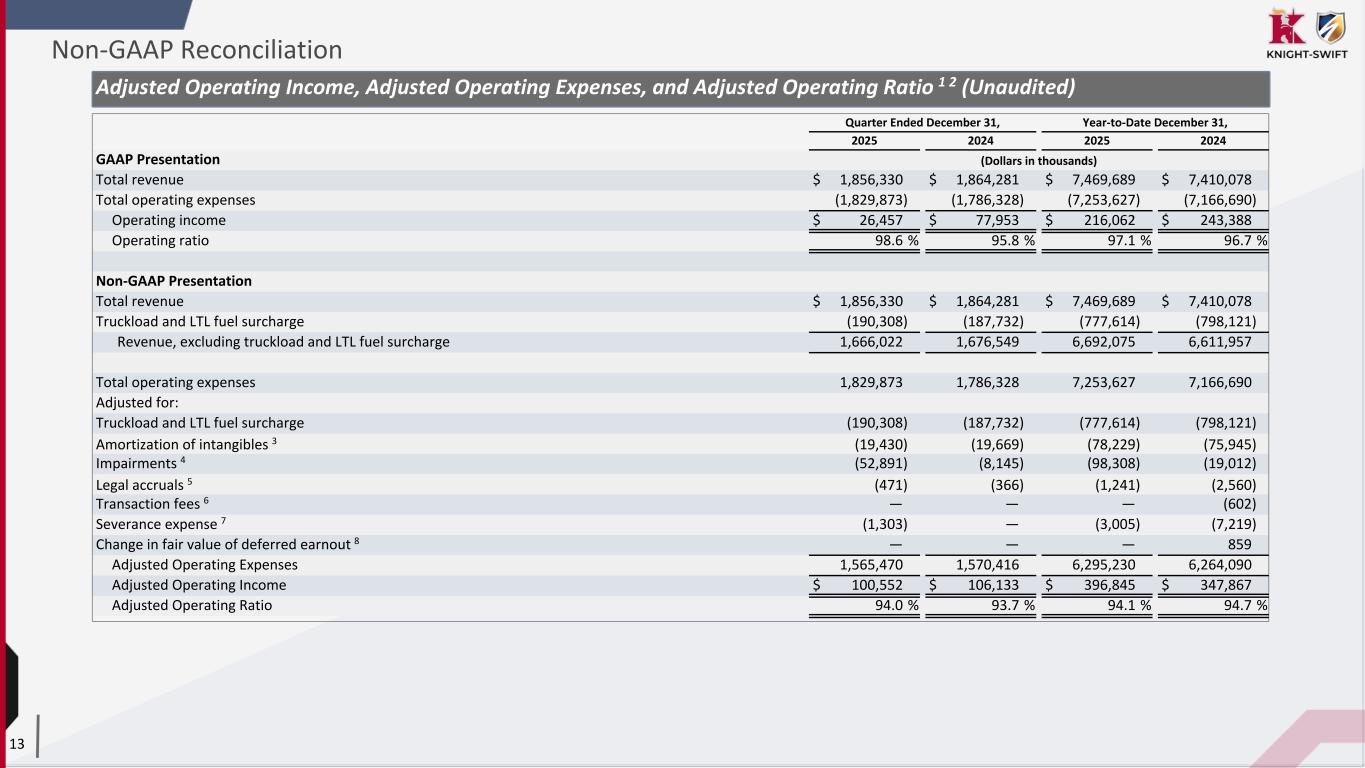
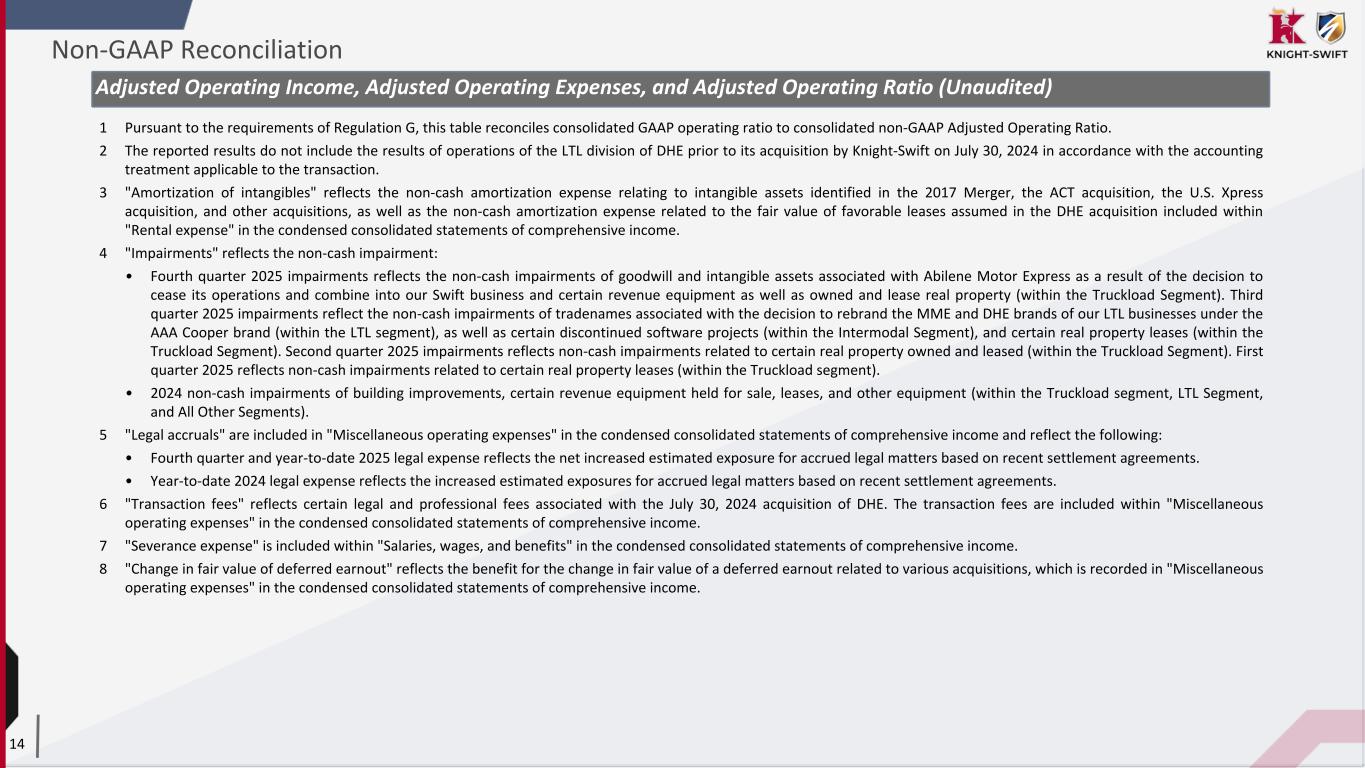
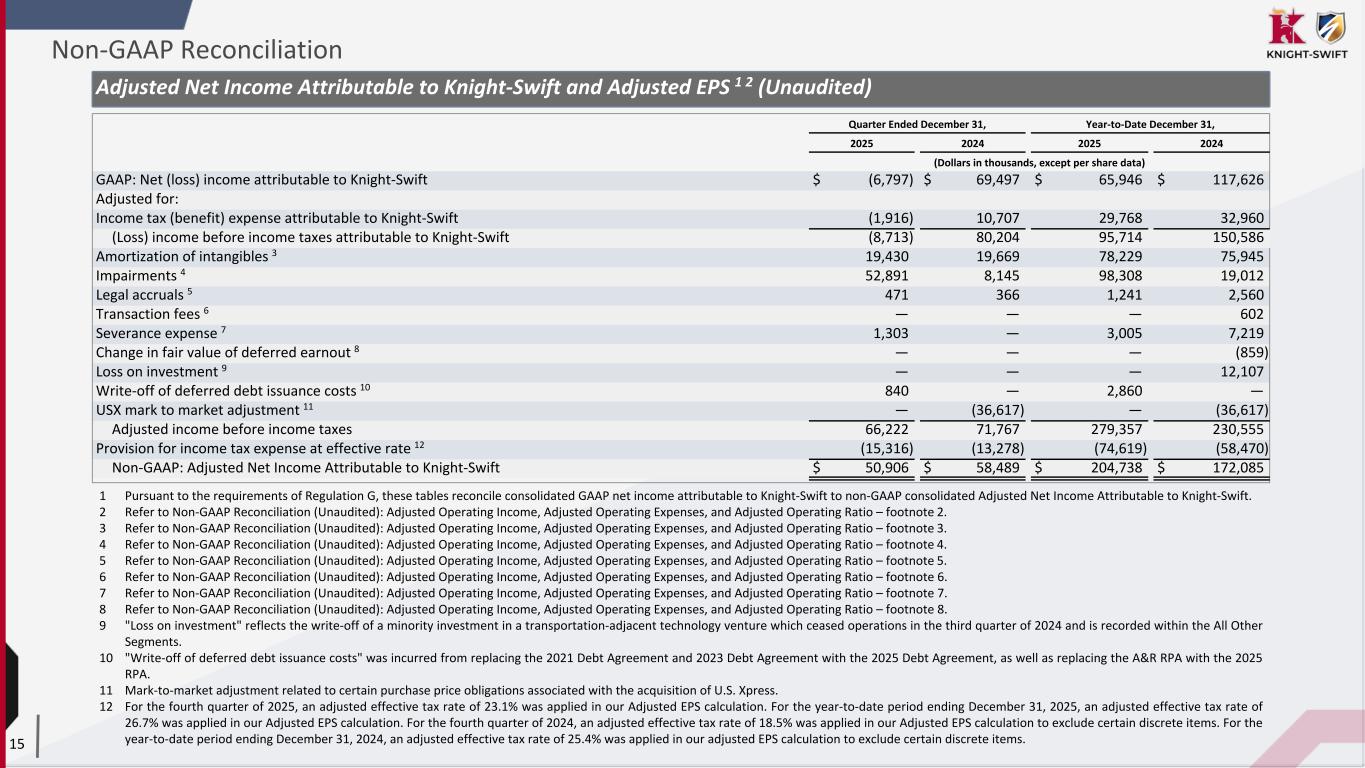
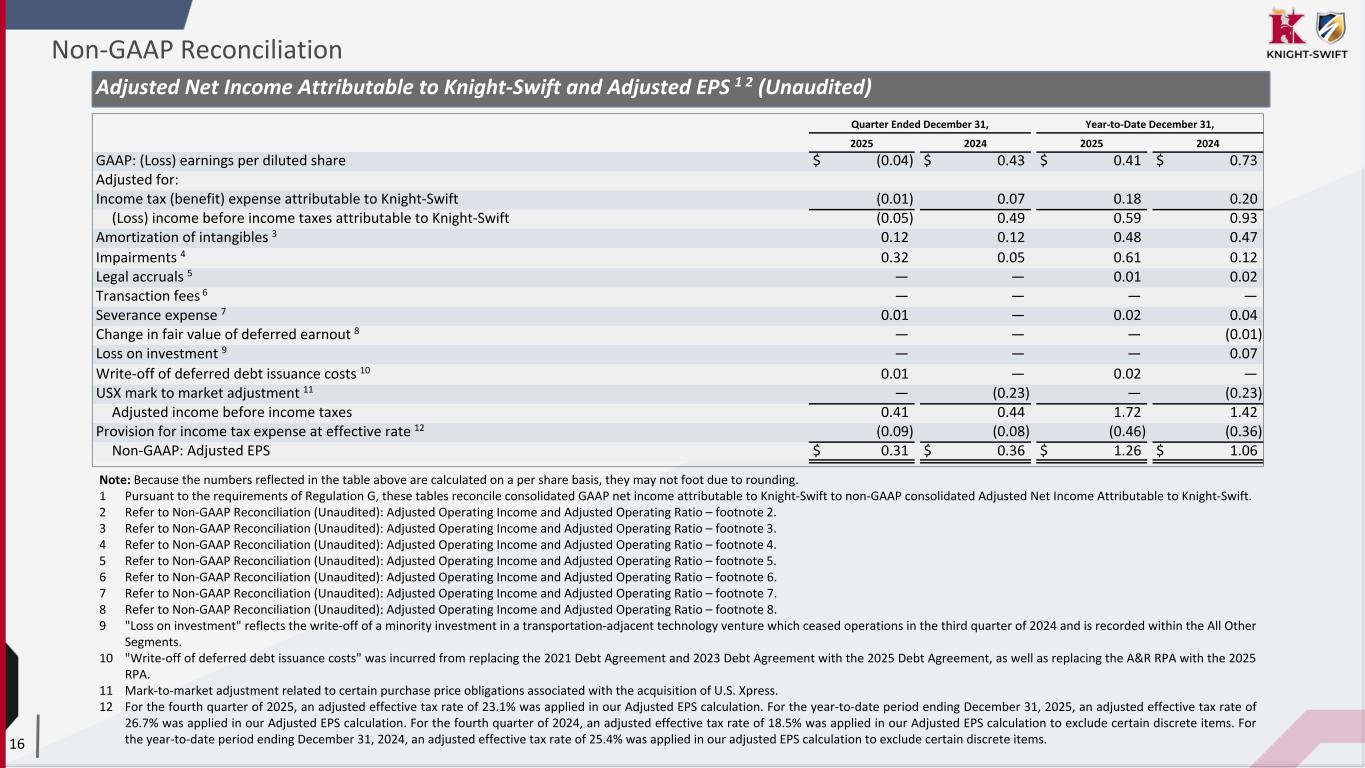
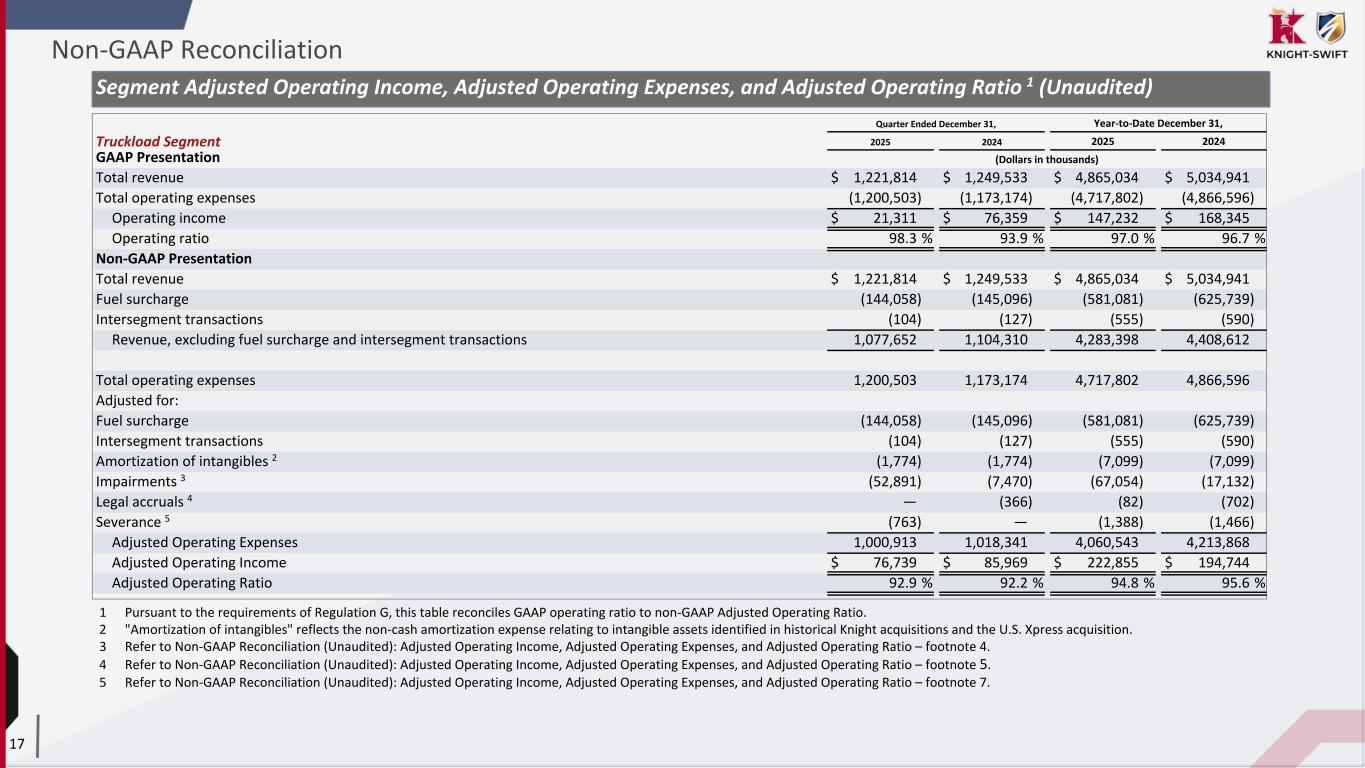
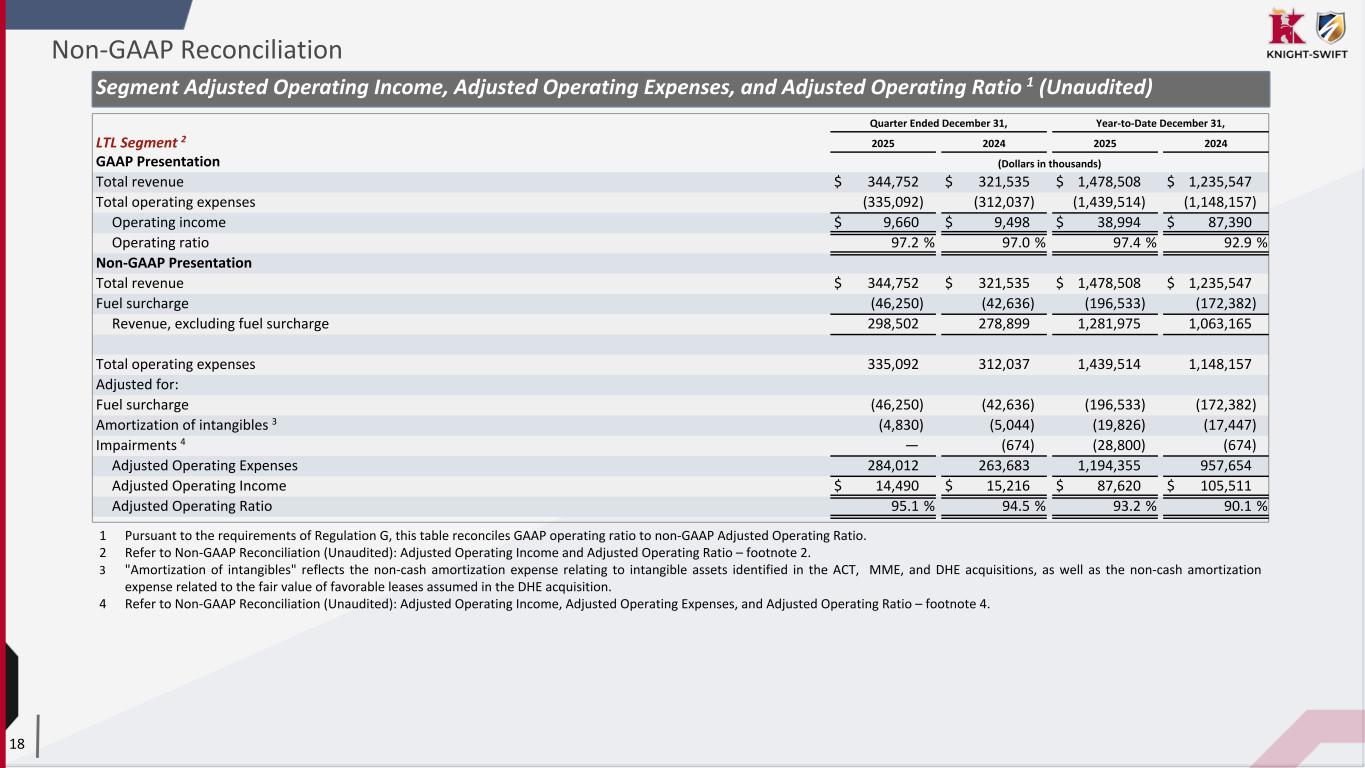
Thanks, Adam. The charts on slide four compare our consolidated fourth quarter revenue and earnings results on a year-over-year basis. Before getting into the comparisons, it's important to note that our GAAP results for the current quarter include $52.9 million of non-cash impairment charges, primarily related to our decision during the quarter to combine our Abilene truckload brand into our SWIFT business. Impairments have been adjusted out of our non-GAAP results, as shown in the reconciliation schedules following this presentation. Revenue-excluding fuel surcharge decreased slightly by 40 basis points, and operating income declined by 51.5 million year-over-year, largely due to the 52.9 million of impairments noted above. Adjusted operating income declined 5.3% per year as a result of lighter truckload and appeal demand environments compared to the fourth quarter of 2024. Gap earnings per diluted share for the fourth quarter of 2025 were a loss of $0.04, primarily related to the impairments right above. Gap earnings per diluted share in the prior year quarter were $0.43, which included a $36.6 million benefit for a mark-to-market adjustment of certain purchase price obligations associated with the U.S. Express acquisition. Adjusted EPS was $0.31 for the fourth quarter of 2025 compared to $0.36 for the fourth quarter of 2024. Our consolidated adjusted operating ratio was 94%, up 30 basis points every year and 20 basis points sequentially. The effective tax rate rate of 21.6% on our GAAP results was 820 basis points higher year-over-year, effective tax rate of 23.1% on non-GAAP results was 460 years higher year-over-year. Slide five illustrates the revenue and adjusted operating income for each of our segments for the quarter. Overall, truckload grew as a share of our consolidated revenue quarter-over-quarter, as the fourth quarter is typically the strongest season for this business, while it is the softest for LTL. We would anticipate LTL returning closer to its recent 20% share next quarter as LTL seasonality begins to improve. We have been enhancing our ability to generate revenue synergies across brands and lines of service. The key levers are intentional leadership to drive powerful collaboration and deploying technology to foster seamless connectivity. Leveraging excess capacity in one brand against excess demand in another effectively increases our ability to surge and capture a greater share of market opportunities while solving internal network imbalances. To be certain, we have leaned on each other before, but these advances make such practices systemic, more responsive, and scalable. These are calculated investments designed and prioritized based on their ability to propel our business. Now, we will discuss each of our segments, starting with our truckload segment on slide 6. As Adam mentioned, volumes in the truckload segment were lower than expected, with generally lower demand than the prior year period until late in the quarter. Additionally, seasonal project activities in October had shorter duration than in the prior year likely due to some freight having been moved earlier than the normal the normal given trade and tariff disruptions throughout 2025 additionally flockades of the Mexico border during the quarter were a headwind to productivity especially for our transmex division while demand did show some improvement late in the quarter which helped support spot rates this could only partially overcome the muted November results the secondary equipment market weakened during the quarter, which appears to be at least partially related to the impact of regulatory enforcement on smaller carriers, which caused gains on the sale to come in roughly $4 million below the prior quarter level and our expectations. On a year-over-year basis, revenue-excluding fuel surcharge declined 2.4%, and adjusted operating income declined $9.2 million, or 10.7% year-over-year, largely as a result of a 3.3% decline in loaded miles. Revenue per loaded mile excluding fuel surcharge and intersegment transactions increased 0.7% year-over-year and sequentially improved 1.4% over the fourth quarter combined adjusted operating ratio was 70 basis points higher year-over-year. Excluding US Express, the legacy truckload brands operated at a 91.6% adjusted operating ratio While US Express improved its adjusted operating ratio of 430 basis points year-over-year to the mid-90s as its seasonal project participation was at its highest since the 2023 acquisition. Finally, during the fourth quarter, we decided to combine the Abilene trucking operations into our SWIFT business to improve efficiency and enhance the productivity by incorporating these assets and freight flows into a more robust network with more freight opportunities. We continue to make tangible progress improving our cost structure to position our business to generate meaningful returns as market conditions recovered. Moving on to slide seven, our LTL business grew revenues including fuel surcharge seven percent year-over-year with shipments per day up 2.1 percent. A lower growth rate than the previous quarters we lapped the acquisition of DHE on July 30th, and as market demand moderated at the beginning of October. Revenue per 100 weight excluding fuel surcharge increased 5% year-over-year. Adjusted operating income decreased 4.8%, and adjusted operating ratio increased slightly by 60 basis points year-over-year. As Adam noted, in response to the moderating demand environment during the quarter, we We stepped up the cost initiatives we had announced last summer to mitigate pressure on margin. We are taking action where prudent in the short term, but without sacrificing our ability to respond to growth opportunities through ongoing vids, as discussions around vids currently in process are encouraging. During the fourth quarter, we opened one new service center and replaced another with a larger sites, bringing our growth and door count to 10% year over year. We have opportunities to optimize our operations and cost structure as our network and business mix mature, and we have confidence in our plans to achieve this. Our solid service levels, growing customer base, and ground to make up on pricing provides a compelling runway for the value to be generated by this business. Now, I will turn it over to Brad for a discussion of our logistics segment on slide eight.
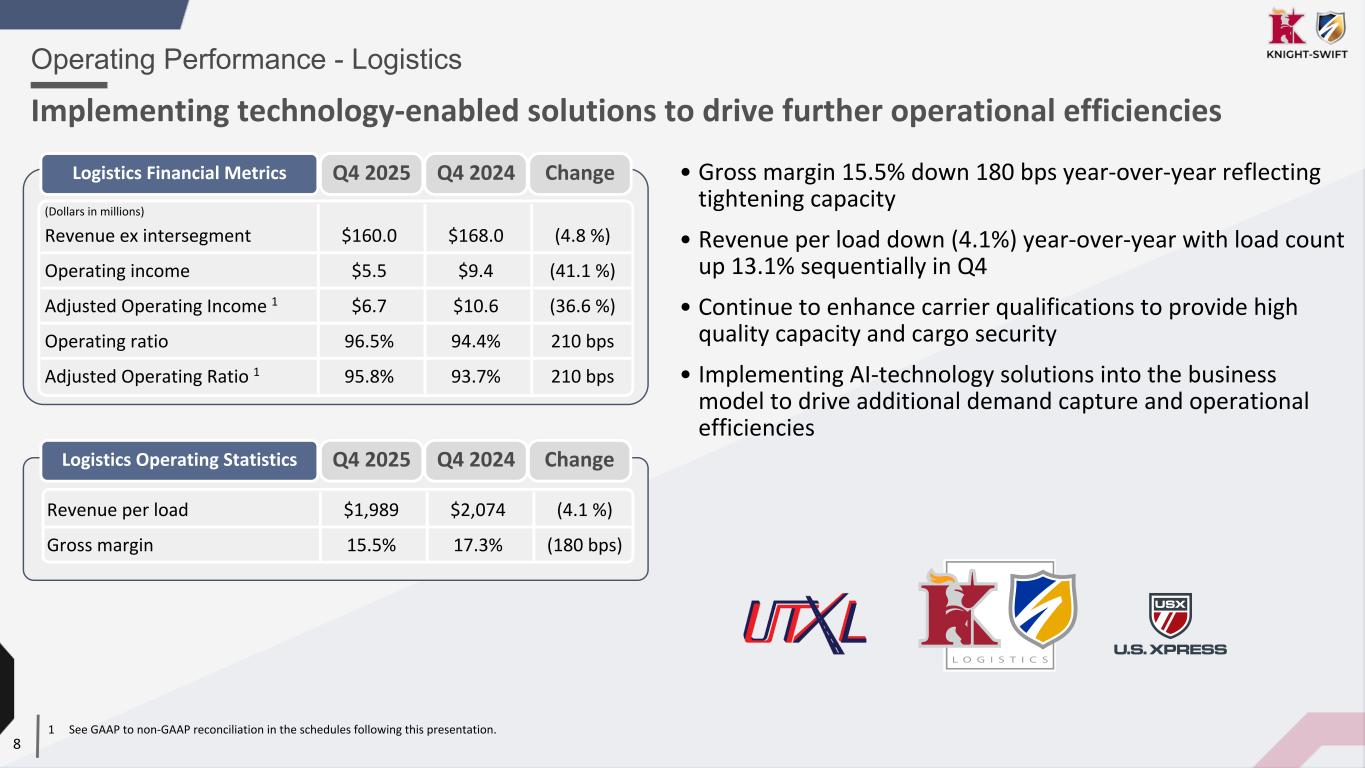
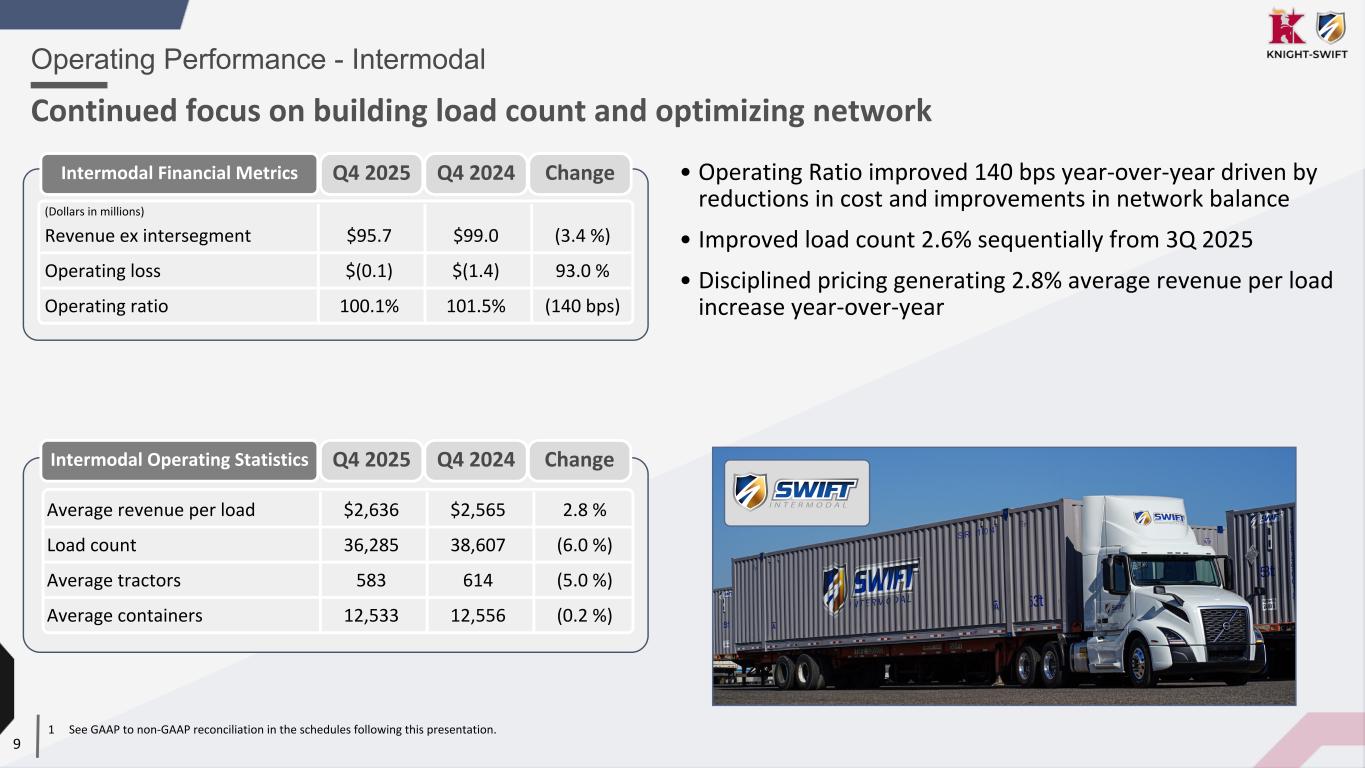
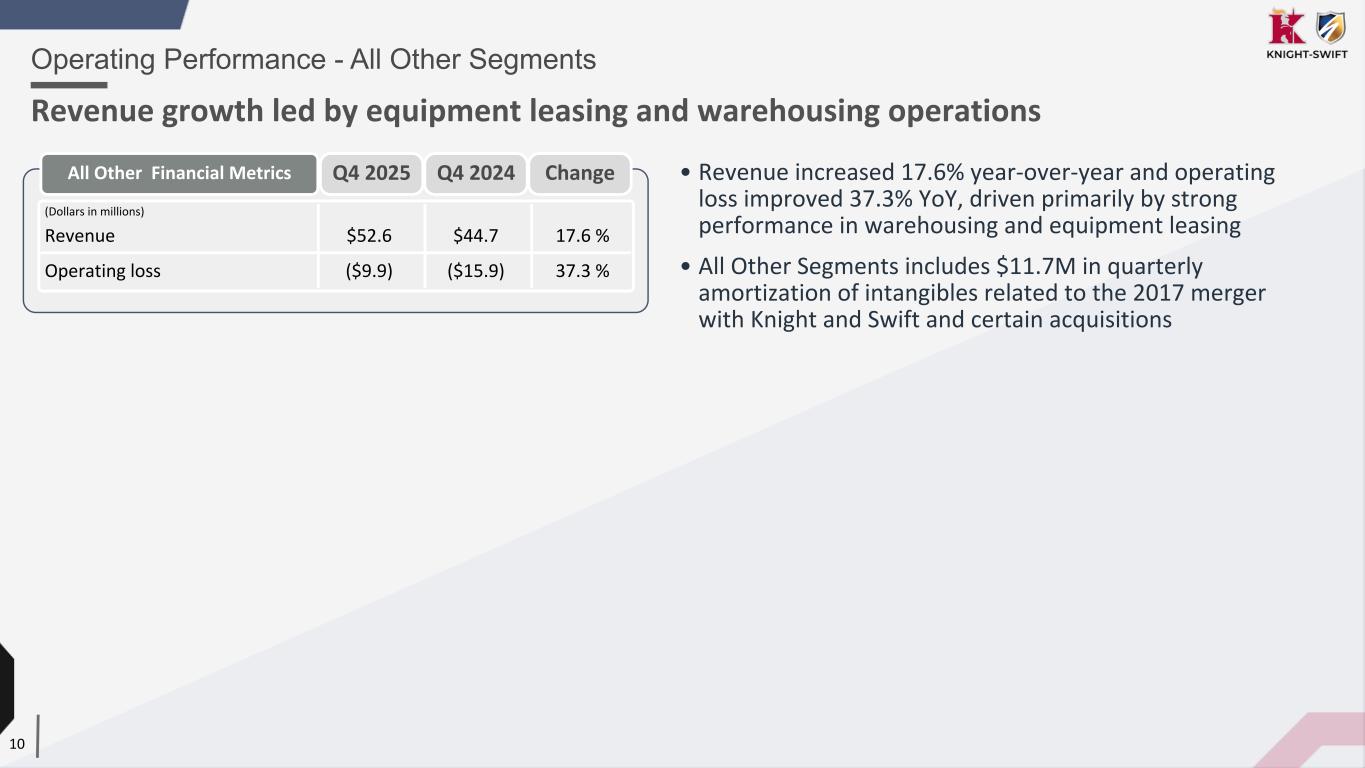
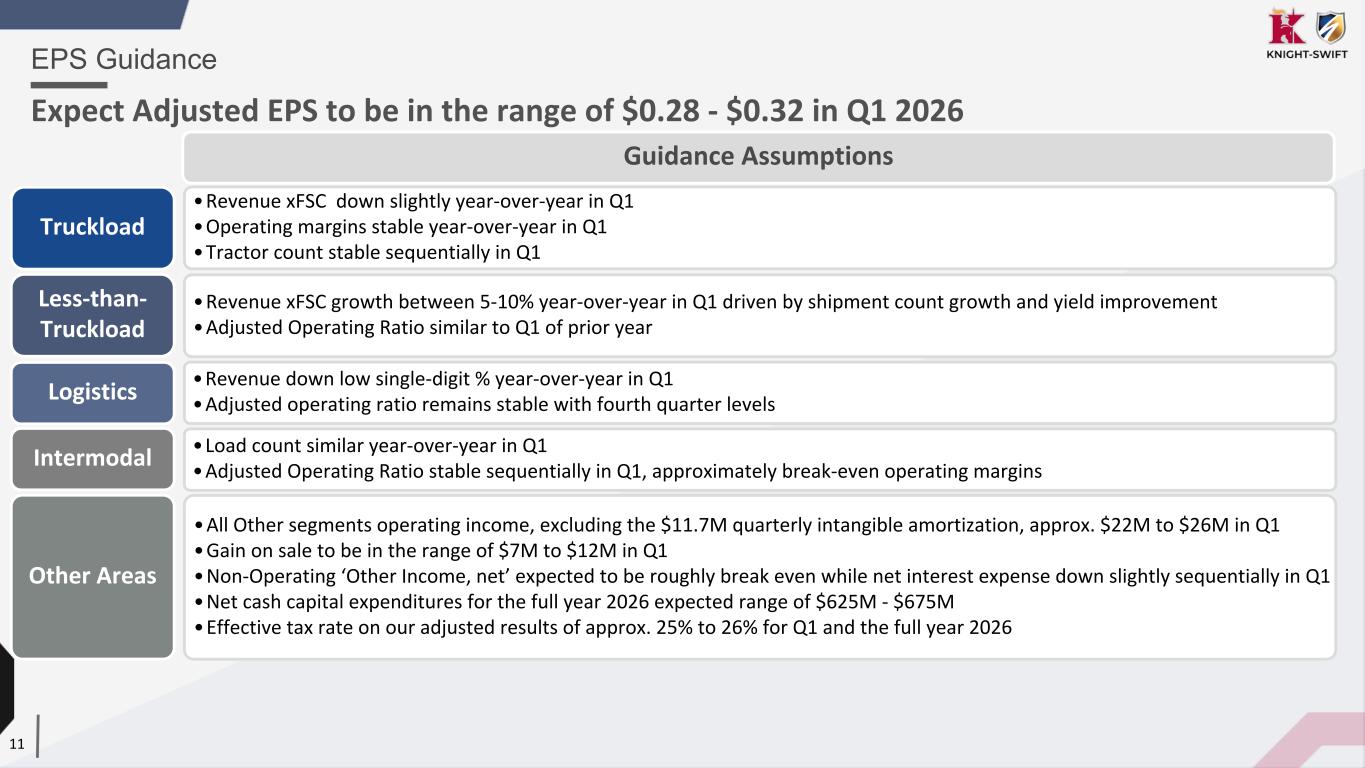
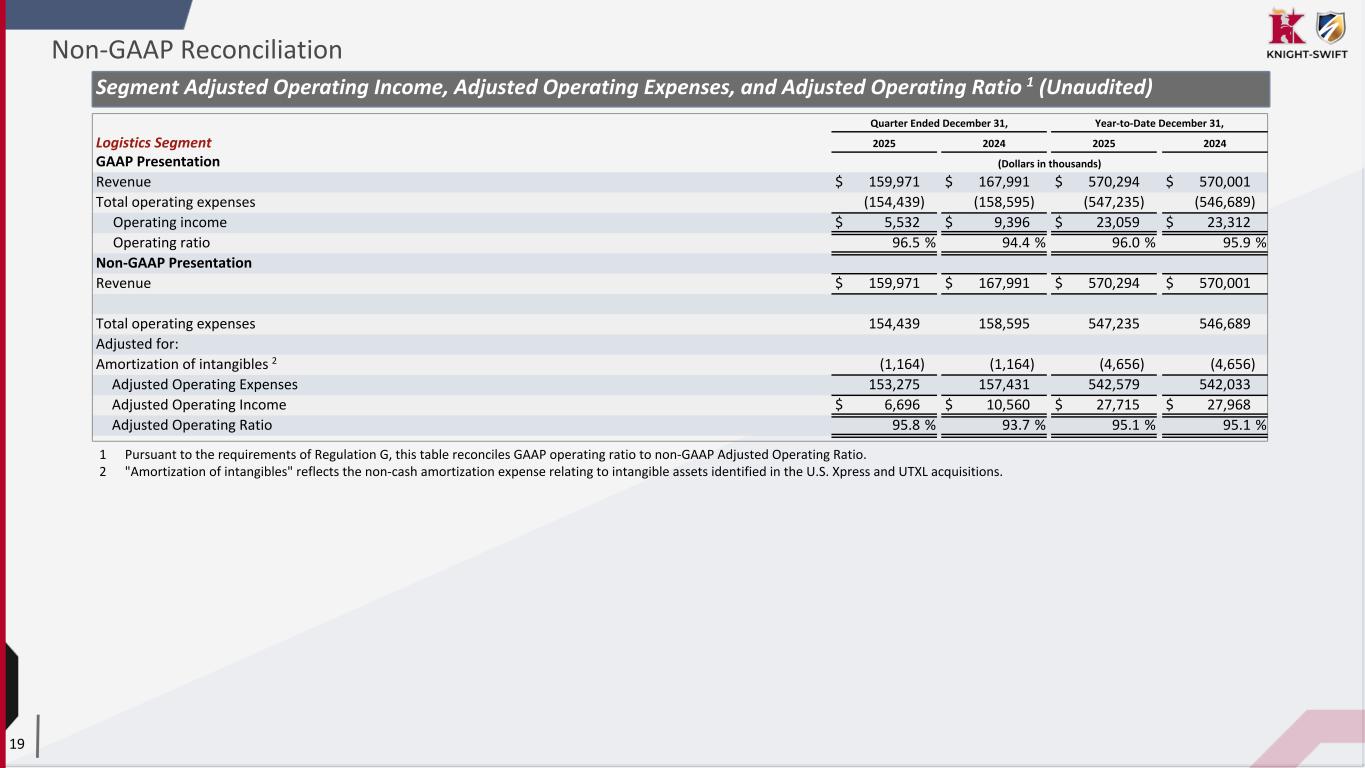
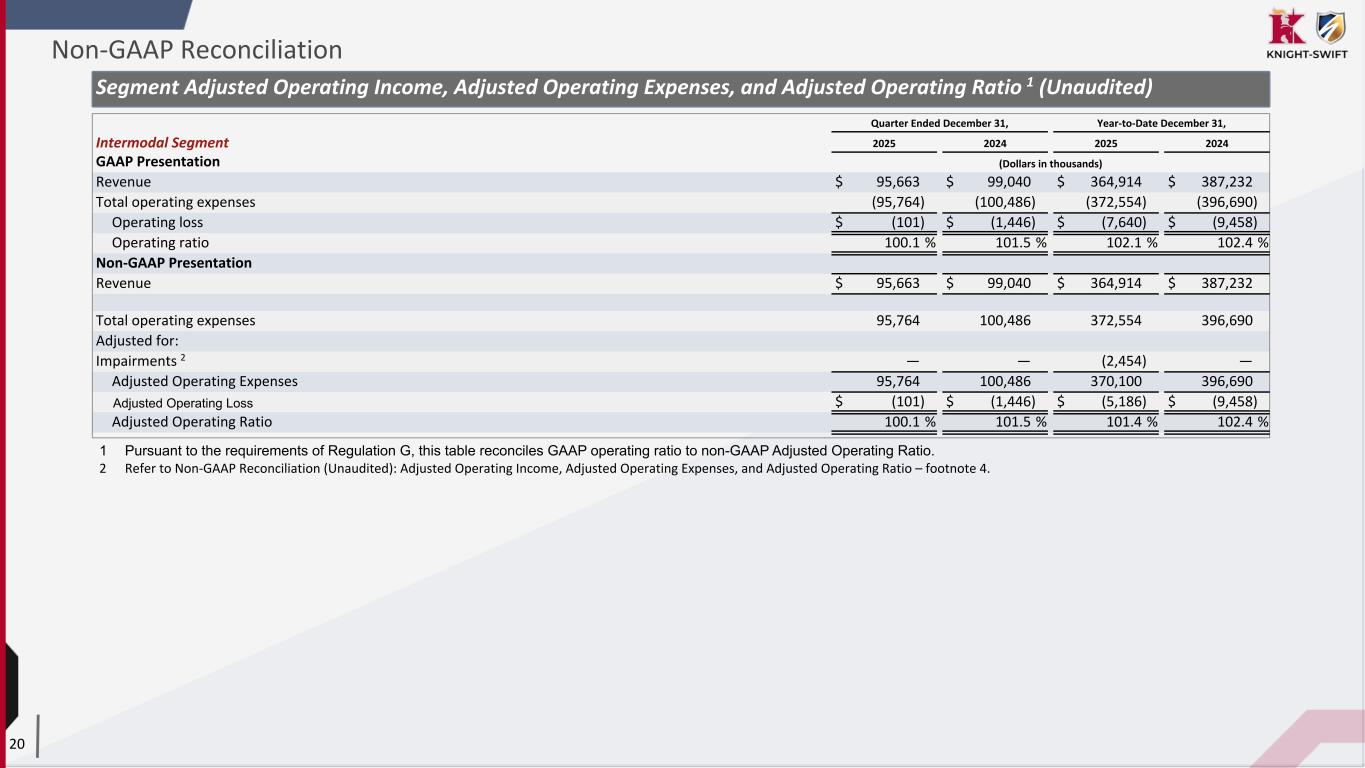
Thanks, Andrew. Logistics revenue for the fourth quarter declined 4.8% year-over-year as volumes were down 1% while revenue per load was 4.1% lower due to mixed change. Third-party carrier capacity grew noticeably more difficult to source during the quarter, which pressured gross margins. Gross margin of 15.5% for the fourth quarter declined 230 basis points from third quarter levels and 180 basis points year over year adjusted operating ratio was 95.8 percent for the quarter another recent trend is the increase in cargo theft in the industry while fraud and theft in the industry has been on the rise over the past couple of years channel checks indicate a rash of theft in the quarter some of which appear to be related to operators being forced out of the business through either financial struggles or regulatory enforcement if these trends continue it can further encourage shippers to allocate more business to direct asset-based carrier relationships. For our part, we have been further tightening our already rigorous carrier qualification standards and narrowing the existing carrier base that we tender loads to. Also, if upward pressure on third-party capacity cost continues, this could cause further pressure on gross margin in the near term as capacity continues to erode. However, given the relationship between our logistics segment and our asset-based truckload segment we believe these dynamics would ultimately benefit both our asset and logistics businesses over time our logistics business has demonstrated its agility in navigating a volatile market the past few years by maintaining its operating margin close to target levels through discipline pricing and cost management this team is now further leveraging technology to take cost efficiencies to a new level as well as to improve our responsiveness and ability to capture opportunities in the market which we expect will contribute to earnings in 2026 these enhancements combined with its complementary relationship with our asset business position our logistics business to accelerate revenue growth and the return on our trailer assets in an improving market now on to slide nine for discussion of our intermodal business the intermodal segment improved its adjusted operating ratio 140 basis points year over year to 100.1 driven by a 2.8 percent increase in revenue per load as well as structural cost reduction and improvement in network balance which led to significant zero-year reductions in empty repositioning, graded, and chassis costs. Revenue declined 3.4 percent year-over-year on a six percent decrease in load count partially offset by the increase in revenue per load. On a sequential basis revenue grew 1.7 percent 2.6 percent increase in load count with both measures reaching their highest marks for the year we look forward to leveraging the new chapter in our rail partnerships in improving market and in the meantime you remain focused on delivering excellent service driving appropriate return through growing our load count with discipline pricing cost control network balance and equipment utilization like tent illustrates are all other segments this category includes support services provided to our customers and contractors and third party carriers such as equipment sales and rentals, equipment leasing, warehousing activities, insurance and maintenance. For the quarter, revenue increased 17.7% and the operating loss in the seasonally slow period for this category improved 5.9 million or 37.3% year-over-year, primarily driven by growth in our warehousing and leasing businesses. Now, on slide 11, we have outlined our guidance and the key assumptions, which are also stated in the earnings release actual results may differ from our expectations based on our assumptions we project our adjusted eps for the first quarter of 2026 will be in the range of 28 to 32 cents in general this guidance for the first quarter assumes current conditions remain stable and that we experience some seasonal slowing in the truckload market and seasonal recovery in the ltl market the key assumptions underpinning this guidance are listed on this slide I won't take time to read through all of our assumptions here, but I do want to touch on a couple of the more significant moves other than the typical seasonality in truckload. We expect a strong bounce back in our All Other Segments category after its seasonal slow period in the fourth quarter, and we have significantly reduced the range for expected gain on sale based on the secondary equipment market trends that we noted in our earlier comments. Now, this concludes our prepared remarks. And before I turn it over for questions, I want to remind everyone to please keep it to one question per participant. Thank you, Konstantin. We will now open the line for questions.
Operator
Ladies and gentlemen, we will now begin the question and answer session. Your first question comes from the line of Rita Harnian from Deutsche Bank. Your line is now open.
Hey, gentlemen. Thanks for the time. I guess maybe we can start with the outlook. Look, you know, Adam, you walked through some various items to be, you know, look forward to in 2026, some tailwinds, maybe you can just elaborate on like, you know, in light of those tailwinds, why we're not seeing maybe a more robust outlook for Q1, and I understand that there's some seasonality, but maybe you can just talk about that. And then just generally speaking, like any sort of guidance on, you know, how we should to think about Q1 relative to the entirety of the year, has seasonality shifted at all and given the incremental margin should maybe be better given all the good work you did on cost, like how should we think about, you know, how margins could progress as the year Thank you, Richa.
We'll count that as one question. So just to go through the outlook here, maybe I'll start with just maybe walking through Q4 and then how that kind of sets up in Q1 and then maybe how we're looking out beyond I won't give any guidance in terms of EPS beyond Q1, but I can give you my view of how I think the market may progress. You know, when we came into the fourth quarter, I think on our last earnings call, we talked about having some projects in the queue, you know, some of them we haven't seen in several years. And those did materialize in October, and typically when you see projects like that materialize, you have other types of projects that just kick off during the fourth quarter where you have customers that have acute needs, and those typically drive a stronger November and build, you know, up through Thanksgiving, and then you have a little bit of a lull coming out of that, and then you could finish the quarter strong. Once we got through our projects in October or maybe early November, We did not see the strength continue, and it was a bit disappointing, the volumes in November, and it was just tough to overcome that, even with some of the strength we saw the back half of December. And we don't get, you know, too wrapped up in, you know, the spot market jumping up for a couple weeks because, you know, we're still largely contractual, but we did see, you know, some of the lift, But it wasn't enough to overcome, you know, the slower November and then just the disruption you get in, you know, productivity during the holidays. But as we saw that market kind of continue in or bleed into the first part of the first couple of weeks of January, I think we became a bit more constructive on, you know, maybe the balance between supply and demand. And so as we sit in early January, you know, we're feeling a bit better about our ability to, you know, push rates in the bid season and maybe find some ways to even get some spot or some premium spot opportunities early in the first quarter, which has been some time since we've been able to do that. But when I look out to, you know, what that means for the first quarter, a lot of the work that we do in the bids we don't really feel the benefit of that or see the benefit of that until you get into the second quarter you know earlier mid second quarter and then throughout the back half of the year so I think the first quarter we may be in a period where we feel better than we look in terms of the results but but the confidence in our ability to start to push rates higher and to restore we're beginning to restore our margins and I I think we started off the bid season with far more constructive conversations with customers where the discussions are starting around securing incumbent lanes with positive rates. Now, I think what we'd be pushing for would be low to mid single digits and improvements in contract rates and maybe closer to mid than low, and maybe that may not align with what our customers want to see, you know, in a pre-bid. And so some of this stuff is going to go into a bid to see where the market is from a balance standpoint. And we've already heard from several customers about wanting to shift a bit more volume from brokers to assets because of the spot market trends that we've been seeing and then some of the capacity that's been coming out of the market from a regulatory perspective. So I think that gives us more confidence in where this market's headed. But I don't know that we really feel the full benefit or see the full benefit of that in the first quarter. But again, we're not trying to call the inflection yet. It's we've seen headaches before, but I think we're feeling better about where this market is headed. And we do feel better about what the DOT and the FMCSA are doing to clean up capacity in our industry. And I can tell you our Knight, our SWIFT, and especially now our U.S. Express business is well positioned and prepared with the tools, even the culture around what we're going to do to find opportunities to really leverage the scale and the flexibility that we have in our network. And so we're encouraged about what that could mean here in the back half of this year.
I mean, Q1s are always a hard quarter to really flex, right, just based on that seasonality. You rarely, and I don't expect rate will be much of a lift for us year over year in Q1. And we're operating on a smaller fleet than we were last year, so I think all those go We do expect continued progress on cost, and I think that's our expectation here in the first quarter improvement in cost per mile year-over-year but and I guess the other side we talked a lot about truckload but an LTL I mean I think there's we're still watching how the volumes build back and that's to some degree going to determine how this quarter plays out and we're encouraged as kind of watching the early build back of volumes here in January but but there's still a lot of kind of runway ahead of us to see really where volumes billed to in the corridor so our guidance range that we've provided is not does not we think reflects a reasonable kind of middle-lane view of how the quarter plays out but certainly if market conditions improve or worsen there is a degree of variation around the guidance we're providing here okay thank you next question comes from the line the next question comes from the line of Jonathan Chappell from Evercore ISI the line is now open Thank you.
Hey, Adam, as it relates to the priorities and the strategic goals, almost every single segment you highlight, cost to serve, technology, automation, optimization, et cetera. So when we think about your margin progression from 1Q, do you kind of view this as all the things you're doing on the cost side and the efficiency side can make margins improve even without the true inflection of the market, or is it more you need price, price kind of drives an exacerbated move in margins and kind of higher highs and higher lows?
Yeah, I mean, really, John, we really want to see both. But if the market doesn't play out on the revenue side like, you know, we're maybe expecting in the back half of the year, we're not going to be a victim of that. We're going to go after as much as we can on the cost side to improve margins on the year-over-year basis. But certainly, when you have a lift in rates and the spot market, I mean, that's going to help you get to normalized margins. I don't think you get to normalized margins just on cost alone. You'll need some lift in the market. But we look at it as, hey, we fight both battles on a regular basis. And really, the wins we've had have been more on the cost side in the last couple of years. And I think we're due on the revenue side. But our goal is to make progress on both.
Yeah, it's really a three-pronged approach, right, to full repair of margins. It's capturing price, it's bringing the volume back into the business, and reducing our cost per mile. We expect each one of those independently to contribute in 2026 to a margin improvement.
And the price, obviously, is going to be very much market dependent and to some degree the miles but but we expect cost alone should should drive margin expansion in 2026 thank you all right thanks john your next question comes from the line of brian awesome back from jp morgan your line is now open hey good afternoon thanks for taking the question guys um if you can expand a little bit more what you're seeing in the ltl uh market it sounded i mean you guys called out things were softer than I think most others saw last quarter. So that seemed to play out in October, but it hasn't really built back the way you might have thought. So I want to see if you can elaborate on that, if it's more of a market perspective or maybe something with the network as you expand it. And then just some quick color on mentioned expanding the length of haul for the network. Like how does that, how long does that take and what does that really mean from a, from a margin perspective as you go throughout this year? Thank you.
So, you know, I think we talked about how we saw, you know, a shift downward of demand starting early in October, and that really progressed throughout the quarter. And so we've had to make some adjustments on the cost side of the business to adjust for that, but also factoring in that, you know, with our expanded network now, we're now going to have an opportunity to bid with larger shippers that we just hadn't had an opportunity with before because we didn't have the the breadth of the network that would support you know what they're looking for in a carrier and so a lot of those loads may be you know heavier loads may have a longer length of haul and this is where we tap into the relationships that we have on the truckload side of the business to provide you know opportunities for our lto business to bid on that volume. So it's kind of still a little too early to tell, you know, how is volume really, is it really picking up? Are we seeing a shift from Q4 into Q1? I think the margins were okay to start, but we're looking for a greater lift. But we have a lot in the pipeline right now in terms of bids that we think could be impactful to the shipment volume of our LTL business because we just have new customers that we have opportunities to grow with. So we're kind of working through those, still early progress on that, and I think more to come. But we're just kind of balancing what you do on the labor front to manage your expense in a market where you have volumes lower than I know what we can handle, knowing that we could have an opportunity to see those volumes shift up, and we want to be prepared to handle that with a high level of service.
Brian, maybe one point I'll add to that is one of the things we identified last year was even though we had integrated from a back-end perspective and systems between the three businesses that we have combined, it was creating confusion in our sales efforts and as we took our business to the market. So we announced in the third quarter we're moving to a unified brand. And we've already seen that really help us in our sales efforts so we can present a single face to our customers and get them comfortable with our ability to deliver across our network in a way that meets their needs. So we think that is enhancing our sales efforts. We think that's going to help in addition to just the design of our network that we're going through. I mean, it is a process to really put our network, as we understand how our freight is flowing with these customers. There's been a process of doing that network design that we've been going through, and I think we're getting to the point where we've managed a lot of those bottlenecks. It's really put in a position on bid on business that we have not been able to participate on before. And so there's a lot of tailwind here in terms of, we think, the strength that's going to build in our ability to sell and build volume into the business that we build this structure on.
Operator
Next question is from the line of Ravi Shankar from Morgan Stanley. Your line is now open.
Great, thanks. Maybe in the follow-up to that, in the past, I think you've said you've, you know, Keeping the brands that you've acquired, protecting them so that you don't have any customer losses, driver losses, and kind of other negative implications in taking those brands away. So, A, how do you protect against that? B, what does this mean for the other separate brands in your portfolio? And if I can squeeze a really quick one in, kind of you spoke about LTL bid season going well. Any early comments on TL bid season would be great as well.
Yeah. Sure. I touched on TL already, but I'll come back to that, Ravi. Yeah. So, if I look over the last two quarters, we've made a couple adjustments to our strategy around, you know, some of our brands. On the LTL front, I think what we realized going into the strategy we had with buying multiple brands is the outsized benefit you get on the LTL front when you have one distinct network, one pro number, just one voice to the customer. I mean, that is what they long for. They don't like the inner line approach. And even though we had the systems integrated, we had the, you know, the visibility was similar across the different brands, regardless of the website, it still didn't feel like one company and one carrier to them. And so we felt like we needed to shift that strategy around LTL to provide one brand, one voice to the customer in order to really maximize the potential of the network that we've built. And so, that wasn't an easy decision. We put a lot of thought into it, but we still think that was the right approach. Now, you may have seen or we did comment on rolling Abilene Motor Express into our swift transportation business. You know, Abilene Motor Express was a smaller company that we purchased in 2018, and it had gotten down to around 300-plus trucks and was really struggling. And what we found was given the size of that company and maybe the lack of brand recognition with some of our customers, it was really tough for them to break through with freight opportunities that was going to support their network. And we had some change in leadership that came from the Swift business to help right the ship at Abilene. And ultimately, we made the decision that it would be best for the Abilene employees, that the drivers in particular, to run under a more robust network under SWIFT, we're trying to convert as many of the Abilene customers that went direct with them to the SWIFT network. And we had a lot of overlap of customers, so we're in that process right now of keeping that freight within SWIFT, but then supporting Abilene with back calls and things that allow them to be far more efficient from a network perspective. I would not – we don't have another brand out there that we own that we believe we would ever need to take this approach with. This was one that really saw margins aggregate over the last several years and didn't have a clear path to profitability, and we felt like this was the fastest way to get that business back to generating a reasonable turn for the assets that we have and then allow us to reduce some overhead and put our drivers in a position to be successful. So, again, this isn't something that we would take lightly, but this was the right decision for the situation we were in. And on the TL bid, you know, again, it's early, but we've had constructive conversations with our customers around rates being positive, and we're not having discussions about having to reduce rates to retain volume. And now it's just a matter of where can we get comfortable, where rates need to settle out in the bids, and some may be done in pre-bid negotiations, others it'll probably have to go to the bid so the customers can really vet where the market is. But I feel more confident going into this bid season that rates are, contract rates are going to be up, and I think, you know, that will build as capacity continues to exit. I mean, we have some cliff events coming potentially with capacity, Robbie, where we've already seen with English proficiency, you know, nearly 12,000 drivers who've been put out of service since June. We have with California, there's, you know, 17,000 non-domicile CDLs potentially expiring in March. New York has a similar number that isn't that far out from there. Really all states other than I think one are not issuing non-domicile CDLs, so you kind of shut off that funnel of capacity coming in. And then there's several countries where the temporary protective status is ending as well in Somalia, Ethiopia, and Haiti, where I would believe actually you're going to have, you know, some of those individuals that are driving a truck. That may not be legal to be able to do that any longer. Then I mentioned just, you know, my opening remarks about all the schools that are being shut down. I think there were 3,000 schools recently removed because of noncompliance, and another 4,000 schools that are placed on notice for noncompliance, and there are audits out there being completed. I mean, we, you know, two of our schools at SWIFT were audited, and hey, we passed with flying colors, as we'd expect, so it is real. It is happening, and so I think, again, constructive on early bid, but I think, you know, So we'll start to see rate, you know, improve as the bid season progresses.
And I think maybe one, just one note, Adam, to add to that is we've had customers share with us that one of their objectives out of the bid season is to increase their asset coverage. And we're, I think we're seeing customers looking at the market, looking at the regulatory changes and realizing that this could be particularly more strategic procurement organizations are looking at this as a chance to increase their coverage of asset. And I think that's helpful in our conversations in the bids.
Operator
The next question is from the line of Dan Moore from Bayerina. Please ask your question.
Dan Moore
Analyst — C. Bair (or as transcribed 'Bayerina')
Hey, guys. I appreciate the time and I appreciate the opportunity to ask your question. i think everyone realizes that you know you're positioned first of all that you're under earning along with everybody else in the space and secondly that you're well positioned here from the standpoint of starting to get some momentum in terms of rate i guess two questions i'll call it one two things that that i'd like to get some perspective on is one cost out story You guys have been very focused on cost, lane balance, improving, you know, your landed costs. Where are you with that? And then, i.e., how much is left? Or are you at a pivot point there where you really need to be more focused on rate? And then to the extent that the rate environment improves over, you know, 26, you know, is there an opportunity to go back to customers in the early innings that try and lock in at rates that are non-compensatory. That's it, and I appreciate the time again.
Yeah, so, Dan, maybe I'll hit on RAID, and I'll let Andrew talk about cost. You know, RAID is pretty fluid in terms of how it works in our markets because you've got to realize, you know, we're not locking up with guaranteed volumes with a customer on the over-the-road space. Now, dedicated is a little bit different, but the 70% that we do over the road is pretty fluid. And when the market begins to shift and it becomes tougher to find capacity, even if we've done contractual rates, you know, we're managing commitments. We start to get overflow volumes, which sometimes can be at a premium. You get backup rates where in a market like this would typically be higher than your contractual rate. You'll have spot opportunities that are ad hoc on, you know, our customer load boards that sometimes can be a premium. And so we can move pretty quickly to adjust to the market if we see a changing. And so even if you've kind of locked up rates early in a bid cycle, there's still opportunity with that customer, even if it's not going back and changing what you've already agreed to. It's just, you know, doing more for them because it's tough for them to find capacity in a more challenging market, and that's where you can at times charge a premium. And so you've got to know what your commitments are, be able to adjust those, manage it very closely, and that's what Knight historically has always done. We brought that logic to SWIFT, and they've employed that extremely well, and that logic is there with US Express now. And so I think we're well-equipped to be able to react to the market. And, again, we're watching this every single day. We have the network maps that are unique to each brand that we see trends before probably many in our space would see those trends. And we have API. We have algorithms that we can adjust on the fly if we see the market changing. And so, I feel like we will be well-positioned to get the most value out of the market if it does, if it, you know, does, indeed does change. Dan, do you want to handle the cost?
Yeah, maybe give, Dan, give you a little perspective on cost and, you know, kind of how I rate our performance as I look back on 2025 and give you a sense for how much more ahead of us is in 2026. So when you look at an environment like 2025, when we got less than a percent on rate, you're not even covering inflation, which probably wants to be, you know, 3% to 4%. So you're not getting a lot of help from the market. And so if you look at our truckload segment, where our costs are down, something like $150 million, probably two-thirds of that reduction is variable, maybe a third of that's fixed. And so, you know, you put that all together and you get about, I think, an 80 basis points improvement on OR year-over-year. And so, when you think about the variable costs, it probably drove half of that OR improvement. So, you know, you've covered inflation plus some margin expansion from these areas. So, at the beginning of the year, we put initiatives in place to drive cost out of what we viewed as the biggest opportunity, three variable cost areas of maintenance, fuel, and insurance. And all of those areas improved, obviously, from a dollar perspective. But I think even more meaningful is that each one was lower in 2025 as a percentage of revenue in 2024 and on a cost-per-mile basis. So real improvement, not just volume-driven reduction. So, those projects are continuing, and just to give you a sense for some of the work we're doing there is, you know, we're working with our drivers to create new routing and fuel optimization processes to really get more efficient in our routes and identify lowest cost fueling solutions. We have technology that we are deploying that is largely going to benefit us in 2026. I would also – another project that we're really encouraged by is some additional tools to drive advanced auto planning technology to just help us optimize our freight routing and load assignments. I think this has a chance to really help us drive driver and asset utilization and reduce fed head and just improve our overall network efficiency. So we're going to continue to deploy these tools to drive variable costs per mile down. On fixed costs, gosh, we made so much progress there. Obviously, you lose 3% or 4% in miles, it's really hard to show up in your P&L because of the fixed cost leverage. But as a percentage of revenue, it also declined in 2025 versus 2024, even with that loss in volume. So we view these as structural in nature that won't come back. It'll lever really well. And I think it's going to come in three areas, equipment and cost and productivity. There you saw that in our utilization, improving to our three percentage points last year over the year before. Our real estate costs. Look, we've done some really smart, in my view, facility rationalization. We exited and sold, I think, 13 locations that we don't think – you know, we're looking at this very long term. These aren't things that are going to impair our ability to capture opportunities, but patrols are going to drive costs out of our business. Just in how we manage our facility costs. Our facility means costs are down about 4% last year. We want to do that again in 2026. Our overhead costs are the other big area we're focusing. I think in the truckload space, we're about 5% down on non-driver headcount after doing 5% or so the year before. So a lot of the AI initiatives that we've made reference to or we're rolling out in 2026 are really going to help us identify opportunities in G&A. And we talked about Abilene, that's going to be an area that's also going to create some opportunity for more efficiency and the cost of our business. So the costs are a huge area of focus for us. We're attacking it from a lot of different angles, and we're optimistic about the momentum we're building on our strategy and cost.
Thanks, Dan. Thanks for the color. Yeah, thanks for the color.
Operator
Your next question is from the line of Chris, whether it be from Wells Fargo. The line is now open.
Hey, thanks. Good afternoon, guys. You know, I guess maybe kind of curious if you could elaborate a little bit on what you're hearing from shippers as you're going through the beginning of bid season here. I guess maybe specifically around capacity reductions, I guess. is there any sense of urgency from the shipper community to kind of think about covering some capacity needs as we're – and maybe doing that on the earlier side, just kind of thoughts about how they're thinking about it. And then maybe you're related to that. I know you're doing a lot of work on the cost side. But as you think about the potential for driver wage increases through the cycle, obviously the enforcement focus is on the driver side, and we're seeing that pool shrink.
Do you think there's risk to the upside in terms of the traditional relationships that we think about, of a point of price getting you know a portion of that to the driver that change it all as we go through the cycle given what this enforcement action looks like well well so so Chris on the on the shipper commentary I mean look we're in early bid season so everyone's always negotiating at this point so I think there are certainly some that acknowledge that there's potential risk some would push that risk out a little bit further into the year and may not feel some of that pain today, there's others that recognize that they most likely want to get ahead of it, especially if they have a higher percentage of their freight running through brokers or where their real exposure is. But again, it's still kind of early on where it's more of a discussion point rather than then taking real action on it right now. So I think, again, we're going to watch that. we continue to have dialogue and again they may not always be so upfront with us because we're in the process of negotiating rates on the driver front you know this is always a question we get hey when rates go up do you do you have to share that with with driver wages and and you know i think historically we would typically share it's probably around 25 to 30 percent of our revenue per mile would go to drivers now in this cycle may feel a little different there's a lot of margin to restore given how low that margin has gotten over the last few years and so you know i think we've got to take some of that margin to the bottom line before doing a blanket driver wage increase unless we feel like there's enough momentum where we're going to have plenty of of revenue per mile to share but we just watch are we able to hire are we able to retain i think our drivers get just a noticeable increase in pay just from running more miles on the truck and so typically when in an environment that's improving you're going to get better utilization which we're already seeing that out of our trucks which just naturally raises the wages for our drivers uh but but hey if we find the driver market gets really tough kind of given the you know, where the, you know, with, you know, the tightness of capacity, and we are compelled that rates are going to be improving, then yeah, we may share with the drivers so we can ensure that we have enough capacity to meet the needs that our customers have in terms of operating loads. So it's pretty dynamic, and hey, we wouldn't, we would look at it in pockets, and we would look at it specific markets rather than historically we've done across-the-board approaches. approaches, we would be very dynamic based on, you know, the region and where we have challenges pertaining and hiring, and that's where we put our resources.
Operator
Your next question is from the line of Ken Hoopster from Bank of America. Your line is now open.
Hey, great. Good afternoon, Adam and team. Just want to revisit a couple of your comments, right? So you said recent trends in truckload have continued into the early part of January. modestly better than typical seasonality. So I just want to understand is that are you making a comment on anything demand-led? Is that just the capacity side? Is that weather? So maybe dig into the – if there's anything in there on demand side as we go into the first quarter and your thoughts as we go forward. And I guess the same for LTL. It seems like you said the same thing, modest volume improvement. Is that just share gains, or are you making a demand commentary there too?
Yeah, I think on the truckload side, what I'm referring to is every day we'll come in to the office and we get a look at the market in terms of the relationship of number of loads versus number of trucks that we have available. And in the first quarter, a lot of times you're having to dig out every morning needing additional loads to feed the trucks that are, you know, available to operate a load. And so, every morning we get these maps, it gives us an idea of the kind of balance in the network. And so, early part of January, those maps are far more balanced than we would typically see in a first quarter, meaning you're very close to a relationship of having enough loads for every truck that you have available, and you're not having to, you know, book as much same-day freight. It's hard to know if that's demand or capacity. I would lean towards capacity, Ken, simply from the third-party data that we have that's available out there where, you know, load tenders are still relatively low, even if you look at the last three years, yet rejections are higher. And that would align with what we're seeing in our rejections as well. Now, our load tenders are still better, so I do feel like there's maybe a flight to quality. in terms of customer shifting loads to the asset-based carriers. But from an industry perspective, I think it's more driven by capacity versus demand, which I think is encouraging because that tells me any uplift in demand is just going to be that much stronger for the market. It will be that much more disruptive potentially. And then on the LTL side, I would say, I think it's just the, we always see some real softness at the tail end of the fourth quarter, particularly with our customer base, we're a bit more retail than maybe some of the larger piers out there. And so we're just seeing that shipment count restore to kind of more normalized levels. but I don't know that we've really seen a big shift in demand that I would call out. And so, for us, we're looking at through the bid season, can we pick up share through the customers that are newer to us, but again, that are larger shippers, and now we have an opportunity to participate with. Thanks, Sid.
Operator
Your next question comes from the line of Scott Group from Wolf Research. Your line is now open.
Hey, thanks, guys. So, Adam, Just a bigger picture, if you look back at prior cycles, you've gotten a lot of price, but utilization usually goes down. Maybe, you know, seat and tractor counts go down or something like that. Driver pay goes up a lot. It sounds like from one of the last questions, you don't think we have to give up maybe as much driver pay this time. And then maybe the other piece, do you think you can get a, can we get a pricing cycle where we also get utilization at the same time and so if we have good price and utilization maybe we don't have as much driver pay it sounds like you're doing some stuff on technology productivity like could that relationship between price and margin be much better meaning like if historically 10 points of price is five points of margin do you think it's a lot better this time around so scott our i mean our goal well, what we intend to accomplish is to get some utilization along with price.
So then, yeah, that price goes a lot further because you've got that utilization that also helps cover your fixed costs. And so I don't think we, like, if I look at the last cycle with COVID, I mean, the labor market was totally disrupted. And so I think that made it very challenging to source drivers. And so then obviously rates were incredibly high. And even that shifted our network to where we were doing shorter length of haul at higher rates because that's where the needs were with the customer. So, I think it really distorted the metrics if you're trying to look at it historically. I look at this as maybe a more typical, you know, cycle and the adjustment's up. And I would think that we would be able to achieve better utilization with our equipment. The key is going to be what happens in the labor force. But we believe that with the academies that we have, the ability to train drivers at a very high level and reducing competition from other academies that I think are not compliant, that we'll be in a good position to source drivers, get volume while rates are improving.
Scott, I would just make one point that one thing we've not had in the prior cycles is we spent most of 2025 developing the capability to match up our demand between our different brands, between our large truckload brands and even LTL and truckload to find efficiencies where there's excess capacity in one place and demand, we can match them up. That is not a toolkit we've had at scale with the level of sophistication that we're going to go into this next cycle with. So I think that's going to help infill in some of those gaps to drive utilization up.
Yeah. So, hey, Scott, we appreciate you sticking to one question.
Okay, so, yeah, so that will conclude our call. We appreciate all the interest and all the questions. If we weren't able to get to your question, you can dial 602-606-6349, and we'll try to get back to you as soon as possible. Thank you, everyone.
Operator
Ladies and gentlemen, this concludes today's CAMP conference call. Thank you very much for your participation. You may now disconnect.