Operator
Greetings and welcome to the Quaker Houghton Second Quarter 2026 Earnings Conference Call. A brief question and answer session will follow the formal presentation. If anyone should require operator assistance during the conference, please press star zero on your telephone keypad. As a reminder, this conference is being recorded. I would now like to turn the call over to John Dauhoff, Director of Investor Relations. Mr. Dauhoff, you may begin.
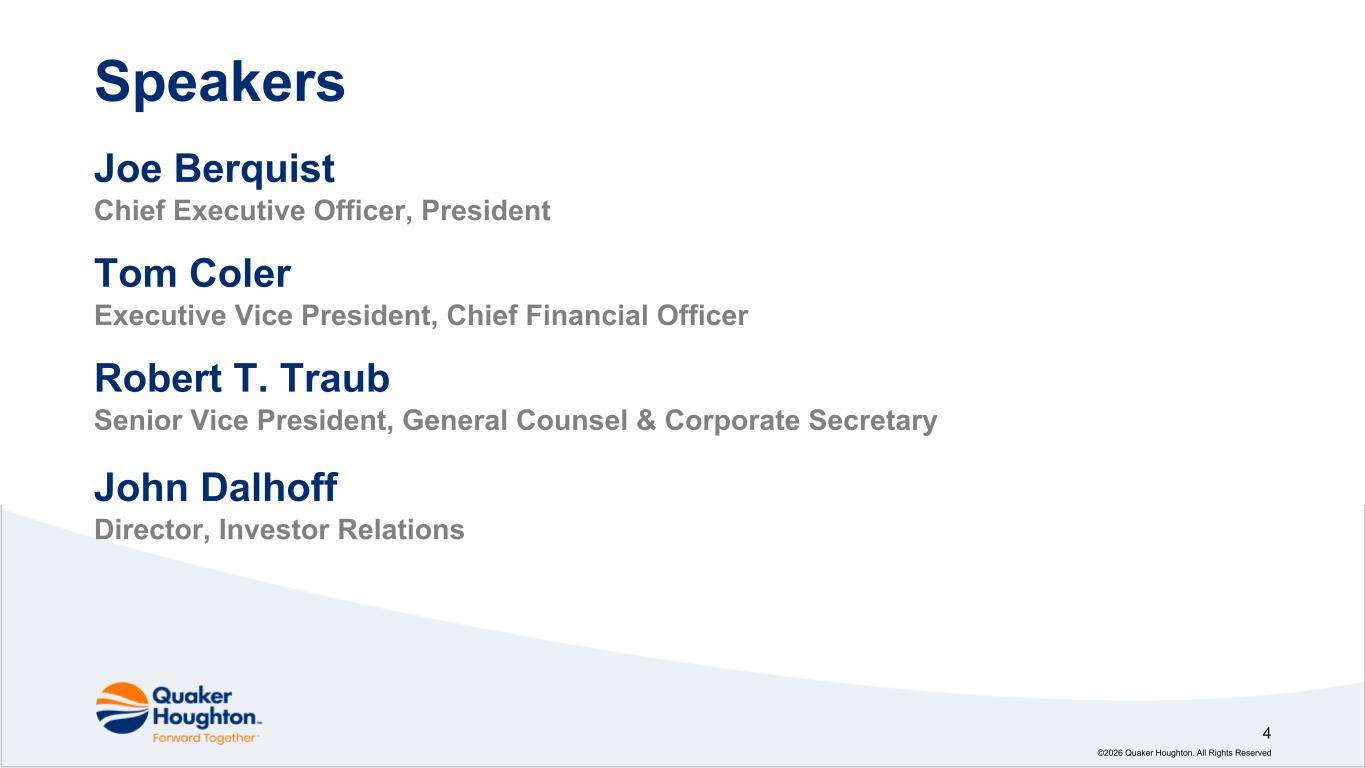
Thank you. Good morning, and welcome to Quaker Houghton's second quarter 2026 earnings conference call. Joining us on the call today are Joe Berquist, our President and Chief Executive Officer, Tom Kohler, our Executive Vice President and Chief Financial Officer, and Robert Traub, our General Counsel. Our comments relate to the financial information released after the close of the U.S. markets yesterday, July 30, 2026. Our press release and accompanying slides can be found on our Investor Relations website. Both the prepared commentary and discussion during this call may contain forward-looking statements reflecting the company's current view of future events and their potential effect on Quaker Houghton's operating and financial performance. These statements involve uncertainties and risks, which may cause actual results to differ. The company is under no obligation to provide subsequent updates to these forward-looking statements. This presentation also contains certain non-GAAP financial measures, and the company has provided reconciliations to the most directly comparable GAAP financial measures in the appendix of the presentation materials, which are available on our website. For additional information, please refer to our filings with the SEC. Now, it's my pleasure to hand the call over to Joe.
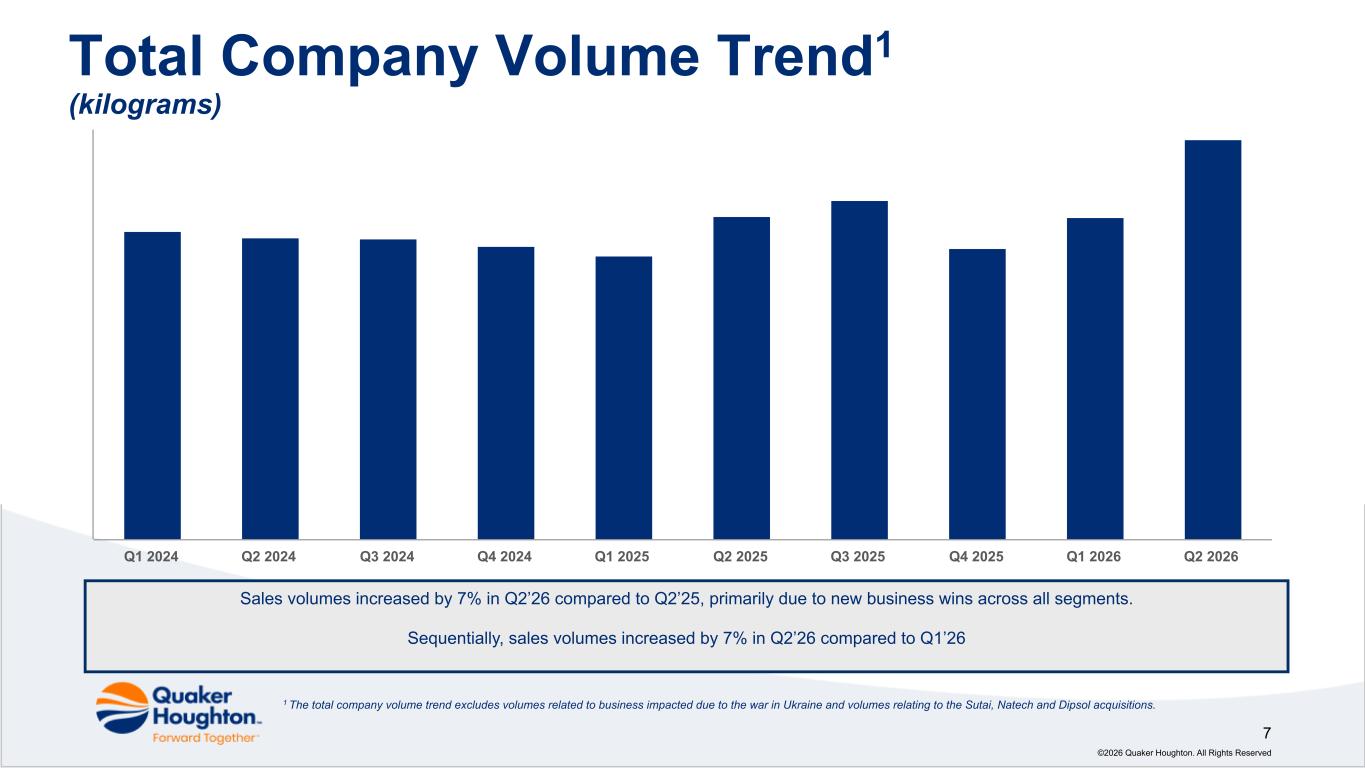
Thank you, John, and good morning, everyone. We achieved our fourth consecutive quarter of year-over-year profitability growth in the second quarter, highlighted by a 7% increase in sales volumes. This resulted in the highest quarterly adjusted EBITDA in our company's 160-plus year history. Our volume increase was driven by broad-based growth and net share gains across all regions. amid end markets that we estimate were flat to slightly above the prior year in the aggregate, tempered by offsetting pockets of strength and weakness. Demand remained steady through the end of the quarter after a strong start in April, as some customers accelerated buying against the backdrop of the crisis in the Strait of Hormuz. Asia Pacific once again delivered the strongest performance, marking a second consecutive quarter of double-digit volume growth. Our team successfully navigated sharp increases in raw material costs and supply disruption, resulting from the conflict in the Strait of Hormuz. Through disciplined execution and by engaging in proactive customer communication, we were able to leverage the flexibility of our global manufacturing network and maintain supply continuity throughout the quarter. Gross margins declined sequentially, but stronger volumes and improved utilization rates helped offset product margin pressure. We implemented price increases throughout the quarter and will see further adjustments from our index pricing in the third quarter. Underlying market conditions were mixed. Demand was steady, despite the geopolitical uncertainty, with pockets of growth in select markets. as normal buying patterns returned. Steel and aluminum end markets trended positively, while automotive light vehicle production remained challenged across most regions and geographies. Some customer purchasing activity may have been pulled forward in response to the Middle East conflict early in the quarter, but we do not believe pre-buy activity had a significant impact on the quarter's results. In aggregate, we estimate end markets were flat to slightly above the prior year, underscoring the significant contribution of share gains to our volume growth. Turning to the second quarter results, net sales increased 10% year-over-year, driven by mid-to-high single-digit share gains, and were achieved across all regions. Momentum remains strongest in Asia-Pacific, where we are winning significant new business in metalworking by penetrating growing sectors like electrical, vehicle OEMs, and component manufacturers. We continue to execute effectively in attractive growth markets, such as China, India, and Thailand, where our investments in local capabilities and customer relationships are translating into meaningful wins. The Americas and EMEA regions each delivered mid-single-digit volume growth during the quarter. In the Americas, we saw improvement in customer activity levels with the return of previously idled capacity and contributions from recent business wins. The Americas region delivered one of its strongest volume performances in several quarters. as operational and customer-specific challenges that affected prior periods improved against a backdrop of firming demand. Our strong customer pipeline and commercial execution drove volume growth in EMEA as we benefited from recent wins in metals and metalworking in that region and continued to grow in the Middle East and Africa despite the challenging backdrop. Adjusted EBITDA margins reached 16% during the quarter, reflecting the increased top-line performance in stable SG&A, which declined as a percentage of sales versus the first quarter. In addition to delivering strong financial results, we are executing key strategic initiatives that support our long-term growth and profitability objectives. We remain committed to a disciplined and balanced capital allocation strategy. In May, we announced a new $250 million stock repurchase authorization and returned approximately $24 million of cash to shareholders through repurchases during the second quarter. We also successfully completed the refinancing of our credit facility, further enhancing financial flexibility. In addition, our board of directors approved an approximately 4% increase to the quarterly dividend, marking our 17th consecutive annual dividend increase and our 50th dividend increase since becoming a public company. At the same time, we remain active evaluating potential acquisition opportunities that strengthen our business and support our long-term growth strategy. We continue to assess targets that expand our portfolio, accelerate innovation, and deliver geographic and channel diversification in new markets. With our strong balance sheet and improved financial flexibility, we remain well positioned to pursue strategic opportunities that create value for shareholders. We will continue to take a prudent approach to capital deployment, weighing returns to shareholders, balance sheet discipline, and careful investments in growth. Turning to the conflict in the Middle East, we continue to navigate the ongoing challenges and are maintaining reliable supply and strong service levels to our customers in a tough environment. Our direct sales into the Middle East and Africa have remained steady, and our consistency of supply has enabled us to win new business in the region. We continue to monitor the situation closely, but have not experienced any significant supply disruptions to date. In many instances, global supply chains have begun adapting to the changing environment, and our global network flexibility continues to ensure reliable service to our customers. But the situation is volatile, and the trajectory is uncertain. We are continuing to invest in the capabilities and infrastructure that further strengthen our network and position us for future growth. In June, we achieved an important milestone in our Asia-Pacific plan with the successful startup of our new manufacturing facility in Zhangjigang, China. This new site enhances our local-for-local operating model and will enable us to manufacture the full breadth of our portfolio inside China, reducing the need to import certain products, and thereby creating additional flexibility, efficiency, and service responsiveness for customers throughout the Asia-Pacific region. More broadly, we continue to take actions across the business to improve efficiency, simplify operations, and optimize our cost structure. We are pleased with the progress we are making with the Business Transformation and Cost Optimization Program announced last quarter. The actions we implemented during the second quarter are expected to deliver approximately $10 million of run rate savings, with benefits already reflected in our Q2 results. We will continue to focus on process simplification, productivity improvement, and manufacturing footprint optimization, which will further strengthen our profitability over time. The opportunity for profitability improvement over the next few years supports our long-term goal to achieve EBITDA margins above 18%. Finally, we released our annual sustainability report during the second quarter, highlighting our progress in advancing sustainable solutions for our customers and improving the environmental performance of our operations. The accomplishments highlighted in this year's report underscore how sustainability is embedded within our culture and is central to how we innovate, operate, and partner with customers around the world. Turning to the outlook, our view on underlying market conditions remains unchanged. The first half of the year progressed in line with our expectations, and we still expect end markets will be flat to modestly positive during the second half of 2026. Raw material costs have currently stabilized, but at elevated levels. Base oil prices remain volatile due to supply constraints across the refinery network and ongoing uncertainty. Based on our current visibility to supply dynamics, we expect our overall input costs to remain stable at these higher rates in the short term and begin to moderate as we progress through the back half of the year. As a result, we anticipate that our gross margin percentage in the third quarter will be in the range of Q2 gross margins as we work through the timing of raw material cost inflation, inventory movements, and price recovery actions. At the same time, incremental pricing actions and certain index-based adjustments will take effect, which will provide increasing benefits as the quarter progresses, and should return us to our target range above 36% by the end of the year. Operationally, we were pleased by the strong volume performance in Q2. Demand remains healthy and is showing no signs of slowing in the early part of the third quarter. We expect normal seasonal patterns in the second half, which has historically been better than the first half of the year. In the third quarter specifically, there may be longer seasonal shutdown activity in parts of Europe with the summer holiday period and unseasonably higher temperatures across the continent, as well as customers managing their inventories. However, demand in the Americas is improving and tracking broadly in line with normal seasonal patterns, which should help offset the expected slowness in Europe. We anticipate our third quarter performance will be in the range of the second quarter, barring disruptions in the market. As a result, we expect to deliver meaningful revenue and mid-to-high single-digit adjusted EBITDA growth for the full year 2026. Our consistent ability to generate share gains, our commitment to execute pricing actions and improve our cost structure, and the advantages derived from our global operating network position us well to steadily navigate uncertainty while creating long-term value. In closing, I am extremely proud of how our team performed during a particularly challenging quarter. Our industry-leading teams of operators and experts enabled us to achieve outsized share gains despite the volatility in the macro environment, resulting in record quarterly EBITDA. We continue to demonstrate the resilience in our differentiated service model that are enabling us to win regardless of external market conditions. And we expect to carry our strong momentum through the remainder of the year. With that, I will turn the call over to Tom to walk through the financials in more detail.
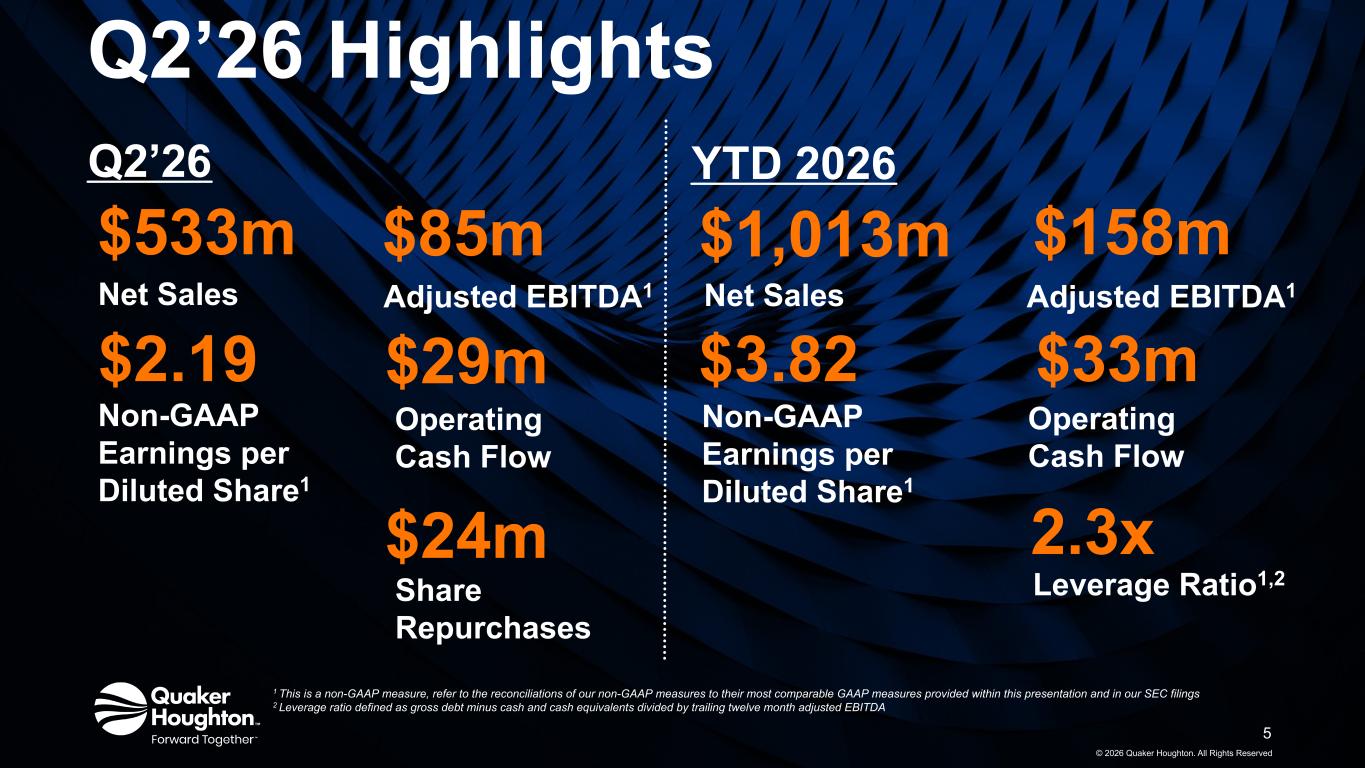
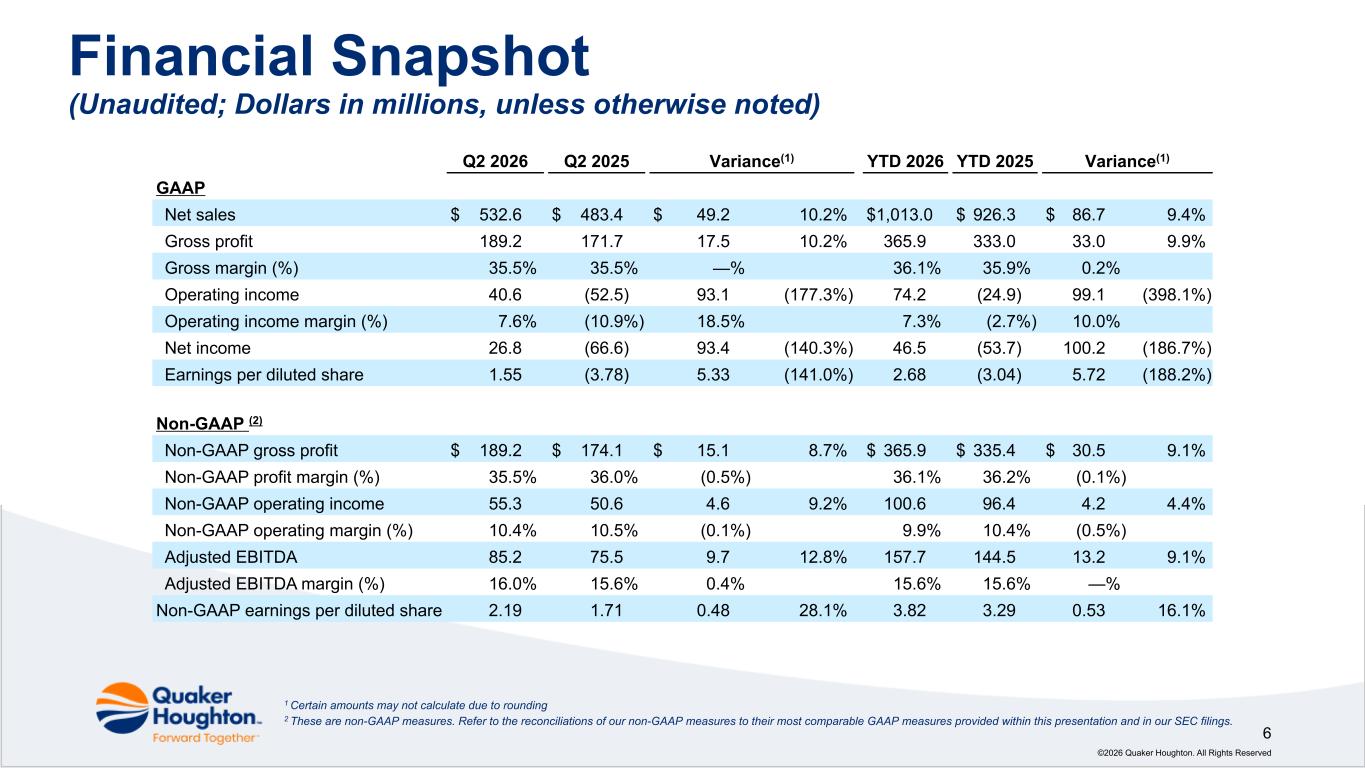
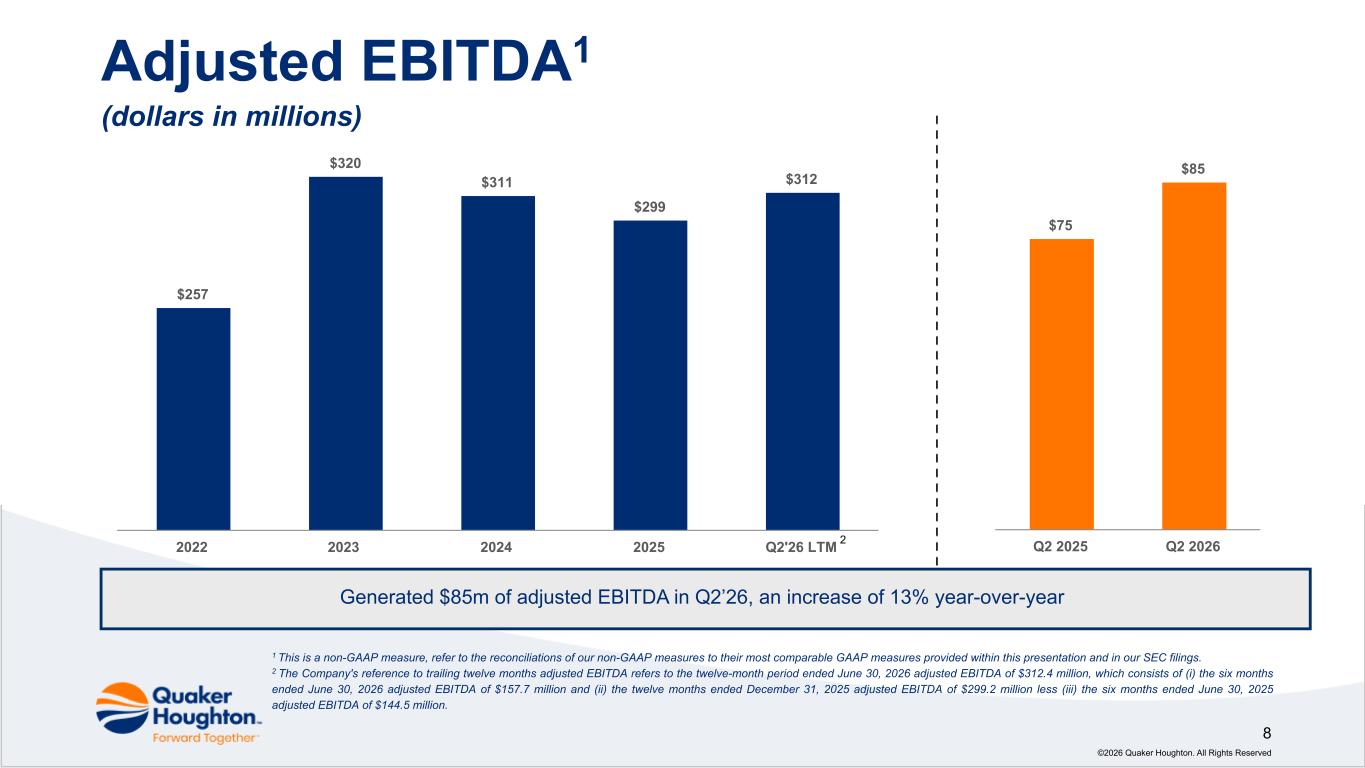
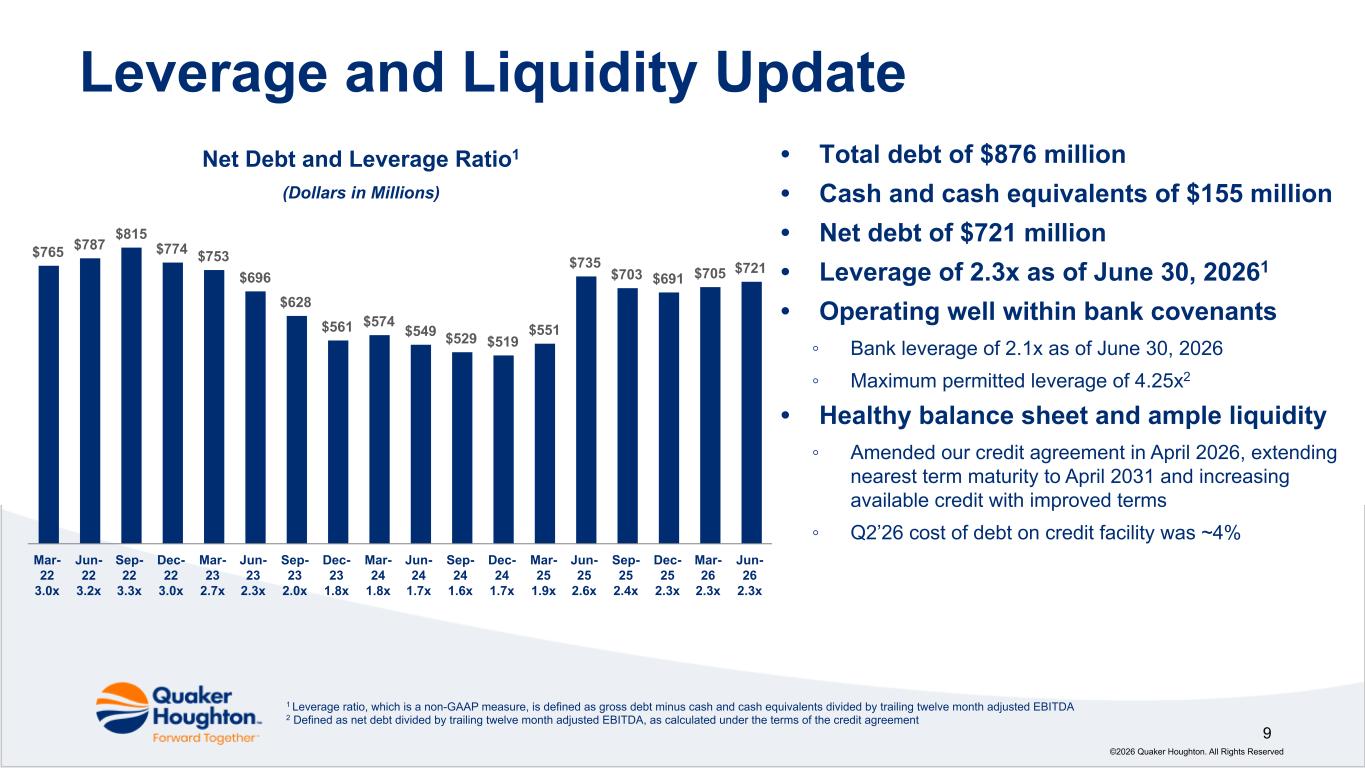
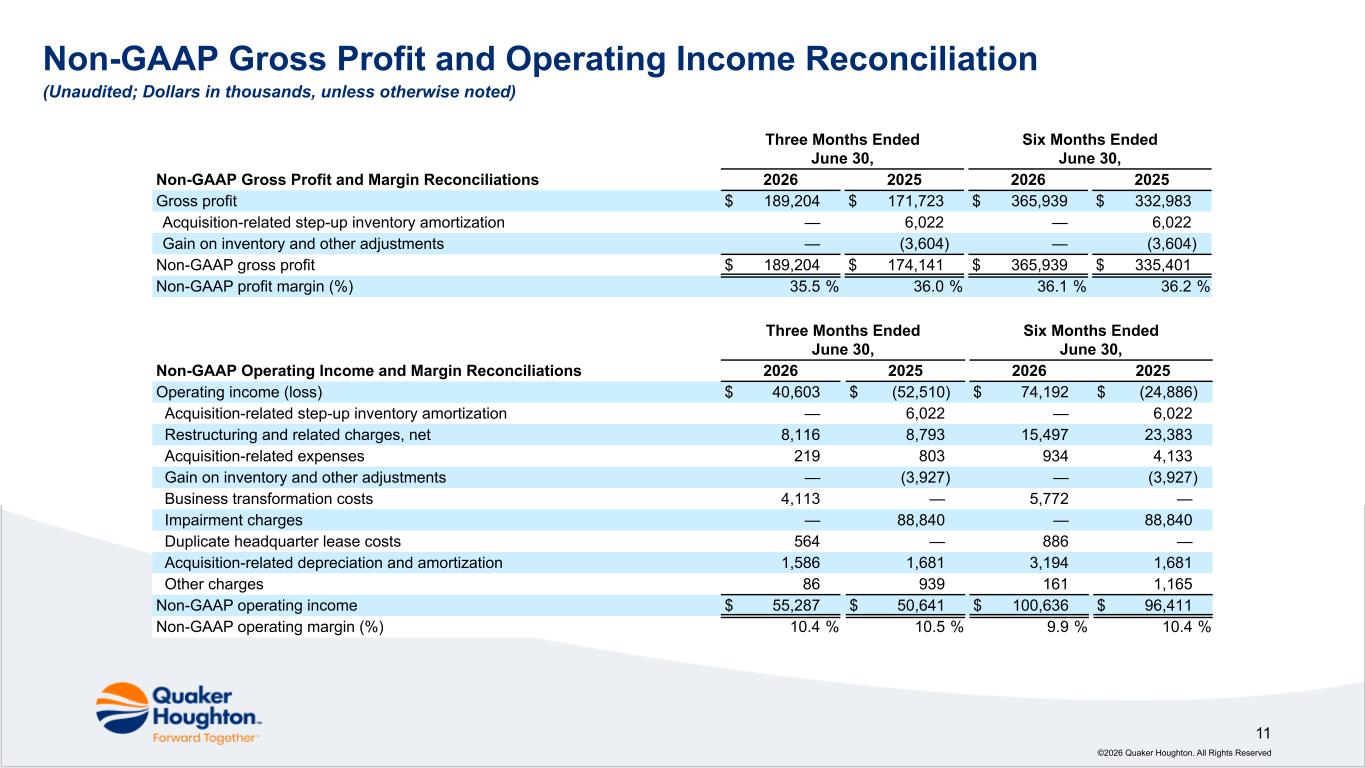
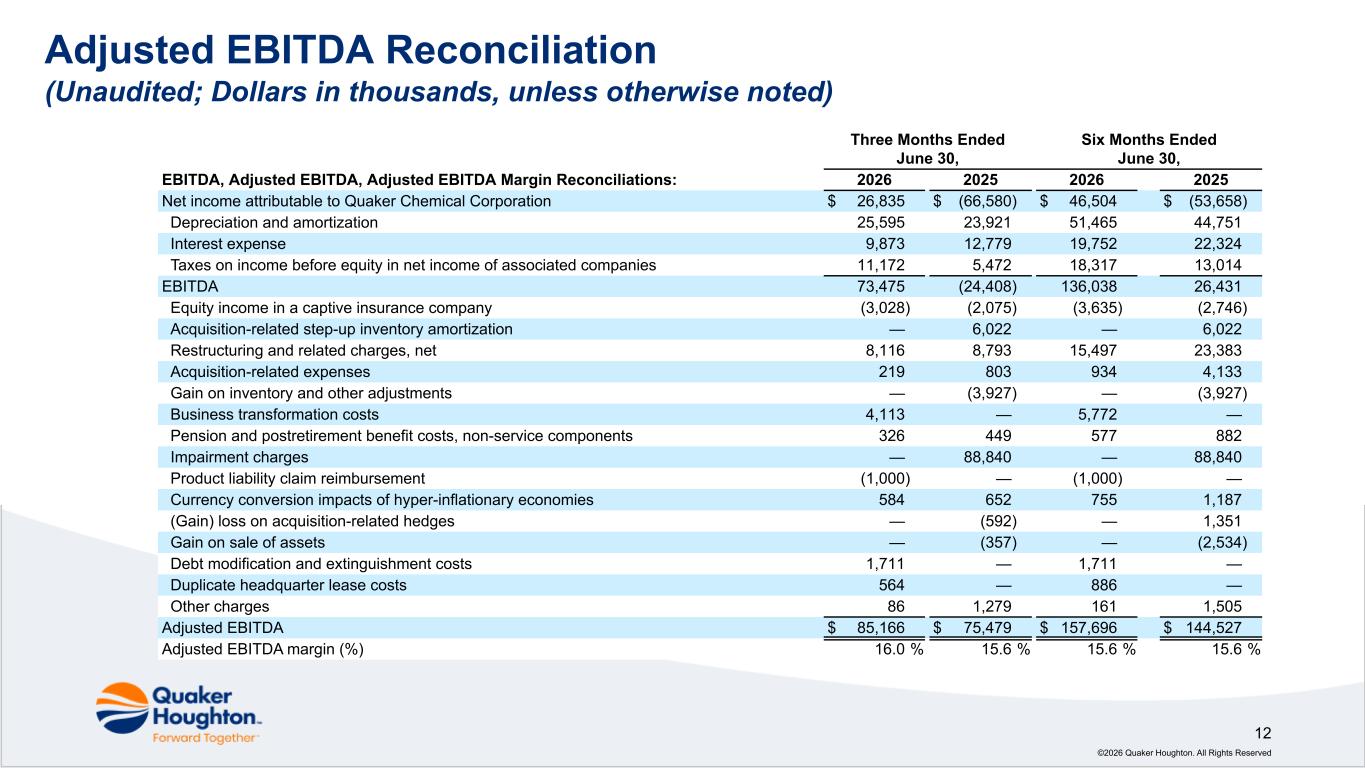
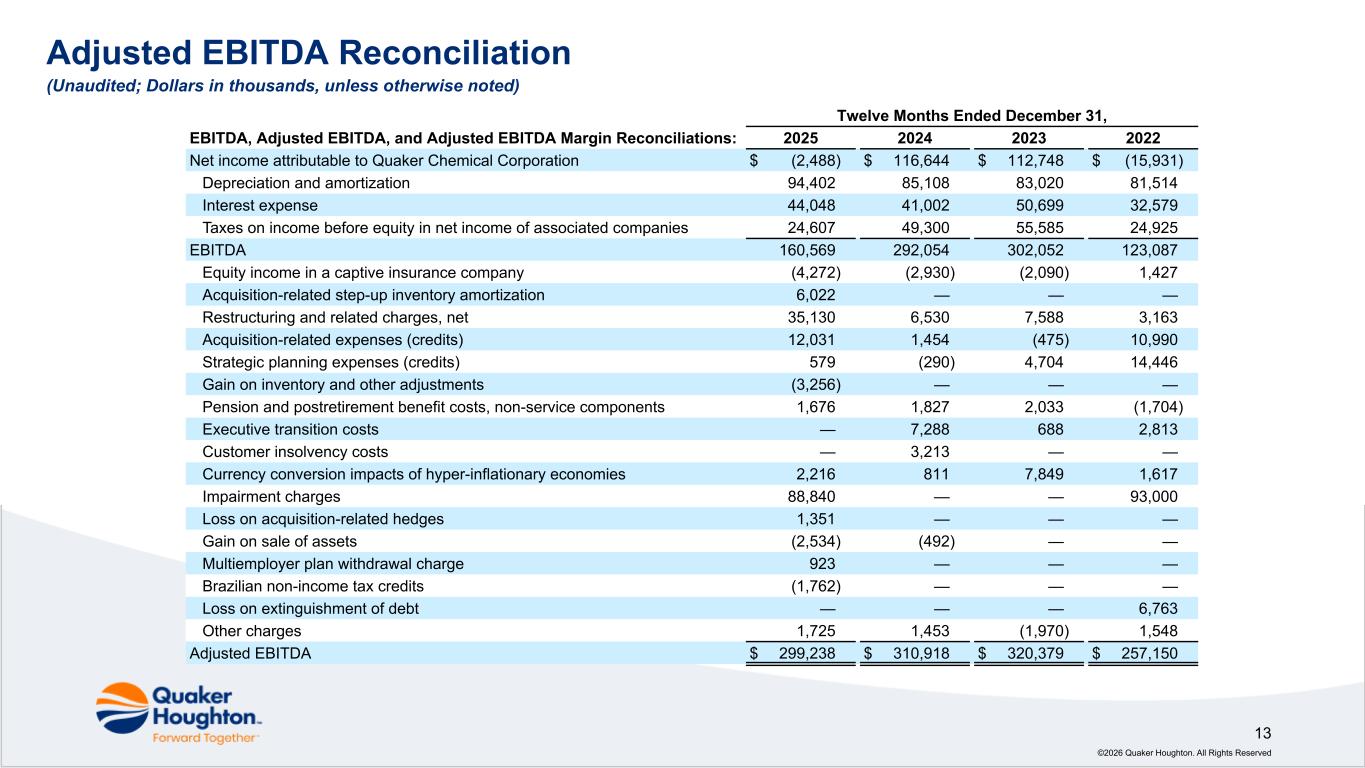
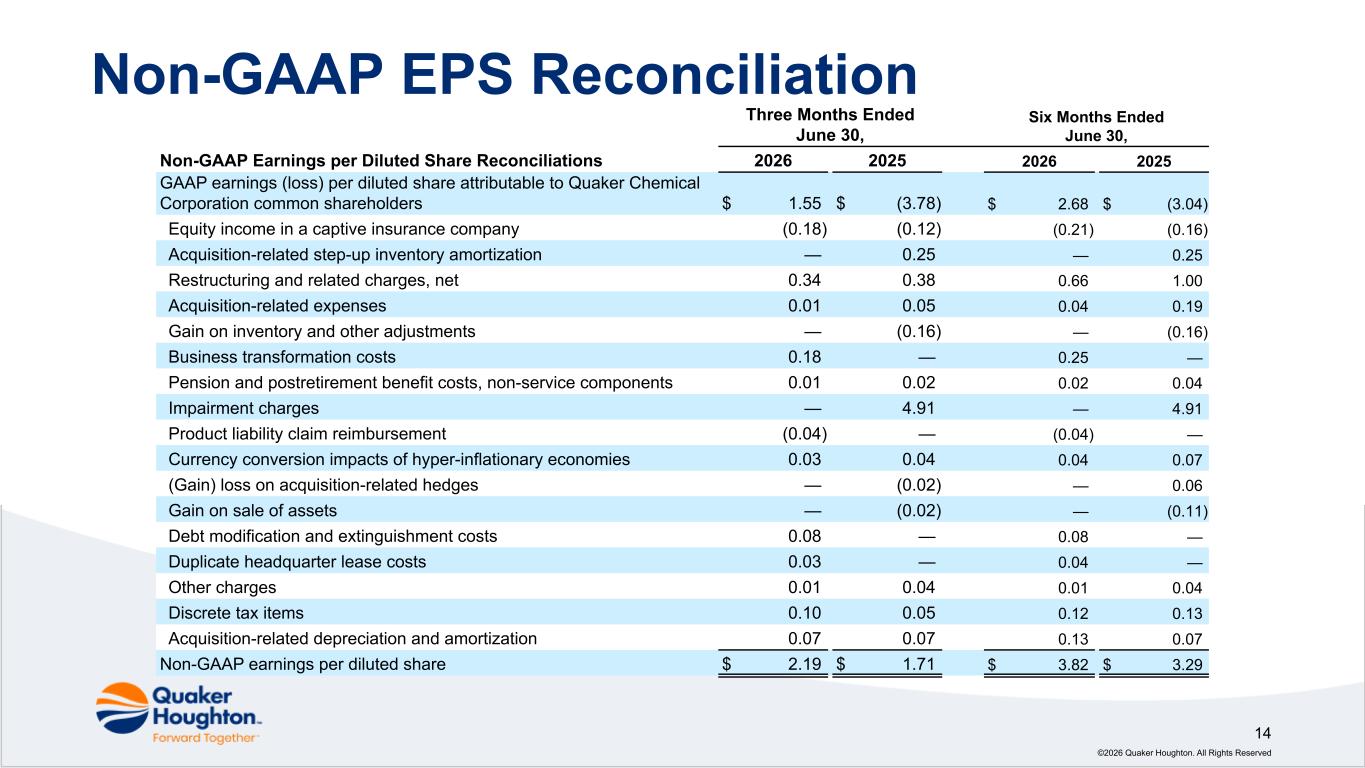
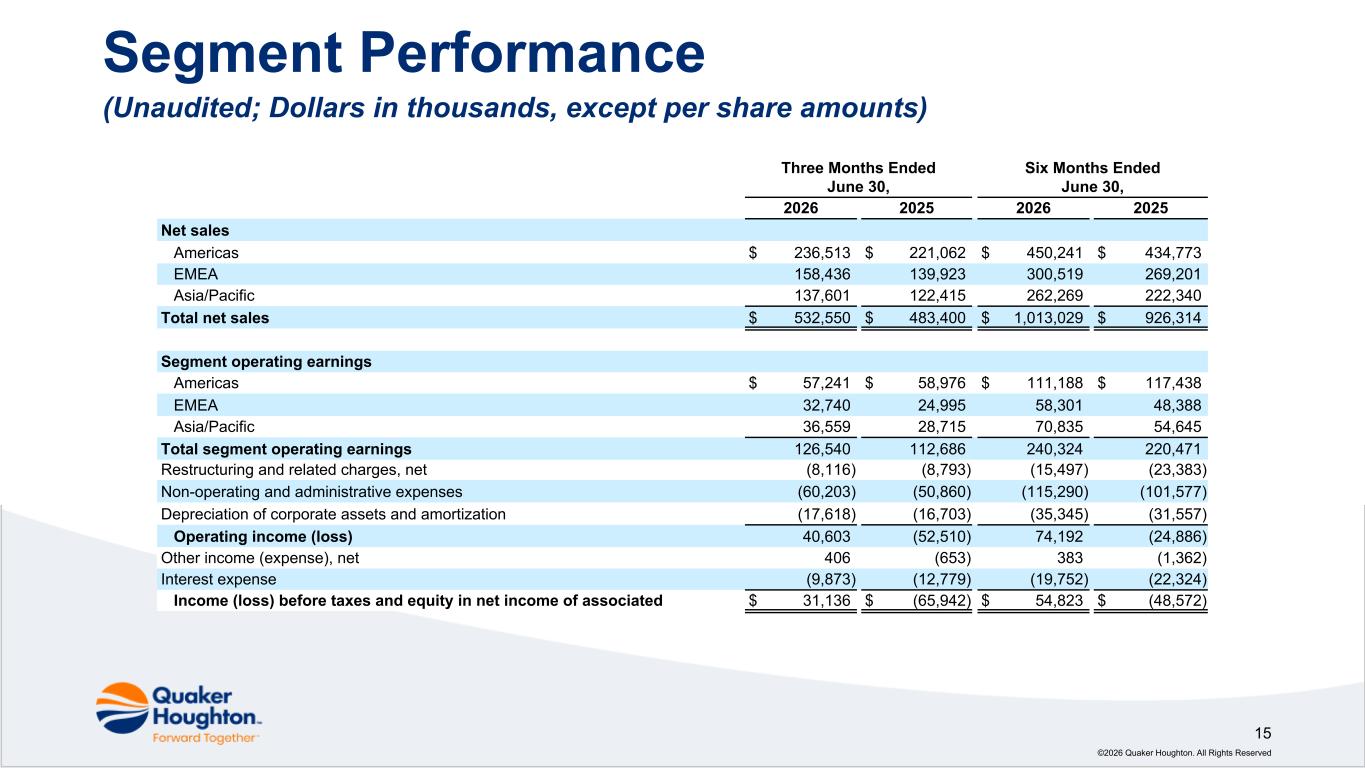
Thank you, Joe, and good morning, everyone. Second quarter net sales were $533 million, a 10% increase from the prior year. Sales volumes increased 7%, driven by global net share gains that exceeded the high end of our target range, with Asia-Pacific once again being the largest contributor. Selling price and product mix contributed an additional 1% to net sales as pricing actions to offset higher raw material costs resulting from the Middle East conflict were partially offset by changes in the mix of products and services. Sequentially, selling price and product mix contributed a 4% increase to net sales compared to the first quarter. We also had a benefit of 2% to net sales year-over-year from favorable foreign currency across all regions. The second quarter marked the first period in which prior-year acquisitions, including Dipsol, are included entirely within our organic results. Gross margins declined on both a year-over-year and sequential basis to 35.5% due to product margin pressure from higher raw material costs. The sequential decline of 130 basis points was less pronounced than originally anticipated due to better top-line performance stemming from higher volumes from our global net share gains as well as solid execution on our two rounds of price increases to offset raw material inflation during the quarter. On a non-GAAP basis, SG&A increased approximately $10 million, or 8%, in the second quarter compared to the prior year. While we began to see benefits from the transformation actions taken during the second quarter, these benefits were offset by higher incentive compensation and unfavorable foreign currency impacts. We delivered $85 million of adjusted EBITDA in the second quarter, while adjusted EBITDA margin of 16% increased 40 basis points year over year and 90 basis points sequentially. This performance highlights the operating leverage in our business as strong volume growth drove earnings expansion, even in an inflationary environment where margins were under pressure. Switching now to our segment results, Asia-Pacific sales in the second quarter increased 12% year-over-year, driven by the second consecutive quarter of 10% organic volume growth. This was the result of new business wins that once again exceeded the high end of our total company target range of 2% to 4%. percent. Favorable selling price and foreign currency also each contributed one percent growth to net sales. Segment earnings in Asia-Pacific increased approximately $8 million, or 27 percent in the second quarter compared to the prior year, driven by higher sales volumes. Second quarter net sales in EMEA increased 13 percent year-over-year, driven by seven percent volume growth, higher selling prices related to price actions taken during the quarter to offset raw material inflation and favorable foreign currency impacts. Segment earnings in EMEA increased $8 million, or 31%, in the second quarter compared to the prior year, primarily due to better top-line performance. Lower manufacturing costs related to the closure of our manufacturing facility in Dortmund, Germany also contributed to the improved segment earnings result. Second quarter net sales in the Americas increased 7% year-over-year, as 4% higher sales volumes were complemented by favorable impacts from foreign currency and higher selling prices. Higher volumes were primarily the result of new business wins, but also benefited from the resumption of previously idled customer production, along with some new capacity coming online in our metals business. Segment earnings in the Americas decreased $2 million, or 3% in the second quarter compared to the prior year, as better top-line performance was offset by higher manufacturing and operational costs. Turning to non-operating costs, our interest expense was $10 million in the second quarter of 2026, which was consistent with the previous quarter, while our cost of debt decreased to approximately 4.4%, reflecting the benefits of our refinancing actions in a more optimized debt portfolio. Our effective tax rate, excluding non-core and non-recurring items, was approximately 28 percent in the second quarter, which was in line with the previous quarter and our full year target range of 28 to 29 percent. Finally, our second quarter gap diluted earnings per share were $1.55, and our non-gap diluted earnings per share were $2.19, a 28 percent increase over the prior year due to improved operating performance and lower interest expense as a result of reduced borrowings. Cash generated from operations was $29 million in the second quarter, decreasing from $42 million in the prior year. The lower cash generation in the current year is driven by higher working capital outflows resulting from increased sales volume and increased inventory associated with closing our facility in Dortmund and opening our new facility in China. These items were partially offset by improved operating performance. Capital expenditures in the second quarter were $10 million, primarily related to the construction of our new facility in China. For the full year, we expect 2026 capital expenditures to be approximately 2.5% to 3% of sales. During the second quarter, we announced the approval of a new $250 million stock repurchase authorization that replaces our previous repurchase program and recently announced an increase in our quarterly dividend of 4.3%. We also repurchased approximately $24 million worth of shares and paid approximately $9 million in dividends, returning a total of $33 million of cash to shareholders in the second quarter. Together, our share repurchase activity and increased quarterly dividend reflect our confidence in the strength and durability of our cash flow generation and underscores our commitment to returning capital to shareholders through a balanced and disciplined capital allocation strategy. We delivered strong second quarter results, driven by continued share gains, disciplined execution of our pricing actions, and broad-based growth across all regions. Our team executed effectively in an uncertain environment, leveraging our global footprint, pricing actions, and our operating discipline to deliver record profitability. With a strong balance sheet, enhanced financial flexibility, and continued progress on our transformation initiatives, we remain well positioned to execute our strategy and create long-term value for our shareholders. With that, I will turn it back over to Joe.
Thank you, Tom. To close, our record second quarter results reinforce the strength of our business model and our ability to consistently outperform our end markets despite macro disruptions and uncertainty. While the external environment remains dynamic, we are confident in our approach and our ability to continue creating value for customers and shareholders and the opportunities ahead in the second half of the year. With that, we would be happy to answer your questions.
Operator
Thank you. We will now be conducting a question and answer session. If you would like to ask a question, please press star 1 on your telephone keypad. The confirmation tone will indicate that your line is in the question queue. You may press star 2 if you would like to remove your question from the queue. For participants using speaker equipment, it may be necessary to pick up your handset before pressing the star keys.
Operator
One moment, please, while we poll for questions.
Operator
Our first question comes from Mike Harrison with Seaport Research Partners. Please proceed with your question.
Hi, good morning. Congrats on a nice quarter.
Thanks, Mike. Good morning.
I was hoping that maybe we could start just getting a little bit more color on what you guys are seeing on the raw material front i'm curious what uh specific raw material baskets are uh you know moving higher or um you know continuing to to show a lot of volatility and uh really interested in understanding the timing of the p l impact um you know to the extent you can uh help us quantify how much raws were up in q2 and what the expectation is for inflationary impact in Q3 and Q4. That would be very helpful.
Yeah, good question, Mike. So overall, if you think about our raw material buckets, there's kind of three buckets, right? The things that are related to base oils or derivatives of crude, the additives, which tend to be closely linked to that, and then the oleochemicals. And I would say the base oil-related, crude-related, just about two-thirds of our bucket remains pretty volatile. It's, as I mentioned in the comments, you know, at that elevated range right now. It's kind of like the new normal, right, is this volatility in the elevated range. There is a little bit of softening on the oleochemicals and things that are delinked from that, and it tends to be more regional impacts overall. Raw material container costs are pretty significant for us in the quarter. We think that those impacts really peaked in June and even early this month in July. As we go forward, I think there's different elements at play, right? We have certainly pricing that came on during the quarter. We have index adjustments that happen at the end of the quarter and even in the middle of this quarter. And there's also the inventory movements. I mentioned that in the comments as well. What that means is as the cost of the inventory changes, we revalue that inventory. And there tends to be a capitalization effect for a couple months as that moves through. So what I would say, as we've modeled this out, we think gross margins are going to be pretty flat, quite frankly, in Q3 from Q2, and then improving hopefully toward the end of the quarter and into Q4. All right.
Thanks for that. And then just on the volume front, Asia has been strong, and so I don't think that was a huge surprise, but EMEA was surprisingly strong. I was hoping maybe for both regions, you can talk about the sustainability of the strengths that you're seeing.
Yeah, I mean, the underlying markets in EMEA were, you know, steel was up and industrial production was up slightly. But conversely, the auto ice production we think was down, you know, double digits, mid-teens. So, you know, in composite, we'll say market was flat to slightly up. most of the of the growth that we're seeing is really what I would call self-help it's it's the share gains that we've been delivering from our pipeline they were on the higher end of our range so you know I would say slightly above that kind of four percent high end of the target range for us how sustainable is that for us I mean I think I think remaining within that two to four percent range is something we were pretty confident that we'll continue to do. And then anything that happens in the market outside of that would bolster that growth rate. But a lot of new business wins in that region. And we've been talking about share gains over the past several quarters, and we're starting to see the impact of that. In EMEA, in the second quarter, early in the April was a busy month. We do think that region in particular of the three different segments for us had some pre-buy. So I would say half to two-thirds of the growth in the quarter was from share gain with that remaining half to one-third to one-half from pre-buy. but you know we're through kind of the early early part of q3 and demand has remained pretty studied in europe so we think most of that that impact um you know it wasn't a huge impact on the quarter let's just say that and we think that the the demand environment in emea has remained pre-study we're entering into um traditionally the holiday period in august is a very slow time But then usually that recovers in September. For AsiaPak, I mean, AsiaPak, some softness really in that market. So it really accentuates kind of the double-digit volume growth that we're getting there. It's coming from share gain. It's coming from winning new lines, whether that's in the metal space or the metalworking space. We've talked about how important it's been for us to gain share with the electric vehicle manufacturers. in that part of the world, do I expect us to continue to, you know, take share and double digit? I would love to say that was true, Mike. I think it'll probably normalize at some point in that, you know, mid single digit range. But we've got, you know, we've got a very good team there that's executing on the ground. We just opened a new plant in China. We're doing very well in India and other parts of Asia. So, you know, that will be, I think, a growth engine for us for several foreseeable quarters, as far as I can tell right now.
All right. And then my last question is on America's operating margin. You were down 250 basis points year on year and Reference some higher manufacturing and operational costs. I'm just wondering if you can help us understand a little bit more between those operational issues and raw materials and pricing and maybe any volume leverage or cost actions you're taking. Help us understand the puts and takes around America's margin and how we might think about that trending into the second half.
Yeah, I do think, so second quarter specifically, we had some inventory disposal costs related to quality, related to kind of things we're working through at one of our plants. On the flip side, you know, good problems to have. I think we had some higher inventory as we work off backlog and we're trying to catch up some of our grease orders. And then, you know, one of our primary plants there in Middletown, we've gone to a 24-7 operation right now. And so we will see some ongoing higher costs in the Americas. However, I think there was a little bit of one-time nature on the operational side in the Americas in the quarter. So I would expect that to improve. and overall operating margins should return to, you know, where they've been traditionally for that region.
All right. Thanks very much.
Operator
Our next question comes from Pete Asterlin with Truist Securities. Please proceed with your question.
Hey, good morning. Thanks for taking the questions. So I just wanted to start by following up on the margin performance, you know, particularly with the drop-off for gross margins less severe than what you anticipated a quarter ago. So I guess to what extent did this reflect faster or higher than expected pricing implementation? And thinking about the second half, do you now see upside to the 36% to 37% range that you've talked about exiting the year at as you continue to implement pricing in the back half?
Don't necessarily – we're not modeling upside, Pete, and thanks for the question. I think what we kind of mentioned it before, there's this inventory valuation aspect that's a little bit of an accounting exercise, but the timing of how the prices roll into our costs and how those costs work their way through the system. We did a good job with pricing. um we we certainly didn't get you know all the pricing that we wanted to get and there's still some some pricing that will come on come on uh uh one of the one of the key things is is the volume you know we modeled a 200 to 300 basis point kind of impact the gross margins in q2 uh the volume was a nice surprise for us right and and that that capacity utilization in our plants uh was helpful. We're also starting to see the benefits of plant closures, right? We made a decision to close a plant in Europe, and you saw the Europe operating margins improve in the quarter. So it's a mix of different things. I firmly believe that we will be above that 36% gross margin by the end of the year you know we say our target range is 36 to 37 percent there have been times in the past in deflationary environments where we can see expansion of our gross margins higher than that and would it surprise me if that happened no but it's not something we're anticipating right now very helpful thank you and then also just wanted to ask a follow-up on capital allocation.
Following your recent buyback authorization and some of that repurchase activity kicking in here in the second quarter, how should we think about your plans for the cadence of buybacks this year? How are you currently weighing share repurchases against the potential you see to execute on additional bolt-on M&A?
Yeah, this is Tom. Thanks for that question, Pete. You know, I would say we continue to have really good flexibility from a capital allocation standpoint with the new share repurchase authorization. We just refinanced our credit facility and have added some capacity there as well. First and foremost, we want to deploy capital to help the business grow, whether that's through organic investments like our new plant in China or inorganic opportunities through continuing to work our M&A pipeline. So I think we'll continue to be opportunistic as we think about share repurchases, balance that with dividend payments. We just announced that we increased our dividend 4.3% coming earlier this week. And so, again, we're going to use all the tools in the toolkit and continue to have a balanced approach. But first and foremost, primarily, we want to deploy capital to grow.
Operator
Our next question comes from Lawrence Alexander with Jeffries. Please proceed with your question.
It's actually Dan Rizwan for Lawrence. Thank you for taking my questions. Just getting back to kind of the Asia share gains you guys are kind of doing, I was wondering if that's like a lot of singles or some meaning that there's a lot of smaller new wins, or is it a couple of customers where you're getting really great penetration and how that should look moving forward?
Yeah, thanks for the question, Dan. It's really broad-based in Asia. You know, China is the biggest aspect, biggest country of the Asia landscape, but really our growth in India has been very good as well as Southeast Asia. And it's across all product lines. So I think it's a lot of singles and doubles. When you get a new mill that comes online, for instance, you know, a new cold rolling line in China this past year, we were able to get our fluid intelligence equipment on that line. And, you know, it's pretty big. So every now and then you have a triple, right? But to the nature of your question there, I think it's broad-based. It's not coming from just a handful of things. It's really across the industrial sectors and across the geographic landscape in that region.
So with that, say, the new food intelligence at a new plant, is that kind of a toehold, and then over the next few years you should penetrate more? I mean, is that kind of how it works, like this is the way in, and then we take it from there? I mean, am I thinking about that right, that it could, I guess, what I'm trying to ask is it could accelerate with each plant as you just get a foothold in it?
I mean, that's the design, right? It's really an enhancement of our service model. And when it works as well as it does in the rolling applications, if you're building a new line, right? If a new mill is coming on, we're in touch with not only the OEMs but also the equipment manufacturers, and it's a way to really control how our fluids are used on those lines so they work very efficiently and give the customers a lot of control over their system as well as insights, you know, how to optimize fluid application with their production processes. So we continue to work on innovation in that area. It's not just a steel rolling or aluminum rolling offer for us. We certainly have a metalworking offer as well, and we're seeing some penetration on that side. And we expect that to be a real, you know, core part of our offer across the business as we go forward. So I do anticipate you will see that, Dan.
And then you mentioned India versus China. I would assume then that India actually offers more opportunity with more new plants and more new metalworking or steel rolling plants coming online there versus China, which I guess would be a little bit more mature at this point. Is that accurate as well?
Yes and no. I mean, I think you're seeing in China, you're still seeing a lot of growth with the electric vehicle segment. So whether that's die casting, electrical steel, all the way through, and there's a lot of line refreshes that are happening there. The overall growth might be decelerating on a comparative basis just because of the size of that market, how big it is. But it's not stagnant. And you're right in pointing out that India is growing differentially. There is, you know, I guess the ballpark figure that people have thrown around is that industrial production there is supposed to double, you know, between sort of 2020 and 2030 or 2035. And it seems to be on that pace. There is a lot of new production in that part of the world. And, you know, so we're happy to grow as that new production comes online. That's certainly a tailwind for our business.
Operator
Our next question comes from John Tenwinting with CJS Securities. Please proceed with your question.
Operator
Hi, good morning. Thank you for taking my question. I was wondering if you could just talk about the expectation for share game and new business wins going forward. I think you've been at or above the high end of your 2% to 4% target range for over a year now, and you're lapping some of that acceleration. What's the competitor dynamic or response, given that your business trends are pretty sticky there? And should we recalibrate our expectation of your ability to continue gaining share as you continue to do that? Just help us out with the thoughts and the target range.
Yeah, good morning, John. I mean, that target range is something that we consider very carefully. Our sales cycle is not a quick sales cycle. Usually, to get a piece of business, it could be on the short side, three months. It could be on the long side, a year or longer. And I do think we've had a good run here for the past several quarters. Why is that happening? I think it's a combination of things. And cross-selling, you know, we've been acquisitive, and we've brought on some new technology that adds to our portfolio and increased the size of our addressable market. So we're going into existing customers who are happy with us and saying, hey, we have some additional things you can buy from us now. And that does help accelerate that sales cycle. I also think it's things like just really having a very strong team, a local for local model in parts of the world like China, like India, that are growing faster and taking advantage of that. It's also, you know, leveraging things like our fluid intelligence play. I mean, we won some business here in Europe and the Americas this year with some customers that were pretty hard to crack by going in with an enhanced service model around our fluid intelligence equipment, and that got us in the door, and we were able to then convert that new business. So we will certainly drive. We incentivize our people. Everyone in the company, including myself, is compensated based upon targets around net share gains. So reducing churn and increasing share gains. So we're all very, very focused on it. And the other piece, John, I think that's maybe helped us just from a math perspective over the past few quarters is we did go through a couple year period there where we had higher churn, right? And we've got that churn number down the low single digit area where it's been historically. So, you know, when we stopped the bleeding on that end, we're able to show a little bit more on the growth side. Got it. Thank you.
Operator
And if you could just drill a little bit more down into the fluid intelligence piece, how big is that business today? And are you seeing momentum accelerating there? What's the growth rate?
I mean, it's hard to say how big the business is. I think, you know, when you look at how we measure it, we're not really measuring equipment sales. We're measuring the amount of fluid sales that are tied to a fluid intelligence offer, right? Right. And so I would say right now it's somewhere between 10 and 20 percent of our revenues have some sort of fluid intelligence component that's part of the service aspect. How big can it be? How big will it be going forward? We want we want it to penetrate across the entire business and we want to use it as a growth engine to penetrate into customers that we don't have today. So, you know, I'll just say we're, you know, our ambitions are high there.
Operator
Got it. And one follow on to that, just are the margins associated with fluid intelligence higher than your than your fleet average? Just given the way the equipment works and the personality you dedicate to it.
Not necessarily. Not necessarily. I again, I think it's a way it's a digitized service model. model. So it doesn't replace our people, but we're really focused on the product sale. And it really enables that product sale for us. And I think that our margin profile is pretty consistent around the world. Okay, great. Thank you very much.
Operator
Our next question comes from David Silver with Freedom Capital Markets. Please proceed with your question.
Yeah. Hi. Good morning. Thank you. I have a question. Hey, thank you. Yeah, good morning. So, apologies, this might be kind of a little, take a little time to get out. But, you know, I was kind of, along with your very strong results this quarter, I would call out maybe the incremental margin performance. I mean, growth in operating income or EBITDA relative to the growth in sales. And, you know, I'm thinking that 7%, you know, volume growth largely from new business wins. I mean, that does strain, you know, your skilled labor force to a certain extent. And, you know, I'm just wondering if from your perspective, Joe, you're able to handle, you know, continued quarters at this, let's say, high, mid to high single digit new business win pace with kind of what I would call your installed base. In other words, I guess under your predecessor, there was some volume erosion and it's not apples to apples, but you are regaining that volume now. And should I look at some of the very attractive incremental margins that you're reporting now is kind of a sense that maybe your skilled labor force was a little bit underutilized and you were able to take on a fair amount of new business without meaningfully staffing up or adding incremental, you know, resources. And if that's the case, I mean, you know, how much more, I don't want to call it slack, but how much more kind of capability do you think you have here before you would have to meaningfully invest in either new talent or other new resources to service your growing customer base? Thanks.
Yeah, thank you, Dave. It's a really great question, honestly. I think, you know, we went through a period, and we're still kind of going through a period Where because of the complexity of our systems, master data, you know, just a complex network in our manufacturing space, our skilled labor, right, our subject matter experts that are touching the customer probably spent too much time on internal things. Right. And in the last 18 months, that's been kind of my battle cry to make sure that we spend more time doing business with our customers than we do amongst ourselves. So Tom and I and the rest of the team are really focused on making sure that we're reducing that complexity. We're freeing up people to spend more time with customers. And in the meantime, making very meaningful improvements to our business processes, our master data, our ERP system, you know, just kind of cleaning things up on the back end so our people on the front end can work more effectively. And I think that's working well for us. And we have capacity in our team to do those things. long-term. I mean, I, I want to continue to invest in those subject matter experts because ultimately it's our people that are the biggest difference. It's our service model. And, and I think we, we probably got a little bit heavier in the functional areas and, and we got a little bit lighter in the commercial areas. And just as a general philosophy, I'm focused on, you know, know, flipping that equation, right? I want us to, I want us to make sure we're investing and nurturing that, that, those, that commercial talent and becoming more efficient, you know, in, in our back office area. So, so it frees up our people to, to sell to our, and serve our customers.
Yeah. And I would, I would just add to that, David, you know, we've got, you know, we've got ample production capacity in terms of our manufacturing network at this point to meet the needs of our customers. Joe talked about cost and complexity reduction and focusing our commercial organization. You know, this is all sort of focused on what Joe and I've talked about, which is driving EBITDA margins to 18% over time. A portion of that is top line growth in scale. And a portion of that is cost and complexity reduction, which we've talked about on the Q1 call relative to our transformation initiative. So I think, you know, we've got the opportunity to continue to drive leverage in the P&L, and that's our goal.
Yeah, we're saying sustainably above 18%, right? So if you look at where we've been kind of running, that's a 200 basis point plus, you know, near-term goal for us to get at. And we feel like we have a lot of sight to do that.
Thank you for all that color. I'll have to re-listen to that another couple times on replay, but no, I appreciate all the all the depth there. I did want to go back to the, I guess, capital allocation or share share repurchase question. And, you know, I guess there's just a lot of moving parts. You're repurchasing shares that, you know, at a level well above, you know, displacing, I guess, any options-related issuance. Your debt did rise a little bit sequentially. You raised your dividend, et cetera. But just thinking about the share repurchase activity level, you know, in light of the new authorization and et cetera, should I look at, you know, the $24 million that was spent here in this quarter as something more opportunistic in nature or is this something that we should think about as programmatic? In other words, with the new authorization and your healthy cash flow, I mean, does opportunistic, did you consider opportunistic share repurchase at, let's say, the current price? you know, a core part of your capital deployment strategy, or is it more of, I don't know, like a flywheel dependent on M&A opportunities and some other things? Thank you.
Yeah, yeah, good question, David. Yeah, I would go back to sort of our overall capital allocation philosophy, which is first and foremost, invest for growth, whether it's organic or inorganic. You used the word opportunistic. I think that's the way that we think about share repurchases as well as we sort of evaluate where our capital structure is, where our leverage ratio is, what we see relative to our M&A pipeline or internal investments, and then how we think about balancing all those pieces. I wouldn't characterize it as programmatic. I would say it is opportunistic, and the new repurchase authorization that we have really just gives us the flexibility to be opportunistic as it makes sense in the market.
Okay, great. I appreciate all the color. Thank you.
Operator
Our next question comes from Arun Viswanathan with RBC Capital Markets. Please proceed with your question.
Adam
Analyst — RBC Capital Markets
Hi, good morning. This is Adam on for a room. Thanks for taking my question. And my understanding is that gross margin outperformance was mostly on volumes for the quarter, but maybe if we could double click on price a bit, it seems like you're doing quite a good job at pushing that through to offset inflation. So I guess I have two quick questions on that. How much of the price you've already implemented has yet to flow through in third quarter? And how much of your year-over-year growth do you think is mostly from the outperformance in the first half? Meaning, you know, how much do you think you're going to have some of this flow through in the second half versus early in the second quarter?
So let's talk about the gross margin piece first and the pricing piece first. The majority of the pricing has flown through, right? Because the prices have stabilized at these high levels, and the delay, I guess, has been we have a few index adjustments that are just time-based, and they come at the beginning of a new quarter or middle of a quarter sometimes. So I would say, you know, we don't expect much more in the short term from a net selling price per kilo expansion, unless the external environment dictates that we have to do that. And hopefully it doesn't. But if it does, we'll go and get it. I think you're asking, you know, second quarter was a really good volume quarter, was a good quarter for us overall. Is that sustainable? I mean, we see, you know, as I said in the comments up front, I think the third quarter will probably look very close, closely like second quarter. Traditionally, third quarter tends to be a good quarter for us. The second half of the year tends to be a little bit better for us than the first half of the year. that growth. The Asian markets, for sure, in the second half of the year have traditionally been better than the first half. Europe will be tough in the month of August, and they may walk back a little bit in Q3, but we're seeing some relative strength in the Americas right now, and we're pretty confident that demand will hold up, that we would see a third quarter pretty similar to what we saw in the second quarter. And then the question becomes what happens in the fourth quarter. With all the volatility in the world right now, I don't really want to go that far down the road, but I think we're tracking on this sort of mid-single-digit, the high-single-digit EBITDA growth for the full year.
Adam
Analyst — RBC Capital Markets
Okay, great. Thanks for that. And maybe if we could go back to the bulletin piece, it kind of sounds like you're saying that India and China are consistently providing the most opportunity for maybe acquisition potential. How are you thinking about that in terms of end markets? And, you know, I know there are several kind of reasonably depressed end markets like building construction, et cetera. So how are you thinking about acquiring things, you know, at discounted multiples, bring in, you know a creative full times versus uh bringing things in that are not necessarily uh at their growth part of the cycle or is that not how you're thinking about it at all and you're more concerned with the sort of the cross-selling and synergistic piece no i mean it's so so now i think you captured pretty well you know the the the variables right that we consider um so when we're talking about bolt-ons, we're looking for, we're either going to look for something that's a portfolio addition,
right, or some IP or capability that we don't have today. A capability could be technical capability or access to markets or certain channel play. So those are things that we consider. I think we're not necessarily looking to go out and get into things, you know, we help people manufacture things out of metal, right? So if there are parts of the portfolio or the value chain today that we don't have or we don't have everywhere, then we would be looking at strengthening our portfolio, adding those capabilities. There's also, as you said, periodically, there are some things that come along that you would look at purely from a synergy standpoint. It's a pretty fragmented space. There are a lot of regional players, small players in those regions. And if you can go and get something and get some arbitrage on the multiple, then we've done that successfully in the past and would certainly consider doing that in the future. And then we always leave dry powder. We position ourselves to be able to do something more transformational, a larger type of deal. Of course, those are rare and they take a lot of time to get done. But that's sort of the overall landscape there, Adam. Yeah.
And I would just add that we have a track record of buying good businesses, EBITDA positive, cash flow positive businesses that are creative to our, to our business. And, you know, we look at those opportunities, as Joe said, in terms, through the lens of a commercial channel or a new product technology or an asset, and bringing that into our large global footprint with all of our capacity and capability to, you know, accelerate growth in those, in those acquisitions that we've made. So I think that's how we think about a philosophy from a, you know, sort of financial standpoint.
Great. Thanks for the detail, and congrats again on a great quarter.
Operator
We have now reached the end of our question and answer session. I would like to turn the floor back over to Joe Berquist for closing comments.
Sure. Thank you. Thank you for joining us today. We appreciate everyone's continued interest in Quaker Houghton, and I also just want to thank our colleagues around the world for their hard work and dedication to our customers, our people, our greatest asset. Please reach out to John if you have any additional follow-up questions. Thank you.
Operator
This includes today's teleconference. You may disconnect your lines at this time. Thank you for your participation.