Operator
Hello and welcome everyone to the LCI Industries 4th Quarter and Full Year 2024 Conference School. My name is Becky and I'll be your operator today. During the presentation, you can register a question by pressing star followed by 1 on your telephone keypad. If you change your mind, please press star followed by 2. I'll now hand over to your host, Lillian Eskorn, to begin. Please go ahead.
Good morning, everyone, and welcome to the LCI Industries fourth quarter and full year 2024 conference call. I am joined on the call today with Jason Lippert, President and CEO, along with Kip Emenheiser, VP of Finance and Treasurer. We will discuss the results of the quarter in just a moment. But first, I would like to inform you that certain statements made in today's conference call regarding LCI Industries and its operations may be considered forward-looking statements under the securities laws and involve a number of risks and uncertainties. As a result, the company cautions you that there are a number of factors, many of which are beyond a company's control, which would cause actual results and events to differ materially from those described in the forward-looking statements. These factors are discussed in our earnings release and in our Form 10-K and other filings with the SEC. The company disclaims any obligation or undertaking to update forward-looking statements to reflect circumstances or events that occur after the date the forward-looking statements are made, except as required by law. With that, I would like to turn the call over to Jason.
Speaker 8
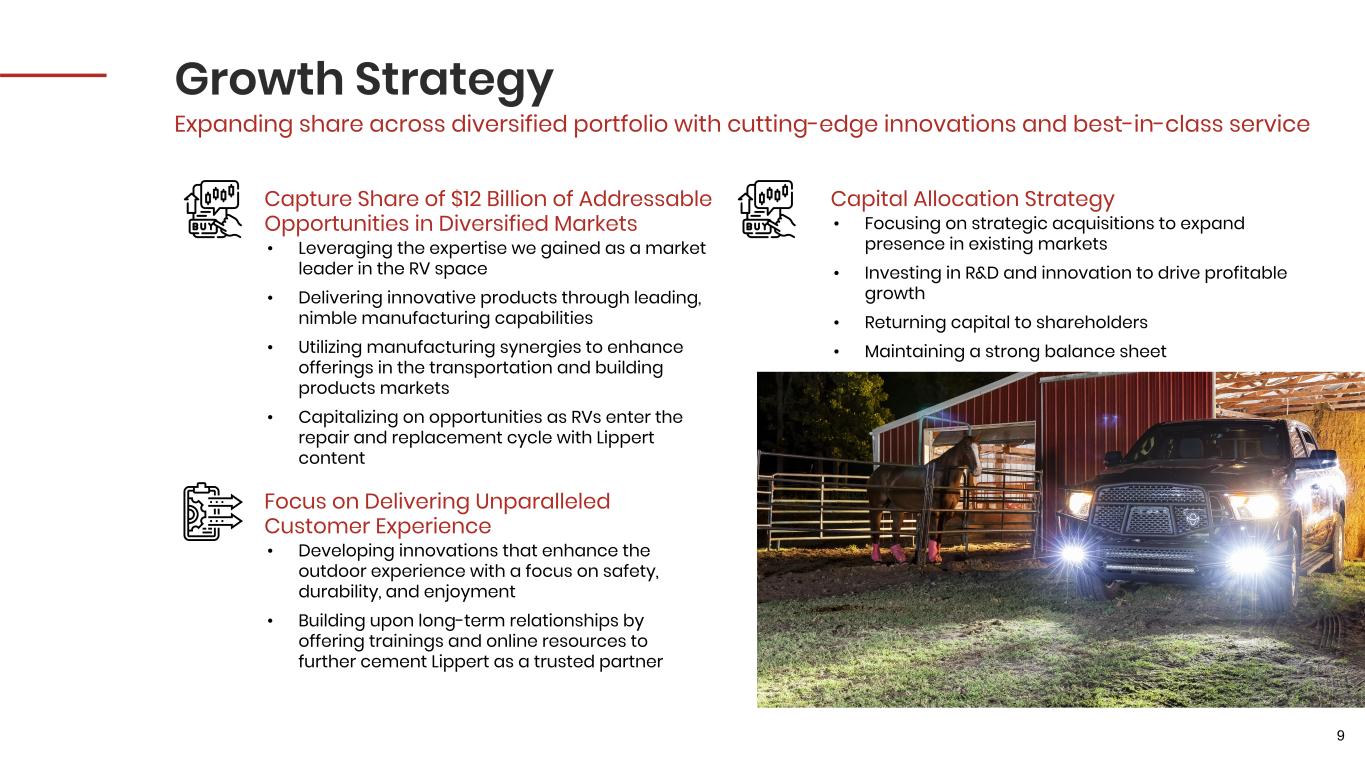
Good morning, everyone, and thank you for joining us on our fourth quarter and full-year 2024 earnings call. Today, I will walk you through our highlights from the year, provide an update on the industry backdrop, and how we will strive to continue to expand our market leadership in 2025. Then I will break down our business performance by market and outline our financial strategy before turning it over to Lillian for a deeper dive into our financials. Starting with highlights from the year, 2024 proved to be a good year for Lippert as we showcased the resilience of our diversified business by delivering full-year revenue of $3.7 billion, down only 1% despite a challenging RV and marine backdrop. As our presence in various end markets, such as building products international and aftermarket, helped offset some of our headwinds and should effectively position us to reach our organic target of $5 billion in total revenue in 2027. We expanded our market leadership across our top five product categories, appliances, awnings, chassis, furniture, and windows, which together accounted for 71% of our North America RV OEM sales. We experienced 7% organic growth in the automotive aftermarket due to market share gains, demonstrating our leadership in the towing and truck accessories markets. We also feel that our Curt and Ranch Hand acquisitions are really starting to gain momentum. We increased EBITDA by 89 million despite a weaker sales and mixed backdrop by delivering cost savings and operational improvements, helping to pave the way for a return to double-digit margins as we strive to deliver further operational improvements. We supply game-changing innovations, especially our CURT Touring Coil Suspension, our Furion Chill Cube Air Conditioning Technology, and our Lippert Analog Brake Systems for towables. We feel that these products clearly set us apart from our competitors and help drive organic content per towable RV up 2% year-over-year in 2024. We are successfully delivering on our new Camping World partnership, with product sales up 62% in their stores. We should be positioned to capitalize on more growth in 2025. Our goal this year is to upfit approximately 100 additional Camping World stores with different merchandising. Camping World has told us they are ecstatic with what we are doing as our partnering efforts are helping to drive their in-store and online aftermarket parts sales. And finally, we reduced net debt below two times EBITDA as we created cash flow from operations of $370 million. As we exit 2024, we're in a really good position, competing in what we believe are the right categories and markets to strengthen our leadership and drive continued margin expansion. None of our 2024 success or 2025 vision would be possible without our incredible team. We are grateful for their hard work, dedication, and relentless drive to push us forward. Our commitment to excellence and innovation is what makes our success possible. And I couldn't be more excited to continue building with them in 2025 and beyond as we execute on our vision and help the business reach new heights. Moving to the industry and macro backdrop, we are cautiously optimistic moving into 2025 as we are seeing that the RV backdrop has modestly improved. Orders are starting to improve and the signs at many retail shows are more positive. Our January RV sales are up 17% as dealer inventories are at their lowest point in recent history, which should create a favorable environment for demand. Also encouraging are reports that interest rate declines have helped the dealer floor planning outcomes. If you take these things and consider that the dealer profits are starting to improve, we believe there's a pretty good case to feel strongly that 2025 will hit its wholesale and retail estimates. Product mix is also looking like it will be in a much healthier situation, and consumer optimism is on the rise. As a reminder, historically, when the industry comes off a two-year downturn, we usually see three to seven years of industry growth. And if the same trend occurs as in the past, we believe we stand in a great position to capitalize on those tailwinds. So how will we expand our leadership position in 2025? Well, first, I want to emphasize that our market leadership matters. Over the last three decades, the team and I feel as though we have built meaningful brand and authority, and trust with our customer base, which we believe has created a strong foundation for cross-selling whichever products we decide to manufacture. This strategy should help to continue to drive scale and other advantages that we believe make us a low-cost provider and go-to for all things innovation. It also should give us a significant advantage as the supply side consolidates because we usually stand out when there are fewer choices because of our innovation and creativity. However, it isn't our market position alone that sets us apart. We think our competitive moat is built on many advantages that make us a trusted partner. I'll talk about seven of these that we believe position us to capitalize on industry tailwinds, drive sustained market share gains, and outperform the market in 2025. Each of the following points reveal our opinion of our place in the market and what should help us continue to succeed. First, our best-in-class manufacturing attracts new customers and expands wallet share this expertise and the decades of investment behind our high precision manufacturing ecosystem should make it incredibly hard for others to replicate our manufacturing capabilities and speed on complex components across rvs both and other product categories second our extreme product breadth should give us a natural advantage in cross-selling bundling and expanding our footprint with existing customers third we are the leaders in RV and marine innovation. Innovation has been part of our DNA for over 25 years as we started launching products beyond chassis that our customers were asking for. We have so many new exciting projects in the pipeline, and in 2023 and in 2024, we launched some significant products like our glass patio systems, 4K windows, ABS, PCS, and the Chill Cube, to name a few. With these products, we believe we have essentially created another 500 million in addressable market for RVs. Fourth, we deliver unmatched dealer support through our robust technical support network. This is a significant competitive advantage that most people don't realize because we are touching customers and forming significant relationships outside of the OEM channel. From our mobile service teams that bail out customers who have broken down on the road, to our tech teams that travel to dealers every week for service trainings, to our 200 customer service agents at our care center in South Bend that handle over 1.25 million customer interactions annually. The dealer body relies on Lippert to help train and fix issues around thousands of products that are constantly changing or being added to our portfolio. Fifth, we're the low-cost producer. Decades of manufacturing expertise, along with our immense volume, should give us the purchasing power which allows us to deliver exceptional value while protecting our margins. Sixth, we're an effective consolidator. With a solid balance sheet and strong track record of strategic acquisitions, we should have flexibility to pursue any compelling opportunities that arise. with this team having done over 70 deals in the past couple of decades acquisitions are in our dna finally our leadership team has seen it all we've successfully navigated many economic cycles industry cycles but most importantly over the last 20 to 30 years our team has developed a lasting and consistent culture built on trust and long-term meaningful relationships with our oem partners and with each other in addition to expanding our market leadership in 2025 we will strive to drive operational leverage and optimize overhead costs to ensure our fixed cost structure remains as efficient as possible, supporting profitability and long-term value creation as we progress back towards double-digit operating margins. To prove how serious we are about making sure our cost structure is optimal, we have set a stretch target of an 85 basis point improvement for this year in our overhead and G&A cost structure.
Speaker 8
I'll now move on to our results by business.
Speaker 8
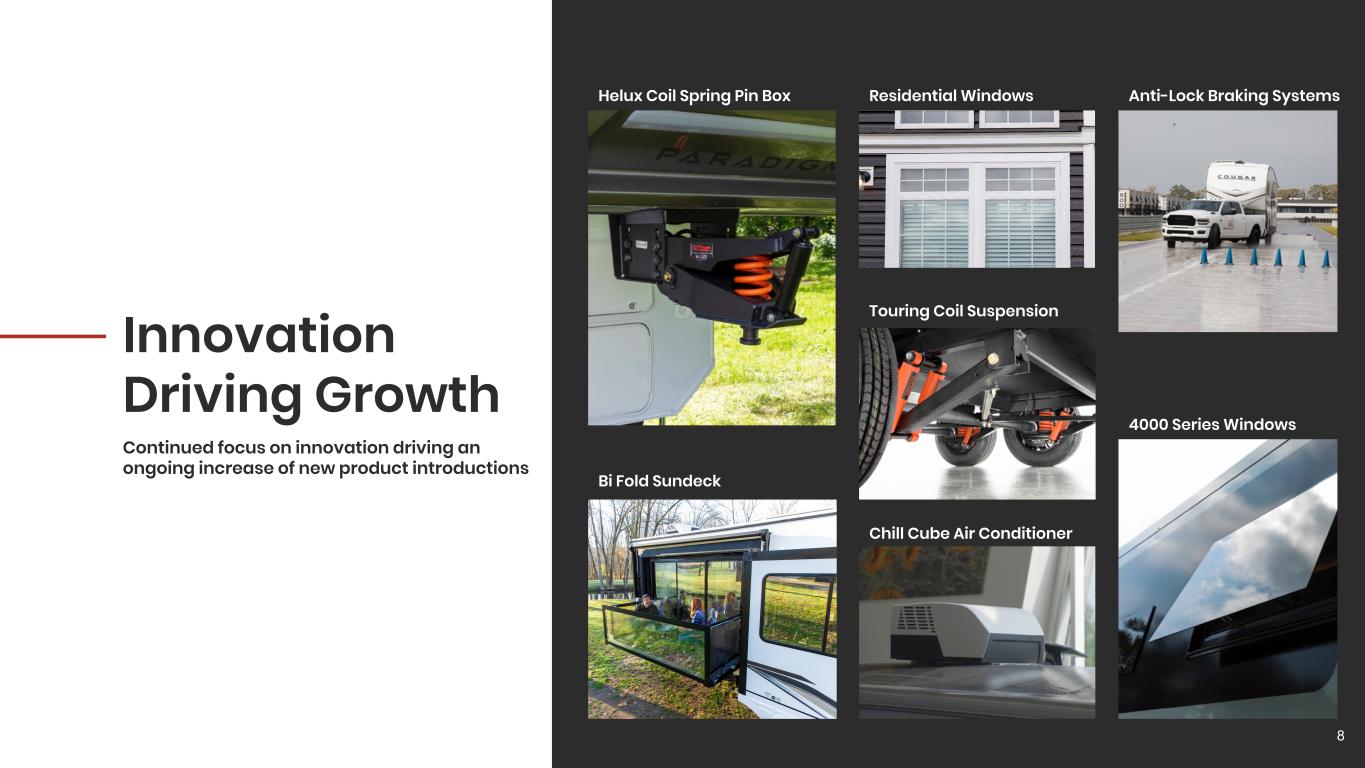
In 2024, RV OEM net sales told $1.7 billion for the full year, up 7% versus the prior year, reflecting continued market share gains across our top product categories. This growth came despite mixed shifts towards smaller towable units, as many of our products remain critical to RVs and should be insulated from decontenting risks. At the Tampa RV Super Show, we showcase innovative products that are driving new business wins for 2025. Some recent innovations, as we mentioned earlier to continue to gain momentum are our curt touring quill spring suspension which is one significant interest from OEMs and dealers alike and opens a new addressable market with more than 150 million dollars currently it has been launched by a few top 10 total brands with more top brands adding it this coming model year our analog braking system which has been adopted by many leading total RV brands and gives us access to 150 million of market opportunity we also anticipate this product will emerge as a standard across utility and cargo trailer segments in the near future, creating even more total addressable market for this great product lineup. Our current Helix Coil Spring Fifth Wheel Pinbox was recently awarded Best New Exterior Accessory at the SEMA show in Las Vegas, Nevada. Our Furion Chill Cube Air Conditioner, by far the quietest and most powerful in its class amongst the other air conditioner brands, has gained immediate interest from OEMs and consumers alike, further strengthening our position in this category as the new leader in HVAC systems. We also continue to expand RV content with larger windows and glass entry doors for 2025 models, which provide more natural light and integrated functionality. Brinkley RV has incorporated these square-bonded windows with integrated shade systems in their high-end units, demonstrating the premium value that these products bring to the market. We have invested over $50 million in glass processing technology over the last few years to keep us leading in all things glass and windows. Looking ahead, we're confident we can capture additional content opportunities as wholesale shipments and product mix normalize and that organic content growth should return to 3% to 5% annually. For 2025, we project $335,000 to $350,000 wholesale shipments or more than $100 million of additional RVOM sales at current content levels to our top line as we strive to capitalize on the nearly $3 billion addressable opportunities for their current products. Supporting these projections, Blue Compass, the second largest RV dealer in the country, reported record sales at the Tampa RV show, up 20% from their best prior year. Furthermore, LCI's January RV sales increased 17% year-over-year, which we believe are all signs that point to the improvement in the industry backdrop. Turning to the aftermarket, net sales were $881 million for the full year, roughly flat year-over-year. Strength in the automotive of aftermarket was offset by some softness in the RV and marine aftermarkets. Operating profit for the aftermarket segment remained strong at 12.6%. The Kurt family of products, including hitches, towing solutions, and truck accessories, delivered impressive growth, with sales increasing 7% during the year, contributing 54% of the total aftermarket revenues. Kurt's strong performance underscores our ability to execute meaningful acquisitions that ultimately contribute to sustained growth. Notably, our ranch hand truck accessories are featured on trucks in the hit TV shows Landman and Yellowstone. Camping World's furniture business acquisition and accompanying supply agreement has continued to exceed our expectations as we have outfitted more than 14 Camping World RV parts stores, with Lippert products in these stores increasing our sales with the world's largest RV retailers, 52% year-over-year. We expect continued growth as we plan to further expand the selection of lipper products online and in camping world locations in addition other dealerships have taken note and are asking for our help to up at their stores our fury ensuite of appliances acquired through another acquisition includes backup observation cameras ovens hot water heaters refrigerators microwaves furnaces and air conditioners it continues to help drive aftermarket revenue through the upgrade repair and replacement cycle contributing $56 million to our aftermarket group sales alone for the year, a 22% increase over 2023, again demonstrating our ability to grow acquisitions. We feel that Furion is a perfect example of how we can impact the aftermarket significantly by driving meaningful OEM volume with new acquisitions that have large product portfolios like Furion. To further capitalize on the aftermarket, as large numbers of vehicles transition out of their warranty periods, we've emphasized dealer tech training programs, strengthening a dealer's knowledge of and preference for Lippert products by equipping technicians with the expertise to service and install our offerings effectively. Over the course of 2024, we trained 36,000 dealer service personnel. We had 1.6 million views of our tech support seminars. We had 65,000 technical product class completions, and we had 2.1 million overall page hits on our how-to technical service pages. All in all, our aftermarket business represents more than $10 billion in addressable market. Our presence has grown substantially since our entrance in 2013, and we will continue to focus on organic and inorganic growth in this critical area for us. Turning to adjacent markets, net sales decreased 13% to $1.1 billion for the full year when compared to the prior year, largely due to weak demand in the marine, as dealers continue to optimize their inventory levels. Excluding North American marine sales, the Jason Andrews series were $867 million, or only down 6%. In the year, we feel as though we've made significant strides in several end markets that position us well to achieve growth moving forward. In the utility trailer market, we've leveraged our core expertise in axle manufacturing to supply leading brands like PJ Trailers, Diamond Sea, Inove, and Big Tex Trailers. With approximately 600,000 utility and cargo trailers built annually, We believe this market is a significant growth opportunity for LCI content. As we continue to gain share, we plan to introduce several advanced upgrades such as ABS and TCS, further enhancing utility trailer suspension performance and safety for the end consumer. In the world of utility trailers, axles are the largest single content item. Additionally, our window and glass products are successfully adding to our content gains in areas like off-road vehicles, schools, school buses, and transit buses with our on-highway and off-highway transportation markets. This represents a significant content opportunity as approximately 70,000 buses of all types are built annually. For building products, we have gained notable traction in residential windows over the past few years, growing this business by 20 million as more residential distributors and builders recognize the value of our entry-level vinyl window products. Our entry-level product has been so successful that we just launched a more premium residential product lineup. This represents only one of the many products we have that have been gaining share with builders. Others include our chassis for manufactured homes, residential awnings, and thermal form components for tubs and showers. Turning to capital allocation, our strong performance and effective inventory management generated $370 million in operating cash flows over the last 12 months, enabling us to pay down $89 million in debt and reduce leverage to below two times. Our solid balance sheet should position us well to pursue a robust pipeline of M&A that aligns with our strategic goals in existing markets. We feel as though we have a proven track record for driving value through acquisitions, focusing on companies with experienced leadership teams, exceptional products, and significant growth potential. In addition to M&A, we remain committed to funding innovation and operational improvements to drive long-term growth while maximizing shareholder returns. This past quarter, we advanced our commitment to returning cash to shareholders by raising our dividend 10% to $1.15 per share. Providing this value to shareholders remains a key priority and reflects our confidence in the strength and resilience of our business in the short and longer terms. Closing with culture, it's intangible, but it truly drives results at Lipper as we remain committed to maintaining a great workplace where we have the best leaders driving on values consistently. When we create a great workplace, people tend not to leave very often, which helps create a lot of consistency and momentum in the manufacturing processes and the overall business results. Even in a difficult year like 2024, our retention was better than industry average. This year, we probably surpassed our ambitious 100,000-hour volunteer initiative goal through our team members by holding events such as a Built to Serve event in Fort Wayne, Indiana, where Lippert leaders supported Shepherd's House, a non-for-profit providing long-term care for homeless veterans facing addiction and mental health challenges, along with hundreds of other events put on by our teams to assist our communities where there is need. We are trying to set an example for many other businesses to follow because we believe by doing this, business can be a greater force for good in the world. Our inclusion on Newsweek's 2025 list of America's most responsible companies highlights our continued progress in environmental, social, and governance initiatives we also advanced our sustainability efforts by implementing resource and waste monitoring across some of the facilities and publishing our third year of scope one and two greenhouse gas emissions data these initiatives reinforce our focus on transparency and accountability supporting lippard's vision of long-term growth that benefits all stakeholders in closing i want to thank our dedicated team members once again for their incredible efforts we believe lippard is well positioned for long-term success and we are excited about the road ahead as we continue to innovate, deliver exceptional customer experiences, and create value for all of our stakeholders. I'll now turn it over to Lillian, who will provide more detail on our financial results.
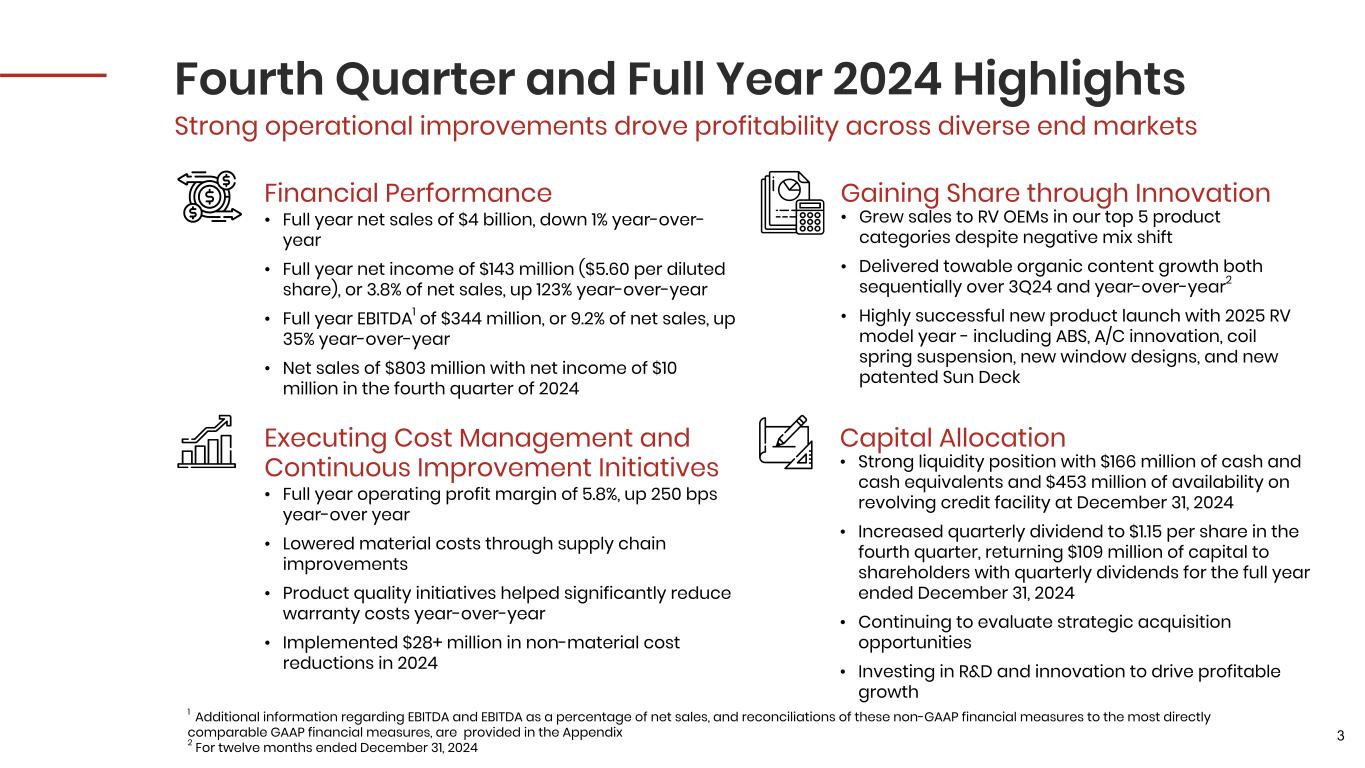
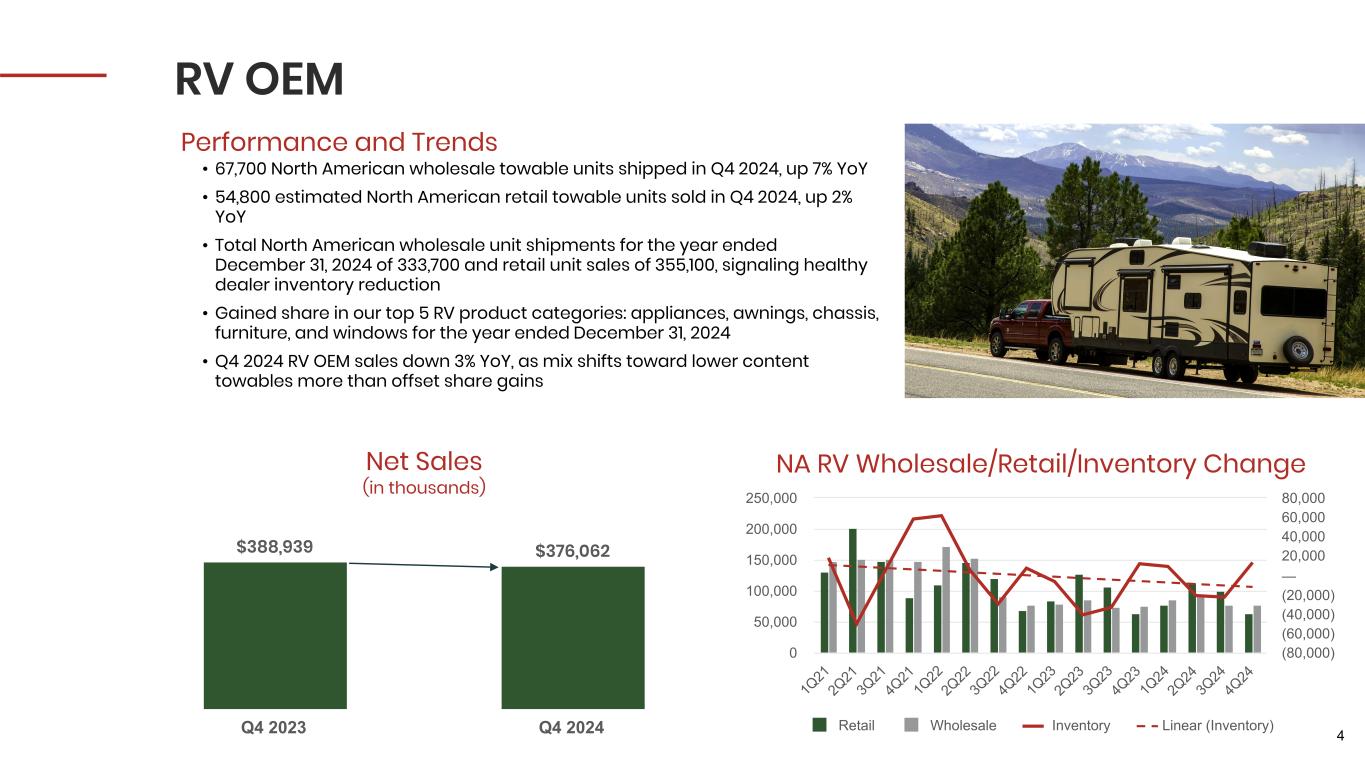
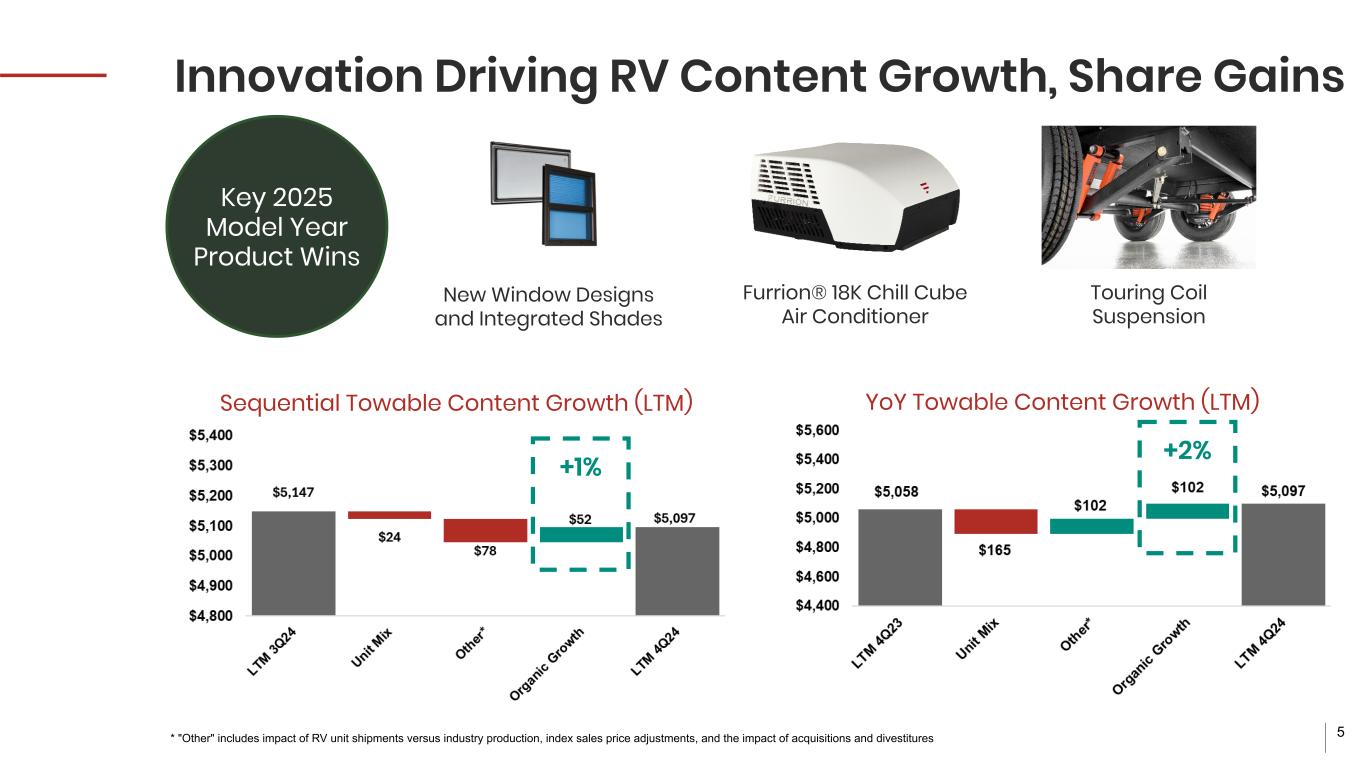
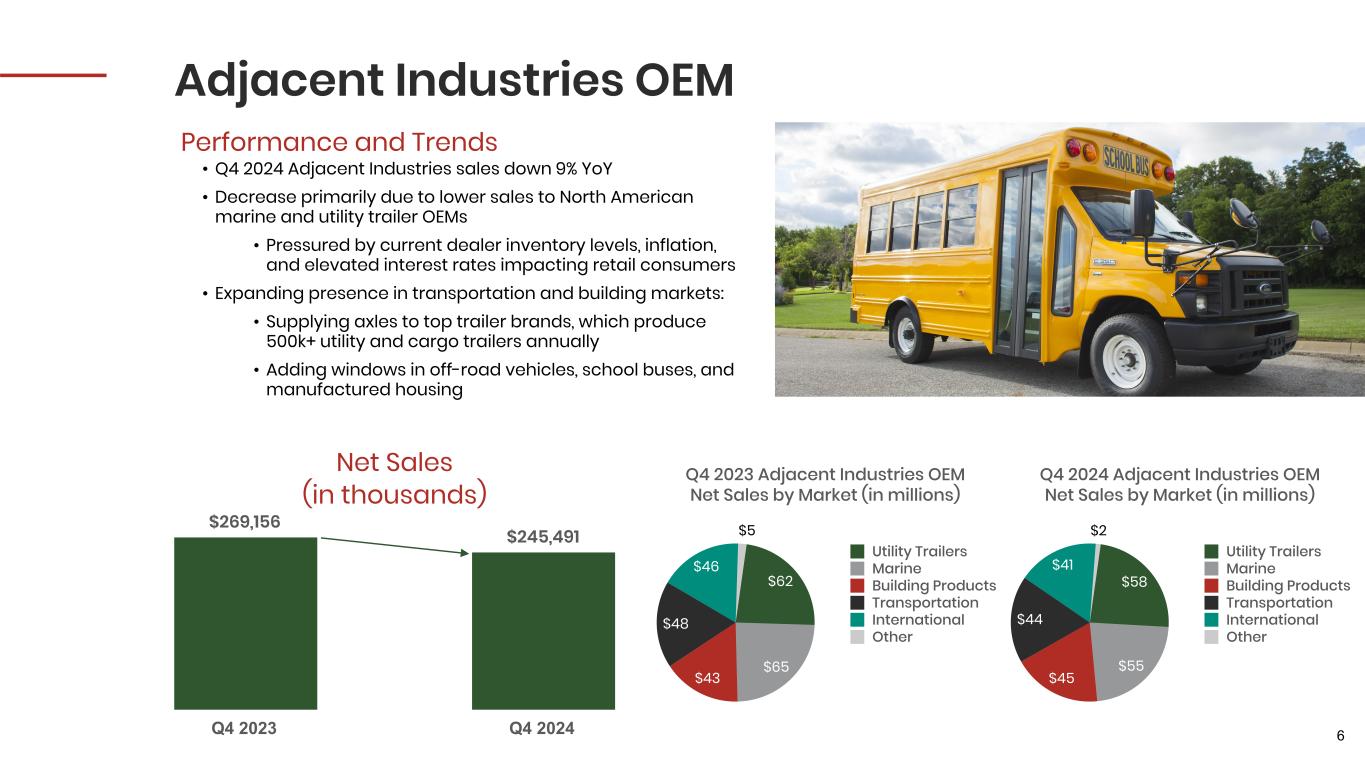
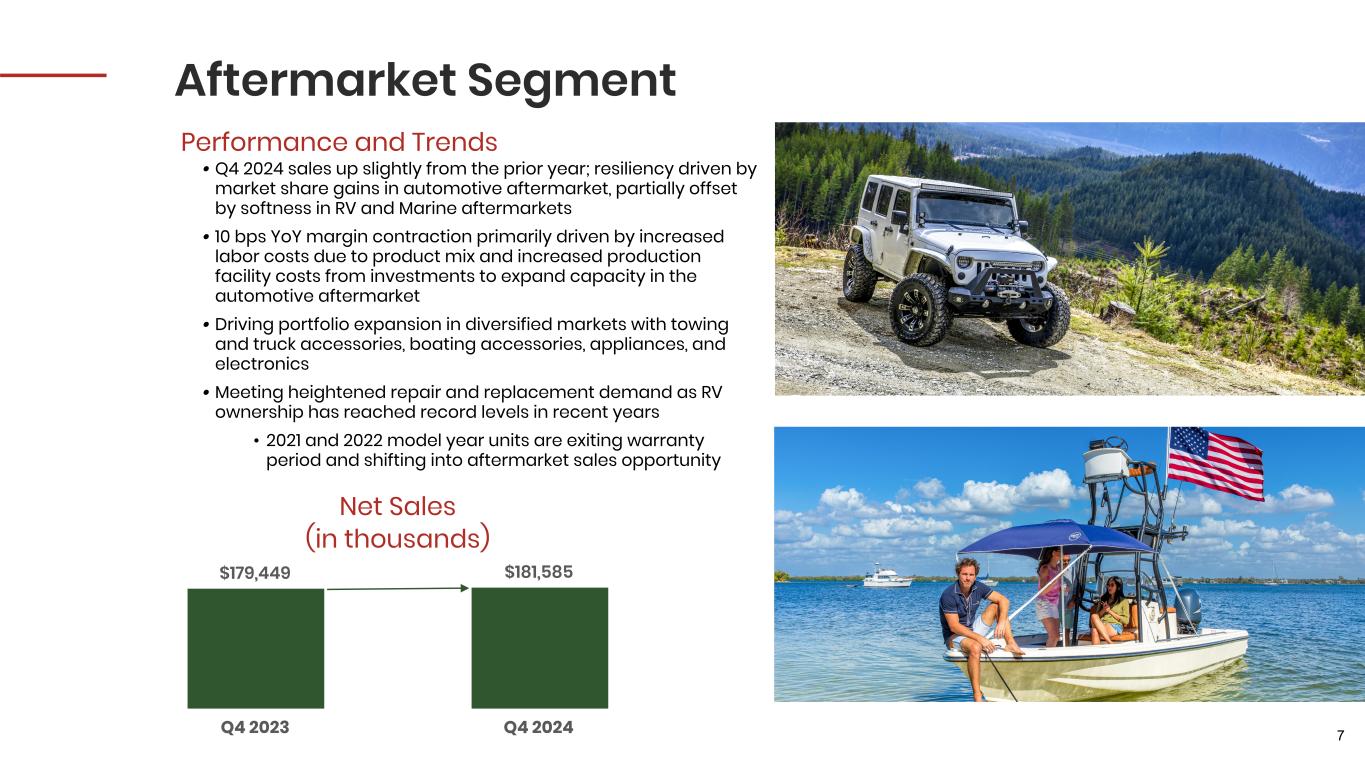
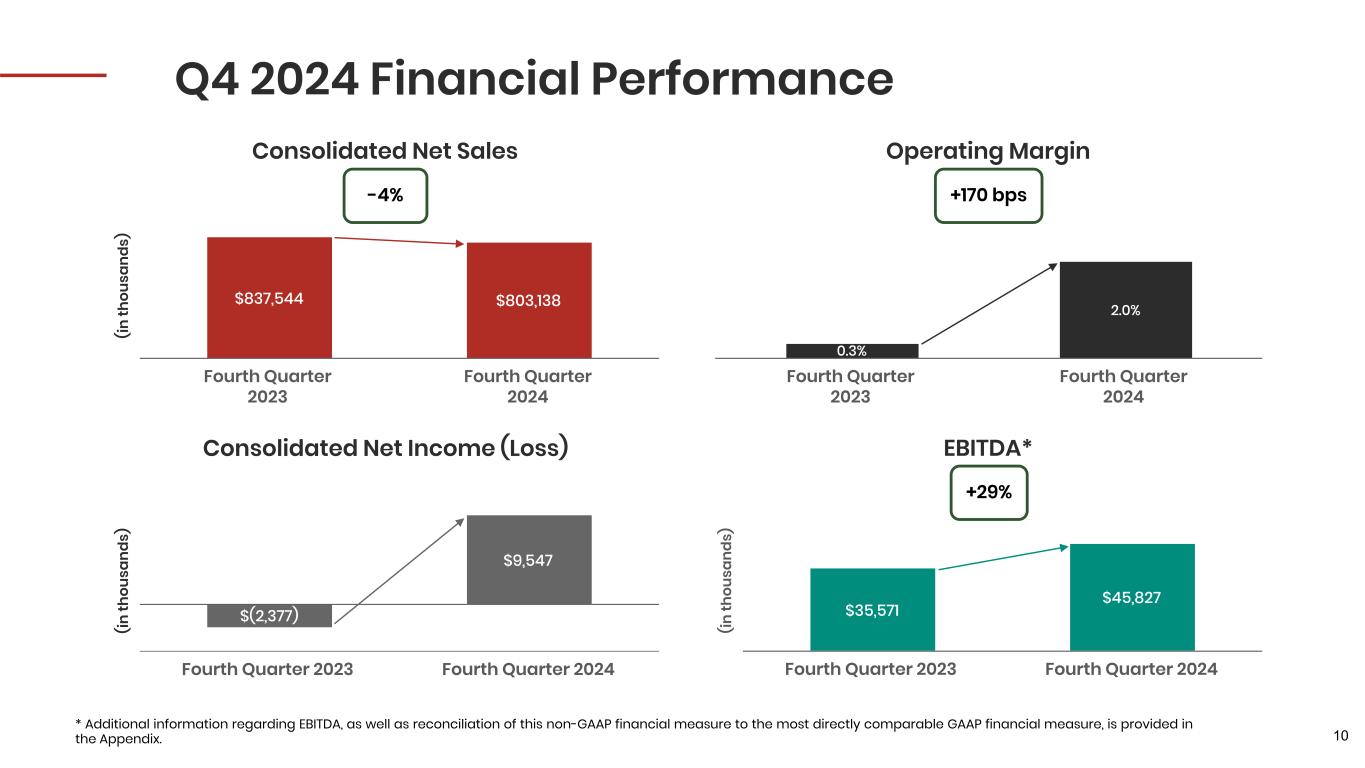
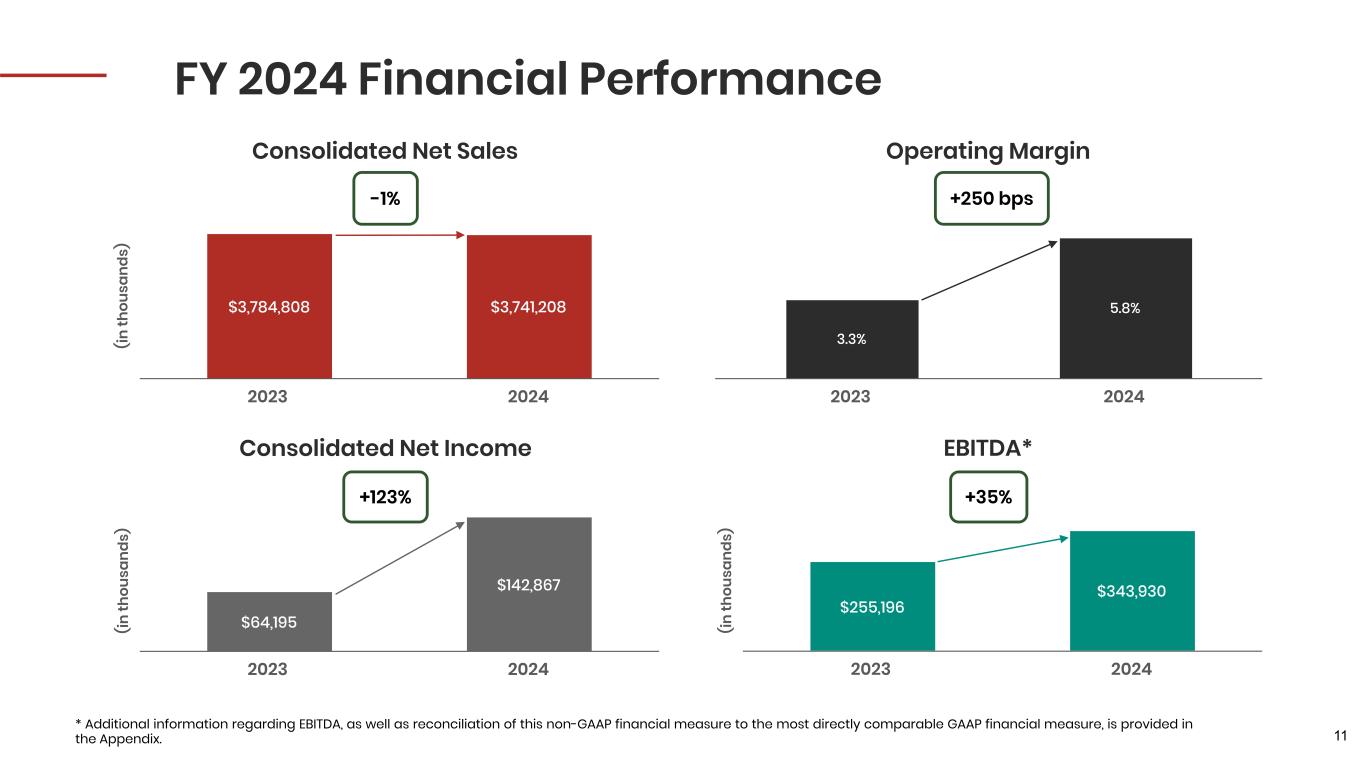
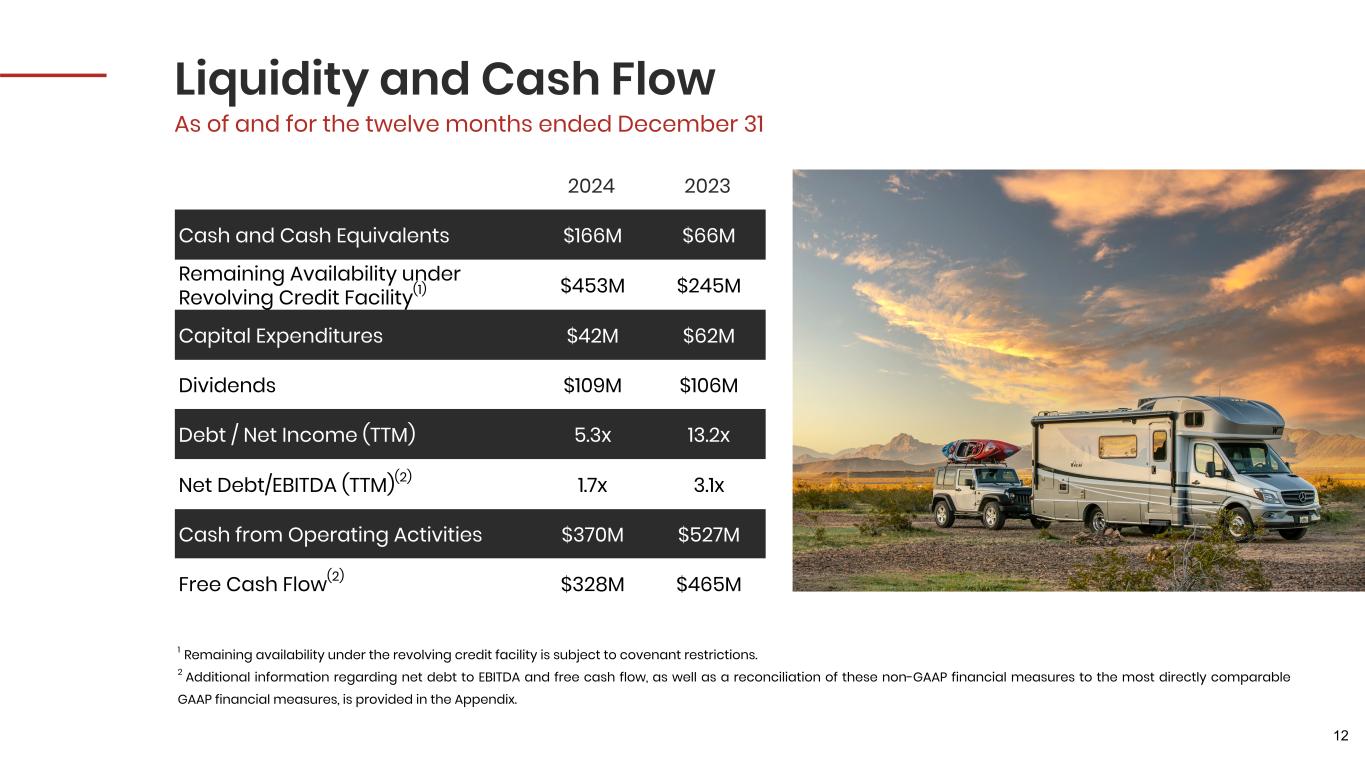
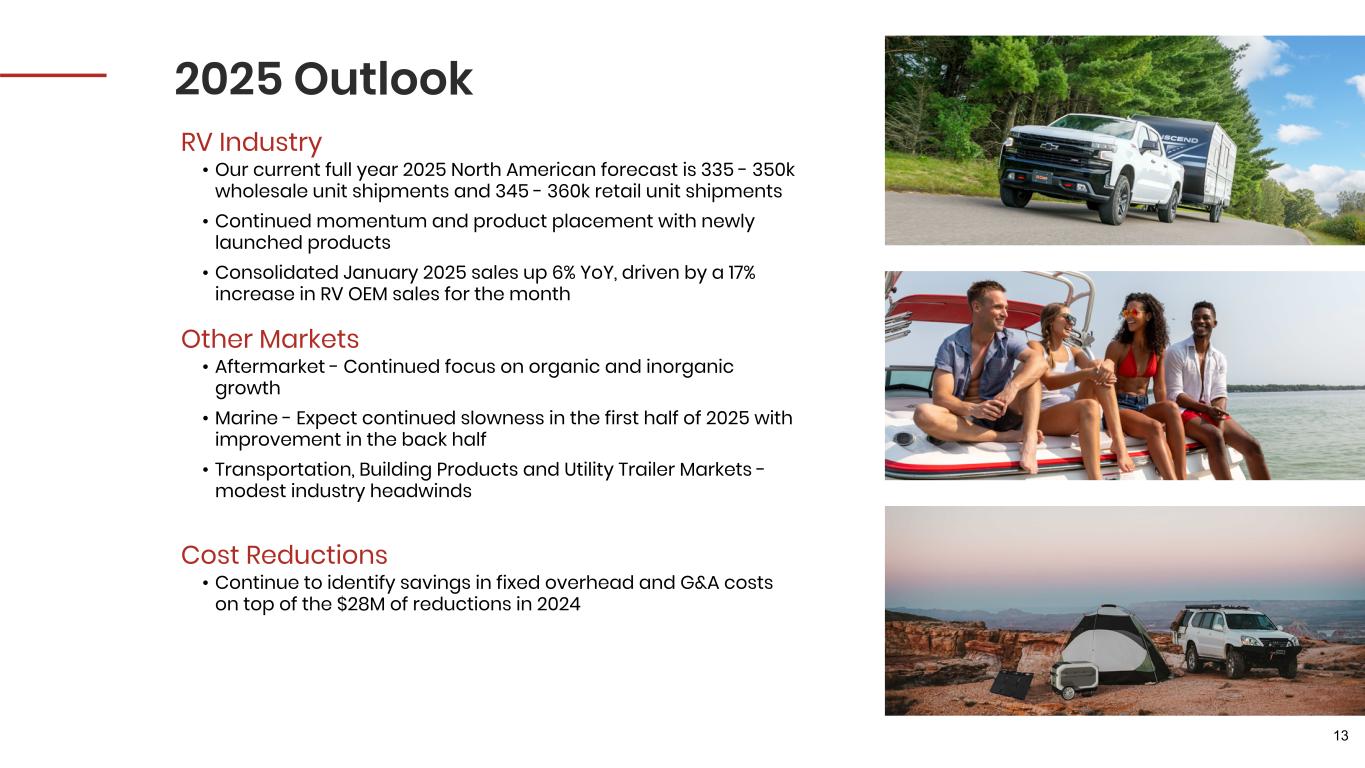
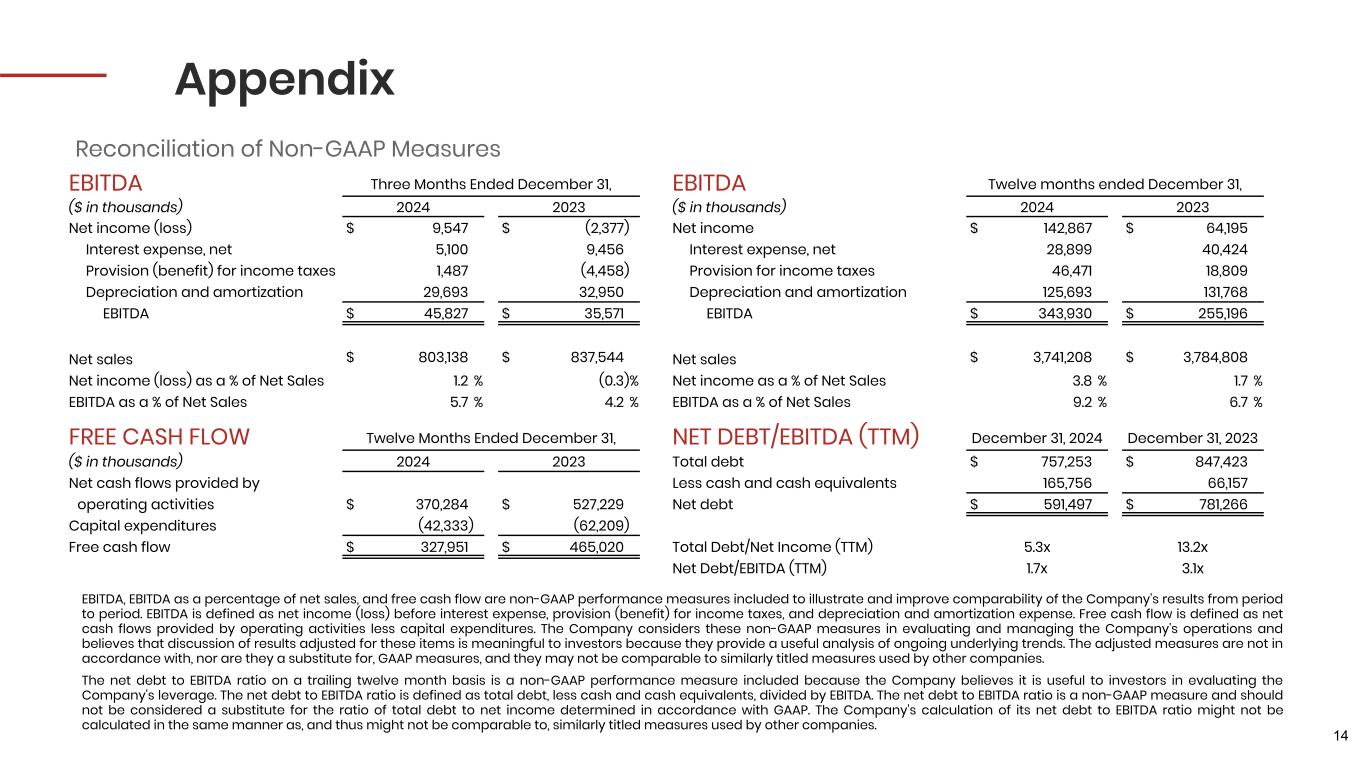
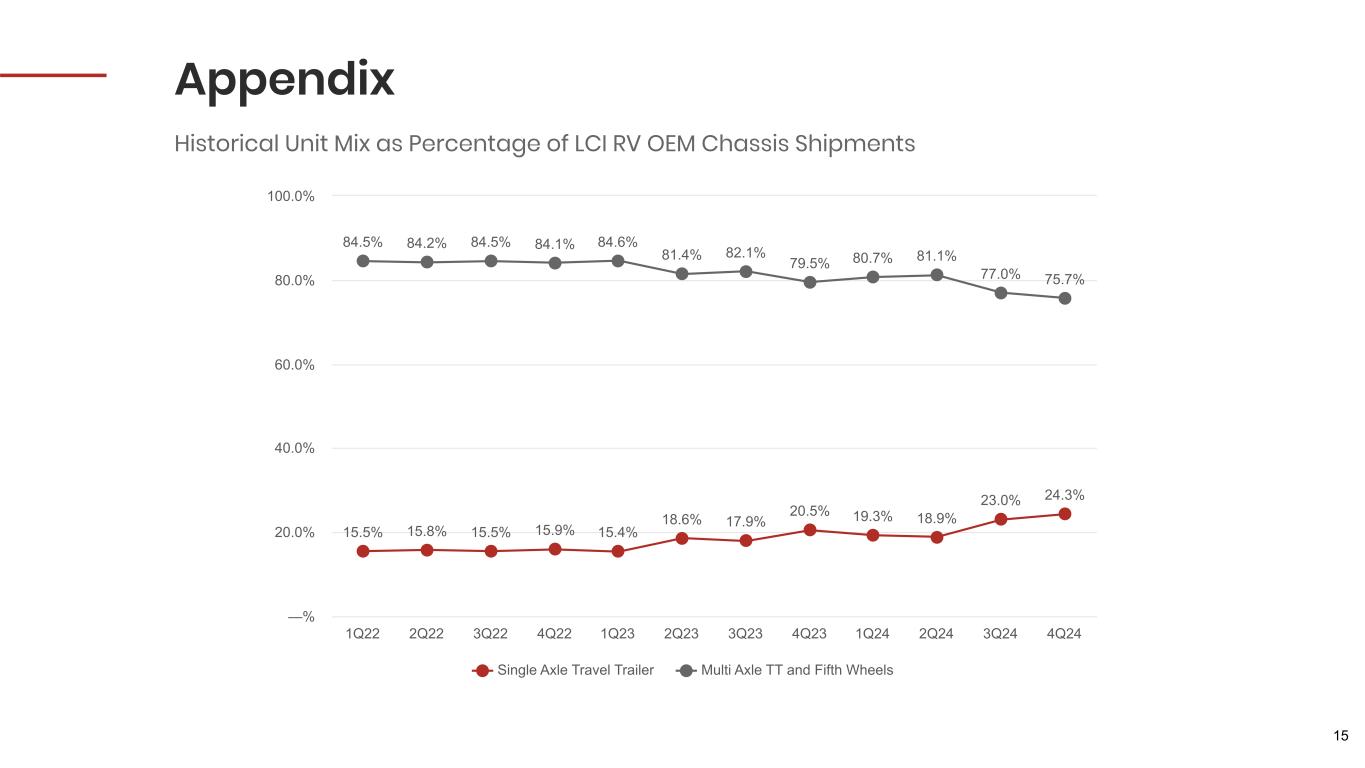
Thank you, Jason. Lippert's strong reputation for best-in-class quality and service, along with our robust portfolio of innovative products, fueled share gains during the quarter. However, revenue growth remained constrained as persistent softness in retail demand across the RV and marine markets continued. Our consolidated net sales for the fourth quarter were $803 million, a decrease of 4% from the fourth quarter of 2023. OEM net sales for the fourth quarter of 2024 were $621.6 million, down 6% from the same period of 2023. RV OEM net sales for the fourth quarter of 2024 were $376 million, down 3% compared to the prior year period, driven by a 24% decrease in motorhome wholesale shipments and a shift in unit mix towards lower content single axle travel trailers. These impacts were partially offset by a 7% increase in North American travel trailer and fifth wheel wholesale shipments and overall market share gains. Content per towable RV units was $5,097, up 1% compared to the prior year period, while content per motorized unit was up 7% to $3,742. Content per towable RV unit was up primarily due to increased adoption of Lipper Innovations, largely offset by a continued shift to single axle trailers which have less content overall. These trailers accounted for about 24% of production in Q4 of 2024 compared to the prior year of 20%. Typically, we would see a mixed range of about 16 to 19% for these units. Organic content increased 1% sequentially and 2% year over year supported by the share gains we delivered in the top product categories we supply to the RV OEMs, specifically appliances, awnings, chassis, furniture, and windows. Aftermarket net sales for the fourth quarter of 2024 were $181.6 million, an increase of 1% compared to the same period in 2023, primarily driven by continued growth in the automotive aftermarket, partially offset by softness in the RV aftermarket, which has been negatively impacted by lower consumer discretionary spending. Adjacent industries OEM net sales for the fourth quarter of 2024 were $245.5 million, down 9% year over year, primarily due to the lower sales to North American marine and utility trailer OEMs. Marine sales were down 15% due to the impact of inflation and still high interest rates on retail demand, and we expect softness in the marine industry to continue for the first half of 2025. During the quarter, this decline was partially offset by increased sales for building products as we continue expanding our footprint in this market by capturing demand for core products, supplying axles to top trailer brands, and adding windows in off-road vehicles, school buses, and manufactured housing. Gross margins for the fourth quarter of 2024 were 21.1%, compared to 19.2% for the same period in the prior year period, supported by decreased steel prices, lower inbound freight costs, and the impact of material sourcing strategies we've implemented to lower input costs. Consolidated operating profit during the fourth quarter was $16 million, or 2%, a 170 basis point improvement over the prior year period. Operating margin expansion was supported by operational improvements, such as further facility consolidations and overhead reductions. I would also like to highlight that our warranty costs reduced by $9 million during the quarter. For the full year, warranty costs have decreased about 29 million compared to the prior year period, driven by the implementation of product quality initiatives. The operating profit margin of the OEM segment increased to 0.3% in the fourth quarter of 2024, compared to a loss of 1.8% for the same period of 2023. The aftermarket segment delivered a 7.9% operating profit margin in line with the prior year period. Gap net income in the fourth quarter was $10 million, or $0.37 earnings per diluted share, compared to a net loss of $2 million, or $0.09 loss per diluted share in the prior year period. EBITDA in the fourth quarter was $46 million, a 29% increase compared to the prior year period driven by higher earnings, along with a 46% decrease in interest expense over the prior year period, reflecting our lower levels of debt in 2024 and improved provisions for income taxes of about $6 million. dollars. Moving on to full year 2024 results. Full year net sales were $3.7 billion, down 1% year-over-year. Sales to RV OEMs increased 7% to $1.7 billion, driven by a 13% increase in wholesale shipments of tribal trailers and fifth-wheel units in addition to market share gains. partially offset by a 24% decrease in motorhome wholesale shipments and a shift in unit mix towards lower content single axle travel trailers. Sales to adjacent markets decreased 13% to 1.1 billion in 2024, primarily due to lower sales to North American marine and utility trailer OEMs, driven by current dealer inventory levels, inflation, and elevated interest rates impeding retail consumers. Aftermarket sales were relatively flat when compared to the prior year at $881 million, as gains in the automotive aftermarket effectively offset impact from lower RV and marine aftermarket demand. Total company operating profit margin for 2024 was 5.8%, up from 3.3% in 2023. The operating profit margin of the OEM segment increased to 3.7% for the full year, compared to 0.6% for 2023, as we made significant operational strides. The aftermarket segment delivered a 12.6% operating profit margin, compared to 12% for 2023, three, which made up over half of our total operating profits, despite only making up 24% of total sales, demonstrating how our diversified business exposure has effectively supported profitability. Non-cash depreciation and amortization was $125.7 million for the 12 months ended December 31st, 2024, while non-cash stock-based compensation expense was $18.7 million for the same period. We anticipate depreciation and amortization in the range of $115 to $125 million during the full year 2025. At December 31st, 2024, our company's cash and cash equivalent balance was $166 million compared to $66 million at December 31st, 2023. For the 12 months ended December 31, 2024, cash provided by operating activities was $370 million, with $42 million used for capital expenditures, $20 million used for acquisitions, and $109 million returned to the shareholders in the form of dividends. Additionally, the company had net repayments of indebtedness of $89 million. As of December 31st, 2024, our net inventory balance was $737 million, down from $768 million at December 31st, 2023. At the end of the fourth quarter, we had outstanding net debt of $591 million, 1.7 times pro forma EBITDA, adjusted to include LTM EBITDA of acquired businesses and the impact of non-cash and other items as defined in our credit agreement. For the month of January, sales were up 6% versus January 2024, with RV sales up 17% and aftermarket up 6%, offset by softness in international and other adjacent markets. We are anticipating an estimated full-year wholesale shipment range of 335,000 to 350,000 units as lingering consumer demand headwinds begin to abate. As we think about Q1, we expect overall revenue to be about flat year-over-year. We expect RV OEM sales to be up about 9%, and we expect continued softness in marine and international markets. We also expect operating margin to be flat to a slight improvement over Q1 of 2024. Looking to capital allocation for the full year of 2025, capital expenditures are anticipated to be in the range of $50 to $70 million. We continue our aim to utilize our balance sheet to pursue strategic opportunities that help us capture profitable growth and deliver shareholder value while maintaining a long-term leverage target of one and a half to two times net debt to EBITDA and maintain our commitment to returning cash to shareholders. We intend to further strengthen our financial profile by making consistent operational improvements to our business while supplying innovative products that result in market share expansion throughout the business. We expect to see industry recovery across the markets we serve over the next several years, in addition to organic growth fueled by our market share expansion. We look forward to continuing this progress, driving sustained, profitable growth as we advance towards our $5 billion revenue target in 2027, while remaining committed to returning to double-digit margins. That is the end of our prepared remarks.
Operator
Operator, we are ready to take questions thank you thank you if you wish to ask a question please press star followed by one on your telephone keypad now if for any reason you want to remove your question from the queue please press star followed by two when preparing to ask your question please ensure your device is unmuted locally our first question is from fred whiteman from wolf research your line is now open please go ahead hey guys good morning i was hoping to I'll start with the tariff question.
I'm hoping you could just level set sort of what you have contemplated in your outlook for the year as far as steel and aluminum tariffs, maybe where inventory levels stand, how you're thinking about pass-through. I know in the past you've sort of talked about a two-quarter lag on the pricing front until contracts reset, but maybe just to start with.
Speaker 9
Yeah, sure, Fred. Well, we haven't put anything into the plan, so, you know, our plan doesn't reflect anything for tariffs. It's obviously still fluid. There's a lot of things we can talk about here. I think the first and most important thing is that, you know, chassis are our largest product, our largest product on our portfolio, and, you know, almost 99% of the steel from those products or for those products come from domestic sources. So, you know, our largest product line, we don't have any issues. But if you look overall, it's probably, you know, we're calculating with what we know today about 50 bps of impact and we feel we can we can mitigate most of that even through pricing that's one time or through our indexes we certainly will get a lot of help from our suppliers you know our suppliers don't want to lose the business so they're working with us to mitigate some of that you know we've been through this before and and mitigated you know mitigated a chunk of it and we'll we'll do it again this time it's just uh there's just a lot of moving parts and pieces but does that help frame it up it does yeah so so just to confirm when you're saying
the the 50 basis points is just the steel and aluminum tariffs or is that sort of assuming china as well too no that's yeah to clarify that's that's china um that's steel and aluminum the steel aluminum would be much less obviously because we're just not you know we don't have the kind of impact with all the domestic sourcing we have okay and then I guess just yeah go ahead yeah so Fred to your comment on the steel and aluminum you're correct that we already have pass-through mechanisms on those two commodities that those are commodities that historically we've you know passed through cost increases we've you know and decreases at
the same time so I would expect that we would continue to fully execute on that model on a go-forward basis for the tariffs to to Jason's point to mitigate the impact there okay and then on content per unit there were a couple comments about just healthier mix and then you gave the disclosure about the percent for single axles which looks like it picked up a little bit sequentially so can you just help us think about maybe where that single axle mix is is expected to trend this year and then maybe what that means for content per unit in towables yes obviously yeah it's obviously risen the last couple years you know I would say that you know if you look at our our
Speaker 9
total chassis output on single axle trailers in 24 was about 12,000 units more than a 23 and we build most of those obviously most of those units we We saw it tick up a little bit for January, about 1,000 units over last January. But our anticipation is that that starts to subside and normalize sometime in Q2. We've had a lot of conversations with dealers, and they're very aware of the mixed situation and feel that we've kind of ballooned inventories on that product pretty well over the last year and a half. So there's a lot of brands making that single-axle trailer, where if you go back two or three years ago, there was only a couple brands making the trailer. So, yeah, saw it tick up a little bit for January and might see a little bit of a flat uptrend this year. But I would say that we're going to, you know, see mix normalize here sometime after the start of Q2. Helpful. Thank you.
Operator
Thank you. Our next question is from Daniel Moore from CJS Securities. The line is now open. Please go ahead.
Thank you. Appreciate the questions, Jason Lillian. And maybe just talk a little bit about, obviously, January started up the year strong. You expect dealers to continue to restock through kind of January, through February, March, April timeframe and ahead of the kind of spring selling season. Just any additional color in terms of what you're hearing there would be helpful.
Speaker 9
Yeah, I think – sorry, Dan, I got a frog in my throat. I think a couple comments I'd like to make, you know, if you look at, you know, Q4, we were averaging about, you know, 4,100 chassis a week. Q3, we were about 4,400 a week. Q2 last year, we were close to 5,200 a week. You know, we're averaging 5,300 a week this year already. We have some pretty good visibility into February and March. February started out, you know just a strong march feels pretty comfortable you know commentary from all the dealers including ones i've talked to just in the last couple days you know pretty strong januaries for the good dealers i'm sure there's dealers out there that are struggling but you know the big players seem to be seem to be having decent uh decent shows and and decent volume uh and retail traffic on their lots you know through year to date is that helpful it is it is and just talk maybe a little bit more color about you know penetration and acceptance rates for some of your more recent innovations obviously mentioned suspension systems anti-lock brakes glass entry doors um the windows series you know any i know you don't have necessarily divulged hard and fast data but just how do we think about how those penetrations might ramp into say model year 26s versus you know 24 25 yeah yes if you look at like you know some of the products we mentioned chill cube abs our tcs our windows helix you know we've got you know close to a 500 million dollar total addressable market we've created with those with those products you know in the near term you know i would just say you got to think about it as you know like tcs for example we're really excited about that product for a lot of reasons obviously it improves the durability and the long lasting of a lot of the components that go in the RV by lessening the vibrations that the unit experience is going down the road. But it's, you know, it's an $800 to $1,200 piece. So, you know, those more expensive pieces take longer to penetrate. But, you know, how this market works, it's a me-too market, and we've got it, you know, we've got that product starting out on the right brands. It's had great success at the shows. and ultimately the consumers are going to want products that make the experience better and help, you know, lend to a better quality unit over time. So ABS is double digits up from last year in terms of product placement for this upcoming model change in June. So, you know, Windows not as pricey as TCS and ABS, but that's seeing progress. You know, we should be the, you know, we should be the largest air conditioner manufacturer in the industry after this year with the launch of the Chill Cube and the success that that's had. So, you know, we're having good success so far. And, you know, I would just look at it in expensive products, just take a little bit longer time to penetrate. But, you know, maybe think of it that way.
Okay. And then just want to clarify, appreciate the commentary on tariffs, you know, potential 50 basis point. Pedwind mitigated to some degree, offsetting that, hopefully a better year in terms of RV shipments, a little bit more overhead absorption. So how were you kind of thinking about the range of operating margin for 25 relative to 24 when you put all that together? Thanks again.
Yeah, good morning, Dan. We're not putting out a specific margin target for this year, but how I would characterize it as we're looking, moving through the year, I would think about incremental margins at about 25 percent. So the leverage that we'll get from the volume increase will definitely help increase the margins. We'll also continue to be very focused on cost reductions. You saw us from a non-material perspective. We shared that we had over 28 million of cost reductions in 2024 you know we're targeting to implement comparable types of levels as we're looking at 2025 again non-material related so looking to reduce the overhead costs you know gna related types of expenditures which will also improve margins so we're expecting you know a reasonable margin uplift this year you know obviously the tariffs are an overhang that the the team needs to work aggressively to mitigate, but we are confident that we'll continue to expand the margins as we progress through 2025.
Speaker 9
A lot of puts and takes there, but the only thing I'd add to what Lillian said is just the fact that as we come out of these cycles and we're clearly seeing a little bit of an inflection point at the present, we are gonna lock down, we have costs locked down. So it's a lot easier to control those out of the gate versus, you know, we're, you know, 24 months into an upswing and we're having to open factories back up. But, you know, we're still closing a few factories and consolidating some business units, which is really helpful. And we've got costs locked down, you know, especially NGNA and overhead. So I think that's going to continue to play favorably for us in the quarters to come.
No, that is helpful. I'll let me jump back with a follow-up or two.
Thank you. sure thank you our next question is from joe altebello from raymond james your line is now open please go ahead thanks hey guys good morning um i guess i'll start with operating margin for 25 and there you're not getting giving a target but if we think about the i guess the three buckets you mentioned the 25 incremental margin um on volume and then i think you mentioned earlier 85 basis points of improvement overhead and gna cost saves and then the third bucket would be the tariffs that would sort of offset that is that how we should be thinking about the margin for 25 um from the two the first two buckets yes in terms of the incremental margins um
at 25 for incremental revenues um the cost reductions and again the areas that we're focused on there that Jason highlighted. It's continued facility reduction, which, you know, we did quite a bit in 2024. We're continuing on that journey. It's, you know, reduced overhead with, you know, from an FTE perspective, again, just trying to really be as efficient as we can and continued reductions in general overhead costs and direct spend. From the tariff perspective, you know, while, you know, based on what we know today and, you know, unfortunately, things do seem to change every day, and the team is being very flexible with the fluidity. But based on what we know with the disclosed and implemented incremental tariffs for China, for the additional tariffs for steel and aluminum, we're saying from a China perspective, it's about a 50 basis point headwind that we're working to mitigate. Steel and aluminum, we already have pass-through mechanisms that have been in place for years. We'll continue to leverage those so not necessarily anticipating the tariffs are going to be an overhang to the margins that said day to day i i wake up and i look at the news to see if there's something new so things could change on the tariff front that we're not anticipating at this point uh so yeah just staying very flexible there and and adjusting as we need to yeah what we know today i think the the clearest way to say it is we feel pretty confident that we can mitigate most of that uh we don't know what what we don't know coming in the in the near future um and we'll we'll deal with that stuff as it comes but with what we know today we feel pretty confident we can mitigate most of that yeah okay and jason just kind of shifting over to your retail outlook for
the year um you know your commentary on the call has been you know pretty upbeat um but if you look at the numbers i guess you're looking for kind of flattish retail this year so maybe um help us understand sort of the disconnect or the perceived disconnect there and maybe what the variables are that would get you toward the lower end or higher end of that range?
Speaker 9
Yeah, I mean, there's a lot of puts and takes and moving parts, but we feel we've been obviously stung the last couple years on retail, so I think we've tended to play it a little bit more conservatively, but I mean, we can certainly make a case for the higher end of that 345 to 360 range. I've got a lot of confidence in the industry. I've been around it for a long time. And we make a lot of great products that serve a lot of different areas. Certainly with a mix that's happened in the recent years, we've got these smaller units that can be used for a lot of different things. I think we'll still see maybe some pickup on FEMA this year. There's been more talk about that recently as the new administration has gotten involved and had some conversations. We know there probably will be some FEMA orders this year to replenish the stock that they normally keep. So there's a lot of moving parts and pieces, but I think all in all we feel pretty bullish that we'll be at the mid to high end of the retail spectrum.
Thank you. thank you our next question is from scott stember from rotha capital partners the line is now open please go ahead uh good morning and thanks for taking my questions morning um jason if we talk about the aftermarket um speaking specifically to camping world um can you just give us a frame of reference of how many stores you're in right now expect to be in i guess 100 more you know by the end of this year? Yeah.
Speaker 9
Yeah. So we're going to have to bring out some resources to do that. We kind of did the last 14, took them slow. We worked really closely with Camping World to make sure we were doing what they needed. Obviously, we completed the acquisition and the supply agreement and our new partnership there in the middle of last year. And it took us a few months to get going. And then we up those stores toward the tail end of 24. They like what we've done. i think they're pretty ecstatic with what what they've seen so far uh it's really given a nice little facelift to some of their depart stores and um you know our goal is to bring out some resources here uh we're doing that as we speak and and then start up fitting as many stores as we can they'd like to do it on all of them but you know we you know they've got a couple hundred stores and we can't bite it all off that fast so uh it's been it's been great where our products are getting a lot of face time and frontage and uh good you know good areas in their store so the customers that are coming in see our products right away and and they've been very focused on on helping us sell through those those inventories so it's been really good so far another other dealers are asking us today also to to do some facelifts for their part stores as well and going back to the rv side of uh the equation for aftermarket you talked about the current business being up um how did the rv side do and are you seeing at least in january any signs of uh break uh you know picking up um i haven't seen the the repair pick up yet um we were we were down just a little bit on the rv side last year but you know you you typically see those ebbs and flows on the aftermarket side like you do uh on the retail side just there's less people in the stores um there you know there is the argument there's a little bit more renovation and things like that when retail sales are down but um you know our aftermarket rv business wasn't wasn't down as much as our our other other businesses so um you know we expected that with a 21 and 22 model years that you know we built over a million units for you know we're expecting those those rvs to come out of the the warranty and into the repair and replacement cycles uh customer pay cycles here in the very near future. So, you know, we'll keep you posted.
And then on the European side, can you talk about what you're seeing from the European OEMs on the RV side?
Speaker 9
Yeah, I think, you know, they've struggled the last couple months. You know, if you just break it down simply, the European businesses feel very strongly that, you know, first half is down, second half is up over last year so kind of flip-flop of what they saw last year last year they had a you know they had a really decent year last year the first quarter was was up and the the second half the first half was up and the second half was down and this year they're expecting the first half to stay down and depressed and you know see a little bit of a uptick in the second half still I think 200,000 total units, which is, you know, still a reasonable year considering they're going to have a soft first half.
Operator
Thank you. Our next question is from Mike Swartz from Truro Securities. The line is now open. Please go ahead.
Hey, good morning, guys. Maybe just to start, and I apologize if I had missed this, but just in the quarter, Lillian, what was the impact of, I guess, pricing mix on the towable content?
In terms of the pricing mix, it was pretty benign, really, I'd say less than a point in terms of that. We really haven't seen the magnitude of an impact there as we had historically. Really, when I think of the mix, what's driving it right now, it really is the overhang. What's depressing it, I'd say, is the overhang of the single axle trailers that we've seen that uptick up to that 24% level. We're still generating nice organic growth, and that's expected to continue to expand. When we look at the number for the first quarter in comparison, I expect that to be closer or two, you know, call it the 3% organic growth that we would typically like to see, it really is the single axle mix that is depressing the content number of the stage, not pricing.
Speaker 9
Yeah, when you consider how much single axle mix there is today, you know, and there's, you know, you have a few windows, you don't really have much furniture, you know, one axle, no slide outs, small chassis, consider those things and the fact that we're still, you know, we're still doing as well as we are from an organic standpoint. I think that says a lot about where we're getting share and where we're innovating and placing new products that are creating opportunities for us on the top line side that we didn't have, you know, a year ago.
Okay. Okay, great. And just to follow up on that, I think Jason, you had mentioned on the call, you know, the plan over time when mix and production kind of normalize, you do expect to be in that three to 5% organic range. It sounds like you're going to be there in the first quarter. Or is that safe to say that we should be within that 3% to 5% range for the full year for 2025?
Speaker 9
Yeah, I think it's reasonable.
Yeah, no, I'd say that's reasonable, Mike.
Speaker 9
You know, if Mix were to really go the other way and not get closer to normalizing, then we'd have other conversations. But we feel pretty good about that.
Thank you. our next question is from Patrick Buckley from Jefferies your line is not open please go ahead hey good morning guys thanks for taking our questions the January results I guess within that 17% increase in RV OEM sales how much of that growth was from underlying increase in demand at the retail level and I guess was any of that increase driven by OEMs trying to stay ahead of tariffs or in anticipation to potential rebound for the for the spring selling season?
Speaker 9
Yeah, I would say that I don't think that there was any buy ahead or anything like that from a tariff perspective or fears that the pricing was going to go up. In terms of what was driven by retail demand, I think most of the, again, I'll go back to Blue Compass. I think they finished the month over 20% up over the prior year, which is really a good sign considering they're the second largest retailer you know i've talked to camping world i've talked to fun town in general and a lot of those guys and they're you know i'd say to the overall commentary is that retail is good it's not great it's not it's certainly you know better than last year um so i think that we're in a we're in a decent spot from a retail perspective great got it and then i guess taking a look at the marine market um i think you include expectations for a second half rebound in your slides um you know i guess what's the current sentiment with the dealers right now is are you starting to see more willingness to take inventories or is that going to be destocking through the first half and I guess what gives you confidence in that second half rebound well you know I mean they're kind of you know feels like they're a year and a half behind the RV you know the RV cycle that we just we just went through and are now coming out of we do feel that the second half on the marine you know the marine retail will start to pick up and impact the wholesale demand but I think that the dealers in general are trying to work through a lot of inventory and uh you know we're seeing it on the the production side right now um and when it does you know when it does turn it really impacts our marine business positively obviously because it's been uh you know last six months have been tough and uh you know there's winners and losers out there i think that there's there's boat companies that are really struggling and there's some that are you know doing pretty well uh considering the environment we're in. So that's kind of how I categorize that.
Great. That's all from us. Thanks, guys. Yep. Thanks.
Operator
Thank you. Our next question is from Brandon Rolay from DA Davidson. Your line is not open. Please go ahead.
Thank you for taking my questions. First, just on tariffs, I think recently you had disclosed your import mix was 30% imported. what percentage is specifically China and what percentage is specifically Mexico and what percentage would any other, you know, major buckets be? Thank you.
Hey, good morning, Brandon. So we have not and we're not anticipating to disclose the buckets by country in our 10K. What you will see, you know, full transparency here, is when we do publish the 2024K later this month, you will see a slight uptick year-to-year in terms of the imports. And just to address that proactively, it's not that we're increasing our exposure to the international markets. It was more so managing the timing of one Chinese New Year purchases, both for 2023, more of those purchases fell into 2024, and we pulled ahead some of the purchases from 2025 into 2024 in anticipation of the tariffs. So now you'll see a slight uptick in the 10K, but it's not from a resourcing. It was just supply chain management and how we procured the inventory. Again, from the overall tariff impact from what we know today, Brandon, is we have roughly a 50 BIP exposure to the China tariffs that we're working to mitigate, the tariffs on steel and aluminum that are global. We have pricing pass-through mechanisms already in place with our customers that we've utilized through many years. We'll continue to utilize that. And as the administration continues to evaluate incremental tariffs potentially, the team is poised to act as appropriate and continue to look to mitigate those going forward.
Speaker 9
Most of our imports are outside of North America, so we don't disclose the exact amount, but a lot of it's outside North America.
Okay. And then on OEM revenue, revenues were down $37 million, but EBIT was up $14 million. Last quarter, you had said you didn't expect any inventory gains during the fourth quarter, but this dynamic does seem to imply there was some in the quarter. How large were they, if any, in 4Q?
Speaker 9
Well, without disclosing how much we did, you know, once we knew the new administration was going to look at imposing tariffs, we did do some buy-aheads on certain products, just to make sure that we were covering ourselves there. We're certainly in a good cash position to be able to do that. And we want to protect our customers the best we can, you know, from some of this pricing and be able to delay it as long as we can.
So we did do some buy-aheads, as Lillian mentioned a minute ago and some of that came in q4 okay uh and just finally i just wanted to touch on the volumes versus content per unit dynamic this year uh the total injury total industry shipments were up 12 and a half percent but entering this year you had mentioned production versus shipments and 23 lag production by about 30 to 35 000 units uh where you said production was actually 275 to 280 versus the industry at 313 so by shipping in line with production your volume should have been up in the 25 to 30 percent range so i'm just trying to square the dynamic with total revenues only up 11 and a half percent this year uh could you explain that
Speaker 9
disconnect yes hey good morning so really the biggest driver there is going to be the shift and mix that we've been talking about uh with the single axle units you know being lower lower price points frankly compared to the prior units so that that's going to be driving the biggest delta there that um that would account for that yeah there's a lot of you know there's a there's big content drops when you consider you know a unit that might be built it you know two axles a couple slide outs you know uh all the other furniture content and chassis content you'd see i mean your chassis goes from you know 25 three thousand dollars down to four hundred dollars on a single axle unit so So, you know, the mix shift has a big impact on that.
Okay, because it seems like content per unit is down almost 17% over a two-year period, but we continue to hear about share gain, so I was just trying to square that. So it's just all due to mix then.
Yeah, Brandon, reminder on that, there's probably a couple big levers there, and then we should move on to allow others to come through the queue. You had the pricing pass-throughs, which related to the commodity cost reduction. So that's going to drive the price down, the content value down. The mix is a tremendous impact as well. And that's offset and mitigated or slightly mitigated by the organic content increase. So you had two big drivers down that are unrelated to organic content growth in the And as a reminder, content dollars are up 50% since 2021.
Speaker 9
So that's just an easy way to look at it.
Operator
Thank you. Our next question is from Tristan Thomas-Martin from BMO Capital Markets. The line is not open. Please go ahead.
I'm just trying to kind of rack my head around how it works. I think in 2024, right, steel pricing was coming down, so that was a tailwind. If we start to see steel pricing go up because of tariffs, after that kind of quarter to two kind of passed, or does that mean it becomes headwind?
Just to make sure we're answering the question the way you're intending, in terms of a content number or in terms of material cost, because there's going to be a difference there, right? Your material cost, you'll start to see if the cost increases for steel due to tariffs, you'll see the material cost hit, and then there can be a lag of up to one to two quarters for the pricing to take hold.
Speaker 9
So you'll have a little bit of a lag there if that's what you're trying to capture, Tristan, and in your assessment net net it neutralizes but it can it can take a quarter or two to catch up right and i i would say too that you know as steel pricing did fall as you explained a second ago uh over the last year you know we're more toward historical yeah i'd say normalized historical lower lower steel costs so you know i think that the you know the the oems probably you and their standard bills have baked in, you know, maybe a little bit higher steel than what we're seeing today at the lows. You know, I'd be more concerned if we were, you know, jumping up 20 or 30 percent on costs and getting back up to, you know, 50 cents a pound or 60 cents a pound where we saw some of that land and during COVID, but it's, you know, we're back into the 30s right now.
Okay. Yeah, I was kind of trying to get at it. Theoretically, there could be a quarter to benefit before things kind of normalize, which is, I think, a little way in your answer. Yeah, just typically you would need that. And then just one more quick question. The 2027 targets, what industry volumes is kind of underpinning that?
Speaker 9
Close to, you know, I'd say close to a 400,000 unit run rate. Okay, thank you. Which is pretty normal if you look at the last, you know, you look at the last decade of wholesale production.
Operator
Thank you. Our next question is from Alice Wicklund from Baird. The line is not open. Please go ahead.
Yeah, good morning, guys. Thanks for taking my question. I think if I look at your 2025 outlook, the range of retail sales is in excess of the range of wholesale shipments. What's the rationale for the expectation that dealer inventory might come down again in a time when, you know, I think the industry seems to think that inventory is pretty clean?
Speaker 9
That's your question. If we think inventory could come down, dealer inventory could come down? Yeah, I mean, I think that's what's implied by the range of retail being higher. than wholesale shipments um yeah so just just wondering if you think that means that dealer inventory has to has to come down more you know i i um i don't really have i mean it's such a there's such small moves i don't don't really have a feeling one way or the other um you know a lot of it's i think retail is going to be going to be decent this year and you know we can expect the range that we've put out of you know 345 to 360 i'd bet on it um i'm answering your question Alice.
Yeah, that helps. That's great. And then maybe just, I think you've mentioned a robust M&A pipeline. Can you provide a little bit more detail on what you're seeing there and kind of the opportunities out in the market right now?
Speaker 9
Yeah, yeah. Obviously, we crunch cash the last couple of years to get to our one and a half to two times leverage. We're having a lot of conversations right now um you know we've uh we've we've got you know acquisitions that were targets that we're looking at in all of our all of our diversified businesses including rv and marine uh we got a couple that we're we're talking to right now um we're hopeful we're gonna do some m a this year um but it's been a couple years of just kind of keeping keeping quiet and i'd say the conversations are you know we're having a lot of them and we're our pipelines full perfect thanks that's that's it for me yep thank you this concludes our q a session so i'll hand back to jason for closing remarks thanks everybody for joining the call uh we're excited about some of the inflection we've seen in the volume and uh hope to report a good good quarter next quarter we'll we'll talk to you then thanks bye-bye this concludes today's call thank you for joining us You may now disconnect your lines.