Operator
Good morning, and welcome to the Limbock Holdings' second quarter 2026 earnings conference call and webcast. All participants will be in listen-only mode. Should you need assistance, please signal a conference specialist by pressing the star key followed by zero. I will now turn the conference over to your host, Lisa Fortuna, of Financial Profiles. You may begin.
Good morning, and thank you for joining us today to discuss Limbock Holdings' financial results for the second quarter of 2026. Yesterday, Limbock issued its arranged release and filed its Form 10-Q for the period ended June 30, 2026. Fiddle's documents, as well as the updated investor presentation, are available on the investor relations section of the company's website at LimbockInc.com. Management may refer to Frilec's slides during today's call and encourages investors to review the presentation in its entirety. On today's call are Michael McCann, President and Chief Executive Officer, and Jamie Brooks, Executive Vice President and Chief Financial Officer. We will begin with prepared remarks and then open the call to questions. Before we begin, I would like to remind you that today's comments will include forward-looking statements under federal securities laws. Forward-looking statements are identified by words such as will, be, intend, believe, expect, anticipate, or other comparable words and phrases. Statements that are not historical facts, such as those about expected financial performance, are also forward-looking statements. Actual results may differ materially from those contemplated by such forward-looking statements. A discussion of the factors that could cause a material difference in the company's results compared to these forward-looking statements is contained in Limbach's SEC filings, including records on Form 10-K and 10Q. Please note on today's call, we will be referring to some non-GAAP measures. You can find the reconciliation of these non-GAAP measures to the most directly comparable GAAP measures in our second quarter 2026 earnings release and in our presentation, both of which can be found on Limbock's Investor Relations website and have been furnished in the Form 8K filed with the SEC. With that, I'll now turn the call over to President and CEO, Mike McCann.
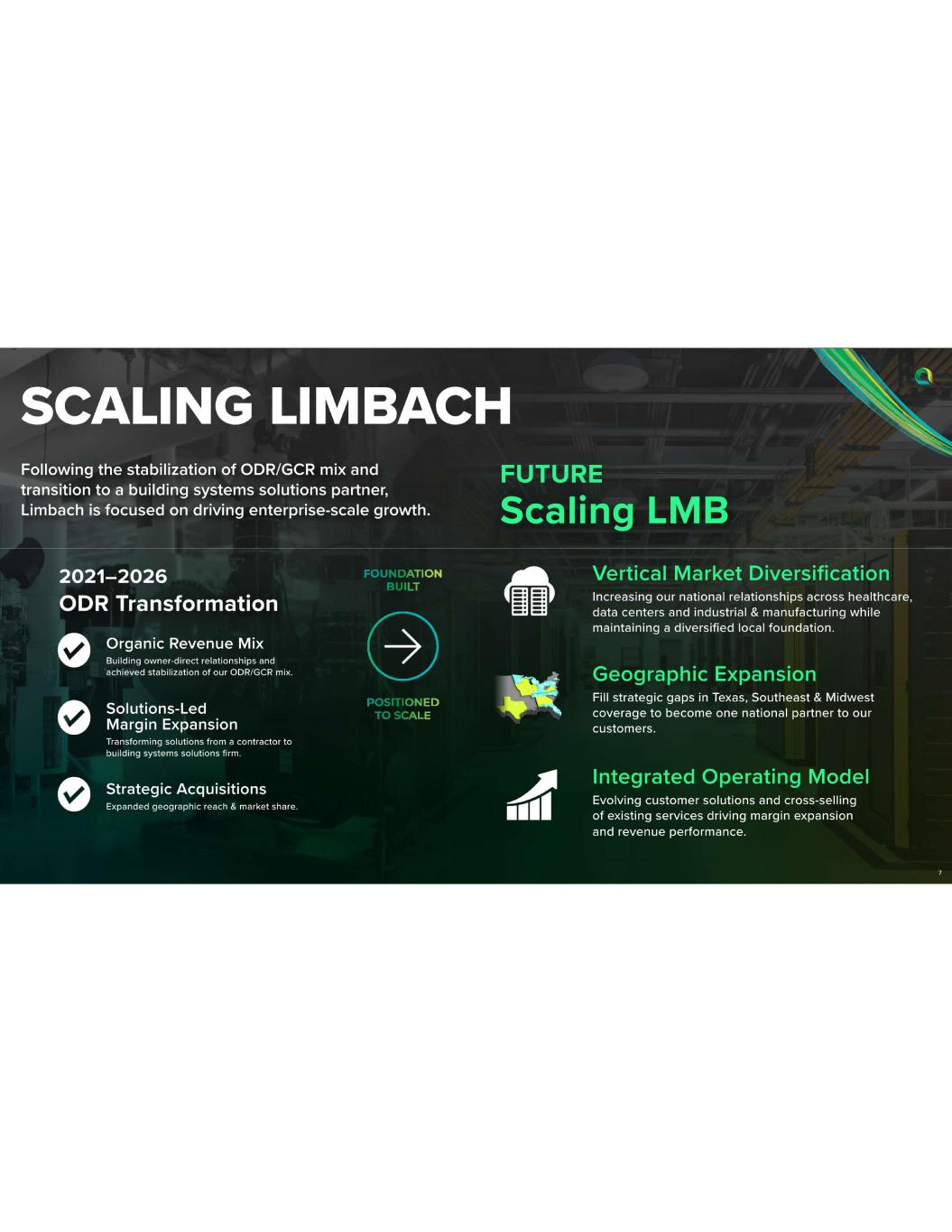
Good morning, and thank you for joining us. Yesterday, we reported our second quarter results, as well as the acquisition of SimCorp. Our results fell short of expectations driven by project timing and ongoing softness in health care and institutional markets from elevated price sensitivity and market conditions pressuring gross margins. However, underlying customer demands remained healthy. We generated $182 million of bookings during the quarter. Our third consecutive quarter of strong bookings bring the total bookings over the past three quarters to $616 million. While these marketing conditions have created near-term pressure, they also underscore the importance of building a more diversified, higher-quality business, and we are taking action. Our focus is diversifying our end markets, expanding our geographic reach, and leveraging our integrated platform in an effort to improve profitability. Moving on to strategy, for the past five years, we transformed Limbock. Today, that work allows us to shift from transformation to discipline growth. Our objective now is to build a larger company with strong cash generation and higher returns over time. First, we are accelerating our efforts for expansion of data centers and industrial manufacturing, building a national platform that mirrors the success we've achieved in our national healthcare platform. By diversifying our exposure across multiple attractive end markets, we believe we will reduce our reliance on any single vertical, better balance of business or market cycles, and create a more resilient platform for long-term growth.
Speaker 6
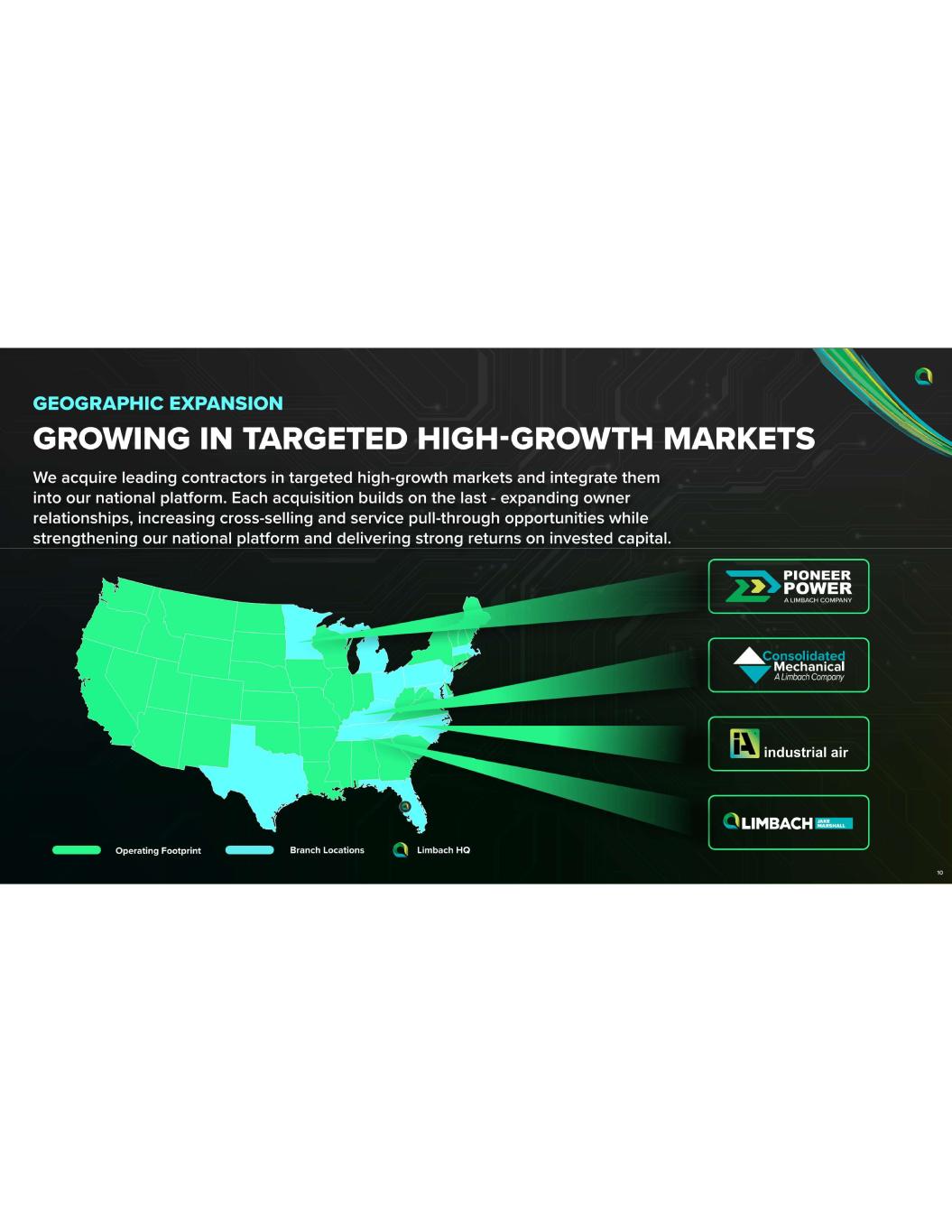
Second, we continue to pursue a disciplined acquisition strategy that expands our presence in targeted vertical markets while extending our reach into attractive, high-growth regions such as Texas, the Midwest, and the Southeast.
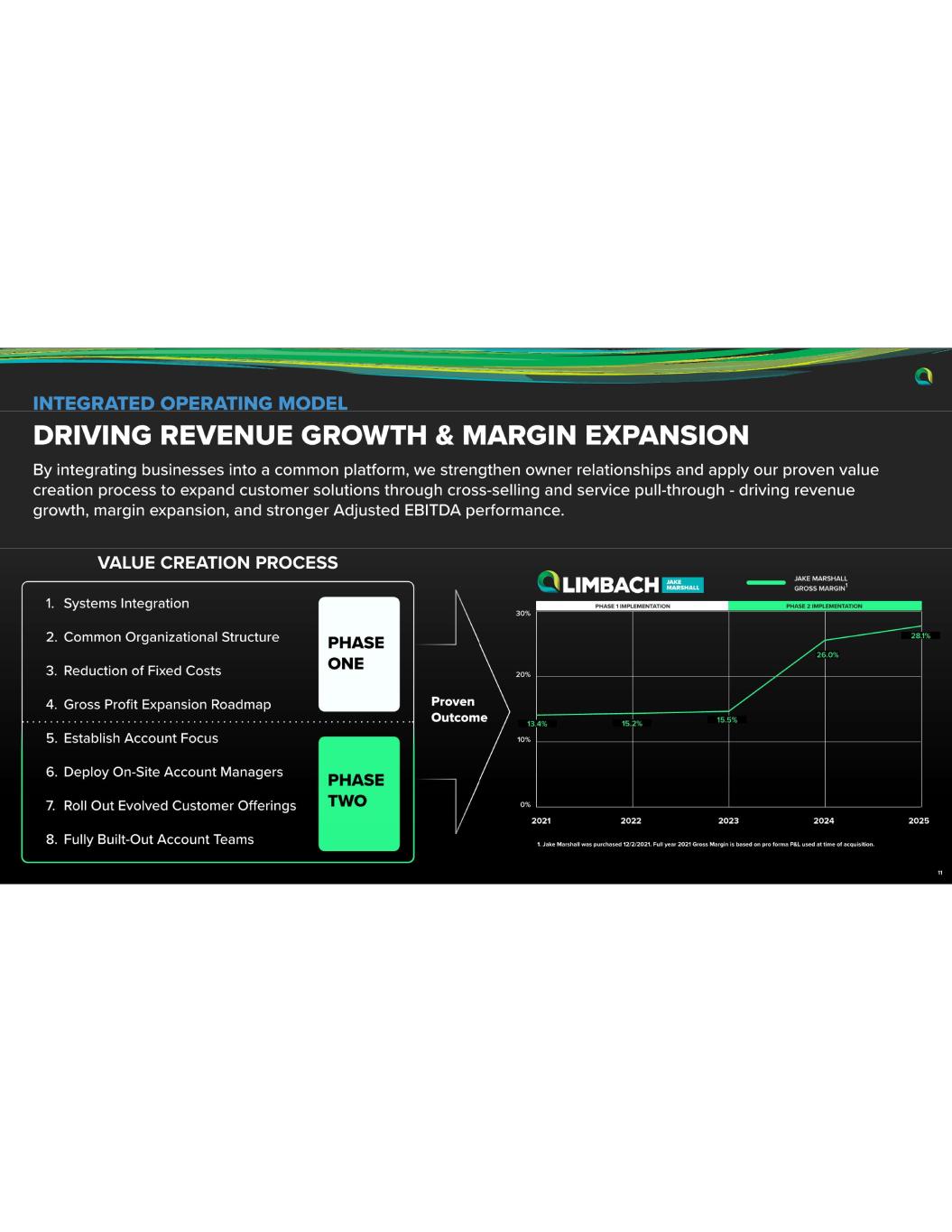
By broadening both our market and geographic exposure, we believe we're able to support customers across more locations, reducing concentration risk and strengthening our competitive position. Additionally, our acquisition philosophy is not built around buying fully optimized businesses. We're looking for companies with strong customer relationships and attractive strategic positions where we believe Limbock's integrated operating model can create additional value over time. We've already seen that approach produce positive results with Pioneer Power, where we've seen encouraging improvements at gross margin, approximately 1.5% from the first half of 2026 compared to when we acquired Pioneer Power in July of 2025. We believe each acquisition strengthens the economics of the entire platform because it expands customer relationships, increases cross-selling opportunities, broads our geographic reach, enhances the value of our integrated operating model. Third, we are leveraging our integrated operating model to connect capabilities across geographies and service lines, accelerating cross-selling opportunities, and improving profitability. We believe our work at Pioneer Power demonstrates how disciplined integration and operational improvements can create meaningful value over time, as we just noted. This integrated operating model also drives value creation from our acquisitions. For example, our target operational and pricing actions are underway in an effort to improve Pioneer Power's profitability and bring gross profit margins in lines to the company average over the next two to three years. We have a clear roadmap to improve results. By executing this plan, we expect to build a more resilient business with a broader set of growth drivers and less exposure to any single market and higher margins. Execution of these strategic initiatives expands our national footprint, expands its customer relationships, increases the scale advantages of our platform. It should strengthen our purchasing power, national account capabilities, operating leverage, and our ability to allocate capital efficiently. We believe these advantages will compound over time, creating a larger, higher-quality business with more durable earnings and a stronger long-term shareholder value.
Speaker 6
Importantly, our balance sheet and liquidity provides us with the flexibility to execute this strategy in a disciplined manner.
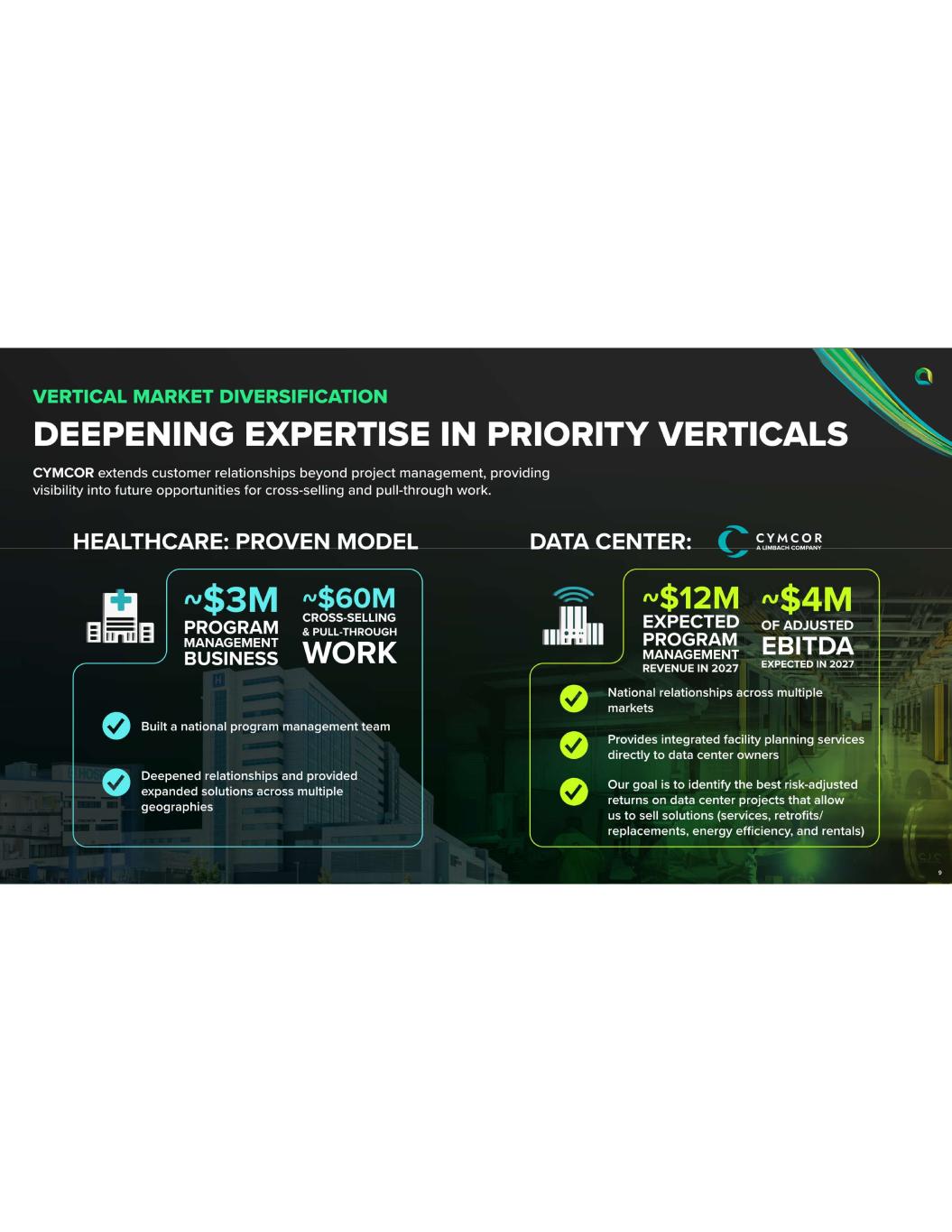
Yesterday's acquisition of SimCorp is an excellent example of our disciplined approach to capital allocation and drives three of our strategic initiatives I've been describing. This acquisition expands Limbock's geographic footprint, enhances its ability to serve national and multi-site data center customers, and increases engagement with building owners early in the facility lifecycle. Equally important, with our integrated operating model, it creates significant cross-selling and pull-through project booking opportunities by connecting complementary service offerings across both organizations, expanding access to new data center customers, and generating additional growth within Limbock's existing markets. Through its national program management services, SEMCOR currently oversees project budgets for customers that have a tune of value exceeding $8 billion. We believe this early engagement with customers will create meaningful opportunities for Limbock to provide engineering, construction, commissioning, maintenance, and other lifecycle services. We have confidence in the acquisition of SEMCOR as its business model closely mirrors Limbock's proven healthcare program management platform, which we expect will provide us the ability to drive value in the data center mission-critical market. Over the last 12 months, our healthcare program management platform generated approximately $3 million of professional service revenue and pulled through approximately $60 million of project bookings, resulting in 20 times pulled through multiple. Looking forward, we currently expect SimCorp to generate $12 million of program management revenue and $4 million of adjusted EBITDA in 2027. Moving on to our verticals. Health care. While at a macro level, health care spending remains pressured by budget constraints and delayed decision-making, we continue to strengthen our position by engaging earlier with national customers of facility planning and long-term travel programs. Those relationships continue to generate larger, more strategic opportunities over time. Industrial. The demand in our industrial markets remains strong and increasingly complements our data center strategy, as both are benefiting from sustained investment in power, manufacturing, and mission-critical infrastructure. Lastly, data centers. We continue to view data centers as an attractive long-term growth opportunity. We are steadily investing in the capabilities, customer relationships, and professional services platform necessary to establish Limbock as a trusted long-term partner. Before I turn the call over to Jamie, let me close by putting today's results into a broader context of where we're taking Limbock. Despite our near-term challenges, we remain confident in Limbock's long-term direction and our ability to generate shareholder value. We believe the actions we're taking from investing in our national platform to expand our capabilities for discipline acquisitions like Simplcore are building a stronger, more diverse device, higher-quality company with greater long-term earnings power.
Speaker 6
Our strategy is straightforward.
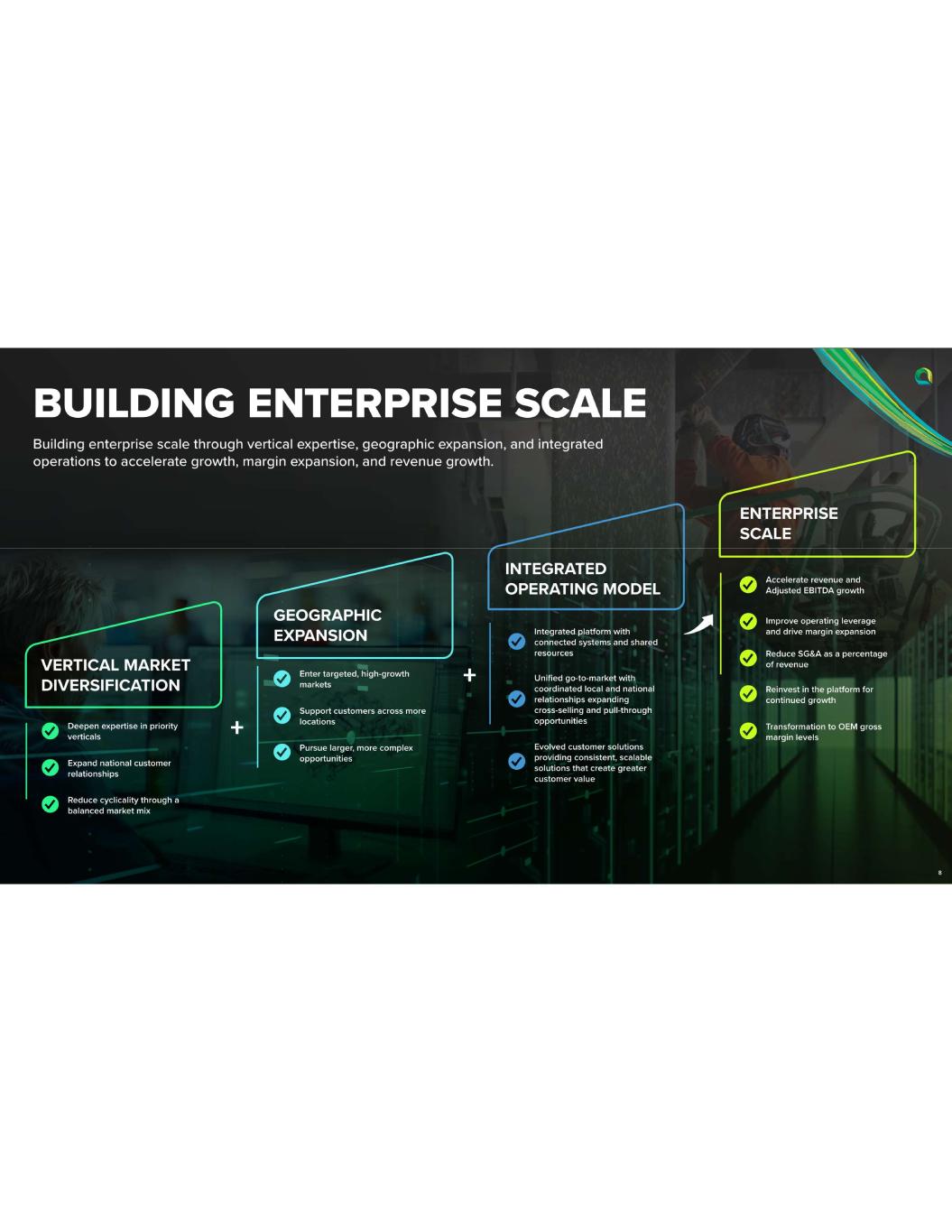
Broaden our geographic reach, deepen customer relationships, expand to attractive end markets, and leverage our integrated operating model to create a business that generates higher returns and compounds value over time. We've augusted our expectations to reflect the business environment as we see it today. We believe our responsibility is straightforward, exigent against the plan, continue allocating capital with discipline, and build a business that is stronger, more valuable. We understand that execution is one of our most important measures of success. We are focused on providing continued and better executions. With that, I'll turn the call over to Jamie to review our financial results and update the outlook.
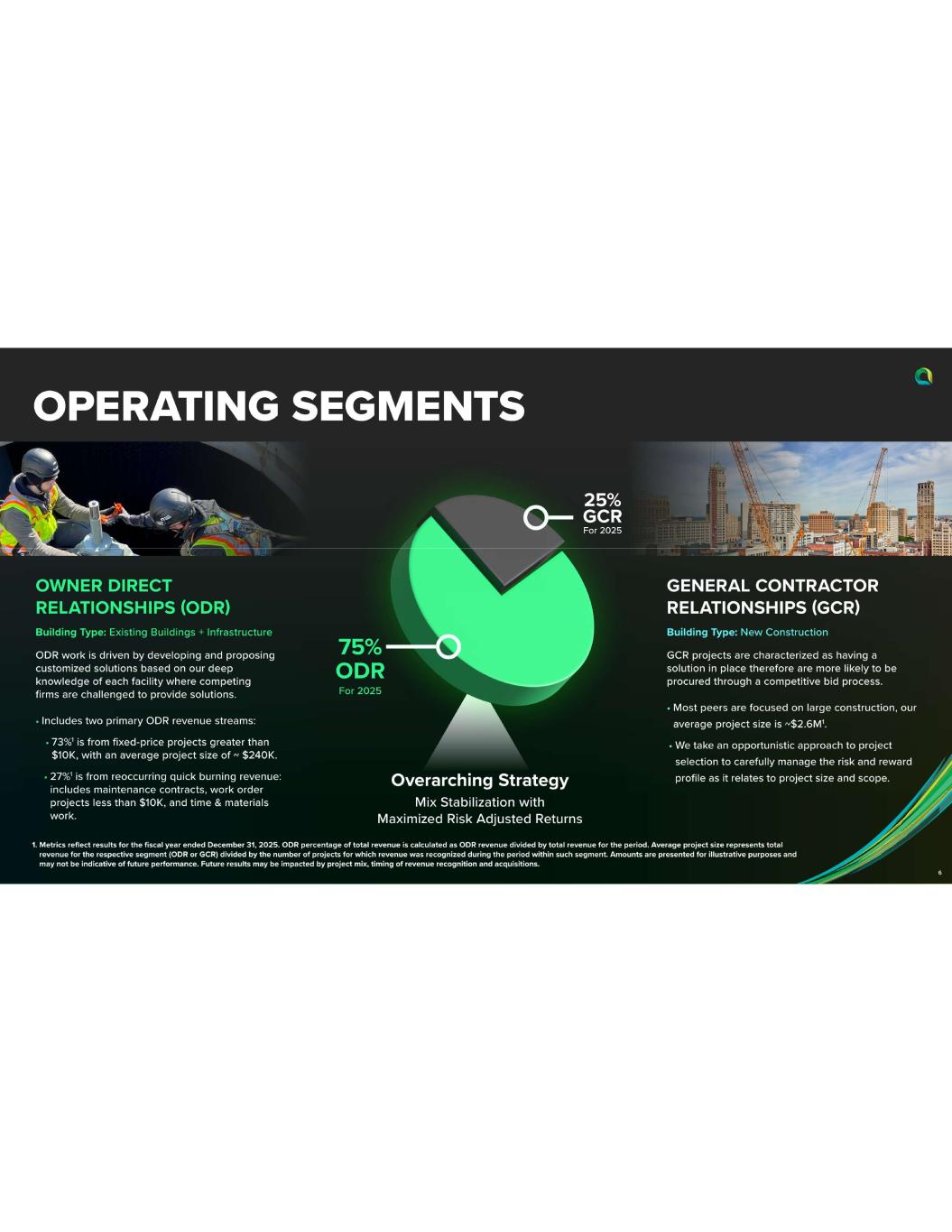
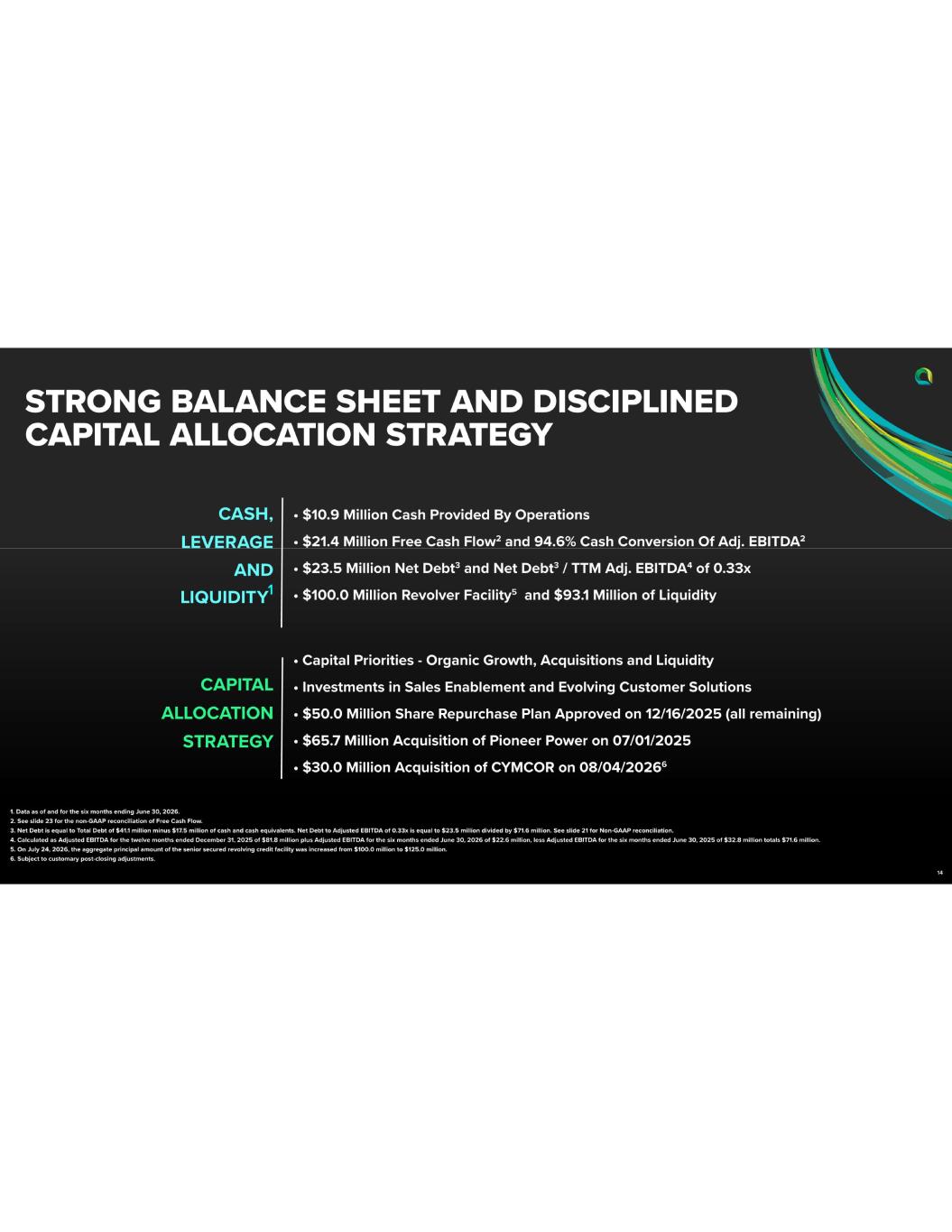
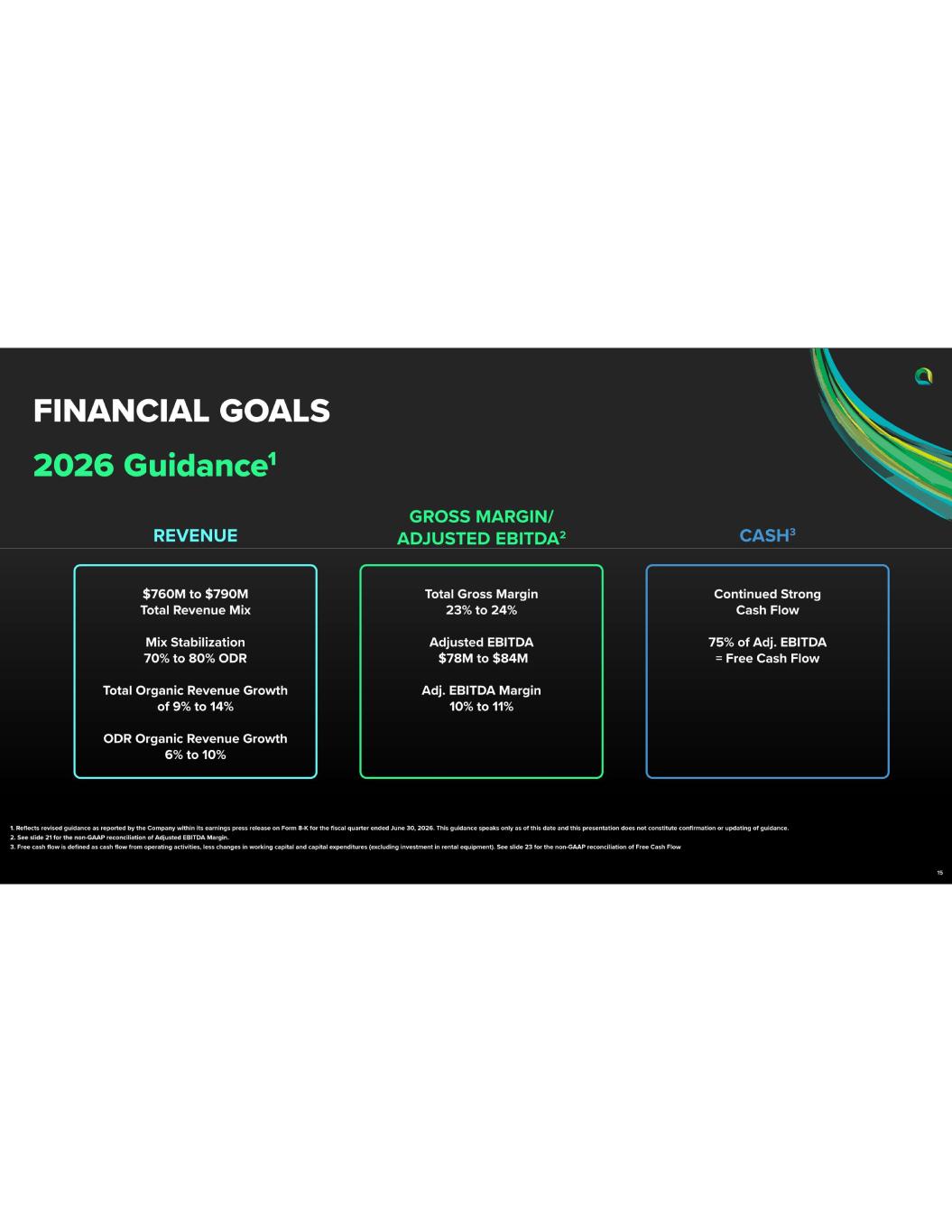
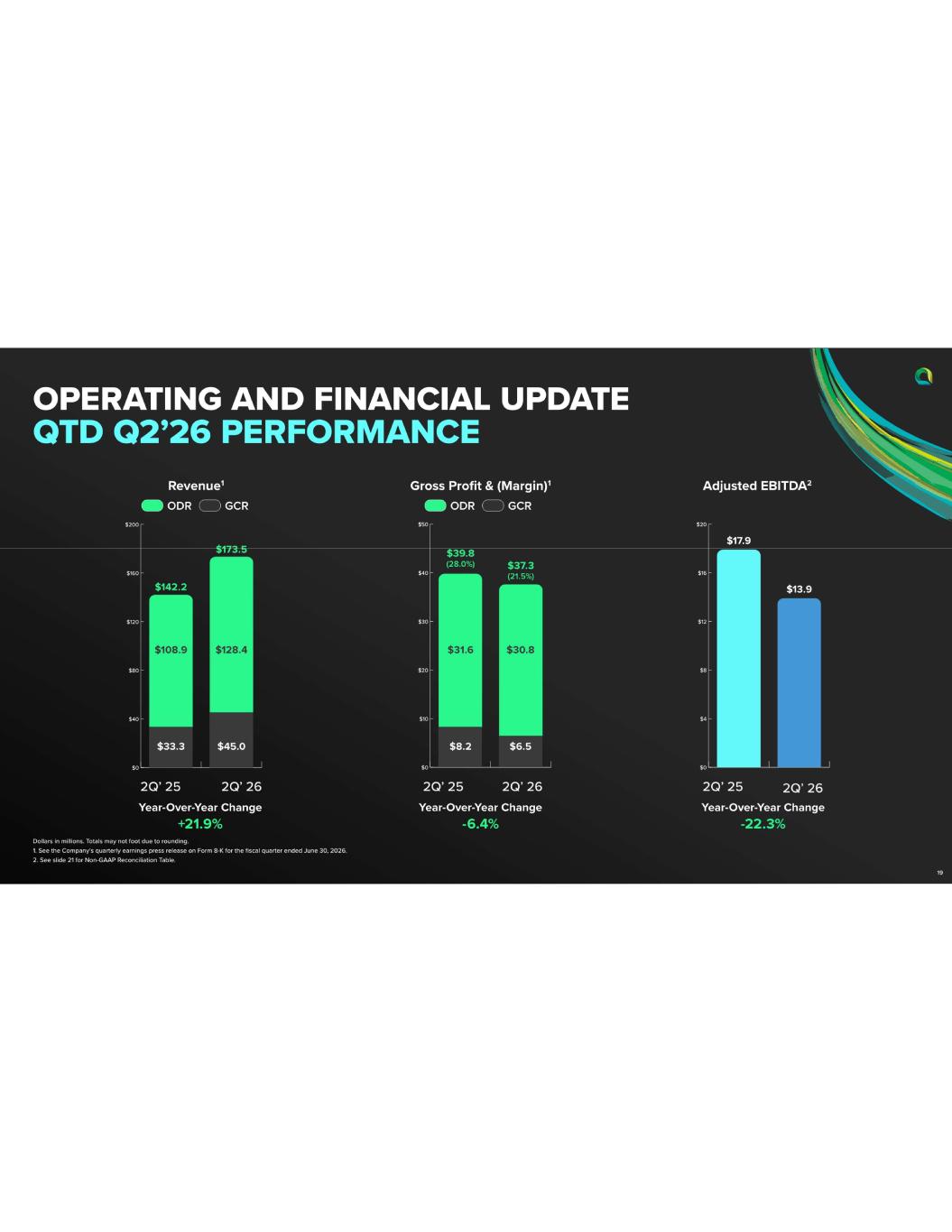
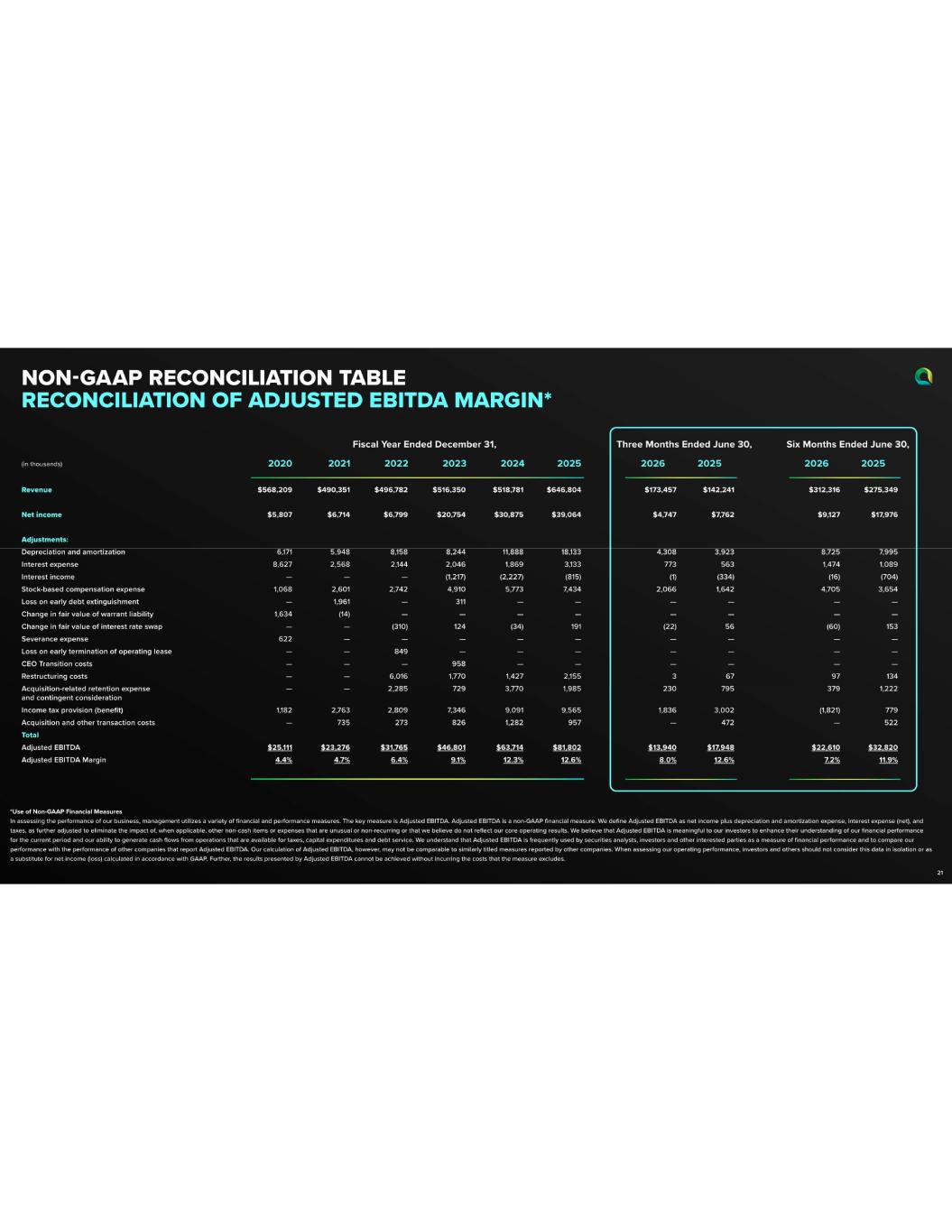
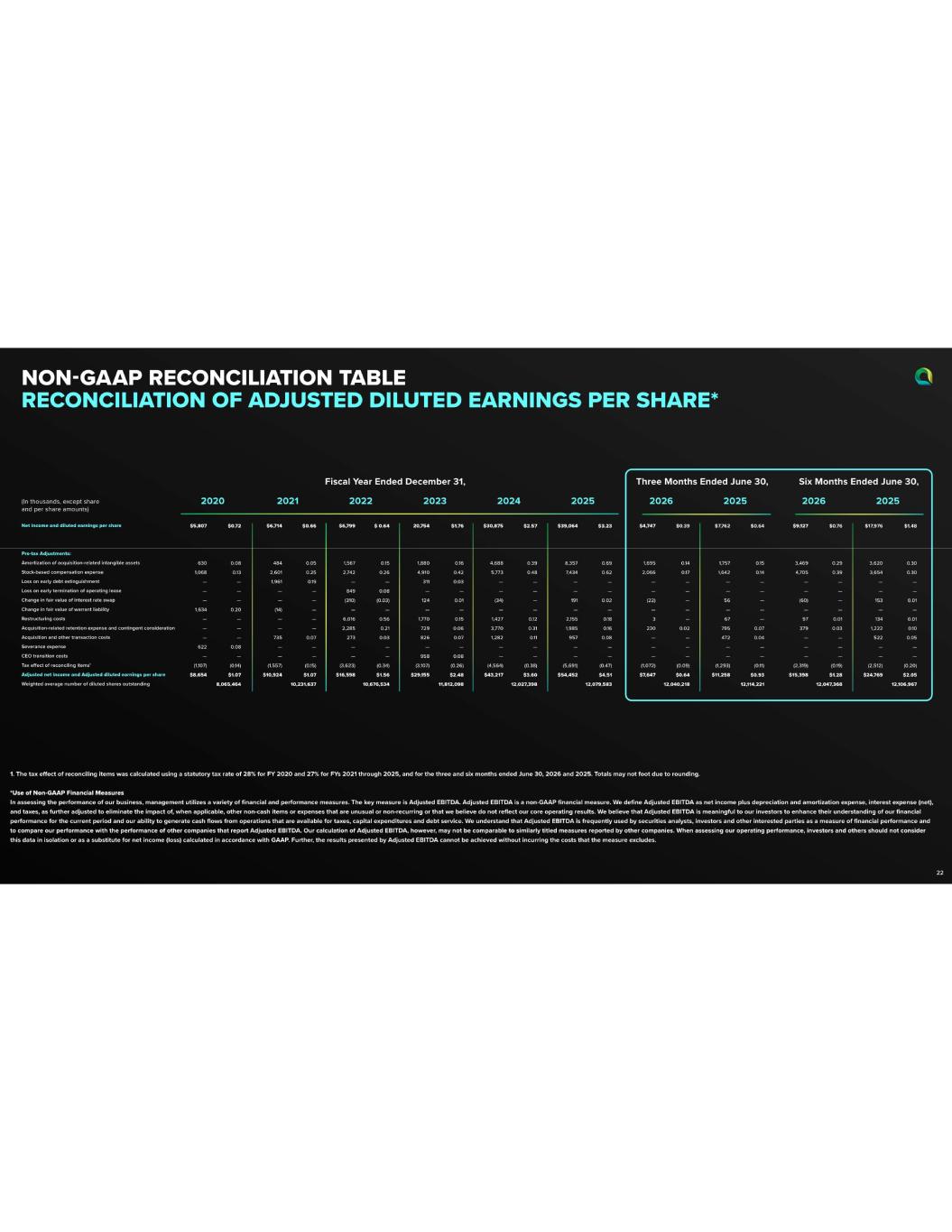
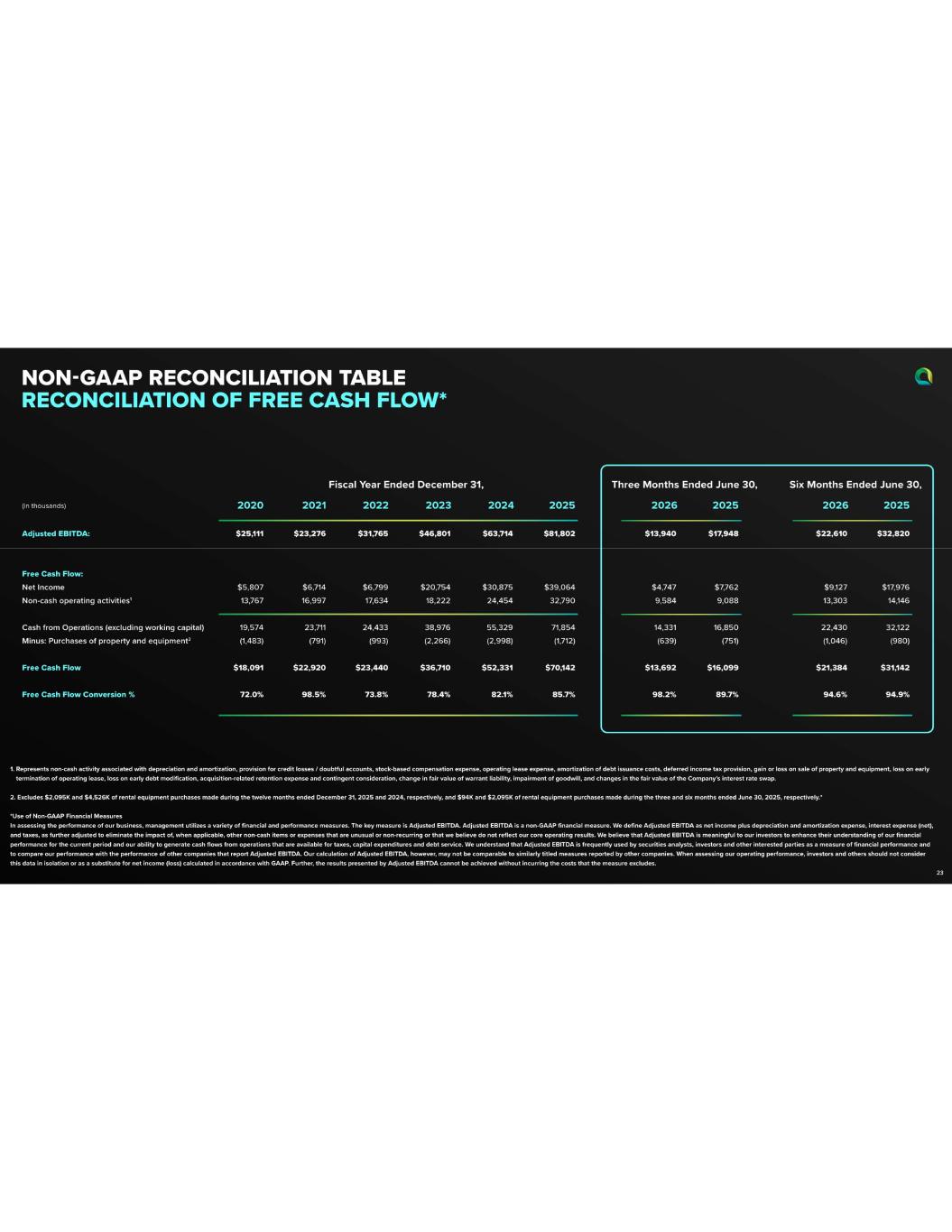
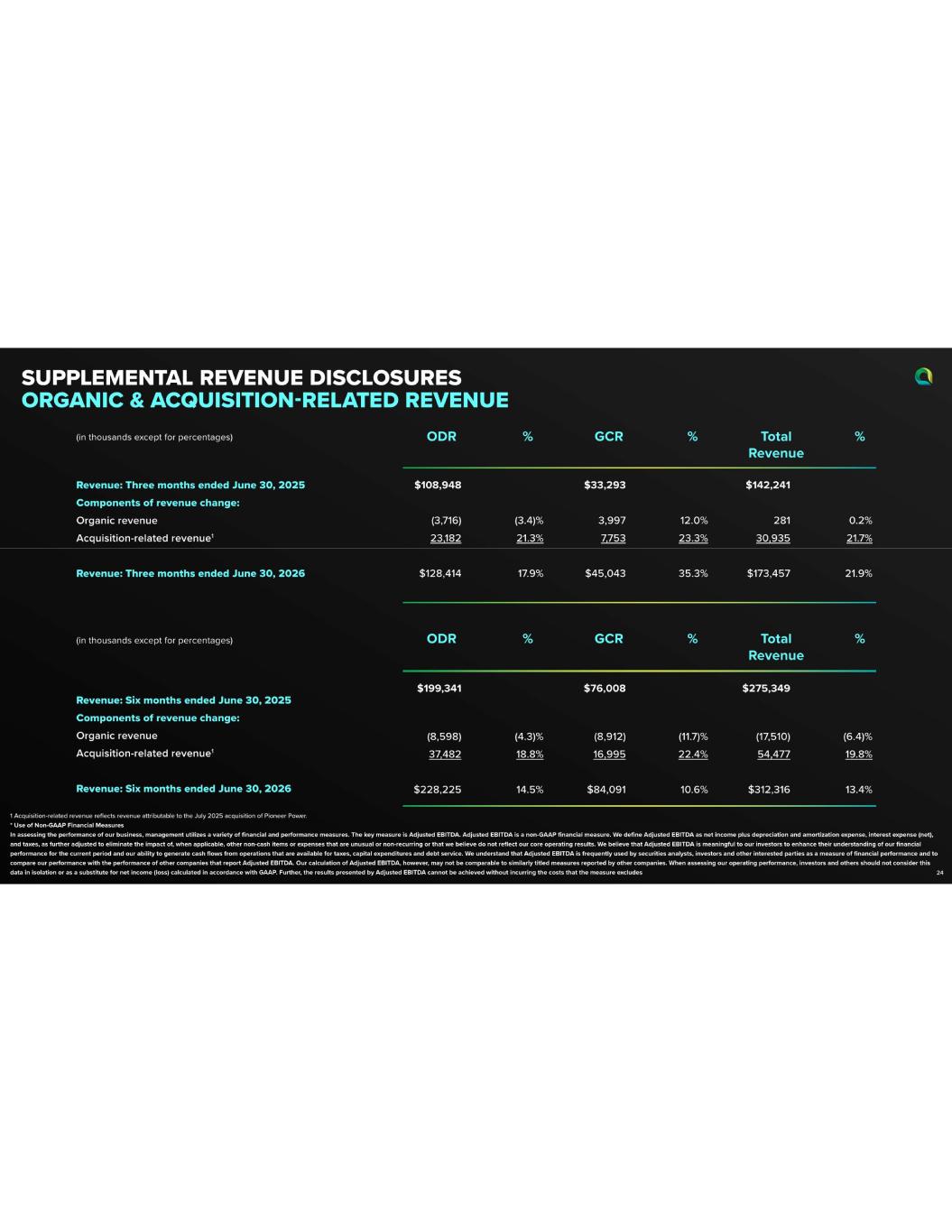
Thank you, Mike. Our Form 10-Q and Earnings Press release, filed yesterday, provides comprehensive details of our FINAMP results, so I will focus on the highlights of the second quarter of 2026 with all comparisons versus the second quarter of 2025, unless otherwise noted. We generated total revenue of $173.5 million compared to $142.2 million in Q2 2025. The increase was primarily due to the $30.9 million revenue contribution from Pinder Power. ODR revenue grew 17.9% to $128.4 million, with ODR acquisition-related revenue increasing 21.3%, partially offset by a 3.4% decrease in ODR organic revenue. ODR revenue accounted for 74% of total revenue during the quarter. GCR revenue increased 35.3% to $45 million, with acquisition-related revenue increasing 23.3% and organic revenue increasing 12%. Total gross profit decreased 6.4% from $39.8 million to $37.3 million. Total gross margin was 21.5%, down from 28% in the prior year quarter. ODR gross profit decreased Q.6%, or .8 million, and ODR gross margin was 24%, compared to 29% in the prior year period. GCR gross profit decreased 20.7%, or $1.7 million, and GCR gross margin was 14.5% from 24.7%. The decrease in both segment gross margin percentages was primarily driven by the current lower margin profile of Pioneer Power. Pioneer Tile continues to perform in line with the company's integration expectations, and management expects growth margins to improve as 2026 progresses. Operational and pricing improvement initiatives are underway to enhance profitability at Pioneer Power, with the goal of bringing growth margins in line with the company average over the next two to three years. The gross profit marginal is also negatively impacted by lower net project write-ups compared to the prior period in competition for skilled labor and materials associated with construction activity in the data center markets. SG&A expense for the second quarter was $28.1 million, an increase of approximately $1.5 million from $26.6 million. The increase was primarily driven by incremental SG&A expense associated with Pioneer Payroll and an aggregate $0.6 million increase in total stock-based compensation and payroll-related expenses. As a percentage of revenue, SG&A expense decreased 16.2% compared to 18.7% in the second quarter of 2025. Net income for the second quarter decreased 38.8% from $7.8 million to $4.7 million, and earnings per diluted share was $0.39 compared to $0.64. Adjusted net income decreased 32.1% to $7.6 million compared to $11.3 million, and adjusted diluting earnings per share decreased from $0.93 to $0.64. Adjusted EBITDA for the quarter decreased 22.3% to $13.9 million compared to $17.9 million. Adjusted EBITDA margin was 8% compared to 12.6% in Q2 last year, primarily driven by the lower gross profit and higher SG&A expense. According to cash flow, net operating cash inflow during the quarter was $18.7 million, representing our second-highest second-quarter operating cash flow since becoming a public company. This compares to $2 million in the year-ago period and was driven by net income of $4.7 million, $9.6 million of non-cash adjustments, and $4.4 million increase from working capital. Free cash flow defined as cash flow from operating activities, excluding changes in working capital minus capital expenditures, was $13.7 million in the second quarter compared to $16.1 million in Q2 last year, representing a $2.4 million decrease. This free cash flow conversion of adjusted EBITDA for the quarter was 98.2% versus 89.7% last year. Turning to our balance sheet, as of June 30th, we had $17.5 million in cash and cash equivalents and total debt of $41.1 million, which includes $17.5 million borrowed on a revolving credit facility. Total liquidity, defined as cash and availability on a revolving credit facility, was $93.1 million at the end of the second quarter, and on July 24, 2026, the company amended its credit agreement to increase the aggregate principal amount of available borrowings under its revolving credit facility from $100 million to $125 million. providing an additional $25 million in potential availability. As Mike mentioned, yesterday the company completed its acquisition of SINCOR for a purchase price of $30 million, subject to typical post-closing adjustments. The acquisition was funded through a combination of available cash and borrowing under our revolving credit facility. Since the acquisition occurred after the end of the second quarter, the balance sheet as of June 30, 2026, does not include the funding impact of SINCOR. Moving to our outlook, our revised outlook is based on our strong bookings, projects currently underway, and the visibility we have into the balance of the year, and we believe it has appropriately reflects the current operating environment and encourages us to execute successfully. Accordingly, we've increased our revenue outlook to reflect the timing of project commencements and execution during the remainder of 2026, while lowering our adjusted EBITDA range to reflect the near-term margin and execution headwinds Mike described earlier. This revised guidance excludes any contribution from the recently completed SINCOR acquisition or future acquisitions. For fiscal 2026, we now expect revenue of $760 million to $790 million and a listed EBITDA of $78 million to $84 million.
Operator
Our outlook is based on the following operating assumptions.
Total organic revenue growth of 9% to 14%. ODR revenue as a percentage of total revenue of 70% to 80%. ODR organic revenue growth of 6% to 10%. growth margin percentage of 23% to 24%, and SG&A expense as a percentage of total revenue of 15% to 16%. Importantly, our expectations for cash generation remain unchanged. We continue to expect to convert at least 75% of adjusted EBITDA into free cash flow through disciplined work and capital management for fiscal 2026 and expect CAPEX to have a run rate of approximately $5 million. dollars. This concludes our prepared remarks. I'll now ask the operator to begin Q&A.
Operator
Ladies and gentlemen, we will now begin the question and answer session. Should you have a question, please press the star followed by the one on your touchtone phone. If you wish to decline from the polling process, please press star followed by the two. If you are using the speakerphone, please lift the handset before pressing any keys. First question comes from Chris Moore with CJS Securities.
Please go ahead. hey good morning guys thanks for taking a couple so maybe we'll just start with the good morning uh with the odr organic revenue guide so um you've stated mike basically some softness in the health care market um is it is it project timing is it you know kind of can you get into it a little bit deeper in terms of the lower revenue growth that you're thinking about for 26, and, you know, does that carry over into 27, just trying to understand kind of how you're seeing the healthcare industrial side of things at this point?
Speaker 6
Yes. What kind of gets us confidence from a guidance perspective, not just from an ODR organic, but a total organic is our strong bookings that we've had over the last three quarters. So we've sold $660 million from Q4, Q1, and Q2. So that gives us some confidence. So for us, we continue to generate healthy bookings. I think each vertical market is a little bit different as far as a price sensitivity perspective as well, too. Institutional health care, these type of markets are challenged. We are still gaining market share and picking up bookings, but, again, the price sensitivity of that is definitely impacted as well, too. But as far as just from a guidance perspective, whether that's ODR or total revenue, the bookings is the biggest thing that gives us confidence, and we hope to continue the momentum from those bookings that leads us into kind of getting off to a strong start next year, too.
Speaker 6
I'll leave that one there.
The GCR margin had been pretty strong as you kind of more and more looked to avoid the lower margin third-party work. It was pretty low this quarter. I know there was project timing, the pioneer work. Is there something more strategic in temporarily doing the data center work, even if it's a third-party data center work, even if it's lower margin to help you, you know, kind of gain further expertise in that vertical that would seem to fit with the SimCorp acquisition?
Speaker 6
Yeah, there's a couple of things going on, I think specifically with the GCR margin. We hit a pretty low point at the end of Q2 from a backlog perspective, from a GCR perspective, and we've been rebuilding. Obviously, we're still pointed significantly towards owner direct concentration, But, you know, regardless, our model has some GCR that's a part of that. So it really comes down to at the end of 2025, we've finished up a lot of work. And then we've started to rebuild from a sales and backlog perspective. And that obviously affects the timing. And that's why ultimately it's a, you know, we're 14.5% in Q2 more than anything. So I would say that's really predominantly from a timing perspective. Now, I would tell you, I think diversity is really important to us. you know we're heavily weighted towards institutional industrial markets our ability to tap penetration with the data center market helps us in a number of different ways we're i would say we're under indexed from a data center perspective and once if we can increase that percentage i think that will help not only revenue growth but also help margins as well too and help us absorb fixed costs.
Got it. And maybe just my last one, kind of more big picture. Just how are you looking at 26? Is it, you know, kind of a 26 versus 27? Is 26 a full reset from an EBITDA perspective, a partial reset, no reset at all, just trying to, you know, kind of understand what's happening here, how that would translate into how everybody's been thinking about 27.
Speaker 6
Yeah, I definitely think, you know, from what we knew, we felt like we had to reset from a guidance perspective. Even though revenue is up, GP is down, and, again, that's part of its timing as well as price sensitivity. So, you know, from a 2027 perspective, you know, we're looking to make sure that our model is built upon and is resilient. And I think there's three core things that we're looking at. Vertical market diversity, which we touched upon a little bit from a data center perspective. Geographic expansion. We want to continue to acquire really good companies. And then really emphasize our operating model. How can we operate efficiently together through all of our locations? So we think it's a reset. We think, you know, going into next year that we're making adjustments that we need to really make sure that we have a super resilient model as we go into next year.
Got it. Appreciate it. I will leave it there.
Operator
Tomo Sano with J.P. Markins. Please go ahead.
Good morning, everyone. Thank you for taking my questions. Could you give us more color on healthcare institutions, the environment, especially on the gaining market share versus pricing sensitivity you talk about, Mike? So how should we look at that environment and strategic initiatives in the back half in 2027, please?
Speaker 6
Yeah, absolutely. So it's still a challenged environment for sure. You know, they're still impacted by things that happened from a policy perspective in 2025. You know, we're trying – I think they're trying to navigate what does the new normal look for them. It's our job to guide them to ultimately make the right decisions. So the other thing that they're also impacted is what happens is if there's data activity in the market, that causes overall construction inflation and makes the cost of what they have to do even more challenging as well, too. So for us, I actually think vertical market diversity for us will not only help Limbock, but also helps from a perspective of some of our other clients as well, too. So we're not looking at a dramatic change. I think over time, they'll be able to adapt, and then we want to be there with them to adapt as well, too. We've spent a lot of time from, you know, investing in on-site account managers, which those are spread against all of our vertical markets as well as our customers, but it's certainly we found that model most impactful from a healthcare perspective. You know, for us, it's a great long-term market. Sometimes, you know, it's not the market the data center is, but it's really important for us to balance as well, too. So we still really believe in it. So it's just helping our customers navigate kind of short-term and continue to stick with them as well, too.
Thank you, Mike. And on data center work beyond mix and gross opportunities, could you provide more color and details on gross margin profiles and key costs, overrun risks, and the contract structure mix, please?
Speaker 6
Yeah, absolutely. So as we talked about from a healthcare perspective, institutional customers are very cost-driven. Data center worries its time and schedule. So they'll pay off for somebody who's going to move really quickly. And in some sense, you know, that's our opportunity as I look at really in 2027. I think the acquisition of SimCorp is really important to kind of jumpstart us from a data center perspective. If we're able to provide the solutions, which is speed to market, there will be opportunities for us from a margin perspective as well, too. But that's why, again, I think SimCorp is really important to kind of use that as a jumping-off point. We've made some progress around the last several quarters. We've talked about various fabrication projects. But a lot of times those projects we'd be in a little bit later. Versus, you know, from a professional service perspective, we're way earlier in the process, and our ability to influence and use our customer solutions I think is going to be super impactful.
Thank you. And if I may squeeze the last one, Mike, and SimCorp acquisitions, could you talk about more opportunities for both growth as well as the margin profiles and then how you manage the execution risk with the pioneer integrations as well?
Speaker 6
Yeah, so SimCorp, you know, we've had some success with our healthcare program management platform. We started that organically about four or five years ago. It took a long time, but we've seen a lot of success. About $3 million professional services revenue has been pulling through about $60 million of project booking, so a big-time multiple from a pull-through perspective. And we've seen our ability to influence early. And we could have started that organically from a data center perspective, but we saw a great opportunity from a SimCorp perspective of not only getting a very solid business that doesn't have the execution risk that a contractor would, as well as the opportunity for pull-through in a very hot market. So those combination of those factors, we're not only excited about the earnings that we'll get off professional services revenue, but the potential for pull-through is definitely there as well too. I think the other question was Pioneer Power. They're performing as we expected. In the prepared remarks, I talked about their margin being 150 basis points improvements when we purchased them. So I've always pointed people to the Jake Marshall example that we have in our investor deck. It takes time, especially the first year or two. So it's on track, and we're looking for ways to improve and kind of following our model that we've done with the other acquisitions as well, too.
Thank you. I appreciate that, caller.
Operator
Thank you. Jerry Sweeney with Roth Capital. Please go ahead.
Good morning, Mike and Jamie. Thanks for taking my call. Just wanted to dig in a little bit more with SimCorp. Sure. I wanted to understand, you know, when they're brought into a project, how much visibility they have, and their ability to maybe, you know, to that equation, and how long would it take to sort of translate some of that professional services revenue tour into additional services?
Speaker 6
Absolutely. So they're in very early. Sometimes they're out there from a real estate perspective of just helping the customer plan super early. Data center customers go to SimCorp. A lot of it comes down to their ability to manage the budget for them, cost controls, understanding what the right long-term outcome. And a lot of times that is from doing multiple projects with the same customer as well too. So there's so many aspects of visibility we'll get from this. And the one thing we learned in the healthcare side, what is really important is the ability to understand where value can be driven through the process and how people purchase as well too. So we're still, you know, from a data center, we're not where we need to be from a healthcare perspective. And data center gives us insight of where we're able to add from a value trained process as well too. So for us, the way that we approach it is very, going to be very similar to healthcare. There's probably going to be some immediate opportunities. I think the fact that the data center is, you know, exploding right now from a demand perspective, we'll look at things like fabrication, procurement, opportunity to perform projects. After a building is completed, there's a lot of opportunity for service, matrons, and retrofit projects as well, too. You know, so it's up to us. The opportunity is there. It's just for us basically to capitalize on it, and that's ultimately going to drive kind of when the pull-through starts as well, too. But we're very excited about it, and we think it's the right thing to do as far as kind of being the linchpin to really kicking off our data center for local market.
Is SimCorp geographically concentrated in the Texas area, or do they have projects?
Speaker 6
So what's nice is they have presence in Dallas, Fort Worth, other parts of Texas, Atlanta, Charlotte, Virginia, Northern Virginia, Richmond area, which is nice because some of those areas are areas that we don't have presence in right now. So it allows us to get a look into a market, and that may eventually be an opportunity for us from an acquisition perspective for a contractor of the day. And, of course, they're dealing with contractors, not only general contractors, but mechanical electrical contractors. So that's one thing that's really attractive is they enter us into markets that we're not. And, of course, the markets they're in are very good markets. So it gives us a look, and we're definitely going to try to find synergies from that perspective as well, too. The biggest thing for us, I mean, we can pull through work by not being in the market. okay, we can do that from fabrication and specialty work, but it's going to give us an avenue to figure out what other geographic expansion we want to do and connect the dots, and that's going to be the ultimate pull-through opportunity.
That's fair. I get that. And then ODR, you know, there's some pressure on that front on spending as well as some costs. How do you recapture it? Is this a pricing game? And at some point do the healthcare companies just have to absorb these Yeah, so there's a couple things.
Speaker 6
I mean, I think they always have to absorb what's happening, and I know some of the stuff that happens is almost 12 months old, but, you know, those customers are very methodical at the end of the day. They're not going to make, you know, they're not going to completely change the way they purchase. It just takes time ultimately. For us, you know, the biggest thing for us is to help them look at things differently, and really, you know, I would say the last 12 months is very different for them as well too. You know, how they're going to bundle projects, how they're going to look at, you know, what across their portfolio, what assets or hospitals are making money and some are not. So it's really the long-term planning. The other thing that helps, obviously, is if, you know, we have fixed cost absorption by going into other vertical markets. We'll also help the cost as well from some of these customers as well too. So we're very dependent on the institutional. It causes some challenges as well too. So I don't think there's a secret button or a magic. It's something that's really going to change health care, but I think it's our ability to stick with them, find avenues, drive value. That's what's been successful for us for the long term, and I think that's going to drive opportunities for us. And we want to stick with these customers as well too. I think that's important, and we know in the long term it's going to work out.
I appreciate it. Thanks a lot.
Operator
Thank you. Rob Brown with Lake Street Capital. Please go ahead.
Hi, good morning. And, Claude, I just wanted to follow up a little bit on the margin question. You'll align some of the things you're doing, but how long does that take to kind of cycle through, and is this something that you can see improvement in 27, or what's the duration of the margin improvement?
Speaker 6
Yeah, thanks, Rob. So there's a couple things. Obviously, project timing, and that really comes back to us as, you know, the sales position, the lack of sales that we had in the middle of last year. So that will – if we perform the way we've performed in the past and we deliver, you know, we're looking forward to potential margin opportunities as we go into 27, just based on the book of business that we have now. I think the other opportunity is diversifying ourselves into vertical markets where there's greater spend in high-growth markets. And I think when I say vertical markets, I mean vertical markets from, you know, data center or other, you know, high-growth drivers, but also from a geographic expansion as well, too. Not every market is treated the same at this point. So the combination of those two factors, we're making adjustments in order to make sure that in 2027, you know, we're looking for increased opportunity.
Okay, thank you. And then on the SimCorp pull-through in the data center market, is that something that takes, you know, projects are moving quickly in that market, I understand, But how long does that take to kind of work through the system and just a sense of how SimCorp kind of works on the timing aspect?
Speaker 6
So we've, you know, we're working, you know, we are currently working with program managers that are not Limbock right now in the data center. So we have some experience. And ultimately I think what's going to happen is we want to make sure that we're understanding and learning their customers. And the nice thing about this is they're bringing new customers to the table as well too, which kind of is an additive to some of the customers that we've had. So it's going to take a little bit of time, but I think if we're doing our job correctly, that there's going to be an opportunity we're able just to fill a gap for them, our ability to influence early. So we don't have an exact timing per se, but I can tell you, you know, yesterday we've, you know, we obviously, we announced that we were doing the deal, but it's, we're going to immediately look for Poulter. We're not going to wait, per se. So, we're probably going to be talking to people, you know, in the next few days and trying to find some opportunities as well, too. So, we're opportunistic about it, but obviously it'll take a little bit of time.
All right. Thank you. I'll turn it over.
Operator
Brian Brassi with CFO. Please go ahead.
Yeah, thanks. Good morning. Appreciate you taking the question. Can you give us a sense for how fast SimCorp has been growing?
Speaker 6
So, they've been they've been pretty steady from an earnings perspective. And the biggest thing for us, and they've been working really in the data centers, I'd say the last four or five years, the challenge for them is responding to the demand. And a lot of that comes down to recruiting staff. So that's one thing they're excited with us is, you know, their ability to add immediately add staff. It's not something that, you know, as we talk to them through a diligence process, I mean, they'd love to add people right now. So that's been the biggest. And that's, of course, a challenge when you're a smaller company is you're so busy responding to your customers that, you know, the recruiting process takes time. So, that's been probably the bigger holdup to even seeing more growth. We like the fact that they were steady, but at the same time, we're going to be immediately looking for staff to add to their team to drive, you know, good quality, high gross margin revenue.
Understood. That's helpful. And then circling back to GCR gross margins for a minute. Obviously, it was a little bit of a disappointment, but were there one or two projects in particular that drove the lower gross margin, or was it more broad-based than that? Thanks.
Speaker 6
It really wasn't execution. It's project starting more than anything. So, I mean, we've had pretty steady execution through the first half of the year. It's more just project starting. As I touched upon before, our GCR backlog was only $99 million at the end of Q2, and we've built that back up to basically double at this point. And it's just projects starting ultimately more than anything. So, again, we're anticipating our opportunity within GCR margins. For us, it's really a timing perspective. We perform the way we've performed in the past. We think there's a lot of opportunity. I think for 2026, the challenge is going to be what happens if that opportunity shows up into 2027. And that's one of the reasons we kind of adjusted our expectations and our guidance to make sure that reflect that timing could be a little bit of a challenge. But definitely not an execution issue.
Speaker 6
And then I guess bigger picture with GCR now back to more of a growth mode, how are you thinking about the long-term mix between the two segments? yeah we updated our guidance to be 70 from 75 to 80 to 70 to 80 you know we always look at our model as more owner direct driven i think we're just you know we're trying to find the right mix balance and i think that's the biggest thing as we go forward and i think that affects obviously what verticals we're talking to so um we're just looking for that mixed stabilization and that's why we felt like going from you know 75 to 80 to 70 isn't a huge change but that's the right kind of mixed at this point.
Understood. Appreciate it.
Operator
A follow-up from Chris Moore with CJS Securities. Please go ahead.
Yeah, just one question on bookings. Three straight quarters of good bookings. I know that calendar Q3 last year was the challenge, and that's what created the soft Q126. You're only a month into Q3 so far. Or any thoughts in terms of July and when did things, you know, kind of go soft last year in Q3? Was it later in the quarter or just trying to get a sense of visibility for Q3 bookings?
Speaker 6
Yeah, I think Q3 last year was, you know, was a little bit different than what we've seen in the past. And that was really a culmination of ultimately policies hitting higher ed, health care, even from a manufacturing standpoint as well, too. So those factors kind of led into our customers kind of into this compression mode as they, you know, they really entered Q3. So that was kind of a unique period of time. You know, we've looked at the last three quarters of kind of getting to that steady pace, and that's what we're looking for kind of as we close out the year.
Appreciate it. I'll leave it there.
Operator
If you have no further questions, I will turn the call back over to Mike McCann for closing comments.
Speaker 6
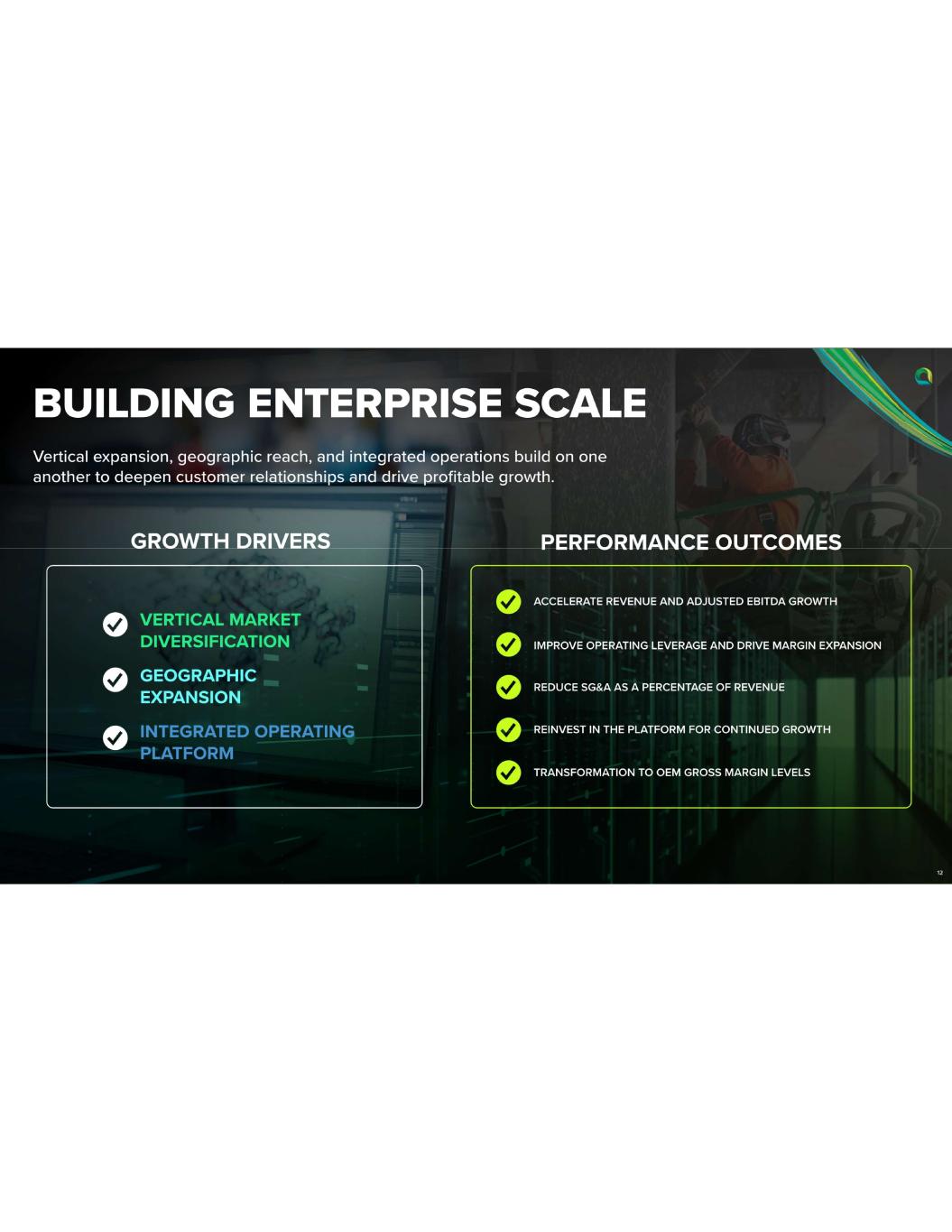
Our conviction in the long-term direction of Limbock has not changed. We've reset expectations to reflect where the business stands today, and our focus is on executing from here. We have a clear roadmap that will build an even more resilient business centered around vertical market diversification, geographic expansion, and an integrated operating model. These three strategic objectives will build enterprise scale that will accelerate growth, expand margins, and drive additional shareholder value. Thank you, everyone, for your interest in Limbock.
Operator
Ladies and gentlemen, this concludes your conference call for today. We thank you for participating, and we ask that you please disconnect your lines.