Operator
Greetings, everyone, and welcome to Lumen Technologies' fourth quarter and full year 2024 earnings call. During the presentation, all participants will be in a listen-only mode. Afterwards, we will conduct a question and answer session. At that time, if you have a question, please press star followed by one on your telephone keypad. If at any time during the conference you need to reach an operator, please press star zero. As a reminder, this call is being recorded today, Tuesday, February 4th, 2025. Your speakers for today are Kate Johnson, CEO, and Chris Stansbury, CFO. I would now like to turn the conference over to Jim Breen, Senior Vice President, Investor Relations. Please go ahead, sir.
Good afternoon, everyone, and thank you for joining Lumen Technologies' fourth quarter 2024 earnings call. On the call today are Kate Johnson, President and Chief Executive Officer, and Chris Stansbury, Executive Vice President, Chief Financial Officer. Before we begin, I need to call your attention to our safe harbor statement on slide one of our fourth quarter 2024 presentation, which notes that this conference call may include forward-looking statements subject to certain risks and uncertainties. All forward-looking statements should be considered in conjunction with the cautionary statements and the risk factors in our SEC files. We will be referring to certain non-GAAP financial measures reconciled to the most comparable GAAP measures which can be found on our earnings press release. In addition, certain metrics discussed today exclude costs for special items as detailed and our earnings materials, which can be found on our investor relations section of the Lumen website. With that, I'll turn the call over to Kate.
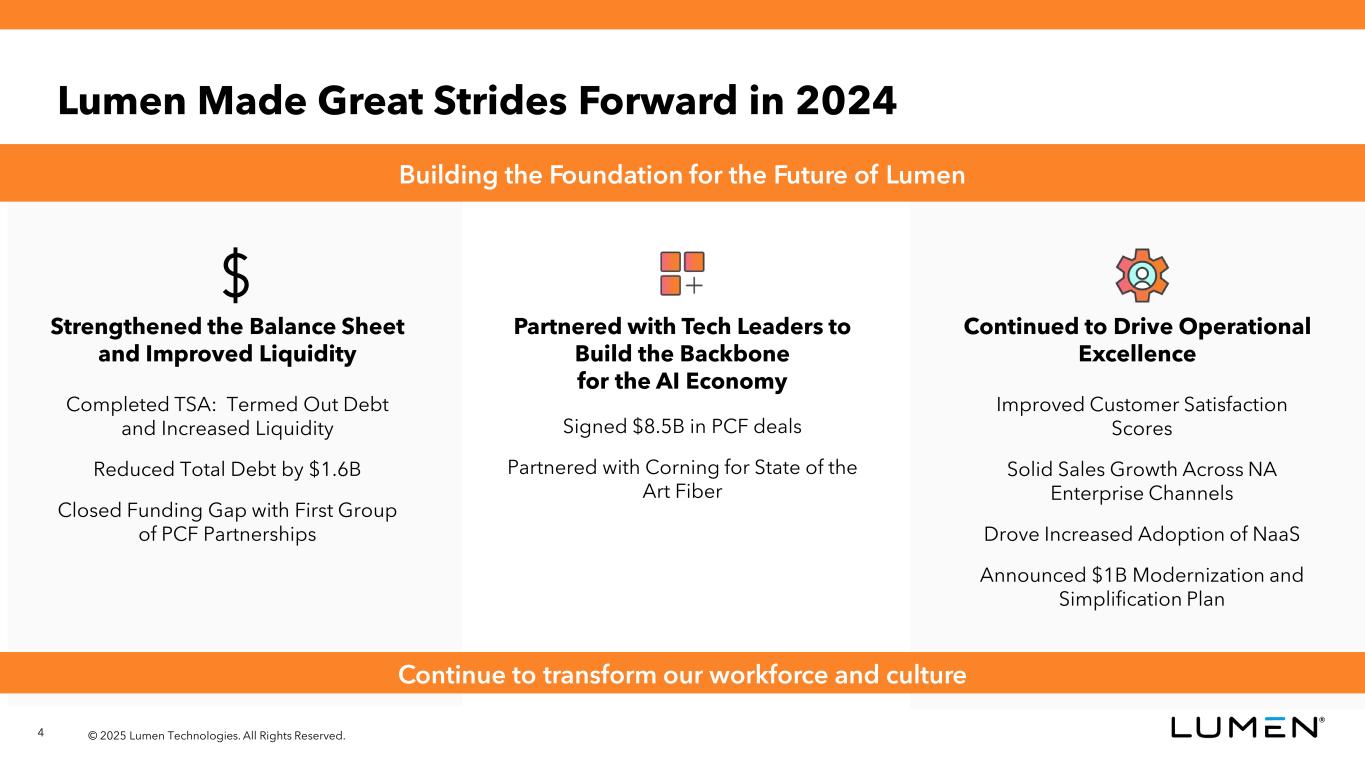
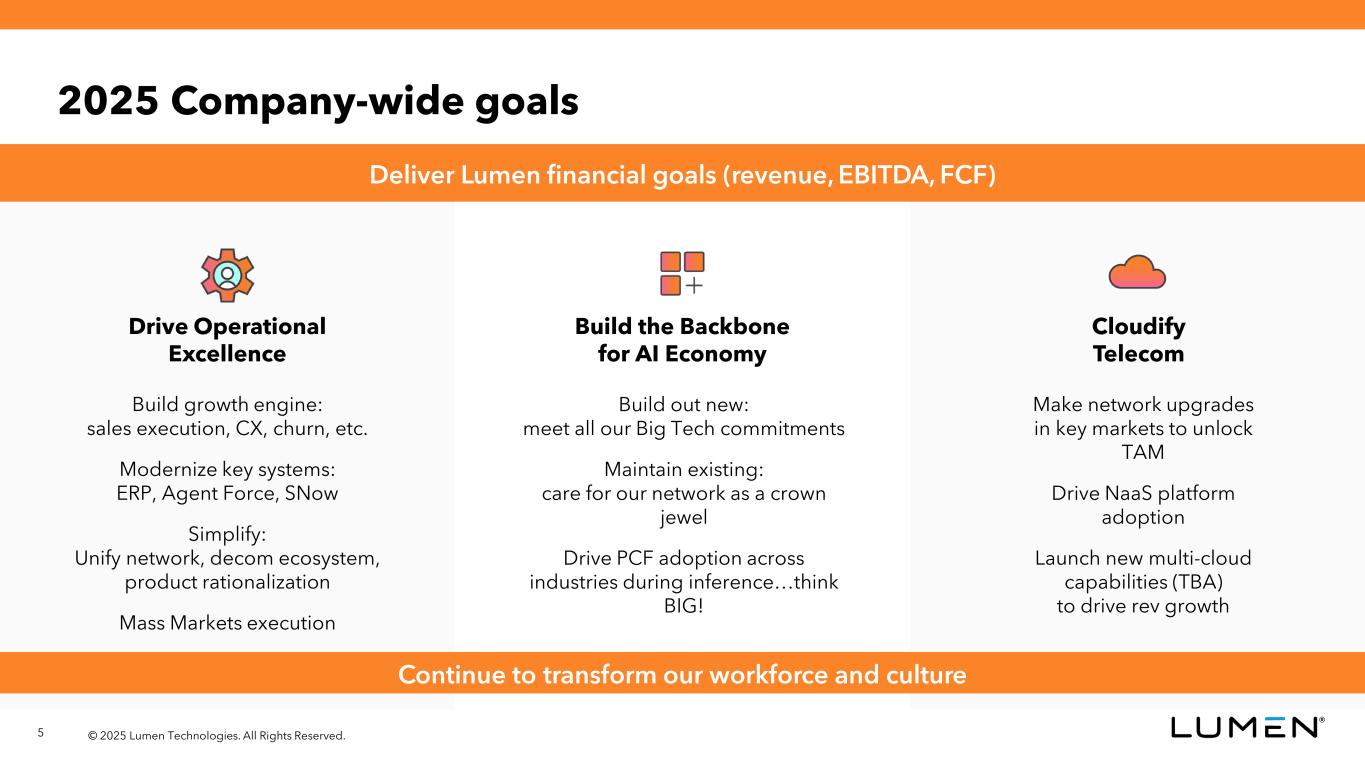
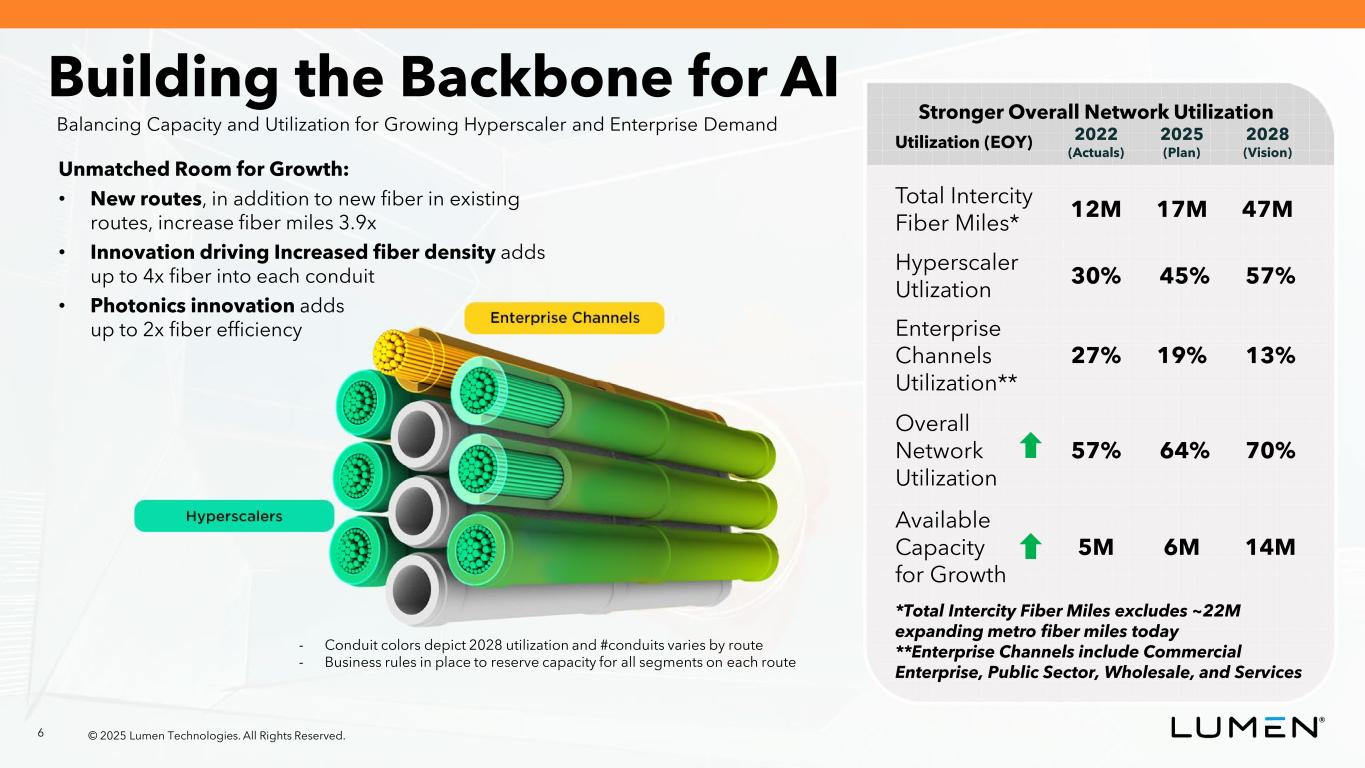
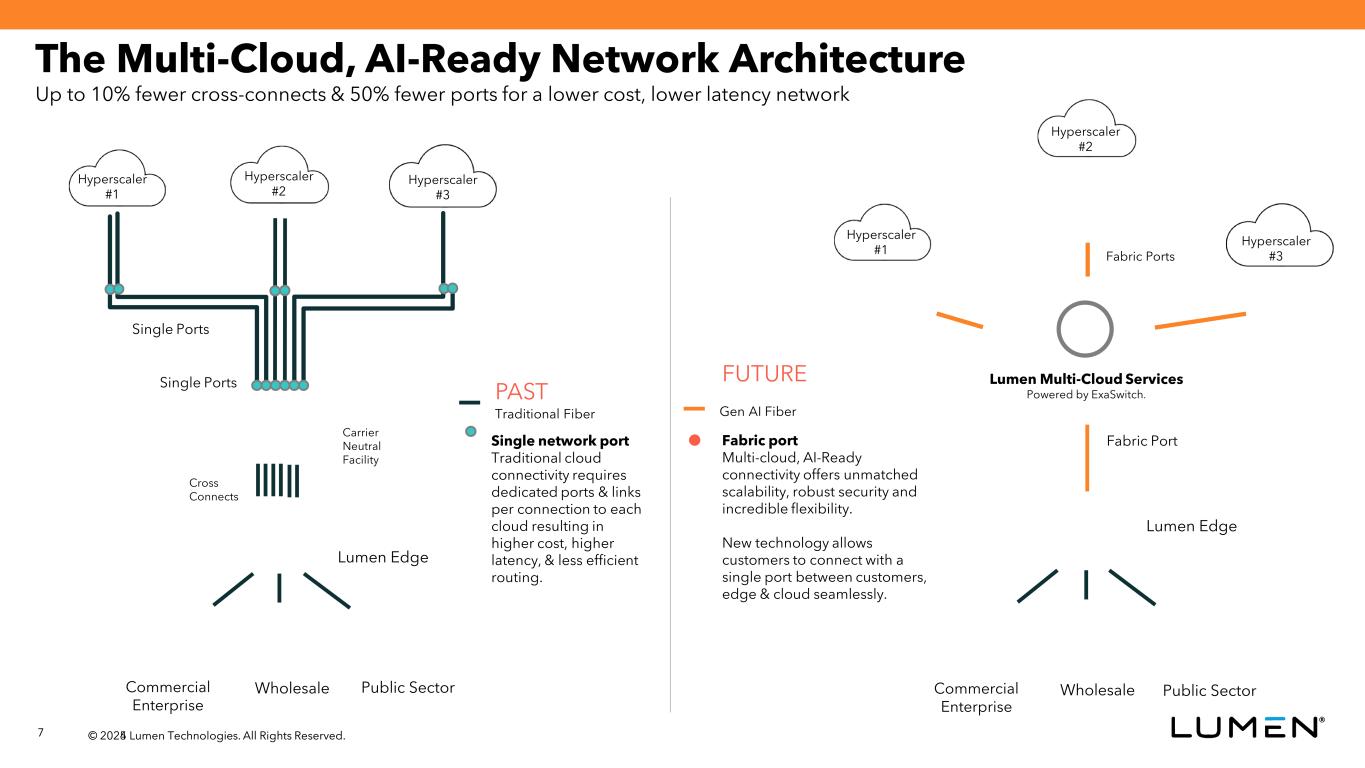
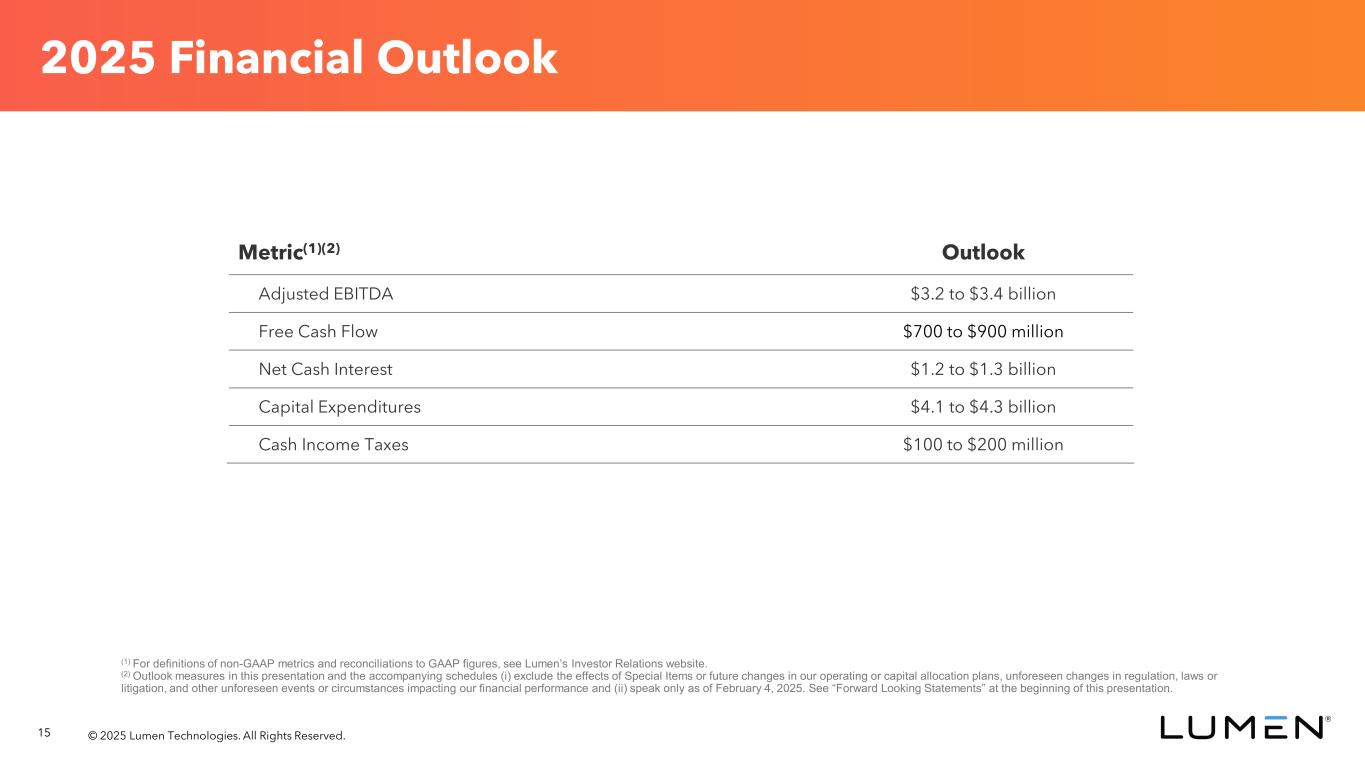
Thanks, Jim, and thanks to everybody for joining the call today. I'll focus my remarks with a quick look back on 2024, and then I'll set the vision for 2025 and beyond. In short, 2024 was a remarkable year for Lumen Technologies. We accomplished so much, way too much to share on this call, so I'll just focus on a few of the big things. We strengthened our financial position and restored market confidence in Lumen, and it started with the debt restructuring that gives us ample time to execute our transformation. We lowered our debt load by $1.6 billion in 2024 and recently sent redemption notices for another $200 million. And importantly, we drove material improvement in both our equity and debt trading values. Next, we established Lumen as the trusted network for AI, inking $8.5 billion in closed sales with big tech companies like Microsoft, AWS, Google, and Meta, among others. These deals helped us strengthen our free cash flow and enable us to self-fund our transformation. We continue to be in deep discussions with several customers to build new routes, and we're going to provide more detail on those deals as it makes sense to do so. Throughout 24, we also made material progress transforming our corporate functions, And some quick highlights include, in Service Operations and Assurance, we delivered materially better year-over-year customer SAT scores in all four enterprise segments, all four quarters in a row. And we built an engine to deliver large, complex, private network projects, on budget and on time, with the delivery of the state of California's digital inclusion program as the latest proof point. Our enterprise sales and customer success teams built a robust engine that delivered over 15% year-over-year sales growth in our North American enterprise channels, with more than 13% sales growth in IP and Waze, and drove more than 500 new customers to adopt the Lumen Digital NAS platform. Our marketing team built new storytelling muscle, standing side-by-side on stage with big tech and great companies like Intel Sat, VSP Vision Care, Churchill Downs, and the Pac-12, to evangelize the criticality of fiber networking and reposition Lumen as a trusted network for AI. our network engineering it and product teams delivered dozens of mission critical programs for us and one breakthrough program is the delivery of lumens unified network architecture enabling 85 of new ethernet and ip data service sales in major metro markets this is the long overdue integration of our four network architectures and has already started delivering benefits the unified network not only enables nas and other more advanced digital services but in some cases it reduces our average time to deliver by more than 12 days and reduces implementation costs by as much as 50 percent what's more our hr team successfully embedded our play to win culture in every aspect of the company we can feel it every day in the work that we do and of course we're proud of the external recognition we've received with more than 15 culture awards so far but most importantly we're excited to see major improvements in our employee engagement scores born out of this work because it really matters to our overall mission and finally our mass markets quantum fiber team delivered more than 500 000 enablements with greater than 90 percent year-over-year growth in fibernet ads while simultaneously reducing expenses year over year. In summary, our progress in 24 did a few things. It validated our mission, our vision, our strategy, our culture, and especially the strength of our team. And it showed that we have great execution muscle and set a strong foundation for accelerating our transformation work. Okay, let's shift gears and look at 2025. We have three clear priorities, driving operational excellence, building the backbone for ai and cloudifying telecom and each of these priorities has detailed plans to deliver more customer shareholder and employee value in 25 and beyond starting with lumen's financial goals our 2025 guidance for ebitda is between 3.2 and 3.4 billion and free cash flow is between 700 and 900 million but the big takeaway is this with a combination of improved revenue mix and cost takeout, we see Lumen returning to full-year EBITDA growth in 2026. I'm going to let Chris provide more detail on this shortly. Next, we continue to drive operational excellence in everything we do, ensuring continuous improvement in sales execution and churn mitigation, simplifying our core business processes, and leveraging modernized ERP, CRM, ops platforms, and artificial intelligence to deliver improved employee, customer, and partner experiences. We've already identified more than $1 billion of OPEX and a big chunk of network expense that we plan to eliminate by year-end 27 with this work, and we expect to exit 2025 with over $250 million of run rate cost benefit delivered. Okay, before I dig into our big two growth levers, I want to provide our view on the market given last week's events in the world of AI. Today, enterprise CIOs are faced with the expectation that they will continue to deliver warp speed innovation at an efficient cost, and they have to push lots of data to the right users at the right places at the right time for the right cost. And the architectural landscape has never been more complex, with apps and data sprinkled all over the place on-prem at the edge and in multiple clouds high speed low latency connectivity is table stakes but it's not the end game cios need digitally controlled higher bandwidth higher performing higher reliability and higher security networks to navigate this complexity and that's exactly what we're building at lumen a digital platform on top of a rapidly expanding fiber network to help cios design control configure and consume network services in a multi-cloud ai first world so when a new global player in ai announces a disruptive breakthrough we see that as a great thing competition increases velocity and decreases cost and basically accelerates the democratization of technology so in short the disruption we saw on the market last week will likely make AI more accessible to companies. And that just means that our total available market for network fabric just got a lot bigger. That's why we're confident in our two big bets. So let me crack into them. Starting with the first one, building the backbone for the AI economy. We've begun construction on the backlog of work generated from the eight and a half billion in PCF sales, and it's going really well. I want to share more on our thinking about how we leverage our network for maximum shareholder returns we are increasing two variables at the same time capacity and utilization you should be able to see a high level model on the chart in the webcast right now and i'll start with capacity on the left side of the page because we see a significant increase in demand for our network infrastructure infrastructure across both the hyperscaler and enterprise market segments, we're driving network expansion in several ways. We're building new routes funded by our customers, often multi-tenant, with great economics. We're partnering with Corning to use their latest fiber innovation, allowing us to get as much as four times more capacity from existing and new routes, and we're leveraging photonics innovation for up to two times greater fiber efficiency. If you add all that up, our total network capacity has the potential to go from 12 million total intercity fiber miles in 22 to 47 million miles by 28, giving us unmatched room for growth for network services. And I'm not even including our 22 million metro miles in that number. The second aspect of our plan to drive improved shareholder return is all about utilization of our assets. On the right side of the chart, you'll see that from 22 to 28, we simultaneously increase overall network capacity, as I just described, but we're also going to increase the overall utilization of our network from 57 to 70%. This is because the hyperscalers are leasing once-empty conduits, and they're funding new builds, while enterprises are upgrading their networks dramatically. In fact, we saw a nearly 50% increase in 100 and 400-gig wave sales across large enterprise and mid-markets in 2024 alone. We're closely monitoring customer demand signals, and we'll continue to make important capital investments in key major metros to capture this traffic growth. Additionally, we'll continue to examine our utilization and capacity planning business rules for maximum shareholder return, adjusting as market dynamics dictate. In summary, the growth lever of building the backbone for AI represents a huge accretive opportunity for this company we're not only driving the strongest utilization of our network assets in the history of the company we have unmatched capacity for growth at exactly the right time moving on to our second growth vector disrupting the market by cloudifying telecom simply put we're building a digital layer on top of our physical network to help us deliver friction-free, high-performing digital network experiences. So long dumb pipes, hello intelligent digital network fabric that enables CIOs to be successful in a multi-cloud AI-first world. As I shared earlier, enterprise CIOs need to move workloads between locations on-prem, at the edge, and multi-cloud, and it needs to be cost-efficient and friction-free. But it's not, and it's not for two reasons. First, legacy networks were not built for a multi-cloud world, so enterprises were forced to use carrier neutral facilities to access the cloud connectivity market, driving growth in costly and inefficient cross-connects. Second, most traditional telecom companies aren't building a platform for digital, dynamic frictionless customer experiences now lumina's fixing all of that using ourselves as customer one i'll share a specific example with a supporting graphic on the webcast that you should see right now to enable our quantum fibers quote to cash process for example we utilize multiple cloud and fast providers order processing workloads are hosted on one public cloud leveraging its native capabilities for seamless flow through provisioning but once it's processed that data required for business operations and financial reporting is then transferred to our corporate data warehouse which is hosted in a completely different public cloud using our own lumen network fabric which is now directly connected to three big public clouds in a virtual networking ecosystem. Our quantum fiber quote-to-cache network architecture bypasses carrier-neutral facilities and eliminates physical cross-connects and their fees, as well as reduces overall port usage. The outcome is a modern multi-cloud network architecture at lower cost than traditional architectures with improved network speed, security, and reliability. We plan to bring this lower-cost, higher-performing architecture to our customers in late 2025. And look, the point is this. How we cloudify ourselves to operate efficiently in a multi-cloud hybrid architecture world is informing how we innovate and commercialize our product and services portfolio for our customers. We're creating an innovative networking ecosystem that will bring new value to enterprise CIOs in today's multi-cloud AI first world. And this will give Lumen access to a net new total available market that we estimate to be at least $15 billion. We have the right assets, the right vision, the right team at exactly the right time. And that's why we're bullish on our pivot to growth. And with that, I'll turn it over to Chris.
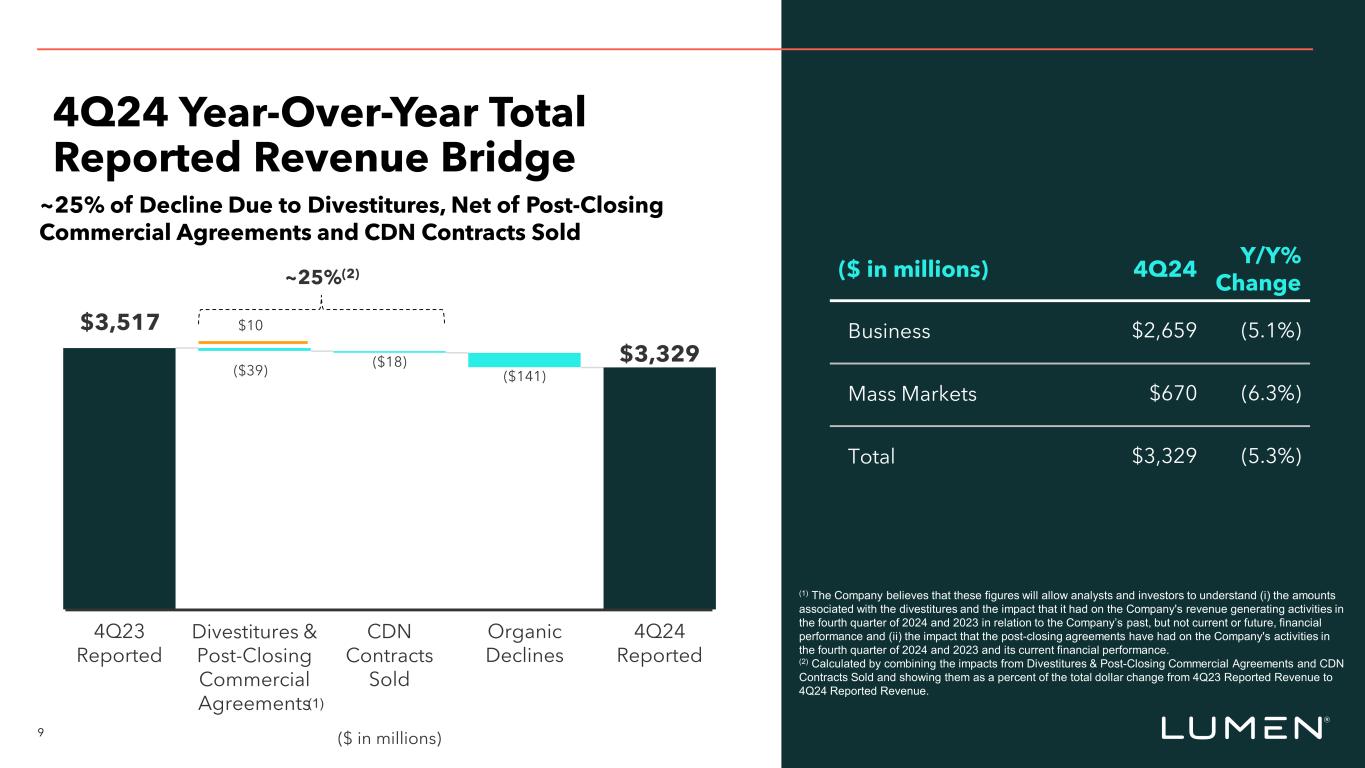
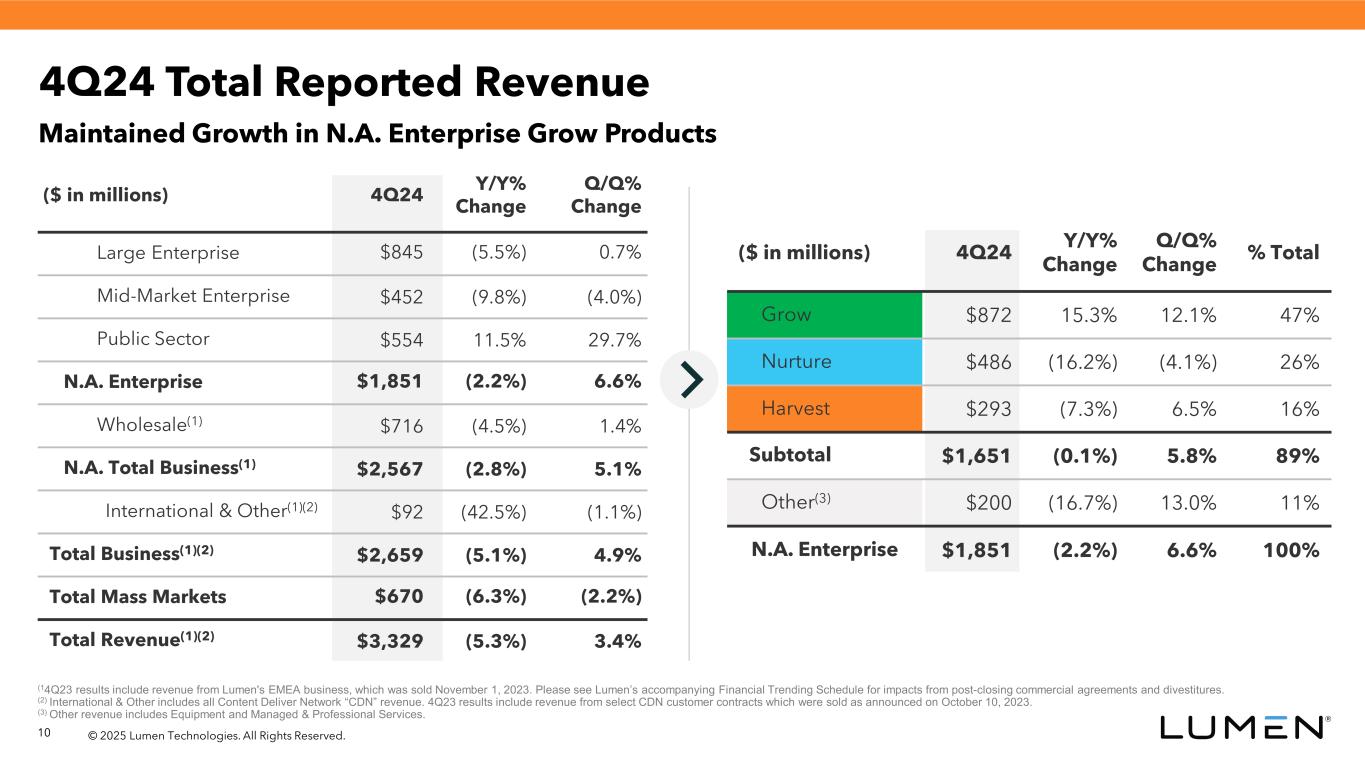
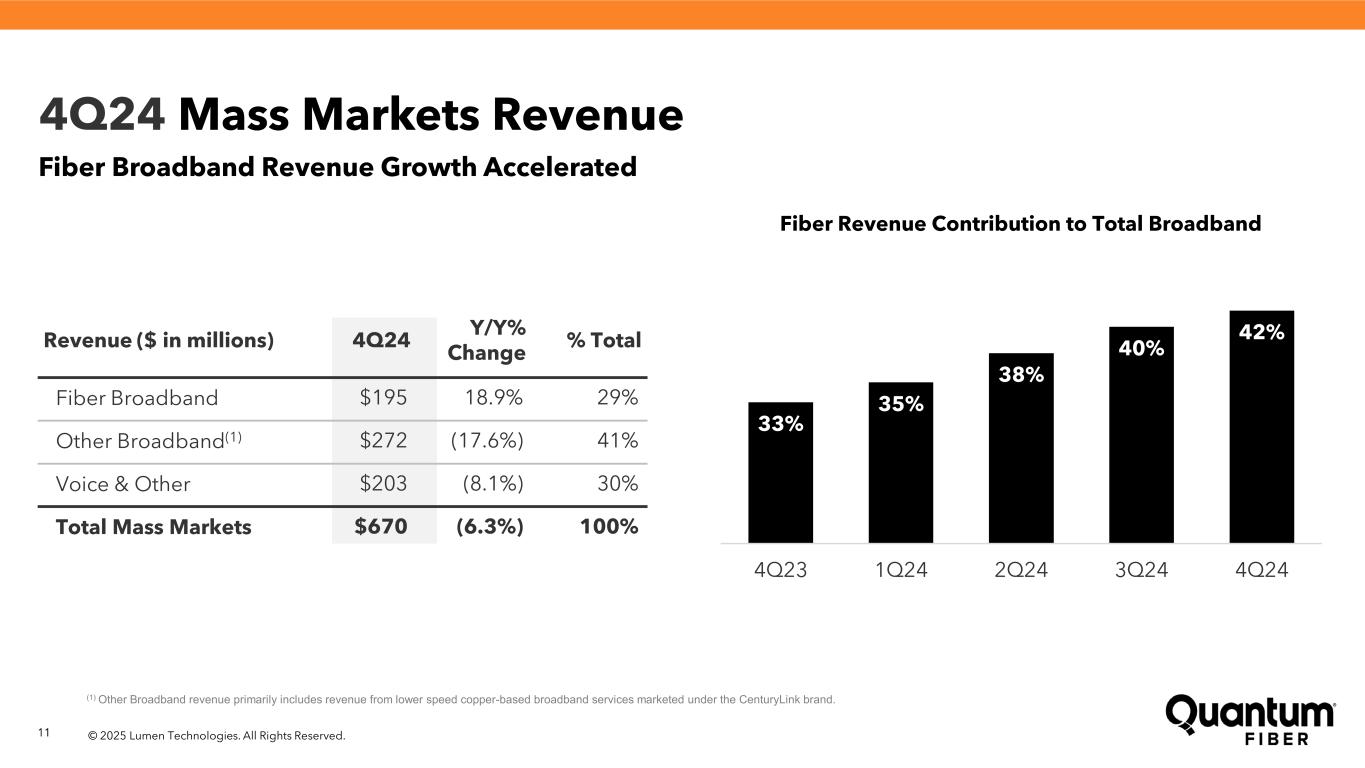
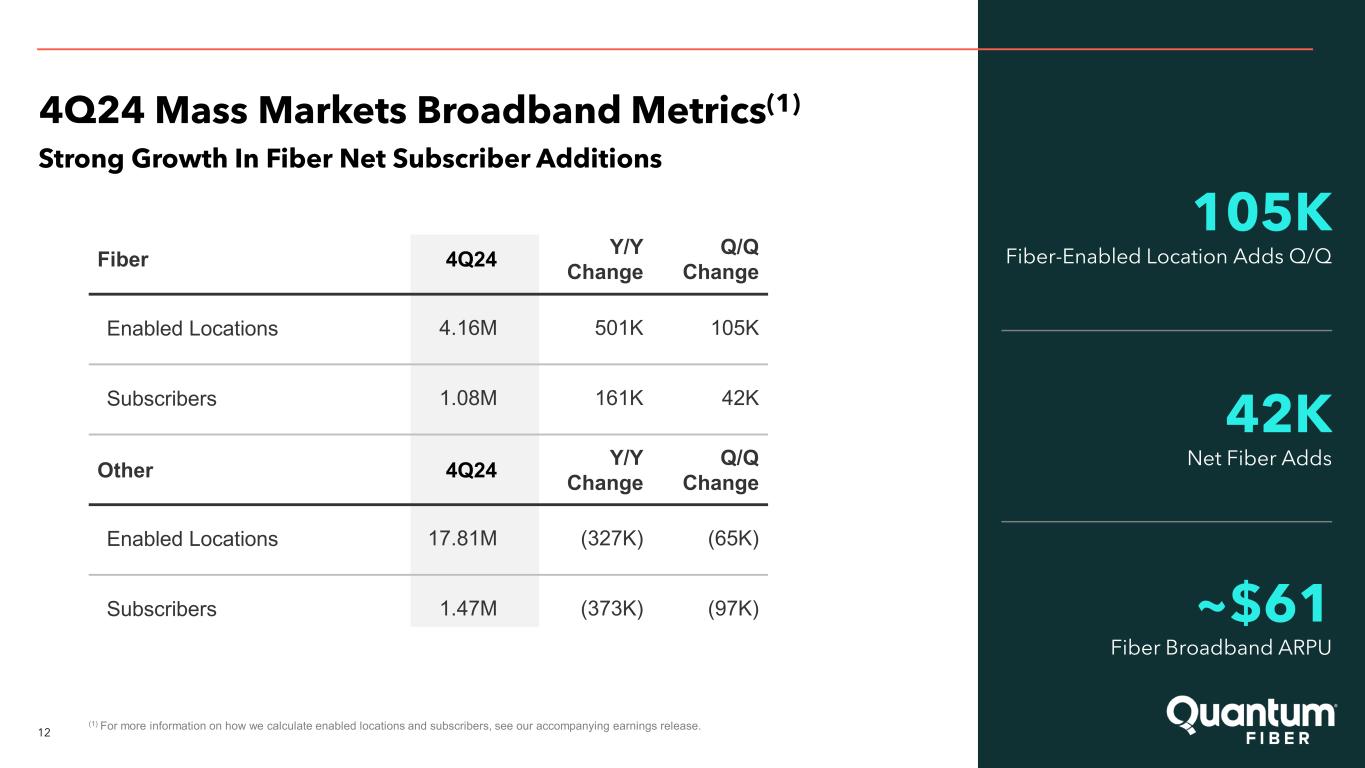
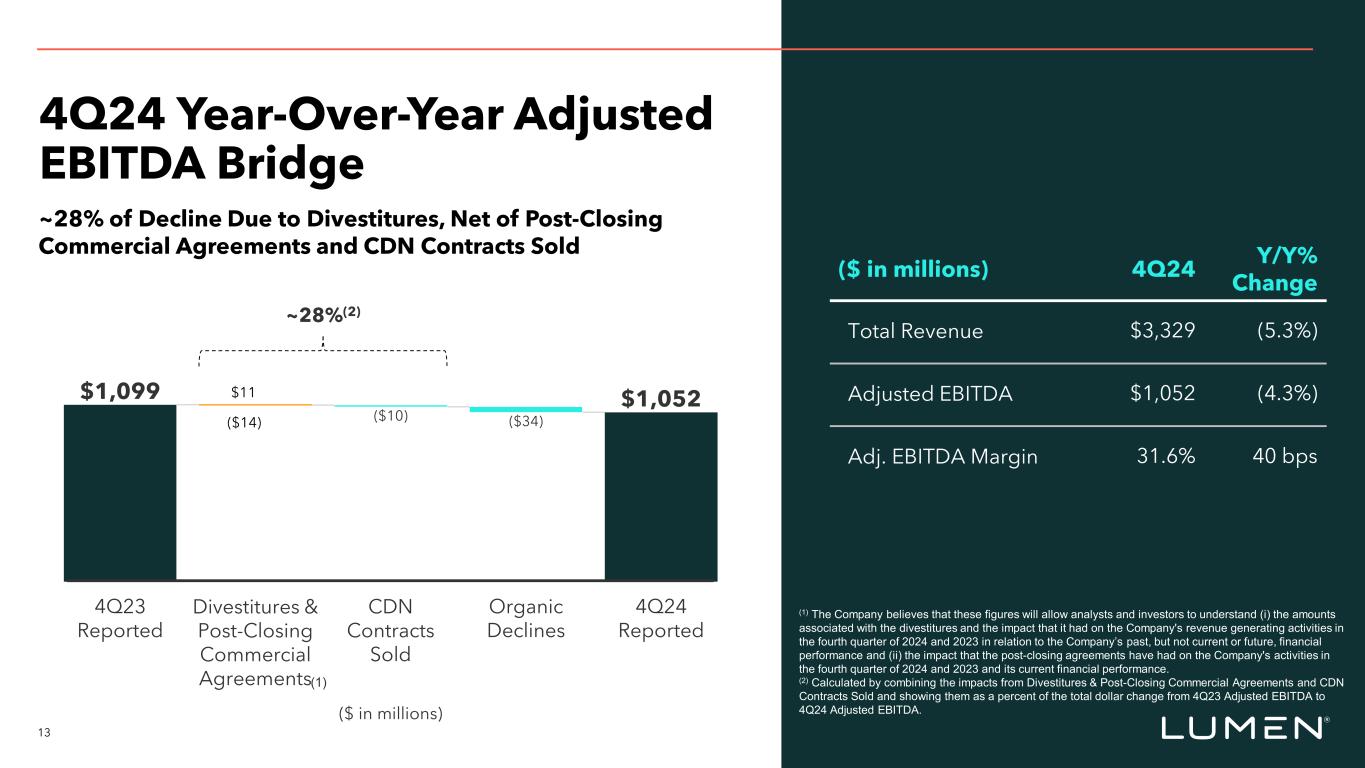
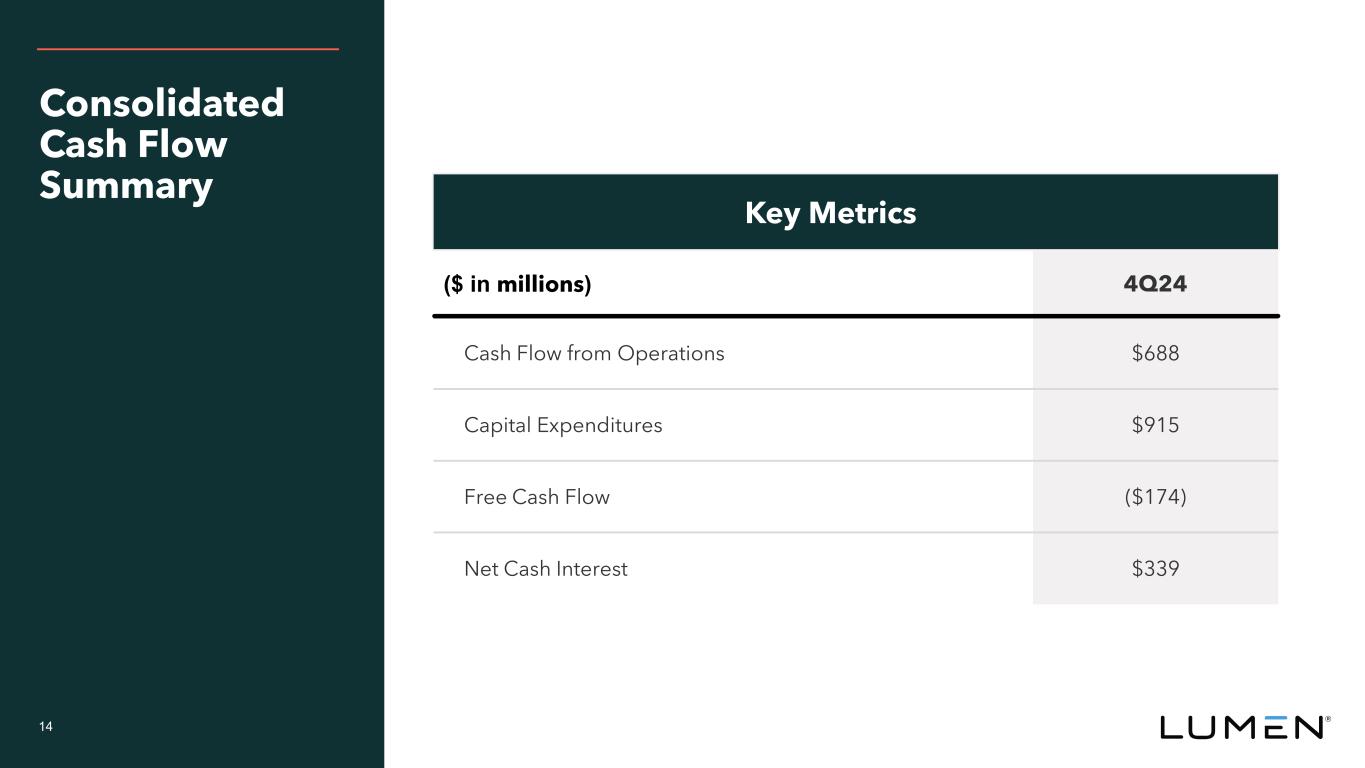
Thanks, Kate. Lumen had a transformative year on many fronts. We completed the TSA in the first quarter, extending debt maturities to 2029 and beyond, providing over a billion dollars in cash and access to a billion-dollar revolver. Last earnings call, we announced $8.5 billion in PCF deals, solidifying Lumen's place as the partner of choice in building the trusted networks for AI. We successfully executed a debt exchange, terming out over $800 million in 2026 through 29 maturities to 2032 and reduced overall debt by $1.6 billion in 2024 and recently sent redemption notices for another $200 million. Given our confidence in free cash flow generation, we contributed $170 million to our pension plans. We continued to make progress in our selling motion with 2024 North American enterprise sales up over 15%. And finally, mass markets had a record year with over half a million new fiber homes passed and 161,000 net fiber ads, all while reducing expenses. Looking forward, 2025 will be a year of investment to reach our future goals. As Kate discussed, the PCF sales we signed in 2024 provide flexibility and liquidity to reduce our debt further, enhance our growth products, and invest in our simplification and modernization efforts. Additionally, with the progress we've made to date, we estimate our run rate cost savings exiting 2025 to be approximately 250 million dollars a strong start towards our 1 billion dollar goal exiting 2027. with our 2025 investments and further execution on our modernization and simplification goals we have confidence in margin expansion and total ebitda returning to full year growth in 2026 and growing thereafter we believe the value creation path for Lumen is clear through additional sales, balance sheet improvements, and cost structure optimization, all as we continue to execute on our core strategic goals to drive operational excellence, build the backbone for AI, and cloudify telecom. Now let's move to the discussion of financial results for the fourth quarter. Total reported revenue declined 5.3% to $3.329 billion. 25% of the decline was due to the impact of divestitures, commercial agreements, and the sale of the CDN business. Business segment revenue declined 5.1% to $2.659 billion. And approximately 33% of that decline was due to the impact of divestitures, commercial agreements, and the sale of the CDN business. Mass markets segment revenue declined 6.3% to $670 million. And adjusted EBITDA was $1.052 billion with a 31.6% margin, and free cash flow was negative $174 million. Now, next, I'll review our detailed revenue results for the quarter on a year-over-year basis. And within our North American enterprise channels, which is our business segment excluding wholesale, international, and other, revenue declined 2.2%. North American enterprise grow revenue increased 15.3 percent year-over-year, driven by public sector growth with continued pressure in nurture and harvest product revenue. Overall, the North American business declined 2.8 percent. On a year-over-year basis, large enterprise revenue declined five and a half percent in the fourth quarter, and mid-market revenue declined approximately 9.8 percent. In both businesses, positive grow revenue, 3.5 percent for large enterprise and 3.4 percent for mid-markets, was offset by nurture and harvest. Public sector revenue grew 11.5% year over year. For the full year, 2024, public sector revenue grew 3.4%. As we've said in the past, public sector revenue can be lumpy quarter to quarter, but we continue to see traction with large bookings in this space, which take time to ramp to revenue. With respect to 2025, and as a result of significant re-rating in the wholesale TDM space from select, smaller, off-net connectivity providers, we are working with our customers to either migrate or disconnect some services. While these actions will be a drag on public sector revenue in the first half of the year, we believe they are healthy for the overall business as we're making decisions that are margin accretive. Wholesale revenue declined approximately 4.5% year over year. The harvest portion of the wholesale portfolio, which is comprised of products like TDM, Voice, and Private Line, saw revenue contraction by 5.2% year-over-year in the fourth quarter. This is primarily driven by telco partners that are selling legacy services. Our harvest product revenue will likely continue to decline over time and is an area that we will manage for cash. Mercer revenue was down 11% in the fourth quarter on VPN and Ethernet declines, and wholesale grow revenue was positive 1.9%. International and other revenue declined 42.5%, driven primarily by the divestiture of our EMEA business and the sale of select CDN contracts in the fourth quarter of last year. As a reminder, the EMEA transaction closed on November 23rd, 2023. Moving to our business product lifecycle reporting, I'll reference the results based on our North America enterprise channels. The 2.2% year-over-year decrease was due to declines in nurture, and harvest, offset by strength and grow, particularly enterprise broadband, dark fiber, and IP. While results can vary in any quarter, we expect sustained growth and grow product revenue as we execute in our core turnaround. Within North American enterprise channels, grow products revenue increased 15.3% year-over-year, up from 4% year-over-year in the prior quarter. Importantly, Grow represents over 47% of our North America enterprise revenue, further reducing our reliance on legacy revenue. Grow products carried in approximately 80% direct margin this quarter. Nurture products revenue decreased 16.2% year-over-year, largely impacted by declines in VPN. Nurture represents approximately 26% of our North America enterprise revenue, and for our total business segment, carried an approximate 67% direct margin this quarter. Harvest products revenue decreased 7.3% year-over-year and continues to be negatively impacted by declines in TDM-based voice. Harvest represented approximately 16% of our North America enterprise revenue in the fourth quarter. For our total business segment, it carried an approximate 77% direct margin this quarter. Other product revenue defined 16.7% year-over-year. As a reminder, other product revenue tends to experience fluctuations due to the variable nature of these products. Now, moving on to mass markets. Our fiber broadband revenue grew 18.9% year-over-year and represents 42% of mass markets' broadband revenue. During the quarter, Lumen added 105,000 fiber homes passed, bringing our total to over 4.16 million as of December 31st, achieving our full-year 2024 target of half a million homes past. We also added 42,000 quantum fiber customers, bringing fiber subs to nearly 1.1 million. Fiber was $61, and I would note that mass market's revenue declines improved year over year in 2024. At the end of the fourth quarter, our penetration of legacy copper broadband was approximately 8%, and our quantum fiber penetration stood at approximately 26%. Now, turning to adjusted EBITDA, for the fourth quarter of 2024, adjusted EBITDA was $1.052 billion compared to $1.099 billion in the year-ago quarter. For the fourth quarter of 2024, our adjusted EBITDA margin was 31.6%. EBITDA margins declined 40 basis points year-over-year compared to a 90 basis point year-over-year decline in the third quarter. Special items impacting EBITDA totaled $132 million. dollars the majority of special items this quarter were related to transaction separation and real estate transaction transaction costs and lastly capital expenditures were 915 million dollars free cash flow excluding special items was negative 174 million dollars mainly due to the timing of cash from pcf deals we would expect free cash flow to be lumpy quarter to quarter as we move through the large pcf bills now moving on to our financial outlook for the full year 2025 we expect adjusted EBITDA to be in the range of $3.2 to $3.4 billion. Our EBITDA guidance includes organic declines similar to 2024 and roughly $200 million in incremental costs, including the annualized spend associated with building a team to expand and deliver on the PCF partnerships, the proactive disconnects of uneconomical legacy services, and additional investments in cloud infrastructure to reduce future CapEx associated with utilizing our own data center assets. Excluded from the guidance above is roughly $300 million in transformation costs to begin the multi-year task of reducing expenses by $1 billion. As we've stated on prior calls, we'd also like to give some preliminary thoughts on 2026 EBITDA. Given anticipated improvements in sales performance, lower absolute declines in the legacy products, and the approximately $250 million in run rate savings exiting 2025, we see 2026 EBITDA being greater than $3.5 billion with growth in future years. Moving to capital spending and our other outlook metrics, for the full year 2025, we expect total capital expenditures in the range of $4.1 billion to $4.3 billion. The majority of the increase in CapEx from 2024 to 2025 is associated with the cost to execute against our signed PCF contracts. We continue to see maintenance CapEx between $400 million and $600 million and quantum fiber CapEx at approximately $1 billion, similar to 2024, as our home's past target for 2025 is also $500,000. The majority of the remaining CapEx is associated with our core enterprise business. We expect to generate free cash flow in a range of $700 million to $900 million for the full year 2025. Additionally, we estimate net cash interest to be $1.2 to $1.3 billion and cash taxes to be $1 to $200 million in 2025, given a prepayment in 2024. In terms of other special items for 2025, we continue to expect dedicated third-party costs to support transition services for the divestitures. The reimbursement for these services will be in other income, with no material net impact to our cash flows. Additionally, special items includes costs associated with Lumen's $1 billion in cost takeout by year-end 2027. Before we move to Q&A, just a couple of housekeeping items. First, please remember that the first quarter typically has seasonally higher expenses related to the timing of bonus payments and other prepaid expenses. Additionally, as noted in our financial trending schedule, fourth quarter 24 was positively impacted by the timing of some public sector revenue and even in EBITDA, which tends to fluctuate quarter to quarter. Following the great strides forward in 2024, Lumen's transformation is on track. The progress we've made around our core strategic goals has resulted in a stronger balance sheet, improvements in sales, a decreased reliance on legacy products, stronger free cash flow generation, and progress on modernization and simplification, giving us increased confidence and an inflection to EBITDA growth in 2026 and beyond. We'll now take your question.
Operator
Thank you, sir. If you would like to ask a question today, please press star followed by one on your telephone. If your question has been answered and you would like to withdraw your question, please press star one again. We will take the first question today from Michael Rollins, Citi.
Thanks, and good afternoon. A couple questions, if I could. First, if you look just in total in terms of what's happening with sales, that you mentioned in the business, I think in North America, up 15%. Now, how does that translate into progress in the verticals like large enterprise and mid markets? And then secondly, just looking at the schedule that you provide is like the customer verticals and product verticals. As you mentioned, Grow is up sequentially and it looks like maybe about $82 million sequentially and wholesale, I think it was wholesale harvest, you know, was also a significant number in the quarter. How much of that might have been recurring, and it's a bouncing off point for, you know, 1K25 versus one time in nature? Thanks.
Yeah, I'll start with the end of the question first. So, we're pleased with the grow product revenue broadly, and I'll get into that in a little more detail the quarter was positively impacted by uh our our state of california initiative uh around pcf that was announced uh gosh about a year ago i guess um and a lot was delivered in the corner uh quarters so revenue started to get turned up but i think what's really interesting when you when you look at the impact overall in the portfolio is you know i touched on in my prepared remarks but the grow bucket is now almost half of what we sell And I think when you look at our overall growth rates vis-a-vis our major competitors who had very different performance than us, it really relates to the customer experience that we're driving and the focus on those grow products as we go forward. And you can actually see that in our wholesale results, right, where legacy declines were significant, but the grow product sales were actually pretty low. the competition is just not focused on it. We are. And so that's without the cloudification of telecom. And ultimately, to your point, sales obviously perceive revenue. 2024 was challenged with disconnects. We talked about some forced disconnects we're going to do in the first half of this year.
But as it relates to things like renewals and the things that are, I would say, manageable and margin accretive to us, we've got motions in place to drive improvements on those as we as we move into 25 next question please next up we'll hear from sebastiano petty jp morgan i sorry about that thanks for taking the question um thank you for the uh 2025 evita outlook um but wanted to see how you how you can maybe help us think about chris um the top line dynamics there particularly in light of the the public sector comments but um as ai fabric revenue come online in the next several years what's the inflection or the growth to or you know what gets you to top line growth i guess in the business or what's the expectation around that and public sector did grow in 2025 2024 but it sounds like there's going to be some one-time items that weigh on it in the first half of the year is the expectation that public sector growth continues from here thank you yeah so so so a couple of things um on the on the overall revenue trends we obviously don't guide revenue but i'll provide some color um when we said that that our revenue um trends will look uh largely similar to what we saw in 2024 there's a lot of activity in there like the
the disconnects that i've talked about that impact that and then and then you've got underlying improvements in things like sales and other disconnects that are more manageable that they kind of net out. I think when we move into 26, we should see continued improvement there because we'll be laughing things like the forced disconnects. We're going to start to turn on some of that PCF revenue. There's going to be very little this year. That's really more 26, 27, ramping fully in 28. And we've also got new product announcements that we'll be making that ultimately benefit as we go forward. The way we can get there, though, really big picture, if you just forecast market declines against our nurture and harvest buckets, and you put us at growing at market rates on things like IP and waves, and quite frankly, I think we do better than market, and Kate alluded to that, we get to growth in the 28, 29 window on revenue. That's really where we inflect. so there's not heroic assumptions being made here and importantly the platform layer that is so critical for differentiating lumen is not really included in that math so our ability to um to really disrupt the space is a tremendous opportunity for us as it relates specifically to public sector tough to call i would say in itself it's challenging because of the disconnects that we're going to take place in the first half, but the team is very focused on, you know, aside from that, trying to grow this year. So, more to come as we move through the year. It's a little early to call.
Operator
Next question, please.
Patia Levi has the next question. Great. Thank you. A couple questions. First, on your network utilization chart, what kind of enterprise needs growth are you assuming that That drives your assumption for lower utilization for the enterprise segment by 28. Is that just a function of revenue mix, meaning much higher growth from the hyperscaler side versus enterprise, or is there anything else that's in there? And then the second question, if you don't mind, helping out with the cadence of incremental costs we should expect for 25. I believe you mentioned $200 million included in the EBITDA guide. and there's an incremental 300 that's not included. And within pre-cash flow, are you assuming any incremental deferred revenue? Thank you.
I'll let Chris hit the last part of your question first, and then I'll hit the utilization capacity chart. Go ahead.
Yeah, we're not assuming any new PCF deals in either the EBITDA or the free cash flow. So that was your last question, I think. But we continue to be deep in those conversations. And as those deals are confirmed, we will obviously be updating guidance, which is very consistent with obviously what we've done to date. Yes. So within EBITDA, there's a $200 million headwind, which really relates to three things. It's the ramp-up that we talked about last year in the team required to do these big PCF builds. It's a shift in our strategy to move from on-prem data centers to cloud. As Kate said, we're customer number one, but that's a shift from CapEx to OpEx. And we're basically avoiding, quite frankly, about a half a billion dollar investment in data centers in the coming years by that shift. And then it's the TDM disconnects from those smaller off-net providers that we're driving. So that's the 200 in EBITDA. The 300 in special items really relates to dedicated expenses associated with getting the billion dollars of cost out, and they're one time in nature, and they will go away.
Okay. And then the first part of your question about utilization, It's really important to note that the utilization chart is really about fiber miles, and so it's the total fiber in our entire network and how each of these major segments, enterprise consisting of commercial, public sector, and wholesale customers, as well as our own use of the network through services, and then the hyperscalers in a different category. And so we're increasing both the capacity with innovation, putting, you know, net new fiber solutions in there, which allow for up to four times the capacity, better photonics, et cetera, greater density, greater efficiency in the same, you know, stretch of conduit. And then, of course, we're adding new routes. I think the big piece here is there was a lot of unused conduit. It was empty for 25 years, and we were able to lease it to the hyperscalers to connect to their data centers. And so that's why the chart looks so dramatic in terms of the increase of the hyperscaler utilization, but it's not taking away from enterprise. And in fact, we have more enterprise growth capacity than we've ever had before with these innovations.
Operator
David Barden, Bank of America, is next.
Hey, guys. Thanks so much for taking the questions. Appreciate it. So I guess just maybe for Chris, two questions. The first would be, with respect to the free cash flow guidance this year, and maybe as it translates into 2026, it would be how much money is coming in from the construction contract customers versus how much is going out. And so if we excluded that, what would the cash flow actually look like? That's question one. And then the second question would be, I think, Chris, you also kind of alluded to this, is that as we look at 2026 and then even more in 27 and beyond, the accounting of how we put the cash flow we're getting today into the income statement down the road when we've built it, and then we can start accounting for it. What kind of contribution is that making to the 2026, you know, better than $3.5 billion EBITDA expectation? Thank you so much.
Yeah, so a couple of things. On the 2026, while PCFOs start to roll in, it's actually going to be pretty small. So we're not because we're still at the very early stages of it. So I would say that the three and a half billion, the increase that you see is largely driven by the modernization and simplification efforts. And that is more than offsetting kind of legacy declines. And again, keep in mind, I mean, we have now been disclosing kind of the grow, nurture, harvest buckets. And I think that'll evolve to more disclosures in time. But we've been doing that now for almost three years, David, and the mix has substantially changed in our favor because of the focus that the company has had. So don't forget to model every quarter mix improvements as legacy continues to become a smaller and smaller piece of what we do. And sorry, remind me, what was the first question? Just on the on the cash cash yes yeah yeah we're so so I want to be really clear before I tell you I'm not going to give you that detail um we we we said and I want to be really transparent about this we had a funding gap before we had the PCF deals and and that remains to be true and the PCF deals not only filled that funding gap it's allowed us to lean in far more heavily into our transformation efforts. And that all remains to be true. We're not going to give 26 guidance on that yet, because here's what I can tell you for certain. There's meaningful things that we can and will do over time as it relates to more PCF contracts, debt refinancings, a number of levers that we can pull that ultimately drive improved free cash flow as we move through the year so more to come as we go through the year this guidance doesn't assume any of those refinancings this guidance doesn't assume any um pcf deals it doesn't assume assume any major transactions um any and all of those things could happen and uh and we'll continue to give you updates but but i think there's far more tailwinds to our free cash flow story than there are headwinds and if jim before you cut me off if it's possible i would love to chris one more question which is
we've seen some pretty successful fiber securitization deals out of Unity, out of ZEO. You guys obviously have redone your whole balance sheet, and I'm not smart enough to figure out how much opportunity is there for you to kind of take advantage of what's happening in the market right now for fiber financing?
Yeah, it's a good question, David. It is an opportunity, but I think that is on the B list of priorities versus the A list of priorities. There's a number of things that we can and will be doing around the debt structure that I think really get to putting the company in more of what I would call a normal capital structure. And at that point, then we can start to look at those things that are on the B list, but more to come. Many thanks, guys. Next question, please.
Operator
Jim Schneider from Goldman's Next is next.
Good afternoon. Thanks for taking my question. First of all, I was wondering if you could maybe contextualize your view on the recent deep seek announcement uh realize it's still very early days but directionally how do you think this changes the connectivity market going forward do you think this is likely to result in you know because of the lower cost um more inference or um more training or could we actually get you know less training and more inference and what do you think that means if anything for the connectivity demand needs you're seeing from hyperscalers do think there's a chance that we could actually see less or is it more likely to work actually see the market stimulated by lower cost yeah it's a great question so i think as i as i noted in
my prepared remarks this is going to accelerate the democratization of ai okay so deep seek is putting pressure on everybody to go faster to innovate and to take costs down and to make the technology more accessible and when you've got more companies that have to navigate in the multi-cloud AI first world, as I described, that's more total available market for us to sell our connectivity fabric into. So we see this as an increase in the total available market and a huge opportunity for us. And we have a pretty good head start in this space, and we're investing heavily in a platform to differentiate, and we think it's going to allow us to capture share.
Thanks. And maybe as a follow-up, could I maybe just sort of ask about the sort of competitive dynamics you're expecting to see in the PCF market going forward. I mean, clearly, you know, you've talked about all the reasons why you believe you have a privileged advantage market position today. You know, one of those, I believe, is because of the empty or available conduits you have to fill right now. But I'm sort of curious as you go into the next couple of years, do you see more competition for these kinds of deals? And do you see your lead extending yourself, or do you think more incremental competition is likely to come in? Thank you.
Yeah, of course, Jim. So first of all, we're grateful for the lead. It was nice to get eight and a half billion in there before anybody else realized that this was a market. But we're paranoid, and we're going to maintain focus on building out the competitive moat. Our network has unmatched coverage. It has unique routes. And we've invested heavily in the fiber solutions that, frankly, our competition hasn't. So we're in the right places with the amount of capacity and the performance that everybody expects. But that's just the infrastructure talking. I think what's differentiating is the platform on top. And that's becoming more and more interesting to, frankly, all of our customer segments as we're able to present them with It's a network fabric that gives them access to all the capabilities no matter where they are. So we're pretty pumped about our position. We think we're going to continue to be able to execute well, and, you know, the future is pretty bright. Chris, do you have anything to add to that?
No, that's it. Next question, please.
Operator
Jonathan Chaplin from New Street Research is up next.
Thanks, guys. I'm wondering if you could give us an update on how things are progressing with the fiber sales. And then in the context of the fiber sale, it seems to me that the ultimate owners of these assets are probably one of the three big national wireless carriers. And I would have thought they would value copper assets in addition to fiber assets. And I'm wondering if there's a way you can structure the sale of fiber that gives the buyer of that asset the ability to use your copper infrastructure to build more fiber. And then looking at the progress that AT&T has made with copper decommissioning, I'm wondering if there's an opportunity for you guys in pursuing that or whether that's an opportunity you might hand off to somebody else as well.
Yeah, it's a good question. And I'm going to stick to things that we said publicly. So first of all, the, you know, it's interesting because there are two schools of thought, right? One could be you sell the whole thing. But there's been a lot of work done, good work, that has said, yeah, but you also give up a lot of EBITDA on that. And is it really a delevering transaction? The comment that we've made is think about it as two businesses, right? You have a fiber business that today is doing just tremendously in terms of its build-outs, but isn't yet in a position where it's generating much EBITDA. There's a lot of OPEX that goes into driving customer penetration. And at the same time, it's consuming a billion dollars a year in CapEx. The bulk of the EBITDA sits on copper today, which doesn't have a huge CapEx burden, basically some maintenance. So, um, could it, could somebody be interested in all of it? Yes. Could somebody be interested in pieces? Yes. Um, we're, we're open to any and all of those discussions and we'll see where it takes us, but ultimately, um, you know, we, we, we've said this for years, it comes down to, um, valuation and at the right time, you know, we'll make that decision. And, and as that decision and that moment comes, we'll obviously share it with you. So that's how we think about it. As it relates to copper DCOM specifically, think about copper DCOM being largely market driven, not consumer driven, because copper DCOM is really both an enterprise and a consumer motion. And so I think like a lot of our competitors, that's how we think about it. We have been very aggressive about, in the consumer space, converting copper to fiber, where we do have fiber passings, because it's a better outcome for the customer and it's a better outcome for us. And that will continue. But the copper decom process, there's a playbook that we've developed. Frankly, it's part of our modernization and simplification. There's a lot of unlock there, and we think there's even more EBIT to be generated in the coming years through those activities.
Yeah, it's a major tenant of driving operational excellence. It's wire center by wire center across the country. We have a P&L view, so we can see it all now, and it makes for great decision-making, and it's a huge vector, as Chris said, of our cost takeout.
Is that approximately $1 billion? Yes. Yes. Yes. It is part of London. Got it. Thanks.
Operator
And the next question today comes from Nick Del Deo, Moffitt Nathanson.
Hi. Thanks for taking my questions. You know, first, I guess what happened in the public sector in the quarter, it's still not entirely clear to me. Chris, you said it was driven by a lot of sales or turn up services to the state of California.
Is that revenue largely recurring or were there one-time delivery or performance fees lumped in there just trying to get a sense as to the the right baseline and then so looking at you yeah oh sorry go ahead sorry yeah i'll just i'll answer that real quick that the so so the pieces of the pcf for the state of california that got turned on um are are one time in nature as that got lit up uh there are other things that happen in the public sector which are are more ongoing we haven't split that out um we don't we don't intend on doing that uh and uh and i think the color we gave around uh some of the headwinds that that that uh uh channel faces in 2025 with the disconnects um is really what we want to say about that at this point sorry what was your second question Okay.
No, no. Thanks for that, Chris. I guess looking at the fiber deployment utilization table, if my math is right, the fiber miles used by enterprise channels is roughly flat from 22 to 25, but then you're expecting it to double from 25 to 28. So I'm just wondering what products, you know, are driving that doubling.
Well, I think to start with, in Kate's prepared remarks, you know, we're seeing 100 gig and 400 gig waves growing at 50 percent in 2024. And we talked about that and gave color around that during the year because we shifted CapEx to support that. So we're at the very, again, think about it back to the phases of AI that we've talked about. And the first phase is, you know, inference, which is where, sorry, training, where the hyperscalers are building these networks for their own consumption to train the AI models. The second phase is inference, which is where large enterprise starts to use those models to run workloads. And so we're at the very beginnings of that, and we can see it in IP and Waze, but I think you'll see more consumption of large enterprise connectivity because of the platform layer that Kate talked about, because ultimately the value that we can bring to enterprise in the form of cost reduction isn't us reducing prices for dumb pipes. It's us providing newer, cheaper, faster, more efficient, and flexible ways of reaching their data. Next question.
Operator
We'll take the next question from Greg Williams, TD Cowan.
Thanks for my questions. Actually, Chris, your last answer is a good segue into my question is, in your deep conversations you're having above and beyond the $8.5 billion pipeline, are you seeing any of the inference phase starting to materialize, or are we still too early there? Second question is on deep seek again. You know, I get the democratization of AI, and you see a larger TAM. but is there a near-term risk with massive scalable AI that would drive a temporary pause of the hyperscalers to rethink some of their plans? Thanks.
We haven't seen a pause. In fact, we're still in deep conversations. We've talked about the pipeline that we're pursuing is predominantly comprised of new routes connecting data centers, and we're deep in those conversations, And it's complex to design these kinds of networks, so it takes a bit more time, but they're still progressing with no sign of slowdown. In fact, we have been asked by every single one of the major cloud companies that we've done a deal with, with no exception, if there's a possibility to accelerate the implementation of what they've purchased so far. Um, with respect to the second phase, uh, in inference, I would say that it, you know, it's early to start calling the ball on trends of exactly what's going to happen here. If anybody tells you they know, they don't. Um, what we are seeing is in some of the major industries, you know, financial services, retail, healthcare, um, they're starting to, they're the ones that are asking for the, you know, the network upgrades. and they're starting to use inference to transform their companies and they're recognizing the fact that they need something fundamentally different. And so that's kind of the trends that we can shine a light on so far. As we learn more, we'll bring it to you. I think it's really important, the discussion that I gave you an overview on the multi-cloud AI-ready network architecture, Every single one of these companies is moving data and workloads back and forth between clouds. And today, it's too complicated, it's too slow, it's too expensive, and it's not secure. And our fabric, now that we're connected to all three clouds, allows you to do that in a cost-effective, high-performance, secure way. And this is a net new capability that we're bringing through our platform and our fabric that no other company is doing. So we're really excited, and we think we'll continue to have a good view on what's happening during inference, and we'll keep you posted.
Operator
Next question comes from Frank Luthin, Raymond James.
Great. Thanks. Can you give us a little bit more color on the public sector for next year? I think you said it was going to pull back a bit. Is any of that related to federal government cost cutting, and does that add any additional risk? Can you give us an update on the billing system collapse and the other system changes that you're working on? Where are you as far as completing those projects?
Sure. So, as it relates to public sector, our sales rates aren't declining. um what's what's impacting revenue in 2025 is um yeah i'll use a word egregious uh re-rate activity by a select few um i mean we're talking thousands of percents really over the last few years where customers largely in the federal space and unfortunately some customers who rely critically on that technology for running their businesses are being forced to migrate or turn off those switches. And it's the right call for the customer. It's the right call for us. So really the big headwind there is that. As it relates to the IT work, we're making good progress. our first phase of our ERP should be complete, I would say, probably early in the second quarter, and we're expecting the second phase, which first phase is really quote to cash, second phase is procure to pay, is later in the year. Now, remember, what we're not doing, I want to be really clear about this, we are not, you know, doing a big consolidation of order entry or billing systems. What we're doing is as we consolidate networks and we turn on the ERP, we will, over time, roll off of old systems that support existing revenue as that revenue kind of retires out. And all of the new revenue will be put into a new modernized system. So as that grow bucket continues to grow, more and more of the product is on the future state. We're not doing any kind of a conversion.
Great, great. Thank you very much.
Operator
And Sam McHugh from BNP Paribus has the next question.
Thanks, guys. On your intercity fiber mile vision, I think the 2028, 47 million mile, 47 miles. Is that based on the announced PCF deals or would that require additional PCF deals and CAPEX to kind of get to that vision, part one? And then secondly, on the investment in new fiber roots. Does that change your view on how many fiber homes in the mass market business you might be able to reach? And is that helping you in discussions with partners on basically being able to provide more backhaul for their own fiber ventures? Thank you.
So the 47 million miles, just based on the business that we've already inked, it doesn't include any new deals. So as we potentially do that, we might be updating this chart for you, hopefully sooner rather than later. And could you hit your fiber design home question again, please?
Yes, sir. I was just saying, as you build out more of the conduits and build new conduits, is that changing your view of kind of a terminal kind of build in mass market? I think you talked to six to eight million locations in the past. So, can you do more with fiber miles?
We think about them separately.
Okay. Thank you. Operator, we have time for one more question.
Operator
And everyone, at this time, there are no further questions in the queue. That does conclude the conference call for today. We thank you for your participation and ask that you please disconnect your line. Have a great day, everyone.