Operator
Greetings, and welcome to the Lumen Technologies First Quarter 2025 Earnings Call. During the presentation, all lines will be in a listen-only mode. Afterwards, we will conduct a question and answer session. At that time, if you have a question, please press the star followed by the one on your telephone. If at any time during the conference you need to reach an operator, please press star zero. As a reminder, this conference is being recorded Thursday, May 1st, 2025. Your speakers for today are Kate Johnson, CEO, and Chris Stansberry, CFO. I would now like to turn the conference over to Jim Brink, Senior Vice President, Investor Relations. Please go ahead.
Good afternoon, everyone, and thank you for joining Lumen Technologies' first quarter 2025 earnings call. On the call today are Kate Johnson, President and CEO, and Chris Dansbury, Executive Vice President and Chief Financial Officer. Before we begin, I need to call your attention to our Safe Harbor Statement on slide one of our first quarter 2025 presentation, which notes that this conference call may include forward-looking statements subject to certain risks and uncertainties. All forward-looking statements should be considered in conjunction with the cautionary statements and the risk factors in our SEC filings. We will be referring to certain non-GAAP financial measures reconciled to the most comparable gap measures, which can be found in our earnings press release. In addition, certain metrics discussed today exclude costs for special items as detailed in our earnings materials, which can be found on our investor relations section of our website. Finally, new this quarter, we've posted some frequently asked questions along with the earnings materials for your reference. With that, I'll turn the call over to Kate.
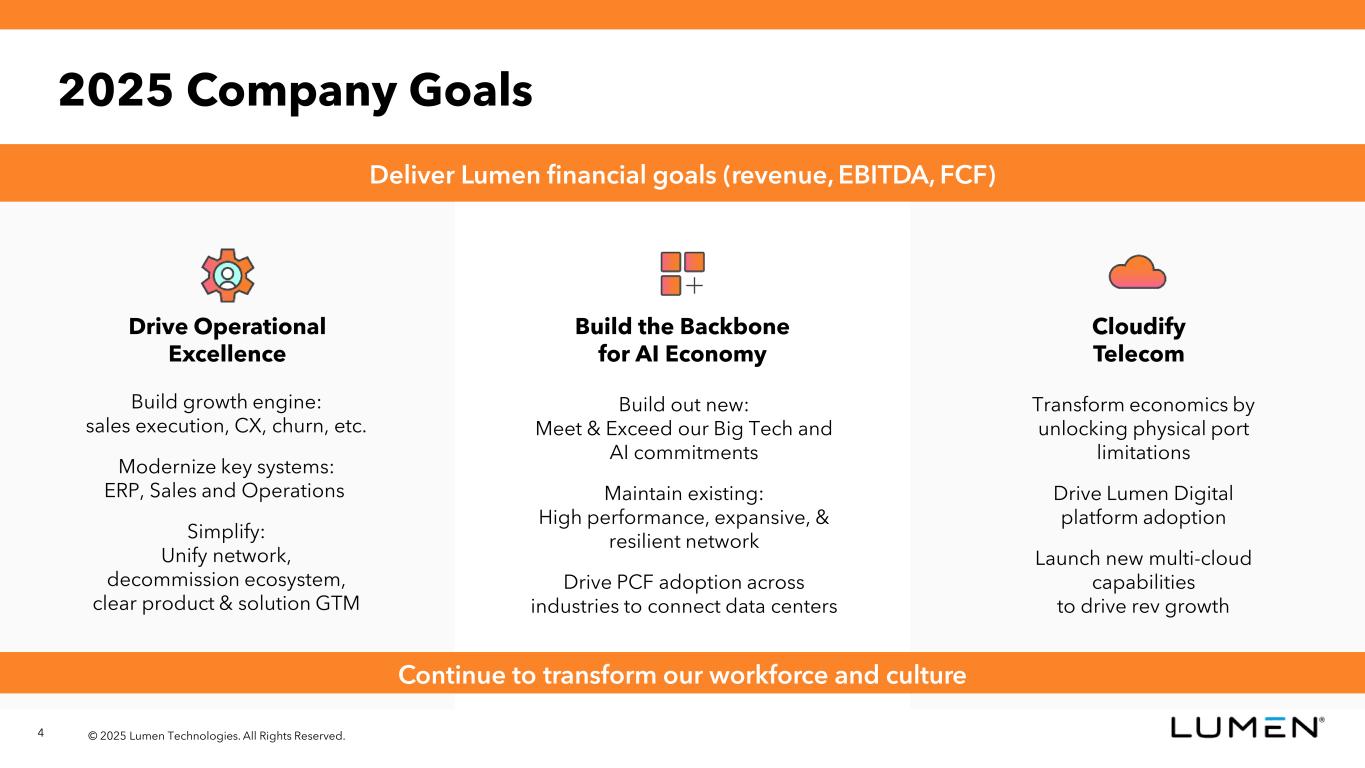
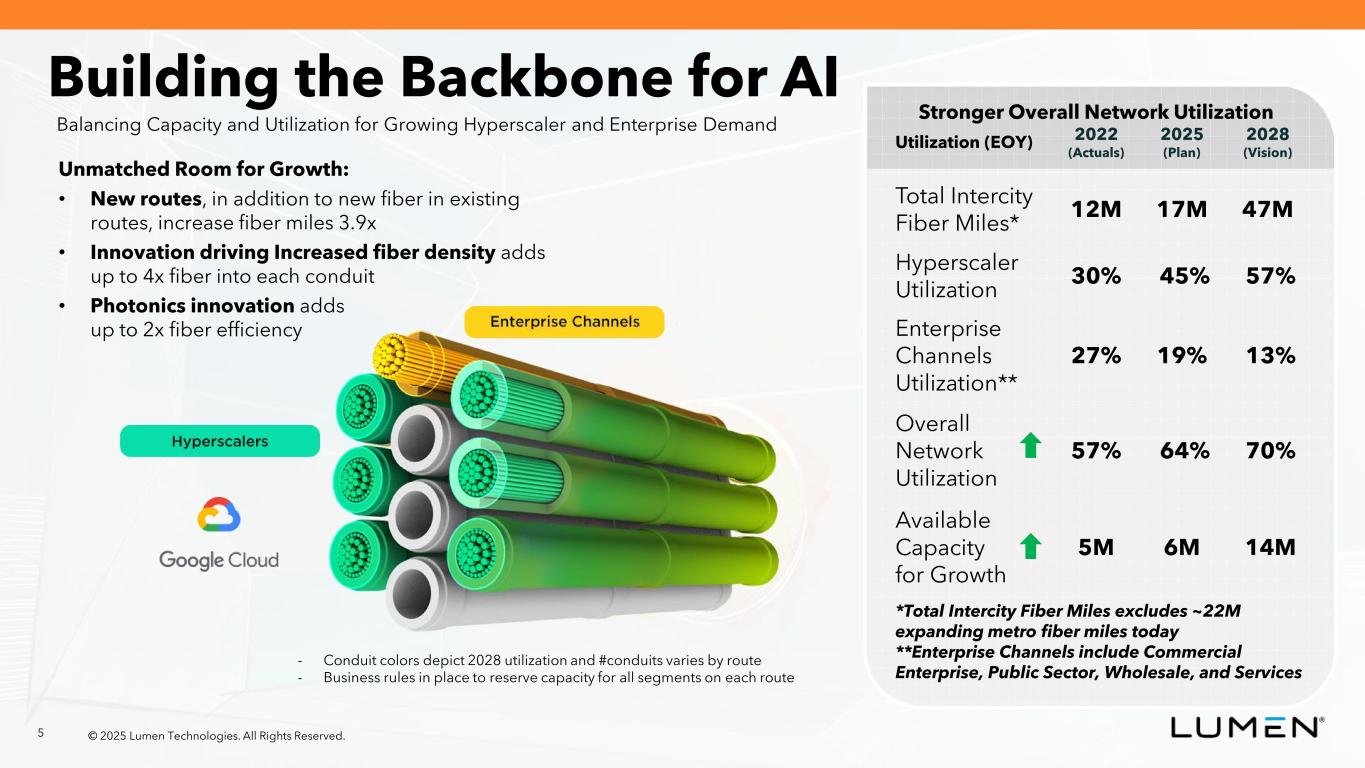
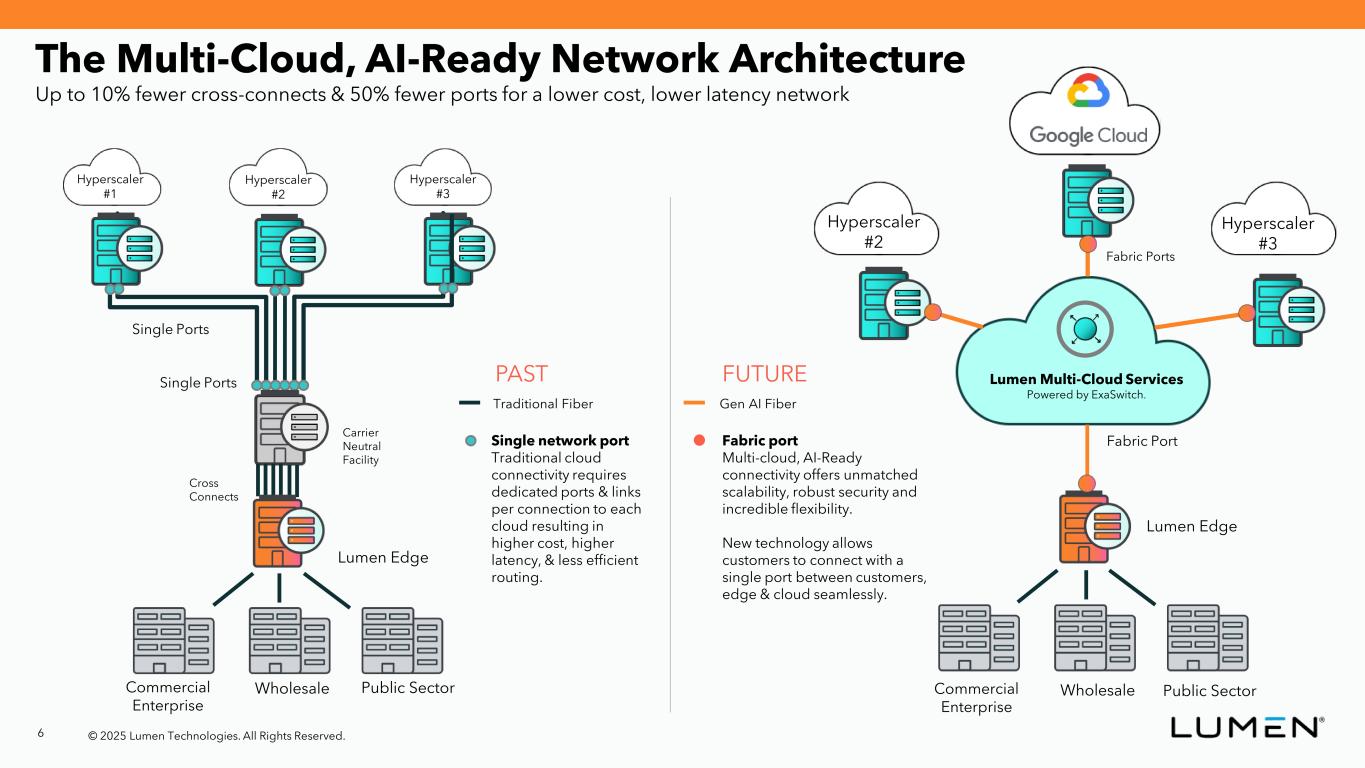
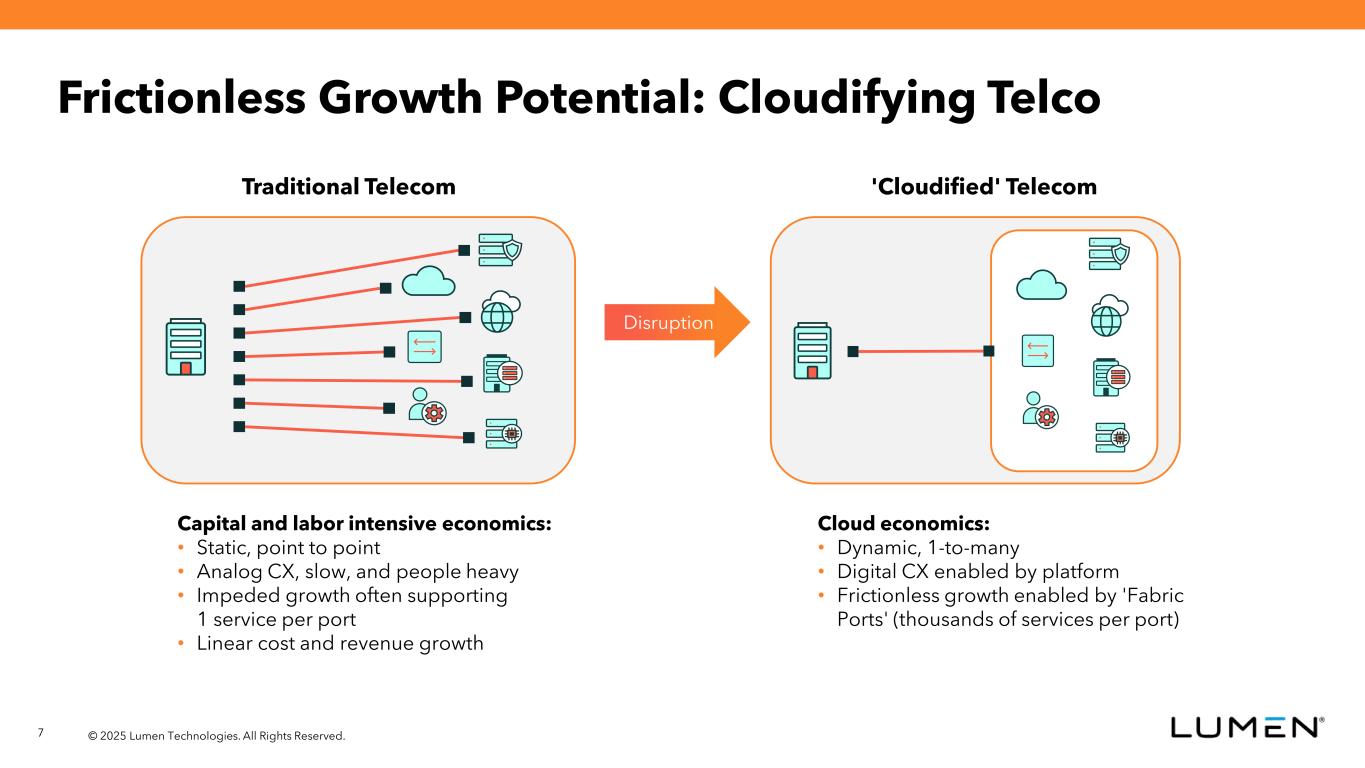
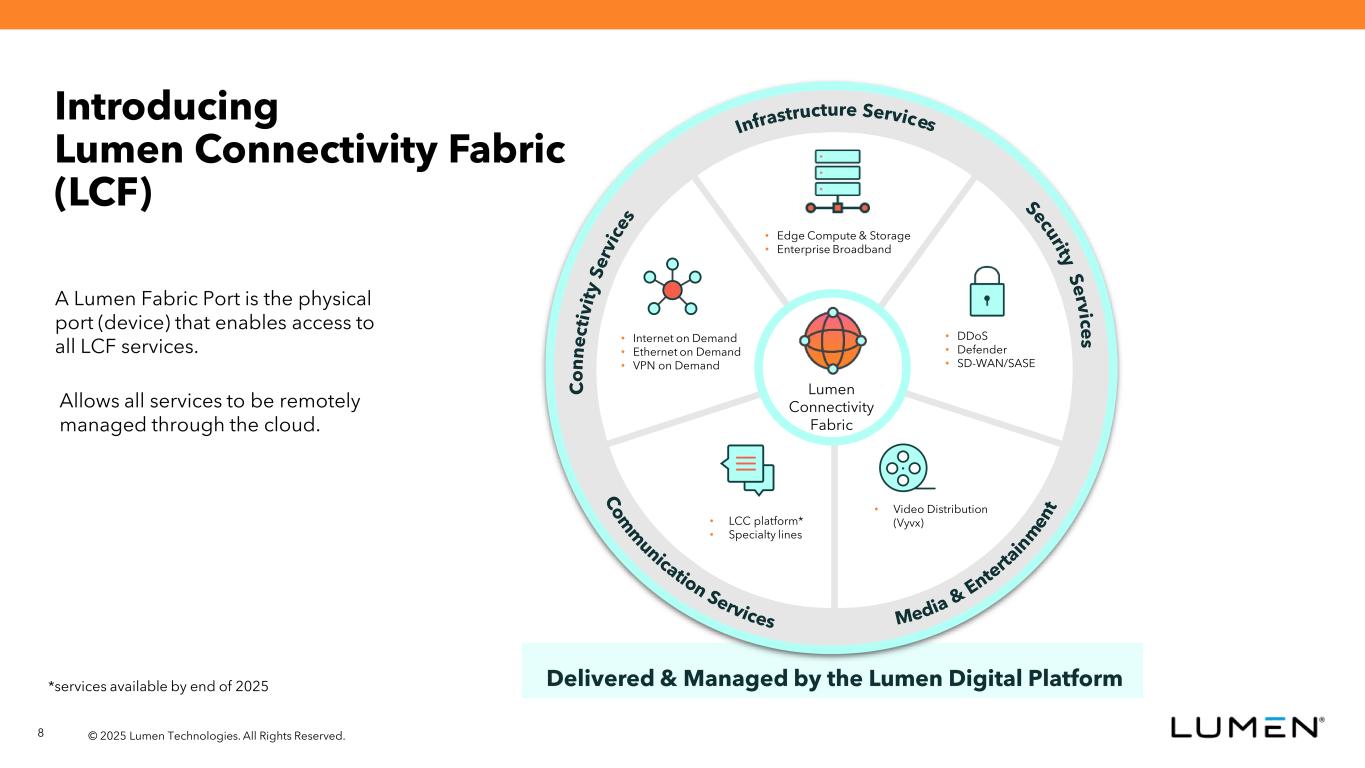
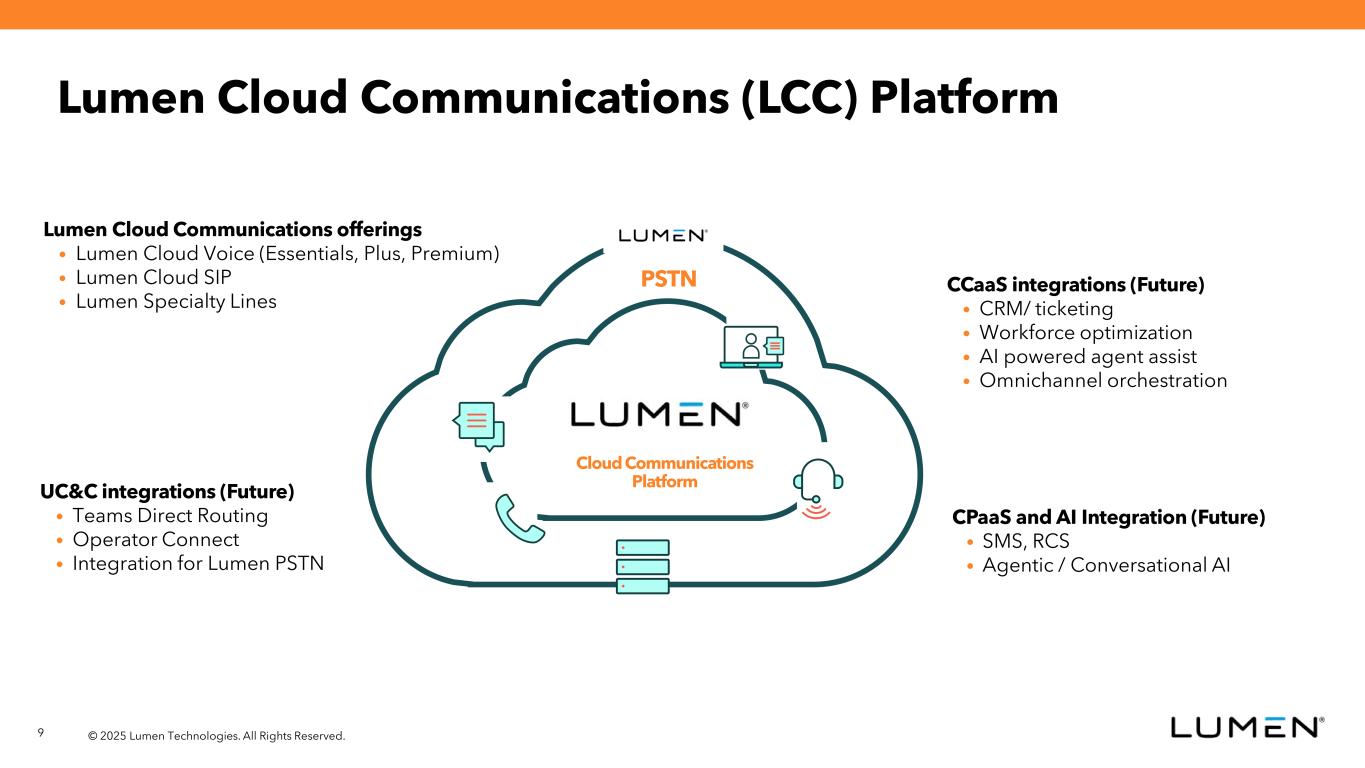
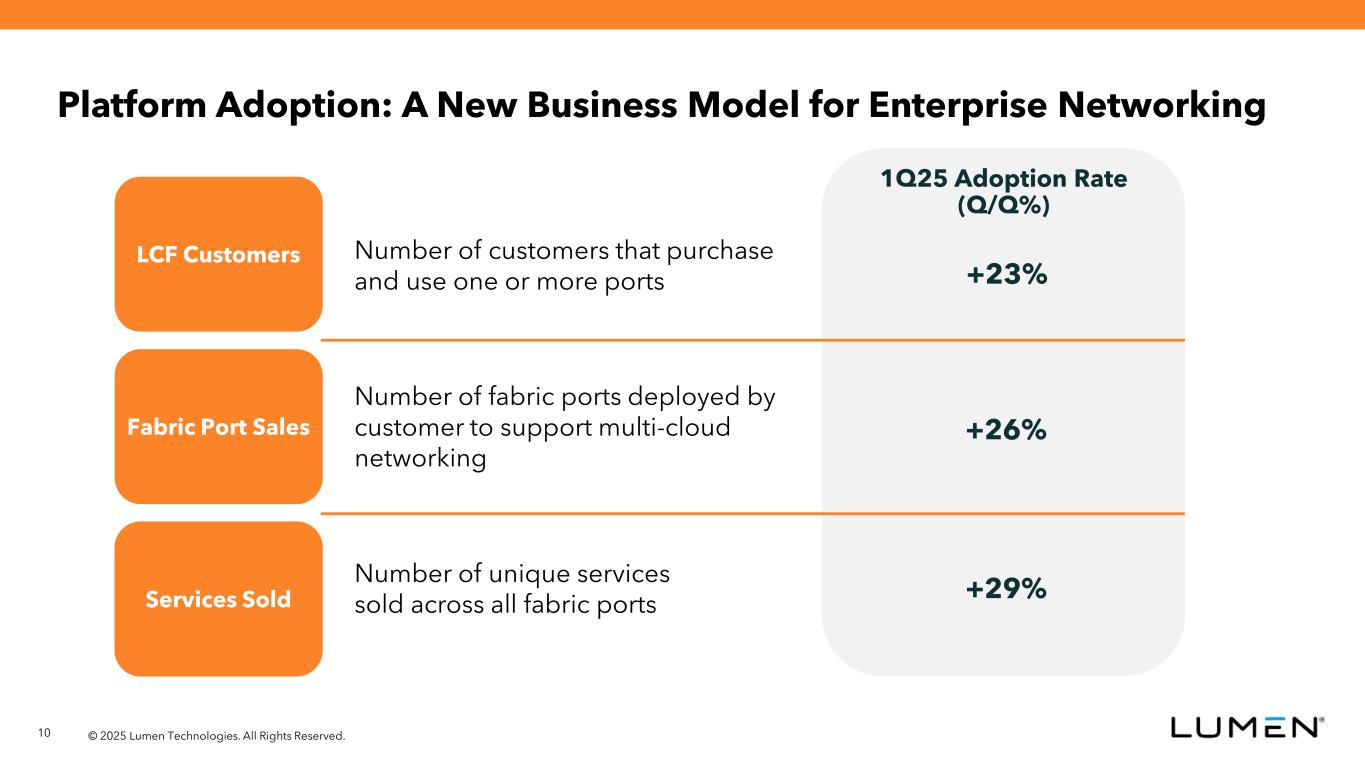
Thanks, Jim, and thanks to everybody for joining the call. In the first quarter of 2025, we remain focused on our three company-wide priorities to drive operational excellence in our core businesses, build the backbone for the AI economy, and cloudify telecom. And I'm happy to share that we made material progress across all three areas, culminating in strong financial results and various external accolades, including being named one of Fortune's most innovative companies and Frost & Sullivan's DIA Company of the Year. And today I'm going to explain exactly why. I've talked about driving operational excellence in the past. we're upgrading our systems, simplifying our product portfolio, unifying our networks, upgrading our go-to-market teams, and improving execution overall. And our financial results in the first quarter show the results of that rigor. We strengthened our balance sheet with a term loan refinancing. We beat consensus for revenue, EBITDA, and free cash flow with our North American business grow revenue up 7.9% year over year and total North American business revenue down only 2.2 year over year approximately one quarter of the decline of our peers in the industry and waves revenue grew on a year-over-year basis a reflection of our strong wave sales with great companies like activision t-mobile and aarp thirdly an important driver of revenue and apodot performance in the in the first quarter was the lowest level of absolute dollar disconnects the past five quarters with an over eight percent improvement from the first quarter of 2024. We continue to actively engage with our customers to migrate them to the newest technologies, showing how our install base is becoming a material advantage in our digital revenue growth trajectory. Lastly, Lumen's modernization and simplification work is going very well with continued progress implementing new digital enterprise applications, unifying our network architectures from four to one, and using AI to drive intelligence and automation in everything we do. We're confident in our goal of generating at least $250 million in savings exiting 2025 and a billion exiting 2027. Now let's talk about the other two priorities that represent our future in enterprise digital networking. Building the backbone for AI is all about ensuring we continue to widen our strategic moat, that is, our expansive fiber network. As I explained last quarter, we're dramatically improving the utilization and therefore the economic returns of our physical network while simultaneously managing the largest network capacity expansion in generations. By connecting all the major cloud and technology providers, we're creating a networking ecosystem that is accessible to all enterprises and provides ample high-speed capacity for the traffic growth from AI, and other advanced technologies like quantum computing will yield. And we're progressing nicely with the construction of the $8.5 billion of private connectivity fabric, or PCF, projects that we announced last year. We have 57 different ILA sites under construction on track to complete the first tranche of 24 locations on time and on budget in the second quarter. We've also initiated deployment of the new Corning 864-count fiber on seven different routes. And our modern, world-class project management platform and controls continue to delight customers with on-time, on-budget delivery. We continue to be in discussions for the next tranche of PCF deals. And while the market is a bit uncertain, last night you heard some of our partners confirming on their earnings calls their intention to continue to spend capital for their AI build-out. From our view, we see that overall PCF demand is still there at both the large deal CST level as well as at the smaller enterprise deal level. We anticipate that that trend will continue as these networks are just critical infrastructure for the United States to be a world leader in AI. But as we've emphasized many, many times, Lumen's turnaround story has never just been about commercializing physical fiber and conduit. AI is forcing a pivotal shift in enterprise customer needs, driving unprecedented bandwidth demand for real-time data processing and secure, uninterrupted access to critical business applications. The network ecosystem I just described provides the key ingredients to deliver huge value to customers, and that value will come in the form of disrupting traditional cloud connect models with new architectures. As we've discussed, traditional cloud connections to enterprises rely on space and cross-connects provided by third-party intermediaries or carrier-neutral facilities. We've leveraged our network ecosystem to reinvent cloud connection with direct fiber access, the ability to connect directly from Lumen's fiber into the cloud providers. It not only simplifies network operations for us and our customers, it also significantly enhances network performance, security, and scalability. Direct fiber access positions Lumen uniquely to deliver a differentiated connectivity experience essential for the new business landscape. A few weeks ago, we announced an important partnership with Google Cloud to provide direct fiber access to customer data centers, providing dedicated connectivity through Lumen's Metro Fiber with speeds up to 400 gigabets per second. We're also integrating with Google's new Cloud WAN solution, helping customers reduce latency by more than 40 percent when connecting to SaaS applications from a global footprint. Both of these initiatives will lead to faster deployments, enhancing performance and reliability, and cost savings as customers deploy AI apps at scale. And as I shared before, the network ecosystem and direct fiber access capabilities provide Lumen with the unique opportunity to go after a net new rapidly growing $15 billion TAM. Okay, enough geeking out on the physical infrastructure and network architectures piece. Let's move on to the digital layer of our transformation. We continue to increase adoption velocity on the Lumen Digital platform, giving customers network as a service offerings that deliver real-time on-demand connectivity with the ability to control bandwidth, latency, and security, all wrapped in a cloud-style consumption model. It's another major industry disruptor and a huge business model shift for Lumen, and it deserves the double-click that I'm going to provide you today. The Lumen Digital Platform transforms the economics of our business by freeing us from the physical limitations of traditional telecom infrastructure in two important ways. First, we're digitizing the entire customer life cycle, allowing customers to purchase, provision, and manage on-demand services through a unified customer experience, delivering through Lumen Digital's control center. This not only delivers a dramatically improved CX compared to legacy telco models, it also drives massive operational efficiency for Lumen and our customers by automating every task and infusing it with AI. Second, through the Lumen digital platform, we've created a device we call the fabric port, acting as the bridge between our control center and the physical network. It allows customers to manage their network infrastructure digitally and remotely. Fabric ports can support thousands of services per single port versus legacy architectures of one port per service, a major breakthrough in terms of driving scaled growth at a reduced marginal cost. So together, Lumen Digital's control center and fabric ports give us the new construct for Lumen's growth story. They allow our customers to dramatically simplify their infrastructure, reduce costs, and accelerate innovation while providing Lumen a path to compounded revenue growth. We now have a clear path to deliver high-value cloud economics at scale. Lumen's business model is no longer bounded by the traditional friction-filled limitations of telecom's physical infrastructure and analog business processes. Instead, our growth will be fueled by our ability to deliver a comprehensive digital services portfolio with a friction-free CX, aimed to serve enterprise needs in a multi-cloud AI-first world. We'll grow the portfolio of digital offerings by both building and acquiring capabilities to sell in our growing install base of Fabric Ports. And we've got a great start, as I'm going to share now. I want to introduce you to something we call Lumen Connectivity Fabric, or LCF, a portfolio of digital network services made to help connect people, data, and applications quickly, securely, and effortlessly. We have five main customer solution areas, including connectivity, infrastructure, security, media entertainment, and the communication services. You can see our flagship NAS services, Internet on Demand and Ethernet on Demand, in the connectivity services customer solution area, with more to be launched over the coming quarters. Now, one area where we see enormous potential is in voice cloud services. We began a limited offering of the Lumen cloud communications platform this year, we'll call it LCC for short. It's a comprehensive group of products that we believe will be unmatched in the broader unified communications and collaboration market, all powered by Lumen's extensive network assets, including our more than 130 million telephone numbers while we have offered voice and ucas products before they were sold as single point products with limited go-to-market support from the company moving forward we believe that lcc and our network assets we have a clear right to win in the 47 billion and growing cloud voice tam with these products lcc provides lumen legacy voice customers with a clear migration path and therefore helps bend the declining revenue curve by reducing churn. What's more, our cloud voice product is built on an IP network, which is far less expensive than the old POTS infrastructure and well-suited for the demands of remote hybrid workforce. Voice has shifted to an API-driven, AI-infused, data-rich, services-oriented market, creating higher-value opportunities like specialty lines for fire alarms and security systems. And with Lumen's modern voice offering, customers can gain national reach on a cloud consumption experience. And this is just one example of how we're simplifying and modernizing our product portfolio to take advantage of the new business construct, layering multiple services on the fabric ports managed by Lumen Digital. We measure success in this digital business through adoption, specifically how many new customers we acquire, how many new fabric ports they buy, and how many services they're layering on those ports. And in the 90 days of Q1, we saw new Lumen Digital customers grow by 23% quarter over quarter. And in the same period, we saw a 26% uptick in the number of new fabric ports provisioned and managed through the Lumen Digital platform. As customers adopt this new model for wide area networks, we expect the new port growth rate to accelerate. And lastly, the number of services sold across these customers and fabric ports grew by 29% in the same quarter of a quarter period. That's the P and Q of our new digital networking business. And a side note, we've been deploying fabric ports technology for a while before the advent of the Lumen Digital Platform. And as such, we're investigating the opportunity to connect existing install-based fabric ports into Control Center, which would yield a large base of sockets to upsell our new LCF services. We'll keep you posted as this would be a major accelerator to our digital adoption and ultimately revenue growth. It's an exciting time for Lumen. The transformation is going really well with our operational rigor delivering sound financials, but what's more, we've created a growth engine called Lumen Digital that not only harnesses the power of our world-renowned fiber network, it provides a springboard for innovation that helps CIOs navigate a complicated set of problems in this multi-cloud AI-first world. And with that, I'll turn the call over to Chris.
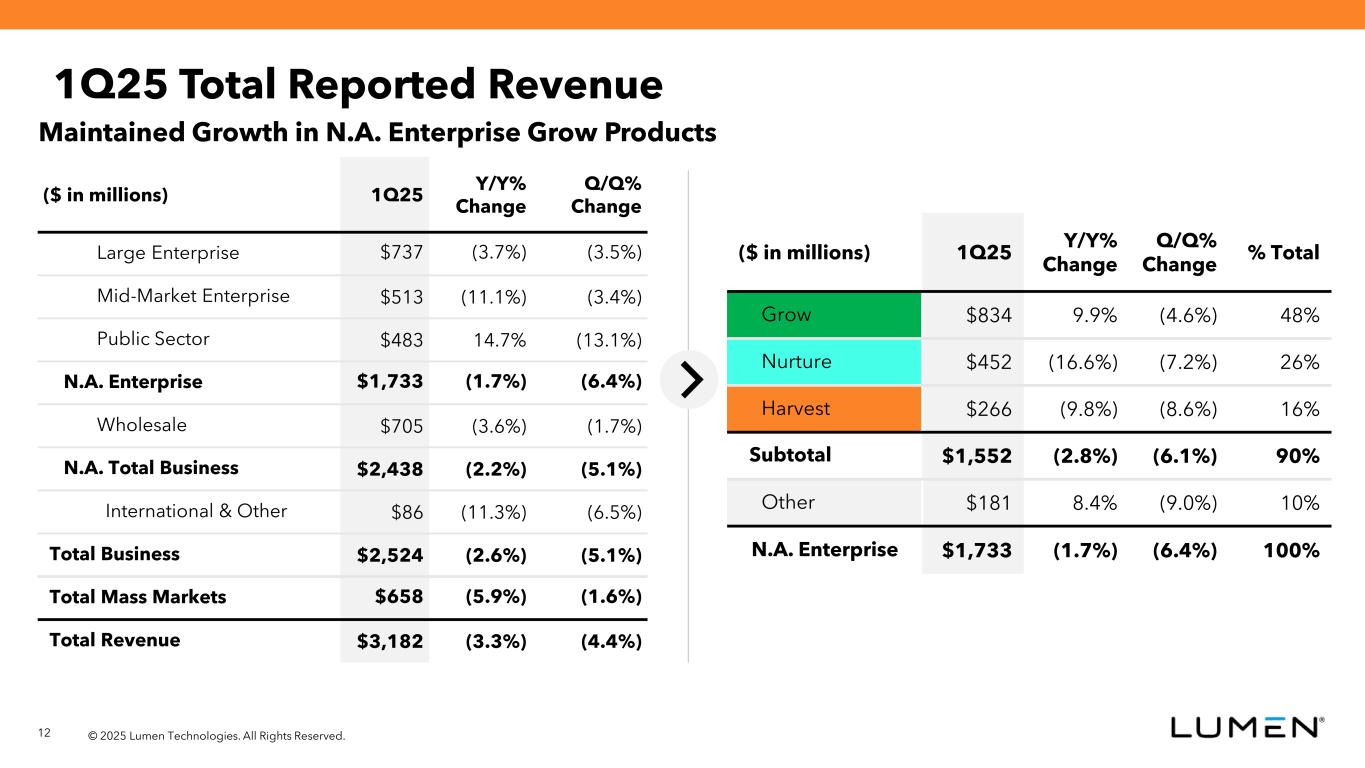
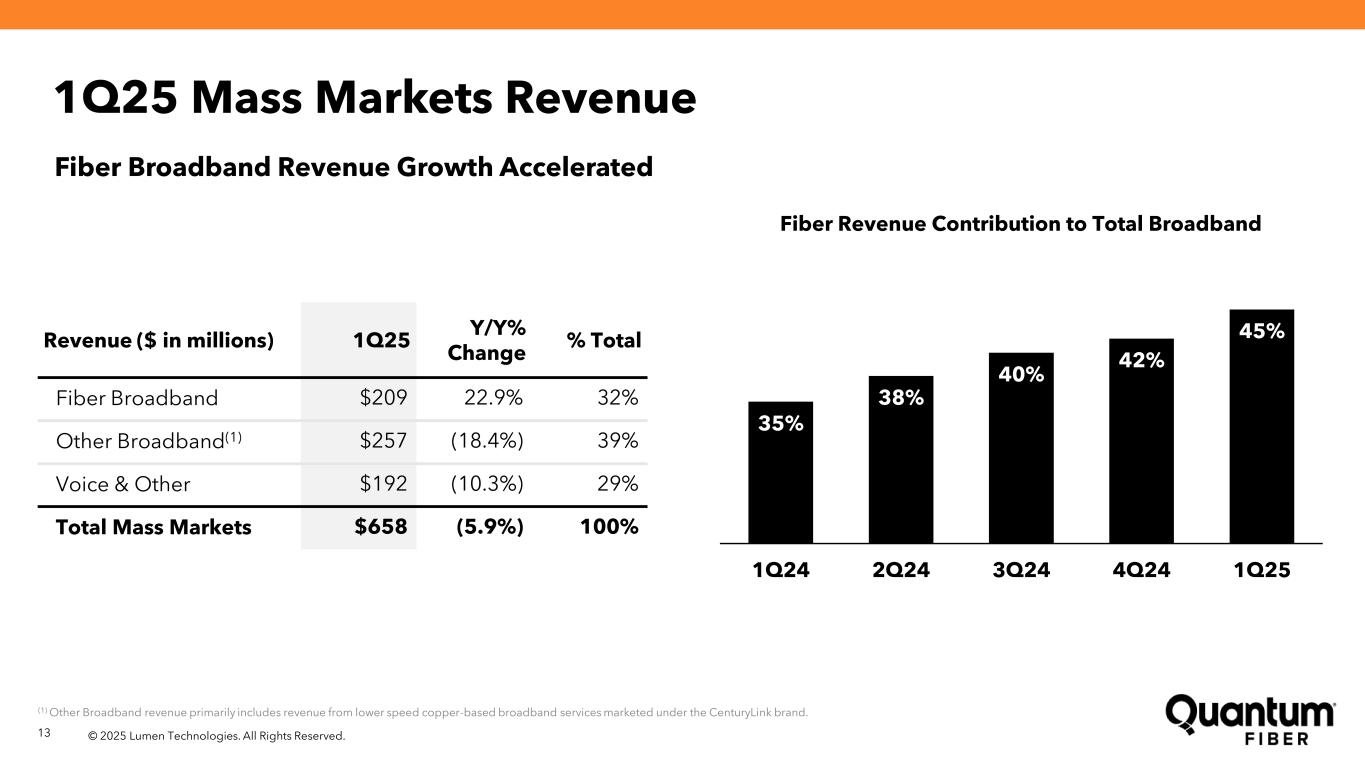
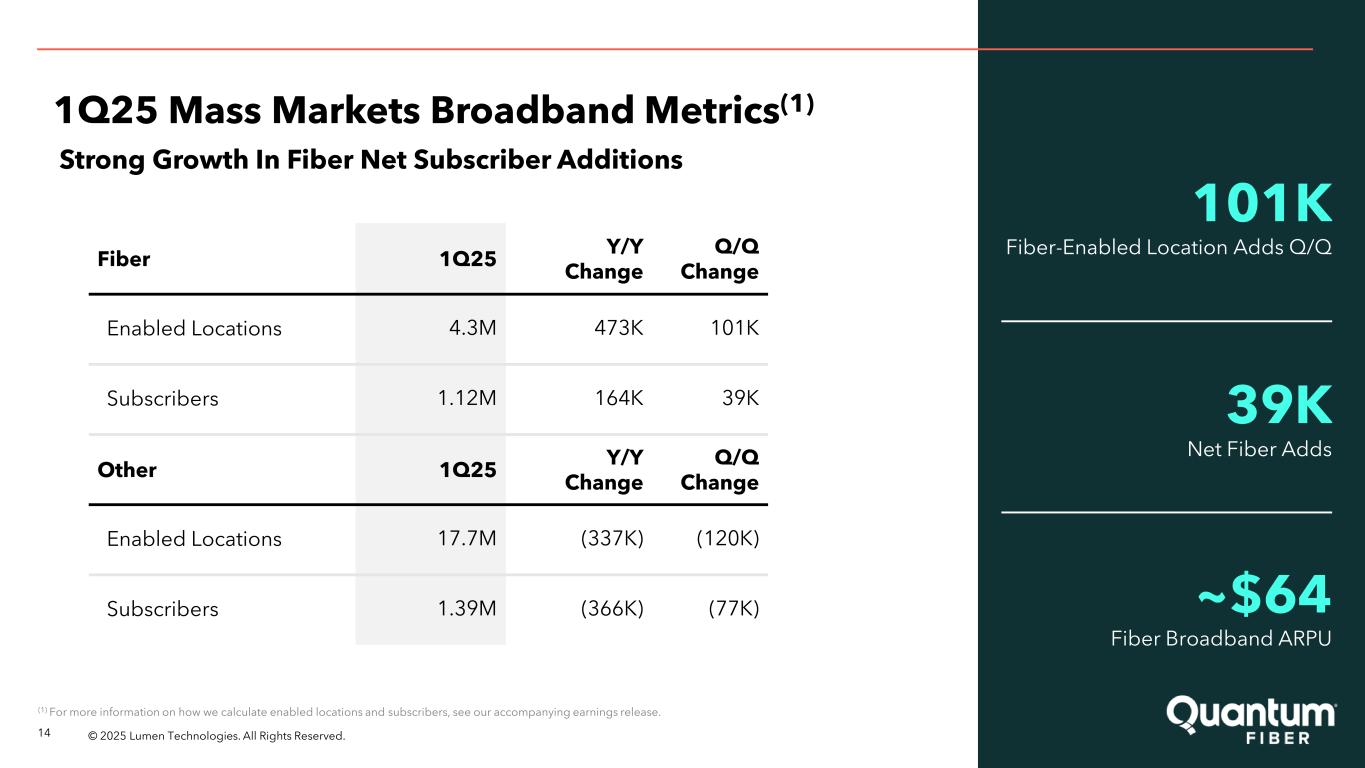
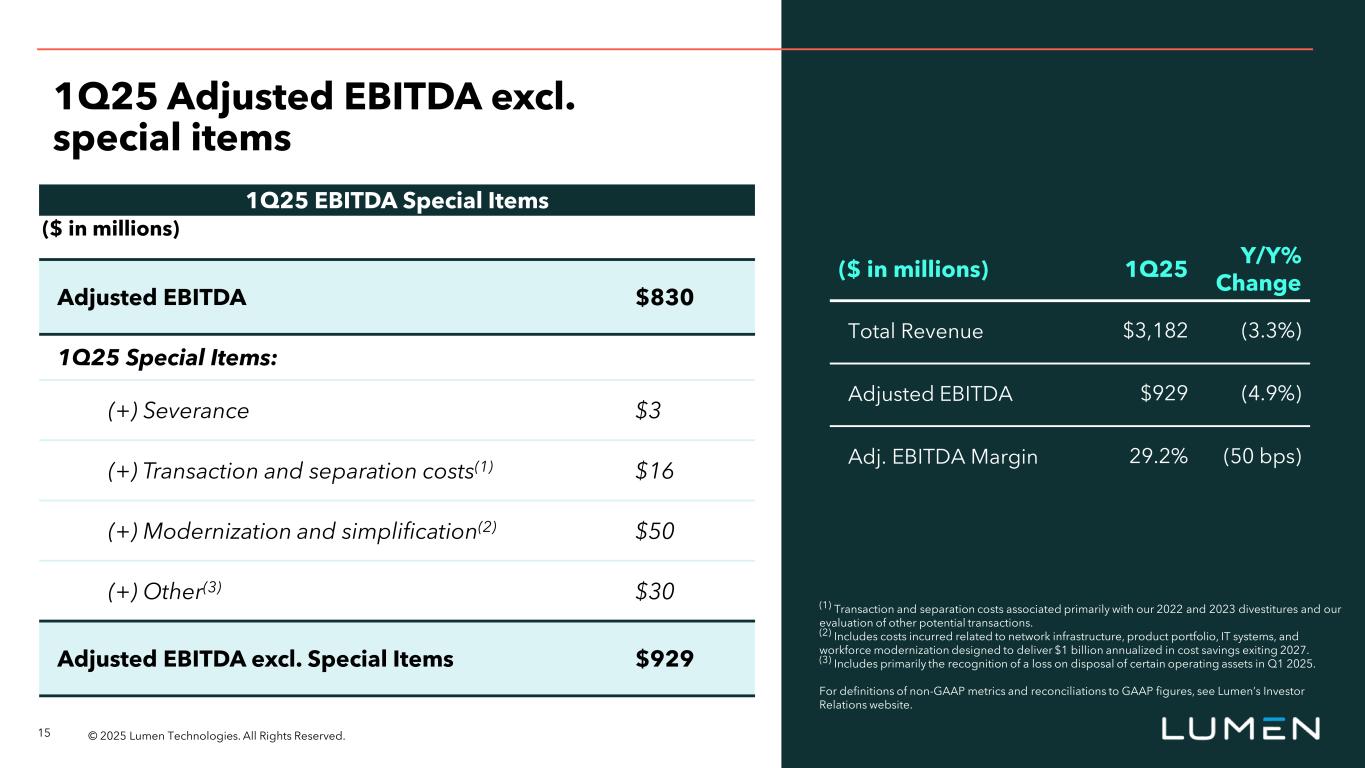
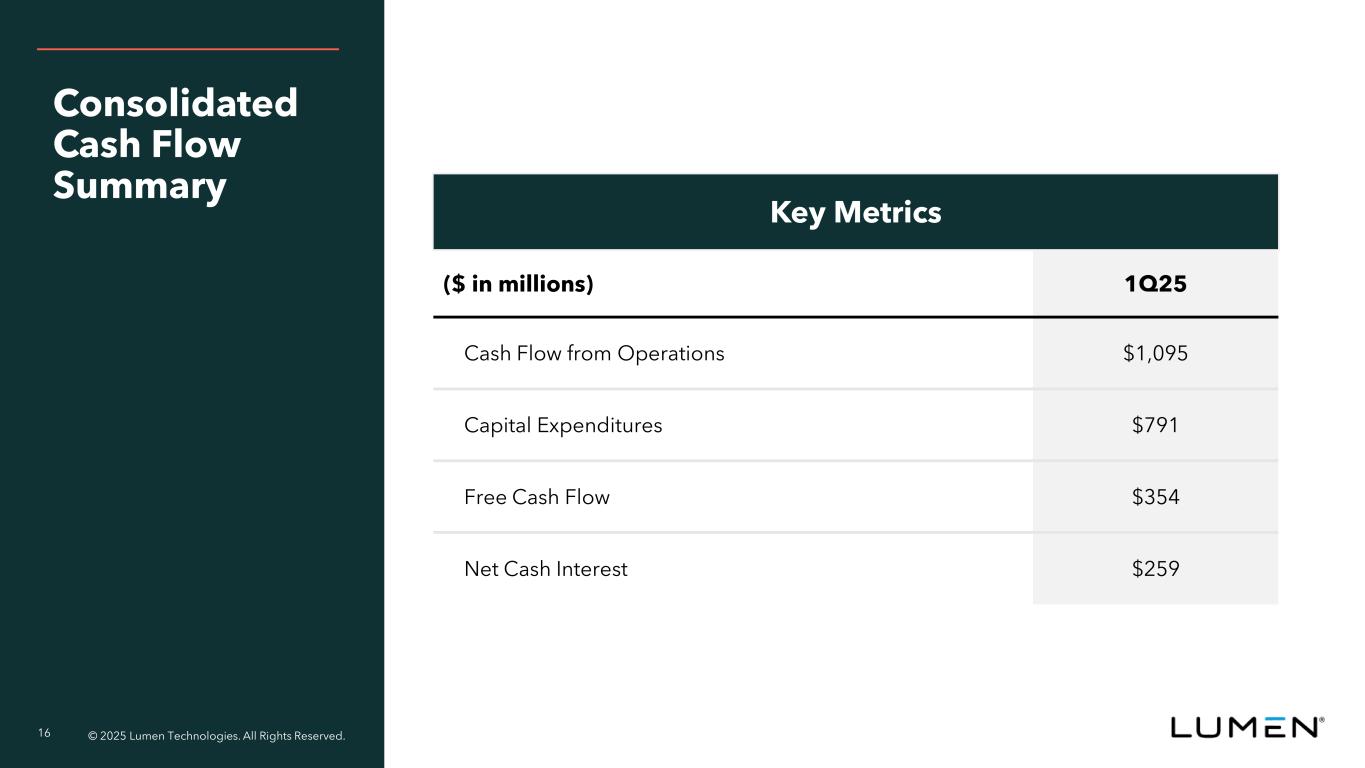
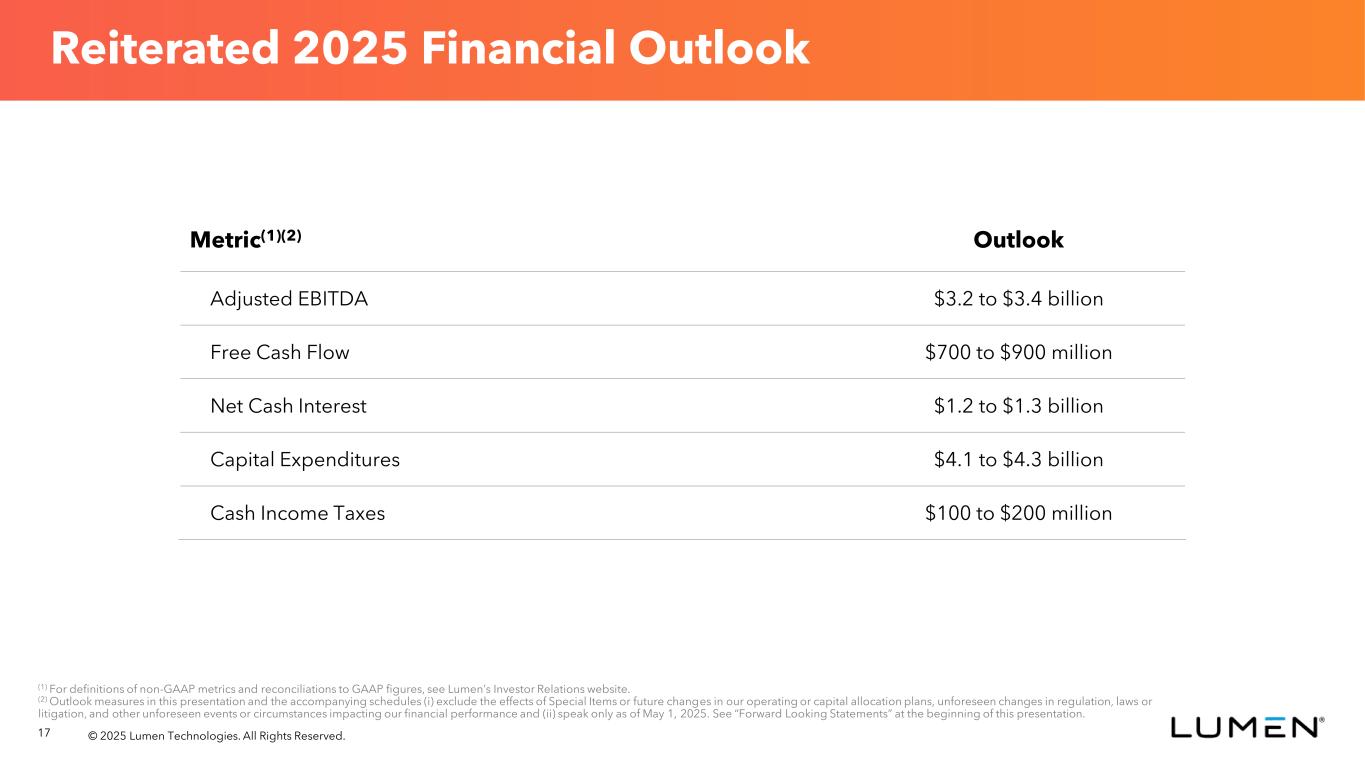
Thanks, Kate. Lumen is having a great start to 2025 as we focus on our core strategic goals to drive operational excellence, build the backbone for AI, and quantify telecom. Financially, we're encouraged by the trends we're seeing despite uncertainty in broader macro environment many of our initiatives are things we can control like our modernization and simplification quantification of our services ordering and delivery platforms and continued execution on the build out of the eight and a half billion dollars in pcf contracts we've signed to date the work we're doing inside lumen to improve our cost structure product portfolio and go to market need to happen regardless of external conditions and positions us to be more efficient and improve the overall customer experience. All of this provides us with confidence in our ability to reach our goals. During the quarter, we continue to improve our balance sheet with the March refinancing of $2.4 billion in term loans. This transaction reduces our annual interest expense by approximately $55 million and extends the loan maturity from 29 and 30 to 2032. This refinancing is a key milestone in fortifying Lumen's balance sheet and free cash flow profile. The significant interest savings is the first step of many to improve our cost of capital, reduce our leverage, normalize our maturity profile, and dramatically simplify our capital structure. We secured better loan terms in part because of our recent credit rating upgrades by Moody's and S&P Global, who recognized the AI-driven demand for Lumen PCF and our stable outlook. Based on our great start to 2025 in both our core connectivity business and in our modernization and simplification program, we have confidence in our margin expansion and total EBITDA returning to full year growth in 2026 and growing thereafter. We believe the value creation path for LUMIN is clear through increased sales, balance sheet improvements, and cost structure optimization. We're excited about our start to 2025 and the progress we're making on our core strategic goals. now let's turn to discussion of our financial results for the quarter total reported revenue declined 3.3 percent to 3.182 billion dollars business segment revenue declined 2.6 percent to 2.524 billion dollars and the mass market segment revenue declined 5.9 percent to 658 million dollars adjusted ebitda was 929 million dollars with a 29.2 percent margin and free cash flow was $354 million. Next, I'll review our detailed revenue results for the quarter on a year-over-year basis. Within our North America enterprise channels, which is in our business segment, excluding wholesale, international, and other, revenue declined by 1.7%. North American enterprise grow revenue increased 9.9% year-over-year, driven by large enterprise and public sector growth, with continued pressure in nurture and harvest product revenue. Overall, the North American business declined 2.2%. On a year-over-year basis, large enterprise revenue declined 3.7% in the first quarter, and mid-market revenue declined approximately 11.1%. In large enterprise and mid-markets, grow revenue was up 10.1% and 1.2%, respectively, offset by nurture and harvest. Public sector revenue grew 14.7% year-over-year, and as we've said in the past, public sector revenue can be lumpy quarter to quarter, but we continue to see traction with large bookings in the space, which take time to ramp to revenue. With respect to 2025, and as a result of significant re-rating in the wholesale TDM space from select smaller off-net connectivity providers, we're working with our customers to either migrate or disconnect some services. While these actions will be a drag on public sector revenue in the first half of the year, we believe they are healthy for to the overall business as we're making decisions that are EBITDA and margin accretive. Wholesale revenue declined approximately 3.6% year over year. The harvest portion of the wholesale portfolio, which is comprised of voice and private line, saw revenue contraction by 5.8% year over year in the first quarter. This is primarily driven by telco partners that are selling legacy services. Our harvest product revenue will likely continue to decline over time and as an area we'll manage for cash. Nurture revenue was down 7.8% in the first quarter on VPN and Ethernet declines, and wholesale grow revenue was positive 1.9%. International and other revenue declined 11.3%, or $11 million, driven primarily by VPN declines. As a reminder, our international and other revenue base was reduced due to the EMEA transaction, which closed on November 1st, 2023. Moving to our business and product lifecycle reporting, I'll reference the results based on our North American Enterprise channel. The 1.7% year-over-year decrease was due to declines in nurture and harvest, offset by strength and grow, particularly non-PCF dark fiber, waves, and IP. While results can vary in any quarter, we expect sustained growth in the grow product revenue as we execute on our core turnaround. Within North American Enterprise channels, grow products revenue increased 9.9% year-over-year, down from 15.3% year-over-year in the fourth quarter due to the timing of large contracts within public sector. GrowNow represents over 48% of total North America enterprise revenue, almost half, and for our total business segment carried an approximate 77% direct margin this quarter. Nurture products revenue decreased 16.6% year-over-year, largely impacted by declines in VPN. Nurture represents approximately 26 percent of our North American enterprise revenue and for our total business segment carried an approximate 61 percent direct margin this quarter. Harvest product revenue decreased 9.8 percent year over year and continues to be negatively impacted by declines in TDM based voice. Harvest represented approximately 16 percent of our North American enterprise revenue in the first quarter. For our total business segment it carried an approximate at 69% direct margin this quarter. Other product revenue increased 8.4% year-over-year. As a reminder, other product revenue tends to experience fluctuations due to the variable nature of these products. Now, moving on to mass markets. Our team continues to do a terrific job of building fiber to the home and adding new subscribers and providing great service to existing customers. Our fiber broadband revenue grew 22.9% year-over-year and now represents 45% of mass-market broadband revenue. During the quarter, Lumen added 101,000 fiber-enabled homes, bringing our total to approximately 4.3 million as of March 31st. We also added 39,000 quantum fiber customers, bringing fiber subs to over 1.1 million. Fiber ARPU was $64. At the end of the first quarter, our penetration of legacy copper broadband was approximately 8%, and our quantum fiber penetration stood at approximately 26 percent now turning to adjusted EBITDA for the first quarter of 25 adjusted EBITDA was 929 million dollars compared to 977 million dollars in the year ago quarter for the first quarter of 2025 our adjusted EBITDA margin was 29.2 percent EBITDA margins declined 50 basis points year over year compared to a 40 basis point year over year increase in the fourth quarter. Special items impacting adjusted EBITDA totaled $99 million. This includes severance, transaction, and separation costs, and our modernization and simplification initiatives. Lastly, capital expenditures were $791 million. Pre-cash flow excluding special items was $354 million. And as a reminder, we expect pre-cash flow to be lumpy quarter to quarter as we move through the large pcf bills now as we look at the outlook for 25 we're reiterating our ebitda guidance of 3.2 to 3.4 billion dollars first quarter ebitda results were above expectations and we feel it's prudent to continue evaluating the evolving macroeconomic landscape before considering increasing our guidance we've had a strong start to 25 but it's It's still early in the year, and as we gather more information, we'll adjust as needed. As a reminder, our EBITDA guidance includes organic declines similar to 2024 and roughly $200 million in incremental costs included in the annualized spend associated with building the team to expand and deliver on the PCF partnerships, the proactive disconnects on economical legacy services, and additional investments in cloud infrastructure to reduce future capex associated with utilizing our own data center assets excluded from the ebitda guidance is roughly 300 million dollars in transformation costs to begin the multi-year task of reducing expenses by one billion dollars as we stated in our last call we estimate 2026 ebitda will be greater than three and a half billion dollars our estimates are based on anticipated improvements in sales performance lower absolute declines in the legacy products and $250 million in run rate savings exiting 2025. And as such, we have confidence in margin expansion and total EBITDA returning to full-year growth in 2026 and growing thereafter. Lastly, before we take your questions, I'd like to address recent rumors around the sale of our consumer fiber business. While we will not comment directly on the details of the rumors, we've been very consistent in saying we're proud of the consumer fiber platform we built, but the investment and return profile are not consistent with our desire to focus on the enterprise connectivity and services market. We have no news to report now, but we will update the market when it's appropriate to do so. In summary, we're up to a great start to the year as we challenge the norms of traditional legacy telecom through the transformation of Lumens financials, network assets, and service delivery platforms. We believe our innovation will lead to new revenue streams that satisfy the needs of customers in today's multi-cloud AI environment while the transformation of Lumen leads to leverage and cost of capital reductions and cost structure optimization. We're excited about the path we're on and look forward to providing more updates along our journey. We'll now take your question.
Operator
Thank you. If you would like to register a question, please press star followed by the one on your telephone. You will hear a three-tone prompt to acknowledge your request. If your question has been answered and you would like to withdraw your question or your registration, please press the one followed by the three. One moment, please, for the first question. Our first question comes from the line of Michael Rollins with Citi. Please go ahead.
Thanks, and good afternoon. Two topics, if I could, please. First on the business revenue, I'm just curious if you could provide some additional context on the reasons that the grow revenue was up 10% year over year during the first quarter, including how much may be coming from existing versus new customers, and can this bucket continue to sustain double-digit growth as you look out over the next few quarters? And then just the second topic, you mentioned earlier some of the legacy TDM revenue that might need to come out, and just curious what happened to what was anticipated to be front and loaded during the first quarter in terms of some of this churn, including within the public sector, and how much is left that may come out during the second quarter or the rest of this year? Thanks.
Hey, it's Chris. So a couple of things. On the grow revenue, we said that it was really driven by dark fiber deals that were not related to the $8.5 billion in PCF. So this is underlying demand from, you know, large enterprise, primarily also some in public sector, as well as waves and IP. And in all of those areas, we do expect those trends to continue. Businesses are preparing themselves for the future of AI and are offering provide something that others are simply not providing. So we feel very good about that. And I think importantly, the fact that that grow bucket is now roughly half of what we sell is, I think, a key leading indicator to the fact that the end of revenue declines will ultimately get to. We've been very focused on this for some time, and this is really before the digital innovation that Kate really leaned into today starts to impact our results. So we feel very good about that. In terms of how much is new customers versus existing, I can't answer that off the top of my head, so I think we'll need to circle back on that one. And then as it relates to the disconnects, there was some activity in the first quarter. We're still working through the final arrangements on the balance of that, and we'll certainly provide some color through the quarter. The reality is, in total, I'm not too concerned about it, because from an EBITDA standpoint, it's, at worst case, a neutral and very likely a positive, and we will see margin improvements from that.
Operator
Our next question comes from line of Batya Levi with UBS. Please proceed with your question.
Great. Can you provide maybe a little bit more color on how cloud economics is different from telco? And if you could kind of like size the difference in margins for both worlds, I think that would be helpful to understand it. And could some of the strategies that you're implementing on the cloud communication side could also be implemented on mass markets, maybe to accelerate the profitability of that unit? And just a quick follow-up on the fiber side, as you continue the strategic review, can you just remind us on how you would think about incremental fiber builds and if you're saying any change in cost to build? Thank you.
How about yes, Kate? So, the exciting part of the Lumen Digital Platform is it enables what we're calling cloud economics because you get out of the linear revenue growth, you know, tied to the cost structure. So, the sauce lies in two places. The first is in the Lumen Digital Platform, and the second is in, you know, the fabric port. And the two go together to make it possible to sell thousands of services on one port. And in the old construct, one port could only support one service. And a service typically needed an origination and a termination point, right? So in the new construct, imagine you have a customer that's running Internet on Demand or Ethernet on Demand on a fabric port, you can sell in VoiceCloud, you can sell in Lumen Defender, and you start layering in these digital services on top of one port. So revenue goes up and the marginal cost of delivering that revenue goes down. Yeah. And that's the exciting part. And it really, it's early to call what that's going to look like. You know, we're building out a digital platform. It's a traditional J-curve. We're delighted by the adoption progress with how many customers are coming and how fast they're going from one to two and more ports. But it's probably early to make a call on the margin.
And that's part of your question i'll yeah yeah and and and on that bachia we will um as we move through the year and approach uh an investor day in september we'll give a lot more color on what that future looks like and including a new model at that point but the early feedback from customers is incredibly positive um on the uh on the additional builds progressing really nicely um we're confident that we'll continue to see expansion there, and the economics continue to look similar to what we saw in the first round. And the team is doing a fantastic job, as Kate said, of building on schedule, if not a little bit ahead at this point, and on budget. So, very pleased with that motion.
Operator
Our next question comes from the line of Jim Schneider with Goldman Sachs. Please proceed with your question.
Good afternoon. Thanks for taking my question. Two, if I may, one is relative to the PCF pipeline. I'm just kind of curious how you would expect the conversion of the remaining sort of $3.5 billion of the pipeline to potentially roll in, and would you expect additional hyperscaler deals to proceed enterprise deals, or do you think it could be a little bit more enterprise loaded in the near term? And then maybe secondly, just, you know, with respect to the overall enterprise spending environment, I believe in the FAQ, you sort of referenced that you haven't seen any change to that yet relative to sort of those more advanced fiber deals. But could you maybe address the flip side of that? You know, typically when times of budget pressure, enterprises consider sort of decommissioning legacy servers a little bit faster than they might have otherwise. so I'm wondering if you see any potential for downside on that side of things. Thank you.
Hey, it's Kate. Just a couple things. So with respect to the pipeline, as I said, we are in active discussions with these customers, and the complication and the timing is around the notion that there are net new routes. It's complicated to design, and we work side-by-side with customers to make sure that we get it exactly right. But, you know, they're still progressing. We feel good about it. Can't give you a specific time frame, but it's moving along. What we're seeing is an increase in demand and interest around our both private connectivity fabric as well as our Lumen, you know, connectivity fabric for services from enterprises, this, because what they're seeing is this unprecedented increase in volume of data generated from AI. And a lot of times they got to get it from on-prem into the cloud or from cloud to cloud or back to the edge and every combination they're in. And so they're looking for a networking partner that can provide them, you know, not just the coverage and reach of the physical network, but a digital platform to make it easy to navigate, you know, in that multi-cloud AI world. And that's what we've built for them. So we're super excited that it's progressing and bullish on what this means. And I'll kind of answer the third part of your question because it really speaks to fiber networking as critical infrastructure for us to build an AI economy in the United States and for us to be competitive on the innovation platform at a global level. And so while there could be uncertainty in the market and nothing's recession-proof per se, these are long-term strategic investments that customers have to make in order to compete. And that's why we're continuing to progress because what we've got is what they need in order to live through that next phase of our technology diffusion life cycle.
Thank you. Next question.
Operator
Our next question comes from the line of Nick DelDio with Moffett Nathanson. Please go ahead.
Hey, thanks for taking my questions. I had two. You know, first, going back to public sector, you know, Chris, last quarter you had talked about some large payments you got from a middle mile project in California that helped revenue there. I guess, did something similar happen again this quarter? I'm just trying to get a bit of a better sense the underlying trends there. And then second for Kate, how are you pricing some of the new services that you walked us through on the digital platform? I mean, are you thinking that you're going to price at a discount because they're more efficient and easier to deliver? Or are you thinking about pricing at a premium because you think they're better products?
So first of all, no, there was no big step up in the second quarter as it relates to the timing of delivery around, I think in particular, what impacted us last quarter was the state of California delivery. You know, that does get lumpy quarter to quarter. This quarter, it was a lot less than last quarter. The reality is there's strength in the public sector space. We have a killer team. They're doing great work. And we continue to be engaged on multiple large-scale opportunities. And so I I think the public sector is going to continue to be a point of strength for us.
Yeah, sure. Regarding pricing of services on the Luma Digital platform, I'm so glad you asked because this is a really important point. So I think in the old world of telecommunications, people referred to our physical network, though it was deeply insulting, as dumb pipes. And those days are long gone. We have a digital platform that we can use to really make things easier to consume for customers in a really, really complex, you know, hybrid architecture that they're navigating through every day. And our orientation is around total value of ownership. And this is really important because if we can actually help customers build higher performing, lower latency, more secure, larger capacity networks, that helps them execute their business outcomes better. They have faster innovation, faster time to revenue, you know, et cetera. If we can also, at the same time, lower cost, like, for example, bypassing disconnects in the old constructs – I'm sorry, cross-connects, sorry, bypassing cross-connects of third parties when trying, you know, to connect between clouds or from data center to cloud, you know, this delivers more value. So we can help them on the top line, and we can help them on the bottom line. And that doesn't mean we drop the price of our service. That means our service is inherently more value, and there's no more, you know, price their way to the bottom in competition with other providers. We feel like we've got real value here, and our adoption metrics are showing it.
Operator
Our next question comes from the line of Greg Williams with TD Cohen. Please proceed with your question.
Thank you. Good afternoon. Thanks for taking my questions. Just two questions. One, I think you know CapEx is $791 million, so it sounds like it's going to ramp up pretty fast. And I know, Chris, you mentioned free cash flow could be lumpy, but can you help us with a sense of the cadence of the CapEx spend through the balance of the year? And same question on the upfront hyperscale fees that you get. would help um second question just around the public sector you noted it was a point of strength which sounds encouraging because the question i have is are you seeing any risk on the doge efficiency cuts in the sector um you know you noted public would be strong but a few of your peers noted some some pressure uh from government cuts thanks yeah so i'll answer the first part um you really don't want to get into kind of the timing of you know inflows and outflows quarter by quarter.
We're really confident in the annual guidance, which would obviously suggest that on the CapEx spend side, that you will see a ramp up. It is really, you know, volatile quarter to quarter in terms of the timing of payments. We're dealing with, you know, major network components that can move by hundreds of millions of dollars quarter to quarter.
So trying to predict, you know, know effectively to get you know get to quarters you got to get to weeks and days and the reality is it's just not that predictable but in total uh we feel very good about the guidance for the year and then yeah and regarding the uh the impact of doge in the public sector market look what we're seeing is that this administration is very committed to modernization and simplification and uh they're trying to to reduce costs and and enable the united states to be more competitive you know, in the various global theaters. And that presents a huge opportunity for our company, given our network and the platform that we're building on it. And also there's a pretty significant return to office trend that's, you know, delivering near-term opportunities as well. So all in all, we are pretty bullish in the public sector space as well.
That's helpful. Next question.
Operator
Our next question comes from the line of Frank Lawton with Raymond James. Please go ahead.
More color on your NOS product. And how are you differentiating yourself in the market with that? And what sort of traction you're getting there? And then secondly, a little bit more, one more clarification on the public sector. Can you give us some color on the weakness you referenced? Is it going to be weaker relative to what you reported this quarter or going forward from this level? How should we think about it? Thanks.
So, Frank, you cut out and we didn't hear the first part of your question. I'll let Chris answer the second part. What was the first part?
The first part of the question was around the connectivity fabric, the NOS product. How are you differentiating that in the industry? Who's buying that product? Where are you finding traction with that in the market?
So interestingly enough, there's a couple things. The NAS product in market doesn't have a like-for-like competitor. So there are digital companies that don't own the network, and so they can't integrate the platform capabilities into the fiber. And then there are, you know, networking companies that aren't building a digital platform. And, you know, as you know, we've got a pretty big competitive or strategic moat with our physical network. It's got scale coverage, unique routes, you know, huge capacity with room to grow. and the major CSPs are all now connected to it. And so we've got this ecosystem and the digital platform itself is starting to bring customers who just want an easier experience. They wanna sort of not have the old experience of static point to point and long ordering cycles and all that kind of stuff. They wanna fire up any port, any service, anytime, anywhere because that's what they get with cloud. and that's their expectation, and they can get that on the LumenDigital platform. And I think there's a third piece. You put all these together with some of the other announcements we've made, direct fiber access into the cloud, direct fiber access between, you know, prem locations and edge and data centers is very unique. And that's something that we're excited about because it's going to continue to improve performance of our network. and further separate us from any other company that tries to compete.
And on public sector, Frank, I think the reality is what we're seeing in terms of both opportunity and booking trends is very strong performance out of the public sector team. I don't want to try to predict what that means in terms of the performance this quarter versus where we end up next quarter. I think in the end, the impact of this off-net piece is, you know, one will obviously share what it is when we get there, but it's not going to have an impact on bottom line, and we'll isolate what that impact is when we make the changes in the second quarter. But broadly speaking, a number of different opportunities from a number of different agencies that we're working on, and we feel really good about where we sit right now.
Operator
Next question? Our question comes from the line of Jonathan Chaplin with Newstreet Research. Please go ahead.
Thanks. Just one question for Kate. So the explanation of how the Lumen connectivity platform is going to be disrupted to the industry was really helpful, Kate. I was wondering if you could give us some context on who's disrupted. So on the revenue side, I understand how the platform sort of facilitates revenue growth for customers. How much of the sort of the revenue that goes onto that platform is coming at expense of your nurture and harvest categories? And then how much, you know, how much from outside of Lumen? And on the cost disruption side, who's getting disrupted there? Is it sort of the traditional data center companies, or is it your sort of enterprise competitors, AT&T and Verizon? Thank you.
Yeah, great question. So the disruption is kind of across the industry, across the ecosystem and all the players. So what customers get is they're getting, you know, a digital experience, higher performance more value and uh you know they can avoid the costs that they pay to these third-party intermediaries like the uh the carrier neutral facilities because they're they're you know they're eliminating the need for cross connects so there's a lot of value for customers and it's different and you know we're building it out and uh it's still early days um but we have a huge amount of demand for this notion of, you know, direct fiber access and direct on ramps from cloud to cloud, because a lot of enterprises need to move data from one cloud company for, you know, to another, say from Azure into GCP and back and forth. And today, if they want to do that, they've got to do a lot of hop, skip and jumps across companies that charge them fees. And what we're offering is a direct connection where those cross-connect fees are no longer needed. And that's disruptive, obviously, to the data center companies. It's also disruptive, but in a very positive way, to the cloud service providers, what we're seeing as an early trend and it's early days. But our NAS offering is driving higher bandwidth consumption through our cloud connect offering into clouds. And when I say higher, like it's an incredible rate. I don't want to give it right now, but over the past 90 days, very, very significant growth. And what that suggests is that there's a faster path to revenue for the cloud companies partnering with Lumen to provide networking for their end customers. So, you know, and I think we want to spend more time on this at Investor Day because it's really disruptive in a lot of different ways. And the thesis is this. Telecom hasn't innovated in a long, long time. And we made some really tough choices two years ago to rethink how we spend our capital. And you're seeing the fruits of those investments now with this platform and with value that we're delivering to enterprises. And it's still early in our transformation life cycle, but the feedback from customers is really terrific. The feedback from the cloud service providers, really terrific. So we're very, very excited about our progress.
Operator
There are no further questions at this time.
Thanks, everyone, for joining the call today.
We appreciate you reaching out with any questions.
Operator
That does conclude the conference call for today. We thank you for your participation and ask that you please disconnect your line. Have a great day, everyone.