Speaker 1
Good afternoon, and welcome to MasterBrand's second quarter 2026 earnings conference call. During the company's prepared remarks, all participants will be in a listen-only mode. Following management's closing remarks, callers are invited to participate in a question-and-answer session. Please note that this conference call is being recorded. I would now like to turn the call over to Henry Harrison, Senior Director of Corporate Financial Planning and Analysis.
Speaker 5
Thank you, and good afternoon. We appreciate you joining us for today's call. With me on the call today are Dave Banyard, President and Chief Executive Officer of MasterBrand, and Andy Simon, Executive Vice President and Chief Financial Officer. We should have pressed release earlier this afternoon disclosing our second quarter 2026 financial results. This document is available on the Investors section of our website at masterbrand.com. I'd like to remind you that this call will include forward-looking statements in either our prepared remarks or the associated question and answer session. These forward-looking statements are based on current expectations and market outlook. They are subject to certain risks and uncertainties that may cause actual results to differ materially from those currently anticipated. Additional information regarding these factors appears in the section entitled Forward-Looking Statements in the press release we issue today. More information about risk can be found in our filings with the Securities and Exchange Commission, including under the heading Risk Factors in our Full Year 2025 Form 10-K, An update is necessary in our subsequent 2026 Form 10-Qs, which are available at scc.gov and at masterbrain.com. The forward-looking statements in this call speak only as of today, and the company does not undertake any obligation to update or revise any of these statements, except as required by law. Today's discussion includes certain non-GAAP financial measures. Please refer to the reconciliation tables, which are in the press release issued earlier this afternoon, and are also available at scc.gov and at masterbrain.com. Our prepared remarks today will include a business update from Dave, followed by a discussion of our second quarter 2026 financial results from Andy, along with our second half 2026 financial outlook. Finally, Dave will make some closing remarks before we host a question and answer session. With that, let me turn the call over to Dave.
Speaker 6
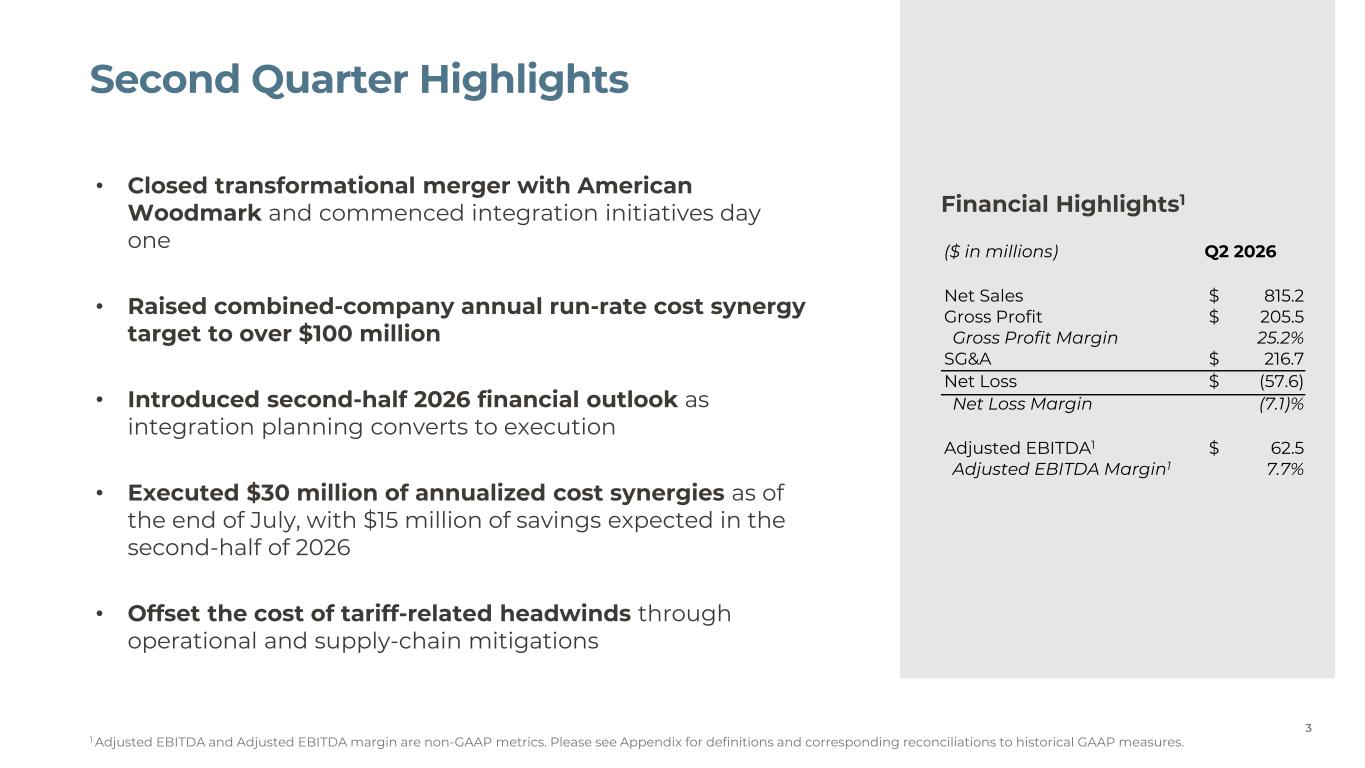
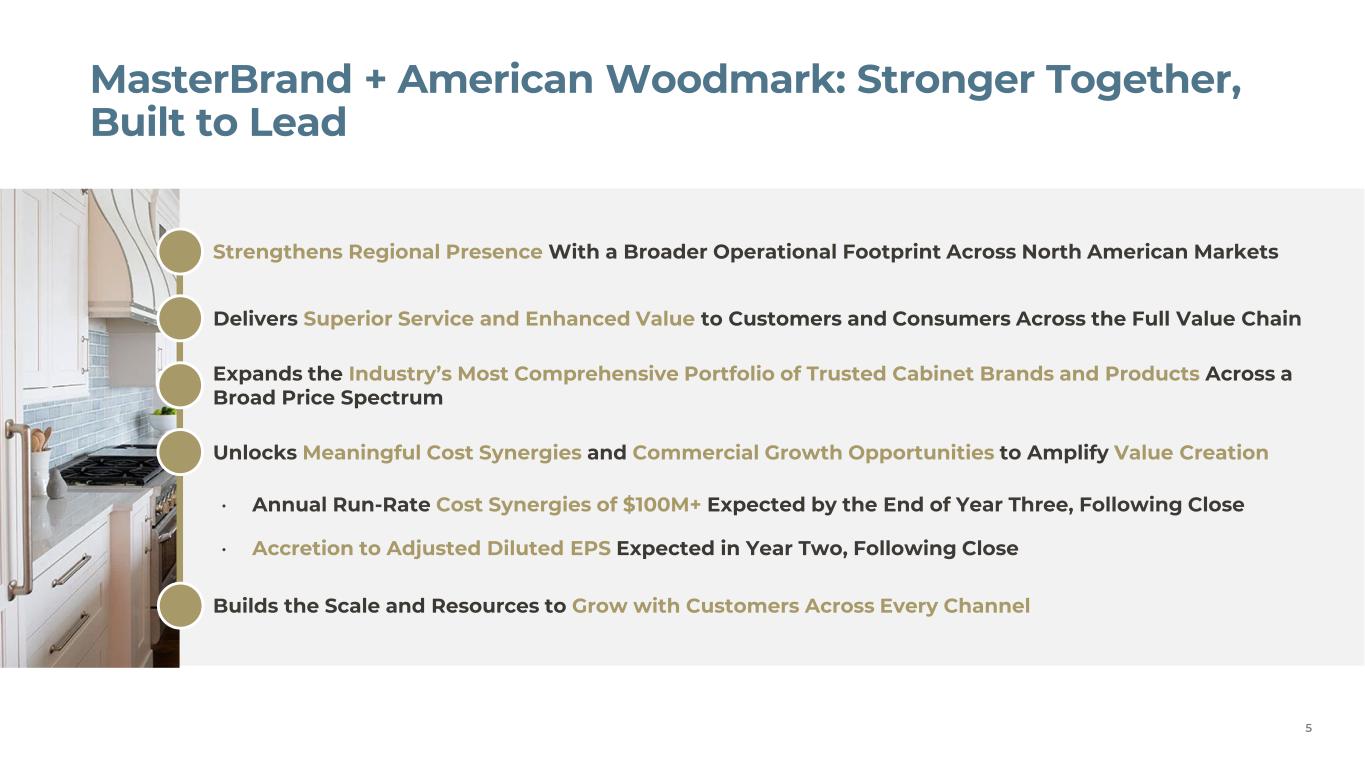
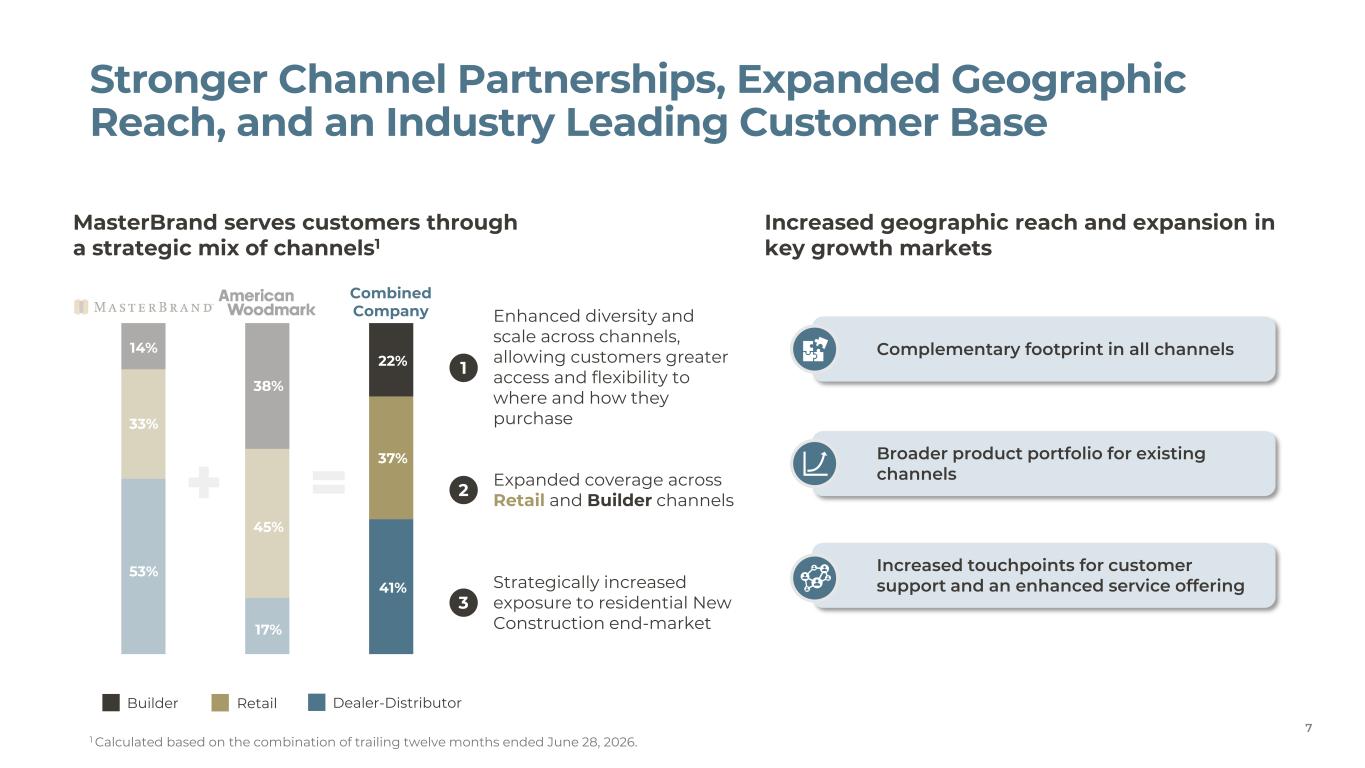
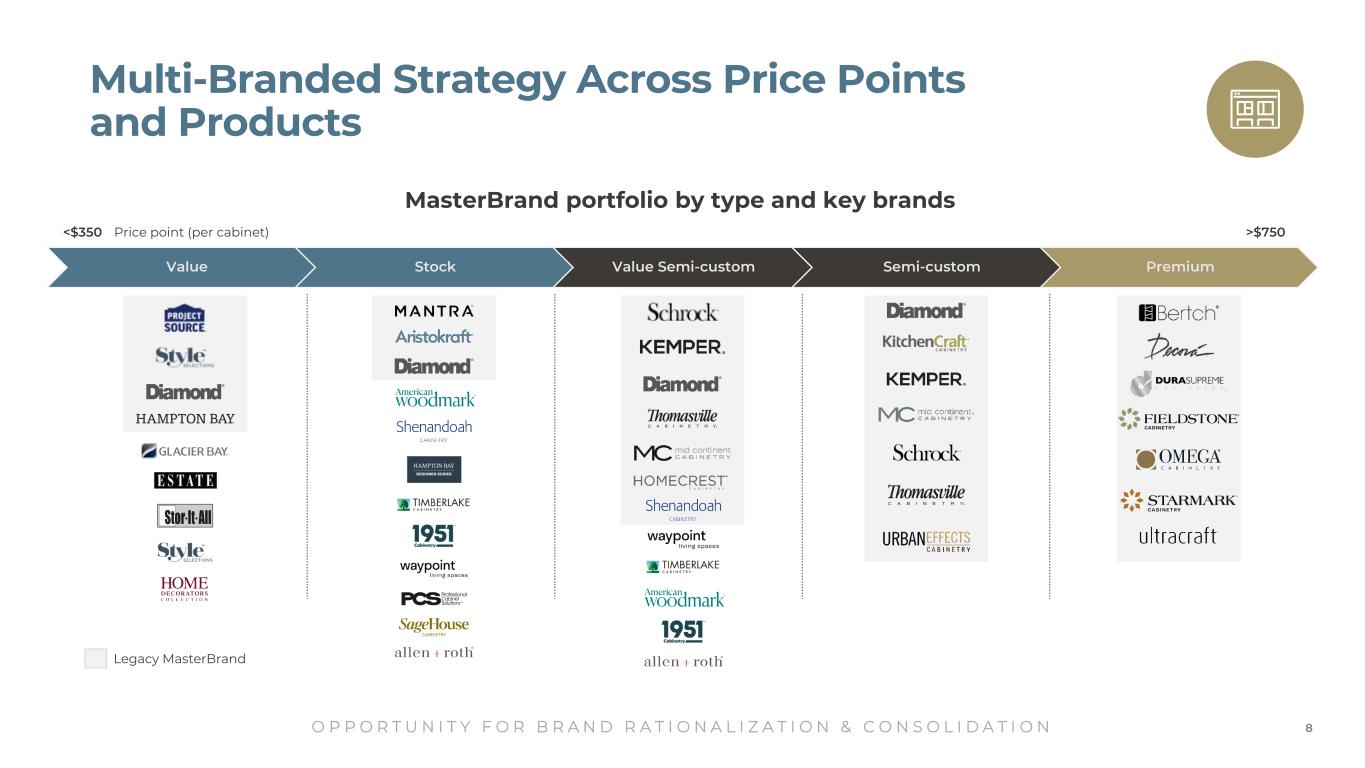
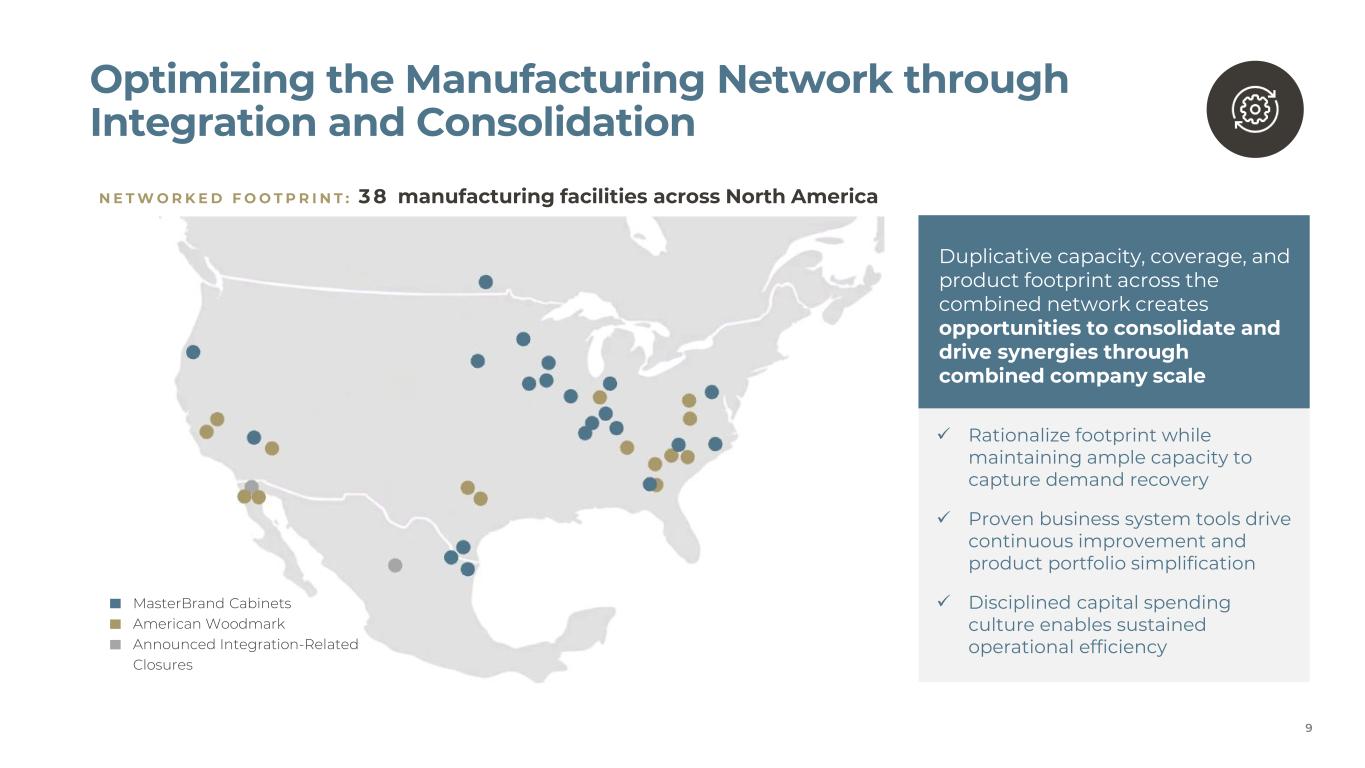
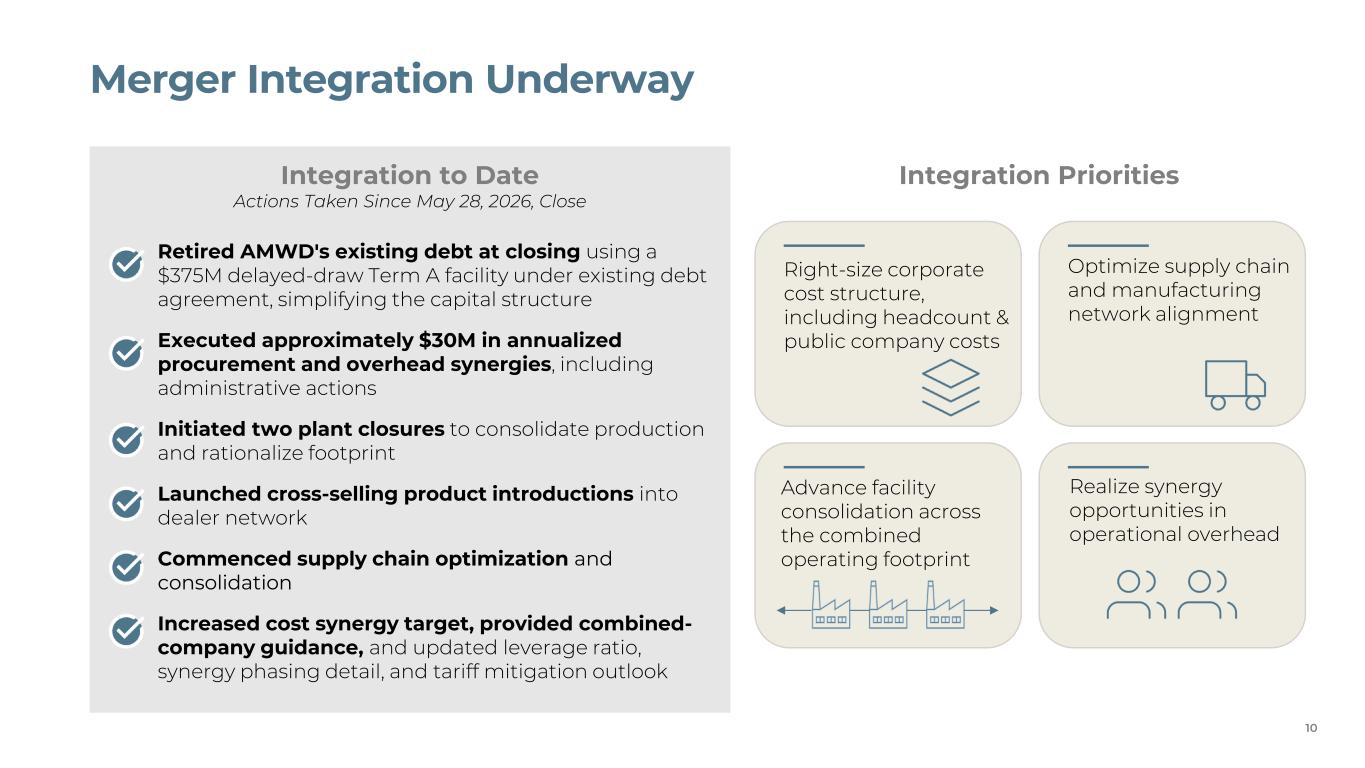
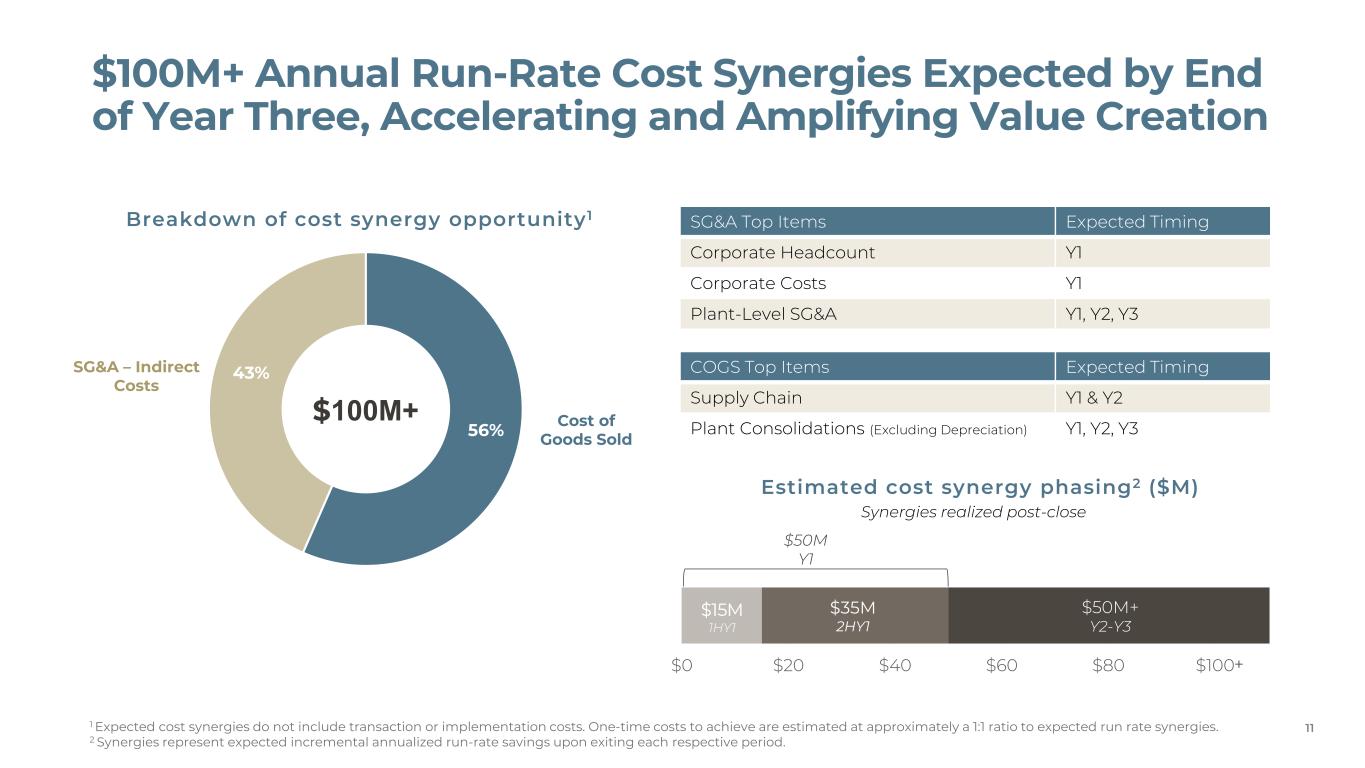
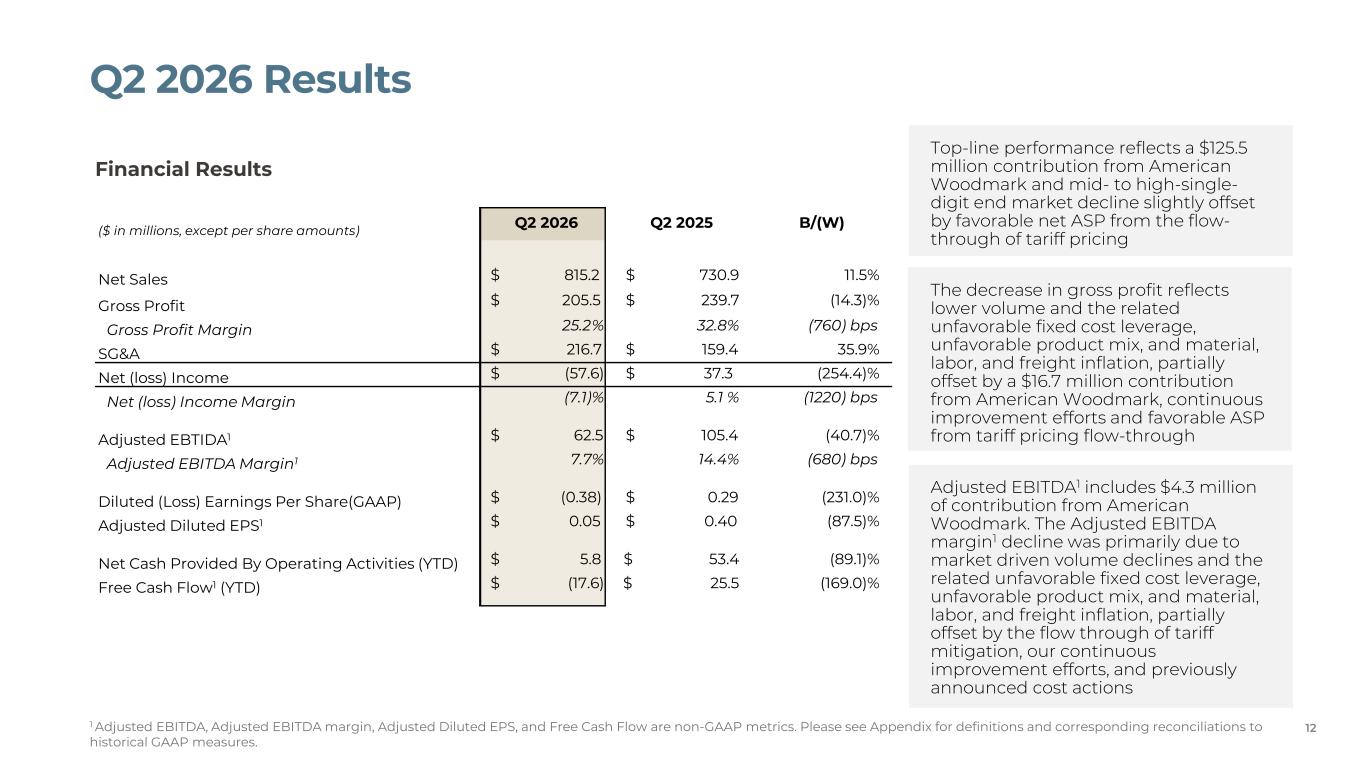
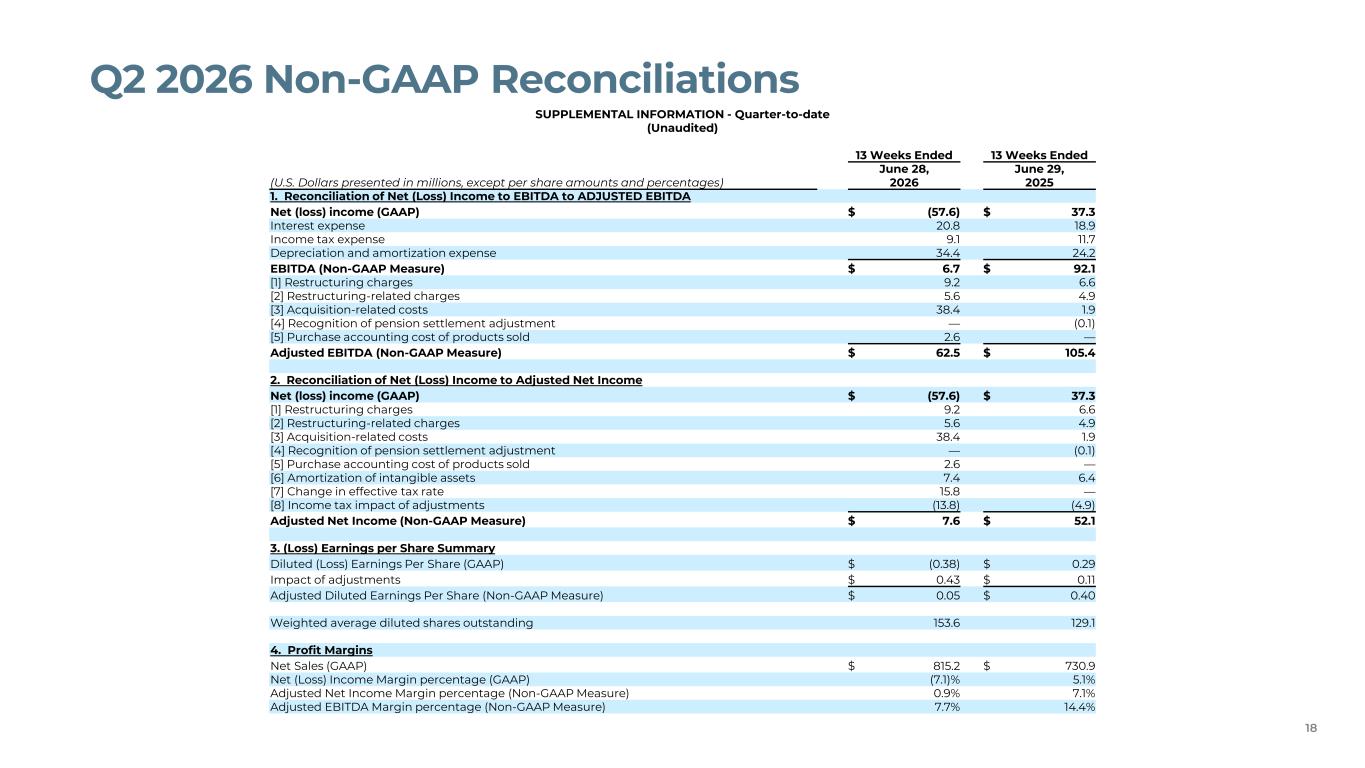
Thank you and good afternoon, everyone. We appreciate you joining us for today's call. The second quarter marked an important milestone for Masterbrain. On May 28th, we completed our merger with American Woodmark, bringing together two industry leaders to create the most comprehensive portfolio of trusted cabinet brands in North America. I want to start by welcoming our new associates from American Woodmark and thanking our teams for staying focused on executing and delivering for our customers through the close. This is our first earnings call as a combined company, and the commitment we have seen across the organization in these first weeks has only strengthened our conviction in what this combination can deliver. Today I'll cover our second quarter results, the state of our end markets, and the combined company's path forward. Now turning to the quarter. We generated net sales of $815 million in the quarter, which includes $126 million of American Woodmark net sales from the close date. Legacy Master Brand net sales were $690 million, in line with our guidance range, calling a mid-to-high single-digit year-over-year market decline, slightly offset by favorable net average selling price due to the flow through of tariff pricing. Adjusted EBITDA for the quarter was $63 million, including $4 million of partial period contribution from the American wood market, and adjusted EBITDA margin was 7.7%. Legacy Master Brand adjusted EBITDA was $58 million, and adjusted EBITDA margin was 8.4%. The lower margin was primarily due to market-driven volume declines and the related unfavorable fixed cost leverage, unfavorable product mix, and material, labor, and freight inflation partially offset by the flow-through of tariff mitigation are continuous improvement efforts and previously announced cost action. For the quarter, free cash flow was $129 million compared to $67 million in the same period last year, primarily reflecting improved working capital. This quarter, we are introducing second half of 2026 outlook for the combined company. Now that the merger is complete and integration planning has converted to execution, we have better visibility into the combined business than earlier this year and have grown more confident in our ability to navigate the dynamic trade environment. The introduction of the second-half guide reflects our improved line of sight and confidence in the actions and plans underway. It's not a change in our view of the market. Andy will walk you through the details shortly. Let me now briefly review our end markets in the quarter. During the second quarter, as anticipated, the broader single-family new construction market softened further, down mid-to-high single digits, driven by ongoing pressures on completions and persistent affordability challenges. With inflation picking back up, the higher-for-longer outlook on interest rates continues to weigh on both builders and buyers. Builder confidence remains near its weakest level since the housing crisis era, and more than 60% of builders are offering sales incentives. Against that backdrop, our new construction business declined at low single digits, excluding the impact of partial period American woodmark sales in the quarter, continuing to outperform the broader market. Shifting to the repair and remodel markets served by our dealer and retail customers, we saw continued softness in demand, consistent with recent quarters, as end markets remained impacted by affordability pressure, low existing home turnover and historically weak consumer sentiment. Consumers continued to defer large discretionary projects, and the trade downtrend we've been seeing persisted, as consumers opted for value products and pared back features in made-to-order categories, a key driver of this quarter's mixed pressure. Excluding the partial period contribution from American Woodmark, our repair and remodel business declined mid to high single digits, in line with the broader market and our expectations. Layered on top of these market dynamics, the ongoing conflict in the Middle East continues to introduce added consumer uncertainty and broader market volatility that remain difficult to size at this stage, including rising fuel costs that are adding further pressure to an already cautious consumer. Taken together, our view of the 2026 addressable market down mid-single digits is directionally unchanged from our previous view, and our outlook assumes no improvement in demand conditions this year, with the broader market expected to begin its recovery in 2027. Now, turning to the merger and why we're so excited about the combined company. As we said at the announcement, this combination brings together two customer-centric platforms with highly complementary strengths, strong, broad portfolios of trusted cabinet brands, and streamlined, low-cost manufacturing profiles. Both are long-established American companies, with the vast majority of manufacturing operations based in the United States, a differentiator we believe matters more than ever in today's trade environment. We believe this combination will ultimately enable us to drive growth and improve margins beyond what either company could achieve on its own. New construction and the home centers have been the two most resilient segments of the market through this downturn, and we believe they hold significant potentials when the eventual recovery comes. Together, Masterbrand and American Woodmark can build the most efficient, cost-effective model for serving these large channels. In new construction, the combination gives us the geographic reach with an industry-leading model to better meet the customer where they are, whether direct or through distribution. The combination also strengthens our position in key new construction markets and enhances our product portfolio. We plan to apply the same disciplined approach to the combined business that has helped Legacy Master Brand outperform the new construction market, and we're confident in our ability to earn back a share American Woodmark has seeded in this channel prior to the merger. In the home centers, the added scale across our combined network enables better inventory management, more product options, and an operating footprint that is well-positioned to bring the high service levels our partners expect. In the dealer channel, the clearest opportunity is cross-selling American Woodmarks products in the master brand's much larger dealer population, allowing us to meet customers and consumers at every price point with the best value, quality, and design. Realizing the full sales potential of this channel will take more time, given current market conditions. It also requires thoughtfully organizing a combined product portfolio and brand package, including meaningful brand and price point white space for a highly fragmented market. We expect this work will simplify our offering for the channel over time. Across new construction, home centers, and dealer, these cross-sell and white space opportunities were not built into our original deal model, and we view them as upside to the transaction economics. Stepping back, the strategic logic of this combination comes down to two factors, scale and flexibility. Our scale reduces inefficiencies and duplication and extends service across a broader geographic footprint. The flexible operating model that we have championed over the past six years creates a simple, connected product continuum that consumers can choose from with ease. And because we are investing in a much larger platform, our investments make an outsized impact, including increased investment in next-generation automation, product innovation, and enhanced in-person and digital engagement, all aimed at greater efficiency and a better customer experience. Turning to integration and cost synergies. Integration is off to a strong start. We've aligned our senior leadership structure, and we're now organizing the next layers of the business. Where processes overlap, we're adopting the best of what each company has built. Where they differ, we're implementing the strongest approach, along with the systems that come with it. Additionally, across the two companies, we have overlapping capabilities and products, as well as excess capacity in our manufacturing network. We intend to apply the same manufacturing network optimization and disciplined integration track record we've built over time to capture greater efficiency. We're already realizing early procurement and overhead synergies, and we've initiated two plant closures to begin consolidating our production footprint. We've also begun the process of cross-selling our product portfolios into the dealer network. As of the end of July, we've executed approximately $30 million of annualized cost synergies, and we expect roughly $15 million of savings in the second half of 2026, with corporate overhead and procurement the primary sources executed to date. In total, we now expect over $100 million of annual run rate cost synergies by the end of year three post-close, exceeding our original synergy target, and we continue to expect the transaction to be accreted to adjusted diluted earnings per share in year two post-close. Importantly, the stated $100 million plus annual run rate Synergy Target excludes both the $30 million of legacy MasterBrand cost actions we announced last quarter and American Woodmark's previously announced closure of its Monterey, Mexico facility, which has already completed its wind down. Both of those programs are incremental savings on top of the Synergy Target. Now turning to capital allocation. For the second half of 2026, we expect capital expenditures of $71 million, or 3% of net sales, including integration capital. We are prioritizing high return projects, and by eliminating plan spending in overlapping areas of the network, we estimate $4 million of CapEx synergies in the second half of 2026 alone. Beyond CapEx, our priorities are clear. The near-term focus is the balance sheet. We're currently targeting a net leverage ratio below two times by the end of 2028. As synergies build and the integration process progresses, we expect our financial flexibility will grow. We anticipate that achieving our target leverage range will open the door to resuming share repurchases and opportunistic M&A. The path is straightforward and we have a clear line of sight to executing against it. Before I turn it over to Andy, I want to step back and talk about the earnings potential of this combined business because it follows the same principles, focusing on what we can control. After an initial assessment, we believe there's a path to structurally higher profitability for the combined business, independent of a market recovery, meaning any improvement in demand would be upside to that path. There are four levers that drive it. First, and our top priority, is cost discipline. The last three years have taught us we can't count on a market recovery, so we're removing that variable from the equation. Across SG&A and our manufacturing footprint, it is clear that both companies carried excess costs from operating independently through a prolonged downturn and the merger closing process. We're aligning that cost base to a level appropriate for a combined company of our scale, and that work is already underway. Second, resetting our product portfolio and the supply chain behind it. Consecutive years of inflation and market decline forced fast pricing and portfolio decisions at both companies, and not all of them are optimized for where the market has landed. Similarly, the need to rapidly mitigate tariffs required us to make quick supply chain decisions that prioritize speed over optimization. Legacy Masterbrand already carried the industry's most comprehensive product portfolio, and the combination with American Woodmark presents a natural opportunity to rebalance the portfolio of the combined company while maintaining complete coverage and a range of choices across the full price spectrum. In parallel, we're implementing the MasterBrand way to optimize our sourcing and manufacturing configuration to ensure the combined business operates as efficiently as possible without sacrificing key service metrics. We have a strong track record here. Over the past five and a half years, we've closed 11 plants while consolidating production into our remaining network, all the while preserving capacity and service level, and we intend to bring that same discipline to the combined footprint. Third, leveraging the portfolio to support a healthier product mix across end markets and drive profitable growth. This opportunity is particularly meaningful in new construction, where we believe our breadth of products and price points, combined with our deep relationships and service expertise, enables the combined company to serve builders better and more efficiently. And finally, we're investing behind dealer share gains. We believe the continued investment in technology, quality, and service across the combined dealer network will position us to grow with our dealer partners even in a flat market and we expect that to meaningfully advance that path despite persistent challenging market conditions the completion of this merger marks the start of a new chapter for master brand a combined platform with a clear path to growth tangible synergy targets and strong early momentum on integration i'm pleased to announce that we will host an investor day in the first quarter of 2027 where we plan to size each of these levers and lay out the time down plan behind We will also introduce the full combined company story, including our strategy and refresh long-term financial targets. This is a company we are proud to be building, and we look forward to seeing many of you there. With that, I'll turn it over to Andy for a detailed review of our financial results and outlook.
Speaker 0
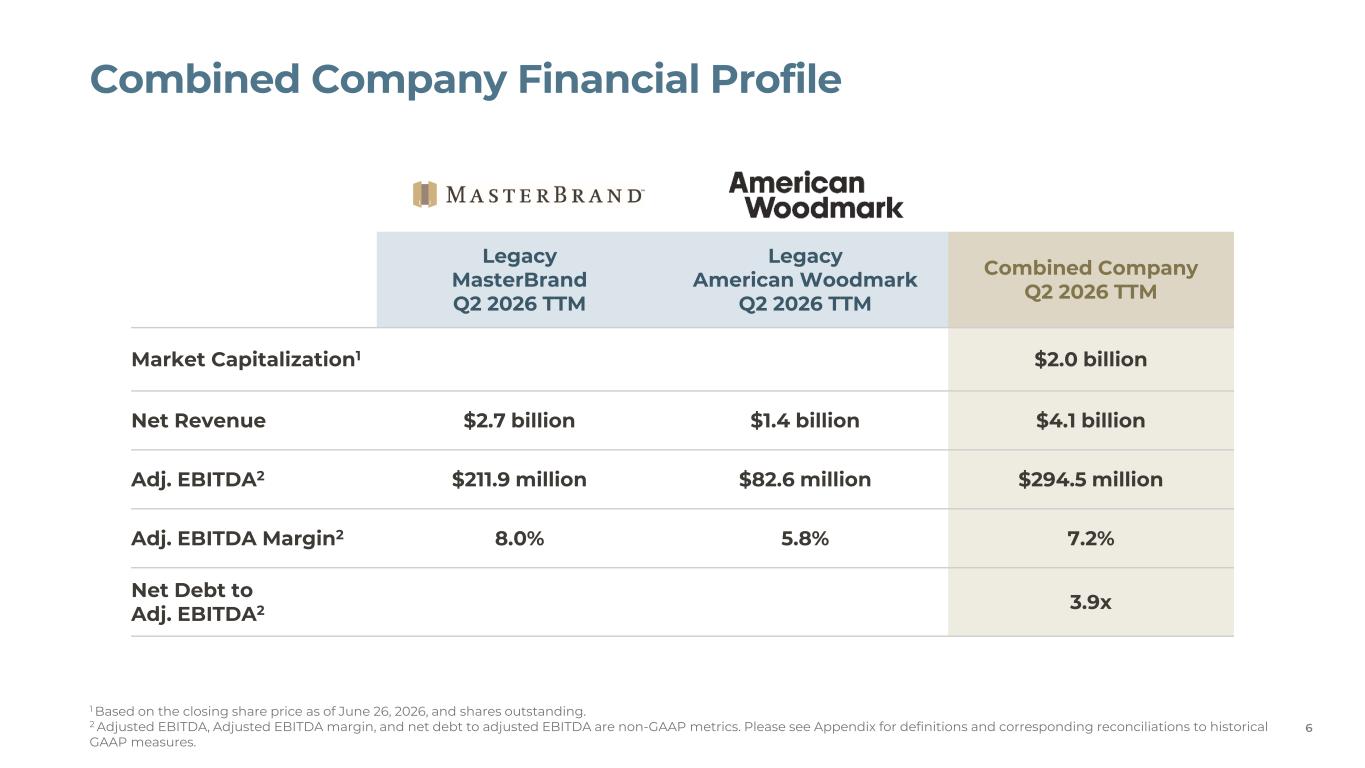
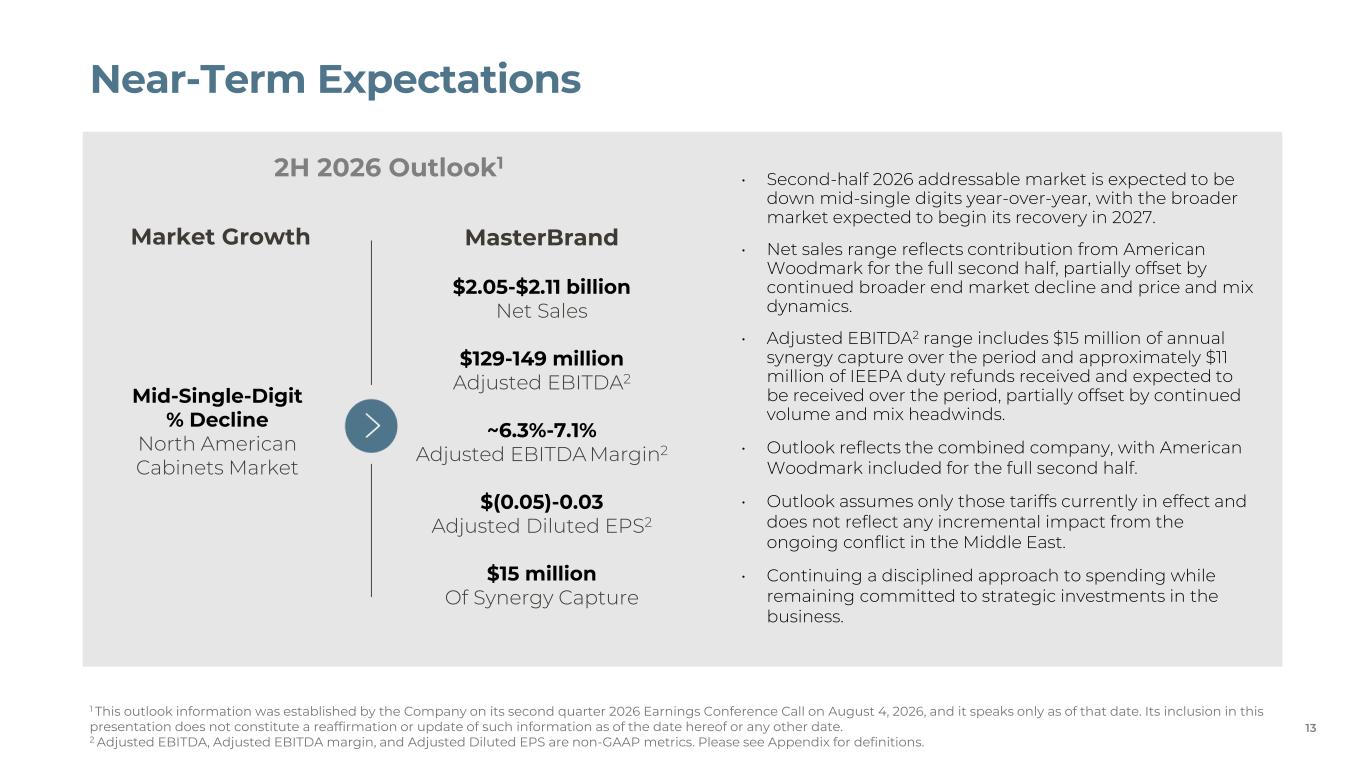
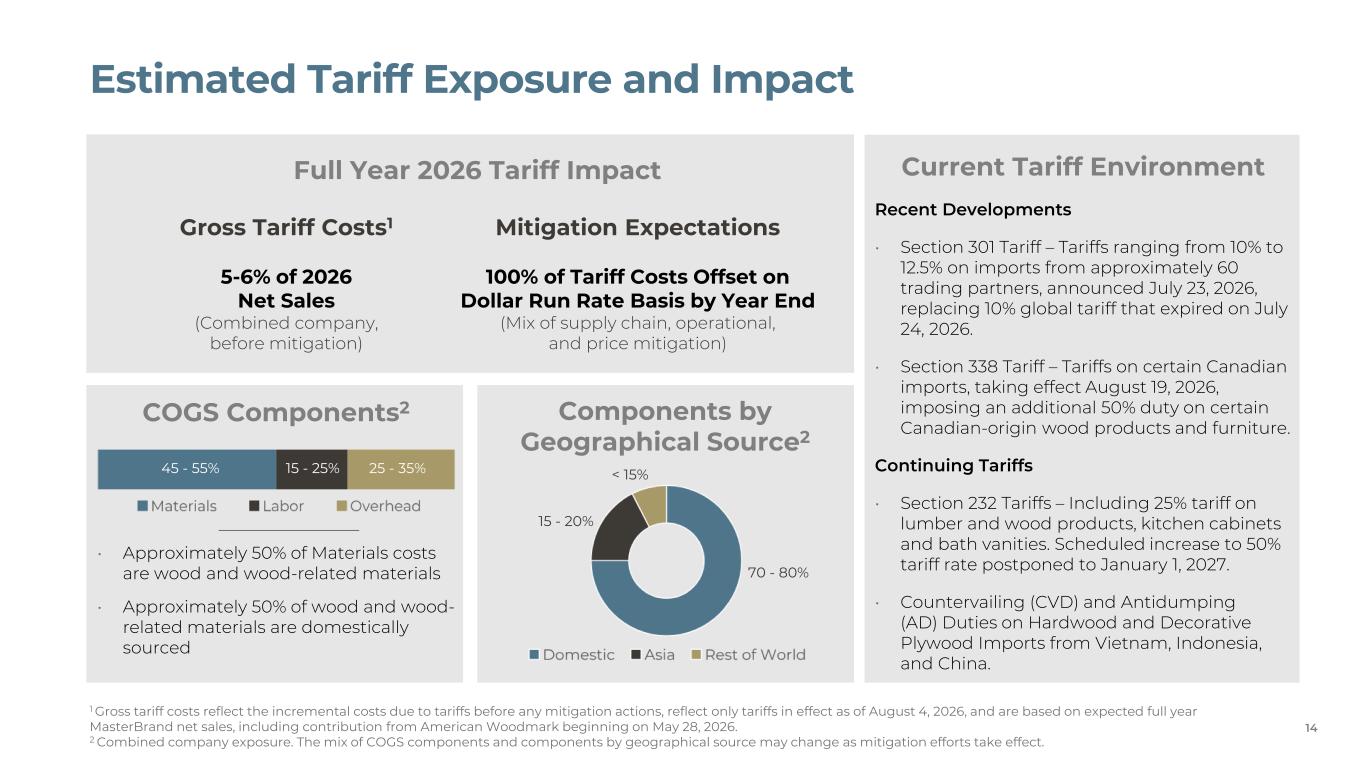
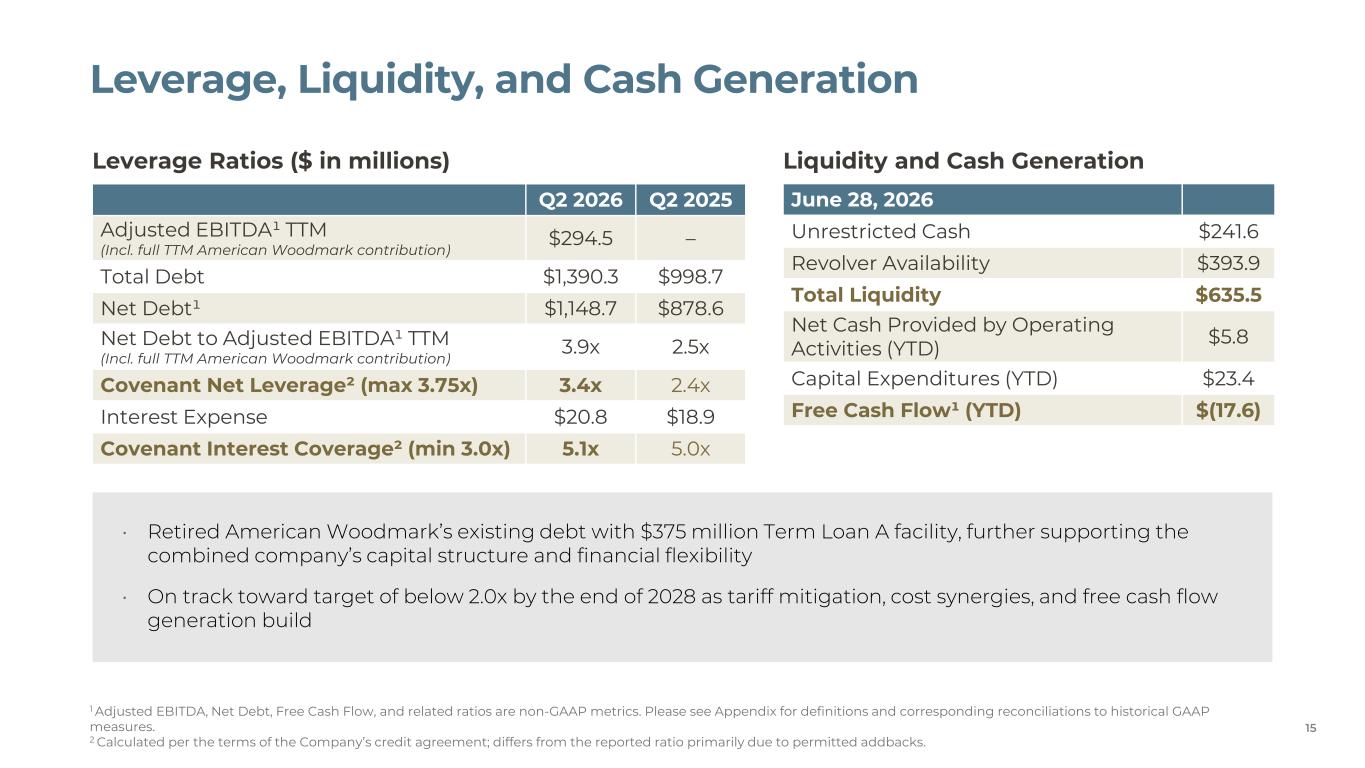
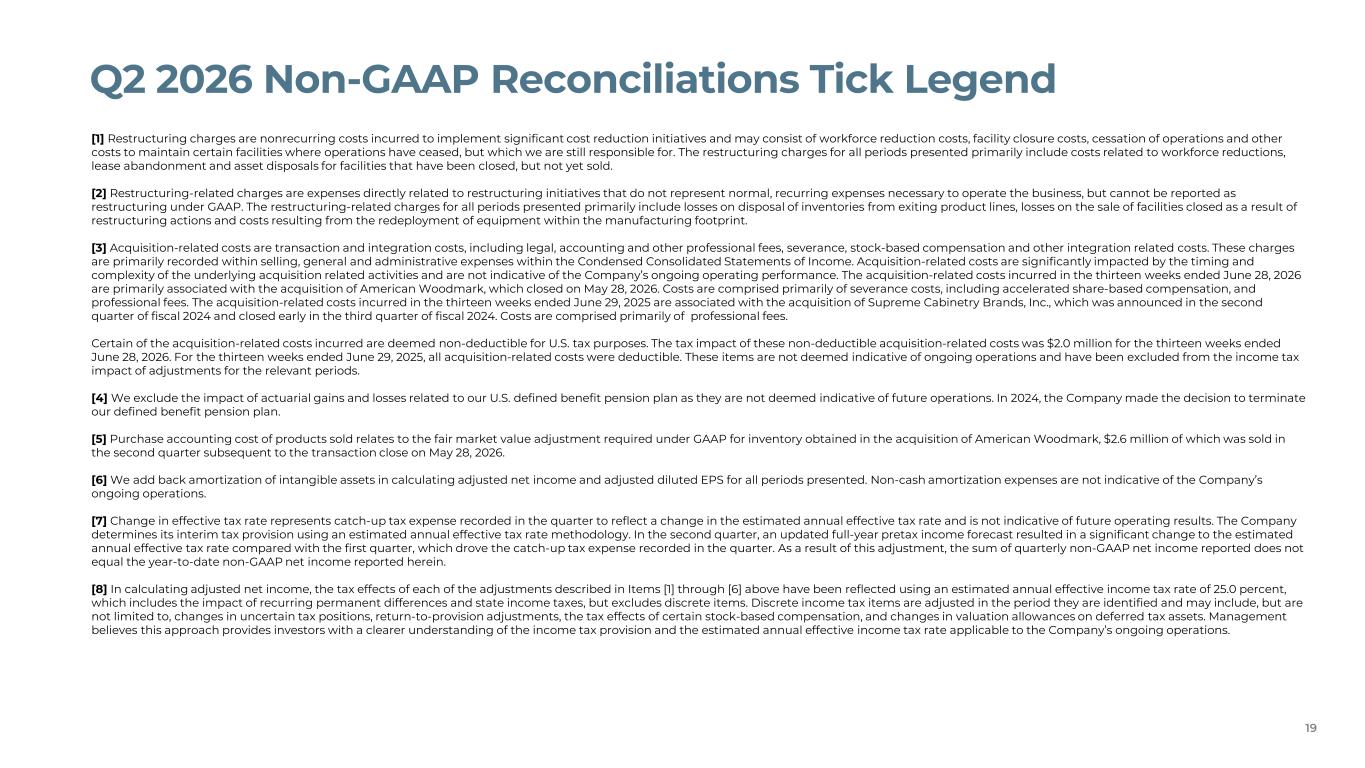
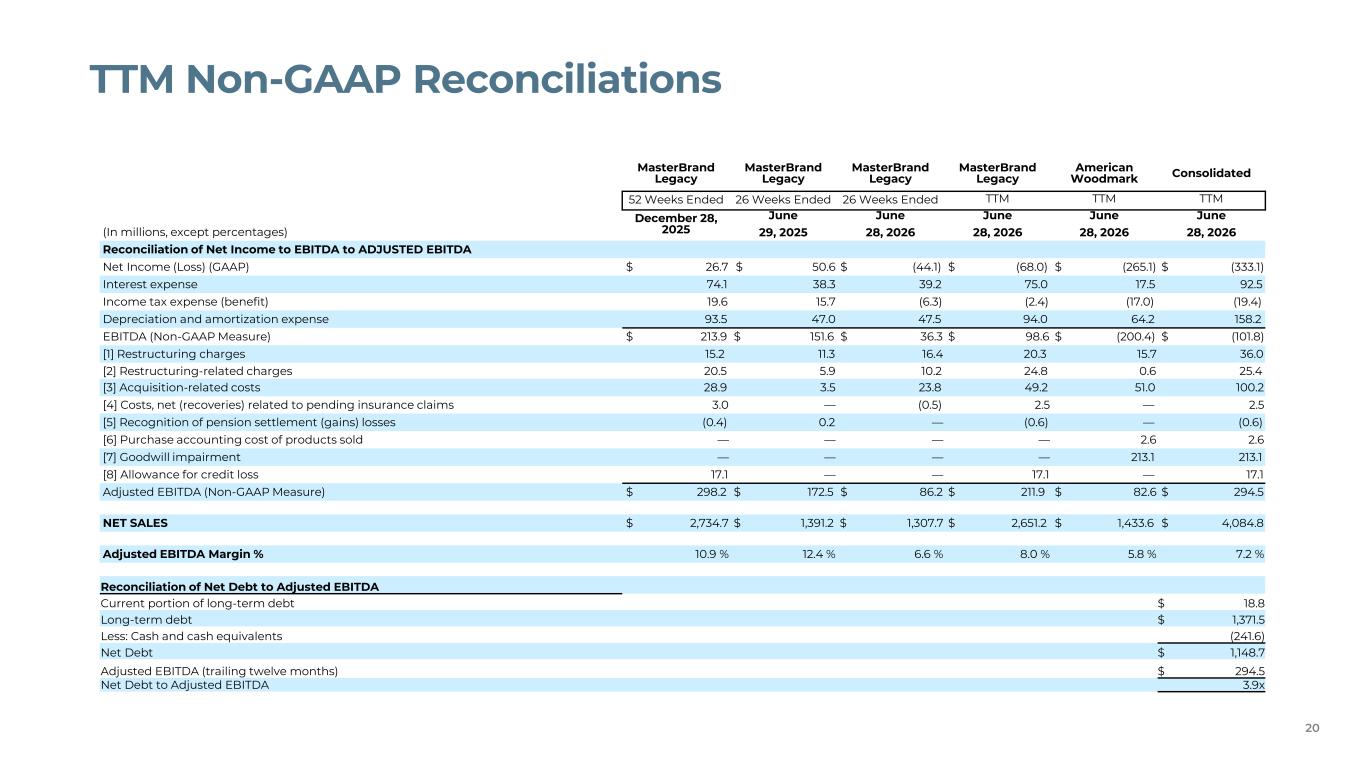
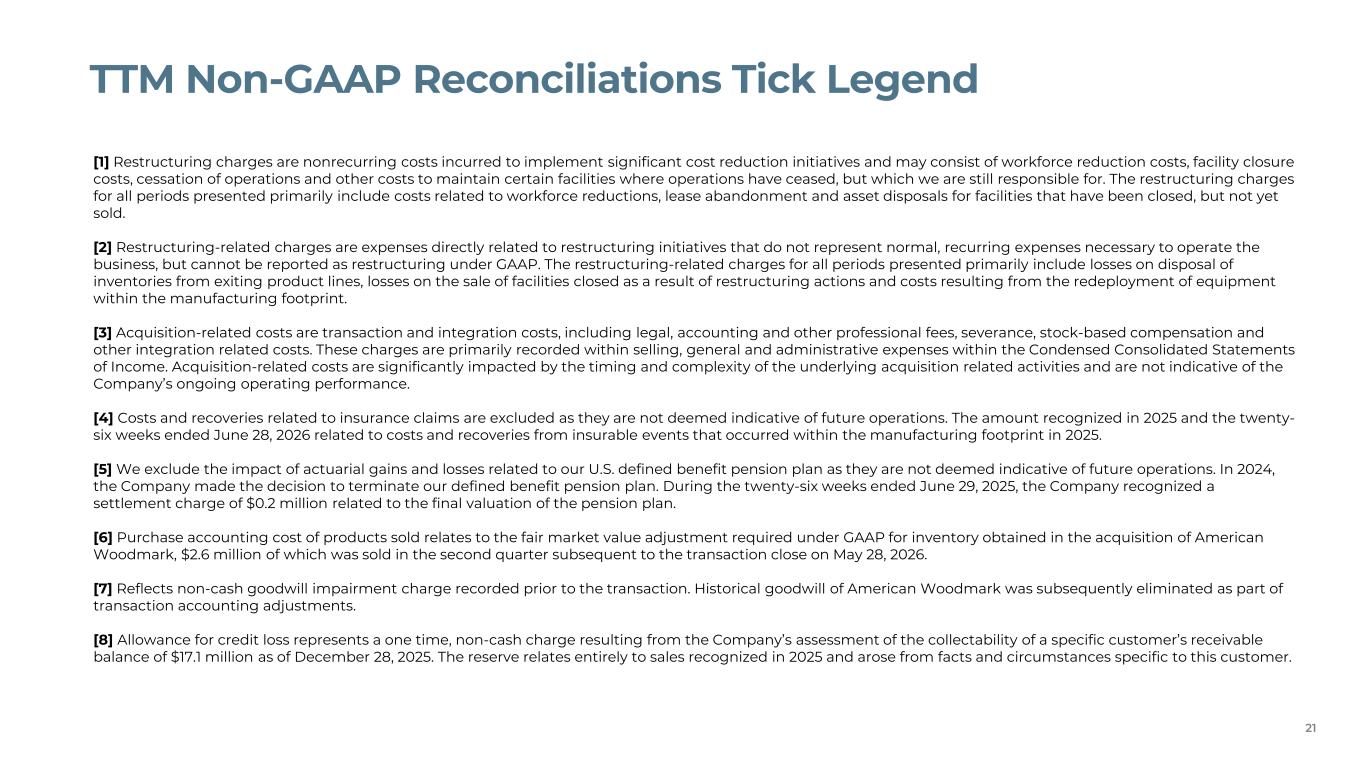
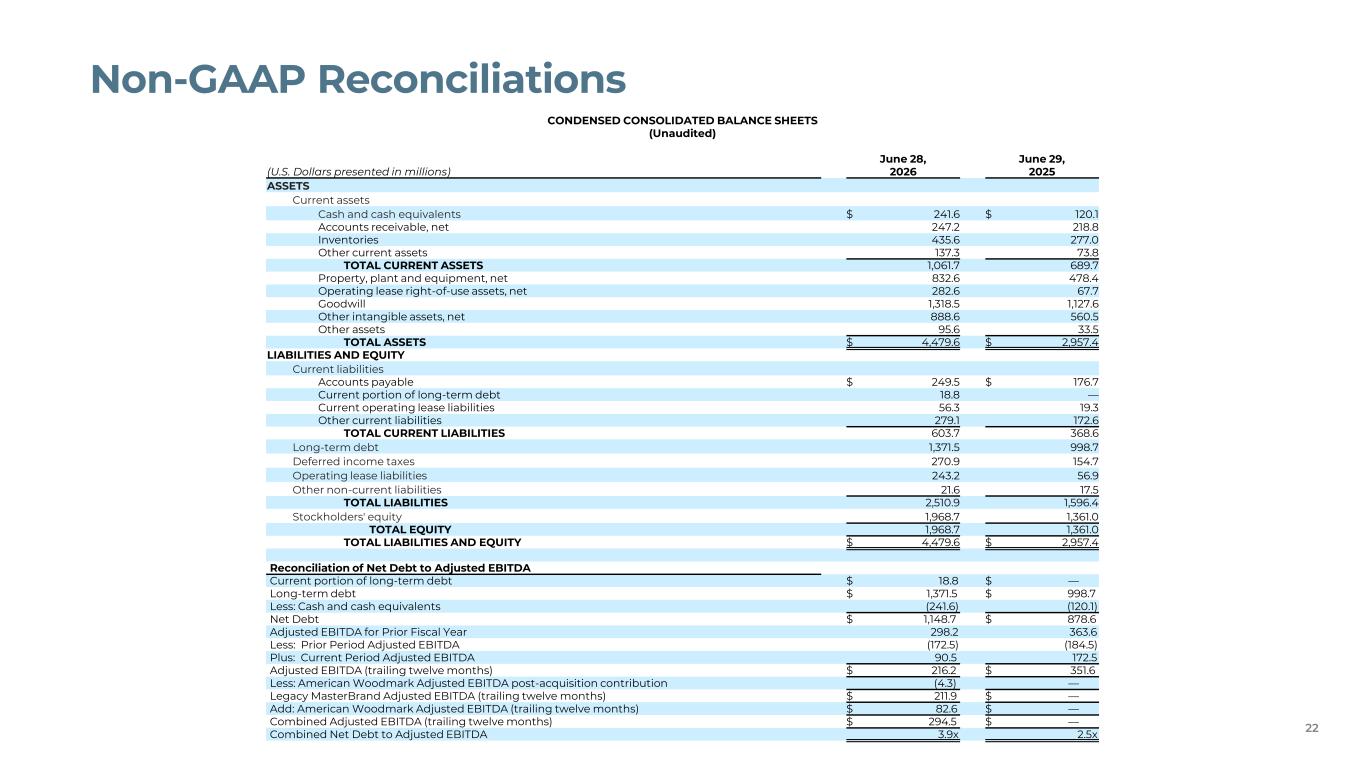
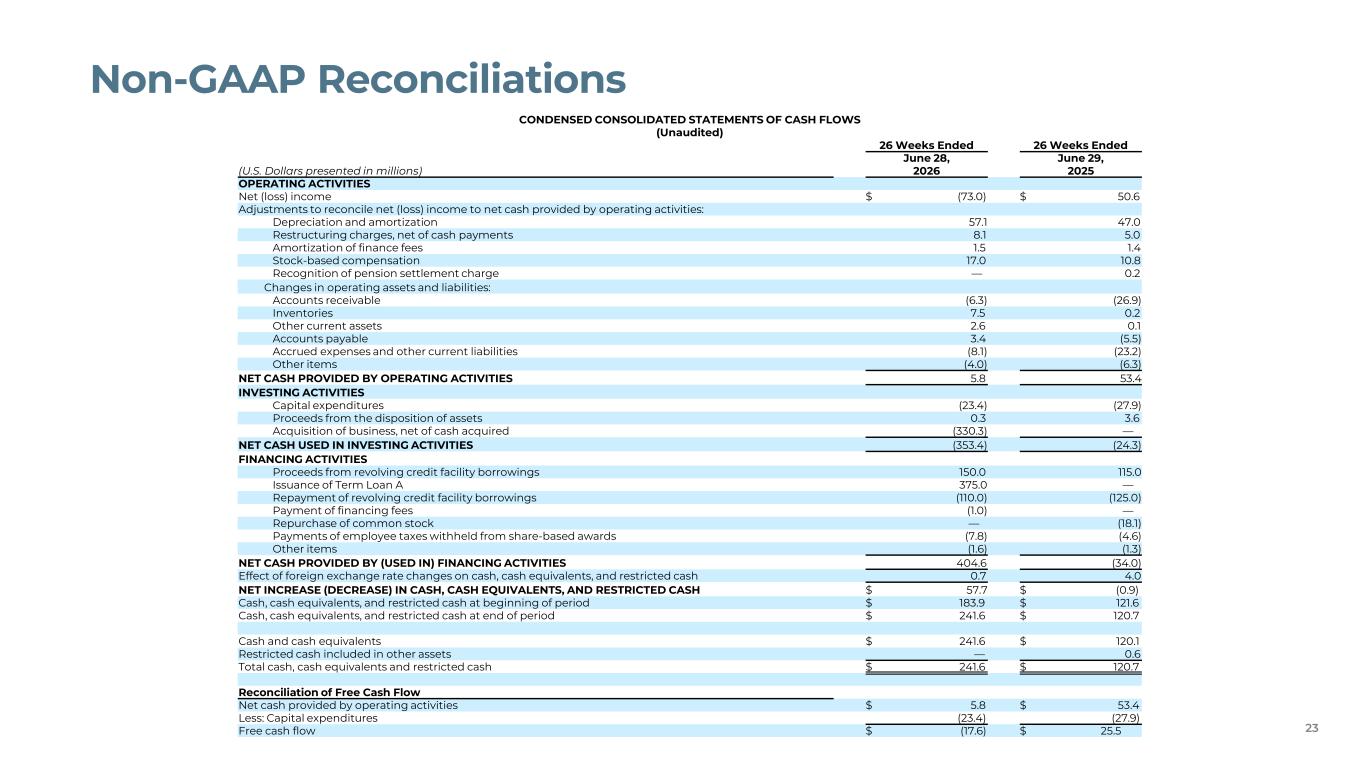
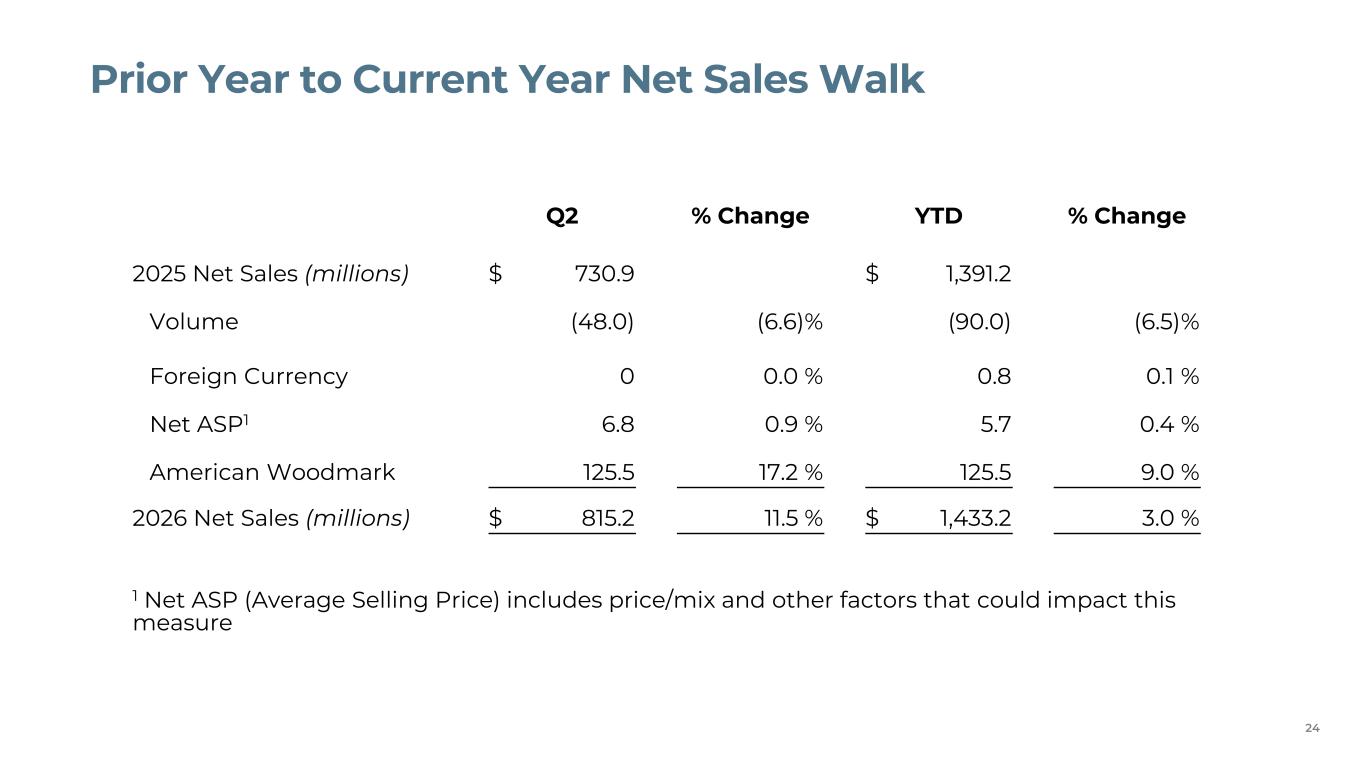
Thanks, Dave, and good afternoon, everyone. I'll start with how we are reporting the quarter as a combined company, then review our second quarter results, and close with our outlook for the second half of 2026. First on reporting conventions. Our results include American Woodmark from the May 28th close date, 32 days of contribution, and prior year comparisons reflect legacy master brand only. It should be noted that purchase accounting estimates included in our second quarter results are preliminary and remain subject to finalization within the one-year allowed measurement period. American Woodmark's results have been conformed to MasterBrand's fiscal calendar and account categorization. Article 11 pro forma financial statements were filed via form 8-K-A on June 26, 2026. Now turning to our second quarter results. Net sales in the second quarter were $815.2 million with a contribution of $125.5 million dollars of American Woodmark net sales from the closed date. Legacy MasterBrand net sales were $689.7 million, down 5.6% compared to $730.9 million in the same period last year, driven by the mid-to-high single-digit market decline and slightly offset by favorable net average selling price due to the flow-through of tariff pricing. Gross profit was $205.5 million with partial period contribution of $16.7 million from American Woodmark, and gross profit margin was 25.2%. Legacy Master Brand gross profit was $188.8 million compared to $239.7 million in the same period last year. Legacy gross profit margin was 27.4% compared to 32.8% in the second quarter of 2025, down 540 basis points year-over-year amid a choppy spring selling season, primarily reflecting market-driven volume decline and the related unfavorable fixed cost leverage, unfavorable product mix, and material freight and personnel inflation, partially offset by our continuous improvement efforts and favorable average selling price driven by tariff pricing. The net tariff impact in the quarter was relatively neutral, with the tariff landscape developing largely as we expected. On a combined basis, our exposure is currently offset, aided in part by the IEFA refunds. Legacy Master Brands pricing and supply chain mitigation actions have now largely reached a full run rate offset and we will continue executing additional actions at American Woodmark over the second half of the year to reach that same run rate level. SG&A expenses totaled $216.7 million with partial period contribution of $24.3 million from American Woodmark. Excluding American Woodmark and merger-related costs of $38.4 million, Legacy Masterbrand SG&A was $154 million, up 50 basis points as a percentage of net sales, driven by the impact of increased fuel costs on distribution, partially offset by the initial benefits of cost actions in the quarter. Fuel and freight costs were a significant headwind in the quarter, driven by a shrinking pool of available drivers, stricter federal regulations, and persistent operating cost inflation across the trucking industry. We are working to offset this pressure through pricing, though these actions take time to fully flow through. Interest expense was $20.8 million dollars compared to 18.9 million dollars in the same period last year. The increase reflects the previously announced refinancing of American Woodmark's debt. Our effective tax rate in the quarter was negative 18.8 percent and positive 13.7 percent year-to-date. I would like to spend a moment on the negative tax rate. When the merger closed in the second quarter, non-deductible merger-related costs were incurred, which, as expected, negatively impacted our full-year estimated tax rate. Because the first quarter was properly recorded at the pre-merger closed effective tax rate, in the second quarter, we were required to record a catch-up tax expense related to the first quarter in the amount of $16 million. This catch-up expense will not repeat in future quarters and thus is an add-back in our reported second quarter adjusted diluted earnings per share. However, the full-year expected tax rate is now estimated at 12 to 15%, reflecting the impact of non-deductible merger-related costs. Net loss for the quarter was $57.6 million, which includes $28.9 million, a partial period impact from American Woodmark, and net loss margin was 7.1%. Legacy MasterBrand net loss was $28.7 million in the second quarter, compared to net income of $37.3 million in the same period last year. Legacy MasterBrand net income margin was negative 4.2% compared to positive 5.1% in the prior year, reflecting lower gross profit, higher SG&A expenses, and a higher tax expense, as discussed, partially offset by the initial benefits of cost actions taken during the quarter. Adjusted EBITDA for the quarter was $62.5 million, which includes $4.3 million of partial period contribution from American Woodmark, and adjusted EBITDA margin was 7.7%. Legacy Master Brand adjusted EBITDA was $58.2 million, compared to $105.4 million in the prior year period, and adjusted EBITDA margin was 8.4%, down 600 basis points due to market-driven volume decline and the related unfavorable fixed cost leverage, unfavorable product mix, and higher material labor and freight inflation as fuel costs continue to rise, partially offset by the flow-through of tariff mitigation, our continuous improvement efforts, and previously announced cost action. Deluded loss per share was negative 38 cents in the second quarter, based on 153.6 million outstanding shares, which is reflective of the additional shares issued at close, proportionate to the timing of the closing within the quarter. This compares to earnings per share of $0.29 in the second quarter of 2025, based on $129.1 million outstanding shares. Adjusted diluted earnings per share was positive $0.05 in the current quarter, based on $153.6 million outstanding shares, compared to earnings of $0.40 in the prior year period, based on $129.1 million outstanding shares. Before turning to the balance sheet, I want to spend a moment on American Woodmark's performance. Since American Woodmark last reported public results, its fiscal third and fourth quarter performance came in below our expectations. More specifically, the underperformance was driven by excess fixed capacity and the related absorption pressure amid lower volume, compounded by capacity decisions that were understandably delayed pending the close of merger. We saw American Woodmark's volume begin to improve in June, moving more in line with our legacy business at the end of the second quarter. Addressing this excess capacity is a top priority in our integration efforts, and we've already begun the work. We have announced two manufacturing facility consolidations since the merger closed, the first steps in right-sizing the combined footprint, and we've identified further consolidation opportunities as we continue evaluating the network. These closures will take time to work through, and they are just the beginning of the actions that underpin our confidence in the earnings potential of the combined platform. Turning to the balance sheet, we ended the quarter with $241.6 million of cash on hand and $393.9 million of liquidity available under our revolving credit facility. Net debt at the end of the second quarter was $1.15 billion, reflecting the financing associated with the American Woodmark acquisition. The trailing 12-month net leverage ratio, including American Woodmark's full trailing 12-month adjusted EBITDA, was 3.9 times. I want to take a moment to provide context on how our leverage ratio is calculated for covenant purposes as it differs from the reported figure. Under our credit agreement, the bank covenant calculation permits the inclusion of full trailing 12-month adjusted EBITDA for American Woodmark, along with other certain additional add-backs, as well as 18 months of anticipated merger synergies. On that basis, our covenant leverage ratio was 3.4 times at quarter end, within the 3.75 times maximum permitted under the post-close four-quarter leverage ratio holiday in our credit agreement. Similarly, our interest coverage ratio, which measures adjusted EBITDA relative to net interest expense, was 5.1 times on a covenant basis, above the three times minimum required. Both measures reflect the full benefit of the combined business and confirm that we have headroom under our covenant at this stage of the integration. Our deleveraging path is clear. We are targeting net leverage below two times by the end of 2028. That target reflects tariffs currently in effect, including Section 232 and its current 25% rate. As I'll discuss in a moment, the scheduled increase to 50% on January 1, 2027 remains in place. Should that increase take effect, it would extend our deleveraging timeline. Once we achieve our leverage target, we expect to resume share repurchases. From a liquidity perspective, our post-close cash and revolver availability of $393.9 million and the absence of any near-term debt maturities, while synergies and cost actions flow through to adjusted EBITDA, we believe give us ample financial flexibility to execute the integration while continuing to reduce debt. Turning to cash flow and capital expenditures. Net cash provided by operating activities was $138.8 million in the second quarter, compared to $84.8 million in the prior year period. For the same period, free cash flow was $128.6 million, compared to $66.7 million in the same period last year, primarily reflecting the timing of home center collections, which we manage proactively within our existing contract terms. capital expenditures in the quarter, or $10.2 million, and for the second half of the year, we expect capital expenditures of $71 million, or 3% of net sales, including integration capital. On synergies and cost actions, Dave covered the framework, so I'll be brief. Our updated $100 million-plus annual run rate cost synergy target is composed of footprint, SG&A, and procurement opportunities, roughly 60% in cost of goods sold and 40% in SG&A and indirect. We expect one-time costs to achieve these synergies to total a one-to-one ratio of the run rate synergy target. For the second half of 2026, we expect those one-time costs to total approximately $30 million. Revenue synergies are expected to represent upside over time. Turning to the current trade environment, let me provide an update on our exposure as a combined company. The tariff landscape has continued to evolve since our last call, adding additional layers of complexity. On July 20, the Administration announced additional Section 338 tariffs on certain Canadian imports. On July 23, the Administration replaced the expired 10% global tariff with Section 301 tariffs ranging from 10 to 12.5 percent on imports from approximately 60 trading partners. Section 232 tariffs on wood and wood products, however, remain the primary driver of our exposure. Unlike the expired global tariffs, these measures have no sunset date. The scheduled increase in the Section 232 tariff rate to 50 percent, previously delayed until january 1st 2027 remains in place we have contingency plans and are prepared to act should it take effect similar to masterbrand american woodmark entered the combination with a comprehensive tariff mitigation program already underway including pricing and surcharge actions supplier renegotiations sourcing optimization and manufacturing footprint initiatives including the closure of its Monterey, Mexico facility. With that said, in the second quarter, combined company gross tariff costs were $41.9 million, with a net impact essentially break-even after mitigation and IEFA duty refunds. For the full year of 2026, we expect the combined company's tariff exposure to be approximately 5% to 6% of net sales, inclusive of American Woodmark's total tariff exposure and net sales since the merger closed. This figure also includes the newly announced Section 338 and Section 301 tariff and the Section 232 tariff at 25%. We continue to expect to fully offset this tariff exposure on a dollar-for-dollar run rate basis by year-end, though further work is still required to offset the newly announced tariffs as we continue to adapt to the evolving landscape. Additionally, following the Supreme Court's ruling invalidating tariffs imposed under IEPA, we have begun receiving refunds for $14.9 million in tariffs previously paid by Master Brand and American Woodmark. In the second quarter, we received $1.2 million of refunds, which we recognized as a reduction in cost of goods sold. Given uncertainty in the refund and administrative approval process, we are recognizing these refunds as they are collected rather than accruing a receivable. Since second quarter end, we have received an additional $9.2 million in refunds, which we will recognize in the third quarter, along with any further portion of the outstanding $4.5 million in expected refunds that are collected during the quarter. Turning to Outlook. This quarter, we are introducing second half 2026 Outlook. this shift in approach reflects that the combination is complete integration planning has converted to execution and we are more confident in our ability to navigate tariffs though the broader macro and demand environments remain uncertain this outlook reflects the combined company with american woodmark included for the full second half and includes our second half tariff impacts and mitigation expectations for tariffs currently in effect. The outlook also embeds approximately $15 million of synergy capture and approximately $11 million of IEPA duty refunds received and expected to be received over the period. As Dave mentioned, the ongoing conflict in the Middle East adds another layer of complexity to an already uncertain consumer environment, with fuel and related input costs representing a direct exposure that has already weighed on our margins this year. We are monitoring developments closely, our outlook does not attempt to quantify any incremental impact to the market at this time. With that said, for the second half of 2026, we expect net sales of $2.05 to $2.11 billion. At the midpoint, American Woodmark is expected to contribute approximately $730 million, or 35% of the combined total, with legacy master brand comprising the remainder. This reflects an addressable market down mid-single digits year-over-year, partially offset by the full period contribution from American Woodmark and price and mix dynamics. We expect second-half adjusted EBITDA of $129 to $149 million, representing an adjusted EBITDA margin of 6.3 to 7.1%. It is worth noting the key building blocks embedded in this range. Approximately $20 million reflects the contribution from American Woodmark's legacy business. $15 million is derived from integration synergies already executed and flowing through. And approximately $11 million relates to anticipated IEPA tariff refunds, of which $9 million has already been received in July. We continue to expect decremental adjusted EBITDA margins to improve versus the first half as tariff mitigation, cost actions, and synergies continue to phase in. Additionally, in the second half, we expect interest expense to be approximately $50 million, reflecting the newly arranged $375 million delayed draw term A loan used to retire American Woodmark's debt at close. We expect second half adjusted diluted earnings per share of negative $0.05 to positive $0.03. As a reminder, the effective tax rate and the pro-rata increase in our diluted share count over the course of the year as a result of the merger introduced variability into this measure. We anticipate diluted shares outstanding to reach $203.6 million by year-end and an effective tax rate of 12-15%. Finally, we continue to expect free cash flow for 2026 to be in excess of net income for the year. Stepping back, our focus in the second half is straightforward, disciplined execution on costs and synergies, and steady progress on the balance sheet. As integration progresses and our visibility into both the combined business and the broader trade environment continues to improve, we expect to return to full-year guidance beginning in 2027. and at our investor day in the first quarter of 2027, we plan to lay out the long-term financial targets behind the path Dave described. Between the two, we aim to provide a complete picture of the combined company. Now I'd like to turn the call back to Dave.
Speaker 6
Thanks, Andy. This was a transformational quarter for Masterbrand. We believe the combination with American Woodmark positions us to navigate through this cycle and outperform in the recovery, and the early progress on integration gives us confidence that we will capture the full value of this transaction. As I said earlier, we see a path to structurally higher profitability for this business, one that doesn't depend on the market, and executing against the four levers to achieve that path is central to our focus in the second half and beyond. At the same time, our confidence in the long-term demand fundamentals of our industry is unchanged. The structural underbuild of housing, the millennial generation entering prime home buying years and aging housing stock prying for remodel activity and rising home equity all support our expectation that pent-up demand remains intact with the broader market expected to begin its recovery in 2027. when that recovery comes our goal is for it to be upside to a business we've already made structurally stronger the strategy is clear execution is underway and we're confident this combination positions master brands to deliver meaningful growth Now with that, I'll open up the call to Q&A.
Speaker 1
Thank you. We will now be conducting a question and answer session. We ask that you please limit yourself to one question and one follow-up. If you would like to ask a question, please press star 1 on your telephone keypad. A confirmation tone will indicate your line is in the question queue. You may press star 2 if you would like to remove your question from the queue. For participants using speaker equipment, it may be necessary to pick up your handset before pressing the star keys. One moment, please, while we pull for questions. Our first question is from McLaren Hayes with Zellman and Associates. Please proceed with your question.
Speaker 2
Hey, thanks. Good evening, guys. Yeah, I guess maybe starting off, it's been about two months now since the merger closed. Can you talk a bit more about what your experience has been in these early days getting closer to the Woodmark team and starting to integrate the businesses, and maybe a bit more on the cost synergies? as well. It seems like the team's off to a really strong start so far. What gave you the confidence to bring that target up with just a few months in the book so far?
Speaker 6
Yeah, thanks, Declaren. I'd say I'd start by saying the teams are working really well together. You know, there is a, we're in the same business in a lot of ways, and so there's a lot of commonality. There's some maybe different language in a few different processes but the team has really come together very well and gotten after the work i think both teams were ready to go you know it's a long wait for the regulatory process and so i think everyone was just ready to hit the ground running on day one which was great um i think what i've observed and i've been to i've been to most of the the legacy american and Woodmark factories now. There is a lot of commonality, but there's also some best practices that both companies have come up with on their own. And one of the main tasks for the team is to pick those best processes from each company and then spread those to the other side, if you will. Where there's differences that maybe don't make sense, then let's kind of figure out what's better and go from there. And so if you think about the work that the team is doing, it starts with a lot of that. It's looking at how we do things. You know, there's a couple examples where we've already adopted some processes that the Legacy American Woodmark team implemented, and they're working really well across the broader enterprise. Obviously, some of, you know, when you're changing a large process, it takes time. So, you know, I wouldn't say there's a ton of those yet, but we've certainly identified quite a few. When it comes to the synergies, you know, obviously we had a really strong plan from what we could look at as as a independent teams prior to the close once we closed that team really hit the ground you know the entire integration team hit the ground running and and really just sat down and and started you know putting numbers down on the page to compare to what we thought versus the reality and i think we found more opportunities there and i think none the least of which is we've recalibrated our view of where we think the market is over the last nine months And I think it's unfortunately different. And so we have, you know, more capacity that we need to take out. I think we're just looking at the business holistically here and being realistic about what we can afford. And the teams are going through that methodically to right size the cost of the entire business. And that's that's the primary mission over the next couple of years.
Speaker 2
Awesome. Thanks. And I guess, you know, maybe how have conversations been with your customers so far? You know, I think you hinted at it in your prepared remarks, but do you see the potential for any revenue synergies as you go to market with this combined product portfolio? Are there any channels where you think that that might be, you know, a more near-term target versus other channels?
Speaker 6
Yeah, I've met with several customers through this period, and I, you know, I think that it's the conversations have been good. I think it does take time for things to develop. They want to understand what we bring to the table as a combined enterprise, which we're in the process of building that picture for them. I think, you know, early days, I think in the new construction paths to market that we have, I think we've demonstrated over the past couple, you know, I'd say year, year and a half that the master brand approach that allows for a broader set of paths to market has been successful. And I think that there's opportunity there to take what is a great team from the legacy Woodmark side, great products, work with those products, perhaps introduce different products, selection into their model, but also take a look at how they're going to market and really using what we call a more flexible model of how you address the customer needs. And I think that's really a big area of focus for us because I think they have not performed as well as the market in that particular portion of the market. And we want to go and gain that back. And I think that's going to be job one. Elsewhere, I think things take time. The home centers don't move really fast. I mean, they have both companies in their stores. We want to help them organize and make that easier for the consumer. That's a primary goal. And help them sell more. And then in the dealer network, it's really much like with Supreme, bringing our product portfolio together in the most logical way takes a lot of time. It takes time to train your sales force. We've already started that, but those will develop more over years rather than months. But I think that's the order in which we're thinking of things.
Speaker 3
Once again, if you would like to ask a question, please press star 1 on your telephone keypad. our next question is from stephen ramsey with thompson research group please proceed with your question hi good evening everyone uh wanted to start with uh the core masterbrands performance in in the builder channel um said you're outperforming there which is good to see can you talk about how you're able to do this and is there any connection to woodmark's struggles in the channel uh being connected to your success yeah i think if you if you remember we go to market
Speaker 6
with a combination of direct to builders and distribution and i think that for a variety of reasons builders like that model and i think that's uh we're going to lean into that uh with the combined enterprise and i think there's also some product differences and again if you talk about things that we knew, but we didn't know all the details. I think there's opportunity there with the Timberlake product as an example, where there's been a lot of trade down in the market, and you have to move with that. I think our team has done a nice job of flexing with that, albeit they're a lower price point product, obviously, and we have some work to do there to bring the performance of that product line and that group of products back to where it was several years ago. But I think there's a lot of lessons we've learned over the last 12 months on how to navigate the current market conditions that I think the combined enterprise can really benefit from.
Speaker 3
Okay, okay, that's helpful. If you think two, three years down the road, and maybe this is an investor day topic, but when you think about the potential sales benefit, do you think the new construction market offers more opportunity than through the dealer channel as you get a couple years down the road?
Speaker 6
You know, I don't know if it's more. I think it's sooner. So maybe we'll address that in more detail, as you said, in Investor Day. But I think it's a less fragmented market. So those are, you know, you can target things easier when there's less fragmentation. But by the same token, the dealer R&R market is larger. And so there's, you know, the population opportunity is larger. So I think I wouldn't, I'm not in a position today to scope the size of each, but I think it's more of a timing question.
Speaker 3
Okay. And then lastly, for me, make sure I'm heard you correctly and understand this correctly. The second half guide for Woodmark was 730 million of sales and even around 20 million that points to a margin that's a little bit lower than what they contributed in the second quarter uh maybe you can connect the dots here make sure I've got my numbers right and kind of the margin gains you expect in the second half for for Woodmark yeah maybe I'll uh I'll say a couple things and then maybe Andy can fill in.
Speaker 6
We only disclosed the June, effectively the last 32 days of the quarter where we were a combined entity. And if you look at that margin, about 126 million in sales, 4 million of EBITDA, it's roughly on par with what you're seeing in the second half. And that's where we think we are. And we got some work to do there. It's not what we expected.
Speaker 4
I think the business can perform better than that but we've got some work to do there is there anything else okay excellent thank you thank you our next question is from jeffrey stevenson with loop capital please proceed with your question hi thanks for taking my questions today and all the detail around the um you know merger with woodmark it's been very helpful but as you're looking at the back half of the year Are you expecting the trade down to lower-priced cabinetry to continue at a similar rate as the first half, or are you seeing any signs of stabilization and mix as we stand here in early August?
Speaker 6
Yeah, I think the trend that we're on is going to continue, and I think that we will start annualizing that in the fourth quarter. That's when we really started seeing a market difference last year. uh and again like we talked a little bit about you know we've had to reorganize the supply chain around inflation around tariffs there's been pricing involved in that and now as a combined enterprise i think we have the opportunity to rethink that portion of the market if this is the new uh you know and i think it will there's going to be a portion of this market that's always going to look for this kind of lower price point product and we just when you've changed your supply chain so drastically over a short period of time. You do it for speed, you do it for certain optimizations, but I think there's better choices we can make. And that's the beauty of having this larger enterprise is that we've got good ideas on both teams and we're going to be implementing those over the next couple of periods. And that'll prepare us. Our thought and our belief is that as the market returns, you still do compete on features. And consumers want more features when they're healthier. But we're in this mode for a bit of time here, and we've got to be prepared for that. And so we're going to do that as well. It doesn't preclude us from having the features down the road, nor the capacity down the road to handle that. But I think in the near term, we've got to be prepared for this, and that requires some change.
Speaker 4
Thanks for that, Dave. And then, you know, it's encouraging to hear, you know, you all said, you know tariffs on a dollar for dollar basis of what was there but you know at a high level how should we think about price costs given the you know additional you know tariff changes you know we've seen in the market and higher energy prices um just you know how we should think about you know overall price cost during the back half of the year yeah i think we have some more catch-up to do uh with particularly with freight i call it freight because it's partially fuel uh but trucking rates, as Andy highlighted in her remarks, have come up as well for a number of reasons that she outlined.
Speaker 6
And don't forget that, you know, petroleum goes into other things, paint being one and resin being another. And so we're still fighting inflation. And as we've said many times before, we don't have instantaneous ability to price or to counteract that.
Speaker 1
And so it takes some time and that's that's what you're going to see through the rest of the year here great thank you this now concludes our question and answer session ladies and gentlemen thank you for joining master brand's second quarter 2026 earnings conference call this does conclude today's teleconference. Please disconnect your lines and have a wonderful day.