Operator
Thank you for waiting. My name is Rebecca, and I will be your conference operator today. I would like to welcome everyone to the Noble Corporation Second Quarter 2025 Earnings Call. I will now turn the call over to Ian MacPherson, Vice President of Investor Relations. Please go ahead.
Thank you, operator, and welcome, everyone, to Noble Corporation's Second Quarter 2025 Earnings Conference Call. You can find a copy of our earnings report, along with the supporting statements and schedules on our website at noblecorp.com. We will reference an earnings presentation that's posted on the Investor Relations page of our website as well. Today's call will feature prepared remarks from our President and CEO, Robert Eifler; as well as our CFO, Richard Barker. We will also have with us Blake Denton, Senior Vice President of Marketing and Contracts; and Joey Kawaja, Senior Vice President of Operations. During the course of this call, we may make certain forward-looking statements regarding various matters related to our business and companies that are not historical facts. Such statements are based upon current expectations and assumptions of management and are therefore subject to certain risks and uncertainties. Many factors could cause actual results to differ materially from these forward-looking statements, and Noble does not assume any obligation to update these statements. Also note, we are referencing non-GAAP financial measures on the call today. You can find the required supplemental disclosure for these measures, including the most directly comparable GAAP measure and an associated reconciliation in our earnings report issued yesterday and filed with the SEC. Now I'll turn the call over to Robert Eifler, President and CEO of Noble.
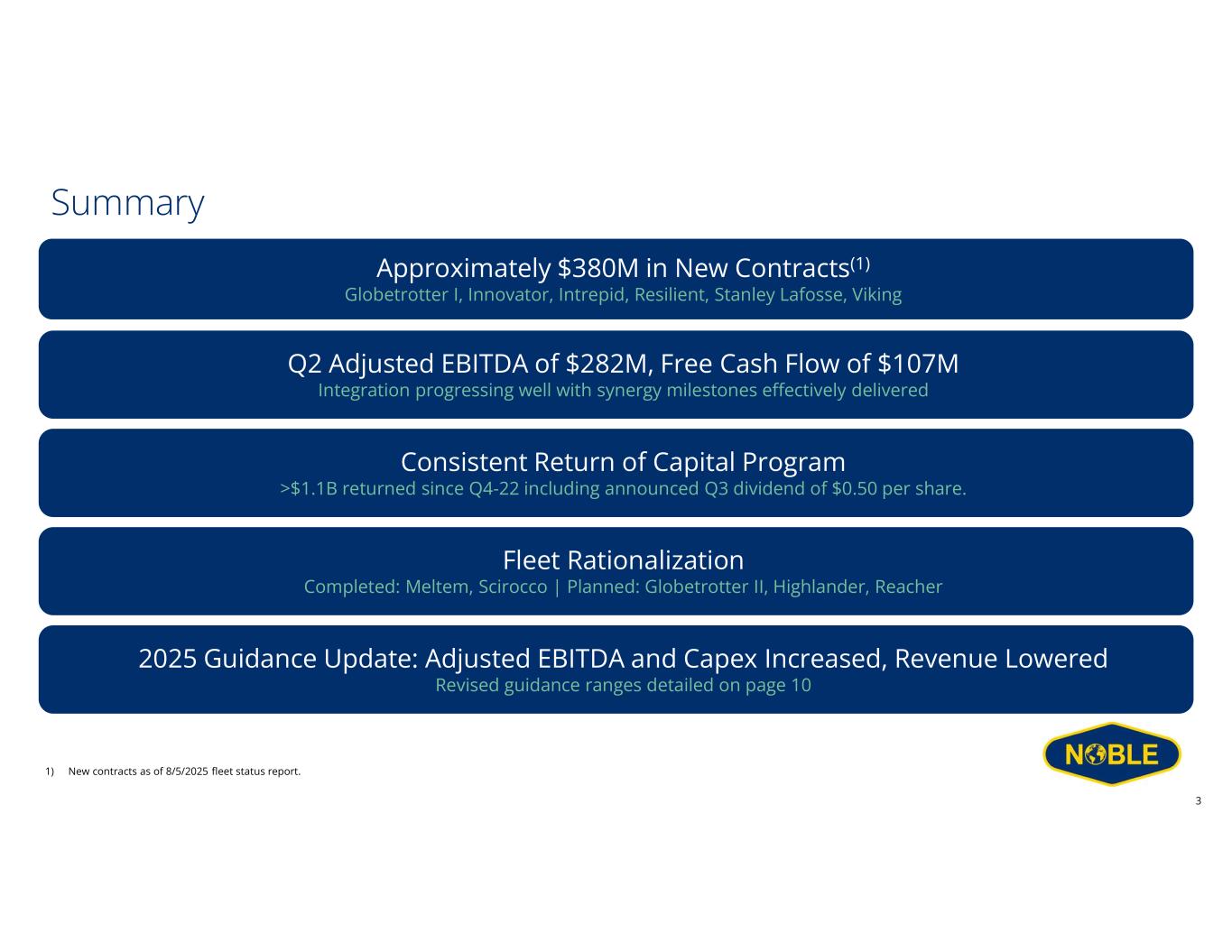
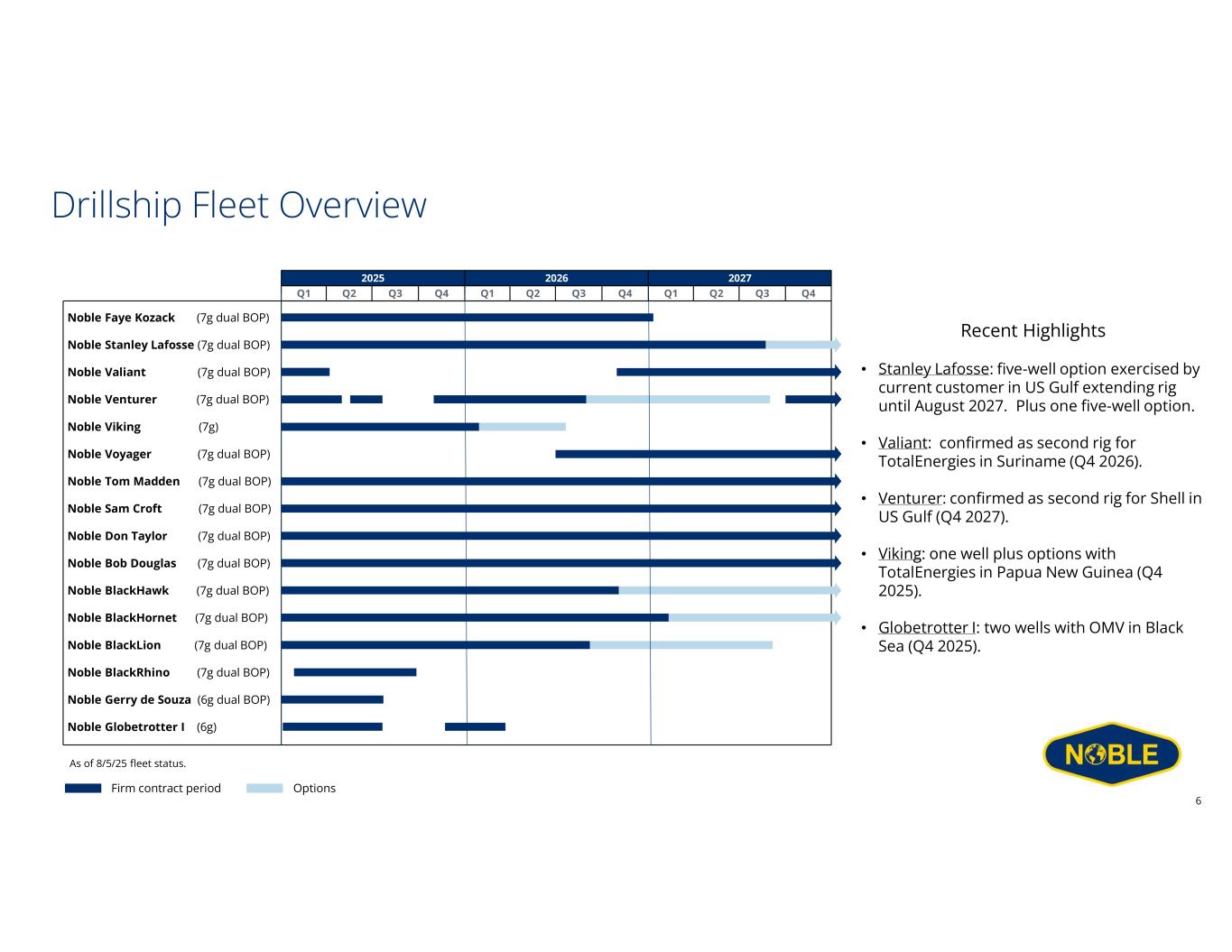
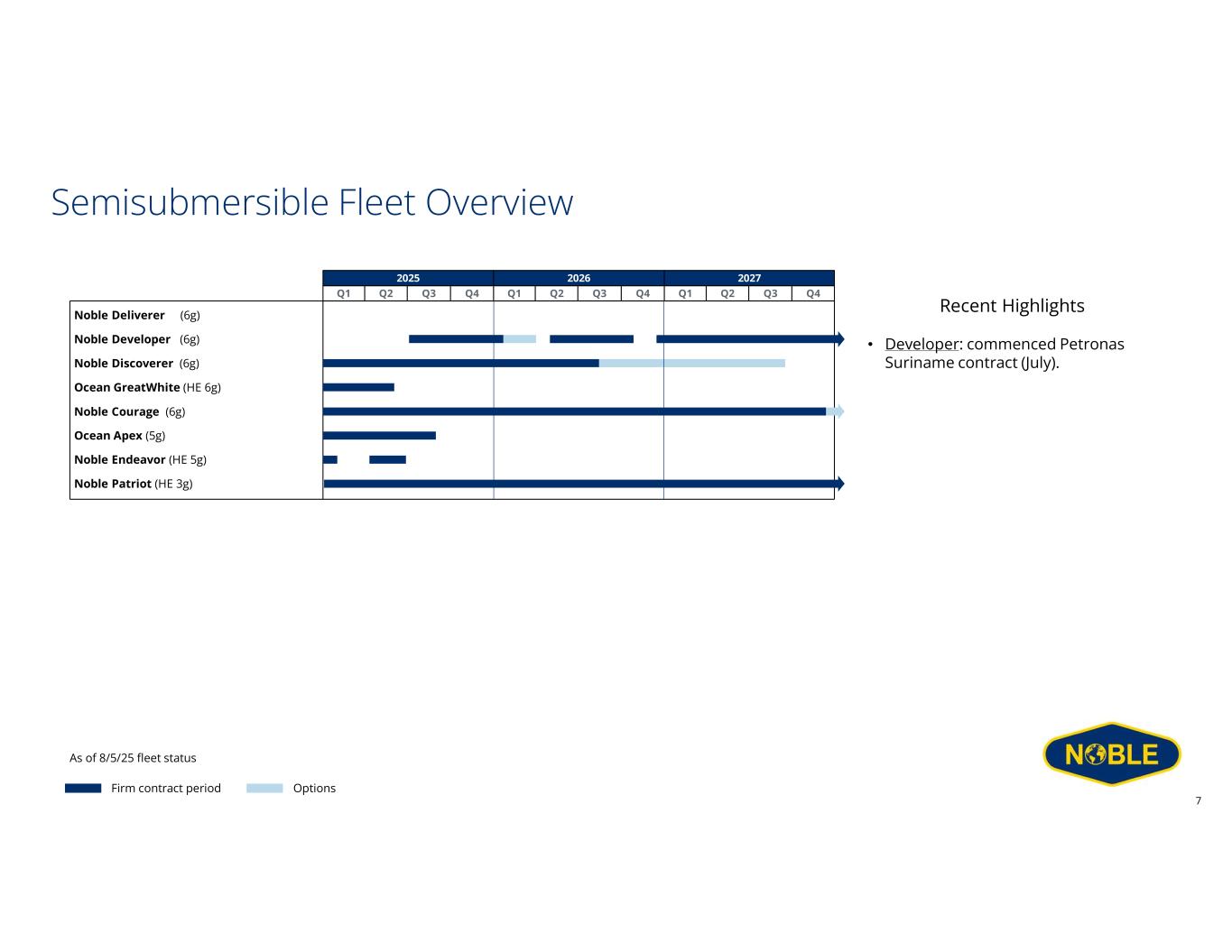
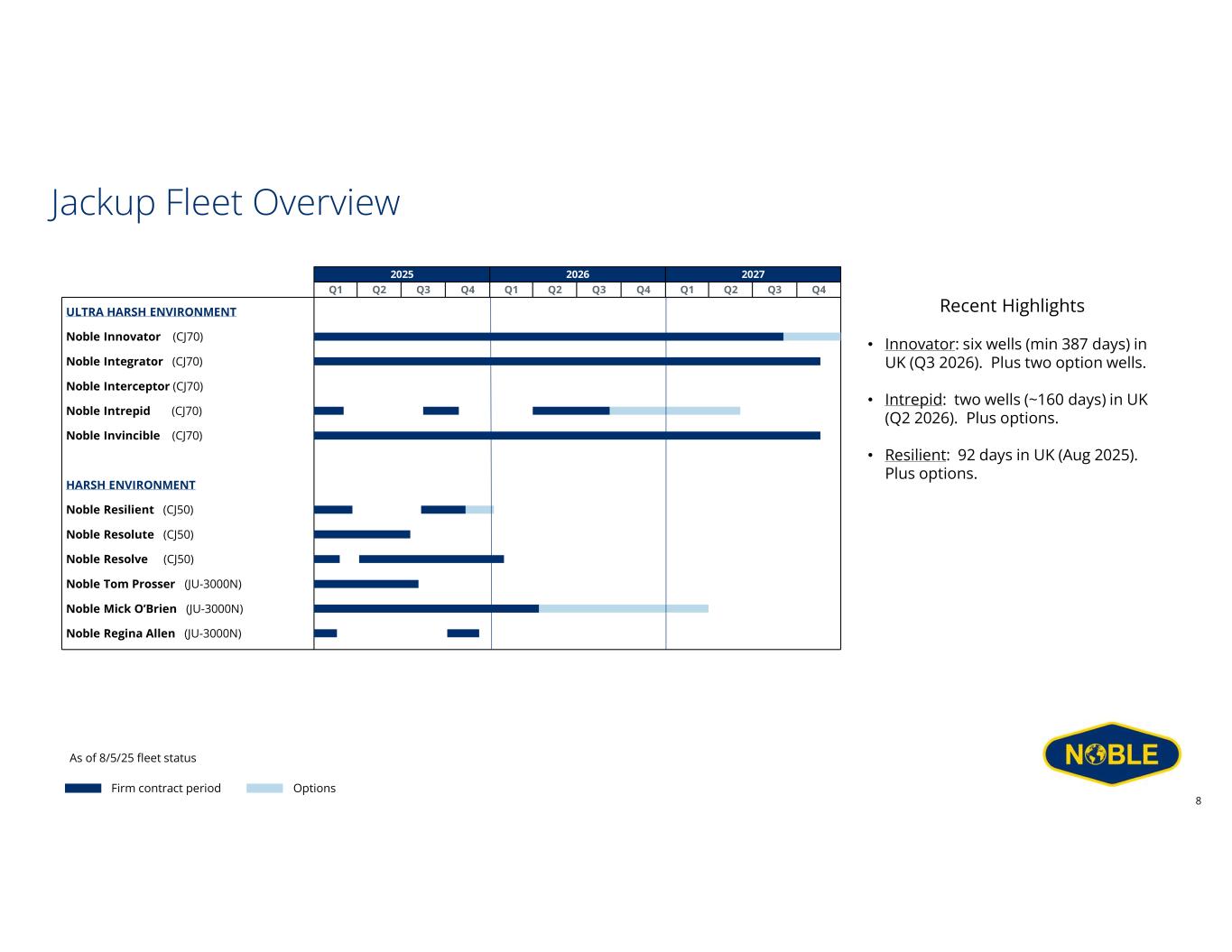
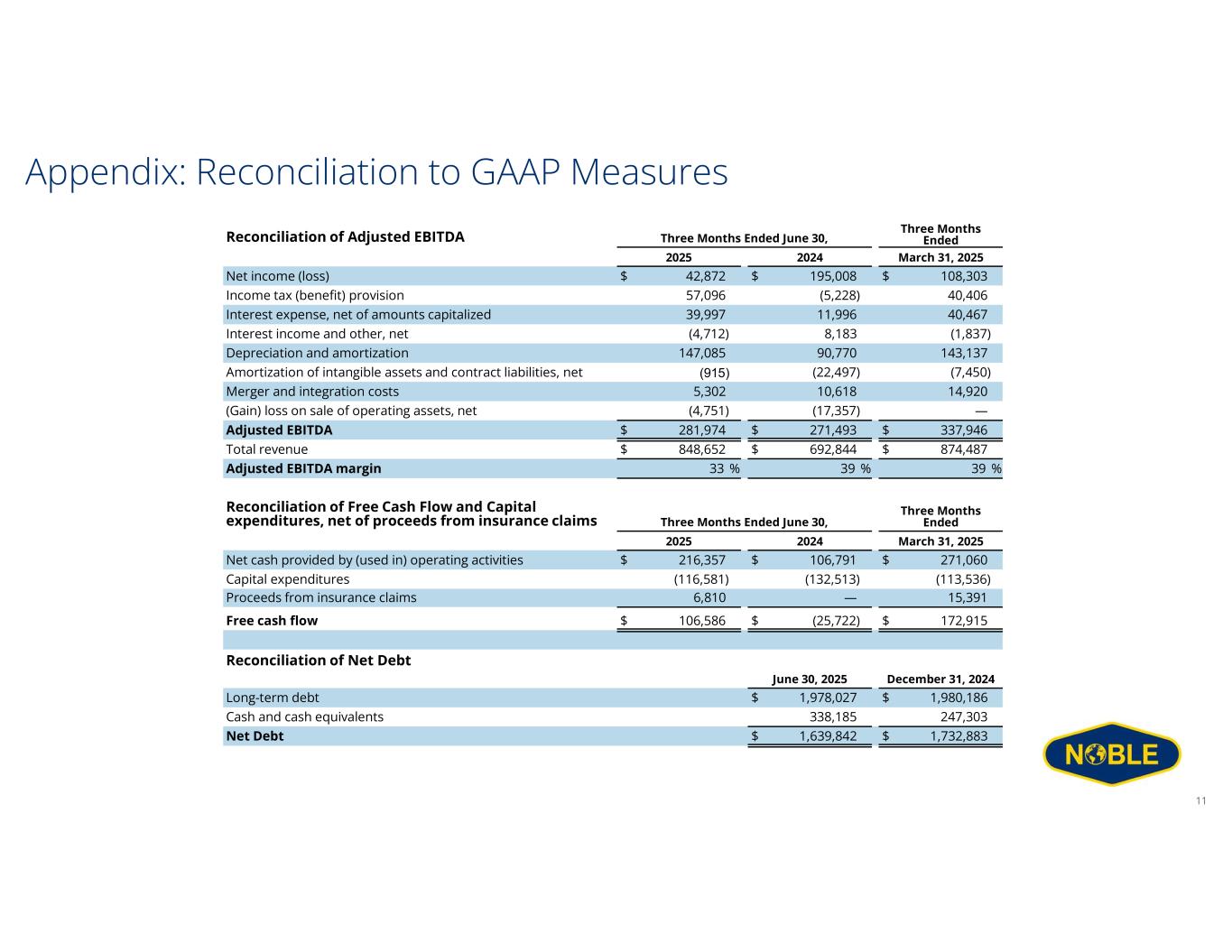
Thanks, Ian. Welcome, everyone, and thank you for joining us as we present our results for the second quarter. Today, I'll outline our financial and operational highlights, recent commercial successes, our outlook on the market, including our semiannual assessment of regional deepwater demand, and conclude with our fleet strategy. After that, Richard will cover the financials before I return for closing remarks and open the line for questions. In Q2, we achieved strong financial results with adjusted EBITDA of $282 million and free cash flow of $107 million. Over the last two years, our capital return program has been a vital component of our strategy. We reaffirmed that commitment this quarter, returning an additional $80 million to shareholders through our $0.50 per share quarterly dividend. Our Board has declared a $0.50 per share dividend for the third quarter, bringing our total capital return since Q4 2022 to over $1.1 billion through dividends and share repurchases. On the integration side, we're nearing the one-year anniversary of the Diamond acquisition, and I'm pleased to say we have reached our $100 million synergy target ahead of schedule. Thank you to the teams across the organization for making our integration efforts so successful. The heavy lifting is now behind us, and our focus is on optimization. I'm proud to report that we have already become better than the sum of our parts. Turning to commercial activity, our contracting momentum continued this quarter. Following the awards we announced in April, we have secured six new contracts since our last earnings call, as detailed in our fleet status report published yesterday. On the deepwater front, the Noble Stanley Lafosse was extended by its current customer in the U.S. Gulf for five additional wells over approximately 14 months, keeping the rig contracted through August 2027, with an option for five more wells at mutually agreed rates. The Noble Viking also received a one-well contract with Total in Papua New Guinea, scheduled for Q4, following its Brunei campaign. This estimated 47-day program is valued at $34 million, including mobilization, demobilization, and MPD usage, excluding a modest performance bonus. This will be the first drillship operating in Papua New Guinea in over 30 years and the first ultra-deepwater rig to do so. We're honored that Total has trusted us with this high-impact exploration well, which includes options for three more wells in the region. Finally, the Noble Globetrotter I, after completing its campaign in the U.S. Gulf, secured a two-well contract with OMV in the Black Sea, planned to begin in Q4 for about four months, valued at approximately $82 million, including a day rate of $450,000 plus mobilization and demobilization fees. The rig’s unique design provides a distinct advantage for transit into and out of the Black Sea. In addition to these deepwater awards, we secured several contracts in our jackup fleet that showcase the versatility of our harsh environment rigs and our capability to support both traditional and energy transition projects. The Noble Innovator was awarded a six-well contract with BP for the Northern Endurance Partnership carbon capture and storage project in the U.K. North Sea, expected to commence in Q3 2026 at a day rate of $150,000 for a minimum firm term of 387 days with two optional wells. The Noble Intrepid was awarded a two-well program with BP for additional CCS wells at the same day rate, scheduled to start in April 2026 for about 160 days plus options. We're proud to support BP with this vital infrastructure project for the U.K.'s carbon storage ambitions. Lastly, the Noble Resilient secured a 92-day accommodation services contract at the Inch Cape Offshore wind farm in the U.K. North Sea, starting in the next few weeks, valued at around $6.5 million for the firm 92 days with extension options. Year-to-date, we have secured new contracts totaling $2.8 billion, and our backlog as of August 5 stands at $6.9 billion. Our backlog assumes 40% of available performance revenue realized on a combined basis under our recent long-term contracts with Shell and Total. We continue to pursue promising opportunities to strengthen this recent momentum and look forward to sharing more updates as they arise. Before moving to the market outlook, I'd like to point out two key contract startups in Southeast Asia and the Americas that required extensive planning and coordination to execute safely and on time. I thank the teams involved for their hard work in launching these projects. First, in the Philippines, the Noble Viking began a crucial three-well program for Prime Energy in June to extend the life of a critical gas field, part of the country’s broader push for energy security and independence. Following the recent award with Total, the Viking could remain active through most of the first quarter next year if options are exercised, with a strong pipeline of future opportunities in the region. Next, in Suriname, the Noble Developer initiated an important three-well development campaign for Petronas in July, returning to a region with increased development activity for this class of rig. Now on to the market outlook and our semiannual review of key deepwater markets. Despite significant macroeconomic uncertainty this year—such as tariffs, conflicts in the Middle East, and fluctuating Brent crude prices—the demand for offshore drilling has remained relatively stable. Although we've seen increased pressure on 2025 upstream CapEx, resulting in more near-term gaps for rigs, there are signs of firming conditions by the second half of 2026 and into 2027. Currently, the global contracted rig count for ultra-deepwater stands at 97 rigs, relatively flat compared to recent quarters but down from the recent peak of 105 to 106 during 2023 and 2024. We anticipate seeing more idle units over the next few quarters as scheduled rollovers may outpace visible contract starts and extensions, which continue to put pressure on day rates, currently in the low to mid-400s per day for Tier 1 drillships. Geographically, recent deepwater demand trends show strength in South America contrasted with weakness in West Africa. However, there are promising signs of recovery in West Africa. In South America, contracted UDW demand is at 43 total units, including 35 in Brazil, five in Guyana, two in Suriname, and one in Colombia. This is a critical region for us, as we operate two rigs in Brazil and seven of the eight contracted rigs across Guyana, Suriname, and Colombia. The outlook remains strong, bolstered by recent tenders from Petrobras for existing development drilling and potential exploration activity in the newly licensed Foz do Amazonas Basin. These are complemented by Shell's recent FID at Gato do Mato, Equinor’s drillship tender, and significant exploration success announced by BP this week, collectively framing an exciting outlook for Brazil in the years ahead. We are also monitoring potential floater programs across Suriname, Trinidad, Colombia, Uruguay, and the Falklands, with varying probability and timing. Overall, the deepwater market in South America reflects extraordinary demand depth and breadth, keeping the region in growth mode. In the U.S. Gulf, demand has softened with 21 contracted UDW rigs today, down from 22 to 24 rigs last year. Activity may dip slightly further by the end of this year, but indications suggest that the rig count could normalize back toward around 20 UDW rigs next year. Demand in the Gulf tends to be more influenced by spot market dynamics and is sensitive to commodity prices. Our primary focus here is the Noble BlackRhino, which will finish its current contract soon. We're optimistic about the rig's long-term outlook in 2026, based on conversations with clients, but we expect it may face some near-term availability gaps in the meantime. In West Africa, current UDW demand is 12 rigs, similar to previous quarters but significantly below the 17 to 20 range from 2023 and the first half of 2024. Angola is stable at six rigs, while Namibia and Nigeria have declined to just one and zero rigs, respectively, reflecting a combined decrease of six compared to last year. Encouragingly, visibility for growth in the region is improving. Although West Africa and Mozambique comprise only 12% of the total deepwater rig count today, their share of open demand exceeds 25%. Prominent IOC tenders are progressing toward contract awards for 2026 and 2027 start dates, which should encourage an increase in the UDW rig count back toward the mid- to high teens or even higher, depending on Namibia's recovery. For now, Namibia is not significantly affecting our near-term open demand, whereas Nigeria, Ghana, Cote d'Ivoire, and Mozambique are. There are also signs of potential exploration activity in adjacent South African blocks as early as 2026. In the Mediterranean and Black Sea, we've seen stable UDW demand, with eight to nine rigs. A recent positive development has been Turkish Petroleum's acquisition of two additional drillships from sidelined capacity, expanding their fleet from four to six and increasing long-term demand in the region. Overall, open demand in the Mediterranean seems supportive of stable activity levels, aside from fluctuations in the Black Sea and structurally increased demand from Turkey. In the Asia Pacific region, including India, demand has decreased to four UDW units, down from five earlier this year. Despite this recent decline, open demand for multiple rigs across India, Southeast Asia, and Australia suggests a modest activity increase in the next couple of years, though some needs may be met by lower-spec equipment. Finally, the harsh environment market in the North Sea and Norway currently shows six UDW demand units and a total of 19 floater demand units, down by one rig compared to earlier this year. Two of our North Sea semis, the GreatWhite and the Endeavor, have left contract recently with no visible work opportunities for the remainder of the year. Consolidation among upstream customers, along with policy and fiscal challenges, continues to constrain spending, resulting in some deferred P&A and intervention programs. However, most of the North Sea and Norway floater fleet is well contracted through 2027 and beyond. There is potential for synergies in Canada with one harsh semi requirement, although that market is currently inactive. To summarize, while the next few quarters appear characterized by various positive and negative factors affecting demand, leading to a relatively flat market, we are optimistic about the potential upside by late 2026 or 2027, expecting a path back toward a contracted UDW rig count of around 105 if macro conditions remain stable. As we have observed over the previous 12 to 18 months, timing risk remains a significant concern, with many FIDs and rig awards being delayed. Therefore, we remain focused on carefully managing our costs and active fleet based on current market conditions. Now, let me provide a brief update on our contract position and objectives. We have made significant progress in contracting our 15 high-end drillships. Our primary focus now is on the BlackRhino, Viking, and Gerry de Souza, all of which have robust opportunities currently being discussed with customers for programs starting in 2026. The Globetrotter I remains under consideration for several multiyear well intervention scopes following its Black Sea drilling program; if those don’t materialize, we will likely move to dispose of the Globetrotter I as well. Four out of our eight semi-submersibles are well contracted for next year, while the Deliverer, GreatWhite, and Endeavor are currently idle, with Apex rolling next month. We are actively pursuing leads for all four of these units worldwide, with expected starts in 2026 and 2027, and each is subject to individual stacking plans in the interim. We will continue to evaluate stacking costs against the opportunity set, particularly with older rigs. In our harsh environment Northern Europe market, current demand stands at 28 jackups. This level has dropped by about three rigs compared to last year, and the outlook for 2026 is clouded by fiscal and regulatory issues. We are pleased with several recent contract wins, including additional CCS and wind farm construction support in the U.K., as well as expanding our customer base in Norway with the Intrepid’s DNO contract. Overall, we expect muted conditions to persist in the region until policy-driven barriers are removed, especially in the U.K. However, the earnings contribution from our jackups is heavily weighted toward well-contracted units, and we do not anticipate significant earnings decline from the overall jackup fleet segment at current levels. In conclusion, we have recently completed the disposal of the cold-stacked drillships, Pacific Scirocco and Meltem, permanently removing those units from the market. We also plan to dispose of the Noble Globetrotter II, as well as the Noble Highlander, for which we finalized a sale agreement for $65 million, and the Noble Reacher, which is now also for sale. The Reacher is the lowest capability jackup in our fleet and has worked exclusively in accommodation mode for the past few years; it would require considerable investment to return to drilling readiness. These decisions reflect our ongoing focus on maintaining a high-spec competitive fleet and managing our costs and active capacity carefully to maximize cash flow for our shareholders. It’s essential to note that our best estimate suggests that the current combined idle and stacking costs across the largest drilling contractors likely approach $800 million to $1 billion annually. Based on these estimates, idle costs for floaters alone represent an additional charge of around $30,000 to $35,000 per day across each of the working floater rigs in the global market. With our focus on cash flow maximization and returning capital to our shareholders, we are taking decisive actions to lessen Noble's exposure to these excess costs. Our recent and upcoming capacity reductions are instantly beneficial, as these units have not generated positive returns in recent years. Looking ahead to a flat market with potential growth in the future, we are positioning the fleet optimally for either a flat or growth market without meaningful earnings attrition. I'll now turn it over to Richard to discuss the financials.
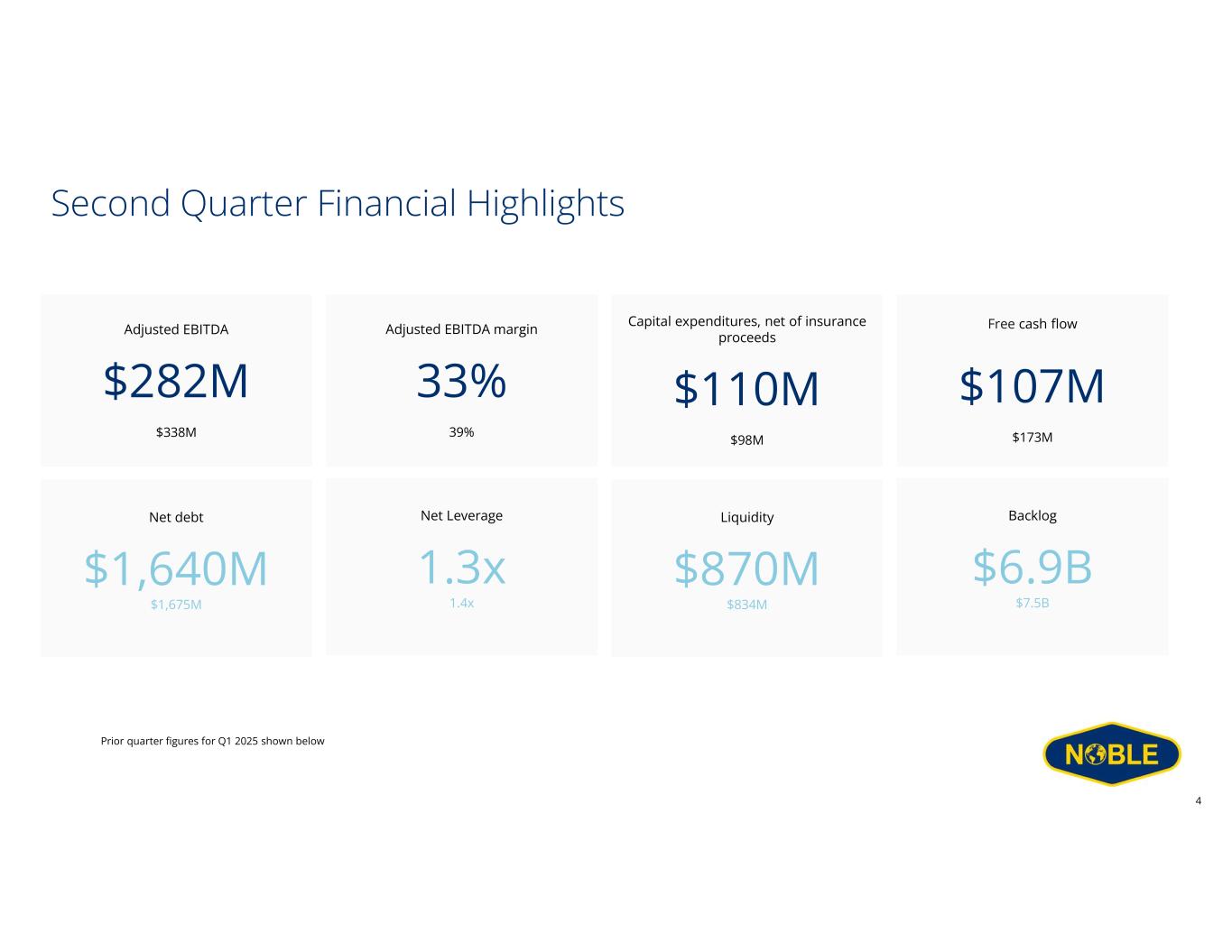
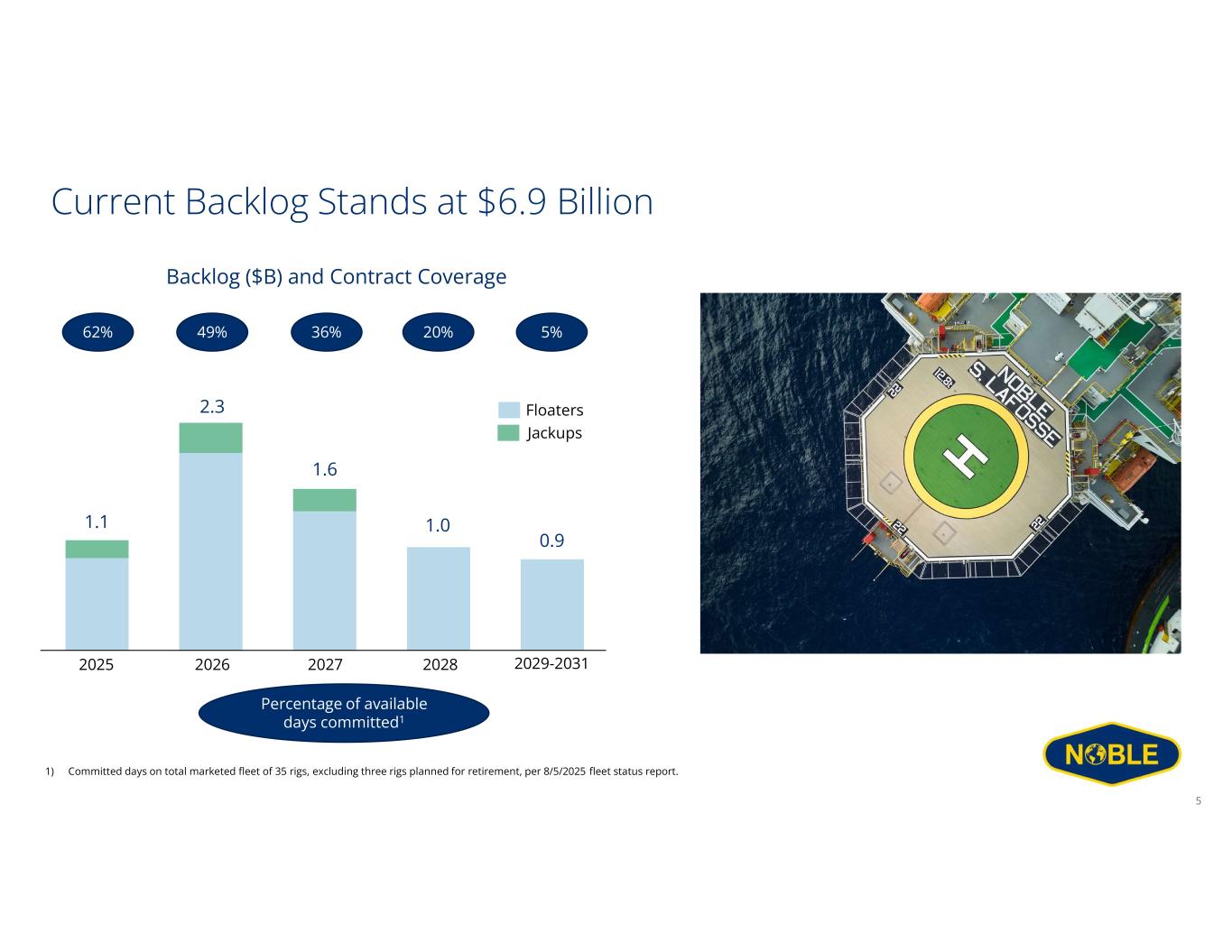
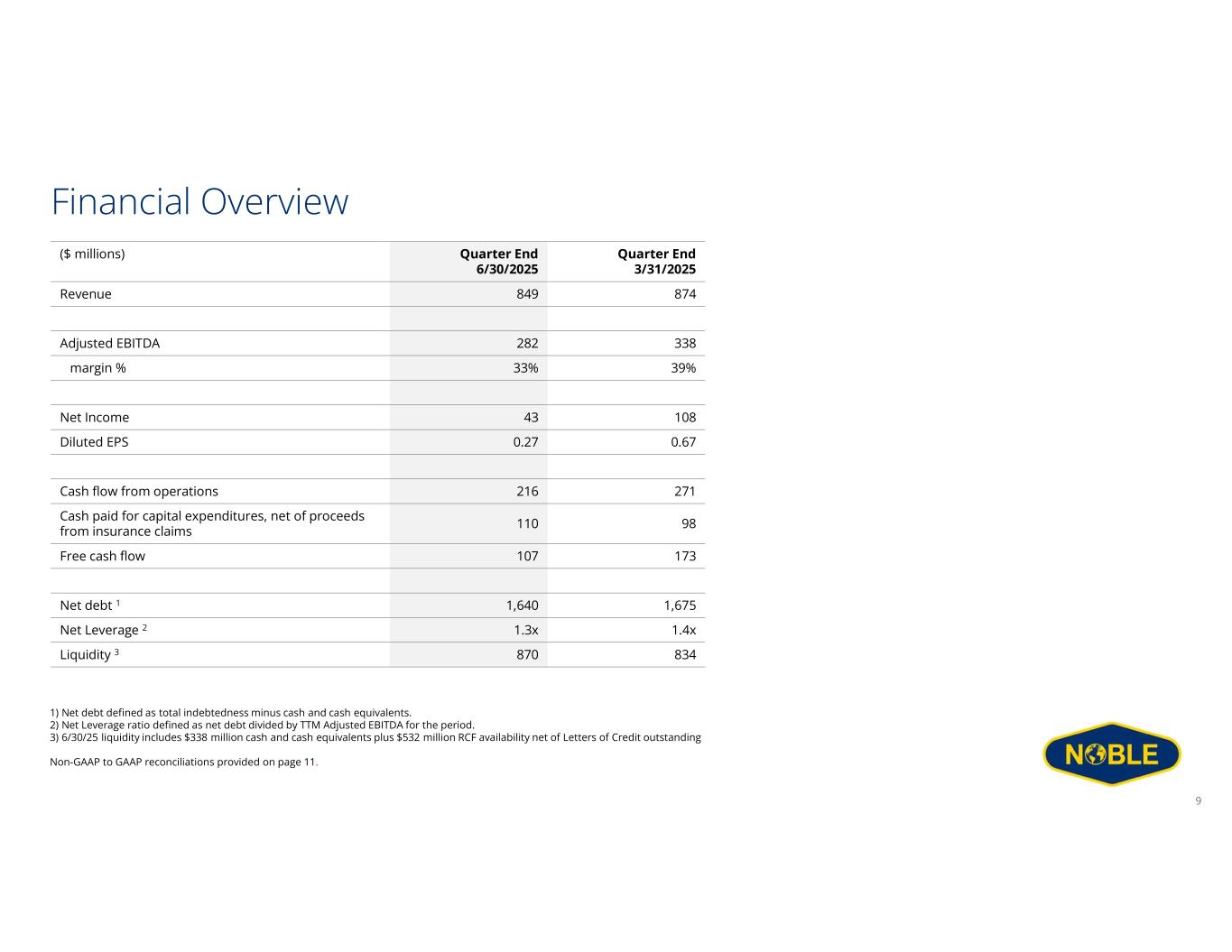
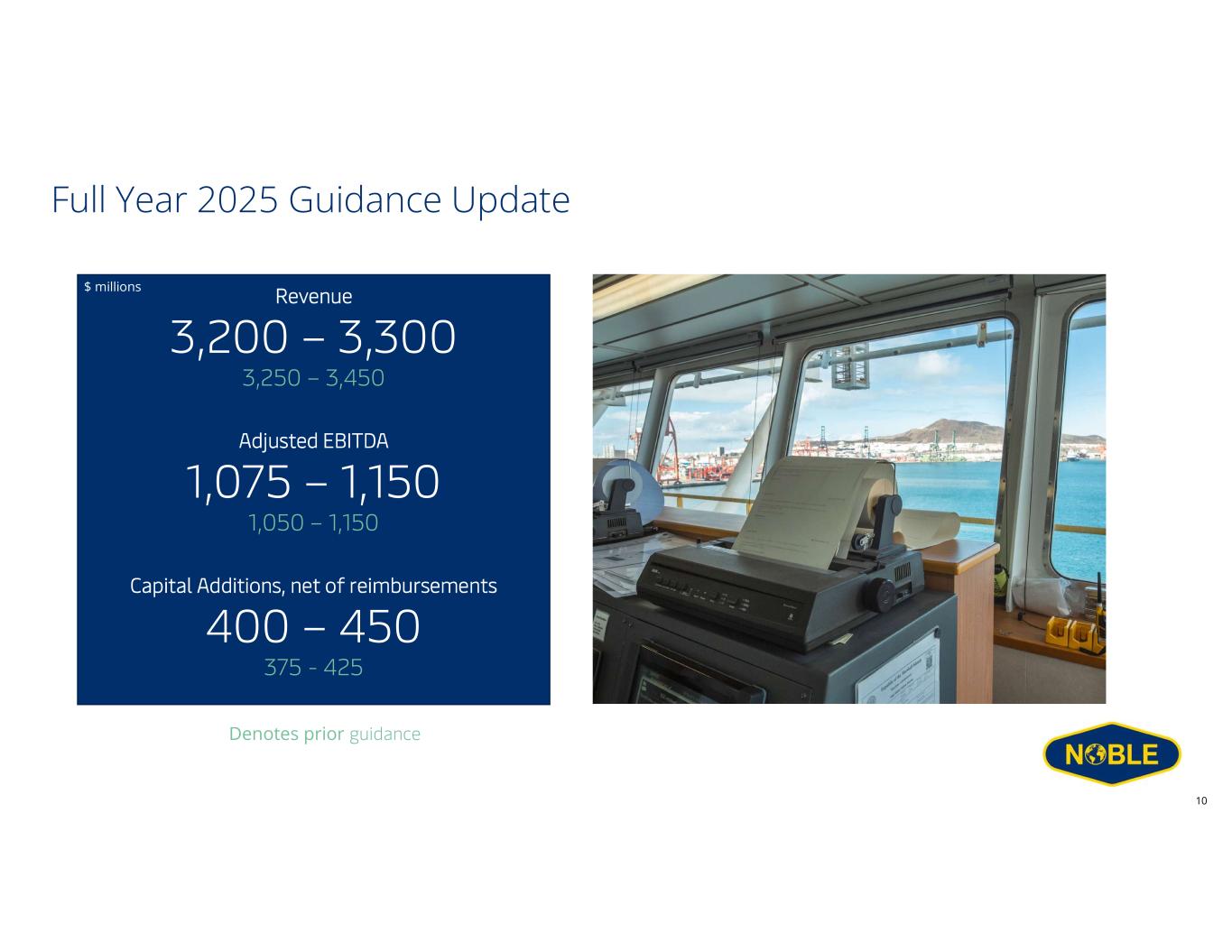
Good morning or good afternoon, all. In my prepared remarks today, I will review our second quarter results, provide a brief update on our integration progress and then discuss our outlook for the remainder of the year as well as some high-level perspectives around 2026. Starting with our quarterly results. Contract drilling services revenue for the second quarter totaled $812 million. Adjusted EBITDA of $282 million, and adjusted EBITDA margin was 33%. As expected, Q2 revenue and adjusted EBITDA was sequentially lower, primarily due to planned out-of-service time for the Noble Sam Croft FPS and rigs rolling off contract during the quarter into a softer spot market. Q2 cash flow from operations was $215 million. Net capital expenditures were $110 million and free cash flow was $107 million. Included in the Q2 free cash flow is approximately $16 million from the closing of the Scirocco sale. The Meltem sale closed in early Q3 for the cash proceeds of approximately $25 million. As summarized on Page 5 of the earnings presentation slides, our total backlog as of August 5 stands at $6.9 billion, which includes $1.1 billion that is scheduled for revenue conversion for the remainder of the year with $2.3 billion and $1.6 billion scheduled for conversion in 2026 and 2027, respectively. As a reminder, these figures exclude reimbursable revenue and revenue from ancillary services. We're very pleased with the progress of the Diamond integration and have now achieved our stated synergy cost target of $100 million. I'd like to echo Robert's earlier comments and thank our employees for the great work in achieving this milestone ahead of schedule. On fleet management, the moves outlined by Robert around the Globetrotter II, the Highlander and the Reacher highlight our commitment to managing the business to maximize cash flow. While these decisions are not taken lightly, we can no longer justify keeping these rigs in our fleet when weighing the ongoing stacking costs and reactivation capital against the opportunity set. Referring to Page 10 of the earnings slides, we are updating our full year 2025 guidance as follows: First, total revenue is lowered to a range of $3.2 billion to $3.3 billion. This update aligns with our commentary on the prior call around trending to the lower end of the initial range as we see white space persist in the second half of the year. Specifically, on rigs we previously thought would see option exercises that did not materialize. Second, the guidance range for adjusted EBITDA is narrowed to the upper end of the previous range, now standing at $1.075 billion to $1.15 billion. This is driven by decent first half results and strong cost management across the business. The lower half of this revised range is effectively fully contracted based on year-to-date results and remaining 2025 backlog. Third, we are increasing capital expenditures, excluding customer reimbursements to a range of $400 million to $450 million. The increase reflects capital tied to the recent long-term awards. The available CapEx for 2025 is expected to total approximately $25 million, with $10 million incurred in the first half. Looking towards 2026, we currently would expect 2026 capital expenditures to be in the ballpark of around $450 million, which includes the capital required for the recent long-term awards. As we look ahead, we anticipate adjusted EBITDA to decline sequentially in Q3, primarily due to contract rollovers and planned downtime for the Noble Venturer. These impacts will be partially offset by the Noble Developer contract startup in Suriname and the Noble Sam Croft working following her Q2 FPS. If we zoom out and bring 2026 into view, we remain constructive on the long-term market despite white space that is expected to persist well into 2026. Given this, we expect quarterly EBITDA to trend lower over the next 4 quarters relative to the first half of 2025, but expect a material rebound starting in the second half of 2026, supported by the startup of new long-term contracts in parallel with rising deepwater demand levels. In the meantime, we are taking a disciplined approach to managing our business that is calibrated to the realities of a nearer-term flatter demand environment. With that, I'll hand it back to Robert for closing remarks.
Thank you, Richard. To reiterate, we're seeing signs that the deepwater market could firm up nicely by the second half of 2026 or 2027, but in the meantime, we are managing the business from a cost and cash flow discipline perspective for the flatter market presently at hand. We remain committed to and confident in a stable dividend. Thus, shareholders in Noble have the unique benefit of being paid to wait for the next leg up in the cycle. While late 2026 is still a ways out and with perennial macro uncertainties and volatility continuing to shape upstream spending, our current backlog, coupled with the active dialogue we're having with customers on a global basis gives us confidence in soon substantially derisking an annualized free cash flow run rate of $400 million to $500 million by the second half of next year, even in a scenario where current trough levels of demand linger past 2026. Today, we are keenly focused on securing the very small handful of key remaining contracts that would be necessary to complete that picture, while continuing to deliver the service integrity and value every single day that our customers expect and require from Noble. With that, operator, we're now ready to go to questions.
Operator
Your first question comes from Arun Jayaram with JPMorgan.
Speaker 4
I was wondering if we could unpack a little bit about around the guidance update, you're lowering your top line guidance by about 3%, but tweaking higher your EBITDA guide by about 1%. So maybe you could just help us unpack kind of the moving pieces there.
So I think on the last conference call, I think we softly guided to the low end of the revenue range. And you know, I think unfortunately, we had a couple of options or specific options that were expected to be decided that did not materialize through this year. And so I think that weighs on guidance because the top line is down. I think also from an EBITDA perspective, I think just strong customer management across the board mitigated that. So that's why the top line seems down a little bit but at the midpoint the EBITDA is slightly more positive.
Speaker 4
Got it. Got it. So cost management, the driver of that. Got it. Got it. Okay. Great. And then maybe for Robert, you highlighted the organization's focus from a marketing perspective on the BlackRhino, Viking, and Gerry De Souza. Obviously, the outlook, which is kind of consistent with your peers is for a broader set of opportunities kind of emerging later in '26 and '27. So talk to us about kind of your strategy around those 3 rigs because that can be a decent swing factor as we think about your earnings power next year?
Yes, we're very focused on those three rigs. I mentioned in my prepared remarks that we believe we can secure contracts for at least two of them, which is key to our plans. We have strong discussions ongoing for all three rigs, and despite a more cautious tone about the market outlook, we still see significant projects moving forward. We're encouraged by the quality of conversations around larger projects and the demand for higher quality rigs. Over the past three months, we've observed a disappointing demand for lower-end rigs globally, but demand for higher-end rigs has remained stable.
Speaker 5
I wanted to start by discussing Brazil specifically. As you mentioned in your prepared remarks, you have a solid presence in South America overall. Currently, there are numerous tenders happening in Brazil, including Buzios and Tupi. I believe you have one rig completing its contract in late 2026 and another in early 2027. What are your thoughts on recontracting opportunities for those units? Are you planning to keep them in Brazil?
I believe that Brazil will remain flat at worst, and is more likely to see an increase of one or two rigs in demand. With 30 out of 35 rigs in the country, Petrobras will ultimately make that decision. The outlook from them appears positive. The current Buzios tender has many moving parts, and they have already secured a few rigs. However, it's a bit early to form a definitive opinion on their direction. We are preparing for Petrobras to maintain a stable rig count over time, with potential growth outside of Petrobras in Brazil. Additionally, there is significant activity further north, which is a key region for us. Overall, South America is currently a strong area of demand.
Speaker 5
Thank you for the information. Regarding supply, you announced three rigs for sale today, one of which has a definitive agreement in place. For the other two, are they aimed at being retired from the drilling fleet, or are there possibilities for selling them to competitors or niche markets where you currently don't have a presence? Additionally, you mentioned that the rigs in your fleet now have individual stacking plans in case of prolonged downtime. If opportunities for some of those rigs do not arise, can you identify any other retirement candidates beyond the Globetrotter I?
Yes. So the Highlander will go to a drilling project, and we don't have a conclusion on the Reacher or the GT II, but we would not anticipate those being sold for drilling purposes. So we would not anticipate that the Reacher or Globetrotter that we would be competing against those later. The Highlander will go to drilling. I would reiterate on the second part of your question, what we've done already with the Meltem and the Scirocco, and we mentioned that the Globetrotters, those are effectively competing for intervention work with the sole exception of 1 or 2 places in the world that really need the Globetrotter capabilities for drilling, the likes of Black Sea. And then I think being rational on the jackup side as well, we're just big believers that the option value of hoping for a better market at present is more expensive than it has been in times past. And we've said for years that we're running this company to generate cash and our fleet rationalization policy has been really in keeping with that.
Speaker 6
So you provided a very constructive medium-term outlook in your walkthrough of the regions but indicated some near-term kind of softness here. We've seen leading edge day rates on recent contracts in the low 400s. Just curious on your expectation on where that pricing could go for upcoming contracts later this year. Do you think rates kind of hold firm here in the low 400s? Or could they even see a downtick lower, just given the near-term softness we're seeing right now? Just curious on your thoughts there.
Yes, I think rates are in the low to mid 400s as you mentioned. To my knowledge, there hasn't been a single instance of a 2 BOP Tier 1 rig priced below that range. Our outlook is that there should be some increased demand for rigs by late 2026, and I can't imagine anyone would lower rates with that outlook, but you never know. There is a unique situation where several large projects are expected to start in late 2026 and 2027, likely resulting in a temporary dip in demand. People often talk about gap filler work, but it's uncertain. I think lower rates could happen, but I don't believe that would reflect a broader market perspective when considering the earnings potential for late 2026 and 2027.
Speaker 6
Got it. That's very helpful color. My follow-up is somewhat related. I think you said in the prepared remarks that there's a very credible path back to UDW rig count back up to 105, I think towards the back half of next year, assuming stable macro conditions. Fair to say that there is also a very credible path back to leading-edge day rates sort of in that mid- to high 400s level on contract announcements we might see in the back half of next year?
It's a great question. I wish I had a definitive answer. We perceive ourselves to be in a bit of a lull caused by a lot of macroeconomic noise at the moment. I would suggest that with the current number of working rigs just below 100 on the floater side and in ultra-deepwater, the normalized demand level based on the current Brent curve should fall between 100 and 105. We've analyzed projects and see a potential to reach the higher end of that range. Therefore, I believe there is at least stabilization, and there certainly exists a possibility for rates to increase from this point. We'll need to observe what transpires in the meantime. You can outline a considerable portion of demand through significant projects, but there are always various factors that complicate predictions. I previously mentioned the lower-spec demand requiring lower-spec assets, but I believe other elements have contributed to a softer market recently, which many did not expect. While it's a bit premature for predictions, we remain optimistic about returning to a more normalized state by the end of next year. Additionally, as stated in our prepared remarks, we are confident that with our fleet and existing contracts, along with a limited need for new contracts, we can position ourselves for substantial cash flow. We've indicated potential cash flow of $400 million to $500 million, even with a stable market or perhaps a slight decrease in day rates. Nonetheless, if our current situation represents the new normal, we still believe we can deliver significant cash flow for our investors, and we've provided ample evidence to support optimism for an increase from that level.
Speaker 7
Yes. I feel like I asked this like once a year, but could you kind of remind us the timing of the Exxon rig resets and then maybe how we should be thinking about that? I believe it's in October, how we should be thinking about that versus, say, where it was, when it was reset, I guess, a few months ago?
Yes. It's March 1 and September 1 are the dates that the new rates go into effect. And so those rates are respectively set 3 to 5 months prior to when they go into effect. I would say that, that mechanism has worked extremely well and it has tracked the market since we came up with the CEA. And so you're talking about a September rate that will go into effect that was set 2 or 3 months ago, and so we don't give the rates out, but I think there's obviously positive ties. And I think that, that mechanism has really tracked the market very closely.
Speaker 7
And I felt like, Robert, you mentioned kind of dual BOP, which is what those are. So it's safe to assume that excludes kind of like it definitely sounds like it excludes sixth-gen rigs, but maybe even lower end seven-gen rigs?
That's correct. That's absolutely right.
Speaker 7
Okay. Great. I have a broader question. There was significant news yesterday regarding consolidation in the jackup market. The acquirer has not previously operated in the North Sea. Mergers and acquisitions can be beneficial or detrimental to a sector. What is your perspective on how this affects the jackup market? I know you've been reducing your jackup fleet over the past couple of years, but does this M&A deal influence your thoughts on your jackup fleet moving forward?
No, not really. We have three rigs outside of the North Sea that we're marketing aggressively, and there is some overlap with the North Sea in this M&A deal. However, it doesn't change our demand or views on anything. I'm happy for the companies involved, and I think it was likely a great deal and a win-win situation, but I don't believe it prompts any action from our side.
Speaker 8
Robert, you've laid out that Q1 drillships are still in the low 400 to mid-400 range. Have you seen any material changes to some of the other factors that can affect economics like mob or demob fees or capital reimbursements. Just trying to look a little deeper in terms of the economics in the current environment.
Yes. I mean, look, contract terms are effectively correlating with day rates. However, I would say that if you're talking about a wider spectrum of potential day rates, so the awful years that had 2 handles on them all the way over to kind of some world with 5 handles where there is the true shortage of rigs. I don't think the change between high 400s and low 400s is particularly meaningful on the broader contract term scale. So yes, there will be a bit of economic leakage probably today versus when we were knocking on the 500 door. But I don't think that's a meaningful change so far.
Speaker 8
Fair enough. And you've touched on this a little bit, but just on some of the options that are outstanding, just any general commentary in terms of option exercise as we think about those rigs going forward.
Yes. We have assumed for the past two to three years that all options would be exercised. Today, we will estimate that around 50% to 75% are exercised, and we hope it leans closer to the higher end. It's important to note that, when considering the entire industry’s options, there will be a significant number that are likely not exercised. We experienced this with our 2025 projections, where we were quite confident last year that several options would be exercised, but they ultimately were not.
Speaker 9
So a lot of mine have been answered. I'm going to step back with just a little bigger picture question. In past cycles, we typically saw floater contract lead times move in tandem with utilization and backlog. In the past few months, we've seen operators locking in multiyear contracts with 12- to 24-month lead times even as near-term demand looks softer and the rig count trends lower. It's creating multi-quarter gaps between contracts for some rigs, a dynamic that seems fairly uncommon compared to prior cycles. I was curious if this strikes you as unusual. And if you have any thoughts on what is driving that out-year contracting behavior?
Yes, that's an excellent point, Dave, and we concur. Earlier, I briefly mentioned that the situation is somewhat unique. Both drilling contractors and service companies see demand emerging in late 2026 and 2027. There has been a disconnect between long lead providers and national service providers for a while, leading to dynamics that differ from what we're typically used to. Our understanding is that for the projects being approved and progressing, the economic feasibility aligns with Brent prices in the 60s range. This trend is evident as major projects advance. Additionally, amidst various macro factors and a continued emphasis on capital discipline from our customers, we are witnessing some different dynamics. You're correct that the correlation regarding lead times has somewhat deteriorated, but we view this as a positive sign. We examined the global perspective and are hopeful that we can return to a more typical level of activity, around 100 to 105 working ultra-deepwater rigs.
Speaker 9
I appreciate it. And a follow-up if I may. Just kind of relates to Eddie's question earlier. But for the rigs that are facing multi-quarter gaps between firm term contracts. Do you see a risk that bidding strategies become more aggressive to fill in those gaps? And if so, do you think that more competitive pricing for short-term and near-term work might influence broader pricing expectations or do you think it's just going to result in a greater bifurcation for short-term, near-term versus longer-term work?
Yes. I mean, for sure, I think you're going to see gas sort of work where people are willing to take almost any price or take a discount, maybe a better way to say it, but I just don't think that affects the broader pricing strategies for the companies. I don't think it will affect ours. And I think back to this funny dynamic we have right now, everybody sees it, and we're one of the last to go on this earnings season and whether you're talking about drilling, contractor or a service company, everyone is talking about the same dynamics. And so I think that's really meaningful and important. And I think people are going to price as they see the market and people generally see a bit of an uptick here starting late '26. So I think of the gap filler stuff as more noise than I do something that's going to drive rates.
Speaker 10
I was wondering, based on your comments about the marketplace so far, have you considered revisiting the maintenance and upgrade schedule in light of the near-term uncertainty regarding white space being taken up, balanced against the consistent industry optimism in 2026 and 2027?
Yes. I would say that we've discussed the rationalization of the fleet and our perspective on it, including the costs associated with some of this option value. Specifically regarding the working rigs, we have not reduced revenue or EBITDA, and we have been closely managing costs. In the previous call, we mentioned our approach to readiness, splitting it between 6-month and 1-year readiness. We have opted for a 6-month readiness on a couple of units, which we believe strikes a good balance between current costs and marketability. We are very focused on managing costs and are satisfied with the decisions we've made regarding the couple of units we are seeking work for, although there may be a bit of a gap before that work commences.
Speaker 10
Great. And I'm just wondering if with BP's announcement of their big discovery at Boomerang offshore Brazil. Do you have any sense of whether that might help sort of affirm or accelerate what we've seen as a little bit of a positive drift towards exploratory dollars and drilling in the industry.
Yes. I mean all discoveries are good for our business. And my longer-term view is very firm around the need for oil and gas produced from offshore wells. There is a gap that we will eventually get to, have to assume an oil demand, obviously. But if history is any guide, I think I'm very confident that there's a gap between discovered barrels and needed barrels coming from offshore, and we thought that dynamic might start playing out this year. It's been pushed off to the right. There's a lot of macro noise, but I remain extremely confident that the need for our services to increase offshore production is imminent and will come in the next few years. So you're starting to hear more about reserves, reserve life, reserve replacement from our customers. And I think this is one of our biggest customers, and them highlighting that this is the best exploration year in 10 years, I think is another data point that there is a meaningful shift back to offshore globally that's happening right now.
Thank you, everyone, for joining us today. We appreciate your interest, and we look forward to speaking with you again next quarter. Have a good day.
Operator
Ladies and gentlemen, that concludes today's call. Thank you all for joining. You may now disconnect.