Operator
Good day, and thank you for standing by. Welcome to the NewtekOne, Inc. First Quarter 2025 Earnings Conference Call. At this time, all participants are in listen-only mode. After the speaker's presentation, there will be a question-and-answer session. Please be advised that today's conference is being recorded. I would now like to hand the conference over to your first speaker today, Barry Sloane, Chairman, President, and CEO. Please go ahead.
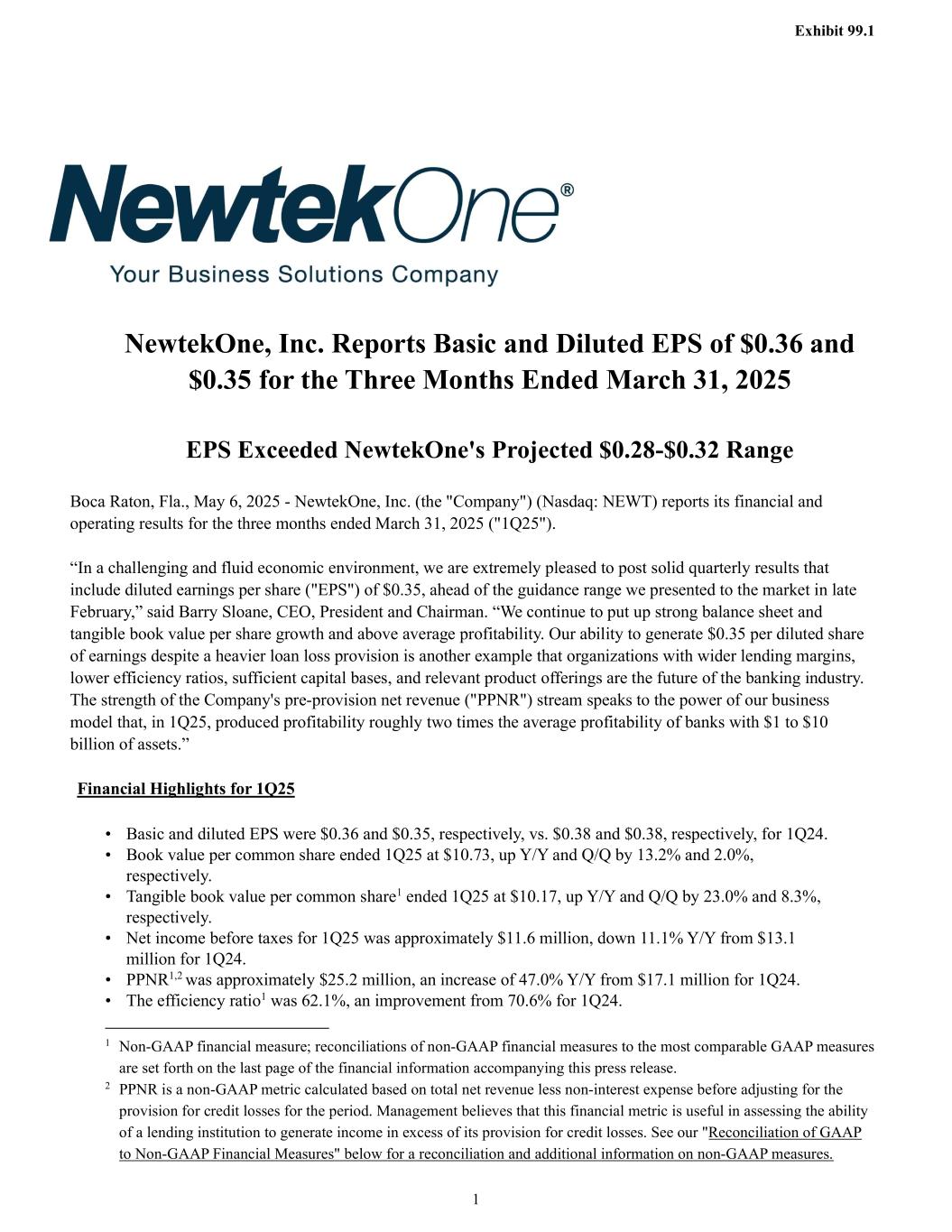
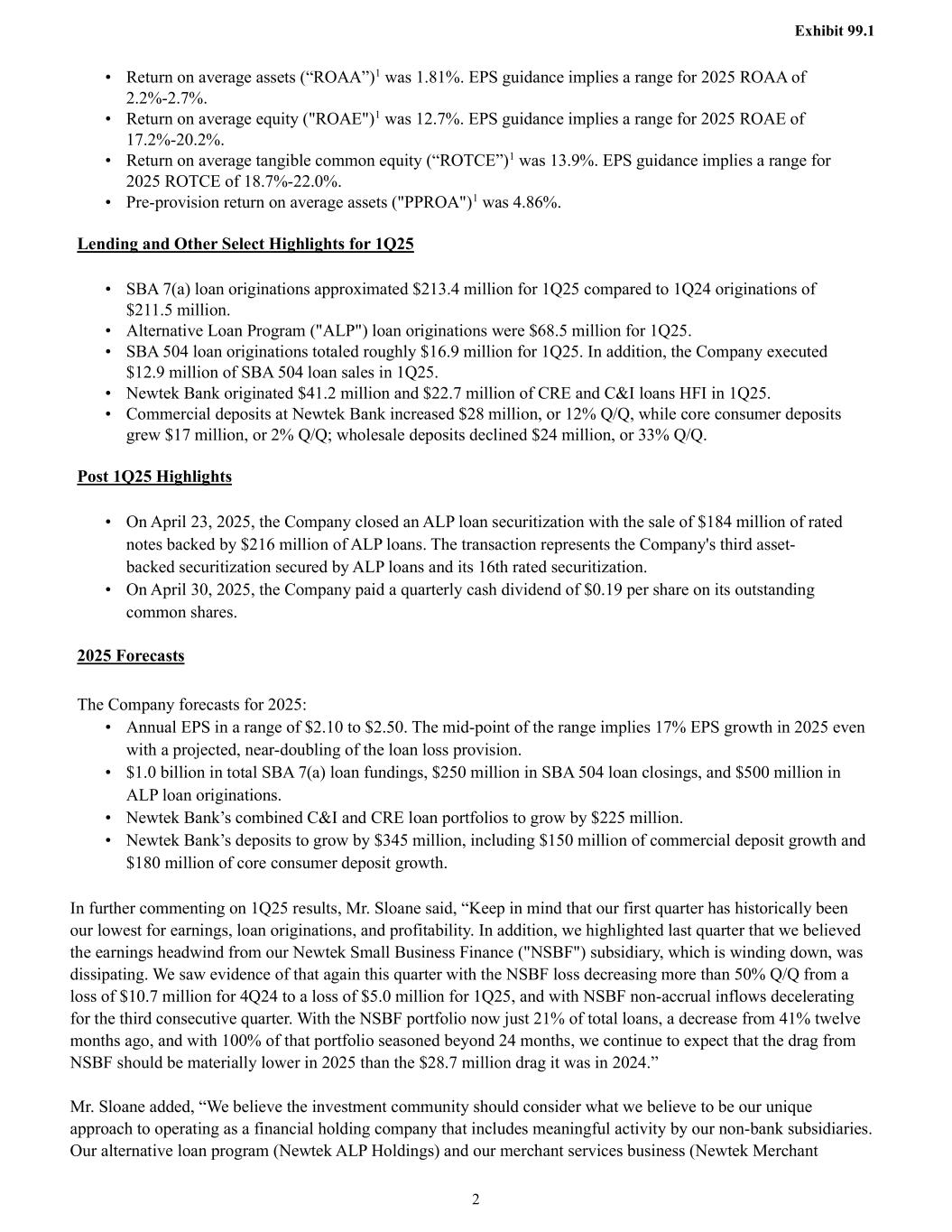
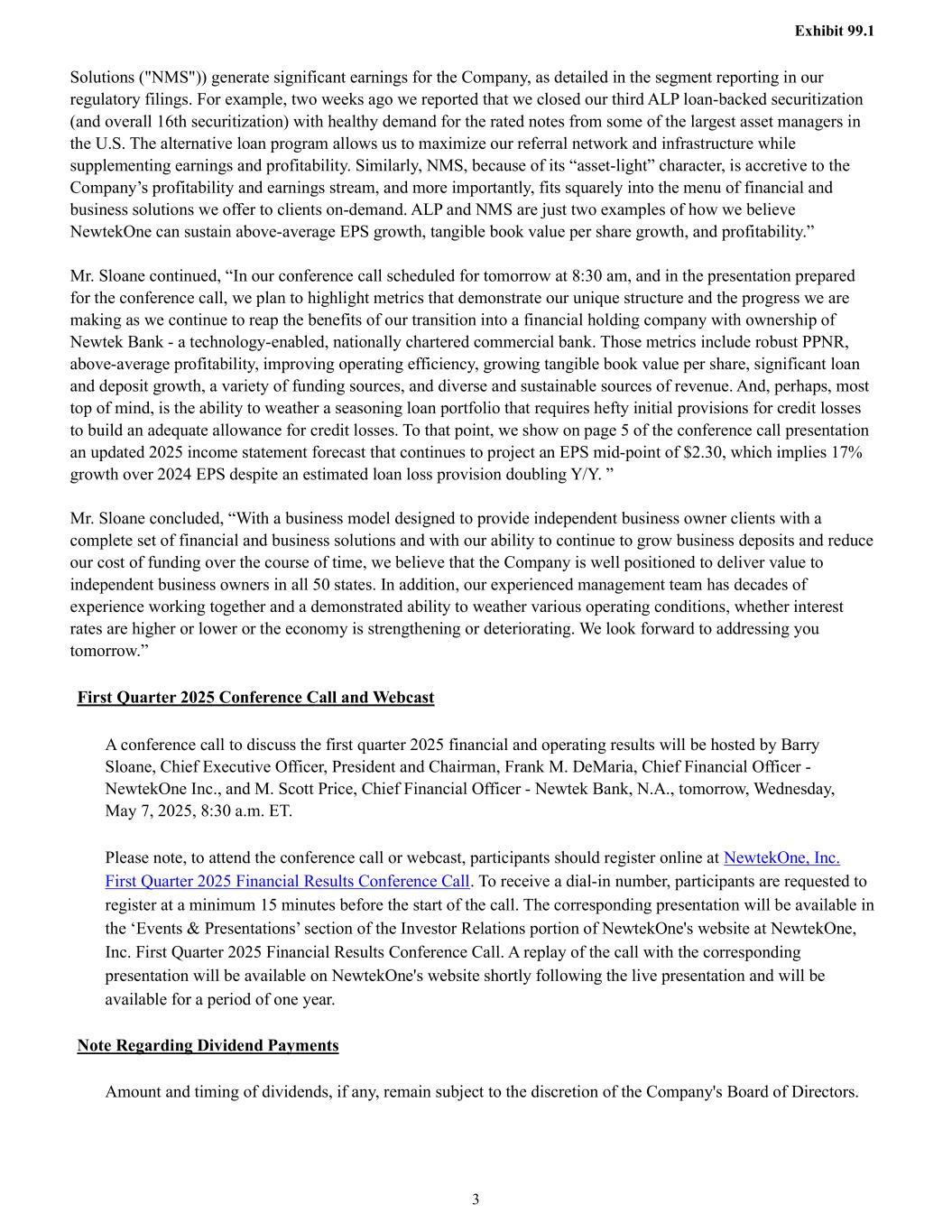
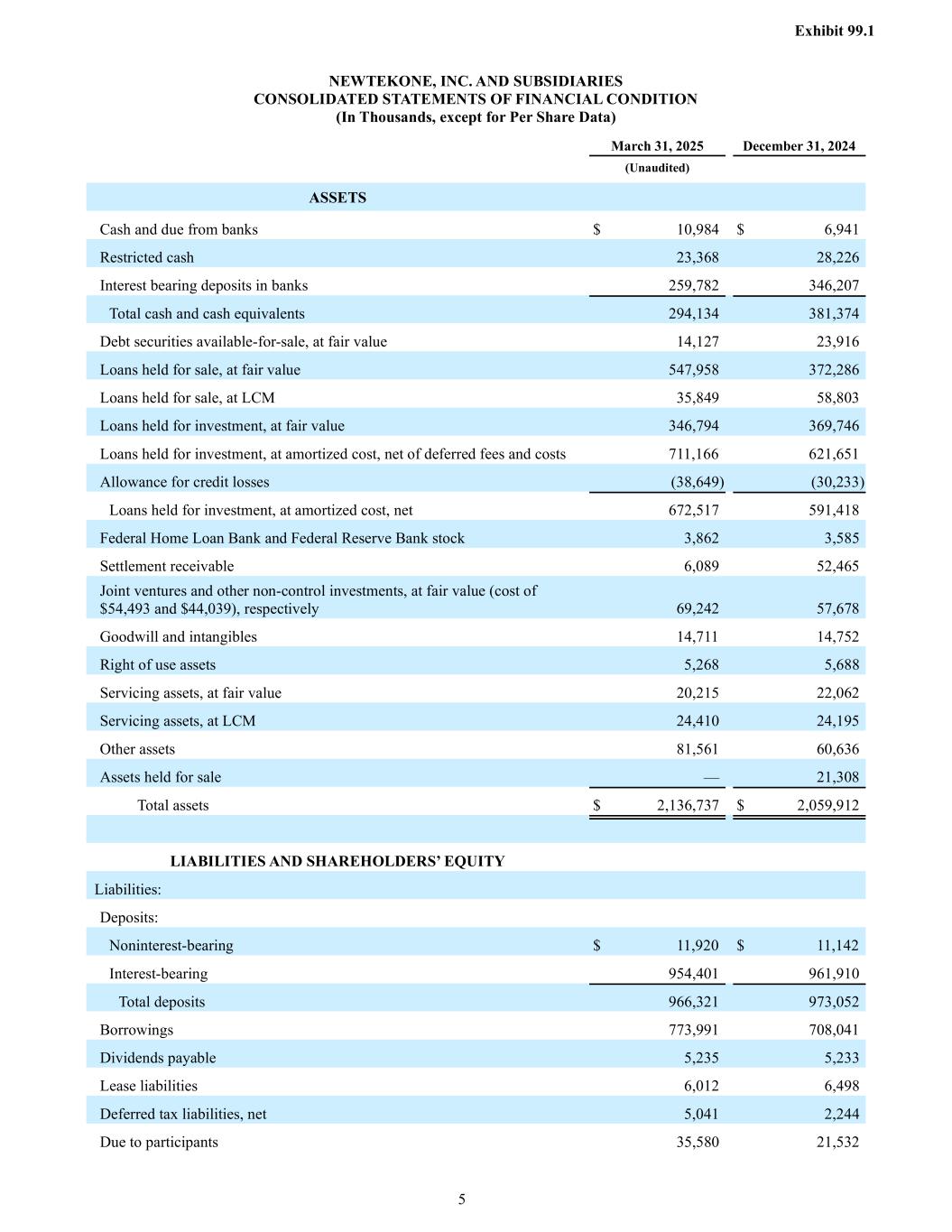
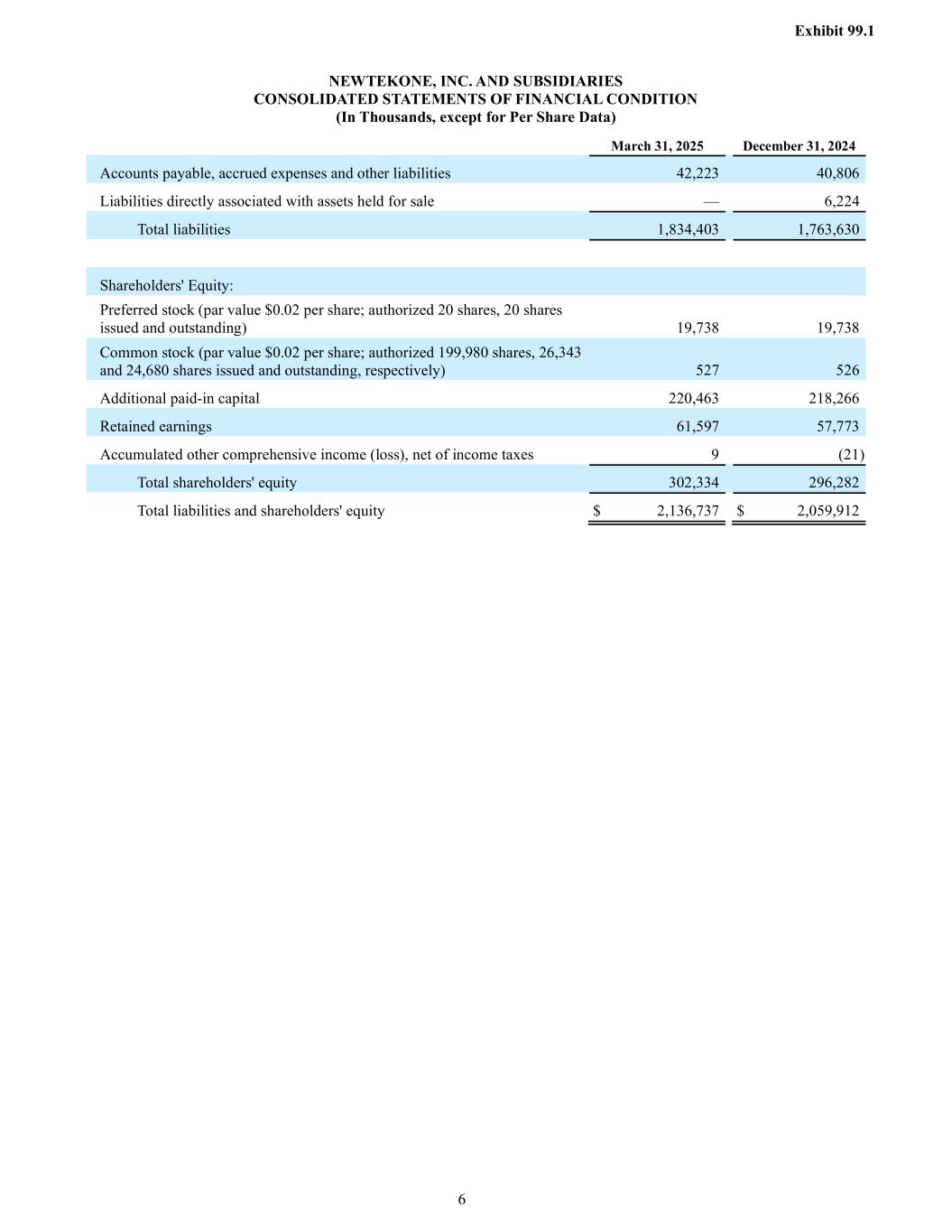
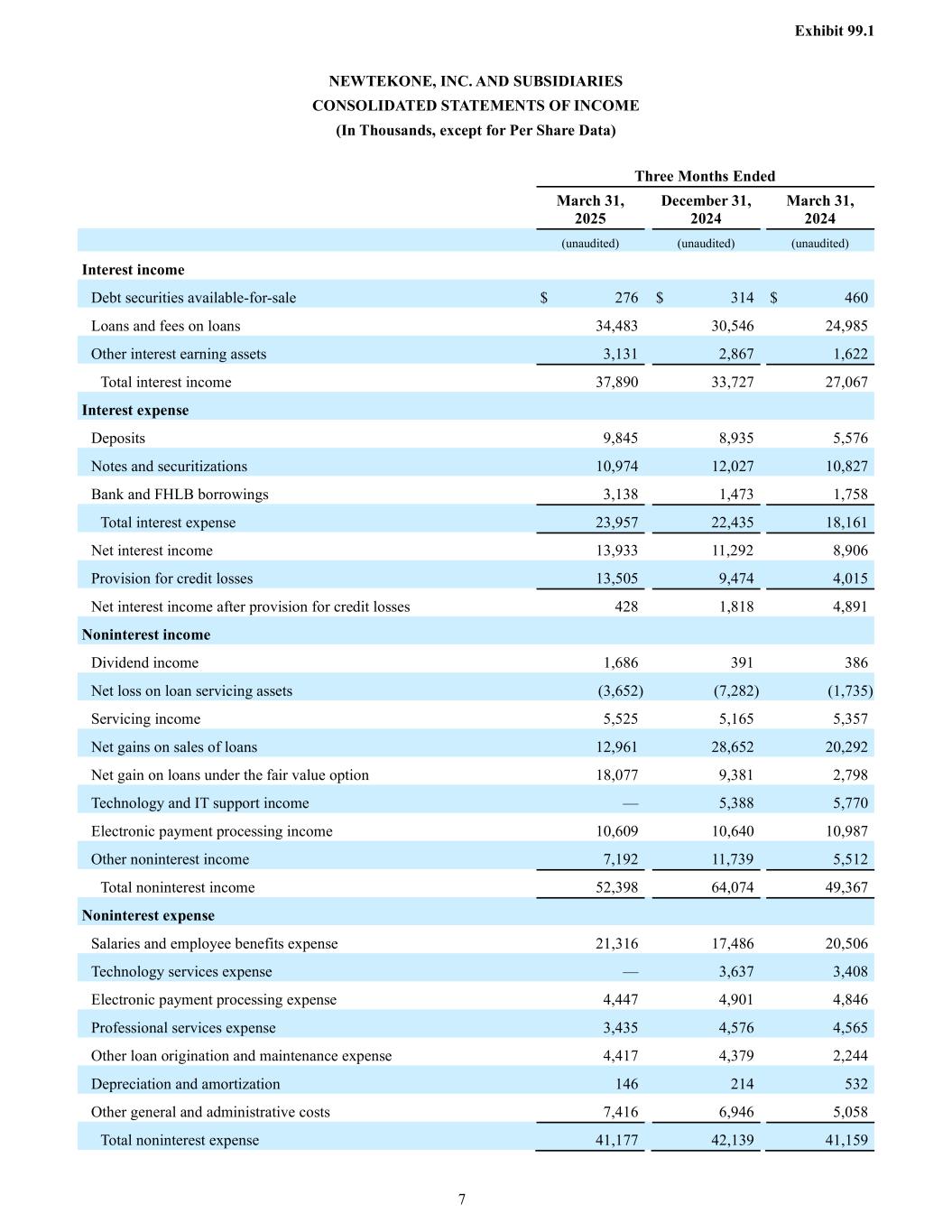
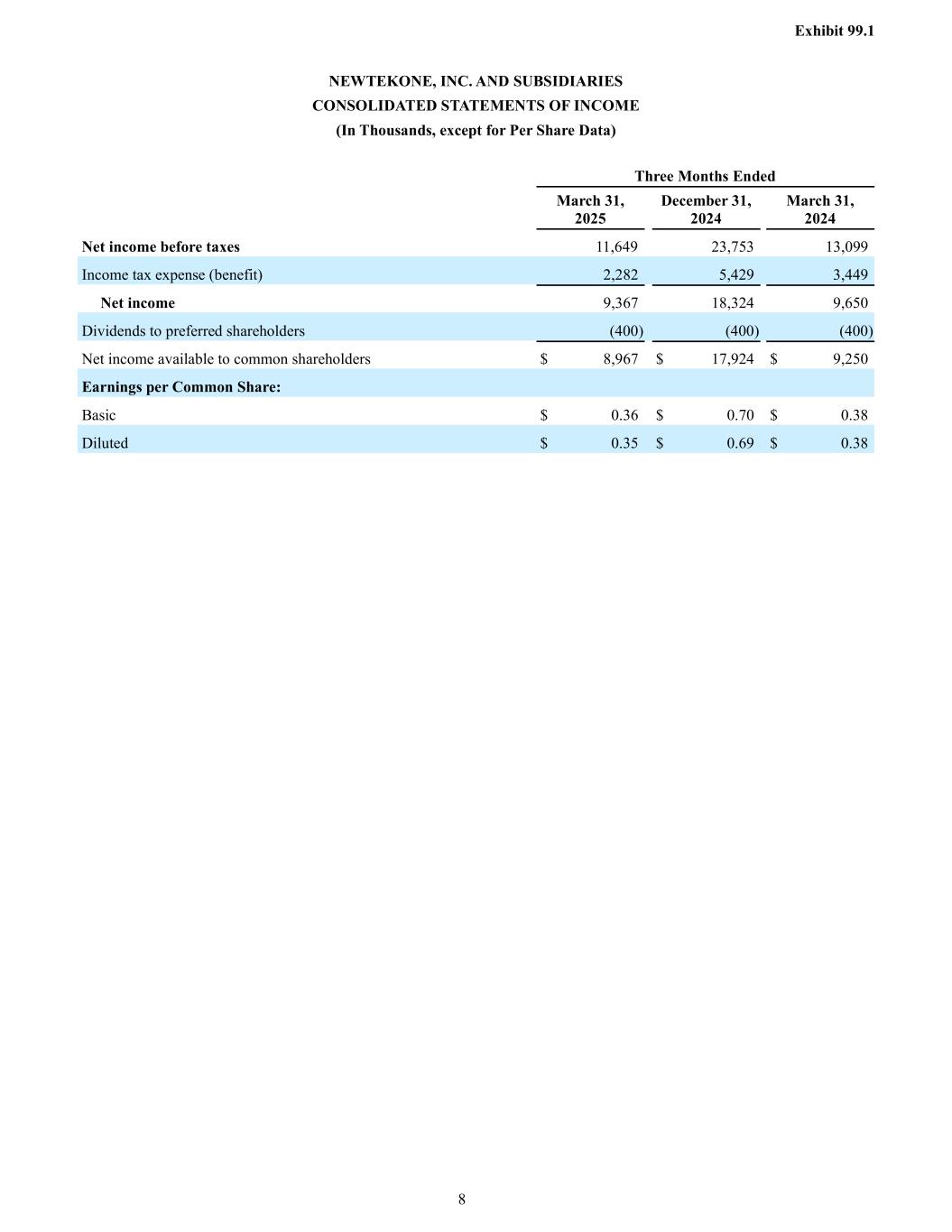
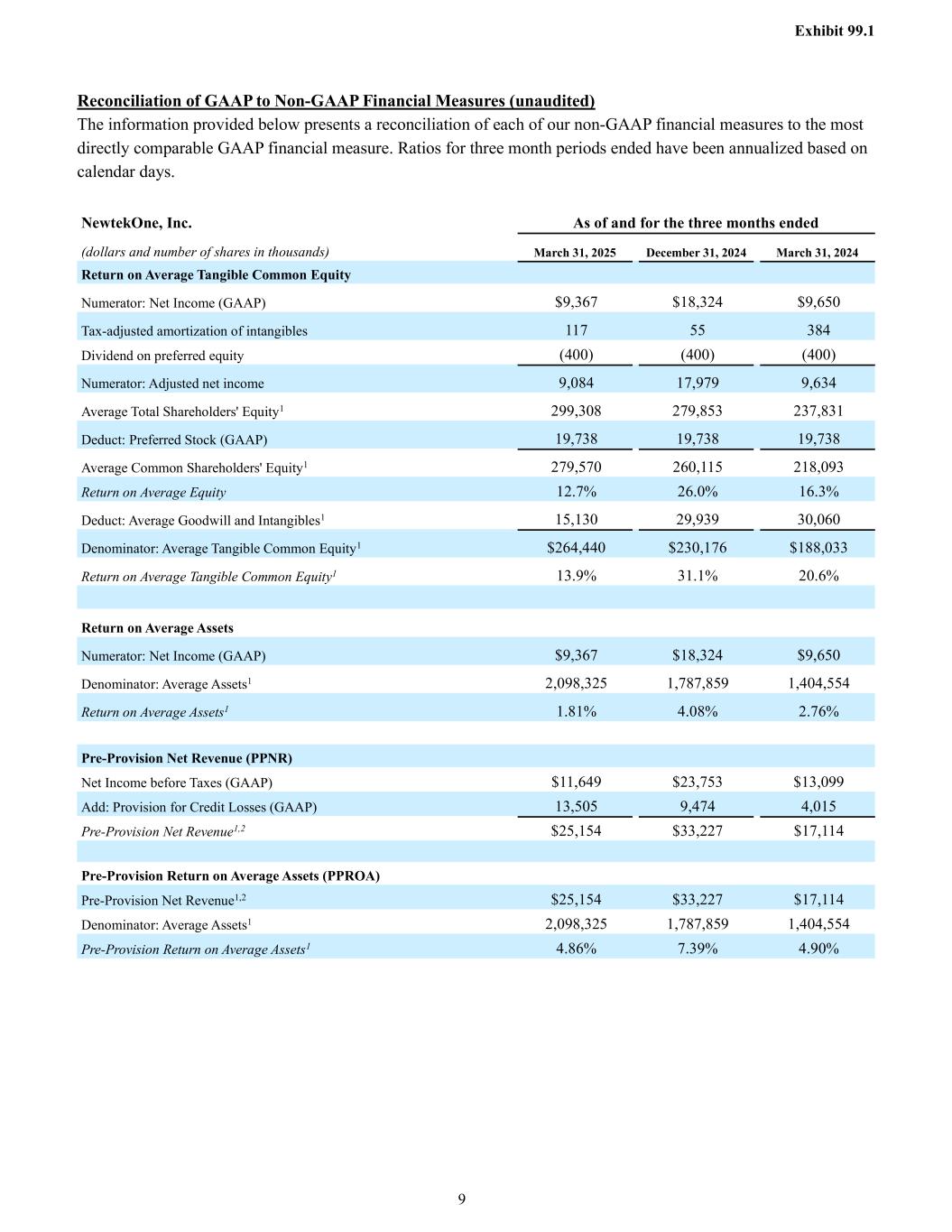
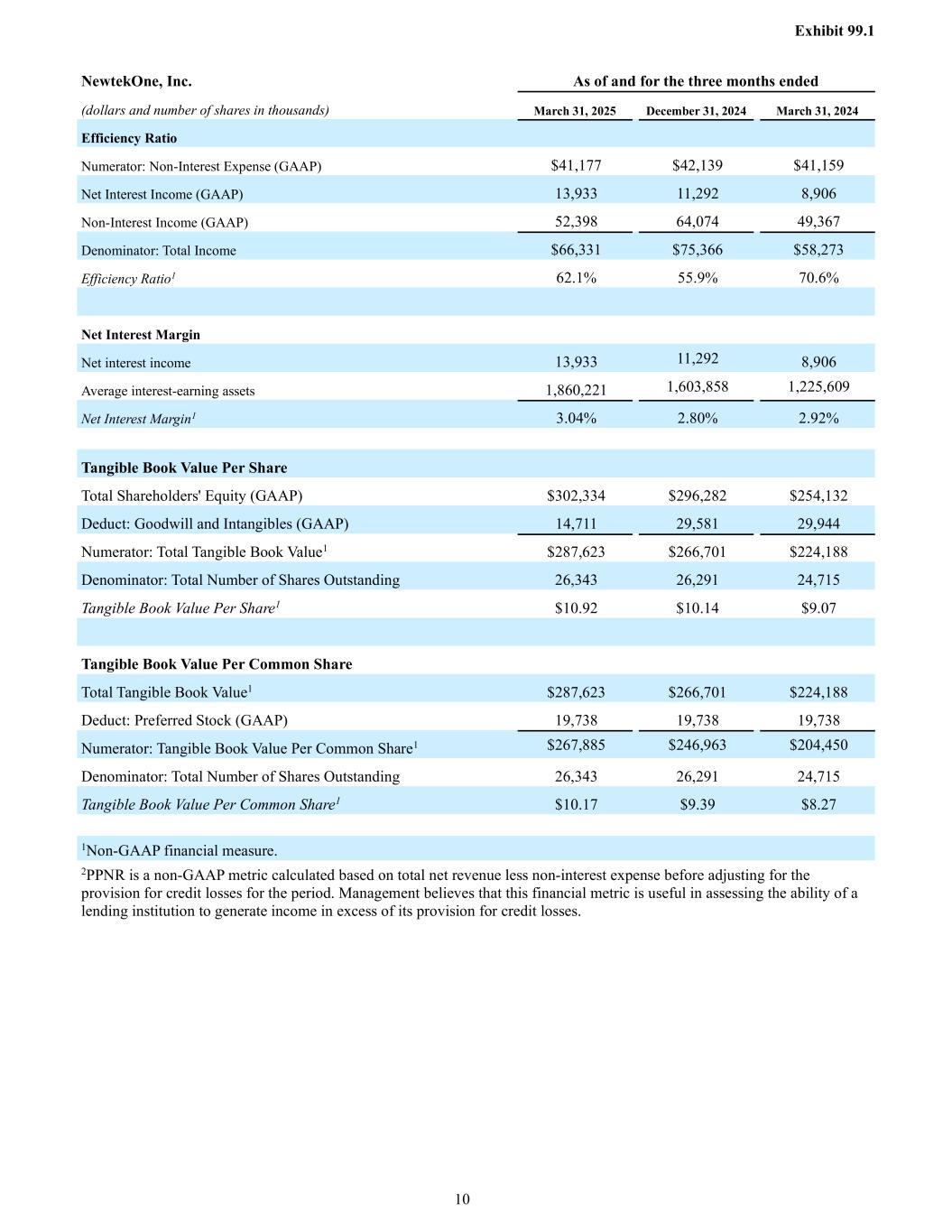
Thank you very much, and welcome everybody to our first quarter 2025 final results conference call. Today I am joined by my two Chief Financial Officers, Scott Price, the CFO of Newtek Bank National Association, and Frank DeMaria, the CFO of NewtekOne, the publicly traded bank holding company. For those of you who would like to follow along on our presentation, please go to our website newtekone.com, go to the Investor Relations section, and the PowerPoint presentation that we'll be addressing today is available there. I also wanted to do a couple of honorable mentions. I wanted to thank Bryce Rowe, who recently joined us as VP of Investor Relations. He's done a terrific job in helping put our deck and press release together and providing a lot of data within the deck and the press release to simplify our story. I also wanted to thank Nick Young. Nick is the former President and Chief Operating Officer of Newtek Bank National Association. Nick, as many of you are aware, has left our organization, although he's still with us until mid-May. We haven't banished him to the Gulag, nor has he banished us to Siberia. If you'd like to chat with him, you can reach him at [email protected]. Over the course of approximately four years, Nick did a great job of transforming a single-branch manual bank in Flushing, Queens, into our digital platform, which today has successfully opened up 15,000 accounts remotely, transitioned our lending business to the bank, and effectively managed through regulatory audits. The mark of a great company is having a deep bench. Peter Downs, a 22-year veteran of Newtek, the Chief Lending Officer, and current President of Newtek Small Business Finance, who was largely responsible for SBA business and its success over the course of two decades, has been named as President of Newtek Bank, and we're very appreciative of that deep bench. We've done a lot of listening to shareholders and analysts recently, particularly yesterday evening. We've reshaped and structured the presentation, simplifying various important issues. More importantly, we believe we'll be able to demonstrate today the attractive progress we've made in growing deposits, loan growth, balance sheet growth, and basically establishing a portfolio at the bank level, which is quite different from what you'll see in 98% to 99% of other banks. One of the things we want to stress is that the traditional metrics used to analyze banks don't apply to us. I think as we go through the deck and explain things in more granular detail, you'll be able to see our unique position. It's important to note that while most banks have bank holding companies that possess little beyond the bank, we have more capital invested in other assets and equity than we do in the bank itself. I think this is an essential distinction. We make loans and sell them, which indicates that they are made in a good manner, whether they go into a securitization, whether they are 504 loans sold to other banks, or whether they are SBA loans, which we have been involved with for over two decades. Fair value has confused many investors and analysts. We've been a fair value player throughout most of our history but more significantly since 2014 when we became a BDC. The CECL Reserve accounting, adopted in the bank, is fairly punitive as it requires us to take losses upfront, and you don’t receive the benefit from the SBA business until later. We believe we are building a very strong portfolio. Our guidance remains consistent, indicating we are growing shareholder equity and net earnings, which exemplifies the way banks will likely operate in the future—without branches and traditional bankers. We are doing a lot of things that leverage artificial intelligence today. My point is that we are often misunderstood, but we are confident in our progress. However, we are concerned about the market’s misunderstanding; today’s efforts will help bridge that gap. Thank you for your interest before we dive into the presentation and investment. Let's go to Slide number 3. Our mission statement and purpose: our company focuses on providing business and financial solutions specifically to independent business owners, which some people refer to as small and medium-sized enterprises or small and medium-sized businesses. We do not provide consumer loans or consumer checking services; we avoid consumer banking entirely. NewtekOne acquired Newtek Bank National Association to add depository solutions and real-time payments to our offerings. We see ourselves as a technology-enabled company that also operates a depository. This is extremely different than simply measuring us by typical banking metrics. NewtekOne is a financial holding company regulated by the Federal Reserve, employing proprietary and patented advanced technological solutions to acquire clients cost-effectively. We receive six to nine referrals daily and regard this as a major strength. The customer acquisition and ability to provide solutions via technology set us apart. We offer a range of best-in-class solutions to independent business owners, making us cost-efficient and a low-cost provider with better margins. Again, we position ourselves as a technology-oriented financial holding company, operating a digital bank solely through online banking without traditional physical branches. We recognize that many markets are hyper-focused on credit concerns; however, it’s essential to note that these concerns mostly pertain to the SBA 7(a) loan portfolio, which is a small fraction of our business. We have many assets in our ALP business, and we'll discuss our success in recent securitizations. We also have a merchant services business, presenting us with diversified opportunities across the spectrum, and we are very pleased with our SBA business, which remains profitable yet does not compare to traditional bank metrics. Now, let's move to Slide number 4. I refer to this as our message for the day. Our first-quarter 2025 earnings beat projections with $0.35 diluted and $0.36 basic. Excluding one analyst’s outlier estimate of $0.53, which I still don't understand, the consensus was $0.31. We had previously forecast in the range of $0.28 to $0.32. I believe this constitutes a beat. We are maintaining our range of $2.10 to $2.50, reflecting projected annual EPS growth of 17% using the midpoint. The risk in the range primarily lies in loan volumes, whether through the 7(a) loans or the Alternative Loan Program. To be fair, acquiring quality credits today is trickier; there are less attractive credits available through traditional client acquisition methods, which means we need to onboard new alliance partners. There’s a continuous pipeline of additional channels being introduced to facilitate business growth, and we are confident in our guidance. From a profitability perspective, the market seems to overlook our profitability metrics while being hyper-focused on credit metrics. In the first quarter, our return on assets was 1.18%, compared to the average of 90 basis points for banks with $1 billion to $10 billion in assets, despite incurring a more substantial loan loss provision in this quarter. We consider this increased provision as prudent and a wise decision for our investors as we are planning ahead. It is in line with what we've communicated over the last several quarters about anticipated headwinds in 2025. It's also crucial to note that Q1 is historically our weakest quarter; the revenues from Q1 cannot be compared sequentially to Q4 from the previous year. Historically, the fourth quarter has always been our strongest by a large margin. The guidance also indicates a return on average assets of 2.45% for 2025. An important note on Slide number 4: the headwinds from our non-bank SBA lending subsidiary are winding down. It's crucial to mention that the loss from NSBF has declined significantly—over 50% down from $10.7 million to $5 million—as observed in our Qs. The expected drag on 2025 should be materially lower than the previous $28.7 million loss. Looking at the delta, the increased provision has been influenced by loan volume growth ranging from approximately $9.5 to $13.5 million, accounting for $4 million in additional provision. Similarly, for our Alternative Loan Program, which we established in 2018-2019 to cater to borrowers with larger loan requirements, these loans are of higher quality than 7(a) loans; they have more established guarantors. In the context of our recent securitization, you can see that these types of loans have an average FICO score of about 740, with a weighted loan-to-value ratio around 50%. We just completed a significant securitization with several large institutional investors purchasing the bonds. Moving on to Slide number 5, we projected earnings will show a $0.05 beat in the first quarter compared to our earlier projections. For Q2, we are adjusting our projection down by $0.05 from $0.50 to $0.60. We’ve increased our Q3 projection by $0.10, now estimating between $0.60 to $0.75. For Q4, we are reducing our projection by 10 basis points. Overall, our consensus remains unchanged at $2.30, but we've altered the outlook across these slides. On Slide number 6, it's critical to emphasize that while there’s focus on credit for 7(a) loans, we will discuss creditworthiness and quality, particularly for 7(a) loans. The SBA 504 and ALP businesses have very few charge-offs—historically, the ALP program has had just 70 basis points of charge-offs. Strategically, we aim to portray our various buckets of loans, which the deck will detail, so you're clear on our performance. We plan to grow total deposits throughout the calendar year, though we may utilize the cash held at the Fed by the end of last year, thus seeing a flat deposit growth albeit with a shift towards more business deposits. On Slide number 7, looking at net income year-on-year, we’ve shown revenue growth, specifically on a pre-provision net revenue basis. However, the provision, which we deemed appropriate, resulted in a net reduction compared to the same quarter last year. We’ve experienced growth in deposits, equity, tangible equity, and the ALP business. Turning to Slide number 8, it’s essential to highlight our growth in shareholder equity. From Q1 2023, when we took over the bank, our equity rose from $6.92 to $10.16 by Q1 2025, representing a 47% growth over two years with dividends paid. This is unusually strong but entails significant analysis from potential investors. As for Slide number 9, while the merchant solutions business doesn't contribute to tangible common equity, it generates roughly $16 million EBITDA pretax, implying a valuation range between $5.45 to $6.42 per share. This asset produces consistent cash flow, aligning with our strategic goals in merchant services. Moving to Slide number 10, we note our superior industry-leading pre-provision net revenue, having outperformed year-over-year, with Q1 producing $25.2 million compared to $17.1 million a year prior—a 47% increase. Our total for the last 12 months stands at $5.88 versus $1.26 and $1.36. On Slide 11, focusing on PPNR, the bank's PPNR represented 13.2% of average loans for Q1, while it averaged 19% for the prior fiscal year, outperforming peer averages considerably. Now, let’s discuss the SBA 7(a) loans: they essentially exist to cater to those needing loans that don’t fit standard lending criteria at traditional banks, hence potentially higher losses on uninsured segments, but the upside is the government-guaranteed bond created on 75% of the loan. Slide number 12 will break down all loans and their classifications, further elucidating our total loans of $1.9 billion as of 3-31-2025. This includes bank loans, non-bank loans, and joint ventures. It's crucial to understand this scenario, as this smaller-sized bank is actively generating significant loan volumes. Slide number 13 excludes NSBF as we address growing NPL levels with expectations based on historical trends from our SBA lending, indicating a balanced and realistic expectation of performance. Slide number 14 elaborates on the percentage mix of loans within our portfolio, demonstrating the structure of our SBA 7(a) loans and related reserves, which are predominantly attributable to this segment. And finally, on Slide number 15, we have noted an encouraging trend of diminishing non-accrual loans. We expect our loss characteristics to continue to improve as we make further adjustments to our provisioning. Now, let's transition to Scott Price. Scott, are you there?
I'm here, Barry. Thank you. Good morning, everyone. Slide 16 shows our deposit growth and mix as of March 31st. You'll note that deposits were relatively flat when compared to 12-31-2024, with a shift toward core deposits in both business and consumer spaces and slightly lower brokered funds. Our average cost of deposits at Newtek Bank was approximately 4%, and we expect that to drift down to roughly 3.8% to 3.85% for the full year of 2025. We did lower our high-yield savings rates during the quarter, in addition to our rates offered on our six-month consumer CDs. Notably, we have about $250 million in consumer CDs maturing or renewing in the second quarter. Our current offer rate is around 4.25%. This could increase depending on retention, and we expect our manager's margin, as well as the weighted average rate on our deposits, to drift down over the year. We anticipate growth in our business deposits, which are typically lower-cost than consumer deposits. As we navigate the year, we will explore the brokered market, contributing to lower costs and improving margins on the SBA 7(a) loans mentioned earlier. Now, with that, I'll turn the call over to Frank.
Thank you, Scott. Turning to Slide 17, let’s take a look at our net interest margin, which continues to expand on a year-over-year and quarter-over-quarter basis. Year-over-year, net interest income has increased about 56%, exceeding the average growth of our earning assets at about 52%. On a linked quarter basis comparing to Q4, the expansion in NIM is about 24 basis points compared to a 12 basis point increase year over year. Additionally, we included a look at our adjusted NIM, suggesting a 27 basis point expansion, largely due to the recent securitization closed last month, which aided in increasing that expansion. Moving to Slide 18, we are in a strong position where our net interest income comprises 78% of our revenue. Following Barry's earlier comments, the top bar chart shows that our gain on sale of loans increased this quarter due to our recent change in cadence to hold government-guaranteed portions of loans longer. In comparison to the prior quarter, we sold approximately $101 million of government-guaranteed loans, down about 50% from the previous $193 million. This shift has affected our balance sheet as these loans are now fair valued at market rates. Flipping to Slide 19, our scalability is evidenced by the inherent nature of our business model as a fully digital bank. Despite a 42% year-over-year growth in assets which maintained flat operating expenses, our efficiency ratio decreased year over year from 71% to 62%. We have also announced lease terminations, which are expected to decrease expenses by about $2 million for the remainder of the year and annually.
Operator
Thank you. At this time, we'll conduct the question and answer session. Our first question comes from Crispin Love from Piper Sandler. Please go ahead.
Speaker 4
Thank you. Good morning, everyone. First, just on the net gain on loans accounted for under the fair value option, it has been elevated in recent quarters, but can you speak to how sustainable you expect those gains to be throughout 2025, particularly with gains related to ALP loans and not the SBA side? Could you walk through some of the math there on how you generate those gains on the ALP side? Thank you.
Sure. Crispin, regarding the ALP, in the recent securitization press release, we securitized approximately $215 million of loans at a 13.30% gross coupon. After servicing—where we receive 100 basis points—it nets to $12.30. The net yield on the bonds was about 6.62%, which leads to a spread of approximately 570 basis points. For those of you analyzing, you’ll have to do your own math, but we put a fair value on those loans and discount them back. Our valuation considers anticipated loss frequency and severity. As seen in the DBRS memo and other public information, we expect these loans to incur a cumulative net charge of between 3% to 3.5%, which informs our pricing strategy. Based on this, we do believe the current earnings and projections are sustainable.
Speaker 4
Great. I appreciate all the color there. Secondly, regarding the management changes in late April, you've made changes to the President and CFO roles. You mentioned your deep bench; can you speak to the rationale and timing of these changes, including your thoughts on splitting CFO roles between the bank and holding company? Will there be more changes, or do you believe you're well-positioned today?
Great question. As you can tell, I'm quite candid. Yes, I expect plenty of changes. Markets change, people change, and we adjust accordingly. The splitting of the CFO role makes sense, considering the bank's crucial role in our operations. Scott will have a more concentrated focus on deposit gathering and related responsibilities. Frank DeMaria, our Chief Accounting Officer, is a perfect fit for the CFO role at the holding company, having been involved in all accounting matters. While changes in personnel can be unsettling for some, I want to assure you that we prioritize accountability. Our organization is a disruptor and innovator; it's not easy work. Although we're likely to continue experiencing changes, we have strong executives with extensive experience. Thank you for your questions.
Speaker 4
Thanks, Barry. I appreciate all the answers.
Speaker 5
Hey, good morning. Can you help us parse through the components that contributed to the $18 million of fair value gains this quarter? I understand that there is a sequential benefit of $5.7 million from lower NSBF losses, but this line item still doubled quarter-over-quarter even with ALP originations approximately two-thirds of Q4 levels, and I think spreads broadly widened in Q1. Could you help clarify what drove that?
Sure. A couple of points, Tim. I’d disagree about the spreads widening. Our ALP securitization secured an 85% advance rate with strong bond execution. It's essential to note that you’ll receive detailed breakdowns in the upcoming Q, but the gain on sale for the SBA segments was about $8 million.
Yes, the SBA gain on sale was just shy of $8 million.
Speaker 5
Was that from originations this quarter? If I look at your 10-K from '24, you reported a total gain of $493,000 for the SBA 7(a) guaranteed loans. How do we get to the $8 million for Q1?
It's primarily from this quarter; however, it varies based on the volume and market rates. The market dictates the prices of these loans, which you can compute, and will be available in the Q report next week.
Speaker 5
Can you quantify the impact of ALP loans originated this quarter on revenue, and what was their average fair value premium?
You'll need to manage your own modeling. We’ll provide extensive details and assumptions within the Qs, but I can't share our proprietary model.
Speaker 5
Understood. There have been some recent changes at the SBA for loans below a million dollars. Can you discuss the potential impact of restoring the 55 basis point lender service fee on the industry and how it might influence gain on sale margins?
I appreciate your question, Tim. There is a proposal in Congress to increase loan sizes from $5 million to $10 million for manufacturing, which is noteworthy. Supplies in the secondary market have begun to tighten, which is raising prices, while prepayment speeds are also reducing—both factors are advantageous regarding gain on sale. However, the service fee that the SBA is implementing reduces our coupon net to investors, likely impacting gain on sale by about 0.5 to 1 point, as projected.
Speaker 5
That context is very helpful; thank you. Lastly, there’s another SBA change requiring full underwriting for smaller loans. What does that mean for Newtek in terms of potential operational adjustments? Do you believe it presents an opportunity to capture market share from competitors who might struggle?
It will have a significant impact as the score-and-gold lender approach has been eliminated, raising the bar for our competitors, especially non-bank lenders with limited infrastructure. This change will indeed present a competitive advantage for us over the long term as we maintain rigorous underwriting processes.
Speaker 5
Thank you for your input, Barry.
Speaker 6
Good morning, Barry. Following up on the SBA loans, how long do you anticipate realizing that fair value gain? For how long do you plan to hold these loans on the balance sheet?
I believe it won't be for an extended duration. While I can't specify exact timeframes—whether it’s one month, two months, or three—I can assure you it won’t be long. Following our projections is a good guide.
Speaker 6
Additionally, regarding the NSBF portfolio, considering the tougher credit year last year, how can we be assured that the recent vintage loans will perform better?
It is crucial to recognize that the current loans at the bank will likely bring about an increase in charge-offs and non-accruals—hence our current provision of $50 million. Loans issued in a higher prime environment should be in a stronger position than those from a lower-rate environment. Moreover, we are strategically paying off debt as many of these loans sit in securitizations which will help reduce future drag.
Speaker 6
Thank you, Barry. Just one last follow-up on the fair value gain. Break down the $18 million segment for us. If we consider $8 million from the SBA loans held for sale, what accounts for the remaining $10 million?
Let me defer to Frank or Scott for their insights on that. It includes service gains, 504 gains, and the fair value of ALP loans.
That's correct; Barry. The fair value of ALP loans accounts for the majority of that increase. The fact that the increase in the SBA fair value number is attributed to holding these loans an extra quarter.
Speaker 6
If I could ask one last question: regarding the potential earnings ramp throughout the year, can we expect a greater weighting towards gain on sale income later in the year? Is that an accurate assumption for the fourth quarter versus the first quarter?
Yes, as the year progresses, we anticipate a natural increase in lending—Q2 sees more originations than Q1, Q3 more than Q2, and so forth. Each loan created holds inherent value, and as we've seen, both ALP and SBA loans have favorable risk-adjusted returns.
Speaker 7
My questions have been asked and answered. Thank you.
Thank you, Chris. I appreciate everyone's interest and engagement with the company. The questions were excellent; it's crucial to have strong discussions. We are confident in our abilities to manage through challenging times. I'm thankful to the management team—Scott, Frank, Bryce, and everyone who supported today's presentation. We will provide further information in our upcoming Q filing. Thank you.
Operator
Thank you for your participation in today's conference. This does conclude the program. You may now disconnect.